<?xml version="1.0" encoding="ISO-8859-1"?><article xmlns:mml="http://www.w3.org/1998/Math/MathML" xmlns:xlink="http://www.w3.org/1999/xlink" xmlns:xsi="http://www.w3.org/2001/XMLSchema-instance">
<front>
<journal-meta>
<journal-id>0864-0289</journal-id>
<journal-title><![CDATA[Revista Cubana de Hematología, Inmunología y Hemoterapia]]></journal-title>
<abbrev-journal-title><![CDATA[Rev Cubana Hematol Inmunol Hemoter]]></abbrev-journal-title>
<issn>0864-0289</issn>
<publisher>
<publisher-name><![CDATA[Centro Nacional de Información de Ciencias MédicasEditorial Ciencias Médicas]]></publisher-name>
</publisher>
</journal-meta>
<article-meta>
<article-id>S0864-02892010000400011</article-id>
<title-group>
<article-title xml:lang="en"><![CDATA[Cell therapy for the treatment of lower limb lymphedema. Case report]]></article-title>
<article-title xml:lang="es"><![CDATA[Terapia celular en el tratamiento de linfedema de miembros inferiores. Presentación de un caso]]></article-title>
</title-group>
<contrib-group>
<contrib contrib-type="author">
<name>
<surname><![CDATA[Goicoechea-Díaz]]></surname>
<given-names><![CDATA[Pedro]]></given-names>
</name>
<xref ref-type="aff" rid="A01"/>
</contrib>
<contrib contrib-type="author">
<name>
<surname><![CDATA[Hernández-Ramírez]]></surname>
<given-names><![CDATA[Porfirio]]></given-names>
</name>
<xref ref-type="aff" rid="A02"/>
</contrib>
<contrib contrib-type="author">
<name>
<surname><![CDATA[Artaza-Sanz]]></surname>
<given-names><![CDATA[Heriberto]]></given-names>
</name>
<xref ref-type="aff" rid="A01"/>
</contrib>
<contrib contrib-type="author">
<name>
<surname><![CDATA[Cortina-Rosales]]></surname>
<given-names><![CDATA[Lázaro]]></given-names>
</name>
<xref ref-type="aff" rid="A02"/>
</contrib>
<contrib contrib-type="author">
<name>
<surname><![CDATA[Marsán-Suárez]]></surname>
<given-names><![CDATA[Vianed]]></given-names>
</name>
<xref ref-type="aff" rid="A02"/>
</contrib>
<contrib contrib-type="author">
<name>
<surname><![CDATA[Peña-Quían]]></surname>
<given-names><![CDATA[Yamilé]]></given-names>
</name>
<xref ref-type="aff" rid="A03"/>
</contrib>
<contrib contrib-type="author">
<name>
<surname><![CDATA[Perera-Pintado]]></surname>
<given-names><![CDATA[Alejandro]]></given-names>
</name>
<xref ref-type="aff" rid="A03"/>
</contrib>
</contrib-group>
<aff id="A01">
<institution><![CDATA[,Hospital General Docente Enrique Cabrera  ]]></institution>
<addr-line><![CDATA[Ciudad de La Habana ]]></addr-line>
<country>Cuba</country>
</aff>
<aff id="A02">
<institution><![CDATA[,Instituto de Hematología e Inmunología  ]]></institution>
<addr-line><![CDATA[Ciudad de La Habana ]]></addr-line>
<country>Cuba</country>
</aff>
<aff id="A03">
<institution><![CDATA[,Centro de Investigaciones Clínicas  ]]></institution>
<addr-line><![CDATA[Ciudad de La Habana ]]></addr-line>
<country>Cuba</country>
</aff>
<pub-date pub-type="pub">
<day>00</day>
<month>12</month>
<year>2010</year>
</pub-date>
<pub-date pub-type="epub">
<day>00</day>
<month>12</month>
<year>2010</year>
</pub-date>
<volume>26</volume>
<numero>4</numero>
<fpage>352</fpage>
<lpage>358</lpage>
<copyright-statement/>
<copyright-year/>
<self-uri xlink:href="http://scielo.sld.cu/scielo.php?script=sci_arttext&amp;pid=S0864-02892010000400011&amp;lng=en&amp;nrm=iso"></self-uri><self-uri xlink:href="http://scielo.sld.cu/scielo.php?script=sci_abstract&amp;pid=S0864-02892010000400011&amp;lng=en&amp;nrm=iso"></self-uri><self-uri xlink:href="http://scielo.sld.cu/scielo.php?script=sci_pdf&amp;pid=S0864-02892010000400011&amp;lng=en&amp;nrm=iso"></self-uri><abstract abstract-type="short" xml:lang="en"><p><![CDATA[Although lymphedema is a common disabling disease causing significant morbidity for affected patients, treatment for this condition remains limited and largely ineffective. Some reported data suggest that some bone-marrow derived cells may play a role in lymphangiogenesis. It appears that blood vessels and lymphatic vessels might use the same population of cells for vasculogenesis and lymphangiogenesis. Therefore, adult stem cell therapy could be a new useful strategy for the treatment of lymphedema. We report a resolution of a severe lower limb bilateral lymphedema after implantation of autologous adult stem cells derived from bone marrow. As far as we know, this is the first reported case with chronic lower limb lymphedema treated successfully with autologous cell therapy. This procedure is a low-cost, relatively simple and easy to perform option that opens new ways for the treatment of lymphedema.]]></p></abstract>
<abstract abstract-type="short" xml:lang="es"><p><![CDATA[Aunque el linfedema es una enfermedad crónica inhabilitante común que causa morbilidad significativa en los pacientes afectados, el tratamiento para esta enfermedad se mantiene muy limitada y en la mayor parte de los casos resulta ineficaz. Algunos datos reportados sugieren que algunas de las células madre derivadas de la medula ósea pueden intervenir en la linfangiogénesis. Al parecer, los vasos sanguíneos y los vasos linfáticos podrían usar la misma población celular para la vasculogénesis y la linfangiogénesis. Por consiguiente, la terapia con células madre adultas podría ser una nueva estrategia útil para el tratamiento de linfedema. En el presente trabajo se informa la resolución de un linfedema bilateral severo de miembros inferiores después de la implantación de células madre autólogas derivadas de la médula ósea. Hasta donde sabemos, este es el primer caso de linfedema crónico de los miembros inferiores tratado exitosamente con células madre autólogas. Este método de tratamiento es económico, relativamente simple, fácil de realizar y una opción que abre nuevas vías para el tratamiento del linfedema.]]></p></abstract>
<kwd-group>
<kwd lng="en"><![CDATA[Stem cell]]></kwd>
<kwd lng="en"><![CDATA[lymphedema]]></kwd>
<kwd lng="en"><![CDATA[bone-marrow derived cells]]></kwd>
<kwd lng="en"><![CDATA[lymphangiogenesis]]></kwd>
<kwd lng="es"><![CDATA[células madre]]></kwd>
<kwd lng="es"><![CDATA[linfedema]]></kwd>
<kwd lng="es"><![CDATA[células derivadas de la médula ósea]]></kwd>
<kwd lng="es"><![CDATA[linfangiogénesis]]></kwd>
</kwd-group>
</article-meta>
</front><body><![CDATA[  <font size="2" face="Verdana"><B> </B></font>     <div align="right">        <p><font size="2" face="Verdana"><b>PRESENTACI&Oacute;N DE CASOS</b></font></p>       <p>&nbsp;</p>       <p align="left"><font size="4"><b><font face="Verdana">Cell therapy for the      treatment of lower limb lymphedema. Case report</font></b></font> </p> </div>     <P>     <P><b><font size="3"><font face="Verdana">Terapia celular en el tratamiento de    linfedema de miembros inferiores. Presentaci&oacute;n de un caso </font></font></b>     <P>      <P>     <P>      ]]></body>
<body><![CDATA[<P><b><font size="2" face="Verdana">Dr. Pedro Goicoechea-D&iacute;az<SUP>I</SUP>;    Prof. DrC. Porfirio Hern&aacute;ndez-Ram&iacute;rez<SUP>II</SUP>; Dr. Heriberto    Artaza-Sanz<SUP>I</SUP>; Dr. L&aacute;zaro Cortina-Rosales<SUP>II</SUP>; Dra.    Vianed Mars&aacute;n-Su&aacute;rez<SUP>II</SUP>; Dr. Yamil&eacute; Pe&ntilde;a-Qu&iacute;an<SUP>III</SUP>;    Dr. Alejandro Perera-Pintado<SUP>III</SUP></font></b>     <P><font size="2" face="Verdana"><SUP>I </SUP>Hospital General Docente &quot;Enrique    Cabrera&quot;. Ciudad de La Habana, Cuba.    <br>   </font><font size="2" face="Verdana"><SUP>II </SUP>Instituto de Hematolog&iacute;a    e Inmunolog&iacute;a. Ciudad de La Habana, Cuba.    <br>   </font><font size="2" face="Verdana"><SUP>III </SUP>Centro de Investigaciones    Cl&iacute;nicas. Ciudad de La Habana, Cuba. </font>     <P>      <P>     <P>     <P>      <P>     <P> <hr size="1" noshade>     ]]></body>
<body><![CDATA[<P><font size="2" face="Verdana"><B>ABSTRACT</B> </font>     <P><font size="2" face="Verdana">Although lymphedema is a common disabling disease    causing significant morbidity for affected patients, treatment for this condition    remains limited and largely ineffective. Some reported data suggest that some    bone-marrow derived cells may play a role in lymphangiogenesis. It appears that    blood vessels and lymphatic vessels might use the same population of cells for    vasculogenesis and lymphangiogenesis. Therefore, adult stem cell therapy could    be a new useful strategy for the treatment of lymphedema. We report a resolution    of a severe lower limb bilateral lymphedema after implantation of autologous    adult stem cells derived from bone marrow. As far as we know, this is the first    reported case with chronic lower limb lymphedema treated successfully with autologous    cell therapy. This procedure is a low-cost, relatively simple and easy to perform    option that opens new ways for the treatment of lymphedema. </font>     <P><font size="2" face="Verdana"><I>Key words</I>: Stem cell, lymphedema, bone-marrow    derived cells, lymphangiogenesis. </font> <hr size="1" noshade>     <P><font size="2" face="Verdana"><B>RESUMEN     <br>       <br> </B></font><font size="2" face="Verdana">Aunque el linfedema es una enfermedad cr&oacute;nica    inhabilitante com&uacute;n que causa morbilidad significativa en los pacientes    afectados, el tratamiento para esta enfermedad se mantiene muy limitada y en    la mayor parte de los casos resulta ineficaz. Algunos datos reportados sugieren    que algunas de las c&eacute;lulas madre derivadas de la medula &oacute;sea pueden    intervenir en la linfangiog&eacute;nesis. Al parecer, los vasos sangu&iacute;neos    y los vasos linf&aacute;ticos podr&iacute;an usar la misma poblaci&oacute;n    celular para la vasculog&eacute;nesis y la linfangiog&eacute;nesis. Por consiguiente,    la terapia con c&eacute;lulas madre adultas podr&iacute;a ser una nueva estrategia    &uacute;til para el tratamiento de linfedema. En el presente trabajo se informa    la resoluci&oacute;n de un linfedema bilateral severo de miembros inferiores    despu&eacute;s de la implantaci&oacute;n de c&eacute;lulas madre aut&oacute;logas    derivadas de la m&eacute;dula &oacute;sea. Hasta donde sabemos, este es el primer    caso de linfedema cr&oacute;nico de los miembros inferiores tratado exitosamente    con c&eacute;lulas madre aut&oacute;logas. Este m&eacute;todo de tratamiento    es econ&oacute;mico, relativamente simple, f&aacute;cil de realizar y una opci&oacute;n  que abre nuevas v&iacute;as para el tratamiento del linfedema. </font> <B></B>     <P><font size="2" face="Verdana"><I>Palabras clave</I>: c&eacute;lulas madre,    linfedema, c&eacute;lulas derivadas de la m&eacute;dula &oacute;sea, linfangiog&eacute;nesis.</font> <hr size="1" noshade>     <p>&nbsp;</p>     <p>&nbsp;</p>     <p><font size="3" face="Verdana"><B>INTRODUCTION</B> </font></p>     ]]></body>
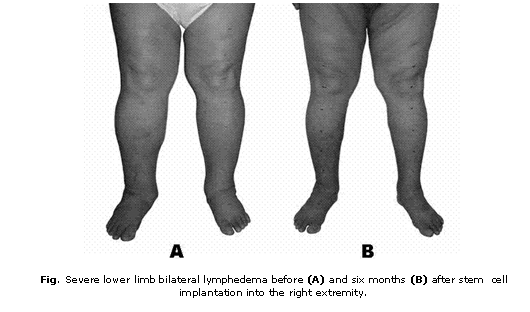
<body><![CDATA[<P><font size="2" face="Verdana">Lymphedema is a chronic condition characterized    by the abnormal accumulation of interstitial fluid due to insufficiency of the    lymphatic system, either as a primary or as a secondary disorder. Although it    is a common disabling disease causing significant morbidity for affected patients,    treatment for this condition remains limited and largely ineffective.<SUP>1</SUP>    </font>     <P><font size="2" face="Verdana">Recently stem-cell based therapy has been the    focus of attention for inducing therapeutic angiogenesis and the therapeutic    potential of adult stem cells in the treatment of peripheral arterial disease    has become increasingly evident during the last years.<SUP>2</SUP> </font>     <P><font size="2" face="Verdana">Some reported data suggest that some bone-marrow    derived cells may play a role in lymphangiogenesis.<SUP>3,4</SUP> It appears    that blood vessels and lymphatic vessels might use the same population of cells    for vasculogenesis and lymphangiogenesis.<SUP>5</SUP> Therefore, adult stem    cell therapy could be a new useful strategy for the treatment of lymphedema.    </font>     <P><font size="2" face="Verdana">Here we report a resolution of a severe lower    limb bilateral lymphedema after implantation of autologous adult stem cells    derived from bone marrow. </font>     <P><font size="2" face="Verdana"><B><font size="3">CASE REPORT </font></B> </font>     <P><font size="2" face="Verdana">A 58 -year -old man was referred to our service    of angiology with severe swelling of both lower extremities. This swelling started    two years earlier after recurrent episodes of lymphangitis. The diagnosis of    lymphedema of the inflammatory type was performed and conservative therapy was    initiated, including compression bandaging. Despite this treatment the swelling    became progressively more severe. This condition limited his walking in a marked    degree and disabled him to go upstairs. </font>     <P><font size="2" face="Verdana">Except the above mentioned lymphangitis episodes,    the patient did not have a noteworthy past medical history. Physical examination    revealed a body weight of 137 kg, a blood pressure of 120/80 mm Hg and severe    lower limb bilateral lymphedema affecting both extremities up to the inguinal    regions (<a href="#fig1">fig. 1A</a>). No other pathological findings were revealed.    The circumferences of his lower extremities were measured 7 cm above the knee,    at the knee, 7cm below the knee, at the ankles and at the metatarsus (<a href="/img/revistas/hih/v26n4/t0111410.gif">table</a>).    </font>     
<P align="center"><a name="fig1"></a><img src="/img/revistas/hih/v26n4/f0111410.gif" width="499" height="340">      
<P><font size="2" face="Verdana">Laboratory findings, including a complete blood    count, sedimentation rate, urinalysis findings, liver function tests and renal    tests were unremarkable. A chest radiograph and an electrocardiogram showed    normal results. A <SUP>99m</SUP>Tc sulphide colloidal lymphoscintigraphy<SUP>6</SUP>    showed absence of flow at both lower extremities. </font>     <P><font size="2" face="Verdana">As patient was considered unresponsive to conservative    therapy, taking into account worsening of swelling in both extremities as well    as serious worsening in quality of life, an autologous transplantation of Granulocyte    Colony-Stimulating Factor (G-CSF) mobilized peripheral blood stem cell (PBSC)    in the most affected extremity was proposed. Scientific and Ethics Committees    of participating institutions approved this treatment and the patient gave written    informed consent. </font>     ]]></body>
<body><![CDATA[<P><font size="2" face="Verdana">For bone marrow mononuclear cell mobilization,    the patient was previously subcutaneously injected with human recombinant G-CSF    (Leuko CIM, CIMAB SA, La Habana, Cuba). The whole procedure, including peripheral    blood collection and mononuclear cell (MNC) concentration adding hidroxyetilstarch    (HES) 6 % to the collected blood, was performed as previously described.<SUP>7</SUP>    A final volume of 140 mL of concentrated cell suspension was obtained. Absolute    MNC count was 8,4 x 10<SUP>9</SUP> and CD34+ absolute stem cell number was 42    x 10<SUP>6</SUP>. Cell viability was 95 %. </font>     <P><font size="2" face="Verdana">Under propofol 1 %, sedation and in sterile conditions    concentrated cells were implanted in the most affected extremity (right limb)    by multiple circumferential injections into the leg and distal half of the thigh.    In addition, cells were also injected into the dorsum of the foot. A volume    of 0,75 mL of the cell suspension was implanted 1-1,5 cm deep into each injection    site with a 3 x 3 cm grid, using a 24 - gauge needle. Total injection volume    was 120 mL. </font>     <P><font size="2" face="Verdana">Slight leakage of fluid from the tissues observed    at the injection sites, disappeared 48 hours after cell implantation. During    this period, compression bandaging was used and there after an elastic stocking    was indicated. No other related side- effect was observed throughout the therapeutic    procedure or within the whole follow-up period. </font>     <P><font size="2" face="Verdana">One week after cell implantation a mild improvement    of foot swelling was appreciated at the treated extremity. Subsequently, progressive    improvement of lymphedema was observed and striking improvement of bilateral    lymphedema was obtained with 19 kg body weight lost during the 6 months following    cell implantation (fig. 1B). Six months after treatment the patient showed reduced    circumferences of both extremities (table). Follow-up lymphoscintigraphy was    not performed because patient did not accept this study. Improvement was sustained    during one and a half year follow-up. </font>     <P>  <B>     <P><font size="3" face="Verdana">DISCUSSION</font></B>      <P><font size="2" face="Verdana">In recent years, much attention has been given    to lymphangiogenesis and new advances in the study of lymphedema have been obtained.<SUP>8</SUP>    </font>     <P><font size="2" face="Verdana">Lymphatic vessels and blood vessels are essential    collaborating parts of the circulatory system. The lymphatic vessels differ    in many ways from the blood vessels, but they also share many properties. Recently,    new information about the regulation of lymphangiogenesis has been gained, and    the factors known to regulate blood vessels have been shown to be involved in    the biology of the lymphatic vessels.<SUP>9</SUP> The development of blood and    lymphatic vascular systems is primarily regulated by vascular endothelial growth    factor (VEGF) family members: VEGF-A, VEGF-B, VEGF-C, VEGF-D and placenta growth    factor.<SUP>10</SUP> It is considered that VEGF-A is the most important of them    for the control of angiogenesis, whereas VEGF-C and VEGF-D are the main factors    that control lymphangiogenesis. </font>     <P><font size="2" face="Verdana">From the clinical point, various therapeutic    procedures have been proposed for selected patients with lymphedema, who are    unresponsive to conservative therapy.<SUP>8,9</SUP> Several surgical options    with promising results have been reported, including lymphatic microsurgery,    autologous lymphatic tissue implants and circumferential suction - assisted    lipectomy.<SUP>8,11-13</SUP> </font>     <P><font size="2" face="Verdana">More recently, based on novel findings on the    molecular mechanisms involved in lymphangiogenesis, encouraging results have    been obtained with VEGF-C gene therapy and with human recombinant VEGF-C in    experimental animal models, which provide attractive procedures for pro-lymphoangiogenic    therapy in lymphedema.<SUP>14,15</SUP> Known similarities between the regulation    of blood and lymphatic vessels, and the preclinical and clinical studies that    have provided evidence that implantation of bone marrow derived cells into ischemic    limbs can improve tissue vascularization, encouraged us to use cell therapy    for the treatment of lymphedema. </font>     ]]></body>
<body><![CDATA[<P><font size="2" face="Verdana">Following autologous mobilized PBSC implantation,    our case showed an astonishing clinical recovery with marked improvement of    bilateral lymphedema, despite the fact that cells were implanted in only one    of the affected extremities. </font>     <P><font size="2" face="Verdana">Up today, the mechanisms through which the transplanted    cells might improve tissue recovery remain unknown. Several hypothesis have    been suggested including transdifferentiation, cell fusion, a paracrine effect    by release of various cytokines and growth factors or maybe an addition of more    than one mechanism.<SUP>5,16,17</SUP> It has been referred that adult human    progenitor cells from bone marrow are potent sources of VEGF.<SUP>17,18</SUP>    On this point, it is important to underline that VEGF-C and VEGF-D are specific    regulators of lymphangiogenesis.<SUP>10</SUP> </font>      <P><font size="2" face="Verdana">It is accepted that hematopoietic cells may release    different growth factors and cytokines and a fraction of CD34+ cells may acts    as lymphatic / vascular endothelial precursors cells.<SUP>2,3</SUP> </font>     <P><font size="2" face="Verdana">There are at least two possibilities that might    explain why G-CSF mobilization plus the transplantation into local affected    tissues of the collected and concentrated PBSCs can result in the excellent    therapeutic improvement obtained. The first is that local injections of G-CSF    mobilized PBSCs into the selected lower extremity directly bring a number of    circulating endothelial precursor cells into affected tissues where these cells    can initiate lymphangiogenesis. The second is that a large number of transplanted    cells can secrete <I>in vivo</I> in the injected sites several cytokines and    grown factors known to stimulate lymphangiogenesis and that may produce a paracrine    effect in a similar way as has been suggested in ischemic diseases.<SUP>17,19</SUP>    Another possible related mechanism is based on the <I>in vivo</I> (endogenous)    availability of a pool of systemic and circulating G-CSF mobilized PBSCs that    might be recruited to the affected tissues, contributing in this way to lymphangiogenesis.    Some of these possibilities may coexist in this therapeutic approach. </font>     <P><font size="2" face="Verdana">By the other side, we were surprised by the fact    that the contralateral, also affected but non-treated, lower limb, also showed    a notable improvement. Although we have not a proved explanation for the mechanisms    involved in this therapy related effect, it could be suggested that endogenous    mobilized PBSCs were recruited to the affected tissues in this limb, as aforementioned,    and in this way they could in principle act similarly to the local exogenous    transplanted cells facilitating the recovery of the swollen tissues inducing    certain degree of lymphangiogenesis. As a pure speculation, this observation    raises also the possibility that the classical inter cellular coordinative communicating    system may be more complex than<FONT  COLOR="#ff0000"> </FONT>previously thought. </font>     <P><font size="2" face="Verdana">In some cases increased serum values of cytokines    and growth factors secreted by the exogenously implanted cells have been detected.<SUP>20</SUP>    Perhaps, a telecrine effect of these circulating soluble products might exist    in certain cases with an action on distant target-cells; this effect might be    in addition to the paracrine effect previously suggested. This possibility would    help to explain in part our result and also others not yet completely explained,    related to improvement of glucose metabolism in diabetic patients who received    mononuclear cell implantation into the lower extremities because of ischemic    disorders.<SUP>21,22</SUP> </font>     <P><font size="2" face="Verdana">As far as we know, this is the first reported    case with chronic lower limb lymphedema treated successfully with autologous    cell therapy. This method of treatment is a low-cost, relatively simple and    easy to perform option that opens new ways for the treatment of lymphedema.    Our observation is supported by the results obtained in a recent controlled    study in patients with breast cancer related arm lymphedema.<SUP>23</SUP> </font>     <P><font size="2" face="Verdana">However, further studies are needed in order    to obtain an accurate evaluation of the efficacy and long term safety of this    novel therapeutic strategy in patients with lymphedema. </font>     <P>      <P>      ]]></body>
<body><![CDATA[<P>      <P><font size="3" face="Verdana"><B>REFERENCES</B> </font>      <!-- ref --><P><font size="2" face="Verdana">1. Yoon YS, Marayama T, Gravereux E, Tkebuchava    T, Silver M, Curry C, et al. VEGF-C gene therapy augments postnatal lymphangiogenesis    and ameliorates secondary lymphedema. J Clin Invest 2003;111:717-25. </font>    <!-- ref --><P><font size="2" face="Verdana">2. Hern&aacute;ndez P, Cortina L, Artaza H, Pol      N, Lam RM, Dortic&oacute;s E, et al. Autologous bone-marrow mononuclear cell      implantation in patients with severe lower limb ischaemia: A comparison of using      blood cell separator and Ficoll density gradient centrifugation. Atherosclerosis      2007;194:e52-6. </font>    <!-- ref --><P><font size="2" face="Verdana">3. Rafii S, Lyden D. Therapeutic stem and progenitor    cell transplantation for organ vascularization and regeneration. Nat Med 2003;9:702-12.    </font>    <!-- ref --><P><font size="2" face="Verdana">4. Salven P, Mustjoki S, Alitalo R, Alitalo K,    Raffi S. VEGFR-3 and CD 133 identify a population of CD 34+ lymphatic/vascular    endothelial precursor cells. Blood 2003;101:168-72. </font>    <!-- ref --><P><font size="2" face="Verdana">5. Religa P, Cao R, Biorndahl M, Zhou Z, Zhu    Z, Cao Y, et al. Presence of bone marrow-derived circulating progenitor endothelial    cells in the newly formed lymphatic vessels. Blood 2005;106:4184-90. </font>    <!-- ref --><P><font size="2" face="Verdana">6. Lee AF. Lymphoscintigraphy of the extremities.    In: O&#180;Connor MK, editor. The Mayo Clinical Manual of Nuclear Medicine.    New York: Churchill Livingstone; 1996. pp. 513-9. </font>    <!-- ref --><P><font size="2" face="Verdana">7. Hern&aacute;ndez P, Artaza H, D&iacute;az    AJ, Cortina LD, Lam RM, Pol N, et al. Autotrasplante de c&eacute;lulas madre    adultas en miembros inferiores con isquemia cr&iacute;tica. Experiencia en Cuba.    Rev Esp Invest Quir&uacute;rg 2007;10:204-11. </font>    <!-- ref --><P><font size="2" face="Verdana">8. Warren AG, Brorson H, Borud LJ, Slavin SA.    Lymphedema: A comprehensive review. Ann Plast Surg 2007;59:464-72. </font>    <!-- ref --><P><font size="2" face="Verdana">9. Jussila L, Alitalo K. Vascular growth factors    and lymphangiogenesis. Physiol Rev 2002;8:673-700. </font>    <!-- ref --><P><font size="2" face="Verdana">10. Sato Y. VEGFR1 for lymphangiogenesis arterioscler.    Tromb Vasc Biol 2008;28:604-5. </font>    <!-- ref --><P><font size="2" face="Verdana">11. Campisi D, Davini D, Bellini C, Taddei G,    Villa G, Fulcheri E, et al. Lymphatic microsurgery for the treatment of lymphedema.    Microsurgery 2006;26:65-9. </font>    <!-- ref --><P><font size="2" face="Verdana">12. Campisi C, Da Rin E, Bellini C, Bonioli E,    Boccardo F. Pediatric lymphedema and correlated syndromes: Rle of microsurgery.    Microsurgery 2008;28:138-42. </font>    <!-- ref --><P><font size="2" face="Verdana">13. Belcaro G, Errichi BM, Cesarone MR, Ippolito    E, Dugall M, Ledda A, et al. Lymphatic tissue transplant in lymphedema a minimally    invasive, out patient, surgical method: a 10-year follow-up pilot study. Angiology    2008;59:77-83. </font>    <!-- ref --><P><font size="2" face="Verdana">14. Cao R, Eriksson A, Kubo H, Alitalo K, Cao    Y, Thyberg J. Comparative evaluation of FGF-2, VEGF-A, and VEGF-C induced angiogenesis,    lymphangiogenesis, vascular fenestrations, and permeability. Circ Res 2004;95:664-70.    </font>    <!-- ref --><P><font size="2" face="Verdana">15. Lohela M, Saaristo A, Veikkola T, Alitalo    K. Lymphangiogenic growth factors, receptors and therapies. Thromb Haemost 2003;90:167-84.    </font>    <!-- ref --><P><font size="2" face="Verdana">16. K&ouml;rbling M, de Lima MJ, Thomas E, Khanna    A, Najjar AM, Gu J, et al. Fusion of circulating blood cells with solid organ    tissue cells in clinical stem cell transplant: A potential therapeutic model?    Reg Med 2008;3:157-64. </font>    <!-- ref --><P><font size="2" face="Verdana">17. M&eacute;ndez-Otero R, de Freitas GR, Andre    C, Furtado de Mendo&ccedil;a ML, Friedrich M, Oliveira-Filho J. Potential roles    of bone marrow stem cells in stroke therapy. Regen Med 2007;2:417-23. </font>    <!-- ref --><P><font size="2" face="Verdana">18. Wang M, Crisotomo PR, Herring C, Meldrum    KK, Meldrum DR. Human progenitor cells from bone marrow or adipose tissue produce    VEGF, HGF, and IGF-I in response to TNF by a p38 MAPK-dependent mechanism. Am    J Physiol Regul Integr Comp Physiol 2006;291:880-4. </font>    <!-- ref --><P><font size="2" face="Verdana">19. De Araujo JD, de Araujo Filho JD, Ciorlin    E, Ruiz MA, Ruiz LP, Greco OT, et al. A terapia celular no tratamento da isquemia    cr&iacute;tica dos miembros inferiores. J Vas Bras 2005;4:357-65. </font>    <!-- ref --><P><font size="2" face="Verdana">20. Tachi Y, Fukui D, Wada Y, Koshikawa M, Shimodaira    S, Ikeda U, et al. Changes in angiogenesis related factors in serum following    autologous bone marrow cell implantation for severe limb ischemia. Exp Opin    Biol Ther 2008;8:705-12. </font>    <!-- ref --><P><font size="2" face="Verdana">21. Huang P, Li S, Han M, Xiao Z, Yang R, Han    ZC. Autologous transplantation of granulocyte colony-stimulating factor - mobilized    peripheral blood mononuclear cells improves critical limb ischemia in diabetes.    Diabetes Care 2005;28:2155-60. </font>    <!-- ref --><P><font size="2" face="Verdana">22. Novoa E, Medina A. Therapeutic angiogenesis    in arterial ischaemic limbs by autologous bone marrow transplantation (ABMT).    The Conzi&#180;s effect in human diabetes mellitus. Arch Med Int (Uruguay) 2007;29(Suppl    1):S24-S25. </font>    <!-- ref --><P><font size="2" face="Verdana">23. Hou C, Wu X, Jin X. Autologous bone marrow    stromal cells transplantation for the treatment of secondary arm lymphedema:    A prospective controlled study in patients with breast cancer related lymphedema.    Jpn J Clin Oncol 2008;38:670-4.</font>    <P>     <P>     <P>     <P>      <P>      ]]></body>
<body><![CDATA[<P>      <P>      <P><font size="2" face="Verdana">Recibido: 8 de junio del 2010.    <br>   </font><font size="2" face="Verdana">Aprobado: 25 de junio dle 2010.</font>      <P>     <P>      <P>     <P>     <P>      <P>      ]]></body>
<body><![CDATA[<P>     <P><font size="2" face="Verdana">Prof. DrC. <I>Porfirio Hern&aacute;ndez Ram&iacute;rez</I>.    Instituto de Hematolog&iacute;a e Inmunolog&iacute;a. Apartado 8070, CP 10800,    Ciudad de La Habana, Cuba. Tel (537) 643 8695, 8268. Fax (537) 644 2334. E-mail:    <U><a href="mailto:ihidir@hemato.sld.cu">ihidir@hemato.sld.cu</a></U>    <br>   </font><font size="2" face="Verdana"> </font>       ]]></body><back>
<ref-list>
<ref id="B1">
<label>1</label><nlm-citation citation-type="journal">
<person-group person-group-type="author">
<name>
<surname><![CDATA[Yoon]]></surname>
<given-names><![CDATA[YS]]></given-names>
</name>
<name>
<surname><![CDATA[Marayama]]></surname>
<given-names><![CDATA[T]]></given-names>
</name>
<name>
<surname><![CDATA[Gravereux]]></surname>
<given-names><![CDATA[E]]></given-names>
</name>
<name>
<surname><![CDATA[Tkebuchava]]></surname>
<given-names><![CDATA[T]]></given-names>
</name>
<name>
<surname><![CDATA[Silver]]></surname>
<given-names><![CDATA[M]]></given-names>
</name>
<name>
<surname><![CDATA[Curry]]></surname>
<given-names><![CDATA[C]]></given-names>
</name>
</person-group>
<article-title xml:lang="en"><![CDATA[VEGF-C gene therapy augments postnatal lymphangiogenesis and ameliorates secondary lymphedema]]></article-title>
<source><![CDATA[J Clin Invest]]></source>
<year>2003</year>
<volume>111</volume>
<page-range>717-25</page-range></nlm-citation>
</ref>
<ref id="B2">
<label>2</label><nlm-citation citation-type="journal">
<person-group person-group-type="author">
<name>
<surname><![CDATA[Hernández]]></surname>
<given-names><![CDATA[P]]></given-names>
</name>
<name>
<surname><![CDATA[Cortina]]></surname>
<given-names><![CDATA[L]]></given-names>
</name>
<name>
<surname><![CDATA[Artaza]]></surname>
<given-names><![CDATA[H]]></given-names>
</name>
<name>
<surname><![CDATA[Pol]]></surname>
<given-names><![CDATA[N]]></given-names>
</name>
<name>
<surname><![CDATA[Lam]]></surname>
<given-names><![CDATA[RM]]></given-names>
</name>
<name>
<surname><![CDATA[Dorticós]]></surname>
<given-names><![CDATA[E]]></given-names>
</name>
</person-group>
<article-title xml:lang="en"><![CDATA[Autologous bone-marrow mononuclear cell implantation in patients with severe lower limb ischaemia: A comparison of using blood cell separator and Ficoll density gradient centrifugation]]></article-title>
<source><![CDATA[Atherosclerosis]]></source>
<year>2007</year>
<volume>194</volume>
<page-range>e52-6</page-range></nlm-citation>
</ref>
<ref id="B3">
<label>3</label><nlm-citation citation-type="journal">
<person-group person-group-type="author">
<name>
<surname><![CDATA[Rafii]]></surname>
<given-names><![CDATA[S]]></given-names>
</name>
<name>
<surname><![CDATA[Lyden]]></surname>
<given-names><![CDATA[D]]></given-names>
</name>
</person-group>
<article-title xml:lang="en"><![CDATA[Therapeutic stem and progenitor cell transplantation for organ vascularization and regeneration]]></article-title>
<source><![CDATA[Nat Med]]></source>
<year>2003</year>
<volume>9</volume>
<page-range>702-12</page-range></nlm-citation>
</ref>
<ref id="B4">
<label>4</label><nlm-citation citation-type="journal">
<person-group person-group-type="author">
<name>
<surname><![CDATA[Salven]]></surname>
<given-names><![CDATA[P]]></given-names>
</name>
<name>
<surname><![CDATA[Mustjoki]]></surname>
<given-names><![CDATA[S]]></given-names>
</name>
<name>
<surname><![CDATA[Alitalo]]></surname>
<given-names><![CDATA[R]]></given-names>
</name>
<name>
<surname><![CDATA[Alitalo]]></surname>
<given-names><![CDATA[K]]></given-names>
</name>
<name>
<surname><![CDATA[Raffi]]></surname>
<given-names><![CDATA[S]]></given-names>
</name>
</person-group>
<article-title xml:lang="en"><![CDATA[VEGFR-3 and CD 133 identify a population of CD 34+ lymphatic/vascular endothelial precursor cells]]></article-title>
<source><![CDATA[Blood]]></source>
<year>2003</year>
<volume>101</volume>
<page-range>168-72</page-range></nlm-citation>
</ref>
<ref id="B5">
<label>5</label><nlm-citation citation-type="journal">
<person-group person-group-type="author">
<name>
<surname><![CDATA[Religa]]></surname>
<given-names><![CDATA[P]]></given-names>
</name>
<name>
<surname><![CDATA[Cao]]></surname>
<given-names><![CDATA[R]]></given-names>
</name>
<name>
<surname><![CDATA[Biorndahl]]></surname>
<given-names><![CDATA[M]]></given-names>
</name>
<name>
<surname><![CDATA[Zhou]]></surname>
<given-names><![CDATA[Z]]></given-names>
</name>
<name>
<surname><![CDATA[Zhu]]></surname>
<given-names><![CDATA[Z]]></given-names>
</name>
<name>
<surname><![CDATA[Cao]]></surname>
<given-names><![CDATA[Y]]></given-names>
</name>
</person-group>
<article-title xml:lang="en"><![CDATA[Presence of bone marrow-derived circulating progenitor endothelial cells in the newly formed lymphatic vessels]]></article-title>
<source><![CDATA[Blood]]></source>
<year>2005</year>
<volume>106</volume>
<page-range>4184-90</page-range></nlm-citation>
</ref>
<ref id="B6">
<label>6</label><nlm-citation citation-type="book">
<person-group person-group-type="author">
<name>
<surname><![CDATA[Lee]]></surname>
<given-names><![CDATA[AF.]]></given-names>
</name>
</person-group>
<article-title xml:lang="en"><![CDATA[Lymphoscintigraphy of the extremities.]]></article-title>
<person-group person-group-type="editor">
<name>
<surname><![CDATA[O´Connor]]></surname>
<given-names><![CDATA[MK]]></given-names>
</name>
</person-group>
<source><![CDATA[The Mayo Clinical Manual of Nuclear Medicine.]]></source>
<year>1996</year>
<page-range>pp. 513-9</page-range><publisher-loc><![CDATA[New York ]]></publisher-loc>
<publisher-name><![CDATA[Churchill Livingstone]]></publisher-name>
</nlm-citation>
</ref>
<ref id="B7">
<label>7</label><nlm-citation citation-type="journal">
<person-group person-group-type="author">
<name>
<surname><![CDATA[Hernández]]></surname>
<given-names><![CDATA[P]]></given-names>
</name>
<name>
<surname><![CDATA[Artaza]]></surname>
<given-names><![CDATA[H]]></given-names>
</name>
<name>
<surname><![CDATA[Díaz]]></surname>
<given-names><![CDATA[AJ]]></given-names>
</name>
<name>
<surname><![CDATA[Cortina]]></surname>
<given-names><![CDATA[LD]]></given-names>
</name>
<name>
<surname><![CDATA[Lam]]></surname>
<given-names><![CDATA[RM]]></given-names>
</name>
<name>
<surname><![CDATA[Pol]]></surname>
<given-names><![CDATA[N]]></given-names>
</name>
</person-group>
<article-title xml:lang="es"><![CDATA[Autotrasplante de células madre adultas en miembros inferiores con isquemia crítica: Experiencia en Cuba]]></article-title>
<source><![CDATA[Rev Esp Invest Quirúrg]]></source>
<year>2007</year>
<volume>10</volume>
<page-range>204-11</page-range></nlm-citation>
</ref>
<ref id="B8">
<label>8</label><nlm-citation citation-type="journal">
<person-group person-group-type="author">
<name>
<surname><![CDATA[Warren]]></surname>
<given-names><![CDATA[AG]]></given-names>
</name>
<name>
<surname><![CDATA[Brorson]]></surname>
<given-names><![CDATA[H]]></given-names>
</name>
<name>
<surname><![CDATA[Borud]]></surname>
<given-names><![CDATA[LJ]]></given-names>
</name>
<name>
<surname><![CDATA[Slavin]]></surname>
<given-names><![CDATA[SA]]></given-names>
</name>
</person-group>
<article-title xml:lang="en"><![CDATA[Lymphedema: A comprehensive review]]></article-title>
<source><![CDATA[Ann Plast Surg]]></source>
<year>2007</year>
<volume>59</volume>
<page-range>464-72</page-range></nlm-citation>
</ref>
<ref id="B9">
<label>9</label><nlm-citation citation-type="journal">
<person-group person-group-type="author">
<name>
<surname><![CDATA[Jussila]]></surname>
<given-names><![CDATA[L]]></given-names>
</name>
<name>
<surname><![CDATA[Alitalo]]></surname>
<given-names><![CDATA[K]]></given-names>
</name>
</person-group>
<article-title xml:lang="en"><![CDATA[Vascular growth factors and lymphangiogenesis]]></article-title>
<source><![CDATA[Physiol Rev]]></source>
<year>2002</year>
<volume>8</volume>
<page-range>673-700</page-range></nlm-citation>
</ref>
<ref id="B10">
<label>10</label><nlm-citation citation-type="journal">
<person-group person-group-type="author">
<name>
<surname><![CDATA[Sato]]></surname>
<given-names><![CDATA[Y]]></given-names>
</name>
</person-group>
<article-title xml:lang="en"><![CDATA[VEGFR1 for lymphangiogenesis arterioscler]]></article-title>
<source><![CDATA[Tromb Vasc Biol]]></source>
<year>2008</year>
<volume>28</volume>
<page-range>604-5</page-range></nlm-citation>
</ref>
<ref id="B11">
<label>11</label><nlm-citation citation-type="journal">
<person-group person-group-type="author">
<name>
<surname><![CDATA[Campisi]]></surname>
<given-names><![CDATA[D]]></given-names>
</name>
<name>
<surname><![CDATA[Davini]]></surname>
<given-names><![CDATA[D]]></given-names>
</name>
<name>
<surname><![CDATA[Bellini]]></surname>
<given-names><![CDATA[C]]></given-names>
</name>
<name>
<surname><![CDATA[Taddei]]></surname>
<given-names><![CDATA[G]]></given-names>
</name>
<name>
<surname><![CDATA[Villa]]></surname>
<given-names><![CDATA[G]]></given-names>
</name>
<name>
<surname><![CDATA[Fulcheri]]></surname>
<given-names><![CDATA[E]]></given-names>
</name>
</person-group>
<article-title xml:lang="en"><![CDATA[Lymphatic microsurgery for the treatment of lymphedema]]></article-title>
<source><![CDATA[Microsurgery]]></source>
<year>2006</year>
<volume>26</volume>
<page-range>65-9</page-range></nlm-citation>
</ref>
<ref id="B12">
<label>12</label><nlm-citation citation-type="journal">
<person-group person-group-type="author">
<name>
<surname><![CDATA[Campisi]]></surname>
<given-names><![CDATA[C]]></given-names>
</name>
<name>
<surname><![CDATA[Da Rin]]></surname>
<given-names><![CDATA[E]]></given-names>
</name>
<name>
<surname><![CDATA[Bellini]]></surname>
<given-names><![CDATA[C]]></given-names>
</name>
<name>
<surname><![CDATA[Bonioli]]></surname>
<given-names><![CDATA[E]]></given-names>
</name>
<name>
<surname><![CDATA[Boccardo]]></surname>
<given-names><![CDATA[F]]></given-names>
</name>
</person-group>
<article-title xml:lang="en"><![CDATA[Pediatric lymphedema and correlated syndromes: Rle of microsurgery]]></article-title>
<source><![CDATA[Microsurgery]]></source>
<year>2008</year>
<volume>28</volume>
<page-range>138-42</page-range></nlm-citation>
</ref>
<ref id="B13">
<label>13</label><nlm-citation citation-type="journal">
<person-group person-group-type="author">
<name>
<surname><![CDATA[Belcaro]]></surname>
<given-names><![CDATA[G]]></given-names>
</name>
<name>
<surname><![CDATA[Errichi]]></surname>
<given-names><![CDATA[BM]]></given-names>
</name>
<name>
<surname><![CDATA[Cesarone]]></surname>
<given-names><![CDATA[MR]]></given-names>
</name>
<name>
<surname><![CDATA[Ippolito]]></surname>
<given-names><![CDATA[E]]></given-names>
</name>
<name>
<surname><![CDATA[Dugall]]></surname>
<given-names><![CDATA[M]]></given-names>
</name>
<name>
<surname><![CDATA[Ledda]]></surname>
<given-names><![CDATA[A]]></given-names>
</name>
</person-group>
<article-title xml:lang="en"><![CDATA[Lymphatic tissue transplant in lymphedema a minimally invasive, out patient, surgical method: a 10-year follow-up pilot study]]></article-title>
<source><![CDATA[Angiology]]></source>
<year>2008</year>
<volume>59</volume>
<page-range>77-83</page-range></nlm-citation>
</ref>
<ref id="B14">
<label>14</label><nlm-citation citation-type="journal">
<person-group person-group-type="author">
<name>
<surname><![CDATA[Cao]]></surname>
<given-names><![CDATA[R]]></given-names>
</name>
<name>
<surname><![CDATA[Eriksson]]></surname>
<given-names><![CDATA[A]]></given-names>
</name>
<name>
<surname><![CDATA[Kubo]]></surname>
<given-names><![CDATA[H]]></given-names>
</name>
<name>
<surname><![CDATA[Alitalo]]></surname>
<given-names><![CDATA[K]]></given-names>
</name>
<name>
<surname><![CDATA[Cao]]></surname>
<given-names><![CDATA[Y]]></given-names>
</name>
<name>
<surname><![CDATA[Thyberg]]></surname>
<given-names><![CDATA[J]]></given-names>
</name>
</person-group>
<article-title xml:lang="en"><![CDATA[Comparative evaluation of FGF-2, VEGF-A, and VEGF-C induced angiogenesis, lymphangiogenesis, vascular fenestrations, and permeability]]></article-title>
<source><![CDATA[Circ Res]]></source>
<year>2004</year>
<volume>95</volume>
<page-range>664-70</page-range></nlm-citation>
</ref>
<ref id="B15">
<label>15</label><nlm-citation citation-type="journal">
<person-group person-group-type="author">
<name>
<surname><![CDATA[Lohela]]></surname>
<given-names><![CDATA[M]]></given-names>
</name>
<name>
<surname><![CDATA[Saaristo]]></surname>
<given-names><![CDATA[A]]></given-names>
</name>
<name>
<surname><![CDATA[Veikkola]]></surname>
<given-names><![CDATA[T]]></given-names>
</name>
<name>
<surname><![CDATA[Alitalo]]></surname>
<given-names><![CDATA[K]]></given-names>
</name>
</person-group>
<article-title xml:lang="en"><![CDATA[Lymphangiogenic growth factors, receptors and therapies]]></article-title>
<source><![CDATA[Thromb Haemost]]></source>
<year>2003</year>
<volume>90</volume>
<page-range>167-84</page-range></nlm-citation>
</ref>
<ref id="B16">
<label>16</label><nlm-citation citation-type="journal">
<person-group person-group-type="author">
<name>
<surname><![CDATA[Körbling]]></surname>
<given-names><![CDATA[M]]></given-names>
</name>
<name>
<surname><![CDATA[de Lima]]></surname>
<given-names><![CDATA[MJ]]></given-names>
</name>
<name>
<surname><![CDATA[Thomas]]></surname>
<given-names><![CDATA[E]]></given-names>
</name>
<name>
<surname><![CDATA[Khanna]]></surname>
<given-names><![CDATA[A]]></given-names>
</name>
<name>
<surname><![CDATA[Najjar]]></surname>
<given-names><![CDATA[AM]]></given-names>
</name>
<name>
<surname><![CDATA[Gu]]></surname>
<given-names><![CDATA[J]]></given-names>
</name>
</person-group>
<article-title xml:lang="en"><![CDATA[Fusion of circulating blood cells with solid organ tissue cells in clinical stem cell transplant: A potential therapeutic model]]></article-title>
<source><![CDATA[Reg Med]]></source>
<year>2008</year>
<volume>3</volume>
<page-range>157-64</page-range></nlm-citation>
</ref>
<ref id="B17">
<label>17</label><nlm-citation citation-type="journal">
<person-group person-group-type="author">
<name>
<surname><![CDATA[Méndez-Otero]]></surname>
<given-names><![CDATA[R]]></given-names>
</name>
<name>
<surname><![CDATA[de Freitas]]></surname>
<given-names><![CDATA[GR]]></given-names>
</name>
<name>
<surname><![CDATA[Andre]]></surname>
<given-names><![CDATA[C]]></given-names>
</name>
<name>
<surname><![CDATA[Furtado de Mendoça]]></surname>
<given-names><![CDATA[ML]]></given-names>
</name>
<name>
<surname><![CDATA[Friedrich]]></surname>
<given-names><![CDATA[M]]></given-names>
</name>
<name>
<surname><![CDATA[Oliveira-Filho]]></surname>
<given-names><![CDATA[J.]]></given-names>
</name>
</person-group>
<article-title xml:lang="en"><![CDATA[Potential roles of bone marrow stem cells in stroke therapy]]></article-title>
<source><![CDATA[Regen Med]]></source>
<year>2007</year>
<volume>2</volume>
<page-range>417-23</page-range></nlm-citation>
</ref>
<ref id="B18">
<label>18</label><nlm-citation citation-type="journal">
<person-group person-group-type="author">
<name>
<surname><![CDATA[Wang]]></surname>
<given-names><![CDATA[M]]></given-names>
</name>
<name>
<surname><![CDATA[Crisotomo]]></surname>
<given-names><![CDATA[PR]]></given-names>
</name>
<name>
<surname><![CDATA[Herring]]></surname>
<given-names><![CDATA[C]]></given-names>
</name>
<name>
<surname><![CDATA[Meldrum]]></surname>
<given-names><![CDATA[KK]]></given-names>
</name>
<name>
<surname><![CDATA[Meldrum]]></surname>
<given-names><![CDATA[DR.]]></given-names>
</name>
</person-group>
<article-title xml:lang="en"><![CDATA[Human progenitor cells from bone marrow or adipose tissue produce VEGF, HGF, and IGF-I in response to TNF by a p38 MAPK-dependent mechanism.]]></article-title>
<source><![CDATA[Am J Physiol Regul Integr Comp Physiol]]></source>
<year>2006</year>
<volume>291</volume>
<page-range>880-4</page-range></nlm-citation>
</ref>
<ref id="B19">
<label>19</label><nlm-citation citation-type="journal">
<person-group person-group-type="author">
<name>
<surname><![CDATA[De Araujo]]></surname>
<given-names><![CDATA[JD]]></given-names>
</name>
<name>
<surname><![CDATA[de Araujo Filho]]></surname>
<given-names><![CDATA[JD]]></given-names>
</name>
<name>
<surname><![CDATA[Ciorlin]]></surname>
<given-names><![CDATA[E]]></given-names>
</name>
<name>
<surname><![CDATA[Ruiz]]></surname>
<given-names><![CDATA[MA]]></given-names>
</name>
<name>
<surname><![CDATA[Ruiz]]></surname>
<given-names><![CDATA[LP]]></given-names>
</name>
<name>
<surname><![CDATA[Greco]]></surname>
<given-names><![CDATA[OT]]></given-names>
</name>
</person-group>
<article-title xml:lang="es"><![CDATA[A terapia celular no tratamento da isquemia crítica dos miembros inferiores.]]></article-title>
<source><![CDATA[J Vas Bras]]></source>
<year>2005</year>
<volume>4</volume>
<page-range>357-65</page-range></nlm-citation>
</ref>
<ref id="B20">
<label>20</label><nlm-citation citation-type="journal">
<person-group person-group-type="author">
<name>
<surname><![CDATA[Tachi]]></surname>
<given-names><![CDATA[Y]]></given-names>
</name>
<name>
<surname><![CDATA[Fukui]]></surname>
<given-names><![CDATA[D]]></given-names>
</name>
<name>
<surname><![CDATA[Wada]]></surname>
<given-names><![CDATA[Y]]></given-names>
</name>
<name>
<surname><![CDATA[Koshikawa]]></surname>
<given-names><![CDATA[M]]></given-names>
</name>
<name>
<surname><![CDATA[Shimodaira]]></surname>
<given-names><![CDATA[S]]></given-names>
</name>
<name>
<surname><![CDATA[Ikeda]]></surname>
<given-names><![CDATA[U]]></given-names>
</name>
</person-group>
<article-title xml:lang="en"><![CDATA[Changes in angiogenesis related factors in serum following autologous bone marrow cell implantation for severe limb ischemia]]></article-title>
<source><![CDATA[Exp Opin Biol Ther]]></source>
<year>2008</year>
<volume>8</volume>
<page-range>705-12</page-range></nlm-citation>
</ref>
<ref id="B21">
<label>21</label><nlm-citation citation-type="journal">
<person-group person-group-type="author">
<name>
<surname><![CDATA[Huang]]></surname>
<given-names><![CDATA[P]]></given-names>
</name>
<name>
<surname><![CDATA[Li]]></surname>
<given-names><![CDATA[S]]></given-names>
</name>
<name>
<surname><![CDATA[Han]]></surname>
<given-names><![CDATA[M]]></given-names>
</name>
<name>
<surname><![CDATA[Xiao]]></surname>
<given-names><![CDATA[Z]]></given-names>
</name>
<name>
<surname><![CDATA[Yang]]></surname>
<given-names><![CDATA[R]]></given-names>
</name>
<name>
<surname><![CDATA[Han]]></surname>
<given-names><![CDATA[ZC]]></given-names>
</name>
</person-group>
<article-title xml:lang="en"><![CDATA[Autologous transplantation of granulocyte colony-stimulating factor - mobilized peripheral blood mononuclear cells improves critical limb ischemia in diabetes]]></article-title>
<source><![CDATA[Diabetes Care]]></source>
<year>2005</year>
<volume>28</volume>
<page-range>2155-60</page-range></nlm-citation>
</ref>
<ref id="B22">
<label>22</label><nlm-citation citation-type="journal">
<person-group person-group-type="author">
<name>
<surname><![CDATA[Novoa]]></surname>
<given-names><![CDATA[E]]></given-names>
</name>
<name>
<surname><![CDATA[Medina]]></surname>
<given-names><![CDATA[A.]]></given-names>
</name>
</person-group>
<article-title xml:lang="en"><![CDATA[Therapeutic angiogenesis in arterial ischaemic limbs by autologous bone marrow transplantation (ABMT).: The Conzi´s effect in human diabetes mellitus.]]></article-title>
<source><![CDATA[Arch Med Int (Uruguay)]]></source>
<year>2007</year>
<volume>29</volume>
<numero>Suppl 1</numero>
<issue>Suppl 1</issue>
<page-range>S24-S25</page-range></nlm-citation>
</ref>
<ref id="B23">
<label>23</label><nlm-citation citation-type="journal">
<person-group person-group-type="author">
<name>
<surname><![CDATA[Hou]]></surname>
<given-names><![CDATA[C]]></given-names>
</name>
<name>
<surname><![CDATA[Wu]]></surname>
<given-names><![CDATA[X]]></given-names>
</name>
<name>
<surname><![CDATA[Jin]]></surname>
<given-names><![CDATA[X]]></given-names>
</name>
</person-group>
<article-title xml:lang="en"><![CDATA[Autologous bone marrow stromal cells transplantation for the treatment of secondary arm lymphedema: A prospective controlled study in patients with breast cancer related lymphedema]]></article-title>
<source><![CDATA[Jpn J Clin Oncol]]></source>
<year>2008</year>
<volume>38</volume>
<page-range>670-4</page-range></nlm-citation>
</ref>
</ref-list>
</back>
</article>
