<?xml version="1.0" encoding="ISO-8859-1"?><article xmlns:mml="http://www.w3.org/1998/Math/MathML" xmlns:xlink="http://www.w3.org/1999/xlink" xmlns:xsi="http://www.w3.org/2001/XMLSchema-instance">
<front>
<journal-meta>
<journal-id>0864-0289</journal-id>
<journal-title><![CDATA[Revista Cubana de Hematología, Inmunología y Hemoterapia]]></journal-title>
<abbrev-journal-title><![CDATA[Rev Cubana Hematol Inmunol Hemoter]]></abbrev-journal-title>
<issn>0864-0289</issn>
<publisher>
<publisher-name><![CDATA[Centro Nacional de Información de Ciencias MédicasEditorial Ciencias Médicas]]></publisher-name>
</publisher>
</journal-meta>
<article-meta>
<article-id>S0864-02892014000200008</article-id>
<title-group>
<article-title xml:lang="en"><![CDATA[Prevalence of hemophilia in six cuban provinces]]></article-title>
<article-title xml:lang="es"><![CDATA[Prevalencia de hemofilia en seis provincias cubanas]]></article-title>
</title-group>
<contrib-group>
<contrib contrib-type="author">
<name>
<surname><![CDATA[Castillo-González]]></surname>
<given-names><![CDATA[Dunia]]></given-names>
</name>
<xref ref-type="aff" rid="A01"/>
</contrib>
<contrib contrib-type="author">
<name>
<surname><![CDATA[Lardoeyt-Ferrer]]></surname>
<given-names><![CDATA[Roberto]]></given-names>
</name>
<xref ref-type="aff" rid="A02"/>
</contrib>
<contrib contrib-type="author">
<name>
<surname><![CDATA[Almagro-Vázquez]]></surname>
<given-names><![CDATA[Delfina]]></given-names>
</name>
<xref ref-type="aff" rid="A01"/>
</contrib>
<contrib contrib-type="author">
<name>
<surname><![CDATA[Lam-Díaz]]></surname>
<given-names><![CDATA[Rosa M]]></given-names>
</name>
<xref ref-type="aff" rid="A01"/>
</contrib>
<contrib contrib-type="author">
<name>
<surname><![CDATA[Lavaut-Sánchez]]></surname>
<given-names><![CDATA[Kalia]]></given-names>
</name>
<xref ref-type="aff" rid="A01"/>
</contrib>
<contrib contrib-type="author">
<name>
<surname><![CDATA[Gutiérrez-Díaz]]></surname>
<given-names><![CDATA[Adys]]></given-names>
</name>
<xref ref-type="aff" rid="A01"/>
</contrib>
<contrib contrib-type="author">
<name>
<surname><![CDATA[Campo-Díaz]]></surname>
<given-names><![CDATA[Mirtha]]></given-names>
</name>
<xref ref-type="aff" rid="A03"/>
</contrib>
<contrib contrib-type="author">
<name>
<surname><![CDATA[Álvarez-Vega]]></surname>
<given-names><![CDATA[Nereyda]]></given-names>
</name>
<xref ref-type="aff" rid="A04"/>
</contrib>
<contrib contrib-type="author">
<name>
<surname><![CDATA[Salinas-González]]></surname>
<given-names><![CDATA[Jorge L]]></given-names>
</name>
<xref ref-type="aff" rid="A05"/>
</contrib>
<contrib contrib-type="author">
<name>
<surname><![CDATA[Fernández-Águila]]></surname>
<given-names><![CDATA[Julio D]]></given-names>
</name>
<xref ref-type="aff" rid="A06"/>
</contrib>
<contrib contrib-type="author">
<name>
<surname><![CDATA[Agramonte-Llanes]]></surname>
<given-names><![CDATA[Olga]]></given-names>
</name>
<xref ref-type="aff" rid="A01"/>
</contrib>
</contrib-group>
<aff id="A01">
<institution><![CDATA[,Instituto de Hematología e Inmunología  ]]></institution>
<addr-line><![CDATA[La Habana ]]></addr-line>
<country>Cuba</country>
</aff>
<aff id="A02">
<institution><![CDATA[,Centro Nacional de Genética Médica  ]]></institution>
<addr-line><![CDATA[La Habana ]]></addr-line>
<country>Cuba</country>
</aff>
<aff id="A03">
<institution><![CDATA[,Hospital Pediátrico Universitario Pepe Portilla  ]]></institution>
<addr-line><![CDATA[Pinar del Río ]]></addr-line>
<country>Cuba</country>
</aff>
<aff id="A04">
<institution><![CDATA[,Hospital Universitario Clínico Quirúrgico Faustino Pérez  ]]></institution>
<addr-line><![CDATA[Matanzas ]]></addr-line>
<country>Cuba</country>
</aff>
<aff id="A05">
<institution><![CDATA[,Facultad de Medicina Enrique Cabrera  ]]></institution>
<addr-line><![CDATA[La Habana ]]></addr-line>
<country>Cuba</country>
</aff>
<aff id="A06">
<institution><![CDATA[,Hospital General Universitario Gustavo Aldereguía  ]]></institution>
<addr-line><![CDATA[Cienfuegos ]]></addr-line>
<country>Cuba</country>
</aff>
<pub-date pub-type="pub">
<day>00</day>
<month>06</month>
<year>2014</year>
</pub-date>
<pub-date pub-type="epub">
<day>00</day>
<month>06</month>
<year>2014</year>
</pub-date>
<volume>30</volume>
<numero>2</numero>
<fpage>155</fpage>
<lpage>161</lpage>
<copyright-statement/>
<copyright-year/>
<self-uri xlink:href="http://scielo.sld.cu/scielo.php?script=sci_arttext&amp;pid=S0864-02892014000200008&amp;lng=en&amp;nrm=iso"></self-uri><self-uri xlink:href="http://scielo.sld.cu/scielo.php?script=sci_abstract&amp;pid=S0864-02892014000200008&amp;lng=en&amp;nrm=iso"></self-uri><self-uri xlink:href="http://scielo.sld.cu/scielo.php?script=sci_pdf&amp;pid=S0864-02892014000200008&amp;lng=en&amp;nrm=iso"></self-uri><abstract abstract-type="short" xml:lang="en"><p><![CDATA[Introduction: hemophilia is an inherited bleeding disorder; its incidence is almost constant in different populations. Since the 80th decade a multidisciplinary group for the care of patients with hemophilia was created at the Instituto de Hematología e Inmunología. Nowadays a national comprehensive care program allows patients to receive a continuous monitoring and an effective treatment. Objective: to know prevalence of patients with hemophilia in Cuba. Results: data of 229 patients from 5 provinces and the special municipality Isla de la Juventud were included, which covered 58,71% of the total patients registered in Cuba. The information included demographic data, severity of hemophilia, presence of inhibitors and infection status for viral diseases. Hemophilia A patients were 188 (82.10%) and 41 (17.90%) with hemophilia B. The disease was severe in 56.33 % of patients, moderate in 24 %, and mild in 19.70 %. Inhibitors were present in 17.03 % of the patients. Human immunodeficiency virus infection was present only in 0.87 % of patients and hepatitis C virus infection in 39.03 %. The mean age at diagnosis was 2.15 years. Conclusions: the general age-adjusted prevalence was 9.63 cases of hemophilia per 100 000 male and the main prevalence of patients was found in ages between 20 and 59 years.]]></p></abstract>
<abstract abstract-type="short" xml:lang="es"><p><![CDATA[Introducción:la hemofilia es una enfermedad hemorrágica con una incidencia casi constante para diferentes poblaciones. Desde la década del 80 del pasado siglo, en el Instituto de Hematología e Inmunología se creó un grupo multidisciplinario de especialistas para la atención del paciente con hemofilia. En la actualidad existe un programa nacional de atención integral al hemofílico que permite el monitoreo continuo y el tratamiento adecuado. Objetivo: conocerla prevalencia de la hemofilia en Cuba. Métodos:se incluyeron los datos de 229 pacientes procedentes de 5 provincias cubanas y el municipio especial Isla de la Juventud (según la división política-administrativa previa), que representan el 58,1 % de los pacientes registrados. Los datos incluyeron aspectos demográficos, gravedad de la enfermedad, presencia de inhibidores y de infecciones transmitidas por las transfusiones. Resultados: los pacientes con hemofilia A fueron 188 (82,10 %) y 41 (17,90 %) con hemofilia B. El 56,33 % de los pacientes presentaron la enfermedad en forma severa, 24 % moderada y 19,7 % leve. Los inhibidores se encontraron en el 17,03 % de los casos. La infección por el virus de inmunodeficiencia humana estuvo presente solamente e el 0,87 % de los pacientes, y la hepatitis C en el 39,03 %. La edad media al diagnóstico fue de 2.15 años. Conclusiones: la prevalencia general ajustada a la edad fue de 9,63 casos de hemofilia por 100 000 varones y la mayor prevalencia de pacientes se encontró en las edades entre 20 y 59 años.]]></p></abstract>
<kwd-group>
<kwd lng="en"><![CDATA[hemophilia]]></kwd>
<kwd lng="en"><![CDATA[epidemiology]]></kwd>
<kwd lng="en"><![CDATA[prevalence]]></kwd>
<kwd lng="en"><![CDATA[Cuba]]></kwd>
<kwd lng="es"><![CDATA[hemofilia]]></kwd>
<kwd lng="es"><![CDATA[epidemiología]]></kwd>
<kwd lng="es"><![CDATA[prevalencia]]></kwd>
<kwd lng="es"><![CDATA[Cuba]]></kwd>
</kwd-group>
</article-meta>
</front><body><![CDATA[ <div align="right"><font face="Verdana" size="2"><b>ART&Iacute;CULO ORIGINAL </b>    </font> </div>     <p>&nbsp;</p> <B>     <P>      <P><font face="Verdana" size="4">Prevalence of hemophilia in six cuban provinces</font> </B>      <p>&nbsp;</p>    <P>      <P><font size="3"><b><font face="Verdana">Prevalencia de hemofilia en seis provincias    cubanas</font></b></font>     <P>&nbsp;     <P>&nbsp;     <P>      ]]></body>
<body><![CDATA[<P><b><font face="Verdana" size="2">Dra. Dunia Castillo-Gonz&aacute;lez<SUP>I</SUP>,    Dr. Roberto Lardoeyt-Ferrer<SUP>II</SUP>, Dra. Delfina Almagro-V&aacute;zquez<SUP>I</SUP>,    Dra. Rosa M Lam-D&iacute;az<SUP>I</SUP>, Dra. Kalia Lavaut-S&aacute;nchez<SUP>I</SUP>,    Dra. Adys Guti&eacute;rrez-D&iacute;az<SUP>I</SUP>, Dra. Mirtha Campo-D&iacute;az<SUP>III</SUP>,    Dra. Nereyda &Aacute;lvarez-Vega<SUP>IV</SUP>, Lic. Jorge L Salinas-Gonz&aacute;lez<SUP>V</SUP>,    Dr. Julio D. Fern&aacute;ndez-&Aacute;guila<SUP>VI</SUP>, Dra. Olga Agramonte-Llanes<SUP>I</SUP>.    </font></b>     <P>      <P><font face="Verdana" size="2"><SUP>I</SUP>Instituto de Hematolog&iacute;a e    Inmunolog&iacute;a. La Habana, Cuba.    <br>   </font><font face="Verdana" size="2"><SUP>II</SUP>Centro Nacional de Gen&eacute;tica    M&eacute;dica. La Habana, Cuba.    <br>   </font><font face="Verdana" size="2"><SUP>III </SUP>Hospital Pedi&aacute;trico    Universitario &quot;Pepe Portilla&quot;. Pinar del R&iacute;o, Cuba.    <br>   </font><font face="Verdana" size="2"><SUP>IV</SUP>Hospital Universitario Cl&iacute;nico    Quir&uacute;rgico &quot;Faustino P&eacute;rez&quot;. Matanzas, Cuba.    <br>   </font><font face="Verdana" size="2"><SUP>V</SUP>Facultad de Medicina &quot;Enrique    Cabrera&quot;. La Habana Cuba.    <br>   </font><font face="Verdana" size="2"><SUP>VI</SUP>Hospital General Universitario&quot;Gustavo    Alderegu&iacute;a&quot;. Cienfuegos, Cuba. </font>     <P>&nbsp;     <P><font face="Verdana" size="2"></font> <hr>     ]]></body>
<body><![CDATA[<P>      <P> <font face="Verdana" size="2"><B>ABSTRACT </B></font>      <P><font face="Verdana" size="2"><B>Introduction: </b>hemophilia is an inherited    bleeding disorder; its incidence is almost constant in different populations.    Since the 80<SUP>th</SUP>decade a multidisciplinary group for the care of patients    with hemophilia was created at the Instituto de Hematolog&iacute;a e Inmunolog&iacute;a.    Nowadays a national comprehensive care program allows patients to receive a    continuous monitoring and an effective treatment. <B>    <br>   Objective: </B>to know prevalence of patients with hemophilia in Cuba. <B>    <br>   Results: </B>data of 229 patients from 5 provinces and the special municipality    Isla de la Juventud were included, which covered 58,71% of the total patients    registered in Cuba. The information included demographic data, severity of hemophilia,    presence of inhibitors and infection status for viral diseases. Hemophilia A    patients were 188 (82.10%) and 41 (17.90%) with hemophilia B. The disease was    severe in 56.33 % of patients, moderate in 24 %, and mild in 19.70 %. Inhibitors    were present in 17.03 % of the patients. Human immunodeficiency virus infection    was present only in 0.87 % of patients and hepatitis C virus infection in 39.03    %. The mean age at diagnosis was 2.15 years. <B>    <br>   Conclusions: </B>the general age-adjusted prevalence was 9.63 cases of hemophilia    per 100 000 male and the main prevalence of patients was found in ages between    20 and 59 years. </font>     <P><font face="Verdana" size="2"><B>Keywords</B>: hemophilia, epidemiology, prevalence,    Cuba. </font> <hr>     <P>      <P> <font face="Verdana" size="2"><B>RESUMEN </B></font>      <P><font face="Verdana" size="2"><B>Introducci&oacute;n: </b>la hemofilia es una    enfermedad hemorr&aacute;gica con una incidencia casi constante para diferentes    poblaciones. Desde la d&eacute;cada del 80 del pasado siglo, en el Instituto    de Hematolog&iacute;a e Inmunolog&iacute;a se cre&oacute; un grupo multidisciplinario    de especialistas para la atenci&oacute;n del paciente con hemofilia. En la actualidad    existe un programa nacional de atenci&oacute;n integral al hemof&iacute;lico    que permite el monitoreo continuo y el tratamiento adecuado. <B>    ]]></body>
<body><![CDATA[<br>   Objetivo: </B>conocerla prevalencia de la hemofilia en Cuba. <B>    <br>   M&eacute;todos: </B>se incluyeron los datos de 229 pacientes procedentes de    5 provincias cubanas y el municipio especial Isla de la Juventud (seg&uacute;n    la divisi&oacute;n pol&iacute;tica-administrativa previa), que representan el    58,1 % de los pacientes registrados. Los datos incluyeron aspectos demogr&aacute;ficos,    gravedad de la enfermedad, presencia de inhibidores y de infecciones transmitidas    por las transfusiones. <B>Resultados: </B>los pacientes con hemofilia A fueron    188 (82,10 %) y 41 (17,90 %) con hemofilia B. El 56,33 % de los pacientes presentaron    la enfermedad en forma severa, 24 % moderada y 19,7 % leve. Los inhibidores    se encontraron en el 17,03 % de los casos. La infecci&oacute;n por el virus    de inmunodeficiencia humana estuvo presente solamente e el 0,87 % de los pacientes,    y la hepatitis C en el 39,03 %. La edad media al diagn&oacute;stico fue de 2.15    a&ntilde;os. <B>    <br>   Conclusiones: </B>la prevalencia general ajustada a la edad fue de 9,63 casos    de hemofilia por 100 000 varones y la mayor prevalencia de pacientes se encontr&oacute;    en las edades entre 20 y 59 a&ntilde;os. </font>     <P><font face="Verdana" size="2"><B>Palabras clave</B>: hemofilia, epidemiolog&iacute;a,prevalencia,    Cuba. </font> <hr>     <p>&nbsp;</p>     <p>&nbsp;</p>     <P>      <P><font face="Verdana" size="3"><B>INTRODUCTION</B> </font>     <P><font face="Verdana" size="2">Hemophilia is bleeding disorder caused by diminish    of procoagulant activity of factor VIII or IX. The incidence is almost constant    in different populations. It is the second most common genetic bleeding disease    after von Willebrand disease (VWD), and the most common hereditary entity linked    to chromosome X.     <BR>   The complications of this disease are diverse, ones given by serious bleeding    events that may occur, such as frequent joint bleeds causing permanent joint    damage that leads the patient to a physical disability; and others such as the    presence of inhibitors and infectious diseases transmitted through blood transfusion    products. </font>     ]]></body>
<body><![CDATA[<P><font face="Verdana" size="2">Since the 80<SUP>th</SUP> decade of the 20<SUP>th</SUP>    century, a multidisciplinary group was created at the Institute of Hematology    and Immunology, La Habana, Cuba, for the care of patients with hemophilia (PWH).    This group was formed by hematologists, orthopedists, laboratory technicians    and psychologists. Gradually, other specialists joined the group and at present    a national comprehensive care program has been developed whichallows patients    to receive a continuous monitoring and an effective treatment.<SUP>1</SUP> </font>     <P><font face="Verdana" size="2">This is the first report that includes demography    and epidemiology data in our country with characterized PWH from different provinces.The    main objective of this cross-sectional study was to provide information about    the present situation of hemophilia A (HA) and hemophilia B (HB) in Cuba. </font>     <P>&nbsp;      <P>      <P>      <P><font face="Verdana" size="3"><B>METHODS</B> </font>     <P><font face="Verdana" size="2">Data on 229 patients from 5 provinces (according    to previous political administrative distribution): Ciudad de La Habana, La    Habana, Pinardel R&iacute;o, Matanzas, Cienfuegos and special municipality Isla    de la Juventud, were collectedin the period from January 2007 to December 2010.    Information included demographic data, severity of hemophilia, presence of inhibitors    and infection status for viral diseases.We defined the haemophilia severity    following the classification of the International Society on Thrombosis &amp;    Haemostasis (ISTH), mild (5-40%), moderate (1_5%) and severe (&lt;1%)<SUP>(2)</SUP>.    The information was collected in a database created for this research, called    HEPIGENET (hemophilia genetic epidemiology).We estimated the prevalence rate    of hemophilia A and B (per 100000 males) by provinces and age group, using EPIDAT    3.1 statistical program. The 95% confidence limits for reliability were calculated    for the rate, which was adjusted for age and sex. Frequencies and percentages    were used as a summary of measures for qualitative data and their analysis was    performed using the Chi square test. Quantitative variables were analysed using    the mean, median, percentage and range; also the Kruskal-Wallis test was used    for comparison. The level of significance was p&lt; 0.05. </font>     <P>&nbsp;      <P>      <P><font face="Verdana" size="3"><B>RESULTS</B> </font>     ]]></body>
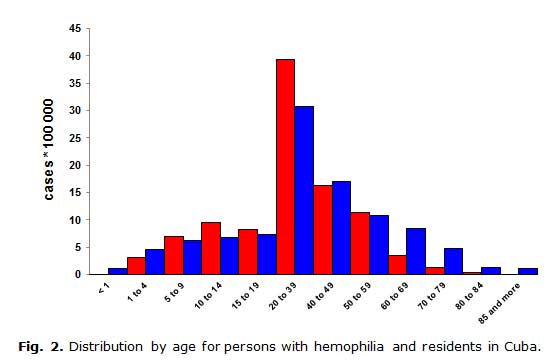
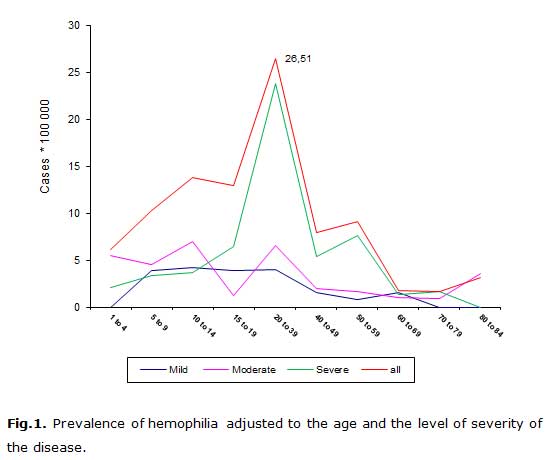
<body><![CDATA[<P><font face="Verdana" size="2">The patients studied covered 58.71 % of the total    registered in Cuba. HA patients were 188 (82.10 %) and 41 (17.90 %) with HB.    The disease was severe in 56.3 % haemophiliacs, moderate in 24 % and mild in    19.7 %. Inhibitors were present in 17.03 % of the patients. The mean age of    the hemophiliacs was 31.74 years old (SD&#177;17.30). </font>     <P><font face="Verdana" size="2">Distribution of the patients by type of hemophilia,    severity of the disease and the prevalence rate in both types of hemophilia    in the country and by provinces, is shown in <a href="/img/revistas/hih/v30n2/t0108214.gif">table 1</a>.    Patients with HA &amp; HB in relation to age are shown in <a href="/img/revistas/hih/v30n2/t0208214.gif">table    2</a>, 27.94 % under 19 years of age. More than half of the population were    between 20 and 59 yea old. Within this group, the highest (39.30 %) was between    20 - 39 years old. In HA, this group represented 38.29 % and in HB, 43.90 %.    When we compared both groups the differences were not significant. It is important    to point out that we found 12 patients (5.23 %) aged over 60 years and one over    80. </font>      <P><font face="Verdana" size="2">In connection with the prevalence of hemophilia    adjusted to the age and the level of severity of the disease, we observed an    absolute prevalence of patients between 15 and 40 years old as well as for the    severe cases (prevalence rate 23.82 per 100 000 males) and when the cases were    pooled the prevalence rate was 26.10 per 100 000 (<a href="#f1">figure 1</a>).    </font>     <P align="center"><a name="f1"></a><img src="/img/revistas/hih/v30n2/f0108214.jpg" width="553" height="460">      <P><font face="Verdana" size="2">In <a href="#f2">figure 2</a> the compared perceptual    distribution of hemophilia population with the overall Cuban male population    is observed.The hemophilia population had a much greater proportion of younger    males in the ages between 5 and 39. In the rest of the age group the non hemophilia    population prevailed. </font>     <P align="center"><a name="f2"></a><img src="/img/revistas/hih/v30n2/f0208214.jpg" width="556" height="360">      <P><font face="Verdana" size="2">Median age for patients diagnosed with mild hemophilia    was 3 years for HA and 5 for HB. Regarding moderate disease the median was 2    years old for both types of haemophilia and 3 for HB. The median for severe    cases was under one year in both types. </font>     <P><font face="Verdana" size="2">When we analysed the seroprevalence of transmitted    transfusion disease, 0.87 % of patients were infected with Human Immunodeficiency    Virus (HIV). The patients with Hepatitis C Virus (HCV) were 39.03 %. The infection    with Hepatitis B Virus (HBV),co-infection HBV+HCV and HBV/HCV+HIV were underestimated.    </font>     <P>&nbsp;      <P>      ]]></body>
<body><![CDATA[<P><font face="Verdana" size="3"><B>DISCUSSION</B></font><font face="Verdana" size="2">    </font>     <P><font face="Verdana" size="2">For many years, the general rates of prevalence    in hemophilia were settled down similar for individuals and countries of different    latitudes and ethnic groups.<SUP>3</SUP>The discrepancies found in the diverse    researches that broach this topic generally conform to the sub-register observed    in many countries where patients with hemophilia have limited access to the    Public Health Systems or to specialized institutions.<SUP>4</SUP>The proportion    of patients with HA and HB were similar in the different reports, but the actual    mean ages are different when we compare our results with the ones of other authors.    These outcomes are probably influenced by the high mortality of hemophiliacs    infected with HIV since the 1980s phenomenon that occurred mainly in developed    countries due to their access to substitute therapy without viral process.<SUP>5</SUP>Our    results showed low HIV infection as our patients only received blood products    from Cuban donors duly processed; at that moment the seroprevalence of HIV was    low in Cuba, whereas in the rest of the world these figures were high.<SUP>6</SUP>    </font>     <P><font face="Verdana" size="2">Regarding the infection of hepatitis C, our results    are high, similar to other studies.<SUP>7</SUP>It is known that the window period    of this disease is very long and the hemophilic patients have received these    blood components when they were supposed to be safe. This has occurred basically    because the developing countries, such as ours, have continued using blood products,    plasma and cryoprecipitate, which were not submitted to viral inactivation;    while the developed countries were infected in the 80&#180;s. In Cuba, the seroprevalence    of hepatitis B is very low because in 1992 vaccination against this virus started    which has proven to be safe and immunogenic.<SUP>8</SUP>Similar low results    were found in the co-infection HCV+HBV and HCV+HIV. </font>     <P><font face="Verdana" size="2">We have patients over 60 years of age; although    adultPWHhave certain muscle-skeletal limitations, most of themhave aged with    favorablehealth status which allows them to maintaina normal social life. This    conditionis favoredbythe characteristics of ournational health system withnational    coverage, results of the applicationof a strategyand deployment ofessential    public healthprinciples. This favorable condition permits us to compare ours    findings withthe observed results ininternational reports. </font>     <P><font face="Verdana" size="2">When we analyze the results of reports from European    countries and the United States, we observe that more than 15% of PHW are older    than 75-80 years due to the higher level of development of the local Comprehensive    Care Programs.<SUP>3</SUP> It is difficult to find similar figures in the reports    of the majority of the underdeveloped countries, because of their deficient    systems of health. </font>     <P><font face="Verdana" size="2">Nowadays, there is a National Comprehensive Care    Program in Cuba that allow patients to receive continuous monitoring and intends    to improve the quality of life for patients with hemophilia. </font>     <P>&nbsp;      <p><font face="Verdana" size="2"><b><i>ACKNOWLEDGEMENTS TO:</i></b></font>      <p><font face="Verdana" size="2"><i>Avenda&ntilde;o RM,&#160;&#160;Gener O, Hernandez    P,&#160;&#160;Kasper C,&#160; Stone J: for their important suggestions in the    preparation of the manuscript.    <br>   G&aacute;mez A,&#160; GuerraT,&#160;&#160;L&oacute;pez MV,&#160; Navia&#160;    A, Robaina T, Rodr&iacute;guez L,&#160;&#160; Tejeda M,&#160; Zamora Y:&#160;    for thecollectionof cases, processofsamples, etc.&#160;</i> </font>     ]]></body>
<body><![CDATA[<p>&nbsp;      <P><b><font face="Verdana" size="3">REFERENCES</font></b>     <P><font face="Verdana" size="2">1. Castillo Gonz&aacute;lez D. La hemofilia:    situaci&oacute;n actual en Cuba y perspectivas. Rev Cubana HematolInmunolHemoter&#160;    [revista en la Internet]. 2013&#160; [Acceso: 14 de enero de 2013] Jun;&#160;    29(2):112-3. Disponible en: <U><FONT  COLOR="#0000ff"><a href="http://scielo.sld.cu/scielo.php?script=sci_arttext&pid=S0864-02892013000200001&lng=es" target="_blank">http://scielo.sld.cu/scielo.php?script=sci_arttext&amp;pid=S0864-02892013000200001&amp;lng=es</a></FONT></U>    . </font>     <!-- ref --><P><font face="Verdana" size="2">2. White GC II, Rosendaal F, Aledort LM, Lusher    JM, Rothschild C, Ingerslev J. On behalf of the Factor VIII and Factor IX Subcommittee.    Definitions in Hemophilia Recommendation of the Scientific Subcommittee on Factor    VIII and Factor IX of the Scientific and Standardization Committee of the International    Society on Thrombosis and Haemostasis. ThrombHaemost. 2001;85: 560.     </font>     <!-- ref --><P><font face="Verdana" size="2">3. Aznar JA, Luc&iacute;a F, Abad-Franch L, Jim&eacute;nez-Yuste    V, P&eacute;rez R, Batlle J, et al. Haemophilia in Spain. Haemophilia. 2009;15:    665_75.     </font>     <!-- ref --><P><font face="Verdana" size="2">4. Ghosh K, Shetty S, Sahu D. Haemophilia care    in India: innovations and integrations by various chapters of Haemophilia Federation    of India (HFI). Haemophilia. 2010; 16:61-5.     </font>     <!-- ref --><P><font face="Verdana" size="2">5. Tagliaferri A, Rivolta GF, Iorio A, Oliovecchio    E, Mancuso ME, Morfini M. Mortality and causes of death in Italian persons with    haemophilia, 1990_2007. Haemophilia. 2010; 16:437_46.     </font>     <!-- ref --><P><font face="Verdana" size="2">6. Miranda G&oacute;mez O, Fari&ntilde;as Reinoso    AT, Cout&iacute;n Marie G, N&aacute;poles P&eacute;rez M, Lara Fern&aacute;ndez    H, Bueno Marrero LE. Panor&aacute;mica de la infecci&oacute;n por el VIH en    Cuba, 1986-2007. Rev Cubana HigEpidemiol&#160; [revista en la Internet]. 2009&#160;    Ago[Acceso: 14 de enero de 2013];&#160; 47(2): Disponible en: <U><FONT  COLOR="#0000ff"><a href="http://scielo.sld.cu/scielo.php?script=sci_arttext&pid=S1561-30032009000200004&lng=es" target="_blank">http://scielo.sld.cu/scielo.php?script=sci_arttext&amp;pid=S1561-30032009000200004&amp;lng=es</a></FONT></U>    .     </font>     <!-- ref --><P><font face="Verdana" size="2">7. Rivero Jim&eacute;nez RA. Antecedentes, diagn&oacute;stico    y estudio evolutivo de la hepatitis C y la hemofilia. Rev Cubana HematolInmunolHemoter&#160;    [revista en la Internet]. 2009&#160; Abr[Acceso: 14 de enero de 2013];&#160;    25(1): Disponible en: <U><FONT  COLOR="#0000ff"><a href="http://scielo.sld.cu/scielo.php?script=sci_arttext&pid=S0864-02892009000100005&lng=es" target="_blank">http://scielo.sld.cu/scielo.php?script=sci_arttext&amp;pid=S0864-02892009000100005&amp;lng=es</a></FONT></U>    .     </font>     <!-- ref --><P><font face="Verdana" size="2">8. Rieumont ER, Gonz&aacute;lez Griego AM, Ram&iacute;rez    Albaj&eacute;s V, Sanabria Negr&iacute;n JG, Lugo Rosa MG. Respuesta inmune    post vacunaci&oacute;n para la hepatitis B y tuberculosis en ni&ntilde;os de    10 a&ntilde;os. Rev Ciencias M&eacute;dicas&#160; [revista en la Internet].    2009&#160; Mar [citado&#160; 2013&#160; Nov&#160; 22]; 13(1): 52-61. Disponible    en: <a href="http://scielo.sld.cu/scielo.php?script=sci_arttext&pid=S1561-31942009000100006&lng=es" target="_blank">http://scielo.sld.cu/scielo.php?script=sci_arttext&amp;pid=S1561-31942009000100006&amp;lng=es</a>.        </font>     <P>     <P>&nbsp;     <P>&nbsp;     ]]></body>
<body><![CDATA[<P>      <P><font face="Verdana" size="2">Recibido: Septiembre 19, 2013.    <br>   </font><font face="Verdana" size="2">Aceptado: Noviembre 24, 2013.</font>     <P>&nbsp;     <P>&nbsp;     <P>      <P>      <P><font face="Verdana" size="2">CORRESPONDENCIA A: </font>     <P><font face="Verdana" size="2">Dra. Dunia Castillo Gonz&aacute;lez. </font><font face="Verdana" size="2">INSTITUTO    DE HEMATOLOG&Iacute;A E INMUNOLOG&Iacute;A. </font><font face="Verdana" size="2">Apartado    8070, La Habana, CP 10800, CUBA. </font>      <P><font face="Verdana" size="2">Tel (537) 643 8695, 8268. </font><font face="Verdana" size="2">Fax    (537) 644 2334. </font><font face="Verdana" size="2">Email: <U><FONT COLOR="#0000ff"><a href="mailto:rchematologia@infomed.sld.cu">rchematologia@infomed.sld.cu</a></FONT></U>    </font>      ]]></body>
<body><![CDATA[<P><font face="Verdana" size="2"> </font>       ]]></body><back>
<ref-list>
<ref id="B1">
<label>1</label><nlm-citation citation-type="journal">
<person-group person-group-type="author">
<name>
<surname><![CDATA[Castillo González]]></surname>
<given-names><![CDATA[D]]></given-names>
</name>
</person-group>
<article-title xml:lang="es"><![CDATA[La hemofilia: situación actual en Cuba y perspectivas]]></article-title>
<source><![CDATA[Rev Cubana HematolInmunolHemoter]]></source>
<year>2013</year>
<month> J</month>
<day>un</day>
<volume>29</volume>
<numero>2</numero>
<issue>2</issue>
<page-range>112-3</page-range></nlm-citation>
</ref>
<ref id="B2">
<label>2</label><nlm-citation citation-type="journal">
<person-group person-group-type="author">
<name>
<surname><![CDATA[White]]></surname>
<given-names><![CDATA[GC II]]></given-names>
</name>
<name>
<surname><![CDATA[Rosendaal]]></surname>
<given-names><![CDATA[F]]></given-names>
</name>
<name>
<surname><![CDATA[Aledort]]></surname>
<given-names><![CDATA[LM]]></given-names>
</name>
<name>
<surname><![CDATA[Lusher]]></surname>
<given-names><![CDATA[JM]]></given-names>
</name>
<name>
<surname><![CDATA[Rothschild]]></surname>
<given-names><![CDATA[C]]></given-names>
</name>
<name>
<surname><![CDATA[Ingerslev]]></surname>
<given-names><![CDATA[J]]></given-names>
</name>
</person-group>
<article-title xml:lang="en"><![CDATA[On behalf of the Factor VIII and Factor IX Subcommittee: Definitions in Hemophilia Recommendation of the Scientific Subcommittee on Factor VIII and Factor IX of the Scientific and Standardization Committee of the International Society on Thrombosis and Haemostasis]]></article-title>
<source><![CDATA[ThrombHaemost.]]></source>
<year>2001</year>
<volume>85</volume>
<page-range>560</page-range></nlm-citation>
</ref>
<ref id="B3">
<label>3</label><nlm-citation citation-type="journal">
<person-group person-group-type="author">
<name>
<surname><![CDATA[Aznar]]></surname>
<given-names><![CDATA[JA]]></given-names>
</name>
<name>
<surname><![CDATA[Lucía]]></surname>
<given-names><![CDATA[F]]></given-names>
</name>
<name>
<surname><![CDATA[Abad-Franch]]></surname>
<given-names><![CDATA[L]]></given-names>
</name>
<name>
<surname><![CDATA[Jiménez-Yuste]]></surname>
<given-names><![CDATA[V]]></given-names>
</name>
<name>
<surname><![CDATA[Pérez]]></surname>
<given-names><![CDATA[R]]></given-names>
</name>
<name>
<surname><![CDATA[Batlle]]></surname>
<given-names><![CDATA[J]]></given-names>
</name>
</person-group>
<article-title xml:lang="en"><![CDATA[Haemophilia in Spain]]></article-title>
<source><![CDATA[Haemophilia.]]></source>
<year>2009</year>
<volume>15</volume>
<page-range>665_75</page-range></nlm-citation>
</ref>
<ref id="B4">
<label>4</label><nlm-citation citation-type="journal">
<person-group person-group-type="author">
<name>
<surname><![CDATA[Ghosh]]></surname>
<given-names><![CDATA[K]]></given-names>
</name>
<name>
<surname><![CDATA[Shetty]]></surname>
<given-names><![CDATA[S]]></given-names>
</name>
<name>
<surname><![CDATA[Sahu]]></surname>
<given-names><![CDATA[D]]></given-names>
</name>
</person-group>
<article-title xml:lang="en"><![CDATA[Haemophilia care in India: innovations and integrations by various chapters of Haemophilia Federation of India (HFI)]]></article-title>
<source><![CDATA[Haemophilia.]]></source>
<year>2010</year>
<volume>16</volume>
<page-range>61-5</page-range></nlm-citation>
</ref>
<ref id="B5">
<label>5</label><nlm-citation citation-type="journal">
<person-group person-group-type="author">
<name>
<surname><![CDATA[Tagliaferri]]></surname>
<given-names><![CDATA[A]]></given-names>
</name>
<name>
<surname><![CDATA[Rivolta]]></surname>
<given-names><![CDATA[GF]]></given-names>
</name>
<name>
<surname><![CDATA[Iorio]]></surname>
<given-names><![CDATA[A]]></given-names>
</name>
<name>
<surname><![CDATA[Oliovecchio]]></surname>
<given-names><![CDATA[E]]></given-names>
</name>
<name>
<surname><![CDATA[Mancuso]]></surname>
<given-names><![CDATA[ME]]></given-names>
</name>
<name>
<surname><![CDATA[Morfini]]></surname>
<given-names><![CDATA[M]]></given-names>
</name>
</person-group>
<article-title xml:lang="en"><![CDATA[Mortality and causes of death in Italian persons with haemophilia, 1990_2007]]></article-title>
<source><![CDATA[Haemophilia.]]></source>
<year>2010</year>
<volume>16</volume>
<page-range>437_46</page-range></nlm-citation>
</ref>
<ref id="B6">
<label>6</label><nlm-citation citation-type="journal">
<person-group person-group-type="author">
<name>
<surname><![CDATA[Miranda Gómez]]></surname>
<given-names><![CDATA[O]]></given-names>
</name>
<name>
<surname><![CDATA[Fariñas Reinoso]]></surname>
<given-names><![CDATA[AT]]></given-names>
</name>
<name>
<surname><![CDATA[Coutín Marie]]></surname>
<given-names><![CDATA[G]]></given-names>
</name>
<name>
<surname><![CDATA[Nápoles Pérez]]></surname>
<given-names><![CDATA[M]]></given-names>
</name>
<name>
<surname><![CDATA[Lara Fernández]]></surname>
<given-names><![CDATA[H]]></given-names>
</name>
<name>
<surname><![CDATA[Bueno Marrero]]></surname>
<given-names><![CDATA[LE]]></given-names>
</name>
</person-group>
<article-title xml:lang="es"><![CDATA[Panorámica de la infección por el VIH en Cuba, 1986-2007]]></article-title>
<source><![CDATA[Rev Cubana HigEpidemiol]]></source>
<year>2009</year>
<month> A</month>
<day>go</day>
<volume>47</volume>
<numero>2</numero>
<issue>2</issue>
</nlm-citation>
</ref>
<ref id="B7">
<label>7</label><nlm-citation citation-type="journal">
<person-group person-group-type="author">
<name>
<surname><![CDATA[Rivero Jiménez]]></surname>
<given-names><![CDATA[RA]]></given-names>
</name>
</person-group>
<article-title xml:lang="es"><![CDATA[Antecedentes, diagnóstico y estudio evolutivo de la hepatitis C y la hemofilia]]></article-title>
<source><![CDATA[Rev Cubana Hematol Inmunol Hemoter]]></source>
<year>2009</year>
<month> A</month>
<day>br</day>
<volume>25</volume>
<numero>1</numero>
<issue>1</issue>
</nlm-citation>
</ref>
<ref id="B8">
<label>8</label><nlm-citation citation-type="journal">
<person-group person-group-type="author">
<name>
<surname><![CDATA[Rieumont]]></surname>
<given-names><![CDATA[ER]]></given-names>
</name>
<name>
<surname><![CDATA[González Griego]]></surname>
<given-names><![CDATA[AM]]></given-names>
</name>
<name>
<surname><![CDATA[Ramírez Albajés]]></surname>
<given-names><![CDATA[V]]></given-names>
</name>
<name>
<surname><![CDATA[Sanabria Negrín]]></surname>
<given-names><![CDATA[JG]]></given-names>
</name>
<name>
<surname><![CDATA[Lugo Rosa]]></surname>
<given-names><![CDATA[MG]]></given-names>
</name>
</person-group>
<article-title xml:lang="es"><![CDATA[Respuesta inmune post vacunación para la hepatitis B y tuberculosis en niños de 10 años]]></article-title>
<source><![CDATA[Rev Ciencias Médicas]]></source>
<year>2009</year>
<month> M</month>
<day>ar</day>
<volume>13</volume>
<numero>1</numero>
<issue>1</issue>
<page-range>52-61</page-range></nlm-citation>
</ref>
</ref-list>
</back>
</article>