<?xml version="1.0" encoding="ISO-8859-1"?><article xmlns:mml="http://www.w3.org/1998/Math/MathML" xmlns:xlink="http://www.w3.org/1999/xlink" xmlns:xsi="http://www.w3.org/2001/XMLSchema-instance">
<front>
<journal-meta>
<journal-id>0864-0289</journal-id>
<journal-title><![CDATA[Revista Cubana de Hematología, Inmunología y Hemoterapia]]></journal-title>
<abbrev-journal-title><![CDATA[Rev Cubana Hematol Inmunol Hemoter]]></abbrev-journal-title>
<issn>0864-0289</issn>
<publisher>
<publisher-name><![CDATA[Centro Nacional de Información de Ciencias MédicasEditorial Ciencias Médicas]]></publisher-name>
</publisher>
</journal-meta>
<article-meta>
<article-id>S0864-02892017000200006</article-id>
<title-group>
<article-title xml:lang="en"><![CDATA[Clinical and epidemiological aspects of leukemias]]></article-title>
<article-title xml:lang="es"><![CDATA[Aspectos clínicos y epidemiológicos de las leucemias]]></article-title>
</title-group>
<contrib-group>
<contrib contrib-type="author">
<name>
<surname><![CDATA[Soares Almeida]]></surname>
<given-names><![CDATA[Anne Louise]]></given-names>
</name>
<xref ref-type="aff" rid="A01"/>
</contrib>
<contrib contrib-type="author">
<name>
<surname><![CDATA[Campos de Azevedo]]></surname>
<given-names><![CDATA[Isabelle]]></given-names>
</name>
<xref ref-type="aff" rid="A01"/>
</contrib>
<contrib contrib-type="author">
<name>
<surname><![CDATA[de Souza Rego Pinto Carvalho]]></surname>
<given-names><![CDATA[Diana Paula]]></given-names>
</name>
<xref ref-type="aff" rid="A01"/>
</contrib>
<contrib contrib-type="author">
<name>
<surname><![CDATA[Fortes Vitor]]></surname>
<given-names><![CDATA[Allyne]]></given-names>
</name>
<xref ref-type="aff" rid="A01"/>
</contrib>
<contrib contrib-type="author">
<name>
<surname><![CDATA[Pereira Santos]]></surname>
<given-names><![CDATA[Viviane Euzébia]]></given-names>
</name>
<xref ref-type="aff" rid="A01"/>
</contrib>
<contrib contrib-type="author">
<name>
<surname><![CDATA[Ferreira Jr]]></surname>
<given-names><![CDATA[Marcos Antonio]]></given-names>
</name>
<xref ref-type="aff" rid="A01"/>
</contrib>
</contrib-group>
<aff id="A01">
<institution><![CDATA[,Federal University of Rio Grnade do Norte Health Science Center Department of Nursing]]></institution>
<addr-line><![CDATA[Natal RN]]></addr-line>
<country>Brazil</country>
</aff>
<pub-date pub-type="pub">
<day>00</day>
<month>06</month>
<year>2017</year>
</pub-date>
<pub-date pub-type="epub">
<day>00</day>
<month>06</month>
<year>2017</year>
</pub-date>
<volume>33</volume>
<numero>2</numero>
<fpage>1</fpage>
<lpage>14</lpage>
<copyright-statement/>
<copyright-year/>
<self-uri xlink:href="http://scielo.sld.cu/scielo.php?script=sci_arttext&amp;pid=S0864-02892017000200006&amp;lng=en&amp;nrm=iso"></self-uri><self-uri xlink:href="http://scielo.sld.cu/scielo.php?script=sci_abstract&amp;pid=S0864-02892017000200006&amp;lng=en&amp;nrm=iso"></self-uri><self-uri xlink:href="http://scielo.sld.cu/scielo.php?script=sci_pdf&amp;pid=S0864-02892017000200006&amp;lng=en&amp;nrm=iso"></self-uri><abstract abstract-type="short" xml:lang="en"><p><![CDATA[Leukemia is a group of clonal diseases derived from a single cell with a genetic alteration in bone marrow or peripheral lymphoid tissue, and each type is determined by the specificity of the source cell. The objective of this research was to synthesize studies that characterize the clinical and epidemiological profile of patients with leukemia, the types of treatments used, duration and outcomes for the cases. This study is an integrative review of literature through databases Medical Literature Analysis and Retrieval System Online (MEDLINE), SCOPUS, Cumulative Index to Nursing & Allied Health Literature (CINAHL) and Science Direct. There were 4,274 articles rescued in the initial search, 188 were selected to compose the review sample after applying all the criteria for inclusion and exclusion adopted. Full articles were grouped into four categories, according to the variables of research: (a) more frequent subtypes of leukemia; (b) most widely used treatment; (c) duration of treatment; and (d) endpoint of the cases. It is concluded a prevalence of leukemia in pediatric patients, with a predominance of the subtype Acute Lymphoblastic Leukemia (ALL). In general, the male population is more affected by hematological malignancies. As the therapy is used, each leukemia subtype had its peculiarities regarding the treatment, especially the introduction of imatinib for chronic myeloid leukemia (CML) and prophylactic cranial irradiation for cases of ALL. Chronic leukemia showed higher treatment duration. There was a significant improvement in survival of Acute Myeloid Leukemia, Chronic Lymphoid leukemia, CML and ALL, the latter approximately with 90% cure rate in children.]]></p></abstract>
<abstract abstract-type="short" xml:lang="es"><p><![CDATA[La leucemia es un grupo de enfermedades clonales derivadas de una única célula con una alteración genética en la médula ósea o tejido linfoide periférico, y cada tipo se determina por la especificidad de la célula de origen. El objetivo de esta investigación fue sintetizar los estudios que caracterizan el perfil clínico y epidemiológico de los pacientes con leucemia, los tipos de tratamientos usados, la duración y los resultados para los casos. Este estudio es una revisión integradora de la literatura a través de bases de datos de análisis médicos, literatura y recuperación de sistema en línea (MEDLINE), SCOPUS, Cumulative Index de Enfermería y Salud Aliada Literatura (CINAHL) y Science Direct. Había 4 274 artículos rescatados en la búsqueda inicial, se seleccionaron 188 para componer la muestra de revisión después de aplicar todos los criterios de inclusión y exclusión adoptada. Los artículos completos se agruparon en cuatro categorías, según las variables de investigación: (a) los subtipos más frecuentes de leucemia; (b) el tratamiento más utilizado; (c) la duración del tratamiento; y (d) el punto final de los casos. Se concluye una prevalencia de leucemia en pacientes pediátricos, con predominio del subtipo de leucemia linfoblástica aguda (LLA). En general, la población masculina se ve más afectada por neoplasias hematológicas. Como se utiliza la terapia, cada subtipo de leucemia tenía sus peculiaridades con respecto al tratamiento, especialmente la introducción de imatinib para la leucemia mieloide crónica (CML) y la irradiación craneal profiláctica para los casos de ALL. La leucemia crónica mostró una mayor duración del tratamiento. Hubo una mejora significativa en la supervivencia de la leucemia mieloide aguda, leucemia linfoide crónica, LMC y LLA, aproximadamente, este último con la tasa de curación del 90% en los niños.]]></p></abstract>
<kwd-group>
<kwd lng="en"><![CDATA[leukemia]]></kwd>
<kwd lng="en"><![CDATA[lymphoma]]></kwd>
<kwd lng="en"><![CDATA[epidemiology]]></kwd>
<kwd lng="en"><![CDATA[hematologic neoplasms]]></kwd>
<kwd lng="en"><![CDATA[multiple myeloma]]></kwd>
<kwd lng="en"><![CDATA[prognosis]]></kwd>
<kwd lng="en"><![CDATA[drug therapy]]></kwd>
<kwd lng="es"><![CDATA[leucemia]]></kwd>
<kwd lng="es"><![CDATA[linfoma]]></kwd>
<kwd lng="es"><![CDATA[epidemiología]]></kwd>
<kwd lng="es"><![CDATA[neoplasias hematológicas]]></kwd>
<kwd lng="es"><![CDATA[mieloma múltiple]]></kwd>
<kwd lng="es"><![CDATA[pronóstico]]></kwd>
<kwd lng="es"><![CDATA[quimioterapia]]></kwd>
</kwd-group>
</article-meta>
</front><body><![CDATA[ <p align="right"> <font face="Verdana, Arial, Helvetica, sans-serif" size="2"><b>ART&#205;CULO    DE REVISI&#211;N</b> </font></p>     <p align="right">&nbsp;</p>     <p> <font face="Verdana, Arial, Helvetica, sans-serif" size="2"><b><font size="4">Clinical    and epidemiological aspects of leukemias</font></b> </font></p>     <p>&nbsp; </p>     <p><font face="Verdana, Arial, Helvetica, sans-serif" size="2"> <b><font size="3">Aspectos    cl&#237;nicos y epidemiol&#243;gicos de las leucemias </font></b></font></p>     <p align="left">&nbsp; </p>     <p align="center">&nbsp; </p>     <p> <font face="Verdana, Arial, Helvetica, sans-serif" size="2"><b>Anne Louise    Soares Almeida, </b> <b> Isabelle Campos de Azevedo, Diana Paula de Souza Rego    Pinto Carvalho, </b> <b>Allyne Fortes Vitor. Viviane Euz&#233;bia Pereira Santos,    </b> <b>Marcos Antonio Ferreira Jr</b> </font></p>     <p><font face="Verdana, Arial, Helvetica, sans-serif" size="2"> Department of    Nursing, Health Science Center, Federal University of Rio Grande do Norte, Natal/RN,    Brazil. </font></p>     <p>&nbsp; </p> <font face="Verdana, Arial, Helvetica, sans-serif" size="2"><b> <br clear="all"/> </b> </font>      ]]></body>
<body><![CDATA[<p>&nbsp; </p> <hr>     <p><font face="Verdana, Arial, Helvetica, sans-serif" size="2"><b>ABSTRACT</b>    </font></p>     <p><font face="Verdana, Arial, Helvetica, sans-serif" size="2"> Leukemia is a    group of clonal diseases derived from a single cell with a genetic alteration    in bone marrow or peripheral lymphoid tissue, and each type is determined by    the specificity of the source cell. The objective of this research was to synthesize    studies that characterize the clinical and epidemiological profile of patients    with leukemia, the types of treatments used, duration and outcomes for the cases.    This study is an integrative review of literature through databases Medical    Literature Analysis and Retrieval System Online (MEDLINE), SCOPUS, Cumulative    Index to Nursing &amp; Allied Health Literature (CINAHL) and Science Direct.    There were 4,274 articles rescued in the initial search, 188 were selected to    compose the review sample after applying all the criteria for inclusion and    exclusion adopted. Full articles were grouped into four categories, according    to the variables of research: (a) more frequent subtypes of leukemia; (b) most    widely used treatment; (c) duration of treatment; and (d) endpoint of the cases.    It is concluded a prevalence of leukemia in pediatric patients, with a predominance    of the subtype Acute Lymphoblastic Leukemia (ALL). In general, the male population    is more affected by hematological malignancies. As the therapy is used, each    leukemia subtype had its peculiarities regarding the treatment, especially the    introduction of imatinib for chronic myeloid leukemia (CML) and prophylactic    cranial irradiation for cases of ALL. Chronic leukemia showed higher treatment    duration. There was a significant improvement in survival of Acute Myeloid Leukemia,    Chronic Lymphoid leukemia, CML and ALL, the latter approximately with 90% cure    rate in children. </font></p>     <p> <font face="Verdana, Arial, Helvetica, sans-serif" size="2"><b>Keywords: </b>    leukemia; lymphoma;<b> </b>epidemiology; hematologic neoplasms; multiple myeloma;<b>    </b>prognosis; drug therapy.<b> </b></font></p> <hr>     <p><font face="Verdana, Arial, Helvetica, sans-serif" size="2"><b>RESUMEN</b>    </font></p>     <p><font face="Verdana, Arial, Helvetica, sans-serif" size="2"> La leucemia es    un grupo de enfermedades clonales derivadas de una &#250;nica c&#233;lula con    una alteraci&#243;n gen&#233;tica en la m&#233;dula &#243;sea o tejido linfoide    perif&#233;rico, y cada tipo se determina por la especificidad de la c&#233;lula    de origen. El objetivo de esta investigaci&#243;n fue sintetizar los estudios    que caracterizan el perfil cl&#237;nico y epidemiol&#243;gico de los pacientes    con leucemia, los tipos de tratamientos usados, la duraci&#243;n y los resultados    para los casos. Este estudio es una revisi&#243;n integradora de la literatura    a trav&#233;s de bases de datos de an&#225;lisis m&#233;dicos, literatura y    recuperaci&#243;n de sistema en l&#237;nea (MEDLINE), SCOPUS, Cumulative Index    de Enfermer&#237;a y Salud Aliada Literatura (CINAHL) y Science Direct. Hab&#237;a    4 274 art&#237;culos rescatados en la b&#250;squeda inicial, se seleccionaron    188 para componer la muestra de revisi&#243;n despu&#233;s de aplicar todos    los criterios de inclusi&#243;n y exclusi&#243;n adoptada. Los art&#237;culos    completos se agruparon en cuatro categor&#237;as, seg&#250;n las variables de    investigaci&#243;n: (a) los subtipos m&#225;s frecuentes de leucemia; (b) el    tratamiento m&#225;s utilizado; (c) la duraci&#243;n del tratamiento; y (d)    el punto final de los casos. Se concluye una prevalencia de leucemia en pacientes    pedi&#225;tricos, con predominio del subtipo de leucemia linfobl&#225;stica    aguda (LLA). En general, la poblaci&#243;n masculina se ve m&#225;s afectada    por neoplasias hematol&#243;gicas. Como se utiliza la terapia, cada subtipo    de leucemia ten&#237;a sus peculiaridades con respecto al tratamiento, especialmente    la introducci&#243;n de imatinib para la leucemia mieloide cr&#243;nica (CML)    y la irradiaci&#243;n craneal profil&#225;ctica para los casos de ALL. La leucemia    cr&#243;nica mostr&#243; una mayor duraci&#243;n del tratamiento. Hubo una mejora    significativa en la supervivencia de la leucemia mieloide aguda, leucemia linfoide    cr&#243;nica, LMC y LLA, aproximadamente, este &#250;ltimo con la tasa de curaci&#243;n    del 90% en los ni&#241;os. </font></p>     <p><font face="Verdana, Arial, Helvetica, sans-serif" size="2"><b>Palabras clave</b>    : leucemia; linfoma; epidemiolog&#237;a; neoplasias hematol&#243;gicas; mieloma    m&#250;ltiple; pron&#243;stico; quimioterapia. </font></p> <hr>     <p>&nbsp;</p>     <p><font face="Verdana, Arial, Helvetica, sans-serif" size="2"><b><br clear="all"/>   </b> </font> </p>     <p> <font face="Verdana, Arial, Helvetica, sans-serif" size="2"><b><font size="3">INTRODUCTION</font></b>    </font></p>     ]]></body>
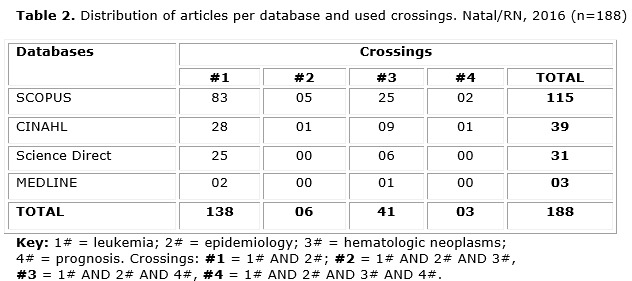
<body><![CDATA[<p><font face="Verdana, Arial, Helvetica, sans-serif" size="2"> The World Health    Organization (WHO), through the World Cancer Report 2014 characterizes cancer    as a public health problem, especially among developing countries, expecting    that the impact of cancer in the population in coming decades corresponds to    80% on more than 20 million new cases estimated for 2025<sup>1</sup>. </font></p>     <p><font face="Verdana, Arial, Helvetica, sans-serif" size="2"> For Brazil, there    is an estimated of 600 000 new cases of cancer in 2016 <sup>2</sup>. Among the    cancers that affect the general population, leukemia has events from childhood    to the elderly stages. There were 352 000 new cases of leukemia estimated worldwide    in 2012, corresponding to 2.5% of all new cancer cases and 265 000 deaths in    the same period worldwide<sup>1</sup>. Leukemia is responsible for approximately    3% of all cancer cases in Brazil and worldwide<sup>3</sup>. </font></p>     <p><font face="Verdana, Arial, Helvetica, sans-serif" size="2"> Leukemia is a    group of clonal diseases derived from a single cell with a genetic alteration    in bone marrow or peripheral lymphoid tissue, with their types determined by    the source cell specification, by cytologic examination, immunohistochemistry    and cytogenetic classified as acute myeloid leukemia (AML), chronic myeloid    leukemia (CML), acute lymphoblastic leukemia (ALL) and chronic lymphoid leukemia    (CLL)<sup>4</sup>. </font></p>     <p><font face="Verdana, Arial, Helvetica, sans-serif" size="2"> The AML diagnosis    is determined by the uncontrolled growth of differentiated cells of the myeloid    type in the blood or bone marrow characterized by the presence of more than    20% blasts and represents 90% of cases of leukemia in adults. CML is a clonal    disorder of a pluripotent stem cell, called as Philadelphia chromosome (Ph)    when translocation occurs from the long arm of chromosome 22 to 9 and 9 to 22.    This translocation brings most of the ABL to gene BCR region of chromosome 22,    responsible for 15% of diagnoses of leukemia<sup>5</sup>. </font></p>     <p><font face="Verdana, Arial, Helvetica, sans-serif" size="2"> The ALL is characterized    by immature lymphoid cells accumulate in bone marrow and is the most prevalent    hematologic malignant neoplasm of childhood, with a higher incidence of two    and five years old, and it is 25% of all cancers in this age group. CLL is diagnosed    from the accumulation of mature lymphocytes of type B and T blood. However,    it does not interfere with the production of normal cells, as in the previous    type<sup>6</sup>. </font></p>     <p><font face="Verdana, Arial, Helvetica, sans-serif" size="2"> Given the importance    of this issue and the social impact generated by the diagnosis and treatment    of this disease, this study aims to summarize the studies that characterize    the clinical and epidemiological profile of patients with leukemia, the type    of treatment used, duration and outcomes for the cases. </font></p>     <p>&nbsp; </p>     <p> <font face="Verdana, Arial, Helvetica, sans-serif" size="2"><b><font size="3">METHOD</font></b>    </font></p>     <p><font face="Verdana, Arial, Helvetica, sans-serif" size="2"> This study is    an integrative literature review, to conferring scientific criticality followed    the following steps: a) identifying the problem or research question, b) search    the databases, c) evaluation of the data, d) data analysis, e) presentation    of the results<sup>7</sup>. </font></p>     <p><font face="Verdana, Arial, Helvetica, sans-serif" size="2"> For the execution    of searches of electronic databases, the following research question has been    defined among the leukemia subtypes, which is the most common, the most common    treatment, duration and outcomes found? </font></p>     ]]></body>
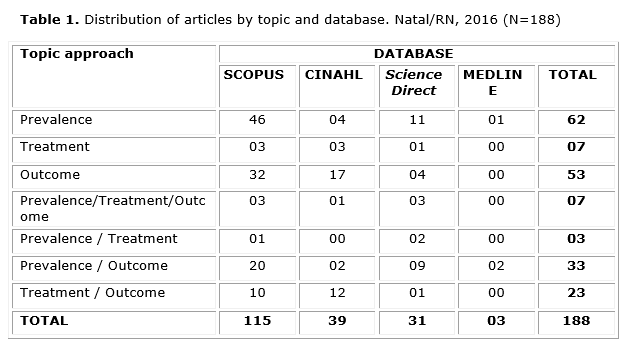
<body><![CDATA[<p><font face="Verdana, Arial, Helvetica, sans-serif" size="2"> The literature    search took place between December 2015 and January 2016, using the proxy licensed    by the Federal University of Rio Grande do Norte (www.capes.ufrn.br/porta3128)    by the following databases: Medical Literature Analysis and Retrieval System    Online (MEDLINE), SCOPUS, Cumulative Index to Nursing &amp; Allied Health Literature    (CINAHL) and Science Direct. </font></p>     <p><font face="Verdana, Arial, Helvetica, sans-serif" size="2"> The crosses were    used by the indexed descriptors of Medical Subject Headings (MeSH): 1# "leukemia",    2# "epidemiology', 3# "hematologic neoplasms" and 4# "prognosis". The crosses    were performed using the Boolean AND operator: 1# AND 2#, 1# AND 2# AND 3#,    1# AND 2# AND 4# and 1# AND 2# AND 3# AND 4#. Uncontrolled search was performed    only in Science Direct base to obtain a representative sample of published articles    that met the inclusion criteria. It was not used time frame, thus all the items    available were analyzed. </font></p>     <p><font face="Verdana, Arial, Helvetica, sans-serif" size="2"> The selected studies    met the following inclusion criteria: studies addressing the clinical and epidemiological    characteristics of patients with leukemia by the prevalence of characteristics,    treatment, and outcome. Articles that were not available in full on the selected    databases, studies of literature review type, reflective articles, previous    notes, letters to the editor, pilot studies and qualitative research were excluded,    as well as those who did not answer the main question of this study. </font></p>     <p><font face="Verdana, Arial, Helvetica, sans-serif" size="2"> The first selection    of studies was carried out by reading the titles and abstracts, with emphasis    on objectives and results. Data were separated by the database and relevant    topics. For data extraction, the classification of items according to the information    presented was carried out: prevalence, treatment, outcome, incidence and treatment,    incidence and outcomes, treatment and outcome and incidence/treatment/outcome.    </font></p>     <p><font face="Verdana, Arial, Helvetica, sans-serif" size="2"> In an initial    search, there were 4 274 articles rescued, 188 of them were selected for the    sample of this review after application of the inclusion criteria. Of the 4    086 studies excluded, 3 970 addressed the topic, but not on the topics of interest    to this review, 28 articles were duplicated, 61 were literature review articles,    and 27 had scientific events. </font></p>     <p>&nbsp;</p>     <p> <font face="Verdana, Arial, Helvetica, sans-serif" size="2"><b><font size="3">RESULTS    AND DISCUSSION</font></b> </font></p>     <p><font face="Verdana, Arial, Helvetica, sans-serif" size="2"> <a href="/img/revistas/hih/v33n2/t01_511.gif">Table    1</a> shows the 188 selected articles, organized by a database that was recovered    and approached themes. There were 62 studies on the prevalence of the disease,    7 addressing kinds of treatments, 53 addressing the outcomes, seven on the prevalence/treatment/outcomes,    three prevalence/treatment, 33 on the prevalence and outcomes and 23 addressing    the treatments and their outcomes. </font></p>     <p><font face="Verdana, Arial, Helvetica, sans-serif" size="2"> <a href="/img/revistas/hih/v33n2/t02_511.gif">Table    2</a> is the distribution of the final sample articles per database and performed    by crossing, with a majority of SCOPUS articles and by #1 combinations (leukemia    AND epidemiology). </font></p>     <p><font face="Verdana, Arial, Helvetica, sans-serif" size="2"> Because it was    not a time frame determined, there was a significant distribution of studies    by year of publication, giving an extensive analysis of the productions on leukemia    over time. Studies published between 1964 and 2015 were rescued, of which 135    articles were published in the last ten years. Therefore, it is clear an important    increase of publications in the last decade. </font></p>     ]]></body>
<body><![CDATA[<p><font face="Verdana, Arial, Helvetica, sans-serif" size="2"> After systematic    reading, the complete articles were grouped into four categories according to    the variables of research: (a) more frequent subtypes of leukemia; (b) most    widely used treatment; (c) duration of treatment; and (d) outcomes of the cases.    </font></p>     <p><font face="Verdana, Arial, Helvetica, sans-serif" size="2"><b>More frequent    subtypes of leukemias</b> </font></p>     <p><font face="Verdana, Arial, Helvetica, sans-serif" size="2"> Most studies on    this topic reported childhood leukemia, and the most incident subtype is the    ALL<sup>8</sup>. Leukemia is approximately one-third of cancer cases in children    aged 0 to 14 years old and 10% of adolescents aged 15 to 19 years old. In Europe,    the overall incidence rate for leukemia in children was 44 per million people    per year between 1988 and 1997. Among the types of leukemia, the lymphoid is    found in 81% of cases, non-lymphocytic acute leukemia in 15%, CML in 1.5% and    unspecified leukemia in 1,3% of cases<sup>9</sup>. </font></p>     <p><font face="Verdana, Arial, Helvetica, sans-serif" size="2"> In Brazil, it    is estimated the occurrence of 10 070 new cases of leukemia in 2016, with male    prevalence (5 540 cases) compared to women (4 530 cases). This type of cancer    is the sixth most common in men in the northern region of the country, with    an incidence of 3,81 cases per 100 thousand inhabitants<sup>2</sup>. </font></p>     <p><font face="Verdana, Arial, Helvetica, sans-serif" size="2"> In a survey conducted    in a city in Brazil&#180;s southeastern region in the 1990s, it was found an    overall incidence of ALL of 12,5 cases per million people per year<sup>10</sup>.    In three state capitals, two of them located in the northeast and one in the    southeast, the estimated incidence was 5,76; 6,32 and 5,48 cases per 100,000    inhabitants, respectively. Despite the high underreporting of childhood cancer,    ALL incidence rates in children are similar to those of developed countries<sup>11</sup>.    </font></p>     <p><font face="Verdana, Arial, Helvetica, sans-serif" size="2"> Between 1979 and    1989 in Kuwait, the ALL was the most frequent among 723 cases (44.2%), with    prevalence in the group aged between 0-4 years old, and the most common leukemia    was in the children (90,5%). The AML represented 32,4% of leukemia and showed    a progressive increase in incidence with age. On the other hand, CML constituted    14,8%, and CLL was 8,6% of all cases <sup>12</sup>. </font></p>     <p><font face="Verdana, Arial, Helvetica, sans-serif" size="2"> In Cape Province,    South Africa, of the 460 cases acute leukaemia diagnosed, 223 (48,5%) occurred    in white patients and 237 (51,5%) in those of mixed ancestry. The relationship    between the incidence of acute leukemia and ethnicity was 2,12, 1,37 and 0,58    per 100 000 people white, brown and black, respectively. The average age of    white people was 30 years old and for brown people, it was 15 years old, comparable    data to black patients being 16 years old<sup>13</sup>. </font></p>     <p><font face="Verdana, Arial, Helvetica, sans-serif" size="2"> Another point    of the overall analysis of the incidence of hematological malignancies found    that with increasing age there was a decrease of lymphoid neoplasms<sup>12,14</sup>.    Nevertheless, some studies have highlighted the increasing number of cases of    CLL among women 50-64 years old and attributed the phenomenon to the introduction    of breast cancer screening, which resulted in a large group of women under greater    surveillance that possibly has led to increased detection of this type of leukemia<sup>15</sup>.    </font></p>     <p><font face="Verdana, Arial, Helvetica, sans-serif" size="2"> In Canada, age-specific    prevalence rates showed a steady increase with advancing years for this disease,    being more common in men than in women (1,80:1)<sup>16</sup>. In the United    States, CLL is the most common form of leukemia in adults. Among 1992 and 2007,    there were 30 622 cases, of which men stood out with a higher incidence than    women<sup>17</sup>. </font></p>     <p><font face="Verdana, Arial, Helvetica, sans-serif" size="2"> In France, the    incidence rate of AML remained stable over time, ranging from 2,5 to 3,5 cases    per 100 000 people per year. The average age at diagnosis was 63 years old.    The ALL had an incidence of 1.5 cases per 100 000 in habitants/year, and it    was more frequent in children aged four to six years old. The B-cell ALL were    more common than T-cell ALL but showed better prognosis<sup>18</sup>. </font></p>     ]]></body>
<body><![CDATA[<p><font face="Verdana, Arial, Helvetica, sans-serif" size="2"> Biphenotypic leukemia,    a rare condition, also had its impact on the US database of the Surveillance,    Epidemiology, and End Results Program (SEER), between 2001 and 2011, which identified    313 patients with mixed phenotype acute leukemia. It presented an incidence    of 0,35 cases per million people per year, with the worst result of prognosis    among all subtypes of leukemia, and a direct relationship with age, extremely    unfavorable for elderly patients<sup>19</sup>. </font></p>     <p><font face="Verdana, Arial, Helvetica, sans-serif" size="2"> The hairy cell    leukemia (HCL) is also an unusual and barely frequent hematologic tumor subtype.    In Mexico, the disease is about 1,12% of all cases of leukemia<sup>20</sup>.    In Israel, the national database recorded 147 cases of HCL among men and 34    for women in the period 1991-2001, with incidence rates adjusted for age of    1,62 cases per million women and 7,97 per million people per year<sup>21</sup>.    </font></p>     <p><font face="Verdana, Arial, Helvetica, sans-serif" size="2"> Globally, for    AML and ALL subtypes, according to the French-American-British (FAB) classification,    it was found that the incidence of AML-M2 was higher than the AML-M1. For ALL,    there was a predominance of ALL-L2 subtype<sup>22</sup>. According to the Health    World Organization classification criteria (WHO) B cell ALL consisted of the    most common subtype<sup>10</sup>. </font></p>     <p> <font face="Verdana, Arial, Helvetica, sans-serif" size="2"><b>Most used treatment</b>    </font></p>     <p><font face="Verdana, Arial, Helvetica, sans-serif" size="2"> Each leukemia    subtype showed their peculiarities relating to treatment. For AML, a minority    of patients held the Hematopoietic Stem Cell Transplantation (HSCT). However,    this procedure consists of a treatment modality used more frequently for oncology-hematological    diseases genetically inherited or acquired<sup>23</sup>. </font></p>     <p><font face="Verdana, Arial, Helvetica, sans-serif" size="2"> The HSCT can occur    through autologous transplantation, when the progenitor hematopoietic cells    (PHC) are from the patient; allogeneic when PHC are from donors with compatible    Human Leukocyte Antigen (HLA), related when they are from the same family and    not unrelated without a consanguineous donor; or syngeneic transplant, when    PHC are identical twins<sup>24</sup>. After the graft, cyclosporine and mycophenolate    mofetil are commonly found, preceded by total body radiation in D0 with or without    the use of fludarabine<sup>25</sup>. </font></p>     <p><font face="Verdana, Arial, Helvetica, sans-serif" size="2"> The intravenous    busulfan consisted of another drug used for autologous HSCT process in patients    with AML. It has low toxicity compared with the version administered orally,    easy to administer and associated with lower rates of the sinusoidal obstructive    syndrome<sup>26</sup>. </font></p>     <p><font face="Verdana, Arial, Helvetica, sans-serif" size="2"> In the acute promyelocytic    leukemia, characterized by the gene rearrangement involving the alpha retinoic    acid receptor on chromosome 15, the treatment was through the administration    of all-trans retinoic acid (ATRA) combined with based chemotherapy in anthracycline<sup>27</sup>.    The arsenic trioxide (ATO) is also an antineoplastic chemotherapeutic agent    approved for the treatment of relapsed or refractory acute promyelocytic leukemia<sup>28,    29</sup>. The ATO was used in preclinical studies for treating multiple myeloma,    and the results showed a reduction in disease progression and induction of apoptosis    in many cell lines that can be achieved safely in patients with this disease    diagn&#243;stido <sup>30-32</sup>. </font></p>     <p><font face="Verdana, Arial, Helvetica, sans-serif" size="2"> For CML, the first-line    treatment was continuously carried out using the kinase inhibitor mesylate tyrosine    imatinib or in the second line, dasatinib, and nilotinib<sup>33</sup>. Chronic    lymphocytic leukemia (CLL) presented treatment centered on the use of fludarabine    and cyclophosphamide and associated or not and with the cycle of one to five    days, repeated every 28 days for up to six cycles. Its combined use was associated    with a higher complete remission rate<sup>34</sup>. Besides fludarabine, the    chlorambucil was also used as a first line treatment<sup>35</sup>. </font></p>     <p><font face="Verdana, Arial, Helvetica, sans-serif" size="2"> In Germany, the    most commonly used first-line regimens adopted bendamustine in combination with    rituximab, fludarabine-associated with cyclophosphamide and rituximab and bendamustine    alone. In the second-line treatment, they were very similar to the first and    their choice was due to the pathophysiologic characteristics of each patient.    Chlorambucil has been used in the treatment of two lines, but in a limited number    of patients <sup>36</sup>. </font></p>     ]]></body>
<body><![CDATA[<p><font face="Verdana, Arial, Helvetica, sans-serif" size="2"> In the cases of    hairy cell leukemia, the pentostatin, and cladribine represented antineoplastic    agents of choice for treatment, when pentostatin demonstrated an association    between improving the health status of patients treated with minimal cost increase<sup>37</sup>.    </font></p>     <p><font face="Verdana, Arial, Helvetica, sans-serif" size="2"> In ALL, the type    of treatment varies between the combination of intrathecal methotrexate and    adriamycin, and between radiation and cranial radiotherapy extended field for    radiation<sup>38</sup>. In a study conducted in Poland, patients received prednisone,    vincristine, adriamycin and cyclophosphamide as a treatment for induction of    remission. For consolidation, cytarabine and 6-thioguanine were administered    and prophylaxis for Central Nervous System (CNS), patients, received cranial    irradiation, intrathecal methotrexate, cytarabine and hydrocortisone<sup>39</sup>.    Prophylactic cranial irradiation composed the standard treatment in children    who were at high risk of relapse into the CNS by residual leukemic cells<sup>40</sup>.    In the UK, the antineoplastic agent of choice for the ALL found was daunorubicin    administered by peripheral venous access because of their high risk of venous    thromboembolism<sup>41</sup>. </font></p>     <p> <font face="Verdana, Arial, Helvetica, sans-serif" size="2"><b>Duration of    treatment</b> </font></p>     <p><font face="Verdana, Arial, Helvetica, sans-serif" size="2"> The duration of    antineoplastic treatment ranged according to the therapy used and leukemia subtype.    In CML, the median duration of therapy using the tyrosine kinase inhibitor of    the first line (imatinib) was 39,8 months and the use of tyrosine kinase inhibitors    in the second line (Dasatinib or Nilotinib) was 22,4 months<sup>33</sup>. </font></p>     <p><font face="Verdana, Arial, Helvetica, sans-serif" size="2"> CLL showed decreasing    numbers of patients within six months after diagnosis with the early-stage disease    since international guidelines have a stronger tendency to discourage the treatment    of indolent patients without active disease<sup>15</sup>. The cycles of chemotherapy    fludarabine and cyclophosphamide, associated or not, were repeated every 28    days for a maximum of six cycles<sup>34</sup>. According to the National Cancer    Institute Working Group, the average treatment duration was 9,2 years compared    to 6,5 years updated by the International Workshop criteria and guidelines,    which varies according to the monocyte count<sup>42,43</sup>. </font></p>     <p><font face="Verdana, Arial, Helvetica, sans-serif" size="2"> In the treatment    of AML by chemotherapy, patients who achieved complete remission received a    single course of Cytarabine 1,5 g/m<sup>2</sup> every one hour for 12 hours,    which resulted in a total of 12 doses, for about four weeks after the record    of complete remission. In some cases, intravenous mitoxantrone 12 mg/m<sup>2</sup>    was used as a rescue therapy on days 7, 8 and 9, respectively<sup>44</sup>.    </font></p>     <p><font face="Verdana, Arial, Helvetica, sans-serif" size="2"> For the cases    of ALL, the treatment of remission induction, consolidation therapy phase, and    maintenance, plus prophylaxis of central nervous system, showed an average total    duration of 2,5 years<sup>39</sup>. </font></p>     <p><font face="Verdana, Arial, Helvetica, sans-serif" size="2"><b>Outcomes of    cases</b> </font></p>     <p><font face="Verdana, Arial, Helvetica, sans-serif" size="2"> In general, the    survival rate of patients with AML showed an increase significantly in recent    years<sup>9,45</sup>. This better prognosis can be associated with increased    investments of hospitalization and chemotherapy. In a study from data collected    in the SEER, it was found that a total of 34 subjects diagnosed with ALL, the    median survival, was 2,4 months with less than 7% of patients alive at two years,    and it was still observed that the higher, the younger were the chances of survival<sup>46</sup>.    In childhood, patients diagnosed between 10 and 19 years old are at increased    risk of death compared to those diagnosed before 10 years, when the subtypes    of AML with t (9;11) (p22;q23) MLLT3-MLL, AML without maturation and acute myelomonocytic    leukemia showed indicative of poor prognosis <sup>47</sup>. </font></p>     <p><font face="Verdana, Arial, Helvetica, sans-serif" size="2"> The same was observed    for the survival rate in CML, mainly associated with the implementation of imatinib    mesylate as first-line therapy <sup>33,48</sup>. In the period 1993-2008, in    the United States and Japan, it was found that the age-standardized mortality    rates declined significantly in both countries after the availability of imatinib	   <sup>48</sup>. The increase in spending on anticancer treatment was also associated    with increased survival of patients with CML<sup>49</sup>. </font></p>     ]]></body>
<body><![CDATA[<p><font face="Verdana, Arial, Helvetica, sans-serif" size="2"> The combination    of fludarabine with cyclophosphamide led to a significant increase in complete    remission for CLL, a higher overall response and overall progression-free survival<sup>34</sup>.    Nevertheless, the B cells CLL has highly heterogeneous clinical course, and    the prognosis is difficult to predict. In Gij&#243;n, Spain, in the 1997-2007    period, survival rates for intervals of five to ten years accounted for 87%    and 73% for low risk, 75% and 49% for intermediate risk and 29% and 16% for    high-risk, respectively<sup>50</sup>. Survival expectations for long-term patients    with CLL showed substantial improvements in the last two decades, except for    patients 80 years old or older at diagnosis<sup>51, 52</sup>. The main cause    of mortality in patients suffering from this particular illness were infectious    complications associated with low absolute monocyte count<sup>43</sup>. </font></p>     <p><font face="Verdana, Arial, Helvetica, sans-serif" size="2"> The more frequent    ALL in childhood showed the relative five-year survival of approximately 90%    of children with this diagnosis, and between 35 and 40% in adults in the same    condition<sup>18</sup>. Despite treatment protocols include the prophylaxis    of the central nervous system cranial irradiation, a relatively high incidence    of relapse was observed in the CNS <sup>39</sup>. Thus, even if the ALL has    high survival, this has evolved in such a way to present a risk of late effects    in treated survivors, especially the risk of subsequent malignancy<sup>53</sup>,    such as the non-lymphoblastic leukemia, of myelodysplastic syndrome, osteoarthritis,    fibroblast sarcoma, B cell ALL, lymphoma, thyroid carcinoma, basal cell carcinoma,    adenocarcinoma, squamous cell carcinoma, meningioma, malignant histiocytosis    anaplastic astrocytoma and glioblastoma. HSCT and high cumulative doses of cranial    irradiation, etoposide, and cyclophosphamide are risk factors for this event<sup>54</sup>.    </font></p>     <p><font face="Verdana, Arial, Helvetica, sans-serif" size="2"> Between 1943 and    2000, a total of 133 secondary malignancies were observed in 16 540 patients    in a multicenter study in the American countries, Europe, Asia, and Oceania.    Among them, 12 731 cases of leukemia, 1 246 Hodgkin's and 2 563 non-Hodgkin    lymphomas, after a median follow-up period of 6,5 years. The most common secondary    cancer after leukemia was brain cancer (19 cases), non-Hodgkin's lymphoma (nine    cases) and thyroid cancer (nine cases)<sup>55</sup>. In the Pediatric Research    Hospital St. Jude in Memphis in the US, between 1962 and 1998 from 2 169 of    ALL patients treated who achieved complete remission and had a median follow-up    of 18,7 years, 123 of them developed secondary malignancies as the first event    after acute lymphoid leukemia, 46 myeloid malignancies, three lymphomas, 14    basal cell carcinomas, 16 carcinomas, six sarcomas, 16 meningiomas and 22 brain    tumors <sup>56</sup>. </font></p>     <p><font face="Verdana, Arial, Helvetica, sans-serif" size="2"> For hairy cell    leukemia (HCL), in the US, the median overall survival based on diagnostic period    was five, six, four and 12 months for those diagnosed during 1973-1995, 1996-2000,    2001-2005 and 2006-2009, respectively. Thus, it was observed a recent sharp    improvement in the survival of HCL, which can be associated with the use of    improved therapeutic strategies <sup>55</sup>. </font></p>     <p><font face="Verdana, Arial, Helvetica, sans-serif" size="2"> The results show    a higher prevalence of leukemia in pediatric patients, especially the ALL subtype.    However, this population is the highest percentage of healing, which can reach    up to 90% of cases, which declines with advancing age. There was also that its    impact is more pronounced in the white population. The AML is the second most    common subtype of leukemia, and in general, the male population is more affected    by hematological malignancies. </font></p>     <p><font face="Verdana, Arial, Helvetica, sans-serif" size="2"> Regarding the    therapy used, each leukemia subtype presented its particularities, highlighting    the success of imatinib mesylate use for the treatment of CML. The prophylactic    cranial irradiation is a complementary therapeutic method for the treatment    of ALL, to prevent recurrence of the tumor in the central nervous system. </font></p>     <p><font face="Verdana, Arial, Helvetica, sans-serif" size="2"> The anticancer    treatment period varied according to the treatment employed and leukemia subtype.    For chronic leukemias (CML and CLL) has been verified the longest period of    treatment ranged from 22,4 months to 9,2 years, respectively. </font></p>     <p><font face="Verdana, Arial, Helvetica, sans-serif" size="2"> In recent years,    the mortality rates standardized by age decreased significantly for the cases    of AML and CML. This prognosis improvement may be associated with increased    investments with hospitalization and chemotherapy. For CLL, there was also an    increased survival, but for patients over 80 years old. The main cause of mortality    in patients suffering from this cancer is infectious complications associated    with a low count of absolute monocyte. The ALL shows the relative survival of    approximately 90% in children, but between 35 and 40% in adults. It is observed    a recent sharp improvement in survival of HCL, which may be associated with    the use of improved therapeutic strategies. </font></p>     <p><font face="Verdana, Arial, Helvetica, sans-serif" size="2"> Even it has seen    the intensification of studies related to the theme, this is a subject that    needs to be constantly studied and updated its revised data and processed to    generate information to encourage epidemiological data. Therefore, when tracing    the epidemiological cancer profile, the reality of this disease in the society    is exposed to which the study is directed, as is possible, from the results,    the increased knowledge by the professionals regarding this disease and of the    population affected by it. </font></p>     <p>&nbsp;</p>     ]]></body>
<body><![CDATA[<p> <font face="Verdana, Arial, Helvetica, sans-serif" size="2"><b>ACKNOWLEDGMENT</b>    </font></p>     <p><font face="Verdana, Arial, Helvetica, sans-serif" size="2"> To the Conselho    Nacional de Desenvolvimento Cient&#237;fico e Tecnol&#243;gico (CNPq; scholarship)    scientific initiation) and Coordena&#231;&#227;o de Aperfei&#231;oamento de    Pessoal de N&#237;vel Superior (CAPES; master's scholarship and PhD scholarship).    </font></p>     <p>&nbsp;</p>     <p> <font face="Verdana, Arial, Helvetica, sans-serif" size="2"><b>REFERENCES</b>    </font></p>     <!-- ref --><p><font face="Verdana, Arial, Helvetica, sans-serif" size="2"> 1. Stewart BW,    Wild CP. World Cancer Report 2014. Lyon (FR): IARC; 2014.     </font></p>     <!-- ref --><p><font face="Verdana, Arial, Helvetica, sans-serif" size="2"> 2. Instituto Nacional    do C&#226;ncer. Coordena&#231;&#227;o de Preven&#231;&#227;o e Vigil&#226;ncia.    Estimativa 2016: incid&#234;ncia de c&#226;ncer no Brasil. Rio de Janeiro: INCA;    2016.     </font></p>     <!-- ref --><p><font face="Verdana, Arial, Helvetica, sans-serif" size="2"> 3. R&#234;go MAV,    Fonseca AA. Mortality Trends from Leukemia in Salvador - Brazil, 1980 to 2012.    Rev Bras Cancerol. 2015; 61(4):325-34.     </font></p>     ]]></body>
<body><![CDATA[<!-- ref --><p><font face="Verdana, Arial, Helvetica, sans-serif" size="2"> 4. Silva DS, Mattos    IE, Teixeira LR. Mortality Trends from Leukemia and Lymphomas in People with    less than 20 Years, Brazil. Rev Bras Cancerol. 2013;59(2):165-73.     </font></p>     <!-- ref --><p><font face="Verdana, Arial, Helvetica, sans-serif" size="2"> 5. Hoffbrand AV,    Moss PAH. Fundamentos em hematologia. Porto Alegre: Artmed; 2013.     </font></p>     <!-- ref --><p><font face="Verdana, Arial, Helvetica, sans-serif" size="2"> 6. Cabral SNS,    Santos SL, Beltr&#227;o AB, Augusto LGS. Baseline of acute lymphocytic leukemia    for surveillance of environmental health on the oil refinery area of the State    of Pernambuco, Brazil, 2004 to 2008. Epidemiol Serv Sa&#250;de. 2012 Dez;21(4):601-8.        </font></p>     <!-- ref --><p><font face="Verdana, Arial, Helvetica, sans-serif" size="2"> 7. Whittemore    R, Knafl K. The integrative review: updated methodology. J Adv Nurs. 2005 Dec;    52(5):546-53.     </font></p>     <!-- ref --><p><font face="Verdana, Arial, Helvetica, sans-serif" size="2"> 8. Knox-Macaulay    HHM, Brown LC. Descriptive epidemiology of de novo acute leukaemia in the Sultanate    of Oman. Leuk Res. 2000 Jul;24(7):589-94.     </font></p>     ]]></body>
<body><![CDATA[<!-- ref --><p><font face="Verdana, Arial, Helvetica, sans-serif" size="2"> 9. Coebergh JW,    Reedijk AM, Vries E, Martos C, Jakab Z, Steliarova-Foucher E, et al. Leukaemia    incidence and survival in children and adolescents in Europe during 1978-1997.    Report from the Automated Childhood Cancer Information System Project. Eur J    Cancer. 2006 Sept;42(13):2019-36.     </font></p>     <!-- ref --><p><font face="Verdana, Arial, Helvetica, sans-serif" size="2"> 10. Rego EM, Garcia    AB, Viana SR, Falc&#227;o RP. Characterization of acute lymphoblastic leukemia    subtypes in Brazilian patients. Leuk Res. 1996 Apr;20(4):349-55.     </font></p>     <!-- ref --><p><font face="Verdana, Arial, Helvetica, sans-serif" size="2"> 11. Silva FA,    Reis RS, Santos MO, Luiz RR, Oliveira MSP. Evaluation of childhood acute leukemia    incidence and underreporting in Brazil by capture-recapture methodology. Cancer    Epidemiol. 2009 Dec;33(6):403-5.     </font></p>     <!-- ref --><p><font face="Verdana, Arial, Helvetica, sans-serif" size="2"> 12. Al-Bahar S,    Pandita R, Al-Muhannaha A, Al-Bahar E. The epidemiology of leukemia in Kuwait.    Leuk Res. 1994 Apr;18(4):251-5.     </font></p>     <!-- ref --><p><font face="Verdana, Arial, Helvetica, sans-serif" size="2"> 13. Sayers GM,    Rip MR, Jacobs P, Klopper JM, Karabus CD, Rosenstrauch WJ, et al. Epidemiology    of acute leukaemia in the Cape Province of South Africa. Leuk Res. 1992 Oct;16(10):961-6.        </font></p>     ]]></body>
<body><![CDATA[<!-- ref --><p><font face="Verdana, Arial, Helvetica, sans-serif" size="2"> 14. Bekadja MA,    Hamladjib RM, Belhani M, Ardjoun FZ, Abad MT, Touhami H, et al. A population-based    study of the epidemiology and clinical features of adults with acute myeloid    leukemia in Algeria: report on behalf of the Algerian Acute Leukemia Study Group.    Hematol Oncol Stem Cell Ther. 2011;4(4):161-6.     </font></p>     <!-- ref --><p><font face="Verdana, Arial, Helvetica, sans-serif" size="2"> 15. Van den Broeka    EC, Katerb AP, Van de Schans SAM, Karim-Kos HE, Janssen-Heijnen ML, Peters WG,    et al. Chronic Lymphocytic Leukaemia in the Netherlands: Trends in incidence,    treatment and survival, 1989-2008. Eur J Cancer. 2012 Apr;48(6):889-95.     </font></p>     <!-- ref --><p><font face="Verdana, Arial, Helvetica, sans-serif" size="2"> 16. Healeya R,    Patela JL, Koninga L, Naugler C. Incidence of chronic lymphocytic leukemia and    monoclonal B-cell lymphocytosis in Calgary, Alberta, Canada. Leuk Res. 2015    Apr;39(4):429-34.     </font></p>     <!-- ref --><p><font face="Verdana, Arial, Helvetica, sans-serif" size="2"> 17. Shenoy PJ,    Malik N, Sinha R, Nooka A, Nastoupil LJ, Smith M, et al. Racial Differences    in the Presentation and Outcomes of Chronic Lymphocytic Leukemia and Variants    in the United States. Clin Lymphoma Myeloma Leuk. 2011 Dec;11(6):498-06.     </font></p>     <!-- ref --><p><font face="Verdana, Arial, Helvetica, sans-serif" size="2"> 18. Maynadi&#233;a    M, Troussard X. &#201;pid&#233;miologie des leuc&#233;mies aigu&#235;s. RFL.    2015;2015(471);29-33.     </font></p>     ]]></body>
<body><![CDATA[<!-- ref --><p><font face="Verdana, Arial, Helvetica, sans-serif" size="2"> 19. Shi R, Munker    R. Survival of patients with mixed phenotype acute leukemias: A large population-based    study. Leuk Res. 2015 Jun;39(6):606-16.     </font></p>     <!-- ref --><p><font face="Verdana, Arial, Helvetica, sans-serif" size="2"> 20. Ruiz-Arg&#252;elles    GJ, Cant&#250;-Rodr&#237;guez OG, G&#243;mez-Almaguer D, Cort&#233;s-Franco    J, G&#243;ngora-Biachi RA, Pizzuto J et al. Hairy cell leukemia is infrequent    in Mexico and has a geographic distribution. Am J Hematol. 1996 Aug;52(4):316-8.        </font></p>     <!-- ref --><p><font face="Verdana, Arial, Helvetica, sans-serif" size="2"> 21. Paltiel O,    Adler B, Barchana M, Dann EJ. A population-based study of hairy cell leukemia    in Israel. Eur J Haematol. 2006 Nov;77(5):372-7.     </font></p>     <!-- ref --><p><font face="Verdana, Arial, Helvetica, sans-serif" size="2"> 22. Nirina MOMH,    Rakotoarivelo ZL, Ntoezara A, Rasolonjatovo AS, RakotoAlson AO, Rasamindrakotroka    A. Epidemiology and diagnosis of acute leukemia in Ravoahangy Andrianavalona    hospital Antananarivo Madagascar. African J Cancer. 2015;7:186-9.     </font></p>     <!-- ref --><p><font face="Verdana, Arial, Helvetica, sans-serif" size="2"> 23. Gangatharan    SA, Grove CS, P'ng S, O'Reilly J, Joske D, Leahy MF, et al. Acute myeloid leukaemia    in Western Australia 1991-2005: a retrospective population-based study of 898    patients regarding epidemiology, cytogenetics, treatment and outcome. Intern    Med J. 2013 Aug;43(8):903-11.     </font></p>     ]]></body>
<body><![CDATA[<!-- ref --><p><font face="Verdana, Arial, Helvetica, sans-serif" size="2"> 24. Fermo VC,    Rad&#252;nz V, Rosa LM, Marinho MM. Profissionals' attitudes for patient safety    culture in units of bone marrow transplantation. Rev Ga&#250;cha Enferm. 2016;37(1):1-9.        </font></p>     <!-- ref --><p><font face="Verdana, Arial, Helvetica, sans-serif" size="2"> 25. Hegenbart    U, Niederwieser D, Sandmaier BM, Maris MB, Shizuru JA, Greinix H et al. Treatment    for acute myelogenous leukemia by low-dose, total-body, irradiation-based conditioning    and hematopoietic cell transplantation from related and unrelated donors. J    Clin Oncol. 2006 Jan;24(3):444-53.     </font></p>     <!-- ref --><p><font face="Verdana, Arial, Helvetica, sans-serif" size="2"> 26. Nagler A,    Labopin M, Gorin NC, Ferrara F, Sanz MA, Wu D, et al. Intravenous busulfan for    autologous stem cell transplantation in adult patients with acute myeloid leukemia:    a survey of 952 patients on behalf of the acute leukemia working party of the    european group for blood and marrow transplantation. Haematologica. 2014 Aug;99(8):1380-6.        </font></p>     <!-- ref --><p><font face="Verdana, Arial, Helvetica, sans-serif" size="2"> 27. Bassi SC,    Rego EM. Molecular basis for the diagnosis and treatment of acute promyelocytic    leucemia. Rev Bras Hematol Hemoter. 2012;34(2):134-9.     </font></p>     <!-- ref --><p> <font face="Verdana, Arial, Helvetica, sans-serif" size="2">28.<b> </b> Niu    C, Yan H, Yu T, Sun HP, Liu JX, Li XS, et al. Studies on treatment of acute    promyelocytic leukemia with arsenic trioxide: remission induction, follow-up,    and molecular monitoring in 11 newly diagnosed and 47 relapsed acute promyelocytic    leukemia patients. Blood. 1999;94(10):3315-24.     </font></p>     ]]></body>
<body><![CDATA[<!-- ref --><p><font face="Verdana, Arial, Helvetica, sans-serif" size="2"> 29. Soignet SL,    Frankel SR, Douer D, Tallman MS, Kantarjian H, Calleja E, et al. United States    multicenter study of arsenic trioxide in relapsed acute promyelocytic leukemia.    J Clin Oncol. 2001;19(18):3852-60.     </font></p>     <!-- ref --><p><font face="Verdana, Arial, Helvetica, sans-serif" size="2"> 30. Park WH, Seol    JG, Kim ES, Hyun JM, Jung CW, Lee CC, et al. Arsenic trioxide-mediated growth    inhibition in MC/CAR myeloma cells via cell cycle arrest in association with    induction of cyclin-dependent kinase inhibitor, p21, and apoptosis. Cancer Res.    2000;60(11):3065-71.     </font></p>     <!-- ref --><p><font face="Verdana, Arial, Helvetica, sans-serif" size="2"> 31. Perkins C,    Kim CN, Fang G, Bhalla KN . Arsenic induces apoptosis of multidrug-resistant    human myeloid leukemia cells that express Bcr-Abl or overexpress MDR, MRP, Bcl-2,    or Bcl-x(L). Blood. 2000;95(3):1014-22.     </font></p>     <!-- ref --><p> <font face="Verdana, Arial, Helvetica, sans-serif" size="2">32.<b> </b> Hideshima    T, Chauhan D, Richardson P, Mitsiades C, Mitsiades N, Hayashi T, et al. NF-kappa    B as a therapeutic target in multiple myeloma. J Biol Chem. 2002;277(19):16639-47.        </font></p>     <!-- ref --><p><font face="Verdana, Arial, Helvetica, sans-serif" size="2"> 33. Henk HJ, Woloj    M, Shapiro M, Whiteley J. Real-world analysis of tyrosine kinase inhibitor treatment    patterns among patients with chronic myeloid leukemia in the United States.    Clin Ther. 2015 Jan;37(1):124-33.     </font></p>     ]]></body>
<body><![CDATA[<!-- ref --><p><font face="Verdana, Arial, Helvetica, sans-serif" size="2"> 34. Flinn IW,    Neuberg DS, Grever MR, Dewald GW, Bennett JM, Paietta EM et al. Phase III trial    of fludarabine plus cyclophosphamide compared with fludarabine for patients    with previously untreated chronic lymphocytic leukemia: US Intergroup Trial    E2997. J Clin Oncol. 2007;25(7):793-8.     </font></p>     <!-- ref --><p><font face="Verdana, Arial, Helvetica, sans-serif" size="2"> 35. Panovsk&#225;    A, Doubek M, Brychtov&#225; Y, Mayer J. Chronic Lymphocytic Leukemia and Focusing    on Epidemiology and Management in Everyday Hematologic Practice: Recent Data    From the Czech Leukemia Study Group for Life (CELL). Clin Lymphoma Myeloma Leuk.    2010;10(4):297-300.     </font></p>     <!-- ref --><p><font face="Verdana, Arial, Helvetica, sans-serif" size="2"> 36. Knauf W, Abenhardt    W, D&#246;rfel S, Meyer D, Grugel R, M&#252;nz M, et al. Routine treatment of    patients with chronic lymphocytic leukaemia by office-based haematologists in    Germany-data from the Prospective Tumour Registry Lymphatic Neoplasms. Hematol    Oncol. 2015 Mar;33(1):15-22.     </font></p>     <!-- ref --><p><font face="Verdana, Arial, Helvetica, sans-serif" size="2"> 37. Guest JF,    Smith H, Sladkevicius E, Jackson G. Cost-effectiveness of pentostatin compared    with cladribine in the management of hairy cell leukemia in the United Kingdom.    Clin Ther. 2009;31:2398-415.     </font></p>     <!-- ref --><p><font face="Verdana, Arial, Helvetica, sans-serif" size="2"> 38. Haupt R, Novakovic    B, Fears TR, Byrne J, Robinson LL, Tucker MA et al. Can protocol-specified doses    of chemotherapy and radiotherapy be used as a measure of treatment actually    received? A CCG/NIH study on long-term survivors of acute lymphocytic leucemia.    J Clin Epidemiol. 1996 Jun;49(6):687-90.     </font></p>     ]]></body>
<body><![CDATA[<!-- ref --><p><font face="Verdana, Arial, Helvetica, sans-serif" size="2"> 39. Boguslawska-Jaworska    J, Chybicka A, Koscielniak E, Armata J, Ochocka M, Koscielniak U et al. The    results of high risk children's acute lymnphoblastic leukemia total therapy.    A report from the polish children's leukemia/lymphoma study group. Europ Paediatr    Hematol Oncol. 1984;1(1):107-12.     </font></p>     <!-- ref --><p><font face="Verdana, Arial, Helvetica, sans-serif" size="2"> 40. Pui CH, Campana    D, Pei D, Bowman P, Sandlund JT, Kaste SC, et al. Treating childhood acute lymphoblastic    leukemia without cranial irradiation. Engl J Med. 2009 Jun;360:2730-41.     </font></p>     <!-- ref --><p><font face="Verdana, Arial, Helvetica, sans-serif" size="2"> 41. Selwood K,    Pizer B, Gibson B, Skinner R. Vascular access for daunorubicin during childhood    acute lymphoblastic leukaemia induction treatment: A UKCCSG supportive care    group and MRC childhood leukaemia working party survey. Eur J Oncol Nurs. 2008    Dec;12(5):476-8.     </font></p>     <!-- ref --><p><font face="Verdana, Arial, Helvetica, sans-serif" size="2"> 42. Call TG, Norman    AD, Hanson CA, Achenbach SJ, Kay NE, Zent CS, et al. Incidence of chronic lymphocytic    leukemia and high-count monoclonal B-cell lymphocytosis using the 2008 guidelines.    Cancer 2014 Jul;120(13):2000-5.     </font></p>     <!-- ref --><p><font face="Verdana, Arial, Helvetica, sans-serif" size="2"> 43. Szerafin L,    Jak&#243; J, Risk&#243; F. Prognostic value of absolute monocyte count in chronic    lymphocytic leukaemia. Orvosi Hetilap. 2015 Apr;156(15):592-7.     </font></p>     ]]></body>
<body><![CDATA[<!-- ref --><p><font face="Verdana, Arial, Helvetica, sans-serif" size="2"> 44. Bow EJ, Gallant    G, Williams GJ, Woloschuk D, Shore TB, Rubinger M, et al. Remission induction    therapy of untreated acute myeloid leukemia using a non-cytarabine-containing    regimen of idarubicin, etoposide, and carboplatin. Cancer. 1998;83(7):1344-54.        </font></p>     <!-- ref --><p><font face="Verdana, Arial, Helvetica, sans-serif" size="2"> 45. Shah BK, Ghimire    KB. Improved survival among older acute myeloid leukemia patients - a population-based    study. Acta Oncol. 2014 Jul;53(7): 935-8.     </font></p>     <!-- ref --><p><font face="Verdana, Arial, Helvetica, sans-serif" size="2"> 46. Lang K, Earle    CC, Foster T, Dixon D, Van Gool R, Menzin J. Trends in the treatment of acute    myeloid leukaemia in the elderly. Drugs Aging. 2005;22(11):943-55.     </font></p>     <!-- ref --><p><font face="Verdana, Arial, Helvetica, sans-serif" size="2"> 47. Hossain J,    Xie L, Caywood EH. Prognostic factors of childhood and adolescent acute myeloid    leukemia (AML) survival: Evidence from four decades of US population data. Cancer    Epidemiol. 2015 Oct;39(5):720-6.     </font></p>     <!-- ref --><p><font face="Verdana, Arial, Helvetica, sans-serif" size="2"> 48. Chihara D,    Ito H, Matsuda T, Katanoda K, Shibata A, Saika K, et al. Decreasing trend in    mortality of chronic myelogenous leukemia patients after introduction of imatinib    in Japan and the U.S. Oncologist. 2012;17(12):1547-50.     </font></p>     ]]></body>
<body><![CDATA[<!-- ref --><p><font face="Verdana, Arial, Helvetica, sans-serif" size="2"> 49. Menzin J,    Lang K, Earle CC, Glendenning A. Treatment patterns, outcomes and costs among    elderly patients with chronic myeloid leukaemia: a population-based analysis.    Drugs Aging. 2004;21(11):737-46.     </font></p>     <!-- ref --><p><font face="Verdana, Arial, Helvetica, sans-serif" size="2"> 50. Rodr&#237;guez    APG, Garc&#237;a EG, &#193;lvarez CF, Huerta AJG, Rodr&#237;guez SG. B-chronic    lymphocytic leukemia: Epidemiological study and comparison of MDACC and GIMENA    pronostic indexes. Med Clin. 2009 Jul;133(5):161-6.     </font></p>     <!-- ref --><p><font face="Verdana, Arial, Helvetica, sans-serif" size="2"> 51. Brenner H,    Gondos A, Pulte D. Trends in long-term survival of patients with chronic lymphocytic    leukemia from the 1980s to the early 21st century. Blood, 2008;111(10):4916-21.        </font></p>     <!-- ref --><p><font face="Verdana, Arial, Helvetica, sans-serif" size="2"> 52. Pulte D, Gondos    A, Brenner H. Trends in 5- and 10-year survival after diagnosis with childhood    hematologic malignancies in the United States, 1990-2004. J Natl Cancer Inst.    2008;100(18):1301-9.     </font></p>     <!-- ref --><p><font face="Verdana, Arial, Helvetica, sans-serif" size="2"> 53. Essig S, Li    Q, Chen Y, Hitzler J, Leisenring W, Greenberg M, et al. Risk of late effects    of treatment in children newly diagnosed with standard-risk acute lymphoblastic    leukaemia: a report from the Childhood Cancer Survivor Study cohort. The Lancet    Oncology. 2014 Jun;15(8): 841-51.     </font></p>     ]]></body>
<body><![CDATA[<!-- ref --><p><font face="Verdana, Arial, Helvetica, sans-serif" size="2"> 54. Borgmann A,    Zinn C, Hartmann R, Herold R, Kaatsch P, Escherich G, et al. Secondary malignant    neoplasms after intensive treatment of relapsed acute lymphoblastic leukaemia    in childhood. Eur J Cancer. 2008 Jan;44(2):257-68.     </font></p>     <!-- ref --><p><font face="Verdana, Arial, Helvetica, sans-serif" size="2"> 55. Maule M, Sc&#233;lo    G, Pastore G, Brennan P, Hemminki K, Tracey E, et al. Risk of second malignant    neoplasms after childhood leukemia and lymphoma: an international study. JNCI.    2007;99(10):790-800.     </font></p>     <!-- ref --><p><font face="Verdana, Arial, Helvetica, sans-serif" size="2"> 56. Hijiya N,    Hudson MM, Lensing S, Zacher M, Onciu M, Behm FG, et al. Cumulative incidence    of secondary neoplasms as a first event after childhood acute lymphoblastic    leukemia. JAMA. 2007 Mar;297(11):1207-15.     </font></p>     <!-- ref --><p><font face="Verdana, Arial, Helvetica, sans-serif" size="2"> 57. Gonsalves    WI, Rajkumar SV, Go RS, Dispenzieri A, Gupta V, Singh PP, et al. Trends in survival    of patients with primary plasma cell leukemia: A population-based analysis.    Blood. 2014 Aug;124(6):907-12.    </font></p>     <p>&nbsp;</p>     <p>&nbsp;</p>     ]]></body>
<body><![CDATA[<p><font face="Verdana, Arial, Helvetica, sans-serif" size="2"> Recibido: julio    26, 2016.    <br>   </font><font face="Verdana, Arial, Helvetica, sans-serif" size="2">Aceptado:    octubre 16, 2016. </font></p>     <p>&nbsp;</p>     <p>&nbsp;</p>     <p> <font face="Verdana, Arial, Helvetica, sans-serif" size="2"><i>Marcos Antonio    Ferreira Jr</i> . Universidade Federal do Rio Grande do Norte, Centro de Ci&#234;ncias    da Sa&#250;de, Departamento de Enfermagem. Avenida Salgado Filho, S/N, Lagoa    Nova, Natal/RN, Brasil. CEP: 59078970. Fax: 55-084-32153615.    <br>   </font><font face="Verdana, Arial, Helvetica, sans-serif" size="2">E-mail: <a href="mailto:marcos_nurse@hotmail.com">marcos_nurse@hotmail.com</a>    </font></p> <font face="Verdana, Arial, Helvetica, sans-serif" size="2"><br clear="all"/> </font>       ]]></body><back>
<ref-list>
<ref id="B1">
<label>1</label><nlm-citation citation-type="book">
<person-group person-group-type="author">
<name>
<surname><![CDATA[Stewart]]></surname>
<given-names><![CDATA[BW]]></given-names>
</name>
<name>
<surname><![CDATA[Wild]]></surname>
<given-names><![CDATA[CP]]></given-names>
</name>
</person-group>
<source><![CDATA[World Cancer Report 2014]]></source>
<year>2014</year>
<publisher-loc><![CDATA[Lyon ]]></publisher-loc>
<publisher-name><![CDATA[IARC]]></publisher-name>
</nlm-citation>
</ref>
<ref id="B2">
<label>2</label><nlm-citation citation-type="book">
<collab>Instituto Nacional do Câncer</collab>
<source><![CDATA[Coordenação de Prevenção e Vigilância: Estimativa 2016: incidência de câncer no Brasil]]></source>
<year>2016</year>
<publisher-loc><![CDATA[Rio de Janeiro ]]></publisher-loc>
<publisher-name><![CDATA[INCA]]></publisher-name>
</nlm-citation>
</ref>
<ref id="B3">
<label>3</label><nlm-citation citation-type="journal">
<person-group person-group-type="author">
<name>
<surname><![CDATA[Rêgo]]></surname>
<given-names><![CDATA[MAV]]></given-names>
</name>
<name>
<surname><![CDATA[Fonseca]]></surname>
<given-names><![CDATA[AA]]></given-names>
</name>
</person-group>
<article-title xml:lang="en"><![CDATA[Mortality Trends from Leukemia in Salvador - Brazil, 1980 to 2012]]></article-title>
<source><![CDATA[Rev Bras Cancerol]]></source>
<year>2015</year>
<volume>61</volume>
<numero>4</numero>
<issue>4</issue>
<page-range>325-34</page-range></nlm-citation>
</ref>
<ref id="B4">
<label>4</label><nlm-citation citation-type="journal">
<person-group person-group-type="author">
<name>
<surname><![CDATA[Silva]]></surname>
<given-names><![CDATA[DS]]></given-names>
</name>
<name>
<surname><![CDATA[Mattos]]></surname>
<given-names><![CDATA[IE]]></given-names>
</name>
<name>
<surname><![CDATA[Teixeira]]></surname>
<given-names><![CDATA[LR]]></given-names>
</name>
</person-group>
<article-title xml:lang="en"><![CDATA[Mortality Trends from Leukemia and Lymphomas in People with less than 20 Years, Brazil]]></article-title>
<source><![CDATA[Rev Bras Cancerol]]></source>
<year>2013</year>
<volume>59</volume>
<numero>2</numero>
<issue>2</issue>
<page-range>165-73</page-range></nlm-citation>
</ref>
<ref id="B5">
<label>5</label><nlm-citation citation-type="book">
<person-group person-group-type="author">
<name>
<surname><![CDATA[Hoffbrand]]></surname>
<given-names><![CDATA[AV]]></given-names>
</name>
<name>
<surname><![CDATA[Moss]]></surname>
<given-names><![CDATA[PAH]]></given-names>
</name>
</person-group>
<source><![CDATA[Fundamentos em hematologia]]></source>
<year>2013</year>
<publisher-loc><![CDATA[Porto Alegre ]]></publisher-loc>
<publisher-name><![CDATA[Artmed]]></publisher-name>
</nlm-citation>
</ref>
<ref id="B6">
<label>6</label><nlm-citation citation-type="journal">
<person-group person-group-type="author">
<name>
<surname><![CDATA[Cabral]]></surname>
<given-names><![CDATA[SNS]]></given-names>
</name>
<name>
<surname><![CDATA[Santos]]></surname>
<given-names><![CDATA[SL]]></given-names>
</name>
<name>
<surname><![CDATA[Beltrão]]></surname>
<given-names><![CDATA[AB]]></given-names>
</name>
<name>
<surname><![CDATA[Augusto]]></surname>
<given-names><![CDATA[LGS]]></given-names>
</name>
</person-group>
<article-title xml:lang="en"><![CDATA[Baseline of acute lymphocytic leukemia for surveillance of environmental health on the oil refinery area of the State of Pernambuco, Brazil, 2004 to 2008]]></article-title>
<source><![CDATA[Epidemiol Serv Saúde]]></source>
<year>2012</year>
<month>12</month>
<volume>21</volume>
<numero>4</numero>
<issue>4</issue>
<page-range>601-8</page-range></nlm-citation>
</ref>
<ref id="B7">
<label>7</label><nlm-citation citation-type="journal">
<person-group person-group-type="author">
<name>
<surname><![CDATA[Whittemore]]></surname>
<given-names><![CDATA[R]]></given-names>
</name>
<name>
<surname><![CDATA[Knafl]]></surname>
<given-names><![CDATA[K]]></given-names>
</name>
</person-group>
<article-title xml:lang="en"><![CDATA[The integrative review: updated methodology]]></article-title>
<source><![CDATA[J Adv Nurs]]></source>
<year>2005</year>
<month>12</month>
<volume>52</volume>
<numero>5</numero>
<issue>5</issue>
<page-range>546-53</page-range></nlm-citation>
</ref>
<ref id="B8">
<label>8</label><nlm-citation citation-type="journal">
<person-group person-group-type="author">
<name>
<surname><![CDATA[Knox-Macaulay]]></surname>
<given-names><![CDATA[HHM]]></given-names>
</name>
<name>
<surname><![CDATA[Brown]]></surname>
<given-names><![CDATA[LC]]></given-names>
</name>
</person-group>
<article-title xml:lang="en"><![CDATA[Descriptive epidemiology of de novo acute leukaemia in the Sultanate of Oman]]></article-title>
<source><![CDATA[Leuk Res]]></source>
<year>2000</year>
<month>07</month>
<volume>24</volume>
<numero>7</numero>
<issue>7</issue>
<page-range>589-94</page-range></nlm-citation>
</ref>
<ref id="B9">
<label>9</label><nlm-citation citation-type="journal">
<person-group person-group-type="author">
<name>
<surname><![CDATA[Coebergh]]></surname>
<given-names><![CDATA[JW]]></given-names>
</name>
<name>
<surname><![CDATA[Reedijk]]></surname>
<given-names><![CDATA[AM]]></given-names>
</name>
<name>
<surname><![CDATA[Vries]]></surname>
<given-names><![CDATA[E]]></given-names>
</name>
<name>
<surname><![CDATA[Martos]]></surname>
<given-names><![CDATA[C]]></given-names>
</name>
<name>
<surname><![CDATA[Jakab]]></surname>
<given-names><![CDATA[Z]]></given-names>
</name>
<name>
<surname><![CDATA[Steliarova-Foucher]]></surname>
<given-names><![CDATA[E]]></given-names>
</name>
</person-group>
<article-title xml:lang="en"><![CDATA[Leukaemia incidence and survival in children and adolescents in Europe during 1978-1997: Report from the Automated Childhood Cancer Information System Project]]></article-title>
<source><![CDATA[Eur J Cancer]]></source>
<year>2006</year>
<month> S</month>
<day>ep</day>
<volume>42</volume>
<numero>13</numero>
<issue>13</issue>
<page-range>2019-36</page-range></nlm-citation>
</ref>
<ref id="B10">
<label>10</label><nlm-citation citation-type="journal">
<person-group person-group-type="author">
<name>
<surname><![CDATA[Rego]]></surname>
<given-names><![CDATA[EM]]></given-names>
</name>
<name>
<surname><![CDATA[Garcia]]></surname>
<given-names><![CDATA[AB]]></given-names>
</name>
<name>
<surname><![CDATA[Viana]]></surname>
<given-names><![CDATA[SR]]></given-names>
</name>
<name>
<surname><![CDATA[Falcão]]></surname>
<given-names><![CDATA[RP]]></given-names>
</name>
</person-group>
<article-title xml:lang="en"><![CDATA[Characterization of acute lymphoblastic leukemia subtypes in Brazilian patients]]></article-title>
<source><![CDATA[Leuk Res]]></source>
<year>1996</year>
<month>04</month>
<volume>20</volume>
<numero>4</numero>
<issue>4</issue>
<page-range>349-55</page-range></nlm-citation>
</ref>
<ref id="B11">
<label>11</label><nlm-citation citation-type="journal">
<person-group person-group-type="author">
<name>
<surname><![CDATA[Silva]]></surname>
<given-names><![CDATA[FA]]></given-names>
</name>
<name>
<surname><![CDATA[Reis]]></surname>
<given-names><![CDATA[RS]]></given-names>
</name>
<name>
<surname><![CDATA[Santos]]></surname>
<given-names><![CDATA[MO]]></given-names>
</name>
<name>
<surname><![CDATA[Luiz]]></surname>
<given-names><![CDATA[RR]]></given-names>
</name>
<name>
<surname><![CDATA[Oliveira]]></surname>
<given-names><![CDATA[MSP]]></given-names>
</name>
</person-group>
<article-title xml:lang="en"><![CDATA[Evaluation of childhood acute leukemia incidence and underreporting in Brazil by capture-recapture methodology]]></article-title>
<source><![CDATA[Cancer Epidemiol]]></source>
<year>2009</year>
<month>12</month>
<volume>33</volume>
<numero>6</numero>
<issue>6</issue>
<page-range>403-5</page-range></nlm-citation>
</ref>
<ref id="B12">
<label>12</label><nlm-citation citation-type="journal">
<person-group person-group-type="author">
<name>
<surname><![CDATA[Al-Bahar]]></surname>
<given-names><![CDATA[S]]></given-names>
</name>
<name>
<surname><![CDATA[Pandita]]></surname>
<given-names><![CDATA[R]]></given-names>
</name>
<name>
<surname><![CDATA[Al-Muhannaha]]></surname>
<given-names><![CDATA[A]]></given-names>
</name>
<name>
<surname><![CDATA[Al-Bahar]]></surname>
<given-names><![CDATA[E]]></given-names>
</name>
</person-group>
<article-title xml:lang="en"><![CDATA[The epidemiology of leukemia in Kuwait]]></article-title>
<source><![CDATA[Leuk Res]]></source>
<year>1994</year>
<month>04</month>
<volume>18</volume>
<numero>4</numero>
<issue>4</issue>
<page-range>251-5</page-range></nlm-citation>
</ref>
<ref id="B13">
<label>13</label><nlm-citation citation-type="journal">
<person-group person-group-type="author">
<name>
<surname><![CDATA[Sayers]]></surname>
<given-names><![CDATA[GM]]></given-names>
</name>
<name>
<surname><![CDATA[Rip]]></surname>
<given-names><![CDATA[MR]]></given-names>
</name>
<name>
<surname><![CDATA[Jacobs]]></surname>
<given-names><![CDATA[P]]></given-names>
</name>
<name>
<surname><![CDATA[Klopper]]></surname>
<given-names><![CDATA[JM]]></given-names>
</name>
<name>
<surname><![CDATA[Karabus]]></surname>
<given-names><![CDATA[CD]]></given-names>
</name>
<name>
<surname><![CDATA[Rosenstrauch]]></surname>
<given-names><![CDATA[WJ]]></given-names>
</name>
</person-group>
<article-title xml:lang="en"><![CDATA[Epidemiology of acute leukaemia in the Cape Province of South Africa]]></article-title>
<source><![CDATA[Leuk Res]]></source>
<year>1992</year>
<month>10</month>
<volume>16</volume>
<numero>10</numero>
<issue>10</issue>
<page-range>961-6</page-range></nlm-citation>
</ref>
<ref id="B14">
<label>14</label><nlm-citation citation-type="journal">
<person-group person-group-type="author">
<name>
<surname><![CDATA[Bekadja]]></surname>
<given-names><![CDATA[MA]]></given-names>
</name>
<name>
<surname><![CDATA[Hamladjib]]></surname>
<given-names><![CDATA[RM]]></given-names>
</name>
<name>
<surname><![CDATA[Belhani]]></surname>
<given-names><![CDATA[M]]></given-names>
</name>
<name>
<surname><![CDATA[Ardjoun]]></surname>
<given-names><![CDATA[FZ]]></given-names>
</name>
<name>
<surname><![CDATA[Abad]]></surname>
<given-names><![CDATA[MT]]></given-names>
</name>
<name>
<surname><![CDATA[Touhami]]></surname>
<given-names><![CDATA[H]]></given-names>
</name>
</person-group>
<article-title xml:lang="en"><![CDATA[A population-based study of the epidemiology and clinical features of adults with acute myeloid leukemia in Algeria: report on behalf of the Algerian Acute Leukemia Study Group]]></article-title>
<source><![CDATA[Hematol Oncol Stem Cell Ther]]></source>
<year>2011</year>
<volume>4</volume>
<numero>4</numero>
<issue>4</issue>
<page-range>161-6</page-range></nlm-citation>
</ref>
<ref id="B15">
<label>15</label><nlm-citation citation-type="journal">
<person-group person-group-type="author">
<name>
<surname><![CDATA[Van den Broeka]]></surname>
<given-names><![CDATA[EC]]></given-names>
</name>
<name>
<surname><![CDATA[Katerb]]></surname>
<given-names><![CDATA[AP]]></given-names>
</name>
<name>
<surname><![CDATA[Van de Schans]]></surname>
<given-names><![CDATA[SAM]]></given-names>
</name>
<name>
<surname><![CDATA[Karim-Kos]]></surname>
<given-names><![CDATA[HE]]></given-names>
</name>
<name>
<surname><![CDATA[Janssen-Heijnen]]></surname>
<given-names><![CDATA[ML]]></given-names>
</name>
<name>
<surname><![CDATA[Peters]]></surname>
<given-names><![CDATA[WG]]></given-names>
</name>
</person-group>
<article-title xml:lang="en"><![CDATA[Chronic Lymphocytic Leukaemia in the Netherlands: Trends in incidence, treatment and survival, 1989-2008]]></article-title>
<source><![CDATA[Eur J Cancer]]></source>
<year>2012</year>
<month> A</month>
<day>pr</day>
<volume>48</volume>
<numero>6</numero>
<issue>6</issue>
<page-range>889-95</page-range></nlm-citation>
</ref>
<ref id="B16">
<label>16</label><nlm-citation citation-type="journal">
<person-group person-group-type="author">
<name>
<surname><![CDATA[Healeya]]></surname>
<given-names><![CDATA[R]]></given-names>
</name>
<name>
<surname><![CDATA[Patela]]></surname>
<given-names><![CDATA[JL]]></given-names>
</name>
<name>
<surname><![CDATA[Koninga]]></surname>
<given-names><![CDATA[L]]></given-names>
</name>
<name>
<surname><![CDATA[Naugler]]></surname>
<given-names><![CDATA[C]]></given-names>
</name>
</person-group>
<article-title xml:lang="en"><![CDATA[Incidence of chronic lymphocytic leukemia and monoclonal B-cell lymphocytosis in Calgary, Alberta, Canada]]></article-title>
<source><![CDATA[Leuk Res]]></source>
<year>2015</year>
<month>04</month>
<volume>39</volume>
<numero>4</numero>
<issue>4</issue>
<page-range>429-34</page-range></nlm-citation>
</ref>
<ref id="B17">
<label>17</label><nlm-citation citation-type="journal">
<person-group person-group-type="author">
<name>
<surname><![CDATA[Shenoy]]></surname>
<given-names><![CDATA[PJ]]></given-names>
</name>
<name>
<surname><![CDATA[Malik]]></surname>
<given-names><![CDATA[N]]></given-names>
</name>
<name>
<surname><![CDATA[Sinha]]></surname>
<given-names><![CDATA[R]]></given-names>
</name>
<name>
<surname><![CDATA[Nooka]]></surname>
<given-names><![CDATA[A]]></given-names>
</name>
<name>
<surname><![CDATA[Nastoupil]]></surname>
<given-names><![CDATA[LJ]]></given-names>
</name>
<name>
<surname><![CDATA[Smith]]></surname>
<given-names><![CDATA[M]]></given-names>
</name>
</person-group>
<article-title xml:lang="en"><![CDATA[Racial Differences in the Presentation and Outcomes of Chronic Lymphocytic Leukemia and Variants in the United States]]></article-title>
<source><![CDATA[Clin Lymphoma Myeloma Leuk]]></source>
<year>2011</year>
<month>12</month>
<volume>11</volume>
<numero>6</numero>
<issue>6</issue>
<page-range>498-06</page-range></nlm-citation>
</ref>
<ref id="B18">
<label>18</label><nlm-citation citation-type="journal">
<person-group person-group-type="author">
<name>
<surname><![CDATA[Maynadiéa]]></surname>
<given-names><![CDATA[M]]></given-names>
</name>
<name>
<surname><![CDATA[Troussard]]></surname>
<given-names><![CDATA[X]]></given-names>
</name>
</person-group>
<article-title xml:lang="fr"><![CDATA[Épidémiologie des leucémies aiguës]]></article-title>
<source><![CDATA[RFL]]></source>
<year>2015</year>
<volume>2015</volume>
<numero>471</numero>
<issue>471</issue>
<page-range>29-33</page-range></nlm-citation>
</ref>
<ref id="B19">
<label>19</label><nlm-citation citation-type="journal">
<person-group person-group-type="author">
<name>
<surname><![CDATA[Shi]]></surname>
<given-names><![CDATA[R]]></given-names>
</name>
<name>
<surname><![CDATA[Munker]]></surname>
<given-names><![CDATA[R]]></given-names>
</name>
</person-group>
<article-title xml:lang="en"><![CDATA[Survival of patients with mixed phenotype acute leukemias: A large population-based study]]></article-title>
<source><![CDATA[Leuk Res]]></source>
<year>2015</year>
<month>06</month>
<volume>39</volume>
<numero>6</numero>
<issue>6</issue>
<page-range>606-16</page-range></nlm-citation>
</ref>
<ref id="B20">
<label>20</label><nlm-citation citation-type="journal">
<person-group person-group-type="author">
<name>
<surname><![CDATA[Ruiz-Argüelles]]></surname>
<given-names><![CDATA[GJ]]></given-names>
</name>
<name>
<surname><![CDATA[Cantú-Rodríguez]]></surname>
<given-names><![CDATA[OG]]></given-names>
</name>
<name>
<surname><![CDATA[Gómez-Almaguer]]></surname>
<given-names><![CDATA[D]]></given-names>
</name>
<name>
<surname><![CDATA[Cortés-Franco]]></surname>
<given-names><![CDATA[J]]></given-names>
</name>
<name>
<surname><![CDATA[Góngora-Biachi]]></surname>
<given-names><![CDATA[RA]]></given-names>
</name>
<name>
<surname><![CDATA[Pizzuto]]></surname>
<given-names><![CDATA[J]]></given-names>
</name>
</person-group>
<article-title xml:lang="en"><![CDATA[Hairy cell leukemia is infrequent in Mexico and has a geographic distribution]]></article-title>
<source><![CDATA[Am J Hematol]]></source>
<year>1996</year>
<month>08</month>
<volume>52</volume>
<numero>4</numero>
<issue>4</issue>
<page-range>316-8</page-range></nlm-citation>
</ref>
<ref id="B21">
<label>21</label><nlm-citation citation-type="journal">
<person-group person-group-type="author">
<name>
<surname><![CDATA[Paltiel]]></surname>
<given-names><![CDATA[O]]></given-names>
</name>
<name>
<surname><![CDATA[Adler]]></surname>
<given-names><![CDATA[B]]></given-names>
</name>
<name>
<surname><![CDATA[Barchana]]></surname>
<given-names><![CDATA[M]]></given-names>
</name>
<name>
<surname><![CDATA[Dann]]></surname>
<given-names><![CDATA[EJ]]></given-names>
</name>
</person-group>
<article-title xml:lang="en"><![CDATA[A population-based study of hairy cell leukemia in Israel]]></article-title>
<source><![CDATA[Eur J Haematol]]></source>
<year>2006</year>
<month>11</month>
<volume>77</volume>
<numero>5</numero>
<issue>5</issue>
<page-range>372-7</page-range></nlm-citation>
</ref>
<ref id="B22">
<label>22</label><nlm-citation citation-type="journal">
<person-group person-group-type="author">
<name>
<surname><![CDATA[Nirina]]></surname>
<given-names><![CDATA[MOMH]]></given-names>
</name>
<name>
<surname><![CDATA[Rakotoarivelo]]></surname>
<given-names><![CDATA[ZL]]></given-names>
</name>
<name>
<surname><![CDATA[Ntoezara]]></surname>
<given-names><![CDATA[A]]></given-names>
</name>
<name>
<surname><![CDATA[Rasolonjatovo]]></surname>
<given-names><![CDATA[AS]]></given-names>
</name>
<name>
<surname><![CDATA[RakotoAlson]]></surname>
<given-names><![CDATA[AO]]></given-names>
</name>
<name>
<surname><![CDATA[Rasamindrakotroka]]></surname>
<given-names><![CDATA[A]]></given-names>
</name>
</person-group>
<article-title xml:lang="en"><![CDATA[Epidemiology and diagnosis of acute leukemia in Ravoahangy Andrianavalona hospital Antananarivo Madagascar]]></article-title>
<source><![CDATA[African J Cancer]]></source>
<year>2015</year>
<volume>7</volume>
<page-range>186-9</page-range></nlm-citation>
</ref>
<ref id="B23">
<label>23</label><nlm-citation citation-type="journal">
<person-group person-group-type="author">
<name>
<surname><![CDATA[Gangatharan]]></surname>
<given-names><![CDATA[SA]]></given-names>
</name>
<name>
<surname><![CDATA[Grove]]></surname>
<given-names><![CDATA[CS]]></given-names>
</name>
<name>
<surname><![CDATA[P'ng]]></surname>
<given-names><![CDATA[S]]></given-names>
</name>
<name>
<surname><![CDATA[O'Reilly]]></surname>
<given-names><![CDATA[J]]></given-names>
</name>
<name>
<surname><![CDATA[Joske]]></surname>
<given-names><![CDATA[D]]></given-names>
</name>
<name>
<surname><![CDATA[Leahy]]></surname>
<given-names><![CDATA[MF]]></given-names>
</name>
</person-group>
<article-title xml:lang="en"><![CDATA[Acute myeloid leukaemia in Western Australia 1991-2005: a retrospective population-based study of 898 patients regarding epidemiology, cytogenetics, treatment and outcome]]></article-title>
<source><![CDATA[Intern Med J]]></source>
<year>2013</year>
<month> A</month>
<day>ug</day>
<volume>43</volume>
<numero>8</numero>
<issue>8</issue>
<page-range>903-11</page-range></nlm-citation>
</ref>
<ref id="B24">
<label>24</label><nlm-citation citation-type="journal">
<person-group person-group-type="author">
<name>
<surname><![CDATA[Fermo]]></surname>
<given-names><![CDATA[VC]]></given-names>
</name>
<name>
<surname><![CDATA[Radünz]]></surname>
<given-names><![CDATA[V]]></given-names>
</name>
<name>
<surname><![CDATA[Rosa]]></surname>
<given-names><![CDATA[LM]]></given-names>
</name>
<name>
<surname><![CDATA[Marinho]]></surname>
<given-names><![CDATA[MM]]></given-names>
</name>
</person-group>
<article-title xml:lang="en"><![CDATA[Profissionals' attitudes for patient safety culture in units of bone marrow transplantation]]></article-title>
<source><![CDATA[Rev Gaúcha Enferm]]></source>
<year>2016</year>
<volume>37</volume>
<numero>1</numero>
<issue>1</issue>
<page-range>1-9</page-range></nlm-citation>
</ref>
<ref id="B25">
<label>25</label><nlm-citation citation-type="journal">
<person-group person-group-type="author">
<name>
<surname><![CDATA[Hegenbart]]></surname>
<given-names><![CDATA[U]]></given-names>
</name>
<name>
<surname><![CDATA[Niederwieser]]></surname>
<given-names><![CDATA[D]]></given-names>
</name>
<name>
<surname><![CDATA[Sandmaier]]></surname>
<given-names><![CDATA[BM]]></given-names>
</name>
<name>
<surname><![CDATA[Maris]]></surname>
<given-names><![CDATA[MB]]></given-names>
</name>
<name>
<surname><![CDATA[Shizuru]]></surname>
<given-names><![CDATA[JA]]></given-names>
</name>
<name>
<surname><![CDATA[Greinix]]></surname>
<given-names><![CDATA[H]]></given-names>
</name>
</person-group>
<article-title xml:lang="en"><![CDATA[Treatment for acute myelogenous leukemia by low-dose, total-body, irradiation-based conditioning and hematopoietic cell transplantation from related and unrelated donors]]></article-title>
<source><![CDATA[J Clin Oncol]]></source>
<year>2006</year>
<month>01</month>
<volume>24</volume>
<numero>3</numero>
<issue>3</issue>
<page-range>444-53</page-range></nlm-citation>
</ref>
<ref id="B26">
<label>26</label><nlm-citation citation-type="journal">
<person-group person-group-type="author">
<name>
<surname><![CDATA[Nagler]]></surname>
<given-names><![CDATA[A]]></given-names>
</name>
<name>
<surname><![CDATA[Labopin]]></surname>
<given-names><![CDATA[M]]></given-names>
</name>
<name>
<surname><![CDATA[Gorin]]></surname>
<given-names><![CDATA[NC]]></given-names>
</name>
<name>
<surname><![CDATA[Ferrara]]></surname>
<given-names><![CDATA[F]]></given-names>
</name>
<name>
<surname><![CDATA[Sanz]]></surname>
<given-names><![CDATA[MA]]></given-names>
</name>
<name>
<surname><![CDATA[Wu]]></surname>
<given-names><![CDATA[D]]></given-names>
</name>
</person-group>
<article-title xml:lang="en"><![CDATA[Intravenous busulfan for autologous stem cell transplantation in adult patients with acute myeloid leukemia: a survey of 952 patients on behalf of the acute leukemia working party of the european group for blood and marrow transplantation]]></article-title>
<source><![CDATA[Haematologica]]></source>
<year>2014</year>
<month>08</month>
<volume>99</volume>
<numero>8</numero>
<issue>8</issue>
<page-range>1380-6</page-range></nlm-citation>
</ref>
<ref id="B27">
<label>27</label><nlm-citation citation-type="journal">
<person-group person-group-type="author">
<name>
<surname><![CDATA[Bassi]]></surname>
<given-names><![CDATA[SC]]></given-names>
</name>
<name>
<surname><![CDATA[Rego]]></surname>
<given-names><![CDATA[EM]]></given-names>
</name>
</person-group>
<article-title xml:lang="en"><![CDATA[Molecular basis for the diagnosis and treatment of acute promyelocytic leucemia]]></article-title>
<source><![CDATA[Rev Bras Hematol Hemoter]]></source>
<year>2012</year>
<volume>34</volume>
<numero>2</numero>
<issue>2</issue>
<page-range>134-9</page-range></nlm-citation>
</ref>
<ref id="B28">
<label>28</label><nlm-citation citation-type="journal">
<person-group person-group-type="author">
<name>
<surname><![CDATA[Niu]]></surname>
<given-names><![CDATA[C]]></given-names>
</name>
<name>
<surname><![CDATA[Yan]]></surname>
<given-names><![CDATA[H]]></given-names>
</name>
<name>
<surname><![CDATA[Yu]]></surname>
<given-names><![CDATA[T]]></given-names>
</name>
<name>
<surname><![CDATA[Sun]]></surname>
<given-names><![CDATA[HP]]></given-names>
</name>
<name>
<surname><![CDATA[Liu]]></surname>
<given-names><![CDATA[JX]]></given-names>
</name>
<name>
<surname><![CDATA[Li]]></surname>
<given-names><![CDATA[XS]]></given-names>
</name>
</person-group>
<article-title xml:lang="en"><![CDATA[Studies on treatment of acute promyelocytic leukemia with arsenic trioxide: remission induction, follow-up, and molecular monitoring in 11 newly diagnosed and 47 relapsed acute promyelocytic leukemia patients]]></article-title>
<source><![CDATA[Blood]]></source>
<year>1999</year>
<volume>94</volume>
<numero>10</numero>
<issue>10</issue>
<page-range>3315-24</page-range></nlm-citation>
</ref>
<ref id="B29">
<label>29</label><nlm-citation citation-type="journal">
<person-group person-group-type="author">
<name>
<surname><![CDATA[Soignet]]></surname>
<given-names><![CDATA[SL]]></given-names>
</name>
<name>
<surname><![CDATA[Frankel]]></surname>
<given-names><![CDATA[SR]]></given-names>
</name>
<name>
<surname><![CDATA[Douer]]></surname>
<given-names><![CDATA[D]]></given-names>
</name>
<name>
<surname><![CDATA[Tallman]]></surname>
<given-names><![CDATA[MS]]></given-names>
</name>
<name>
<surname><![CDATA[Kantarjian]]></surname>
<given-names><![CDATA[H]]></given-names>
</name>
<name>
<surname><![CDATA[Calleja]]></surname>
<given-names><![CDATA[E]]></given-names>
</name>
</person-group>
<article-title xml:lang="en"><![CDATA[United States multicenter study of arsenic trioxide in relapsed acute promyelocytic leukemia]]></article-title>
<source><![CDATA[J Clin Oncol]]></source>
<year>2001</year>
<volume>19</volume>
<numero>18</numero>
<issue>18</issue>
<page-range>3852-60</page-range></nlm-citation>
</ref>
<ref id="B30">
<label>30</label><nlm-citation citation-type="journal">
<person-group person-group-type="author">
<name>
<surname><![CDATA[Park]]></surname>
<given-names><![CDATA[WH]]></given-names>
</name>
<name>
<surname><![CDATA[Seol]]></surname>
<given-names><![CDATA[JG]]></given-names>
</name>
<name>
<surname><![CDATA[Kim]]></surname>
<given-names><![CDATA[ES]]></given-names>
</name>
<name>
<surname><![CDATA[Hyun]]></surname>
<given-names><![CDATA[JM]]></given-names>
</name>
<name>
<surname><![CDATA[Jung]]></surname>
<given-names><![CDATA[CW]]></given-names>
</name>
<name>
<surname><![CDATA[Lee]]></surname>
<given-names><![CDATA[CC]]></given-names>
</name>
</person-group>
<article-title xml:lang="en"><![CDATA[Arsenic trioxide-mediated growth inhibition in MC/CAR myeloma cells via cell cycle arrest in association with induction of cyclin-dependent kinase inhibitor, p21, and apoptosis]]></article-title>
<source><![CDATA[Cancer Res]]></source>
<year>2000</year>
<volume>60</volume>
<numero>11</numero>
<issue>11</issue>
<page-range>3065-71</page-range></nlm-citation>
</ref>
<ref id="B31">
<label>31</label><nlm-citation citation-type="journal">
<person-group person-group-type="author">
<name>
<surname><![CDATA[Perkins]]></surname>
<given-names><![CDATA[C]]></given-names>
</name>
<name>
<surname><![CDATA[Kim]]></surname>
<given-names><![CDATA[CN]]></given-names>
</name>
<name>
<surname><![CDATA[Fang]]></surname>
<given-names><![CDATA[G]]></given-names>
</name>
<name>
<surname><![CDATA[Bhalla]]></surname>
<given-names><![CDATA[KN]]></given-names>
</name>
</person-group>
<article-title xml:lang="en"><![CDATA[Arsenic induces apoptosis of multidrug-resistant human myeloid leukemia cells that express Bcr-Abl or overexpress MDR, MRP, Bcl-2, or Bcl-x(L)]]></article-title>
<source><![CDATA[Blood]]></source>
<year>2000</year>
<volume>95</volume>
<numero>3</numero>
<issue>3</issue>
<page-range>1014-22</page-range></nlm-citation>
</ref>
<ref id="B32">
<label>32</label><nlm-citation citation-type="journal">
<person-group person-group-type="author">
<name>
<surname><![CDATA[Hideshima]]></surname>
<given-names><![CDATA[T]]></given-names>
</name>
<name>
<surname><![CDATA[Chauhan]]></surname>
<given-names><![CDATA[D]]></given-names>
</name>
<name>
<surname><![CDATA[Richardson]]></surname>
<given-names><![CDATA[P]]></given-names>
</name>
<name>
<surname><![CDATA[Mitsiades]]></surname>
<given-names><![CDATA[C]]></given-names>
</name>
<name>
<surname><![CDATA[Mitsiades]]></surname>
<given-names><![CDATA[N]]></given-names>
</name>
<name>
<surname><![CDATA[Hayashi]]></surname>
<given-names><![CDATA[T]]></given-names>
</name>
</person-group>
<article-title xml:lang="en"><![CDATA[NF-kappa B as a therapeutic target in multiple myeloma]]></article-title>
<source><![CDATA[J Biol Chem]]></source>
<year>2002</year>
<volume>277</volume>
<numero>19</numero>
<issue>19</issue>
<page-range>16639-47</page-range></nlm-citation>
</ref>
<ref id="B33">
<label>33</label><nlm-citation citation-type="journal">
<person-group person-group-type="author">
<name>
<surname><![CDATA[Henk]]></surname>
<given-names><![CDATA[HJ]]></given-names>
</name>
<name>
<surname><![CDATA[Woloj]]></surname>
<given-names><![CDATA[M]]></given-names>
</name>
<name>
<surname><![CDATA[Shapiro]]></surname>
<given-names><![CDATA[M]]></given-names>
</name>
<name>
<surname><![CDATA[Whiteley]]></surname>
<given-names><![CDATA[J]]></given-names>
</name>
</person-group>
<article-title xml:lang="en"><![CDATA[Real-world analysis of tyrosine kinase inhibitor treatment patterns among patients with chronic myeloid leukemia in the United States]]></article-title>
<source><![CDATA[Clin Ther]]></source>
<year>2015</year>
<month>01</month>
<volume>37</volume>
<numero>1</numero>
<issue>1</issue>
<page-range>124-33</page-range></nlm-citation>
</ref>
<ref id="B34">
<label>34</label><nlm-citation citation-type="journal">
<person-group person-group-type="author">
<name>
<surname><![CDATA[Flinn]]></surname>
<given-names><![CDATA[IW]]></given-names>
</name>
<name>
<surname><![CDATA[Neuberg]]></surname>
<given-names><![CDATA[DS]]></given-names>
</name>
<name>
<surname><![CDATA[Grever]]></surname>
<given-names><![CDATA[MR]]></given-names>
</name>
<name>
<surname><![CDATA[Dewald]]></surname>
<given-names><![CDATA[GW]]></given-names>
</name>
<name>
<surname><![CDATA[Bennett]]></surname>
<given-names><![CDATA[JM]]></given-names>
</name>
<name>
<surname><![CDATA[Paietta]]></surname>
<given-names><![CDATA[EM]]></given-names>
</name>
</person-group>
<article-title xml:lang="en"><![CDATA[Phase III trial of fludarabine plus cyclophosphamide compared with fludarabine for patients with previously untreated chronic lymphocytic leukemia: US Intergroup Trial E2997]]></article-title>
<source><![CDATA[J Clin Oncol]]></source>
<year>2007</year>
<volume>25</volume>
<numero>7</numero>
<issue>7</issue>
<page-range>793-8</page-range></nlm-citation>
</ref>
<ref id="B35">
<label>35</label><nlm-citation citation-type="journal">
<person-group person-group-type="author">
<name>
<surname><![CDATA[Panovská]]></surname>
<given-names><![CDATA[A]]></given-names>
</name>
<name>
<surname><![CDATA[Doubek]]></surname>
<given-names><![CDATA[M]]></given-names>
</name>
<name>
<surname><![CDATA[Brychtová]]></surname>
<given-names><![CDATA[Y]]></given-names>
</name>
<name>
<surname><![CDATA[Mayer]]></surname>
<given-names><![CDATA[J]]></given-names>
</name>
</person-group>
<article-title xml:lang="en"><![CDATA[Chronic Lymphocytic Leukemia and Focusing on Epidemiology and Management in Everyday Hematologic Practice: Recent Data From the Czech Leukemia Study Group for Life (CELL)]]></article-title>
<source><![CDATA[Clin Lymphoma Myeloma Leuk]]></source>
<year>2010</year>
<volume>10</volume>
<numero>4</numero>
<issue>4</issue>
<page-range>297-300</page-range></nlm-citation>
</ref>
<ref id="B36">
<label>36</label><nlm-citation citation-type="journal">
<person-group person-group-type="author">
<name>
<surname><![CDATA[Knauf]]></surname>
<given-names><![CDATA[W]]></given-names>
</name>
<name>
<surname><![CDATA[Abenhardt]]></surname>
<given-names><![CDATA[W]]></given-names>
</name>
<name>
<surname><![CDATA[Dörfel]]></surname>
<given-names><![CDATA[S]]></given-names>
</name>
<name>
<surname><![CDATA[Meyer]]></surname>
<given-names><![CDATA[D]]></given-names>
</name>
<name>
<surname><![CDATA[Grugel]]></surname>
<given-names><![CDATA[R]]></given-names>
</name>
<name>
<surname><![CDATA[Münz]]></surname>
<given-names><![CDATA[M]]></given-names>
</name>
</person-group>
<article-title xml:lang="en"><![CDATA[Routine treatment of patients with chronic lymphocytic leukaemia by office-based haematologists in Germany-data from the Prospective Tumour Registry Lymphatic Neoplasms]]></article-title>
<source><![CDATA[Hematol Oncol]]></source>
<year>2015</year>
<month>03</month>
<volume>33</volume>
<numero>1</numero>
<issue>1</issue>
<page-range>15-22</page-range></nlm-citation>
</ref>
<ref id="B37">
<label>37</label><nlm-citation citation-type="journal">
<person-group person-group-type="author">
<name>
<surname><![CDATA[Guest]]></surname>
<given-names><![CDATA[JF]]></given-names>
</name>
<name>
<surname><![CDATA[Smith]]></surname>
<given-names><![CDATA[H]]></given-names>
</name>
<name>
<surname><![CDATA[Sladkevicius]]></surname>
<given-names><![CDATA[E]]></given-names>
</name>
<name>
<surname><![CDATA[Jackson]]></surname>
<given-names><![CDATA[G]]></given-names>
</name>
</person-group>
<article-title xml:lang="en"><![CDATA[Cost-effectiveness of pentostatin compared with cladribine in the management of hairy cell leukemia in the United Kingdom]]></article-title>
<source><![CDATA[Clin Ther]]></source>
<year>2009</year>
<volume>31</volume>
<page-range>2398-415</page-range></nlm-citation>
</ref>
<ref id="B38">
<label>38</label><nlm-citation citation-type="journal">
<person-group person-group-type="author">
<name>
<surname><![CDATA[Haupt]]></surname>
<given-names><![CDATA[R]]></given-names>
</name>
<name>
<surname><![CDATA[Novakovic]]></surname>
<given-names><![CDATA[B]]></given-names>
</name>
<name>
<surname><![CDATA[Fears]]></surname>
<given-names><![CDATA[TR]]></given-names>
</name>
<name>
<surname><![CDATA[Byrne]]></surname>
<given-names><![CDATA[J]]></given-names>
</name>
<name>
<surname><![CDATA[Robinson]]></surname>
<given-names><![CDATA[LL]]></given-names>
</name>
<name>
<surname><![CDATA[Tucker]]></surname>
<given-names><![CDATA[MA]]></given-names>
</name>
</person-group>
<article-title xml:lang="en"><![CDATA[Can protocol-specified doses of chemotherapy and radiotherapy be used as a measure of treatment actually received: A CCG/NIH study on long-term survivors of acute lymphocytic leucemia]]></article-title>
<source><![CDATA[J Clin Epidemiol]]></source>
<year>1996</year>
<month>06</month>
<volume>49</volume>
<numero>6</numero>
<issue>6</issue>
<page-range>687-90</page-range></nlm-citation>
</ref>
<ref id="B39">
<label>39</label><nlm-citation citation-type="journal">
<person-group person-group-type="author">
<name>
<surname><![CDATA[Boguslawska-Jaworska]]></surname>
<given-names><![CDATA[J]]></given-names>
</name>
<name>
<surname><![CDATA[Chybicka]]></surname>
<given-names><![CDATA[A]]></given-names>
</name>
<name>
<surname><![CDATA[Koscielniak]]></surname>
<given-names><![CDATA[E]]></given-names>
</name>
<name>
<surname><![CDATA[Armata]]></surname>
<given-names><![CDATA[J]]></given-names>
</name>
<name>
<surname><![CDATA[Ochocka]]></surname>
<given-names><![CDATA[M]]></given-names>
</name>
<name>
<surname><![CDATA[Koscielniak]]></surname>
<given-names><![CDATA[U]]></given-names>
</name>
</person-group>
<article-title xml:lang="en"><![CDATA[The results of high risk children's acute lymnphoblastic leukemia total therapy: A report from the polish children's leukemia/lymphoma study group]]></article-title>
<source><![CDATA[Europ Paediatr Hematol Oncol]]></source>
<year>1984</year>
<volume>1</volume>
<numero>1</numero>
<issue>1</issue>
<page-range>107-12</page-range></nlm-citation>
</ref>
<ref id="B40">
<label>40</label><nlm-citation citation-type="journal">
<person-group person-group-type="author">
<name>
<surname><![CDATA[Pui]]></surname>
<given-names><![CDATA[CH]]></given-names>
</name>
<name>
<surname><![CDATA[Campana]]></surname>
<given-names><![CDATA[D]]></given-names>
</name>
<name>
<surname><![CDATA[Pei]]></surname>
<given-names><![CDATA[D]]></given-names>
</name>
<name>
<surname><![CDATA[Bowman]]></surname>
<given-names><![CDATA[P]]></given-names>
</name>
<name>
<surname><![CDATA[Sandlund]]></surname>
<given-names><![CDATA[JT]]></given-names>
</name>
<name>
<surname><![CDATA[Kaste]]></surname>
<given-names><![CDATA[SC]]></given-names>
</name>
</person-group>
<article-title xml:lang="en"><![CDATA[Treating childhood acute lymphoblastic leukemia without cranial irradiation]]></article-title>
<source><![CDATA[Engl J Med]]></source>
<year>2009</year>
<month>06</month>
<volume>360</volume>
<page-range>2730-41</page-range></nlm-citation>
</ref>
<ref id="B41">
<label>41</label><nlm-citation citation-type="journal">
<person-group person-group-type="author">
<name>
<surname><![CDATA[Selwood]]></surname>
<given-names><![CDATA[K]]></given-names>
</name>
<name>
<surname><![CDATA[Pizer]]></surname>
<given-names><![CDATA[B]]></given-names>
</name>
<name>
<surname><![CDATA[Gibson]]></surname>
<given-names><![CDATA[B]]></given-names>
</name>
<name>
<surname><![CDATA[Skinner]]></surname>
<given-names><![CDATA[R]]></given-names>
</name>
</person-group>
<article-title xml:lang="en"><![CDATA[Vascular access for daunorubicin during childhood acute lymphoblastic leukaemia induction treatment: A UKCCSG supportive care group and MRC childhood leukaemia working party survey]]></article-title>
<source><![CDATA[Eur J Oncol Nurs]]></source>
<year>2008</year>
<month>12</month>
<volume>12</volume>
<numero>5</numero>
<issue>5</issue>
<page-range>476-8</page-range></nlm-citation>
</ref>
<ref id="B42">
<label>42</label><nlm-citation citation-type="journal">
<person-group person-group-type="author">
<name>
<surname><![CDATA[Call]]></surname>
<given-names><![CDATA[TG]]></given-names>
</name>
<name>
<surname><![CDATA[Norman]]></surname>
<given-names><![CDATA[AD]]></given-names>
</name>
<name>
<surname><![CDATA[Hanson]]></surname>
<given-names><![CDATA[CA]]></given-names>
</name>
<name>
<surname><![CDATA[Achenbach]]></surname>
<given-names><![CDATA[SJ]]></given-names>
</name>
<name>
<surname><![CDATA[Kay]]></surname>
<given-names><![CDATA[NE]]></given-names>
</name>
<name>
<surname><![CDATA[Zent]]></surname>
<given-names><![CDATA[CS]]></given-names>
</name>
</person-group>
<article-title xml:lang="en"><![CDATA[Incidence of chronic lymphocytic leukemia and high-count monoclonal B-cell lymphocytosis using the 2008 guidelines]]></article-title>
<source><![CDATA[Cancer]]></source>
<year>2014</year>
<month>07</month>
<volume>120</volume>
<numero>13</numero>
<issue>13</issue>
<page-range>2000-5</page-range></nlm-citation>
</ref>
<ref id="B43">
<label>43</label><nlm-citation citation-type="journal">
<person-group person-group-type="author">
<name>
<surname><![CDATA[Szerafin]]></surname>
<given-names><![CDATA[L]]></given-names>
</name>
<name>
<surname><![CDATA[Jakó]]></surname>
<given-names><![CDATA[J]]></given-names>
</name>
<name>
<surname><![CDATA[Riskó]]></surname>
<given-names><![CDATA[F]]></given-names>
</name>
</person-group>
<article-title xml:lang="en"><![CDATA[Prognostic value of absolute monocyte count in chronic lymphocytic leukaemia]]></article-title>
<source><![CDATA[Orvosi Hetilap]]></source>
<year>2015</year>
<month>04</month>
<volume>156</volume>
<numero>15</numero>
<issue>15</issue>
<page-range>592-7</page-range></nlm-citation>
</ref>
<ref id="B44">
<label>44</label><nlm-citation citation-type="journal">
<person-group person-group-type="author">
<name>
<surname><![CDATA[Bow]]></surname>
<given-names><![CDATA[EJ]]></given-names>
</name>
<name>
<surname><![CDATA[Gallant]]></surname>
<given-names><![CDATA[G]]></given-names>
</name>
<name>
<surname><![CDATA[Williams]]></surname>
<given-names><![CDATA[GJ]]></given-names>
</name>
<name>
<surname><![CDATA[Woloschuk]]></surname>
<given-names><![CDATA[D]]></given-names>
</name>
<name>
<surname><![CDATA[Shore]]></surname>
<given-names><![CDATA[TB]]></given-names>
</name>
<name>
<surname><![CDATA[Rubinger]]></surname>
<given-names><![CDATA[M]]></given-names>
</name>
</person-group>
<article-title xml:lang="en"><![CDATA[Remission induction therapy of untreated acute myeloid leukemia using a non-cytarabine-containing regimen of idarubicin, etoposide, and carboplatin]]></article-title>
<source><![CDATA[Cancer]]></source>
<year>1998</year>
<volume>83</volume>
<numero>7</numero>
<issue>7</issue>
<page-range>1344-54</page-range></nlm-citation>
</ref>
<ref id="B45">
<label>45</label><nlm-citation citation-type="journal">
<person-group person-group-type="author">
<name>
<surname><![CDATA[Shah]]></surname>
<given-names><![CDATA[BK]]></given-names>
</name>
<name>
<surname><![CDATA[Ghimire]]></surname>
<given-names><![CDATA[KB]]></given-names>
</name>
</person-group>
<article-title xml:lang="en"><![CDATA[Improved survival among older acute myeloid leukemia patients - a population-based study]]></article-title>
<source><![CDATA[Acta Oncol]]></source>
<year>2014</year>
<month>07</month>
<volume>53</volume>
<numero>7</numero>
<issue>7</issue>
<page-range>935-8</page-range></nlm-citation>
</ref>
<ref id="B46">
<label>46</label><nlm-citation citation-type="journal">
<person-group person-group-type="author">
<name>
<surname><![CDATA[Lang]]></surname>
<given-names><![CDATA[K]]></given-names>
</name>
<name>
<surname><![CDATA[Earle]]></surname>
<given-names><![CDATA[CC]]></given-names>
</name>
<name>
<surname><![CDATA[Foster]]></surname>
<given-names><![CDATA[T]]></given-names>
</name>
<name>
<surname><![CDATA[Dixon]]></surname>
<given-names><![CDATA[D]]></given-names>
</name>
<name>
<surname><![CDATA[Van Gool]]></surname>
<given-names><![CDATA[R]]></given-names>
</name>
<name>
<surname><![CDATA[Menzin]]></surname>
<given-names><![CDATA[J]]></given-names>
</name>
</person-group>
<article-title xml:lang="en"><![CDATA[Trends in the treatment of acute myeloid leukaemia in the elderly]]></article-title>
<source><![CDATA[Drugs Aging]]></source>
<year>2005</year>
<volume>22</volume>
<numero>11</numero>
<issue>11</issue>
<page-range>943-55</page-range></nlm-citation>
</ref>
<ref id="B47">
<label>47</label><nlm-citation citation-type="journal">
<person-group person-group-type="author">
<name>
<surname><![CDATA[Hossain]]></surname>
<given-names><![CDATA[J]]></given-names>
</name>
<name>
<surname><![CDATA[Xie]]></surname>
<given-names><![CDATA[L]]></given-names>
</name>
<name>
<surname><![CDATA[Caywood]]></surname>
<given-names><![CDATA[EH]]></given-names>
</name>
</person-group>
<article-title xml:lang="en"><![CDATA[Prognostic factors of childhood and adolescent acute myeloid leukemia (AML) survival: Evidence from four decades of US population data]]></article-title>
<source><![CDATA[Cancer Epidemiol]]></source>
<year>2015</year>
<month>10</month>
<volume>39</volume>
<numero>5</numero>
<issue>5</issue>
<page-range>720-6</page-range></nlm-citation>
</ref>
<ref id="B48">
<label>48</label><nlm-citation citation-type="journal">
<person-group person-group-type="author">
<name>
<surname><![CDATA[Chihara]]></surname>
<given-names><![CDATA[D]]></given-names>
</name>
<name>
<surname><![CDATA[Ito]]></surname>
<given-names><![CDATA[H]]></given-names>
</name>
<name>
<surname><![CDATA[Matsuda]]></surname>
<given-names><![CDATA[T]]></given-names>
</name>
<name>
<surname><![CDATA[Katanoda]]></surname>
<given-names><![CDATA[K]]></given-names>
</name>
<name>
<surname><![CDATA[Shibata]]></surname>
<given-names><![CDATA[A]]></given-names>
</name>
<name>
<surname><![CDATA[Saika]]></surname>
<given-names><![CDATA[K]]></given-names>
</name>
</person-group>
<article-title xml:lang="en"><![CDATA[Decreasing trend in mortality of chronic myelogenous leukemia patients after introduction of imatinib in Japan and the US]]></article-title>
<source><![CDATA[Oncologist]]></source>
<year>2012</year>
<volume>17</volume>
<numero>12</numero>
<issue>12</issue>
<page-range>1547-50</page-range></nlm-citation>
</ref>
<ref id="B49">
<label>49</label><nlm-citation citation-type="journal">
<person-group person-group-type="author">
<name>
<surname><![CDATA[Menzin]]></surname>
<given-names><![CDATA[J]]></given-names>
</name>
<name>
<surname><![CDATA[Lang]]></surname>
<given-names><![CDATA[K]]></given-names>
</name>
<name>
<surname><![CDATA[Earle]]></surname>
<given-names><![CDATA[CC]]></given-names>
</name>
<name>
<surname><![CDATA[Glendenning]]></surname>
<given-names><![CDATA[A]]></given-names>
</name>
</person-group>
<article-title xml:lang="en"><![CDATA[Treatment patterns, outcomes and costs among elderly patients with chronic myeloid leukaemia: a population-based analysis]]></article-title>
<source><![CDATA[Drugs Aging]]></source>
<year>2004</year>
<volume>21</volume>
<numero>11</numero>
<issue>11</issue>
<page-range>737-46</page-range></nlm-citation>
</ref>
<ref id="B50">
<label>50</label><nlm-citation citation-type="journal">
<person-group person-group-type="author">
<name>
<surname><![CDATA[Rodríguez]]></surname>
<given-names><![CDATA[APG]]></given-names>
</name>
<name>
<surname><![CDATA[García]]></surname>
<given-names><![CDATA[EG]]></given-names>
</name>
<name>
<surname><![CDATA[Álvarez]]></surname>
<given-names><![CDATA[CF]]></given-names>
</name>
<name>
<surname><![CDATA[Huerta]]></surname>
<given-names><![CDATA[AJG]]></given-names>
</name>
<name>
<surname><![CDATA[Rodríguez]]></surname>
<given-names><![CDATA[SG]]></given-names>
</name>
</person-group>
<article-title xml:lang="en"><![CDATA[B-chronic lymphocytic leukemia: Epidemiological study and comparison of MDACC and GIMENA pronostic indexes]]></article-title>
<source><![CDATA[Med Clin]]></source>
<year>2009</year>
<month>07</month>
<volume>133</volume>
<numero>5</numero>
<issue>5</issue>
<page-range>161-6</page-range></nlm-citation>
</ref>
<ref id="B51">
<label>51</label><nlm-citation citation-type="journal">
<person-group person-group-type="author">
<name>
<surname><![CDATA[Brenner]]></surname>
<given-names><![CDATA[H]]></given-names>
</name>
<name>
<surname><![CDATA[Gondos]]></surname>
<given-names><![CDATA[A]]></given-names>
</name>
<name>
<surname><![CDATA[Pulte]]></surname>
<given-names><![CDATA[D]]></given-names>
</name>
</person-group>
<article-title xml:lang="en"><![CDATA[Trends in long-term survival of patients with chronic lymphocytic leukemia from the 1980s to the early 21st century]]></article-title>
<source><![CDATA[Blood]]></source>
<year>2008</year>
<volume>111</volume>
<numero>10</numero>
<issue>10</issue>
<page-range>4916-21</page-range></nlm-citation>
</ref>
<ref id="B52">
<label>52</label><nlm-citation citation-type="journal">
<person-group person-group-type="author">
<name>
<surname><![CDATA[Pulte]]></surname>
<given-names><![CDATA[D]]></given-names>
</name>
<name>
<surname><![CDATA[Gondos]]></surname>
<given-names><![CDATA[A]]></given-names>
</name>
<name>
<surname><![CDATA[Brenner]]></surname>
<given-names><![CDATA[H]]></given-names>
</name>
</person-group>
<article-title xml:lang="en"><![CDATA[Trends in 5- and 10-year survival after diagnosis with childhood hematologic malignancies in the United States, 1990-2004]]></article-title>
<source><![CDATA[J Natl Cancer Inst]]></source>
<year>2008</year>
<volume>100</volume>
<numero>18</numero>
<issue>18</issue>
<page-range>1301-9</page-range></nlm-citation>
</ref>
<ref id="B53">
<label>53</label><nlm-citation citation-type="journal">
<person-group person-group-type="author">
<name>
<surname><![CDATA[Essig]]></surname>
<given-names><![CDATA[S]]></given-names>
</name>
<name>
<surname><![CDATA[Li]]></surname>
<given-names><![CDATA[Q]]></given-names>
</name>
<name>
<surname><![CDATA[Chen]]></surname>
<given-names><![CDATA[Y]]></given-names>
</name>
<name>
<surname><![CDATA[Hitzler]]></surname>
<given-names><![CDATA[J]]></given-names>
</name>
<name>
<surname><![CDATA[Leisenring]]></surname>
<given-names><![CDATA[W]]></given-names>
</name>
<name>
<surname><![CDATA[Greenberg]]></surname>
<given-names><![CDATA[M]]></given-names>
</name>
</person-group>
<article-title xml:lang="en"><![CDATA[Risk of late effects of treatment in children newly diagnosed with standard-risk acute lymphoblastic leukaemia: a report from the Childhood Cancer Survivor Study cohort]]></article-title>
<source><![CDATA[The Lancet Oncology]]></source>
<year>2014</year>
<month>06</month>
<volume>15</volume>
<numero>8</numero>
<issue>8</issue>
<page-range>841-51</page-range></nlm-citation>
</ref>
<ref id="B54">
<label>54</label><nlm-citation citation-type="journal">
<person-group person-group-type="author">
<name>
<surname><![CDATA[Borgmann]]></surname>
<given-names><![CDATA[A]]></given-names>
</name>
<name>
<surname><![CDATA[Zinn]]></surname>
<given-names><![CDATA[C]]></given-names>
</name>
<name>
<surname><![CDATA[Hartmann]]></surname>
<given-names><![CDATA[R]]></given-names>
</name>
<name>
<surname><![CDATA[Herold]]></surname>
<given-names><![CDATA[R]]></given-names>
</name>
<name>
<surname><![CDATA[Kaatsch]]></surname>
<given-names><![CDATA[P]]></given-names>
</name>
<name>
<surname><![CDATA[Escherich]]></surname>
<given-names><![CDATA[G]]></given-names>
</name>
</person-group>
<article-title xml:lang="en"><![CDATA[Secondary malignant neoplasms after intensive treatment of relapsed acute lymphoblastic leukaemia in childhood]]></article-title>
<source><![CDATA[Eur J Cancer]]></source>
<year>2008</year>
<month>01</month>
<volume>44</volume>
<numero>2</numero>
<issue>2</issue>
<page-range>257-68</page-range></nlm-citation>
</ref>
<ref id="B55">
<label>55</label><nlm-citation citation-type="journal">
<person-group person-group-type="author">
<name>
<surname><![CDATA[Maule]]></surname>
<given-names><![CDATA[M]]></given-names>
</name>
<name>
<surname><![CDATA[Scélo]]></surname>
<given-names><![CDATA[G]]></given-names>
</name>
<name>
<surname><![CDATA[Pastore]]></surname>
<given-names><![CDATA[G]]></given-names>
</name>
<name>
<surname><![CDATA[Brennan]]></surname>
<given-names><![CDATA[P]]></given-names>
</name>
<name>
<surname><![CDATA[Hemminki]]></surname>
<given-names><![CDATA[K]]></given-names>
</name>
<name>
<surname><![CDATA[Tracey]]></surname>
<given-names><![CDATA[E]]></given-names>
</name>
</person-group>
<article-title xml:lang="en"><![CDATA[Risk of second malignant neoplasms after childhood leukemia and lymphoma: an international study]]></article-title>
<source><![CDATA[JNCI]]></source>
<year>2007</year>
<volume>99</volume>
<numero>10</numero>
<issue>10</issue>
<page-range>790-800</page-range></nlm-citation>
</ref>
<ref id="B56">
<label>56</label><nlm-citation citation-type="journal">
<person-group person-group-type="author">
<name>
<surname><![CDATA[Hijiya]]></surname>
<given-names><![CDATA[N]]></given-names>
</name>
<name>
<surname><![CDATA[Hudson]]></surname>
<given-names><![CDATA[MM]]></given-names>
</name>
<name>
<surname><![CDATA[Lensing]]></surname>
<given-names><![CDATA[S]]></given-names>
</name>
<name>
<surname><![CDATA[Zacher]]></surname>
<given-names><![CDATA[M]]></given-names>
</name>
<name>
<surname><![CDATA[Onciu]]></surname>
<given-names><![CDATA[M]]></given-names>
</name>
<name>
<surname><![CDATA[Behm]]></surname>
<given-names><![CDATA[FG]]></given-names>
</name>
</person-group>
<article-title xml:lang="en"><![CDATA[Cumulative incidence of secondary neoplasms as a first event after childhood acute lymphoblastic leukemia]]></article-title>
<source><![CDATA[JAMA]]></source>
<year>2007</year>
<month>03</month>
<volume>297</volume>
<numero>11</numero>
<issue>11</issue>
<page-range>1207-15</page-range></nlm-citation>
</ref>
<ref id="B57">
<label>57</label><nlm-citation citation-type="journal">
<person-group person-group-type="author">
<name>
<surname><![CDATA[Gonsalves]]></surname>
<given-names><![CDATA[WI]]></given-names>
</name>
<name>
<surname><![CDATA[Rajkumar]]></surname>
<given-names><![CDATA[SV]]></given-names>
</name>
<name>
<surname><![CDATA[Go]]></surname>
<given-names><![CDATA[RS]]></given-names>
</name>
<name>
<surname><![CDATA[Dispenzieri]]></surname>
<given-names><![CDATA[A]]></given-names>
</name>
<name>
<surname><![CDATA[Gupta]]></surname>
<given-names><![CDATA[V]]></given-names>
</name>
<name>
<surname><![CDATA[Singh]]></surname>
<given-names><![CDATA[PP]]></given-names>
</name>
</person-group>
<article-title xml:lang="en"><![CDATA[Trends in survival of patients with primary plasma cell leukemia: A population-based analysis]]></article-title>
<source><![CDATA[Blood]]></source>
<year>2014</year>
<month>08</month>
<volume>124</volume>
<numero>6</numero>
<issue>6</issue>
<page-range>907-12</page-range></nlm-citation>
</ref>
</ref-list>
</back>
</article>