<?xml version="1.0" encoding="ISO-8859-1"?><article xmlns:mml="http://www.w3.org/1998/Math/MathML" xmlns:xlink="http://www.w3.org/1999/xlink" xmlns:xsi="http://www.w3.org/2001/XMLSchema-instance">
<front>
<journal-meta>
<journal-id>0864-0300</journal-id>
<journal-title><![CDATA[Revista Cubana de Investigaciones Biomédicas]]></journal-title>
<abbrev-journal-title><![CDATA[Rev Cubana Invest Bioméd]]></abbrev-journal-title>
<issn>0864-0300</issn>
<publisher>
<publisher-name><![CDATA[ECIMED]]></publisher-name>
</publisher>
</journal-meta>
<article-meta>
<article-id>S0864-03002004000200008</article-id>
<title-group>
<article-title xml:lang="es"><![CDATA[Comparación entre la estimulación ortodrómica y antidrómica del nervio sural]]></article-title>
<article-title xml:lang="en"><![CDATA[Comparison of orthodromic and antidromic stimulation of the sural nerve]]></article-title>
</title-group>
<contrib-group>
<contrib contrib-type="author">
<name>
<surname><![CDATA[Hernández Hernández]]></surname>
<given-names><![CDATA[Bárbara Aymeé]]></given-names>
</name>
<xref ref-type="aff" rid="A01"/>
</contrib>
<contrib contrib-type="author">
<name>
<surname><![CDATA[Brown Martínez]]></surname>
<given-names><![CDATA[Marta]]></given-names>
</name>
</contrib>
<contrib contrib-type="author">
<name>
<surname><![CDATA[Cañizarez Quintero]]></surname>
<given-names><![CDATA[Judith]]></given-names>
</name>
</contrib>
<contrib contrib-type="author">
<name>
<surname><![CDATA[Collazo Amaro]]></surname>
<given-names><![CDATA[Mercedes]]></given-names>
</name>
</contrib>
<contrib contrib-type="author">
<name>
<surname><![CDATA[Más Corona]]></surname>
<given-names><![CDATA[María Elena]]></given-names>
</name>
</contrib>
</contrib-group>
<aff id="A01">
<institution><![CDATA[,Centro Nacional de Neurociencias Departamento de Neurofisiología Clínica ]]></institution>
<addr-line><![CDATA[Ciudad de La Habana ]]></addr-line>
<country>Cuba</country>
</aff>
<pub-date pub-type="pub">
<day>00</day>
<month>06</month>
<year>2004</year>
</pub-date>
<pub-date pub-type="epub">
<day>00</day>
<month>06</month>
<year>2004</year>
</pub-date>
<volume>23</volume>
<numero>2</numero>
<fpage>112</fpage>
<lpage>117</lpage>
<copyright-statement/>
<copyright-year/>
<self-uri xlink:href="http://scielo.sld.cu/scielo.php?script=sci_arttext&amp;pid=S0864-03002004000200008&amp;lng=en&amp;nrm=iso"></self-uri><self-uri xlink:href="http://scielo.sld.cu/scielo.php?script=sci_abstract&amp;pid=S0864-03002004000200008&amp;lng=en&amp;nrm=iso"></self-uri><self-uri xlink:href="http://scielo.sld.cu/scielo.php?script=sci_pdf&amp;pid=S0864-03002004000200008&amp;lng=en&amp;nrm=iso"></self-uri><abstract abstract-type="short" xml:lang="es"><p><![CDATA[Se identificaron posibles diferencias en las respuestas del nervio sural obtenidas mediante técnicas antidrómicas y ortodrómicas. Se realizó estudio de conducción de nervio sural bilateralmente, a 37 sujetos sanos de los 2 sexos en las condiciones estandarizadas para estos. Se obtuvo a través de t de Student que existen diferencias estadísticamente significativas en los 2 sexos entre las variables duración de la fase negativa, amplitud y área, obtenidas por ambas técnicas. Por lo que se concluyó que con la estimulación antidrómica la respuesta tiene mayor amplitud, se define mejor, y presenta mayor duración de la fase negativa. Esto podría ser utilizado como método alternativo para la confirmación electrofisiológica de daño del nervio sural, no demostrado con los métodos neurográficos convencionales]]></p></abstract>
<abstract abstract-type="short" xml:lang="en"><p><![CDATA[Possible differences in sural nerve responses obtained from the application of antidromic and orthodromic techniques were identified. A study of bilateral conduction of sural nerve was performed in 37 healthy subjects of both sexes under standardized conditions. Student´s t test yielded that there were statistically significant differences between the two sexes regarding variables such as duration of negative phase, amplitude and area obtained from both techniques. Therefore, it was concluded that antidromic stimulation facilitates a response of wider amplitude, better definition and longer duration of negative phase. This might be used as an alternative method to electrophysiologically confirm the sural nerve damage that is not shown by the conventional neurographic methods]]></p></abstract>
<kwd-group>
<kwd lng="es"><![CDATA[Nervio sural]]></kwd>
<kwd lng="es"><![CDATA[técnicas antidrómicas y ortodrómicas]]></kwd>
<kwd lng="en"><![CDATA[Sural nerve]]></kwd>
<kwd lng="en"><![CDATA[antidromic y orthodromic techniques]]></kwd>
</kwd-group>
</article-meta>
</front><body><![CDATA[ <div class=Section1>    <p class=MsoFooter style=' '><span lang=ES-TRAD>Centro Nacional de Neurociencias</span></p><h2 style='page-break-after:auto'><span lang=ES-TRAD>Comparación  entre la estimulación ortodrómica y antidrómica del nervio sural</span></h2>    <p class=MsoNormal style=' '><i><span lang=ES-TRAD>Dra. Bárbara Aymeé Hernández Hernández, Dra. Marta Brown  Martínez, Lic. Judith Cañizare</span></i><span lang=ES-TRAD>z <i>Quintero, Téc.  Mercedes Collazo Amaro</i> <i>y Téc. María Elena Más Corona</i></span><i><span lang=ES-TRAD style='font-size:10.0pt'></span></i></p><h4>&nbsp;</h4><h4><span lang=ES-TRAD style='mso-ansi-language:ES-TRAD'>Resumen</span></h4>    <p class=MsoNormal style=' '><span lang=ES-TRAD>Se identificaron posibles diferencias en las respuestas del  nervio sural obtenidas mediante técnicas antidrómicas y ortodrómicas. Se realizó  estudio de conducción de nervio sural bilateralmente, a 37 sujetos sanos de los  2 sexos en las condiciones estandarizadas para estos. Se obtuvo a través de t  de Student que existen diferencias estadísticamente significativas en los 2 sexos  entre las variables duración de la fase negativa, amplitud y área, obtenidas por  ambas técnicas. Por lo que se concluyó que con la estimulación antidrómica la  respuesta tiene mayor amplitud, se define mejor, y presenta mayor duración de  la fase negativa. Esto podría ser utilizado como método alternativo para la confirmación  electrofisiológica de daño del nervio sural, no demostrado con los métodos neurográficos  convencionales.</span><span lang=ES-TRAD style='font-size:10.0pt'></span></p>    <p class=MsoNormal style=' '><i><span lang=ES-TRAD>Palabras clave</span></i><span lang=ES-TRAD>: Nervio sural, técnicas antidrómicas y ortodrómicas.</span><span lang=ES-TRAD style='font-size:10.0pt'></span></p>    <p class=MsoNormal style=' '>&nbsp;</p>    <p class=MsoNormal style=' '>&nbsp;</p>    <p class=MsoNormal style=' '>&nbsp;</p>    <p class=MsoNormal style=' '><span lang=ES-TRAD>El estudio de conducción nerviosa periférica es una técnica  muy útil en el diagnóstico, pronóstico, localización topográfica y evaluación  del tratamiento de las neuropatías periféricas, plexopatías, radiculopatías y  ciertas afecciones medulares.<sup>1-3</sup></span><span lang=ES-TRAD style='font-size:10.0pt'></span></p>    <p class=MsoNormal style=' '><span lang=ES-TRAD>Debido al tiempo de realización de las normas vigentes en  Cuba, los autores de este trabajo se dieron a la tarea de actualizarlas según  las características de la población cubana actual y de analizar la influencia  de ciertos factores como la edad, el sexo y la distancia cátodo-cátodo sobre las  variables del estudio de conducción nerviosa periférica.<sup>1,4,5</sup></span><span lang=ES-TRAD style='font-size:10.0pt'></span></p>    ]]></body>
<body><![CDATA[<p class=MsoNormal style=' '><span lang=ES-TRAD>Además, se plantea que existen diferencias significativas  de las respuestas obtenidas por estimulación ortodrómica y antidrómica. Se plantea  que las respuestas antidrómicas tienen mayor latencia, mayor amplitud y menor  velocidad de conducción que las respuestas ortodrómicas, además, en las primeras  se definen mejor las fases del potencial.<sup>6-10</sup></span><span lang=ES-TRAD style='font-size:10.0pt'></span></p><h4><span lang=ES-TRAD style='mso-ansi-language:ES-TRAD;font-weight:normal'>  &nbsp; </span></h4><h4><span lang=ES-TRAD style='mso-ansi-language:ES-TRAD'>Métodos</span></h4>    <p class=MsoBodyText3 style='line-height:normal'><span lang=ES-TRAD>Se  estudiaron 102 sujetos sanos de los 2 sexos, entre 15 y 78 años, se les realizó  interrogatorio y examen físico por un especialista de Neurología. Se les tomó  la temperatura corporal, la cual osciló entre 36-36,8 °C, manteniendo constante  la del local (22-24 °C).<sup>11-13</sup></span></p>    <p class=MsoNormal style=' '><span lang=ES-TRAD>Los individuos guardaron decúbito prono. Se les realizó estudio  de conducción nerviosa periférica del nervio sural con técnica ortodrómica, a  una submuestra de 27 sujetos se le realizó el registro con técnica antidrómica  con la finalidad de comparar estos resultados. Los nervios se estudiaron de forma  bilateral.</span><span lang=ES-TRAD style='font-size:10.0pt'></span></p>    <p class=MsoNormal style=' '><span lang=ES-TRAD>Los estudios fueron realizados con el equipo NEURONICA 4,  software EMGWorkplace.</span><span lang=ES-TRAD style='font-size:10.0pt'></span></p>    <p class=MsoNormal style=' '><span lang=ES-TRAD>Los electrodos de estimulación fueron de tipo bipolar concéntrico.  Los de registro fueron de superficie y un electrodo de banda de tierra. Los parámetros  técnicos utilizados fueron los habituales para este estudio. Se midió la distancia  en milímetros entre el sitio de estimulación y el de registro, para calcular posteriormente  la velocidad de conducción. Esta distancia se mantuvo constante entre 10-15 cm.<sup>14-17</sup></span><span lang=ES-TRAD style='font-size:10.0pt'></span></p>    <p class=MsoNormal style=' '><span lang=ES-TRAD>Se analizaron las variables siguientes:</span><span lang=ES-TRAD style='font-size:10.0pt'></span></p>    <p class=MsoNormal style=' '><span lang=ES-TRAD>Intensidad promedio del estimulo necesaria para obtener la  respuesta supramáxima.</span><span lang=ES-TRAD style='font-size:10.0pt'></span></p>    <p class=MsoNormal style=' '><span lang=ES-TRAD>Latencia al inicio y al pico.</span><span lang=ES-TRAD style='font-size:10.0pt'></span></p>    <p class=MsoNormal style=' '><span lang=ES-TRAD>Duración de todo el potencial y de la fase negativa.</span><span lang=ES-TRAD style='font-size:10.0pt'></span></p>    <p class=MsoNormal style=' '><span lang=ES-TRAD>Amplitud pico-pico.</span><span lang=ES-TRAD style='font-size:10.0pt'></span></p>    ]]></body>
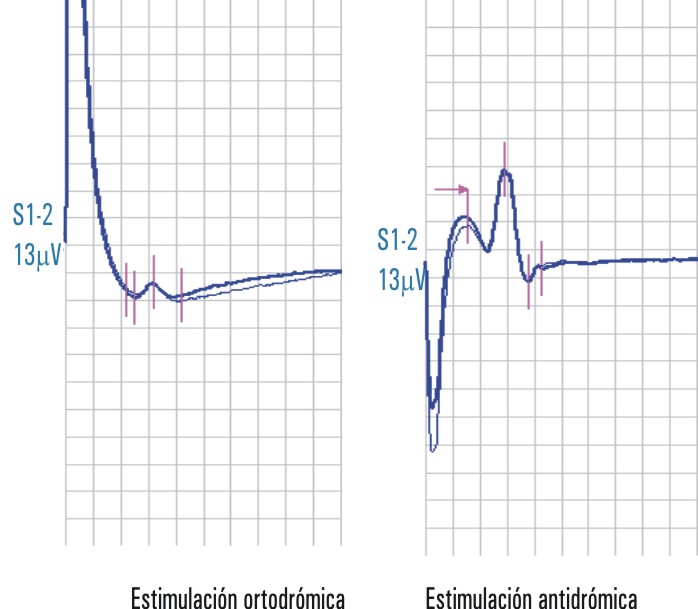
<body><![CDATA[<p class=MsoNormal style=' '><span lang=ES-TRAD>Área bajo la curva.</span><span lang=ES-TRAD style='font-size:10.0pt'></span></p>    <p class=MsoNormal style=' '><span lang=ES-TRAD>Velocidad de conducción nerviosa usando en su cálculo tanto  la latencia al inicio como al pico.</span><span lang=ES-TRAD style='font-size:10.0pt'></span></p><h4><span lang=ES-TRAD style='mso-ansi-language:ES-TRAD;font-weight:normal'>  &nbsp; </span></h4><h4><span lang=ES-TRAD style='mso-ansi-language:ES-TRAD'>Resultados  </span></h4>    <p class=MsoNormal style=' '><i><span lang=ES-TRAD>Relación entre el sexo, la edad y las variables electrofisiológicas  medidas</span></i><i><span lang=ES-TRAD style='font-size: 10.0pt'></span></i></p>    <p class=MsoNormal style=' '><span lang=ES-TRAD>El ANOVA realizado demostró la influencia estadísticamente  significativa (p&lt; 0,05) del sexo en un número considerable de variables como:  la latencia al inicio y al pico, la duración, la duración de la fase negativa  del potencial, la amplitud y la velocidad de conducción tomando en cuenta la latencia  al inicio como al pico.</span><span lang=ES-TRAD style='font-size:10.0pt'></span></p>    <p class=MsoNormal style=' '><span lang=ES-TRAD>Debido a esto fue necesario subdividir la muestra en 2 grupos:  femenino y masculino. Se observó, además, que existió efecto de la edad sobre  un grupo considerable de variables.</span><span lang=ES-TRAD style='font-size:10.0pt'></span></p>    <p class=MsoNormal style=' '><span lang=ES-TRAD><i>Diferencias entre lados</i></span><span lang=ES-TRAD style='font-size:10.0pt'></span></p>    <p class=MsoNormal style=' '><span lang=ES-TRAD>Para ninguna de las variables analizadas existió diferencias  estadísticamente significativas entre ambos lados (derecho e izquierdo), demostrado  a través de una t de Student para muestras dependientes.</span><span lang=ES-TRAD style='font-size:10.0pt'></span></p>    <p class=MsoNormal style=' '><span lang=ES-TRAD>Se calcularon las diferencias medias permisibles entre lados  para cada variable analizada en cada sexo.</span><span lang=ES-TRAD style='font-size:10.0pt'></span></p>    <p class=MsoNormal style=' '><span lang=ES-TRAD>Identificación de las diferencias existentes entre las variables  electrofisiológicas obtenidas por diferentes formas de estimulación (ortodrómica  y antidrómica) (fig.1).</span></p>    <p class=MsoNormal align=center style=' text-align:center'><span lang=ES-TRAD><a href="/img/revistas/ibi/v23n2/fig0108204.jpg"><img src="/img/revistas/ibi/v23n2/fig0108204.jpg" width="307" height="300" border="0"></a></span></p>    
]]></body>
<body><![CDATA[<p class=MsoNormal align=center style=' text-align:center'><i><span lang=ES-TRAD>Fig. 1</span></i><span lang=ES-TRAD>.  Comparación entre la estimulación ortodrómica y antidrómica del nervio sural.</span><span lang=ES-TRAD style='font-size:10.0pt'></span></p>    <p class=MsoNormal style=' '><span lang=ES-TRAD>Se demostró a través de una t de Student para muestras dependientes  que existen diferencias estadísticamente significativas en los 2 sexos entre las  variables duración, duración de la fase negativa, amplitud y área obtenidas por  estimulación ortodrómica y antidrómica (fig.2).</span></p>    <p class=MsoNormal align=center style=' text-align:center'><span lang=ES-TRAD><a href="/img/revistas/ibi/v23n2/fig0208204.jpg"><span style='mso-ansi-font-size:11.0pt;mso-bidi-font-size: 10.0pt;mso-ascii-font-family:&quot;CG Times&quot;;mso-hansi-font-family:&quot;CG Times&quot;; color:windowtext;mso-ansi-font-weight:normal;mso-bidi-font-weight:normal'><img border=0 width=371 height=333 id="_x0000_i1027" src=/img/revistas/ibi/v23n2/fig0208204.jpg align=middle></span></a></span></p>    
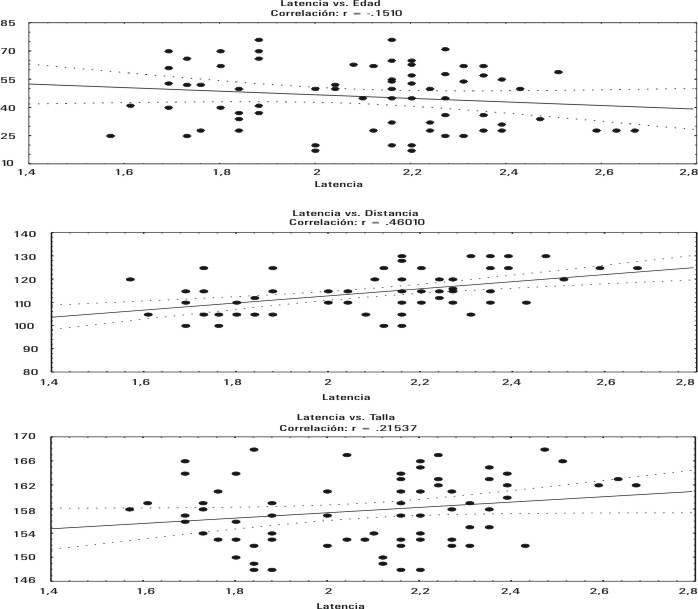
<p class=MsoNormal align=center style=' text-align:center'><i><span lang=ES-TRAD>Fig. 2. </span></i><span lang=ES-TRAD>Estudio  de conducción nerviosa del nervio sural, en un sujeto sano en la misma extremidad.  </span></p>    <p class=MsoNormal align=center style=' text-align:center'><span lang=ES-TRAD>A: con técnica ortodrómica; B: con técnica  antidrómica</span><span lang=ES-TRAD style='font-size:9.0pt;mso-bidi-font-size:10.0pt;font-family:Arial;mso-bidi-font-family: &quot;Times New Roman&quot;'>.</span></p>    <p class=MsoFooter style=' '><i><span lang=ES-TRAD>Cálculo</span></i><span lang=ES-TRAD> <i>de</i> <i>las ecuaciones</i>  <i>de regresión</i></span><span lang=ES-TRAD style='font-size:10.0pt'></span></p>    <p class=MsoNormal style=' '><span lang=ES-TRAD>Debido a la utilización de la distancia en estos estudios  para el cálculo de la velocidad de conducción nerviosa y además el efecto anteriormente  mencionado de la edad sobre las variables, se procedió a analizar el grado de  correlación de estas con dichos factores (edad y distancia). Posteriormente se  calcularon las ecuaciones de regresión que caracterizan a las variables. A las  variables que no mostraron grado de correlación alguno ni con la edad ni con la  distancia (amplitud, duración, duración de la fase negativa, velocidad de conducción  nerviosa tomando en cuenta la latencia tanto al inicio como al pico) se les calculó  la mediana con un intervalo de confianza a 95 %; porque al utilizar la media el  rango del intervalo se observó muy estrecho debido a la distorsión ejercida por  los valores extremos en un promedio, por tal razón la mediana caracterizó mejor  estas variables. En la figura3 se muestra el análisis de correlación para la variable  latencia al inicio en el estudio ortodrómico en función de la edad, la distancia  cátodo-cátodo y la talla. También se calculó la intensidad media necesaria para  lograr la estimulación supramáxima.</span></p>    <p class=MsoNormal align=center style=' text-align:center'><span lang=ES-TRAD><a href="/img/revistas/ibi/v23n2/fig0308204.jpg"><span style='mso-ansi-font-size:11.0pt;mso-bidi-font-size: 10.0pt;mso-ascii-font-family:&quot;CG Times&quot;;mso-hansi-font-family:&quot;CG Times&quot;; color:windowtext;mso-ansi-font-weight:normal;mso-bidi-font-weight:normal'><img border=0 width=366 height=308 id="_x0000_i1028" src=/img/revistas/ibi/v23n2/fig0308204.jpg align=middle></span></a></span></p>    
<p class=MsoNormal align=center style=' text-align:center'><i><span lang=ES-TRAD>Fig. 3.</span></i><span lang=ES-TRAD>  Análisis de correlación de la latencia en el estudio sensitivo del nervio sural.  Sexo femenino.</span></p><h4><span lang=ES-TRAD style='mso-ansi-language:ES-TRAD'>Discusión</span></h4>    <p class=MsoNormal style=' '><span lang=ES-TRAD>Se ha reportado la influencia de factores como la edad y  el sexo en las variables del estudio de conducción. Se plantea que las mujeres  tienen latencias más cortas y velocidades más rápidas que los hombres, así como  que la latencia se prolonga, la velocidad se enlentece y la amplitud disminuye  con edades avanzadas, lo cual concuerda con estos hallazgos.<sup>18-25</sup></span><span lang=ES-TRAD style='font-size:10.0pt'></span></p>    ]]></body>
<body><![CDATA[<p class=MsoNormal style=' '><span lang=ES-TRAD>También se ha planteado la existencia de diferencias entre  el estudio ortodrómico y el antidrómico, con este último la respuesta tiene mayor  amplitud, se define mejor la morfología trifásica, su inicio y final, se obtiene  con menor intensidad de estimulación e incluso hay autores que plantean que no  necesita de técnicas de promediación para obtenerlo.<sup>18-28</sup></span><span lang=ES-TRAD style='font-size:10.0pt'></span></p>    <p class=MsoNormal style=' '><span lang=ES-TRAD>Estos resultados concuerdan con tales planteamientos excepto  con el último, porque siempre se utilizaron técnicas de promediación. Se demostró  que con la estimulación antidrómica la respuesta tiene mayor ampltud, se define  mejor y presenta menor duración de la fase negativa; por lo que esta se mide de  forma más fiel (fig. 1).</span><span lang=ES-TRAD style='font-size:10.0pt'></span></p>    <p class=MsoNormal style=' '><span lang=ES-TRAD>Se concluyó que las variables del estudio de conducción nerviosa  periférica son influenciadas por el sexo, la edad y la distancia. Las variables  del estudio de conducción nerviosa periférica del nervio sural difieren con la  técnica de estimulación (ortodrómica o antidrómica).</span><span lang=ES-TRAD style='font-size:10.0pt'></span></p><h4><span lang=EN-US style='mso-ansi-language:EN-US'>Summary</span></h4>    <p class=MsoNormal style=' '><span lang=EN-US style='mso-ansi-language:EN-US'>Possible differences in sural  nerve responses obtained from the application of antidromic and orthodromic techniques  were identified. A study of bilateral conduction of sural nerve was performed  in 37 healthy subjects of both sexes under standardized conditions. Student´s  t test yielded that there were statistically significant differences between the  two sexes regarding variables such as duration of negative phase, amplitude and  area obtained from both techniques. Therefore, it was concluded that antidromic  stimulation facilitates a response of wider amplitude, better definition and longer  duration of negative phase. This might be used as an alternative method to electrophysiologically  confirm the sural nerve damage that is not shown by the conventional neurographic  methods.</span><span lang=EN-US style='font-size: 10.0pt;mso-ansi-language:EN-US'></span></p>    <!-- ref --><p class=MsoNormal style=' '><i><span lang=EN-US style='mso-ansi-language:EN-US'>Key words</span></i><span lang=EN-US style='mso-ansi-language:EN-US'>: Sural nerve; antidromic y orthodromic  techniques.</span><!-- ref -->Aminoff  MJ. Electrodiagnosis in Clinical Neurology. 3ed. Churchill, Livingstone; 1992.</span><span      lang=EN-US style='font-size:12.0pt;mso-bidi-font-size:10.0pt;font-family:      &quot;Times New Roman&quot;;mso-ansi-language:EN-US'></span></li><li class=MsoNormal style='mso-list:l0 level1 lfo3;      '><span lang=EN-US style='font-size:12.0pt;      font-family:&quot;Times New Roman&quot;;mso-ansi-language:EN-US'>    <!-- ref -->Schalow  G, Zach GA, Warzok R. Classification of human peripheral nerves fibre groups by  conduction velocity and nerve fibre diameter in preserved following spinal cord  lesion. J Auton Nerv Syst 1995;52(2-3):125-50.</span><span      lang=EN-US style='font-size:12.0pt;mso-bidi-font-size:10.0pt;font-family:      &quot;Times New Roman&quot;;mso-ansi-language:EN-US'></span></li><li class=MsoNormal style='mso-list:l0 level1 lfo3;      '><span lang=EN-US style='font-size:12.0pt;      font-family:&quot;Times New Roman&quot;;mso-ansi-language:EN-US'>    <!-- ref -->Kandel ER,  Scwartz JH, Jessell TM. Principles of Neural Science. 3ed. 1991.</span><span      lang=EN-US style='font-size:12.0pt;mso-bidi-font-size:10.0pt;font-family:      &quot;Times New Roman&quot;;mso-ansi-language:EN-US'></span></li><li class=MsoNormal style='mso-list:l0 level1 lfo3;      '><span lang=EN-US style='font-size:12.0pt;      font-family:&quot;Times New Roman&quot;;mso-ansi-language:EN-US'>    <!-- ref -->Binnie CD,  Cooper R, Fowler CJ, Mauguiere F, Prior PF. Clinical Neurophysiology. EMG, Nerve  Conduction and Evoked Potentials. 1ed. London:1996.</span><span      lang=EN-US style='font-size:12.0pt;mso-bidi-font-size:10.0pt;font-family:      &quot;Times New Roman&quot;;mso-ansi-language:EN-US'></span></li><li class=MsoNormal style='mso-list:l0 level1 lfo3;      '><span lang=EN-US style='font-size:12.0pt;      font-family:&quot;Times New Roman&quot;;mso-ansi-language:EN-US'>    <!-- ref -->Liveson  JA, Dong MM. Laboratory reference for clinical neurophysiology. Philadelphia:  1992.</span><span      lang=EN-US style='font-size:12.0pt;mso-bidi-font-size:10.0pt;font-family:      &quot;Times New Roman&quot;;mso-ansi-language:EN-US'></span></li><li class=MsoNormal style='mso-list:l0 level1 lfo3;      '><span lang=EN-US style='font-size:12.0pt;      font-family:&quot;Times New Roman&quot;;mso-ansi-language:EN-US'>    <!-- ref -->Zwarts MJ,  Guechev A. The relation between conduction velocity and axonal length. Muscle  Nerve 1995;18(11):1244-49.</span><span lang=EN-US style='font-size:12.0pt;      mso-bidi-font-size:10.0pt;font-family:&quot;Times New Roman&quot;;mso-ansi-language:      EN-US'></span></li><li class=MsoNormal style='mso-list:l0 level1 lfo3;      '><span lang=EN-US style='font-size:12.0pt;      font-family:&quot;Times New Roman&quot;;mso-ansi-language:EN-US'>    <!-- ref -->Kimura J.  Electrodiagnosis in diseases of nerve and muscle: principles and practice. Philadelphia:  1983.</span><span lang=EN-US style='font-size:12.0pt;      mso-bidi-font-size:10.0pt;font-family:&quot;Times New Roman&quot;;mso-ansi-language:      EN-US'></span></li><li class=MsoNormal style='mso-list:l0 level1 lfo3;      '><span lang=EN-US style='font-size:12.0pt;      font-family:&quot;Times New Roman&quot;;mso-ansi-language:EN-US'>    <!-- ref -->Hodes R,  Larrabee MG, German W. The human electromyogram in response to nerve stimulation  and the conduction velocity of motor axons: studies on normal and on injured peripheral  nerves. Arch Neurol Psychiatr 1948;60:340.</span><span      lang=EN-US style='font-size:12.0pt;mso-bidi-font-size:10.0pt;font-family:      &quot;Times New Roman&quot;;mso-ansi-language:EN-US'></span></li><li class=MsoNormal style='mso-list:l0 level1 lfo3;      '><span lang=EN-US style='font-size:12.0pt;      font-family:&quot;Times New Roman&quot;;mso-ansi-language:EN-US'>    <!-- ref -->Dawson GD,  Scolt JW. The recording of nerve action potentials through the skin in man. J  Neurol Neurosurg Psychiatr 1949; (Suppl 12): 259.</span><span lang=EN-US      style='font-size:12.0pt;mso-bidi-font-size:10.0pt;font-family:&quot;Times New Roman&quot;;      mso-ansi-language:EN-US'></span></li><li class=MsoNormal style='mso-list:l0 level1 lfo3;      '><span lang=EN-US style='font-size:12.0pt;      font-family:&quot;Times New Roman&quot;;mso-ansi-language:EN-US'>    <!-- ref -->Kimura J.  Nerve Conduction Studies and Electromyography. </span><span lang=ES-TRAD      style='font-size:12.0pt;font-family:"Times New Roman"'>En: Dyck PJ, Thomas  PK. </span><span lang=EN-US style='font-size:12.0pt;font-family:&quot;Times New Roman&quot;;      mso-ansi-language:EN-US'>Peripheral Neuropathy. 3ed. Vol1. 1993:p.598-644.</span><span      lang=EN-US style='font-size:12.0pt;mso-bidi-font-size:10.0pt;font-family:      &quot;Times New Roman&quot;;mso-ansi-language:EN-US'></span></li><li class=MsoNormal style='mso-list:l0 level1 lfo3;      '><span lang=EN-US style='font-size:12.0pt;      font-family:&quot;Times New Roman&quot;;mso-ansi-language:EN-US'>Oh SJ. Clinical  electromyography: nerve conduction studies. </span><span style='font-size:      12.0pt;font-family:&quot;Times New Roman&quot;;mso-ansi-language:ES'>1ed.  1984.</span><span      style='font-size:12.0pt;mso-bidi-font-size:10.0pt;font-family:&quot;Times New Roman&quot;;      mso-ansi-language:ES'></span></li><li class=MsoNormal style='mso-list:l0 level1 lfo3;      '><span style='font-size:12.0pt;font-family:&quot;Times New Roman&quot;;      mso-ansi-language:ES'>    <!-- ref -->Yuasa J, Kishi R, Harabuchi I, Egushi T, Arata </span><span      lang=ES-TRAD style='font-size:12.0pt;font-family:"Times New Roman"'>Y, Fujitas  S, et al. </span><span lang=EN-US style='font-size:12.0pt;      font-family:&quot;Times New Roman&quot;;mso-ansi-language:EN-US'>Effects  of age and skin temperature on peripheral nerve conduction velocity, a basic study  for nerve conduction velocity measurement in worksite. </span><span      lang=ES-TRAD style='font-size:12.0pt;font-family:"Times New Roman"'>Sangyo  Eiseigaku Zasshi 1996 Jul; 38 (4):158-64.</span><span style='font-size:      12.0pt;mso-bidi-font-size:10.0pt;font-family:&quot;Times New Roman&quot;;mso-ansi-language:      ES'></span></li><li class=MsoNormal style='mso-list:l0 level1 lfo3;      '><span lang=EN-US style='font-size:12.0pt;      font-family:&quot;Times New Roman&quot;;mso-ansi-language:EN-US'>Tan M, Tan  U. Possible lateralization of peripheral nerve conduction associated with gender.  Percept Mot Skills 1995;81(3 Pt1):939-43.</span><span lang=EN-US      style='font-size:12.0pt;mso-bidi-font-size:10.0pt;font-family:&quot;Times New Roman&quot;;      mso-ansi-language:EN-US'></span></li><li class=MsoNormal style='mso-list:l0 level1 lfo3;      '><span lang=EN-US style='font-size:12.0pt;      font-family:&quot;Times New Roman&quot;;mso-ansi-language:EN-US'>Kurokawa  K, Tanaka E, Yamashita H, Nakayama T, Maruyama H, Yukawa Ma, et al. Age related  changes in amplitude ratio, duration ratio and area ratio in nerve conduction  studies. Nippon Ronen Igakkai Zasshi 1995; 32(8-9):547-52.</span><span      lang=EN-US style='font-size:12.0pt;mso-bidi-font-size:10.0pt;font-family:      &quot;Times New Roman&quot;;mso-ansi-language:EN-US'></span></li><li class=MsoNormal style='mso-list:l0 level1 lfo3;      '><span lang=EN-US style='font-size:12.0pt;      font-family:&quot;Times New Roman&quot;;mso-ansi-language:EN-US'>    <!-- ref -->Rabben OK.  Sensory nerves conduction studies in children. Age related changes of conduction  velocities. Neuropediatrics 1995;26(10):26-32.</span><span lang=EN-US      style='font-size:12.0pt;mso-bidi-font-size:10.0pt;font-family:&quot;Times New Roman&quot;;      mso-ansi-language:EN-US'></span></li><li class=MsoNormal style='mso-list:l0 level1 lfo3;      '><span lang=EN-US style='font-size:12.0pt;      font-family:&quot;Times New Roman&quot;;mso-ansi-language:EN-US'>    <!-- ref -->Albers J,  Shields RW, Wimourn AJ. Sensory nerve conduction study workshop. Cleveland Clinic  Foundation, 1995, 1-19.</span><span lang=EN-US style='font-size:12.0pt;      mso-bidi-font-size:10.0pt;font-family:&quot;Times New Roman&quot;;mso-ansi-language:      EN-US'></span></li><li class=MsoNormal style='mso-list:l0 level1 lfo3;      '><span lang=EN-US style='font-size:12.0pt;      font-family:&quot;Times New Roman&quot;;mso-ansi-language:EN-US'>    <!-- ref -->Kotte FJ,  Amate EA. </span><span lang=ES-TRAD style='font-size:12.0pt;font-family:"Times New Roman"'>Adelantos  clínicos en Medicina Física y rehabilitación. </span><span lang=EN-US      style='font-size:12.0pt;font-family:&quot;Times New Roman&quot;;mso-ansi-language:      EN-US'>Washington DC:1994.</span><span lang=EN-US style='font-size:12.0pt;      mso-bidi-font-size:10.0pt;font-family:&quot;Times New Roman&quot;;mso-ansi-language:      EN-US'></span></li><li class=MsoNormal style='mso-list:l0 level1 lfo3;      '><span lang=EN-US style='font-size:12.0pt;      font-family:&quot;Times New Roman&quot;;mso-ansi-language:EN-US'>    <!-- ref -->Kachi T,  Sobue G, Yamamoto M, Igata A. Sensory conduction studies in chronic sensory ataxic  neuropathy. J Neurol Neurosurg Psychiatry 1994 ;57(8):941-4.</span><span      lang=EN-US style='font-size:12.0pt;mso-bidi-font-size:10.0pt;font-family:      &quot;Times New Roman&quot;;mso-ansi-language:EN-US'></span></li><li class=MsoNormal style='mso-list:l0 level1 lfo3;      '><span lang=ES-TRAD style='font-size:12.0pt;      font-family:&quot;Times New Roman&quot;'>    <!-- ref -->Almirall P. Neuropatía Epidémica  en Cuba 1992-1994, Cuba. 1995.</span><span style='font-size:12.0pt;mso-bidi-font-size:      10.0pt;font-family:&quot;Times New Roman&quot;;mso-ansi-language:ES'></span></li><li class=MsoNormal style='mso-list:l0 level1 lfo3;      '><span lang=EN-US style='font-size:12.0pt;      font-family:&quot;Times New Roman&quot;;mso-ansi-language:EN-US'>    <!-- ref -->Trojaborg  W. Sensory nerve conduction. Near nerve recording. Methods Clin Neurophysiol 1992;3(2):17-44.</span><span lang=EN-US style='font-size:12.0pt;      mso-bidi-font-size:10.0pt;font-family:&quot;Times New Roman&quot;;mso-ansi-language:      EN-US'></span></li><li class=MsoNormal style='mso-list:l0 level1 lfo3;      '><span lang=EN-US style='font-size:12.0pt;      font-family:&quot;Times New Roman&quot;;mso-ansi-language:EN-US'>    <!-- ref -->Trojaborg  W, Moon A, Andersen BB, Trojaborg NS. Sural nerve conduction parameters in normal  subjects related to age, gender, temperature, and height: A reappraisal. Muscle  Nerve 1992;15:15-20.</span><span lang=EN-US style='font-size:12.0pt;      mso-bidi-font-size:10.0pt;font-family:&quot;Times New Roman&quot;;mso-ansi-language:      EN-US'></span></li><li class=MsoNormal style='mso-list:l0 level1 lfo3;      '><span lang=EN-US style='font-size:12.0pt;      font-family:&quot;Times New Roman&quot;;mso-ansi-language:EN-US'>    <!-- ref -->Taylor PK.  Non linear effects of age on nerve conduction in adults. J Neurol Sci 1984; 66:223-34.</span><span lang=EN-US style='font-size:12.0pt;mso-bidi-font-size:      10.0pt;font-family:&quot;Times New Roman&quot;;mso-ansi-language:EN-US'></span></li><li class=MsoNormal style='mso-list:l0 level1 lfo3;      '><span lang=EN-US style='font-size:12.0pt;      font-family:&quot;Times New Roman&quot;;mso-ansi-language:EN-US'>    <!-- ref -->Stetson  DS, Albers JW, Silverstein BA, Wolfe RA. Effects of age, sex, and anthropometric  factors on nerve conduction measures. Muscle Nerve 1992;15:1095-104.</span><span      lang=EN-US style='font-size:12.0pt;mso-bidi-font-size:10.0pt;font-family:      &quot;Times New Roman&quot;;mso-ansi-language:EN-US'></span></li><li class=MsoNormal style='mso-list:l0 level1 lfo3;      '><span lang=EN-US style='font-size:12.0pt;      font-family:&quot;Times New Roman&quot;;mso-ansi-language:EN-US'>    <!-- ref -->Falck B,  Stålberg E, Christian B. Sensory Nerve Conduction studies with surface electrodes.  Methods Clin Neurophysiol 1994;5(1):1-20.</span><span lang=EN-US      style='font-size:12.0pt;mso-bidi-font-size:10.0pt;font-family:&quot;Times New Roman&quot;;      mso-ansi-language:EN-US'></span></li><li class=MsoNormal style='mso-list:l0 level1 lfo3;      '><span lang=EN-US style='font-size:12.0pt;      font-family:&quot;Times New Roman&quot;;mso-ansi-language:EN-US'>    <!-- ref -->Horowitz  SH, Krarup C. Conduction studies of normal sural nerve. Muscle Nerve 1992; 15:374-83.</span><span      lang=EN-US style='font-size:12.0pt;mso-bidi-font-size:10.0pt;font-family:      &quot;Times New Roman&quot;;mso-ansi-language:EN-US'></span></li><li class=MsoNormal style='mso-list:l0 level1 lfo3;      '><span lang=EN-US style='font-size:12.0pt;      font-family:&quot;Times New Roman&quot;;mso-ansi-language:EN-US'>    <!-- ref -->Ma DM, Liveson  JA. Nerve Conduction Handbook, Philadelphia: 1983.</span><span lang=EN-US      style='font-size:12.0pt;mso-bidi-font-size:10.0pt;font-family:&quot;Times New Roman&quot;;      mso-ansi-language:EN-US'></span></li><li class=MsoNormal style='mso-list:l0 level1 lfo3;      '><span lang=EN-US style='font-size:12.0pt;      font-family:&quot;Times New Roman&quot;;mso-ansi-language:EN-US'>    <!-- ref -->Bolton CF,  Carter KM. Human sensory nerve compound action potential amplitude: Variation  with sex and finger circumference. J Neurol Neurosurg Psychiatr 1980;43:925.</span><span lang=EN-US style='font-size:12.0pt;mso-bidi-font-size:      10.0pt;font-family:&quot;Times New Roman&quot;;mso-ansi-language:EN-US'></span></li><li class=MsoNormal style='mso-list:l0 level1 lfo3;      '><span lang=EN-US style='font-size:12.0pt;      font-family:&quot;Times New Roman&quot;;mso-ansi-language:EN-US'>    <!-- ref -->Oken BS.  Statistics for evoked potentials. </span><span style='font-size:12.0pt;font-family:      &quot;Times New Roman&quot;;mso-ansi-language:ES'>En Chiappa KH. </span><span      lang=EN-US style='font-size:12.0pt;font-family:&quot;Times New Roman&quot;;      mso-ansi-language:EN-US'>Evoked Potentials in Clinical Medicine. 3ed. Philadelphia.  1997. p.565-77.</span></li>    </ol>    <p><span style='mso-ansi-language:ES'>    <br> </span><span lang=ES-MX style='font-size:11.0pt;mso-bidi-font-size:10.0pt; font-family:&quot;CG Times&quot;;font-weight:normal;mso-bidi-font-weight:bold'>Recibido:  8 de septiembre de 2003. Aprobado: 22 de marzo de 2004.    <br> </span><span lang=ES-MX style='font-size:11.0pt;mso-bidi-font-size: 10.0pt;font-family:&quot;CG Times&quot;'>Dra. <i>Bárbara Aymeé Hernández Hernández</i>.  Departamento de Neurofisiología Clínica. Centro Nacional de Neurociencias, CENIC.  Ave 25, No.15202, esq. 158, Cubanacán, CP 16041 Ciudad de La Habana, Cuba.</span>  </p></div>      ]]></body><back>
<ref-list>
<ref id="B1">
<nlm-citation citation-type="book">
<person-group person-group-type="author">
<name>
<surname><![CDATA[Nodarse]]></surname>
<given-names><![CDATA[A]]></given-names>
</name>
</person-group>
<source><![CDATA[Manual Básico del laboratorio de electromiografía: Estudios de Conducción Nerviosa Periférica y Potenciales Evocados Somatosensoriales]]></source>
<year>1992</year>
<publisher-name><![CDATA[Facultad de Medicina. Universidad de los Andes]]></publisher-name>
</nlm-citation>
</ref>
<ref id="B2">
<nlm-citation citation-type="">
<person-group person-group-type="author">
<name>
<surname><![CDATA[Aminoff]]></surname>
<given-names><![CDATA[MJ]]></given-names>
</name>
</person-group>
<source><![CDATA[Electrodiagnosis in Clinical Neurology]]></source>
<year>1992</year>
<edition>3</edition>
</nlm-citation>
</ref>
<ref id="B3">
<nlm-citation citation-type="journal">
<person-group person-group-type="author">
<name>
<surname><![CDATA[Schalow]]></surname>
<given-names><![CDATA[G]]></given-names>
</name>
<name>
<surname><![CDATA[Zach]]></surname>
<given-names><![CDATA[GA]]></given-names>
</name>
<name>
<surname><![CDATA[Warzok]]></surname>
<given-names><![CDATA[R]]></given-names>
</name>
</person-group>
<article-title xml:lang="en"><![CDATA[Classification of human peripheral nerves fibre groups by conduction velocity and nerve fibre diameter in preserved following spinal cord lesion]]></article-title>
<source><![CDATA[J Auton Nerv Syst]]></source>
<year>1995</year>
<volume>52</volume>
<numero>2-3</numero>
<issue>2-3</issue>
<page-range>125-50</page-range></nlm-citation>
</ref>
<ref id="B4">
<nlm-citation citation-type="">
<person-group person-group-type="author">
<name>
<surname><![CDATA[Kandel]]></surname>
<given-names><![CDATA[ER]]></given-names>
</name>
<name>
<surname><![CDATA[Scwartz]]></surname>
<given-names><![CDATA[JH]]></given-names>
</name>
<name>
<surname><![CDATA[Jessell]]></surname>
<given-names><![CDATA[TM]]></given-names>
</name>
</person-group>
<source><![CDATA[Principles of Neural Science]]></source>
<year>1991</year>
<edition>3</edition>
</nlm-citation>
</ref>
<ref id="B5">
<nlm-citation citation-type="">
<person-group person-group-type="author">
<name>
<surname><![CDATA[Binnie]]></surname>
<given-names><![CDATA[CD]]></given-names>
</name>
<name>
<surname><![CDATA[Cooper]]></surname>
<given-names><![CDATA[R]]></given-names>
</name>
<name>
<surname><![CDATA[Fowler]]></surname>
<given-names><![CDATA[CJ]]></given-names>
</name>
<name>
<surname><![CDATA[Mauguiere]]></surname>
<given-names><![CDATA[F]]></given-names>
</name>
<name>
<surname><![CDATA[Prior]]></surname>
<given-names><![CDATA[PF]]></given-names>
</name>
</person-group>
<source><![CDATA[Clinical Neurophysiology]]></source>
<year>1996</year>
<edition>1</edition>
</nlm-citation>
</ref>
<ref id="B6">
<nlm-citation citation-type="">
<person-group person-group-type="author">
<name>
<surname><![CDATA[Liveson]]></surname>
<given-names><![CDATA[JA]]></given-names>
</name>
<name>
<surname><![CDATA[Dong]]></surname>
<given-names><![CDATA[MM]]></given-names>
</name>
</person-group>
<source><![CDATA[Laboratory reference for clinical neurophysiology]]></source>
<year>1992</year>
</nlm-citation>
</ref>
<ref id="B7">
<nlm-citation citation-type="journal">
<person-group person-group-type="author">
<name>
<surname><![CDATA[Zwarts]]></surname>
<given-names><![CDATA[MJ]]></given-names>
</name>
<name>
<surname><![CDATA[Guechev]]></surname>
<given-names><![CDATA[A]]></given-names>
</name>
</person-group>
<article-title xml:lang="en"><![CDATA[The relation between conduction velocity and axonal length]]></article-title>
<source><![CDATA[Muscle Nerve]]></source>
<year>1995</year>
<volume>18</volume>
<numero>11</numero>
<issue>11</issue>
<page-range>1244-49</page-range></nlm-citation>
</ref>
<ref id="B8">
<nlm-citation citation-type="">
<person-group person-group-type="author">
<name>
<surname><![CDATA[Kimura]]></surname>
<given-names><![CDATA[J]]></given-names>
</name>
</person-group>
<source><![CDATA[Electrodiagnosis in diseases of nerve and muscle: principles and practice]]></source>
<year>1983</year>
</nlm-citation>
</ref>
<ref id="B9">
<nlm-citation citation-type="journal">
<person-group person-group-type="author">
<name>
<surname><![CDATA[Hodes]]></surname>
<given-names><![CDATA[R]]></given-names>
</name>
<name>
<surname><![CDATA[Larrabee]]></surname>
<given-names><![CDATA[MG]]></given-names>
</name>
<name>
<surname><![CDATA[German]]></surname>
<given-names><![CDATA[W]]></given-names>
</name>
</person-group>
<article-title xml:lang="en"><![CDATA[The human electromyogram in response to nerve stimulation and the conduction velocity of motor axons: studies on normal and on injured peripheral nerves]]></article-title>
<source><![CDATA[Arch Neurol Psychiatr]]></source>
<year>1948</year>
<volume>60</volume>
<page-range>340</page-range></nlm-citation>
</ref>
<ref id="B10">
<nlm-citation citation-type="journal">
<person-group person-group-type="author">
<name>
<surname><![CDATA[Dawson]]></surname>
<given-names><![CDATA[GD]]></given-names>
</name>
<name>
<surname><![CDATA[Scolt]]></surname>
<given-names><![CDATA[JW]]></given-names>
</name>
</person-group>
<article-title xml:lang="en"><![CDATA[The recording of nerve action potentials through the skin in man]]></article-title>
<source><![CDATA[J Neurol Neurosurg Psychiatr]]></source>
<year>1949</year>
<numero>^s12</numero>
<issue>^s12</issue>
<supplement>12</supplement>
<page-range>259</page-range></nlm-citation>
</ref>
<ref id="B11">
<nlm-citation citation-type="journal">
<person-group person-group-type="author">
<name>
<surname><![CDATA[Kimura]]></surname>
<given-names><![CDATA[J]]></given-names>
</name>
</person-group>
<article-title xml:lang="en"><![CDATA[Nerve Conduction Studies and Electromyography]]></article-title>
<source><![CDATA[Peripheral Neuropathy]]></source>
<year>1993</year>
<volume>1</volume>
<page-range>598-644</page-range></nlm-citation>
</ref>
<ref id="B12">
<nlm-citation citation-type="">
<person-group person-group-type="author">
<name>
<surname><![CDATA[Oh]]></surname>
<given-names><![CDATA[SJ]]></given-names>
</name>
</person-group>
<source><![CDATA[Clinical electromyography: nerve conduction studies]]></source>
<year>1984</year>
<edition>1</edition>
</nlm-citation>
</ref>
<ref id="B13">
<nlm-citation citation-type="journal">
<person-group person-group-type="author">
<name>
<surname><![CDATA[Yuasa]]></surname>
<given-names><![CDATA[J]]></given-names>
</name>
<name>
<surname><![CDATA[Kishi]]></surname>
<given-names><![CDATA[R]]></given-names>
</name>
<name>
<surname><![CDATA[Harabuchi]]></surname>
<given-names><![CDATA[I]]></given-names>
</name>
<name>
<surname><![CDATA[Egushi]]></surname>
<given-names><![CDATA[T]]></given-names>
</name>
<name>
<surname><![CDATA[Arata]]></surname>
<given-names><![CDATA[Y]]></given-names>
</name>
<name>
<surname><![CDATA[Fujitas]]></surname>
<given-names><![CDATA[S]]></given-names>
</name>
</person-group>
<article-title xml:lang="en"><![CDATA[Effects of age and skin temperature on peripheral nerve conduction velocity, a basic study for nerve conduction velocity measurement in worksite]]></article-title>
<source><![CDATA[Sangyo Eiseigaku Zasshi]]></source>
<year>1996</year>
<volume>38</volume>
<numero>4</numero>
<issue>4</issue>
<page-range>158-64</page-range></nlm-citation>
</ref>
<ref id="B14">
<nlm-citation citation-type="journal">
<person-group person-group-type="author">
<name>
<surname><![CDATA[Tan]]></surname>
<given-names><![CDATA[M]]></given-names>
</name>
<name>
<surname><![CDATA[Tan]]></surname>
<given-names><![CDATA[U]]></given-names>
</name>
</person-group>
<article-title xml:lang="en"><![CDATA[Possible lateralization of peripheral nerve conduction associated with gender]]></article-title>
<source><![CDATA[Percept Mot Skills]]></source>
<year>1995</year>
<volume>81</volume>
<numero>3</numero>
<issue>3</issue>
<page-range>939-43</page-range></nlm-citation>
</ref>
<ref id="B15">
<nlm-citation citation-type="journal">
<person-group person-group-type="author">
<name>
<surname><![CDATA[Kurokawa]]></surname>
<given-names><![CDATA[K]]></given-names>
</name>
<name>
<surname><![CDATA[Tanaka]]></surname>
<given-names><![CDATA[E]]></given-names>
</name>
<name>
<surname><![CDATA[Yamashita]]></surname>
<given-names><![CDATA[H]]></given-names>
</name>
<name>
<surname><![CDATA[Nakayama]]></surname>
<given-names><![CDATA[T]]></given-names>
</name>
<name>
<surname><![CDATA[Maruyama]]></surname>
<given-names><![CDATA[H]]></given-names>
</name>
<name>
<surname><![CDATA[Yukawa]]></surname>
<given-names><![CDATA[Ma]]></given-names>
</name>
</person-group>
<article-title xml:lang="en"><![CDATA[Age related changes in amplitude ratio, duration ratio and area ratio in nerve conduction studies]]></article-title>
<source><![CDATA[Nippon Ronen Igakkai Zasshi]]></source>
<year>1995</year>
<volume>32</volume>
<numero>8-9</numero>
<issue>8-9</issue>
<page-range>547-52</page-range></nlm-citation>
</ref>
<ref id="B16">
<nlm-citation citation-type="journal">
<person-group person-group-type="author">
<name>
<surname><![CDATA[Rabben]]></surname>
<given-names><![CDATA[OK]]></given-names>
</name>
</person-group>
<article-title xml:lang="en"><![CDATA[Sensory nerves conduction studies in children: Age related changes of conduction velocities]]></article-title>
<source><![CDATA[Neuropediatrics]]></source>
<year>1995</year>
<volume>26</volume>
<numero>10</numero>
<issue>10</issue>
<page-range>26-32</page-range></nlm-citation>
</ref>
<ref id="B17">
<nlm-citation citation-type="book">
<person-group person-group-type="author">
<name>
<surname><![CDATA[Albers]]></surname>
<given-names><![CDATA[J]]></given-names>
</name>
<name>
<surname><![CDATA[Shields]]></surname>
<given-names><![CDATA[RW]]></given-names>
</name>
<name>
<surname><![CDATA[Wimourn]]></surname>
<given-names><![CDATA[AJ]]></given-names>
</name>
</person-group>
<source><![CDATA[Sensory nerve conduction study workshop]]></source>
<year>1995</year>
<page-range>1-19</page-range><publisher-name><![CDATA[Cleveland Clinic Foundation]]></publisher-name>
</nlm-citation>
</ref>
<ref id="B18">
<nlm-citation citation-type="">
<person-group person-group-type="author">
<name>
<surname><![CDATA[Kotte]]></surname>
<given-names><![CDATA[FJ]]></given-names>
</name>
<name>
<surname><![CDATA[Amate]]></surname>
<given-names><![CDATA[EA]]></given-names>
</name>
</person-group>
<source><![CDATA[Adelantos clínicos en Medicina Física y rehabilitación]]></source>
<year>1994</year>
</nlm-citation>
</ref>
<ref id="B19">
<nlm-citation citation-type="journal">
<person-group person-group-type="author">
<name>
<surname><![CDATA[Kachi]]></surname>
<given-names><![CDATA[T]]></given-names>
</name>
<name>
<surname><![CDATA[Sobue]]></surname>
<given-names><![CDATA[G]]></given-names>
</name>
<name>
<surname><![CDATA[Yamamoto]]></surname>
<given-names><![CDATA[M]]></given-names>
</name>
<name>
<surname><![CDATA[Igata]]></surname>
<given-names><![CDATA[A]]></given-names>
</name>
</person-group>
<article-title xml:lang="en"><![CDATA[Sensory conduction studies in chronic sensory ataxic neuropathy]]></article-title>
<source><![CDATA[J Neurol Neurosurg Psychiatry]]></source>
<year>1994</year>
<volume>57</volume>
<numero>8</numero>
<issue>8</issue>
<page-range>941-4</page-range></nlm-citation>
</ref>
<ref id="B20">
<nlm-citation citation-type="">
<person-group person-group-type="author">
<name>
<surname><![CDATA[Almirall]]></surname>
<given-names><![CDATA[P]]></given-names>
</name>
</person-group>
<source><![CDATA[Neuropatía Epidémica en Cuba 1992-1994]]></source>
<year>1995</year>
</nlm-citation>
</ref>
<ref id="B21">
<nlm-citation citation-type="journal">
<person-group person-group-type="author">
<name>
<surname><![CDATA[Trojaborg]]></surname>
<given-names><![CDATA[W]]></given-names>
</name>
</person-group>
<article-title xml:lang="en"><![CDATA[Sensory nerve conduction: Near nerve recording]]></article-title>
<source><![CDATA[Methods Clin Neurophysiol]]></source>
<year>1992</year>
<volume>3</volume>
<numero>2</numero>
<issue>2</issue>
<page-range>17-44</page-range></nlm-citation>
</ref>
<ref id="B22">
<nlm-citation citation-type="journal">
<person-group person-group-type="author">
<name>
<surname><![CDATA[Trojaborg]]></surname>
<given-names><![CDATA[W]]></given-names>
</name>
<name>
<surname><![CDATA[Moon]]></surname>
<given-names><![CDATA[A]]></given-names>
</name>
<name>
<surname><![CDATA[Andersen]]></surname>
<given-names><![CDATA[BB]]></given-names>
</name>
<name>
<surname><![CDATA[Trojaborg]]></surname>
<given-names><![CDATA[NS]]></given-names>
</name>
</person-group>
<article-title xml:lang="en"><![CDATA[Sural nerve conduction parameters in normal subjects related to age, gender, temperature, and height: A reappraisal]]></article-title>
<source><![CDATA[Muscle Nerve]]></source>
<year>1992</year>
<volume>15</volume>
<page-range>15-20</page-range></nlm-citation>
</ref>
<ref id="B23">
<nlm-citation citation-type="journal">
<person-group person-group-type="author">
<name>
<surname><![CDATA[Taylor]]></surname>
<given-names><![CDATA[PK]]></given-names>
</name>
</person-group>
<article-title xml:lang="en"><![CDATA[Non linear effects of age on nerve conduction in adults]]></article-title>
<source><![CDATA[J Neurol Sci]]></source>
<year>1984</year>
<volume>66</volume>
<page-range>223-34</page-range></nlm-citation>
</ref>
<ref id="B24">
<nlm-citation citation-type="journal">
<person-group person-group-type="author">
<name>
<surname><![CDATA[Stetson]]></surname>
<given-names><![CDATA[DS]]></given-names>
</name>
<name>
<surname><![CDATA[Albers]]></surname>
<given-names><![CDATA[JW]]></given-names>
</name>
<name>
<surname><![CDATA[Silverstein]]></surname>
<given-names><![CDATA[BA]]></given-names>
</name>
<name>
<surname><![CDATA[Wolfe]]></surname>
<given-names><![CDATA[RA]]></given-names>
</name>
</person-group>
<article-title xml:lang="en"><![CDATA[Effects of age, sex, and anthropometric factors on nerve conduction measures]]></article-title>
<source><![CDATA[Muscle Nerve]]></source>
<year>1992</year>
<volume>15</volume>
<page-range>1095-104</page-range></nlm-citation>
</ref>
<ref id="B25">
<nlm-citation citation-type="journal">
<person-group person-group-type="author">
<name>
<surname><![CDATA[Falck]]></surname>
<given-names><![CDATA[B]]></given-names>
</name>
<name>
<surname><![CDATA[Stålberg]]></surname>
<given-names><![CDATA[E]]></given-names>
</name>
<name>
<surname><![CDATA[Christian]]></surname>
<given-names><![CDATA[B]]></given-names>
</name>
</person-group>
<article-title xml:lang="en"><![CDATA[Sensory Nerve Conduction studies with surface electrodes]]></article-title>
<source><![CDATA[Methods Clin Neurophysiol]]></source>
<year>1994</year>
<volume>5</volume>
<numero>1</numero>
<issue>1</issue>
<page-range>1-20</page-range></nlm-citation>
</ref>
<ref id="B26">
<nlm-citation citation-type="journal">
<person-group person-group-type="author">
<name>
<surname><![CDATA[Horowitz]]></surname>
<given-names><![CDATA[SH]]></given-names>
</name>
<name>
<surname><![CDATA[Krarup]]></surname>
<given-names><![CDATA[C]]></given-names>
</name>
</person-group>
<article-title xml:lang="en"><![CDATA[Conduction studies of normal sural nerve]]></article-title>
<source><![CDATA[Muscle Nerve]]></source>
<year>1992</year>
<volume>15</volume>
<page-range>374-83</page-range></nlm-citation>
</ref>
<ref id="B27">
<nlm-citation citation-type="">
<person-group person-group-type="author">
<name>
<surname><![CDATA[Ma]]></surname>
<given-names><![CDATA[DM]]></given-names>
</name>
<name>
<surname><![CDATA[Liveson]]></surname>
<given-names><![CDATA[JA]]></given-names>
</name>
</person-group>
<source><![CDATA[Nerve Conduction Handbook]]></source>
<year>1983</year>
</nlm-citation>
</ref>
<ref id="B28">
<nlm-citation citation-type="journal">
<person-group person-group-type="author">
<name>
<surname><![CDATA[Bolton]]></surname>
<given-names><![CDATA[CF]]></given-names>
</name>
<name>
<surname><![CDATA[Carter]]></surname>
<given-names><![CDATA[KM]]></given-names>
</name>
</person-group>
<article-title xml:lang="en"><![CDATA[Human sensory nerve compound action potential amplitude: Variation with sex and finger circumference]]></article-title>
<source><![CDATA[J Neurol Neurosurg Psychiatr]]></source>
<year>1980</year>
<volume>43</volume>
<page-range>925</page-range></nlm-citation>
</ref>
<ref id="B29">
<nlm-citation citation-type="">
<person-group person-group-type="author">
<name>
<surname><![CDATA[Oken]]></surname>
<given-names><![CDATA[BS]]></given-names>
</name>
</person-group>
<article-title xml:lang="en"><![CDATA[Statistics for evoked potentials]]></article-title>
<person-group person-group-type="editor">
<name>
<surname><![CDATA[Chiappa]]></surname>
<given-names><![CDATA[KH]]></given-names>
</name>
</person-group>
<source><![CDATA[Evoked Potentials in Clinical Medicine]]></source>
<year>1997</year>
<edition>3</edition>
<page-range>565-77</page-range></nlm-citation>
</ref>
</ref-list>
</back>
</article>