<?xml version="1.0" encoding="ISO-8859-1"?><article xmlns:mml="http://www.w3.org/1998/Math/MathML" xmlns:xlink="http://www.w3.org/1999/xlink" xmlns:xsi="http://www.w3.org/2001/XMLSchema-instance">
<front>
<journal-meta>
<journal-id>0864-084X</journal-id>
<journal-title><![CDATA[Nucleus]]></journal-title>
<abbrev-journal-title><![CDATA[Nucleus]]></abbrev-journal-title>
<issn>0864-084X</issn>
<publisher>
<publisher-name><![CDATA[CUBAENERGIA]]></publisher-name>
</publisher>
</journal-meta>
<article-meta>
<article-id>S0864-084X2007000200010</article-id>
<title-group>
<article-title xml:lang="en"><![CDATA[Standard test of labelling for efficiency for quality control of no carrier added 90YCL3]]></article-title>
<article-title xml:lang="es"><![CDATA[Prueba estándar de la eficiencia del marcaje para el control de la calidad del 90YCI3 sin portador añadido]]></article-title>
</title-group>
<contrib-group>
<contrib contrib-type="author">
<name>
<surname><![CDATA[Beran]]></surname>
<given-names><![CDATA[Milos]]></given-names>
</name>
<xref ref-type="aff" rid="A01"/>
</contrib>
<contrib contrib-type="author">
<name>
<surname><![CDATA[Eigner Henke]]></surname>
<given-names><![CDATA[K]]></given-names>
</name>
<xref ref-type="aff" rid="A01"/>
</contrib>
<contrib contrib-type="author">
<name>
<surname><![CDATA[Srank]]></surname>
<given-names><![CDATA[J]]></given-names>
</name>
<xref ref-type="aff" rid="A01"/>
</contrib>
<contrib contrib-type="author">
<name>
<surname><![CDATA[Melichar]]></surname>
<given-names><![CDATA[F]]></given-names>
</name>
<xref ref-type="aff" rid="A01"/>
</contrib>
</contrib-group>
<aff id="A01">
<institution><![CDATA[,Department of Radiopharmaceuticals The Institute of Nuclear Physics The Academy of Sciences of the Czech Republic (INP ASCR)]]></institution>
<addr-line><![CDATA[Prague ]]></addr-line>
<country>Czech Republic</country>
</aff>
<pub-date pub-type="pub">
<day>00</day>
<month>12</month>
<year>2007</year>
</pub-date>
<pub-date pub-type="epub">
<day>00</day>
<month>12</month>
<year>2007</year>
</pub-date>
<numero>42</numero>
<fpage>62</fpage>
<lpage>65</lpage>
<copyright-statement/>
<copyright-year/>
<self-uri xlink:href="http://scielo.sld.cu/scielo.php?script=sci_arttext&amp;pid=S0864-084X2007000200010&amp;lng=en&amp;nrm=iso"></self-uri><self-uri xlink:href="http://scielo.sld.cu/scielo.php?script=sci_abstract&amp;pid=S0864-084X2007000200010&amp;lng=en&amp;nrm=iso"></self-uri><self-uri xlink:href="http://scielo.sld.cu/scielo.php?script=sci_pdf&amp;pid=S0864-084X2007000200010&amp;lng=en&amp;nrm=iso"></self-uri><abstract abstract-type="short" xml:lang="en"><p><![CDATA[ABSTRACT Particle emitting radionuclides (e.g. b--emitters 90Y and 177Lu, b-emitter 149Tb, Auger electron emitter 165Er or positron emitter 86Y) are more and more frequently used in research and clinical practice for imaging and radionuclide targeted therapy in nuclear medicine. These radiometals, altogether threevalent lanthanides or actinides with high specific radioactivity, coupled to biomolecule carriers (peptides or monoclonal antibodies) through chelating link (e.g. DTPA or DOTA) bind to specific antigens and/or receptors of diseased tissues, which enables the imaging (positron emitters) or destruction (b--, a-, and Auger electron emitter) of the diseased tissue releasing the antigens or carrying the receptors. The radionuclide precursor 90YCl3 (solution of hard b--emitter 90Y in diluted HCl) with high purity and specific activity is already commercially produced and succesfully used in nuclear medicine, e.g. for radioimmunotherapy (RIT) of Lymphoma. Specification and purity of our product obtained using extraction 90Sr/90Y generator (using technology of centrifuge extractors with di-2-ethylhexylphosphoric acid, D2EHPA) is examined and compared to other similar products in this contribution. A standard method for determination of labelling efficiency of the 90YCl3 precursor based on its reaction with DOTA-Tyr3-Octreotide (DOTA-TOC) and ITLC-SG chromatographic separation is described and proposed for the quality control.]]></p></abstract>
<abstract abstract-type="short" xml:lang="es"><p><![CDATA[Los radionucleidos emisores de partículas (ej. emisores b 90Y y 177Lu, emisores a 149Tb, emisor de electrones Auger 165Er o emisor de positrones 86Y) se emplean cada vez más en la investigación, en la práctica clínica para el procesamiento de imágenes y en la terapia dirigida de radionuclidos en medicina nuclear. Estos radiometales junto con actínidos o lantánidos trivalentes con alta actividad específica, asociados a portadores de biomoléculas (péptidos o anticuerpos monoclonales) por medio de un enlace con quelatos (ej. DTPA o DOTA) se unen a antígenos específicos receptores de tejidos afectados que permiten el procesamiento de imágenes (emisores de positrones) o la destrucción (b--, a-, y emisores de electrones de Auger) de los tejidos afectados que liberan los antígenos o portan los receptores. El precursor del radionucleido 90YCI3 (solución de emisor b- duro - 90Y en HCI diluido) con elevada pureza y actividad específica ya se produce comercialmente y se usa exitosamente en la medicina nuclear, por ejemplo, para la radioinmunoterapia (RIT) del linfoma. En esta contribución se examina la especificación y la pureza de nuestro producto, obtenido mediante extracción con generador 90Sr/90Y (empleando la tecnología de extractores por centrifugado con ácido di-2-ethylhexyl phosphoric D2EHPA) y se compara con otros productos similares. Se describe y propone para el control de la calidad un método estándar para determinar la eficiencia en el marcaje del precursor del 90YCI3 basado en su reacción con DOTA-Tyr3-ostreotido (DOTA-TOC) y separación cromatográfica ITLC-SG.]]></p></abstract>
<kwd-group>
<kwd lng="en"><![CDATA[fluorine 18]]></kwd>
<kwd lng="en"><![CDATA[fluorodeoxyglucose]]></kwd>
<kwd lng="en"><![CDATA[liquid column chromatography]]></kwd>
<kwd lng="en"><![CDATA[positron computed tomography]]></kwd>
<kwd lng="en"><![CDATA[quality control]]></kwd>
<kwd lng="en"><![CDATA[radiopharmaceuticals]]></kwd>
<kwd lng="en"><![CDATA[toxicity]]></kwd>
<kwd lng="en"><![CDATA[autoradiolysis]]></kwd>
</kwd-group>
</article-meta>
</front><body><![CDATA[ <p align="left"><font face="Verdana, Arial, Helvetica, sans-serif" size="2"><b>CIENCIAS    NUCLEARES</b></font></p>     <p align="right">&nbsp;</p>     <p align="right">&nbsp;</p>     <p><font face="Verdana, Arial, Helvetica, sans-serif"><strong><font size="4">Standard test of labelling for efficiency for quality control of no carrier added 90YCL3</font></strong></font></p>     <p><font size="4" face="Verdana, Arial, Helvetica, sans-serif">Prueba est&aacute;ndar de la eficiencia del marcaje para el control de la calidad del 90YCI3 sin portador a&ntilde;adido </font></p>     <p><font size="2" face="Verdana, Arial, Helvetica, sans-serif">    <br> Milos Beran, K. Eigner Henke, J. Srank, F. Melichar</font></p>     <p><font size="2" face="Verdana, Arial, Helvetica, sans-serif">    <br>   Department of Radiopharmaceuticals    <br>   The Institute of Nuclear Physics, The Academy of Sciences of the Czech Republic (INP ASCR)    ]]></body>
<body><![CDATA[<br>   Rez near Prague, Czech Republic    <br>   milber@attas.cz, beran@ujf.cas.cz</font></p>     <p align="left">&nbsp;</p> <hr>     <p><font face="Verdana, Arial, Helvetica, sans-serif" size="2"><b>ABSTRACT</b></font></p>     <p><font size="2" face="Verdana, Arial, Helvetica, sans-serif">Particle emitting radionuclides (e.g. b--emitters 90Y and 177Lu, b-emitter 149Tb, Auger electron emitter 165Er or positron emitter 86Y) are more and more frequently used in research and clinical practice for imaging and radionuclide targeted therapy in nuclear medicine.  These radiometals, altogether threevalent lanthanides or actinides with high specific radioactivity, coupled to biomolecule carriers (peptides or monoclonal antibodies) through chelating link (e.g. DTPA or DOTA) bind to specific antigens and/or receptors of diseased tissues, which enables the imaging (positron emitters) or destruction (b--, a-, and Auger electron emitter) of the diseased tissue releasing the antigens or carrying the receptors. The radionuclide precursor  90YCl3 (solution of hard b--emitter 90Y in diluted HCl) with high purity and specific activity is already commercially produced and succesfully used in nuclear medicine, e.g. for radioimmunotherapy (RIT) of Lymphoma. Specification and purity of our product obtained using extraction 90Sr/90Y generator (using technology of centrifuge extractors with di-2-ethylhexylphosphoric acid, D2EHPA) is examined and compared to other similar products in this contribution. A standard method for determination of labelling efficiency of the 90YCl3 precursor based on its reaction with DOTA-Tyr3-Octreotide (DOTA-TOC) and ITLC-SG chromatographic separation is described and proposed for the quality control. </font></p> <hr>     <p><font face="Verdana, Arial, Helvetica, sans-serif" size="2"><b>RESUMEN</b></font></p>     <p><font size="2" face="Verdana, Arial, Helvetica, sans-serif">Los radionucleidos emisores de part&iacute;culas (ej. emisores b 90Y y 177Lu, emisores a 149Tb, emisor de electrones Auger 165Er o emisor de positrones 86Y) se emplean cada vez m&aacute;s en la investigaci&oacute;n, en la pr&aacute;ctica cl&iacute;nica para el procesamiento de im&aacute;genes y en la terapia dirigida de radionuclidos en medicina nuclear. Estos radiometales junto con act&iacute;nidos o lant&aacute;nidos trivalentes con alta actividad espec&iacute;fica, asociados a portadores de biomol&eacute;culas (p&eacute;ptidos o anticuerpos monoclonales) por medio de un enlace con quelatos (ej. DTPA o DOTA) se unen a ant&iacute;genos espec&iacute;ficos receptores de tejidos afectados que permiten el procesamiento de im&aacute;genes (emisores de positrones) o la destrucci&oacute;n (b--, a-, y emisores de electrones de Auger) de los tejidos afectados que liberan los ant&iacute;genos o portan los receptores. El precursor del radionucleido 90YCI3 (soluci&oacute;n de emisor b- duro - 90Y en HCI diluido) con elevada pureza y actividad espec&iacute;fica ya se produce comercialmente y se usa exitosamente en la medicina nuclear, por ejemplo, para la radioinmunoterapia (RIT) del linfoma. En esta contribuci&oacute;n se examina la especificaci&oacute;n y la pureza de nuestro producto, obtenido mediante extracci&oacute;n con generador 90Sr/90Y (empleando la tecnolog&iacute;a de extractores por centrifugado con &aacute;cido di-2-ethylhexyl phosphoric D2EHPA) y se compara con otros productos similares. Se describe y propone para el control de la calidad un m&eacute;todo est&aacute;ndar para determinar la eficiencia en el marcaje del precursor del 90YCI3 basado en su reacci&oacute;n con DOTA-Tyr3-ostreotido (DOTA-TOC) y separaci&oacute;n cromatogr&aacute;fica ITLC-SG. </font></p>     <p><font face="Verdana, Arial, Helvetica, sans-serif" size="2"><b>Key words: </b>fluorine 18, fluorodeoxyglucose, liquid column chromatography, positron computed tomography, quality control, radiopharmaceuticals, toxicity, autoradiolysis</font></p> <hr>     <p>&nbsp;</p>     <p> <font size="2" face="Verdana, Arial, Helvetica, sans-serif"><strong>INTRODUCTION</strong></font></p>     ]]></body>
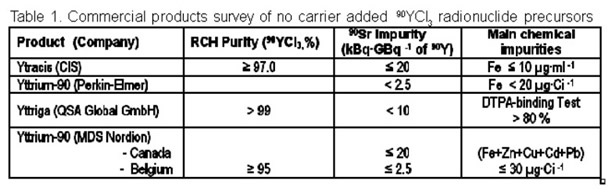
<body><![CDATA[<p><font size="2" face="Verdana, Arial, Helvetica, sans-serif">The internal targeted radionuclide therapy for treatment of various diseases in human oncology has recently reached the age of mature.  In February 2002,  90Y-ibritumomab tiuxetan (Zevalin; IDEC Pharmaceuticals Corp., San Diego, CA) monoclonal antibody (mAb) received the final approval by the Food and Drug Administration (FDA) as the first commercially available radiolabelled antibody for cancer treatment. Schering received the European approval for Zevalin on January 22, 2004. Zevalin proved high efficiency in treatment of relapsed or refractory  non-Hodgkin&lsquo;s Lymphoma of B-cells in clinical trials [1].  An overall response rate of 80% and a complete response of 30% were observed compared to the 56% and 16% response for immunnotherapy with Rituximab, unlabelled mAb alone. Since that time, very intensive research of various biomolecules labelled with different therapeutic radionuclides, targeted against the most significant tumour antigens and receptors, has started. For diagnostics of chosen types of tumors, radioactive labelled octreotide derivatives are often indicated. Octreotide is a synthetic somatostatine analogue with a longer biological half-life.  It is metabolised in the liver.  Much like somatostatine,  octreotide  binds to the SRIF 1-class SSRT (SRIF: somatotropine release inhibiting factor). 90Y-DOTA-d-Phe1-Tyr3-octreotide (90Y-DOTATOC) has recently been used for treatment of patients with  somatostatin receptor positive tumors. A pilot study with 44 patients with advanced somatostatin receptor positive tumors showed that only 29 of the 44 patients could be treated with 90Y-DOTATOC. Taking into account the radiotoxicity of 90Y, a reliable diagnostic tool for examination of the 90Y-DOTATOC affinity to the somatostatin receptor positive tumor is essential to avoid the  &uml;try and error principal&uml; therapy. Patients with a cumulative radiation dose                   &ETH;  7400 MBq/m2 showed no severe renal or aematological toxicity, while the patients having received a cumulative radiation dose &gt; 7400 MBq/m2 developed renal and/or haematological toxicity [2]. Therefore, to develop and optimize a new methodology for synthesis of 86/90Y-DOTATOC derivatives appears to be very useful. The biochemical and biophysiological properties of the octreotide derivatives are not influenced by the used yttrium isotope.</font></p>     <p><font size="2" face="Verdana, Arial, Helvetica, sans-serif">Very high demands are imposed on purity of  radionuclide precursors used for labelling of biomolecules in nuclear medicine.  There are only few b--emitting radionuclides commercially produced in corresponding quality.  Among them, no carrier added 90YCl3 radionuclide precursor  in diluted      0.04 &ndash; 0.05 mol&rsquo;.l-1 hydrochloric acid is currently the most important because of the very high 90Y specific radioactivity (theoretically about 500 Ci&rsquo;.mg -1) being reached in the production and the 90Y decay properties (pure b--emission; average energy    0.935 MeV, maximum 2.284 MeV; penetration in tissue 5-9 mm; physical half-life 64.1 h). </font></p>     <p><font size="2" face="Verdana, Arial, Helvetica, sans-serif">Some of the commercially produced and marketed 90Y radionuclide preparations, including their main properties as stated in producer&lsquo;s specifications, are presented in table 1.</font></p>     <p><img src="/img/revistas/nuc/n42/t010104207.jpg" width="612" height="189"></p>     
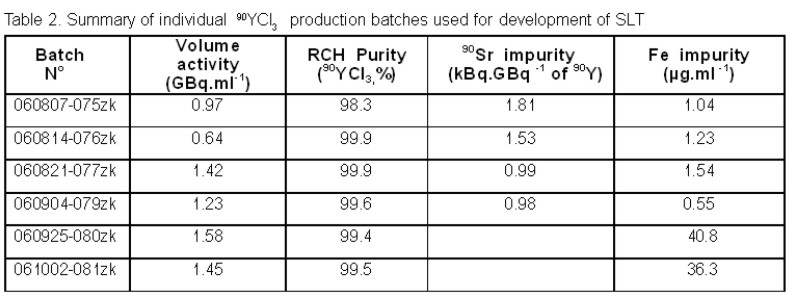
<p><font size="2" face="Verdana, Arial, Helvetica, sans-serif">The quality of the latest 90YCl3 commercial product approved in Europe as radiopharmaceutical precursor (Yttriga, AEA Technology, QSA Global GmbH, Braunschweig, Germany) is estimated using the binding efficiency test with DTPA instead of chemical impurities definition. This test seems to be much more predicative and crucial for quality control of preparations than estimating the admissible limits of individual chemical impurities. Determination of all trace impurities and estimation of their acceptable concentrations are nearly impossible. Therefore, a Standard Labelling Test (SLT) using DOTATOC, one of the DOTA conjugated peptides frequently used in RIT preclinical and clinical experiments, has been developed in our laboratory. The results are presented in this contribution.</font></p>     <p><font size="2" face="Verdana, Arial, Helvetica, sans-serif">Experimental</font></p>     <p><font size="2" face="Verdana, Arial, Helvetica, sans-serif">High pure 90YCl3 radionuclide precursor was prepared in our laboratory using the experimental pilot facility with two-stage Centrifugal Semicounterflow Extractors [3]. The separation of  90Y from the 90Sr/90Y mixture in 0.5 mol&rsquo;.l -1 nitric acid was accomplished by extracting it with di-2-ethylhexylphosphoric acid in n-dodecane. The extraction was followed by washing steps  (e.g. with n-hexane) and  reextraction of 90Y into 5 mol.l -1 hydrochloric acid. Vacuum evaporation was used for the final concentration. Subsequently, the product was dissolved in a small volume of  0.05 mol.l -1 HCl. The charcteristics of individual production batches used in development of Standard Labelling Test are summarized in table 2. The two last batches significantly contamined by Fe were used to determine the level of Fe resulting in rapid decrease of 90Y labelling efficiency.</font></p>     <p><img src="/img/revistas/nuc/n42/t020104207.jpg" width="680" height="259"></p>     
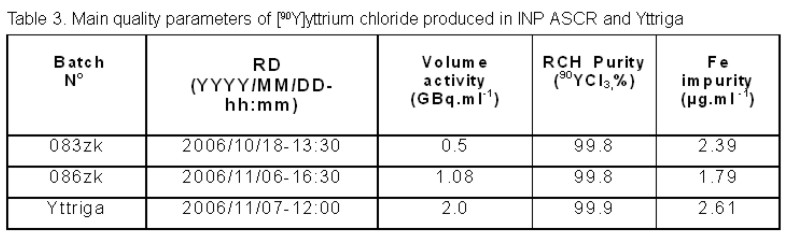
<p><font size="2" face="Verdana, Arial, Helvetica, sans-serif">The main quality parameters of our preparation in comparison to the Yttriga product (AEA Technology, QSA Global GmbH, Braunschweig, Germany) are presented in table 3.</font></p>     <p><img src="/img/revistas/nuc/n42/t030104207.jpg" width="698" height="206"></p>     
]]></body>
<body><![CDATA[<p><font size="2" face="Verdana, Arial, Helvetica, sans-serif">DOTA-Tyr3-Octreotide, DOTA-TOC                        (MW 1421.64 g.mol-1), was supplied by piCHEM, Austria (white lyophilisate, purity  &gt; 95% by HPLC).</font></p>     <p><font size="2" face="Verdana, Arial, Helvetica, sans-serif">Labelling Protocol for analytical use [4] :  About 2.5&ndash;5 MBq of 90YCl3  in 300 &micro;l of 0.05 mol.l-1 HCl was mixed with 5-20 &micro;g of DOTA-TOC in 300 &micro;l of 0.4 mol.l-1 sodium acetate (NaAc &ndash; supra pure) and heated in water bath for 5-40 min at 60-95&deg;C in order to find the optimal labelling conditions.</font></p>     <p><font size="2" face="Verdana, Arial, Helvetica, sans-serif">Chromatographic method for determination of 90Y fraction incorporated in DOTA-TOC complex:  About 2 &micro;l of  the solution after termination of Labelling Protocol was applied on the start  (about 10 mm at the margin) of ITLC chromatographic strips (15 x 200 mm, ITLC-SG, Pall Life Sciences, PALL Corporation). Subsequently, the strips were ascendently developed in 0.1 mol.l-1 sodium citrate (Na3Cit) up to about 10 mm bellow the strip margin. The strips were analyzed on 90Y distribution using b--scanner after being air dried. Each sample was analyzed in 3 parallels.</font></p>     <p><font size="2" face="Verdana, Arial, Helvetica, sans-serif">Instruments: Linear scanning of radiochromatograms for  90Y distribution was done by TLC Scanner RAYTEST, Minigita with Proportional Gas Flow (Argon 90%-Methane 10%) Beta Counting Tube  (Isotopenme&szlig;ger&auml;te GmbH).</font></p>     <p><strong><font size="2" face="Verdana, Arial, Helvetica, sans-serif">RESULTS AND DISCUSSION</font></strong></p>     <p><font size="2" face="Verdana, Arial, Helvetica, sans-serif">Bifunctional chelators such as 1,4,7,10-tetraazacyclododecane-N,N&rsquo;,N&rsquo;&rsquo;,N&rsquo;&rsquo;&rsquo;-tetraacetic acid  (DOTA)  and diethylenetriaminepenta               -acetic acid  (DTPA) [5] are widely used to bound radiometals, namely threevalent lanthanides and actinides, onto biomolecules. The DOTA bioconjugates demonstrate much higher in vivo stability than the DTPA analogues. However, the kinetics of their synthesis (e.g. chelatation of 90Y by DOTA) is significantly slower and requires temperature range up to 100&ordm;C. Nevertheless, they are preferred for use in nuclear medicine, and, thereby, they represent suitable examples for developing SLT. Such test of labelling efficiency reflects credibly the labelling power of  90YCl3 radionuclide precursor in majority of its applications. Very high attainable labelling efficiency despite the presence of chemical impurities (e.g. metal interferents like iron) in low concentrations is an added reason for choosing the 90Y-DOTATOC system for SLT. Figure. 1 demonstrates the typical chromatogram appearance of SLT (Batch No. 060904-079zk of our production - table 2). </font></p>     <p><font size="2" face="Verdana, Arial, Helvetica, sans-serif"><img src="/img/revistas/nuc/n42/f010104207.jpg" width="416" height="303">    
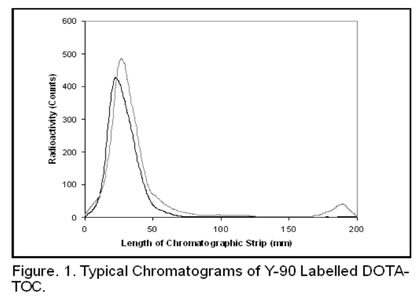
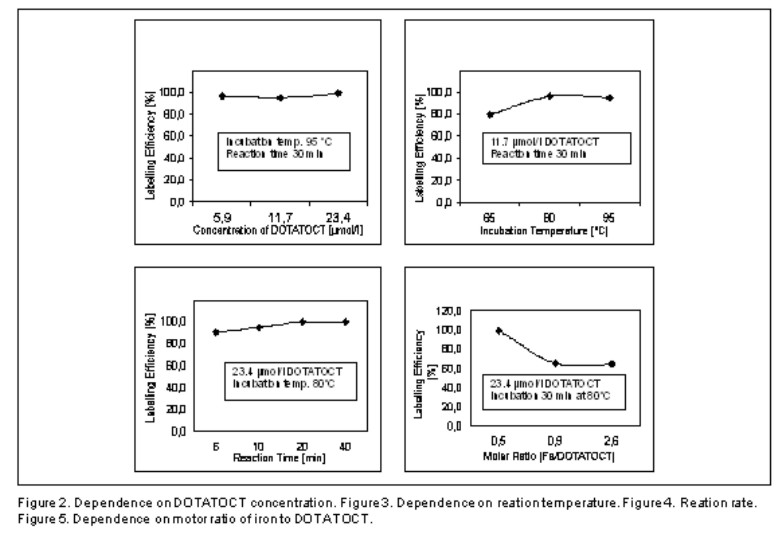
<br>       <br>   Separation of 90Y-DOTATOC complex from free yttrium-90 is quantitative in the presented chromatographic system. These only two components appear in solutions after the labelling procedure described above so that analytical evaluation of results is very easy.  More precise determination of optimal labelling conditions (labelling kinetics, incubation temperature, concentration of DOTATOC) is ilustrated in figures 2-4. Obviously, the optimal incubation temperature (maximum yield) is 80&deg;C. Higher temperature may cause degradation of the peptide resulting in decreased labelling yields. The optimal reaction time seems to be  25-30 minutes because of slower formation kinetics of DOTA complexes. </font></p>     <p><img src="/img/revistas/nuc/n42/f020104207.jpg" width="776" height="533"></p>     
]]></body>
<body><![CDATA[<p><font size="2" face="Verdana, Arial, Helvetica, sans-serif">The Standard Labellig Protocol was precised as follows:</font></p>     <p><font size="2" face="Verdana, Arial, Helvetica, sans-serif">About 2.5&ndash;5 MBq of 90YCl3  in 300 &micro;l of 0.05 mol.dl-1 HCl is mixed with 20 &micro;g of DOTATOCT in 300 &micro;l of 0.4 mol.l-1 sodium acetate (final concentration of DOTATOCT 23.4 &micro;mol/l) and heated in water bath for 30 min at 80&deg;C. ITLC chromatographic procedure (see page 4) is then applied (after cooling down the sample to the room temperature) to determine 90YCl3 labelling efficiency. Each chromatogram is developed in 3 parallels. Two production batches of 90YCl3 radionuclide recursor with higher Fe content (080zk and 081zk &ndash; see table 2) were analyzed  using this method (SLT) in order to determine maximum permissible limit for Fe impurity.  This limit corresponds to toichiometric saturation of DOTATOCT (figure 5). Acceptable labelling yield was obtained up to molar ratio [Fe/DOTATOCT] = 0.5. </font></p>     <p><font size="2" face="Verdana, Arial, Helvetica, sans-serif">The SLT developed in our laboratory and described above was used to estimate the labelling   efficiency  of  two  90YCl3   radionuclide   precursor   products  compiled  in  table 3:    Yttriga-06/11/07, QSA Global GmbH   and   our  product  Batch No. 086zk-06/11/06. Labelling efficiency  (mean &plusmn; SD, n=3)  for both products was:  99.5 &plusmn; 0.1% for Yttriga and  96.1 &plusmn; 0.8% for our product.     <br>       <br> <strong>REFERENCES</strong></font></p>     <p><font size="2" face="Verdana, Arial, Helvetica, sans-serif">[1] WITZIG, T. E., GORDON, L. I., CABANILLAS, F., CZUCZMAN, M. S., EMMANOUILIDES, Ch. JOYCE, R.,  POHLMAN, B. L. BARTLETT, N. L. WISEMAN, G.A., PADRE, N. A. GRILLO-L&Oacute;PEZ,  MULTANI, J. P., WHITE, Ch.A.,  Randomized Controlled Trial of Yttrium-90&ndash;Labeled Ibritumomab Tiuxetan Radioimmunotherapy Versus Rituximab Immunotherapy for Patients With Relapsed or Refractory Low-Grade, Follicular, or Transformed B-Cell Non-Hodgkin&rsquo;s Lymphoma, Journal of Clinical Oncology, Vol 20, Issue 10 (May) 2453-2463(2002).    <br>   [2] OTTE, A., HERRMANN, R., HEPPELER, A., BEHE,M., JERMANN, E. POWELL, P.    MAECKE, H.R., M&Uuml;LLER,J. , Yttrium-90-DOTATOC: first clinical results. Eur J Nucl Med, Vol.  26 (1999)1439-1447.    <br>   [3] KODINA, G. E., G. KORPUSOV, V., FILYANIN, A. T.,  Production of High-Purity 90Y on     <br>   Specially Developed Centrifugal Semicounterflow Extractors, Radiochemistry, Vol. 44, No. 1,  (2002)62-66.    <br>   [4] R&Ouml;SCH,  F., 86/90Y-DOTA-octreotide Labelling Protocol, Personal Communication, 2006, University  Mainz,  Institute of Nuclear Chemistry.    ]]></body>
<body><![CDATA[<br>   [5] BREEMAN, W.A., JONG, M. De., VISSER,T,J., ERION, J.L., KRENNING, E.P., Optimizing Conditions for Radiolabeling of DOTA-Peptides with 90Y, 111I and 177 Lu at High Specific Activities, European Journal of Nuclear Medicine Molecular Imaging, Vol.  30 (2003)917-920.</font></p>     <p><font size="2" face="Verdana, Arial, Helvetica, sans-serif">Recibido: 9 de enero de 2007    <br>   Aceptado: 1 de noviembre de 2007</font></p>     <p><font size="2" face="Verdana, Arial, Helvetica, sans-serif"><a href="mailto:milber@attas.cz">milber@attas.cz</a>,    <a href="mailto:beran@ujf.cas.cz">beran@ujf.cas.cz</a></font></p>      ]]></body><back>
<ref-list>
<ref id="B1">
<label>1.</label><nlm-citation citation-type="journal">
<person-group person-group-type="author">
<name>
<surname><![CDATA[WITZIG]]></surname>
<given-names><![CDATA[TE]]></given-names>
</name>
<name>
<surname><![CDATA[GORDON]]></surname>
<given-names><![CDATA[LI]]></given-names>
</name>
<name>
<surname><![CDATA[CABANILLAS]]></surname>
<given-names><![CDATA[F]]></given-names>
</name>
<name>
<surname><![CDATA[CZUCZMAN]]></surname>
<given-names><![CDATA[MS]]></given-names>
</name>
</person-group>
<article-title xml:lang="en"><![CDATA[Randomized Controlled Trial of Yttrium-90-Labeled Ibritumomab Tiuxetan Radioimmunotherapy Versus Rituximab Immunotherapy for Patients With Relapsed or Refractory Low-Grade, Follicular, or Transformed B-Cell Non-Hodgkin&#8217;s Lymphoma]]></article-title>
<source><![CDATA[J Clin Onc]]></source>
<year>2002</year>
<volume>20</volume>
<numero>(10)</numero>
<issue>(10)</issue>
<page-range>2453-2463</page-range></nlm-citation>
</ref>
<ref id="B2">
<label>2.</label><nlm-citation citation-type="journal">
<person-group person-group-type="author">
<name>
<surname><![CDATA[OTTE]]></surname>
<given-names><![CDATA[A]]></given-names>
</name>
<name>
<surname><![CDATA[HERRMANN]]></surname>
<given-names><![CDATA[R]]></given-names>
</name>
<name>
<surname><![CDATA[HEPPELER]]></surname>
<given-names><![CDATA[A]]></given-names>
</name>
<name>
<surname><![CDATA[BEHE]]></surname>
<given-names><![CDATA[M]]></given-names>
</name>
</person-group>
<article-title xml:lang="en"><![CDATA[Yttrium-90-DOTATOC: first clinical results]]></article-title>
<source><![CDATA[Eur J Nucl Med]]></source>
<year>1999</year>
<volume>26</volume>
<page-range>1439-1447</page-range></nlm-citation>
</ref>
<ref id="B3">
<label>3.</label><nlm-citation citation-type="">
<person-group person-group-type="author">
<name>
<surname><![CDATA[KODINA]]></surname>
<given-names><![CDATA[GE]]></given-names>
</name>
<name>
<surname><![CDATA[KORPUSOV]]></surname>
<given-names><![CDATA[V]]></given-names>
</name>
<name>
<surname><![CDATA[FILYANIN]]></surname>
<given-names><![CDATA[AT]]></given-names>
</name>
</person-group>
<article-title xml:lang="en"><![CDATA[Production of High-Purity 90Y on Specially Developed Centrifugal Semicounterflow Extractors]]></article-title>
<source><![CDATA[]]></source>
<year></year>
</nlm-citation>
</ref>
<ref id="B4">
<label>4.</label><nlm-citation citation-type="">
<person-group person-group-type="author">
<name>
<surname><![CDATA[RÖSCH]]></surname>
<given-names><![CDATA[F]]></given-names>
</name>
</person-group>
<collab>University Mainz^dInstitute of Nuclear Chemistry</collab>
<source><![CDATA[86/90Y-DOTA-octreotide Labelling Protocol. Personal Communication]]></source>
<year>2006</year>
</nlm-citation>
</ref>
<ref id="B5">
<label>5.</label><nlm-citation citation-type="journal">
<person-group person-group-type="author">
<name>
<surname><![CDATA[BREEMAN]]></surname>
<given-names><![CDATA[WA]]></given-names>
</name>
<name>
<surname><![CDATA[JONG]]></surname>
<given-names><![CDATA[MD]]></given-names>
</name>
<name>
<surname><![CDATA[VISSER]]></surname>
<given-names><![CDATA[TJ]]></given-names>
</name>
<name>
<surname><![CDATA[ERION]]></surname>
<given-names><![CDATA[JL]]></given-names>
</name>
<name>
<surname><![CDATA[KRENNING]]></surname>
<given-names><![CDATA[EP]]></given-names>
</name>
</person-group>
<article-title xml:lang="en"><![CDATA[Optimizing Conditions for Radiolabeling of DOTA-Peptides with 90Y, 111I and 177 Lu at High Specific Activities]]></article-title>
<source><![CDATA[Eur J Nucl Med Mol Imag]]></source>
<year>2003</year>
<volume>30</volume>
<page-range>917-920</page-range></nlm-citation>
</ref>
</ref-list>
</back>
</article>