<?xml version="1.0" encoding="ISO-8859-1"?><article xmlns:mml="http://www.w3.org/1998/Math/MathML" xmlns:xlink="http://www.w3.org/1999/xlink" xmlns:xsi="http://www.w3.org/2001/XMLSchema-instance">
<front>
<journal-meta>
<journal-id>0864-084X</journal-id>
<journal-title><![CDATA[Nucleus]]></journal-title>
<abbrev-journal-title><![CDATA[Nucleus]]></abbrev-journal-title>
<issn>0864-084X</issn>
<publisher>
<publisher-name><![CDATA[CUBAENERGIA]]></publisher-name>
</publisher>
</journal-meta>
<article-meta>
<article-id>S0864-084X2009000200005</article-id>
<title-group>
<article-title xml:lang="en"><![CDATA[Use of PIXE analysis to study urban atmospheric aerosols from downtown Havana City]]></article-title>
<article-title xml:lang="es"><![CDATA[Aplicación del análisis PIXE al estudio de aerosoles atmosféricos urbanos en el centro de Ciudad de La Habana]]></article-title>
</title-group>
<contrib-group>
<contrib contrib-type="author">
<name>
<surname><![CDATA[Pérez Zayas]]></surname>
<given-names><![CDATA[Grizel]]></given-names>
</name>
</contrib>
<contrib contrib-type="author">
<name>
<surname><![CDATA[Piñera Hernández]]></surname>
<given-names><![CDATA[Ibrahin]]></given-names>
</name>
</contrib>
<contrib contrib-type="author">
<name>
<surname><![CDATA[Ramos Aruca]]></surname>
<given-names><![CDATA[Maridelin]]></given-names>
</name>
</contrib>
<contrib contrib-type="author">
<name>
<surname><![CDATA[Guibert Gal]]></surname>
<given-names><![CDATA[Rolando]]></given-names>
</name>
</contrib>
<contrib contrib-type="author">
<name>
<surname><![CDATA[Molina Esquivel]]></surname>
<given-names><![CDATA[Enrique]]></given-names>
</name>
</contrib>
<contrib contrib-type="author">
<name>
<surname><![CDATA[Martínez Varona]]></surname>
<given-names><![CDATA[Miriam]]></given-names>
</name>
</contrib>
<contrib contrib-type="author">
<name>
<surname><![CDATA[Fernández Arocha]]></surname>
<given-names><![CDATA[Ariadna]]></given-names>
</name>
</contrib>
<contrib contrib-type="author">
<name>
<surname><![CDATA[Aldape Ugald]]></surname>
<given-names><![CDATA[Francisca]]></given-names>
</name>
</contrib>
<contrib contrib-type="author">
<name>
<surname><![CDATA[Flores Maldonado]]></surname>
<given-names><![CDATA[Javier]]></given-names>
</name>
</contrib>
</contrib-group>
<aff id="A01">
<institution><![CDATA[,Departamento de Física, Centro de Aplicaciones Tecnológicas y Desarrollo Nuclear  ]]></institution>
<addr-line><![CDATA[La Habana ]]></addr-line>
<country>Cuba</country>
</aff>
<aff id="A02">
<institution><![CDATA[,Laboratorio de Contaminantes Atmosféricos, Instituto Nacional de Higiene, Epidemiología y Microbiología  ]]></institution>
<addr-line><![CDATA[La Habana ]]></addr-line>
<country>Cuba</country>
</aff>
<aff id="A03">
<institution><![CDATA[,Laboratorio de Análisis PIXE, Instituto Nacional de Investigaciones Nucleares  ]]></institution>
<addr-line><![CDATA[México D.F. ]]></addr-line>
<country>México</country>
</aff>
<pub-date pub-type="pub">
<day>00</day>
<month>12</month>
<year>2009</year>
</pub-date>
<pub-date pub-type="epub">
<day>00</day>
<month>12</month>
<year>2009</year>
</pub-date>
<numero>46</numero>
<fpage>27</fpage>
<lpage>33</lpage>
<copyright-statement/>
<copyright-year/>
<self-uri xlink:href="http://scielo.sld.cu/scielo.php?script=sci_arttext&amp;pid=S0864-084X2009000200005&amp;lng=en&amp;nrm=iso"></self-uri><self-uri xlink:href="http://scielo.sld.cu/scielo.php?script=sci_abstract&amp;pid=S0864-084X2009000200005&amp;lng=en&amp;nrm=iso"></self-uri><self-uri xlink:href="http://scielo.sld.cu/scielo.php?script=sci_pdf&amp;pid=S0864-084X2009000200005&amp;lng=en&amp;nrm=iso"></self-uri><abstract abstract-type="short" xml:lang="en"><p><![CDATA[ABSTRACT The present work shows the results of a first study aimed at determining the elemental composition in airborne particulate matter (in fine and coarse particle size fractions). It was collected at the Atmospheric Monitoring Station in the Municipality of Centro Habana, using the Particle Induced Xray Emission (PIXE) technique. At present, there is no information available about elemental contents in airborne particulate matter from this region. For this study, we carried out a sampling campaign during five months (November 14, 2006 to April 19, 2007). The samples were collected every second day during 24 h under an air flux of 20 l/min. The air sampler used was a Gent Sampler equipped with a Stacked Filter Unit (SFU) system which allows the aerosol collection in both size fractions simultaneously. A total of 144 aerosol samples were collected (72 correspond to the fine mass particle and 72 to the coarse mass particle). For PIXE analysis, the samples were irradiated by 2.0 MeV energy protons from the 2 MV Tandetron Accelerator from the Laboratory of PIXE analysis at ININ, Mexico. A total of 14 elements (S, Cl, K, Ca, Ti, V, Cr, Mn, Fe, Ni, Cu, Zn, Br and Pb) were consistently detected in both of particle size fractions with minimum detection limits in the range of 1-10 ng/<img width=17 height=13 src="http://img/revistas/nuc/nuc46/images/e01054609.jpg"> . The quantitative results obtained from PIXE elemental analysis for mass of particles in both fractions have revealed important information that has been used in a first attempt to understand and characterize the atmospheric pollution in this area. A general discussion about these results is presented in this paper.]]></p></abstract>
<abstract abstract-type="short" xml:lang="es"><p><![CDATA[RESUMEN El presente trabajo reporta los resultados de un primer estudio realizado para determinar la composición elemental en material particulado atmosférico (en tamaños de partícula fina y gruesa) colectado en la Estación de Monitoreo Ambiental del Instituto Nacional de Higiene y Epidemiología, del Municipio de Centro Habana, utilizando la técnica PIXE (emisión de rayos X inducida por partículas). Para este estudio se realizó una campaña de muestreo durante cinco meses, entre los meses de noviembre, 2006 y abril, 2007, con un período de colección de una toma cada segundo día y 24 horas de duración. Se utilizó un muestreador de aire del tipo Gent con posibilidades de colectar de forma simultánea el material particulado fino y grueso. Un total de 144 muestras de MPA se colectaron para este estudio (72 de fracción fina y 72 de fracción gruesa). Las muestras se irradiaron tras la incidencia de un haz de protones de 2,5 MeV. Un total de 14 elementos (S, Cl, K, Ca, Ti, V, Cr, Mn, Fe, Ni, Cu, Zn, Br y Pb) fueron consistentemente detectados en la mayoría de las muestras, con límites mínimos de detección entre 1-10 ng de partículas/<img width=17 height=13 src="http://img/revistas/nuc/nuc46/images/e01054609.jpg"> de aire. Los resultados del análisis PIXE para ambos tamaños de partícula revelaron una importante información que se ha utilizado en una primera intención para entender y caracterizar la contaminación atmosférica del área muestreada. Se presenta una discusión general de estos resultados en este trabajo.]]></p></abstract>
<kwd-group>
<kwd lng="en"><![CDATA[particulates]]></kwd>
<kwd lng="en"><![CDATA[air pollution monitoring]]></kwd>
<kwd lng="en"><![CDATA[pixe analysis]]></kwd>
<kwd lng="en"><![CDATA[urban areas]]></kwd>
</kwd-group>
</article-meta>
</front><body><![CDATA[ <p align="left"><font face="Verdana, Arial, Helvetica, sans-serif" size="2"><b>CIENCIAS    NUCLEARES</b></font></p>     <p align="left">&nbsp;</p>     <p><strong><font size="3" face="Verdana, Arial, Helvetica, sans-serif">Use of    PIXE analysis to study urban atmospheric aerosols from downtown Havana City</font></strong></p>     <p><font size="3" face="Verdana, Arial, Helvetica, sans-serif">Aplicaci&oacute;n    del an&aacute;lisis PIXE al estudio de aerosoles atmosf&eacute;ricos urbanos    en el centro de Ciudad de La Habana    <br>   </font></p>     <p><font size="2" face="Verdana, Arial, Helvetica, sans-serif">Grizel P&eacute;rez    Zayas1, , Ibrahin Pi&ntilde;era Hern&aacute;ndez1 , Maridelin Ramos Aruca1,    Rolando Guibert Gal 1 , Enrique Molina Esquivel2, Miriam Mart&iacute;nez Varona2,    Ariadna Fern&aacute;ndez Arocha2 , Francisca Aldape Ugald 3 , Javier Flores    Maldonado3    <br>   </font></p>     <p><font size="2" face="Verdana, Arial, Helvetica, sans-serif">1 Departamento    de F&iacute;sica, Centro de Aplicaciones Tecnol&oacute;gicas y Desarrollo Nuclear,    La Habana, Cuba.    <br>   2 Laboratorio de Contaminantes Atmosf&eacute;ricos, Instituto Nacional de Higiene,    Epidemiolog&iacute;a y Microbiolog&iacute;a, La Habana, Cuba    <br>   3 Laboratorio de An&aacute;lisis PIXE, Instituto Nacional de Investigaciones    Nucleares, M&eacute;xico D.F., M&eacute;xico.    ]]></body>
<body><![CDATA[<br>   <a href="mailto:ipinera@ceaden.edu.cu">ipinera@ceaden.edu.cu</a></font></p> <hr>     <p><font face="Verdana, Arial, Helvetica, sans-serif" size="2"><b>ABSTRACT</b></font></p>     <p><font size="2" face="Verdana, Arial, Helvetica, sans-serif">The present work    shows the results of a first study aimed at determining the elemental composition    in airborne particulate matter (in fine and coarse particle size fractions).    It was collected at the Atmospheric    <br>   Monitoring Station in the Municipality of Centro Habana, using the Particle    Induced Xray Emission (PIXE) technique. At present, there is no information    available about elemental contents in airborne particulate matter from this    region. For this study, we carried out a sampling campaign during five months    (November 14, 2006 to April 19, 2007). The samples were collected every second    day during 24 h under an air flux of 20 l/min. The air sampler used was a Gent    Sampler equipped with a Stacked Filter Unit (SFU) system which allows the aerosol    collection in both size fractions simultaneously. A total of 144 aerosol samples    were collected (72 correspond to the fine mass particle and 72 to the coarse    mass particle). For PIXE analysis, the samples were irradiated by 2.0 MeV energy    protons from the 2 MV Tandetron Accelerator from the Laboratory of PIXE analysis    at ININ, Mexico. A total of 14 elements (S, Cl, K, Ca, Ti, V, Cr, Mn, Fe, Ni,    Cu, Zn, Br and Pb) were consistently detected in both of particle size fractions    with minimum detection limits in the range of 1-10 </font><font size="2" face="Verdana, Arial, Helvetica, sans-serif">ng/<img src="/img/revistas/nuc/n46/e01054609.jpg" width="17" height="13">    . The quantitative results obtained from PIXE elemental analysis for mass of    particles in both fractions have revealed important information that has been    used in a first attempt to understand and characterize the atmospheric pollution    in this area. A general discussion about these results is presented in this    paper.</font></p> <hr>     
<p><font face="Verdana, Arial, Helvetica, sans-serif" size="2"><b>RESUMEN</b></font></p>     <p><font size="2" face="Verdana, Arial, Helvetica, sans-serif">El presente trabajo    reporta los resultados de un primer estudio realizado para determinar la composici&oacute;n    elemental en material particulado atmosf&eacute;rico (en tama&ntilde;os de part&iacute;cula    fina y gruesa) colectado en la Estaci&oacute;n de Monitoreo Ambiental del Instituto    Nacional de Higiene y Epidemiolog&iacute;a, del Municipio de Centro Habana,    utilizando la t&eacute;cnica PIXE (emisi&oacute;n de rayos X inducida por part&iacute;culas).    Para este estudio se realiz&oacute; una campa&ntilde;a de muestreo durante cinco    meses, entre los meses de noviembre, 2006 y abril, 2007, con un per&iacute;odo    de colecci&oacute;n de una toma cada segundo d&iacute;a y 24 horas de duraci&oacute;n.    Se utiliz&oacute; un muestreador de aire del tipo Gent con posibilidades de    colectar de forma simult&aacute;nea el material particulado fino y grueso. Un    total de 144 muestras de MPA se colectaron para este estudio (72 de fracci&oacute;n    fina y 72 de fracci&oacute;n gruesa). Las muestras se irradiaron tras la incidencia    de un haz de protones de 2,5 MeV. Un total de 14 elementos (S, Cl, K, Ca, Ti,    V, Cr, Mn, Fe, Ni, Cu, Zn, Br y Pb) fueron consistentemente detectados en la    mayor&iacute;a de las muestras, con l&iacute;mites m&iacute;nimos de detecci&oacute;n    entre 1-10 ng de part&iacute;culas/<img src="/img/revistas/nuc/n46/e01054609.jpg" width="17" height="13">    de aire. Los resultados del an&aacute;lisis PIXE para ambos tama&ntilde;os de    part&iacute;cula revelaron una importante informaci&oacute;n que se ha utilizado    en una primera intenci&oacute;n para entender y caracterizar la contaminaci&oacute;n    atmosf&eacute;rica del &aacute;rea muestreada. Se presenta una discusi&oacute;n    general de estos resultados en este trabajo.</font></p>     
<p><font face="Verdana, Arial, Helvetica, sans-serif" size="2"><b>Key words:</b>    particulates, air pollution monitoring, pixe analysis, urban areas</font></p> <hr>     <p><font face="Verdana, Arial, Helvetica, sans-serif" size="2"><b><font size="3">Introduction</font></b></font></p>     <p><font face="Verdana, Arial, Helvetica, sans-serif" size="2">Atmospheric pollution    studies in more populated cities of the world have been an important issue to    diverse authors in recent years, because of the relevant impact that pollution    has on the health of the population [1-6]. One of the most important factors    of air pollution problem in Havana City is the presence of airborne particles,    which are responsible for effects on public health, especially when their dimensions    are below 10 &igrave;m, as they can penetrate deeply into the human respiratory    tract, reason for which studying the properties of these kind of pollutants    and its elemental characterization have become an important task to achieve.    <br>   </font></p>     ]]></body>
<body><![CDATA[<p><font face="Verdana, Arial, Helvetica, sans-serif" size="2">In the frame of    an ARCAL Regional Project promoted by the IAEA, a first study of multielemental    contents in airborne particulate matter (in fine and coarse particle size fractions)    from an urban area heavily populated of the Havana City was performed using    the Particle-Induced X-ray Emission (PIXE) technique [7, 8].    <br>   </font></p>     <p><font face="Verdana, Arial, Helvetica, sans-serif" size="2">PIXE is a nuclear    analytical technique that has long been applied to the study of atmospheric    aerosols and it continues as one of the most important areas of application    [9-15]. The technique has certainly contributed to the understanding of source-receptor    relationship for aerosol particles as well as to aerosol physics and chemistry.    It is a method based on charged particle accelerators, that allows fast simultaneous    analysis of all elements with atomic number larger than 13 (&gt; Al), with a    high sensitivity (around 1 ng of an element per 1 <img src="/img/revistas/nuc/n46/e01054609.jpg" width="17" height="13">    of air), nondestructive and extremely small targets can be effectively analyzed    because of the well defined dimension of the incident proton beam on the samples.    PIXE does not offer information on chemical states of elements and it is not    applicable for lighter elements, such as C, N, H and O, which generally occupy    more than 80% of the atmospheric aerosols, but as in this type of analysis the    sample is not destroyed, PIXE aerosol analysis can be complemented with other    techniques. Examples of theme are PESA (proton elastic scattering analysis)    for measurement of hydrogen, PIGE (proton induced gamma ray emission) for detection    of light elements, like B, Li, Na, Mg, Al, Si and P and RBS (rutherford backscattering)    for measurement of C, N and O, allowing to obtain a complete reconstruction    of the aerosol mass and to achieve a more comprehensive view of the characteristic    elements of the aerosol.    
<br>   </font></p>     <p><font face="Verdana, Arial, Helvetica, sans-serif" size="2">Due to all these    advantages in order to determine elemental concentrations of a variety of airborne    pollution samples, the use of PIXE technique is recommended over other ones    that can be used too for aerosol analyses.    <br>   </font></p>     <p><font face="Verdana, Arial, Helvetica, sans-serif" size="2">In the present    work, the quantitative results obtained from PIXE elemental analysis for fine    and coarse particles mass collected at the Municipality of Centro Habana, Cuba,    are presented.    <br>   </font></p>     <p><font face="Verdana, Arial, Helvetica, sans-serif" size="2"><b>Experimental    measurements</b>    <br>   </font></p>     ]]></body>
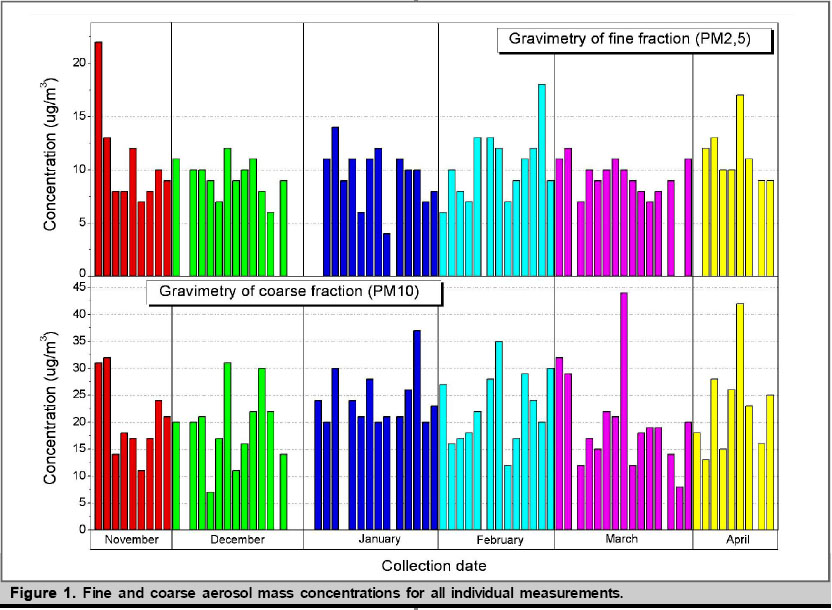
<body><![CDATA[<p><font face="Verdana, Arial, Helvetica, sans-serif" size="2"><b>Sampling.</b>    The sampling site (latitude 23.1N, longitude 82.4W) is located at the Air Pollutant    Monitoring Station of INHEM, in the central part of the urban area of Havana    City. This place is a heavily populated area with a great variety of industries    (factories of detergents, soft drinks, tobaccos, biological products) and a    high-traffic of vehicles. The site counts also with several sites of high humans    activity to its around, as for example: Christina&#146;s Trains Station (1.2    km), Central Bus Station (0.81 km) visited every day by thousands commuters,    Pediatric Hospital (a few meters from it), and Unique Market (1 km). All this    together makes that this places must be observed and studied carefully for what    is a part of Havana City&#146;s conurbation that contributes significantly to    its atmospheric pollution.    <br>   </font></p>     <p><font face="Verdana, Arial, Helvetica, sans-serif" size="2">The aerosol samples    were collected during five months (from November 14, 2006 to April 19, 2007),    every second day, during 24 h (00:00 h-24:00 h) each one at an average flow    rate of 20 l/min. The sampler used in this study was a Gent Sampler with a Stacked    Filter Unit (SFU-PM10\PM2,5) system [9, 16]. This sampling device allowed the    particulate collection into two size fractions simultaneously: particles PM2,5    smaller than 2.5 &micro;m (fine fraction) and particles PM2,5-10 with aerodynamic    diameter between 2.5 &micro;m and 10 &micro;m (coarse fraction). The particles    were collected on a 47 mm diameter Nucleopore polycarbonates filters; coarse    mode on filters with 8.0 &micro;m pore size and fine particles on filters with    0.4 &micro;m pore size. A total de 144 aerosol samples were collected (72 correspond    to the PM2,5 fine mass particle and 72 to the PM2,5-10 coarse mass particle).    <br>   </font></p>     <p><font face="Verdana, Arial, Helvetica, sans-serif" size="2">The total amount    of mass deposited of fine and coarse particles on the samples were obtained    by gravimetric analysis. The filters were weighed before and after sampling    in a Cahn 33 electronic microbalance with 0.1 &micro;g sensitivity. Before weighing,    all filters were stabilized during 48 h under constant relative humidity and    temperature conditions (45% and 22 &deg;C). An alpha source of <img src="/img/revistas/nuc/n46/e02054609.jpg" width="30" height="13">    was used to eliminate static charge on the samples during weighing. Measured    fine particulate matter (FPM) and coarse particulate matter (CPM) mass concentrations    (&micro;g/<img src="/img/revistas/nuc/n46/e01054609.jpg" width="17" height="13">)    are shown in <a href="#f1">figure 1</a>. Levels of PM2,5-10 up to 44.2 &micro;g/<img src="/img/revistas/nuc/n46/e01054609.jpg" width="17" height="13">    and PM2,5 values up to 22.4 &micro;g/<img src="/img/revistas/nuc/n46/e01054609.jpg" width="17" height="13">    were obtained.</font></p>     
<p><font face="Verdana, Arial, Helvetica, sans-serif" size="2"><a name="f1"></a><img src="/img/revistas/nuc/n46/f01054609.jpg" width="832" height="610">    
<br>   </font></p>     <p><font face="Verdana, Arial, Helvetica, sans-serif" size="2">Other analyt ical    equipments operat ing simultaneously at this station provided complementary    data of several variables such as <img src="/img/revistas/nuc/n46/e03054609.jpg" width="31" height="22">    and <img src="/img/revistas/nuc/n46/e04054609.jpg" width="35" height="23">.    
<br>   </font></p>     <p><font face="Verdana, Arial, Helvetica, sans-serif" size="2"><b>PIXE analysis</b>.    The experimental system of PIXE analysis consists of an accelerator, an ion    beam, a vacuum irradiation chamber with a target holder included and a measurement    system.    ]]></body>
<body><![CDATA[<br>   </font></p>     <p><font face="Verdana, Arial, Helvetica, sans-serif" size="2">The aerosol samples,    without any pre-treatment, were bombarded by 2.5 MeV protons from the 2 MV Van    de Graff (Tandetron) accelerator, located at the Laboratory of PIXE Analysis    of the ININ, Mexico. Ion beam currents in the system were 15 nA and total integrated    charges were 6 &micro;C. For the irradiation, the samples were placed in a sample    holder with an angle of 45&deg; with respect to the beam direction. The characteristics    X-rays emitted from the samples were detected with an Ortec Si(Li) detector    with an active area of 80 mm 2 and 200 eV resolution at 5.9 keV of the Mn K    a line, coming from an 55 Fe source. The detector in the experimental arrangement    was located outside the irradiation chamber at 90&deg; angle with respect to    the ion beam direction and is coupled to standard electronics and PC based multichannel    analyser. </font><font face="Verdana, Arial, Helvetica, sans-serif" size="2">Spectra    were obtained in this experimental line using EG&amp;G Ortec Maestro II computer    code [17]. The precision and reproducibility of the PIXE system were verified    on a regular basis, using spectroscopically pure thin films of known area density,    deposited on Nucleopore filters (MicroMatter Co., Deer Harbor, WA, USA). Details    of the experimental setup, instrumentation and analytical procedures used to    perform the PIXE analysis at the ININ PIXE Laboratory are better explained in    reference [18].    <br>   </font></p>     <p><font face="Verdana, Arial, Helvetica, sans-serif" size="2">For the elemental    analysis the filters with the aerosol were cut in two pieces: 1/4 of it was    analysed by PIXE; the remaining 3/4 was kept for other possible measurements.    </font></p>     <p><font face="Verdana, Arial, Helvetica, sans-serif" size="2">The PIXE analysis    revealed the presence of 14 elements in both particle size fractions, ranging    from sulphur (S) to lead (Pb). Irradiation time was in the interval 10-15 min.    Elemental minimum detection limits (MDL) were in the range of 0.1-10 ng/<img src="/img/revistas/nuc/n46/e01054609.jpg" width="17" height="13">    for most of the detected elements. The precision of the elemental concentration    measurements was typical in the range of 5-10%.    
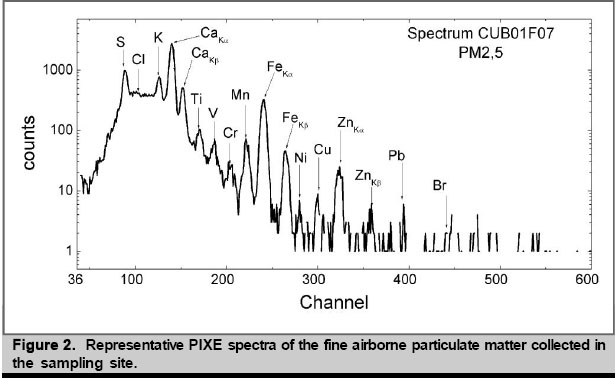
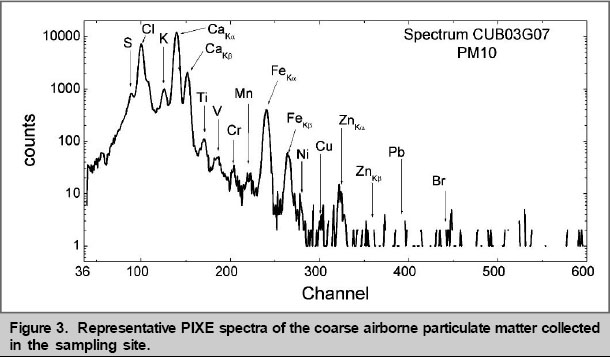
<br>   </font></p>     <p><font face="Verdana, Arial, Helvetica, sans-serif" size="2">The evaluation    of the PIXE spectra was performed with the softwares AXIL v3.0 and WinAxil v4.5.3    [19]. Two of the obtained PIXE spectra are shown in <a href="#f2">figure 2</a> for the airborne    particulate matter PM2,5 and in <a href="#f3">figure 3</a> for PM2,5-10. </font></p>     <p><a name="f2"></a><img src="/img/revistas/nuc/n46/f02054609.jpg" width="616" height="378"></p>     
<p><a name="f3"></a><img src="/img/revistas/nuc/n46/f03054609.jpg" width="610" height="357"></p>     
<p><font face="Verdana, Arial, Helvetica, sans-serif" size="2"><b>Results and    Discussion</b>    ]]></body>
<body><![CDATA[<br>   </font></p>     <p><font face="Verdana, Arial, Helvetica, sans-serif" size="2">The basis of the    present work is the elemental mass concentrations of 144 aerosol samples (fine    and coarse) analysed by PIXE. The PIXE analysis permitted to identified and    to quantify the elemental content of    the airborne particulate matter (APM) deposited on the filter and revealed consistently    the presence of the following 14 elements: S, Cl, K, Ca, Ti, V, Cr, Mn, Fe,    Ni, Cu, Zn, Br and Pb; in both particle size fractions. A summary of the elemental    concentrations for the PM2,5 and PM2,5-10 particles is presented in <a href="#t1">table 1</a>.</font></p>     <p><font face="Verdana, Arial, Helvetica, sans-serif" size="2"><a name="t1"></a><img src="/img/revistas/nuc/n46/t01054609.jpg" width="833" height="509">    
<br>   </font></p>     <p><font face="Verdana, Arial, Helvetica, sans-serif" size="2">The table allows    an easy comparison of the results obtained for each particle size fraction.    The information presented shows the MDL of the system for each element, the    number of appearan-ces of each element above the MDL (n) and the mini-mum, maximum,    mean and standard deviation values reached by each element. As can be seen from    the values showed in the table 1, remarkable differences are observed between    fine and coarse components.    <br>   </font></p>     <p><font face="Verdana, Arial, Helvetica, sans-serif" size="2">The fine particle    fraction shows significantly higher concentrations of S, than the coarse fraction    and significantly lower values for K, Ca, Ti, while the coarse fraction has    higher contents of Cl than the fine one and soil dust related elements, such    as Ca, K, and Fe, dominate the elemental mass. Pb was found not in all samples    above the MDL, but it was found in both the fine and coarse modes in significant    quantities. Higher values of V, Cr, Ni, and Zn were observed too in the fine    fraction, bromine concentration was found apparently uniform in both fractions.    <br>   </font></p>     <p><font face="Verdana, Arial, Helvetica, sans-serif" size="2">Some elements (like    S, V, Ni, Zn, Br and Pb) are considered element of anthropogenic origin and    are present mainly in the fine fraction. Other elements (like K, Ca, Ti, Fe,    and Cl) are considered element of natural    origin and appeared mainly in the coarse fraction. These tendencies correspond    to the chemical characteristics of atmospheric aerosols [20].     <br>   </font></p>     ]]></body>
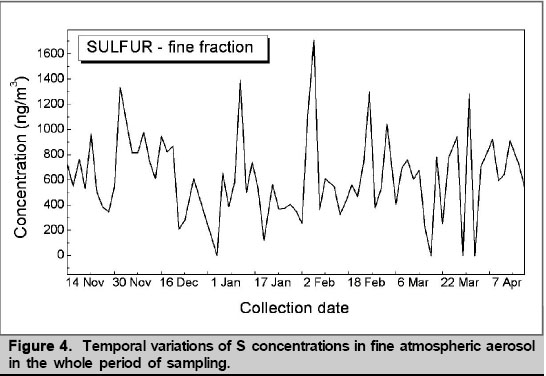
<body><![CDATA[<p><font face="Verdana, Arial, Helvetica, sans-serif" size="2">According to the    sampling site, the elements detected in these particles by the PIXE analysis    can be associated to diverse emission sources, such are the cases of S, V and    Pb, representing the fossil fuel combustion group from industrial and motor    vehicles. The metal group formed by Cr, Mn, Ni, Cu and Zn can be associated    to metallurgic industry and K, Ca, Ti and Fe are soil derived elements or road    dust related elements. Our sampling site is located nearby important roads of    the city. We assumed that the Cl found in coarse fraction is coming from the    marine aerosol, but it should be careful treated, because the Na is an important    component of that source and in our case it was not detected in the elemental    composition of aerosol samples by this technique, due to specific limitations    related with the used PIXE installation at ININ. The mean total seawater ratios    for Cl/Na are well known [21], then, is our great interest to know the Na content    in our samples, for what we need to analyze them by another technique that ensure    the detection and quanti&ucirc;cation of this element. Some work is in progress    in this direction. In some articles in the literature Br is reported as a vehicular    component [22] and in other studies appeared associated to the incineration    of certain materials [23].    <br>   </font></p>     <p><font face="Verdana, Arial, Helvetica, sans-serif" size="2">Sulphate particle    is an important component of the aerosol in this area, mainly originating from    gas to particle conversion from <img src="/img/revistas/nuc/n46/e03054609.jpg" width="31" height="22">    . S is considered an anthropogenic element, which is most likely present in    the fine aerosol. Sulphur was present in all samples in concentrations ranging    from 121 ng/<img src="/img/revistas/nuc/n46/e01054609.jpg" width="17" height="13">    to 1712 ng/<img src="/img/revistas/nuc/n46/e01054609.jpg" width="17" height="13">    of air sampled, however appeared significantly higher in the fine fraction of    aerosol.    
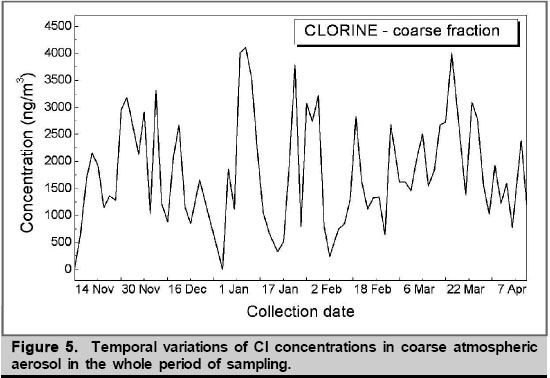
<br>   </font></p>     <p><font face="Verdana, Arial, Helvetica, sans-serif" size="2">The elemental concentrations    determined by the PIXE analysis were used to analyse the temporal variations    of each element. The concentrations in the complete collection period are shown    in <a href="#f4">figure 4</a> for S in fine mode and in <a href="#f5">figure 5</a> for Cl in coarse one.</font></p>     <p><a name="f4"></a><img src="/img/revistas/nuc/n46/f04054609.jpg" width="546" height="376"></p>     
<p><font face="Verdana, Arial, Helvetica, sans-serif" size="2"><a name="f5"></a><img src="/img/revistas/nuc/n46/f05054609.jpg" width="550" height="378">    
<br>   </font></p>     <p><font face="Verdana, Arial, Helvetica, sans-serif" size="2">In the temporal    variation of the PM2,5 and PM2,5-10 mass concentrations showed in <a href="#f1">figure 1</a>,    the peaks of particulate concentrations coinciding with the periods of changes    in the weather conditions, when dispersion of the contaminants is more difficult,    i.e. entrance of a cold front with temperature decreasing and high pressure.    High concentration for some elements, as the S in fine mode and Cl in coarse    mode were also observed in these days (see <a href="#f4">figure 4</a> and <a href="#f5">figure 5</a>).</font></p>     <p><b><font face="Verdana, Arial, Helvetica, sans-serif" size="2">Conclusions</font></b><font face="Verdana, Arial, Helvetica, sans-serif" size="2">    ]]></body>
<body><![CDATA[<br>   </font></p>     <p><font face="Verdana, Arial, Helvetica, sans-serif" size="2">The results obtained    in this work represent a first effort to evaluate the elemental composition    in the airborne particulate matter (fine and coarse) in an urban area, heavily    populated, of the Havana City with the use of nuclear analytical techniques.        <br>   </font></p>     <p><font face="Verdana, Arial, Helvetica, sans-serif" size="2">A total of 144    aerosol samples were collected (72 correspond to the fine mass fraction and    72 to the coarse mass fraction). PIXE analysis revealed the detection of 14    elements (S, Cl, K, Ca, Ti, V, Cr, Mn, Fe, Ni, Cu, Zn, Br and Pb) in both particle    size fractions. </font></p>     <p><font face="Verdana, Arial, Helvetica, sans-serif" size="2">Toxic elements    (like S, V, Ni, Zn, Br and Pb) were observed with higher concentrations in the    PM2,5 fine mode and are mainly considered element of anthropogenic origin, aspect    that should be considered in the impact and health studies that are carried    out in this place. Those elements that are considered from natural origin (like    K, Ca, Ti, Fe, and Cl) appeared mainly in the coarse fraction.    <br>   </font></p>     <p><font face="Verdana, Arial, Helvetica, sans-serif" size="2">PIXE has showed    that is a suitable technique for the analysis of atmospheric aerosol and particularly    for the fast and routine analysis of aerosol particulates collected on filters.    It is a technique highly sensitive and multielemental, no sample preparations    is required, analyses can be automated and carried out in few minutes, the low    detection limits allow particle fractions to be observed and the sample is not    destroyed, allowing further characterization using other techniques in the same    filter. By means of PIXE, it is possible to measure a sample of few micrograms    in a few minutes reaching MDL&#146;s in the order of ng/m 3 for most of the    elements (Z&gt;11).    <br>   </font></p>     <p><font face="Verdana, Arial, Helvetica, sans-serif" size="2">These results obtained    by the PIXE analysis have revealed important informat ion about elemental composition    of airborne particulate matter PM2,5 and PM2,5-10 from sampled area, and especially    about the inhalable fine fraction, from which didn&#146;t exist any information.    It is important to notice that with this technique was possible to measure significant    elements in environmental and health related studies like S and Pb, which are    difficult to detect and evaluate using other techniques.     <br>   </font></p>     ]]></body>
<body><![CDATA[<p><font face="Verdana, Arial, Helvetica, sans-serif" size="2">Furthermore, the    elemental database obtained from the PIXE analysis combined with gas measurements    and statistical analysis will allow extracting a first idea of the pollution    sources of the area under study, but much more work is required. It is necessary    to get much more information, for example, if it is possible to sampling over    a longer time (1 year), giving the possibility of study the elemental seasonal    variations in a whole year, also to be able to correlate those profiles with    meteorological varia-bles and with larger amounts of samples get better statistically    results.Furthermore, the analysis can be complemented on the same samples with    other physics and chemical analytical techniques, as the ion beam analysis techniques    for detection of light elements, ion chromatography for cation (<img src="/img/revistas/nuc/n46/e05054609.jpg" width="27" height="19">    , <img src="/img/revistas/nuc/n46/e6054609.jpg" width="34" height="22">,    <img src="/img/revistas/nuc/n46/e07054609.jpg" width="20" height="18">    , <img src="/img/revistas/nuc/n46/e08054609.jpg" width="36" height="22">)    and anion (<img src="/img/revistas/nuc/n46/e09054609.jpg" width="19" height="17">,    <img src="/img/revistas/nuc/n46/e10054609.jpg" width="34" height="24">,    <img src="/img/revistas/nuc/n46/e11054609.jpg" width="35" height="21">)    species, reflectance technique for black carbon concentration, and gas chromatography    &#150; mass spectrometer for organic compound characterization.    
<br> </font></p>     <p><font face="Verdana, Arial, Helvetica, sans-serif" size="2">All this will allow    obtaining a complete scheme about atmospheric pollution in the area, allowing    to understand how it is affecting life of people in the cities densely populated    and in order to establish air pollution control and reduction programs.    <br>   </font></p>     <p><font face="Verdana, Arial, Helvetica, sans-serif" size="2"><b>Acknowledgements</b>    <br>   </font></p>     <p><font face="Verdana, Arial, Helvetica, sans-serif" size="2">This work has been    financially supported by the International Atomic Energy Agency (IAEA) under    the Regional Project ARCAL RLA7011. We are deeply grateful to F. Aldape and    J. Flores, from PIXE Laboratory at the ININ-Mexico, for their kind collaboration.    We also appreciate the technical support and assistance provided by the technical    staff of that Laboratory during gravimetric, irradiation and PIXE analysis of    the samples.    <br>   </font></p>     <p><font face="Verdana, Arial, Helvetica, sans-serif" size="2"><b>References</b>    <br>   </font></p>     ]]></body>
<body><![CDATA[<!-- ref --><p><font face="Verdana, Arial, Helvetica, sans-serif" size="2">[1] NEL A. Air    Pollution-Related Illness: Effects of Particles. Science. 2005; 308(5723): 804-806.    <!-- ref --><br>   [2] O'NEIL MS, LOOMIS D, TORRES-MEZA V, et. al. Estimating particle exposure    in the Mexico City metropolitan area. Journal of Exposure Analysis and Environmental    Epidemiology. 2002; 12(2): 145-156.    <!-- ref --><br>   [3] ALDAPE F, FLORES MJ, FLORES AJ, et. al. Elemental Composition and Source    Identification of PM 2,5 particles collected in downtown Mexico City. International    Journal of PIXE. 2005; 15(3-4): 263-270.    <!-- ref --><br>   [4] ARTAXO P, GERAB F, RABELLO MLC. Elemental composition of aerosol particles    from two atmospheric monitoring stations in the Amazon Basin. Nucl. Instr. Meth.    B. 1993; 75(1-4): 277-281.    <!-- ref --><br>   [5] ALVES LC, REIS MA, FREITAS MC. Air particulate matter characterization of    a rural area in Portugal. Nucl. Instr. Meth. B. 1998; 136(1-4): 941-947.    <!-- ref --><br>   [6] BRAGA CF, TEIXEIRA EC, MEIRA L, et. al. Elemental composition of PM 10 and    PM 2.5 in urban environment in South Brazil. Atmospheric Environment. 2005;    39(10): 1801-1815.    <!-- ref --><br>   [7] JOHANSSON SAE, CAMPBELL JL. PIXE: a novel technique for elemental analysis.    Chichester: John Wiley &amp; Sons, 1988.    <!-- ref --><br>   [8] MAENHAUT W, MALMQVIST KG. Particle-Induced X-ray Emission Analysis. In:    Handbook of X-Ray Spectrometry. Second Edition. New York: 2002. p 719-809.    <!-- ref --><br>   [9] MAENHAUT W, FRAN&Ccedil;OIS F, CAFMEYER J. The ''Gent'' stacked filter unit    (SFU) sampler for the collection of atmospheric aerosols in two size fractions:    Description and instructions for installation and use. IAEA Report NAHRES-19.    In: Applied Research on Air Pollution using Nuclear-Related Analytical Techniques.    Vienna: IAEA, 1994. p. 249-263.    <!-- ref --><br>   [10]ALDAPE F. Uso de los Aceleradores en la B&uacute;squeda de Soluciones a    la Problem&aacute;tica Ambiental: Trascendencia Social. In: Experiencia Mexicana    en Aceleradores de Part&iacute;culas. Serie: CIENCIA Y TECNOLOG&Iacute;A EN    LA HISTORIA DE MEXICO. Editorial Siglo XXI, 2004. Primera Edici&oacute;n. p.    203.    <!-- ref --><br>   [11]ALDAPE F, FLORES MJ, D&Iacute;AZ RV, et. al. Upgrading of the PIXE system    at ININ (Mexico) and report on elemental composition of atmospheric aerosols    from 1990 in the ZMCM. Nucl. Instr. Meth. B. 1996; 109: 459-464.    <!-- ref --><br>   [12]ALDAPE F, FLORES MJ, GARC&Iacute;A R, et. al. PIXE analysis of atmospheric    aerosols from a simultaneous three site sampling during the autumn of 1993 in    Mexico City. Nucl. Instr. Meth. B. 1996; 109: 502-505.    <!-- ref --><br>   [13]FLORES MJ, ALDAPE F. PIXE study of airborne particulate matter in northern    Mexico City. International Journal of PIXE. 2001; 11(1-2): 61-67.    <!-- ref --><br>   [14]MIRANDA J, L&Oacute;PEZ SU&Aacute;REZ A , PAREDES GUTI&Eacute;RREZ R, et.    al. A study of atmospheric aerosols from five sites in Mexico city using PIXE.    Nucl. Instr. Meth. B. 1998; 136(1-4): 970-974.    <!-- ref --><br>   [15]FLORES MJ, ALDAPE F, D&Iacute;AZ RV, et. al. PIXE analysis of airborne particulate    matter from Xalostoc, Mexico: winter to summer comparison. Nucl. Instr. Meth.    B. 1999; 150(1-4): 445-449.    <!-- ref --><br>   [16]HOPKE PK, XIE Y, RAUNEMAA T, et. al. Characterization of the Gent Stacked    Filter Unit PM 10 Sampler. Aerosol Science and Technology. 1997; 27(6): 726-735.    <!-- ref --><br>   [17]EG&amp;G ORTEC Maestro II Emulation Software [software inform&aacute;tico].    V.1.10. Oak Ridge, 1990.    <!-- ref --><br>   [18]FLORES MJ, ALDAPE F, D&Iacute;AZ RV, et. al. Set-up and improvements of    the PIXE facility at ININ, Mexico. Nucl. Instr. Meth. B. 1993; 75(1-4): 116-119.    <!-- ref --><br>   [19]AXIL. Quantitative X-ray Analysis System. [software inform&aacute;tico].    V.3.3 and WinAxil V.4.5.3. Developed under the auspices of the International    Atomic Energy Agency (IAEA). Vienna, Austria.    <!-- ref --><br>   [20] KASAHARA M. Characterization of atmospheric aerosols and aerosol studies    applying PIXE analysis. In: Analytical Chemistry of Aerosols. CRC Press LLC,    2001. p. 145-171.    <!-- ref --><br>   [21]WEAST RC. CRC Handbook of Chemistry and Physics : A Ready-Reference Book    of Chemical and Physical Data. 57th ed. Cleveland: CRC Press, 1977. p. 203.    <!-- ref --><br>   [22]THURSTON GD, SPENGLER JD. A quantitative assessment of source contributions    to inhalable particulate matter pollution in metropolitan Boston. Atmospheric    Environment. 1985; 19(1): 9-25.    <!-- ref --><br>   [23]GREENBERG RR, GORDON GE, ZOLLER WH, et. al. Composition of particles from    the Nicosia Municipal Incinerator. Environ Science and Technol. 1978; 12(12):    1329-1332.    <br>   </font></p>     <p><font face="Verdana, Arial, Helvetica, sans-serif" size="2">Recibido: 14 de    octubre de 2009    <br>   Aceptado: 12 de noviembre de 2009</font></p>      ]]></body><back>
<ref-list>
<ref id="B1">
<label>[1]</label><nlm-citation citation-type="journal">
<person-group person-group-type="author">
<name>
<surname><![CDATA[NEL]]></surname>
<given-names><![CDATA[A]]></given-names>
</name>
</person-group>
<article-title xml:lang="en"><![CDATA[Pollution-Related Illness: Effects of Particles]]></article-title>
<source><![CDATA[Science]]></source>
<year>2005</year>
<volume>308</volume>
<numero>(5723)</numero>
<issue>(5723)</issue>
<page-range>804-806</page-range></nlm-citation>
</ref>
<ref id="B2">
<label>[2]</label><nlm-citation citation-type="journal">
<person-group person-group-type="author">
<name>
<surname><![CDATA[O NEIL]]></surname>
<given-names><![CDATA[MS]]></given-names>
</name>
<name>
<surname><![CDATA[LOOMIS]]></surname>
<given-names><![CDATA[D]]></given-names>
</name>
<name>
<surname><![CDATA[TORRES-MEZA]]></surname>
<given-names><![CDATA[V]]></given-names>
</name>
</person-group>
<article-title xml:lang="en"><![CDATA[Estimating particle exposure in the Mexico City metropolitan area]]></article-title>
<source><![CDATA[Journal of Exposure Analysis and Environmental Epidemiology]]></source>
<year>2002</year>
<volume>12</volume>
<numero>(2)</numero>
<issue>(2)</issue>
<page-range>145-156</page-range></nlm-citation>
</ref>
<ref id="B3">
<label>[3]</label><nlm-citation citation-type="journal">
<person-group person-group-type="author">
<name>
<surname><![CDATA[ALDAPE]]></surname>
<given-names><![CDATA[F]]></given-names>
</name>
<name>
<surname><![CDATA[FLORES]]></surname>
<given-names><![CDATA[MJ]]></given-names>
</name>
<name>
<surname><![CDATA[FLORES]]></surname>
<given-names><![CDATA[AJ]]></given-names>
</name>
</person-group>
<article-title xml:lang="en"><![CDATA[Elemental Composition and Source Identification of PM 2,5 particles collected in downtown Mexico City]]></article-title>
<source><![CDATA[International Journal of PIXE]]></source>
<year>2005</year>
<volume>15</volume>
<numero>(3-4)</numero>
<issue>(3-4)</issue>
<page-range>263-270</page-range></nlm-citation>
</ref>
<ref id="B4">
<label>[4]</label><nlm-citation citation-type="journal">
<person-group person-group-type="author">
<name>
<surname><![CDATA[ARTAXO]]></surname>
<given-names><![CDATA[P]]></given-names>
</name>
<name>
<surname><![CDATA[GERAB]]></surname>
<given-names><![CDATA[F]]></given-names>
</name>
<name>
<surname><![CDATA[RABELLO]]></surname>
<given-names><![CDATA[MLC]]></given-names>
</name>
</person-group>
<article-title xml:lang="en"><![CDATA[Elemental composition of aerosol particles from two atmospheric monitoring stations in the Amazon Basin]]></article-title>
<source><![CDATA[Nucl. Instr. Meth. B]]></source>
<year>1993</year>
<volume>75</volume>
<numero>(1-4)</numero>
<issue>(1-4)</issue>
<page-range>277-281</page-range></nlm-citation>
</ref>
<ref id="B5">
<label>[5]</label><nlm-citation citation-type="journal">
<person-group person-group-type="author">
<name>
<surname><![CDATA[ALVES]]></surname>
<given-names><![CDATA[LC]]></given-names>
</name>
<name>
<surname><![CDATA[REIS]]></surname>
<given-names><![CDATA[MA]]></given-names>
</name>
<name>
<surname><![CDATA[FREITAS]]></surname>
<given-names><![CDATA[MC]]></given-names>
</name>
</person-group>
<article-title xml:lang="en"><![CDATA[Air particulate matter characterization of a rural area in Portugal]]></article-title>
<source><![CDATA[Nucl. Instr. Meth. B]]></source>
<year>1998</year>
<volume>136</volume>
<numero>(1-4)</numero>
<issue>(1-4)</issue>
<page-range>941-947</page-range></nlm-citation>
</ref>
<ref id="B6">
<label>[6]</label><nlm-citation citation-type="journal">
<person-group person-group-type="author">
<name>
<surname><![CDATA[BRAGA]]></surname>
<given-names><![CDATA[CF]]></given-names>
</name>
<name>
<surname><![CDATA[TEIXEIRA]]></surname>
<given-names><![CDATA[EC]]></given-names>
</name>
<name>
<surname><![CDATA[MEIRA]]></surname>
<given-names><![CDATA[L]]></given-names>
</name>
</person-group>
<article-title xml:lang="en"><![CDATA[Elemental composition of PM 10 and PM 2.5 in urban environment in South Brazil]]></article-title>
<source><![CDATA[Atmospheric Environment]]></source>
<year>2005</year>
<volume>39</volume>
<numero>(10)</numero>
<issue>(10)</issue>
<page-range>1801-1815</page-range></nlm-citation>
</ref>
<ref id="B7">
<label>[7]</label><nlm-citation citation-type="book">
<person-group person-group-type="author">
<name>
<surname><![CDATA[JOHANSSON]]></surname>
<given-names><![CDATA[SAE]]></given-names>
</name>
<name>
<surname><![CDATA[CAMPBELL]]></surname>
<given-names><![CDATA[JL]]></given-names>
</name>
</person-group>
<source><![CDATA[PIXE: a novel technique for elemental analysis]]></source>
<year>1988</year>
<publisher-loc><![CDATA[Chichester ]]></publisher-loc>
<publisher-name><![CDATA[John Wiley & Sons]]></publisher-name>
</nlm-citation>
</ref>
<ref id="B8">
<label>[8]</label><nlm-citation citation-type="">
<person-group person-group-type="author">
<name>
<surname><![CDATA[MAENHAUT]]></surname>
<given-names><![CDATA[W]]></given-names>
</name>
<name>
<surname><![CDATA[MALMQVIST]]></surname>
<given-names><![CDATA[KG]]></given-names>
</name>
</person-group>
<source><![CDATA[Particle-Induced X-ray Emission Analysis. In: Handbook of X-Ray Spectrometry]]></source>
<year>2002</year>
<edition>Second Edition</edition>
<page-range>p 719-809</page-range><publisher-loc><![CDATA[New York ]]></publisher-loc>
</nlm-citation>
</ref>
<ref id="B9">
<label>[9]</label><nlm-citation citation-type="book">
<person-group person-group-type="author">
<name>
<surname><![CDATA[MAENHAUT]]></surname>
<given-names><![CDATA[W]]></given-names>
</name>
<name>
<surname><![CDATA[FRANÇOIS]]></surname>
<given-names><![CDATA[F]]></given-names>
</name>
<name>
<surname><![CDATA[CAFMEYER]]></surname>
<given-names><![CDATA[J]]></given-names>
</name>
</person-group>
<source><![CDATA[The ''Gent'' stacked filter unit (SFU) sampler for the collection of atmospheric aerosols in two size fractions: Description and instructions for installation and use. IAEA Report NAHRES-19]]></source>
<year>1994</year>
<page-range>p. 249-263</page-range><publisher-loc><![CDATA[Vienna ]]></publisher-loc>
<publisher-name><![CDATA[IAEA]]></publisher-name>
</nlm-citation>
</ref>
<ref id="B10">
<label>[10]</label><nlm-citation citation-type="book">
<person-group person-group-type="author">
<name>
<surname><![CDATA[ALDAPE]]></surname>
<given-names><![CDATA[F]]></given-names>
</name>
</person-group>
<source><![CDATA[Uso de los Aceleradores en la Búsqueda de Soluciones a la Problemática Ambiental: Trascendencia Social]]></source>
<year>2004</year>
<edition>Primera Edición</edition>
<page-range>p. 203</page-range><publisher-name><![CDATA[Editorial Siglo XXI]]></publisher-name>
</nlm-citation>
</ref>
<ref id="B11">
<label>[11]</label><nlm-citation citation-type="journal">
<person-group person-group-type="author">
<name>
<surname><![CDATA[ALDAPE]]></surname>
<given-names><![CDATA[F]]></given-names>
</name>
<name>
<surname><![CDATA[FLORES]]></surname>
<given-names><![CDATA[MJ]]></given-names>
</name>
<name>
<surname><![CDATA[DÍAZ]]></surname>
<given-names><![CDATA[RV]]></given-names>
</name>
</person-group>
<article-title xml:lang="en"><![CDATA[Upgrading of the PIXE system at ININ (Mexico) and report on elemental composition of atmospheric aerosols from 1990 in the ZMCM]]></article-title>
<source><![CDATA[Nucl. Instr. Meth. B]]></source>
<year>1996</year>
<volume>109</volume>
<page-range>459-464</page-range></nlm-citation>
</ref>
<ref id="B12">
<label>[12]</label><nlm-citation citation-type="journal">
<person-group person-group-type="author">
<name>
<surname><![CDATA[ALDAPE]]></surname>
<given-names><![CDATA[F]]></given-names>
</name>
<name>
<surname><![CDATA[FLORES]]></surname>
<given-names><![CDATA[MJ]]></given-names>
</name>
<name>
<surname><![CDATA[GARCÍA]]></surname>
<given-names><![CDATA[R]]></given-names>
</name>
</person-group>
<article-title xml:lang="en"><![CDATA[PIXE analysis of atmospheric aerosols from a simultaneous three site sampling during the autumn of 1993 in Mexico City]]></article-title>
<source><![CDATA[Nucl. Instr. Meth. B]]></source>
<year>1996</year>
<volume>109</volume>
<page-range>502-505</page-range></nlm-citation>
</ref>
<ref id="B13">
<label>[13]</label><nlm-citation citation-type="journal">
<person-group person-group-type="author">
<name>
<surname><![CDATA[FLORES]]></surname>
<given-names><![CDATA[MJ]]></given-names>
</name>
<name>
<surname><![CDATA[ALDAPE]]></surname>
<given-names><![CDATA[F]]></given-names>
</name>
</person-group>
<article-title xml:lang="en"><![CDATA[PIXE study of airborne particulate matter in northern Mexico City]]></article-title>
<source><![CDATA[International Journal of PIXE]]></source>
<year>2001</year>
<volume>11</volume>
<numero>(1-2)</numero>
<issue>(1-2)</issue>
<page-range>61-67</page-range></nlm-citation>
</ref>
<ref id="B14">
<label>[14]</label><nlm-citation citation-type="journal">
<person-group person-group-type="author">
<name>
<surname><![CDATA[MIRANDA]]></surname>
<given-names><![CDATA[J]]></given-names>
</name>
<name>
<surname><![CDATA[LÓPEZ SUÁREZ]]></surname>
<given-names><![CDATA[A]]></given-names>
</name>
<name>
<surname><![CDATA[PAREDES GUTIÉRREZ]]></surname>
<given-names><![CDATA[R]]></given-names>
</name>
</person-group>
<article-title xml:lang="en"><![CDATA[A study of atmospheric aerosols from five sites in Mexico city using PIXE]]></article-title>
<source><![CDATA[Nucl. Instr. Meth. B]]></source>
<year>1998</year>
<volume>136</volume>
<numero>(1-4)</numero>
<issue>(1-4)</issue>
<page-range>-974</page-range></nlm-citation>
</ref>
<ref id="B15">
<label>[15]</label><nlm-citation citation-type="journal">
<person-group person-group-type="author">
<name>
<surname><![CDATA[FLORES]]></surname>
<given-names><![CDATA[MJ]]></given-names>
</name>
<name>
<surname><![CDATA[ALDAPE]]></surname>
<given-names><![CDATA[F]]></given-names>
</name>
<name>
<surname><![CDATA[DÍAZ]]></surname>
<given-names><![CDATA[RV]]></given-names>
</name>
</person-group>
<article-title xml:lang="en"><![CDATA[PIXE analysis of airborne particulate matter from Xalostoc, Mexico: winter to summer comparison]]></article-title>
<source><![CDATA[Nucl. Instr. Meth. B]]></source>
<year>1999</year>
<volume>150</volume>
<numero>(1-4)</numero>
<issue>(1-4)</issue>
<page-range>445-449</page-range></nlm-citation>
</ref>
<ref id="B16">
<label>[16]</label><nlm-citation citation-type="journal">
<person-group person-group-type="author">
<name>
<surname><![CDATA[HOPKE]]></surname>
<given-names><![CDATA[PK]]></given-names>
</name>
<name>
<surname><![CDATA[XIE]]></surname>
<given-names><![CDATA[Y]]></given-names>
</name>
<name>
<surname><![CDATA[RAUNEMAA]]></surname>
<given-names><![CDATA[T]]></given-names>
</name>
</person-group>
<article-title xml:lang="en"><![CDATA[Characterization of the Gent Stacked Filter Unit PM 10 Sampler]]></article-title>
<source><![CDATA[Aerosol Science and Technology]]></source>
<year>1997</year>
<volume>27</volume>
<numero>(6)</numero>
<issue>(6)</issue>
<page-range>726-735</page-range></nlm-citation>
</ref>
<ref id="B17">
<label>[17]</label><nlm-citation citation-type="">
<source><![CDATA[EG&G ORTEC Maestro II Emulation Software [software informático]. V.1.10]]></source>
<year>1990</year>
<publisher-loc><![CDATA[Oak Ridge ]]></publisher-loc>
</nlm-citation>
</ref>
<ref id="B18">
<label>[18]</label><nlm-citation citation-type="journal">
<person-group person-group-type="author">
<name>
<surname><![CDATA[FLORES]]></surname>
<given-names><![CDATA[MJ]]></given-names>
</name>
<name>
<surname><![CDATA[ALDAPE]]></surname>
<given-names><![CDATA[F]]></given-names>
</name>
<name>
<surname><![CDATA[DÍAZ]]></surname>
<given-names><![CDATA[RV]]></given-names>
</name>
</person-group>
<article-title xml:lang="en"><![CDATA[Set-up and improvements of the PIXE facility at ININ, Mexico]]></article-title>
<source><![CDATA[Nucl. Instr. Meth. B]]></source>
<year>1993</year>
<volume>75</volume>
<numero>(1-4)</numero>
<issue>(1-4)</issue>
<page-range>116-119</page-range></nlm-citation>
</ref>
<ref id="B19">
<label>[19]</label><nlm-citation citation-type="">
<source><![CDATA[AXIL. Quantitative X-ray Analysis System. [software informático]. V.3.3 and WinAxil V.4.5.3. Developed under the auspices of the International Atomic Energy Agency (IAEA)]]></source>
<year></year>
<publisher-loc><![CDATA[Vienna ]]></publisher-loc>
</nlm-citation>
</ref>
<ref id="B20">
<label>[20]</label><nlm-citation citation-type="book">
<person-group person-group-type="author">
<name>
<surname><![CDATA[KASAHARA]]></surname>
<given-names><![CDATA[M]]></given-names>
</name>
</person-group>
<source><![CDATA[Characterization of atmospheric aerosols and aerosol studies applying PIXE analysis]]></source>
<year>2001</year>
<page-range>145-171</page-range><publisher-name><![CDATA[CRC Press LLC]]></publisher-name>
</nlm-citation>
</ref>
<ref id="B21">
<label>[21]</label><nlm-citation citation-type="book">
<person-group person-group-type="author">
<name>
<surname><![CDATA[WEAST]]></surname>
<given-names><![CDATA[RC]]></given-names>
</name>
</person-group>
<source><![CDATA[CRC Handbook of Chemistry and Physics : A Ready-Reference Book of Chemical and Physical Data]]></source>
<year>1977</year>
<edition>57th ed</edition>
<page-range>p. 203</page-range><publisher-loc><![CDATA[Cleveland ]]></publisher-loc>
<publisher-name><![CDATA[CRC Press]]></publisher-name>
</nlm-citation>
</ref>
<ref id="B22">
<label>[22]</label><nlm-citation citation-type="journal">
<person-group person-group-type="author">
<name>
<surname><![CDATA[THURSTON]]></surname>
<given-names><![CDATA[GD]]></given-names>
</name>
<name>
<surname><![CDATA[SPENGLER]]></surname>
<given-names><![CDATA[JD]]></given-names>
</name>
</person-group>
<article-title xml:lang="en"><![CDATA[A quantitative assessment of source contributions to inhalable particulate matter pollution in metropolitan Boston]]></article-title>
<source><![CDATA[Atmospheric Environment]]></source>
<year>1985</year>
<volume>19</volume>
<numero>(1)</numero>
<issue>(1)</issue>
<page-range>9-25</page-range></nlm-citation>
</ref>
<ref id="B23">
<label>[23]</label><nlm-citation citation-type="journal">
<person-group person-group-type="author">
<name>
<surname><![CDATA[GREENBERG]]></surname>
<given-names><![CDATA[RR]]></given-names>
</name>
<name>
<surname><![CDATA[GORDON]]></surname>
<given-names><![CDATA[GE]]></given-names>
</name>
<name>
<surname><![CDATA[ZOLLER]]></surname>
<given-names><![CDATA[WH]]></given-names>
</name>
</person-group>
<article-title xml:lang="en"><![CDATA[Composition of particles from the Nicosia Municipal Incinerator]]></article-title>
<source><![CDATA[Environ Science and Technol]]></source>
<year>1978</year>
<volume>12</volume>
<numero>(12)</numero>
<issue>(12)</issue>
<page-range>1329-1332</page-range></nlm-citation>
</ref>
</ref-list>
</back>
</article>