<?xml version="1.0" encoding="ISO-8859-1"?><article xmlns:mml="http://www.w3.org/1998/Math/MathML" xmlns:xlink="http://www.w3.org/1999/xlink" xmlns:xsi="http://www.w3.org/2001/XMLSchema-instance">
<front>
<journal-meta>
<journal-id>0864-084X</journal-id>
<journal-title><![CDATA[Nucleus]]></journal-title>
<abbrev-journal-title><![CDATA[Nucleus]]></abbrev-journal-title>
<issn>0864-084X</issn>
<publisher>
<publisher-name><![CDATA[CUBAENERGIA]]></publisher-name>
</publisher>
</journal-meta>
<article-meta>
<article-id>S0864-084X2011000100006</article-id>
<title-group>
<article-title xml:lang="en"><![CDATA[Alpha decay half-lives of superheavy nuclei in the WKB approximation]]></article-title>
<article-title xml:lang="es"><![CDATA[Períodos de semidesintegración alfa de núcleos superpesados en el marco de la aproximación WKB]]></article-title>
</title-group>
<contrib-group>
<contrib contrib-type="author">
<name>
<surname><![CDATA[Bello Garrote]]></surname>
<given-names><![CDATA[Frank]]></given-names>
</name>
</contrib>
<contrib contrib-type="author">
<name>
<surname><![CDATA[Aguilera Fernández]]></surname>
<given-names><![CDATA[Javier]]></given-names>
</name>
</contrib>
<contrib contrib-type="author">
<name>
<surname><![CDATA[Rodríguez Hoyos]]></surname>
<given-names><![CDATA[Oscar]]></given-names>
</name>
</contrib>
</contrib-group>
<aff id="A01">
<institution><![CDATA[,Instituto Superior de Tecnologías y Ciencias Aplicadas (InSTEC)  ]]></institution>
<addr-line><![CDATA[La Habana ]]></addr-line>
<country>Cuba</country>
</aff>
<pub-date pub-type="pub">
<day>00</day>
<month>06</month>
<year>2011</year>
</pub-date>
<pub-date pub-type="epub">
<day>00</day>
<month>06</month>
<year>2011</year>
</pub-date>
<numero>49</numero>
<fpage>33</fpage>
<lpage>39</lpage>
<copyright-statement/>
<copyright-year/>
<self-uri xlink:href="http://scielo.sld.cu/scielo.php?script=sci_arttext&amp;pid=S0864-084X2011000100006&amp;lng=en&amp;nrm=iso"></self-uri><self-uri xlink:href="http://scielo.sld.cu/scielo.php?script=sci_abstract&amp;pid=S0864-084X2011000100006&amp;lng=en&amp;nrm=iso"></self-uri><self-uri xlink:href="http://scielo.sld.cu/scielo.php?script=sci_pdf&amp;pid=S0864-084X2011000100006&amp;lng=en&amp;nrm=iso"></self-uri><abstract abstract-type="short" xml:lang="en"><p><![CDATA[ABSTRACT Alpha decay half-lives of superheavy nuclei are obtained in the context of barrier penetration theory built with the use of Coulomb and proximity potentials, taking into account the quadrupole deformations of nuclei. It is estimated from a classical viewpoint, a possible maximum value of the angular momentum of alpha particles emitted from odd and odd-odd nuclei. Masses and deformations of nuclei are obtained from the macro-microscopic method, with the use of the twocenter shell model. Alpha-decay half-lives are compared with recent experimental results]]></p></abstract>
<abstract abstract-type="short" xml:lang="es"><p><![CDATA[RESUMEN Se obtienen períodos de semidesintegración alfa en el marco de la teoría de penetración de barrera, esta última construida con el uso de los potenciales de proximidad y de Coulomb, teniendo en cuenta la deformación cuadrupolar de los núcleos. Se estima, desde el punto de vista clásico, el máximo valor posible del momento angular de las partículas alfa emitidas por núcleos impares e impar-impar. Las masas y las deformaciones de los núcleos se obtienen según el método macromicroscópico, con el uso del modelo de capas de dos centros. Los períodos de semidesintegración alfa se comparan con resultados experimentales.]]></p></abstract>
<kwd-group>
<kwd lng="en"><![CDATA[alpha decay]]></kwd>
<kwd lng="en"><![CDATA[transactinide elements]]></kwd>
<kwd lng="en"><![CDATA[half life]]></kwd>
<kwd lng="en"><![CDATA[WKB approximation]]></kwd>
<kwd lng="en"><![CDATA[potentials]]></kwd>
<kwd lng="en"><![CDATA[ODD-ODD nuclei]]></kwd>
<kwd lng="es"><![CDATA[desintegración alfa]]></kwd>
<kwd lng="es"><![CDATA[elementos transactinidos]]></kwd>
<kwd lng="es"><![CDATA[período de desintegración]]></kwd>
<kwd lng="es"><![CDATA[aproximación WKB]]></kwd>
<kwd lng="es"><![CDATA[potenciales]]></kwd>
<kwd lng="es"><![CDATA[núcleos impar-impar]]></kwd>
</kwd-group>
</article-meta>
</front><body><![CDATA[ <p align="left"><font face="Verdana, Arial, Helvetica, sans-serif" size="2"><b>CIENCIAS    NUCLEARES</b></font></p>     <p align="left">&nbsp;</p>     <p><strong><font size="3" face="Verdana, Arial, Helvetica, sans-serif">Alpha decay half-lives of superheavy  nuclei in the WKB approximation</font></strong></p>     <p><font size="3" face="Verdana, Arial, Helvetica, sans-serif">Per&iacute;odos de semidesintegraci&oacute;n alfa de n&uacute;cleos superpesados en el marco  de la aproximaci&oacute;n WKB</font></p>     <p><font size="2" face="Verdana, Arial, Helvetica, sans-serif">Frank Bello Garrote,    Javier Aguilera Fern&aacute;ndez, Oscar Rodr&iacute;guez Hoyos</font></p>     <p><font size="2" face="Verdana, Arial, Helvetica, sans-serif">    <br>   Instituto Superior de Tecnolog&iacute;as y Ciencias Aplicadas (InSTEC)    <br>   Ave. Salvador Allende, esq. Luaces, Plaza. La Habana, Cuba    <br>   <a href="mailto:frankl@instec.cu">frankl@instec.cu</a></font></p> <hr>     <p><font face="Verdana, Arial, Helvetica, sans-serif" size="2"><b>ABSTRACT</b></font></p>     ]]></body>
<body><![CDATA[<p><font size="2" face="Verdana, Arial, Helvetica, sans-serif">Alpha decay half-lives of superheavy nuclei are obtained in the context of barrier penetration    theory built with the use of Coulomb and proximity potentials, taking into account the quadrupole    deformations of nuclei. It is estimated from a classical viewpoint, a possible maximum value of    the angular momentum of alpha particles emitted from odd and odd-odd nuclei. Masses and    deformations of nuclei are obtained from the macro-microscopic method, with the use of the twocenter    shell model. Alpha-decay half-lives are compared with recent experimental results</font></p>     <p><font size="2" face="Verdana, Arial, Helvetica, sans-serif"><b>Key words:</b>    alpha decay, transactinide elements, half life, WKB approximation, potentials,    ODD-ODD nuclei. </font></p> <hr>     <p><font face="Verdana, Arial, Helvetica, sans-serif" size="2"><b>RESUMEN</b></font></p>     <p><font size="2" face="Verdana, Arial, Helvetica, sans-serif">Se obtienen per&iacute;odos de semidesintegraci&oacute;n alfa en el marco de la teor&iacute;a de penetraci&oacute;n de    barrera, esta &uacute;ltima construida con el uso de los potenciales de proximidad y de Coulomb, teniendo    en cuenta la deformaci&oacute;n cuadrupolar de los n&uacute;cleos. Se estima, desde el punto de vista    cl&aacute;sico, el m&aacute;ximo valor posible del momento angular de las part&iacute;culas alfa emitidas por n&uacute;cleos    impares e impar-impar. Las masas y las deformaciones de los n&uacute;cleos se obtienen seg&uacute;n el    m&eacute;todo macromicrosc&oacute;pico, con el uso del modelo de capas de dos centros. Los per&iacute;odos de    semidesintegraci&oacute;n alfa se comparan con resultados experimentales.</font></p>     <p><font size="2" face="Verdana, Arial, Helvetica, sans-serif"><strong>Palabras    claves:</strong></font> <font face="Verdana, Arial, Helvetica, sans-serif" size="2">desintegraci&oacute;n    alfa, elementos transactinidos , per&iacute;odo de desintegraci&oacute;n, aproximaci&oacute;n    WKB, potenciales, n&uacute;cleos impar-impar. </font></p> <hr>     <p><font face="Verdana, Arial, Helvetica, sans-serif" size="2"><b>Introduction</b>    <br> </font></p>     <p><font face="Verdana, Arial, Helvetica, sans-serif" size="2"> One of the main    problems of modern nuclear physics is the extension of the periodic system into    the islands of stability of superheavy elements (SHE). For the synthesis of    these nuclei fusion-evaporation reactions are used and two approaches have been    successfully employed: cold and hot fusion. The former have been used to produce    new elements and isotopes up to Z = 113 [1,2]; the latter have been used to    produce more neutron rich isotopes of elements up to Z = 118 [3]. The identification    of SHEs in cold fusion reactions is based on the identifi cation of the decay    products via alpha correlations with known alpha emitters at the end of the    decay sequences, but in hot fusion reactions the nuclei at the end of the decay    sequences are neutron rich isotopes that have not been obtained yet in other    kind of experiments; thus, in this type of reactions, alpha-decay half-lives    systematics based on theoretical calculations provide a useful tool for an ulterior    identification of the reaction products. Most of alpha decay half-lives calculations    are performed with the aid of semi-empirical relationships [4-8]; alternatively,    calculations in the framework of quantum mechanical tunneling have been done    using the density-dependent M3Y interaction model [9,10], the proximity potential    model [11] or using the relativistic mean-fi eld model to calculate the interaction    potential [12-14]. However, in most works the infl uence of deformed shapes    of nuclei in the results of the half-lives calculations has been neglected.    In this work is presented a method for obtaining alpha decay half-lives in the    framework of WKB approximation using the proximity potential model, which takes    into account quadrupole deformations of nuclei. Besides the fact that alpha-decay    half-lives calculations can be used to identify new nuclei in experiments, they    can be used as a way to test other theoretical results by comparison with experiment.    </font></p>     <p><font face="Verdana, Arial, Helvetica, sans-serif" size="2">In this work, new    theoretical values of masses and deformations, calculated from the macro-microscopic    method using the two center shell model, are used in order to obtain the alpha-decay    half-lives, and the comparison of this half-lives values with experimental ones,    can be useful to test the veracity of the calculation of masses and deformations.    <br>   </font></p>     ]]></body>
<body><![CDATA[<p><font size="2" face="Verdana, Arial, Helvetica, sans-serif"><strong>Methods</strong>    <br>     <strong>Half-live Calculation</strong>    <br>   </font></p>     <p><font size="2" face="Verdana, Arial, Helvetica, sans-serif">In the quantum tunneling theory of alpha decay,    the decay <a href="#e0306">constant</a> <img src="/img/revistas/nuc/n49/e01064911.jpg" width="12" height="15"> can be expressed as the product    of the alpha particle pre-formation probability    
<br>   <img src="/img/revistas/nuc/n49/e02064911.jpg" width="11" height="15">, by the number of assaults on the barrier per second  n, by the barrier penetration probability <em>P</em>.</font></p>     
<p><img src="/img/revistas/nuc/n49/e03064911.jpg" width="255" height="20"><a name="e0306"></a></p>     
<p><font size="2" face="Verdana, Arial, Helvetica, sans-serif">The <a href="#e0506">half-live</a> <img src="/img/revistas/nuc/n49/e04064911.jpg" width="22" height="18">, the main result of this paper, is  related to the decay constant as</font></p>     
<p><img src="/img/revistas/nuc/n49/e05064911.jpg" width="238" height="33"><a name="e0506"></a></p>     
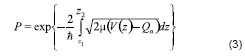
<p><font size="2" face="Verdana, Arial, Helvetica, sans-serif">The <a href="#probability">barrier penetration probability</a> is calculated  using one-dimensional WKB approximation</font></p>     <p><img src="/img/revistas/nuc/n49/e06064911.jpg" width="245" height="56"><a name="probability"></a></p>     
]]></body>
<body><![CDATA[<p><font size="2" face="Verdana, Arial, Helvetica, sans-serif">where  &mu; is the reduced mass. The <a href="#e1006">potential energy</a> V is the sum of the Coulomb <img src="/img/revistas/nuc/n49//e07064911.jpg" width="14" height="20">, nuclear <img src="/img/revistas/nuc/n49/e08064911.jpg" width="15" height="18"></font> <font size="2" face="Verdana, Arial, Helvetica, sans-serif">and centrifugal <img src="/img/revistas/nuc/n49/e09064911.jpg" width="13" height="17"> energy.</font></p>     
<p><img src="/img/revistas/nuc/n49/e10064911.jpg" width="250" height="24"><a name="e1006"></a></p>     
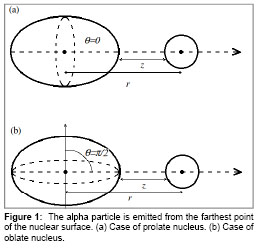
<p><font size="2" face="Verdana, Arial, Helvetica, sans-serif">In the above expressions, z and r are, respectively,    the distances between the surfaces and between    the centers of the alpha particle and the residual    nucleus, both measured along an axis parallel    to the vector which describes the relative motion; in    the present work is considered that the alpha particle    is emitted from the farthest point of the nuclear    surface (see <a href="#f0106">Fig. 1</a>), because in this way the alpha    particle face a lesser Coulomb barrier. The turning  points <img src="/img/revistas/nuc/n49/e11064911.jpg" width="13" height="14"> and <img src="/img/revistas/nuc/n49/e12064911.jpg" width="13" height="15"> are determined from the <a href="#e1306">equation</a></font> </p>     
<p><img src="/img/revistas/nuc/n49/e13064911.jpg" width="260" height="22"><a name="e1306"></a></p>     
<p><font size="2" face="Verdana, Arial, Helvetica, sans-serif">The barrier penetration probability <em>P</em>, is the most    important factor in the half-live calculation, however,    rather rough values of <img src="/img/revistas/nuc/n49/e02064911.jpg" width="11" height="15"> and <img src="/img/revistas/nuc/n49/e02064911.jpg" width="11" height="15"> can reduce significantly the accuracy of the results. For <img src="/img/revistas/nuc/n49/e02064911.jpg" width="11" height="15"> and <em>v</em>,</font> <font size="2" face="Verdana, Arial, Helvetica, sans-serif">values in [8] have been taken; they have been obtained    recently by a fit with a selected set of experimental data. For even-even, even-odd, odd-even  and odd-odd nuclei we have</font></p>     
<p><img src="/img/revistas/nuc/n49/e14064911.jpg" width="256" height="38"><a name="e1406"></a></p>     
<p><font size="2"><a href="#e1506"><font face="Verdana, Arial, Helvetica, sans-serif">where</font></a></font></p>     <p><img src="/img/revistas/nuc/n49/e15064911.jpg" width="243" height="28"><a name="e1506"></a></p>     
<p><font size="2" face="Verdana, Arial, Helvetica, sans-serif"><strong>Proximity Potential</strong>    <br> </font></p>     ]]></body>
<body><![CDATA[<p><font size="2" face="Verdana, Arial, Helvetica, sans-serif">The nucleus is a leptodermous distribution, i. e.,    a distribution essentially homogeneous except for    its surface. The strong attraction between two nuclei    occurs when their surfaces approach to a distance    comparable to the surface width <em>b</em>; the energy of this interaction can be <a href="#e1606">described</a> by the proximity potential [15].</font></p>     <p><img src="/img/revistas/nuc/n49/e16064911.jpg" width="238" height="27"><a name="e1606"></a></p>     
<p><font size="2" face="Verdana, Arial, Helvetica, sans-serif">Here <img src="/img/revistas/nuc/n49/e72064911.jpg" width="10" height="14"> is the nuclear surface tension coefficient, <img src="/img/revistas/nuc/n49/e17064911.jpg" width="14" height="18"> is the reciprocal of the square root of the Gaussian    curvature of the function that determines the distance between two points of the surfaces, evaluated at the point of closest approach, and <img src="/img/revistas/nuc/n49/e18064911.jpg" width="12" height="15"> is an adimensional function called universal proximity potential.    
<br> </font></p>     <p><font size="2" face="Verdana, Arial, Helvetica, sans-serif">The Lysekil <a href="#e1906">formula</a> is used for the surface tension coefficient [15].</font></p>     <p><img src="/img/revistas/nuc/n49/e19064911.jpg" width="247" height="32"><a name="e1906"></a></p>     
<p><font size="2" face="Verdana, Arial, Helvetica, sans-serif">Here <img src="/img/revistas/nuc/n49/e20064911.jpg" width="12" height="14"></font>&asymp;<font size="2" face="Verdana, Arial, Helvetica, sans-serif">0.95 MeV/<img src="/img/revistas/nuc/n49/e22064911.jpg" width="20" height="12"> and I = (N &ndash; Z)/A, where    N, Z and A refer to the set of both nuclei. Calculation    of the Gaussian curvature of a function which depends    on the shape of the surfaces of two deformed    nuclei can be difficult; <img src="/img/revistas/nuc/n49/e17064911.jpg" width="14" height="18"> in (8) can be replaced by    a simple <a href="#e2506">expression</a> that depends on the principal  curvatures <img src="/img/revistas/nuc/n49/e21064911.jpg" width="15" height="17">, <img src="/img/revistas/nuc/n49/e24064911.jpg" width="14" height="16"> y of the surfaces of both nuclei.</font></p>     
<p><img src="/img/revistas/nuc/n49/e25064911.jpg" width="247" height="32"><a name="e2506"></a></p>     
<p><font size="2" face="Verdana, Arial, Helvetica, sans-serif">For the expansion of the nuclear surface in    spherical harmonics <img src="/img/revistas/nuc/n49/e26064911.jpg" width="16" height="16">, generally are only taken    into account quadrupole deformations; therefore,    for a nucleus with axial symmetry, the <a href="#e2906">radius</a> <img src="/img/revistas/nuc/n49/e27064911.jpg" width="16" height="16"> can    be expressed as follows, depending on the parameter <img src="/img/revistas/nuc/n49/e28064911.jpg" width="13" height="17">:</font></p>     
<p><img src="/img/revistas/nuc/n49/e29064911.jpg" width="255" height="23"><a name="e2906"></a></p>     
]]></body>
<body><![CDATA[<p><font size="2" face="Verdana, Arial, Helvetica, sans-serif">Here C is the radius of a spherical nucleus with    the same volume as the deformed nucleus. To define the radius of a leptodermous distribution there    are several parameters, the best known is the sharp     radius, usually taken as <img src="/img/revistas/nuc/n49/e30064911.jpg" width="52" height="15">. However, when    the proximity potential is used, it is preferable to take    the radius of the nucleus as the central radius [16],    which is determined mostly by the characteristics of    the surface of the nucleus and not by the value of    the density distribution function inside the nucleus.    
<br> </font></p>     <p><font size="2" face="Verdana, Arial, Helvetica, sans-serif">The central radius is related with the sharp radius by the <a href="#e3106">expression</a>:</font></p>     <p><img src="/img/revistas/nuc/n49/e31064911.jpg" width="251" height="35"><a name="e3106"></a></p>     
<p><font size="2" face="Verdana, Arial, Helvetica, sans-serif">The next <a href="#e3206">formula</a> can be used for the sharp radius</font></p>     <p><img src="/img/revistas/nuc/n49/e32064911.jpg" width="240" height="24"><a name="e3206"></a></p>     
<p><font size="2" face="Verdana, Arial, Helvetica, sans-serif">as it takes into account an R0 dependence with A    (see ref. [15]).     <br> </font></p>     <p><font size="2" face="Verdana, Arial, Helvetica, sans-serif">From (11), the principal curvatures of the nucleus in the emission point of the alpha particle are calculated; for <a href="#e3406">prolate nuclei</a> (<a href="#f0106">Fig. 1 (a)</a>)</font></p>     <p><img src="/img/revistas/nuc/n49/e34064911.jpg" width="256" height="41"><a name="e3406"></a></p>     
]]></body>
<body><![CDATA[<p><font size="2" face="Verdana, Arial, Helvetica, sans-serif">and for <a href="#e3506">oblate nuclei</a> (<a href="#f0106">Fig. 1 (b)</a>)</font></p>     <p><img src="/img/revistas/nuc/n49/e35064911.jpg" width="259" height="39"><a name="e3506"></a></p>     
<p><font size="2"><a href="#e3606"><font face="Verdana, Arial, Helvetica, sans-serif">where</font></a></font></p>     <p><img src="/img/revistas/nuc/n49/e36064911.jpg" width="244" height="38"><a name="e3606"></a></p>     
<p><font size="2" face="Verdana, Arial, Helvetica, sans-serif">The curvature of the alpha particle is equal to    the inverse of its radius, in this case, the central radius;    we take its sharp radius as <img src="/img/revistas/nuc/n49//e37064911.jpg" width="15" height="15">= 1.671 fm. The    universal proximity potential [17] was obtained from    the Thomas-Fermi model with the inclusion of a momentum    dependent nucleon-nucleon interaction potential;  <a href="#e3806">it reads</a>:</font></p>     
<p><img src="/img/revistas/nuc/n49/e38064911.jpg" width="252" height="47"><a name="e3806"></a></p>     
<p><font size="2"><a href="#e3906"><font face="Verdana, Arial, Helvetica, sans-serif">for</font></a></font></p>     <p><img src="/img/revistas/nuc/n49/e39064911.jpg" width="255" height="22"><a name="e3906"></a></p>     
<p><font size="2"><a href="#e4006"><font face="Verdana, Arial, Helvetica, sans-serif">and</font></a></font></p>     <p><img src="/img/revistas/nuc/n49/e40064911.jpg" width="222" height="38"><a name="e4006"></a></p>     
]]></body>
<body><![CDATA[<p><font size="2"><a href="#e4106"><font face="Verdana, Arial, Helvetica, sans-serif">for</font></a></font></p>     <p><img src="/img/revistas/nuc/n49/e41064911.jpg" width="254" height="27"><a name="e4106"></a></p>     
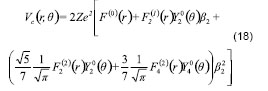
<p><font size="2" face="Verdana, Arial, Helvetica, sans-serif"><strong>Coulomb Energy</strong>    <br> </font></p>     <p><font size="2" face="Verdana, Arial, Helvetica, sans-serif">The Coulomb interaction for two axially symmetric    nuclei with quadrupole deformations can be <a href="#e4206">expressed analytically</a> [18]; in the case of the nucleus and the alpha particle we have</font></p>     <p><img src="/img/revistas/nuc/n49/e42064911.jpg" width="268" height="91"><a name="e4206"></a></p>     
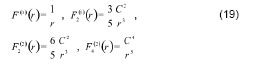
<p><font size="2" face="Verdana, Arial, Helvetica, sans-serif">where the F<img src="/img/revistas/nuc/n49/e71064911.jpg" width="18" height="15">(r) are form factors and <img src="/img/revistas/nuc/n49/e72064911.jpg" width="10" height="17"> is the angle    between the nucleus symmetry axis and the direction    of relative motion (see <a href="#f0106">Fig. 1</a>). The <a href="#e4306">form factors are</a>:</font></p>     
<p><img src="/img/revistas/nuc/n49/e43064911.jpg" width="254" height="65"><a name="e4306"></a></p>     
<p><img src="/img/revistas/nuc/n49/f01064911.jpg" width="260" height="249"><a name="f0106"></a></p>     
<p><font size="2" face="Verdana, Arial, Helvetica, sans-serif"><strong>Centrifugal Potential</strong>    ]]></body>
<body><![CDATA[<br> </font></p>     <p><font size="2" face="Verdana, Arial, Helvetica, sans-serif">The orbital quantum number <img src="/img/revistas/nuc/n49/e45064911.jpg" width="10" height="13"> of the emitted    alpha particle is the fundamental <a href="#e4406">factor</a> in determining    the centrifugal barrier </font></p>     
<p><img src="/img/revistas/nuc/n49/e44064911.jpg" width="247" height="38"><a name="e4406"></a></p>     
<p><font size="2" face="Verdana, Arial, Helvetica, sans-serif">In this paper is considered that both the parent    nucleus and the residual nucleus are in the ground    state, therefore, for even-even nuclei <img src="/img/revistas/nuc/n49/e45064911.jpg" width="10" height="13"> = 0. For odd    and odd-odd nuclei, from the classical definition of    angular momentum, we can make an argument that    leads to estimate a maximum value for <img src="/img/revistas/nuc/n49/e45064911.jpg" width="10" height="13"> (<img src="/img/revistas/nuc/n49/e46064911.jpg" width="17" height="15">), whose    fundamental idea is that the impact parameter of    the alpha particle can not be greater than the radius  of the emitter nucleus; from here we <a href="#e4706">obtain</a></font></p>     
<p><font size="2" face="Verdana, Arial, Helvetica, sans-serif"><img src="/img/revistas/nuc/n49/e47064911.jpg" width="253" height="46"><a name="e4706"></a></font></p>     
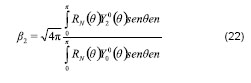
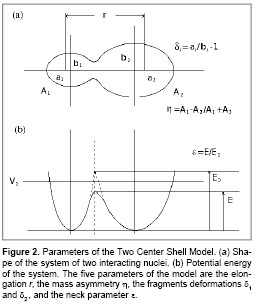
<p><font size="2" face="Verdana, Arial, Helvetica, sans-serif"><strong>Masses and Deformations    in the Ground State</strong>    <br> </font></p>     <p><font size="2" face="Verdana, Arial, Helvetica, sans-serif">The masses of nuclei in the ground state were    calculated by the macro-microscopic method, i.e.    the shell correction method of Strutinsky [19]. The    macroscopic part of the calculation was performed    by means of a version of the liquid drop model which    takes into account the fi nite range of the nuclear forces    (FRLDM) [20, 21]; the two center shell model    (TCSM) [22] was used for the microscopic part of    the calculation. The energy of the system depends    on fi ve parameters (see <a href="#f0206">Fig. 2</a>); fixing three of them    (<img src="/img/revistas/nuc/n49/e48064911.jpg" width="8" height="9">= 1, <img src="/img/revistas/nuc/n49/e70064911.jpg" width="13" height="12"> = 0 and <img src="/img/revistas/nuc/n49/e49064911.jpg" width="13" height="16">1 = <img src="/img/revistas/nuc/n49/e50064911.jpg" width="12" height="15">= <img src="/img/revistas/nuc/n49/e51064911.jpg" width="7" height="13">) a three-dimensional potential    surface whose minimum point corresponds    to the ground state can be constructed [23]. The    <a href="#deformationparameter">deformation parameter</a> <img src="/img/revistas/nuc/n49/e28064911.jpg" width="13" height="17"> was obtained from (11) once the minimum energy state was found and the shape of the nucleus was known.</font></p>     
<p><img src="/img/revistas/nuc/n49/e52064911.jpg" width="251" height="83"><a name="deformationparameter"></a></p>     
<p><img src="/img/revistas/nuc/n49/f02064911.jpg" width="257" height="305"><a name="f0206"></a></p>     
]]></body>
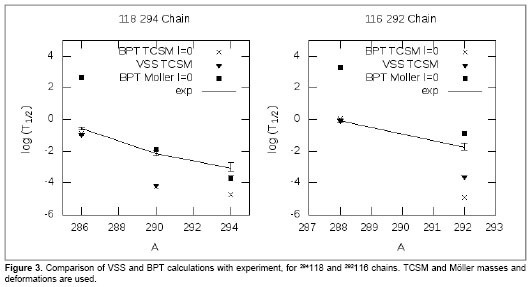
<body><![CDATA[<p><font size="2" face="Verdana, Arial, Helvetica, sans-serif"><strong>Results and Discussion    <br>   Even-even nuclei</strong>    <br> </font></p>     <p><font size="2" face="Verdana, Arial, Helvetica, sans-serif"><a href="#f0306">Figure 3</a> compares calculated half-lives with experimental    values obtained at JIRN, of the chains of    nuclei <img src="/img/revistas/nuc/n49/e53064911.jpg" width="30" height="14"> and <img src="/img/revistas/nuc/n49/e54064911.jpg" width="31" height="15"> [3]. It shows the results obtained    from the Viola-Seaborg formula (VSS) [4] using    masses and deformations calculated by means of the    TCSM; it shows too the results obtained from the formalism    of the barrier penetration theory (BPT), using    masses and deformations calculated by means of the    TCSM and also using the masses and deformations    reported by M&ouml;ller [21]. Parameters of the VSS formula were taken from [7]. The best result is reached for the nuclei <img src="/img/revistas/nuc/n49/e55064911.jpg" width="37" height="15"> and <img src="/img/revistas/nuc/n49/e56064911.jpg" width="38" height="16">, in which both, BPT and    VSS calculations using TCSM masses and deformations, are in very good agreement with experiment. In the case of <img src="/img/revistas/nuc/n49/e57064911.jpg" width="36" height="13">, the result from M&ouml;ller is better, as in the case of <img src="/img/revistas/nuc/n49/e54064911.jpg" width="31" height="15">, but for the last nucleus, BPT calculation    differs from the result of VSS formula for TCSM,    what indicates that there is something wrong with the    TCSM deformation. In the method to fi nd the masses    and deformations of nuclei, there is a probability for a    local minimum to be found in the search for a global minimum, and it could have similar energy but different deformation, and so distorts the results.</font></p>     
<p><img src="/img/revistas/nuc/n49/f03064911.jpg" width="532" height="287"><a name="f0306"></a></p>     
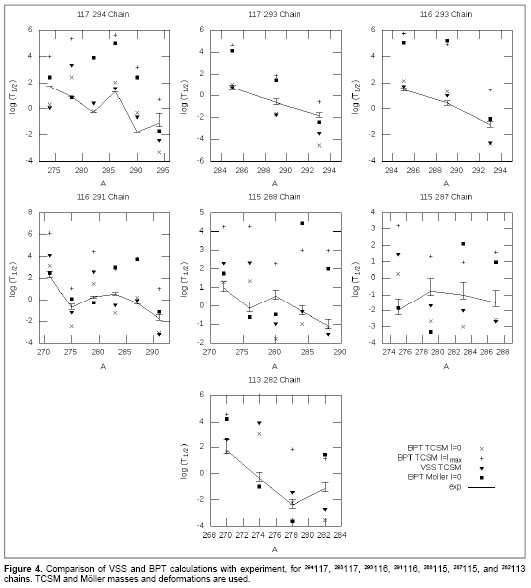
<p><font size="2" face="Verdana, Arial, Helvetica, sans-serif"><strong>Odd and Odd-odd Nuclei</strong>    <br> </font></p>     <p><font size="2" face="Verdana, Arial, Helvetica, sans-serif"><a href="#f0406">Figure 4</a> compares calculated half-lives with experimental    values [3] of the chains of nuclei <img src="/img/revistas/nuc/n49/e58064911.jpg" width="38" height="17">,    <img src="/img/revistas/nuc/n49//e59064911.jpg" width="39" height="15">, <img src="/img/revistas/nuc/n49/e60064911.jpg" width="37" height="16">, <img src="/img/revistas/nuc/n49/e61064911.jpg" width="38" height="15">, <img src="/img/revistas/nuc/n49/e62064911.jpg" width="37" height="16">, <img src="/img/revistas/nuc/n49/e68064911.jpg" width="39" height="15"> and <img src="/img/revistas/nuc/n49/e69064911.jpg" width="39" height="15">. BPT calculations using TCSM masses and deformations were performed with <em>l</em> = 0 and with <em>l</em> = <img src="/img/revistas/nuc/n49/e46064911.jpg" width="17" height="15">; the results    from the VSS formula and from BPT calculations    using M&ouml;ller masses and deformations with    <em>l</em> = 0 also appear in this fi gure. In general, BPT calculation    for l = 0 differs from VSS formula more widely    than in the case of even-even nuclei, because    in general, l has nonzero value. As can be seen, in general, the value given by VSS is included in the range determined by the variation of <em>l</em>. The previous    results are in good enough agreement with experiment,    with the exception of a few, for example,    some isotopes of meitnerium, taking into account the margin of error that causes the variation of angular momentum.    
<br> </font></p>     <p><img src="/img/revistas/nuc/n49/f04064911.jpg" width="531" height="588"><a name="f0406"></a></p>     
]]></body>
<body><![CDATA[<p><font size="2" face="Verdana, Arial, Helvetica, sans-serif">Taking into account all of the nuclei of the chains    mentioned so far (including even-even nuclei), the    standard deviation s of the calculated half-lives with respect to the experimental ones can be taken as a way of <a href="#e6406">comparison</a> </font></p>     <p><img src="/img/revistas/nuc/n49/e64064911.jpg" width="308" height="49"><a name="e6406"></a><a href="#"></a></p>     
<p><font size="2" face="Verdana, Arial, Helvetica, sans-serif">In M&ouml;ller case <img src="/img/revistas/nuc/n49/e65064911.jpg" width="11" height="12"> = 2.51 ( <img src="/img/revistas/nuc/n49/e65064911.jpg" width="11" height="12"> = 0.82 for even-even    nuclei) and in TCSM case <img src="/img/revistas/nuc/n49/e65064911.jpg" width="11" height="12"> = 1.61 (<img src="/img/revistas/nuc/n49/e65064911.jpg" width="11" height="12"> = 0.70 for eveneven    nuclei). In all cases we take values for <em>l</em> = 0.    
<br> </font></p>     <p><font size="2" face="Verdana, Arial, Helvetica, sans-serif"><strong>Conclusions</strong>    <br> </font></p>     <p><font size="2" face="Verdana, Arial, Helvetica, sans-serif">A method for obtaining alpha-decay half-lives    which is based in the WKB approximation was developed    in the present work. This method takes    into account the cuadrupole deformation parameter,    which has a significant roll in the half-life value,    as was seen in section 3.1. If good enough    theoretical values of masses and deformations    are used for calculations, the present method can    be used as an additional way to predict or confirm experimental results in the region of superheavy nuclei.    <br> </font></p>     <p><font size="2" face="Verdana, Arial, Helvetica, sans-serif"><strong>Acknowledgements</strong>    <br>   </font></p>     ]]></body>
<body><![CDATA[<p><font size="2" face="Verdana, Arial, Helvetica, sans-serif">Authors want to thank Yaser Martinez and    Luis Felipe from Prof. W Greiner work group at FIAS for the ground states masses and deformations calculated using the two center shell model.</font></p>     <p><font size="2" face="Verdana, Arial, Helvetica, sans-serif"><strong>References</strong>    <br> </font></p>     <!-- ref --><p><font size="2" face="Verdana, Arial, Helvetica, sans-serif">1. HOFMANN S, M&Uuml;NZENBERG G. The discovery of the    heaviest elements. Rev. Mod. Phys. 2000; 72(3): 733-   767.    <!-- ref --><br>   2. MORITA K. Superheavy research at RIKEN. Nuc. Phys. A.    2010; 834(1-4): 338c-344c.    <!-- ref --><br>   3. OGANESSIAN YU TS. Heaviest nuclei from 48Ca-induced    reactions. J. Phys. G. 2007; 34(4): R165-R242.    <br>   4. VIOLA VE, SEABORG GT. Nuclear systematics of the    heavy elements &ndash; lI. Livetimes for alpha, beta and spontaneous    fi ssion decay. J. lnorg. Nucl. Chem. 1966; 28:   741-761.    <br>   5. ROYER G, GUILBAUD M, ONILLON A, et. al. On the liquid    drop model mass formulas and <img src="/img/revistas/nuc/n49/e66064911.jpg" width="10" height="11"> decay of the heaviest nuclei.    
<br>   Authors manuscript published at the 12th International    Conference on nuclear reaction mechanisms. Varenna,    Italy, 2009.    <br>   6. KOURA H. Alpha-decay half-lives and fission barriers for    superheavy nuclei predicted by a nuclear mass formula. J.   Nucl. Rad. Sci. 2002; 3(1): 201&ndash;203.    ]]></body>
<body><![CDATA[<!-- ref --><br>   7. PARKHOMENKO A, SOBICZEWSKI A. Phenomenological    formula for <img src="http:/img/revistas/nuc/n49/e66064911.jpg" width="10" height="11">-decay half-lives of heaviest nuclei. Acta    Phys. Pol. B. 2005; 36(10): 3095-3108.    <!-- ref --><br>   8. POENARU DN, PLONSKI IH, GREINER W. <img src="http:/img/revistas/nuc/n49/e66064911.jpg" width="10" height="11">-decay    half-lives of superheavy nuclei. Phys. Rev. C. 2006; 74:   014312.    <br>   9. CHOWDHURY PR, SAMANTA C, BASU DN. Nuclear halflives    for <img src="/img/revistas/nuc/n49/e66064911.jpg" width="10" height="11">-radioactivity of elements with 100 &le; Z &le; 130. At.   Data Nucl. Data Tables. 2008; 94(6): 781-806.    
<!-- ref --><br>   10. CHANG X, ZHONGZHOU R, YANQING G. Competition    between <img src="http:/img/revistas/nuc/n49/e66064911.jpg" width="10" height="11"> decay and spontaneous fission for heavy and    superheavy nuclei. Phys. Rev. C. 2008; 78(4): 044329.    <!-- ref --><br>   11. SANTHOSH KP, SAHADEVAN S, BIJU RK. Alpha radioactivity    in heavy and super heavy elements. Nucl. Phys. A.    2009; 825(3-4): 159-174.    <!-- ref --><br>   12. SHARMA MM, FARHAN AR, M&Uuml;NZENBERG G. <img src="http:/img/revistas/nuc/n49/e66064911.jpg" width="10" height="11">-decay    properties of superheavy elements Z=113-125 in the relativistic    mean-fi eld theory with vector self-coupling of <img src="http:/img/revistas/nuc/n49/e67064911.jpg" width="12" height="12"> meson.    Phys. Rev. C. 2005; 71: 054310.    <!-- ref --><br>   13. GAMBHIR YK, BHAGWAT A, GUPTA M. <img src="http:/img/revistas/nuc/n49/e66064911.jpg" width="10" height="11">-decay halflives of the observed superheavy nuclei (Z=108-118). Phys. Rev. C. 2005; 71(3): 037301.    <!-- ref --><br>   14. GENG LS, TOKI H, MENG J. <img src="http:/img/revistas/nuc/n49/e66064911.jpg" width="10" height="11">-decay chains of 173288115 and 172287115 in the relativistic mean fi eld theory. Phys. Rev. C. 2003; 68: 061303(R).    <!-- ref --><br>   15. BLOCKI J, RANDRUP J, SWATECKI WJ, et al. Proximity forces. Ann. Physics. 1977; 105: 427-462.    <!-- ref --><br>   16. MYERS WD. Geometric properties of leptodermous distributions with applications to Nuclei. Nucl. Phys. A. 1973; 204: 465-484.    <!-- ref --><br>   17. BLOCKI J, SWATECKI WJ. A generalization of the proximity force theorem. Ann. Physics. 1981; 132: 53-65.    <!-- ref --><br>   18. TAKIGAWA N, RUMIN T, IHARA N. Coulomb interaction between spherical and deformed nuclei. Phys. Rev. C. 2000; 61(4): 044607.    <!-- ref --><br>   19. STRUTINSKY VM. Shell effects in nuclear masses and deformation energies. Nucl. Phys. A. 1967; 95: 420-442.    <!-- ref --><br>   20. SIERK AJ. Macroscopic Model of Rotating Nuclei. Phys. Rev. C. 1986; 33: 2039-2053.    <!-- ref --><br>   21. M&Ouml;LLER P, NIX JR, MYERS WD, et. al. Nuclear groundstate masses and deformations. At. Data Nucl. Data Tables. 1995; 59: 185-381.    <!-- ref --><br>   22. ZAGREBAEV V, KARPOV A, ARITOMO Y, et. al. Potential energy of a heavy nuclear system in fusion-fi ssion processes. Phys. Part. Nuclei. 2007; 38(4): 469-491.    <!-- ref --><br>   23. MOSEL U, MARUHN J, GREINER W. Asymptotically Correct Shell Model for Asymmetric Fission. Phys. Lett. B. 1971; 34(7): 587-590.    <br> </font></p>     <p><font size="2" face="Verdana, Arial, Helvetica, sans-serif"><strong>Recibido:</strong> 14 de marzo de 2011    <br>   <strong>Aceptado:</strong> 28 de abril de 2011</font></p>     ]]></body>
<body><![CDATA[ ]]></body><back>
<ref-list>
<ref id="B1">
<label>1</label><nlm-citation citation-type="journal">
<person-group person-group-type="author">
<name>
<surname><![CDATA[HOFMANN]]></surname>
<given-names><![CDATA[S]]></given-names>
</name>
<name>
<surname><![CDATA[MÜNZENBERG]]></surname>
<given-names><![CDATA[G]]></given-names>
</name>
</person-group>
<article-title xml:lang="en"><![CDATA[The discovery of the heaviest elements]]></article-title>
<source><![CDATA[Rev. Mod. Phys]]></source>
<year>2000</year>
<volume>72</volume>
<numero>(3)</numero>
<issue>(3)</issue>
<page-range>733- 767</page-range></nlm-citation>
</ref>
<ref id="B2">
<label>2</label><nlm-citation citation-type="journal">
<person-group person-group-type="author">
<name>
<surname><![CDATA[MORITA]]></surname>
<given-names><![CDATA[K]]></given-names>
</name>
</person-group>
<article-title xml:lang="en"><![CDATA[Superheavy research at RIKEN]]></article-title>
<source><![CDATA[Nuc. Phys. A]]></source>
<year>2010</year>
<volume>834</volume>
<numero>(1-4)</numero>
<issue>(1-4)</issue>
<page-range>338c-344c</page-range></nlm-citation>
</ref>
<ref id="B3">
<label>3</label><nlm-citation citation-type="journal">
<person-group person-group-type="author">
<name>
<surname><![CDATA[OGANESSIAN YU]]></surname>
<given-names><![CDATA[TS]]></given-names>
</name>
</person-group>
<article-title xml:lang="en"><![CDATA[Heaviest nuclei from 48Ca-induced reactions]]></article-title>
<source><![CDATA[J. Phys. G]]></source>
<year>2007</year>
<volume>34</volume>
<numero>(4)</numero>
<issue>(4)</issue>
<page-range>R165-R242</page-range></nlm-citation>
</ref>
<ref id="B4">
<label>4</label><nlm-citation citation-type="journal">
<person-group person-group-type="author">
<name>
<surname><![CDATA[VIOLA]]></surname>
<given-names><![CDATA[VE]]></given-names>
</name>
<name>
<surname><![CDATA[SEABORG]]></surname>
<given-names><![CDATA[GT]]></given-names>
</name>
</person-group>
<article-title xml:lang="en"><![CDATA[Nuclear systematics of the heavy elements - lI. Livetimes for alpha, beta and spontaneous fission decay]]></article-title>
<source><![CDATA[J. lnorg. Nucl. Chem]]></source>
<year>1966</year>
<volume>28</volume>
<page-range>741-761</page-range></nlm-citation>
</ref>
<ref id="B5">
<label>5</label><nlm-citation citation-type="">
<person-group person-group-type="author">
<name>
<surname><![CDATA[ROYER]]></surname>
<given-names><![CDATA[G]]></given-names>
</name>
<name>
<surname><![CDATA[GUILBAUD]]></surname>
<given-names><![CDATA[M]]></given-names>
</name>
<name>
<surname><![CDATA[ONILLON]]></surname>
<given-names><![CDATA[A]]></given-names>
</name>
</person-group>
<source><![CDATA[On the liquid drop model mass formulas and decay of the heaviest nuclei. Authors manuscript published at the 12th International Conference on nuclear reaction mechanisms]]></source>
<year>2009</year>
<publisher-loc><![CDATA[Varenna ]]></publisher-loc>
</nlm-citation>
</ref>
<ref id="B6">
<label>6</label><nlm-citation citation-type="journal">
<person-group person-group-type="author">
<name>
<surname><![CDATA[KOURA]]></surname>
<given-names><![CDATA[H]]></given-names>
</name>
</person-group>
<article-title xml:lang="en"><![CDATA[Alpha-decay half-lives and fission barriers for superheavy nuclei predicted by a nuclear mass formula]]></article-title>
<source><![CDATA[J. Nucl. Rad. Sci]]></source>
<year>2002</year>
<volume>3</volume>
<numero>(1)</numero>
<issue>(1)</issue>
<page-range>201-203</page-range></nlm-citation>
</ref>
<ref id="B7">
<label>7</label><nlm-citation citation-type="journal">
<person-group person-group-type="author">
<name>
<surname><![CDATA[PARKHOMENKO]]></surname>
<given-names><![CDATA[A]]></given-names>
</name>
<name>
<surname><![CDATA[SOBICZEWSKI]]></surname>
<given-names><![CDATA[A]]></given-names>
</name>
</person-group>
<article-title xml:lang="en"><![CDATA[Phenomenological formula for -decay half-lives of heaviest nuclei]]></article-title>
<source><![CDATA[Acta Phys. Pol. B]]></source>
<year>2005</year>
<volume>36</volume>
<numero>(10)</numero>
<issue>(10)</issue>
<page-range>3095-3108</page-range></nlm-citation>
</ref>
<ref id="B8">
<label>8</label><nlm-citation citation-type="journal">
<person-group person-group-type="author">
<name>
<surname><![CDATA[POENARU]]></surname>
<given-names><![CDATA[DN]]></given-names>
</name>
<name>
<surname><![CDATA[PLONSKI]]></surname>
<given-names><![CDATA[IH]]></given-names>
</name>
<name>
<surname><![CDATA[GREINER]]></surname>
<given-names><![CDATA[W]]></given-names>
</name>
</person-group>
<article-title xml:lang="en"><![CDATA[-decay half-lives of superheavy nuclei]]></article-title>
<source><![CDATA[Phys. Rev. C]]></source>
<year>2006</year>
<volume>74</volume>
<page-range>014312</page-range></nlm-citation>
</ref>
<ref id="B9">
<label>9</label><nlm-citation citation-type="journal">
<person-group person-group-type="author">
<name>
<surname><![CDATA[CHOWDHURY]]></surname>
<given-names><![CDATA[PR]]></given-names>
</name>
<name>
<surname><![CDATA[SAMANTA]]></surname>
<given-names><![CDATA[C]]></given-names>
</name>
<name>
<surname><![CDATA[BASU]]></surname>
<given-names><![CDATA[DN]]></given-names>
</name>
</person-group>
<article-title xml:lang="en"><![CDATA[Nuclear halflives for -radioactivity of elements with 100 &#8804; Z &#8804; 130]]></article-title>
<source><![CDATA[At. Data Nucl. Data Tables]]></source>
<year>2008</year>
<volume>94</volume>
<numero>(6)</numero>
<issue>(6)</issue>
<page-range>781-806</page-range></nlm-citation>
</ref>
<ref id="B10">
<label>10</label><nlm-citation citation-type="journal">
<person-group person-group-type="author">
<name>
<surname><![CDATA[CHANG]]></surname>
<given-names><![CDATA[X]]></given-names>
</name>
<name>
<surname><![CDATA[ZHONGZHOU]]></surname>
<given-names><![CDATA[R]]></given-names>
</name>
<name>
<surname><![CDATA[YANQING]]></surname>
<given-names><![CDATA[G]]></given-names>
</name>
</person-group>
<article-title xml:lang="en"><![CDATA[Competition between decay and spontaneous fission for heavy and superheavy nuclei]]></article-title>
<source><![CDATA[Phys. Rev. C]]></source>
<year>2008</year>
<volume>78</volume>
<numero>(4)</numero>
<issue>(4)</issue>
<page-range>044329</page-range></nlm-citation>
</ref>
<ref id="B11">
<label>11</label><nlm-citation citation-type="journal">
<person-group person-group-type="author">
<name>
<surname><![CDATA[SANTHOSH]]></surname>
<given-names><![CDATA[KP]]></given-names>
</name>
<name>
<surname><![CDATA[SAHADEVAN]]></surname>
<given-names><![CDATA[S]]></given-names>
</name>
<name>
<surname><![CDATA[BIJU]]></surname>
<given-names><![CDATA[RK]]></given-names>
</name>
</person-group>
<article-title xml:lang="en"><![CDATA[Alpha radioactivity in heavy and super heavy elements]]></article-title>
<source><![CDATA[Nucl. Phys. A]]></source>
<year>2009</year>
<volume>825</volume>
<numero>(3-4)</numero>
<issue>(3-4)</issue>
<page-range>159-174</page-range></nlm-citation>
</ref>
<ref id="B12">
<label>12</label><nlm-citation citation-type="journal">
<person-group person-group-type="author">
<name>
<surname><![CDATA[SHARMA]]></surname>
<given-names><![CDATA[MM]]></given-names>
</name>
<name>
<surname><![CDATA[FARHAN]]></surname>
<given-names><![CDATA[AR]]></given-names>
</name>
<name>
<surname><![CDATA[MÜNZENBERG]]></surname>
<given-names><![CDATA[G]]></given-names>
</name>
</person-group>
<article-title xml:lang="en"><![CDATA[-decay properties of superheavy elements Z=113-125 in the relativistic mean-field theory with vector self-coupling of meson]]></article-title>
<source><![CDATA[Phys. Rev. C]]></source>
<year>2005</year>
<volume>71</volume>
<page-range>054310</page-range></nlm-citation>
</ref>
<ref id="B13">
<label>13</label><nlm-citation citation-type="journal">
<person-group person-group-type="author">
<name>
<surname><![CDATA[GAMBHIR]]></surname>
<given-names><![CDATA[YK]]></given-names>
</name>
<name>
<surname><![CDATA[BHAGWAT]]></surname>
<given-names><![CDATA[A]]></given-names>
</name>
<name>
<surname><![CDATA[GUPTA]]></surname>
<given-names><![CDATA[M]]></given-names>
</name>
</person-group>
<article-title xml:lang="en"><![CDATA[-decay halflives of the observed superheavy nuclei (Z=108-118)]]></article-title>
<source><![CDATA[Phys. Rev. C]]></source>
<year>2005</year>
<volume>71</volume>
<numero>(3)</numero>
<issue>(3)</issue>
<page-range>037301</page-range></nlm-citation>
</ref>
<ref id="B14">
<label>14</label><nlm-citation citation-type="journal">
<person-group person-group-type="author">
<name>
<surname><![CDATA[GENG]]></surname>
<given-names><![CDATA[LS]]></given-names>
</name>
<name>
<surname><![CDATA[TOKI]]></surname>
<given-names><![CDATA[H]]></given-names>
</name>
<name>
<surname><![CDATA[MENG]]></surname>
<given-names><![CDATA[J]]></given-names>
</name>
</person-group>
<article-title xml:lang="en"><![CDATA[-decay chains of 173288115 and 172287115 in the relativistic mean field theory]]></article-title>
<source><![CDATA[Phys. Rev. C]]></source>
<year>2003</year>
<volume>68</volume>
<page-range>061303(R)</page-range></nlm-citation>
</ref>
<ref id="B15">
<label>15</label><nlm-citation citation-type="journal">
<person-group person-group-type="author">
<name>
<surname><![CDATA[BLOCKI]]></surname>
<given-names><![CDATA[J]]></given-names>
</name>
<name>
<surname><![CDATA[RANDRUP]]></surname>
<given-names><![CDATA[J]]></given-names>
</name>
<name>
<surname><![CDATA[SWATECKI]]></surname>
<given-names><![CDATA[WJ]]></given-names>
</name>
</person-group>
<article-title xml:lang="en"><![CDATA[Proximity forces]]></article-title>
<source><![CDATA[Ann. Physics]]></source>
<year>1977</year>
<volume>105</volume>
<page-range>427-462</page-range></nlm-citation>
</ref>
<ref id="B16">
<label>16</label><nlm-citation citation-type="journal">
<person-group person-group-type="author">
<name>
<surname><![CDATA[MYERS]]></surname>
<given-names><![CDATA[WD]]></given-names>
</name>
</person-group>
<article-title xml:lang="en"><![CDATA[Geometric properties of leptodermous distributions with applications to Nuclei]]></article-title>
<source><![CDATA[Nucl Phys. A]]></source>
<year>1973</year>
<volume>204</volume>
<page-range>465-484</page-range></nlm-citation>
</ref>
<ref id="B17">
<label>17</label><nlm-citation citation-type="journal">
<person-group person-group-type="author">
<name>
<surname><![CDATA[BLOCKI]]></surname>
<given-names><![CDATA[J]]></given-names>
</name>
<name>
<surname><![CDATA[SWATECKI]]></surname>
<given-names><![CDATA[WJ]]></given-names>
</name>
</person-group>
<article-title xml:lang="en"><![CDATA[A generalization of the proximity force theorem]]></article-title>
<source><![CDATA[Ann. Physics]]></source>
<year>1981</year>
<volume>132</volume>
<page-range>53-65</page-range></nlm-citation>
</ref>
<ref id="B18">
<label>18</label><nlm-citation citation-type="journal">
<person-group person-group-type="author">
<name>
<surname><![CDATA[TAKIGAWA]]></surname>
<given-names><![CDATA[N]]></given-names>
</name>
<name>
<surname><![CDATA[RUMIN]]></surname>
<given-names><![CDATA[T]]></given-names>
</name>
<name>
<surname><![CDATA[IHARA]]></surname>
<given-names><![CDATA[N]]></given-names>
</name>
</person-group>
<article-title xml:lang="en"><![CDATA[Coulomb interaction between spherical and deformed nuclei]]></article-title>
<source><![CDATA[Phys. Rev. C]]></source>
<year>2000</year>
<volume>61</volume>
<numero>(4)</numero>
<issue>(4)</issue>
<page-range>044607</page-range></nlm-citation>
</ref>
<ref id="B19">
<label>19</label><nlm-citation citation-type="journal">
<person-group person-group-type="author">
<name>
<surname><![CDATA[STRUTINSKY]]></surname>
<given-names><![CDATA[VM]]></given-names>
</name>
</person-group>
<article-title xml:lang="en"><![CDATA[Shell effects in nuclear masses and deformation energies]]></article-title>
<source><![CDATA[Nucl. Phys. A]]></source>
<year>1967</year>
<volume>95</volume>
<page-range>420-442</page-range></nlm-citation>
</ref>
<ref id="B20">
<label>20</label><nlm-citation citation-type="journal">
<person-group person-group-type="author">
<name>
<surname><![CDATA[SIERK]]></surname>
<given-names><![CDATA[AJ]]></given-names>
</name>
</person-group>
<article-title xml:lang="en"><![CDATA[Macroscopic Model of Rotating Nuclei]]></article-title>
<source><![CDATA[Phys. Rev. C]]></source>
<year>1986</year>
<volume>33</volume>
<page-range>2039-2053</page-range></nlm-citation>
</ref>
<ref id="B21">
<label>21</label><nlm-citation citation-type="journal">
<person-group person-group-type="author">
<name>
<surname><![CDATA[MÖLLER]]></surname>
<given-names><![CDATA[P]]></given-names>
</name>
<name>
<surname><![CDATA[NIX]]></surname>
<given-names><![CDATA[JR]]></given-names>
</name>
<name>
<surname><![CDATA[MYERS]]></surname>
<given-names><![CDATA[WD]]></given-names>
</name>
</person-group>
<article-title xml:lang="en"><![CDATA[Nuclear groundstate masses and deformations]]></article-title>
<source><![CDATA[At. Data Nucl. Data Tables]]></source>
<year>1995</year>
<volume>59</volume>
<page-range>185-381</page-range></nlm-citation>
</ref>
<ref id="B22">
<label>22</label><nlm-citation citation-type="journal">
<person-group person-group-type="author">
<name>
<surname><![CDATA[ZAGREBAEV]]></surname>
<given-names><![CDATA[V]]></given-names>
</name>
<name>
<surname><![CDATA[KARPOV]]></surname>
<given-names><![CDATA[A]]></given-names>
</name>
<name>
<surname><![CDATA[ARITOMO]]></surname>
<given-names><![CDATA[Y]]></given-names>
</name>
</person-group>
<article-title xml:lang="en"><![CDATA[Potential energy of a heavy nuclear system in fusion-fission processes]]></article-title>
<source><![CDATA[Phys. Part. Nuclei]]></source>
<year>2007</year>
<volume>38</volume>
<numero>(4)</numero>
<issue>(4)</issue>
<page-range>469-491</page-range></nlm-citation>
</ref>
<ref id="B23">
<label>23</label><nlm-citation citation-type="journal">
<person-group person-group-type="author">
<name>
<surname><![CDATA[MOSEL]]></surname>
<given-names><![CDATA[U]]></given-names>
</name>
<name>
<surname><![CDATA[MARUHN]]></surname>
<given-names><![CDATA[J]]></given-names>
</name>
<name>
<surname><![CDATA[GREINER]]></surname>
<given-names><![CDATA[W]]></given-names>
</name>
</person-group>
<article-title xml:lang="en"><![CDATA[Asymptotically Correct Shell Model for Asymmetric Fission]]></article-title>
<source><![CDATA[Phys. Lett. B]]></source>
<year>1971</year>
<volume>34</volume>
<numero>(7)</numero>
<issue>(7)</issue>
<page-range>587-590</page-range></nlm-citation>
</ref>
</ref-list>
</back>
</article>