<?xml version="1.0" encoding="ISO-8859-1"?><article xmlns:mml="http://www.w3.org/1998/Math/MathML" xmlns:xlink="http://www.w3.org/1999/xlink" xmlns:xsi="http://www.w3.org/2001/XMLSchema-instance">
<front>
<journal-meta>
<journal-id>0864-084X</journal-id>
<journal-title><![CDATA[Nucleus]]></journal-title>
<abbrev-journal-title><![CDATA[Nucleus]]></abbrev-journal-title>
<issn>0864-084X</issn>
<publisher>
<publisher-name><![CDATA[CUBAENERGIA]]></publisher-name>
</publisher>
</journal-meta>
<article-meta>
<article-id>S0864-084X2011000200005</article-id>
<title-group>
<article-title xml:lang="en"><![CDATA[Simulation and evaluation of the absorption edge subtraction technique in energy-resolved X-ray radiography applied to the cultural heritage studies]]></article-title>
<article-title xml:lang="es"><![CDATA[Simulación y evaluación de la técnica de sustracción del borde de absorción en un sistema radiográfico espectrométrico destinado al estudio del patrimonio cultural]]></article-title>
</title-group>
<contrib-group>
<contrib contrib-type="author">
<name>
<surname><![CDATA[Leyva Pernía]]></surname>
<given-names><![CDATA[Diana]]></given-names>
</name>
</contrib>
<contrib contrib-type="author">
<name>
<surname><![CDATA[Cabal Rodríguez]]></surname>
<given-names><![CDATA[Ana E]]></given-names>
</name>
</contrib>
<contrib contrib-type="author">
<name>
<surname><![CDATA[Van Espen]]></surname>
<given-names><![CDATA[Piet]]></given-names>
</name>
</contrib>
<contrib contrib-type="author">
<name>
<surname><![CDATA[Piñera Hernández]]></surname>
<given-names><![CDATA[Ibrahin]]></given-names>
</name>
</contrib>
<contrib contrib-type="author">
<name>
<surname><![CDATA[Leyva Fabelo]]></surname>
<given-names><![CDATA[Antonio]]></given-names>
</name>
</contrib>
<contrib contrib-type="author">
<name>
<surname><![CDATA[Abreu Alfonso]]></surname>
<given-names><![CDATA[Yamiel]]></given-names>
</name>
</contrib>
</contrib-group>
<aff id="A01">
<institution><![CDATA[,Departamento de Física Centro de Aplicaciones Tecnológicas y Desarrollo Nuclear (CEADEN) ]]></institution>
<addr-line><![CDATA[La Habana ]]></addr-line>
</aff>
<aff id="A02">
<institution><![CDATA[,Department of Chemistry University of Antwerp ]]></institution>
<addr-line><![CDATA[Belgium ]]></addr-line>
</aff>
<pub-date pub-type="pub">
<day>00</day>
<month>12</month>
<year>2011</year>
</pub-date>
<pub-date pub-type="epub">
<day>00</day>
<month>12</month>
<year>2011</year>
</pub-date>
<numero>50</numero>
<fpage>24</fpage>
<lpage>30</lpage>
<copyright-statement/>
<copyright-year/>
<self-uri xlink:href="http://scielo.sld.cu/scielo.php?script=sci_arttext&amp;pid=S0864-084X2011000200005&amp;lng=en&amp;nrm=iso"></self-uri><self-uri xlink:href="http://scielo.sld.cu/scielo.php?script=sci_abstract&amp;pid=S0864-084X2011000200005&amp;lng=en&amp;nrm=iso"></self-uri><self-uri xlink:href="http://scielo.sld.cu/scielo.php?script=sci_pdf&amp;pid=S0864-084X2011000200005&amp;lng=en&amp;nrm=iso"></self-uri><abstract abstract-type="short" xml:lang="en"><p><![CDATA[ABSTRACT In this work the mathematical simulation of photon transport in the matter was used to evaluate the potentials of a new energy-resolved X-ray radiography system. The system is intended for investigations of cultural heritage object, mainly painting. The radiographic system uses polychromatic radiation from an X-ray tube and measures the spectrum transmitted through the object with an energy-dispersive X-ray detector on a pixel-by-pixel basis. Manipulation of the data-set obtained allows constructing images with enhanced contrast for certain elements. Here the use of the absorption edge subtraction technique was emphasized. The simulated results were in good agreement with the experimental data.]]></p></abstract>
<abstract abstract-type="short" xml:lang="es"><p><![CDATA[RESUMEN En este trabajo se utilizó la simulación matemática del transporte de los fotones en la materia para evaluar las potencialidades de un nuevo sistema radiográfico destinado al estudio de obras del patrimonio cultural. Este sistema emplea una fuente de rayos X no monocromática y mide a nivel de píxel el espectro transmitido a través del objeto en estudio con un detector espectrométrico. El procesamiento del conjunto de datos obtenidos permite la construcción de imágenes con contraste realzado para ciertos elementos. En el presente trabajo se enfatizó en el uso de la técnica de sustracción del borde de absorción para el procesamiento de las imágenes. Los resultados de las simulaciones resultaron consistentes con las mediciones experimentales.]]></p></abstract>
<kwd-group>
<kwd lng="en"><![CDATA[photon transport]]></kwd>
<kwd lng="en"><![CDATA[X-ray tubes]]></kwd>
<kwd lng="en"><![CDATA[cultural objects]]></kwd>
<kwd lng="en"><![CDATA[mathematical models]]></kwd>
<kwd lng="en"><![CDATA[X-ray radiography]]></kwd>
<kwd lng="en"><![CDATA[image processing]]></kwd>
<kwd lng="en"><![CDATA[Si semiconductor detectors]]></kwd>
<kwd lng="en"><![CDATA[absorption]]></kwd>
<kwd lng="es"><![CDATA[transporte de fotones]]></kwd>
<kwd lng="es"><![CDATA[tubos de rayos X]]></kwd>
<kwd lng="es"><![CDATA[objetos culturales]]></kwd>
<kwd lng="es"><![CDATA[modelos matemáticos]]></kwd>
<kwd lng="es"><![CDATA[radiografía por rayos X]]></kwd>
<kwd lng="es"><![CDATA[tratamiento de imágenes]]></kwd>
<kwd lng="es"><![CDATA[detectores de semiconductor de Si]]></kwd>
<kwd lng="es"><![CDATA[absorción]]></kwd>
</kwd-group>
</article-meta>
</front><body><![CDATA[ <p align="left"><font face="Verdana, Arial, Helvetica, sans-serif" size="2"><b>CIENCIAS    NUCLEARES</b></font></p>     <p><font size="3"><strong><font size="4" face="Verdana, Arial, Helvetica, sans-serif">Simulation and evaluation of the absorption edge subtraction    technique in energy-resolved X-ray radiography applied  to the cultural heritage studies</font></strong> </font></p>     <p><strong><font size="4"><font size="3" face="Verdana, Arial, Helvetica, sans-serif">Simulaci&oacute;n  y evaluaci&oacute;n de la t&eacute;cnica de sustracci&oacute;n del borde de absorci&oacute;n en un sistema  radiogr&aacute;fico espectrom&eacute;trico destinado al estudio del patrimonio cultural</font></font></strong></p>     <p><font size="2" face="Verdana, Arial, Helvetica, sans-serif">Diana Leyva Pern&iacute;a<SUP>1</SUP>, Ana E. Cabal Rodr&iacute;guez<SUP>1</SUP>, Piet Van Espen<SUP>2</SUP>, Ibrahin Pi&ntilde;era Hern&aacute;ndez<SUP>1</SUP>, Antonio Leyva  Fabelo<SUP>1</SUP> , Yamiel Abreu Alfonso<SUP>1</SUP></font></p>     <p><font size="2" face="Verdana, Arial, Helvetica, sans-serif">  <SUP>1</SUP>1Departamento de F&iacute;sica. Centro de Aplicaciones Tecnol&oacute;gicas y Desarrollo Nuclear (CEADEN). Calle 30 No 502 e/ 5ta y 7ma, Miramar,    Playa. La Habana    <br>   <SUP>2</SUP>Department of Chemistry, University of Antwerp, Belgium</font></p>     <p><font size="2" face="Verdana, Arial, Helvetica, sans-serif"><a href="mailto:dleyva@ceaden.edu.cu">dleyva@ceaden.edu.cu</a></font></p> <hr>     <p><font face="Verdana, Arial, Helvetica, sans-serif" size="2"><b>ABSTRACT</b></font></p>     <p><font size="2" face="Verdana, Arial, Helvetica, sans-serif">In this work the mathematical simulation of photon transport in the matter was used to evaluate the potentials    of a new energy-resolved X-ray radiography system. The system is intended for investigations of    cultural heritage object, mainly painting. The radiographic system uses polychromatic radiation from an    X-ray tube and measures the spectrum transmitted through the object with an energy-dispersive X-ray    detector on a pixel-by-pixel basis. Manipulation of the data-set obtained allows constructing images    with enhanced contrast for certain elements. Here the use of the absorption edge subtraction technique    was emphasized. The simulated results were in good agreement with the experimental data.</font></p>     <p><font size="2" face="Verdana, Arial, Helvetica, sans-serif"><b>Key words:</b> photon transport, X-ray tubes, cultural objects, mathematical models, X-ray radiography, image  processing, Si semiconductor detectors, absorption</font>.</p> <hr>     ]]></body>
<body><![CDATA[<p><font face="Verdana, Arial, Helvetica, sans-serif" size="2"><b>RESUMEN</b></font></p>     <p><font size="2" face="Verdana, Arial, Helvetica, sans-serif">En este trabajo se utiliz&oacute; la simulaci&oacute;n matem&aacute;tica del transporte de los fotones en la materia para    evaluar las potencialidades de un nuevo sistema radiogr&aacute;fi co destinado al estudio de obras del patrimonio    cultural. Este sistema emplea una fuente de rayos X no monocrom&aacute;tica y mide a nivel de p&iacute;xel    el espectro transmitido a trav&eacute;s del objeto en estudio con un detector espectrom&eacute;trico. El procesamiento    del conjunto de datos obtenidos permite la construcci&oacute;n de im&aacute;genes con contraste realzado    para ciertos elementos. En el presente trabajo se enfatiz&oacute; en el uso de la t&eacute;cnica de sustracci&oacute;n del    borde de absorci&oacute;n para el procesamiento de las im&aacute;genes. Los resultados de las simulaciones resultaron    consistentes con las mediciones experimentales.</font></p>     <p><font face="Verdana, Arial, Helvetica, sans-serif" size="2"><strong>Palabras claves: </strong>transporte de fotones, tubos de rayos X, objetos culturales, modelos matem&aacute;ticos, radiograf&iacute;a  por rayos X, tratamiento de im&aacute;genes, detectores de semiconductor de Si, absorci&oacute;n</font>.</p> <hr>     <p><font size="3" face="Verdana, Arial, Helvetica, sans-serif"><strong>Introduction</strong></font></p>     <p><font size="2" face="Verdana, Arial, Helvetica, sans-serif">  Art historians and conservators extensively use    X-ray radiography of paintings during restoration, to    study the artist&rsquo;s technique and to identify forgery.    The obtained contrast results from the density and the    composition of the object, e.g. substrate and pigments    used. However it does not provide precise information    on the elemental composition and in some cases only    very little contrast is obtained and little information can    be deduced from this radiograph. This is the case for    instance when the painting is made on a thick wooden</font><font size="2" face="Verdana, Arial, Helvetica, sans-serif"> substrate or when a lead based ground layer is present    below the actual painting as is commonly found    in many paintings of the nineteenth and early twentieth    centuries [1].</font></p>     <p>  <font size="2" face="Verdana, Arial, Helvetica, sans-serif">The absorption edge subtraction technique [2,3]    has the potential to obtain a more element specific radiographic    image and it had been successfully used in    cultural heritage studies [4,5]. Nevertheless the classical    application of this technique requires the use of highly    monochromatic X-ray sources or synchrotron radiation    that difficult its implementation. As a solution to this inconvenient    was presented in recent publications [6,7] a novel energy-resolved X-ray radiography system, which    allows the absorption edge subtraction technique using    low power X-ray tubes and an X-ray detector with high    energy-resolution.</font></p>     <p><font size="2" face="Verdana, Arial, Helvetica, sans-serif"> A quick and effective way to study such a system    is the use of mathematical simulation of radiation transport    in matter, which had been previously used in several    investigations related to X-ray systems applied    for the cultural heritage studies [8,9]. In this article the    mathematical simulation was used by means of MCNPX    (Monte Carlo N-Particle version X) [10] to assess    in more detail the potentialities of the absorption edge    subtraction technique application in the system described    at [7].</font></p>     <p><font size="2" face="Verdana, Arial, Helvetica, sans-serif"><strong>Theory</strong></font></p>     <p><font size="2" face="Verdana, Arial, Helvetica, sans-serif"><strong>X-ray attenuation in an energy-resolved    radiography of paintings</strong></font></p>     <p><font size="2" face="Verdana, Arial, Helvetica, sans-serif"> The fundamental process that is responsible for the    creation of radiographic contrast of a sample (a painting    in our case) is the photo-electric absorption of X-rays    by the sample and the fact that the absorption crosssection    depends on the composition of the sample.</font></p>     ]]></body>
<body><![CDATA[<p><font size="2" face="Verdana, Arial, Helvetica, sans-serif"> In energy-resolved radiography, due to the use of    energy dispersive detectors (measuring the transmitted   spectrum), the radiographic image is reconstructed from    the data obtained at each pixel. We modeled the radiographic    contrast of this system as follow. The number    of photons observed in the spectrum for a given energy    E, N(E), is related to the number of photons emitted by    the tube with that energy, <img src="/img/revistas/nuc/n50/e01055011.jpg" width="32" height="17">(E) via the <a href="#e02055011">relation</a>:</font></p>     
<p><img src="/img/revistas/nuc/n50/e02055011.jpg" width="492" height="116"><a name="e02055011"></a></p>     
<p><font size="2" face="Verdana, Arial, Helvetica, sans-serif">where the first exponent refers to the attenuation in the    air path and the second to the attenuation in the painting,    with &mu; the mass absorption coefficient in <img src="/img/revistas/nuc/n50/e35055011.jpg" width="42" height="14">, <img src="/img/revistas/nuc/n50/e33055011.jpg" width="10" height="12"> the density in g <img src="/img/revistas/nuc/n50/e36055011.jpg" width="27" height="13">, and <em>d</em> the thickness in cm. The  detector efficiency is given by <img src="/img/revistas/nuc/n50/e34055011.jpg" width="8" height="11">(E).</font></p>     
<p><font size="2" face="Verdana, Arial, Helvetica, sans-serif">  If the painting is not present, and assuming that the    thickness of the painting is small relative to the air path,    ie <img src="/img/revistas/nuc/n50/e03055011.jpg" width="97" height="28">, one can <a href="#e04055011">write</a>:</font> </p>     
<p><img src="/img/revistas/nuc/n50/e04055011.jpg" width="515" height="63"><a name="e04055011"></a></p>     
<p><font size="2" face="Verdana, Arial, Helvetica, sans-serif"><a href="#e05055011">The ratio</a> of these two intensities is</font></p>     <p><img src="/img/revistas/nuc/n50/e05055011.jpg" width="509" height="66"><a name="e05055011"></a></p>     
<p><font size="2" face="Verdana, Arial, Helvetica, sans-serif">or the absorbance, <em>A(E)</em>, which is directly proportional    to the attenuation coefficients, densities and thicknesses  of the <a href="#e06055011">painting</a>:</font></p>     <p><img src="/img/revistas/nuc/n50/e06055011.jpg" width="506" height="76"><a name="e06055011"></a></p>     
<p><font size="2" face="Verdana, Arial, Helvetica, sans-serif">where the mass attenuation coefficient of the painting    can be written as the weighted contribution of the <a href="#e07055011">constituent elements</a>:</font></p>     ]]></body>
<body><![CDATA[<p><img src="/img/revistas/nuc/n50/e07055011.jpg" width="503" height="65"><a name="e07055011"></a></p>     
<p><font size="2" face="Verdana, Arial, Helvetica, sans-serif">Each time the painting is moved according to a    predefi ned stepping procedure, the transmitted X-ray    spectrum is measured at a given location of the painting    (pixel) and then it is moved to another location to    acquire the next spectrum. The three dimensional data    structure of the measured intensity can this represented    by <img src="/img/revistas/nuc/n50/e08055011.jpg" width="27" height="24">, with <em><strong>i</strong></em> and <em><strong>j</strong></em> referring to the <em><strong>x</strong></em> and y positions on    the painting and<strong><em> k</em></strong> referring to the energy interval (channel  in the spectrum). </font></p>     
<p><font size="2" face="Verdana, Arial, Helvetica, sans-serif"><strong>Edge subtraction radiography</strong></font></p>     <p><font size="2" face="Verdana, Arial, Helvetica, sans-serif">  The K-edge subtraction technique has the potential    to obtain a more element specific radiographic image.    The principle of edge subtraction radiography is to make    an element-specific image using the absorbance image    before and after the absorption edge of the element of    interest A [2,3]. Two orthogonal images are obtained: an    element specific image and a background image. The    fi rst image emphasizes the distribution of the specific    element due to the differences in X-ray attenuation below  and above the absorption edge of that element.</font></p>     <p><font size="2" face="Verdana, Arial, Helvetica, sans-serif">  If <img src="/img/revistas/nuc/n50/e09055011.jpg" width="17" height="25"> represents the energy below the edge and <img src="/img/revistas/nuc/n50/e10055011.jpg" width="17" height="23">  the energy above the edge, one can <a href="#e11055011">write</a>:</font></p>     
<p><img src="/img/revistas/nuc/n50/e11055011.jpg" width="505" height="73"><a name="e11055011"></a></p>     
<p><font size="2" face="Verdana, Arial, Helvetica, sans-serif">which is a set of two equations in two unknowns <img src="/img/revistas/nuc/n50/e15055011.jpg" width="21" height="21"> and      <img src="/img/revistas/nuc/n50/e12055011.jpg" width="20" height="24">. While <img src="/img/revistas/nuc/n50/e13055011.jpg" width="17" height="20"> and <img src="/img/revistas/nuc/n50/e14055011.jpg" width="25" height="22">  are the mass attenuation coefficients of an element of interest, <strong><em>A</em></strong>, and the rest of the    matrix, respectively. The solution, known as Lehmann    
<br> algorithm, is as <a href="#e16055011">follows</a>:</font></p>     <p><img src="/img/revistas/nuc/n50/e16055011.jpg" width="502" height="81"><a name="e16055011"></a></p>     
<p><a href="#e17055011">with</a></p>     ]]></body>
<body><![CDATA[<p><img src="/img/revistas/nuc/n50/e17055011.jpg" width="495" height="46"><a name="e17055011"></a></p>     
<p><font size="2" face="Verdana, Arial, Helvetica, sans-serif">Applying this algorithm for each pixel results in two    images, one related to the specific element image and    one of residual image. The algorithm thus requires the    mass attenuation coefficient of the specific element at    the two energies <img src="/img/revistas/nuc/n50/e09055011.jpg" width="16" height="19"> and <img src="/img/revistas/nuc/n50/e10055011.jpg" width="17" height="25">, which can be found in tables    [11]. To estimate the mass attenuation coefficient of the    rest of the matrix a guess must be made about the average    composition. Often the rest matrix is represented  by carbon or by water.</font></p>     
<p><font size="2" face="Verdana, Arial, Helvetica, sans-serif">In classical K-edge subtraction radiography the difference    between the two energies is of the order of few    keV. In our case, we can choose <img src="/img/revistas/nuc/n50/e09055011.jpg" width="16" height="19"> and <img src="/img/revistas/nuc/n50/e10055011.jpg" width="17" height="23"> to be 100    to 200 eV below and above the edge energy. Because    of this small difference the original Lehmann algorithm    can be simplified substantially. We can assume that the    mass attenuation coefficient of the rest of the matrix  remain essentially <a href="#e18055011">constant</a>.</font></p>     
<p><img src="/img/revistas/nuc/n50/e18055011.jpg" width="289" height="34"><a name="e18055011"></a></p>     
<p><font size="2" face="Verdana, Arial, Helvetica, sans-serif">The element specific information (eq. 7) can be <a href="#e19055011">written as</a>:</font></p>     <p><img src="/img/revistas/nuc/n50/e19055011.jpg" width="401" height="66"><a name="e19055011"></a></p>     
<p><font size="2" face="Verdana, Arial, Helvetica, sans-serif">Because <img src="/img/revistas/nuc/n50/e13055011.jpg" width="22" height="20">(<img src="/img/revistas/nuc/n50/e10055011.jpg" width="17" height="23">) &ndash; <img src="/img/revistas/nuc/n50/e13055011.jpg" width="22" height="20">(<img src="/img/revistas/nuc/n50/e09055011.jpg" width="16" height="19"> ) is a constant independent    of the sample, and because we are not interested in    the absolute value but rather in differences from pixel    to pixel we can obtain element specifi c images simply    by subtracting the absorbance at two energies, one just    below and one just above the edge of interest. Thus,    when taking absorption images close to a particular    edge, the element specific image can be calculated    simply by subtracting the two absorbance images. In    contrast to the Lehmann algorithm the value of mass  attenuation coefficient is not required.</font></p>     
<p><font size="3" face="Verdana, Arial, Helvetica, sans-serif">  <strong>Materials and methods</strong></font></p>     <p><font size="2" face="Verdana, Arial, Helvetica, sans-serif"> The transport    code MCNPX [10] was used to simulate the transport of the gamma rays through    the different components of the experimental set-up. In the simulations all    the geometrical details related to the detection system were reproduced and    the source spectrum was defined from experimental measurements made with the    X-ray tube of the system.</font></p>     <p><font size="2" face="Verdana, Arial, Helvetica, sans-serif">  Two test paintings, denominated D5 and D6, were    used in the simulations. They were constructed to emulate    the actual test paintings that were available for the    study of the experimental set-up.</font></p>     ]]></body>
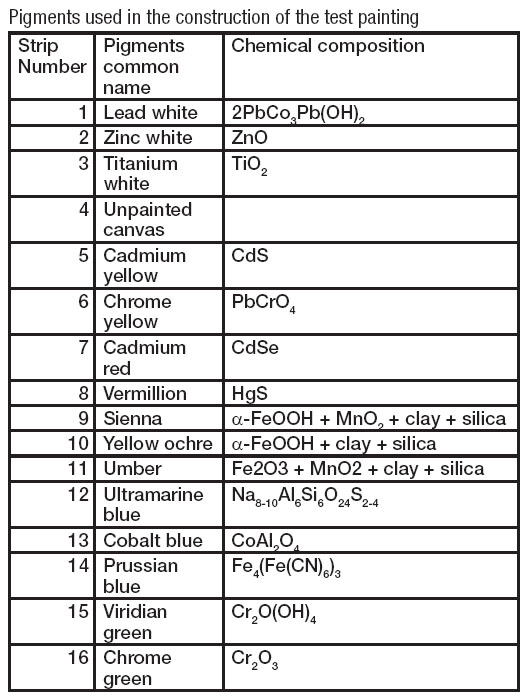
<body><![CDATA[<p><font size="2" face="Verdana, Arial, Helvetica, sans-serif"> The test painting    D5 consisted of 15 bands of different pigments painted on a canvas of 180 mm    x 240 mm. Each pigment was applied in different thickness of about 20, 40 and    60 &igrave;m in order to observe the effect of the brushstrokes thickness in    the radiographic image. The applied pigments with their chemical formula are    shown in <a href="#t01055011">table</a>. Between the third white band and the    first yellow a band was left unpainted. </font></p>     <p><img src="/img/revistas/nuc/n50/t01055011.jpg" width="527" height="699"><a name="t01055011"></a></p>     
<p><font size="2" face="Verdana, Arial, Helvetica, sans-serif">  The D6 test painting only differs from D5 in that between    the canvas and pigment bands a ground layer of    40 &mu;m thick lead white <img src="/img/revistas/nuc/n50/e20055011.jpg" width="133" height="19"> was painted.</font></p>     
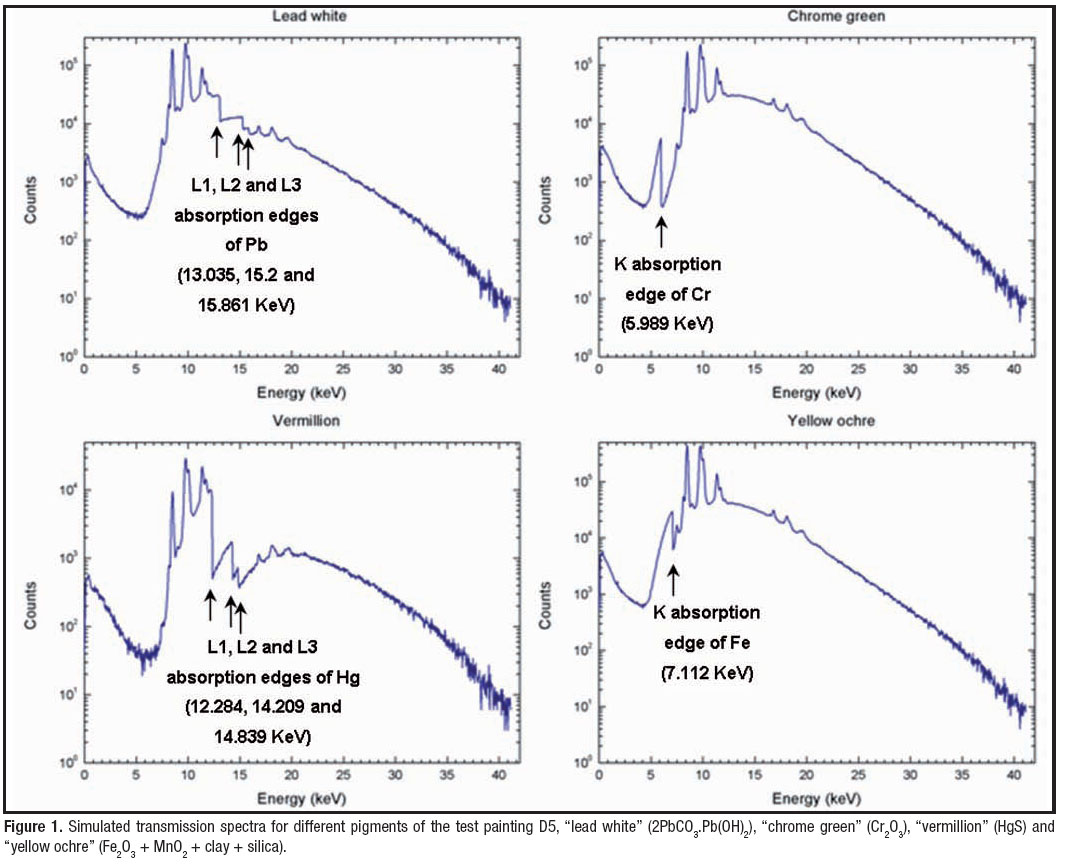
<p><font size="2" face="Verdana, Arial, Helvetica, sans-serif"> The energy distribution    of pulses created in the cell, that models the physical detector, was obtained    by the implementation of the pulse height tally (F8) provided by the MCNPX.    To ensure that the simulation results have a relative error of 1% were carried    out in each run 100 millions of histories.</font></p>     <p><font size="2" face="Verdana, Arial, Helvetica, sans-serif">  The data obtained by the simulations were further    processed using a Matlab program specially developed    for this purpose. This program was also used to    process the experimental results and it allows to obtain    and visualize images of the X-ray intensity at a given    energy or energy range, e.g. before and after an absorption    edge and to perform mathematical operations    on these images such as logarithmic subtraction. In this    way the effect of selecting certain energies or energy    ranges can be studied as well as the infl uence of various    normalization and scaling steps. Performing the    proper operations and selecting the right energies it is    possible to achieve a dramatic improvement of the image  contrast for a specific element.</font></p>     <p><font size="3" face="Verdana, Arial, Helvetica, sans-serif">  <strong>Results and discussion</strong></font></p>     <p><font size="2" face="Verdana, Arial, Helvetica, sans-serif">  <a href="/img/revistas/nuc/n50/f01055011.jpg">Figure 1</a> shows some absorption spectra after transmission    through different pigments of test painting D5, obtained    by simulation. Next to the overall absorption of the    tube spectrum in which stands out three emission lines    from the wolfram anode (8.397, 9.672 and 11.285 KeV),    K and L edges of some elements (indicated with black    arrows) can clearly be observed showing the possibility    to discriminate, at least in principle, between different pigments    based on their absorption spectrum.</font></p>     
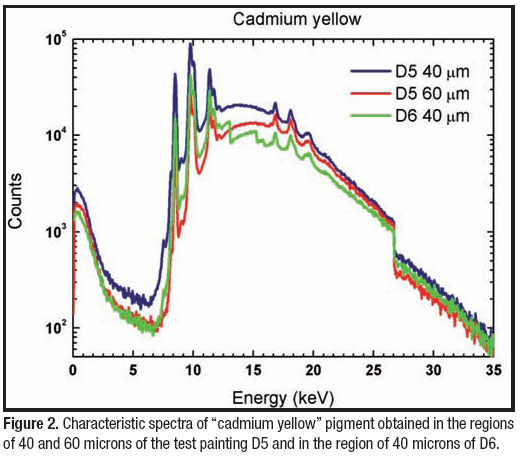
<p><font size="2" face="Verdana, Arial, Helvetica, sans-serif"><a href="#f02055011">Figure    2</a> are presented the characteristic spectra of the &ldquo;cadmium yellow&rdquo;    pigment acquired by simulation from two regions of D5 with different thickness    (40 and 60 microns) and from the region of D6 that presents 40 microns of pigment    over the ground layer. These three spectra differ in their intensities but all    of them present a very distinctive K absorption edge of cadmium. The influence    of the pigment thickness on the obtained spectra is evident, it is seen the    clear difference of the X-ray absorption spectra intensities between the 40    microns layer and the thicker layer of 60 microns of the test painting D5. In    the spectrum obtained from D6 is visible a higher attenuation due to the presence    of Pb in the ground layer, which also causes the apparition of the <img src="/img/revistas/nuc/n50/e21055011.jpg" width="13" height="14">,    <img src="/img/revistas/nuc/n50/e22055011.jpg" width="16" height="16">    and <img src="/img/revistas/nuc/n50/e23055011.jpg" width="14" height="15">    absorption edges of this element next to the already mentioned K absorption    edge of cadmium.</font></p>     
<p><img src="/img/revistas/nuc/n50/f02055011.jpg" width="525" height="456"><a name="f02055011"></a></p>     
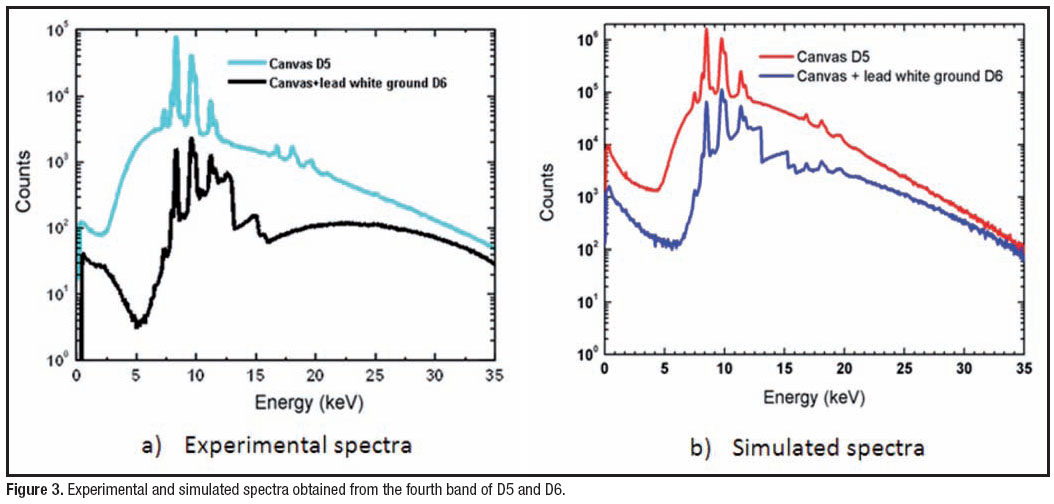
<p><font size="2" face="Verdana, Arial, Helvetica, sans-serif">  The comparison between experimental and simulated    spectra obtained from the fourth band of the test    paintings is sowed in <a href="/img/revistas/nuc/n50/f03055011.jpg">figure 3</a>. Both simulated and experimental    spectra from D5 exhibit only the presence of    the wolfram anode emission lines, while the D6 spectra    also present the absorption edges of lead. In both    cases the spectra from D6 are less intense than those    from D5, due to attenuation caused by the lead in the    ground layer. In this figure is also noticeable that the    difference between the spectra intensities of the experimental results is larger than in the simulated case. This    can be caused by non-homogeneity in the thickness    of the ground layer applied on the experimental test    painting. The existence of a thickness larger than the    considered average in the analyzed pixel would cause  a greater attenuation in the results.</font></p>     
]]></body>
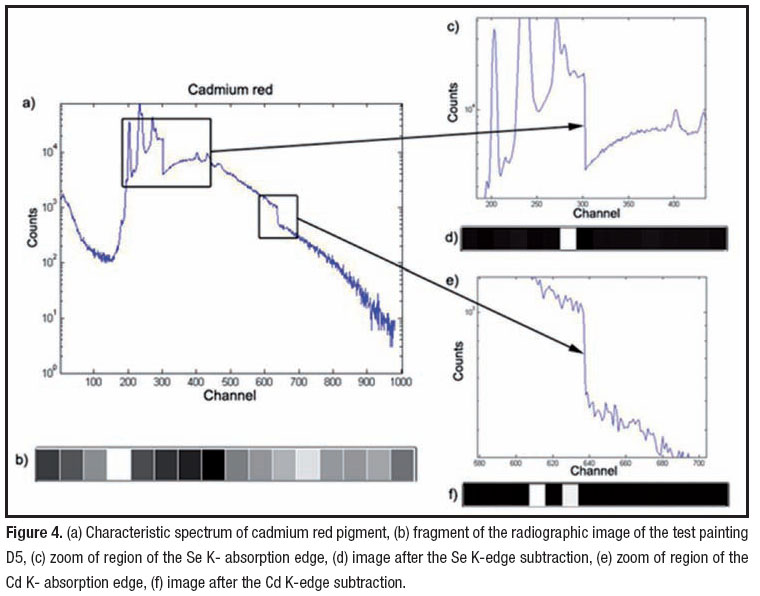
<body><![CDATA[<p><font size="2" face="Verdana, Arial, Helvetica, sans-serif"><a href="/img/revistas/nuc/n50/f04055011.jpg">Figure    4</a> illustrates the procedure of the application of absorption edge subtraction    and its application to the analysis and identification of pigments of the test    painting D5. <a href="/img/revistas/nuc/n50/f04055011.jpg">Figure 4 (a)</a> shows the characteristic    spectrum of the &ldquo;cadmium red&rdquo; pigment (CdSe). It is the transmission    spectrum obtained at one of the pixels of the D5 band covered by this pigment.    The K-absorption edges of the two elements, comprised in the pigment, can be    clearly observed. <a href="/img/revistas/nuc/n50/f04055011.jpg">Figure 4 (c)</a> zooms in on the region    of the Se K-edge (12.658 keV), while 4 (e) shows the detail of the Cd K-edge    (26.711 keV). For all pixels of the test painting were selected two region of    the spectrum, below and above the Se K-edge. Then the logarithmic subtraction    technique was applied and the absorbance image of the section of D5 (<a href="/img/revistas/nuc/n50/f04055011.jpg">figure    4(d)</a>) was obtained.</font></p>     
<p><font size="2" face="Verdana, Arial, Helvetica, sans-serif">In the image the    single band that contains selenium can clearly be distinguished. It coincides    with the distribution of the &ldquo;cadmium red&rdquo; pigment in the test painting    D5. An image (<a href="/img/revistas/nuc/n50/f04055011.jpg">figure 4(f)</a>)    was obtained applying the same procedure for the Cd K-edge , which has two enhanced    bands where Cd is presented, the fi fth (CdS) and the seventh (CdSe). These    last two figures can be compared with the original image of the same section    without any mathematical treatment.</font> <font size="2" face="Verdana, Arial, Helvetica, sans-serif">Without    applying the edge subtraction technique and not knowing the distribution of    the pigments, it would be impossible to identify these bands.</font></p>     
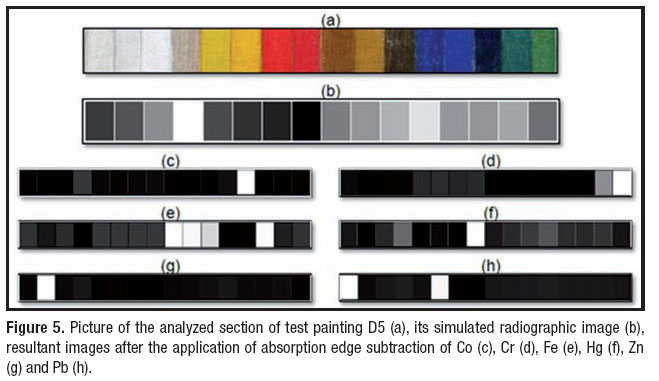
<p><font size="2" face="Verdana, Arial, Helvetica, sans-serif">  Without prior knowledge of the distribution of pigments,    as is the case in a real painting, it can be concluded    from the above results that it is possible to distinguish    between two pigments containing Cd, using the additional information provided by the image produced  from the Se edge.</font></p>     <p><font size="2" face="Verdana, Arial, Helvetica, sans-serif"><a href="/img/revistas/nuc/n50/f05055011.jpg">Figure    5</a> shows a picture obtained by simulation of the analyzed section of test    painting D5 <a href="/img/revistas/nuc/n50/f05055011.jpg">(a)</a>, the radiographic image formed from    the total number of counts in each pixel <a href="/img/revistas/nuc/n50/f05055011.jpg">(b)</a> and the    images obtained from the subtraction of some absorption edges <a href="/img/revistas/nuc/n50/f05055011.jpg">(c-h)</a>.    In the image obtained by the Co absorption edge subtraction (<a href="/img/revistas/nuc/n50/f05055011.jpg">figure    3 (c)</a>) the 13th band is enhanced, which is the only one in the test painting    in which that element is present (&ldquo;cobalt blue&rdquo; <img src="/img/revistas/nuc/n50/e24055011.jpg" width="48" height="16">    pigment). <a href="/img/revistas/nuc/n50/f05055011.jpg">Figure 5 (d)</a> shows the image from the subtraction    of the chromium edge, where the last two bands, 15 and 16 are enhanced. Band    number 16 <img src="/img/revistas/nuc/n50/e25055011.jpg" width="55" height="15">    is more intense than 15 <img src="/img/revistas/nuc/n50/e26055011.jpg" width="78" height="17">    because of the higher Cr concentration in the former. The band 6 also contains    Cr, but it is not enhanced in the figure as a result of the presence of Pb in    the pigment &ldquo;chrome yellow&rdquo;. The image corresponding to the subtraction    of the iron absorption edge, shown in <a href="/img/revistas/nuc/n50/f05055011.jpg">figure 5 (e)</a>,    exhibits four bands that stand out from the rest, corresponding to &ldquo;sienna&rdquo;    <img src="/img/revistas/nuc/n50/e27055011.jpg" width="227" height="20">,    &ldquo;yellow ochre&rdquo; <img src="/img/revistas/nuc/n50/e38055011.jpg" width="155" height="13">,    &ldquo;umber&rdquo; <img src="/img/revistas/nuc/n50/e39055011.jpg" width="200" height="19">    and &ldquo;prussian blue&rdquo; <img src="/img/revistas/nuc/n50/e30055011.jpg" width="99" height="14">    pigments. <a href="/img/revistas/nuc/n50/f05055011.jpg">Figures 5 (f)</a> and <a href="/img/revistas/nuc/n50/f05055011.jpg">(g)</a>    show only one prominent band, because the elements relating to absorption edges    (mercury and zinc, respectively) were only present in these bands. Finally,    looking at <a href="/img/revistas/nuc/n50/f05055011.jpg">figure 5 (h)</a>, obtained from the subtraction    of the lead edge, accentuated regions are observed corresponding to band 1 <img src="/img/revistas/nuc/n50/e31055011.jpg" width="134" height="14">    and 6 <img src="/img/revistas/nuc/n50/e32055011.jpg" width="70" height="16">.    These are the only areas in which lead is present in the pigments in this test    painting.</font></p>     

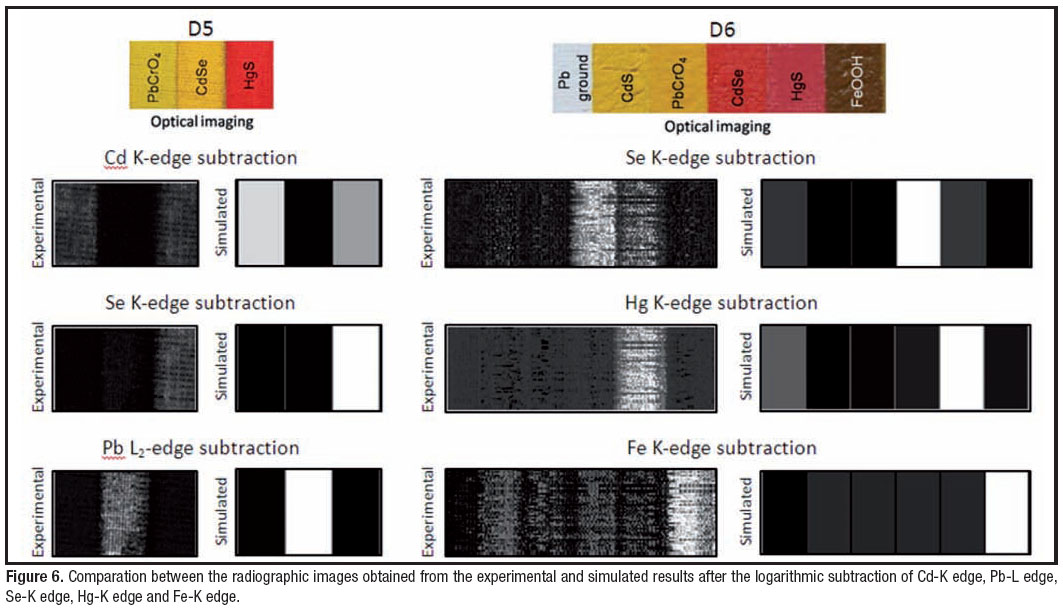
<p><font size="2" face="Verdana, Arial, Helvetica, sans-serif">The obtained results    clearly demonstrate the practical usefulness of the absorption edge subtraction    procedure for the study of paintings, specifically for the identification of    pigments.</font></p>     <p><font size="2" face="Verdana, Arial, Helvetica, sans-serif">  Experimental data were acquired only for a small    region of D5, which corresponds to the bands of the    pigments &ldquo;cadmium yellow&rdquo;, &ldquo;chrome yellow&rdquo; and &ldquo;cadmium    red&rdquo;. While the D6 scanned area extends over    the bands of the pigments &ldquo;lead white&rdquo; ground layer,&ldquo;cadmium yellow&rdquo;, &ldquo;chrome yellow&rdquo;, &ldquo;cadmium red&rdquo;,&ldquo;vermillion&rdquo; and &ldquo;sienna&rdquo;. A comparison between the    radiographic images, obtained from the application of    the absorption edge subtraction technique to the experimental    and simulated data, is presented in <a href="/img/revistas/nuc/n50/f06055011.jpg">figure 6</a>.    Both experimental and simulated results show enhanced    bands corresponding to the element, whose absorption    edge was used to produce the image. The similarity between    the experimental results and the simulated validate    the simulation results. Thanks to the simulation it was possible to obtain evidence of the usefulness of edge    subtraction via energy-resolved radiography for more    elements than available experimentally such as Co, Cr,    Fe, Hg and Zn. This gives confidence about the more general    applicability of this technique. Further experimental    verification is planned in the near future.</font></p>     
<p>&nbsp;</p>     <p><font size="3" face="Verdana, Arial, Helvetica, sans-serif"><strong>Conclusions</strong></font></p>     <p><font size="2" face="Verdana, Arial, Helvetica, sans-serif">  Simulated spectra and images were obtained for    energy-resolved digital X-ray radiograph system. Absorption    edges of the main elements were observed in    the spectra even when a ground layer of &ldquo;lead white&rdquo;    pigment is applied. Applying the absorption edge subtraction    technique it was possible to obtain the distribution    of each chemical element in a selected region of the    test painting. This allows the identifi cation of pigments    present in the painting and to obtain their distribution.</font></p>     <p><font size="2" face="Verdana, Arial, Helvetica, sans-serif">  The simulation results were compared with available experimental    data and good agreement was obtained. The    simulation involved a larger number of elements than    experimentally available and indicated that edge subtraction    technique is applicable for an extended range of    elements and can be used in real situations investigating    the distribution of pigments in the painting.</font></p>     ]]></body>
<body><![CDATA[<p><font size="3" face="Verdana, Arial, Helvetica, sans-serif">  <strong>References</strong></font></p>     <p><font size="2" face="Verdana, Arial, Helvetica, sans-serif">  1. AIB&Eacute;O CL, GOFFIN S, SCHALM O, et. al. Micro-Raman analysis for    the identifi cation of pigments from 19th and 20th century paintings. J.    Raman Spectrosc. 2008; 39(8): 1091&ndash;1098.    <!-- ref --><br>   2. ALVAREZ RE, MACOVSKI A. Energy-selective Reconstructions in X-ray    computerized Tomography. Phys. Med. Biol. 1976; 21(5): 733-744.    <!-- ref --><br>   3. LEHMANN LA, &Aacute;LVAREZ RE, MACOVSKI A, BRODY WR. Generalized    image combinations in dual KVP digital radiography. Med. Phys. 1981;    8(5): 659-667.    <br>   4. BALDELLI P, BONIZZONI L, GAMBACCINI M, et. al. Application of the    K-edge X-ray technique to map pigments of art paintings: Preliminary    results. IL NUOVO CIMENTO. 2006; 29C (6): 663&ndash;672.    <br>   5. KRUG K, DIK J, DEN LEEUW M et. al. Visualization of pigment distributions    in paintings using synchrotron K-edge imaging. Appl. Phys. A.   2006; 83(2): pp. 247&ndash;251.    <!-- ref --><br>   6. SCHALM O, CABAL AE, VAN ESPEN P, et. al. Improved radiographic    methods for the investigation of paintings using laboratory and    synchrotron X-ray sources. J Anal Atom Spectr. 2011; 26: 1068-1077.    <!-- ref --><br>   7. CABAL AE, LEYVA D, SCHALM O, et. al. Possibilities of energy-resolved    X-ray radiography for the investigation of paintings. Anal. Bioanal. Chem. 2011. DOI: 10.1007/s00216-011-5230-x.    <br>   8. HARDING G, HARDING E. Compton scatter imaging A tool for    historical exploration. Appl Rad and Isot. 2010; 68(6): 993&ndash;   1005.    <br>   9. TROJEK T, CECHAK T, MUSILEK L. Monte Carlo simulations of disturbing    effects in quantitative n-situ X-ray fl uorescence analysis and    microanalysis. Nucl Instrum and Meth Phys Res A. 2010; 619: 266&ndash;   269.    ]]></body>
<body><![CDATA[<!-- ref --><br>   10. HENDRICKS JS, MCKINNEY GW, TRELLUE HR, et. al. MCNPXTM    Version 2.6.B. [software inform&aacute;tico]. Los Alamos National Laboratory    report. LA-UR-06-3248. 2006.    <!-- ref --><br>   11. VAN GRIEKEN R, MARKOVIC A. Handbook of X-ray spectrometry.  New York: Marcel Dekker, 2002.    </font></p>     <p><font size="2" face="Verdana, Arial, Helvetica, sans-serif">    <br>     <strong>Recibido:</strong> 8 de septiembre de 2011    <br>     <strong>Aceptado: </strong>27 de octubre de 2011</font></p>     <p>&nbsp;</p>      ]]></body><back>
<ref-list>
<ref id="B1">
<label>1</label><nlm-citation citation-type="journal">
<person-group person-group-type="author">
<name>
<surname><![CDATA[AIBÉO]]></surname>
<given-names><![CDATA[CL]]></given-names>
</name>
<name>
<surname><![CDATA[GOFFIN]]></surname>
<given-names><![CDATA[S]]></given-names>
</name>
<name>
<surname><![CDATA[SCHALM]]></surname>
<given-names><![CDATA[O]]></given-names>
</name>
</person-group>
<article-title xml:lang="en"><![CDATA[Micro-Raman analysis for the identification of pigments from 19th and 20th century paintings]]></article-title>
<source><![CDATA[J. Raman Spectrosc]]></source>
<year>2008</year>
<volume>39</volume>
<numero>(8)</numero>
<issue>(8)</issue>
<page-range>1091-109</page-range></nlm-citation>
</ref>
<ref id="B2">
<label>2</label><nlm-citation citation-type="journal">
<person-group person-group-type="author">
<name>
<surname><![CDATA[ALVAREZ]]></surname>
<given-names><![CDATA[RE]]></given-names>
</name>
<name>
<surname><![CDATA[MACOVSKI]]></surname>
<given-names><![CDATA[A]]></given-names>
</name>
</person-group>
<article-title xml:lang="en"><![CDATA[Energy-selective Reconstructions in X-ray computerized Tomography]]></article-title>
<source><![CDATA[Phys. Med. Biol]]></source>
<year>1976</year>
<volume>21</volume>
<numero>(5)</numero>
<issue>(5)</issue>
<page-range>733-744</page-range></nlm-citation>
</ref>
<ref id="B3">
<label>3</label><nlm-citation citation-type="journal">
<person-group person-group-type="author">
<name>
<surname><![CDATA[LEHMANN]]></surname>
<given-names><![CDATA[LA]]></given-names>
</name>
<name>
<surname><![CDATA[ÁLVAREZ]]></surname>
<given-names><![CDATA[RE]]></given-names>
</name>
<name>
<surname><![CDATA[MACOVSKI]]></surname>
<given-names><![CDATA[A]]></given-names>
</name>
<name>
<surname><![CDATA[BRODY]]></surname>
<given-names><![CDATA[WR]]></given-names>
</name>
</person-group>
<article-title xml:lang="en"><![CDATA[Generalized image combinations in dual KVP digital radiography]]></article-title>
<source><![CDATA[Med. Phys]]></source>
<year>1981</year>
<volume>8</volume>
<numero>(5)</numero>
<issue>(5)</issue>
<page-range>659-667</page-range></nlm-citation>
</ref>
<ref id="B4">
<label>4</label><nlm-citation citation-type="journal">
<person-group person-group-type="author">
<name>
<surname><![CDATA[BALDELLI]]></surname>
<given-names><![CDATA[P]]></given-names>
</name>
<name>
<surname><![CDATA[BONIZZONI]]></surname>
<given-names><![CDATA[L]]></given-names>
</name>
<name>
<surname><![CDATA[GAMBACCINI]]></surname>
<given-names><![CDATA[M]]></given-names>
</name>
</person-group>
<article-title xml:lang="en"><![CDATA[Application of the K-edge X-ray technique to map pigments of art paintings: Preliminary results]]></article-title>
<source><![CDATA[IL NUOVO CIMENTO]]></source>
<year>2006</year>
<volume>29C</volume>
<numero>(6)</numero>
<issue>(6)</issue>
<page-range>663-672</page-range></nlm-citation>
</ref>
<ref id="B5">
<label>5</label><nlm-citation citation-type="journal">
<person-group person-group-type="author">
<name>
<surname><![CDATA[KRUG]]></surname>
<given-names><![CDATA[K]]></given-names>
</name>
<name>
<surname><![CDATA[DIK]]></surname>
<given-names><![CDATA[J]]></given-names>
</name>
<name>
<surname><![CDATA[DEN LEEUW]]></surname>
<given-names><![CDATA[M]]></given-names>
</name>
</person-group>
<article-title xml:lang="en"><![CDATA[Visualization of pigment distributions in paintings using synchrotron K-edge imaging]]></article-title>
<source><![CDATA[Appl. Phys. A]]></source>
<year>2006</year>
<volume>83</volume>
<numero>(2)</numero>
<issue>(2)</issue>
<page-range>247-251</page-range></nlm-citation>
</ref>
<ref id="B6">
<label>6</label><nlm-citation citation-type="journal">
<person-group person-group-type="author">
<name>
<surname><![CDATA[SCHALM]]></surname>
<given-names><![CDATA[O]]></given-names>
</name>
<name>
<surname><![CDATA[CABAL]]></surname>
<given-names><![CDATA[AE]]></given-names>
</name>
<name>
<surname><![CDATA[VAN ESPEN]]></surname>
<given-names><![CDATA[P]]></given-names>
</name>
</person-group>
<article-title xml:lang="en"><![CDATA[Improved radiographic methods for the investigation of paintings using laboratory and synchrotron X-ray sources]]></article-title>
<source><![CDATA[J Anal Atom Spectr]]></source>
<year>2011</year>
<volume>26</volume>
<page-range>1068-1077</page-range></nlm-citation>
</ref>
<ref id="B7">
<label>7</label><nlm-citation citation-type="journal">
<person-group person-group-type="author">
<name>
<surname><![CDATA[CABAL]]></surname>
<given-names><![CDATA[AE]]></given-names>
</name>
<name>
<surname><![CDATA[LEYVA]]></surname>
<given-names><![CDATA[D]]></given-names>
</name>
<name>
<surname><![CDATA[SCHALM]]></surname>
<given-names><![CDATA[O]]></given-names>
</name>
</person-group>
<article-title xml:lang="en"><![CDATA[Possibilities of energy-resolved X-ray radiography for the investigation of paintings]]></article-title>
<source><![CDATA[Anal. Bioanal. Chem]]></source>
<year>2011</year>
</nlm-citation>
</ref>
<ref id="B8">
<label>8</label><nlm-citation citation-type="journal">
<person-group person-group-type="author">
<name>
<surname><![CDATA[HARDING]]></surname>
<given-names><![CDATA[G]]></given-names>
</name>
<name>
<surname><![CDATA[HARDING]]></surname>
<given-names><![CDATA[E]]></given-names>
</name>
</person-group>
<article-title xml:lang="en"><![CDATA[Compton scatter imaging A tool for historical exploration]]></article-title>
<source><![CDATA[Appl Rad and Isot]]></source>
<year>2010</year>
<volume>68</volume>
<numero>(6)</numero>
<issue>(6)</issue>
<page-range>993- 1005</page-range></nlm-citation>
</ref>
<ref id="B9">
<label>9</label><nlm-citation citation-type="journal">
<person-group person-group-type="author">
<name>
<surname><![CDATA[TROJEK]]></surname>
<given-names><![CDATA[T]]></given-names>
</name>
<name>
<surname><![CDATA[CECHAK]]></surname>
<given-names><![CDATA[T]]></given-names>
</name>
<name>
<surname><![CDATA[MUSILEK]]></surname>
<given-names><![CDATA[L]]></given-names>
</name>
</person-group>
<article-title xml:lang="en"><![CDATA[Monte Carlo simulations of disturbing effects in quantitative n-situ X-ray fl uorescence analysis and microanalysis]]></article-title>
<source><![CDATA[Nucl Instrum and Meth Phys Res A]]></source>
<year>2010</year>
<volume>619</volume>
<page-range>266- 269</page-range></nlm-citation>
</ref>
<ref id="B10">
<label>10</label><nlm-citation citation-type="">
<person-group person-group-type="author">
<name>
<surname><![CDATA[HENDRICKS]]></surname>
<given-names><![CDATA[JS]]></given-names>
</name>
<name>
<surname><![CDATA[MCKINNEY]]></surname>
<given-names><![CDATA[GW]]></given-names>
</name>
<name>
<surname><![CDATA[TRELLUE]]></surname>
<given-names><![CDATA[HR]]></given-names>
</name>
</person-group>
<source><![CDATA[MCNPXTM Version 2.6.B: Los Alamos National Laboratory report. LA-UR-06-3248]]></source>
<year>2006</year>
</nlm-citation>
</ref>
<ref id="B11">
<label>11</label><nlm-citation citation-type="book">
<person-group person-group-type="author">
<name>
<surname><![CDATA[VAN GRIEKEN]]></surname>
<given-names><![CDATA[R]]></given-names>
</name>
<name>
<surname><![CDATA[MARKOVIC]]></surname>
<given-names><![CDATA[A]]></given-names>
</name>
</person-group>
<source><![CDATA[Handbook of X-ray spectrometry]]></source>
<year>2002</year>
<publisher-loc><![CDATA[New York ]]></publisher-loc>
<publisher-name><![CDATA[Marcel Dekker]]></publisher-name>
</nlm-citation>
</ref>
</ref-list>
</back>
</article>