<?xml version="1.0" encoding="ISO-8859-1"?><article xmlns:mml="http://www.w3.org/1998/Math/MathML" xmlns:xlink="http://www.w3.org/1999/xlink" xmlns:xsi="http://www.w3.org/2001/XMLSchema-instance">
<front>
<journal-meta>
<journal-id>0864-084X</journal-id>
<journal-title><![CDATA[Nucleus]]></journal-title>
<abbrev-journal-title><![CDATA[Nucleus]]></abbrev-journal-title>
<issn>0864-084X</issn>
<publisher>
<publisher-name><![CDATA[CUBAENERGIA]]></publisher-name>
</publisher>
</journal-meta>
<article-meta>
<article-id>S0864-084X2012000100005</article-id>
<title-group>
<article-title xml:lang="en"><![CDATA[Evaluation of TBP, TOA and MEK as extractants to obtain <img width=31 height=17 id="_x0000_i1025" src="http://img/revistas/nuc/n51/img/e02055112.jpg" alt="http://img/revistas/nuc/n51/img/e02055112.jpg">radiotracers in organic phase from <img width=32 height=13 id="_x0000_i1026" src="http://img/revistas/nuc/n51/img/e01055112.jpg" alt="http://img/revistas/nuc/n51/img/e01055112.jpg">/<img width=31 height=17 id="_x0000_i1027" src="http://img/revistas/nuc/n51/img/e02055112.jpg" alt="http://img/revistas/nuc/n51/img/e02055112.jpg"> generator.]]></article-title>
<article-title xml:lang="es"><![CDATA[Evaluación del TBF, la TOA y la MEC como extrayentes para obtener radiotrazadores de <img width=31 height=17 id="_x0000_i1028" src="http://img/revistas/nuc/n51/img/e02055112.jpg" alt="http://img/revistas/nuc/n51/img/e02055112.jpg">en fase orgánica a partir del generador de <img width=32 height=13 id="_x0000_i1029" src="http://img/revistas/nuc/n51/img/e01055112.jpg" alt="http://img/revistas/nuc/n51/img/e01055112.jpg">/<img width=31 height=17 id="_x0000_i1030" src="http://img/revistas/nuc/n51/img/e02055112.jpg" alt="http://img/revistas/nuc/n51/img/e02055112.jpg">]]></article-title>
</title-group>
<contrib-group>
<contrib contrib-type="author">
<name>
<surname><![CDATA[Domínguez Catasús]]></surname>
<given-names><![CDATA[Judith]]></given-names>
</name>
<xref ref-type="aff" rid="A01"/>
</contrib>
<contrib contrib-type="author">
<name>
<surname><![CDATA[León Arias]]></surname>
<given-names><![CDATA[Yusnier]]></given-names>
</name>
<xref ref-type="aff" rid="A01"/>
</contrib>
<contrib contrib-type="author">
<name>
<surname><![CDATA[Gamboa Marrero]]></surname>
<given-names><![CDATA[Regla]]></given-names>
</name>
<xref ref-type="aff" rid="A02"/>
</contrib>
<contrib contrib-type="author">
<name>
<surname><![CDATA[Abreu Díaz]]></surname>
<given-names><![CDATA[Aidamary]]></given-names>
</name>
<xref ref-type="aff" rid="A01"/>
</contrib>
<contrib contrib-type="author">
<name>
<surname><![CDATA[Borroto Portela]]></surname>
<given-names><![CDATA[Jorge Isaías]]></given-names>
</name>
<xref ref-type="aff" rid="A01"/>
</contrib>
</contrib-group>
<aff id="A01">
<institution><![CDATA[,Instituto Superior de Tecnologías y Ciencias Aplicadas (InSTEC)  ]]></institution>
<addr-line><![CDATA[La Habana ]]></addr-line>
<country>Cuba</country>
</aff>
<aff id="A02">
<institution><![CDATA[,Centro de Isótopos (CENTIS)  ]]></institution>
<addr-line><![CDATA[ ]]></addr-line>
</aff>
<pub-date pub-type="pub">
<day>00</day>
<month>06</month>
<year>2012</year>
</pub-date>
<pub-date pub-type="epub">
<day>00</day>
<month>06</month>
<year>2012</year>
</pub-date>
<numero>51</numero>
<fpage>26</fpage>
<lpage>31</lpage>
<copyright-statement/>
<copyright-year/>
<self-uri xlink:href="http://scielo.sld.cu/scielo.php?script=sci_arttext&amp;pid=S0864-084X2012000100005&amp;lng=en&amp;nrm=iso"></self-uri><self-uri xlink:href="http://scielo.sld.cu/scielo.php?script=sci_abstract&amp;pid=S0864-084X2012000100005&amp;lng=en&amp;nrm=iso"></self-uri><self-uri xlink:href="http://scielo.sld.cu/scielo.php?script=sci_pdf&amp;pid=S0864-084X2012000100005&amp;lng=en&amp;nrm=iso"></self-uri><abstract abstract-type="short" xml:lang="en"><p><![CDATA[An alternative for radiotracer technique in Cuba, is the use of sodium pertechnate (<img width=59 height=17 id="_x0000_i1032" src="http://img/revistas/nuc/n51/img/e03055112.jpg" alt="http://img/revistas/nuc/n51/img/e03055112.jpg">) eluted from <img width=32 height=13 id="_x0000_i1033" src="http://img/revistas/nuc/n51/img/e01055112.jpg" alt="http://img/revistas/nuc/n51/img/e01055112.jpg">/<img width=31 height=17 id="_x0000_i1034" src="http://img/revistas/nuc/n51/img/e02055112.jpg" alt="http://img/revistas/nuc/n51/img/e02055112.jpg"> generator. This radioisotope generator is produced by the Cuban Center of Isotopes (CENTIS). Taking into account that solvent extraction is an usual procedure to separate <img width=49 height=19 id="_x0000_i1035" src="http://img/revistas/nuc/n51/img/e04055112.jpg" alt="http://img/revistas/nuc/n51/img/e04055112.jpg">from the fission products, this technique was used to get a radiotracer in organic phase from the eluted <img width=49 height=19 id="_x0000_i1036" src="http://img/revistas/nuc/n51/img/e04055112.jpg" alt="http://img/revistas/nuc/n51/img/e04055112.jpg">, using 30% TBP-16% TOA/ n-dodecane and 30% TBP-16% TOA/ ciclohexane as solvents. On the other hand, MEK is used as solvent in the so called <img width=32 height=13 id="_x0000_i1037" src="http://img/revistas/nuc/n51/img/e01055112.jpg" alt="http://img/revistas/nuc/n51/img/e01055112.jpg">/<img width=31 height=17 id="_x0000_i1038" src="http://img/revistas/nuc/n51/img/e02055112.jpg" alt="http://img/revistas/nuc/n51/img/e02055112.jpg"> extraction radioisotope generator. Consequently, it was also evaluated. In this paper, the influence on the extraction degree, of the volumetric ratio between organic and aqueous phases, the time of phase shaking and the time elapsed between shaking-end and phase separation were studied. Furthermore, in the case of MEK, the influence of NaOH concentration in the aqueous phase was considered. For the extraction using 30% TBP-16% TOA/ciclohexane and 30% TBP-16% TOA/n-dodecane, the influence of pH was also studied. The extraction degree of <img width=49 height=19 id="_x0000_i1039" src="http://img/revistas/nuc/n51/img/e04055112.jpg" alt="http://img/revistas/nuc/n51/img/e04055112.jpg">eluted from generator using MEK, as well as 30% TBP-16% TOA in n-dodecane or ciclohexane, in adequate conditions, was higher than 99%, so, any of the tested solvents could be used to get a <img width=31 height=17 id="_x0000_i1040" src="http://img/revistas/nuc/n51/img/e02055112.jpg" alt="http://img/revistas/nuc/n51/img/e02055112.jpg">radiotracer in organic phase.]]></p></abstract>
<abstract abstract-type="short" xml:lang="es"><p><![CDATA[Una alternativa para el empleo de la técnica de radiotrazadores en Cuba ha sido el uso del pertecnetato de sodio (<img width=59 height=17 id="_x0000_i1042" src="http://img/revistas/nuc/n51/img/e03055112.jpg" alt="http://img/revistas/nuc/n51/img/e03055112.jpg">) eluido del generador de <img width=32 height=13 id="_x0000_i1043" src="http://img/revistas/nuc/n51/img/e01055112.jpg" alt="http://img/revistas/nuc/n51/img/e01055112.jpg">/ <img width=31 height=17 id="_x0000_i1044" src="http://img/revistas/nuc/n51/img/e02055112.jpg" alt="http://img/revistas/nuc/n51/img/e02055112.jpg">producido en el Centro de Isótopos. Teniendo en cuenta que la extracción se utiliza regularmente para separar al <img width=49 height=17 id="_x0000_i1045" src="http://img/revistas/nuc/n51/img/e04055112.jpg" alt="http://img/revistas/nuc/n51/img/e04055112.jpg">de los productos de fisión, se evaluó este método para obtener un radiotrazador en fase orgánica a partir del <img width=49 height=17 id="_x0000_i1046" src="http://img/revistas/nuc/n51/img/e04055112.jpg" alt="http://img/revistas/nuc/n51/img/e04055112.jpg">, empleando como solventes la mezcla 30% TBF-16% TOA en n-dodecano y en ciclohexano. Por otro lado, la metiletilcetona se utiliza como solvente en el generador radisotópico de extracción de <img width=32 height=13 id="_x0000_i1047" src="http://img/revistas/nuc/n51/img/e01055112.jpg" alt="http://img/revistas/nuc/n51/img/e01055112.jpg">/<img width=31 height=17 id="_x0000_i1048" src="http://img/revistas/nuc/n51/img/e02055112.jpg" alt="http://img/revistas/nuc/n51/img/e02055112.jpg">, por lo que también se evaluó para estos fines. En el trabajo se estudió la influencia de la relación volumétrica de la fase acuosa y la orgánica, del tiempo de contacto en agitación y del tiempo de reposo antes de la separación de las fases, en el grado de extracción del <img width=31 height=17 id="_x0000_i1049" src="http://img/revistas/nuc/n51/img/e02055112.jpg" alt="http://img/revistas/nuc/n51/img/e02055112.jpg">. En el caso de la metiletilcetona se evaluó además, la influencia de la concentración de NaOH en la fase acuosa y para la extracción, con 30% TBF-16% TOA en ciclohexano y en n-dodecano, la del pH. El grado de extracción del <img width=49 height=19 id="_x0000_i1050" src="http://img/revistas/nuc/n51/img/e04055112.jpg" alt="http://img/revistas/nuc/n51/img/e04055112.jpg">eluido del generador empleando, ya sea la metiletlicetona o la mezcla 30% TBF-16% TOA en n-dodecano o ciclohexano, en condiciones adecuadas, fue superior al 99 %; por tanto, cualquiera de los solventes evaluados se puede utilizar para obtener radiotrazadores de <img width=31 height=17 id="_x0000_i1051" src="http://img/revistas/nuc/n51/img/e02055112.jpg" alt="http://img/revistas/nuc/n51/img/e02055112.jpg">en fase orgánica.]]></p></abstract>
<kwd-group>
<kwd lng="en"><![CDATA[extraction]]></kwd>
<kwd lng="en"><![CDATA[trioctylamine]]></kwd>
<kwd lng="en"><![CDATA[tracer techniques]]></kwd>
<kwd lng="en"><![CDATA[ketones]]></kwd>
<kwd lng="en"><![CDATA[TBP]]></kwd>
<kwd lng="es"><![CDATA[extracción]]></kwd>
<kwd lng="es"><![CDATA[trioctilamina]]></kwd>
<kwd lng="es"><![CDATA[técnicas de trazadores]]></kwd>
<kwd lng="es"><![CDATA[cetonas]]></kwd>
<kwd lng="es"><![CDATA[TCP]]></kwd>
</kwd-group>
</article-meta>
</front><body><![CDATA[ <p align="right"><font face="Verdana, Arial, Helvetica, sans-serif" size="2"><b>CIENCIAS  NUCLEARES</b></font></p>    <p align="left">&nbsp;</p>    <p align="left"><strong><font size="4" face="Verdana, Arial, Helvetica, sans-serif">Evaluation  of TBP, TOA and MEK as extractants to obtain </font><font size="3" face="Verdana, Arial, Helvetica, sans-serif"><strong><img src="/img/revistas/nuc/n51/e02055112.jpg" width="31" height="17"></strong></font><font size="4" face="Verdana, Arial, Helvetica, sans-serif">  radiotracers in organic phase from <img src="/img/revistas/nuc/n51/e01055112.jpg" width="32" height="13">/<img src="/img/revistas/nuc/n51/e02055112.jpg" width="31" height="17">  generator.</font></strong></p>    
<p align="left">&nbsp;</p>    <p><font size="3" face="Verdana, Arial, Helvetica, sans-serif"><strong><B>Evaluaci&oacute;n  del TBF, la TOA y la MEC como extrayentes para obtener&nbsp; radiotrazadores de  <img src="/img/revistas/nuc/n51/e02055112.jpg" width="31" height="17"> en  fase org&aacute;nica a partir &nbsp;del generador de&nbsp; <font size="4" face="Verdana, Arial, Helvetica, sans-serif"><img src="/img/revistas/nuc/n51/e01055112.jpg" width="32" height="13"></font>/<font size="4" face="Verdana, Arial, Helvetica, sans-serif"><img src="/img/revistas/nuc/n51/e02055112.jpg" width="31" height="17"></font></B></strong></font></p>    
<p>&nbsp;</p>    <p>&nbsp;</p>    <p><font size="2" face="Verdana, Arial, Helvetica, sans-serif"><B>Judith  Dom&iacute;nguez Catas&uacute;s</B>1, <B>Yusnier Le&oacute;n Arias</B>1, <B>Regla  Gamboa Marrero</B>2, <B>Aidamary Abreu D&iacute;az</B>1, <B>Jorge Isa&iacute;as  Borroto Portela</B>1</font></p>    <p><font size="2" face="Verdana, Arial, Helvetica, sans-serif">1  Instituto Superior de Tecnolog&iacute;as y Ciencias Aplicadas (InSTEC)    <br> Ave.  Luaces y Salvador Allende. La Habana, Cuba    ]]></body>
<body><![CDATA[<br> 2 Centro de Is&oacute;topos (CENTIS)</font></p>    <p><font size="2" face="Verdana, Arial, Helvetica, sans-serif">    <br>  <A HREF="mailto:judith@instec.cu">judith@instec.cu</A></font></p><hr>     <p><font face="Verdana, Arial, Helvetica, sans-serif" size="2"><b>ABSTRACT</b></font></p>    <p><font size="2" face="Verdana, Arial, Helvetica, sans-serif">An  alternative for radiotracer technique in Cuba, is the use of sodium pertechnate  (<img src="/img/revistas/nuc/n51/e03055112.jpg" width="59" height="17">)  eluted from <img src="/img/revistas/nuc/n51/e01055112.jpg" width="32" height="13">/<img src="/img/revistas/nuc/n51/e02055112.jpg" width="31" height="17">  generator. This radioisotope generator is produced by the Cuban Center of Isotopes  (CENTIS). Taking into account that solvent extraction is an usual procedure to  separate <img src="/img/revistas/nuc/n51/e04055112.jpg" width="49" height="19">  from the fission products, this technique was used to get a radiotracer in organic  phase from the eluted&nbsp; <img src="/img/revistas/nuc/n51/e04055112.jpg" width="49" height="19">,  using 30% TBP-16% TOA/ n-dodecane and 30% TBP-16% TOA/ ciclohexane as solvents.  On the other hand, MEK is used as solvent in the so called <img src="/img/revistas/nuc/n51/e01055112.jpg" width="32" height="13">/<img src="/img/revistas/nuc/n51/e02055112.jpg" width="31" height="17">  extraction radioisotope generator. &nbsp;Consequently, it was also evaluated.&nbsp;  In this paper, the influence on the extraction degree, of the volumetric ratio  between organic and aqueous phases, the time of phase shaking and the time elapsed  between shaking-end and phase separation were studied. Furthermore, in the case  of MEK, the influence of NaOH concentration in the aqueous phase was considered.  For the extraction using 30% TBP-16% TOA/ciclohexane and 30% TBP-16% TOA/n-dodecane,  the influence of pH was also studied. The extraction degree of <img src="/img/revistas/nuc/n51/e04055112.jpg" width="49" height="19">  eluted from generator using MEK, as well as 30% TBP-16% TOA in n-dodecane or ciclohexane,  in adequate conditions, was higher than 99%, so, any of the tested solvents could  be used to get a <img src="/img/revistas/nuc/n51/e02055112.jpg" width="31" height="17">  radiotracer in organic phase</font></p>    
<p><font size="2" face="Verdana, Arial, Helvetica, sans-serif"><strong>Palabras  claves:</strong> fullerenes, atomic displacements, cross sections, radiation effects,  Monte Carlo method, gamma radiation.</font></p><hr>     <p><font face="Verdana, Arial, Helvetica, sans-serif" size="2"><b>RESUMEN</b></font></p>    <p><font size="2" face="Verdana, Arial, Helvetica, sans-serif">Una  alternativa para el empleo de la t&eacute;cnica de radiotrazadores en Cuba ha  sido el uso del pertecnetato de sodio (<img src="/img/revistas/nuc/n51/e03055112.jpg" width="59" height="17">)  eluido del generador&nbsp; de <img src="/img/revistas/nuc/n51/e01055112.jpg" width="32" height="13">/  <img src="/img/revistas/nuc/n51/e02055112.jpg" width="31" height="17"> producido  en el Centro de Is&oacute;topos. Teniendo en cuenta que la extracci&oacute;n se  utiliza regularmente para separar al&nbsp; <img src="/img/revistas/nuc/n51/e04055112.jpg" width="49" height="17">  de los productos de fisi&oacute;n, se evalu&oacute; este m&eacute;todo para obtener  un radiotrazador en fase org&aacute;nica a partir del&nbsp; <img src="/img/revistas/nuc/n51/e04055112.jpg" width="49" height="17">,  empleando como solventes la mezcla 30% TBF-16% TOA en&nbsp; n-dodecano y en ciclohexano.  Por otro lado, la metiletilcetona se utiliza como solvente en el generador radisot&oacute;pico  de extracci&oacute;n de <img src="/img/revistas/nuc/n51/e01055112.jpg" width="32" height="13">/<img src="/img/revistas/nuc/n51/e02055112.jpg" width="31" height="17">,  por lo que tambi&eacute;n se evalu&oacute; para estos fines. En el trabajo se  estudi&oacute; la influencia de la relaci&oacute;n volum&eacute;trica de la fase  acuosa y la org&aacute;nica, del tiempo de contacto en agitaci&oacute;n y del  tiempo de reposo antes de la separaci&oacute;n de las fases, en el grado de extracci&oacute;n  del <img src="/img/revistas/nuc/n51/e02055112.jpg" width="31" height="17">.  En el caso de la metiletilcetona se evalu&oacute; adem&aacute;s, la influencia  de la concentraci&oacute;n de NaOH en la fase acuosa y para la extracci&oacute;n,  con&nbsp; 30% TBF-16% TOA&nbsp; en ciclohexano y en n-dodecano, la del pH. El  grado de extracci&oacute;n del&nbsp;&nbsp; <img src="/img/revistas/nuc/n51/e04055112.jpg" width="49" height="19">  eluido del generador empleando, ya sea la metiletlicetona o la mezcla 30% TBF-16%  TOA en n-dodecano o ciclohexano, en condiciones adecuadas, fue superior al 99  %; por tanto, cualquiera de los solventes evaluados se puede utilizar para obtener  radiotrazadores de <img src="/img/revistas/nuc/n51/e02055112.jpg" width="31" height="17">  en fase org&aacute;nica.</font></p>    
<p><font size="2" face="Verdana, Arial, Helvetica, sans-serif"><strong>Key  words:</strong> radiation gamma, desplazamientos at&oacute;micos, secciones eficaces,  efectos de las radiaciones, m&eacute;todo de Monte Carlo, radiaci&oacute;n gamma.</font></p><hr>  <h1 align="left">&nbsp;</h1><h1 align="left">&nbsp;</h1><h1 align="left"><FONT SIZE="3" FACE="Verdana, Arial, Helvetica, sans-serif">INTRODUCTION</FONT></h1>    <p><font size="2" face="Verdana, Arial, Helvetica, sans-serif">Studies  which expand the potentialities of the <img src="/img/revistas/nuc/n51/e02055112.jpg" width="31" height="17">  eluted from <img src="/img/revistas/nuc/n51/e01055112.jpg" width="32" height="13">/<img src="/img/revistas/nuc/n51/e02055112.jpg" width="31" height="17">  to label silts [1], surface waters in non-reducing [2,3,4] or reducing [5] environment  have been carried out in our country. However, alternatives that allow the use  of this isotope for labeling organic fluids have sofar not been explored yet.  Therefore, applications related with organic phase tracing have not been done  in Cuba.&nbsp; </font></p>    
]]></body>
<body><![CDATA[<p><font size="2" face="Verdana, Arial, Helvetica, sans-serif">  The application and development of nuclear energy goes by the treatment and confinement  of its residuals, especially those with high activity which result from the re-processing  of nuclear fuel. <img src="/img/revistas/nuc/n51/e02055112.jpg" width="31" height="17">  and 129I radionuclides represent the dominant portion of the nuclear wastes with  radiological risk [6].</font></p>    
<p><font size="2" face="Verdana, Arial, Helvetica, sans-serif">  Selective extraction with organic solvents is a commonly used procedure to separate  <img src="/img/revistas/nuc/n51/e04055112.jpg" width="49" height="17"> from  the rest of the fission products, with the objective of concentrating it before  its final disposition. Tri-n-butylphosphate (TBP) and tri-n-octylamine (TOA) are  two of the most used, either in self-sufficient form, in a mixture with diluters  or in their one mixture. In all of these studies, the shaking times are between  10 and 15 min. Different diluents are use, among them: ciclohexane and n-dodecane  [7-11].</font></p>    
<p><font size="2" face="Verdana, Arial, Helvetica, sans-serif">  On the other hand, it is also known that methylethylketone (MEK) is used as solvent  in the so called <img src="/img/revistas/nuc/n51/e01055112.jpg" width="32" height="13">/<img src="/img/revistas/nuc/n51/e02055112.jpg" width="31" height="17">  radioisotope generator, which is produced nowadays by the Indian Radiation and  Isotopic Technology Association [12]. </font></p>    
<p><font size="2" face="Verdana, Arial, Helvetica, sans-serif">  The aim of the present work was to evaluate the extraction conditions of <img src="/img/revistas/nuc/n51/e03055112.jpg" width="59" height="17">,  eluted from <img src="/img/revistas/nuc/n51/e01055112.jpg" width="32" height="13">/<img src="/img/revistas/nuc/n51/e02055112.jpg" width="31" height="17">  radioisotope generator, using TBP, TOA and MEK as extractants in order to get  a <img src="/img/revistas/nuc/n51/e02055112.jpg" width="31" height="17">  radiotracer for organic fluids.</font></p>    
<p>&nbsp;</p>    <p><font size="2" face="Verdana, Arial, Helvetica, sans-serif"><strong><FONT SIZE="3">MATERIALS  AND METHODS </FONT></strong></font></p><h2><font size="2" face="Verdana, Arial, Helvetica, sans-serif">General  procedure for the extraction experiments </font></h2>    <p><font size="2" face="Verdana, Arial, Helvetica, sans-serif">The  extraction behavior of <img src="/img/revistas/nuc/n51/e04055112.jpg" width="49" height="17">,  eluted from the <img src="/img/revistas/nuc/n51/e01055112.jpg" width="32" height="13">/<img src="/img/revistas/nuc/n51/e02055112.jpg" width="31" height="17">  generator, was studied using MEK, 30% TBP-16% TOA/ n-dodecane and 30% TBP-16%  TOA/ ciclohexane. The parameters were modified according to the goal of each experiment.  </font></p>    
<p><font size="2" face="Verdana, Arial, Helvetica, sans-serif"> The  aqueous and organic phases were shaken inside the 20 mL plastic syringe used as  separator device. A German shaker ILMENAU - MLW was use and the shaking speed  was kept constant. The volume of the aqueous phase was fixed at 3 mL, while the  organic phase volume was modified.</font></p>    <p><font size="2" face="Verdana, Arial, Helvetica, sans-serif">  After shaking and some resting time, three samples of 0.5 mL each were taken from  aqueous phase and measured 3 times with NaI (Tl) detector joint to the ratemeter.  </font></p>    <p><font size="2" face="Verdana, Arial, Helvetica, sans-serif">To evaluate  the extraction yield, the extraction degree,<a href="#e05055112"> R</a> (%), was  determined as: </font></p>    ]]></body>
<body><![CDATA[<p><img src="/img/revistas/nuc/n51/e05055112.jpg" width="310" height="48"><a name="e05055112"></a></p>    
<p><font size="2" face="Verdana, Arial, Helvetica, sans-serif">Where  A (cps/mL) and B (cps/mL) are the radioactive concentrations of aqueous phase  after and before extraction, respectively. &nbsp;</font></p>    <p><font size="2" face="Verdana, Arial, Helvetica, sans-serif">  Each experiment was replicated 3 times for error estimation. Some studies were  carried out using experimental design; in these cases the first experiment of  the plan was performed 3 times.</font></p><h2><font size="2" face="Verdana, Arial, Helvetica, sans-serif"><a>Extraction  of&nbsp; </a><img src="/img/revistas/nuc/n51/e04055112.jpg" width="49" height="17"><a>&nbsp;with  MEK</a> </font></h2>    
<p><font size="2" face="Verdana, Arial, Helvetica, sans-serif">To  study the influence on the extraction degree of the volumetric ratio of phases  <img src="/img/revistas/nuc/n51/e06055112.jpg" width="36" height="18">, NaOH  concentration in the aqueous phase and time elapsed between shaking-end and phase  separation (resting time), an experimental plan <img src="/img/revistas/nuc/n51/e07055112.jpg" width="14" height="15">  was designed. R (%) was determined as the dependent parameter. Levels and modules  (h) used for each parameter are shown in <a href="#t01055112">table 1</a>. The  experimental conditions were chosen taking into account previous experience [13].</font></p>    
<p ALIGN="CENTER"><img src="/img/revistas/nuc/n51/t01055112.jpg" width="314" height="125"><a name="t01055112"></a></p>    
<p><font size="2" face="Verdana, Arial, Helvetica, sans-serif"><strong>Influence  of shaking time on the extraction degree using MEK as solvent </strong></font></p>    <p><font size="2" face="Verdana, Arial, Helvetica, sans-serif">  Due to the short half life of <img src="/img/revistas/nuc/n51/e02055112.jpg" width="31" height="17">  (6.02 h), it is important to reduce as much as reasonable possible the time consumed  in radiotracer preparation. So, the behavior of the extraction degree was studies  at the following shaking times: 1, 2, 4, 6, 8 and 10 min. NaOH concentration in  the aqueous phase was 5 M, the resting time was 10 min and Vo/Va = 1.</font></p><h2><font size="2" face="Verdana, Arial, Helvetica, sans-serif"><a>Extraction  of </a><img src="/img/revistas/nuc/n51/e04055112.jpg" width="49" height="17"><a>  using 30%TBP-16%TOA/ ciclohexane and 30%TBP-16%TOA/ n-dodecane as solvents</a></font></h2>    
<p><font size="2" face="Verdana, Arial, Helvetica, sans-serif">To  study the influence on the extraction degree of the volumetric ratio of phases,  pH in the aqueous phase and time elapsed between the end of shaking and phase  separation, an experimental plan <img src="/img/revistas/nuc/n51/e07055112.jpg" width="14" height="15">  was designed. R (%) was again determined as dependent parameter. The aqueous solution  pH was modified varying the concentration of <img src="/img/revistas/nuc/n51/e08055112.jpg" width="36" height="18">.  <a href="#t02055112">Table 2</a> shows the levels and modules (h) used for each  parameter.</font></p>    
<p ALIGN="CENTER"><img src="/img/revistas/nuc/n51/t02055112.jpg" width="320" height="140"><a name="t02055112"></a></p><h3><font size="2" face="Verdana, Arial, Helvetica, sans-serif">Influence  of pH on the extraction of <img src="/img/revistas/nuc/n51/e04055112.jpg" width="49" height="17">  using 30% TBP-16% TOA in ciclohexane and n-dodecane as solvents. </font></h3>    
<p><font size="2" face="Verdana, Arial, Helvetica, sans-serif">As  the extraction mechanism of <img src="/img/revistas/nuc/n51/e04055112.jpg" width="49" height="17">  by TBP and TOA involves protons [7, 8, 16], the pH study was extended outside  the performed experimental plans, (pH= 0.5 and 5). On the other hand, some points  of the experimental designs were reproduced (pH=1, 2, 3 and 4) in order to validate  the obtained mathematical models through the Kolmogorov Smirnov test. The shaking  and resting times were fixed at 6 min and 10 min, respectively, and the phase  volumetric relation was 1.</font></p><h3><font size="2" face="Verdana, Arial, Helvetica, sans-serif">Influence  of shaking time on the extraction of <img src="/img/revistas/nuc/n51/e04055112.jpg" width="49" height="19">  using 30% TBP-16% TOA in ciclohexane and n-dodecane as solvents.</font></h3>    
]]></body>
<body><![CDATA[<p><font size="2" face="Verdana, Arial, Helvetica, sans-serif">In  this case, the extraction degree was determined after shaking 3, 6, 9, 12 and  15 min. &nbsp;The last one was the longest time reported in the consulted literature  [11]. The resting time was 10 min, pH was fixed to 1, and Vo/Va = 1.</font></p>    <p>&nbsp;</p>    <p><font size="2" face="Verdana, Arial, Helvetica, sans-serif"><strong>RESULTS  AND DISCUSSION </strong></font></p><h2><font size="2" face="Verdana, Arial, Helvetica, sans-serif">Extraction  of&nbsp; <img src="/img/revistas/nuc/n51/e04055112.jpg" width="49" height="17">&nbsp;with  MEK</font></h2>    
<p><font size="2" face="Verdana, Arial, Helvetica, sans-serif">Results  from the experimental plan are shown in <a href="#t03055112">table 3</a>. Coefficients  B1 (Vo/Va) and B2 (NaOH concentration) resulting from the analysis of experimental  data are positive, quite similar and significantly higher than B3 (resting time  before phases separation), which influence on the extraction degree is also positive.&nbsp;  </font></p>    <p ALIGN="CENTER"><img src="/img/revistas/nuc/n51/t03055112.jpg" width="318" height="191"><a name="t03055112"></a></p>    
<p><font size="2" face="Verdana, Arial, Helvetica, sans-serif">The  best result (99.76 &plusmn; 0.04) % was obtained when all parameters had been  fixed at maximum levels. If the resting time is reduced to 5 min, the extraction  degree just decreases in 0.87%. This behavior agrees with the results obtained  by Karpeles and Rivero [13] using MEK to separate <img src="/img/revistas/nuc/n51/e02055112.jpg" width="31" height="17">  and <img src="/img/revistas/nuc/n51/e01055112.jpg" width="32" height="13">  from alkaline solutions. They found out the best extraction when NaOH concentration  of aqueous solution was between 3 and 5 M. The design parameters were uncodified  according to their modules and the model which describes its relationship with  the extraction degree was established as <a href="#e09055112">(eq. 2)</a>:</font></p>    
<p><img src="/img/revistas/nuc/n51/e09055112.jpg" width="314" height="93"><a name="e09055112"></a></p>    
<p><font size="2" face="Verdana, Arial, Helvetica, sans-serif">MEK  is a neutral extractant [14]. So, it is quite probably that extraction mechanism  of <img src="/img/revistas/nuc/n51/e04055112.jpg" width="49" height="17">  will be the hidratation solvatation <a href="#e12055112">(eq.3)</a>, through the  coordination water [15].</font></p>    
<p><img src="/img/revistas/nuc/n51/e12055112.jpg" width="342" height="42"><a name="e12055112"></a></p>    
<p><font size="2" face="Verdana, Arial, Helvetica, sans-serif"><strong>Extraction  of </strong><img src="/img/revistas/nuc/n51/e04055112.jpg" width="49" height="17"><strong>  using 30% TBP-16% TOA/ ciclohexane and 30% TBP-16% TOA/ n-dodecane as solvents</strong>  </font></p>    
]]></body>
<body><![CDATA[<p><font size="2" face="Verdana, Arial, Helvetica, sans-serif"><a href="#t04055112">Table  4</a><a> shows results from the experimental design.</a> All of the coefficients  are statistically significant for a significance level of 0.05. The most important  parameter is pH, which has a great negative influence in R (%). The lowest extraction  degrees were obtained when pH was equal to 4 (experiments 3, 4, 7 and 8 from <a href="#t04055112">table  4</a>). This perfectly matches with the roll of protons in the extraction mechanism  for both extractants. Pruett et al. [7], El-Kot [16] and Kwan-Wook [8] stated  that proton transferred by <img src="/img/revistas/nuc/n51/e08055112.jpg" width="36" height="18">  bonds to the phosphoric oxygen in TBP and <img src="/img/revistas/nuc/n51/e04055112.jpg" width="49" height="17">  joins to the proton as a counter ion.</font></p>    
<p ALIGN="CENTER"><img src="/img/revistas/nuc/n51/t04055112.jpg" width="580" height="280"><a name="t04055112"></a></p>    
<p><font size="2" face="Verdana, Arial, Helvetica, sans-serif">  On the other hand, TOA is a tertiary amine with a pair of non-shearing electrons  at nitrogen atom, which participate in the extraction mechanism. In this case,  besides the protonation mechanism, extraction goes by ionic exchange [8]. </font></p>    <p><font size="2" face="Verdana, Arial, Helvetica, sans-serif">  For both extractant systems, the phase volumetric relationship influences in a  positive way but, its effect on the extraction degree is only important only for  pH = 4. Even using the higher phase volumetric relationship (Vo/Va = 4) in experiments  2, 4, 6, and 6 from <a href="#t04055112">table 4</a>, R(%) does not reach the  values obtained when pH = 1 (exp. 1, 2, 5 and 6 ), no matter the phase of volumetric  relationship used. It seems that as the total amount of active protons available  for the extraction is smaller at pH = 4, the total amount of extractant molecules  becomes a limiting factor. </font></p>    <p><font size="2" face="Verdana, Arial, Helvetica, sans-serif">  In fact, from all over the coefficients that represent interactions between parameters,  B12 (phase volumetric relationship-pH) is the highest, even a little bigger than  the influence of phase volumetric relationship itself. When Vo/Va = 1 and pH =  4, the lowest extraction degree (91.4 &plusmn; 0.2) % was obtained. </font></p>    <p><font size="2" face="Verdana, Arial, Helvetica, sans-serif">  As expected, the behavior of <img src="/img/revistas/nuc/n51/e04055112.jpg" width="49" height="17">  extraction using n-dodecane as diluent instead of ciclohexane is similar. Nevertheless,  the first one could be considered a little more efficient under the worst conditions  (pH = 4 and Vo/Va = 1), revealing a higher extraction degree ((95.93 &plusmn;  0.02) %).</font></p>    
<p><font size="2" face="Verdana, Arial, Helvetica, sans-serif">  Finally, the extraction degree could reach (99.91 &plusmn; 0.01) % for ciclohexane  and (99.86 &plusmn; 0.01) % for n-dodecane, if pH of aqueous solution is fixed  to 1 with <img src="/img/revistas/nuc/n51/e08055112.jpg" width="36" height="18">,  shaking time is 15 min and resting time is 10 min. </font></p>    
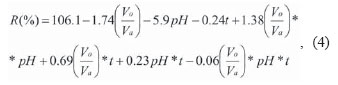
<p><font size="2" face="Verdana, Arial, Helvetica, sans-serif">The  parameters of the design were uncodified according to their modules and the model  which describes its relationship with the extraction degree was established for  30% TBP-16% TOA/ciclohexane <a href="#e13055112">(eq. 4)</a> and 30% TBP-16%TOA/n-dodecane  <a href="#e14055112">(eq.5)</a>.<strong>&nbsp; </strong></font></p>    <p><img src="/img/revistas/nuc/n51/e13055112.jpg" width="338" height="85"><a name="e13055112"></a></p>    
<p><img src="/img/revistas/nuc/n51/e14055112.jpg" width="333" height="90"><a name="e14055112"></a></p>    
]]></body>
<body><![CDATA[<p><font size="2" face="Verdana, Arial, Helvetica, sans-serif"><strong>Influence  of pH on the extraction of </strong><img src="/img/revistas/nuc/n51/e04055112.jpg" width="49" height="17"><strong>  using 30% TBP-16% TOA in ciclohexane or n-dodecane as solvents.</strong></font></p>    
<p><font size="2" face="Verdana, Arial, Helvetica, sans-serif">  For 30% TBP-16% TOA/ciclohexane system <a href="#f01055112">(figure 1a)</a>, the  experimental standard deviation varied between 0.001 and 0.036. When n-dodecane  was used as a diluent <a href="#f01055112">(figure 1b)</a>, values ranged between  0.02 and 0.12.     <br> For both systems, the extraction degree decreases from pH  = 1 to pH = 5 in approximately 4%. Nevertheless, R (%) is always higher than 95%,  which could be enough for some radiotracing applications.</font></p>    <p ALIGN="CENTER"><img src="/img/revistas/nuc/n51/f01055112.jpg" width="462" height="618"><a name="f01055112"></a></p>    
<p><font size="2" face="Verdana, Arial, Helvetica, sans-serif">No  significant differences were observed in the extraction degree at pH = 0.5 and  1. This increase on NO3- concentration does not induce yet, any significant negative  effect on <img src="/img/revistas/nuc/n51/e04055112.jpg" width="49" height="17">  extraction due to the competition of nitrates ions for TBP and TOA molecules [17,  18].</font></p>    
<p><font size="2" face="Verdana, Arial, Helvetica, sans-serif">  The Kolmogorov Smirnov test, for 95% of probability, demonstrated that there are  not significant differences between experimental data and models.</font></p>    <p><font size="2" face="Verdana, Arial, Helvetica, sans-serif"><strong>Influence  of shaking time on the extraction degree </strong></font></p>    <p><font size="2" face="Verdana, Arial, Helvetica, sans-serif"><a href="#f02055112">Figure  2</a> shows the behavior of the extraction degree versus the increase on shaking  time, when MEK was used as solvent. From 6 min on, no more significant increase  in R (%) is observed and the value is about 96.5%. This matches with experiment  7 <a href="#t03055112">(table 3)</a> where Vo/Va was also 1. The standard deviations  of the calculated extraction degrees oscillate &nbsp;between 0.05 and 0.20. </font></p>    <p ALIGN="CENTER"><img src="/img/revistas/nuc/n51/f02055112.jpg" width="337" height="250"><a name="f02055112"></a></p>    
<p><font size="2" face="Verdana, Arial, Helvetica, sans-serif">When  using 30% TBP-16% TOA/ciclohexane, there are no significant changes on the extraction  degree from 6 min on <a href="#f03055112">(figure 3a)</a>. The standard deviations  ranged between 0.001 and 0.01. For 30% TBP-16% TOA/n-dodecane system <a href="#f03055112">(figure  3b)</a>, the standard deviations are in the same range, and the increase in the  extraction degree from 6 to 15 min is just about 0.05%. So also in this case,  6 min of shaking time is enough for a successful extraction.&nbsp; </font></p>    ]]></body>
<body><![CDATA[<p ALIGN="CENTER"><IMG SRC="/img/revistas/nuc/n51/f03055112.jpg" WIDTH="360" HEIGHT="589"><a name="f03055112"></a></p>    
<p>&nbsp;</p>    <p><font size="2" face="Verdana, Arial, Helvetica, sans-serif"><strong><FONT SIZE="3">CONCLUSIONS</FONT></strong></font></p>    <p><font size="2" face="Verdana, Arial, Helvetica, sans-serif">  When MEK was used as solvent, the best degree of extraction was obtained by fixing  NaOH concentration in aqueous phase to 5 M, volumetric relationship (Vo/Va) to  4, shaking time to 6 min and the resting time before phase separation to 10 min.  The reduction of the resting time to 5 min provokes a diminishing of extraction  degree just in a 0.87%. For 30% TBP-16% TOA/ ciclohexane and 30% TBP16% TOA/ n-dodecane  solvents, the best results were obtained by fitting the aqueous phase pH to 1  with nitric acid, shaking the phases during 6 min and separating them after 10  min of rest.</font></p>    <p><font size="2" face="Verdana, Arial, Helvetica, sans-serif">  The solvent extraction of <img src="/img/revistas/nuc/n51/e04055112.jpg" width="49" height="17">,  eluted from <img src="/img/revistas/nuc/n51/e01055112.jpg" width="32" height="13">/<img src="/img/revistas/nuc/n51/e02055112.jpg" width="31" height="17">  generator, using MEK and 30% TBP-16% TOA in n-dodecane or ciclohexane as solvents,  could be used to get a radiotracer in organic phase for industrial applications.  The selection of the solvent will depend on the nature of the system that will  be traced and the cost-benefit analysis. Furthermore, it should be previously  validated. </font></p><h1><font size="2" face="Verdana, Arial, Helvetica, sans-serif">Acknowledgements</font></h1>    
<p><font size="2" face="Verdana, Arial, Helvetica, sans-serif">The  authors would like to thank the IAEA for its partial financial support.</font></p>    <p>&nbsp;</p>    <p><font size="2" face="Verdana, Arial, Helvetica, sans-serif"><strong><FONT SIZE="3">REFERENCES</FONT></strong></font></p>    <!-- ref --><p><font size="2" face="Verdana, Arial, Helvetica, sans-serif">1.  BANDEIRA JV, BORROTO J. Development of a technique for using 99mTc as an adsorbable  tracer for hydrodynamic studies of fine sediment in suspension. Appl Rad Isot.  2002; 57(1): 85-92.    <!-- ref --><br> 2. BORROTO J, DOM&Iacute;NGUEZ J. Behaviour of 99mTc in  highly polluted surface waters: Field and laboratory experiments. In: Isotope  Techniques in Water Resources Development and Management. CSP-2/C. Vienna, 10-14  Mayo 1999.    <!-- ref --><br> 3. DOM&Iacute;NGUEZ, J., BORROTO, J., HERN&Aacute;NDEZ, A. Empleo  de trazadores en la obtenci&oacute;n de modelos de calidad de agua del r&iacute;o  Almendares. Nucleus. 2003; (34): 20-27.    <!-- ref --><br> 4. DOM&Iacute;NGUEZ J, BORROTO J,  P&Eacute;REZ E, HERN&Aacute;NDEZ A. Use of the 99mTcO4- and the Rhodamine-WT as  Tracers and the Mathematical Convolution Procedure to Establish the Alarm Model  In the Almendares River. Radioanal Nucl Chemistry. 2004; 260(2): 417-420.    <br>  5. DOM&Iacute;NGUEZ J, BORROTO J, GAMBOA R, et. al. Compuestos marcados en estudios  hidrol&oacute;gicos. Memorias de la II Conferencia Internacional de Qu&iacute;mica.  Universidad Central &ldquo;Martha Abreu&rdquo; de Las Villas. Santa Clara, Cuba.  2003. ISBN 959-250-080-0.    <!-- ref --><br> 6. ASAKURA T. Technetium separation for future reprocessing.  J. Nucl. Radiochem. Sci. 2005; 6(3): 271-274.    <!-- ref --><br> 7. PRUETT DJ. The solvent extraction  of heptavalent Technetium. Radiochimica Acta. 1981; 28(153).    <!-- ref --><br> 8. KWANG-WOOK  K. Extraction and stripping behavior of U-Np-Tc ternary system to TBP. J. Radioanal.  Nucl Chem. 2002; 253(1): 3-10.    <!-- ref --><br> 9. EIL-HEE L. Enhancement of Tc extraction  and selective co-extraction of T, Np and U by adding a small amount of TOA in  30 % TBP/dodecane-HNO3 system. J. Korean Ind. Eng. Chem. 2001; 12(8): 883-889.    <!-- ref --><br>  10. MAITI M, LAHIRI S. Separation of 99Mo and 99mTc by liquid-liquid extraction  using TOA as extractant. J. Radioanal. Nucl. Chem. 2010; 283(3): 661-663.    <!-- ref --><br>  11. FLORES A. Influence of extractant (TBP and TOA), diluents, and modifier on  extraction equilibrium of monocarboxylic acids. J. Chem. Eng. Data. 2003; 48(4):  874-886.    <!-- ref --><br> 12. Board of Radiation and Isotope Technology (BRIT). The 99Mo/99mTc  Generator TCG-2. Department of Atomic Energy of India, 2008.    <!-- ref --><br> 13. KARPELES  A, RIVERO M. Obtenci&oacute;n de soluciones de pertecnectato (Tc-99m) de alta  concentraci&oacute;n de actividad. Rep&uacute;blica de Argentina. Comisi&oacute;n  Nacional de Energ&iacute;a At&oacute;mica, 1973.    <!-- ref --><br> 14. BRINGAS E. Contribuci&oacute;n  al Dise&ntilde;o de Procesos de Separaci&oacute;n con Membranas L&iacute;quidas  Selectivas. Tratamiento de Aguas Subterr&aacute;neas Contaminadas con Cr(VI).  [tesis doctoral]. Universidad de Cantabria, 2008.    <!-- ref --><br> 15. NEFIODOV VD. Radioqu&iacute;mica.  Mosc&uacute;: Educaci&oacute;n Superior, 1987.    <!-- ref --><br> 16. EL KOT AM. Solvent extraction  of heptavalent technetium. J. Radioanal. Nucl. Chemi, Artic. 1992; 163(2): 363-373.    <!-- ref --><br> 17. PETERMAN DR, MINCHER BJ, et. al. Summary Report on Gamma Radiolysis of  TBP/ndodecane in the Presence of Nitric Acid Using the Radiolysis/Hydrolysis Test  Loop. Idaho National Laboratory Fuel Cycle Research &amp; Development, 2010.    <!-- ref --><br>  18. JASSIN TN. Effect of uranyl nitrat on the extraction of Pertechnic Acid by  TBP solutions from nitric acids. Radiochim. Acta. 1983; 33: 163-167.    </font></p>    <p>&nbsp;</p>    <p>&nbsp;</p>    <p><font size="2" face="Verdana, Arial, Helvetica, sans-serif"><strong>Recibido:</strong>  22 de marzo de 2012    ]]></body>
<body><![CDATA[<br> <strong>Aceptado: </strong>10 de mayo de 2012 </font></p>    <p>&nbsp;</p>    <p>&nbsp;</p>    <p>&nbsp;</p>      ]]></body><back>
<ref-list>
<ref id="B1">
<label>1</label><nlm-citation citation-type="journal">
<person-group person-group-type="author">
<name>
<surname><![CDATA[BANDEIRA]]></surname>
<given-names><![CDATA[JV]]></given-names>
</name>
<name>
<surname><![CDATA[BORROTO]]></surname>
<given-names><![CDATA[J]]></given-names>
</name>
</person-group>
<article-title xml:lang="en"><![CDATA[Development of a technique for using 99mTc as an adsorbable tracer for hydrodynamic studies of fine sediment in suspension]]></article-title>
<source><![CDATA[Appl Rad Isot]]></source>
<year>2002</year>
<volume>57</volume>
<numero>(1)</numero>
<issue>(1)</issue>
<page-range>85-92</page-range></nlm-citation>
</ref>
<ref id="B2">
<label>2</label><nlm-citation citation-type="">
<person-group person-group-type="author">
<name>
<surname><![CDATA[BORROTO]]></surname>
<given-names><![CDATA[J]]></given-names>
</name>
<name>
<surname><![CDATA[DOMÍNGUEZ]]></surname>
<given-names><![CDATA[J]]></given-names>
</name>
</person-group>
<source><![CDATA[Behaviour of 99mTc in highly polluted surface waters: Field and laboratory experiments]]></source>
<year>10-1</year>
<month>4 </month>
<day>Ma</day>
<publisher-loc><![CDATA[Vienna ]]></publisher-loc>
</nlm-citation>
</ref>
<ref id="B3">
<label>3</label><nlm-citation citation-type="journal">
<person-group person-group-type="author">
<name>
<surname><![CDATA[DOMÍNGUEZ]]></surname>
<given-names><![CDATA[J]]></given-names>
</name>
<name>
<surname><![CDATA[BORROTO]]></surname>
<given-names><![CDATA[J]]></given-names>
</name>
<name>
<surname><![CDATA[HERNÁNDEZ]]></surname>
<given-names><![CDATA[A]]></given-names>
</name>
</person-group>
<article-title xml:lang="es"><![CDATA[Empleo de trazadores en la obtención de modelos de calidad de agua del río Almendares]]></article-title>
<source><![CDATA[Nucleus]]></source>
<year>2003</year>
<numero>(34)</numero>
<issue>(34)</issue>
<page-range>20-27</page-range></nlm-citation>
</ref>
<ref id="B4">
<label>4</label><nlm-citation citation-type="journal">
<person-group person-group-type="author">
<name>
<surname><![CDATA[DOMÍNGUEZ]]></surname>
<given-names><![CDATA[J]]></given-names>
</name>
<name>
<surname><![CDATA[BORROTO]]></surname>
<given-names><![CDATA[J]]></given-names>
</name>
<name>
<surname><![CDATA[PÉREZ]]></surname>
<given-names><![CDATA[E]]></given-names>
</name>
<name>
<surname><![CDATA[HERNÁNDEZ]]></surname>
<given-names><![CDATA[A]]></given-names>
</name>
</person-group>
<article-title xml:lang="en"><![CDATA[Use of the 99mTcO4- and the Rhodamine-WT as Tracers and the Mathematical Convolution Procedure to Establish the Alarm Model In the Almendares River]]></article-title>
<source><![CDATA[Radioanal Nucl Chemistry]]></source>
<year>2004</year>
<volume>260</volume>
<numero>(2)</numero>
<issue>(2)</issue>
<page-range>417-420</page-range></nlm-citation>
</ref>
<ref id="B5">
<label>5</label><nlm-citation citation-type="confpro">
<person-group person-group-type="author">
<name>
<surname><![CDATA[DOMÍNGUEZ]]></surname>
<given-names><![CDATA[J]]></given-names>
</name>
<name>
<surname><![CDATA[BORROTO]]></surname>
<given-names><![CDATA[J]]></given-names>
</name>
<name>
<surname><![CDATA[GAMBOA]]></surname>
<given-names><![CDATA[R]]></given-names>
</name>
</person-group>
<source><![CDATA[Compuestos marcados en estudios hidrológicos]]></source>
<year></year>
<conf-name><![CDATA[ Memorias de la II Conferencia Internacional de Química]]></conf-name>
<conf-date>2003</conf-date>
<conf-loc>Santa Clara </conf-loc>
</nlm-citation>
</ref>
<ref id="B6">
<label>6</label><nlm-citation citation-type="journal">
<person-group person-group-type="author">
<name>
<surname><![CDATA[ASAKURA]]></surname>
<given-names><![CDATA[T]]></given-names>
</name>
</person-group>
<article-title xml:lang="en"><![CDATA[Technetium separation for future reprocessing]]></article-title>
<source><![CDATA[J. Nucl. Radiochem. Sci]]></source>
<year>2005</year>
<volume>6</volume>
<numero>(3)</numero>
<issue>(3)</issue>
<page-range>271-274</page-range></nlm-citation>
</ref>
<ref id="B7">
<label>7</label><nlm-citation citation-type="journal">
<person-group person-group-type="author">
<name>
<surname><![CDATA[PRUETT]]></surname>
<given-names><![CDATA[DJ]]></given-names>
</name>
</person-group>
<article-title xml:lang="en"><![CDATA[The solvent extraction of heptavalent Technetium]]></article-title>
<source><![CDATA[Radiochimica Acta]]></source>
<year>1981</year>
<volume>28</volume>
<numero>(153)</numero>
<issue>(153)</issue>
</nlm-citation>
</ref>
<ref id="B8">
<label>8</label><nlm-citation citation-type="journal">
<person-group person-group-type="author">
<name>
<surname><![CDATA[KWANG-WOOK]]></surname>
<given-names><![CDATA[K]]></given-names>
</name>
</person-group>
<article-title xml:lang="en"><![CDATA[Extraction and stripping behavior of U-Np-Tc ternary system to TBP]]></article-title>
<source><![CDATA[J. Radioanal. Nucl Chem]]></source>
<year>2002</year>
<volume>253</volume>
<numero>(1)</numero>
<issue>(1)</issue>
<page-range>3-10</page-range></nlm-citation>
</ref>
<ref id="B9">
<label>9</label><nlm-citation citation-type="journal">
<person-group person-group-type="author">
<name>
<surname><![CDATA[EIL-HEE]]></surname>
<given-names><![CDATA[L]]></given-names>
</name>
</person-group>
<article-title xml:lang="en"><![CDATA[Enhancement of Tc extraction and selective co-extraction of T, Np and U by adding a small amount of TOA in 30 % TBP/dodecane-HNO3 system]]></article-title>
<source><![CDATA[J. Korean Ind. Eng. Chem]]></source>
<year>2001</year>
<volume>12</volume>
<page-range>(8)</page-range><page-range>883-889</page-range></nlm-citation>
</ref>
<ref id="B10">
<label>10</label><nlm-citation citation-type="journal">
<person-group person-group-type="author">
<name>
<surname><![CDATA[MAITI]]></surname>
<given-names><![CDATA[M]]></given-names>
</name>
<name>
<surname><![CDATA[LAHIRI]]></surname>
<given-names><![CDATA[S]]></given-names>
</name>
</person-group>
<article-title xml:lang="en"><![CDATA[Separation of 99Mo and 99mTc by liquid-liquid extraction using TOA as extractant]]></article-title>
<source><![CDATA[J. Radioanal. Nucl. Chem]]></source>
<year>2010</year>
<volume>283</volume>
<numero>(3)</numero>
<issue>(3)</issue>
<page-range>661-663</page-range></nlm-citation>
</ref>
<ref id="B11">
<label>11</label><nlm-citation citation-type="journal">
<person-group person-group-type="author">
<name>
<surname><![CDATA[FLORES]]></surname>
<given-names><![CDATA[A]]></given-names>
</name>
</person-group>
<article-title xml:lang="en"><![CDATA[Influence of extractant (TBP and TOA), diluents, and modifier on extraction equilibrium of monocarboxylic acids]]></article-title>
<source><![CDATA[J. Chem. Eng. Data]]></source>
<year>2003</year>
<volume>48</volume>
<numero>(4)</numero>
<issue>(4)</issue>
<page-range>874-886</page-range></nlm-citation>
</ref>
<ref id="B12">
<label>12</label><nlm-citation citation-type="book">
<collab>Board of Radiation and Isotope Technology (BRIT)</collab>
<source><![CDATA[The 99Mo/99mTc Generator TCG-2]]></source>
<year>2008</year>
<publisher-name><![CDATA[Department of Atomic Energy of India]]></publisher-name>
</nlm-citation>
</ref>
<ref id="B13">
<label>13</label><nlm-citation citation-type="book">
<person-group person-group-type="author">
<name>
<surname><![CDATA[KARPELES]]></surname>
<given-names><![CDATA[A]]></given-names>
</name>
<name>
<surname><![CDATA[RIVERO]]></surname>
<given-names><![CDATA[M]]></given-names>
</name>
</person-group>
<source><![CDATA[Obtención de soluciones de pertecnectato (Tc-99m) de alta concentración de actividad. República de Argentina]]></source>
<year>1973</year>
<publisher-name><![CDATA[Comisión Nacional de Energía Atómica]]></publisher-name>
</nlm-citation>
</ref>
<ref id="B14">
<label>14</label><nlm-citation citation-type="">
<person-group person-group-type="author">
<name>
<surname><![CDATA[BRINGAS]]></surname>
<given-names><![CDATA[E]]></given-names>
</name>
</person-group>
<source><![CDATA[Contribución al Diseño de Procesos de Separación con Membranas Líquidas Selectivas. Tratamiento de Aguas Subterráneas Contaminadas con Cr(VI)]]></source>
<year></year>
</nlm-citation>
</ref>
<ref id="B15">
<label>15</label><nlm-citation citation-type="book">
<person-group person-group-type="author">
<name>
<surname><![CDATA[NEFIODOV]]></surname>
<given-names><![CDATA[VD]]></given-names>
</name>
</person-group>
<source><![CDATA[Radioquímica]]></source>
<year>1987</year>
<publisher-name><![CDATA[MoscúEducación Superior]]></publisher-name>
</nlm-citation>
</ref>
<ref id="B16">
<label>16</label><nlm-citation citation-type="journal">
<person-group person-group-type="author">
<name>
<surname><![CDATA[EL KOT]]></surname>
<given-names><![CDATA[AM]]></given-names>
</name>
</person-group>
<article-title xml:lang="en"><![CDATA[Solvent extraction of heptavalent technetium]]></article-title>
<source><![CDATA[J. Radioanal. Nucl. Chemi. Artic]]></source>
<year>1992</year>
<volume>163</volume>
<numero>(2)</numero>
<issue>(2)</issue>
<page-range>363-373</page-range></nlm-citation>
</ref>
<ref id="B17">
<label>17</label><nlm-citation citation-type="book">
<person-group person-group-type="author">
<name>
<surname><![CDATA[PETERMAN]]></surname>
<given-names><![CDATA[DR]]></given-names>
</name>
<name>
<surname><![CDATA[MINCHER]]></surname>
<given-names><![CDATA[BJ]]></given-names>
</name>
</person-group>
<source><![CDATA[Summary Report on Gamma Radiolysis of TBP/ndodecane in the Presence of Nitric Acid Using the Radiolysis/Hydrolysis Test Loop]]></source>
<year>2010</year>
<publisher-name><![CDATA[Idaho National Laboratory Fuel Cycle Research & Development]]></publisher-name>
</nlm-citation>
</ref>
<ref id="B18">
<label>18</label><nlm-citation citation-type="journal">
<person-group person-group-type="author">
<name>
<surname><![CDATA[JASSIN]]></surname>
<given-names><![CDATA[TN]]></given-names>
</name>
</person-group>
<article-title xml:lang="en"><![CDATA[Effect of uranyl nitrat on the extraction of Pertechnic Acid by TBP solutions from nitric acids]]></article-title>
<source><![CDATA[Radiochim. Acta]]></source>
<year>1983</year>
<volume>33</volume>
<page-range>163-167</page-range></nlm-citation>
</ref>
</ref-list>
</back>
</article>