<?xml version="1.0" encoding="ISO-8859-1"?><article xmlns:mml="http://www.w3.org/1998/Math/MathML" xmlns:xlink="http://www.w3.org/1999/xlink" xmlns:xsi="http://www.w3.org/2001/XMLSchema-instance">
<front>
<journal-meta>
<journal-id>0864-084X</journal-id>
<journal-title><![CDATA[Nucleus]]></journal-title>
<abbrev-journal-title><![CDATA[Nucleus]]></abbrev-journal-title>
<issn>0864-084X</issn>
<publisher>
<publisher-name><![CDATA[CUBAENERGIA]]></publisher-name>
</publisher>
</journal-meta>
<article-meta>
<article-id>S0864-084X2012000200009</article-id>
<title-group>
<article-title xml:lang="en"><![CDATA[Is Technetium-99m dead or still alive? An outlook to recent developments with specialfocus on myocardial perfusion imaging]]></article-title>
<article-title xml:lang="es"><![CDATA[¿Murió o permanece con vida el Tecnecio 99m? Una panorámica de desarrollos recientes con énfasis en la imagen de perfusión del miocardio]]></article-title>
</title-group>
<contrib-group>
<contrib contrib-type="author">
<name>
<surname><![CDATA[Duatti]]></surname>
<given-names><![CDATA[Adriano]]></given-names>
</name>
<xref ref-type="aff" rid="A01"/>
</contrib>
</contrib-group>
<aff id="A01">
<institution><![CDATA[,Laboratory of Nuclear Medicine Department of Radiological Sciences University of Ferrara]]></institution>
<addr-line><![CDATA[Ferrara ]]></addr-line>
<country>Italy</country>
</aff>
<pub-date pub-type="pub">
<day>00</day>
<month>12</month>
<year>2012</year>
</pub-date>
<pub-date pub-type="epub">
<day>00</day>
<month>12</month>
<year>2012</year>
</pub-date>
<numero>52</numero>
<fpage>41</fpage>
<lpage>49</lpage>
<copyright-statement/>
<copyright-year/>
<self-uri xlink:href="http://scielo.sld.cu/scielo.php?script=sci_arttext&amp;pid=S0864-084X2012000200009&amp;lng=en&amp;nrm=iso"></self-uri><self-uri xlink:href="http://scielo.sld.cu/scielo.php?script=sci_abstract&amp;pid=S0864-084X2012000200009&amp;lng=en&amp;nrm=iso"></self-uri><self-uri xlink:href="http://scielo.sld.cu/scielo.php?script=sci_pdf&amp;pid=S0864-084X2012000200009&amp;lng=en&amp;nrm=iso"></self-uri><abstract abstract-type="short" xml:lang="en"><p><![CDATA[Despite the advances associated with the introduction of PET technology, reasons to consider that SPECT, particularly with <img width=30 height=14 id="_x0000_i1026" src="http://img/revistas/nuc/n52/e01095212.jpg" alt="http://img/revistas/nuc/n52/e01095212.jpg">radiopharmaceuticals will continue playing an important role in Nuclear Medicine, are presented. The details examined are the following ones. An improvement of the technology SPECT is appreciated with the development of new detection systems and the advantages of the appearance of the hybrid systems SPECT / TAC. The biggest half-life of the main SPECT radionuclides like <img width=19 height=14 id="_x0000_i1027" src="http://img/revistas/nuc/n52/e02095212.jpg" alt="http://img/revistas/nuc/n52/e02095212.jpg">and <img width=30 height=14 id="_x0000_i1028" src="http://img/revistas/nuc/n52/e01095212.jpg" alt="http://img/revistas/nuc/n52/e01095212.jpg">in comparison with PET radionuclides, facilitates its transportation at larger distances, allow the realization of studies with radiopharmaceuticals with different radionuclides in the same patient, and the possibility of the detection of lesions of low tracer accumulation. Finally the main base core for <img width=30 height=14 id="_x0000_i1029" src="http://img/revistas/nuc/n52/e01095212.jpg" alt="http://img/revistas/nuc/n52/e01095212.jpg">complex formation with different ligands are reviewed, as a background that assure the appearance of new radiopharmaceuticals of practical interest. The oncological and cardiological potential applications are examined with emphasis in these last ones. It is clear that <img width=30 height=14 id="_x0000_i1030" src="http://img/revistas/nuc/n52/e01095212.jpg" alt="http://img/revistas/nuc/n52/e01095212.jpg">radiopharmacy will continue playing an important role in nuclear medicine.]]></p></abstract>
<abstract abstract-type="short" xml:lang="es"><p><![CDATA[En el trabajo se exponen razones para considerar que el SPECT, particularmente con radiofármacos de <img width=30 height=14 id="_x0000_i1032" src="http://img/revistas/nuc/n52/e01095212.jpg" alt="http://img/revistas/nuc/n52/e01095212.jpg">continuará teniendo un importante papel en medicina nuclear, no obstante los avances asociados a la incorporación de la tecnología PET. Las razones que se examinan son las siguientes. Se aprecia un mejoramiento de la tecnología SPECT con el desarrollo de nuevos sistemas de detección y las ventajas de la aparición de los sistemas híbridos SPECT/TAC, la mayor vida media de los principales radionúclidos SPECT como <img width=19 height=14 id="_x0000_i1033" src="http://img/revistas/nuc/n52/e02095212.jpg" alt="http://img/revistas/nuc/n52/e02095212.jpg">y <img width=30 height=14 id="_x0000_i1034" src="http://img/revistas/nuc/n52/e01095212.jpg" alt="http://img/revistas/nuc/n52/e01095212.jpg">en comparación con los radionúclidos PET, lo que posibilita su traslado a mayores distancias, la realización de estudios con radiofármacos con más de un radionúclido en el mismo paciente y la posibilidad de detectar lesiones de baja captación, favorecido por lo indicado de las vidas medias. Finalmente se examinan los principales núcleos base de formación de complejos de <img width=30 height=14 id="_x0000_i1035" src="http://img/revistas/nuc/n52/e01095212.jpg" alt="http://img/revistas/nuc/n52/e01095212.jpg">con distintos ligandos que aseguran la aparición de nuevos radiofármacos de interés. Se examinan las potenciales aplicaciones oncológicas y cardiológicas con énfasis en estas últimas. Se considera que la radiofarmacia del <img width=30 height=8 id="_x0000_i1036" src="http://img/revistas/nuc/n52/e01095212.jpg" alt="http://img/revistas/nuc/n52/e01095212.jpg">continuará jugando un importante papel en medicina nuclear.]]></p></abstract>
<kwd-group>
<kwd lng="en"><![CDATA[myocardium]]></kwd>
<kwd lng="en"><![CDATA[Technetium 99]]></kwd>
<kwd lng="en"><![CDATA[perfused organs]]></kwd>
<kwd lng="en"><![CDATA[radiopharmaceuticals]]></kwd>
<kwd lng="en"><![CDATA[nuclear medicine]]></kwd>
<kwd lng="en"><![CDATA[single photon emission computed tomography]]></kwd>
<kwd lng="es"><![CDATA[miocardio]]></kwd>
<kwd lng="es"><![CDATA[Tecnecio 99]]></kwd>
<kwd lng="es"><![CDATA[órganos perfundidos]]></kwd>
<kwd lng="es"><![CDATA[radiofármacos]]></kwd>
<kwd lng="es"><![CDATA[medicina nuclear]]></kwd>
<kwd lng="es"><![CDATA[tomografía de emisión computarizada de fotón único]]></kwd>
</kwd-group>
</article-meta>
</front><body><![CDATA[ <p align="right"><font face="Verdana, Arial, Helvetica, sans-serif" size="2"><b>CIENCIAS  NUCLEARES</b></font></p>    <p align="left">&nbsp;</p>    <p><font face="Verdana, Arial, Helvetica, sans-serif" size="4"><strong>Is  Technetium-99m dead or still alive? An outlook to recent developments with specialfocus  on myocardial perfusion imaging</strong></font></p>    <p><strong>    <br> </strong></p>    <p><strong><font face="Verdana, Arial, Helvetica, sans-serif" size="3">&iquest;Muri&oacute;  o permanece con vida el Tecnecio 99m? Una panor&aacute;mica de desarrollos recientes  con &eacute;nfasis en la imagen de perfusi&oacute;n del miocardio</font>    <br> </strong></p>    <p>&nbsp;</p>    <p><font face="Verdana, Arial, Helvetica, sans-serif" size="2"><B>Adriano  Duatti</B>    <br> </font></p>    ]]></body>
<body><![CDATA[<p><font face="Verdana, Arial, Helvetica, sans-serif" size="2">Laboratory  of Nuclear Medicine, Department of Radiological Sciences, University of Ferrara,  44121 Ferrara, Italy, Industrial Application and Chemistry Section, Division of  Physical and Chemical Sciences, Department of Nuclear Sciences and Applications,  International Atomic Energy Agency, 1400 Vienna, Austria    <br> </font></p>    <p><font face="Verdana, Arial, Helvetica, sans-serif" size="2"><A HREF="mailto:a.duatti@iaea.org">a.duatti@iaea.org</A></font></p>    <p>    <br>  </p><hr>     <p><font face="Verdana, Arial, Helvetica, sans-serif" size="2"><b>ABSTRACT</b></font></p>    <p><font size="2" face="Verdana, Arial, Helvetica, sans-serif">Despite  the advances associated with the introduction of PET technology, reasons to consider  that SPECT, particularly with <img src="/img/revistas/nuc/n52/e01095212.jpg" width="30" height="14">  radiopharmaceuticals will continue playing an important role in Nuclear Medicine,  are presented. The details examined are the following ones. An improvement of  the technology SPECT is appreciated with the development of new detection systems  and the advantages of the appearance of the hybrid systems SPECT / TAC. The biggest  half-life of the main SPECT radionuclides like <img src="/img/revistas/nuc/n52/e02095212.jpg" width="19" height="14">  and <img src="/img/revistas/nuc/n52/e01095212.jpg" width="30" height="14">  in comparison with PET radionuclides, facilitates its transportation at larger  distances, allow the realization of studies with radiopharmaceuticals with different  radionuclides in the same patient, and the possibility of the detection of lesions  of low tracer accumulation. Finally the main base core for <img src="/img/revistas/nuc/n52/e01095212.jpg" width="30" height="14">  complex formation with different ligands are reviewed, as a background that assure  the appearance of new radiopharmaceuticals of practical interest. The oncological  and cardiological potential applications are examined with emphasis in these last  ones. It is clear that <img src="/img/revistas/nuc/n52/e01095212.jpg" width="30" height="14">  radiopharmacy will continue playing an important role in nuclear medicine.</font></p>    
<p><font size="2" face="Verdana, Arial, Helvetica, sans-serif"><strong>Key  words: </strong>myocardium, Technetium 99, perfused organs, radiopharmaceuticals,  nuclear medicine, single photon emission computed tomography.</font></p><hr>     <p><font face="Verdana, Arial, Helvetica, sans-serif" size="2"><b>RESUMEN</b></font></p>    <p><font size="2" face="Verdana, Arial, Helvetica, sans-serif">En  el trabajo se exponen razones para considerar que&nbsp; el&nbsp; SPECT, particularmente  con radiof&aacute;rmacos de&nbsp; <img src="/img/revistas/nuc/n52/e01095212.jpg" width="30" height="14">  continuar&aacute; teniendo un importante papel en medicina nuclear, no obstante  los avances asociados a la incorporaci&oacute;n de la tecnolog&iacute;a PET. Las  razones que se examinan son las siguientes. Se aprecia un mejoramiento de la tecnolog&iacute;a  SPECT con el desarrollo de nuevos sistemas de detecci&oacute;n y las ventajas  de la aparici&oacute;n de los sistemas h&iacute;bridos SPECT/TAC, la mayor vida  media de los principales radion&uacute;clidos SPECT como <img src="/img/revistas/nuc/n52/e02095212.jpg" width="19" height="14">  y <img src="/img/revistas/nuc/n52/e01095212.jpg" width="30" height="14">  en comparaci&oacute;n con los radion&uacute;clidos PET, lo que posibilita su traslado  a mayores distancias, la realizaci&oacute;n de estudios con radiof&aacute;rmacos  con m&aacute;s de un radion&uacute;clido en el mismo paciente y la posibilidad  de detectar lesiones de baja captaci&oacute;n, favorecido por lo indicado de las  vidas medias. Finalmente se examinan los principales n&uacute;cleos base de formaci&oacute;n  de complejos de <img src="/img/revistas/nuc/n52/e01095212.jpg" width="30" height="14">  con distintos ligandos que aseguran la aparici&oacute;n de nuevos radiof&aacute;rmacos  de inter&eacute;s. Se examinan las potenciales aplicaciones oncol&oacute;gicas  y cardiol&oacute;gicas con &eacute;nfasis en estas &uacute;ltimas. Se considera  que la radiofarmacia del <img src="/img/revistas/nuc/n52/e01095212.jpg" width="30" height="8">  continuar&aacute; jugando un importante papel en medicina nuclear.</font></p>    
]]></body>
<body><![CDATA[<p><font size="2" face="Verdana, Arial, Helvetica, sans-serif"><strong>Palabras  claves:</strong> miocardio, Tecnecio 99, &oacute;rganos perfundidos, radiof&aacute;rmacos,  medicina nuclear, tomograf&iacute;a de emisi&oacute;n computarizada de fot&oacute;n  &uacute;nico.</font></p><hr>     <p>&nbsp;</p>    <p><font size="3" face="Verdana, Arial, Helvetica, sans-serif"><strong>INTRODUCTION</strong></font></p>    <p><font size="2" face="Verdana, Arial, Helvetica, sans-serif">The  radionuclide Technetium-99m has been the workhorse of nuclear medicine for decades.  Nuclear imaging would not have been existed without this wonderful radionuclide  having almost ideal nuclear properties for yielding functional images of the internal  organs of the body. After so many successful years, as in any fairy tales, now  it seems that time has come for it to disappear from the scene almost completely  replaced by positron-emitting radionuclides. Is this really the end of the story?  We will try here to bring some arguments that refute this conclusion and support  the viewthat <img src="/img/revistas/nuc/n52/e01095212.jpg" width="30" height="14">  radiopharmaceuticals may still have an important role in diagnostic nuclear medicine  and molecular imaging. This short review aims to provide a few examples demonstrating  how the field is still active and producing new potentially useful radiopharmaceuticals  selectively visualizing exactly the same biological end points that are currently  the most widely pursuedusing positron-emitting tracers.</font></p>    
<p><font size="2" face="Verdana, Arial, Helvetica, sans-serif"><strong>Some  preliminary considerations</strong></font></p>    <p><font size="2" face="Verdana, Arial, Helvetica, sans-serif">  The nuclear imaging technologies, PET and SPECT are highly analogous. They both  offer the sensitivity required to monitor drug distribution, pharmacokinetics  and pharmacodynamics, and for imaging specific biomarkers and molecular end points.  Depending on the ligands and radionuclides used, a myriad of molecular targets  can be hit.</font></p>    <p><font size="2" face="Verdana, Arial, Helvetica, sans-serif">  Traditionally, PET has outperformed SPECT in terms of detection sensitivity and  image resolution. Positron emitters have higher tissue penetration than the single  photon emitters and the ability to localize positrons without the use of collimation  techniques, results in better detection sensitivities. However, the recent emergence  of hybrid systems, PET/CT and SPECT/CT, has narrowed some of the differences between  the two modalities. Indeed, CT image data can be used to correct for tissue attenuation,  and this anatomical information further contributes to improve the localization  of single-photon emissions. Furthermore, the recent introduction of solid-state  detectors and photomultipliers has dramatically improved the performance of SPECT.</font></p>    <p><font size="2" face="Verdana, Arial, Helvetica, sans-serif">  Currently, the impact of these technological advancements has become apparent  particularly in the field of imaging of smaller subjects such as mice and other  animals. In fact, the recent invention of multiple pinhole collimation systems  has resulted in very high imaging sensitivities with spatial image resolution  in the nanoliter range, far superior to PET.</font></p>    <p><font size="2" face="Verdana, Arial, Helvetica, sans-serif">  Traditional single photon emitting radioisotopes such a <img src="/img/revistas/nuc/n52/e01095212.jpg" width="30" height="14">  and <img src="/img/revistas/nuc/n52/e02095212.jpg" width="19" height="14">  have radioactive half-lives ofhours and are long enough to allow their production  at a central site for subsequent distribution over a relatively large geographic  region. In contrast most PET isotopes decay much faster and the distribution of  their radiopharmaceuticals is impossible or usually requires building up a complex  and expensive infrastructure. Conversely, SPECT is faster and cheaper when there  is already a registered radiopharmaceutical for a specific diagnostic indication.</font></p>    
<p><font size="2" face="Verdana, Arial, Helvetica, sans-serif">  The ultra-high resolution nuclear imaging capabilities of novel SPECT/CT scanners  offer unique advantages when the concentration of the target is relatively low.  In these situations, detecting a signal sometimes requires a very low level of  background noise that can be reachedafter hours necessary to eliminate background  activity. For these applications, single photon emitters with longer half-lives  can be more effective than short-lived positron emitting isotopes.</font></p>    ]]></body>
<body><![CDATA[<p><font size="2" face="Verdana, Arial, Helvetica, sans-serif"><strong>Technetium  99m cores</strong></font></p>    <p><font size="2" face="Verdana, Arial, Helvetica, sans-serif">  The most interesting Tc-99m radiopharmaceuticals that have been developed in the  last decade belong almost exclusively to three main categories of complexes each  characterized by a specific metallic core. These cores constitute characteristic  chemical motifs that control and shape the molecular structure of the resulting  radiopharmaceutical and, ultimately, its biological properties. The main features  of these cores and of the corresponding complexes are briefly outlined in the  following.</font></p>    <p><font size="2" face="Verdana, Arial, Helvetica, sans-serif">  A terminal <img src="/img/revistas/nuc/n52/e03095212.jpg" width="47" height="16">  triple bond can be formally viewed as generated by the bonding interaction between  a <img src="/img/revistas/nuc/n52/e04095212.jpg" width="42" height="15">  ion and a <img src="/img/revistas/nuc/n52/e05095212.jpg" width="20" height="16">  nitrido nitrogen atom. This yields the <img src="/img/revistas/nuc/n52/e06095212.jpg" width="67" height="17">  functional moiety that, owing to its small molecular size, behave like a single  atomic entity. Nitrido Tc-99m complexes usually possess a five-coordinated geometry  in which the terminal <img src="/img/revistas/nuc/n52/e07095212.jpg" width="32" height="14">  groupspans an apical position. These compoundsare commonly classified in two distinct  subtypes: (a) symmetrical and (b) asymmetrical complexes [1-3].</font></p>    
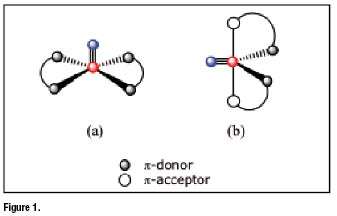
<p><font size="2" face="Verdana, Arial, Helvetica, sans-serif">  Symmetrical complexes formwhen two identical bidentate chelating ligands bind  the same <img src="/img/revistas/nuc/n52/e07095212.jpg" width="32" height="13">  group (<A HREF="#f01095212">figure 1</A>). This class can be further separated  in two subsets depending on which molecular arrangement,among the two allowed  for a five-coordinated species, is preferred by the symmetrical complex. Five-coordinated  complexes can take on either a square pyramidal (sp) or a trigonal bipyramidal  (tbp) arrangement Experimental evidence showed that square pyramidal complexes  (<a href="#f01095212">figure 1a</a>) are exclusively formed when two bidentate  ligands having <img src="/img/revistas/nuc/n52/e08095212.jpg" width="12" height="13">-donor  atoms are utilizedas coordinating sites. In these complexes, the four <img src="/img/revistas/nuc/n52/e08095212.jpg" width="12" height="13">-donors  are positioned on the basal plane of the square pyramid, the <img src="/img/revistas/nuc/n52/e07095212.jpg" width="32" height="14">  moiety lying above this plane. Conversely, formation of tbp complexes (<a href="#f01095212">figure  1b</a>) usually occurs when a combination of two <img src="/img/revistas/nuc/n52/e08095212.jpg" width="12" height="13">-donor  and two <img src="/img/revistas/nuc/n52/e08095212.jpg" width="12" height="13">-acceptor  atoms is placed around the <img src="/img/revistas/nuc/n52/e07095212.jpg" width="32" height="14">  group. Obviously, symmetrical complexes can be obtained only when each bidentate  ligand separately carries a set of one <img src="/img/revistas/nuc/n52/e08095212.jpg" width="12" height="13">-donor  and one <img src="/img/revistas/nuc/n52/e08095212.jpg" width="12" height="13">-acceptor  coordinating atoms. As a general rule, the two <img src="/img/revistas/nuc/n52/e08095212.jpg" width="12" height="13">-acceptor  atoms on the two bidentate ligands have the tendency to occupy the two axial positions  of the tbp geometry, whereas the two <img src="/img/revistas/nuc/n52/e08095212.jpg" width="12" height="13">-donors  span the positions on the equatorial plane along with the nitrido nitrogen atom  of the <img src="/img/revistas/nuc/n52/e07095212.jpg" width="32" height="14">  group.</font></p>    
<p ALIGN="CENTER"><img src="/img/revistas/nuc/n52/f01095212.jpg" width="337" height="216"><a name="f01095212"></a><a></a></p>    
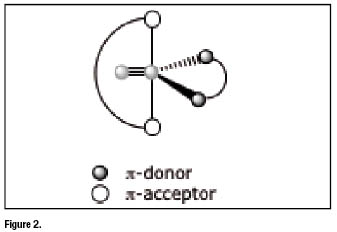
<p><font size="2" face="Verdana, Arial, Helvetica, sans-serif">  Asymmetrical nitrido complexes [4-8] arise when the two <img src="/img/revistas/nuc/n52/e08095212.jpg" width="12" height="13">-acceptor  and the two <img src="/img/revistas/nuc/n52/e08095212.jpg" width="12" height="13">-donor  atoms are separated in two distinct sets belongingtotwo different bidentate ligands.  In this situation, upon coordination, the <img src="/img/revistas/nuc/n52/e07085212.jpg" width="32" height="14">  core becomes surrounded by two bidentate ligands that are not identical since  one carries only <img src="/img/revistas/nuc/n52/e08095212.jpg" width="12" height="13">-acceptor  atoms and the other only <img src="/img/revistas/nuc/n52/e08095212.jpg" width="12" height="13">-donor  atoms. Accordingly, the final nitride complex (heterocomplex) has an asymmetrical  structure as illustrated <a href="#f02095212">figure 2</a> below.</font></p>    
<p ALIGN="CENTER"><img src="/img/revistas/nuc/n52/f02095212.jpg" width="337" height="232"><a name="f02095212"></a><a></a></p>    
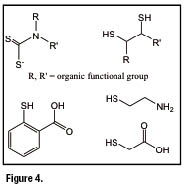
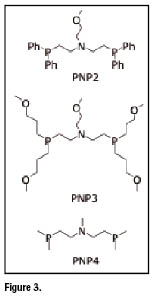
<p><font size="2" face="Verdana, Arial, Helvetica, sans-serif">  Common bidentate <img src="/img/revistas/nuc/n52/e08095212.jpg" width="12" height="13">-acceptor  ligands utilized in the preparation of asymmetrical complexes are heterodiphosphane  ligands of the type shown in <a href="#f03095212">figure 3</a> (PNP ligands).  Examples of bidentate ligands having <img src="/img/revistas/nuc/n52/e09095212.jpg" width="14" height="16">,  S, <img src="/img/revistas/nuc/n52/e10095212.jpg" width="27" height="17">,  and <img src="/img/revistas/nuc/n52/e11095212.jpg" width="17" height="15">  as <img src="/img/revistas/nuc/n52/e08095212.jpg" width="12" height="13">-donor  atoms (XY ligands) are illustrated in <a href="#f04095212">figure 4</a>. Asymmetrical  nitrido heterocomplexes, therefore, can be represented by the general formula  <img src="/img/revistas/nuc/n52/e13095212.jpg" width="126" height="18"> where  the neutral or monopositive charge depends on whether monoanionic or dianionic  bidentate XY ligandsare employed in the preparation.</font></p>    
<p ALIGN="CENTER"><img src="/img/revistas/nuc/n52/f03095212.jpg" width="152" height="297"><a name="f03095212"></a><a></a></p>    
<p ALIGN="CENTER"><img src="/img/revistas/nuc/n52/f04095212.jpg" width="187" height="186"><a name="f04095212"></a><a></a></p>    
]]></body>
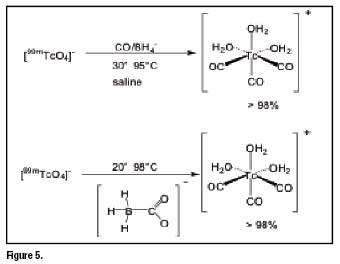
<body><![CDATA[<p><font size="2" face="Verdana, Arial, Helvetica, sans-serif">  Another important Tc-99m core is the monocationic organometallic fragment <img src="/img/revistas/nuc/n52/e13095212.jpg" width="74" height="18">.  It represents a building block particularly suitable for the labelling of biomolecules  since it contains three fixed CO ligands bound to a formally <img src="/img/revistas/nuc/n52/e14095212.jpg" width="21" height="15">  ion, that constitutes the invariant and stable region of the resulting radiopharmaceuticals.  The metallic fragment is completed by the coordination of three weakly bound water  molecules, which can be easily exchanged by other chelators for labelling of targeting  biomolecules or for the preparation of technetium essential radiopharmaceuticals.  The preparation of the intermediated precursor <img src="/img/revistas/nuc/n52/e15095212.jpg" width="113" height="17">  is not straightforward, but it can be prepared through a kit formulation that  is currently available commercially [9-11]. The approach is of broad applicability  and many biomolecules have been labelled with the <img src="/img/revistas/nuc/n52/e16095212.jpg" width="75" height="18">core.  Among these are peptides [12-19], antibodies [18], glucose, CNS receptor ligands  and many small molecules [20-24]. The principle of the precursor preparation is  given in <a href="#f05095212">figure 5</a> below.</font></p>    

<p ALIGN="CENTER"><font size="2" face="Verdana, Arial, Helvetica, sans-serif"><img src="/img/revistas/nuc/n52/f05095212.jpg" width="340" height="264"><a name="f05095212"></a><a></a>    
<br>  </font></p>    <p><font size="2" face="Verdana, Arial, Helvetica, sans-serif">The  advantages and disadvantages of the <img src="/img/revistas/nuc/n52/e17095212.jpg" width="58" height="18">  labelling approach have been discussed in more detail in a controversial article  [25,26]. A major advantage is certainly the very wide variety of ligands, which  bind very efficiently to the Tc(I) metallic center. Complex stabilities are governed  by kinetic stability or inertness. The complexes are all highly robust and, commonly,  do not decompose in serum or in vivo. Many different ligands have been exploited  and among them are hydrides [27], and cyclopentadienyl [28]. Many combinations  of mono- bi- and tridentate ligands are possible, but tridentate chelators turned  out to be most versatile [29]. Labelling can be performed at low biomolecule concentration,  but heating is always required in order to achieve quantitative labelling. The  resulting complexes are usually lipophilic, which could be a disadvantage when  attempting to labelhydrophilic substrates such as peptides. Despite of this, a  few works described the preparation of very hydrophilic Tc-99m tris-carbonyl complexes  [19].</font></p>    
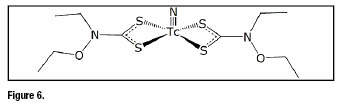
<p><font size="2" face="Verdana, Arial, Helvetica, sans-serif"><strong>Heart  Imaging</strong></font></p>    <p><font size="2" face="Verdana, Arial, Helvetica, sans-serif">  Myocardial perfusion imaging (MPI) still constitutes a major area of diagnostic  nuclear medicine where Tc-99m cardiac tracers play a fundamental role. Actually,  MPI using Tc-99m radiopharmaceuticals remains the most common, non-invasive imaging  tool for risk stratification of patients with coronary artery disease (CAD). </font></p>    <p><font size="2" face="Verdana, Arial, Helvetica, sans-serif">Recent  progress in SPECT technology with the introduction of ultrafast </font><font size="2" face="Verdana, Arial, Helvetica, sans-serif">dedicated  cardiac scanner paralleled the continuous development of new Tc-99m heart imaging  agents having biodistribution properties approaching the requirements for an ideal  perfusion tracer. Ultra-fast cardiac SPECT cameras have been created to meet current  evolutionary challenges in nuclear cardiology [7,8]. These new devices feature  high sensitivity as well as improved spatial, temporal and energy resolution.  They enable reduction of acquisition time and fast protocols. Most importantly,  they are inherently tomographic imaging characterized by high count rate linearity  and, therefore,are potentially capable of dynamic 3-D acquisition. In the near  future, increased resolution will be a key factor to allow nuclear cardiology  entering the field of molecular imaging. Unlike PET, SPECT is capable of simultaneous  multiple isotope imaging and, in principle, a better spatial resolution may ultimately  be achieved with SPECT. Critical research targets include imaging of vulnerable  plaques at high risk for rupture, left ventricular remodelling, angiogenesis,  apoptosis and hypoxia, gene expression, and stem cell therapy. Thus a steady evolution  of nuclear cardiology beyond the assessment of myocardial perfusion, towards the  characterization of molecular events can be envisaged, thus linking molecular  biology science and clinical cardiology.</font></p>    <p><font size="2" face="Verdana, Arial, Helvetica, sans-serif">  In the following, a brief overview of recent progress in the discovery of new  Tc-99m cardiac agents using the nitrido and tris-carbonyl Tc-99m cores is reported.</font></p>    <p><font size="2" face="Verdana, Arial, Helvetica, sans-serif">  Symmetrical nitrido Tc-99m complexes have proven to be particularly useful for  heart imaging the most important class of cardiac tracers being that of bis(dithiocarbamato)&nbsp;  nitrido Tc-99m complexes formed by complexes containing two dithiocarbamate ligands  bound to a <img src="/img/revistas/nuc/n52/e07095212.jpg" width="32" height="14">  core [30]. These complexes are neutral and accumulate in myocardium of various  animal species and of humans to a different extent depending on the nature of  the lateral groups appended to the nitrogen atom of the dithiocarbamate ligand.  Extensive clinical studies have been carried out with the complex bis[(N-ethoxy,  N-ethyl)dithiocarbamato] nitrido Tc-99m (<img src="/img/revistas/nuc/n52/e01095212.jpg" width="30" height="14">N-NOET)  (<a href="#f06095212">figure 6</a>) [30,31]. <img src="/img/revistas/nuc/n52/e01095212.jpg" width="30" height="14">N-NOET)  [32-46] was found to accumulate human myocardium with uptake as high as 4% of  the injected activity at 5 min post injection.</font></p>    
<p ALIGN="CENTER"><img src="/img/revistas/nuc/n52/f06095212.jpg" width="339" height="103"><a name="f06095212"></a><a></a></p>    
]]></body>
<body><![CDATA[<p><font size="2" face="Verdana, Arial, Helvetica, sans-serif">  This compound showed high first-pass extraction (&gt; 86%) in a canine and isolated  rabbit heart models, and a myocardial uptake that correlates with myocardial blood  flow over a wide range of flow. According to the observed kinetic behavior, <img src="/img/revistas/nuc/n52/e01095212.jpg" width="30" height="14">-N-NOET  appears much closer to <img src="/img/revistas/nuc/n52/e18095212.jpg" width="24" height="12">  than other technetium complexes. These similarities include high first-pass extraction,  good correlation with coronary blood flow, and redistribution. In fact, as observed  for <img src="/img/revistas/nuc/n52/e18095212.jpg" width="24" height="12">,experimental  studies showed that <img src="/img/revistas/nuc/n52/e01095212.jpg" width="30" height="14">-N-NOET  has differential clearance from ischemic and normal myocardium resulting in normalization  of initial ischemic defect over time. Models of occlusion and reperfusion demonstrate  significant redistribution of <img src="/img/revistas/nuc/n52/e01095212.jpg" width="30" height="14">N-NOET  within 15 minutes after injection similar to that observed for the neutral lipophilic  compound <img src="/img/revistas/nuc/n52/e01095212.jpg" width="30" height="14">-Teboroxime.</font></p>    
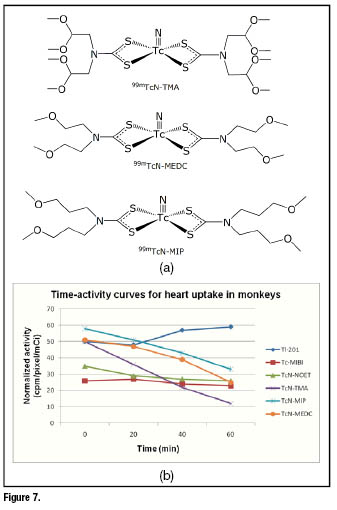
<p><font size="2" face="Verdana, Arial, Helvetica, sans-serif">  A relevant feature of symmetrical bis(dithiocarbamato) <img src="/img/revistas/nuc/n52/e01095212.jpg" width="30" height="14">  nitrido tracers lies in the possibility toachieve a fine tuning of their pharmacokinetics  properties by simply modifying the chemical nature of the lateral groups bound  to the dithiocarbamate [&gt;N-C(=S)<img src="/img/revistas/nuc/n52/e09095212.jpg" width="14" height="16">]  moiety. This allowed obtaining a series of perfusion tracers showing a variable  residence time in myocardial tissue ranging from a few minutes to hours. For instance,  the three derivatives represented in <a href="#f07095212">figure 7a</a> only differ  in their lateral groups, but their heart washouts are dramatically different.  In <a href="#f07095212">figure 7b</a>, the time-variation of heart uptake in monkeys  for these compounds isreported in comparison with <img src="/img/revistas/nuc/n52/e18095212.jpg" width="24" height="12">,  <img src="/img/revistas/nuc/n52/e01095212.jpg" width="30" height="14">-MIBI  and <img src="/img/revistas/nuc/n52/e01095212.jpg" width="30" height="14">N-NOET.  </font></p>    
<p align="CENTER"><font size="2" face="Verdana, Arial, Helvetica, sans-serif"><img src="/img/revistas/nuc/n52/f07095212.jpg" width="337" height="510"><a name="f07095212"></a><a></a></font></p>    
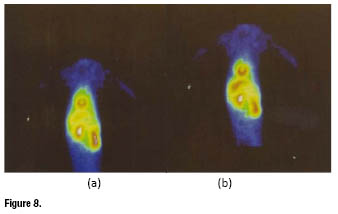
<p align="left"><font size="2" face="Verdana, Arial, Helvetica, sans-serif">  The first-pass extractionsof these tracers were comparable to that of <img src="/img/revistas/nuc/n52/e18095212.jpg" width="24" height="12">  and <img src="/img/revistas/nuc/n52/e01095212.jpg" width="30" height="14">N-NOET,  as well as the high initial cardiac accumulation. However, after 20 min post injection,  approximately 50% of the initial activity was washed out. A representative example  of planar images recorded in baboons at different times [5 min <a href="#f08095212">(a)</a>  and 25 min <a href="#f08095212">(b)</a>] for the complex <img src="/img/revistas/nuc/n52/e01095212.jpg" width="30" height="14">-TMIP  is reported in <a href="#f08095212">figure 8</a>.</font></p>    
<p align="CENTER"><font size="2" face="Verdana, Arial, Helvetica, sans-serif"><img src="/img/revistas/nuc/n52/f08095212.jpg" width="338" height="214"><a name="f08095212"></a><a></a></font></p>    
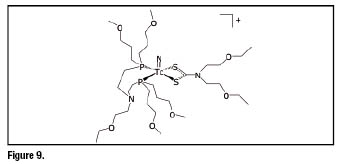
<p><font size="2" face="Verdana, Arial, Helvetica, sans-serif">  The high first-pass extraction combined with a fairly linear relationship between  uptake and flow suggest that this class of myocardial tracers could be particularly  useful when used in combination with the new dedicated ultrafast cardiac scanners  able to collect high-quality SPECT images in less than 2 minutes.</font></p>    <p><font size="2" face="Verdana, Arial, Helvetica, sans-serif">  Replacement of one dithiocarbamato ligand with an heterodiphosphane ligand PN(R)P  led to the formation of asymmetrical species containing two different bidentate  ligands bound to the same <img src="/img/revistas/nuc/n52/e07095212.jpg" width="32" height="14">  group. This change yielded dramatic consequences on the observed cardiac uptake.  The resulting monocationic nitrido Tc(V) heterocomplexes, <img src="/img/revistas/nuc/n52/e20095212.jpg" width="170" height="16">,constitute  a novel class of myocardial tracers exhibiting superior imaging qualities was  obtained [11, 41]. In particular, using the heterodiphosphane ligand&nbsp; bis[(dimethoxypropylphosphanyl)ethyl]ethoxyethylamine  (PNP5) a novel class of myocardial tracers exhibiting superior imaging qualities  was obtained [47,48]. Within this class, the derivative<img src="/img/revistas/nuc/n52/e21095212.jpg" width="156" height="18">  (<img src="/img/revistas/nuc/n52/e01095212.jpg" width="30" height="14">N-DBODC)  (DBODC = diethoxyethyldithiocarbamato, PNP5 = bis[(dimethoxypropylphosphanyl)ethyl]ethoxyethylamine)  has recently raised much interest due to its unprecedented imaging properties.  The structure of this complex is reported in <a href="#f09095212">figure 9</a>.</font></p>    

<p ALIGN="CENTER"><img src="/img/revistas/nuc/n52/f09095212.jpg" width="337" height="164"><a name="f09095212"></a><a></a></p>    
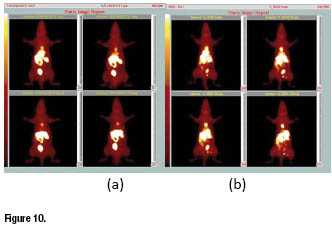
<p><font size="2" face="Verdana, Arial, Helvetica, sans-serif">  In <a href="#f10095212">figure 10a</a>, whole-body image of a rat obtained at  30 min after administration of the tracer is reported. It clearly shows a high  accumulation of activity in the myocardium, but with negligible uptake in background  tissues, particularly in lungs and liver. As a result, heart region appears very  well delineated allowing the acquisition of SPECT images of superior quality.  The difference in the liver washout kinetic between the new tracer and <img src="/img/revistas/nuc/n52/e01095212.jpg" width="30" height="14">-Sestamibi  is clearly evidenced in <a href="#f10095212">figure 10b</a>, which reports rat  planar whole-body image for <img src="/img/revistas/nuc/n52/e01095212.jpg" width="30" height="14">-Sestamibi  collectedat the same time.</font></p>    
<p ALIGN="CENTER"><img src="/img/revistas/nuc/n52/f10095212.jpg" width="332" height="229"><a name="f10095212"></a><a></a></p>    
]]></body>
<body><![CDATA[<p><font size="2" face="Verdana, Arial, Helvetica, sans-serif">  Biodistribution data of <img src="/img/revistas/nuc/n52/e01095212.jpg" width="30" height="14">N-DBODC  in rats [49&minus;51] showed that the heart is the main target organ and liver  activity is rapidly washed out into the intestine leaving the cardiac region completely  free of background activity. This result appeared particularly evident when time  variation of heart/liver ratiois considered in comparison with <img src="/img/revistas/nuc/n52/e01095212.jpg" width="30" height="14">-sestamibi  and <img src="/img/revistas/nuc/n52/e01095212.jpg" width="30" height="14">-tetrofosmin  (<a href="#f11095212">figure 11</a>). Heart/liver ratio of <img src="/img/revistas/nuc/n52/e01095212.jpg" width="30" height="14">N-DBODC  rises dramatically over time whereas those of the other two agents remain almost  constant.</font></p>    
<p ALIGN="CENTER"><img src="/img/revistas/nuc/n52/.jpg" width="336" height="227"><a name="f11095212"></a><a></a></p>    
<p><font size="2" face="Verdana, Arial, Helvetica, sans-serif">  First-pass extraction fraction of <img src="/img/revistas/nuc/n52/e01095212.jpg" width="30" height="14">N-DBODC,  as determined in dogs [52], was found to be comparable to <img src="/img/revistas/nuc/n52/e01095212.jpg" width="30" height="14">-sestamibi  and <img src="/img/revistas/nuc/n52/e01095212.jpg" width="30" height="14">-tetrofosmin.The  new tracer has been tested in healthy human volunteers and results confirmed the  favorable kinetic behavior and fast and quantitative liver washout as early as  30 min post injection [53].</font></p>    
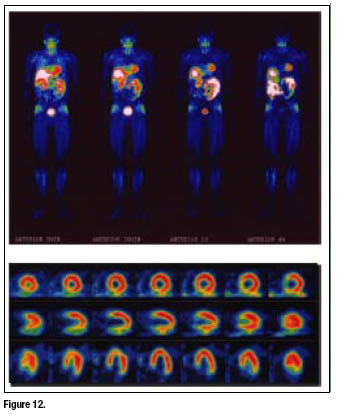
<p><font size="2" face="Verdana, Arial, Helvetica, sans-serif">  Whole-body images and high-quality SPECT images of the myocardium (<a href="#f12095212">figure  12</a>) were collected starting from 5 min after tracer administration. Radioactivity  in the liver decreased rapidly whereas a slow washout of myocardial activity was  observed. Thus, the combination of the rapid liver clearance and the high cardiac  accumulation may shorten the duration of imaging protocols by allowing earlier  image acquisition.</font></p>    <p ALIGN="CENTER"><font size="2" face="Verdana, Arial, Helvetica, sans-serif"><img src="/img/revistas/nuc/n52/f12095212.jpg" width="338" height="415"><a name="f12095212"></a><a></a>    
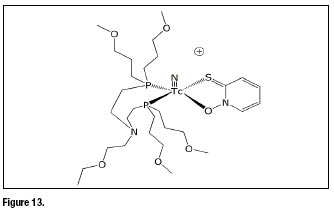
<br>  </font></p>    <p><font size="2" face="Verdana, Arial, Helvetica, sans-serif">Other  bidentate chelators have been used to replace dithiocarbamate ligands in the basic  structure of <img src="/img/revistas/nuc/n52/e01095212.jpg" width="30" height="14">-DBODC.The  ligand 2-mercaptopyridine oxide were employed in the preparation of the asymmetrical  compound shown in <a href="#f13095212">figure 13</a>. This complex has, essentially,  the same basic structure of <img src="/img/revistas/nuc/n52/e01085212.jpg" width="30" height="14">-DBODC,  but differs from the bidentate <img src="/img/revistas/nuc/n52/e08095212.jpg" width="12" height="13">-donor  chelating ligand.</font></p>    

<p ALIGN="CENTER"><font size="2" face="Verdana, Arial, Helvetica, sans-serif"><img src="/img/revistas/nuc/n52/f13095212.jpg" width="334" height="212"><a name="f13095212"></a><a></a>    
<br>  </font></p>    <p><font size="2" face="Verdana, Arial, Helvetica, sans-serif">Preliminary  biological evaluation of <img src="/img/revistas/nuc/n52/e01095212.jpg" width="30" height="14">N-MPO  in rats [54, 55] showed a high initial heart uptake with long myocardial retention.  The heart uptake of <img src="/img/revistas/nuc/n52/e01095212.jpg" width="30" height="14">N-MPO  was between that of <img src="/img/revistas/nuc/n52/e01095212.jpg" width="30" height="14">-sestamibi  and that of <img src="/img/revistas/nuc/n52/e01095212.jpg" width="30" height="14">N-DBODC.  Clearance from the liver and lungs was rapid, resulting in high heart-liver and  heart-lung ratios.    
]]></body>
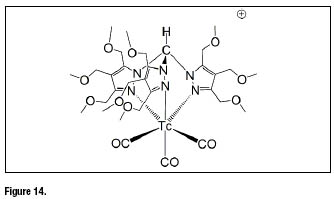
<body><![CDATA[<br> In the family of Tc-99m tris-carbonyl complexes, recently  a new promising heart imaging agent has been described [56,57]. The complex fac-<img src="/img/revistas/nuc/n52/e22095212.jpg" width="236" height="21">containing  a functionalized tris(pyrazolyl)methane chelators with methoxymethyl groups at  the azole rings (<a href="#f14095212">figure 14</a>) exhibits a significantly  high and stable heart uptake associated with avery fast liver clearance.</font></p>    
<p ALIGN="CENTER"><img src="/img/revistas/nuc/n52/f14095212.jpg" width="334" height="199"><a name="f14095212"></a><a></a></p>    
<p><font size="2" face="Verdana, Arial, Helvetica, sans-serif"><strong>Cancer  imaging</strong></font></p>    <p><font size="2" face="Verdana, Arial, Helvetica, sans-serif">  Somatostatin receptors (SSTs) are integral membrane glycoproteins that are distributed  in a variety of tissues throughout the body [22]. They have multiple physiological  functions, including an inhibition of secretion of a growth hormone, glucagon,  insulin, gastrin and other human peptide hormones. In addition, somatostatin plays  an inhibitory role in the immune system and acts as a neuromodulatory peptide  in the central nervous system. Alterations of somatostatin receptor expression  during disease, such as overexpression in many tumours can be exploited by imaging  techniques. Receptor-positive tumours may be originated in the neuroendocrine  system, such as pituitary adenomas, gastroenteropancreatic tumours, and pancreatic  islet-cell tumours, but other tumours, such as lymphomas and breast cancer, may  possess these receptors as well. Of the six SST subtypes, SST1, SST2A, SST2B,  SST3, SST4, and SST5, SST2A is the most important one because of its high overexpression  in malignant tumours and its high affinity for the clinically available somatostatin  analogues.</font></p>    <p><font size="2" face="Verdana, Arial, Helvetica, sans-serif">  The first successful Tc-99m radiopharmaceutical targeting SST receptors that has  beenintroduced into the clinical use was P829 (Depreotide, NeoSPECT) [58]. It  is based on the oxo-Tc-99m core coordinated to a <img src="/img/revistas/nuc/n52/e23095212.jpg" width="22" height="16">  monothiol-bisamide-monoamine ligand bearing an additional lysine residue. In patients,  it has proven successful in imaging solitary pulmonary nodes but failed in gastrointestinal  tumours. Further improvement of the peptide (<img src="/img/revistas/nuc/n52/e01095212.jpg" width="30" height="14">-P2045)  resulted in a dramatic increase in tumour uptake with improved biodistribution  pattern suitable for <img src="/img/revistas/nuc/n52/e24095212.jpg" width="46" height="13">  labelling for therapeutic applications [59].</font></p>    

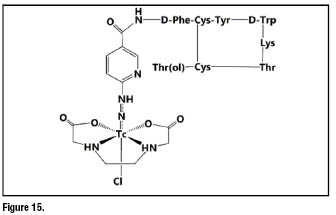
<p><font size="2" face="Verdana, Arial, Helvetica, sans-serif">  HYNIC (6-hydazinonicotinamide) is of particular interest due to its high <img src="/img/revistas/nuc/n52/e01095212.jpg" width="30" height="14">-labeling  efficiency (rapid and high yield radiolabeling), the high solution stability of  its <img src="/img/revistas/nuc/n52/e01095212.jpg" width="30" height="14">complexes,  and the easy use of coligands for modification of biodistribution characteristic  of the <img src="/img/revistas/nuc/n52/e01095212.jpg" width="30" height="14">-labeled  small biomolecules [60]. HYNIC-conjugated octreotide analogues have been proven  to be particularly suitable for <img src="/img/revistas/nuc/n52/e01095212.jpg" width="30" height="14">labelling  [61]. Among them, <img src="/img/revistas/nuc/n52/e25095212.jpg" width="110" height="17">-octreotide  (<a href="#f15095212">figure 15</a>) was proved to be superior in patients compared  to <img src="../copia%20imag/e26095212.jpg" width="24" height="13">-DTPA octreotide.  Especially when EDDA (ethylenediaminodiacetic acid) was used as the coligand,  the resulting <img src="/img/revistas/nuc/n52/e01095212.jpg" width="30" height="14">-labeled  peptide becomes highly stable and hydrophilic. So far <img src="/img/revistas/nuc/n52/e01095212.jpg" width="30" height="14">-EDDA/HYNIC-TOC  can be considered the most widely used <img src="/img/revistas/nuc/n52/e01095212.jpg" width="30" height="14">  labelled octreotide derivative [62].</font></p>    
<p ALIGN="CENTER"><img src="/img/revistas/nuc/n52/f15095212.jpg" width="336" height="215"><a name="f15095212"></a><a></a></p>    
<p><font size="2" face="Verdana, Arial, Helvetica, sans-serif">Tumors  produce many angiogenic factors, which are able to activate endothelial cells  in the established blood vessels and induce endothelial proliferation, migration,  and new vessel formation (angiogenesis). The angiogenic process is regulated by  cell adhesion receptors.&nbsp; Integrins are such a family of proteins that facilitate  cellular adhesion and migration on the extracellular matrix proteins found in  intercellular spaces and basement membranes, and regulate cellular entry and withdraw  from the cell cycle [63]. Integrin <img src="/img/revistas/nuc/n52/e27095212.jpg" width="29" height="15">  serves as a receptor for the extracellular matrix proteins, including vitronectin,  fibronectin, fibrinogen, lamin, collagen, Von Willibrand&rsquo;s factor, osteoponin  and adenovirus particles, with the exposed arginine-glycine-aspartic (RGD) tripeptide  sequence [64,65].&nbsp; Integrin <img src="/img/revistas/nuc/n52/e27095212.jpg" width="29" height="15">  is expressed at low levels on epithelial cells and mature endothelial cells, but  it is highly expressed on the activated endothelial cells in the neovasculature  of tumors. The highly restricted expression of integrin <img src="/img/revistas/nuc/n52/e27095212.jpg" width="29" height="15">  during tumor growth, invasion and metastasis present an interesting molecular  target for early diagnosis of rapidly growing and metastatic tumors. During the  last several years, a number of radiolabeled RGD peptides have been evaluated  as integrin <img src="/img/revistas/nuc/n52/e27095212.jpg" width="29" height="15">-targeted  radiotracers by single photon emission computed tomography (SPECT) or positron  emission tomography (PET) in pre-clinical animal models and human clinical trials.</font></p>    
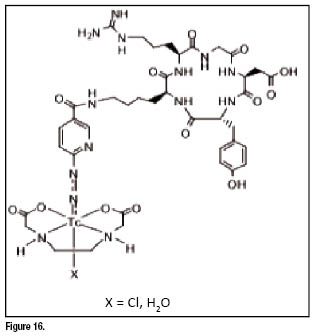
<p><a></a><font size="2" face="Verdana, Arial, Helvetica, sans-serif">  Cyclic RGD peptides, such as c(RGDfK) and <img src="/img/revistas/nuc/n52/e28095212.jpg" width="74" height="18">,  have been used to develop Tc-99m radiotracers for imaging integrin <img src="/img/revistas/nuc/n52/e27095212.jpg" width="29" height="15">  expression in tumors [66,67]. The results from biodistribution studies showed  that <img src="/img/revistas/nuc/n52/e29095212.jpg" width="284" height="15">  (<a href="#f16095212">figure 16</a>) has the best biodistribution characteristics  in terms of tumor uptake, tumor/liver and tumor/lung ratios.&nbsp; RP593 showed  much higher tumor uptake and longer retention than [<img src="/img/revistas/nuc/n52/e01095212.jpg" width="30" height="14">(HYNIC-c(RGDfK))(tricine)(TPPTS)]  (RP582).&nbsp; The tumor uptake of RP593 can be blocked by co-injection of excess  c(RGDfV), suggesting that its tumor localization is indeed due to the integrin  <img src="/img/revistas/nuc/n52/e27095212.jpg" width="29" height="15"> binding.&nbsp;  RP593 and RP582 were also evaluated in the female Balb/c mice with subcutaneously  growing OVCAR-3 ovarian carcinoma xenografts [68,69].&nbsp; The tumor uptake of  RP593 was significantly higher than that of RP582 at different time points.&nbsp;  These results strongly suggest that cyclic RGD dimer <img src="/img/revistas/nuc/n52/e28095212.jpg" width="74" height="18">  [70] has a significant advantage over its monomer counterpart with respect to  the tumor uptake and retention of their <img src="/img/revistas/nuc/n52/e01095212.jpg" width="30" height="14">  radiotracers.</font></p>    

<p ALIGN="CENTER"><img src="/img/revistas/nuc/n52/f16095212.jpg" width="319" height="336"><a name="f16095212"></a><a></a></p>    
]]></body>
<body><![CDATA[<p>&nbsp;</p>    <p>&nbsp;</p>    <p><font size="3" face="Verdana, Arial, Helvetica, sans-serif"><strong><font size="2">REFERENCIAS  BIBLIOGR&Aacute;FICAS</font></strong></font></p>    <!-- ref --><p><font face="Verdana, Arial, Helvetica, sans-serif" size="2">1.  BOSCHI A, DUATTI A, UCCELLI L. Development of technetium-99m and rhenium-188 radiopharmaceuticals  containing a terminal metal-nitrido multiple bond for diagnosis and therapy. Topics  Curr. Chem. 2005; 252: 85-115.    <!-- ref --><br> 2. DUATTI A, UCCELLI L. Technetium complexes  and radiopharmaceuticals containing the TcN multiple bond. Trends Inorg. Chem.  1996; 4: 27-41.    <!-- ref --><br> 3. PASQUALINI R, et. al. A new efficient method for the preparation  of 99mTc-radiopharmaceuticals containing the TcN multiple bond. Appl. Radiat.  Isot. 1992; 43(11): 1329-1333.    <!-- ref --><br> 4. BOLZATI C, et. al. Geometrically controlled  selective formation of nitrido technetium(V) asymmetrical heterocomplexes with  bidentate ligands. J. Am. Chem. Soc. 2000; 122(8): 4510-4511.    <!-- ref --><br> 5. REFOSCO F,  et. al. Mixed-Ligand Tc- and Re-nitrido complexes for radiolabeling bioactive  molecules. Recent Res. Devel. Inorganic Chem. 2000; 2: 89-98.    <!-- ref --><br> 6. BOLZATI C,  et. al. Chemistry of the strong electrophilic metal fragment [99Tc(N)(PXP)]2+  (PXP = diphosphine ligand). A novel tool for the selective labeling of small molecules.  J. Am. Chem. Soc. 2002; 124(38): 11468-11479.    <br> 7. BOCHER M, et. al. A fast  cardiac gamma camera with dynamic SPECT capabilities: design, system validation  and future potential. Eur. J. Nucl. Med. Mol. Imaging. 2010; 37: 1887&amp;ndash;1902.    ]]></body>
<body><![CDATA[<br>  8. HUTTON BF. New SPECT technology: potential and challenges. Eur. J. Nucl. Med.  Mol. Imaging. 2010; 37: 1883&amp;ndash;1886.    <!-- ref --><br> 9. ALBERTO R, et. al. Synthesis  and Properties of Boranocarbonate: A Convenient in Situ CO Source for the Aqueous  Preparation of [99mTc(OH2)3(CO)3]+. J. Am. Chem. Soc. 2001; 123: 3135.    <!-- ref --><br> 10.  ALBERTO R. Radiopharmaceuticals. In: Bioorganometallics. Weinheim: Wiley-VCH,  2006. p 97.    <!-- ref --><br> 11. ALBERTO R, et. al. A Novel Organometallic Aqua Complex of  Technetium for the Labeling of Biomolecules: Synthesis of [99mTc(OH2)3(CO)3]+  from [99mTcO4]- in Aqueous Solution and Its Reaction with a Bifunctional Ligand.  J. Am. Chem. Soc. 1998; 120(31): 7987-7988.    <!-- ref --><br> 12. LIU S. The role of coordination  chemistry in the development of target-specific radiopharmaceuticals. Chem. Soc.  Rev. 2004; 33(7): 445-61.    <!-- ref --><br> 13. THOMPSON KH, ORVIG C. Metal complexes in medicinal  chemistry: new vistas and challenges in drug design. Dalton Trans. 2006; 14(6):  761-4.    <!-- ref --><br> 14. LA BELLA R, et. al. In vitro and in vivo evaluation of a Tc-99m(I)-labeled  bombesin analogue for imaging of gastrin releasing peptide receptor-positive tumors.  Nucl. Med. Biol. 2002; 29(5): 553-560.    <!-- ref --><br> 15. VEERENDRA B, et. al. Synthesis,  radiolabeling and in vitro GRP receptor targeting studies of (99m) Tc-Triaza-X-BBN[7-14]NH2  (X = serylserylserine, glycylglycylglycine, glycylserylglycine, or beta alanine).  Synth. React. Inorg. Me. 2006; 36: 481-491.    <!-- ref --><br> 16. SMITH CJ, et. al. Radiochemical  investigations of gastrin-releasing peptide receptor-specific [Tc-99m(X)(CO)(3)-Dpr-Ser-Ser-Ser-Gln-Trp-Ala-Val-Gly-His-Leu-Met-(NH2)]  in PC-3, tumor-bearing, rodent models: Syntheses, radiolabeling, and in vitro/in  vivo studies where Dpr=2,3-diaminopropionic acid and X = H2O or P(CH2OH)(3). Cancer  Res. 2003; 63 (14): 4082-4088.    <!-- ref --><br> 17. WAIBEL R, et. al. Stable one-step technetium-99m  labeling of His-tagged recombinant proteins with a novel Tc(I)-carbonyl complex.  Nat. Biotechnol. 1999; 17(9): 897-901.    <!-- ref --><br> 18. FERREIRA CL, et. al. Glucosamine  Conjugates of Tricarbonylcyclopentadienyl Rhenium(I) and Technetium(I) Cores.  Inorg. Chem. 2006; 45(17): 6979-6987.    <br> 19. FERREIRA, et. al. Carbohydrate-appended  3-hydroxy-4-pyridinone Complexes of the [M(CO)(3)](+) core (M) Re, Tc-99m, Re-186).  Bioconjugate Chem. 2006; 17(5): 1321-1329.    <!-- ref --><br> 20. SCHIBLI R, et. al. Synthesis  and in vitro characterization of organometallic rhenium and technetium glucose  complexes against glut 1 and hexokinase. Bioconjugate Chem. 2005; 16(1): 105-112.    <!-- ref --><br>  21. BERNARD J, et. al. Aqueous Synthesis of Derivatized Cyclopentadienyl Complexes  of Technetium and Rhenium Directed Toward Radiopharmaceutical Application. Inorg.  Chem. 2003; 42(4): 1014-1022.    <!-- ref --><br> 22. TZANOPOULOU S, et. al. Synthesis, Characterization,  and Biological Evaluation of M(I)(CO)(3)(NNO) Complexes (M = Re, Tc-99m) Conjugated  to 2-(4-aminophenyl)benzothiazole as Potential Breast Cancer Radiopharmaceuticals.  J. Med. Chem. 2006; 49(18): 5408-10.    <!-- ref --><br> 23. LIU Y, et. al. Amino Acids Labeled  with [99mTc(CO)3]+ and Recognized by the L-Type Amino Acid Transporter LAT1. J.  Am. Chem. Soc. 2006; 128(50): 15996-97.    <!-- ref --><br> 24. STEPHENSON KA, et. al. Bridging  the gap between in vitro and in vivo imaging: Isostructural Re and Tc-99m complexes  for correlating fluorescence and radioimaging studies. J. Am. Chem. Soc. 2004;  126(29): 8598-99.    <!-- ref --><br> 25. ALBERTO R. [Tc(CO)3]+ Chemistry: a Promising New Concept  for SPET?. Eur. J. Nucl. Med. Mol. I. 2003; 30(9): 1299-1302.    <!-- ref --><br> 26. WELCH M.  [Tc(CO)3]+ chemistry: a promising new concept for SPET?. Eur. J. Nucl. Med. Mol.  Imaging. 2003; 30(9): 1302-1304.    <!-- ref --><br> 27. GARCIA R, PAULO A, DOMINGOS A, et. al.  Re and Tc complexes containing B-H...M agostic interactions as building blocks  for the design of radiopharmaceuticals. J. Am. Chem. Soc. 2000; 122(45): 11240-11241.    <!-- ref --><br>  28. WALD J, et. al. Aqueous One-Pot Synthesis of Derivatized Cyclopentadienyl-Tricarbonyl  Complexes of 99mTc with an In Situ CO Source: Application to a Serotonergic Receptor  Ligand. Angew. Chem. Int. Ed. 2001; 40(16): 3062-3066.    <!-- ref --><br> 29. ALBERTO R, et.  al. Mono-, Bi-, or Tridentate Ligands? The Labeling of Peptides with Tc-99m-Carbonyls.  Biopolymers. 2004; 76(4): 324-333.    <!-- ref --><br> 30. PASQUALINI R, et. al. Bis(dithiocarbamato)  nitrido technetium-99m radiopharmaceuticals: a class of neutral myocardial imaging  agents. J. Nucl. Med. 1994; 35(2): 334-341.    <!-- ref --><br> 31. PASQUALINI R, DUATTI A. Synthesis  and characterization of the new neutral myocardial imaging agent [99mTcN(noet)2]  (noet = N-ethyl-N-ethoxydithiocarbamato). J. Chem. Soc. Chem. Commun. 1992; (18):  1354-1355.    <!-- ref --><br> 32. JOHNSON G, et. al. Clearance of technetium-99m N-NOEt in normal,  ischemic-reperfused, and membrane-disrupted myocardium. J. Nucl. Cardiol. 1996;  3(1): 42-54.    <!-- ref --><br> 33. GIGANTI M, et. al. Advances in radiopharmaceuticals for cardiac  imaging: 99mTcN-NOET. Q. J. Nucl. Med. 1997; 41(Suppl.): 147-151.    <!-- ref --><br> 34. TAKEHANA  K, et. al. Assessment of residual coronary stenoses using 99mTc-N-NOET vasodilator  stress imaging to evaluate coronary flow reserve early after coronary reperfusion  in a canine model of subendocardial infarction. J. Nucl. Med. 2001; 42(9): 1388-1394.    <!-- ref --><br>  35. VANZETTO G, et. al. 99mTc-N-NOET myocardial uptake reflects myocardial blood  flow and not viability in dogs with reperfused acute myocardial infarction. Circulation.  2000; 101(20): 2424-2430.    <!-- ref --><br> 36. HOLLY TA, et. al. The effect of ischemic injury  on the cardiac transport of Tc-99m-N-NOET in the isolated rabbit heart. J. Nucl.  Cardiol. 1999; 6(6): 633-640.    <!-- ref --><br> 37. VANZETTO G, et. al. Myocardial uptake and  redistribution of 99mTc-N-NOET in dogs with either sustained coronary low flow  or transient coronary occlusion: comparison with 201Tl and myocardial blood flow.  Circulation. 1997; 96(7): 2325-2331.    <!-- ref --><br> 38. JEETLEY P, et. al. Comparison between  Tc-99m-N-NOET and Tl-201 in the assessment of patients with known or suspected  coronary artery disease. J. Nucl. Cardiol. 2004; 11(6): 664-672.    <!-- ref --><br> 39. PETRUZELLA  FD, et. al. Optimal timing for initial and redistribution technetium-99m-N-NOET  image acquisition. J. Nucl. Cardiol. 2000; 7(2): 123-131.    <!-- ref --><br> 40. VANZETTO G,  et. al. Biodistribution, dosimetry, and safety of myocardial perfusion imaging  agent 99mTcN-NOET in healthy volunteers. J. Nucl. Med. 2000; 41(1): 141-148.    <!-- ref --><br>  41. CALNON DA, et. al. Myocardial uptake of 99mTc-N-NOET and 201Tl during dobutamine  infusion. Comparison with adenosine stress. Circulation. 1999; 100: 1653-1659.    <!-- ref --><br>  42. JOHNSON G, et. al. Planar imaging of 99mTc-labeled (bis(N-ethoxy, N-ethyl  dithiocarbamato) nitrido technetium(V) can detect resting ischemia. J. Nucl. Cardiol.  1997; 4(3): 217-225.    <!-- ref --><br> 43. SINUSAS AJ. Technetium 99m-N-NOET: although not equivalent  to thallium-201, it still offers new opportunities. J. Nucl. Cardiol. 2000; 7(2):  185-188.    <!-- ref --><br> 44. JOHNSON G, et. al. Interaction of technetium-99m-N-NOET with  blood elements: potential mechanism of myocardial redistribution. J. Nucl. Med.  1997; 38(1): 138-143.    <!-- ref --><br> 45. JOHNSON G, et. al. Clearance of technetium 99mTcN-NOET  in normal, ischemic-reperfused, and membrane-disrupted myocardium. J. Nucl. Cardiol.  1996; 3(1): 42-54.    <!-- ref --><br> 46. UCCELLI L, et. al. Subcellular distribution of technetium-99mTcN-NOEt  in rat myocardium. J.Nucl. Med. 1995; 36(11): 2075-2079.    <!-- ref --><br> 47. BOSCHI A, et.  al. Synthesis and biological evaluation of monocationic asymmetric 99mTc-nitride  heterocomplexes showing high heart uptake and improved imaging properties. J.  Nucl. Med. 2003; 44(5): 806-814.    <!-- ref --><br> 48. OSCHI A, BOLZATI C, UCCELLI L, et. al.  A class of asymmetrical nitrido 99mTc heterocomplexes as heart imaging agents  with improved biological properties. Nucl. Med. Commun. 2002; 23(7): 689-693.    <!-- ref --><br>  49. HATADA K, et. al. 99mTc-N-DBODC5, a new myocardial perfusion imaging agent  with rapid liver clearance: comparison with 99mTc-sestamibi and 99mTc-tetrofosmin  in rats. J. Nucl. Med. 2004; 45(12): 2095-2101.    <!-- ref --><br> 50. BOLZATI C, et. al. Subcellular  distribution and metabolism studies of the potential myocardial imaging agent  [99mTc(N)(DBODC)(PNP5)]+. J. Nucl. Med. 2008; 49(8): 1336-1344.    <!-- ref --><br> 51. ZHANG  WC, et. al. Experimental study of [99mTc(PNP5) (DBODC)]+ as a new myocardial perfusion  imaging agent. Cardiology. 2009; 112(2): 89-97.    <!-- ref --><br> 52. HATADA K, et. al. Organ  biodistribution and myocardial uptake, washout, and redistribution kinetics of  Tc-99m N-DBODC5 when injected during vasodilator stress in canine models of coronary  stenoses. J. Nucl. Cardiol. 2006; 13(6): 779-790.    <!-- ref --><br> 53. CITTANTI C, et. al.  Whole-body biodistribution and radiation dosimetry of the new cardiac tracer 99mTc-N-DBODC.  J. Nucl. Med. 2008; 49(8): 1299-1304.    <!-- ref --><br> 54. KIM YS, et. al. Tc-99m-N-MPO: novel  cationic Tc-99m radiotracer for myocardial perfusion imaging. J. Nucl. Cardiol.  2008; 15(4): 535-546.    <!-- ref --><br> 55. KIM YS, et. al. Mechanism for myocardial localization  and rapid liver clearance of Tc-99m-N-MPO: a new perfusion radiotracer for heart  imaging. J. Nucl. Cardiol. 2009; 16(4): 571-579.    <!-- ref --><br> 56. MARIA L, et. al. Tris(pyrazolyl)methane  99mTc tricarbonyl complexes for myocardial imaging. Dalton Trans. 2009; 28(4):  603-606.    <br> 57. MARIA L, et. al. Rhenium and technetium tricarbonyl complexes  anchored by pyrazole-based tripods: novel lead structures for the design of myocardial  imaging agents. Dalton Trans. 2007; 28(28): 3010&amp;ndash;3019.    ]]></body>
<body><![CDATA[<!-- ref --><br> 58. BLUM  JE, HANDMAKER H, RINNE N A. The utility of a somatostatin-type receptor binding  peptide radiopharmaceutical (P829) in the evaluation of solitary pulmonary nodules.  Chest 1999; 115(1): 224-232.    <!-- ref --><br> 59. CYR JE, et. al. Somatostatin receptor-binding  peptides suitable for tumor radiotherapy with Re-188 or Re-186. Chemistry and  initial biological studies. J. Med. Chem. 2007; 50 (6): 1354-1364.    <!-- ref --><br> 60. DECRISTOFORO  C, et. al. 99mTc-HYNIC-[Tyr3]-octreotide for imaging somatostatin-receptor-positive  tumors: preclinical evaluation and comparison with 111In-octreotide. J. Nucl.  Med. 2000; 41(6): 1114-1119.    <!-- ref --><br> 61. DECRISTOFORO C, et. al. 99mTc-EDDA/HYNIC-TOC-  A new technetium-99m labelled radiopharmaceutical for imaging somatostatin receptor  positive tumours: first clinical results and intra-patient comparison with 111In-labelled  octreotide derivatives. Eur. J. Nucl. Med. 2000; 27(9): 1318-1325.    <!-- ref --><br> 62. GABRIEL  M, et. al. An intrapatient comparison of 99mTc-EDDA/HYNIC-TOC with 111In-DTPA-octreotide  for diagnosis of somatostatin receptor-expressing tumors. J. Nucl. Med. 2003;  44(5): 708-716.    <!-- ref --><br> 63. FOLKMAN J. Role of angiogenesis in tumor growth and metastasis.  Semin. Oncol. 2002; 29(6 Suppl. 6): 15-18.    <!-- ref --><br> 64. HWANG R, VARNER J. The role  of integrins in tumor angiogenesis. Hematol. Oncol. Clin. North. Am. 2004; 18(5):  991-1006.    <!-- ref --><br> 65. LIU S, ROBINSON SP, EDWARDS DS. Radiolabeled integrin avb3 antagonists  as radiopharmaceuticals for tumor radiotherapy. Topics Curr. Chem. 2005; 252:  193-216.    <!-- ref --><br> 66. LIU S. 99mTc-Labeling of a hydrazinonicotinamide-conjugated vitronectin  receptor antagonist useful for imaging tumors. Bioconjug. Chem. 2001; 12(4): 624-629.    <!-- ref --><br>  67. LIU S, et. al. Effect of coligands on biodistribution characteristics of ternary  ligand 99mTc complexes of a HYNIC-conjugated cyclic RGDfK dimer. Bioconjug. Chem.  2005; 16(6): 1580-1588.    <!-- ref --><br> 68. LIU S, et. al. Evaluation of a 99mTc-labeled cyclic  RGD tetramer for non-invasive imaging integrin avb3-positive breast cancer. Bioconjug.  Chem. 2007; 18(2): 438-446.    <!-- ref --><br> 69. LIU S, et. al. Impact of PKM linkers on biodistribution  characteristics of the 99mTc-labeled cyclic RGDfK dimer. Bioconjug. Chem. 2006;  17(6): 1499-1507.    <!-- ref --><br> 70. DECRISTOFORO C, et. al. [99mTc]HYNIC-RGD for imaging  integrin avb3 expression, Nucl. Med. Biol. 2006; 33: 945-952.    <br> </font><font face="Verdana, Arial, Helvetica, sans-serif">  </font> </p>    <p>&nbsp;</p>    <p><font size="2" face="Verdana, Arial, Helvetica, sans-serif"><strong>Recibido:</strong>  30 de agosto de 2012    <br> <strong>Aceptado:</strong> 4 de octubre de 2012</font></p>      ]]></body><back>
<ref-list>
<ref id="B1">
<label>1</label><nlm-citation citation-type="journal">
<person-group person-group-type="author">
<name>
<surname><![CDATA[BOSCHI]]></surname>
<given-names><![CDATA[A]]></given-names>
</name>
<name>
<surname><![CDATA[DUATTI]]></surname>
<given-names><![CDATA[A]]></given-names>
</name>
<name>
<surname><![CDATA[UCCELLI]]></surname>
<given-names><![CDATA[L]]></given-names>
</name>
</person-group>
<article-title xml:lang="en"><![CDATA[Development of technetium-99m and rhenium-188 radiopharmaceuticals containing a terminal metal-nitrido multiple bond for diagnosis and therapy]]></article-title>
<source><![CDATA[Topics Curr. Chem]]></source>
<year>2005</year>
<volume>252</volume>
<page-range>85-115</page-range></nlm-citation>
</ref>
<ref id="B2">
<label>2</label><nlm-citation citation-type="journal">
<person-group person-group-type="author">
<name>
<surname><![CDATA[DUATTI]]></surname>
<given-names><![CDATA[A]]></given-names>
</name>
<name>
<surname><![CDATA[UCCELLI]]></surname>
<given-names><![CDATA[L]]></given-names>
</name>
</person-group>
<article-title xml:lang="en"><![CDATA[Technetium complexes and radiopharmaceuticals containing the TcN multiple bond]]></article-title>
<source><![CDATA[Trends Inorg. Chem]]></source>
<year>1996</year>
<volume>4</volume>
<page-range>27-41</page-range></nlm-citation>
</ref>
<ref id="B3">
<label>3</label><nlm-citation citation-type="journal">
<person-group person-group-type="author">
<name>
<surname><![CDATA[PASQUALINI]]></surname>
<given-names><![CDATA[R]]></given-names>
</name>
</person-group>
<article-title xml:lang="en"><![CDATA[A new efficient method for the preparation of 99mTc-radiopharmaceuticals containing the TcN multiple bond]]></article-title>
<source><![CDATA[Appl. Radiat. Isot]]></source>
<year>1992</year>
<volume>43</volume>
<numero>11</numero>
<issue>11</issue>
<page-range>1329-1333</page-range></nlm-citation>
</ref>
<ref id="B4">
<label>4</label><nlm-citation citation-type="journal">
<person-group person-group-type="author">
<name>
<surname><![CDATA[BOLZATI]]></surname>
<given-names><![CDATA[C]]></given-names>
</name>
</person-group>
<article-title xml:lang="en"><![CDATA[Geometrically controlled selective formation of nitrido technetium(V) asymmetrical heterocomplexes with bidentate ligands]]></article-title>
<source><![CDATA[J. Am. Chem. Soc]]></source>
<year>2000</year>
<volume>122</volume>
<numero>8</numero>
<issue>8</issue>
<page-range>4510-4511</page-range></nlm-citation>
</ref>
<ref id="B5">
<label>5</label><nlm-citation citation-type="journal">
<person-group person-group-type="author">
<name>
<surname><![CDATA[REFOSCO]]></surname>
<given-names><![CDATA[F]]></given-names>
</name>
</person-group>
<article-title xml:lang="en"><![CDATA[Mixed-Ligand Tc- and Re-nitrido complexes for radiolabeling bioactive molecules]]></article-title>
<source><![CDATA[Recent Res. Devel. Inorganic Chem]]></source>
<year>2000</year>
<volume>2</volume>
<page-range>89-98</page-range></nlm-citation>
</ref>
<ref id="B6">
<label>6</label><nlm-citation citation-type="journal">
<person-group person-group-type="author">
<name>
<surname><![CDATA[BOLZATI]]></surname>
<given-names><![CDATA[C]]></given-names>
</name>
</person-group>
<article-title xml:lang="en"><![CDATA[Chemistry of the strong electrophilic metal fragment [99Tc(N)(PXP)]2+ (PXP = diphosphine ligand). A novel tool for the selective labeling of small molecules]]></article-title>
<source><![CDATA[J. Am. Chem. Soc]]></source>
<year>2002</year>
<volume>124</volume>
<numero>38</numero>
<issue>38</issue>
<page-range>11468-11479</page-range></nlm-citation>
</ref>
<ref id="B7">
<label>7</label><nlm-citation citation-type="journal">
<person-group person-group-type="author">
<name>
<surname><![CDATA[BOCHER]]></surname>
<given-names><![CDATA[M]]></given-names>
</name>
</person-group>
<article-title xml:lang="en"><![CDATA[A fast cardiac gamma camera with dynamic SPECT capabilities: design, system validation and future potential]]></article-title>
<source><![CDATA[Eur. J. Nucl. Med. Mol. Imaging]]></source>
<year>2010</year>
<volume>37</volume>
<page-range>1887-1902</page-range></nlm-citation>
</ref>
<ref id="B8">
<label>8</label><nlm-citation citation-type="journal">
<person-group person-group-type="author">
<name>
<surname><![CDATA[HUTTON]]></surname>
<given-names><![CDATA[BF]]></given-names>
</name>
</person-group>
<article-title xml:lang="en"><![CDATA[New SPECT technology: potential and challenges]]></article-title>
<source><![CDATA[Eur. J. Nucl. Med. Mol. Imaging]]></source>
<year>2010</year>
<volume>37</volume>
<page-range>1883-1886</page-range></nlm-citation>
</ref>
<ref id="B9">
<label>9</label><nlm-citation citation-type="journal">
<person-group person-group-type="author">
<name>
<surname><![CDATA[ALBERTO]]></surname>
<given-names><![CDATA[R]]></given-names>
</name>
</person-group>
<article-title xml:lang="en"><![CDATA[Synthesis and Properties of Boranocarbonate: A Convenient in Situ CO Source for the Aqueous Preparation of [99mTc(OH2)3(CO)3]+]]></article-title>
<source><![CDATA[J. Am. Chem. Soc]]></source>
<year>2001</year>
<volume>123</volume>
<page-range>3135</page-range></nlm-citation>
</ref>
<ref id="B10">
<label>10</label><nlm-citation citation-type="book">
<person-group person-group-type="author">
<name>
<surname><![CDATA[ALBERTO]]></surname>
<given-names><![CDATA[R]]></given-names>
</name>
</person-group>
<article-title xml:lang="en"><![CDATA[Radiopharmaceuticals]]></article-title>
<source><![CDATA[Bioorganometallics]]></source>
<year>2006</year>
<page-range>p 97</page-range><publisher-loc><![CDATA[Weinheim ]]></publisher-loc>
<publisher-name><![CDATA[Wiley-VCH]]></publisher-name>
</nlm-citation>
</ref>
<ref id="B11">
<label>11</label><nlm-citation citation-type="journal">
<person-group person-group-type="author">
<name>
<surname><![CDATA[ALBERTO]]></surname>
<given-names><![CDATA[R]]></given-names>
</name>
</person-group>
<article-title xml:lang="en"><![CDATA[A Novel Organometallic Aqua Complex of Technetium for the Labeling of Biomolecules: Synthesis of [99mTc(OH2)3(CO)3]+ from [99mTcO4]- in Aqueous Solution and Its Reaction with a Bifunctional Ligand]]></article-title>
<source><![CDATA[J. Am. Chem. Soc]]></source>
<year>1998</year>
<volume>120</volume>
<numero>31</numero>
<issue>31</issue>
<page-range>7987-7988</page-range></nlm-citation>
</ref>
<ref id="B12">
<label>12</label><nlm-citation citation-type="journal">
<person-group person-group-type="author">
<name>
<surname><![CDATA[LIU]]></surname>
<given-names><![CDATA[S]]></given-names>
</name>
</person-group>
<article-title xml:lang="en"><![CDATA[The role of coordination chemistry in the development of target-specific radiopharmaceuticals]]></article-title>
<source><![CDATA[Chem. Soc. Rev]]></source>
<year>2004</year>
<volume>33</volume>
<numero>7</numero>
<issue>7</issue>
<page-range>445-61</page-range></nlm-citation>
</ref>
<ref id="B13">
<label>13</label><nlm-citation citation-type="journal">
<person-group person-group-type="author">
<name>
<surname><![CDATA[THOMPSON]]></surname>
<given-names><![CDATA[KH]]></given-names>
</name>
<name>
<surname><![CDATA[ORVIG]]></surname>
<given-names><![CDATA[C]]></given-names>
</name>
</person-group>
<article-title xml:lang="en"><![CDATA[Metal complexes in medicinal chemistry: new vistas and challenges in drug design]]></article-title>
<source><![CDATA[Dalton Trans]]></source>
<year>2006</year>
<volume>14</volume>
<numero>6</numero>
<issue>6</issue>
<page-range>-4</page-range></nlm-citation>
</ref>
<ref id="B14">
<label>14</label><nlm-citation citation-type="journal">
<person-group person-group-type="author">
<name>
<surname><![CDATA[LA BELLA]]></surname>
<given-names><![CDATA[R]]></given-names>
</name>
</person-group>
<article-title xml:lang="en"><![CDATA[In vitro and in vivo evaluation of a Tc-99m(I)-labeled bombesin analogue for imaging of gastrin releasing peptide receptor-positive tumors]]></article-title>
<source><![CDATA[Nucl. Med. Biol]]></source>
<year>2002</year>
<volume>29</volume>
<numero>5</numero>
<issue>5</issue>
<page-range>553-560</page-range></nlm-citation>
</ref>
<ref id="B15">
<label>15</label><nlm-citation citation-type="journal">
<person-group person-group-type="author">
<name>
<surname><![CDATA[VEERENDRA]]></surname>
<given-names><![CDATA[B]]></given-names>
</name>
</person-group>
<article-title xml:lang="en"><![CDATA[Synthesis, radiolabeling and in vitro GRP receptor targeting studies of (99m) Tc-Triaza-X-BBN[7-14]NH2 (X = serylserylserine, glycylglycylglycine, glycylserylglycine, or beta alanine)]]></article-title>
<source><![CDATA[Synth. React. Inorg. Me]]></source>
<year>2006</year>
<volume>36</volume>
<page-range>481-491</page-range></nlm-citation>
</ref>
<ref id="B16">
<label>16</label><nlm-citation citation-type="journal">
<person-group person-group-type="author">
<name>
<surname><![CDATA[SMITH]]></surname>
<given-names><![CDATA[CJ]]></given-names>
</name>
</person-group>
<article-title xml:lang="en"><![CDATA[Radiochemical investigations of gastrin-releasing peptide receptor-specific [Tc-99m(X)(CO)(3)-Dpr-Ser-Ser-Ser-Gln-Trp-Ala-Val-Gly-His-Leu-Met-(NH2)] in PC-3, tumor-bearing, rodent models: Syntheses, radiolabeling, and in vitro/in vivo studies where Dpr=2,3-diaminopropionic acid and X = H2O or P(CH2OH)(3)]]></article-title>
<source><![CDATA[Cancer Res]]></source>
<year>2003</year>
<volume>63</volume>
<numero>14</numero>
<issue>14</issue>
<page-range>4082-4088</page-range></nlm-citation>
</ref>
<ref id="B17">
<label>17</label><nlm-citation citation-type="journal">
<person-group person-group-type="author">
<name>
<surname><![CDATA[WAIBEL]]></surname>
<given-names><![CDATA[R]]></given-names>
</name>
</person-group>
<article-title xml:lang="en"><![CDATA[Stable one-step technetium-99m labeling of His-tagged recombinant proteins with a novel Tc(I)-carbonyl complex]]></article-title>
<source><![CDATA[Nat. Biotechnol]]></source>
<year>1999</year>
<volume>17</volume>
<numero>9</numero>
<issue>9</issue>
<page-range>897-901</page-range></nlm-citation>
</ref>
<ref id="B18">
<label>18</label><nlm-citation citation-type="journal">
<person-group person-group-type="author">
<name>
<surname><![CDATA[FERREIRA]]></surname>
<given-names><![CDATA[CL]]></given-names>
</name>
</person-group>
<article-title xml:lang="en"><![CDATA[Glucosamine Conjugates of Tricarbonylcyclopentadienyl Rhenium(I) and Technetium(I) Cores]]></article-title>
<source><![CDATA[Inorg. Chem]]></source>
<year>2006</year>
<volume>45</volume>
<numero>17</numero>
<issue>17</issue>
<page-range>6979-6987</page-range></nlm-citation>
</ref>
<ref id="B19">
<label>19</label><nlm-citation citation-type="journal">
<person-group person-group-type="author">
<name>
<surname><![CDATA[FERREIRA]]></surname>
<given-names><![CDATA[CL]]></given-names>
</name>
</person-group>
<article-title xml:lang="en"><![CDATA[Carbohydrate-appended 3-hydroxy-4-pyridinone Complexes of the [M(CO)(3)](+) core (M) Re, Tc-99m, Re-186)]]></article-title>
<source><![CDATA[Bioconjugate Chem]]></source>
<year>2006</year>
<volume>17</volume>
<numero>5</numero>
<issue>5</issue>
<page-range>1321-1329</page-range></nlm-citation>
</ref>
<ref id="B20">
<label>20</label><nlm-citation citation-type="journal">
<person-group person-group-type="author">
<name>
<surname><![CDATA[SCHIBLI]]></surname>
<given-names><![CDATA[R]]></given-names>
</name>
</person-group>
<article-title xml:lang="en"><![CDATA[Synthesis and in vitro characterization of organometallic rhenium and technetium glucose complexes against glut 1 and hexokinase]]></article-title>
<source><![CDATA[Bioconjugate Chem]]></source>
<year>2005</year>
<volume>16</volume>
<numero>1</numero>
<issue>1</issue>
<page-range>105-112</page-range></nlm-citation>
</ref>
<ref id="B21">
<label>21</label><nlm-citation citation-type="journal">
<person-group person-group-type="author">
<name>
<surname><![CDATA[BERNARD]]></surname>
<given-names><![CDATA[J]]></given-names>
</name>
</person-group>
<article-title xml:lang="en"><![CDATA[Aqueous Synthesis of Derivatized Cyclopentadienyl Complexes of Technetium and Rhenium Directed Toward Radiopharmaceutical Application]]></article-title>
<source><![CDATA[Inorg. Chem]]></source>
<year>2003</year>
<volume>42</volume>
<numero>4</numero>
<issue>4</issue>
<page-range>1014-1022</page-range></nlm-citation>
</ref>
<ref id="B22">
<label>22</label><nlm-citation citation-type="journal">
<person-group person-group-type="author">
<name>
<surname><![CDATA[TZANOPOULOU]]></surname>
<given-names><![CDATA[S]]></given-names>
</name>
</person-group>
<article-title xml:lang="en"><![CDATA[Synthesis, Characterization, and Biological Evaluation of M(I)(CO)(3)(NNO) Complexes (M = Re, Tc-99m) Conjugated to 2-(4-aminophenyl)benzothiazole as Potential Breast Cancer Radiopharmaceuticals]]></article-title>
<source><![CDATA[J. Med. Chem]]></source>
<year>2006</year>
<volume>49</volume>
<numero>18</numero>
<issue>18</issue>
<page-range>5408-10</page-range></nlm-citation>
</ref>
<ref id="B23">
<label>23</label><nlm-citation citation-type="journal">
<person-group person-group-type="author">
<name>
<surname><![CDATA[LIU]]></surname>
<given-names><![CDATA[Y]]></given-names>
</name>
</person-group>
<article-title xml:lang="en"><![CDATA[AminoAcids Labeled with [99mTc(CO)3]+ and Recognized by the L-Type Amino Acid Transporter LAT1]]></article-title>
<source><![CDATA[J. Am. Chem. Soc]]></source>
<year>2006</year>
<volume>128</volume>
<numero>50</numero>
<issue>50</issue>
<page-range>15996-97</page-range></nlm-citation>
</ref>
<ref id="B24">
<label>24</label><nlm-citation citation-type="journal">
<person-group person-group-type="author">
<name>
<surname><![CDATA[STEPHENSON]]></surname>
<given-names><![CDATA[KA]]></given-names>
</name>
</person-group>
<article-title xml:lang="en"><![CDATA[Bridging the gap between in vitro and in vivo imaging: Isostructural Re and Tc-99m complexes for correlating fluorescence and radioimaging studies]]></article-title>
<source><![CDATA[J. Am. Chem. Soc]]></source>
<year>2004</year>
<volume>126</volume>
<numero>29</numero>
<issue>29</issue>
<page-range>8598-99</page-range></nlm-citation>
</ref>
<ref id="B25">
<label>25</label><nlm-citation citation-type="journal">
<person-group person-group-type="author">
<name>
<surname><![CDATA[ALBERTO]]></surname>
<given-names><![CDATA[R]]></given-names>
</name>
</person-group>
<article-title xml:lang="en"><![CDATA[[Tc(CO)3]+ Chemistry: a Promising New Concept for SPET?]]></article-title>
<source><![CDATA[Eur. J. Nucl. Med. Mol. I]]></source>
<year>2003</year>
<volume>30</volume>
<numero>9</numero>
<issue>9</issue>
<page-range>1299-1302</page-range></nlm-citation>
</ref>
<ref id="B26">
<label>26</label><nlm-citation citation-type="journal">
<person-group person-group-type="author">
<name>
<surname><![CDATA[WELCH]]></surname>
<given-names><![CDATA[M]]></given-names>
</name>
</person-group>
<article-title xml:lang="en"><![CDATA[[Tc(CO)3]+ chemistry: a promising new concept for SPET?]]></article-title>
<source><![CDATA[Eur. J. Nucl. Med. Mol. Imaging]]></source>
<year>2003</year>
<volume>30</volume>
<numero>9</numero>
<issue>9</issue>
<page-range>1302-1304</page-range></nlm-citation>
</ref>
<ref id="B27">
<label>27</label><nlm-citation citation-type="journal">
<person-group person-group-type="author">
<name>
<surname><![CDATA[GARCIA]]></surname>
<given-names><![CDATA[R]]></given-names>
</name>
<name>
<surname><![CDATA[PAULO]]></surname>
<given-names><![CDATA[A]]></given-names>
</name>
<name>
<surname><![CDATA[DOMINGOS]]></surname>
<given-names><![CDATA[A]]></given-names>
</name>
</person-group>
<article-title xml:lang="en"><![CDATA[Re and Tc complexes containing B-H...M agostic interactions as building blocks for the design of radiopharmaceuticals]]></article-title>
<source><![CDATA[J. Am. Chem. Soc]]></source>
<year>2000</year>
<volume>122</volume>
<numero>45</numero>
<issue>45</issue>
<page-range>11240-11241</page-range></nlm-citation>
</ref>
<ref id="B28">
<label>28</label><nlm-citation citation-type="journal">
<person-group person-group-type="author">
<name>
<surname><![CDATA[WALD]]></surname>
<given-names><![CDATA[J]]></given-names>
</name>
</person-group>
<article-title xml:lang="en"><![CDATA[Aqueous One-Pot Synthesis of Derivatized Cyclopentadienyl-Tricarbonyl Complexes of 99mTc with an In Situ CO Source: Application to a Serotonergic Receptor Ligand]]></article-title>
<source><![CDATA[Angew. Chem. Int. Ed]]></source>
<year>2001</year>
<volume>40</volume>
<numero>16</numero>
<issue>16</issue>
<page-range>3062-3066</page-range></nlm-citation>
</ref>
<ref id="B29">
<label>29</label><nlm-citation citation-type="journal">
<person-group person-group-type="author">
<name>
<surname><![CDATA[ALBERTO]]></surname>
<given-names><![CDATA[R]]></given-names>
</name>
</person-group>
<article-title xml:lang="en"><![CDATA[Mono-, Bi-, or Tridentate Ligands? The Labeling of Peptides with Tc-99m-Carbonyls]]></article-title>
<source><![CDATA[Biopolymers]]></source>
<year>2004</year>
<volume>76</volume>
<numero>4</numero>
<issue>4</issue>
<page-range>324-33</page-range></nlm-citation>
</ref>
<ref id="B30">
<label>30</label><nlm-citation citation-type="journal">
<person-group person-group-type="author">
<name>
<surname><![CDATA[PASQUALINI]]></surname>
<given-names><![CDATA[R]]></given-names>
</name>
</person-group>
<article-title xml:lang="en"><![CDATA[Bis(dithiocarbamato) nitrido technetium-99m radiopharmaceuticals: a class of neutral myocardial imaging agent]]></article-title>
<source><![CDATA[J. Nucl. Med]]></source>
<year>1994</year>
<volume>35</volume>
<numero>2</numero>
<issue>2</issue>
<page-range>334-341</page-range></nlm-citation>
</ref>
<ref id="B31">
<label>31</label><nlm-citation citation-type="journal">
<person-group person-group-type="author">
<name>
<surname><![CDATA[PASQUALINI]]></surname>
<given-names><![CDATA[R]]></given-names>
</name>
<name>
<surname><![CDATA[DUATTI]]></surname>
<given-names><![CDATA[A]]></given-names>
</name>
</person-group>
<article-title xml:lang="en"><![CDATA[Synthesis and characterization of the new neutral myocardial imaging agent [99mTcN(noet)2] (noet = N-ethyl-N-ethoxydithiocarbamato)]]></article-title>
<source><![CDATA[J. Chem. Soc. Chem. Commun]]></source>
<year>1992</year>
<numero>18</numero>
<issue>18</issue>
<page-range>1354-1355</page-range></nlm-citation>
</ref>
<ref id="B32">
<label>32</label><nlm-citation citation-type="journal">
<person-group person-group-type="author">
<name>
<surname><![CDATA[JOHNSON]]></surname>
<given-names><![CDATA[G]]></given-names>
</name>
</person-group>
<article-title xml:lang="en"><![CDATA[Clearance of technetium-99m N-NOEt in normal, ischemic-reperfused, and membrane-disrupted myocardium]]></article-title>
<source><![CDATA[J. Nucl. Cardiol]]></source>
<year>1996</year>
<volume>3</volume>
<numero>1</numero>
<issue>1</issue>
<page-range>42-54</page-range></nlm-citation>
</ref>
<ref id="B33">
<label>33</label><nlm-citation citation-type="journal">
<person-group person-group-type="author">
<name>
<surname><![CDATA[GIGANTI]]></surname>
<given-names><![CDATA[M]]></given-names>
</name>
</person-group>
<article-title xml:lang="en"><![CDATA[Advances in radiopharmaceuticals for cardiac imaging: 99mTcN-NOET]]></article-title>
<source><![CDATA[Q. J. Nucl. Med]]></source>
<year>1997</year>
<volume>41</volume>
<numero>^s(Suppl.)</numero>
<issue>^s(Suppl.)</issue>
<supplement>(Suppl.)</supplement>
<page-range>147-151</page-range></nlm-citation>
</ref>
<ref id="B34">
<label>34</label><nlm-citation citation-type="journal">
<person-group person-group-type="author">
<name>
<surname><![CDATA[TAKEHANA]]></surname>
<given-names><![CDATA[K]]></given-names>
</name>
</person-group>
<article-title xml:lang="en"><![CDATA[Assessment of residual coronary stenoses using 99mTc-N-NOET vasodilator stress imaging to evaluate coronary flow reserve early after coronary reperfusion in a canine model of subendocardial infarction]]></article-title>
<source><![CDATA[J. Nucl. Med]]></source>
<year>2001</year>
<volume>42</volume>
<numero>9</numero>
<issue>9</issue>
<page-range>1388-1394</page-range></nlm-citation>
</ref>
<ref id="B35">
<label>35</label><nlm-citation citation-type="journal">
<person-group person-group-type="author">
<name>
<surname><![CDATA[VANZETTO]]></surname>
<given-names><![CDATA[G]]></given-names>
</name>
</person-group>
<article-title xml:lang="en"><![CDATA[99mTc-N-NOET myocardial uptake reflects myocardial blood flow and not viability in dogs with reperfused acute myocardial infarction]]></article-title>
<source><![CDATA[Circulation]]></source>
<year>2000</year>
<volume>101</volume>
<numero>20</numero>
<issue>20</issue>
<page-range>2424-2430</page-range></nlm-citation>
</ref>
<ref id="B36">
<label>36</label><nlm-citation citation-type="journal">
<person-group person-group-type="author">
<name>
<surname><![CDATA[HOLLY]]></surname>
<given-names><![CDATA[TA]]></given-names>
</name>
</person-group>
<article-title xml:lang="en"><![CDATA[The effect of ischemic injury on the cardiac transport of Tc-99m-N-NOET in the isolated rabbit heart]]></article-title>
<source><![CDATA[J. Nucl. Cardiol]]></source>
<year>1999</year>
<volume>6</volume>
<numero>6</numero>
<issue>6</issue>
<page-range>633-640</page-range></nlm-citation>
</ref>
<ref id="B37">
<label>37</label><nlm-citation citation-type="journal">
<person-group person-group-type="author">
<name>
<surname><![CDATA[VANZETTO]]></surname>
<given-names><![CDATA[G]]></given-names>
</name>
</person-group>
<article-title xml:lang="en"><![CDATA[Myocardial uptake and redistribution of 99mTc-N-NOET in dogs with either sustained coronary low flow or transient coronary occlusion: comparison with 201Tl and myocardial blood flow]]></article-title>
<source><![CDATA[Circulation]]></source>
<year>1997</year>
<volume>96</volume>
<numero>7</numero>
<issue>7</issue>
<page-range>2325-2331</page-range></nlm-citation>
</ref>
<ref id="B38">
<label>38</label><nlm-citation citation-type="journal">
<person-group person-group-type="author">
<name>
<surname><![CDATA[JEETLEY]]></surname>
<given-names><![CDATA[P]]></given-names>
</name>
</person-group>
<article-title xml:lang="en"><![CDATA[Comparison between Tc-99m-N-NOET and Tl-201 in the assessment of patients with known or suspected coronary artery disease]]></article-title>
<source><![CDATA[J. Nucl. Cardiol]]></source>
<year>2004</year>
<volume>11</volume>
<numero>6</numero>
<issue>6</issue>
<page-range>664-672</page-range></nlm-citation>
</ref>
<ref id="B39">
<label>39</label><nlm-citation citation-type="journal">
<person-group person-group-type="author">
<name>
<surname><![CDATA[PETRUZELLA]]></surname>
<given-names><![CDATA[FD]]></given-names>
</name>
</person-group>
<article-title xml:lang="en"><![CDATA[Optimal timing for initial and redistribution technetium-99m-N-NOET image acquisition]]></article-title>
<source><![CDATA[J. Nucl. Cardiol]]></source>
<year>2000</year>
<volume>7</volume>
<numero>2</numero>
<issue>2</issue>
<page-range>123-131</page-range></nlm-citation>
</ref>
<ref id="B40">
<label>40</label><nlm-citation citation-type="journal">
<person-group person-group-type="author">
<name>
<surname><![CDATA[VANZETTO]]></surname>
<given-names><![CDATA[G]]></given-names>
</name>
</person-group>
<article-title xml:lang="en"><![CDATA[Biodistribution, dosimetry, and safety of myocardial perfusion imaging agent 99mTcN-NOET in healthy volunteers]]></article-title>
<source><![CDATA[J. Nucl. Med]]></source>
<year>2000</year>
<volume>41</volume>
<numero>1</numero>
<issue>1</issue>
<page-range>141-148</page-range></nlm-citation>
</ref>
<ref id="B41">
<label>41</label><nlm-citation citation-type="journal">
<person-group person-group-type="author">
<name>
<surname><![CDATA[CALNON]]></surname>
<given-names><![CDATA[DA]]></given-names>
</name>
</person-group>
<article-title xml:lang="en"><![CDATA[uptake of 99mTc-N-NOET and 201Tl during dobutamine infusion. Comparison with adenosine stress]]></article-title>
<source><![CDATA[Circulation]]></source>
<year>1999</year>
<volume>100</volume>
<page-range>1653-1659</page-range></nlm-citation>
</ref>
<ref id="B42">
<label>42</label><nlm-citation citation-type="journal">
<person-group person-group-type="author">
<name>
<surname><![CDATA[JOHNSON]]></surname>
<given-names><![CDATA[G]]></given-names>
</name>
</person-group>
<article-title xml:lang="en"><![CDATA[imaging of 99mTc-labeled (bis(N-ethoxy, N-ethyl dithiocarbamato) nitrido technetium(V) can detect resting ischemia]]></article-title>
<source><![CDATA[J. Nucl. Cardiol]]></source>
<year>1997</year>
<volume>4</volume>
<numero>3</numero>
<issue>3</issue>
<page-range>217-225</page-range></nlm-citation>
</ref>
<ref id="B43">
<label>43</label><nlm-citation citation-type="journal">
<person-group person-group-type="author">
<name>
<surname><![CDATA[SINUSAS]]></surname>
<given-names><![CDATA[AJ]]></given-names>
</name>
</person-group>
<article-title xml:lang="en"><![CDATA[Technetium 99m-N-NOET: although not equivalent to thallium-201, it still offers new opportunities]]></article-title>
<source><![CDATA[J. Nucl. Cardiol]]></source>
<year>2000</year>
<volume>7</volume>
<numero>2</numero>
<issue>2</issue>
<page-range>185-188</page-range></nlm-citation>
</ref>
<ref id="B44">
<label>44</label><nlm-citation citation-type="journal">
<person-group person-group-type="author">
<name>
<surname><![CDATA[JOHNSON]]></surname>
<given-names><![CDATA[G]]></given-names>
</name>
</person-group>
<article-title xml:lang="en"><![CDATA[Interaction of technetium-99m-N-NOET with blood elements: potential mechanism of myocardial redistribution]]></article-title>
<source><![CDATA[J. Nucl. Med]]></source>
<year>1997</year>
<volume>38</volume>
<numero>1</numero>
<issue>1</issue>
<page-range>138-143</page-range></nlm-citation>
</ref>
<ref id="B45">
<label>45</label><nlm-citation citation-type="journal">
<person-group person-group-type="author">
<name>
<surname><![CDATA[JOHNSON]]></surname>
<given-names><![CDATA[G]]></given-names>
</name>
</person-group>
<article-title xml:lang="en"><![CDATA[Clearance of technetium 99mTcN-NOET in normal, ischemic-reperfused, and membrane-disrupted myocardium]]></article-title>
<source><![CDATA[J. Nucl. Cardiol]]></source>
<year>1996</year>
<volume>3</volume>
<numero>1</numero>
<issue>1</issue>
<page-range>42-54</page-range></nlm-citation>
</ref>
<ref id="B46">
<label>46</label><nlm-citation citation-type="journal">
<person-group person-group-type="author">
<name>
<surname><![CDATA[UCCELLI]]></surname>
<given-names><![CDATA[L]]></given-names>
</name>
</person-group>
<article-title xml:lang="en"><![CDATA[Subcellular distribution of technetium-99mTcN-NOEt in rat myocardium]]></article-title>
<source><![CDATA[J.Nucl. Med]]></source>
<year>1995</year>
<volume>36</volume>
<numero>11</numero>
<issue>11</issue>
<page-range>2075-2079</page-range></nlm-citation>
</ref>
<ref id="B47">
<label>47</label><nlm-citation citation-type="journal">
<person-group person-group-type="author">
<name>
<surname><![CDATA[BOSCHI]]></surname>
<given-names><![CDATA[A]]></given-names>
</name>
</person-group>
<article-title xml:lang="en"><![CDATA[Synthesis and biological evaluation of monocationic asymmetric 99mTc-nitride heterocomplexes showing high heart uptake and improved imaging properties]]></article-title>
<source><![CDATA[J. Nucl. Med]]></source>
<year>2003</year>
<volume>44</volume>
<numero>5</numero>
<issue>5</issue>
<page-range>806-814</page-range></nlm-citation>
</ref>
<ref id="B48">
<label>48</label><nlm-citation citation-type="journal">
<person-group person-group-type="author">
<name>
<surname><![CDATA[OSCHI]]></surname>
<given-names><![CDATA[A]]></given-names>
</name>
<name>
<surname><![CDATA[BOLZATI]]></surname>
<given-names><![CDATA[C]]></given-names>
</name>
<name>
<surname><![CDATA[UCCELLI]]></surname>
<given-names><![CDATA[L]]></given-names>
</name>
</person-group>
<article-title xml:lang="en"><![CDATA[A class of asymmetrical nitrido 99mTc heterocomplexes as heart imaging agents with improved biological properties]]></article-title>
<source><![CDATA[Nucl. Med. Commun]]></source>
<year>2002</year>
<volume>23</volume>
<numero>7</numero>
<issue>7</issue>
<page-range>689-693</page-range></nlm-citation>
</ref>
<ref id="B49">
<label>49</label><nlm-citation citation-type="journal">
<person-group person-group-type="author">
<name>
<surname><![CDATA[HATADA]]></surname>
<given-names><![CDATA[K]]></given-names>
</name>
</person-group>
<article-title xml:lang="en"><![CDATA[99mTc-N-DBODC5, a new myocardial perfusion imaging agent with rapid liver clearance: comparison with 99mTc-sestamibi and 99mTc-tetrofosmin in rats]]></article-title>
<source><![CDATA[J. Nucl. Med]]></source>
<year>2004</year>
<volume>45</volume>
<numero>12</numero>
<issue>12</issue>
<page-range>2095-2101</page-range></nlm-citation>
</ref>
<ref id="B50">
<label>50</label><nlm-citation citation-type="journal">
<person-group person-group-type="author">
<name>
<surname><![CDATA[BOLZATI]]></surname>
<given-names><![CDATA[C]]></given-names>
</name>
</person-group>
<article-title xml:lang="en"><![CDATA[Subcellular distribution and metabolism studies of the potential myocardial imaging agent [99mTc(N)(DBODC)(PNP5)]+]]></article-title>
<source><![CDATA[J. Nucl. Med]]></source>
<year>2008</year>
<volume>49</volume>
<numero>8</numero>
<issue>8</issue>
<page-range>1336-1344</page-range></nlm-citation>
</ref>
<ref id="B51">
<label>51</label><nlm-citation citation-type="journal">
<person-group person-group-type="author">
<name>
<surname><![CDATA[ZHANG]]></surname>
<given-names><![CDATA[WC]]></given-names>
</name>
</person-group>
<article-title xml:lang="en"><![CDATA[Experimental study of [99mTc(PNP5) (DBODC)]+ as a new myocardial perfusion imaging agent]]></article-title>
<source><![CDATA[Cardiology]]></source>
<year>2009</year>
<volume>112</volume>
<numero>2</numero>
<issue>2</issue>
<page-range>89-97</page-range></nlm-citation>
</ref>
<ref id="B52">
<label>52</label><nlm-citation citation-type="journal">
<person-group person-group-type="author">
<name>
<surname><![CDATA[HATADA]]></surname>
<given-names><![CDATA[K]]></given-names>
</name>
</person-group>
<article-title xml:lang="en"><![CDATA[Organ biodistribution and myocardial uptake, washout, and redistribution kinetics of Tc-99m N-DBODC5 when injected during vasodilator stress in canine models of coronary stenoses]]></article-title>
<source><![CDATA[J. Nucl. Cardiol]]></source>
<year>2006</year>
<volume>13</volume>
<numero>6</numero>
<issue>6</issue>
<page-range>779-790</page-range></nlm-citation>
</ref>
<ref id="B53">
<label>53</label><nlm-citation citation-type="journal">
<person-group person-group-type="author">
<name>
<surname><![CDATA[CITTANTI]]></surname>
<given-names><![CDATA[C]]></given-names>
</name>
</person-group>
<article-title xml:lang="en"><![CDATA[Whole-body biodistribution and radiation dosimetry of the new cardiac tracer 99mTc-N-DBODC]]></article-title>
<source><![CDATA[J. Nucl. Med]]></source>
<year>2008</year>
<volume>49</volume>
<numero>8</numero>
<issue>8</issue>
<page-range>1299-1304</page-range></nlm-citation>
</ref>
<ref id="B54">
<label>54</label><nlm-citation citation-type="journal">
<person-group person-group-type="author">
<name>
<surname><![CDATA[KIM]]></surname>
<given-names><![CDATA[YS]]></given-names>
</name>
</person-group>
<article-title xml:lang="en"><![CDATA[Tc-99m-N-MPO: novel cationic Tc-99m radiotracer for myocardial perfusion imaging]]></article-title>
<source><![CDATA[J. Nucl. Cardiol]]></source>
<year>2008</year>
<volume>15</volume>
<numero>4</numero>
<issue>4</issue>
<page-range>535-546</page-range></nlm-citation>
</ref>
<ref id="B55">
<label>55</label><nlm-citation citation-type="journal">
<person-group person-group-type="author">
<name>
<surname><![CDATA[KIM]]></surname>
<given-names><![CDATA[YS]]></given-names>
</name>
</person-group>
<article-title xml:lang="en"><![CDATA[Mechanism for myocardial localization and rapid liver clearance of Tc-99m-N-MPO: a new perfusion radiotracer for heart imaging]]></article-title>
<source><![CDATA[J. Nucl. Cardiol]]></source>
<year>2009</year>
<volume>16</volume>
<numero>4</numero>
<issue>4</issue>
<page-range>571-579</page-range></nlm-citation>
</ref>
<ref id="B56">
<label>56</label><nlm-citation citation-type="journal">
<person-group person-group-type="author">
<name>
<surname><![CDATA[MARIA]]></surname>
<given-names><![CDATA[L]]></given-names>
</name>
</person-group>
<article-title xml:lang="en"><![CDATA[Tris(pyrazolyl)methane 99mTc tricarbonyl complexes for myocardial imaging]]></article-title>
<source><![CDATA[Dalton Trans]]></source>
<year>2009</year>
<volume>28</volume>
<numero>4</numero>
<issue>4</issue>
<page-range>603-606</page-range></nlm-citation>
</ref>
<ref id="B57">
<label>57</label><nlm-citation citation-type="journal">
<person-group person-group-type="author">
<name>
<surname><![CDATA[MARIA]]></surname>
<given-names><![CDATA[L]]></given-names>
</name>
</person-group>
<article-title xml:lang="en"><![CDATA[Rhenium and technetium tricarbonyl complexes anchored by pyrazole-based tripods: novel lead structures for the design of myocardial imaging agents]]></article-title>
<source><![CDATA[Dalton Trans]]></source>
<year>2007</year>
<volume>28</volume>
<numero>28</numero>
<issue>28</issue>
<page-range>3010-3019</page-range></nlm-citation>
</ref>
<ref id="B58">
<label>58</label><nlm-citation citation-type="journal">
<person-group person-group-type="author">
<name>
<surname><![CDATA[BLUM]]></surname>
<given-names><![CDATA[JE]]></given-names>
</name>
<name>
<surname><![CDATA[HANDMAKER]]></surname>
<given-names><![CDATA[H]]></given-names>
</name>
<name>
<surname><![CDATA[RINNE]]></surname>
<given-names><![CDATA[NA]]></given-names>
</name>
</person-group>
<article-title xml:lang="en"><![CDATA[The utility of a somatostatin-type receptor binding peptide radiopharmaceutical (P829) in the evaluation of solitary pulmonary nodules]]></article-title>
<source><![CDATA[Chest]]></source>
<year>1999</year>
<volume>115</volume>
<numero>1</numero>
<issue>1</issue>
<page-range>224-232</page-range></nlm-citation>
</ref>
<ref id="B59">
<label>59</label><nlm-citation citation-type="journal">
<person-group person-group-type="author">
<name>
<surname><![CDATA[CYR]]></surname>
<given-names><![CDATA[JE]]></given-names>
</name>
</person-group>
<article-title xml:lang="en"><![CDATA[Somatostatin receptor-binding peptides suitable for tumor radiotherapy with Re-188 or Re-186. Chemistry and initial biological studies]]></article-title>
<source><![CDATA[J. Med. Chem]]></source>
<year>2007</year>
<volume>50</volume>
<numero>6</numero>
<issue>6</issue>
<page-range>1354-1364</page-range></nlm-citation>
</ref>
<ref id="B60">
<label>60</label><nlm-citation citation-type="journal">
<person-group person-group-type="author">
<name>
<surname><![CDATA[DECRISTOFORO]]></surname>
<given-names><![CDATA[C]]></given-names>
</name>
</person-group>
<article-title xml:lang="en"><![CDATA[99mTc-HYNIC-[Tyr3]-octreotide for imaging somatostatin-receptor-positive tumors: preclinical evaluation and comparison with 111In-octreotide]]></article-title>
<source><![CDATA[J. Nucl. Med]]></source>
<year>2000</year>
<volume>41</volume>
<numero>6</numero>
<issue>6</issue>
<page-range>1114-1119</page-range></nlm-citation>
</ref>
<ref id="B61">
<label>61</label><nlm-citation citation-type="journal">
<person-group person-group-type="author">
<name>
<surname><![CDATA[DECRISTOFORO]]></surname>
<given-names><![CDATA[C]]></given-names>
</name>
</person-group>
<article-title xml:lang="en"><![CDATA[99mTc-EDDA/HYNIC-TOC- A new technetium-99m labelled radiopharmaceutical for imaging somatostatin receptor positive tumours: first clinical results and intra-patient comparison with 111In-labelled octreotide derivatives]]></article-title>
<source><![CDATA[Eur. J. Nucl. Med]]></source>
<year>2000</year>
<volume>27</volume>
<numero>9</numero>
<issue>9</issue>
<page-range>1318-1325</page-range></nlm-citation>
</ref>
<ref id="B62">
<label>62</label><nlm-citation citation-type="journal">
<person-group person-group-type="author">
<name>
<surname><![CDATA[GABRIEL]]></surname>
<given-names><![CDATA[M]]></given-names>
</name>
</person-group>
<article-title xml:lang="en"><![CDATA[intrapatient comparison of 99mTc-EDDA/HYNIC-TOC with 111In-DTPA-octreotide for diagnosis of somatostatin receptor-expressing tumors]]></article-title>
<source><![CDATA[J. Nucl. Med]]></source>
<year>2003</year>
<volume>44</volume>
<numero>5</numero>
<issue>5</issue>
<page-range>708-716</page-range></nlm-citation>
</ref>
<ref id="B63">
<label>63</label><nlm-citation citation-type="journal">
<person-group person-group-type="author">
<name>
<surname><![CDATA[FOLKMAN]]></surname>
<given-names><![CDATA[J]]></given-names>
</name>
</person-group>
<article-title xml:lang="en"><![CDATA[Role of angiogenesis in tumor growth and metastasis]]></article-title>
<source><![CDATA[Semin. Oncol]]></source>
<year>2002</year>
<volume>29</volume>
<numero>6^sSuppl. 6</numero>
<issue>6^sSuppl. 6</issue>
<supplement>Suppl. 6</supplement>
<page-range>15-18</page-range></nlm-citation>
</ref>
<ref id="B64">
<label>64</label><nlm-citation citation-type="journal">
<person-group person-group-type="author">
<name>
<surname><![CDATA[HWANG]]></surname>
<given-names><![CDATA[R]]></given-names>
</name>
<name>
<surname><![CDATA[VARNER]]></surname>
<given-names><![CDATA[J]]></given-names>
</name>
</person-group>
<article-title xml:lang="en"><![CDATA[The role of integrins in tumor angiogenesis]]></article-title>
<source><![CDATA[Hematol. Oncol. Clin. North. Am]]></source>
<year>2004</year>
<volume>18</volume>
<numero>5</numero>
<issue>5</issue>
<page-range>991-1006</page-range></nlm-citation>
</ref>
<ref id="B65">
<label>65</label><nlm-citation citation-type="journal">
<person-group person-group-type="author">
<name>
<surname><![CDATA[LIU]]></surname>
<given-names><![CDATA[S]]></given-names>
</name>
<name>
<surname><![CDATA[ROBINSON]]></surname>
<given-names><![CDATA[SP]]></given-names>
</name>
<name>
<surname><![CDATA[EDWARDS]]></surname>
<given-names><![CDATA[DS]]></given-names>
</name>
</person-group>
<article-title xml:lang="en"><![CDATA[Radiolabeled integrin avb3 antagonists as radiopharmaceuticals for tumor radiotherapy]]></article-title>
<source><![CDATA[Topics Curr. Chem]]></source>
<year>2005</year>
<volume>252</volume>
<page-range>193-216</page-range></nlm-citation>
</ref>
<ref id="B66">
<label>66</label><nlm-citation citation-type="journal">
<person-group person-group-type="author">
<name>
<surname><![CDATA[LIU]]></surname>
<given-names><![CDATA[S]]></given-names>
</name>
</person-group>
<article-title xml:lang="en"><![CDATA[99mTc-Labeling of a hydrazinonicotinamide-conjugated vitronectin receptor antagonist useful for imaging tumors]]></article-title>
<source><![CDATA[Bioconjug. Chem]]></source>
<year>2001</year>
<volume>12</volume>
<numero>4</numero>
<issue>4</issue>
<page-range>624-629</page-range></nlm-citation>
</ref>
<ref id="B67">
<label>67</label><nlm-citation citation-type="journal">
<person-group person-group-type="author">
<name>
<surname><![CDATA[LIU]]></surname>
<given-names><![CDATA[S]]></given-names>
</name>
</person-group>
<article-title xml:lang="en"><![CDATA[Effect of coligands on biodistribution characteristics of ternary ligand 99mTc complexes of a HYNIC-conjugated cyclic RGDfK dimer]]></article-title>
<source><![CDATA[Bioconjug. Chem]]></source>
<year>2005</year>
<volume>16</volume>
<numero>6</numero>
<issue>6</issue>
<page-range>1580-1588</page-range></nlm-citation>
</ref>
<ref id="B68">
<label>68</label><nlm-citation citation-type="journal">
<person-group person-group-type="author">
<name>
<surname><![CDATA[LIU]]></surname>
<given-names><![CDATA[S]]></given-names>
</name>
</person-group>
<article-title xml:lang="en"><![CDATA[Evaluation of a 99mTc-labeled cyclic RGD tetramer for non-invasive imaging integrin avb3-positive breast cancer]]></article-title>
<source><![CDATA[Bioconjug. Chem]]></source>
<year>2007</year>
<volume>18</volume>
<numero>2</numero>
<issue>2</issue>
<page-range>438-446</page-range></nlm-citation>
</ref>
<ref id="B69">
<label>69</label><nlm-citation citation-type="journal">
<person-group person-group-type="author">
<name>
<surname><![CDATA[LIU]]></surname>
<given-names><![CDATA[S]]></given-names>
</name>
</person-group>
<article-title xml:lang="en"><![CDATA[Impact of PKM linkers on biodistribution characteristics of the 99mTc-labeled cyclic RGDfK dimer]]></article-title>
<source><![CDATA[Bioconjug. Chem]]></source>
<year>2006</year>
<volume>17</volume>
<numero>6</numero>
<issue>6</issue>
<page-range>1499-1507</page-range></nlm-citation>
</ref>
<ref id="B70">
<label>70</label><nlm-citation citation-type="journal">
<person-group person-group-type="author">
<name>
<surname><![CDATA[DECRISTOFORO]]></surname>
<given-names><![CDATA[C]]></given-names>
</name>
</person-group>
<article-title xml:lang="en"><![CDATA[[99mTc]HYNIC-RGD for imaging integrin avb3 expression]]></article-title>
<source><![CDATA[Nucl. Med. Biol]]></source>
<year>2006</year>
<volume>33</volume>
<page-range>945-952</page-range></nlm-citation>
</ref>
</ref-list>
</back>
</article>