<?xml version="1.0" encoding="ISO-8859-1"?><article xmlns:mml="http://www.w3.org/1998/Math/MathML" xmlns:xlink="http://www.w3.org/1999/xlink" xmlns:xsi="http://www.w3.org/2001/XMLSchema-instance">
<front>
<journal-meta>
<journal-id>0864-084X</journal-id>
<journal-title><![CDATA[Nucleus]]></journal-title>
<abbrev-journal-title><![CDATA[Nucleus]]></abbrev-journal-title>
<issn>0864-084X</issn>
<publisher>
<publisher-name><![CDATA[CUBAENERGIA]]></publisher-name>
</publisher>
</journal-meta>
<article-meta>
<article-id>S0864-084X2013000100002</article-id>
<title-group>
<article-title xml:lang="en"><![CDATA[Electron and positron contributions to the displacement per atom profile in bulk multi-walled carbon nanotube material irradiated with gamma rays]]></article-title>
<article-title xml:lang="es"><![CDATA[Aporte de electrones y positrones al perfil de desplazamientos atómicos en materiales masivos de nanotubos de carbono de paredes múltiples irradiados con rayos gamma.]]></article-title>
</title-group>
<contrib-group>
<contrib contrib-type="author">
<name>
<surname><![CDATA[Leyva Fabelo]]></surname>
<given-names><![CDATA[Antonio]]></given-names>
</name>
<xref ref-type="aff" rid="A01"/>
</contrib>
<contrib contrib-type="author">
<name>
<surname><![CDATA[Piñera Hernández]]></surname>
<given-names><![CDATA[Ibrahin]]></given-names>
</name>
<xref ref-type="aff" rid="A01"/>
</contrib>
<contrib contrib-type="author">
<name>
<surname><![CDATA[Leyva Pernía]]></surname>
<given-names><![CDATA[Diana]]></given-names>
</name>
<xref ref-type="aff" rid="A01"/>
</contrib>
<contrib contrib-type="author">
<name>
<surname><![CDATA[Abreu Alfonso]]></surname>
<given-names><![CDATA[Yamiel]]></given-names>
</name>
<xref ref-type="aff" rid="A01"/>
</contrib>
<contrib contrib-type="author">
<name>
<surname><![CDATA[Cruz Inclán]]></surname>
<given-names><![CDATA[Carlos M]]></given-names>
</name>
<xref ref-type="aff" rid="A01"/>
</contrib>
</contrib-group>
<aff id="A01">
<institution><![CDATA[,Centro de Aplicaciones Tecnológicas y Desarrollo Nuclear (CEADEN)  ]]></institution>
<addr-line><![CDATA[La Habana ]]></addr-line>
<country>Cuba</country>
</aff>
<pub-date pub-type="pub">
<day>00</day>
<month>06</month>
<year>2013</year>
</pub-date>
<pub-date pub-type="epub">
<day>00</day>
<month>06</month>
<year>2013</year>
</pub-date>
<numero>53</numero>
<fpage>5</fpage>
<lpage>9</lpage>
<copyright-statement/>
<copyright-year/>
<self-uri xlink:href="http://scielo.sld.cu/scielo.php?script=sci_arttext&amp;pid=S0864-084X2013000100002&amp;lng=en&amp;nrm=iso"></self-uri><self-uri xlink:href="http://scielo.sld.cu/scielo.php?script=sci_abstract&amp;pid=S0864-084X2013000100002&amp;lng=en&amp;nrm=iso"></self-uri><self-uri xlink:href="http://scielo.sld.cu/scielo.php?script=sci_pdf&amp;pid=S0864-084X2013000100002&amp;lng=en&amp;nrm=iso"></self-uri><abstract abstract-type="short" xml:lang="en"><p><![CDATA[The electron and positron contributions to the effective atom displacement cross-section in multi-walled carbon nanotube bulk materials exposed to the gamma rays were calculated. The physical properties and the displacement threshold energy value reported in literature for this material were taken into account. Then, using the mathematical simulation of photon and particle transport in matter, the electron and positron energy flux distributions within the irradiated object were also calculated. Finally, considering both results, the atom displacement damage profiles inside the analyzed bulk carbon nanotube material were determined. The individual contribution from each type of secondary particles generated by the photon interactions was specified. An increasing behavior of the displacement cross-sections for all the studied particles energy range was observed. The particles minimum kinetic energy values that make probabilistically possible the single and multiple atom displacement processes were determined. The positrons contribution importance to the total number of point defects generated during the interaction of gamma rays with the studied materials was confirmed.]]></p></abstract>
<abstract abstract-type="short" xml:lang="es"><p><![CDATA[Se presentan los resultados del cálculo de las contribuciones de los electrones y los positrones a la sección eficaz de desplazamiento de los átomos de carbono en materiales masivos constituidos por nanotubos de paredes múltiples. Para ello se tomaron en consideración las propiedades físicas y la energía umbral de desplazamiento del carbono reportadas en la literatura para este material. Se calculó también la distribución espacial de los flujos energéticos de los electrones y positrones dentro del blanco irradiado utilizando la simulación matemática del transporte de los fotones y las partículas en la materia. Considerando ambos resultados, se determinaron los perfiles de daño por desplazamientos atómicos dentro del material masivo analizado, particularizando el aporte de cada tipo de partícula secundaria generada por la interacción de los fotones. Los resultados mostraron el comportamiento creciente de las secciones eficaces de desplazamiento en todo el rango de energía cinética evaluado. Se determinaron los valores de energías cinéticas de electrones y positrones a partir de los cuales son probabilísticamente posible los procesos de desplazamientos atómicos simples y múltiples. Se confirmó la importancia del aporte de los positrones al número total de defectos puntuales generados durante la interacción de los rayos gamma con el material estudiado.]]></p></abstract>
<kwd-group>
<kwd lng="en"><![CDATA[carbon nanotubes]]></kwd>
<kwd lng="en"><![CDATA[gamma radiation]]></kwd>
<kwd lng="en"><![CDATA[atomic displacements]]></kwd>
<kwd lng="en"><![CDATA[cross section]]></kwd>
<kwd lng="en"><![CDATA[monte carlo method]]></kwd>
<kwd lng="en"><![CDATA[simulation]]></kwd>
<kwd lng="es"><![CDATA[nanotubos de carbono]]></kwd>
<kwd lng="es"><![CDATA[radiación gamma]]></kwd>
<kwd lng="es"><![CDATA[desplazamientos atómicos]]></kwd>
<kwd lng="es"><![CDATA[sección eficaz]]></kwd>
<kwd lng="es"><![CDATA[método de Monte Carlo]]></kwd>
<kwd lng="es"><![CDATA[simulación]]></kwd>
</kwd-group>
</article-meta>
</front><body><![CDATA[ <p align="right"><font face="Verdana, Arial, Helvetica, sans-serif" size="2"><b>CIENCIAS  NUCLEARES</b></font></p>    <p align="left">&nbsp;</p>    <p><strong><font size="4" face="Verdana, Arial, Helvetica, sans-serif">Electron  and positron contributions to the displacement per atom profile in bulk multi-walled  carbon nanotube material irradiated with gamma rays </font>    <br> </strong></p>    <p>&nbsp;</p>    <p><font size="3" face="Verdana, Arial, Helvetica, sans-serif"><strong>Aporte  de electrones y positrones al perfil de desplazamientos at&oacute;micos en materiales  masivos de nanotubos de carbono de paredes m&uacute;ltiples irradiados con rayos  gamma.&nbsp;</strong>&nbsp;</font>&nbsp;&nbsp;&nbsp;&nbsp;&nbsp;&nbsp;&nbsp;&nbsp;&nbsp;&nbsp;&nbsp;&nbsp;&nbsp;&nbsp;&nbsp;&nbsp;&nbsp;&nbsp;&nbsp;&nbsp;&nbsp;&nbsp;&nbsp;&nbsp;&nbsp;&nbsp;&nbsp;&nbsp;&nbsp;&nbsp;&nbsp;&nbsp;  <strong>    <br> </strong></p>    <p>&nbsp;</p>    <p>&nbsp;</p>    <p><font size="2" face="Verdana, Arial, Helvetica, sans-serif"><strong>Antonio  Leyva Fabelo, Ibrahin Pi&ntilde;era Hern&aacute;ndez, Diana Leyva Pern&iacute;a,  Yamiel Abreu Alfonso y Carlos M. Cruz Incl&aacute;n</strong>&nbsp;</font></p>    ]]></body>
<body><![CDATA[<p>  <font face="Verdana, Arial, Helvetica, sans-serif" size="2">    <br> </font><font size="2" face="Verdana, Arial, Helvetica, sans-serif">Centro  de Aplicaciones Tecnol&oacute;gicas y Desarrollo Nuclear (CEADEN)    <br> Calle 30,  No. 502, entre 5ta y 7ma, Miramar, Playa, La Habana, Cuba    <BR></font><a href="mailto:aleyva@ceaden.edu.cu"><font size="2" face="Verdana, Arial, Helvetica, sans-serif">aleyva@ceaden.edu.cu</font></a></p>    <p>&nbsp;</p>    <p>    <br>  </p><hr>     <p><font face="Verdana, Arial, Helvetica, sans-serif" size="2"><b>ABSTRACT</b></font></p>    <p><font size="2" face="Verdana, Arial, Helvetica, sans-serif">The  electron and positron contributions to the effective atom displacement cross-section  in multi-walled carbon nanotube bulk materials exposed to the gamma rays were  calculated. The physical properties and the displacement threshold energy value  reported in literature for this material were taken into account. Then, using  the mathematical simulation of photon and particle transport in matter, the electron  and positron energy flux distributions within the irradiated object were also  calculated. Finally, considering both results, the atom displacement damage profiles  inside the analyzed bulk carbon nanotube material were determined. The individual  contribution from each type of secondary particles generated by the photon interactions  was specified. An increasing behavior of the displacement cross-sections for all  the studied particles energy range was observed. The particles minimum kinetic  energy values that make probabilistically possible the single and multiple atom  displacement processes were determined. The positrons contribution importance  to the total number of point defects generated during the interaction of gamma  rays with the studied materials was confirmed.</font></p>    <p><font size="2" face="Verdana, Arial, Helvetica, sans-serif"><strong>Key  words: </strong>carbon nanotubes, gamma radiation, atomic displacements, cross  section, monte carlo method, simulation.</font></p><hr>     ]]></body>
<body><![CDATA[<p><font face="Verdana, Arial, Helvetica, sans-serif" size="2"><b>RESUMEN</b></font></p>    <p><font size="2" face="Verdana, Arial, Helvetica, sans-serif">Se  presentan los resultados del c&aacute;lculo de las contribuciones de los electrones  y los positrones a la secci&oacute;n eficaz de desplazamiento de los &aacute;tomos  de carbono en materiales masivos constituidos por nanotubos de paredes m&uacute;ltiples.  Para ello se tomaron en consideraci&oacute;n las propiedades f&iacute;sicas y  la energ&iacute;a umbral de desplazamiento del carbono reportadas en la literatura  para este material. Se calcul&oacute; tambi&eacute;n la distribuci&oacute;n espacial  de los flujos energ&eacute;ticos de los electrones y positrones dentro del blanco  irradiado utilizando la simulaci&oacute;n matem&aacute;tica del transporte de  los fotones y las part&iacute;culas en la materia. Considerando ambos resultados,  se determinaron los perfiles de da&ntilde;o por desplazamientos at&oacute;micos  dentro del material masivo analizado, particularizando el aporte de cada tipo  de part&iacute;cula secundaria generada por la interacci&oacute;n de los fotones.  Los resultados mostraron el comportamiento creciente de las secciones eficaces  de desplazamiento en todo el rango de energ&iacute;a cin&eacute;tica evaluado.  Se determinaron los valores de energ&iacute;as cin&eacute;ticas de electrones  y positrones a partir de los cuales son probabil&iacute;sticamente posible los  procesos de desplazamientos at&oacute;micos simples y m&uacute;ltiples. Se confirm&oacute;  la importancia del aporte de los positrones al n&uacute;mero total de defectos  puntuales generados durante la interacci&oacute;n de los rayos gamma con el material  estudiado.</font></p>    <p><font size="2" face="Verdana, Arial, Helvetica, sans-serif"><strong>Palabras  claves:</strong> nanotubos de carbono, radiaci&oacute;n gamma, desplazamientos  at&oacute;micos, secci&oacute;n eficaz, m&eacute;todo de Monte Carlo, simulaci&oacute;n.</font></p><hr>  <h1>&nbsp;</h1>    <p><font size="3" face="Verdana, Arial, Helvetica, sans-serif"><strong>INTRODUCTION</strong></font></p>    <p><font size="2" face="Verdana, Arial, Helvetica, sans-serif">The  irradiation techniques are an effective method for the controlled generation of  defects in carbon nanostructured materials. They are used in order to modify its  properties, or to facilitate some processes such as coalescence, functionalization,  formation of tunneling barriers, couplings creation and some others [1-5]. It  is well known that the formation of radiation-induced defects in carbon nanostructures  change their mechanical and electronic properties and may even cause catastrophic  structural alterations [6, 7]. In this sense, understanding the formation of radiation-induced  defects in these materials and its quantification is essential for the so-called  defect-assisted engineering of nanomaterials [8]. These studies are also very  important for the development of other applications related to nuclear, aerospace  and medical technologies, where devices and materials based on carbon nanostructures  are habitually exposed to aggressive radiation environments. Examples of these  applications could be radiation detectors, solar cells, batteries, electronic  microcircuits, etc. [9-12]. The thorough knowledge of the radiation response of  these materials and devices, its radiation resistance and the dose thresholds  is decisive for the modern and future science and technology.</font></p>    <p><font size="2" face="Verdana, Arial, Helvetica, sans-serif">  For the present study, the gamma rays have been selected as radiation source due  to its high penetration capability and its ability to generate stable point defects  through the emitted secondary particles [7, 13, 14]. Gamma rays are often present  in any nuclear facility, either for research, energy generation or medical therapy  purposes. Moreover, in outer space this radiation forms part of an energetic and  dense radiation background.</font></p>    <p><font size="2" face="Verdana, Arial, Helvetica, sans-serif">  Although in the scientific literature the study of gamma rays effects on different  carbon nanostructures are reported, see for example [2, 7, 15], the influence  of gamma radiation on defects generation in bulk multi-walled carbon nanotubes  (B-MWCNT) materials is investigated for the first time. In particular, the carbon  atom displacement cross-section <img src="/img/revistas/nuc/n53/e01025313.jpg" width="29" height="18">  for electrons and positrons had not been reported. Neither, the sample in-depth  distribution of the generated displacements per atom total number <img src="/img/revistas/nuc/n53/e02025313.jpg" width="31" height="19">  and its electron and positron contributions had been studied.</font></p>    
<p><font size="2" face="Verdana, Arial, Helvetica, sans-serif">  Knowledge of these data and facts provides new evidences to the understanding  of the gamma radiation damage phenomenon in advanced materials, such as B-MWCNT,  which is essential for safe and reliable exploitation and generalization of its  applications. </font></p>    <p>&nbsp;</p>    <p><strong><font size="3" face="Verdana, Arial, Helvetica, sans-serif">MATERIALS  AND METHODS</font></strong><font size="3" face="Verdana, Arial, Helvetica, sans-serif"></font></p>    ]]></body>
<body><![CDATA[<p><font size="2" face="Verdana, Arial, Helvetica, sans-serif">The  studied samples consist of B-MWCNT with mass densities of 1.36 g <img src="/img/revistas/nuc/n53/e03025313.jpg" width="29" height="13">  and 1.45 g <img src="/img/revistas/nuc/n53/e03025313.jpg" width="29" height="13">,  which correspond to 24.4% and 19.4% porosities respectively. These values were  experimentally measured in B-MWCNT samples fabricated by spark plasma sintering  [16]. </font></p>    
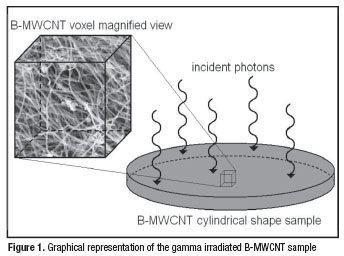
<p><font size="2" face="Verdana, Arial, Helvetica, sans-serif">  The effective atom displacement cross-sections were calculated using the MCCM  (Monte Carlo assisted Classical Method) algorithm. This software takes into account  the McKinley-Feshbach approach [17] with the Kinchin-Pease approximation [18]  for the damage function. A more complete and detailed explanation of this procedure  can be found in [19].</font></p>    <p><font size="2" face="Verdana, Arial, Helvetica, sans-serif">  <a href="#f01025313">Figure 1</a> shows a graphical representation of the simulated  experiment. A multi-walled carbon nanotubes cylindrical shaped sample (100 &micro;m  diameter and 10 &micro;m thickness) is irradiated with monochromatic photons of  given energies. These photons impact perpendicularly and homogeneously distributed  over top surface of the cylinder. The atom displacement profile determination  is performed in a 10 &mu;m x 10 &mu;m x 10 &mu;m voxel located in the center of  the cylinder.</font></p>    <p align="center"><img src="/img/revistas/nuc/n53/f01025313.jpg" width="344" height="256"><a name="f01025313"></a></p>    
<p><font size="2" face="Verdana, Arial, Helvetica, sans-serif">  The energy fluxes of electrons and positrons were calculated at different depths  within the selected voxel. This calculation was accomplished with the use of MCNPX  (Monte Carlos n - Particles Transport Code) software [20], which simulates the  transport of photons and particles in matter. The obtained energy fluxes results  were processed by the MCCM program to determine the number of atom displacements  with depth in the selected voxel for each kind of secondary particle.</font></p>    <p><font size="2" face="Verdana, Arial, Helvetica, sans-serif">  All simulation results are reported with a relative statistical error lower than  1%, which was ensured using a large number (10 million) of simulated incident  photons and its secondary particles.</font></p>    <p><font size="2" face="Verdana, Arial, Helvetica, sans-serif">  The displacement threshold energy, <img src="/img/revistas/nuc/n53/e04025313.jpg" width="17" height="19">,  is an important characteristic describing the radiation hardness of the material.  It is related not only to the bond energy but also to the local chemical bonding,  to the availability of open space in the structure, and it may depend on the system  geometry (e.g. diameter of a nanotube, incidence angle of radiation). Due to this,  the determination of <img src="/img/revistas/nuc/n53/e04025313.jpg" width="17" height="19">  is complicated, and for our target material a wide range of <img src="/img/revistas/nuc/n53/e04025313.jpg" width="17" height="19"><em>  </em>values are reported in the literature. This threshold energy interval is  usually between 15 and 20 eV [21, 22]. For this work was selected the average  value <img src="/img/revistas/nuc/n53/e04025313.jpg" width="17" height="19">=  19.3 eV reported in [23], where the authors studied the angular dependence of  the threshold energy using molecular-dynamics simulations.</font></p><h1 align="left">&nbsp;</h1>    
<p align="left"><font size="3" face="Verdana, Arial, Helvetica, sans-serif"><strong>RESULTS  AND DISCUSSION</strong></font></p>    <p><font size="2" face="Verdana, Arial, Helvetica, sans-serif">Gamma  radiation is not able to directly transfer the energy needed to produce atom displacements,  therefore the products of its interaction with matter (electrons and positrons)  are responsible for this process. If the kinetic energy transferred from particle  to the nucleus is higher than <img src="/img/revistas/nuc/n53/e04025313.jpg" width="17" height="19">,  a carbon atom can leave its initial position to form a metastable structural defect  on a subpicosecond time scale. The probability of this atom displacement process  is determined by the displacement cross section, calculated using the previously  explained methodology. Displacement cross section dependences with the secondary  electron and positron kinetic energies <em><img src="/img/revistas/nuc/n53/e05025313.jpg" width="57" height="16"></em>  are shown in <a href="#f02025313">figure 2</a>. The behaviors of these two plots  are similar, increasing with energy within the entire studied energy interval.  Values of <em>&sigma;dpa</em> calculated for electrons are lightly higher than  those of positrons, but no more than 3.36% in average. </font></p>    
<p align="center"><img src="/img/revistas/nuc/n53/f02025313.jpg" width="320" height="257"><a name="f02025313"></a></p>    
]]></body>
<body><![CDATA[<p><font size="2" face="Verdana, Arial, Helvetica, sans-serif">  As can be accurately observed in the inset graph of <a href="#f02025313">figure  2</a> (magnification of the low energy region, <img src="/img/revistas/nuc/n53/e06025313.jpg" width="32" height="19">&le;  1 MeV) the atom displacements processes are energetically possible for particle  energy &ge; 100 keV.</font></p>    
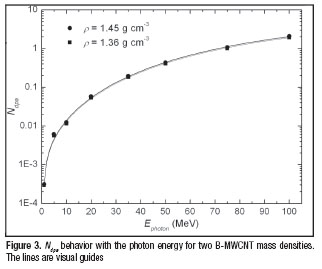
<p><font size="2" face="Verdana, Arial, Helvetica, sans-serif">  If the primary rejected atom has enough energy to displace another atom by atom-atom  collisions, then the multiple atoms displacements may take place. The multilayer  structure and the bulk character of the studied sample increases the probabilities  of occurring cascades processes. The precise moment when the multiple atoms displacements  processes begin is observable in <a href="#f02025313">figure 2</a> at the point  where an abrupt curves slope change takes place. As seen, the energy at which  the atom displacement cascades begin is ~ 500 keV for both, electrons and positrons.  </font></p>    <p><font size="2" face="Verdana, Arial, Helvetica, sans-serif"> <a href="#f03025313">Figure  3</a> shows the calculation results for the total number of displacements per  atom as a function of the incident photon energy for two mass density values.  Here, <em><img src="/img/revistas/nuc/n53/e09025313.jpg" width="27" height="22"></em>  denotes the sum of all the involved particles contributions to <em>dpa</em> in  the whole voxel volume. In <a href="#f03025313">this figure</a> is observed that  <em><img src="/img/revistas/nuc/n53/e09025313.jpg" width="27" height="22">  </em>behaviors with the photon energy are monotonous increasing in the whole studied  energy range. For photon energies higher than 20 MeV, difference between the two  distributions is almost constant, being approximately 6% superior for the sample  with <em><img src="/img/revistas/nuc/n53/e08025313.jpg" width="12" height="15"></em>  = 1.45 g <img src="/img/revistas/nuc/n53/e03025313.jpg" width="29" height="13">.</font></p>    
<p align="center"><img src="/img/revistas/nuc/n53/f03025313.jpg" width="322" height="269"><a name="f03025313"></a></p>    
<p><font size="2" face="Verdana, Arial, Helvetica, sans-serif">  The behaviors of the total number of atom displacements with depth inside the  sample for both analyzed mass densities are presented in <a href="/img/revistas/nuc/n53/f04025313.jpg">figure  4</a>. Here, reported <em><img src="/img/revistas/nuc/n53/e09025313.jpg" width="27" height="22"></em>  values refer to the total number of stable defects generated in a 1 &micro;m thick  layer within the voxel shown in <a href="#f01025313">figure 1</a>. These layers  are located parallel at different depths in a continuous arrangement and perpendicularly  to the incident photons direction.</font></p>    
<p><font size="2" face="Verdana, Arial, Helvetica, sans-serif">  For both analyzed sample mass densities, the <em><img src="/img/revistas/nuc/n53/e09025313.jpg" width="27" height="22">  </em>in-depth dependences increase monotonically along the entire sample, thus  showing inhomogeneous volume distribution within the sample for all studied energies.  The <em><img src="/img/revistas/nuc/n53/e09025313.jpg" width="27" height="22"></em>  highest values are located near to the sample surface opposite to the incidence  surface.</font></p>    
<p><font size="2" face="Verdana, Arial, Helvetica, sans-serif">  Taken as reference the <em><img src="/img/revistas/nuc/n53/e09025313.jpg" width="27" height="22"></em>  values generated by the low-energy photons (1 MeV), the number of point defects  produced by the other examined energies (20, 50, 75 and 100 MeV) were found to  be higher by about 180, 1400, 3500 and 6600 times respectively, regardless of  the depth where the events take place and the mass density of the studied samples.</font></p>    
<p><font size="2" face="Verdana, Arial, Helvetica, sans-serif">  At first sight the differences between the profiles presented in <a href="/img/revistas/nuc/n53/f04025313.jpg">figures  4 (a)</a> and <a href="/img/revistas/nuc/n53/f04025313.jpg">(b)</a> are not  observable. Detailed analysis showed that the distributions corresponding to the  higher mass density sample were on average 6.59% higher than those ones belonging  to the lighter sample. This small difference between the defects numbers created  in the sample volume is closely related to the ratio between the two mass densities  (6.62%). This result is reasonable because the density parameter appears as a  linear factor in the used formalism for calculating the <em>dpa</em> and it is  the one parameter that changes in the simulated experiment. </font></p>    
<p><font size="2" face="Verdana, Arial, Helvetica, sans-serif">  <a href="/img/revistas/nuc/n53/f05025313.jpg">Figures 5 (a)</a> and <a href="/img/revistas/nuc/n53/f05025313.jpg">(b)</a>  present the results of the <em><img src="/img/revistas/nuc/n53/e09025313.jpg" width="27" height="22"></em>  decomposition in its two components, the electron and the positron contributions.  The first conclusion from the analysis of these <a href="/img/revistas/nuc/n53/f05025313.jpg">two  figures</a> is that the relationship between <em><img src="/img/revistas/nuc/n53/e09025313.jpg" width="27" height="22"></em>  partial contributions dependence to the mass density is negligible. </font></p>    
<p><font size="2" face="Verdana, Arial, Helvetica, sans-serif">  As can be seen for <a href="/img/revistas/nuc/n53/f05025313.jpg">both figures</a>,  at low energies the positrons contribution to the stable structural point defects  formation is significantly lower than the electrons one. For photons energies  lower than 1.02 MeV positrons contribution is completely absent, as expected.</font></p>    
]]></body>
<body><![CDATA[<p><font size="2" face="Verdana, Arial, Helvetica, sans-serif">  With increasing photon energy the occurrence probability of the pair formation  phenomenon growths generating a larger number of positrons and increasing their  maximum kinetic energies. The positron displacement cross section <a href="#f02025313">(see  figure 2)</a> and the particle range also rise with the particle energy.</font></p>    <p><font size="2" face="Verdana, Arial, Helvetica, sans-serif">  All this leads to the observed behaviors in <a href="/img/revistas/nuc/n53/f05025313.jpg">figures  5 (a)</a> and <a href="/img/revistas/nuc/n53/f05025313.jpg">(b)</a>; with  increasing photon energy, the weight of the positron component grows up to close  to the electronic component. The positrons contribution to the total number of  <em>dpa</em> generated in the sample were found to be 3.8%, 11.4%, 35.5% and 41.8%  for photon energies of 5, 10, 50 and 100 MeV respectively.</font></p>    
<p><font size="2" face="Verdana, Arial, Helvetica, sans-serif">  As can be seen, positrons contribute substantially to the total number of atom  displacements in the analyzed structure exposed to radiation. This fact contradicts  the affirmation made by some authors whom claim that, since the generated positron  subsequently annihilates by combining with an electron, its effect on atom displacement  is negligibly small, and they does not included it in the calculation. For example,  in [24] the authors present the results in the determination of the displacement  cross section in various materials including C for gamma energies up to 14 MeV,  avoiding in all the cases the positron contributions to the displacement damage.  Following the used methodology, we have determinate that for 14 MeV gamma energy  the positron contribution to the total displacement number in B-MWCNT sample (carbon  allotrope) is about 16%, value which cannot be considered negligible. In previous  studies, where bulk fullerene C60 [25] and YBCO superconducting materials [26]  where studied following the same procedure as here, similar results were obtained.  In summary, these results prove that the positron contribution cannot be ignored,  and it takes a significant importance when increasing the photon energy.</font></p>    <p>&nbsp;</p><h1><font size="3" face="Verdana, Arial, Helvetica, sans-serif">CONCLUSIONS</font></h1>    <p><font size="2" face="Verdana, Arial, Helvetica, sans-serif">The  atom displacement cross section dependences with the secondary electron and positron  kinetic energies for B-MWCNT were calculated in the energy range up to 100 MeV.  Both behaviors are increasing with the energy and the values obtained for electrons  are on average 3.36% higher than for positrons. The displacements processes start  at particle energy ~ 100 keV and the multiple atoms displacements begin at energy  close to 500 keV for both electrons and positrons. The total number of displacements  per atom as a function of the incident photon energy was determined for two mass  densities. These profiles show a monotonous increasing behavior in all the energy  range, with values which are 6.6% higher for the sample with greater mass density.  The dependence with depth of the total number of atom displacements is also monotonically  increasing along the entire sample, with slopes growing up with photon energy.  The electron and positron contributions to the <em><img src="/img/revistas/nuc/n53/e09025313.jpg" width="27" height="22"></em>  as a function of photon energy were presented, showing that the relationship between  <em><img src="/img/revistas/nuc/n53/e09025313.jpg" width="27" height="22"></em>  partial contributions dependence to the mass density is negligible. At very low  energies the positrons contribution to the <em><img src="/img/revistas/nuc/n53/e09025313.jpg" width="27" height="22"></em>  is small, but its role increases with photon energy, reaching the 3.8%, 11.4%,  35.5% and 41.8% for photon energy of 5, 10, 50 and 100 MeV respectively. This  behavior is independent of the B-MWCNT target mass density. These results confirm  once again that the positron contribution to the atom displacements in materials  should be considered, taking more importance when increasing the incident photon  energy.</font></p>    
<p>&nbsp;</p><h1 align="left"><font size="3" face="Verdana, Arial, Helvetica, sans-serif">ACKNOWLEDGEMENTS</font></h1>    <p><font size="2" face="Verdana, Arial, Helvetica, sans-serif">This  work was supported by the AENTA of Cuba through the project PRN/6-2/3.</font></p>    <p>&nbsp;</p>    <p><font size="3" face="Verdana, Arial, Helvetica, sans-serif"><strong>REFERENCES</strong></font></p>    <!-- ref --><p><font size="2" face="Verdana, Arial, Helvetica, sans-serif">1.  ISMAT S, HASSNAIN G, YASSITEPE E, ALI B. Evaporation: processes, bulk microstructures,  and mechanical properties. Chapter 4. In: Handbook of deposition technologies  for films and coatings: science, applications and technology. Third Edition. Elsevier  Inc., 2010. p. 135-252.    <!-- ref --><br> 2. SKAKALOVA V, DETTLAFF-WEGLIKOWSKA U, ROTH S. Gamma-irradiated  and functionalized single wall nanotubes. Diamond and Related Materials. 2004;  13(2): 296-298.    <!-- ref --><br> 3. DMYTRENKO OP, KULISH NP, BELYI NM, et al. Dose dependences  of the optical properties of fullerene films subjected to the electron irradiation.  Thin Solid Films. 2006; 495(1-2): 365-367.    <!-- ref --><br> 4. DHARAMVIR K, JEET K, DU C, et  al. Structural Modifications of Multiwalled Carbon Nanotubes by Swift Heavy Ions  Irradiation. Journal of Nano Research. 2010; 10: 1-9.    <!-- ref --><br> 5. RODR&Iacute;GUEZ  JA, TOLVANEN A, KRASHENINNIKOV AV, et al. Defect-induced junctions between single-  or double-wall carbon nanotubes and metal crystals. Nanoscale. 2010; 2(6): 901-905.    <!-- ref --><br>  6. KRASHENINNIKOV AV, NORDLUND K. Ion and electron irradiation-induced effects  in nanostructured materials. J. Appl. Phys.&nbsp; 2010; 107(7): 071301-071370.    <!-- ref --><br>  7. ZHIWEI X, LEI C, LIANGSEN L, et. al. Structural changes in multi-walled carbon  nanotubes caused by gamma-ray irradiation. Carbon. 2011; 4(1): 350-351.    <!-- ref --><br> 8.  YAZYEV OV, TAVERNELLI I, ROTHLISBERGER U, HELM L. Early stages of radiation damage  in graphite and carbon nanostructures: A first-principles molecular dynamics study.  Phys. Rev. B. 2007; 75(11): 115418-115422.    <br> 9. THEOCHAROUS SP, THEOCHAROUS  E, LEHMAN JH. The evaluation of the performance of two pyroelectric detectors  with vertically aligned multi-walled carbon nanotube coatings. Infrared Physics  &amp; Technology. 2012; 55(4): 299&ndash;305.    <!-- ref --><br> 10. PINGFAN D, LIXIN S, JIE  X, et al. Dye-sensitized solar cells based on anatase TiO2/multi-walled carbon  nanotubes composite nanofibers photoanode. Electrochimica Acta. 2013; 87(1): 651-656.    <!-- ref --><br>  11. ZHILI X, YOUNG SY, HYOUNG-JOON J. Applications of Carbon Nanotubes for Lithium  Ion Battery Anodes. Materials. 2013; 6(3): 1138-1158.    <!-- ref --><br> 12. JOO-HYUNG K, SUNGRYUL  Y, HYUN-U K, JAEHWAN K. A flexible paper transistor made with aligned single-walled  carbon nanotube bonded cellulose composite. Current Applied Physics. 2013; 13(5):  897-901.    <!-- ref --><br> 13. JOVANOVIC SP, MARKOVIC ZM, KLEUT DN, et al. A novel method for  the functionalization of gamma-irradiated single wall carbon nanotubes with DNA.  Nanotechnology. 2009; 20(44): 4456021-4456028.    <!-- ref --><br> 14. VITUSEVICH SA, SYDORUK  VA, PETRYCHUK MV, et al. Transport properties of single-walled carbon nanotube  transistors after gamma radiation treatment. J. Appl. Phys. 2010; 107(6): 063701-063707.    <!-- ref --><br>  15. LEE KY, KIM KY. 60Co gamma-ray irradiation effect and degradation behaviors  of a carbon nanotube and poly(ethylene-co-vinyl acetate) nanocomposites. Polymer  Degradation and Stability. 2008; 93(7): 1290-1299.    <!-- ref --><br> 16. ZHANG HL, LI JF, YAO  KF, CHEN LD. Spark plasma sintering and thermal conductivity of carbon nanotube  bulk materials. J. Appl. Phys. 2005; 97(11): 114310-114315.    <!-- ref --><br> 17. MCKINLEY WA,  FESHBACH H. The coulomb scattering of relativistic electrons by nuclei. Phys.  Rev. 1948; 74(12): 1759-1763.    <!-- ref --><br> 18. KINCHIN GH, PEASE RS. The displacement of  atoms in solids by radiation. Rep. Prog. Phys. 1955; 18(1): 1-51.    <!-- ref --><br> 19. PI&Ntilde;ERA  I, CRUZ C, ABREU Y, et. al. Monte Carlo assisted classical method for the calculation  of dpa distribution in solid materials. IEEE Nuclear Science Symposium Conference  Record, 2008. NSS '08. IEEE. Dresden, Germany. 19-25 Oct. 2008. &nbsp;p. 2557-2560.  doi: 10.1109/NSSMIC.2008.4774878.    <!-- ref --><br> 20. HENDRICKS JS, MCKINNEY GW, TRELLUE HR,  et. al. MCNPXTM (version 2.6.B). Report LA-UR-06-3248. Los Alamos National Laboratory,  2006.    <!-- ref --><br> 21. BANHART F. Irradiation effects in carbon nanostructures. Rep. Prog.  Phys. 1999; 62(8): 1181-1221.    <!-- ref --><br> 22. BANHART F, FULLER T, REDLICH Ph, AJAYAN  PM. The formation, annealing and self-compression of carbon onions under electron  irradiation. Chem. Phys. Lett. 1997; 269(3-4): 349-355.    <!-- ref --><br> 23. CUI FZ, CHEN ZJ,  MA J, et al. Atomistic simulation of radiation damage to carbon nanotube. Physics  Letters A. 2002; 295(1): 55-59.    <!-- ref --><br> 24. KWON J, MOTTA AT. Gamma displacement cross-sections  in various materials. Annals of Nuclear Energy. 2000; 27(18): 1627-1642.    <!-- ref --><br> 25.  LEYVA A, PI&Ntilde;ERA I, LEYVA D, et. al. Monte Carlo calculation of carbon atom  displacement damage in C60 fullerene bulk materials irradiated with gamma rays.  Nucleus. 2012; (51): 20-25.    <!-- ref --><br> 26. PI&Ntilde;ERA I, CRUZ C, ABREU Y, et. al.  Monte Carlo simulation study of positron contribution to displacement per atom  production in YBCO superconductors. Nucl. Inst. Meth. Phys. Res. Section B. 2008;  266(22): 4899-4902.    </font></p>    <p>&nbsp;</p>    <p>&nbsp;</p>    <p><font size="2" face="Verdana, Arial, Helvetica, sans-serif"><strong>Recibido:</strong>  10 de diciembre de 2012     <br> <strong>Aceptado:</strong></font> <font size="2" face="Verdana, Arial, Helvetica, sans-serif">25  de abril de 2013</font> </p>     ]]></body>
<body><![CDATA[ ]]></body><back>
<ref-list>
<ref id="B1">
<label>1</label><nlm-citation citation-type="book">
<person-group person-group-type="author">
<name>
<surname><![CDATA[ISMAT]]></surname>
<given-names><![CDATA[S]]></given-names>
</name>
<name>
<surname><![CDATA[HASSNAIN]]></surname>
<given-names><![CDATA[G]]></given-names>
</name>
<name>
<surname><![CDATA[YASSITEPE]]></surname>
<given-names><![CDATA[E]]></given-names>
</name>
<name>
<surname><![CDATA[ALI]]></surname>
<given-names><![CDATA[B]]></given-names>
</name>
</person-group>
<article-title xml:lang="en"><![CDATA[Evaporation: processes, bulk microstructures, and mechanical properties. Chapter 4]]></article-title>
<source><![CDATA[Handbook of deposition technologies for films and coatings: science, applications and technology]]></source>
<year>2010</year>
<edition>Third</edition>
<page-range>135-252</page-range><publisher-name><![CDATA[Elsevier Inc]]></publisher-name>
</nlm-citation>
</ref>
<ref id="B2">
<label>2</label><nlm-citation citation-type="journal">
<person-group person-group-type="author">
<name>
<surname><![CDATA[SKAKALOVA]]></surname>
<given-names><![CDATA[V]]></given-names>
</name>
<name>
<surname><![CDATA[DETTLAFF-WEGLIKOWSKA]]></surname>
<given-names><![CDATA[U]]></given-names>
</name>
<name>
<surname><![CDATA[ROTH]]></surname>
<given-names><![CDATA[S]]></given-names>
</name>
</person-group>
<article-title xml:lang="en"><![CDATA[Gamma-irradiated and functionalized single wall nanotubes]]></article-title>
<source><![CDATA[Diamond and Related Materials]]></source>
<year>2004</year>
<volume>13</volume>
<numero>2</numero>
<issue>2</issue>
<page-range>296-298</page-range></nlm-citation>
</ref>
<ref id="B3">
<label>3</label><nlm-citation citation-type="journal">
<person-group person-group-type="author">
<name>
<surname><![CDATA[DMYTRENKO]]></surname>
<given-names><![CDATA[OP]]></given-names>
</name>
<name>
<surname><![CDATA[KULISH]]></surname>
<given-names><![CDATA[NP]]></given-names>
</name>
<name>
<surname><![CDATA[BELYI]]></surname>
<given-names><![CDATA[NM]]></given-names>
</name>
</person-group>
<article-title xml:lang="en"><![CDATA[Dose dependences of the optical properties of fullerene films subjected to the electron irradiation]]></article-title>
<source><![CDATA[Thin Solid Films]]></source>
<year>2006</year>
<volume>495</volume>
<numero>1-2</numero>
<issue>1-2</issue>
<page-range>365-367</page-range></nlm-citation>
</ref>
<ref id="B4">
<label>4</label><nlm-citation citation-type="journal">
<person-group person-group-type="author">
<name>
<surname><![CDATA[DHARAMVIR]]></surname>
<given-names><![CDATA[K]]></given-names>
</name>
<name>
<surname><![CDATA[JEET]]></surname>
<given-names><![CDATA[K]]></given-names>
</name>
<name>
<surname><![CDATA[DU]]></surname>
<given-names><![CDATA[C]]></given-names>
</name>
</person-group>
<article-title xml:lang="en"><![CDATA[Structural Modifications of Multiwalled Carbon Nanotubes by Swift Heavy Ions Irradiation]]></article-title>
<source><![CDATA[Journal of Nano Research]]></source>
<year>2010</year>
<volume>10</volume>
<page-range>1-9</page-range></nlm-citation>
</ref>
<ref id="B5">
<label>5</label><nlm-citation citation-type="journal">
<person-group person-group-type="author">
<name>
<surname><![CDATA[RODRÍGUEZ]]></surname>
<given-names><![CDATA[JA]]></given-names>
</name>
<name>
<surname><![CDATA[TOLVANEN]]></surname>
<given-names><![CDATA[A]]></given-names>
</name>
<name>
<surname><![CDATA[KRASHENINNIKOV]]></surname>
<given-names><![CDATA[AV]]></given-names>
</name>
</person-group>
<article-title xml:lang="en"><![CDATA[Defect-induced junctions between single- or double-wall carbon nanotubes and metal crystals]]></article-title>
<source><![CDATA[Nanoscale]]></source>
<year>2010</year>
<volume>2</volume>
<numero>6</numero>
<issue>6</issue>
<page-range>901-905</page-range></nlm-citation>
</ref>
<ref id="B6">
<label>6</label><nlm-citation citation-type="journal">
<person-group person-group-type="author">
<name>
<surname><![CDATA[KRASHENINNIKOV]]></surname>
<given-names><![CDATA[AV]]></given-names>
</name>
<name>
<surname><![CDATA[NORDLUND]]></surname>
<given-names><![CDATA[K]]></given-names>
</name>
</person-group>
<article-title xml:lang="en"><![CDATA[Ion and electron irradiation-induced effects in nanostructured materials]]></article-title>
<source><![CDATA[J. Appl. Phys]]></source>
<year>2010</year>
<volume>107</volume>
<numero>7</numero>
<issue>7</issue>
<page-range>071301-071370</page-range></nlm-citation>
</ref>
<ref id="B7">
<label>7</label><nlm-citation citation-type="journal">
<person-group person-group-type="author">
<name>
<surname><![CDATA[ZHIWEI]]></surname>
<given-names><![CDATA[X]]></given-names>
</name>
<name>
<surname><![CDATA[LEI]]></surname>
<given-names><![CDATA[C]]></given-names>
</name>
<name>
<surname><![CDATA[LIANGSEN]]></surname>
<given-names><![CDATA[L]]></given-names>
</name>
</person-group>
<article-title xml:lang="en"><![CDATA[Structural changes in multi-walled carbon nanotubes caused by gamma-ray irradiation]]></article-title>
<source><![CDATA[Carbon]]></source>
<year>2011</year>
<volume>4</volume>
<numero>1</numero>
<issue>1</issue>
<page-range>350-351</page-range></nlm-citation>
</ref>
<ref id="B8">
<label>8</label><nlm-citation citation-type="journal">
<person-group person-group-type="author">
<name>
<surname><![CDATA[YAZYEV]]></surname>
<given-names><![CDATA[OV]]></given-names>
</name>
<name>
<surname><![CDATA[TAVERNELLI]]></surname>
<given-names><![CDATA[I]]></given-names>
</name>
<name>
<surname><![CDATA[ROTHLISBERGER]]></surname>
<given-names><![CDATA[U]]></given-names>
</name>
<name>
<surname><![CDATA[HELM]]></surname>
<given-names><![CDATA[L]]></given-names>
</name>
</person-group>
<article-title xml:lang="en"><![CDATA[Early stages of radiation damage in graphite and carbon nanostructures: A first-principles molecular dynamics study]]></article-title>
<source><![CDATA[Phys. Rev. B]]></source>
<year>2007</year>
<volume>75</volume>
<numero>11</numero>
<issue>11</issue>
<page-range>115418-115422</page-range></nlm-citation>
</ref>
<ref id="B9">
<label>9</label><nlm-citation citation-type="journal">
<person-group person-group-type="author">
<name>
<surname><![CDATA[THEOCHAROUS]]></surname>
<given-names><![CDATA[SP]]></given-names>
</name>
<name>
<surname><![CDATA[THEOCHAROUS]]></surname>
<given-names><![CDATA[E]]></given-names>
</name>
<name>
<surname><![CDATA[LEHMAN]]></surname>
<given-names><![CDATA[JH]]></given-names>
</name>
</person-group>
<article-title xml:lang="en"><![CDATA[The evaluation of the performance of two pyroelectric detectors with vertically aligned multi-walled carbon nanotube coatings]]></article-title>
<source><![CDATA[Infrared Physics & Technology]]></source>
<year>2012</year>
<volume>55</volume>
<numero>4</numero>
<issue>4</issue>
<page-range>299-305</page-range></nlm-citation>
</ref>
<ref id="B10">
<label>10</label><nlm-citation citation-type="journal">
<person-group person-group-type="author">
<name>
<surname><![CDATA[PINGFAN]]></surname>
<given-names><![CDATA[D]]></given-names>
</name>
<name>
<surname><![CDATA[LIXIN]]></surname>
<given-names><![CDATA[S]]></given-names>
</name>
<name>
<surname><![CDATA[JIE]]></surname>
<given-names><![CDATA[X]]></given-names>
</name>
</person-group>
<article-title xml:lang="en"><![CDATA[Dye-sensitized solar cells based on anatase TiO2/multi-walled carbon nanotubes composite nanofibers photoanode]]></article-title>
<source><![CDATA[Electrochimica Acta]]></source>
<year>2013</year>
<volume>87</volume>
<numero>1</numero>
<issue>1</issue>
<page-range>651-656</page-range></nlm-citation>
</ref>
<ref id="B11">
<label>11</label><nlm-citation citation-type="journal">
<person-group person-group-type="author">
<name>
<surname><![CDATA[ZHILI]]></surname>
<given-names><![CDATA[X]]></given-names>
</name>
<name>
<surname><![CDATA[YOUNG]]></surname>
<given-names><![CDATA[SY]]></given-names>
</name>
<name>
<surname><![CDATA[HYOUNG-JOON]]></surname>
<given-names><![CDATA[J]]></given-names>
</name>
</person-group>
<article-title xml:lang="en"><![CDATA[Applications of Carbon Nanotubes for Lithium Ion Battery Anodes]]></article-title>
<source><![CDATA[Materials]]></source>
<year>2013</year>
<volume>6</volume>
<numero>3</numero>
<issue>3</issue>
<page-range>1138-1158</page-range></nlm-citation>
</ref>
<ref id="B12">
<label>12</label><nlm-citation citation-type="journal">
<person-group person-group-type="author">
<name>
<surname><![CDATA[JOO-HYUNG]]></surname>
<given-names><![CDATA[K]]></given-names>
</name>
<name>
<surname><![CDATA[SUNGRYUL]]></surname>
<given-names><![CDATA[Y]]></given-names>
</name>
<name>
<surname><![CDATA[HYUN-U]]></surname>
<given-names><![CDATA[K]]></given-names>
</name>
<name>
<surname><![CDATA[JAEHWAN]]></surname>
<given-names><![CDATA[K]]></given-names>
</name>
</person-group>
<article-title xml:lang="en"><![CDATA[A flexible paper transistor made with aligned single-walled carbon nanotube bonded cellulose composite]]></article-title>
<source><![CDATA[Current Applied Physics]]></source>
<year>2013</year>
<volume>13</volume>
<numero>5</numero>
<issue>5</issue>
<page-range>897-901</page-range></nlm-citation>
</ref>
<ref id="B13">
<label>13</label><nlm-citation citation-type="journal">
<person-group person-group-type="author">
<name>
<surname><![CDATA[JOVANOVIC]]></surname>
<given-names><![CDATA[SP]]></given-names>
</name>
<name>
<surname><![CDATA[MARKOVIC]]></surname>
<given-names><![CDATA[ZM]]></given-names>
</name>
<name>
<surname><![CDATA[KLEUT]]></surname>
<given-names><![CDATA[DN]]></given-names>
</name>
</person-group>
<article-title xml:lang="en"><![CDATA[A novel method for the functionalization of gamma-irradiated single wall carbon nanotubes with DNA]]></article-title>
<source><![CDATA[Nanotechnology]]></source>
<year>2009</year>
<volume>20</volume>
<numero>44</numero>
<issue>44</issue>
<page-range>4456021-4456028</page-range></nlm-citation>
</ref>
<ref id="B14">
<label>14</label><nlm-citation citation-type="journal">
<person-group person-group-type="author">
<name>
<surname><![CDATA[VITUSEVICH]]></surname>
<given-names><![CDATA[SA]]></given-names>
</name>
<name>
<surname><![CDATA[SYDORUK]]></surname>
<given-names><![CDATA[VA]]></given-names>
</name>
<name>
<surname><![CDATA[PETRYCHUK]]></surname>
<given-names><![CDATA[MV]]></given-names>
</name>
</person-group>
<article-title xml:lang="en"><![CDATA[Transport properties of single-walled carbon nanotube transistors after gamma radiation treatment]]></article-title>
<source><![CDATA[J. Appl. Phys]]></source>
<year>2010</year>
<volume>107</volume>
<numero>6</numero>
<issue>6</issue>
<page-range>063701-063707</page-range></nlm-citation>
</ref>
<ref id="B15">
<label>15</label><nlm-citation citation-type="journal">
<person-group person-group-type="author">
<name>
<surname><![CDATA[LEE]]></surname>
<given-names><![CDATA[KY]]></given-names>
</name>
<name>
<surname><![CDATA[KIM]]></surname>
<given-names><![CDATA[KY]]></given-names>
</name>
</person-group>
<article-title xml:lang="en"><![CDATA[60Co gamma-ray irradiation effect and degradation behaviors of a carbon nanotube and poly(ethylene-co-vinyl acetate) nanocomposites]]></article-title>
<source><![CDATA[Polymer Degradation and Stability]]></source>
<year>2008</year>
<volume>93</volume>
<numero>7</numero>
<issue>7</issue>
<page-range>1290-1299</page-range></nlm-citation>
</ref>
<ref id="B16">
<label>16</label><nlm-citation citation-type="journal">
<person-group person-group-type="author">
<name>
<surname><![CDATA[ZHANG]]></surname>
<given-names><![CDATA[HL]]></given-names>
</name>
<name>
<surname><![CDATA[LI]]></surname>
<given-names><![CDATA[JF]]></given-names>
</name>
<name>
<surname><![CDATA[YAO]]></surname>
<given-names><![CDATA[KF]]></given-names>
</name>
<name>
<surname><![CDATA[CHEN]]></surname>
<given-names><![CDATA[LD]]></given-names>
</name>
</person-group>
<article-title xml:lang="en"><![CDATA[Spark plasma sintering and thermal conductivity of carbon nanotube bulk materials]]></article-title>
<source><![CDATA[J. Appl. Phys]]></source>
<year>2005</year>
<volume>97</volume>
<numero>11</numero>
<issue>11</issue>
<page-range>114310-114315</page-range></nlm-citation>
</ref>
<ref id="B17">
<label>17</label><nlm-citation citation-type="journal">
<person-group person-group-type="author">
<name>
<surname><![CDATA[MCKINLEY]]></surname>
<given-names><![CDATA[WA]]></given-names>
</name>
<name>
<surname><![CDATA[FESHBACH]]></surname>
<given-names><![CDATA[H]]></given-names>
</name>
</person-group>
<article-title xml:lang="en"><![CDATA[The coulomb scattering of relativistic electrons by nuclei]]></article-title>
<source><![CDATA[Phys. Rev]]></source>
<year>1948</year>
<volume>74</volume>
<numero>12</numero>
<issue>12</issue>
<page-range>1759-1763</page-range></nlm-citation>
</ref>
<ref id="B18">
<label>18</label><nlm-citation citation-type="journal">
<person-group person-group-type="author">
<name>
<surname><![CDATA[KINCHIN]]></surname>
<given-names><![CDATA[GH]]></given-names>
</name>
<name>
<surname><![CDATA[PEASE]]></surname>
<given-names><![CDATA[RS]]></given-names>
</name>
</person-group>
<article-title xml:lang="en"><![CDATA[The displacement of atoms in solids by radiation]]></article-title>
<source><![CDATA[Rep. Prog. Phys]]></source>
<year>1955</year>
<volume>18</volume>
<numero>1</numero>
<issue>1</issue>
<page-range>1-51</page-range></nlm-citation>
</ref>
<ref id="B19">
<label>19</label><nlm-citation citation-type="confpro">
<person-group person-group-type="author">
<name>
<surname><![CDATA[PIÑERA]]></surname>
<given-names><![CDATA[I]]></given-names>
</name>
<name>
<surname><![CDATA[CRUZ]]></surname>
<given-names><![CDATA[C]]></given-names>
</name>
<name>
<surname><![CDATA[ABREU]]></surname>
<given-names><![CDATA[Y]]></given-names>
</name>
</person-group>
<source><![CDATA[Monte Carlo assisted classical method for the calculation of dpa distribution in solid materials]]></source>
<year></year>
<conf-name><![CDATA[ IEEE Nuclear Science Symposium Conference Record, 2008. NSS '08. IEEE]]></conf-name>
<conf-date>19-25 Oct. 2008</conf-date>
<conf-loc>Dresden </conf-loc>
<page-range>2557-2560</page-range></nlm-citation>
</ref>
<ref id="B20">
<label>20</label><nlm-citation citation-type="book">
<person-group person-group-type="author">
<name>
<surname><![CDATA[HENDRICKS]]></surname>
<given-names><![CDATA[JS]]></given-names>
</name>
<name>
<surname><![CDATA[MCKINNEY]]></surname>
<given-names><![CDATA[GW]]></given-names>
</name>
<name>
<surname><![CDATA[TRELLUE]]></surname>
<given-names><![CDATA[HR]]></given-names>
</name>
</person-group>
<source><![CDATA[MCNPXTM (version 2.6.B): Report LA-UR-06-3248]]></source>
<year>2006</year>
<publisher-name><![CDATA[Los Alamos National Laboratory]]></publisher-name>
</nlm-citation>
</ref>
<ref id="B21">
<label>21</label><nlm-citation citation-type="journal">
<person-group person-group-type="author">
<name>
<surname><![CDATA[BANHART]]></surname>
<given-names><![CDATA[F]]></given-names>
</name>
</person-group>
<article-title xml:lang="en"><![CDATA[Irradiation effects in carbon nanostructures]]></article-title>
<source><![CDATA[Rep. Prog. Phys]]></source>
<year>1999</year>
<volume>62</volume>
<numero>8</numero>
<issue>8</issue>
<page-range>1181-1221</page-range></nlm-citation>
</ref>
<ref id="B22">
<label>22</label><nlm-citation citation-type="journal">
<person-group person-group-type="author">
<name>
<surname><![CDATA[BANHART]]></surname>
<given-names><![CDATA[F]]></given-names>
</name>
<name>
<surname><![CDATA[FULLER]]></surname>
<given-names><![CDATA[T]]></given-names>
</name>
<name>
<surname><![CDATA[REDLICH]]></surname>
<given-names><![CDATA[Ph]]></given-names>
</name>
<name>
<surname><![CDATA[AJAYAN]]></surname>
<given-names><![CDATA[PM]]></given-names>
</name>
</person-group>
<article-title xml:lang="en"><![CDATA[The formation, annealing and self-compression of carbon onions under electron irradiation]]></article-title>
<source><![CDATA[Chem. Phys. Lett]]></source>
<year>1997</year>
<volume>269</volume>
<numero>3-4</numero>
<issue>3-4</issue>
<page-range>349-355</page-range></nlm-citation>
</ref>
<ref id="B23">
<label>23</label><nlm-citation citation-type="journal">
<person-group person-group-type="author">
<name>
<surname><![CDATA[CUI]]></surname>
<given-names><![CDATA[FZ]]></given-names>
</name>
<name>
<surname><![CDATA[CHEN]]></surname>
<given-names><![CDATA[ZJ]]></given-names>
</name>
<name>
<surname><![CDATA[MA]]></surname>
<given-names><![CDATA[J]]></given-names>
</name>
</person-group>
<article-title xml:lang="en"><![CDATA[Atomistic simulation of radiation damage to carbon nanotube]]></article-title>
<source><![CDATA[Physics Letters A]]></source>
<year>2002</year>
<volume>295</volume>
<numero>1</numero>
<issue>1</issue>
<page-range>55-59</page-range></nlm-citation>
</ref>
<ref id="B24">
<label>24</label><nlm-citation citation-type="journal">
<person-group person-group-type="author">
<name>
<surname><![CDATA[KWON]]></surname>
<given-names><![CDATA[J]]></given-names>
</name>
<name>
<surname><![CDATA[MOTTA]]></surname>
<given-names><![CDATA[AT]]></given-names>
</name>
</person-group>
<article-title xml:lang="en"><![CDATA[Gamma displacement cross-sections in various materials]]></article-title>
<source><![CDATA[Annals of Nuclear Energy]]></source>
<year>2000</year>
<volume>27</volume>
<numero>18</numero>
<issue>18</issue>
<page-range>1627-1642</page-range></nlm-citation>
</ref>
<ref id="B25">
<label>25</label><nlm-citation citation-type="journal">
<person-group person-group-type="author">
<name>
<surname><![CDATA[LEYVA]]></surname>
<given-names><![CDATA[A]]></given-names>
</name>
<name>
<surname><![CDATA[PIÑERA]]></surname>
<given-names><![CDATA[I]]></given-names>
</name>
<name>
<surname><![CDATA[LEYVA]]></surname>
<given-names><![CDATA[D]]></given-names>
</name>
</person-group>
<article-title xml:lang="en"><![CDATA[Monte Carlo calculation of carbon atom displacement damage in C60 fullerene bulk materials irradiated with gamma rays]]></article-title>
<source><![CDATA[Nucleus]]></source>
<year>2012</year>
<numero>51</numero>
<issue>51</issue>
<page-range>20-25</page-range></nlm-citation>
</ref>
<ref id="B26">
<label>26</label><nlm-citation citation-type="journal">
<person-group person-group-type="author">
<name>
<surname><![CDATA[PIÑERA]]></surname>
<given-names><![CDATA[I]]></given-names>
</name>
<name>
<surname><![CDATA[CRUZ]]></surname>
<given-names><![CDATA[C]]></given-names>
</name>
<name>
<surname><![CDATA[ABREU]]></surname>
<given-names><![CDATA[Y]]></given-names>
</name>
</person-group>
<article-title xml:lang="en"><![CDATA[Monte Carlo simulation study of positron contribution to displacement per atom production in YBCO superconductors]]></article-title>
<source><![CDATA[Nucl. Inst. Meth. Phys. Res. Section B]]></source>
<year>2008</year>
<volume>266</volume>
<numero>22</numero>
<issue>22</issue>
<page-range>4899-4902</page-range></nlm-citation>
</ref>
</ref-list>
</back>
</article>