<?xml version="1.0" encoding="ISO-8859-1"?><article xmlns:mml="http://www.w3.org/1998/Math/MathML" xmlns:xlink="http://www.w3.org/1999/xlink" xmlns:xsi="http://www.w3.org/2001/XMLSchema-instance">
<front>
<journal-meta>
<journal-id>0864-084X</journal-id>
<journal-title><![CDATA[Nucleus]]></journal-title>
<abbrev-journal-title><![CDATA[Nucleus]]></abbrev-journal-title>
<issn>0864-084X</issn>
<publisher>
<publisher-name><![CDATA[CUBAENERGIA]]></publisher-name>
</publisher>
</journal-meta>
<article-meta>
<article-id>S0864-084X2013000100003</article-id>
<title-group>
<article-title xml:lang="en"><![CDATA[Raman D-band in the irradiated graphene: Origin of the non-monotonous dependence of its intensity with defect concentration]]></article-title>
<article-title xml:lang="es"><![CDATA[La banda D de Raman del grafeno irradiado: Origen de la dependencia no monótona de su intensidad con la concentración de defectos]]></article-title>
</title-group>
<contrib-group>
<contrib contrib-type="author">
<name>
<surname><![CDATA[Codorniu Pujals]]></surname>
<given-names><![CDATA[Daniel]]></given-names>
</name>
<xref ref-type="aff" rid="A01"/>
</contrib>
</contrib-group>
<aff id="A01">
<institution><![CDATA[,Instituto Superior de Tecnolog ías y Ciencias Aplicadas (INSTEC)  ]]></institution>
<addr-line><![CDATA[La Habana ]]></addr-line>
<country>Cuba</country>
</aff>
<pub-date pub-type="pub">
<day>00</day>
<month>06</month>
<year>2013</year>
</pub-date>
<pub-date pub-type="epub">
<day>00</day>
<month>06</month>
<year>2013</year>
</pub-date>
<numero>53</numero>
<fpage>10</fpage>
<lpage>13</lpage>
<copyright-statement/>
<copyright-year/>
<self-uri xlink:href="http://scielo.sld.cu/scielo.php?script=sci_arttext&amp;pid=S0864-084X2013000100003&amp;lng=en&amp;nrm=iso"></self-uri><self-uri xlink:href="http://scielo.sld.cu/scielo.php?script=sci_abstract&amp;pid=S0864-084X2013000100003&amp;lng=en&amp;nrm=iso"></self-uri><self-uri xlink:href="http://scielo.sld.cu/scielo.php?script=sci_pdf&amp;pid=S0864-084X2013000100003&amp;lng=en&amp;nrm=iso"></self-uri><abstract abstract-type="short" xml:lang="en"><p><![CDATA[Raman spectroscopy is one of the experimental techniques more used in studying irradiated carbon nanostructures, in particular graphene, due to its high sensibility to the presence of defects in the crystalline lattice. Special attention has received the variation of the intensity of the Raman D-band of graphene with the concentration of defects produced by irradiation. Nowadays, there are enough experimental evidences about the non-monotonous character of that dependence, but the explanation of this behavior is still controversial. In the present work we developed a simplified mathematical model to obtain a functional relationship between these two magnitudes and showed that the non-monotonous dependence is intrinsic to the nature of the D-band and that it is not necessarily linked to amorphization processes. The obtained functional dependence was used to fit experimental data taken from other authors. The determination coefficient of the fitting was.]]></p></abstract>
<abstract abstract-type="short" xml:lang="es"><p><![CDATA[La espectroscopía Raman es una de las técnicas experimentales más usadas en el estudio de las nano-estructuras de carbono irradiadas, en particular del grafeno, debido a su alta sensibilidad a la presencia de defectos en la red cristalina. Una atención especial ha recibido la variación de la intensidad de la banda D de los espectros Raman del grafeno con la concentración de defectos producida por la irradiación. Hoy día hay suficientes evidencias experimentales sobre el carácter no monótono de esa dependencia, pero la explicación de ese comportamiento todavía es polémica. En el presente trabajo se desarrolló un modelo matemático simplificado para obtener una relación funcional entre estas dos magnitudes y se demostró que la dependencia no-monótona es intrínseca a la naturaleza de la banda D y que no está ligada necesariamente a procesos de amorfización. La dependencia funcional obtenida fue utilizada para ajustar datos experimentales obtenidos por otros autores. Se obtuvo un ajuste con un coeficiente de determinación.]]></p></abstract>
<kwd-group>
<kwd lng="en"><![CDATA[graphene]]></kwd>
<kwd lng="en"><![CDATA[irradiation]]></kwd>
<kwd lng="en"><![CDATA[Raman spectroscopy]]></kwd>
<kwd lng="en"><![CDATA[nanostructures]]></kwd>
<kwd lng="en"><![CDATA[mathematical models]]></kwd>
<kwd lng="es"><![CDATA[grafeno]]></kwd>
<kwd lng="es"><![CDATA[irradiación]]></kwd>
<kwd lng="es"><![CDATA[espectroscopía Raman]]></kwd>
<kwd lng="es"><![CDATA[nanoestructura]]></kwd>
<kwd lng="es"><![CDATA[modelos matemáticos]]></kwd>
</kwd-group>
</article-meta>
</front><body><![CDATA[ <p align="right"><font face="Verdana, Arial, Helvetica, sans-serif" size="2"><b>CIENCIAS  NUCLEARES</b></font></p>    <p align="left">&nbsp;</p>    <p align="left"><strong><font size="4" face="Verdana, Arial, Helvetica, sans-serif">Raman  D-band in the irradiated graphene: Origin of the non-monotonous dependence of  its intensity with defect concentration </font>    <br> </strong></p>    <p>&nbsp;</p>    <p><font size="3" face="Verdana, Arial, Helvetica, sans-serif"><strong>La  banda D de Raman del grafeno irradiado: Origen de la dependencia no mon&oacute;tona  de su intensidad con la concentraci&oacute;n de defectos</strong>&nbsp;</font>&nbsp;&nbsp;&nbsp;&nbsp;&nbsp;&nbsp;&nbsp;&nbsp;&nbsp;&nbsp;&nbsp;&nbsp;&nbsp;&nbsp;&nbsp;&nbsp;&nbsp;&nbsp;&nbsp;&nbsp;&nbsp;&nbsp;&nbsp;&nbsp;&nbsp;&nbsp;&nbsp;&nbsp;&nbsp;&nbsp;&nbsp;&nbsp;  <strong>    <br> </strong></p>    <p>&nbsp;</p>    <p>&nbsp;</p>    <p><font size="2" face="Verdana, Arial, Helvetica, sans-serif"><strong>Daniel  Codorniu Pujals</strong></font></p>    ]]></body>
<body><![CDATA[<p><font face="Verdana, Arial, Helvetica, sans-serif" size="2">Instituto  Superior de Tecnolog &iacute;as y Ciencias Aplicadas (INSTEC)    <br> Avenida Salvador  Allende esquinaa Luaces, Plaza de la Revoluci&oacute;n, La Habana, Cuba    <BR></font><font size="2" face="Verdana, Arial, Helvetica, sans-serif"><a href="mailto:dcodorniu@instec.cu">dcodorniu@instec.cu</a></font></p>    <p>&nbsp;</p>    <p>    <br>  </p><hr>     <p><font face="Verdana, Arial, Helvetica, sans-serif" size="2"><b>ABSTRACT</b></font></p>    <p><font size="2" face="Verdana, Arial, Helvetica, sans-serif">Raman  spectroscopy is one of the experimental techniques more used in studying irradiated  carbon nanostructures, in particular graphene, due to its high sensibility to  the presence of defects in the crystalline lattice.&nbsp; Special attention has  received the variation of the intensity of the Raman D-band of graphene with the  concentration of defects produced by irradiation. Nowadays, there are enough experimental  evidences about the non-monotonous character of that dependence, but the explanation  of this behavior is still controversial. In the present work we developed a simplified  mathematical model to obtain a functional relationship between these two magnitudes  and showed that the non-monotonous dependence is intrinsic to the nature of the  D-band and that it is not necessarily linked to amorphization processes. The obtained  functional dependence was used to fit experimental data taken from other authors.  The determination coefficient of the fitting was . </font></p>    <p><font size="2" face="Verdana, Arial, Helvetica, sans-serif"><strong>Key  words: </strong>graphene, irradiation, Raman spectroscopy, nanostructures, mathematical  models.</font></p><hr>     <p><font face="Verdana, Arial, Helvetica, sans-serif" size="2"><b>RESUMEN</b></font></p>    ]]></body>
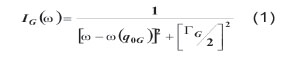
<body><![CDATA[<p><font size="2" face="Verdana, Arial, Helvetica, sans-serif">La  espectroscop&iacute;a Raman es una de las t&eacute;cnicas experimentales m&aacute;s  usadas en el estudio de las nano-estructuras de carbono irradiadas, en particular  del grafeno, debido a su alta sensibilidad a la presencia de defectos en la red  cristalina.&nbsp; Una &nbsp;atenci&oacute;n especial ha recibido la variaci&oacute;n  de la intensidad de la banda D de los espectros &nbsp;Raman del grafeno con la  concentraci&oacute;n de defectos producida por la irradiaci&oacute;n. Hoy d&iacute;a  hay suficientes evidencias experimentales sobre el car&aacute;cter no mon&oacute;tono  de esa dependencia, pero la explicaci&oacute;n de ese comportamiento todav&iacute;a  es pol&eacute;mica. En el presente trabajo se desarroll&oacute; &nbsp;un modelo  matem&aacute;tico simplificado para obtener una relaci&oacute;n funcional entre  estas dos magnitudes y se demostr&oacute; &nbsp;que la dependencia no-mon&oacute;tona  es intr&iacute;nseca a la naturaleza de la banda D y que &nbsp;no est&aacute;  ligada necesariamente a procesos de amorfizaci&oacute;n. La dependencia funcional  obtenida fue utilizada &nbsp;&nbsp;para ajustar datos experimentales obtenidos  por otros autores. Se obtuvo un ajuste con un coeficiente de determinaci&oacute;n.  </font></p>    <p><font size="2" face="Verdana, Arial, Helvetica, sans-serif"><strong>Palabras  claves:</strong> grafeno, irradiaci&oacute;n, espectroscop&iacute;a Raman, nanoestructuras,  modelos matem&aacute;ticos.</font></p><hr>     <p>&nbsp;</p>    <p>&nbsp;</p>    <p><font size="3" face="Verdana, Arial, Helvetica, sans-serif"><strong>INTRODUCTION</strong></font></p>    <p><font size="2" face="Verdana, Arial, Helvetica, sans-serif">Graphene  is a very interesting and promising material. Since its obtainment&nbsp; in 2004,&nbsp;  a lot of attention has been devoted to the study of the exceptional electronic  and physical properties of this two-dimensional nanostructure [1,2] and to the  analysis of potential practical applications that cover many different </font><font size="2" face="Verdana, Arial, Helvetica, sans-serif">fields  from electronics to environmental protection and health [3]. Particularly interesting  are the possible applications in biosciences , where there are a lot of ongoing  research projects devoted to the use of graphene as the basis for develop DNA  sequencing devices, biosensors, etc.[4].</font><font size="2" face="Verdana, Arial, Helvetica, sans-serif">In  many of the mentioned applications it is necessary or desirable to control the  electronic structure and, in particular, the band gap. For this purpose it is  possible to follow several approaches. One of them is the chemical functionalization  of graphene, but another very important way is the controlled introduction of  defects through its irradiation with different kind of particles. This alternative  is being explored experimentally, as well as theoretically, by several groups  around the world [5-8].</font><font size="2" face="Verdana, Arial, Helvetica, sans-serif">  In the efforts devoted to understand the behavior of graphene under particle bombardment,  &nbsp;an special role is played by Raman spectroscopy, a powerful technique that  have been &nbsp;applied for several &nbsp;decades to the characterize of carbon  bulk structures and nanostructures. The special usefulness of Raman spectroscopy  in the study of irradiated graphene, graphite and carbon nanotubes is related  with the so-called D-band, that only exists in the Raman spectra of these materials  in case lattice defects or other kind of disorder [9]. The sensibility of this  technique to the modifications to and defects in the lattice of carbon structures  have been used to studied amorphization processes in graphite and other carbonaceous  materials [10].</font><font size="2" face="Verdana, Arial, Helvetica, sans-serif">An  important experimental parameter in the study of the irradiated samples of graphite  and carbon nanostructures is the ratio of the intensities of D-band and the G-band  . The G-band is &nbsp;the main first order line in graphene spectra and it is  not linked to the existence of defects [11]. Already in &nbsp;the seventies of  the last century, it was clear that the ratio is strongly dependent of the concentration  of defects in the crystal lattice. In 1970, Tuinstra and Konig [12] proposed for  graphite <img src="/img/revistas/nuc/n53/e01035313.jpg" width="87" height="21">  the&nbsp;&nbsp; relationship </font><img src="/img/revistas/nuc/n53/e02035313.jpg" width="33" height="20">  <font size="2" face="Verdana, Arial, Helvetica, sans-serif">where </font><img src="/img/revistas/nuc/n53/e03035313.jpg" width="21" height="19">  <font size="2" face="Verdana, Arial, Helvetica, sans-serif">is the defect concentration  </font><ins><font size="-2" face="Verdana, Arial, Helvetica, sans-serif"><strong><A NAME="r1"></A><A HREF="#1">1</A></strong></font></ins><font size="-2" face="Verdana, Arial, Helvetica, sans-serif">.</font><font size="2" face="Verdana, Arial, Helvetica, sans-serif">  Nevertheless, the experimental studies of irradiated graphene performed in the  last years have shown that the Tuinstra-Konig relation is not applicable in those  cases, and that the </font><img src="/img/revistas/nuc/n53/e02035313.jpg" width="33" height="20"><font size="2" face="Verdana, Arial, Helvetica, sans-serif">ratio  exhibits a non-monotonous behavior, i.e.&nbsp; for small concentration of defects&nbsp;  the ratio increases with the concentration of defects, but after a critical concentration  it begins to decrease [7,13,14]. &nbsp;The authors of those papers explained the  decreasing of the ratio by&nbsp; the existence&nbsp; at high defect concentrations  &nbsp;of very distorted zones in the lattice, where the material is no more crystalline  but amorphous. They followed a theory developed in 2000 by Ferrari and Robertson  [10] for the evolution of Raman spectra of graphite from pristine to amorphous  samples, not directly related to irradiation processes. In that paper was reported  by the first time the non-monotonous variation of </font><img src="/img/revistas/nuc/n53/e02035313.jpg" width="33" height="20">  <font size="2" face="Verdana, Arial, Helvetica, sans-serif">with the concentration.</font><font size="2" face="Verdana, Arial, Helvetica, sans-serif">In  spite of the fact that in many&nbsp; irradiation processes&nbsp; the sample gets  some kind of amorphization, this is not always true, especially when the bombarding  particles are electrons or protons with energies of several keV [15]. Besides  that, in the zone of medium concentration of defects, when the ratio <img src="/img/revistas/nuc/n53/e02035313.jpg" width="33" height="20">  begins to decrease</font> <font size="2" face="Verdana, Arial, Helvetica, sans-serif">with  <img src="/img/revistas/nuc/n53/e03035313.jpg" width="21" height="17"> the  cited papers do not give enough evidence of the existence of amophization.</font><font size="2" face="Verdana, Arial, Helvetica, sans-serif">Therefore,  it is worth to obtain the theoretical dependence of the ratio </font><img src="/img/revistas/nuc/n53/e02035313.jpg" width="33" height="20">  <font size="2" face="Verdana, Arial, Helvetica, sans-serif">with <img src="/img/revistas/nuc/n53/e03035313.jpg" width="21" height="20">  in order to elucidate whether the observed behavior is present there or it requires  additional mechanisms as ,for example, amorphization, for its explanation. This  was the main goal of the research reported in this paper.</font><font size="2" face="Verdana, Arial, Helvetica, sans-serif"><strong>Development  of the model</strong></font><font size="2" face="Verdana, Arial, Helvetica, sans-serif">In  order to obtain a mathematical expression for the ratio,</font> <img src="/img/revistas/nuc/n53/e02035313.jpg" width="33" height="17"><font size="2" face="Verdana, Arial, Helvetica, sans-serif">  it is necessary to consider the differences in the mechanisms that produce each  band. As it was mentioned above, the G-band is the only first order Raman process  allowed by the selection rule <img src="/img/revistas/nuc/n53/e04035313.jpg" width="15" height="15">=0  [9, 11]. On the other side, due to the conical form of the energy bands in the  graphene (Dirac cones) and to the absence of gap, all the Raman lines in graphene  are resonant. It is well established in the literature [9,11] that the G band  is a typical Raman resonant line described by a <a href="#e05035313">Lorentzian  function</a>, as follows:</font></p>    
<p align="center"><img src="/img/revistas/nuc/n53/e05035313.jpg" width="281" height="61"><a name="e05035313"></a></p>    
<p><font size="2" face="Verdana, Arial, Helvetica, sans-serif">where  <img src="/img/revistas/nuc/n53/e06035313.jpg" width="47" height="21"> is  the frequency at the center of the G-band and <img src="/img/revistas/nuc/n53/e07035313.jpg" width="21" height="16">  is the G-line width.</font><font size="2" face="Verdana, Arial, Helvetica, sans-serif">The  nature of the D-band is totally different. In fact, it is linked with phonons  whose wavevectors are far from the center of the Brillouin zone and, consequently,  they are forbidden by the selection rule . Thomsen and Reich [16] explained the  existence of this band in the Raman spectra of graphite by a double resonance  process, in which the excited electron is scattered first by a phonon and then  by a lattice defect.</font><font size="2" face="Verdana, Arial, Helvetica, sans-serif">The  double resonance process is represented in the <a href="#f01035313">figure 1a</a>.  First , an electron with wavevector k in the valence band (p), near of the Dirac  point K, is excited by the laser to the conduction band , i.e. an electron-hole  pair is created (step 1); then the excited electron is scattered by a phonon,  acquiring a wavevector k+q and passing to the Dirac cone near to the point <img src="/img/revistas/nuc/n53/e10035313.jpg" width="16" height="15">  (step 2). After that, the electron is scattered by a lattice defect, that absorbs  the wavevector q (step 3). Finally the electron goes back to the valence band  and recombines with the hole (step 4). The Feynman diagram corresponding to that  process is represented in <a href="#f01035313">figure 1b</a>.</font></p>    
<p align="center"><img src="/img/revistas/nuc/n53/f01035313.jpg" width="342" height="224"><a name="f01035313"></a></p>    
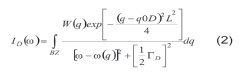
<p><font size="2" face="Verdana, Arial, Helvetica, sans-serif">  Due to the double resonance process, the mathematical expression that describes  the intensity of the D band in graphene is rather complicated [17]. For the purposes  of this work we can use a simplified <a href="#e14035313">expression</a> taken  from [11]</font>.</p>    ]]></body>
<body><![CDATA[<p align="center"><img src="/img/revistas/nuc/n53/e14035313.jpg" width="239" height="72"><a name="e14035313"></a></p>    
<p><font size="2" face="Verdana, Arial, Helvetica, sans-serif">where  W (<img src="/img/revistas/nuc/n53/e04035313.jpg" width="15" height="15">)  is a factor that contains the matrix elements of the transitions ocurring during  the double resonance processes, L is the average distance between defects, </font><img src="/img/revistas/nuc/n53/e15035313.jpg" width="20" height="17">  <font size="2" face="Verdana, Arial, Helvetica, sans-serif">is the wave vector  corresponding to the maximum of the D-line and </font><img src="/img/revistas/nuc/n53/e16035313.jpg" width="17" height="18">  <font size="2" face="Verdana, Arial, Helvetica, sans-serif">the line width. The  integration is performed on the phonon wavevectors in the first Brillouin Zone  (BZ).</font><font size="2" face="Verdana, Arial, Helvetica, sans-serif">As well  as our interest is in the main dependence of </font> <img src="/img/revistas/nuc/n53/e17035313.jpg" width="13" height="20">  <font size="2" face="Verdana, Arial, Helvetica, sans-serif">with <img src="/img/revistas/nuc/n53/e03035313.jpg" width="21" height="20">,  it is enough to consider the central part of the band, then we can substitute  the <a href="#e18035313">gaussian function</a> by a Dirac delta <font size="1"><ins><strong><A NAME="r2"></A><A HREF="#2">2</A></strong></ins></font>  in the integrand of <a href="#e14035313">(2)</a> , i.e</font></p>    
<p align="center"><img src="/img/revistas/nuc/n53/e18035313.jpg" width="269" height="50"><a name="e18035313"></a></p>    
<p><font size="2" face="Verdana, Arial, Helvetica, sans-serif">Making  this change in <a href="#e14035313">(2)</a>, using the properties of the Dirac  delta and changing <img src="/img/revistas/nuc/n53/e19035313.jpg" width="26" height="31">  by , <a href="#e20035313">we obtain</a>:</font></p>    
<p align="center"><img src="/img/revistas/nuc/n53/e20035313.jpg" width="217" height="54"><a name="e20035313"></a></p>    
<p><a href="#e21035313">where  </a><img src="/img/revistas/nuc/n53/e21035313.jpg" width="105" height="21"><a name="e21035313"></a>.</p>    
<p><font size="2" face="Verdana, Arial, Helvetica, sans-serif">Besides  the explicit dependence of </font><img src="/img/revistas/nuc/n53/e17035313.jpg" width="13" height="20">  <font size="2" face="Verdana, Arial, Helvetica, sans-serif">with</font> <font size="2" face="Verdana, Arial, Helvetica, sans-serif"><img src="/img/revistas/nuc/n53/e03035313.jpg" width="21" height="20"></font>  <font size="2" face="Verdana, Arial, Helvetica, sans-serif">that is showed in  <a href="#e20035313">(4)</a>, there is also an implicit dependence because the  line width also depends of the concentration of defects. In fact, for the excited  electronic states, those that participates in the processes originating the D-band,  there are two basic mechanisms of relaxation: scattering by phonons and scattering  by defects. We can <a href="#e22035313">then write</a> the following:</font></p>    
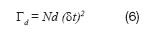
<p align="center"><img src="/img/revistas/nuc/n53/e22035313.jpg" width="147" height="25"><a name="e22035313"></a></p>    
<p><font size="2" face="Verdana, Arial, Helvetica, sans-serif">The  first term in the right side of (5) is the contribution to the line width of the  electron-phonon interaction and the second one is the contribution of the electron-defect  scattering. It is obvious that the last term should depend of the concentration  of defects<strong><font size="1"> <ins><A NAME="r3"></A><A HREF="#3">3</A></ins></font></strong>.  In the case of irradiated graphene the main kind of defects are single vacancies  [18]. For this kind of defects, the <a href="#e23035313">expression</a>:</font></p>    <p align="center"><img src="/img/revistas/nuc/n53/e23035313.jpg" width="146" height="32"><a name="e23035313"></a></p>    
]]></body>
<body><![CDATA[<p><font size="2" face="Verdana, Arial, Helvetica, sans-serif">Is  frequently used [17] , where </font><img src="/img/revistas/nuc/n53/e25035313.jpg" width="27" height="16"><font size="2" face="Verdana, Arial, Helvetica, sans-serif">  is the square mean deviation of the nearest neighbor hopping energy calculated  by the tight binding model. This variation is produced by the presence of defects,  which change the positions of the atomic orbitals.</font><font size="2" face="Verdana, Arial, Helvetica, sans-serif">  Using (6) we can <a href="#e26035313">rewrite</a> (4) as follows:</font></p>    
<p align="center"><img src="/img/revistas/nuc/n53/e26035313.jpg" width="301" height="59"><a name="e26035313"></a></p>    
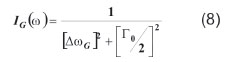
<p><font size="2" face="Verdana, Arial, Helvetica, sans-serif">In  the case of the G-band, the relaxation of the electronic states that participates  in the Raman process is produced mainly through the scattering of electrons by  phonons. Then, in this case, the contribution to the line width of the interaction  electron-defects can be neglected and we can consider</font> <img src="/img/revistas/nuc/n53/e27035313.jpg" width="41" height="19"><font size="2" face="Verdana, Arial, Helvetica, sans-serif">Then,  <a href="#e28035313">the expression</a> for the intensity of line G can be approximated  to:</font></p>    
<p align="center"><img src="/img/revistas/nuc/n53/e28035313.jpg" width="225" height="62"><a name="e28035313"></a></p>    
<p><a href="#e29035313"><font size="2" face="Verdana, Arial, Helvetica, sans-serif">with</font>  </a><img src="/img/revistas/nuc/n53/e29035313.jpg" width="100" height="20"><a name="e29035313"></a></p>    
<p>&nbsp;</p>    <p>&nbsp;</p>    <p><font size="3" face="Verdana, Arial, Helvetica, sans-serif"><strong>RESULTS  AND DISCUSSION</strong></font></p>    <p><font size="2" face="Verdana, Arial, Helvetica, sans-serif">  Using <a href="#e26035313">(7)</a> and <a href="#e28035313">(8)</a> we can <a href="#e30035313">obtain</a>  the dependence of</font> <font size="2" face="Verdana, Arial, Helvetica, sans-serif"><img src="/img/revistas/nuc/n53/e02035313.jpg" width="33" height="18">  with <img src="/img/revistas/nuc/n53/e03035313.jpg" width="21" height="20"><a href="#e30035313">  as follows</a>:</font></p>    
<p align="center"><img src="/img/revistas/nuc/n53/e30035313.jpg" width="188" height="55"><a name="e30035313"></a></p>    
]]></body>
<body><![CDATA[<p><a href="#e31035313"><font size="2" face="Verdana, Arial, Helvetica, sans-serif">where  </font></a><img src="/img/revistas/nuc/n53/e31035313.jpg" width="224" height="48"><a name="e31035313"></a><a href="#e32035313">  <font size="2" face="Verdana, Arial, Helvetica, sans-serif">and</font> </a><img src="/img/revistas/nuc/n53/e32035313.jpg" width="148" height="48"><a name="e32035313"></a></p>    
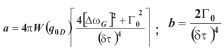
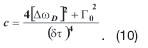
<p><font size="2" face="Verdana, Arial, Helvetica, sans-serif"><a href="#e30035313">Expression  (9)</a> shows clearly the non-monotonous dependence of <img src="/img/revistas/nuc/n53/e02035313.jpg" width="33" height="18"></font>  <font size="2" face="Verdana, Arial, Helvetica, sans-serif">with the concentration  of defects in irradiated graphene. In obtaining it ,we have not used any kind  of consideration about amorphization of another mechanism, additional to the basic  Raman processes. Then, the experimentally obtained dependence of <img src="/img/revistas/nuc/n53/e02035313.jpg" width="33" height="18"></font>  <font size="2" face="Verdana, Arial, Helvetica, sans-serif">with the defect concentration  is intrinsic to the nature of the processes that produces the D-band in the Raman  spectra of graphene.</font></p>    
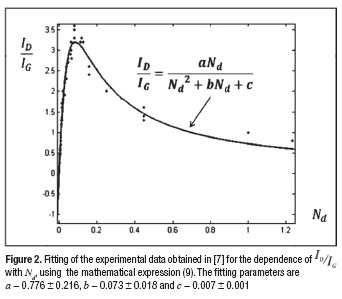
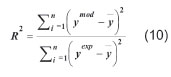
<p><font size="2" face="Verdana, Arial, Helvetica, sans-serif">Besides  its theoretical value, <a href="#e30035313">expression (9)</a> can be used as  a function for fitting experimental data, using <em>a, b, c</em></font> <font size="2" face="Verdana, Arial, Helvetica, sans-serif">as  fitting parameters.</font></p>    <p><font size="2" face="Verdana, Arial, Helvetica, sans-serif">The  fitting of the experimental data obtained by Luchesse et al<font size="1"><A NAME="r4"></A>  <ins><strong><A HREF="#4">4</A></strong></ins></font>. [7 ] using the <a href="#e30035313">expression  (9)</a>, is showed in <a href="#f02035313">Figure 2</a>. It was carried out with  the fitting tools of MATLAB that use the determination coefficient, </font><img src="/img/revistas/nuc/n53/e33035313.jpg" width="20" height="14"><font size="2" face="Verdana, Arial, Helvetica, sans-serif">  for evaluating the quality of the approximation. This <a href="#e34035313">coefficient</a>  is defined by:</font></p>    
<p align="center"><img src="/img/revistas/nuc/n53/e34035313.jpg" width="171" height="77"><a name="e34035313"></a></p>    
<p><font size="2" face="Verdana, Arial, Helvetica, sans-serif">where  </font><img src="/img/revistas/nuc/n53/e35035313.jpg" width="32" height="16"><font size="2" face="Verdana, Arial, Helvetica, sans-serif">  and </font><img src="/img/revistas/nuc/n53/e36035313.jpg" width="29" height="16"><font size="2" face="Verdana, Arial, Helvetica, sans-serif">  are the values of the independent variable (<img src="/img/revistas/nuc/n53/e02035313.jpg" width="33" height="18">  in this work ) obtained from the model and from the experimental data, respectively;  and <em>y</em></font> <font size="2" face="Verdana, Arial, Helvetica, sans-serif">is  the mean value of the experimental values. In our case <img src="/img/revistas/nuc/n53/e33035313.jpg" width="20" height="14">=  0,96. Furthermore, the relative error in the determination of the parameters </font>  <font size="2" face="Verdana, Arial, Helvetica, sans-serif"><em>a, b, c</em></font>  <font size="2" face="Verdana, Arial, Helvetica, sans-serif">is less than 30%.  This indicates that, although we have introduced several approximations in the  model, <a href="#e30035313">formula (9)</a> is an acceptable representation of  the function <img src="/img/revistas/nuc/n53/e02035313.jpg" width="33" height="18">=<img src="/img/revistas/nuc/n53/e37035313.jpg" width="33" height="18">.</font></p>    
<p align="center"><img src="/img/revistas/nuc/n53/f02035313.jpg" width="342" height="299"><a name="f02035313"></a></p>    
<p>&nbsp;</p>    <p>&nbsp;</p>    <p><font size="3" face="Verdana, Arial, Helvetica, sans-serif"><strong>CONCLUSIONS</strong></font></p>    ]]></body>
<body><![CDATA[<p><font size="2" face="Verdana, Arial, Helvetica, sans-serif">  It has been demonstrated that the non-monotonous dependence of <img src="/img/revistas/nuc/n53/e02035313.jpg" width="33" height="18"></font>  <font size="2" face="Verdana, Arial, Helvetica, sans-serif">with the defect concentration  (<img src="/img/revistas/nuc/n53/e03035313.jpg" width="17" height="18">)</font>  <font size="2" face="Verdana, Arial, Helvetica, sans-serif">is an intrinsic feature  of the Raman spectra of irradiated graphene and it is not necessarily related  to the amorphization of the samples.</font><font size="2" face="Verdana, Arial, Helvetica, sans-serif">  A simple mathematical relationship between these magnitudes was obtained. This  expression can be used to fit experimental data of the Raman spectra of irradiated  graphene in relation with the concentration of defects.</font></p>    
<p>&nbsp;</p>    <p>&nbsp;</p>    <p><font size="3" face="Verdana, Arial, Helvetica, sans-serif"><strong>REFERENCES</strong></font></p>    <!-- ref --><p><FONT SIZE="2" FACE="Verdana, Arial, Helvetica, sans-serif">1.  GEIM AK. Graphene: Status and prospects. Science. 2009; 324(5934): 1531-1534.    <!-- ref --><br>  2. CASTRO NETO AH, GUINEA F, PERES NMR, et. al. The electronic properties of grapheme.  Rev. Mod. Physi. 2009; 81(1): 109-162.    <!-- ref --><br> 3. COOPER DR, D'ANJOU B, GHATTAMANENI  N, et. al. Experimental review of graphene. ISRN Condensed Matter Physics. 2012;  2012(article ID 501686): 1-56.    <!-- ref --><br> 4. YAO J, SUN Y, YANG M,&nbsp;DUAN Y. Chemistry,  physics and biology of graphene-based nanomaterials: new horizons for sensing,  imaging and medicine. J. Mater. Chem. 2012; 22(29): 14313-14329.    <!-- ref --><br> 5. TAPASZTO  L, DOBRIK G, NEMES-INCZE P, et. al. Tuning the electronic structure of graphene  by ion irradiation. Phys.Rev. B. 2008; 78(1-4): 233407.    <!-- ref --><BR></FONT><FONT SIZE="2" FACE="Verdana, Arial, Helvetica, sans-serif">6.  LETHINEN O, KOTAKOSKI&nbsp;J, KRASHENINNIKOV AV, et. al. Effect of ion bombardment  on a two-dimensional target. Phys. Rev. B. 2010; 81(1-4): 153401.    <!-- ref --><br> 7. LUCCHESE  MM, STAVALE F, MARTINS FERREIRA EH, et. al. Quantifying ion-induced defects and  Raman relaxation length in grapheme. Carbon. 2010; 48(5): 1592-1597.    <!-- ref --><br> 8. CODORNIU  PUJALS D, AGUILERA CORRALES Y, BALDASARRE F. Calculation of the number of atoms  displaced during the irradiation of monolayer grapheme. J. Radioanal. Nucl. Chem,  2011; 289(1): 167-172.    <!-- ref --><br> 9. MALARDAL M, PIMENTAM A, DRESSELHAUS G, DRESSELHAUS  MS. Raman spectroscopy in grapheme. Physics&nbsp;Reports. 2009; 473(5-6): 51-87.    <!-- ref --><br> 10. FERRARI C. AND ROBERTSON J. Interpretation of Raman spectra of disordered  and amorphous carbon. Physical Review B. 2000; 61(20): 14095-14101.    <!-- ref --><br> 11. SAITO  R, HOFMANN M, DRESSELHAUS G, et. al. Raman spectroscopy of graphene and carbon  nanotubes. Advances in Physics. 2011; 60(3): 413-550.    <br> 12. TUINSTRA F, KOENIG  JL. Raman spectrum of graphite. J Chem. Phys. 1970; 53(3): 1126&ndash;30.    <!-- ref --><br>  13. TEWELDEBRHAN D, BALANDIN A A. Modification of graphene properties due to electron-beam  irradiation. Appl. Phys. Lett. 2009; 94(1):&nbsp;013101-013103.    <!-- ref --><br> 14. BUCHOWICZ  G, STONE P,&nbsp;ROBINSON JT, et. al. Correlation between structure and electrical  transport in ion-irradiated graphene grown on Cu foils. [art&iacute;culo en l&iacute;nea].  Appl. Phys. Letters. 2011; 98&nbsp;(3): 032102. &lt;<A HREF="http:%20arxiv.org/pdf/1012.4060" TARGET="_blank">http:  arxiv.org/pdf/1012.4060</A>&gt; [consulta: feb 2013]     <!-- ref --><br> 15. KRASHENNINIKOV AV,  NORDLUND K. Ion and electron irradiation-induced effects in nanostructured materials.  J.Appl. Phys. 2010; 107(7):&nbsp;071301.    <!-- ref --><br> 16. THOMSEN C, REICH S. Double Resonant  Raman Scattering in Graphite. Phys. Rev. Lett. 2000; 85(24):&nbsp;5214-5217.    <!-- ref --><br>  17. VENEZUELA P, LAZZERI M, MAURI F. Theory of double-resonant Raman spectra in  graphene: intensity and line shape of defect-induced and two-phonon bands&nbsp;[art&iacute;culo  en l&iacute;nea]. Phys Rev B. 2011; 84(3): 035433. &lt;<A HREF="http:%20arXiv:%201103.4582" TARGET="_blank">http:  arXiv: 1103.4582</A>&gt; [consulta: feb 2013]     <!-- ref --><br> 18. LETHINEN O, KOTAKOSKI J,  KRASHENNINIKOV AV, et. al. Effects of ion bombardenment in a two-dimensional target.  Physical Review B. 2010; 81(15): 153401.    </FONT></p>    <p>&nbsp;</p>    <p>&nbsp;</p>    <p><font size="2" face="Verdana, Arial, Helvetica, sans-serif"><strong>Recibido:</strong>  15 de noviembre de 2012     <br> <strong>Aceptado:</strong> 25 de abril de 2013 </font></p>    <p><font size="1" face="Verdana, Arial, Helvetica, sans-serif"><strong><ins><A NAME="1"></A><A HREF="#r1">1</A></ins></strong>  The so-called Tuinstra-Konig relationship was formulated as<img src="/img/revistas/nuc/n53/e11035313.jpg" width="63" height="23">  ,where <img src="/img/revistas/nuc/n53/e12035313.jpg" width="23" height="14">  is a factor that depends of the wave length of the exciting laser and L is the  distance between the crystallites, that is approximately the same as the average  distance between defects. Then, <img src="/img/revistas/nuc/n53/e13035313.jpg" width="50" height="18">    
<br>  <ins><strong><A NAME="2"></A><A HREF="#r2">2</A></strong></ins> The factor <img src="/img/revistas/nuc/n53/e38035313.jpg" width="20" height="24">  is introduced to assure that the integral of both functions is the same    
<br> <ins><strong><A NAME="3"></A><A HREF="#r3">3</A></strong></ins>  The anharmonic effects give an additional contribution to the line-width. As this  contribution is not related to defects, we will include it in <img src="/img/revistas/nuc/n53/e24035313.jpg" width="12" height="17">.      
]]></body>
<body><![CDATA[<br> <ins><strong><A NAME="4"></A><A HREF="#r4">4</A></strong></ins> The experimental  results reported in [7 ] constitute one of the most complete set of data Raman  intensities in irradiated graphene published so far.</font></p>      ]]></body><back>
<ref-list>
<ref id="B1">
<label>1</label><nlm-citation citation-type="journal">
<person-group person-group-type="author">
<name>
<surname><![CDATA[GEIM]]></surname>
<given-names><![CDATA[AK]]></given-names>
</name>
</person-group>
<article-title xml:lang="en"><![CDATA[Graphene: Status and prospects]]></article-title>
<source><![CDATA[Science]]></source>
<year>2009</year>
<volume>324</volume>
<numero>5934</numero>
<issue>5934</issue>
<page-range>1531-1534</page-range></nlm-citation>
</ref>
<ref id="B2">
<label>2</label><nlm-citation citation-type="journal">
<person-group person-group-type="author">
<name>
<surname><![CDATA[CASTRO NETO]]></surname>
<given-names><![CDATA[AH]]></given-names>
</name>
<name>
<surname><![CDATA[GUINEA]]></surname>
<given-names><![CDATA[F]]></given-names>
</name>
<name>
<surname><![CDATA[PERES]]></surname>
<given-names><![CDATA[NMR]]></given-names>
</name>
</person-group>
<article-title xml:lang="en"><![CDATA[The electronic properties of grapheme]]></article-title>
<source><![CDATA[Rev. Mod. Physi]]></source>
<year>2009</year>
<volume>81</volume>
<numero>1</numero>
<issue>1</issue>
<page-range>109-162</page-range></nlm-citation>
</ref>
<ref id="B3">
<label>3</label><nlm-citation citation-type="journal">
<person-group person-group-type="author">
<name>
<surname><![CDATA[COOPER]]></surname>
<given-names><![CDATA[DR]]></given-names>
</name>
<name>
<surname><![CDATA[D'ANJOU]]></surname>
<given-names><![CDATA[B]]></given-names>
</name>
<name>
<surname><![CDATA[GHATTAMANENI]]></surname>
<given-names><![CDATA[N]]></given-names>
</name>
</person-group>
<article-title xml:lang="en"><![CDATA[Experimental review of graphene]]></article-title>
<source><![CDATA[ISRN Condensed Matter Physics]]></source>
<year>2012</year>
<volume>2012</volume>
<numero>article ID 501686</numero>
<issue>article ID 501686</issue>
<page-range>1-56</page-range></nlm-citation>
</ref>
<ref id="B4">
<label>4</label><nlm-citation citation-type="journal">
<person-group person-group-type="author">
<name>
<surname><![CDATA[YAO]]></surname>
<given-names><![CDATA[J]]></given-names>
</name>
<name>
<surname><![CDATA[SUN]]></surname>
<given-names><![CDATA[Y]]></given-names>
</name>
<name>
<surname><![CDATA[YANG]]></surname>
<given-names><![CDATA[M]]></given-names>
</name>
<name>
<surname><![CDATA[DUAN]]></surname>
<given-names><![CDATA[Y]]></given-names>
</name>
</person-group>
<article-title xml:lang="en"><![CDATA[Chemistry, physics and biology of graphene-based nanomaterials: new horizons for sensing, imaging and medicine]]></article-title>
<source><![CDATA[J. Mater. Chem]]></source>
<year>2012</year>
<volume>22</volume>
<numero>29</numero>
<issue>29</issue>
<page-range>14313-14329</page-range></nlm-citation>
</ref>
<ref id="B5">
<label>5</label><nlm-citation citation-type="journal">
<person-group person-group-type="author">
<name>
<surname><![CDATA[TAPASZTO]]></surname>
<given-names><![CDATA[L]]></given-names>
</name>
<name>
<surname><![CDATA[DOBRIK]]></surname>
<given-names><![CDATA[G]]></given-names>
</name>
<name>
<surname><![CDATA[NEMES-INCZE]]></surname>
<given-names><![CDATA[P]]></given-names>
</name>
</person-group>
<article-title xml:lang="en"><![CDATA[Tuning the electronic structure of graphene by ion irradiation]]></article-title>
<source><![CDATA[Phys.Rev. B]]></source>
<year>2008</year>
<volume>78</volume>
<numero>1-4</numero>
<issue>1-4</issue>
<page-range>233407</page-range></nlm-citation>
</ref>
<ref id="B6">
<label>6</label><nlm-citation citation-type="journal">
<person-group person-group-type="author">
<name>
<surname><![CDATA[LETHINEN]]></surname>
<given-names><![CDATA[O]]></given-names>
</name>
<name>
<surname><![CDATA[KOTAKOSKI]]></surname>
<given-names><![CDATA[J]]></given-names>
</name>
<name>
<surname><![CDATA[KRASHENINNIKOV]]></surname>
<given-names><![CDATA[AV]]></given-names>
</name>
</person-group>
<article-title xml:lang="en"><![CDATA[Effect of ion bombardment on a two-dimensional target]]></article-title>
<source><![CDATA[Phys. Rev. B]]></source>
<year>2010</year>
<volume>81</volume>
<numero>1-4</numero>
<issue>1-4</issue>
<page-range>153401</page-range></nlm-citation>
</ref>
<ref id="B7">
<label>7</label><nlm-citation citation-type="journal">
<person-group person-group-type="author">
<name>
<surname><![CDATA[LUCCHESE]]></surname>
<given-names><![CDATA[MM]]></given-names>
</name>
<name>
<surname><![CDATA[STAVALE]]></surname>
<given-names><![CDATA[F]]></given-names>
</name>
<name>
<surname><![CDATA[MARTINS FERREIRA]]></surname>
<given-names><![CDATA[EH]]></given-names>
</name>
</person-group>
<article-title xml:lang="en"><![CDATA[Quantifying ion-induced defects and Raman relaxation length in grapheme]]></article-title>
<source><![CDATA[Carbon]]></source>
<year>2010</year>
<volume>48</volume>
<numero>5</numero>
<issue>5</issue>
<page-range>1592-1597</page-range></nlm-citation>
</ref>
<ref id="B8">
<label>8</label><nlm-citation citation-type="journal">
<person-group person-group-type="author">
<name>
<surname><![CDATA[CODORNIU PUJALS]]></surname>
<given-names><![CDATA[D]]></given-names>
</name>
<name>
<surname><![CDATA[AGUILERA CORRALES]]></surname>
<given-names><![CDATA[Y]]></given-names>
</name>
<name>
<surname><![CDATA[BALDASARRE]]></surname>
<given-names><![CDATA[F]]></given-names>
</name>
</person-group>
<article-title xml:lang="en"><![CDATA[Calculation of the number of atoms displaced during the irradiation of monolayer grapheme]]></article-title>
<source><![CDATA[J. Radioanal. Nucl. Chem]]></source>
<year>2011</year>
<volume>289</volume>
<numero>1</numero>
<issue>1</issue>
<page-range>167-172</page-range></nlm-citation>
</ref>
<ref id="B9">
<label>9</label><nlm-citation citation-type="journal">
<person-group person-group-type="author">
<name>
<surname><![CDATA[MALARDAL]]></surname>
<given-names><![CDATA[M]]></given-names>
</name>
<name>
<surname><![CDATA[PIMENTAM]]></surname>
<given-names><![CDATA[A]]></given-names>
</name>
<name>
<surname><![CDATA[DRESSELHAUS]]></surname>
<given-names><![CDATA[G]]></given-names>
</name>
<name>
<surname><![CDATA[DRESSELHAUS]]></surname>
<given-names><![CDATA[MS]]></given-names>
</name>
</person-group>
<article-title xml:lang="en"><![CDATA[Raman spectroscopy in grapheme]]></article-title>
<source><![CDATA[Physics Reports]]></source>
<year>2009</year>
<volume>473</volume>
<numero>5-6</numero>
<issue>5-6</issue>
<page-range>51-87</page-range></nlm-citation>
</ref>
<ref id="B10">
<label>10</label><nlm-citation citation-type="journal">
<person-group person-group-type="author">
<name>
<surname><![CDATA[FERRARI]]></surname>
<given-names><![CDATA[C]]></given-names>
</name>
<name>
<surname><![CDATA[AND ROBERTSON]]></surname>
<given-names><![CDATA[J]]></given-names>
</name>
</person-group>
<article-title xml:lang="en"><![CDATA[Interpretation of Raman spectra of disordered and amorphous carbon]]></article-title>
<source><![CDATA[Physical Review B]]></source>
<year>2000</year>
<volume>61</volume>
<numero>20</numero>
<issue>20</issue>
<page-range>14095-14101</page-range></nlm-citation>
</ref>
<ref id="B11">
<label>11</label><nlm-citation citation-type="journal">
<person-group person-group-type="author">
<name>
<surname><![CDATA[SAITO]]></surname>
<given-names><![CDATA[R]]></given-names>
</name>
<name>
<surname><![CDATA[HOFMANN]]></surname>
<given-names><![CDATA[M]]></given-names>
</name>
<name>
<surname><![CDATA[DRESSELHAUS]]></surname>
<given-names><![CDATA[G]]></given-names>
</name>
</person-group>
<article-title xml:lang="en"><![CDATA[Raman spectroscopy of graphene and carbon nanotubes]]></article-title>
<source><![CDATA[Advances in Physics]]></source>
<year>2011</year>
<volume>60</volume>
<numero>3</numero>
<issue>3</issue>
<page-range>413-550</page-range></nlm-citation>
</ref>
<ref id="B12">
<label>12</label><nlm-citation citation-type="journal">
<person-group person-group-type="author">
<name>
<surname><![CDATA[TUINSTRA]]></surname>
<given-names><![CDATA[F]]></given-names>
</name>
<name>
<surname><![CDATA[KOENIG]]></surname>
<given-names><![CDATA[JL]]></given-names>
</name>
</person-group>
<article-title xml:lang="en"><![CDATA[Raman spectrum of graphite]]></article-title>
<source><![CDATA[J Chem. Phys]]></source>
<year>1970</year>
<volume>53</volume>
<numero>3</numero>
<issue>3</issue>
<page-range>1126-30</page-range></nlm-citation>
</ref>
<ref id="B13">
<label>13</label><nlm-citation citation-type="journal">
<person-group person-group-type="author">
<name>
<surname><![CDATA[TEWELDEBRHAN]]></surname>
<given-names><![CDATA[D]]></given-names>
</name>
<name>
<surname><![CDATA[BALANDIN]]></surname>
<given-names><![CDATA[AA]]></given-names>
</name>
</person-group>
<article-title xml:lang="en"><![CDATA[Modification of graphene properties due to electron-beam irradiation]]></article-title>
<source><![CDATA[Appl. Phys. Lett]]></source>
<year>2009</year>
<volume>94</volume>
<numero>1</numero>
<issue>1</issue>
<page-range>013101-013103</page-range></nlm-citation>
</ref>
<ref id="B14">
<label>14</label><nlm-citation citation-type="journal">
<person-group person-group-type="author">
<name>
<surname><![CDATA[BUCHOWICZ]]></surname>
<given-names><![CDATA[G]]></given-names>
</name>
<name>
<surname><![CDATA[STONE]]></surname>
<given-names><![CDATA[P]]></given-names>
</name>
<name>
<surname><![CDATA[ROBINSON]]></surname>
<given-names><![CDATA[JT]]></given-names>
</name>
</person-group>
<article-title xml:lang="en"><![CDATA[Correlation between structure and electrical transport in ion-irradiated graphene grown on Cu foils]]></article-title>
<source><![CDATA[Appl. Phys. Letters]]></source>
<year>2011</year>
<volume>98</volume>
<numero>3</numero>
<issue>3</issue>
<page-range>032102</page-range></nlm-citation>
</ref>
<ref id="B15">
<label>15</label><nlm-citation citation-type="journal">
<person-group person-group-type="author">
<name>
<surname><![CDATA[KRASHENNINIKOV]]></surname>
<given-names><![CDATA[AV]]></given-names>
</name>
<name>
<surname><![CDATA[NORDLUND]]></surname>
<given-names><![CDATA[K]]></given-names>
</name>
</person-group>
<article-title xml:lang="en"><![CDATA[Ion and electron irradiation-induced effects in nanostructured materials]]></article-title>
<source><![CDATA[J.Appl. Phys]]></source>
<year>2010</year>
<volume>107</volume>
<numero>7</numero>
<issue>7</issue>
<page-range>071301</page-range></nlm-citation>
</ref>
<ref id="B16">
<label>16</label><nlm-citation citation-type="journal">
<person-group person-group-type="author">
<name>
<surname><![CDATA[THOMSEN]]></surname>
<given-names><![CDATA[C]]></given-names>
</name>
<name>
<surname><![CDATA[REICH]]></surname>
<given-names><![CDATA[S]]></given-names>
</name>
</person-group>
<article-title xml:lang="en"><![CDATA[Double Resonant Raman Scattering in Graphite]]></article-title>
<source><![CDATA[Phys. Rev. Lett]]></source>
<year>2000</year>
<volume>85</volume>
<numero>24</numero>
<issue>24</issue>
<page-range>5214-5217</page-range></nlm-citation>
</ref>
<ref id="B17">
<label>17</label><nlm-citation citation-type="journal">
<person-group person-group-type="author">
<name>
<surname><![CDATA[VENEZUELA]]></surname>
<given-names><![CDATA[P]]></given-names>
</name>
<name>
<surname><![CDATA[LAZZERI]]></surname>
<given-names><![CDATA[M]]></given-names>
</name>
<name>
<surname><![CDATA[MAURI]]></surname>
<given-names><![CDATA[F]]></given-names>
</name>
</person-group>
<article-title xml:lang="en"><![CDATA[Theory of double-resonant Raman spectra in graphene: intensity and line shape of defect-induced and two-phonon bands]]></article-title>
<source><![CDATA[Phys Rev B]]></source>
<year>2011</year>
<volume>84</volume>
<numero>3</numero>
<issue>3</issue>
<page-range>035433</page-range></nlm-citation>
</ref>
<ref id="B18">
<label>18</label><nlm-citation citation-type="journal">
<person-group person-group-type="author">
<name>
<surname><![CDATA[LETHINEN]]></surname>
<given-names><![CDATA[O]]></given-names>
</name>
<name>
<surname><![CDATA[KOTAKOSKI]]></surname>
<given-names><![CDATA[J]]></given-names>
</name>
<name>
<surname><![CDATA[KRASHENNINIKOV]]></surname>
<given-names><![CDATA[AV]]></given-names>
</name>
</person-group>
<article-title xml:lang="en"><![CDATA[Effects of ion bombardenment in a two-dimensional target]]></article-title>
<source><![CDATA[Physical Review B]]></source>
<year>2010</year>
<volume>81</volume>
<numero>15</numero>
<issue>15</issue>
<page-range>153401</page-range></nlm-citation>
</ref>
</ref-list>
</back>
</article>