<?xml version="1.0" encoding="ISO-8859-1"?><article xmlns:mml="http://www.w3.org/1998/Math/MathML" xmlns:xlink="http://www.w3.org/1999/xlink" xmlns:xsi="http://www.w3.org/2001/XMLSchema-instance">
<front>
<journal-meta>
<journal-id>0864-084X</journal-id>
<journal-title><![CDATA[Nucleus]]></journal-title>
<abbrev-journal-title><![CDATA[Nucleus]]></abbrev-journal-title>
<issn>0864-084X</issn>
<publisher>
<publisher-name><![CDATA[CUBAENERGIA]]></publisher-name>
</publisher>
</journal-meta>
<article-meta>
<article-id>S0864-084X2013000100006</article-id>
<title-group>
<article-title xml:lang="en"><![CDATA[Hydrogel wound dressing preparation at the laboratory scale by using electron beam and gamma radiation]]></article-title>
<article-title xml:lang="es"><![CDATA[Preparación de apósitos de membranas de hidrogeles a escala de laboratorio mediante haz de electrones y radiación gamma]]></article-title>
</title-group>
<contrib-group>
<contrib contrib-type="author">
<name>
<surname><![CDATA[Rapado Raneque]]></surname>
<given-names><![CDATA[Manuel]]></given-names>
</name>
<xref ref-type="aff" rid="A01"/>
</contrib>
<contrib contrib-type="author">
<name>
<surname><![CDATA[Rodríguez Rodríguez]]></surname>
<given-names><![CDATA[Alejandro]]></given-names>
</name>
<xref ref-type="aff" rid="A01"/>
</contrib>
<contrib contrib-type="author">
<name>
<surname><![CDATA[Peniche Covas]]></surname>
<given-names><![CDATA[Carlos]]></given-names>
</name>
<xref ref-type="aff" rid="A02"/>
</contrib>
</contrib-group>
<aff id="A01">
<institution><![CDATA[,Centro de Aplicaciones Tecnológicas y Desarrollo Nuclear (CEADEN)  ]]></institution>
<addr-line><![CDATA[La Habana ]]></addr-line>
<country>Cuba</country>
</aff>
<aff id="A02">
<institution><![CDATA[,Centro de Biomateriales Universidad de La Habana ]]></institution>
<addr-line><![CDATA[Habana ]]></addr-line>
<country>Cuba</country>
</aff>
<pub-date pub-type="pub">
<day>00</day>
<month>06</month>
<year>2013</year>
</pub-date>
<pub-date pub-type="epub">
<day>00</day>
<month>06</month>
<year>2013</year>
</pub-date>
<numero>53</numero>
<fpage>24</fpage>
<lpage>31</lpage>
<copyright-statement/>
<copyright-year/>
<self-uri xlink:href="http://scielo.sld.cu/scielo.php?script=sci_arttext&amp;pid=S0864-084X2013000100006&amp;lng=en&amp;nrm=iso"></self-uri><self-uri xlink:href="http://scielo.sld.cu/scielo.php?script=sci_abstract&amp;pid=S0864-084X2013000100006&amp;lng=en&amp;nrm=iso"></self-uri><self-uri xlink:href="http://scielo.sld.cu/scielo.php?script=sci_pdf&amp;pid=S0864-084X2013000100006&amp;lng=en&amp;nrm=iso"></self-uri><abstract abstract-type="short" xml:lang="en"><p><![CDATA[The present work describes the preparation of hydrogel based on cross-linked networks of poly (N-vinylpirrolidone), PVP, with polyethyleneglicol and agar with 90% water and PVP nancomposites with a synthetic nanoclay, Laponite XLG, for use as burn dressings. These systems were obtained in two ways: using gamma Co-60 and electron beam radiation. The gelation obtained dose was Dg= 1.72 kGy. The elastic modulus of hydrogel was independent of the method of irradiation. It was 0.39 MPa for the hydrogel irradiated with gamma Co-60 and 0.38 MPa for electron beam irradiation. The elastic modulus of the nanocomposite membrane was 1.25 MPa, three times higher. These results indicate that the PVP/Laponite XLG nanocomposite hydrogel membrane is the best choice for wound dressing applications due to its high water sorption capacity and its superior mechanical properties.]]></p></abstract>
<abstract abstract-type="short" xml:lang="es"><p><![CDATA[En el presente trabajo se describe la preparación de hidrogeles basados en redes entrecruzadas de poli (N-vinilpirrolidona), PVP con polietilenglicol, agar y un 90% de agua, y nanocomposites de PVP con una nanoarcilla sintética, la Laponita XLG para su empleo como apósito para quemaduras. Estos sistemas se obtuvieron por dos vías: radiación gamma de Co-60 y haz de electrones. La dosis de gelificación obtenida fue de Dg= 1.72 kGy. El módulo elástico de los hidrogeles resultó independiente del método de irradiación, siendo igual a 0.39 MPa para el irradiado con Co-60 y 0.38 MPa para el irradiado con haz de electrones. El módulo elástico de la membrana de nanocomposite fue 3 veces superior, 1.25 MPa. Estos resultados muestran que los hidrogeles de nanocomposites de PVP/Laponita XLG resultan superiores para su aplicación en el tratamiento de quemaduras, por su alta capacidad de sorción de agua y sus mejores propiedades mecánicas.]]></p></abstract>
<kwd-group>
<kwd lng="en"><![CDATA[hydrogels]]></kwd>
<kwd lng="en"><![CDATA[PVP]]></kwd>
<kwd lng="en"><![CDATA[burns]]></kwd>
<kwd lng="en"><![CDATA[gamma radiation]]></kwd>
<kwd lng="en"><![CDATA[electron beams]]></kwd>
<kwd lng="en"><![CDATA[cobalt 60]]></kwd>
<kwd lng="es"><![CDATA[hidrogeles]]></kwd>
<kwd lng="es"><![CDATA[PVP]]></kwd>
<kwd lng="es"><![CDATA[quemaduras]]></kwd>
<kwd lng="es"><![CDATA[radiación gamma]]></kwd>
<kwd lng="es"><![CDATA[haces electrónicos]]></kwd>
<kwd lng="es"><![CDATA[cobalto 60]]></kwd>
</kwd-group>
</article-meta>
</front><body><![CDATA[ <p align="right"><font face="Verdana, Arial, Helvetica, sans-serif" size="2"><b>CIENCIAS  NUCLEARES</b></font></p>    <p align="left">&nbsp;</p>    <p><font size="4" face="Verdana, Arial, Helvetica, sans-serif"><strong>Hydrogel  wound dressing preparation at the laboratory scale by using electron beam and  gamma radiation</strong>&nbsp;</font></p>    <p><strong><font size="4" face="Verdana, Arial, Helvetica, sans-serif">  </font>    <br> </strong></p>    <p><font size="3"><strong><font face="Verdana, Arial, Helvetica, sans-serif">Preparaci&oacute;n  de ap&oacute;sitos de membranas de hidrogeles a escala </font></strong><font face="Verdana, Arial, Helvetica, sans-serif"><strong>de  laboratorio mediante haz de electrones y radiaci&oacute;n gamma</strong></font></font><font size="3" face="Verdana, Arial, Helvetica, sans-serif">&nbsp;&nbsp;</font>&nbsp;&nbsp;&nbsp;&nbsp;&nbsp;&nbsp;&nbsp;&nbsp;&nbsp;&nbsp;&nbsp;&nbsp;&nbsp;&nbsp;&nbsp;&nbsp;&nbsp;&nbsp;&nbsp;&nbsp;&nbsp;&nbsp;&nbsp;&nbsp;&nbsp;&nbsp;&nbsp;&nbsp;&nbsp;&nbsp;&nbsp;  <strong>    <br></strong></p>    <p>&nbsp;</p>    <p>&nbsp;</p>    <p><font size="2" face="Verdana, Arial, Helvetica, sans-serif"><strong>Manuel  Rapado Raneque<sup>1</sup>, Alejandro Rodr&iacute;guez Rodr&iacute;guez<sup>1</sup>,  Carlos Peniche Covas<sup>2</sup></strong></font></p>    ]]></body>
<body><![CDATA[<p><font size="2" face="Verdana, Arial, Helvetica, sans-serif"><sup>1</sup>Centro  de Aplicaciones Tecnol&oacute;gicas y Desarrollo Nuclear (CEADEN)    <br> Calle 30  no 502 esq. 5ta. Avenida, Miramar, Playa. La Habana, Cuba    <br> <sup>2</sup>Centro  de Biomateriales, Universidad de La Habana    <br> Ave. Universidad s/n entre G y  Ronda, Habana, Cuba    <BR><A HREF="mailto:rapado@ceaden.edu.cu">rapado@ceaden.edu.cu</A>,  <A HREF="mailto:peniche@reduniv.edu.cu">peniche@reduniv.edu.cu</A></font></p>    <p>&nbsp;</p>    <p>&nbsp;</p><hr>      <p><font face="Verdana, Arial, Helvetica, sans-serif" size="2"><b>ABSTRACT</b></font></p>    <p><font size="2" face="Verdana, Arial, Helvetica, sans-serif">The  present work describes the preparation of hydrogel based on cross-linked networks  of poly (<em>N</em>-vinylpirrolidone), PVP, with polyethyleneglicol and agar with  90% water and PVP nancomposites with a synthetic nanoclay, Laponite XLG, for use  as burn dressings. These systems were obtained in two ways: using gamma Co-60  and electron beam radiation.&nbsp; The gelation obtained dose was D<SUB>g</SUB>=  1.72 kGy. The elastic modulus of hydrogel was independent of the method of irradiation.  It was 0.39 MPa for the hydrogel irradiated with gamma Co-60 and 0.38 MPa for  electron beam irradiation. The elastic modulus of the nanocomposite membrane was  1.25 MPa, three times higher. These results indicate that the PVP/Laponite XLG  nanocomposite hydrogel membrane is the best choice for wound dressing applications  due to its high water sorption capacity and its superior mechanical properties.&nbsp;  </font></p>    <p><font size="2" face="Verdana, Arial, Helvetica, sans-serif"><strong>Key  words: </strong>hydrogels, PVP, burns, gamma radiation, electron beams, cobalt  60.</font></p><hr>     ]]></body>
<body><![CDATA[<p><font face="Verdana, Arial, Helvetica, sans-serif" size="2"><b>RESUMEN</b></font></p>    <p><font size="2" face="Verdana, Arial, Helvetica, sans-serif">En  el presente trabajo se describe la preparaci&oacute;n de hidrogeles basados en  redes entrecruzadas de poli (<em>N</em>-vinilpirrolidona), PVP con polietilenglicol,  agar y un 90% de agua, y nanocomposites de PVP con una nanoarcilla sint&eacute;tica,  la Laponita XLG para su empleo como ap&oacute;sito para quemaduras. Estos sistemas  se obtuvieron por dos v&iacute;as: radiaci&oacute;n gamma de Co-60 y haz de electrones.  La dosis de gelificaci&oacute;n obtenida fue de D<SUB>g</SUB>= 1.72 kGy. El m&oacute;dulo  el&aacute;stico de los hidrogeles result&oacute; independiente del m&eacute;todo  de irradiaci&oacute;n, siendo igual a 0.39 MPa para el irradiado con Co-60 y 0.38  MPa para el irradiado con haz de electrones. El m&oacute;dulo el&aacute;stico  de la membrana de nanocomposite fue 3 veces superior, 1.25 MPa. Estos resultados  muestran que los hidrogeles de nanocomposites de PVP/Laponita XLG resultan superiores  para su aplicaci&oacute;n en el tratamiento de quemaduras, por su alta capacidad  de sorci&oacute;n de agua y sus mejores propiedades mec&aacute;nicas.</font></p>    <p><font size="2" face="Verdana, Arial, Helvetica, sans-serif"><strong>Palabras  claves: </strong>hidrogeles, PVP, quemaduras, radiaci&oacute;n gamma,&nbsp;haces  electr&oacute;nicos, cobalto 60.</font></p><hr> <h1>&nbsp;</h1>    <p><font size="3" face="Verdana, Arial, Helvetica, sans-serif"><strong>INTRODUCTION</strong></font></p>    <p><span lang=EN-GB style='font-size:10.0pt;font-family:Verdana'>Hydrogels  are essentially highly hydrophilic three dimensional polymer networks that swellsignificantly  in water but do not dissolve. The cross-link density of the network regulates  the magnitude of water sorption and the mechanical properties of hydrogels <font size="2" face="Verdana, Arial, Helvetica, sans-serif">[1]</font>.  Hydrogelsexhibit very smooth surfaces and mechanical properties similar to those  of human tissues. Therefore these materials find numerous applications in biomedicine  <font size="2" face="Verdana, Arial, Helvetica, sans-serif">[<span lang=EN-GB style='font-size:10.0pt;font-family:Verdana'>2</span>]</font>.  Particular interest has received in the last decade the use of hydrogels as dressings  for managing wounds and burns.</span></p>    <p><span lang=EN-GB style='font-size:10.0pt;font-family:Verdana'>It  has been stressed that and ideal wound dressing must fulfill the following conditions:  create and keep the moist environment, protect the wound from secondary infections,  adsorb fluids and exudates, prevent the wound desiccation and stimulate growth  factors; the wound dressing has to be elastic, non-antigenic and biocompatible.  Many of these conditions are fulfilled by hydrogels. Therefore hydrogels prepared  from synthetic polymers (poly (ethylene&nbsp;glycol), poly (vinylpyrrolidone),  poly (propylene&nbsp;glycol), polyurethane) <font size="2" face="Verdana, Arial, Helvetica, sans-serif">[<span lang=EN-GB style='font-size:10.0pt;font-family:Verdana'>2-4</span>]</font>  as well as from polymers of natural origin (xanthan, methyl cellulose, carboxymethyl  cellulose, alginate, hyaluronan) <font size="2" face="Verdana, Arial, Helvetica, sans-serif">[<span lang=EN-GB style='font-size:10.0pt;font-family:Verdana'>2,  5-8</span>]</font> have been proposed as wound managing aids. Hydrogel wound dressings  can be found in the market the trade name of Vigilon, Ivalon, Aqua gel, Kik gel,  among others <font size="2" face="Verdana, Arial, Helvetica, sans-serif">[<span lang=EN-GB style='font-size:10.0pt;font-family:Verdana'>9</span>]</font>.</span></p>    <p><span lang=EN-GB style='font-size:10.0pt;font-family:Verdana'>Ionizing  radiation has been recognized as a suitable tool for the formation of polymer  hydrogels. The advantages of ionizing radiation in hydrogel preparation are: easy  process control, possibility of combining hydrogel formation and sterilization  simultaneously, no need to add any chemical initiators <font size="2" face="Verdana, Arial, Helvetica, sans-serif">[1</font></span><span lang=EN-GB><font size="2" face="Verdana, Arial, Helvetica, sans-serif">0</font></span><span lang=EN-GB style='font-size:10.0pt;font-family:Verdana'><font size="2" face="Verdana, Arial, Helvetica, sans-serif">]</font>.  In consequence the obtained hydrogel membranes are ready to use.</span></p>    <p><span lang=EN-GB style='font-size:10.0pt;font-family:Verdana'>Poly(N-vinyl-2-pyrrolidone)  (PVP)-based hydrogels, produced by radiation-induced cross-linking and simultaneous  sterilization, have been applied successfully as local dressings in wounds, such  as burns, skin ulcerations, bedsores and skin grafts. The production process of  these hydrogels by using radiation was developed by Rosiak <font size="2" face="Verdana, Arial, Helvetica, sans-serif">[11]</font>.  The process involves radiation cross-linking and sterilization in a single step  to produce theready to use hydrogel wound dressing. The methodentails the use  of a hydrophilic polymer component, like poly(vinyl pyrrolidone) (7-10%) along  with agar-agar (1-2%) or another polysaccharide with would act as antioxidant,  a biocompatible humectante.g.polyethylene glycol (1-2%) and across-linkingpromoter,  e.g. ethylene glycol dimethacrylate, triethylene glycol dimethacrylate, <em><span style='font-family:Verdana'>N,N</span></em>&#8242;-methylene-bis-acrylamide <font size="2" face="Verdana, Arial, Helvetica, sans-serif">[</font></span><span lang=EN-GB><font size="2" face="Verdana, Arial, Helvetica, sans-serif">2</font></span><span lang=EN-GB style='font-size:10.0pt;font-family:Verdana'><font size="2" face="Verdana, Arial, Helvetica, sans-serif">]</font>.  Similar procedures are commonly used for the production of wound dressings using  gamma radiation <font size="2" face="Verdana, Arial, Helvetica, sans-serif">[1</font></span><span lang=EN-GB><font size="2" face="Verdana, Arial, Helvetica, sans-serif">0,  </font></span><span lang=EN-GB style='font-size:10.0pt;font-family:Verdana'><font size="2" face="Verdana, Arial, Helvetica, sans-serif"><span lang=EN-GB style='font-size:10.0pt;font-family:Verdana'>12-14</span>]</font>.</span></p>    <p><span lang=EN-GB style='font-size:10.0pt;font-family:Verdana'>Hydrogels,  particularly highly swollen ones, usually possess poor mechanical properties.  Therefore, it is sometimes desired to improve the mechanical properties of hydrogels  by the use of reinforcing materials. In recent years, the preparation of polymer/filler  nanocomposites usinga synthetic clay (mostly layered silicates) as a transparent  filler has attracted considerable interest for its reinforcing ability. The most  commonly used layered silicates for the preparation of polymer/inorganic clay  nanocomposites are montmorillonite, hectorite, and saponite <font size="2" face="Verdana, Arial, Helvetica, sans-serif">[1</font></span><span lang=EN-GB><font size="2" face="Verdana, Arial, Helvetica, sans-serif">5</font></span><span lang=EN-GB style='font-size:10.0pt;font-family:Verdana'><font size="2" face="Verdana, Arial, Helvetica, sans-serif">]</font>.  Synthetic clay is an inexpensive, transparent, environmentally benign, nanoparticulate  material with unique mechanical and rheological properties. Another benefit of  synthetic clay is that it can be produced with high enough purity for critical  manufacturing applications <font size="2" face="Verdana, Arial, Helvetica, sans-serif">[1</font></span><span lang=EN-GB><font size="2" face="Verdana, Arial, Helvetica, sans-serif">6</font></span><span lang=EN-GB style='font-size:10.0pt;font-family:Verdana'><font size="2" face="Verdana, Arial, Helvetica, sans-serif">]</font>.  Synthetic clay has been used as reinforcing additive for epoxy resins, polyamides,  polystyrene, polyurethane, polypropylene, polyesters, etc. These nanocomposites  demonstrate improvements in tensileproperties, gas barrier action, thermal stability  and flameretardation <font size="2" face="Verdana, Arial, Helvetica, sans-serif">[1</font></span><span lang=EN-GB><font size="2" face="Verdana, Arial, Helvetica, sans-serif">7</font></span><span lang=EN-GB style='font-size:10.0pt;font-family:Verdana'><font size="2" face="Verdana, Arial, Helvetica, sans-serif">]</font>.  </span></p>    <p><span lang=EN-GB style='font-size:10.0pt;font-family:Verdana'>Polymer/inorganic  clay nanocomposites are classified in three different groups, namely (1)&nbsp;intercalated  nanocomposites, for which insertion of polymer chains into a layered silicate  structure occurs in a crystallographically regular fashion, with a repeat distance  of few nanometers, regardless of polymer-to-clay ratio, (2) flocculated nanocomposites,  for which intercalated and stacked silicate layers flocculate to some extent,  and (3) exfoliated nanocomposites, for which the individual silicate layers are  separated in the polymer matrix by average distances that depend only on the clay  loading <font size="2" face="Verdana, Arial, Helvetica, sans-serif">[1</font></span><span lang=EN-GB><font size="2" face="Verdana, Arial, Helvetica, sans-serif">8</font></span><span lang=EN-GB style='font-size:10.0pt;font-family:Verdana'><font size="2" face="Verdana, Arial, Helvetica, sans-serif">]</font>.</span></p>    ]]></body>
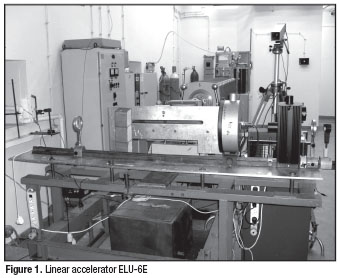
<body><![CDATA[<p><span lang=EN-GB style='font-size:10.0pt;font-family:Verdana'>Haraguchi,  et. al. <font size="2" face="Verdana, Arial, Helvetica, sans-serif">[1</font></span><span lang=EN-GB><font size="2" face="Verdana, Arial, Helvetica, sans-serif">9</font></span><span lang=EN-GB style='font-size:10.0pt;font-family:Verdana'><font size="2" face="Verdana, Arial, Helvetica, sans-serif">]</font>  studied the mechanical behavior of temperature-sensitive nanocomposite hydrogelsconsisting  of poly(<em><span style='font-family:Verdana'>N</span></em>-isopropylacrylamide) (polyNIPA) and  clay, reporting he first observation of a retractive mechanical force as a result  of a coil-globular transition of polyNIPA chains. More recently, Thomas, et al.  <font size="2" face="Verdana, Arial, Helvetica, sans-serif">[</font></span><span lang=EN-GB><font size="2" face="Verdana, Arial, Helvetica, sans-serif">20</font></span><span lang=EN-GB style='font-size:10.0pt;font-family:Verdana'><font size="2" face="Verdana, Arial, Helvetica, sans-serif">]</font>  useda synthetic layered silicate from the Laponite family to prepare clay-cross-linked  polyNIPA gels for cation-binding and separation. They used a kind of hectorite,  Laponite RD, which is a synthetic layered silicate clay that is in the form of  disk-like nanoparticles with a diameter of 25 nm and a thickness of 0.9 nm. When  polymerized with NIPA and initiator, the particles form bonds with several NIPA  chains and thereby the particles serve as the cross-links in the gel network.  The particles also have numerous negative charges on their faces, which present  binding sites for cations. These nanocomposite hydrogels resulted efficient materials  for separation and ion exchangeowing to the strong binding affinity of certain  cations for the anionic surfaces of the clay nanoparticles within the gel matrix.  Kokabi, et. al<em><span style='font-family:Verdana'>. </span></em><font size="2" face="Verdana, Arial, Helvetica, sans-serif">[</font></span><span lang=EN-GB><font size="2" face="Verdana, Arial, Helvetica, sans-serif">2</font></span><span lang=EN-GB style='font-size:10.0pt;font-family:Verdana'><font size="2" face="Verdana, Arial, Helvetica, sans-serif">1]</font>  prepared nanocomposite hydrogelwound dressings based on poly(vinyl alcohol) (PVA)  and organically modified montmorillonite (OMONT) clay by the cyclic freezing-thawing  method. They report that adding 10&nbsp;wt-% of OMONT to PVA hydrogel, the tensile  modulus of hydrogel shows an increase of 27%. After evaluating other essential  properties of these materials such as swelling, their ability in transmission  of water vapor and resistance to microbe penetration they concluded that the quantity  of clay was the key factor to obtain nanocomposite hydrogels with desirable properties  for wound dressing applications.</span></p>    <p><span lang=EN-GB style='font-size:10.0pt;font-family:Verdana'>In  the present work, polymer-clay nanocomposite hydrogels based on poly (vinylpyrrolidone),  PEG and Laponite XLG were prepared by cross-linking usingelectron beam and gamma  radiation in order to obtain an applicable nanocomposite hydrogel wound dressing  for external usage. The nanocomposite hydrogel were characterized in terms of  mechanical properties.</span></p>    <p><span lang=EN-GB style='font-size:10.0pt;font-family:Verdana'>The  PVP hydrogel wound dressing clinical test has been successfully finished. The  government approval for clinical use had been given by CECMED with the register  permission No. 1006013. </span></p>    <p><span lang=EN-GB>&nbsp;</span></p>    <p><strong><span lang=EN-GB style='font-family:Verdana'>MATERIALS  AND METHODS</span></strong></p>    <p><strong><span lang=EN-GB style='font-size:10.0pt;font-family:Verdana'>Materials</span></strong></p>    <p><span lang=EN-GB style='font-size:10.0pt;font-family:Verdana'>Polyvinylpyrrolidone  (PVP) with an average molecular weight of 1.2 x 10⁶ g/mol was purchased from Kollidone,  BASF.&nbsp; Agar bacteriological, Lot No. 3000180 was obtained from Life Technologies  (Scotland) and poly (ethylene glycol) (PEG) purchased from Aldrich. Laponite XLG  Lot 06-234 from ROCKWOOD was used without purification. Double distilled water  was always used. </span></p>    <p><strong><span lang=EN-GB style='font-size:10.0pt;font-family:Verdana'>Irradiation  facilities</span></strong></p>    <p><span lang=EN-GB style='font-size:10.0pt;font-family:Verdana'>A  linear accelerator ELU-6E (Electronika -Moscow) was used and is shown in </span><span style='font-size:10.0pt;font-family:Verdana'><a href="#f01065313"><span lang=EN-GB>Figure 1</span></a></span><span lang=EN-GB style='font-size:10.0pt; font-family:Verdana'>. It provides pulsed electron beam for basic radiation studies  as well as for technological applications. With two independent easily switchable  modulators LINAC can generate:</span></p>    <p><span lang=EN-GB style='font-size:10.0pt; font-family:Verdana'> Single pulses of 8 MeV electrons with duration times equal  to 2.5, 5, 10, 20 ns and peak current ca 12A.    ]]></body>
<body><![CDATA[<br> Single pulses of 5 MeV electrons  with duration time variable from 0.5 to 4.5 &micro;s and peak current 1 A.</span></p>    <p align=center style='text-align:center'><img border=0 width=340 height=278 src="/img/revistas/nuc/n53/f01065313.jpg"><a name=f01065313></a></p>    
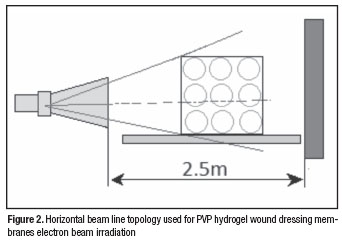
<p><span lang=EN-GB style='font-size:10.0pt;font-family:Verdana'>For  technological irradiation pulses produced with repetition 10-200 Hz can be scanned  across a 40 cm long exit window.    <br> EB irradiation was performed with the average  dose rate 9.0 kGy/min determined by calorimetry. </span></p>    <p><span lang=EN-GB style='font-size:10.0pt;font-family:Verdana'>A  critical decision when designing an electron beam treatment process is the choice  of the irradiation topology, namely horizontal or vertical irradiation <font size="2" face="Verdana, Arial, Helvetica, sans-serif">[</font></span><span lang=EN-GB><font size="2" face="Verdana, Arial, Helvetica, sans-serif">22</font></span><span lang=EN-GB style='font-size:10.0pt;font-family:Verdana'><font size="2" face="Verdana, Arial, Helvetica, sans-serif">]</font>.  A horizontal irradiation arrangement was used in the present study based on its  easy validation </span><span style='font-size:10.0pt; font-family:Verdana'><a href="#f02065313"><span lang=EN-GB>(Figure 2)</span></a></span><span lang=EN-GB style='font-size:10.0pt;font-family:Verdana'>. </span></p>    <p align=center style='text-align:center'><img border=0 width=342 height=243 src="/img/revistas/nuc/n53/f02065313.jpg"><a name=f02065313></a></p>    
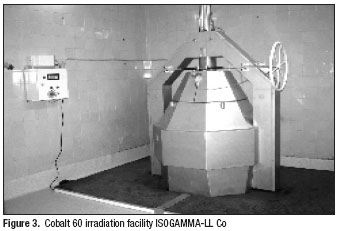
<p><span lang=EN-GB style='font-size:10.0pt;font-family:Verdana'>The  electron beam irradiation facility was calibrated by using a water calorimeter  located at the distance of 2.5 m from the beam output window all the involved  elements were positioned on the same horizontal surface, see </span><a href="#f03065313" class="Estilo2">Figure  3</a><span lang=EN-GB style='font-size:10.0pt; font-family:Verdana'>. A single side irradiation was considered during the hydrogel  membranes irradiation; from the point that in case of a double sided irradiation  choicea simple turning mechanism is required.</span></p>    <p align=center style='text-align:center'><img src="/img/revistas/nuc/n53/f03065313.jpg" width="341" height="231"><a name="f03065313"></a></p>    
<p><span lang=EN-GB style='font-size:10.0pt;font-family:Verdana'>A  cobalt 60, self shielding irradiation chamber ISOGAMMA-LL Co from Hungary with  dose rate 7.6 kGy/h according to Fricke dosimetry was used for </span><b><span style='font-size:10.0pt;font-family:Verdana'><img border=0 width=14 height=15 src="/img/revistas/nuc/n53/e08065313.jpg"></span></b><span lang=EN-GB style='font-size:10.0pt;font-family:Verdana'>-irradiation.</span></p>    
<p><strong><span lang=EN-GB style='font-size:10.0pt;font-family:Verdana'>Preparation  of hydrogel membranes at laboratory scale</span></strong></p>    ]]></body>
<body><![CDATA[<p><span lang=EN-GB style='font-size:10.0pt;font-family:Verdana'>The  laboratory scale preparation of the hydrogel dressing carried out following the  method developed by Rosiak <font size="2" face="Verdana, Arial, Helvetica, sans-serif">[</font></span><span lang=EN-GB><font size="2" face="Verdana, Arial, Helvetica, sans-serif">23</font></span><span lang=EN-GB style='font-size:10.0pt;font-family:Verdana'><font size="2" face="Verdana, Arial, Helvetica, sans-serif">]</font>  according to the following steps. Aqueous solutions of PVP (7.0 wt/v-%), PEG (1.5  wt/v-%) and agar (1.0 wt/v-%), were mixed and heated at 50-60 &ordm;C until homogeneity.  The solution was poured in 50-100 diameter moulds. The moulds were packed inside  envelopes of polyethylene films and irradiated. Irradiation of samples was carried  out using electron beam irradiation or </span><b><span style='font-size:10.0pt;font-family:Verdana'><img border=0 width=14 height=15 src="/img/revistas/nuc/n53/e08065313.jpg"></span></b><span lang=EN-GB style='font-size:10.0pt;font-family:Verdana'>-irradiation.</span></p>    
<p><span lang=EN-GB style='font-size:10.0pt;font-family:Verdana'>Laponite  loaded hydrogels were prepared following the same procedure, by adding Laponite  XLG to the PVP solution before irradiation. The laponite concentration in the  solution was 0.01 wt-%.</span></p>    <p><strong><span lang=EN-GB style='font-size:10.0pt;font-family:Verdana'>Characterization</span></strong><span lang=EN-GB style='font-size:10.0pt;font-family:Verdana'> <strong><span style='font-family:Verdana'>Determination of the radiation chemical yield value  by sol-gel analysis</span></strong></span></p>    <p><span lang=EN-GB style='font-size:10.0pt;font-family:Verdana'>The  gel fractions were calculated as the ratio of the weight of dried gel to the initial  weight of the polymer for a given radiation dose. Gelation dose (</span><span style='font-size:10.0pt;font-family:Verdana'><img border=0 width=18 height=19 src="/img/revistas/nuc/n53/e01065313.jpg"></span><span lang=EN-GB style='font-size:10.0pt;font-family:Verdana'>) and ratio radiation chemical yields  of chain scission to cross-linking yields (</span><span style='font-size:10.0pt;font-family:Verdana'><img border=0 width=35 height=18 src="/img/revistas/nuc/n53/e02065313.jpg"></span><span lang=EN-GB style='font-size:10.0pt;font-family:Verdana'>) where </span><span style='font-size:10.0pt;font-family:Verdana'><img border=0 width=15 height=18 src="/img/revistas/nuc/n53/e03065313.jpg"></span><span lang=EN-GB style='font-size:10.0pt;font-family:Verdana'>and </span><span style='font-size: 10.0pt;font-family:Verdana'><img border=0 width=16 height=16 src="/img/revistas/nuc/n53/e04065313.jpg"></span><span lang=EN-GB style='font-size:10.0pt;font-family:Verdana'>are degradation and cross-linking  density, respectively, were determined. The ratio </span><span style='font-size:10.0pt;font-family:Verdana'><img border=0 width=35 height=18 src="/img/revistas/nuc/n53/e02065313.jpg"></span><span lang=EN-GB style='font-size:10.0pt;font-family:Verdana'>was calculated by the Charlesby-Rosiak  method <font size="2" face="Verdana, Arial, Helvetica, sans-serif">[</font></span><span lang=EN-GB><font size="2" face="Verdana, Arial, Helvetica, sans-serif">24</font></span><span lang=EN-GB style='font-size:10.0pt;font-family:Verdana'><font size="2" face="Verdana, Arial, Helvetica, sans-serif">]</font>,  with the aid of the computer program Gel Sol 95 <font size="2" face="Verdana, Arial, Helvetica, sans-serif">[</font></span><span lang=EN-GB><font size="2" face="Verdana, Arial, Helvetica, sans-serif">23</font></span><span lang=EN-GB style='font-size:10.0pt;font-family:Verdana'><font size="2" face="Verdana, Arial, Helvetica, sans-serif">]</font>;  this program calculates the gelation dose </span><span style='font-size:10.0pt;font-family:Verdana'><img border=0 width=18 height=19 src="/img/revistas/nuc/n53/e01065313.jpg"></span><span lang=EN-GB style='font-size:10.0pt;font-family:Verdana'>, the virtual dose Dv  and the ratio of radiation chemical&nbsp; yields of chain scission&nbsp; to cross-linking,  </span><span style='font-size:10.0pt;font-family:Verdana'><img border=0 width=35 height=18 src="/img/revistas/nuc/n53/e02065313.jpg"></span><span lang=EN-GB style='font-size:10.0pt;font-family:Verdana'>, by using the </span><a href="#e05065313"><span class="Estilo2">Charlesby-Rosiak  equation</span></a><span lang=EN-GB style='font-size:10.0pt;font-family:Verdana'><font size="2" face="Verdana, Arial, Helvetica, sans-serif">[</font></span><span lang=EN-GB><font size="2" face="Verdana, Arial, Helvetica, sans-serif">24</font></span><span lang=EN-GB style='font-size:10.0pt;font-family:Verdana'><font size="2" face="Verdana, Arial, Helvetica, sans-serif">]</font>.  </span></p>    
<p align=center style='text-align:center'><img src="/img/revistas/nuc/n53/e05065313.jpg" width="298" height="37"><a name="e05065313"></a></p>    
<p><span lang=EN-GB style='font-size:10.0pt;font-family:Verdana'>where  s is the soluble fraction for a given radiation dose D.</span></p>    <p><strong><span lang=EN-GB style='font-size:10.0pt;font-family:Verdana'>FTIR  spectral analysis</span></strong></p>    <p><span lang=EN-GB style='font-size:10.0pt;font-family:Verdana'>FTIR  spectra were obtained with KBr discs and recorded in the spectral range from 4000  to 500 </span><img src="/img/revistas/nuc/n53/e06065313.jpg" width="29" height="14"><span lang=EN-GB style='font-size:10.0pt;font-family:Verdana'> by using a Nicolet AVATAR  330 Fourier-Transform Infrared Spectrophotometer (Nicolet Instrument Corp., Madison,  WI). Spectra were obtained with a resolution of 2 </span><span style='font-size:10.0pt;font-family:Verdana'><img src="/img/revistas/nuc/n53/e06065313.jpg" width="29" height="14"></span><span lang=EN-GB style='font-size:10.0pt;font-family:Verdana'> and were averaged over 100 scans.  Samples were thoroughly dried and ground with KBr and discs were prepared by compression  under vacuum.</span></p>    
<p><strong><span lang=EN-GB style='font-size:10.0pt;font-family:Verdana'>Mechanical  analysis</span></strong></p>    <p><span lang=EN-GB style='font-size:10.0pt;font-family:Verdana'>Mechanical  properties of PVP membranes were evaluated with a Zwick BZ2.5/TN1S universal testing  machine (Zwick GmbH &amp; Co. KG, Ulm, Germany). Samples were prepared in cylindrical  specimens of 10 cm diameter and 1.0 cm height. The upper load limit was fixed  at 1&nbsp;kN with a crosshead speed of 5 mm&nbsp;</span><span style='font-size:10.0pt;font-family:Verdana'><img border=0 width=32 height=14 src="/img/revistas/nuc/n53/e07065313.jpg"></span><span lang=EN-GB style='font-size:10.0pt;font-family:Verdana'>. The compressive modulus was determined  from the slope of the initial part of the stress-strain curve.</span></p>    
]]></body>
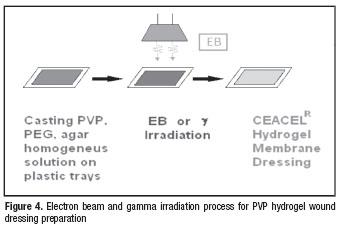
<body><![CDATA[<p><span lang=EN-GB>&nbsp;</span><span lang=EN-GB>&nbsp;</span></p>    <p><strong><span lang=EN-GB style='font-family:Verdana'>RESULTS  AND DISCUSSION</span></strong></p>    <p><span lang=EN-GB style='font-size:10.0pt;font-family:Verdana'>The  radiation technology employed in the present work is ideal for obtaining wound  dressing hydrogel membranes because the cross-linked hydrogel network is generated  and sterilized in a single technological process. This way the product obtained  does not require additional operations and is ready to use. </span><span style='font-size:10.0pt;font-family:Verdana'>The process is schematically shown  in <a href="#f04065313">Figure 4</a>.</span></p>    <p align=center style='text-align:center'><A NAME=f04065313></A><img border=0 width=339 height=227 src="/img/revistas/nuc/n53/f04065313.jpg"></p>    
<p>&nbsp;</p>    <p><strong><span lang=EN-GB style='font-size:10.0pt;font-family:Verdana'>Electron  beam irradiation hydrogel dressing process</span></strong><span lang=EN-GB style='font-size:10.0pt;font-family:Verdana'> </span></p>    <p class=MsoNormal><span lang=EN-GB style='font-size:10.0pt;font-family:Verdana; color:windowtext'>In an electron beam treatment process the machine should be  focused, and scanned by electric or magnetic field to create a suitable irradiation  area and increase the efficiency of the irradiation process</span><span lang=EN-GB style='color:windowtext'> </span><span lang=EN-GB style='font-size:10.0pt;font-family:Verdana'><font size="2" face="Verdana, Arial, Helvetica, sans-serif">[</font></span><span lang=EN-GB><font size="2" face="Verdana, Arial, Helvetica, sans-serif">25</font></span><span lang=EN-GB style='font-size:10.0pt;font-family:Verdana'><font size="2" face="Verdana, Arial, Helvetica, sans-serif">]</font>.  A useful magnitude to determine the necessary electron energy is the product of  the density (r) and penetration length (C) usually called standardized depth Z  = </span><span style='font-size:10.0pt;font-family:Verdana'><img border=0 width=8 height=15 src="/img/revistas/nuc/n53/e11065313.jpg"></span><span lang=EN-GB style='font-size:10.0pt;font-family:Verdana'>X. If </span><span style='font-size:10.0pt;font-family:Verdana'><img border=0 width=8 height=15 src="/img/revistas/nuc/n53/e11065313.jpg"></span><span lang=EN-GB style='font-size:10.0pt;font-family:Verdana'>is measured in </span><span style='font-size:10.0pt;font-family:Verdana'><img border=0 width=36 height=15 src="/img/revistas/nuc/n53/e09065313.jpg"></span><span lang=EN-GB style='font-size:10.0pt;font-family:Verdana'> and X in cm then Z has the unity  </span><img src="/img/revistas/nuc/n53/e12065313.jpg" width="37" height="15"><span lang=EN-GB style='font-size:10.0pt;font-family:Verdana'>. </span></p>    
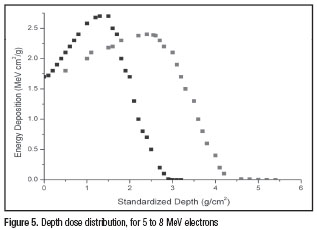
<p><span lang=EN-GB style='font-size:10.0pt;font-family:Verdana'>In  the present study the irradiated hydrogel dressing membranes,prepared by means  of EBwere obtained as 0.3-4.0 mm thick sheets with energy deposition from 1.5  to 2.0 MeV </span><img src="/img/revistas/nuc/n53/e12065313.jpg" width="37" height="15"><span lang=EN-GB style='font-size:10.0pt;font-family:Verdana'>. </span><span style='font-size: 10.0pt;font-family:Verdana'><a href="#f05065313"><span lang=EN-GB>Figure 5</span></a></span><span lang=EN-GB style='font-size:10.0pt;font-family:Verdana'> shows the calculated  depth dose curves for energy deposition corresponding to 1,7 MeV </span><span lang=EN-GB style='font-size:10.0pt;font-family:Verdana'>&nbsp;<img src="/img/revistas/nuc/n53/e12065313.jpg" width="37" height="15">  on the&nbsp; standardized&nbsp; 3-5 </span><span style='font-size:10.0pt;font-family:Verdana'><img border=0 width=36 height=15 src="/img/revistas/nuc/n53/e10065313.jpg"></span><span lang=EN-GB style='font-size:10.0pt;font-family:Verdana'>depth. The black dotted  line corresponds to the energy of 5 MeV, while the red corresponds to the energy  of 8 MeV, respectively.</span></p>    
<p align=center style='text-align:center'><img border=0 width=317 height=230 src="/img/revistas/nuc/n53/f05065313.jpg"><a name=f05065313></a></p>    
<p><span lang=EN-GB style='font-size:10.0pt;font-family:Verdana'>The  aqueous solution of PVP, PEG and agar used for the preparation of hydrogels was  a clear, almost transparent homogeneous liquid. When irradiating with the cobalt  60 facility the hydrogels dressings obtained were also transparent and came out  as fully sterile 3-4 mm thick sheets. Hydrogels dressings were flexible and did  not dissolve in hot water but showed high sorption capacity. They were easy to  handle and pleasant in touch. </span></p>    ]]></body>
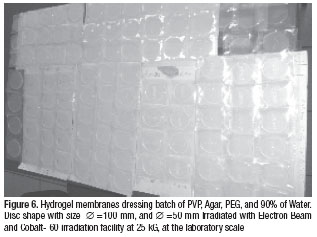
<body><![CDATA[<p><span lang=EN-GB style='font-size:10.0pt;font-family:Verdana'>Hydrogel  membranes dressingswere also prepared in laboratory batches from 1000 mL initial  polymer solutions each, producing 60 or 42 circular membranes per batch with diameters  </span><span style='font-size:10.0pt;font-family:Verdana'><img border=0 width=15 height=13 src="/img/revistas/nuc/n53/e13065313.jpg"></span><span lang=EN-GB style='font-size:10.0pt;font-family:Verdana'>&nbsp;=&nbsp;50 mm, or  </span><span style='font-size:10.0pt;font-family:Verdana'><img border=0 width=15 height=13 src="/img/revistas/nuc/n53/e13065313.jpg"></span><span lang=EN-GB style='font-size:10.0pt;font-family:Verdana'>&nbsp;=&nbsp;100 mm, respectively.  These hydrogel dressings have a 90 wt-% water content. They come out in individual  fully sterile packets as shown in </span><a href="#f06065313" class="Estilo2">Figure  6</a><span lang=EN-GB style='font-size:10.0pt;font-family:Verdana'> for samples irradiated  with Co-60 at 25 kGy.&nbsp;</span></p>    
<p align=center style='text-align:center'><img src="/img/revistas/nuc/n53/f06065313.jpg" width="317" height="237"><a name="f06065313"></a></p>    
<p><span lang=EN-GB style='font-size:10.0pt;font-family:Verdana'>The  physical and mechanical characteristics of the finally obtained hydrogel membrane  depend on a number of factors such as the PVP molecular weight and concentration,  the additives used and the radiation absorbed dose. In particular, the PVP concentration  and the rheological behavior of the starting polymer solution can influence the  resultant hydrogels properties. We have found that in order to obtain hydrogels  with adequate characteristics for wound dressings PVP concentrations should be  greater than 5 wt&#8209;%. At these concentrations PVP solutions exhibit a pseudoplastic  behavior. </span></p>    <p><strong><span lang=EN-GB style='font-size:10.0pt;font-family:Verdana'>Preparation  of membranes with nanoaditive</span></strong><span lang=EN-GB style='font-size: 10.0pt;font-family:Verdana'> </span></p>    <p><span lang=EN-GB style='font-size:10.0pt;font-family:Verdana'>Ahigh  purity grade inorganic synthetic clay (hectorite: Laponite XLG),with empirical  formula </span><span style='font-size:10.0pt;font-family:Verdana'><img border=0 width=162 height=20 src="/img/revistas/nuc/n53/e14065313.jpg"></span><span lang=EN-GB style='font-size:10.0pt;font-family:Verdana'>was used as nanoaditive.  Laponite XLG is a layered silicate with low heavy metals content. In dry form  the nanoclayparticles are stacked together in the form of tactoid columns which  are readily hydrated <font size="2" face="Verdana, Arial, Helvetica, sans-serif">[</font></span><span lang=EN-GB><font size="2" face="Verdana, Arial, Helvetica, sans-serif">24</font></span><span lang=EN-GB style='font-size:10.0pt;font-family:Verdana'><font size="2" face="Verdana, Arial, Helvetica, sans-serif">]</font>.  </span></p>    

<p><span lang=EN-GB style='font-size:10.0pt;font-family:Verdana'>In  the present study a transparent dispersion of nanoclay with the rest of additives  was achieved, and after irradiation uniform hydrogels were obtained </span><span style='font-size:10.0pt;font-family:Verdana'><a href="#f07065313"><span lang=EN-GB>(Figure 7)</span></a></span><span lang=EN-GB style='font-size:10.0pt; font-family:Verdana'>.</span></p>    <p align=center style='text-align:center'><img border=0 width=316 height=185 src="/img/revistas/nuc/n53/f07065313.jpg"><a name=f07065313></a></p>    
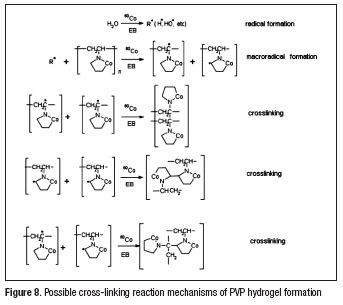
<p><span lang=EN-GB style='font-size:10.0pt;font-family:Verdana'>Taking  in to account the Laponitebehavior on water solutions, care has to be taken during  preparation to obtain uniform reacting solutions, in order to avoid the formation  of residual heterogeneities. These heterogeneities can result from insufficient  exfoliation of clay aggregates or presence of bubbles, which could affect the  polymer solution homogeneity to achieve transparent mixture with Laponite XLG.  After irradiation the obtained hydrogel dressings, behaved reologically as a viscoelastic  cross-linked structure in the range of compositions tested.</span></p>    <p><strong><span lang=EN-GB style='font-size:10.0pt;font-family:Verdana'>Sol  Gel Analysis</span></strong></p>    <p><span lang=EN-GB style='font-size:10.0pt;font-family:Verdana'>When  PVP is irradiated in water solution with ionizing radiation such as </span><b><span style='font-size:10.0pt;font-family:Verdana'><img border=0 width=14 height=15 src="/img/revistas/nuc/n53/e08065313.jpg"></span></b><span lang=EN-GB style='font-size:10.0pt;font-family:Verdana'>-rays or fast electrons, most of  the energy is absorbed by water. Ionization of water molecules leads to the formation  of hydrated electrons, hydroxyl radicals and hydrogen atoms <font size="2" face="Verdana, Arial, Helvetica, sans-serif">[</font></span><span lang=EN-GB><font size="2" face="Verdana, Arial, Helvetica, sans-serif">26</font></span><span lang=EN-GB style='font-size:10.0pt;font-family:Verdana'><font size="2" face="Verdana, Arial, Helvetica, sans-serif">]</font>.  Hydroxyl radicals have been shown to be the main species responsible for reactivity  transfer from water to polymer. They abstract hydrogen atoms from PVP macromolecules,  producingpolymer radicals. These macroradicals recombine, and if they are located  in different chains, give rise to new macromolecules. If the amount of these new  macromolecules is sufficiently great, a gel like material is obtained by intermolecular  cross-linking as shown </span><a href="#f08065313" class="Estilo2">Figure 8</a><span lang=EN-GB style='font-size:10.0pt;font-family:Verdana'>.</span></p>    
]]></body>
<body><![CDATA[<p align=center style='text-align:center'><img src="/img/revistas/nuc/n53/f08065313.jpg" width="343" height="305"><a name="f08065313"></a></p>    
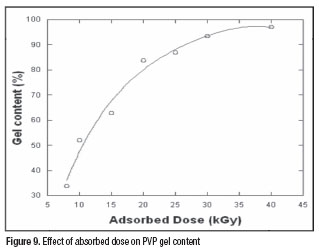
<p><span lang=EN-GB style='font-size:10.0pt;font-family:Verdana'>For  the formation of cross-linked macromolecules, the presence of two radicals on  neighboring chains and their subsequent combination is required. In the proposed  mechanism the two radicals are combined themselves or with each other. </span></p>    <p><span style='font-size:10.0pt;font-family:Verdana'><a href="#f09065313"><span lang=EN-GB>Figure 9</span></a></span><span lang=EN-GB style='font-size:10.0pt; font-family:Verdana'> shows the gel content of cross-linked PVP chains formed  as a function of the absorbed radiation dose.&nbsp; </span></p>    <p align=center style='text-align:center'><img border=0 width=319 height=252 src="/img/revistas/nuc/n53/f09065313.jpg"><a name=f09065313></a></p>    
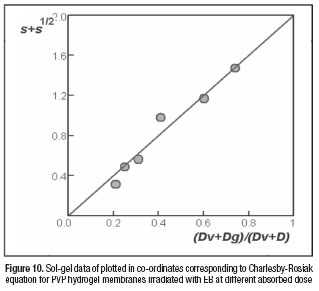
<p><span lang=EN-GB style='font-size:10.0pt;font-family:Verdana'>As  it can be seen the gel content increases from approximately 43% to about 97&nbsp;%  with an increase of the absorbed dose from 8 kGy to 40 kGy. Ajji, et. al<em><span style='font-family:Verdana'>. </span></em><font size="2" face="Verdana, Arial, Helvetica, sans-serif">[1</font></span><span lang=EN-GB><font size="2" face="Verdana, Arial, Helvetica, sans-serif">3</font></span><span lang=EN-GB style='font-size:10.0pt;font-family:Verdana'><font size="2" face="Verdana, Arial, Helvetica, sans-serif">]</font>  reported a high gelation percent in PVP membranes in the absence of PEG, and a  gelation decrease with increasing the PEG concentration. They explainedthat PEG  plays a role of plasticizer and also acts as a radical scavenger. In the present  work the PEG concentration used was only 1.5%, which is close to the value used  by Ajji, at absorbed dose of 25 kGy when producing hydrogel wound dressings using  gamma radiation <font size="2" face="Verdana, Arial, Helvetica, sans-serif">[1</font></span><span lang=EN-GB><font size="2" face="Verdana, Arial, Helvetica, sans-serif">3</font></span><span lang=EN-GB style='font-size:10.0pt;font-family:Verdana'><font size="2" face="Verdana, Arial, Helvetica, sans-serif">]</font>.  </span></p>    <p><span lang=EN-GB style='font-size:10.0pt;font-family:Verdana'>In  </span><span style='font-size:10.0pt;font-family:Verdana'><a href="#f10065313"><span lang=EN-GB>Figure 10</span></a></span><span lang=EN-GB style='font-size:10.0pt; font-family:Verdana'> are presented the results of sol-gel analysis obtained in  the present work for the radiation cross-linking of PVP. The data for the sol-gel  analysis were obtained from the gravimetric determination of sol fraction after  a given irradiation dose. With the values of s and D, it is possible to estimate  the cross-linking parameters with the use of a freely&nbsp; available computer  program <font size="2" face="Verdana, Arial, Helvetica, sans-serif">[</font></span><span lang=EN-GB><font size="2" face="Verdana, Arial, Helvetica, sans-serif">27</font></span><span lang=EN-GB style='font-size:10.0pt; font-family:Verdana'><font size="2" face="Verdana, Arial, Helvetica, sans-serif">]</font>.  The values obtained are </span><span style='font-size:10.0pt;font-family:Verdana'><img border=0 width=35 height=18 src="/img/revistas/nuc/n53/e02065313.jpg"></span><span lang=EN-GB style='font-size:10.0pt;font-family:Verdana'>=&nbsp;0, &nbsp;</span><span style='font-size:10.0pt;font-family:Verdana'><img border=0 width=16 height=18 src="/img/revistas/nuc/n53/e15065313.jpg"></span><span lang=EN-GB style='font-size:10.0pt;font-family:Verdana'>=&nbsp;0.71 and </span><span style='font-size:10.0pt;font-family:Verdana'><img border=0 width=17 height=19 src="/img/revistas/nuc/n53/e01065313.jpg"></span><span lang=EN-GB style='font-size:10.0pt;font-family:Verdana'>&nbsp;=&nbsp;1.72.&nbsp; This value  of </span><span style='font-size:10.0pt;font-family:Verdana'><img border=0 width=18 height=19 src="/img/revistas/nuc/n53/e01065313.jpg"></span><span lang=EN-GB style='font-size:10.0pt;font-family:Verdana'> is in good agreement  with the value reported for PVP hydrogels by Benamer, <span style='font-family:Verdana'>et. al.</span> <span style='font-family:Verdana'><font size="2" face="Verdana, Arial, Helvetica, sans-serif">[</font></span></span><span lang=EN-GB><font size="2" face="Verdana, Arial, Helvetica, sans-serif">28</font></span><span lang=EN-GB style='font-size:10.0pt;font-family:Verdana'><span style='font-family:Verdana'><font size="2" face="Verdana, Arial, Helvetica, sans-serif">]</font></span>.  The ratio <img src="/img/revistas/nuc/n53/e02065313.jpg" width="35" height="18">&nbsp;=&nbsp;0  indicates that cross-linking of PVP chains was the only occurring process during  irradiation.&nbsp; </span></p>    
<p align=center style='text-align:center'><img border=0 width=319 height=291 src="/img/revistas/nuc/n53/f10065313.jpg"><a name=f10065313></a></p>    
<p><span lang=EN-GB style='font-size:10.0pt;font-family:Verdana'>Olejniaczak,  et. al. <span lang=EN-GB style='font-size:10.0pt;font-family:Verdana'><span style='font-family:Verdana'><font size="2" face="Verdana, Arial, Helvetica, sans-serif">[</font></span></span><span lang=EN-GB><font size="2" face="Verdana, Arial, Helvetica, sans-serif">2</font></span></span><span lang=EN-GB><span lang=EN-GB><font size="2" face="Verdana, Arial, Helvetica, sans-serif">9</font></span></span><span lang=EN-GB style='font-size:10.0pt;font-family:Verdana'><span lang=EN-GB style='font-size:10.0pt;font-family:Verdana'><span style='font-family:Verdana'><font size="2" face="Verdana, Arial, Helvetica, sans-serif">]</font></span></span>  reported </span><span style='font-size:10.0pt; font-family:Verdana'><img border=0 width=35 height=18 src="/img/revistas/nuc/n53/e02065313.jpg"></span><span lang=EN-GB style='font-size:10.0pt;font-family:Verdana'> values for gamma irradiation of  PVP in aqueous solution of 0.22 in aerated solution and zero, from argon saturated  solution and </span><span style='font-size:10.0pt;font-family:Verdana'><img border=0 width=24 height=18 src="/img/revistas/nuc/n53/e16065313.jpg"></span><span lang=EN-GB style='font-size:10.0pt;font-family:Verdana'>. Lugao, <span style='font-family:Verdana'>et. al.</span> <span lang=EN-GB style='font-size:10.0pt;font-family:Verdana'><span style='font-family:Verdana'><font size="2" face="Verdana, Arial, Helvetica, sans-serif">[</font></span></span></span><span lang=EN-GB><span lang=EN-GB><font size="2" face="Verdana, Arial, Helvetica, sans-serif">10</font></span></span><span lang=EN-GB style='font-size:10.0pt;font-family:Verdana'><span lang=EN-GB style='font-size:10.0pt;font-family:Verdana'><span style='font-family:Verdana'><font size="2" face="Verdana, Arial, Helvetica, sans-serif">]</font></span></span>  reported a value close to 0.25 for aerated solution. They explain this difference  by the long irradiation periods involved in UV-cross-linking and also the possible  interference of degradation products. As it can be seen in </span><span style='font-size:10.0pt;font-family:Verdana'><a href="#f10065313"><span lang=EN-GB>figure 10</span></a></span><span lang=EN-GB style='font-size:10.0pt; font-family:Verdana'>, the obtained results fit to the straight line with good  correlation as predicted by the </span><span style='font-size:10.0pt; font-family:Verdana'><a href="#e05065313"><span lang=EN-GB>Charlesby-Rosiak equation</span></a></span><span lang=EN-GB style='font-size:10.0pt;font-family: Verdana'>. </span></p>    
<p><strong><span lang=EN-GB style='font-size:10.0pt;font-family:Verdana'>FTIR  Spectroscopy </span></strong></p>    <p><span lang=EN-GB style='font-size:10.0pt;font-family:Verdana'>FTIR  spectra of radiation cross-linked PVP, PVP loaded with 0.5% Laponite XLG and Laponite  XLG are shown in </span><span style='font-size:10.0pt;font-family:Verdana'><a href="#f11065313"><span lang=EN-GB>Figure 11</span></a></span><span lang=EN-GB style='font-size:10.0pt;font-family:Verdana'>. The spectrum of pure PVP shows  the characteristic absorption bands at 2948-2875 </span><span style='font-size: 10.0pt;font-family:Verdana'><img border=0 width=30 height=15 src="/img/revistas/nuc/n53/e06065313.jpg"></span><span lang=EN-GB style='font-size:10.0pt;font-family:Verdana'>, CH and </span><span style='font-size:10.0pt;font-family:Verdana'><img border=0 width=27 height=17 src="/img/revistas/nuc/n53/e17065313.jpg"></span><span lang=EN-GB style='font-size:10.0pt;font-family:Verdana'> stretching;&nbsp; 1759-1649 </span><span style='font-size:10.0pt;font-family:Verdana'><img src="/img/revistas/nuc/n53/e06065313.jpg" width="29" height="14"></span><span lang=EN-GB style='font-size:10.0pt;font-family:Verdana'>, non-hydrogen bonded </span><span style='font-size:10.0pt;font-family:Verdana'><img border=0 width=8 height=11 src="/img/revistas/nuc/n53/e18065313.jpg"></span><span lang=EN-GB style='font-size:10.0pt;font-family:Verdana'>C=O; 1492,1459,1419 and 1371 <img src="/img/revistas/nuc/n53/e06065313.jpg" width="29" height="14">,  CH deformation of cyclic <strong><img src="/img/revistas/nuc/n53/e17065313.jpg" width="27" height="17"></strong>.  A strong absorption band can be seen at 3390 </span><span lang=EN-GB style='font-size:10.0pt;font-family:Verdana'><img src="/img/revistas/nuc/n53/e06065313.jpg" width="29" height="14">,  which is due to OH stretching <span lang=EN-GB style='font-size:10.0pt;font-family:Verdana'><span style='font-family:Verdana'><font size="2" face="Verdana, Arial, Helvetica, sans-serif">[</font></span></span></span><span lang=EN-GB><span lang=EN-GB><font size="2" face="Verdana, Arial, Helvetica, sans-serif">14</font></span></span><span lang=EN-GB style='font-size:10.0pt;font-family:Verdana'><span lang=EN-GB style='font-size:10.0pt;font-family:Verdana'><span style='font-family:Verdana'><font size="2" face="Verdana, Arial, Helvetica, sans-serif">]</font></span></span>.  In the FTIR spectrum of Laponite XLG (empirical formula: </span><span style='font-size:10.0pt;font-family:Verdana'><img border=0 width=162 height=20 src="/img/revistas/nuc/n53/e14065313.jpg"></span><span lang=EN-GB style='font-size:10.0pt;font-family:Verdana'> one can observe a broad  band at 1044-952 <img src="/img/revistas/nuc/n53/e06065313.jpg" width="29" height="14">  </span><span lang=EN-GB style='font-size:10.0pt;font-family:Verdana'>, Si-O stretching vibration  and Mg-OH vibration, and 650 <img src="/img/revistas/nuc/n53/e06065313.jpg" width="29" height="14"></span><span lang=EN-GB style='font-size:10.0pt;font-family:Verdana'>, Si-O-Mg vibration. As expected,  in the FTIR of PVP/Laponite XLGnanocomposite hydrogel, the main characteristic  bands of both components were present. </span></p>    
]]></body>
<body><![CDATA[<p align=center style='text-align:center'><img border=0 width=323 height=305 src="/img/revistas/nuc/n53/f11065313.jpg"><a name=f11065313></a></p>    
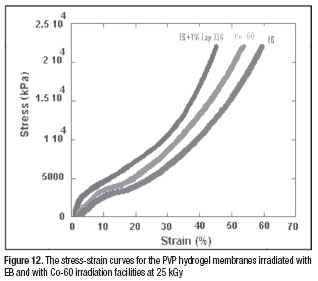
<p><strong><span lang=EN-GB style='font-size:10.0pt;font-family:Verdana'>Mechanical  analysis</span></strong></p>    <p><span lang=EN-GB style='font-size:10.0pt;font-family:Verdana'>As  mentioned before, the main interest in the preparation of nanocomposites is to  achieve materials with better mechanical properties. The mixing process of Laponite  XLG with PVP hydrogel solutionprovoke the diffusion of the polymer chains into  the basal space of the silicate layers of the organoclay creating strong interfacial  interactions. Therefore it is expected that the nanocomposite hydrogel could bear  higher external loads than the pure hydrogel.</span></p>    <p><span lang=EN-GB style='font-size:10.0pt;font-family:Verdana'>The  stress-strain curves obtained for the hydrogels prepared by EB and Co-60 irradiation  procedures and the PVP nanocompositehydrogel membrane with 1% Laponite are shown  in </span><a href="#f12065313" class="Estilo2">Figure 12</a><span lang=EN-GB style='font-size:10.0pt;font-family:Verdana'>. The resultant elastic mudulii evaluated  from the initial slope of the curves were 1.25 MPa for the nanocomposite membrane,  0.39 MPa for the Co-60 irradiated and 0.38 MPa for the EB irradiated PVP hydrogel  membranes. </span></p>    <p align=center style='text-align:center'><img src="/img/revistas/nuc/n53/f12065313.jpg" width="318" height="281"><a name="f12065313"></a></p>    
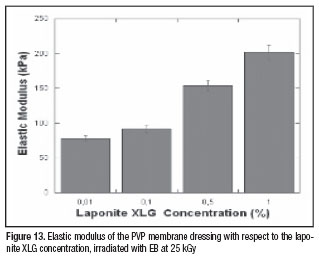
<p><span lang=EN-GB style='font-size:10.0pt;font-family:Verdana'>These  results indicate that that the irradiation method had almost no influence on the  elastic modulus of PVP hydrogels, although Co-60 irradiation seems to have produced  a somewhat stronger hydrogel as reflected by the higher area under the stress-strain  curve. The higher value of elastic modulus for the nanocomposite hydrogel is undoubtly  due to the presence of nanoclay, which results in a more entangled structure in  compare with pure gel. This is a significant result because an increase in swelling  ratio is usually accompanied by a decrease in shear modulus for non-composite  gels <span lang=EN-GB style='font-size:10.0pt;font-family:Verdana'><span lang=EN-GB style='font-size:10.0pt;font-family:Verdana'><span style='font-family:Verdana'><font size="2" face="Verdana, Arial, Helvetica, sans-serif">[</font></span></span></span></span><span lang=EN-GB><span lang=EN-GB><span lang=EN-GB><font size="2" face="Verdana, Arial, Helvetica, sans-serif">30</font></span></span></span><span lang=EN-GB style='font-size:10.0pt;font-family:Verdana'><span lang=EN-GB style='font-size:10.0pt;font-family:Verdana'><span lang=EN-GB style='font-size:10.0pt;font-family:Verdana'><span style='font-family:Verdana'><font size="2" face="Verdana, Arial, Helvetica, sans-serif">]</font></span></span></span>.  </span></p>    <p><span style='font-size:10.0pt;font-family:Verdana'><a href="#f13065313"><span lang=EN-GB>Figure 13</span></a></span><span lang=EN-GB style='font-size:10.0pt; font-family:Verdana'> shows the elastic modulus of PVP hydrogel wound dressing  as a function of the laponite XLG concentration. As can be seen the elastic modulus  increases with increasing laponite concentration from 0.01 to 1.0%. This behaviour  may be due to the intercalation of the polymerchains into the galleries of the  clay layers, whichleads to the suppression of the mobility of thecopolymer segments  near the interface and reinforce the network. Because of the improvement on the  mechanical properties, the new membrane could be candidate for wound dressing  under stresses.</span></p>    <p align=center style='text-align:center'><img border=0 width=319 height=258 src="/img/revistas/nuc/n53/f13065313.jpg"><a name=f13065313></a></p>    
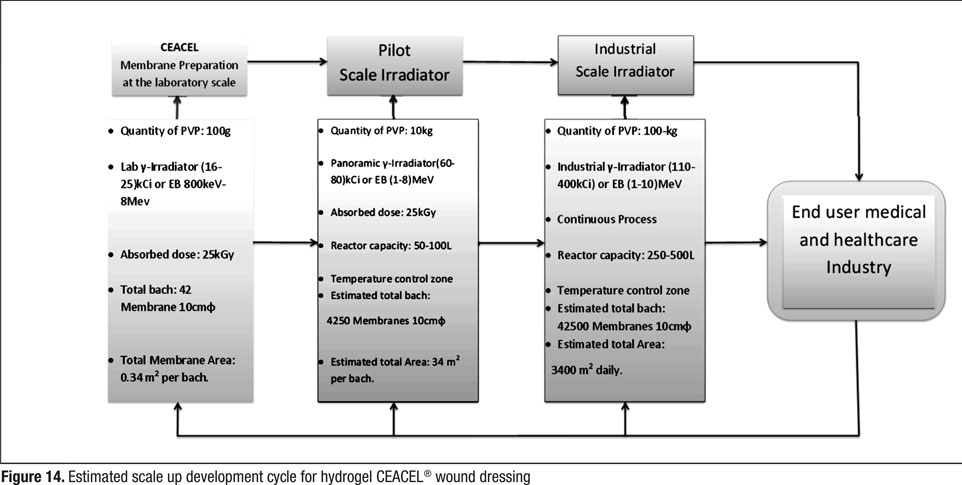
<p><strong><span lang=EN-GB style='font-size:10.0pt;font-family:Verdana'>Estimated  scale up developmentof CEACEL</span></strong><span lang=EN-GB style='font-size: 7.5pt;font-family:Verdana'>&reg;</span><strong><span lang=EN-GB style='font-size: 10.0pt;font-family:Verdana'> wound dressing</span></strong></p>    <p><span lang=EN-GB style='font-size:10.0pt;font-family:Verdana'>After  the positive results obtained at laboratory scaleit was decided to propose the  production of a these PVP hydrogel membranes in larger scale, under the trade  name CEACEL</span><span lang=EN-GB style='font-size:7.5pt;font-family:Verdana'>&reg;</span><span lang=EN-GB style='font-size:10.0pt;font-family:Verdana'>. In order to determine  technical viability for the pilot and industrial scale manufacture, the basic  irradiation facility capacities such as irradiator activity or energy, raw material  quantity and control parameters such as temperature, total production required  for satisfying medical needswere estimated.</span></p>    ]]></body>
<body><![CDATA[<p><span lang=EN-GB style='font-size:10.0pt;font-family:Verdana'>Subsequently,  the obtained wound dressings should be subjected to physical and mechanical analysis  in order to establish the product specifications.</span></p>    <p><span lang=EN-GB style='font-size:10.0pt;font-family:Verdana'>Taking  into account the existing manufacturing facilities for industrial and pilot trial  studies, a general simplified diagram is proposed, to achieve the large scale  production of CEACEL</span><span lang=EN-GB style='font-size:7.5pt;font-family: Verdana'>&reg;</span><span lang=EN-GB style='font-size:10.0pt;font-family:Verdana'>.  </span><span style='font-size:10.0pt;font-family:Verdana'>It is presented in <a href="/img/revistas/nuc/n53/f14065313.jpg">Figure 14</a></span><span style='font-family:Verdana'>.</span></p>    
<p><span lang=EN-GB>&nbsp;</span></p>    <p><strong><span lang=EN-GB style='font-family:Verdana'>CONCLUSIONS</span></strong></p>    <p><span lang=EN-GB style='font-size:10.0pt;font-family:Verdana'>Polyvinyl  pyrrolydone hydrogel membranes and nanocomposite PVP hydrogel composites with  Laponite XLG nanoclaywere prepared at laboratory scale by electron beam and Co-60  gammairradiation at 25 kGy, The elastic modulus of pure PVP hydrogels were almost  independent of the irradiation procedure, but it was three times bigger for the  nanocomposite hydrogel with 1.0% Laponite XLG. Therefore, the addition of Laponite  XLG to PVP hydrogel will provideit with better elasticity. These results indicate  that the nanocomposite hydrogel is the best choice for wound dressing applications  due to its superior mechanical properties. On the basis of these results industrial  and pilot trial studies for achieving a large scale production of the hydrogel  dressing CEACEL</span><span lang=EN-GB style='font-size:7.5pt;font-family:Verdana'>&reg;</span><span lang=EN-GB style='font-size:10.0pt;font-family:Verdana'> are proposed. </span></p>    <p>&nbsp;</p>    <p><font face="Verdana, Arial, Helvetica, sans-serif"><strong><font size="3">Acknowledgements</font></strong></font></p><font face="Verdana, Arial, Helvetica, sans-serif"><font size="2">      <p> The authors gratefully acknowledge the support provided by the International  Atomic Energy Agency through the Project No. CUB/07018. We also wish to thank  Prof. Januz M. Rosiak, for his valuable help and discussions. Most part of the  work was done in the framework of fellowships at the Institute of Applied Radiation  Chemistry, Technical University of Lotdz, Poland.</p>    <p>&nbsp;</p></font></font>    <p><font size="3" face="Verdana, Arial, Helvetica, sans-serif"><strong>REFERENCES  </strong></font></p>    ]]></body>
<body><![CDATA[<!-- ref --><p><font size="2" face="Verdana, Arial, Helvetica, sans-serif">1.  BELL&nbsp;CL, PEPPAS NA. Biomedical membranes from hydrogels and interpolymer  complexes. Adv Polym Sci. 1995; 122: 125-175.    <!-- ref --><br> 2.&nbsp;ROSIAK JM, YOSHII F.  Hydrogels and their medical applications. Nucl. Inst. Meth Phys Res B. 1999; 151(1-4):  56-64.    <!-- ref --><br> 3. BENAMER S, MAHLOUS M, BOUKRIF A, et. al. Synthesis and characterization  of hydrogels based on poly(vinyl&nbsp;pyrrolidone. Nucl. Inst. Meth. B. 2006;  248(2): 284-290.    <!-- ref --><br> 4.&nbsp;LUG&Atilde;O AB, MALMONGE SM. Use of radiation in  production of hydrogels. Nucl. Inst. Meth. B. 2001; 185(1-4): 37-42.    <!-- ref --><br> 5.&nbsp;KIM  SJ, HAHN SK, KIM MJ, et. al. Development of a novel sustained release formulation  of recombinant human growth hormone using sodium hyaluronate microparticles. J  Controlled Release. 2005; 104(2): 323-335.    <!-- ref --><br> 6.&nbsp;LLOYD LL, KENNEDY JF, METHACANON  P, et. al. Carbohydrate polymers as wound management aids. Carbohydrate Polymers.  1998; 37(3):&nbsp;315-322.    <!-- ref --><br> 7.&nbsp;ROSIAK JM, ULANSKI P, RZEINICKI A. Hydrogels  for biomedical purposes. Nucl Inst Meth Phys Res B. 1995; 105(1): 335-339.    <!-- ref --><br>  8.&nbsp;WALKER M, et. al. Scanning electron microscopic examination of bacterial  immobilisation in a carboxymethyl cellulose (AQUACEL) and alginate dressings.  Biomaterials. 2003; 24(5): 883-890.    <!-- ref --><br> 9.&nbsp;RAZZAK MT, et. al. Irradiation  of polyvinyl alcohol and polyvinyl pyrrolidone blended hydrogel for wound dressing.  Radiation Physics and Chemistry. 2001; 62(9): 107-113.    <!-- ref --><br> 10. LUG&Atilde;O AB,  ROGERO SO, MALMONGE SM. Rheological behaviour of irradiated wound dressing poly(vinyl  pyrrolidone) hydrogels. Radiat. Phys. Chem. 2002; 63(3-6): 543-546.    <!-- ref --><br> 11. ROSIAK  JM, RUCINSKA-RYBUS A, PEKALA W. Method of manufacturing of hydrogel dressings.  Patent US 4871490. 1989.    <!-- ref --><br> 12. ABAD LV, et. al. Properties of radiation synthesized  PVP-kappa carrageenan hydrogel blends.Radiat Phys Chem. 2003; 68(5): 901-908.    <!-- ref --><br>  13. AJJI Z, OTHMAN I, ROSIAK JM. Production of hydrogel wound dressings using  gamma radiation. Nucl Inst Meth Phys Res B. 2005; 229(3-4): 375-380.    <br> 14. SEN  M, AVCI EN. Radiation synthesis of poly(N-vinyl-2-pyrrolidone)-&kappa;-carrageenan  hydrogels and their use in wound dressing applications. I. Preliminary laboratory  tests. J Biomed Mater Res. 2005; 74A(2): 187-196.    <!-- ref --><br> 15.&nbsp;ZHU L, WOOL RP.  Nanoclay reinforced bio-based elastomers: Synthesis and characterization. Polymer.  2006; 47(24): 8106-8115.    <!-- ref --><br> 16.&nbsp;BLANTON TN, MAJUMDAR D, MELPOLDER SM. Microstructure  of clay-polymer composites. Advances in X-ray Analysis. 2000; 42: 562-568.    <!-- ref --><br>  17.&nbsp;LAN T, KAVIRATNA PD, PINNAVAIA TJ. On the nature of polyimide-clay hybrid  composites. Chem. Mater. 1994; 6: 573-575.    <br> 18.&nbsp;RAY SS, OKAMOTO M. Polymer/layered  silicate nanocomposites: a review from&nbsp;preparation to processing. Prog. Polym.  Sci. 2003; 28(11): 1539-1641.    <!-- ref --><br> 19. HARAGUCHI K, TANIGUCHI S, TAKEHISA T. Reversible  force generation in a temperature-responsive nanocomposite hydrogel consisting  of poly(N-isopropylacrylamide) and clay. ChemPhysChem. 2005; 6(2): 238-241.    <!-- ref --><br>  20.&nbsp;THOMAS PC, CIPRIANO BH, RAGHAVAN SR. Nanoparticle-cross-linked hydrogels  as a class of efficient materials for separation and ion exchange. SoftMatter.  2011; 7: 8192-8197.    <!-- ref --><br> 21.&nbsp;KOKABI M, SIROUSAZAR M, HASSAN ZM. PVA-clay nanocomposite  hydrogels for wound dressing. European Polymer Journal. 2007; 43(3): 773-781.    <!-- ref --><br>  22.&nbsp;MITTENDORFER J, GRATZ F. A Status report from an advanced electron beam  service center in Austria. In:&nbsp;Emerging applications of radiation processing.  IAEA-TECDOC 1386. Proceedings of a technical meeting held in Vienna, 28-30 April  2003. IAEA: Vienna, 2004. p. 21-26.    <!-- ref --><br> 23.&nbsp;ROSIAK JM. Hidrogel dresings.  In: Radiation Effects on Polymers. Washington DC: American Chemical Society, 1991.  p. 271-299.    <!-- ref --><br> 24.&nbsp;ROSIAK JM. Gel/sol analysis of irradiated polymers. Radiat  Phys Chem. 1998; 51(1): 13-17.    <br> 25.&nbsp;ZIMEK Z. Accelerator technology for  radiation processing. Recent development. In:&nbsp;Emerging applications of radiation  processing. IAEA-TECDOC 1386. Proceedings of a technical meeting held in Vienna,  28&ndash;30 April 2003. IAEA: Vienna, 2004. p. 55-64.     <br> 26.&nbsp;POZZO DC,  WALKER LM. Reversible shear gelation of polymer&ndash;clay dispersions. Colloids  and Surfaces A: Physicochem. Eng. Aspects. 2004; 240(1-3): 187-198.    <!-- ref --><br> 27.&nbsp;JANIK  I, ROSIAK JM. Sol/Gel program [software en l&iacute;nea] &lt;<A HREF="http://mitr.p.lodz.pl/biomat" TARGET="_blank">http://mitr.p.lodz.pl/biomat</A>&gt;  [consulta: 12-02-2012].    <!-- ref --><br> 28.&nbsp;BENAMER S, et. al. Synthesis and characterisation  of hydrogels based on poly(vinyl pyrrolidone). Nucl Inst Meth Phys Res B. 2006;  248(2): 284-290.    <br> 29.&nbsp;TAKIGAWA T, et. al. Change in Young&rsquo;s modulus  of poly(N-isopropylacrylamide) gels by volume phase transition. Polym Gels Networks.  1997; 5(6): 585-589.    <!-- ref --><br> 30.&nbsp;ROSIAK J, OLEJNIACZAK J, CHARLESBY A. Determination  of de radiation yield of hydrogels crossliking. Radiat. Phys. Chem. 1998; 32(5):  691-694.     </font></p>    <p>&nbsp;</p>    <p>&nbsp;</p>    <p><font size="2" face="Verdana, Arial, Helvetica, sans-serif"><strong>Recibido:</strong>  17 de abril de 2013     <br> <strong>Aceptado:</strong></font> <font size="2" face="Verdana, Arial, Helvetica, sans-serif">25  de abril de 2013 </font></p>      ]]></body><back>
<ref-list>
<ref id="B1">
<label>1</label><nlm-citation citation-type="journal">
<person-group person-group-type="author">
<name>
<surname><![CDATA[BELL]]></surname>
<given-names><![CDATA[CL]]></given-names>
</name>
<name>
<surname><![CDATA[PEPPAS]]></surname>
<given-names><![CDATA[NA]]></given-names>
</name>
</person-group>
<article-title xml:lang="en"><![CDATA[Biomedical membranes from hydrogels and interpolymer complexes]]></article-title>
<source><![CDATA[Adv Polym Sci]]></source>
<year>1995</year>
<volume>122</volume>
<page-range>125-175</page-range></nlm-citation>
</ref>
<ref id="B2">
<label>2</label><nlm-citation citation-type="journal">
<person-group person-group-type="author">
<name>
<surname><![CDATA[ROSIAK]]></surname>
<given-names><![CDATA[JM]]></given-names>
</name>
<name>
<surname><![CDATA[YOSHII]]></surname>
<given-names><![CDATA[F]]></given-names>
</name>
</person-group>
<article-title xml:lang="en"><![CDATA[Hydrogels and their medical applications]]></article-title>
<source><![CDATA[Nucl. Inst. Meth Phys Res B]]></source>
<year>1999</year>
<volume>151</volume>
<numero>1-4</numero>
<issue>1-4</issue>
<page-range>56-64</page-range></nlm-citation>
</ref>
<ref id="B3">
<label>3</label><nlm-citation citation-type="journal">
<person-group person-group-type="author">
<name>
<surname><![CDATA[BENAMER]]></surname>
<given-names><![CDATA[S]]></given-names>
</name>
<name>
<surname><![CDATA[MAHLOUS]]></surname>
<given-names><![CDATA[M]]></given-names>
</name>
<name>
<surname><![CDATA[BOUKRIF]]></surname>
<given-names><![CDATA[A]]></given-names>
</name>
</person-group>
<article-title xml:lang="en"><![CDATA[Synthesis and characterization of hydrogels based on poly(vinyl pyrrolidone]]></article-title>
<source><![CDATA[Nucl. Inst. Meth. B]]></source>
<year>2006</year>
<volume>248</volume>
<numero>2</numero>
<issue>2</issue>
<page-range>284-290</page-range></nlm-citation>
</ref>
<ref id="B4">
<label>4</label><nlm-citation citation-type="journal">
<person-group person-group-type="author">
<name>
<surname><![CDATA[LUGÃO]]></surname>
<given-names><![CDATA[AB]]></given-names>
</name>
<name>
<surname><![CDATA[MALMONGE]]></surname>
<given-names><![CDATA[SM]]></given-names>
</name>
</person-group>
<article-title xml:lang="en"><![CDATA[Use of radiation in production of hydrogels]]></article-title>
<source><![CDATA[Nucl. Inst. Meth. B]]></source>
<year>2001</year>
<volume>185</volume>
<numero>1-4</numero>
<issue>1-4</issue>
<page-range>37-42</page-range></nlm-citation>
</ref>
<ref id="B5">
<label>5</label><nlm-citation citation-type="journal">
<person-group person-group-type="author">
<name>
<surname><![CDATA[KIM]]></surname>
<given-names><![CDATA[SJ]]></given-names>
</name>
<name>
<surname><![CDATA[HAHN]]></surname>
<given-names><![CDATA[SK]]></given-names>
</name>
<name>
<surname><![CDATA[KIM]]></surname>
<given-names><![CDATA[MJ]]></given-names>
</name>
</person-group>
<article-title xml:lang="en"><![CDATA[Development of a novel sustained release formulation of recombinant human growth hormone using sodium hyaluronate microparticles]]></article-title>
<source><![CDATA[J Controlled Release]]></source>
<year>2005</year>
<volume>104</volume>
<numero>2</numero>
<issue>2</issue>
<page-range>323-335</page-range></nlm-citation>
</ref>
<ref id="B6">
<label>6</label><nlm-citation citation-type="journal">
<person-group person-group-type="author">
<name>
<surname><![CDATA[LLOYD]]></surname>
<given-names><![CDATA[LL]]></given-names>
</name>
<name>
<surname><![CDATA[KENNEDY]]></surname>
<given-names><![CDATA[JF]]></given-names>
</name>
<name>
<surname><![CDATA[METHACANON]]></surname>
<given-names><![CDATA[P]]></given-names>
</name>
</person-group>
<article-title xml:lang="en"><![CDATA[Carbohydrate polymers as wound management aids]]></article-title>
<source><![CDATA[Carbohydrate Polymers]]></source>
<year>1998</year>
<volume>37</volume>
<numero>3</numero>
<issue>3</issue>
<page-range>315-322</page-range></nlm-citation>
</ref>
<ref id="B7">
<label>7</label><nlm-citation citation-type="journal">
<person-group person-group-type="author">
<name>
<surname><![CDATA[ROSIAK]]></surname>
<given-names><![CDATA[JM]]></given-names>
</name>
<name>
<surname><![CDATA[ULANSKI]]></surname>
<given-names><![CDATA[P]]></given-names>
</name>
<name>
<surname><![CDATA[RZEINICKI]]></surname>
<given-names><![CDATA[A]]></given-names>
</name>
</person-group>
<article-title xml:lang="en"><![CDATA[Hydrogels for biomedical purposes]]></article-title>
<source><![CDATA[Nucl Inst Meth Phys Res B]]></source>
<year>1995</year>
<volume>105</volume>
<numero>1</numero>
<issue>1</issue>
<page-range>335-339</page-range></nlm-citation>
</ref>
<ref id="B8">
<label>8</label><nlm-citation citation-type="journal">
<person-group person-group-type="author">
<name>
<surname><![CDATA[WALKER]]></surname>
<given-names><![CDATA[M]]></given-names>
</name>
</person-group>
<article-title xml:lang="en"><![CDATA[Scanning electron microscopic examination of bacterial immobilisation in a carboxymethyl cellulose (AQUACEL) and alginate dressings]]></article-title>
<source><![CDATA[Biomaterials]]></source>
<year>2003</year>
<volume>24</volume>
<numero>5</numero>
<issue>5</issue>
<page-range>883-890</page-range></nlm-citation>
</ref>
<ref id="B9">
<label>9</label><nlm-citation citation-type="journal">
<person-group person-group-type="author">
<name>
<surname><![CDATA[RAZZAK]]></surname>
<given-names><![CDATA[MT]]></given-names>
</name>
</person-group>
<article-title xml:lang="en"><![CDATA[Irradiation of polyvinyl alcohol and polyvinyl pyrrolidone blended hydrogel for wound dressing]]></article-title>
<source><![CDATA[Radiation Physics and Chemistry]]></source>
<year>2001</year>
<volume>62</volume>
<numero>(9)</numero>
<issue>(9)</issue>
<page-range>107-113</page-range></nlm-citation>
</ref>
<ref id="B10">
<label>10</label><nlm-citation citation-type="journal">
<person-group person-group-type="author">
<name>
<surname><![CDATA[LUGÃO]]></surname>
<given-names><![CDATA[AB]]></given-names>
</name>
<name>
<surname><![CDATA[ROGERO]]></surname>
<given-names><![CDATA[SO]]></given-names>
</name>
<name>
<surname><![CDATA[MALMONGE]]></surname>
<given-names><![CDATA[SM]]></given-names>
</name>
</person-group>
<article-title xml:lang="en"><![CDATA[Rheological behaviour of irradiated wound dressing poly(vinyl pyrrolidone) hydrogels]]></article-title>
<source><![CDATA[Radiat. Phys. Chem]]></source>
<year>2002</year>
<volume>63</volume>
<numero>3-6</numero>
<issue>3-6</issue>
<page-range>543-546</page-range></nlm-citation>
</ref>
<ref id="B11">
<label>11</label><nlm-citation citation-type="">
<person-group person-group-type="author">
<name>
<surname><![CDATA[ROSIAK]]></surname>
<given-names><![CDATA[JM]]></given-names>
</name>
<name>
<surname><![CDATA[RUCINSKA-RYBUS]]></surname>
<given-names><![CDATA[A]]></given-names>
</name>
<name>
<surname><![CDATA[PEKALA]]></surname>
<given-names><![CDATA[W]]></given-names>
</name>
</person-group>
<source><![CDATA[Method of manufacturing of hydrogel dressings: Patent US 4871490]]></source>
<year>1989</year>
</nlm-citation>
</ref>
<ref id="B12">
<label>12</label><nlm-citation citation-type="journal">
<person-group person-group-type="author">
<name>
<surname><![CDATA[ABAD]]></surname>
<given-names><![CDATA[LV]]></given-names>
</name>
</person-group>
<article-title xml:lang="en"><![CDATA[Properties of radiation synthesized PVP-kappa carrageenan hydrogel blends]]></article-title>
<source><![CDATA[Radiat Phys Chem]]></source>
<year>2003</year>
<volume>68</volume>
<numero>5</numero>
<issue>5</issue>
<page-range>901-908</page-range></nlm-citation>
</ref>
<ref id="B13">
<label>13</label><nlm-citation citation-type="journal">
<person-group person-group-type="author">
<name>
<surname><![CDATA[AJJI]]></surname>
<given-names><![CDATA[Z]]></given-names>
</name>
<name>
<surname><![CDATA[OTHMAN]]></surname>
<given-names><![CDATA[I]]></given-names>
</name>
<name>
<surname><![CDATA[ROSIAK]]></surname>
<given-names><![CDATA[JM]]></given-names>
</name>
</person-group>
<article-title xml:lang="en"><![CDATA[Production of hydrogel wound dressings using gamma radiation]]></article-title>
<source><![CDATA[Nucl Inst Meth Phys Res B]]></source>
<year>2005</year>
<volume>229</volume>
<numero>3-4</numero>
<issue>3-4</issue>
<page-range>375-380</page-range></nlm-citation>
</ref>
<ref id="B14">
<label>14</label><nlm-citation citation-type="journal">
<person-group person-group-type="author">
<name>
<surname><![CDATA[SEN]]></surname>
<given-names><![CDATA[M]]></given-names>
</name>
<name>
<surname><![CDATA[AVCI]]></surname>
<given-names><![CDATA[EN]]></given-names>
</name>
</person-group>
<article-title xml:lang="en"><![CDATA[Radiation synthesis of poly(N-vinyl-2-pyrrolidone)-&#954;-carrageenan hydrogels and their use in wound dressing applications I. Preliminary laboratory tests]]></article-title>
<source><![CDATA[J Biomed Mater Res]]></source>
<year>2005</year>
<volume>74A</volume>
<numero>2</numero>
<issue>2</issue>
<page-range>187-196</page-range></nlm-citation>
</ref>
<ref id="B15">
<label>15</label><nlm-citation citation-type="journal">
<person-group person-group-type="author">
<name>
<surname><![CDATA[ZHU]]></surname>
<given-names><![CDATA[L]]></given-names>
</name>
<name>
<surname><![CDATA[WOOL]]></surname>
<given-names><![CDATA[RP]]></given-names>
</name>
</person-group>
<article-title xml:lang="en"><![CDATA[Nanoclay reinforced bio-based elastomers: Synthesis and characterization]]></article-title>
<source><![CDATA[Polymer]]></source>
<year>2006</year>
<volume>47</volume>
<numero>24</numero>
<issue>24</issue>
<page-range>8106-8115</page-range></nlm-citation>
</ref>
<ref id="B16">
<label>16</label><nlm-citation citation-type="journal">
<person-group person-group-type="author">
<name>
<surname><![CDATA[BLANTON]]></surname>
<given-names><![CDATA[TN]]></given-names>
</name>
<name>
<surname><![CDATA[MAJUMDAR]]></surname>
<given-names><![CDATA[D]]></given-names>
</name>
<name>
<surname><![CDATA[MELPOLDER]]></surname>
<given-names><![CDATA[SM]]></given-names>
</name>
</person-group>
<article-title xml:lang="en"><![CDATA[Microstructure of clay-polymer composites]]></article-title>
<source><![CDATA[Advances in X-ray Analysis]]></source>
<year>2000</year>
<volume>42</volume>
<page-range>562-568</page-range></nlm-citation>
</ref>
<ref id="B17">
<label>17</label><nlm-citation citation-type="journal">
<person-group person-group-type="author">
<name>
<surname><![CDATA[LAN]]></surname>
<given-names><![CDATA[T]]></given-names>
</name>
<name>
<surname><![CDATA[KAVIRATNA]]></surname>
<given-names><![CDATA[PD]]></given-names>
</name>
<name>
<surname><![CDATA[PINNAVAIA]]></surname>
<given-names><![CDATA[TJ]]></given-names>
</name>
</person-group>
<article-title xml:lang="en"><![CDATA[On the nature of polyimide-clay hybrid composites]]></article-title>
<source><![CDATA[Chem. Mater]]></source>
<year>1994</year>
<volume>6</volume>
<page-range>573-575</page-range></nlm-citation>
</ref>
<ref id="B18">
<label>18</label><nlm-citation citation-type="journal">
<person-group person-group-type="author">
<name>
<surname><![CDATA[RAY]]></surname>
<given-names><![CDATA[SS]]></given-names>
</name>
<name>
<surname><![CDATA[OKAMOTO]]></surname>
<given-names><![CDATA[M]]></given-names>
</name>
</person-group>
<article-title xml:lang="en"><![CDATA[Polymer/layered silicate nanocomposites: a review from preparation to processing]]></article-title>
<source><![CDATA[Prog. Polym. Sci]]></source>
<year>2003</year>
<volume>28</volume>
<numero>1</numero>
<issue>1</issue>
<page-range>1539-1641</page-range></nlm-citation>
</ref>
<ref id="B19">
<label>19</label><nlm-citation citation-type="journal">
<person-group person-group-type="author">
<name>
<surname><![CDATA[HARAGUCHI]]></surname>
<given-names><![CDATA[K]]></given-names>
</name>
<name>
<surname><![CDATA[TANIGUCHI]]></surname>
<given-names><![CDATA[S]]></given-names>
</name>
<name>
<surname><![CDATA[TAKEHISA]]></surname>
<given-names><![CDATA[T]]></given-names>
</name>
</person-group>
<article-title xml:lang="en"><![CDATA[Reversible force generation in a temperature-responsive nanocomposite hydrogel consisting of poly(N-isopropylacrylamide) and clay]]></article-title>
<source><![CDATA[ChemPhysChem]]></source>
<year>2005</year>
<volume>6</volume>
<numero>2</numero>
<issue>2</issue>
<page-range>238-241</page-range></nlm-citation>
</ref>
<ref id="B20">
<label>20</label><nlm-citation citation-type="journal">
<person-group person-group-type="author">
<name>
<surname><![CDATA[THOMAS]]></surname>
<given-names><![CDATA[PC]]></given-names>
</name>
<name>
<surname><![CDATA[CIPRIANO]]></surname>
<given-names><![CDATA[BH]]></given-names>
</name>
<name>
<surname><![CDATA[RAGHAVAN]]></surname>
<given-names><![CDATA[SR]]></given-names>
</name>
</person-group>
<article-title xml:lang="en"><![CDATA[Nanoparticle-cross-linked hydrogels as a class of efficient materials for separation and ion exchange]]></article-title>
<source><![CDATA[SoftMatter]]></source>
<year>2011</year>
<volume>7</volume>
<page-range>8192-8197</page-range></nlm-citation>
</ref>
<ref id="B21">
<label>21</label><nlm-citation citation-type="journal">
<person-group person-group-type="author">
<name>
<surname><![CDATA[KOKABI]]></surname>
<given-names><![CDATA[M]]></given-names>
</name>
<name>
<surname><![CDATA[SIROUSAZAR]]></surname>
<given-names><![CDATA[M]]></given-names>
</name>
<name>
<surname><![CDATA[HASSAN]]></surname>
<given-names><![CDATA[ZM]]></given-names>
</name>
</person-group>
<article-title xml:lang="en"><![CDATA[PVA-clay nanocomposite hydrogels for wound dressing]]></article-title>
<source><![CDATA[European Polymer Journal]]></source>
<year>2007</year>
<volume>43</volume>
<numero>3</numero>
<issue>3</issue>
<page-range>773-781</page-range></nlm-citation>
</ref>
<ref id="B22">
<label>22</label><nlm-citation citation-type="confpro">
<person-group person-group-type="author">
<name>
<surname><![CDATA[MITTENDORFER]]></surname>
<given-names><![CDATA[J]]></given-names>
</name>
<name>
<surname><![CDATA[GRATZ]]></surname>
<given-names><![CDATA[F]]></given-names>
</name>
</person-group>
<article-title xml:lang="en"><![CDATA[A Status report from an advanced electron beam service center in Austria]]></article-title>
<source><![CDATA[Emerging applications of radiation processing: IAEA-TECDOC 1386]]></source>
<year>2004</year>
<conf-name><![CDATA[ Proceedings of a technical meeting]]></conf-name>
<conf-date>28-30 April 2003</conf-date>
<conf-loc>Vienna </conf-loc>
<page-range>21-26</page-range><publisher-loc><![CDATA[Vienna ]]></publisher-loc>
<publisher-name><![CDATA[IAEA]]></publisher-name>
</nlm-citation>
</ref>
<ref id="B23">
<label>23</label><nlm-citation citation-type="book">
<person-group person-group-type="author">
<name>
<surname><![CDATA[ROSIAK]]></surname>
<given-names><![CDATA[JM]]></given-names>
</name>
</person-group>
<article-title xml:lang="en"><![CDATA[Hidrogel dresings]]></article-title>
<source><![CDATA[Radiation Effects on Polymers]]></source>
<year>1991</year>
<page-range>271-299</page-range><publisher-loc><![CDATA[Washington DC ]]></publisher-loc>
<publisher-name><![CDATA[American Chemical Society]]></publisher-name>
</nlm-citation>
</ref>
<ref id="B24">
<label>24</label><nlm-citation citation-type="journal">
<person-group person-group-type="author">
<name>
<surname><![CDATA[ROSIAK]]></surname>
<given-names><![CDATA[JM]]></given-names>
</name>
</person-group>
<article-title xml:lang="en"><![CDATA[Gel/sol analysis of irradiated polymers]]></article-title>
<source><![CDATA[Radiat Phys Chem]]></source>
<year>1998</year>
<volume>51</volume>
<numero>1</numero>
<issue>1</issue>
<page-range>13-17</page-range></nlm-citation>
</ref>
<ref id="B25">
<label>25</label><nlm-citation citation-type="confpro">
<person-group person-group-type="author">
<name>
<surname><![CDATA[ZIMEK]]></surname>
<given-names><![CDATA[Z]]></given-names>
</name>
</person-group>
<article-title xml:lang="en"><![CDATA[Accelerator technology for radiation processing: Recent development]]></article-title>
<source><![CDATA[Emerging applications of radiation processing: IAEA-TECDOC 1386]]></source>
<year>2004</year>
<conf-name><![CDATA[ Proceedings of a technical meeting]]></conf-name>
<conf-date>28-30 April 2003</conf-date>
<conf-loc>Vienna </conf-loc>
<page-range>55-64</page-range><publisher-loc><![CDATA[Vienna ]]></publisher-loc>
<publisher-name><![CDATA[IAEA]]></publisher-name>
</nlm-citation>
</ref>
<ref id="B26">
<label>26</label><nlm-citation citation-type="journal">
<person-group person-group-type="author">
<name>
<surname><![CDATA[POZZO]]></surname>
<given-names><![CDATA[DC]]></given-names>
</name>
<name>
<surname><![CDATA[WALKER]]></surname>
<given-names><![CDATA[LM]]></given-names>
</name>
</person-group>
<article-title xml:lang="en"><![CDATA[Reversible shear gelation of polymer-clay dispersions]]></article-title>
<source><![CDATA[Colloids and Surfaces A: Physicochem. Eng. Aspects]]></source>
<year>2004</year>
<volume>240</volume>
<numero>1-3</numero>
<issue>1-3</issue>
<page-range>187-198</page-range></nlm-citation>
</ref>
<ref id="B27">
<label>27</label><nlm-citation citation-type="">
<person-group person-group-type="author">
<name>
<surname><![CDATA[JANIK]]></surname>
<given-names><![CDATA[I]]></given-names>
</name>
<name>
<surname><![CDATA[ROSIAK]]></surname>
<given-names><![CDATA[JM]]></given-names>
</name>
</person-group>
<source><![CDATA[Sol/Gel program]]></source>
<year></year>
</nlm-citation>
</ref>
<ref id="B28">
<label>28</label><nlm-citation citation-type="journal">
<person-group person-group-type="author">
<name>
<surname><![CDATA[BENAMER]]></surname>
<given-names><![CDATA[S]]></given-names>
</name>
</person-group>
<article-title xml:lang="en"><![CDATA[Synthesis and characterisation of hydrogels based on poly(vinyl pyrrolidone)]]></article-title>
<source><![CDATA[Nucl Inst Meth Phys Res B]]></source>
<year>2006</year>
<volume>248</volume>
<numero>2</numero>
<issue>2</issue>
<page-range>284-290</page-range></nlm-citation>
</ref>
<ref id="B29">
<label>29</label><nlm-citation citation-type="journal">
<person-group person-group-type="author">
<name>
<surname><![CDATA[TAKIGAWA]]></surname>
<given-names><![CDATA[T]]></given-names>
</name>
</person-group>
<article-title xml:lang="en"><![CDATA[Change in Young&#8217;s modulus of poly(N-isopropylacrylamide) gels by volume phase transition]]></article-title>
<source><![CDATA[Polym Gels Networks]]></source>
<year>1997</year>
<volume>5</volume>
<numero>6</numero>
<issue>6</issue>
<page-range>585-589</page-range></nlm-citation>
</ref>
<ref id="B30">
<label>30</label><nlm-citation citation-type="journal">
<person-group person-group-type="author">
<name>
<surname><![CDATA[ROSIAK]]></surname>
<given-names><![CDATA[J]]></given-names>
</name>
<name>
<surname><![CDATA[OLEJNIACZAK]]></surname>
<given-names><![CDATA[J]]></given-names>
</name>
<name>
<surname><![CDATA[CHARLESBY]]></surname>
<given-names><![CDATA[A]]></given-names>
</name>
</person-group>
<article-title xml:lang="en"><![CDATA[of de radiation yield of hydrogels crossliking]]></article-title>
<source><![CDATA[Radiat. Phys. Chem]]></source>
<year>1998</year>
<volume>32</volume>
<numero>5</numero>
<issue>5</issue>
<page-range>691-694</page-range></nlm-citation>
</ref>
</ref-list>
</back>
</article>