<?xml version="1.0" encoding="ISO-8859-1"?><article xmlns:mml="http://www.w3.org/1998/Math/MathML" xmlns:xlink="http://www.w3.org/1999/xlink" xmlns:xsi="http://www.w3.org/2001/XMLSchema-instance">
<front>
<journal-meta>
<journal-id>0864-084X</journal-id>
<journal-title><![CDATA[Nucleus]]></journal-title>
<abbrev-journal-title><![CDATA[Nucleus]]></abbrev-journal-title>
<issn>0864-084X</issn>
<publisher>
<publisher-name><![CDATA[CUBAENERGIA]]></publisher-name>
</publisher>
</journal-meta>
<article-meta>
<article-id>S0864-084X2013000200002</article-id>
<title-group>
<article-title xml:lang="en"><![CDATA[Bioaccumulation of zinc in crops and its contribution to Zn intake by Cuban population]]></article-title>
<article-title xml:lang="es"><![CDATA[Bioacumulación de zinc en cultivos y su contribución a la ingestión de Zn por la población cubana]]></article-title>
</title-group>
<contrib-group>
<contrib contrib-type="author">
<name>
<surname><![CDATA[Díaz Rizo]]></surname>
<given-names><![CDATA[Oscar]]></given-names>
</name>
</contrib>
<contrib contrib-type="author">
<name>
<surname><![CDATA[Olivares Reumont]]></surname>
<given-names><![CDATA[Susana]]></given-names>
</name>
</contrib>
<contrib contrib-type="author">
<name>
<surname><![CDATA[Denis Alpízar]]></surname>
<given-names><![CDATA[Otoniel]]></given-names>
</name>
</contrib>
<contrib contrib-type="author">
<name>
<surname><![CDATA[Lima Cazorla]]></surname>
<given-names><![CDATA[Lázaro]]></given-names>
</name>
</contrib>
<contrib contrib-type="author">
<name>
<surname><![CDATA[D´Alessandro Rodríguez]]></surname>
<given-names><![CDATA[Katia]]></given-names>
</name>
</contrib>
<contrib contrib-type="author">
<name>
<surname><![CDATA[Arado López]]></surname>
<given-names><![CDATA[Juana O.]]></given-names>
</name>
</contrib>
</contrib-group>
<aff id="A01">
<institution><![CDATA[,Instituto Superior de Tecnologías y Ciencias Aplicadas (InSTEC) Ave. Salvador Allende y Luaces, La Habana, Cuba  ]]></institution>
<addr-line><![CDATA[La Habana ]]></addr-line>
<country>Cuba</country>
</aff>
<aff id="A02">
<institution><![CDATA[,Universidad de Matanzas  ]]></institution>
<addr-line><![CDATA[ ]]></addr-line>
<country>Cuba</country>
</aff>
<pub-date pub-type="pub">
<day>00</day>
<month>12</month>
<year>2013</year>
</pub-date>
<pub-date pub-type="epub">
<day>00</day>
<month>12</month>
<year>2013</year>
</pub-date>
<numero>54</numero>
<fpage>8</fpage>
<lpage>11</lpage>
<copyright-statement/>
<copyright-year/>
<self-uri xlink:href="http://scielo.sld.cu/scielo.php?script=sci_arttext&amp;pid=S0864-084X2013000200002&amp;lng=en&amp;nrm=iso"></self-uri><self-uri xlink:href="http://scielo.sld.cu/scielo.php?script=sci_abstract&amp;pid=S0864-084X2013000200002&amp;lng=en&amp;nrm=iso"></self-uri><self-uri xlink:href="http://scielo.sld.cu/scielo.php?script=sci_pdf&amp;pid=S0864-084X2013000200002&amp;lng=en&amp;nrm=iso"></self-uri><abstract abstract-type="short" xml:lang="en"><p><![CDATA[Zinc content and Zn bioaccumulation in crops (rice and some vegetables and condiments) cultivated in 18 Cuban urban and suburban areas are reported. Zinc content in food and the corresponding farming soil samples was determined by X-Ray Fluorescence analysis and by Atomic Absorption spectrometry. The quality of the analysis was verified using the Certified Reference Materials IAEA 393 «Algae», MA-B-3/TM «Fish Tissue Lyophilised», IAEA V-10 «Hay» and IAEA Soil-7. The obtained results show rice, of the studied crops, as the major Zn bioaccumulator and important Zn source in Cuban human diet.]]></p></abstract>
<abstract abstract-type="short" xml:lang="es"><p><![CDATA[Se reportan los contenidos de zinc y su bioacumulación en cultivos (arroz, vegetales y condimentos) procedentes de 18 áreas de agricultura urbana y suburbana. El contenido de zinc en los alimentos, así como en sus correspondientes suelos de cultivo, fue determinado por Fluorescencia de Rayos X y por Espectrometría de Absorción Atómica. La calidad del estudio se verificó mediante el análisis de los Materiales de Referencia Certificados IAEA 393 «Algae», MA-B-3/TM «Fish Tissue Lyophilised», IAEA V-10 «Hay» e IAEA Soil-7. Los resultados mostraron al arroz, de los cultivos estudiados, como el cultivo de mayor bioacumulación de zinc y como fuente importante de Zn en la dieta de nuestra población]]></p></abstract>
<kwd-group>
<kwd lng="en"><![CDATA[Cuba]]></kwd>
<kwd lng="en"><![CDATA[diet]]></kwd>
<kwd lng="en"><![CDATA[biological accumulation]]></kwd>
<kwd lng="en"><![CDATA[soils]]></kwd>
<kwd lng="en"><![CDATA[crops]]></kwd>
<kwd lng="en"><![CDATA[X-ray fluorescence analysis]]></kwd>
<kwd lng="en"><![CDATA[absorption spectroscopy]]></kwd>
<kwd lng="es"><![CDATA[Cuba]]></kwd>
<kwd lng="es"><![CDATA[dieta]]></kwd>
<kwd lng="es"><![CDATA[acumulación biológica]]></kwd>
<kwd lng="es"><![CDATA[suelos]]></kwd>
<kwd lng="es"><![CDATA[cosechas]]></kwd>
<kwd lng="es"><![CDATA[análisis por fluorescencia de rayos X]]></kwd>
<kwd lng="es"><![CDATA[espectroscopia de absorción]]></kwd>
</kwd-group>
</article-meta>
</front><body><![CDATA[ <p align="right"><font face="Verdana, Arial, Helvetica, sans-serif" size="2"><b>CIENCIAS NUCLEARES</b></font></p>     <p align="left">&nbsp;</p>     <p><strong><font size="4" face="Verdana, Arial, Helvetica, sans-serif">Bioaccumulation of zinc in crops  and its contribution</font></strong><font size="4" face="Verdana, Arial, Helvetica, sans-serif"> <strong>to Zn  intake by Cuban population</strong> </font></p>     <p><strong><font size="4" face="Verdana, Arial, Helvetica, sans-serif"> </font></strong></p>     <p><strong>    <br> </strong><strong><font face="Verdana, Arial, Helvetica, sans-serif" size="3">Bioacumulaci&oacute;n de zinc en cultivos y su contribuci&oacute;n a la  ingesti&oacute;n </font></strong><font size="3" face="Verdana, Arial, Helvetica, sans-serif"><strong>de Zn por la poblaci&oacute;n cubana</strong></font><font size="3"><strong></strong></font></p>     <p><strong><font face="Verdana, Arial, Helvetica, sans-serif" size="3">&nbsp;</font></strong>&nbsp;&nbsp;&nbsp;&nbsp;</p>     <p>&nbsp;</p>     <p><font face="Verdana, Arial, Helvetica, sans-serif" size="2"><strong>Oscar D&iacute;az Rizo<sup>1</sup>, Susana Olivares Reumont<sup>1</sup>, Otoniel Denis Alp&iacute;zar<sup>2</sup>, L&aacute;zaro Lima Cazorla<sup>1</sup>, Katia D&acute;Alessandro  Rodr&iacute;guez<sup>1</sup> ,  Juana O. Arado L&oacute;pez<sup>1</sup>&nbsp;&nbsp;</strong></font> <font face="Verdana, Arial, Helvetica, sans-serif" size="2">    <br> </font></p>     ]]></body>
<body><![CDATA[<p><font size="2" face="Verdana, Arial, Helvetica, sans-serif"><sup>1</sup>Instituto  Superior de Tecnolog&iacute;as y Ciencias Aplicadas (InSTEC)     <br>   Ave. Salvador Allende y Luaces, La Habana, Cuba    <br>   <sup>2</sup>Universidad  de Matanzas, Cuba </font></p>     <p><font size="2" face="Verdana, Arial, Helvetica, sans-serif"><a href="mailto:odrizo@instec.cu">odrizo@instec.cu</a></font></p>     <p>&nbsp;</p>     <p>&nbsp;</p> <hr>     <p><font face="Verdana, Arial, Helvetica, sans-serif" size="2"><b>ABSTRACT</b></font></p>     <p><font size="2" face="Verdana, Arial, Helvetica, sans-serif">Zinc content and Zn bioaccumulation  in crops (rice and some vegetables and condiments) cultivated in 18 Cuban urban  and suburban areas are reported. Zinc content in food and the corresponding  farming soil samples was determined by X-Ray Fluorescence analysis and by Atomic  Absorption spectrometry. The quality of the  analysis was verified using the Certified Reference Materials IAEA 393 &laquo;Algae&raquo;,  MA-B-3/TM &laquo;Fish Tissue Lyophilised&raquo;, IAEA V-10 &laquo;Hay&raquo; and IAEA Soil-7. The obtained results show rice, of the studied crops, as the major Zn  bioaccumulator and important Zn source in Cuban human diet. </font></p>     <p><font size="2" face="Verdana, Arial, Helvetica, sans-serif"><strong>Key words: </strong>Cuba, diet, biological accumulation, soils,  crops, X-ray fluorescence analysis, absorption spectroscopy</font></p> <hr>     <p><font face="Verdana, Arial, Helvetica, sans-serif" size="2"><b>RESUMEN</b></font></p>     ]]></body>
<body><![CDATA[<p><font size="2" face="Verdana, Arial, Helvetica, sans-serif">Se reportan los  contenidos de zinc y su bioacumulaci&oacute;n en cultivos (arroz, vegetales y  condimentos) procedentes de 18 &aacute;reas de agricultura urbana y suburbana. El  contenido de zinc en los alimentos, as&iacute; como en sus correspondientes suelos de  cultivo, fue determinado por Fluorescencia de Rayos X y por Espectrometr&iacute;a de  Absorci&oacute;n At&oacute;mica. La calidad del estudio se verific&oacute; mediante el an&aacute;lisis de  los Materiales de Referencia Certificados IAEA 393 &laquo;Algae&raquo;, MA-B-3/TM &laquo;<em>Fish Tissue Lyophilised</em>&raquo;, IAEA V-10  &laquo;Hay&raquo; e IAEA <em>Soil-</em>7. Los resultados  mostraron al arroz, de los cultivos estudiados, como el cultivo de mayor  bioacumulaci&oacute;n de zinc y como fuente importante de Zn en la dieta de nuestra  poblaci&oacute;n.</font></p>     <p><font size="2" face="Verdana, Arial, Helvetica, sans-serif"><strong>Palabras claves:</strong></font> <font size="2" face="Verdana, Arial, Helvetica, sans-serif">Cuba, dieta, acumulaci&oacute;n biol&oacute;gica, suelos,  cosechas, an&aacute;lisis por fluorescencia de rayos X, espectroscopia de absorci&oacute;n</font>.</p> <hr> <h1>&nbsp;</h1>     <p>&nbsp;</p>     <p><font size="3" face="Verdana, Arial, Helvetica, sans-serif"><strong>INTRODUCTION</strong></font></p>     <p><font size="2" face="Verdana, Arial, Helvetica, sans-serif">Trace elements play an important  role in human nutrition and health, and hundreds of millions of people around  the world suffer the consequences of trace element deficiencies [1]. Among  those, zinc is an essential microelement, which people solely ingest from their  diet. The World Hearth Organization (WHO) recommends a daily optimal intake for  adults of 12-15 mg of zinc [1]. Zinc influences cell  division, growth and development as well as sexual maturation. It is also a membrane  stabilizer and essential for the integrity of the immune system [2]. Moreover, zinc is required by more than 100 enzymes as  cofactor, and it seems to help in the proper storage and release of insulin,  growth and repair of tissues, the ability to taste food, mineralization of  bone, blood clotting, the function of vitamin A and the functions of the  thyroid hormones [3]. Inadequate zinc nutrition is becoming a  considerable public health problem nowadays, with the WHO lastly highlighting  zinc deficiency as one of the 10 major factors contributing to the burden of  disease in developing countries [4]</font>.</p>     <p><font size="2" face="Verdana, Arial, Helvetica, sans-serif">Rice is the  main garniture in Cuban diet, with population consuming (in average) around 200 grams per day. However,  urban and suburban agriculture in Cuba have accomplished  a considerable increment in the ingestion of fresh vegetables (tomato, lettuce,  cabbage, cucumber, gumbo, etc.) in the last decades [5]. Furthermore, garlic, onion, red pepper and parsley are quite popular  condiments in Cuban cuisine. The present  study summarizes zinc content determination in regular  consumption foodstuff (rice, some vegetables, fruits and condiments) and its  corresponding farming soils using nuclear and related techniques in order to  determinate its contribution to the net Zn intake within the Cuban population's  diet. </font></p>     <p>&nbsp;</p>     <p>&nbsp;</p>     <p><font face="Verdana, Arial, Helvetica, sans-serif"><strong><font size="3">MATERIALS AND METHODS </font></strong></font></p>     <p><font size="2" face="Verdana, Arial, Helvetica, sans-serif">The edible parts of different crops (rice, vegetables, fruits and roots  samples) and its corresponding farming soils were collected in 18 urban and  suburban agricultural areas from La   Habana, Matanzas and Cienfuegos cities. Composite  samples, consisting on four subsamples, were collected at each site  (approximately 5 x 5 m).  Zinc concentrations in soils were estimated by X-Ray  Fluorescence Analysis (XRF) using Certified Reference Materials (CRM) as  standards, a <img src="/img/revistas/nuc/n54/e01025413.jpg" width="34" height="14"> (1.1  GBq) excitation source with ring geometry and a Canberra Si(Li) detector-based  XRF spectrometer at Nuclear Analytical Lab at InSTEC (150 eV energy resolution  at 5.9 keV, Be window thickness = 12.0 mm)  coupled to a MCA, following the methodology described in [6]. On the other hand, the zinc  content in rice samples was determined by XRF using set of Zn-doped cellulose  samples for calibration [7],  while Zn contents in the rest of the crops was determined by AAS (Buck  Scientific 210 VGP) according to the procedure established and validated in the  Environmental Analytical Lab at InSTEC [8] (PNO09  2007). </font></p>     
]]></body>
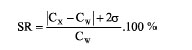
<body><![CDATA[<p><font size="2" face="Verdana, Arial, Helvetica, sans-serif">  The accuracy was evaluated using the <a href="#e02025413">SR criterion</a>, proposed by McFarrell  [9]:</font></p>     <p><img src="/img/revistas/nuc/n54/e02025413.jpg" width="192" height="50"><a name="e02025413"></a></p>     
<p><font size="2" face="Verdana, Arial, Helvetica, sans-serif">where <img src="/img/revistas/nuc/n54/e08025413.jpg" width="18" height="18">&ndash;experimental value, <img src="/img/revistas/nuc/n54/e03025413.jpg" width="21" height="18">&ndash;certified value  and s is the standard deviation of <img src="/img/revistas/nuc/n54/e08025413.jpg" width="18" height="18">. On the basis of this  criterion, the similarity between the certified value and the analytical data  obtained by the proposed methods is divided into three categories: SR <img src="/img/revistas/nuc/n54/e04025413.jpg" width="14" height="18"> 25% =  excellent; 25 &lt; SR <img src="/img/revistas/nuc/n54/e04025413.jpg" width="14" height="18"> 50% = acceptable, SR &gt; 50% = unacceptable. The  analysis of five replica of the CRMs IAEA 393 &laquo;Algae&raquo;, MA-B-3/TM &laquo;Fish Tissue  Lyophilised&raquo;, IAEA V-10 &laquo;Hay&raquo; and IAEA Soil-7 is presented in <a href="#t01025413">Table 1</a>. Both,  XRF and AAS methodologies, show &ldquo;excellent&rdquo; (SR <img src="../img/e04025413.jpg" width="13" height="17"> 25%) results and a very good  correlation (R = 0.999) between the certified and measured values. </font></p>     
<p align="center"><img src="/img/revistas/nuc/n54/t01025413.jpg" width="319" height="141"><a name="t01025413"></a></p>     
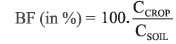
<p><font size="2" face="Verdana, Arial, Helvetica, sans-serif">In order to estimate the rate at which Zn appears  in the selected specie and associated soil, the biota-soil bioaccumulations  factors (BFs) were calculated in the studied samples according to the <a href="#e09025413">formula</a> [10]:</font></p>     <p><img src="/img/revistas/nuc/n54/e09025413.jpg" width="176" height="44"><a name="e09025413"></a></p>     
<p><font size="2" face="Verdana, Arial, Helvetica, sans-serif">where <img src="/img/revistas/nuc/n54/e10025413.jpg" width="40" height="21"> and <img src="/img/revistas/nuc/n54/e11025413.jpg" width="34" height="20"> are  the mean concentrations of Zn in the food sample and its corresponding soil, respectively.</font></p>     
<p>&nbsp;</p>     <p>&nbsp;</p>     <p><font size="2" face="Verdana, Arial, Helvetica, sans-serif"><strong><font size="3">RESULTS AND DISCUSSION</font></strong></font></p>     ]]></body>
<body><![CDATA[<p><font size="2" face="Verdana, Arial, Helvetica, sans-serif">  Zinc content in all studied food samples are  shown in <a href="#t02025413">Table 2</a>. The highest mean content and bioaccumulation values were found  in the studied rice samples (35.9 <img src="/img/revistas/nuc/n54/e05025413.jpg" width="48" height="15">  fresh weight and 41.0%, respectively), while the lowest content was found in tomato fruits. As it is well known, rice is  one of the most frequently consumed cereals worldwide, especially in developing  countries. For this reason, in the last decade different studies were performed  (supported by FAO) in order to solve the Zn deficiency in rice. For example,  positive results were obtained by doping rice seeds with <img src="/img/revistas/nuc/n54/e06025413.jpg" width="41" height="17"> or using Zn doped fertilizers [11] and applying biotechnological techniques to increase the essential  metal absorption by plants [12]. Cuba  was part of these FAO studies evidencing the high Zn content in our cultivated  rice. Thus, around the 70% of the  established Zn daily intake by Cuban regulations    (1 <img src="/img/revistas/nuc/n54/e05025413.jpg" width="48" height="15"> body weight <img src="/img/revistas/nuc/n54/e07025413.jpg" width="30" height="15">)  [13] is supplied by rice consumption.</font></p>     
<p align="center"><img src="/img/revistas/nuc/n54/t02025413.jpg" width="554" height="514"><a name="t02025413"></a></p>     
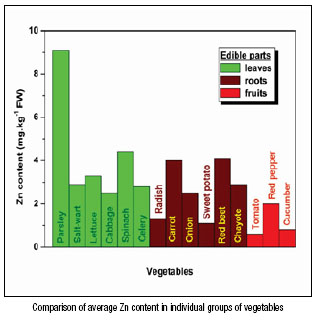
<p><font size="2" face="Verdana, Arial, Helvetica, sans-serif">For the rest of the studied crops  (vegetables and condiments), the determined Zn concentration (and the corresponding  bioaccumulation) is very low when compared to rice Zn content and bioaccumulation.  The concentration values are similar to those reported by other authors and,  for the major part of the studied fruits and vegetables, the Zn content does  not exceed its maximum allowable limit (10.0 <img src="/img/revistas/nuc/n54/e12025413.jpg" width="46" height="15"> fresh weight) specified by Cuban regulations [13].  In the studied vegetables, on average, higher  zinc content was found in those with leaves as edible parts <a href="#f01025413">(Figure)</a>, compared with  vegetables of which edible parts are roots and fruits. </font></p>     
<p align="center"><img src="/img/revistas/nuc/n54/f01025413.jpg" width="318" height="321"><a name="f01025413"></a></p>     
<p><font size="2" face="Verdana, Arial, Helvetica, sans-serif">In Cuba, from the studied vegetables,  only lettuce, cabbage, onions, tomato, red pepper and cucumber are frequently  consumed. Assuming an average daily consumption (in one month) of rice &ndash; 200 g, vegetables whose edible parts are leaves &ndash; 100 g, vegetables whose  edible parts are roots &ndash; 100 g  and vegetables whose edible parts are fruits &ndash;  100 g,  the Daily Dietary Intakes (DDI) of Zn in Cuba would be around 8.8 mg per day.  This value is similar to the recommended medium level for Zn intake (8.7 mg per  day) [1] and it is the 80%  of the US Recommendable Dietary Allowances (11.0 mg per day) [22]. </font></p>     <p><font size="2" face="Verdana, Arial, Helvetica, sans-serif">  This  seems to indicate that Cuban population would be able to meet the normative  requirements if consuming diets of uniformly low zinc bioavailability. It is  also apparent that dietary intake data taken alone (without consideration of  the bioavailability) does not allow a reliable assessment of whether a  particular population has an adequate or inadequate nutrition. </font></p>     <p><font size="2" face="Verdana, Arial, Helvetica, sans-serif">  The  bioavailability of zinc from different diets depends on many factors. High  availability is found only in refined diets low in cereal fibre and phytic acid  contents, and with adequate proteins, mainly from non-vegetable sources such as  meat and fish. Therefore, Zn content in meat and fish tissues remains to be  assessed by a specific study to estimate a more accurate Zn DDI of the Cuban  population.</font></p>     <p>&nbsp;</p>     <p>&nbsp;</p>     <p><font face="Verdana, Arial, Helvetica, sans-serif"><strong><font size="3">CONCLUSIONES</font></strong></font></p>     ]]></body>
<body><![CDATA[<p><font size="2" face="Verdana, Arial, Helvetica, sans-serif">The combination of XRF and  AAS allowed the Zn content determination in an important group of food samples,  as well as its bioaccumulation and its contribution to the Daily Dietary Intake of Zn in Cuba. Higher zinc contents were found in  vegetables whose edible parts are leaves. The obtained result shows rice as the  main Zn bioaccumulator and major contributor to Zn DDI within the studied crops.  Although a large portion of the Cuban population&acute;s diet has been studied,  analysis of additional foodstuff, such as fish and meat, still remains  necessary for a complete Zn DDI report.</font></p>     <p>&nbsp;</p>     <p>&nbsp;</p>     <p><font size="3" face="Verdana, Arial, Helvetica, sans-serif"><strong>REFERENCES</strong></font></p>     <!-- ref --><p>   <font size="2" face="Verdana, Arial, Helvetica, sans-serif">1. WORLD  HEALTH ORGANIZATION. Trace Elements in Human Nutrition and Health. Geneva: WHO,  1996.    <!-- ref --><br> 2. SCHLESINGER L, AREVALO M,  ARREDONDO S, et. al. Effect of a zinc-fortified formula on immunocompetence and  growth of malnourished infants. Am J Clin Nutr. 1993; 56(3): 491-498.    <!-- ref --><br> 3. HANDS ES. Nutrients in food.  London: Lippincott Williams and Wilkins, 1999.    <!-- ref --><br> 4. PARR RM, ARAS NK, IYENGAR GV. Dietary  intakes of essential trace elements: Results from total diet studies supported  by the IAEA. J Radioanal Nucl Chem. 2006; 270: 155-161.    <br> 5. ALTIERI MA, COMPANIONI N,  CA&Ntilde;IZARES K, et. al. The greening of the &ldquo;barrios&rdquo;: urban agriculture for  food security in Cuba. Agric Hum Values. 1999; 16(2): 131-140.     <!-- ref --><br> 6. D&Iacute;AZ RIZO O, ECHEVARR&Iacute;A F,  ARADO JO, MERLO M. Assessment of heavy  metal pollution in urban soils of Havana city, Cuba. Bull Environ Contam  Toxicol. 2011; 87(4): 414-419.    <!-- ref --><br> 7. DENIS ALP&Iacute;ZAR O, D&Iacute;AZ RIZO O.  Zinc content in rice and other agriproduct by X-ray fluorescence. Nucleus.  2009; (46): 34-39.    <!-- ref --><br> 8. InSTEC. Cd, Pb, Zn and Cu  content determination in fresh vegetables.&nbsp; Quality Assurance System of  the&nbsp;Environmental Analytical Laboratory. Procedure No. 9 (PNO09).&nbsp;La Habana: InSTEC, 2007 (in  Spanish).    <br> 9. QUEVAUVILLER Ph, MARRIER E. Quality Assurance for  Environmental Analysis In:     <br> Quality&nbsp;&nbsp;&nbsp; Assurance for Environmental Analysis. Tech. Instrum.  Anal. Chem.  1995, 17: 1-25.    <!-- ref --><br> 10. VIVES A, MOREIRA S, BRIENZA S, et. al. Synchrotron radiation total  reflection X-ray fluorescence (SR-TXRF) for evaluation of food contamination. J  Radioanal Nucl Chem. 2006; 270(1): 147-153.    <!-- ref --><br> 11. SLATON NA, NORMAN R,  WILSON CE. Effect of zinc source and application time on zinc uptake and grain  yield of flood-irrigated rice. Agron J. 2005; 97: 272-278.    <!-- ref --><br> 12. CAKMAK I. Plant  nutrition research: Priorities to meet human needs for food in sustainable  ways. Plant Soil. 2002; 247: 3-24.    <br> 13. NORMA CUBANA-493. Metallic contaminant in  food-sanitary regulation. Cuban National Bureau of Standards. ICS:67.020,  Havana, Cuba, 2006 (in Spanish).    <!-- ref --><br> 14. KABATA-PENDIAS A, PENDIAS H. Trace element in soils  and plants. Boca Raton: CRC Press, 1992.    <!-- ref --><br> 15. BAHEMUKA T, MUBOFU E. Heavy metals in edible green vegetables grown along  the sites of the Sinza and Msimbazi rivers in Dar es Salaam, Tanzania. Food  Chem. 1999; 66(1): 63-66.    <!-- ref --><br> 16. GORBUNOV A, FROTASYEVA M, KISTANOV A, et. al. Heavy and toxic metals in&nbsp; staple  foodstuffs and agriproduct from contaminated soils. JINR Communication  E18-2002-111. Dubna:&nbsp; JINR, 2002.    <!-- ref --><br> 17. BOSIACKI M,  TYKSINSKI W. Copper, zinc, iron and manganese content in edible parts of some  fresh vegetables sold on markets in Poznan. J Elementol. 2009; 14(1): 13-22.    <!-- ref --><br> 18. PANDEY  J, PANDEY U. Accumulation of heavy metals in dietary vegetables and cultivated  soil horizon in organic farming system in relation to atmospheric deposition in  a seasonally dry tropical region of India. Environ Monit Assess. 2009;  148(1-4): 61-74.    <!-- ref --><br> 19. YUNG MC. Heavy metal concentrations in soils and factors affecting metal  uptake by plants in the vicinity of a Korean Cu-W mine. Sensors. 2008; 8(4):  2413-2423.    <!-- ref --><br> 20IYAKA YA. Concentration of Cu and Zn in some fruits and vegetables  commonly available in north-central zone of Nigeria. EJEAFChe. 2007; 6(6):  2150-2154.    <br> 21. MARCUSSEN  H, JOERGENSEN K, HOLM PE, et. al. Element contents and food safety of water spinach  (Ipomoea aquatica Forssk.) cultivated with wastewater in Hanoi, Vietnam.  Environ. Monit. Assess. 2008, 139(1-3): 77&ndash;91.     <!-- ref --><br> 22. FOOD AND  NUTRITION BOARD. Dietary Reference Intakes for Vitamin A, Vitamin K, Arsenic,  Boron, Chromium, Copper, Iodine, Iron, Manganese, Molybdenum, Nickel, Silicon,  Vanadium, and Zinc. Washington DC. National Academy Press, 2000.    </font></p>     <p>&nbsp;</p>     <p><font size="2" face="Verdana, Arial, Helvetica, sans-serif"><strong>Recibido:</strong> 22 de julio de 2013    ]]></body>
<body><![CDATA[<br>   <strong>Aceptado:</strong></font> <font size="2" face="Verdana, Arial, Helvetica, sans-serif">24 de octubre de 2013</font></p>      ]]></body><back>
<ref-list>
<ref id="B1">
<label>1</label><nlm-citation citation-type="book">
<collab>WORLD HEALTH ORGANIZATION</collab>
<source><![CDATA[Trace Elements in Human Nutrition and Health]]></source>
<year>1996</year>
<publisher-loc><![CDATA[Geneva ]]></publisher-loc>
<publisher-name><![CDATA[WHO]]></publisher-name>
</nlm-citation>
</ref>
<ref id="B2">
<label>2</label><nlm-citation citation-type="journal">
<person-group person-group-type="author">
<name>
<surname><![CDATA[SCHLESINGER]]></surname>
<given-names><![CDATA[L]]></given-names>
</name>
<name>
<surname><![CDATA[AREVALO]]></surname>
<given-names><![CDATA[M]]></given-names>
</name>
<name>
<surname><![CDATA[ARREDONDO]]></surname>
<given-names><![CDATA[S]]></given-names>
</name>
</person-group>
<article-title xml:lang="en"><![CDATA[Effect of a zinc-fortified formula on immunocompetence and growth of malnourished infants]]></article-title>
<source><![CDATA[Am J Clin Nutr]]></source>
<year>1993</year>
<volume>56</volume>
<numero>3</numero>
<issue>3</issue>
<page-range>491-498</page-range></nlm-citation>
</ref>
<ref id="B3">
<label>3</label><nlm-citation citation-type="book">
<person-group person-group-type="author">
<name>
<surname><![CDATA[HANDS]]></surname>
<given-names><![CDATA[ES]]></given-names>
</name>
</person-group>
<source><![CDATA[Nutrients in food]]></source>
<year>1999</year>
<publisher-loc><![CDATA[London ]]></publisher-loc>
<publisher-name><![CDATA[Lippincott Williams and Wilkins]]></publisher-name>
</nlm-citation>
</ref>
<ref id="B4">
<label>4</label><nlm-citation citation-type="journal">
<person-group person-group-type="author">
<name>
<surname><![CDATA[PARR]]></surname>
<given-names><![CDATA[RM]]></given-names>
</name>
<name>
<surname><![CDATA[ARAS]]></surname>
<given-names><![CDATA[NK]]></given-names>
</name>
<name>
<surname><![CDATA[IYENGAR]]></surname>
<given-names><![CDATA[GV]]></given-names>
</name>
</person-group>
<article-title xml:lang="en"><![CDATA[Dietary intakes of essential trace elements: Results from total diet studies supported by the IAEA]]></article-title>
<source><![CDATA[J Radioanal Nucl Chem]]></source>
<year>2006</year>
<volume>270</volume>
<page-range>155-161</page-range></nlm-citation>
</ref>
<ref id="B5">
<label>5</label><nlm-citation citation-type="journal">
<person-group person-group-type="author">
<name>
<surname><![CDATA[ALTIERI]]></surname>
<given-names><![CDATA[MA]]></given-names>
</name>
<name>
<surname><![CDATA[COMPANIONI]]></surname>
<given-names><![CDATA[N]]></given-names>
</name>
<name>
<surname><![CDATA[CAÑIZARES]]></surname>
<given-names><![CDATA[K]]></given-names>
</name>
</person-group>
<article-title xml:lang="en"><![CDATA[The greening of the &#8220;barrios&#8221;: urban agriculture for food security in Cuba]]></article-title>
<source><![CDATA[Agric Hum Values]]></source>
<year>1999</year>
<volume>16</volume>
<numero>2</numero>
<issue>2</issue>
<page-range>131-140</page-range></nlm-citation>
</ref>
<ref id="B6">
<label>6</label><nlm-citation citation-type="journal">
<person-group person-group-type="author">
<name>
<surname><![CDATA[DÍAZ RIZO]]></surname>
<given-names><![CDATA[O]]></given-names>
</name>
<name>
<surname><![CDATA[ECHEVARRÍA]]></surname>
<given-names><![CDATA[F]]></given-names>
</name>
<name>
<surname><![CDATA[ARADO]]></surname>
<given-names><![CDATA[JO]]></given-names>
</name>
<name>
<surname><![CDATA[MERLO]]></surname>
<given-names><![CDATA[M]]></given-names>
</name>
</person-group>
<article-title xml:lang="en"><![CDATA[Assessment of heavy metal pollution in urban soils of Havana city, Cuba]]></article-title>
<source><![CDATA[Bull Environ Contam Toxicol]]></source>
<year>2011</year>
<volume>87</volume>
<numero>4</numero>
<issue>4</issue>
<page-range>414-419</page-range></nlm-citation>
</ref>
<ref id="B7">
<label>7</label><nlm-citation citation-type="journal">
<person-group person-group-type="author">
<name>
<surname><![CDATA[DENIS ALPÍZAR]]></surname>
<given-names><![CDATA[O]]></given-names>
</name>
<name>
<surname><![CDATA[DÍAZ RIZO]]></surname>
<given-names><![CDATA[O]]></given-names>
</name>
</person-group>
<article-title xml:lang="en"><![CDATA[Zinc content in rice and other agriproduct by X-ray fluorescence]]></article-title>
<source><![CDATA[Nucleus]]></source>
<year>2009</year>
<numero>46</numero>
<issue>46</issue>
<page-range>34-39</page-range></nlm-citation>
</ref>
<ref id="B8">
<label>8</label><nlm-citation citation-type="book">
<collab>InSTEC</collab>
<source><![CDATA[Cd, Pb, Zn and Cu content determination in fresh vegetables. Quality Assurance System of the Environmental Analytical Laboratory: Procedure No. 9 (PNO09)]]></source>
<year>2007</year>
<publisher-loc><![CDATA[La Habana ]]></publisher-loc>
<publisher-name><![CDATA[InSTEC]]></publisher-name>
</nlm-citation>
</ref>
<ref id="B9">
<label>9</label><nlm-citation citation-type="journal">
<person-group person-group-type="author">
<name>
<surname><![CDATA[QUEVAUVILLER]]></surname>
<given-names><![CDATA[Ph]]></given-names>
</name>
<name>
<surname><![CDATA[MARRIER]]></surname>
<given-names><![CDATA[E]]></given-names>
</name>
</person-group>
<article-title xml:lang="en"><![CDATA[Quality Assurance for Environmental Analysis]]></article-title>
<source><![CDATA[Tech. Instrum. Anal. ChemQuality Assurance for Environmental Analysis]]></source>
<year>1995</year>
<volume>17</volume>
<page-range>1-25</page-range></nlm-citation>
</ref>
<ref id="B10">
<label>10</label><nlm-citation citation-type="journal">
<person-group person-group-type="author">
<name>
<surname><![CDATA[VIVES]]></surname>
<given-names><![CDATA[A]]></given-names>
</name>
<name>
<surname><![CDATA[MOREIRA]]></surname>
<given-names><![CDATA[S]]></given-names>
</name>
<name>
<surname><![CDATA[BRIENZA]]></surname>
<given-names><![CDATA[S]]></given-names>
</name>
</person-group>
<article-title xml:lang="en"><![CDATA[Synchrotron radiation total reflection X-ray fluorescence (SR-TXRF) for evaluation of food contamination]]></article-title>
<source><![CDATA[J Radioanal Nucl Chem]]></source>
<year>2006</year>
<volume>270</volume>
<numero>1</numero>
<issue>1</issue>
<page-range>147-153</page-range></nlm-citation>
</ref>
<ref id="B11">
<label>11</label><nlm-citation citation-type="journal">
<person-group person-group-type="author">
<name>
<surname><![CDATA[SLATON]]></surname>
<given-names><![CDATA[NA]]></given-names>
</name>
<name>
<surname><![CDATA[NORMAN]]></surname>
<given-names><![CDATA[R]]></given-names>
</name>
<name>
<surname><![CDATA[WILSON]]></surname>
<given-names><![CDATA[CE]]></given-names>
</name>
</person-group>
<article-title xml:lang="en"><![CDATA[Effect of zinc source and application time on zinc uptake and grain yield of flood-irrigated rice]]></article-title>
<source><![CDATA[Agron J]]></source>
<year>2005</year>
<volume>97</volume>
<page-range>272-278</page-range></nlm-citation>
</ref>
<ref id="B12">
<label>12</label><nlm-citation citation-type="journal">
<person-group person-group-type="author">
<name>
<surname><![CDATA[CAKMAK]]></surname>
<given-names><![CDATA[I]]></given-names>
</name>
</person-group>
<article-title xml:lang="en"><![CDATA[Plant nutrition research: Priorities to meet human needs for food in sustainable ways]]></article-title>
<source><![CDATA[Plant Soil]]></source>
<year>2002</year>
<volume>247</volume>
<page-range>3-24</page-range></nlm-citation>
</ref>
<ref id="B13">
<label>13</label><nlm-citation citation-type="book">
<collab>National Office of Normalization</collab>
<source><![CDATA[Metallic contaminant in food-sanitary regulation: NC-493]]></source>
<year>2006</year>
<publisher-loc><![CDATA[Havana ]]></publisher-loc>
<publisher-name><![CDATA[National Office of Normalization]]></publisher-name>
</nlm-citation>
</ref>
<ref id="B14">
<label>14</label><nlm-citation citation-type="book">
<person-group person-group-type="author">
<name>
<surname><![CDATA[KABATA-PENDIAS]]></surname>
<given-names><![CDATA[A]]></given-names>
</name>
<name>
<surname><![CDATA[PENDIAS]]></surname>
<given-names><![CDATA[H]]></given-names>
</name>
</person-group>
<source><![CDATA[Trace element in soils and plants]]></source>
<year>1992</year>
<publisher-loc><![CDATA[Boca Raton ]]></publisher-loc>
<publisher-name><![CDATA[CRC Press]]></publisher-name>
</nlm-citation>
</ref>
<ref id="B15">
<label>15</label><nlm-citation citation-type="journal">
<person-group person-group-type="author">
<name>
<surname><![CDATA[BAHEMUKA]]></surname>
<given-names><![CDATA[T]]></given-names>
</name>
<name>
<surname><![CDATA[MUBOFU]]></surname>
<given-names><![CDATA[E]]></given-names>
</name>
</person-group>
<article-title xml:lang="en"><![CDATA[Heavy metals in edible green vegetables grown along the sites of the Sinza and Msimbazi rivers in Dar es Salaam, Tanzania]]></article-title>
<source><![CDATA[Food Chem]]></source>
<year>1999</year>
<volume>66</volume>
<numero>1</numero>
<issue>1</issue>
<page-range>63-66</page-range></nlm-citation>
</ref>
<ref id="B16">
<label>16</label><nlm-citation citation-type="book">
<person-group person-group-type="author">
<name>
<surname><![CDATA[GORBUNOV]]></surname>
<given-names><![CDATA[A]]></given-names>
</name>
<name>
<surname><![CDATA[FROTASYEVA]]></surname>
<given-names><![CDATA[M]]></given-names>
</name>
<name>
<surname><![CDATA[KISTANOV]]></surname>
<given-names><![CDATA[A]]></given-names>
</name>
</person-group>
<source><![CDATA[Heavy and toxic metals in staple foodstuffs and agriproduct from contaminated soils: JINR Communication E18-2002-111]]></source>
<year>2002</year>
<publisher-loc><![CDATA[Dubna ]]></publisher-loc>
<publisher-name><![CDATA[JINR]]></publisher-name>
</nlm-citation>
</ref>
<ref id="B17">
<label>17</label><nlm-citation citation-type="journal">
<person-group person-group-type="author">
<name>
<surname><![CDATA[BOSIACKI]]></surname>
<given-names><![CDATA[M]]></given-names>
</name>
<name>
<surname><![CDATA[TYKSINSKI]]></surname>
<given-names><![CDATA[W]]></given-names>
</name>
</person-group>
<article-title xml:lang="en"><![CDATA[Copper, zinc, iron and manganese content in edible parts of some fresh vegetables sold on markets in Poznan]]></article-title>
<source><![CDATA[J Elementol]]></source>
<year>2009</year>
<volume>14</volume>
<numero>1</numero>
<issue>1</issue>
<page-range>13-22</page-range></nlm-citation>
</ref>
<ref id="B18">
<label>18</label><nlm-citation citation-type="journal">
<person-group person-group-type="author">
<name>
<surname><![CDATA[PANDEY]]></surname>
<given-names><![CDATA[J]]></given-names>
</name>
<name>
<surname><![CDATA[PANDEY]]></surname>
<given-names><![CDATA[U]]></given-names>
</name>
</person-group>
<article-title xml:lang="en"><![CDATA[Accumulation of heavy metals in dietary vegetables and cultivated soil horizon in organic farming system in relation to atmospheric deposition in a seasonally dry tropical region of India]]></article-title>
<source><![CDATA[Environ Monit Assess]]></source>
<year>2009</year>
<volume>148</volume>
<numero>1-4</numero>
<issue>1-4</issue>
<page-range>61-74</page-range></nlm-citation>
</ref>
<ref id="B19">
<label>19</label><nlm-citation citation-type="journal">
<person-group person-group-type="author">
<name>
<surname><![CDATA[YUNG]]></surname>
<given-names><![CDATA[MC]]></given-names>
</name>
</person-group>
<article-title xml:lang="en"><![CDATA[Heavy metal concentrations in soils and factors affecting metal uptake by plants in the vicinity of a Korean Cu-W mine]]></article-title>
<source><![CDATA[Sensors]]></source>
<year>2008</year>
<volume>8</volume>
<numero>4</numero>
<issue>4</issue>
<page-range>2413-2423</page-range></nlm-citation>
</ref>
<ref id="B20">
<label>20</label><nlm-citation citation-type="journal">
<person-group person-group-type="author">
<name>
<surname><![CDATA[IYAKA]]></surname>
<given-names><![CDATA[YA]]></given-names>
</name>
</person-group>
<article-title xml:lang="en"><![CDATA[Concentration of Cu and Zn in some fruits and vegetables commonly available in north-central zone of Nigeria]]></article-title>
<source><![CDATA[EJEAFChe]]></source>
<year>2007</year>
<volume>6</volume>
<numero>6</numero>
<issue>6</issue>
<page-range>2150-2154</page-range></nlm-citation>
</ref>
<ref id="B21">
<label>21</label><nlm-citation citation-type="journal">
<person-group person-group-type="author">
<name>
<surname><![CDATA[MARCUSSEN]]></surname>
<given-names><![CDATA[H]]></given-names>
</name>
<name>
<surname><![CDATA[JOERGENSEN]]></surname>
<given-names><![CDATA[K]]></given-names>
</name>
<name>
<surname><![CDATA[HOLM]]></surname>
<given-names><![CDATA[PE]]></given-names>
</name>
</person-group>
<article-title xml:lang="en"><![CDATA[Element contents and food safety of water spinach (Ipomoea aquatica Forssk.) cultivated with wastewater in Hanoi, Vietnam]]></article-title>
<source><![CDATA[Environ. Monit. Assess]]></source>
<year>2008</year>
<volume>139</volume>
<numero>1-3</numero>
<issue>1-3</issue>
<page-range>77-91</page-range></nlm-citation>
</ref>
<ref id="B22">
<label>22</label><nlm-citation citation-type="book">
<collab>FOOD AND NUTRITION BOARD</collab>
<source><![CDATA[Dietary Reference Intakes for Vitamin A, Vitamin K, Arsenic, Boron, Chromium, Copper, Iodine, Iron, Manganese, Molybdenum, Nickel, Silicon, Vanadium, and Zinc]]></source>
<year>2000</year>
<publisher-loc><![CDATA[Washington DC ]]></publisher-loc>
<publisher-name><![CDATA[National Academy Press]]></publisher-name>
</nlm-citation>
</ref>
</ref-list>
</back>
</article>