<?xml version="1.0" encoding="ISO-8859-1"?><article xmlns:mml="http://www.w3.org/1998/Math/MathML" xmlns:xlink="http://www.w3.org/1999/xlink" xmlns:xsi="http://www.w3.org/2001/XMLSchema-instance">
<front>
<journal-meta>
<journal-id>0864-084X</journal-id>
<journal-title><![CDATA[Nucleus]]></journal-title>
<abbrev-journal-title><![CDATA[Nucleus]]></abbrev-journal-title>
<issn>0864-084X</issn>
<publisher>
<publisher-name><![CDATA[CUBAENERGIA]]></publisher-name>
</publisher>
</journal-meta>
<article-meta>
<article-id>S0864-084X2015000200006</article-id>
<title-group>
<article-title xml:lang="en"><![CDATA[Spatial distribution and contamination assessment of heavy metals in street dust from Camagüey city (Cuba) using X-ray fluorescence]]></article-title>
<article-title xml:lang="es"><![CDATA[Distribución espacial y estudio de contaminación por metales pesados en polvos urbanos de la ciudad de Camagüey (Cuba) mediante fluorescencia de rayos X]]></article-title>
</title-group>
<contrib-group>
<contrib contrib-type="author">
<name>
<surname><![CDATA[Díaz Rizo]]></surname>
<given-names><![CDATA[Oscar]]></given-names>
</name>
</contrib>
<contrib contrib-type="author">
<name>
<surname><![CDATA[Rivero Plama]]></surname>
<given-names><![CDATA[Oreste]]></given-names>
</name>
</contrib>
<contrib contrib-type="author">
<name>
<surname><![CDATA[D'Alessandro Rodríguez]]></surname>
<given-names><![CDATA[Katia]]></given-names>
</name>
</contrib>
<contrib contrib-type="author">
<name>
<surname><![CDATA[García Trápaga]]></surname>
<given-names><![CDATA[César]]></given-names>
</name>
</contrib>
</contrib-group>
<aff id="A01">
<institution><![CDATA[,Instituto Superior de Tecnologías y Ciencias Aplicadas (InSTEC)  ]]></institution>
<addr-line><![CDATA[La Habana ]]></addr-line>
<country>Cuba</country>
</aff>
<pub-date pub-type="pub">
<day>00</day>
<month>12</month>
<year>2015</year>
</pub-date>
<pub-date pub-type="epub">
<day>00</day>
<month>12</month>
<year>2015</year>
</pub-date>
<numero>58</numero>
<fpage>34</fpage>
<lpage>38</lpage>
<copyright-statement/>
<copyright-year/>
<self-uri xlink:href="http://scielo.sld.cu/scielo.php?script=sci_arttext&amp;pid=S0864-084X2015000200006&amp;lng=en&amp;nrm=iso"></self-uri><self-uri xlink:href="http://scielo.sld.cu/scielo.php?script=sci_abstract&amp;pid=S0864-084X2015000200006&amp;lng=en&amp;nrm=iso"></self-uri><self-uri xlink:href="http://scielo.sld.cu/scielo.php?script=sci_pdf&amp;pid=S0864-084X2015000200006&amp;lng=en&amp;nrm=iso"></self-uri><abstract abstract-type="short" xml:lang="en"><p><![CDATA[Concentrations of Cr, Co, Ni, Cu, Zn, Pb and Fe in the street dust from Camagüey city were studied by X-ray .uorescence analysis. The mean Cr, Co, Ni, Cu, Zn and Pb contents in the urban dust samples (97 ± 30, 14 ± 2, 35 ± 36, 94 ± 26, 199 ± 87 and 42 ± 29 mg.kg-1 dry weight, respectively) were compared with mean concentrations in other cities around the world. Spatial distribution maps indicated the same behaviour for Cr-Ni and Pb-Zn-Cu, respectively, whereas the spatial distribution of Co differs from other heavy metals. The metal-to-iron normalization, using Cuban average metal soil contents as background, showed that street dusts from Camagüey city are moderately or significantly Zn-Pb enriched in those areas associated with heavy traffic density and metallurgic plant location. However, the calculation of the potential ecological risk index shows that metal content in Camagüey street dust does not represent any risk for the city population]]></p></abstract>
<abstract abstract-type="short" xml:lang="es"><p><![CDATA[Se determinan por fluorescencia de rayos X las concentraciones de Cr, Co, Ni, Cu, Zn y Pb en los polvos urbanos de la ciudad de Camagüey. Los contenidos medios de metales pesados en las muestras de polvos urbanos (97 ± 30, 14 ± 2, 35 ± 36, 94 ± 26, 199 ± 87 y 42 ± 29 mg.kg-1 en peso seco respectivamente) son comparados con las concentraciones medias determinadas en otras ciudades del mundo. Los mapas de distribución espacial indican comportamientos similares para Cr-Ni y Pb-Zn-Cu respectivamente, en tanto la distribución espacial de Co difiere del resto de los metales. La normalización a un metal de referencia, empleando como fondo los valores medios de concentraciones de metales pesados cubanos, mostró que los polvos urbanos de la ciudad de Camagüey tienen un enriquecimiento moderado o significativo de Zn y Pb en aquellas áreas que están asociadas a una elevada densidad del tráfico automotor y a la ubicación de plantas metalúrgicas. El cálculo del índice de riesgo ecológico potencial mostró que el contenido de metales pesados en los polvos urbanos de Camagüey no representa riesgo alguno para su población]]></p></abstract>
<kwd-group>
<kwd lng="en"><![CDATA[heavy metals]]></kwd>
<kwd lng="en"><![CDATA[Cuba]]></kwd>
<kwd lng="en"><![CDATA[X-ray fluorescence analysis]]></kwd>
<kwd lng="en"><![CDATA[dusts]]></kwd>
<kwd lng="en"><![CDATA[pollution]]></kwd>
<kwd lng="en"><![CDATA[health hazards]]></kwd>
<kwd lng="en"><![CDATA[roads]]></kwd>
<kwd lng="en"><![CDATA[spatial distribution]]></kwd>
<kwd lng="en"><![CDATA[concentration ratio]]></kwd>
<kwd lng="es"><![CDATA[metales pesados]]></kwd>
<kwd lng="es"><![CDATA[análisis por fluorescencia de rayos X]]></kwd>
<kwd lng="es"><![CDATA[polvo]]></kwd>
<kwd lng="es"><![CDATA[polución]]></kwd>
<kwd lng="es"><![CDATA[riesgos para la salud]]></kwd>
<kwd lng="es"><![CDATA[carreteras]]></kwd>
<kwd lng="es"><![CDATA[distribución espacial]]></kwd>
<kwd lng="es"><![CDATA[tasa de relevancia]]></kwd>
<kwd lng="es"><![CDATA[Cuba]]></kwd>
</kwd-group>
</article-meta>
</front><body><![CDATA[ <p align="right"><font face="Verdana, Arial, Helvetica, sans-serif" size="2"><b>CIENCIAS NUCLEARES</b></font></p>     <p align="left">&nbsp;</p>     <p><font size="3"><font face="Verdana, Arial, Helvetica, sans-serif" size="4"><b>Spatial    distribution and contamination assessment of heavy metals in street dust from    </b></font></font><b><font size="4" face="Verdana, Arial, Helvetica, sans-serif">Camag&uuml;ey    city (Cuba) using X-ray fluorescence</font></b></p>     <p><font size="3" face="Verdana, Arial, Helvetica, sans-serif"><strong>Distribuci&oacute;n    espacial y estudio de contaminaci&oacute;n por metales pesados en polvos urbanos    de la ciudad de Camag&uuml;ey (Cuba) mediante fluorescencia de rayos X</strong>    </font></p>      <p>&nbsp;</p>      <p>&nbsp;</p>      <p><font face="Verdana, Arial, Helvetica, sans-serif" size="2"><strong>Oscar D&iacute;az Rizo, Oreste Rivero Plama, Katia D'Alessandro Rodr&iacute;guez, C&eacute;sar Garc&iacute;a Tr&aacute;paga </strong></font></p>       <p><font face="Verdana, Arial, Helvetica, sans-serif" size="2">    <br>   </font><font size="2" face="Verdana, Arial, Helvetica, sans-serif">Instituto    Superior de Tecnolog&iacute;as y Ciencias Aplicadas (InSTEC)    <br>   Ave. Salvador Allende y Luaces. La Habana, Cuba    ]]></body>
<body><![CDATA[<br>       <br>   <a href="mailto:desdin@ceaden.edu.cu">odrizo@instec.cu</a></font></p>  <hr>     <p><font face="Verdana, Arial, Helvetica, sans-serif" size="2"><b>ABSTRACT</b></font></p>     <p><font face="Verdana, Arial, Helvetica, sans-serif" size="2">Concentrations    of Cr, Co, Ni, Cu, Zn, Pb and Fe in the street dust from Camag&uuml;ey city    were studied by X-ray .uorescence analysis. The mean Cr, Co, Ni, Cu, Zn and    Pb contents in the urban dust samples (97 &plusmn; 30, 14 &plusmn; 2, 35 &plusmn;    36, 94 &plusmn; 26, 199 &plusmn; 87 and 42 &plusmn; 29 mg.kg-1 dry weight, respectively)    were compared with mean concentrations in other cities around the world. Spatial    distribution maps indicated the same behaviour for Cr&#150;Ni and Pb&#150;Zn&#150;Cu,    respectively, whereas the spatial distribution of Co differs from other heavy    metals. The metal-to-iron normalization, using Cuban average metal soil contents    as background, showed that street dusts from Camag&uuml;ey city are moderately    or significantly Zn-Pb enriched in those areas associated with heavy traffic    density and metallurgic plant location. However, the calculation of the potential    ecological risk index shows that metal content in Camag&uuml;ey street dust    does not represent any risk for the city population.</font></p>     <p><font size="2" face="Verdana, Arial, Helvetica, sans-serif"><strong>Key words:    </strong></font> <font size="2" face="Verdana, Arial, Helvetica, sans-serif">heavy    metals; Cuba; X-ray fluorescence analysis; dusts; pollution; health hazards;    roads; spatial distribution; concentration ratio</font></p> <hr>     <p><font face="Verdana, Arial, Helvetica, sans-serif" size="2"><b>RESUMEN</b></font></p>     <p><font size="2" face="Verdana, Arial, Helvetica, sans-serif"> Se determinan    por fluorescencia de rayos X las concentraciones de Cr, Co, Ni, Cu, Zn y Pb    en los    polvos urbanos de la ciudad de Camag&uuml;ey. Los contenidos medios de metales    pesados en las muestras de polvos urbanos (97 &plusmn; 30, 14 &plusmn; 2, 35    &plusmn; 36, 94 &plusmn; 26, 199 &plusmn; 87 y 42 &plusmn; 29 mg.kg-1 en peso    seco respectivamente) son comparados con las concentraciones medias determinadas    en otras ciudades del mundo. Los mapas de distribuci&oacute;n espacial indican    comportamientos similares para Cr&#150;Ni y Pb&#150;Zn&#150;Cu respectivamente,    en tanto la distribuci&oacute;n espacial de Co difiere del resto de los metales.    La normalizaci&oacute;n a un metal de referencia, empleando como fondo los valores    medios de concentraciones de metales pesados cubanos, mostr&oacute; que los    polvos urbanos de la ciudad de Camag&uuml;ey tienen un enriquecimiento moderado    o significativo de Zn y Pb en aquellas &aacute;reas que est&aacute;n asociadas    a una elevada densidad del tr&aacute;fico automotor y a la ubicaci&oacute;n    de plantas metal&uacute;rgicas. El c&aacute;lculo del &iacute;ndice de riesgo    ecol&oacute;gico potencial mostr&oacute; que el contenido de metales pesados    en los polvos urbanos de Camag&uuml;ey no representa riesgo alguno para su poblaci&oacute;n.</font></p>     <p><font size="2" face="Verdana, Arial, Helvetica, sans-serif"><strong>Palabras    claves: </strong>metales pesados; an&aacute;lisis por fluorescencia de rayos    X; polvo; poluci&oacute;n; riesgos para la salud; carreteras; distribuci&oacute;n    espacial; tasa de relevancia; Cuba</font></p> <hr>     <p>&nbsp;</p>     <p>&nbsp;</p>     ]]></body>
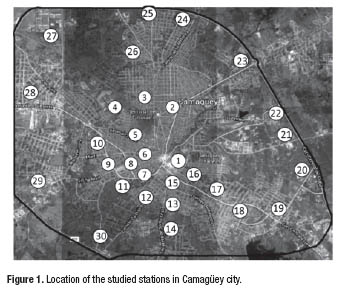
<body><![CDATA[<p><font size="3" face="Verdana, Arial, Helvetica, sans-serif"><strong>INTRODUCTION</strong></font></p>     <p><font face="Verdana, Arial, Helvetica, sans-serif" size="2">Street dust usually    consists of soil, deposited airborne particles, construction materials and soot    or fumes discharged from industries, waste incinerators or vehicles, among others.    Its composition is, in essence, a sensitive indicator of urban environmental    quality, providing valuable information beyond the single analysis of urban    air, water or soil samples [1]. Metals in dust can accumulate in human fatty    tissue and internal organs via direct inhalation, ingestion and dermal contact    absorption [2-3], causing risk to human health because of their toxicity and    non-degradability, especially for children who are more sensitive than adults    [4-6]. In Cuba, the assessment of heavy metal content in urban soils and the    evaluation of its impact on human health and on urban agriculture started recently    [7-14]. However, heavy metal content in urban dust from a Camag&uuml;ey city    has not been reported yet.</font></p>     <p><font face="Verdana, Arial, Helvetica, sans-serif" size="2">Camag&uuml;ey,    a city with a population of 324 989 inhabitants, from which 16.3 % are children    [15], is one of the oldest Cuban cities, where some metallurgic plants are located,    and, due to their geographical position, an important vehicular maintenance    center, which may represent    a significant heavy metal emission source into the environment. Furthermore,    in 2015 Camag&uuml;ey celebrated the 500 anniversary of the city foundation.    On this special occasion, important restoration works were performed in urban    areas in the last few years. Therefore,    the main objective of this study was to investigate the contents and spatial    distribution of heavy metals in Camag&uuml;ey street dusts to estimate both    their potential risks as well as sources of pollution.</font></p>     <p>&nbsp;</p>     <p>&nbsp;</p>     <p><font face="Verdana, Arial, Helvetica, sans-serif"><strong><font size="3">MATERIALS    AND METHODS </font></strong></font></p>     <p><font face="Verdana, Arial, Helvetica, sans-serif" size="2">Thirty street dust    samples (each weighting approximately 150 g) were collected from different locations    (St.) in the highly urbanized region of Camaguey during the same journey <a href="#f01065815">(Fig. 1)</a>. Samples were collected close to recreational centers (St. 1, 5, 7, 8, 16),    parks (St. 6, 12, 13, 14), schools (St. 17, 21, 22, 25, 26), hospitals (St.    9, 10, 15, 30), factories (St. 4, 11, 20, 24, 29), hotels (St. 3, 19), metallurgical    plants (27, 28), residential areas (St. 18, 23) and in the railway station (St.    2). Each sample was collected by gently sweeping an area of about 16 <img src="/img/revistas/nuc/n58/img/e08065815.jpg" width="21" height="13"> in the    street crossroad using a plastic hand broom and transferred to a clean, self-sealed    polyethylene bag.</font> <font face="Verdana, Arial, Helvetica, sans-serif" size="2">In the laboratory,    samples were first dried at 35 &deg;C and large rock, metallic and plastic pieces    and organic debris were removed before sieving. The fractions smaller than 2    mm were ground to a fine powder (&lt; 63 &micro;m) in an agate mortar.    The pulverized samples were newly dried at 35 &deg;C until obtaining a constant    weight. For analysis, samples were mixed with cellulose (analytical quality)    in proportion 4:1 and pressed at 15 tons into the pellets of 25 mm diameter    and 4&#150;5 mm height.</font></p>     
<p align="center"><img src="/img/revistas/nuc/n58/f01065815.jpg" width="344" height="292"><a name="f01065815"></a></p>     
<p><font face="Verdana, Arial, Helvetica, sans-serif" size="2">The Cr, Co, Ni,    Cu, Zn and Pb concentrations were estimated by X-Ray Fluorescence Analysis (XRF)    using the experimental array and methodology described in [7, 10]. The spatial    distribution maps of all studied heavy metals in urban street dust from Camag&uuml;ey    city were  generated with ArcGIS software.</font></p>     <p><font face="Verdana, Arial, Helvetica, sans-serif" size="2">The accuracy was    evaluated using the <a href="#e01065815">SR criterion</a>, proposed by McFarrell [16]:</font></p>     ]]></body>
<body><![CDATA[<p align="center"><img src="/img/revistas/nuc/n58/img/e01065815.jpg" width="188" height="52"><a name="e01065815"></a></p>     
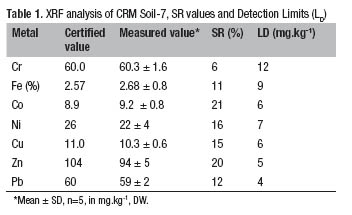
<p><font face="Verdana, Arial, Helvetica, sans-serif" size="2">where <img src="/img/revistas/nuc/n58/img/e02065815.jpg" width="21" height="19"> experimental    value, <img src="/img/revistas/nuc/n58/img/e03065815.jpg" width="21" height="20"> certified value and s is the standard deviation of <img src="/img/revistas/nuc/n58/img/e02065815.jpg" width="21" height="19">. On the basis    of this criterion the similarity between the certified value and the analytical    data obtained by proposed methods is divided into three categories: SR &le; 25    % = excellent;    25 &lt; SR&le; 50 % = acceptable, SR &gt; 50 % = unacceptable. The analysis of    five replica of the CRM IAEA Soil-7 is presented in <a href="#t01065815">table 1</a>. All metals (Cr,    Fe, Co, Ni, Cu, Zn and Pb) determined by XRF are &#129;gexcellent&#129;h (SR    . 25 %) and the obtained results shows a very good correlation    (R = 0.999) between certified and measured values.</font></p>     
<p align="center"><img src="/img/revistas/nuc/n58/t01065815.jpg" width="352" height="215"><a name="t01065815"></a></p>     
<p><font face="Verdana, Arial, Helvetica, sans-serif" size="2">To assess the possible    metal pollution in urban dust, the element enrichment was estimated by normalizing    the results to a reference element, using the Enrichment Factor (EF) calculated    as: EF = <img src="/img/revistas/nuc/n58/img/e04065815.jpg" width="64" height="22">/<img src="/img/revistas/nuc/n58/img/e05065815.jpg" width="73" height="22">, where <img src="/img/revistas/nuc/n58/img/e04065815.jpg" width="64" height="22"> is the ratio of the concentration    of a studied    element to the concentration of iron in the sample and <img src="/img/revistas/nuc/n58/img/e05065815.jpg" width="73" height="22">  is the same    ratio but with a background soil [17]. Due to the absence of previous baseline    or background studies, the average heavy metal content reported for Cu ban soils    [18] were used as background values    (BV). Six contamination categories are recognized on the basis of the enrichment    factor: EF &lt; 1 corresponds to non-enrichment, EF = 1.2 states deficiency    to minimal enrichment, EF = 2.5 moderate enrichment, EF = 5.20 significant enrichment,    EF = 20.40 very high enrichment    and EF &gt; 40 extremely high enrichment [19, 20].</font></p>     
<p><font face="Verdana, Arial, Helvetica, sans-serif" size="2">Potential ecological    risk index (RI) originally introduced by Hakanson [21] is also calculated to    assess the degree of heavy metal pollution in street dust, using <a href="#e06065815">the following equations:</a></font></p>     <p align="center"><img src="/img/revistas/nuc/n58/img/e06065815.jpg" width="405" height="185"><a name="e06065815"></a></p>     
<p><font face="Verdana, Arial, Helvetica, sans-serif" size="2">where, RI is the    sum of the all give risk factors for heavy metals, Ei is the monomial potential    ecological risk factor, Ti is the metal toxic factor and the values for each    element are in the order of Zn = 1 &lt; Cr = 2 &lt; Cu = Co = Ni = Pb = 5. fi    is the metal pollution factor, Ci is the concentration of metals in the street    dust, and Bi is a reference value for metals. Different RI classifications of    metal pollution are low ecological risk (RI . 150), moderated ecological risk    (150 . RI &lt; 300), considerable ecological risk (300 . RI &lt; 600) and high    ecological risk (RI . 600) [21].</font></p>     <p>&nbsp;</p>     <p>&nbsp;</p>     <p><font face="Verdana, Arial, Helvetica, sans-serif" size="3"><b>RESULTS AND DISCUSSION</b></font></p>     ]]></body>
<body><![CDATA[<p><font face="Verdana, Arial, Helvetica, sans-serif" size="2">Concentrations    of Cr, Fe, Co, Ni, Cu, Zn and Pb in the street dusts of Camaguey city, together    with soil background values (BV), are presented in <a href="#t02065815">table 2</a>. The concentration    ranges of Cr, Co, Ni, Cu, Zn and Pb were 41.278, 8.26, 7.168, 25.72, 84.553    and 16.401 <img src="../img/e07065815.jpg" width="49" height="19">, with mean values of 126, 15, 66, 36, 222 and 63 <img src="../img/e07065815.jpg" width="49" height="19">    respectively. Mean concentrations of the heavy metals in urban soils decreased    following this order: Zn&gt;Cr&gt;Ni&gt;Pb&gt;Cu&gt;Co; they were all comparable    to the background values with the exception of Zn and Pb, the mean contents    of which were 2.5 and 1.8 fold higher than its corresponding background values,    respectively. The concentrations of Cr, Ni, Zn and Pb varied greatly, while    Co and Cu concentrations were quite homogeneous across the city. The comparison    with metal contents reported for other similar population cities worldwide <a href="#t03065815">(table 3)</a> shows that those from Camag&uuml;ey streets dusts results are within the same    range.</font></p>     <p align="center"><img src="/img/revistas/nuc/n58/t02065815.jpg" width="344" height="224"><a name="t02065815"></a></p>     
<p align="center"><img src="/img/revistas/nuc/n58/t03065815.jpg" width="349" height="347"><a name="t03065815"></a></p>     
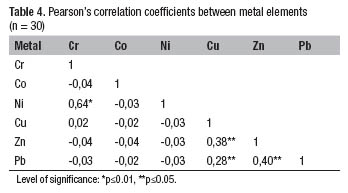
<p><font face="Verdana, Arial, Helvetica, sans-serif" size="2"><a href="#t04065815">Table 4</a> depicts    the correlation coefficient matrix, listing the Pearson&#146;s correlation coefficient.    A very significant correlation (p &lt; 0.01) was found between Cr and Ni (r    = 0.64), while significant correlation (p &lt; 0.05) was also found between    Cu and Zn (r = 0.38), Cu and Pb (r = 0.28)    and Zn and-Pb (r = 0.40). The high correlations between dust metals may reflect    that these heavy metals had similar sources.</font></p>     <p align="center"><img src="/img/revistas/nuc/n58/t04065815.jpg" width="348" height="193"><a name="t04065815"></a></p>     
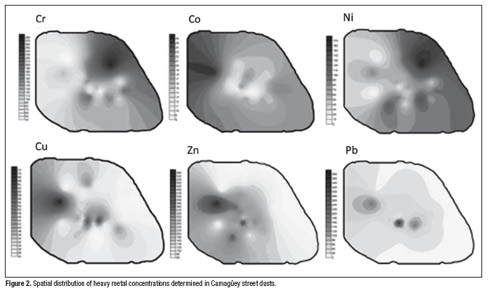
<p><font face="Verdana, Arial, Helvetica, sans-serif" size="2">The spatial distributions    of Cr, Co, Ni, Cu, Pb and Zn in the street dusts of Camag&uuml;ey city are represented    in <a href="#f02065815">Fig. 2</a>. It is evident that the Cr&#150;Ni and Pb&#150;Zn-Cu spatial distribution    characteristics are similar, while Co distribution is unique. That fact is in    line with the determined Pearson&#146;s factors.</font></p>     <p align="center"><img src="/img/revistas/nuc/n58/f02065815.jpg" width="494" height="293"><a name="f02065815"></a></p>     
<p><font face="Verdana, Arial, Helvetica, sans-serif" size="2">Two Pb-Zn-Cu hot-spots    are located in the centre of city and in the western area. As it is well known,    lead, copper and zinc have been identified as typical &#145;&#145;urban&#146;&#146;    metals for which the usual sources are traffic (i.e. vehicular emissions) and    other industrial sources such as metallurgical industries and thermo-electric    plants [30]. Despite the wide use of lead-free fuels since 2000 in    Cuba, Pb is not liable to transfer, resulting in its accumulation in urban soil    due to pollution from previous decades [31]. Taking into account that urban    soil is one of the main street dust components [1], the hot-spot area of Pb,    Zn and Cu located in the centre of the city (highest    traffic zone of the city) must be mainly associated with heavy traffic density.    The second Pb-Zn-Cu hot-spot area is shown in the metallurgical plant location    (station 28) and must be associated with plant emissions.</font></p>     <p><font face="Verdana, Arial, Helvetica, sans-serif" size="2">Furthermore, metal    enrichment in street dusts <a href="#f03065815">(Fig.3)</a> using the enrichment factors (EF), shows    that Camag&uuml;ey urban dusts are not enriched with Cr, Co and Ni (EF &lt;    1) and only street dusts from a few of the studied stations shows a minimal    Cu enrichment (station 16), a moderate Zn-Pb enrichments (stations 7-9, 11-13,    15 and 28) and a significant Zn-Pb enrichment (stations 16-17). The highest    Zn-Pb enrichments (7.4 and 6.3, respectively) were determined in station 16.    This behaviour is in correspondence with the observed Pb-Zn-Cu hotspot areas    <a href="#f02065815">(Fig. 2)</a>.</font></p>     <p align="center"><img src="/img/revistas/nuc/n58/f03065815.jpg" width="354" height="267"><a name="f03065815"></a></p>     
]]></body>
<body><![CDATA[<p align="left"><font face="Verdana, Arial, Helvetica, sans-serif" size="2">To quantify the    overall potential ecological risk of determined metals in street dust, RI was    estimated as the sum of all calculated risk factors <a href="#f04065815">(Fig. 4)</a>. RI values in all    studied stations are less than 150. Therefore, according to Hakanson classification    [21], metal content present in dust from Camag&uuml;ey city represents a negligible    ecological risk to its population. The highest RI value (42.4) was determined    in the location of a metallurgic plant (St.28).</font></p>     <p align="center"><img src="/img/revistas/nuc/n58/f04065815.jpg" width="351" height="257"><a name="f04065815"></a></p>     
<p>&nbsp;</p>     <p>&nbsp;</p>     <p><font size="3"><b><font face="Verdana, Arial, Helvetica, sans-serif">CONCLUSIONS</font></b></font></p>     <p><font face="Verdana, Arial, Helvetica, sans-serif" size="2">Concentrations    of six heavy metals (Cr, Co, Ni, Cu, Zn and Pb) in street dust from Camag&uuml;ey    city were determined by XRF analysis. The metal spatial distribution allowed    to identify two Pb-Zn-Cu hot-spots areas, associated with the highest traffic    zone of the city and with a metallurgic plant location, respectively. Independently    of the moderate or significant Zn-Pb enrichment in the mentioned areas, the    metal content in Camag&uuml;ey street dusts does not represent a risk for the    health of the city population.</font></p>     <p>&nbsp;</p>     <p>&nbsp;</p>     <p><font size="3" face="Verdana, Arial, Helvetica, sans-serif"><strong>REFERENCES</strong></font></p>     <!-- ref --><p><font size="2" face="Verdana, Arial, Helvetica, sans-serif">[1] PANDEY  B, AGRAWAL M &amp; SINGH S. Coal mining activities change plant community  structure due to air pollution and soil degradation. Ecotoxicology. 2014;  23(8): 1474-1483.    <!-- ref --><br> [2]  KURT-KARAKUS PB. Determination of heavy metals in indoor dust from Istanbul,  Turkey: estimation of the health risk. Environ Int. 2012; 50(1): 47-55.    <!-- ref --><br> [3] LIU E,  YAN T, BIRCH G &amp; ZHU Y. Pollution and health risk of potentially toxic  metals in urban road dust in Nanjing, a mega-city of China. Sci Total Environ.  2014; 476-477: 522-531.    <!-- ref --><br> [4] HUANG  M, WANGA W, CHAN CY, et. al. Contamination and risk assessment (based on  bioaccessibility via ingestion and inhalation) of metal(loid)s in outdoor and  indoor particles from urban centers of Guangzhou, China. Sci Total  Environ. 2014; 479-480: 117-124.    <!-- ref --><br> [5] ORDONEZ A, ALVAREZ R, DE MIGUEL EC, et. al. Spatial and temporal variations of  trace element distribution in soils and street dust of an industrial town in NW  Spain: 15 years of study. Sci Total Environ. 2015; 524-525: 93-103.    <!-- ref --><br> [6] CHEN H,  LU X, LI LY. Spatial distribution and risk assessment of metals in dust based  on samples from nursery and primary schools of Xi&#129;fan, China. Atmospheric Environ. 2014; 88: 172-182.    <!-- ref --><br> [7] DIAZ RIZO O, ECHEVARRIA CASTILLO F, ARADO LOPEZ JO, et.  al. Assessment of heavy metal  pollution in urban soils of Havana city, Cuba. Bull Environ Contam  Toxicol. 2011; 87(4): 414-419. doi:10.1007/s00128-011-0378 -9.    <!-- ref --><br> [8] DIAZ RIZO O, COTO HERNANDEZ I, ARADO LOPEZ JO, et. al. Chromium, Cobalt and Nickel content  in urban soils from Moa, northeastern Cuba. Bull Environ Contam Toxicol.  2011; 86(2): 189-193. doi:10.1007/s00128-010-0173-z.    <!-- ref --><br> [9] DIAZ RIZO O, HERNANDEZ MERLO M, ECHEVARRIA CASTILLO F,  et. al. Assessment of metal  pollution in soils from a former Havana (Cuba) solid waste open dump. Bull  Environ Contam Toxicol. 2012; 88(2): 182-186. doi:10.1007/s00128-011-0505-7.    <!-- ref --><br> [10] DIAZ RIZO O, FONTICIELLA MORELL D, ARADO LOPEZ JO, et.  al. Spatial distribution and contamination  assessment of heavy metals in urban topsoils from Las Tunas city, Cuba. Bull  Environ Contam Toxicol. 2013; 91(1): 29-35.    <br> [11] GARCIA CESPEDES D, SANTANA ROMERO JL, OLIVARES RIEUMONT  S, et. al. Evaluacion de la incorporacion de metales pesados al agroecosistema.  Rol de las practicas productivas ejecutadas por los trabajadores agricolas. Rev  Cub Salud y Trabajo. 2012; 13(1): 3-9.    ]]></body>
<body><![CDATA[<!-- ref --><br> [12] GARCIA CESPEDES D, OLIVARES RIEUMONT S, SANTANA ROMERO  JL, et. al. Evaluacion de riesgos a la salud por exposicion a metales pesados  en cercanias de sitios potencialmente peligrosos con actividad agricola. Rev  Cub Salud y Trabajo. 2012; 13(1): 10-18.    <!-- ref --><br> [13] DIAZ RIZO O, QUINTANA MIRANDA E, ALONSO HERNANDEZ CM,  et al. Niveles de radionuclidos naturales y metales pesados en suelos urbanos  de la ciudad de Cienfuegos, Cuba. Nucleus. 2013; (54): 17-22.    <!-- ref --><br> [14] DIAZ RIZO O, LIMA CAZORLA L, GARCIA CESPEDES D, et al. Assessment of heavy metal content in  urban agricultural soils from the surrounding of steel-smelter plant using X-ray  fluorescence. Nucleus. 2015; (54): 38-43.    <!-- ref --><br> [15] Cuban  National Statistical Office. Cuban population at December 31, 2013 (in Spanish)  [on-line]. Available in: http://www.one.cu/Estadistica Poblacion/. [accessed:  October 22, 2015].    <!-- ref --><br> [16]  QUEVAUVILLER PH, MARRIER E. Quality assurance and quality control for  environmental monitoring. Weinheim: VCH, 1995.    <!-- ref --><br> [17] BIRCH  G. A scheme for assessing human impacts on coastal aquatic environment using  sediments. In: Coastal GIS 2003: an integrated approach to Australian coastal  issues. Wollongong, Australia: Centre for Maritime Policy, University of  Wollongong, 2003. Series: Wollongong papers on maritime policy. No. 14.    <!-- ref --><br> [18] RODRIGUEZ ALFARO M, MONTERO A, MUNIZ UGARTE O, et. al. Background concentrations and  reference values for heavy metals in soils of Cuba. Environ Monit Assess. 2015;  187(1): 4198- 2015.    <!-- ref --><br> [19]  YONGMING H, PEIXUAN D, JUNJI C, et. al. Multivariate analysis of heavy metal  contamination in urban dusts of Xi&#129;fan, Central China. Sci  Total Environ. 2006; 355(1-3):  176-186.    <!-- ref --><br> [20] BIRCH  GF, OLMOS MA. Sediment-bound heavy metals as indicators of human influence and  biological risk in coastal water bodies. ICES J Mar Sci. 2008; 65(8):  1407-1413.    <!-- ref --><br> [21]  HAKANSON L. An ecological risk index for aquatic pollution control. A  sedimentological approach. Water Res. 1980; 14(8): 975- 1001.    <!-- ref --><br> [22]  SOLTANI N, KESHAVARZI B, MOORE F, et. al. Ecological and human health hazards  of heavy metals and polycyclic aromatic hydrocarbons (PAHs) in road dust of  Isfahan metropolis, Iran. Sci Total Environ. 2015; 505:712-723.    <!-- ref --><br> [23] CHEN  H, LU X, LI LY, et. al. Metal contamination in campus dust of Xi&#129;fan, China: A study based on multivariate statistics and spatial  distribution. Sci Total Environ. 2014; 484: 27-35.    <!-- ref --><br> [24]  RASMUSSEN PE, SUBRAMANIAN SK, JESSIMAN BJ. A multielement profile of house dust  in re lation to exterior dust and soils in the city of Ottawa, Canada. Sci  Total Environ. 2001; 267(1-3): 125-140.    <!-- ref --><br> [25]  AL-MOMANI IF. Assessment of trace metal distribution and contamination in  surface soils of Amman, Jordan. Jordan Journal of Chemistry. 2009; 4(1): 77-87.    <!-- ref --><br> [26]  CHRISTOFORIDIS A, STAMATIS N. Heavy metal contamination in street dust and  roadside soil along the major national road in Kavala&#129;fs region, Greece. Geoderma. 2009;  151(3-4): 257-263.    <br> [27]  TOKALIO.LU ., KARTAL .. Multivariate analysis of the data and speciation of  heavy metals in street dust samples from the Organized Industrial District in  Kayseri (Turkey). Atmospheric Environ. 2006; 40(16): 2797-2805.    <!-- ref --><br> [28]  CHARLESWORTH S, EVERETT M, MCCARTHY R, et. al. A comparative study of heavy  metal concentration and distribution in deposited street dusts in a large and a  small urban area: Birmingham and Coventry, West Midlands, UK. Environ Int.  2003; 29(5): 563-573.    <!-- ref --><br> [29]  McALISTER JJ, SMITH BJ, BAPTISTA NETO J, et. al. Geochemical distribution and  bioavailability of heavy metals and oxalate in street sediments from Rio de  Janeiro, Brazil: a preliminary investigation. Environ Geochem Hlth. 2005;  27(5): 429-441.    <!-- ref --><br> [30]  BIASIOLI M, GR.MAN H, KRALJ T, et. al. Potentially toxic elements contamination  in urban soils: a comparison of three European cities. J Environ Qual.  2007; 36(1): 70-79.    <!-- ref --><br> [31] GUO G, WU F, XIE F, et. al. Spatial distribution and pollution assessment of  heavy metals in urban soils from southwest China. J Environ Sci. 2012;  24(3): 410-418.    </font></p>     <p>&nbsp;</p>     <p><font face="Verdana, Arial, Helvetica, sans-serif" size="2"><strong>Received:</strong> 23th    October, 2015    <br>   <strong>Approved:</strong> 27th November, 2015</font></p>      ]]></body><back>
<ref-list>
<ref id="B1">
<label>1</label><nlm-citation citation-type="journal">
<person-group person-group-type="author">
<name>
<surname><![CDATA[PANDEY]]></surname>
<given-names><![CDATA[B]]></given-names>
</name>
<name>
<surname><![CDATA[AGRAWAL]]></surname>
<given-names><![CDATA[M]]></given-names>
</name>
<name>
<surname><![CDATA[SINGH]]></surname>
<given-names><![CDATA[S]]></given-names>
</name>
</person-group>
<article-title xml:lang="en"><![CDATA[Coal mining activities change plant community structure due to air pollution and soil degradation]]></article-title>
<source><![CDATA[Ecotoxicology]]></source>
<year>2014</year>
<volume>23</volume>
<numero>8</numero>
<issue>8</issue>
<page-range>1474-1483</page-range></nlm-citation>
</ref>
<ref id="B2">
<label>2</label><nlm-citation citation-type="journal">
<person-group person-group-type="author">
<name>
<surname><![CDATA[KURT-KARAKUS]]></surname>
<given-names><![CDATA[PB]]></given-names>
</name>
</person-group>
<article-title xml:lang="en"><![CDATA[Determination of heavy metals in indoor dust from Istanbul, Turkey: estimation of the health risk]]></article-title>
<source><![CDATA[Environ Int]]></source>
<year>2012</year>
<volume>50</volume>
<numero>1</numero>
<issue>1</issue>
<page-range>47-55</page-range></nlm-citation>
</ref>
<ref id="B3">
<label>3</label><nlm-citation citation-type="journal">
<person-group person-group-type="author">
<name>
<surname><![CDATA[LIU]]></surname>
<given-names><![CDATA[E]]></given-names>
</name>
<name>
<surname><![CDATA[YAN]]></surname>
<given-names><![CDATA[T]]></given-names>
</name>
<name>
<surname><![CDATA[BIRCH]]></surname>
<given-names><![CDATA[G]]></given-names>
</name>
<name>
<surname><![CDATA[ZHU]]></surname>
<given-names><![CDATA[Y]]></given-names>
</name>
</person-group>
<article-title xml:lang="en"><![CDATA[Pollution and health risk of potentially toxic metals in urban road dust in Nanjing, a mega-city of China]]></article-title>
<source><![CDATA[Sci Total Environ]]></source>
<year>2014</year>
<volume>476-477</volume>
<page-range>522-531</page-range></nlm-citation>
</ref>
<ref id="B4">
<label>4</label><nlm-citation citation-type="journal">
<person-group person-group-type="author">
<name>
<surname><![CDATA[HUANG]]></surname>
<given-names><![CDATA[M]]></given-names>
</name>
<name>
<surname><![CDATA[WANGA]]></surname>
<given-names><![CDATA[W]]></given-names>
</name>
<name>
<surname><![CDATA[CHAN]]></surname>
<given-names><![CDATA[CY]]></given-names>
</name>
</person-group>
<article-title xml:lang="en"><![CDATA[Contamination and risk assessment (based on bioaccessibility via ingestion and inhalation) of metal(loid)s in outdoor and indoor particles from urban centers of Guangzhou, China]]></article-title>
<source><![CDATA[Sci Total Environ]]></source>
<year>2014</year>
<volume>479-480</volume>
<page-range>117-124</page-range></nlm-citation>
</ref>
<ref id="B5">
<label>5</label><nlm-citation citation-type="journal">
<person-group person-group-type="author">
<name>
<surname><![CDATA[ORDONEZ]]></surname>
<given-names><![CDATA[A]]></given-names>
</name>
<name>
<surname><![CDATA[ALVAREZ]]></surname>
<given-names><![CDATA[R]]></given-names>
</name>
<name>
<surname><![CDATA[DE MIGUEL]]></surname>
<given-names><![CDATA[EC]]></given-names>
</name>
</person-group>
<article-title xml:lang="en"><![CDATA[Spatial and temporal variations of trace element distribution in soils and street dust of an industrial town in NW Spain: 15 years of study]]></article-title>
<source><![CDATA[Sci Total Environ]]></source>
<year>2015</year>
<volume>524-525</volume>
<page-range>93-103</page-range></nlm-citation>
</ref>
<ref id="B6">
<label>6</label><nlm-citation citation-type="journal">
<person-group person-group-type="author">
<name>
<surname><![CDATA[CHEN]]></surname>
<given-names><![CDATA[H]]></given-names>
</name>
<name>
<surname><![CDATA[LU]]></surname>
<given-names><![CDATA[X]]></given-names>
</name>
<name>
<surname><![CDATA[LI]]></surname>
<given-names><![CDATA[LY]]></given-names>
</name>
</person-group>
<article-title xml:lang="en"><![CDATA[Spatial distribution and risk assessment of metals in dust based on samples from nursery and primary schools of Xifan, China]]></article-title>
<source><![CDATA[Atmospheric Environ]]></source>
<year>2014</year>
<volume>88</volume>
<page-range>172-182</page-range></nlm-citation>
</ref>
<ref id="B7">
<label>7</label><nlm-citation citation-type="journal">
<person-group person-group-type="author">
<name>
<surname><![CDATA[DIAZ RIZO]]></surname>
<given-names><![CDATA[O]]></given-names>
</name>
<name>
<surname><![CDATA[ECHEVARRIA CASTILLO]]></surname>
<given-names><![CDATA[F]]></given-names>
</name>
<name>
<surname><![CDATA[ARADO LOPEZ]]></surname>
<given-names><![CDATA[JO]]></given-names>
</name>
</person-group>
<article-title xml:lang="en"><![CDATA[Assessment of heavy metal pollution in urban soils of Havana city, Cuba]]></article-title>
<source><![CDATA[Bull Environ Contam Toxicol]]></source>
<year>2011</year>
<volume>87</volume>
<numero>4</numero>
<issue>4</issue>
<page-range>414-419</page-range></nlm-citation>
</ref>
<ref id="B8">
<label>8</label><nlm-citation citation-type="journal">
<person-group person-group-type="author">
<name>
<surname><![CDATA[DIAZ RIZO]]></surname>
<given-names><![CDATA[O]]></given-names>
</name>
<name>
<surname><![CDATA[COTO HERNANDEZ]]></surname>
<given-names><![CDATA[I]]></given-names>
</name>
<name>
<surname><![CDATA[ARADO LOPEZ]]></surname>
<given-names><![CDATA[JO]]></given-names>
</name>
</person-group>
<article-title xml:lang="en"><![CDATA[Chromium, Cobalt and Nickel content in urban soils from Moa, northeastern Cuba]]></article-title>
<source><![CDATA[Bull Environ Contam Toxicol]]></source>
<year>2011</year>
<volume>86</volume>
<numero>2</numero>
<issue>2</issue>
<page-range>189-193</page-range></nlm-citation>
</ref>
<ref id="B9">
<label>9</label><nlm-citation citation-type="journal">
<person-group person-group-type="author">
<name>
<surname><![CDATA[DIAZ RIZO]]></surname>
<given-names><![CDATA[O]]></given-names>
</name>
<name>
<surname><![CDATA[HERNANDEZ MERLO]]></surname>
<given-names><![CDATA[M]]></given-names>
</name>
<name>
<surname><![CDATA[ECHEVARRIA CASTILLO]]></surname>
<given-names><![CDATA[F]]></given-names>
</name>
</person-group>
<article-title xml:lang="en"><![CDATA[Assessment of metal pollution in soils from a former Havana (Cuba) solid waste open dump]]></article-title>
<source><![CDATA[Bull Environ Contam Toxicol]]></source>
<year>2012</year>
<volume>88</volume>
<numero>2</numero>
<issue>2</issue>
<page-range>182-186</page-range></nlm-citation>
</ref>
<ref id="B10">
<label>10</label><nlm-citation citation-type="journal">
<person-group person-group-type="author">
<name>
<surname><![CDATA[DIAZ RIZO]]></surname>
<given-names><![CDATA[O]]></given-names>
</name>
<name>
<surname><![CDATA[FONTICIELLA MORELL]]></surname>
<given-names><![CDATA[D]]></given-names>
</name>
<name>
<surname><![CDATA[ARADO LOPEZ]]></surname>
<given-names><![CDATA[JO]]></given-names>
</name>
</person-group>
<article-title xml:lang="en"><![CDATA[Spatial distribution and contamination assessment of heavy metals in urban topsoils from Las Tunas city, Cuba]]></article-title>
<source><![CDATA[Bull Environ Contam Toxicol]]></source>
<year>2013</year>
<volume>91</volume><volume>1</volume>
<page-range>29-35</page-range></nlm-citation>
</ref>
<ref id="B11">
<label>11</label><nlm-citation citation-type="journal">
<person-group person-group-type="author">
<name>
<surname><![CDATA[GARCIA CESPEDES]]></surname>
<given-names><![CDATA[D]]></given-names>
</name>
<name>
<surname><![CDATA[SANTANA ROMERO]]></surname>
<given-names><![CDATA[JL]]></given-names>
</name>
<name>
<surname><![CDATA[OLIVARES RIEUMONT]]></surname>
<given-names><![CDATA[S]]></given-names>
</name>
</person-group>
<article-title xml:lang="es"><![CDATA[Evaluación de la incorporacion de metales pesados al agroecosistema: Rol de las prácticas productivas ejecutadas por los trabajadores agrícolas]]></article-title>
<source><![CDATA[Rev Cub Salud y Trabajo]]></source>
<year>2012</year>
<volume>13</volume>
<numero>1</numero>
<issue>1</issue>
<page-range>3-</page-range></nlm-citation>
</ref>
<ref id="B12">
<label>12</label><nlm-citation citation-type="journal">
<person-group person-group-type="author">
<name>
<surname><![CDATA[GARCIA CESPEDES]]></surname>
<given-names><![CDATA[D]]></given-names>
</name>
<name>
<surname><![CDATA[OLIVARES RIEUMONT]]></surname>
<given-names><![CDATA[S]]></given-names>
</name>
<name>
<surname><![CDATA[SANTANA ROMERO]]></surname>
<given-names><![CDATA[JL]]></given-names>
</name>
</person-group>
<article-title xml:lang="es"><![CDATA[Evaluacion de riesgos a la salud por exposicion a metales pesados en cercanias de sitios potencialmente peligrosos con actividad agricola]]></article-title>
<source><![CDATA[Rev Cub Salud y Trabajo]]></source>
<year>2012</year>
<volume>13</volume>
<numero>1</numero>
<issue>1</issue>
<page-range>10-18</page-range></nlm-citation>
</ref>
<ref id="B13">
<label>13</label><nlm-citation citation-type="journal">
<person-group person-group-type="author">
<name>
<surname><![CDATA[DIAZ RIZO]]></surname>
<given-names><![CDATA[O]]></given-names>
</name>
<name>
<surname><![CDATA[QUINTANA MIRANDA]]></surname>
<given-names><![CDATA[E]]></given-names>
</name>
<name>
<surname><![CDATA[ALONSO HERNANDEZ]]></surname>
<given-names><![CDATA[CM]]></given-names>
</name>
</person-group>
<article-title xml:lang="es"><![CDATA[Niveles de radionuclidos naturales y metales pesados en suelos urbanos de la ciudad de Cienfuegos, Cuba]]></article-title>
<source><![CDATA[Nucleus]]></source>
<year>2013</year>
<numero>54</numero>
<issue>54</issue>
<page-range>17-22</page-range></nlm-citation>
</ref>
<ref id="B14">
<label>14</label><nlm-citation citation-type="journal">
<person-group person-group-type="author">
<name>
<surname><![CDATA[DIAZ RIZO]]></surname>
<given-names><![CDATA[O]]></given-names>
</name>
<name>
<surname><![CDATA[LIMA CAZORLA]]></surname>
<given-names><![CDATA[L]]></given-names>
</name>
<name>
<surname><![CDATA[GARCIA CESPEDES]]></surname>
<given-names><![CDATA[D]]></given-names>
</name>
</person-group>
<article-title xml:lang="en"><![CDATA[Assessment of heavy metal content in urban agricultural soils from the surrounding of steel-smelter plant using X-ray fluorescence]]></article-title>
<source><![CDATA[Nucleus]]></source>
<year>2015</year>
<numero>54</numero>
<issue>54</issue>
<page-range>38-43</page-range></nlm-citation>
</ref>
<ref id="B15">
<label>15</label><nlm-citation citation-type="">
<collab>Cuban National Statistical Office</collab>
<source><![CDATA[Cuban population at December 31, 2013]]></source>
<year></year>
</nlm-citation>
</ref>
<ref id="B16">
<label>16</label><nlm-citation citation-type="book">
<person-group person-group-type="author">
<name>
<surname><![CDATA[QUEVAUVILLER]]></surname>
<given-names><![CDATA[PH]]></given-names>
</name>
<name>
<surname><![CDATA[MARRIER]]></surname>
<given-names><![CDATA[E]]></given-names>
</name>
</person-group>
<source><![CDATA[Quality assurance and quality control for environmental monitoring]]></source>
<year>1995</year>
<publisher-loc><![CDATA[Weinheim ]]></publisher-loc>
<publisher-name><![CDATA[VCH]]></publisher-name>
</nlm-citation>
</ref>
<ref id="B17">
<label>17</label><nlm-citation citation-type="book">
<person-group person-group-type="author">
<name>
<surname><![CDATA[BIRCH]]></surname>
<given-names><![CDATA[G]]></given-names>
</name>
</person-group>
<source><![CDATA[A scheme for assessing human impacts on coastal aquatic environment using sediments]]></source>
<year>2003</year>
<publisher-loc><![CDATA[Wollongong ]]></publisher-loc>
<publisher-name><![CDATA[Centre for Maritime Policy, University of Wollongong]]></publisher-name>
</nlm-citation>
</ref>
<ref id="B18">
<label>18</label><nlm-citation citation-type="journal">
<person-group person-group-type="author">
<name>
<surname><![CDATA[RODRIGUEZ ALFARO]]></surname>
<given-names><![CDATA[M]]></given-names>
</name>
<name>
<surname><![CDATA[MONTERO]]></surname>
<given-names><![CDATA[A]]></given-names>
</name>
<name>
<surname><![CDATA[MUNIZ UGARTE]]></surname>
<given-names><![CDATA[O]]></given-names>
</name>
</person-group>
<article-title xml:lang="en"><![CDATA[Background concentrations and reference values for heavy metals in soils of Cuba]]></article-title>
<source><![CDATA[Environ Monit Assess]]></source>
<year>2015</year>
<volume>187</volume>
<numero>1</numero>
<issue>1</issue>
<page-range>4198- 2015</page-range></nlm-citation>
</ref>
<ref id="B19">
<label>19</label><nlm-citation citation-type="journal">
<person-group person-group-type="author">
<name>
<surname><![CDATA[YONGMING]]></surname>
<given-names><![CDATA[H]]></given-names>
</name>
<name>
<surname><![CDATA[PEIXUAN]]></surname>
<given-names><![CDATA[D]]></given-names>
</name>
<name>
<surname><![CDATA[JUNJI]]></surname>
<given-names><![CDATA[C]]></given-names>
</name>
</person-group>
<article-title xml:lang="en"><![CDATA[Multivariate analysis of heavy metal contamination in urban dusts of Xifan, Central China]]></article-title>
<source><![CDATA[Sci Total Environ]]></source>
<year>2006</year>
<volume>355</volume>
<numero>1-3</numero>
<issue>1-3</issue>
<page-range>176-186</page-range></nlm-citation>
</ref>
<ref id="B20">
<label>20</label><nlm-citation citation-type="journal">
<person-group person-group-type="author">
<name>
<surname><![CDATA[BIRCH]]></surname>
<given-names><![CDATA[GF]]></given-names>
</name>
<name>
<surname><![CDATA[OLMOS]]></surname>
<given-names><![CDATA[MA]]></given-names>
</name>
</person-group>
<article-title xml:lang="en"><![CDATA[Sediment-bound heavy metals as indicators of human influence and biological risk in coastal water bodies]]></article-title>
<source><![CDATA[ICES J Mar Sci]]></source>
<year>2008</year>
<volume>65</volume>
<numero>8</numero>
<issue>8</issue>
<page-range>1407-1413</page-range></nlm-citation>
</ref>
<ref id="B21">
<label>21</label><nlm-citation citation-type="journal">
<person-group person-group-type="author">
<name>
<surname><![CDATA[HAKANSON]]></surname>
<given-names><![CDATA[L]]></given-names>
</name>
</person-group>
<article-title xml:lang="en"><![CDATA[An ecological risk index for aquatic pollution control: A sedimentological approach]]></article-title>
<source><![CDATA[Water Res]]></source>
<year>1980</year>
<volume>14</volume>
<numero>8</numero>
<issue>8</issue>
<page-range>975- 1001</page-range></nlm-citation>
</ref>
<ref id="B22">
<label>22</label><nlm-citation citation-type="journal">
<person-group person-group-type="author">
<name>
<surname><![CDATA[SOLTANI]]></surname>
<given-names><![CDATA[N]]></given-names>
</name>
<name>
<surname><![CDATA[KESHAVARZI]]></surname>
<given-names><![CDATA[B]]></given-names>
</name>
<name>
<surname><![CDATA[MOORE]]></surname>
<given-names><![CDATA[F]]></given-names>
</name>
</person-group>
<article-title xml:lang="en"><![CDATA[Ecological and human health hazards of heavy metals and polycyclic aromatic hydrocarbons (PAHs) in road dust of Isfahan metropolis, Iran]]></article-title>
<source><![CDATA[Sci Total Environ]]></source>
<year>2015</year>
<volume>505</volume>
<page-range>712-723</page-range></nlm-citation>
</ref>
<ref id="B23">
<label>23</label><nlm-citation citation-type="journal">
<person-group person-group-type="author">
<name>
<surname><![CDATA[CHEN]]></surname>
<given-names><![CDATA[H]]></given-names>
</name>
<name>
<surname><![CDATA[LU]]></surname>
<given-names><![CDATA[X]]></given-names>
</name>
<name>
<surname><![CDATA[LI]]></surname>
<given-names><![CDATA[LY]]></given-names>
</name>
</person-group>
<source><![CDATA[Sci Total Environ]]></source>
<year>2014</year>
<volume>484</volume>
<page-range>27-35</page-range></nlm-citation>
</ref>
<ref id="B24">
<label>24</label><nlm-citation citation-type="journal">
<person-group person-group-type="author">
<name>
<surname><![CDATA[RASMUSSEN]]></surname>
<given-names><![CDATA[PE]]></given-names>
</name>
<name>
<surname><![CDATA[SUBRAMANIAN]]></surname>
<given-names><![CDATA[SK]]></given-names>
</name>
<name>
<surname><![CDATA[JESSIMAN]]></surname>
<given-names><![CDATA[BJ]]></given-names>
</name>
</person-group>
<article-title xml:lang="en"><![CDATA[A multielement profile of house dust in re lation to exterior dust and soils in the city of Ottawa, Canada]]></article-title>
<source><![CDATA[Sci Total Environ]]></source>
<year>2001</year>
<volume>267</volume>
<numero>1-3</numero>
<issue>1-3</issue>
<page-range>125-140</page-range></nlm-citation>
</ref>
<ref id="B25">
<label>25</label><nlm-citation citation-type="journal">
<person-group person-group-type="author">
<name>
<surname><![CDATA[AL-MOMANI]]></surname>
<given-names><![CDATA[IF]]></given-names>
</name>
</person-group>
<article-title xml:lang="en"><![CDATA[Assessment of trace metal distribution and contamination in surface soils of Amman, Jordan]]></article-title>
<source><![CDATA[Jordan Journal of Chemistry]]></source>
<year>2009</year>
<volume>4</volume>
<numero>1</numero>
<issue>1</issue>
<page-range>77-87</page-range></nlm-citation>
</ref>
<ref id="B26">
<label>26</label><nlm-citation citation-type="journal">
<person-group person-group-type="author">
<name>
<surname><![CDATA[CHRISTOFORIDIS]]></surname>
<given-names><![CDATA[A]]></given-names>
</name>
<name>
<surname><![CDATA[STAMATIS]]></surname>
<given-names><![CDATA[N]]></given-names>
</name>
</person-group>
<article-title xml:lang="en"><![CDATA[Heavy metal contamination in street dust and roadside soil along the major national road in Kavalafs region, Greece]]></article-title>
<source><![CDATA[Geoderma]]></source>
<year>2009</year>
<volume>151</volume>
<numero>3-4</numero>
<issue>3-4</issue>
<page-range>257-263</page-range></nlm-citation>
</ref>
<ref id="B27">
<label>27</label><nlm-citation citation-type="journal">
<person-group person-group-type="author">
<name>
<surname><![CDATA[TOKALIO]]></surname>
<given-names><![CDATA[LU]]></given-names>
</name>
<name>
<surname><![CDATA[KARTAL]]></surname>
<given-names><![CDATA[S]]></given-names>
</name>
</person-group>
<article-title xml:lang="en"><![CDATA[Multivariate analysis of the data and speciation of heavy metals in street dust samples from the Organized Industrial District in Kayseri (Turkey)]]></article-title>
<source><![CDATA[Atmospheric Environ]]></source>
<year>2006</year>
<volume>40</volume>
<numero>16</numero>
<issue>16</issue>
<page-range>2797-2805</page-range></nlm-citation>
</ref>
<ref id="B28">
<label>28</label><nlm-citation citation-type="journal">
<person-group person-group-type="author">
<name>
<surname><![CDATA[CHARLESWORTH]]></surname>
<given-names><![CDATA[S]]></given-names>
</name>
<name>
<surname><![CDATA[EVERETT]]></surname>
<given-names><![CDATA[M]]></given-names>
</name>
<name>
<surname><![CDATA[MCCARTHY]]></surname>
<given-names><![CDATA[R]]></given-names>
</name>
</person-group>
<article-title xml:lang="en"><![CDATA[A comparative study of heavy metal concentration and distribution in deposited street dusts in a large and a small urban area: Birmingham and Coventry, West Midlands, UK]]></article-title>
<source><![CDATA[Environ Int]]></source>
<year>2003</year>
<volume>29</volume>
<numero>5</numero>
<issue>5</issue>
<page-range>563-573</page-range></nlm-citation>
</ref>
<ref id="B29">
<label>29</label><nlm-citation citation-type="journal">
<person-group person-group-type="author">
<name>
<surname><![CDATA[McALISTER]]></surname>
<given-names><![CDATA[JJ]]></given-names>
</name>
<name>
<surname><![CDATA[SMITH]]></surname>
<given-names><![CDATA[BJ]]></given-names>
</name>
<name>
<surname><![CDATA[BAPTISTA NETO]]></surname>
<given-names><![CDATA[J]]></given-names>
</name>
</person-group>
<article-title xml:lang="en"><![CDATA[Geochemical distribution and bioavailability of heavy metals and oxalate in street sediments from Rio de Janeiro, Brazil: a preliminary investigation]]></article-title>
<source><![CDATA[Environ Geochem Hlth]]></source>
<year>2005</year>
<volume>27</volume>
<numero>5</numero>
<issue>5</issue>
<page-range>429-441</page-range></nlm-citation>
</ref>
<ref id="B30">
<label>30</label><nlm-citation citation-type="journal">
<person-group person-group-type="author">
<name>
<surname><![CDATA[BIASIOLI]]></surname>
<given-names><![CDATA[M]]></given-names>
</name>
<name>
<surname><![CDATA[GR.MAN]]></surname>
<given-names><![CDATA[H]]></given-names>
</name>
<name>
<surname><![CDATA[KRALJ]]></surname>
<given-names><![CDATA[T]]></given-names>
</name>
</person-group>
<article-title xml:lang="en"><![CDATA[Potentially toxic elements contamination in urban soils: a comparison of three European cities]]></article-title>
<source><![CDATA[J Environ Qual]]></source>
<year>2007</year>
<volume>36</volume>
<numero>1</numero>
<issue>1</issue>
<page-range>70-79</page-range></nlm-citation>
</ref>
<ref id="B31">
<label>31</label><nlm-citation citation-type="journal">
<person-group person-group-type="author">
<name>
<surname><![CDATA[GUO]]></surname>
<given-names><![CDATA[G]]></given-names>
</name>
<name>
<surname><![CDATA[WU]]></surname>
<given-names><![CDATA[F]]></given-names>
</name>
<name>
<surname><![CDATA[XIE]]></surname>
<given-names><![CDATA[F]]></given-names>
</name>
</person-group>
<article-title xml:lang="en"><![CDATA[Spatial distribution and pollution assessment of heavy metals in urban soils from southwest China]]></article-title>
<source><![CDATA[J Environ Sci]]></source>
<year>2012</year>
<volume>24</volume>
<numero>3</numero>
<issue>3</issue>
<page-range>410-418</page-range></nlm-citation>
</ref>
</ref-list>
</back>
</article>