<?xml version="1.0" encoding="ISO-8859-1"?><article xmlns:mml="http://www.w3.org/1998/Math/MathML" xmlns:xlink="http://www.w3.org/1999/xlink" xmlns:xsi="http://www.w3.org/2001/XMLSchema-instance">
<front>
<journal-meta>
<journal-id>0864-215X</journal-id>
<journal-title><![CDATA[Revista Cubana de Ortopedia y Traumatología]]></journal-title>
<abbrev-journal-title><![CDATA[Rev Cubana Ortop Traumatol]]></abbrev-journal-title>
<issn>0864-215X</issn>
<publisher>
<publisher-name><![CDATA[Editorial Ciencias Médicas]]></publisher-name>
</publisher>
</journal-meta>
<article-meta>
<article-id>S0864-215X2014000100008</article-id>
<title-group>
<article-title xml:lang="es"><![CDATA[Artrosis y actividad física]]></article-title>
<article-title xml:lang="en"><![CDATA[Arthrosis and physical activity]]></article-title>
<article-title xml:lang="fr"><![CDATA[Arthrose et activité physique]]></article-title>
</title-group>
<contrib-group>
<contrib contrib-type="author">
<name>
<surname><![CDATA[Jorge Jaime]]></surname>
<given-names><![CDATA[Márquez Arabia]]></given-names>
</name>
<xref ref-type="aff" rid="A01"/>
</contrib>
<contrib contrib-type="author">
<name>
<surname><![CDATA[William Henry]]></surname>
<given-names><![CDATA[Márquez Arabia]]></given-names>
</name>
<xref ref-type="aff" rid="A01"/>
</contrib>
</contrib-group>
<aff id="A01">
<institution><![CDATA[,Universidad de Antioquia  ]]></institution>
<addr-line><![CDATA[ ]]></addr-line>
</aff>
<pub-date pub-type="pub">
<day>00</day>
<month>06</month>
<year>2014</year>
</pub-date>
<pub-date pub-type="epub">
<day>00</day>
<month>06</month>
<year>2014</year>
</pub-date>
<volume>28</volume>
<numero>1</numero>
<fpage>83</fpage>
<lpage>100</lpage>
<copyright-statement/>
<copyright-year/>
<self-uri xlink:href="http://scielo.sld.cu/scielo.php?script=sci_arttext&amp;pid=S0864-215X2014000100008&amp;lng=en&amp;nrm=iso"></self-uri><self-uri xlink:href="http://scielo.sld.cu/scielo.php?script=sci_abstract&amp;pid=S0864-215X2014000100008&amp;lng=en&amp;nrm=iso"></self-uri><self-uri xlink:href="http://scielo.sld.cu/scielo.php?script=sci_pdf&amp;pid=S0864-215X2014000100008&amp;lng=en&amp;nrm=iso"></self-uri><abstract abstract-type="short" xml:lang="es"><p><![CDATA[La artrosis es una de las principales causas de dolor y discapacidad en el mundo y afecta principalmente a las articulaciones de la rodilla, cadera y mano. La influencia de la actividad física en el desarrollo y progresión de la artrosis es controversial. En general, parece no tener un efecto perjudicial sobre la rodilla y la cadera, y por el contrario, beneficia la salud articular. Factores de riesgo, como la obesidad y el trauma previo sí provocan efectos nocivos. La mayoría de los expertos recomienda las medidas no farmacológicas para el tratamiento de la artrosis de rodilla y cadera, entre estas: ejercicios aeróbicos, de fuerza, acuáticos; y la fisioterapia para la mejoría del funcionamiento físico, de la discapacidad y el dolor. Falta determinar con mayor precisión la prescripción ideal del ejercicio para obtener sus efectos en estos pacientes y poder optimizar el manejo individualizado. La adherencia es fundamental para obtener los beneficios de cualquier tipo de ejercicio a corto y largo plazo y se debe evaluar mínimo las preferencias y barreras para su ejecución. Este artículo revisa fundamentalmente los efectos de la actividad física y el ejercicio en el desarrollo, progresión y tratamiento de la artrosis de rodilla y cadera.]]></p></abstract>
<abstract abstract-type="short" xml:lang="en"><p><![CDATA[Osteoarthritis is one of the main causes of pain and disability worldwide and fundamentally affects the knee, the hip and the hand joints. The influence of physical activity in the development and progression of osteoarthritis is controversial. Generally speaking, it seems that it does not have harmful effects in the knee and the hip; it rather benefits the joint health. Risk factors such as obesity and previous trauma do have harmful effects. The majority of experts recommend the non-pharmacological measures for the treatment of knee and hip osteoarthritis such as aerobics, strengthening, aquatic exercises, and physical therapy for improved physical functioning, reduction of disability and pain relief. It is necessary to determine more accurately the ideal prescription of exercises for the patients to obtain the best effects and to optimize the personalized management. The adherence to exercising is important to achieve at short and at long term the best benefits from any type of exercises, and the preferences for performing them and the barriers to do it should be evaluated. This article reviewed the general effects of exercising and of physical activity in the development, progression and treatment of knee and hip osteoarthritis.]]></p></abstract>
<abstract abstract-type="short" xml:lang="fr"><p><![CDATA[L'arthrose est l'une des principales causes de douleur et de handicap, affectant notamment les articulations du genou, de la hanche et des mains. L'influence de l'activité physique sur le développement et la progression de l'arthrose est un sujet encore polémique. Généralement, elle ne semble pas avoir un effet nocif sur le genou et la hanche, elle rapporte au contraire un bénéfice pour la santé des articulations; quelques facteurs de risque tels que l'obésité et le traumatisme préalable provoquent un effet nocif majeur. La plupart des experts recommandent des mesures non pharmacologiques pour traiter l'arthrose de genou et de hanche, telles que des exercices aérobics, de force, aquatiques, et basés sur la kinésithérapie, afin d'améliorer le fonctionnement physique et de soulager les handicaps et la douleur. Il faut définir avec beaucoup plus de précision quelle est la prescription idéale des exercices, afin d'obtenir les meilleurs résultats chez ces patients et d'optimiser la prise en charge personnalisée. C'est essentiel de suivre le traitement pour atteindre les bénéfices de chaque exercice à court et à long terme, et une évaluation minimale des préférences et des obstacles doit être réalisée pour sa mise en exécution. Cet article met en examen les effets de l'activité physique et de l'exercice sur le développement, la progression et le traitement de l'arthrose de genou et de hanche.]]></p></abstract>
<kwd-group>
<kwd lng="es"><![CDATA[artrosis]]></kwd>
<kwd lng="es"><![CDATA[ejercicio]]></kwd>
<kwd lng="es"><![CDATA[actividad física]]></kwd>
<kwd lng="es"><![CDATA[rodilla]]></kwd>
<kwd lng="es"><![CDATA[cadera]]></kwd>
<kwd lng="en"><![CDATA[osteoarthritis]]></kwd>
<kwd lng="en"><![CDATA[exercising]]></kwd>
<kwd lng="en"><![CDATA[physical activity]]></kwd>
<kwd lng="en"><![CDATA[knee]]></kwd>
<kwd lng="en"><![CDATA[hip]]></kwd>
<kwd lng="fr"><![CDATA[arthrose]]></kwd>
<kwd lng="fr"><![CDATA[exercice]]></kwd>
<kwd lng="fr"><![CDATA[activité physique]]></kwd>
<kwd lng="fr"><![CDATA[genou]]></kwd>
</kwd-group>
</article-meta>
</front><body><![CDATA[ <p align="right"> <font size="2" face="Verdana"><b>Rev Cubana Ortop Traumatol    2014;28(1)</b> </font></p>     <p align="right"> <font size="2" face="Verdana"><b>REVISI&#211;N BIBLIOGR&#193;FICA</b></font></p>     <p align="right">&nbsp;</p>     <p align="left"><font size="4"><b><font face="Verdana">Artrosis y actividad f&iacute;sica</font></b></font></p>     <p align="left">&nbsp;</p>     <p> <font size="2" face="Verdana"><b><font size="3">Arthrosis and physical activity</font></b>    </font></p>     <p>&nbsp;</p>     <p> <font size="2" face="Verdana"><b><font size="3">Arthrose et activit&#233;    physique</font></b></font></p>     <p>&nbsp;</p>     <p>&nbsp;</p>     ]]></body>
<body><![CDATA[<p><font size="2" face="Verdana"> <b>Dr. Jorge Jaime M&#225;rquez Arabia, Dr.    William Henry M&#225;rquez Arabia </b></font></p>     <p><font size="2" face="Verdana"> Universidad de Antioquia, Medell&#237;n, Colombia.</font></p>     <p>&nbsp;</p>     <p>&nbsp;</p>     <p><hr size="1" noshade>     <p><font size="2" face="Verdana"><b>RESUMEN</b> </font></p>     <p><font size="2" face="Verdana"> La artrosis es una de las principales causas    de dolor y discapacidad en el mundo y afecta principalmente a las articulaciones    de la rodilla, cadera y mano. La influencia de la actividad f&#237;sica en el    desarrollo y progresi&#243;n de la artrosis es controversial. En general, parece    no tener un efecto perjudicial sobre la rodilla y la cadera, y por el contrario,    beneficia la salud articular. Factores de riesgo, como la obesidad y el trauma    previo s&#237; provocan efectos nocivos. La mayor&#237;a de los expertos recomienda    las medidas no farmacol&#243;gicas para el tratamiento de la artrosis de rodilla    y cadera, entre estas: ejercicios aer&#243;bicos, de fuerza, acu&#225;ticos;    y la fisioterapia para la mejor&#237;a del funcionamiento f&#237;sico, de la    discapacidad y el dolor. Falta determinar con mayor precisi&#243;n la prescripci&#243;n    ideal del ejercicio para obtener sus efectos en estos pacientes y poder optimizar    el manejo individualizado. La adherencia es fundamental para obtener los beneficios    de cualquier tipo de ejercicio a corto y largo plazo y se debe evaluar m&#237;nimo    las preferencias y barreras para su ejecuci&#243;n. Este art&#237;culo revisa    fundamentalmente los efectos de la actividad f&#237;sica y el ejercicio en el    desarrollo, progresi&#243;n y tratamiento de la artrosis de rodilla y cadera.    </font></p>     <p> <font size="2" face="Verdana"><b>Palabras </b> <b>c</b><b>lave</b><b>:</b>    artrosis, ejercicio, actividad f&#237;sica, rodilla, cadera. <hr size="1" noshade></font>     <p><font size="2" face="Verdana"><b>ABSTRACT</b> </font> </p>     <p><font size="2" face="Verdana"> Osteoarthritis is one of the main causes of    pain and disability worldwide and fundamentally affects the knee, the hip and    the hand joints. The influence of physical activity in the development and progression    of osteoarthritis is controversial. Generally speaking, it seems that it does    not have harmful effects in the knee and the hip; it rather benefits the joint    health. Risk factors such as obesity and previous trauma do have harmful effects.    The majority of experts recommend the non-pharmacological measures for the treatment    of knee and hip osteoarthritis such as aerobics, strengthening, aquatic exercises,    and physical therapy for improved physical functioning, reduction of disability    and pain relief. It is necessary to determine more accurately the ideal prescription    of exercises for the patients to obtain the best effects and to optimize the    personalized management. The adherence to exercising is important to achieve    at short and at long term the best benefits from any type of exercises, and    the preferences for performing them and the barriers to do it should be evaluated.    This article reviewed the general effects of exercising and of physical activity    in the development, progression and treatment of knee and hip osteoarthritis.    </font></p>     ]]></body>
<body><![CDATA[<p>  <font size="2" face="Verdana"><b>Keywords:</b> osteoarthritis, exercising, physical  activity, knee, hip.  <hr size="1" noshade></font>     <p><font size="2" face="Verdana"><b>R&#201;SUM&#201; </b> </font> </p>     <p><font size="2" face="Verdana"> L'arthrose est l'une des principales causes    de douleur et de handicap, affectant notamment les articulations du genou, de    la hanche et des mains. L'influence de l'activit&#233; physique sur le d&#233;veloppement    et la progression de l'arthrose est un sujet encore pol&#233;mique. G&#233;n&#233;ralement,    elle ne semble pas avoir un effet nocif sur le genou et la hanche, elle rapporte    au contraire un b&#233;n&#233;fice pour la sant&#233; des articulations; quelques    facteurs de risque tels que l'ob&#233;sit&#233; et le traumatisme pr&#233;alable    provoquent un effet nocif majeur. La plupart des experts recommandent des mesures    non pharmacologiques pour traiter l'arthrose de genou et de hanche, telles que    des exercices a&#233;robics, de force, aquatiques, et bas&#233;s sur la kin&#233;sith&#233;rapie,    afin d'am&#233;liorer le fonctionnement physique et de soulager les handicaps    et la douleur. Il faut d&#233;finir avec beaucoup plus de pr&#233;cision quelle    est la prescription id&#233;ale des exercices, afin d'obtenir les meilleurs    r&#233;sultats chez ces patients et d'optimiser la prise en charge personnalis&#233;e.    C'est essentiel de suivre le traitement pour atteindre les b&#233;n&#233;fices    de chaque exercice &#224; court et &#224; long terme, et une &#233;valuation    minimale des pr&#233;f&#233;rences et des obstacles doit &#234;tre r&#233;alis&#233;e    pour sa mise en ex&#233;cution. Cet article met en examen les effets de l'activit&#233;    physique et de l'exercice sur le d&#233;veloppement, la progression et le traitement    de l'arthrose de genou et de hanche. </font></p>     <p>  <font size="2" face="Verdana"><b>Mots cl&#233;s:</b> arthrose, exercice, activit&#233;  physique, genou, hanche.  <hr size="1" noshade></font>     <p>&nbsp; </p>     <p>&nbsp;</p>     <p><font size="2" face="Verdana"><b><font size="3">INTRODUCCI</font></b><font size="3"><b>&#211;N</b>    </font></font></p>     <p><font size="2" face="Verdana"> La artrosis (OA) es la forma m&#225;s com&#250;n    de artritis y su frecuencia ha aumentado alrededor de 30 % en los &#250;ltimos    10 a&#241;os.<sup>1,2</sup> Es una de las principales causas de dolor y discapacidad    en el mundo y se refiere a un s&#237;ndrome cl&#237;nico, de dolor articular    acompa&#241;ado de varios grados de limitaci&#243;n funcional y psicol&#243;gica    que compromete la calidad de vida.<sup>2,3</sup> Su alta prevalencia, etiolog&#237;a,    patogenia y las razones para su progresi&#243;n todav&#237;a no se determinan    completamente. En general, la OA es una enfermedad articular degenerativa que    involucra un proceso de reparaci&#243;n metab&#243;licamente activo que se lleva    a cabo en los tejidos articulares e implica p&#233;rdida localizada de cart&#237;lago    y remodelaci&#243;n del hueso adyacente.<sup>2,4</sup> Las rodillas, las caderas    y las articulaciones peque&#241;as de las manos son las m&#225;s com&#250;nmente    afectadas. Aunque el dolor, disminuci&#243;n de la funci&#243;n y la calidad    de vida pueden ser consecuencias importantes de la OA, los cambios estructurales    a menudo se presentan sin s&#237;ntomas asociados.<sup>5</sup> </font></p>     <p><font size="2" face="Verdana">     <br>   FACTORES DE RIESGO PARA ARTROSIS </font></p>     ]]></body>
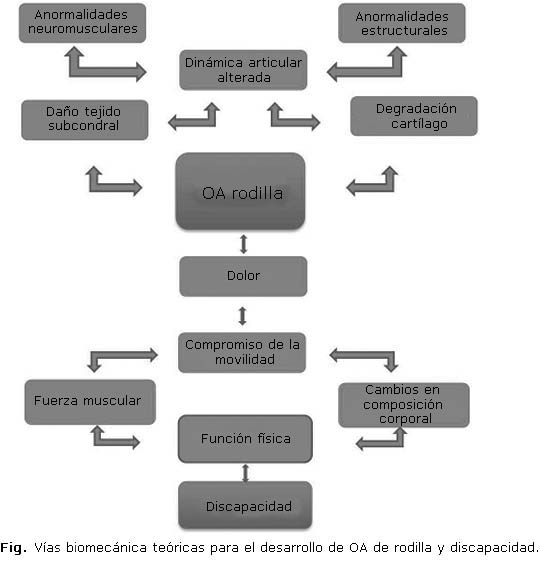
<body><![CDATA[<p><font size="2" face="Verdana"> Contrariamente a la creencia popular, la OA    no se produce por el envejecimiento y no necesariamente la deteriora, puede    predisponer, pero las articulaciones afectadas y la gravedad de la enfermedad    est&#225;n m&#225;s estrechamente relacionadas con otros factores de riesgo    como lesi&#243;n articular, la obesidad, y los factores anat&#243;micos y biomec&#225;nicos.<sup>2.6</sup>    </font></p>     <p><font size="2" face="Verdana"> LA OA es una enfermedad compleja com&#250;n    con m&#250;ltiples factores de riesgo controversiales que se pueden dividir,    en general, en gen&#233;ticos (herencia hasta 40-60 % para OA la mano, rodilla    y cadera, aunque muchos genes responsables no se conocen, susceptibilidad gen&#233;tica    en mol&#233;culas inflamatorias e involucradas en cascadas de se&#241;alizaci&#243;n),<sup>7-9</sup>    constitucionales (edad, sexo femenino, la obesidad, densidad &#243;sea)<sup>2,10</sup>    y biomec&#225;nicos (lesi&#243;n articular, uso recreativo y laboral, p&#233;rdida    de fuerza muscular, d&#233;ficit propioceptivo, laxitud articular, mala alineaci&#243;n    articular);<sup>10-12</sup> un modelo biomec&#225;nico te&#243;rico puede explicar    el desarrollo de OA y discapacidad<sup>10</sup> (<a href="#fig1_08">Fig</a>.).</font></p>     <p align="center"><a name="fig1_08"></a><img src="/img/revistas/ort/v28n1/f0108114.jpg" width="540" height="562"></p>     <p><font size="2" face="Verdana">     <br>   Seg&#250;n una revisi&#243;n reciente, relacionada con los marcadores o predictores    para la progresi&#243;n de la OA de rodilla y cadera, la evidencia es fuerte    a moderada para la mala alineaci&#243;n de la rodilla, OA generalizada, la migraci&#243;n    supero-lateral de la cabeza del f&#233;mur, la edad, los niveles de &#225;cido    hialur&#243;nico y la respuesta atr&#243;fica &#243;sea de la cadera. Limitada    para el momento de aducci&#243;n, la nutrici&#243;n, la fuerza del cu&#225;driceps,    los s&#237;ntomas iniciales y cr&#243;nicos, la sinovitis y el edema &#243;seo    en la RM; inconclusa para los estr&#243;genos, la gen&#233;tica y la duraci&#243;n    de la OA; no evidencia para condrocalcinosis, deportes, correr, lesiones, el    tabaquismo, la depresi&#243;n, ansiedad y la meniscectom&#237;a.<sup>13</sup>    </font></p>     <p><font size="2" face="Verdana"> Adem&#225;s, una revisi&#243;n sistem&#225;tica    (RS) y meta-an&#225;lisis reciente reporta que los principales factores consistentemente    asociados con OA de la rodilla fueron la obesidad (OR agrupado 2,63, IC 95 %    2,28 a 3,05), traumatismo de rodilla anterior (OR agrupado 3,86, IC 95 %: 2,61    a 5,70), OA de la mano (OR agrupado 1,49, IC 95 % 1,05-2,10), el sexo femenino    (OR agrupado 1,84 IC 95 %: 1,32-2,55) y la edad avanzada.<sup>14</sup> </font></p>     <p><font size="2" face="Verdana"> Actualmente se reconoce que la obesidad y el    sobrepeso predisponen a OA de cadera, rodilla y mano, explicado por su componente    mec&#225;nico y tambi&#233;n por el metab&#243;lico e inflamatorio; el ejercicio    f&#237;sico puede tener un impacto positivo en ellos.<sup>4,15-17</sup> </font></p>     <p>    <br>   <font size="2" face="Verdana">ACTIVIDAD F&#205;SICA, EJERCICIO Y DEPORTE COMO    RIESGO DE ARTROSIS </font></p>     <p><font size="2" face="Verdana"> La influencia de la actividad f&#237;sica en    el desarrollo y progresi&#243;n de la OA, particularmente en articulaciones    que soportan peso como la rodilla, es controversial.<sup>3,4,18</sup> </font></p>     ]]></body>
<body><![CDATA[<p><font size="2" face="Verdana"> Una revisi&#243;n reciente basada en la evidencia,    no soporta un consenso claro sobre el efecto de la actividad f&#237;sica en    la aparici&#243;n o progresi&#243;n de la OA en etapas tard&#237;as de la vida,    probablemente debido a diferencias metodol&#243;gicas de los estudios de alta    calidad y a la variaci&#243;n en el tipo, duraci&#243;n y frecuencia de la actividad    f&#237;sica.<sup>3</sup> </font></p>     <p><font size="2" face="Verdana"> El grupo OASIS establece las siguientes recomendaciones    basadas en el nivel de evidencia (A: alto, B: moderado, C: consenso cl&#237;nico)    con respecto al riesgo de OA de rodilla y cadera:<sup>19 </sup> </font></p>     <p><font size="2" face="Verdana">1.<i> Actividades de la </i> <i>v</i> <i>ida    </i> <i>d</i><i>iaria</i><i>:</i> son un factor de riesgo para OA de rodilla    y &#233;ste aumenta con la intensidad y la duraci&#243;n de la actividad (B).    Los pacientes con o sin OA, en general, pueden alcanzar un alto nivel de actividad    f&#237;sica, siempre que esta no sea dolorosa ni predisponga a trauma (B). La    OA radiogr&#225;fica o cl&#237;nica no es una contraindicaci&#243;n para promover    la actividad en los pacientes sedentarios (C). </font></p>     <p><font size="2" face="Verdana">2. <i>Actividad </i> <i>o</i><i>cupacional</i><i>:</i>    existe una relaci&#243;n entre &#233;sta y la OA de rodilla y cadera (A) y se    recomienda hacer una historia ocupacional (B). La naturaleza exacta del stress    biomec&#225;nico que conduce a OA sigue sin aclararse, pero factores como las    altas cargas articulares, posiciones corporales no naturales, levantar objetos    pesados, escalar y saltar pueden contribuir a la OA de rodilla y cadera. Se    debe evitar la actividad laboral que produzca o perpet&#250;e el dolor (B).    Los m&#233;dicos deben estar pendientes de los signos y s&#237;ntomas tempranos    de la OA de rodilla y cadera de los trabajadores expuestos a cargas que se sabe    o se supone favorecen la OA (C). </font></p>     <p><font size="2" face="Verdana">3. <i>Ejercicio</i><i>:</i> el ejercicio estructurado    recomendado para la salud tiene un efecto favorable sobre el dolor y la funci&#243;n    del paciente sedentario con OA de rodilla (A). Se pueden realizar ejercicios    est&#225;ticos o din&#225;micos, considerando la disponibilidad, preferencia    y tolerancia (A). Como los beneficios disminuyen cuando el ejercicio se suspende,    debe realizarse con una frecuencia de una a tres veces por semana (B). La ayuda    profesional puede ser &#250;til para mejorar la adherencia al ejercicio (B).    No hay evidencia que sugiera suspender el ejercicio durante las crisis de OA    (C). </font></p>     <p><font size="2" face="Verdana">4.<i> Deporte y </i> <i>r</i><i>ecreaci&#243;n</i><i>:</i>    son un factor de riesgo para OA de rodilla y cadera y &#233;ste se correlaciona    con la duraci&#243;n e intensidad de la exposici&#243;n (A). El riesgo de OA    asociado con el deporte es menor que el relacionado con la historia de trauma    y el sobrepeso (A). No hay conclusiones firmes sobre el posible papel protector    de los deportes como el ciclismo, la nataci&#243;n o el golf. Los atletas deben    conocer que el trauma articular es un factor de riesgo mayor que la pr&#225;ctica    del deporte (A) y que el riesgo se relaciona con la duraci&#243;n e intensidad    de la exposici&#243;n (B). El paciente con OA puede seguir participando regularmente    en deportes recreativos que no causen dolor (C) y se le debe aconsejar el cambio    de los deportes de alto riesgo para trauma articular (C). </font></p>     <p><font size="2" face="Verdana">     <br>   En ausencia de lesi&#243;n articular, no hay evidencia para soportar la idea    err&#243;nea de que el ejercicio es perjudicial para las articulaciones; por    el contrario, parece que tiene efectos positivos para los tejidos articulares,    adem&#225;s de sus beneficios para la salud.<sup>4,20</sup> </font></p>     <p><font size="2" face="Verdana"> La participaci&#243;n de personas con articulaciones    y funci&#243;n neuromuscular normales en deportes que causan m&#237;nimo impacto    articular y carga de torsi&#243;n, puede causar la formaci&#243;n de osteofitos,    con efecto m&#237;nimo o nulo sobre el riesgo de OA.<sup>4,21</sup> En cambio,    la participaci&#243;n repetitiva en deportes con alta carga rotacional e impacto    como f&#250;tbol, tenis, salto de obst&#225;culos, balonmano y <i>basketbal</i>l    pudieran incrementar el riesgo de degeneraci&#243;n articular inducida por lesi&#243;n.<sup>21-25    </sup>Sin embargo, se debe tener en cuenta que la obesidad y las lesiones articulares    tienen mayor riesgo de OA precoz que el deporte en s&#237;, y el ejercicio se    usa com&#250;nmente para prevenir y tratar la OA.<sup>3,4,15,25-27</sup> Los    pacientes con anormalidades anat&#243;micas o mal alineaci&#243;n, lesiones    o cirug&#237;as previas, OA, inestabilidad articular, incongruencia o displasia    de la superficie articular, alteraciones de la inervaci&#243;n o inadecuada    fuerza muscular tienen mayor riesgo de da&#241;o articular durante la pr&#225;ctica    deportiva.<sup>21,27</sup> </font></p>     <p><font size="2" face="Verdana"> Debido a que varios estudios han encontrado    controversia en la relaci&#243;n de la AF con la OA, se realiz&#243; una RS    para estudiarla y evaluar el efecto de la AF en las estructuras articulares    individuales de la rodilla, la cual reporta esa misma evidencia contradictoria    en la OA de rodilla y que la relaci&#243;n entre la actividad f&#237;sica y    las estructuras espec&#237;ficas de la rodilla difieren, con evidencia fuerte    de una relaci&#243;n positiva entre la actividad f&#237;sica y osteofitostibiofemorales    (no necesariamente patol&#243;gicos), ausencia de una asociaci&#243;n entre    actividad f&#237;sica y el estrechamiento del espacio articular y una fuerte    evidencia de la relaci&#243;n inversa entre la actividad f&#237;sica y los defectos    del cart&#237;lago.<sup>18</sup> </font></p>     ]]></body>
<body><![CDATA[<p><font size="2" face="Verdana"> Todos los hallazgos mencionados, sugieren que    no se ha demostrado la asociaci&#243;n directa entre la actividad f&#237;sica    en general y un efecto perjudicial sobre la rodilla y la cadera, y en contraste,    ser&#237;a ben&#233;fica para la salud articular en personas sin factores predisponentes.    </font></p>     <p><font size="2" face="Verdana">     <br>   EJERCICIO EN EL MANEJO DE LA ARTROSIS </font></p>     <p><font size="2" face="Verdana"> Antes de sugerir el ejercicio al paciente con    OA, debe realizarse una evaluaci&#243;n y manejo hol&#237;stico (social, pensamientos    del paciente, ocupacional, &#225;nimo, psicol&#243;gico, calidad del sue&#241;o,    servicio de salud, comorbilidades, actitud frente al ejercicio, evaluaci&#243;n    del dolor). Existen una serie de opciones de tratamiento multidisciplinario    que requieren una combinaci&#243;n de medidas farmacol&#243;gicas y no farmacol&#243;gicas,    estas &#250;ltimas consideradas como fundamentales y recomendadas, tanto que    3 de ellas se recomiendan como el tratamiento b&#225;sico: educaci&#243;n e    informaci&#243;n, actividad y ejercicio, manejo del peso.<sup>1,2,28-36</sup>    </font></p>     <p><font size="2" face="Verdana"> Adem&#225;s, recomendaciones internacionales    en OA de rodilla y cadera -<i>Osteoarthritis Research Society International</i>    (OARSI) y<i> European League Against Rheumatism</i> (EULAR), el <i>American    College of Rheumatology</i>, y las 18 gu&#237;as analizadas recientemente por<i>    Misso </i>y otros, reportan que las 2 medidas de tratamiento son igualmente    efectivas y consideran a no farmacol&#243;gicas como la primera l&#237;nea de    manejo, e incluyen al ejercicio como pilar fundamental.<sup>28,34-38</sup> </font></p>     <p><font size="2" face="Verdana"> En general, la orientaci&#243;n del tratamiento    multidisciplinario debe incluir; educaci&#243;n y automanejo, manejo no farmacol&#243;gico    (ejercicio aer&#243;bico, de fuerza, hidroterapia, terapia manual, p&#233;rdida    de peso, terapia f&#237;sica y termoterapia, electroterapia, ortesis, ayudas    y dispositivos, tratamiento invasivo, contacto telef&#243;nico regular, intevenciones    psicosociales), tratamiento farmacol&#243;gico (acetaminof&#233;n, AINES selectivos    y no selectivos, AINEs t&#243;picos y la capsaicina, inyecciones intra-articulares    de corticoides y hialuronatos, la glucosamina y/o sulfato de condroitina para    aliviar los s&#237;ntomas; sulfato de glucosamina, condroit&#237;n sulfato y    diacere&#237;na para posibles efectos modificadores de la estructura y el uso    de analg&#233;sicos opioides y duloxetinapara. El tratamiento del dolor (refractario    o respuesta inadecuada a tratamiento inicial) y modalidades quir&#250;rgicas    (reemplazos articulares totales, pr&#243;tesis de rodilla unicompartimental,    osteotom&#237;a y cirug&#237;a de preservaci&#243;n articular; lavado articular    y desbridamiento artrosc&#243;pico en la OA de rodilla, y la fusi&#243;n articular    como procedimiento de rescate si falla la pr&#243;tesis).<sup>2,34-37</sup>    </font></p>     <p> <font size="2" face="Verdana"><b>    <br>   RECOMENDACIONES Y BENEFICIOS DEL EJERCICIO EN LA OA</b> </font></p>     <p><font size="2" face="Verdana"> Las organizaciones e investigadores especializados    recomiendan el ejercicio aer&#243;bico, el de fuerza y el de flexibilidad, como    terapia de la OA de m&#250;ltiples localizaciones, pero la mayor&#237;a de la    evidencia existe para la OA de rodilla y en segundo lugar la OA decadera.<sup>2,19,28,32-42</sup>    </font></p>   <font size="2" face="Verdana"> A parte de los beneficios del ejercicio en los  diferentes sistemas (cardiovascular, respiratorio, metab&#243;lico, etc.) y en  la salud en general, el paciente con OA puede obtener otros efectos espec&#237;ficos.<sup>2,4,10,43-46</sup>  </font>      <p>    ]]></body>
<body><![CDATA[<br>   <font size="2" face="Verdana">EJERCICIO EN ARTROSIS DE RODILLA </font></p>     <p><font size="2" face="Verdana"> Una revisi&#243;n de la literatura de numerosos    ensayos cl&#237;nicos aleatorizados (RCT) de buena calidad, nivel I en forma    de revisiones Cochrane y sistem&#225;ticas,<sup>41,42,47,48</sup> incluso una    RS de RSs sobre los efectos del ejercicio en la OA de rodilla establecida,<sup>49</sup>    encuentra peque&#241;os problemas con el cegamiento, con la asignaci&#243;n    al azar, el an&#225;lisis de intenci&#243;n a tratar, la adherencia y la heterogeneidad    en la evaluaci&#243;n de esos estudios.<sup>23</sup> Las intervenciones evaluadas    incluyeron entrenamiento de fuerza progresivo, fortalecimiento de los cu&#225;driceps,    ejercicios acu&#225;ticos, ejercicios en tierra, caminando, intensificaci&#243;n    de actividades de la vida, entrenamiento aer&#243;bico y otras modalidades de    ejercicio y concluyen lo siguiente:<b> </b>s&#243;lo eval&#250;an los efectos    de las intervenciones sobre los s&#237;ntomas y el grado de discapacidad de    los pacientes. No realizan evaluaciones cl&#237;nicas o radiol&#243;gicas. En    general, los niveles de intervenci&#243;n de ejercicios fueron bajos o moderados.    Si el ejercicio es estructurado y progresivo, muestra beneficio en las personas    sedentarias. </font></p>     <p><font size="2" face="Verdana"> Hay poca correlaci&#243;n entre la severidad    de los s&#237;ntomas de la OA al inicio de la actividad y el grado de beneficio.    Probablemente tiene ventaja el ejercicio din&#225;mico sobre el est&#225;tico.    La obesidad es una comorbilidad frecuente. El ejercicio es seguro y la disminuci&#243;n    de la grasa corporal y/o el peso brinda beneficios. La mayor parte de los beneficios    se miden a corto plazo. No se han demostrado beneficios a largo plazo (m&#225;s    de 6 meses), a menos que se hagan "sesiones de refuerzo" despu&#233;s del entrenamiento.    Los efectos ben&#233;ficos sobre el dolor son peque&#241;os a moderados. </font></p>     <p><font size="2" face="Verdana"> Todas las intervenciones, excepto el entrenamiento    de fuerza progresivo, tiene un efecto peque&#241;o a moderado en la discapacidad.    Los beneficios de los ejercicios en tierra pueden ser similares a los obtenidos    con los AINES. Generalmente, el manejo no farmacol&#243;gico es tan efectivo    como el farmacol&#243;gico. El ejercicio ligero o moderado no provoca aumento    del dolor o discapacidad<b>.</b> </font></p>     <p><font size="2" face="Verdana"> Otras recomendaciones no referidas en la revisi&#243;n    mencionada que se derivan del consenso "MOVE" y de las gu&#237;as de pr&#225;ctica    cl&#237;nica basadas en la evidencia del "Ottawa Panel", con nivel IA se resumen    a continuaci&#243;n:<sup>16,40,50</sup> </font></p>     <p><font size="2" face="Verdana"> 1. Recomendaciones del consenso "MOVE" acerca    el papel del ejercicio en la OA de rodilla y cadera: </font></p>     <blockquote>        <p><font size="2" face="Verdana"> a) El fortalecimiento y el ejercicio aer&#243;bico      pueden reducir el dolor y mejorar la funci&#243;n y el estado de salud. </font></p>       <p><font size="2" face="Verdana"> b) Para ser eficaces, los programas de ejercicio      deben incluir asesoramiento y educaci&#243;n para promover un cambio de estilo      de vida positivo con un aumento de la actividad f&#237;sica. </font></p>       <p><font size="2" face="Verdana"> c) Los ejercicios ambulatorios y los grupales      son igualmente efectivos y se debe considerar la preferencia del paciente.      </font></p>       ]]></body>
<body><![CDATA[<p><font size="2" face="Verdana"> d) Deben adoptarse estrategias para mejorar      y mantener la adherencia, por ejemplo, monitore y revisi&#243;n a largo plazo      y la inclusi&#243;n del c&#243;nyuge y la familia en el ejercicio. </font></p> </blockquote>     <p><font size="2" face="Verdana"> 2. Recomendaciones del Ottawa Panel sobre el    EF en el manejo de la OA: </font></p>     <blockquote>        <p><font size="2" face="Verdana"> a) Fortalecimiento isot&#243;nico e isom&#233;trico      de miembros inferiores, principalmente del cuadriceps y los isquiotibiales,      para el dolor al levantarse y acostarse y el estado funcional. </font></p>       <p><font size="2" face="Verdana"> b) EF conc&#233;ntrico para el dolor en reposo      y durante las actividades. </font></p>       <p><font size="2" face="Verdana"> c) EF conc&#233;ntrico-exc&#233;ntrico para      el dolor en reposo y durante actividades funcionales espec&#237;ficas: caminar      15-m y tiempo para subir y bajar. </font></p>       <p><font size="2" face="Verdana"> d) EF ambulatorio para el dolor, estado funcional,      nivel de energ&#237;a y arco de movimiento en flexi&#243;n. </font></p>       <p><font size="2" face="Verdana"> e) EF general de miembros inferiores (incluida      la fuerza muscular, la flexibilidad y la movilidad/coordinaci&#243;n) para      el dolor nocturno y la habilidad en las escaleras. </font></p>       <p><font size="2" face="Verdana"> f) EF de miembros inferiores con progresi&#243;n      de cargas para el dolor en reposo y arcos de movimiento. </font></p> </blockquote>     <p><font size="2" face="Verdana"> 3. Recomendaciones de la actividad f&#237;sica    general, Fitness y ejercicio aer&#243;bico seg&#250;n el Ottawa Panel: </font></p>     ]]></body>
<body><![CDATA[<blockquote>        <p><font size="2" face="Verdana"> a) Ejercicios funcionales de todo el cuerpo      para el dolor y estado funcional (movilidad, caminar, trabajo, actividades      diarias). </font></p>       <p><font size="2" face="Verdana"> b) Programas de caminata para el dolor, estado      funcional, la longitud de la zancada, funcionalidad para ir a la cama y el      ba&#241;o, capacidad aer&#243;bica, nivel de energ&#237;a y el uso de medicamentos.      </font></p>       <p><font size="2" face="Verdana"> c) Correr en el agua para la actividad f&#237;sica      y la capacidad aer&#243;bica. </font></p>       <p><font size="2" face="Verdana"> d) Yoga para el dolor durante la actividad      y arcos de movimiento. </font></p>       <p><font size="2" face="Verdana"> e) Terapia manual con ejercicio para el dolor.      </font></p> </blockquote>     <p><font size="2" face="Verdana">     <br>   Las recomendaciones anteriores relacionadas con el entrenamiento de fuerza (EF)    est&#225;n avaladas por una RS y RCTs recientes que reportan que este ejercicio    al optimizar la fuerza muscular, el balance y activaci&#243;n muscular, y la    superficie de carga articular mejora el dolor, la funci&#243;n, el tiempo de    caminada y el torque muscular del paciente con OA de rodilla.<sup>51-58</sup>    </font></p>     <p><font size="2" face="Verdana"> En resumen, y demostrado con nuevos RCTs, los    pacientes con OA de rodilla obtienen beneficios uniformes en el funcionamiento    f&#237;sico, con reducci&#243;n del dolor y la discapacidad, mediante el ejercicio    aer&#243;bico, de fuerza muscular, acu&#225;tico, o del basado en fisioterapia.    </font></p>     <p><font size="2" face="Verdana">     ]]></body>
<body><![CDATA[<br>   EJERCICIO EN ARTROSIS DE CADERA </font></p>     <p><font size="2" face="Verdana"> El ejercicio para la OA de cadera y rodilla    tiene el mismo objetivo principal: mejorar el rango de movilidad articular,    elongar, fortalecer y volver resistente el m&#250;sculo y el tend&#243;n, y    disminuir el dolor y la carga en el compartimiento sintom&#225;tico.<sup>33</sup>    </font></p>     <p><font size="2" face="Verdana"> Hay controversia con el beneficio del ejercicio    en la OA de cadera debido a que varias gu&#237;as y consensos proponen el ejercicio    aer&#243;bico (incluyendo el acu&#225;tico), el de fuerza y de flexibilidad    para disminuir el dolor, mejorar la funci&#243;n y la calidad de vida de los    pacientes, pero los efectos y recomendaciones del ejercicio en ellos se han    basado o extrapolado de aquellos con OA de rodilla,<sup>33,35,39,48,50,59-62</sup>    seg&#250;n las RS, hay pocos RCT exclusivos para OA de cadera y no se pueden    confirmar los beneficios por la calidad metodol&#243;gica de &#233;stos.<sup>42,59,60,61,63</sup>    </font></p>     <p><font size="2" face="Verdana"> De manera similar, una RS en la que s&#243;lo    6 intervenciones con ejercicio en la OA de cadera cumplieron los criterios de    selecci&#243;n encontr&#243; evidencia insuficiente para respaldar al ejercicio    como tratamiento para disminuir el dolor, mejorar la funci&#243;n o mejorar    la calidad de vida. Se debe tener en cuenta que ninguno de los estudios cumpli&#243;    con los par&#225;metros del ejercicio recomendados para la OA y concluyen que    se necesitan RCT de alta calidad y deber&#237;an establecerse las caracter&#237;sticas    &#243;ptimas del ejercicio para lograr beneficios a largo plazo en el manejo    de la OA de la cadera.<sup>64</sup> </font></p>     <p><font size="2" face="Verdana"> Para aclarar la controversia en los efectos    del ejercicio en la OA, un meta-an&#225;lisis reciente, en el que se extrajeron    los datos espec&#237;ficos de la OA de cadera a partir de 8 RCTs, con metodolog&#237;a    del entrenamiento similares, que evaluaron el efecto del ejercicio sobre la    OA de rodilla y cadera, mostraron un tama&#241;o del efecto significativo para    el ejercicio (-0,46 [95 % CI -0,64, -0,28; P &lt; 0,0001]). </font></p>     <p><font size="2" face="Verdana"> El Entrenamiento de fuerza fue la modalidad    m&#225;s utilizada en los RCT y los autores sugieren que &#233;ste podr&#237;a    ser el tipo m&#225;s eficaz de ejercicio.<sup>65</sup> Adicionalmente, RCTs    recientes con ejercicio aer&#243;bico y de fuerza no analizados en las RS, muestran    mejor&#237;a del dolor, la funci&#243;n f&#237;sica y la discapacidad, lo cual    podr&#237;a dar m&#225;s valor a las recomendaciones de las gu&#237;as basadas    en la evidencia.<sup>63,66-69</sup> </font></p>     <p>    <br>   <font size="2" face="Verdana">OTRAS MODALIDADES DE EJERCICIO PARA LA ARTROSIS    </font></p>     <p><font size="2" face="Verdana"> Actualmente, se est&#225;n utilizando las siguientes    modalidades de ejercicio con buenos resultados en la OA, principalmente de rodilla,    pero falta an&#225;lisis para evidenciar sus beneficios con propiedad: ejercicios    propioceptivos y vibratorios, terapia Spa, Hidroterapia "Kneipp", terapia manual,    Baduanjin y TaiChi.<sup>70-82</sup> </font></p>     <p><font size="2" face="Verdana"> Una RS de 5 RCTs concluye que el Taich&#237;    puede ser efectivo para el control del dolor pero hay controversia en la mejor&#237;a    de la funci&#243;n f&#237;sica (mejor&#243; en 2 de 4 RCT).<sup>71</sup> 4 RCTs    m&#225;s recientes en pacientes con OA de rodilla, utilizaron TaiCh&#237; 60    minutos por sesi&#243;n, de 2 a 4 veces semanales, durante 6, 12, 12 o 24 semanas,    encontrando de manera significativa, disminuci&#243;n del dolor y la rigidez    y mejor&#237;a de la funci&#243;n f&#237;sica, la auto-eficacia, la depresi&#243;n    y la calidad de vida relacionada con la salud,<sup>83-86</sup> tanto que las    recomendaciones de 2012 del <i>American College of Rheumatology</i> EULAR de    2013 lo incluyen en OA de rodilla y cadera.<sup>28,37</sup> </font></p>     ]]></body>
<body><![CDATA[<p>    <br>   <font size="2" face="Verdana">PRESCRIPCI&#211;N DEL EJERCICIO PARA LA ARTROSIS    </font></p>     <p><font size="2" face="Verdana"> Para poder prescribir adecuadamente el ejercicio    al paciente con OA se debe conocer que esta tiene factores de riesgo f&#237;sicos,    cognitivos, visuales, psicol&#243;gicos, sociales, de salud y sociodemogr&#225;ficos    y presenta como s&#237;ntomas y signos principales dolor, sensibilidad localizada,    rigidez y rango de movimiento limitado, inestabilidad articular, debilidad muscular    periarticular, discapacidad y fatiga; y sus problemas relacionados incluyen    disminuci&#243;n de la capacidad aer&#243;bica, fuerza muscular, flexibilidad,    propiocepci&#243;n y balance. </font></p>     <p><font size="2" face="Verdana"> La mayor&#237;a de los pacientes son mayores,    muchos tienen sobrepeso, obesidad u otras comorbilidades previas o inducidas    por la inactividad y pueden tener alteraciones del &#225;nimo y la autoconfianza.    Lo anterior, se debe tratar de mejorar con el ejercicio m&#225;s espec&#237;fico    para cada condici&#243;n, por ejemplo aumentando la fuerza y la flexibilidad    de los m&#250;sculos estabilizadores, mejorar el fitness, modificar los factores    biomec&#225;nicos, etc&#233;tera.<sup>10,45,87</sup> </font></p>     <p><font size="2" face="Verdana"> Una RS que consider&#243; 10 RCTs y 6 Revisiones    de alta calidad metodol&#243;gica que cumplieron los criterios de selecci&#243;n    desde 1950 a 2008 encontr&#243; que hay gran heterogeneidad en los estudios    que eval&#250;an el ejercicio en el tratamiento de la OA de rodilla y cadera,    no obstante, hay evidencia que soporta los beneficios del entrenamiento de fuerza,    el aer&#243;bico o su combinaci&#243;n en adultos y ancianos,<sup>3</sup> est&#225;    pendiente determinar con mayor precisi&#243;n la prescripci&#243;n ideal del    ejercicio para obtener sus efectos en estos pacientes y poder optimizar el manejo    individualizado. La prescipci&#243;n del ejercicio debe ser individualizada    y tener en cuenta las preferencias del paciente. Aunque falta evidencia, el    seguimiento continuo y la supervici&#243;n por un profesional de salud m&#237;nimo    en las fases iniciales de entrenamiento de cualquier modalidad de ejercicio    son esenciales para la participaci&#243;n de lo pacientes y la garant&#237;a    de los beneficios del ejercicio.<sup>37,46</sup> </font></p>     <p><font size="2" face="Verdana"> A pesar de una considerable variaci&#243;n en    el dise&#241;o de los estudios, selecci&#243;n de la poblaci&#243;n, y el tipo,    duraci&#243;n, intensidad y alcance de la supervisi&#243;n de una multitud de    intervenciones,<sup>3,88</sup> el colegio americano de medicina del deporte    (ACSM) recomienda las siguientes consideraciones y prescripci&#243;n del ejercicio    (<a href="/img/revistas/ort/v28n1/t0108114.jpg">tabla</a>) para pacientes con OA.<sup>45,46,89</sup></font></p>     <p align="left"><font size="2" face="Verdana">S&#237;ntomas de los pacientes con    OA de esfuerzo limitada por: </font></p> <ul type="disc">       <li><font size="2" face="Verdana"> El tipo de ejercicio debe ser el menos doloroso      (el cicloerg&#243;metro puede tolerarse m&#225;s y permite mejor evaluaci&#243;n      cardiovascular que la banda).    <br>         <br>     </font></li>       ]]></body>
<body><![CDATA[<li><font size="2" face="Verdana"> Se deben monitorizar los niveles de dolor      con la escala de BORG CR10.<sup>10,89    <br>         <br>     </sup> </font></li>       <li><font size="2" face="Verdana"> Se puede medir la fuerza muscular isom&#233;trica,      isot&#243;nica o isocin&#233;tica generalmente con el test de una repetici&#243;n      m&#225;xima.    <br>         <br>     </font></li>       <li><font size="2" face="Verdana"> Evitar ejercicios vigorosos durante las crisis      agudas y per&#237;odos de inflamaci&#243;n; se puede hacer ejercicios de flexibilidad      en estos per&#237;odos.    <br>         <br>     </font></li>       <li><font size="2" face="Verdana"> Se debe realizar la progresi&#243;n del ejercicio      enfatizando m&#225;s en la duraci&#243;n que en la intensidad: tanto el aer&#243;bico      como el de fuerza debe iniciar con baja carga y se tiene en cuenta el dolor      para las variaciones de &#233;sta.    ]]></body>
<body><![CDATA[<br>         <br>     </font></li>       <li><font size="2" face="Verdana"> Para minimizar el dolor, se debe hacer un      calentamiento y enfriamiento de 5-10 minutos.    <br>         <br>     </font></li>       <li><font size="2" face="Verdana"> Si la artralgia persiste por 2 horas posejercicio      y excede la severidad previa a la actividad, se debe reducir la duraci&#243;n/intensidad      en las pr&#243;ximas sesiones.    <br>         <br>     </font></li>       <li><font size="2" face="Verdana"> Aconsejar el ejercicio en el momento del      d&#237;a con menos dolor y/o sumado al pico de actividad de los medicamentos.    <br>         ]]></body>
<body><![CDATA[<br>     </font></li>       <li><font size="2" face="Verdana"> Utilizar calzado adecuado estable con absorci&#243;n      de choque o recomendado biomec&#225;nicamente.    <br>         <br>     </font></li>       <li><font size="2" face="Verdana"> Mantener un peso saludable.<sup>17,90</sup>          <br>         <br>     </font></li>       <li><font size="2" face="Verdana"> Incorporar ejercicios funcionales a tolerancia      como sentarse, pararse y subir escaleras para mejorar el control neuromuscular,      el balance y mantener las actividades diarias.    <br>         <br>     </font></li>       ]]></body>
<body><![CDATA[<li><font size="2" face="Verdana"> Para ejercicios acu&#225;ticos, la temperatura      debe ser de 28-31<sup> </sup>&deg;C, para relajar los m&#250;sculos y reducir      el dolor. </font></li>     </ul>     <p align="left">     <br>   <font size="2" face="Verdana">Aunque falta evidencia para confirmar la efectividad    y prescripci&#243;n &#243;ptima del ejercicio despu&#233;s de la artroplastia,    es fundamental que el paciente contin&#250;e realizando las modalidades del    ejercicio recomendadas para OA de una manera precoz, progresiva e individualizada    dentro de su proceso completo de rehabilitaci&#243;n y posteriormente, para    obtener sus beneficios.<sup>91-100</sup> </font></p>     <p><font size="2" face="Verdana"> La adherencia es fundamental para obtener los    efectos beneficiosos de cualquier tipo de ejercicio a corto y largo plazo y    se debe evaluar m&#237;nimo las preferencias y barreras para realizarlo. Las    intervenciones como el ejercicio supervisado o individualizado y t&#233;cnicas    de auto-manejo pueden mejorar la adherencia al ejercicio, pero en ocasiones    el paciente prefiere el entrenamiento ambulatorio o en casa.<sup>101-105</sup></font></p>     <p>&nbsp;</p>     <p> <font size="2" face="Verdana"><b><font size="3">REFERENCIAS BIBLIOGR&#193;FICAS</font></b>    </font></p>     <!-- ref --><p><font size="2" face="Verdana"> 1. Robbins L, Kulesa MG. The state of the science    in the prevention and management of osteoarthritis. Am J Nurs. 2012;112(3 Suppl    1):S3-S11.     </font></p>     <!-- ref --><p><font size="2" face="Verdana"> 2. National Collaborating Center for Chronic    Conditions. Osteoarthritis: National clinical guideline for care and management    in adults. London: Royal College of Physicians; 2008.     </font></p>     <!-- ref --><p><font size="2" face="Verdana"> 3. Hart LE, Haaland DA, Baribeau DA, Mukovozov    IM, Sabljic TF. The relationship between exercise and osteoarthritis in the    elderly. Clin J Sport Med. 2008;18(6):508-21.     </font></p>     <!-- ref --><p><font size="2" face="Verdana"> 4. Hunter DJ, Eckstein F. Exercise and osteoarthritis.    J Anat. 2009;214(2):197-207.     </font></p>     <!-- ref --><p><font size="2" face="Verdana"> 5. Bedson J, Croft PR. The discordance between    clinical and radiographic knee osteoarthritis: a systematic search and summary    of the literature. BMC Musculoskelet Disord. 2008;9:116.     </font></p>     <!-- ref --><p><font size="2" face="Verdana"> 6. Shane Anderson A, Loeser RF. Why is osteoarthritis    an age-related disease? Best Pract Res Clin Rheumatol. 2010;24(1):15-26.     </font></p>     <!-- ref --><p><font size="2" face="Verdana"> 7. Valdes AM, Spector TD. The genetic epidemiology    of osteoarthritis. Curr Opin Rheumatol. 2010;22(2):139-43.     </font></p>     <!-- ref --><p><font size="2" face="Verdana"> 8. Valdes AM, Spector TD. The clinical relevance    of genetic susceptibility to osteoarthritis. Best Pract Res Clin Rheumatol.    2010;24(1):3-14.     </font></p>     <!-- ref --><p><font size="2" face="Verdana"> 9. Dai J, Ikegawa S. Recent advances in association    studies of osteoarthritis susceptibility genes. J Hum Genet. 2010;55(2):77-80.        </font></p>     <!-- ref --><p><font size="2" face="Verdana"> 10. ACSM. ACSM's Resource Manual for Guidelines    for Exercise Testing and Prescription. 7a ed. Philadelphia: LWW. 2013.     </font></p>     <!-- ref --><p><font size="2" face="Verdana"> 11. Englund M. The role of biomechanics in the    initiation and progression of OA of the knee. Best Pract Res Clin Rheumatol.    2010;24(1):39-46.     </font></p>     <!-- ref --><p><font size="2" face="Verdana"> 12. Tanamas S, Hanna FS, Cicuttini FM, Wluka    AE, Berry P, Urquhart DM. Does knee malalignment increase the risk of development    and progression of knee osteoarthritis? A systematic review. Arthritis Rheum.    2009;61(4):459-67.     </font></p>     <!-- ref --><p><font size="2" face="Verdana"> 13. Cheung PP, Gossec L, Dougados M. What are    the best markers for disease progression in osteoarthritis (OA)? Best Pract    Res Clin Rheumatol. 2010;24(1):81-92.     </font></p>     <!-- ref --><p><font size="2" face="Verdana"> 14. Blagojevic M, Jinks C, Jeffery A, Jordan    KP. Risk factors for onset of osteoarthritis of the knee in older adults: a    systematic review and meta-analysis. Osteoarthritis Cartilage. 2010;18(1):24-33.        </font></p>     <!-- ref --><p><font size="2" face="Verdana"> 15. Jiang L, Rong J, Wang Y, Hu F, Bao C, Li    X, et al. The relationship between body mass index and hip osteoarthritis: A    systematic review and meta-analysis. Joint Bone Spine. 2011;78(2):150-5.     </font></p>     <!-- ref --><p><font size="2" face="Verdana"> 16. Loew L, Brosseau L, Wells GA, Tugwell P,    Kenny GP, Reid R, et al. Ottawa panel evidence-based clinical practice guidelines    for aerobic walking programs in the management of osteoarthritis. Arch Phys    Med Rehabil. 2012;93(7):1269-85.    </font></p>     <!-- ref --><p><font size="2" face="Verdana"> 17.Vincent HK, Heywood K, Connelly J, Hurley    RW. Obesity and weight loss in the treatment and prevention of osteoarthritis.    PMR. 2012;4(5 Suppl):S59-67.     </font></p>     <!-- ref --><p><font size="2" face="Verdana"> 18. Urquhart DM, Tobing JF, Hanna FS, Berry    P, Wluka AE, Ding C, et al. What is the effect of physical activity on the Knee    Joint?: A Systematic Review. Med Sci Sports Exerc. 2011;43(3):432-42.     </font></p>     <!-- ref --><p><font size="2" face="Verdana"> 19. Vignon E, Valat JP, Rossignol M, Avouac    B, Rozenberg S, Thoumie P, et al. Osteoarthritis of the knee and hip and activity:    a systematic international review and synthesis (OASIS). Joint Bone Spine. 2006;73(4):442-55.        </font></p>     <!-- ref --><p><font size="2" face="Verdana"> 20. Eckstein F, Hudelmaier M, Putz R. The effects    of exercise on human articular cartilage. J Anat. 2006;208(4):491-512.     </font></p>     <!-- ref --><p><font size="2" face="Verdana"> 21. Papavasiliou KA, Kenanidis EI, Potoupnis    ME, Kapetanou A, Sayegh FE. Participation in athletic activities may be associated    with later development of hip and knee osteoarthritis. Phys Sport smed. 2011    Nov;39(4):51-9.     </font></p>     <!-- ref --><p><font size="2" face="Verdana"> 22. Bennell K, Hunter DJ, Vicenzino B. Long-term    effects of sport: preventing and managing OA in the athlete. Nat Rev Rheumatol.    2012 Jul 31 [Epub ahead of print].     </font></p>     <!-- ref --><p><font size="2" face="Verdana"> 23. Bosomworth NJ. Exercise and knee osteoarthritis:    benefit or hazard? Can Fam Physician. 2009;55(9):871-8.     </font></p>     <!-- ref --><p><font size="2" face="Verdana"> 24. Wolf BR, Amendola A. Impact of osteoarthritis    on sports careers. Clin Sports Med. 2005;24(1):187-98.     </font></p>     <!-- ref --><p><font size="2" face="Verdana"> 25. Sch&#228;fer M, Dreinh&#246;fer K. Sports    and osteoarthrosis. Z Rheumatol. 2009;68(10):804-10.     </font></p>     <!-- ref --><p><font size="2" face="Verdana"> 26. Zeller L, Sukenik S. The association between    sports activity and knee osteoarthritis. Harefuah. 2008;147(4):315-9.     </font></p>     <!-- ref --><p><font size="2" face="Verdana"> 27. Bierma-Zeinstra SM, Koes BW. Risk factors    and prognostic factors of hip and knee osteoarthritis. Nat Clin Pract Rheumatol.    2007;3(2):78-85.     </font></p>     <!-- ref --><p><font size="2" face="Verdana"> 28. American College of Rheumatology. American    College of Rheumatology 2012 recommendations for the use of nonpharmacologic    and pharmacologic therapies in osteoarthritis of the hand, hip, and knee. Arthritis    Care Res (Hoboken). 2012;64(4):455-74.     </font></p>     <!-- ref --><p><font size="2" face="Verdana"> 29. Richmond J, Hunter D, Irrgang J, Jones MH,    Levy B, Marx R. Treatment of osteoarthritis of the knee (nonarthroplasty). J    Am Acad Orthop Surg. 2009;17(9):591-600.     </font></p>     <!-- ref --><p><font size="2" face="Verdana"> 30. Hunter DJ, Lo GH. The management of osteoarthritis:    an overview and call to appropriate conservative treatment. Med Clin North Am.    2009;93(1):127-43.     </font></p>     <!-- ref --><p><font size="2" face="Verdana"> 31. Stemberger R, Kerschan-Schindl K. Osteoarthritis:    physical medicine and rehabilitation-nonpharmacological management. Wien Med    Wochenschr. 2013;163(9-10):228-35.     </font></p>     <!-- ref --><p><font size="2" face="Verdana"> 32. Williams NH, Amoakwa E, Burton K, Hendry    M, Lewis R, Jones J, et al. The Hip and Knee Book: developing an active management    booklet for hip and knee osteoarthritis. Br J Gen Pract. 2010;60(571):64-82.        </font></p>     <!-- ref --><p><font size="2" face="Verdana"> 33. Rannou F, Poiraudeau S. Non-pharmacological    approaches for the treatment of osteoarthritis. Best Pract Res Clin Rheumatol.    2010;24(1):93-106.     </font></p>     <!-- ref --><p><font size="2" face="Verdana"> 34. Zhang W, Nuki G, Moskowitz RW, Abramson    S, Altman RD, Arden NK, et al. OARSI recommendations for the management of hip    and knee osteoarthritis: part III: Changes in evidence following systematic    cumulative update of research published through January 2009.Osteoarthritis    Cartilage.2010;18(4):476-99.     </font></p>     <!-- ref --><p><font size="2" face="Verdana"> 35. Zhang W, Moskowitz RW, Nuki G, Abramson    S, Altman RD, Arden N, et al. OARSI recommendations for the management of hip    and knee osteoarthritis, Part II: OARSI evidence-based, expert consensus guidelines.    Osteoarthritis Cartilage. 2008;16(2):137-62.     </font></p>     <!-- ref --><p><font size="2" face="Verdana"> 36. Zhang W, Moskowitz RW, Nuki G, Abramson    S, Altman RD, Arden N, et al. OARSI recommendations for the management of hip    and knee osteoarthritis, part I: critical appraisal of existing treatment guidelines    and systematic review of current research evidence. Osteoarthritis Cartilage.    2007;15(9):981-1000 </font><!-- ref --><p><font size="2" face="Verdana"> 37.Fernandes L, Hagen KB, Bijlsma JW, Andreassen    O, Christensen P, Conaghan PG, et al. EULAR recommendations for the non-pharmacological    core management of hip and knee osteoarthritis. Ann Rheum Dis. 2013;72(7):1125-35.        </font></p>     ]]></body>
<body><![CDATA[<!-- ref --><p><font size="2" face="Verdana"> 38. Misso ML, Pitt VJ, Jones KM, Barnes HN,    Piterman L, Green SE. Quality and consistency of clinical practice guidelines    for diagnosis and management of osteoarthritis of the hip and knee: a descriptive    overview of published guidelines. Med J Aust. 2008;189(7):394-9.     </font></p>     <!-- ref --><p><font size="2" face="Verdana"> 39. Jordan KM, Arden NK, Doherty M, Bannwarth    B, Bijlsma JW, Dieppe P, et al. EULAR Recommendations 2003: An evidence based    approach to the manage- ment of knee osteoarthritis: Report of a task force    of the Standing Committee for International Clinical Studies. Ann Rheum Dis.    2003;62(12):1145-55.     </font></p>     <!-- ref --><p><font size="2" face="Verdana"> 40. Roddy E, Zhang W, Doherty M, Arden NK, Barlow    J, Birrell F, et al. Evidence- based recommendations for the role of exercise    in the management of osteoarthritis of the hip or knee-the MOVE consensus. Rheumatology    (Oxford). 2005;44:67-73.     </font></p>     <!-- ref --><p><font size="2" face="Verdana"> 41. Fransen M, McConnell S. Exercise for osteoarthritis    of the knee. Cochrane Database Syst Rev. 2008;4:CD004376.     </font></p>     <!-- ref --><p><font size="2" face="Verdana"> 42. Bartels EM, Lund H, Hagen KB, Dagfinrud    H, Christensen R, Danneskiold-Sams&#248;e B. Aquatic exercise for the treatment    of knee an hip osteoarthritis. Cochrane Database Syst Rev. 2007;(4):CD005523.        </font></p>     ]]></body>
<body><![CDATA[<!-- ref --><p><font size="2" face="Verdana"> 43. O'Donovan G, Blazevich AJ, Boreham C, Cooper    AR, Crank H, Ekelund U, et al. The ABC of Physical Activity for Health: a consensus    statement from the British Association of Sport and Exercise Sciences. J Sports    Sci. 2010;28(6):573-9.     </font></p>     <!-- ref --><p><font size="2" face="Verdana"> 44. Haskell WL, Lee IM, Pate RR, Powell KE,    Blair SN, Franklin BA, et al. Physical activity and public health: updated recommendation    for adults from the American College of Sports Medicine and the American Heart    Association. Circulation. 2007;116(9):1081-93.     </font></p>     <!-- ref --><p><font size="2" face="Verdana"> 45. Vuori IM. Arthritis. In: Skinner JS, editor.    Exercise Testing And Exercise Prescription For Special Cases. 3a. ed. Baltimore:    Lippincott Williams<i> &amp;</i> Wilkins. 2005. p. 151-70.     </font></p>     <!-- ref --><p><font size="2" face="Verdana"> 46.Gaught AM, Carneiro KA. Evidence for determining    the exercise prescription in patients with osteoarthritis. PhysSportsmed. 2013;41(1):58-65.        </font></p>     <!-- ref --><p><font size="2" face="Verdana"> 47. Roddy E, Zhang W, Doherty M. Aerobic walking    or strengthening exercise for osteoarthritis of the knee? A systematic review.    Ann Rheum Dis. 2005;64(4):544-8.     </font></p>     ]]></body>
<body><![CDATA[<!-- ref --><p><font size="2" face="Verdana"> 48. Pisters MF, Veenhof C, van Meeteren LU,    Ostelo RW, de Bakker DH, Schellevis FG, et al. Long-term effectiveness of exercise    therapy in patients with osteoarthritis of the hip or knee: a systematic review.    Arthritis Rheum. 2007;57(7):1245-53.     </font></p>     <!-- ref --><p><font size="2" face="Verdana"> 49. Jamtvedt G, Dahm KT, Christle A, Moe RH,    Haavardsholm E, Holm I, et al. Physical therapy interventions for patients with    osteoarthritis of the knee: an overview of systematic reviews. Phys Ther. 2008;88(1):123-36.        </font></p>     <!-- ref --><p><font size="2" face="Verdana"> 50. Ottawa Panel. Ottawa panel evidence-based    clinical practice guidelines for therapeutic exercises and manual therapy in    the management of osteoarthritis. Phys Ther. 2005;85(9):907-71.     </font></p>     <!-- ref --><p><font size="2" face="Verdana"> 51. Lange AK, Vanwanseele B, Fiatarone Singh    MA. Strength training for treatment of osteoarthritis of the knee: a systematic    review. Arthritis Rheum. 2008;59(10):1488-94.     </font></p>     <!-- ref --><p><font size="2" face="Verdana"> 52. Farr JN, Going SB, McKnight PE, Kasle S,    Cussler EC, Cornett M. Progressive resistance training improves overall physical    activity levels in patients with early osteoarthritis of the knee: a randomized    controlled trial. Phys Ther. 2010;90(3):356-66.     </font></p>     ]]></body>
<body><![CDATA[<!-- ref --><p><font size="2" face="Verdana"> 53. McKnight PE, Kasle S, Going S, Villanueva    I, Cornett M, Farr J, et al. A comparison of strength training, self-management,    and the combination for early osteoarthritis of the knee. Arthritis Care Res    (Hoboken). 2010;62(1):45-53.     </font></p>     <!-- ref --><p><font size="2" face="Verdana"> 54. Jan MH, Lin JJ, Liau JJ, Lin YF, Lin DH.    Investigation of clinical effects of high- and low-resistance training for patients    with knee osteoarthritis: a randomized controlled trial. Phys Ther. 2008;88(4):427-36.        </font></p>     <!-- ref --><p><font size="2" face="Verdana"> 55. Vincent KR, Vincent HK. Resistance exercise    for knee osteoarthritis. PM R. 2012 May;4(5 Suppl):S45-52.     </font></p>     <!-- ref --><p><font size="2" face="Verdana"> 56. King LK, Birmingham TB, Kean CO, Jones IC,    Bryant DM, Giffin JR. Resistance training for medial compartment knee osteoarthritis    and malalignment. Med Sci Sports Exerc. 2008;40(8):1376-84.     </font></p>     <!-- ref --><p><font size="2" face="Verdana"> 57. Jan MH, Lin CH, Lin YF, Lin JJ, Lin DH.    Effects of weight-bearing versus nonweight-bearing exercise on function, walking    speed, and position sense in participants with knee osteoarthritis: a randomized    controlled trial. Arch Phys Med Rehabil. 2009;90(6):897-904.     </font></p>     ]]></body>
<body><![CDATA[<!-- ref --><p><font size="2" face="Verdana"> 58. Lange AK, Vanwanseele B, Foroughi N, Baker    MK, Shnier R, Smith RM, Singh MA. Resistive Exercise for Arthritic Cartilage    Health (REACH): a randomized double-blind, sham-exercise controlled trial. BMC    Geriatr. 2009;9:1.     </font></p>     <!-- ref --><p><font size="2" face="Verdana"> 59. Fernandes L, Storheim K, Nordsletten L,    Risberg MA. Development of a therapeutic exercise program for patients with    osteoarthritis of the hip. Phys Ther. 2010;90(4):592-601.     </font></p>     <!-- ref --><p><font size="2" face="Verdana"> 60. Fransen M, McConnell S, Hernandez-Molina    G, Reichenbach S. Exercise for osteoarthritis of the hip. Cochrane Database    Syst Rev. 2009 Jul 8;(3):CD007912.     </font></p>     <!-- ref --><p><font size="2" face="Verdana"> 61. Fransen M, McConnell S, Hernandez-Molina    G, Reichenbach S. Does land-based exercise reduce pain and disability associated    with hip osteoarthritis? A meta-analysis of randomized controlled trials. Osteoarthritis    Cartilage. 2010;18(5):613-20.     </font></p>     <!-- ref --><p><font size="2" face="Verdana"> 62. Lin CW, Taylor D, Bierma-Zeinstra SM, Maher    CG Exercise for osteoarthritis of the knee. Phys Ther. 2010;90(6):839-42.     </font></p>     ]]></body>
<body><![CDATA[<!-- ref --><p><font size="2" face="Verdana"> 63. French HP, Cusack T, Brennan A, Caffrey    A, Conroy R, Cuddy V. et al. Exercise and manual physiotherapy arthritis research    trial (EMPART) for osteoarthritis of the hip: a multicenter randomized controlled    trial. Arch Phys Med Rehabil. 2013;94(2):302-14.    </font></p>     <!-- ref --><p><font size="2" face="Verdana"> 64. McNair PJ, Simmonds MA, Boocock MG, Larmer    PJ. Exercise therapy for the management of osteoarthritis of the hip joint:    a systematic review. Arthritis Res Ther. 2009;11(3):R98.     </font></p>     <!-- ref --><p><font size="2" face="Verdana"> 65. Hern&#225;ndez-Molina G, Reichenbach S,    Zhang B, Lavalley M, Felson DT. Effect of therapeutic exercise for hip osteoarthritis    pain: results of a meta-analysis. Arthritis Rheum. 2008;59(9):1221-8.     </font></p>     <!-- ref --><p><font size="2" face="Verdana"> 66. Murphy SL, Strasburg DM, Lyden AK, Smith    DM, Koliba JF, Dadabhoy DP, et al. Effects of activity strategy training on    pain and physical activity in older adults with knee or hip osteoarthritis:    a pilot study. Arthritis Rheum. 2008 Oct 15;59(10):1480-7.     </font></p>     <!-- ref --><p><font size="2" face="Verdana"> 67. Gill SD, McBurney H, Schulz DL. Land-based    versus pool-based exercise for people awaiting joint replacement surgery of    the hip or knee: results of a randomized controlled trial. Arch Phys Med Rehabil.    2009;90(3):388-94.     </font></p>     ]]></body>
<body><![CDATA[<!-- ref --><p><font size="2" face="Verdana"> 68. Paans N, van den Akker-Scheek I, van der    Meer K, Bulstra SK, Stevens M. The effects of exercise and weight loss in overweight    patients with hip osteoarthritis: design of a prospective cohort study. BMC    Musculoskelet Disord. 2009;10:24.     </font></p>     <!-- ref --><p><font size="2" face="Verdana"> 69. Abbott JH, Robertson MC, McKenzie JE, Baxter    GD, Theis JC, Campbell AJ. Exercise therapy, manual therapy, or both, for osteoarthritis    of the hip or knee: a factorial randomised controlled trial protocol. Trials.    2009;10:11.     </font></p>     <!-- ref --><p><font size="2" face="Verdana"> 70.Yan JH, Gu WJ, Sun J, Zhang WX, Li BW, Pan    L. Efficacy of Tai Chi on pain, stiffness and function in patients with osteoarthritis:    a meta-analysis. PLoS One. 2013;8(4):e61672.     </font></p>     <!-- ref --><p><font size="2" face="Verdana"> 71. Lee MS, Pittler MH, Ernst E. Tai chi for    osteoarthritis: a systematic review. Clin Rheumatol. 2008;27(2):211-8.     </font></p>     <!-- ref --><p><font size="2" face="Verdana"> 72. Lin DH, Lin CH, Lin YF, Jan MH. Efficacy    of 2 non-weight-bearing interventions, proprioception training versus strength    training, for patients with knee osteoarthritis: a randomized clinical trial.    J Orthop Sports Phys Ther. 2009;39(6):450-7.     </font></p>     ]]></body>
<body><![CDATA[<!-- ref --><p><font size="2" face="Verdana"> 73. Jan MH, Tang PF, Lin JJ, Tseng SC, Lin YF,    Lin DH. Efficacy of a target-matching foot-stepping exercise on proprioception    and function in patients with knee osteoarthritis. J Orthop Sports Phys Ther.    2008;38(1):19-25.     </font></p>     <!-- ref --><p><font size="2" face="Verdana"> 74. Waller B, Munukka M, Multanen J, Rantalainen    T, P&#246;yh&#246;nen T, Nieminen MT. Effects of a progressive aquatic resistance    exercise program on the biochemical composition and morphology of cartilage    in women with mild knee osteoarthritis: protocol for a randomized controlledtrial.    BMC Musculos kelet Disord. 2013;14:82.     </font></p>     <!-- ref --><p><font size="2" face="Verdana"> 75. Trans T, Aaboe J, Henriksen M, Christensen    R, Bliddal H, Lund H. Effect of whole body vibration exercise on muscle strength    and proprioception in females with knee osteoarthritis. Knee. 2009;16(4):256-61.        </font></p>     <!-- ref --><p><font size="2" face="Verdana"> 76. Forestier R, Desfour H, Tessier JM, Fran&#231;on    A, Foote AM, Genty C, et al. Spa therapy in the treatment of knee osteoarthritis:    a large randomised multicentre trial. Ann Rheum Dis. 2010;69(4):660-5.     </font></p>     <!-- ref --><p><font size="2" face="Verdana"> 77. Karag&#252;lle M, Karag&#252;lle MZ, Karag&#252;lle    O, D&#246;nmez A, Turan M. A 10-day course of SPA therapy is beneficial for    people with severe knee osteoarthritis. A 24-week randomised, controlled pilot    study. Clin Rheumatol. 2007;26(12):2063-71.     </font></p>     ]]></body>
<body><![CDATA[<!-- ref --><p><font size="2" face="Verdana"> 78. Schencking M, Otto A, Deutsch T, Sandholzer    H. A comparison of Kneipp hydrotherapy with conventional physiotherapy in the    treatment of osteoarthritis of the hip or knee: protocol of a prospective randomised    controlled clinical trial. BMC Musculoskelet Disord. 2009;10:104.     </font></p>     <!-- ref --><p><font size="2" face="Verdana"> 79. Wang JL, Chai CH, Xu YM. Clinical observations    on the effect of Tuigua manipulation combined with quadriceps exercise for the    treatment of degenerative gonarthritis. Zhongguo Gu Shang. 2008;21(12):887-9.        </font></p>     <!-- ref --><p><font size="2" face="Verdana"> 80. Brantingham JW, Globe G, Pollard H, Hicks    M, Korporaal C, Hoskins W. Manipulative therapy for lower extremity conditions:    expansion of literature review. J Manipulative Physiol Ther. 2009;32(1):53-71.        </font></p>     <!-- ref --><p><font size="2" face="Verdana"> 81. Pollard H, Ward G, Hoskins W, Hardy K. The    effect of a manual therapy knee protocol on osteoarthritic knee pain: a randomised    controlled trial. J Can Chiropr Assoc. 2008;52(4):229-42.     </font></p>     <!-- ref --><p><font size="2" face="Verdana"> 82. An B, Dai K, Zhu Z, Wang Y, Hao Y, Tang    T, et al. Baduanjin alleviates the symptoms of knee osteoarthritis. J Altern    Complement Med. 2008;14(2):167-74.     </font></p>     ]]></body>
<body><![CDATA[<!-- ref --><p><font size="2" face="Verdana"> 83. Shen CL, James CR, Chyu MC, Bixby WR, Brism&#233;e    JM, Zumwalt MA, et al. Effects of Tai Chi on gait kinematics, physical function,    and pain in elderly with knee osteoarthritis -a pilot study. Am J Chin Med.    2008;36(2):219-32.     </font></p>     <!-- ref --><p><font size="2" face="Verdana"> 84. Wang C, Schmid CH, Hibberd PL, Kalish R,    Roubenoff R, Rones R, et al. Tai Chi is effective in treating knee osteoarthritis:    a randomized controlled trial. Arthritis Rheum. 2009;61(11):1545-53.     </font></p>     <!-- ref --><p><font size="2" face="Verdana"> 85. Lee HY, Lee KJ. Effects of Tai Chi exercise    in elderly with knee osteoarthritis. Taehan Kanho Hakhoe Chi. 2008;38(1):11-8.        </font></p>     <!-- ref --><p><font size="2" face="Verdana"> 86. Ni GX, Song L, Yu B, Huang CH, Lin JH. Tai    chi improves physical function in older Chinese women with knee osteoarthritis.    J Clin Rheumatol. 2010;16(2):64-7.     </font></p>     <!-- ref --><p><font size="2" face="Verdana"> 87. Dekker J, van Dijk GM, Veenhof C. Risk factors    for functional decline in osteoarthritis of the hip or knee. Curr Opin Rheumatol.    2009;21(5):520-4.     </font></p>     ]]></body>
<body><![CDATA[<!-- ref --><p><font size="2" face="Verdana"> 88. Peinado JB, Cupeiro-Coto R, Calder&#243;n-Montero    J. Ejercicio f&#237;sico como terapia no farmacol&#243;gica en la artrosis de    rodilla. Reumatolog&#237;a cl&#237;nica. 2010;6(3):153-60.     </font></p>     <!-- ref --><p><font size="2" face="Verdana"> 89. ACSM. ACSM's Guidelines for Exercise Testing    and Prescription. 9a ed. Philadelphia: LWW; 2013.     </font></p>     <!-- ref --><p><font size="2" face="Verdana"> 90.Brosseau L, Wells GA, Tugwell P, Egan M,    Dubouloz CJ, Casimiro L, et al. Ottawa Panel evidence-based clinical practice    guidelines for the management of osteoarthritis in adults who are obese or overweight.    PhysTher. 2011;91(6):843-61.     </font></p>     <!-- ref --><p><font size="2" face="Verdana"> 91. Bandholm T, Kehlet H. Physiotherapy exerciseafter    fast-track totalhip and knee arthroplasty: time for reconsideration? Arch Phys    Med Rehabil. 2012;93(7):1292-4.     </font></p>     <!-- ref --><p><font size="2" face="Verdana"> 92. Minns Lowe CJ, Barker KL, Dewey ME, Sackley    CM. Effectiveness of physiotherapy exercise following hip arthroplasty for osteoarthritis:    a systematic review of clinical trials. BMC Musculoskelet Disord. 2009;10:98.        </font></p>     ]]></body>
<body><![CDATA[<!-- ref --><p><font size="2" face="Verdana"> 93. Bade MJ, Stevens-Lapsley JE. Restoration    of physical function in patients following total knee arthroplasty: an update    on rehabilitation practices. Curr Opin Rheumatol. 2012;24(2):208-14.     </font></p>     <!-- ref --><p><font size="2" face="Verdana"> 94. Multicenter Arthroplasty Aftercare Project    . Multicenter randomized controlled trial comparing early versus late aquatic    therapy aftertotalhip or knee arthroplasty. Arch Phys Med Rehabil. 2012;93(2):192-9.        </font></p>     <!-- ref --><p><font size="2" face="Verdana"> 95. Gill SD, McBurney H, Schulz DL. Land-based    versus pool-based exercise for people awaiting joint replacement surgery of    the hip or knee: results of a randomized controlled trial. Arch Phys Med Rehabil.    2009;90(3):388-94.     </font></p>     <!-- ref --><p><font size="2" face="Verdana"> 96. Jakobsen TL, Husted H, Kehlet H, Bandholm    T. Progressive strength training (10 RM) commenced immediately after fast-track    total knee arthroplasty: is it feasible? DisablRehabil. 2012;34(12):1034-40.        </font></p>     <!-- ref --><p><font size="2" face="Verdana"> 97. Farr J, Jiranek WA. Sports after knee arthroplasty:    partial versus total knee arthroplasty. Phys Sportsmed. 2009;37(4):53-61.     </font></p>     ]]></body>
<body><![CDATA[<!-- ref --><p><font size="2" face="Verdana"> 98. Harmer AR, Naylor JM, Crosbie J, Russell    T. Land-based versus water-based rehabilitation following total knee replacement:    a randomized, single-blind trial. Arthritis Rheum. 2009;61(2):184-91.     </font></p>     <!-- ref --><p><font size="2" face="Verdana"> 99. Monaghan B, Grant T, Hing W, Cusack T. Functional    exercise after total hip replacement (FEATHER) a randomised control trial. BMC    Musculos kelet Disord. 2012;13:237.     </font></p>     <!-- ref --><p><font size="2" face="Verdana"> 100. Grotle M, Garratt AM, Klokkerud M, L&#248;chting    I, Uhlig T, Hagen KB. What's in team rehabilitation care after arthroplasty    for osteoarthritis? Results from a multicenter, longitudinal study assessing    structure, process, and outcome. Phys Ther. 2010;90(1):121-31.     </font></p>     <!-- ref --><p><font size="2" face="Verdana"> 101. Petursdottir U, Arnadottir SA, Halldorsdottir    S. Facilitators and barriers to exercising among people with osteoarthritis:    a phenomenological study. Phys Ther. 2010;90(7):1014-25.     </font></p>     <!-- ref --><p><font size="2" face="Verdana"> 102. Marks R. Knee osteoarthritis and exerciseadherence:    a review. Curr Aging Sci. 2012;5(1):72-83.     </font></p>     ]]></body>
<body><![CDATA[<!-- ref --><p><font size="2" face="Verdana"> 103. Pisters MF, Veenhof C, Schellevis FG, Twisk    JW, Dekker J, De Bakker DH. Exercise adherence improves long-term patient outcome    in patients with osteoarthritis of the hip and/or knee. Arthritis Care Res (Hoboken).    2010;62(8):1087-94.     </font></p>     <!-- ref --><p><font size="2" face="Verdana"> 104. Focht BC, Garver MJ, Devor ST, Dials J,    Rose M, Lucas AR, Improving maintenance of physical activity in older, knee    osteoarthritis patients trial-pilot (IMPACT-P): Design and methods. Contemp    Clin Trials. 2012;33(5):976-82.     </font></p>     <!-- ref --><p><font size="2" face="Verdana"> 105. Jordan JL, Holden MA, Mason EE, Foster    NE. Interventions to improve adherence to exercise for chronic musculoskeletal    pain in adults. Cochrane Database Syst Rev. 2010 Jan 20;(1):CD005956.     </font></p>     <p>&nbsp;</p>     <p>&nbsp;</p>     <p><font size="2" face="Verdana">Recibido: 14 de marzo de 2013. </font>    <br>   <font size="2" face="Verdana">Aprobado: 25 de junio de 2013. </font></p>     ]]></body>
<body><![CDATA[<p>&nbsp;</p>     <p>&nbsp;</p>     <p> <font size="2" face="Verdana">Dr.<i> Jorge Jaime M&#225;rquez Arabia</i><i>.</i>    Universidad de Antioquia, Medell&#237;n, Colombia. Dg 80 No. 78B-240 Bloque    73 Apto. 303. Medell&#237;n, Colombia.    <br>   </font><font size="2" face="Verdana">Correo electr&#243;nico: <a href="mailto:jaimejorge33@yahoo.com">jaimejorge33@yahoo.com</a>    </font></p> <font size="2" face="Verdana">> </font>       ]]></body><back>
<ref-list>
<ref id="B1">
<label>1</label><nlm-citation citation-type="journal">
<person-group person-group-type="author">
<name>
<surname><![CDATA[Robbins]]></surname>
<given-names><![CDATA[L]]></given-names>
</name>
<name>
<surname><![CDATA[Kulesa]]></surname>
<given-names><![CDATA[MG]]></given-names>
</name>
</person-group>
<article-title xml:lang="en"><![CDATA[The state of the science in the prevention and management of osteoarthritis]]></article-title>
<source><![CDATA[Am J Nurs]]></source>
<year>2012</year>
<volume>112</volume>
<numero>^s3</numero><numero>^s1</numero>
<issue>^s3</issue><issue>^s1</issue>
<supplement>3</supplement><supplement>1</supplement>
<page-range>S3-S11</page-range></nlm-citation>
</ref>
<ref id="B2">
<label>2</label><nlm-citation citation-type="book">
<collab>National Collaborating Center for Chronic Conditions</collab>
<source><![CDATA[Osteoarthritis: National clinical guideline for care and management in adults]]></source>
<year>2008</year>
<publisher-loc><![CDATA[London ]]></publisher-loc>
<publisher-name><![CDATA[Royal College of Physicians]]></publisher-name>
</nlm-citation>
</ref>
<ref id="B3">
<label>3</label><nlm-citation citation-type="journal">
<person-group person-group-type="author">
<name>
<surname><![CDATA[Hart]]></surname>
<given-names><![CDATA[LE]]></given-names>
</name>
<name>
<surname><![CDATA[Haaland]]></surname>
<given-names><![CDATA[DA]]></given-names>
</name>
<name>
<surname><![CDATA[Baribeau]]></surname>
<given-names><![CDATA[DA]]></given-names>
</name>
<name>
<surname><![CDATA[Mukovozov]]></surname>
<given-names><![CDATA[IM]]></given-names>
</name>
<name>
<surname><![CDATA[Sabljic]]></surname>
<given-names><![CDATA[TF]]></given-names>
</name>
</person-group>
<article-title xml:lang="en"><![CDATA[The relationship between exercise and osteoarthritis in the elderly]]></article-title>
<source><![CDATA[Clin J Sport Med]]></source>
<year>2008</year>
<volume>18</volume>
<numero>6</numero>
<issue>6</issue>
<page-range>508-21</page-range></nlm-citation>
</ref>
<ref id="B4">
<label>4</label><nlm-citation citation-type="journal">
<person-group person-group-type="author">
<name>
<surname><![CDATA[Hunter]]></surname>
<given-names><![CDATA[DJ]]></given-names>
</name>
<name>
<surname><![CDATA[Eckstein]]></surname>
<given-names><![CDATA[F]]></given-names>
</name>
</person-group>
<article-title xml:lang="en"><![CDATA[Exercise and osteoarthritis]]></article-title>
<source><![CDATA[J Anat]]></source>
<year>2009</year>
<volume>214</volume>
<numero>2</numero>
<issue>2</issue>
<page-range>197-207</page-range></nlm-citation>
</ref>
<ref id="B5">
<label>5</label><nlm-citation citation-type="journal">
<person-group person-group-type="author">
<name>
<surname><![CDATA[Bedson]]></surname>
<given-names><![CDATA[J]]></given-names>
</name>
<name>
<surname><![CDATA[Croft]]></surname>
<given-names><![CDATA[PR]]></given-names>
</name>
</person-group>
<article-title xml:lang="en"><![CDATA[The discordance between clinical and radiographic knee osteoarthritis: a systematic search and summary of the literature]]></article-title>
<source><![CDATA[BMC Musculoskelet Disord]]></source>
<year>2008</year>
<volume>9</volume>
<page-range>116</page-range></nlm-citation>
</ref>
<ref id="B6">
<label>6</label><nlm-citation citation-type="journal">
<person-group person-group-type="author">
<name>
<surname><![CDATA[Shane Anderson]]></surname>
<given-names><![CDATA[A]]></given-names>
</name>
<name>
<surname><![CDATA[Loeser]]></surname>
<given-names><![CDATA[RF]]></given-names>
</name>
</person-group>
<article-title xml:lang="en"><![CDATA[Why is osteoarthritis an age-related disease?]]></article-title>
<source><![CDATA[Best Pract Res Clin Rheumatol]]></source>
<year>2010</year>
<volume>24</volume>
<numero>1</numero>
<issue>1</issue>
<page-range>15-26</page-range></nlm-citation>
</ref>
<ref id="B7">
<label>7</label><nlm-citation citation-type="journal">
<person-group person-group-type="author">
<name>
<surname><![CDATA[Valdes]]></surname>
<given-names><![CDATA[AM]]></given-names>
</name>
<name>
<surname><![CDATA[Spector]]></surname>
<given-names><![CDATA[TD]]></given-names>
</name>
</person-group>
<article-title xml:lang="en"><![CDATA[The genetic epidemiology of osteoarthritis]]></article-title>
<source><![CDATA[Curr Opin Rheumatol]]></source>
<year>2010</year>
<volume>22</volume>
<numero>2</numero>
<issue>2</issue>
<page-range>139-43</page-range></nlm-citation>
</ref>
<ref id="B8">
<label>8</label><nlm-citation citation-type="journal">
<person-group person-group-type="author">
<name>
<surname><![CDATA[Valdes]]></surname>
<given-names><![CDATA[AM]]></given-names>
</name>
<name>
<surname><![CDATA[Spector]]></surname>
<given-names><![CDATA[TD]]></given-names>
</name>
</person-group>
<article-title xml:lang="en"><![CDATA[The clinical relevance of genetic susceptibility to osteoarthritis]]></article-title>
<source><![CDATA[Best Pract Res Clin Rheumatol]]></source>
<year>2010</year>
<volume>24</volume>
<numero>1</numero>
<issue>1</issue>
<page-range>3-14</page-range></nlm-citation>
</ref>
<ref id="B9">
<label>9</label><nlm-citation citation-type="journal">
<person-group person-group-type="author">
<name>
<surname><![CDATA[Dai]]></surname>
<given-names><![CDATA[J]]></given-names>
</name>
<name>
<surname><![CDATA[Ikegawa]]></surname>
<given-names><![CDATA[S]]></given-names>
</name>
</person-group>
<article-title xml:lang="en"><![CDATA[Recent advances in association studies of osteoarthritis susceptibility genes]]></article-title>
<source><![CDATA[J Hum Genet]]></source>
<year>2010</year>
<volume>55</volume>
<numero>2</numero>
<issue>2</issue>
<page-range>77-80</page-range></nlm-citation>
</ref>
<ref id="B10">
<label>10</label><nlm-citation citation-type="book">
<collab>ACSM</collab>
<source><![CDATA[ACSM's Resource Manual for Guidelines for Exercise Testing and Prescription]]></source>
<year>2013</year>
<edition>7a</edition>
<publisher-loc><![CDATA[Philadelphia ]]></publisher-loc>
<publisher-name><![CDATA[LWW]]></publisher-name>
</nlm-citation>
</ref>
<ref id="B11">
<label>11</label><nlm-citation citation-type="journal">
<person-group person-group-type="author">
<name>
<surname><![CDATA[Englund]]></surname>
<given-names><![CDATA[M]]></given-names>
</name>
</person-group>
<article-title xml:lang="en"><![CDATA[The role of biomechanics in the initiation and progression of OA of the knee]]></article-title>
<source><![CDATA[Best Pract Res Clin Rheumatol]]></source>
<year>2010</year>
<volume>24</volume>
<numero>1</numero>
<issue>1</issue>
<page-range>39-46</page-range></nlm-citation>
</ref>
<ref id="B12">
<label>12</label><nlm-citation citation-type="journal">
<person-group person-group-type="author">
<name>
<surname><![CDATA[Tanamas]]></surname>
<given-names><![CDATA[S]]></given-names>
</name>
<name>
<surname><![CDATA[Hanna]]></surname>
<given-names><![CDATA[FS]]></given-names>
</name>
<name>
<surname><![CDATA[Cicuttini]]></surname>
<given-names><![CDATA[FM]]></given-names>
</name>
<name>
<surname><![CDATA[Wluka]]></surname>
<given-names><![CDATA[AE]]></given-names>
</name>
<name>
<surname><![CDATA[Berry]]></surname>
<given-names><![CDATA[P]]></given-names>
</name>
<name>
<surname><![CDATA[Urquhart]]></surname>
<given-names><![CDATA[DM]]></given-names>
</name>
</person-group>
<article-title xml:lang="en"><![CDATA[Does knee malalignment increase the risk of development and progression of knee osteoarthritis?]]></article-title>
<source><![CDATA[A systematic review. Arthritis Rheum]]></source>
<year>2009</year>
<volume>61</volume>
<numero>4</numero>
<issue>4</issue>
<page-range>459-67</page-range></nlm-citation>
</ref>
<ref id="B13">
<label>13</label><nlm-citation citation-type="journal">
<person-group person-group-type="author">
<name>
<surname><![CDATA[Cheung]]></surname>
<given-names><![CDATA[PP]]></given-names>
</name>
<name>
<surname><![CDATA[Gossec]]></surname>
<given-names><![CDATA[L]]></given-names>
</name>
<name>
<surname><![CDATA[Dougados]]></surname>
<given-names><![CDATA[M]]></given-names>
</name>
</person-group>
<article-title xml:lang="en"><![CDATA[What are the best markers for disease progression in osteoarthritis (OA)?]]></article-title>
<source><![CDATA[Best Pract Res Clin Rheumatol]]></source>
<year>2010</year>
<volume>24</volume>
<numero>1</numero>
<issue>1</issue>
<page-range>81-92</page-range></nlm-citation>
</ref>
<ref id="B14">
<label>14</label><nlm-citation citation-type="journal">
<person-group person-group-type="author">
<name>
<surname><![CDATA[Blagojevic]]></surname>
<given-names><![CDATA[M]]></given-names>
</name>
<name>
<surname><![CDATA[Jinks]]></surname>
<given-names><![CDATA[C]]></given-names>
</name>
<name>
<surname><![CDATA[Jeffery]]></surname>
<given-names><![CDATA[A]]></given-names>
</name>
<name>
<surname><![CDATA[Jordan]]></surname>
<given-names><![CDATA[KP]]></given-names>
</name>
</person-group>
<article-title xml:lang="en"><![CDATA[Risk factors for onset of osteoarthritis of the knee in older adults: a systematic review and meta-analysis]]></article-title>
<source><![CDATA[Osteoarthritis Cartilage]]></source>
<year>2010</year>
<volume>18</volume>
<numero>1</numero>
<issue>1</issue>
<page-range>24-33</page-range></nlm-citation>
</ref>
<ref id="B15">
<label>15</label><nlm-citation citation-type="journal">
<person-group person-group-type="author">
<name>
<surname><![CDATA[Jiang]]></surname>
<given-names><![CDATA[L]]></given-names>
</name>
<name>
<surname><![CDATA[Rong]]></surname>
<given-names><![CDATA[J]]></given-names>
</name>
<name>
<surname><![CDATA[Wang]]></surname>
<given-names><![CDATA[Y]]></given-names>
</name>
<name>
<surname><![CDATA[Hu]]></surname>
<given-names><![CDATA[F]]></given-names>
</name>
<name>
<surname><![CDATA[Bao]]></surname>
<given-names><![CDATA[C]]></given-names>
</name>
<name>
<surname><![CDATA[Li]]></surname>
<given-names><![CDATA[X]]></given-names>
</name>
</person-group>
<article-title xml:lang="en"><![CDATA[The relationship between body mass index and hip osteoarthritis: A systematic review and meta-analysis]]></article-title>
<source><![CDATA[Joint Bone Spine]]></source>
<year>2011</year>
<volume>78</volume>
<numero>2</numero>
<issue>2</issue>
<page-range>150-5</page-range></nlm-citation>
</ref>
<ref id="B16">
<label>16</label><nlm-citation citation-type="journal">
<person-group person-group-type="author">
<name>
<surname><![CDATA[Loew]]></surname>
<given-names><![CDATA[L]]></given-names>
</name>
<name>
<surname><![CDATA[Brosseau]]></surname>
<given-names><![CDATA[L]]></given-names>
</name>
<name>
<surname><![CDATA[Wells]]></surname>
<given-names><![CDATA[GA]]></given-names>
</name>
<name>
<surname><![CDATA[Tugwell]]></surname>
<given-names><![CDATA[P]]></given-names>
</name>
<name>
<surname><![CDATA[Kenny]]></surname>
<given-names><![CDATA[GP]]></given-names>
</name>
<name>
<surname><![CDATA[Reid]]></surname>
<given-names><![CDATA[R]]></given-names>
</name>
</person-group>
<article-title xml:lang="en"><![CDATA[Ottawa panel evidence-based clinical practice guidelines for aerobic walking programs in the management of osteoarthritis]]></article-title>
<source><![CDATA[Arch Phys Med Rehabil]]></source>
<year>2012</year>
<volume>93</volume>
<numero>7</numero>
<issue>7</issue>
<page-range>1269-85</page-range></nlm-citation>
</ref>
<ref id="B17">
<label>17</label><nlm-citation citation-type="journal">
<person-group person-group-type="author">
<name>
<surname><![CDATA[Vincent]]></surname>
<given-names><![CDATA[HK]]></given-names>
</name>
<name>
<surname><![CDATA[Heywood]]></surname>
<given-names><![CDATA[K]]></given-names>
</name>
<name>
<surname><![CDATA[Connelly]]></surname>
<given-names><![CDATA[J]]></given-names>
</name>
<name>
<surname><![CDATA[Hurley]]></surname>
<given-names><![CDATA[RW]]></given-names>
</name>
</person-group>
<article-title xml:lang="en"><![CDATA[Obesity and weight loss in the treatment and prevention of osteoarthritis]]></article-title>
<source><![CDATA[PMR]]></source>
<year>2012</year>
<volume>4</volume>
<numero>^s5</numero>
<issue>^s5</issue>
<supplement>5</supplement>
<page-range>S59-67</page-range></nlm-citation>
</ref>
<ref id="B18">
<label>18</label><nlm-citation citation-type="journal">
<person-group person-group-type="author">
<name>
<surname><![CDATA[Urquhart]]></surname>
<given-names><![CDATA[DM]]></given-names>
</name>
<name>
<surname><![CDATA[Tobing]]></surname>
<given-names><![CDATA[JF]]></given-names>
</name>
<name>
<surname><![CDATA[Hanna]]></surname>
<given-names><![CDATA[FS]]></given-names>
</name>
<name>
<surname><![CDATA[Berry]]></surname>
<given-names><![CDATA[P]]></given-names>
</name>
<name>
<surname><![CDATA[Wluka]]></surname>
<given-names><![CDATA[AE]]></given-names>
</name>
<name>
<surname><![CDATA[Ding]]></surname>
<given-names><![CDATA[C]]></given-names>
</name>
</person-group>
<article-title xml:lang="en"><![CDATA[What is the effect of physical activity on the Knee Joint?: A Systematic Review]]></article-title>
<source><![CDATA[Med Sci Sports Exerc]]></source>
<year>2011</year>
<volume>43</volume>
<numero>3</numero>
<issue>3</issue>
<page-range>432-42</page-range></nlm-citation>
</ref>
<ref id="B19">
<label>19</label><nlm-citation citation-type="journal">
<person-group person-group-type="author">
<name>
<surname><![CDATA[Vignon]]></surname>
<given-names><![CDATA[E]]></given-names>
</name>
<name>
<surname><![CDATA[Valat]]></surname>
<given-names><![CDATA[JP]]></given-names>
</name>
<name>
<surname><![CDATA[Rossignol]]></surname>
<given-names><![CDATA[M]]></given-names>
</name>
<name>
<surname><![CDATA[Avouac]]></surname>
<given-names><![CDATA[B]]></given-names>
</name>
<name>
<surname><![CDATA[Rozenberg]]></surname>
<given-names><![CDATA[S]]></given-names>
</name>
<name>
<surname><![CDATA[Thoumie]]></surname>
<given-names><![CDATA[P]]></given-names>
</name>
</person-group>
<article-title xml:lang="en"><![CDATA[Osteoarthritis of the knee and hip and activity: a systematic international review and synthesis (OASIS)]]></article-title>
<source><![CDATA[Joint Bone Spine]]></source>
<year>2006</year>
<volume>73</volume>
<numero>4</numero>
<issue>4</issue>
<page-range>442-55</page-range></nlm-citation>
</ref>
<ref id="B20">
<label>20</label><nlm-citation citation-type="journal">
<person-group person-group-type="author">
<name>
<surname><![CDATA[Eckstein]]></surname>
<given-names><![CDATA[F]]></given-names>
</name>
<name>
<surname><![CDATA[Hudelmaier]]></surname>
<given-names><![CDATA[M]]></given-names>
</name>
<name>
<surname><![CDATA[Putz]]></surname>
<given-names><![CDATA[R]]></given-names>
</name>
</person-group>
<article-title xml:lang="en"><![CDATA[The effects of exercise on human articular cartilage]]></article-title>
<source><![CDATA[J Anat]]></source>
<year>2006</year>
<volume>208</volume>
<numero>4</numero>
<issue>4</issue>
<page-range>491-512</page-range></nlm-citation>
</ref>
<ref id="B21">
<label>21</label><nlm-citation citation-type="journal">
<person-group person-group-type="author">
<name>
<surname><![CDATA[Papavasiliou]]></surname>
<given-names><![CDATA[KA]]></given-names>
</name>
<name>
<surname><![CDATA[Kenanidis]]></surname>
<given-names><![CDATA[EI]]></given-names>
</name>
<name>
<surname><![CDATA[Potoupnis]]></surname>
<given-names><![CDATA[ME]]></given-names>
</name>
<name>
<surname><![CDATA[Kapetanou]]></surname>
<given-names><![CDATA[A]]></given-names>
</name>
<name>
<surname><![CDATA[Sayegh]]></surname>
<given-names><![CDATA[FE]]></given-names>
</name>
</person-group>
<article-title xml:lang="en"><![CDATA[Participation in athletic activities may be associated with later development of hip and knee osteoarthritis]]></article-title>
<source><![CDATA[Phys Sport smed]]></source>
<year>2011</year>
<month> N</month>
<day>ov</day>
<volume>39</volume>
<numero>4</numero>
<issue>4</issue>
<page-range>51-9</page-range></nlm-citation>
</ref>
<ref id="B22">
<label>22</label><nlm-citation citation-type="journal">
<person-group person-group-type="author">
<name>
<surname><![CDATA[Bennell]]></surname>
<given-names><![CDATA[K]]></given-names>
</name>
<name>
<surname><![CDATA[Hunter]]></surname>
<given-names><![CDATA[DJ]]></given-names>
</name>
<name>
<surname><![CDATA[Vicenzino]]></surname>
<given-names><![CDATA[B]]></given-names>
</name>
</person-group>
<article-title xml:lang="en"><![CDATA[Long-term effects of sport: preventing and managing OA in the athlete]]></article-title>
<source><![CDATA[Nat Rev Rheumatol]]></source>
<year>2012</year>
<month> J</month>
<day>ul</day>
</nlm-citation>
</ref>
<ref id="B23">
<label>23</label><nlm-citation citation-type="journal">
<person-group person-group-type="author">
<name>
<surname><![CDATA[Bosomworth]]></surname>
<given-names><![CDATA[NJ]]></given-names>
</name>
</person-group>
<article-title xml:lang="en"><![CDATA[Exercise and knee osteoarthritis: benefit or hazard?]]></article-title>
<source><![CDATA[Can Fam Physician]]></source>
<year>2009</year>
<volume>55</volume>
<numero>9</numero>
<issue>9</issue>
<page-range>871</page-range></nlm-citation>
</ref>
<ref id="B24">
<label>24</label><nlm-citation citation-type="journal">
<person-group person-group-type="author">
<name>
<surname><![CDATA[Wolf]]></surname>
<given-names><![CDATA[BR]]></given-names>
</name>
<name>
<surname><![CDATA[Amendola]]></surname>
<given-names><![CDATA[A]]></given-names>
</name>
</person-group>
<article-title xml:lang="en"><![CDATA[Impact of osteoarthritis on sports careers]]></article-title>
<source><![CDATA[Clin Sports Med]]></source>
<year>2005</year>
<volume>24</volume>
<numero>1</numero>
<issue>1</issue>
<page-range>187-98</page-range></nlm-citation>
</ref>
<ref id="B25">
<label>25</label><nlm-citation citation-type="journal">
<person-group person-group-type="author">
<name>
<surname><![CDATA[Schäfer]]></surname>
<given-names><![CDATA[M]]></given-names>
</name>
<name>
<surname><![CDATA[Dreinhöfer]]></surname>
<given-names><![CDATA[K]]></given-names>
</name>
</person-group>
<article-title xml:lang="en"><![CDATA[Sports and osteoarthrosis]]></article-title>
<source><![CDATA[Z Rheumatol]]></source>
<year>2009</year>
<volume>68</volume>
<numero>10</numero>
<issue>10</issue>
<page-range>804-10</page-range></nlm-citation>
</ref>
<ref id="B26">
<label>26</label><nlm-citation citation-type="journal">
<person-group person-group-type="author">
<name>
<surname><![CDATA[Zeller]]></surname>
<given-names><![CDATA[L]]></given-names>
</name>
<name>
<surname><![CDATA[Sukenik]]></surname>
<given-names><![CDATA[S]]></given-names>
</name>
</person-group>
<article-title xml:lang="en"><![CDATA[The association between sports activity and knee osteoarthritis]]></article-title>
<source><![CDATA[Harefuah]]></source>
<year>2008</year>
<volume>147</volume>
<numero>4</numero>
<issue>4</issue>
<page-range>315-9</page-range></nlm-citation>
</ref>
<ref id="B27">
<label>27</label><nlm-citation citation-type="journal">
<person-group person-group-type="author">
<name>
<surname><![CDATA[Bierma-Zeinstra]]></surname>
<given-names><![CDATA[SM]]></given-names>
</name>
<name>
<surname><![CDATA[Koes]]></surname>
<given-names><![CDATA[BW]]></given-names>
</name>
</person-group>
<article-title xml:lang="en"><![CDATA[Risk factors and prognostic factors of hip and knee osteoarthritis]]></article-title>
<source><![CDATA[Nat Clin Pract Rheumatol]]></source>
<year>2007</year>
<volume>3</volume>
<numero>2</numero>
<issue>2</issue>
<page-range>78-85</page-range></nlm-citation>
</ref>
<ref id="B28">
<label>28</label><nlm-citation citation-type="journal">
<collab>American College of Rheumatology</collab>
<article-title xml:lang="en"><![CDATA[American College of Rheumatology 2012 recommendations for the use of nonpharmacologic and pharmacologic therapies in osteoarthritis of the hand, hip, and knee]]></article-title>
<source><![CDATA[Arthritis Care Res (Hoboken)]]></source>
<year>2012</year>
<volume>64</volume>
<numero>4</numero>
<issue>4</issue>
<page-range>455-74</page-range></nlm-citation>
</ref>
<ref id="B29">
<label>29</label><nlm-citation citation-type="journal">
<person-group person-group-type="author">
<name>
<surname><![CDATA[Richmond]]></surname>
<given-names><![CDATA[J]]></given-names>
</name>
<name>
<surname><![CDATA[Hunter]]></surname>
<given-names><![CDATA[D]]></given-names>
</name>
<name>
<surname><![CDATA[Irrgang]]></surname>
<given-names><![CDATA[J]]></given-names>
</name>
<name>
<surname><![CDATA[Jones]]></surname>
<given-names><![CDATA[MH]]></given-names>
</name>
<name>
<surname><![CDATA[Levy]]></surname>
<given-names><![CDATA[B]]></given-names>
</name>
<name>
<surname><![CDATA[Marx]]></surname>
<given-names><![CDATA[R]]></given-names>
</name>
</person-group>
<article-title xml:lang="en"><![CDATA[Treatment of osteoarthritis of the knee (nonarthroplasty)]]></article-title>
<source><![CDATA[J Am Acad Orthop Surg]]></source>
<year>2009</year>
<volume>17</volume>
<numero>9</numero>
<issue>9</issue>
<page-range>591-600</page-range></nlm-citation>
</ref>
<ref id="B30">
<label>30</label><nlm-citation citation-type="journal">
<person-group person-group-type="author">
<name>
<surname><![CDATA[Hunter]]></surname>
<given-names><![CDATA[DJ]]></given-names>
</name>
<name>
<surname><![CDATA[Lo]]></surname>
<given-names><![CDATA[GH]]></given-names>
</name>
</person-group>
<article-title xml:lang="en"><![CDATA[The management of osteoarthritis: an overview and call to appropriate conservative treatment]]></article-title>
<source><![CDATA[Med Clin North Am]]></source>
<year>2009</year>
<volume>93</volume>
<numero>1</numero>
<issue>1</issue>
<page-range>127-43</page-range></nlm-citation>
</ref>
<ref id="B31">
<label>31</label><nlm-citation citation-type="journal">
<person-group person-group-type="author">
<name>
<surname><![CDATA[Stemberger]]></surname>
<given-names><![CDATA[R]]></given-names>
</name>
<name>
<surname><![CDATA[Kerschan-Schindl]]></surname>
<given-names><![CDATA[K]]></given-names>
</name>
</person-group>
<article-title xml:lang="en"><![CDATA[Osteoarthritis: physical medicine and rehabilitation-nonpharmacological management]]></article-title>
<source><![CDATA[Wien Med Wochenschr]]></source>
<year>2013</year>
<volume>163</volume>
<numero>9-10</numero>
<issue>9-10</issue>
<page-range>228-35</page-range></nlm-citation>
</ref>
<ref id="B32">
<label>32</label><nlm-citation citation-type="journal">
<person-group person-group-type="author">
<name>
<surname><![CDATA[Williams]]></surname>
<given-names><![CDATA[NH]]></given-names>
</name>
<name>
<surname><![CDATA[Amoakwa]]></surname>
<given-names><![CDATA[E]]></given-names>
</name>
<name>
<surname><![CDATA[Burton]]></surname>
<given-names><![CDATA[K]]></given-names>
</name>
<name>
<surname><![CDATA[Hendry]]></surname>
<given-names><![CDATA[M]]></given-names>
</name>
<name>
<surname><![CDATA[Lewis]]></surname>
<given-names><![CDATA[R]]></given-names>
</name>
<name>
<surname><![CDATA[Jones]]></surname>
<given-names><![CDATA[J]]></given-names>
</name>
</person-group>
<article-title xml:lang="en"><![CDATA[The Hip and Knee Book: developing an active management booklet for hip and knee osteoarthritis]]></article-title>
<source><![CDATA[Br J Gen Pract]]></source>
<year>2010</year>
<volume>60</volume>
<numero>571</numero>
<issue>571</issue>
<page-range>64-82</page-range></nlm-citation>
</ref>
<ref id="B33">
<label>33</label><nlm-citation citation-type="journal">
<person-group person-group-type="author">
<name>
<surname><![CDATA[Rannou]]></surname>
<given-names><![CDATA[F]]></given-names>
</name>
<name>
<surname><![CDATA[Poiraudeau]]></surname>
<given-names><![CDATA[S]]></given-names>
</name>
</person-group>
<article-title xml:lang="en"><![CDATA[Non-pharmacological approaches for the treatment of osteoarthritis]]></article-title>
<source><![CDATA[Best Pract Res Clin Rheumatol]]></source>
<year>2010</year>
<volume>24</volume>
<numero>1</numero>
<issue>1</issue>
<page-range>93-106</page-range></nlm-citation>
</ref>
<ref id="B34">
<label>34</label><nlm-citation citation-type="journal">
<person-group person-group-type="author">
<name>
<surname><![CDATA[Zhang]]></surname>
<given-names><![CDATA[W]]></given-names>
</name>
<name>
<surname><![CDATA[Nuki]]></surname>
<given-names><![CDATA[G]]></given-names>
</name>
<name>
<surname><![CDATA[Moskowitz]]></surname>
<given-names><![CDATA[RW]]></given-names>
</name>
<name>
<surname><![CDATA[Abramson]]></surname>
<given-names><![CDATA[S]]></given-names>
</name>
<name>
<surname><![CDATA[Altman]]></surname>
<given-names><![CDATA[RD]]></given-names>
</name>
<name>
<surname><![CDATA[Arden]]></surname>
<given-names><![CDATA[NK]]></given-names>
</name>
</person-group>
<article-title xml:lang="en"><![CDATA[OARSI recommendations for the management of hip and knee osteoarthritis: part III: Changes in evidence following systematic cumulative update of research published through January 2009]]></article-title>
<source><![CDATA[Osteoarthritis Cartilage]]></source>
<year>2010</year>
<volume>18</volume>
<numero>4</numero>
<issue>4</issue>
<page-range>476-99</page-range></nlm-citation>
</ref>
<ref id="B35">
<label>35</label><nlm-citation citation-type="journal">
<person-group person-group-type="author">
<name>
<surname><![CDATA[Zhang]]></surname>
<given-names><![CDATA[W]]></given-names>
</name>
<name>
<surname><![CDATA[Moskowitz]]></surname>
<given-names><![CDATA[RW]]></given-names>
</name>
<name>
<surname><![CDATA[Nuki]]></surname>
<given-names><![CDATA[G]]></given-names>
</name>
<name>
<surname><![CDATA[Abramson]]></surname>
<given-names><![CDATA[S]]></given-names>
</name>
<name>
<surname><![CDATA[Altman]]></surname>
<given-names><![CDATA[RD]]></given-names>
</name>
<name>
<surname><![CDATA[Arden]]></surname>
<given-names><![CDATA[N]]></given-names>
</name>
</person-group>
<article-title xml:lang="en"><![CDATA[OARSI recommendations for the management of hip and knee osteoarthritis, Part II: OARSI evidence-based, expert consensus guidelines]]></article-title>
<source><![CDATA[Osteoarthritis Cartilage]]></source>
<year>2008</year>
<volume>16</volume>
<numero>2</numero>
<issue>2</issue>
<page-range>137-62</page-range></nlm-citation>
</ref>
<ref id="B36">
<label>36</label><nlm-citation citation-type="journal">
<person-group person-group-type="author">
<name>
<surname><![CDATA[Zhang]]></surname>
<given-names><![CDATA[W]]></given-names>
</name>
<name>
<surname><![CDATA[Moskowitz]]></surname>
<given-names><![CDATA[RW]]></given-names>
</name>
<name>
<surname><![CDATA[Nuki]]></surname>
<given-names><![CDATA[G]]></given-names>
</name>
<name>
<surname><![CDATA[Abramson]]></surname>
<given-names><![CDATA[S]]></given-names>
</name>
<name>
<surname><![CDATA[Altman]]></surname>
<given-names><![CDATA[RD]]></given-names>
</name>
<name>
<surname><![CDATA[Arden]]></surname>
<given-names><![CDATA[N]]></given-names>
</name>
</person-group>
<article-title xml:lang="en"><![CDATA[OARSI recommendations for the management of hip and knee osteoarthritis, part I: critical appraisal of existing treatment guidelines and systematic review of current research evidence]]></article-title>
<source><![CDATA[Osteoarthritis Cartilage]]></source>
<year>2007</year>
<volume>15</volume>
<numero>9</numero>
<issue>9</issue>
<page-range>981-1000</page-range></nlm-citation>
</ref>
<ref id="B37">
<label>37</label><nlm-citation citation-type="journal">
<person-group person-group-type="author">
<name>
<surname><![CDATA[Fernandes]]></surname>
<given-names><![CDATA[L]]></given-names>
</name>
<name>
<surname><![CDATA[Hagen]]></surname>
<given-names><![CDATA[KB]]></given-names>
</name>
<name>
<surname><![CDATA[Bijlsma]]></surname>
<given-names><![CDATA[JW]]></given-names>
</name>
<name>
<surname><![CDATA[Andreassen]]></surname>
<given-names><![CDATA[O]]></given-names>
</name>
<name>
<surname><![CDATA[Christensen]]></surname>
<given-names><![CDATA[P]]></given-names>
</name>
<name>
<surname><![CDATA[Conaghan]]></surname>
<given-names><![CDATA[PG]]></given-names>
</name>
</person-group>
<article-title xml:lang="en"><![CDATA[EULAR recommendations for the non-pharmacological core management of hip and knee osteoarthritis]]></article-title>
<source><![CDATA[Ann Rheum Dis]]></source>
<year>2013</year>
<volume>72</volume>
<numero>7</numero>
<issue>7</issue>
<page-range>1125-35</page-range></nlm-citation>
</ref>
<ref id="B38">
<label>38</label><nlm-citation citation-type="journal">
<person-group person-group-type="author">
<name>
<surname><![CDATA[Misso]]></surname>
<given-names><![CDATA[ML]]></given-names>
</name>
<name>
<surname><![CDATA[Pitt]]></surname>
<given-names><![CDATA[VJ]]></given-names>
</name>
<name>
<surname><![CDATA[Jones]]></surname>
<given-names><![CDATA[KM]]></given-names>
</name>
<name>
<surname><![CDATA[Barnes]]></surname>
<given-names><![CDATA[HN]]></given-names>
</name>
<name>
<surname><![CDATA[Piterman]]></surname>
<given-names><![CDATA[L]]></given-names>
</name>
<name>
<surname><![CDATA[Green]]></surname>
<given-names><![CDATA[SE]]></given-names>
</name>
</person-group>
<article-title xml:lang="en"><![CDATA[Quality and consistency of clinical practice guidelines for diagnosis and management of osteoarthritis of the hip and knee: a descriptive overview of published guidelines]]></article-title>
<source><![CDATA[Med J Aust]]></source>
<year>2008</year>
<volume>189</volume>
<numero>7</numero>
<issue>7</issue>
<page-range>394-9</page-range></nlm-citation>
</ref>
<ref id="B39">
<label>39</label><nlm-citation citation-type="journal">
<person-group person-group-type="author">
<name>
<surname><![CDATA[Jordan]]></surname>
<given-names><![CDATA[KM]]></given-names>
</name>
<name>
<surname><![CDATA[Arden]]></surname>
<given-names><![CDATA[NK]]></given-names>
</name>
<name>
<surname><![CDATA[Doherty]]></surname>
<given-names><![CDATA[M]]></given-names>
</name>
<name>
<surname><![CDATA[Bannwarth]]></surname>
<given-names><![CDATA[B]]></given-names>
</name>
<name>
<surname><![CDATA[Bijlsma]]></surname>
<given-names><![CDATA[JW]]></given-names>
</name>
<name>
<surname><![CDATA[Dieppe]]></surname>
<given-names><![CDATA[P]]></given-names>
</name>
</person-group>
<article-title xml:lang="en"><![CDATA[EULAR Recommendations 2003: An evidence based approach to the manage- ment of knee osteoarthritis: Report of a task force of the Standing Committee for International Clinical Studies]]></article-title>
<source><![CDATA[Ann Rheum Dis]]></source>
<year>2003</year>
<volume>62</volume>
<numero>12</numero>
<issue>12</issue>
<page-range>1145-55</page-range></nlm-citation>
</ref>
<ref id="B40">
<label>40</label><nlm-citation citation-type="journal">
<person-group person-group-type="author">
<name>
<surname><![CDATA[Roddy]]></surname>
<given-names><![CDATA[E]]></given-names>
</name>
<name>
<surname><![CDATA[Zhang]]></surname>
<given-names><![CDATA[W]]></given-names>
</name>
<name>
<surname><![CDATA[Doherty]]></surname>
<given-names><![CDATA[M]]></given-names>
</name>
<name>
<surname><![CDATA[Arden]]></surname>
<given-names><![CDATA[NK]]></given-names>
</name>
<name>
<surname><![CDATA[Barlow]]></surname>
<given-names><![CDATA[J]]></given-names>
</name>
<name>
<surname><![CDATA[Birrell]]></surname>
<given-names><![CDATA[F]]></given-names>
</name>
</person-group>
<article-title xml:lang="en"><![CDATA[Evidence- based recommendations for the role of exercise in the management of osteoarthritis of the hip or knee-the MOVE consensus]]></article-title>
<source><![CDATA[Rheumatology (Oxford)]]></source>
<year>2005</year>
<volume>44</volume>
<page-range>67-73</page-range></nlm-citation>
</ref>
<ref id="B41">
<label>41</label><nlm-citation citation-type="journal">
<person-group person-group-type="author">
<name>
<surname><![CDATA[Fransen]]></surname>
<given-names><![CDATA[M]]></given-names>
</name>
<name>
<surname><![CDATA[McConnell]]></surname>
<given-names><![CDATA[S]]></given-names>
</name>
</person-group>
<article-title xml:lang="en"><![CDATA[Exercise for osteoarthritis of the knee]]></article-title>
<source><![CDATA[Cochrane Database Syst Rev]]></source>
<year>2008</year>
<volume>4</volume>
</nlm-citation>
</ref>
<ref id="B42">
<label>42</label><nlm-citation citation-type="journal">
<person-group person-group-type="author">
<name>
<surname><![CDATA[Bartels]]></surname>
<given-names><![CDATA[EM]]></given-names>
</name>
<name>
<surname><![CDATA[Lund]]></surname>
<given-names><![CDATA[H]]></given-names>
</name>
<name>
<surname><![CDATA[Hagen]]></surname>
<given-names><![CDATA[KB]]></given-names>
</name>
<name>
<surname><![CDATA[Dagfinrud]]></surname>
<given-names><![CDATA[H]]></given-names>
</name>
<name>
<surname><![CDATA[Christensen]]></surname>
<given-names><![CDATA[R]]></given-names>
</name>
<name>
<surname><![CDATA[Danneskiold-Samsøe]]></surname>
<given-names><![CDATA[B]]></given-names>
</name>
</person-group>
<article-title xml:lang="en"><![CDATA[Aquatic exercise for the treatment of knee an hip osteoarthritis]]></article-title>
<source><![CDATA[Cochrane Database Syst Rev]]></source>
<year>2007</year>
<volume>4</volume>
</nlm-citation>
</ref>
<ref id="B43">
<label>43</label><nlm-citation citation-type="journal">
<person-group person-group-type="author">
<name>
<surname><![CDATA[O'Donovan]]></surname>
<given-names><![CDATA[G]]></given-names>
</name>
<name>
<surname><![CDATA[Blazevich]]></surname>
<given-names><![CDATA[AJ]]></given-names>
</name>
<name>
<surname><![CDATA[Boreham]]></surname>
<given-names><![CDATA[C]]></given-names>
</name>
<name>
<surname><![CDATA[Cooper]]></surname>
<given-names><![CDATA[AR]]></given-names>
</name>
<name>
<surname><![CDATA[Crank]]></surname>
<given-names><![CDATA[H]]></given-names>
</name>
<name>
<surname><![CDATA[Ekelund]]></surname>
<given-names><![CDATA[U]]></given-names>
</name>
</person-group>
<article-title xml:lang="en"><![CDATA[The ABC of Physical Activity for Health: a consensus statement from the British Association of Sport and Exercise Sciences]]></article-title>
<source><![CDATA[J Sports Sci]]></source>
<year>2010</year>
<volume>28</volume>
<numero>6</numero>
<issue>6</issue>
<page-range>573-9</page-range></nlm-citation>
</ref>
<ref id="B44">
<label>44</label><nlm-citation citation-type="journal">
<person-group person-group-type="author">
<name>
<surname><![CDATA[Haskell]]></surname>
<given-names><![CDATA[WL]]></given-names>
</name>
<name>
<surname><![CDATA[Lee]]></surname>
<given-names><![CDATA[IM]]></given-names>
</name>
<name>
<surname><![CDATA[Pate]]></surname>
<given-names><![CDATA[RR]]></given-names>
</name>
<name>
<surname><![CDATA[Powell]]></surname>
<given-names><![CDATA[KE]]></given-names>
</name>
<name>
<surname><![CDATA[Blair]]></surname>
<given-names><![CDATA[SN]]></given-names>
</name>
<name>
<surname><![CDATA[Franklin]]></surname>
<given-names><![CDATA[BA]]></given-names>
</name>
</person-group>
<article-title xml:lang="en"><![CDATA[Physical activity and public health: updated recommendation for adults from the American College of Sports Medicine and the American Heart Association]]></article-title>
<source><![CDATA[Circulation]]></source>
<year>2007</year>
<volume>116</volume>
<numero>9</numero>
<issue>9</issue>
<page-range>1081-93</page-range></nlm-citation>
</ref>
<ref id="B45">
<label>45</label><nlm-citation citation-type="book">
<person-group person-group-type="author">
<name>
<surname><![CDATA[Vuori]]></surname>
<given-names><![CDATA[IM]]></given-names>
</name>
</person-group>
<article-title xml:lang="en"><![CDATA[Arthritis]]></article-title>
<person-group person-group-type="editor">
<name>
<surname><![CDATA[Skinner]]></surname>
<given-names><![CDATA[JS]]></given-names>
</name>
</person-group>
<source><![CDATA[Exercise Testing And Exercise Prescription For Special Cases]]></source>
<year>2005</year>
<edition>3a</edition>
<page-range>151-70</page-range><publisher-loc><![CDATA[Baltimore ]]></publisher-loc>
<publisher-name><![CDATA[Lippincott Williams & Wilkins]]></publisher-name>
</nlm-citation>
</ref>
<ref id="B46">
<label>46</label><nlm-citation citation-type="journal">
<person-group person-group-type="author">
<name>
<surname><![CDATA[Gaught]]></surname>
<given-names><![CDATA[AM]]></given-names>
</name>
<name>
<surname><![CDATA[Carneiro]]></surname>
<given-names><![CDATA[KA]]></given-names>
</name>
</person-group>
<article-title xml:lang="en"><![CDATA[Evidence for determining the exercise prescription in patients with osteoarthritis]]></article-title>
<source><![CDATA[PhysSportsmed]]></source>
<year>2013</year>
<volume>41</volume>
<numero>1</numero>
<issue>1</issue>
<page-range>58-65</page-range></nlm-citation>
</ref>
<ref id="B47">
<label>47</label><nlm-citation citation-type="journal">
<person-group person-group-type="author">
<name>
<surname><![CDATA[Roddy]]></surname>
<given-names><![CDATA[E]]></given-names>
</name>
<name>
<surname><![CDATA[Zhang]]></surname>
<given-names><![CDATA[W]]></given-names>
</name>
<name>
<surname><![CDATA[Doherty]]></surname>
<given-names><![CDATA[M]]></given-names>
</name>
</person-group>
<article-title xml:lang="en"><![CDATA[Aerobic walking or strengthening exercise for osteoarthritis of the knee?]]></article-title>
<source><![CDATA[A systematic review. Ann Rheum Dis]]></source>
<year>2005</year>
<volume>64</volume>
<numero>4</numero>
<issue>4</issue>
<page-range>544-8</page-range></nlm-citation>
</ref>
<ref id="B48">
<label>48</label><nlm-citation citation-type="journal">
<person-group person-group-type="author">
<name>
<surname><![CDATA[Pisters]]></surname>
<given-names><![CDATA[MF]]></given-names>
</name>
<name>
<surname><![CDATA[Veenhof]]></surname>
<given-names><![CDATA[C]]></given-names>
</name>
<name>
<surname><![CDATA[van Meeteren]]></surname>
<given-names><![CDATA[LU]]></given-names>
</name>
<name>
<surname><![CDATA[Ostelo]]></surname>
<given-names><![CDATA[RW]]></given-names>
</name>
<name>
<surname><![CDATA[de Bakker]]></surname>
<given-names><![CDATA[DH]]></given-names>
</name>
<name>
<surname><![CDATA[Schellevis]]></surname>
<given-names><![CDATA[FG]]></given-names>
</name>
</person-group>
<article-title xml:lang="en"><![CDATA[Long-term effectiveness of exercise therapy in patients with osteoarthritis of the hip or knee: a systematic review]]></article-title>
<source><![CDATA[Arthritis Rheum]]></source>
<year>2007</year>
<volume>57</volume>
<numero>7</numero>
<issue>7</issue>
<page-range>1245-53</page-range></nlm-citation>
</ref>
<ref id="B49">
<label>49</label><nlm-citation citation-type="journal">
<person-group person-group-type="author">
<name>
<surname><![CDATA[Jamtvedt]]></surname>
<given-names><![CDATA[G]]></given-names>
</name>
<name>
<surname><![CDATA[Dahm]]></surname>
<given-names><![CDATA[KT]]></given-names>
</name>
<name>
<surname><![CDATA[Christle]]></surname>
<given-names><![CDATA[A]]></given-names>
</name>
<name>
<surname><![CDATA[Moe]]></surname>
<given-names><![CDATA[RH]]></given-names>
</name>
<name>
<surname><![CDATA[Haavardsholm]]></surname>
<given-names><![CDATA[E]]></given-names>
</name>
<name>
<surname><![CDATA[Holm]]></surname>
<given-names><![CDATA[I]]></given-names>
</name>
</person-group>
<article-title xml:lang="en"><![CDATA[Physical therapy interventions for patients with osteoarthritis of the knee: an overview of systematic reviews]]></article-title>
<source><![CDATA[Phys Ther]]></source>
<year>2008</year>
<volume>88</volume>
<numero>1</numero>
<issue>1</issue>
<page-range>123-36</page-range></nlm-citation>
</ref>
<ref id="B50">
<label>50</label><nlm-citation citation-type="journal">
<person-group person-group-type="author">
<name>
<surname><![CDATA[Ottawa]]></surname>
<given-names><![CDATA[Panel]]></given-names>
</name>
</person-group>
<article-title xml:lang="en"><![CDATA[Ottawa panel evidence-based clinical practice guidelines for therapeutic exercises and manual therapy in the management of osteoarthritis]]></article-title>
<source><![CDATA[Phys Ther]]></source>
<year>2005</year>
<volume>85</volume>
<numero>9</numero>
<issue>9</issue>
<page-range>907-71</page-range></nlm-citation>
</ref>
<ref id="B51">
<label>51</label><nlm-citation citation-type="journal">
<person-group person-group-type="author">
<name>
<surname><![CDATA[Lange]]></surname>
<given-names><![CDATA[AK]]></given-names>
</name>
<name>
<surname><![CDATA[Vanwanseele]]></surname>
<given-names><![CDATA[B]]></given-names>
</name>
<name>
<surname><![CDATA[Fiatarone Singh]]></surname>
<given-names><![CDATA[MA]]></given-names>
</name>
</person-group>
<article-title xml:lang="en"><![CDATA[Strength training for treatment of osteoarthritis of the knee: a systematic review]]></article-title>
<source><![CDATA[Arthritis Rheum]]></source>
<year>2008</year>
<volume>59</volume>
<numero>10</numero>
<issue>10</issue>
<page-range>1488-94</page-range></nlm-citation>
</ref>
<ref id="B52">
<label>52</label><nlm-citation citation-type="journal">
<person-group person-group-type="author">
<name>
<surname><![CDATA[Farr]]></surname>
<given-names><![CDATA[JN]]></given-names>
</name>
<name>
<surname><![CDATA[Going]]></surname>
<given-names><![CDATA[SB]]></given-names>
</name>
<name>
<surname><![CDATA[McKnight]]></surname>
<given-names><![CDATA[PE]]></given-names>
</name>
<name>
<surname><![CDATA[Kasle]]></surname>
<given-names><![CDATA[S]]></given-names>
</name>
<name>
<surname><![CDATA[Cussler]]></surname>
<given-names><![CDATA[EC]]></given-names>
</name>
<name>
<surname><![CDATA[Cornett]]></surname>
<given-names><![CDATA[M]]></given-names>
</name>
</person-group>
<article-title xml:lang="en"><![CDATA[Progressive resistance training improves overall physical activity levels in patients with early osteoarthritis of the knee: a randomized controlled trial]]></article-title>
<source><![CDATA[Phys Ther]]></source>
<year>2010</year>
<volume>90</volume>
<numero>3</numero>
<issue>3</issue>
<page-range>356-66</page-range></nlm-citation>
</ref>
<ref id="B53">
<label>53</label><nlm-citation citation-type="journal">
<person-group person-group-type="author">
<name>
<surname><![CDATA[McKnight]]></surname>
<given-names><![CDATA[PE]]></given-names>
</name>
<name>
<surname><![CDATA[Kasle]]></surname>
<given-names><![CDATA[S]]></given-names>
</name>
<name>
<surname><![CDATA[Going]]></surname>
<given-names><![CDATA[S]]></given-names>
</name>
<name>
<surname><![CDATA[Villanueva]]></surname>
<given-names><![CDATA[I]]></given-names>
</name>
<name>
<surname><![CDATA[Cornett]]></surname>
<given-names><![CDATA[M]]></given-names>
</name>
<name>
<surname><![CDATA[Farr]]></surname>
<given-names><![CDATA[J]]></given-names>
</name>
</person-group>
<article-title xml:lang="en"><![CDATA[A comparison of strength training, self-management, and the combination for early osteoarthritis of the knee]]></article-title>
<source><![CDATA[Arthritis Care Res (Hoboken)]]></source>
<year>2010</year>
<volume>62</volume>
<numero>1</numero>
<issue>1</issue>
<page-range>45-53</page-range></nlm-citation>
</ref>
<ref id="B54">
<label>54</label><nlm-citation citation-type="journal">
<person-group person-group-type="author">
<name>
<surname><![CDATA[Jan]]></surname>
<given-names><![CDATA[MH]]></given-names>
</name>
<name>
<surname><![CDATA[Lin]]></surname>
<given-names><![CDATA[JJ]]></given-names>
</name>
<name>
<surname><![CDATA[Liau]]></surname>
<given-names><![CDATA[JJ]]></given-names>
</name>
<name>
<surname><![CDATA[Lin]]></surname>
<given-names><![CDATA[YF]]></given-names>
</name>
<name>
<surname><![CDATA[Lin]]></surname>
<given-names><![CDATA[DH]]></given-names>
</name>
</person-group>
<article-title xml:lang="en"><![CDATA[Investigation of clinical effects of high- and low-resistance training for patients with knee osteoarthritis: a randomized controlled trial]]></article-title>
<source><![CDATA[Phys Ther]]></source>
<year>2008</year>
<volume>88</volume>
<numero>4</numero>
<issue>4</issue>
<page-range>427-36</page-range></nlm-citation>
</ref>
<ref id="B55">
<label>55</label><nlm-citation citation-type="journal">
<person-group person-group-type="author">
<name>
<surname><![CDATA[Vincent]]></surname>
<given-names><![CDATA[KR]]></given-names>
</name>
<name>
<surname><![CDATA[Vincent]]></surname>
<given-names><![CDATA[HK]]></given-names>
</name>
</person-group>
<article-title xml:lang="en"><![CDATA[Resistance exercise for knee osteoarthritis]]></article-title>
<source><![CDATA[PM R]]></source>
<year>2012</year>
<month> M</month>
<day>ay</day>
<volume>4</volume>
<numero>^s5</numero>
<issue>^s5</issue>
<supplement>5</supplement>
<page-range>S45-52</page-range></nlm-citation>
</ref>
<ref id="B56">
<label>56</label><nlm-citation citation-type="">
<person-group person-group-type="author">
<name>
<surname><![CDATA[King]]></surname>
<given-names><![CDATA[LK]]></given-names>
</name>
<name>
<surname><![CDATA[Birmingham]]></surname>
<given-names><![CDATA[TB]]></given-names>
</name>
<name>
<surname><![CDATA[Kean]]></surname>
<given-names><![CDATA[CO]]></given-names>
</name>
<name>
<surname><![CDATA[Jones]]></surname>
<given-names><![CDATA[IC]]></given-names>
</name>
<name>
<surname><![CDATA[Bryant]]></surname>
<given-names><![CDATA[DM]]></given-names>
</name>
</person-group>
<source><![CDATA[]]></source>
<year></year>
</nlm-citation>
</ref>
<ref id="B57">
<label>57</label><nlm-citation citation-type="journal">
<person-group person-group-type="author">
<name>
<surname><![CDATA[Jan]]></surname>
<given-names><![CDATA[MH]]></given-names>
</name>
<name>
<surname><![CDATA[Lin]]></surname>
<given-names><![CDATA[CH]]></given-names>
</name>
<name>
<surname><![CDATA[Lin]]></surname>
<given-names><![CDATA[YF]]></given-names>
</name>
<name>
<surname><![CDATA[Lin]]></surname>
<given-names><![CDATA[JJ]]></given-names>
</name>
<name>
<surname><![CDATA[Lin]]></surname>
<given-names><![CDATA[DH]]></given-names>
</name>
</person-group>
<article-title xml:lang="en"><![CDATA[Effects of weight-bearing versus nonweight-bearing exercise on function, walking speed, and position sense in participants with knee osteoarthritis: a randomized controlled trial]]></article-title>
<source><![CDATA[Arch Phys Med Rehabil]]></source>
<year>2009</year>
<volume>90</volume>
<numero>6</numero>
<issue>6</issue>
<page-range>897-904</page-range></nlm-citation>
</ref>
<ref id="B58">
<label>58</label><nlm-citation citation-type="journal">
<person-group person-group-type="author">
<name>
<surname><![CDATA[Lange]]></surname>
<given-names><![CDATA[AK]]></given-names>
</name>
<name>
<surname><![CDATA[Vanwanseele]]></surname>
<given-names><![CDATA[B]]></given-names>
</name>
<name>
<surname><![CDATA[Foroughi]]></surname>
<given-names><![CDATA[N]]></given-names>
</name>
<name>
<surname><![CDATA[Baker]]></surname>
<given-names><![CDATA[MK]]></given-names>
</name>
<name>
<surname><![CDATA[Shnier]]></surname>
<given-names><![CDATA[R]]></given-names>
</name>
<name>
<surname><![CDATA[Smith]]></surname>
<given-names><![CDATA[RM]]></given-names>
</name>
<name>
<surname><![CDATA[Singh]]></surname>
<given-names><![CDATA[MA]]></given-names>
</name>
</person-group>
<article-title xml:lang="en"><![CDATA[Resistive Exercise for Arthritic Cartilage Health (REACH): a randomized double-blind, sham-exercise controlled trial]]></article-title>
<source><![CDATA[BMC Geriatr]]></source>
<year>2009</year>
<volume>9</volume>
<page-range>1</page-range></nlm-citation>
</ref>
<ref id="B59">
<label>59</label><nlm-citation citation-type="journal">
<person-group person-group-type="author">
<name>
<surname><![CDATA[Fernandes]]></surname>
<given-names><![CDATA[L]]></given-names>
</name>
<name>
<surname><![CDATA[Storheim]]></surname>
<given-names><![CDATA[K]]></given-names>
</name>
<name>
<surname><![CDATA[Nordsletten]]></surname>
<given-names><![CDATA[L]]></given-names>
</name>
<name>
<surname><![CDATA[Risberg]]></surname>
<given-names><![CDATA[MA]]></given-names>
</name>
</person-group>
<article-title xml:lang="en"><![CDATA[Development of a therapeutic exercise program for patients with osteoarthritis of the hip]]></article-title>
<source><![CDATA[Phys Ther]]></source>
<year>2010</year>
<volume>90</volume>
<numero>4</numero>
<issue>4</issue>
<page-range>592-601</page-range></nlm-citation>
</ref>
<ref id="B60">
<label>60</label><nlm-citation citation-type="journal">
<person-group person-group-type="author">
<name>
<surname><![CDATA[Fransen]]></surname>
<given-names><![CDATA[M]]></given-names>
</name>
<name>
<surname><![CDATA[McConnell]]></surname>
<given-names><![CDATA[S]]></given-names>
</name>
<name>
<surname><![CDATA[Hernandez-Molina]]></surname>
<given-names><![CDATA[G]]></given-names>
</name>
<name>
<surname><![CDATA[Reichenbach]]></surname>
<given-names><![CDATA[S]]></given-names>
</name>
</person-group>
<article-title xml:lang="en"><![CDATA[Exercise for osteoarthritis of the hip]]></article-title>
<source><![CDATA[Cochrane Database Syst Rev]]></source>
<year>2009</year>
<month> J</month>
<day>ul</day>
<numero>3</numero>
<issue>3</issue>
</nlm-citation>
</ref>
<ref id="B61">
<label>61</label><nlm-citation citation-type="journal">
<person-group person-group-type="author">
<name>
<surname><![CDATA[M, McConnell]]></surname>
<given-names><![CDATA[S]]></given-names>
</name>
<name>
<surname><![CDATA[Hernandez-Molina]]></surname>
<given-names><![CDATA[G]]></given-names>
</name>
<name>
<surname><![CDATA[Reichenbach]]></surname>
<given-names><![CDATA[S]]></given-names>
</name>
</person-group>
<article-title xml:lang="en"><![CDATA[Does land-based exercise reduce pain and disability associated with hip osteoarthritis? A meta-analysis of randomized controlled trials]]></article-title>
<source><![CDATA[Osteoarthritis Cartilage]]></source>
<year>2010</year>
<volume>18</volume>
<numero>5</numero>
<issue>5</issue>
<page-range>613-20</page-range></nlm-citation>
</ref>
<ref id="B62">
<label>62</label><nlm-citation citation-type="journal">
<person-group person-group-type="author">
<name>
<surname><![CDATA[Lin]]></surname>
<given-names><![CDATA[CW]]></given-names>
</name>
<name>
<surname><![CDATA[Taylor]]></surname>
<given-names><![CDATA[D]]></given-names>
</name>
<name>
<surname><![CDATA[Bierma-Zeinstra]]></surname>
<given-names><![CDATA[SM]]></given-names>
</name>
<name>
<surname><![CDATA[Maher]]></surname>
<given-names><![CDATA[CG]]></given-names>
</name>
</person-group>
<article-title xml:lang="en"><![CDATA[Exercise for osteoarthritis of the knee]]></article-title>
<source><![CDATA[Phys Ther]]></source>
<year>2010</year>
<volume>90</volume>
<numero>6</numero>
<issue>6</issue>
<page-range>839-42</page-range></nlm-citation>
</ref>
<ref id="B63">
<label>63</label><nlm-citation citation-type="journal">
<person-group person-group-type="author">
<name>
<surname><![CDATA[French]]></surname>
<given-names><![CDATA[HP]]></given-names>
</name>
<name>
<surname><![CDATA[Cusack]]></surname>
<given-names><![CDATA[T]]></given-names>
</name>
<name>
<surname><![CDATA[Brennan]]></surname>
<given-names><![CDATA[A]]></given-names>
</name>
<name>
<surname><![CDATA[Caffrey]]></surname>
<given-names><![CDATA[A]]></given-names>
</name>
<name>
<surname><![CDATA[Conroy]]></surname>
<given-names><![CDATA[R]]></given-names>
</name>
<name>
<surname><![CDATA[Cuddy]]></surname>
<given-names><![CDATA[V]]></given-names>
</name>
</person-group>
<article-title xml:lang="en"><![CDATA[Exercise and manual physiotherapy arthritis research trial (EMPART) for osteoarthritis of the hip: a multicenter randomized controlled trial]]></article-title>
<source><![CDATA[Arch Phys Med Rehabil]]></source>
<year>2013</year>
<volume>94</volume>
<numero>2</numero>
<issue>2</issue>
<page-range>302-14</page-range></nlm-citation>
</ref>
<ref id="B64">
<label>64</label><nlm-citation citation-type="journal">
<person-group person-group-type="author">
<name>
<surname><![CDATA[McNair]]></surname>
<given-names><![CDATA[PJ]]></given-names>
</name>
<name>
<surname><![CDATA[Simmonds]]></surname>
<given-names><![CDATA[MA]]></given-names>
</name>
<name>
<surname><![CDATA[Boocock]]></surname>
<given-names><![CDATA[MG]]></given-names>
</name>
<name>
<surname><![CDATA[Larmer]]></surname>
<given-names><![CDATA[PJ]]></given-names>
</name>
</person-group>
<article-title xml:lang="en"><![CDATA[Exercise therapy for the management of osteoarthritis of the hip joint: a systematic review]]></article-title>
<source><![CDATA[Arthritis Res Ther]]></source>
<year>2009</year>
<volume>11</volume>
<numero>3</numero>
<issue>3</issue>
<page-range>R98</page-range></nlm-citation>
</ref>
<ref id="B65">
<label>65</label><nlm-citation citation-type="journal">
<person-group person-group-type="author">
<name>
<surname><![CDATA[Hernández-Molina]]></surname>
<given-names><![CDATA[G]]></given-names>
</name>
<name>
<surname><![CDATA[Reichenbach]]></surname>
<given-names><![CDATA[S]]></given-names>
</name>
<name>
<surname><![CDATA[Zhang]]></surname>
<given-names><![CDATA[B]]></given-names>
</name>
<name>
<surname><![CDATA[Lavalley]]></surname>
<given-names><![CDATA[M]]></given-names>
</name>
<name>
<surname><![CDATA[Felson]]></surname>
<given-names><![CDATA[DT]]></given-names>
</name>
</person-group>
<article-title xml:lang="en"><![CDATA[Effect of therapeutic exercise for hip osteoarthritis pain: results of a meta-analysis]]></article-title>
<source><![CDATA[Arthritis Rheum]]></source>
<year>2008</year>
<volume>59</volume>
<numero>9</numero>
<issue>9</issue>
<page-range>1221-8</page-range></nlm-citation>
</ref>
<ref id="B66">
<label>66</label><nlm-citation citation-type="journal">
<person-group person-group-type="author">
<name>
<surname><![CDATA[Murphy]]></surname>
<given-names><![CDATA[SL]]></given-names>
</name>
<name>
<surname><![CDATA[Strasburg]]></surname>
<given-names><![CDATA[DM]]></given-names>
</name>
<name>
<surname><![CDATA[Lyden]]></surname>
</name>
<name>
<surname><![CDATA[Smith]]></surname>
<given-names><![CDATA[DM]]></given-names>
</name>
<name>
<surname><![CDATA[Koliba]]></surname>
<given-names><![CDATA[JF]]></given-names>
</name>
<name>
<surname><![CDATA[Dadabhoy]]></surname>
<given-names><![CDATA[DP]]></given-names>
</name>
</person-group>
<article-title xml:lang="en"><![CDATA[Effects of activity strategy training on pain and physical activity in older adults with knee or hip osteoarthritis: a pilot study]]></article-title>
<source><![CDATA[Arthritis Rheum]]></source>
<year>2008</year>
<month> O</month>
<day>ct</day>
<volume>59</volume><volume>10</volume>
<page-range>1480-7</page-range></nlm-citation>
</ref>
<ref id="B67">
<label>67</label><nlm-citation citation-type="journal">
<person-group person-group-type="author">
<name>
<surname><![CDATA[Gill]]></surname>
<given-names><![CDATA[SD]]></given-names>
</name>
<name>
<surname><![CDATA[McBurney]]></surname>
<given-names><![CDATA[H]]></given-names>
</name>
<name>
<surname><![CDATA[Schulz]]></surname>
<given-names><![CDATA[DL]]></given-names>
</name>
</person-group>
<article-title xml:lang="en"><![CDATA[Land-based versus pool-based exercise for people awaiting joint replacement surgery of the hip or knee: results of a randomized controlled trial]]></article-title>
<source><![CDATA[Arch Phys Med Rehabil]]></source>
<year>2009</year>
<volume>90</volume>
<numero>3</numero>
<issue>3</issue>
<page-range>388-94</page-range></nlm-citation>
</ref>
<ref id="B68">
<label>68</label><nlm-citation citation-type="journal">
<person-group person-group-type="author">
<name>
<surname><![CDATA[Paans]]></surname>
<given-names><![CDATA[N]]></given-names>
</name>
<name>
<surname><![CDATA[van den Akker-Scheek]]></surname>
<given-names><![CDATA[I]]></given-names>
</name>
<name>
<surname><![CDATA[van der Meer]]></surname>
<given-names><![CDATA[K]]></given-names>
</name>
<name>
<surname><![CDATA[Bulstra]]></surname>
<given-names><![CDATA[SK]]></given-names>
</name>
<name>
<surname><![CDATA[Stevens]]></surname>
<given-names><![CDATA[M]]></given-names>
</name>
</person-group>
<article-title xml:lang="en"><![CDATA[The effects of exercise and weight loss in overweight patients with hip osteoarthritis: design of a prospective cohort study]]></article-title>
<source><![CDATA[BMC Musculoskelet Disord]]></source>
<year>2009</year>
<volume>10</volume>
<page-range>24</page-range></nlm-citation>
</ref>
<ref id="B69">
<label>69</label><nlm-citation citation-type="journal">
<person-group person-group-type="author">
<name>
<surname><![CDATA[Abbott]]></surname>
<given-names><![CDATA[JH]]></given-names>
</name>
<name>
<surname><![CDATA[Robertson]]></surname>
<given-names><![CDATA[MC]]></given-names>
</name>
<name>
<surname><![CDATA[McKenzie]]></surname>
<given-names><![CDATA[JE]]></given-names>
</name>
<name>
<surname><![CDATA[Baxter]]></surname>
<given-names><![CDATA[GD]]></given-names>
</name>
<name>
<surname><![CDATA[Theis]]></surname>
<given-names><![CDATA[JC]]></given-names>
</name>
<name>
<surname><![CDATA[Campbell]]></surname>
<given-names><![CDATA[AJ]]></given-names>
</name>
</person-group>
<article-title xml:lang="en"><![CDATA[Exercise therapy, manual therapy, or both, for osteoarthritis of the hip or knee: a factorial randomised controlled trial protocol]]></article-title>
<source><![CDATA[Trials]]></source>
<year>2009</year>
<volume>10</volume>
<page-range>11</page-range></nlm-citation>
</ref>
<ref id="B70">
<label>70</label><nlm-citation citation-type="journal">
<person-group person-group-type="author">
<name>
<surname><![CDATA[Yan]]></surname>
<given-names><![CDATA[JH]]></given-names>
</name>
<name>
<surname><![CDATA[Gu]]></surname>
<given-names><![CDATA[WJ]]></given-names>
</name>
<name>
<surname><![CDATA[Sun]]></surname>
<given-names><![CDATA[J]]></given-names>
</name>
<name>
<surname><![CDATA[Zhang]]></surname>
<given-names><![CDATA[WX]]></given-names>
</name>
<name>
<surname><![CDATA[Li]]></surname>
<given-names><![CDATA[BW]]></given-names>
</name>
<name>
<surname><![CDATA[Pan]]></surname>
<given-names><![CDATA[L]]></given-names>
</name>
</person-group>
<article-title xml:lang="en"><![CDATA[Efficacy of Tai Chi on pain, stiffness and function in patients with osteoarthritis: a meta-analysis]]></article-title>
<source><![CDATA[PLoS One]]></source>
<year>2013</year>
<volume>8</volume>
<numero>4</numero>
<issue>4</issue>
<page-range>e61672</page-range></nlm-citation>
</ref>
<ref id="B71">
<label>71</label><nlm-citation citation-type="journal">
<person-group person-group-type="author">
<name>
<surname><![CDATA[Lee]]></surname>
<given-names><![CDATA[MS]]></given-names>
</name>
<name>
<surname><![CDATA[Pittler]]></surname>
<given-names><![CDATA[MH]]></given-names>
</name>
<name>
<surname><![CDATA[Ernst]]></surname>
<given-names><![CDATA[E]]></given-names>
</name>
</person-group>
<article-title xml:lang="en"><![CDATA[Tai chi for osteoarthritis: a systematic review]]></article-title>
<source><![CDATA[Clin Rheumatol]]></source>
<year>2008</year>
<volume>27</volume>
<numero>2</numero>
<issue>2</issue>
<page-range>211-8</page-range></nlm-citation>
</ref>
<ref id="B72">
<label>72</label><nlm-citation citation-type="journal">
<person-group person-group-type="author">
<name>
<surname><![CDATA[Lin]]></surname>
<given-names><![CDATA[DH]]></given-names>
</name>
<name>
<surname><![CDATA[Lin]]></surname>
<given-names><![CDATA[CH]]></given-names>
</name>
<name>
<surname><![CDATA[Lin]]></surname>
<given-names><![CDATA[YF]]></given-names>
</name>
<name>
<surname><![CDATA[Jan]]></surname>
<given-names><![CDATA[MH]]></given-names>
</name>
</person-group>
<article-title xml:lang="en"><![CDATA[Efficacy of 2 non-weight-bearing interventions, proprioception training versus strength training, for patients with knee osteoarthritis: a randomized clinical trial]]></article-title>
<source><![CDATA[J Orthop Sports Phys Ther]]></source>
<year>2009</year>
<volume>39</volume>
<numero>6</numero>
<issue>6</issue>
<page-range>450-7</page-range></nlm-citation>
</ref>
<ref id="B73">
<label>73</label><nlm-citation citation-type="journal">
<person-group person-group-type="author">
<name>
<surname><![CDATA[Jan]]></surname>
<given-names><![CDATA[MH]]></given-names>
</name>
<name>
<surname><![CDATA[Tang]]></surname>
<given-names><![CDATA[PF]]></given-names>
</name>
<name>
<surname><![CDATA[Lin]]></surname>
<given-names><![CDATA[JJ]]></given-names>
</name>
<name>
<surname><![CDATA[Tseng]]></surname>
<given-names><![CDATA[SC]]></given-names>
</name>
<name>
<surname><![CDATA[Lin]]></surname>
<given-names><![CDATA[YF]]></given-names>
</name>
<name>
<surname><![CDATA[Lin]]></surname>
<given-names><![CDATA[DH]]></given-names>
</name>
</person-group>
<article-title xml:lang="en"><![CDATA[Efficacy of a target-matching foot-stepping exercise on proprioception and function in patients with knee osteoarthritis]]></article-title>
<source><![CDATA[J Orthop Sports Phys Ther]]></source>
<year>2008</year>
<volume>38</volume>
<numero>1</numero>
<issue>1</issue>
<page-range>19-25</page-range></nlm-citation>
</ref>
<ref id="B74">
<label>74</label><nlm-citation citation-type="journal">
<person-group person-group-type="author">
<name>
<surname><![CDATA[Waller]]></surname>
<given-names><![CDATA[B]]></given-names>
</name>
<name>
<surname><![CDATA[Munukka]]></surname>
<given-names><![CDATA[M]]></given-names>
</name>
<name>
<surname><![CDATA[Multanen]]></surname>
<given-names><![CDATA[J]]></given-names>
</name>
<name>
<surname><![CDATA[Rantalainen]]></surname>
<given-names><![CDATA[T]]></given-names>
</name>
<name>
<surname><![CDATA[Pöyhönen]]></surname>
<given-names><![CDATA[T]]></given-names>
</name>
<name>
<surname><![CDATA[Nieminen]]></surname>
<given-names><![CDATA[MT]]></given-names>
</name>
</person-group>
<article-title xml:lang="en"><![CDATA[Effects of a progressive aquatic resistance exercise program on the biochemical composition and morphology of cartilage in women with mild knee osteoarthritis: protocol for a randomized controlledtrial]]></article-title>
<source><![CDATA[BMC Musculos kelet Disord]]></source>
<year>2013</year>
<volume>14</volume>
<page-range>82</page-range></nlm-citation>
</ref>
<ref id="B75">
<label>75</label><nlm-citation citation-type="journal">
<person-group person-group-type="author">
<name>
<surname><![CDATA[Trans]]></surname>
<given-names><![CDATA[T]]></given-names>
</name>
<name>
<surname><![CDATA[Aaboe]]></surname>
<given-names><![CDATA[J]]></given-names>
</name>
<name>
<surname><![CDATA[Henriksen]]></surname>
<given-names><![CDATA[M]]></given-names>
</name>
<name>
<surname><![CDATA[Christensen]]></surname>
<given-names><![CDATA[R]]></given-names>
</name>
<name>
<surname><![CDATA[Bliddal]]></surname>
<given-names><![CDATA[H]]></given-names>
</name>
<name>
<surname><![CDATA[Lund]]></surname>
<given-names><![CDATA[H]]></given-names>
</name>
</person-group>
<article-title xml:lang="en"><![CDATA[Effect of whole body vibration exercise on muscle strength and proprioception in females with knee osteoarthritis]]></article-title>
<source><![CDATA[Knee]]></source>
<year>2009</year>
<volume>16</volume>
<numero>4</numero>
<issue>4</issue>
<page-range>256-61</page-range></nlm-citation>
</ref>
<ref id="B76">
<label>76</label><nlm-citation citation-type="journal">
<person-group person-group-type="author">
<name>
<surname><![CDATA[Forestier]]></surname>
<given-names><![CDATA[R]]></given-names>
</name>
<name>
<surname><![CDATA[Desfour]]></surname>
<given-names><![CDATA[H]]></given-names>
</name>
<name>
<surname><![CDATA[Tessier]]></surname>
<given-names><![CDATA[JM]]></given-names>
</name>
<name>
<surname><![CDATA[Françon]]></surname>
<given-names><![CDATA[A]]></given-names>
</name>
<name>
<surname><![CDATA[Foote]]></surname>
<given-names><![CDATA[AM]]></given-names>
</name>
<name>
<surname><![CDATA[Genty]]></surname>
<given-names><![CDATA[C]]></given-names>
</name>
</person-group>
<article-title xml:lang="en"><![CDATA[Spa therapy in the treatment of knee osteoarthritis: a large randomised multicentre trial]]></article-title>
<source><![CDATA[Ann Rheum Dis]]></source>
<year>2010</year>
<volume>69</volume>
<numero>4</numero>
<issue>4</issue>
<page-range>660-5</page-range></nlm-citation>
</ref>
<ref id="B77">
<label>77</label><nlm-citation citation-type="journal">
<person-group person-group-type="author">
<name>
<surname><![CDATA[Karagülle]]></surname>
<given-names><![CDATA[M]]></given-names>
</name>
<name>
<surname><![CDATA[Karagülle]]></surname>
<given-names><![CDATA[MZ]]></given-names>
</name>
<name>
<surname><![CDATA[Karagülle]]></surname>
<given-names><![CDATA[O]]></given-names>
</name>
<name>
<surname><![CDATA[Dönmez]]></surname>
</name>
<name>
<surname><![CDATA[Turan]]></surname>
<given-names><![CDATA[M]]></given-names>
</name>
</person-group>
<article-title xml:lang="en"><![CDATA[A 10-day course of SPA therapy is beneficial for people with severe knee osteoarthritis. A 24-week randomised, controlled pilot study]]></article-title>
<source><![CDATA[Clin Rheumatol]]></source>
<year>2007</year>
<volume>26</volume>
<numero>12</numero>
<issue>12</issue>
<page-range>2063-71</page-range></nlm-citation>
</ref>
<ref id="B78">
<label>78</label><nlm-citation citation-type="journal">
<person-group person-group-type="author">
<name>
<surname><![CDATA[Schencking]]></surname>
<given-names><![CDATA[M]]></given-names>
</name>
<name>
<surname><![CDATA[Otto]]></surname>
<given-names><![CDATA[A]]></given-names>
</name>
<name>
<surname><![CDATA[Deutsch]]></surname>
<given-names><![CDATA[T]]></given-names>
</name>
<name>
<surname><![CDATA[Sandholzer]]></surname>
<given-names><![CDATA[H]]></given-names>
</name>
</person-group>
<article-title xml:lang="en"><![CDATA[A comparison of Kneipp hydrotherapy with conventional physiotherapy in the treatment of osteoarthritis of the hip or knee: protocol of a prospective randomised controlled clinical trial]]></article-title>
<source><![CDATA[BMC Musculoskelet Disord]]></source>
<year>2009</year>
<volume>10</volume>
<page-range>104</page-range></nlm-citation>
</ref>
<ref id="B79">
<label>79</label><nlm-citation citation-type="journal">
<person-group person-group-type="author">
<name>
<surname><![CDATA[Wang]]></surname>
<given-names><![CDATA[JL]]></given-names>
</name>
<name>
<surname><![CDATA[Chai]]></surname>
<given-names><![CDATA[CH]]></given-names>
</name>
<name>
<surname><![CDATA[Xu]]></surname>
<given-names><![CDATA[YM]]></given-names>
</name>
</person-group>
<article-title xml:lang="en"><![CDATA[Clinical observations on the effect of Tuigua manipulation combined with quadriceps exercise for the treatment of degenerative gonarthritis]]></article-title>
<source><![CDATA[Zhongguo Gu Shang]]></source>
<year>2008</year>
<volume>21</volume>
<numero>12</numero>
<issue>12</issue>
<page-range>887-9</page-range></nlm-citation>
</ref>
<ref id="B80">
<label>80</label><nlm-citation citation-type="journal">
<person-group person-group-type="author">
<name>
<surname><![CDATA[Brantingham]]></surname>
<given-names><![CDATA[JW]]></given-names>
</name>
<name>
<surname><![CDATA[Globe]]></surname>
<given-names><![CDATA[G]]></given-names>
</name>
<name>
<surname><![CDATA[Pollard]]></surname>
<given-names><![CDATA[H]]></given-names>
</name>
<name>
<surname><![CDATA[Hicks]]></surname>
<given-names><![CDATA[M]]></given-names>
</name>
<name>
<surname><![CDATA[Korporaal]]></surname>
<given-names><![CDATA[C]]></given-names>
</name>
<name>
<surname><![CDATA[Hoskins]]></surname>
<given-names><![CDATA[W]]></given-names>
</name>
</person-group>
<article-title xml:lang="en"><![CDATA[Manipulative therapy for lower extremity conditions: expansion of literature review]]></article-title>
<source><![CDATA[J Manipulative Physiol Ther]]></source>
<year>2009</year>
<volume>32</volume>
<numero>1</numero>
<issue>1</issue>
<page-range>53-71</page-range></nlm-citation>
</ref>
<ref id="B81">
<label>81</label><nlm-citation citation-type="journal">
<person-group person-group-type="author">
<name>
<surname><![CDATA[Pollard]]></surname>
<given-names><![CDATA[H]]></given-names>
</name>
<name>
<surname><![CDATA[Ward]]></surname>
<given-names><![CDATA[G]]></given-names>
</name>
<name>
<surname><![CDATA[Hoskins]]></surname>
<given-names><![CDATA[W]]></given-names>
</name>
<name>
<surname><![CDATA[Hardy]]></surname>
<given-names><![CDATA[K]]></given-names>
</name>
</person-group>
<article-title xml:lang="en"><![CDATA[effect of a manual therapy knee protocol on osteoarthritic knee pain: a randomised controlled trial]]></article-title>
<source><![CDATA[Can Chiropr Assoc]]></source>
<year>2008</year>
<volume>52</volume>
<numero>4</numero>
<issue>4</issue>
<page-range>229-42</page-range></nlm-citation>
</ref>
<ref id="B82">
<label>82</label><nlm-citation citation-type="journal">
<person-group person-group-type="author">
<name>
<surname><![CDATA[An]]></surname>
<given-names><![CDATA[B]]></given-names>
</name>
<name>
<surname><![CDATA[Dai]]></surname>
<given-names><![CDATA[K]]></given-names>
</name>
<name>
<surname><![CDATA[Zhu]]></surname>
<given-names><![CDATA[Z]]></given-names>
</name>
<name>
<surname><![CDATA[Wang]]></surname>
<given-names><![CDATA[Y]]></given-names>
</name>
<name>
<surname><![CDATA[Hao]]></surname>
<given-names><![CDATA[Y]]></given-names>
</name>
<name>
<surname><![CDATA[Tang]]></surname>
<given-names><![CDATA[T]]></given-names>
</name>
</person-group>
<article-title xml:lang="en"><![CDATA[Baduanjin alleviates the symptoms of knee osteoarthritis]]></article-title>
<source><![CDATA[J Altern Complement Med]]></source>
<year>2008</year>
<volume>14</volume>
<numero>2</numero>
<issue>2</issue>
<page-range>167-74</page-range></nlm-citation>
</ref>
<ref id="B83">
<label>83</label><nlm-citation citation-type="journal">
<person-group person-group-type="author">
<name>
<surname><![CDATA[Shen]]></surname>
<given-names><![CDATA[CL]]></given-names>
</name>
<name>
<surname><![CDATA[James]]></surname>
<given-names><![CDATA[CR]]></given-names>
</name>
<name>
<surname><![CDATA[Chyu]]></surname>
<given-names><![CDATA[MC]]></given-names>
</name>
<name>
<surname><![CDATA[Bixby]]></surname>
<given-names><![CDATA[WR]]></given-names>
</name>
<name>
<surname><![CDATA[Brismée]]></surname>
<given-names><![CDATA[JM]]></given-names>
</name>
<name>
<surname><![CDATA[Zumwalt]]></surname>
<given-names><![CDATA[MA]]></given-names>
</name>
</person-group>
<article-title xml:lang="en"><![CDATA[Effects of Tai Chi on gait kinematics, physical function, and pain in elderly with knee osteoarthritis -a pilot study]]></article-title>
<source><![CDATA[Am J Chin Med]]></source>
<year>2008</year>
<volume>36</volume><volume>2</volume>
<page-range>219-32</page-range></nlm-citation>
</ref>
<ref id="B84">
<label>84</label><nlm-citation citation-type="journal">
<person-group person-group-type="author">
<name>
<surname><![CDATA[Wang]]></surname>
<given-names><![CDATA[C]]></given-names>
</name>
<name>
<surname><![CDATA[Schmid]]></surname>
<given-names><![CDATA[CH]]></given-names>
</name>
<name>
<surname><![CDATA[Hibberd]]></surname>
</name>
</person-group>
<source><![CDATA[Arthritis Rheum]]></source>
<year>2009</year>
<volume>61</volume>
<numero>11</numero>
<issue>11</issue>
<page-range>1545-53</page-range></nlm-citation>
</ref>
<ref id="B85">
<label>85</label><nlm-citation citation-type="journal">
<person-group person-group-type="author">
<name>
<surname><![CDATA[Lee]]></surname>
<given-names><![CDATA[HY]]></given-names>
</name>
<name>
<surname><![CDATA[Lee]]></surname>
<given-names><![CDATA[KJ]]></given-names>
</name>
</person-group>
<article-title xml:lang="en"><![CDATA[Effects of Tai Chi exercise in elderly with knee osteoarthritis]]></article-title>
<source><![CDATA[Taehan Kanho Hakhoe Chi]]></source>
<year>2008</year>
<volume>38</volume>
<numero>1</numero>
<issue>1</issue>
<page-range>11-8</page-range></nlm-citation>
</ref>
<ref id="B86">
<label>86</label><nlm-citation citation-type="journal">
<person-group person-group-type="author">
<name>
<surname><![CDATA[Ni]]></surname>
<given-names><![CDATA[GX]]></given-names>
</name>
<name>
<surname><![CDATA[Song]]></surname>
<given-names><![CDATA[L]]></given-names>
</name>
<name>
<surname><![CDATA[Yu]]></surname>
<given-names><![CDATA[B]]></given-names>
</name>
<name>
<surname><![CDATA[Huang]]></surname>
<given-names><![CDATA[CH]]></given-names>
</name>
<name>
<surname><![CDATA[Lin]]></surname>
<given-names><![CDATA[JH]]></given-names>
</name>
</person-group>
<article-title xml:lang="en"><![CDATA[Tai chi improves physical function in older Chinese women with knee osteoarthritis]]></article-title>
<source><![CDATA[J Clin Rheumatol]]></source>
<year>2010</year>
<volume>16</volume>
<numero>2</numero>
<issue>2</issue>
<page-range>64-7</page-range></nlm-citation>
</ref>
<ref id="B87">
<label>87</label><nlm-citation citation-type="journal">
<person-group person-group-type="author">
<name>
<surname><![CDATA[Dekker]]></surname>
<given-names><![CDATA[J]]></given-names>
</name>
<name>
<surname><![CDATA[van Dijk]]></surname>
<given-names><![CDATA[GM]]></given-names>
</name>
<name>
<surname><![CDATA[Veenhof]]></surname>
<given-names><![CDATA[C]]></given-names>
</name>
</person-group>
<article-title xml:lang="en"><![CDATA[Risk factors for functional decline in osteoarthritis of the hip or knee]]></article-title>
<source><![CDATA[Curr Opin Rheumatol]]></source>
<year>2009</year>
<volume>21</volume>
<numero>5</numero>
<issue>5</issue>
<page-range>520-4</page-range></nlm-citation>
</ref>
<ref id="B88">
<label>88</label><nlm-citation citation-type="journal">
<person-group person-group-type="author">
<name>
<surname><![CDATA[Peinado]]></surname>
<given-names><![CDATA[JB]]></given-names>
</name>
<name>
<surname><![CDATA[Cupeiro-Coto]]></surname>
<given-names><![CDATA[R]]></given-names>
</name>
<name>
<surname><![CDATA[Calderón-Montero]]></surname>
<given-names><![CDATA[J]]></given-names>
</name>
</person-group>
<article-title xml:lang="en"><![CDATA[Ejercicio físico como terapia no farmacológica en la artrosis de rodilla]]></article-title>
<source><![CDATA[Reumatología clínica]]></source>
<year>2010</year>
<volume>6</volume>
<numero>3</numero>
<issue>3</issue>
<page-range>153-60</page-range></nlm-citation>
</ref>
<ref id="B89">
<label>89</label><nlm-citation citation-type="book">
<collab>ACSM</collab>
<source><![CDATA[ACSM's Guidelines for Exercise Testing and Prescription]]></source>
<year>2013</year>
<edition>9a</edition>
<publisher-loc><![CDATA[Philadelphia ]]></publisher-loc>
<publisher-name><![CDATA[LWW]]></publisher-name>
</nlm-citation>
</ref>
<ref id="B90">
<label>90</label><nlm-citation citation-type="journal">
<person-group person-group-type="author">
<name>
<surname><![CDATA[Brosseau]]></surname>
<given-names><![CDATA[L]]></given-names>
</name>
<name>
<surname><![CDATA[Wells]]></surname>
<given-names><![CDATA[GA]]></given-names>
</name>
<name>
<surname><![CDATA[Tugwell]]></surname>
<given-names><![CDATA[P]]></given-names>
</name>
<name>
<surname><![CDATA[Egan]]></surname>
<given-names><![CDATA[M]]></given-names>
</name>
<name>
<surname><![CDATA[Dubouloz]]></surname>
<given-names><![CDATA[CJ]]></given-names>
</name>
<name>
<surname><![CDATA[Casimiro]]></surname>
<given-names><![CDATA[L]]></given-names>
</name>
</person-group>
<article-title xml:lang="en"><![CDATA[Ottawa Panel evidence-based clinical practice guidelines for the management of osteoarthritis in adults who are obese or overweight]]></article-title>
<source><![CDATA[PhysTher]]></source>
<year>2011</year>
<volume>91</volume>
<numero>6</numero>
<issue>6</issue>
<page-range>843-61</page-range></nlm-citation>
</ref>
<ref id="B91">
<label>91</label><nlm-citation citation-type="journal">
<person-group person-group-type="author">
<name>
<surname><![CDATA[Bandholm]]></surname>
<given-names><![CDATA[T]]></given-names>
</name>
<name>
<surname><![CDATA[Kehlet]]></surname>
<given-names><![CDATA[H]]></given-names>
</name>
</person-group>
<article-title xml:lang="en"><![CDATA[Physiotherapy exerciseafter fast-track totalhip and knee arthroplasty: time for reconsideration?]]></article-title>
<source><![CDATA[Arch Phys Med Rehabil]]></source>
<year>2012</year>
<volume>93</volume>
<numero>7</numero>
<issue>7</issue>
<page-range>1292-4</page-range></nlm-citation>
</ref>
<ref id="B92">
<label>92</label><nlm-citation citation-type="journal">
<person-group person-group-type="author">
<name>
<surname><![CDATA[Minns Lowe]]></surname>
<given-names><![CDATA[CJ]]></given-names>
</name>
<name>
<surname><![CDATA[Barker]]></surname>
<given-names><![CDATA[KL]]></given-names>
</name>
<name>
<surname><![CDATA[Dewey]]></surname>
<given-names><![CDATA[ME]]></given-names>
</name>
<name>
<surname><![CDATA[Sackley]]></surname>
<given-names><![CDATA[CM]]></given-names>
</name>
</person-group>
<article-title xml:lang="en"><![CDATA[Effectiveness of physiotherapy exercise following hip arthroplasty for osteoarthritis: a systematic review of clinical trials]]></article-title>
<source><![CDATA[BMC Musculoskelet Disord]]></source>
<year>2009</year>
<volume>10</volume>
<page-range>98</page-range></nlm-citation>
</ref>
<ref id="B93">
<label>93</label><nlm-citation citation-type="journal">
<person-group person-group-type="author">
<name>
<surname><![CDATA[Bade]]></surname>
<given-names><![CDATA[MJ]]></given-names>
</name>
<name>
<surname><![CDATA[Stevens-Lapsley]]></surname>
<given-names><![CDATA[JE]]></given-names>
</name>
</person-group>
<article-title xml:lang="en"><![CDATA[Restoration of physical function in patients following total knee arthroplasty: an update on rehabilitation practices]]></article-title>
<source><![CDATA[Curr Opin Rheumatol]]></source>
<year>2012</year>
<volume>24</volume>
<numero>2</numero>
<issue>2</issue>
<page-range>208-14</page-range></nlm-citation>
</ref>
<ref id="B94">
<label>94</label><nlm-citation citation-type="journal">
<collab>Multicenter Arthroplasty Aftercare Project</collab>
<article-title xml:lang="en"><![CDATA[Multicenter randomized controlled trial comparing early versus late aquatic therapy aftertotalhip or knee arthroplasty]]></article-title>
<source><![CDATA[Arch Phys Med Rehabil]]></source>
<year>2012</year>
<volume>93</volume>
<numero>2</numero>
<issue>2</issue>
<page-range>192-9</page-range></nlm-citation>
</ref>
<ref id="B95">
<label>95</label><nlm-citation citation-type="journal">
<person-group person-group-type="author">
<name>
<surname><![CDATA[Gill]]></surname>
<given-names><![CDATA[SD]]></given-names>
</name>
<name>
<surname><![CDATA[McBurney]]></surname>
<given-names><![CDATA[H]]></given-names>
</name>
<name>
<surname><![CDATA[Schulz]]></surname>
<given-names><![CDATA[DL]]></given-names>
</name>
</person-group>
<article-title xml:lang="en"><![CDATA[Land-based versus pool-based exercise for people awaiting joint replacement surgery of the hip or knee: results of a randomized controlled trial]]></article-title>
<source><![CDATA[Arch Phys Med Rehabil]]></source>
<year>2009</year>
<volume>90</volume>
<numero>3</numero>
<issue>3</issue>
<page-range>388-94</page-range></nlm-citation>
</ref>
<ref id="B96">
<label>96</label><nlm-citation citation-type="journal">
<person-group person-group-type="author">
<name>
<surname><![CDATA[Jakobsen]]></surname>
<given-names><![CDATA[TL]]></given-names>
</name>
<name>
<surname><![CDATA[Husted]]></surname>
<given-names><![CDATA[H]]></given-names>
</name>
<name>
<surname><![CDATA[Kehlet]]></surname>
<given-names><![CDATA[H]]></given-names>
</name>
<name>
<surname><![CDATA[Bandholm]]></surname>
<given-names><![CDATA[T]]></given-names>
</name>
</person-group>
<article-title xml:lang="en"><![CDATA[Progressive strength training (10 RM) commenced immediately after fast-track total knee arthroplasty: is it feasible?]]></article-title>
<source><![CDATA[DisablRehabil]]></source>
<year>2012</year>
<volume>34</volume>
<numero>12</numero>
<issue>12</issue>
<page-range>1034-40</page-range></nlm-citation>
</ref>
<ref id="B97">
<label>97</label><nlm-citation citation-type="journal">
<person-group person-group-type="author">
<name>
<surname><![CDATA[Farr]]></surname>
<given-names><![CDATA[J]]></given-names>
</name>
<name>
<surname><![CDATA[Jiranek]]></surname>
<given-names><![CDATA[WA]]></given-names>
</name>
</person-group>
<article-title xml:lang="en"><![CDATA[Sports after knee arthroplasty: partial versus total knee arthroplasty]]></article-title>
<source><![CDATA[Phys Sportsmed]]></source>
<year>2009</year>
<volume>37</volume>
<numero>4</numero>
<issue>4</issue>
<page-range>53-61</page-range></nlm-citation>
</ref>
<ref id="B98">
<label>98</label><nlm-citation citation-type="journal">
<person-group person-group-type="author">
<name>
<surname><![CDATA[Harmer]]></surname>
<given-names><![CDATA[AR]]></given-names>
</name>
<name>
<surname><![CDATA[Naylor]]></surname>
<given-names><![CDATA[JM]]></given-names>
</name>
<name>
<surname><![CDATA[Crosbie]]></surname>
<given-names><![CDATA[J]]></given-names>
</name>
<name>
<surname><![CDATA[Russell]]></surname>
<given-names><![CDATA[T]]></given-names>
</name>
</person-group>
<article-title xml:lang="en"><![CDATA[Land-based versus water-based rehabilitation following total knee replacement: a randomized, single-blind trial]]></article-title>
<source><![CDATA[Arthritis Rheum]]></source>
<year>2009</year>
<volume>61</volume>
<numero>2</numero>
<issue>2</issue>
<page-range>184-91</page-range></nlm-citation>
</ref>
<ref id="B99">
<label>99</label><nlm-citation citation-type="journal">
<person-group person-group-type="author">
<name>
<surname><![CDATA[Monaghan]]></surname>
<given-names><![CDATA[B]]></given-names>
</name>
<name>
<surname><![CDATA[Grant]]></surname>
<given-names><![CDATA[T]]></given-names>
</name>
<name>
<surname><![CDATA[Hing]]></surname>
<given-names><![CDATA[W]]></given-names>
</name>
<name>
<surname><![CDATA[Cusack]]></surname>
<given-names><![CDATA[T]]></given-names>
</name>
</person-group>
<article-title xml:lang="en"><![CDATA[Functional exercise after total hip replacement (FEATHER) a randomised control trial]]></article-title>
<source><![CDATA[BMC Musculos kelet Disord]]></source>
<year>2012</year>
<volume>13</volume>
<page-range>237</page-range></nlm-citation>
</ref>
<ref id="B100">
<label>100</label><nlm-citation citation-type="journal">
<person-group person-group-type="author">
<name>
<surname><![CDATA[Grotle]]></surname>
<given-names><![CDATA[M]]></given-names>
</name>
<name>
<surname><![CDATA[Garratt]]></surname>
<given-names><![CDATA[AM]]></given-names>
</name>
<name>
<surname><![CDATA[Klokkerud]]></surname>
<given-names><![CDATA[M]]></given-names>
</name>
<name>
<surname><![CDATA[Løchting]]></surname>
<given-names><![CDATA[I]]></given-names>
</name>
<name>
<surname><![CDATA[Uhlig]]></surname>
<given-names><![CDATA[T]]></given-names>
</name>
<name>
<surname><![CDATA[Hagen]]></surname>
<given-names><![CDATA[KB]]></given-names>
</name>
</person-group>
<article-title xml:lang="en"><![CDATA[What's in team rehabilitation care after arthroplasty for osteoarthritis? Results from a multicenter, longitudinal study assessing structure, process, and outcome]]></article-title>
<source><![CDATA[Phys Ther]]></source>
<year>2010</year>
<volume>90</volume>
<numero>1</numero>
<issue>1</issue>
<page-range>121-31</page-range></nlm-citation>
</ref>
<ref id="B101">
<label>101</label><nlm-citation citation-type="journal">
<person-group person-group-type="author">
<name>
<surname><![CDATA[Petursdottir]]></surname>
<given-names><![CDATA[U]]></given-names>
</name>
<name>
<surname><![CDATA[Arnadottir]]></surname>
<given-names><![CDATA[SA]]></given-names>
</name>
<name>
<surname><![CDATA[Halldorsdottir]]></surname>
<given-names><![CDATA[S]]></given-names>
</name>
</person-group>
<article-title xml:lang="en"><![CDATA[Facilitators and barriers to exercising among people with osteoarthritis: a phenomenological study]]></article-title>
<source><![CDATA[Phys Ther]]></source>
<year>2010</year>
<volume>90</volume>
<numero>7</numero>
<issue>7</issue>
<page-range>1014-25</page-range></nlm-citation>
</ref>
<ref id="B102">
<label>102</label><nlm-citation citation-type="journal">
<person-group person-group-type="author">
<name>
<surname><![CDATA[Marks]]></surname>
<given-names><![CDATA[R]]></given-names>
</name>
</person-group>
<article-title xml:lang="en"><![CDATA[Knee osteoarthritis and exerciseadherence: a review]]></article-title>
<source><![CDATA[Curr Aging Sci]]></source>
<year>2012</year>
<volume>5</volume>
<numero>1</numero>
<issue>1</issue>
<page-range>72-83</page-range></nlm-citation>
</ref>
<ref id="B103">
<label>103</label><nlm-citation citation-type="journal">
<person-group person-group-type="author">
<name>
<surname><![CDATA[Pisters]]></surname>
<given-names><![CDATA[MF]]></given-names>
</name>
<name>
<surname><![CDATA[Veenhof]]></surname>
<given-names><![CDATA[C]]></given-names>
</name>
<name>
<surname><![CDATA[Schellevis]]></surname>
<given-names><![CDATA[FG]]></given-names>
</name>
<name>
<surname><![CDATA[Twisk]]></surname>
<given-names><![CDATA[JW]]></given-names>
</name>
<name>
<surname><![CDATA[Dekker]]></surname>
<given-names><![CDATA[J]]></given-names>
</name>
<name>
<surname><![CDATA[De Bakker]]></surname>
<given-names><![CDATA[DH]]></given-names>
</name>
</person-group>
<article-title xml:lang="en"><![CDATA[Exercise adherence improves long-term patient outcome in patients with osteoarthritis of the hip and/or knee]]></article-title>
<source><![CDATA[Arthritis Care Res (Hoboken)]]></source>
<year>2010</year>
<volume>62</volume>
<numero>8</numero>
<issue>8</issue>
<page-range>1087-94</page-range></nlm-citation>
</ref>
<ref id="B104">
<label>104</label><nlm-citation citation-type="journal">
<person-group person-group-type="author">
<name>
<surname><![CDATA[Focht]]></surname>
<given-names><![CDATA[BC]]></given-names>
</name>
<name>
<surname><![CDATA[Garver]]></surname>
<given-names><![CDATA[MJ]]></given-names>
</name>
<name>
<surname><![CDATA[Devor]]></surname>
<given-names><![CDATA[ST]]></given-names>
</name>
<name>
<surname><![CDATA[Dials]]></surname>
<given-names><![CDATA[J]]></given-names>
</name>
<name>
<surname><![CDATA[Rose]]></surname>
<given-names><![CDATA[M]]></given-names>
</name>
<name>
<surname><![CDATA[Lucas]]></surname>
<given-names><![CDATA[AR]]></given-names>
</name>
</person-group>
<article-title xml:lang="en"><![CDATA[Improving maintenance of physical activity in older, knee osteoarthritis patients trial-pilot (IMPACT-P): Design and methods]]></article-title>
<source><![CDATA[Contemp Clin Trials]]></source>
<year>2012</year>
<volume>33</volume>
<numero>5</numero>
<issue>5</issue>
<page-range>976-82</page-range></nlm-citation>
</ref>
<ref id="B105">
<label>105</label><nlm-citation citation-type="journal">
<person-group person-group-type="author">
<name>
<surname><![CDATA[Jordan]]></surname>
<given-names><![CDATA[JL]]></given-names>
</name>
<name>
<surname><![CDATA[Holden]]></surname>
<given-names><![CDATA[MA]]></given-names>
</name>
<name>
<surname><![CDATA[Mason]]></surname>
<given-names><![CDATA[EE]]></given-names>
</name>
<name>
<surname><![CDATA[Foster]]></surname>
<given-names><![CDATA[NE]]></given-names>
</name>
</person-group>
<article-title xml:lang="en"><![CDATA[Interventions to improve adherence to exercise for chronic musculoskeletal pain in adults]]></article-title>
<source><![CDATA[Cochrane Database Syst Rev]]></source>
<year>2010</year>
<month> J</month>
<day>an</day>
<numero>1</numero>
<issue>1</issue>
</nlm-citation>
</ref>
</ref-list>
</back>
</article>
