<?xml version="1.0" encoding="ISO-8859-1"?><article xmlns:mml="http://www.w3.org/1998/Math/MathML" xmlns:xlink="http://www.w3.org/1999/xlink" xmlns:xsi="http://www.w3.org/2001/XMLSchema-instance">
<front>
<journal-meta>
<journal-id>0864-2176</journal-id>
<journal-title><![CDATA[Revista Cubana de Oftalmología]]></journal-title>
<abbrev-journal-title><![CDATA[Rev Cubana Oftalmol]]></abbrev-journal-title>
<issn>0864-2176</issn>
<publisher>
<publisher-name><![CDATA[Editorial Ciencias Médicas]]></publisher-name>
</publisher>
</journal-meta>
<article-meta>
<article-id>S0864-21761999000100010</article-id>
<title-group>
<article-title xml:lang="es"><![CDATA[Herencia de la retinosis pigmentaria en la provincia Camagüey]]></article-title>
<article-title xml:lang="en"><![CDATA[Inheritance of retinitis pigmentosa in the province of Camagüey]]></article-title>
</title-group>
<contrib-group>
<contrib contrib-type="author">
<name>
<surname><![CDATA[Dyce Gordon]]></surname>
<given-names><![CDATA[Elisa]]></given-names>
</name>
<xref ref-type="aff" rid="A01"/>
</contrib>
<contrib contrib-type="author">
<name>
<surname><![CDATA[Mapolón Arcendor]]></surname>
<given-names><![CDATA[Yolanda]]></given-names>
</name>
<xref ref-type="aff" rid="A01"/>
</contrib>
<contrib contrib-type="author">
<name>
<surname><![CDATA[Dyce Gordon]]></surname>
<given-names><![CDATA[Beatriz]]></given-names>
</name>
<xref ref-type="aff" rid="A01"/>
</contrib>
</contrib-group>
<aff id="A01">
<institution><![CDATA[,Centro Provincial de Retinosis Pigmentaria  ]]></institution>
<addr-line><![CDATA[ ]]></addr-line>
</aff>
<pub-date pub-type="pub">
<day>00</day>
<month>06</month>
<year>1999</year>
</pub-date>
<pub-date pub-type="epub">
<day>00</day>
<month>06</month>
<year>1999</year>
</pub-date>
<volume>12</volume>
<numero>1</numero>
<fpage>0</fpage>
<lpage>0</lpage>
<copyright-statement/>
<copyright-year/>
<self-uri xlink:href="http://scielo.sld.cu/scielo.php?script=sci_arttext&amp;pid=S0864-21761999000100010&amp;lng=en&amp;nrm=iso"></self-uri><self-uri xlink:href="http://scielo.sld.cu/scielo.php?script=sci_abstract&amp;pid=S0864-21761999000100010&amp;lng=en&amp;nrm=iso"></self-uri><self-uri xlink:href="http://scielo.sld.cu/scielo.php?script=sci_pdf&amp;pid=S0864-21761999000100010&amp;lng=en&amp;nrm=iso"></self-uri><abstract abstract-type="short" xml:lang="es"><p><![CDATA[Con el objetivo de clasificar a los pacientes con Retinosis Pigmentaria y a sus respectivas familias según la herencia y exponer el valor de dicha clasificación, se realizó un estudio descriptivo con 354 individuos afectados, distribuidos en 191 familias camagüeyanas. A través de entrevistas y la confección e interpretación del árbol genealógico se obtuvieron los datos necesarios. Se realizó estadística descriptiva con pruebas de chi-cuadrado y de probabilidad estadística. El 36,65 % de las familias estuvieron representadas por los casos con herencia no definida (simple) seguidas por las herencias autosómica recesiva (27,75 %) y autosómica dominante (24,60 %), esta última con el 87 % de penetrancia. Estadísticamente significativa fue la asociación de la consanguinidad con las herencias recesivas ( p < 0,05 ). De 581 pacientes examinados, se realizaron 231 nuevos diagnósticos (39,75 %). El hecho de conocer los modos de herencia de la Retinosis Pigmentaria en cada paciente y familia es de gran valor para el pesquisaje de individuos afectados y para la prevención de la enfermedad]]></p></abstract>
<abstract abstract-type="short" xml:lang="en"><p><![CDATA[A descriptive study of 354 affected individuals distributed in 190 families from Camagüey was conducted aimed at classifying those patients with retinitis pigmentosa and their families according to inheritance and at showing the value of such classification. The necessary data were obtained by interviews and genealogical analysis. A descriptive statistics was presented based on chi square test and statistical probability test. 36,65 % of the families were represent by the cases with indefinite (simple) inheritance followed by recessive autosomal inheritances (27,75 %) and dominant autosomal inheritance (24,60 %). The latter with 87 % of penetrance. The association of consanguinity with the recesive inheritances was statistically significant (p < ,005). 231 new diagnosis (39,75 %) were made among the 581 patients who were examined. Knowing the ways of inheritance of retinis pigmentosa of each patient and this family is very important for screening the affected individuals and for preventing the disease]]></p></abstract>
<kwd-group>
<kwd lng="es"><![CDATA[RETINITIS PIGMENTOSA]]></kwd>
<kwd lng="en"><![CDATA[RETINITIS PIGMENTOSA]]></kwd>
</kwd-group>
</article-meta>
</front><body><![CDATA[ <P>Centro Provincial de Retinosis Pigmentaria. Camag&uuml;ey  <H2>  Herencia de la retinosis pigmentaria en la provincia Camag&uuml;ey</H2>  <I><A HREF="#*">Elisa Dyce Gordon,<SUP>1</SUP> Yolanda Mapol&oacute;n Arcendor<SUP>2</SUP>  y Beatriz Dyce Gordon<SUP>3</SUP></A></I>  <H4>  Resumen</H4>  Con el objetivo de clasificar a los pacientes con Retinosis Pigmentaria  y a sus respectivas familias seg&uacute;n la herencia y exponer el valor  de dicha clasificaci&oacute;n, se realiz&oacute; un estudio descriptivo  con 354 individuos afectados, distribuidos en 191 familias camag&uuml;eyanas.  A trav&eacute;s de entrevistas y la confecci&oacute;n e interpretaci&oacute;n  del &aacute;rbol geneal&oacute;gico se obtuvieron los datos necesarios.  Se realiz&oacute; estad&iacute;stica descriptiva con pruebas de chi-cuadrado  y de probabilidad estad&iacute;stica. El 36,65 % de las familias estuvieron  representadas por los casos con herencia no definida (simple) seguidas  por las herencias autos&oacute;mica recesiva (27,75 %) y autos&oacute;mica  dominante (24,60 %), esta &uacute;ltima con el 87 % de penetrancia. Estad&iacute;sticamente  significativa fue la asociaci&oacute;n de la consanguinidad con las herencias  recesivas ( p &lt; 0,05 ). De 581 pacientes examinados, se realizaron 231  nuevos diagn&oacute;sticos (39,75 %). El hecho de conocer los modos de  herencia de la Retinosis Pigmentaria en cada paciente y familia es de gran  valor para el pesquisaje de individuos afectados y para la prevenci&oacute;n  de la enfermedad.        <P>Descriptores DeCS: RETINITIS PIGMENTOSA/ gen&eacute;tica; RETINITIS  PIGMENTOSA/prevenci&oacute;n &amp; control.        <P>&nbsp;        <P>La Retinosis Pigmentaria (RP), caracterizada cl&iacute;nicamente por  la disminuci&oacute;n progresiva del campo visual y su evoluci&oacute;n  hacia la ceguera,<SUP>1,2</SUP> es la m&aacute;s com&uacute;n de las retinopat&iacute;as  de origen gen&eacute;tico,<SUP>1</SUP> representada por tres de los cuatro  modos de herencia mendeliana.<SUP>3,4</SUP> La herencia materna (mitocondrial)  tambi&eacute;n ha sido reportada.<SUP>3,5</SUP>        <P>Constituye un problema de salud en la poblaci&oacute;n cubana a causa  de su prevalencia, estimada en 1 de cada 4 082 habitantes<SUP>6</SUP> y  a su car&aacute;cter incurable, ya que el tratamiento actual est&aacute;  encaminado a mejorar el estado visual del paciente y controlar su evoluci&oacute;n;  por lo que se hace tan necesaria su prevenci&oacute;n y detecci&oacute;n  precoz.        <P>Con esta investigaci&oacute;n se pretende clasificar a los pacientes  con RP seg&uacute;n los modos de herencia de la enfermedad, relacion&aacute;ndolos  con los sexos, razas, edad de aparici&oacute;n y consanguinidad, as&iacute;  como exponer el valor que tiene la identificaci&oacute;n de los diferentes  patrones hereditarios para perfeccionar su pesquisaje y prevenci&oacute;n  a trav&eacute;s del asesoramiento gen&eacute;tico (AG) y el diagn&oacute;stico  prenatal (en el futuro).        <P>Se realiz&oacute; un estudio descriptivo sobre la herencia de la RP,  en el Centro de Retinosis Pigmentaria de la provincia Cama-g&uuml;ey, desde  el 21 de octubre de 1991 hasta el 27 de octubre de 1997. La poblaci&oacute;n  estudiada estuvo compuesta por 354 individuos afectados por esta enfermedad,  distribuidos en 191 familias camag&uuml;eyanas.        <P>A todos los pacientes se les llen&oacute; una encuesta en la que se  recogieron sus nombres y apellidos, direcci&oacute;n particular, n&uacute;mero  de historia cl&iacute;nica, sexo, raza y edad de inicio de la enfermedad.  Se les confeccion&oacute; adem&aacute;s el &aacute;rbol geneal&oacute;gico  para establecer los diferentes patrones hereditarios, analizar la consanguinidad  y penetrancia del gen.        <P>Para identificar cada patr&oacute;n hereditario se tuvieron en cuenta  los criterios cl&aacute;sicos, m&aacute;s las consideraciones desde el  punto de vista pr&aacute;ctico tomadas como acuerdos por los genetistas  en el marco del IV Taller Nacional de Retinosis Pigmentaria celebrado en  diciembre de 1993 en Santiago de Cuba, que son:        <P>RP Autos&oacute;mica dominante (AD).&nbsp;    ]]></body>
<body><![CDATA[<BR>      <BR>  <OL>      <LI>  Como m&iacute;nimo dos generaciones de afectados con transmisi&oacute;n  vertical.</LI>        <LI>  Transmisi&oacute;n de padre a hijo.</LI>        <LI>  Cada individuo tiene al menos un padre afectado: puede ocurrir un salto  generacional.</LI>      </OL>      <BR>  RP. Autos&oacute;mica recesiva (AR).&nbsp;    <BR>      <BR>  <OL>      <LI>  Dos &oacute; m&aacute;s hermanos afectados, a&uacute;n con s&iacute;ntomas  referidos.</LI>        ]]></body>
<body><![CDATA[<LI>  Dos hermanos varones afectados, hijos de madre normal sin signos de portadora,  es decir, con fondo de ojo electrorretinograma normal.</LI>      </OL>      <BR>  RP Recesiva ligada al cromosoma X (RLX)        <P>    <BR>  Se considerar&aacute; aquella que re&uacute;na los criterios cl&aacute;sicos.        <P>    <BR>  RP con herencia no definida simple (NDS).        <P>    <BR>  Caso aislado, sin signos de consanguinidad parental y sin signos de portadora  en madre, hermanas o hijas.        <P>    ]]></body>
<body><![CDATA[<BR>  RP con herencia no definida m&uacute;ltiple (NDM).        <P>    <BR>  Familias con al menos dos miembros enfermos que no encuadran dentro de  un patr&oacute;n mendeliano espec&iacute;fico.        <P>    <BR>  Caso desconocido        <P>    <BR>  Cuando el individuo con RP sea un hijo adoptivo o desconozca de su familia.        <P>Despu&eacute;s de establecer el patr&oacute;n hereditario en cada caso,  se procedi&oacute; a ofrecer AG e identificaci&oacute;n de los individuos  con riesgo de padecer la enfermedad. Se les indic&oacute; estudio oftalmol&oacute;gico  (fondo de ojo, perimetr&iacute;a y electrorretinograma) si ellos as&iacute;  lo deseaban.        <P>La penetrancia del gen en las familias con herencia AD, se calcul&oacute;  en t&eacute;rminos matem&aacute;ticos como:        <P>&nbsp;&nbsp;&nbsp;&nbsp;&nbsp;&nbsp;&nbsp;&nbsp;&nbsp;&nbsp;&nbsp;&nbsp;&nbsp;&nbsp;&nbsp;&nbsp;&nbsp;&nbsp;&nbsp;&nbsp;&nbsp;&nbsp;&nbsp;&nbsp;&nbsp;&nbsp;&nbsp;&nbsp;&nbsp;&nbsp;&nbsp;  Individuos afectados        ]]></body>
<body><![CDATA[<P>&nbsp;Penetrancia&nbsp;&nbsp;&nbsp;&nbsp;&nbsp;&nbsp; = ___________________&nbsp;  x 100        <P>&nbsp;&nbsp;&nbsp;&nbsp;&nbsp;&nbsp;&nbsp;&nbsp;&nbsp;&nbsp;&nbsp;&nbsp;&nbsp;&nbsp;&nbsp;&nbsp;&nbsp;&nbsp;&nbsp;&nbsp;&nbsp;&nbsp;&nbsp;  Individuos Portadores obligados      <BR>&nbsp;&nbsp;&nbsp;&nbsp;&nbsp;&nbsp;&nbsp;&nbsp;&nbsp;&nbsp;&nbsp;&nbsp;&nbsp;&nbsp;&nbsp;&nbsp;&nbsp;&nbsp;&nbsp;&nbsp;&nbsp;&nbsp;&nbsp;&nbsp;&nbsp;&nbsp;&nbsp;&nbsp;&nbsp;&nbsp;&nbsp;  afectados + del gen simple        <P>La edad de comienzo de la enfermedad (debut) se clasific&oacute; seg&uacute;n  la escuela cubana del profesor Orfilio Pel&aacute;ez Molina en:        <P>Debut precoz: Inicio antes de los diez a&ntilde;os.      <BR>Debut juvenil: Inicio entre 10 y 20 a&ntilde;os.      <BR>Debut tard&iacute;o: Inicio a los 21 a&ntilde;os o m&aacute;s.<SUP>7</SUP>        <P>Los datos fueron procesados por el paquete de programa estad&iacute;stico  Microstat. Se realizaron pruebas de chi-cuadrado y significaci&oacute;n  estad&iacute;stica para buscar asociaci&oacute;n entre determinadas variables.        <P>Los resultados fueron presentados en tablas de distribuci&oacute;n de  frecuencias y de contingencia as&iacute; como en figuras para su an&aacute;lisis  y discusi&oacute;n.  <H4>  Resultados</H4>  La mayor&iacute;a de los pacientes ten&iacute;an un patr&oacute;n de herencia  bien definido (n = 258; 72,87 %). En las familias predomin&oacute; el grupo  constituido por los casos no definidos simples, seguidos por las herencias  AR y AD (tabla 1), esta &uacute;ltima con un grado de penetrancia del 87  %.      <BR>    ]]></body>
<body><![CDATA[<BR>      <BR>      <CENTER>Tabla 1. Modos de herencia de la retinosis pigmentaria</CENTER>        <CENTER><TABLE CELLPADDING=4 >  <TR>  <TD VALIGN=TOP WIDTH="34%">&nbsp;Modos de Familias</TD>    <TD VALIGN=TOP COLSPAN="2" WIDTH="35%">      <CENTER>Individuos</CENTER>  </TD>    <TD VALIGN=TOP COLSPAN="2" WIDTH="32%">      <CENTER>Herencia</CENTER>  </TD>  </TR>    <TR>  <TD VALIGN=TOP WIDTH="34%">&nbsp;</TD>    <TD VALIGN=TOP WIDTH="17%">      <CENTER>No.</CENTER>  </TD>    <TD VALIGN=TOP WIDTH="18%">      <CENTER>%</CENTER>  </TD>    <TD VALIGN=TOP WIDTH="16%">      <CENTER>No.</CENTER>  </TD>    <TD VALIGN=TOP WIDTH="16%">      <CENTER>%</CENTER>  </TD>  </TR>    <TR>  <TD VALIGN=TOP WIDTH="34%">AD</TD>    <TD VALIGN=TOP WIDTH="17%">      ]]></body>
<body><![CDATA[<CENTER>183</CENTER>  </TD>    <TD VALIGN=TOP WIDTH="18%">      <CENTER>51,69</CENTER>  </TD>    <TD VALIGN=TOP WIDTH="16%">      <CENTER>47</CENTER>  </TD>    <TD VALIGN=TOP WIDTH="16%">      <CENTER>24,60</CENTER>  </TD>  </TR>    <TR>  <TD VALIGN=TOP WIDTH="34%">AR</TD>    <TD VALIGN=TOP WIDTH="17%">      <CENTER>69</CENTER>  </TD>    <TD VALIGN=TOP WIDTH="18%">      <CENTER>19,49</CENTER>  </TD>    <TD VALIGN=TOP WIDTH="16%">      <CENTER>53</CENTER>  </TD>    <TD VALIGN=TOP WIDTH="16%">      <CENTER>27,75</CENTER>  </TD>  </TR>    <TR>  <TD VALIGN=TOP WIDTH="34%">RLX</TD>    <TD VALIGN=TOP WIDTH="17%">      <CENTER>6</CENTER>  </TD>    <TD VALIGN=TOP WIDTH="18%">      <CENTER>1,69</CENTER>  </TD>    <TD VALIGN=TOP WIDTH="16%">      ]]></body>
<body><![CDATA[<CENTER>3</CENTER>  </TD>    <TD VALIGN=TOP WIDTH="16%">      <CENTER>1,58</CENTER>  </TD>  </TR>    <TR>  <TD VALIGN=TOP WIDTH="34%">Sin patr&oacute;n hereditario definido</TD>    <TD VALIGN=TOP WIDTH="17%">&nbsp;</TD>    <TD VALIGN=TOP WIDTH="18%">&nbsp;</TD>    <TD VALIGN=TOP WIDTH="16%">&nbsp;</TD>    <TD VALIGN=TOP WIDTH="16%">&nbsp;</TD>  </TR>    <TR>  <TD VALIGN=TOP WIDTH="34%">NDS</TD>    <TD VALIGN=TOP WIDTH="17%">      <CENTER>70</CENTER>  </TD>    <TD VALIGN=TOP WIDTH="18%">      <CENTER>19,77</CENTER>  </TD>    <TD VALIGN=TOP WIDTH="16%">      <CENTER>70</CENTER>  </TD>    <TD VALIGN=TOP WIDTH="16%">      <CENTER>36,65</CENTER>  </TD>  </TR>    <TR>  <TD VALIGN=TOP WIDTH="34%">NDM</TD>    <TD VALIGN=TOP WIDTH="17%">      <CENTER>21</CENTER>  </TD>    <TD VALIGN=TOP WIDTH="18%">      <CENTER>5,93</CENTER>  </TD>    <TD VALIGN=TOP WIDTH="16%">      <CENTER>13</CENTER>  </TD>    <TD VALIGN=TOP WIDTH="16%">      <CENTER>6,80</CENTER>  </TD>  </TR>    <TR>  <TD VALIGN=TOP WIDTH="34%">Desconocida</TD>    <TD VALIGN=TOP WIDTH="17%">      ]]></body>
<body><![CDATA[<CENTER>5</CENTER>  </TD>    <TD VALIGN=TOP WIDTH="18%">      <CENTER>1,43</CENTER>  </TD>    <TD VALIGN=TOP WIDTH="16%">      <CENTER>5</CENTER>  </TD>    <TD VALIGN=TOP WIDTH="16%">      <CENTER>2,62</CENTER>  </TD>  </TR>    <TR>  <TD VALIGN=TOP WIDTH="34%">Total</TD>    <TD VALIGN=TOP WIDTH="17%">      <CENTER>354</CENTER>  </TD>    <TD VALIGN=TOP WIDTH="18%">      <CENTER>100,00</CENTER>  </TD>    <TD VALIGN=TOP WIDTH="16%">      <CENTER>191</CENTER>  </TD>    <TD VALIGN=TOP WIDTH="16%">      <CENTER>100,00</CENTER>  </TD>  </TR>  </TABLE></CENTER>        <CENTER>Fuente: Encuestas.</CENTER>        <CENTER>&nbsp;</CENTER>          ]]></body>
<body><![CDATA[<P>Se encontr&oacute; un ligero aumento del n&uacute;mero de pacientes  del sexo masculino (tabla 2) as&iacute; como un predominio de la raza blanca  (tabla 3).      <CENTER><FONT SIZE=-2>&nbsp;</FONT></CENTER>        <CENTER>Tabla 2.<B> </B>Sexos y modos de herencia</CENTER>        <CENTER><TABLE CELLPADDING=4>  <TR>  <TD VALIGN=TOP WIDTH="41%">&nbsp;</TD>    <TD VALIGN=TOP COLSPAN="2" WIDTH="59%">Sexos</TD>  </TR>    <TR>  <TD VALIGN=TOP WIDTH="41%">Modos de herencia&nbsp;</TD>    <TD VALIGN=TOP WIDTH="30%">      <CENTER>Maculino</CENTER>  </TD>    <TD VALIGN=TOP WIDTH="29%">      <CENTER>Femenino</CENTER>  </TD>  </TR>    <TR>  <TD VALIGN=TOP WIDTH="41%">AD</TD>    <TD VALIGN=TOP WIDTH="30%">      <CENTER>83</CENTER>  </TD>    <TD VALIGN=TOP WIDTH="29%">      <CENTER>100</CENTER>  </TD>  </TR>    <TR>  <TD VALIGN=TOP WIDTH="41%">AR</TD>    <TD VALIGN=TOP WIDTH="30%">      <CENTER>41</CENTER>  </TD>    <TD VALIGN=TOP WIDTH="29%">      <CENTER>28</CENTER>  </TD>  </TR>    <TR>  <TD VALIGN=TOP WIDTH="41%">RLX</TD>    <TD VALIGN=TOP WIDTH="30%">      ]]></body>
<body><![CDATA[<CENTER>5</CENTER>  </TD>    <TD VALIGN=TOP WIDTH="29%">      <CENTER>1</CENTER>  </TD>  </TR>    <TR>  <TD VALIGN=TOP WIDTH="41%">NDS</TD>    <TD VALIGN=TOP WIDTH="30%">      <CENTER>36</CENTER>  </TD>    <TD VALIGN=TOP WIDTH="29%">      <CENTER>34</CENTER>  </TD>  </TR>    <TR>  <TD VALIGN=TOP WIDTH="41%">NDM</TD>    <TD VALIGN=TOP WIDTH="30%">      <CENTER>13</CENTER>  </TD>    <TD VALIGN=TOP WIDTH="29%">      <CENTER>8</CENTER>  </TD>  </TR>    <TR>  <TD VALIGN=TOP WIDTH="41%">Desconocida</TD>    <TD VALIGN=TOP WIDTH="30%">      <CENTER>2</CENTER>  </TD>    <TD VALIGN=TOP WIDTH="29%">      <CENTER>3</CENTER>  </TD>  </TR>    <TR>  <TD VALIGN=TOP WIDTH="41%">Total</TD>    <TD VALIGN=TOP WIDTH="30%">      <CENTER>180</CENTER>  </TD>    <TD VALIGN=TOP WIDTH="29%">      <CENTER>174</CENTER>  </TD>  </TR>  </TABLE></CENTER>        ]]></body>
<body><![CDATA[<CENTER>Fuente: Encuestas.</CENTER>          <P>&nbsp;      <CENTER>Tabla 3. Raza y modos de herencia</CENTER>        <CENTER><TABLE CELLPADDING=4>  <TR>  <TD VALIGN=TOP COLSPAN="4" HEIGHT="21">Razas</TD>  </TR>    <TR>  <TD VALIGN=TOP COLSPAN="4" HEIGHT="18">Modos de herencia Blanca Negra Mestiza</TD>  </TR>    <TR>  <TD VALIGN=TOP WIDTH="41%">AD</TD>    <TD VALIGN=TOP WIDTH="18%">      <CENTER>163</CENTER>  </TD>    <TD VALIGN=TOP WIDTH="20%">      <CENTER>2</CENTER>  </TD>    <TD VALIGN=TOP WIDTH="21%">      <CENTER>18</CENTER>  </TD>  </TR>    <TR>  <TD VALIGN=TOP WIDTH="41%">AR</TD>    <TD VALIGN=TOP WIDTH="18%">      <CENTER>63</CENTER>  </TD>    <TD VALIGN=TOP WIDTH="20%">      <CENTER>1</CENTER>  </TD>    <TD VALIGN=TOP WIDTH="21%">      <CENTER>5</CENTER>  </TD>  </TR>    <TR>  <TD VALIGN=TOP WIDTH="41%">RLX</TD>    <TD VALIGN=TOP WIDTH="18%">      ]]></body>
<body><![CDATA[<CENTER>6</CENTER>  </TD>    <TD VALIGN=TOP WIDTH="20%">      <CENTER>0</CENTER>  </TD>    <TD VALIGN=TOP WIDTH="21%">      <CENTER>0</CENTER>  </TD>  </TR>    <TR>  <TD VALIGN=TOP WIDTH="41%">NDS</TD>    <TD VALIGN=TOP WIDTH="18%">      <CENTER>59</CENTER>  </TD>    <TD VALIGN=TOP WIDTH="20%">      <CENTER>4</CENTER>  </TD>    <TD VALIGN=TOP WIDTH="21%">      <CENTER>7</CENTER>  </TD>  </TR>    <TR>  <TD VALIGN=TOP WIDTH="41%">NDM</TD>    <TD VALIGN=TOP WIDTH="18%">      <CENTER>18</CENTER>  </TD>    <TD VALIGN=TOP WIDTH="20%">      <CENTER>0</CENTER>  </TD>    <TD VALIGN=TOP WIDTH="21%">      <CENTER>3</CENTER>  </TD>  </TR>    <TR>  <TD VALIGN=TOP WIDTH="41%">Desconocida</TD>    <TD VALIGN=TOP WIDTH="18%">      <CENTER>5</CENTER>  </TD>    <TD VALIGN=TOP WIDTH="20%">      ]]></body>
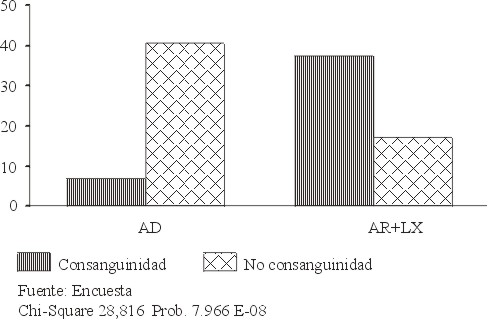
<body><![CDATA[<CENTER>0</CENTER>  </TD>    <TD VALIGN=TOP WIDTH="21%">      <CENTER>0</CENTER>  </TD>  </TR>    <TR>  <TD VALIGN=TOP WIDTH="41%">Total</TD>    <TD VALIGN=TOP WIDTH="18%">      <CENTER>314</CENTER>  </TD>    <TD VALIGN=TOP WIDTH="20%">      <CENTER>7</CENTER>  </TD>    <TD VALIGN=TOP WIDTH="21%">      <CENTER>33</CENTER>  </TD>  </TR>  </TABLE></CENTER>        <CENTER>Fuente: Encuestas.</CENTER>          <P>&nbsp;      <BR>Las edades de inicio de la enfermedad fueron variables; el debut precoz  fue el m&aacute;s frecuente, seguido por el tard&iacute;o (tabla 4). En  las familias con herencia definida (AD, AR y RLX) se encontr&oacute; mayor  consanguinidad entre aquellas con herencia recesiva (autos&oacute;mica  y ligada al sexo), con una dependencia estad&iacute;stica altamente significativa,  con un 99 % de confiabilidad (fig. 1).        <P><FONT SIZE=-2>&nbsp;</FONT>      <CENTER>Tabla 4.<B> </B>Debut de la enfermedad y modos de herencia</CENTER>        ]]></body>
<body><![CDATA[<CENTER><TABLE  CELLPADDING=4 >  <TR>  <TD VALIGN=TOP COLSPAN="4">Modos de herencia Debut</TD>  </TR>    <TR>  <TD VALIGN=TOP WIDTH="33%">&nbsp;</TD>    <TD VALIGN=TOP WIDTH="25%">      <CENTER>Precoz</CENTER>  </TD>    <TD VALIGN=TOP WIDTH="22%">      <CENTER>Juvenil</CENTER>  </TD>    <TD VALIGN=TOP WIDTH="20%">      <CENTER>Tard&iacute;o</CENTER>  </TD>  </TR>    <TR>  <TD VALIGN=TOP WIDTH="33%">AD</TD>    <TD VALIGN=TOP WIDTH="25%">      <CENTER>66</CENTER>  </TD>    <TD VALIGN=TOP WIDTH="22%">      <CENTER>54</CENTER>  </TD>    <TD VALIGN=TOP WIDTH="20%">      <CENTER>63</CENTER>  </TD>  </TR>    <TR>  <TD VALIGN=TOP WIDTH="33%">AR</TD>    <TD VALIGN=TOP WIDTH="25%">      <CENTER>38</CENTER>  </TD>    <TD VALIGN=TOP WIDTH="22%">      <CENTER>16</CENTER>  </TD>    <TD VALIGN=TOP WIDTH="20%">      <CENTER>15</CENTER>  </TD>  </TR>    <TR>  <TD VALIGN=TOP WIDTH="33%">RLX</TD>    <TD VALIGN=TOP WIDTH="25%">      ]]></body>
<body><![CDATA[<CENTER>2</CENTER>  </TD>    <TD VALIGN=TOP WIDTH="22%">      <CENTER>2</CENTER>  </TD>    <TD VALIGN=TOP WIDTH="20%">      <CENTER>2</CENTER>  </TD>  </TR>    <TR>  <TD VALIGN=TOP WIDTH="33%">NDS</TD>    <TD VALIGN=TOP WIDTH="25%">      <CENTER>21</CENTER>  </TD>    <TD VALIGN=TOP WIDTH="22%">      <CENTER>16</CENTER>  </TD>    <TD VALIGN=TOP WIDTH="20%">      <CENTER>33</CENTER>  </TD>  </TR>    <TR>  <TD VALIGN=TOP WIDTH="33%">NDM</TD>    <TD VALIGN=TOP WIDTH="25%">      <CENTER>6</CENTER>  </TD>    <TD VALIGN=TOP WIDTH="22%">      <CENTER>9</CENTER>  </TD>    <TD VALIGN=TOP WIDTH="20%">      <CENTER>6</CENTER>  </TD>  </TR>    <TR>  <TD VALIGN=TOP WIDTH="33%">Desconocida</TD>    <TD VALIGN=TOP WIDTH="25%">      <CENTER>0</CENTER>  </TD>    <TD VALIGN=TOP WIDTH="22%">      ]]></body>
<body><![CDATA[<CENTER>1</CENTER>  </TD>    <TD VALIGN=TOP WIDTH="20%">      <CENTER>4</CENTER>  </TD>  </TR>    <TR>  <TD VALIGN=TOP WIDTH="33%">Total</TD>    <TD VALIGN=TOP WIDTH="25%">      <CENTER>133</CENTER>  </TD>    <TD VALIGN=TOP WIDTH="22%">      <CENTER>98</CENTER>  </TD>    <TD VALIGN=TOP WIDTH="20%">      <CENTER>123</CENTER>  </TD>  </TR>  </TABLE></CENTER>        <CENTER>Fuente: Encuestas.</CENTER>        <CENTER>    <BR>      <BR></CENTER>        <CENTER></CENTER>        ]]></body>
<body><![CDATA[<CENTER>   <A HREF="/img/revistas/oft/v12n1/f0110199.jpg"><IMG SRC="/img/revistas/oft/v12n1/f0110199.jpg" ALT="Figura 1" BORDER=1 HEIGHT=131 WIDTH=201></A>  </CENTER>        
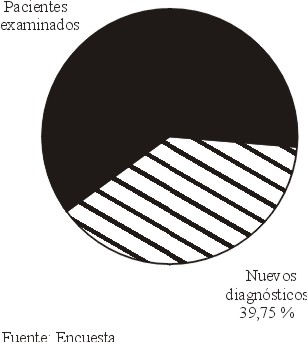
<CENTER>Fig 1. An&aacute;lisis de la consanguinidad.</CENTER>          <P>Con el establecimiento del patr&oacute;n hereditario en cada familia,  la identificaci&oacute;n de individuos con riesgo de padecer la enfermedad  y su estudio oftalmol&oacute;gico, se diagnosticaron 231 nuevos casos de  RP (figura 2).        <P>&nbsp;      <CENTER>     <A HREF="/img/revistas/oft/v12n1/f0210199.jpg"><IMG SRC="/img/revistas/oft/v12n1/f0210199.jpg" ALT="Figura 2" BORDER=1 HEIGHT=141 WIDTH=127></A>    </CENTER>        
<CENTER>Fig 2. Nuevos diagn&oacute;sticos.</CENTER>    <H4>  Discusi&oacute;n</H4>  Qued&oacute; manifiesto el car&aacute;cter hereditario de la RP en las  familias estudiadas. Al igual que en otros reportes de la literatura entre  los patrones hereditarios mendelianos, se destaca la herencia AR con alta  frecuencia de consanguinidad.<SUP>1,8</SUP> En el caso de la herencia AD  la penetrancia del gen result&oacute; ser similar a la reportada por Kaplan  y cols, en 19901 y cercano al 90,6 % encontrado por Jay en 1982.<SUP>4</SUP>  Posiblemente ascienda m&aacute;s su valor en el futuro, en la misma medida  en que se profundice en el estudio de los familiares.        <P>El gran n&uacute;mero de pacientes con herencia no definida (simple  y m&uacute;ltiple) no excluye la base gen&eacute;tica en ellos, ya que  pudieran representar casos familiares con penetrancia reducida o leve expresi&oacute;n  del gen en algunos individuos, as&iacute; como nuevas mutaciones.        <P>En la literatura se reporta un predominio de esta enfermedad en el sexo  masculino a causa de la contribuci&oacute;n de la herencia RLX.3 En el  presente estudio, el ligero aumento del sexo masculino no est&aacute; relacionado  con este modo de herencia, ya que s&oacute;lo est&aacute; presente en tres  familias representadas por cinco hombres y una mujer. En los casos no definidos  ambos sexos m&aacute;s o menos se afectaron por igual.        <P>El predominio de la enfermedad entre personas blancas es independiente  de la composici&oacute;n &eacute;tnica de la poblaci&oacute;n camag&uuml;eyana,  pues se han obtenido iguales resultados incluso en las provincias m&aacute;s  orientales del pa&iacute;s.<SUP>6</SUP>        <P>Las diferentes edades de inicio de la enfermedad son una expresi&oacute;n  de su gran heterogeneidad cl&iacute;nica y gen&eacute;tica<SUP>1,3</SUP>  representada por diferentes subtipos cl&iacute;nicos y gen&eacute;ticos  que difieren en la edad de comienzo y su evoluci&oacute;n.<SUP>1</SUP>        ]]></body>
<body><![CDATA[<P>Por todo lo anterior concluimos que a trav&eacute;s de la identificaci&oacute;n  de los diferentes modos de herencia de la RP fueron pesquisados de forma  organizada un gran n&uacute;mero de personas afectadas por la enfermedad,  a&uacute;n cuando se encontraban asintom&aacute;ticos o con s&iacute;ntomas  tan leves que hab&iacute;an pasado inadvertidos.        <P>Es por tanto necesario continuar el estudio de los familiares de los  pacientes con herencia no definida, tanto simple como m&uacute;ltiple,  para identificar nuevos pacientes. Es necesario tambi&eacute;n advertir  a la poblaci&oacute;n acerca del efecto nocivo para su descendencia del  matrimonio entre parientes a causa del riesgo de presentaci&oacute;n de  enfermedades hereditarias, como es el caso de la RP.  <H4>  Resumen</H4>  A descriptive study of 354 affected individuals distributed in 190 families  from Camag&uuml;ey was conducted aimed at classifying those patients with  retinitis pigmentosa and their families according to inheritance and at  showing the value of such classification. The necessary data were obtained  by interviews and genealogical analysis. A descriptive statistics was presented  based on chi square test and statistical probability test. 36,65 % of the  families were represent by the cases with indefinite (simple) inheritance  followed by recessive autosomal inheritances (27,75 %) and dominant autosomal  inheritance (24,60 %). The latter with 87 % of penetrance. The association  of consanguinity with the recesive inheritances was statistically significant  (p &lt; ,005). 231 new diagnosis (39,75 %) were made among the 581 patients  who were examined. Knowing the ways of inheritance of retinis pigmentosa  of each patient and this family is very important for screening the affected  individuals and for preventing the disease.        <P>Subject headings: RETINITIS PIGMENTOSA/ genetics; RETINITIS PIGMENTOSA/prevention  &amp; control.  <H4>  Referencias Bibliogr&aacute;ficas</H4>        <!-- ref --><p> 1. Kaplan J, Bonneau D, Fr&eacute;zal J, Munnich A, Dufier JL. Clinical and    genetic heterogeneity in retinitis pigmentosa. Hum genet 1990;85:635-42.<!-- ref --><p> 2. Pel&aacute;ez O, Palmero A, P&eacute;rez RM, Salcedo M. El deterioro visual    y su relaci&oacute;n con los a&ntilde;os de evoluci&oacute;n de la Retinosis    Pigmentaria. Rev Cubana Oftalmol 1992;4(1):66-71.<!-- ref --><p> 3. Haim M. Prevalence of retinitis pigmentosa and allied disorders in Denmark.    III. Hereditary pattern. Acta Ophthalmol 1992;70:615-24.<!-- ref --><p> 4. Haim M. Retinitis pigmentosa: problems associated with genetic classification.    Clin Genet 1993;44:62-70.<!-- ref --><p> 5. Dryja TP, Li T. Molecular genetics of retinitis pigmentosa. Hum Mol Genet    1995;4:1739-43.<!-- ref --><p> 6. Sarmiento J. Experiencia cubana en la Retinosis Pigmentaria. 1er Simposio    Internacional de Retinosis Pigmentaria. Libro de res&uacute;menes. La Habana:    Palacio de las Convenciones, 28 nov/1ro dic 1994:12.<!-- ref --><p> 7. Pel&aacute;ez O, Herrera M, Palmero A, P&eacute;rez RM, Mart&iacute;nez    C, Ramos E. Clasificaci&oacute;n de la Retinosis Pigmentaria seg&uacute;n la    escuela cubana del profesor Orfilio Pel&aacute;ez Molina. 1er Simposio Internacional    de Retinosis Pigmentaria. Libro de res&uacute;menes. La Habana: Palacio de las    Convenciones, 28 nov/1ro dic 1994:25.<!-- ref --><p> 8. Kar B, John S, Kumaramanickavel G. Retinitis pigmentosa in India: A genetic    and segregation analysis. Clin Genet 1995;47(2):75-9.<BR>  Recibido: 17 de marzo de 1998. Aprobado: 5 de abril de 1999.      <BR>Dra. <I>Elisa Dyce Gordon</I>. Centro Provincial de Retinosis Pigmentaria.  Camag&uuml;ey.        <P>&nbsp;      <BR><A NAME="*"></A><SUP>1</SUP> Especialista de II Grado en Gen&eacute;tica  Cl&iacute;nica. Asistente.      <BR><SUP>2</SUP> Especialista de I Grado en Oftalmolog&iacute;a.      <BR><SUP>3 </SUP>Especialista de I Grado en Gen&eacute;tica Cl&iacute;nica.      ]]></body><back>
<ref-list>
<ref id="B1">
<label>1</label><nlm-citation citation-type="journal">
<person-group person-group-type="author">
<name>
<surname><![CDATA[Kaplan]]></surname>
<given-names><![CDATA[J]]></given-names>
</name>
<name>
<surname><![CDATA[Bonneau]]></surname>
<given-names><![CDATA[D]]></given-names>
</name>
<name>
<surname><![CDATA[Frézal]]></surname>
<given-names><![CDATA[J]]></given-names>
</name>
<name>
<surname><![CDATA[Munnich]]></surname>
<given-names><![CDATA[A]]></given-names>
</name>
<name>
<surname><![CDATA[Dufier]]></surname>
<given-names><![CDATA[JL]]></given-names>
</name>
</person-group>
<article-title xml:lang="en"><![CDATA[Clinical and genetic heterogeneity in retinitis pigmentosa]]></article-title>
<source><![CDATA[Hum genet]]></source>
<year>1990</year>
<volume>85</volume>
<page-range>635-42</page-range></nlm-citation>
</ref>
<ref id="B2">
<label>2</label><nlm-citation citation-type="journal">
<person-group person-group-type="author">
<name>
<surname><![CDATA[Peláez]]></surname>
<given-names><![CDATA[O]]></given-names>
</name>
<name>
<surname><![CDATA[Palmero]]></surname>
<given-names><![CDATA[A]]></given-names>
</name>
<name>
<surname><![CDATA[Pérez]]></surname>
<given-names><![CDATA[RM]]></given-names>
</name>
<name>
<surname><![CDATA[Salcedo]]></surname>
<given-names><![CDATA[M]]></given-names>
</name>
</person-group>
<article-title xml:lang="es"><![CDATA[El deterioro visual y su relación con los años de evolución de la Retinosis Pigmentaria]]></article-title>
<source><![CDATA[Rev Cubana Oftalmol]]></source>
<year>1992</year>
<volume>4</volume>
<numero>1</numero>
<issue>1</issue>
<page-range>66-71</page-range></nlm-citation>
</ref>
<ref id="B3">
<label>3</label><nlm-citation citation-type="journal">
<person-group person-group-type="author">
<name>
<surname><![CDATA[Haim]]></surname>
<given-names><![CDATA[M]]></given-names>
</name>
</person-group>
<article-title xml:lang="en"><![CDATA[Prevalence of retinitis pigmentosa and allied disorders in Denmark: III]]></article-title>
<source><![CDATA[Hereditary pattern. Acta Ophthalmol]]></source>
<year>1992</year>
<volume>70</volume>
<page-range>615-24</page-range></nlm-citation>
</ref>
<ref id="B4">
<label>4</label><nlm-citation citation-type="journal">
<person-group person-group-type="author">
<name>
<surname><![CDATA[Haim]]></surname>
<given-names><![CDATA[M]]></given-names>
</name>
</person-group>
<article-title xml:lang="es"><![CDATA[Retinitis pigmentosa: problems associated with genetic classification]]></article-title>
<source><![CDATA[Clin Genet]]></source>
<year>1993</year>
<volume>44</volume>
<page-range>62-70</page-range></nlm-citation>
</ref>
<ref id="B5">
<label>5</label><nlm-citation citation-type="journal">
<person-group person-group-type="author">
<name>
<surname><![CDATA[Dryja]]></surname>
<given-names><![CDATA[TP]]></given-names>
</name>
<name>
<surname><![CDATA[Li]]></surname>
<given-names><![CDATA[T]]></given-names>
</name>
</person-group>
<article-title xml:lang="en"><![CDATA[Molecular genetics of retinitis pigmentosa]]></article-title>
<source><![CDATA[Hum Mol Genet]]></source>
<year>1995</year>
<volume>4</volume>
<page-range>1739-43</page-range></nlm-citation>
</ref>
<ref id="B6">
<label>6</label><nlm-citation citation-type="book">
<person-group person-group-type="author">
<name>
<surname><![CDATA[Sarmiento]]></surname>
<given-names><![CDATA[J]]></given-names>
</name>
</person-group>
<source><![CDATA[Experiencia cubana en la Retinosis Pigmentaria]]></source>
<year>1994</year>
<page-range>12</page-range><publisher-name><![CDATA[Palacio de las Convenciones]]></publisher-name>
</nlm-citation>
</ref>
<ref id="B7">
<label>7</label><nlm-citation citation-type="book">
<person-group person-group-type="author">
<name>
<surname><![CDATA[Peláez]]></surname>
<given-names><![CDATA[O]]></given-names>
</name>
<name>
<surname><![CDATA[Herrera]]></surname>
<given-names><![CDATA[M]]></given-names>
</name>
<name>
<surname><![CDATA[Palmero]]></surname>
<given-names><![CDATA[A]]></given-names>
</name>
<name>
<surname><![CDATA[Pérez]]></surname>
<given-names><![CDATA[RM]]></given-names>
</name>
<name>
<surname><![CDATA[Martínez]]></surname>
<given-names><![CDATA[C]]></given-names>
</name>
<name>
<surname><![CDATA[Ramos]]></surname>
<given-names><![CDATA[E]]></given-names>
</name>
</person-group>
<source><![CDATA[Clasificación de la Retinosis Pigmentaria según la escuela cubana del profesor Orfilio Peláez Molina]]></source>
<year>1994</year>
<page-range>25</page-range><publisher-name><![CDATA[Palacio de las Convenciones]]></publisher-name>
</nlm-citation>
</ref>
<ref id="B8">
<label>8</label><nlm-citation citation-type="journal">
<person-group person-group-type="author">
<name>
<surname><![CDATA[Kar]]></surname>
<given-names><![CDATA[B]]></given-names>
</name>
<name>
<surname><![CDATA[John]]></surname>
<given-names><![CDATA[S]]></given-names>
</name>
<name>
<surname><![CDATA[Kumaramanickavel]]></surname>
<given-names><![CDATA[G]]></given-names>
</name>
</person-group>
<article-title xml:lang="en"><![CDATA[Retinitis pigmentosa in India: A genetic and segregation analysis]]></article-title>
<source><![CDATA[Clin Genet]]></source>
<year>1995</year>
<volume>47</volume>
<numero>2</numero>
<issue>2</issue>
<page-range>75-9</page-range></nlm-citation>
</ref>
</ref-list>
</back>
</article>
