<?xml version="1.0" encoding="ISO-8859-1"?><article xmlns:mml="http://www.w3.org/1998/Math/MathML" xmlns:xlink="http://www.w3.org/1999/xlink" xmlns:xsi="http://www.w3.org/2001/XMLSchema-instance">
<front>
<journal-meta>
<journal-id>0864-2176</journal-id>
<journal-title><![CDATA[Revista Cubana de Oftalmología]]></journal-title>
<abbrev-journal-title><![CDATA[Rev Cubana Oftalmol]]></abbrev-journal-title>
<issn>0864-2176</issn>
<publisher>
<publisher-name><![CDATA[Editorial Ciencias Médicas]]></publisher-name>
</publisher>
</journal-meta>
<article-meta>
<article-id>S0864-21762000000200003</article-id>
<title-group>
<article-title xml:lang="es"><![CDATA[Aspectos genéticos y clínicos del síndrome de usher]]></article-title>
<article-title xml:lang="en"><![CDATA[Genetical and clinical aspects of Usher syndrome]]></article-title>
</title-group>
<contrib-group>
<contrib contrib-type="author">
<name>
<surname><![CDATA[Dyce Gordon]]></surname>
<given-names><![CDATA[Beatriz]]></given-names>
</name>
<xref ref-type="aff" rid="A01"/>
</contrib>
<contrib contrib-type="author">
<name>
<surname><![CDATA[Mejías Márquez]]></surname>
<given-names><![CDATA[Josefina]]></given-names>
</name>
<xref ref-type="aff" rid="A01"/>
</contrib>
<contrib contrib-type="author">
<name>
<surname><![CDATA[Copello Noblet]]></surname>
<given-names><![CDATA[Mirtha]]></given-names>
</name>
<xref ref-type="aff" rid="A01"/>
</contrib>
<contrib contrib-type="author">
<name>
<surname><![CDATA[Hernández Baguer]]></surname>
<given-names><![CDATA[Raisa]]></given-names>
</name>
<xref ref-type="aff" rid="A01"/>
</contrib>
<contrib contrib-type="author">
<name>
<surname><![CDATA[Horrach Rosa]]></surname>
<given-names><![CDATA[Irma]]></given-names>
</name>
<xref ref-type="aff" rid="A01"/>
</contrib>
</contrib-group>
<aff id="A01">
<institution><![CDATA[,Centro de Referencia Nacional de Retinosis Pigmentaria  ]]></institution>
<addr-line><![CDATA[ ]]></addr-line>
</aff>
<pub-date pub-type="pub">
<day>00</day>
<month>12</month>
<year>2000</year>
</pub-date>
<pub-date pub-type="epub">
<day>00</day>
<month>12</month>
<year>2000</year>
</pub-date>
<volume>13</volume>
<numero>2</numero>
<fpage>0</fpage>
<lpage>0</lpage>
<copyright-statement/>
<copyright-year/>
<self-uri xlink:href="http://scielo.sld.cu/scielo.php?script=sci_arttext&amp;pid=S0864-21762000000200003&amp;lng=en&amp;nrm=iso"></self-uri><self-uri xlink:href="http://scielo.sld.cu/scielo.php?script=sci_abstract&amp;pid=S0864-21762000000200003&amp;lng=en&amp;nrm=iso"></self-uri><self-uri xlink:href="http://scielo.sld.cu/scielo.php?script=sci_pdf&amp;pid=S0864-21762000000200003&amp;lng=en&amp;nrm=iso"></self-uri><abstract abstract-type="short" xml:lang="es"><p><![CDATA[Con el objetivo de describir algunos aspectos genéticos y clínicos del Síndrome de Usher, se realizó un estudio descriptivo transversal en el Centro de Referencia Nacional de Retinosis Pigmentaria desde marzo de 1996 hasta junio de 1998, con 33 pacientes con diagnóstico de síndrome de Usher a través de la revisión de historias clínicas, entrevistas para interrogatorio y examen físico, así como para la confección e interpretación del árbol genealógico. La mayoría de los pacientes (60,60 %) presentaron el síndrome de Usher tipo II. Se encontró consanguinidad en el 29,62 % de los casos y los antecedentes patológicos familiares se observaron en 12 familias. Las manifestaciones clínicas oftalmológicas tuvieron un inicio fundamentalmente juvenil, y las audiológicas tuvieron un inicio muy precoz (congénito) en el tipo I y en la infancia, en el tipo II. En conclusión en el presente estudio, se pone de manifiesto la heterogeneidad clínica y genética del síndrome de Usher así como su carácter hereditario con patrón de herencia autosómico recesivo. Se hace necesario su diagnóstico precoz para ofrecer asesoramiento genético a los padres y poner tratamiento adecuado a las discapacidades]]></p></abstract>
<abstract abstract-type="short" xml:lang="en"><p><![CDATA[With the aim of describe some genetic and clinical features of Usher´s syndrome, we performed a cross and descriptive study in National Center of Remission of Pigmentosa Retinitis from March 1996 o June 1998, where 33 patients were diagnosed of Usher´s syndrome through revision of medical records, interviews for interrogation and physical examination, as well as to drawing up and interpretation of genealogical tree. Most patients (60,60 %) presenting with type II Usher´s syndrome. We found consanguinity in 29,62 % of cases and familial pathologic bacgrounds were observed in 12 families. Ophthalmologic and clinical manifestations had a youthful onset, and audiologies had a very early onset (congenital) in type I, and in infancy in type II. In conclusion, in present study was evident clinical and genetic heterogeneity of Usher´s syndrome as well as hereditary character with a autosomal recessive pattern of inheritance. It is necessary its early diagnosis to offer genetical advising to parents and to treat disabilities]]></p></abstract>
<kwd-group>
<kwd lng="es"><![CDATA[RETINITIS PIGMENTOSA]]></kwd>
<kwd lng="es"><![CDATA[SORDERA]]></kwd>
<kwd lng="en"><![CDATA[RETINITIS PIGMENTOSA]]></kwd>
<kwd lng="en"><![CDATA[DEAFNESS]]></kwd>
</kwd-group>
</article-meta>
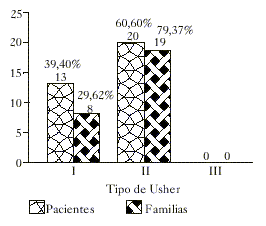
</front><body><![CDATA[ <P>Centro de Referencia Nacional de Retinosis Pigmentaria   <H2>   Aspectos gen&eacute;ticos y cl&iacute;nicos del s&iacute;ndrome de usher</H2>   <I><A HREF="#x">Dra. Beatriz Dyce Gordon,<SUP>1</SUP> Dra. Josefina Mej&iacute;as  M&aacute;rquez,<SUP>2</SUP> Dra. Mirtha Copello Noblet,<SUP>3</SUP> Dra. Raisa  Hern&aacute;ndez Baguer<SUP>4 </SUP>y Dra. Irma Horrach Rosa<SUP>4</SUP></A></I>  <H4>   RESUMEN</H4>   Con el objetivo de describir algunos aspectos gen&eacute;ticos y cl&iacute;nicos   del S&iacute;ndrome de Usher, se realiz&oacute; un estudio descriptivo   transversal en el Centro de Referencia Nacional de Retinosis Pigmentaria   desde marzo de 1996 hasta junio de 1998, con 33 pacientes con diagn&oacute;stico   de s&iacute;ndrome de Usher a trav&eacute;s de la revisi&oacute;n de historias   cl&iacute;nicas, entrevistas para interrogatorio y examen f&iacute;sico,   as&iacute; como para la confecci&oacute;n e interpretaci&oacute;n del &aacute;rbol   geneal&oacute;gico. La mayor&iacute;a de los pacientes (60,60 %) presentaron   el s&iacute;ndrome de Usher tipo II. Se encontr&oacute; consanguinidad   en el 29,62 % de los casos y los antecedentes patol&oacute;gicos familiares   se observaron en 12 familias. Las manifestaciones cl&iacute;nicas oftalmol&oacute;gicas   tuvieron un inicio fundamentalmente juvenil, y las audiol&oacute;gicas   tuvieron un inicio muy precoz (cong&eacute;nito) en el tipo I y en la infancia,   en el tipo II. En conclusi&oacute;n en el presente estudio, se pone de   manifiesto la heterogeneidad cl&iacute;nica y gen&eacute;tica del s&iacute;ndrome   de Usher as&iacute; como su car&aacute;cter hereditario con patr&oacute;n   de herencia autos&oacute;mico recesivo. Se hace necesario su diagn&oacute;stico   precoz para ofrecer asesoramiento gen&eacute;tico a los padres y poner   tratamiento adecuado a las discapacidades.          <P>Descriptores DeCS: RETINITIS PIGMENTOSA; SORDERA/diagn&oacute;stico;   SORDERA/prevenci&oacute;n y control; SORDERA/terapia.          <P>El s&iacute;ndrome de Usher (SU) es un heterog&eacute;neo grupo de enfermedades   caracterizadas por retinosis pigmentaria (RP) y sordera sensorineural.<SUP>1</SUP>   La coincidencia de ambas anomal&iacute;as fue reconocida por primera vez   por <I>Von Graefe</I> en 1855 y posteriormente <I>Charles Usher</I> (1914-1935)   corrobor&oacute; su naturaleza hereditaria.<SUP>2</SUP>          <P>Este s&iacute;ndrome constituye la primera causa de sordoceguera hereditaria   y su prevalencia es variable. Oscila entre 3,0 x 100 000 en Escandinavia   y 4,4 x 100 000 en Estados Unidos<SUP>3</SUP> y en Cuba es la forma sindr&oacute;mica   de la RP m&aacute;s frecuente.<SUP>3</SUP>          <P>Es cl&iacute;nica y gen&eacute;ticamente heterog&eacute;nea y ya se   conocen varios genes responsables          <P>de &eacute;ste y de las manifestaciones fenot&iacute;picas que producen.<SUP>1,2</SUP>   Con el objetivo de describir algunos aspectos gen&eacute;ticos y cl&iacute;nicos   del SU en nuestra poblaci&oacute;n, se realiza esta investigaci&oacute;n   para as&iacute; profundizar en su conocimiento y contribuir a su prevenci&oacute;n,   diagn&oacute;stico y tratamiento precoz.   <H4>   M&Eacute;TODOS</H4>   Se realiz&oacute; un estudio descriptivo transversal sobre algunos aspectos   gen&eacute;ticos y cl&iacute;nicos del SU, con 33 pacientes as&iacute;   diagnosticados y clasificados seg&uacute;n la clasificaci&oacute;n de Kimberling   en 1995, 2 entre marzo de 1996 y junio de 1998 en el Centro de Referencia   Nacional de RP.          <P>Los datos fueron obtenidos a trav&eacute;s de la revisi&oacute;n de   las historias cl&iacute;nicas, entrevistas y examen f&iacute;sico realizados   a los pacientes, que luego fueron volcados en un modelo de recolecci&oacute;n   de datos. Ellos fueron: datos generales del paciente, edad de inicio de   la hipoacusia, comienzo de la RP, existencia y grado de consanguinidad,   tipo de Usher, antecedentes familiares de RP, de hipoacusia o de SU, as&iacute;   como presencia de enfermedades concomitantes.          <P>Adem&aacute;s, a cada familia se le confeccion&oacute; e interpret&oacute;   el &aacute;rbol geneal&oacute;gico.          <P>Los datos fueron procesados manualmente con ayuda de una calculadora   Casio DC-200 BK y se presentaron en forma de tablas y gr&aacute;ficos para   su an&aacute;lisis y discusi&oacute;n.   <H4>   RESULTADOS</H4>   La mayor&iacute;a de los pacientes (60,60 %) presentaron el SU tipo II y por lo  tanto hubo un mayor n&uacute;mero de familias incluidas en este grupo. Ning&uacute;n  paciente present&oacute; el tipo III de la enfermedad (fig. 1).      <P align="center"><a href="/img/revistas/oft/v13n2/f103200.gif"><img src="/img/revistas/oft/v13n2/f103200.gif" width="184" height="153" border="0"></a>      
]]></body>
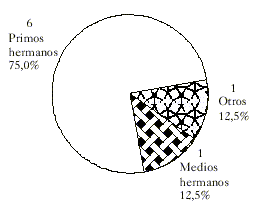
<body><![CDATA[<P align="center">Fig. 1. Clasificaci&oacute;n de pacientes y familias.      <P>Se encontr&oacute; consanguinidad entre los padres de los individuos   afectados en el 29,62 % de los pacientes (tabla 1), y el grado de consanguinidad   m&aacute;s com&uacute;n fue el de primos hermanos (75 %) (fig. 2).          <P align="center"><a href="/img/revistas/oft/v13n2/f203200.gif"><img src="/img/revistas/oft/v13n2/f203200.gif" width="172" height="142" border="0"></a>      
<P align="center">Fig. 2. Grado de consanguinidad.      <P>        <CENTER>     <B>TABLA 1. Presencia de consanguinidad familiar</B>    </CENTER>       <CENTER>     <B></B>&nbsp;    </CENTER>     <CENTER><TABLE CELLPADDING=4 >   <TR>   <TD VALIGN=TOP WIDTH="33%">Consanguinidad familiar&nbsp;</TD>      <TD VALIGN=TOP WIDTH="33%">       <CENTER>No.</CENTER>   </TD>      <TD VALIGN=TOP WIDTH="33%">       <CENTER>%</CENTER>   </TD>   </TR>      <TR>   <TD VALIGN=TOP WIDTH="33%">S&iacute;</TD>      <TD VALIGN=TOP WIDTH="33%">       ]]></body>
<body><![CDATA[<CENTER>8</CENTER>   </TD>      <TD VALIGN=TOP WIDTH="33%">       <CENTER>29,62</CENTER>   </TD>   </TR>      <TR>   <TD VALIGN=TOP WIDTH="33%">No</TD>      <TD VALIGN=TOP WIDTH="33%">       <CENTER>19</CENTER>   </TD>      <TD VALIGN=TOP WIDTH="33%">       <CENTER>70,38</CENTER>   </TD>   </TR>      <TR>   <TD VALIGN=TOP WIDTH="33%">Total</TD>      <TD VALIGN=TOP WIDTH="33%">       <CENTER>27</CENTER>   </TD>      <TD VALIGN=TOP WIDTH="33%">       <CENTER>100</CENTER>   </TD>   </TR>   </TABLE></CENTER>          <CENTER><B></B>&nbsp;</CENTER>          <CENTER><B></B></CENTER>          <CENTER><B>TABLA 2. Antecedentes patol&oacute;gicos familiares</B></CENTER>          <CENTER><B></B>&nbsp;</CENTER>          ]]></body>
<body><![CDATA[<CENTER><TABLE CELLPADDING=4 >   <TR>   <TD VALIGN=TOP WIDTH="33%">Antecedentes patol&oacute;gicos familiares</TD>      <TD VALIGN=TOP WIDTH="33%">       <CENTER>No.</CENTER>   </TD>      <TD VALIGN=TOP WIDTH="33%">       <CENTER>%</CENTER>   </TD>   </TR>      <TR>   <TD VALIGN=TOP WIDTH="33%">Retinosis pigmentaria</TD>      <TD VALIGN=TOP WIDTH="33%">       <CENTER>3</CENTER>   </TD>      <TD VALIGN=TOP WIDTH="33%">       <CENTER>25</CENTER>   </TD>   </TR>      <TR>   <TD VALIGN=TOP WIDTH="33%">Hipoacusia</TD>      <TD VALIGN=TOP WIDTH="33%">       <CENTER>-</CENTER>   </TD>      <TD VALIGN=TOP WIDTH="33%">       <CENTER>-</CENTER>   </TD>   </TR>      <TR>   <TD VALIGN=TOP WIDTH="33%">S&iacute;ndrome de Usher</TD>      <TD VALIGN=TOP WIDTH="33%">       <CENTER>9</CENTER>   </TD>      <TD VALIGN=TOP WIDTH="33%">       <CENTER>75</CENTER>   </TD>   </TR>      <TR>   <TD VALIGN=TOP WIDTH="33%">Total</TD>      <TD VALIGN=TOP WIDTH="33%">       <CENTER>12</CENTER>   </TD>      <TD VALIGN=TOP WIDTH="33%">       ]]></body>
<body><![CDATA[<CENTER>100</CENTER>   </TD>   </TR>   </TABLE></CENTER>   De las 27 familias, 12 presentaban antecedentes; 3 de RP y 9 de SU (tabla   2). El comienzo m&aacute;s frecuente de las manifestaciones oftalmol&oacute;gicas   fue el juvenil y el inicio de la hipoacusia fue cong&eacute;nito en la   mayor&iacute;a de los pacientes con el SU tipo I, solo uno refiri&oacute;   haber comenzado su hipoacusia en la infancia; sin embargo, en el SU tipo   II la mayor&iacute;a de los pacientes iniciaron esta manifestaci&oacute;n   durante la infancia, exceptuando a 2 pacientes con disminuci&oacute;n de   la agudeza visual; la ceguera nocturna fue el s&iacute;ntoma oftalmol&oacute;gico   inicial (tabla 3).       <BR>&nbsp;       <CENTER><B>TABLA 3. Inicio de las manifestaciones cl&iacute;nicas seg&uacute;n   tipo de Usher</B></CENTER>          <CENTER><B></B>&nbsp;</CENTER>          <CENTER><TABLE CELLPADDING=4 >   <TR>   <TD VALIGN=TOP WIDTH="13%">Tipo</TD>      <TD VALIGN=TOP WIDTH="13%">&nbsp;</TD>      <TD VALIGN=TOP COLSPAN="2" WIDTH="26%">       <CENTER>Oftalmol&oacute;gicas</CENTER>   </TD>      <TD VALIGN=TOP COLSPAN="2" WIDTH="26%">       <CENTER>Inicio</CENTER>   </TD>      <TD VALIGN=TOP COLSPAN="2" WIDTH="26%">       <CENTER>Audiol&oacute;gicas</CENTER>   </TD>   </TR>      <TR>   <TD VALIGN=TOP WIDTH="13%">&nbsp;</TD>      <TD VALIGN=TOP WIDTH="13%">       <CENTER>Precoz</CENTER>   </TD>      <TD VALIGN=TOP WIDTH="13%">       <CENTER>Juvenil</CENTER>   </TD>      <TD VALIGN=TOP WIDTH="13%">       ]]></body>
<body><![CDATA[<CENTER>Tard&iacute;o</CENTER>   </TD>      <TD VALIGN=TOP WIDTH="13%">       <CENTER>Cong&eacute;nita</CENTER>   </TD>      <TD VALIGN=TOP WIDTH="13%">       <CENTER>Infancia</CENTER>   </TD>      <TD VALIGN=TOP WIDTH="13%">       <CENTER>Adolescencia</CENTER>   </TD>      <TD VALIGN=TOP WIDTH="13%">       <CENTER>Adultez</CENTER>   </TD>   </TR>      <TR>   <TD VALIGN=TOP WIDTH="13%">I</TD>      <TD VALIGN=TOP WIDTH="13%">       <CENTER>1</CENTER>   </TD>      <TD VALIGN=TOP WIDTH="13%">       <CENTER>8</CENTER>   </TD>      <TD VALIGN=TOP WIDTH="13%">       <CENTER>4</CENTER>   </TD>      <TD VALIGN=TOP WIDTH="13%">       <CENTER>12</CENTER>   </TD>      <TD VALIGN=TOP WIDTH="13%">       <CENTER>1</CENTER>   </TD>      <TD VALIGN=TOP WIDTH="13%">       ]]></body>
<body><![CDATA[<CENTER>-</CENTER>   </TD>      <TD VALIGN=TOP WIDTH="13%">       <CENTER>-</CENTER>   </TD>   </TR>      <TR>   <TD VALIGN=TOP WIDTH="13%">II</TD>      <TD VALIGN=TOP WIDTH="13%">       <CENTER>3</CENTER>   </TD>      <TD VALIGN=TOP WIDTH="13%">       <CENTER>9</CENTER>   </TD>      <TD VALIGN=TOP WIDTH="13%">       <CENTER>8</CENTER>   </TD>      <TD VALIGN=TOP WIDTH="13%">       <CENTER>1</CENTER>   </TD>      <TD VALIGN=TOP WIDTH="13%">       <CENTER>14</CENTER>   </TD>      <TD VALIGN=TOP WIDTH="13%">       <CENTER>4</CENTER>   </TD>      <TD VALIGN=TOP WIDTH="13%">       <CENTER>1</CENTER>   </TD>   </TR>   </TABLE></CENTER>          <CENTER></CENTER>          ]]></body>
<body><![CDATA[<CENTER><B>TABLA 4. Genes causantes de la enfermedad</B></CENTER>          <CENTER>&nbsp;</CENTER>          <CENTER><TABLE CELLPADDING=4 >   <TR>   <TD VALIGN=TOP WIDTH="25%">       <CENTER>Tipo&nbsp;</CENTER>   </TD>      <TD VALIGN=TOP WIDTH="25%">       <CENTER>Subtipo</CENTER>   </TD>      <TD VALIGN=TOP WIDTH="25%">       <CENTER>Ubicaci&oacute;n del gen</CENTER>   </TD>      <TD VALIGN=TOP WIDTH="25%">       <CENTER>Prote&iacute;na</CENTER>   </TD>   </TR>      <TR>   <TD VALIGN=TOP WIDTH="25%">SU tipo I</TD>      <TD VALIGN=TOP WIDTH="25%">       <CENTER>1A</CENTER>   </TD>      <TD VALIGN=TOP WIDTH="25%">       <CENTER>14q31</CENTER>   </TD>      <TD VALIGN=TOP WIDTH="25%">&nbsp;</TD>   </TR>      <TR>   <TD VALIGN=TOP WIDTH="25%">&nbsp;</TD>      <TD VALIGN=TOP WIDTH="25%">       <CENTER>1B</CENTER>   </TD>      <TD VALIGN=TOP WIDTH="25%">       ]]></body>
<body><![CDATA[<CENTER>11q13,5</CENTER>   </TD>      <TD VALIGN=TOP WIDTH="25%">       <CENTER>miosina</CENTER>   </TD>   </TR>      <TR>   <TD VALIGN=TOP WIDTH="25%">&nbsp;</TD>      <TD VALIGN=TOP WIDTH="25%">       <CENTER>VIIA</CENTER>   </TD>      <TD VALIGN=TOP WIDTH="25%">&nbsp;</TD>      <TD VALIGN=TOP WIDTH="25%">&nbsp;</TD>   </TR>      <TR>   <TD VALIGN=TOP WIDTH="25%">&nbsp;</TD>      <TD VALIGN=TOP WIDTH="25%">       <CENTER>1C</CENTER>   </TD>      <TD VALIGN=TOP WIDTH="25%">       <CENTER>11p15,1</CENTER>   </TD>      <TD VALIGN=TOP WIDTH="25%">&nbsp;</TD>   </TR>      <TR>   <TD VALIGN=TOP WIDTH="25%">&nbsp;</TD>      <TD VALIGN=TOP WIDTH="25%">       <CENTER>ID</CENTER>   </TD>      <TD VALIGN=TOP WIDTH="25%">       <CENTER>10q</CENTER>   </TD>      <TD VALIGN=TOP WIDTH="25%">&nbsp;</TD>   </TR>      <TR>   <TD VALIGN=TOP WIDTH="25%">&nbsp;</TD>      <TD VALIGN=TOP WIDTH="25%">       <CENTER>1E</CENTER>   </TD>      <TD VALIGN=TOP WIDTH="25%">       <CENTER>21q21</CENTER>   </TD>      <TD VALIGN=TOP WIDTH="25%">&nbsp;</TD>   </TR>      <TR>   <TD VALIGN=TOP WIDTH="25%">SU tipo II</TD>      <TD VALIGN=TOP WIDTH="25%">       <CENTER>2A</CENTER>   </TD>      <TD VALIGN=TOP WIDTH="25%">       ]]></body>
<body><![CDATA[<CENTER>1q41</CENTER>   </TD>      <TD VALIGN=TOP WIDTH="25%">&nbsp;</TD>   </TR>      <TR>   <TD VALIGN=TOP WIDTH="25%">&nbsp;</TD>      <TD VALIGN=TOP WIDTH="25%">       <CENTER>2B</CENTER>   </TD>      <TD VALIGN=TOP WIDTH="25%">       <CENTER>Not 1q</CENTER>   </TD>      <TD VALIGN=TOP WIDTH="25%">&nbsp;</TD>   </TR>      <TR>   <TD VALIGN=TOP WIDTH="25%">SU tipo III</TD>      <TD VALIGN=TOP WIDTH="25%">&nbsp;</TD>      <TD VALIGN=TOP WIDTH="25%">       <CENTER>3q21-q25</CENTER>   </TD>      <TD VALIGN=TOP WIDTH="25%">&nbsp;</TD>   </TR>   </TABLE></CENTER>   Las enfermedades concomitantes se presentaron en 7 pacientes, como se muestra  en la figura 3.      <P align="center"><a href="/img/revistas/oft/v13n2/f303200.gif"><img src="/img/revistas/oft/v13n2/f303200.gif" width="165" height="128" border="0"></a>      
<P align="center">Fig. 3. Enfermedades concomitantes.  <H4>   DISCUSI&Oacute;N</H4>   Nuestros resultados ponen de manifiesto la heterogeneidad cl&iacute;nica   y gen&eacute;tica del SU, al encontrar pacientes con el tipo I y II de   la enfermedad, lo que est&aacute; determinado por la existencia de varios   genes mutantes causantes de los distintos fenotipos.<SUP>2,4</SUP> Hasta   el momento se han reportado los genes que se muestran en la tabla 4.          <P>Esta heterogeneidad tambi&eacute;n fue evidenciada, tanto por la diversidad   de las manifestaciones cl&iacute;nicas como por las diferentes edades de   inicio de la enfermedad. Este s&iacute;ndrome ha sido clasificado en 3   tipos:          <P><I>SU tipo I</I>: Caracterizado por sordera sensorineural profunda y   cong&eacute;nita, con ausencia de la funci&oacute;n vestibular, y RP progresiva   de inicio prepuberal.<SUP>2</SUP>          <P><I>SU tipo II</I>: P&eacute;rdida auditiva cong&eacute;nita de moderada   a severa y la funci&oacute;n vestibular es normal. La RP progresiva suele   comenzar alrededor de los 15 a&ntilde;os.<SUP>1,2,4</SUP>          <P><I>SU tipo III</I>: Se distingue del tipo II por la naturaleza progresiva   de la p&eacute;rdida auditiva y el compromiso vestibular variable.<SUP>2,5,6</SUP>   La RP puede aparecer a cualquier edad.<SUP>1</SUP>          ]]></body>
<body><![CDATA[<P>Acorde con otros reportes de la literatura<SUP>7-9 </SUP>el tipo II   result&oacute; ser el m&aacute;s frecuente, y la ausencia del tipo III   posiblemente sea a causa de la rareza con que se presenta en determinadas   poblaciones, estimada en el 2-4 % del total de los casos de SU.<SUP>5,6</SUP>          <P>Como es de esperar para el patr&oacute;n de herencia autos&oacute;mico   recesivo, modo de transmisi&oacute;n de la enfermedad,<SUP>1,2</SUP> la   consanguinidad tiene un papel importante en la producci&oacute;n de homocigotos   recesivos,<SUP>10</SUP> fundamentalmente entre parientes cercanos.          <P>Conocer los antecedentes familiares en cada persona afectada contribuye   a identificar el modo de herencia, pero tambi&eacute;n para sospechar la   enfermedad en otros, como es el caso de los antecedentes de RP en 3 individuos   con SU que deben ser valorados por el otorrinolaring&oacute;logo.          <P>Teniendo en cuenta la naturaleza hereditaria de la enfermedad, es importante   tambi&eacute;n conocer las entidades de inicio de las alteraciones oftalmol&oacute;gicas   y audiol&oacute;gicas con el fin de ofrecer oportuno asesoramiento gen&eacute;tico   a los padres para que ellos decidan acerca de su futura descendencia, as&iacute;   como para proteger al individuo de accidentes, poner tratamiento y garantizar   una educaci&oacute;n acorde con sus discapacidades.          <P>En la literatura <SUP>2</SUP> se reportan enfermedades asociadas al   SU tales como el retraso mental y des&oacute;rdenes psiqui&aacute;tricos,   como la esquizofrenia, la psicosis y la depresi&oacute;n recurrente. La   psicosis fue encontrada en 1 de nuestros pacientes.          <P>Por lo anterior se concluye que el SU es gen&eacute;ticamente heterog&eacute;neo.   Una vez m&aacute;s se pone de manifiesto su car&aacute;cter hereditario   con patr&oacute;n de herencia autos&oacute;mico recesivo y la relaci&oacute;n   entre &eacute;ste y la consanguinidad.          <P>El hecho de asociar ceguera y sordera hace al individuo doblemente incapacitado,   por lo que se recomienda sospechar de &eacute;l siempre que se encuentre   esta asociaci&oacute;n, con el fin de realizar un diagn&oacute;stico precoz   que garantice iniciar un tratamiento y manejo educacional oportunos, as&iacute;   como asesoramiento gen&eacute;tico a los padres para su prevenci&oacute;n.   <H4>   SUMMARY</H4>   With the aim of describe some genetic and clinical features of Usher&acute;s   syndrome, we performed a cross and descriptive study in National Center   of Remission of Pigmentosa Retinitis from March 1996 o June 1998, where   33 patients were diagnosed of Usher&acute;s syndrome through revision of   medical records, interviews for interrogation and physical examination,   as well as to drawing up and interpretation of genealogical tree. Most   patients (60,60 %) presenting with type II Usher&acute;s syndrome. We found   consanguinity in 29,62 % of cases and familial pathologic bacgrounds were   observed in 12 families. Ophthalmologic and clinical manifestations had   a youthful onset, and audiologies had a very early onset (congenital) in   type I, and in infancy in type II. In conclusion, in present study was   evident clinical and genetic heterogeneity of Usher&acute;s syndrome as   well as hereditary character with a autosomal recessive pattern of inheritance.   It is necessary its early diagnosis to offer genetical advising to parents   and to treat disabilities.       <BR>&nbsp;          <P>Subject headings: RETINITIS PIGMENTOSA; DEAFNESS/ diagnosis; DEAFNESS/   prevention &amp; control; DEAFNESS/ therapy.   <H4>   REFERENCIAS BIBLIOGR&Aacute;FICAS</H4>          <!-- ref --><p> 1. Mackey DA. Recent advances in hereditary disease and neuro-opthalmology.    Ophthalmology 1995;6(16):48-53.<!-- ref --><p> 2. Kimberling WJ. Clinical and molecular genetics of Usher Syndrome. J Am    Acad Audiol 1995;6:63-72.<!-- ref --><p> 3. Sarmiento JA. Algunas variaciones epide-miol&oacute;gicas de la retinosis    pigmentaria en Cuba. En: P&eacute;laez O. Retinosis pigmentaria. Experiencia    cubana. La Habana: Editorial Cient&iacute;fico-T&eacute;cnica; 1997:35-47.<!-- ref --><p> 4. Kimberling WJ, Smith RJH. Gene mapping of the Usher syndromes. Otolaryngol    Clin North Am 1992;25(5):923-34.<!-- ref --><p> 5. Mac Donald MI, Haney PM, Musarella MA. Summary of ocular genetic disorders    and inherited systemic conditions with eye findings. Ophthalmic Genet 1998;19(1):1-17.<!-- ref --><p> 6. Pakarinen L, Karialainens S, Simola KO, Laippala P, Kaitalo H. Usher syndrome    type 3 in Finland. Laryngoscope 1995; 105(6):613-7.<!-- ref --><p> 7. Herrera M. Caracter&iacute;sticas cl&iacute;nicas de la retinosis pigmentaria.    En: Pel&aacute;ez O. Retinosis pigmentaria. Experiencia cubana. La Habana: Editorial    Cient&iacute;fico-T&eacute;cnica, 1997:87- 107.<!-- ref --><p> 8. Hope CI, Bundey S, Proops D, Fielder AR. Usher syndrome in the city of    Birmingham. Prevalence and clinical classification. Br J Ophthalmol 1997;81(1):46-53.<!-- ref --><p> 9. Rosenberg T, Haim M, Hauch AM, Parving A. The prevalence of Usher syndrome    and other retinal dystrophy-hearing impairment associations. Clin Genet 1997;51(5):314-21.<!-- ref --><p> 10. Trop I, Schloss MD, Palomero R, Kaloustian V der. Usher syndrome in four    siblings from a consanguineous family of Pakistani origin. J Otolaryngol 1995;24(2):102-4.Recibido: 18 de noviembre de 1999. Aprobado: 16 de diciembre de 1999.     ]]></body>
<body><![CDATA[<BR> Dra. <I>Beatriz Dyce Gordon.</I> Calle Cintra No. 66. entre Reyes y   Empresa, Cerro, Ciudad de La Habana, Cuba.   <DIR><A NAME="x"></A><SUP>1 </SUP>Especialista de I Grado en Gen&eacute;tica Cl&iacute;nica.        <BR>   <SUP>2 </SUP>Especialista de I Grado en Otorrinolaringolog&iacute;a.     <BR>   <SUP>3 </SUP>Especialista de II Grado en Oftalmolog&iacute;a. Asistente.     <BR>   <SUP>4 </SUP>Especialista de I Grado en Oftalmolog&iacute;a.   </DIR>           ]]></body>
<back>
<ref-list>
<ref id="B1">
<label>1</label><nlm-citation citation-type="journal">
<person-group person-group-type="author">
<name>
<surname><![CDATA[Mackey]]></surname>
<given-names><![CDATA[DA]]></given-names>
</name>
</person-group>
<article-title xml:lang="en"><![CDATA[Recent advances in hereditary disease and neuro-opthalmology]]></article-title>
<source><![CDATA[Ophthalmology]]></source>
<year>1995</year>
<volume>6</volume>
<numero>16</numero>
<issue>16</issue>
<page-range>48-53</page-range></nlm-citation>
</ref>
<ref id="B2">
<label>2</label><nlm-citation citation-type="journal">
<person-group person-group-type="author">
<name>
<surname><![CDATA[Kimberling]]></surname>
<given-names><![CDATA[WJ]]></given-names>
</name>
</person-group>
<article-title xml:lang="en"><![CDATA[Clinical and molecular genetics of Usher Syndrome]]></article-title>
<source><![CDATA[J Am Acad Audiol]]></source>
<year>1995</year>
<volume>6</volume>
<page-range>63-72</page-range></nlm-citation>
</ref>
<ref id="B3">
<label>3</label><nlm-citation citation-type="book">
<person-group person-group-type="author">
<name>
<surname><![CDATA[Sarmiento]]></surname>
<given-names><![CDATA[JA]]></given-names>
</name>
</person-group>
<article-title xml:lang="es"><![CDATA[Algunas variaciones epide-miológicas de la retinosis pigmentaria en Cuba]]></article-title>
<person-group person-group-type="editor">
<name>
<surname><![CDATA[Pélaez]]></surname>
<given-names><![CDATA[O]]></given-names>
</name>
</person-group>
<source><![CDATA[Retinosis pigmentaria: Experiencia cubana]]></source>
<year>1997</year>
<page-range>35-47</page-range><publisher-name><![CDATA[Editorial Científico-Técnica]]></publisher-name>
</nlm-citation>
</ref>
<ref id="B4">
<label>4</label><nlm-citation citation-type="journal">
<person-group person-group-type="author">
<name>
<surname><![CDATA[Kimberling]]></surname>
<given-names><![CDATA[WJ]]></given-names>
</name>
<name>
<surname><![CDATA[Smith]]></surname>
<given-names><![CDATA[RJH]]></given-names>
</name>
</person-group>
<article-title xml:lang="en"><![CDATA[Gene mapping of the Usher syndromes]]></article-title>
<source><![CDATA[Otolaryngol Clin North Am]]></source>
<year>1992</year>
<volume>25</volume>
<numero>5</numero>
<issue>5</issue>
<page-range>923-34</page-range></nlm-citation>
</ref>
<ref id="B5">
<label>5</label><nlm-citation citation-type="journal">
<person-group person-group-type="author">
<name>
<surname><![CDATA[Mac Donald]]></surname>
<given-names><![CDATA[MI]]></given-names>
</name>
<name>
<surname><![CDATA[Haney]]></surname>
<given-names><![CDATA[PM]]></given-names>
</name>
<name>
<surname><![CDATA[Musarella]]></surname>
<given-names><![CDATA[MA]]></given-names>
</name>
</person-group>
<article-title xml:lang="en"><![CDATA[Summary of ocular genetic disorders and inherited systemic conditions with eye findings]]></article-title>
<source><![CDATA[Ophthalmic Genet]]></source>
<year>1998</year>
<volume>19</volume>
<numero>1</numero>
<issue>1</issue>
<page-range>1-17</page-range></nlm-citation>
</ref>
<ref id="B6">
<label>6</label><nlm-citation citation-type="journal">
<person-group person-group-type="author">
<name>
<surname><![CDATA[Pakarinen]]></surname>
<given-names><![CDATA[L]]></given-names>
</name>
<name>
<surname><![CDATA[Karialainens]]></surname>
<given-names><![CDATA[S]]></given-names>
</name>
<name>
<surname><![CDATA[Simola]]></surname>
<given-names><![CDATA[KO]]></given-names>
</name>
<name>
<surname><![CDATA[Laippala]]></surname>
<given-names><![CDATA[P]]></given-names>
</name>
<name>
<surname><![CDATA[Kaitalo]]></surname>
<given-names><![CDATA[H]]></given-names>
</name>
</person-group>
<article-title xml:lang="en"><![CDATA[Usher syndrome type 3 in Finland]]></article-title>
<source><![CDATA[Laryngoscope]]></source>
<year>1995</year>
<volume>105</volume>
<numero>6</numero>
<issue>6</issue>
<page-range>613-7</page-range></nlm-citation>
</ref>
<ref id="B7">
<label>7</label><nlm-citation citation-type="book">
<person-group person-group-type="author">
<name>
<surname><![CDATA[Herrera]]></surname>
<given-names><![CDATA[M]]></given-names>
</name>
</person-group>
<article-title xml:lang="es"><![CDATA[Características clínicas de la retinosis pigmentaria]]></article-title>
<person-group person-group-type="editor">
<name>
<surname><![CDATA[Peláez]]></surname>
<given-names><![CDATA[O]]></given-names>
</name>
</person-group>
<source><![CDATA[Retinosis pigmentaria: Experiencia cubana]]></source>
<year>1997</year>
<page-range>87- 107</page-range><publisher-name><![CDATA[Editorial Científico-Técnica]]></publisher-name>
</nlm-citation>
</ref>
<ref id="B8">
<label>8</label><nlm-citation citation-type="journal">
<person-group person-group-type="author">
<name>
<surname><![CDATA[Hope]]></surname>
<given-names><![CDATA[CI]]></given-names>
</name>
<name>
<surname><![CDATA[Bundey]]></surname>
<given-names><![CDATA[S]]></given-names>
</name>
<name>
<surname><![CDATA[Proops]]></surname>
<given-names><![CDATA[D]]></given-names>
</name>
<name>
<surname><![CDATA[Fielder]]></surname>
<given-names><![CDATA[AR]]></given-names>
</name>
</person-group>
<article-title xml:lang="en"><![CDATA[Usher syndrome in the city of Birmingham: Prevalence and clinical classification]]></article-title>
<source><![CDATA[Br J Ophthalmol]]></source>
<year>1997</year>
<volume>81</volume>
<numero>1</numero>
<issue>1</issue>
<page-range>46-53</page-range></nlm-citation>
</ref>
<ref id="B9">
<label>9</label><nlm-citation citation-type="journal">
<person-group person-group-type="author">
<name>
<surname><![CDATA[Rosenberg]]></surname>
<given-names><![CDATA[T]]></given-names>
</name>
<name>
<surname><![CDATA[Haim]]></surname>
<given-names><![CDATA[M]]></given-names>
</name>
<name>
<surname><![CDATA[Hauch]]></surname>
<given-names><![CDATA[AM]]></given-names>
</name>
<name>
<surname><![CDATA[Parving]]></surname>
<given-names><![CDATA[A]]></given-names>
</name>
</person-group>
<article-title xml:lang="en"><![CDATA[The prevalence of Usher syndrome and other retinal dystrophy-hearing impairment associations]]></article-title>
<source><![CDATA[Clin Genet]]></source>
<year>1997</year>
<volume>51</volume>
<numero>5</numero>
<issue>5</issue>
<page-range>314-21</page-range></nlm-citation>
</ref>
<ref id="B10">
<label>10</label><nlm-citation citation-type="journal">
<person-group person-group-type="author">
<name>
<surname><![CDATA[Trop]]></surname>
<given-names><![CDATA[I]]></given-names>
</name>
<name>
<surname><![CDATA[Schloss]]></surname>
<given-names><![CDATA[MD]]></given-names>
</name>
<name>
<surname><![CDATA[Palomero]]></surname>
<given-names><![CDATA[R]]></given-names>
</name>
<name>
<surname><![CDATA[Kaloustian V]]></surname>
<given-names><![CDATA[der]]></given-names>
</name>
</person-group>
<article-title xml:lang="en"><![CDATA[Usher syndrome in four siblings from a consanguineous family of Pakistani origin]]></article-title>
<source><![CDATA[J Otolaryngol]]></source>
<year>1995</year>
<volume>24</volume>
<numero>2</numero>
<issue>2</issue>
<page-range>102-4</page-range></nlm-citation>
</ref>
</ref-list>
</back>
</article>
