<?xml version="1.0" encoding="ISO-8859-1"?><article xmlns:mml="http://www.w3.org/1998/Math/MathML" xmlns:xlink="http://www.w3.org/1999/xlink" xmlns:xsi="http://www.w3.org/2001/XMLSchema-instance">
<front>
<journal-meta>
<journal-id>0864-2176</journal-id>
<journal-title><![CDATA[Revista Cubana de Oftalmología]]></journal-title>
<abbrev-journal-title><![CDATA[Rev Cubana Oftalmol]]></abbrev-journal-title>
<issn>0864-2176</issn>
<publisher>
<publisher-name><![CDATA[Editorial Ciencias Médicas]]></publisher-name>
</publisher>
</journal-meta>
<article-meta>
<article-id>S0864-21762014000300016</article-id>
<title-group>
<article-title xml:lang="es"><![CDATA[Escleritis posterior: a propósito de un caso]]></article-title>
<article-title xml:lang="en"><![CDATA[Posterior scleritis: a propos of a case]]></article-title>
</title-group>
<contrib-group>
<contrib contrib-type="author">
<name>
<surname><![CDATA[Ambou Frutos]]></surname>
<given-names><![CDATA[Isabel]]></given-names>
</name>
<xref ref-type="aff" rid="A01"/>
</contrib>
<contrib contrib-type="author">
<name>
<surname><![CDATA[Valdés Petitón]]></surname>
<given-names><![CDATA[Ángeles]]></given-names>
</name>
<xref ref-type="aff" rid="A02"/>
</contrib>
<contrib contrib-type="author">
<name>
<surname><![CDATA[de Prada Sánchez]]></surname>
<given-names><![CDATA[Carmen]]></given-names>
</name>
<xref ref-type="aff" rid="A02"/>
</contrib>
<contrib contrib-type="author">
<name>
<surname><![CDATA[Pérez Sotolongo]]></surname>
<given-names><![CDATA[Lisette]]></given-names>
</name>
<xref ref-type="aff" rid="A01"/>
</contrib>
<contrib contrib-type="author">
<name>
<surname><![CDATA[Carvajal Reyes]]></surname>
<given-names><![CDATA[Sandra]]></given-names>
</name>
<xref ref-type="aff" rid="A01"/>
</contrib>
</contrib-group>
<aff id="A01">
<institution><![CDATA[,Instituto Cubano de Oftalmología Ramón Pando Ferrer  ]]></institution>
<addr-line><![CDATA[La Habana ]]></addr-line>
<country>Cuba</country>
</aff>
<aff id="A02">
<institution><![CDATA[,Facultad de Ciencias Médicas Calixto García  ]]></institution>
<addr-line><![CDATA[La Habana ]]></addr-line>
<country>Cuba</country>
</aff>
<pub-date pub-type="pub">
<day>00</day>
<month>09</month>
<year>2014</year>
</pub-date>
<pub-date pub-type="epub">
<day>00</day>
<month>09</month>
<year>2014</year>
</pub-date>
<volume>27</volume>
<numero>3</numero>
<fpage>497</fpage>
<lpage>502</lpage>
<copyright-statement/>
<copyright-year/>
<self-uri xlink:href="http://scielo.sld.cu/scielo.php?script=sci_arttext&amp;pid=S0864-21762014000300016&amp;lng=en&amp;nrm=iso"></self-uri><self-uri xlink:href="http://scielo.sld.cu/scielo.php?script=sci_abstract&amp;pid=S0864-21762014000300016&amp;lng=en&amp;nrm=iso"></self-uri><self-uri xlink:href="http://scielo.sld.cu/scielo.php?script=sci_pdf&amp;pid=S0864-21762014000300016&amp;lng=en&amp;nrm=iso"></self-uri><abstract abstract-type="short" xml:lang="es"><p><![CDATA[Las enfermedades inflamatorias de la esclera son infrecuentes. Involucran tanto la esclera como la epiesclera y se caracterizan por su cronicidad, dolor y por ser una causa potencial de ceguera. Su asociación con enfermedades sistémicas, frecuentemente de causa autoinmune, y la aparición de graves complicaciones oculares, conllevan una terapia sistémica agresiva con antinflamatorios no esteroideos, corticoesteroides y agentes inmunosupresores, los cuales se pueden utilizar solos o combinados. Presentamos el caso de un paciente masculino de 37 años de edad quien acudió al Cuerpo de Guardia por dolor ocular intenso, asociado a ojo rojo, disminución de la agudeza visual y cifras elevadas de tensión ocular del ojo derecho, a quien le fue diagnosticada una escleritis posterior.]]></p></abstract>
<abstract abstract-type="short" xml:lang="en"><p><![CDATA[The inflammatory diseases of the sclera are uncommon. They involve both the sclera and the episclera and are characterized by chronic nature, pain and potential cause of blindness. Their association with systemic diseases, frequently autoimmune ones, and the occurrence of serious ocular complications lead to applying aggressive systemic therapy with non-steroid antinflammatory drugs, corticosteroids and immunosuppressive agents, which can be administered alone or combined. This is a 37 years-old patient who went to the emergency service because he suffered intense ocular pain associated to red eyes, reduction of visual acuity and high ocular pressure values in his right eye. He was finally diagnosed with posterior scleritis.]]></p></abstract>
<kwd-group>
<kwd lng="es"><![CDATA[antinflamatorios no esteroideos]]></kwd>
<kwd lng="es"><![CDATA[escleritis]]></kwd>
<kwd lng="es"><![CDATA[epiescleritis]]></kwd>
<kwd lng="en"><![CDATA[non-steroidal anti-inflammatory drugs]]></kwd>
<kwd lng="en"><![CDATA[scleritis]]></kwd>
<kwd lng="en"><![CDATA[episcleritis]]></kwd>
</kwd-group>
</article-meta>
</front><body><![CDATA[ <DIV class="Part"   >        <p align="right"><font size="2" color="#000000" face="Verdana, Arial, Helvetica, sans-serif"><B>PRESENTACI&Oacute;N      DE CASO</b></font></p>       <p>&nbsp;</p>       <p><font size="2" color="#000000" face="Verdana, Arial, Helvetica, sans-serif"><B><font size="4">Escleritis      posterior: a prop&oacute;sito de un caso</font></b></font></p>       <p>&nbsp;</p>       <p><b><font face="Verdana, Arial, Helvetica, sans-serif" size="3">Posterior      scleritis: a propos of a case</font></b></p>       <p>&nbsp;</p>       <p>&nbsp;</p>       <p><font size="2" color="#000000" face="Verdana, Arial, Helvetica, sans-serif"><B>Dra.      Isabel Ambou Frutos,<Sup>I </Sup>Dra. &Aacute;ngeles Vald&eacute;s Petit&oacute;n,<Sup>II</Sup>      Dra. Carmen de Prada S&aacute;nchez,<Sup>II </Sup>Dra. Lisette P&eacute;rez      Sotolongo,<Sup>I </Sup> Dra. Sandra Carvajal Reyes<Sup>I </Sup></b><Sup>    <br>         ]]></body>
<body><![CDATA[<br>     I </Sup>Instituto Cubano de Oftalmolog&iacute;a &quot;Ram&oacute;n Pando Ferrer&quot;.      La Habana, Cuba.    <br>     <Sup>II </Sup>Facultad de Ciencias M&eacute;dicas &quot;Calixto Garc&iacute;a&quot;.      La Habana, Cuba. </font></p>       <p>&nbsp;</p>       <p>&nbsp;</p>   <hr>   <FONT size="+1" color="#000000"><FONT size="+1"><FONT size="+1"><FONT size="+1"><FONT size="+1"><FONT size="+1"><FONT size="+1"><FONT size="+1"><FONT size="+1"><FONT size="+1"><FONT size="+1"><FONT size="+1"><FONT size="+1">    </font></font></font></font></font></font></font></font></font></font></font></font></font></DIV > <FONT size="+1" color="#000000"><FONT size="+1"><FONT size="+1"><FONT size="+1"><FONT size="+1"><FONT size="+1"><FONT size="+1"><FONT size="+1"><FONT size="+1"><FONT size="+1"><FONT size="+1"><FONT size="+1"><FONT size="+1">      <DIV class="Part"   >        <p><font face="Verdana, Arial, Helvetica, sans-serif" size="2"><B>    <br>     RESUMEN</b></font></p>       <p><font face="Verdana, Arial, Helvetica, sans-serif" size="2">Las enfermedades      inflamatorias de la esclera son infrecuentes. Involucran tanto la esclera      como la epiesclera y se caracterizan por su cronicidad, dolor y por ser una      causa potencial de ceguera. Su asociaci&oacute;n con enfermedades sist&eacute;micas,      frecuentemente de causa autoinmune, y la aparici&oacute;n de graves complicaciones      oculares, conllevan una terapia sist&eacute;mica agresiva con antinflamatorios      no esteroideos, corticoesteroides y agentes inmunosupresores, los cuales se      pueden utilizar solos o combinados. Presentamos el caso de un paciente masculino      de 37 a&ntilde;os de edad quien acudi&oacute; al Cuerpo de Guardia por dolor      ocular intenso, asociado a ojo rojo, disminuci&oacute;n de la agudeza visual      y cifras elevadas de tensi&oacute;n ocular del ojo derecho, a quien le fue      diagnosticada una escleritis posterior. <B>    <br>         <br>     Palabras clave:</B> antinflamatorios no esteroideos, escleritis, epiescleritis.      </font></p>   <hr>       ]]></body>
<body><![CDATA[<p><font size="2"><b>ABSTRACT</b></font></p>       <p><font face="Verdana, Arial, Helvetica, sans-serif" size="2">The inflammatory      diseases of the sclera are uncommon. They involve both the sclera and the      episclera and are characterized by chronic nature, pain and potential cause      of blindness. Their association with systemic diseases, frequently autoimmune      ones, and the occurrence of serious ocular complications lead to applying      aggressive systemic therapy with non-steroid antinflammatory drugs, corticosteroids      and immunosuppressive agents, which can be administered alone or combined.      This is a 37 years-old patient who went to the emergency service because he      suffered intense ocular pain associated to red eyes, reduction of visual acuity      and high ocular pressure values in his right eye. He was finally diagnosed      with posterior scleritis.    <br>     </font></p>       <p><font face="Verdana, Arial, Helvetica, sans-serif" size="2"><b>Key words:</b>      non-steroidal anti-inflammatory drugs, scleritis, episcleritis.</font></p>   <hr>       <p>&nbsp;</p>       <p></p> </DIV >     <DIV class="Part"   >        <p>&nbsp;</p>       <p><font face="Verdana, Arial, Helvetica, sans-serif" size="2"><B><font size="3">INTRODUCCI&Oacute;N      </font> </b></font></p>       <p><font face="Verdana, Arial, Helvetica, sans-serif" size="2">La escleritis      se define como un proceso inflamatorio que afecta a la esclera. Se caracteriza      por ser generalmente cr&oacute;nico, doloroso, destructivo y causante potencial      de ceguera. Est&aacute; frecuentemente asociado a enfermedades sist&eacute;micas,      y requiere tratamiento general para controlar la inflamaci&oacute;n subyacente.      No obstante, formas leves de escleritis deben ser diferenciadas de las episcleritis.      Esta entidad envuelve a la esclera anterior en un 85-90 %; sin embargo, tambi&eacute;n      puede afectar a la esclera posterior, de manera aislada o en conjunci&oacute;n      con una escleritis anterior.<Sup>1</Sup> La escleritis posterior se define      como la inflamaci&oacute;n de la esclera posterior a la ora serrata.<Sup>2      </Sup>Se puede presentar en cualquier grupo etario, aunque es frecuentemente      diagnosticada entre los 30 y los 60 a&ntilde;os. Asimismo, existe una leve      predilecci&oacute;n por el sexo femenino.<Sup>1 </Sup>Es bilateral en m&aacute;s      del 50 % de los pacientes, pero generalmente comienza por un solo ojo.<Sup>2      </Sup>Al contrario que en las episcleritis, existe una com&uacute;n asociaci&oacute;n      con enfermedades sist&eacute;micas. La m&aacute;s frecuente es la artritis      reumatoide, con el 33 % de pacientes afectos. La patogenia de la escleritis      viene caracterizada por una vasculitis mediada inmunol&oacute;gicamente, en      la que las c&eacute;lulas inflamatorias son activadas por inmunocomplejos      depositados o por ant&iacute;genos locales a&uacute;n desconocido. Por ejemplo,      en la escleritis necrotizante, existe una evidencia consistente que indica      que el dep&oacute;sito de inmunocomplejos en la pared vascular da lugar a      una necrosis fibrinoide de esta, oclusi&oacute;n tromb&oacute;tica de los      vasos junto con una respuesta inflamatoria cr&oacute;nica en el tejido escleral.<Sup>3,4      </Sup>Nos proponemos presentar este caso, ya que las escleritis tienen una      baja incidencia entre las enfermedades oculares, sobre todo al tratarse de      un paciente masculino y estar asociada a una enfermedad sist&eacute;mica como      la toxoplasmosis. </font></p> </DIV > <FONT size="+1"><FONT size="+1"><FONT size="+1"><FONT size="+1"><FONT size="+1"><FONT size="+1"><FONT size="+1"><FONT size="+1"><FONT size="+1"><FONT size="+1">      ]]></body>
<body><![CDATA[<DIV class="Part"   >        <p>&nbsp;</p>       <p><font face="Verdana, Arial, Helvetica, sans-serif" size="2"><B><font size="3">CASO      CL&Iacute;NICO </font> </b></font></p>       <p><font face="Verdana, Arial, Helvetica, sans-serif" size="2">Se presenta el      caso de un paciente var&oacute;n de 37 a&ntilde;os de edad con antecedentes      patol&oacute;gicos personales de hipertensi&oacute;n arterial descompensada,      quien acude a nuestro servicio por dolor ocular punzante en ojo derecho, que      se asocia a ojo rojo y disminuci&oacute;n de la agudeza visual. Al examen      oftalmol&oacute;gico se constata:</font></p> </DIV > </font></font></font></font></font></font></font></font></font></font></font></font></font></font></font></font></font></font></font></font></font></font></font>  <FONT size="+1" color="#000000"><FONT size="+1"><FONT size="+1"><FONT size="+1"><FONT size="+1"><FONT size="+1"><FONT size="+1"><FONT size="+1"><FONT size="+1"><FONT size="+1"><FONT size="+1"><FONT size="+1"><FONT size="+1"><FONT size="+1"><FONT size="+1"><FONT size="+1"><FONT size="+1"><FONT size="+1"><FONT size="+1"><FONT size="+1"><FONT size="+1"><FONT size="+1"><FONT size="+1">     <DIV class="Part"   ><font face="Verdana, Arial, Helvetica, sans-serif" size="2"><I>- Agudeza visual    sin correcci&oacute;n: </I></font><font size="+1" color="#000000"><font size="+1"><font size="+1"><font size="+1"><font size="+1"><font size="+1"><font size="+1"><font size="+1"><font size="+1"><font size="+1"><font size="+1"><font size="+1"><font size="+1"><font size="+1"><font size="+1"><font size="+1"><font size="+1"><font size="+1"><font size="+1"><font size="+1"><font size="+1"><font size="+1"><font size="+1"><font size="+1" color="#000000"><font size="+1"><font size="+1"><font size="+1"><font size="+1"><font size="+1"><font size="+1"><font size="+1"><font size="+1"><font size="+1"><font size="+1"><font size="+1"><font size="+1"><font size="+1"><font size="+1"><font size="+1"><font size="+1"><font size="+1"><font size="+1"><font size="+1"><font size="+1"><font size="+1"><font size="+1"><font face="Verdana, Arial, Helvetica, sans-serif" size="2">ojo    derecho</font></font></font></font></font></font></font></font></font></font></font></font></font></font></font></font></font></font></font></font></font></font></font></font><font face="Verdana, Arial, Helvetica, sans-serif" size="2">:</font></font></font></font></font></font></font></font></font></font></font></font></font></font></font></font></font></font></font></font></font></font></font></font><font face="Verdana, Arial, Helvetica, sans-serif" size="2">    0,1; </font><font size="+1" color="#000000"><font size="+1"><font size="+1"><font size="+1"><font size="+1"><font size="+1"><font size="+1"><font size="+1"><font size="+1"><font size="+1"><font size="+1"><font size="+1"><font size="+1"><font size="+1"><font size="+1"><font size="+1"><font size="+1"><font size="+1"><font size="+1"><font size="+1"><font size="+1"><font size="+1"><font size="+1"><font size="+1" color="#000000"><font size="+1"><font size="+1"><font size="+1"><font size="+1"><font size="+1"><font size="+1"><font size="+1"><font size="+1"><font size="+1"><font size="+1"><font size="+1"><font size="+1"><font size="+1"><font size="+1"><font size="+1"><font size="+1"><font size="+1"><font size="+1"><font size="+1"><font size="+1"><font size="+1"><font size="+1"><font face="Verdana, Arial, Helvetica, sans-serif" size="2">ojo    izquierdo:</font></font></font></font></font></font></font></font></font></font></font></font></font></font></font></font></font></font></font></font></font></font></font></font></font></font></font></font></font></font></font></font></font></font></font></font></font></font></font></font></font></font></font></font></font></font></font><font face="Verdana, Arial, Helvetica, sans-serif" size="2">    1,0.    <br>       <br>   <I>- Tensi&oacute;n ocular con ton&oacute;metro de Goldman: </I></font><font size="+1" color="#000000"><font size="+1"><font size="+1"><font size="+1"><font size="+1"><font size="+1"><font size="+1"><font size="+1"><font size="+1"><font size="+1"><font size="+1"><font size="+1"><font size="+1"><font size="+1"><font size="+1"><font size="+1"><font size="+1"><font size="+1"><font size="+1"><font size="+1"><font size="+1"><font size="+1"><font size="+1"><font face="Verdana, Arial, Helvetica, sans-serif" size="2">ojo    derecho</font></font></font></font></font></font></font></font></font></font></font></font></font></font></font></font></font></font></font></font></font></font></font></font><font face="Verdana, Arial, Helvetica, sans-serif" size="2">:    36; </font><font size="+1" color="#000000"><font size="+1"><font size="+1"><font size="+1"><font size="+1"><font size="+1"><font size="+1"><font size="+1"><font size="+1"><font size="+1"><font size="+1"><font size="+1"><font size="+1"><font size="+1"><font size="+1"><font size="+1"><font size="+1"><font size="+1"><font size="+1"><font size="+1"><font size="+1"><font size="+1"><font size="+1"><font face="Verdana, Arial, Helvetica, sans-serif" size="2">ojo    izquierdo:</font></font></font></font></font></font></font></font></font></font></font></font></font></font></font></font></font></font></font></font></font></font></font></font><font face="Verdana, Arial, Helvetica, sans-serif" size="2">    12<FONT color="#000000">.     <br>       <br>   </font></font></DIV > </font></font></font></font></font></font></font></font></font></font></font></font></font></font></font></font></font></font></font></font></font></font></font><FONT size="+1" color="#000000"><FONT size="+1"><FONT size="+1"><FONT size="+1"><FONT size="+1"><FONT size="+1"><FONT size="+1"><FONT size="+1"><FONT size="+1"><FONT size="+1"><FONT size="+1"><FONT size="+1"><FONT size="+1"><FONT size="+1"><FONT size="+1"><FONT size="+1"><FONT size="+1"><FONT size="+1"><FONT size="+1"><FONT size="+1"><FONT size="+1"><FONT size="+1"><FONT size="+1">      <DIV class="Part"   > <font face="Verdana, Arial, Helvetica, sans-serif" size="2">ANEXOS</font></DIV > </font></font></font></font></font></font></font></font></font></font></font></font></font></font></font></font></font></font></font></font></font></font></font>      ]]></body>
<body><![CDATA[<br> <FONT size="+1" color="#000000"><FONT size="+1"><FONT size="+1"><FONT size="+1"><FONT size="+1"><FONT size="+1"><FONT size="+1"><FONT size="+1"><FONT size="+1"><FONT size="+1"><FONT size="+1"><FONT size="+1"><FONT size="+1"><FONT size="+1"><FONT size="+1"><FONT size="+1"><FONT size="+1"><FONT size="+1"><FONT size="+1"><FONT size="+1"><FONT size="+1"><FONT size="+1"><FONT size="+1">      <DIV class="Part"   ><font face="Verdana, Arial, Helvetica, sans-serif" size="2"><font size="+1" color="#000000"><font size="+1"><font size="+1"><font size="+1"><font size="+1"><font size="+1"><font size="+1"><font size="+1"><font size="+1"><font size="+1"><font size="+1"><font size="+1"><font size="+1"><font size="+1"><font size="+1"><font size="+1"><font size="+1"><font size="+1"><font size="+1"><font size="+1"><font size="+1"><font size="+1"><font size="+1"><font size="+1" color="#000000"><font size="+1"><font size="+1"><font size="+1"><font size="+1"><font size="+1"><font size="+1"><font size="+1"><font size="+1"><font size="+1"><font size="+1"><font size="+1"><font size="+1"><font size="+1"><font size="+1"><font size="+1"><font size="+1"><font size="+1"><font size="+1"><font size="+1"><font size="+1"><font size="+1"><font size="+1"><font size="+1" color="#000000"><font size="+1"><font size="+1"><font size="+1"><font size="+1"><font size="+1"><font size="+1"><font size="+1"><font size="+1"><font size="+1"><font size="+1"><font size="+1"><font size="+1"><font size="+1"><font size="+1"><font size="+1"><font size="+1"><font size="+1"><font size="+1"><font size="+1"><font size="+1"><font size="+1"><font size="+1"><font face="Verdana, Arial, Helvetica, sans-serif" size="2">-    Ojo derecho</font></font></font></font></font></font></font></font></font></font></font></font></font></font></font></font></font></font></font></font></font></font></font></font><font face="Verdana, Arial, Helvetica, sans-serif" size="2">:</font></font></font></font></font></font></font></font></font></font></font></font></font></font></font></font></font></font></font></font></font></font></font></font><font face="Verdana, Arial, Helvetica, sans-serif" size="2"></font></font></font></font></font></font></font></font></font></font></font></font></font></font></font></font></font></font></font></font></font></font></font></font><FONT color="#000000">    edema palpebral moderado, quemosis conjuntival e inyecci&oacute;n cilioconjuntival.    <br>       <br>   </font></font><font face="Verdana, Arial, Helvetica, sans-serif" size="2"><font size="+1" color="#000000"><font size="+1"><font size="+1"><font size="+1"><font size="+1"><font size="+1"><font size="+1"><font size="+1"><font size="+1"><font size="+1"><font size="+1"><font size="+1"><font size="+1"><font size="+1"><font size="+1"><font size="+1"><font size="+1"><font size="+1"><font size="+1"><font size="+1"><font size="+1"><font size="+1"><font size="+1"><font size="+1" color="#000000"><font size="+1"><font size="+1"><font size="+1"><font size="+1"><font size="+1"><font size="+1"><font size="+1"><font size="+1"><font size="+1"><font size="+1"><font size="+1"><font size="+1"><font size="+1"><font size="+1"><font size="+1"><font size="+1"><font size="+1"><font size="+1"><font size="+1"><font size="+1"><font size="+1"><font size="2">-    O</font><font size="+1"><font face="Verdana, Arial, Helvetica, sans-serif" size="2">jo    izquierdo:</font></font></font></font></font></font></font></font></font></font></font></font></font></font></font></font></font></font></font></font></font></font></font></font></font></font></font></font></font></font></font></font></font></font></font></font></font></font></font></font></font></font></font></font></font></font></font><FONT color="#000000">    Normal.     <br>       <br>   </font></font></DIV > </font></font></font></font></font></font></font></font></font></font></font></font></font></font></font></font></font></font></font></font></font></font></font><FONT size="+1" color="#000000"><FONT size="+1"><FONT size="+1"><FONT size="+1"><FONT size="+1"><FONT size="+1"><FONT size="+1"><FONT size="+1"><FONT size="+1"><FONT size="+1"><FONT size="+1"><FONT size="+1"><FONT size="+1"><FONT size="+1"><FONT size="+1"><FONT size="+1"><FONT size="+1"><FONT size="+1"><FONT size="+1"><FONT size="+1"><FONT size="+1"><FONT size="+1"><FONT size="+1"><FONT size="+1" color="#000000">      <DIV class="Part"   > <font face="Verdana, Arial, Helvetica, sans-serif" size="2"><B>Segmento anterior    <br>       <br>   </b></font></DIV > </font></font></font></font></font></font></font></font></font></font></font></font></font></font></font></font></font></font></font></font></font></font></font></font><FONT size="+1" color="#000000"><FONT size="+1"><FONT size="+1"><FONT size="+1"><FONT size="+1"><FONT size="+1"><FONT size="+1"><FONT size="+1"><FONT size="+1"><FONT size="+1"><FONT size="+1"><FONT size="+1"><FONT size="+1"><FONT size="+1"><FONT size="+1"><FONT size="+1"><FONT size="+1"><FONT size="+1"><FONT size="+1"><FONT size="+1"><FONT size="+1"><FONT size="+1"><FONT size="+1"><FONT size="+1" color="#000000">      <DIV class="Part"   >       ]]></body>
<body><![CDATA[<p><font size="+1" color="#000000"><font size="+1"><font size="+1"><font size="+1"><font size="+1"><font size="+1"><font size="+1"><font size="+1"><font size="+1"><font size="+1"><font size="+1"><font size="+1"><font size="+1"><font size="+1"><font size="+1"><font size="+1"><font size="+1"><font size="+1"><font size="+1"><font size="+1"><font size="+1"><font size="+1"><font size="+1"><font size="+1" color="#000000"><font size="+1"><font size="+1"><font size="+1"><font size="+1"><font size="+1"><font size="+1"><font size="+1"><font size="+1"><font size="+1"><font size="+1"><font size="+1"><font size="+1"><font size="+1"><font size="+1"><font size="+1"><font size="+1"><font size="+1"><font size="+1"><font size="+1"><font size="+1"><font size="+1"><font size="+1"><font size="+1" color="#000000"><font size="+1"><font size="+1"><font size="+1"><font size="+1"><font size="+1"><font size="+1"><font size="+1"><font size="+1"><font size="+1"><font size="+1"><font size="+1"><font size="+1"><font size="+1"><font size="+1"><font size="+1"><font size="+1"><font size="+1"><font size="+1"><font size="+1"><font size="+1"><font size="+1"><font size="+1"><font face="Verdana, Arial, Helvetica, sans-serif" size="2">-      Ojo derecho</font></font></font></font></font></font></font></font></font></font></font></font></font></font></font></font></font></font></font></font></font></font></font></font><font face="Verdana, Arial, Helvetica, sans-serif" size="2">:</font></font></font></font></font></font></font></font></font></font></font></font></font></font></font></font></font></font></font></font></font></font></font></font></font></font></font></font></font></font></font></font></font></font></font></font></font></font></font></font></font></font></font></font></font></font></font><i><font face="Verdana, Arial, Helvetica, sans-serif" size="2">      </font></i><font face="Verdana, Arial, Helvetica, sans-serif" size="2">c&aacute;mara      discretamente estrecha. Se aprecian 2 vasos radiales a hora 5 y 7 en iris,      con signo de atrofia iridiana. </font><font size="+1" color="#000000"><font size="+1"><font size="+1"><font size="+1"><font size="+1"><font size="+1"><font size="+1"><font size="+1"><font size="+1"><font size="+1"><font size="+1"><font size="+1"><font size="+1"><font size="+1"><font size="+1"><font size="+1"><font size="+1"><font size="+1"><font size="+1"><font size="+1"><font size="+1"><font size="+1"><font size="+1"><font face="Verdana, Arial, Helvetica, sans-serif" size="2"><font size="+1" color="#000000"><font size="+1"><font size="+1"><font size="+1"><font size="+1"><font size="+1"><font size="+1"><font size="+1"><font size="+1"><font size="+1"><font size="+1"><font size="+1"><font size="+1"><font size="+1"><font size="+1"><font size="+1"><font size="+1"><font size="+1"><font size="+1"><font size="+1"><font size="+1"><font size="+1"><font size="+1"><font size="+1" color="#000000"><font size="+1"><font size="+1"><font size="+1"><font size="+1"><font size="+1"><font size="+1"><font size="+1"><font size="+1"><font size="+1"><font size="+1"><font size="+1"><font size="+1"><font size="+1"><font size="+1"><font size="+1"><font size="+1"><font size="+1"><font size="+1"><font size="+1"><font size="+1"><font size="+1"><font size="2">O</font><font size="+1"><font face="Verdana, Arial, Helvetica, sans-serif" size="2">jo      izquierdo:</font></font></font></font></font></font></font></font></font></font></font></font></font></font></font></font></font></font></font></font></font></font></font></font></font></font></font></font></font></font></font></font></font></font></font></font></font></font></font></font></font></font></font></font></font></font></font></font></font></font></font></font></font></font></font></font></font></font></font></font></font></font></font></font></font></font></font></font></font></font></font><i><font face="Verdana, Arial, Helvetica, sans-serif" size="2">      </font></i><font face="Verdana, Arial, Helvetica, sans-serif" size="2">Normal.      </font></p> </DIV >     <DIV class="Part"   >        <p><font face="Verdana, Arial, Helvetica, sans-serif" size="2"><B>Medios </b></font></p>       <p><font face="Verdana, Arial, Helvetica, sans-serif" size="2"><i>- </i> No      celularidad en el humor acuoso ni en el v&iacute;treo. </font></p> </DIV >     <DIV class="Part"   >        <p><font face="Verdana, Arial, Helvetica, sans-serif" size="2"><B>Fondo de ojo      por oftalmoscopia binocular indirecta </b></font></p>       <p><font size="+1" color="#000000"><font size="+1"><font size="+1"><font size="+1"><font size="+1"><font size="+1"><font size="+1"><font size="+1"><font size="+1"><font size="+1"><font size="+1"><font size="+1"><font size="+1"><font size="+1"><font size="+1"><font size="+1"><font size="+1"><font size="+1"><font size="+1"><font size="+1"><font size="+1"><font size="+1"><font size="+1"><font size="+1" color="#000000"><font size="+1"><font size="+1"><font size="+1"><font size="+1"><font size="+1"><font size="+1"><font size="+1"><font size="+1"><font size="+1"><font size="+1"><font size="+1"><font size="+1"><font size="+1"><font size="+1"><font size="+1"><font size="+1"><font size="+1"><font size="+1"><font size="+1"><font size="+1"><font size="+1"><font size="+1"><font size="+1" color="#000000"><font size="+1"><font size="+1"><font size="+1"><font size="+1"><font size="+1"><font size="+1"><font size="+1"><font size="+1"><font size="+1"><font size="+1"><font size="+1"><font size="+1"><font size="+1"><font size="+1"><font size="+1"><font size="+1"><font size="+1"><font size="+1"><font size="+1"><font size="+1"><font size="+1"><font size="+1"><font face="Verdana, Arial, Helvetica, sans-serif" size="2"><i>Ojo      derecho</i></font></font></font></font></font></font></font></font></font></font></font></font></font></font></font></font></font></font></font></font></font></font></font></font><i><font face="Verdana, Arial, Helvetica, sans-serif" size="2">:</font></i></font></font></font></font></font></font></font></font></font></font></font></font></font></font></font></font></font></font></font></font></font></font></font></font></font></font></font></font></font></font></font></font></font></font></font></font></font></font></font></font></font></font></font></font></font></font><i><font face="Verdana, Arial, Helvetica, sans-serif" size="2">      </font></i><font face="Verdana, Arial, Helvetica, sans-serif" size="2">d</font><font face="Verdana, Arial, Helvetica, sans-serif" size="2">isco      &oacute;ptico con excavaci&oacute;n 0,5 hiper&eacute;mico, con rechazo nasal      vascular, con capilares dilatados y discreto borramiento hacia los polos y      nasal, ingurgitaci&oacute;n venosa con cruces arteriovenosos con depresi&oacute;n      intensa, signo de gunn, edema retinal con pliegues en la limitante interna      en polo posterior, p&eacute;rdida del brillo foveal, no se aprecian ni exudados      ni hemorragias, hacia temporal inferior se observa &aacute;rea de retina con      mayor edema retinal sugestivo de desprendimiento seroso de retina. </font></p>       <p><font face="Verdana, Arial, Helvetica, sans-serif" size="2">D&iacute;as despu&eacute;s,      a&uacute;n sin comenzar el tratamiento con esteroides sist&eacute;micos, aparecen      en el fondo de ojo hemorragias profundas en n&uacute;mero de 5 de aproximadamente      de medio y un di&aacute;metro papilar en los cuadrantes superiores:    <br>     </font></p>       <p><font size="+1" color="#000000"><font size="+1"><font size="+1"><font size="+1"><font size="+1"><font size="+1"><font size="+1"><font size="+1"><font size="+1"><font size="+1"><font size="+1"><font size="+1"><font size="+1"><font size="+1"><font size="+1"><font size="+1"><font size="+1"><font size="+1"><font size="+1"><font size="+1"><font size="+1"><font size="+1"><font size="+1"><font face="Verdana, Arial, Helvetica, sans-serif" size="2"><font size="+1" color="#000000"><font size="+1"><font size="+1"><font size="+1"><font size="+1"><font size="+1"><font size="+1"><font size="+1"><font size="+1"><font size="+1"><font size="+1"><font size="+1"><font size="+1"><font size="+1"><font size="+1"><font size="+1"><font size="+1"><font size="+1"><font size="+1"><font size="+1"><font size="+1"><font size="+1"><font size="+1"><font size="+1" color="#000000"><font size="+1"><font size="+1"><font size="+1"><font size="+1"><font size="+1"><font size="+1"><font size="+1"><font size="+1"><font size="+1"><font size="+1"><font size="+1"><font size="+1"><font size="+1"><font size="+1"><font size="+1"><font size="+1"><font size="+1"><font size="+1"><font size="+1"><font size="2"><i>      O</i></font><i><font size="+1"><font size="+1"><font size="+1"><font face="Verdana, Arial, Helvetica, sans-serif" size="2">jo      izquierdo:</font></font></font></font></i></font></font></font></font></font></font></font></font></font></font></font></font></font></font></font></font></font></font></font></font></font></font></font></font></font></font></font></font></font></font></font></font></font></font></font></font></font></font></font></font></font></font></font></font></font></font></font></font></font></font></font></font></font></font></font></font></font></font></font></font></font></font></font></font></font></font></font><font face="Verdana, Arial, Helvetica, sans-serif" size="2">      disco &oacute;ptico con excavaci&oacute;n 0,4, con rechazo nasal vascular,      cruces arteriovenoso patol&oacute;gico y signo de gunn. Se le indican complementarios      que incluyen: <i>    ]]></body>
<body><![CDATA[<br>         <br>     - Hemograma completo:</i> Hb 13,9; leucocitos totales 12,0 x 10 L con 0,87      polimorfonucleares y 0,13 linfocitos; conteo de plaquetas: 322 x 10/L.    <br>         <br>     <i> - Eritrosedimentaci&oacute;n:</i> 18 mm.    <br>     </font><font face="Verdana, Arial, Helvetica, sans-serif" size="2">    <br>     - Glicemia: 5,3 mmol/L.    <br>     </font><font face="Verdana, Arial, Helvetica, sans-serif" size="2">    <br>     <i>- Creatinina:</i> 100 mmol/L.    <br>         <br>     <i>- c&eacute;lulas LE:</i> negativas.    ]]></body>
<body><![CDATA[<br>         <br>     <i>- ANA:</i> negativo.    <br>         <br>     <i> - PPD: </i>4 mm. <i>    <br>         <br>     - Serolog&iacute;a:</i> negativa.<i>     <br>         <br>     - VIH: </i>negativo. <i>    <br>         <br>     - Rx AP y lateral:</i> negativos.     ]]></body>
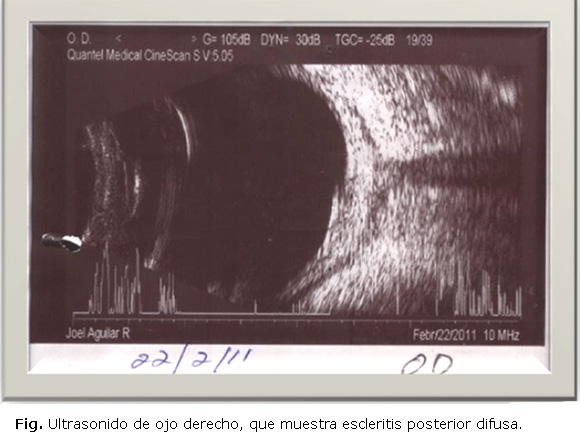
<body><![CDATA[<br>         <br>     <i>- Ant&iacute;geno de superficie: </i>negativo.     <br>     <i>    <br>     - IFI/ELISA para toxoplasma:</i> pendiente de resultado.    <br>         <br>     <i>- TAC de &oacute;rbita ojo derecho, cortes axiales y coronales:</i> informa      lesi&oacute;n polipoidea en seno maxilar de base de 17 mm; no otras alteraciones.      <i>    <br>         <br>     - Ultrasonido ojo derecho:</i> se observa engrosamiento del complejo retina      coroides, aumento de la reflectividad del espacio de la tenon por infiltraci&oacute;n,      y tambi&eacute;n el signo caracter&iacute;stico en &quot;T&quot;. V&iacute;treo      libre de ecos. Cristalino <I>in situ</I>. Se informa como una escleritis posterior      difusa (<FONT color="#528ED3"><a href="#f1">Fig</a>.<FONT color="#000000">).          <br>         <br>     </font><font size="+1" color="#000000"><font size="+1"><font size="+1"><font size="+1"><font size="+1"><font size="+1"><font size="+1"><font size="+1"><font size="+1"><font size="+1"><font size="+1"><font size="+1"><font size="+1"><font size="+1"><font size="+1"><font size="+1"><font size="+1"><font size="+1"><font size="+1"><font size="+1"><font size="+1"><font size="+1"><font size="+1"><font size="+1" color="#000000"><font color="#528ED3" face="Verdana, Arial, Helvetica, sans-serif" size="2"><font color="#000000"><i>-      Ultrasonido abdominal:</i> Normal. </font></font></font></font></font></font></font></font></font></font></font></font></font></font></font></font></font></font></font></font></font></font></font></font></font></font><FONT color="#000000">      </font></font></font></p>       ]]></body>
<body><![CDATA[<p>&nbsp;</p>       <p>&nbsp;</p> </DIV > </font></font></font></font></font></font></font></font></font></font></font></font></font></font></font></font></font></font></font></font></font></font></font></font>      <blockquote><FONT size="+1" color="#000000"><FONT size="+1"><FONT size="+1"><FONT size="+1"><FONT size="+1"><FONT size="+1"><FONT size="+1"><FONT size="+1"><FONT size="+1"><FONT size="+1"><FONT size="+1"><FONT size="+1"><FONT size="+1"><FONT size="+1"><FONT size="+1"><FONT size="+1"><FONT size="+1"><FONT size="+1"><FONT size="+1"><FONT size="+1"><FONT size="+1"><FONT size="+1"><FONT size="+1"><FONT size="+1" color="#000000">       <DIV class="Part"   >         <div align="center"><img src="/img/revistas/oft/v27n3/f0116314.jpg" width="580" height="442"><a name="f1"></a></div>   </DIV >   </font></font></font></font></font></font></font></font></font></font></font></font></font></font></font></font></font></font></font></font></font></font></font></font></blockquote> <FONT size="+1" color="#000000"><FONT size="+1"><FONT size="+1"><FONT size="+1"><FONT size="+1"><FONT size="+1"><FONT size="+1"><FONT size="+1"><FONT size="+1"><FONT size="+1"><FONT size="+1"><FONT size="+1"><FONT size="+1"><FONT size="+1"><FONT size="+1"><FONT size="+1"><FONT size="+1"><FONT size="+1"><FONT size="+1"><FONT size="+1"><FONT size="+1"><FONT size="+1"><FONT size="+1"><FONT size="+1" color="#000000">     <DIV class="Part"   >       <p>&nbsp;</p>       <p><font color="#528ED3" face="Verdana, Arial, Helvetica, sans-serif" size="2"><FONT color="#000000">Se      interconsulta con los servicios de Medicina Interna, Reumatolog&iacute;a y      Otorrinolaringolog&iacute;a, y no se encuentran elementos positivos de enfermedad      sist&eacute;mica asociada. Se decidi&oacute; entonces, previo control medicamentoso      de la tensi&oacute;n arterial, imponer tratamiento con esteroides sist&eacute;micos      y t&oacute;picos, asociados a hipotensores oculares, y se observ&oacute; entonces      una respuesta favorable al tratamiento impuesto. Durante el seguimiento hubo      una evoluci&oacute;n satisfactoria con una disminuci&oacute;n lenta y progresiva      de los esteroides, hasta llegar a los 30 mg de prednisona oral, en que present&oacute;      una reca&iacute;da del cuadro, que coincidi&oacute; con la llegada del resultado      del IFI para toxoplasma,el cual arroj&oacute; t&iacute;tulos de 1:256. Se      decidi&oacute; entonces asociar el tratamiento antitoxopl&aacute;smico (sulfaprim      y azitromicina), y elevar nuevamente la dosis de esteroides orales a la dosis      previa efectiva. Hasta el momento la evoluci&oacute;n ha sido muy favorable,      y no se han presentado nuevas reca&iacute;das. </font></font></p>       <p>&nbsp;</p> </DIV > <FONT color="#528ED3"><FONT color="#000000">      <DIV class="Part"   >        ]]></body>
<body><![CDATA[<p><font face="Verdana, Arial, Helvetica, sans-serif" size="2"><B><font size="3">DISCUSI&Oacute;N</font></b></font></p>       <p><font face="Verdana, Arial, Helvetica, sans-serif" size="2">La escleritis      posterior se define como la inflamaci&oacute;n de la esclera posterior a la      <i>ora serrata</i>, la cual puede comprometer estructuras oculares contiguas,      incluyendo la coroides, la retina, el nervio &oacute;ptico, los m&uacute;sculos      extraoculares y los tejidos orbitarios.<Sup>5 </Sup>Diversos estudios previos      sobre series de pacientes con escleritis afirman que de 40-50 % de estos pacientes      presentar&aacute;n una enfermedad sist&eacute;mica infecciosa o reumatol&oacute;gica      asociada (aproximadamente el 5-10 % tendr&aacute;n una enfermedad infecciosa      y el 30-40 % ser&aacute; reum&aacute;tica). <I>Vitale</I> y <I>Sainz de la      Maza</I> describen que infecciones por protozoos, como la <I>Acanthamoeba</I>,      el <I>Microsporidium</I> y el <I>Toxoplasma gondii</I>, tambi&eacute;n han      sido identificados como agentes causales en pacientes con severa escleroqueratitis,      esclerouve&iacute;tis con desprendimiento de retina y escleritis posterior      respectivamente.<Sup>5 </Sup>A menudo el diagn&oacute;stico de una enfermedad      sist&eacute;mica asociada a escleritis, dicta su tratamiento. As&iacute; pues,      una escleritis infecciosa requerir&iacute;a terapia con agentes antibi&oacute;ticos      o antivirales; sin embargo, una escleritis asociada a una vasculitis sist&eacute;mica      se tratar&iacute;a con f&aacute;rmacos inmunosupresores para intentar solucionarla.      Por tanto, el diagn&oacute;stico de patolog&iacute;a sist&eacute;mica asociada      se convierte en un aspecto crucial en el manejo de un paciente con escleritis.      Aunque algunas series documentan la presencia de una enfermedad sist&eacute;mica,      ninguna eval&uacute;a la aparici&oacute;n de las patolog&iacute;as sist&eacute;mica      y ocular ni documentan los resultados de la evaluaci&oacute;n diagn&oacute;stica      inicial de estos pacientes.<Sup>6-12 </Sup>En un estudio reciente se estudiaron      243 pacientes con escleritis. Se present&oacute; un amplio rango etario (5      a 93 a&ntilde;os, con una media de 52 a&ntilde;os). Se afirm&oacute; que la      enfermedad infecciosa m&aacute;s com&uacute;nmente asociada fue el herpes      zoster oft&aacute;lmico y la afectaci&oacute;n reum&aacute;tica m&aacute;s      frecuente fue la artritis reumatoide. La vasculitis sist&eacute;mica fue la      segunda causa sist&eacute;mica asociada a escleritis y se diagnosticaron todos      los tipos de vasculitis en los pacientes evaluados. La media de seguimiento      fue 1,7 a&ntilde;os con un rango de 0 a 16,6 a&ntilde;os.<Sup>13 </Sup>Asimismo      se apreciaron diversos aspectos cl&iacute;nicos que confer&iacute;an mayor      riesgo de padecer una enfermedad sist&eacute;mica asociada a la patolog&iacute;a      ocular, de modo que los varones eran m&aacute;s susceptibles que las mujeres      de padecer una enfermedad infecciosa (OR= 0,34; <I>p</I>= 0,035), mientras      que las mujeres presentaban mayor predisposici&oacute;n a enfermedades reum&aacute;ticas      (OR= 1,98, <I>p</I>= 0,027). El &uacute;nico tipo de escleritis claramente      asociada a patolog&iacute;a sist&eacute;mica fue la escleritis nodular anterior      (OR= 3,08; <I>p</I>= 0,037). La queratitis intersticial se objetiv&oacute;      principalmente en pacientes con una enfermedad infecciosa (OR= 4,80; <I>p</I>=      0,004), as&iacute; como la uve&iacute;tis (OR= 3,75; <I>p</I>= 0,010). La      escleritis bilateral se asoci&oacute; fundamentalmente con enfermedades reumatol&oacute;gicas      (OR= 1,78; <I>p</I>= 0,032).<Sup>13 </Sup>En algunos casos en que exista positividad      de pruebas diagn&oacute;sticas para una determinada entidad, pensamos que      es adecuado instaurar tratamientos emp&iacute;ricos, a pesar de que no exista      evidencia cl&iacute;nica o un diagn&oacute;stico de certeza, ya que es fundamental      un control adecuado del cuadro escleral por el riesgo ocular que conllevan      y las graves complicaciones de algunos subtipos.<Sup>14 </Sup></font></p>       <p>&nbsp;</p> </DIV > <FONT size="+1"><FONT size="+1"><FONT size="+1"><FONT size="+1"><FONT size="+1"><FONT size="+1"><FONT size="+1"><FONT size="+1"><FONT size="+1"><FONT size="+1"><FONT size="+1">      <DIV class="Part"   >        <p><font size="2" face="Verdana, Arial, Helvetica, sans-serif"><B><font size="3">REFERENCIAS      BIBLIOGR&Aacute;FICAS </font></b></font></p> </DIV > </font></font></font></font></font></font></font></font></font></font></font></font></font></font></font></font></font></font></font></font></font></font></font></font></font></font></font></font></font></font></font></font></font></font></font></font></font><FONT size="+1" color="#000000"><FONT size="+1"><FONT size="+1"><FONT size="+1"><FONT size="+1"><FONT size="+1"><FONT size="+1"><FONT size="+1"><FONT size="+1"><FONT size="+1"><FONT size="+1"><FONT size="+1"><FONT size="+1"><FONT size="+1"><FONT size="+1"><FONT size="+1"><FONT size="+1"><FONT size="+1"><FONT size="+1"><FONT size="+1"><FONT size="+1"><FONT size="+1"><FONT size="+1"><FONT size="+1" color="#000000"><FONT color="#528ED3"><FONT color="#000000"><FONT size="+1"><FONT size="+1"><FONT size="+1"><FONT size="+1"><FONT size="+1"><FONT size="+1"><FONT size="+1"><FONT size="+1"><FONT size="+1"><FONT size="+1"><FONT size="+1">      <DIV class="Part"   >       <!-- ref --><p><FONT size="+1"><font face="Verdana, Arial, Helvetica, sans-serif" size="2">1.      Benson WE. Posterior scleritis. Survey Ophthalmol. 1988;32(5):297-316.    </font></font></p>       <!-- ref --><p><font face="Verdana, Arial, Helvetica, sans-serif" size="2">2.<font size="+1">      </font></font><FONT size="+1"><font face="Verdana, Arial, Helvetica, sans-serif" size="2">Whitcup      SM. Scleritis. In: Nussenblatt RB, Whitcup SM, editors. Uveitis fundamental      and clinical practice. Elsevier: Mosby; 2004. p. 287-90.     </font></font></p> </DIV > </font></font></font></font></font></font></font></font></font></font></font></font></font></font></font></font></font></font></font></font></font></font></font></font></font></font></font></font></font></font></font></font></font></font></font></font></font><FONT size="+1" color="#000000"><FONT size="+1"><FONT size="+1"><FONT size="+1"><FONT size="+1"><FONT size="+1"><FONT size="+1"><FONT size="+1"><FONT size="+1"><FONT size="+1"><FONT size="+1"><FONT size="+1"><FONT size="+1"><FONT size="+1"><FONT size="+1"><FONT size="+1"><FONT size="+1"><FONT size="+1"><FONT size="+1"><FONT size="+1"><FONT size="+1"><FONT size="+1"><FONT size="+1"><FONT size="+1" color="#000000"><FONT color="#528ED3"><FONT color="#000000"><FONT size="+1"><FONT size="+1"><FONT size="+1"><FONT size="+1"><FONT size="+1"><FONT size="+1"><FONT size="+1"><FONT size="+1"><FONT size="+1"><FONT size="+1"><FONT size="+1"></font></font></font></font></font></font></font></font></font></font></font></font></font></font></font></font></font></font></font></font></font></font></font></font></font></font></font></font></font></font></font></font></font></font></font></font></font><FONT size="+1" color="#000000"><FONT size="+1"><FONT size="+1"><FONT size="+1"><FONT size="+1"><FONT size="+1"><FONT size="+1"><FONT size="+1"><FONT size="+1"><FONT size="+1"><FONT size="+1"><FONT size="+1"><FONT size="+1"><FONT size="+1"><FONT size="+1"><FONT size="+1"><FONT size="+1"><FONT size="+1"><FONT size="+1"><FONT size="+1"><FONT size="+1"><FONT size="+1"><FONT size="+1"><FONT size="+1" color="#000000"><FONT color="#528ED3"><FONT color="#000000"><FONT size="+1"><FONT size="+1"><FONT size="+1"><FONT size="+1"><FONT size="+1"><FONT size="+1"><FONT size="+1"><FONT size="+1"><FONT size="+1"><FONT size="+1"><FONT size="+1">      ]]></body>
<body><![CDATA[<DIV class="Part"   >       <!-- ref --><p><FONT size="+1"><font face="Verdana, Arial, Helvetica, sans-serif" size="2">3.      Meyer PA, Watson PG, Franks W, Dubard P. Pulse inmunosupresive therapy in      the treatment of inmunologically induced corneal and scleral disease. Eye.      1987;1:487-95.     </font></font></p>       <!-- ref --><p><font face="Verdana, Arial, Helvetica, sans-serif" size="2">4. </font><FONT size="+1"><font face="Verdana, Arial, Helvetica, sans-serif" size="2">Watson      PG. The nature and treatment of scleral inflammation. Trans Ophthalmol Soc      UK. 1982;99:257.     </font></font></p> </DIV > </font></font></font></font></font></font></font></font></font></font></font></font></font></font></font></font></font></font></font></font></font></font></font></font></font></font></font></font></font></font></font></font></font></font></font></font></font><FONT size="+1" color="#000000"><FONT size="+1"><FONT size="+1"><FONT size="+1"><FONT size="+1"><FONT size="+1"><FONT size="+1"><FONT size="+1"><FONT size="+1"><FONT size="+1"><FONT size="+1"><FONT size="+1"><FONT size="+1"><FONT size="+1"><FONT size="+1"><FONT size="+1"><FONT size="+1"><FONT size="+1"><FONT size="+1"><FONT size="+1"><FONT size="+1"><FONT size="+1"><FONT size="+1"><FONT size="+1" color="#000000"><FONT color="#528ED3"><FONT color="#000000"><FONT size="+1"><FONT size="+1"><FONT size="+1"><FONT size="+1"><FONT size="+1"><FONT size="+1"><FONT size="+1"><FONT size="+1"><FONT size="+1"><FONT size="+1"><FONT size="+1"></font></font></font></font></font></font></font></font></font></font></font></font></font></font></font></font></font></font></font></font></font></font></font></font></font></font></font></font></font></font></font></font></font></font></font></font></font><FONT size="+1" color="#000000"><FONT size="+1"><FONT size="+1"><FONT size="+1"><FONT size="+1"><FONT size="+1"><FONT size="+1"><FONT size="+1"><FONT size="+1"><FONT size="+1"><FONT size="+1"><FONT size="+1"><FONT size="+1"><FONT size="+1"><FONT size="+1"><FONT size="+1"><FONT size="+1"><FONT size="+1"><FONT size="+1"><FONT size="+1"><FONT size="+1"><FONT size="+1"><FONT size="+1"><FONT size="+1" color="#000000"><FONT color="#528ED3"><FONT color="#000000"><FONT size="+1"><FONT size="+1"><FONT size="+1"><FONT size="+1"><FONT size="+1"><FONT size="+1"><FONT size="+1"><FONT size="+1"><FONT size="+1"><FONT size="+1"><FONT size="+1">      <!-- ref --><DIV class="Part"   ><FONT size="+1"><font face="Verdana, Arial, Helvetica, sans-serif" size="2">5.    Vitale AT, Sainz de la Maza. Scleral Inflammatory Disease. In: Ryan SJ, editor.    Retina. Elseiver: Mosby; 2006. p. 1731-46.     </font></font></DIV > </font></font></font></font></font></font></font></font></font></font></font></font></font></font></font></font></font></font></font></font></font></font></font></font></font></font></font></font></font></font></font></font></font></font></font></font></font><FONT size="+1" color="#000000"><FONT size="+1"><FONT size="+1"><FONT size="+1"><FONT size="+1"><FONT size="+1"><FONT size="+1"><FONT size="+1"><FONT size="+1"><FONT size="+1"><FONT size="+1"><FONT size="+1"><FONT size="+1"><FONT size="+1"><FONT size="+1"><FONT size="+1"><FONT size="+1"><FONT size="+1"><FONT size="+1"><FONT size="+1"><FONT size="+1"><FONT size="+1"><FONT size="+1"><FONT size="+1" color="#000000"><FONT color="#528ED3"><FONT color="#000000"><FONT size="+1"><FONT size="+1"><FONT size="+1"><FONT size="+1"><FONT size="+1"><FONT size="+1"><FONT size="+1"><FONT size="+1"><FONT size="+1"><FONT size="+1"><FONT size="+1">     <DIV class="Part"   ><FONT size="+1"><font face="Verdana, Arial, Helvetica, sans-serif" size="2">    <!-- ref --><br>   6. Jabs DA. Episcleritis and scleritis: clinical features and treatment results.    Am J Ophthalmol. 2000;10:469-76.     </font></font></DIV > </font></font></font></font></font></font></font></font></font></font></font></font></font></font></font></font></font></font></font></font></font></font></font></font></font></font></font></font></font></font></font></font></font></font></font></font></font><FONT size="+1" color="#000000"><FONT size="+1"><FONT size="+1"><FONT size="+1"><FONT size="+1"><FONT size="+1"><FONT size="+1"><FONT size="+1"><FONT size="+1"><FONT size="+1"><FONT size="+1"><FONT size="+1"><FONT size="+1"><FONT size="+1"><FONT size="+1"><FONT size="+1"><FONT size="+1"><FONT size="+1"><FONT size="+1"><FONT size="+1"><FONT size="+1"><FONT size="+1"><FONT size="+1"><FONT size="+1" color="#000000"><FONT color="#528ED3"><FONT color="#000000"><FONT size="+1"><FONT size="+1"><FONT size="+1"><FONT size="+1"><FONT size="+1"><FONT size="+1"><FONT size="+1"><FONT size="+1"><FONT size="+1"><FONT size="+1"><FONT size="+1">     ]]></body>
<body><![CDATA[<DIV class="Part"   ><FONT size="+1"><font face="Verdana, Arial, Helvetica, sans-serif" size="2">    <!-- ref --><br>   7. Watson PG, Hayreh SS. Scleritis and episcleritis. Br J Ophthalmol. 1976;60:163-91.    <br>       <br>   </font></font></DIV > </font></font></font></font></font></font></font></font></font></font></font></font></font></font></font></font></font></font></font></font></font></font></font></font></font></font></font></font></font></font></font></font></font></font></font></font></font>  <FONT size="+1" color="#000000"><FONT size="+1"><FONT size="+1"><FONT size="+1"><FONT size="+1"><FONT size="+1"><FONT size="+1"><FONT size="+1"><FONT size="+1"><FONT size="+1"><FONT size="+1"><FONT size="+1"><FONT size="+1"><FONT size="+1"><FONT size="+1"><FONT size="+1"><FONT size="+1"><FONT size="+1"><FONT size="+1"><FONT size="+1"><FONT size="+1"><FONT size="+1"><FONT size="+1"><FONT size="+1" color="#000000"><FONT color="#528ED3"><FONT color="#000000"><FONT size="+1"><FONT size="+1"><FONT size="+1"><FONT size="+1"><FONT size="+1"><FONT size="+1"><FONT size="+1"><FONT size="+1"><FONT size="+1"><FONT size="+1"><FONT size="+1">     <!-- ref --><DIV class="Part"   ><FONT size="+1"><font face="Verdana, Arial, Helvetica, sans-serif" size="2">8.    Mc Gavin DD, Williamson J. Episcleritis and scleritis: a study of their clinical    manifestation and association with reumathoid arthritis. Br J Ophthalmol. </font></font><FONT size="+1"><font face="Verdana, Arial, Helvetica, sans-serif" size="2">1976;60:192-226.    <br>       <!-- ref --><br>   9. </font></font><FONT size="+1"><font face="Verdana, Arial, Helvetica, sans-serif" size="2">Sainz    de la Maza M. Severity of scleritis and episcleritis. Ophthalmology. 1994;101:389-96.    <br>       <br>   </font></font></DIV > </font></font></font></font></font></font></font></font></font></font></font></font></font></font></font></font></font></font></font></font></font></font></font></font></font></font></font></font></font></font></font></font></font></font></font></font></font><FONT size="+1" color="#000000"><FONT size="+1"><FONT size="+1"><FONT size="+1"><FONT size="+1"><FONT size="+1"><FONT size="+1"><FONT size="+1"><FONT size="+1"><FONT size="+1"><FONT size="+1"><FONT size="+1"><FONT size="+1"><FONT size="+1"><FONT size="+1"><FONT size="+1"><FONT size="+1"><FONT size="+1"><FONT size="+1"><FONT size="+1"><FONT size="+1"><FONT size="+1"><FONT size="+1"><FONT size="+1" color="#000000"><FONT color="#528ED3"><FONT color="#000000"><FONT size="+1"><FONT size="+1"><FONT size="+1"><FONT size="+1"><FONT size="+1"><FONT size="+1"><FONT size="+1"><FONT size="+1"><FONT size="+1"><FONT size="+1"><FONT size="+1"></font></font></font></font></font></font></font></font></font></font></font></font></font></font></font></font></font></font></font></font></font></font></font></font></font></font></font></font></font></font></font></font></font></font></font></font></font><FONT size="+1" color="#000000"><FONT size="+1"><FONT size="+1"><FONT size="+1"><FONT size="+1"><FONT size="+1"><FONT size="+1"><FONT size="+1"><FONT size="+1"><FONT size="+1"><FONT size="+1"><FONT size="+1"><FONT size="+1"><FONT size="+1"><FONT size="+1"><FONT size="+1"><FONT size="+1"><FONT size="+1"><FONT size="+1"><FONT size="+1"><FONT size="+1"><FONT size="+1"><FONT size="+1"><FONT size="+1" color="#000000"><FONT color="#528ED3"><FONT color="#000000"><FONT size="+1"><FONT size="+1"><FONT size="+1"><FONT size="+1"><FONT size="+1"><FONT size="+1"><FONT size="+1"><FONT size="+1"><FONT size="+1"><FONT size="+1"><FONT size="+1">      <DIV class="Part"   >       ]]></body>
<body><![CDATA[<!-- ref --><p><FONT size="+1"><font face="Verdana, Arial, Helvetica, sans-serif" size="2">10.Tuft      SJ, Watson PG. Progression of scleral disease. Ophthalmology. 1991; 98:467-71.    <br>         <!-- ref --><br>     11. Mc Clusky PJ. Posterior scleritis: clinical features, systemis associations      and outcome in a large series of patients. Ophthalmology. 1999;166:2380-6.    <br>         <!-- ref --><br>     12. Sainz de la Maza M, Foster CS. Scleritis associated with systemic vasculitis      diseases. Ophthalmology. 1995;102:687-92.    <br>         <!-- ref --><br>     13. Karamursel E, Thorne J. Evaluation of patients with scleritis for systemic      disease. Ophthalmology. 2004;111:501-5.    <br>         <!-- ref --><br>     14. Fern&aacute;ndez-Baca G, Losada Castillo MJ, P&eacute;rez Barreto L, Martin      Barrera F. Escleritis asociadas a enfermedades sist&eacute;micas. Arch Soc      Canar Oftal. 2005 [citado 16 de mayo de 2014]. Disponible en: <FONT color="#528ED3"><a href="http://www.oftalmo.com/sco/revista-16/16sco17.htm" target="_blank">http://www.oftalmo.com/sco/revista-16/16sco17.htm</a></font></font></font><p>&nbsp;</p>       ]]></body>
<body><![CDATA[<p>&nbsp;</p>       <p><FONT size="+1"><font color="#528ED3" face="Verdana, Arial, Helvetica, sans-serif" size="2"><FONT color="#000000">Recibido:      5 de febrero de 2014.    <br>     Aprobado: 19 de junio de 2014.</font></font></font></p>       <p>&nbsp;</p>       <p>&nbsp;</p>       <p><FONT size="+1"><font color="#528ED3" face="Verdana, Arial, Helvetica, sans-serif" size="2"><FONT color="#000000">Dra.      <I>Isabel Ambou Frutos</I>. Instituto Cubano de Oftalmolog&iacute;a &quot;Ram&oacute;n      Pando Ferrer&quot;. Ave. 76 No. 3104 entre 31 y 41 Marianao, La Habana, Cuba.      Correo Electr&oacute;nico: <a href="mailto:Isabel.ambou@infomed.sld.cu">Isabel.ambou@infomed.sld.cu</a>      </font></font></font></p> </DIV > </font></font></font></font></font></font></font></font></font></font></font></font></font></font></font></font></font></font></font></font></font></font></font></font></font></font></font></font></font></font></font></font></font></font></font></font></font>       ]]></body><back>
<ref-list>
<ref id="B1">
<label>1</label><nlm-citation citation-type="journal">
<person-group person-group-type="author">
<name>
<surname><![CDATA[Benson]]></surname>
<given-names><![CDATA[WE]]></given-names>
</name>
</person-group>
<article-title xml:lang="en"><![CDATA[Posterior scleritis]]></article-title>
<source><![CDATA[Survey Ophthalmol]]></source>
<year>1988</year>
<volume>32</volume>
<numero>5</numero>
<issue>5</issue>
<page-range>297-316</page-range></nlm-citation>
</ref>
<ref id="B2">
<label>2</label><nlm-citation citation-type="book">
<person-group person-group-type="author">
<name>
<surname><![CDATA[Whitcup]]></surname>
<given-names><![CDATA[SM]]></given-names>
</name>
</person-group>
<article-title xml:lang="en"><![CDATA[Scleritis]]></article-title>
<person-group person-group-type="editor">
<name>
<surname><![CDATA[Nussenblatt]]></surname>
<given-names><![CDATA[RB]]></given-names>
</name>
<name>
<surname><![CDATA[Whitcup]]></surname>
<given-names><![CDATA[SM]]></given-names>
</name>
</person-group>
<source><![CDATA[Uveitis fundamental and clinical practice]]></source>
<year>2004</year>
<page-range>287-90</page-range><publisher-name><![CDATA[Elsevier: Mosby]]></publisher-name>
</nlm-citation>
</ref>
<ref id="B3">
<label>3</label><nlm-citation citation-type="journal">
<person-group person-group-type="author">
<name>
<surname><![CDATA[Meyer]]></surname>
<given-names><![CDATA[PA]]></given-names>
</name>
<name>
<surname><![CDATA[Watson]]></surname>
<given-names><![CDATA[PG]]></given-names>
</name>
<name>
<surname><![CDATA[Franks]]></surname>
<given-names><![CDATA[W]]></given-names>
</name>
<name>
<surname><![CDATA[Dubard]]></surname>
<given-names><![CDATA[P]]></given-names>
</name>
</person-group>
<article-title xml:lang="en"><![CDATA[Pulse inmunosupresive therapy in the treatment of inmunologically induced corneal and scleral disease]]></article-title>
<source><![CDATA[Eye]]></source>
<year>1987</year>
<volume>1</volume>
<page-range>487-95</page-range></nlm-citation>
</ref>
<ref id="B4">
<label>4</label><nlm-citation citation-type="journal">
<person-group person-group-type="author">
<name>
<surname><![CDATA[Watson]]></surname>
<given-names><![CDATA[PG]]></given-names>
</name>
</person-group>
<article-title xml:lang="en"><![CDATA[The nature and treatment of scleral inflammation]]></article-title>
<source><![CDATA[Trans Ophthalmol Soc UK]]></source>
<year>1982</year>
<volume>99</volume>
<page-range>257</page-range></nlm-citation>
</ref>
<ref id="B5">
<label>5</label><nlm-citation citation-type="book">
<person-group person-group-type="author">
<name>
<surname><![CDATA[Vitale]]></surname>
<given-names><![CDATA[AT]]></given-names>
</name>
<name>
<surname><![CDATA[Sainz de la Maza]]></surname>
</name>
</person-group>
<article-title xml:lang="en"><![CDATA[Scleral Inflammatory Disease]]></article-title>
<person-group person-group-type="editor">
<name>
<surname><![CDATA[Ryan]]></surname>
<given-names><![CDATA[SJ]]></given-names>
</name>
</person-group>
<source><![CDATA[Retina]]></source>
<year>2006</year>
<page-range>1731-46</page-range><publisher-name><![CDATA[Elseiver: Mosby]]></publisher-name>
</nlm-citation>
</ref>
<ref id="B6">
<label>6</label><nlm-citation citation-type="journal">
<person-group person-group-type="author">
<name>
<surname><![CDATA[Jabs]]></surname>
<given-names><![CDATA[DA]]></given-names>
</name>
</person-group>
<article-title xml:lang="en"><![CDATA[Episcleritis and scleritis: clinical features and treatment results]]></article-title>
<source><![CDATA[Am J Ophthalmol]]></source>
<year>2000</year>
<volume>10</volume>
<page-range>469-76</page-range></nlm-citation>
</ref>
<ref id="B7">
<label>7</label><nlm-citation citation-type="journal">
<person-group person-group-type="author">
<name>
<surname><![CDATA[Watson]]></surname>
<given-names><![CDATA[PG]]></given-names>
</name>
<name>
<surname><![CDATA[Hayreh]]></surname>
<given-names><![CDATA[SS]]></given-names>
</name>
</person-group>
<article-title xml:lang="en"><![CDATA[Scleritis and episcleritis]]></article-title>
<source><![CDATA[Br J Ophthalmol]]></source>
<year>1976</year>
<volume>60</volume>
<page-range>163-91</page-range></nlm-citation>
</ref>
<ref id="B8">
<label>8</label><nlm-citation citation-type="journal">
<person-group person-group-type="author">
<name>
<surname><![CDATA[Mc Gavin]]></surname>
<given-names><![CDATA[DD]]></given-names>
</name>
<name>
<surname><![CDATA[Williamson]]></surname>
<given-names><![CDATA[J]]></given-names>
</name>
</person-group>
<article-title xml:lang="en"><![CDATA[Episcleritis and scleritis: a study of their clinical manifestation and association with reumathoid arthritis]]></article-title>
<source><![CDATA[Br J Ophthalmol]]></source>
<year>1976</year>
<volume>60</volume>
<page-range>192-226</page-range></nlm-citation>
</ref>
<ref id="B9">
<label>9</label><nlm-citation citation-type="journal">
<person-group person-group-type="author">
<name>
<surname><![CDATA[Sainz de la Maza]]></surname>
<given-names><![CDATA[M]]></given-names>
</name>
</person-group>
<article-title xml:lang="en"><![CDATA[Severity of scleritis and episcleritis]]></article-title>
<source><![CDATA[Ophthalmology]]></source>
<year>1994</year>
<volume>101</volume>
<page-range>389-96</page-range></nlm-citation>
</ref>
<ref id="B10">
<label>10</label><nlm-citation citation-type="journal">
<person-group person-group-type="author">
<name>
<surname><![CDATA[Tuft]]></surname>
<given-names><![CDATA[SJ]]></given-names>
</name>
<name>
<surname><![CDATA[Watson]]></surname>
<given-names><![CDATA[PG]]></given-names>
</name>
</person-group>
<article-title xml:lang="en"><![CDATA[Progression of scleral disease]]></article-title>
<source><![CDATA[Ophthalmology]]></source>
<year>1991</year>
<volume>98</volume>
<page-range>467-71</page-range></nlm-citation>
</ref>
<ref id="B11">
<label>11</label><nlm-citation citation-type="journal">
<person-group person-group-type="author">
<name>
<surname><![CDATA[Mc Clusky]]></surname>
<given-names><![CDATA[PJ]]></given-names>
</name>
</person-group>
<article-title xml:lang="en"><![CDATA[Posterior scleritis: clinical features, systemis associations and outcome in a large series of patients]]></article-title>
<source><![CDATA[Ophthalmology]]></source>
<year>1999</year>
<volume>166</volume>
<page-range>2380-6</page-range></nlm-citation>
</ref>
<ref id="B12">
<label>12</label><nlm-citation citation-type="journal">
<person-group person-group-type="author">
<name>
<surname><![CDATA[Sainz de la Maza]]></surname>
<given-names><![CDATA[M]]></given-names>
</name>
<name>
<surname><![CDATA[Foster]]></surname>
<given-names><![CDATA[CS]]></given-names>
</name>
</person-group>
<article-title xml:lang="en"><![CDATA[Scleritis associated with systemic vasculitis diseases]]></article-title>
<source><![CDATA[Ophthalmology]]></source>
<year>1995</year>
<volume>102</volume>
<page-range>687-92</page-range></nlm-citation>
</ref>
<ref id="B13">
<label>13</label><nlm-citation citation-type="journal">
<person-group person-group-type="author">
<name>
<surname><![CDATA[Karamursel]]></surname>
<given-names><![CDATA[E]]></given-names>
</name>
<name>
<surname><![CDATA[Thorne]]></surname>
<given-names><![CDATA[J]]></given-names>
</name>
</person-group>
<article-title xml:lang="en"><![CDATA[Evaluation of patients with scleritis for systemic disease]]></article-title>
<source><![CDATA[Ophthalmology]]></source>
<year>2004</year>
<volume>111</volume>
<page-range>501-5</page-range></nlm-citation>
</ref>
<ref id="B14">
<label>14</label><nlm-citation citation-type="journal">
<person-group person-group-type="author">
<name>
<surname><![CDATA[Fernández-Baca]]></surname>
<given-names><![CDATA[G]]></given-names>
</name>
<name>
<surname><![CDATA[Losada Castillo]]></surname>
<given-names><![CDATA[MJ]]></given-names>
</name>
<name>
<surname><![CDATA[Pérez Barreto]]></surname>
<given-names><![CDATA[L]]></given-names>
</name>
<name>
<surname><![CDATA[Martin Barrera]]></surname>
<given-names><![CDATA[F]]></given-names>
</name>
</person-group>
<article-title xml:lang="es"><![CDATA[Escleritis asociadas a enfermedades sistémicas]]></article-title>
<source><![CDATA[Arch Soc Canar Oftal]]></source>
<year>2005</year>
</nlm-citation>
</ref>
</ref-list>
</back>
</article>