<?xml version="1.0" encoding="ISO-8859-1"?><article xmlns:mml="http://www.w3.org/1998/Math/MathML" xmlns:xlink="http://www.w3.org/1999/xlink" xmlns:xsi="http://www.w3.org/2001/XMLSchema-instance">
<front>
<journal-meta>
<journal-id>0864-2176</journal-id>
<journal-title><![CDATA[Revista Cubana de Oftalmología]]></journal-title>
<abbrev-journal-title><![CDATA[Rev Cubana Oftalmol]]></abbrev-journal-title>
<issn>0864-2176</issn>
<publisher>
<publisher-name><![CDATA[Editorial Ciencias Médicas]]></publisher-name>
</publisher>
</journal-meta>
<article-meta>
<article-id>S0864-21762015000200010</article-id>
<title-group>
<article-title xml:lang="es"><![CDATA[Síndrome de Chandler]]></article-title>
<article-title xml:lang="en"><![CDATA[Chandler's syndrome]]></article-title>
</title-group>
<contrib-group>
<contrib contrib-type="author">
<name>
<surname><![CDATA[Escalona Ballester]]></surname>
<given-names><![CDATA[Yurisván]]></given-names>
</name>
<xref ref-type="aff" rid="A01"/>
</contrib>
<contrib contrib-type="author">
<name>
<surname><![CDATA[Ortiz Ávila]]></surname>
<given-names><![CDATA[Yaquelín]]></given-names>
</name>
<xref ref-type="aff" rid="A02"/>
</contrib>
<contrib contrib-type="author">
<name>
<surname><![CDATA[Meneses Leyva]]></surname>
<given-names><![CDATA[Esmel A]]></given-names>
</name>
<xref ref-type="aff" rid="A01"/>
</contrib>
<contrib contrib-type="author">
<name>
<surname><![CDATA[Mendoza Rodríguez]]></surname>
<given-names><![CDATA[Yadira]]></given-names>
</name>
<xref ref-type="aff" rid="A02"/>
</contrib>
<contrib contrib-type="author">
<name>
<surname><![CDATA[Fernández Morales]]></surname>
<given-names><![CDATA[Nelson A]]></given-names>
</name>
<xref ref-type="aff" rid="A02"/>
</contrib>
</contrib-group>
<aff id="A01">
<institution><![CDATA[,Policlínico 27 de Noviembre  ]]></institution>
<addr-line><![CDATA[Holguín Antilla]]></addr-line>
<country>Cuba</country>
</aff>
<aff id="A02">
<institution><![CDATA[,Hospital Clínico Quirúrgico Lucia Íñiguez Landín  ]]></institution>
<addr-line><![CDATA[Holguín ]]></addr-line>
<country>Cuba</country>
</aff>
<pub-date pub-type="pub">
<day>00</day>
<month>06</month>
<year>2015</year>
</pub-date>
<pub-date pub-type="epub">
<day>00</day>
<month>06</month>
<year>2015</year>
</pub-date>
<volume>28</volume>
<numero>2</numero>
<fpage>234</fpage>
<lpage>239</lpage>
<copyright-statement/>
<copyright-year/>
<self-uri xlink:href="http://scielo.sld.cu/scielo.php?script=sci_arttext&amp;pid=S0864-21762015000200010&amp;lng=en&amp;nrm=iso"></self-uri><self-uri xlink:href="http://scielo.sld.cu/scielo.php?script=sci_abstract&amp;pid=S0864-21762015000200010&amp;lng=en&amp;nrm=iso"></self-uri><self-uri xlink:href="http://scielo.sld.cu/scielo.php?script=sci_pdf&amp;pid=S0864-21762015000200010&amp;lng=en&amp;nrm=iso"></self-uri><abstract abstract-type="short" xml:lang="es"><p><![CDATA[El síndrome de Chandler es una de las variaciones clínicas del síndrome iridocorneoendotelial, donde el denominador común es una alteración del endotelio corneal cuyo diagnóstico es, en ocasiones, muy difícil de realizar por la complejidad y la variabilidad de sus signos y síntomas. Se presenta una paciente de 67 años con disminución importante de la visión del ojo izquierdo. A la exploración existía un edema corneal severo, una midriasis pupilar, una corectopia leve hacia el sector temporal con tracción iridiana hacia el ángulo y sinequias anteriores angulares en el lado de la corectopia. La realización de un recuento endotelial demostró alteraciones cuali y cuantitativas del endotelio en el ojo izquierdo. Se concluyó que la microscopia especular es fundamental para el diagnóstico y la evaluación en casos sospechosos de síndrome de Chandler.]]></p></abstract>
<abstract abstract-type="short" xml:lang="en"><p><![CDATA[Chandler's syndrome is a clinical variant of the iridocorneal endothelial syndrome in which the common aspect is the altered corneal endothelium that is sometimes very difficult to be diagnosed on account of the complexity and variability of signs and symptoms. This article was aimed at showing the effectiveness of specular microscopy for diagnosis. Here is a 67 years-old female patient who had significant reduction of vision in her left eye. On examination, there were observed severe corneal edema, pupillary mydriasis, mild corectopia towards the temporal sector with angled iridal traction and anterior angle synechias on the corectopia side. The endothelial counting revealed qualitative and quantitative alterations in the left eye. It was concluded that the specular microscopy is the key to diagnosis and assessment of suspected Chandler's syndrome cases]]></p></abstract>
<kwd-group>
<kwd lng="es"><![CDATA[Chandler]]></kwd>
<kwd lng="es"><![CDATA[síndrome iridocorneoendotelial]]></kwd>
<kwd lng="es"><![CDATA[microscopia especular]]></kwd>
<kwd lng="en"><![CDATA[Chandler]]></kwd>
<kwd lng="en"><![CDATA[iridocorneal endothelial syndrome]]></kwd>
<kwd lng="en"><![CDATA[specular microscopy]]></kwd>
</kwd-group>
</article-meta>
</front><body><![CDATA[ <DIV class="Part"   >        <p   align="right" ><font size="2" color="#000000" face="Verdana, Arial, Helvetica, sans-serif"><B>PRESENTACI&Oacute;N      DE CASO</b></font></p >       <p   align="right" >&nbsp;</p >       <p   align="left" ><font face="Verdana, Arial, Helvetica, sans-serif" size="4"><b>S&iacute;ndrome      de Chandler</b></font></p >       <p   align="left" >&nbsp;</p >   <FONT size="+1" color="#000000"><B>        <p   align="justify" ><font face="Verdana, Arial, Helvetica, sans-serif" size="3">Chandler's syndrome</font></p >   </b></font></DIV >     <p>&nbsp;</p> <FONT size="+1" color="#000000">      <DIV class="Part"   >        <p>&nbsp;</p>       <p   align="justify" ><b><font face="Verdana, Arial, Helvetica, sans-serif" size="2">MSc. Yurisv&aacute;n      Escalona Ballester,<Sup>I</Sup> Dra.Yaquel&iacute;n Ortiz &Aacute;vila,<Sup>II</Sup>      Dr. Esmel A. Meneses Leyva,<Sup>I</Sup> Dra.Yadira Mendoza Rodr&iacute;guez,<Sup>II</Sup>      Dr. Nelson A. Fern&aacute;ndez Morales<Sup>II</Sup></font></b></p >       ]]></body>
<body><![CDATA[<p   align="justify" ><font size="+1" color="#000000"><font face="Verdana, Arial, Helvetica, sans-serif" size="2"><sup>I</sup></font></font>      <font size="2" face="Verdana, Arial, Helvetica, sans-serif">Policl&iacute;nico      &quot;27 de Noviembre&quot;. Antilla, Holgu&iacute;n, Cuba.    <br>     </font><font size="+1" color="#000000"><font face="Verdana, Arial, Helvetica, sans-serif" size="2"><sup>II</sup></font></font>      <font face="Verdana, Arial, Helvetica, sans-serif" size="2">Hospital Cl&iacute;nico      Quir&uacute;rgico &quot;Lucia &Iacute;&ntilde;iguez Land&iacute;n&quot;. Holgu&iacute;n.      Cuba. </font></p >       <p>&nbsp;</p>       <p>&nbsp;</p>   <hr>       <p><font face="Verdana, Arial, Helvetica, sans-serif" size="2"><B>    <br>     RESUMEN</b></font></p> </DIV > <FONT size="+1"><FONT size="+1"><FONT size="+1"><FONT size="+1"><FONT size="+1"><FONT size="+1"><FONT size="+1"><FONT size="+1"><FONT size="+1"><FONT size="+1">     <DIV class="Part"   >     <p><font face="Verdana, Arial, Helvetica, sans-serif" size="2">El s&iacute;ndrome      de Chandler es una de las variaciones cl&iacute;nicas del s&iacute;ndrome      iridocorneoendotelial, donde el denominador com&uacute;n es una alteraci&oacute;n      del endotelio corneal cuyo diagn&oacute;stico es, en ocasiones, muy dif&iacute;cil      de realizar por la complejidad y la variabilidad de sus signos y s&iacute;ntomas.      Se presenta una paciente de 67 a&ntilde;os con disminuci&oacute;n importante      de la visi&oacute;n del ojo izquierdo. A la exploraci&oacute;n exist&iacute;a      un edema corneal severo, una midriasis pupilar, una corectopia leve hacia      el sector temporal con tracci&oacute;n iridiana hacia el &aacute;ngulo y sinequias      anteriores angulares en el lado de la corectopia. La realizaci&oacute;n de      un recuento endotelial demostr&oacute; alteraciones cuali y cuantitativas      del endotelio en el ojo izquierdo. Se concluy&oacute; que la microscopia especular      es fundamental para el diagn&oacute;stico y la evaluaci&oacute;n en casos      sospechosos de s&iacute;ndrome de Chandler. </font></p>   <FONT size="+1">        <p   align="justify" ><font face="Verdana, Arial, Helvetica, sans-serif" size="2"><B>Palabras clave:      </B>Chandler, s&iacute;ndrome iridocorneoendotelial, microscopia especular.      </font></p >   </font>   <hr>       <div class="Part"   >          ]]></body>
<body><![CDATA[<p   align="justify" ><font face="Verdana, Arial, Helvetica, sans-serif" size="+1" color="#000000"><b><font size="2">    <br>       ABSTRACT    <br>           <br>       </font></b></font><font face="Verdana, Arial, Helvetica, sans-serif" size="2">Chandler's        syndrome is a clinical variant of the iridocorneal endothelial syndrome        in which the common aspect is the altered corneal endothelium that is sometimes        very difficult to be diagnosed on account of the complexity and variability        of signs and symptoms. This article was aimed at showing the effectiveness        of specular microscopy for diagnosis. Here is a 67 years-old female patient        who had significant reduction of vision in her left eye. On examination,        there were observed severe corneal edema, pupillary mydriasis, mild corectopia        towards the temporal sector with angled iridal traction and anterior angle        synechias on the corectopia side. The endothelial counting revealed qualitative        and quantitative alterations in the left eye. It was concluded that the        specular microscopy is the key to diagnosis and assessment of suspected        Chandler's syndrome cases.</font></p >         <p><font face="Verdana, Arial, Helvetica, sans-serif" size="2"><b>Key words:        </b>Chandler, iridocorneal endothelial syndrome, specular microscopy.</font></p>         <p></p>         <p></p>         <p></p>     <hr>         <p   align="justify" >&nbsp;</p >   </div >   <FONT size="+1">       <p   align="justify" >&nbsp;</p >   </font></DIV > <FONT size="+1">     ]]></body>
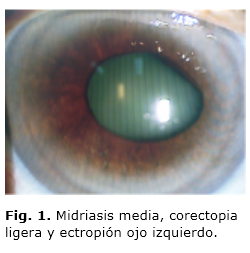
<body><![CDATA[<DIV class="Part"   >        <div class="Part"   >     <p   ><font face="Verdana, Arial, Helvetica, sans-serif" size="+1" color="#000000"><b><font size="3">INTRODUCCI&Oacute;N        </font> </b></font></p >         <p   ><font face="Verdana, Arial, Helvetica, sans-serif" size="2" color="#000000">El        s&iacute;ndrome de Chandler fue descrito por <i>Calves Chandler</i> al observar        un patr&oacute;n de ojo rojo sin dolor y cierres intermitentes del &aacute;ngulo        iridocorneal, lo que desencadena episodios de hipertensi&oacute;n ocular        y se resuelve con mi&oacute;tico y otros antihipertensivos oculares, as&iacute;        como espont&aacute;neamente; pero puede ser recurrente y llegar a la atrofia        &oacute;ptica.<sup>1,2</sup> Afecta, con una relaci&oacute;n de 8:1, a mujeres        con respecto a hombres entre las edades de 40 y 60 a&ntilde;os sin antecedentes        de afecci&oacute;n ocular. Puede ser adquirido y unilateral. Aunque se trata        de una enfermedad poco frecuente, hasta el 50 por ciento desarrolla glaucoma        de dif&iacute;cil control por sinequias anteriores perif&eacute;ricas o        por recubrimiento de la malla trabecular.<sup>3,4 </sup>En todas las variaciones        cl&iacute;nicas de s&iacute;ndrome iridoc&oacute;rneo-endotelial (ICE) est&aacute;        presente la anomal&iacute;a del endotelio corneal,<sup>4-6</sup> que puede        ser asintom&aacute;tico u originar un edema corneal, m&aacute;s frecuente        en s&iacute;ndrome de Chandler, en ocasiones agravado por la tensi&oacute;n        ocular del ojo izquierdo (PIO) elevada.<sup>4,5</sup> La microscopia especular        revela una anormalidad difusa, varios grados de pleomorfismo, p&eacute;rdida        de m&aacute;rgenes hexagonales, y en ojo contralateral una leve disminuci&oacute;n        del recuento endotelial, as&iacute; como pleomorfismo celular medio, casi        siempre asintom&aacute;tico.<sup>5,6</sup> La atrofia del iridiano est&aacute;        ausente en alrededor del 60 % de los casos y en los restantes su gravedad        es variable. La corectopia es leve o moderada.<sup>7 </sup>El glaucoma suele        ser menos grave que en los otros dos s&iacute;ndromes, y en el momento de        la presentaci&oacute;n la tensi&oacute;n ocular en el ojo izquierdo puede        ser normal.<sup>8-10 </sup></font></p >   </div >       <div class="Part"   >          <p   >&nbsp;</p >   </div >    </DIV > <FONT size="+1"><FONT size="+1"><FONT size="+1"><FONT size="+1"><FONT size="+1"><FONT size="+1"><FONT size="+1"><FONT size="+1"><FONT size="+1"><FONT size="+1"><FONT size="+1"><FONT size="+1"><FONT size="+1">     <DIV class="Part"   >     <p   ><font size="2" face="Verdana, Arial, Helvetica, sans-serif"><B><font size="3">PRESENTACI&Oacute;N      DEL CASO </font></b></font></p >       <p><font face="Verdana, Arial, Helvetica, sans-serif" size="2">Mujer de 67 a&ntilde;os      quien acudi&oacute; a la consulta del Cuerpo de Guardia del Servicio de Oftalmolog&iacute;a,      remitida por su &aacute;rea de salud por la p&eacute;rdida visual lenta y      progresiva del ojo izquierdo (OI), sin antecedentes oftalmol&oacute;gicos      personales ni familiares de inter&eacute;s. En la exploraci&oacute;n oftalmol&oacute;gica      la agudeza visual del ojo derecho (OD) fue de 0,5; en el ojo izquierdo llam&oacute;      la atenci&oacute;n el edema corneal severo (en este momento ya con c&oacute;rnea      transparente), acompa&ntilde;ado de ojo rojo y de hipertensi&oacute;n ocular      luego de las 72 horas de evoluci&oacute;n. Presentaba adem&aacute;s corectopia      en el ojo izquierdo hacia el sector temporal y cierta tracci&oacute;n del      iris hacia ese lado, as&iacute; como midriasis media y ectropion uveal (<a href="#F1">Fig.      1</a>). </font></p> </DIV > </font></font></font></font></font></font></font></font></font></font></font></font></font></font></font></font></font></font></font></font></font></font></font></font></font>     <blockquote><FONT size="+1" color="#000000"><FONT size="+1"><FONT size="+1"><FONT size="+1"><FONT size="+1"><FONT size="+1"><FONT size="+1"><FONT size="+1"><FONT size="+1"><FONT size="+1"><FONT size="+1"><FONT size="+1"><FONT size="+1"><FONT size="+1"><FONT size="+1"><FONT size="+1"><FONT size="+1"><FONT size="+1"><FONT size="+1"><FONT size="+1"><FONT size="+1"><FONT size="+1"><FONT size="+1"><FONT size="+1"><FONT size="+1">       ]]></body>
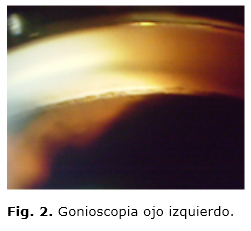
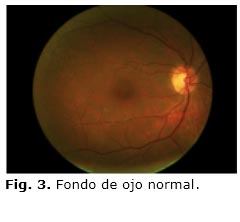
<body><![CDATA[<DIV class="Part"   >         <div align="center"><font size="+1" color="#000000"><font size="+1"><font size="+1"><font size="+1"><font size="+1"><font size="+1"><font size="+1"><font size="+1"><font size="+1"><font size="+1"><font size="+1"><font size="+1"><font size="+1"><font size="+1"><font size="+1"><font size="+1"><font size="+1"><font size="+1"><font size="+1"><font size="+1"><font size="+1"><font size="+1"><font size="+1"><font size="+1"><img src="/img/revistas/oft/v28n2/f0110215.jpg" width="250" height="253"></font></font></font></font></font></font></font></font></font></font></font></font></font></font></font></font></font></font></font></font></font></font></font></font><a name="F1"></a>    <br>           <br>     </div>   </DIV >   </font></font></font></font></font></font></font></font></font></font></font></font></font></font></font></font></font></font></font></font></font></font></font></font></font></blockquote> <FONT size="+1" color="#000000"><FONT size="+1"><FONT size="+1"><FONT size="+1"><FONT size="+1"><FONT size="+1"><FONT size="+1"><FONT size="+1"><FONT size="+1"><FONT size="+1"><FONT size="+1"><FONT size="+1"><FONT size="+1"><FONT size="+1"><FONT size="+1"><FONT size="+1"><FONT size="+1"><FONT size="+1"><FONT size="+1"><FONT size="+1"><FONT size="+1"><FONT size="+1"><FONT size="+1"><FONT size="+1"><FONT size="+1">      <DIV class="Part"   ><FONT size="+1">        <p   ><font face="Verdana, Arial, Helvetica, sans-serif" size="2">La tensi&oacute;n      ocular fue de 12 mmHg en el ojo izquierdo (OI) y a las 72 horas se elev&oacute;      a 54 mmHg. </font><font size="+1" color="#000000"><font size="+1"><font size="+1"><font size="+1"><font size="+1"><font size="+1"><font size="+1"><font size="+1"><font size="+1"><font size="+1"><font size="+1"><font size="+1"><font size="+1"><font size="+1"><font size="+1"><font size="+1"><font size="+1"><font size="+1"><font size="+1"><font size="+1"><font size="+1"><font size="+1"><font size="+1"><font size="+1"><font size="+1"><font size="+1"><font face="Verdana, Arial, Helvetica, sans-serif" size="2">En      el ojo izquierdo </font></font></font></font></font></font></font></font></font></font></font></font></font></font></font></font></font></font></font></font></font></font></font></font></font></font></font><font size="+1" color="#000000"><font size="+1"><font size="+1"><font size="+1"><font size="+1"><font size="+1"><font size="+1"><font size="+1"><font size="+1"><font size="+1"><font size="+1"><font size="+1"><font size="+1"><font size="+1"><font size="+1"><font size="+1"><font size="+1"><font size="+1"><font size="+1"><font size="+1"><font size="+1"><font size="+1"><font size="+1"><font size="+1"><font size="+1"><font size="+1"><font face="Verdana, Arial, Helvetica, sans-serif" size="2">se      observ&oacute; </font></font></font></font></font></font></font></font></font></font></font></font></font></font></font></font></font></font></font></font></font></font></font></font></font></font></font>      <font face="Verdana, Arial, Helvetica, sans-serif" size="2">gonioscopia, <i>trabeculum</i>      hiperpigmentado, el &aacute;ngulo grado III-grado IV (<a href="#F2">Fig. 2</a>),      el &aacute;ngulo grado I-grado II y cierre angular de hora 1 a hora 4. Ante      la sospecha de un s&iacute;ndrome iridoc&oacute;rneo-endotelial (ICE) se realiz&oacute;      una microscopia endotelial donde se observ&oacute; en el ojo izquierdo un      endotelio con pleomorfismo de 30,0 % y polimegatismo de 73,1 %. En el ojo      derecho se pudo observar endotelio normal (<a href="#F3">Fig. 3</a>). </font></p >   </font></DIV > </font></font></font></font></font></font></font></font></font></font></font></font></font></font></font></font></font></font></font></font></font></font></font></font></font>     <blockquote><FONT size="+1" color="#000000"><FONT size="+1"><FONT size="+1"><FONT size="+1"><FONT size="+1"><FONT size="+1"><FONT size="+1"><FONT size="+1"><FONT size="+1"><FONT size="+1"><FONT size="+1"><FONT size="+1"><FONT size="+1"><FONT size="+1"><FONT size="+1"><FONT size="+1"><FONT size="+1"><FONT size="+1"><FONT size="+1"><FONT size="+1"><FONT size="+1"><FONT size="+1"><FONT size="+1"><FONT size="+1"><FONT size="+1">       <DIV class="Part"   >         <div align="center">            <p><FONT size="+1"><img src="/img/revistas/oft/v28n2/f0210215.jpg" width="251" height="231"><a name="F2"></a>    ]]></body>
<body><![CDATA[<br>         </font></p>           <p><img src="/img/revistas/oft/v28n2/f0310215.jpg" width="240" height="222"><a name="F3"></a></p>     </div>   </DIV >   </font></font></font></font></font></font></font></font></font></font></font></font></font></font></font></font></font></font></font></font></font></font></font></font></font></blockquote> <FONT size="+1" color="#000000"><FONT size="+1"><FONT size="+1"><FONT size="+1"><FONT size="+1"><FONT size="+1"><FONT size="+1"><FONT size="+1"><FONT size="+1"><FONT size="+1"><FONT size="+1"><FONT size="+1"><FONT size="+1"><FONT size="+1"><FONT size="+1"><FONT size="+1"><FONT size="+1"><FONT size="+1"><FONT size="+1"><FONT size="+1"><FONT size="+1"><FONT size="+1"><FONT size="+1"><FONT size="+1"><FONT size="+1"><FONT size="+1">      <DIV class="Part"   >        <p   align="justify" >&nbsp;</p >       <p   align="justify" ><font face="Verdana, Arial, Helvetica, sans-serif" size="3" color="#000000"><b>DISCUSI&Oacute;N      </b></font></p >       <p   align="justify" ><font face="Verdana, Arial, Helvetica, sans-serif" size="2" color="#000000">Para      llegar al diagn&oacute;stico del s&iacute;ndrome se tuvo en cuenta el cuadro      cl&iacute;nico, que puede ser variable o incompleto, y se realizaron una serie      de ex&aacute;menes complementarios que, en este caso, fueron de gran importancia      para poder establecer la conducta correcta. Los resultados fueron los siguientes:      prote&iacute;na C reactiva y factor reumatoideo, negativos; doppler carot&iacute;deo      y ultrasonograf&iacute;a ocular, normales. En la microscopia especular con      modificaciones y en la gonioscopia se obtuvo cierre angular parcial por sinequias.      Al alta hospitalaria se logr&oacute; en la operada la tensi&oacute;n ocular      en 10, y la agudeza visual en 0,15 sin correcci&oacute;n y Asintom&aacute;tica.      Al a&ntilde;o de evoluci&oacute;n del posoperatorio la paciente estuvo asintom&aacute;tica,      el ojo blanco, tranquilo y adelfo, sin s&iacute;ntomas ni signos. La agudeza      visual fue de 0,1 sin correcci&oacute;n y la tensi&oacute;n ocular de 12 mmhg.      Adem&aacute;s se obtuvo trabeculectom&iacute;a (TBT) al a&ntilde;o de evoluci&oacute;n      del posoperatorio. En estas pudimos observar midriasis media, iridectom&iacute;a      permeable, bula de filtraci&oacute;n funcional, pigmentos iridianos en conjuntiva,      atrofia iridiana y no ectropi&oacute;n uveal. </font></p >       <p   align="justify" ><font face="Verdana, Arial, Helvetica, sans-serif" size="2" color="#000000">En      el caso de la paciente estudiada, las c&eacute;lulas ICE tienen el aspecto      de c&eacute;lulas endoteliales anormales pero relativamente regulares, que      recuerdan la arquitectura normal del endotelio. Estos hallazgos pueden representar      las fases iniciales o menos avanzadas de la enfermedad, tal y como apunta      la publicaci&oacute;n de <i>Chiou</i><sup><i>9</i></sup>. En otros pacientes      el endotelio aparece muy desorganizado, con m&uacute;ltiples c&eacute;lulas      irregulares de n&uacute;cleo hiperrefringente y abundante presencia de estructuras      hiperrefringentes. Suele tratarse de pacientes con mayor tiempo de evoluci&oacute;n,      lo cual podr&iacute;a apoyar la teor&iacute;a de que las c&eacute;lulas ICE      son el resultado de una metaplasia endotelial. </font></p >       <p><font face="Verdana, Arial, Helvetica, sans-serif" size="2" color="#000000"><i>Alvarado</i><sup>11</sup>      relaciona el s&iacute;ndrome ICE con la infecci&oacute;n por el virus del      herpes simple en 16 de 25 pacientes afectados, lo cual podr&iacute;a corresponder      al &quot;segundo suceso&quot;. <i>Blair</i><sup>12</sup> y <i>Eiferman</i><sup>13</sup>      reportan el caso de un paciente afectado de iridosquisis y queratocono, y      apuntan en la misma direcci&oacute;n al se&ntilde;alar el origen com&uacute;n      de las estructuras afectadas. </font><font size="2" color="#000000"><font face="Verdana, Arial, Helvetica, sans-serif"><i>Menezo</i><sup>14</sup>      realiza la presentaci&oacute;n de un caso en el 2002 de atrofia esencial progresiva      de iris bilateral. </font></font></p>       <p   align="justify" ><font face="Verdana, Arial, Helvetica, sans-serif" size="2" color="#000000">Otros      autores publican un caso cl&iacute;nico con esa asociaci&oacute;n. Plantean      que los signos cl&iacute;nicos del paciente les permiti&oacute; realizar el      diagn&oacute;stico de atrofia esencial del iris con afectaci&oacute;n endotelial      y queratocono-asociaci&oacute;n, que es excepcional en la literatura. En el      ojo izquierdo los hallazgos en la microscopia especular muestran una alteraci&oacute;n      endotelial subcl&iacute;nica.<sup>15,16 </sup></font></p >       <p   align="justify" ><font size="2" face="Verdana, Arial, Helvetica, sans-serif" color="#000000">Las      posibilidades que nos ofrecen nuevos m&eacute;todos diagn&oacute;sticos, como      la microscopia especular y la topograf&iacute;a de elevaci&oacute;n, propiciar&aacute;n      que puedan diagnosticarse cada vez m&aacute;s estas asociaciones patol&oacute;gicas.      Adem&aacute;s, los avances en gen&eacute;tica molecular nos aportar&aacute;n      en un futuro una valiosa informaci&oacute;n para comprender mejor las enfermedades      que son causadas por alteraciones en la diferenciaci&oacute;n de la cresta      neural (<i>neurocristopathies</i>) y poder disponer as&iacute; de mayores      opciones terap&eacute;uticas.<sup>17,18 </sup></font></p > </DIV > <FONT size="+1"><FONT size="+1"><FONT size="+1"><FONT size="+1"><FONT size="+1"><FONT size="+1"><FONT size="+1"><FONT size="+1"><FONT size="+1"><FONT size="+1"><FONT size="+1"><FONT size="+1"><FONT size="+1">     ]]></body>
<body><![CDATA[<DIV class="Part"   >        <p   align="justify" >&nbsp;</p >       <p   align="justify" ><font face="Verdana, Arial, Helvetica, sans-serif" size="+1" color="#000000"><b><font size="3">REFERENCIAS      BIBLIOGR&Aacute;FICAS</font></b></font></p >       <!-- ref --><p><font face="Verdana, Arial, Helvetica, sans-serif" size="2" color="#000000">1.      Shields MB. Progressive essential iris atrophy, Chandler's syndrome and the      iris nevus (Cogan-Reese) syndrome: a spectrum of disease. Surv Ophthalmol.      1979;24(1):3-20.    <br>         <!-- ref --><br>     2. Huna R, Barak A, Melamed S. Bilateral iridocorneal endothelial syndrome      presented as Cogan-Reese and Chandler's syndrome. J Glaucoma. 1996;5(1):60-2.    <br>         <!-- ref --><br>     3. Denis P. Iridocorneal endothelial syndrome and glaucoma. J Fr Ophtalmol.      2007;30(2):189-95.    <br>         <!-- ref --><br>     4. Herde J. Iridocorneal endothelial syndrome (ICE-S): classification, clinical      picture, diagnosis. Klin Monbl Augenheilkd. 2005;222(10):797-801.    <br>         <!-- ref --><br>     5. Morris RW, Dunbar MT. Atypical presentation and review of the ICE syndrome.      Optometry. 2004;75(1):13-25.    <br>         <!-- ref --><br>     6. Patel A, Kenyon KR, Hirst LW, Quigley HA, Stark WJ, Meyer RF, et al. Clinicopathologic      features of Chandler's syndrome. Surv Ophthalmol. 1983;27(5):327-44.    <br>         <!-- ref --><br>     7. Gogaki E, Tsolaki F, Tiganita S, Skatharoudi C, Balatsoukas D. Iridoschisis:      case report and review of the literature. Clin Ophthalmol. 2011;5:381-4.    <br>         <!-- ref --><br>     8. Hemady RK, Patel A, Blum S, Nirankari VS. Bilateral iridocorneal endothelial      syndrome: case report and review of the literature. Cornea. 1994;13(4):368-72.    <br>         <!-- ref --><br>     9. Chiou AG, Kaufman SC, Beuerman RW, Ohta T, Yaylali V, Kaufman HE. Confocal      microscopy in the iridocorneal endothelial syndrome. Br J Ophthalmol. 1999;83(6):697-702.    <br>         <!-- ref --><br>     10. Teekhasaenee C, Ritch R. Iridocorneal endothelial syndrome in Thai patients:      clinical variations. Arch Ophthalmol. 2000;118(2):187-92.     </font></p>       <!-- ref --><p><font face="Verdana, Arial, Helvetica, sans-serif" size="2" color="#000000">11.      Alvarado JA, Underwood JL, Green R, Wu S, Murphy CG, Hwang DG, et al. Detection      of herpes simplex viral DNA in the iridocorneal endothelial syndrome. Arch      Ophthalmol. 1994;112:1601-9.    </font></p>       <!-- ref --><p><font face="Verdana, Arial, Helvetica, sans-serif" size="2" color="#000000">12.      Blair SD, Seabrooks D, Shields WJ, Pillai S, Cavanagh HD. Bilateral progressive      essential iris atrophy and keratoconus with coincident features of posterior      polymorphous dystrophy: a case report and proposed pathogenesis. Cornea. 1992;11:255-61.    </font></p>       <!-- ref --><p><font face="Verdana, Arial, Helvetica, sans-serif" size="2" color="#000000">13.      Eiferman R, Law M, Lane L. Iridoschisis and Keratoconus. Cornea.1994;13:78-9.    </font></p>       <!-- ref --><p><font face="Verdana, Arial, Helvetica, sans-serif" size="2" color="#000000">14.      Menezo V, L&oacute;pez Torres J, Esteban Masanet M. Microscopia confocal en      el s&iacute;ndrome I.C.E. bilateral. Ann Oftalmol. 2002;10(2):94-6.    </font></p>       <!-- ref --><p><font face="Verdana, Arial, Helvetica, sans-serif" size="2" color="#000000">15.      Cavanagh HD, Petroll WM, Alizadeh H, et al. Clinical and diagnostic use of      in vivo confocal microscopy in patients with corneal disease. Ophthalmology.      1993;100:1444-54.    <br>         <!-- ref --><br>     16. Minezaki T. Non-Descemet's stripping automated endothelial keratoplasty      for bullous keratopathy secondary to iridoschisis. Clin Ophthalmol. 2013;7:1353.    <br>         <!-- ref --><br>     17. Crosby NJ, McDonnell P, Shah P. Iridoschisis associated with nanophthalmos      and bullous keratopathy. Int Ophthalmol. 2013;33:83-5.    <br>         <!-- ref --><br>     18. Wang HB, Hu YX, Feng X. Corneal endothelial decompensation secondary to      iridoschisis in degenerative myopic eyes: a case report. Int J Ophthalmol.      2012;5:116-118.    <br>         <br>     </font></p>       ]]></body>
<body><![CDATA[<p>&nbsp;</p>       <p><font face="Verdana, Arial, Helvetica, sans-serif" size="2" color="#000000">Recibido:      2 de diciembre de 2014.    <br>     Aprobado: 3 de enero de 2015.</font></p>       <p>&nbsp; </p>       <p><font face="Verdana, Arial, Helvetica, sans-serif" size="2" color="#000000">    <br>     Dra. <i>Yurisv&aacute;n Escalona Ballester</i>. Policl&iacute;nica &quot;27      de Noviembre&quot;. Antilla. Holgu&iacute;n. Cuba. Correo electr&oacute;nico:      <a href="mailto:yurisvan@antilla.hlg.sld.cu">yurisvan@antilla.hlg.sld.cu</a>      </font></p>       <p></p> </DIV > </font></font></font></font></font></font></font></font></font></font></font></font></font></font></font></font></font></font></font></font></font></font></font></font></font></font></font></font></font></font></font></font></font></font></font></font></font></font></font>       ]]></body><back>
<ref-list>
<ref id="B1">
<label>1</label><nlm-citation citation-type="journal">
<person-group person-group-type="author">
<name>
<surname><![CDATA[Shields]]></surname>
<given-names><![CDATA[MB]]></given-names>
</name>
</person-group>
<article-title xml:lang="en"><![CDATA[Progressive essential iris atrophy, Chandler's syndrome and the iris nevus (Cogan-Reese) syndrome: a spectrum of disease]]></article-title>
<source><![CDATA[Surv Ophthalmol]]></source>
<year>1979</year>
<volume>24</volume>
<numero>1</numero>
<issue>1</issue>
<page-range>3-20</page-range></nlm-citation>
</ref>
<ref id="B2">
<label>2</label><nlm-citation citation-type="journal">
<person-group person-group-type="author">
<name>
<surname><![CDATA[Huna]]></surname>
<given-names><![CDATA[R]]></given-names>
</name>
<name>
<surname><![CDATA[Barak]]></surname>
<given-names><![CDATA[A]]></given-names>
</name>
<name>
<surname><![CDATA[Melamed]]></surname>
<given-names><![CDATA[S]]></given-names>
</name>
</person-group>
<article-title xml:lang="en"><![CDATA[Bilateral iridocorneal endothelial syndrome presented as Cogan-Reese and Chandler's syndrome]]></article-title>
<source><![CDATA[J Glaucoma]]></source>
<year>1996</year>
<volume>5</volume>
<numero>1</numero>
<issue>1</issue>
<page-range>60-2</page-range></nlm-citation>
</ref>
<ref id="B3">
<label>3</label><nlm-citation citation-type="journal">
<person-group person-group-type="author">
<name>
<surname><![CDATA[Denis]]></surname>
<given-names><![CDATA[P]]></given-names>
</name>
</person-group>
<article-title xml:lang="en"><![CDATA[Iridocorneal endothelial syndrome and glaucoma]]></article-title>
<source><![CDATA[J Fr Ophtalmol]]></source>
<year>2007</year>
<volume>30</volume>
<numero>2</numero>
<issue>2</issue>
<page-range>189-95</page-range></nlm-citation>
</ref>
<ref id="B4">
<label>4</label><nlm-citation citation-type="journal">
<person-group person-group-type="author">
<name>
<surname><![CDATA[Herde]]></surname>
<given-names><![CDATA[J]]></given-names>
</name>
</person-group>
<article-title xml:lang="en"><![CDATA[Iridocorneal endothelial syndrome (ICE-S): classification, clinical picture, diagnosis]]></article-title>
<source><![CDATA[Klin Monbl Augenheilkd]]></source>
<year>2005</year>
<volume>222</volume>
<numero>10</numero>
<issue>10</issue>
<page-range>797-801</page-range></nlm-citation>
</ref>
<ref id="B5">
<label>5</label><nlm-citation citation-type="journal">
<person-group person-group-type="author">
<name>
<surname><![CDATA[Morris]]></surname>
<given-names><![CDATA[RW]]></given-names>
</name>
<name>
<surname><![CDATA[Dunbar]]></surname>
<given-names><![CDATA[MT]]></given-names>
</name>
</person-group>
<source><![CDATA[Optometry]]></source>
<year>2004</year>
<volume>75</volume>
<numero>1</numero>
<issue>1</issue>
<page-range>13-25</page-range></nlm-citation>
</ref>
<ref id="B6">
<label>6</label><nlm-citation citation-type="journal">
<person-group person-group-type="author">
<name>
<surname><![CDATA[Patel]]></surname>
<given-names><![CDATA[A]]></given-names>
</name>
<name>
<surname><![CDATA[Kenyon]]></surname>
<given-names><![CDATA[KR]]></given-names>
</name>
<name>
<surname><![CDATA[Hirst]]></surname>
<given-names><![CDATA[LW]]></given-names>
</name>
<name>
<surname><![CDATA[Quigley]]></surname>
<given-names><![CDATA[HA]]></given-names>
</name>
<name>
<surname><![CDATA[Stark]]></surname>
<given-names><![CDATA[WJ]]></given-names>
</name>
<name>
<surname><![CDATA[Meyer]]></surname>
<given-names><![CDATA[RF]]></given-names>
</name>
</person-group>
<article-title xml:lang="en"><![CDATA[Clinicopathologic features of Chandler's syndrome]]></article-title>
<source><![CDATA[Surv Ophthalmol]]></source>
<year>1983</year>
<volume>27</volume>
<numero>5</numero>
<issue>5</issue>
<page-range>327-44</page-range></nlm-citation>
</ref>
<ref id="B7">
<label>7</label><nlm-citation citation-type="journal">
<person-group person-group-type="author">
<name>
<surname><![CDATA[Gogaki]]></surname>
<given-names><![CDATA[E]]></given-names>
</name>
<name>
<surname><![CDATA[Tsolaki]]></surname>
<given-names><![CDATA[F]]></given-names>
</name>
<name>
<surname><![CDATA[Tiganita]]></surname>
<given-names><![CDATA[S]]></given-names>
</name>
<name>
<surname><![CDATA[Skatharoudi]]></surname>
<given-names><![CDATA[C]]></given-names>
</name>
<name>
<surname><![CDATA[Balatsoukas]]></surname>
<given-names><![CDATA[D]]></given-names>
</name>
</person-group>
<article-title xml:lang="en"><![CDATA[Iridoschisis: case report and review of the literature]]></article-title>
<source><![CDATA[Clin Ophthalmol]]></source>
<year>2011</year>
<volume>5</volume>
<page-range>381-4</page-range></nlm-citation>
</ref>
<ref id="B8">
<label>8</label><nlm-citation citation-type="journal">
<person-group person-group-type="author">
<name>
<surname><![CDATA[Hemady]]></surname>
<given-names><![CDATA[RK]]></given-names>
</name>
<name>
<surname><![CDATA[Patel]]></surname>
<given-names><![CDATA[A]]></given-names>
</name>
<name>
<surname><![CDATA[Blum]]></surname>
<given-names><![CDATA[S]]></given-names>
</name>
<name>
<surname><![CDATA[Nirankari]]></surname>
<given-names><![CDATA[VS]]></given-names>
</name>
</person-group>
<article-title xml:lang="en"><![CDATA[Bilateral iridocorneal endothelial syndrome: case report and review of the literature]]></article-title>
<source><![CDATA[Cornea]]></source>
<year>1994</year>
<volume>13</volume>
<numero>4</numero>
<issue>4</issue>
<page-range>368-72</page-range></nlm-citation>
</ref>
<ref id="B9">
<label>9</label><nlm-citation citation-type="journal">
<person-group person-group-type="author">
<name>
<surname><![CDATA[Chiou]]></surname>
<given-names><![CDATA[AG]]></given-names>
</name>
<name>
<surname><![CDATA[Kaufman]]></surname>
<given-names><![CDATA[SC]]></given-names>
</name>
<name>
<surname><![CDATA[Beuerman]]></surname>
<given-names><![CDATA[RW]]></given-names>
</name>
<name>
<surname><![CDATA[Ohta]]></surname>
<given-names><![CDATA[T]]></given-names>
</name>
<name>
<surname><![CDATA[Yaylali]]></surname>
<given-names><![CDATA[V]]></given-names>
</name>
<name>
<surname><![CDATA[Kaufman]]></surname>
<given-names><![CDATA[HE]]></given-names>
</name>
</person-group>
<article-title xml:lang="en"><![CDATA[Confocal microscopy in the iridocorneal endothelial syndrome]]></article-title>
<source><![CDATA[Br J Ophthalmol]]></source>
<year>1999</year>
<volume>83</volume>
<numero>6</numero>
<issue>6</issue>
<page-range>697-702</page-range></nlm-citation>
</ref>
<ref id="B10">
<label>10</label><nlm-citation citation-type="journal">
<person-group person-group-type="author">
<name>
<surname><![CDATA[Teekhasaenee]]></surname>
<given-names><![CDATA[C]]></given-names>
</name>
<name>
<surname><![CDATA[Ritch]]></surname>
<given-names><![CDATA[R]]></given-names>
</name>
</person-group>
<source><![CDATA[Arch Ophthalmol]]></source>
<year>2000</year>
<volume>118</volume>
<numero>2</numero>
<issue>2</issue>
<page-range>187-92</page-range></nlm-citation>
</ref>
<ref id="B11">
<label>11</label><nlm-citation citation-type="journal">
<person-group person-group-type="author">
<name>
<surname><![CDATA[Alvarado]]></surname>
<given-names><![CDATA[JA]]></given-names>
</name>
<name>
<surname><![CDATA[Underwood]]></surname>
<given-names><![CDATA[JL]]></given-names>
</name>
<name>
<surname><![CDATA[Green]]></surname>
<given-names><![CDATA[R]]></given-names>
</name>
<name>
<surname><![CDATA[Wu]]></surname>
<given-names><![CDATA[S]]></given-names>
</name>
<name>
<surname><![CDATA[Murphy]]></surname>
<given-names><![CDATA[CG]]></given-names>
</name>
<name>
<surname><![CDATA[Hwang]]></surname>
<given-names><![CDATA[DG]]></given-names>
</name>
</person-group>
<article-title xml:lang="en"><![CDATA[Detection of herpes simplex viral DNA in the iridocorneal endothelial syndrome]]></article-title>
<source><![CDATA[Arch Ophthalmol]]></source>
<year>1994</year>
<volume>112</volume>
<page-range>1601-9</page-range></nlm-citation>
</ref>
<ref id="B12">
<label>12</label><nlm-citation citation-type="journal">
<person-group person-group-type="author">
<name>
<surname><![CDATA[Blair]]></surname>
<given-names><![CDATA[SD]]></given-names>
</name>
<name>
<surname><![CDATA[Seabrooks]]></surname>
<given-names><![CDATA[D]]></given-names>
</name>
<name>
<surname><![CDATA[Shields]]></surname>
<given-names><![CDATA[WJ]]></given-names>
</name>
<name>
<surname><![CDATA[Pillai]]></surname>
<given-names><![CDATA[S]]></given-names>
</name>
<name>
<surname><![CDATA[Cavanagh]]></surname>
<given-names><![CDATA[HD]]></given-names>
</name>
</person-group>
<article-title xml:lang="en"><![CDATA[Bilateral progressive essential iris atrophy and keratoconus with coincident features of posterior polymorphous dystrophy: a case report and proposed pathogenesis]]></article-title>
<source><![CDATA[Cornea]]></source>
<year>1992</year>
<volume>11</volume>
<page-range>255-61</page-range></nlm-citation>
</ref>
<ref id="B13">
<label>13</label><nlm-citation citation-type="journal">
<person-group person-group-type="author">
<name>
<surname><![CDATA[Eiferman]]></surname>
<given-names><![CDATA[R]]></given-names>
</name>
<name>
<surname><![CDATA[Law]]></surname>
<given-names><![CDATA[M]]></given-names>
</name>
<name>
<surname><![CDATA[Lane]]></surname>
<given-names><![CDATA[L]]></given-names>
</name>
</person-group>
<article-title xml:lang="en"><![CDATA[Iridoschisis and Keratoconus]]></article-title>
<source><![CDATA[Cornea]]></source>
<year>1994</year>
<volume>13</volume>
<page-range>78-9</page-range></nlm-citation>
</ref>
<ref id="B14">
<label>14</label><nlm-citation citation-type="journal">
<person-group person-group-type="author">
<name>
<surname><![CDATA[Menezo]]></surname>
<given-names><![CDATA[V]]></given-names>
</name>
<name>
<surname><![CDATA[López Torres]]></surname>
<given-names><![CDATA[J]]></given-names>
</name>
<name>
<surname><![CDATA[Esteban Masanet]]></surname>
<given-names><![CDATA[M]]></given-names>
</name>
</person-group>
<article-title xml:lang="es"><![CDATA[Microscopia confocal en el síndrome I.C.E. bilateral]]></article-title>
<source><![CDATA[Ann Oftalmol]]></source>
<year>2002</year>
<volume>10</volume>
<numero>2</numero>
<issue>2</issue>
<page-range>94-6</page-range></nlm-citation>
</ref>
<ref id="B15">
<label>15</label><nlm-citation citation-type="journal">
<person-group person-group-type="author">
<name>
<surname><![CDATA[Cavanagh]]></surname>
<given-names><![CDATA[HD]]></given-names>
</name>
<name>
<surname><![CDATA[Petroll]]></surname>
<given-names><![CDATA[WM]]></given-names>
</name>
<name>
<surname><![CDATA[Alizadeh]]></surname>
<given-names><![CDATA[H]]></given-names>
</name>
</person-group>
<article-title xml:lang="en"><![CDATA[Clinical and diagnostic use of in vivo confocal microscopy in patients with corneal disease]]></article-title>
<source><![CDATA[Ophthalmology]]></source>
<year>1993</year>
<volume>100</volume>
<page-range>1444-54</page-range></nlm-citation>
</ref>
<ref id="B16">
<label>16</label><nlm-citation citation-type="journal">
<person-group person-group-type="author">
<name>
<surname><![CDATA[Minezaki]]></surname>
<given-names><![CDATA[T]]></given-names>
</name>
</person-group>
<article-title xml:lang="en"><![CDATA[Non-Descemet's stripping automated endothelial keratoplasty for bullous keratopathy secondary to iridoschisis]]></article-title>
<source><![CDATA[Clin Ophthalmol]]></source>
<year>2013</year>
<volume>7</volume>
<page-range>1353</page-range></nlm-citation>
</ref>
<ref id="B17">
<label>17</label><nlm-citation citation-type="journal">
<person-group person-group-type="author">
<name>
<surname><![CDATA[Crosby]]></surname>
<given-names><![CDATA[NJ]]></given-names>
</name>
<name>
<surname><![CDATA[McDonnell]]></surname>
<given-names><![CDATA[P]]></given-names>
</name>
<name>
<surname><![CDATA[Shah]]></surname>
<given-names><![CDATA[P]]></given-names>
</name>
</person-group>
<article-title xml:lang="en"><![CDATA[Iridoschisis associated with nanophthalmos and bullous keratopathy]]></article-title>
<source><![CDATA[Int Ophthalmol]]></source>
<year>2013</year>
<volume>33</volume>
<page-range>83-5</page-range></nlm-citation>
</ref>
<ref id="B18">
<label>18</label><nlm-citation citation-type="journal">
<person-group person-group-type="author">
<name>
<surname><![CDATA[Wang]]></surname>
<given-names><![CDATA[HB]]></given-names>
</name>
<name>
<surname><![CDATA[Hu]]></surname>
<given-names><![CDATA[YX]]></given-names>
</name>
<name>
<surname><![CDATA[Feng]]></surname>
<given-names><![CDATA[X]]></given-names>
</name>
</person-group>
<article-title xml:lang="en"><![CDATA[Corneal endothelial decompensation secondary to iridoschisis in degenerative myopic eyes: a case report]]></article-title>
<source><![CDATA[Int J Ophthalmol]]></source>
<year>2012</year>
<volume>5</volume>
<page-range>116-118</page-range></nlm-citation>
</ref>
</ref-list>
</back>
</article>