<?xml version="1.0" encoding="ISO-8859-1"?><article xmlns:mml="http://www.w3.org/1998/Math/MathML" xmlns:xlink="http://www.w3.org/1999/xlink" xmlns:xsi="http://www.w3.org/2001/XMLSchema-instance">
<front>
<journal-meta>
<journal-id>1010-2752</journal-id>
<journal-title><![CDATA[Revista de Protección Vegetal]]></journal-title>
<abbrev-journal-title><![CDATA[Rev. Protección Veg.]]></abbrev-journal-title>
<issn>1010-2752</issn>
<publisher>
<publisher-name><![CDATA[Centro Nacional de Sanidad Agropecuaria]]></publisher-name>
</publisher>
</journal-meta>
<article-meta>
<article-id>S1010-27522012000300003</article-id>
<title-group>
<article-title xml:lang="en"><![CDATA[Identification of new hosts for Ralstonia solanacearum (Smith) race 2 from Colombia]]></article-title>
<article-title xml:lang="es"><![CDATA[Identificación de nuevos hospedantes de Ralstonia solanacearum (Smith) raza 2 en Colombia]]></article-title>
</title-group>
<contrib-group>
<contrib contrib-type="author">
<name>
<surname><![CDATA[Prieto Romo]]></surname>
<given-names><![CDATA[Jorge]]></given-names>
</name>
<xref ref-type="aff" rid="A01"/>
</contrib>
<contrib contrib-type="author">
<name>
<surname><![CDATA[Morales Osorio]]></surname>
<given-names><![CDATA[Juan Gonzalo]]></given-names>
</name>
<xref ref-type="aff" rid="A02"/>
</contrib>
<contrib contrib-type="author">
<name>
<surname><![CDATA[Salazar Yepes]]></surname>
<given-names><![CDATA[Mauricio]]></given-names>
</name>
<xref ref-type="aff" rid="A03"/>
</contrib>
</contrib-group>
<aff id="A01">
<institution><![CDATA[,Universidad Nacional de Colombia  ]]></institution>
<addr-line><![CDATA[Palmira ]]></addr-line>
<country>Colombia</country>
</aff>
<aff id="A02">
<institution><![CDATA[,Universidad Nacional de Colombia Facultad de Ciencias Agropecuarias Departamento de Ciencias Agronómicas]]></institution>
<addr-line><![CDATA[ ]]></addr-line>
<country>Colombia</country>
</aff>
<aff id="A03">
<institution><![CDATA[,Universidad Nacional de Colombia Facultad de Ciencias Escuela de Biociencias]]></institution>
<addr-line><![CDATA[ ]]></addr-line>
<country>Colombia</country>
</aff>
<pub-date pub-type="pub">
<day>00</day>
<month>12</month>
<year>2012</year>
</pub-date>
<pub-date pub-type="epub">
<day>00</day>
<month>12</month>
<year>2012</year>
</pub-date>
<volume>27</volume>
<numero>3</numero>
<fpage>151</fpage>
<lpage>161</lpage>
<copyright-statement/>
<copyright-year/>
<self-uri xlink:href="http://scielo.sld.cu/scielo.php?script=sci_arttext&amp;pid=S1010-27522012000300003&amp;lng=en&amp;nrm=iso"></self-uri><self-uri xlink:href="http://scielo.sld.cu/scielo.php?script=sci_abstract&amp;pid=S1010-27522012000300003&amp;lng=en&amp;nrm=iso"></self-uri><self-uri xlink:href="http://scielo.sld.cu/scielo.php?script=sci_pdf&amp;pid=S1010-27522012000300003&amp;lng=en&amp;nrm=iso"></self-uri><abstract abstract-type="short" xml:lang="en"><p><![CDATA[Ralstonia solanacearum Smith induces the Moko disease on banana, plantain and heliconia flowers. The objectives of this work were: I) to identify R. solanacearum hosts in weeds or cultivated hosts and II) to determine its pathogenicity on the susceptible host plantain cv. Dominico-Hartón. A survey in search of natural hosts of R. solanacearum race 2 was performed in selected Colombian regions. Sixty bacterial colonies showing R. solanacearum characteristics in a semi-selective medium were used in further pathogenicity tests in the susceptible plantain plants. Twenty six isolates induced Moko disease symptoms in plantain during the 60 days of evaluation. Twelve new hosts were found for R. solanacearum at the worldwide level: nine of them were weeds (Euphorbia graminea Jacq., Blechum piramidatum Lam., Oxalis latifolia Kunth, Cuphea micrantha Kunth, Eleusine indica L., Gliricidia sepium Kunth ex Steud., Lobelalia xalapensis Kunth, Stachys lamioides Benth., Salvia aff. lasiocephala Hook. & Arn.) and three cultivated crops (Colocasia esculenta L., Cucurbita maxima Duchesne and Psidium guajava L.). The presence of R. solanacearum race 2 in weeds and cultivated crops should be managed as an important component of an integrated Moko disease control program.]]></p></abstract>
<abstract abstract-type="short" xml:lang="es"><p><![CDATA[Ralstonia solanacearum Smith ocasiona la enfermedad denominada Moko en cultivos de banano, plátano y heliconias. Los objetivos de este trabajo fueron: I) identificar hospedantes de R. solanacearum en malezas o plantas cultivadas y II) determinar su patogenicidad en la variedad de plátano susceptible Dominico-Hartón. Se realizó un muestreo para identificar hospedantes naturales de R. solanacearum raza 2 en regiones de Colombia. Sesenta colonias aisladas en medio semi-selectivo mostraron características típicas de R. solanacearum y fueron usadas posteriormente para la evaluación de patogenicidad en plantas susceptibles de plátano. Veintiséis cepas indujeron los síntomas típicos de la enfermedad del Moko en las plantas de plátano, durante el período de evaluación de 60 días. Se encontraron doce hospedantes no informados previamente a nivel mundial para R. solanacearum: nueve fueron malezas (Euphorbia graminea Jacq., Blechum piramidatum Lam., Oxalis latifolia Kunth, Cuphea micrantha Kunth, Eleusine indica L., Gliricidia sepium Kunth ex Steud., Lobelalia xalapensis Kunth, Stachys lamioides Benth., Salvia aff. lasiocephala Hook. & Arn.) y tres correspondieron a hospedantes cultivados )Colocasia esculenta L., Cucurbita maxima Duchesne y Psidium guajava L.). La presencia de R. solanacearum raza 2 en malezas y hospedantes cultivados debe ser manejado como un componente importante en el programa integrado de control de la enfermedad del Moko.]]></p></abstract>
<kwd-group>
<kwd lng="en"><![CDATA[Musa spp.]]></kwd>
<kwd lng="en"><![CDATA[Ralstonia solanacearum]]></kwd>
<kwd lng="en"><![CDATA[Moko disease]]></kwd>
<kwd lng="es"><![CDATA[Musa spp.]]></kwd>
<kwd lng="es"><![CDATA[Ralstonia solanacearum]]></kwd>
<kwd lng="es"><![CDATA[enfermedad del Moko]]></kwd>
</kwd-group>
</article-meta>
</front><body><![CDATA[ <p align="right"><font size="2" face="Verdana, Arial, Helvetica, sans-serif"><B>ORIGINAL  ARTICLE</B></font></p>    <p>&nbsp;</p>    <p><font size="2" face="Verdana, Arial, Helvetica, sans-serif"><B><font size="4">Identification  of new hosts for <I>Ralstonia solanacearum </I>(Smith) race 2 from Colombia </font>  </B></font></p>    <p>&nbsp;</p>    <p><font size="2" face="Verdana, Arial, Helvetica, sans-serif"><b><font size="3">Identificaci&oacute;n  de nuevos hospedantes de <i>Ralstonia solanacearum</i> (Smith) raza 2 en Colombia  </font> </b></font></p>    <p>&nbsp;</p>    <p>&nbsp;</p>    <p><font size="2" face="Verdana, Arial, Helvetica, sans-serif"><b>Jorge  Prieto Romo<SUP>I</SUP>, Juan Gonzalo Morales Osorio<SUP>II</SUP>, <a href="#autor">Mauricio  Salazar Yepes</a><a name="correspondencia"></a><SUP>III,*</SUP></b></font> <B></B>  </p>    <P><font size="2" face="Verdana, Arial, Helvetica, sans-serif"><SUP>I</SUP>Agronomical  Engineer, Universidad Nacional de Colombia sede Palmira, Palmira-Colombia. E-mail:  <U><a href="mailto:jorgeprieto150@yahoo.com">jorgeprieto150@yahoo.com</a></U>.    <br>  </font><font size="2" face="Verdana, Arial, Helvetica, sans-serif"><SUP>II</SUP>Professor,  IA, MSc, PhD, Universidad Nacional de Colombia, sede Medell&iacute;n, Facultad  de Ciencias Agropecuarias, Departamento de Ciencias Agron&oacute;micas, Colombia.  E-mail: <U><a href="mailto:jgmoraleso@unal.edu.co">jgmoraleso@unal.edu.co</a></U>.    ]]></body>
<body><![CDATA[<br>  <SUP>III</SUP>Professor, IA, MSc, PhD, Universidad Nacional de Colombia, sede  Medell&iacute;n, Facultad de Ciencias, Escuela de Biociencias, Colombia.</font>      <P>&nbsp;     <P>&nbsp; <hr noshade size="1">     <P><font size="2" face="Verdana, Arial, Helvetica, sans-serif"><B>ABSTRACT</B></font>      <P><font size="2" face="Verdana, Arial, Helvetica, sans-serif"><I>Ralstonia solanacearum</I>  Smith induces the Moko disease on banana, plantain and heliconia flowers. The  objectives of this work were: I) to identify <I>R. solanacearum</I> hosts in weeds  or cultivated hosts and II) to determine its pathogenicity on the susceptible  host plantain cv. Dominico-Hart&oacute;n. A survey in search of natural hosts  of <I>R. solanacearum</I> race 2 was performed in selected Colombian regions.  Sixty bacterial colonies showing <I>R. solanacearum</I> characteristics in a semi-selective  medium were used in further pathogenicity tests in the susceptible plantain plants.  Twenty six isolates induced Moko disease symptoms in plantain during the 60 days  of evaluation. Twelve new hosts were found for <I>R</I>. <I>solanacearum</I> at  the worldwide level: nine of them were weeds (<I>Euphorbia graminea</I> Jacq.<I>,  Blechum piramidatum</I> Lam.<I>, Oxalis latifolia</I> Kunth<I>, Cuphea micrantha</I>  Kunth<I>, Eleusine indica</I> L.<I>, Gliricidia sepium</I> Kunth ex Steud.<I>,  Lobelalia xalapensis</I> Kunth<I>, Stachys lamioides</I> Benth.<I>, Salvia aff.  lasiocephala</I> Hook. &amp; Arn.) and three cultivated crops (<I>Colocasia esculenta</I>  L.<I>, Cucurbita maxima</I> Duchesne<I> </I>and <I>Psidium guajava</I> L.). The  presence of <I>R. solanacearum</I> race 2 in weeds and cultivated crops should  be managed as an important component of an integrated Moko disease control program.  </font>     <P><font size="2" face="Verdana, Arial, Helvetica, sans-serif"><B>Key  words:</B> <I>Musa </I>spp., <I>Ralstonia solanacearum</I>, Moko disease. </font>  <hr noshade size="1">     <p><font size="2" face="Verdana, Arial, Helvetica, sans-serif"><B>RESUMEN</b></font></p>    <p><font size="2" face="Verdana, Arial, Helvetica, sans-serif"><I>Ralstonia  solanacearum</I> Smith ocasiona la enfermedad denominada Moko en cultivos de banano,  pl&aacute;tano y heliconias. Los objetivos de este trabajo fueron: I) identificar  hospedantes de <I>R</I>. <I>solanacearum</I> en malezas o plantas cultivadas y  II) determinar su patogenicidad en la variedad de pl&aacute;tano susceptible Dominico-Hart&oacute;n.  Se realiz&oacute; un muestreo para identificar hospedantes naturales de <I>R</I>.  <I>solanacearum</I> raza 2 en regiones de Colombia. Sesenta colonias aisladas  en medio semi-selectivo mostraron caracter&iacute;sticas t&iacute;picas de <I>R</I>.  <I>solanacearum</I> y fueron usadas posteriormente para la evaluaci&oacute;n de  patogenicidad en plantas susceptibles de pl&aacute;tano. Veintis&eacute;is cepas  indujeron los s&iacute;ntomas t&iacute;picos de la enfermedad del Moko en las  plantas de pl&aacute;tano, durante el per&iacute;odo de evaluaci&oacute;n de 60  d&iacute;as. Se encontraron doce hospedantes no informados previamente a nivel  mundial para <I>R</I>. <I>solanacearum</I>: nueve fueron malezas <I>(Euphorbia  graminea</I> Jacq.<I>, Blechum piramidatum</I> Lam.<I>, Oxalis latifolia</I> Kunth<I>,  Cuphea micrantha</I> Kunth<I>, Eleusine indica</I> L.<I>, Gliricidia sepium</I>  Kunth ex Steud.<I>, Lobelalia xalapensis</I> Kunth<I>, Stachys lamioides</I> Benth.<I>,  Salvia aff. lasiocephala</I> Hook. &amp; Arn.) y tres correspondieron a hospedantes  cultivados <I>)Colocasia esculenta</I> L.<I>, Cucurbita maxima</I> Duchesne<I>  </I>y <I>Psidium guajava</I> L.). La presencia de <I>R</I>. <I>solanacearum</I>  raza 2 en malezas y hospedantes cultivados debe ser manejado como un componente  importante en el programa integrado de control de la enfermedad del Moko. </font>  </p>    <P><font size="2" face="Verdana, Arial, Helvetica, sans-serif"><B>Palabras  clave:</B> <I>Musa </I>spp., <I>Ralstonia solanacearum</I>, enfermedad del Moko.</font>  <hr noshade size="1">     <P>&nbsp;     ]]></body>
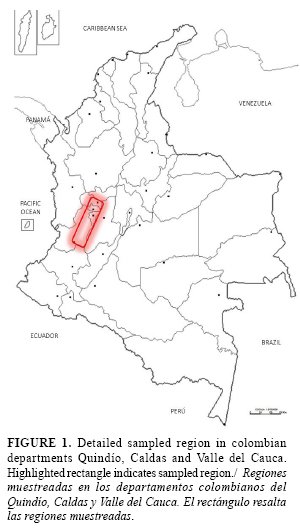
<body><![CDATA[<P>&nbsp;     <P><font size="2" face="Verdana, Arial, Helvetica, sans-serif"><B><font size="3">INTRODUCTION</font></B>  </font>     <P><font size="2" face="Verdana, Arial, Helvetica, sans-serif">The plant  pathogenic bacterium <I>Ralstonia solanacearum</I> Smith has a wide host range  infecting more than 200 different plant species within 53 taxonomic families (1,  2). There are five different races and an equal number of biovars of<I> R. solanacearum</I>  depending on the host range and the biochemical and physiological characteristics,  respectively. Race 1 mainly infects cultivated plants belonging to the Solanaceae  family and diploid bananas; whereas race 2 causes the Moko disease (3), arguably  the most important bacterial disease in triploid bananas, plantain and the ornamental  plants heliconias in the tropics. Race 3 attacks potato, tomato and geranium;  race 4 has been reported causing disease on ginger (4, 5, 6, 7) and race 5 (biovar  5) is specialized on <I>Morus</I> (7).Most susceptible hosts include cultivated  plants within the Solanaceae family (tomato, potato, tobacco, bell pepper), Fabaceae  (peanut), Musaceae (banana and plantain), and many others (2, 8). Previous studies  aiming to determine <I>R. solanacearum</I> natural hosts have demonstrated the  bacteria ability to asymptomatically colonize survive and persist in the absence  of susceptible plants (1, 4, 9). </font>     <P><font size="2" face="Verdana, Arial, Helvetica, sans-serif">In  Colombia, 17 new host weeds for races 1, 2 and 3 were identified (4); on the other  hand, Granada (10) determined that roots from common weeds found in plantain crops  might be asymptomatic hosts for <I>R. solanacearum </I>race 2. Meanwhile in Honduras  and Costa Rica, several hosts other than banana have been identified in natural  ecosystems (5). More than 50 % of <I>R. solanacearum</I> host species reported  have been weeds (4).<I> R. solanacearum</I> can be spread very fast by water streams,  machinery, insects, seeds, labour tools, crop workers and animals (1, 4, 6, 11).  Colombia is the second larger plantain producer and the third largest banana exporter  in the world, besides many wild heliconia species are native from Colombia, and  Moko disease is a permanent threat to these current and potential crops. </font>      <P><font size="2" face="Verdana, Arial, Helvetica, sans-serif">The disease was  first reported in Tolima department, Colombia, in1954 by Galvez and Lozano (12),  and from this place, it spread throughout the country. As a consequence of Moko  spreading, losses could reach 100% of production if the treatments were not correctly  and promptly applied. In the most important Colombian banana growing area (Urab&aacute;),  more than 611 hectares have been destroyed at an average rate of 16-17 hectares  per annum (13). Additionally, in banana growing areas, the control and quarantine  tactics for Moko have a high economic impact since nine plants must be destroyed  per each infected plant (11) and a six month quarantine established (13) in the  area. </font>     <P><font size="2" face="Verdana, Arial, Helvetica, sans-serif">Despite  the numerous investigations on <I>R. solanacearum</I>, many aspects of its ecology,  survival, spread and host range in the tropics are still poorly understood. </font>      <P><font size="2" face="Verdana, Arial, Helvetica, sans-serif">The objectives  of this work were I) to identify <I>R. solanacearum</I> hosts on weeds or cultivated  plants and II) to determine its pathogenicity on the susceptible host plantain  cv. Dominico-Hart&oacute;n. </font>     <P>&nbsp; <H1> <font size="2" face="Verdana, Arial, Helvetica, sans-serif"><B><font size="3">MATERIALS  AND METHODS</font></B> </font></H1>    <P><font size="2" face="Verdana, Arial, Helvetica, sans-serif"><B>Survey  and sample collection</B> </font>     <P><font size="2" face="Verdana, Arial, Helvetica, sans-serif">Bacterial  isolates were obtained from weeds and cultivated plants in the crops of banana,  plantain, heliconia, bell pepper, potato and tomato growing in areas of the three  Colombian Departments named Caldas, Quind&iacute;o and Valle del Cauca (<a href="#f01">Figure  1</a>). Special attention was given to those fields with a previous report of  Moko disease. Plants were sampled within or around Moko foci including symptomless  plants. Plants showing Moko symptoms were collected;fields with apparently healthy  crops were also randomly sampled. Plant genera and species were identified with  the assistance of the Herbarium staff from Universidad Nacional de Colombia (Medell&iacute;n  and Palmira Headquarters), who provided a list of plant scientific names.</font>      ]]></body>
<body><![CDATA[<P ALIGN="CENTER"><img src="/img/revistas/rpv/v27n3/f0103312.jpg" width="300" height="529">  <a name="f01"></a>     
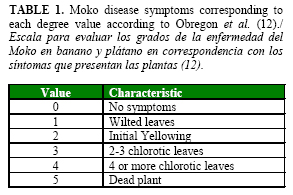
<P><font size="2" face="Verdana, Arial, Helvetica, sans-serif"><B>Identification  of <I>R. solanacearum</I> from different host plants</B> </font>     <P><font size="2" face="Verdana, Arial, Helvetica, sans-serif">Bacteria  were isolated and identified in the molecular biology laboratory at Universidad  Nacional de Colombia headquarters Palmira, using the below described protocols.  </font>     <P><font size="2" face="Verdana, Arial, Helvetica, sans-serif">Individual  plants were surface sterilized and root and stem vascular tissues were extracted  with a new sterile scalpel blade. Small pieces of the extracted tissues (1-2mm<SUP>2</SUP>)  were placed on Kelman-triphenyltetrazolium chloride (TZC) TZC semi-selective medium  and incubated (14). Individual virulent mucoid colonies with pink centers appeared  after 48-60 hours, then developed blood red whorls showing a reddish-golden halo.  Bacterial colonies showing <I>R</I>. <I>solanacearum</I> distinctive features  were further identified using the ImmunoStrip&#174; test Kit from Agdia&#174;  for specific detection of <I>R</I>.<I> solanacearum</I>, following the manufacturer&#180;s  instructions. </font>     <P><font size="2" face="Verdana, Arial, Helvetica, sans-serif">Colonies  confirmed as <I>R</I>. <I>solanacearum</I> were grown overnight in liquid semi-selective  medium from South Africa (SMSA) at 28&#176;C under constant shaking (250rpm).  After incubation, glycerol was added up to 30% and the strains kept at -80&#176;C  for further use. </font>     <P><font size="2" face="Verdana, Arial, Helvetica, sans-serif"><B>Pathogenicity  test</B> </font>     <P><font size="2" face="Verdana, Arial, Helvetica, sans-serif">The  isolates obtained were inoculated on Moko susceptible seedling plants cv. Dominico-Hart&oacute;n.  For this study, plantain seedlings were obtained from a disease-free certified  producer farm and grown in the greenhouse for pathogen containment in 3kg pots  with a sterile soil-organic matter substrate (3:1). After one month, 15g of a  mixture of nitrogen and potassium (3:2) were applied. The plantlets were grown  for another month under similar conditions before inoculation. </font>     <P><font size="2" face="Verdana, Arial, Helvetica, sans-serif">Each  strain was inoculated in each group of four individual two month old plantain  plants. A completely randomized block design with four replicates was used as  experimental model. Each plant was injected with a syringe in the pseudostem at  a height of 15cm from soil with 2,5 ml of a solution containing each individual  strain at a concentration of 10<SUP>8</SUP> colony forming units (CFU).mL<SUP>-1</SUP>.  Plants inoculated with liquid medium and plants non-inoculated were used as negative  controls. After inoculation plants and controls were grown at 27&#176;C and 70%  relative humidity in a greenhouse with an irrigation system for watering plants  every two days. </font>     <P><font size="2" face="Verdana, Arial, Helvetica, sans-serif">Moko  disease symptoms were recorded every three days after inoculation (DAI) during  60 days. A strain was considered positive when clear Moko symptoms were induced  on at least three plants per inoculated strain (12). </font>     <P><font size="2" face="Verdana, Arial, Helvetica, sans-serif">Bacteria  were re-isolated from diseased plants in Kelman semi-selective medium to confirm  Koch&#180;s postulates. Disease severity was scored by visual evaluation according  to the semi-quantitative scale reported by Obreg&oacute;n <I>et al</I>. (12) (<a href="#t01">Table  1</a>).</font>     ]]></body>
<body><![CDATA[<P ALIGN="CENTER"><img src="/img/revistas/rpv/v27n3/t0103312.jpg" width="293" height="195">  <a name="t01"></a>     
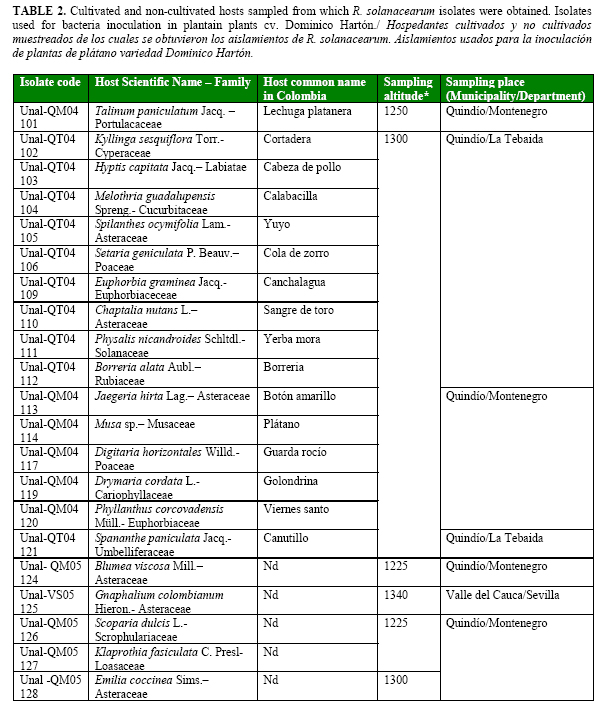
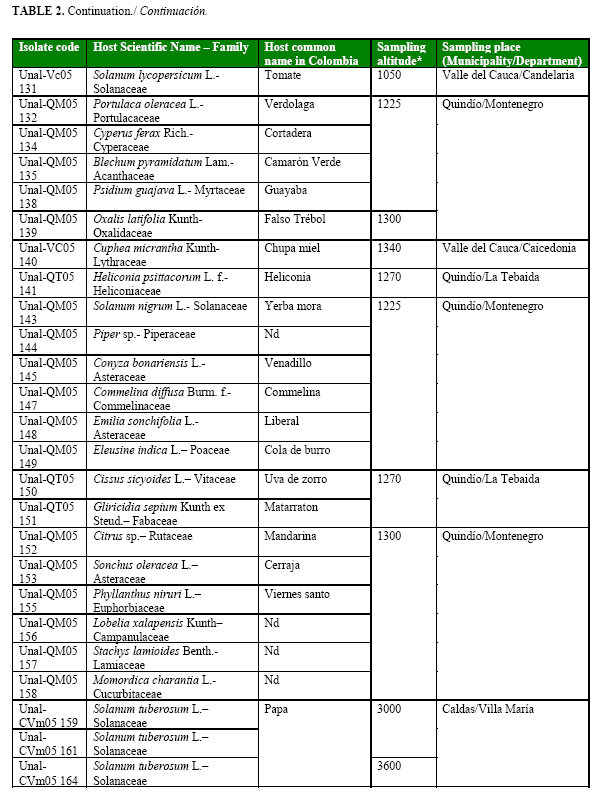
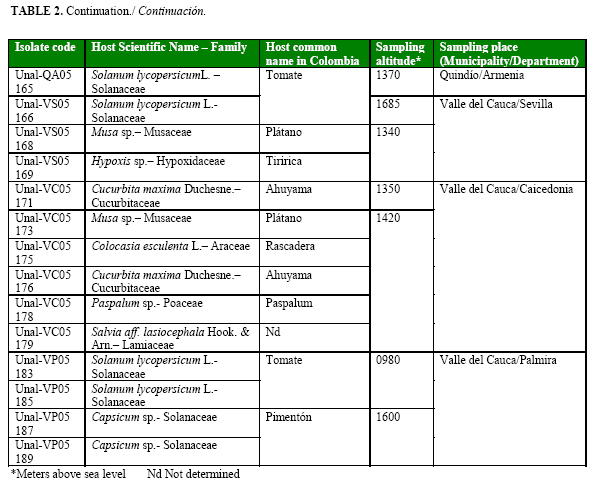
<P><font size="2" face="Verdana, Arial, Helvetica, sans-serif">Every  individual strain was considered as a different treatment. Disease severity was  estimated by the area under the disease progression curve (AUDPC) for each bacterial  strain, represented as the sum of the area of the polygons for each evaluation  as described by Campbell and Madden (15). An analysis of variance of the AUDPC  values was performed; means were square root transformed and compared by the Least  Significant Difference (LSD) multiple range test (<I>P</I>&lt;0.05). Differences  were calculated from 4 repetitions for each treatment.</font>     <P>&nbsp; <H1> <font size="2" face="Verdana, Arial, Helvetica, sans-serif"><B><font size="3">RESULTS</font></B>  </font></H1>    <P><font size="2" face="Verdana, Arial, Helvetica, sans-serif"><B>Identification  of <I>R. solanacearum</I> from different host plants</B> </font>     <P><font size="2" face="Verdana, Arial, Helvetica, sans-serif">Using  Kelman&#180;s semi-selective medium, sixty strains were selected by the characteristics  previously reported by Kelman (14) for <I>Pseudomonas solanacearum </I>(currently  <I>R. solanacearum</I>) such as large, elevated, fluidal, and either entirely  white or with a pale red center colonies (<a href="/img/revistas/rpv/v27n3/t2a03312.jpg">Table  2a</a>, <a href="/img/revistas/rpv/v27n3/t2b03312.jpg">Table 2b cont</a>.,  <a href="/img/revistas/rpv/v27n3/t2c03312.jpg">Table 2c cont</a>.). All strains  were confirmed as <I>R. solanacearum</I> by serological studies. </font>     
<P><font size="2" face="Verdana, Arial, Helvetica, sans-serif">Forty  one strains were obtained from the central Colombian department Quind&iacute;o,  sixteen from Valle del Cauca, and three from Caldas. Eighteen strains were from  cultivated plants such as plantain (three), tomato (five), potato (three), bell  pepper (two), heliconia flower (one), guava (one), mandarin (one) and squash (one)  and other forty two strains from non-cultivated plants (<a href="/img/revistas/rpv/v27n3/t2a03312.jpg">Table  2a</a>, <a href="/img/revistas/rpv/v27n3/t2b03312.jpg">Table 2b cont</a>.,  <a href="/img/revistas/rpv/v27n3/t2c03312.jpg">Table 2c cont</a>.). </font>      
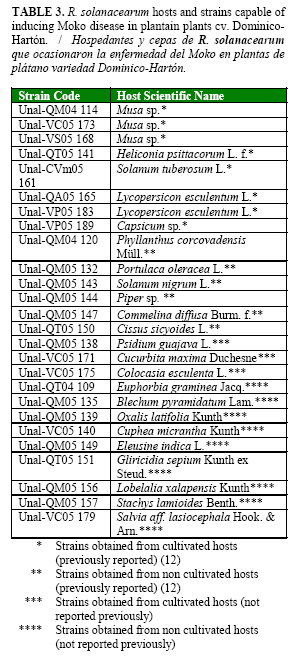
<P><font size="2" face="Verdana, Arial, Helvetica, sans-serif"><B>Pathogenicity  test</B> </font>     <P><font size="2" face="Verdana, Arial, Helvetica, sans-serif">From  the sixty strains inoculated on plantain plants, only twenty six (from cultivated  and non-cultivated hosts) were capable of producing Moko disease (<a href="#t03">Table  3</a>). Interestingly, other 27 strains developed initial Moko symptoms such as  mild wilt (degree 1) and yellowing (degree 2) (<a href="#t01">Table 1</a>), but  most of the plants recovered during the evaluation period, and only two or less  plants per strain inoculated remained affected (Data not shown).</font>     <P ALIGN="CENTER"><img src="/img/revistas/rpv/v27n3/t0303312.jpg" width="298" height="656">  <a name="t03"></a>     
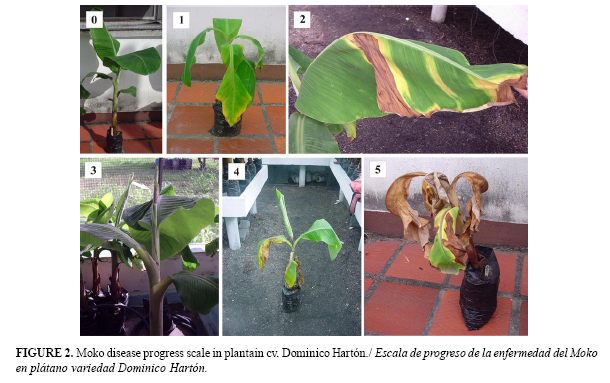
<P><font size="2" face="Verdana, Arial, Helvetica, sans-serif">First  wilting symptoms were observed between 12 to 18 DAI. At eighteen DAI, the plants  showed yellowing. At thirty DAI, the typical Moko symptoms such as necrosis of  the youngest leaf and yellowing of 2-3 youngest leaves were recorded (<a href="/img/revistas/rpv/v27n3/f0203312.jpg">Figure  2</a>). The first plant dead appeared forty two DAI. At forty five DAI, twenty  one isolates induced Moko wilted plant symptoms with a scale value between 1 and  5 (<a href="/img/revistas/rpv/v27n3/f0203312.jpg">Figure 2</a>). </font>      
]]></body>
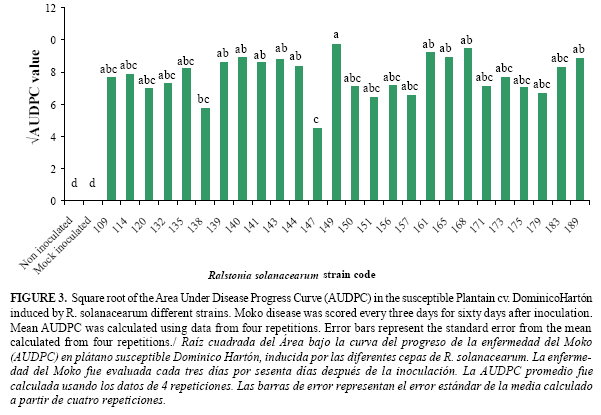
<body><![CDATA[<P><font size="2" face="Verdana, Arial, Helvetica, sans-serif">Strains (Unal-QA05  165) and (Unal-VP05 183) from tomato and strain (Unal-VP05 189) from bell pepper  induced Moko symptoms and caused plant death in at least one plant out from four  inoculated per strain. Strain (Unal-CVm05 161) from potato induced symptoms showing  scale values between 2 and 4 but did not cause death to inoculated plants. Two  strains were obtained from <I>Cucurbita maxima </I>and one of them was pathogenic  to plantain (Unal-VC05 171). All Moko-positive strains showed <I>R. solanacearum</I>  characteristics described by Kelman (14) when re-isolated in semi-selective medium  confirming Koch&#180;s postulates for these 26 strains. </font>     <P><font size="2" face="Verdana, Arial, Helvetica, sans-serif">Positive  strains for Moko disease were obtained from twelve new hosts not reported previously  at the worldwide level: <I>E. graminea, B. piramidatum, P. guajaba, O. latifolia,  C. micrantha, E. indica, G. sepium, L. xalapensis, S. lamioides, C. esculenta,  C. maxima, S. aff. lasiocephala</I>, from which <I>C. maxima, C. esculenta</I>  and <I>P. guajava</I> are cultivated hosts. </font>     <P><font size="2" face="Verdana, Arial, Helvetica, sans-serif">The  AUDPC calculated for 26 positive strains showed different levels of aggressiveness  on plantain cv. Dominico-Hart&oacute;n (<a href="/img/revistas/rpv/v27n3/f0303312.jpg">Figure  3</a>). The strains Unal-QM05 138 (from <I>P. guajava</I>)<I> </I>and Unal-QM05  147 (from <I>C. diffusa</I>), developed Moko disease slowly compared with most  strains that produced AUDPC values similar to strain Unal-VS05 168 original from  plantain (<a href="/img/revistas/rpv/v27n3/f0303312.jpg">Figure 3</a>). Strains  135 and 149 from weeds and 161, 165, 168, 189 from cultivated hosts, grouped together  with the highest AUDPC values (<a href="/img/revistas/rpv/v27n3/f0303312.jpg">Figure  3</a>, <a href="/img/revistas/rpv/v27n3/t2a03312.jpg">Table 2a</a>, <a href="/img/revistas/rpv/v27n3/t2b03312.jpg">Table  2b cont</a>., <a href="/img/revistas/rpv/v27n3/t2c03312.jpg">Table 2c cont</a>.).  </font>     
<P>&nbsp; <H1> <font size="2" face="Verdana, Arial, Helvetica, sans-serif"><B><font size="3">DISCUSSION</font></B>  </font></H1>    <P><font size="2" face="Verdana, Arial, Helvetica, sans-serif">An  effective management of the Moko disease requires knowledge about <I>R. solanacearum</I>  host range, because several plants may act as inoculum reservoirs for important  cultivated crops like banana and plantain. </font>     <P><font size="2" face="Verdana, Arial, Helvetica, sans-serif">In  this work, twelve new hosts for <I>R. solanacearum</I> race 2 were described in  areas where banana, plantain, heliconias, bell pepper, potato and tomato are grown  in Colombia . More than 200 plant species distributed in about 53 families have  been reported as hosts for R<I>. solanacearum</I> (1, 16). In a recent work, we  reported eight new <I>R. solanacearum</I> race 2 hosts: <I>C. nutans</I>, <I>S.  cinerea</I>, <I>T. glandulosa</I>, <I>P. hirtus</I>, <I>P. pellucida</I>, <I>T.  cumanensis</I>, <I>Desmodium </I>sp. and <I>C. sicyoides</I>. The latter (<I>C.  sicyoides</I>) is classified in the botanical family Vitaceae, which any of its  members had previously been reported as host for <I>R. solanacearum</I> race 2  (12). </font>     <P><font size="2" face="Verdana, Arial, Helvetica, sans-serif">A  recent molecular characterization of Colombian strains virulent on <I>Musa</I>  sp. showed that this population was sub-structured (Fst=0,66) with the host as  the main factor of differentiation (17). </font>     <P><font size="2" face="Verdana, Arial, Helvetica, sans-serif">Although  several works have been performed, the basic biology and ecological interactions  between <I>R. solanacearum</I>, its different hosts and the environment are not  completely clear. Our results together with previous reports suggest that <I>R.  solanacearum</I> has an extraordinary wide host range, aggressiveness, environment  adaptation ability and ability to survive in an asymptomatic, symptomatic, systemic  or endophytic way (1, 16). The host range for <I>R. solanacearum </I>race 2 is  wider than the expected one and the bacteria, pathogenic to plantain cv. Dominico-Hart&oacute;n,  can be found in several regions and diverse ecosystems even different from those  in which the plantain or related crops like bananas are frequently found. </font>      <P><font size="2" face="Verdana, Arial, Helvetica, sans-serif">The results obtained  through this work and other reports support the hypothesis that <I>R. solanacearum</I>  exhibits an endophytic phase during its life cycle. This phase is important for  bacteria survival and renovation of soil and host populations (1). Interestingly,  a strain from potato collected at high altitude (3000 meters above mean sea level  (m.s.l)) was pathogenic to plantain cv. Dominico-Hart&oacute;n, which is usually  cultivated below 2000 m.s.l. This finding reflects the remarkable adaptability  of this plant pathogen to different environments, soil types, moisture conditions,  hosts and temperatures. </font>     <P><font size="2" face="Verdana, Arial, Helvetica, sans-serif">The  presence of host weeds in crop fields should be considered for disease prevention  and management. Host range is determined by a number of different factors which  are not completely understood. Some strains such as GMI1000, originally isolated  from tomato in French Guyana, have been reported to have a broad host range, including  different botanical families, whereas other strains have exhibited a narrower  host range (8). Genin (8) pointed out that research on <I>R. solanacearum</I>  host range has two important limitations to be considered. First, some strains  are referenced only from the host they were originally isolated and second, artificial  inoculations may overestimate the natural host range. </font>     ]]></body>
<body><![CDATA[<P><font size="2" face="Verdana, Arial, Helvetica, sans-serif">In  our work we found twelve hosts that might have implications in crop disease management.  Agricultural practices introduce tissue wounds which help bacterial colonization  in a similar way artificial inoculations do and should be considered in disease  control. Asymptomatic infections are a natural reservoir of inocula that contribute  to spread the Moko disease. </font>     <P><font size="2" face="Verdana, Arial, Helvetica, sans-serif"><I>R  solanacearum</I> disease induction is a complex process which involves environmental  and crop conditions, the different hosts and a number of pathogenicity determinants  from the bacterium, named effector proteins (18, 19). Penetration and colonization  of host tissues by the pathogen is a required step for disease induction. Plants  exhibit non-host resistance against most potentially pathogenic microbes which  delimits host range. The nature of this resistance may involve preformed physical  or chemical barriers or induced defense responses activated by microbe associated  molecular patterns (MAMP&#180;s), damage associated molecular patterns (DAMP&#180;s)  or pathogen effector proteins. In addition, <I>R. solanacearum</I> may colonize  some hosts asymptomatically making host range determination a complex scientific  challenge. Unlike most phytopathogenic bacteria, which need natural or wound induced  openings, some <I>R. solanacearum </I>strains are able to invade plants through  intact roots (8). Wounds produced during agricultural labors, insect damage or  artificial inoculations may help overcome natural barriers against plant tissue  infection. Molecular determinants of host range are beginning to be elucidated  (18, 19). Some recent studies reported that some <I>R. solanacearum </I>type 3  secreted effectors may determine host range as exemplified by the <I>AvrA</I>  and the <I>popP1</I> genes from the GMI1000 strain which confer specificity on  tobacco (20). It is expected that during the upcoming years knowledge will increase  to comprehensively understand factors and mechanisms determining <I>R. solanacearum</I>  host range (19, 21). </font>     <P><font size="2" face="Verdana, Arial, Helvetica, sans-serif"><I>R.  solanacearum</I> race 3 induces disease mainly on potato and tomato and other  solanaceous crops and weeds in the higher elevations of the tropics. In this work,  we obtained two strains from tomato (Unal-QA05 165, Unal-VP05 183) and one from  bell pepper (Unal-VP05 189) which induced mild Moko disease and caused plant death  in artificially inoculated plantains. In a previous work, we observed similar  results with one strain from tomato which induced mild disease symptoms in plantain  (12). A similar finding was reported by Buddenhagen (5) in seed-bearing <I>Musa</I>  sp. Belalc&aacute;zar <I>et al</I>. (4) obtained mild symptoms on <I>Physalis  peruviana</I> inoculated with strains from race 1, 2 and 3 and reported <I>P.  peruviana</I> as <I>R. solanacearum </I>resistant. Buddenhagen (5) reported wilt  symptoms in tomato and <I>Physalis angulata</I> L. inoculated with <I>R. solanacearum</I>  strains isolated from abandoned plantain and heliconia plantations in Costa Rica.  </font>     <P><font size="2" face="Verdana, Arial, Helvetica, sans-serif">According  to French (6), the host range under field conditions is well defined; bacteria  may colonize tissues but do not induce disease, which may not reflect completely  the situation under experimental conditions. For example, it is possible that  structural penetration barriers, which may determine host range and the first  defense mechanism, may be surpassed by bacterial artificial injection. Further  evidence was provided by Prior and Fegan (22), who reported ecotypes of <I>R.  solanacearum</I> race 2 inducing characteristic Moko symptoms on <I>Musa</I> spp.  under field conditions and having the ability to be pathogenic on tomato and other  solanaceous plants when the bacteria were stem inoculated; however, these strains  have not been isolated from in-field wilted solanaceous plants. According to French  (6), race 3 is found mainly at high latitudes north or south or at high altitude  in the tropics. In Colombia, race 3 is endemic at altitudes higher than 2200 m.s.l.  French and Gutarra (23) reported that <I>R. solanacearum</I> race 3 was able to  adapt <I>in-vitro </I>to a warm environment. These reports may indicate a possible  explanation for our results. Furthermore, strains classified within race 1 are  widely distributed in the tropics and may infect solanaceaous plants and diploid  bananas (7), showing the ability of one <I>R. solanacearum </I>race to infect  plants from different families. The results achieved in this work may be explained  by a strain with pathogenicity to both tomato and plantain, or by a favorable  environment for the pathogen under the conditions used in this experiment. It  is important to consider that the experimental conditions used in this work may  reflect what could happen under agricultural conditions where labors and inappropriate  tool used may cause plant tissue injuries facilitating pathogen entry, or by roots  pest damage. </font>     <P><font size="2" face="Verdana, Arial, Helvetica, sans-serif">The  fact that AUDPC values observed for most strains were similar to strain Unal-VS05  168 obtained from plantain, could indicate the potential pathogenicity of <I>R.  solanacearum</I> strains from hosts different to those obtained from <I>Musa</I>  sp. This possibility should be considered for crop disease management to prevent  bacteria spread. </font>     <P><font size="2" face="Verdana, Arial, Helvetica, sans-serif">Belalcazar  <I>et al</I>. (4) proposed to eradicate weed and cultivated hosts from quarantined  areas to make an effective Moko control. This measure has proven effective to  diminish Moko incidence in large areas like Urab&aacute; in Colombia (13). Moko  control includes a six month quarantine period on a 5m radius around disease foci  and permanent weed control. Crop rotation may be an alternative for this long  quarantine period, but the increasing <I>R. solanacearum </I>race<I> 2</I> host  range must be an important factor to consider because symptomless plants colonized  by <I>R. solanacearum </I>may be a source of inoculum for banana or plantain re-infection  after the above mentioned quarantine period (12). </font>     <P><font size="2" face="Verdana, Arial, Helvetica, sans-serif">Squash  (<I>C. maxima</I>) is frequently used in the Colombian regions Quind&iacute;o  and Valle del Cauca for crop rotation after banana or plantain eradication during  Moko control. In this work, two <I>R. solanacearum</I> strains were isolated from  <I>C. maxima</I> plants and one was positive for Moko induction in plantain cv.  Dominico-Hart&oacute;n suggesting that squash was not appropriate as a rotation  crop in a banana or plantain Moko eradication program. </font>     <P><font size="2" face="Verdana, Arial, Helvetica, sans-serif">Bacteria  diversity has been classified into four molecular phylotypes which maybe arose  by geographical isolation (22). These phylotypes show little or no correlation  between host range and phylogenetic relationships (8). Wicker <I>et al.</I> (24)  reported a group of strains, some of them obtained from plants of the family Cucurbitaceae<I>,</I>  belonging to phylotype II / sequevar 4 (II/4). Although they clustered with the  group of Moko disease strains, they were not pathogenic to banana. Interestingly,  strains from family Cucurbitaceae were able to asymptomatically infect plantain  (cooking banana) cv. Dominico-Hart&oacute;n (24). </font>     <P><font size="2" face="Verdana, Arial, Helvetica, sans-serif">It  is very important to continue surveys to determine new natural hosts and the role  they play in bacteria dispersion. Host range, particularly asymptomatic hosts,  is one factor that, with many others such as soil and debris bacteria persistence  and survival, early diagnosis, effective quarantine period, crop workers education,  and inoculum dispersion, should be studied in more detail for a better Moko disease  control and eradication.</font>     <P>&nbsp; <H1> <font size="2" face="Verdana, Arial, Helvetica, sans-serif"><B><font size="3">CONCLUSION  AND PERSPECTIVES</font></B> </font></H1>    ]]></body>
<body><![CDATA[<P><font size="2" face="Verdana, Arial, Helvetica, sans-serif">Findings  in this work suggest an insufficient knowledge of <I>R. solanacearum</I> host  range. Surveys in search of an elucidation of a comprehensive host range should  be continued. As cultivated and not cultivated hosts other than banana, plantain  and heliconias may be inoculum sources for disease spread, host management should  be considered within a Moko disease control and eradication program. </font>     <P>&nbsp;  <H1> <font size="2" face="Verdana, Arial, Helvetica, sans-serif"><B><font size="3">ACKNOWLEDGEMENTS</font></B>  </font></H1>    <P><font size="2" face="Verdana, Arial, Helvetica, sans-serif">Authors  would like to express acknowledgements to SENA-COLCIENCIAS for project funding  (project: Development of a method of asymptomatic detection of the banana and  plantain Moko disease PCR-based and applications to disease management, code:  8242-07-16025), to Universidad Nacional de Colombia sede Palmira Research Office  (DIPAL) and to Herbarium MEDEL for the taxonomic plant identification. The funding  source(s) has no involvement in the conduct of the research, preparation of the  paper, the study design, the collection, the analysis and interpretation of data,  the writing of the report or in the decision to submit the paper for publication.</font>      <P>&nbsp;     <P><font size="2" face="Verdana, Arial, Helvetica, sans-serif"><B><font size="3">REFERENCES</font></B>  </font>     <!-- ref --><P><font size="2" face="Verdana, Arial, Helvetica, sans-serif">1. Hayward  AC. Biology and epidemiology of bacterial wilt caused by <I>Pseudomonas solanacearum</I>.  Annu Rev Phytopathol. 1991;29:65-87.     </font>     <!-- ref --><P><font size="2" face="Verdana, Arial, Helvetica, sans-serif">2.  Rodrigues L, Dest&eacute;fano S, Diniz M, Comparoni R, Rodrigues-Neto J. Pathogenicity  of Brazilian strains of <I>Ralstonia solanacearum</I> in <I>Strelitzia reginae  </I>seedlings. Tropical Plant Pathology. 2011;36(6):409-413.     </font>     <!-- ref --><P><font size="2" face="Verdana, Arial, Helvetica, sans-serif">3.  Morales JG, Casta&ntilde;eda D. <I>Ralstonia solanacearum</I>, otro nombre para  <I>Pseudomonas solanacearum</I>, el agente causal del Moko. Carta Inf Augura.  2001;211(1):4-6.     </font>     <!-- ref --><P><font size="2" face="Verdana, Arial, Helvetica, sans-serif">4.  Belalcazar S, Rosales F, Pocasangre L. El &#171;Moko&#187; del pl&aacute;tano  y banano y el rol de las plantas hospederas en su epidemiolog&iacute;a. In XVI  Reuni&oacute;n Internacional de ACORBAT, 26 of September-1 Octubre, Oaxaca, M&eacute;xico.  Publicaci&oacute;n especial; 2004. p. 16-35.     </font>     <!-- ref --><P><font size="2" face="Verdana, Arial, Helvetica, sans-serif">5.  Buddenhagen IW. Bacterial wilt of certain seed-bearing <I>Musa </I>spp caused  by tomato strain of <I>Pseudomonas solanacearum</I>. Phytopathology. 1962;52(3):286.      </font>     <!-- ref --><P><font size="2" face="Verdana, Arial, Helvetica, sans-serif">6. French  ER. Interaction between strains of <I>Ralstonia solanacearum</I>, its hosts and  the environment. In Persley, G.J. (Ed.), Bacterial wilt disease en Asia and the  South Pacific. ACIAR Proceedings, vol. 13. Los Ba&ntilde;os, Philiphines; 1985.p.  99-104.     </font>     <!-- ref --><P><font size="2" face="Verdana, Arial, Helvetica, sans-serif">7.  European Plant Protection Organization (EPPO). <I>Ralstonia solanacearum</I>.  OEPP/EPPO Bulletin. 2004;34:173-178.     </font>     <!-- ref --><P><font size="2" face="Verdana, Arial, Helvetica, sans-serif">8.  Genin S. Molecular traits controlling host range and adaptation to plants in <I>Ralstonia  solanacearum</I>. New Phytologist. 2010;187:920-928.     </font>     <!-- ref --><P><font size="2" face="Verdana, Arial, Helvetica, sans-serif">9.  Cruz L, Eloy M, Quirino F, Oliveira H, Tenreiro R. Molecular epidemiology of <I>Ralstonia  solanacearum</I> strains from plants and environmental sources in Portugal. European  Jour Plant Pathology. 2012;133(3):687-706.     </font>     <!-- ref --><P><font size="2" face="Verdana, Arial, Helvetica, sans-serif">10.Granada  G. Manejo integrado del Moko del pl&aacute;tano (<I>Pseudomonas solanacearum)  </I>bajo condiciones de la zona cafetera del Quind&iacute;o. In Tecnolog&iacute;a  del eje cafetero para la siembra y explotaci&oacute;n rentable del cultivo del  pl&aacute;tano. Comit&eacute; departamental de cafeteros del Quind&iacute;o. Tercer  informe t&eacute;cnico, 1994-1996, Regional 9, CORPOICA, Armenia, Colombia; 1996.  p. 95-96.     </font>     <!-- ref --><P><font size="2" face="Verdana, Arial, Helvetica, sans-serif">11.Munar-Vivas  O, Morales-Osorio J, Casta&ntilde;eda-S&aacute;nchez D. Use of field-integrated  information in GIS-based maps to evaluate Moko disease (<I>Ralstonia solanacearum</I>)  in banana growing farms in Colombia. Crop Protection. 2010;29:936-941.     </font>      <!-- ref --><P><font size="2" face="Verdana, Arial, Helvetica, sans-serif">12.Obreg&oacute;n  M, Rodr&iacute;guez P, Morales J, Salazar M. Hospedantes de <I>Ralstonia solanacearum</I>  en plantaciones de banano y pl&aacute;tano en Colombia. Rev Fac Nal Agr Medell&iacute;n.  2008;61(2):4518-4526.     </font>     <!-- ref --><P><font size="2" face="Verdana, Arial, Helvetica, sans-serif">13.Casta&ntilde;eda  D, Espinosa J. Comportamiento e impacto de la enfermedad de Moko en la zona de  Urab&aacute; (Colombia), en las &uacute;ltimas tres d&eacute;cadas y media y propuesta  de un &iacute;ndice de riesgo de la enfermedad. Rev Fac Nal Agron Medell&iacute;n.  2005;58(1):2587-2599.     </font>     <!-- ref --><P><font size="2" face="Verdana, Arial, Helvetica, sans-serif">14.Kelman  A. The relationship of pathogenicity in <I>Pseudomonas solanacearum</I> to colony  appearance on a tetrazolium medium. Phytopathology. 1954;44(12):693-695.     </font>      <!-- ref --><P><font size="2" face="Verdana, Arial, Helvetica, sans-serif">15.Campbell CL,  Madden LV. Introduction to Plant Disease Epidemiology. John Wiley &amp; Sons,  New York City, 1990. 532p.     </font>     <!-- ref --><P><font size="2" face="Verdana, Arial, Helvetica, sans-serif">16.Kumar  A, Prameela T, Suseela Bhai R, Siljo A, Biju N, Anandaraj M, et al. Small cardamom  (<I>Elettaria cardamomum</I> Maton.) and ginger (<I>Zingiber officinale</I> Roxb)  bacterial wilt is caused by same strain of <I>Ralstonia solanacearum</I>: a result  revealed by multilocus sequence typing (MLST). Eur J Plant Pathol. 2012;132:477-482.      </font>     <!-- ref --><P><font size="2" face="Verdana, Arial, Helvetica, sans-serif">17.Cardozo  C, Rodr&iacute;guez P, Cotes J, Mar&iacute;n M. Variabilidad gen&eacute;tica de  la bacteria <I>Ralstonia solanacearum </I>(Burkholderiales: Burholderiaceae) en  la zona bananera<I> </I>de Urab&aacute; (Colombia).<I> </I>Rev Biol Trop. 2010;58(1):31-44.      </font>     <!-- ref --><P><font size="2" face="Verdana, Arial, Helvetica, sans-serif">18.Genin  S, Denny T. Pathogenomics of the <I>Ralstonia solanacearum </I>Species Complex.  Annu Rev Phytopathol. 2012;50:4.1-4.23.     </font>     <!-- ref --><P><font size="2" face="Verdana, Arial, Helvetica, sans-serif">19.Remigi  P, Anisimova M, Guidot A, Genin S, Peeters N. Functional diversification of the  GALA type III effector family contributes to <I>Ralstonia solanacearum</I> adaptation  on different plant hosts. New Phytologist. 2011;192:976-987.     </font>     <!-- ref --><P><font size="2" face="Verdana, Arial, Helvetica, sans-serif">20.Poueymiro  M, Cunnac S, Barberis P, Deslandes L, Peeters N, Cazale-Noel A, et al. Two Type  III Secretion System Effectors from <I>Ralstonia solanacearum </I>GMI1000 Determine  Host-Range Specificity on Tobacco. Molecular Plant-Microbe Interactions. 2009;22(5):538-550.      </font>     <!-- ref --><P><font size="2" face="Verdana, Arial, Helvetica, sans-serif">21.Wicker  E, Lefeuvre P, de Cambiaire JC, Lemaire C, Poussier S, Prior P. Contrasting recombination  patterns and demographic histories of the plant pathogen <I>Ralstonia solanacearum</I>  inferred from MLSA. ISME J. 2012;6(5):961-74.     </font>     <!-- ref --><P><font size="2" face="Verdana, Arial, Helvetica, sans-serif">22.Prior  P, Fegan M. Recent developments in the phylogeny and classification of <I>Ralstonia  solanacearum</I>. Acta Horticulturae (ISHS). 2005;695:127-136.     </font>     <!-- ref --><P><font size="2" face="Verdana, Arial, Helvetica, sans-serif">23.French  E, Gutarra L. Adaptabilidad de <I>Pseudomonas solanacearum</I> razas 1 y 3 al  fr&iacute;o. In: Res&uacute;menes del II Congreso Nacional de Investigadores Agrarios  del Per&uacute;, 12-16 de Agosto, 1974, Lima, Per&uacute;; 1974. p. 44.     </font>      <!-- ref --><P><font size="2" face="Verdana, Arial, Helvetica, sans-serif">24.Wicker E, Grassart  L, Coranson-Beaudu R, Mian D, Guilbaud C, Fegan M, Prior P. <I>Ralstonia solanacearum  </I>strains from Martinique (French West Indies) exhibiting a new pathogenic potential.  Applied and Environmental Microbiol. 2007;73(21):6790-6801.    </font>     <P>&nbsp;     <P>&nbsp;     <P><font size="2" face="Verdana, Arial, Helvetica, sans-serif">Recibido:  27-1-2012.</font>    <br> <font size="2" face="Verdana, Arial, Helvetica, sans-serif">Aceptado:  24-4-2012.</font>     <P>&nbsp;     <P>&nbsp;     <P><font face="Verdana, Arial, Helvetica, sans-serif" size="2">*<a href="#correspondencia">Author  for correspondence</a><a name="autor"></a>: <i>Mauricio Salazar Yepes.</i> Professor,  IA. MSc, PhD, Universidad Nacional de Colombia, sede Medell&iacute;n, Facultad  de Ciencias, Escuela de Biociencias. E-mail: <u><a href="mailto:masalazay@unal.edu.co">masalazay@unal.edu.co</a></u></font>      ]]></body>
<body><![CDATA[ ]]></body><back>
<ref-list>
<ref id="B1">
<label>1</label><nlm-citation citation-type="journal">
<person-group person-group-type="author">
<name>
<surname><![CDATA[Hayward]]></surname>
<given-names><![CDATA[AC]]></given-names>
</name>
</person-group>
<article-title xml:lang="en"><![CDATA[Biology and epidemiology of bacterial wilt caused by Pseudomonas solanacearum]]></article-title>
<source><![CDATA[Annu Rev Phytopathol]]></source>
<year>1991</year>
<volume>29</volume>
<page-range>65-87</page-range></nlm-citation>
</ref>
<ref id="B2">
<label>2</label><nlm-citation citation-type="journal">
<person-group person-group-type="author">
<name>
<surname><![CDATA[Rodrigues]]></surname>
<given-names><![CDATA[L]]></given-names>
</name>
<name>
<surname><![CDATA[Destéfano]]></surname>
<given-names><![CDATA[S]]></given-names>
</name>
<name>
<surname><![CDATA[Diniz]]></surname>
<given-names><![CDATA[M]]></given-names>
</name>
<name>
<surname><![CDATA[Comparoni]]></surname>
<given-names><![CDATA[R]]></given-names>
</name>
<name>
<surname><![CDATA[Rodrigues-Neto]]></surname>
<given-names><![CDATA[J]]></given-names>
</name>
</person-group>
<article-title xml:lang="en"><![CDATA[Pathogenicity of Brazilian strains of Ralstonia solanacearum in Strelitzia reginae seedlings]]></article-title>
<source><![CDATA[Tropical Plant Pathology]]></source>
<year>2011</year>
<volume>36</volume>
<numero>6</numero>
<issue>6</issue>
<page-range>409-413</page-range></nlm-citation>
</ref>
<ref id="B3">
<label>3</label><nlm-citation citation-type="journal">
<person-group person-group-type="author">
<name>
<surname><![CDATA[Morales]]></surname>
<given-names><![CDATA[JG]]></given-names>
</name>
<name>
<surname><![CDATA[Castañeda]]></surname>
<given-names><![CDATA[D]]></given-names>
</name>
</person-group>
<article-title xml:lang="es"><![CDATA[Ralstonia solanacearum, otro nombre para Pseudomonas solanacearum, el agente causal del Moko]]></article-title>
<source><![CDATA[Carta Inf Augura]]></source>
<year>2001</year>
<volume>211</volume>
<numero>1</numero>
<issue>1</issue>
<page-range>4-6</page-range></nlm-citation>
</ref>
<ref id="B4">
<label>4</label><nlm-citation citation-type="">
<person-group person-group-type="author">
<name>
<surname><![CDATA[Belalcazar]]></surname>
<given-names><![CDATA[S]]></given-names>
</name>
<name>
<surname><![CDATA[Rosales]]></surname>
<given-names><![CDATA[F]]></given-names>
</name>
<name>
<surname><![CDATA[Pocasangre]]></surname>
<given-names><![CDATA[L]]></given-names>
</name>
</person-group>
<article-title xml:lang="es"><![CDATA[El «Moko» del plátano y banano y el rol de las plantas hospederas en su epidemiología]]></article-title>
<source><![CDATA[XVI Reunión Internacional de ACORBAT]]></source>
<year>2004</year>
<page-range>16-35</page-range><publisher-loc><![CDATA[Oaxaca^eMéxico México]]></publisher-loc>
</nlm-citation>
</ref>
<ref id="B5">
<label>5</label><nlm-citation citation-type="journal">
<person-group person-group-type="author">
<name>
<surname><![CDATA[Buddenhagen]]></surname>
<given-names><![CDATA[IW]]></given-names>
</name>
</person-group>
<article-title xml:lang="en"><![CDATA[Bacterial wilt of certain seed-bearing Musa spp caused by tomato strain of Pseudomonas solanacearum]]></article-title>
<source><![CDATA[Phytopathology]]></source>
<year>1962</year>
<volume>52</volume>
<numero>3</numero>
<issue>3</issue>
<page-range>286</page-range></nlm-citation>
</ref>
<ref id="B6">
<label>6</label><nlm-citation citation-type="">
<person-group person-group-type="author">
<name>
<surname><![CDATA[French]]></surname>
<given-names><![CDATA[ER]]></given-names>
</name>
</person-group>
<article-title xml:lang="en"><![CDATA[Interaction between strains of Ralstonia solanacearum, its hosts and the environment]]></article-title>
<person-group person-group-type="editor">
<name>
<surname><![CDATA[Persley]]></surname>
<given-names><![CDATA[G.J]]></given-names>
</name>
</person-group>
<source><![CDATA[Bacterial wilt disease en Asia and the South Pacific: ACIAR Proceedings]]></source>
<year>1985</year>
<page-range>99-104</page-range><publisher-loc><![CDATA[Los Baños^ePhiliphines Philiphines]]></publisher-loc>
</nlm-citation>
</ref>
<ref id="B7">
<label>7</label><nlm-citation citation-type="journal">
<collab>European Plant Protection Organization</collab>
<article-title xml:lang="en"><![CDATA[Ralstonia solanacearum]]></article-title>
<source><![CDATA[OEPP/EPPO Bulletin]]></source>
<year>2004</year>
<volume>34</volume>
<page-range>173-178</page-range></nlm-citation>
</ref>
<ref id="B8">
<label>8</label><nlm-citation citation-type="journal">
<person-group person-group-type="author">
<name>
<surname><![CDATA[Genin]]></surname>
<given-names><![CDATA[S]]></given-names>
</name>
</person-group>
<article-title xml:lang="en"><![CDATA[Molecular traits controlling host range and adaptation to plants in Ralstonia solanacearum]]></article-title>
<source><![CDATA[New Phytologist]]></source>
<year>2010</year>
<volume>187</volume>
<page-range>920-928</page-range></nlm-citation>
</ref>
<ref id="B9">
<label>9</label><nlm-citation citation-type="journal">
<person-group person-group-type="author">
<name>
<surname><![CDATA[Cruz]]></surname>
<given-names><![CDATA[L]]></given-names>
</name>
<name>
<surname><![CDATA[Eloy]]></surname>
<given-names><![CDATA[M]]></given-names>
</name>
<name>
<surname><![CDATA[Quirino]]></surname>
<given-names><![CDATA[F]]></given-names>
</name>
<name>
<surname><![CDATA[Oliveira]]></surname>
<given-names><![CDATA[H]]></given-names>
</name>
<name>
<surname><![CDATA[Tenreiro]]></surname>
<given-names><![CDATA[R]]></given-names>
</name>
</person-group>
<article-title xml:lang="en"><![CDATA[Molecular epidemiology of Ralstonia solanacearum strains from plants and environmental sources in Portugal]]></article-title>
<source><![CDATA[European Jour Plant Pathology]]></source>
<year>2012</year>
<volume>133</volume>
<numero>3</numero>
<issue>3</issue>
<page-range>687-706</page-range></nlm-citation>
</ref>
<ref id="B10">
<label>10</label><nlm-citation citation-type="">
<person-group person-group-type="author">
<name>
<surname><![CDATA[Granada]]></surname>
<given-names><![CDATA[G]]></given-names>
</name>
</person-group>
<article-title xml:lang="es"><![CDATA[Manejo integrado del Moko del plátano (Pseudomonas solanacearum) bajo condiciones de la zona cafetera del Quindío]]></article-title>
<source><![CDATA[]]></source>
<year>1996</year>
<page-range>95-96</page-range><publisher-loc><![CDATA[Armenia^eColombia Colombia]]></publisher-loc>
</nlm-citation>
</ref>
<ref id="B11">
<label>11</label><nlm-citation citation-type="journal">
<person-group person-group-type="author">
<name>
<surname><![CDATA[Munar-Vivas]]></surname>
<given-names><![CDATA[O]]></given-names>
</name>
<name>
<surname><![CDATA[Morales-Osorio]]></surname>
<given-names><![CDATA[J]]></given-names>
</name>
<name>
<surname><![CDATA[Castañeda-Sánchez]]></surname>
<given-names><![CDATA[D]]></given-names>
</name>
</person-group>
<article-title xml:lang="en"><![CDATA[Use of field-integrated information in GIS-based maps to evaluate Moko disease (Ralstonia solanacearum) in banana growing farms in Colombia]]></article-title>
<source><![CDATA[Crop Protection]]></source>
<year>2010</year>
<volume>29</volume>
<page-range>936-941</page-range></nlm-citation>
</ref>
<ref id="B12">
<label>12</label><nlm-citation citation-type="journal">
<person-group person-group-type="author">
<name>
<surname><![CDATA[Obregón]]></surname>
<given-names><![CDATA[M]]></given-names>
</name>
<name>
<surname><![CDATA[Rodríguez]]></surname>
<given-names><![CDATA[P]]></given-names>
</name>
<name>
<surname><![CDATA[Morales]]></surname>
<given-names><![CDATA[J]]></given-names>
</name>
<name>
<surname><![CDATA[Salazar]]></surname>
<given-names><![CDATA[M]]></given-names>
</name>
</person-group>
<article-title xml:lang="es"><![CDATA[Hospedantes de Ralstonia solanacearum en plantaciones de banano y plátano en Colombia]]></article-title>
<source><![CDATA[Rev Fac Nal Agr Medellín]]></source>
<year>2008</year>
<volume>61</volume>
<numero>2</numero>
<issue>2</issue>
<page-range>4518-4526</page-range></nlm-citation>
</ref>
<ref id="B13">
<label>13</label><nlm-citation citation-type="journal">
<person-group person-group-type="author">
<name>
<surname><![CDATA[Castañeda]]></surname>
<given-names><![CDATA[D]]></given-names>
</name>
<name>
<surname><![CDATA[Espinosa]]></surname>
<given-names><![CDATA[J]]></given-names>
</name>
</person-group>
<article-title xml:lang="es"><![CDATA[Comportamiento e impacto de la enfermedad de Moko en la zona de Urabá (Colombia), en las últimas tres décadas y media y propuesta de un índice de riesgo de la enfermedad]]></article-title>
<source><![CDATA[Rev Fac Nal Agron Medellín]]></source>
<year>2005</year>
<volume>58</volume>
<numero>1</numero>
<issue>1</issue>
<page-range>2587-2599</page-range></nlm-citation>
</ref>
<ref id="B14">
<label>14</label><nlm-citation citation-type="journal">
<person-group person-group-type="author">
<name>
<surname><![CDATA[Kelman]]></surname>
<given-names><![CDATA[A]]></given-names>
</name>
</person-group>
<article-title xml:lang="en"><![CDATA[The relationship of pathogenicity in Pseudomonas solanacearum to colony appearance on a tetrazolium medium]]></article-title>
<source><![CDATA[Phytopathology]]></source>
<year>1954</year>
<volume>44</volume>
<numero>12</numero>
<issue>12</issue>
<page-range>693-695</page-range></nlm-citation>
</ref>
<ref id="B15">
<label>15</label><nlm-citation citation-type="book">
<person-group person-group-type="author">
<name>
<surname><![CDATA[Campbell]]></surname>
<given-names><![CDATA[CL]]></given-names>
</name>
<name>
<surname><![CDATA[Madden]]></surname>
<given-names><![CDATA[LV]]></given-names>
</name>
</person-group>
<source><![CDATA[Introduction to Plant Disease Epidemiology]]></source>
<year>1990</year>
<page-range>532</page-range><publisher-loc><![CDATA[New York City ]]></publisher-loc>
<publisher-name><![CDATA[John Wiley & Sons]]></publisher-name>
</nlm-citation>
</ref>
<ref id="B16">
<label>16</label><nlm-citation citation-type="journal">
<person-group person-group-type="author">
<name>
<surname><![CDATA[Kumar]]></surname>
<given-names><![CDATA[A]]></given-names>
</name>
<name>
<surname><![CDATA[Prameela]]></surname>
<given-names><![CDATA[T]]></given-names>
</name>
<name>
<surname><![CDATA[Suseela]]></surname>
<given-names><![CDATA[Bhai R]]></given-names>
</name>
<name>
<surname><![CDATA[Siljo]]></surname>
<given-names><![CDATA[A]]></given-names>
</name>
<name>
<surname><![CDATA[Biju]]></surname>
<given-names><![CDATA[N]]></given-names>
</name>
<name>
<surname><![CDATA[Anandaraj]]></surname>
<given-names><![CDATA[M]]></given-names>
</name>
</person-group>
<article-title xml:lang="en"><![CDATA[Small cardamom (Elettaria cardamomum Maton.) and ginger (Zingiber officinale Roxb) bacterial wilt is caused by same strain of Ralstonia solanacearum: a result revealed by multilocus sequence typing (MLST)]]></article-title>
<source><![CDATA[Eur J Plant Pathol]]></source>
<year>2012</year>
<volume>132</volume>
<page-range>477-482</page-range></nlm-citation>
</ref>
<ref id="B17">
<label>17</label><nlm-citation citation-type="journal">
<person-group person-group-type="author">
<name>
<surname><![CDATA[Cardozo]]></surname>
<given-names><![CDATA[C]]></given-names>
</name>
<name>
<surname><![CDATA[Rodríguez]]></surname>
<given-names><![CDATA[P]]></given-names>
</name>
<name>
<surname><![CDATA[Cotes]]></surname>
<given-names><![CDATA[J]]></given-names>
</name>
<name>
<surname><![CDATA[Marín]]></surname>
<given-names><![CDATA[M]]></given-names>
</name>
</person-group>
<article-title xml:lang="es"><![CDATA[Variabilidad genética de la bacteria Ralstonia solanacearum (Burkholderiales: Burholderiaceae) en la zona bananera de Urabá (Colombia)]]></article-title>
<source><![CDATA[Rev Biol Trop]]></source>
<year>2010</year>
<volume>58</volume>
<numero>1</numero>
<issue>1</issue>
<page-range>31-44</page-range></nlm-citation>
</ref>
<ref id="B18">
<label>18</label><nlm-citation citation-type="journal">
<person-group person-group-type="author">
<name>
<surname><![CDATA[Genin]]></surname>
<given-names><![CDATA[S]]></given-names>
</name>
<name>
<surname><![CDATA[Denny]]></surname>
<given-names><![CDATA[T]]></given-names>
</name>
</person-group>
<article-title xml:lang="en"><![CDATA[Pathogenomics of the Ralstonia solanacearum Species Complex]]></article-title>
<source><![CDATA[Annu Rev Phytopathol]]></source>
<year>2012</year>
<volume>50</volume>
<page-range>4.1-4.23</page-range></nlm-citation>
</ref>
<ref id="B19">
<label>19</label><nlm-citation citation-type="journal">
<person-group person-group-type="author">
<name>
<surname><![CDATA[Remigi]]></surname>
<given-names><![CDATA[P]]></given-names>
</name>
<name>
<surname><![CDATA[Anisimova]]></surname>
<given-names><![CDATA[M]]></given-names>
</name>
<name>
<surname><![CDATA[Guidot]]></surname>
<given-names><![CDATA[A]]></given-names>
</name>
<name>
<surname><![CDATA[Genin]]></surname>
<given-names><![CDATA[S]]></given-names>
</name>
<name>
<surname><![CDATA[Peeters]]></surname>
<given-names><![CDATA[N]]></given-names>
</name>
</person-group>
<article-title xml:lang="en"><![CDATA[Functional diversification of the GALA type III effector family contributes to Ralstonia solanacearum adaptation on different plant hosts]]></article-title>
<source><![CDATA[New Phytologist]]></source>
<year>2011</year>
<volume>192</volume>
<page-range>976-987</page-range></nlm-citation>
</ref>
<ref id="B20">
<label>20</label><nlm-citation citation-type="journal">
<person-group person-group-type="author">
<name>
<surname><![CDATA[Poueymiro]]></surname>
<given-names><![CDATA[M]]></given-names>
</name>
<name>
<surname><![CDATA[Cunnac]]></surname>
<given-names><![CDATA[S]]></given-names>
</name>
<name>
<surname><![CDATA[Barberis]]></surname>
<given-names><![CDATA[P]]></given-names>
</name>
<name>
<surname><![CDATA[Deslandes]]></surname>
<given-names><![CDATA[L]]></given-names>
</name>
<name>
<surname><![CDATA[Peeters]]></surname>
<given-names><![CDATA[N]]></given-names>
</name>
<name>
<surname><![CDATA[Cazale-Noel]]></surname>
<given-names><![CDATA[A]]></given-names>
</name>
</person-group>
<article-title xml:lang="en"><![CDATA[Two Type III Secretion System Effectors from Ralstonia solanacearum GMI1000 Determine Host-Range Specificity on Tobacco]]></article-title>
<source><![CDATA[Molecular Plant-Microbe Interactions]]></source>
<year>2009</year>
<volume>22</volume>
<numero>5</numero>
<issue>5</issue>
<page-range>538-550</page-range></nlm-citation>
</ref>
<ref id="B21">
<label>21</label><nlm-citation citation-type="journal">
<person-group person-group-type="author">
<name>
<surname><![CDATA[Wicker]]></surname>
<given-names><![CDATA[E]]></given-names>
</name>
<name>
<surname><![CDATA[Lefeuvre]]></surname>
<given-names><![CDATA[P]]></given-names>
</name>
<name>
<surname><![CDATA[de Cambiaire]]></surname>
<given-names><![CDATA[JC]]></given-names>
</name>
<name>
<surname><![CDATA[Lemaire]]></surname>
<given-names><![CDATA[C]]></given-names>
</name>
<name>
<surname><![CDATA[Poussier]]></surname>
<given-names><![CDATA[S]]></given-names>
</name>
<name>
<surname><![CDATA[Prior]]></surname>
<given-names><![CDATA[P]]></given-names>
</name>
</person-group>
<article-title xml:lang="en"><![CDATA[Contrasting recombination patterns and demographic histories of the plant pathogen Ralstonia solanacearum inferred from MLSA]]></article-title>
<source><![CDATA[ISME J]]></source>
<year>2012</year>
<volume>6</volume>
<numero>5</numero>
<issue>5</issue>
<page-range>961-74</page-range></nlm-citation>
</ref>
<ref id="B22">
<label>22</label><nlm-citation citation-type="journal">
<person-group person-group-type="author">
<name>
<surname><![CDATA[Prior]]></surname>
<given-names><![CDATA[P]]></given-names>
</name>
<name>
<surname><![CDATA[Fegan]]></surname>
<given-names><![CDATA[M]]></given-names>
</name>
</person-group>
<article-title xml:lang="en"><![CDATA[Recent developments in the phylogeny and classification of Ralstonia solanacearum]]></article-title>
<source><![CDATA[Acta Horticulturae (ISHS)]]></source>
<year>2005</year>
<volume>695</volume>
<page-range>127-136</page-range></nlm-citation>
</ref>
<ref id="B23">
<label>23</label><nlm-citation citation-type="confpro">
<person-group person-group-type="author">
<name>
<surname><![CDATA[French]]></surname>
<given-names><![CDATA[E]]></given-names>
</name>
<name>
<surname><![CDATA[Gutarra]]></surname>
<given-names><![CDATA[L]]></given-names>
</name>
</person-group>
<article-title xml:lang="es"><![CDATA[Adaptabilidad de Pseudomonas solanacearum razas 1 y 3 al frío]]></article-title>
<source><![CDATA[]]></source>
<year></year>
<conf-name><![CDATA[ Resúmenes del II Congreso Nacional de Investigadores Agrarios del Perú]]></conf-name>
<conf-date>Agosto, 1974</conf-date>
<conf-loc>Lima </conf-loc>
</nlm-citation>
</ref>
<ref id="B24">
<label>24</label><nlm-citation citation-type="journal">
<person-group person-group-type="author">
<name>
<surname><![CDATA[Wicker]]></surname>
<given-names><![CDATA[E]]></given-names>
</name>
<name>
<surname><![CDATA[Grassart]]></surname>
<given-names><![CDATA[L]]></given-names>
</name>
<name>
<surname><![CDATA[Coranson-Beaudu]]></surname>
<given-names><![CDATA[R]]></given-names>
</name>
<name>
<surname><![CDATA[Mian]]></surname>
<given-names><![CDATA[D]]></given-names>
</name>
<name>
<surname><![CDATA[Guilbaud]]></surname>
<given-names><![CDATA[C]]></given-names>
</name>
<name>
<surname><![CDATA[Fegan]]></surname>
<given-names><![CDATA[M]]></given-names>
</name>
<name>
<surname><![CDATA[Prior]]></surname>
<given-names><![CDATA[P]]></given-names>
</name>
</person-group>
<article-title xml:lang="en"><![CDATA[Ralstonia solanacearum strains from Martinique (French West Indies) exhibiting a new pathogenic potential]]></article-title>
<source><![CDATA[Applied and Environmental Microbiol]]></source>
<year>2007</year>
<volume>73</volume>
<numero>21</numero>
<issue>21</issue>
<page-range>6790-6801</page-range></nlm-citation>
</ref>
</ref-list>
</back>
</article>