<?xml version="1.0" encoding="ISO-8859-1"?><article xmlns:mml="http://www.w3.org/1998/Math/MathML" xmlns:xlink="http://www.w3.org/1999/xlink" xmlns:xsi="http://www.w3.org/2001/XMLSchema-instance">
<front>
<journal-meta>
<journal-id>1010-2752</journal-id>
<journal-title><![CDATA[Revista de Protección Vegetal]]></journal-title>
<abbrev-journal-title><![CDATA[Rev. Protección Veg.]]></abbrev-journal-title>
<issn>1010-2752</issn>
<publisher>
<publisher-name><![CDATA[Centro Nacional de Sanidad Agropecuaria]]></publisher-name>
</publisher>
</journal-meta>
<article-meta>
<article-id>S1010-27522013000100006</article-id>
<title-group>
<article-title xml:lang="en"><![CDATA[Characterization of Citrus tristeza virus isolates from Colombia]]></article-title>
<article-title xml:lang="es"><![CDATA[Caracterización de aislamientos de Citrus tristeza virus de Colombia]]></article-title>
</title-group>
<contrib-group>
<contrib contrib-type="author">
<name>
<surname><![CDATA[Morales]]></surname>
<given-names><![CDATA[Juan]]></given-names>
</name>
<xref ref-type="aff" rid="A01"/>
</contrib>
<contrib contrib-type="author">
<name>
<surname><![CDATA[Orlando]]></surname>
<given-names><![CDATA[Acosta]]></given-names>
</name>
<xref ref-type="aff" rid="A02"/>
</contrib>
<contrib contrib-type="author">
<name>
<surname><![CDATA[Tamayo]]></surname>
<given-names><![CDATA[Pablo]]></given-names>
</name>
<xref ref-type="aff" rid="A03"/>
</contrib>
<contrib contrib-type="author">
<name>
<surname><![CDATA[Peñaranda]]></surname>
<given-names><![CDATA[José]]></given-names>
</name>
<xref ref-type="aff" rid="A02"/>
</contrib>
</contrib-group>
<aff id="A01">
<institution><![CDATA[,Universidad Nacional de Colombia sede Medellín , Departamento de Ciencias Agronómicas ]]></institution>
<addr-line><![CDATA[ ]]></addr-line>
<country>Colombia</country>
</aff>
<aff id="A02">
<institution><![CDATA[,Universidad Nacional de Colombia sede Bogotá  ]]></institution>
<addr-line><![CDATA[ ]]></addr-line>
<country>Colombia</country>
</aff>
<aff id="A03">
<institution><![CDATA[,Corporación Colombiana de Investigación Agropecuaria  ]]></institution>
<addr-line><![CDATA[ ]]></addr-line>
<country>Colombia</country>
</aff>
<pub-date pub-type="pub">
<day>00</day>
<month>04</month>
<year>2013</year>
</pub-date>
<pub-date pub-type="epub">
<day>00</day>
<month>04</month>
<year>2013</year>
</pub-date>
<volume>28</volume>
<numero>1</numero>
<fpage>45</fpage>
<lpage>53</lpage>
<copyright-statement/>
<copyright-year/>
<self-uri xlink:href="http://scielo.sld.cu/scielo.php?script=sci_arttext&amp;pid=S1010-27522013000100006&amp;lng=en&amp;nrm=iso"></self-uri><self-uri xlink:href="http://scielo.sld.cu/scielo.php?script=sci_abstract&amp;pid=S1010-27522013000100006&amp;lng=en&amp;nrm=iso"></self-uri><self-uri xlink:href="http://scielo.sld.cu/scielo.php?script=sci_pdf&amp;pid=S1010-27522013000100006&amp;lng=en&amp;nrm=iso"></self-uri><abstract abstract-type="short" xml:lang="en"><p><![CDATA[Isolates of Citrus tristeza virus around the world differ widely in their biological properties. These properties may depend on strain mixtures within individual trees. Monoclonal Antibody 13 (MCA13) is an antibody that detects almost all the severe strains causing Quick Decline and Stem Pitting CTV syndromes. The objectives of this work were: I) to determine the percentage of CTV isolates reactive to the MCA13 antibody in each Colombian region evaluated and II) to analyze the genetic diversity of isolates from these regions. In almost all the regions evaluated, CTV MCA13 reactive isolates were identified; however, only one was found in Mompox area. The coat protein gene was amplified by reverse transcription-polymerase chain reaction (RT-PCR) and analyzed by single strain conformational polymorphisms (SSCP) patterns. In this work, at least twelve different dsRNA electrophoretic profiles and seven SSCP different electrophoretic patterns were identified. At least two different isolates were shown to be a mixture of strains. Non reactive strains to MAC13 from the Mompox region could be the best candidates for a Tristeza disease cross-protection program.]]></p></abstract>
<abstract abstract-type="short" xml:lang="es"><p><![CDATA[Los aislamientos de Citrus tristeza virus de diferentes regiones del mundo difieren en sus propiedades biológicas. Esas propiedades pueden depender de mezclas de cepas en el interior de árboles individuales. El anticuerpo monoclonal MCA13 detecta casi todas las cepas severas que causan los síndromes de declinamiento rápido y acanalamiento de tallos. Este trabajo tuvo como objetivos: I) determinar el porcentaje de aislamientos de CTV reactivos al anticuerpo monoclonal MCA13, en cada región Colombiana evaluada y II) analizar la diversidad genética de los aislamientos provenientes de esas regiones. En este trabajo identificamos aislamientos de CTV reactivos al MCA13 en casi todas las regiones de Colombia; sin embargo en Mompox, solamente se encontró uno. La proteína de la cápside fue amplificada por transcripción reversa seguida de la reacción en cadena de la polimerasa y los patrones de polimorfismo conformacional de una sola hebra (SSCP) fueron analizados. Se identificaron al menos 12 perfiles electroforéticos de RNA de doble hebra y siete perfiles SSCP. Se encontró que al menos dos aislamientos diferentes están compuestos de mezclas de cepas. Las cepas no reactivas al MCA13 podrían ser buenas candidatas para un programa de protección cruzada.]]></p></abstract>
<kwd-group>
<kwd lng="en"><![CDATA[virus cross-protection]]></kwd>
<kwd lng="en"><![CDATA[citrus tristeza disease]]></kwd>
<kwd lng="en"><![CDATA[Citrus spp]]></kwd>
<kwd lng="en"><![CDATA[RT-PCR]]></kwd>
<kwd lng="en"><![CDATA[SSCP]]></kwd>
<kwd lng="es"><![CDATA[protección cruzada en virus]]></kwd>
<kwd lng="es"><![CDATA[enfermedad de la tristeza de los cítricos]]></kwd>
<kwd lng="es"><![CDATA[Citrus spp]]></kwd>
<kwd lng="es"><![CDATA[RT-PCR]]></kwd>
<kwd lng="es"><![CDATA[SSCP]]></kwd>
</kwd-group>
</article-meta>
</front><body><![CDATA[ <p align="right"><font face="Verdana, Arial, Helvetica, sans-serif" size="2"><B>ORIGINAL    ARTICLE</B></font></p>     <p>&nbsp; </p> <H1> <font face="Verdana, Arial, Helvetica, sans-serif" size="2"><B><font size="4">Characterization    of <I>Citrus tristeza virus</I> isolates from Colombia</font></B></font></H1>     <p><font face="Verdana, Arial, Helvetica, sans-serif" size="2"><b></b></font></p> <h1> <font face="Verdana, Arial, Helvetica, sans-serif" size="2"><b><font size="3">Caracterizaci&oacute;n    de aislamientos de<i> Citrus tristeza virus</i> de Colombia </font></b></font></h1>     <p>&nbsp;</p>     <p>&nbsp;</p> <H1><font face="Verdana, Arial, Helvetica, sans-serif" size="2">Juan Morales<SUP>I*</SUP>,    Orlando Acosta<SUP>II</SUP>, Pablo Tamayo<SUP>III</SUP>, Jos&eacute; Pe&ntilde;aranda<SUP>II,<a href="#inicio">&#134;</a><a name="pie"></a></SUP></font>  </H1>     <P><font face="Verdana, Arial, Helvetica, sans-serif" size="2"><SUP> I</SUP>Universidad    Nacional de Colombia sede Medell&iacute;n, Departamento de Ciencias Agron&oacute;micas.    Calle 59A No 63-20,     <BR>   N&uacute;cleo el Volador, Bloque 11. Medell&iacute;n-Colombia. Tel: 0057 4 4309099,    fax: 0057 4 4309118. E-mail: <U><a href="mailto:jgmoraleso@unal.edu.co">jgmoraleso@unal.edu.co</a></U>.    <SUP>    <br>   II</SUP>Universidad Nacional de Colombia sede Bogot&aacute;, Colombia. Departamento    de Ciencias Fisiol&oacute;gicas. <SUP>    <br>   III</SUP>Corporaci&oacute;n Colombiana de Investigaci&oacute;n Agropecuaria,    CORPOICA. Regional 4 &quot;La Selva&quot;, Rionegro-Antioquia, Colombia.</font>      <P>&nbsp;     ]]></body>
<body><![CDATA[<P>&nbsp; <hr noshade size="1">     <P><font face="Verdana, Arial, Helvetica, sans-serif" size="2"><B>ABSTRACT</B></font>     <P><font face="Verdana, Arial, Helvetica, sans-serif" size="2">Isolates of <I>Citrus    tristeza virus</I> around the world differ widely in their biological properties.    These properties may depend on strain mixtures within individual trees. Monoclonal    Antibody 13 (MCA13) is an antibody that detects almost all the severe strains    causing Quick Decline and Stem Pitting CTV syndromes. The objectives of this    work were: I) to determine the percentage of CTV isolates reactive to the MCA13    antibody in each Colombian region evaluated and II) to analyze the genetic diversity    of isolates from these regions. In almost all the regions evaluated, CTV MCA13    reactive isolates were identified; however, only one was found in Mompox area.    The coat protein gene was amplified by reverse transcription-polymerase chain    reaction (RT-PCR) and analyzed by single strain conformational polymorphisms    (SSCP) patterns. In this work, at least twelve different dsRNA electrophoretic    profiles and seven SSCP different electrophoretic patterns were identified.    At least two different isolates were shown to be a mixture of strains. Non reactive    strains to MAC13 from the Mompox region could be the best candidates for a <I>Tristeza</I>    disease cross-protection program. </font>     <P><font face="Verdana, Arial, Helvetica, sans-serif" size="2"><B>Key words:</B>    virus cross-protection, citrus tristeza disease, <I>Citrus</I> spp., RT-PCR,    SSCP.</font> <hr noshade size="1"> <H1><font face="Verdana, Arial, Helvetica, sans-serif" size="2"><B>RESUMEN</b></font></H1> <font face="Verdana, Arial, Helvetica, sans-serif" size="2">Los aislamientos de  <I>Citrus tristeza virus</I> de diferentes regiones del mundo difieren en sus  propiedades biol&oacute;gicas. Esas propiedades pueden depender de mezclas de  cepas en el interior de &aacute;rboles individuales. El anticuerpo monoclonal  MCA13 detecta casi todas las cepas severas que causan los s&iacute;ndromes de  declinamiento r&aacute;pido y acanalamiento de tallos. Este trabajo tuvo como  objetivos: I) determinar el porcentaje de aislamientos de CTV reactivos al anticuerpo  monoclonal MCA13, en cada regi&oacute;n Colombiana evaluada y II) analizar la  diversidad gen&eacute;tica de los aislamientos provenientes de esas regiones.  En este trabajo identificamos aislamientos de CTV reactivos al MCA13 en casi todas  las regiones de Colombia; sin embargo en Mompox, solamente se encontr&oacute;  uno. La prote&iacute;na de la c&aacute;pside fue amplificada por transcripci&oacute;n  reversa seguida de la reacci&oacute;n en cadena de la polimerasa y los patrones  de polimorfismo conformacional de una sola hebra (SSCP) fueron analizados. Se  identificaron al menos 12 perfiles electrofor&eacute;ticos de RNA de doble hebra  y siete perfiles SSCP. Se encontr&oacute; que al menos dos aislamientos diferentes  est&aacute;n compuestos de mezclas de cepas. Las cepas no reactivas al MCA13 podr&iacute;an  ser buenas candidatas para un programa de protecci&oacute;n cruzada.</font>      <P><font face="Verdana, Arial, Helvetica, sans-serif" size="2"><B>Palabras clave:</B>    protecci&oacute;n cruzada en virus, enfermedad de la tristeza de los c&iacute;tricos,    <I>Citrus</I> spp., RT-PCR, SSCP.</font>  <hr noshade size="1">     <P>&nbsp;     <P>&nbsp;     <P><font face="Verdana, Arial, Helvetica, sans-serif" size="2"><B><font size="3">INTRODUCTION</font></B>    </font>     <P><font face="Verdana, Arial, Helvetica, sans-serif" size="2"><I>Citrus tristeza    virus</I> (CTV) is a member of the genus <I>Closterovirus</I>, family <I>Closteroviridae</I>    of (+) sense, single-stranded RNA plant viruses. CTV is a phloem virus associated    with a host range primarily in the genus <I>Citrus </I>(1)<I>.</I> Virus strains    induce various economically important diseases worldwide and are a significant    threat to citrus production (1). CTV produces several symptoms depending on    the host and the bud and scion combination on graft (1). Main symptoms are quick    decline, seedling yellowing and stem pitting (2). </font>     <P><font face="Verdana, Arial, Helvetica, sans-serif" size="2">Virus particles    spread through aphid transmission and vegetative propagation (1); <I>Toxoptera    citricida</I> is the most efficient vector within the aphids and is spreading    around the world from South Africa to South America reaching Florida-USA, Madeira    Island, and Mainland Portugal (3). The complete viral genome sequence is available    (1), allowing for extensive molecular analysis, detection and strain characterization    in several countries around the world (1). </font>     ]]></body>
<body><![CDATA[<P><font face="Verdana, Arial, Helvetica, sans-serif" size="2">CTV detection is    possible either by polyclonal or monoclonal antibodies (1). The monoclonal antibody    MCA13 can detect 95% of severe strains causing quick decline and stem pitting    in sweet orange grafted onto sour orange seedlings (4). In a previous survey    made in Colombia, a CTV incidence of 95% was quantified using polyclonal and    monoclonal antibodies by the ELISA test (Enzyme linked immunoabsorbent assay)    (5, 6), excluding the Mompox-Bol&iacute;var area, where the incidence was 70%.    According to the detection by the monoclonal antibody MCA13, CTV strains detected    in almost all Colombia were severe excluding Mompox-Bol&iacute;var, where MCA13-severe    strains were not found (5). </font>     <P><font face="Verdana, Arial, Helvetica, sans-serif" size="2">From the point    of view of disease management, genetic engineering and mild strain-mediated    cross- protection are the only known means for the disease control (1, 7). Selection    for potential effective cross-protection mild strains is an expensive and time    consuming process (7, 8). Molecular tools may help to select mild strains in    a short period at a low cost (1, 6, 9, 10). Understanding the variation at the    molecular level is of crucial importance to design fast and maybe cheap means    of strain differentiation and selection. </font>     <P><font face="Verdana, Arial, Helvetica, sans-serif" size="2">In this research,    we measured CTV incidence in several Colombian Citrus-growing areas and determined    the double stranded ribonucleic acid (dsRNA) and single strand conformational    polymorphism (SSCP) patterns of the CTV p25 gene from Colombian isolates. </font>     <P><font face="Verdana, Arial, Helvetica, sans-serif" size="2">The objectives    of this work were: I) to determine the incidence of the CTV isolates reactive    and not reactive to the MCA13 antibody en each Colombian region evaluated and    II) to analyze the CTV dsRNA patterns and the coat protein gene p25 diversity    by single strand conformational polymorphism (SSCP) of isolates from these regions.</font>     <P>&nbsp;     <P><font face="Verdana, Arial, Helvetica, sans-serif" size="2"><B><font size="3">MATERIALS    AND METHODS</font></B> </font>     <P><font face="Verdana, Arial, Helvetica, sans-serif" size="2"><B>Sampling</B>    </font>     <P><font face="Verdana, Arial, Helvetica, sans-serif" size="2">Ninety-five isolates    were collected in the main citrus producing areas in Colombia in the departments    of Antioquia (northwest), the region of Mompox-Bol&iacute;var (comprising the    departments of Bolivar and Magdalena, north) and Meta (east). A zig-zag sampling    strategy was followed inside each field. Department, farm, host (scion-rootstock),    age, and visual symptoms such as healthy or deficient development, vein clearing,    quick decline and stem pitting, were recorded. Green bark tissue of tree young    shoots was removed and ground in liquid nitrogen until a fine powder was obtained,    it was stored at -60&#176;C for further use (11). </font>     <P><font face="Verdana, Arial, Helvetica, sans-serif" size="2">For virus detection,    4ml of extraction buffer were added to 1g of sample powder, carefully mixed    and incubated for 15 min at room temperature. The mixture was centrifuged at    5000 <I>g</I> for 10 min and the supernatant transferred to a clean tube for    being used in the serological tests. </font>     <P><font face="Verdana, Arial, Helvetica, sans-serif" size="2"><B>Virus Detection</B>    </font>     ]]></body>
<body><![CDATA[<P><font face="Verdana, Arial, Helvetica, sans-serif" size="2">The virus was detected    using the Enzyme Linked Immunosorbent Assay (ELISA), Agdia Kit test (5). To    detect severe strains, the MCA13 monoclonal antibody was used (4) in an I-DAS-ELISA    test; this antibody detects almost all the severe strains and has been widely    used around the world (4, 5). The measurements were carried out in an ELISA    reader at 405 nm wavelength. Positive results were those samples showing an    optical density (O.D./405nm) twice or more times higher than that of the mean    value of the negative control (5, 12). </font>     <P><font face="Verdana, Arial, Helvetica, sans-serif" size="2"><B>DsRNA electrophoretic    pattern</B> </font>     <P><font face="Verdana, Arial, Helvetica, sans-serif" size="2">Seven grams of    bark of infected tissue were collected in a centrifuge tube, and 12 ml of STE    double-strength buffer (2X STE= 0,2M NaCl; 0,1M Tris; 0,002M EDTA, pH 6.8) were    added together with 15ml of STE-saturated phenol and 1,5 ml of 10% SDS. The    mixture was shaken for 30min at room temperature and then centrifuged at 8000g    for 20min, the aqueous phase recovered and adjusted to 16,5% ethanol. </font>     <P><font face="Verdana, Arial, Helvetica, sans-serif" size="2">The solution was    percolated through a CF-11 cellulose powder column in the presence of STE buffered    with 16,5% ethanol (11). The column was washed with 100ml of STE-buffered with    16,5% ethanol, and the dsRNA contained in the washed column was eluted with    15 ml of ethanol-free STE. The dsRNA in the collected eluate was precipitated    with 2,5 volumes of 95% ethanol and 1/20 volumes of sodium acetate 3M pH 5.5    and stored at -20&#176;C for one hour or indefinitely. </font>     <P><font face="Verdana, Arial, Helvetica, sans-serif" size="2">Precipitated dsRNA    was collected by centrifugation at 8000g for 30min and resuspended in 1 ml of    STE, transferred to an eppendorf tube and ethanol and sodium acetate precipitated    as described, centrifuged at 3000g for 30min and resuspended in TAE buffer (40mM    Tris, 20mM Sodium acetate, 1mM EDTA) (11, 13). The samples were run on polyacrylamide    gel electrophoresis (PAGE) (6%) for 3h at 100v, and silver nitrate- stained    as described before (14). </font>     <P><font face="Verdana, Arial, Helvetica, sans-serif" size="2"><B>cDNA synthesis    and cloning.</B> </font>     <P><font face="Verdana, Arial, Helvetica, sans-serif" size="2">DsRNA was used    as a template for reverse transcription-polymerase chain reaction (RT-PCR).    To denature the template, a reaction tube containing: 5,0 ml dsRNA template,    500ng of each of two primers CN150 (5'ATA TAT TTA CTC TAG ATC TAC CAT GGA CGA    CGA AAC AAA) and CN151 (5'GAA TCG GAA CGC GAA TTC TCA ACG TGT GTT AAA TTT CC)    (15); 22,5 ml of HPLC water and 25ml mineral oil overlain, were heated at 98&#176;C    for 5min and chilled on ice. To the denatured template tube reaction, 10ml of    RT 5X Gibco&Ograve; Buffer, 5ml 0,1M ditiothreitol; 0,5ml Rnasin (40U/ml); 2,5ml    DNT`s mix (10mM); 2,0ml M-V (200U/ml) were added in a final volume reaction    of 50ml and incubated at 37&#176;C for 60min for retrotranscription. </font>     <P><font face="Verdana, Arial, Helvetica, sans-serif" size="2">The cDNA was amplified    by the polimerase chain reaction as follows: 2,5 ml of PCR buffer 10X Gibco&Ograve;;    2,5ml of cDNA (50ng); 1,25ml MgCl<SUB>2</SUB>; 1ml DNTP's (10mM), 300ng of each    of two primers CN150 and CN 151; 0,625 U <I>Taq </I>DNA polymerase (5U/ml) and    16,875ml of HPLC water in a final volume reaction of 25ml. Then the following    thermocycling conditions were used: 94&#176;C for 1min, 55&#176;C for 1min,    72&#176;C for 2min (35 cycles) and a final extension at 72&#176;C for 10min.    After amplification, the PCR products were separated from the mineral oil overlain    by chloroform (1,5 volumes) extraction. </font>     <P><font face="Verdana, Arial, Helvetica, sans-serif" size="2">ThePCR products    were analyzed on agarose gel electrophoresis (1% agarose gel in TAE buffer at    100v for 40 minutes) stained with ethidium bromide (0,5mg/) and visualized under    UV light at 300 nm (15). </font>     <P><font face="Verdana, Arial, Helvetica, sans-serif" size="2">PCR amplified fragments    were cloned into pGEM3zf+ plasmid by preparing a T-overhang PGEM3zf+ plasmid.    10mg of <I>Sma</I> I-digested vector were incubated in PCR buffer (Gibco&Ograve;)    with 2mM dTTP and 5U <I>Taq </I>DNA polymerase at 72&#176;C for 2h. After phenol-chloroform    extraction and ethanol precipitation, the pellet containing the T-overhang vector    was re-suspended in sterile distilled water and ligated for 16h at room temperature    in 50ml reaction containing 2U of T4 ligase and ligation buffer as recommended    by the manufacturer (Gibco&Ograve;). <I>Escherichia coli</I> cells were transformed    with the plasmid-insert construct and colonies containing plasmid-insert were    selected with X-gal, following the standard procedures described by Sambrook    <I>et al.</I> (16). The insert was verified by agarose (1%) gel electrophoresis    as described. </font>     ]]></body>
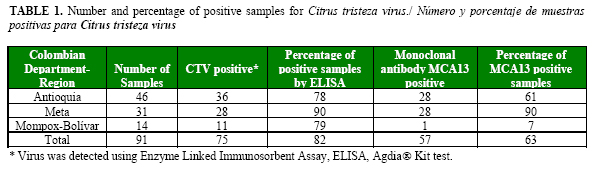
<body><![CDATA[<P><font face="Verdana, Arial, Helvetica, sans-serif" size="2"><B>Single strand    conformational polymorphism, (SSCP)</B> </font>     <P><font face="Verdana, Arial, Helvetica, sans-serif" size="2">SSCP analysis was    performed directly for the PCR products of the coat protein cDNA gene (<I>cp</I>)    of Colombian isolates following the procedure described by Rubio <I>et al</I>.    (9) modified by Morales (17). One microliter of PCR product was mixed with 9ml    of denaturing solution (950ml/L formamide, 20mM EDTA, 500 mg/L bromophenol blue),    heated for 10min at 99&#176;C and chilled on ice. Denatured DNA was electrophoresed    in a non-denaturing 80g/L polyacrylamide gel, using TBE (Tris-borate 89mM, 2mM    EDTA, pH 8.0) as electrophoresis buffer and a constant voltage (200v) for 2,5h    at room temperature (17). The gels were silver nitrate- stained following the    procedures described by Rubio <I>et al</I>. (9), modified by Morales (17). </font>     <P><font face="Verdana, Arial, Helvetica, sans-serif" size="2">To determine if    a band pattern from one isolate corresponded to a single or a mixture of sequences,    the <I>cp</I> gene from isolates M79 (MCA13 non-reactive) and A01 (MCA13 reactive)    were cloned and the individual clones tested. PCR products were separated by    PAGE, and the band was excised from the polyacrilamide gel and cloned in plasmid    pGEM3zf+, amplified by PCR and electrophoresed as described before. Alternatively,    a band was excised and directly amplified by PCR and electrophoresed for SSCP    pattern analysis as described (17). </font>     <P> <font face="Verdana, Arial, Helvetica, sans-serif" size="2"><B>Data evaluation    and statistical analysis</B> </font>     <P><font face="Verdana, Arial, Helvetica, sans-serif" size="2">A binary character    matrix was constructed where the presence of a band in a particular position    was recorded as 1 and absence as 0 (18, 19). The PAST software version 2.16    (19), was used to calculate the DICE similarity coefficient between all samples    and the cophenetic correlation coefficient. A cluster analysis was performed    using the unweighted pair group method with arithmetic mean (UPGMA) based on    the Dice index (19). Bootstrap values (based on 10000 re-samplings) were used    to estimate the reliability of the clustering pattern.</font>     <P>&nbsp;  <H1> <font face="Verdana, Arial, Helvetica, sans-serif" size="2"><B><font size="3">RESULTS    AND DISCUSSION</font></B> </font></H1>     <P><font face="Verdana, Arial, Helvetica, sans-serif" size="2"><B>CTV incidence</B>    </font>     <P><font face="Verdana, Arial, Helvetica, sans-serif" size="2">CTV was detected    in all the regions surveyed. From 91 samples evaluated by DAS-ELISA test, 75    (82%) were positive (<a href="/img/revistas/rpv/v28n1/t0106113.jpg">Table    1</a>). Previous studies showed similar results, indicating that this disease    was well established in Colombian citrus crops (5). The highest incidence was    found in Meta, followed by the Mompox-Bol&iacute;var region and the department    of Antioquia. More important, from the point of view of disease losses and management,    was the distribution of mild and severe strains. In Meta, most isolates were    positive to the severe strain detecting with antibody MCA13, followed by Antioquia    and Mompox-Bol&iacute;var (1 sample) (<a href="/img/revistas/rpv/v28n1/t0106113.jpg">Table    1</a>). </font>      
<P><font face="Verdana, Arial, Helvetica, sans-serif" size="2">Most isolates collected    in Mompox-Bol&iacute;var were mild, confirming previous results and pointing    out the importance of this region as a source of potential mild strains for    cross protection (5) (<a href="/img/revistas/rpv/v28n1/t0106113.jpg">Table    1</a>). In a previous survey, Pe&ntilde;aranda and collaborators (unpublished    results) collected 18 seedlings pre-infected with MCA13-non-reactive strains    in the region of Mompox-Bol&iacute;var and planted them in Meta, in a farm previously    identified with 100% incidence of CTV and <I>Toxoptera citricida</I> as the    most frequent vector (5). Non-infected seedlings were used as negative controls.    In this study, samples from this experiment were collected and evaluated by    using monoclonal and polyclonal antibodies as described in Materials and methods.    </font>      
<P><font face="Verdana, Arial, Helvetica, sans-serif" size="2">After six years,    the trees pre-infected with mild strains were growing without external symptoms    and all the controls died except one. The standing control tree showed external    symptoms of quick decline. ELISA tests were positive for both monoclonal and    polyclonal antibodies confirming infection of trees by a severe strain. All    the trees pre-infected with mild strains from the region of Mompox were positive    to MCA13 suggesting that they had acquired severe strains in the department    of Meta by natural mechanisms of infection. Although all the samples were positive    by DAS-ELISA using MCA13, the trees pre-infected with mild strains did not showed    external symptoms at the time the samples were taken. </font>     ]]></body>
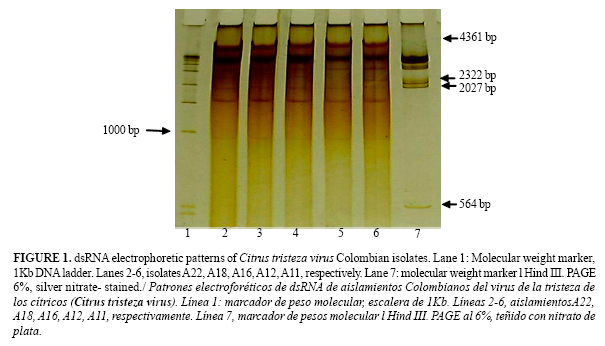
<body><![CDATA[<P><font face="Verdana, Arial, Helvetica, sans-serif" size="2"><B>DsRNA electrophoretic    pattern</B> </font>     <P><font face="Verdana, Arial, Helvetica, sans-serif" size="2">Twelve different    dsRNA electrophoretic<B> </B>patterns were found indicating variability between    isolates. All the isolates tested showed two characteristic dsRNA bands of 13,3    x 10<SUP>6</SUP> Daltons (Da) (replicative form of the viral genome) and 0,8x10<SUP>6</SUP>    Da (replicative form of the coat protein gene p25) respectively (11, 13) (<a href="/img/revistas/rpv/v28n1/f0106113.jpg">Figure    1</a>). </font>      
<P><font face="Verdana, Arial, Helvetica, sans-serif" size="2">Six different patterns    were present in the isolates from Antioquia. A band of 0,5 x 10<SUP>6</SUP>    Da was detected in all of them except one. Furthermore, all isolate having this    band was MCA13-positive. In previous studies, the presence of this band (0,5    x 10<SUP>6</SUP> Da) was correlated with MCA13-reactive strains (4, 11) exhibiting    seedling yellowing and stem pitting symptoms in grapefruit (11, 13). Seven different    patterns were detected from the Mompox-Bol&iacute;var region and twelve in the    isolates from the Meta region. In general, a more complex pattern was present    in MCA13-reactive isolates than in the non-reactive ones (<a href="/img/revistas/rpv/v28n1/f0106113.jpg">Figure    1</a>). </font>      
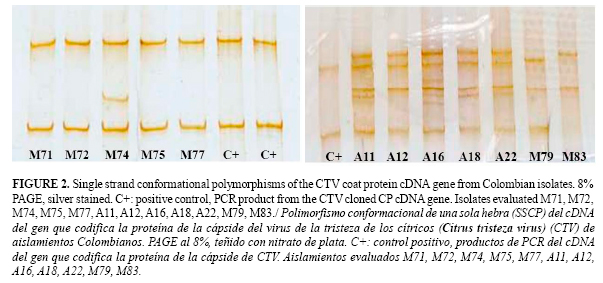
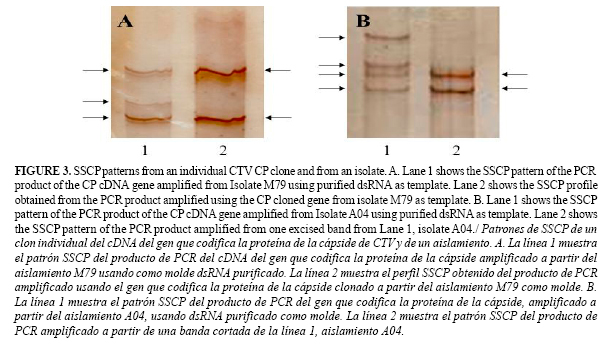
<P><font face="Verdana, Arial, Helvetica, sans-serif" size="2"><B>Single strand    conformational polymorphism, (SSCP)</B> </font>     <P><font face="Verdana, Arial, Helvetica, sans-serif" size="2">Using the SSCP    method, a single base mutation could be detected (9) without sequencing saving    money and time. Seven different SSCP patterns were identified in the isolates    collected. The more complex patterns corresponded to the isolates from Antioquia    (<a href="/img/revistas/rpv/v28n1/f0206113.jpg">Figure 2</a>). As for dsRNA    results, MCA13-reactive strains in general showed more complex SSCP patterns    than non MCA13-reactive strains (<a href="/img/revistas/rpv/v28n1/f0206113.jpg">Figure    2</a>). To identify a possible strain mixture, the CTV coat protein gene from    isolates A01 (MCA13 reactive) and M79 (MCA13 non-reactive) were cloned and the    SSCP patterns between an individual clone and the original isolate compared.    Two bands in the clone SSCP pattern and three (M79) or four (A01) in the corresponding    isolates were found (<a href="/img/revistas/rpv/v28n1/f0306113.jpg">Figure    3</a>). </font>      
<P><font face="Verdana, Arial, Helvetica, sans-serif" size="2">A similar result    was obtained when a band was excised from the polyacrylamide gel and the SSCP    pattern compared with the corresponding isolate. These results indicated that    some isolates were composed of a strain mixture and that <I>Tristeza </I>disease    could involve a complex rather than an individual strain of CTV. It is probable    that most isolates evaluated by SSCP and dsRNA were composed by several strains    since most patterns were complex. Interestingly, in the Mompox-Bol&iacute;var    region, most isolates were MCA13 non-reactive (<a href="/img/revistas/rpv/v28n1/t0106113.jpg">Table    1</a>) and exhibited only two bands in the SSCP pattern compared with the complex    patterns from Antioquia and Meta (<a href="/img/revistas/rpv/v28n1/f0206113.jpg">Figure    2</a>). </font>      
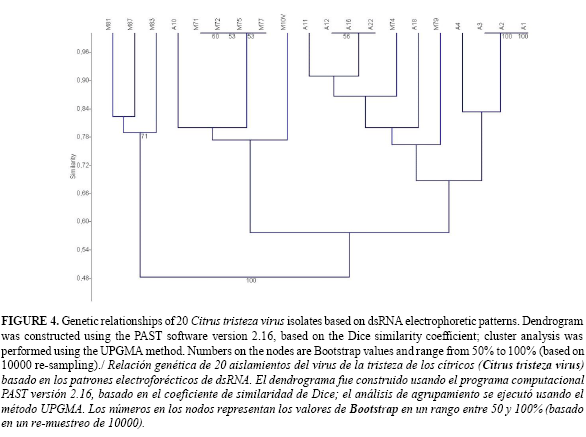
<P><font face="Verdana, Arial, Helvetica, sans-serif" size="2">All the citrus    trees pre-infected with mild strains from the region of Mompox and planted in    the Meta department were positive to MCA13, indicating that they could have    had a mixture of mild (pre-infected) and severe (in-field acquired) strains.    Furthermore, biological, biochemical and molecular evidences of infection of    individual trees by several different strains of CVT had been reported before    (20, 21, 24). </font>     <P><font face="Verdana, Arial, Helvetica, sans-serif" size="2">Tristeza disease    may have components of several strains and strain interactions can be very complex    (22). The CTV virion contains a monopartite positive-sense RNA genome (22).    RNA viruses can evolve very fast but evidence of slow evolution of CTV has been    found (23). The molecular analysis of isolates can be difficult for the presence    of many strains in an individual tree. Sophisticated molecular techniques have    been developed to detect and characterize RNA viruses, but most of them require    expensive equipment and skilled scientists (20, 24, 25). Virus gene amplification    by PCR followed by SSCP analysis discriminates precisely virus strains using    a simple technique (6, 9). It is important to clone genes for future studies    to avoid any interference caused by a mixture of strains. </font>     <P><font face="Verdana, Arial, Helvetica, sans-serif" size="2">The dendogram showed    13 divisions, three corresponded to groups with similar isolates (<a href="/img/revistas/rpv/v28n1/f0406113.gif">Figure    4</a>). Isolates A1, A2 and A3 clustered together and were collected in Antioquia    from lime cv. Tahiti; a second cluster with isolates A12, A16 and A22 collected    in Antioquia from orange cv. Valencia; isolates in this group showed a complex    SSCP pattern (<a href="/img/revistas/rpv/v28n1/f0206113.jpg">Figures 2</a>).    A third group was integrated by isolates M71, M72, M75 and M77 collected in    Mompox-Bol&iacute;var from orange cv. Margarita. This group exhibited a simple    SSCP pattern (<a href="/img/revistas/rpv/v28n1/f0206113.jpg">Figure 2</a>).    Isolates A4, A10, A11, A18, M10v, M74, M79, M81, M83 and M87, plotted at independent    points suggesting diversity compared to themselves and to the other three groups    (<a href="/img/revistas/rpv/v28n1/f0406113.gif">Figure 4</a>). Most isolates    plotting independently showed a complex SSCP pattern (<a href="/img/revistas/rpv/v28n1/f0206113.jpg">Figure    2</a>) indicating a possible strain mixture. </font>      
<P><font face="Verdana, Arial, Helvetica, sans-serif" size="2">From Mompox region,    we identified potential mild strains that could be evaluated against severe    strains. These strains have been sequenced (5, 6) and characterized by other    methods like polyclonal and monoclonal antibodies and dsRNA (5). In this study,    SSCP patterns that can help for further strain differentiation are shown. At    least for two isolates, the evidence indicated that they were composed of a    mixture of different strains in an individual tree. The SSCP method is an economic    and fast technique to test the strain mixture within an individual tree. </font>     ]]></body>
<body><![CDATA[<P><font face="Verdana, Arial, Helvetica, sans-serif" size="2">CTV is well established    in all the Colombian citrus growing areas evaluated. The socially and economically    acceptable disease management strategy in the short term is mild strain cross-protection;    this type of control requires a simple procedure for the selection of potential    mild strain candidates to overcome the long greenhouse period of evaluation    before field tests. The first example for Colombia of a field assay of mild    strain cross-protection was carried out in the Meta Departmet. Because of the    favorable conditions in Meta fields for the development of Tristeza disease,    these results are promising. Mild strains from Mompox-Bol&iacute;var are characterized    at the biological and molecular level and constitute the best candidates to    be tested in a program of cross-protection in a large scale in the near future.</font>     <P>&nbsp;  <H1> <font face="Verdana, Arial, Helvetica, sans-serif" size="2"><B><font size="3">CONCLUSIONS</font></B>    </font></H1>     <P><font face="Verdana, Arial, Helvetica, sans-serif" size="2">CTV disease is    established in Antioquia, Meta, and Mompox Colombian regions. Incidence of CTV    is 84%; incidence of severe strains is 62% (MCA13-reactive). In two cases, evidence    of several strains within one individual tree was found. The SSCP analysis is    useful to determine the presence of a mixture of CTV strains in an individual    tree. Mild strains from the Mompox-Bol&iacute;var region are the most promising    strains for a cross-protection program in Colombian citrus fields.</font>     <P>&nbsp;  <H1> <font face="Verdana, Arial, Helvetica, sans-serif" size="2"><B><font size="3">ACKNOWLEDGMENTS</font></B>    </font></H1>     <P><font face="Verdana, Arial, Helvetica, sans-serif" size="2">This work was supported    by COLCIENCIAS, UNIVERSIDAD NACIONAL DE COLOMBIA and CORPOICA.</font>     <P>&nbsp;     <P><font face="Verdana, Arial, Helvetica, sans-serif" size="2"><B><font size="3">REFERENCES</font></B>    </font>      <!-- ref --><P><font face="Verdana, Arial, Helvetica, sans-serif" size="2">1. Moreno P,      Ambr&oacute;s S, Albiach-Mart &iacute; M, Guerri J, Pe&ntilde;a I. <I>Citrus      tristeza virus</I>: a pathogen that changed the course of the citrus industry.      Mol Plant Pathol. 2008;9(2):251-268.     </font>       <!-- ref --><P><font face="Verdana, Arial, Helvetica, sans-serif" size="2">2. Herrera-Isidr&oacute;n      L, Ochoa-S&aacute;nchez J, Rivera-Bustamante R, Mart&iacute;nez-Soriano J.      Sequence diversity on four ORFs of <I>Citrus tristeza virus</I> correlates      with pathogenicity. Virology Journal.<I> </I>2009;6:116.     </font>       <!-- ref --><P><font face="Verdana, Arial, Helvetica, sans-serif" size="2">3. Roy A, Brlansky      R. Population dynamics of a Florida <I>Citrus tristeza virus </I>isolate and      aphid-transmitted subisolates: Identification of three genotypic groups and      recombinants after aphid transmission. Phytopathology. 2009; 99:1297-1306.          </font>       <!-- ref --><P><font face="Verdana, Arial, Helvetica, sans-serif" size="2">4. Permar T,      Garnsey S, Gumpf D, Lee R. A monoclonal antibody that discriminates strains      of <I>citrus tristeza virus</I>. Phytopathology. 1990;80:224-228.     </font>       <!-- ref --><P><font face="Verdana, Arial, Helvetica, sans-serif" size="2">5. Acosta O,      Alegria A, Guzm&aacute;n M, Lee R, Niblett C, Pe&ntilde;aranda J. El virus      de la Tristeza de los c&iacute;tricos: una grave amenaza para la citricultura      colombiana. Ed. Cient&iacute;fica, Santa Fe de Bogot&aacute;, Colombia; 1994.      58p.     </font>       <!-- ref --><P><font face="Verdana, Arial, Helvetica, sans-serif" size="2">6. Oliveros-Garay      OA,&#160;Martinez-Salazar N,&#160;Torres-Ruiz Y,&#160;Acosta O. CPm gene diversity      in field isolates of <I>Citrus tristeza virus</I> from Colombia. Archives      of Virology. 2009;154(12):1933-1937.     </font>       <!-- ref --><P><font face="Verdana, Arial, Helvetica, sans-serif" size="2">7. Soler N, Plomer      M, Fagoaga C, Moreno P, Navarro L, et al. Transformation of Mexican lime with      an intron-hairpin construct expressing untranslatable versions of the genes      coding for the three silencing suppressors of <I>Citrus tristeza virus</I>      confers complete resistance to the virus. Plant Biotechnology Journal. 2012;10:597-608.          </font>       <!-- ref --><P><font face="Verdana, Arial, Helvetica, sans-serif" size="2">8. Muller G,      Costa S. Search for outstanding plants in Tristeza infected citrus orchards:      the best approach to control the disease by preimmunization. Phytophylactica.      1987;19:187-191.     </font>       <!-- ref --><P><font face="Verdana, Arial, Helvetica, sans-serif" size="2">9. Rubio L, Ayllon      M, Guerri J, Pappu H, Niblett C, Moreno P. Differentiation of <I>citrus tristeza</I>      <I>closterovirus</I> (CTV) isolates by single-strand conformation polymorphism      analysis of the coat protein gene. Annals of applied biology. 1996;129:479-489.          </font>       <!-- ref --><P><font face="Verdana, Arial, Helvetica, sans-serif" size="2">10.Costa A, Nunes      W, Zanutto C, M&uuml;ller G. Stability of <I>Citrus tristeza virus </I>protective      isolates in field conditions. Pesq Agropec Bras. 2010;45(7):693-700.     </font>       <!-- ref --><P><font face="Verdana, Arial, Helvetica, sans-serif" size="2">11.Jarupat T,      Lee J, Dodds J. Additional factors Affecting dsRNA Analysis of <I>Citrus Tristeza      Virus.</I> Proceedings of the Eleventh IOCV Conference. 1991; pp 137-145.          </font>       <!-- ref --><P><font face="Verdana, Arial, Helvetica, sans-serif" size="2">12.Garnsey SM,      Cambra M. Enzyme-linked immunosorbent assay (ELISA) for citrus pathogens.      En: Roistacher CN (Ed). Graft-transmissible diseases of citrus. Handbook for      detection and diagnosis. FAO, Rome. 1991; pp 193-216.     </font>       <!-- ref --><P><font face="Verdana, Arial, Helvetica, sans-serif" size="2">13.Dodds J, Jarupat      T, Roistacher C, Lee R. Detection of strain double-stranded RNAs in citrus      species infected with <I>citrus tristeza virus</I>: a review. Phytophylactica.      1987;19:131-137.     </font>       <!-- ref --><P><font face="Verdana, Arial, Helvetica, sans-serif" size="2">14.Valverde R.      Analysis of double-Stranded RNA for Plant Virus Diagnosis. Plant Disease.      1990;74(3):255-258.     </font>       <!-- ref --><P><font face="Verdana, Arial, Helvetica, sans-serif" size="2">15.Pappu H, Pappu      S, Niblett C, Lee R, Civerolo E. Comparative sequence analysis of the coat      proteins of biologically distinct citrus tristeza closterovirus isolates.      Virus Genes. 1993;7(3):225-264.     </font>       <!-- ref --><P><font face="Verdana, Arial, Helvetica, sans-serif" size="2">16.Sambrook J,      Fritsch E, Maniatis T. Molecular Cloning: A Laboratory Manual, 2nd. ed. Cold      Spring Harbor, New York: Cold Spring Harbor Laboratory Press. 1989.     </font>       <!-- ref --><P><font face="Verdana, Arial, Helvetica, sans-serif" size="2">17.Morales J.      Caracterizaci&oacute;n de aislamientos colombianos del virus de la tristeza      de los c&iacute;tricos, mediante an&aacute;lisis serol&oacute;gico de la prote&iacute;na      de la c&aacute;pside y molecular de su gen. [Tesis de Maestr&iacute;a en Bioqu&iacute;mica],      Facultad de Medicina, Universidad Nacional de Colombia sede Bogot&aacute;.      2000; pp 96.     </font>       <!-- ref --><P><font face="Verdana, Arial, Helvetica, sans-serif" size="2">18.Hammer &Oslash;,      Harper D, Ryan P. PAST: paleontological statistics software package for education      and data analysis. Palaeontologia Electronica. 2001;4(1):9.     </font>       <!-- ref --><P><font face="Verdana, Arial, Helvetica, sans-serif" size="2">19.Hammer &Oslash;.      PAST PAleontological Statistics version 2.16. Reference Manual. Natural History      Museum, University of Oslo Norway. 2012; 227 p.     </font>       <!-- ref --><P><font face="Verdana, Arial, Helvetica, sans-serif" size="2">20.Roy A, Ananthakrishnan      G, Hartung JS, Brlansky RH. Development and application of a multiplex reverse      transcription polymerase chain reaction assay for screening a global collection      of <I>Citrus tristeza virus </I>isolates. Phytopathology. 2010;100:1077-1088.          </font>       <!-- ref --><P><font face="Verdana, Arial, Helvetica, sans-serif" size="2">21.Folimonova      S, Robertson C, Shilts T, Folimonov A, Hilf M, Garnsey S, Dawson W. Infection      with strains of <I>Citrus Tristeza Virus </I>does not exclude superinfection      by other strains of the virus. Journal of virology. 2010;84(3):1314-1325.          </font>       <!-- ref --><P><font face="Verdana, Arial, Helvetica, sans-serif" size="2">22.Tatinenia      S, Robertsona C, Garnsey S, Dawson W. A plant virus evolved by acquiring multiple      non conserved genes to extend its host range. PNAS. 2011;108(42):1736617371.          </font>       <!-- ref --><P><font face="Verdana, Arial, Helvetica, sans-serif" size="2">23.Silva G, Marques      N, Nolasco G. The evolutionary rate of <I>citrus tristeza virus</I> ranks      among the rates of the slowest RNA viruses. J Gen Virol. 2012;93:419-429.          </font>       <!-- ref --><P><font face="Verdana, Arial, Helvetica, sans-serif" size="2">24.Ananthakrishnan      G, Venkataprasanna T, Roy A, Brlansky R. Characterization of the mixture of      genotypes of a <I>Citrus tristeza virus</I> isolate by reverse transcription-quantitative      real-time PCR. Journal of Virological Methods. 2010;164(1-2):75-82.     </font>        <!-- ref --><P><font face="Verdana, Arial, Helvetica, sans-serif" size="2">25.Licciardello    G, Raspagliesi D, Bar-Joseph M, Catara A. Characterization of isolates of <I>Citrus    tristeza virus</I> by sequential analyses of enzyme immunoassays and capillary    electrophoresis-single-strand conformation polymorphisms. Journal of Virological    Methods. 2012;181(2):139-147.    </font>     <P>&nbsp;     <P>&nbsp;     <P><font face="Verdana, Arial, Helvetica, sans-serif" size="2">Recibido: 17-2-2012.    ]]></body>
<body><![CDATA[<br>   </font><font face="Verdana, Arial, Helvetica, sans-serif" size="2">Aceptado:    26-9-2012. </font>      <P>&nbsp;     <P>&nbsp;     <P><font face="Verdana, Arial, Helvetica, sans-serif" size="2"><B><a href="#pie">&#134;</a><a name="inicio"></a></B>(Q.E.P.D.)    In memoriam of Jos&eacute; Pe&ntilde;aranda Valverde.</font>       ]]></body><back>
<ref-list>
<ref id="B1">
<label>1</label><nlm-citation citation-type="journal">
<person-group person-group-type="author">
<name>
<surname><![CDATA[Moreno]]></surname>
<given-names><![CDATA[P]]></given-names>
</name>
<name>
<surname><![CDATA[Ambrós]]></surname>
<given-names><![CDATA[S]]></given-names>
</name>
<name>
<surname><![CDATA[Albiach-Martí]]></surname>
<given-names><![CDATA[M]]></given-names>
</name>
<name>
<surname><![CDATA[Guerri]]></surname>
<given-names><![CDATA[J]]></given-names>
</name>
<name>
<surname><![CDATA[Peña]]></surname>
<given-names><![CDATA[I]]></given-names>
</name>
</person-group>
<article-title xml:lang="en"><![CDATA[Citrus tristeza virus: a pathogen that changed the course of the citrus industry]]></article-title>
<source><![CDATA[Mol Plant Pathol]]></source>
<year>2008</year>
<volume>9</volume>
<numero>2</numero>
<issue>2</issue>
<page-range>251-268</page-range></nlm-citation>
</ref>
<ref id="B2">
<label>2</label><nlm-citation citation-type="journal">
<person-group person-group-type="author">
<name>
<surname><![CDATA[Herrera-Isidrón]]></surname>
<given-names><![CDATA[L]]></given-names>
</name>
<name>
<surname><![CDATA[Ochoa-Sánchez]]></surname>
<given-names><![CDATA[J]]></given-names>
</name>
<name>
<surname><![CDATA[Rivera-Bustamante]]></surname>
<given-names><![CDATA[R]]></given-names>
</name>
<name>
<surname><![CDATA[Martínez-Soriano]]></surname>
<given-names><![CDATA[J]]></given-names>
</name>
</person-group>
<article-title xml:lang="en"><![CDATA[Sequence diversity on four ORFs of Citrus tristeza virus correlates with pathogenicity]]></article-title>
<source><![CDATA[Virology Journal]]></source>
<year>2009</year>
<volume>6</volume>
<page-range>116</page-range></nlm-citation>
</ref>
<ref id="B3">
<label>3</label><nlm-citation citation-type="journal">
<person-group person-group-type="author">
<name>
<surname><![CDATA[Roy]]></surname>
<given-names><![CDATA[A]]></given-names>
</name>
<name>
<surname><![CDATA[Brlansky]]></surname>
<given-names><![CDATA[R]]></given-names>
</name>
</person-group>
<article-title xml:lang="en"><![CDATA[Population dynamics of a Florida Citrus tristeza virus isolate and aphid-transmitted subisolates: Identification of three genotypic groups and recombinants after aphid transmission]]></article-title>
<source><![CDATA[Phytopathology]]></source>
<year>2009</year>
<volume>99</volume>
<page-range>1297-1306</page-range></nlm-citation>
</ref>
<ref id="B4">
<label>4</label><nlm-citation citation-type="journal">
<person-group person-group-type="author">
<name>
<surname><![CDATA[Permar]]></surname>
<given-names><![CDATA[T]]></given-names>
</name>
<name>
<surname><![CDATA[Garnsey]]></surname>
<given-names><![CDATA[S]]></given-names>
</name>
<name>
<surname><![CDATA[Gumpf]]></surname>
<given-names><![CDATA[D]]></given-names>
</name>
<name>
<surname><![CDATA[Lee]]></surname>
<given-names><![CDATA[R]]></given-names>
</name>
</person-group>
<article-title xml:lang="en"><![CDATA[A monoclonal antibody that discriminates strains of citrus tristeza virus]]></article-title>
<source><![CDATA[Phytopathology]]></source>
<year>1990</year>
<volume>80</volume>
<page-range>224-228</page-range></nlm-citation>
</ref>
<ref id="B5">
<label>5</label><nlm-citation citation-type="book">
<person-group person-group-type="author">
<name>
<surname><![CDATA[Acosta]]></surname>
<given-names><![CDATA[O]]></given-names>
</name>
<name>
<surname><![CDATA[Alegria]]></surname>
<given-names><![CDATA[A]]></given-names>
</name>
<name>
<surname><![CDATA[Guzmán]]></surname>
<given-names><![CDATA[M]]></given-names>
</name>
<name>
<surname><![CDATA[Lee]]></surname>
<given-names><![CDATA[R]]></given-names>
</name>
<name>
<surname><![CDATA[Niblett]]></surname>
<given-names><![CDATA[C]]></given-names>
</name>
<name>
<surname><![CDATA[Peñaranda]]></surname>
<given-names><![CDATA[J]]></given-names>
</name>
</person-group>
<source><![CDATA[El virus de la Tristeza de los cítricos: una grave amenaza para la citricultura colombiana]]></source>
<year>1994</year>
<page-range>58</page-range><publisher-loc><![CDATA[^eColombia Colombia]]></publisher-loc>
<publisher-name><![CDATA[Ed. Científica, Santa Fe de Bogotá]]></publisher-name>
</nlm-citation>
</ref>
<ref id="B6">
<label>6</label><nlm-citation citation-type="journal">
<person-group person-group-type="author">
<name>
<surname><![CDATA[Oliveros-Garay]]></surname>
<given-names><![CDATA[OA]]></given-names>
</name>
<name>
<surname><![CDATA[Martinez-Salazar]]></surname>
<given-names><![CDATA[N]]></given-names>
</name>
<name>
<surname><![CDATA[Torres-Ruiz]]></surname>
<given-names><![CDATA[Y]]></given-names>
</name>
<name>
<surname><![CDATA[Acosta]]></surname>
<given-names><![CDATA[O]]></given-names>
</name>
</person-group>
<article-title xml:lang="en"><![CDATA[CPm gene diversity in field isolates of Citrus tristeza virus from Colombia]]></article-title>
<source><![CDATA[Archives of Virology]]></source>
<year>2009</year>
<volume>154</volume>
<numero>12</numero>
<issue>12</issue>
<page-range>1933-1937</page-range></nlm-citation>
</ref>
<ref id="B7">
<label>7</label><nlm-citation citation-type="journal">
<person-group person-group-type="author">
<name>
<surname><![CDATA[Soler]]></surname>
<given-names><![CDATA[N]]></given-names>
</name>
<name>
<surname><![CDATA[Plomer]]></surname>
<given-names><![CDATA[M]]></given-names>
</name>
<name>
<surname><![CDATA[Fagoaga]]></surname>
<given-names><![CDATA[C]]></given-names>
</name>
<name>
<surname><![CDATA[Moreno]]></surname>
<given-names><![CDATA[P]]></given-names>
</name>
<name>
<surname><![CDATA[Navarro]]></surname>
<given-names><![CDATA[L]]></given-names>
</name>
</person-group>
<article-title xml:lang="en"><![CDATA[Transformation of Mexican lime with an intron-hairpin construct expressing untranslatable versions of the genes coding for the three silencing suppressors of Citrus tristeza virus confers complete resistance to the virus]]></article-title>
<source><![CDATA[Plant Biotechnology Journal]]></source>
<year>2012</year>
<volume>10</volume>
<page-range>597-608</page-range></nlm-citation>
</ref>
<ref id="B8">
<label>8</label><nlm-citation citation-type="journal">
<person-group person-group-type="author">
<name>
<surname><![CDATA[Muller]]></surname>
<given-names><![CDATA[G]]></given-names>
</name>
<name>
<surname><![CDATA[Costa]]></surname>
<given-names><![CDATA[S]]></given-names>
</name>
</person-group>
<article-title xml:lang="en"><![CDATA[Search for outstanding plants in Tristeza infected citrus orchards: the best approach to control the disease by preimmunization]]></article-title>
<source><![CDATA[Phytophylactica]]></source>
<year>1987</year>
<volume>19</volume>
<page-range>187-191</page-range></nlm-citation>
</ref>
<ref id="B9">
<label>9</label><nlm-citation citation-type="journal">
<person-group person-group-type="author">
<name>
<surname><![CDATA[Rubio]]></surname>
<given-names><![CDATA[L]]></given-names>
</name>
<name>
<surname><![CDATA[Ayllon]]></surname>
<given-names><![CDATA[M]]></given-names>
</name>
<name>
<surname><![CDATA[Guerri]]></surname>
<given-names><![CDATA[J]]></given-names>
</name>
<name>
<surname><![CDATA[Pappu]]></surname>
<given-names><![CDATA[H]]></given-names>
</name>
<name>
<surname><![CDATA[Niblett]]></surname>
<given-names><![CDATA[C]]></given-names>
</name>
<name>
<surname><![CDATA[Moreno]]></surname>
<given-names><![CDATA[P]]></given-names>
</name>
</person-group>
<article-title xml:lang="en"><![CDATA[Differentiation of citrus tristeza closterovirus (CTV) isolates by single-strand conformation polymorphism analysis of the coat protein gene]]></article-title>
<source><![CDATA[Annals of applied biology]]></source>
<year>1996</year>
<volume>129</volume>
<page-range>479-489</page-range></nlm-citation>
</ref>
<ref id="B10">
<label>10</label><nlm-citation citation-type="journal">
<person-group person-group-type="author">
<name>
<surname><![CDATA[Costa]]></surname>
<given-names><![CDATA[A]]></given-names>
</name>
<name>
<surname><![CDATA[Nunes]]></surname>
<given-names><![CDATA[W]]></given-names>
</name>
<name>
<surname><![CDATA[Zanutto]]></surname>
<given-names><![CDATA[C]]></given-names>
</name>
<name>
<surname><![CDATA[Müller]]></surname>
<given-names><![CDATA[G]]></given-names>
</name>
</person-group>
<article-title xml:lang="en"><![CDATA[Stability of Citrus tristeza virus protective isolates in field conditions]]></article-title>
<source><![CDATA[Pesq Agropec Bras]]></source>
<year>2010</year>
<volume>45</volume>
<numero>7</numero>
<issue>7</issue>
<page-range>693-700</page-range></nlm-citation>
</ref>
<ref id="B11">
<label>11</label><nlm-citation citation-type="confpro">
<person-group person-group-type="author">
<name>
<surname><![CDATA[Jarupat]]></surname>
<given-names><![CDATA[T]]></given-names>
</name>
<name>
<surname><![CDATA[Lee]]></surname>
<given-names><![CDATA[J]]></given-names>
</name>
<name>
<surname><![CDATA[Dodds]]></surname>
<given-names><![CDATA[J]]></given-names>
</name>
</person-group>
<article-title xml:lang="en"><![CDATA[Additional factors Affecting dsRNA Analysis of Citrus Tristeza Virus]]></article-title>
<source><![CDATA[]]></source>
<year></year>
<conf-name><![CDATA[ Proceedings of the Eleventh IOCV Conference]]></conf-name>
<conf-date>1991</conf-date>
<conf-loc> </conf-loc>
<page-range>137-145</page-range></nlm-citation>
</ref>
<ref id="B12">
<label>12</label><nlm-citation citation-type="book">
<person-group person-group-type="author">
<name>
<surname><![CDATA[Garnsey]]></surname>
<given-names><![CDATA[SM]]></given-names>
</name>
<name>
<surname><![CDATA[Cambra]]></surname>
<given-names><![CDATA[M]]></given-names>
</name>
</person-group>
<article-title xml:lang="en"><![CDATA[Enzyme-linked immunosorbent assay (ELISA) for citrus pathogens]]></article-title>
<person-group person-group-type="editor">
<name>
<surname><![CDATA[Roistacher]]></surname>
<given-names><![CDATA[CN]]></given-names>
</name>
</person-group>
<source><![CDATA[Graft-transmissible diseases of citrus: Handbook for detection and diagnosis]]></source>
<year>1991</year>
<page-range>193-216</page-range><publisher-loc><![CDATA[^eRome Rome]]></publisher-loc>
<publisher-name><![CDATA[FAO]]></publisher-name>
</nlm-citation>
</ref>
<ref id="B13">
<label>13</label><nlm-citation citation-type="journal">
<person-group person-group-type="author">
<name>
<surname><![CDATA[Dodds]]></surname>
<given-names><![CDATA[J]]></given-names>
</name>
<name>
<surname><![CDATA[Jarupat]]></surname>
<given-names><![CDATA[T]]></given-names>
</name>
<name>
<surname><![CDATA[Roistacher]]></surname>
<given-names><![CDATA[C]]></given-names>
</name>
<name>
<surname><![CDATA[Lee]]></surname>
<given-names><![CDATA[R]]></given-names>
</name>
</person-group>
<article-title xml:lang="en"><![CDATA[Detection of strain double-stranded RNAs in citrus species infected with citrus tristeza virus: a review]]></article-title>
<source><![CDATA[Phytophylactica]]></source>
<year>1987</year>
<volume>19</volume>
<page-range>131-137</page-range></nlm-citation>
</ref>
<ref id="B14">
<label>14</label><nlm-citation citation-type="journal">
<person-group person-group-type="author">
<name>
<surname><![CDATA[Valverde]]></surname>
<given-names><![CDATA[R]]></given-names>
</name>
</person-group>
<article-title xml:lang="en"><![CDATA[Analysis of double-Stranded RNA for Plant Virus Diagnosis]]></article-title>
<source><![CDATA[Plant Disease]]></source>
<year>1990</year>
<volume>74</volume>
<numero>3</numero>
<issue>3</issue>
<page-range>255-258</page-range></nlm-citation>
</ref>
<ref id="B15">
<label>15</label><nlm-citation citation-type="journal">
<person-group person-group-type="author">
<name>
<surname><![CDATA[Pappu]]></surname>
<given-names><![CDATA[H]]></given-names>
</name>
<name>
<surname><![CDATA[Pappu]]></surname>
<given-names><![CDATA[S]]></given-names>
</name>
<name>
<surname><![CDATA[Niblett]]></surname>
<given-names><![CDATA[C]]></given-names>
</name>
<name>
<surname><![CDATA[Lee]]></surname>
<given-names><![CDATA[R]]></given-names>
</name>
<name>
<surname><![CDATA[Civerolo]]></surname>
<given-names><![CDATA[E]]></given-names>
</name>
</person-group>
<article-title xml:lang="en"><![CDATA[Comparative sequence analysis of the coat proteins of biologically distinct citrus tristeza closterovirus isolates]]></article-title>
<source><![CDATA[Virus Genes]]></source>
<year>1993</year>
<volume>7</volume>
<numero>3</numero>
<issue>3</issue>
<page-range>225-264</page-range></nlm-citation>
</ref>
<ref id="B16">
<label>16</label><nlm-citation citation-type="book">
<person-group person-group-type="author">
<name>
<surname><![CDATA[Sambrook]]></surname>
<given-names><![CDATA[J]]></given-names>
</name>
<name>
<surname><![CDATA[Fritsch]]></surname>
<given-names><![CDATA[E]]></given-names>
</name>
<name>
<surname><![CDATA[Maniatis]]></surname>
<given-names><![CDATA[T]]></given-names>
</name>
</person-group>
<source><![CDATA[Molecular Cloning: A Laboratory Manual]]></source>
<year>1989</year>
<edition>2nd</edition>
<publisher-loc><![CDATA[New York ]]></publisher-loc>
<publisher-name><![CDATA[Cold Spring Harbor]]></publisher-name>
</nlm-citation>
</ref>
<ref id="B17">
<label>17</label><nlm-citation citation-type="">
<person-group person-group-type="author">
<name>
<surname><![CDATA[Morales]]></surname>
<given-names><![CDATA[J]]></given-names>
</name>
</person-group>
<article-title xml:lang="es"><![CDATA[Caracterización de aislamientos colombianos del virus de la tristeza de los cítricos, mediante análisis serológico de la proteína de la cápside y molecular de su gen]]></article-title>
<source><![CDATA[]]></source>
<year></year>
<page-range>96</page-range></nlm-citation>
</ref>
<ref id="B18">
<label>18</label><nlm-citation citation-type="journal">
<person-group person-group-type="author">
<name>
<surname><![CDATA[Hammer]]></surname>
<given-names><![CDATA[Ø]]></given-names>
</name>
<name>
<surname><![CDATA[Harper]]></surname>
<given-names><![CDATA[D]]></given-names>
</name>
<name>
<surname><![CDATA[Ryan]]></surname>
<given-names><![CDATA[P]]></given-names>
</name>
</person-group>
<article-title xml:lang="en"><![CDATA[PAST: paleontological statistics software package for education and data analysis]]></article-title>
<source><![CDATA[Palaeontologia Electronica]]></source>
<year>2001</year>
<volume>4</volume>
<numero>1</numero>
<issue>1</issue>
<page-range>9</page-range></nlm-citation>
</ref>
<ref id="B19">
<label>19</label><nlm-citation citation-type="book">
<person-group person-group-type="author">
<name>
<surname><![CDATA[Hammer]]></surname>
<given-names><![CDATA[Ø]]></given-names>
</name>
</person-group>
<source><![CDATA[PAST PAleontological Statistics version 2.16. Reference Manual]]></source>
<year>2012</year>
<page-range>227</page-range><publisher-name><![CDATA[Natural History Museum, University of Oslo Norway]]></publisher-name>
</nlm-citation>
</ref>
<ref id="B20">
<label>20</label><nlm-citation citation-type="journal">
<person-group person-group-type="author">
<name>
<surname><![CDATA[Roy]]></surname>
<given-names><![CDATA[A]]></given-names>
</name>
<name>
<surname><![CDATA[Ananthakrishnan]]></surname>
<given-names><![CDATA[G]]></given-names>
</name>
<name>
<surname><![CDATA[Hartung]]></surname>
<given-names><![CDATA[JS]]></given-names>
</name>
<name>
<surname><![CDATA[Brlansky]]></surname>
<given-names><![CDATA[RH]]></given-names>
</name>
</person-group>
<article-title xml:lang="en"><![CDATA[Development and application of a multiplex reverse transcription polymerase chain reaction assay for screening a global collection of Citrus tristeza virus isolates]]></article-title>
<source><![CDATA[Phytopathology]]></source>
<year>2010</year>
<volume>100</volume>
<page-range>1077-1088</page-range></nlm-citation>
</ref>
<ref id="B21">
<label>21</label><nlm-citation citation-type="journal">
<person-group person-group-type="author">
<name>
<surname><![CDATA[Folimonova]]></surname>
<given-names><![CDATA[S]]></given-names>
</name>
<name>
<surname><![CDATA[Robertson]]></surname>
<given-names><![CDATA[C]]></given-names>
</name>
<name>
<surname><![CDATA[Shilts]]></surname>
<given-names><![CDATA[T]]></given-names>
</name>
<name>
<surname><![CDATA[Folimonov]]></surname>
<given-names><![CDATA[A]]></given-names>
</name>
<name>
<surname><![CDATA[Hilf]]></surname>
<given-names><![CDATA[M]]></given-names>
</name>
<name>
<surname><![CDATA[Garnsey]]></surname>
<given-names><![CDATA[S]]></given-names>
</name>
<name>
<surname><![CDATA[Dawson]]></surname>
<given-names><![CDATA[W]]></given-names>
</name>
</person-group>
<article-title xml:lang="en"><![CDATA[Infection with strains of Citrus Tristeza Virus does not exclude superinfection by other strains of the virus]]></article-title>
<source><![CDATA[Journal of virology]]></source>
<year>2010</year>
<volume>84</volume>
<numero>3</numero>
<issue>3</issue>
<page-range>1314-1325</page-range></nlm-citation>
</ref>
<ref id="B22">
<label>22</label><nlm-citation citation-type="journal">
<person-group person-group-type="author">
<name>
<surname><![CDATA[Tatinenia]]></surname>
<given-names><![CDATA[S]]></given-names>
</name>
<name>
<surname><![CDATA[Robertsona]]></surname>
<given-names><![CDATA[C]]></given-names>
</name>
<name>
<surname><![CDATA[Garnsey]]></surname>
<given-names><![CDATA[S]]></given-names>
</name>
<name>
<surname><![CDATA[Dawson]]></surname>
<given-names><![CDATA[W]]></given-names>
</name>
</person-group>
<article-title xml:lang="en"><![CDATA[A plant virus evolved by acquiring multiple non conserved genes to extend its host range]]></article-title>
<source><![CDATA[PNAS]]></source>
<year>2011</year>
<volume>108</volume>
<numero>42</numero>
<issue>42</issue>
<page-range>1736617371</page-range></nlm-citation>
</ref>
<ref id="B23">
<label>23</label><nlm-citation citation-type="journal">
<person-group person-group-type="author">
<name>
<surname><![CDATA[Silva]]></surname>
<given-names><![CDATA[G]]></given-names>
</name>
<name>
<surname><![CDATA[Marques]]></surname>
<given-names><![CDATA[N]]></given-names>
</name>
<name>
<surname><![CDATA[Nolasco]]></surname>
<given-names><![CDATA[G]]></given-names>
</name>
</person-group>
<article-title xml:lang="en"><![CDATA[The evolutionary rate of citrus tristeza virus ranks among the rates of the slowest RNA viruses]]></article-title>
<source><![CDATA[J Gen Virol]]></source>
<year>2012</year>
<volume>93</volume>
<page-range>419-429</page-range></nlm-citation>
</ref>
<ref id="B24">
<label>24</label><nlm-citation citation-type="journal">
<person-group person-group-type="author">
<name>
<surname><![CDATA[Ananthakrishnan]]></surname>
<given-names><![CDATA[G]]></given-names>
</name>
<name>
<surname><![CDATA[Venkataprasanna]]></surname>
<given-names><![CDATA[T]]></given-names>
</name>
<name>
<surname><![CDATA[Roy]]></surname>
<given-names><![CDATA[A]]></given-names>
</name>
<name>
<surname><![CDATA[Brlansky]]></surname>
<given-names><![CDATA[R]]></given-names>
</name>
</person-group>
<article-title xml:lang="en"><![CDATA[Characterization of the mixture of genotypes of a Citrus tristeza virus isolate by reverse transcription-quantitative real-time PCR]]></article-title>
<source><![CDATA[Journal of Virological Methods]]></source>
<year>2010</year>
<volume>164</volume>
<numero>1-2</numero>
<issue>1-2</issue>
<page-range>75-82</page-range></nlm-citation>
</ref>
<ref id="B25">
<label>25</label><nlm-citation citation-type="journal">
<person-group person-group-type="author">
<name>
<surname><![CDATA[Licciardello]]></surname>
<given-names><![CDATA[G]]></given-names>
</name>
<name>
<surname><![CDATA[Raspagliesi]]></surname>
<given-names><![CDATA[D]]></given-names>
</name>
<name>
<surname><![CDATA[Bar-Joseph]]></surname>
<given-names><![CDATA[M]]></given-names>
</name>
<name>
<surname><![CDATA[Catara]]></surname>
<given-names><![CDATA[A]]></given-names>
</name>
</person-group>
<article-title xml:lang="en"><![CDATA[Characterization of isolates of Citrus tristeza virus by sequential analyses of enzyme immunoassays and capillary electrophoresis-single-strand conformation polymorphisms]]></article-title>
<source><![CDATA[Journal of Virological Methods]]></source>
<year>2012</year>
<volume>181</volume>
<numero>2</numero>
<issue>2</issue>
<page-range>139-147</page-range></nlm-citation>
</ref>
</ref-list>
</back>
</article>