<?xml version="1.0" encoding="ISO-8859-1"?><article xmlns:mml="http://www.w3.org/1998/Math/MathML" xmlns:xlink="http://www.w3.org/1999/xlink" xmlns:xsi="http://www.w3.org/2001/XMLSchema-instance">
<front>
<journal-meta>
<journal-id>1010-2752</journal-id>
<journal-title><![CDATA[Revista de Protección Vegetal]]></journal-title>
<abbrev-journal-title><![CDATA[Rev. Protección Veg.]]></abbrev-journal-title>
<issn>1010-2752</issn>
<publisher>
<publisher-name><![CDATA[Centro Nacional de Sanidad Agropecuaria]]></publisher-name>
</publisher>
</journal-meta>
<article-meta>
<article-id>S1010-27522013000200009</article-id>
<title-group>
<article-title xml:lang="en"><![CDATA[Quantification of phenols in lesions caused by Mycosphaerella fijiensis Morelet in `Cavendish naine']]></article-title>
<article-title xml:lang="es"><![CDATA[Cuantificación de fenoles en lesiones causadas por Mycosphaerella fijiensis Morelet en `Cavendish naine']]></article-title>
</title-group>
<contrib-group>
<contrib contrib-type="author">
<name>
<surname><![CDATA[Sanchez-García]]></surname>
<given-names><![CDATA[Cynthia]]></given-names>
</name>
<xref ref-type="aff" rid="A01"/>
</contrib>
<contrib contrib-type="author">
<name>
<surname><![CDATA[Alvarado-Capó]]></surname>
<given-names><![CDATA[Yelenys]]></given-names>
</name>
<xref ref-type="aff" rid="A01"/>
</contrib>
<contrib contrib-type="author">
<name>
<surname><![CDATA[Acosta-Suárez]]></surname>
<given-names><![CDATA[Mayra]]></given-names>
</name>
<xref ref-type="aff" rid="A01"/>
</contrib>
<contrib contrib-type="author">
<name>
<surname><![CDATA[Leiva-Mora]]></surname>
<given-names><![CDATA[Michel]]></given-names>
</name>
<xref ref-type="aff" rid="A01"/>
</contrib>
<contrib contrib-type="author">
<name>
<surname><![CDATA[Cruz-Martín]]></surname>
<given-names><![CDATA[Mileidy]]></given-names>
</name>
<xref ref-type="aff" rid="A01"/>
</contrib>
<contrib contrib-type="author">
<name>
<surname><![CDATA[Roque]]></surname>
<given-names><![CDATA[Berkys]]></given-names>
</name>
<xref ref-type="aff" rid="A01"/>
</contrib>
</contrib-group>
<aff id="A01">
<institution><![CDATA[,Universidad Central Marta Abreude Las Villas Instituto de Biotecnología de las Plantas (IBP) ]]></institution>
<addr-line><![CDATA[Santa Clara ]]></addr-line>
<country>Cuba</country>
</aff>
<pub-date pub-type="pub">
<day>00</day>
<month>08</month>
<year>2013</year>
</pub-date>
<pub-date pub-type="epub">
<day>00</day>
<month>08</month>
<year>2013</year>
</pub-date>
<volume>28</volume>
<numero>2</numero>
<fpage>149</fpage>
<lpage>152</lpage>
<copyright-statement/>
<copyright-year/>
<self-uri xlink:href="http://scielo.sld.cu/scielo.php?script=sci_arttext&amp;pid=S1010-27522013000200009&amp;lng=en&amp;nrm=iso"></self-uri><self-uri xlink:href="http://scielo.sld.cu/scielo.php?script=sci_abstract&amp;pid=S1010-27522013000200009&amp;lng=en&amp;nrm=iso"></self-uri><self-uri xlink:href="http://scielo.sld.cu/scielo.php?script=sci_pdf&amp;pid=S1010-27522013000200009&amp;lng=en&amp;nrm=iso"></self-uri><abstract abstract-type="short" xml:lang="en"><p><![CDATA[The presence of phenols was demonstrated in leaf lesions caused by Mycosphaerella fijiensis Morelet in inoculated plants of `Cavendish naine'. Phenolic compounds were microscopically detected in plant tissue with symptoms in different development stages by using staining cathecol derivatives, and they were quantified by spectrophotometry. An accumulation of phenols was observed since the first lesions appeared and gradually increased as symptoms progressed. It varied from 29µg.cm² in the early lesion stage to 79µg.cm² in the last stage of the disease. Although phenols were not effective in preventing further disease development in this compatible interaction, these results constituted an evidence of the presence of these biochemical compounds as part of the plant defense response against pathogen infection.]]></p></abstract>
<abstract abstract-type="short" xml:lang="es"><p><![CDATA[Se demostró la acumulación de fenoles en lesiones foliares causadas por Mycosphaerella fijiensis Morelet en plantas inoculadas de `Cavendish naine'. Los compuestos fenólicos fueron detectados microscópicamente, en el tejido vegetal correspondiente a síntomas en diferentes estados de desarrollo, mediante la tinción de derivados del catecol y cuantificados por espectrofotometría. Se observó que la acumulación de fenoles ocurrió desde la aparición de las primeras lesiones e incrementó a medida que evolucionaron los síntomas, desde un valor de concentración de 29µg.cm² en el estado más temprano de la enfermedad hasta 79µg.cm² en el estado más avanzado. Aunque la inducción de fenoles no fue efectiva en el control del progreso de la enfermedad en esta interacción compatible, estos resultados constituyen una evidencia de la presencia de estos compuestos como parte de la respuesta de la planta ante la infección del patógeno.]]></p></abstract>
<kwd-group>
<kwd lng="en"><![CDATA[Black Sigatoka]]></kwd>
<kwd lng="en"><![CDATA[cathecol derivatives]]></kwd>
<kwd lng="en"><![CDATA[histochemical detection]]></kwd>
<kwd lng="es"><![CDATA[Sigatoka negra]]></kwd>
<kwd lng="es"><![CDATA[derivados del catecol]]></kwd>
<kwd lng="es"><![CDATA[detección histoquímica]]></kwd>
</kwd-group>
</article-meta>
</front><body><![CDATA[ <p align="right"><font size="2" face="Verdana, Arial, Helvetica, sans-serif"><B>SHORT    COMMUNICATION</B></font></p>     <p>&nbsp; </p> <H1> <font size="2" face="Verdana, Arial, Helvetica, sans-serif"><B><font size="4">Quantification    of phenols in lesions caused by <I>Mycosphaerella fijiensis </I>Morelet in `Cavendish    naine' </font></B></font></H1>     <p>&nbsp;</p>     <p><font size="2" face="Verdana, Arial, Helvetica, sans-serif"><b><font size="3">Cuantificaci&oacute;n    de fenoles en lesiones causadas por <i>Mycosphaerella fijiensis </i>Morelet    en `Cavendish naine'</font></b></font></p>     <p>&nbsp;</p>     <p>&nbsp;</p>     <p><font size="2" face="Verdana, Arial, Helvetica, sans-serif"><b>Cynthia<SUP>    </SUP>Sanchez-Garc&iacute;a, Yelenys Alvarado-Cap&oacute;, Mayra Acosta-Su&aacute;rez,    Michel Leiva-Mora, Mileidy Cruz-Mart&iacute;n, Berkys Roque</b></font> <b> </b></p>     <P><font size="2" face="Verdana, Arial, Helvetica, sans-serif">Instituto de Biotecnolog&iacute;a    de las Plantas (IBP). Universidad Central Marta Abreude Las Villas. Carretera    a Camajuan&iacute; km 5.5, Santa Clara. Cuba. Email: <u><a href="mailto:cyn@ibp.co.cu">cyn@ibp.co.cu</a></u>.    </font>      <P>&nbsp;     <P>&nbsp; <hr noshade size="1">     ]]></body>
<body><![CDATA[<P><font size="2" face="Verdana, Arial, Helvetica, sans-serif"><B>ABSTRACT</B></font>     <P><font size="2" face="Verdana, Arial, Helvetica, sans-serif">The presence of    phenols was demonstrated in leaf lesions caused by <I>Mycosphaerella fijiensis</I>    Morelet in inoculated plants of `Cavendish naine'. Phenolic compounds were microscopically    detected in plant tissue with symptoms in different development stages by using    staining cathecol derivatives, and they were quantified by spectrophotometry.    An accumulation of phenols was observed since the first lesions appeared and    gradually increased as symptoms progressed. It varied from 29&#181;g.cm<SUP>2</SUP>    in the early lesion stage to 79&#181;g.cm<SUP>2</SUP> in the last stage of the    disease. Although phenols were not effective in preventing further disease development    in this compatible interaction, these results constituted an evidence of the    presence of these biochemical compounds as part of the plant defense response    against pathogen infection. </font>     <P><font size="2" face="Verdana, Arial, Helvetica, sans-serif"><B>Key words: </B>Black    Sigatoka, cathecol derivatives, histochemical detection.</font> <hr noshade size="1">     <p><font size="2" face="Verdana, Arial, Helvetica, sans-serif"><B>RESUMEN</b></font></p>     <p><font size="2" face="Verdana, Arial, Helvetica, sans-serif">Se demostr&oacute;    la acumulaci&oacute;n de fenoles en lesiones foliares causadas por <I>Mycosphaerella    fijiensis</I> Morelet en plantas inoculadas de `Cavendish naine'. Los compuestos    fen&oacute;licos fueron detectados microsc&oacute;picamente, en el tejido vegetal    correspondiente a s&iacute;ntomas en diferentes estados de desarrollo, mediante    la tinci&oacute;n de derivados del catecol y cuantificados por espectrofotometr&iacute;a.    Se observ&oacute; que la acumulaci&oacute;n de fenoles ocurri&oacute; desde    la aparici&oacute;n de las primeras lesiones e increment&oacute; a medida que    evolucionaron los s&iacute;ntomas, desde un valor de concentraci&oacute;n de    29&#181;g.cm<SUP>2</SUP> en el estado m&aacute;s temprano de la enfermedad hasta    79&#181;g.cm<SUP>2</SUP> en el estado m&aacute;s avanzado. Aunque la inducci&oacute;n    de fenoles no fue efectiva en el control del progreso de la enfermedad en esta    interacci&oacute;n compatible, estos resultados constituyen una evidencia de    la presencia de estos compuestos como parte de la respuesta de la planta ante    la infecci&oacute;n del pat&oacute;geno. </font> </p>     <P><font size="2" face="Verdana, Arial, Helvetica, sans-serif"><B>Palabras clave</B>:    Sigatoka negra, derivados del catecol, detecci&oacute;n histoqu&iacute;mica.</font> <hr noshade size="1">     <P>&nbsp;     <P>&nbsp;     <P><font size="2" face="Verdana, Arial, Helvetica, sans-serif">Histochemical techniques    have been used in many kinds of studies of plant structures because of their    simplicity and rapidness, which made them quite useful for a first approach    to the phenomenon to be studied. They have been used in many plants to evaluate    their morphological changes during growth (1), the pathogen spread in plant    tissues, and also for observing the biochemical response of plant cells to pathogen    infection in some pathosystems (2,3). </font>      <P><font size="2" face="Verdana, Arial, Helvetica, sans-serif">Accumulation of    phenolic compounds in the host as a response to fungal attack to strengthen    the cell wall is well known l (4), and it has been correlated with disease resistance    in a number of plant pathogen interactions. </font>     ]]></body>
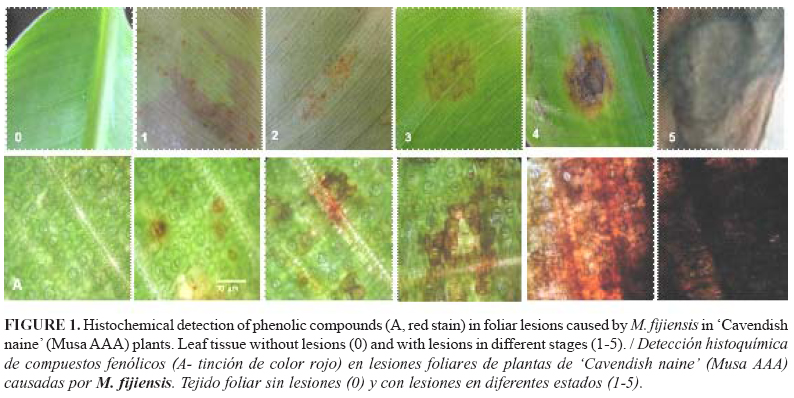
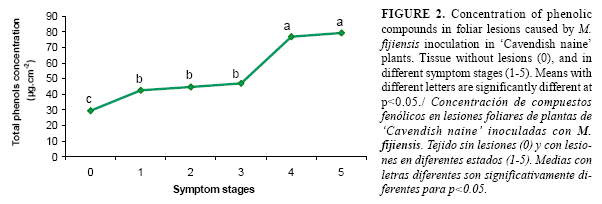
<body><![CDATA[<P><font size="2" face="Verdana, Arial, Helvetica, sans-serif"><I>Musa </I>sp.<I>-Mycosphaerella    fijiensis</I> Morelet pathosystem has been studied from many perspectives with    the aim of increasing the knowledge of this plant-pathogen interaction. In Cuba,    some investigations have been carried out in the field of the molecular biology    related to this pathosystem (6) and the use of epidemiological variables and    components of resistance to differentiate genotypes of <I>Musa</I> spp. (7).    However, the use of biochemical techniques to detect and quantify molecular    compounds involved in banana plant defence, such as phenols, has been little    successful. </font>     <P><font size="2" face="Verdana, Arial, Helvetica, sans-serif">The symptoms caused    by <I>M. fijiensis</I>, causal agent of Black Sigatoka, in susceptible <I>Musa    </I>spp. plants are characterized by the presence of pronounced lesions with    chlorotic halos since the stage 3 of the disease that suggests a photo-oxidative    damage, the release of pathogen toxins and the triggering of the plant defense    response (5). In this sense, obtaining of evidences of local accumulation of    biochemical compounds, specifically phenols, in lesions of banana plants inoculated    with <I>M. fijiensis</I>is is very important in studying this plant-pathogen    interaction. </font>     <P><font size="2" face="Verdana, Arial, Helvetica, sans-serif">The objective of    this work was the histochemical detection and quantification of phenolic compounds    in the lesions caused by <I>M. fijiensis</I> in inoculated plants of `Cavendish    naine'. </font>     <P><font size="2" face="Verdana, Arial, Helvetica, sans-serif">`Cavendish naine'    plants (<I>Musa</I> AAA, susceptible to Black Sigatoka) was used as the plant    material. They were obtained from &#168;La Cuba&#168; enterprise (Ciego de &Aacute;vila,    Cuba), propagated by tissue culture according to the protocol described by Orellana    (8) and acclimatized during three months in a greenhouse until they reached    20cm of height and with more than three developed leaves. The pathogenic strain    CCIBP-Pf83 of <I>M. fijiensis </I>from the microbial culture collection of Plant    Biotechnology Institute (IBP, Cuba) was used. </font>     <P><font size="2" face="Verdana, Arial, Helvetica, sans-serif">Preparation of    <I>M. fijiensis</I> mycelia suspension, artificial inoculation and evaluation    of the symptom development and evolution<B> </B>were carried out following the    protocol described by Alvarado-Cap&oacute; <I>et al</I>. (9). The inoculum concentration    was adjusted to approximately 10<SUP>5</SUP> mycelia fragments.mL<SUP>-1</SUP>.    The first three leaves of 20 plants were inoculated with the fungal suspension    and other 20 plants were inoculated only with 1% (w/v) gelatin and included    as controls. Plants were kept under greenhouse conditions with 80% of humidity    and with a sun light intensity of 3 841 &#181;mol.m<SUP>2</SUP>.s (measured    with Extech Light Meter 401025, USA). </font>     <P><font size="2" face="Verdana, Arial, Helvetica, sans-serif">For the histochemical    detection and quantification of phenolic compounds, 20 leaf segments (2cm<SUP>2</SUP>)    with one lesion per symptom stage (from 1 to 5), according to the scale proposed    by Alvarado <I>et al</I>. (9) and without lesions were randomly sampled from    inoculated `Cavendish naine' plants and from control plants, respectively. </font>     <P><font size="2" face="Verdana, Arial, Helvetica, sans-serif">Leaf segments (samples)    were placed on clean glass microscope slides before staining. The accumulation    of phenolic compounds was visualized by the protocol described by Reeve (10)    for cathecol derivatives. One drop of 10% (v/v) aqueous sodium nitrate, one    drop of 10% (v/v) aqueous acetic acid and one drop of 20% (w/v) aqueous urea    were added. After 3 min, two drops of 2N NaOH were finally added. Samples were    examined with a compound light microscope (Olympus, 200X) and photographed immediately    with a digital camera (Canon PC1201). A deep cherry red colouration was observed    in the presence of phenolics. </font>     <P><font size="2" face="Verdana, Arial, Helvetica, sans-serif">The total phenol    concentration was determined colorimetrically according to Bray and Thorpe (11).    The samples were grounded in liquid nitrogen and extracted in 10 ml of 80% (v/v)    ethanol, boiled at 50&#186;C for 30 min, and then centrifuged at 8 000 g for    10 min. Reaction volume included 1 ml supernatant, 3 ml distilled water, 1 ml    Folin Ciocalteau reagent and 2 ml 20% (w/v) sodium carbonate. The ethanolic    extract was heated for 1 min in a boiling water bath and cooled in tap water.    The solution was diluted to 10 ml with distilled water and the intensity of    the blue colour was measured at 750 nm in a spectrophotometer UV-visible (Genesys    6, Thermo Electron Corporation, USA) using a blank (the blank was obtained with    3 ml distilled water instead of the extract and the colour was developed as    described above). A standard curve was prepared from known concentrations of    gallic acid to calculate the concentration of phenolic compounds in the samples.    The concentration of phenolic compounds was expressed as total phenol concentration    (&#181;g. cm<SUP>-2</SUP>). </font>     <P><font size="2" face="Verdana, Arial, Helvetica, sans-serif">The data were analyzed    by using the Statistic Package for Social Science<I> </I>(SPSS) version 19.0    for Windows. The values obtained were analyzed statistically by nonparametric    tests of Mann-Whitney after verifying the assumptions of normality and heterogeneity    of variance. </font>     <P><font size="2" face="Verdana, Arial, Helvetica, sans-serif">The accumulation    of phenols was detected in the foliar tissue as deep red coloured zone corresponding    to lesions in all the symptom stages, which increased gradually while lesions    progressed (<a href="/img/revistas/rpv/v28n2/f0109213.jpg">Fig. 1</a>).    Similarly, it was observed in the total phenol concentrations (<a href="/img/revistas/rpv/v28n2/f0209213.jpg">Fig.    2</a>), where the highest values were obtained in the stages 4 and 5. </font>      
]]></body>
<body><![CDATA[<P><font size="2" face="Verdana, Arial, Helvetica, sans-serif">It has been demonstrated    that, after inoculation, many structural and physiological changes occurs in    the cells surrounding the infection site for restricting pathogen spread and    for reducing fluid loss (12). </font>     <P><font size="2" face="Verdana, Arial, Helvetica, sans-serif">Phenol accumulation    in foliar lesions is an evidence of the triggering of the defensive response    in plants to pathogen attack, which has been described as one of the most important    molecular events (4). In addition, it has been demonstrated that phenol accumulation    after infection are directly toxic to pathogens (12) and their polymerization    makes the cell wall thicker and stronger (11). This phenomenon has been observed    in many pathosystem such as <I>Sorghum vulgare</I> Pers.-<I>Sclerotium rolfsii</I>    Sacc. (15), <I>Solanum lycopersicum</I> L.-<I>Botrytis cinerea</I> Pers. (2),    <I>Eucalyptus</I> sp.-<I>Mycosphaerella </I>sp. (3) and <I>Lactuca sativa </I>L<I>.</I>-    <I>Bremia lactucae</I> Regel (16). </font>     <P><font size="2" face="Verdana, Arial, Helvetica, sans-serif">In <I>Musa </I>sp<I>.</I>-    <I>M. fijiensis</I> interaction, those evidences are very limited; however,    Portal (6) mentioned the possible relationship of the phenol metabolic pathway    in <I>Musa</I> defense response to <I>M. fijiensis</I> in the susceptible genotype    `Grande naine' by using a subtractive gen library. Accordingly, the results    of this work provide a new direct evidence of a local accumulation of phenolic    compounds in foliar lesions of `Cavendish naine' plants after <I>M. fijiensis</I>    inoculation as part of the defence response of banana plants in this compatible    interaction. At the same time, they validate the use of this histochemical tool    to detect biochemical compounds as a simple and rapid alternative for testing    different resistance phenotypes under controlled conditions, which can be applied    in <I>Musa</I> breeding programs. In general, they may also contribute to a    better understanding of this important plant-pathogen interaction.</font>     <P>&nbsp;  <H1> <font size="2" face="Verdana, Arial, Helvetica, sans-serif"><B><font size="3">ACKNOWLEDGMENT</font></B>    </font></H1>     <P><font size="2" face="Verdana, Arial, Helvetica, sans-serif">This work was developed    in the frame of the Program of Institutional University Cooperation among the    Universidad Central &#168;Marta Abreu&#168; de Las Villas and the Flemish Interuniversity    Council of Belgium (IUC UCLV/VLIR).</font>     <P>&nbsp;     <P><font size="2" face="Verdana, Arial, Helvetica, sans-serif"><B><font size="3">REFERENCES</font></B>    </font>      <!-- ref --><P><font size="2" face="Verdana, Arial, Helvetica, sans-serif">1. Valerio R,      Lindorf H, de Garc&iacute;a E. Relationship between leaf anatomy of some varieties      of <I>Musa</I> sp. and its behaviour towards Sigatoka (yellow and black) disease.      Agronom&iacute;a Tropical. 2002;52(4):507-521.     </font>       <!-- ref --><P><font size="2" face="Verdana, Arial, Helvetica, sans-serif">2. Asselbergh      B, Curvens K, Fran&ccedil;a SC, Audenaert K, Vuylsteke van BF, H&ouml;fte      M. Resistance to <I>Botrytis cinerea</I> in sitiens, an abscisic acid-deficient      tomato mutant, involves timely production of hydrogen peroxide and cell wall      modifications in the epidermis. Plant Physiology. 2007;144:1863-4877.     </font>       <!-- ref --><P><font size="2" face="Verdana, Arial, Helvetica, sans-serif">3. Smith AH,      Gill WM, Pinkard EA, Mohammed CL. Anatomical and histochemical defence responses      induced in juvenile leaves of <I>Eucalyptus globulus</I> and <I>Eucalyptus      nitens</I> by <I>Mycosphaerella</I> infection. For Path. 2007;37:361-373.          </font>       <!-- ref --><P><font size="2" face="Verdana, Arial, Helvetica, sans-serif">4. Walters D,      Newton A, Lyon G. Induced resistance: Helping plants to help themselves. Biologist.      2005;52:28-33.     </font>        <!-- ref --><P><font size="2" face="Verdana, Arial, Helvetica, sans-serif">5. Carlier J, Four&eacute;    E, Gauhl F, Jones D, Lepoivre P, Mourichon X, et al. Black Leaf Streak. In:    Jones DR (ed.). Fungal Disease of the Foliage. 2000; 37-79.     </font>      <!-- ref --><P><font size="2" face="Verdana, Arial, Helvetica, sans-serif">6. Portal O. Development    of molecular tools to study the interaction between banana and <I>Mycosphaerella    fijiensis</I>, the causal agent of Black Leaf Streak Disease. 2008. PhD thesis.    Ghent University, Belgium.     </font>      <!-- ref --><P><font size="2" face="Verdana, Arial, Helvetica, sans-serif">7. Leiva-Mora      M, Alvarado-Cap&oacute; Y, Acosta-Su&aacute;rez M, Cruz-Mart&iacute;n M, S&aacute;nchez-Garc&iacute;a      C, Roque B. Protocolo para la inoculaci&oacute;n artificial de plantas de      <I>Musa</I> spp. con <I>Mycosphaerella fijiensis</I> y evaluaci&oacute;n de      su respuesta mediante variables epifitiol&oacute;gicas y componentes de la      resistencia. Biotecnolog&iacute;a Vegetal. 2010;10(2):79-88.     </font>        <!-- ref --><P><font size="2" face="Verdana, Arial, Helvetica, sans-serif">8. Orellana P.    Tecnolog&iacute;a para la micropropagaci&oacute;n <I>in vitro</I> de clones    de <I>Musa</I> spp. 1994. Tesis de Doctor en Ciencias. Universidad Central &#168;Marta    Abreu&#168; de Las Villas-Instituto de Biotecnolog&iacute;a de las Plantas,    Santa Clara, Cuba.     </font>      <!-- ref --><P><font size="2" face="Verdana, Arial, Helvetica, sans-serif">9. Alvarado Y,    Leiva M, Rodr&iacute;guez MA, Acosta M, Cruz M,<B> </B>Portal O, et al. Early    evaluation of Black leaf streak resistance by using mycelial suspension of <I>Mycosphaerella</I>    <I>fijiensis. </I>In: Jacome L, Leproive P, Martin D, Ortiz R, Romero R, Escalant    JV (eds). <I>Mycosphaerella </I>leaf spot diseases of bananas: present status    and outlook. 2003; 169-175. INIBAP, Montpellier. ISBN 2-910810-57-7.     </font>      <!-- ref --><P><font size="2" face="Verdana, Arial, Helvetica, sans-serif">10.Reeve RM.      Histochemical tests for polyphenols in plant tissues. Stain Tech. 1951;26:91-96.          </font>       <!-- ref --><P><font size="2" face="Verdana, Arial, Helvetica, sans-serif">11.Bray W, Thorpe      V. Analysis of phenolic compounds of interest in metabolism. Meth Biochem      Analysis. 1954;1:27-52.     </font>        <!-- ref --><P><font size="2" face="Verdana, Arial, Helvetica, sans-serif">12.Ferreira RB,    Monteiro S, Freitas R, Santos CN, Chen Z, Batista LM, et al. The role of plant    defence proteins in fungal pathogenesis. Molecular Plant Pathology. 2007;5:677-700.        </font>      <!-- ref --><P><font size="2" face="Verdana, Arial, Helvetica, sans-serif">13.Hern&aacute;ndez      Y, Portillo F, Portillo MP, Navarro C, Rodr&iacute;guez M, Velazco J. Densidad      estom&aacute;tica en materiales de pl&aacute;tano (<I>Musa</I> AAB, AAAB y      ABB) susceptibles y resistentes a Sigatoka Negra (<I>Mycosphaerella fijiensis</I>,      Morelet). Rev Fac Agron. 2006;23(3):114-121.     </font>       <!-- ref --><P><font size="2" face="Verdana, Arial, Helvetica, sans-serif">14.Basha SA,      Sarma BK, Singh DP, Singh UP. Differential methods of inoculation of plant      growth-promoting rhizobacteria induce synthesis of phenylalanine ammonia-lyase      and phenolic compounds differentially in chickpea. Folia Microbiol. 2006;51:463-468.          </font>       <!-- ref --><P><font size="2" face="Verdana, Arial, Helvetica, sans-serif">15.Maurya S,      Singh R, Singh DP, Singh HB, Srivastav JS, Singh U. Phenolic compounds of      <I>Sorghum vulgare</I> in response to <I>Sclerotium rolfsii</I> infection      S. Journal of Plant Interactions. 2007;2(1):25-29.     </font>        <!-- ref --><P><font size="2" face="Verdana, Arial, Helvetica, sans-serif">16.Lebeda A, Sedlarova    M, Petrivalsky M, Prokopova J. Diversity of defence mechanisms in plant-Oomycete    interactions: a case study of <I>Lactuca </I>spp. and <I>Bremia lactucae</I>.    European Journal of Plant Pathology. 2008;122:71-89.    </font>     <P>&nbsp;     ]]></body>
<body><![CDATA[<P>&nbsp;     <P><font size="2" face="Verdana, Arial, Helvetica, sans-serif">Recibido: 8-5-2012.    <br>   </font><font size="2" face="Verdana, Arial, Helvetica, sans-serif">Aceptado:    26-9-2012.</font>       ]]></body><back>
<ref-list>
<ref id="B1">
<label>1</label><nlm-citation citation-type="journal">
<person-group person-group-type="author">
<name>
<surname><![CDATA[Valerio]]></surname>
<given-names><![CDATA[R]]></given-names>
</name>
<name>
<surname><![CDATA[Lindorf]]></surname>
<given-names><![CDATA[H]]></given-names>
</name>
<name>
<surname><![CDATA[de García]]></surname>
<given-names><![CDATA[E]]></given-names>
</name>
</person-group>
<article-title xml:lang="en"><![CDATA[Relationship between leaf anatomy of some varieties of Musa sp. and its behaviour towards Sigatoka (yellow and black) disease]]></article-title>
<source><![CDATA[Agronomía Tropical]]></source>
<year>2002</year>
<volume>52</volume>
<numero>4</numero>
<issue>4</issue>
<page-range>507-521</page-range></nlm-citation>
</ref>
<ref id="B2">
<label>2</label><nlm-citation citation-type="journal">
<person-group person-group-type="author">
<name>
<surname><![CDATA[Asselbergh]]></surname>
<given-names><![CDATA[B]]></given-names>
</name>
<name>
<surname><![CDATA[Curvens]]></surname>
<given-names><![CDATA[K]]></given-names>
</name>
<name>
<surname><![CDATA[França]]></surname>
<given-names><![CDATA[SC]]></given-names>
</name>
<name>
<surname><![CDATA[Audenaert]]></surname>
<given-names><![CDATA[K]]></given-names>
</name>
<name>
<surname><![CDATA[Vuylsteke van]]></surname>
<given-names><![CDATA[BF]]></given-names>
</name>
<name>
<surname><![CDATA[Höfte]]></surname>
<given-names><![CDATA[M]]></given-names>
</name>
</person-group>
<article-title xml:lang="en"><![CDATA[Resistance to Botrytis cinerea in sitiens, an abscisic acid-deficient tomato mutant, involves timely production of hydrogen peroxide and cell wall modifications in the epidermis]]></article-title>
<source><![CDATA[Plant Physiology]]></source>
<year>2007</year>
<volume>144</volume>
<page-range>1863-4877</page-range></nlm-citation>
</ref>
<ref id="B3">
<label>3</label><nlm-citation citation-type="journal">
<person-group person-group-type="author">
<name>
<surname><![CDATA[Smith]]></surname>
<given-names><![CDATA[AH]]></given-names>
</name>
<name>
<surname><![CDATA[Gill]]></surname>
<given-names><![CDATA[WM]]></given-names>
</name>
<name>
<surname><![CDATA[Pinkard]]></surname>
<given-names><![CDATA[EA]]></given-names>
</name>
<name>
<surname><![CDATA[Mohammed]]></surname>
<given-names><![CDATA[CL]]></given-names>
</name>
</person-group>
<article-title xml:lang="en"><![CDATA[Anatomical and histochemical defence responses induced in juvenile leaves of Eucalyptus globulus and Eucalyptus nitens by Mycosphaerella infection]]></article-title>
<source><![CDATA[For Path]]></source>
<year>2007</year>
<volume>37</volume>
<page-range>361-373</page-range></nlm-citation>
</ref>
<ref id="B4">
<label>4</label><nlm-citation citation-type="journal">
<person-group person-group-type="author">
<name>
<surname><![CDATA[Walters]]></surname>
<given-names><![CDATA[D]]></given-names>
</name>
<name>
<surname><![CDATA[Newton]]></surname>
<given-names><![CDATA[A]]></given-names>
</name>
<name>
<surname><![CDATA[Lyon]]></surname>
<given-names><![CDATA[G]]></given-names>
</name>
</person-group>
<article-title xml:lang="en"><![CDATA[Induced resistance: Helping plants to help themselves]]></article-title>
<source><![CDATA[Biologist]]></source>
<year>2005</year>
<volume>52</volume>
<page-range>28-33</page-range></nlm-citation>
</ref>
<ref id="B5">
<label>5</label><nlm-citation citation-type="">
<person-group person-group-type="author">
<name>
<surname><![CDATA[Carlier]]></surname>
<given-names><![CDATA[J]]></given-names>
</name>
<name>
<surname><![CDATA[Fouré]]></surname>
<given-names><![CDATA[E]]></given-names>
</name>
<name>
<surname><![CDATA[Gauhl]]></surname>
<given-names><![CDATA[F]]></given-names>
</name>
<name>
<surname><![CDATA[Jones]]></surname>
<given-names><![CDATA[D]]></given-names>
</name>
<name>
<surname><![CDATA[Lepoivre]]></surname>
<given-names><![CDATA[P]]></given-names>
</name>
<name>
<surname><![CDATA[Mourichon]]></surname>
<given-names><![CDATA[X]]></given-names>
</name>
</person-group>
<article-title xml:lang="en"><![CDATA[Black Leaf Streak]]></article-title>
<person-group person-group-type="editor">
<name>
<surname><![CDATA[Jones]]></surname>
<given-names><![CDATA[DR]]></given-names>
</name>
</person-group>
<source><![CDATA[Fungal Disease of the Foliage]]></source>
<year>2000</year>
<page-range>37-79</page-range></nlm-citation>
</ref>
<ref id="B6">
<label>6</label><nlm-citation citation-type="">
<person-group person-group-type="author">
<name>
<surname><![CDATA[Portal]]></surname>
<given-names><![CDATA[O]]></given-names>
</name>
</person-group>
<source><![CDATA[Development of molecular tools to study the interaction between banana and Mycosphaerella fijiensis, the causal agent of Black Leaf Streak Disease]]></source>
<year></year>
</nlm-citation>
</ref>
<ref id="B7">
<label>7</label><nlm-citation citation-type="journal">
<person-group person-group-type="author">
<name>
<surname><![CDATA[Leiva-Mora]]></surname>
<given-names><![CDATA[M]]></given-names>
</name>
<name>
<surname><![CDATA[Alvarado-Capó]]></surname>
<given-names><![CDATA[Y]]></given-names>
</name>
<name>
<surname><![CDATA[Acosta-Suárez]]></surname>
<given-names><![CDATA[M]]></given-names>
</name>
<name>
<surname><![CDATA[Cruz-Martín]]></surname>
<given-names><![CDATA[M]]></given-names>
</name>
<name>
<surname><![CDATA[Sánchez-García]]></surname>
<given-names><![CDATA[C]]></given-names>
</name>
<name>
<surname><![CDATA[Roque]]></surname>
<given-names><![CDATA[B]]></given-names>
</name>
</person-group>
<article-title xml:lang="es"><![CDATA[Protocolo para la inoculación artificial de plantas de Musa spp. con Mycosphaerella fijiensis y evaluación de su respuesta mediante variables epifitiológicas y componentes de la resistencia]]></article-title>
<source><![CDATA[Biotecnología Vegetal]]></source>
<year>2010</year>
<volume>10</volume>
<numero>2</numero>
<issue>2</issue>
<page-range>79-88</page-range></nlm-citation>
</ref>
<ref id="B8">
<label>8</label><nlm-citation citation-type="">
<person-group person-group-type="author">
<name>
<surname><![CDATA[Orellana]]></surname>
<given-names><![CDATA[P]]></given-names>
</name>
</person-group>
<source><![CDATA[Tecnología para la micropropagación in vitro de clones de Musa spp]]></source>
<year></year>
</nlm-citation>
</ref>
<ref id="B9">
<label>9</label><nlm-citation citation-type="">
<person-group person-group-type="author">
<name>
<surname><![CDATA[Alvarado]]></surname>
<given-names><![CDATA[Y]]></given-names>
</name>
<name>
<surname><![CDATA[Leiva]]></surname>
<given-names><![CDATA[M]]></given-names>
</name>
<name>
<surname><![CDATA[Rodríguez]]></surname>
<given-names><![CDATA[MA]]></given-names>
</name>
<name>
<surname><![CDATA[Acosta]]></surname>
<given-names><![CDATA[M]]></given-names>
</name>
<name>
<surname><![CDATA[Cruz]]></surname>
<given-names><![CDATA[M]]></given-names>
</name>
<name>
<surname><![CDATA[Portal]]></surname>
<given-names><![CDATA[O]]></given-names>
</name>
</person-group>
<article-title xml:lang="en"><![CDATA[Early evaluation of Black leaf streak resistance by using mycelial suspension of Mycosphaerella fijiensis]]></article-title>
<person-group person-group-type="editor">
<name>
<surname><![CDATA[Jacome]]></surname>
<given-names><![CDATA[L]]></given-names>
</name>
<name>
<surname><![CDATA[Leproive]]></surname>
<given-names><![CDATA[P]]></given-names>
</name>
<name>
<surname><![CDATA[Martin]]></surname>
<given-names><![CDATA[D]]></given-names>
</name>
<name>
<surname><![CDATA[Ortiz]]></surname>
<given-names><![CDATA[R]]></given-names>
</name>
<name>
<surname><![CDATA[Romero]]></surname>
<given-names><![CDATA[R]]></given-names>
</name>
<name>
<surname><![CDATA[Escalant]]></surname>
<given-names><![CDATA[JV]]></given-names>
</name>
</person-group>
<source><![CDATA[Mycosphaerella leaf spot diseases of bananas: present status and outlook]]></source>
<year>2003</year>
<page-range>169-175</page-range><publisher-loc><![CDATA[Montpellier ]]></publisher-loc>
</nlm-citation>
</ref>
<ref id="B10">
<label>10</label><nlm-citation citation-type="journal">
<person-group person-group-type="author">
<name>
<surname><![CDATA[Reeve]]></surname>
<given-names><![CDATA[RM]]></given-names>
</name>
</person-group>
<article-title xml:lang="en"><![CDATA[Histochemical tests for polyphenols in plant tissues]]></article-title>
<source><![CDATA[Stain Tech]]></source>
<year>1951</year>
<volume>26</volume>
<page-range>91-96</page-range></nlm-citation>
</ref>
<ref id="B11">
<label>11</label><nlm-citation citation-type="journal">
<person-group person-group-type="author">
<name>
<surname><![CDATA[Bray]]></surname>
<given-names><![CDATA[W]]></given-names>
</name>
<name>
<surname><![CDATA[Thorpe]]></surname>
<given-names><![CDATA[V]]></given-names>
</name>
</person-group>
<article-title xml:lang="en"><![CDATA[Analysis of phenolic compounds of interest in metabolism]]></article-title>
<source><![CDATA[Meth Biochem Analysis]]></source>
<year>1954</year>
<volume>1</volume>
<page-range>27-52</page-range></nlm-citation>
</ref>
<ref id="B12">
<label>12</label><nlm-citation citation-type="journal">
<person-group person-group-type="author">
<name>
<surname><![CDATA[Ferreira]]></surname>
<given-names><![CDATA[RB]]></given-names>
</name>
<name>
<surname><![CDATA[Monteiro]]></surname>
<given-names><![CDATA[S]]></given-names>
</name>
<name>
<surname><![CDATA[Freitas]]></surname>
<given-names><![CDATA[R]]></given-names>
</name>
<name>
<surname><![CDATA[Santos]]></surname>
<given-names><![CDATA[CN]]></given-names>
</name>
<name>
<surname><![CDATA[Chen]]></surname>
<given-names><![CDATA[Z]]></given-names>
</name>
<name>
<surname><![CDATA[Batista]]></surname>
<given-names><![CDATA[LM]]></given-names>
</name>
</person-group>
<article-title xml:lang="en"><![CDATA[The role of plant defence proteins in fungal pathogenesis]]></article-title>
<source><![CDATA[Molecular Plant Pathology]]></source>
<year>2007</year>
<volume>5</volume>
<page-range>677-700</page-range></nlm-citation>
</ref>
<ref id="B13">
<label>13</label><nlm-citation citation-type="journal">
<person-group person-group-type="author">
<name>
<surname><![CDATA[Hernández]]></surname>
<given-names><![CDATA[Y]]></given-names>
</name>
<name>
<surname><![CDATA[Portillo]]></surname>
<given-names><![CDATA[F]]></given-names>
</name>
<name>
<surname><![CDATA[Portillo]]></surname>
<given-names><![CDATA[MP]]></given-names>
</name>
<name>
<surname><![CDATA[Navarro]]></surname>
<given-names><![CDATA[C]]></given-names>
</name>
<name>
<surname><![CDATA[Rodríguez]]></surname>
<given-names><![CDATA[M]]></given-names>
</name>
<name>
<surname><![CDATA[Velazco]]></surname>
<given-names><![CDATA[J]]></given-names>
</name>
</person-group>
<article-title xml:lang="es"><![CDATA[Densidad estomática en materiales de plátano (Musa AAB, AAAB y ABB) susceptibles y resistentes a Sigatoka Negra (Mycosphaerella fijiensis, Morelet)]]></article-title>
<source><![CDATA[Rev Fac Agron]]></source>
<year>2006</year>
<volume>23</volume>
<numero>3</numero>
<issue>3</issue>
<page-range>114-121</page-range></nlm-citation>
</ref>
<ref id="B14">
<label>14</label><nlm-citation citation-type="journal">
<person-group person-group-type="author">
<name>
<surname><![CDATA[Basha]]></surname>
<given-names><![CDATA[SA]]></given-names>
</name>
<name>
<surname><![CDATA[Sarma]]></surname>
<given-names><![CDATA[BK]]></given-names>
</name>
<name>
<surname><![CDATA[Singh]]></surname>
<given-names><![CDATA[DP]]></given-names>
</name>
<name>
<surname><![CDATA[Singh]]></surname>
<given-names><![CDATA[UP]]></given-names>
</name>
</person-group>
<article-title xml:lang="en"><![CDATA[Differential methods of inoculation of plant growth-promoting rhizobacteria induce synthesis of phenylalanine ammonia-lyase and phenolic compounds differentially in chickpea]]></article-title>
<source><![CDATA[Folia Microbiol]]></source>
<year>2006</year>
<volume>51</volume>
<page-range>463-468</page-range></nlm-citation>
</ref>
<ref id="B15">
<label>15</label><nlm-citation citation-type="journal">
<person-group person-group-type="author">
<name>
<surname><![CDATA[Maurya]]></surname>
<given-names><![CDATA[S]]></given-names>
</name>
<name>
<surname><![CDATA[Singh]]></surname>
<given-names><![CDATA[R]]></given-names>
</name>
<name>
<surname><![CDATA[Singh]]></surname>
<given-names><![CDATA[DP]]></given-names>
</name>
<name>
<surname><![CDATA[Singh]]></surname>
<given-names><![CDATA[HB]]></given-names>
</name>
<name>
<surname><![CDATA[Srivastav]]></surname>
<given-names><![CDATA[JS]]></given-names>
</name>
<name>
<surname><![CDATA[Singh]]></surname>
<given-names><![CDATA[U]]></given-names>
</name>
</person-group>
<article-title xml:lang="en"><![CDATA[Phenolic compounds of Sorghum vulgare in response to Sclerotium rolfsii infection S]]></article-title>
<source><![CDATA[Journal of Plant Interactions]]></source>
<year>2007</year>
<volume>2</volume>
<numero>1</numero>
<issue>1</issue>
<page-range>25-29</page-range></nlm-citation>
</ref>
<ref id="B16">
<label>16</label><nlm-citation citation-type="journal">
<person-group person-group-type="author">
<name>
<surname><![CDATA[Lebeda]]></surname>
<given-names><![CDATA[A]]></given-names>
</name>
<name>
<surname><![CDATA[Sedlarova]]></surname>
<given-names><![CDATA[M]]></given-names>
</name>
<name>
<surname><![CDATA[Petrivalsky]]></surname>
<given-names><![CDATA[M]]></given-names>
</name>
<name>
<surname><![CDATA[Prokopova]]></surname>
<given-names><![CDATA[J]]></given-names>
</name>
</person-group>
<article-title xml:lang="en"><![CDATA[Diversity of defence mechanisms in plant-Oomycete interactions: a case study of Lactuca spp. and Bremia lactucae]]></article-title>
<source><![CDATA[European Journal of Plant Pathology]]></source>
<year>2008</year>
<volume>122</volume>
<page-range>71-89</page-range></nlm-citation>
</ref>
</ref-list>
</back>
</article>