<?xml version="1.0" encoding="ISO-8859-1"?><article xmlns:mml="http://www.w3.org/1998/Math/MathML" xmlns:xlink="http://www.w3.org/1999/xlink" xmlns:xsi="http://www.w3.org/2001/XMLSchema-instance">
<front>
<journal-meta>
<journal-id>1010-2752</journal-id>
<journal-title><![CDATA[Revista de Protección Vegetal]]></journal-title>
<abbrev-journal-title><![CDATA[Rev. Protección Veg.]]></abbrev-journal-title>
<issn>1010-2752</issn>
<publisher>
<publisher-name><![CDATA[Centro Nacional de Sanidad Agropecuaria]]></publisher-name>
</publisher>
</journal-meta>
<article-meta>
<article-id>S1010-27522014000200004</article-id>
<title-group>
<article-title xml:lang="en"><![CDATA[Nesidiocoris tenuis Reuter (Hemiptera: Miridae) and Cycloneda sanguinea limbifer (Casey) (Coleoptera: Coccinellidae): behaviour and predatory activity on Myzus persicae Zulzer (Hemiptera: Aphididae)]]></article-title>
<article-title xml:lang="es"><![CDATA[Nesidiocoris tenuis Reuter (Hemiptera: Miridae) y Cycloneda sanguinea limbifer (Casey) (Coleoptera: Coccinellidae): comportamiento y actividad predadora sobre Myzus persicae Zulzer (Hemiptera: Aphididae)]]></article-title>
</title-group>
<contrib-group>
<contrib contrib-type="author">
<name>
<surname><![CDATA[Duarte]]></surname>
<given-names><![CDATA[Leticia]]></given-names>
</name>
<xref ref-type="aff" rid="A01"/>
</contrib>
<contrib contrib-type="author">
<name>
<surname><![CDATA[Pacheco]]></surname>
<given-names><![CDATA[Ronal]]></given-names>
</name>
<xref ref-type="aff" rid="A01"/>
</contrib>
<contrib contrib-type="author">
<name>
<surname><![CDATA[Quiñones]]></surname>
<given-names><![CDATA[Madelaine]]></given-names>
</name>
<xref ref-type="aff" rid="A01"/>
</contrib>
<contrib contrib-type="author">
<name>
<surname><![CDATA[Martínez]]></surname>
<given-names><![CDATA[María de los Ángeles]]></given-names>
</name>
<xref ref-type="aff" rid="A01"/>
</contrib>
<contrib contrib-type="author">
<name>
<surname><![CDATA[Paes Bueno]]></surname>
<given-names><![CDATA[Vanda Helena]]></given-names>
</name>
<xref ref-type="aff" rid="A02"/>
</contrib>
</contrib-group>
<aff id="A01">
<institution><![CDATA[,Centro Nacional de Sanidad Agropecuaria (CENSA) Dirección de Sanidad Vegetal ]]></institution>
<addr-line><![CDATA[Mayabeque ]]></addr-line>
<country>Cuba</country>
</aff>
<aff id="A02">
<institution><![CDATA[,Universidade Federal de Lavras Departamento do Entomologia Laboratorio de Control Biologico]]></institution>
<addr-line><![CDATA[Minas Gerais ]]></addr-line>
<country>Brazil</country>
</aff>
<pub-date pub-type="pub">
<day>00</day>
<month>08</month>
<year>2014</year>
</pub-date>
<pub-date pub-type="epub">
<day>00</day>
<month>08</month>
<year>2014</year>
</pub-date>
<volume>29</volume>
<numero>2</numero>
<fpage>99</fpage>
<lpage>105</lpage>
<copyright-statement/>
<copyright-year/>
<self-uri xlink:href="http://scielo.sld.cu/scielo.php?script=sci_arttext&amp;pid=S1010-27522014000200004&amp;lng=en&amp;nrm=iso"></self-uri><self-uri xlink:href="http://scielo.sld.cu/scielo.php?script=sci_abstract&amp;pid=S1010-27522014000200004&amp;lng=en&amp;nrm=iso"></self-uri><self-uri xlink:href="http://scielo.sld.cu/scielo.php?script=sci_pdf&amp;pid=S1010-27522014000200004&amp;lng=en&amp;nrm=iso"></self-uri><abstract abstract-type="short" xml:lang="en"><p><![CDATA[The aim of this work was to evaluate the predation and behavior activities of the predatory bug Nesidiocoris tenuis Reuter and the lady beetle Cycloneda sanguinea limbifer (Casey) on the aphid. Myzus persicae Zulzer, as well as their effect on this prey dispersal. The experiments were carried out in an acclimatized room at 23.7±1, 8ºC, RH 62,6±5% and 12 h photofase. The number of aphids on the infested and non-infested plants was recorded after 24 hours. Behavioral activities such as moving, searching, resting, encountering aphids, feeding, encountering aphid exuviae, and cleaning, and the time spent in each one were recorded. C. sanguinea limbifer was more voracious than N. tenuis on M. persicae. The ladybeetle led to more aphid dispersion than N. tenuis; however, the highest aphid dispersion occurred when a higher number of both predatory species was used. Significant differences were not observed in the time spent by both predators in moving, encountering and feeding activities, but the time spent in feeding by N. tenuis was longer than that spent by C. sanguinea limbifer. N. tenuis spent longer time in resting activity than C. sanguinea limbifer (p=0,0088). The lady beetle spent longer time searching for the prey than the predatory bug (p=0,0007), but the time needed by C. sanguinea limbifer for cleaning its mouthparts with its front legs was longer than that used by N. tenuis for cleaning its whole body (p=0,0218). The results showed that M. persicae dispersion was an effect of its antipredator behavior in the presence of the predator.]]></p></abstract>
<abstract abstract-type="short" xml:lang="es"><p><![CDATA[El objetivo del trabajo fue evaluar las actividades de conducta y depredación de la chinche Nesidiocoris tenuis Reuter y la cotorrita Cycloneda sanguinea limbifer (Casey) sobre el áfido Myzus persicae Zulzer, así como su efecto sobre la dispersión de la presa. Los experiementos se realizaron en una sala climatizada a 23,7±1,8ºC, 62,6±5% de HR y fotoperíodo de 12 horas. El número de áfidos encontrado sobre las plantas sanas e infestadas fue registrado a las 24 horas. Se registró la duración del tiempo dedicado en actividades de conducta como: moverse, buscar, descansar, encuentro con áfidos y exuvias y limpieza. C. sanguinea limbifer fue más voraz que N. tenuis sobre M. persicae. La cotorrita permitió mayor dispersión de áfidos que la chince; sin embargo, la mayor dispersión ocurrió cuando un mayor número de depredadores fue usado en ambas especies. El tiempo dedicado en actividades como moverse, encuentros y aliementación en ambos predadores no mostró diferencias significativas, pero el tiempo dedicado por N. tenuis en alimentarse fue mayor al empleado por C. sanguinea limbifer. N. tenuis gasta más tiempo en descansar que C. sanguinea limbifer (p=0,0088). La cotorrita emplea más tiempo en buscar la presa que la chinche (p=0,0007), pero el tiempo necesitado por C. sanguinea limbifer para limpiar sus piezas bucales con sus patas delanteras fue mayor que el usado por N. tenuis para limpiar todo su cuerpo (p=0,0218). Los resultados mostraron que la dispersión de M. persicae es un efecto de su conducta antipredadora, en presencia de los predadores.]]></p></abstract>
<kwd-group>
<kwd lng="en"><![CDATA[biological control]]></kwd>
<kwd lng="en"><![CDATA[bug]]></kwd>
<kwd lng="en"><![CDATA[lady beetle]]></kwd>
<kwd lng="en"><![CDATA[aphid]]></kwd>
<kwd lng="en"><![CDATA[pepper]]></kwd>
<kwd lng="es"><![CDATA[control biológico]]></kwd>
<kwd lng="es"><![CDATA[chinche]]></kwd>
<kwd lng="es"><![CDATA[cotorrita]]></kwd>
<kwd lng="es"><![CDATA[áfido]]></kwd>
<kwd lng="es"><![CDATA[pimiento]]></kwd>
</kwd-group>
</article-meta>
</front><body><![CDATA[ <p align="right"><font face="Verdana, Arial, Helvetica, sans-serif" size="2"><B>ORIGINAL    ARTICLE</B> </font> </p>     <p>&nbsp;</p>     <p><font face="Verdana, Arial, Helvetica, sans-serif" size="2"><b><i><font size="4">Nesidiocoris    tenuis</font></i><font size="4"> Reuter (Hemiptera: Miridae) and <i>Cycloneda    sanguinea limbifer </i>(Casey) (Coleoptera: Coccinellidae): behaviour and predatory    activity on <i>Myzus persicae </i>Zulzer (Hemiptera: Aphididae)</font></b></font></p>     <p>&nbsp;</p>     <p><font face="Verdana, Arial, Helvetica, sans-serif" size="2"><b><i><font size="3">Nesidiocoris    tenuis</font></i><font size="3"> Reuter (Hemiptera: Miridae) y <i>Cycloneda    sanguinea limbifer </i>(Casey) (Coleoptera: Coccinellidae): comportamiento y    actividad predadora sobre <i>Myzus persicae </i>Zulzer (Hemiptera: Aphididae)</font></b>    </font></p>     <p>&nbsp;</p>     <p>&nbsp;</p>     <p><font face="Verdana, Arial, Helvetica, sans-serif" size="2"><b>Leticia Duarte<SUP>I</SUP>,    Ronal Pacheco<SUP>I</SUP>, Madelaine Qui&ntilde;ones<SUP>I</SUP>, Mar&iacute;a    de los &Aacute;ngeles Mart&iacute;nez<SUP>I</SUP>, Vanda Helena Paes Bueno<SUP>II</SUP></b></font><b>    </b> </p>     <P><font face="Verdana, Arial, Helvetica, sans-serif" size="2"><SUP>I</SUP>Direcci&oacute;n    de Sanidad Vegetal. Centro Nacional de Sanidad Agropecuaria (CENSA), Apartado    10, San Jos&eacute; de las Lajas, Mayabeque, Cuba. Correo electr&oacute;nico:    <U><a href="leticia@censa.edu.cu">leticia@censa.edu.cu</a></U>.    <br>   <SUP>II</SUP>Laboratorio de Control Biologico. Departamento do Entomologia,    Universidade Federal de Lavras, Lavras, Minas Gerais, Brazil.</font>     ]]></body>
<body><![CDATA[<P>&nbsp;     <P>&nbsp; <hr noshade size="1">     <P><font face="Verdana, Arial, Helvetica, sans-serif" size="2"><B>ABSTRACT</B></font>     <P><font face="Verdana, Arial, Helvetica, sans-serif" size="2">The aim of this    work was to evaluate the predation and behavior activities of the predatory    bug<I> Nesidiocoris tenuis</I> Reuter and the lady beetle<I> Cycloneda sanguinea</I>    <I>limbifer </I>(Casey) on the aphid<I>. Myzus persicae</I> Zulzer, as well    as their effect on this prey dispersal. The experiments were carried out in    an acclimatized room at 23.7&#177;1, 8<SUP>o</SUP>C, RH 62,6&#177;5% and 12    h photofase. The number of aphids on the infested and non-infested plants was    recorded after 24 hours. Behavioral activities such as moving, searching, resting,    encountering aphids, feeding, encountering aphid exuviae, and cleaning, and    the time spent in each one were recorded. <I>C. sanguinea</I> <I>limbifer </I>was    more voracious than <I>N. tenuis</I> on <I>M. persicae</I>. The ladybeetle led    to more aphid dispersion than <I>N. tenuis</I>; however, the highest aphid dispersion    occurred when a higher number of both predatory species was used. Significant    differences were not observed in the time spent by both predators in moving,    encountering and feeding activities, but the time spent in feeding by <I>N.    tenuis</I> was longer than that spent by <I>C. sanguinea limbifer</I>. <I>N.    tenuis</I> spent longer time in resting activity than <I>C. sanguinea limbifer    </I>(p=0,0088). The lady beetle spent longer time searching for the prey than    the predatory bug (p=0,0007), but the time needed by <I>C. sanguinea limbifer</I>    for cleaning its mouthparts with its front legs was longer than that used by    <I>N. tenuis</I> for cleaning its whole body (p=0,0218). The results showed    that <I>M. persicae</I> dispersion was an effect of its antipredator behavior    in the presence of the predator. </font>     <P><font face="Verdana, Arial, Helvetica, sans-serif" size="2"><B>Key words</B>:    biological control, bug, lady beetle<I>, </I>aphid, pepper.</font> <hr noshade size="1">     <P><font face="Verdana, Arial, Helvetica, sans-serif" size="2"><B>RESUMEN</B></font>     <P><font face="Verdana, Arial, Helvetica, sans-serif" size="2">El objetivo del    trabajo fue evaluar las actividades de conducta y depredaci&oacute;n de la chinche<I>    Nesidiocoris tenuis</I> Reuter y la cotorrita <I>Cycloneda sanguinea limbifer    </I>(Casey) sobre el &aacute;fido <I>Myzus persicae </I>Zulzer, as&iacute; como    su efecto sobre la dispersi&oacute;n de la presa. Los experiementos se realizaron    en una sala climatizada a 23,7&#177;1,8<SUP>o</SUP>C, 62,6&#177;5% de HR y fotoper&iacute;odo    de 12 horas. El n&uacute;mero de &aacute;fidos encontrado sobre las plantas    sanas e infestadas fue registrado a las 24 horas. Se registr&oacute; la duraci&oacute;n    del tiempo dedicado en actividades de conducta como: moverse, buscar, descansar,    encuentro con &aacute;fidos y exuvias y limpieza. <I>C. sanguinea</I> <I>limbifer</I>    fue m&aacute;s voraz que <I>N. tenuis</I> sobre <I>M. persicae</I>. La cotorrita    permiti&oacute; mayor dispersi&oacute;n de &aacute;fidos que la chince; sin    embargo, la mayor dispersi&oacute;n ocurri&oacute; cuando un mayor n&uacute;mero    de depredadores fue usado en ambas especies. El tiempo dedicado en actividades    como moverse, encuentros y aliementaci&oacute;n en ambos predadores no mostr&oacute;    diferencias significativas, pero el tiempo dedicado por <I>N. tenuis</I> en    alimentarse fue mayor al empleado por <I>C. sanguinea limbifer</I>. <I>N. tenuis</I>    gasta m&aacute;s tiempo en descansar que <I>C. sanguinea limbifer </I>(p=0,0088).    La cotorrita emplea m&aacute;s tiempo en buscar la presa que la chinche (p=0,0007),    pero el tiempo necesitado por <I>C. sanguinea limbifer</I> para limpiar sus    piezas bucales con sus patas delanteras fue mayor que el usado por <I>N. tenuis</I>    para limpiar todo su cuerpo (p=0,0218). Los resultados mostraron que la dispersi&oacute;n    de <I>M. persicae</I> es un efecto de su conducta antipredadora, en presencia    de los predadores. </font>     <P><font face="Verdana, Arial, Helvetica, sans-serif" size="2"><B>Palabras clave</B>:    control biol&oacute;gico, chinche, cotorrita<I>, </I>&aacute;fido, pimiento.</font>  <hr noshade size="1">     <P>&nbsp;     <P>&nbsp;     ]]></body>
<body><![CDATA[<P><font face="Verdana, Arial, Helvetica, sans-serif" size="2"><B><font size="3">INTRODUCTION</font></B>    </font>     <P><font face="Verdana, Arial, Helvetica, sans-serif" size="2">The family Miridae    (plant bugs) represents nearly one-third of the described species within the    Heteroptera, with at least one third of them estimated to exhibit predatory    habits (1).<I> Nesidiocoris tenuis</I> (Reuter) is one of the representative    species of this group, and currently of great interest for being released in    augmentative control programs and conservative biological control (2, 3). Several    informations concerning its biology, mass rearing, and use as a biological control    agent to control <I>Tuta absoluta</I> and <I>Bemisia tabaci</I> in greenhouses    are reported so far (2, 4), Also <I>N. tenuis</I> is object of much research    because of its duality of presenting a zoophytophagous behavior (5, 6) and also    being associated with several pests like whiteflies, thrips, aphids in several    crops (7). This predatory bug is common in tomato (<I>Solanum lycopersicum </I>L.),    and most of vegetable crops in the Mediterranean area and others with similar    climate, such as the Canary Islands (8,9,10). Natural populations of this insect    also occur in Cuba (11). </font>     <P><font face="Verdana, Arial, Helvetica, sans-serif" size="2">Predatory beetles    (Coleoptera: Coccinellidae) have been used in the biological control of several    agricultural pests in the world (12). Many aspects of their biology, their use    as a biological control agent, the conservation of native species, and pests    suppression, such as aphids, scales, eggs of various insects, spider mites,    and other pests have been reported (13). </font>     <P><font face="Verdana, Arial, Helvetica, sans-serif" size="2">Lady beetles are    aphidophagous and highly polyphagous. They consume most (if not all) of aphid    species they encounter. However, some results evidence that not every aphid    species is equally suitable for every lady beetle species (14). The beetle <I>Cycloneda    sanguinea</I> <I>limbifer</I> (Coleoptera: Coccinellidae) is a Cuban native    species associated with aphid species of vegetables and other crops (15). </font>     <P><font face="Verdana, Arial, Helvetica, sans-serif" size="2">Aphids are one    of the major pests of most crops in Cuba. They were reported to limit the development    of crops by causing direct damages and transmitting virus diseases (16). <I>Myzus    persicae</I> Zulzer is the most important pest associated with many botanical    families in Cuba. It is reported on several species of Solanaceae (<I>Solanum    tuberosum</I> L., <I>S</I>.<I> lycopersicum</I>, <I>Capsicum annuum</I> L.,    <I>Solanum melongena</I> L., <I>Nicotiana tabacum </I>L<I>.</I>), Crucciferae    (<I>Brassica oleraceae</I> L. var. <I>capitata</I>, <I>Brassica oleracea</I>    L. var. <I>botrytis</I> and <I>Brassica oleraceae</I> L. var. italica plenck),    Cucurbitaceae (<I>Cucumis</I> <I>melo</I> L. and <I>Cucumis sativus</I> L.):    Umbeliferae (<I>Daucus carota</I> L.) and others (17). </font>     <P><font face="Verdana, Arial, Helvetica, sans-serif" size="2">The literature    on the effects of biological control of aphids on plant virus dispersal suggests    that the effect of the natural enemies depends on the mode of the virus transmission,    since it determines the time required for virus acquisition and inoculation,    and on the level of disturbance (i.e. antipredator behaviour) induced by natural    enemies on aphid colonies (18). As <I>C. sanguinea limbifer</I> and <I>N. tenuis</I>    are present together in Cuban agroecosystems, and due to the importance of <I>M.    persicae</I> as a pest in vegetables crops, the aim of this work was to study    the behavior and predator activities of both natural enemies on <I>M. persicae</I>,    and also their effect on the prey dispersal. These elements will allow to determine    their potential as biological control agents in Cuba under natural or released    conditions, and also to evaluate their influence in the pest dispersal.</font>     <P>&nbsp;     <P><font face="Verdana, Arial, Helvetica, sans-serif" size="2"><B><font size="3">MATERIALS    AND METHODS</font></B> </font>     <P><font face="Verdana, Arial, Helvetica, sans-serif" size="2">All the experiments    were carried out at the Laboratory of Entomology of the Plant Health Division    in the National Centre for Animal and Plant Health (CENSA), Cuba. </font>     <P><font face="Verdana, Arial, Helvetica, sans-serif" size="2"><B> <U>Plant and    Insects obtaining </U></B> </font>     ]]></body>
<body><![CDATA[<P><font face="Verdana, Arial, Helvetica, sans-serif" size="2"><I>Capsicum annuum</I>    (pepper) and <I>S</I>.<I> lycopersicum</I> (tomatoe) plants (California Wonder    and Vita varieties, respectively) were used in the tests. The plants were obtained    from balled root trays (50 x 30 x 15 cm) placed in a room with natural conditions    of temperature and relative humidity. Plants with 30 days of age were transferred    to plastic pots (11cm high; diameter 14cm) with sterilized soil and used in    the experiments. </font>     <P><font face="Verdana, Arial, Helvetica, sans-serif" size="2">Aphids: <I>M. persicae</I>    was collected from <I>Solanum melongena</I> (aubergine) in the field from Alamar    organic garden in Havana, Cuba. A colony of aphids was maintained on pepper    plants in wooden and glass cages (75&#215;90&#215;95 cm) covered with a fine    mesh. The aphids used in the experiments came from the second-generation of    a stock obtained in the laboratory. </font>     <P><font face="Verdana, Arial, Helvetica, sans-serif" size="2">Predators: Adults    of <I>N. tenuis</I>, originally collected from tomato plants from Las Papas    farm (Mayabeque Province, Cuba), were reared in plastic cages (45&#215;45&#215;70    cm). The insect feeding was supplied with bee pollen from flowers of <I>Bidens    alba</I> L. and tomato plants infested with <I>Bemisia tabaci</I> Gennadius    (whitefly). The bug predator adults obtained from the second generation of 24    to 48 hours of emergence were transferred to another cage (45&#215;45&#215;70    cm) and fed with aphids of <I>M. persicae </I>on pepper plants 72 hours before    of the experiment. Adults of <I>C. sanguinea limbifer</I> were collected from    corn plants in Alamar organic garden (Havana, Cuba) and maintained on infested    pepper plants with <I>M. persicae</I> in similar plastic cages. All the insects    were kept in an acclimatized room at 24&#177;1, 6<SUP>o</SUP>C RH 63, 5&#177;5%    and photophase of 12 hours to establish a stock colony at the laboratory. Individuals    from the second-generation were used in the experiments. </font>     <P><font face="Verdana, Arial, Helvetica, sans-serif" size="2"><B><U>Predation    and Aphid dispersal Test</U></B> </font>     <P><font face="Verdana, Arial, Helvetica, sans-serif" size="2">The aphid consumption    and effect of predators on dispersal of <I>M. persicae</I> were evaluated as    follows: a pepper plant infested with an aphid colony of <I>M. persicae</I>    with aproximately 160 aphids (nymphs plus apterous adults) was placed in the    center of the wooden and mesh cage (120&#215;60&#215;60 cm). Then, four non-infested    pepper plants were placed around this infested plant in circle at a distance    of 15cm from the infested plant. After, <I>N. tenuis</I> and <I>C. sanguinea    limbifer</I> adults were released manually by opening a plastic tube with the    predators on the infested plant. </font>     <P><font face="Verdana, Arial, Helvetica, sans-serif" size="2">Five treatments    were used with adult predators, which consisted in releasing one <I>N. tenuis</I>,    two <I>N. tenuis</I>, one <I>C. sanguinea limbifer</I>, two <I>C. limbifer sanguinea</I>    and a control treatment, without predators. For obtaining starving insects at    the beginning of the test, the predators were maintained without food for the    previous 24 hours. The experimental cages were maintained in an acclimatized    room at 23, 7&#177;1, 8&aelig;%C RH 62,6&#177;5% and photophase of 12 hours.    </font>     <P><font face="Verdana, Arial, Helvetica, sans-serif" size="2">After 24h, the    number of aphids on the infested and non-infested plants, and the location of    both predators on the plants were recorded. The aphid dispersal was measured    by the number of aphids found on the non-infested plants. The predator consumption    was determined by the number of aphids that survived on the infested and non-infested    plants. Six replications per each treatment (n=6) were included. To know the    normal distribution of the data in the experiment, a Shapiro-Wilks test was    used. Predator consumption between treatments by ANOVA (<I>p&lt;0.05</I>) was    compared and the dispersal aphids was related by KruskalWallis test <I>(p&lt;0.05).    </I> </font>     <P><font face="Verdana, Arial, Helvetica, sans-serif" size="2"><B><U>Behaviour    of predators</U>.</B> The behaviour of predators feeding on aphids was observed    in the laboratory. Both predatory species without food were maintained separately    inside of tube glasses for 24h before the test. Only female adults with less    than seven days of age were used in the test. The observation arena consisted    in a cylindrical glass (7cm high; diameter 9cm) containing pepper leaves infested    with approximately 100 mixed stages of <I>M. persicae </I>and covered with a    Petri dish (&Oslash; 9,5 cm). A single predator (predatory bug or coccinellid    adult) was gently placed in the aphid colony. Subsequently, the behaviour of    the predators on the aphids was continuously observed during 60 and 20 minutes    for <I>N. tenuis</I> and <I>C. sanguinea limbifer</I>, respectively. For these    observations, a photographic camera (Canon) installed on a stereomicroscope    (Zeiss Stemi 2000-C) was used, with a magnification of 1x10 and 1,25x10, respectively.    Behavioural observations were recorded with the program Etholog 2.2 version    (19). </font>     <P><font face="Verdana, Arial, Helvetica, sans-serif" size="2">The following behaviour    activities of the predators and the duration of each one were recorded: moving    (i.e. walking), searching (i.e. pivoting moving and without moving from the    same place), resting, encountering aphids (i.e. touching aphids), feeding, encountering    aphid exuviae, and cleaning (i.e. cleaning mouthparts with forelegs and/or cleaning    another parts of the body). The number of aphids remaining after the observation    of the predator behaviour was counted. The methodology was adapted from Belliure    <I>et al.</I> (18). </font>     <P><font face="Verdana, Arial, Helvetica, sans-serif" size="2">Three treatments    were used: predatory bug, coccinellid and control (without predator). Replicates    where predation occurred were used for further analysis (10-12 per treatment).    A control treatment without predators was used to compare the number of aphids    at the beginning of the experiment, after the observation with the predator.    The time percentage spent by predators performing each behaviour was compared    between treatments using Kruskal-Wallis ANOVA (<I>p&lt;0.05</I>).</font>     ]]></body>
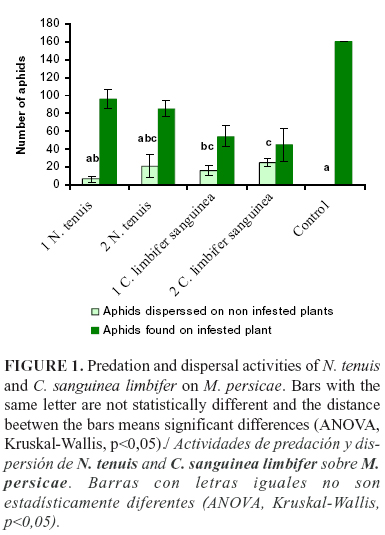
<body><![CDATA[<P>&nbsp;     <P><font face="Verdana, Arial, Helvetica, sans-serif" size="2"><B><font size="3">RESULTS</font></B>    </font>     <P><font face="Verdana, Arial, Helvetica, sans-serif" size="2"><B><U>Predation    and aphid dispersal test</U></B> </font>     <P><font face="Verdana, Arial, Helvetica, sans-serif" size="2">The total number    of aphids on the infested plants differed significantly between treatments after    24h of the beginning of the experiment (<a href="#f1">Fig.1</a>, ANOVA, F=14.99,    d.f.=4, p&lt;0.0001). The number of aphids per plant was higher in the control    than in the treatments with predator. Among predator treatments, the number    of aphids on the infested plant was higher in the presence of<I> N. tenuis</I>    than in the presence of <I>C. sanguinea limbifer</I>. In addition, the highest    quantity of aphids was found on the infested plant in the treatments where a    single (one) predator was used.</font>      <P align="center"><img src="/img/revistas/rpv/v29n2/f0104214.jpg" width="385" height="535">    <a name="f1"></a>     
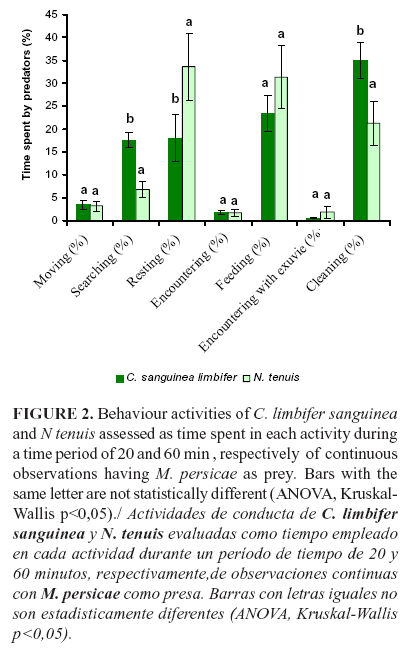
<P><font face="Verdana, Arial, Helvetica, sans-serif" size="2">Dispersal of <I>M.    persicae</I> towards non-infested plants (i.e. total number of aphids on the    non-infested plants) was higher with predators than without them (<a href="#f1">Fig.1</a>,    Kruskal-Wallis), with significant differences between the treatments. The coccinellid<I>    C. sanguinea</I> <I>limbifer</I> allowed more dispersion of <I>M. persicae</I>    than <I>N. tenuis</I>, but the highest aphid dispersion occurred when a higher    predator quantity (2 predators/plant) was used for both species. This result    showed an antipredator behaviour of the aphids with the predator presence, considering    that <I>M. persicae</I> moved to another plant or evaded predator proximity    for persisting, mainly when the two predators were present. </font>      <P><font face="Verdana, Arial, Helvetica, sans-serif" size="2"><B>Behavior of    predators</B> </font>     <P><font face="Verdana, Arial, Helvetica, sans-serif" size="2">The number of aphids    consumed by <I>N. tenuis</I> during 60 min was 1.43, whereas by <I>C. limbifer    sanguinea</I> was 11.97 during 20 min. The behavior activities of <I>C. limbifer</I>    and <I>N. tenuis</I> during 20 and 60 min, respectively, of continuous observations    are shown in <a href="#f2">Fig. 2</a>.</font>      <P align="center"><img src="/img/revistas/rpv/v29n2/f0204214.jpg" width="414" height="652">    <a name="f2"></a>     
<P><font face="Verdana, Arial, Helvetica, sans-serif" size="2">The time spent    in moving, encountering (touching aphids), encountering with exuviae and feeding    activities between the predators did not show significant differences (<a href="#f2">Figure    2</a>). The time spent in feeding by <I>N. tenuis</I> was higher than that spent    by <I>C. limbifer sanguinea</I>. <I>N. tenuis</I> needed longer time for resting    than <I>C. sanguinea limbifer</I> <I>(p=0,0088)</I>. The lady beetle spent longer    time in searching preys than the predatory bug <I>(p=0,0007)</I>. The time needed    by <I>C. sanguinea</I> <I>limbifer</I> for cleaning the mouthparts with it forelegs    was longer than that needed by <I>N. tenuis</I> for cleaning its whole body    <I>(p=0,0218). </I> </font>      ]]></body>
<body><![CDATA[<P><font face="Verdana, Arial, Helvetica, sans-serif" size="2">In general, the    predatory bug and the coccinellid spent an important part of the time in cleaning    (41%) and resting (38%) activities when both were combined. However, C<I>. sanguinea</I>    <I>limbifer</I> used longer time performing other activities directly associated    with aphid predation (moving, searching, encountering and feeding) than <I>N.    tenuis did</I>. The lady beetle started predation activity after 11 seconds    of being released in the arena, and they were quicker and more voracious than    the mirid. The encountering of <I>C. sanguinea limbifer</I> with <I>M. persicae</I>    was more frequent and the time spent by it for taking the first prey was in    average 25 seconds. <I>C. sanguinea limbifer</I> consumed approximately 5.4    aphids between cleaning and resting activities. With lady beetles, the first    predation event and the first antipredator behavior of <I>M. persicae</I> occurred    almost simultaneously, whereas with <I>N. tenuis</I> was not in this way. The    stronger antipredator behavior of <I>M. persicae </I>occurred at least 30 minutes    after the predator <I>N. tenuis</I> started the attack, and this behavior was    mainly showed by aphid nymphs. </font>     <P><font face="Verdana, Arial, Helvetica, sans-serif" size="2">In the behavioral    observations, <I>N. tenuis</I> started to prey on average 32 min after being    released on the aphid colony. The time spent by bugs for taking the first prey    was 17.22 min on average, and the previous time before predation were used for    moving, cleaning and resting activities. In contrast, with <I>C. sanguinea limbifer</I>,    <I>N. tenuis</I> preferred 1<SUP>st </SUP>- 3<SUP>rd</SUP> instar aphids as    prey. The antipredator behavior of the 4 instar nymphs and the aphid adults    after the attack of <I>N. tenuis</I> allowed them to disperse and evade predation    (i.e. to run away). </font>     <P>&nbsp;     <P><font face="Verdana, Arial, Helvetica, sans-serif" size="2"><B><font size="3">DISCUSSION</font></B>    </font>     <P><font face="Verdana, Arial, Helvetica, sans-serif" size="2">The evidence on    finding a high quantity of aphids on infested plants when <I>N. tenuis</I> was    present and a low quantity when the two predators were present suggested that<I>    C. sanguinea limbifer</I> was more voracious than <I>N. tenuis</I> when the    prey was the aphid <I>M. persicae</I>, and that the quantity of them had an    influence on reducing aphid populations. Both natural enemies promoted <I>M.    persicae</I> dispersal towards non-infested plants. The predatory bug <I>N.    tenuis</I> induced some antipredator behavior of <I>M. persicae</I> (i.e. running    away) when it was released and entered into a colony, whereas the coccinellid    <I>C. limbifer sanguinea</I> did not seem to be perceived by aphids until the    first aphid was attacked. However, when the first predation event occurred,    more aphids then dropped off the plant with coccinellids than with mirid bugs.    Also the number of aphids performing antipredator behavior during a searching    event was higher with coccinellids than with mirid bugs. </font>     <P><font face="Verdana, Arial, Helvetica, sans-serif" size="2">These results indicated    that <I>C. sanguinea limbifer</I> adults induced antipredator behaviour in <I>M.    persicae</I> only after the first attack, and predation by this coccinellid    species induced stronger antipredator behavior than predation by mirid bug <I>N.    tenuis</I>. The higher number of aphids showing antipredator behavior with coccinellids    than with bugs could be due to the longer distance covered by <I>C. sanguinea    limbifer</I> or to the faster escape of aphids. In turn, it could enhance an    earlier infestation of surrounding non-infested plants and, therefore, increase    transmission of the non-persistently transmitted virus by <I>M. persicae</I>.    </font>     <P><font face="Verdana, Arial, Helvetica, sans-serif" size="2">Belliure <I>et    al</I>. (18), reported the antipredator behavior of aphids starting only after    the first coccinellid attack, an event associated with the alarm pheromone emission    only when the aphids have been physically attacked, and not when they have detected    a predator. This phenomenon occurs by (E)-beta-farnesene pheromone in several    aphids species, including <I>M. persicae. </I>It is also released as a volatile    substance by plant species of several families, including Solanaceae (20), together    with other sesquiterpene hydrocarbons that inhibit pheromonal activity. This    allows aphids to distinguish between the signal emitted by plants and that from    aphids following attack by natural enemies (21). </font>     <P><font face="Verdana, Arial, Helvetica, sans-serif" size="2">Furthermore, aphids    release a basal level of pheromone also in the absence of predator attack (22).    The response of <I>M. persicae</I> to emission of alarm pheromone also results    in a higher survival rate in the presence of a coccinellid predator (<I>Hippodamia    convergens</I>) (23), and moreover, the alarm pheromone serves as an attractive    cue for predators such as coccinellids and other beetles (24). Therefore, it    is adaptively beneficial for aphids to emit the alarm pheromone only in case    of actual danger (25). This might explain in this study why <I>M. persicae</I>    did not react to <I>C. sanguinea limbifer</I> before any aphid was attacked.    This behavioural response is consistent with the reported lack of attraction    of <I>Adalia bipunctata</I> (L.) towards <I>M. persicae</I> unless aphids are    stressed and therefore emitting the alarm pheromone (26,18). </font>     <P><font face="Verdana, Arial, Helvetica, sans-serif" size="2">Moreover, observations    of natural aphid colonies revealed a collective twitching and kicking responses    (CTKR) against natural enemies. In addition, laser vibrometry of the substrate    revealed twitching-associated vibrations that formed a train of sharp acceleration    peaks in the course of a CTKR. This suggests that visual signals in combination    with twitching-related substrate vibrations may play an important role in synchronising    defence among individuals of an aphid colony. This cooperative defence behaviour    provides an example of a surprising sociality that can be found in some aphid    species that are not expected to be social at all (27). </font>     <P><font face="Verdana, Arial, Helvetica, sans-serif" size="2">It is known that    natural enemies affect aphids not only by causing direct mortality, but also    may affect pest dynamics inducing its dispersion to another host as a response    to escape from predation. Predators and parasitoids promote dispersal of pests,    affect the feeding behavior of their prey, and reduce prey populations by inducing    an antipredator behavior (18). </font>     ]]></body>
<body><![CDATA[<P>&nbsp;     <P><font face="Verdana, Arial, Helvetica, sans-serif" size="2"><B><font size="3">CONCLUSION</font></B>    </font>     <P><font face="Verdana, Arial, Helvetica, sans-serif" size="2">These results showed    that a higher dispersion of the aphid <I>M. persicae</I> occurs in the presence    of the coccinellid <I>C. sanguinea limbifer</I> than with the predatory bug    <I>N. tenuis</I>, and that this might be due to the strongest antipredator behaviour    induced by <I>C. sanguinea limbifer</I> in comparison with <I>N. tenuis</I>    on colonies of <I>M. persicae</I>. However, the highest number of aphids consumed    was by <I>C. sanguinea limbifer</I>. Overall, these results highlight the relevance    of the studies on plantpest speciesnatural enemy interactions for understanding    the epidemiology of vector-borne plant viruses, in the case of <I>M. persicae</I>.    Other studies have also pointed out the importance of such studies with parasitoids    (28,29). The use of both species in regulating populations of insect pests (30,31)    is well known, for this reason, the potential practical implications of these    results for the biological control of aphid vectors would be the use of appropriate    natural enemies, preferably selecting those predators inducing weaker antipredator    responses, when there is a high risk of spread of non-persistent viruses.</font>     <P>&nbsp;     <P><font face="Verdana, Arial, Helvetica, sans-serif" size="2"><B><font size="3">REFERENCES</font></B>    </font>     <!-- ref --><P><font face="Verdana, Arial, Helvetica, sans-serif" size="2">1. Wheeler AG.    Predacious plant bugs (Miridae). In Heteroptera of Economic Importance, 2000.        </font>      <!-- ref --><P><font face="Verdana, Arial, Helvetica, sans-serif" size="2">2. Calvo FJ, Lorente    MJ, Stansly PA, Belda JE. Preplant release of <I>Nesidiocoris tenuis</I> and    supplementary tactics for control of <I>Tuta absoluta</I> and <I>Bemisa tabaci</I>    in greenhouse tomato. Entomologia Experimentalis et Applicata. 2012;143(2):111-119.        </font>     <!-- ref --><P><font face="Verdana, Arial, Helvetica, sans-serif" size="2">3. van Lenteren    JC. IOBC Internet Book of Biological Control - Version 6. 2012. Available online:    <a href="http://www.iobcglobal.org/publications_iobc_internet_%20book_of_biological_control.html">http://www.iobcglobal.org/publications_iobc_internet_    book_of_biological_control.html</a>. Consulted 24/3/2014.     </font>      <!-- ref --><P><font face="Verdana, Arial, Helvetica, sans-serif" size="2">4. Bueno VH, van    Lenteren JC. Insect Bioecology and Nutrition for Integrated Pest Management    (Book). Chapter 22. Predatory Bugs (Heteroptera). 2012; 539-569.     </font>     <!-- ref --><P><font face="Verdana, Arial, Helvetica, sans-serif" size="2">5. Sanchez JA.    Density thresholds for <I>Nesidiocoris tenuis</I> (Heteroptera: Miridae) in    tomato crops. Biological Control. 2009;51:493-498.     </font>     <!-- ref --><P><font face="Verdana, Arial, Helvetica, sans-serif" size="2">6. Casta&ntilde;&eacute;    C, Arn&oacute; J, Gabarra R, Alomar O. Plant damage to vegetable crops by zoophytophagous    mirid predators. Biological Control. 2011;59(1):22-29.     </font>     <!-- ref --><P><font face="Verdana, Arial, Helvetica, sans-serif" size="2">7. Urbaneja A,    Calvo J, Bolckmans K, Stansly PA. Predation by <I>Nesidiocoris tenuis</I> on    <I>Bemisia tabaci</I> and injury to tomato. BioControl. 2009;54:237-246.     </font>     <!-- ref --><P><font face="Verdana, Arial, Helvetica, sans-serif" size="2">8. Arn&oacute;    J, Casta&ntilde;&eacute; C, Riudavets J, Roig J, Gabarra R. Characterization    of damage to tomato plants produced by the zoophytophagous predator <I>Nesidiocoris    tenuis</I>. IOBC wprs Bulletin. 2006;29:249-254.     </font>     <!-- ref --><P><font face="Verdana, Arial, Helvetica, sans-serif" size="2">9. Sanchez JA,    Martinez-Cascales JI, La casa A. Abundance and wild host plants of predator    mirids (Heteroptera: Miridae) in horticultural crops in the Southeast of Spain.    IOBC wprs Bulletin. 2003;26:147-151.     </font>     <!-- ref --><P><font face="Verdana, Arial, Helvetica, sans-serif" size="2">10.Trottin-Caudal    Y, Fournier C, Leyre JM, Chabriere C. La tomate sous serre dans le Sud-Est de    la France. Protection contre la punaise <I>Nesidiocoris tenuis</I>. Infos Ctifl.    2006;224:30-35.     </font>      <!-- ref --><P><font face="Verdana, Arial, Helvetica, sans-serif" size="2">11.Grillo H. Heteropteros    de Cuba. Tesis presentada en opci&oacute;n al T&iacute;tulo de Doctor en Ciencias.    Universidad Central de Las Villas, Cuba. 2012.     </font>      <P><font face="Verdana, Arial, Helvetica, sans-serif" size="2">12.Gullan PJ, Craston    PC. The Insects: An Outline of Entomology. Chapter 16: Pest management. Fourth    Edition. Wiley-Blackwell. 2010. 590p. </font>      <!-- ref --><P><font face="Verdana, Arial, Helvetica, sans-serif" size="2">13.Van Driesche    R, Hoddle M. Control of pests and weeds by natural enemies an introduction to    biological control. Parte 2, Kids of natural enemies. Chapter 4. Predator diversity    and ecology. Blackwell Publishing Ltd. 2008. 502p.     </font>     ]]></body>
<body><![CDATA[<!-- ref --><P><font face="Verdana, Arial, Helvetica, sans-serif" size="2">14.Finlayson C,    Alyokhin A, Gross S, Porter E. Differential consumption of four aphid species    by four lady beetle species. Journal of Insect Science. 2010;10:31. Available    online: <U><a href="http://www.insectsicence.org/10.31">http://www.insectsicence.org/10.31</a></U>.        </font>     <!-- ref --><P><font face="Verdana, Arial, Helvetica, sans-serif" size="2">15.Mil&aacute;n    O, Cueto N, Hern&aacute;ndez N, Ramos T, Pineda MD, Granda R, et al. Prospecci&oacute;n    de coccin&eacute;lidos benefices asociados a plagas y cultivos en Cuba. Fitosanidad.    2008;12(2):71-78.     </font>     <!-- ref --><P><font face="Verdana, Arial, Helvetica, sans-serif" size="2">16.Duarte L, Mart&iacute;nez    MA, Ceballos M. <I>Aphelinus abdominalis </I>Dalman (Hymenoptera: Aphelinidae):    Par&aacute;metros biol&oacute;gicos, hospedantes y cultivos asociados. Rev Protecci&oacute;n    Veg<I>. </I>2012;27(3):147-150.     </font>     <!-- ref --><P><font face="Verdana, Arial, Helvetica, sans-serif" size="2">17.Duarte L, Mart&iacute;nez    MA, Ceballos M, Ba&ntilde;os HL, Miranda I, S&aacute;nchez A. Biolog&iacute;a    y tabla de vida de <I>Myzus persicae </I>(Sulzer) (Hemiptera: Aphididae) en    condiciones de laboratorio. Rev Protecci&oacute;n Veg<I>. </I>2011;26(1):1-4.        </font>     <!-- ref --><P><font face="Verdana, Arial, Helvetica, sans-serif" size="2">18.Belliure B,    Amor&oacute;s-Jim&eacute;nez R, Fereres A, Marcos-Garc&iacute;a MA. Antipredator    behaviour of <I>Myzus persicae</I> affects transmission efficiency of Broad    bean wiltvirus 1. Virus Research. 2011;159:206-214.     </font>     ]]></body>
<body><![CDATA[<!-- ref --><P><font face="Verdana, Arial, Helvetica, sans-serif" size="2">19.Ottoni EB. EthoLog    2.2: A tool for the transcription and timing of behaviour observation sessions.    Behav Res Methods Instrum Computers. 2000;32(3):446-449.     </font>      <!-- ref --><P><font face="Verdana, Arial, Helvetica, sans-serif" size="2">20.Agelopoulos    NG, Hooper AM, Maniar SP, Pickett JA, Wadhams LJ. A novel approach for isolation    of volatile chemicals released by individual leaves of a plant in situ. J Chem    Ecol. 1999;25:1411-1425.     </font>     <!-- ref --><P><font face="Verdana, Arial, Helvetica, sans-serif" size="2">21.Dawson GW, Griffiths    DC, Merritt LA, Mudd A, Pickett JA, et al. Aphid semiochemicals: a review, and    recent advances on the sex pheromone. J Chem Ecol. 1990;16:3019-3030.     </font>     <!-- ref --><P><font face="Verdana, Arial, Helvetica, sans-serif" size="2">22.Almohamad R,    Verheggen FJ, Francis F, Lognay G, Haubruge E. Emission of alarm pheromone by    non-preyed aphid colonies. J Appl Entomol. 2008;132:601-604.     </font>     <!-- ref --><P><font face="Verdana, Arial, Helvetica, sans-serif" size="2">23.De Vos M, Cheng    WY, Summers HE, Raguso RA, Jander G. Alarm pheromone habituation in <I>Myzus    persicae</I> has fitness consequences and causes extensive gene expression changes.    Proc Natl Acad Sci. U.S.A. 2010;107:14673-14678.     </font>     ]]></body>
<body><![CDATA[<!-- ref --><P><font face="Verdana, Arial, Helvetica, sans-serif" size="2">24.Verheggen FJ,    Fagel Q, Heuskin S, Lognay G, Francis F, Haubruge E. Electrophysiological and    behavioral responses of the multicolored Asian lady beetle, <I>Harmonia axyridis</I>    Pallas, to sesquiterpene semiochemicals. J Chem Ecol. 2007;33:2148-2155.     </font>     <!-- ref --><P><font face="Verdana, Arial, Helvetica, sans-serif" size="2">25.Fievet V, Lhomme    P, Outreman Y. Predation risk cues associated with killed conspecifics affect    the behavior and reproduction of prey animals. Oikos. 2008;117:1380-1385.     </font>     <!-- ref --><P><font face="Verdana, Arial, Helvetica, sans-serif" size="2">26.Francis F, Lognay    G, Haubruge E. Olfactory responses to aphid and host plant volatile releases:    (E)-Farnesene an effective kairomone for the predator <I>Adalia bipunctata</I>.    J Chem Ecol. 2004;30:741-755.     </font>     <!-- ref --><P><font face="Verdana, Arial, Helvetica, sans-serif" size="2">27.Hartbauer M.    Collective Defense of <I>Aphis nerii</I> and <I>Uroleucon hypochoeridis</I>    (Homoptera, Aphididae) against Natural Enemies. PLoS ONE. 2010;5(4):e10417.    </font>      <!-- ref --><P><font face="Verdana, Arial, Helvetica, sans-serif" size="2">28.Hodge S, Hardie    J, Powell G. Parasitoid said dispersal of an on persistently transmitted plant    virus by disturbing the aphid vector. Agric Forest Entomol. 2010;13:83-88.     </font>     ]]></body>
<body><![CDATA[<!-- ref --><P><font face="Verdana, Arial, Helvetica, sans-serif" size="2">29.Jeger MJ, Chen    Z, Powell G, Hodge S, van den Bosch F. Interactions in a host plant-virus-vector-parasitoid    system: modeling the consequences for virus transmission and disease dynamics.    Virus Research. 2011;159:183-193.     </font>      <!-- ref --><P><font face="Verdana, Arial, Helvetica, sans-serif" size="2">30.Perdikis D,    Alomar O. Heteropteran Predators and Their Role in Biological Control in Agroecosystems.    Biological Control. 2011;59(1):1-68.     </font>     <!-- ref --><P><font face="Verdana, Arial, Helvetica, sans-serif" size="2">31.van Lenteren    JC. The state of commercial augmentative biological control: plenty of natural    enemies, but a frustrating lack of uptake. BioControl. 2012;57:1-20.    </font>     <P>&nbsp;     <P>&nbsp;     <P><font face="Verdana, Arial, Helvetica, sans-serif" size="2">Recibido: 7-3-2014.    <br>   </font><font face="Verdana, Arial, Helvetica, sans-serif" size="2">Aceptado:    6-5-2014.</font><font face="Verdana, Arial, Helvetica, sans-serif" size="2">    </font>     ]]></body>
<body><![CDATA[ ]]></body><back>
<ref-list>
<ref id="B1">
<label>1</label><nlm-citation citation-type="">
<person-group person-group-type="author">
<name>
<surname><![CDATA[Wheeler]]></surname>
<given-names><![CDATA[AG]]></given-names>
</name>
</person-group>
<article-title xml:lang="en"><![CDATA[Predacious plant bugs (Miridae)]]></article-title>
<source><![CDATA[Heteroptera of Economic Importance]]></source>
<year></year>
</nlm-citation>
</ref>
<ref id="B2">
<label>2</label><nlm-citation citation-type="journal">
<person-group person-group-type="author">
<name>
<surname><![CDATA[Calvo]]></surname>
<given-names><![CDATA[FJ]]></given-names>
</name>
<name>
<surname><![CDATA[Lorente]]></surname>
<given-names><![CDATA[MJ]]></given-names>
</name>
<name>
<surname><![CDATA[Stansly]]></surname>
<given-names><![CDATA[PA]]></given-names>
</name>
<name>
<surname><![CDATA[Belda]]></surname>
<given-names><![CDATA[JE]]></given-names>
</name>
</person-group>
<article-title xml:lang="en"><![CDATA[Preplant release of Nesidiocoris tenuis and supplementary tactics for control of Tuta absoluta and Bemisa tabaci in greenhouse tomato]]></article-title>
<source><![CDATA[Entomologia Experimentalis et Applicata]]></source>
<year>2012</year>
<volume>143</volume>
<numero>2</numero>
<issue>2</issue>
<page-range>111-119</page-range></nlm-citation>
</ref>
<ref id="B3">
<label>3</label><nlm-citation citation-type="">
<person-group person-group-type="author">
<name>
<surname><![CDATA[van Lenteren]]></surname>
<given-names><![CDATA[JC]]></given-names>
</name>
</person-group>
<source><![CDATA[IOBC Internet Book of Biological Control - Version 6. 2012]]></source>
<year></year>
</nlm-citation>
</ref>
<ref id="B4">
<label>4</label><nlm-citation citation-type="">
<person-group person-group-type="author">
<name>
<surname><![CDATA[Bueno]]></surname>
<given-names><![CDATA[VH]]></given-names>
</name>
<name>
<surname><![CDATA[van Lenteren]]></surname>
<given-names><![CDATA[JC]]></given-names>
</name>
</person-group>
<source><![CDATA[Insect Bioecology and Nutrition for Integrated Pest Management (Book): Chapter 22. Predatory Bugs (Heteroptera)]]></source>
<year>2012</year>
<page-range>539-569</page-range></nlm-citation>
</ref>
<ref id="B5">
<label>5</label><nlm-citation citation-type="journal">
<person-group person-group-type="author">
<name>
<surname><![CDATA[Sanchez]]></surname>
<given-names><![CDATA[JA]]></given-names>
</name>
</person-group>
<article-title xml:lang="en"><![CDATA[Density thresholds for Nesidiocoris tenuis (Heteroptera: Miridae) in tomato crops]]></article-title>
<source><![CDATA[Biological Control]]></source>
<year>2009</year>
<volume>51</volume>
<page-range>493-498</page-range></nlm-citation>
</ref>
<ref id="B6">
<label>6</label><nlm-citation citation-type="journal">
<person-group person-group-type="author">
<name>
<surname><![CDATA[Castañé]]></surname>
<given-names><![CDATA[C]]></given-names>
</name>
<name>
<surname><![CDATA[Arnó]]></surname>
<given-names><![CDATA[J]]></given-names>
</name>
<name>
<surname><![CDATA[Gabarra]]></surname>
<given-names><![CDATA[R]]></given-names>
</name>
<name>
<surname><![CDATA[Alomar]]></surname>
<given-names><![CDATA[O]]></given-names>
</name>
</person-group>
<article-title xml:lang="en"><![CDATA[Plant damage to vegetable crops by zoophytophagous mirid predators]]></article-title>
<source><![CDATA[Biological Control]]></source>
<year>2011</year>
<volume>59</volume>
<numero>1</numero>
<issue>1</issue>
<page-range>22-29</page-range></nlm-citation>
</ref>
<ref id="B7">
<label>7</label><nlm-citation citation-type="journal">
<person-group person-group-type="author">
<name>
<surname><![CDATA[Urbaneja]]></surname>
<given-names><![CDATA[A]]></given-names>
</name>
<name>
<surname><![CDATA[Calvo]]></surname>
<given-names><![CDATA[J]]></given-names>
</name>
<name>
<surname><![CDATA[Bolckmans]]></surname>
<given-names><![CDATA[K]]></given-names>
</name>
<name>
<surname><![CDATA[Stansly]]></surname>
<given-names><![CDATA[PA]]></given-names>
</name>
</person-group>
<article-title xml:lang="en"><![CDATA[Predation by Nesidiocoris tenuis on Bemisia tabaci and injury to tomato]]></article-title>
<source><![CDATA[BioControl]]></source>
<year>2009</year>
<volume>54</volume>
<page-range>237-246</page-range></nlm-citation>
</ref>
<ref id="B8">
<label>8</label><nlm-citation citation-type="journal">
<person-group person-group-type="author">
<name>
<surname><![CDATA[Arnó]]></surname>
<given-names><![CDATA[J]]></given-names>
</name>
<name>
<surname><![CDATA[Castañé]]></surname>
<given-names><![CDATA[C]]></given-names>
</name>
<name>
<surname><![CDATA[Riudavets]]></surname>
<given-names><![CDATA[J]]></given-names>
</name>
<name>
<surname><![CDATA[Roig]]></surname>
<given-names><![CDATA[J]]></given-names>
</name>
<name>
<surname><![CDATA[Gabarra]]></surname>
<given-names><![CDATA[R]]></given-names>
</name>
</person-group>
<article-title xml:lang="en"><![CDATA[Characterization of damage to tomato plants produced by the zoophytophagous predator Nesidiocoris tenuis]]></article-title>
<source><![CDATA[IOBC wprs Bulletin]]></source>
<year>2006</year>
<volume>29</volume>
<page-range>249-254</page-range></nlm-citation>
</ref>
<ref id="B9">
<label>9</label><nlm-citation citation-type="journal">
<person-group person-group-type="author">
<name>
<surname><![CDATA[Sanchez]]></surname>
<given-names><![CDATA[JA]]></given-names>
</name>
<name>
<surname><![CDATA[Martinez-Cascales]]></surname>
<given-names><![CDATA[JI]]></given-names>
</name>
<name>
<surname><![CDATA[La casa]]></surname>
<given-names><![CDATA[A]]></given-names>
</name>
</person-group>
<article-title xml:lang="en"><![CDATA[Abundance and wild host plants of predator mirids (Heteroptera: Miridae) in horticultural crops in the Southeast of Spain]]></article-title>
<source><![CDATA[IOBC wprs Bulletin]]></source>
<year>2003</year>
<volume>26</volume>
<page-range>147-151</page-range></nlm-citation>
</ref>
<ref id="B10">
<label>10</label><nlm-citation citation-type="journal">
<person-group person-group-type="author">
<name>
<surname><![CDATA[Trottin-Caudal]]></surname>
<given-names><![CDATA[Y]]></given-names>
</name>
<name>
<surname><![CDATA[Fournier]]></surname>
<given-names><![CDATA[C]]></given-names>
</name>
<name>
<surname><![CDATA[Leyre]]></surname>
<given-names><![CDATA[JM]]></given-names>
</name>
<name>
<surname><![CDATA[Chabriere]]></surname>
<given-names><![CDATA[C]]></given-names>
</name>
</person-group>
<article-title xml:lang="fr"><![CDATA[La tomate sous serre dans le Sud-Est de la France: Protection contre la punaise Nesidiocoris tenuis]]></article-title>
<source><![CDATA[Infos Ctifl]]></source>
<year>2006</year>
<volume>224</volume>
<page-range>30-35</page-range></nlm-citation>
</ref>
<ref id="B11">
<label>11</label><nlm-citation citation-type="">
<person-group person-group-type="author">
<name>
<surname><![CDATA[Grillo]]></surname>
<given-names><![CDATA[H]]></given-names>
</name>
</person-group>
<source><![CDATA[Heteropteros de Cuba]]></source>
<year></year>
</nlm-citation>
</ref>
<ref id="B12">
<label>12</label><nlm-citation citation-type="book">
<person-group person-group-type="author">
<name>
<surname><![CDATA[Gullan]]></surname>
<given-names><![CDATA[PJ]]></given-names>
</name>
<name>
<surname><![CDATA[Craston]]></surname>
<given-names><![CDATA[PC]]></given-names>
</name>
</person-group>
<article-title xml:lang="en"><![CDATA[The Insects: An Outline of Entomology]]></article-title>
<source><![CDATA[Chapter 16: Pest management]]></source>
<year>2010</year>
<edition>4th</edition>
<page-range>590</page-range><publisher-name><![CDATA[Wiley-Blackwell]]></publisher-name>
</nlm-citation>
</ref>
<ref id="B13">
<label>13</label><nlm-citation citation-type="book">
<person-group person-group-type="author">
<name>
<surname><![CDATA[Van Driesche]]></surname>
<given-names><![CDATA[R]]></given-names>
</name>
<name>
<surname><![CDATA[Hoddle]]></surname>
<given-names><![CDATA[M]]></given-names>
</name>
</person-group>
<article-title xml:lang="en"><![CDATA[Control of pests and weeds by natural enemies an introduction to biological control: Parte 2, Kids of natural enemies]]></article-title>
<source><![CDATA[Chapter 4: Predator diversity and ecology]]></source>
<year>2008</year>
<page-range>502</page-range><publisher-name><![CDATA[Blackwell Publishing Ltd]]></publisher-name>
</nlm-citation>
</ref>
<ref id="B14">
<label>14</label><nlm-citation citation-type="journal">
<person-group person-group-type="author">
<name>
<surname><![CDATA[Finlayson]]></surname>
<given-names><![CDATA[C]]></given-names>
</name>
<name>
<surname><![CDATA[Alyokhin]]></surname>
<given-names><![CDATA[A]]></given-names>
</name>
<name>
<surname><![CDATA[Gross]]></surname>
<given-names><![CDATA[S]]></given-names>
</name>
<name>
<surname><![CDATA[Porter]]></surname>
<given-names><![CDATA[E]]></given-names>
</name>
</person-group>
<article-title xml:lang="en"><![CDATA[Differential consumption of four aphid species by four lady beetle species]]></article-title>
<source><![CDATA[Journal of Insect Science]]></source>
<year>2010</year>
<volume>10</volume>
<page-range>31</page-range></nlm-citation>
</ref>
<ref id="B15">
<label>15</label><nlm-citation citation-type="journal">
<person-group person-group-type="author">
<name>
<surname><![CDATA[Milán]]></surname>
<given-names><![CDATA[O]]></given-names>
</name>
<name>
<surname><![CDATA[Cueto]]></surname>
<given-names><![CDATA[N]]></given-names>
</name>
<name>
<surname><![CDATA[Hernández]]></surname>
<given-names><![CDATA[N]]></given-names>
</name>
<name>
<surname><![CDATA[Ramos]]></surname>
<given-names><![CDATA[T]]></given-names>
</name>
<name>
<surname><![CDATA[Pineda]]></surname>
<given-names><![CDATA[MD]]></given-names>
</name>
<name>
<surname><![CDATA[Granda]]></surname>
<given-names><![CDATA[R]]></given-names>
</name>
</person-group>
<article-title xml:lang="es"><![CDATA[Prospección de coccinélidos benefices asociados a plagas y cultivos en Cuba]]></article-title>
<source><![CDATA[Fitosanidad]]></source>
<year>2008</year>
<volume>12</volume>
<numero>2</numero>
<issue>2</issue>
<page-range>71-78</page-range></nlm-citation>
</ref>
<ref id="B16">
<label>16</label><nlm-citation citation-type="journal">
<person-group person-group-type="author">
<name>
<surname><![CDATA[Duarte]]></surname>
<given-names><![CDATA[L]]></given-names>
</name>
<name>
<surname><![CDATA[Martínez]]></surname>
<given-names><![CDATA[MA]]></given-names>
</name>
<name>
<surname><![CDATA[Ceballos]]></surname>
<given-names><![CDATA[M]]></given-names>
</name>
</person-group>
<article-title xml:lang="es"><![CDATA[Aphelinus abdominalis Dalman (Hymenoptera: Aphelinidae): Parámetros biológicos, hospedantes y cultivos asociados]]></article-title>
<source><![CDATA[Rev Protección Veg]]></source>
<year>2012</year>
<volume>27</volume>
<numero>3</numero>
<issue>3</issue>
<page-range>147-150</page-range></nlm-citation>
</ref>
<ref id="B17">
<label>17</label><nlm-citation citation-type="journal">
<person-group person-group-type="author">
<name>
<surname><![CDATA[Duarte]]></surname>
<given-names><![CDATA[L]]></given-names>
</name>
<name>
<surname><![CDATA[Martínez]]></surname>
<given-names><![CDATA[MA]]></given-names>
</name>
<name>
<surname><![CDATA[Ceballos]]></surname>
<given-names><![CDATA[M]]></given-names>
</name>
<name>
<surname><![CDATA[Baños]]></surname>
<given-names><![CDATA[HL]]></given-names>
</name>
<name>
<surname><![CDATA[Miranda]]></surname>
<given-names><![CDATA[I]]></given-names>
</name>
<name>
<surname><![CDATA[Sánchez]]></surname>
<given-names><![CDATA[A]]></given-names>
</name>
</person-group>
<article-title xml:lang="es"><![CDATA[Biología y tabla de vida de Myzus persicae (Sulzer) (Hemiptera: Aphididae) en condiciones de laboratorio]]></article-title>
<source><![CDATA[Rev Protección Veg]]></source>
<year>2011</year>
<volume>26</volume>
<numero>1</numero>
<issue>1</issue>
<page-range>1-4</page-range></nlm-citation>
</ref>
<ref id="B18">
<label>18</label><nlm-citation citation-type="journal">
<person-group person-group-type="author">
<name>
<surname><![CDATA[Belliure]]></surname>
<given-names><![CDATA[B]]></given-names>
</name>
<name>
<surname><![CDATA[Amorós-Jiménez]]></surname>
<given-names><![CDATA[R]]></given-names>
</name>
<name>
<surname><![CDATA[Fereres]]></surname>
<given-names><![CDATA[A]]></given-names>
</name>
<name>
<surname><![CDATA[Marcos-García]]></surname>
<given-names><![CDATA[MA]]></given-names>
</name>
</person-group>
<article-title xml:lang="en"><![CDATA[Antipredator behaviour of Myzus persicae affects transmission efficiency of Broad bean wiltvirus 1]]></article-title>
<source><![CDATA[Virus Research]]></source>
<year>2011</year>
<volume>159</volume>
<page-range>206-214</page-range></nlm-citation>
</ref>
<ref id="B19">
<label>19</label><nlm-citation citation-type="journal">
<person-group person-group-type="author">
<name>
<surname><![CDATA[Ottoni]]></surname>
<given-names><![CDATA[EB]]></given-names>
</name>
</person-group>
<article-title xml:lang="en"><![CDATA[EthoLog 2.2: A tool for the transcription and timing of behaviour observation sessions]]></article-title>
<source><![CDATA[Behav Res Methods Instrum Computers]]></source>
<year>2000</year>
<volume>32</volume>
<numero>3</numero>
<issue>3</issue>
<page-range>446-449</page-range></nlm-citation>
</ref>
<ref id="B20">
<label>20</label><nlm-citation citation-type="journal">
<person-group person-group-type="author">
<name>
<surname><![CDATA[Agelopoulos]]></surname>
<given-names><![CDATA[NG]]></given-names>
</name>
<name>
<surname><![CDATA[Hooper]]></surname>
<given-names><![CDATA[AM]]></given-names>
</name>
<name>
<surname><![CDATA[Maniar]]></surname>
<given-names><![CDATA[SP]]></given-names>
</name>
<name>
<surname><![CDATA[Pickett]]></surname>
<given-names><![CDATA[JA]]></given-names>
</name>
<name>
<surname><![CDATA[Wadhams]]></surname>
<given-names><![CDATA[LJ]]></given-names>
</name>
</person-group>
<article-title xml:lang="en"><![CDATA[A novel approach for isolation of volatile chemicals released by individual leaves of a plant in situ]]></article-title>
<source><![CDATA[J Chem Ecol]]></source>
<year>1999</year>
<volume>25</volume>
<page-range>1411-1425</page-range></nlm-citation>
</ref>
<ref id="B21">
<label>21</label><nlm-citation citation-type="journal">
<person-group person-group-type="author">
<name>
<surname><![CDATA[Dawson]]></surname>
<given-names><![CDATA[GW]]></given-names>
</name>
<name>
<surname><![CDATA[Griffiths]]></surname>
<given-names><![CDATA[DC]]></given-names>
</name>
<name>
<surname><![CDATA[Merritt]]></surname>
<given-names><![CDATA[LA]]></given-names>
</name>
<name>
<surname><![CDATA[Mudd]]></surname>
<given-names><![CDATA[A]]></given-names>
</name>
<name>
<surname><![CDATA[Pickett]]></surname>
<given-names><![CDATA[JA]]></given-names>
</name>
</person-group>
<article-title xml:lang="en"><![CDATA[Aphid semiochemicals: a review, and recent advances on the sex pheromone]]></article-title>
<source><![CDATA[J Chem Ecol]]></source>
<year>1990</year>
<volume>16</volume>
<page-range>3019-3030</page-range></nlm-citation>
</ref>
<ref id="B22">
<label>22</label><nlm-citation citation-type="journal">
<person-group person-group-type="author">
<name>
<surname><![CDATA[Almohamad]]></surname>
<given-names><![CDATA[R]]></given-names>
</name>
<name>
<surname><![CDATA[Verheggen]]></surname>
<given-names><![CDATA[FJ]]></given-names>
</name>
<name>
<surname><![CDATA[Francis]]></surname>
<given-names><![CDATA[F]]></given-names>
</name>
<name>
<surname><![CDATA[Lognay]]></surname>
<given-names><![CDATA[G]]></given-names>
</name>
<name>
<surname><![CDATA[Haubruge]]></surname>
<given-names><![CDATA[E]]></given-names>
</name>
</person-group>
<article-title xml:lang="en"><![CDATA[Emission of alarm pheromone by non-preyed aphid colonies]]></article-title>
<source><![CDATA[J Appl Entomol]]></source>
<year>2008</year>
<volume>132</volume>
<page-range>601-604</page-range></nlm-citation>
</ref>
<ref id="B23">
<label>23</label><nlm-citation citation-type="journal">
<person-group person-group-type="author">
<name>
<surname><![CDATA[De Vos]]></surname>
<given-names><![CDATA[M]]></given-names>
</name>
<name>
<surname><![CDATA[Cheng]]></surname>
<given-names><![CDATA[WY]]></given-names>
</name>
<name>
<surname><![CDATA[Summers]]></surname>
<given-names><![CDATA[HE]]></given-names>
</name>
<name>
<surname><![CDATA[Raguso]]></surname>
<given-names><![CDATA[RA]]></given-names>
</name>
<name>
<surname><![CDATA[Jander]]></surname>
<given-names><![CDATA[G]]></given-names>
</name>
</person-group>
<article-title xml:lang="en"><![CDATA[Alarm pheromone habituation in Myzus persicae has fitness consequences and causes extensive gene expression changes]]></article-title>
<source><![CDATA[Proc Natl Acad Sci. U.S.A]]></source>
<year>2010</year>
<volume>107</volume>
<page-range>14673-14678</page-range></nlm-citation>
</ref>
<ref id="B24">
<label>24</label><nlm-citation citation-type="journal">
<person-group person-group-type="author">
<name>
<surname><![CDATA[Verheggen]]></surname>
<given-names><![CDATA[FJ]]></given-names>
</name>
<name>
<surname><![CDATA[Fagel]]></surname>
<given-names><![CDATA[Q]]></given-names>
</name>
<name>
<surname><![CDATA[Heuskin]]></surname>
<given-names><![CDATA[S]]></given-names>
</name>
<name>
<surname><![CDATA[Lognay]]></surname>
<given-names><![CDATA[G]]></given-names>
</name>
<name>
<surname><![CDATA[Francis]]></surname>
<given-names><![CDATA[F]]></given-names>
</name>
<name>
<surname><![CDATA[Haubruge]]></surname>
<given-names><![CDATA[E]]></given-names>
</name>
</person-group>
<article-title xml:lang="en"><![CDATA[Electrophysiological and behavioral responses of the multicolored Asian lady beetle, Harmonia axyridis Pallas, to sesquiterpene semiochemicals]]></article-title>
<source><![CDATA[J Chem Ecol]]></source>
<year>2007</year>
<volume>33</volume>
<page-range>2148-2155</page-range></nlm-citation>
</ref>
<ref id="B25">
<label>25</label><nlm-citation citation-type="journal">
<person-group person-group-type="author">
<name>
<surname><![CDATA[Fievet]]></surname>
<given-names><![CDATA[V]]></given-names>
</name>
<name>
<surname><![CDATA[Lhomme]]></surname>
<given-names><![CDATA[P]]></given-names>
</name>
<name>
<surname><![CDATA[Outreman]]></surname>
<given-names><![CDATA[Y]]></given-names>
</name>
</person-group>
<article-title xml:lang="en"><![CDATA[Predation risk cues associated with killed conspecifics affect the behavior and reproduction of prey animals]]></article-title>
<source><![CDATA[Oikos]]></source>
<year>2008</year>
<volume>117</volume>
<page-range>1380-1385</page-range></nlm-citation>
</ref>
<ref id="B26">
<label>26</label><nlm-citation citation-type="journal">
<person-group person-group-type="author">
<name>
<surname><![CDATA[Francis]]></surname>
<given-names><![CDATA[F]]></given-names>
</name>
<name>
<surname><![CDATA[Lognay]]></surname>
<given-names><![CDATA[G]]></given-names>
</name>
<name>
<surname><![CDATA[Haubruge]]></surname>
<given-names><![CDATA[E]]></given-names>
</name>
</person-group>
<article-title xml:lang="en"><![CDATA[Olfactory responses to aphid and host plant volatile releases: (E)-Farnesene an effective kairomone for the predator Adalia bipunctata]]></article-title>
<source><![CDATA[J Chem Ecol]]></source>
<year>2004</year>
<volume>30</volume>
<page-range>741-755</page-range></nlm-citation>
</ref>
<ref id="B27">
<label>27</label><nlm-citation citation-type="journal">
<person-group person-group-type="author">
<name>
<surname><![CDATA[Hartbauer]]></surname>
<given-names><![CDATA[M]]></given-names>
</name>
</person-group>
<article-title xml:lang="en"><![CDATA[Collective Defense of Aphis nerii and Uroleucon hypochoeridis (Homoptera, Aphididae) against Natural Enemies]]></article-title>
<source><![CDATA[PLoS ONE]]></source>
<year>2010</year>
<volume>5</volume>
<numero>4</numero>
<issue>4</issue>
<page-range>e10417</page-range></nlm-citation>
</ref>
<ref id="B28">
<label>28</label><nlm-citation citation-type="journal">
<person-group person-group-type="author">
<name>
<surname><![CDATA[Hodge]]></surname>
<given-names><![CDATA[S]]></given-names>
</name>
<name>
<surname><![CDATA[Hardie]]></surname>
<given-names><![CDATA[J]]></given-names>
</name>
<name>
<surname><![CDATA[Powell]]></surname>
<given-names><![CDATA[G]]></given-names>
</name>
</person-group>
<article-title xml:lang="en"><![CDATA[Parasitoid said dispersal of an on persistently transmitted plant virus by disturbing the aphid vector]]></article-title>
<source><![CDATA[Agric Forest Entomol]]></source>
<year>2010</year>
<volume>13</volume>
<page-range>83-88</page-range></nlm-citation>
</ref>
<ref id="B29">
<label>29</label><nlm-citation citation-type="journal">
<person-group person-group-type="author">
<name>
<surname><![CDATA[Jeger]]></surname>
<given-names><![CDATA[MJ]]></given-names>
</name>
<name>
<surname><![CDATA[Chen]]></surname>
<given-names><![CDATA[Z]]></given-names>
</name>
<name>
<surname><![CDATA[Powell]]></surname>
<given-names><![CDATA[G]]></given-names>
</name>
<name>
<surname><![CDATA[Hodge]]></surname>
<given-names><![CDATA[S]]></given-names>
</name>
<name>
<surname><![CDATA[van den Bosch]]></surname>
<given-names><![CDATA[F]]></given-names>
</name>
</person-group>
<article-title xml:lang="en"><![CDATA[Interactions in a host plant-virus-vector-parasitoid system: modeling the consequences for virus transmission and disease dynamics]]></article-title>
<source><![CDATA[Virus Research]]></source>
<year>2011</year>
<volume>159</volume>
<page-range>183-193</page-range></nlm-citation>
</ref>
<ref id="B30">
<label>30</label><nlm-citation citation-type="journal">
<person-group person-group-type="author">
<name>
<surname><![CDATA[Perdikis]]></surname>
<given-names><![CDATA[D]]></given-names>
</name>
<name>
<surname><![CDATA[Alomar]]></surname>
<given-names><![CDATA[O]]></given-names>
</name>
</person-group>
<article-title xml:lang="en"><![CDATA[Heteropteran Predators and Their Role in Biological Control in Agroecosystems]]></article-title>
<source><![CDATA[Biological Control]]></source>
<year>2011</year>
<volume>59</volume>
<numero>1</numero>
<issue>1</issue>
<page-range>1-68</page-range></nlm-citation>
</ref>
<ref id="B31">
<label>31</label><nlm-citation citation-type="journal">
<person-group person-group-type="author">
<name>
<surname><![CDATA[van Lenteren]]></surname>
<given-names><![CDATA[JC]]></given-names>
</name>
</person-group>
<article-title xml:lang="en"><![CDATA[The state of commercial augmentative biological control: plenty of natural enemies, but a frustrating lack of uptake]]></article-title>
<source><![CDATA[BioControl]]></source>
<year>2012</year>
<volume>57</volume>
<page-range>1-20</page-range></nlm-citation>
</ref>
</ref-list>
</back>
</article>