<?xml version="1.0" encoding="ISO-8859-1"?><article xmlns:mml="http://www.w3.org/1998/Math/MathML" xmlns:xlink="http://www.w3.org/1999/xlink" xmlns:xsi="http://www.w3.org/2001/XMLSchema-instance">
<front>
<journal-meta>
<journal-id>1010-2752</journal-id>
<journal-title><![CDATA[Revista de Protección Vegetal]]></journal-title>
<abbrev-journal-title><![CDATA[Rev. Protección Veg.]]></abbrev-journal-title>
<issn>1010-2752</issn>
<publisher>
<publisher-name><![CDATA[Centro Nacional de Sanidad Agropecuaria]]></publisher-name>
</publisher>
</journal-meta>
<article-meta>
<article-id>S1010-27522014000300002</article-id>
<title-group>
<article-title xml:lang="en"><![CDATA[Molecular detection of Potato yellow vein virus in the natural whitefly vector Trialeurodes vaporariorum, Westwood]]></article-title>
<article-title xml:lang="es"><![CDATA[Detección molecular de Potato yellow vein virus en el vector natural Trialeurodes vaporariorum, Westwood (mosca blanca)]]></article-title>
</title-group>
<contrib-group>
<contrib contrib-type="author">
<name>
<surname><![CDATA[Barragan]]></surname>
<given-names><![CDATA[Carlos Eduardo]]></given-names>
</name>
<xref ref-type="aff" rid="A01"/>
</contrib>
<contrib contrib-type="author">
<name>
<surname><![CDATA[Guzmán-Barney]]></surname>
<given-names><![CDATA[Mónica]]></given-names>
</name>
<xref ref-type="aff" rid="A01"/>
</contrib>
</contrib-group>
<aff id="A01">
<institution><![CDATA[,Universidad Nacional de Colombia Instituto de Biotecnología ]]></institution>
<addr-line><![CDATA[Bogotá DC ]]></addr-line>
<country>Colombia</country>
</aff>
<pub-date pub-type="pub">
<day>00</day>
<month>12</month>
<year>2014</year>
</pub-date>
<pub-date pub-type="epub">
<day>00</day>
<month>12</month>
<year>2014</year>
</pub-date>
<volume>29</volume>
<numero>3</numero>
<fpage>168</fpage>
<lpage>176</lpage>
<copyright-statement/>
<copyright-year/>
<self-uri xlink:href="http://scielo.sld.cu/scielo.php?script=sci_arttext&amp;pid=S1010-27522014000300002&amp;lng=en&amp;nrm=iso"></self-uri><self-uri xlink:href="http://scielo.sld.cu/scielo.php?script=sci_abstract&amp;pid=S1010-27522014000300002&amp;lng=en&amp;nrm=iso"></self-uri><self-uri xlink:href="http://scielo.sld.cu/scielo.php?script=sci_pdf&amp;pid=S1010-27522014000300002&amp;lng=en&amp;nrm=iso"></self-uri><abstract abstract-type="short" xml:lang="en"><p><![CDATA[Potato yellow vein virus (PYVV) expresses yellowing symptoms on plants and it is transmitted by the whitefly vector Trialeurodes vaporariorum Westwood. No molecular viral detection from the vector extracts has been reported to date. The objectives of this study were I) amplification of the PYVV major coat protein (CP) gene from viruliferous vector extracts by RT-PCR using specific primers, II) cloning and III) sequencing and sequences analysis. Some Colombian Solanum phureja (Jus et Buk) field potato plants expressing yellowing symptoms and confirmed PYVV positive by RT-PCR were used as virus donor plants for feeding whiteflies. Viruliferous vectors were obtained by depositing aviruliferous whiteflies on symptomatic leaves and kept in a muslin cloth-covered glass flask for 48 h. A kit SV for total RNA Isolation System (Promega®) was used for extracting the viral RNA from one viruliferous whitefly and from pools of viruliferous vectors (2, 5, 10, 15 and 20 individuals); CP gene amplicons of about 765bp were cloned and sequenced to confirm the PYVV genome. Blast alignment established more than 99% similarity between CP gene amplified from vector extracts and several GenBank reported PYVV CP genes from Colombian and Peruvian isolates.This study presents information concerning the molecular detection of PYVV in its natural vector for the first time by using a very simple viral acquisition technique for obtaining viruliferous vectors that could be of interest for future studies concerning virus and vector gene characterization, plant-virus and vector interaction and/or epidemiological studies.]]></p></abstract>
<abstract abstract-type="short" xml:lang="es"><p><![CDATA[El Potato yellow vein virus (PYVV) produce síntomas de amarillamiento en las nervaduras de la hoja de papa, y es transmitido por el vector natural Trialeurodes vaporariorum Westwood (mosca blanca). Hasta la fecha no se ha detectado molecularmente PYVV en extractos de moscas virulíferas. Los objetivos de este estudio fueron I) amplificar el gen de la proteína mayor de la cápside (CP) de PYVV a partir de extractos del vector, utilizando RT-PCR con cebadores específicos, II) clonar los amplicones y III) secuenciar y analizar las secuencias. Se utilizaron como donadoras de virus, las plantas de papa Solanum phureja (Jus et Buk), colectadas en campo con síntomas de amarillamiento y confirmadas positivas para PYVV por RT-PCR. Se depositaron moscas aviruliferas en hojas sintomáticas cubiertas con tela de muselina, para la adquisición de PYVV durante 48 h. Para la extracción de RNA viral se empleó el kit SV total RNA Isolation System (Promega®), utilizando una mosca o grupos (2, 5, 10, 15 y 20 individuos). Los amplicones obtenidos de CP, aproximadamente 765 pb se clonaron y secuenciaron. Las secuencias obtenidas se alinearon con la herramienta BLAST; se establecieron similitudes del 99% entre el amplicón derivado del vector y secuencias del gen CP de aislados de PYVV colombianos y peruanos.]]></p></abstract>
<kwd-group>
<kwd lng="en"><![CDATA[PYVV]]></kwd>
<kwd lng="en"><![CDATA[RNA]]></kwd>
<kwd lng="en"><![CDATA[whitefly]]></kwd>
<kwd lng="en"><![CDATA[detection]]></kwd>
<kwd lng="en"><![CDATA[vector]]></kwd>
<kwd lng="es"><![CDATA[PYVV]]></kwd>
<kwd lng="es"><![CDATA[RNA]]></kwd>
<kwd lng="es"><![CDATA[mosca blanca]]></kwd>
<kwd lng="es"><![CDATA[detección]]></kwd>
<kwd lng="es"><![CDATA[vector]]></kwd>
</kwd-group>
</article-meta>
</front><body><![CDATA[ <p align="right"><font size="2" face="Verdana, Arial, Helvetica, sans-serif"><B>ORIGINAL    ARTICLE</B> </font> </p>     <p>&nbsp;</p> <h1> <font size="2" face="Verdana, Arial, Helvetica, sans-serif"><b><font size="4">Molecular    detection of <i>Potato yellow vein virus </i>in the natural whitefly vector    <i>Trialeurodes vaporariorum, </i>Westwood </font></b></font></h1>     <p>&nbsp;</p> <h1> <font size="2" face="Verdana, Arial, Helvetica, sans-serif"><b><font size="3">Detecci&oacute;n    molecular de <i>Potato yellow vein virus</i> en el vector natural <i>Trialeurodes    vaporariorum</i>, Westwood (mosca blanca) </font></b></font></h1>     <p>&nbsp;</p>     <p>&nbsp;</p>     <p><font size="2" face="Verdana, Arial, Helvetica, sans-serif"><b>Carlos Eduardo    Barragan, M&oacute;nica Guzm&aacute;n-Barney<a href="#pie">*</a><a name="autor"></a><SUP>1</SUP></b></font>    <B></B> </p>     <P><font size="2" face="Verdana, Arial, Helvetica, sans-serif">Instituto de Biotecnolog&iacute;a,    Universidad Nacional de Colombia, Carrera 30 #45-30, Bogot&aacute; DC, Colombia.    C&oacute;digo postal 111321.<SUP> 1</SUP>Plant Viruses Laboratory Coordinator.</font>     <P>&nbsp;     <P>&nbsp; <hr noshade size="1">     <P><font size="2" face="Verdana, Arial, Helvetica, sans-serif"><B>ABSTRACT</B></font>     ]]></body>
<body><![CDATA[<P><font size="2" face="Verdana, Arial, Helvetica, sans-serif"><I>Potato yellow    vein virus </I>(PYVV) expresses yellowing symptoms on plants and it is transmitted    by the whitefly vector <I>Trialeurodes vaporariorum</I> Westwood. No molecular    viral detection from the vector extracts has been reported to date. The objectives    of this study were I) amplification of the PYVV major coat protein (<I>CP</I>)    gene from viruliferous vector extracts by RT-PCR using specific primers, II)    cloning and III) sequencing and sequences analysis. Some Colombian <I>Solanum    phureja </I>(Jus et Buk) field potato plants expressing yellowing symptoms and    confirmed PYVV positive by RT-PCR were used as virus donor plants for feeding    whiteflies. Viruliferous vectors were obtained by depositing aviruliferous whiteflies    on symptomatic leaves and kept in a muslin cloth-covered glass flask for 48    h. A kit SV for total RNA Isolation System (Promega<SUP>&#174;</SUP>) was used    for extracting the viral RNA from one viruliferous whitefly and from pools of    viruliferous vectors (2, 5, 10, 15 and 20 individuals); <I>CP</I> gene amplicons    of about 765bp were cloned and sequenced to confirm the PYVV genome. Blast alignment    established more than 99% similarity between <I>CP </I>gene amplified from vector    extracts and several GenBank reported PYVV <I>CP </I>genes from Colombian and    Peruvian isolates.This study presents information concerning the molecular detection    of PYVV in its natural vector for the first time by using a very simple viral    acquisition technique for obtaining viruliferous vectors that could be of interest    for future studies concerning virus and vector gene characterization, plant-virus    and vector interaction and/or epidemiological studies. </font>     <P><font size="2" face="Verdana, Arial, Helvetica, sans-serif"><B>Key words:</B>    PYVV, RNA, whitefly, detection, vector. </font>  <hr noshade size="1">        <P><font size="2" face="Verdana, Arial, Helvetica, sans-serif"><B>RESUMEN</b></font>        <P><font size="2" face="Verdana, Arial, Helvetica, sans-serif">El <I>Potato yellow    vein virus </I>(PYVV) produce s&iacute;ntomas de amarillamiento en las nervaduras    de la hoja de papa, y es transmitido por el vector natural <I>Trialeurodes vaporariorum    </I>Westwood (mosca blanca). Hasta la fecha no se ha detectado molecularmente    PYVV en extractos de moscas virul&iacute;feras. Los objetivos de este estudio    fueron I) amplificar el gen de la prote&iacute;na mayor de la c&aacute;pside    (<I>CP</I>) de PYVV a partir de extractos del vector, utilizando RT-PCR con    cebadores espec&iacute;ficos, II) clonar los amplicones y III) secuenciar y    analizar las secuencias. Se utilizaron como donadoras de virus, las plantas    de papa <I>Solanum phureja </I>(Jus et Buk), colectadas en campo con s&iacute;ntomas    de amarillamiento y confirmadas positivas para PYVV por RT-PCR. Se depositaron    moscas aviruliferas en hojas sintom&aacute;ticas cubiertas con tela de muselina,    para la adquisici&oacute;n de PYVV durante 48 h. Para la extracci&oacute;n de    RNA viral se emple&oacute; el kit SV total RNA Isolation System (Promega<SUP>&#174;</SUP>),    utilizando una mosca o grupos (2, 5, 10, 15 y 20 individuos). Los amplicones    obtenidos de <I>CP</I>, aproximadamente 765 pb se clonaron y secuenciaron. Las    secuencias obtenidas se alinearon con la herramienta BLAST; se establecieron    similitudes del 99% entre el amplic&oacute;n derivado del vector y secuencias    del gen <I>CP </I>de aislados de PYVV colombianos y peruanos. </font>      <P><font size="2" face="Verdana, Arial, Helvetica, sans-serif"><B>Palabras clave:    </B>PYVV, RNA, mosca blanca, detecci&oacute;n, vector.</font> <hr noshade size="1">     <P>&nbsp;     <P>&nbsp;     <P><font size="2" face="Verdana, Arial, Helvetica, sans-serif"><B><font size="3">INTRODUCTION</font></B>    </font>      <P><font size="2" face="Verdana, Arial, Helvetica, sans-serif"><I>Potato yellow    vein virus </I>(PYVV) is a re-emergent pathogen affecting <I>Solanum phureja    </I>(Jus et Buk) and other potato plants in Andean countries. PYVV requires    quarantine measures being taken as it causes yellow vein disease (PYVD) from    the leaf apex until the leaflets become totally chlorotic (1, 2). Yields of    infected plants reduced by up to 50% in plots where all the plants had become    infected (2) with reports of up to 30% in <I>Solanum phureja </I>(3, 4). </font>     <P><font size="2" face="Verdana, Arial, Helvetica, sans-serif">PYVV is a member    of the <I>Closteroviridae </I>family, genus <I>Crinivirus </I>(5), having flexuous    filamentous particles which are limited to the plant phloem (2, 6, 7). The genome    is tripartite, consisting of 8 kb, 5.3 kb and 3.8 kb RNA positive-sense, single-stranded    segments (RNA1, RNA 2 and RNA 3, respectively); two defective RNA (dRNA) have    also been reported (8). RNA 1 contains the replication module and RNA 2 and    3 contain the hallmark <I>Closteroviridae </I>gene array which includes the    major coat protein (<I>CP</I>) and the heat shock protein 70 homolog(Hsp70h)    (8). </font>     ]]></body>
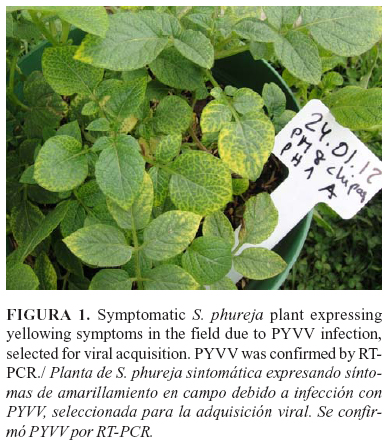
<body><![CDATA[<P><font size="2" face="Verdana, Arial, Helvetica, sans-serif">So far, the molecular    detection and characterisation of PYVV have been reported from leaf extracts    (4, 9, 10, 11, 12, 13). PYVV is transmitted by infected tubers (14) and semi-persistently    by the natural whitefly vector (<I>Trialeurodes vaporariorum, </I>Westwood)    (2). High PYVD incidence in Colombia (3, 14) is due to increased vector populations,    although indiscriminate use of potato-infected seed provides the major pathway    for viral dissemination (2). </font>     <P><font size="2" face="Verdana, Arial, Helvetica, sans-serif">Whitefly-transmitted    viruses have become increasingly prevalent in crops grown in tropical and subtropical    parts of the world (15, 16), thereby leading to the emergence of numerous whitefly-transmitted    diseases (17, 18, 19). The whitefly <I>Bemisia tabaci </I>has been reported    as a vector of viruses such as <I>Tomato yellow leaf curl virus </I>(TYLCV<I>),    Tomato infectious chlorosis virus </I>(TICV), and <I>Tomato chlorosis virus    (</I>ToCV) (20, 21, 22). On the other hand, <I>Cucumber vein yellowing virus    </I>(CVYV) and <I>Cucurbit yellow stunting disorder virus</I> (CYSDV) have been    detected by RT-PCR from <I>B. Tabaci </I>extracts (23, 24).The interaction between    <I>T. vaporariorum, </I>PYVV and a host (potato/tomato) has only been reported    by classical vector transmission and symptom expression assays(25). </font>     <P><font size="2" face="Verdana, Arial, Helvetica, sans-serif">No reports concerning    the molecular detection of PYVV from <I>T. vaporariorum </I>extracts have been    reported to date.The aim of this study was to detect PYVV from viruliferous    <I>T.vaporariorum</I> extracts for the first time by using molecular methods    and using a short procedure to obtain viruliferous whiteflies. </font>      <P>&nbsp;     <P><font size="2" face="Verdana, Arial, Helvetica, sans-serif"><B><font size="3">MATERIALS    AND METHODS</font></B> </font>     <P><font size="2" face="Verdana, Arial, Helvetica, sans-serif"><B>Virus isolates</B>    </font>     <P><font size="2" face="Verdana, Arial, Helvetica, sans-serif">Two Colombian <I>Solanum    phureja</I> potato plants showing yellowing symptoms were harvested in a field    near Chipaque, Cundinamarca, Colombia. The tubers from these plants were planted    and shoots expressing yellowing symptoms (<a href="#f1">Fig. 1</a>) were diagnosed    for PYVV by RT-PCR. The viral RNA was extracted from the petioles; PYVV<I>CP    </I>and the Hsp70h genes were amplified using previously-described specific    primers (11, 26).</font>      <P align="center"><img src="/img/revistas/rpv/v29n3/f0102314.jpg" width="388" height="445">    <a name="f1"></a>      
<P><font size="2" face="Verdana, Arial, Helvetica, sans-serif"><B>PYVV acquisition    by the insect vector</B> </font>     <P><font size="2" face="Verdana, Arial, Helvetica, sans-serif"><I>Aviruliferous    vector: </I>A nursery of whiteflies (<I>T. Vaporariorum </I>Westwood) was obtained    by feeding them on PYVV-resistant green zucchini plants grown in a greenhouse    (15&#176;C to 25&#176;C). </font>     ]]></body>
<body><![CDATA[<P><font size="2" face="Verdana, Arial, Helvetica, sans-serif"><I>Viruliferous    vector: </I>A large population of aviruliferous whiteflies (100) was divided    into samples containing 1 and 2 whiteflies and pools of 5, 10 and 20 whiteflies    (with duplicates). Each whitefly or pools were left to feed on a single symptomatic    potato leaf (<a href="#f1">Fig. 1</a>) kept in a distilled water-filled beaker.    The flask was covered with a film and a muslin veil cage was attached to the    underside of the leaf (<a href="/img/revistas/rpv/v29n3/f0202314.jpg">Fig.    2</a>). The vector was allowed to feed on the virus-infected leave for 48 h    for the acquisition access periods (AAP). Aviruliferous whiteflies were placed    to feed on symptomless potato leaves as controls (negative for PYVV by RT-PCR).    </font>      
<P><font size="2" face="Verdana, Arial, Helvetica, sans-serif"><B>PYVV detection    from the vector</B>: The viruliferous whiteflies were quickly immobilised by    briefly chilling at 4&#176;C and the cages were carefully removed from the potato    leaves. The 1, 2, 5, 10, 15 and 20 whitefly samples were picked up and used    for extracting the vector total RNA. </font>     <P><font size="2" face="Verdana, Arial, Helvetica, sans-serif"><B>RNA extraction    from whiteflies</B> </font>     <P><font size="2" face="Verdana, Arial, Helvetica, sans-serif">Total RNA was extracted    from each whitefly sample or pool using an SV total RNA Isolation System,Promega<SUP>&#174;</SUP>,    Madison, USA.The whiteflies were carefully picked up from the leaves using a    wet needle, directly placed into microtubes containing the buffer, and ground    using a plastic pestle. RNA concentration was determined following extraction    using a Qubit<SUP>&#174;</SUP> spectrophotometer (Invitrogen<SUP>&#174;</SUP>).    </font>     <P><font size="2" face="Verdana, Arial, Helvetica, sans-serif"><B>RT-PCR and primer    design</B> </font>     <P><font size="2" face="Verdana, Arial, Helvetica, sans-serif">All RT-PCR amplifications    were performed using F2oligonucleotide primers </font>     <P><font size="2" face="Verdana, Arial, Helvetica, sans-serif">(5'-GGATCCTCATGGAAATCCGATC-3')    and (5'-CTACTCAATAGATCCTGCTA-3') for amplifying an extended PYVV <I>CP </I>gene    region (13); the Hsp70h gene was partially amplified with F517 (5'-AGAGACGGTAAGTAT-3')    and R2323 primers (5'-TTGGGCATGTGACAT-3') designed by Cubillos (26) from a Peruvian    isolate genome sequence (NC-006063.1). <I>Trialeurodes vaporariorum </I>control    primers Tv18SR (5'-CGTTCGGGGTTTATCTTTATC-3') and Tv18SF(5'-CAGACCGTGACTTTTGAAC-3')    were designed using the 18S region of its rRNA as a template (accession No.    HQ446161.1). These primers were thoroughly tested for primer-dimers using OligoAnalyzer    3.1 software (ADT) and no similarity to any plant or viral RNA. All the primers    were provided by ADTTechnologies<SUP>&#174;</SUP>. </font>     <P><font size="2" face="Verdana, Arial, Helvetica, sans-serif"><B><I>CP</I> and    Hsp70 gene amplification: </B> </font>     <P><font size="2" face="Verdana, Arial, Helvetica, sans-serif">cDNA synthesis    involved whitefly RNA extracts (10 ml) being heated at 70&#176;C for 5 min,    rapidly chilled on ice and then added to the RT-PCR mix containing 0.4 mM virus-specific    reverse primer, 3.2 U broad-spectrum RNase inhibitor(RNasin,Fermentas<SUP>&#174;</SUP>),    1XRT buffer (Epicentre<SUP>&#174;</SUP>), 1 mM dNTPs, 10 mM dithiothreitol and    16U Moloney murine leukaemia virus (MMLV) reverse transcriptase (Epicentre<SUP>&#174;</SUP>),    in 10 ml reaction volume. RT-PCR was run at 42&#176;C for 45 min in a thermal    cycler. cDNA from PYVV-infected <I>S.phureja </I>symptomatic leaves and healthy    <I>S.phureja </I>leaves was used as a positive control and cDNA from aviruliferous    whiteflies as a negative control; water was included as a blank reaction. </font>     <P><font size="2" face="Verdana, Arial, Helvetica, sans-serif">A volume of 10    ml was used for the PCR reaction, containing 5 ml cDNA, 1XPCR buffer (Bioline<SUP>&#174;</SUP>),    250 mM dNTPs, 0.4 mM of each primer and 0.8 U Biolase<SUP>&#174;</SUP> DNA polymerase    (Bioline<SUP>&#174;</SUP>). Amplification involved denaturing at 94&#176;C for    3 min followed by 30 cycles at 94&#176;C for 30 s, 60&#176;C for 30 s and 72&#176;C    for 60 s. The samples were incubated for an additional 10 min at 72&#176;C.    Each RT-PCR reaction was run in triplicate, with 5 to 8 replications per transmission.    PCR products were migrated onto stained 1% agarose gel using TAE buffer with    SybrSafe (Invitrogen<SUP>&#174;</SUP>). </font>     ]]></body>
<body><![CDATA[<P><font size="2" face="Verdana, Arial, Helvetica, sans-serif">The primers designed    for amplifying the vector rRNA 18s region were tested in different reactions    and in the same RT-PCR reaction in which the <I>CP</I> and Hsp70h genes were    amplified to confirm an appropriate RNA extraction from <I>T. Vaporariorum </I>and    avoid false negatives due to the presence of PCR inhibitors. </font>     <P><font size="2" face="Verdana, Arial, Helvetica, sans-serif"><B>Amplicon sequence    and bioinformatics analysis</B></font>      <P><font size="2" face="Verdana, Arial, Helvetica, sans-serif">The <I>CP </I>amplicons    were ligated into TOPO-TA vector (Invitrogen), according to the manufacturer's    instructions, and transformed into <I>Escherichia coli</I>-TOP10 cells to confirm    amplification of the <I>T. vaporariorum</I>-derived PYVV <I>CP</I> gene. The    plasmids were extracted from the selected colonies using a Qiagen Plasmid QuickLyse<SUP>&#174;</SUP>    kit and linearised by digesting with EcoRI (Promega<SUP>&#174;</SUP>). Both    strands were sequenced using Universidad Nacional de Colombia's sequencing laboratory    SSiGMol amplification primers (Applied Biosystems<SUP>&#174;</SUP> 3500 Series    Genetic Analyzer). </font>     <P><font size="2" face="Verdana, Arial, Helvetica, sans-serif">Electropherogram    results were assembled using BioEdit software and debugged sequences were used    for predicting the protein using EMBOSS Sixpack software. Blast was then used    for comparing this with the already published sequence information.To confirm    sequence identity and predicted <I>CP</I>, sequences were aligned in Muscle    (27) and used for a phylogenetic reconstruction at <U><a href="http://www.phylogeny.fr">http://www.phylogeny.fr</a></U>    (28). The results were analysed using the neighbor-joining method (1,000 bootstraps,    Jones-Taylor-Thornton substitution matrixmodel) (29,30). The GenBank Peruvian    PYVV YP-054421 sequence was used as a control for the cladogram which also included    the AEC22851.1 sequence from a PYVV isolated from Colombian <I>S. phureja</I>.    The <I>CP</I> gene sequence reported for <I>Citrus tristeza virus </I>(CTV)    (accesion code NP-042867.1) was used for the base of the cladogram; both CTV    and PYVV belong to the <I>Closteroviridae </I>family. </font>      <P>&nbsp;     <P><font size="2" face="Verdana, Arial, Helvetica, sans-serif"><B><font size="3">RESULTS</font></B>    </font>     <P><font size="2" face="Verdana, Arial, Helvetica, sans-serif"><B>RT-PCR detection    of PYVV in viruliferous whiteflies</B> </font>     <P><font size="2" face="Verdana, Arial, Helvetica, sans-serif">For the first time,    it was obtained viruliferous vectors (capable of transmitting virus in a semipersistent    way) using one symptomatic plant leaf placed in a small glass flask containing    distilled water and covered with a muslin cage. </font>     <P><font size="2" face="Verdana, Arial, Helvetica, sans-serif">The RNA extracted    from whiteflies using the aforementioned kit ranged from 12 ng/ml (1 whitefly)    to 46 ng/ml (20 whiteflies), thereby ensuring the success in further <I>CP</I>    gene and Hsp70h gene amplifications. <I>CP </I>gene and HSP70h amplicons were    estimated at 765bp and 1,656bp, respectively (<a href="/img/revistas/rpv/v29n3/f0302314.gif">Fig.    3a-b</a>). No positive RT-PCR results were obtained from the aviruliferous whiteflies    feeding on healthy <I>S. Phureja </I>plants. </font>      
<P><font size="2" face="Verdana, Arial, Helvetica, sans-serif">The 18S rRNA region    of the vector genome was amplified from the RNA extracts to guarantee the absence    of PCR inhibitors in the vector extract and avoid false negatives. The expected    band of around 290 bp for the 18SrRNA region was obtained from both viruliferous    and aviruliferous whiteflies feeding on zucchini (<a href="/img/revistas/rpv/v29n3/f0302314.gif">Fig.    3b</a>).This approach was carried out many times (for one or insect pools) giving    consistently positive results for viral genes amplification by RT-PCR. </font>      
]]></body>
<body><![CDATA[<P><font size="2" face="Verdana, Arial, Helvetica, sans-serif">The electrophoresis    gel (<a href="/img/revistas/rpv/v29n3/f0302314.gif">Fig. 3a</a>) revealed    a <I>CP</I> gene migration amplicon of around 790 bp, with 20 bp more than the    expected PYVV <I>CP</I> size (760 bp) because the forward F2 primer annealed    in an upstream region of the <I>CP</I> gene. The PYVV Hsp70h gene was also successfully    amplified. </font>      
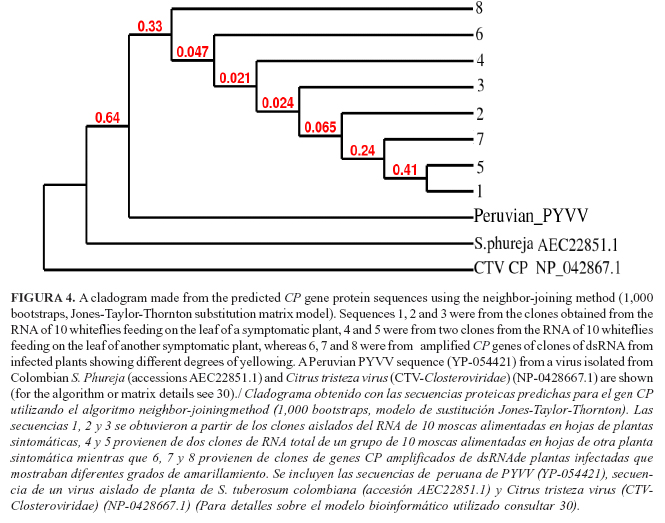
<P><font size="2" face="Verdana, Arial, Helvetica, sans-serif"><B>Nucleotic sequences    and bioinformatics analysis</B> </font>     <P><font size="2" face="Verdana, Arial, Helvetica, sans-serif">The <I>CP</I> gene    sequences obtained were compared with those reported in GenBank. The sequence    analysis and alignment revealed &gt;99% similarity with <I>CP</I> genes of different    Colombian PYVV isolates from extracts obtained from symptomatic leaves (different    accessions reported in GenBank), and 98-99% similarity with a Peruvian PYVV    isolate (YP-054421). Sequences obtained in this study were submitted to GenBank    (accession numbers KC257442, KC257443, KC257444, KC257445 and KC257446). </font>     <P><font size="2" face="Verdana, Arial, Helvetica, sans-serif">The predicted protein    sequences were aligned to construct a cladogram for determining the relative    position of each cloned PYVV isolate derived from the vector extracts (<a href="/img/revistas/rpv/v29n3/f0402314.jpg">Fig.    4</a>). This included the AEC22851.1 sequence from a PYVV isolated from the    Colombian <I>S.phureja, </I>and the <I>CP</I> gene sequence reported for <I>Citrus    tristeza virus </I>(CTV) (accession code NP-042867.1) was used for the base    of the cladogram. Both PYVV and CTV belong to the <I>Closteroviridae </I>family.    </font>      
<P><font size="2" face="Verdana, Arial, Helvetica, sans-serif">The phylogenetic    analysis of the clones obtained from the whitefly extracts studied (whiteflies    feeding on different plants or individual symptomatic leaves) revealed slight    differences (<a href="/img/revistas/rpv/v29n3/f0402314.jpg">Fig. 4</a>).    These findings could support the hypothesis stating the occurrence of PYVV virus    variants, not only amongst different field potato plants (11, 13) but also in    a single infected plant (intra-isolates), as it was suspected in other work    done by our group (31).</font>      
<P>&nbsp;     <P><font size="2" face="Verdana, Arial, Helvetica, sans-serif"><B><font size="3">DISCUSSION</font></B>    </font>     <P><font size="2" face="Verdana, Arial, Helvetica, sans-serif">The present study    demonstrated the PYVV molecular detection from RNA extracts of the natural <I>Trialeurodes    vaporariorum </I>vector for the first time by using a simple method based on    the amplification and sequencing of PYVV <I>CP</I> and Hsp70h genes. </font>     <P><font size="2" face="Verdana, Arial, Helvetica, sans-serif">Previous reports    had confirmed the whitefly <I>Trialeurodes vaporariorum </I>as a natural vector    of PYVV by classical plant to plant transmission protocols (2). Other viruses    have been detected from their vector RNA or DNA extracts (23, 24), but the authors    used approaches different from the simple one described in this study to obtain    viruliferous whiteflies. </font>     <P><font size="2" face="Verdana, Arial, Helvetica, sans-serif">No RT-PCR bands    were obtained from 1 or 2 whiteflies, possibly because it was not certain that    one specific whitefly had fed on the infected leaf, whereas using pools of 3    to 20 whiteflies, it was very likely that some whiteflies had fed correctly    on the infected leaf and had thus acquired the PYVV during the feeding period.    No bands were obtained from either healthy plant tissue or aviruliferous whiteflies    maintained on zucchini plants. </font>     ]]></body>
<body><![CDATA[<P><font size="2" face="Verdana, Arial, Helvetica, sans-serif">Amplicons of around    790 bp were obtained for <I>CP</I> gene by RT-PCR from viruliferous <I>T. Vaporariorum    </I>extracts, close to the predicted 758 bp genome <I>CP</I> size reported for    leaf extraction (13). Fragments of around 1,650 bp were amplified with the PYVV    Hsp70h primers (<a href="/img/revistas/rpv/v29n3/f0302314.gif">Fig. 3b</a>).    Amplicons from each assay were sequenced to confirm the PYVV origin. <I>CP</I>    gene sequence and alignments analysis had&gt;99% similarity with those reported    for PYVV isolates derived from potato symptomatic leaf-extracts. <I>CP</I> genes    sequences obtained from the vector extract clustered in a different clade from    that reported for Peruvian and Colombian <I>CP</I> genes accession extracted    from a leaf harvested in Marinilla region (Colombian Antioquia State). </font>      
<P><font size="2" face="Verdana, Arial, Helvetica, sans-serif">The viral RNA extracted    from the vector was positive from pools of 3 to more than 20 whiteflies. Unfortunately,    it was difficult to obtain positive RT-PCR from only one or 3 whiteflies, but    other studies would be necessary to improve this option. </font>     <P><font size="2" face="Verdana, Arial, Helvetica, sans-serif">The RT-PCR amplification    band was weak when RNA extracts from fewer than 5 flies were tested. The amount    of viral particles detectable by RT-PCR is limited to viruses associated with    the fly stylets in a semi-persistent transmission (33), contrasting with viruses    transmitted in a circulatory, replicative and persistent manner (32, 34). It    should be noticed that whiteflies were chilled before being removed from the    leaves so that if the whiteflies &#171;fell asleep&#187; or became immobile    due to cold while still feeding, their stylets could have been broken when they    were taken from the leaves. </font>     <P><font size="2" face="Verdana, Arial, Helvetica, sans-serif">Whiteflies acquired    the virus with its capsid; the free viral RNA titres could thus have been very    low. This could explain the differences in whitefly RNA Hsp70h band intensity    in contrast with the bands amplified from plant tissue-derived RNA (<a href="/img/revistas/rpv/v29n3/f0302314.gif">Fig.    3b</a>) where the virus was replicating and was naked, meaning that the viral    titres in the plant tissue extracts could have been higher than in the vector.    </font>      
<P><font size="2" face="Verdana, Arial, Helvetica, sans-serif">The amplified band    from a single fly was undetectable; however, it would be important to obtain    this so that information from one individual fly could be obtained by sequencing    its corresponding clones. Whiteflies can transmit some viral variants but not    all of them, as it was demonstrated for specific CTV variants in aphid transmission    (35). Our hypothesis must thus be verified in other studies. Limitation could    have been due to the low viral titre of the vector because as virions do not    replicate in semi-persistent transmission, the virus does not circulate through    the insect invading the salivary glands, and it can become lost in a very short    period of time (32). Even more, some of the flies could have died in the feeding    period. However, the simple acquisition method presented in this study can be    useful for different genes characterization and for other viruses or vectors    analysis, as well as for transmission and epidemiological studies. </font>     <P><font size="2" face="Verdana, Arial, Helvetica, sans-serif">Other viral genes    could be easily studied in PYVV-harbouring viruliferous flies as it has been    demonstrated for <I>CP</I> or Hsp70h genes. High quality viral RNA extracted    from a vector will allow amplification of any gene present in the viral or vector    genome. Including an internal vector control assay for amplifying the <I>T.    vaporariorum</I>18S rRNA gene is important for confirming successful RNA extraction    and avoiding false negative results. </font>     <P><font size="2" face="Verdana, Arial, Helvetica, sans-serif">Virus detection    in RNA extracts of insect vectors has been reported for other Closteroviruses,    such as CTV extracted from aphids using RT-PCR (36) and <I>Cucurbit yellow stunting    disorder virus </I>in <I>B. tabaci </I>(24). Many factors contribute towards    <I>Crinivirus </I>epidemiology, viral emergence and dominance, including host    viral titre (21). Methodologies must thus be developed for studying and understanding    PYVV-vector-plant interactions, as well as their epidemiology. </font>     <P><font size="2" face="Verdana, Arial, Helvetica, sans-serif">This is a first    report of PYVV molecular detection in its natural viruliferous vector using    a very simple technique for viral acquisition to obtain viruliferous vectors.    This approach can be useful to be applied in future studies promoting an efficient    management practice, such as those on vector acquisition and transmission, gene    characterisation and host-insect vector interactions.</font>     <P>&nbsp;     <P><font size="2" face="Verdana, Arial, Helvetica, sans-serif"><B><font size="3">CONCLUSION</font></B>    </font>     ]]></body>
<body><![CDATA[<P><font size="2" face="Verdana, Arial, Helvetica, sans-serif">A molecular study    was conducted for the first time to detect the presence of PYVV in RNA extracts    derived from viruliferous whiteflies <I>T.vaporariorum</I>, the natural PYVV    vector. The molecular detection involved the RT-PCR amplification of two viral    genes (<I>CP</I> gene and Hsp70h), their sequencing and alignment analysis.    The study included a simple method for obtaining viruliferous whiteflies through    viral acquisition from a single symptomatic potato leaf kept in water-containing    beakers. This molecular study concerning PYVV detection in its natural vector    provides a useful model for studying other genes and viruses and their natural    vectors as well, and represents an easy way for developing studies on viral    and vector gene characterization and epidemiology. </font>     <P>&nbsp;     <P><font size="2" face="Verdana, Arial, Helvetica, sans-serif"><B><font size="3">ACKNOWLEDGEMENTS</font></B>    </font>     <P><font size="2" face="Verdana, Arial, Helvetica, sans-serif">We are grateful    to Universidad Nacional de Colombia, Instituto de Biotecnolog&iacute;a, and    the Agronomy Faculty for providing the laboratory and greenhouse facilities;    to Liliana Franco, Universidad Militar Nueva Granada, for providing some vector    insects, and Anne-LiseHaenni, who kindly revised the manuscript and made important    suggestions. A grant from Colciencias Project 2011-2013 is gratefully acknowledged.    </font>     <P>&nbsp;     <P><font size="2" face="Verdana, Arial, Helvetica, sans-serif"><B><font size="3">REFERENCES</font></B>    </font>          <!-- ref --><P><font size="2" face="Verdana, Arial, Helvetica, sans-serif">1. Ortega E, Rodr&iacute;guez    Y. El virus del amarilleo de las venas de papa (PYVV). INIA Divulga. 2005;4:33-36.    Available in <U><a href="http://sian.inia.gob.ve/repositorio/revistas_tec/inia_divulga/numero%204%20/ortega_e.pdf">http://sian.inia.gob.ve/repositorio/revistas_tec/inia_divulga/numero%204    /ortega_e.pdf</a></U>.     </font>      <!-- ref --><P><font size="2" face="Verdana, Arial, Helvetica, sans-serif">2. Salazar LF,      Muller G, Querci M, Zapata JL, Owens RA. <I>Potato yellow vein virus</I>.      Its host range, distribution in South America and identification as a <I>Crinivirus      </I>transmitted by <I>Trialeurodes vaporariorum</I>. Ann Appl Biol. 2000;137(1):007-019.          </font>         ]]></body>
<body><![CDATA[<!-- ref --><P><font size="2" face="Verdana, Arial, Helvetica, sans-serif">3. Franco-Lara    L, Rodr&iacute;guez D, Guzm&aacute;n-Barney M. Prevalence of <I>potato yellow    vein virus</I> (PYVV) in <I>Solanum tuberosum</I> Group <I>Phureja </I>fields    in three states of Colombia. Am J Potato Res. 2013;90(4):324-330.     </font>     <!-- ref --><P><font size="2" face="Verdana, Arial, Helvetica, sans-serif">4. Guzm&aacute;n-Barney      M, Franco-Lara L, Rodr&iacute;guez D, Vargas L, Fierro J. Yield losses in      <I>Solanum tuberosum </I>group Phureja cultivar Criolla Colombia in plants      with symptoms of PYVV in field trials. Am J Potato Res. 2012;89(6):438-447.          </font>        <!-- ref --><P><font size="2" face="Verdana, Arial, Helvetica, sans-serif">5. Martelli GP,      Ghanem-Sabanadzovic N, Agranovsky AA, Al Rwahnih M, Dolja VV, Dovas CI, et      al. Taxonomic revision of the family <I>Closteroviridae </I>with special reference      to the grapevine leaf roll-associated members of the genus <I>Ampelovirus      </I>and the putative species unassigned to the family. J Plant Pathol. 2012;94(1):7-19.          </font>        <!-- ref --><P><font size="2" face="Verdana, Arial, Helvetica, sans-serif">6. Dolja V, Kreuze      J, Valkonen J. Comparative and functional genomics of Closteroviruses. Virus      Res. 2006;117(1):38-51.     </font>        <!-- ref --><P><font size="2" face="Verdana, Arial, Helvetica, sans-serif">7. Karasev AV.      Genetic diversity and evolution of Closteroviruses. Annu Rev Phytopathol.      2000;38:293-324.     </font>        ]]></body>
<body><![CDATA[<!-- ref --><P><font size="2" face="Verdana, Arial, Helvetica, sans-serif">8. Livieratos      IC, Eliasco E, Muller G, Olsthoorn RCL, Salazar LF, et al. Analysis of the      RNA of <I>Potato yellow veinvirus</I>: evidence for a tripartite genome and      conserved 3'-terminal structures among members of the genus <I>Crinivirus</I>.      J Gen Virol. 2004;85(7):2065-2075.     </font>        <!-- ref --><P><font size="2" face="Verdana, Arial, Helvetica, sans-serif">9. Eliasco E,      Livieratos IC, Muller G, Guzm&aacute;n M, Salazar LF, Coutts RHA. Sequences      of defective RNAs associated with <I>Potato yellow vein virus</I>. Arch Virol.      2006;151(1):201-204.     </font>        <!-- ref --><P><font size="2" face="Verdana, Arial, Helvetica, sans-serif">10.Guzm&aacute;n      M, Rodr&iacute;guez P. Susceptibility of <I>Solanum phureja </I>(Juz. <I>Et</I>Buk)      to <I>Potato yellow vein virus</I>. Agron Col. 2010;28(2):219-224.     </font>        <!-- ref --><P><font size="2" face="Verdana, Arial, Helvetica, sans-serif">11.Guzm&aacute;n      M, Ruiz E, Arciniegas N, Coutts RHA. Occurrence and variability of <I>Potato      Yellow Vein Virus</I> in three departments of Colombia. J Phytopathol. 2006;154(11-12):748-750.          </font>        <!-- ref --><P><font size="2" face="Verdana, Arial, Helvetica, sans-serif">12.L&oacute;pez      R, Acensio C, Guzm&aacute;n M, Boonham N. Development of real-time and conventional      RT-PCR assays for detection of <I>Potato yellow vein virus</I>. J Virol Methods.      2006;136(1-2):24-29.     </font>        ]]></body>
<body><![CDATA[<!-- ref --><P><font size="2" face="Verdana, Arial, Helvetica, sans-serif">13.Offei SK,      Arciniegas N, Muller G, Guzm&aacute;n M, Salazar LF, Coutts RHA. Molecular      variation of <I>Potato yellow vein virus </I>isolates. Arch Virol. 2004;149(4):821-827.          </font>        <!-- ref --><P><font size="2" face="Verdana, Arial, Helvetica, sans-serif">14.Guzm&aacute;n-Barney      M, Hern&aacute;ndez AK, Franco-Lara L. Tracking Foliar Symptoms Caused by      Tuber-Borne <I>Potato Yellow Vein Virus</I> (PYVV) in <I>Solanum phureja</I>      (Juz et Buk) Cultivar &#171;Criolla Colombia&#187;. Am J Potato Res. 2013;90(3):284-293.          </font>        <!-- ref --><P><font size="2" face="Verdana, Arial, Helvetica, sans-serif">15.Anderson PK,      Cunningham AA, Patel NG, Morales FJ, Epstein PR, Daszak P. Emerging infectious      diseases of plants: Pathogen pollution, climate change, and agrotechnology      drivers. Trends Ecol Evol. 2004;19(10):535-544.     </font>        <!-- ref --><P><font size="2" face="Verdana, Arial, Helvetica, sans-serif">16.Tzanetakis      IE, Martin R, Wintermantel WM. Epidemiology of criniviruses: an emerging problem      in world agriculture. Front Microbiol. 2013;4:119-124.     </font>        <!-- ref --><P><font size="2" face="Verdana, Arial, Helvetica, sans-serif">17.Jones DR.      Plant viruses transmitted by whiteflies. Eur J Plant Pathol. 2003;109(3):195-219.          </font>         ]]></body>
<body><![CDATA[<!-- ref --><P><font size="2" face="Verdana, Arial, Helvetica, sans-serif">18.Wintermantel    WM. Emergence of greenhouse whitefly (<I>Trialeurodes vaporariorum</I>) transmitted    criniviruses as threats to vegetable and fruit production in North America.    2004. Online. Available in <U><a href="http://www.apsnet.org/publications/apsnetfeatures/Pages/GreenhouseWhitefly.aspx">http://www.apsnet.org/publications/apsnetfeatures/Pages/GreenhouseWhitefly.aspx</a></U>.    Accessed Jul, 2013.     </font>      <!-- ref --><P><font size="2" face="Verdana, Arial, Helvetica, sans-serif">19.Brown JK, Czosnek    H. Whitefly transmission of plant viruses. In: Plumb RT (Ed). Advances in Botanical    Research. Academic Press, San Diego, CA, USA. 2002; pp 65-100.     </font>      <!-- ref --><P><font size="2" face="Verdana, Arial, Helvetica, sans-serif">20.Gottlieb Y,      Zchori-Fein E, Mozes-Daube N, Kontsedalov S, Skaljac M,Brumin M, et al. The      transmission efficiency of <I>Tomato Yellow Leaf Curl Virus </I>by the whitefly      <I>Bemisia tabaci </I>is correlated with the presence of a specific symbiotic      bacterium species. J Virol. 2010;84(18):9310-9317.     </font>         <!-- ref --><P><font size="2" face="Verdana, Arial, Helvetica, sans-serif">21.Wintermantel    WM, Cortez A, Anchieta A, Gulati-Sakhuja A, Hladky L. Co-infection by two Criniviruses    alters accumulation of each virus in a host-specific manner and influences efficiency    of virus transmission. Phytopathology. 2008;98(12):1340-1345.     </font>      <!-- ref --><P><font size="2" face="Verdana, Arial, Helvetica, sans-serif">22.Wintermantel      WM, Wisler GC. Vector specificity, host range, and genetic diversity of <I>Tomato      Chlorosis Virus</I>. Plant Dis. 2006;90(6):814-819.     </font>         ]]></body>
<body><![CDATA[<!-- ref --><P><font size="2" face="Verdana, Arial, Helvetica, sans-serif">23.Gil-Salas FM,    Morris J, Colyer A, Budge G, Boonham N, Cuadrado IM, et al. Development of real-time    RT-PCR assays for the detection of <I>Cucumber vein yellowing virus </I>(CVYV)    and <I>Cucurbit yellow stunting disorder virus </I>(CYSDV) in the whitefly vector    <I>Bemisia tabaci. </I>J Virol Methods. 2007;146(1-2):45-51.     </font>      <!-- ref --><P><font size="2" face="Verdana, Arial, Helvetica, sans-serif">24.Ruiz L, Janssen      D, Velasco L, Segundo E, Cuadrado IM. Quantitation of cucurbit yellow stunting      disorder virus in <I>Bemisia tabaci </I>(Genn.) using digoxigenin-labelled      hybridisation probes. J Virol Methods. 2002;101(1-2):95-103.     </font>        <!-- ref --><P><font size="2" face="Verdana, Arial, Helvetica, sans-serif">25.Gamarra H,      Chuquillanqui C, M&uuml;ller G. Transmisi&oacute;n del virus del amarillamiento      de las venas de la papa en variedades y clones de <I>Solanum tuberosum</I>      L. Potato international center (CIP); Entomological National Convention, Lima,      Per&uacute;. 2002.     </font>         <!-- ref --><P><font size="2" face="Verdana, Arial, Helvetica, sans-serif">26.Cubillos K.    Determination of virus variants of potato yellowing vein virus (PYVV) by molecular    analysis of three genes in colombian isolates of <I>Solanum spp</I>. Master    degree Thesis. Sciences Faculty. Universidad Nacional de Colombia. 2011. Available    in <U><a href="http://www.bdigital.unal.edu.co/4193">http://www.bdigital.unal.edu.co/4193</a></U>.        </font>      <!-- ref --><P><font size="2" face="Verdana, Arial, Helvetica, sans-serif">27.Edgar RC.      MUSCLE: multiple sequence alignment with high accuracy and high throughput.      Nucleic Acids Res. 2004;32(5):1792-1797.     </font>         ]]></body>
<body><![CDATA[<!-- ref --><P><font size="2" face="Verdana, Arial, Helvetica, sans-serif">28.Dereeper A,    Guignon V, Blanc G, Audic S, Buffet S, Chevenet F, et al. Phylogeny.fr: robust    phylogenetic analysis for the non-specialist. Nucleic Acids Res. 2008;36(Web    Server issue):W465-9.     </font>      <!-- ref --><P><font size="2" face="Verdana, Arial, Helvetica, sans-serif">29.Castresana J.    Selection of conserved blocks from multiple alignmentsfor their use in phylogenetic    analysis. Mol Biol Evol. 2000;17(4):540-552.     </font>      <!-- ref --><P><font size="2" face="Verdana, Arial, Helvetica, sans-serif">30.Wang HC, Li    K, Susko E, Roger AJ. A class frequency mixture model that adjusts for site-specific    amino acid frequencies and improves inference of protein phylogeny. BMC Evol    Biol. 2008;8(1):331.     </font>      <!-- ref --><P><font size="2" face="Verdana, Arial, Helvetica, sans-serif">31.Chaves-Bedoya      G, Guzm&aacute;n-Barney M, Ortiz-Rojas L. Genetic heterogeneity and Evidence      Of Putative Darwinian Diversifying Selection In <I>Potato Yellow Vein Virus</I>      (PYVV). Rev Agron Col. 2013;31(2):161-168.     </font>        <!-- ref --><P><font size="2" face="Verdana, Arial, Helvetica, sans-serif">32.Chen A, Walker      GP, Carter D, Ng JCK. A virus capsid component mediates virion retention and      transmission by its insect vector. PNAS. 2011;108(40):16777-16782.     </font>        ]]></body>
<body><![CDATA[<!-- ref --><P><font size="2" face="Verdana, Arial, Helvetica, sans-serif">33.Fereres A,      Moreno A. Behavioral aspects influencing plant virus transmission by homopteran      insects. Virus Res. 2009;141(2):158-168.     </font>         <!-- ref --><P><font size="2" face="Verdana, Arial, Helvetica, sans-serif">34.Andret-Link    P, Fuchs M. Transmission specificity of plant viruses by vectors. J Plant Pathol.    2005;87(3):153-165.     </font>      <!-- ref --><P><font size="2" face="Verdana, Arial, Helvetica, sans-serif">35.Velazquez-Monreal      JJ, Mathews DM, Dodds JA. Segregation of distinct variants from <I>Citrus      tristeza virus</I> Isolate SY568 using aphid transmission. Phytopathology.      2009;99(10):1168-1176.     </font>         <!-- ref --><P><font size="2" face="Verdana, Arial, Helvetica, sans-serif">36.Saponari M,    Manjunath K, Yokomi R. Quantitative detection of<I>Citrus tristeza virus </I>in    citrus and aphids by real-time reverse transcription-PCR (TaqMan). J Virol Methods.    2008;147(1):43-53.     </font>      <P>&nbsp;     <P>&nbsp;     ]]></body>
<body><![CDATA[<P><font size="2" face="Verdana, Arial, Helvetica, sans-serif">Recibido: 31-1-2014.    <br>   </font><font size="2" face="Verdana, Arial, Helvetica, sans-serif">Aceptado:    11-8-2014.</font>     <P>&nbsp;     <P>&nbsp;     <P><font size="2" face="Verdana, Arial, Helvetica, sans-serif"><B><a href="#autor">*</a><a name="pie"></a></B>Correspondent:    <I>M&oacute;nica Guzm&aacute;n-Barney.</I> E-mail: <U><a href="mailto:mmguzmanb@unal.edu.co">mmguzmanb@unal.edu.co</a></U>.</font>    <B><FONT COLOR="#ffffff"></FONT></B>       ]]></body><back>
<ref-list>
<ref id="B1">
<label>1</label><nlm-citation citation-type="journal">
<person-group person-group-type="author">
<name>
<surname><![CDATA[Ortega]]></surname>
<given-names><![CDATA[E]]></given-names>
</name>
<name>
<surname><![CDATA[Rodríguez]]></surname>
<given-names><![CDATA[Y]]></given-names>
</name>
</person-group>
<article-title xml:lang="es"><![CDATA[El virus del amarilleo de las venas de papa (PYVV)]]></article-title>
<source><![CDATA[INIA Divulga]]></source>
<year>2005</year>
<volume>4</volume>
<page-range>33-36</page-range></nlm-citation>
</ref>
<ref id="B2">
<label>2</label><nlm-citation citation-type="journal">
<person-group person-group-type="author">
<name>
<surname><![CDATA[Salazar]]></surname>
<given-names><![CDATA[LF]]></given-names>
</name>
<name>
<surname><![CDATA[Muller]]></surname>
<given-names><![CDATA[G]]></given-names>
</name>
<name>
<surname><![CDATA[Querci]]></surname>
<given-names><![CDATA[M]]></given-names>
</name>
<name>
<surname><![CDATA[Zapata]]></surname>
<given-names><![CDATA[JL]]></given-names>
</name>
<name>
<surname><![CDATA[Owens]]></surname>
<given-names><![CDATA[RA]]></given-names>
</name>
</person-group>
<article-title xml:lang="en"><![CDATA[Potato yellow vein virus: Its host range, distribution in South America and identification as a Crinivirus transmitted by Trialeurodes vaporariorum]]></article-title>
<source><![CDATA[Ann Appl Biol]]></source>
<year>2000</year>
<volume>137</volume>
<numero>1</numero>
<issue>1</issue>
<page-range>007-019</page-range></nlm-citation>
</ref>
<ref id="B3">
<label>3</label><nlm-citation citation-type="journal">
<person-group person-group-type="author">
<name>
<surname><![CDATA[Franco-Lara]]></surname>
<given-names><![CDATA[L]]></given-names>
</name>
<name>
<surname><![CDATA[Rodríguez]]></surname>
<given-names><![CDATA[D]]></given-names>
</name>
<name>
<surname><![CDATA[Guzmán-Barney]]></surname>
<given-names><![CDATA[M]]></given-names>
</name>
</person-group>
<article-title xml:lang="en"><![CDATA[Prevalence of potato yellow vein virus (PYVV) in Solanum tuberosum Group Phureja fields in three states of Colombia]]></article-title>
<source><![CDATA[Am J Potato Res]]></source>
<year>2013</year>
<volume>90</volume>
<numero>4</numero>
<issue>4</issue>
<page-range>324-330</page-range></nlm-citation>
</ref>
<ref id="B4">
<label>4</label><nlm-citation citation-type="journal">
<person-group person-group-type="author">
<name>
<surname><![CDATA[Guzmán-Barney]]></surname>
<given-names><![CDATA[M]]></given-names>
</name>
<name>
<surname><![CDATA[Franco-Lara]]></surname>
<given-names><![CDATA[L]]></given-names>
</name>
<name>
<surname><![CDATA[Rodríguez]]></surname>
<given-names><![CDATA[D]]></given-names>
</name>
<name>
<surname><![CDATA[Vargas]]></surname>
<given-names><![CDATA[L]]></given-names>
</name>
<name>
<surname><![CDATA[Fierro]]></surname>
<given-names><![CDATA[J]]></given-names>
</name>
</person-group>
<article-title xml:lang="en"><![CDATA[Yield losses in Solanum tuberosum group Phureja cultivar Criolla Colombia in plants with symptoms of PYVV in field trials]]></article-title>
<source><![CDATA[Am J Potato Res]]></source>
<year>2012</year>
<volume>89</volume>
<numero>6</numero>
<issue>6</issue>
<page-range>438-447</page-range></nlm-citation>
</ref>
<ref id="B5">
<label>5</label><nlm-citation citation-type="journal">
<person-group person-group-type="author">
<name>
<surname><![CDATA[Martelli]]></surname>
<given-names><![CDATA[GP]]></given-names>
</name>
<name>
<surname><![CDATA[Ghanem-Sabanadzovic]]></surname>
<given-names><![CDATA[N]]></given-names>
</name>
<name>
<surname><![CDATA[Agranovsky]]></surname>
<given-names><![CDATA[AA]]></given-names>
</name>
<name>
<surname><![CDATA[Al Rwahnih]]></surname>
<given-names><![CDATA[M]]></given-names>
</name>
<name>
<surname><![CDATA[Dolja]]></surname>
<given-names><![CDATA[VV]]></given-names>
</name>
<name>
<surname><![CDATA[Dovas]]></surname>
<given-names><![CDATA[CI]]></given-names>
</name>
</person-group>
<article-title xml:lang="en"><![CDATA[Taxonomic revision of the family Closteroviridae with special reference to the grapevine leaf roll-associated members of the genus Ampelovirus and the putative species unassigned to the family]]></article-title>
<source><![CDATA[J Plant Pathol]]></source>
<year>2012</year>
<volume>94</volume>
<numero>1</numero>
<issue>1</issue>
<page-range>7-19</page-range></nlm-citation>
</ref>
<ref id="B6">
<label>6</label><nlm-citation citation-type="journal">
<person-group person-group-type="author">
<name>
<surname><![CDATA[Dolja]]></surname>
<given-names><![CDATA[V]]></given-names>
</name>
<name>
<surname><![CDATA[Kreuze]]></surname>
<given-names><![CDATA[J]]></given-names>
</name>
<name>
<surname><![CDATA[Valkonen]]></surname>
<given-names><![CDATA[J]]></given-names>
</name>
</person-group>
<article-title xml:lang="en"><![CDATA[Comparative and functional genomics of Closteroviruses]]></article-title>
<source><![CDATA[Virus Res]]></source>
<year>2006</year>
<volume>117</volume>
<numero>1</numero>
<issue>1</issue>
<page-range>38-51</page-range></nlm-citation>
</ref>
<ref id="B7">
<label>7</label><nlm-citation citation-type="journal">
<person-group person-group-type="author">
<name>
<surname><![CDATA[Karasev]]></surname>
<given-names><![CDATA[AV]]></given-names>
</name>
</person-group>
<article-title xml:lang="en"><![CDATA[Genetic diversity and evolution of Closteroviruses]]></article-title>
<source><![CDATA[Annu Rev Phytopathol]]></source>
<year>2000</year>
<volume>38</volume>
<page-range>293-324</page-range></nlm-citation>
</ref>
<ref id="B8">
<label>8</label><nlm-citation citation-type="journal">
<person-group person-group-type="author">
<name>
<surname><![CDATA[Livieratos]]></surname>
<given-names><![CDATA[IC]]></given-names>
</name>
<name>
<surname><![CDATA[Eliasco]]></surname>
<given-names><![CDATA[E]]></given-names>
</name>
<name>
<surname><![CDATA[Muller]]></surname>
<given-names><![CDATA[G]]></given-names>
</name>
<name>
<surname><![CDATA[Olsthoorn]]></surname>
<given-names><![CDATA[RCL]]></given-names>
</name>
<name>
<surname><![CDATA[Salazar]]></surname>
<given-names><![CDATA[LF]]></given-names>
</name>
</person-group>
<article-title xml:lang="en"><![CDATA[Analysis of the RNA of Potato yellow veinvirus: evidence for a tripartite genome and conserved 3'-terminal structures among members of the genus Crinivirus]]></article-title>
<source><![CDATA[J Gen Virol]]></source>
<year>2004</year>
<volume>85</volume>
<numero>7</numero>
<issue>7</issue>
<page-range>2065-2075</page-range></nlm-citation>
</ref>
<ref id="B9">
<label>9</label><nlm-citation citation-type="journal">
<person-group person-group-type="author">
<name>
<surname><![CDATA[Eliasco]]></surname>
<given-names><![CDATA[E]]></given-names>
</name>
<name>
<surname><![CDATA[Livieratos]]></surname>
<given-names><![CDATA[IC]]></given-names>
</name>
<name>
<surname><![CDATA[Muller]]></surname>
<given-names><![CDATA[G]]></given-names>
</name>
<name>
<surname><![CDATA[Guzmán]]></surname>
<given-names><![CDATA[M]]></given-names>
</name>
<name>
<surname><![CDATA[Salazar]]></surname>
<given-names><![CDATA[LF]]></given-names>
</name>
<name>
<surname><![CDATA[Coutts]]></surname>
<given-names><![CDATA[RHA]]></given-names>
</name>
</person-group>
<article-title xml:lang="en"><![CDATA[Sequences of defective RNAs associated with Potato yellow vein virus]]></article-title>
<source><![CDATA[Arch Virol]]></source>
<year>2006</year>
<volume>151</volume>
<numero>1</numero>
<issue>1</issue>
<page-range>201-204</page-range></nlm-citation>
</ref>
<ref id="B10">
<label>10</label><nlm-citation citation-type="journal">
<person-group person-group-type="author">
<name>
<surname><![CDATA[Guzmán]]></surname>
<given-names><![CDATA[M]]></given-names>
</name>
<name>
<surname><![CDATA[Rodríguez]]></surname>
<given-names><![CDATA[P]]></given-names>
</name>
</person-group>
<article-title xml:lang="en"><![CDATA[Susceptibility of Solanum phureja (Juz. EtBuk) to Potato yellow vein virus]]></article-title>
<source><![CDATA[Agron Col]]></source>
<year>2010</year>
<volume>28</volume>
<numero>2</numero>
<issue>2</issue>
<page-range>219-224</page-range></nlm-citation>
</ref>
<ref id="B11">
<label>11</label><nlm-citation citation-type="journal">
<person-group person-group-type="author">
<name>
<surname><![CDATA[Guzmán]]></surname>
<given-names><![CDATA[M]]></given-names>
</name>
<name>
<surname><![CDATA[Ruiz]]></surname>
<given-names><![CDATA[E]]></given-names>
</name>
<name>
<surname><![CDATA[Arciniegas]]></surname>
<given-names><![CDATA[N]]></given-names>
</name>
<name>
<surname><![CDATA[Coutts]]></surname>
<given-names><![CDATA[RHA]]></given-names>
</name>
</person-group>
<article-title xml:lang="en"><![CDATA[Occurrence and variability of Potato Yellow Vein Virus in three departments of Colombia]]></article-title>
<source><![CDATA[J Phytopathol]]></source>
<year>2006</year>
<volume>154</volume>
<numero>11-12</numero>
<issue>11-12</issue>
<page-range>748-750</page-range></nlm-citation>
</ref>
<ref id="B12">
<label>12</label><nlm-citation citation-type="journal">
<person-group person-group-type="author">
<name>
<surname><![CDATA[López]]></surname>
<given-names><![CDATA[R]]></given-names>
</name>
<name>
<surname><![CDATA[Acensio]]></surname>
<given-names><![CDATA[C]]></given-names>
</name>
<name>
<surname><![CDATA[Guzmán]]></surname>
<given-names><![CDATA[M]]></given-names>
</name>
<name>
<surname><![CDATA[Boonham]]></surname>
<given-names><![CDATA[N]]></given-names>
</name>
</person-group>
<article-title xml:lang="en"><![CDATA[Development of real-time and conventional RT-PCR assays for detection of Potato yellow vein virus]]></article-title>
<source><![CDATA[J Virol Methods]]></source>
<year>2006</year>
<volume>136</volume>
<numero>1-2</numero>
<issue>1-2</issue>
<page-range>24-29</page-range></nlm-citation>
</ref>
<ref id="B13">
<label>13</label><nlm-citation citation-type="journal">
<person-group person-group-type="author">
<name>
<surname><![CDATA[Offei]]></surname>
<given-names><![CDATA[SK]]></given-names>
</name>
<name>
<surname><![CDATA[Arciniegas]]></surname>
<given-names><![CDATA[N]]></given-names>
</name>
<name>
<surname><![CDATA[Muller]]></surname>
<given-names><![CDATA[G]]></given-names>
</name>
<name>
<surname><![CDATA[Guzmán]]></surname>
<given-names><![CDATA[M]]></given-names>
</name>
<name>
<surname><![CDATA[Salazar]]></surname>
<given-names><![CDATA[LF]]></given-names>
</name>
<name>
<surname><![CDATA[Coutts]]></surname>
<given-names><![CDATA[RHA]]></given-names>
</name>
</person-group>
<article-title xml:lang="en"><![CDATA[Molecular variation of Potato yellow vein virus isolates]]></article-title>
<source><![CDATA[Arch Virol]]></source>
<year>2004</year>
<volume>149</volume>
<numero>4</numero>
<issue>4</issue>
<page-range>821-827</page-range></nlm-citation>
</ref>
<ref id="B14">
<label>14</label><nlm-citation citation-type="journal">
<person-group person-group-type="author">
<name>
<surname><![CDATA[Guzmán-Barney]]></surname>
<given-names><![CDATA[M]]></given-names>
</name>
<name>
<surname><![CDATA[Hernández]]></surname>
<given-names><![CDATA[AK]]></given-names>
</name>
<name>
<surname><![CDATA[Franco-Lara]]></surname>
<given-names><![CDATA[L]]></given-names>
</name>
</person-group>
<article-title xml:lang="en"><![CDATA[Tracking Foliar Symptoms Caused by Tuber-Borne Potato Yellow Vein Virus (PYVV) in Solanum phureja (Juz et Buk) Cultivar «Criolla Colombia»]]></article-title>
<source><![CDATA[Am J Potato Res]]></source>
<year>2013</year>
<volume>90</volume>
<numero>3</numero>
<issue>3</issue>
<page-range>284-293</page-range></nlm-citation>
</ref>
<ref id="B15">
<label>15</label><nlm-citation citation-type="journal">
<person-group person-group-type="author">
<name>
<surname><![CDATA[Anderson]]></surname>
<given-names><![CDATA[PK]]></given-names>
</name>
<name>
<surname><![CDATA[Cunningham]]></surname>
<given-names><![CDATA[AA]]></given-names>
</name>
<name>
<surname><![CDATA[Patel]]></surname>
<given-names><![CDATA[NG]]></given-names>
</name>
<name>
<surname><![CDATA[Morales]]></surname>
<given-names><![CDATA[FJ]]></given-names>
</name>
<name>
<surname><![CDATA[Epstein]]></surname>
<given-names><![CDATA[PR]]></given-names>
</name>
<name>
<surname><![CDATA[Daszak]]></surname>
<given-names><![CDATA[P]]></given-names>
</name>
</person-group>
<article-title xml:lang="en"><![CDATA[Emerging infectious diseases of plants: Pathogen pollution, climate change, and agrotechnology drivers]]></article-title>
<source><![CDATA[Trends Ecol Evol]]></source>
<year>2004</year>
<volume>19</volume>
<numero>10</numero>
<issue>10</issue>
<page-range>535-544</page-range></nlm-citation>
</ref>
<ref id="B16">
<label>16</label><nlm-citation citation-type="journal">
<person-group person-group-type="author">
<name>
<surname><![CDATA[Tzanetakis]]></surname>
<given-names><![CDATA[IE]]></given-names>
</name>
<name>
<surname><![CDATA[Martin]]></surname>
<given-names><![CDATA[R]]></given-names>
</name>
<name>
<surname><![CDATA[Wintermantel]]></surname>
<given-names><![CDATA[WM]]></given-names>
</name>
</person-group>
<article-title xml:lang="en"><![CDATA[Epidemiology of criniviruses: an emerging problem in world agriculture]]></article-title>
<source><![CDATA[Front Microbiol]]></source>
<year>2013</year>
<volume>4</volume>
<page-range>119-124</page-range></nlm-citation>
</ref>
<ref id="B17">
<label>17</label><nlm-citation citation-type="journal">
<person-group person-group-type="author">
<name>
<surname><![CDATA[Jones]]></surname>
<given-names><![CDATA[DR]]></given-names>
</name>
</person-group>
<article-title xml:lang="en"><![CDATA[Plant viruses transmitted by whiteflies]]></article-title>
<source><![CDATA[Eur J Plant Pathol]]></source>
<year>2003</year>
<volume>109</volume>
<numero>3</numero>
<issue>3</issue>
<page-range>195-219</page-range></nlm-citation>
</ref>
<ref id="B18">
<label>18</label><nlm-citation citation-type="">
<person-group person-group-type="author">
<name>
<surname><![CDATA[Wintermantel]]></surname>
<given-names><![CDATA[WM]]></given-names>
</name>
</person-group>
<source><![CDATA[Emergence of greenhouse whitefly (Trialeurodes vaporariorum) transmitted criniviruses as threats to vegetable and fruit production in North America]]></source>
<year>2004</year>
</nlm-citation>
</ref>
<ref id="B19">
<label>19</label><nlm-citation citation-type="book">
<person-group person-group-type="author">
<name>
<surname><![CDATA[Brown]]></surname>
<given-names><![CDATA[JK]]></given-names>
</name>
<name>
<surname><![CDATA[Czosnek]]></surname>
<given-names><![CDATA[H]]></given-names>
</name>
</person-group>
<article-title xml:lang="en"><![CDATA[Whitefly transmission of plant viruses]]></article-title>
<person-group person-group-type="editor">
<name>
<surname><![CDATA[Plumb]]></surname>
<given-names><![CDATA[RT]]></given-names>
</name>
</person-group>
<source><![CDATA[Advances in Botanical Research]]></source>
<year>2002</year>
<page-range>65-100</page-range><publisher-loc><![CDATA[San Diego^eCA CA]]></publisher-loc>
<publisher-name><![CDATA[Academic Press]]></publisher-name>
</nlm-citation>
</ref>
<ref id="B20">
<label>20</label><nlm-citation citation-type="journal">
<person-group person-group-type="author">
<name>
<surname><![CDATA[Gottlieb]]></surname>
<given-names><![CDATA[Y]]></given-names>
</name>
<name>
<surname><![CDATA[Zchori-Fein]]></surname>
<given-names><![CDATA[E]]></given-names>
</name>
<name>
<surname><![CDATA[Mozes-Daube]]></surname>
<given-names><![CDATA[N]]></given-names>
</name>
<name>
<surname><![CDATA[Kontsedalov]]></surname>
<given-names><![CDATA[S]]></given-names>
</name>
<name>
<surname><![CDATA[Skaljac]]></surname>
<given-names><![CDATA[M]]></given-names>
</name>
<name>
<surname><![CDATA[Brumin]]></surname>
<given-names><![CDATA[M]]></given-names>
</name>
</person-group>
<article-title xml:lang="en"><![CDATA[The transmission efficiency of Tomato Yellow Leaf Curl Virus by the whitefly Bemisia tabaci is correlated with the presence of a specific symbiotic bacterium species]]></article-title>
<source><![CDATA[J Virol]]></source>
<year>2010</year>
<volume>84</volume>
<numero>18</numero>
<issue>18</issue>
<page-range>9310-9317</page-range></nlm-citation>
</ref>
<ref id="B21">
<label>21</label><nlm-citation citation-type="journal">
<person-group person-group-type="author">
<name>
<surname><![CDATA[Wintermantel]]></surname>
<given-names><![CDATA[WM]]></given-names>
</name>
<name>
<surname><![CDATA[Cortez]]></surname>
<given-names><![CDATA[A]]></given-names>
</name>
<name>
<surname><![CDATA[Anchieta]]></surname>
<given-names><![CDATA[A]]></given-names>
</name>
<name>
<surname><![CDATA[Gulati-Sakhuja]]></surname>
<given-names><![CDATA[A]]></given-names>
</name>
<name>
<surname><![CDATA[Hladky]]></surname>
<given-names><![CDATA[L]]></given-names>
</name>
</person-group>
<article-title xml:lang="en"><![CDATA[Co-infection by two Criniviruses alters accumulation of each virus in a host-specific manner and influences efficiency of virus transmission]]></article-title>
<source><![CDATA[Phytopathology]]></source>
<year>2008</year>
<volume>98</volume>
<numero>12</numero>
<issue>12</issue>
<page-range>1340-1345</page-range></nlm-citation>
</ref>
<ref id="B22">
<label>22</label><nlm-citation citation-type="journal">
<person-group person-group-type="author">
<name>
<surname><![CDATA[Wintermantel]]></surname>
<given-names><![CDATA[WM]]></given-names>
</name>
<name>
<surname><![CDATA[Wisler]]></surname>
<given-names><![CDATA[GC]]></given-names>
</name>
</person-group>
<article-title xml:lang="en"><![CDATA[Vector specificity, host range, and genetic diversity of Tomato Chlorosis Virus]]></article-title>
<source><![CDATA[Plant Dis]]></source>
<year>2006</year>
<volume>90</volume>
<numero>6</numero>
<issue>6</issue>
<page-range>814-819</page-range></nlm-citation>
</ref>
<ref id="B23">
<label>23</label><nlm-citation citation-type="journal">
<person-group person-group-type="author">
<name>
<surname><![CDATA[Gil-Salas]]></surname>
<given-names><![CDATA[FM]]></given-names>
</name>
<name>
<surname><![CDATA[Morris]]></surname>
<given-names><![CDATA[J]]></given-names>
</name>
<name>
<surname><![CDATA[Colyer]]></surname>
<given-names><![CDATA[A]]></given-names>
</name>
<name>
<surname><![CDATA[Budge]]></surname>
<given-names><![CDATA[G]]></given-names>
</name>
<name>
<surname><![CDATA[Boonham]]></surname>
<given-names><![CDATA[N]]></given-names>
</name>
<name>
<surname><![CDATA[Cuadrado]]></surname>
<given-names><![CDATA[IM]]></given-names>
</name>
</person-group>
<article-title xml:lang="en"><![CDATA[Development of real-time RT-PCR assays for the detection of Cucumber vein yellowing virus (CVYV) and Cucurbit yellow stunting disorder virus (CYSDV) in the whitefly vector Bemisia tabaci]]></article-title>
<source><![CDATA[J Virol Methods]]></source>
<year>2007</year>
<volume>146</volume>
<numero>1-2</numero>
<issue>1-2</issue>
<page-range>45-51</page-range></nlm-citation>
</ref>
<ref id="B24">
<label>24</label><nlm-citation citation-type="journal">
<person-group person-group-type="author">
<name>
<surname><![CDATA[Ruiz]]></surname>
<given-names><![CDATA[L]]></given-names>
</name>
<name>
<surname><![CDATA[Janssen]]></surname>
<given-names><![CDATA[D]]></given-names>
</name>
<name>
<surname><![CDATA[Velasco]]></surname>
<given-names><![CDATA[L]]></given-names>
</name>
<name>
<surname><![CDATA[Segundo]]></surname>
<given-names><![CDATA[E]]></given-names>
</name>
<name>
<surname><![CDATA[Cuadrado]]></surname>
<given-names><![CDATA[IM]]></given-names>
</name>
</person-group>
<article-title xml:lang="en"><![CDATA[Quantitation of cucurbit yellow stunting disorder virus in Bemisia tabaci (Genn.) using digoxigenin-labelled hybridisation probes]]></article-title>
<source><![CDATA[J Virol Methods]]></source>
<year>2002</year>
<volume>101</volume>
<numero>1-2</numero>
<issue>1-2</issue>
<page-range>95-103</page-range></nlm-citation>
</ref>
<ref id="B25">
<label>25</label><nlm-citation citation-type="">
<person-group person-group-type="author">
<name>
<surname><![CDATA[Gamarra]]></surname>
<given-names><![CDATA[H]]></given-names>
</name>
<name>
<surname><![CDATA[Chuquillanqui]]></surname>
<given-names><![CDATA[C]]></given-names>
</name>
<name>
<surname><![CDATA[Müller]]></surname>
<given-names><![CDATA[G]]></given-names>
</name>
</person-group>
<source><![CDATA[Transmisión del virus del amarillamiento de las venas de la papa en variedades y clones de Solanum tuberosum L. Potato international center (CIP)]]></source>
<year>2002</year>
<publisher-loc><![CDATA[^eLima^ePerú LimaPerú]]></publisher-loc>
</nlm-citation>
</ref>
<ref id="B26">
<label>26</label><nlm-citation citation-type="">
<person-group person-group-type="author">
<name>
<surname><![CDATA[Cubillos]]></surname>
<given-names><![CDATA[K]]></given-names>
</name>
</person-group>
<article-title xml:lang="en"><![CDATA[Determination of virus variants of potato yellowing vein virus (PYVV) by molecular analysis of three genes in colombian isolates of Solanum spp.]]></article-title>
<source><![CDATA[]]></source>
<year></year>
</nlm-citation>
</ref>
<ref id="B27">
<label>27</label><nlm-citation citation-type="journal">
<person-group person-group-type="author">
<name>
<surname><![CDATA[Edgar]]></surname>
<given-names><![CDATA[RC]]></given-names>
</name>
</person-group>
<article-title xml:lang="en"><![CDATA[MUSCLE: multiple sequence alignment with high accuracy and high throughput]]></article-title>
<source><![CDATA[Nucleic Acids Res]]></source>
<year>2004</year>
<volume>32</volume>
<numero>5</numero>
<issue>5</issue>
<page-range>1792-1797</page-range></nlm-citation>
</ref>
<ref id="B28">
<label>28</label><nlm-citation citation-type="journal">
<person-group person-group-type="author">
<name>
<surname><![CDATA[Dereeper]]></surname>
<given-names><![CDATA[A]]></given-names>
</name>
<name>
<surname><![CDATA[Guignon]]></surname>
<given-names><![CDATA[V]]></given-names>
</name>
<name>
<surname><![CDATA[Blanc]]></surname>
<given-names><![CDATA[G]]></given-names>
</name>
<name>
<surname><![CDATA[Audic]]></surname>
<given-names><![CDATA[S]]></given-names>
</name>
<name>
<surname><![CDATA[Buffet]]></surname>
<given-names><![CDATA[S]]></given-names>
</name>
<name>
<surname><![CDATA[Chevenet]]></surname>
<given-names><![CDATA[F]]></given-names>
</name>
</person-group>
<article-title xml:lang="en"><![CDATA[Phylogeny. fr: robust phylogenetic analysis for the non-specialist]]></article-title>
<source><![CDATA[Nucleic Acids Res]]></source>
<year>2008</year>
<volume>36</volume>
<page-range>W465-9</page-range></nlm-citation>
</ref>
<ref id="B29">
<label>29</label><nlm-citation citation-type="journal">
<person-group person-group-type="author">
<name>
<surname><![CDATA[Castresana]]></surname>
<given-names><![CDATA[J]]></given-names>
</name>
</person-group>
<article-title xml:lang="en"><![CDATA[Selection of conserved blocks from multiple alignmentsfor their use in phylogenetic analysis]]></article-title>
<source><![CDATA[Mol Biol Evol]]></source>
<year>2000</year>
<volume>17</volume>
<numero>4</numero>
<issue>4</issue>
<page-range>540-552</page-range></nlm-citation>
</ref>
<ref id="B30">
<label>30</label><nlm-citation citation-type="journal">
<person-group person-group-type="author">
<name>
<surname><![CDATA[Wang]]></surname>
<given-names><![CDATA[HC]]></given-names>
</name>
<name>
<surname><![CDATA[Li]]></surname>
<given-names><![CDATA[K]]></given-names>
</name>
<name>
<surname><![CDATA[Susko]]></surname>
<given-names><![CDATA[E]]></given-names>
</name>
<name>
<surname><![CDATA[Roger]]></surname>
<given-names><![CDATA[AJ]]></given-names>
</name>
</person-group>
<article-title xml:lang="en"><![CDATA[A class frequency mixture model that adjusts for site-specific amino acid frequencies and improves inference of protein phylogeny]]></article-title>
<source><![CDATA[BMC Evol Biol]]></source>
<year>2008</year>
<volume>8</volume>
<numero>1</numero>
<issue>1</issue>
<page-range>331</page-range></nlm-citation>
</ref>
<ref id="B31">
<label>31</label><nlm-citation citation-type="journal">
<person-group person-group-type="author">
<name>
<surname><![CDATA[Chaves-Bedoya]]></surname>
<given-names><![CDATA[G]]></given-names>
</name>
<name>
<surname><![CDATA[Guzmán-Barney]]></surname>
<given-names><![CDATA[M]]></given-names>
</name>
<name>
<surname><![CDATA[Ortiz-Rojas]]></surname>
<given-names><![CDATA[L]]></given-names>
</name>
</person-group>
<article-title xml:lang="en"><![CDATA[Genetic heterogeneity and Evidence Of Putative Darwinian Diversifying Selection In Potato Yellow Vein Virus (PYVV)]]></article-title>
<source><![CDATA[Rev Agron Col]]></source>
<year>2013</year>
<volume>31</volume>
<numero>2</numero>
<issue>2</issue>
<page-range>161-168</page-range></nlm-citation>
</ref>
<ref id="B32">
<label>32</label><nlm-citation citation-type="journal">
<person-group person-group-type="author">
<name>
<surname><![CDATA[Chen]]></surname>
<given-names><![CDATA[A]]></given-names>
</name>
<name>
<surname><![CDATA[Walker]]></surname>
<given-names><![CDATA[GP]]></given-names>
</name>
<name>
<surname><![CDATA[Carter]]></surname>
<given-names><![CDATA[D]]></given-names>
</name>
<name>
<surname><![CDATA[Ng]]></surname>
<given-names><![CDATA[JCK]]></given-names>
</name>
</person-group>
<article-title xml:lang="en"><![CDATA[A virus capsid component mediates virion retention and transmission by its insect vector]]></article-title>
<source><![CDATA[PNAS]]></source>
<year>2011</year>
<volume>108</volume>
<numero>40</numero>
<issue>40</issue>
<page-range>16777-16782</page-range></nlm-citation>
</ref>
<ref id="B33">
<label>33</label><nlm-citation citation-type="journal">
<person-group person-group-type="author">
<name>
<surname><![CDATA[Fereres]]></surname>
<given-names><![CDATA[A]]></given-names>
</name>
<name>
<surname><![CDATA[Moreno]]></surname>
<given-names><![CDATA[A]]></given-names>
</name>
</person-group>
<article-title xml:lang="en"><![CDATA[Behavioral aspects influencing plant virus transmission by homopteran insects]]></article-title>
<source><![CDATA[Virus Res]]></source>
<year>2009</year>
<volume>141</volume>
<numero>2</numero>
<issue>2</issue>
<page-range>158-168</page-range></nlm-citation>
</ref>
<ref id="B34">
<label>34</label><nlm-citation citation-type="journal">
<person-group person-group-type="author">
<name>
<surname><![CDATA[Andret-Link]]></surname>
<given-names><![CDATA[P]]></given-names>
</name>
<name>
<surname><![CDATA[Fuchs]]></surname>
<given-names><![CDATA[M]]></given-names>
</name>
</person-group>
<article-title xml:lang="en"><![CDATA[Transmission specificity of plant viruses by vectors]]></article-title>
<source><![CDATA[J Plant Pathol]]></source>
<year>2005</year>
<volume>87</volume>
<numero>3</numero>
<issue>3</issue>
<page-range>153-165</page-range></nlm-citation>
</ref>
<ref id="B35">
<label>35</label><nlm-citation citation-type="journal">
<person-group person-group-type="author">
<name>
<surname><![CDATA[Velazquez-Monreal]]></surname>
<given-names><![CDATA[JJ]]></given-names>
</name>
<name>
<surname><![CDATA[Mathews]]></surname>
<given-names><![CDATA[DM]]></given-names>
</name>
<name>
<surname><![CDATA[Dodds]]></surname>
<given-names><![CDATA[JA]]></given-names>
</name>
</person-group>
<article-title xml:lang="en"><![CDATA[Segregation of distinct variants from Citrus tristeza virus Isolate SY568 using aphid transmission]]></article-title>
<source><![CDATA[Phytopathology]]></source>
<year>2009</year>
<volume>99</volume>
<numero>10</numero>
<issue>10</issue>
<page-range>1168-1176</page-range></nlm-citation>
</ref>
<ref id="B36">
<label>36</label><nlm-citation citation-type="journal">
<person-group person-group-type="author">
<name>
<surname><![CDATA[Saponari]]></surname>
<given-names><![CDATA[M]]></given-names>
</name>
<name>
<surname><![CDATA[Manjunath]]></surname>
<given-names><![CDATA[K]]></given-names>
</name>
<name>
<surname><![CDATA[Yokomi]]></surname>
<given-names><![CDATA[R]]></given-names>
</name>
</person-group>
<article-title xml:lang="en"><![CDATA[Quantitative detection ofCitrus tristeza virus in citrus and aphids by real-time reverse transcription-PCR (TaqMan)]]></article-title>
<source><![CDATA[J Virol Methods]]></source>
<year>2008</year>
<volume>147</volume>
<numero>1</numero>
<issue>1</issue>
<page-range>43-53</page-range></nlm-citation>
</ref>
</ref-list>
</back>
</article>