<?xml version="1.0" encoding="ISO-8859-1"?><article xmlns:mml="http://www.w3.org/1998/Math/MathML" xmlns:xlink="http://www.w3.org/1999/xlink" xmlns:xsi="http://www.w3.org/2001/XMLSchema-instance">
<front>
<journal-meta>
<journal-id>1010-2752</journal-id>
<journal-title><![CDATA[Revista de Protección Vegetal]]></journal-title>
<abbrev-journal-title><![CDATA[Rev. Protección Veg.]]></abbrev-journal-title>
<issn>1010-2752</issn>
<publisher>
<publisher-name><![CDATA[Centro Nacional de Sanidad Agropecuaria]]></publisher-name>
</publisher>
</journal-meta>
<article-meta>
<article-id>S1010-27522014000300007</article-id>
<title-group>
<article-title xml:lang="en"><![CDATA[Predatory mirids (Hemiptera: Heteroptera: Miridae) in tomato and tobacco in Cuba]]></article-title>
<article-title xml:lang="es"><![CDATA[Míridos depredadores (Hemiptera: Heteroptera: Miridae) en cultivos de tomate y tabaco en Cuba]]></article-title>
</title-group>
<contrib-group>
<contrib contrib-type="author">
<name>
<surname><![CDATA[Martínez]]></surname>
<given-names><![CDATA[María A.]]></given-names>
</name>
<xref ref-type="aff" rid="A01"/>
</contrib>
<contrib contrib-type="author">
<name>
<surname><![CDATA[Duarte]]></surname>
<given-names><![CDATA[Leticia]]></given-names>
</name>
<xref ref-type="aff" rid="A01"/>
</contrib>
<contrib contrib-type="author">
<name>
<surname><![CDATA[Baños]]></surname>
<given-names><![CDATA[Heyker L.]]></given-names>
</name>
<xref ref-type="aff" rid="A01"/>
</contrib>
<contrib contrib-type="author">
<name>
<surname><![CDATA[Rivas]]></surname>
<given-names><![CDATA[Aramis]]></given-names>
</name>
<xref ref-type="aff" rid="A02"/>
</contrib>
<contrib contrib-type="author">
<name>
<surname><![CDATA[Sánchez]]></surname>
<given-names><![CDATA[Adayakni]]></given-names>
</name>
<xref ref-type="aff" rid="A01"/>
</contrib>
</contrib-group>
<aff id="A01">
<institution><![CDATA[,Centro Nacional de Sanidad Agropecuaria (CENSA) Dirección de Sanidad Vegetal ]]></institution>
<addr-line><![CDATA[Mayabeque ]]></addr-line>
<country>Cuba</country>
</aff>
<aff id="A02">
<institution><![CDATA[,Universidad de las Tunas  ]]></institution>
<addr-line><![CDATA[ ]]></addr-line>
<country>Cuba</country>
</aff>
<pub-date pub-type="pub">
<day>00</day>
<month>12</month>
<year>2014</year>
</pub-date>
<pub-date pub-type="epub">
<day>00</day>
<month>12</month>
<year>2014</year>
</pub-date>
<volume>29</volume>
<numero>3</numero>
<fpage>204</fpage>
<lpage>207</lpage>
<copyright-statement/>
<copyright-year/>
<self-uri xlink:href="http://scielo.sld.cu/scielo.php?script=sci_arttext&amp;pid=S1010-27522014000300007&amp;lng=en&amp;nrm=iso"></self-uri><self-uri xlink:href="http://scielo.sld.cu/scielo.php?script=sci_abstract&amp;pid=S1010-27522014000300007&amp;lng=en&amp;nrm=iso"></self-uri><self-uri xlink:href="http://scielo.sld.cu/scielo.php?script=sci_pdf&amp;pid=S1010-27522014000300007&amp;lng=en&amp;nrm=iso"></self-uri><abstract abstract-type="short" xml:lang="en"><p><![CDATA[In order to update the presence of species of mirid predators and their impact on solanaceous crops of interest, samples were taken from tomato and tobacco in open fields and from tomato in covered crops of selected locations of Mayabeque and Las Tunas Provinces every seven days. In each sampling, mirid specimens were counted and collected for their subsequent identification and determination of incidence. The results showed the presence of the species Nesidiocoris tenuis Reuter, Macrolophus praeclarus (Distant) and Cyrtopeltis = Engyatus varians (Distant). The mirids were present in most samples taken in tomato and tobacco, while the incidence remained over 40% in both crops.]]></p></abstract>
<abstract abstract-type="short" xml:lang="es"><p><![CDATA[Con el objetivo de actualizar la presencia de especies de míridos depredadores y su incidencia en solanáceas de interés, se realizaron 10 muestreos en los cultivos de tomate y tabaco a campo abierto y en casas de cultivos protegidos de tomate, en localidades seleccionadas de las provincias Mayabeque y Las Tunas desde finales de marzo a inicios de julio 2013. En cada muestreo se procedió al conteo de míridos y la recolecta de ejemplares para su posterior identificación y determinación de la incidencia. Los resultados evidenciaron la presencia de las especies Nesidiocoris tenuis Reuter, Macrolophus praeclarus (Distant) y Cyrtopeltis= Engyatus varians (Distant). Los míridos estuvieron presentes en la mayoría de los muestreos realizados en el tomate y el tabaco. La incidencia se mantuvo por encima del 40 % en ambos cultivos.]]></p></abstract>
<kwd-group>
<kwd lng="en"><![CDATA[Hemiptera]]></kwd>
<kwd lng="en"><![CDATA[Miridae]]></kwd>
<kwd lng="en"><![CDATA[tomato]]></kwd>
<kwd lng="en"><![CDATA[tobacco]]></kwd>
<kwd lng="en"><![CDATA[covered crops]]></kwd>
<kwd lng="en"><![CDATA[field]]></kwd>
<kwd lng="en"><![CDATA[incidence]]></kwd>
<kwd lng="en"><![CDATA[Cuba]]></kwd>
<kwd lng="es"><![CDATA[Hemiptera]]></kwd>
<kwd lng="es"><![CDATA[Miridae]]></kwd>
<kwd lng="es"><![CDATA[tomate]]></kwd>
<kwd lng="es"><![CDATA[tabaco]]></kwd>
<kwd lng="es"><![CDATA[casa de cultivo protegido]]></kwd>
<kwd lng="es"><![CDATA[campo]]></kwd>
<kwd lng="es"><![CDATA[incidencia]]></kwd>
<kwd lng="es"><![CDATA[Cuba]]></kwd>
</kwd-group>
</article-meta>
</front><body><![CDATA[ <p align="right"><font face="Verdana, Arial, Helvetica, sans-serif" size="2"><B>SHORT    COMMUNICATION </B></font></p>     <p>&nbsp;</p>     <p><font face="Verdana, Arial, Helvetica, sans-serif" size="2"><b><font size="4">Predatory    mirids (Hemiptera: Heteroptera: Miridae) in tomato and tobacco in Cuba</font></b></font></p>     <p>&nbsp;</p>     <p><font face="Verdana, Arial, Helvetica, sans-serif" size="2"><b><font size="3">M&iacute;ridos    depredadores (Hemiptera: Heteroptera: Miridae) en cultivos de tomate y tabaco    en Cuba</font></b></font></p>     <p>&nbsp;</p>     <p>&nbsp;</p> <H1><font face="Verdana, Arial, Helvetica, sans-serif" size="2">Mar&iacute;a A.    Mart&iacute;nez<SUP>I</SUP>, Leticia Duarte<SUP>I</SUP>, Heyker L. Ba&ntilde;os<SUP>I</SUP>,    Aramis Rivas<SUP>II</SUP>, Adayakni S&aacute;nchez<SUP>I</SUP> </font><B></B>  </H1>     <P><font face="Verdana, Arial, Helvetica, sans-serif" size="2"><SUP>I</SUP>Direcci&oacute;n    de Sanidad Vegetal. Centro Nacional de Sanidad Agropecuaria (CENSA). Apdo 10,    San Jos&eacute; de las Lajas, Mayabeque, Cuba. Correo electr&oacute;nico: <U><a href="mailto:maria@censa.edu.cu">maria@censa.edu.cu</a></U>.    <SUP>    <br>   II</SUP>Universidad de las Tunas, Cuba. </font>     <P>&nbsp;     ]]></body>
<body><![CDATA[<P>&nbsp; <hr noshade size="1">     <P><font face="Verdana, Arial, Helvetica, sans-serif" size="2"><B>ABSTRACT</B></font>     <P><font face="Verdana, Arial, Helvetica, sans-serif" size="2">In order to update    the presence of species of mirid predators and their impact on solanaceous crops    of interest, samples were taken from tomato and tobacco in open fields and from    tomato in covered crops of selected locations of Mayabeque and Las Tunas Provinces    every seven days. In each sampling, mirid specimens were counted and collected    for their subsequent identification and determination of incidence. The results    showed the presence of the species <I>Nesidiocoris tenuis</I> Reuter, <I>Macrolophus    praeclarus</I> (Distant) and <I>Cyrtopeltis</I> = <I>Engyatus varians</I><B>    </B>(Distant). The mirids were present in most samples taken in tomato and tobacco,    while the incidence remained over 40% in both crops. </font>     <P><font face="Verdana, Arial, Helvetica, sans-serif" size="2"><B>Key words: </B>Hemiptera,    Miridae, tomato, tobacco, covered crops, field<I>, </I>incidence,<I> </I>Cuba.</font> <hr noshade size="1">     <p><font face="Verdana, Arial, Helvetica, sans-serif" size="2"><B>RESUMEN</b></font></p>     <p><font face="Verdana, Arial, Helvetica, sans-serif" size="2">Con el objetivo    de actualizar la presencia de especies de m&iacute;ridos depredadores y su incidencia    en solan&aacute;ceas de inter&eacute;s, se realizaron 10 muestreos en los cultivos    de tomate y tabaco a campo abierto y en casas de cultivos protegidos de tomate,    en localidades seleccionadas de las provincias Mayabeque y Las Tunas desde finales    de marzo a inicios de julio 2013. En cada muestreo se procedi&oacute; al conteo    de m&iacute;ridos y la recolecta de ejemplares para su posterior identificaci&oacute;n    y determinaci&oacute;n de la incidencia. Los resultados evidenciaron la presencia    de las especies <I>Nesidiocoris tenuis </I>Reuter, <I>Macrolophus praeclarus</I>    (Distant) y Cyrtopeltis= <I>Engyatus varians</I> (Distant). Los m&iacute;ridos    estuvieron presentes en la mayor&iacute;a de los muestreos realizados en el    tomate y el tabaco. La incidencia se mantuvo por encima del 40 % en ambos cultivos.    </font> </p>     <P><font face="Verdana, Arial, Helvetica, sans-serif" size="2"><B>Palabras clave:</B>    Hemiptera, Miridae, tomate, tabaco, casa de cultivo protegido, campo, incidencia,    Cuba.</font> <hr noshade size="1">     <P>&nbsp;     <P>&nbsp;     <P><font face="Verdana, Arial, Helvetica, sans-serif" size="2">At present, there    is a marked interest in Heteroptera, which can be explained from both a practical    and an ecological perspective, because they constitute an important component    of the fauna of predatory arthropods in natural and managed ecosystems (1).    </font>     ]]></body>
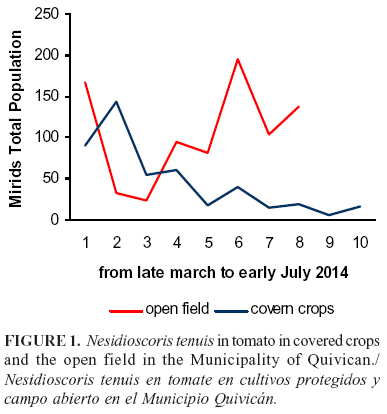
<body><![CDATA[<P><font face="Verdana, Arial, Helvetica, sans-serif" size="2">Within this group,    the Miridae (Heteroptera) form a family with very different feeding habits,    which includes predatory species, some of which are important as biological    control agents of small noxious arthropods (2, 3). </font>     <P><font face="Verdana, Arial, Helvetica, sans-serif" size="2">Commercial use    of predatory bugs as biological control agents for pest control in agriculture    and forestry has shown a significant increase today, especially in Europe, where    several Heteroptera species such as <I>Orius laevigatus</I> [(Fieber), <I>Macrolophus    pygmaeus</I> (Rambur), and <I>Nesidiocoris tenuis</I> (Reuter)] are produced    in large quantities and released in greenhouses (1, 3). </font>     <P><font face="Verdana, Arial, Helvetica, sans-serif" size="2">Based on the above    considerations, the present work was aimed at updating the species of mirids    in the crops of tomato and tobacco and their impact under our conditions, as    a basis for further studies related to the biological control of pests of concern    for these crops. </font>     <P><font face="Verdana, Arial, Helvetica, sans-serif" size="2">The survey of the    species of mirid predators was conducted in two locations in the provinces of    Las Tunas and Mayabeque, located in the western and eastern regions respectively    <FONT  COLOR="#231f20">during the 2014 campaign</FONT>. In Mayabeque in the tomato crop,    <I>Solanum esculentum</I> L., grown in both the open field and covered crops,    and in Las Tunas in outdoor plantations of the tobacco<I>, Nicotiana tabacum</I>    L., cultivars IT-2004, H-2000 and H-92 during the 2012-2013 campaign. </font>     <P><font face="Verdana, Arial, Helvetica, sans-serif" size="2">In each sampling,    a total of 30 plants in the diagonals were examined; nymphs and adults of mirids    were counted and adult specimens collected and taken to the Entomology Laboratory    at CENSA for their identification using keys by different authors (4, 5). </font>     <P><font face="Verdana, Arial, Helvetica, sans-serif" size="2">To determine the    incidence of these Heteroptera, the count of the species found per plant in    each sampling was taken in consideration. A graphic was made with the population    movements in tomato in the open field and covered crops, and in the cultivar    Havana 92 during the first campaign, the latter being the most widely distributed    in the municipality. </font>     <P><font face="Verdana, Arial, Helvetica, sans-serif" size="2">The survey showed    the presence of the mirids <I>Nesidiocoris tenuis</I> Reuter, <I>Macrolophus    praeclarus</I> (Distant) and <I>Engytatus varians</I> (Distant) (syn. <I>Cyrtopeltis    varians</I>), the first species in the tomato and tabaco crops in Mayabeque    and Las Tunas, and the last two only in the plantation of tobacco in the eastern    region. </font>     <P><font face="Verdana, Arial, Helvetica, sans-serif" size="2">Natural populations    of these species have been reported in Cuba by different authors. <I>N. tenuis</I>    on <I>Solanum esculentum</I> L., (5, 6)), <I>Sesamum indicum,</I> and recently    on <I>Martynia annua</I> L., also been reported causing damage to tobacco (5)),    while <I>E. varians</I> and <I>Macrolophus praeclarus</I> (Distant) have been    reported on <I>Nicotiana tabacum</I> L. (5,7)) and <I>Martynia annua</I> L.    (5). </font>     <P> <font face="Verdana, Arial, Helvetica, sans-serif" size="2"><I>Nesidiocoris    tenuis</I> has been the subject of several recent works, due to its economic    importance and its duality as predator and herbivore (8); in this respect, the    attributes of this predator have been reported by several researchers, who pointed    out their contribution to the reduction of populations of whiteflies and pest    lepidotera (8,9)). In Cuba there are recent studies concerning the behavior    and predatory activity of <I>N. tenuis</I> and its combined effect with <I>Cicloneda    sanguinea</I> limbifer (Casey) on the dispersion of <I>Myzus persicae</I> Sulzer    (10). </font>     <P><font face="Verdana, Arial, Helvetica, sans-serif" size="2"><I>E. varians</I>    has been reported as an important natural enemy of <I>Bemisia tabaci</I> (Genn.)    (Hemiptera: Aleyrodidae) (6, 7) and has also been found attacking early instars    of <I>Heliothis virescens</I> F. (Lepidoptera: Noctuidae) (5, 11). </font>     ]]></body>
<body><![CDATA[<P><font face="Verdana, Arial, Helvetica, sans-serif" size="2">Similarly, it is    known that some species of the genus <I>Macrolophus</I> have deserved priority    attention in Europe because of their perspective use in agriculture as an agent    for complementary control of the whitefly in the protected production of vegetables    (12). To this it is added that another species of this genus, particularly <I>M.    basicornis</I>, has been found preying on aphids and lepidopteran larvae (13),    but not in the crops sampled in the present work. </font>     <P><font face="Verdana, Arial, Helvetica, sans-serif" size="2">In Brazil, three    predatory species of this family (Miridae, Dicyphini), identified as <I>Campyloneuropsis    infumatus</I> (Carvalho 1947), <I>Engytatus varians</I> (Distant 1884), and    <I>Macrolophus basicornis</I> (Stal 1860), were found on young tobacco plants    after 20 days of planting, on which 1190 nymphs were collected during four months    of sampling . In addition, specimens of these mirids were found on <I>Calendula    officinalis</I> L. and on tomato plants infested with eggs and larvae of the    tomato borer <I>Tuta absoluta</I> (1), a species not present in Cuba. </font>     <P><font face="Verdana, Arial, Helvetica, sans-serif" size="2">Regarding the incidence    of mirids during the period evaluated, it was higher in tomato grown in the    open field than in the protected house, but not with great differences, which    remained between 42 and 40% respectively, where the predominating species was    <I>N. tenuis .</I> </font>     <P><font face="Verdana, Arial, Helvetica, sans-serif" size="2">As shown in <a href="#f1">Fig.    1</a>, <I>N. tenuis</I> was present in tomato from the beginning of the vegetative    stage to the fruiting stage in both the open field and the covered crops. The    population in the open showed ups and downs in the assessed period with two    peaks that corresponded with the highest populations in the first and seventh    samplings; however, in the covered crops there was an initial population increase    with a trend to decrease gradually until the last assessment. </font>      <P align="center"><img src="/img/revistas/rpv/v29n3/f0107314.jpg" width="387" height="414">    <a name="f1"></a>      
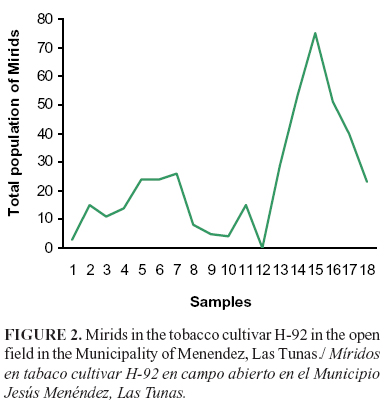
<P><font face="Verdana, Arial, Helvetica, sans-serif" size="2">Tobacco (<a href="#f2">Fig.    2</a>), the cultivars H-2000 (66,79%) and H 92 (67,58%) had the highest incidence    values, where the presence of the three reported species of mirids as well as    several lepidoptera and whiteflies were recorded, being less in the cultivar    IT -2004 (43,2%). </font>      <P align="center"><img src="/img/revistas/rpv/v29n3/f0207314.jpg" width="387" height="408">    <a name="f2"></a>     
<P><font face="Verdana, Arial, Helvetica, sans-serif" size="2">In tobacco, the    mirids were present with ups and downs of the population in most of the samplings    (<a href="#f2">Fig. 2</a>) with a peak in the sampling 15 corresponding with    the stage of tobacco second cutting which began from sampling 11 when the plant    started growing again from the so called main cut and where the temperature    and the presence of insects like the whitefly and lepidoteran larvae could influence    on the levels of predators. </font>      <P><font face="Verdana, Arial, Helvetica, sans-serif" size="2">It is emphasized    the role of the mirids as generalist predators in the tobacco crop and their    potential as biological controls in the implementation of programs of integrated    pest management in this crop (7). </font>     <P><font face="Verdana, Arial, Helvetica, sans-serif" size="2">On the other hand,    it is highlighted that the current strategies of biological control of pests    are based on inoculative applications or on the landscape management for conservation    of the local populations and improvement of the crop colonization (15). </font>     ]]></body>
<body><![CDATA[<P><font face="Verdana, Arial, Helvetica, sans-serif" size="2">Mirid predatory    bugs<B> </B>are currently used with success in southern Europe to control <I>T.    absoluta</I> and other pests. In Brazil, four Hemipteran predatory bugs, not    yet known to attack <I>T. absoluta</I>, were found to successfully prey on eggs    and larvae of this pest (14). </font>     <P><font face="Verdana, Arial, Helvetica, sans-serif" size="2">Summarizing, the    incidence of natural populations of mirids remained over 40%, which suggested    that they must be taken in consideration for the contribution they can exert    to the biological control of small key arthropods in solanaceous plants of importance,    such as tomato and tobacco, despite the affectations that <I>N tenuis</I> could    cause in the tomato crop due to its dual condition of predator and phytophagous,    which can be an object of further studies. </font>     <P>&nbsp;     <P><font face="Verdana, Arial, Helvetica, sans-serif" size="2"><B><font size="3">REFERENCIAS    </font> </B> </font>      <!-- ref --><P><font face="Verdana, Arial, Helvetica, sans-serif" size="2">1. Bueno VHP, van    Lenteren JC. Predatory Bugs (Heteroptera) Chapter 22. In: Ed. by Panizzi AR,    Parra JRP, Insect bioecology and nutrition for integrated pest management. CRC    Press, Boca Raton, FL, 2012; 539-569.     </font>      <!-- ref --><P><font face="Verdana, Arial, Helvetica, sans-serif" size="2">2. Sanchez JA,      Lacasa A. Impact of the Zoophytophagous Plant Bug <I>Nesidiocoris tenuis </I>(Heteroptera:      Miridae) on Tomato Yield. J Econ Entomol. 2008;101(6):1864-1870.     </font>        <!-- ref --><P><font face="Verdana, Arial, Helvetica, sans-serif" size="2">3. Machtelinckx    T, Van Leeuwen T, Van De Wiele T, Boon N, De Vos W, S&aacute;nchez JA, et al.    Microbial community of predatory bugs of the genus Macrolophus (Hemiptera: Miridae).    BMC Microbiology. 2012;12(Suppl 1):S9. <U><a href="http://www.biomedcentral.com/1471-2180/12/S1/S9">http://www.biomedcentral.com/1471-2180/12/S1/S9</a></U>.        </font>      ]]></body>
<body><![CDATA[<!-- ref --><P><font face="Verdana, Arial, Helvetica, sans-serif" size="2">4. Goula M, Alomar      O. M&iacute;ridos (Heteroptera: Miridae) de inter&eacute;s en el control integrado      de plagas en tomate. Gu&iacute;a para su identificaci&oacute;n. Bolet&iacute;n      de Sanidad Vegetal, Plagas 1994;20:131-143.     </font>        <!-- ref --><P><font face="Verdana, Arial, Helvetica, sans-serif" size="2">5. Grillo H. Heter&oacute;pteros    de Cuba Tesis presentada en opci&oacute;n al t&iacute;tulo de doctor en ciencias.    Universidad Central de las Villas, Cuba. 2012.     </font>      <!-- ref --><P><font face="Verdana, Arial, Helvetica, sans-serif" size="2">6. Casti&ntilde;eiras      A. Natural enemies of <I>Bemisia tabaco</I> (Homoptera: Aleyroridae) in Cuba.      Florida Entomologist, 1995;78(3):538:540.     </font>        <!-- ref --><P><font face="Verdana, Arial, Helvetica, sans-serif" size="2">7. Rivas DA. Lepid&oacute;pteros    en el cultivo del Tabaco: Elementos ecol&oacute;gicos y alternativas para su    manejo en Las Tunas. Tesis en opci&oacute;n al grado cient&iacute;fico de Doctor    en Ciencias, Universidad Agraria de la Habana. Centro Nacional de Sanidad Agropecuaria,    2012. 102pp.     </font>      <!-- ref --><P><font face="Verdana, Arial, Helvetica, sans-serif" size="2">8. Sanchez JA.      Density thresholds for <I>Nesidiocoris tenuis</I> (Heteroptera: Miridae) in      tomato crops. Biological Control. 2009;51:493-498.     </font>        ]]></body>
<body><![CDATA[<!-- ref --><P><font face="Verdana, Arial, Helvetica, sans-serif" size="2">9. Urbaneja A,    Mont&oacute;n H, Molla O. Suitability of the tomato borer <I>Tuta absoluta</I>    as prey for <I>Macrolophus pygmaeus</I> and <I>Nesidiocoris tenuis.</I> Journal    of Applied Entomology. 2009;133:292-296.     </font>      <!-- ref --><P><font face="Verdana, Arial, Helvetica, sans-serif" size="2">10.Duarte L, Pacheco    R, Qui&ntilde;ones M, Mart&iacute;nez MA, Bueno VH. <I>Nesidiocoris tenuis</I>    Reuter (Hemiptera: Miridae) and <I>Cycloneda sanguinea limbifer </I>(Casey)    (Coleoptera: Coccinellidae): Behaviour and predation activities on <I>Myzus    persicae </I>Zulzer (Hemiptera: Aphididae). Rev Protecci&oacute;n Veg<I>. </I>2014;29(2):99-105.        </font>      <!-- ref --><P><font face="Verdana, Arial, Helvetica, sans-serif" size="2">11.Suarez PR,      Hern&aacute;ndez RE. Plagas, enfermedades y su control. Editorial Pueblo y      Educaci&oacute;n, La Habana, 1992, 398pp.     </font>       <!-- ref --><P><font face="Verdana, Arial, Helvetica, sans-serif" size="2">12.Mart&iacute;nez-Cascales      JI, Cenis JL, Cassis G, S&aacute;nchez JA. Species identity of <I>Macrolophus      melanotoma </I>(Costa 1853) and <I>Macrolophus pygmaeus </I>(Rambur 1839)      (Insecta: Heteroptera: Miridae) based on morphological and molecular data      and bionomic implications. Insect Syst Evol. 2006;37:385-404. ISSN 1399-560X.          </font>       <!-- ref --><P><font face="Verdana, Arial, Helvetica, sans-serif" size="2">13.Hernandez      LM, Henry TJ, The plant bugs, or Miridae (Hemiptera: Heteroptera), of Cuba.      Pensoft Ser Faunistica. 2010;92:212.     </font>       ]]></body>
<body><![CDATA[<P><font face="Verdana, Arial, Helvetica, sans-serif" size="2">14.Bueno VHP,      van Lenteren JC, Lins JC, Calixto AM, Montes FC, Silva DB, et al. New records      of <I>Tuta absoluta</I> (Meyrick) (Lepidoptera: Gelechiidae) predation by      Brazilian Hemipteran predatory bugs. Journal of Applied Entomology. 2012;      6 pag. </font>        <!-- ref --><P><font face="Verdana, Arial, Helvetica, sans-serif" size="2">15.Aloma O, Goula    M, Albajes R. Colonisation of tomato fields by predatory mirid bugs (Hemiptera:    Heteroptera) in northern Spain. Agriculture, Ecosystems &amp; Environment. 2002;89:105-115.    </font>      <P>&nbsp;     <P>&nbsp;     <P><font face="Verdana, Arial, Helvetica, sans-serif" size="2">Recibido: 20-9-2014.    <br>   </font><font face="Verdana, Arial, Helvetica, sans-serif" size="2">Aceptado:    11-11-2014.</font>       ]]></body><back>
<ref-list>
<ref id="B1">
<label>1</label><nlm-citation citation-type="book">
<person-group person-group-type="author">
<name>
<surname><![CDATA[Bueno]]></surname>
<given-names><![CDATA[VHP]]></given-names>
</name>
<name>
<surname><![CDATA[van Lenteren]]></surname>
<given-names><![CDATA[JC]]></given-names>
</name>
</person-group>
<article-title xml:lang="en"><![CDATA[Predatory Bugs (Heteroptera)]]></article-title>
<person-group person-group-type="editor">
<name>
<surname><![CDATA[Panizzi]]></surname>
<given-names><![CDATA[AR]]></given-names>
</name>
<name>
<surname><![CDATA[Parra]]></surname>
<given-names><![CDATA[JRP]]></given-names>
</name>
</person-group>
<source><![CDATA[Insect bioecology and nutrition for integrated pest management]]></source>
<year>2012</year>
<page-range>539-569</page-range><publisher-loc><![CDATA[Boca Raton^eFL FL]]></publisher-loc>
<publisher-name><![CDATA[CRC Press]]></publisher-name>
</nlm-citation>
</ref>
<ref id="B2">
<label>2</label><nlm-citation citation-type="journal">
<person-group person-group-type="author">
<name>
<surname><![CDATA[Sanchez]]></surname>
<given-names><![CDATA[JA]]></given-names>
</name>
<name>
<surname><![CDATA[Lacasa]]></surname>
<given-names><![CDATA[A]]></given-names>
</name>
</person-group>
<article-title xml:lang="en"><![CDATA[Impact of the Zoophytophagous Plant Bug Nesidiocoris tenuis (Heteroptera: Miridae) on Tomato Yield]]></article-title>
<source><![CDATA[J Econ Entomol]]></source>
<year>2008</year>
<volume>101</volume>
<numero>6</numero>
<issue>6</issue>
<page-range>1864-1870</page-range></nlm-citation>
</ref>
<ref id="B3">
<label>3</label><nlm-citation citation-type="journal">
<person-group person-group-type="author">
<name>
<surname><![CDATA[Machtelinckx]]></surname>
<given-names><![CDATA[T]]></given-names>
</name>
<name>
<surname><![CDATA[Van Leeuwen]]></surname>
<given-names><![CDATA[T]]></given-names>
</name>
<name>
<surname><![CDATA[Van De Wiele]]></surname>
<given-names><![CDATA[T]]></given-names>
</name>
<name>
<surname><![CDATA[Boon]]></surname>
<given-names><![CDATA[N]]></given-names>
</name>
<name>
<surname><![CDATA[De Vos]]></surname>
<given-names><![CDATA[W]]></given-names>
</name>
<name>
<surname><![CDATA[Sánchez]]></surname>
<given-names><![CDATA[JA]]></given-names>
</name>
</person-group>
<article-title xml:lang="en"><![CDATA[Microbial community of predatory bugs of the genus Macrolophus (Hemiptera: Miridae)]]></article-title>
<source><![CDATA[BMC Microbiology]]></source>
<year>2012</year>
<volume>12</volume>
<numero>^sSuppl 1</numero>
<issue>^sSuppl 1</issue>
<supplement>Suppl 1</supplement>
<page-range>S9</page-range></nlm-citation>
</ref>
<ref id="B4">
<label>4</label><nlm-citation citation-type="journal">
<person-group person-group-type="author">
<name>
<surname><![CDATA[Goula]]></surname>
<given-names><![CDATA[M]]></given-names>
</name>
<name>
<surname><![CDATA[Alomar]]></surname>
<given-names><![CDATA[O]]></given-names>
</name>
</person-group>
<article-title xml:lang="es"><![CDATA[Míridos (Heteroptera: Miridae) de interés en el control integrado de plagas en tomate. Guía para su identificación]]></article-title>
<source><![CDATA[Boletín de Sanidad Vegetal, Plagas]]></source>
<year>1994</year>
<volume>20</volume>
<page-range>131-143</page-range></nlm-citation>
</ref>
<ref id="B5">
<label>5</label><nlm-citation citation-type="">
<person-group person-group-type="author">
<name>
<surname><![CDATA[Grillo]]></surname>
<given-names><![CDATA[H]]></given-names>
</name>
</person-group>
<source><![CDATA[Heterópteros de Cuba]]></source>
<year></year>
</nlm-citation>
</ref>
<ref id="B6">
<label>6</label><nlm-citation citation-type="journal">
<person-group person-group-type="author">
<name>
<surname><![CDATA[Castiñeiras]]></surname>
<given-names><![CDATA[A]]></given-names>
</name>
</person-group>
<article-title xml:lang="es"><![CDATA[Natural enemies of Bemisia tabaco (Homoptera: Aleyroridae) in Cuba]]></article-title>
<source><![CDATA[Florida Entomologist]]></source>
<year>1995</year>
<volume>78</volume>
<numero>3</numero>
<issue>3</issue>
<page-range>538:540</page-range></nlm-citation>
</ref>
<ref id="B7">
<label>7</label><nlm-citation citation-type="">
<person-group person-group-type="author">
<name>
<surname><![CDATA[Rivas]]></surname>
<given-names><![CDATA[DA]]></given-names>
</name>
</person-group>
<article-title xml:lang="es"><![CDATA[Lepidópteros en el cultivo del Tabaco: Elementos ecológicos y alternativas para su manejo en Las Tunas]]></article-title>
<source><![CDATA[]]></source>
<year></year>
<page-range>102</page-range></nlm-citation>
</ref>
<ref id="B8">
<label>8</label><nlm-citation citation-type="journal">
<person-group person-group-type="author">
<name>
<surname><![CDATA[Sanchez]]></surname>
<given-names><![CDATA[JA]]></given-names>
</name>
</person-group>
<article-title xml:lang="en"><![CDATA[Density thresholds for Nesidiocoris tenuis (Heteroptera: Miridae) in tomato crops]]></article-title>
<source><![CDATA[Biological Control]]></source>
<year>2009</year>
<volume>51</volume>
<page-range>493-498</page-range></nlm-citation>
</ref>
<ref id="B9">
<label>9</label><nlm-citation citation-type="journal">
<person-group person-group-type="author">
<name>
<surname><![CDATA[Urbaneja]]></surname>
<given-names><![CDATA[A]]></given-names>
</name>
<name>
<surname><![CDATA[Montón]]></surname>
<given-names><![CDATA[H]]></given-names>
</name>
<name>
<surname><![CDATA[Molla]]></surname>
<given-names><![CDATA[O]]></given-names>
</name>
</person-group>
<article-title xml:lang="en"><![CDATA[Suitability of the tomato borer Tuta absoluta as prey for Macrolophus pygmaeus and Nesidiocoris tenuis]]></article-title>
<source><![CDATA[Journal of Applied Entomology]]></source>
<year>2009</year>
<volume>133</volume>
<page-range>292-296</page-range></nlm-citation>
</ref>
<ref id="B10">
<label>10</label><nlm-citation citation-type="journal">
<person-group person-group-type="author">
<name>
<surname><![CDATA[Duarte]]></surname>
<given-names><![CDATA[L]]></given-names>
</name>
<name>
<surname><![CDATA[Pacheco]]></surname>
<given-names><![CDATA[R]]></given-names>
</name>
<name>
<surname><![CDATA[Quiñones]]></surname>
<given-names><![CDATA[M]]></given-names>
</name>
<name>
<surname><![CDATA[Martínez]]></surname>
<given-names><![CDATA[MA]]></given-names>
</name>
<name>
<surname><![CDATA[Bueno]]></surname>
<given-names><![CDATA[VH]]></given-names>
</name>
</person-group>
<article-title xml:lang="en"><![CDATA[Nesidiocoris tenuis Reuter (Hemiptera: Miridae) and Cycloneda sanguinea limbifer (Casey) (Coleoptera: Coccinellidae): Behaviour and predation activities on Myzus persicae Zulzer (Hemiptera: Aphididae)]]></article-title>
<source><![CDATA[Rev Protección Veg]]></source>
<year>2014</year>
<volume>29</volume>
<numero>2</numero>
<issue>2</issue>
<page-range>99-105</page-range></nlm-citation>
</ref>
<ref id="B11">
<label>11</label><nlm-citation citation-type="book">
<person-group person-group-type="author">
<name>
<surname><![CDATA[Suarez]]></surname>
<given-names><![CDATA[PR]]></given-names>
</name>
<name>
<surname><![CDATA[Hernández]]></surname>
<given-names><![CDATA[RE]]></given-names>
</name>
</person-group>
<source><![CDATA[Plagas, enfermedades y su control]]></source>
<year>1992</year>
<page-range>398</page-range><publisher-loc><![CDATA[La Habana ]]></publisher-loc>
<publisher-name><![CDATA[Editorial Pueblo y Educación]]></publisher-name>
</nlm-citation>
</ref>
<ref id="B12">
<label>12</label><nlm-citation citation-type="journal">
<person-group person-group-type="author">
<name>
<surname><![CDATA[Martínez-Cascales]]></surname>
<given-names><![CDATA[JI]]></given-names>
</name>
<name>
<surname><![CDATA[Cenis]]></surname>
<given-names><![CDATA[JL]]></given-names>
</name>
<name>
<surname><![CDATA[Cassis]]></surname>
<given-names><![CDATA[G]]></given-names>
</name>
<name>
<surname><![CDATA[Sánchez]]></surname>
<given-names><![CDATA[JA]]></given-names>
</name>
</person-group>
<article-title xml:lang="en"><![CDATA[Species identity of Macrolophus melanotoma (Costa 1853) and Macrolophus pygmaeus (Rambur 1839) (Insecta: Heteroptera: Miridae) based on morphological and molecular data and bionomic implications]]></article-title>
<source><![CDATA[Insect Syst Evol]]></source>
<year>2006</year>
<volume>37</volume>
<page-range>385-404</page-range></nlm-citation>
</ref>
<ref id="B13">
<label>13</label><nlm-citation citation-type="journal">
<person-group person-group-type="author">
<name>
<surname><![CDATA[Hernandez]]></surname>
<given-names><![CDATA[LM]]></given-names>
</name>
<name>
<surname><![CDATA[Henry]]></surname>
<given-names><![CDATA[TJ]]></given-names>
</name>
</person-group>
<article-title xml:lang="en"><![CDATA[The plant bugs, or Miridae (Hemiptera Heteroptera), of Cuba]]></article-title>
<source><![CDATA[Pensoft Ser Faunistica]]></source>
<year>2010</year>
<volume>92</volume>
<page-range>212</page-range></nlm-citation>
</ref>
<ref id="B14">
<label>14</label><nlm-citation citation-type="journal">
<person-group person-group-type="author">
<name>
<surname><![CDATA[Bueno]]></surname>
<given-names><![CDATA[VHP]]></given-names>
</name>
<name>
<surname><![CDATA[van Lenteren]]></surname>
<given-names><![CDATA[JC]]></given-names>
</name>
<name>
<surname><![CDATA[Lins]]></surname>
<given-names><![CDATA[JC]]></given-names>
</name>
<name>
<surname><![CDATA[Calixto]]></surname>
<given-names><![CDATA[AM]]></given-names>
</name>
<name>
<surname><![CDATA[Montes]]></surname>
<given-names><![CDATA[FC]]></given-names>
</name>
<name>
<surname><![CDATA[Silva]]></surname>
<given-names><![CDATA[DB]]></given-names>
</name>
</person-group>
<article-title xml:lang="en"><![CDATA[New records of Tuta absoluta (Meyrick) (Lepidoptera: Gelechiidae) predation by Brazilian Hemipteran predatory bugs]]></article-title>
<source><![CDATA[Journal of Applied Entomology]]></source>
<year>2012</year>
<volume>6</volume>
<page-range>0 pag</page-range></nlm-citation>
</ref>
<ref id="B15">
<label>15</label><nlm-citation citation-type="journal">
<person-group person-group-type="author">
<name>
<surname><![CDATA[Aloma]]></surname>
<given-names><![CDATA[O]]></given-names>
</name>
<name>
<surname><![CDATA[Goula]]></surname>
<given-names><![CDATA[M]]></given-names>
</name>
<name>
<surname><![CDATA[Albajes]]></surname>
<given-names><![CDATA[R]]></given-names>
</name>
</person-group>
<article-title xml:lang="en"><![CDATA[Colonisation of tomato fields by predatory mirid bugs (Hemiptera: Heteroptera) in northern Spain]]></article-title>
<source><![CDATA[Agriculture, Ecosystems & Environment]]></source>
<year>2002</year>
<volume>89</volume>
<page-range>105-115</page-range></nlm-citation>
</ref>
</ref-list>
</back>
</article>