<?xml version="1.0" encoding="ISO-8859-1"?><article xmlns:mml="http://www.w3.org/1998/Math/MathML" xmlns:xlink="http://www.w3.org/1999/xlink" xmlns:xsi="http://www.w3.org/2001/XMLSchema-instance">
<front>
<journal-meta>
<journal-id>1010-2752</journal-id>
<journal-title><![CDATA[Revista de Protección Vegetal]]></journal-title>
<abbrev-journal-title><![CDATA[Rev. Protección Veg.]]></abbrev-journal-title>
<issn>1010-2752</issn>
<publisher>
<publisher-name><![CDATA[Centro Nacional de Sanidad Agropecuaria]]></publisher-name>
</publisher>
</journal-meta>
<article-meta>
<article-id>S1010-27522015000100005</article-id>
<title-group>
<article-title xml:lang="en"><![CDATA[Biology and population parameters of Tuta absoluta (Meyrick) under laboratory conditions]]></article-title>
<article-title xml:lang="es"><![CDATA[Biología y parámetros poblacionales de Tuta absoluta (Meyrick) bajo condiciones de laboratorio]]></article-title>
</title-group>
<contrib-group>
<contrib contrib-type="author">
<name>
<surname><![CDATA[Duarte]]></surname>
<given-names><![CDATA[Leticia]]></given-names>
</name>
<xref ref-type="aff" rid="A01"/>
</contrib>
<contrib contrib-type="author">
<name>
<surname><![CDATA[Martínez]]></surname>
<given-names><![CDATA[María de los Ángeles]]></given-names>
</name>
<xref ref-type="aff" rid="A01"/>
</contrib>
<contrib contrib-type="author">
<name>
<surname><![CDATA[Paes Bueno]]></surname>
<given-names><![CDATA[Vanda Helena]]></given-names>
</name>
<xref ref-type="aff" rid="A02"/>
</contrib>
</contrib-group>
<aff id="A01">
<institution><![CDATA[,Centro Nacional de Sanidad Agropecuaria (CENSA) Dirección de Sanidad Vegetal ]]></institution>
<addr-line><![CDATA[San José de las Lajas Mayabeque]]></addr-line>
<country>Cuba</country>
</aff>
<aff id="A02">
<institution><![CDATA[,Universidad Federal de Lavras Departamento do Entomología Laboratorio de Control Biológico]]></institution>
<addr-line><![CDATA[ Minas Gerais]]></addr-line>
<country>Brasil</country>
</aff>
<pub-date pub-type="pub">
<day>00</day>
<month>04</month>
<year>2015</year>
</pub-date>
<pub-date pub-type="epub">
<day>00</day>
<month>04</month>
<year>2015</year>
</pub-date>
<volume>30</volume>
<numero>1</numero>
<fpage>19</fpage>
<lpage>29</lpage>
<copyright-statement/>
<copyright-year/>
<self-uri xlink:href="http://scielo.sld.cu/scielo.php?script=sci_arttext&amp;pid=S1010-27522015000100005&amp;lng=en&amp;nrm=iso"></self-uri><self-uri xlink:href="http://scielo.sld.cu/scielo.php?script=sci_abstract&amp;pid=S1010-27522015000100005&amp;lng=en&amp;nrm=iso"></self-uri><self-uri xlink:href="http://scielo.sld.cu/scielo.php?script=sci_pdf&amp;pid=S1010-27522015000100005&amp;lng=en&amp;nrm=iso"></self-uri><abstract abstract-type="short" xml:lang="en"><p><![CDATA[The aim of this work was to determine the temperature effect on Tuta absoluta (Meyrick) biological development. Its biological and population parameters were evaluated on the Cuban tomato (Solanum lycopersicum L.) cultivar Vyta at temperatures of 25±1ºC and 20/30±1ºC under controlled conditions. The duration (in days) of the egg, larval and pupal stages and reproductive periods, as well as the sex ratio, the viability of eggs and pupae (in per cent), total fecundity/female and longevity obtained at different temperature regimens were compared between treatments by ANOVA with Mann-Whitney test (p<0.05). The larval survival (in per cent) was compared between treatments by ANOVA with Bonferroni test (p<0.05).Only the egg stage and the pre-oviposition period were longer with 20/30ºC (p <.0001). Viability of the pupae was higher at (25ºC) (p=0.0121).The larval survival was affected negatively with 32.14 and 20% at 25ºC and 20/30ºC, respectively (p=0.0206). The survival curves for larvae and female adults in both conditions were of type II. The survival of females subjected to (20/30ºC) was three days longer, but without significant differences between treatments. The total fecundity/female and longevity were not affected. The specific fecundity (m x) in both temperatures was more stable in a range of 0.8-1.0 until the 10 days of age. The population growth parameters of T. absoluta Ro, T, r m, TD and (l) were 9.36, 8.90, 5.52, 5.75, 0.02, 0.01, 34.64, 117.01, and 1.02, 1.01 at 25ºC and 20/30ºC, respectively. The biological and population parameters of T. absoluta on the tomato Vyta cultivar were influenced by the temperature in the test, and, as a consequence, the development of the pest was limited under the laboratory conditions. In addition, indications of Vyta as a possible resistant cultivar versus the pest were shown under the temperature regimen studied.]]></p></abstract>
<abstract abstract-type="short" xml:lang="es"><p><![CDATA[El objetivo de este trabajo fue determinar el efecto de la temperatura sobre el desarrollo biológico de Tuta absoluta (Meyrick). Los parámetros biológicos y poblacionales fueron evaluados a temperaturas de 25±1ºC y 20/30±1ºC sobre el cultivar de tomate (Solanum lycopersicum L.) Vyta en condiciones controladas. La duración (en días) de las fases de huevo, larva, pupa y períodos reproductivos, así como razón sexual, viabilidad de los huevos y pupas (en por ciento), fecundidad total/hembra y la longevidad obtenida en los diferentes regímenes de temperatura por ANOVA con prueba de Mann-Whitney (p<0.05), se compararon entre tratamientos. La supervivencia larval (en por ciento) se comparó entre los tratamientos por ANOVA, con una prueba de Bonferroni (p<0.05). Solo la fase de huevo y el periodo de pre-oviposición fueron más largos con 20/30ºC (p <.0001). La viabilidad pupal fue superior a 25ºC (p=0,0121). La supervivencia larval se afectó negativamente con 32,14 y 20% a 25ºC y 20/30ºC, respectivamente (p=0,0206). En ambas condiciones, las curvas de supervivencia para larvas y hembras adultas fueron de tipo II. La supervivencia de las hembras sometidas a 20/30ºC fue tres días más larga, pero sin diferencias significativas entre los tratamientos. La fecundidad total/hembra y la longevidad no se afectaron. La fecundidad específica (m x) fue más estable, en un rango de 0.8-1.0 hasta los 10 días de edad en ambas temperaturas. Los parámetros de crecimiento poblacional de T. absoluta Ro, T, r m, TD y (l) fueron 9,36, 8,90; 5,52, 5,75; 0,02, 0,01; 34,64; 117,01 y 1,02, 1,01 a (25ºC) y (20/30ºC), respectivamente. El desarrollo biológico y parámetros poblacionales de T. absoluta sobre el cultivar Vyta, estuvieron influenciados en el estudio por la temperatura, y como consecuencia, el desarrollo de la plaga se limitó en condiciones de laboratorio. Además, se mostraron indicios de Vyta como un posible cultivar resistente, frente a la plaga bajo el régimen de temperatura estudiado.]]></p></abstract>
<kwd-group>
<kwd lng="en"><![CDATA[leaf miner]]></kwd>
<kwd lng="en"><![CDATA[host plant resistant]]></kwd>
<kwd lng="en"><![CDATA[Solanum lycopersicum]]></kwd>
<kwd lng="es"><![CDATA[minador de hojas]]></kwd>
<kwd lng="es"><![CDATA[resistencia de planta hospedante]]></kwd>
<kwd lng="es"><![CDATA[Solanum lycopersicum]]></kwd>
</kwd-group>
</article-meta>
</front><body><![CDATA[ <p align="right"><font face="Verdana, Arial, Helvetica, sans-serif" size="2"><B>ORIGINAL    ARTICLE</B> </font></p>     <p>&nbsp;</p> <h1> <font face="Verdana, Arial, Helvetica, sans-serif" size="2"><b><font size="4">Biology    and population parameters of <i>Tuta absoluta</i> (Meyrick) under laboratory    conditions </font> </b></font></h1>     <p>&nbsp;</p>     <p><font face="Verdana, Arial, Helvetica, sans-serif" size="2"><b><font size="3">Biolog&iacute;a    y par&aacute;metros poblacionales de <i>Tuta absoluta </i>(Meyrick) bajo condiciones    de laboratorio </font></b></font> </p>     <p>&nbsp;</p>     <p>&nbsp;</p>     <p><font face="Verdana, Arial, Helvetica, sans-serif" size="2"><b>Leticia Duarte<SUP>I</SUP>,    Mar&iacute;a de los &Aacute;ngeles Mart&iacute;nez<SUP>I</SUP>, Vanda Helena    Paes Bueno<SUP>II</SUP></b></font><b> </b></p>     <P><font face="Verdana, Arial, Helvetica, sans-serif" size="2"><SUP>I</SUP>Direcci&oacute;n    de Sanidad Vegetal. Centro Nacional de Sanidad Agropecuaria (CENSA), Apartado    10, San Jos&eacute; de las Lajas, Mayabeque, Cuba. Correo electr&oacute;nico:    <U><a href="mailto:leticia@censa.edu.cu">leticia@censa.edu.cu</a></U>. <SUP>    <br>   II</SUP>Laboratorio de Control Biol&oacute;gico. Departamento do Entomolog&iacute;a,    Universidad Federal de Lavras, Lavras, Minas Gerais, Brasil.</font>     <P>&nbsp;     ]]></body>
<body><![CDATA[<P>&nbsp; <hr noshade size="1">     <P><font face="Verdana, Arial, Helvetica, sans-serif" size="2"><B>ABSTRACT</B></font>     <P><font face="Verdana, Arial, Helvetica, sans-serif" size="2">The aim of this    work was to determine the temperature effect on <I>Tuta absoluta </I>(Meyrick)    biological development. Its biological and population parameters were evaluated    on the Cuban tomato (<I>Solanum lycopersicum</I> L.) cultivar Vyta at temperatures    of 25&#177;1<SUP>o</SUP>C and 20/30&#177;1<SUP>o</SUP>C under controlled conditions.    The duration (in days) of the egg, larval and pupal stages and reproductive    periods, as well as the sex ratio, the viability of eggs and pupae (in per cent),    total fecundity/female and longevity obtained at different temperature regimens    were compared between treatments by ANOVA with Mann-Whitney test (p&lt;0.05).    The larval survival (in per cent) was compared between treatments by ANOVA with    Bonferroni test (p&lt;0.05).Only the egg stage and the pre-oviposition period    were longer with 20/30<SUP>o</SUP>C <I>(p &lt;.0001). </I>Viability of the pupae    was higher at (25<SUP>o</SUP>C)<I> (p=0.0121).</I>The larval survival was affected    negatively with<I> </I>32.14 and 20% at 25<SUP>o</SUP>C and 20/30<SUP>o</SUP>C,    respectively <I>(p=0.0206). </I>The survival curves for larvae and female adults    in both conditions were of type II. The survival of females subjected to (20/30<SUP>o</SUP>C)    was three days longer, but without significant differences between treatments.    The total fecundity/female and longevity were not affected. The specific fecundity    (m<SUB>x</SUB>) in both temperatures was more stable in a range of 0.8-1.0 until    the 10 days of age. The population growth parameters of <I>T. absoluta</I> R<SUB>o</SUB>,    T, r<SUB>m</SUB>, TD and (<I><FONT  COLOR="#231f20">l</FONT></I>) were 9.36, 8.90, 5.52, 5.75, 0.02, 0.01, 34.64,    117.01, and 1.02, 1.01 at 25<SUP>o</SUP>C and 20/30<SUP>o</SUP>C, respectively.    The biological and population parameters of <I>T. absoluta</I> on the tomato    Vyta cultivar were influenced by the temperature in the test, and, as a consequence,    the development of the pest was limited under the laboratory conditions. In    addition, indications of Vyta as a possible resistant cultivar versus the pest    were shown under the temperature regimen studied. </font>     <P><font face="Verdana, Arial, Helvetica, sans-serif" size="2"><B>Key words</B>:    leaf miner, host plant resistant, <I>Solanum lycopersicum.</I></font> <hr noshade size="1">     <p><font face="Verdana, Arial, Helvetica, sans-serif" size="2"><B>RESUMEN</b></font></p>     <p><font face="Verdana, Arial, Helvetica, sans-serif" size="2">El objetivo de    este trabajo fue determinar el efecto de la temperatura sobre el desarrollo    biol&oacute;gico de <I>Tuta absoluta </I>(Meyrick). Los par&aacute;metros biol&oacute;gicos    y poblacionales fueron evaluados a temperaturas de 25&#177;1<SUP>o</SUP>C y    20/30&#177;1<SUP>o</SUP>C sobre el cultivar de tomate (<I>Solanum lycopersicum</I>    L.) Vyta en condiciones controladas. La duraci&oacute;n (en d&iacute;as) de    las fases de huevo, larva, pupa y per&iacute;odos reproductivos, as&iacute;    como raz&oacute;n sexual, viabilidad de los huevos y pupas (en por ciento),    fecundidad total/hembra y la longevidad obtenida en los diferentes reg&iacute;menes    de temperatura por ANOVA con prueba de Mann-Whitney (p&lt;0.05), se compararon    entre tratamientos. La supervivencia larval (en por ciento) se compar&oacute;    entre los tratamientos por ANOVA, con una prueba de Bonferroni (p&lt;0.05).    Solo la fase de huevo y el periodo de pre-oviposici&oacute;n fueron m&aacute;s    largos con 20/30<SUP>o</SUP>C <I>(p &lt;.0001). </I>La viabilidad pupal fue    superior a<I> </I>25<SUP>o</SUP>C<I> (p=0,0121).</I> La supervivencia larval    se afect&oacute; negativamente con 32,14 y 20% a 25<SUP>o</SUP>C y 20/30<SUP>o</SUP>C,    respectivamente <I>(p=0,0206). </I>En ambas condiciones, las curvas de supervivencia    para larvas y hembras adultas fueron de tipo II. La supervivencia de las hembras    sometidas a 20/30<SUP>o</SUP>C fue tres d&iacute;as m&aacute;s larga, pero sin    diferencias significativas entre los tratamientos. La fecundidad total/hembra    y la longevidad no se afectaron. La fecundidad espec&iacute;fica (m<SUB>x</SUB>)    fue m&aacute;s estable, en un rango de 0.8-1.0 hasta los 10 d&iacute;as de edad    en ambas temperaturas. Los par&aacute;metros de crecimiento poblacional de <I>T.    absoluta</I> R<SUB>o</SUB>, T, r<SUB>m</SUB>, TD y (<I><FONT  COLOR="#231f20">l</FONT></I>) fueron 9,36, 8,90; 5,52, 5,75; 0,02, 0,01; 34,64;    117,01 y 1,02, 1,01 a (25<SUP>o</SUP>C) y (20/30<SUP>o</SUP>C), respectivamente.    <FONT  COLOR="#231f20">El desarrollo biol&oacute;gico y par&aacute;metros poblacionales    de <I>T.</I></FONT><I> absoluta</I> sobre el cultivar Vyta, estuvieron influenciados    en el estudio por la temperatura, y como consecuencia, el desarrollo de la plaga    se limit&oacute; en condiciones de laboratorio. Adem&aacute;s, se mostraron    indicios de Vyta como un posible cultivar resistente, frente a la plaga bajo    el r&eacute;gimen de temperatura estudiado. </font> </p>     <P><font face="Verdana, Arial, Helvetica, sans-serif" size="2"><B>Palabras clave</B>:    minador de hojas, resistencia de planta hospedante, <I>Solanum lycopersicum.</I></font> <hr noshade size="1">     <P>&nbsp;     <P>&nbsp;     <P><font face="Verdana, Arial, Helvetica, sans-serif" size="2"><B><font size="3">INTRODUCTION</font></B>    </font>     ]]></body>
<body><![CDATA[<P><font face="Verdana, Arial, Helvetica, sans-serif" size="2">Tomato (<I>Solanum    lycopersicum</I> L.) is original from Andean countries and is one of the vegetables    most cultivated in the world (1). The present world production is about 152.1    million tons of fresh fruit (2). Despite of this, the crop is attacked from    planting to harvest by numerous pests and diseases (3). </font>     <P><font face="Verdana, Arial, Helvetica, sans-serif" size="2">The tomato leaf    miner <I>Tuta absoluta </I>(Meyrick) (Lepidoptera: Gelechiidae), is an extremely    devastating pest that may decrease fruit quality, or even, cause 100% losses    in open field and greenhouse crops, mainly if control methods are not applied    (4). It was first described in Peru in 1917 and is considered one of the most    devastating pests for the tomato crop in South America and a serious threat    to tomato production in the Mediterranean region<I> </I>(5). Invasion of the    Mediterranean Basin was rapid; <I>T. absoluta</I> traveled about 4,000 km in    five years and has become now a major threat to tomato production in three continents    (Europe, Africa, and Asia) (6). It extends North-South from The Netherlands    to Sudan, and West-East from Portugal to Iran (7). The presence of this pest    was also reported in Panama (8).<B> </B> </font>     <P><font face="Verdana, Arial, Helvetica, sans-serif" size="2">This species<I>    </I>is a multivoltine pest that mines leaves, fruits, flowers, buds and stems.    The damage is produced when the larvae feed on the leaf mesophyll expanding    mines, thus affecting the photosynthetic capacity of the crop with the subsequent    yield reduction. <I>T. absoluta </I>is an oligophagous insect that feeds on    solanaceous species, where, besides tomato, is associated with other cultivated    and non-cultivated<I> </I>host-plants (9). The duration of the life cycle depends    on the environmental conditions, in particular the temperature, ranging from    76.3 days at 14&#176;C to 23.8 days at 27&#176;C (10). Also there may be an    overlap in generations and all the stages of the cycle are found in field conditions    (11). Temperature variations directly influence the development rate of insects    and indirectly influence their development through effects on the host plant,    and so, the plant quality as food resource (12). </font>     <P><font face="Verdana, Arial, Helvetica, sans-serif" size="2">It is known that    temperature has an important influence on duration of the different development    stages of the insects allowing a higher or lower exposure time of them to the    natural enemies (13). Additionally, negative effects of ecological factors on    the multiplication of the population could be considered, and consequently,    a higher reduction of the number of progenies in natural conditions. van Lenteren    (14) reports that the research involving knowledge of plant resistance to pests    is a challenge that should be displayed for the sustainable growth of plant    production systems. Understanding the relationship between temperature variation    and tomato cultivars concerning pest development is important to evaluate the    control option of host-plant resistance and to determine whether a combination    of host-plant resistance with biological control is a realistic option. </font>     <P><font face="Verdana, Arial, Helvetica, sans-serif" size="2">The tomato leaf    miner is included in the <I>Official list of quarantine of the Cuban Republic</I>;    its introduction constitutes a risk for the country, and the resistance level    of the Cuban cultivars versus this species has not been studied. The phytogenetic    resources are known to contain an important quantity of genes for being managed    and explored in a rational form,mainly those genera of plants related to resistance    to biotic and abiotic factors that affect cultivated species by the man (15).    </font>     <P><font face="Verdana, Arial, Helvetica, sans-serif" size="2">In Cuba, the introgressions    of the <I>Ty-1</I> gene from native species of tomato (<I>Solanum chilense</I>)    to cultivated plants (<I>S. esculentum</I>) allowed to obtain the resistance    lines in the whitefly-<I>geminivirus </I>complex, until the generalization of    the Vyta commercial cultivar for the best productive areas in the country (16).    In this paper, it is reported a study on the development and populational growth    of <I>T. absoluta</I> on the Cuban tomato cultivar Vyta under constant and alternating    temperature regimes. </font>     <P>&nbsp;     <P><font face="Verdana, Arial, Helvetica, sans-serif" size="2"><B><font size="3">MATERIALS    AND METHODS</font></B> </font>     <P><font face="Verdana, Arial, Helvetica, sans-serif" size="2">The experiments    were carried out at the Laboratory of Biological Control, Department of Entomology,    Universidade Federal de Lavras (UFLA), Lavras, Minas Gerais, Brazil. </font>     <P><font face="Verdana, Arial, Helvetica, sans-serif" size="2">The tomato seeds    of the Cuban cultivar Vyta were supplied by the Horticultural Research Institute    &#171;Liliana Dimitrova&#187;, located in Quivic&aacute;n, Mayabeque, Cuba.    The seedlings were produced in root ball trays with substrate UFLA in a greenhouse.    After 20 days, they were transferred to 5L pots. The pots were provided with    a mixture of soil, sand, calcium, a complete formula of nitrogen, phosphorum    and potassium (NPK) and substrate UFLA for obtaining a higher nutritional value    and a consequent best pest population development. Each pot was supplied with    0.83, 0.42, 0.02, 0.13 and 0.42Kg of each component, respectively. The plants    were fertilized weekly with 100 ml per pot of a dissolution of KNO<SUB>3</SUB>.    The plants were subjected to 23&#177;7,6<SUP>o</SUP>C of temperature, 64&#177;15.4%    of relative humidity and 12 hours of photoperiod. The plants were irrigated    by aspersion with a frequency of one hour by space of five minutes. </font>     ]]></body>
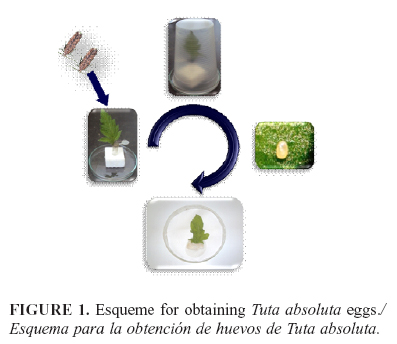
<body><![CDATA[<P><font face="Verdana, Arial, Helvetica, sans-serif" size="2">The regime of constant    and alternating temperatures used in the experiment was defined according to    studies on <I>T. absoluta</I> development conducted at different temperatures    reported in the literature (9,17). Moreover, this study considered the temperature    average from regions of the country where the largest Cuban tomato productions    have been achieved. The constant and alternating temperature at 25&#176;C and    20/30&#176;C, were chosen, respectively. According to the temperature fluctuations,    the values of alternating temperature were considered minimum and maximum according    to night or daytime. The experiments were carried out in climatic chambers.    Two temperature treatments were used: 25&#176;C and 20/30&#176;C, with a relative    humidity of 70&#177;10% and photoperiod of 12 hours. </font>     <P><font face="Verdana, Arial, Helvetica, sans-serif" size="2"><B>Rearing of <I>Tuta    absoluta</I> on plant of the tomato cultivar Vyta under laboratory conditions.</B>    </font>     <P><font face="Verdana, Arial, Helvetica, sans-serif" size="2">Adults of <I>T.    absoluta</I> of 48-72 hours of emerged were collected from the pest rearing    established in Santa Clara at the Biological Control Laboratory in UFLA. Plants    of the Vyta cultivar were placed into acrylic cages (60x30x30 cm) with 100 adults    of the pest. After 48 hours, the rearing was started with the eggs oviposited    by the adults. The laboratory conditions used for the rearing were 25&#177;2&#176;C    of temperature, 70%&#177;10% of relative humidity and 12 hours of photoperiod.    Eggs, <FONT COLOR="#231f20">larvae and adults of <I>T. absoluta</I> from individuals    of</FONT> the second generation were used for starting the tests. </font>     <P>     <p><font face="Verdana, Arial, Helvetica, sans-serif" size="2"><B>Development    and survival of <I>T. absoluta</I> </B></font></p>     <p><font face="Verdana, Arial, Helvetica, sans-serif" size="2"><b>Egg stage</b></font></p> <B></B>      <P><font face="Verdana, Arial, Helvetica, sans-serif" size="2">To determine the    duration of the egg stage and their viability, <I>T. absoluta</I> couples were    placed into a transparent acrylic glasses (6.5 cm, 8.0 cm diameter) for 24 hours.    Each glass was fixed to a Petri dish (10 cm diameter) with an adhesive film.    Each dish contained a leaf of the Vyta cultivar inserted into an Eppendorf tube    with distilled water and supported to a polystyrene cube. Tomato leaves were    used as oviposition substrate. The adults were fed with drops of honey. A few    portion of this was placed inside of the glasses with the help of an entomological    brush. After 24 hours, the excess of eggs present on the leaves were removed    with a fine-tipped brush. Only, fifteen eggs were left per leaf. Ten replicates    per each treatment were included (n= 150) The larvae hatched were counted daily    (<a href="#f1">Figure 1</a>). </font>      <P align="center"><img src="/img/revistas/rpv/v30n1/f0105115.jpg" width="397" height="344">    <a name="f1"></a>     
<P><font face="Verdana, Arial, Helvetica, sans-serif" size="2"><B>Larval stage</B>    </font>     <P><font face="Verdana, Arial, Helvetica, sans-serif" size="2">Newly hatched larvae    from the pest reared at the laboratory were used in the test. Stems of tomato    leaflets were wrapped with cotton moistened with distilled water and placed    into the Petri dishes. Five larvae of <I>T. absoluta</I> were placed on each    leaf using a fine brush under a stereoscopic microscope (Zeiss Stemi 2000-C),    with a magnification of 1x10. Twenty-eight Petri dishes (&Oslash; 8 cm) containing    a leaf with five larvae per each was considered, for a total of 140 larvae per    treatment. The leaves were changed every two days to allow the development of    the larvae until pupae. A disk of filter paper was placed in the bottom of each    Petri dish for absorbing the excess moisture. Then, the dishes were sealed with    PVC film. The number of live larvae was counted daily. </font>     ]]></body>
<body><![CDATA[<P><font face="Verdana, Arial, Helvetica, sans-serif" size="2"><B>Pupal stage</B>    </font>     <P><font face="Verdana, Arial, Helvetica, sans-serif" size="2">When the larvae    reached the pupal stage, they were individually placed into a glass tube (8.5    x 2.5). The pupae were observed daily until adult emergence. Considering larvae    survival until reaching the pupal stage, the number of pupae evaluated was 45    and 38 at 25 and 20/30<SUP>o</SUP>C, respectively. The emerged adults were sexed    according to the methodology proposed by Coelho and Franca (18), and the presence    of possible deformations was observed. The sex ratio was evaluated in both treatments.    </font>     <P><font face="Verdana, Arial, Helvetica, sans-serif" size="2"><B>Effects of the    Vyta tomato cultivar and temperature on the reproduction and population parameters    of <I>T. absoluta</I>. </B> </font>     <P><font face="Verdana, Arial, Helvetica, sans-serif" size="2">To determine the    reproductive potential and survival of adults, the newly emerged couples of    <I>T. absoluta</I> at constant and alternating temperature from the pupae stage    test were placed into a transparent acrylic glass (6.5 cm, 8.0 cm diameter)    until death. The glass was supported with a Petri dish (9cm diameter) with the    same conditions above mentioned. The leaves of the tomato cultivar were used    as substrate of oviposition for adults of <I>T. absoluta </I>(<a href="#f1">Figure    1</a>). </font>      <P><font face="Verdana, Arial, Helvetica, sans-serif" size="2">Fifteen couples    (1 couple per glass) per each treatment were placed on the leaves in the experimental    arena. A few drops of honey were placed for feeding the insects. The small leaves    were removed daily and the number of eggs per couple counted and death of the    adults recorded. In addition, the pre-oviposition, oviposition and post-reproductive    periods, as well as the longevity of the adults were evaluated according to    the methodology described by Borgoni &amp; Carvalho (19) and Silva (17). </font>     <P><font face="Verdana, Arial, Helvetica, sans-serif" size="2"><B>Fertility life    table </B> </font>      <P><font face="Verdana, Arial, Helvetica, sans-serif" size="2">To estimate the    population parameters of <I>T. absoluta</I> on the Vyta tomato cultivar under    both temperature conditions, the fertility life table was constructed per each    treatment. The rate of survival (lx), specific fertility (mx), net reproductive    rate (Ro), intrinsic rate of increase (<I>r<SUB>m</SUB></I>), generation time    (T), finite rate of increase () and duplication time (TD) were determined in    the test. Some definitions (<a href="/img/revistas/rpv/v30n1/t0105115.jpg">Table    1</a>) and calculations of these parameters were as <a href="#e1">follows</a>:    </font>      
<P align="center"><img src="/img/revistas/rpv/v30n1/e0105115.gif" width="403" height="148">    <a name="e1"></a>     
<P><font face="Verdana, Arial, Helvetica, sans-serif" size="2"><B>Data analysis</B>    </font>     <P><font face="Verdana, Arial, Helvetica, sans-serif" size="2">A Kolmogorov Smirnov    test was used to know the normal distribution of the data in the experiment.    The duration (in days) of the egg, larval and pupal stages and the reproductive    periods, as well as the sex ratio, the viability of eggs and pupae (in per cent),    total fecundity/female and longevity obtained at different temperature regimens    were subjected to an ANOVA with the Mann-Whitney test (p&lt;0.05) for the comparison    between treatments. The larval survival (in per cent) subjected to an ANOVA    with the Bonferroni test (p&lt;0.05) for the comparison between treatments.    The SAS program, version 9.0 was used for the statistical analyses.</font>     ]]></body>
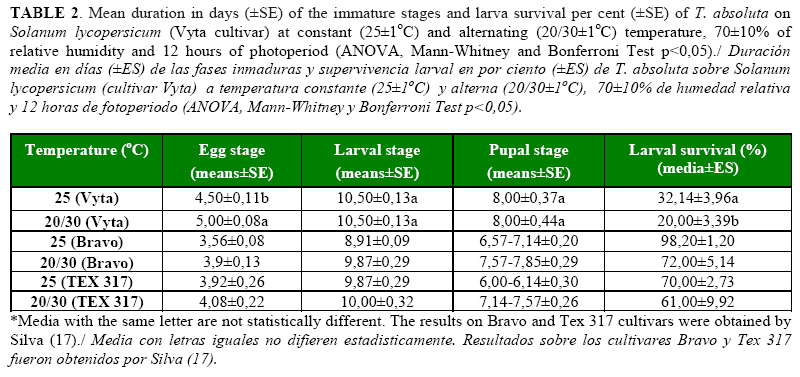
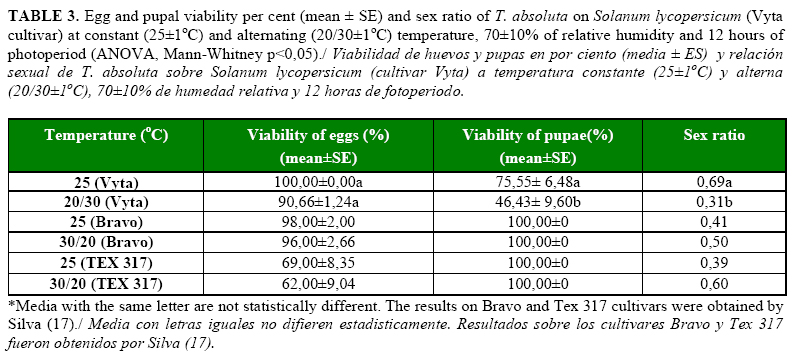
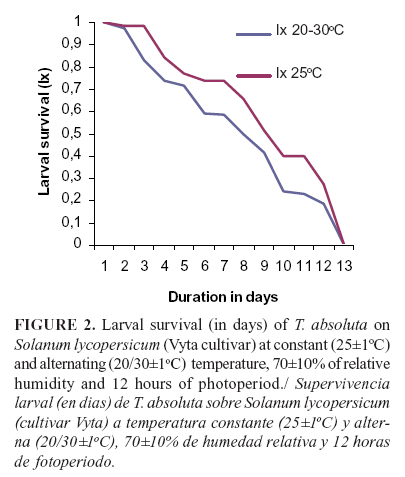
<body><![CDATA[<P>&nbsp;     <P><font face="Verdana, Arial, Helvetica, sans-serif" size="2"><B><font size="3">RESULTS</font></B>    </font>     <P><font face="Verdana, Arial, Helvetica, sans-serif" size="2">The duration of    the larval and pupal stages of <I>T. absoluta</I> did not show significant differences    under both temperature conditions. However, the duration of the egg stage of    the pest was significantly longer <I>(p &lt;.0001)</I> under the alternating    (20/30<SUP>o</SUP>C) than under the constant temperature (25<SUP>o</SUP>C).    Despite of this, the immature stages of the insect on the Vyta cultivar were    longer than on the tomato cultivars evaluated by Silva (17) under the same temperature    regimens (<a href="/img/revistas/rpv/v30n1/t0205115.jpg">Table 2</a>).    The highest effect of both temperatures on <I>T. absoluta</I> development was    showed by the viability of the pupae, with significant differences between treatments    <I>(p=0.0121)</I> (<a href="/img/revistas/rpv/v30n1/t0305115.jpg">Table    3</a>), and larvae survival was affected negatively. The average percentage    of survival showed statistical differences (<I>p=0.0206</I>) between treatments    and the highest effects were obtained under the alternating temperature (<a href="/img/revistas/rpv/v30n1/t0305115.jpg">Table    3</a>). The larval survival described a curve of type II under both treatments,    where a constant number of individuals died by time unit (<a href="/img/revistas/rpv/v30n1/f0205115.jpg">Figure    2</a>). The sex ratio of the adults were affected by the temperature with statistical    differences between treatments <I>(p=0.0035)</I>; the highest effect was obtained    when the Vyta cultivar was combined with the alternating temperature (<a href="/img/revistas/rpv/v30n1/t0305115.jpg">Table    3</a>). </font>      
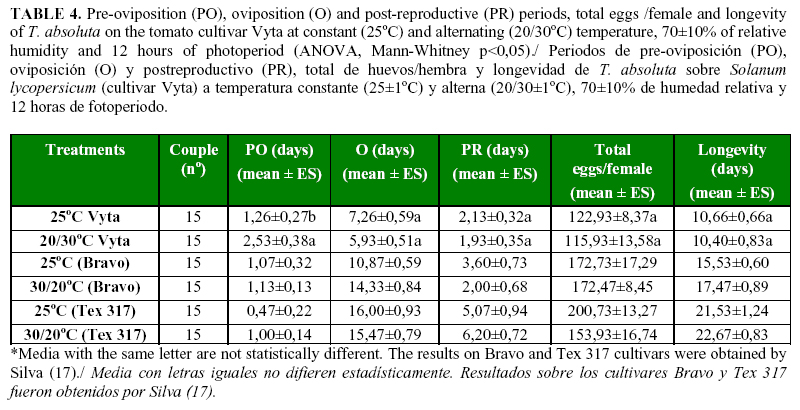
<P><font face="Verdana, Arial, Helvetica, sans-serif" size="2">The duration of    the reproductive periods of the adults, the fecundity of the females and longevity    were not affected notably by the temperature conditions in the test; only the    pre-oviposition period was longer with alternating temperature than with the    constant temperature <I>(p &lt;.0001) </I>(<a href="/img/revistas/rpv/v30n1/t0405115.jpg">Table    4</a>). However, the duration of these periods, total eggs/female and longevity    of <I>T. absoluta </I>were lower than what was obtained by the pest on the Bravo    and Tex 317 cultivars at the same temperature conditions (17). The low oviposition    period limited the pest oviposition time, and as consecuence, an lower quantity    of eggs was laid by <I>T. absoluta</I> females on the Vyta cultivar. </font>      
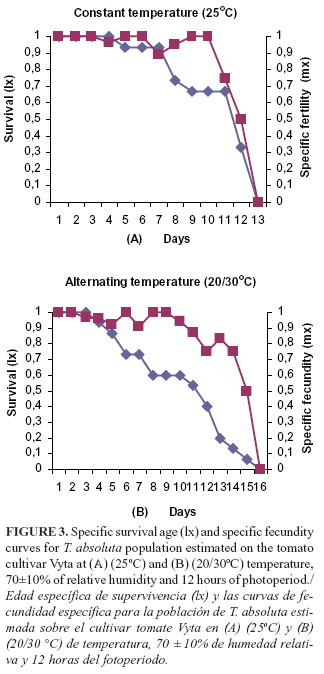
<P><font face="Verdana, Arial, Helvetica, sans-serif" size="2">Moreover, the survival    of the female adults showed a curve of the type II, where a constant number    of individuals died by time unit. The females subjected to alternating (20/30<SUP>o</SUP>C)    temperature reached three more days of life than the females under constant    temperature (25<SUP>o</SUP>C), for a survival of 16 days. The highest population    mortality started in a range of 5-7 days of age, in both conditions. In addition,    the specific fecundity (m<SUB>x</SUB>) was better established in a range of    values of 0.8-1.0 until the 10 days of age of the population despite the progressive    death of individuals by time unit (<a href="#f3">Figure 3</a>). </font>      <P align="center"><img src="/img/revistas/rpv/v30n1/f0305115.jpg" width="324" height="674">    <a name="f3"></a>      
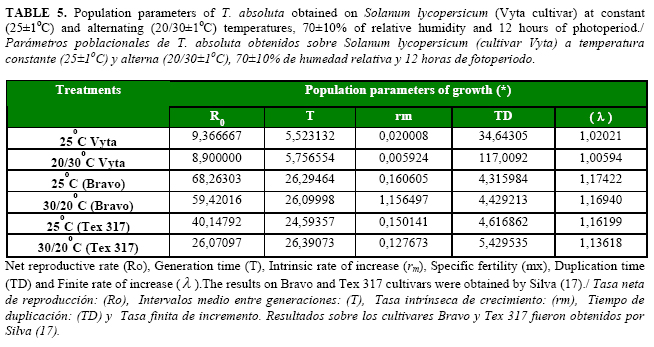
<P><font face="Verdana, Arial, Helvetica, sans-serif" size="2">The lowest value    of the finite rate of increase (<I><FONT  COLOR="#231f20">l</FONT></I>) of the pest was obtained with the alternating (20/30<SUP>o</SUP>C)    temperature as a consequence of the increase of the time necessary for the duplication    of individuals in the population (TD). The values of the intrinsic rate of increase    (r<SUB>m</SUB>), were lower than the values of the <FONT  COLOR="#231f20">(<I>l</I>)</FONT>, but, in this case, the higher value of r<SUB>m</SUB>    was reached by the pest with the constant (25<SUP>o</SUP>C) temperature. Under    both temperature conditions, these values were positive indicating the populational    growth of <I>T. absoluta</I> under laboratory conditions (<a href="/img/revistas/rpv/v30n1/t0505115.jpg">Table    5</a>). </font>      
<P><font face="Verdana, Arial, Helvetica, sans-serif" size="2">The net reproductive    rate (R<SUB>o</SUB>) of <I>T. absoluta</I> was higher at 25<SUP>o</SUP>C than    at 20/30<SUP>o</SUP>C, allowing a better population increase (r<SUB>m</SUB>)    of the pest under constant temperature. The generation time (T) was higher under    the alternating temperature in the laboratory conditions (<a href="/img/revistas/rpv/v30n1/t0505115.jpg">Table    5</a>), indicating a longer exposure of the population to natural enemies or    ecological factors by a higher interval between generations; this results indicated    that R<SUB>o</SUB> and r<SUB>m</SUB> of the pest could be affected in natural    conditions. </font>      
<P>&nbsp;     <P><font face="Verdana, Arial, Helvetica, sans-serif" size="2"><B><font size="3">DISCUSSION</font></B>    </font>     ]]></body>
<body><![CDATA[<P><font face="Verdana, Arial, Helvetica, sans-serif" size="2">The results of    the biological and population parameters of <i>T. absoluta </i>on the tomato    cultivar Vyta in the present study differed from those obtained by Silva (17)    on Brazilian tomato cultivars under similar temperature conditions. In comparing    these results, it was allowed making evident the potential of the Cuban cultivar    since the resistance of the commercially extended Brazilian cultivars to <i>T.    absoluta </i>is quite known (20). It was the first time that the Cuban cultivar    was tested against this pest based on its resistance to whitefly-<i>begomovirus    </i>complex (21). </font>      <p><font face="Verdana, Arial, Helvetica, sans-serif" size="2">In this work, the    results indicated that the combination of temperatures with the Vyta cultivar    could be an important tool to combat the pest. Besides, the longer duration    of the egg, larval and pupal stages obtained on Vyta cultivar could allow a    higher exposure time of the pest to the natural enemies in natural conditions.    Moreover, it is known the potential use of predators, parasitoids and entomopathogens    as biological control agents of <i>T. absoluta </i>(22). Some of these control    agents, mainly indigenous mirid predators, have already been successfully used    in integrated pest management programs (23). </font>      <p><font face="Verdana, Arial, Helvetica, sans-serif" size="2">The response of    <i>T. abosoluta</i> to the alternating temperature could be attributed to changes    in the insect causing disorders on its metabolism and development of immature    phases. Due to being poikilotermic organims, insects do not present mechanisms    to regulate their body temperature and, therefore, their physiology is strongly    influenced by this factor (24). Thus, it is possible that the alterations produced    within a phase may influence the development in the next phase. </font>      <p><font face="Verdana, Arial, Helvetica, sans-serif" size="2">Regarding insect    sex ratio, is a parameter that can be influenced by several factors. It is documented    that the patterns defining sex are the population mating structure and the environmental    conditions (25). About this latter, it is known that temperature can aversely    influence on sperm viability (26), an element that could explain why the sex    ratio was in favor of males at the alternating temperature in the present study.    </font>      <p><font face="Verdana, Arial, Helvetica, sans-serif" size="2">The sex rate values    of <i>T. absoluta</i> observed in the present work were contrary to those obtained    by Silva (17), so that the numbers of males or females in the population could    be attributed to the combined effect of the temperature with the tomato variety    on which the insects were developed. </font>      <p><font face="Verdana, Arial, Helvetica, sans-serif" size="2">These results suggest    that <i>T. absoluta</i> has a limited development of the Vyta variety. The low    larval survival reached by the insect under both temperature conditions are    considered a result of great importance, taking into account that the crop damages    are caused by the larvae. </font>      <p><font face="Verdana, Arial, Helvetica, sans-serif" size="2">When the results    on larval survival and pupa viability herein obtained were compared with those    obtained by Pereyra and S&aacute;nchez (9) and Moreira <i>et al</i>. (27) on    other tomato varieties under similar temperature conditions, the highest values    of these parameters obtained by these authors suggest a negative effect of the    Vyta variety on <i>T. absoluta</i> development. </font>      <p><font face="Verdana, Arial, Helvetica, sans-serif" size="2">On the other hand,    although no significant differences among treatments were found in the insect    oviposition period, this period was shorter than that obtained by Moreira <i>et    al</i>. (27), who determined the resistance of the tomato wild lines<i> S. hirsutum</i>    f. <i>glabratum</i> (PI134417), <i>S. pimpinellifolium</i> (PI 126931), and    <i>S. peruvianum</i> at 25<sup> o</sup>C , and they concluded that the short    oviposition period could be related to the presence of toxic substances in the    leaves which reduced oviposition quickly after the insect got in touch with    them. </font>      <p><font face="Verdana, Arial, Helvetica, sans-serif" size="2">Likewise, although    no significant differences among treatment were observed in the species fecundity,    the values obtained in the present study were far below those reached by Thomazini    <i>et al</i>., (28) y Silva (17). </font>      <p><font face="Verdana, Arial, Helvetica, sans-serif" size="2">In this respect,    Ecole <i>et al. </i>(29) and<i> </i>Gon&ccedil;alves-Neto <i>et al</i>. (30)    state that the resistance of tomato varieties to <i>T. absoluta</i> is attributed    to the presence of allelochemicals in the glandular thricomes of the leaves    and the methyl-ketona 2 tridecanona is the major secondary metabolite responsible    for resistance. </font>      ]]></body>
<body><![CDATA[<p><font face="Verdana, Arial, Helvetica, sans-serif" size="2">The glandular thricomes    of <i>Solanum</i> species release toxic exudates or resins when they are touched    by phytophagous organisms. These irritating substances can potentially cause    death. Research on the roll of thricomes in the resistance of the tomato crop    as a host has been mainly focused on<i> S. hirsutum, S. hirsutum </i>f.<i> glabratum    </i>and<i> S. pennellii, </i>which are resistant to <i>Keiferia lycopersicella</i>    (Walsingham) (Lepidoptera: Gelechiidae) because they get fewer insect larvae    and the s on the leaves are smaller when they are compared with <i>S. lycopersicum</i>    (31). </font>      <p><font face="Verdana, Arial, Helvetica, sans-serif" size="2">Different hybrid    combinations between genotypes with high and low levels of aminoacids showed    excelent levels of resistance to <i>T. absoluta</i>. These allelochemicals can    act preventing the oviposition, feeding, and producing a lethal effect on the    development of some insects phases (20). </font>      <p><font face="Verdana, Arial, Helvetica, sans-serif" size="2">In turn, Leite    (32) defines that tomato varieties show resistance by antibiosis when a longer    duration of the insect development phases and a low pupa viability, larval survival    and female fecundity are observed. These criteria agree with the results attained    in the present study, suggesting that the Vyta variety can exert antibiosis    as a resistance mechanism to <i>T. absoluta</i>. </font>      <p><font face="Verdana, Arial, Helvetica, sans-serif" size="2">In this sense,    Ecole <i>et al</i>. (29) consider that a longer duration and a lower larval    survival of <i>T. absoluta</i> on tomato wild accessions of S.<i> hirsutum </i>f.<i>    typicum</i> reinforce the hypothesis that antibiosis and antixenosis are the    mechanisms of these genotypes involved in the resistance to tomato moth, since    they cause a higher larval mortality by inanition or antibiotic action. </font>      <p><font face="Verdana, Arial, Helvetica, sans-serif" size="2">This type of mechanims    were referred to by Sald&uacute;a and Castro (33) when they evaluated the resistance    of different comercial wheat varieties against <i>Sipha maydis</i> Passerini    (Hemiptera: Aphididae), and they concluded that the antixenosis exerts a strong    selection pressure on the insect population due to volatile compounds inducing    the not preference, whereas the antibiosis, based on anti-nutitive principles    afects the multiple metabolic proccesses of the aphid. These criterion could    be associated with the limited development of the immature phase of <i>T. absoluta</i>    affecting, consequently, the insect population increase in the present study.    </font>      <p><font face="Verdana, Arial, Helvetica, sans-serif" size="2">On the other hand,    Gilard&oacute;n <i>et al</i>. (34) evaluated the resistance of 24 tomato lines    from crosses between S. <i>lycopersicum </i>y <i>S. hirsutum</i> f. <i>glabratum</i>    against <i>T. absoluta</i>, and concluded that those lines manifesting resistance    exerted antibiosis as the resistance mechanism to the first insect larval stages,    which was correlated with a low average weight of fruits, a result that corroborated    the difficulties in selecting lines with a high resistance to tomato moth and    big fruits.</font>     <p>&nbsp;     <p><font face="Verdana, Arial, Helvetica, sans-serif" size="2"><b><font size="3">CONCLUSION</font></b>    </font>     <p><font face="Verdana, Arial, Helvetica, sans-serif" size="2">The biological    and population parameters of <i>T. absoluta </i>maintained on the Vyta tomato    cultivar were influenced by temperature, and development of the pest was consequently    limited. The individuals subjected to alternating (20/30<sup>o</sup>C) temperature    showed lower values of the survival of the larval stage and adult, viability    of pupae (%), sex ratio and total female fecundity. These results suggest the    possible resistance of Vyta cultivar to <i>T. absoluta</i>, allowing the highest    population reduction when the cultivar was subjected to alternating temperature.    </font>      <p><font face="Verdana, Arial, Helvetica, sans-serif" size="2">These results are    of great importance because it is the first time that the biological and population    parameters of an exotic species are evaluated on a Cuban tomato variety previous    to its introduction into the country. They must be included in the risk analysis    of this phytophagous insect. </font>      ]]></body>
<body><![CDATA[<p><font face="Verdana, Arial, Helvetica, sans-serif" size="2">Considering the    importance of this pest to Cuba and the implications of its introduction into    the island, the tomato cultivar Vyta, with those characteristics suggesting    its possible resistance to <i>T. absoluta</i>, constitutes an important arm    to combat this quarantine pest in Cuba. Despite the characteristics of the Vyta    cultivar related to size, texture, organoleptic properties and others not preferred    by farmers, it has been used as a resistant control (TYLCV) and in genetic improvement    programs for the incorporation of <i>Ty-1 </i>gene varieties of commercial interest.</font>      <P>&nbsp;     <P><font face="Verdana, Arial, Helvetica, sans-serif" size="2"><B><font size="3">REFERENCES</font></B>    </font>          <!-- ref --><P><font face="Verdana, Arial, Helvetica, sans-serif" size="2">1. Filgueira FAR.    Vi&ccedil;osa, MG: Ed. Novo manual de olericultura: agrotecnologia moderna na    produ&ccedil;&atilde;o e comercializa&ccedil;&atilde;o de hortali&ccedil;as.    2008. UFV, 3ed. 194-241 p.     </font>      <!-- ref --><P><font face="Verdana, Arial, Helvetica, sans-serif" size="2">2. FAOSTAT Database.    World ranking: Tomatoes, by Production (tonnes), &uacute;ltima actualizaci&oacute;n    16/febrero/2012. Disponible en: <U><a href="http://faostat.fao.org/faostat">http://faostat.fao.org/faostat</a></U>.    Consultado: enero, 2015.     </font>      <!-- ref --><P><font face="Verdana, Arial, Helvetica, sans-serif" size="2">3. Coopercitrus.    Tomaticultura lidera crescimento e lucratividade no setor de hortali&ccedil;as.    Revista Agropecu&aacute;ria, 2010. Dispon&iacute;vel em: <U><a href="http://www.revistacoopercitrus.com.br/%20?pag%20=materia&%20codigo%20=5908">http://www.revistacoopercitrus.com.br/    ?pag =materia&amp; codigo =5908</a></U>. Acesso em: 23 out. 2012.     </font>      <!-- ref --><P><font face="Verdana, Arial, Helvetica, sans-serif" size="2">4. <FONT COLOR="#231f20">Bueno      VH, van Lenteren JC, Lins Jr, Calixto AM, Montes F, Silva D, et al. New records      of <I>Tuta absoluta </I>(Meyrick) (Lepidoptera: Gelechiidae) predation by      Brazilian Hemipteran predatory bugs. J Appl Entomol. 2013;137(1-2):29-34.    </FONT></font>         <!-- ref --><P><font face="Verdana, Arial, Helvetica, sans-serif" size="2">5. Desneux N, Luna    MG, Guillemaud T, Urbaneja A. The invasive South American tomato pinworm, <I>Tuta    absoluta</I>, continues to spread in Afro-Eurasia and beyond: the new threat    to tomato world production. Journal of Pest Science. 2011;84(4):403-408.     </font>      <!-- ref --><P><font face="Verdana, Arial, Helvetica, sans-serif" size="2">6. Tropea Garzia      G, Siscaro G, Biondi A, Zappal&agrave; L. <I>Tuta absoluta</I>, a South American      pest of tomato now in the EPPO region: Biology, distribution and damage. EPPO      Bull. 2012;42:205-210.     </font>        <!-- ref --><P><font face="Verdana, Arial, Helvetica, sans-serif" size="2">7. Ponti L, Gutierrez    AP, Altieri MA. Holistic management of invasive species: The case study of <I>Tuta    absoluta</I> (Meyrick) (Lepidoptera, Gelechiidae). Atti Accademia Nazionale    Italiana di Entomologia. 2013;125-136.     </font>      <!-- ref --><P><font face="Verdana, Arial, Helvetica, sans-serif" size="2">8. CABI Head Office,    Wallingford, UK. Distribution Maps of Plant Pests, <I>Tuta absoluta</I>. Distribution    map. 2011. Map 723 (1st revision).     </font>      <!-- ref --><P><font face="Verdana, Arial, Helvetica, sans-serif" size="2">9. Pereira PC,    Sanchez NE. Effects of two solanaceus plants on developmental and populational    parameters of the tomato leaf miner<I>, Tuta absoluta</I> (Lepidoptera: Gelechiidae).    Neotropical Entomology. 2006;35:671-676.     </font>      <!-- ref --><P><font face="Verdana, Arial, Helvetica, sans-serif" size="2">10.Barrientos      ZR, Apablaza HJ, Norero SA, Estay PP. Temperatura b&aacute;sica y constante      t&eacute;rmica de desarrollo de la Polilla del tomate <I>Tuta absoluta</I>      (Lepidoptera: Gelechiidae). Ciencia e Investigacion Agraria. 1998;251:33-137.          </font>        <!-- ref --><P><font face="Verdana, Arial, Helvetica, sans-serif" size="2">11.Souza JC, Reis    PR. Tra&ccedil;a do tomateiro, hist&ograve;rico, reconhecimento, biologia, prejuizios    e controle. Belo Horizonte: EPAMIG. 1992. Boletin 32. 19p.     </font>      <!-- ref --><P><font face="Verdana, Arial, Helvetica, sans-serif" size="2">12.Karban R,      Baldwin IT. Induced responses to herbivory. 2007. University of Chicago Press,      319p.     </font>       <!-- ref --><P><font face="Verdana, Arial, Helvetica, sans-serif" size="2">13.Lara FM. Princ&iacute;pios      de resist&ecirc;ncia de plantas a insetos. S&atilde;o Paulo, Icone. 1991:      336p.     </font>        <!-- ref --><P><font face="Verdana, Arial, Helvetica, sans-serif" size="2">14.Lenteren JC.    Biological control of pests and diseases in greenhouses: an unexpected success.    In: Vincent, C., Goettel, M.S. and Lazarovits, G. (eds.). Biological Control:    a Global Perspective, CABI, Wallingford. 2007:105-117.     </font>      <!-- ref --><P><font face="Verdana, Arial, Helvetica, sans-serif" size="2">15.Tsutomu A.      Tomato as a model plant for plantpathogen interactions. Plant Biotechnology.      2007;24:135-147.     </font>        <!-- ref --><P><font face="Verdana, Arial, Helvetica, sans-serif" size="2">16.Gomez O, et    al. Breeding for resistence to begomovirus in tropic-adapted tomato genotypes.    Plant Breeding. 2004;123(3):275-279.     </font>      <!-- ref --><P><font face="Verdana, Arial, Helvetica, sans-serif" size="2">17.Silva D. Desenvolvimento    e tabela de vida de fertilidade de <I>Tuta absoluta </I>(Meyrick) (Lepidoptera:    Gelechiidae) em regime de temperaturas constante e alternante em dois cultivares    de tomate. UFLA. 2012<i>. </i>75p (tese mestrado).     </font>      <!-- ref --><P><font face="Verdana, Arial, Helvetica, sans-serif" size="2">18.Coelho MCF,      Franca FH. Biologia, quetotaxia da larva e descrip&ccedil;ao da pupa e adulto      da tra&ccedil;a do tomateiro. Pesquisa Agropecuaria Brasileira. 1987;2(22):129-135.          </font>        <!-- ref --><P><font face="Verdana, Arial, Helvetica, sans-serif" size="2">19.Bogorni PC,    Carvalho GS. Biologia de <I>Tuta absoluta</I> Meyrick (Lepidoptera: Gelechiidae)    em diferentes cultivares de <I>Lycopersicum escullentum</I> Mill. Bioikos Campinas.    2006;20(2):49-61.     </font>      <!-- ref --><P><font face="Verdana, Arial, Helvetica, sans-serif" size="2">20.Maciel GM, Maluf    WR, Silva VF, Gon&ccedil;alves neto AC, Gomes LAA. H&iacute;bridos pr&eacute;-comerciais    resistentes a <i>Tuta absoluta</i> obtidos de linhagem de tomateiro rica em    acila&ccedil;&uacute;cares. Horticultura Brasileira. 2011;29:151-156.     </font>      <!-- ref --><p><font face="Verdana, Arial, Helvetica, sans-serif" size="2">21.<font color="#231f20">Alvares    M, Moya C, Florido M, Plana D. Resultados de la mejora gen&eacute;tica del tomate    (<i>Lycopersicon esculentum</i> Mill.) y su incidencia en la producci&oacute;n    hort&iacute;cola de cuba. Cultivos Tropicales. 2003;24(2):63-70.    </font></font>      <!-- ref --><p><font face="Verdana, Arial, Helvetica, sans-serif" size="2">22.Moll&aacute;    O, Gonz&aacute;lez-Cabrera J, Urbaneja A. The combined use of <i>Bacillus thuringiensis</i>    and <i>Nesidiocoris tenuis</i> against the tomato borer <i>Tuta absoluta</i>.;    Springer, Amsterdam, Netherlands, BioControl. 2011;56(6):883-891.     </font>      <!-- ref --><p><font face="Verdana, Arial, Helvetica, sans-serif" size="2">23.Moll&aacute;    O, Biondi A, Alonso-Valiente M, Urbaneja A. A comparative life history study    of two mirid bugs preying on <i>Tuta absoluta</i> and <i>Ephestia kuehniella</i>    eggs on tomato crops: implications for biological control. BioControl. 2014    doi:10.1007/s10526-013-9553-8.     </font>      <!-- ref --><p><font face="Verdana, Arial, Helvetica, sans-serif" size="2">24.Resh VH, Carde    RT. Encyclopedia of Insects. 2nd edition. Academic Press is an imprint of Elsevier.    2009. 1132p. ISBN: 978-0-12-374144-8.     </font>      <!-- ref --><p><font face="Verdana, Arial, Helvetica, sans-serif" size="2">25.Wikipedia, 2015.    Selecci&oacute;n sexual. Disponible en: <u><a href="https://es.wikipedia.org/wiki/Selecci%C3%B3n_sexual">https://es.wikipedia.org/wiki/Selecci%C3%B3n_sexual</a></u>    Consultado: 10/11/2014.     </font>      <!-- ref --><p><font face="Verdana, Arial, Helvetica, sans-serif" size="2">26.Boscan N. Cultivo    masivo de insectos entom&oacute;fagos con fines de control biol&oacute;gico.    <i>Fonaiap</i> divulga. 1988;28. Disponible en: <u><a href="http://sian.inia.gob.ve/repositorio/revistas_tec%20/FonaiapDivulga/fd28/texto/cultivo.htm">http://sian.inia.gob.ve/repositorio/revistas_tec    /FonaiapDivulga/fd28/texto/cultivo.htm</a></u>. Consultado: 10/11/2014.     </font>      <!-- ref --><p><font face="Verdana, Arial, Helvetica, sans-serif" size="2">27.Moreira LA,    Pican&ccedil;o MC, Silva GA, Seme&atilde;o AA, Casali VWD, Campos MR, et al.    Antibiosis of eight <i>Lycopersicon</i> genotypes to <i>Tuta absoluta</i> (Lepidoptera:    Gelechiidae). Revista Ceres. 2009;56(3):283-287.     </font>      <!-- ref --><p><font face="Verdana, Arial, Helvetica, sans-serif" size="2">28.Thomazini AP,    Vendramim JD, Brunherotto R, Lopes MT. Efeito de Gen&oacute;tipos de Tomateiro    sobre a Biologia e Oviposi&ccedil;&atilde;o de <i>Tuta absoluta</i> (Meyrick)    (Lep.:Gelechiidae). Neotropical Entomology. 2001;30(2):283-288.     </font>      <!-- ref --><p><font color="#231f20" face="Verdana, Arial, Helvetica, sans-serif" size="2">29.</font><font face="Verdana, Arial, Helvetica, sans-serif" size="2">Ecole    C, Pican&ccedil;o M, Moreira MD, Magalh&atilde;es STV. Componentes Qu&iacute;micos    Associados &agrave; Resist&ecirc;ncia de <i>Lycopersicon hirsutum</i> f. <i>typicum</i>    a <i>Tuta absoluta</i> (Meyrick) (Lepidoptera: Gelechiidae). An Soc Entomol    Brasil. 2000;29(2):327-337.     </font>      <!-- ref --><p><font face="Verdana, Arial, Helvetica, sans-serif" size="2">30.Gon&ccedil;alves    Neto AC, Silva VF, Maluf WR, Maciel GM, Nizio DAC, et al. Resist&ecirc;ncia    &agrave; tra&ccedil;a-do-tomateiro em plantas com altos teores de acila&ccedil;&uacute;cares    nas folhas. Horticultura Brasileira. 2010;28:203-208.     </font>      <!-- ref --><p><font face="Verdana, Arial, Helvetica, sans-serif" size="2">31.Simmons AT,    Gurr GM. Trichomes of <i>Lycopersicon</i> species and their hybrids: effects    on pests and natural enemies. Agricultural and Forest Entomology. 2005;8:1-11.        </font>      <!-- ref --><p><font face="Verdana, Arial, Helvetica, sans-serif" size="2">32.Leite GLD. Resistencia    de tomates a pragas. Unimontes Cientifica. Montes Claros. 2004;2(6):130-140.        </font>      <!-- ref --><p><font face="Verdana, Arial, Helvetica, sans-serif" size="2">33.Sald&uacute;a    VL, Castro AM. Antibiosis and antixenosis against the black cereal aphid (<i>Sipha    maydis</i>) in commercial wheat cultivars. Rev Fac Agron. 2011;110(1):1-11.        </font>      <!-- ref --><p><font face="Verdana, Arial, Helvetica, sans-serif" size="2">34.Gilard&oacute;n    E, Gorustovich M, Collavino G, Hern&aacute;ndez C, Pocov&iacute; M, et al. Resistencia    de l&iacute;neas de tomate a la polilla del tomate (<i>Tuta absoluta</i> Meyr.)    en laboratorio y a campo. Invest. Agr: Prod Prot Veg. 2002;17(1):35-42.    </font>      <P>&nbsp;     <P>&nbsp;     <P><font face="Verdana, Arial, Helvetica, sans-serif" size="2">Recibido: 25-10-2014.    <br>   Aceptado: 25-2-2015.</font>       ]]></body><back>
<ref-list>
<ref id="B1">
<label>1</label><nlm-citation citation-type="">
<person-group person-group-type="author">
<name>
<surname><![CDATA[Filgueira]]></surname>
<given-names><![CDATA[FAR]]></given-names>
</name>
<name>
<surname><![CDATA[Viçosa]]></surname>
<given-names><![CDATA[MG]]></given-names>
</name>
</person-group>
<source><![CDATA[Novo manual de olericultura: agrotecnologia moderna na produção e comercialização de hortaliças]]></source>
<year>2008</year>
<edition>3ed</edition>
<page-range>194-241</page-range></nlm-citation>
</ref>
<ref id="B2">
<label>2</label><nlm-citation citation-type="">
<source><![CDATA[World ranking: Tomatoes, by Production (tonnes)]]></source>
<year>16/f</year>
<month>eb</month>
<day>re</day>
</nlm-citation>
</ref>
<ref id="B3">
<label>3</label><nlm-citation citation-type="journal">
<collab>Coopercitrus</collab>
<article-title xml:lang="pt"><![CDATA[Tomaticultura lidera crescimento e lucratividade no setor de hortaliças]]></article-title>
<source><![CDATA[Revista Agropecuária]]></source>
<year>2010</year>
</nlm-citation>
</ref>
<ref id="B4">
<label>4</label><nlm-citation citation-type="journal">
<person-group person-group-type="author">
<name>
<surname><![CDATA[¡Bueno]]></surname>
<given-names><![CDATA[VH]]></given-names>
</name>
<name>
<surname><![CDATA[van Lenteren]]></surname>
<given-names><![CDATA[JC]]></given-names>
</name>
<name>
<surname><![CDATA[Lins]]></surname>
<given-names><![CDATA[Jr]]></given-names>
</name>
<name>
<surname><![CDATA[Calixto]]></surname>
<given-names><![CDATA[AM]]></given-names>
</name>
<name>
<surname><![CDATA[Montes]]></surname>
<given-names><![CDATA[F]]></given-names>
</name>
<name>
<surname><![CDATA[Silva]]></surname>
<given-names><![CDATA[D]]></given-names>
</name>
</person-group>
<article-title xml:lang="en"><![CDATA[New records of Tuta absoluta (Meyrick) (Lepidoptera: Gelechiidae) predation by Brazilian Hemipteran predatory bugs]]></article-title>
<source><![CDATA[J Appl Entomol]]></source>
<year>2013</year>
<volume>137</volume>
<numero>1-2</numero>
<issue>1-2</issue>
<page-range>29-34</page-range></nlm-citation>
</ref>
<ref id="B5">
<label>5</label><nlm-citation citation-type="journal">
<person-group person-group-type="author">
<name>
<surname><![CDATA[Desneux]]></surname>
<given-names><![CDATA[N]]></given-names>
</name>
<name>
<surname><![CDATA[Luna]]></surname>
<given-names><![CDATA[MG]]></given-names>
</name>
<name>
<surname><![CDATA[Guillemaud]]></surname>
<given-names><![CDATA[T]]></given-names>
</name>
<name>
<surname><![CDATA[Urbaneja]]></surname>
<given-names><![CDATA[A]]></given-names>
</name>
</person-group>
<article-title xml:lang="en"><![CDATA[The invasive South American tomato pinworm, Tuta absoluta, continues to spread in Afro-Eurasia and beyond: the new threat to tomato world production]]></article-title>
<source><![CDATA[Journal of Pest Science]]></source>
<year>2011</year>
<volume>84</volume>
<numero>4</numero>
<issue>4</issue>
<page-range>403-408</page-range></nlm-citation>
</ref>
<ref id="B6">
<label>6</label><nlm-citation citation-type="journal">
<person-group person-group-type="author">
<name>
<surname><![CDATA[Tropea Garzia]]></surname>
<given-names><![CDATA[G]]></given-names>
</name>
<name>
<surname><![CDATA[Siscaro]]></surname>
<given-names><![CDATA[G]]></given-names>
</name>
<name>
<surname><![CDATA[Biondi]]></surname>
<given-names><![CDATA[A]]></given-names>
</name>
<name>
<surname><![CDATA[Zappalà]]></surname>
<given-names><![CDATA[L]]></given-names>
</name>
</person-group>
<article-title xml:lang="en"><![CDATA[Tuta absoluta, a South American pest of tomato now in the EPPO region: Biology, distribution and damage]]></article-title>
<source><![CDATA[EPPO Bull]]></source>
<year>2012</year>
<volume>42</volume>
<page-range>205-210</page-range></nlm-citation>
</ref>
<ref id="B7">
<label>7</label><nlm-citation citation-type="journal">
<person-group person-group-type="author">
<name>
<surname><![CDATA[Ponti]]></surname>
<given-names><![CDATA[L]]></given-names>
</name>
<name>
<surname><![CDATA[Gutierrez]]></surname>
<given-names><![CDATA[AP]]></given-names>
</name>
<name>
<surname><![CDATA[Altieri]]></surname>
<given-names><![CDATA[MA]]></given-names>
</name>
</person-group>
<article-title xml:lang="en"><![CDATA[Holistic management of invasive species: The case study of Tuta absoluta (Meyrick) (Lepidoptera, Gelechiidae)]]></article-title>
<source><![CDATA[Atti Accademia Nazionale Italiana di Entomologia]]></source>
<year>2013</year>
<page-range>125-136</page-range></nlm-citation>
</ref>
<ref id="B8">
<label>8</label><nlm-citation citation-type="">
<collab>CABI Head Office</collab>
<source><![CDATA[Distribution Maps of Plant Pests, Tuta absoluta: Distribution map]]></source>
<year>2011</year>
</nlm-citation>
</ref>
<ref id="B9">
<label>9</label><nlm-citation citation-type="journal">
<person-group person-group-type="author">
<name>
<surname><![CDATA[Pereira]]></surname>
<given-names><![CDATA[PC]]></given-names>
</name>
<name>
<surname><![CDATA[Sanchez]]></surname>
<given-names><![CDATA[NE]]></given-names>
</name>
</person-group>
<article-title xml:lang="en"><![CDATA[Effects of two solanaceus plants on developmental and populational parameters of the tomato leaf miner, Tuta absoluta (Lepidoptera: Gelechiidae)]]></article-title>
<source><![CDATA[Neotropical Entomology]]></source>
<year>2006</year>
<volume>35</volume>
<page-range>671-676</page-range></nlm-citation>
</ref>
<ref id="B10">
<label>10</label><nlm-citation citation-type="journal">
<person-group person-group-type="author">
<name>
<surname><![CDATA[Barrientos]]></surname>
<given-names><![CDATA[ZR]]></given-names>
</name>
<name>
<surname><![CDATA[Apablaza]]></surname>
<given-names><![CDATA[HJ]]></given-names>
</name>
<name>
<surname><![CDATA[Norero]]></surname>
<given-names><![CDATA[SA]]></given-names>
</name>
<name>
<surname><![CDATA[Estay]]></surname>
<given-names><![CDATA[PP]]></given-names>
</name>
</person-group>
<article-title xml:lang="es"><![CDATA[Temperatura básica y constante térmica de desarrollo de la Polilla del tomate Tuta absoluta (Lepidoptera: Gelechiidae)]]></article-title>
<source><![CDATA[Ciencia e Investigacion Agraria]]></source>
<year>1998</year>
<volume>251</volume>
<page-range>33-137</page-range></nlm-citation>
</ref>
<ref id="B11">
<label>11</label><nlm-citation citation-type="">
<person-group person-group-type="author">
<name>
<surname><![CDATA[Souza]]></surname>
<given-names><![CDATA[JC]]></given-names>
</name>
<name>
<surname><![CDATA[Reis]]></surname>
<given-names><![CDATA[PR]]></given-names>
</name>
</person-group>
<source><![CDATA[Traça do tomateiro, històrico, reconhecimento, biologia, prejuizios e controle]]></source>
<year>1992</year>
<page-range>19</page-range></nlm-citation>
</ref>
<ref id="B12">
<label>12</label><nlm-citation citation-type="book">
<person-group person-group-type="author">
<name>
<surname><![CDATA[Karban]]></surname>
<given-names><![CDATA[R]]></given-names>
</name>
<name>
<surname><![CDATA[Baldwin]]></surname>
<given-names><![CDATA[IT]]></given-names>
</name>
</person-group>
<source><![CDATA[Induced responses to herbivory]]></source>
<year>2007</year>
<page-range>319</page-range><publisher-name><![CDATA[University of Chicago Press]]></publisher-name>
</nlm-citation>
</ref>
<ref id="B13">
<label>13</label><nlm-citation citation-type="">
<person-group person-group-type="author">
<name>
<surname><![CDATA[Lara]]></surname>
<given-names><![CDATA[FM]]></given-names>
</name>
</person-group>
<source><![CDATA[Princípios de resistência de plantas a insetos]]></source>
<year>1991</year>
<page-range>336</page-range><publisher-loc><![CDATA[São Paulo ]]></publisher-loc>
</nlm-citation>
</ref>
<ref id="B14">
<label>14</label><nlm-citation citation-type="book">
<person-group person-group-type="author">
<name>
<surname><![CDATA[Lenteren]]></surname>
<given-names><![CDATA[JC]]></given-names>
</name>
</person-group>
<article-title xml:lang="en"><![CDATA[Biological control of pests and diseases in greenhouses: an unexpected success]]></article-title>
<person-group person-group-type="editor">
<name>
<surname><![CDATA[Vincent]]></surname>
<given-names><![CDATA[C]]></given-names>
</name>
<name>
<surname><![CDATA[Goettel]]></surname>
<given-names><![CDATA[M.S]]></given-names>
</name>
<name>
<surname><![CDATA[Lazarovits]]></surname>
<given-names><![CDATA[G]]></given-names>
</name>
</person-group>
<source><![CDATA[Biological Control: a Global Perspective]]></source>
<year>2007</year>
<page-range>105-117</page-range><publisher-loc><![CDATA[Wallingford ]]></publisher-loc>
<publisher-name><![CDATA[CABI]]></publisher-name>
</nlm-citation>
</ref>
<ref id="B15">
<label>15</label><nlm-citation citation-type="journal">
<person-group person-group-type="author">
<name>
<surname><![CDATA[Tsutomu]]></surname>
<given-names><![CDATA[A]]></given-names>
</name>
</person-group>
<article-title xml:lang="en"><![CDATA[Tomato as a model plant for plantpathogen interactions]]></article-title>
<source><![CDATA[Plant Biotechnology]]></source>
<year>2007</year>
<volume>24</volume>
<page-range>135-147</page-range></nlm-citation>
</ref>
<ref id="B16">
<label>16</label><nlm-citation citation-type="journal">
<person-group person-group-type="author">
<name>
<surname><![CDATA[Gomez]]></surname>
<given-names><![CDATA[O]]></given-names>
</name>
</person-group>
<article-title xml:lang="en"><![CDATA[Breeding for resistence to begomovirus in tropic-adapted tomato genotypes]]></article-title>
<source><![CDATA[Plant Breeding]]></source>
<year>2004</year>
<volume>123</volume>
<numero>3</numero>
<issue>3</issue>
<page-range>275-279</page-range></nlm-citation>
</ref>
<ref id="B17">
<label>17</label><nlm-citation citation-type="">
<person-group person-group-type="author">
<name>
<surname><![CDATA[Silva]]></surname>
<given-names><![CDATA[D]]></given-names>
</name>
</person-group>
<article-title xml:lang="pt"><![CDATA[Desenvolvimento e tabela de vida de fertilidade de Tuta absoluta (Meyrick) (Lepidoptera: Gelechiidae) em regime de temperaturas constante e alternante em dois cultivares de tomate]]></article-title>
<source><![CDATA[]]></source>
<year></year>
</nlm-citation>
</ref>
<ref id="B18">
<label>18</label><nlm-citation citation-type="journal">
<person-group person-group-type="author">
<name>
<surname><![CDATA[Coelho]]></surname>
<given-names><![CDATA[MCF]]></given-names>
</name>
<name>
<surname><![CDATA[Franca]]></surname>
<given-names><![CDATA[FH]]></given-names>
</name>
</person-group>
<article-title xml:lang="pt"><![CDATA[Biologia, quetotaxia da larva e descripçao da pupa e adulto da traça do tomateiro]]></article-title>
<source><![CDATA[Pesquisa Agropecuaria Brasileira]]></source>
<year>1987</year>
<volume>2</volume>
<numero>22</numero>
<issue>22</issue>
<page-range>129-135</page-range></nlm-citation>
</ref>
<ref id="B19">
<label>19</label><nlm-citation citation-type="journal">
<person-group person-group-type="author">
<name>
<surname><![CDATA[Bogorni]]></surname>
<given-names><![CDATA[PC]]></given-names>
</name>
<name>
<surname><![CDATA[Carvalho]]></surname>
<given-names><![CDATA[GS]]></given-names>
</name>
</person-group>
<article-title xml:lang="es"><![CDATA[Biologia de Tuta absoluta Meyrick (Lepidoptera]]></article-title>
<source><![CDATA[Bioikos Campinas]]></source>
<year>2006</year>
<volume>20</volume>
<numero>2</numero>
<issue>2</issue>
<page-range>49-61</page-range></nlm-citation>
</ref>
<ref id="B20">
<label>20</label><nlm-citation citation-type="journal">
<person-group person-group-type="author">
<name>
<surname><![CDATA[Maciel]]></surname>
<given-names><![CDATA[GM]]></given-names>
</name>
<name>
<surname><![CDATA[Maluf]]></surname>
<given-names><![CDATA[WR]]></given-names>
</name>
<name>
<surname><![CDATA[Silva]]></surname>
<given-names><![CDATA[VF]]></given-names>
</name>
<name>
<surname><![CDATA[Gonçalves Neto]]></surname>
<given-names><![CDATA[AC]]></given-names>
</name>
<name>
<surname><![CDATA[Gomes]]></surname>
<given-names><![CDATA[LAA]]></given-names>
</name>
</person-group>
<article-title xml:lang="pt"><![CDATA[Híbridos pré-comerciais resistentes a Tuta absoluta obtidos de linhagem de tomateiro rica em acilaçúcares]]></article-title>
<source><![CDATA[Horticultura Brasileira]]></source>
<year>2011</year>
<volume>29</volume>
<page-range>151-156</page-range></nlm-citation>
</ref>
<ref id="B21">
<label>21</label><nlm-citation citation-type="journal">
<person-group person-group-type="author">
<name>
<surname><![CDATA[Alvares]]></surname>
<given-names><![CDATA[M]]></given-names>
</name>
<name>
<surname><![CDATA[Moya]]></surname>
<given-names><![CDATA[C]]></given-names>
</name>
<name>
<surname><![CDATA[Florido]]></surname>
<given-names><![CDATA[M]]></given-names>
</name>
<name>
<surname><![CDATA[Plana]]></surname>
<given-names><![CDATA[D]]></given-names>
</name>
</person-group>
<article-title xml:lang="es"><![CDATA[Resultados de la mejora genética del tomate (Lycopersicon esculentum Mill: ) y su incidencia en la producción hortícola de cuba]]></article-title>
<source><![CDATA[Cultivos Tropicales]]></source>
<year>2003</year>
<volume>24</volume>
<numero>2</numero>
<issue>2</issue>
<page-range>63-70</page-range></nlm-citation>
</ref>
<ref id="B22">
<label>22</label><nlm-citation citation-type="journal">
<person-group person-group-type="author">
<name>
<surname><![CDATA[Mollá]]></surname>
<given-names><![CDATA[O]]></given-names>
</name>
<name>
<surname><![CDATA[González-Cabrera]]></surname>
<given-names><![CDATA[J]]></given-names>
</name>
<name>
<surname><![CDATA[Urbaneja]]></surname>
<given-names><![CDATA[A]]></given-names>
</name>
</person-group>
<article-title xml:lang="en"><![CDATA[The combined use of Bacillus thuringiensis and Nesidiocoris tenuis against the tomato borer Tuta absoluta]]></article-title>
<source><![CDATA[BioControl]]></source>
<year>2011</year>
<volume>56</volume>
<numero>6</numero>
<issue>6</issue>
<page-range>883-891</page-range></nlm-citation>
</ref>
<ref id="B23">
<label>23</label><nlm-citation citation-type="journal">
<person-group person-group-type="author">
<name>
<surname><![CDATA[Mollá]]></surname>
<given-names><![CDATA[O]]></given-names>
</name>
<name>
<surname><![CDATA[Biondi]]></surname>
<given-names><![CDATA[A]]></given-names>
</name>
<name>
<surname><![CDATA[Alonso-Valiente]]></surname>
<given-names><![CDATA[M]]></given-names>
</name>
<name>
<surname><![CDATA[Urbaneja]]></surname>
<given-names><![CDATA[A]]></given-names>
</name>
</person-group>
<article-title xml:lang="en"><![CDATA[A comparative life history study of two mirid bugs preying on Tuta absoluta and Ephestia kuehniella eggs on tomato crops: implications for biological control]]></article-title>
<source><![CDATA[BioControl]]></source>
<year>2014</year>
</nlm-citation>
</ref>
<ref id="B24">
<label>24</label><nlm-citation citation-type="">
<person-group person-group-type="author">
<name>
<surname><![CDATA[Resh]]></surname>
<given-names><![CDATA[VH]]></given-names>
</name>
<name>
<surname><![CDATA[Carde]]></surname>
<given-names><![CDATA[RT]]></given-names>
</name>
</person-group>
<source><![CDATA[Encyclopedia of Insects]]></source>
<year>2009</year>
<edition>2nd</edition>
<page-range>1132</page-range></nlm-citation>
</ref>
<ref id="B25">
<label>25</label><nlm-citation citation-type="">
<source><![CDATA[Wikipedia, 2015: Selección sexual]]></source>
<year></year>
</nlm-citation>
</ref>
<ref id="B26">
<label>26</label><nlm-citation citation-type="">
<person-group person-group-type="author">
<name>
<surname><![CDATA[Boscan]]></surname>
<given-names><![CDATA[N]]></given-names>
</name>
</person-group>
<source><![CDATA[Cultivo masivo de insectos entomófagos con fines de control biológico]]></source>
<year>1988</year>
</nlm-citation>
</ref>
<ref id="B27">
<label>27</label><nlm-citation citation-type="journal">
<person-group person-group-type="author">
<name>
<surname><![CDATA[Moreira]]></surname>
<given-names><![CDATA[LA]]></given-names>
</name>
<name>
<surname><![CDATA[Picanço]]></surname>
<given-names><![CDATA[MC]]></given-names>
</name>
<name>
<surname><![CDATA[Silva]]></surname>
<given-names><![CDATA[GA]]></given-names>
</name>
<name>
<surname><![CDATA[Semeão]]></surname>
<given-names><![CDATA[AA]]></given-names>
</name>
<name>
<surname><![CDATA[Casali]]></surname>
<given-names><![CDATA[VWD]]></given-names>
</name>
<name>
<surname><![CDATA[Campos]]></surname>
<given-names><![CDATA[MR]]></given-names>
</name>
</person-group>
<article-title xml:lang="en"><![CDATA[Antibiosis of eight Lycopersicon genotypes to Tuta absoluta (Lepidoptera: Gelechiidae)]]></article-title>
<source><![CDATA[Revista Ceres]]></source>
<year>2009</year>
<volume>56</volume>
<numero>3</numero>
<issue>3</issue>
<page-range>283-287</page-range></nlm-citation>
</ref>
<ref id="B28">
<label>28</label><nlm-citation citation-type="journal">
<person-group person-group-type="author">
<name>
<surname><![CDATA[Thomazini]]></surname>
<given-names><![CDATA[AP]]></given-names>
</name>
<name>
<surname><![CDATA[Vendramim]]></surname>
<given-names><![CDATA[JD]]></given-names>
</name>
<name>
<surname><![CDATA[Brunherotto]]></surname>
<given-names><![CDATA[R]]></given-names>
</name>
<name>
<surname><![CDATA[Lopes]]></surname>
<given-names><![CDATA[MT]]></given-names>
</name>
</person-group>
<article-title xml:lang="pt"><![CDATA[Efeito de Genótipos de Tomateiro sobre a Biologia e Oviposição de Tuta absoluta (Meyrick) (Lep.:Gelechiidae)]]></article-title>
<source><![CDATA[Neotropical Entomology]]></source>
<year>2001</year>
<volume>30</volume>
<numero>2</numero>
<issue>2</issue>
<page-range>283-288</page-range></nlm-citation>
</ref>
<ref id="B29">
<label>29</label><nlm-citation citation-type="journal">
<person-group person-group-type="author">
<name>
<surname><![CDATA[Ecole]]></surname>
<given-names><![CDATA[C]]></given-names>
</name>
<name>
<surname><![CDATA[Picanço]]></surname>
<given-names><![CDATA[M]]></given-names>
</name>
<name>
<surname><![CDATA[Moreira]]></surname>
<given-names><![CDATA[MD]]></given-names>
</name>
<name>
<surname><![CDATA[Magalhães]]></surname>
<given-names><![CDATA[STV]]></given-names>
</name>
</person-group>
<article-title xml:lang="pt"><![CDATA[Componentes Químicos Associados à Resistência de Lycopersicon hirsutum f. typicum a Tuta absoluta (Meyrick) (Lepidoptera: Gelechiidae)]]></article-title>
<source><![CDATA[An Soc Entomol Brasil]]></source>
<year>2000</year>
<volume>29</volume>
<numero>2</numero>
<issue>2</issue>
<page-range>327-337</page-range></nlm-citation>
</ref>
<ref id="B30">
<label>30</label><nlm-citation citation-type="journal">
<person-group person-group-type="author">
<name>
<surname><![CDATA[Gonçalves Neto]]></surname>
<given-names><![CDATA[AC]]></given-names>
</name>
<name>
<surname><![CDATA[Silva]]></surname>
<given-names><![CDATA[VF]]></given-names>
</name>
<name>
<surname><![CDATA[Maluf]]></surname>
<given-names><![CDATA[WR]]></given-names>
</name>
<name>
<surname><![CDATA[Maciel]]></surname>
<given-names><![CDATA[GM]]></given-names>
</name>
<name>
<surname><![CDATA[Nizio]]></surname>
<given-names><![CDATA[DAC]]></given-names>
</name>
</person-group>
<article-title xml:lang="pt"><![CDATA[Resistência à traça-do-tomateiro em plantas com altos teores de acilaçúcares nas folhas]]></article-title>
<source><![CDATA[Horticultura Brasileira]]></source>
<year>2010</year>
<volume>28</volume>
<page-range>203-208</page-range></nlm-citation>
</ref>
<ref id="B31">
<label>31</label><nlm-citation citation-type="journal">
<person-group person-group-type="author">
<name>
<surname><![CDATA[Simmons]]></surname>
<given-names><![CDATA[AT]]></given-names>
</name>
<name>
<surname><![CDATA[Gurr]]></surname>
<given-names><![CDATA[GM]]></given-names>
</name>
</person-group>
<article-title xml:lang="en"><![CDATA[Trichomes of Lycopersicon species and their hybrids: effects on pests and natural enemies]]></article-title>
<source><![CDATA[Agricultural and Forest Entomology]]></source>
<year>2005</year>
<volume>8</volume>
<page-range>1-11</page-range></nlm-citation>
</ref>
<ref id="B32">
<label>32</label><nlm-citation citation-type="journal">
<person-group person-group-type="author">
<name>
<surname><![CDATA[Leite]]></surname>
<given-names><![CDATA[GLD]]></given-names>
</name>
</person-group>
<article-title xml:lang="es"><![CDATA[Resistencia de tomates a pragas]]></article-title>
<source><![CDATA[Unimontes Cientifica]]></source>
<year>2004</year>
<volume>2</volume>
<numero>6</numero>
<issue>6</issue>
</nlm-citation>
</ref>
<ref id="B33">
<label>33</label><nlm-citation citation-type="journal">
<person-group person-group-type="author">
<name>
<surname><![CDATA[Saldúa]]></surname>
<given-names><![CDATA[VL]]></given-names>
</name>
<name>
<surname><![CDATA[Castro]]></surname>
<given-names><![CDATA[AM]]></given-names>
</name>
</person-group>
<article-title xml:lang="en"><![CDATA[Antibiosis and antixenosis against the black cereal aphid (Sipha maydis) in commercial wheat cultivars]]></article-title>
<source><![CDATA[Rev Fac Agron]]></source>
<year>2011</year>
<volume>110</volume>
<numero>1</numero>
<issue>1</issue>
<page-range>1-11</page-range></nlm-citation>
</ref>
<ref id="B34">
<label>34</label><nlm-citation citation-type="journal">
<person-group person-group-type="author">
<name>
<surname><![CDATA[Gilardón]]></surname>
<given-names><![CDATA[E]]></given-names>
</name>
<name>
<surname><![CDATA[Gorustovich]]></surname>
<given-names><![CDATA[M]]></given-names>
</name>
<name>
<surname><![CDATA[Collavino]]></surname>
<given-names><![CDATA[G]]></given-names>
</name>
<name>
<surname><![CDATA[Hernández]]></surname>
<given-names><![CDATA[C]]></given-names>
</name>
<name>
<surname><![CDATA[Pocoví]]></surname>
<given-names><![CDATA[M]]></given-names>
</name>
</person-group>
<article-title xml:lang="en"><![CDATA[Resistencia de líneas de tomate a la polilla del tomate (Tuta absoluta Meyr.) en laboratorio y a campo]]></article-title>
<source><![CDATA[Invest. Agr: Prod Prot Veg]]></source>
<year>2002</year>
<volume>17</volume>
<numero>1</numero>
<issue>1</issue>
<page-range>35-42</page-range></nlm-citation>
</ref>
</ref-list>
</back>
</article>