<?xml version="1.0" encoding="ISO-8859-1"?><article xmlns:mml="http://www.w3.org/1998/Math/MathML" xmlns:xlink="http://www.w3.org/1999/xlink" xmlns:xsi="http://www.w3.org/2001/XMLSchema-instance">
<front>
<journal-meta>
<journal-id>1010-2752</journal-id>
<journal-title><![CDATA[Revista de Protección Vegetal]]></journal-title>
<abbrev-journal-title><![CDATA[Rev. Protección Veg.]]></abbrev-journal-title>
<issn>1010-2752</issn>
<publisher>
<publisher-name><![CDATA[Centro Nacional de Sanidad Agropecuaria]]></publisher-name>
</publisher>
</journal-meta>
<article-meta>
<article-id>S1010-27522015000100011</article-id>
<title-group>
<article-title xml:lang="en"><![CDATA[Biological control of Polyphagotarsonemus latus (Banks) by the predatory mite Amblyseius largoensis (Muma) on sheltered pepper production in Cuba]]></article-title>
<article-title xml:lang="es"><![CDATA[Control biológico de Polyphagotarsonemus latus (Banks) con el ácaro depredador Amblyseius largoensis (Muma), en la producción protegida de pimiento en Cuba]]></article-title>
</title-group>
<contrib-group>
<contrib contrib-type="author">
<name>
<surname><![CDATA[Rodríguez]]></surname>
<given-names><![CDATA[Héctor]]></given-names>
</name>
<xref ref-type="aff" rid="A01"/>
</contrib>
<contrib contrib-type="author">
<name>
<surname><![CDATA[Montoya]]></surname>
<given-names><![CDATA[Adrián]]></given-names>
</name>
<xref ref-type="aff" rid="A02"/>
</contrib>
<contrib contrib-type="author">
<name>
<surname><![CDATA[Miranda]]></surname>
<given-names><![CDATA[Ileana]]></given-names>
</name>
<xref ref-type="aff" rid="A01"/>
</contrib>
<contrib contrib-type="author">
<name>
<surname><![CDATA[Rodríguez]]></surname>
<given-names><![CDATA[Yaritza]]></given-names>
</name>
<xref ref-type="aff" rid="A03"/>
</contrib>
<contrib contrib-type="author">
<name>
<surname><![CDATA[Depestre]]></surname>
<given-names><![CDATA[Tomás L.]]></given-names>
</name>
<xref ref-type="aff" rid="A03"/>
</contrib>
<contrib contrib-type="author">
<name>
<surname><![CDATA[Ramos]]></surname>
<given-names><![CDATA[Mayra]]></given-names>
</name>
<xref ref-type="aff" rid="A04"/>
</contrib>
<contrib contrib-type="author">
<name>
<surname><![CDATA[Badii-Zabeh]]></surname>
<given-names><![CDATA[Mohammad H.]]></given-names>
</name>
<xref ref-type="aff" rid="A05"/>
</contrib>
</contrib-group>
<aff id="A01">
<institution><![CDATA[,Centro Nacional de Sanidad Agropecuaria (CENSA) Dirección de Protección de Plantas Grupo Plagas Agrícolas]]></institution>
<addr-line><![CDATA[San José de las Lajas Mayabeque]]></addr-line>
<country>Cuba</country>
</aff>
<aff id="A02">
<institution><![CDATA[,Centro Universitario de Guantánamo (CUG) Facultad Agroforestal de Montaña (FAM) ]]></institution>
<addr-line><![CDATA[ Guantánamo]]></addr-line>
<country>Cuba</country>
</aff>
<aff id="A03">
<institution><![CDATA[,Instituto de Investigaciones Hortícolas Liliana Dimitrova (IIHLD)  ]]></institution>
<addr-line><![CDATA[Quivicán Mayabeque]]></addr-line>
<country>Cuba</country>
</aff>
<aff id="A04">
<institution><![CDATA[,Instituto Superior de Tecnologías y Ciencias Aplicadas (InSTEC) Facultad de Gestión de la Ciencia, la Tecnología y el Medio Ambiente Departamento de Medio Ambiente]]></institution>
<addr-line><![CDATA[La Habana ]]></addr-line>
<country>Cuba</country>
</aff>
<aff id="A05">
<institution><![CDATA[,UANL  ]]></institution>
<addr-line><![CDATA[ ]]></addr-line>
<country>México</country>
</aff>
<pub-date pub-type="pub">
<day>00</day>
<month>04</month>
<year>2015</year>
</pub-date>
<pub-date pub-type="epub">
<day>00</day>
<month>04</month>
<year>2015</year>
</pub-date>
<volume>30</volume>
<numero>1</numero>
<fpage>70</fpage>
<lpage>76</lpage>
<copyright-statement/>
<copyright-year/>
<self-uri xlink:href="http://scielo.sld.cu/scielo.php?script=sci_arttext&amp;pid=S1010-27522015000100011&amp;lng=en&amp;nrm=iso"></self-uri><self-uri xlink:href="http://scielo.sld.cu/scielo.php?script=sci_abstract&amp;pid=S1010-27522015000100011&amp;lng=en&amp;nrm=iso"></self-uri><self-uri xlink:href="http://scielo.sld.cu/scielo.php?script=sci_pdf&amp;pid=S1010-27522015000100011&amp;lng=en&amp;nrm=iso"></self-uri><abstract abstract-type="short" xml:lang="en"><p><![CDATA[The effectiveness of Amblyseius largoensis (Muma) (Acari: Phytoseiidae) for regulating Polyphagotarsonemus latus (Banks) (Acari: Tarsonemidae) populations in pepper crops was evaluated in a greenhouse, protected microplots and a tunnel system. A. largoensis were released at the densities of 2, 4 and 8 predators per plant in the greenhouse. In the microplot and tunnel systems, only four predators per plant were released. Broad mite population densities were evaluated weekly by sampling young leaves from the top of the plants. All three released rates of A. largoensis significantly (p < 0.05) controlled broad mite populations in the greenhouse; however, the control effect was delayed when only two predatory mites were released. On the other hand, releasing A. largoensis in the microplots and tunnel was also effective in controlling broad mites. These results demonstrated the effectiveness of A. largoensis to control broad mites in the pepper crop.]]></p></abstract>
<abstract abstract-type="short" xml:lang="es"><p><![CDATA[En el presente estudio se evaluó la efectividad de Amblyseius largoensis (Muma) (Acari: Phytoseiidae) para regular las poblaciones de Polyphagotarsonemus latus (Banks) (Acari: Tarsonemidae) sobre pimiento en casas de malla, canaleta y túnel de cultivo protegido. En casas de malla se usaron tres tasas de liberación, 2, 4 y 8 A. largoensis por plantas, mientras que en canaleta y túnel solo se liberaron 4 depredadores por planta. La población del ácaro blanco se evaluó a través de muestreos semanales de hojas jóvenes de la parte superior de las plantas. Las tres tasas de liberación de A. largoensis redujeron significativamente (P < 0,05) las poblaciones del ácaro blanco en casa de malla; pero cuando solo se liberaron dos depredadores por plantas, el efecto de control se retardó. En canaleta y túnel la liberación de A. largoensis también fue eficaz en el control del ácaro blanco. Los resultados obtenidos demostraron que A. largoensis es un agente de control biológico efectivo del ácaro blanco en pimiento.]]></p></abstract>
<kwd-group>
<kwd lng="en"><![CDATA[broad mite]]></kwd>
<kwd lng="en"><![CDATA[Tarsonemidae]]></kwd>
<kwd lng="en"><![CDATA[Phytoseiidae]]></kwd>
<kwd lng="en"><![CDATA[Capsicum annuum]]></kwd>
<kwd lng="en"><![CDATA[release rate]]></kwd>
<kwd lng="es"><![CDATA[ácaro blanco]]></kwd>
<kwd lng="es"><![CDATA[Tarsonemidae]]></kwd>
<kwd lng="es"><![CDATA[Phytoseiidae]]></kwd>
<kwd lng="es"><![CDATA[Capsicum annuum]]></kwd>
<kwd lng="es"><![CDATA[tasa de liberación]]></kwd>
</kwd-group>
</article-meta>
</front><body><![CDATA[ <p align="right"><font face="Verdana, Arial, Helvetica, sans-serif" size="2"><B>ORIGINAL    ARTICLE</B> </font></p>     <p>&nbsp;</p>     <p><font face="Verdana, Arial, Helvetica, sans-serif" size="2"><b><font size="4">Biological    control of <i>Polyphagotarsonemus latus</i> (Banks) by the predatory mite <i>Amblyseius    largoensis</i> (Muma) on sheltered pepper production in Cuba</font></b></font></p>     <p>&nbsp;</p>     <p><font face="Verdana, Arial, Helvetica, sans-serif" size="2"><b><font size="3">Control    biol&oacute;gico de <i>Polyphagotarsonemus latus</i> (Banks) con el &aacute;caro    depredador <i>Amblyseius largoensis</i> (Muma), en la producci&oacute;n protegida    de pimiento en Cuba</font> </b></font> </p>     <p>&nbsp;</p>     <p>&nbsp; </p> <H1> <font face="Verdana, Arial, Helvetica, sans-serif" size="2"></font><B>        <P><font face="Verdana, Arial, Helvetica, sans-serif" size="2">H&eacute;ctor      Rodr&iacute;guez<SUP>I,</SUP><a href="#autor">*</a><a name="pie"></a>, Adri&aacute;n      Montoya<SUP>II</SUP>, Ileana Miranda<SUP>I</SUP>, Yaritza Rodr&iacute;guez<SUP>III</SUP>,      Tom&aacute;s L. Depestre<SUP>III</SUP>, Mayra Ramos<SUP>IV</SUP>, Mohammad      H. Badii-Zabeh<SUP>V</SUP></font>    </B> </H1>     <P><font face="Verdana, Arial, Helvetica, sans-serif" size="2"><SUP>I</SUP>Grupo    Plagas Agr&iacute;colas, Direcci&oacute;n de Protecci&oacute;n de Plantas. Centro    Nacional de Sanidad Agropecuaria (CENSA). Carretera de Jamaica y Autopista Nacional.    Apdo 10, San Jos&eacute; de las Lajas, Mayabeque, CP 32 700, Cuba.    <br>   <SUP>II</SUP>Facultad Agroforestal de Monta&ntilde;a (FAM). Centro Universitario    de Guant&aacute;namo (CUG). El Salvador, Guant&aacute;namo, Cuba. <SUP>    ]]></body>
<body><![CDATA[<br>   III</SUP>Instituto de Investigaciones Hort&iacute;colas Liliana Dimitrova (IIHLD).    Carretera Bejucal-Quivic&aacute;n, km 33&#189;, Quivic&aacute;n, Mayabeque,    Cuba. <SUP>    <br>   IV</SUP>Departamento de Medio Ambiente. Facultad de Gesti&oacute;n de la Ciencia,    la Tecnolog&iacute;a y el Medio Ambiente, Instituto Superior de Tecnolog&iacute;as    y Ciencias Aplicadas (InSTEC). Carlos III y Luaces, Plaza de la Revoluci&oacute;n,    La Habana. Cuba. <SUP>    <br>   V</SUP>UANL, San Nicol&aacute;s, N.L., M&eacute;xico.</font>     <P>&nbsp;     <P>&nbsp; <hr noshade size="1">     <P><font face="Verdana, Arial, Helvetica, sans-serif" size="2"><B>ABSTRACT</B></font>     <P><font face="Verdana, Arial, Helvetica, sans-serif" size="2">The effectiveness    of <I>Amblyseius largoensis</I> (Muma) (Acari: Phytoseiidae) for regulating    <I>Polyphagotarsonemus latus</I> (Banks) (Acari: Tarsonemidae) populations in    pepper crops was evaluated in a greenhouse, protected microplots and a tunnel    system. <I>A. largoensis</I> were released at the densities of 2, 4 and 8 predators    per plant in the greenhouse. In the microplot and tunnel systems, only four    predators per plant were released. Broad mite population densities were evaluated    weekly by sampling young leaves from the top of the plants. All three released    rates of <I>A. largoensis</I> significantly (p &lt; 0.05) controlled broad mite    populations in the greenhouse; however, the control effect was delayed when    only two predatory mites were released. On the other hand, releasing <I>A. largoensis    </I>in the microplots and tunnel was also effective in controlling broad mites.    These results demonstrated the effectiveness of <I>A. largoensis</I> to control    broad mites in the pepper crop. </font>     <P><font face="Verdana, Arial, Helvetica, sans-serif" size="2"><B>Key words</B>:    broad mite, Tarsonemidae, Phytoseiidae, <I>Capsicum annuum</I>, release rate.</font> <hr noshade size="1">     <p><font face="Verdana, Arial, Helvetica, sans-serif" size="2"><B>RESUMEN</b></font></p>     <p><font face="Verdana, Arial, Helvetica, sans-serif" size="2">En el presente    estudio se evalu&oacute; la efectividad de <I>Amblyseius largoensis</I> (Muma)    (Acari: Phytoseiidae) para regular las poblaciones de <I>Polyphagotarsonemus    latus</I> (Banks) (Acari: Tarsonemidae) sobre pimiento en casas de malla, canaleta    y t&uacute;nel de cultivo protegido. En casas de malla se usaron tres tasas    de liberaci&oacute;n, 2, 4 y 8 <I>A. largoensis</I> por plantas, mientras que    en canaleta y t&uacute;nel solo se liberaron 4 depredadores por planta. La poblaci&oacute;n    del &aacute;caro blanco se evalu&oacute; a trav&eacute;s de muestreos semanales    de hojas j&oacute;venes de la parte superior de las plantas. Las tres tasas    de liberaci&oacute;n de <I>A. largoensis</I> redujeron significativamente (P    &lt; 0,05) las poblaciones del &aacute;caro blanco en casa de malla; pero cuando    solo se liberaron dos depredadores por plantas, el efecto de control se retard&oacute;.    En canaleta y t&uacute;nel la liberaci&oacute;n de <I>A. largoensis</I> tambi&eacute;n    fue eficaz en el control del &aacute;caro blanco. Los resultados obtenidos demostraron    que <I>A. largoensis</I> es un agente de control biol&oacute;gico efectivo del    &aacute;caro blanco en pimiento. </font> </p>     ]]></body>
<body><![CDATA[<P><font face="Verdana, Arial, Helvetica, sans-serif" size="2"><B>Palabras clave</B>:    &aacute;caro blanco, Tarsonemidae, Phytoseiidae, <I>Capsicum annuum</I>, tasa    de liberaci&oacute;n.</font> <hr noshade size="1">     <P>&nbsp;     <P>&nbsp;     <P><font face="Verdana, Arial, Helvetica, sans-serif" size="2"><B><font size="3">INTRODUCTION</font></B>    </font>     <P><font face="Verdana, Arial, Helvetica, sans-serif" size="2">The broad mite,    <I>Polyphagotarsonemus latus </I>(Banks) (Acari: Tarsonemidae), is a serious    pest in tropical and subtropical regions and has been collected from about 60    different plant families (1). This mite attacks young growing plant parts and    is very small and difficult to be detected. It usually feeds on the lower leaf    surface making the leaf edges become rigid and roll under, causes distortion    and/or discoloration of the flowers and blistering of the fruits, and finally    the reduction of the plant yield. <I>P. latus</I> is an important pest of vegetables,    and peppers show a low tolerance level against this pest mite (2,3). </font>     <P><font face="Verdana, Arial, Helvetica, sans-serif" size="2">In Cuba, <I>P.    latus</I> is a serious pest of the sheltered pepper plants (4). The cultivars    used at present are severely damaged. Ten mites on a young pepper plant can    cause a significantly lesser leaf area and plant height (5). In Cuba, <I>P</I>.    <I>latus</I> is controlled almost exclusively with pesticides; however, the    effectiveness declines occasionally (6). Therefore, on the basis of these data,    non-chemical control solutions, particularly, environmental friendly biological    control method as a viable alternative to control this pest mite is being considered    in Cuba. </font>     <P><font face="Verdana, Arial, Helvetica, sans-serif" size="2">A number of predators    of the broad mite, including phytoseiid mite species, have been reported in    the literature (1). Species such as <I>Neoseiulus barkeri</I> (Hughes) (7),    <I>N. californicus</I> (McGregor) (8), <I>N. cucumeris</I> (9), and more recently    <I>Amblyseius swirskii</I> Athias-Heriot (3,10) were reported to control the    broad mite successfully in greenhouses. Among these phytoseiid species, only    <I>N. californicus</I> has been reported in Cuba, but it has not been observed    in association with <I>P. latus</I>. </font>     <P><font face="Verdana, Arial, Helvetica, sans-serif" size="2"><I>Amblyseius</I>    <I>largoensis</I> (Muma) (Acari: Phytoseiidae) is a very frequent and abundant    phytoseiid mite species in Cuba and has been observed feeding on <I>P. latus</I>.    Studies have shown this predatory mite to have a short life cycle, high fecundity    rate, and an adequate searching efficiency, with a type II functional response    when feeding on <I>P. latus</I> as prey (11,12).<I> </I>Therefore, <I>A. largoensis</I>    could be considered a good candidate for the biological control of the broad    mite. The aim of this research was to evaluate the efficacy of this predator    mite to control broad mites on peppers grown in greenhouse and protected systems.    </font>      <P>&nbsp;     <P><font face="Verdana, Arial, Helvetica, sans-serif" size="2"><B><font size="3">MATERIAL    AND METHODS</font></B> </font>     ]]></body>
<body><![CDATA[<P><font face="Verdana, Arial, Helvetica, sans-serif" size="2">All experiments    were conducted in a greenhouse of the Centro Nacional de Sanidad Agropecuaria    (CENSA) located in San Jos&eacute; de las Lajas municipality, with net walls    and plexiglass roofs and also in areas of protected crop production at the Instituto    de Investigaciones Hort&iacute;colas &#171;Liliana Dimitrova&#187; (IIHLD) located    in Quivic&aacute;n municipality, both in Mayabeque Province. </font>     <P><font face="Verdana, Arial, Helvetica, sans-serif" size="2">The sweet pepper    seedlings used for the experiments were obtained under controlled conditions    at the Acarology Laboratory (CENSA). One month after germination, the seedlings    were transplanted to 5 L plastic pots containing Compacted Red Ferralitic soil    (13) and organic matter (cattle manure) in a 3:1 ratio (greenhouse trial) or    to the microplots and the tunnels (field trials). The plants were watered according    to standard agricultural practices for the sheltered pepper production (14).    </font>     <P><font face="Verdana, Arial, Helvetica, sans-serif" size="2"><B>Rearing of </B><I>P.    latus<B> </B></I><B>and </B><I>A. largoensis</I><B>:<I> </I></B>The<B><I> </I></B>broad    mite colony used to inoculate pepper plants was maintained according to the    detached leaf culture method on pepper leaf (<I>Capsicum annuum</I> L. cv. LPD-5    F<SUB>1</SUB>). The predatory mite <I>A. largoensis </I>was mass reared using    the tray method with the bean (<I>Phaseolus vulgaris</I> L. var. F&oacute;sforo-40)    as host plant and <I>Tetranychus tumidus</I> Banks (Acari: Tetranychidae) as    prey species (15), both under laboratory conditions. The temperature and the    relative humidity, measured with a digital thermo-hygrometer (Testo 608-H2),    were of 26.63 &#177; 6.5&#176;C and 64.08 &#177; 5.1%, respectively.</font>     <P> <font face="Verdana, Arial, Helvetica, sans-serif" size="2"><B>Trial in greenhouse:</b>    Twenty one days after the transplantation, each pepper plant was inoculated    with five females of <I>P. latus</I>. On days 7, 10 and 15 afterwards, two,    four or eight females of <I>A. largoensis</I> were released per plant, respectively,    no-predator (absolute control) and dicofol-sprayed (positive control) (dicofol    CE 18.5 at 0.27 kg ia.ha<SUP>-1</SUP>) were also set up. Each release rate was    tested independently with their respective controls. There were 12 plants per    plastic pot for each treatment. These were placed in three different sites and    repeated three times per site. The temperature and the relative humidity, measured    with a digital thermo-hygrometer (Testo 608-H2), were of 30.12&#177;2.25&#186;C    and 65.35&#177;3.61%, respectively.<B> </B> </font>     <P><font face="Verdana, Arial, Helvetica, sans-serif" size="2">The broad mite    populations were examined before the introduction of <I>A. largoensis</I> and    also prior to the application of dicofol. After the infestation, plants were    sampled weekly for six consecutive weeks. At each sampling, the number of all    active stages of broad mites on one leaf per plant collected from the apical    zone of each plant was determined under a Zeiss Stemi SV-6 stereomicroscope    at 25x. </font>     <P><font face="Verdana, Arial, Helvetica, sans-serif" size="2"><B>Trial in protected    microplots:</B> In a 10 x 5 m tunnel covered with plastic, five microplots were    planted each with two rows of 20 pepper plants. Thirty days after the transplantation,    every pepper plant was inoculated with five females of <I>P. latus</I>. During    the 5-7 following days, four females of the predatory mite were released on    each plant, in the left-hand side of the microplot; the central part of the    microplot was used as no-release no-predator control plot, and the right-hand    side of the microplot was chosen as the control plot with Dicofol (dicofol CE    18.5 at 0.27 kg ia.ha<SUP>-1</SUP>).<B> </B>The temperature and the relative    humidity, measured with a digital thermo-hygrometer (Testo 608-H2),<B> </B>were    of 32.46&#177;2.21&#186;C and 73.84&#177;5.25%, respectively.<B> </B> </font>     <P><font face="Verdana, Arial, Helvetica, sans-serif" size="2">The broad mite    populations were examined before the introduction of <I>A. largoensis</I> and    also prior to the application of dicofol. After the infestation, the plants    were sampled weekly for six consecutive weeks. In each sampling, the number    of broad mites (all active phases) on one leaf collected from the apical zone    of fifteen randomly selected plants was determined under a Zeiss Stemi SV-6    stereomicroscope at 25x. In this trial, each plant was considered a replicate.    </font>     <P><font face="Verdana, Arial, Helvetica, sans-serif" size="2"><B>Trial in tunnel:</B>    In a 20 x 10 m tunnel covered with plastic, six rows were planted with 60 pepper    plants each. Thirty days after the transplantation, every pepper plant was inoculated    with five females of <I>P. latus</I>. On the 5-7 following days and also four    week later, the predatory mite was released. The tunnel was transversely divided    into three sections by means of a double layer of plastic wall. Each section    housed approximately 60 plants. In each section, a treatment was set up; in    the southern section, four immature phases of <I>A. largoensis</I> were released    per plant; the central section was used for the no-predator control and the    northern section for the dicofol-sprayed control (dicofol CE 18.5 at 0.27 kg    ia.ha<SUP>-1</SUP>). Temperature was measured with a thermometer. The mean temperature    was of 35.11&#177; 6.02&#186;C, with average maxima and minima of 41.04&#177;2.52    and 22.33&#177;2.98&#186;C, respectively, </font>     <P><font face="Verdana, Arial, Helvetica, sans-serif" size="2">The broad mite    populations were examined before the introduction of <I>A. largoensis</I> and    also prior to the application of dicofol. After the infestation, the plants    were sampled weekly for six consecutive weeks. In each sampling, the number    of broad mites (all active phases) on one leaf collected from the apical zone    of twenty randomly selected plants was determined under a Zeiss Stemi SV-6 stereomicroscope    at 25x. In this trial, each plant was considered a replicate. </font>     <P><font face="Verdana, Arial, Helvetica, sans-serif" size="2">In all experiments    conducted, <I>A. largoensis</I> populations were examined weekly after plant    infestation. In each sampling, the number of predatory mites present on one    leaf collected from the apical zone and also on an additional leaf from the    middle zone of each plant was determined under a Zeiss Stemi SV-6 stereomicroscope    at 25x. </font>     ]]></body>
<body><![CDATA[<P><font face="Verdana, Arial, Helvetica, sans-serif" size="2"><B>Statistical    analysis: </B>Prior to ANOVA running, the homogeneity of the variances was tested.    Data were normalized using &Ouml;x+0.5 transformations followed by ANOVA analysis    using SAS version 9.0 software (SAS Institute, Inc, 2002). The means were compared    by Tukey HSD at a = 0.05. Data points show the means &#177; SEM. </font>      <P>&nbsp;     <P><font face="Verdana, Arial, Helvetica, sans-serif" size="2"><B><font size="3">RESULTS    </font></B> </font>     <P><font face="Verdana, Arial, Helvetica, sans-serif" size="2"><B>Trial in greenhouse    </B> </font>     <P><font face="Verdana, Arial, Helvetica, sans-serif" size="2">The results of    the release of <I>A. largoensis</I> for controlling broad mites on peppers in    greenhouse are shown in Figure 1. The dicofol treatment always caused a rapid    decline in broad mite population; however, the broad mite density tended to    increase again at the end of the trials. In the treatment in which <I>A. largoensis</I>    was released at two individual mites per plant (<a href="#f1">Fig. 1A</a>),    the number of broad mite continued increasing for two consecutive weeks; however,    by the third week, there was a reduction in the number of broad mites. This    trend continued until the end of the trial. Nevertheless, from the second sample,    the treatment with <I>A. largoensis</I> reduced the broad mite density significantly    to the end of the trial (<I>P</I> &lt;<I> 0.001</I>,<I> F </I>=<I> 29.55</I>,<I>    df </I>=<I> 2</I>) when compared with the no-predator control. The density of    broad mites in the control treatment peaked in the second sampling and it gradually    declined thereafter. </font>      <P><font face="Verdana, Arial, Helvetica, sans-serif" size="2">When four predatory    mites were released, (<a href="#f1">Fig. 1B</a>), the broad mite density continued    increasing for one more week, and thereafter, it started to decline until the    end of the trial. Seven days after the predator release, the treatment with    <I>A. largoensis</I> reduced the broad mite density significantly (<I>P</I>    &lt; <I>0.0001</I>, <I>F</I> = <I>133.7</I>,<I> df</I><B> </B>= <I>2</I>) to    the fourth sampling when compared with the no-predator control. During the fifth    and sixth samplings, no significant difference between broad mite density in    <I>A. largoensis</I> treatment and the control was observed. The density of    broad mites in the control showed a similar behavior as in the previous trial.    </font>      <P><font face="Verdana, Arial, Helvetica, sans-serif" size="2">When eight predatory    mites per plant were released, (<a href="#f1">Fig. 1C</a>), the broad mite density    showed a similar dynamic pattern as in the second trial; however, with the exception    of the third (<I>P</I> &lt; <I>0.002</I>, <I>F</I> = <I>7.80</I>,<I> df</I><B>    </B>= <I>2</I>) and sixth (<I>P</I> &lt; <I>0.0001</I>, <I>F</I> = <I>181.14</I>,<I>    df</I><B> </B>= <I>2</I>) samplings, the reduction of the broad mite density    by <I>A. largoensis</I> was not significant as compared with the control treatment.</font>      <P align="center"><img src="/img/revistas/rpv/v30n1/f0111115.jpg" width="341" height="795">    <a name="f1"></a>     
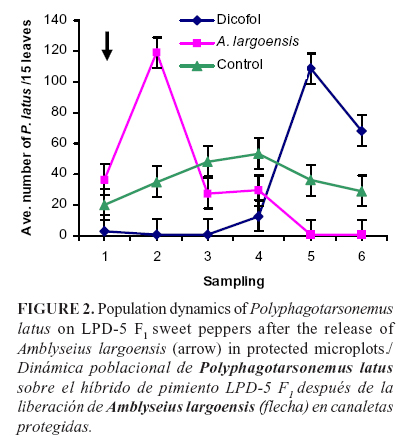
<P><font face="Verdana, Arial, Helvetica, sans-serif" size="2"><B>Trial in protected    microplots</B> </font>     <P><font face="Verdana, Arial, Helvetica, sans-serif" size="2">The results of    releasing <I>A. largoensis</I> on broad mite population in covered microplots    are shown in <a href="#f2">Figure 2</a>. In the first sampling after the release    of the predatory mite, the broad mite population continued increasing; however,    this trend was reversed in the following samplings and toward the end of the    trial. Finally, the reduction in the broad mite density by the predator was    significant (<I>P </I>&lt; <I>0.05</I>, <I>F </I>= <I>3</I>.<I>33</I>, <I>df</I>    = <I>2</I>) from the fourth sampling onward.</font>      ]]></body>
<body><![CDATA[<P align="center"><img src="/img/revistas/rpv/v30n1/f0211115.jpg" width="406" height="443">    <a name="f2"></a>     
<P><font face="Verdana, Arial, Helvetica, sans-serif" size="2"><B>Trial in tunnel</B>    </font>     <P><font face="Verdana, Arial, Helvetica, sans-serif" size="2">In the tunnel system,    the results were similar to those obtained in the protected microplots (<a href="#f3">Fig.    3</a>). In the first sampling after the release of the predatory mite, the broad    mite population continued increasing; however, as in the previous case, this    trend was reversed after the second sampling toward the end of the trial. The    density of broad mites in the control treatment peaked in the second sampling    and it gradually declined thereafter.</font>      <P align="center"> <img src="/img/revistas/rpv/v30n1/f0311115.jpg" width="393" height="437">    <a name="f3"></a>     
<P><font face="Verdana, Arial, Helvetica, sans-serif" size="2">The predatory mite    individuals were found primarily on leaves located at the middle of the pepper    plants. The population means oscillated with an average of 2 to 6 predatory    mites per sampling (<a href="#f4">Fig. 4</a>), with a further increase at the    end of the experiments. </font>      <P align="center"><img src="/img/revistas/rpv/v30n1/f0411115.jpg" width="392" height="460">    <a name="f4"></a>     
<P>&nbsp;     <P><font face="Verdana, Arial, Helvetica, sans-serif" size="2"><B><font size="3">DISCUSSION    </font></B> </font>     <P><font face="Verdana, Arial, Helvetica, sans-serif" size="2">The production    of crops under protected conditions such as climatically controlled greenhouses    and glasshouses, protected areas covered by plastic sheets, or &#171;insect-proof    screening&#187; (tunnels) with little or no climate control is increasing worldwide    (16). The agronomic and production conditions of the crops in these systems    are also suitable for the development of new pests and the population rise of    other species to levels that may be incompatible with the obtaining of acceptable    yields. In this context, an increase of the economic impacts by nematodes, insects    and mites has occurred with the latter species causing considerable losses in    some horticultural species grown under these protected conditions (17). </font>     <P><font face="Verdana, Arial, Helvetica, sans-serif" size="2">The present study    showed that <I>A. largoensis</I> was an effective predator on <I>P. latus</I>.    In all the greenhouse treatments (2, 4, and 8 predatory mites/plants), an excellent    control of the pest by this predatory species was obtained. A gradual reduction    of broad mite population was observed over a period of seven weeks. </font>     ]]></body>
<body><![CDATA[<P><font face="Verdana, Arial, Helvetica, sans-serif" size="2">Regardless of the    extremely high density of the broad mite, the most favorable result was obtained    when eight <I>A. largoensis</I>/plant were released. With 2 and 4 predatory    mites/plant, the control effect was observed a week later as compared with the    8 predators/plant; however, the results were the same at the end of the trials.    </font>     <P><font face="Verdana, Arial, Helvetica, sans-serif" size="2">Our present findings    are in agreement with previous studies on the biological characteristics of    <I>A. largoensis</I>, whereby it was shown that this predaceous mite had a potential    to be a highly effective predator of the broad mite (11,12). It is important    to consider that the release rate used in this study was much lower than the    commonly used release rates for other phytoseiid mites (3,9,18). </font>     <P><font face="Verdana, Arial, Helvetica, sans-serif" size="2">Obtaining an effective    broad mite control in microplots and tunnel system required a slightly longer    time period as compared with the greenhouse system, but with similar results    at the end of the trials. It should be mentioned that in microplots and tunnel    condition, the systems are more open and the temperature is extremely high,    and therefore, the environment is more favorable for the development of <I>P.    latus </I>(1). </font>     <P><font face="Verdana, Arial, Helvetica, sans-serif" size="2"><I>Amblyseius largoensis</I>    was mainly localized at the middle of the plant. A very high temperature and/or    an intense light at the top of the pepper plants during the day could cause    the movement of the predator towards the inside foliage of the pepper plants.    Weintraub <I>et al</I>. (9) considered that <I>N. cucumeris</I> moved upwards    and downwards on the plant as the light intensity and temperature changed throughout    the day. </font>     <P><font face="Verdana, Arial, Helvetica, sans-serif" size="2">In Cuba for several    years, <I>A. largoensis</I> has been evaluated as a promising candidate for    the biological control of <I>P. latus.</I> Our results showed that it has proved    to be an effective control agent for the broad mite with an excellent establishment    rate in sheltered peppers systems. In an experiment conducted under controlled    conditions, <I>A. largoensis</I> was compatible with the miticides dicofol,    sulphur and the LBt-13 strain of <I>Bacillus thuringiensis </I>Berliner,<I>    </I>the insecticide imidacloprid, and the fungicides mancozeb and metalaxyl+mancozeb.    However, the insecticides diafentiuron and cypermethrin+diazinon were toxic    to the predator (19). These results permit to think that an Integrated Pest    Management program (IPM) can be a viable alternative including use of chemicals,    host plant resistance and biological control, as it has being suggested by different    researchers (20,21). </font>      <P>&nbsp;     <P><font face="Verdana, Arial, Helvetica, sans-serif" size="2"><B><font size="3">ACKNOWLEDGEMENTS</font>    </B> </font>      <P><font face="Verdana, Arial, Helvetica, sans-serif" size="2">We thank Eduardo    Sistachs Ph. D. for improving the English text; Francisco J. Ferragut Ph. D.    for his comments on the preliminary draft and Reynaldo Chico for his technical    support.</font>     <P>&nbsp;     <P><font face="Verdana, Arial, Helvetica, sans-serif" size="2"><B><font size="3">REFERENCES</font></B>    </font>      ]]></body>
<body><![CDATA[<!-- ref --><P><font face="Verdana, Arial, Helvetica, sans-serif" size="2">1. Gerson U.      Biology and control of the broad mite, <I>Polyphagotarsonemus latus </I>(Banks)(Acari:      Tarsonemidae). Exp Appl Acarol. 1992;13:163-178.     </font>        <!-- ref --><P><font face="Verdana, Arial, Helvetica, sans-serif" size="2">2. De Coss-Romero      M, Pe&ntilde;a JE. Relationship of broad mite (Acari: Tarsonemidae) to host      phenology and injury levels in <I>Capsicum annuum</I>. Fla Entomol. 1998;81:515-526.          </font>        <!-- ref --><P><font face="Verdana, Arial, Helvetica, sans-serif" size="2">3. Tal C, Coll      M, Weintraub PG. Biological control of <I>Polyphagotarsonemus latus </I>(Acari:      Tarsonemidae) by the predaceous mite <I>Amblyseius swirskii </I>(Acari: Phytoseiidae).      IOBC/WPRS Bull. 2007;30:25-36.     </font>        <!-- ref --><P><font face="Verdana, Arial, Helvetica, sans-serif" size="2">4. Montoya A,      Miranda I, Rodr&iacute;guez Y, Rodr&iacute;guez H. Percepci&oacute;n de los      fitosanitarios sobre el control de <I>Polyphagotarsonemus latus</I> en la      producci&oacute;n protegida de pimiento. Rev Protecci&oacute;n Veg. 2013;28(1):60-64.          </font>         <!-- ref --><P><font face="Verdana, Arial, Helvetica, sans-serif" size="2">5. Rodr&iacute;guez    H, Montoya A, Miranda I, Rodr&iacute;guez Y, Ramos M. Influence of the phenological    phase of two pepper cultivars on the behaviour of<I> Polyphagotarsonemus latus    </I>(Banks). Rev Protecci&oacute;n Veg. 2011;26(2):73-79.     </font>      ]]></body>
<body><![CDATA[<!-- ref --><P><font face="Verdana, Arial, Helvetica, sans-serif" size="2">6. Montoya A, Miranda    I, Rodr&iacute;guez Y, Ramos M, Rodr&iacute;guez H. Incidencia de <I>Polyphagotarsonemus    latus </I>(Banks) en la producci&oacute;n protegida de pimiento (<I>Capsicum    annuum </I>L. var. Lical). Centro Agr&iacute;cola. 2012;39(1):53-58.     </font>      <!-- ref --><P><font face="Verdana, Arial, Helvetica, sans-serif" size="2">7. Fan Y, Petitt      FL. Biological control of broad mite, <I>Polyphagotarsonemus latus </I>(Banks),      by <I>Neoseiulus barkeri</I> Hughes on pepper. Biol Control. 1994;4:390-395.          </font>         <!-- ref --><P><font face="Verdana, Arial, Helvetica, sans-serif" size="2">8. Pe&ntilde;a    JE, Obsorne L. Biological control of <I>Polyphagotarsonemus latus </I>(Banks)    (Acarina: Tarsonemidae) in greenhouses and field trials using introduction of    predacious mites (Acarina: Phytoseiidae). Entomophaga. 1996;41:279-285.     </font>      <!-- ref --><P><font face="Verdana, Arial, Helvetica, sans-serif" size="2">9. Weintraub      PG, Kleitman S, Mori R, Shapira N, Palevsky E. Control of broad mites (<I>Polyphagotarsonemus      latus</I> (Banks)) on organic greenhouse sweet peppers (<I>Capsicum annuum</I>      L.) with the predatory mite, <I>Neoseiulus cucumeris</I> (Oudemans). Biol      Control. 2003;26:300-309.     </font>        <!-- ref --><P><font face="Verdana, Arial, Helvetica, sans-serif" size="2">10.Van Maanen      E, Vila E, Sabelis MW, Janssen A. Biological control of broad mites (<I>Polyphagotarsonemus      latus</I>) with the generalist predator <I>Amblyseius swirskii</I>. Exp Appl      Acarol. 2010;52:29-34.     </font>        ]]></body>
<body><![CDATA[<!-- ref --><P><font face="Verdana, Arial, Helvetica, sans-serif" size="2">11.Rodr&iacute;guez      H, Miranda I, Ramos M, Badii MH. Functional and numerical responses of <I>Amblyseius      largoensis </I>(Muma) (Acari: Phytoseiidae) on <I>Polyphagotarsonemus latus      </I>(Banks) (Acari: Tarsonemidae) in Cuba. Internat J Acarol. 2010;36:371-376.          </font>         <!-- ref --><P><font face="Verdana, Arial, Helvetica, sans-serif" size="2">12.Rodr&iacute;guez    H, Ramos M, Montoya A, Rodr&iacute;guez Y, Chico R, et al. Development of <I>Amblyseius    largoensis</I> as biological control agent of the broad mites (<I>Polyphagotarsonemus    latus</I>). Biotecnolog&iacute;a Aplicada. 2011;28(3):171-175.     </font>      <!-- ref --><P><font face="Verdana, Arial, Helvetica, sans-serif" size="2">13.MINAGRI. Ministerio      de la Agricultura. Instituto de Suelos. Nueva versi&oacute;n de la clasificaci&oacute;n      gen&eacute;tica de los suelos de Cuba. La Habana. AGRINFOR, 1999. 64 p.     </font>         <!-- ref --><P><font face="Verdana, Arial, Helvetica, sans-serif" size="2">14.Casanova AS,    G&oacute;mez O, Hern&aacute;ndez M, Chailloux M, Depestre T, Pupo FR. Instituto    de Investigaciones Hort&iacute;colas Liliana Dimitrova, Ministerio de la Agricultura.    Manual para la Producci&oacute;n Protegida de Hortalizas. 2da Edici&oacute;n.    Editorial Liliana, 2007, 179 pp.     </font>      <!-- ref --><P><font face="Verdana, Arial, Helvetica, sans-serif" size="2">15.Montoya A, Miranda    I, Ramos M, Rodr&iacute;guez H. Cr&iacute;a de <I>Amblyseius largoensis </I>(Muma)    sobre <I>Tetranychus tumidus </I>(Banks) utilizando el m&eacute;todo de las    bandejas. Rev Protecci&oacute;n Veg. 2009;24:191-194.     </font>      ]]></body>
<body><![CDATA[<!-- ref --><P><font face="Verdana, Arial, Helvetica, sans-serif" size="2">16.Gerson U,      Weintraub PG. Mites for the control of pests in protected cultivation. Pest      Manag Sci. 2007;63:658-676.     </font>        <!-- ref --><P><font face="Verdana, Arial, Helvetica, sans-serif" size="2">17.Hanafi A.      Invasive pests and diseases: a challenge to IPM in greenhouse crops. Phytoparasitica.      2005;33:423-426.     </font>        <!-- ref --><P><font face="Verdana, Arial, Helvetica, sans-serif" size="2">18.Weintraub      PG, Alchanatis V, Palevsky E. Distribution of the predatory mite, <I>Neoseiulus      cucumeris</I>, in greenhouse pepper. In: Cantliffle DJ, Stoffella PJ, Shaw      N (editors). Proc. VIII Symposia on Prot. Cult. Mild Winter Climates. Acta      Hort. 659, ISHS 2004.     </font>        <!-- ref --><P><font face="Verdana, Arial, Helvetica, sans-serif" size="2">19.Montoya A,      Pino O, Rodr&iacute;guez H, Posos P. Selectividad de <I>Amblyseius largoensis</I>      (Muma) a productos fitosanitarios en la producci&oacute;n protegida de pimiento      (<I>Capsicum annuum</I> L.). Rev Protecci&oacute;n Veg. 2013;28(1):65-69.          </font>         <!-- ref --><P><font face="Verdana, Arial, Helvetica, sans-serif" size="2">20.Martin T, Assogba-Komlan    A, Sidick I, Ahle V, Chandre F. An acaricide-treated net to control phytophagous    mites. Crop Protection. 2010;29:470-475.    </font>      ]]></body>
<body><![CDATA[<!-- ref --><P><font face="Verdana, Arial, Helvetica, sans-serif" size="2">21.Angeli LF, de    Queiroz DL, Piacentini D. Damage characterization and control tactics to broad    mite (<I>Polyphagotarsonemus latus </I>Banks) in Paraguay-tea plants (<I>Ilex    paraguariensis </I>A.St.-Hil.). R Bras Bioci., Porto Alegre. 2010;8(2):208-212.        </font>      <P>&nbsp;     <P>&nbsp;     <P><font face="Verdana, Arial, Helvetica, sans-serif" size="2">Recibido: 2-7-2014.    <br>   </font><font face="Verdana, Arial, Helvetica, sans-serif" size="2">Aceptado:    10-10-2014.</font>     <P>&nbsp;     <P>&nbsp;     <P><font face="Verdana, Arial, Helvetica, sans-serif" size="2"><B><a href="#pie">*</a><a name="autor"></a>Direcci&oacute;n    actual:</B> Departamento Biolog&iacute;a-Sanidad Vegetal. Facultad de Agronom&iacute;a.    Universidad Agraria de La Habana (UNAH). Carretera de Tapaste y Autopista Nacional.    San Jos&eacute; de las Lajas, Mayabeque. CP 32 700. Cuba. E-mail de contacto:    <a href="mailto:morell_66@unah.edu.cu">morell_66@unah.edu.cu</a>. </font>       ]]></body><back>
<ref-list>
<ref id="B1">
<label>1</label><nlm-citation citation-type="journal">
<person-group person-group-type="author">
<name>
<surname><![CDATA[Gerson]]></surname>
<given-names><![CDATA[U]]></given-names>
</name>
</person-group>
<article-title xml:lang="en"><![CDATA[Biology and control of the broad mite, Polyphagotarsonemus latus (Banks)(Acari: Tarsonemidae)]]></article-title>
<source><![CDATA[Exp Appl Acarol]]></source>
<year>1992</year>
<volume>13</volume>
<page-range>163-178</page-range></nlm-citation>
</ref>
<ref id="B2">
<label>2</label><nlm-citation citation-type="journal">
<person-group person-group-type="author">
<name>
<surname><![CDATA[De Coss-Romero]]></surname>
<given-names><![CDATA[M]]></given-names>
</name>
<name>
<surname><![CDATA[Peña]]></surname>
<given-names><![CDATA[JE]]></given-names>
</name>
</person-group>
<article-title xml:lang="en"><![CDATA[Relationship of broad mite (Acari: Tarsonemidae) to host phenology and injury levels in Capsicum annuum]]></article-title>
<source><![CDATA[Fla Entomol]]></source>
<year>1998</year>
<volume>81</volume>
<page-range>515-526</page-range></nlm-citation>
</ref>
<ref id="B3">
<label>3</label><nlm-citation citation-type="journal">
<person-group person-group-type="author">
<name>
<surname><![CDATA[Tal]]></surname>
<given-names><![CDATA[C]]></given-names>
</name>
<name>
<surname><![CDATA[Coll]]></surname>
<given-names><![CDATA[M]]></given-names>
</name>
<name>
<surname><![CDATA[Weintraub]]></surname>
<given-names><![CDATA[PG]]></given-names>
</name>
</person-group>
<article-title xml:lang="en"><![CDATA[Biological control of Polyphagotarsonemus latus (Acari: Tarsonemidae) by the predaceous mite Amblyseius swirskii (Acari: Phytoseiidae)]]></article-title>
<source><![CDATA[IOBC/WPRS Bull]]></source>
<year>2007</year>
<volume>30</volume>
<page-range>25-36</page-range></nlm-citation>
</ref>
<ref id="B4">
<label>4</label><nlm-citation citation-type="journal">
<person-group person-group-type="author">
<name>
<surname><![CDATA[Montoya]]></surname>
<given-names><![CDATA[A]]></given-names>
</name>
<name>
<surname><![CDATA[Miranda]]></surname>
<given-names><![CDATA[I]]></given-names>
</name>
<name>
<surname><![CDATA[Rodríguez]]></surname>
<given-names><![CDATA[Y]]></given-names>
</name>
<name>
<surname><![CDATA[Rodríguez]]></surname>
<given-names><![CDATA[H]]></given-names>
</name>
</person-group>
<article-title xml:lang="es"><![CDATA[Percepción de los fitosanitarios sobre el control de Polyphagotarsonemus latus en la producción protegida de pimiento]]></article-title>
<source><![CDATA[Rev Protección Veg]]></source>
<year>2013</year>
<volume>28</volume>
<numero>1</numero>
<issue>1</issue>
<page-range>60-64</page-range></nlm-citation>
</ref>
<ref id="B5">
<label>5</label><nlm-citation citation-type="journal">
<person-group person-group-type="author">
<name>
<surname><![CDATA[Rodríguez]]></surname>
<given-names><![CDATA[H]]></given-names>
</name>
<name>
<surname><![CDATA[Montoya]]></surname>
<given-names><![CDATA[A]]></given-names>
</name>
<name>
<surname><![CDATA[Miranda]]></surname>
<given-names><![CDATA[I]]></given-names>
</name>
<name>
<surname><![CDATA[Rodríguez]]></surname>
<given-names><![CDATA[Y]]></given-names>
</name>
<name>
<surname><![CDATA[Ramos]]></surname>
<given-names><![CDATA[M]]></given-names>
</name>
</person-group>
<article-title xml:lang="en"><![CDATA[Influence of the phenological phase of two pepper cultivars on the behaviour of Polyphagotarsonemus latus (Banks)]]></article-title>
<source><![CDATA[Rev Protección Veg]]></source>
<year>2011</year>
<volume>26</volume>
<numero>2</numero>
<issue>2</issue>
<page-range>73-79</page-range></nlm-citation>
</ref>
<ref id="B6">
<label>6</label><nlm-citation citation-type="journal">
<person-group person-group-type="author">
<name>
<surname><![CDATA[Montoya]]></surname>
<given-names><![CDATA[A]]></given-names>
</name>
<name>
<surname><![CDATA[Miranda]]></surname>
<given-names><![CDATA[I]]></given-names>
</name>
<name>
<surname><![CDATA[Rodríguez]]></surname>
<given-names><![CDATA[Y]]></given-names>
</name>
<name>
<surname><![CDATA[Ramos]]></surname>
<given-names><![CDATA[M]]></given-names>
</name>
<name>
<surname><![CDATA[Rodríguez]]></surname>
<given-names><![CDATA[H]]></given-names>
</name>
</person-group>
<article-title xml:lang="es"><![CDATA[Incidencia de Polyphagotarsonemus latus (Banks) en la producción protegida de pimiento (Capsicum annuum L. var. Lical)]]></article-title>
<source><![CDATA[Centro Agrícola]]></source>
<year>2012</year>
<volume>39</volume>
<numero>1</numero>
<issue>1</issue>
<page-range>53-58</page-range></nlm-citation>
</ref>
<ref id="B7">
<label>7</label><nlm-citation citation-type="journal">
<person-group person-group-type="author">
<name>
<surname><![CDATA[Fan]]></surname>
<given-names><![CDATA[Y]]></given-names>
</name>
<name>
<surname><![CDATA[Petitt]]></surname>
<given-names><![CDATA[FL]]></given-names>
</name>
</person-group>
<article-title xml:lang="en"><![CDATA[Biological control of broad mite, Polyphagotarsonemus latus (Banks), by Neoseiulus barkeri Hughes on pepper]]></article-title>
<source><![CDATA[Biol Control]]></source>
<year>1994</year>
<volume>4</volume>
<page-range>390-395</page-range></nlm-citation>
</ref>
<ref id="B8">
<label>8</label><nlm-citation citation-type="journal">
<person-group person-group-type="author">
<name>
<surname><![CDATA[Peña]]></surname>
<given-names><![CDATA[JE]]></given-names>
</name>
<name>
<surname><![CDATA[Obsorne]]></surname>
<given-names><![CDATA[L]]></given-names>
</name>
</person-group>
<article-title xml:lang="en"><![CDATA[Biological control of Polyphagotarsonemus latus (Banks) (Acarina: Tarsonemidae) in greenhouses and field trials using introduction of predacious mites (Acarina: Phytoseiidae)]]></article-title>
<source><![CDATA[Entomophaga]]></source>
<year>1996</year>
<volume>41</volume>
<page-range>279-285</page-range></nlm-citation>
</ref>
<ref id="B9">
<label>9</label><nlm-citation citation-type="journal">
<person-group person-group-type="author">
<name>
<surname><![CDATA[Weintraub]]></surname>
<given-names><![CDATA[PG]]></given-names>
</name>
<name>
<surname><![CDATA[Kleitman]]></surname>
<given-names><![CDATA[S]]></given-names>
</name>
<name>
<surname><![CDATA[Mori]]></surname>
<given-names><![CDATA[R]]></given-names>
</name>
<name>
<surname><![CDATA[Shapira]]></surname>
<given-names><![CDATA[N]]></given-names>
</name>
<name>
<surname><![CDATA[Palevsky]]></surname>
<given-names><![CDATA[E]]></given-names>
</name>
</person-group>
<article-title xml:lang="en"><![CDATA[Control of broad mites (Polyphagotarsonemus latus (Banks)) on organic greenhouse sweet peppers (Capsicum annuum L.) with the predatory mite, Neoseiulus cucumeris (Oudemans)]]></article-title>
<source><![CDATA[Biol Control]]></source>
<year>2003</year>
<volume>26</volume>
<page-range>300-309</page-range></nlm-citation>
</ref>
<ref id="B10">
<label>10</label><nlm-citation citation-type="journal">
<person-group person-group-type="author">
<name>
<surname><![CDATA[Van Maanen]]></surname>
<given-names><![CDATA[E]]></given-names>
</name>
<name>
<surname><![CDATA[Vila]]></surname>
<given-names><![CDATA[E]]></given-names>
</name>
<name>
<surname><![CDATA[Sabelis]]></surname>
<given-names><![CDATA[MW]]></given-names>
</name>
<name>
<surname><![CDATA[Janssen]]></surname>
<given-names><![CDATA[A]]></given-names>
</name>
</person-group>
<article-title xml:lang="en"><![CDATA[Biological control of broad mites (Polyphagotarsonemus latus) with the generalist predator Amblyseius swirskii]]></article-title>
<source><![CDATA[Exp Appl Acarol]]></source>
<year>2010</year>
<volume>52</volume>
<page-range>29-34</page-range></nlm-citation>
</ref>
<ref id="B11">
<label>11</label><nlm-citation citation-type="journal">
<person-group person-group-type="author">
<name>
<surname><![CDATA[Rodríguez]]></surname>
<given-names><![CDATA[H]]></given-names>
</name>
<name>
<surname><![CDATA[Miranda]]></surname>
<given-names><![CDATA[I]]></given-names>
</name>
<name>
<surname><![CDATA[Ramos]]></surname>
<given-names><![CDATA[M]]></given-names>
</name>
<name>
<surname><![CDATA[Badii]]></surname>
<given-names><![CDATA[MH]]></given-names>
</name>
</person-group>
<article-title xml:lang="en"><![CDATA[Functional and numerical responses of Amblyseius largoensis (Muma) (Acari: Phytoseiidae) on Polyphagotarsonemus latus (Banks) (Acari: Tarsonemidae) in Cuba]]></article-title>
<source><![CDATA[Internat J Acarol]]></source>
<year>2010</year>
<volume>36</volume>
<page-range>371-376</page-range></nlm-citation>
</ref>
<ref id="B12">
<label>12</label><nlm-citation citation-type="journal">
<person-group person-group-type="author">
<name>
<surname><![CDATA[Rodríguez]]></surname>
<given-names><![CDATA[H]]></given-names>
</name>
<name>
<surname><![CDATA[Ramos]]></surname>
<given-names><![CDATA[M]]></given-names>
</name>
<name>
<surname><![CDATA[Montoya]]></surname>
<given-names><![CDATA[A]]></given-names>
</name>
<name>
<surname><![CDATA[Rodríguez]]></surname>
<given-names><![CDATA[Y]]></given-names>
</name>
<name>
<surname><![CDATA[Chico]]></surname>
<given-names><![CDATA[R]]></given-names>
</name>
</person-group>
<article-title xml:lang="en"><![CDATA[Development of Amblyseius largoensis as biological control agent of the broad mites (Polyphagotarsonemus latus)]]></article-title>
<source><![CDATA[Biotecnología Aplicada]]></source>
<year>2011</year>
<volume>28</volume>
<numero>3</numero>
<issue>3</issue>
<page-range>171-175</page-range></nlm-citation>
</ref>
<ref id="B13">
<label>13</label><nlm-citation citation-type="book">
<collab>Ministerio de la Agricultura^dInstituto de Suelos</collab>
<source><![CDATA[Nueva versión de la clasificación genética de los suelos de Cuba]]></source>
<year>1999</year>
<page-range>64</page-range><publisher-loc><![CDATA[La Habana ]]></publisher-loc>
<publisher-name><![CDATA[AGRINFOR]]></publisher-name>
</nlm-citation>
</ref>
<ref id="B14">
<label>14</label><nlm-citation citation-type="book">
<person-group person-group-type="author">
<name>
<surname><![CDATA[Casanova]]></surname>
<given-names><![CDATA[AS]]></given-names>
</name>
<name>
<surname><![CDATA[Gómez]]></surname>
<given-names><![CDATA[O]]></given-names>
</name>
<name>
<surname><![CDATA[Hernández]]></surname>
<given-names><![CDATA[M]]></given-names>
</name>
<name>
<surname><![CDATA[Chailloux]]></surname>
<given-names><![CDATA[M]]></given-names>
</name>
<name>
<surname><![CDATA[Depestre]]></surname>
<given-names><![CDATA[T]]></given-names>
</name>
<name>
<surname><![CDATA[Pupo]]></surname>
<given-names><![CDATA[FR]]></given-names>
</name>
</person-group>
<collab>Ministerio de la Agricultura^dInstituto de Investigaciones Hortícolas Liliana Dimitrova</collab>
<source><![CDATA[Manual para la Producción Protegida de Hortalizas]]></source>
<year></year>
<edition>2da</edition>
<publisher-name><![CDATA[Editorial Liliana]]></publisher-name>
</nlm-citation>
</ref>
<ref id="B15">
<label>15</label><nlm-citation citation-type="journal">
<person-group person-group-type="author">
<name>
<surname><![CDATA[Montoya]]></surname>
<given-names><![CDATA[A]]></given-names>
</name>
<name>
<surname><![CDATA[Miranda]]></surname>
<given-names><![CDATA[I]]></given-names>
</name>
<name>
<surname><![CDATA[Ramos]]></surname>
<given-names><![CDATA[M]]></given-names>
</name>
<name>
<surname><![CDATA[Rodríguez]]></surname>
<given-names><![CDATA[H]]></given-names>
</name>
</person-group>
<article-title xml:lang="es"><![CDATA[Cría de Amblyseius largoensis (Muma) sobre Tetranychus tumidus (Banks) utilizando el método de las bandejas]]></article-title>
<source><![CDATA[Rev Protección Veg]]></source>
<year>2009</year>
<volume>24</volume>
<page-range>191-194</page-range></nlm-citation>
</ref>
<ref id="B16">
<label>16</label><nlm-citation citation-type="journal">
<person-group person-group-type="author">
<name>
<surname><![CDATA[Gerson]]></surname>
<given-names><![CDATA[U]]></given-names>
</name>
<name>
<surname><![CDATA[Weintraub]]></surname>
<given-names><![CDATA[PG]]></given-names>
</name>
</person-group>
<article-title xml:lang="en"><![CDATA[Mites for the control of pests in protected cultivation]]></article-title>
<source><![CDATA[Pest Manag Sci]]></source>
<year>2007</year>
<volume>63</volume>
<page-range>658-676</page-range></nlm-citation>
</ref>
<ref id="B17">
<label>17</label><nlm-citation citation-type="journal">
<person-group person-group-type="author">
<name>
<surname><![CDATA[Hanafi]]></surname>
<given-names><![CDATA[A]]></given-names>
</name>
</person-group>
<article-title xml:lang="en"><![CDATA[Invasive pests and diseases: a challenge to IPM in greenhouse crops]]></article-title>
<source><![CDATA[Phytoparasitica]]></source>
<year>2005</year>
<volume>33</volume>
<page-range>423-426</page-range></nlm-citation>
</ref>
<ref id="B18">
<label>18</label><nlm-citation citation-type="">
<person-group person-group-type="author">
<name>
<surname><![CDATA[Weintraub]]></surname>
<given-names><![CDATA[PG]]></given-names>
</name>
<name>
<surname><![CDATA[Alchanatis]]></surname>
<given-names><![CDATA[V]]></given-names>
</name>
<name>
<surname><![CDATA[Palevsky]]></surname>
<given-names><![CDATA[E]]></given-names>
</name>
</person-group>
<article-title xml:lang="en"><![CDATA[Distribution of the predatory mite, Neoseiulus cucumeris, in greenhouse pepper]]></article-title>
<person-group person-group-type="editor">
<name>
<surname><![CDATA[Cantliffle]]></surname>
<given-names><![CDATA[DJ]]></given-names>
</name>
<name>
<surname><![CDATA[Stoffella]]></surname>
<given-names><![CDATA[PJ]]></given-names>
</name>
<name>
<surname><![CDATA[Shaw]]></surname>
<given-names><![CDATA[N]]></given-names>
</name>
</person-group>
<source><![CDATA[Proc. VIII Symposia on Prot. Cult. Mild Winter Climates: Acta Hort]]></source>
<year>2004</year>
<page-range>659</page-range></nlm-citation>
</ref>
<ref id="B19">
<label>19</label><nlm-citation citation-type="journal">
<person-group person-group-type="author">
<name>
<surname><![CDATA[Montoya]]></surname>
<given-names><![CDATA[A]]></given-names>
</name>
<name>
<surname><![CDATA[Pino]]></surname>
<given-names><![CDATA[O]]></given-names>
</name>
<name>
<surname><![CDATA[Rodríguez]]></surname>
<given-names><![CDATA[H]]></given-names>
</name>
<name>
<surname><![CDATA[Posos]]></surname>
<given-names><![CDATA[P]]></given-names>
</name>
</person-group>
<article-title xml:lang="es"><![CDATA[Selectividad de Amblyseius largoensis (Muma) a productos fitosanitarios en la producción protegida de pimiento (Capsicum annuum L.)]]></article-title>
<source><![CDATA[Rev Protección Veg]]></source>
<year>2013</year>
<volume>28</volume>
<numero>1</numero>
<issue>1</issue>
<page-range>65-69</page-range></nlm-citation>
</ref>
<ref id="B20">
<label>20</label><nlm-citation citation-type="journal">
<person-group person-group-type="author">
<name>
<surname><![CDATA[Martin]]></surname>
<given-names><![CDATA[T]]></given-names>
</name>
<name>
<surname><![CDATA[Assogba-Komlan]]></surname>
<given-names><![CDATA[A]]></given-names>
</name>
<name>
<surname><![CDATA[Sidick]]></surname>
<given-names><![CDATA[I]]></given-names>
</name>
<name>
<surname><![CDATA[Ahle]]></surname>
<given-names><![CDATA[V]]></given-names>
</name>
<name>
<surname><![CDATA[Chandre]]></surname>
<given-names><![CDATA[F]]></given-names>
</name>
</person-group>
<article-title xml:lang="en"><![CDATA[An acaricide-treated net to control phytophagous mites]]></article-title>
<source><![CDATA[Crop Protection]]></source>
<year>2010</year>
<volume>29</volume>
<page-range>470-475</page-range></nlm-citation>
</ref>
<ref id="B21">
<label>21</label><nlm-citation citation-type="journal">
<person-group person-group-type="author">
<name>
<surname><![CDATA[Angeli]]></surname>
<given-names><![CDATA[LF]]></given-names>
</name>
<name>
<surname><![CDATA[de Queiroz]]></surname>
<given-names><![CDATA[DL]]></given-names>
</name>
<name>
<surname><![CDATA[Piacentini]]></surname>
<given-names><![CDATA[D]]></given-names>
</name>
</person-group>
<article-title xml:lang="en"><![CDATA[Damage characterization and control tactics to broad mite (Polyphagotarsonemus latus Banks) in Paraguay-tea plants (Ilex paraguariensis A.St.-Hil.)]]></article-title>
<source><![CDATA[R Bras Bioci]]></source>
<year>2010</year>
<volume>8</volume>
<numero>2</numero>
<issue>2</issue>
<page-range>208-212</page-range></nlm-citation>
</ref>
</ref-list>
</back>
</article>