<?xml version="1.0" encoding="ISO-8859-1"?><article xmlns:mml="http://www.w3.org/1998/Math/MathML" xmlns:xlink="http://www.w3.org/1999/xlink" xmlns:xsi="http://www.w3.org/2001/XMLSchema-instance">
<front>
<journal-meta>
<journal-id>1010-2752</journal-id>
<journal-title><![CDATA[Revista de Protección Vegetal]]></journal-title>
<abbrev-journal-title><![CDATA[Rev. Protección Veg.]]></abbrev-journal-title>
<issn>1010-2752</issn>
<publisher>
<publisher-name><![CDATA[Centro Nacional de Sanidad Agropecuaria]]></publisher-name>
</publisher>
</journal-meta>
<article-meta>
<article-id>S1010-27522015000200011</article-id>
<title-group>
<article-title xml:lang="en"><![CDATA[Pyramiding TYLCV and TSWV resistance genes in tomato genotypes]]></article-title>
<article-title xml:lang="es"><![CDATA[Pirimidación de genes de resistencia a TYLCV y TSWV en genotipos de tomate]]></article-title>
</title-group>
<contrib-group>
<contrib contrib-type="author">
<name>
<surname><![CDATA[Gómez Consuegra]]></surname>
<given-names><![CDATA[Olimpia]]></given-names>
</name>
<xref ref-type="aff" rid="A01"/>
</contrib>
<contrib contrib-type="author">
<name>
<surname><![CDATA[Piñón Gómez]]></surname>
<given-names><![CDATA[Mayte]]></given-names>
</name>
<xref ref-type="aff" rid="A01"/>
</contrib>
<contrib contrib-type="author">
<name>
<surname><![CDATA[Martínez Zubiaur]]></surname>
<given-names><![CDATA[Yamila]]></given-names>
</name>
<xref ref-type="aff" rid="A02"/>
</contrib>
</contrib-group>
<aff id="A01">
<institution><![CDATA[,Horticultural Research Institute Liliana Dimitrova (IIHLD)  ]]></institution>
<addr-line><![CDATA[ Mayabeque]]></addr-line>
<country>Cuba</country>
</aff>
<aff id="A02">
<institution><![CDATA[,National Center for Animal and Plant Health (CENSA)  ]]></institution>
<addr-line><![CDATA[San José de las Lajas Mayabeque]]></addr-line>
<country>Cuba</country>
</aff>
<pub-date pub-type="pub">
<day>00</day>
<month>08</month>
<year>2015</year>
</pub-date>
<pub-date pub-type="epub">
<day>00</day>
<month>08</month>
<year>2015</year>
</pub-date>
<volume>30</volume>
<numero>2</numero>
<fpage>161</fpage>
<lpage>164</lpage>
<copyright-statement/>
<copyright-year/>
<self-uri xlink:href="http://scielo.sld.cu/scielo.php?script=sci_arttext&amp;pid=S1010-27522015000200011&amp;lng=en&amp;nrm=iso"></self-uri><self-uri xlink:href="http://scielo.sld.cu/scielo.php?script=sci_abstract&amp;pid=S1010-27522015000200011&amp;lng=en&amp;nrm=iso"></self-uri><self-uri xlink:href="http://scielo.sld.cu/scielo.php?script=sci_pdf&amp;pid=S1010-27522015000200011&amp;lng=en&amp;nrm=iso"></self-uri><abstract abstract-type="short" xml:lang="en"><p><![CDATA[The Cuban tomato line LD3 , in which the Ty-1 gene from Solanum chilense LA 1969 was detected, was crossed with an F1 hybrid carrying the genes Ty-3 from S. chilense LA 2779 and Sw-5 from S. peruvianum. A hundred F2 plants were transplanted to a ferralitic soil in the field and the F2 plants individually evaluated in the field with high natural TYLCV-IL (Cu) incidence by using a scale from 0 (no symptom) to 4 (severe stunting). The total DNA extracted from the F2 plants were analyzed per individual plant by using PCR markers linked to the genes Ty-3 (resistance to TYLCV) and Sw-5 (resistance to TSWV) so that both genes could be detected in a same genotype. Eighty two F2 plants showed no symptoms under natural TYLCV incidence (0 symptoms) with a productivity ranging from 1.6 to 9.7 kilograms per plant. The Principal Component Analysis (PCA) permitted grouping the different genotypes. Six F2 plants showed the Ty-3 gene in homozygosis and 12 in heterozygosis; 33 F2 plants showed the Sw-5 gene according to their DNA analysis. Three F2 plants (number 65, 68 and 78) showed the Ty-3 and Sw-5 genes in homozygosis besides the Ty-1 gene (resistance to TYLCV) from their female parent. Their productivity ranged from 6.0 to 6.8 kilograms per plant. These are the first Cuban results in which resistance genes for two important diseases in the tomato crop are obtained in a same genotype by the early and simultaneous molecular screening for resistance and the productivity evaluation under field conditions, Both tools, when simultaneously used, are efficient in reducing selection time and space.]]></p></abstract>
<abstract abstract-type="short" xml:lang="es"><p><![CDATA[En este estudio, los cruzamientos se realizaron entre la línea cubana LD3, con gen de resistencia Ty-1, procedente de Solanum chilense LA 1969, y el híbrido F1 portador de los genes Ty-3 de S. chilense LA 2779 y Sw-5 de S. peruvianum. Se obtuvieron 100 plantas F2 que fueron trasplantadas a campo, en suelo ferralítico rojo. Las plantas F2 fueron evaluadas en condiciones naturales de campo en áreas con alta presión de TYLCV-IL (Cu). Las plantas individuales fueron evaluadas con escala de síntomas desde 0 (sin síntomas) a 4 (enanismo severo). Los ADN totales extraídos fueron analizados en plantas individuales de la población F2 en estudio, utilizando marcadores PCR ligados a los genes Ty-3 (resistencia a TYLCV) y Sw-5 (resistencia a TSWV) con el objetivo de detectar estos genes en un mismo genotipo. Un total de 82 plantas F2 no mostraron síntomas bajo condiciones naturales de incidencia de TYLCV-IL (Cu) (grado 0) con un rango de productividad de 1.6 a 9.7 kilogramos por plantas. El Análisis de Componentes Principales permitió agrupar los genotipos. En seis plantas se detectó la presencia de gen Ty-3 en homocigosis y en 12 plantas en heterocigosis; 33 plantas F2 demostraron el gen Sw-5 a partir de los análisis de ADN realizado. En tres plantas F2 (números 65, 68 y 78) se encontraron en homocigosis los genes Ty-3 y Sw-5 en adición del gen Ty-1 (resistencia a TYLCV) procedente del parental femenino. El rango de productividad obtenido fue de 6.0 a 6.8 kilogramos por plantas. Estos son los primeros resultados en Cuba donde se obtienen genes de resistencia en un mismo genotipo para dos importantes enfermedades del cultivo del tomate con una evaluación simultánea y temprana de la resistencia y la productividad en condiciones de campo, mediante el uso temprano de marcadores moleculares en la reducción del tiempo y el espacio en el proceso de selección de genotipos promisorios.]]></p></abstract>
<kwd-group>
<kwd lng="en"><![CDATA[TYLCV]]></kwd>
<kwd lng="en"><![CDATA[TSWV]]></kwd>
<kwd lng="en"><![CDATA[pyrimiding]]></kwd>
<kwd lng="en"><![CDATA[resistance genes]]></kwd>
<kwd lng="en"><![CDATA[tomato]]></kwd>
<kwd lng="en"><![CDATA[genotypes]]></kwd>
<kwd lng="es"><![CDATA[TYLCV]]></kwd>
<kwd lng="es"><![CDATA[TSWV]]></kwd>
<kwd lng="es"><![CDATA[pirimidación]]></kwd>
<kwd lng="es"><![CDATA[genes de resistencia]]></kwd>
<kwd lng="es"><![CDATA[genotipos]]></kwd>
<kwd lng="es"><![CDATA[tomate]]></kwd>
</kwd-group>
</article-meta>
</front><body><![CDATA[ <p align="right"><font face="Verdana, Arial, Helvetica, sans-serif" size="2"><B>SHORT    COMMUNICATION</B> </font></p>     <p>&nbsp;</p>     <p><font face="Verdana, Arial, Helvetica, sans-serif" size="2"><b><font size="4">Pyramiding    TYLCV and TSWV resistance genes in tomato genotypes</font></b></font></p>     <p>&nbsp;</p>     <p><font face="Verdana, Arial, Helvetica, sans-serif" size="2"><b><font size="3">Pirimidaci&oacute;n    de genes de resistencia a TYLCV y TSWV en genotipos de tomate</font> </b></font>  </p>     <p>&nbsp;</p>     <p>&nbsp; </p> <H1> <font face="Verdana, Arial, Helvetica, sans-serif" size="2"></font><B>        <P><font face="Verdana, Arial, Helvetica, sans-serif" size="2">Olimpia G&oacute;mez      Consuegra<SUP>I</SUP>, Mayte Pi&ntilde;&oacute;n G&oacute;mez<SUP>I</SUP>,      Yamila Mart&iacute;nez Zubiaur<SUP>II</SUP></font>   </B> </H1>     <P><font face="Verdana, Arial, Helvetica, sans-serif" size="2"><SUP>I</SUP>Horticultural    Research Institute Liliana Dimitrova(IIHLD), Carretera Quivic&aacute;n Km 33<SUP>&#189;</SUP>,    Mayabeque, Cuba.     <br>   <SUP>II</SUP>National Center for Animal and Plant Health (CENSA), Apartado 10.    San Jos&eacute; de las Lajas, Mayabeque, Cuba. E-mail: <U><a href="mailto:yamila@censa.edu.cu">yamila@censa.edu.cu</a></U>.</font>      ]]></body>
<body><![CDATA[<P>&nbsp;     <P>&nbsp; <hr noshade size="1">     <P><font face="Verdana, Arial, Helvetica, sans-serif" size="2"><B>ABSTRACT</B></font>     <P><font face="Verdana, Arial, Helvetica, sans-serif" size="2">The Cuban tomato    line LD3 , in which the <I>Ty-1</I> gene from <I>Solanum chilense</I> LA 1969    was detected, was crossed with an F<SUB>1</SUB> hybrid carrying the genes <I>Ty-3</I>    from <I>S. chilense</I> LA 2779 and <I>Sw-5</I> from <I>S. peruvianum</I>. A    hundred F<SUB>2 </SUB>plants were transplanted to a ferralitic soil in the field    and the F<SUB>2</SUB> plants individually evaluated in the field with high natural    TYLCV-IL (Cu) incidence by using a scale from 0 (no symptom) to 4 (severe stunting).    The total DNA extracted from the F<SUB>2</SUB> plants were analyzed per individual    plant by using PCR markers linked to the genes <I>Ty-3</I> (resistance to TYLCV)    and <I>Sw-5</I> (resistance to TSWV) so that both genes could be detected in    a same genotype. Eighty two F<SUB>2 </SUB>plants showed no symptoms under natural    TYLCV incidence (0 symptoms) with a productivity ranging from 1.6 to 9.7 kilograms    per plant. The Principal Component Analysis (PCA) permitted grouping the different    genotypes. Six F<SUB>2 </SUB>plants showed the <I>Ty-3</I> gene in homozygosis    and 12 in heterozygosis; 33 F<SUB>2</SUB> plants showed the <I>Sw-5</I> gene    according to their DNA analysis. Three F<SUB>2 </SUB>plants (number 65, 68 and    78) showed the <I>Ty-3</I> and <I>Sw-5</I> genes in homozygosis besides the    <I>Ty-1</I> gene (resistance to TYLCV) from their female parent. Their productivity    ranged from 6.0 to 6.8 kilograms per plant. These are the first Cuban results    in which resistance genes for two important diseases in the tomato crop are    obtained in a same genotype by the early and simultaneous molecular screening    for resistance and the productivity evaluation under field conditions, Both    tools, when simultaneously used, are efficient in reducing selection time and    space. </font>     <P><font face="Verdana, Arial, Helvetica, sans-serif" size="2"><B>Key words:</B>    TYLCV, TSWV, pyrimiding, resistance genes, tomato, genotypes. </font>  <hr noshade size="1">        <P><font face="Verdana, Arial, Helvetica, sans-serif" size="2"><B>RESUMEN</b></font>        <P><font face="Verdana, Arial, Helvetica, sans-serif" size="2">En este estudio,    los cruzamientos se realizaron entre la l&iacute;nea cubana LD3, con gen de    resistencia <I>Ty-1</I>, procedente de <I>Solanum chilense</I> LA 1969, y el    h&iacute;brido F<SUB>1</SUB> portador de los genes <I>Ty-3</I> de <I>S. chilense</I>    LA 2779 y Sw-5 de <I>S. peruvianum</I>. Se obtuvieron 100 plantas F<SUB>2 </SUB>que    fueron trasplantadas a campo, en suelo ferral&iacute;tico rojo. Las plantas    F<SUB>2</SUB> fueron evaluadas en condiciones naturales de campo en &aacute;reas    con alta presi&oacute;n de TYLCV-IL (Cu). Las plantas individuales fueron evaluadas    con escala de s&iacute;ntomas desde 0 (sin s&iacute;ntomas) a 4 (enanismo severo).    Los ADN totales extra&iacute;dos fueron analizados en plantas individuales de    la poblaci&oacute;n F<SUB>2</SUB> en estudio, utilizando marcadores PCR ligados    a los genes <I>Ty-3</I> (resistencia a TYLCV) y <I>Sw-5</I> (resistencia a TSWV)    con el objetivo de detectar estos genes en un mismo genotipo. Un total de 82    plantas F<SUB>2</SUB> no mostraron s&iacute;ntomas bajo condiciones naturales    de incidencia de TYLCV-IL (Cu) (grado 0) con un rango de productividad de 1.6    a 9.7 kilogramos por plantas. El An&aacute;lisis de Componentes Principales    permiti&oacute; agrupar los genotipos. En seis plantas se detect&oacute; la    presencia de gen <I>Ty-3</I> en homocigosis y en 12 plantas en heterocigosis;    33 plantas F<SUB>2</SUB> demostraron el gen <I>Sw-5</I> a partir de los an&aacute;lisis    de ADN realizado. En tres plantas F<SUB>2 </SUB> (n&uacute;meros 65, 68 y 78)    se encontraron en homocigosis los genes <I>Ty-3</I> y <I>Sw-5</I> en adici&oacute;n    del gen <I>Ty-1</I> (resistencia a TYLCV) procedente del parental femenino.    El rango de productividad obtenido fue de 6.0 a 6.8 kilogramos por plantas.    Estos son los primeros resultados en Cuba donde se obtienen genes de resistencia    en un mismo genotipo para dos importantes enfermedades del cultivo del tomate    con una evaluaci&oacute;n simult&aacute;nea y temprana de la resistencia y la    productividad en condiciones de campo, mediante el uso temprano de marcadores    moleculares en la reducci&oacute;n del tiempo y el espacio en el proceso de    selecci&oacute;n de genotipos promisorios. </font>      <P><font face="Verdana, Arial, Helvetica, sans-serif" size="2"><B>Palabras clave:</B>    TYLCV, TSWV, pirimidaci&oacute;n, genes de resistencia, genotipos, tomate. </font> <hr noshade size="1">     <P>&nbsp;     <P>&nbsp;     ]]></body>
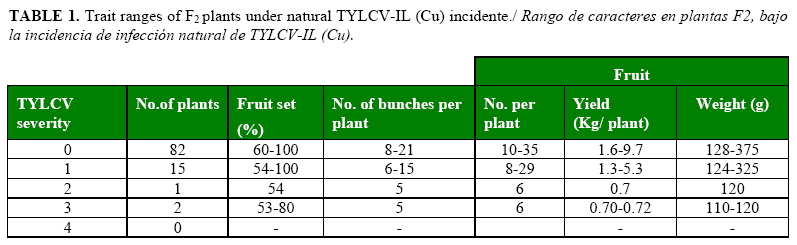
<body><![CDATA[<P><font face="Verdana, Arial, Helvetica, sans-serif" size="2">Begomoviruses,    mainly the <I>Tomato yellow leaf curl virus</I> (TYLCV), and tospoviruses, such    as <I>Tomato spotted wilt virus </I>(TSWV), <I>Tomato Chlorotic spot virus</I>    (TCSV) and <I>Groundnut ring spot virus</I> (GRSV), are major diseases in the    tomato (<I>Solanum lycopersicum </I>L) crop. In Cuba, TYLCV became the most    important tomato disease since the last eighties when it appeared in the country    (1). On the contrary, tospovirus species has not been reported in the Island,    but it is a major constraint in different neighboring countries. </font>      <P><font face="Verdana, Arial, Helvetica, sans-serif" size="2">Different TYLCV    resistance genes have been reported to provide a broad spectrum of protection    to many begomovirus species that are wide spread in the world (2). Zamir <I>et    al</I>. (3) were the first to report a major incompletely dominant gene (<I>Ty-1</I>)    on chromosome 6 derived from <I>Solanum chilense</I> (Dunal) Reiche LA 1969.    Plants homozygous for <I>S. chilense</I> alleles at TG297 and TG97 markers on    chromosome 6 were symptomless, while susceptible control had severe symptoms.    The introgression of this gene provides high resistance to a broader array of    begomoviruses to some Cuban parent lines (4). Ji and Scott (5) reported a partially    dominant gene also on the long arm of chromosome 6, further designated <I>Ty-3</I>    gene (6, 7) in lines derived from <I>S. chilense</I> LA2779. The gene <I>Sw-5</I>    confers resistance to TSWV in a dominant way (8) </font>     <P><font face="Verdana, Arial, Helvetica, sans-serif" size="2">A breeding program    was needed at the Horticultural Research Institute &#171;Liliana Dimitrova&#187;    (IIHLD) supported by the National Center for Animal and Plant Health (CENSA),    to improve resistance level by pyramiding genes for TYLCV and TSWV resistance    in high yielding genotypes to enhance a sustainable production. The aim of the    present work was to incorporate different TYLCV resistance genes (<I>Ty-1</I>    and <I>Ty-3</I>) and the <I>Sw-5</I> gene (resistance to TSWV) into a single    tomato genotype to be screened by molecular markers in early generations and    to establish the relationships between TYLCV resistance and productivity traits.    </font>     <P><font face="Verdana, Arial, Helvetica, sans-serif" size="2">The<B> </B>cross    of the genetic material was made between LD3, a Cuban tomato line in which the    <I>Ty-1</I> gene from <I>S. chilense</I> LA 1969 was detected by Pi&ntilde;&oacute;n    <I>et al</I>. (9), and an F<SUB>1</SUB> hybrid carrying the <I>Ty-3</I> gene    from <I>S. chilense</I> LA 2779 and the <I>Sw-5</I> gene from <I>S. peruvianum</I>.    In a field trial, 100 F<SUB>2 </SUB>plants were transplanted to ferralitic soil    at the IIHLD. The distance between the plants was 0.25 m with an interrow space    of 1.40 m, respectively. No chemical treatment was applied to control <I>Bemisia    tabaci</I> Genn., the TYLCV-vector. </font>     <P><font face="Verdana, Arial, Helvetica, sans-serif" size="2">After transplanted,    the F<SUB>2</SUB> plants were evaluated under high natural TYLCV incidence in    open field conditions with no escape to the susceptible control cv. `Campbell    28'. The plants were individually evaluated weekly until 56 days after inoculation    by using a scale from 0 (no symptom) to 4 (stunting) (10). </font>     <P><font face="Verdana, Arial, Helvetica, sans-serif" size="2">The plant DNA was    extracted using a short nucleic acid extraction technique (11). Leaf tissue    (0.15 g) was macerated in liquid nitrogen followed by the addition of the extraction    buffer (100 mM Tris-HCL pH8, 50 ml NaCl, 1% SDS, 10 ml &szlig;-mercaptoethanol).    The final product was suspended in 300 ml of TE buffer (10 m&Igrave; Tris-HCl,    pH8 1 ml EDTA). The total DNA extracted from the F<SUB>2</SUB> plants were analyzed    per individual plant by using PCR markers linked to the genes <I>Ty-3</I> (7)    and <I>Sw-5 </I>(8) so that both genes could be detected in a same genotype.    The individual plants carrying these genes were quantified. The PCR-fragments    were visualized with UV light and purified from PCR reaction according to the    standard protocol (Wizard Plus SV miniprep DNA purification System). The sequencing    was conducted under BigDyeTM terminator cycling conditions (Macrogen Service).The    Correlation and Principal Component analyses were carried out using SAS 8.1    software (SAS Institute, Cary, N. C. USA), in which variables such as TYLCV    severity, number of flowers, fruits and fruit set at the first four bunches,    number of bunches and number of total fruits per plant; mean fruit weight and    yield per plant were included. </font>     <P><font face="Verdana, Arial, Helvetica, sans-serif" size="2">Differences for    TYLCV severity and for productivity characters were detected among genotypes.    Eighty two F<SUB>2 </SUB>plants showed no symptoms under natural TYLCV incidence    (0 symptoms) with a productivity ranging from 1.6 to 9.7 kilograms per plant    making possible to select for TYLCV resistance and high productivity. (<a href="/img/revistas/rpv/v30n2/t0111215.jpg">Table    1</a>) </font>      
<P><font face="Verdana, Arial, Helvetica, sans-serif" size="2">TYLCV severity    was negatively and significantly correlated with the flower number at the first    four bunches in the plant (r = -0.783). It also decreased other productivity    traits such as: fruit and bunch numbers per plant (r = -0.886 and -0.8334, respectively),    fruit set (r = -0.93) and yield per plant (r = -0.893), which explained the    productivity decrease observed in this work when TYLCV severity increased (<a href="/img/revistas/rpv/v30n2/t0111215.jpg">table    1</a>). G&oacute;mez <I>et al</I>. (9) informed these effects in comparing resistant    and susceptible tomato cultivars in tropical conditions. Mejias <I>et al</I>.    (12) found that TYLCV infection led to yield loss mainly due to the reduction    of the number of fruits per plant. </font>      
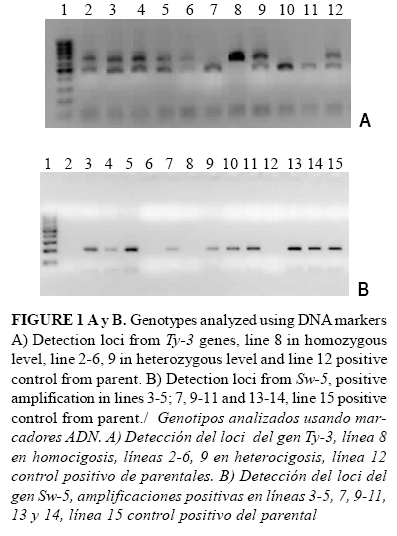
<P><font face="Verdana, Arial, Helvetica, sans-serif" size="2">According to the    Principal Component Analysis (PCA), where the first three components extracted    60% of the total variability, the genotypes could be grouped. The F<SUB>2 </SUB>plants    numbers 65, 68 and 78 were included into the 1<SUP>st</SUP> group highlighting    for symptomless and high yield (6.0 to 6.8 kilogram per plant). </font>     <P><font face="Verdana, Arial, Helvetica, sans-serif" size="2">Six F<SUB>2 </SUB>plants    showed the <I>Ty-3</I> gene in homozygosis with an amplified fragment of aprox.    640pb; twenty in heterozygosis and an amplified fragment of aprox. 500 and 640pb    (<a href="#f1">Figure 1A</a>), and 33 F<SUB>2</SUB> plants showed the <I>Sw-5</I>    gene according to DNA analyses (<a href="#f1">Figure 1B</a>). </font>      ]]></body>
<body><![CDATA[<P align="center"><img src="/img/revistas/rpv/v30n2/f0111215.gif" width="397" height="536">    <a name="f1"></a>     
<P><font face="Verdana, Arial, Helvetica, sans-serif" size="2">The sequence in    forward and reverse direction of the 629 pb from the fragment showed 100% of    identity with <I>Ty-3</I> gene from Gc43 Genotype resistant to begomoviruses    in Guatemala (12). </font>     <P><font face="Verdana, Arial, Helvetica, sans-serif" size="2">The transfer of    the gene <I>Sw-5</I> was observed for the amplification of PCR-fragments about    200pb with 100% of identity to <I>Sw-5</I> a gene from Genebank (AY007366.1).    </font>     <P><font face="Verdana, Arial, Helvetica, sans-serif" size="2">Three F<SUB>2 </SUB>plants    (number 65, 68 and 78), symptomless and with high productivity, showed the <I>Ty-3</I>    and <I>Sw-5</I> genes in homozygosis besides the <I>Ty-1</I> gene (resistance    to TYLCV) previously reported by Pi&ntilde;&oacute;n <I>et al.</I> (2) in their    female parent. </font>     <P><font face="Verdana, Arial, Helvetica, sans-serif" size="2">DNA marker technology    has been used in commercial plant breeding programs since the early 1990's and    has proved helpful for rapid and efficient transfer of useful traits into agronomically    desirable varieties and hybrids. In this work the main goal was achieved through    the early molecular screening for resistance and the productivity evaluation    under field conditions; both tools, when simultaneously used, showed to be efficient    in reducing selection time and space. </font>     <P>&nbsp;     <P><font face="Verdana, Arial, Helvetica, sans-serif" size="2"><B><font size="3">REFRENCES</font></B>    </font>      <!-- ref --><P><font face="Verdana, Arial, Helvetica, sans-serif" size="2">1. Mart&iacute;nez    Y, Mart&iacute;nez MA, Qui&ntilde;ones M, Miranda I, Holt J, Chancellor T. Estudio    de factores que influyen en la epifitolog&iacute;a del complejo mosca blanca-geminivirus,    en la regi&oacute;n oriental de Cuba. Rev Protecci&oacute;n Veg. 2009;24(1):47-50.        </font>      <!-- ref --><P><font face="Verdana, Arial, Helvetica, sans-serif" size="2">2. Ji Y, Scott    JW, Hanson P, Graham E, Maxwell DP. Sources of resistance, inheritance, and    location of genetic loci conferring resistance to members of the tomato-infecting    begomoviruses Chapter 2. In H. Czosnek (ed.), Tomato Yellow Leaf Curl Virus    Disease. 2007. pages 343-362.    </font>      <!-- ref --><P><font face="Verdana, Arial, Helvetica, sans-serif" size="2">3. Zamir D, Michelson    I, Zakay Y, Navot N, Zeidan M, Sarfatti M, et al. Mapping and introgression    of a Tomato yellow leaf curl virus tolerance gene, <I>Ty-1</I>. Theor Appl Genet.    1994;88:141-146.     </font>      <!-- ref --><P><font face="Verdana, Arial, Helvetica, sans-serif" size="2">4. Pi&ntilde;&oacute;n    M, G&oacute;mez O, Cornide MT. RFLP analysis of Cuban tomato breeding lines    with resistance to Tomato yellow leaf curl virus. Acta Horticulturae<I>. </I>2005;695:273-276.        </font>      <!-- ref --><P><font face="Verdana, Arial, Helvetica, sans-serif" size="2">5. Ji Y, Scott    JW. Identification of RAPD markers linked to <I>Lycopersicon chilense</I> derived    begomovirus resistant genes on chromosome 6 of tomato. Acta Horticulturae. 2005;695:407-416.        </font>      <!-- ref --><P><font face="Verdana, Arial, Helvetica, sans-serif" size="2">6. Ji Y, Scott    JW. Development of SCAR and CAPS markers linked to tomato begomovirus resistance    genes introgressed from <I>Lycopersicon chilense</I>. HortSci. 2005;40:1090.        </font>      <!-- ref --><P><font face="Verdana, Arial, Helvetica, sans-serif" size="2">7. Ji Y, Schuster    DJ, Scott JW. <I>Ty-3</I>, a begomovirus resistance locus near the Tomato yellow    leaf curl virus resistance locus <I>Ty-1</I> on chromosome 6 of tomato. Molecular    Breeding. 2007;20(3):271.     </font>      <!-- ref --><P><font face="Verdana, Arial, Helvetica, sans-serif" size="2">8. Langella R,    Ercolano MR, Monti L, Frusciante L, Barone A. Molecular marker assistance transfer    of resistance to TSWV in tomato elite. J Hort Sci &amp; Biotech<I>.</I> 2004;79(5):806-810.        </font>      <!-- ref --><P><font face="Verdana, Arial, Helvetica, sans-serif" size="2">9. G&oacute;mez    O, Pi&ntilde;&oacute;n M, Mart&iacute;nez Y, Qui&ntilde;ones M, Fonseca D, Laterrot    H. Breeding for resistance to begomovirus in tropic-adapted tomato genotypes.    Plant Breeding<I>.</I> 2004;123:275-279.     </font>      <!-- ref --><P><font face="Verdana, Arial, Helvetica, sans-serif" size="2">10.Scott JW,      Schuster DJ. Screening of accessions for resistance to the Florida tomato      geminivirus. 1991; TGC Report 41.     </font>         <!-- ref --><P><font face="Verdana, Arial, Helvetica, sans-serif" size="2">11.Noris EE, Hidalgo    GP, Moriones E. High similarity among the tomato yellow leaf curl isolates from    the west Mediterranean Basin: the nucleotide sequence of an infectious clone    from Spain. Arch Virol. 1994;135:165-170.     </font>      <!-- ref --><P><font face="Verdana, Arial, Helvetica, sans-serif" size="2">12.Mej&iacute;a    L, Teni RE, Vidavski F, Czosnek H, Lapidot M, et al. Evaluation of tomato germplasm    and selection of breeding lines for resistance to begomoviruses in Guatemala.    Acta Horticulturae. 2005;695:251-255.     </font>      <P>&nbsp;     <P>&nbsp;     <P><font face="Verdana, Arial, Helvetica, sans-serif" size="2">Recibido: 23-12-2014.    <br>   </font><font face="Verdana, Arial, Helvetica, sans-serif" size="2">Aceptado:    13-2-2015.</font>       ]]></body><back>
<ref-list>
<ref id="B1">
<label>1</label><nlm-citation citation-type="journal">
<person-group person-group-type="author">
<name>
<surname><![CDATA[Martínez]]></surname>
<given-names><![CDATA[Y]]></given-names>
</name>
<name>
<surname><![CDATA[Martínez]]></surname>
<given-names><![CDATA[MA]]></given-names>
</name>
<name>
<surname><![CDATA[Quiñones]]></surname>
<given-names><![CDATA[M]]></given-names>
</name>
<name>
<surname><![CDATA[Miranda]]></surname>
<given-names><![CDATA[I]]></given-names>
</name>
<name>
<surname><![CDATA[Holt]]></surname>
<given-names><![CDATA[J]]></given-names>
</name>
<name>
<surname><![CDATA[Chancellor]]></surname>
<given-names><![CDATA[T]]></given-names>
</name>
</person-group>
<article-title xml:lang="es"><![CDATA[Estudio de factores que influyen en la epifitología del complejo mosca blanca-geminivirus, en la región oriental de Cuba]]></article-title>
<source><![CDATA[Rev Protección Veg]]></source>
<year>2009</year>
<volume>24</volume>
<numero>1</numero>
<issue>1</issue>
<page-range>47-50</page-range></nlm-citation>
</ref>
<ref id="B2">
<label>2</label><nlm-citation citation-type="">
<person-group person-group-type="author">
<name>
<surname><![CDATA[Ji]]></surname>
<given-names><![CDATA[Y]]></given-names>
</name>
<name>
<surname><![CDATA[Scott]]></surname>
<given-names><![CDATA[JW]]></given-names>
</name>
<name>
<surname><![CDATA[Hanson]]></surname>
<given-names><![CDATA[P]]></given-names>
</name>
<name>
<surname><![CDATA[Graham]]></surname>
<given-names><![CDATA[E]]></given-names>
</name>
<name>
<surname><![CDATA[Maxwell]]></surname>
<given-names><![CDATA[DP]]></given-names>
</name>
</person-group>
<article-title xml:lang="en"><![CDATA[Sources of resistance, inheritance, and location of genetic loci conferring resistance to members of the tomato-infecting begomoviruses Chapter 2]]></article-title>
<person-group person-group-type="editor">
<name>
<surname><![CDATA[Czosnek]]></surname>
<given-names><![CDATA[H]]></given-names>
</name>
</person-group>
<source><![CDATA[Tomato Yellow Leaf Curl Virus Disease]]></source>
<year>2007</year>
<page-range>343-362</page-range></nlm-citation>
</ref>
<ref id="B3">
<label>3</label><nlm-citation citation-type="journal">
<person-group person-group-type="author">
<name>
<surname><![CDATA[Zamir]]></surname>
<given-names><![CDATA[D]]></given-names>
</name>
<name>
<surname><![CDATA[Michelson]]></surname>
<given-names><![CDATA[I]]></given-names>
</name>
<name>
<surname><![CDATA[Zakay]]></surname>
<given-names><![CDATA[Y]]></given-names>
</name>
<name>
<surname><![CDATA[Navot]]></surname>
<given-names><![CDATA[N]]></given-names>
</name>
<name>
<surname><![CDATA[Zeidan]]></surname>
<given-names><![CDATA[M]]></given-names>
</name>
<name>
<surname><![CDATA[Sarfatti]]></surname>
<given-names><![CDATA[M]]></given-names>
</name>
</person-group>
<article-title xml:lang="en"><![CDATA[Mapping and introgression of a Tomato yellow leaf curl virus tolerance gene, Ty-1]]></article-title>
<source><![CDATA[Theor Appl Genet]]></source>
<year>1994</year>
<volume>88</volume>
<page-range>141-146</page-range></nlm-citation>
</ref>
<ref id="B4">
<label>4</label><nlm-citation citation-type="journal">
<person-group person-group-type="author">
<name>
<surname><![CDATA[Piñón]]></surname>
<given-names><![CDATA[M]]></given-names>
</name>
<name>
<surname><![CDATA[Gómez]]></surname>
<given-names><![CDATA[O]]></given-names>
</name>
<name>
<surname><![CDATA[Cornide]]></surname>
<given-names><![CDATA[MT]]></given-names>
</name>
</person-group>
<article-title xml:lang="en"><![CDATA[RFLP analysis of Cuban tomato breeding lines with resistance to Tomato yellow leaf curl virus]]></article-title>
<source><![CDATA[Acta Horticulturae]]></source>
<year>2005</year>
<volume>695</volume>
<page-range>273-276</page-range></nlm-citation>
</ref>
<ref id="B5">
<label>5</label><nlm-citation citation-type="journal">
<person-group person-group-type="author">
<name>
<surname><![CDATA[Ji]]></surname>
<given-names><![CDATA[Y]]></given-names>
</name>
<name>
<surname><![CDATA[Scott]]></surname>
<given-names><![CDATA[JW]]></given-names>
</name>
</person-group>
<article-title xml:lang="en"><![CDATA[Identification of RAPD markers linked to Lycopersicon chilense derived begomovirus resistant genes on chromosome 6 of tomato]]></article-title>
<source><![CDATA[Acta Horticulturae]]></source>
<year>2005</year>
<volume>695</volume>
<page-range>407-416</page-range></nlm-citation>
</ref>
<ref id="B6">
<label>6</label><nlm-citation citation-type="journal">
<person-group person-group-type="author">
<name>
<surname><![CDATA[Ji]]></surname>
<given-names><![CDATA[Y]]></given-names>
</name>
<name>
<surname><![CDATA[Scott]]></surname>
<given-names><![CDATA[JW]]></given-names>
</name>
</person-group>
<article-title xml:lang="en"><![CDATA[Development of SCAR and CAPS markers linked to tomato begomovirus resistance genes introgressed from Lycopersicon chilense]]></article-title>
<source><![CDATA[HortSci]]></source>
<year>2005</year>
<volume>40</volume>
<page-range>1090</page-range></nlm-citation>
</ref>
<ref id="B7">
<label>7</label><nlm-citation citation-type="journal">
<person-group person-group-type="author">
<name>
<surname><![CDATA[Ji]]></surname>
<given-names><![CDATA[Y]]></given-names>
</name>
<name>
<surname><![CDATA[Schuster]]></surname>
<given-names><![CDATA[DJ]]></given-names>
</name>
<name>
<surname><![CDATA[Scott]]></surname>
<given-names><![CDATA[JW]]></given-names>
</name>
</person-group>
<article-title xml:lang="en"><![CDATA[Ty-3, a begomovirus resistance locus near the Tomato yellow leaf curl virus resistance locus Ty-1 on chromosome 6 of tomato]]></article-title>
<source><![CDATA[Molecular Breeding]]></source>
<year>2007</year>
<volume>20</volume>
<numero>3</numero>
<issue>3</issue>
<page-range>271</page-range></nlm-citation>
</ref>
<ref id="B8">
<label>8</label><nlm-citation citation-type="journal">
<person-group person-group-type="author">
<name>
<surname><![CDATA[Langella]]></surname>
<given-names><![CDATA[R]]></given-names>
</name>
<name>
<surname><![CDATA[Ercolano]]></surname>
<given-names><![CDATA[MR]]></given-names>
</name>
<name>
<surname><![CDATA[Monti]]></surname>
<given-names><![CDATA[L]]></given-names>
</name>
<name>
<surname><![CDATA[Frusciante]]></surname>
<given-names><![CDATA[L]]></given-names>
</name>
<name>
<surname><![CDATA[Barone]]></surname>
<given-names><![CDATA[A]]></given-names>
</name>
</person-group>
<article-title xml:lang="en"><![CDATA[Molecular marker assistance transfer of resistance to TSWV in tomato elite]]></article-title>
<source><![CDATA[J Hort Sci & Biotech]]></source>
<year>2004</year>
<volume>79</volume>
<numero>5</numero>
<issue>5</issue>
<page-range>806-810</page-range></nlm-citation>
</ref>
<ref id="B9">
<label>9</label><nlm-citation citation-type="journal">
<person-group person-group-type="author">
<name>
<surname><![CDATA[Gómez]]></surname>
<given-names><![CDATA[O]]></given-names>
</name>
<name>
<surname><![CDATA[Piñón]]></surname>
<given-names><![CDATA[M]]></given-names>
</name>
<name>
<surname><![CDATA[Martínez]]></surname>
<given-names><![CDATA[Y]]></given-names>
</name>
<name>
<surname><![CDATA[Quiñones]]></surname>
<given-names><![CDATA[M]]></given-names>
</name>
<name>
<surname><![CDATA[Fonseca]]></surname>
<given-names><![CDATA[D]]></given-names>
</name>
<name>
<surname><![CDATA[Laterrot]]></surname>
<given-names><![CDATA[H]]></given-names>
</name>
</person-group>
<article-title xml:lang="en"><![CDATA[Breeding for resistance to begomovirus in tropic-adapted tomato genotypes]]></article-title>
<source><![CDATA[Plant Breeding]]></source>
<year>2004</year>
<volume>123</volume>
<page-range>275-279</page-range></nlm-citation>
</ref>
<ref id="B10">
<label>10</label><nlm-citation citation-type="">
<person-group person-group-type="author">
<name>
<surname><![CDATA[Scott]]></surname>
<given-names><![CDATA[JW]]></given-names>
</name>
<name>
<surname><![CDATA[Schuster]]></surname>
<given-names><![CDATA[DJ]]></given-names>
</name>
</person-group>
<source><![CDATA[Screening of accessions for resistance to the Florida tomato geminivirus]]></source>
<year>1991</year>
</nlm-citation>
</ref>
<ref id="B11">
<label>11</label><nlm-citation citation-type="journal">
<person-group person-group-type="author">
<name>
<surname><![CDATA[Noris]]></surname>
<given-names><![CDATA[EE]]></given-names>
</name>
<name>
<surname><![CDATA[Hidalgo]]></surname>
<given-names><![CDATA[GP]]></given-names>
</name>
<name>
<surname><![CDATA[Moriones]]></surname>
<given-names><![CDATA[E]]></given-names>
</name>
</person-group>
<article-title xml:lang="en"><![CDATA[High similarity among the tomato yellow leaf curl isolates from the west Mediterranean Basin: the nucleotide sequence of an infectious clone from Spain]]></article-title>
<source><![CDATA[Arch Virol]]></source>
<year>1994</year>
<volume>135</volume>
<page-range>165-170</page-range></nlm-citation>
</ref>
<ref id="B12">
<label>12</label><nlm-citation citation-type="journal">
<person-group person-group-type="author">
<name>
<surname><![CDATA[Mejía]]></surname>
<given-names><![CDATA[L]]></given-names>
</name>
<name>
<surname><![CDATA[Teni]]></surname>
<given-names><![CDATA[RE]]></given-names>
</name>
<name>
<surname><![CDATA[Vidavski]]></surname>
<given-names><![CDATA[F]]></given-names>
</name>
<name>
<surname><![CDATA[Czosnek]]></surname>
<given-names><![CDATA[H]]></given-names>
</name>
<name>
<surname><![CDATA[Lapidot]]></surname>
<given-names><![CDATA[M]]></given-names>
</name>
</person-group>
<article-title xml:lang="en"><![CDATA[Evaluation of tomato germplasm and selection of breeding lines for resistance to begomoviruses in Guatemala]]></article-title>
<source><![CDATA[Acta Horticulturae]]></source>
<year>2005</year>
<volume>695</volume>
<page-range>251-255</page-range></nlm-citation>
</ref>
</ref-list>
</back>
</article>