<?xml version="1.0" encoding="ISO-8859-1"?><article xmlns:mml="http://www.w3.org/1998/Math/MathML" xmlns:xlink="http://www.w3.org/1999/xlink" xmlns:xsi="http://www.w3.org/2001/XMLSchema-instance">
<front>
<journal-meta>
<journal-id>1010-2752</journal-id>
<journal-title><![CDATA[Revista de Protección Vegetal]]></journal-title>
<abbrev-journal-title><![CDATA[Rev. Protección Veg.]]></abbrev-journal-title>
<issn>1010-2752</issn>
<publisher>
<publisher-name><![CDATA[Centro Nacional de Sanidad Agropecuaria]]></publisher-name>
</publisher>
</journal-meta>
<article-meta>
<article-id>S1010-27522015000300010</article-id>
<title-group>
<article-title xml:lang="en"><![CDATA[Effects of mineral, organic, and biological fertilization on the establishment of Pochonia chlamydosporia var. catenulata (Kamyschko ex. Barron and Onions) Zare & Gams in a protected crop]]></article-title>
<article-title xml:lang="es"><![CDATA[Efecto de la fertilización mineral, orgánica y biológica sobre el establecimiento de Pochonia chlamydosporia var. catenulata (Kamyschko ex. Barron y Onions) Zare & Gams en cultivos protegidos]]></article-title>
</title-group>
<contrib-group>
<contrib contrib-type="author">
<name>
<surname><![CDATA[Charles]]></surname>
<given-names><![CDATA[Nelson J]]></given-names>
</name>
<xref ref-type="aff" rid="A01"/>
</contrib>
<contrib contrib-type="author">
<name>
<surname><![CDATA[Arévalo]]></surname>
<given-names><![CDATA[Jersys]]></given-names>
</name>
<xref ref-type="aff" rid="A02"/>
</contrib>
<contrib contrib-type="author">
<name>
<surname><![CDATA[Hernández Duquesne]]></surname>
<given-names><![CDATA[Ailin]]></given-names>
</name>
<xref ref-type="aff" rid="A03"/>
</contrib>
<contrib contrib-type="author">
<name>
<surname><![CDATA[Martín Alonso]]></surname>
<given-names><![CDATA[Nelson J]]></given-names>
</name>
<xref ref-type="aff" rid="A03"/>
</contrib>
<contrib contrib-type="author">
<name>
<surname><![CDATA[Hidalgo Díaz]]></surname>
<given-names><![CDATA[Leopoldo]]></given-names>
</name>
<xref ref-type="aff" rid="A02"/>
</contrib>
</contrib-group>
<aff id="A01">
<institution><![CDATA[,Seychelles Agricultural Agency  ]]></institution>
<addr-line><![CDATA[ ]]></addr-line>
<country>Republic of Seychelles</country>
</aff>
<aff id="A02">
<institution><![CDATA[,National Center for Animal and Plant Heath (CENSA)  ]]></institution>
<addr-line><![CDATA[San José de las Lajas Mayabeque]]></addr-line>
<country>Cuba</country>
</aff>
<aff id="A03">
<institution><![CDATA[,Agrarian University of Havana (UNAH)  ]]></institution>
<addr-line><![CDATA[San José de las Lajas Mayabeque]]></addr-line>
<country>Cuba</country>
</aff>
<pub-date pub-type="pub">
<day>00</day>
<month>12</month>
<year>2015</year>
</pub-date>
<pub-date pub-type="epub">
<day>00</day>
<month>12</month>
<year>2015</year>
</pub-date>
<volume>30</volume>
<numero>3</numero>
<fpage>239</fpage>
<lpage>244</lpage>
<copyright-statement/>
<copyright-year/>
<self-uri xlink:href="http://scielo.sld.cu/scielo.php?script=sci_arttext&amp;pid=S1010-27522015000300010&amp;lng=en&amp;nrm=iso"></self-uri><self-uri xlink:href="http://scielo.sld.cu/scielo.php?script=sci_abstract&amp;pid=S1010-27522015000300010&amp;lng=en&amp;nrm=iso"></self-uri><self-uri xlink:href="http://scielo.sld.cu/scielo.php?script=sci_pdf&amp;pid=S1010-27522015000300010&amp;lng=en&amp;nrm=iso"></self-uri><abstract abstract-type="short" xml:lang="en"><p><![CDATA[The objective of this research work was to evaluate the effect of applying different doses of mineral fertilization, organic fertilization (worm humus) or arbuscular mycorrhizal fungi (Glomus hoi-like) separately or in combination on the establishment of the strain IMI SD 187 of P. chlamydosporia var. catenulata. The experiment was carried out using the tomato (Solanum lycopersicum L.) hybrid HA-3108 in a greenhouse at «Los 3 Picos» farm in Havana, Cuba. Colonization of the soil and roots by the selected strain was assessed in each treatment. The number of P. chlamydosporia colony forming units in soil and roots was directly related to the application of arbuscular micorrhizal fungi and worm humus according to the Principal Component analysis and the biplot graph used. A direct relationship between the mineral fertilization and P. chlamydosporia colonization of roots was found, while it was inverse respect the soil colonization. These results indicated that the nutritional treatments favored P. chlamydosporia (IMI SD 187) growth, with more significant effects when the arbuscular mycorrhizal fungi were used combined with the worm humus.]]></p></abstract>
<abstract abstract-type="short" xml:lang="es"><p><![CDATA[El objetivo del presente trabajo fue evaluar el efecto de diferentes dosis de fertilización mineral, fertilización orgánica con humus de lombriz y hongos micorrízicos arbusculares (Glomus hoi-like), aplicados de manera separada o en combinación, sobre el establecimiento de la cepa IMI SD 187 de Pochonia chlamydosporia var. catenulata. El experimento se realizó en cultivo protegido en la Granja «Los 3 Picos», La Habana, Cuba. Se utilizó tomate (Solanum lycopersicum L.), híbrido HA-3108, y se evaluó la colonización de la cepa seleccionada en el suelo y las raíces para cada tratamiento. El análisis de componentes principales, unido al gráfico de biplot, mostró una relación directa entre la utilización de micorriza y humus con el número de colonias de P. chlamydosporia en el suelo y la raíz. La fertilización mineral tuvo una relación directa con el número de colonias en la raíz e inversa con la colonización de este hongo en el suelo. Estos resultados indicaron que los tratamientos nutricionales probados favorecieron el crecimiento P. chlamydosporia (IMI SD 187) y el efecto combinado de micorriza y humus resultó ser el más significativo.]]></p></abstract>
<kwd-group>
<kwd lng="en"><![CDATA[Arbuscular Mycorrhizal Fungi]]></kwd>
<kwd lng="en"><![CDATA[inorganic fertilization]]></kwd>
<kwd lng="en"><![CDATA[nematophagous fungi]]></kwd>
<kwd lng="en"><![CDATA[worm humus]]></kwd>
<kwd lng="es"><![CDATA[Hongos Micorrízicos Arbusculares]]></kwd>
<kwd lng="es"><![CDATA[fertilización inorgánica]]></kwd>
<kwd lng="es"><![CDATA[Hongos nematófagos]]></kwd>
<kwd lng="es"><![CDATA[humus de lombriz]]></kwd>
</kwd-group>
</article-meta>
</front><body><![CDATA[ <p align="right"><font face="Verdana, Arial, Helvetica, sans-serif" size="2"><B>COMUNICACI&Oacute;N    CORTA</B> </font></p>     <p>&nbsp;</p>     <p><font face="Verdana, Arial, Helvetica, sans-serif" size="2"><b><font size="4">Effects    of mineral, organic, and biological fertilization on the establishment of <i>Pochonia    chlamydosporia</i> var. <i>catenulata</i> (Kamyschko ex. Barron and Onions)    Zare &amp; Gams in a protected crop</font></b></font></p>     <p>&nbsp;</p>     <p><font face="Verdana, Arial, Helvetica, sans-serif" size="2"><b><font size="3">Efecto    de la fertilizaci&oacute;n mineral, org&aacute;nica y biol&oacute;gica sobre    el establecimiento de <i>Pochonia chlamydosporia</i> var. <i>catenulata</i>    (Kamyschko ex. Barron y Onions) Zare &amp; Gams en cultivos protegidos</font></b></font></p>     <p>&nbsp;</p>     <p>&nbsp; </p> <H1> <font face="Verdana, Arial, Helvetica, sans-serif" size="2"></font><B>        <P><font face="Verdana, Arial, Helvetica, sans-serif" size="2">Nelson J. Charles<SUP>I</SUP>,      Jersys Ar&eacute;valo<SUP>II</SUP>, Ailin Hern&aacute;ndez Duquesne<SUP>III</SUP>,      Nelson J. Mart&iacute;n Alonso<SUP>III</SUP>, Leopoldo Hidalgo D&iacute;az<SUP>II</SUP></font>   </B> </H1>     <P><font face="Verdana, Arial, Helvetica, sans-serif" size="2"><SUP>I</SUP>Seychelles    Agricultural Agency, Republic of Seychelles. E-mail: <U><a href="MAILTO:nelcharless78@yahoo.com">nelcharless78@yahoo.com</a></U>.        <BR>   <SUP>II</SUP>National Center for Animal and Plant Heath (CENSA), San Jos&eacute;    de las Lajas, Mayabeque, CP 32700, Cuba.     ]]></body>
<body><![CDATA[<BR>   <SUP>III</SUP>Agrarian University of Havana (UNAH), San Jos&eacute; de las Lajas,    Mayabeque, CP 32 700, Cuba.</font>     <P>&nbsp;     <P>&nbsp; <hr noshade size="1">     <P><font face="Verdana, Arial, Helvetica, sans-serif" size="2"><B>ABSTRACT</B></font>     <P><font face="Verdana, Arial, Helvetica, sans-serif" size="2">The objective of    this research work was to evaluate the effect of applying different doses of    mineral fertilization, organic fertilization (worm humus) or arbuscular mycorrhizal    fungi (<I>Glomus hoi-like) </I>separately or in combination on the establishment    of the strain IMI SD 187 of <I>P. chlamydosporia </I>var. <I>catenulata.</I>    The experiment was carried out using the tomato (<I>Solanum lycopersicum </I>L.)    hybrid HA-3108 in a greenhouse at &#171;Los 3 Picos&#187; farm in Havana, Cuba.    Colonization of the soil and roots by the selected strain was assessed in each    treatment. The number of <I>P. chlamydosporia</I> colony forming units in soil    and roots was directly related to the application of arbuscular micorrhizal    fungi and worm humus according to the Principal Component analysis and the biplot    graph used. A direct relationship between the mineral fertilization and <I>P.    chlamydosporia </I>colonization<I> </I>of roots was found, while it was inverse    respect the soil colonization. These results indicated that the nutritional    treatments favored <I>P. chlamydosporia </I>(IMI SD 187)<I> </I>growth, with    more significant effects when the arbuscular mycorrhizal fungi were used combined    with the worm humus. </font>     <P><font face="Verdana, Arial, Helvetica, sans-serif" size="2"><B>Key words: </B>Arbuscular    Mycorrhizal Fungi, inorganic fertilization, nematophagous fungi, worm humus.    </font> <hr noshade size="1">  <font face="Verdana, Arial, Helvetica, sans-serif" size="2"></font>         <P><font face="Verdana, Arial, Helvetica, sans-serif" size="2"><B>RESUMEN</b></font>      <P><font face="Verdana, Arial, Helvetica, sans-serif" size="2">El objetivo del    presente trabajo fue evaluar el efecto de diferentes dosis de fertilizaci&oacute;n    mineral, fertilizaci&oacute;n org&aacute;nica con humus de lombriz y hongos    micorr&iacute;zicos arbusculares (<I>Glomus hoi-like</I>), aplicados de manera    separada o en combinaci&oacute;n, sobre el establecimiento de la cepa IMI SD    187 de <I>Pochonia chlamydosporia </I>var. <I>catenulata.</I> El experimento    se realiz&oacute; en cultivo protegido en la Granja &#171;Los 3 Picos&#187;,    La Habana, Cuba. Se utiliz&oacute; tomate (<I>Solanum lycopersicum </I>L.),    h&iacute;brido HA-3108, y se evalu&oacute; la colonizaci&oacute;n de la cepa    seleccionada en el suelo y las ra&iacute;ces para cada tratamiento. El an&aacute;lisis    de componentes principales, unido al gr&aacute;fico de biplot, mostr&oacute;    una relaci&oacute;n directa entre la utilizaci&oacute;n de micorriza y humus    con el n&uacute;mero de colonias de <I>P. chlamydosporia</I> en el suelo y la    ra&iacute;z. La fertilizaci&oacute;n mineral tuvo una relaci&oacute;n directa    con el n&uacute;mero de colonias en la ra&iacute;z e inversa con la colonizaci&oacute;n    de este hongo en el suelo. Estos resultados indicaron que los tratamientos nutricionales    probados favorecieron el crecimiento <I>P. chlamydosporia</I> (IMI SD 187) y    el efecto combinado de micorriza y humus result&oacute; ser el m&aacute;s significativo.    </font>      <P><font face="Verdana, Arial, Helvetica, sans-serif" size="2"><B>Palabras clave:    </B>Hongos Micorr&iacute;zicos Arbusculares, fertilizaci&oacute;n inorg&aacute;nica,    Hongos nemat&oacute;fagos<I>, </I>humus de lombriz.</font> <hr noshade size="1">     <P>&nbsp;     ]]></body>
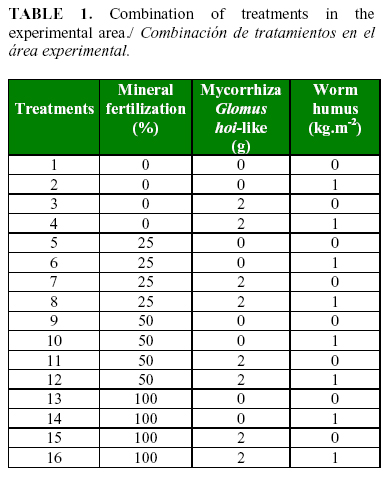
<body><![CDATA[<P>&nbsp;     <P><font face="Verdana, Arial, Helvetica, sans-serif" size="2">In Cuba, the integrated    pest management is applied in the vegetable production under intensive systems,    and the biological control agents (BCA) have great importance (1). In this type    of technology, the root knot nematodes (<I>Meloidogyne </I>spp.) are the most    important crop pests at the international and national scale (2, 3, 4). </font>      <P><font face="Verdana, Arial, Helvetica, sans-serif" size="2">The nematophagous    fungus <I>Pochonia chlamydosporia </I>(Goddard) Zare &amp; Gams (former Ver<I>ticillium    chlamydosporium </I>Goddard) is a facultative parasite of cyst and root knot    nematode eggs. It is commonly present as a facultative saprophyte in a great    diversity of soils of different agroecosystems worldwide (5). The effectiveness    of <I>P. chlamydosporia </I>in reducing root knot nematodes has been demonstrated    largely, and this effectiveness is increased when the fungus is applied in combination    with other control measures such as the application of green manures, organic    amendments or arbuscular mycorrhizal fungi (AMF) (6, 7, 8, 9). </font>     <P><font face="Verdana, Arial, Helvetica, sans-serif" size="2">The bionematicide    KlamiC<SUP>&#174;</SUP> is produced from the Cuban native strain IMI SD 187    of <I>P. chlamydosporia </I>var. <I>catenulata</I> and commercialized as effective    for the management of <I>Meloidogyne </I>spp. in intensive production systems    of vegetables (10). Nevertheless, the effectiveness of this microorganism in    agricultural systems can be influenced by abiotic and biotic factors, like the    biological composition of the soil and the competition with other microorganisms    (11, 12). Therefore, evaluating the influence of the agricultural practices    applied in the production system of vegetables is essential for the adoption    of tactics and strategies favoring the establishment of this fungus in the rhizosphere.    </font>     <P><font face="Verdana, Arial, Helvetica, sans-serif" size="2">The objective of    this study was to determine the effect of different doses of mineral fertilization    applied alone or in combination with arbuscular mycorrhizal fungi and worm humus    on the establishment of <I>P. chlamydosporia </I>var.<I> catenulata </I>strain    IMI SD 187 in soil and tomato roots under greenhouse cultivation. </font>     <P><font face="Verdana, Arial, Helvetica, sans-serif" size="2">The work was carried    out in a greenhouse at &#171;Los 3 Picos&#187; farm in Havana, Cuba. Tomato    (S<I>olanum lycopersicum L</I>.) seedlings of the hybrid HA-3108 were used.    Twenty five days after germination, the seedlings were transplanted to beds    containing Ferralitic Yellow Gley soil (13). For the experimental work, a split-split    plot randomized block design with four replications per treatment was used.    A 3-way factorial arrangement was used to evaluate the application of different    doses of mineral nutrients, worm humus and AMF, on the colonization of <I>P.</I>    <I>chlamydosporia </I>in the soil and tomato roots. <a href="#t1">Table 1</a>    shows the combination of the treatments in the experimental area.</font>      <P align="center"><img src="/img/revistas/rpv/v30n3/t0110315.jpg" width="389" height="477">    <a name="t1"></a>      
<P><font face="Verdana, Arial, Helvetica, sans-serif" size="2">The doses of mineral    fertilizers (0, 25, 50 or 100%.) were applied to the main plots through the    irrigation water. According to Casanova <I>et al</I>. (14), the fertilizers    used in the fertigation system were: magnesium nitrate (11-0-0-0-15); calcium    nitrate (15.5-0-0-26), phosphoric acid (85%), potassium nitrate (12-0-45), and    ammonium nitrate (34-0-0).g. Two treatments of worm humus (with 1 kg.m<SUP>-2    </SUP>or none) were used in the sub- plots. The sub-sub-plots were or not inoculated    with the AMF. A certified inoculum of <I>Glomus hoi-like</I> fungi of an ecological    commercial product (Ecomic<SUP>&#174;</SUP>) from the National Institute of    Agricultural Science (INCA, Cuba) was used to inoculate the AMF, which were    applied by coating the seeds with a volume of product corresponding to 10% of    the seed weight (15). </font>     <P><font face="Verdana, Arial, Helvetica, sans-serif" size="2">Three days before    transplanting the seedlings, KlamiC<SUP>&#174;</SUP> (a.i., <I>P. chlamydosporia</I>    var. <I>catenulata</I>) was applied to all the plots at a rate of 25 g.m<SUP>-2</SUP>    of soil (16). An inundative application of the fungus was carried out by spraying    1 kg of the product over each bed (40 m<SUP>2</SUP> area) around the roots once    a month during three consecutive months. The experiment was established and    carried out for five months (from December 2009 to May 2010), and a second repetition    was done one year after (from December 2010 to May 2011). After each period,    the colonization of the substrate and tomato roots by <I>P.</I> <I>chlamydosporia</I>    was determined by counting the number of colony forming units (CFU) according    to Kerry and Bourne (17). </font>     <P><font face="Verdana, Arial, Helvetica, sans-serif" size="2">The data obtained    were log(x+1) transformed. Treatment behavior regarding <I>P. chlamydosporia</I>    growth and the correlation between the different variables were evaluated by    using a principal component analysis and a biplot graph using InfoStat version    1.1 (18). </font>     ]]></body>
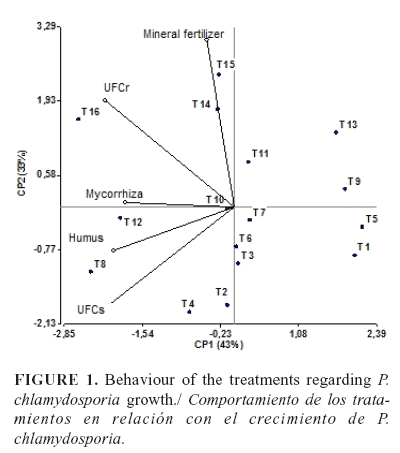
<body><![CDATA[<P><font face="Verdana, Arial, Helvetica, sans-serif" size="2">Root and soil colonization    by <I>P. chlamydosporia</I> was in the range 3.33 x 10<SUP>2</SUP>-3.53 x 10<SUP>3</SUP>    CFU.g<SUP>-1</SUP> and 9.83x10<SUP>2</SUP>-1.56x10<SUP>4</SUP> CFU.g<SUP>-1</SUP>,    respectively, at the end of the experiment,t with no significant differences    between the two years (p&gt;0,05). The analysis of principal components showed    an 87 % correlation. Two principal components could explain more than 76 % of    the variance (<a href="#t2">Table 2</a>). The first principal component (CP1)    showed a direct relationship between the use of mycorrhiza or worm humus and    the number of colonies formed by <I>P. chlamydosporia</I> in the soil (CFUs)    and roots (CFUr), which indicated that these treatments promoted the growth    of the fungus. Fertigation, the second component (CP2), showed a direct relationship    with the root colonization, but it was inverse with the quantity of CFUs in    soil (<a href="#t2">Table 2</a>).</font>      <P align="center"><img src="/img/revistas/rpv/v30n3/t0210315.jpg" width="390" height="311">    <font face="Verdana, Arial, Helvetica, sans-serif" size="2"><a name="t2"></a></font>      
<P><font face="Verdana, Arial, Helvetica, sans-serif" size="2">The biplot graph    (<a href="#f1">Figure 1</a>) revealed that the best treatments with the highest    CFUs and CFUr were 8, 12 and 16, where the application of mycorrhiza and humus    in combination with the fertigation at the doses of 25, 50 and 100 % respectively;    according to these data, the fertigation did not affect <I>P. chlamydosporia</I>    establishment, even at a dose of 100 %. Treatments 5, 9, and 13 (with no application    of mycorrhiza or worm humus) showed lower <I>P. chlamydosporia</I> growth in    the soil and roots, and they were placed into the same group of the control    treatment (treatment 1). Treatments with application of mycorrhiza or worm humus    separately presented an intermediate growth of the nematophagous fungus. </font>      <P align="center"><img src="/img/revistas/rpv/v30n3/f0110315.gif" width="400" height="453">    <a name="f1"></a>     
<P><font face="Verdana, Arial, Helvetica, sans-serif" size="2">The establishment    of <I>P</I>.<I> chlamydosporia </I>in the rhizosphere is essential for survival    of this fungus in absence of the nematode host, as well as for nematode control    (19). Previous studies have demonstrated that proliferation of <I>P. chlamydosporia    </I>is more abundant in organic than mineral soils (20). The present work indicated    that nutritional treatments favored the growth of <I>P. chlamydosporia</I>,    with a more remarkable effect of the combined use of mycorrhiza and worm humus<I>.</I>    </font>     <P><font face="Verdana, Arial, Helvetica, sans-serif" size="2">The application    of <I>Glomus hoi-like </I>favored <I>P. chlamydosporia </I>growth in soil and    roots. Previous studies by Puertas <I>et al.</I> (21) demonstrated the compatibility    of <I>P. chlamydosporia </I>var. <I>catenulata </I>(IMI SD 187) and AMF (G<I>lomus    clarum) </I>and the possibility of combining them in nematode management. On    the other hand, the inoculation of <I>Glomus mosseae </I>and <I>P. chlamydosporia</I>    limited the development and effectiveness of the nematophagous fungus in roots,    probably because of the competition between both microorganisms in the rhizosphere<I>    </I>(7). Studies by Siddiqui and Akhtar (6) revealed a synergetic effect between    <I>P. chlamydosporia </I>and the AMF <I>Glomus intraradices </I>on the<I> </I>reduction    of galling and multiplication of <I>M. incognita </I>and caused a significant    increase of tomato growth. Furthermore, the strain IMI SD 187 was recently shown    to be plant endophytic (22); this capability could give this fungus a potential    effect on plant growth and health (23). </font>     <P><font face="Verdana, Arial, Helvetica, sans-serif" size="2">The studies by    Theunissen <I>et al.</I> (24) proved that the application of worm humus stimulated    the increase of microorganisms taking part in its decomposition, promoted the    synthesis of phenolic compounds that improve the plant quality, and acted as    a deterrent against pests and diseases. Puertas and Hidalgo-D&iacute;az (9)    observed that <I>P</I>. <I>chlamydosporia </I>growth<I> </I>was not limited    by worm humus, a result that agrees with the results obtained in this work.    </font>     <P><font face="Verdana, Arial, Helvetica, sans-serif" size="2">The mineral fertilization    did not affect <I>P. chlamydosporia</I> establishment, even in the treatments    where 100 % doses were applied. Mineral fertilizer <I>per se</I> did not stimulate    the saprophytic development of the fungus, but it was related to root colonization    by <I>P. chlamydosporia</I>. This could be by the fungus feeding on root exudations.    Fertigation has been reported to have a more direct influence on plant growth    and changes in root exudations (25). </font>     <P><font face="Verdana, Arial, Helvetica, sans-serif" size="2">However, the indiscriminate    application of mineral fertilizers induces variations in the physical condition    of the soil, like changes in the pH and not optimal cationic relationships,    that result in unfavorable physical properties of the soil and thus contributes    to the intensification of erosion and pollution of the environment (26). These    effects influence adversely on the microbiota of the agroecosystem. A way to    avoid the deterioration of soil fertility in intensive farming is combining    the use of adequate quantities of mineral fertilizers with products of microbial    origin (27). Some studies demonstrate the beneficial effects of the symbiotic    association between the AMF and plants. The combined application of AMF and    low doses of mineral fertilizers increase the effectiveness of the mycorrhizal    symbiosis, and an optimum dose of fertilizers lower than the recommended to    obtain similar yields is achieved (28). </font>     <P><font face="Verdana, Arial, Helvetica, sans-serif" size="2">The results obtained    by Charles and Martin (29) showed a synergetic effect on the production of tomato    under a protected cultivation when they combined the application of EcomiC<SUP>&#174;</SUP>    and worm humus with a dose of 50 % mineral fertilization. In this sense, it    was interesting to note that combined application of mycorrhiza and worm humus    contributed to a better establishment of the strain IMI SD 187 of <I>P. chlamydosporia    </I>var. <I>catenulata </I>at this intermediate level of mineral fertilization    in both years. Therefore, it is feasible to integrate KlamiC<SUP>&#174; </SUP>with    these management measures<SUP> </SUP>for the tomato crop in intensive production    systems, and it is recommended the conduction of further research emphasizing    their common benefits in the growth and development of plants and the protection    against populations of root-knot nematodes. </font>     ]]></body>
<body><![CDATA[<P>&nbsp;     <P><font face="Verdana, Arial, Helvetica, sans-serif" size="2"><B><font size="3">REFERENCES</font></B>    </font>          <!-- ref --><P><font face="Verdana, Arial, Helvetica, sans-serif" size="2">1. Ceiro W. Evaluaci&oacute;n    de una alternativa de manejo sostenible para <I>Meloidogyne</I> spp., en cultivo    del tomate (<I>Solanum lycopersicum</I> M.). Rev Protecci&oacute;n Veg. 2010;25(3):197.        </font>      <!-- ref --><P><font face="Verdana, Arial, Helvetica, sans-serif" size="2">2. G&oacute;mez      L. Diagn&oacute;stico de nematodos agalleros y pr&aacute;cticas agron&oacute;micas      para el manejo de <I>Meloidogyne incognita </I>en la Producci&oacute;n Protegida      de Hortalizas. Tesis para optar por el Grado Cient&iacute;fico de Doctor en      Ciencias Agr&iacute;colas. Universidad Agraria de La Habana- Centro Nacional      de Sanidad Agropecuaria. 2007; 100p.     </font>        <!-- ref --><P><font face="Verdana, Arial, Helvetica, sans-serif" size="2">3. Escudero N,      L&oacute;pez-Llorca LV. Effects on plant growth and root-knot nematode infection      of an endophytic GFP transformant of the nematophagous fungus <I>Pochonia      chlamydosporia</I>. Symbiosis. DOI: 10.1007/s13199-012-0173-3. 2012.     </font>        <!-- ref --><P><font face="Verdana, Arial, Helvetica, sans-serif" size="2">4. Manzanilla-L&oacute;pez      R, Esteves I, Finetti-Sialer M, Hirsch P, Ward E, Devonshire J, <I>et al.      Pochonia chlamydosporia</I>: Advances and challenges to improve its performance      as a biological control agent of sedentary endo-parasitic nematodes. Journal      of Nematology. 2013;45(1):1-7.     </font>        ]]></body>
<body><![CDATA[<!-- ref --><P><font face="Verdana, Arial, Helvetica, sans-serif" size="2">5. Gams W, Zare      R. A revision of <I>Verticillium</I> section Prostrata. III. Generic classification.      Nova Hedwigia. 2001;73(3-4):329-337.     </font>        <!-- ref --><P><font face="Verdana, Arial, Helvetica, sans-serif" size="2">6. Siddiqui ZA,      Akhtar MS. Synergistic effects of antagonistic fungi and plant growth promoting      rhizobacterium, an arbuscular mycorrhizal fungus, or composted cow manure      on populations of <I>Meloidogyne incognita</I> and growth of tomato. Biocontrol      Science and Technology. 2008;18(3):279-290.     </font>        <!-- ref --><P><font face="Verdana, Arial, Helvetica, sans-serif" size="2">7. Hern&aacute;ndez      MA. Interacci&oacute;n de <I>Glomus mosseae</I> - <I>Pochonia chlamydosporia</I>      var. <I>catenulata</I> y <I>Meloidogyne incognita</I> en tomate (<I>Solanum      lycopersicum</I> L.). Tesis en opci&oacute;n al grado acad&eacute;mico de      Maestro en Ciencias en Nutrici&oacute;n de<I> </I>las plantas y biofertilizantes.      La Habana. 2009: 89 pp.     </font>        <!-- ref --><P><font face="Verdana, Arial, Helvetica, sans-serif" size="2">8. Ar&eacute;valo      J, Silva SD, Carneiro MDG, Lopes RB, Carneiro RMDG, Tigano MS, et al. Efecto      de la presencia de abono org&aacute;nico sobre la actividad de <I>Pochonia      chlamydosporia</I> var. catenulata (Kamyschko ex Barron y Onions) Zare y Gams      frente a <I>Meloidogyne enterolobii</I> Yang y Eisenback. Rev Protecci&oacute;n      Veg. 2012;27(3):167-173.     </font>        <!-- ref --><P><font face="Verdana, Arial, Helvetica, sans-serif" size="2">9. Puertas A,      Hidalgo-D&iacute;az L. Efecto de diferentes abonos org&aacute;nicos sobre      el establecimiento de <I>Pochonia chlamydosporia</I> var. <I>catenulata</I>      en el sustrato y la rizosfera de plantas de tomate. Rev Protecci&oacute;n      Veg. 2009;24(3):162-165.     </font>        ]]></body>
<body><![CDATA[<!-- ref --><P><font face="Verdana, Arial, Helvetica, sans-serif" size="2">10.Hidalgo-D&iacute;az      L. Investigaci&oacute;n, desarrollo e innovaci&oacute;n de <I>Pochonia chlamydosporia      </I>var. <I>catenulata </I>como agente microbiano para el control de nematodos      formadores de agallas. Rev Protecci&oacute;n Veg<I>.</I> 2013;28(3):238.     </font>        <!-- ref --><P><font face="Verdana, Arial, Helvetica, sans-serif" size="2">11.Monfort E,      Lopez-Lloca L, Jansson H, Salinas J. In vitro soil receptivity assays to egg-parasitic      nematophagous fungi<I>. Mycol Progress.</I> 2006;5:18-23.     </font>         <!-- ref --><P><font face="Verdana, Arial, Helvetica, sans-serif" size="2">12.Atkins S, Peteira    B, Clark I, Kerry B, Hirsch P. Use of real-time quantitative PCR to investigate    root and gall colonization by co-inoculated isolates of the nematophagous fungus    <I>Pochonia chlamydosporia</I>. Annals of Applied Biology. 2009;155:43-152.        </font>      <!-- ref --><P><font face="Verdana, Arial, Helvetica, sans-serif" size="2">13.Instituto de    Suelos. Academia de Ciencias de Cuba. G&eacute;nesis y Clasificaci&oacute;n    de los suelos de Cuba. Cuba. 1999: 77-78.     </font>      <!-- ref --><P><font face="Verdana, Arial, Helvetica, sans-serif" size="2">14.Casanova A,    G&oacute;mez O, Pupo FR, Hern&aacute;ndez M, Chailloux M, Depestre T, et al.    MINAG-Viceministerio de Cultivos Varios. Instituto de Investigaciones Hort&iacute;colas    &#171;Liliana Dimitrova&#187;. Manual para la producci&oacute;n Protegida de    Hortalizas. La Habana, Cuba. 2007: 80.     </font>      ]]></body>
<body><![CDATA[<!-- ref --><P><font face="Verdana, Arial, Helvetica, sans-serif" size="2">15.Fern&aacute;ndez      F, Vanega LF, Noval B, Rivera R. Producto inoculante micorriz&oacute;geno.      Oficina Nacional de Propiedad Industrial. No. 22641. Cuba. 2000.     </font>        <!-- ref --><P><font face="Verdana, Arial, Helvetica, sans-serif" size="2">16.Hern&aacute;ndez      MA, Hidalgo L. KlamiC<SUP>&#174;</SUP>: Bionematicida agr&iacute;cola producido      a partir del hongo <I>Pochonia chlamydosporia </I>var. <I>catenulata</I>.      Rev Protecci&oacute;n Veg. 2008;23(2):131-134.     </font>        <!-- ref --><P><font face="Verdana, Arial, Helvetica, sans-serif" size="2">17.Kerry BR,      Bourne JM. A Manual for Research on <I>Verticillium chlamydosporium</I>, a      Potential Biological Control Agent for Root-Knot Nematodes. IOBC/WPRS, University      of Gent; 2002: 84 pp. ISBN 92-9067-138-2.     </font>         <!-- ref --><P><font face="Verdana, Arial, Helvetica, sans-serif" size="2">18.Miranda I. Centro    Nacional de Sanidad Agropecuaria (CENSA). Estad&iacute;stica aplicada a la Sanidad    Vegetal. Cuba, 2011: 17 pp. ISBN 978-959-7125-44-0.     </font>      <!-- ref --><P><font face="Verdana, Arial, Helvetica, sans-serif" size="2">19.Bourne JM,      Kerry BR, de Leij FAAM. The importance of the host plant on the interaction      between root-knot nematodes (<I>Meloidogyne</I> spp.) and the nemathophagous      fungus, <I>Verticillium chlamydosporium</I> (Goddard). Biocontrol Sci and      Technol. 1996;6:539-548.     </font>        ]]></body>
<body><![CDATA[<!-- ref --><P><font face="Verdana, Arial, Helvetica, sans-serif" size="2">20.Kerry BR.      Fungi as biological control agents for plant parasitic nematodes. In: Whipps      JM, Lumsden RD (Eds.). Biotechnology of fungi improving plant. 1989;153-170.          </font>        <!-- ref --><P><font face="Verdana, Arial, Helvetica, sans-serif" size="2">21.Puertas A,      de la Noval B, Mart&iacute;nez B, Miranda I, Fern&aacute;ndez F, Hidalgo L.      Interacci&oacute;n de <I>Pochonia chlamydosporia</I> var. <I>catenulata</I>      con <I>Rhizobium</I> sp., <I>Trichoderma harzianum</I> y <I>Glomus clarum</I>      en el control de <I>Meloidogyne incognita</I>. Rev Protecci&oacute;n Veg.      2006;21(2):80-89.     </font>         <!-- ref --><P><font face="Verdana, Arial, Helvetica, sans-serif" size="2">22.Ar&eacute;valo    J. Avances en la caracterizaci&oacute;n de la cepa IMI SD 187 de <I>Pochonia    chlamydosporia</I> var. <I>catenulata</I> (Kamyschko ex. Barron and Onions)    Zare &amp; Gams y mejoras productivas de bionometicida Klamic&#174;. Rev Protecci&oacute;n    Veg. 2013;8(1):0.     </font>      <!-- ref --><P><font face="Verdana, Arial, Helvetica, sans-serif" size="2">23.Maci&aacute;-Vicente      JG, Jansson H-B, Talbot NJ. Real-time PCR quantification and live-cell imaging      of endophytic colonization of barley (<I>Hordeum vulg</I>are) roots by <I>Fusarium      equiseti</I>and <I>Pochonia chlamydosporia</I>. New Phytol. 2009;182:213-228.          </font>        <!-- ref --><P><font face="Verdana, Arial, Helvetica, sans-serif" size="2">24.Theunissen      J, Ndakidemi P, Laubscher C. Potential of vermicompost produced from plant      waste on the growth and nutrient status in vegetable production. International      Journal of the Physical Sciences. 2010;5(13):1964-1973.     </font>         ]]></body>
<body><![CDATA[<!-- ref --><P><font face="Verdana, Arial, Helvetica, sans-serif" size="2">25.Spann TM, Schumann    AW. Mineral nutrition contributes to plant disease and pest resistance. University    of Florida IFAS Extension. Available in: <U><a href="http://edis.ifas.ufl.edu/hs1181">http://edis.ifas.ufl.edu/hs1181</a></U>.    Consulted: 18/02/2014.     </font>      <!-- ref --><P><font face="Verdana, Arial, Helvetica, sans-serif" size="2">26.Orellana RM,      Hern&aacute;ndez O, Quintero PL. Consecuencias de la aplicaci&oacute;n excesiva      de fertilizantes minerales en el estado f&iacute;sico de los suelos. In: Summary      of the II Organic Agriculture National Meeting. Havana, Cuba. 1995, 13.     </font>        <!-- ref --><P><font face="Verdana, Arial, Helvetica, sans-serif" size="2">27.Martinez R.      El uso de biofertilizantes. Curso de Agricultura Org&aacute;nica. ICA. La      Habana. 1994.     </font>        <!-- ref --><P><font face="Verdana, Arial, Helvetica, sans-serif" size="2">28.Mart&iacute;n      G, Rivera R, P&eacute;rez A. Efecto de canavalia, inoculaci&oacute;n micorr&iacute;zica      y dosis de fertilizante nitrogenado en el cultivo del ma&iacute;z. Cultivos      Tropicales versi&oacute;n ISSN 0258-5936. 2013:4(34).     </font>         <!-- ref --><P><font face="Verdana, Arial, Helvetica, sans-serif" size="2">29.Charles NJ,    Martin NJ. Manejo de Hongos Micorrizicos Arbusculares (HMA) y humus de lombriz    en el cultivo del tomate <I>Solanum lycopercum </I>L<I>.</I> bajo condiciones    de cultivos protegidos. XVII International Scientific Congress Memories. National    Institute of Agricultural Sciences. Mayabeque, Cuba. 2010; November 22-26. Available    in: <U><a href="http://ediciones.inca.edu.cu/files/congresos/2010/CDMemorias/memorias/ponencias/talleres/CMM/ra/CMM-P.28.pdf">http://ediciones.inca.edu.cu/files/congresos/2010/CDMemorias/memorias/ponencias/talleres/CMM/ra/CMM-P.28.pdf</a></U>.    Consulted: 17/02/2014.     </font>      ]]></body>
<body><![CDATA[<P>&nbsp;     <P>&nbsp;     <P><font face="Verdana, Arial, Helvetica, sans-serif" size="2">Recibido: 6-7-2015.    <br>   </font><font face="Verdana, Arial, Helvetica, sans-serif" size="2">Aceptado:    3-11-2015. </font>       ]]></body><back>
<ref-list>
<ref id="B1">
<label>1</label><nlm-citation citation-type="journal">
<person-group person-group-type="author">
<name>
<surname><![CDATA[Ceiro]]></surname>
<given-names><![CDATA[W]]></given-names>
</name>
</person-group>
<article-title xml:lang="es"><![CDATA[Evaluación de una alternativa de manejo sostenible para Meloidogyne spp., en cultivo del tomate (Solanum lycopersicum M.)]]></article-title>
<source><![CDATA[Rev Protección Veg]]></source>
<year>2010</year>
<volume>25</volume>
<numero>3</numero>
<issue>3</issue>
<page-range>197</page-range></nlm-citation>
</ref>
<ref id="B2">
<label>2</label><nlm-citation citation-type="">
<person-group person-group-type="author">
<name>
<surname><![CDATA[Gómez]]></surname>
<given-names><![CDATA[L]]></given-names>
</name>
</person-group>
<article-title xml:lang="es"><![CDATA[Diagnóstico de nematodos agalleros y prácticas agronómicas para el manejo de Meloidogyne incognita en la Producción Protegida de Hortalizas]]></article-title>
<source><![CDATA[]]></source>
<year></year>
<page-range>100</page-range></nlm-citation>
</ref>
<ref id="B3">
<label>3</label><nlm-citation citation-type="journal">
<person-group person-group-type="author">
<name>
<surname><![CDATA[Escudero]]></surname>
<given-names><![CDATA[N]]></given-names>
</name>
<name>
<surname><![CDATA[López-Llorca]]></surname>
<given-names><![CDATA[LV]]></given-names>
</name>
</person-group>
<article-title xml:lang="en"><![CDATA[Effects on plant growth and root-knot nematode infection of an endophytic GFP transformant of the nematophagous fungus Pochonia chlamydosporia]]></article-title>
<source><![CDATA[Symbiosis]]></source>
<year>2012</year>
</nlm-citation>
</ref>
<ref id="B4">
<label>4</label><nlm-citation citation-type="journal">
<person-group person-group-type="author">
<name>
<surname><![CDATA[Manzanilla-López]]></surname>
<given-names><![CDATA[R]]></given-names>
</name>
<name>
<surname><![CDATA[Esteves]]></surname>
<given-names><![CDATA[I]]></given-names>
</name>
<name>
<surname><![CDATA[Finetti-Sialer]]></surname>
<given-names><![CDATA[M]]></given-names>
</name>
<name>
<surname><![CDATA[Hirsch]]></surname>
<given-names><![CDATA[P]]></given-names>
</name>
<name>
<surname><![CDATA[Ward]]></surname>
<given-names><![CDATA[E]]></given-names>
</name>
<name>
<surname><![CDATA[Devonshire]]></surname>
<given-names><![CDATA[J]]></given-names>
</name>
</person-group>
<article-title xml:lang="en"><![CDATA[Pochonia chlamydosporia: Advances and challenges to improve its performance as a biological control agent of sedentary endo-parasitic nematodes]]></article-title>
<source><![CDATA[Journal of Nematology]]></source>
<year>2013</year>
<volume>45</volume>
<numero>1</numero>
<issue>1</issue>
<page-range>1-7</page-range></nlm-citation>
</ref>
<ref id="B5">
<label>5</label><nlm-citation citation-type="journal">
<person-group person-group-type="author">
<name>
<surname><![CDATA[Gams]]></surname>
<given-names><![CDATA[W]]></given-names>
</name>
<name>
<surname><![CDATA[Zare]]></surname>
<given-names><![CDATA[R]]></given-names>
</name>
</person-group>
<article-title xml:lang="en"><![CDATA[A revision of Verticillium section Prostrata. III. Generic classification]]></article-title>
<source><![CDATA[Nova Hedwigia]]></source>
<year>2001</year>
<volume>73</volume>
<numero>3-4</numero>
<issue>3-4</issue>
<page-range>329-337</page-range></nlm-citation>
</ref>
<ref id="B6">
<label>6</label><nlm-citation citation-type="journal">
<person-group person-group-type="author">
<name>
<surname><![CDATA[Siddiqui]]></surname>
<given-names><![CDATA[ZA]]></given-names>
</name>
<name>
<surname><![CDATA[Akhtar]]></surname>
<given-names><![CDATA[MS]]></given-names>
</name>
</person-group>
<article-title xml:lang="en"><![CDATA[Synergistic effects of antagonistic fungi and plant growth promoting rhizobacterium, an arbuscular mycorrhizal fungus, or composted cow manure on populations of Meloidogyne incognita and growth of tomato]]></article-title>
<source><![CDATA[Biocontrol Science and Technology]]></source>
<year>2008</year>
<volume>18</volume>
<numero>3</numero>
<issue>3</issue>
<page-range>279-290</page-range></nlm-citation>
</ref>
<ref id="B7">
<label>7</label><nlm-citation citation-type="">
<person-group person-group-type="author">
<name>
<surname><![CDATA[Hernández]]></surname>
<given-names><![CDATA[MA]]></given-names>
</name>
</person-group>
<article-title xml:lang="es"><![CDATA[Interacción de Glomus mosseae - Pochonia chlamydosporia var. catenulata y Meloidogyne incognita en tomate (Solanum lycopersicum L.)]]></article-title>
<source><![CDATA[]]></source>
<year></year>
<page-range>89</page-range></nlm-citation>
</ref>
<ref id="B8">
<label>8</label><nlm-citation citation-type="journal">
<person-group person-group-type="author">
<name>
<surname><![CDATA[Arévalo]]></surname>
<given-names><![CDATA[J]]></given-names>
</name>
<name>
<surname><![CDATA[Silva]]></surname>
<given-names><![CDATA[SD]]></given-names>
</name>
<name>
<surname><![CDATA[Carneiro]]></surname>
<given-names><![CDATA[MDG]]></given-names>
</name>
<name>
<surname><![CDATA[Lopes]]></surname>
<given-names><![CDATA[RB]]></given-names>
</name>
<name>
<surname><![CDATA[Carneiro]]></surname>
<given-names><![CDATA[RMDG]]></given-names>
</name>
<name>
<surname><![CDATA[Tigano]]></surname>
<given-names><![CDATA[MS]]></given-names>
</name>
</person-group>
<article-title xml:lang="es"><![CDATA[Efecto de la presencia de abono orgánico sobre la actividad de Pochonia chlamydosporia var. catenulata (Kamyschko ex Barron y Onions) Zare y Gams frente a Meloidogyne enterolobii Yang y Eisenback]]></article-title>
<source><![CDATA[Rev Protección Veg]]></source>
<year>2012</year>
<volume>27</volume>
<numero>3</numero>
<issue>3</issue>
<page-range>167-173</page-range></nlm-citation>
</ref>
<ref id="B9">
<label>9</label><nlm-citation citation-type="journal">
<person-group person-group-type="author">
<name>
<surname><![CDATA[Puertas]]></surname>
<given-names><![CDATA[A]]></given-names>
</name>
<name>
<surname><![CDATA[Hidalgo-Díaz]]></surname>
<given-names><![CDATA[L]]></given-names>
</name>
</person-group>
<article-title xml:lang="es"><![CDATA[Efecto de diferentes abonos orgánicos sobre el establecimiento de Pochonia chlamydosporia var. catenulata en el sustrato y la rizosfera de plantas de tomate]]></article-title>
<source><![CDATA[Rev Protección Veg]]></source>
<year>2009</year>
<volume>24</volume>
<numero>3</numero>
<issue>3</issue>
<page-range>162-165</page-range></nlm-citation>
</ref>
<ref id="B10">
<label>10</label><nlm-citation citation-type="journal">
<person-group person-group-type="author">
<name>
<surname><![CDATA[Hidalgo-Díaz]]></surname>
<given-names><![CDATA[L]]></given-names>
</name>
</person-group>
<article-title xml:lang="es"><![CDATA[Investigación, desarrollo e innovación de Pochonia chlamydosporia var. catenulata como agente microbiano para el control de nematodos formadores de agallas]]></article-title>
<source><![CDATA[Rev Protección Veg]]></source>
<year>2013</year>
<volume>28</volume>
<numero>3</numero>
<issue>3</issue>
<page-range>238</page-range></nlm-citation>
</ref>
<ref id="B11">
<label>11</label><nlm-citation citation-type="journal">
<person-group person-group-type="author">
<name>
<surname><![CDATA[Monfort]]></surname>
<given-names><![CDATA[E]]></given-names>
</name>
<name>
<surname><![CDATA[Lopez-Lloca]]></surname>
<given-names><![CDATA[L]]></given-names>
</name>
<name>
<surname><![CDATA[Jansson]]></surname>
<given-names><![CDATA[H]]></given-names>
</name>
<name>
<surname><![CDATA[Salinas]]></surname>
<given-names><![CDATA[J]]></given-names>
</name>
</person-group>
<article-title xml:lang="en"><![CDATA[In vitro soil receptivity assays to egg-parasitic nematophagous fungi]]></article-title>
<source><![CDATA[Mycol Progress]]></source>
<year>2006</year>
<volume>5</volume>
<page-range>18-23</page-range></nlm-citation>
</ref>
<ref id="B12">
<label>12</label><nlm-citation citation-type="journal">
<person-group person-group-type="author">
<name>
<surname><![CDATA[Atkins]]></surname>
<given-names><![CDATA[S]]></given-names>
</name>
<name>
<surname><![CDATA[Peteira]]></surname>
<given-names><![CDATA[B]]></given-names>
</name>
<name>
<surname><![CDATA[Clark]]></surname>
<given-names><![CDATA[I]]></given-names>
</name>
<name>
<surname><![CDATA[Kerry]]></surname>
<given-names><![CDATA[B]]></given-names>
</name>
<name>
<surname><![CDATA[Hirsch]]></surname>
<given-names><![CDATA[P]]></given-names>
</name>
</person-group>
<article-title xml:lang="en"><![CDATA[Use of real-time quantitative PCR to investigate root and gall colonization by co-inoculated isolates of the nematophagous fungus Pochonia chlamydosporia]]></article-title>
<source><![CDATA[Annals of Applied Biology]]></source>
<year>2009</year>
<volume>155</volume>
<page-range>43-152</page-range></nlm-citation>
</ref>
<ref id="B13">
<label>13</label><nlm-citation citation-type="">
<collab>Instituto de Suelos^dAcademia de Ciencias de Cuba</collab>
<source><![CDATA[Génesis y Clasificación de los suelos de Cuba]]></source>
<year>1999</year>
<page-range>77-78</page-range><publisher-loc><![CDATA[^eCuba Cuba]]></publisher-loc>
</nlm-citation>
</ref>
<ref id="B14">
<label>14</label><nlm-citation citation-type="">
<person-group person-group-type="author">
<name>
<surname><![CDATA[Casanova]]></surname>
<given-names><![CDATA[A]]></given-names>
</name>
<name>
<surname><![CDATA[Gómez]]></surname>
<given-names><![CDATA[O]]></given-names>
</name>
<name>
<surname><![CDATA[Pupo]]></surname>
<given-names><![CDATA[FR]]></given-names>
</name>
<name>
<surname><![CDATA[Hernández]]></surname>
<given-names><![CDATA[M]]></given-names>
</name>
<name>
<surname><![CDATA[Chailloux]]></surname>
<given-names><![CDATA[M]]></given-names>
</name>
<name>
<surname><![CDATA[Depestre]]></surname>
<given-names><![CDATA[T]]></given-names>
</name>
</person-group>
<source><![CDATA[Manual para la producción Protegida de Hortalizas]]></source>
<year>2007</year>
<page-range>80</page-range><publisher-loc><![CDATA[La Habana^eCuba Cuba]]></publisher-loc>
</nlm-citation>
</ref>
<ref id="B15">
<label>15</label><nlm-citation citation-type="">
<person-group person-group-type="author">
<name>
<surname><![CDATA[Fernández]]></surname>
<given-names><![CDATA[F]]></given-names>
</name>
<name>
<surname><![CDATA[Vanega]]></surname>
<given-names><![CDATA[LF]]></given-names>
</name>
<name>
<surname><![CDATA[Noval]]></surname>
<given-names><![CDATA[B]]></given-names>
</name>
<name>
<surname><![CDATA[Rivera]]></surname>
<given-names><![CDATA[R]]></given-names>
</name>
</person-group>
<source><![CDATA[Producto inoculante micorrizógeno]]></source>
<year></year>
</nlm-citation>
</ref>
<ref id="B16">
<label>16</label><nlm-citation citation-type="journal">
<person-group person-group-type="author">
<name>
<surname><![CDATA[Hernández]]></surname>
<given-names><![CDATA[MA]]></given-names>
</name>
<name>
<surname><![CDATA[Hidalgo]]></surname>
<given-names><![CDATA[L]]></given-names>
</name>
</person-group>
<article-title xml:lang="es"><![CDATA[KlamiC®: Bionematicida agrícola producido a partir del hongo Pochonia chlamydosporia var. catenulata]]></article-title>
<source><![CDATA[Rev Protección Veg]]></source>
<year>2008</year>
<volume>23</volume>
<numero>2</numero>
<issue>2</issue>
<page-range>131-134</page-range></nlm-citation>
</ref>
<ref id="B17">
<label>17</label><nlm-citation citation-type="">
<person-group person-group-type="author">
<name>
<surname><![CDATA[Kerry]]></surname>
<given-names><![CDATA[BR]]></given-names>
</name>
<name>
<surname><![CDATA[Bourne]]></surname>
<given-names><![CDATA[JM]]></given-names>
</name>
</person-group>
<source><![CDATA[A Manual for Research on Verticillium chlamydosporium, a Potential Biological Control Agent for Root-Knot Nematodes]]></source>
<year>2002</year>
<page-range>84</page-range></nlm-citation>
</ref>
<ref id="B18">
<label>18</label><nlm-citation citation-type="">
<person-group person-group-type="author">
<name>
<surname><![CDATA[Miranda]]></surname>
<given-names><![CDATA[I]]></given-names>
</name>
</person-group>
<collab>Centro Nacional de Sanidad Agropecuaria (CENSA)</collab>
<source><![CDATA[Estadística aplicada a la Sanidad Vegetal]]></source>
<year>2011</year>
<page-range>17</page-range><publisher-loc><![CDATA[^eCuba Cuba]]></publisher-loc>
</nlm-citation>
</ref>
<ref id="B19">
<label>19</label><nlm-citation citation-type="journal">
<person-group person-group-type="author">
<name>
<surname><![CDATA[Bourne]]></surname>
<given-names><![CDATA[JM]]></given-names>
</name>
<name>
<surname><![CDATA[Kerry]]></surname>
<given-names><![CDATA[BR]]></given-names>
</name>
<name>
<surname><![CDATA[de Leij]]></surname>
<given-names><![CDATA[FAAM]]></given-names>
</name>
</person-group>
<article-title xml:lang="en"><![CDATA[The importance of the host plant on the interaction between root-knot nematodes (Meloidogyne spp.) and the nemathophagous fungus, Verticillium chlamydosporium (Goddard)]]></article-title>
<source><![CDATA[Biocontrol Sci and Technol]]></source>
<year>1996</year>
<volume>6</volume>
<page-range>539-548</page-range></nlm-citation>
</ref>
<ref id="B20">
<label>20</label><nlm-citation citation-type="">
<person-group person-group-type="author">
<name>
<surname><![CDATA[Kerry]]></surname>
<given-names><![CDATA[BR]]></given-names>
</name>
</person-group>
<article-title xml:lang="en"><![CDATA[Fungi as biological control agents for plant parasitic nematodes]]></article-title>
<person-group person-group-type="editor">
<name>
<surname><![CDATA[Whipps]]></surname>
<given-names><![CDATA[JM]]></given-names>
</name>
<name>
<surname><![CDATA[Lumsden]]></surname>
<given-names><![CDATA[RD]]></given-names>
</name>
</person-group>
<source><![CDATA[Biotechnology of fungi improving plant]]></source>
<year>1989</year>
<page-range>153-170</page-range></nlm-citation>
</ref>
<ref id="B21">
<label>21</label><nlm-citation citation-type="journal">
<person-group person-group-type="author">
<name>
<surname><![CDATA[Puertas]]></surname>
<given-names><![CDATA[A]]></given-names>
</name>
<name>
<surname><![CDATA[de la Noval]]></surname>
<given-names><![CDATA[B]]></given-names>
</name>
<name>
<surname><![CDATA[Martínez]]></surname>
<given-names><![CDATA[B]]></given-names>
</name>
<name>
<surname><![CDATA[Miranda]]></surname>
<given-names><![CDATA[I]]></given-names>
</name>
<name>
<surname><![CDATA[Fernández]]></surname>
<given-names><![CDATA[F]]></given-names>
</name>
<name>
<surname><![CDATA[Hidalgo]]></surname>
<given-names><![CDATA[L]]></given-names>
</name>
</person-group>
<article-title xml:lang="es"><![CDATA[Interacción de Pochonia chlamydosporia var. catenulata con Rhizobium sp., Trichoderma harzianum y Glomus clarum en el control de Meloidogyne incognita]]></article-title>
<source><![CDATA[Rev Protección Veg]]></source>
<year>2006</year>
<volume>21</volume>
<numero>2</numero>
<issue>2</issue>
<page-range>80-89</page-range></nlm-citation>
</ref>
<ref id="B22">
<label>22</label><nlm-citation citation-type="journal">
<person-group person-group-type="author">
<name>
<surname><![CDATA[Arévalo]]></surname>
<given-names><![CDATA[J]]></given-names>
</name>
</person-group>
<article-title xml:lang="es"><![CDATA[Avances en la caracterización de la cepa IMI SD 187 de Pochonia chlamydosporia var. catenulata (Kamyschko ex. Barron and Onions) Zare & Gams y mejoras productivas de bionometicida Klamic®]]></article-title>
<source><![CDATA[Rev Protección Veg]]></source>
<year>2013</year>
<volume>8</volume>
<numero>1</numero>
<issue>1</issue>
<page-range>0</page-range></nlm-citation>
</ref>
<ref id="B23">
<label>23</label><nlm-citation citation-type="journal">
<person-group person-group-type="author">
<name>
<surname><![CDATA[Maciá-Vicente]]></surname>
<given-names><![CDATA[JG]]></given-names>
</name>
<name>
<surname><![CDATA[Jansson]]></surname>
<given-names><![CDATA[H-B]]></given-names>
</name>
<name>
<surname><![CDATA[Talbot]]></surname>
<given-names><![CDATA[NJ]]></given-names>
</name>
</person-group>
<article-title xml:lang="en"><![CDATA[Real-time PCR quantification and live-cell imaging of endophytic colonization of barley (Hordeum vulgare) roots by Fusarium equisetiand Pochonia chlamydosporia]]></article-title>
<source><![CDATA[New Phytol]]></source>
<year>2009</year>
<volume>182</volume>
<page-range>213-228</page-range></nlm-citation>
</ref>
<ref id="B24">
<label>24</label><nlm-citation citation-type="journal">
<person-group person-group-type="author">
<name>
<surname><![CDATA[Theunissen]]></surname>
<given-names><![CDATA[J]]></given-names>
</name>
<name>
<surname><![CDATA[Ndakidemi]]></surname>
<given-names><![CDATA[P]]></given-names>
</name>
<name>
<surname><![CDATA[Laubscher]]></surname>
<given-names><![CDATA[C]]></given-names>
</name>
</person-group>
<article-title xml:lang="en"><![CDATA[Potential of vermicompost produced from plant waste on the growth and nutrient status in vegetable production]]></article-title>
<source><![CDATA[International Journal of the Physical Sciences]]></source>
<year>2010</year>
<volume>5</volume>
<numero>13</numero>
<issue>13</issue>
<page-range>1964-1973</page-range></nlm-citation>
</ref>
<ref id="B25">
<label>25</label><nlm-citation citation-type="">
<person-group person-group-type="author">
<name>
<surname><![CDATA[Spann]]></surname>
<given-names><![CDATA[TM]]></given-names>
</name>
<name>
<surname><![CDATA[Schumann]]></surname>
<given-names><![CDATA[AW]]></given-names>
</name>
</person-group>
<source><![CDATA[Mineral nutrition contributes to plant disease and pest resistance]]></source>
<year></year>
</nlm-citation>
</ref>
<ref id="B26">
<label>26</label><nlm-citation citation-type="">
<person-group person-group-type="author">
<name>
<surname><![CDATA[Orellana]]></surname>
<given-names><![CDATA[RM]]></given-names>
</name>
<name>
<surname><![CDATA[Hernández]]></surname>
<given-names><![CDATA[O]]></given-names>
</name>
<name>
<surname><![CDATA[Quintero]]></surname>
<given-names><![CDATA[PL]]></given-names>
</name>
</person-group>
<article-title xml:lang="es"><![CDATA[Consecuencias de la aplicación excesiva de fertilizantes minerales en el estado físico de los suelos]]></article-title>
<source><![CDATA[Summary of the II Organic Agriculture National Meeting]]></source>
<year>1995</year>
<page-range>13</page-range><publisher-loc><![CDATA[Havana^eCuba Cuba]]></publisher-loc>
</nlm-citation>
</ref>
<ref id="B27">
<label>27</label><nlm-citation citation-type="">
<person-group person-group-type="author">
<name>
<surname><![CDATA[Martinez]]></surname>
<given-names><![CDATA[R]]></given-names>
</name>
</person-group>
<source><![CDATA[El uso de biofertilizantes: Curso de Agricultura Orgánica]]></source>
<year>1994</year>
<publisher-loc><![CDATA[La Habana ]]></publisher-loc>
</nlm-citation>
</ref>
<ref id="B28">
<label>28</label><nlm-citation citation-type="journal">
<person-group person-group-type="author">
<name>
<surname><![CDATA[Martín]]></surname>
<given-names><![CDATA[G]]></given-names>
</name>
<name>
<surname><![CDATA[Rivera]]></surname>
<given-names><![CDATA[R]]></given-names>
</name>
<name>
<surname><![CDATA[Pérez]]></surname>
<given-names><![CDATA[A]]></given-names>
</name>
</person-group>
<article-title xml:lang="es"><![CDATA[Efecto de canavalia, inoculación micorrízica y dosis de fertilizante nitrogenado en el cultivo del maíz]]></article-title>
<source><![CDATA[Cultivos Tropicales]]></source>
<year>2013</year>
<volume>4</volume>
<numero>34</numero>
<issue>34</issue>
</nlm-citation>
</ref>
<ref id="B29">
<label>29</label><nlm-citation citation-type="confpro">
<person-group person-group-type="author">
<name>
<surname><![CDATA[Charles]]></surname>
<given-names><![CDATA[NJ]]></given-names>
</name>
<name>
<surname><![CDATA[Martin]]></surname>
<given-names><![CDATA[NJ]]></given-names>
</name>
</person-group>
<source><![CDATA[Manejo de Hongos Micorrizicos Arbusculares (HMA) y humus de lombriz en el cultivo del tomate Solanum lycopercum L. bajo condiciones de cultivos protegidos]]></source>
<year>17/0</year>
<month>2/</month>
<day>20</day>
<conf-name><![CDATA[ XVII International Scientific Congress Memories]]></conf-name>
<conf-date>2010; November</conf-date>
<conf-loc>Mayabeque Cuba</conf-loc>
</nlm-citation>
</ref>
</ref-list>
</back>
</article>