<?xml version="1.0" encoding="ISO-8859-1"?><article xmlns:mml="http://www.w3.org/1998/Math/MathML" xmlns:xlink="http://www.w3.org/1999/xlink" xmlns:xsi="http://www.w3.org/2001/XMLSchema-instance">
<front>
<journal-meta>
<journal-id>1010-2752</journal-id>
<journal-title><![CDATA[Revista de Protección Vegetal]]></journal-title>
<abbrev-journal-title><![CDATA[Rev. Protección Veg.]]></abbrev-journal-title>
<issn>1010-2752</issn>
<publisher>
<publisher-name><![CDATA[Centro Nacional de Sanidad Agropecuaria]]></publisher-name>
</publisher>
</journal-meta>
<article-meta>
<article-id>S1010-27522016000300005</article-id>
<title-group>
<article-title xml:lang="en"><![CDATA[Morphological and molecular identification of Fusarium species associated with vascular wilt of babaco (Vasconcellea heilbornii var. pentagona Badillo)]]></article-title>
<article-title xml:lang="es"><![CDATA[Identificación morfológica y molecular de especies de Fusarium asociadas a la marchitez vascular del babaco (Vasconcellea heilbornii var. pentagona Badillo)]]></article-title>
</title-group>
<contrib-group>
<contrib contrib-type="author">
<name>
<surname><![CDATA[Robles-Carrión]]></surname>
<given-names><![CDATA[Angel]]></given-names>
</name>
<xref ref-type="aff" rid="A01"/>
</contrib>
<contrib contrib-type="author">
<name>
<surname><![CDATA[Leiva-Mora]]></surname>
<given-names><![CDATA[Michel]]></given-names>
</name>
<xref ref-type="aff" rid="A02"/>
</contrib>
<contrib contrib-type="author">
<name>
<surname><![CDATA[Herrera-Isla]]></surname>
<given-names><![CDATA[Lidcay]]></given-names>
</name>
<xref ref-type="aff" rid="A03"/>
</contrib>
<contrib contrib-type="author">
<name>
<surname><![CDATA[Sánchez-Rodríguez]]></surname>
<given-names><![CDATA[Aminael]]></given-names>
</name>
<xref ref-type="aff" rid="A04"/>
</contrib>
<contrib contrib-type="author">
<name>
<surname><![CDATA[Torres-Gutiérrez]]></surname>
<given-names><![CDATA[Roldán]]></given-names>
</name>
<xref ref-type="aff" rid="A05"/>
</contrib>
</contrib-group>
<aff id="A01">
<institution><![CDATA[,Universidad Nacional de Loja Centro de Biotecnología ]]></institution>
<addr-line><![CDATA[ Loja]]></addr-line>
<country>Ecuador</country>
</aff>
<aff id="A02">
<institution><![CDATA[,Agritechbio  ]]></institution>
<addr-line><![CDATA[ Riobamba]]></addr-line>
<country>Ecuador</country>
</aff>
<aff id="A03">
<institution><![CDATA[,Universidad Marta Abreu de Las Villas Facultad de Ciencias Agropecuarias ]]></institution>
<addr-line><![CDATA[ Santa Clara]]></addr-line>
<country>Cuba</country>
</aff>
<aff id="A04">
<institution><![CDATA[,Universidad Técnica Particular de Loja-Ecuador Departamento de Ciencias Naturales ]]></institution>
<addr-line><![CDATA[ Loja]]></addr-line>
<country>Ecuador</country>
</aff>
<aff id="A05">
<institution><![CDATA[,Universidad Estatal Amazónica Carrera de Ingeniería Ambiental ]]></institution>
<addr-line><![CDATA[ Puyo]]></addr-line>
<country>Ecuador</country>
</aff>
<pub-date pub-type="pub">
<day>00</day>
<month>12</month>
<year>2016</year>
</pub-date>
<pub-date pub-type="epub">
<day>00</day>
<month>12</month>
<year>2016</year>
</pub-date>
<volume>31</volume>
<numero>3</numero>
<fpage>184</fpage>
<lpage>193</lpage>
<copyright-statement/>
<copyright-year/>
<self-uri xlink:href="http://scielo.sld.cu/scielo.php?script=sci_arttext&amp;pid=S1010-27522016000300005&amp;lng=en&amp;nrm=iso"></self-uri><self-uri xlink:href="http://scielo.sld.cu/scielo.php?script=sci_abstract&amp;pid=S1010-27522016000300005&amp;lng=en&amp;nrm=iso"></self-uri><self-uri xlink:href="http://scielo.sld.cu/scielo.php?script=sci_pdf&amp;pid=S1010-27522016000300005&amp;lng=en&amp;nrm=iso"></self-uri><abstract abstract-type="short" xml:lang="en"><p><![CDATA[Pathogenic isolates of Fusarium spp. associated with babaco (Vasconcellea heilbornii var. pentagona Badillo) were characterized morphologically and molecularly. Babaco roots with symptoms of root rot were collected in major areas in southern Ecuador, and monosporic isolates were obtained. Twenty-one isolates associated with the vascular wilt of babaco (VWB) were characterized culturally, morphologicaly, and molecularly. Amplification of ITS (Internal Transcribed Spacer) subregions placed between the ribosomal genes (rDNA) 18S was performed using specific primers for Fusarium identification. Based on morphological and cultural characteristics, 12 isolates were identified as belonging to Fusarium. Analysis of nucleotide sequences confirmed that all of them belonged to the Fusarium genus: Fusarium oxysporum (Schlechtendahl emend. Snyder & Hansen) (nine isolates), Fusarium camptoceras (Wollenweber & Reinking emend. Marasas & Logrieco) (one isolate), Fusarium temperatum (Scaufl. & Munaut) (one isolate), and Fusarium sp. (one isolate). This is the first report of these four Fusarium species causing VWB in the south of Ecuador]]></p></abstract>
<abstract abstract-type="short" xml:lang="es"><p><![CDATA[Se caracterizaron morfológica y molecularmente los aislados patogénicos de Fusarium asociados al babaco (Vasconcellea heilbornii, Badillo). Se colectaron raíces con síntomas de pudrición radicular en varias áreas de mayor producción en el sur del Ecuador y se obtuvieron aislados monospóricos. Se caracterizaron morfológica y molecularmente 21 aislados asociados con la marchitez vascular del babaco (MVB). Se amplificaron la subregión ITS (Espaciador Transcripto Interno) ubicados entre los genes 18S (ADNr) ribosomales y se utilizaron cebadores específicos para la identificación de Fusarium. Basados en las características morfológicas y moleculares, 12 aislados pertenecen a Fusarium. El análisis de las secuencias de nucleótidos confirman que todos los aislados pertenecieron al género Fusarium: nueve aislados de Fusarium oxysporum (Schlechtendahl emend. Snyder & Hansen), un aislado de Fusarium camptoceras (Wollenweber & Reinking emend. Marasas & Logrieco), un aislado de Fusarium temperatum (Scaufl. & Munaut) y un aislado de Fusarium sp. Este es el primer informe de estas cuatro especies de Fusarium que causaron la MVB en el sur del Ecuador]]></p></abstract>
<kwd-group>
<kwd lng="en"><![CDATA[Fusarium]]></kwd>
<kwd lng="en"><![CDATA[species]]></kwd>
<kwd lng="en"><![CDATA[babaco]]></kwd>
<kwd lng="en"><![CDATA[indentification]]></kwd>
<kwd lng="es"><![CDATA[Fusarium]]></kwd>
<kwd lng="es"><![CDATA[species]]></kwd>
<kwd lng="es"><![CDATA[babaco]]></kwd>
<kwd lng="es"><![CDATA[identificación]]></kwd>
</kwd-group>
</article-meta>
</front><body><![CDATA[  <span style="font-family:'Verdana','sans-serif'; font-size:10.0pt"></span>     <p align="right"><font size="2" face="Verdana, Arial, Helvetica, sans-serif"><b>ORIGINAL ARTICLE</b></font></p> <span style="font-family:'Verdana','sans-serif'; font-size:10.0pt">     <p>&nbsp;</p>     <p align="justify"><font size="4" face="Verdana, Arial, Helvetica, sans-serif"><b>Morphological and molecular identification of <em>Fusarium</em> species  associated with vascular wilt of babaco (<em>Vasconcellea heilbornii </em>var. <em>pentagona</em> Badillo)</b></font></p>     <p>&nbsp;</p>     <p align="justify"><font size="3" face="Verdana, Arial, Helvetica, sans-serif"><b>Identificación morfológica y molecular de especies de <em>Fusarium</em> asociadas a la marchitez vascular del babaco (<em>Vasconcellea heilbornii </em>var. <em>pentagona</em> Badillo)</b></font></p>     <p>&nbsp;</p>     <p>&nbsp;</p>     <p align="justify"><font size="2" face="Verdana, Arial, Helvetica, sans-serif"><b><strong><span style="line-height:107%; font-family:'Verdana','sans-serif'; font-size:10.0pt; ">Angel Robles-Carri&oacute;n</span></strong>,</b><sup><b>I</b></sup>   <strong><span style="line-height:107%; font-family:'Verdana','sans-serif'; font-size:10.0pt; ">Michel Leiva-Mora</span></strong><b>,</b><sup><b>II</b></sup>   <strong><span style="line-height:107%; font-family:'Verdana','sans-serif'; font-size:10.0pt; ">Lidcay Herrera-Isla</span></strong><b>,</b><sup><b>III </b></sup><strong><span style="line-height:107%; font-family:'Verdana','sans-serif'; font-size:10.0pt; ">Aminael S&aacute;nchez-Rodr&iacute;guez</span></strong><b>,</b><sup><b>IV</b></sup></font> <strong><span style="line-height:107%; font-family:'Verdana','sans-serif'; font-size:10.0pt; ">Rold&aacute;n Torres-Guti&eacute;rrez,</span></strong><font size="2" face="Verdana, Arial, Helvetica, sans-serif"><sup><b>V</b></sup></font></p> </span>     <p align="justify">    <span style="font-family:'Verdana','sans-serif'; font-size:10.0pt"><font size="2" face="Verdana, Arial, Helvetica, sans-serif"><sup>I</sup>Centro de Biotecnolog&iacute;a ,  Universidad Nacional de Loja. Ciudad Universitaria Guillermo Falcon&iacute; Espinosa  &ldquo;La Argelia&rdquo; - PBX: 072547252 - Casilla Letra &ldquo;S&rdquo;</font></span><font size="2" face="Verdana, Arial, Helvetica, sans-serif">, </font><span style="font-family:'Verdana','sans-serif'; font-size:10.0pt"><font size="2" face="Verdana, Arial, Helvetica, sans-serif"> Loja-Ecuador.    ]]></body>
<body><![CDATA[<br>   <sup>II</sup><span style="font-family:'Verdana','sans-serif'; font-size:10.0pt; ">Agritechbio</span></font>, <font size="2" face="Verdana, Arial, Helvetica, sans-serif"><span style="font-family:'Verdana','sans-serif'; font-size:10.0pt; ">Riobamba -  Ecuador</span>.    <br>   <sup>III</sup><span style="font-family:'Verdana','sans-serif'; font-size:10.0pt; ">Facultad de Ciencias  Agropecuarias Universidad Marta Abreu de Las Villas</span></font>, <font size="2" face="Verdana, Arial, Helvetica, sans-serif"><span style="font-family:'Verdana','sans-serif'; font-size:10.0pt; ">Santa Clara-Cuba</span>.    <br>   <sup>IV</sup><span style="font-family:'Verdana','sans-serif'; font-size:10.0pt; ">Departamento de Ciencias  Naturales. Universidad T&eacute;cnica Particular de Loja-Ecuador</span></font></span>.    <br>   <span style="line-height:107%; font-family:'Verdana','sans-serif'; font-size:10.0pt; "><font size="2" face="Verdana, Arial, Helvetica, sans-serif"><sup>V</sup></font></span><span style="line-height:107%; font-family:'Verdana','sans-serif'; font-size:10.0pt; ">Carrera de Ingenier&iacute;a Ambiental, Universidad  Estatal Amaz&oacute;nica,  km 2 1/2 v&iacute;a Puyo a Tena (Paso Lateral), CP 160150, Puyo-Ecuador</span>.</p> <span style="font-family:'Verdana','sans-serif'; font-size:10.0pt">     <p>&nbsp;</p>     <p>&nbsp;</p> <hr>     <p><font size="2" face="Verdana, Arial, Helvetica, sans-serif"><b>ABSTRACT</b></font></p>     <p align="justify"><font size="2" face="Verdana, Arial, Helvetica, sans-serif"><span style="line-height:107%; font-family:'Verdana','sans-serif'; font-size:10.0pt; ">Pathogenic isolates of <em>Fusarium</em> spp.  associated with babaco (<em>Vasconcellea heilbornii</em> var. <em>pentagona</em> Badillo) were characterized morphologically and molecularly. Babaco roots with  symptoms of root rot were collected in major areas in southern Ecuador, and  monosporic isolates were obtained. Twenty-one isolates associated with the  vascular wilt of babaco (VWB) were characterized culturally, morphologicaly,  and molecularly. Amplification of ITS (Internal Transcribed Spacer) subregions  placed between the ribosomal genes (rDNA) 18S was performed using specific  primers for <em>Fusarium</em> identification. Based on morphological and cultural  characteristics, 12 isolates were identified as&nbsp;  belonging to <em>Fusarium</em>. Analysis of nucleotide sequences confirmed  that all of them belonged to the <em>Fusarium</em> genus: <em>Fusarium</em> <em>oxysporum</em> (Schlechtendahl emend. Snyder &amp; Hansen) (nine isolates), <em>Fusarium</em> <em>camptoceras</em> (Wollenweber &amp; Reinking emend. Marasas &amp; Logrieco) (one isolate), <em>Fusarium</em> <em>temperatum</em> (Scaufl. &amp; Munaut) (one isolate), and <em>Fusarium</em> sp.  (one isolate). This is the first report of these four <em>Fusarium</em> species  causing VWB in the south of Ecuador</span>.</font></p>     <p><font size="2" face="Verdana, Arial, Helvetica, sans-serif"><b>Key words:</b><em><span style="line-height:107%; font-family:'Verdana','sans-serif'; font-size:10.0pt; "> Fusarium</span></em><span style="font-family:'Verdana','sans-serif'; font-size:10.0pt; ">, species, babaco,  indentification</span>.</font></p> <hr>     <p><font size="2" face="Verdana, Arial, Helvetica, sans-serif"><b>RESUMEN</b></font></p>     ]]></body>
<body><![CDATA[<p align="justify"><font size="2" face="Verdana, Arial, Helvetica, sans-serif"><span style="line-height:107%; font-family:'Verdana','sans-serif'; font-size:10.0pt; ">Se caracterizaron morfol&oacute;gica y molecularmente  los aislados patog&eacute;nicos de <em>Fusarium</em> asociados al babaco (<em>Vasconcellea  heilbornii</em>, Badillo). Se colectaron ra&iacute;ces con s&iacute;ntomas de pudrici&oacute;n  radicular en varias &aacute;reas de mayor producci&oacute;n en el sur del Ecuador y se  obtuvieron aislados monosp&oacute;ricos. Se caracterizaron morfol&oacute;gica y  molecularmente 21 aislados asociados con la marchitez vascular del babaco  (MVB). Se amplificaron la subregi&oacute;n ITS (Espaciador Transcripto Interno)  ubicados entre los genes 18S (ADNr)&nbsp;  ribosomales y se utilizaron cebadores espec&iacute;ficos para la identificaci&oacute;n  de <em>Fusarium</em>. Basados en las caracter&iacute;sticas morfol&oacute;gicas y moleculares,  12 aislados pertenecen a <em>Fusarium</em>. El an&aacute;lisis de las secuencias de  nucle&oacute;tidos confirman que todos los aislados pertenecieron al g&eacute;nero <em>Fusarium</em>:  nueve aislados de <em>Fusarium oxysporum</em> (Schlechtendahl emend. Snyder &amp;  Hansen), un aislado de <em>Fusarium camptoceras</em> (Wollenweber &amp; Reinking  emend. Marasas &amp; Logrieco), un aislado de <em>Fusarium temperatum</em> (Scaufl. &amp; Munaut) y un aislado de <em>Fusarium</em> sp. Este es el primer  informe de estas cuatro especies de <em>Fusarium</em> que causaron la MVB en el  sur del Ecuador</span>.</font></p> </span>     <p><b><font size="2" face="Verdana, Arial, Helvetica, sans-serif">Palabras claves</font></b><span style="font-family:'Verdana','sans-serif'; font-size:10.0pt"><font size="2" face="Verdana, Arial, Helvetica, sans-serif"><b>:</b><em><span style="line-height:107%; font-family:'Verdana','sans-serif'; font-size:10.0pt; "> Fusarium</span></em><span style="font-family:'Verdana','sans-serif'; font-size:10.0pt; ">, species, babaco,  identificaci&oacute;n</span>.</font></span></p> <span style="font-family:'Verdana','sans-serif'; font-size:10.0pt"> <hr>     <p>&nbsp;</p> </span>     <p align="justify"><font size="2" face="Verdana, Arial, Helvetica, sans-serif">     <p align="justify"><font size="3" face="Verdana, Arial, Helvetica, sans-serif"><b>INTRODUCTION</b></font></p> </font>     <p align="justify" style="margin-top:12.0pt;text-align:justify;"><font size="2" face="Verdana, Arial, Helvetica, sans-serif">The babaco (<em>Vasconcellea heilbornii</em> var. <em>pentagona</em>,  Badillo) is an important crop in Ecuador because of the increasing exports of  this exotic fruit and its derivatives to the European Union, mainly to Germany  and Netherlands with an export volume of 2 351.43 t. This represents more than  4.2 billion dollars, supporting social development in regions where this fruit  is grown by small farmers (1, 2). However, diseases are serious limitations to  babaco production by causing yield reduction or complete crop loss (3, 4).</font></p>     <p align="justify" style="margin-top:12.0pt;text-align:justify;"><font size="2" face="Verdana, Arial, Helvetica, sans-serif">One of the most important diseases of babaco is  Babaco Vascular Wilt (BVW). The main symptoms of the disease are chlorosis of  the lower leaves and rot at the stem base, which leads to epinasty of leaves  and plant wilt. Once flaccidity has set in the affected plants, they die within  a short period, reducing the production of babaco (3, 5). During the early  stages of the pathogen establishment, the growth of babaco seedlings is normal.  However, BVW symptoms appear one month after the pathogen infects seedlings.  Leaf discoloration usually starts at the bottom of the seedlings and spreads  gradually to the top. In the advanced stages of infection, the plant suffers  defoliation. BVW disease may occur in both young and old plants. In serious  cases the main roots loose their feeder roots, resulting in dieback and  eventual death of the seedling (6, 5).</font></p>     <p align="justify" style="margin-top:12.0pt;text-align:justify;"><font size="2" face="Verdana, Arial, Helvetica, sans-serif">The causal agent of BVW disease is Fusarium  oxysporum (3), which was identified and classified as <em>Fusarium oxysporum</em> f sp. <em>vasconcellae</em> (7).&nbsp; This  serious disease causes severe crop losses in most highland provinces in which  babaco is grown (1). <em>Fusarium </em>infection reduces the economic lifespan of  the plantation from 5 years to 1-3 weeks (3, 8). Affected plants may survive  for several weeks, but death occurs frequently in the first week after  infection (3).</font></p>     <p align="justify" style="margin-top:12.0pt;text-align:justify;"><font size="2" face="Verdana, Arial, Helvetica, sans-serif">Molecular methods, which are faster and more  sensitive than morphological identification, are also used to identify <em>Fusarium </em>species (12). The use of PCR and DNA sequence analysis of internal  transcribed spacer (ITS) regions has become a diagnostic routine for the  detection, identification, classification and phylogenetic analysis of many  fungi at the species level (13, 14). ITS regions sequences are highly variable  in <em>Fusarium</em>, and taxon-selective ITS amplification has been used to  detect fungal pathogens such as <em>Fusarium</em> (15, 12).</font></p>     <p align="justify" style="margin-top:12.0pt;text-align:justify;"><font size="2" face="Verdana, Arial, Helvetica, sans-serif">Nevertheless, according to previous studies,  only&nbsp; <em>Fusarium oxysporum</em> is the  agent causing the vascular wilt of babaco (4, 3), but an integral  characterization using cultural, morphological, and molecular criteria of this  causal agent have not been done yet. Therefore, the aim of this research was to  characterize pathogenic isolates of <em>Fusarium</em> spp. associated with babaco  morphologically and molecularly.</font></p> <font size="2" face="Verdana, Arial, Helvetica, sans-serif">     ]]></body>
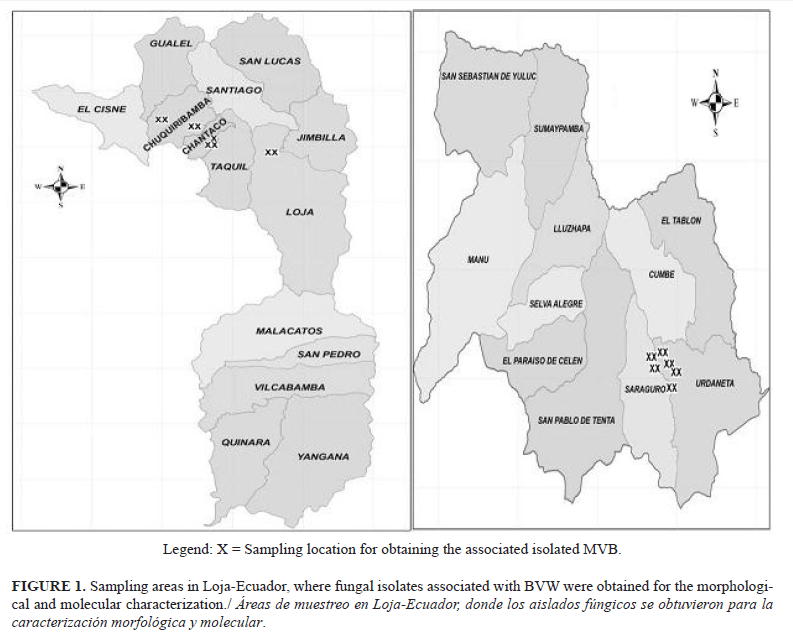
<body><![CDATA[<p style="margin-top:12.0pt;text-align:justify;"><strong><span style="font-family:'Verdana','sans-serif'; font-size:10.0pt; ">&nbsp;</span></strong></p>     <p align="justify"><font size="3" face="Verdana, Arial, Helvetica, sans-serif"><b>MATERIALS AND METHODS</b></font></p>     <p align="justify"><font size="2" face="Verdana, Arial, Helvetica, sans-serif"><b>Sample collection and fungal isolation</b></font></p> </font>     <p align="justify" style="margin-top:12.0pt;text-align:justify;"><font size="2" face="Verdana, Arial, Helvetica, sans-serif">Samples were collected in areas with the highest  production of babaco in the province of Loja from January to March 2013. Each  area was georeferenced using a Global Positioning System (GPS). Samples were  taken in the cantons Loja (locations: Amable Maria, El Carmelo, Chantaco,  Reymincha, Gonzabal, and La Retama) and Saraguro (locations: Cochapamba,  Tuncarta, Quisquinchir, and Las Lagunas) (<a href="/img/revistas/rpv/v31n3/f0105316.gif">Figure 1</a>).</font></p>     
<p align="justify" style="margin-top:12.0pt;text-align:justify;"><font size="2" face="Verdana, Arial, Helvetica, sans-serif"><span style="font-family:'Verdana','sans-serif'; font-size:10.0pt; ">Nine samples of root rots of babaco were collected  from the canton of Loja, which is located between the geographical coordinates  03&deg;39&rsquo;55&rdquo; to 04&deg;30&rsquo;38&rdquo; south latitude and 79&deg;05&rsquo;58&rdquo; to 79&deg;32</span><span style="line-height:107%; font-family:'Arial','sans-serif'; font-size:10.0pt; ">&#697;</span><span style="font-family:'Verdana','sans-serif'; font-size:10.0pt; ">48&rdquo; west longitude, with a height of 2 100 mosl; the  temperature varies between 16 and 21&deg;C. Twelve samples of root rots of babaco were taken from the canton of  Saraguro. It is located between the geographical coordinates 03&deg;31&rsquo;38&rsquo;&rsquo; to  04&deg;30&rsquo;20&rsquo;&rsquo; south latitude 79&deg;43&rsquo;41&rsquo;&rsquo; to 80&deg;60&rsquo;30&rsquo;&rsquo;, with an altitude between 2  000 to 3 500 mosl; the temperature varies between 15 and 20&deg;C (16).</span></font></p>     <p align="justify" style="margin-top:12.0pt;text-align:justify;"><font size="2" face="Verdana, Arial, Helvetica, sans-serif">Plants with chlorosis in the lower leaves and rotting  at the stem base were selected. They were cut transversely to check vascular  stem discoloration (wine-coloured). Root samples and symptomatic stems were  packed in Ziploc bags for further analysis in the plant pathology laboratory at  the National University of Loja.</font></p>     <p align="justify" style="margin-top:12.0pt;text-align:justify;"><font size="2" face="Verdana, Arial, Helvetica, sans-serif">Isolation and identification of <em>Fusarium</em> spp.  was performed using the following protocol: roots of plants were washed with  tap water until they were free of soil. Subsequently, plant tissue of the  affected parts of stems and roots were selected and cut into sections of 0.3 to  0.5 cm length. The samples were disinfected in sodium hypochlorite (NaClO) at  2.5% for two minutes, in 70% alcohol for one minute, and rinsed three times in  sterile distilled water for one minute. This procedure aims to eliminate those  saprophytes and non-pathogenic microorganisms which are found on the plant  tissue surface.</font></p>     <p align="justify" style="margin-top:12.0pt;text-align:justify;"><font size="2" face="Verdana, Arial, Helvetica, sans-serif">Five sections of the affected plant tissue were  selected and placed inside Petri dishes (90 X 15 mm) containing PDA medium  (Potato 200 g, Dextrose 20 g, Agar 20 g, distilled sterile water 1000 ml; pH  5.5). The plates were then sealed with Parafilm&reg; and incubated at 28&deg;C for 48  hours at 28&deg;C according to Leslie and Summerell (10). Monosporic isolation was  done and the fungi were preserved in mineral oil.</font></p> <font size="2" face="Verdana, Arial, Helvetica, sans-serif">     <p align="justify"><font size="2" face="Verdana, Arial, Helvetica, sans-serif"><b>Morphological and cultural characterization</b></font></p> </font>     <p align="justify" style="margin-top:12.0pt;text-align:justify;"><font size="2" face="Verdana, Arial, Helvetica, sans-serif">The morphological characterization of isolates of <em>Fusarium</em> spp. was performed with the keys proposed by Barnett and Hunter (17), Watanabe  (18), and Leslie and Summerell (10), which consisted in determining various  characteristic parameters such as: type of mycelium, colony color (surface and  reverse) according to the Chart of&nbsp;  Rayner (19), radial growth rate, and the observation, quantification,  and measurement of the reproductive structures.</font></p>     ]]></body>
<body><![CDATA[<p align="justify" style="margin-top:12.0pt;text-align:justify;"><font size="2" face="Verdana, Arial, Helvetica, sans-serif">For measuring the radial growth speed, 2 mm discs of  each fungal isolate were placed in the center of four Petri dishes&nbsp; with PDA medium. . The dishes were sealed and  incubated at 28&deg;C in digital incubator (Poleko Series: SN5SE111205, Poland).  The radial growth rate calculation (RGR mm.day-1) was performed by comparing  the growth at the eighth day of the trial. The RGR was calculated using the  formula proposed by Subhani <em>et al.</em> (20):</font></p> <font size="2" face="Verdana, Arial, Helvetica, sans-serif">     <p align="center" ><a name="e1"></a></p>     <p align="center" ><img src="../img/revistas/rpv/v31n3/e0105316.gif" width="151" height="75"></p> </font>     <p align="justify" style="margin-top:12.0pt;text-align:justify;"><font size="2" face="Verdana, Arial, Helvetica, sans-serif">Where: RGR: Radial growth rate; Fg: Final growth  (diameter in mm); Ig: Initial growth (diameter in mm); Et: End time (days); St:  Start time (days).</font></p>     <p align="justify" style="margin-top:12.0pt;text-align:justify;"><font size="2" face="Verdana, Arial, Helvetica, sans-serif">The values of the initial (Ig) and final (Fg) growth  and the start (St) and end time (Et) corresponded to the difference between one  day of growth and the time elapsed. Isolates were grouped considering the  categories of growth: slow (10 mm/day), medium (&gt; 10-12 mm/day), and fast  (&gt; 12 mm/day) (21).&nbsp; </font></p>     <p align="justify" style="margin-top:12.0pt;text-align:justify;"><font size="2" face="Verdana, Arial, Helvetica, sans-serif">In addition, the measurement and characterization of  the reproductive structures (micro and microconidia) were done. Microcultures  of each isolate were incubated at 28&deg;C for 72 hours. After the incubation time,  the samples were observed using optical microscopy (Olympus Series: 1D81617,  Germany).&nbsp; One hundred (100) microconidia  and 100 macroconidia were randomly taken to determine their average size (30).  The conidia were counted in each of the isolates by using the quadrant counting  method in the Neubauer chamber with a magnification of 40 X for calculating of  final concentration of colony forming units ml<sup>-1 </sup>(CFU) (22). </font></p>     <p align="justify" style="margin-top:12.0pt;text-align:justify;"><font size="2" face="Verdana, Arial, Helvetica, sans-serif">Identification of the fungal genus was according to  Barnett and Hunter (17), Watanabe (17) Leslie and Summerell (10).</font></p>     <p align="justify" style="margin-top:12.0pt;text-align:justify;"><font size="2" face="Verdana, Arial, Helvetica, sans-serif">The statistical analysis was performed with the use  of the Statgraphic Centurion v.16.1 package. For analysis of RGR,  quantification and reproductive structures, measurements were carried out in a  completely randomized experimental design with four replications. Differences  between isolates were analysed by statistical One Way Anova and Tukey HSD test  with a confidence probability of p &lt;0.05.</font></p> <font size="2" face="Verdana, Arial, Helvetica, sans-serif">     <p align="justify"><font size="2" face="Verdana, Arial, Helvetica, sans-serif"><b>Molecular characterization</b></font></p> </font>     <p align="justify" style="margin-top:12.0pt;text-align:justify;"><font size="2" face="Verdana, Arial, Helvetica, sans-serif">The DNA extraction was performed from  axenic-monosporic cultures, according with the methodology proposed by  Rojas-Trivi&ntilde;o (22) with slight modifications. Single spore isolates were  inoculated in PDB (potato dextrose broth) (two Erlenmeyer flasks 250 ml per isolate),  two mycelial discs (5 mm in diameter) with active growth were used for  inoculation.</font></p>     ]]></body>
<body><![CDATA[<p align="justify" style="margin-top:12.0pt;text-align:justify;"><font size="2" face="Verdana, Arial, Helvetica, sans-serif">The Erlenmeyer flasks were placed in an orbital  shaker (Thermo Scientific, IGS60 Germany) at 28&deg;C, constant agitation at 250  rpm for seven days. The harvest of mycelia was done under laminar flow chamber.  Filtering was performed with sterile filter paper Whatman # 1 on a glass  funnel. The filter paper with the mycelium was placed in a Petri dish for two  hours to ensure drying and maceration. The resulting powder maceration was  placed in 2 ml tubes (eppendorf).</font></p>     <p align="justify" style="margin-top:12.0pt;text-align:justify;"><font size="2" face="Verdana, Arial, Helvetica, sans-serif">The fungal DNA was extracted using Purelink Plant  Extraction Kit Quick Gel Extraction, Invitrogen TM, (Catalogue K1830-01)  according to the manufacturer&rsquo;s specifications. The extraction product was then  analysed by gel electrophoresis on 1% agarose (one g of agarose in 100 ml of 1X  TBE buffer).</font></p>     <p align="justify" style="margin-top:12.0pt;text-align:justify;"><font size="2" face="Verdana, Arial, Helvetica, sans-serif">An internal fragment of ITS (Internal Transcribed  Spacer) regions was amplified using the specific primers for Fusarium reported  by Abd-Elsalam et al. (12): ITS-Fu-Fwd (5`-CAACTCCCAAACCCCTGTGA-3`) e  ITS-Fu-Rev (5`-CGACGATTACCAGTAACGA-3`). PCR amplification contained a final  volume of 50&mu;L: 34&mu;L MilliQ water, 5 &mu;L of dNTPs (2 mM each), 5 &mu;l of 10X  PCR-buffer, 1.5 &mu;l of each primer (ITS-fuf/ITS-fur) 1.8 &mu;l of MgCl2, 0.2 &mu;l Taq  DNA polymerase, 1 &mu;l of extracted DNA. Amplifications were performed with a first  cycle of 2 min at 95&deg;C for denaturation, 30 cycles of amplification (1 min at  94&deg;C, 30 s at 54&deg;C and 1 min at 72&deg;C), and a final extension at 72&deg;C for 5 min.</font></p>     <p align="justify" style="margin-top:12.0pt;text-align:justify;"><font size="2" face="Verdana, Arial, Helvetica, sans-serif">All Polymerase Chain Reactions (PCR) were done in a  thermocycler (BioRad serial 583BR01218), amplifications were checked by gel  electrophoresis on a 0.7% agarose (1 g of agarose in 150 ml of TAE buffer 1X)  with 115 V for 45 min. The gel was stained with 1 ml of ethidium bromide (10 mg  ml-1) and bands were visualized on a UV transilluminator according to the  procedure of Abd-Elsalam et al. (12).</font></p> <font size="2" face="Verdana, Arial, Helvetica, sans-serif">     <p align="justify"><font size="2" face="Verdana, Arial, Helvetica, sans-serif"><b>Sequencing of the amplified ITS fragments</b></font></p> </font>     <p align="justify" style="margin-top:12.0pt;text-align:justify;"><font size="2" face="Verdana, Arial, Helvetica, sans-serif">The PCR product was verified by 0.7% agarose gel  electrophoresis (band of 400 bp) and the sample was directly purified without  removing the gel bands, using a purification kit (Purelink PCR Quick Gel  Extraction and Purification, Invitrogen (Catalogue K220001)). Sequencing was  performed by capillary electrophoresis and PCR product samples were sent to the  Catholic University of Leuven, Belgium, where the sequencing reactions were  performed with the same primers used for amplification. </font></p>     <p align="justify" style="margin-top:12.0pt;text-align:justify;"><font size="2" face="Verdana, Arial, Helvetica, sans-serif">An automatic sequencer Applied Biosystem 3100 was  used. Nucleotide sequence assembly and alignment were performed with the Codon  Code Aligner program and compared with a search for homologous sequences using  the BLAST-N program and algorithm MEGABLAST (23), on the basis data NCBI gene  bank (National Center for Biotechnology Information <u style="text-underline:thick;"><a href="http://www.ncbi.nlm.nih.gov" target="_blank">http://www.ncbi.nlm.nih.gov</a></u>).</font></p> <font size="2" face="Verdana, Arial, Helvetica, sans-serif">     <p style="margin-top:12.0pt;text-align:justify;"><strong><span style="font-family:'Verdana','sans-serif'; font-size:10.0pt; ">&nbsp;</span></strong></p>     <p align="justify"><font size="3" face="Verdana, Arial, Helvetica, sans-serif"><b>RESULTS AND DISCUSSION</b></font></p>     <p align="justify"><font size="2" face="Verdana, Arial, Helvetica, sans-serif"><b>Morphological and cultural characterization of  fungal isolates from babaco</b></font></p> </font>     ]]></body>
<body><![CDATA[<p align="justify" style="margin-top:12.0pt;text-align:justify;"><font size="2" face="Verdana, Arial, Helvetica, sans-serif">A total of 21 fungal isolates were obtained from the  of roots and stems with symptoms of root rot disease associated with BVW. All  isolates showed highly variable macroscopic cultural characteristics, mainly in  the pigmentation of the PDA culture medium. The color of the colony surface was  white or predominantly white magenta (41.67%) and of the colony reverse was  predominantly purple, purple or whitish yellow (25%), pink or magenta pink  (25%) and white or yellowish white (25%) (<a href="/img/revistas/rpv/v31n3/t0105316.gif">Table 1</a>).</font></p>     
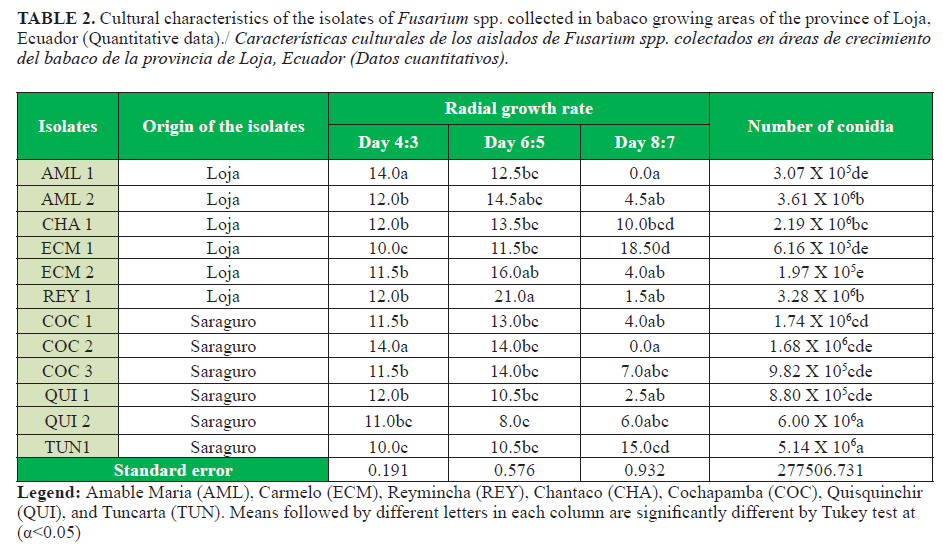
<p align="justify" style="margin-top:12.0pt;text-align:justify;"><font size="2" face="Verdana, Arial, Helvetica, sans-serif"><span style="font-family:'Verdana','sans-serif'; font-size:10.0pt; ">Almost 75% of all isolates showed a type copious or  floccose mycelium.&nbsp; According to the  radial growth rate&nbsp; AML1 and COC2 were  fast growing isolates, which covered the Petri dish completely before the last  evaluation period (<a href="/img/revistas/rpv/v31n3/t0205316.gif">Table 2</a>).</span> </font></p>     
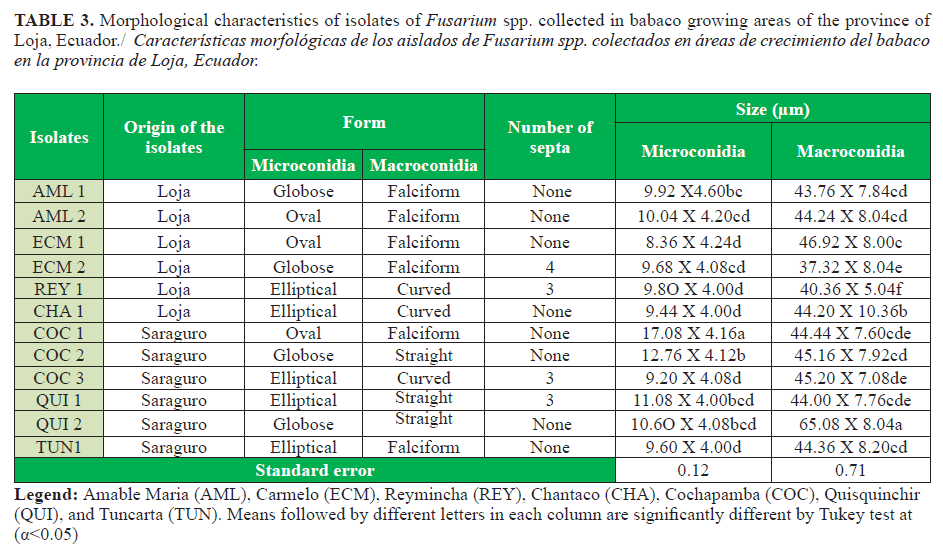
<p align="justify" style="margin-top:12.0pt;text-align:justify;"><font size="2" face="Verdana, Arial, Helvetica, sans-serif">Isolates QUI2 (Quisquinchir) and TUN1 (Tuncarta)  produced the longest conidia, both isolates belonged to the canton of Saraguro.  Therefore, there was variability in this parameter among the isolates obtained  (<a href="/img/revistas/rpv/v31n3/t0305316.gif">Table 3</a>). A great variability was observed among the twelve isolates, which  suggested the possible coexistence of&nbsp;  several <em>Fusarium</em> species in the same lesions.</font></p>     
<p align="justify" style="margin-top:12.0pt;text-align:justify;"><font size="2" face="Verdana, Arial, Helvetica, sans-serif">The twelve isolates associated with MVB showed  hyaline, globose, oval or elliptical microconidia. None of the conidia showed  septa, and they were 17.08 to 8 36 X 4.60 to 4.0 &micro;m (length x width). In  addition, all isolates showed hyaline macroconidia boat shaped, curved or  straight pointed at the ends with 65.08 to 37.32 X 8.20 to 5.04 &micro;m (length x  width). It should be noted that the great majority of the isolates showed  macroconidia without septa, except the isolates ECM 2, REY1, COC 3, and QUI 1,  in which 3-4 septa were observed (<a href="/img/revistas/rpv/v31n3/t0305316.gif">Table 3</a>). </font></p>     
<p align="justify" style="margin-top:12.0pt;text-align:justify;"><font size="2" face="Verdana, Arial, Helvetica, sans-serif">Based on the morphological and cultural  characteristics, the twelve fungal isolates associated with VWB sampled in  different agroclimatic zones of Loja province belonged to several species of  Fusarium spp. Ochoa and Fonseca (24) reported F. oxysporum isolates from babaco  tissues showing a cottony mycelium and a typical pale-pink to purplish  discoloration of the species when it sporulated. On the other hand, according  to Leslie and Summerell (10), <em>F. oxysporum</em> mycelium produces dark purple  or dark magenta pigments when is grown on PDA medium, never clear or whitish  yellow. However, the pigmentation observed by Dubey <em>et al. </em>&nbsp;(21) was violet, yellow and grey. Furthermore,  Shahnazi et al. (25) reported<em> F. solani </em>isolates from black pepper  producing pigmentation that was cream, white or whitish cream, wine, coffee,  black, and grey. In our study, the different isolates of <em>Fusarium</em> produced pigmentation with different colors such as purple, purple or whitish  yellow, pink or magenta pink, and white or yellowish white, mainly in the  centre of the colony. This result showed a great variability among different  isolates of <em>Fusarium </em>associated with babaco vascular wilt.</font></p>     <p align="justify" style="margin-top:12.0pt;text-align:justify;"><font size="2" face="Verdana, Arial, Helvetica, sans-serif">Ochoa and Fonseca (3) and Irzykowska <em>et al.</em> (26), argued that <em>F. oxysporum</em> was the causal agent of BVW, which had a  rich mycelium (cottony or floccose). On the contrary, the descriptions by Dubey <em>et al.</em> (21) assert that <em>F. oxysporum</em> is a predominantly floccose  mycelium. Conversely, Lezcano <em>et al.</em> (26) and Shahnazi et al. (24)  reported that <em>Fusarium</em> species had an aerial mycelium, and sometimes  plush. In our study, the results based on the type of mycelium of <em>Fusarium</em> agreed with those reported by the first three authors above cited; moreover,  the results concerning the morphological diversity of the isolates obtained in  the present study suggested the presence of various <em>Fusarium </em>species  including in the species <em>F. oxysporum.</em></font></p>     <p align="justify" style="margin-top:12.0pt;text-align:justify;"><font size="2" face="Verdana, Arial, Helvetica, sans-serif">Variability was also observed among isolates in the  daily mycelial growth, which might be caused by nutrient defficiency (5). The  macroconidia were less abundant compared with the microconidia. Morphology of  these structures varied and the sickle, curved, and straight shapes were the  most frequent. Most isolates showed microconidia without septa, except the  isolates El Carmelo 2 (ECM 2) and Reymincha (REY 1). The microconidia were  globular, oval,&nbsp; and elliptical to oval.  The macro and microconidia size were outside the range informed by Watanabe  (17) and Leslie and Summerell (10), with an average of (29,1-45 &micro;m x 2,9-4,7  &micro;m) for <em>F. oxysporum</em> macro and microconidia, which suggested thar other  species of the genus might be present (<a href="/img/revistas/rpv/v31n3/t0305316.gif">Table 3</a>).</font></p>     
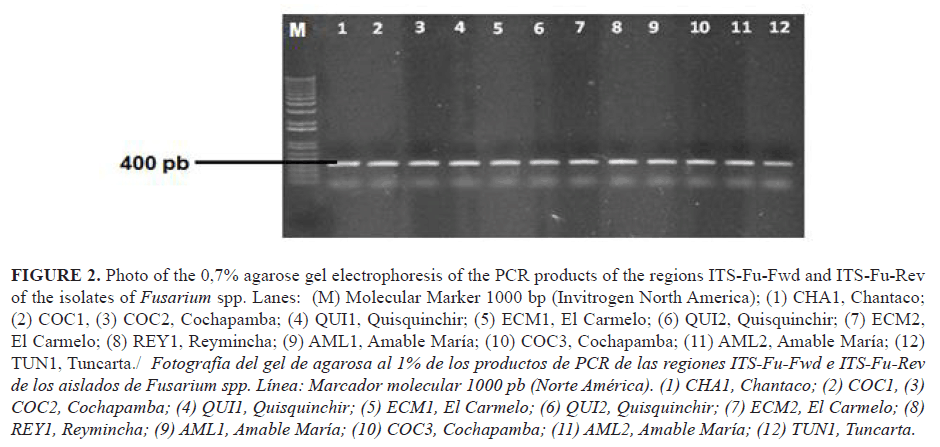
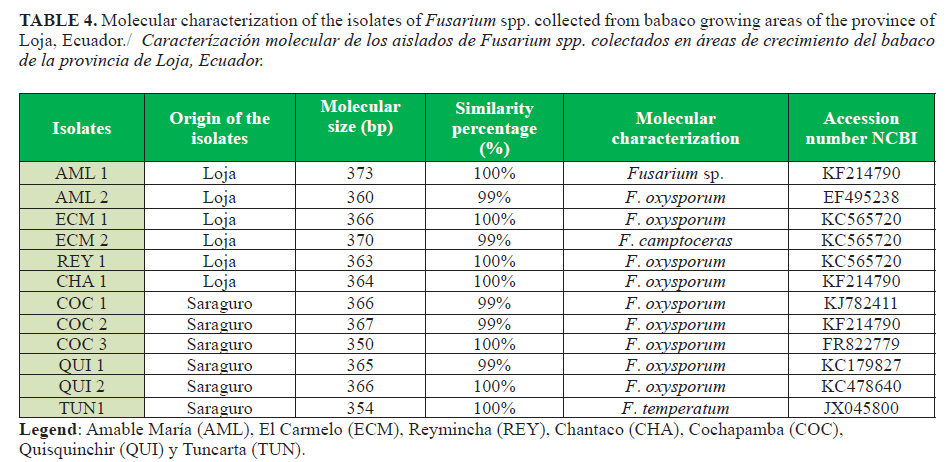
<p align="justify" style="margin-top:12.0pt;text-align:justify;"><font size="2" face="Verdana, Arial, Helvetica, sans-serif">Similarly, C&oacute;rdova-Albores <em>et</em> <em>al</em>. (11)  reported that the morphological characteristics of the species of <em>Fusarium</em> spp. isolated from gladiolus corms were greatly variable. The macroconidia  showed varied forms: papillate, blunt, hooked, and foot shaped. Likewise, the  microconidia were oval, reniform, pyriform, and globose. The great variability  in macroconidia size (87,51 to 82,54 &micro;m x 50,50 to 48,72 &micro;m), with three to  four septa, was evident, and the microconidia were non-septate or with one  septum. Similar results were observed in the present study.</font></p>     <p align="justify" style="margin-top:12.0pt;text-align:justify;"><font size="2" face="Verdana, Arial, Helvetica, sans-serif">The twelve isolates associated with BVW identified  by their cultural and morphological characteristics were analized for  identification by using&nbsp; molecular  techniques&nbsp; PCR products of approximety  400 bp were obtained (<a href="/img/revistas/rpv/v31n3/f0205316.gif">Figure 2</a>). Comparative analysis of sequenced ITS region  showed an identity of 99 to 100% with isolates of <em>Fusarium</em> spp. from the  Genbank. According to the sequence homology, four species of <em>Fusarium</em> (<em>F</em>. <em>camptoceras</em>, <em>F</em>. <em>temperatum</em>, <em>F</em>. <em>oxysporum,</em> and <em>Fusarium</em> sp.) were identified (<a href="/img/revistas/rpv/v31n3/t0405316.gif">Table 4</a>).</font></p>     
<p align="justify" style="margin-top:12.0pt;text-align:justify;"><font size="2" face="Verdana, Arial, Helvetica, sans-serif">Based on this result, Abd-Elsalam <em>et</em> <em>al</em>.  (12) used the primers ITS1 and ITS4 to identify <em>F</em>. <em>oxysporum</em> f.  sp. <em>vasinfectum</em>, <em>F</em>. <em>oxysporum</em>, <em>Fusarium</em> <em>moniliforme,</em> and <em>F</em>. <em>solani</em>, and they obtained bands with molecular size from  550 to 570 bp,&nbsp; results which did not  agree with the those obtained in the present work. Nevertheless, these authors  did not perform sequencing of the PCR products. Similarly, Abd-Elsalam <em>et</em> <em>al</em>. (12) designed the specific primers ITS-Fu-Fwd and Rev ITS-Fu-Rev for  a rapid identification of <em>Fusarium</em>.&nbsp;  These primers showed high specificity for amplifying a <em>Fusarium</em> region with a molecular size of 389 bp. In this research, the PCR products  obtained with these primers showed an&nbsp;  estimated molecular size of 400 bp (<a href="/img/revistas/rpv/v31n3/t0405316.gif">Table 4</a>).</font></p>     
]]></body>
<body><![CDATA[<p align="justify" style="margin-top:12.0pt;text-align:justify;"><font size="2" face="Verdana, Arial, Helvetica, sans-serif">In addition, the studies conducted by  C&oacute;rdova-Albores <em>et</em> <em>al</em>. (2014) using the universal primers ITS 1,  ITS2, and ITS5 to identify species of <em>Fusarium</em> (<em>F</em>. <em>oxysporum</em>, <em>F</em>. <em>solani,</em> and <em>F</em>. <em>proliferatum</em>) from gladiolus,  showed bands with a molecular size of 500 bp . Furthermore, they also used  specific primers (ITS-Fu-Fwd and ITS-Fu-Rev) for identification of species of <em>Fusarium</em>,  which had a molecular size of approximately 410-429 bp. These results are  within the range observed&nbsp; in our  research.</font></p>     <p align="justify" style="margin-top:12.0pt;text-align:justify;"><font size="2" face="Verdana, Arial, Helvetica, sans-serif">Therefore, of the twelve molecularly characterized  isolates, only 11 corresponding to <em>F</em>. <em>camptoceras</em>, <em>F</em>. <em>temperatum</em>,  or <em>F</em>. <em>oxysporum</em> could be identified. The remaining isolate showed  similarity to align the BLAST 100% and it was identified as <em>Fusarium</em>.  sp. It was evident that using the molecular tools used in this research allowed  the identification of microorganisms, integrating morphological, cultural, and  molecular data. Future studies will help the understanding of the pathogenic  mechanisms allowing the development of integrated strategies for a more  effective and environmentally friendly management (27).</font></p>     <p align="justify" style="margin-top:12.0pt;text-align:justify;"><font size="2" face="Verdana, Arial, Helvetica, sans-serif">In the present study, the cultural, morphological  and molecular characterization determined showed great variability among  species of <em>Fusarium</em> spp. reporting new species of <em>Fusarium</em> (<em>F</em>. <em>camptoceras</em>, <em>F</em>. <em>temperatum</em>, <em>F</em>. <em>oxysporum,</em> and <em>Fusarium</em> sp.) associated with vascular wilt of babaco (BVW) in  southern Ecuador. </font></p> <font size="2" face="Verdana, Arial, Helvetica, sans-serif">     <p style="margin-top:12.0pt;text-align:justify;"><strong><span style="font-family:'Verdana','sans-serif'; font-size:10.0pt; ">&nbsp;</span></strong></p>     <p align="justify"><font size="3" face="Verdana, Arial, Helvetica, sans-serif"><b>CONCLUSIONS</b></font></p>     <p align="justify" style="margin-top:12.0pt;text-align:justify;">From 21 samples from babaco roots associated with  BVW in Loja province and based on the cultural and morphological  characteristics of fungal isolates, we identified 12 isolates belonging to the  genus <em>Fusarium</em> spp. on wilting babaco plants. Likewise, based on the  molecular features, four groups of species of the genus <em>Fusarium</em> (nine  isolates of <em>F</em>. <em>oxysporum</em>, one isolate of <em>F</em>. <em>camptoceras</em>,  one isolate of <em>F</em>. <em>temperatum</em>, and one of <em>Fusarium</em> sp.)  were identified. This is the first report about the interaction of these four <em>Fusarium</em> species, which cause the BVW disease. </p>     <p style="margin-top:12.0pt;text-align:justify;"><strong><span style="font-family:'Verdana','sans-serif'; font-size:10.0pt; ">&nbsp;</span></strong></p>     <p align="justify"><font size="3" face="Verdana, Arial, Helvetica, sans-serif"><b>ACKNOWLEDGMENTS</b></font></p>     <p style="margin-top:12.0pt;text-align:justify;">The authors acknowledge the National University of  Loja, the Flemish University Council (VLIR) of Belgium and Secretar&iacute;a Nacional  de Ciencia, Tecnolog&iacute;a e Innovaci&oacute;n (SENESCYT) for the financial support to  conduct this study. To Dr. Roldan Torres Guti&eacute;rrez and Dr. Aminael S&aacute;nchez  Rodr&iacute;guez for their contribution to the conduction of the research.</p>     <p style="margin-top:12.0pt;text-align:justify;"><strong><span style="font-family:'Verdana','sans-serif'; font-size:10.0pt; ">&nbsp;</span></strong></p>     ]]></body>
<body><![CDATA[<p align="justify"><font size="3" face="Verdana, Arial, Helvetica, sans-serif"><b>REFERENCES</b></font></p> </font>     <!-- ref --><p align="justify" style="margin-top:12.0pt;text-align:justify;"><font size="2" face="Verdana, Arial, Helvetica, sans-serif">1. Bravo C, Larriva W, Minchala L. Manejo integrado  de la marchitez o fusariosis (<em>Fusarium oxysporum</em>) en el cultivo del  babaco. Quito, Ecuador: Instituto Nacional Aut&oacute;nomo de Investigaciones  Agropecuarias. 2012: 17.    </font></p>     <!-- ref --><p align="justify" style="margin-top:12.0pt;text-align:justify;"><font size="2" face="Verdana, Arial, Helvetica, sans-serif">2. Garc&iacute;a P. Evaluaci&oacute;n de la tolerancia de cinco  accesiones de Vasconcelleas a <em>Fusarium</em> sp. como posible portainjertos  para babaco (<em>Vasconcelleae</em> x <em>heilbornii</em>) bajo cubierta pl&aacute;stica  en la estaci&oacute;n experimental del austro de INIAP. [Tesis presentada en opci&oacute;n al  t&iacute;tulo de Magister en Gesti&oacute;n de la Producci&oacute;n de Flores y Frutas Andinas para  Exportaci&oacute;n] Universidad T&eacute;cnica de Ambato. Ecuador. 2011; 74 pp.    </font></p>     <!-- ref --><p align="justify" style="margin-top:12.0pt;text-align:justify;"><font size="2" face="Verdana, Arial, Helvetica, sans-serif">3. Ochoa J, Fonseca G, Ellis M. First report of <em>Fusarium</em> wilt of Babaco (<em>Carica</em>&times; <em>heilbornii</em> var. <em>pentagona</em>) in  Ecuador. Plant Disease.  2000;84(2):199.    </font></p>     <!-- ref --><p align="justify" style="margin-top:12.0pt;text-align:justify;"><font size="2" face="Verdana, Arial, Helvetica, sans-serif">4. Argotti E, Cazar M, Motte E, Cede&ntilde;o V. An&aacute;lisis  molecular de la regi&oacute;n ITS de <em>Fusarium</em> spp., agente causal de la  marchitez vascular de <em>Vasconcellea heilbornii</em> y <em>Solanum quiotense</em> en Ecuador. ESPE Ciencia y Tecnolog&iacute;a. 2011;3(1):25-36.    </font></p>     <!-- ref --><p align="justify" style="margin-top:12.0pt;text-align:justify;"><font size="2" face="Verdana, Arial, Helvetica, sans-serif">5. Agrios GN. Plant Pathology. 5th ed. United States  of America: Elsiever; 2005; 534-550.    </font></p>     <!-- ref --><p align="justify" style="margin-top:12.0pt;text-align:justify;"><font size="2" face="Verdana, Arial, Helvetica, sans-serif">6. Nelson P, Toussoun T, Morasas W. <em>Fusarium</em> species: An Illustred Manual for Identification. Pennsylvania, United States of  America: Pennsylvania State University Press; 1983; 193.    </font></p>     <!-- ref --><p align="justify" style="margin-top:12.0pt;text-align:justify;"><font size="2" face="Verdana, Arial, Helvetica, sans-serif">7. Ochoa J, Yangari B, Ellis M, Williams R. Dos nuevas <em>formae</em> <em>specialis</em> de <em>Fusarium</em> <em>oxysporum</em> causantes de  la marchitez vascular del babaco (<em>Carica heilbornii</em> var. <em>pentagona</em>)  y de la marchitez vascular de la naranjilla (<em>Solanum</em> <em>quitoense</em>)  en Ecuador. Fitopatolog&iacute;a. 2004;39(1):10-17.    </font></p>     <!-- ref --><p align="justify" style="margin-top:12.0pt;text-align:justify;"><font size="2" face="Verdana, Arial, Helvetica, sans-serif">8. Quillay N. Determinaci&oacute;n de la capacidad  embriog&eacute;nica de babaco (<em>Vasconcelleae</em> x <em>heilbornii</em>) a partir de  &oacute;vulos y hojas multiplicadas in vitro v&iacute;a embriog&eacute;nesis som&aacute;tica. [Tesis  presentada en opci&oacute;n al t&iacute;tulo de Magister en Gesti&oacute;n de la Producci&oacute;n de  Flores y Frutas Andinas para Exportaci&oacute;n] Universidad T&eacute;cnica de Ambato.  Ecuador. 2011; 114 pp.    </font></p>     <!-- ref --><p align="justify" style="margin-top:12.0pt;text-align:justify;"><font size="2" face="Verdana, Arial, Helvetica, sans-serif">9. Biswas S, Pandey N, Rajik M. Inductions of  defense response in tomato against <em>Fusarium </em>wilt through inorganic  chemicals as inducers. J Plant Pathol Microb. 2012;3(4):3-4.    </font></p>     <!-- ref --><p align="justify" style="margin-top:12.0pt;text-align:justify;"><font size="2" face="Verdana, Arial, Helvetica, sans-serif">10. Leslie JF, Summerell BA. The <em>Fusarium</em> Laboratory Manual. United States of America: Blackwell. 2006; 387.    </font></p>     <!-- ref --><p align="justify" style="margin-top:12.0pt;text-align:justify;"><font size="2" face="Verdana, Arial, Helvetica, sans-serif">11. C&oacute;rdova L, Bautista S, Mart&iacute;nez J, Barrera L,  Hern&aacute;ndez M, Cruz A. Morphological and molecular characterization of pathogenic  isolates of <em>Fusarium</em> spp. obtained from gladiolus corms and their  sensitivity to <em>Jatropha curcas</em> L. oil. Afr J Microbiol Res.  2014;8(8):724-733.    </font></p>     <!-- ref --><p align="justify" style="margin-top:12.0pt;text-align:justify;"><font size="2" face="Verdana, Arial, Helvetica, sans-serif">12. Abd-Elsalam KA, Aly IN, Abdel-Satar MA, Khalil  MS, Verreet JA. PCR identification of <em>Fusarium</em> genus based on nuclear  ribosomal-DNA sequence data. Afr J Biotechnol. 2004;2(4):82-85.    </font></p>     <!-- ref --><p align="justify" style="margin-top:12.0pt;text-align:justify;"><font size="2" face="Verdana, Arial, Helvetica, sans-serif">13. Hafizi R, Salleh B, Latiffah Z. Morphological and  molecular characterization of <em>Fusarium solani</em> and <em>Fusarium oxysporum</em> associated with crown disease of oil palm. Brazilian Journal of Microbiology.  2013;44(3):959-968.    </font></p>     <!-- ref --><p align="justify" style="margin-top:12.0pt;text-align:justify;"><font size="2" face="Verdana, Arial, Helvetica, sans-serif">14. Zhao B, Yan J, Zhang S, Liu X, Gao Z. Phylogeny  and pathogenicity of <em>Fusarium</em> spp. isolated from greenhouse melon soil  in Liaoning Province. Saudi Journal of Biological Sciences. 2014;21(4):374-379.    </font></p>     <!-- ref --><p align="justify" style="margin-top:12.0pt;text-align:justify;"><font size="2" face="Verdana, Arial, Helvetica, sans-serif">15. White TJ, Bruns T, Lee S, Taylor J. Amplification  and direct sequencing of fungal ribosomal RNA genes for phylogenetics. PCR  protocols: a guide to methods and applications. 1990;18:315-22.    </font></p>     <!-- ref --><p align="justify" style="margin-top:12.0pt;text-align:justify;"><font size="2" face="Verdana, Arial, Helvetica, sans-serif">16. Scheldeman X.&nbsp;  Distribution and potential of Cherimoya (<em>Annona cherimola</em> Mill.)  and highland papayas (<em>Vasconcelleae</em> spp.) in Ecuador. [Tesis presentada  en opci&oacute;n al grado cient&iacute;fico de Doctor in Applied Biological Sciences].  Faculty of Agricultural and Applied Biological Sciences. Ghent University.  Belgium. 190 p.    </font></p>     <!-- ref --><p align="justify" style="margin-top:12.0pt;text-align:justify;"><font size="2" face="Verdana, Arial, Helvetica, sans-serif">17. Barnett H, Hunter BB. Illustrated genera of  imperfect fungi. 4th ed. MacMillan Publishing Company: United States of  America; 1987; 218.    </font></p>     <!-- ref --><p align="justify" style="margin-top:12.0pt;text-align:justify;"><font size="2" face="Verdana, Arial, Helvetica, sans-serif">18. Watanabe T. Pictorial Atlas of Soil and Seed  Fungi: Morphologies of Cultured Fungi and Key to Species. 2nd ed. United States  of America: CRC Press; 2002; 506.     </font></p>     <!-- ref --><p align="justify" style="margin-top:12.0pt;text-align:justify;"><font size="2" face="Verdana, Arial, Helvetica, sans-serif">19. Rayner RW. A mycological colour chart. 1970; 34  p.    </font></p>     <!-- ref --><p align="justify" style="margin-top:12.0pt;text-align:justify;"><font size="2" face="Verdana, Arial, Helvetica, sans-serif">20. Subhani MN, Talib S, Sahi AL, Hussain S, Iqbal J,  Hussain N. Management of chickpea wilt caused by <em>Fusarium oxysporum</em> f.  sp. <em>ciceris</em> through antagonistic microorganisms. Canadian Journal of  Plant Protection. 2013;1(1):1-6.    </font></p>     <!-- ref --><p align="justify" style="margin-top:12.0pt;text-align:justify;"><font size="2" face="Verdana, Arial, Helvetica, sans-serif">21. Dubey S, Singh SR, Singh B. Morphological and  pathogenic variability of Indian isolates of <em>Fusarium oxysporum</em> f. sp. <em>ciceris</em> causing chickpea wilt. Archives of Phytopathology and Plant Protection.  2010;43(2):174-190.    </font></p>     <!-- ref --><p align="justify" style="margin-top:12.0pt;text-align:justify;"><font size="2" face="Verdana, Arial, Helvetica, sans-serif">22. Rojas-Trivi&ntilde;o A. Conceptos y Pr&aacute;ctica de  Microbiolog&iacute;a General. Palmira, Colombia: Universidad Nacional de Colombia Sede  Palmira. 2011; 161.    </font></p>     <!-- ref --><p align="justify" style="margin-top:12.0pt;text-align:justify;"><font size="2" face="Verdana, Arial, Helvetica, sans-serif">23. Altschul S, Gish W, Miller E, Meyers E, Lipman D.  Basic local alignment search tool. J Mol Biol. 1990;215(3):403-410.    </font></p>     <!-- ref --><p align="justify" style="margin-top:12.0pt;text-align:justify;"><font size="2" face="Verdana, Arial, Helvetica, sans-serif">24. Shahnazi S, Meon S, Vadamalai G, Ahmad K, Nejat  N. Morphological and molecular characterization of <em>Fusarium</em> spp.  associated with yellowing disease of black pepper (<em>Piper nigrum</em> L.) in  Malaysia. J Gen Plant Pathol. 2012;78(3):160-169.    </font></p>     <!-- ref --><p align="justify" style="margin-top:12.0pt;text-align:justify;"><font size="2" face="Verdana, Arial, Helvetica, sans-serif">25. Irzykowska L, Bocianowski J, Waskiewicz A, Weber  Z, Karolewski Z, Golinski P, et al. Genetic variation of <em>Fusarium oxysporum</em> isolates forming fumonisin B1 and moniliformin. J Appl Genetics.  2012;2(53):237-247.    </font></p>     <!-- ref --><p align="justify" style="margin-top:12.0pt;text-align:justify;"><font size="2" face="Verdana, Arial, Helvetica, sans-serif">26. Lezcano J, Mart&iacute;nez B, Alonso O. Caracterizaci&oacute;n  cultural y morfol&oacute;gica e identificaci&oacute;n de diez aislamientos de <em>Fusarium</em> procedentes de semillas de <em>Leucaena leucocephala</em> cv. Per&uacute; almacenadas.  Pastos y Forrajes. 2012;35(2):187-196.    </font></p>     <!-- ref --><p align="justify" style="margin-top:12.0pt;text-align:justify;"><font size="2" face="Verdana, Arial, Helvetica, sans-serif">27. Hill A, Reeves P, Larson R, Fenwick A, Hanson L,  Panella L. Genetic variability among isolates of <em>Fusarium oxysporum</em> from  sugar beet. Plant Pathology. 2011;60(3):496-505.    </font></p>     <!-- ref --><p align="justify" style="margin-top:12.0pt;text-align:justify;"><font size="2" face="Verdana, Arial, Helvetica, sans-serif">28. Mwaniki P, Abang M, Wagara I, Wolukau J, Schroers  H. Morphology, pathogenicity and molecular identification of <em>Fusarium</em> spp. from wilting eggplants in Tanzania. 10th African Crop Science Conference  Proceedings, Maputo, Mozambique, 10-13 October 2011. African Crop Science  Society.    </font></p>     <!-- ref --><p align="justify" style="margin-top:12.0pt;text-align:justify;"><font size="2" face="Verdana, Arial, Helvetica, sans-serif"><span style="font-family:'Verdana','sans-serif'; font-size:10.0pt; ">29. Vengadaramana A, de  Costa D. Morphological and pathogenic variations of the causal organisms of  leaf twister disease of red onion (<em>Allium cepa</em> L.) in Jaffna district of  Sri Lanka. Tropical Agricultural Research. 2014;25(3):412-31</span>.    </font></p> <font size="2" face="Verdana, Arial, Helvetica, sans-serif">     <p>&nbsp;</p>     ]]></body>
<body><![CDATA[<p>&nbsp;</p>     <p><span style="font-family:'Verdana','sans-serif'; font-size:10.0pt"><font size="2" face="Verdana, Arial, Helvetica, sans-serif">Recibido: </font></span><font size="2" face="Verdana, Arial, Helvetica, sans-serif">22/04/<span style="font-family:'Verdana','sans-serif'; font-size:10.0pt">2016    <br>   Aceptado: </span></font><span style="font-family:'Verdana','sans-serif'; font-size:10.0pt">27/10/2016</span></p>     <p>&nbsp;</p> </font> </p>     <p align="justify"><font size="2" face="Verdana, Arial, Helvetica, sans-serif"><i>Angel Robles-Carrión,</i></font> <font size="2" face="Verdana, Arial, Helvetica, sans-serif">Centro de Biotecnolog&iacute;a ,  Universidad Nacional de Loja.    Email: <a href="mailto:correo">anroca1980@gmail.com</a></font></p>      ]]></body><back>
<ref-list>
<ref id="B1">
<label>1</label><nlm-citation citation-type="book">
<person-group person-group-type="author">
<name>
<surname><![CDATA[Bravo]]></surname>
<given-names><![CDATA[C]]></given-names>
</name>
<name>
<surname><![CDATA[Larriva]]></surname>
<given-names><![CDATA[W]]></given-names>
</name>
<name>
<surname><![CDATA[Minchala]]></surname>
<given-names><![CDATA[L]]></given-names>
</name>
</person-group>
<source><![CDATA[Manejo integrado de la marchitez o fusariosis (Fusarium oxysporum) en el cultivo del babaco]]></source>
<year>2012</year>
<page-range>17</page-range><publisher-loc><![CDATA[^eQuito Quito]]></publisher-loc>
<publisher-name><![CDATA[Instituto Nacional Autónomo de Investigaciones Agropecuarias]]></publisher-name>
</nlm-citation>
</ref>
<ref id="B2">
<label>2</label><nlm-citation citation-type="">
<person-group person-group-type="author">
<name>
<surname><![CDATA[García]]></surname>
<given-names><![CDATA[P]]></given-names>
</name>
</person-group>
<article-title xml:lang="es"><![CDATA[Evaluación de la tolerancia de cinco accesiones de Vasconcelleas a Fusarium sp. como posible portainjertos para babaco (Vasconcelleae x heilbornii) bajo cubierta plástica en la estación experimental del austro de INIAP]]></article-title>
<source><![CDATA[]]></source>
<year></year>
<page-range>74</page-range></nlm-citation>
</ref>
<ref id="B3">
<label>3</label><nlm-citation citation-type="journal">
<person-group person-group-type="author">
<name>
<surname><![CDATA[Ochoa]]></surname>
<given-names><![CDATA[J]]></given-names>
</name>
<name>
<surname><![CDATA[Fonseca]]></surname>
<given-names><![CDATA[G]]></given-names>
</name>
<name>
<surname><![CDATA[Ellis]]></surname>
<given-names><![CDATA[M]]></given-names>
</name>
</person-group>
<article-title xml:lang="en"><![CDATA[First report of Fusarium wilt of Babaco (Carica× heilbornii var. pentagona) in Ecuador]]></article-title>
<source><![CDATA[Plant Disease]]></source>
<year>2000</year>
<volume>84</volume>
<numero>2</numero>
<issue>2</issue>
<page-range>199</page-range></nlm-citation>
</ref>
<ref id="B4">
<label>4</label><nlm-citation citation-type="journal">
<person-group person-group-type="author">
<name>
<surname><![CDATA[Argotti]]></surname>
<given-names><![CDATA[E]]></given-names>
</name>
<name>
<surname><![CDATA[Cazar]]></surname>
<given-names><![CDATA[M]]></given-names>
</name>
<name>
<surname><![CDATA[Motte]]></surname>
<given-names><![CDATA[E]]></given-names>
</name>
<name>
<surname><![CDATA[Cedeño]]></surname>
<given-names><![CDATA[V]]></given-names>
</name>
</person-group>
<article-title xml:lang="es"><![CDATA[Análisis molecular de la región ITS de Fusarium spp., agente causal de la marchitez vascular de Vasconcellea heilbornii y Solanum quiotense en Ecuador]]></article-title>
<source><![CDATA[ESPE Ciencia y Tecnología]]></source>
<year>2011</year>
<volume>3</volume>
<numero>1</numero>
<issue>1</issue>
<page-range>25-36</page-range></nlm-citation>
</ref>
<ref id="B5">
<label>5</label><nlm-citation citation-type="book">
<person-group person-group-type="author">
<name>
<surname><![CDATA[Agrios]]></surname>
<given-names><![CDATA[GN]]></given-names>
</name>
</person-group>
<source><![CDATA[Plant Pathology]]></source>
<year>2005</year>
<edition>5</edition>
<page-range>534-550</page-range><publisher-name><![CDATA[Elsiever]]></publisher-name>
</nlm-citation>
</ref>
<ref id="B6">
<label>6</label><nlm-citation citation-type="book">
<person-group person-group-type="author">
<name>
<surname><![CDATA[Nelson]]></surname>
<given-names><![CDATA[P]]></given-names>
</name>
<name>
<surname><![CDATA[Toussoun]]></surname>
<given-names><![CDATA[T]]></given-names>
</name>
<name>
<surname><![CDATA[Morasas]]></surname>
<given-names><![CDATA[W]]></given-names>
</name>
</person-group>
<source><![CDATA[Fusarium species: An Illustred Manual for Identification]]></source>
<year>1983</year>
<page-range>193</page-range><publisher-loc><![CDATA[^ePennsylvania Pennsylvania]]></publisher-loc>
<publisher-name><![CDATA[Pennsylvania State University Press]]></publisher-name>
</nlm-citation>
</ref>
<ref id="B7">
<label>7</label><nlm-citation citation-type="journal">
<person-group person-group-type="author">
<name>
<surname><![CDATA[Ochoa]]></surname>
<given-names><![CDATA[J]]></given-names>
</name>
<name>
<surname><![CDATA[Yangari]]></surname>
<given-names><![CDATA[B]]></given-names>
</name>
<name>
<surname><![CDATA[Ellis]]></surname>
<given-names><![CDATA[M]]></given-names>
</name>
<name>
<surname><![CDATA[Williams]]></surname>
<given-names><![CDATA[R]]></given-names>
</name>
</person-group>
<article-title xml:lang="es"><![CDATA[Dos nuevas formae specialis de Fusarium oxysporum causantes de la marchitez vascular del babaco (Carica heilbornii var. pentagona) y de la marchitez vascular de la naranjilla (Solanum quitoense) en Ecuador]]></article-title>
<source><![CDATA[Fitopatología]]></source>
<year>2004</year>
<volume>39</volume>
<numero>1</numero>
<issue>1</issue>
<page-range>10-17</page-range></nlm-citation>
</ref>
<ref id="B8">
<label>8</label><nlm-citation citation-type="">
<person-group person-group-type="author">
<name>
<surname><![CDATA[Quillay]]></surname>
<given-names><![CDATA[N]]></given-names>
</name>
</person-group>
<article-title xml:lang="es"><![CDATA[Determinación de la capacidad embriogénica de babaco (Vasconcelleae x heilbornii) a partir de óvulos y hojas multiplicadas in vitro vía embriogénesis somática]]></article-title>
<source><![CDATA[]]></source>
<year></year>
<page-range>114</page-range></nlm-citation>
</ref>
<ref id="B9">
<label>9</label><nlm-citation citation-type="journal">
<person-group person-group-type="author">
<name>
<surname><![CDATA[Biswas]]></surname>
<given-names><![CDATA[S]]></given-names>
</name>
<name>
<surname><![CDATA[Pandey]]></surname>
<given-names><![CDATA[N]]></given-names>
</name>
<name>
<surname><![CDATA[Rajik]]></surname>
<given-names><![CDATA[M]]></given-names>
</name>
</person-group>
<article-title xml:lang="en"><![CDATA[Inductions of defense response in tomato against Fusarium wilt through inorganic chemicals as inducers]]></article-title>
<source><![CDATA[J Plant Pathol Microb]]></source>
<year>2012</year>
<volume>3</volume>
<numero>4</numero>
<issue>4</issue>
<page-range>3-4</page-range></nlm-citation>
</ref>
<ref id="B10">
<label>10</label><nlm-citation citation-type="book">
<person-group person-group-type="author">
<name>
<surname><![CDATA[Leslie]]></surname>
<given-names><![CDATA[JF]]></given-names>
</name>
<name>
<surname><![CDATA[Summerell]]></surname>
<given-names><![CDATA[BA]]></given-names>
</name>
</person-group>
<source><![CDATA[The Fusarium Laboratory Manual]]></source>
<year>2006</year>
<page-range>387</page-range><publisher-name><![CDATA[Blackwell]]></publisher-name>
</nlm-citation>
</ref>
<ref id="B11">
<label>11</label><nlm-citation citation-type="journal">
<person-group person-group-type="author">
<name>
<surname><![CDATA[Córdova]]></surname>
<given-names><![CDATA[L]]></given-names>
</name>
<name>
<surname><![CDATA[Bautista]]></surname>
<given-names><![CDATA[S]]></given-names>
</name>
<name>
<surname><![CDATA[Martínez]]></surname>
<given-names><![CDATA[J]]></given-names>
</name>
<name>
<surname><![CDATA[Barrera]]></surname>
<given-names><![CDATA[L]]></given-names>
</name>
<name>
<surname><![CDATA[Hernández]]></surname>
<given-names><![CDATA[M]]></given-names>
</name>
<name>
<surname><![CDATA[Cruz]]></surname>
<given-names><![CDATA[A]]></given-names>
</name>
</person-group>
<article-title xml:lang="en"><![CDATA[Morphological and molecular characterization of pathogenic isolates of Fusarium spp. obtained from gladiolus corms and their sensitivity to Jatropha curcas L. oil]]></article-title>
<source><![CDATA[Afr J Microbiol Res]]></source>
<year>2014</year>
<volume>8</volume>
<numero>8</numero>
<issue>8</issue>
<page-range>724-733</page-range></nlm-citation>
</ref>
<ref id="B12">
<label>12</label><nlm-citation citation-type="journal">
<person-group person-group-type="author">
<name>
<surname><![CDATA[Abd-Elsalam]]></surname>
<given-names><![CDATA[KA]]></given-names>
</name>
<name>
<surname><![CDATA[Aly]]></surname>
<given-names><![CDATA[IN]]></given-names>
</name>
<name>
<surname><![CDATA[Abdel-Satar]]></surname>
<given-names><![CDATA[MA]]></given-names>
</name>
<name>
<surname><![CDATA[Khalil]]></surname>
<given-names><![CDATA[MS]]></given-names>
</name>
<name>
<surname><![CDATA[Verreet]]></surname>
<given-names><![CDATA[JA]]></given-names>
</name>
</person-group>
<article-title xml:lang="en"><![CDATA[PCR identification of Fusarium genus based on nuclear ribosomal-DNA sequence data]]></article-title>
<source><![CDATA[Afr J Biotechnol]]></source>
<year>2004</year>
<volume>2</volume>
<numero>4</numero>
<issue>4</issue>
<page-range>82-85</page-range></nlm-citation>
</ref>
<ref id="B13">
<label>13</label><nlm-citation citation-type="journal">
<person-group person-group-type="author">
<name>
<surname><![CDATA[Hafizi]]></surname>
<given-names><![CDATA[R]]></given-names>
</name>
<name>
<surname><![CDATA[Salleh]]></surname>
<given-names><![CDATA[B]]></given-names>
</name>
<name>
<surname><![CDATA[Latiffah]]></surname>
<given-names><![CDATA[Z]]></given-names>
</name>
</person-group>
<article-title xml:lang="en"><![CDATA[Morphological and molecular characterization of Fusarium solani and Fusarium oxysporum associated with crown disease of oil palm]]></article-title>
<source><![CDATA[Brazilian Journal of Microbiology]]></source>
<year>2013</year>
<volume>44</volume>
<numero>3</numero>
<issue>3</issue>
<page-range>959-968</page-range></nlm-citation>
</ref>
<ref id="B14">
<label>14</label><nlm-citation citation-type="journal">
<person-group person-group-type="author">
<name>
<surname><![CDATA[Zhao]]></surname>
<given-names><![CDATA[B]]></given-names>
</name>
<name>
<surname><![CDATA[Yan]]></surname>
<given-names><![CDATA[J]]></given-names>
</name>
<name>
<surname><![CDATA[Zhang]]></surname>
<given-names><![CDATA[S]]></given-names>
</name>
<name>
<surname><![CDATA[Liu]]></surname>
<given-names><![CDATA[X]]></given-names>
</name>
<name>
<surname><![CDATA[Gao]]></surname>
<given-names><![CDATA[Z]]></given-names>
</name>
</person-group>
<article-title xml:lang="en"><![CDATA[Phylogeny and pathogenicity of Fusarium spp. isolated from greenhouse melon soil in Liaoning Province]]></article-title>
<source><![CDATA[Saudi Journal of Biological Sciences]]></source>
<year>2014</year>
<volume>21</volume>
<numero>4</numero>
<issue>4</issue>
<page-range>374-379</page-range></nlm-citation>
</ref>
<ref id="B15">
<label>15</label><nlm-citation citation-type="journal">
<person-group person-group-type="author">
<name>
<surname><![CDATA[White]]></surname>
<given-names><![CDATA[TJ]]></given-names>
</name>
<name>
<surname><![CDATA[Bruns]]></surname>
<given-names><![CDATA[T]]></given-names>
</name>
<name>
<surname><![CDATA[Lee]]></surname>
<given-names><![CDATA[S]]></given-names>
</name>
<name>
<surname><![CDATA[Taylor]]></surname>
<given-names><![CDATA[J]]></given-names>
</name>
</person-group>
<article-title xml:lang="en"><![CDATA[Amplification and direct sequencing of fungal ribosomal RNA genes for phylogenetics]]></article-title>
<source><![CDATA[PCR protocols: a guide to methods and applications]]></source>
<year>1990</year>
<volume>18</volume>
<page-range>315-22</page-range></nlm-citation>
</ref>
<ref id="B16">
<label>16</label><nlm-citation citation-type="">
<person-group person-group-type="author">
<name>
<surname><![CDATA[Scheldeman]]></surname>
<given-names><![CDATA[X]]></given-names>
</name>
</person-group>
<article-title xml:lang="en"><![CDATA[Distribution and potential of Cherimoya (Annona cherimola Mill.) and highland papayas (Vasconcelleae spp.) in Ecuador]]></article-title>
<source><![CDATA[]]></source>
<year></year>
<page-range>190</page-range></nlm-citation>
</ref>
<ref id="B17">
<label>17</label><nlm-citation citation-type="book">
<person-group person-group-type="author">
<name>
<surname><![CDATA[Barnett]]></surname>
<given-names><![CDATA[H]]></given-names>
</name>
<name>
<surname><![CDATA[Hunter]]></surname>
<given-names><![CDATA[BB]]></given-names>
</name>
</person-group>
<source><![CDATA[Illustrated genera of imperfect fungi]]></source>
<year>1987</year>
<edition>4</edition>
<page-range>218</page-range><publisher-name><![CDATA[MacMillan Publishing Company]]></publisher-name>
</nlm-citation>
</ref>
<ref id="B18">
<label>18</label><nlm-citation citation-type="book">
<person-group person-group-type="author">
<name>
<surname><![CDATA[Watanabe]]></surname>
<given-names><![CDATA[T]]></given-names>
</name>
</person-group>
<source><![CDATA[Pictorial Atlas of Soil and Seed Fungi: Morphologies of Cultured Fungi and Key to Species]]></source>
<year>2002</year>
<edition>2</edition>
<page-range>506</page-range><publisher-name><![CDATA[CRC Press]]></publisher-name>
</nlm-citation>
</ref>
<ref id="B19">
<label>19</label><nlm-citation citation-type="">
<person-group person-group-type="author">
<name>
<surname><![CDATA[Rayner]]></surname>
<given-names><![CDATA[RW]]></given-names>
</name>
</person-group>
<source><![CDATA[A mycological colour chart]]></source>
<year>1970</year>
<page-range>34</page-range></nlm-citation>
</ref>
<ref id="B20">
<label>20</label><nlm-citation citation-type="journal">
<person-group person-group-type="author">
<name>
<surname><![CDATA[Subhani]]></surname>
<given-names><![CDATA[MN]]></given-names>
</name>
<name>
<surname><![CDATA[Talib]]></surname>
<given-names><![CDATA[S]]></given-names>
</name>
<name>
<surname><![CDATA[Sahi]]></surname>
<given-names><![CDATA[AL]]></given-names>
</name>
<name>
<surname><![CDATA[Hussain]]></surname>
<given-names><![CDATA[S]]></given-names>
</name>
<name>
<surname><![CDATA[Iqbal]]></surname>
<given-names><![CDATA[J]]></given-names>
</name>
<name>
<surname><![CDATA[Hussain]]></surname>
<given-names><![CDATA[N]]></given-names>
</name>
</person-group>
<article-title xml:lang="en"><![CDATA[Management of chickpea wilt caused by Fusarium oxysporum f. sp. ciceris through antagonistic microorganisms]]></article-title>
<source><![CDATA[Canadian Journal of Plant Protection]]></source>
<year>2013</year>
<volume>1</volume>
<numero>1</numero>
<issue>1</issue>
<page-range>1-6</page-range></nlm-citation>
</ref>
<ref id="B21">
<label>21</label><nlm-citation citation-type="journal">
<person-group person-group-type="author">
<name>
<surname><![CDATA[Dubey]]></surname>
<given-names><![CDATA[S]]></given-names>
</name>
<name>
<surname><![CDATA[Singh]]></surname>
<given-names><![CDATA[SR]]></given-names>
</name>
<name>
<surname><![CDATA[Singh]]></surname>
<given-names><![CDATA[B]]></given-names>
</name>
</person-group>
<article-title xml:lang="en"><![CDATA[Morphological and pathogenic variability of Indian isolates of Fusarium oxysporum f. sp. ciceris causing chickpea wilt]]></article-title>
<source><![CDATA[Archives of Phytopathology and Plant Protection]]></source>
<year>2010</year>
<volume>43</volume>
<numero>2</numero>
<issue>2</issue>
<page-range>174-190</page-range></nlm-citation>
</ref>
<ref id="B22">
<label>22</label><nlm-citation citation-type="book">
<person-group person-group-type="author">
<name>
<surname><![CDATA[Rojas-Triviño]]></surname>
<given-names><![CDATA[A]]></given-names>
</name>
</person-group>
<source><![CDATA[Conceptos y Práctica de Microbiología General]]></source>
<year>2011</year>
<page-range>161</page-range><publisher-loc><![CDATA[^ePalmira Palmira]]></publisher-loc>
<publisher-name><![CDATA[Universidad Nacional de Colombia Sede Palmira]]></publisher-name>
</nlm-citation>
</ref>
<ref id="B23">
<label>23</label><nlm-citation citation-type="journal">
<person-group person-group-type="author">
<name>
<surname><![CDATA[Altschul]]></surname>
<given-names><![CDATA[S]]></given-names>
</name>
<name>
<surname><![CDATA[Gish]]></surname>
<given-names><![CDATA[W]]></given-names>
</name>
<name>
<surname><![CDATA[Miller]]></surname>
<given-names><![CDATA[E]]></given-names>
</name>
<name>
<surname><![CDATA[Meyers]]></surname>
<given-names><![CDATA[E]]></given-names>
</name>
<name>
<surname><![CDATA[Lipman]]></surname>
<given-names><![CDATA[D]]></given-names>
</name>
</person-group>
<article-title xml:lang="en"><![CDATA[Basic local alignment search tool]]></article-title>
<source><![CDATA[J Mol Biol]]></source>
<year>1990</year>
<volume>215</volume>
<numero>3</numero>
<issue>3</issue>
<page-range>403-410</page-range></nlm-citation>
</ref>
<ref id="B24">
<label>24</label><nlm-citation citation-type="journal">
<person-group person-group-type="author">
<name>
<surname><![CDATA[Shahnazi]]></surname>
<given-names><![CDATA[S]]></given-names>
</name>
<name>
<surname><![CDATA[Meon]]></surname>
<given-names><![CDATA[S]]></given-names>
</name>
<name>
<surname><![CDATA[Vadamalai]]></surname>
<given-names><![CDATA[G]]></given-names>
</name>
<name>
<surname><![CDATA[Ahmad]]></surname>
<given-names><![CDATA[K]]></given-names>
</name>
<name>
<surname><![CDATA[Nejat]]></surname>
<given-names><![CDATA[N]]></given-names>
</name>
</person-group>
<article-title xml:lang="en"><![CDATA[Morphological and molecular characterization of Fusarium spp. associated with yellowing disease of black pepper (Piper nigrum L.) in Malaysia]]></article-title>
<source><![CDATA[J Gen Plant Pathol]]></source>
<year>2012</year>
<volume>78</volume>
<numero>3</numero>
<issue>3</issue>
<page-range>160-169</page-range></nlm-citation>
</ref>
<ref id="B25">
<label>25</label><nlm-citation citation-type="journal">
<person-group person-group-type="author">
<name>
<surname><![CDATA[Irzykowska]]></surname>
<given-names><![CDATA[L]]></given-names>
</name>
<name>
<surname><![CDATA[Bocianowski]]></surname>
<given-names><![CDATA[J]]></given-names>
</name>
<name>
<surname><![CDATA[Waskiewicz]]></surname>
<given-names><![CDATA[A]]></given-names>
</name>
<name>
<surname><![CDATA[Weber]]></surname>
<given-names><![CDATA[Z]]></given-names>
</name>
<name>
<surname><![CDATA[Karolewski]]></surname>
<given-names><![CDATA[Z]]></given-names>
</name>
<name>
<surname><![CDATA[Golinski]]></surname>
<given-names><![CDATA[P]]></given-names>
</name>
</person-group>
<article-title xml:lang="en"><![CDATA[Genetic variation of Fusarium oxysporum isolates forming fumonisin B1 and moniliformin]]></article-title>
<source><![CDATA[J Appl Genetics]]></source>
<year>2012</year>
<volume>2</volume>
<numero>53</numero>
<issue>53</issue>
<page-range>237-247</page-range></nlm-citation>
</ref>
<ref id="B26">
<label>26</label><nlm-citation citation-type="journal">
<person-group person-group-type="author">
<name>
<surname><![CDATA[Lezcano]]></surname>
<given-names><![CDATA[J]]></given-names>
</name>
<name>
<surname><![CDATA[Martínez]]></surname>
<given-names><![CDATA[B]]></given-names>
</name>
<name>
<surname><![CDATA[Alonso]]></surname>
<given-names><![CDATA[O]]></given-names>
</name>
</person-group>
<article-title xml:lang="es"><![CDATA[Caracterización cultural y morfológica e identificación de diez aislamientos de Fusarium procedentes de semillas de Leucaena leucocephala cv. Perú almacenadas]]></article-title>
<source><![CDATA[Pastos y Forrajes]]></source>
<year>2012</year>
<volume>35</volume>
<numero>2</numero>
<issue>2</issue>
<page-range>187-196</page-range></nlm-citation>
</ref>
<ref id="B27">
<label>27</label><nlm-citation citation-type="journal">
<person-group person-group-type="author">
<name>
<surname><![CDATA[Hill]]></surname>
<given-names><![CDATA[A]]></given-names>
</name>
<name>
<surname><![CDATA[Reeves]]></surname>
<given-names><![CDATA[P]]></given-names>
</name>
<name>
<surname><![CDATA[Larson]]></surname>
<given-names><![CDATA[R]]></given-names>
</name>
<name>
<surname><![CDATA[Fenwick]]></surname>
<given-names><![CDATA[A]]></given-names>
</name>
<name>
<surname><![CDATA[Hanson]]></surname>
<given-names><![CDATA[L]]></given-names>
</name>
<name>
<surname><![CDATA[Panella]]></surname>
<given-names><![CDATA[L]]></given-names>
</name>
</person-group>
<article-title xml:lang="en"><![CDATA[Genetic variability among isolates of Fusarium oxysporum from sugar beet]]></article-title>
<source><![CDATA[Plant Pathology]]></source>
<year>2011</year>
<volume>60</volume>
<numero>3</numero>
<issue>3</issue>
<page-range>496-505</page-range></nlm-citation>
</ref>
<ref id="B28">
<label>28</label><nlm-citation citation-type="confpro">
<person-group person-group-type="author">
<name>
<surname><![CDATA[Mwaniki]]></surname>
<given-names><![CDATA[P]]></given-names>
</name>
<name>
<surname><![CDATA[Abang]]></surname>
<given-names><![CDATA[M]]></given-names>
</name>
<name>
<surname><![CDATA[Wagara]]></surname>
<given-names><![CDATA[I]]></given-names>
</name>
<name>
<surname><![CDATA[Wolukau]]></surname>
<given-names><![CDATA[J]]></given-names>
</name>
<name>
<surname><![CDATA[Schroers]]></surname>
<given-names><![CDATA[H]]></given-names>
</name>
</person-group>
<article-title xml:lang="en"><![CDATA[Morphology, pathogenicity and molecular identification of Fusarium spp. from wilting eggplants in Tanzania]]></article-title>
<source><![CDATA[]]></source>
<year></year>
<conf-name><![CDATA[10 African Crop Science Conference Proceedings]]></conf-name>
<conf-date>2011</conf-date>
<conf-loc>Maputo Maputo</conf-loc>
<publisher-name><![CDATA[African Crop Science Society]]></publisher-name>
</nlm-citation>
</ref>
<ref id="B29">
<label>29</label><nlm-citation citation-type="journal">
<person-group person-group-type="author">
<name>
<surname><![CDATA[Vengadaramana]]></surname>
<given-names><![CDATA[A]]></given-names>
</name>
<name>
<surname><![CDATA[de Costa]]></surname>
<given-names><![CDATA[D]]></given-names>
</name>
</person-group>
<article-title xml:lang="en"><![CDATA[Morphological and pathogenic variations of the causal organisms of leaf twister disease of red onion (Allium cepa L.) in Jaffna district of Sri Lanka]]></article-title>
<source><![CDATA[Tropical Agricultural Research]]></source>
<year>2014</year>
<volume>25</volume>
<numero>3</numero>
<issue>3</issue>
<page-range>412-31</page-range></nlm-citation>
</ref>
</ref-list>
</back>
</article>