<?xml version="1.0" encoding="ISO-8859-1"?><article xmlns:mml="http://www.w3.org/1998/Math/MathML" xmlns:xlink="http://www.w3.org/1999/xlink" xmlns:xsi="http://www.w3.org/2001/XMLSchema-instance">
<front>
<journal-meta>
<journal-id>1010-2752</journal-id>
<journal-title><![CDATA[Revista de Protección Vegetal]]></journal-title>
<abbrev-journal-title><![CDATA[Rev. Protección Veg.]]></abbrev-journal-title>
<issn>1010-2752</issn>
<publisher>
<publisher-name><![CDATA[Centro Nacional de Sanidad Agropecuaria]]></publisher-name>
</publisher>
</journal-meta>
<article-meta>
<article-id>S1010-27522016000300007</article-id>
<title-group>
<article-title xml:lang="en"><![CDATA[Induction of tomato resistance to Alternaria solani Sor. by biological and chemical activators in the field]]></article-title>
<article-title xml:lang="es"><![CDATA[Inducción de resistencia en tomate contra Alternaria solani Sor. mediante activadores químico y biológicos en campo]]></article-title>
</title-group>
<contrib-group>
<contrib contrib-type="author">
<name>
<surname><![CDATA[Pérez-Martínez]]></surname>
<given-names><![CDATA[Simón]]></given-names>
</name>
<xref ref-type="aff" rid="A01"/>
</contrib>
<contrib contrib-type="author">
<name>
<surname><![CDATA[Solórzano]]></surname>
<given-names><![CDATA[Ernestina]]></given-names>
</name>
<xref ref-type="aff" rid="A02"/>
</contrib>
<contrib contrib-type="author">
<name>
<surname><![CDATA[Sosa del Castillo]]></surname>
<given-names><![CDATA[Daynet]]></given-names>
</name>
<xref ref-type="aff" rid="A03"/>
</contrib>
<contrib contrib-type="author">
<name>
<surname><![CDATA[Martínez Coca]]></surname>
<given-names><![CDATA[Benedicto]]></given-names>
</name>
<xref ref-type="aff" rid="A04"/>
</contrib>
</contrib-group>
<aff id="A01">
<institution><![CDATA[,Universidad Estatal de Milagro (UNEMI) Facultad de Ingeniería ]]></institution>
<addr-line><![CDATA[ Guayas]]></addr-line>
<country>Ecuador</country>
</aff>
<aff id="A02">
<institution><![CDATA[,Instituto Superior de Tecnologías y Ciencias Aplicadas Facultad de Medio-Ambiente ]]></institution>
<addr-line><![CDATA[ Habana]]></addr-line>
<country>Cuba</country>
</aff>
<aff id="A03">
<institution><![CDATA[,Centro de Investigaciones Biotecnológicas del Ecuador (CIBE) Escuela Superior Politécnica del Litoral, ESPOL ]]></institution>
<addr-line><![CDATA[ Guayaquil]]></addr-line>
<country>Ecuador</country>
</aff>
<aff id="A04">
<institution><![CDATA[,Centro Nacional de Sanidad Agropecuaria (CENSA) Grupo de Fitopatología ]]></institution>
<addr-line><![CDATA[ ]]></addr-line>
</aff>
<pub-date pub-type="pub">
<day>00</day>
<month>12</month>
<year>2016</year>
</pub-date>
<pub-date pub-type="epub">
<day>00</day>
<month>12</month>
<year>2016</year>
</pub-date>
<volume>31</volume>
<numero>3</numero>
<fpage>201</fpage>
<lpage>212</lpage>
<copyright-statement/>
<copyright-year/>
<self-uri xlink:href="http://scielo.sld.cu/scielo.php?script=sci_arttext&amp;pid=S1010-27522016000300007&amp;lng=en&amp;nrm=iso"></self-uri><self-uri xlink:href="http://scielo.sld.cu/scielo.php?script=sci_abstract&amp;pid=S1010-27522016000300007&amp;lng=en&amp;nrm=iso"></self-uri><self-uri xlink:href="http://scielo.sld.cu/scielo.php?script=sci_pdf&amp;pid=S1010-27522016000300007&amp;lng=en&amp;nrm=iso"></self-uri><abstract abstract-type="short" xml:lang="en"><p><![CDATA[Tomato early blight (Alternaria solani Sor.) is a prevalent disease in the humid subtropics of Western Cuba. The effect of pretreatment of the susceptible tomato cultivar HC-3880 with Glomus clarum, Arthrospira platensis and acibenzolar-S-methyl (ASM) was determined under field conditions. Seven treatments (mycorrhizas, spirulina, ASM, their combinations, and an untreated control) were studied to assess the plant enzymatic activity and response to the disease after artificial inoculations of a mixture of A. solani strains. The mycorrhizas were inoculated only once at planting by coating the seeds.The other inductors were applied by foliar spray, ASM one week and spirulina one day before inoculation of A. solani to all the plants, including the control, at 104 days of planting. The induction of six enzyme systems was determined at 0d, 1d, 7d and 10d after pathogen inoculation. After 10-12d of pathogen inoculation, the necrotic leaf area (NLA), number of spots per leaf (SPL) and yield were determined. The increase in enzyme activity and protection against the pathogen were minimal in the spirulina and control treatments. The combination mycorrhizas-ASM induced higher enzyme activity than the other treatments, with significant differences for glucanase, phenylalanine ammonia-lyase, peroxidase, and polyphenoloxidase. The NLA (14.04%) in this treatment was lower (but not significantly), than in the other five. The NLA discriminated the treatments better than the SPL and yield. In general, those treatments including ASM showed better results]]></p></abstract>
<abstract abstract-type="short" xml:lang="es"><p><![CDATA[El tizón temprano (Alternaria solani Sor.) es una enfermedad prevalente en el subtrópico húmedo del occidente de Cuba. Se determinó el efecto de pretratamientos en la variedad susceptible al tizón temprano HC-3880 con Glomus clarum, Arthrospira platensis y acibenzolar-S-metilo (ASM) en condiciones de campo, contra A. solani. Se estudiaron siete tratamientos: mycorrhizas, spirulina, ASM, sus combinaciones y el Control (no tratadas) para determinar la respuesta de las plantas en términos de actividad enzimática y afectaciones foliares posterior a la infección artificial con A. solani. Las micorrizas se inocularon una sola vez mediante recubrimiento de las semillas y los otros agentes por aspersión foliar de cada uno. Todo el experimento fue asperjado con una mezcla de cepas de A. solani a los 104d, incluso el Control, cuando las plantas tenían 104d de tratadas con Micorriza, una semana con ASM y un día con Spirulina. Se determinó la inducción de seis sistemas enzimáticos a los 0d, 1d, 7d y 10d posteriores a la inoculación con el patógeno. A los 10-12d pos-inoculación se determinó el área foliar necrosada (NLA), el número de manchas por hoja (SPL) y el rendimiento. El incremento de las actividades enzimáticas fue mínimo en los tratamientos control y con spirulina, así como la protección contra el patógeno. La combinación de micorriza-ASM indujo mayor actividad enzimática respecto a los otros tratamientos, con diferencias significativas para glucanasa, fenilalanina amonio liasa, peroxidasa y polifenoloxidasa. El NLA (14,04%) fue menor (pero no significativamente) en este tratamiento, respecto a los otros cinco. El NLA discriminó mejor los tratamientos que el SPL y el rendimiento. En general, los tratamientos que incluyeron ASM mostraron mejores resultados]]></p></abstract>
<kwd-group>
<kwd lng="en"><![CDATA[Arthrospira platensis]]></kwd>
<kwd lng="en"><![CDATA[early blight]]></kwd>
<kwd lng="en"><![CDATA[mycorrhizas]]></kwd>
<kwd lng="en"><![CDATA[PR-proteins]]></kwd>
<kwd lng="en"><![CDATA[systemic acquired resistance]]></kwd>
<kwd lng="en"><![CDATA[spirulina]]></kwd>
<kwd lng="es"><![CDATA[Arthrospira platensis]]></kwd>
<kwd lng="es"><![CDATA[tizón temprano]]></kwd>
<kwd lng="es"><![CDATA[micorrizas]]></kwd>
<kwd lng="es"><![CDATA[PR-proteínas]]></kwd>
<kwd lng="es"><![CDATA[resistencia sistémica adquirida]]></kwd>
<kwd lng="es"><![CDATA[spirulina]]></kwd>
</kwd-group>
</article-meta>
</front><body><![CDATA[  <span style="font-family:'Verdana','sans-serif'; font-size:10.0pt"></span>     <p align="right"><font size="2" face="Verdana, Arial, Helvetica, sans-serif"><b>ORIGINAL ARTICLE</b></font></p> <span style="font-family:'Verdana','sans-serif'; font-size:10.0pt">     <p>&nbsp;</p>     <p align="justify"><font size="4" face="Verdana, Arial, Helvetica, sans-serif"><b>Induction of tomato resistance to <em>Alternaria solani</em> Sor. by biological and chemical activators in the field</b></font></p>     <p>&nbsp;</p>     <p align="justify"><font size="3" face="Verdana, Arial, Helvetica, sans-serif"><b>Inducción de resistencia en tomate contra <em>Alternaria solani </em>Sor. mediante activadores químico y biológicos en campo</b></font></p>     <p>&nbsp;</p>     <p>&nbsp;</p> </span>     <p align="justify"><span style="font-family:'Verdana','sans-serif'; font-size:10.0pt"><font size="2" face="Verdana, Arial, Helvetica, sans-serif"><b>Sim&oacute;n P&eacute;rez-Mart&iacute;nez,<sup>I</sup></b></font></span><font size="2" face="Verdana, Arial, Helvetica, sans-serif"><b> <span style="line-height:107%; font-family:'Verdana','sans-serif'; font-size:10.0pt; ">Ernestina Sol&oacute;rzano,<sup>II</sup></span></b><b> <span style="line-height:107%; font-family:'Verdana','sans-serif'; font-size:10.0pt; ">Daynet Sosa del Castillo,<sup>I,III</sup></span></b></font><span style="font-family:'Verdana','sans-serif'; font-size:10.0pt"><b> <span style="line-height:107%; font-family:'Verdana','sans-serif'; font-size:10.0pt; ">Benedicto Mart&iacute;nez Coca,<sup>IV</sup></span></b></span></p>     <p align="justify">    <span style="font-family:'Verdana','sans-serif'; font-size:10.0pt"><font size="2" face="Verdana, Arial, Helvetica, sans-serif"><sup>I</sup>Facultad  de Ingenier&iacute;a, Universidad Estatal de Milagro (UNEMI)</font>, <font size="2" face="Verdana, Arial, Helvetica, sans-serif">Km 1,5 v&iacute;a al Km 26,  Milagro 090150</font></span><font size="2" face="Verdana, Arial, Helvetica, sans-serif">, </font><span style="font-family:'Verdana','sans-serif'; font-size:10.0pt"><font size="2" face="Verdana, Arial, Helvetica, sans-serif">Guayas, Ecuador.    ]]></body>
<body><![CDATA[<br>   <sup>II  </sup> <span style="line-height:107%; font-family:'Verdana','sans-serif'; font-size:10.0pt; ">Facultad de Medio-Ambiente, Instituto Superior  de Tecnolog&iacute;as y Ciencias Aplicadas, Habana, Cuba</span>.     <br>   <sup>III</sup><span style="font-family:'Verdana','sans-serif'; font-size:10.0pt; ">Escuela  Superior Polit&eacute;cnica del Litoral, ESPOL, Centro de Investigaciones  Biotecnol&oacute;gicas del Ecuador (CIBE), Campus Gustavo Galindo Km 30.5 V&iacute;a  Perimetral, P.O. Box 09-01-5863, Guayaquil, Ecuador</span>.    <br>   <sup>IV</sup><span style="font-family:'Verdana','sans-serif'; font-size:10.0pt; ">Grupo  de Fitopatolog&iacute;a</span></font>, <font size="2" face="Verdana, Arial, Helvetica, sans-serif"><span style="font-family:'Verdana','sans-serif'; font-size:10.0pt; ">Centro Nacional de Sanidad Agropecuaria (CENSA), San Jos&eacute; de  las Lajas</span></font>, <font size="2" face="Verdana, Arial, Helvetica, sans-serif"><span style="font-family:'Verdana','sans-serif'; font-size:10.0pt; ">Mayabeque, Cuba</span>. </font></span></p><span style="font-family:'Verdana','sans-serif'; font-size:10.0pt">     <p>&nbsp;</p>     <p>&nbsp;</p> <hr>     <p><font size="2" face="Verdana, Arial, Helvetica, sans-serif"><b>ABSTRACT</b></font></p>     <p align="justify"><font size="2" face="Verdana, Arial, Helvetica, sans-serif"><span style="line-height:107%; font-family:'Verdana','sans-serif'; font-size:10.0pt; ">Tomato early blight (<em>Alternaria solani </em>Sor.)  is a prevalent disease in the humid subtropics of Western Cuba. The effect of  pretreatment of the susceptible tomato cultivar HC-3880 with <em>Glomus clarum</em>, <em>Arthrospira platensis</em> and acibenzolar-S-methyl (ASM) was determined  under field conditions. Seven treatments (mycorrhizas, spirulina, ASM, their  combinations, and an untreated control) were studied to assess the plant  enzymatic activity and response to the disease after artificial inoculations of  a mixture of <em>A. solani</em> strains. The mycorrhizas were inoculated only  once at planting by coating the seeds.The other inductors were applied by  foliar spray, ASM one week and spirulina one day before inoculation of&nbsp; <em>A. solani</em> to all the plants, including  the control, at 104 days of planting. The induction of six enzyme systems was  determined at 0d, 1d, 7d and 10d after pathogen inoculation. After 10-12d of  pathogen inoculation, the necrotic leaf area (NLA), number of spots per leaf  (SPL) and yield were determined. The increase in enzyme activity and protection  against the pathogen were minimal in the spirulina and control treatments. The  combination mycorrhizas-ASM induced higher enzyme activity than the other  treatments, with significant differences for glucanase, phenylalanine  ammonia-lyase, peroxidase, and polyphenoloxidase. The NLA (14.04%) in this  treatment was lower (but not significantly), than in the other five. The NLA  discriminated the treatments better than the SPL and yield. In general, those  treatments including ASM showed better results</span>.</font></p> </span>    <p align="justify"><span style="font-family:'Verdana','sans-serif'; font-size:10.0pt"><font size="2" face="Verdana, Arial, Helvetica, sans-serif"><b>Key words:</b></font> <em>Arthrospira platensis</em>,  early blight, mycorrhizas, PR-proteins, systemic acquired resistance,  spirulina.</span></p> <span style="font-family:'Verdana','sans-serif'; font-size:10.0pt"> <hr> </span>     <p><font size="2" face="Verdana, Arial, Helvetica, sans-serif"><b>RESUMEN</b></font></p>   <span style="font-family:'Verdana','sans-serif'; font-size:10.0pt">     <p align="justify"><font size="2" face="Verdana, Arial, Helvetica, sans-serif"><span style="line-height:107%; font-family:'Verdana','sans-serif'; font-size:10.0pt; ">El tiz&oacute;n temprano (<em>Alternaria solani </em>Sor.)  es una enfermedad prevalente en el subtr&oacute;pico h&uacute;medo del occidente de Cuba. Se  determin&oacute; el efecto de pretratamientos en la variedad susceptible al tiz&oacute;n  temprano HC-3880 con <em>Glomus clarum</em>, <em>Arthrospira platensis </em>y  acibenzolar-S-metilo (ASM) en condiciones de campo, contra <em>A. solani</em>. Se  estudiaron siete tratamientos: mycorrhizas, spirulina, ASM, sus combinaciones y  el Control (no tratadas) para determinar la respuesta de las plantas en t&eacute;rminos  de actividad enzim&aacute;tica y afectaciones foliares posterior a la infecci&oacute;n  artificial con <em>A. solani</em>. Las micorrizas se inocularon una sola vez  mediante recubrimiento de las semillas y los otros agentes por aspersi&oacute;n foliar  de cada uno. Todo el experimento fue asperjado con una mezcla de cepas de <em>A.  solani</em> a los 104d, incluso el Control, cuando las plantas ten&iacute;an 104d de  tratadas con Micorriza, una semana con ASM y un d&iacute;a con Spirulina. Se determin&oacute;  la inducci&oacute;n de seis sistemas enzim&aacute;ticos a los 0d, 1d, 7d y 10d posteriores a  la inoculaci&oacute;n con el pat&oacute;geno. A los 10-12d pos-inoculaci&oacute;n se determin&oacute; el  &aacute;rea foliar necrosada (NLA), el n&uacute;mero de manchas por hoja (SPL) y el  rendimiento. El incremento de las actividades enzim&aacute;ticas fue m&iacute;nimo en los  tratamientos control y con spirulina, as&iacute; como la protecci&oacute;n contra el  pat&oacute;geno. La combinaci&oacute;n de micorriza-ASM indujo mayor actividad enzim&aacute;tica  respecto a los otros tratamientos, con diferencias significativas para  glucanasa, fenilalanina amonio liasa, peroxidasa y polifenoloxidasa. El NLA  (14,04%) fue menor (pero no significativamente) en este tratamiento, respecto a  los otros cinco. El NLA discrimin&oacute; mejor los tratamientos que el SPL y el  rendimiento. En general, los tratamientos que incluyeron ASM mostraron mejores  resultados</span>.</font></p> </span>       ]]></body>
<body><![CDATA[<p align="justify"><b><font size="2" face="Verdana, Arial, Helvetica, sans-serif">Palabras claves: </font></b><span style="font-family:'Verdana','sans-serif'; font-size:10.0pt"><font size="2" face="Verdana, Arial, Helvetica, sans-serif"><em><span style="line-height:107%; font-family:'Verdana','sans-serif'; font-size:10.0pt; ">Arthrospira platensis</span></em><span style="font-family:'Verdana','sans-serif'; font-size:10.0pt; ">, tiz&oacute;n temprano, micorrizas, PR-prote&iacute;nas, resistencia sist&eacute;mica  adquirida, spirulina</span>.</font></span></p>   <span style="font-family:'Verdana','sans-serif'; font-size:10.0pt"> <hr>     <p>&nbsp;</p>     <p>&nbsp;</p> </span>     <p align="justify"><font size="2" face="Verdana, Arial, Helvetica, sans-serif">     <p align="justify"><font size="3" face="Verdana, Arial, Helvetica, sans-serif"><b>INTRODUCTION</b></font></p>   </font>     <p align="justify" style="margin-top:8.5pt;margin-right:0cm;margin-bottom:8.5pt;margin-left:0cm;text-indent:0cm;"><font size="2" face="Verdana, Arial, Helvetica, sans-serif">Early blight disease of tomato (<em>Alternaria solani </em>Sor.  is an endemic disease in hot and humid climates; it affects stems, fruits, and  is particularly important due to the foliar necrosis it produces. Its control  by fungicides, long-term crop rotations and soil fumigation (1) have been  largely assayed. The complexity of the inheritance pattern and strong influence  of the environmental conditions in natural epidemics of early blight hamper the  commercial availability of resistant cultivars (1,2). Induction of resistance,  especially by chemical or biological activators, is another alternative quite  often used in crop protection to control the disease. </font></p>     <p align="justify" style="margin-top:8.5pt;margin-right:0cm;margin-bottom:8.5pt;margin-left:0cm;text-indent:0cm;"><font size="2" face="Verdana, Arial, Helvetica, sans-serif">Among the chemical activators of the systemic acquired  resistance are salicylic acid, its analogues 2,6-dichloro-isonicotinic acid and  benzo (1,2,3) thiadiazole-7-carbothioic acid S-methyl ester, and its derivative  benzo (1,2,3) thiadiazole with S methyl-benzo (1,2,3)  thiadiazole-7-carbo-thiate. The latter, known as Acibenzolar-S-methyl (ASM),  was developed to commercial product (BION&reg;), and classified as plant activator  and antifungal agrochemical (<u style="text-underline:thick;"><a href="http://www.ebi.ac.uk/chebi/searchId.do?chebiId=CHEBI%3A73178" target="_blank">http://www.ebi.ac.uk/chebi/searchId.do?chebiId=CHEBI%3A73178</a></u>).  Induced resistance by chemicals such as ASM mimics the biological activation of  systemic acquired resistance (SAR). ASM takes the place of salicylic acid (SA)  in the SAR signal pathway inducing the same molecular markers and range of  resistance (3). SAR is a long distance signaling mechanism that provides broad  spectrum and long-lasting resistance to secondary infections throughout the  plant (4). This unique feature makes SAR a highly desirable trait in crop production.</font></p>     <p align="justify" style="margin-top:8.5pt;margin-right:0cm;margin-bottom:8.5pt;margin-left:0cm;text-indent:0cm;"><font size="2" face="Verdana, Arial, Helvetica, sans-serif">The resistance inductors have no direct antimicrobial  effects, so it is assumed that the best results in field application are  obtained by combining them with fungicides or antibacterial treatment (5).  However, Fritz (15) obtained that ASM significantly inhibited the mycelial  growth of <em>Alternaria solani</em> Sor. <em>in vitro. </em>Activation of  resistance against <em>A. solani</em> in tomato is characterized by the induction  of chitinase, &beta;-1,3-glucanase, and lipoxigenase enzymes (6,7) in resistant  cultivars. The ASM showed itself to be effective in the greenhouse, sufficing a  single application of the product to achieve protection in the field; however,  ASM does not always provide protection against pathogens (8).</font></p>     <p align="justify" style="margin-top:8.5pt;margin-right:0cm;margin-bottom:8.5pt;margin-left:0cm;text-indent:0cm;"><font size="2" face="Verdana, Arial, Helvetica, sans-serif">Resistance in plants to both the avirulent or hypovirulent  forms of a pathogen, like <em>Fusariumm oxysporum</em> Schltdl in tomato, can be  induced by some biological active principles (9), or by&nbsp; symbionts such as the vesicular arbuscular  mycorrhizas (VAM), which enhance tomato resistance to early blight by priming systemic  defense response and the jasmonate signaling pathway (10). Several mycorrhizal  species of <em>Glomus</em>, such as <em>Glomus clarum</em> (Nicolson &amp;  Schenck), <em>Glomus mossae</em> (Nicol. &amp; Gerd./ Gerdeman &amp; Trappe), and <em>Glomus hoi-like</em> (Berch &amp; Trappe)(11,12), have shown beneficial  effects on tomato. <em>Glomus</em> <em>intraradices</em> was highly efficient in  harvest index values and fruit fresh weight, respectively (11). Enzymatic  activities showed different responses in tomato seedlings according to VAM  strains, being <em>Glomus fasciculatum</em> ((Thaxt.) Gerd. &amp; Trappe) the  most effective strain for this interaction under the studied conditions (13).  In the market, there are commercial products whose active ingredients are  different mycorhizal species, particularly Ecomic&reg; in Cuba.</font></p>     <p align="justify" style="margin-top:8.5pt;margin-right:0cm;margin-bottom:8.5pt;margin-left:0cm;text-indent:0cm;"><font size="2" face="Verdana, Arial, Helvetica, sans-serif">The cyanobacterium <em>Arthrospira platensis</em> ((Nordstedt) Gomont) (Spirulina) is marketed primarily as a nutritional  supplement in humans (14). Particularly in Germany, it has been registered in  the markets for organic products as a plant restorer, not been required to prove  its effectiveness (15). Due to the presence of exopolysaccharides in its  cultures, it is expected that there is a positive effect on the defense system  of plants.</font></p>     ]]></body>
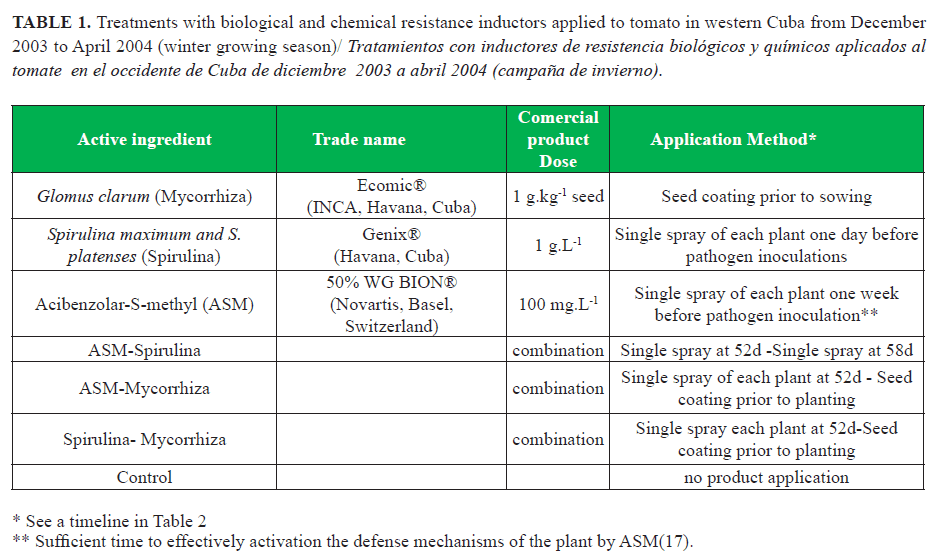
<body><![CDATA[<p align="justify" style="margin-top:8.5pt;margin-right:0cm;margin-bottom:8.5pt;margin-left:0cm;text-indent:0cm;"><font size="2" face="Verdana, Arial, Helvetica, sans-serif">Achieving natural activation of the defense systems of  plants as an alternative control is compatible for both cropping systems, where  monoculture and the curative approach predominates, as well as in farms managed  with an agroecological approach where the nonuse or reduction of traditional  chemicals is imperative. </font></p>     <p align="justify" style="margin-top:8.5pt;margin-right:0cm;margin-bottom:8.5pt;margin-left:0cm;text-indent:0cm;"><font size="2" face="Verdana, Arial, Helvetica, sans-serif">The objective of the research was to measure the  protection by chemical and biological resistance activators to the damage of <em>A.  solani</em> on a susceptible tomato cultivar in field trials by evaluating the  kinetics of enzymes related to host defense systems and the leaf damage induced  by the pathogen.</font></p> <font size="2" face="Verdana, Arial, Helvetica, sans-serif">     <p align="left" style="text-align:left;">&nbsp;</p>     <p align="justify"><font size="3" face="Verdana, Arial, Helvetica, sans-serif"><b>MATERIALS AND  METHODS</b></font></p>     <p align="justify"><font size="2" face="Verdana, Arial, Helvetica, sans-serif"><b>Plant  material</b></font></p> </font>     <p align="justify" style="margin-top:8.5pt;margin-right:0cm;margin-bottom:8.5pt;margin-left:0cm;text-indent:0cm;"><font size="2" face="Verdana, Arial, Helvetica, sans-serif">Plants of the tomato cultivar HC-3880 were used. This  cultivar is susceptible to early blight and low inducing pathogenesis-related  proteins (PR proteins) against <em>A. solani </em>(7). </font></p>     <p align="justify" style="margin-top:8.5pt;margin-right:0cm;margin-bottom:8.5pt;margin-left:0cm;text-indent:0cm;"><font size="2" face="Verdana, Arial, Helvetica, sans-serif">The field experiment was carried out in Western Cuba,  San Jos&eacute; de Las Lajas, Mayabeque province, in winter from December 2003 to  April 2004. Seedlings were sown in a dry heat sterilized mix of ferralitic red  soil and peat contained in plastic trays. They were grown at room temperature  in houses protected with anti-aphid mesh and ultraviolet-radiation-absorbent  plexiglass roof for 45 days. Then, the seedlings were transplanted to the field  in the morning at a planting distance of 0.7m x 0.25-0.30m. Previous soil  analysis of the experimental area indicated an average number of viable young  VAM spores of 18.6/g of soill, which was considered low (11).</font></p> <font size="2" face="Verdana, Arial, Helvetica, sans-serif">     <p align="justify"><font size="2" face="Verdana, Arial, Helvetica, sans-serif"><b>Inoculation</b></font></p> </font>     <p align="justify" style="margin-top:8.5pt;margin-right:0cm;margin-bottom:8.5pt;margin-left:0cm;text-indent:0cm;"><font size="2" face="Verdana, Arial, Helvetica, sans-serif"><a href="/img/revistas/rpv/v31n3/t0107316.gif">Table 1</a> shows the different resistance-inducing  products and treatments. Doses of the commercial products were adjusted as  recommended by the manufacturer, except in the case of Spirulina that was  chosen arbitrarily. The experiment time was optimal for growing tomatoes, so  that a low natural infection was expected. At 59 d post-transplant, all  treatments were inoculated with a mixture of four Cuban pathogenic isolates of <em>A.  solani </em>(Mycological Lab. National Center for Plant and Animal Health  (CENSA), Mayabeque). The isolates were obtained from symptoms of tomato early  blight&nbsp; with different degrees of  aggressiveness against tomato genotypes (16).</font></p>     
<p align="justify" style="margin-top:8.5pt;margin-right:0cm;margin-bottom:8.5pt;margin-left:0cm;text-indent:0cm;"><font size="2" face="Verdana, Arial, Helvetica, sans-serif">The inoculum was prepared in static culture of each  isolate in potato dextrose broth (200 g of fresh potato / 20 g dextrose),  cultured for eight days in darkness at 27&plusmn;1&deg;C. Subsequently, the mycelium of  each isolate was vacuum filtered through filter paper (Whatman # 1), weighed  and proportionally fragmented into blender for 2-3 min. A final suspension of  fresh mycelium in sterile distilled water (4.49 g.L<sup>-1</sup>) was prepared  and each plant inoculated with 3-5 ml of the suspension with a 1-liter one-hand  pressure sprayer after18:00 hours. It has been found that some inducers perform  well when single pathogen isolates are used for inoculation, but not so well  when mixtures of two or three pathogen isolates are used (8).</font></p> <font size="2" face="Verdana, Arial, Helvetica, sans-serif">     ]]></body>
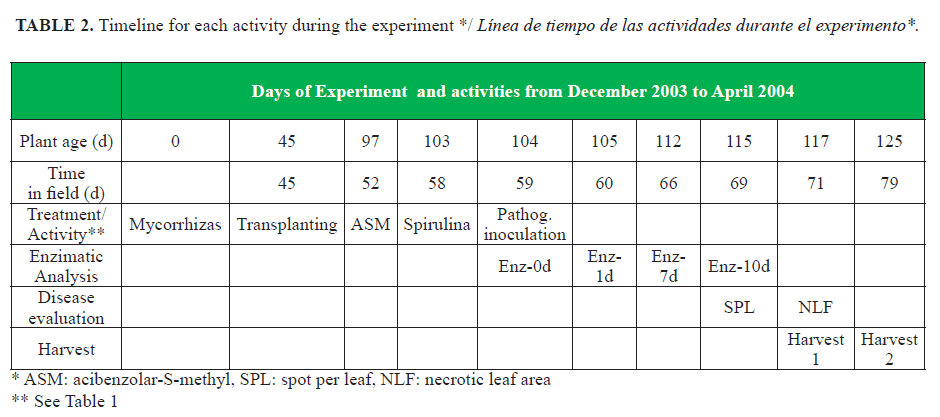
<body><![CDATA[<p align="justify"><font size="2" face="Verdana, Arial, Helvetica, sans-serif"><b>Enzymatic  analysis</b></font></p> </font>     <p align="justify" style="margin-top:8.5pt;margin-right:0cm;margin-bottom:8.5pt;margin-left:0cm;text-indent:0cm;"><font size="2" face="Verdana, Arial, Helvetica, sans-serif">Leaf samples were taken from the plotstreated 59 days  after planting, just before inoculation with the fungus. This time was  considered time 0. Subsequently, samples at 1, 7 and 10d post-inoculation for  the enzymatic dynamics (<a href="/img/revistas/rpv/v31n3/t0207316.gif">Table 2</a>). Leaves between the 2nd to 4th positions from  the ground were selected as the most susceptible to early blight (18).</font></p>     
<p align="justify" style="margin-top:8.5pt;margin-right:0cm;margin-bottom:8.5pt;margin-left:0cm;text-indent:0cm;"><font size="2" face="Verdana, Arial, Helvetica, sans-serif">Enzyme Extraction: a mixture of detached leaves was  made and divided into three replicates of 5 g/treatment/time. The methodology  (7) consisted of macerating with liquid nitrogen and homogenizing with sodium  acetate (0.1 M; pH 5.2) in a 2:1 ratio (ml.g-<sup>1</sup> fresh weight). The  homogenate was incubated with stirring in an ice bath for 45 min, filtered  through gauze and centrifuged (14.000 g /4&deg;C/ 30min). The supernatant was  stored at -20&deg;C until use. Protein concentration was determined by the Bradford  Coomassie brilliant blue assay is accomplished by measurement of absorbance at  595 nm. The standard bovine serum albumin curve was calibrated from a stock  solution of 1mg.ml<sup>-1 </sup>(7).</font></p>     <p align="justify" style="margin-top:8.5pt;margin-right:0cm;margin-bottom:8.5pt;margin-left:0cm;text-indent:0cm;"><font size="2" face="Verdana, Arial, Helvetica, sans-serif">Enzymatic activity: Each enzyme activity was determined  using the methods previously standardized by Sol&oacute;rzano (7) and Rodr&iacute;guez <em>et  al.</em> (19).These methods can be described briefly as follows. &szlig;-1,3-glucanase  (GLUC): A discontinuous method based on laminarin (&szlig;-1,3 glucan) hydrolysis.  The product of reaction absorbs at 660 nm. Glucose (1 mg.ml<sup>-1</sup>) was  used as standard in the calibration pattern curve. Phenylalanine ammonia lyase  (PAL): a discontinuous method based on phenylalanine deamination. The reaction  product, cinnamic acid, absorbs at 275 nm, and the reaction rate was determined  with its readings. The calibration pattern curve was performed with cinnamic  acid at1 mg.ml<sup>-1</sup>. Chitinase (CHIT): a discontinuous method based on  the hydrolysis of the colloidal chitin&nbsp;  to N-acetyl-glucosamine (585nm). Peroxidase (POX): a continuous method  based on guaiacoloxidation. The reaction rate of oxidation was determined by  recording the product absorbance at 470 nm. Variation in the optical density  was determined for two minutes at 15 sec. intervals (&Delta;DO / At). Lipoxygenase  (LOX): a continuous method where the linolenic acid is hydrolyzed (20). The  reaction product absorbs at 234 nm. Polyphenoloxidase (PPO): a continuous  method which is based on the oxidation of pyrogallol to quinones. The reaction  product absorbs at 420 nm, the (&Delta;DO / Dt) was determined the same way as in the  previous method. Enzyme activity was expressed in&mu;mol of formed product min<sup>-1</sup> mL enz<sup>-1</sup>, except where the PPO was expressed as &Delta;DO / &Delta;t / min / ml  of enzyme, as the extinction coefficient of pyrogallol was lacked (19). The  specific activity of each enzyme was determined as Specific Act. = Enzime Act.  Units / protein concentration (EAU.mg Prot<sup>-1</sup>).</font></p> <font size="2" face="Verdana, Arial, Helvetica, sans-serif">     <p align="justify"><font size="2" face="Verdana, Arial, Helvetica, sans-serif"><b>Foliar  damage by <i>A. solani</i> and yield</b></font></p> </font>     <p align="justify" style="margin-top:8.5pt;margin-right:0cm;margin-bottom:8.5pt;margin-left:0cm;text-indent:0cm;"><font size="2" face="Verdana, Arial, Helvetica, sans-serif">Leaf damage were determined by two recommended methods  for this plant-pathogen interaction (18). After 10 days of inoculating the  pathogen, the numbers of spots per leaf (SPL) were counted in three plants per  treatment. At 12 days post-inoculation, the percentage of necrotic area per  leaf (NLA) was determined in all plants by visual assessment by two evaluators  (see time line in <a href="/img/revistas/rpv/v31n3/t0207316.gif">Table 2</a>). The yield of the harvests at 70 and 79d from  transplanting was measured. Not marketable fruits were discarded.</font></p>     
<p align="justify" style="margin-top:8.5pt;margin-right:0cm;margin-bottom:8.5pt;margin-left:0cm;"><font size="2" face="Verdana, Arial, Helvetica, sans-serif"><b>Experimental  design and analysis</b></font></p>     <p align="justify" style="margin-top:8.5pt;margin-right:0cm;margin-bottom:8.5pt;margin-left:0cm;text-indent:0cm;"><font size="2" face="Verdana, Arial, Helvetica, sans-serif">A random block design with three replications and seven  treatments per block was used. Each treatment consisted of six rows with about  14 plants in each; the two outer rows were discarded to eliminate edge effects.  Statistical analysis: Variance analysis was performed. The analysis of the nine  response variables was integrated using analysis of the principal components  with standardized data (due to the different scales) on a correlation matrix  (21). This analysis was combined with a Biplot representation by Info-Stat  program (C&oacute;rdoba, Argentina:<a href="http://www.infostat.com.ar/)" target="_blank"> <u style="text-underline:thick;">http://www.infostat.com.ar/</u>)</a>.</font></p> <font size="2" face="Verdana, Arial, Helvetica, sans-serif">     <p align="left" style="text-align:left;">&nbsp;</p>     <p align="justify"><font size="3" face="Verdana, Arial, Helvetica, sans-serif"><b>RESULTS</b></font></p>     ]]></body>
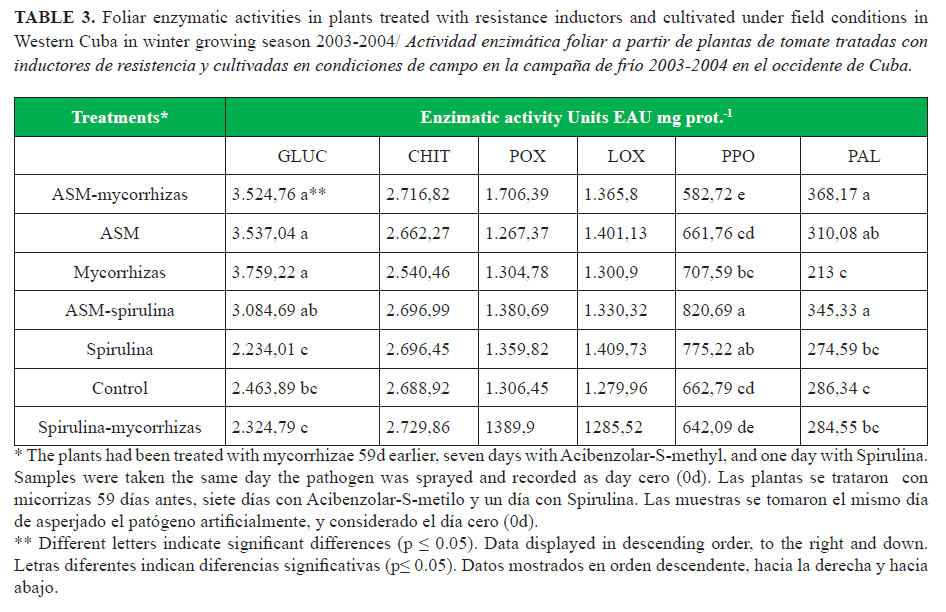
<body><![CDATA[<p align="justify"><font size="2" face="Verdana, Arial, Helvetica, sans-serif"><b>Enzyme  induction</b></font></p> </font>     <p align="justify" style="margin-top:8.5pt;margin-right:0cm;margin-bottom:8.5pt;margin-left:0cm;text-indent:0cm;"><font size="2" face="Verdana, Arial, Helvetica, sans-serif"><span style="letter-spacing:-.1pt; font-family:'Verdana','sans-serif'; ">Detectable levels of all enzymes  were observed in the control treatment (<a href="/img/revistas/rpv/v31n3/t0307316.gif">Table 3</a>), confirming the existence of a  constitutive enzyme level in the cultivar. The enzymes GLUC, PPO and PAL showed  activities with significant differences between some of the treatments, unlike  the other three enzymes (<a href="/img/revistas/rpv/v31n3/t0307316.gif">Table 3</a>). </span><span style="font-family:'Verdana','sans-serif'; ">GLUC was significantly high in the plants treated with  mycorrhizas, acibenzolar-S-methyl (ASM) and the ASM-mycorrhizas combination.  PPO was higher with spirulina and ASM-spirulina treatments. PAL particularly  induced with ASM alone and with the combinations ASM-spirulina and  ASM-mycorrhizas. The control plants showed the lowest enzyme levels in almost  all treatments. It should be pointed out that there were a low level of  mycorrhizas in the field blocks (22), between 0-40 young viable spores (data  not shown).</span></font></p>     
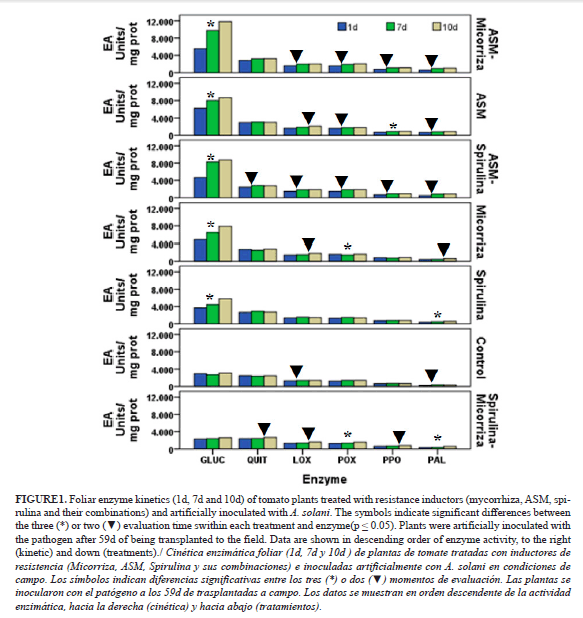
<p align="justify" style="margin-top:8.5pt;margin-right:0cm;margin-bottom:8.5pt;margin-left:0cm;text-indent:0cm;"><font size="2" face="Verdana, Arial, Helvetica, sans-serif"><span style="font-family:'Verdana','sans-serif'; ">All treatments with acibenzolar-S-methyl induced the  highest levels of foliar enzyme activity after <em>A. solani</em> inoculation  (<a href="/img/revistas/rpv/v31n3/f0107316.gif">Fig. 1</a>). The treatments with spirulina-mycorrhizas, spirulina alone, and the  control (not treated) showed the lowest level of all the enzymes analyzed (<a href="/img/revistas/rpv/v31n3/f0107316.gif">Fig.  1</a>). On average from all enzymes, covering the seeds with mycorrhizas showed an  intermediate position among of all the treatments (<a href="/img/revistas/rpv/v31n3/f0107316.gif">Fig. 1</a>). In most treatments,  glucanase was notably the enzyme with higher level over 4.000 EAU mg prot.<sup>-1</sup>,  but the effects of spirulina-mycorrhizas and the control. On the other hand,  none of the treatments showed enzymatic activity over 4.000 EAU mg  prot.<sup>-1</sup> before pathogen inoculation (<a href="/img/revistas/rpv/v31n3/t0307316.gif">Table 3</a>).The content of enzymes  increased with time (1d to 10d) (<a href="/img/revistas/rpv/v31n3/f0107316.gif">Fig. 1</a>), but not always significantly (see */</span>&#9660;<span style="font-family:'Verdana','sans-serif'; ">).  It should be noticed that only the treatment with mycorrhizas and  spirulina-mycorrhizas stimulated some enzymes between 7d to 10d significantly  (<a href="/img/revistas/rpv/v31n3/f0207316.gif">Fig. 2</a>), while with most treatments the significance was shown between 1 and 7  days. </span></font></p>     
<p align="justify" style="margin-top:8.5pt;margin-right:0cm;margin-bottom:8.5pt;margin-left:0cm;text-indent:0cm;"><font size="2" face="Verdana, Arial, Helvetica, sans-serif">The enzyme CHIT showed no significant differences in  none of the treatment at 0d, nor elicited at 24h after inoculations of the  pathogen (data not shown), and in general at none of the times evaluated. Only  in ASM-spirulina and spirulina-mycorrhizas treatments, the differences were  significant (<a href="/img/revistas/rpv/v31n3/f0107316.gif">Fig. 1</a>).</font></p>     
<p align="justify" style="margin-top:8.5pt;margin-right:0cm;margin-bottom:8.5pt;margin-left:0cm;text-indent:0cm;"><font size="2" face="Verdana, Arial, Helvetica, sans-serif">Ten days after inoculations with <em>A. solani</em>, the  levels of all enzymes were two fold the levels of the day of inoculations (see  0d <a href="/img/revistas/rpv/v31n3/f0107316.gif">Fig. 1</a> and <a href="/img/revistas/rpv/v31n3/f0207316.gif">Fig. 2</a>). Comparing the effects of the treatments at 10d, the  ASM-mycorrhiza combination induced significantly higher level of enzymes than  the worst treatments (control and spirulina-mycorrhizas). Moreover, all  treatments that included ASM were statistically superior to the control,  excepting ASM-spirulina that did not show significant differences. Minor and&nbsp;&nbsp; no significant differences were observed  among the other treatments.&nbsp; </font></p> <font size="2" face="Verdana, Arial, Helvetica, sans-serif">     
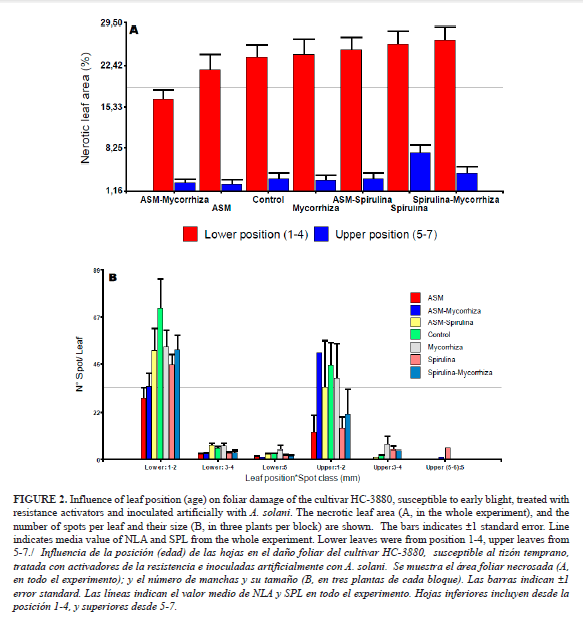
<p align="justify"><font size="2" face="Verdana, Arial, Helvetica, sans-serif"><b>Foliar  damage</b></font></p> </font>     <p align="justify" style="margin-top:8.5pt;margin-right:0cm;margin-bottom:8.5pt;margin-left:0cm;text-indent:0cm;"><font size="2" face="Verdana, Arial, Helvetica, sans-serif">All inoculated plants were infected, although the level  of infection in all treatments was low. The overall average was 18.04% (1-100%)  for necrotic area and 22.33 for spots leaf<sup>-1</sup> (1-157 spots), with the  prevalence of 1-2 mm spots. Leaf necrosis development was influenced by its  position on the plant (age) as expected for <em>A. solani</em>-tomato interaction  (18).&nbsp; No significant differences among  treatments were observed with ASM-mycorrhizas, although more damage was  observed in all the treatments with spirulina (<a href="/img/revistas/rpv/v31n3/f0207316.gif">Fig. 2 A</a>). </font></p>     
<p align="justify" style="margin-top:8.5pt;margin-right:0cm;margin-bottom:8.5pt;margin-left:0cm;text-indent:0cm;"><font size="2" face="Verdana, Arial, Helvetica, sans-serif"><a href="/img/revistas/rpv/v31n3/f0207316.gif">Figure 2</a> shows older leaves to be more susceptible to  the pathogen infections with more necrotic areas (A) and generally more number  of spots (B). Spot size 1-2 mm predominated in all treatments, irrespective of  leaf position (<a href="/img/revistas/rpv/v31n3/f0207316.gif">Fig. 2 B</a>). It must be pointed out that during this experiment,  inoculum pressure remained low, judged by the surrounding tomato fields, which  showed no early blight epidemics or significant damage. The site is  characterized by low early blight apparent infection rate &ldquo;r&rdquo; and minimum  temperatures of 20.1&deg;C (23).     
<br> The maximum damage in terms of SPL and NLA matched the low-medium degrees of  the scales proposed to evaluate the disease in the same province (18), where up  to 20 spots were included in the lowest leaves 1-4. </font></p>     <p align="justify" style="margin-top:8.5pt;margin-right:0cm;margin-bottom:8.5pt;margin-left:0cm;text-indent:0cm;"><font size="2" face="Verdana, Arial, Helvetica, sans-serif">The lowest percentage of NLA was achieved in the  combination of ASM-mycorrhizas, while the spirulina treatment was the most  affected (<a href="/img/revistas/rpv/v31n3/f0207316.gif">Fig. 2 A</a> and <a href="/img/revistas/rpv/v31n3/f0207316.gif">B</a>). The results showed herein suggested the ASM-mycorrhizas  treatment to reduce the progression of 1-2 mm necrotic spots in the host  (lowest NLA) rather than to prevent infection events (highest SPL). The  opposite effect was only observed in the plants treated with Spirulina (<a href="/img/revistas/rpv/v31n3/f0207316.gif">Fig.  2</a>).</font></p> <font size="2" face="Verdana, Arial, Helvetica, sans-serif">     
]]></body>
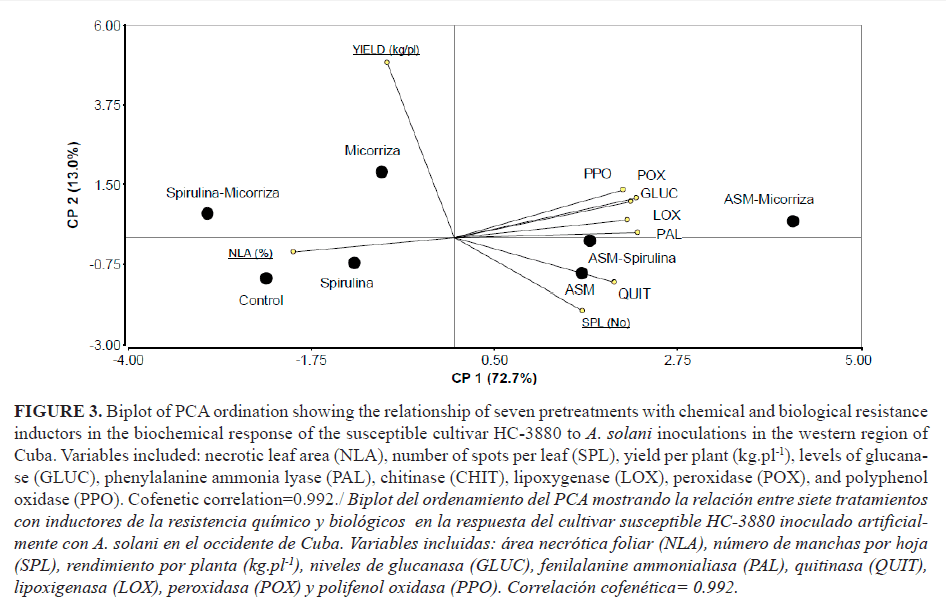
<body><![CDATA[<p align="justify"><font size="2" face="Verdana, Arial, Helvetica, sans-serif"><b>Yield</b></font></p>     <p align="justify" style="margin-top:8.5pt;margin-right:0cm;margin-bottom:8.5pt;margin-left:0cm;text-indent:0cm;">The highest yield in this experiment was 12 kg total,  equivalent to 3.8 TM.ha<sup>-1</sup> and 0.48 kg.pl<sup>-1</sup>, which was  achieved by coating the seeds with Mycorrhiza only. The other treatments  followed with the values 10.25; 9.0; 4.95; 4.43; 3.68 and 3.30 kg for  Spirulina-Mycorrhizas, Control, ASM-Spirulina, ASM-Mycorrhiza, Spirulina and  ASM, respectively. However, these values are only for reference because they  were the result of a block, the others were damaged at harvest by ants.</p>     <p align="justify"><font size="2" face="Verdana, Arial, Helvetica, sans-serif"><b>Integrated  analysis</b></font></p> </font>     <p align="justify" style="margin-top:8.5pt;margin-right:0cm;margin-bottom:8.5pt;margin-left:0cm;text-indent:0cm;"><font size="2" face="Verdana, Arial, Helvetica, sans-serif">A comprehensive analysis conducted by the PCA-Biplot  combination allowed reflecting simultaneously relationships among the  treatments and the variables evaluated (<a href="/img/revistas/rpv/v31n3/f0307316.gif">Fig. 3</a>). By the PCA, the first two  components were found to explain a high proportion of the total variability  (86.0%, see axes of <a href="/img/revistas/rpv/v31n3/f0307316.gif">Fig. 3</a>).</font></p>     
<p align="justify" style="margin-top:8.5pt;margin-right:0cm;margin-bottom:8.5pt;margin-left:0cm;text-indent:0cm;"><font size="2" face="Verdana, Arial, Helvetica, sans-serif">The first principal component (CP1) was strongly and  positively correlated with the original enzymatic variables, while NLA was also  strongly correlated with these variables but negatively. This suggests that the  treatments where ASM was included also tended to have more necrotic areas on  the leaf, the second principal component increased with increasing yield. </font></p>     <p align="justify" style="margin-top:8.5pt;margin-right:0cm;margin-bottom:8.5pt;margin-left:0cm;text-indent:0cm;"><font size="2" face="Verdana, Arial, Helvetica, sans-serif">Yield (kg.pl<sup>-1</sup>) position in the CP2  indicated that it had a strong correlation with it, which only explained 13% of  the total variability. This result showed that the ASM-mycorrhizas  significantly differed from the other treatments by the NLA and by the activity  of the enzymes GLUC, PAL, POX and PPO, which showed significant differences at  10d.</font></p> <font size="2" face="Verdana, Arial, Helvetica, sans-serif">     <p align="left" style="text-align:left;">&nbsp;</p>     <p align="justify"><font size="3" face="Verdana, Arial, Helvetica, sans-serif"><b>DISCUSSION</b></font></p> </font>     <p align="justify" style="margin-top:8.5pt;margin-right:0cm;margin-bottom:8.5pt;margin-left:0cm;text-indent:0cm;"><font size="2" face="Verdana, Arial, Helvetica, sans-serif">The results achieved showed that a cultivar susceptible  to early blight like HC-3880 could be protected from pathogen attack by the  combined application of mycorrhizas and ASM. Untreated plants showed low enzyme  levels, but not necessarily lower levels of pathogen infection. In fact,  ASM-mycorrhizas was the only treatment that markedly (but not significantly)  differed from five of the total seven treatments, considering the NLA. </font></p>     <p align="justify" style="margin-top:8.5pt;margin-right:0cm;margin-bottom:8.5pt;margin-left:0cm;text-indent:0cm;"><font size="2" face="Verdana, Arial, Helvetica, sans-serif">At time of transplanting, the mycorrhizas are  sufficiently established (13,19). From here onwards,&nbsp; the VAM-plant symbiosis enters into a  parasitic stage (24), in which the fungal growth rate decreases and root  colonization becomes low. The highest colonization levels are reached at 60  days, coinciding with the full flowering stage of the crop, when water and  nutrients are highly required and the micorrhizas-plant symbiosis is more  efficiently expressed. The level of fungal colonization begins to decrease at  120 days, a fact whichis closely related to host senescence (25).</font></p>     ]]></body>
<body><![CDATA[<p align="justify" style="margin-top:8.5pt;margin-right:0cm;margin-bottom:8.5pt;margin-left:0cm;text-indent:0cm;"><font size="2" face="Verdana, Arial, Helvetica, sans-serif">The enzyme inducing effect of the micorrhizas, could be  reinforced by ASM, since mycorrhizas or ASM by themselves showed no significant  effects on reducing infection by <em>A. solani</em>. Plants pre-treated with ASM  reduced severity of <em>Clavibacter michiganensis</em> subsp. <em>michiganensis</em> (Smith 1910), (Davis <em>et al.</em> 1984) up to 76.3% in tomato; this resistance  was associated with a significant increase of the enzymes POX and CHIT (6). The  mechanism of action of ASM, by either over- or under-expression, modifies genes  encoding defense proteins (4). Similar studies showed that the content of  phenolic compounds, PR-protein accumulation (such as CHIT and LUC) and PR-like  thaumatins were observed more strongly in rice plants pretreated with ASM and  inoculated with <em>Xanthomonas oryzae pv. oryzae </em>(26). Similar experiments  in Australia, but with potato in production greenhouses and a dose of 100 mg  a.i L<sup>-1</sup> of ASM, reported an average in leaf damage of three spots  per plant at 67d&nbsp; (27). In the same  experiment, the field tests showed that foliar necrosis was only 20% of NLA.  For <em>Erysiphe cichoracearum </em>DC, another foliar pathogen of potato, a dose  of 50 mg i.a. L<sup>-1</sup> of ASM was enough to reduce damage to less than 1%  compared with 11.7% in the control under greenhouse conditions (27). </font></p>     <p align="justify" style="margin-top:8.5pt;margin-right:0cm;margin-bottom:8.5pt;margin-left:0cm;text-indent:0cm;"><font size="2" face="Verdana, Arial, Helvetica, sans-serif">Spraying acibenzolar-S-methylol once at 55d after  seeding showed promising results (<a href="/img/revistas/rpv/v31n3/f0207316.gif">Fig. 2</a>). Despite the benefits of ASM,  experiments in tomato leaf discs and different concentrations of <em>A. solani</em> inoculum showed contradictory ASM responses to pathogen control (15).  Furthermore, fruit size reduction has been also reported in the tomato cultivar  Easy Harvest treated with ASM, with significant&nbsp;  dry weight reduction of about 50% in comparison with untreated plants  (5). Even, the same authors indicated ASM had no measurable effect on the early  and late blight of potato when applied without the accompaniment of fungicides  underfield conditions in the UU.SS. Greenhouse aspersions resulted in almost  complete control of <em>Alternaria </em>(27); however, its severity reduction was  less impressive in the field. In general, yield was low in the experiment here  in reported, despite the fact that it was performed in the optimum growing  season (winter). In warmer field conditions in the eastern region of Cuba and  with similar early blight damage (&lt;10%), the tomato cultivar HC-3380 yielded  less than 3 TM.ha<sup>-1 </sup>(28), and by far less than other cultivars with  2.20-2.75 kg.pl<sup>-1</sup> in the western region in winter (16).</font></p>     
<p align="justify" style="margin-top:8.5pt;margin-right:0cm;margin-bottom:8.5pt;margin-left:0cm;text-indent:0cm;"><font size="2" face="Verdana, Arial, Helvetica, sans-serif">Spirulina showed no favorable results regarding the  reduction of early blight damage (<a href="/img/revistas/rpv/v31n3/f0207316.gif">Fig. 2 A</a>). Spirulina applications in  greenhouse tests favored the reduction <span style="letter-spacing:-.1pt; ">of  dry and fresh tomato weight (15). The concentration of microalgae is not  influential, in this case 1 g.L<sup>-</sup></span><sup>1</sup> was used and  Fritz (15) obtained the same result in greenhouses with 2.5 and 10 g.L<sup>-1</sup>.  However, an increase of two enzymes (GLUC and PAL) until 10d of confronting the  plants with the pathogen was confirmed (<a href="/img/revistas/rpv/v31n3/f0107316.gif">Fig. 1</a>). The same effect was shown on  both NLA and the induced enzymes by combining spirulina with ASM or  mycorrhizas.</font></p>     
<p align="justify" style="margin-top:8.5pt;margin-right:0cm;margin-bottom:8.5pt;margin-left:0cm;text-indent:0cm;"><font size="2" face="Verdana, Arial, Helvetica, sans-serif">By themselves, mycorrhizas and ASM showed no noticeable  effects in reducing infection by A. solani. However, with their combination (at  the planting time and a spray at 55d),&nbsp; a  reduction in NLA was observed. From the practical perspective, it is useful to  achieve protection of a cultivar like HC-3880, which, even being susceptible,  is prized for its agro-ecological adaptability and for consumption&nbsp; (29). The favorable effect of MVA on tomato  yield is well known under Cuban field conditions (25) as well as in reducing  infection by A. solani in terms of necrosis or chlorosis compared  withnon-mycorrhized plants (30). In practice, different methods of application  of a phytosanitary product as well as the times and frequency of application  determine the crop's response to disease(8). It has been suggested to combine  acquired systemic resistance inductors to raise the levels of resistance early  in the&nbsp; infected plants (31). The results  reported here suggest that enhancement of natural resistance of tomato  cultivars will help to reduce the number of fungicide applications even if they  are susceptible to early blight.</font></p>     <p align="justify" style="margin-top:8.5pt;margin-right:0cm;margin-bottom:8.5pt;margin-left:0cm;text-indent:0cm;"><font size="2" face="Verdana, Arial, Helvetica, sans-serif">In the case of <em>A. solani</em>, predominant pathogen  populations in the agricultural ecosystem should be considered. Cuban  populations of <em>A. solani</em> show intraspecific differences in genotyping,  sensitivity to fungicides, and aggressiveness (15,32). Similarly, different  isolates produce different biochemical responses depending on the cultivar  (33). Excessive phosphorus availability is not favorable for VAM to express  their potential in tomato (30), since levels of this element influence  indirectly via reduced mycorrhizal colonization and this in turn reduces  resistance.</font></p>     <p align="justify" style="margin-top:8.5pt;margin-right:0cm;margin-bottom:8.5pt;margin-left:0cm;text-indent:0cm;"><font size="2" face="Verdana, Arial, Helvetica, sans-serif">It appears that the yield-improved modern cultivars  have lost a considerable part of the basal and induced broad-spectrum  resistance that characterizes their wild relatives and landraces (34). In  addition to the combination of different products, it is necessary to determine  the best variants in different localities. The presented results show a  positive effect of combining seed coating with mycorrhizas and ASM application  once the plants are established after transplantation. Activation of induced  resistance by means of the six enzymes included in this study can also protect  the crop from other pathogens. It remains to determine the response of tomato  under more favorable conditions for the pathogen infection, such as planting  outside the optimum growing season, where temperatures favor the epidemic, or  in areas with high rates of infection.</font></p> <font size="2" face="Verdana, Arial, Helvetica, sans-serif">     <p>&nbsp;</p>     <p align="justify"><font size="3" face="Verdana, Arial, Helvetica, sans-serif"><b>ACKNOWLEDGEMENTS</b></font></p>     <p align="justify" style="margin-top:8.5pt;margin-right:0cm;margin-bottom:8.5pt;margin-left:0cm;text-indent:0cm;">Project funded by the National Science and Technology  Program of the Ministry of Science, Technology and Environment of Cuba. The  first author is grateful to the Ecuadorian Program PROMETEO-SENESCYT for the  financial support during the writing of this manuscript. We thank Maendy Fritz  for the assistance during the execution of the experiments,&nbsp;&nbsp; Marta &Aacute;lvarez for supplying seeds of  cultivar HC-3880 and Eduardo Sictach for polish up the writing.&nbsp; We are also grateful to anonymous reviewers  for their suggestions on the manuscript. </p>     <p style="margin-top:8.5pt;margin-right:0cm;margin-bottom:8.5pt;margin-left:0cm;text-indent:0cm;">&nbsp;</p>     ]]></body>
<body><![CDATA[<p align="justify"><font size="3" face="Verdana, Arial, Helvetica, sans-serif"><b>REFERENCES</b></font></p> </font>     <!-- ref --><p align="justify" style="margin-top:8.5pt;margin-right:0cm;margin-bottom:8.5pt;margin-left:0cm;text-align:justify;text-indent:0cm;"><font size="2" face="Verdana, Arial, Helvetica, sans-serif">1.&nbsp;&Ouml;zer &Ccedil;al&#305;&#351;, Topkaya &#350;. Genetic analysis  of resistance to early blight disease in tomato. African J Biotechnol.  2011;10(79):18071-18077.     </font></p>     <!-- ref --><p align="justify" style="margin-top:8.5pt;margin-right:0cm;margin-bottom:8.5pt;margin-left:0cm;text-align:justify;text-indent:0cm;"><font size="2" face="Verdana, Arial, Helvetica, sans-serif">2. Kumar S, Srivastava K. Screening of  Tomato Genotypes Against Early Blight (<em>Alternaria solani</em>) under field  condition. The Bioscan. 2013;8(1):189-193.     </font></p>     <!-- ref --><p align="justify" style="margin-top:8.5pt;margin-right:0cm;margin-bottom:8.5pt;margin-left:0cm;text-align:justify;text-indent:0cm;"><font size="2" face="Verdana, Arial, Helvetica, sans-serif">3. Zuluaga AP, Vega-Arregu&iacute;n JC, Fry WE.  Transcriptome profile of acibenzolar-S-methyl-induced genes in tomato suggests  a complex polygenic effect on resistance to <em>Phytophthora infestans</em>.  Physiol Mol Plant Pathol. 2013;81:97-106.     </font></p>     <!-- ref --><p align="justify" style="margin-top:8.5pt;margin-right:0cm;margin-bottom:8.5pt;margin-left:0cm;text-align:justify;text-indent:0cm;"><font size="2" face="Verdana, Arial, Helvetica, sans-serif">4. Gao Q-M, Zhu S, Kachroo P, Kachroo A.  Signal regulators of systemic acquired resistance. Frontiers&nbsp; in Plant Sci. 2015;6:228. doi:  10.3389/fpls.2015.00228.    </font></p>     <!-- ref --><p align="justify" style="margin-top:8.5pt;margin-right:0cm;margin-bottom:8.5pt;margin-left:0cm;text-align:justify;text-indent:0cm;"><font size="2" face="Verdana, Arial, Helvetica, sans-serif">5. Louws FJ, Wilson M, Campbell HL, Cuppels  DA, Jones JB, Shoemaker PB, et al. Field Control of Bacterial Spot and  Bacterial speck of tomato using a plant activator. Plant Disease. 2001;85(5):  481-488.     </font></p>     <!-- ref --><p align="justify" style="margin-top:8.5pt;margin-right:0cm;margin-bottom:8.5pt;margin-left:0cm;text-align:justify;text-indent:0cm;"><font size="2" face="Verdana, Arial, Helvetica, sans-serif">6. Baysal &Ouml;, Soylu S, Soylu E. Induction of  defence-related enzymes and resistance by the plant activator  acibenzolar-S-methyl in tomato seedlings against bacterial canker caused by <em>Clavibacter  michiganensis</em> ssp. <em>michiganensis</em>. Plant Pathol. 2003;52(6):747-753.     </font></p>     <!-- ref --><p align="justify" style="margin-top:8.5pt;margin-right:0cm;margin-bottom:8.5pt;margin-left:0cm;text-align:justify;text-indent:0cm;"><font size="2" face="Verdana, Arial, Helvetica, sans-serif">7. Sol&oacute;rzano E. Estudio de proteinas y  enzimas de defensa en la interacci&oacute;n <em>Lycopersicon esculentum</em> Mill -<em>Alternaria  solani</em> (Ellis &amp; Martin) Jones y Grout. Universidad Agraria de la  Habana. Centro Nacional de Sanidad Agropecuaria. PhD thesis. 2002. 100 pp.    </font></p>     <!-- ref --><p align="justify" style="margin-top:8.5pt;margin-right:0cm;margin-bottom:8.5pt;margin-left:0cm;text-align:justify;text-indent:0cm;"><font size="2" face="Verdana, Arial, Helvetica, sans-serif">8. Walters DR, Ratsep J, Havis ND.  Controlling crop diseases using induced resistance: Challenges for the future.  J Exp Bot. 2013;64(5):1263-1280.     </font></p>     <!-- ref --><p align="justify" style="margin-top:8.5pt;margin-right:0cm;margin-bottom:8.5pt;margin-left:0cm;text-align:justify;text-indent:0cm;"><font size="2" face="Verdana, Arial, Helvetica, sans-serif">9. Parvatha RP. Non-pathogenic strains. In:  Recent advances. Pavarta (ed). Springer India; 2013.p. 103-120.    </font></p>     <!-- ref --><p align="justify" style="margin-top:8.5pt;margin-right:0cm;margin-bottom:8.5pt;margin-left:0cm;text-align:justify;text-indent:0cm;"><font size="2" face="Verdana, Arial, Helvetica, sans-serif">10. Song Y, Chen D, Lu K, Sun Z, Zeng R.  Enhanced tomato disease resistance primed by arbuscular mycorrhizal fungus.  Front Plant Sci. 2015 Sep 28;6:786. doi: 10.3389/fpls.2015.00786.     </font></p>     <!-- ref --><p align="justify" style="margin-top:8.5pt;margin-right:0cm;margin-bottom:8.5pt;margin-left:0cm;text-align:justify;text-indent:0cm;"><font size="2" face="Verdana, Arial, Helvetica, sans-serif">11. Ley-Rivas JF, S&aacute;nchez JA, Ricardo NE,  Collazo E. Efecto de cuatro especies de hongos micorriz&oacute;genos arbusculares en  la producci&oacute;n de frutos de tomate. Agron Costarric. 2015;39(1):47-59.     </font></p>     <!-- ref --><p align="justify" style="margin-top:8.5pt;margin-right:0cm;margin-bottom:8.5pt;margin-left:0cm;text-align:justify;text-indent:0cm;"><font size="2" face="Verdana, Arial, Helvetica, sans-serif">12. Mujica Y. Inoculaci&oacute;n de hongos  micorr&iacute;zicos arbusculares (HMA) por dos v&iacute;as diferentes en el cultivo del  tomate (<em>Solanum lycopersicum</em> L.). Cultiv Trop. 2012;33(4):71-76.     </font></p>     <p align="justify" style="margin-top:8.5pt;margin-right:0cm;margin-bottom:8.5pt;margin-left:0cm;text-align:justify;text-indent:0cm;"><font size="2" face="Verdana, Arial, Helvetica, sans-serif">13. Rodr&iacute;guez Y, de la Noval B, Fern&aacute;ndez F,  Rodr&iacute;guez P, Rodr&iacute;guez-Yon Y. Estudio comparativo del comportamiento de seis  cepas de hongos micorr&iacute;zicos arbusculares en su interacci&oacute;n con el tomate (<em>Lycopersicon  esculentum</em> M. var &ldquo;Amalia&rdquo;). Ecol Apl. 2004;3(1-2). </font></p>     <!-- ref --><p align="justify" style="margin-top:8.5pt;margin-right:0cm;margin-bottom:8.5pt;margin-left:0cm;text-align:justify;text-indent:0cm;"><font size="2" face="Verdana, Arial, Helvetica, sans-serif">14. Abomohra AE, El-shouny W, Sharaf M,  Abp-eleneen M. Effect of Gamma Radiation on Growth and Metabolic Activities of <em>Arthrospira  platensis</em>. Brazilian Arch Biol Technol. 2016;59:1-11.     </font></p>     <!-- ref --><p align="justify" style="margin-top:8.5pt;margin-right:0cm;margin-bottom:8.5pt;margin-left:0cm;text-align:justify;text-indent:0cm;"><font size="2" face="Verdana, Arial, Helvetica, sans-serif">15. Fritz M. Resistance induction in the  pathosystem tomato-<em>Alternaria solani</em> . [Gie&szlig;en]: Biometrie und  Populations genetik. Pflanzenbau und Pflanzenz&uuml;chtung II der  Justus-Liebig-Universit&auml;t Giessen; 2005.     </font></p>     ]]></body>
<body><![CDATA[<p align="justify" style="margin-top:8.5pt;margin-right:0cm;margin-bottom:8.5pt;margin-left:0cm;text-align:justify;text-indent:0cm;"><font size="2" face="Verdana, Arial, Helvetica, sans-serif">16.&nbsp;&Aacute;lvarez M, Moya C, Domin&iacute; ME, Arzuaga J,  Mart&iacute;nez B, P&eacute;rez-Mart&iacute;nez S, et al. &ldquo; Amalia&rdquo;: A Medium-fruit-size, Heat-tolerant  Tomato Cultivar for Tropical Conditions. HortScience. 2004;39(6):1503-15034. </font></p>     <!-- ref --><p align="justify" style="margin-top:8.5pt;margin-right:0cm;margin-bottom:8.5pt;margin-left:0cm;text-align:justify;text-indent:0cm;"><font size="2" face="Verdana, Arial, Helvetica, sans-serif">17. Puerari HH, Dias-Arieira CR, Dadazio TS,  Mattei D, Da Silva TRB, Ribeiro RCF. Evaluation of acibenzolar-S-methyl for the  control of <em>Meloidogyne javanica</em> and effects on the development of  susceptible and resistant soybean. Trop Plant Pathol. 2013;38(1):44-48.     </font></p>     <!-- ref --><p align="justify" style="margin-top:8.5pt;margin-right:0cm;margin-bottom:8.5pt;margin-left:0cm;text-align:justify;text-indent:0cm;"><font size="2" face="Verdana, Arial, Helvetica, sans-serif">18. Cornide MT, Izquierdo F. Aplicaci&oacute;n de dos  m&eacute;todos evaluativos para el estudio de la resistencia horizontal de variedades  y l&iacute;neas de tomate ante el ataque foliar del tiz&oacute;n temprano. Rev Ciencias  Biol&oacute;gicas. 1979;10(2):245-261.     </font></p>     <!-- ref --><p align="justify" style="margin-top:8.5pt;margin-right:0cm;margin-bottom:8.5pt;margin-left:0cm;text-align:justify;text-indent:0cm;"><font size="2" face="Verdana, Arial, Helvetica, sans-serif">19. Rodr&iacute;guez Y, Fern&aacute;ndez A, Sol&oacute;rzano E,  Peteira B, Fern&aacute;ndez F, Rodr&iacute;guez Yon Y. Inducci&oacute;n de    enzimas de defensa en dos variedades de arroz    (<em>Oryza sativa</em>) por el hongo micorr&iacute;zico arbuscular <em>G. mosseae</em>.  Rev Colomb Biotecnol. 2006;7(2): 35-49.     </font></p>     <!-- ref --><p align="justify" style="margin-top:8.5pt;margin-right:0cm;margin-bottom:8.5pt;margin-left:0cm;text-align:justify;text-indent:0cm;"><font size="2" face="Verdana, Arial, Helvetica, sans-serif">20. Sol&oacute;rzano E, Pilar M del. Inducci&oacute;n de  lipoxigenasas en c&eacute;lulas de tomate tratadas con el hongo <em>Alternaria solani</em>. Rev Protecci&oacute;n Veg. 2003;18(3):196-169.     </font></p>     <!-- ref --><p align="justify" style="margin-top:8.5pt;margin-right:0cm;margin-bottom:8.5pt;margin-left:0cm;text-align:justify;text-indent:0cm;"><font size="2" face="Verdana, Arial, Helvetica, sans-serif">21. Balzarini M, Bruno C, Arroyo A. An&aacute;lisis de  ensayos agr&iacute;colas multi-ambientales. Ejemplos con Info-Gen. C&oacute;rdoba, Argentina;  2010. 141 p.     </font></p>     <!-- ref --><p align="justify" style="margin-top:8.5pt;margin-right:0cm;margin-bottom:8.5pt;margin-left:0cm;text-align:justify;text-indent:0cm;"><font size="2" face="Verdana, Arial, Helvetica, sans-serif">22. Morell F, Hern&aacute;ndez A. Degradaci&oacute;n de las  propiedades agrobiol&oacute;gicas de los suelos ferral&iacute;ticos rojos lixiviados por la  influencia antr&oacute;pica y su respuesta agroproductiva al mejoramiento. Agron Trop.  2008;58(4):335-343.     </font></p>     <!-- ref --><p align="justify" style="margin-top:8.5pt;margin-right:0cm;margin-bottom:8.5pt;margin-left:0cm;text-align:justify;text-indent:0cm;"><font size="2" face="Verdana, Arial, Helvetica, sans-serif">23. G&oacute;mez G, Almaguel L, Jimenez S, Secada I,  Cortinas J. Zonificacion de <em>Alternaria solani</em> en papa en la provincia de  La Habana. Fitosanidad. 1998;2(3-4):15-19.     </font></p>     <!-- ref --><p align="justify" style="margin-top:8.5pt;margin-right:0cm;margin-bottom:8.5pt;margin-left:0cm;text-align:justify;text-indent:0cm;"><font size="2" face="Verdana, Arial, Helvetica, sans-serif">24. Terry E. Microorganismos ben&eacute;ficos y  productos bioactivos como alternativas para la producci&oacute;n ecol&oacute;gica de tomate (<em>Solanum  lycopersicum</em>, Mill). Instituto Nacional de Ciencias Agr&iacute;colas.    Universidad Agraria de la Habana, Instituto Nacional de Ciencias Agr&iacute;colas  (INCA). PhD Thesis. Habana; 2005. 100 pp.    </font></p>     <!-- ref --><p align="justify" style="margin-top:8.5pt;margin-right:0cm;margin-bottom:8.5pt;margin-left:0cm;text-align:justify;text-indent:0cm;"><font size="2" face="Verdana, Arial, Helvetica, sans-serif">25. Terry E, Ruiz J. Evaluaci&oacute;n de bioproductos  para la producci&oacute;n de tomate (<em>Solanum lycopersicum</em>, Mill) bajo sistema  de cultivo protegido. Cultiv Trop. 2008;29:11-15.     </font></p>     <!-- ref --><p align="justify" style="margin-top:8.5pt;margin-right:0cm;margin-bottom:8.5pt;margin-left:0cm;text-align:justify;text-indent:0cm;"><font size="2" face="Verdana, Arial, Helvetica, sans-serif">26. Mohan Babu R, Sajeena A, Vijaya  Samundeeswari A, Sreedhar A, Vidhyasekeran P, Reddy M. Induction of bacterial  blight (<em>Xanthomonas oryzae</em> pv. <em>oryzae</em>) resistance in rice by  treatment with acibenzolar-S-methyl. Ann Appl Biol. 2003;143:333-340.     </font></p>     <p align="justify" style="margin-top:8.5pt;margin-right:0cm;margin-bottom:8.5pt;margin-left:0cm;text-align:justify;text-indent:0cm;"><font size="2" face="Verdana, Arial, Helvetica, sans-serif">27. Bokshi AI, Deverall BJ, Morris SC. Effects  of benzothiadiazole and acetylsalicylic acid on &beta;-1,3-glucanase activity and  disease resistance in potato. Plant Pathol. 2003;52(1):22-27. </font></p>     <!-- ref --><p align="justify" style="margin-top:8.5pt;margin-right:0cm;margin-bottom:8.5pt;margin-left:0cm;text-indent:0cm;"><font size="2" face="Verdana, Arial, Helvetica, sans-serif">28. Moya C, &Aacute;lvarez M, J. Arzuaga, Fe C de la,  Caballero A, Ponce M, et al. La selecci&oacute;n participativa de variedades (SPV) en  el cultivo del tomate. Cultiv Trop. 2010;31(1):87-92.     </font></p>     <!-- ref --><p align="justify" style="margin-top:8.5pt;margin-right:0cm;margin-bottom:8.5pt;margin-left:0cm;text-align:justify;text-indent:0cm;"><font size="2" face="Verdana, Arial, Helvetica, sans-serif">29. Moya C, &Aacute;lvarez M, Domin&iacute; ME, Arzuaga J.  MARA, nueva variedad de tomate de mesa. Cultiv Trop . 2004;25(2):69.     </font></p>     <!-- ref --><p align="justify" style="margin-top:8.5pt;margin-right:0cm;margin-bottom:8.5pt;margin-left:0cm;text-align:justify;text-indent:0cm;"><font size="2" face="Verdana, Arial, Helvetica, sans-serif">30. Fritz M, Jakobsen I, Foged M,  Thordal-Christensen J, Pons-K&uuml;hnemann J. Arbuscular mycorrhiza reduces  susceptibility of tomato to <em>Alternaria solani</em>. Mycorrhiza.  2006;16(6):413-419.     </font></p>     <!-- ref --><p align="justify" style="margin-top:8.5pt;margin-right:0cm;margin-bottom:8.5pt;margin-left:0cm;text-align:justify;text-indent:0cm;"><font size="2" face="Verdana, Arial, Helvetica, sans-serif">31. Usman Ghazanfar M, Wakil W, Talib Sahi S.  Induction of resistance in chickpea (<em>Cicer arietinum</em> L.) against  Ascochyta rabiei by applying chemicals and plant extracts. Chil J Agric Res.  2011;71(1):52-62.     </font></p>     ]]></body>
<body><![CDATA[<!-- ref --><p align="justify" style="margin-top:8.5pt;margin-right:0cm;margin-bottom:8.5pt;margin-left:0cm;text-align:justify;text-indent:0cm;"><font size="2" face="Verdana, Arial, Helvetica, sans-serif">32. Lantigua S, Mart&iacute;nez-Coca B, Pons-K&uuml;hnemann  J, P&eacute;rez-Mart&iacute;nez S. Grupos intraespec&iacute;ficos en <em>Alternaria solani</em> de tomate y papa. Fitopatol Venez. 2008;21:44-50.     </font></p>     <!-- ref --><p align="justify" style="margin-top:8.5pt;margin-right:0cm;margin-bottom:8.5pt;margin-left:0cm;text-align:justify;text-indent:0cm;"><font size="2" face="Verdana, Arial, Helvetica, sans-serif">33. Shahbazi H, Aminian H, Sahebani N,  Halterman DA. Biochemical evaluation of resistance responses of potato to  different isolates of <em>Alternaria solani</em>. Phytopathology.  2010;100(5):454-459.     </font></p>     <!-- ref --><p align="justify" style="margin-top:8.5pt;margin-right:0cm;margin-bottom:8.5pt;margin-left:0cm;text-align:justify;text-indent:0cm;"><font size="2" face="Verdana, Arial, Helvetica, sans-serif">34. C&oacute;rdova-Campos O, Adame-&Aacute;lvarez RM,  Acosta-Gallegos JA, Heil M. Domestication affected the basal and induced  disease resistance in common bean (<em>Phaseolus vulgaris</em>). Eur J Plant  Pathol. 2012;134(2):36.    </font></p> <font size="2" face="Verdana, Arial, Helvetica, sans-serif">     <p>&nbsp;</p>     <p>&nbsp;</p>     <p><span style="font-family:'Verdana','sans-serif'; font-size:10.0pt"><font size="2" face="Verdana, Arial, Helvetica, sans-serif">Recibido: </font></span><font size="2" face="Verdana, Arial, Helvetica, sans-serif">6/11/<span style="font-family:'Verdana','sans-serif'; font-size:10.0pt">2015    <br>   Aceptado: </span>8/05/<span style="font-family:'Verdana','sans-serif'; font-size:10.0pt">2016</span></font></p>     ]]></body>
<body><![CDATA[<p>&nbsp;</p> </font> </p>     <p align="justify"><font size="2" face="Verdana, Arial, Helvetica, sans-serif"><i>Simón Pérez-Martínez,</i> Facultad de Ingeniería, Universidad Estatal de Milagro (UNEMI), Guayas, Ecuador.    Email: <a href="mailto:correo">sperezm2@unemi.edu.ec.</a></font></p>      ]]></body><back>
<ref-list>
<ref id="B1">
<label>1</label><nlm-citation citation-type="journal">
<person-group person-group-type="author">
<name>
<surname><![CDATA[Çal&#305;&#351;]]></surname>
<given-names><![CDATA[Özer]]></given-names>
</name>
<name>
<surname><![CDATA[Topkaya]]></surname>
<given-names><![CDATA[&#350;]]></given-names>
</name>
</person-group>
<article-title xml:lang="en"><![CDATA[Genetic analysis of resistance to early blight disease in tomato]]></article-title>
<source><![CDATA[African J Biotechnol]]></source>
<year>2011</year>
<volume>10</volume>
<numero>79</numero>
<issue>79</issue>
<page-range>18071-18077</page-range></nlm-citation>
</ref>
<ref id="B2">
<label>2</label><nlm-citation citation-type="journal">
<person-group person-group-type="author">
<name>
<surname><![CDATA[Kumar]]></surname>
<given-names><![CDATA[S]]></given-names>
</name>
<name>
<surname><![CDATA[Srivastava]]></surname>
<given-names><![CDATA[K]]></given-names>
</name>
</person-group>
<article-title xml:lang="en"><![CDATA[Screening of Tomato Genotypes Against Early Blight (Alternaria solani) under field condition]]></article-title>
<source><![CDATA[The Bioscan]]></source>
<year>2013</year>
<volume>8</volume>
<numero>1</numero>
<issue>1</issue>
<page-range>189-193</page-range></nlm-citation>
</ref>
<ref id="B3">
<label>3</label><nlm-citation citation-type="journal">
<person-group person-group-type="author">
<name>
<surname><![CDATA[Zuluaga]]></surname>
<given-names><![CDATA[AP]]></given-names>
</name>
<name>
<surname><![CDATA[Vega-Arreguín]]></surname>
<given-names><![CDATA[JC]]></given-names>
</name>
<name>
<surname><![CDATA[Fry]]></surname>
<given-names><![CDATA[WE]]></given-names>
</name>
</person-group>
<article-title xml:lang="en"><![CDATA[Transcriptome profile of acibenzolar-S-methyl-induced genes in tomato suggests a complex polygenic effect on resistance to Phytophthora infestans]]></article-title>
<source><![CDATA[Physiol Mol Plant Pathol]]></source>
<year>2013</year>
<volume>81</volume>
<page-range>97-106</page-range></nlm-citation>
</ref>
<ref id="B4">
<label>4</label><nlm-citation citation-type="journal">
<person-group person-group-type="author">
<name>
<surname><![CDATA[Gao]]></surname>
<given-names><![CDATA[Q-M]]></given-names>
</name>
<name>
<surname><![CDATA[Zhu]]></surname>
<given-names><![CDATA[S]]></given-names>
</name>
<name>
<surname><![CDATA[Kachroo]]></surname>
<given-names><![CDATA[P]]></given-names>
</name>
<name>
<surname><![CDATA[Kachroo]]></surname>
<given-names><![CDATA[A]]></given-names>
</name>
</person-group>
<article-title xml:lang="en"><![CDATA[Signal regulators of systemic acquired resistance]]></article-title>
<source><![CDATA[Frontiers in Plant Sci]]></source>
<year>2015</year>
<volume>6</volume>
<page-range>228</page-range></nlm-citation>
</ref>
<ref id="B5">
<label>5</label><nlm-citation citation-type="journal">
<person-group person-group-type="author">
<name>
<surname><![CDATA[Louws]]></surname>
<given-names><![CDATA[FJ]]></given-names>
</name>
<name>
<surname><![CDATA[Wilson]]></surname>
<given-names><![CDATA[M]]></given-names>
</name>
<name>
<surname><![CDATA[Campbell]]></surname>
<given-names><![CDATA[HL]]></given-names>
</name>
<name>
<surname><![CDATA[Cuppels]]></surname>
<given-names><![CDATA[DA]]></given-names>
</name>
<name>
<surname><![CDATA[Jones]]></surname>
<given-names><![CDATA[JB]]></given-names>
</name>
<name>
<surname><![CDATA[Shoemaker]]></surname>
<given-names><![CDATA[PB]]></given-names>
</name>
</person-group>
<article-title xml:lang="en"><![CDATA[Field Control of Bacterial Spot and Bacterial speck of tomato using a plant activator]]></article-title>
<source><![CDATA[Plant Disease]]></source>
<year>2001</year>
<volume>85</volume>
<numero>5</numero>
<issue>5</issue>
<page-range>481-488</page-range></nlm-citation>
</ref>
<ref id="B6">
<label>6</label><nlm-citation citation-type="journal">
<person-group person-group-type="author">
<name>
<surname><![CDATA[Baysal]]></surname>
<given-names><![CDATA[Ö]]></given-names>
</name>
<name>
<surname><![CDATA[Soylu]]></surname>
<given-names><![CDATA[S]]></given-names>
</name>
<name>
<surname><![CDATA[Soylu]]></surname>
<given-names><![CDATA[E]]></given-names>
</name>
</person-group>
<article-title xml:lang="en"><![CDATA[Induction of defence-related enzymes and resistance by the plant activator acibenzolar-S-methyl in tomato seedlings against bacterial canker caused by Clavibacter michiganensis ssp. michiganensis]]></article-title>
<source><![CDATA[Plant Pathol]]></source>
<year>2003</year>
<volume>52</volume>
<numero>6</numero>
<issue>6</issue>
<page-range>747-753</page-range></nlm-citation>
</ref>
<ref id="B7">
<label>7</label><nlm-citation citation-type="">
<person-group person-group-type="author">
<name>
<surname><![CDATA[Solórzano]]></surname>
<given-names><![CDATA[E]]></given-names>
</name>
</person-group>
<article-title xml:lang="es"><![CDATA[Estudio de proteinas y enzimas de defensa en la interacción Lycopersicon esculentum Mill -Alternaria solani (Ellis & Martin) Jones y Grout]]></article-title>
<source><![CDATA[]]></source>
<year></year>
<page-range>100</page-range></nlm-citation>
</ref>
<ref id="B8">
<label>8</label><nlm-citation citation-type="journal">
<person-group person-group-type="author">
<name>
<surname><![CDATA[Walters]]></surname>
<given-names><![CDATA[DR]]></given-names>
</name>
<name>
<surname><![CDATA[Ratsep]]></surname>
<given-names><![CDATA[J]]></given-names>
</name>
<name>
<surname><![CDATA[Havis]]></surname>
<given-names><![CDATA[ND]]></given-names>
</name>
</person-group>
<article-title xml:lang="en"><![CDATA[Controlling crop diseases using induced resistance: Challenges for the future]]></article-title>
<source><![CDATA[J Exp Bot]]></source>
<year>2013</year>
<volume>64</volume>
<numero>5</numero>
<issue>5</issue>
<page-range>1263-1280</page-range></nlm-citation>
</ref>
<ref id="B9">
<label>9</label><nlm-citation citation-type="book">
<person-group person-group-type="author">
<name>
<surname><![CDATA[Parvatha]]></surname>
<given-names><![CDATA[RP]]></given-names>
</name>
</person-group>
<article-title xml:lang="en"><![CDATA[Non-pathogenic strains]]></article-title>
<source><![CDATA[Recent advances]]></source>
<year>2013</year>
<page-range>103-120</page-range><publisher-name><![CDATA[Springer India]]></publisher-name>
</nlm-citation>
</ref>
<ref id="B10">
<label>10</label><nlm-citation citation-type="journal">
<person-group person-group-type="author">
<name>
<surname><![CDATA[Song]]></surname>
<given-names><![CDATA[Y]]></given-names>
</name>
<name>
<surname><![CDATA[Chen]]></surname>
<given-names><![CDATA[D]]></given-names>
</name>
<name>
<surname><![CDATA[Lu]]></surname>
<given-names><![CDATA[K]]></given-names>
</name>
<name>
<surname><![CDATA[Sun]]></surname>
<given-names><![CDATA[Z]]></given-names>
</name>
<name>
<surname><![CDATA[Zeng]]></surname>
<given-names><![CDATA[R]]></given-names>
</name>
</person-group>
<article-title xml:lang="en"><![CDATA[Enhanced tomato disease resistance primed by arbuscular mycorrhizal fungus]]></article-title>
<source><![CDATA[Front Plant Sci]]></source>
<year>2015</year>
<volume>6</volume>
<page-range>786</page-range></nlm-citation>
</ref>
<ref id="B11">
<label>11</label><nlm-citation citation-type="journal">
<person-group person-group-type="author">
<name>
<surname><![CDATA[Ley-Rivas]]></surname>
<given-names><![CDATA[JF]]></given-names>
</name>
<name>
<surname><![CDATA[Sánchez]]></surname>
<given-names><![CDATA[JA]]></given-names>
</name>
<name>
<surname><![CDATA[Ricardo]]></surname>
<given-names><![CDATA[NE]]></given-names>
</name>
<name>
<surname><![CDATA[Collazo]]></surname>
<given-names><![CDATA[E]]></given-names>
</name>
</person-group>
<article-title xml:lang="es"><![CDATA[Efecto de cuatro especies de hongos micorrizógenos arbusculares en la producción de frutos de tomate]]></article-title>
<source><![CDATA[Agron Costarric]]></source>
<year>2015</year>
<volume>39</volume>
<numero>1</numero>
<issue>1</issue>
<page-range>47-59</page-range></nlm-citation>
</ref>
<ref id="B12">
<label>12</label><nlm-citation citation-type="journal">
<person-group person-group-type="author">
<name>
<surname><![CDATA[Mujica]]></surname>
<given-names><![CDATA[Y]]></given-names>
</name>
</person-group>
<article-title xml:lang="es"><![CDATA[Inoculación de hongos micorrízicos arbusculares (HMA) por dos vías diferentes en el cultivo del tomate (Solanum lycopersicum L.)]]></article-title>
<source><![CDATA[Cultiv Trop]]></source>
<year>2012</year>
<volume>33</volume>
<numero>4</numero>
<issue>4</issue>
<page-range>71-76</page-range></nlm-citation>
</ref>
<ref id="B13">
<label>13</label><nlm-citation citation-type="journal">
<person-group person-group-type="author">
<name>
<surname><![CDATA[Rodríguez]]></surname>
<given-names><![CDATA[Y]]></given-names>
</name>
<name>
<surname><![CDATA[de la Noval]]></surname>
<given-names><![CDATA[B]]></given-names>
</name>
<name>
<surname><![CDATA[Fernández]]></surname>
<given-names><![CDATA[F]]></given-names>
</name>
<name>
<surname><![CDATA[Rodríguez]]></surname>
<given-names><![CDATA[P]]></given-names>
</name>
<name>
<surname><![CDATA[Rodríguez-Yon]]></surname>
<given-names><![CDATA[Y]]></given-names>
</name>
</person-group>
<article-title xml:lang="es"><![CDATA[Estudio comparativo del comportamiento de seis cepas de hongos micorrízicos arbusculares en su interacción con el tomate (Lycopersicon esculentum M. var “Amalia”)]]></article-title>
<source><![CDATA[Ecol Apl]]></source>
<year>2004</year>
<volume>3</volume>
<numero>1-2</numero>
<issue>1-2</issue>
</nlm-citation>
</ref>
<ref id="B14">
<label>14</label><nlm-citation citation-type="journal">
<person-group person-group-type="author">
<name>
<surname><![CDATA[Abomohra]]></surname>
<given-names><![CDATA[AE]]></given-names>
</name>
<name>
<surname><![CDATA[El-shouny]]></surname>
<given-names><![CDATA[W]]></given-names>
</name>
<name>
<surname><![CDATA[Sharaf]]></surname>
<given-names><![CDATA[M]]></given-names>
</name>
<name>
<surname><![CDATA[Abp-eleneen]]></surname>
<given-names><![CDATA[M]]></given-names>
</name>
</person-group>
<article-title xml:lang="en"><![CDATA[Effect of Gamma Radiation on Growth and Metabolic Activities of Arthrospira platensis]]></article-title>
<source><![CDATA[Brazilian Arch Biol Technol]]></source>
<year>2016</year>
<volume>59</volume>
<page-range>1-11</page-range></nlm-citation>
</ref>
<ref id="B15">
<label>15</label><nlm-citation citation-type="book">
<person-group person-group-type="author">
<name>
<surname><![CDATA[Fritz]]></surname>
<given-names><![CDATA[M]]></given-names>
</name>
</person-group>
<source><![CDATA[Resistance induction in the pathosystem tomato-Alternaria solani]]></source>
<year>2005</year>
<publisher-name><![CDATA[Universität Giessen]]></publisher-name>
</nlm-citation>
</ref>
<ref id="B16">
<label>16</label><nlm-citation citation-type="journal">
<person-group person-group-type="author">
<name>
<surname><![CDATA[Álvarez]]></surname>
<given-names><![CDATA[M]]></given-names>
</name>
<name>
<surname><![CDATA[Moya]]></surname>
<given-names><![CDATA[C]]></given-names>
</name>
<name>
<surname><![CDATA[Dominí]]></surname>
<given-names><![CDATA[ME]]></given-names>
</name>
<name>
<surname><![CDATA[Arzuaga]]></surname>
<given-names><![CDATA[J]]></given-names>
</name>
<name>
<surname><![CDATA[Martínez]]></surname>
<given-names><![CDATA[B]]></given-names>
</name>
<name>
<surname><![CDATA[Pérez-Martínez]]></surname>
<given-names><![CDATA[S]]></given-names>
</name>
</person-group>
<article-title xml:lang="en"><![CDATA[“ Amalia”: A Medium-fruit-size, Heat-tolerant Tomato Cultivar for Tropical Conditions]]></article-title>
<source><![CDATA[HortScience]]></source>
<year>2004</year>
<volume>39</volume>
<numero>6</numero>
<issue>6</issue>
<page-range>1503-15034</page-range></nlm-citation>
</ref>
<ref id="B17">
<label>17</label><nlm-citation citation-type="journal">
<person-group person-group-type="author">
<name>
<surname><![CDATA[Puerari]]></surname>
<given-names><![CDATA[HH]]></given-names>
</name>
<name>
<surname><![CDATA[Dias-Arieira]]></surname>
<given-names><![CDATA[CR]]></given-names>
</name>
<name>
<surname><![CDATA[Dadazio]]></surname>
<given-names><![CDATA[TS]]></given-names>
</name>
<name>
<surname><![CDATA[Mattei]]></surname>
<given-names><![CDATA[D]]></given-names>
</name>
<name>
<surname><![CDATA[Da Silva]]></surname>
<given-names><![CDATA[TRB]]></given-names>
</name>
<name>
<surname><![CDATA[Ribeiro]]></surname>
<given-names><![CDATA[RCF]]></given-names>
</name>
</person-group>
<article-title xml:lang="en"><![CDATA[Evaluation of acibenzolar-S-methyl for the control of Meloidogyne javanica and effects on the development of susceptible and resistant soybean]]></article-title>
<source><![CDATA[Trop Plant Pathol]]></source>
<year>2013</year>
<volume>38</volume>
<numero>1</numero>
<issue>1</issue>
<page-range>44-48</page-range></nlm-citation>
</ref>
<ref id="B18">
<label>18</label><nlm-citation citation-type="journal">
<person-group person-group-type="author">
<name>
<surname><![CDATA[Cornide]]></surname>
<given-names><![CDATA[MT]]></given-names>
</name>
<name>
<surname><![CDATA[Izquierdo]]></surname>
<given-names><![CDATA[F]]></given-names>
</name>
</person-group>
<article-title xml:lang="es"><![CDATA[Aplicación de dos métodos evaluativos para el estudio de la resistencia horizontal de variedades y líneas de tomate ante el ataque foliar del tizón temprano]]></article-title>
<source><![CDATA[Rev Ciencias Biológicas]]></source>
<year>1979</year>
<volume>10</volume>
<numero>2</numero>
<issue>2</issue>
<page-range>245-261</page-range></nlm-citation>
</ref>
<ref id="B19">
<label>19</label><nlm-citation citation-type="journal">
<person-group person-group-type="author">
<name>
<surname><![CDATA[Rodríguez]]></surname>
<given-names><![CDATA[Y]]></given-names>
</name>
<name>
<surname><![CDATA[Fernández]]></surname>
<given-names><![CDATA[A]]></given-names>
</name>
<name>
<surname><![CDATA[Solórzano]]></surname>
<given-names><![CDATA[E]]></given-names>
</name>
<name>
<surname><![CDATA[Peteira]]></surname>
<given-names><![CDATA[B]]></given-names>
</name>
<name>
<surname><![CDATA[Fernández]]></surname>
<given-names><![CDATA[F]]></given-names>
</name>
<name>
<surname><![CDATA[Rodríguez Yon]]></surname>
<given-names><![CDATA[Y]]></given-names>
</name>
</person-group>
<article-title xml:lang="es"><![CDATA[Inducción de enzimas de defensa en dos variedades de arroz (Oryza sativa) por el hongo micorrízico arbuscular G. mosseae]]></article-title>
<source><![CDATA[Rev Colomb Biotecnol]]></source>
<year>2006</year>
<volume>7</volume>
<numero>2</numero>
<issue>2</issue>
<page-range>35-49</page-range></nlm-citation>
</ref>
<ref id="B20">
<label>20</label><nlm-citation citation-type="journal">
<person-group person-group-type="author">
<name>
<surname><![CDATA[Solórzano]]></surname>
<given-names><![CDATA[E]]></given-names>
</name>
<name>
<surname><![CDATA[Pilar]]></surname>
<given-names><![CDATA[M del]]></given-names>
</name>
</person-group>
<article-title xml:lang="es"><![CDATA[Inducción de lipoxigenasas en células de tomate tratadas con el hongo Alternaria solani]]></article-title>
<source><![CDATA[Rev Protección Veg]]></source>
<year>2003</year>
<volume>18</volume>
<numero>3</numero>
<issue>3</issue>
<page-range>196-169</page-range></nlm-citation>
</ref>
<ref id="B21">
<label>21</label><nlm-citation citation-type="">
<person-group person-group-type="author">
<name>
<surname><![CDATA[Balzarini]]></surname>
<given-names><![CDATA[M]]></given-names>
</name>
<name>
<surname><![CDATA[Bruno]]></surname>
<given-names><![CDATA[C]]></given-names>
</name>
<name>
<surname><![CDATA[Arroyo]]></surname>
<given-names><![CDATA[A]]></given-names>
</name>
</person-group>
<source><![CDATA[Análisis de ensayos agrícolas multi-ambientales]]></source>
<year>2010</year>
<page-range>141</page-range><publisher-loc><![CDATA[^eCórdoba Córdoba]]></publisher-loc>
</nlm-citation>
</ref>
<ref id="B22">
<label>22</label><nlm-citation citation-type="journal">
<person-group person-group-type="author">
<name>
<surname><![CDATA[Morell]]></surname>
<given-names><![CDATA[F]]></given-names>
</name>
<name>
<surname><![CDATA[Hernández]]></surname>
<given-names><![CDATA[A]]></given-names>
</name>
</person-group>
<article-title xml:lang="es"><![CDATA[Degradación de las propiedades agrobiológicas de los suelos ferralíticos rojos lixiviados por la influencia antrópica y su respuesta agroproductiva al mejoramiento]]></article-title>
<source><![CDATA[Agron Trop]]></source>
<year>2008</year>
<volume>58</volume>
<numero>4</numero>
<issue>4</issue>
<page-range>335-343</page-range></nlm-citation>
</ref>
<ref id="B23">
<label>23</label><nlm-citation citation-type="journal">
<person-group person-group-type="author">
<name>
<surname><![CDATA[Gómez]]></surname>
<given-names><![CDATA[G]]></given-names>
</name>
<name>
<surname><![CDATA[Almaguel]]></surname>
<given-names><![CDATA[L]]></given-names>
</name>
<name>
<surname><![CDATA[Jimenez]]></surname>
<given-names><![CDATA[S]]></given-names>
</name>
<name>
<surname><![CDATA[Secada]]></surname>
<given-names><![CDATA[I]]></given-names>
</name>
<name>
<surname><![CDATA[Cortinas]]></surname>
<given-names><![CDATA[J]]></given-names>
</name>
</person-group>
<article-title xml:lang="es"><![CDATA[Zonificacion de Alternaria solani en papa en la provincia de La Habana]]></article-title>
<source><![CDATA[Fitosanidad]]></source>
<year>1998</year>
<volume>2</volume>
<numero>3-4</numero>
<issue>3-4</issue>
<page-range>15-19</page-range></nlm-citation>
</ref>
<ref id="B24">
<label>24</label><nlm-citation citation-type="">
<person-group person-group-type="author">
<name>
<surname><![CDATA[Terry]]></surname>
<given-names><![CDATA[E]]></given-names>
</name>
</person-group>
<article-title xml:lang="es"><![CDATA[Microorganismos benéficos y productos bioactivos como alternativas para la producción ecológica de tomate (Solanum lycopersicum, Mill)]]></article-title>
<source><![CDATA[]]></source>
<year></year>
<page-range>100</page-range></nlm-citation>
</ref>
<ref id="B25">
<label>25</label><nlm-citation citation-type="journal">
<person-group person-group-type="author">
<name>
<surname><![CDATA[Terry]]></surname>
<given-names><![CDATA[E]]></given-names>
</name>
<name>
<surname><![CDATA[Ruiz]]></surname>
<given-names><![CDATA[J]]></given-names>
</name>
</person-group>
<article-title xml:lang="es"><![CDATA[Evaluación de bioproductos para la producción de tomate (Solanum lycopersicum, Mill) bajo sistema de cultivo protegido]]></article-title>
<source><![CDATA[Cultiv Trop]]></source>
<year>2008</year>
<volume>29</volume>
<page-range>11-15</page-range></nlm-citation>
</ref>
<ref id="B26">
<label>26</label><nlm-citation citation-type="journal">
<person-group person-group-type="author">
<name>
<surname><![CDATA[Mohan Babu]]></surname>
<given-names><![CDATA[R]]></given-names>
</name>
<name>
<surname><![CDATA[Sajeena]]></surname>
<given-names><![CDATA[A]]></given-names>
</name>
<name>
<surname><![CDATA[Vijaya Samundeeswari]]></surname>
<given-names><![CDATA[A]]></given-names>
</name>
<name>
<surname><![CDATA[Sreedhar]]></surname>
<given-names><![CDATA[A]]></given-names>
</name>
<name>
<surname><![CDATA[Vidhyasekeran]]></surname>
<given-names><![CDATA[P]]></given-names>
</name>
<name>
<surname><![CDATA[Reddy]]></surname>
<given-names><![CDATA[M]]></given-names>
</name>
</person-group>
<article-title xml:lang="en"><![CDATA[Induction of bacterial blight (Xanthomonas oryzae pv. oryzae) resistance in rice by treatment with acibenzolar-S-methyl]]></article-title>
<source><![CDATA[Ann Appl Biol]]></source>
<year>2003</year>
<volume>143</volume>
<page-range>333-340</page-range></nlm-citation>
</ref>
<ref id="B27">
<label>27</label><nlm-citation citation-type="journal">
<person-group person-group-type="author">
<name>
<surname><![CDATA[Bokshi]]></surname>
<given-names><![CDATA[AI]]></given-names>
</name>
<name>
<surname><![CDATA[Deverall]]></surname>
<given-names><![CDATA[BJ]]></given-names>
</name>
<name>
<surname><![CDATA[Morris]]></surname>
<given-names><![CDATA[SC]]></given-names>
</name>
</person-group>
<article-title xml:lang="en"><![CDATA[Effects of benzothiadiazole and acetylsalicylic acid on &#946;-1,3-glucanase activity and disease resistance in potato]]></article-title>
<source><![CDATA[Plant Pathol]]></source>
<year>2003</year>
<volume>52</volume>
<numero>1</numero>
<issue>1</issue>
<page-range>22-27</page-range></nlm-citation>
</ref>
<ref id="B28">
<label>28</label><nlm-citation citation-type="journal">
<person-group person-group-type="author">
<name>
<surname><![CDATA[Moya]]></surname>
<given-names><![CDATA[C]]></given-names>
</name>
<name>
<surname><![CDATA[Álvarez]]></surname>
<given-names><![CDATA[M]]></given-names>
</name>
<name>
<surname><![CDATA[Arzuaga]]></surname>
<given-names><![CDATA[J.]]></given-names>
</name>
<name>
<surname><![CDATA[Fe]]></surname>
<given-names><![CDATA[C de la]]></given-names>
</name>
<name>
<surname><![CDATA[Caballero]]></surname>
<given-names><![CDATA[A]]></given-names>
</name>
<name>
<surname><![CDATA[Ponce]]></surname>
<given-names><![CDATA[M]]></given-names>
</name>
</person-group>
<article-title xml:lang="es"><![CDATA[La selección participativa de variedades (SPV) en el cultivo del tomate]]></article-title>
<source><![CDATA[Cultiv Trop]]></source>
<year>2010</year>
<volume>31</volume>
<numero>1</numero>
<issue>1</issue>
<page-range>87-92</page-range></nlm-citation>
</ref>
<ref id="B29">
<label>29</label><nlm-citation citation-type="journal">
<person-group person-group-type="author">
<name>
<surname><![CDATA[Moya]]></surname>
<given-names><![CDATA[C]]></given-names>
</name>
<name>
<surname><![CDATA[Álvarez]]></surname>
<given-names><![CDATA[M]]></given-names>
</name>
<name>
<surname><![CDATA[Dominí]]></surname>
<given-names><![CDATA[ME]]></given-names>
</name>
<name>
<surname><![CDATA[Arzuaga]]></surname>
<given-names><![CDATA[J]]></given-names>
</name>
</person-group>
<article-title xml:lang="es"><![CDATA[MARA, nueva variedad de tomate de mesa]]></article-title>
<source><![CDATA[Cultiv Trop]]></source>
<year>2004</year>
<volume>25</volume>
<numero>2</numero>
<issue>2</issue>
<page-range>69</page-range></nlm-citation>
</ref>
<ref id="B30">
<label>30</label><nlm-citation citation-type="journal">
<person-group person-group-type="author">
<name>
<surname><![CDATA[Fritz]]></surname>
<given-names><![CDATA[M]]></given-names>
</name>
<name>
<surname><![CDATA[Jakobsen]]></surname>
<given-names><![CDATA[I]]></given-names>
</name>
<name>
<surname><![CDATA[Foged]]></surname>
<given-names><![CDATA[M]]></given-names>
</name>
<name>
<surname><![CDATA[Thordal-Christensen]]></surname>
<given-names><![CDATA[J]]></given-names>
</name>
<name>
<surname><![CDATA[Pons-Kühnemann]]></surname>
<given-names><![CDATA[J]]></given-names>
</name>
</person-group>
<article-title xml:lang="en"><![CDATA[Arbuscular mycorrhiza reduces susceptibility of tomato to Alternaria solani]]></article-title>
<source><![CDATA[Mycorrhiza]]></source>
<year>2006</year>
<volume>16</volume>
<numero>6</numero>
<issue>6</issue>
<page-range>413-419</page-range></nlm-citation>
</ref>
<ref id="B31">
<label>31</label><nlm-citation citation-type="journal">
<person-group person-group-type="author">
<name>
<surname><![CDATA[Usman Ghazanfar]]></surname>
<given-names><![CDATA[M]]></given-names>
</name>
<name>
<surname><![CDATA[Wakil]]></surname>
<given-names><![CDATA[W]]></given-names>
</name>
<name>
<surname><![CDATA[Talib Sahi]]></surname>
<given-names><![CDATA[S]]></given-names>
</name>
</person-group>
<article-title xml:lang="en"><![CDATA[Induction of resistance in chickpea (Cicer arietinum L.) against Ascochyta rabiei by applying chemicals and plant extracts]]></article-title>
<source><![CDATA[Chil J Agric Res]]></source>
<year>2011</year>
<volume>71</volume>
<numero>1</numero>
<issue>1</issue>
<page-range>52-62</page-range></nlm-citation>
</ref>
<ref id="B32">
<label>32</label><nlm-citation citation-type="journal">
<person-group person-group-type="author">
<name>
<surname><![CDATA[Lantigua]]></surname>
<given-names><![CDATA[S]]></given-names>
</name>
<name>
<surname><![CDATA[Martínez-Coca]]></surname>
<given-names><![CDATA[B]]></given-names>
</name>
<name>
<surname><![CDATA[Pons-Kühnemann]]></surname>
<given-names><![CDATA[J]]></given-names>
</name>
<name>
<surname><![CDATA[Pérez-Martínez]]></surname>
<given-names><![CDATA[S]]></given-names>
</name>
</person-group>
<article-title xml:lang="es"><![CDATA[Grupos intraespecíficos en Alternaria solani de tomate y papa]]></article-title>
<source><![CDATA[Fitopatol Venez]]></source>
<year>2008</year>
<volume>21</volume>
<page-range>44-50</page-range></nlm-citation>
</ref>
<ref id="B33">
<label>33</label><nlm-citation citation-type="journal">
<person-group person-group-type="author">
<name>
<surname><![CDATA[Shahbazi]]></surname>
<given-names><![CDATA[H]]></given-names>
</name>
<name>
<surname><![CDATA[Aminian]]></surname>
<given-names><![CDATA[H]]></given-names>
</name>
<name>
<surname><![CDATA[Sahebani]]></surname>
<given-names><![CDATA[N]]></given-names>
</name>
<name>
<surname><![CDATA[Halterman]]></surname>
<given-names><![CDATA[DA]]></given-names>
</name>
</person-group>
<article-title xml:lang="en"><![CDATA[Biochemical evaluation of resistance responses of potato to different isolates of Alternaria solani]]></article-title>
<source><![CDATA[Phytopathology]]></source>
<year>2010</year>
<volume>100</volume>
<numero>5</numero>
<issue>5</issue>
<page-range>454-459</page-range></nlm-citation>
</ref>
<ref id="B34">
<label>34</label><nlm-citation citation-type="journal">
<person-group person-group-type="author">
<name>
<surname><![CDATA[Córdova-Campos]]></surname>
<given-names><![CDATA[O]]></given-names>
</name>
<name>
<surname><![CDATA[Adame-Álvarez]]></surname>
<given-names><![CDATA[RM]]></given-names>
</name>
<name>
<surname><![CDATA[Acosta-Gallegos]]></surname>
<given-names><![CDATA[JA]]></given-names>
</name>
<name>
<surname><![CDATA[Heil]]></surname>
<given-names><![CDATA[M]]></given-names>
</name>
</person-group>
<article-title xml:lang="en"><![CDATA[Domestication affected the basal and induced disease resistance in common bean (Phaseolus vulgaris)]]></article-title>
<source><![CDATA[Eur J Plant Pathol]]></source>
<year>2012</year>
<volume>134</volume>
<numero>2</numero>
<issue>2</issue>
<page-range>36</page-range></nlm-citation>
</ref>
</ref-list>
</back>
</article>