<?xml version="1.0" encoding="ISO-8859-1"?><article xmlns:mml="http://www.w3.org/1998/Math/MathML" xmlns:xlink="http://www.w3.org/1999/xlink" xmlns:xsi="http://www.w3.org/2001/XMLSchema-instance">
<front>
<journal-meta>
<journal-id>1010-2752</journal-id>
<journal-title><![CDATA[Revista de Protección Vegetal]]></journal-title>
<abbrev-journal-title><![CDATA[Rev. Protección Veg.]]></abbrev-journal-title>
<issn>1010-2752</issn>
<publisher>
<publisher-name><![CDATA[Centro Nacional de Sanidad Agropecuaria]]></publisher-name>
</publisher>
</journal-meta>
<article-meta>
<article-id>S1010-27522017000100004</article-id>
<title-group>
<article-title xml:lang="en"><![CDATA[Etiology of tree tomato (Solanum betaceum CAV.) diseases]]></article-title>
<article-title xml:lang="es"><![CDATA[Etiología de enfermedades del cultivo de tomate de árbol (Solanum betaceum CAV.)]]></article-title>
</title-group>
<contrib-group>
<contrib contrib-type="author">
<name>
<surname><![CDATA[Ramírez-Gil]]></surname>
<given-names><![CDATA[Joaquín Guillermo]]></given-names>
</name>
<xref ref-type="aff" rid="A01"/>
</contrib>
<contrib contrib-type="author">
<name>
<surname><![CDATA[Gil-Aguirre]]></surname>
<given-names><![CDATA[Alejandro]]></given-names>
</name>
<xref ref-type="aff" rid="A01"/>
</contrib>
<contrib contrib-type="author">
<name>
<surname><![CDATA[Morales-Osorio]]></surname>
<given-names><![CDATA[Juan Gonzalo]]></given-names>
</name>
<xref ref-type="aff" rid="A01"/>
</contrib>
</contrib-group>
<aff id="A01">
<institution><![CDATA[,Universidad Nacional de Colombia  ]]></institution>
<addr-line><![CDATA[ Medellín]]></addr-line>
<country>Colombia</country>
</aff>
<pub-date pub-type="pub">
<day>00</day>
<month>04</month>
<year>2017</year>
</pub-date>
<pub-date pub-type="epub">
<day>00</day>
<month>04</month>
<year>2017</year>
</pub-date>
<volume>32</volume>
<numero>1</numero>
<fpage>33</fpage>
<lpage>51</lpage>
<copyright-statement/>
<copyright-year/>
<self-uri xlink:href="http://scielo.sld.cu/scielo.php?script=sci_arttext&amp;pid=S1010-27522017000100004&amp;lng=en&amp;nrm=iso"></self-uri><self-uri xlink:href="http://scielo.sld.cu/scielo.php?script=sci_abstract&amp;pid=S1010-27522017000100004&amp;lng=en&amp;nrm=iso"></self-uri><self-uri xlink:href="http://scielo.sld.cu/scielo.php?script=sci_pdf&amp;pid=S1010-27522017000100004&amp;lng=en&amp;nrm=iso"></self-uri><abstract abstract-type="short" xml:lang="en"><p><![CDATA[The present study had as objectives the identification of the causal agents associated with different pathologies in tree tomato (Solanum betaceumCav.) and the estimation of the disease prevalence in commercial lots located in tree tomato-producing regions of Antioquia, Colombia. Surveys were performed in the three main growing areas of the department of Antioquia, Colombia: the North, the East and the Southwest. Symptoms were recorded and tissue samples taken for pathogen isolation. Tree tomato seedlings were inoculated with not previously identified diseases, and the pathogen postulates of Koch were confirmed. Prevalence of each disease was determined for the time period tested of two years. Results suggested that the major pathogens for the tree tomato crop under field conditions in Antioquia during the period evaluated were Phytophthora infestans sensu lato, Alternaria sp., Xanthomonas sp., Colletotrichum sp., Spongospora subterranea, Verticillium sp., Clavibacter sp., Meloidogyne sp., and viral species classified into six genera: Potyvirus, Cucumovirus, Tospovirus, Tobamovirus, Potexvirus, and Polerovirus. The low percentage of relative identity of the sequences with known viruses merits further research. The diseases identified in the two years of sampling corresponded to those that developed under the specific conditions present such as the cultivated area, weather, and agronomical management for this period of time; therefore, the disease prevalence may change each growing season according to how these parameters vary. Clavibacter sp., S. subterranea and Verticillium sp., were reported as new pathogens for this crop. An accurate and timely diagnosis followed by a prompt and appropriate disease management will contribute to tree tomato production]]></p></abstract>
<abstract abstract-type="short" xml:lang="es"><p><![CDATA[Este estudio tuvo como objetivos identificar los agentes causales asociados con las diferentes patologías en el cultivo de tomate de árbol (Solanum betaceum Cav.) y determinar la prevalencia de las enfermedades en lotes comerciales localizados en las regiones productoras de tomate de árbol en Antioquia, Colombia. Se realizaron monitoreos en las tres principales regiones productoras del departamento de Antioquia, Colombia: el Norte, el Oriente y el Suroeste. Se registraron los síntomas y se muestrearon tejidos para el aislamiento de los patógenos. Para las enfermedades no registradas previamente, se inocularon plántulas de tomate de árbol y se confirmaron los postulados de Koch. Se determinó la prevalencia de cada enfermedad para el periodo de dos años evaluado. Los resultados sugieren que los principales patógenos en Antioquia en condiciones de campo, en el cultivo de tomate de árbol para el periodo evaluado, fueron Phytophthora infestans sensu lato, Alternaria sp., Xanthomonas sp., Colletotrichum sp., Spongospora subterranea, Verticillium sp., Clavibacter sp., Meloidogyne sp. y especies de virus clasificadas en seis géneros: Potyvirus, Cucumovirus, Tospovirus, Tobamovirus, Potexvirus y Polerovirus. El bajo porcentaje de identidad relativa de las secuencias con los virus conocidos amerita una investigación posterior. Las enfermedades identificadas durante los dos años de muestreo corresponden a aquellas que se desarrollaron bajo las condiciones específicas presentes como son el área cultivada, el clima y el manejo agronómico para este periodo de tiempo; por lo tanto, la prevalencia de las enfermedades puede cambiar cada periodo de siembra de acuerdo al modo en que varíen esos parámetros. Clavibacter sp., S. subterranea y Verticillium sp. se informan como nuevos patógenos para este cultivo. El diagnóstico preciso y oportuno, seguido de un manejo oportuno y apropiado de la enfermedad, ayudará a la producción del cultivo de tomate de árbol]]></p></abstract>
<kwd-group>
<kwd lng="en"><![CDATA[fungal]]></kwd>
<kwd lng="en"><![CDATA[bacterial and viral pathogens]]></kwd>
<kwd lng="en"><![CDATA[tamarillo]]></kwd>
<kwd lng="es"><![CDATA[patógenos fungosos]]></kwd>
<kwd lng="es"><![CDATA[bacterianos y virales]]></kwd>
<kwd lng="es"><![CDATA[tamarillo]]></kwd>
</kwd-group>
</article-meta>
</front><body><![CDATA[ <p align="right" style="text-align:right;"><strong><span style="font-family:'Verdana','sans-serif'; font-size:10.0pt; ">ORIGINAL ARTICLE</span></strong></p>     <p align="right" style="text-align:right;">&nbsp;</p>     <p style="text-align:justify;"><strong><span style="font-family:'Verdana','sans-serif'; font-size:14.0pt; ">Etiology of tree  tomato (<em>Solanum  betaceum</em> CAV.) </span></strong><strong><span style="font-family:'Verdana','sans-serif'; font-size:14.0pt; ">diseases</span></strong></p>     <p style="text-align:justify;">&nbsp;</p>     <p style="text-align:justify;"><strong><span style="font-family:'Verdana','sans-serif'; font-size:13.0pt; ">Etiolog&iacute;a de enfermedades del cultivo de tomate de  &aacute;rbol (<em>Solanum  betaceum</em> CAV.)</span></strong></p>     <p style="text-align:justify;">&nbsp;</p>     <p style="text-align:justify;">&nbsp;</p>     <p style="text-align:justify;"><strong><span style="font-family:'Verdana','sans-serif'; font-size:10.0pt; ">Joaqu&iacute;n  Guillermo Ram&iacute;rez-Gil, Alejandro Gil-Aguirre, Juan Gonzalo Morales-Osorio</span></strong><a href="#_ftn1" name="_ftnref1" title=""><span class="MsoFootnoteReference"><strong><span style="font-family:Wingdings; font-size:10.0pt; ">*</span></strong></span></a><strong><span style="font-family:'Verdana','sans-serif'; font-size:10.0pt; "> </span></strong></p>     <p style="text-align:justify;"><em><span style="font-family:'Verdana','sans-serif'; font-size:10.0pt; ">Laboratorio  de Fitotecnia Tropical, Departamento de Ciencias Agron&oacute;micas, Facultad de  Ciencias Agrarias, Universidad Nacional de Colombia sede Medell&iacute;n,&nbsp;Calle  59 A N 63-20, N&uacute;cleo El Volador, bloque 11, oficina 101,&nbsp;Medell&iacute;n,&nbsp;Colombia.</span></em></p>     <p style="text-align:justify;">&nbsp;</p>     ]]></body>
<body><![CDATA[<p style="text-align:justify;">&nbsp;</p> <hr>     <p style="text-align:justify;"><strong><span style="font-family:'Verdana','sans-serif'; font-size:10.0pt; ">ABSTRACT</span></strong></p>     <p style="text-align:justify;"><span style="font-family:'Verdana','sans-serif'; font-size:10.0pt; ">The present study had as objectives the identification of the causal  agents associated with different pathologies in tree tomato </span><span style="font-family:'Verdana','sans-serif'; font-size:10.0pt; ">(<em>Solanum  betaceum</em></span><span style="font-family:'Verdana','sans-serif'; font-size:10.0pt; ">Cav.) and the estimation of the disease prevalence in  commercial lots located in tree tomato-producing regions of Antioquia,  Colombia.</span><span style="font-family:'Verdana','sans-serif'; font-size:10.0pt; "> Surveys were performed in the three main growing  areas of the department of Antioquia, Colombia: the North, the East and the  Southwest. Symptoms were recorded and tissue samples taken for pathogen  isolation.&nbsp; Tree tomato seedlings were  inoculated with not previously identified diseases, and the pathogen </span><span style="font-family:'Verdana','sans-serif'; font-size:10.0pt; ">postulates of Koch were confirmed</span><span style="font-family:'Verdana','sans-serif'; font-size:10.0pt; ">.&nbsp; Prevalence of  each disease was determined for the time period tested of two years. Results  suggested that the major pathogens for the tree tomato crop under field  conditions in Antioquia during the period evaluated were<em> Phytophthora infestans sensu lato</em>, <em>Alternaria</em> sp., <em>Xanthomonas </em>sp., <em>Colletotrichum</em> sp.,<em> Spongospora subterranea</em>, <em>Verticillium</em> sp., <em>Clavibacter</em> sp., <em>Meloidogyne</em> sp., and viral species  classified into six genera: <em>Potyvirus</em>, <em>Cucumovirus</em>, <em>Tospovirus</em>, <em>Tobamovirus</em>, <em>Potexvirus,</em> and <em>Polerovirus</em>. The low  percentage of relative identity of the sequences with known viruses merits  further research. </span><span style="font-family:'Verdana','sans-serif'; font-size:10.0pt; ">The diseases identified in the two years of sampling corresponded to  those that developed under the specific conditions present such as the  cultivated area, weather, and agronomical management for this period of time;  therefore, the disease prevalence may change each growing season according to  how these parameters vary. </span><em><span style="font-family:'Verdana','sans-serif'; font-size:10.0pt; ">Clavibacter</span></em><span style="font-family:'Verdana','sans-serif'; font-size:10.0pt; "> sp., <em>S. subterranea</em> and <em>Verticillium</em> sp., were reported as new pathogens for this crop. An  accurate and timely diagnosis followed by a prompt and appropriate disease  management will contribute to tree tomato production.</span><span style="font-family:'Verdana','sans-serif'; font-size:10.0pt; "> </span></p>     <p style="text-align:justify;"><strong><span style="font-family:'Verdana','sans-serif'; font-size:10.0pt; ">Key words:</span></strong><span style="font-family:'Verdana','sans-serif'; font-size:10.0pt; "> fungal, bacterial and  viral pathogens, tamarillo.</span></p> <hr>     <p style="text-align:justify;"><strong><span style="font-family:'Verdana','sans-serif'; font-size:10.0pt; ">RESUMEN</span></strong></p>     <p style="text-align:justify;"><span style="font-family:'Verdana','sans-serif'; font-size:10.0pt; ">Este estudio tuvo como objetivos ide</span><span style="font-family:'Verdana','sans-serif'; font-size:10.0pt; ">ntificar los agentes causales asociados con  las diferentes patolog&iacute;as en el cultivo de tomate de &aacute;rbol (</span><em><span style="font-family:'Verdana','sans-serif'; font-size:10.0pt; ">Solanum betaceum</span></em><span style="font-family:'Verdana','sans-serif'; font-size:10.0pt; "> Cav.)</span><span style="font-family:'Verdana','sans-serif'; font-size:10.0pt; "> y determinar la prevalencia de las enfermedades en  lotes comerciales localizados en las regiones productoras de tomate de &aacute;rbol en  Antioquia, Colombia. Se realizaron  monitoreos en las tres principales regiones productoras del departamento de  Antioquia, Colombia: el Norte, el Oriente y el Suroeste. Se registraron los  s&iacute;ntomas y se muestrearon tejidos para el aislamiento de los pat&oacute;genos. Para  las enfermedades no registradas previamente, se inocularon pl&aacute;ntulas de tomate  de &aacute;rbol y se confirmaron los postulados de Koch. Se determin&oacute; la prevalencia de cada enfermedad para el periodo de dos  a&ntilde;os evaluado. Los resultados sugieren que los principales pat&oacute;genos en  Antioquia en condiciones de campo, en el cultivo de tomate de &aacute;rbol para el periodo  evaluado, fueron <em>Phytophthora  infestans sensu lato</em>, <em>Alternaria</em> sp., <em>Xanthomonas </em>sp., <em>Colletotrichum</em> sp.,<em> Spongospora subterranea</em>, <em>Verticillium</em> sp., <em>Clavibacter</em> sp., <em>Meloidogyne</em> sp. y especies de virus clasificadas en seis g&eacute;neros: <em>Potyvirus</em>, <em>Cucumovirus</em>, <em>Tospovirus</em>, <em>Tobamovirus</em>, <em>Potexvirus</em> y <em>Polerovirus</em>.  El bajo porcentaje de identidad relativa de las secuencias con los virus  conocidos amerita una investigaci&oacute;n posterior. Las enfermedades identificadas  durante los dos a&ntilde;os de muestreo corresponden a aquellas que se desarrollaron  bajo las condiciones espec&iacute;ficas presentes como son el &aacute;rea cultivada, el clima  y el manejo agron&oacute;mico para este periodo de tiempo; por lo tanto, la  prevalencia de las enfermedades puede cambiar cada periodo de siembra de  acuerdo al modo en que var&iacute;en esos par&aacute;metros. </span><em><span style="font-family:'Verdana','sans-serif'; font-size:10.0pt; ">Clavibacter</span></em><span style="font-family:'Verdana','sans-serif'; font-size:10.0pt; "> sp., <em>S. subterranea</em> y <em>Verticillium</em> sp. se informan como nuevos pat&oacute;genos para este cultivo. El diagn&oacute;stico preciso  y oportuno, seguido de un manejo oportuno y apropiado de la enfermedad, ayudar&aacute;  a la producci&oacute;n del cultivo de tomate de &aacute;rbol.</span></p>     <p style="text-align:justify;"><strong><span style="font-family:'Verdana','sans-serif'; font-size:10.0pt; ">Palabras clave:</span></strong><span style="font-family:'Verdana','sans-serif'; font-size:10.0pt; "> pat&oacute;genos fungosos,  bacterianos y virales, tamarillo.</span><span style="font-family:'Verdana','sans-serif'; font-size:10.0pt; "> </span></p> <hr>     <p>&nbsp;</p>     <p><br clear="all" style="page-break-before:auto;"> </p>     <p style="text-align:justify;"><strong><span style="font-family:'Verdana','sans-serif'; ">INTRODUCTION</span></strong><strong><span style="font-family:'Verdana','sans-serif'; "> </span></strong></p>     ]]></body>
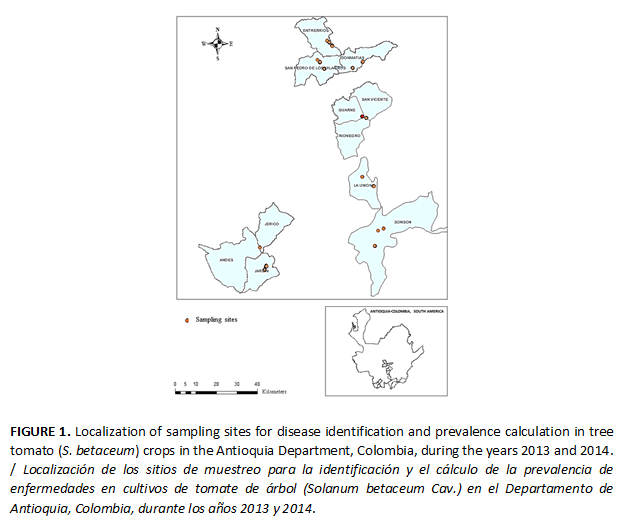
<body><![CDATA[<p style="text-align:justify;"><span style="font-family:'Verdana','sans-serif'; font-size:10.0pt; ">Tree tomato, or tamarillo (<em>Solanum  betaceum</em> Cav.), is a fruit native to the South American Andes, where it is  widely cultivated. This crop is currently grown on a global scale in numerous  countries of Central and South America, Asia, Africa and Oceania. Great efforts  have been made to develop this crop in New Zealand, Ecuador and Colombia, and  these countries have increased its production and exportation in recent years </span><span style="font-family:'Verdana','sans-serif'; font-size:10.0pt; "><a href="#r">(1,2,3)</a></span><span style="font-family:'Verdana','sans-serif'; font-size:10.0pt; ">. Tree tomato has great prospects for being grown as a  productive alternative in moderately cold climate zones; its nutritional  qualities and flavor make it attractive for fresh consumption and the  agroindustrial processing for the purposes of both exportation and domestic  consumption. </span></p>     <p style="text-align:justify;"><span style="font-family:'Verdana','sans-serif'; font-size:10.0pt; ">In Colombia, cultivation of tree tomato (<em>S. betaceum</em></span><span style="font-family:'Verdana','sans-serif'; font-size:10.0pt; ">) has shown a sustained increase, with 8862 hectares  planted in 2014. This area was distributed across 19 departments, of which  Antioquia was the largest producer </span><span style="font-family:'Verdana','sans-serif'; font-size:10.0pt; "><a href="#r">(4)</a></span><span style="font-family:'Verdana','sans-serif'; font-size:10.0pt; ">. Despite the importance of this crop, there are major problems with its  production. The most notable of these are the use of low-quality planting  materials; the indiscriminate use of agrochemical products including  insecticides, fungicides and fertilizers; inappropriate post-harvest handling;  weak and discontinuous professional technical assistance; small number of  varieties; an emerging marketing system; price fluctuation; inadequate crop  planning; and a high prevalence of pests and diseases. In addition to these  problems, no efficient and timely phytosanitary diagnostic system exists </span><span style="font-family:'Verdana','sans-serif'; font-size:10.0pt; "><a href="#r">(5,6,7)</a></span><span style="font-family:'Verdana','sans-serif'; font-size:10.0pt; ">.</span><span style="font-family:'Verdana','sans-serif'; font-size:10.0pt; "> </span></p>     <p style="text-align:justify;"><span style="font-family:'Verdana','sans-serif'; font-size:10.0pt; ">Diseases of tree tomato are caused by various pathogenic agents,  including fungi, bacteria, viruses, nematodes and oomycetes. Historically,  anthracnose on the fruit, caused by <em>Colletotrichum gloeosporioides </em>(Penz.)  Penz &amp; Sacc, and <em>Colletotrichum acutatum </em>Simmonds, and the root-knot  nematodes have been considered the most important diseases in tree tomato </span><span style="font-family:'Verdana','sans-serif'; font-size:10.0pt; "><a href="#r">(8,9)</a></span><span style="font-family:'Verdana','sans-serif'; font-size:10.0pt; ">. However, in recent years, the prevalence and  severity of other phytopathological problems has notably increased, such as  viral diseases caused by the viruses:<em> Potato virus Y (PVY, Potyvirus), Tamarillo leaf malformation virus (TaLMV,  Potyvirus), Tamarillo mosaic virus (TaMV, Potyvirus), Cucumber mosaic virus,  (CMV, Cucumovirus), Potato aucuba mosaic virus (PAMV, Potexvirus), Alfalfa  mosaic virus (AMV, Alfamovirus), Tomato spotted wilt virus (TSWV, Tospovirus),  Tomato mosaic virus (ToMV, Tobamovirus), Potato leafroll virus (PLRV,  Polerovirus), Tomato ringspot virus (ToRSV, Nepovirus), Potato aucuba mosaic  virus (PAMV, Potexvirus), Potato virus A (PVA, Potyvirus), Potato virus V (PVV, Potyvirus), and Peru tomato mosaic virus (PTV, Potyvirus)</em>, have been informed as  inducing symptoms on tree tomato </span><span style="font-family:'Verdana','sans-serif'; font-size:10.0pt; "><a href="#r">(3,7)</a></span><em><span style="font-family:'Verdana','sans-serif'; font-size:10.0pt; ">.</span></em><span style="font-family:'Verdana','sans-serif'; font-size:10.0pt; "> </span></p>     <p style="text-align:justify;"><span style="font-family:'Verdana','sans-serif'; font-size:10.0pt; ">Other phytosanitary problem recently informed is the late blight  disease, for which the oomycete <em>Phytophthora  infestans </em>(Mont.) </span><span style="font-family:'Verdana','sans-serif'; font-size:10.0pt; ">de Bary was identified as the causal agent. Later, a new species named <em>P</em>. <em>andina</em> was informed causing late blight, but it has been the subject of an intense  debate </span><span style="font-family:'Verdana','sans-serif'; font-size:10.0pt; "><a href="#r">(10,11,12)</a></span><span style="font-family:'Verdana','sans-serif'; font-size:10.0pt; ">. For this reason, this causal agent is referred to as <em>P</em>. <em>infestans</em> <em>sensu lato</em> in  the literature </span><span style="font-family:'Verdana','sans-serif'; font-size:10.0pt; "><a href="#r">(10,12)</a></span><span style="font-family:'Verdana','sans-serif'; font-size:10.0pt; ">.</span></p>     <p style="text-align:justify;"><span style="font-family:'Verdana','sans-serif'; font-size:10.0pt; ">There is practically no information available  in Colombia about the abiotic agents that cause pathologies like scarring </span><span style="font-family:'Verdana','sans-serif'; font-size:10.0pt; "><a href="#r">(13)</a></span><span style="font-family:'Verdana','sans-serif'; font-size:10.0pt; ">. There has been little monitoring, identification, diagnosis,  management, or research carried out regarding biotic problems caused by other  pathogens including <em>Alternaria </em>sp.<em>, Ralstonia </em>sp.,<em> Xanthomonas </em>sp.,<em> Oidium </em>sp., and others. The biology of the plant-pathogen  interaction, the incidence, prevalence and distribution, the severity, and the  appropriate conditions for managing these problems in the crop are unknown  essential aspects for mangement of these pathogens management. Additionally,  pathologies present in foreign countries and not identified in Colombia, like  that caused by </span><em><span style="font-family:'Verdana','sans-serif'; font-size:10.0pt; ">Candidatus</span></em><span style="font-family:'Verdana','sans-serif'; font-size:10.0pt; "> Liberibacter  solanacearum, represents a potential quarantine risk </span><span style="font-family:'Verdana','sans-serif'; font-size:10.0pt; "><a href="#r">(14)</a></span><span style="font-family:'Verdana','sans-serif'; font-size:10.0pt; ">. </span></p>     <p style="text-align:justify;"><span style="font-family:'Verdana','sans-serif'; font-size:10.0pt; ">The present study had as objectives the identification of the causal  agents associated with different pathologies in the tree tomato crop and the  estimation of the disease prevalence in commercial lots located in tree  tomato-producing regions of Antioquia, Colombia.</span><span style="font-family:'Verdana','sans-serif'; font-size:10.0pt; "> </span></p>     <p style="text-align:justify;">&nbsp;</p>     <p style="text-align:justify;"><strong><span style="font-family:'Verdana','sans-serif'; ">MATERIALS AND METHODS</span></strong></p>     <p style="text-align:justify;"><span style="font-family:'Verdana','sans-serif'; font-size:10.0pt; ">The present study was carried out in eight municipalities of the  department of Antioquia, Colombia, with a history of producing</span><span style="font-family:'Verdana','sans-serif'; font-size:10.0pt; "> tree tomato, during 2013  and 2014</span><span style="font-family:'Verdana','sans-serif'; font-size:10.0pt; ">. The lots evaluated were located in the Northern  Highlands region (Don Mat&iacute;as, San Pedro, Entrerr&iacute;os), Eastern Antioquia (San  Vicente, La Uni&oacute;n and Sons&oacute;n), and Southwestern Antioquia (Andes and Jard&iacute;n).  Three plots were selected in each of these municipalities (</span><span style="font-family:'Verdana','sans-serif'; font-size:10.0pt; "><a href="/img/revistas/rpv/v32n1/f0104117.gif">Figure 1</a></span><span style="font-family:'Verdana','sans-serif'; font-size:10.0pt; ">).</span></p>     
<p style="text-align:justify;"><span style="font-family:'Verdana','sans-serif'; font-size:10.0pt; ">The regions evaluated were located in the Andean mountains above 1800  masl and corresponded to life zones humid, very humid and pluvial, premontane  and low montane forests (Sensu Holdridge), characterized for mild temperatures,  high precipitation and high relative humidity most of the year round, which are  conditions that favored plant pathogen development.</span></p>     ]]></body>
<body><![CDATA[<p style="text-align:justify;"><strong><span style="font-family:'Verdana','sans-serif'; font-size:10.0pt; ">Identification of the causal agents</span></strong></p>     <p style="text-align:justify;"><span style="font-family:'Verdana','sans-serif'; font-size:10.0pt; ">In the regions of study, tissue samples (roots, stems, leaves, fruits  and flower buds) with any symptomatology, regardless of whether or not it had  been reported previously, were collected </span><span style="font-family:'Verdana','sans-serif'; font-size:10.0pt; "><a href="#r">(7,8,9,10)</a></span><span style="font-family:'Verdana','sans-serif'; font-size:10.0pt; ">. The symptoms were recorded, tissues collected, and microorganisms  isolated. The tissues were stored in hermetic bags prior to laboratory  processing.</span></p>     <p style="text-align:justify;"><span style="font-family:'Verdana','sans-serif'; font-size:10.0pt; ">A portion of the samples was taken to humidity chambers, and the others  were processed in accordance with the methods described by Ram&iacute;rez <em>et al</em>. </span><span style="font-family:'Verdana','sans-serif'; font-size:10.0pt; "><a href="#r">(15)</a></span><span style="font-family:'Verdana','sans-serif'; font-size:10.0pt; ">: rye agar (RA) (Difco, USA) for <em>Phytophthora  infestans sensu lato</em>; acidified potato dextrose agar plus lactic acid  (PDA-A) (Difco, USA) and vegetable juice agar (V8-A) (Difco, USA) supplemented  with streptomycin <span style="background:white; ">(100 &micro;g/ml</span>) for fungi;  and nutrient agar (NA) (Difco, USA) supplemented with <span style="background:white; ">Benomyl&reg; fungicide (50 &micro;g/ml</span>), yeast, dextrose, calcium carbonate  (YDC) (Difco, USA) (16) supplemented with <span style="background:white; ">Benomyl&reg;  fungicide (50 &micro;g/ml</span>), and the semi-selective culture medium Kelman's TZC  Agar (K-TZC-A) (17) as a medium for bacterial growth.</span></p>     <p style="text-align:justify;"><span style="font-family:'Verdana','sans-serif'; font-size:10.0pt; ">Afterwards, the samples were incubated at 28&deg;C for 15 days, with the  exception of the rye agar, which was incubated at 16&deg;C with a photoperiod of 12  hours of light and 12 hours of darkness. For the nematode analysis, roots were  taken from the field, washed with water, air-dried, and used to make  histological mountings on microscope glass slides.</span></p>     <p style="text-align:justify;"><span style="font-family:'Verdana','sans-serif'; font-size:10.0pt; ">Sporulating tissue samples and isolates taken from the culture media  were used to create microassemblies, which were observed under a light  microscope with DIC (<em>Differential  Interference Contrast</em>, Nikon Eclipse Ni) for identification at the genus  level by using the keys from the manual by Barnett and Hunter </span><span style="font-family:'Verdana','sans-serif'; font-size:10.0pt; "><a href="#r">(18)</a></span><span style="font-family:'Verdana','sans-serif'; font-size:10.0pt; "> for fungi, and the manual by Erwin y Ribeiro (19) for <em>Phytophthora </em>spp. Meanwhile, bacteria  were identified through routine biochemical tests, including: Gram staining;  hydrolysis of mucoid colonies on YDC at 30 &deg;C; colony color on YDC; oxidase;  and urease, based on the instructions of Shaad </span><span style="font-family:'Verdana','sans-serif'; font-size:10.0pt; "><a href="#r">(16)</a></span><span style="font-family:'Verdana','sans-serif'; font-size:10.0pt; ">.</span></p>     <p style="text-align:justify;"><span style="font-family:'Verdana','sans-serif'; font-size:10.0pt; ">For nematodes identification, roots with galls or knots from plants  showing symptoms were collected. Galls or knots were dissected under a  stereomicroscope with a sterile scalpel blade. Perineal patterns were performed  from the females recovered and then fixed and mounted permanently on a glass  slide. Structures were visualized under light microscopy (Kikon Eclipse E-200).  Taxonomic identification of nematodes was performed using the keys provided by  Mai and Mullin </span><span style="font-family:'Verdana','sans-serif'; font-size:10.0pt; "><a href="#r">(20)</a></span><span style="font-family:'Verdana','sans-serif'; font-size:10.0pt; ">.</span></p>     <p style="text-align:justify;"><span style="font-family:'Verdana','sans-serif'; font-size:10.0pt; ">For virus identification, samples of symptomatic tissues were collected  and sent to the AGDIA, Inc. diagnostic center (United States). The procedure at  AGDIA Company included an initial serological identification for the virus  genera <em>Begomovirus</em>, <em>Bromoviridade</em>, <em>Carlavirus</em>, <em>Closteroviridae</em>, <em>Comovirus</em>, <em>Curtovirus</em>, <em>Ilarvirus</em>, <em>Nepovirus</em>, <em>Potexvirus</em>, <em>Potyviridade</em>, <em>Tobamovirus</em>, <em>Tobravirus</em>, <em>Tombusvirus</em> and <em>Tospovirus</em>, by the ELISA test,  followed by PCR amplification using species-specific primers, sequencing and  sequence comparison analysis for determining the identity values with the  closest known virus.</span><span style="font-family:'Verdana','sans-serif'; font-size:10.0pt; "> </span></p>     <p style="text-align:justify;"><span style="font-family:'Verdana','sans-serif'; font-size:10.0pt; ">For each pathology found, the corresponding description of the  associated symptomatology was recorded, and for those that had not been  previously reported, the Koch's postulates were performed as follows: Plants  of&nbsp; Red and&nbsp; Yellow cultivars were grown in pots  containing sterile soil (autoclaved at 15 psi and 121&deg;C for two cycles under  net house conditions until they showed five completely expanded leaves.  Standard fertilization, watering and other nursery practices were applied  during seedling development.</span></p>     <p style="text-align:justify;"><em><span style="font-family:'Verdana','sans-serif'; font-size:10.0pt; ">Verticillium </span></em><span style="font-family:'Verdana','sans-serif'; font-size:10.0pt; ">sp.: An isolate was grown on PDA as described. Two hundred milliliters  of sterile distilled water were added per plate and mixed thoroughly. The  resulting suspension was adjusted to a concentration of </span><span style="font-family:'Verdana','sans-serif'; font-size:10.0pt; ">10<sup>5 </sup>conidia per ml<sup>-1</sup> using a  Neubauer chamber. The inoculum was applied homogeneously over the plant roots.  The microorganism was re-isolated from plants showing symptoms.</span><span style="font-family:'Verdana','sans-serif'; font-size:10.0pt; "> </span></p>     <p style="text-align:justify;"><em><span style="font-family:'Verdana','sans-serif'; font-size:10.0pt; ">Clavibacter</span></em><span style="font-family:'Verdana','sans-serif'; font-size:10.0pt; "> sp.: A pure colony was grown on AN (Merck) media as described. The  colony was inoculated in nutritive broth (Merck) under constant shaking at 150  rpm for 48 h at 25&deg;C. Bacterial suspension was adjusted to a concentration of </span><span style="font-family:'Verdana','sans-serif'; font-size:10.0pt; ">10<sup>6 </sup>UFC ml<sup>-1</sup> in 50 ml of final  volume, with sterile distilled water measured by&nbsp; spectrophotometry at 640 nm. The bacterial  suspension was inoculated into the stems and leaves of tomato tree plants. The  bacteria were re-isolated from plants showing symptoms.</span><span style="font-family:'Verdana','sans-serif'; font-size:10.0pt; "> </span></p>     ]]></body>
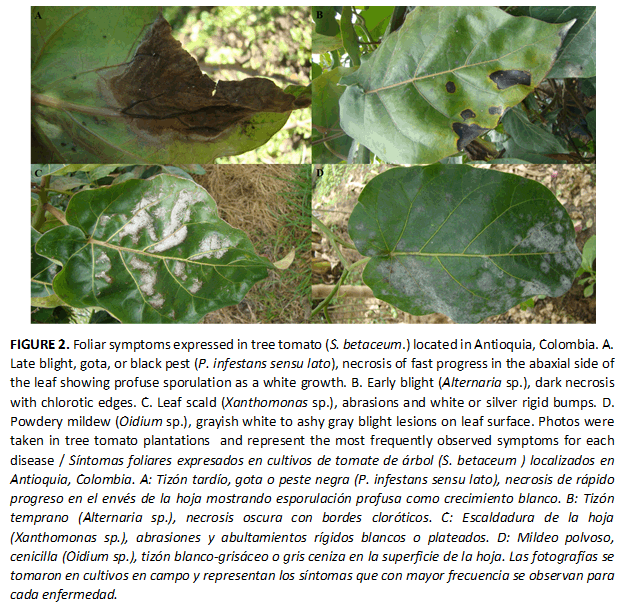
<body><![CDATA[<p style="text-align:justify;"><em><span style="font-family:'Verdana','sans-serif'; font-size:10.0pt; ">Spongospora subterranea : </span></em><span style="font-family:'Verdana','sans-serif'; font-size:10.0pt; ">Tree tomato plants were grown in soil infested with sporosori (spore  balls) of <em>S</em>. <em>subterranea</em> as described previously </span><span style="font-family:'Verdana','sans-serif'; font-size:10.0pt; "><a href="#r">(21,22)</a></span><span style="font-family:'Verdana','sans-serif'; font-size:10.0pt; ">. Plants were kept under net house conditions and the onset of symptoms  was recorded daily. Sporosori and plasmodium presence were identified in the  roots by staining as described previously </span><span style="font-family:'Verdana','sans-serif'; font-size:10.0pt; "><a href="#r">(21,22)</a></span><span style="font-family:'Verdana','sans-serif'; font-size:10.0pt; ">.</span><span style="font-family:'Verdana','sans-serif'; font-size:10.0pt; "> </span></p>     <p style="text-align:justify;"><strong><span style="font-family:'Verdana','sans-serif'; font-size:10.0pt; ">Determination of the prevalence</span></strong><strong><span style="font-family:'Verdana','sans-serif'; font-size:10.0pt; "> </span></strong><strong><span style="font-family:'Verdana','sans-serif'; font-size:10.0pt; ">of the different  pathologies during the two year period tested</span></strong></p>     <p style="text-align:justify;"><span style="font-family:'Verdana','sans-serif'; font-size:10.0pt; ">In each municipality of sampling, three plots planted with tree tomato  in different stages of development were examined. Within each lot, 30 plants  were selected at random. The data obtained in the previously described analyses  were used to determine the prevalence of each disease, calculated as the number  of diseased plants for a given pathology divided by the total number of plants  evaluated.</span></p>     <p style="text-align:justify;"><strong><span style="font-family:'Verdana','sans-serif'; font-size:10.0pt; ">Data analysis</span></strong><strong><span style="font-family:'Verdana','sans-serif'; font-size:10.0pt; "> </span></strong></p>     <p style="text-align:justify;"><span style="font-family:'Verdana','sans-serif'; font-size:10.0pt; ">The prevalence percentage was calculated for each lot, and the value  obtained for prevalence in each lot was used to determine the mean and standard  deviation in each region for the data regarding each disease. A general mean  was then calculated for each disease and for all of the sampling zones.</span></p>     <p style="text-align:justify;">&nbsp;</p>     <p style="text-align:justify;"><strong><span style="font-family:'Verdana','sans-serif'; ">RESULTS AND DISCUSSION</span></strong></p>     <p style="text-align:justify;"><strong><span style="font-family:'Verdana','sans-serif'; font-size:10.0pt; ">Pathogen recognition and description of the  corresponding symptomatology</span></strong></p>     <p style="text-align:justify;"><strong><span style="font-family:'Verdana','sans-serif'; font-size:10.0pt; ">Late blight or black pest</span></strong></p>     <p style="text-align:justify;"><span style="font-family:'Verdana','sans-serif'; font-size:10.0pt; ">The presence of this disease in the field was characterized by irregular  spots on the leaves, which initially have a greasy appearance and later become  necrotic and invade a large portion of the tissue (</span><span style="font-family:'Verdana','sans-serif'; font-size:10.0pt; "><a href="/img/revistas/rpv/v32n1/f0204117.gif">Figure 2A</a></span><span style="font-family:'Verdana','sans-serif'; font-size:10.0pt; ">). In humid conditions, profuse sporulation was  observed on the surface of infected tissues as a white growth at the leading  edge of lesions, usually on the abaxial side of the leaves (</span><span style="font-family:'Verdana','sans-serif'; font-size:10.0pt; "><a href="/img/revistas/rpv/v32n1/f0204117.gif">Figure 2A</a></span><span style="font-family:'Verdana','sans-serif'; font-size:10.0pt; ">). On rye agar medium, the mycelium presented slow,  hyaline, and aerial growth. Under the light microscope, we observed a  non-partitioned mycelium with branched sporangiophores of indeterminate growth.  Semi-papillate (papillae flattened) and caduceus sporangia exhibiting  lemon-like shape with short pedicels.</span></p>     
]]></body>
<body><![CDATA[<p style="text-align:justify;"><span style="font-family:'Verdana','sans-serif'; font-size:10.0pt; ">Based on symptomatology observed and &nbsp;morphological characteristics of the  microorganism, this pathology was associated with the presence of <em>P. infestans sensu lato</em></span><span style="font-family:'Verdana','sans-serif'; font-size:10.0pt; "><a href="#r"> (10,11,12,19)</a></span><span style="font-family:'Verdana','sans-serif'; font-size:10.0pt; ">. This microorganism was clearly differentiated from  the other reported foliar potato pathogen <em>P</em>. <em>nicotianae</em> because it had prominently  papillate and noncaducous sporangia and, at least when infecting potato, no  visible white sporulation was observed with <em>P</em>. <em>nicotianae</em></span><span style="font-family:'Verdana','sans-serif'; font-size:10.0pt; "><a href="#r"> (23)</a></span><span style="font-family:'Verdana','sans-serif'; font-size:10.0pt; background:white; ">.</span></p>     <p style="text-align:justify;"><strong><span style="font-family:'Verdana','sans-serif'; font-size:10.0pt; ">Early blight, sudden leaf burn, or target spots</span></strong></p>     <p style="text-align:justify;"><span style="font-family:'Verdana','sans-serif'; font-size:10.0pt; ">This disease was associated with semicircular intense dark brown spots  of variable sizes, with chlorotic edges (</span><span style="font-family:'Verdana','sans-serif'; font-size:10.0pt; "><a href="/img/revistas/rpv/v32n1/f0204117.gif">Figure 2B</a></span><span style="font-family:'Verdana','sans-serif'; font-size:10.0pt; ">). In the majority of these situations, this damage occurred in the leaf  margins; in advanced stages, the spots coalesced, giving rise to leaf drop. The  colony on PDA exhibited slow growth and a grayish to dark brown color. Short,  simple and erect conidiophores were observed bearing single or branched chains  of large, elongated, dark and pear-shaped conidia with both transverse and  longitudinal septa. The symptomatology and morphological identification  corresponded to <em>Alternaria </em>sp. </span><span style="font-family:'Verdana','sans-serif'; font-size:10.0pt; "><a href="#r">(18,24)</a></span><span style="font-family:'Verdana','sans-serif'; font-size:10.0pt; ">.</span></p>     
<p style="text-align:justify;"><strong><span style="font-family:'Verdana','sans-serif'; font-size:10.0pt; ">Leaf scald or silver spots</span></strong></p>     <p style="text-align:justify;"><span style="font-family:'Verdana','sans-serif'; font-size:10.0pt; ">The initial symptoms were small irregular lesions, which could appear on  any part of the leaf. In advanced stages, this disease was characterized by the  presence of abrasions and white or silver rigid bumps on the leaves (</span><span style="font-family:'Verdana','sans-serif'; font-size:10.0pt; "><a href="/img/revistas/rpv/v32n1/f0204117.gif">Figure 2C</a></span><span style="font-family:'Verdana','sans-serif'; font-size:10.0pt; ">). Over time, these symptoms became more pronounced  and could lead to leaf drop. On the YDC culture medium, yellow, circular  colonies with a convex surface, rounded border and mucoid consistency were  observed. The biochemical tests corresponded to a Gram-negative bacteria type,  yellow or orange colonies on YDC, negative oxidase, mucoid hydrolysis on YDC at  30&deg;C, and negative urease. The test results and symptoms observed were  consistent with the bacteria <em>Xanthomonas </em>sp. </span><span style="font-family:'Verdana','sans-serif'; font-size:10.0pt; "><a href="#r">(16)</a></span><span style="font-family:'Verdana','sans-serif'; font-size:10.0pt; ">.</span></p>     
<p style="text-align:justify;"><strong><span style="font-family:'Verdana','sans-serif'; font-size:10.0pt; ">Mildew or powdery mildew</span></strong></p>     <p style="text-align:justify;"><span style="font-family:'Verdana','sans-serif'; font-size:10.0pt; ">This disease was characterized by the presence of a grayish white to  ashy gray blight that primarily affected the leaf surfaces (</span><span style="font-family:'Verdana','sans-serif'; font-size:10.0pt; "><a href="/img/revistas/rpv/v32n1/f0204117.gif">Figure 2D</a></span><span style="font-family:'Verdana','sans-serif'; font-size:10.0pt; ">). In severe infections, it also appeared on the  underside of the leaves, where irregularly-shaped, dark necrotic lesions were  also observed. In advanced stages, these symptoms were also observed in the  peduncles causing leaf drop. Hyaline, elliptical conidia with thin walls that  emerged in a chain from short, non-branched conidiophores were observed under  the light microscope. The symptoms and morphological structures of the  microorganism corresponded to <em><span style="background:white; ">Oidium</span></em><span style="background:white; "> sp. </span></span><span style="font-family:'Verdana','sans-serif'; font-size:10.0pt; "><a href="#r"><span style="background:white; ">(18)</span></a></span><span style="font-family:'Verdana','sans-serif'; font-size:10.0pt; background:white; ">.</span><span style="font-family:'Verdana','sans-serif'; font-size:10.0pt; "> </span></p>     
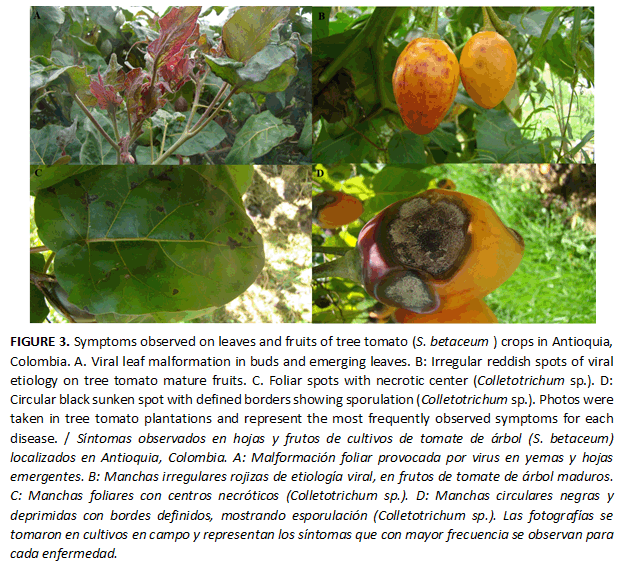
<p style="text-align:justify;"><strong><span style="font-family:'Verdana','sans-serif'; font-size:10.0pt; ">Viral complex</span></strong></p>     <p style="text-align:justify;"><span style="font-family:'Verdana','sans-serif'; font-size:10.0pt; ">The symptoms associated with plants with the  viral complex were very diverse, with the most noteworthy including mosaics,  blisters, vein thickening, and leaf deformation, especially in tender buds and  new leaves (</span><span style="font-family:'Verdana','sans-serif'; font-size:10.0pt; "><a href="/img/revistas/rpv/v32n1/f0304117.gif">Figure 3A</a></span><span style="font-family:'Verdana','sans-serif'; font-size:10.0pt; ">). Irregular reddish spots of variable intensity and pulp hardening in  the mature fruits were also observed (</span><span style="font-family:'Verdana','sans-serif'; font-size:10.0pt; "><a href="/img/revistas/rpv/v32n1/f0304117.gif">Figure 3B</a></span><span style="font-family:'Verdana','sans-serif'; font-size:10.0pt; ">). In advanced stages, the  plants exhibited a general state of decay.</span></p>     
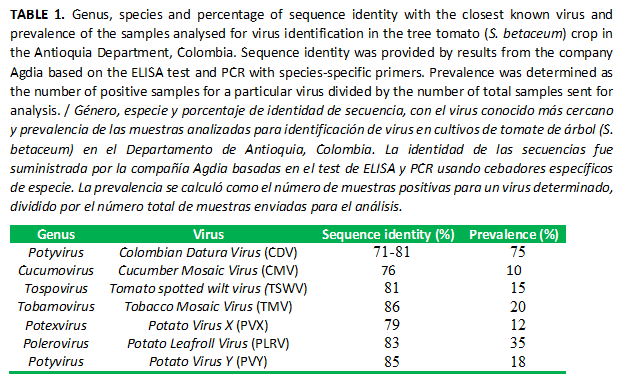
<p style="text-align:justify;"><span style="font-family:'Verdana','sans-serif'; font-size:10.0pt; ">Results from the Agdia diagnostic services  based on the ELISA test and nucleic acid sequence identity informed a close  relationship of the samples with seven virus classified into the genera <em>Potyvirus</em>, <em>Cucumovirus</em>, <em>Tospovirus</em>, <em>Tobamovirus</em>, <em>Potexvirus, </em>and <em>Polerovirus</em> (</span><span style="font-family:'Verdana','sans-serif'; font-size:10.0pt; "><a href="/img/revistas/rpv/v32n1/t0104117.gif">Table 1</a></span><span style="font-family:'Verdana','sans-serif'; font-size:10.0pt; ">). The samples evaluated showed values of sequence identity from 71%,  with <em>Colombian Datura Virus</em> (CDV), to  86%, with <em>Tobacco Mosaic Virus</em> (TMV).  The most prevalent (75%) was the group with 71-81% of sequence identity with  the <em>Colombian Datura Virus</em> (CDV). The  least prevalent (10%) was the group showing 76% of sequence identity with the <em>Cucumber Mosaic Virus</em> (CMV) (</span><span style="font-family:'Verdana','sans-serif'; font-size:10.0pt; "><a href="/img/revistas/rpv/v32n1/t0104117.gif">Table 1</a></span><span style="font-family:'Verdana','sans-serif'; font-size:10.0pt; ">).</span></p>     
]]></body>
<body><![CDATA[<p style="text-align:justify;"><span style="font-family:'Verdana','sans-serif'; font-size:10.0pt; ">Usually, for disease diagnosis purposes, PCR  with species-specific primers and sequence similarity analysis with known  isolates of a virus is sufficient and more sensitive than serological  techniques </span><span style="font-family:'Verdana','sans-serif'; font-size:10.0pt; "><a href="#r">(25)</a></span><span style="font-family:'Verdana','sans-serif'; font-size:10.0pt; ">.</span><span style="font-family:'Verdana','sans-serif'; font-size:10.0pt; "> Even more, for some virus  species a threshold for the sequence identity value has been established, as for  example the species classified within the genus <em>Potyvirus</em> (76%) </span><span style="font-family:'Verdana','sans-serif'; font-size:10.0pt; "><a href="#r">(26)</a></span><span style="font-family:'Verdana','sans-serif'; font-size:10.0pt; ">. However, accurate thresholds for all viral  plant pathogens are not available and sequence identity criteria is under  permanent discussion as more sequences from all the world are publicly  available </span><span style="font-family:'Verdana','sans-serif'; font-size:10.0pt; "><a href="#r">(27)</a></span><span style="font-family:'Verdana','sans-serif'; font-size:10.0pt; ">. For this reason, caution should be exercised when using sequence  identity as the sole diagnostic procedure to identify or confirm a virus  species, and it is always desirable to confirm or complement sequence identity  with another test such as ELISA.</span></p>     <p style="text-align:justify;"><span style="font-family:'Verdana','sans-serif'; font-size:10.0pt; ">Results in the present work showed sequence  identity between 71 to 86% suggesting high intraspecific variability with  presence of lineages or even unknown or closely related viral species to known  viruses. For example, the </span><em><span style="font-family:'Verdana','sans-serif'; font-size:10.0pt; ">Tamarillo Leaf Malformation  Virus</span></em><span style="font-family:'Verdana','sans-serif'; font-size:10.0pt; "> (TaLMV), a </span><span style="font-family:'Verdana','sans-serif'; font-size:10.0pt; ">closely relative species of  the </span><em><span style="font-family:'Verdana','sans-serif'; font-size:10.0pt; ">Colombian Datura Virus</span></em><span style="font-family:'Verdana','sans-serif'; font-size:10.0pt; "> (CDV) was recently  proposed </span><span style="font-family:'Verdana','sans-serif'; font-size:10.0pt; ">as a new species involved in  the tree tomato viral complex </span><span style="font-family:'Verdana','sans-serif'; font-size:10.0pt; "><a href="#r">(3)</a></span><span style="font-family:'Verdana','sans-serif'; font-size:10.0pt; ">.</span></p>     <p style="text-align:justify;"><span style="font-family:'Verdana','sans-serif'; font-size:10.0pt; ">A group of samples exhibited sequence identity  of 86% with the </span><em><span style="font-family:'Verdana','sans-serif'; font-size:10.0pt; ">Tobacco  Mosaic Virus</span></em><span style="font-family:'Verdana','sans-serif'; font-size:10.0pt; "> (TMV). TMV was reported previously in Ecuador by using the ELISA test but no  sequences are available of virus isolates infecting <em>S</em>. <em>betaceum</em></span><span style="font-family:'Verdana','sans-serif'; font-size:10.0pt; "><a href="#r">(28)</a></span><span style="font-family:'Verdana','sans-serif'; font-size:10.0pt; ">. ToMV has frequently been  informed as one of the species of the viral complex causing disease symptoms on  tree tomato </span><span style="font-family:'Verdana','sans-serif'; font-size:10.0pt; "><a href="#r">(3,7)</a></span><span style="font-family:'Verdana','sans-serif'; font-size:10.0pt; ">. TMV and ToMV are classified into the genus <em>Tobamovirus</em> and are closely related species with sequence identity  about 80% (Calculated from sequences obtained from</span><span style="font-family:'Verdana','sans-serif'; font-size:10.0pt; "> </span><span style="font-family:'Verdana','sans-serif'; font-size:10.0pt; "><a href="http://www.dpvweb.net/seqs/plantviruses.php">http://www.dpvweb.net/seqs/plantviruses.php</a></span><span style="font-family:'Verdana','sans-serif'; font-size:10.0pt; ">, consulted 17 November of 2016, using the DnaSP v5  software). At least 14 different virus species have been reported causing  symptoms on tree tomato, some of them in mixed infections and some of them  closely related, </span><span style="font-family:'Verdana','sans-serif'; font-size:10.0pt; ">making  research, diagnosis and management of viral diseases, in particular the viral  complex, a difficult challenge.</span></p>     <p style="text-align:justify;"><span style="font-family:'Verdana','sans-serif'; font-size:10.0pt; ">It is expected that with new information  coming in the next years using cutting edge technologies, as for example the  complete genome sequencing, accurate and fast virus identification will  contribute to a better disease management.</span></p>     <p style="text-align:justify;"><strong><span style="font-family:'Verdana','sans-serif'; font-size:10.0pt; ">Fruit rot, necrotic spots and dieback (anthracnose  complex) </span></strong><strong><span style="font-family:'Verdana','sans-serif'; font-size:10.0pt; "> </span></strong></p>     <p style="text-align:justify;"><span style="font-family:'Verdana','sans-serif'; font-size:10.0pt; ">Rapidly growing greasy black foliar spots with a necrotic center  coalescing in advanced stages were observed (</span><span style="font-family:'Verdana','sans-serif'; font-size:10.0pt; "><a href="/img/revistas/rpv/v32n1/f0304117.gif">Figure 3C</a></span><span style="font-family:'Verdana','sans-serif'; font-size:10.0pt; ">). In all stages of fruit development, these initially appeared as circular  black sunken spots with defined borders (</span><span style="font-family:'Verdana','sans-serif'; font-size:10.0pt; "><a href="/img/revistas/rpv/v32n1/f0304117.gif">Figure 3D</a></span><span style="font-family:'Verdana','sans-serif'; font-size:10.0pt; ">). When the attack occurred in early stages, it led to fruit mummification.  In some cases, a pink or salmon color appeared on the lesion, corresponding to  sporulation. Bud rot leading to dieback was also observed. The colonies on PDA  showed rapid growth with great color variation that ranged from white and gray  to orange. The conidia exhibited variable shapes, which could be cylindrical,  oval, or ellipsoid-fusiform. In the majority of them, one of the sides was  tapered and the other rounded. The symptoms observed in the field and the  morphological characteristics of the associated isolate showed the fungus <em>Colletotrichum </em>sp. as the causative  agent of this disease </span><span style="font-family:'Verdana','sans-serif'; font-size:10.0pt; "><a href="#r">(8,18)</a></span><span style="font-family:'Verdana','sans-serif'; font-size:10.0pt; ">.</span></p>     
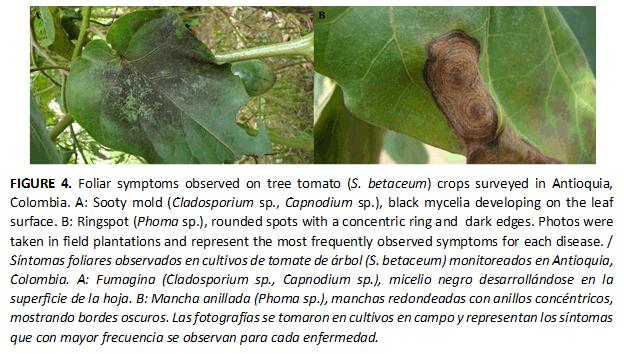
<p style="text-align:justify;"><strong><span style="font-family:'Verdana','sans-serif'; font-size:10.0pt; ">Sooty mold</span></strong></p>     <p style="text-align:justify;"><span style="font-family:'Verdana','sans-serif'; font-size:10.0pt; ">This disease was characterized by the presence of a black mycelial layer  on the surface of the leaves, on which chlorosis sometimes appeared (<a href="/img/revistas/rpv/v32n1/f0404117.gif">Figure 4A</a>). These symptoms may appear on the stem and fruits  and with time can cause defoliation. Rigid conidiophores were observed to have  a series of olivaceous, easily disintegrable, uni- or bicellular conidia at the  apex. These structures are characteristic of <em>Cladosporium </em>sp. <a href="#r">(18)</a>. Additionally,  rounded, cylindrical, emergent and nearly pedunculated fructiferous bodies of a  dark brown color, characteristic to </span><em><span style="font-family:'Verdana','sans-serif'; font-size:10.0pt; ">Capnodium </span></em><span style="font-family:'Verdana','sans-serif'; font-size:10.0pt; ">sp. were observed <a href="#r">(18)</a>.</span></p>     
<p style="text-align:justify;"><strong><span style="font-family:'Verdana','sans-serif'; font-size:10.0pt; ">Ringspot</span></strong></p>     <p style="text-align:justify;"><span style="font-family:'Verdana','sans-serif'; font-size:10.0pt; ">This pathology was characterized by the presence of rounded spots with a  light brown concentric ring in the center and margins with a darker tone (</span><span style="font-family:'Verdana','sans-serif'; font-size:10.0pt; "><a href="/img/revistas/rpv/v32n1/f0404117.gif">Figure 4B</a></span><span style="font-family:'Verdana','sans-serif'; font-size:10.0pt; ">). In advanced stages of the disease, the internal  tissue collapsed causing a perforation in the affected leaves. On PDA culture  medium, the mycelium was aerial, cottony, and dark brown, with a slightly  lighter center. In the micro-assemblies, globular pycnidia with a  well-differentiated ostiole and thin yellow walls containing cylindrical  non-septate conidia were obsrved. The symptomatology found and the  morphological characteristics of the microorganism indicated that this  pathology was associated with <em>Phoma</em> sp. </span><span style="font-family:'Verdana','sans-serif'; font-size:10.0pt; "><a href="#r">(18)</a></span><span style="font-family:'Verdana','sans-serif'; font-size:10.0pt; ">.</span></p>     
]]></body>
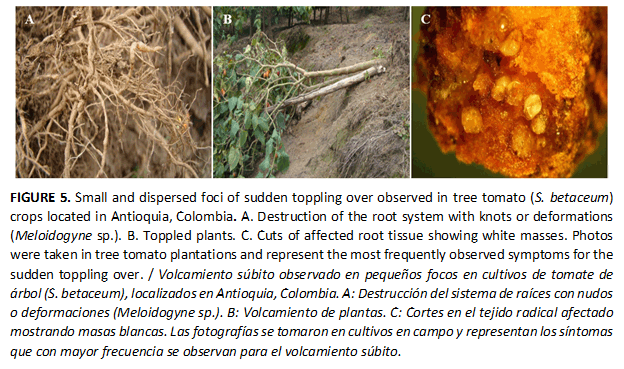
<body><![CDATA[<p style="text-align:justify;"><strong><span style="font-family:'Verdana','sans-serif'; font-size:10.0pt; ">Sudden toppling or generalized yellowing</span></strong></p>     <p style="text-align:justify;"><span style="font-family:'Verdana','sans-serif'; font-size:10.0pt; ">The presence of this disease is characterized by leaf yellowing, stunted  growth, and in advanced stages, plant death, usually localized in dispersed  small foci inside the crop lot. It was observed an extensive destruction of the  root system, with knots or deformations, which sometimes caused the plants to  topple over, mainly because of the wind (</span><span style="font-family:'Verdana','sans-serif'; font-size:10.0pt; "><a href="/img/revistas/rpv/v32n1/f0504117.gif">Figure 5A and 5B</a></span><span style="font-family:'Verdana','sans-serif'; font-size:10.0pt; ">). In cuts made to affected root tissues, white  females and egg masses of root knot nematodes were observed (</span><span style="font-family:'Verdana','sans-serif'; font-size:10.0pt; "><a href="/img/revistas/rpv/v32n1/f0504117.gif">Figure 5C</a></span><span style="font-family:'Verdana','sans-serif'; font-size:10.0pt; ">). Under the microscope, female nematodes with  morphological characteristics coinciding with <em>Meloidogyne</em> sp. were observed </span><span style="font-family:'Verdana','sans-serif'; font-size:10.0pt; "><a href="#r">(9,20)</a></span><span style="font-family:'Verdana','sans-serif'; font-size:10.0pt; ">.</span></p>     
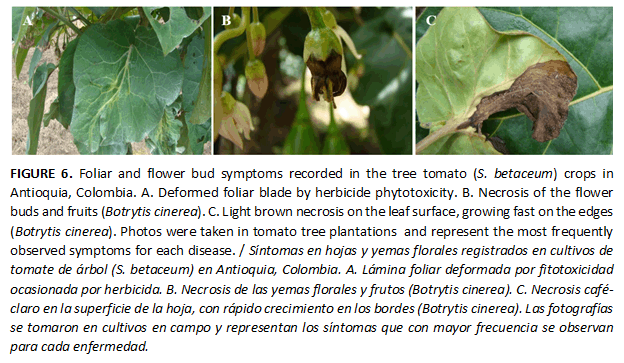
<p style="text-align:justify;"><strong><span style="font-family:'Verdana','sans-serif'; font-size:10.0pt; ">Phytotoxicity</span></strong></p>     <p style="text-align:justify;"><span style="font-family:'Verdana','sans-serif'; font-size:10.0pt; ">Symptoms characteristic of herbicide phytotoxicity, including the growth  of deformed tissue followed by necrosis, were found to be the most frequent  pathology associated with abiotic causes (</span><span style="font-family:'Verdana','sans-serif'; font-size:10.0pt; "><a href="/img/revistas/rpv/v32n1/f0604117.gif">Figure 6A</a></span><span style="font-family:'Verdana','sans-serif'; font-size:10.0pt; ">).</span></p>     
<p style="text-align:justify;"><strong><span style="font-family:'Verdana','sans-serif'; font-size:10.0pt; ">Necrotic spots or leaf blight</span></strong></p>     <p style="text-align:justify;"><span style="font-family:'Verdana','sans-serif'; font-size:10.0pt; ">This disease was characterized by necrosis and subsequent detachment of  flower buds and fruits (</span><span style="font-family:'Verdana','sans-serif'; font-size:10.0pt; "><a href="/img/revistas/rpv/v32n1/f0604117.gif">Figure 6B</a></span><span style="font-family:'Verdana','sans-serif'; font-size:10.0pt; ">). A light brown, moist-looking lesion that grew  rapidly on the margins appeared on the leaf surfaces.&nbsp; (</span><span style="font-family:'Verdana','sans-serif'; font-size:10.0pt; "><a href="/img/revistas/rpv/v32n1/f0604117.gif">Figure 6C</a></span><span style="font-family:'Verdana','sans-serif'; font-size:10.0pt; ">). In times of high humidity, reproductive structures were observed on  the lesions. On PDA medium, the mycelium was gray, and, under the  microscope,&nbsp; the structures observed&nbsp; were long branched conidiophores with  thickened or globular vesicles on their terminal part and clusters of ovoid or  spherical conidia found on the surface. The observed symptomatology and  morphology of the microorganism corresponded to the fungus <em>Botrytis cinerea</em></span><span style="font-family:'Verdana','sans-serif'; font-size:10.0pt; "><a href="#r">(18)</a></span><span style="font-family:'Verdana','sans-serif'; font-size:10.0pt; ">.</span></p>     
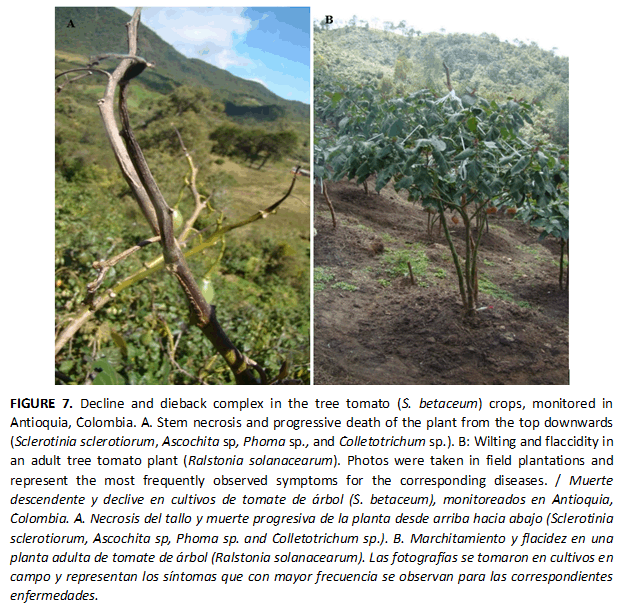
<p style="text-align:justify;"><strong><span style="font-family:'Verdana','sans-serif'; font-size:10.0pt; ">Decline and dieback complex</span></strong></p>     <p style="text-align:justify;"><span style="font-family:'Verdana','sans-serif'; font-size:10.0pt; ">The presence of this disease was characterized by wilting, leaf drop and  stem necrosis, a symptomatology that in advanced stages caused the progressive  death of the plant from the top downwards (</span><span style="font-family:'Verdana','sans-serif'; font-size:10.0pt; "><a href="/img/revistas/rpv/v32n1/f0704117.gif">Figure 7A</a></span><span style="font-family:'Verdana','sans-serif'; font-size:10.0pt; ">). This pathology was observed primarily in adult plantations, although  it was also seen on young plants with a poor agricultural management. The  isolates obtained were associated with the previously reported microorganisms: <em>Sclerotinia sclerotiorum</em>, <em>Ascochita </em>sp.<em>, Phoma </em>sp<em>., </em>and<em> Colletotrichum </em>sp<em>.</em></span><span style="font-family:'Verdana','sans-serif'; font-size:10.0pt; "><a href="#r">(18)</a></span><span style="font-family:'Verdana','sans-serif'; font-size:10.0pt; ">.</span></p>     
<p style="text-align:justify;"><strong><span style="font-family:'Verdana','sans-serif'; font-size:10.0pt; ">Wilt</span></strong></p>     <p style="text-align:justify;"><span style="font-family:'Verdana','sans-serif'; font-size:10.0pt; ">Widespread wilting and flaccidity (</span><span style="font-family:'Verdana','sans-serif'; font-size:10.0pt; "><a href="/img/revistas/rpv/v32n1/f0704117.gif">Figure 7B</a></span><span style="font-family:'Verdana','sans-serif'; font-size:10.0pt; ">), which was accentuated when the ambient temperature was higher, was  identified. In advanced stages, the symptoms described were accompanied by leaf  yellowing, defoliation, and general plant deterioration. In the macroscopic  analysis of the tissue, an obstruction of the vascular bundles, characterized  by a dark brown coloration on the stem, was observed</span><span style="font-family:'Verdana','sans-serif'; font-size:10.0pt; ">.</span><span style="font-family:'Verdana','sans-serif'; font-size:10.0pt; "> From the  diseased tissue, red-colored Gram-negative bacterial colonies surrounded by a  white halo were isolated on TZC medium. The Hydrolysis on YDC at 30&deg;C, the  absence of yellow or orange colonies on YDC culture medium, and the positive  oxidase and urease tests, taken together, indicated the isolation of <em>R. solanacearum </em></span><span style="font-family:'Verdana','sans-serif'; font-size:10.0pt; "><a href="#r">(16,17)</a></span><span style="font-family:'Verdana','sans-serif'; font-size:10.0pt; ">.</span></p>     
]]></body>
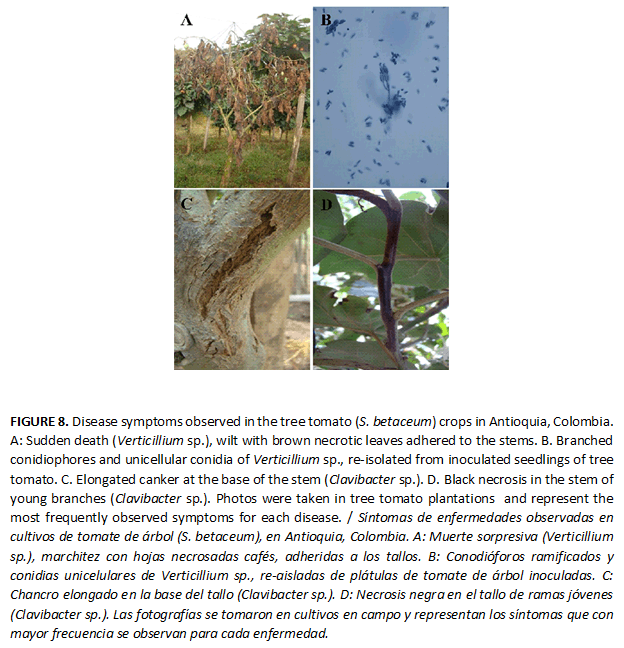
<body><![CDATA[<p style="text-align:justify;"><strong><span style="font-family:'Verdana','sans-serif'; font-size:10.0pt; ">Reporting  new pathologies under field conditions</span></strong></p>     <p style="text-align:justify;"><strong><span style="font-family:'Verdana','sans-serif'; font-size:10.0pt; ">Sudden death</span></strong><strong><span style="font-family:'Verdana','sans-serif'; font-size:10.0pt; "> </span></strong></p>     <p style="text-align:justify;"><span style="font-family:'Verdana','sans-serif'; font-size:10.0pt; ">This pathology was characterized by a widespread wilt, with the leaves  subsequently acquiring a brown tone and remaining adhered to the stems (</span><span style="font-family:'Verdana','sans-serif'; font-size:10.0pt; "><a href="/img/revistas/rpv/v32n1/f0804117.gif">Figure 8A</a></span><span style="font-family:'Verdana','sans-serif'; font-size:10.0pt; ">). This was followed by the death of the plant (</span><span style="font-family:'Verdana','sans-serif'; font-size:10.0pt; "><a href="/img/revistas/rpv/v32n1/f0804117.gif">Figure 8A</a></span><span style="font-family:'Verdana','sans-serif'; font-size:10.0pt; ">). The macroscopic examination of the stem tissue  showed the presence of a brown coloration in the vascular bundles. A hyaline,  floccus, partitioned and thin mycelium grew on the PDA culture medium. </span></p>     
<p style="text-align:justify;"><span style="font-family:'Verdana','sans-serif'; font-size:10.0pt; ">The microassemblies showed branched conidiophores in whorled bundles  with unicellular, hyaline and ovoid conidia at the apex (</span><span style="font-family:'Verdana','sans-serif'; font-size:10.0pt; "><a href="/img/revistas/rpv/v32n1/f0804117.gif">Figure 8B</a></span><span style="font-family:'Verdana','sans-serif'; font-size:10.0pt; ">). The symptomatology was similar to the wilt reported  in avocado </span><span style="font-family:'Verdana','sans-serif'; font-size:10.0pt; "><a href="#r">(15)</a></span><span style="font-family:'Verdana','sans-serif'; font-size:10.0pt; "> and the results of the tests indicated that this  disease was caused by the fungus <em>Verticillium </em>sp. </span><span style="font-family:'Verdana','sans-serif'; font-size:10.0pt; "><a href="#r">(15,18)</a></span><span style="font-family:'Verdana','sans-serif'; font-size:10.0pt; ">. The pathogenicity tests reproduced the symptoms and  the same microorganism was re-isolated, which suggested that it was the causal  agent of sudden death in tree tomato (</span><span style="font-family:'Verdana','sans-serif'; font-size:10.0pt; "><a href="/img/revistas/rpv/v32n1/f0804117.gif">Figure 8B</a></span><span style="font-family:'Verdana','sans-serif'; font-size:10.0pt; ">). </span></p>     
<p style="text-align:justify;"><strong><span style="font-family:'Verdana','sans-serif'; font-size:10.0pt; ">Stem canker, split stem and branch rot</span></strong></p>     <p style="text-align:justify;"><span style="font-family:'Verdana','sans-serif'; font-size:10.0pt; ">On young branches and at the base of the stem,&nbsp; a semi-moist rot of an intense black color  was observed. On the stem, elongated cankers were found (</span><span style="font-family:'Verdana','sans-serif'; font-size:10.0pt; "><a href="/img/revistas/rpv/v32n1/f0804117.gif">Figures 8C and 8D</a></span><span style="font-family:'Verdana','sans-serif'; font-size:10.0pt; ">). A bacterium was consistently isolated from the  diseased tissue; the test performed showed Gram-positive colonies, hydrolysis  on YDC at 30&deg;C, and yellow or orange colonies on YDC. They were negative for  oxidase and urease. The results were consistent with a species belonging to the <em>Clavibacter</em> genus </span><span style="font-family:'Verdana','sans-serif'; font-size:10.0pt; "><a href="#r">(16)</a></span><span style="font-family:'Verdana','sans-serif'; font-size:10.0pt; ">. When the isolate was re-inoculated into tree tomato  seedlings, stem rot symptoms similar to those recorded were observed, and the  same bacterium was re-isolated from the diseased tissues, confirming it as the  causal agent.</span></p>     
<p style="text-align:justify;"><strong><span style="font-family:'Verdana','sans-serif'; font-size:10.0pt; ">Leaf curl</span></strong></p>     <p style="text-align:justify;"><span style="font-family:'Verdana','sans-serif'; font-size:10.0pt; ">This pathology was characterized by leaf yellowing, wilt and curl, in  addition to a&nbsp;&nbsp; stunted growth (</span><span style="font-family:'Verdana','sans-serif'; font-size:10.0pt; "><a href="/img/revistas/rpv/v32n1/f0904117.gif">Figure 9A</a></span><span style="font-family:'Verdana','sans-serif'; font-size:10.0pt; ">). Root galls were also found associated with this  symptomatology; these appeared as a row of irregular spheres with light  coloration that eventually increased slightly in size, turned brown, and  disintegrated into powder (</span><span style="font-family:'Verdana','sans-serif'; font-size:10.0pt; "><a href="/img/revistas/rpv/v32n1/f0904117.gif">Figure 9B</a></span><span style="font-family:'Verdana','sans-serif'; font-size:10.0pt; ">). Roots collected  in the fields, stained and observed under the light microscope, revealed&nbsp; yellow-brown sporosori (</span><span style="font-family:'Verdana','sans-serif'; font-size:10.0pt; "><a href="/img/revistas/rpv/v32n1/f0904117.gif">Figure 9C</a></span><span style="font-family:'Verdana','sans-serif'; font-size:10.0pt; ">) with a polyhedral or slightly ellipsoidal shape and  zoosporangia (</span><span style="font-family:'Verdana','sans-serif'; font-size:10.0pt; "><a href="/img/revistas/rpv/v32n1/f0904117.gif">Figure 9D</a></span><span style="font-family:'Verdana','sans-serif'; font-size:10.0pt; ">), consistent with the plant pathogen <em>Spongospora subterranea</em></span><span style="font-family:'Verdana','sans-serif'; font-size:10.0pt; "><a href="#r"> (21,22)</a></span><span style="font-family:'Verdana','sans-serif'; font-size:10.0pt; ">.</span></p>     
<p style="text-align:justify;"><span style="font-family:'Verdana','sans-serif'; font-size:10.0pt; ">Tree tomato seedlings grown on soil inoculated with sporosori (spore  balls) as described in materials and methods, showed similar symptoms to those  observed under field conditions. Plasmodium (</span><span style="font-family:'Verdana','sans-serif'; font-size:10.0pt; "><a href="/img/revistas/rpv/v32n1/f0904117.gif">Figure 9E</a></span><span style="font-family:'Verdana','sans-serif'; font-size:10.0pt; ">) and sporosori (</span><span style="font-family:'Verdana','sans-serif'; font-size:10.0pt; "><a href="/img/revistas/rpv/v32n1/f0904117.gif">Figure 9F</a></span><span style="font-family:'Verdana','sans-serif'; font-size:10.0pt; ">) were identified on the stained roots from the plant  seedlings grown in soi inoculated with sporosori, being confirmed the  pathogenicity of these structures.</span><span style="font-family:'Verdana','sans-serif'; font-size:10.0pt; "> </span></p>     
<p style="text-align:justify;"><strong><span style="font-family:'Verdana','sans-serif'; font-size:10.0pt; ">Prevalence of pathologies in tree tomato in Antioquia</span></strong></p>     ]]></body>
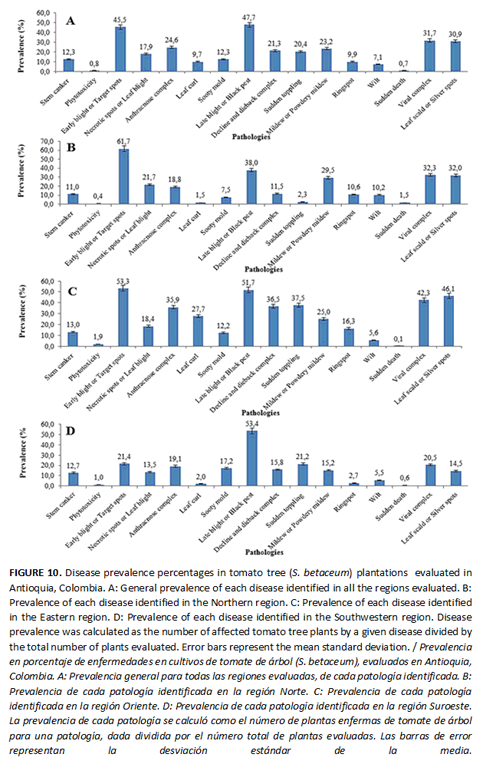
<body><![CDATA[<p style="text-align:justify;"><span style="font-family:'Verdana','sans-serif'; font-size:10.0pt; ">A number of parameters, such as the agronomical management, the sources  and amount of inoculum, and the climatic conditions, determined the prevalence  observed for each disease. The recorded pathologies corresponded to those  expressed under the conditions prevailing during the two years of the study,  which were usually of high precipitation and relative humidity most of the year  round. The absence of others diseases was likely due to the absence of the  environmental conditions required by their causal agents to develop, or maybe  being present the causal agent, the disease did not show high prevalence values  because the climatic conditions were not the optimal for pathogen development,  or control measures were applied promptly and correctly in the fields sampled.</span></p>     <p style="text-align:justify;"><span style="font-family:'Verdana','sans-serif'; font-size:10.0pt; ">The presence of 16 diseases was defined in this study (</span><span style="font-family:'Verdana','sans-serif'; font-size:10.0pt; "><a href="/img/revistas/rpv/v32n1/f1004117.gif">Figure 10A</a></span><span style="font-family:'Verdana','sans-serif'; font-size:10.0pt; ">); of these, 13 presented a prevalence percentage  higher than 9.5%. This signified a high pressure on the crop. The prevalence of  the microorganisms identified varied by sampling region (</span><span style="font-family:'Verdana','sans-serif'; font-size:10.0pt; "><a href="/img/revistas/rpv/v32n1/f1004117.gif">Figures 10B, 10C and 10D</a></span><span style="font-family:'Verdana','sans-serif'; font-size:10.0pt; ">).</span><span style="font-family:'Verdana','sans-serif'; font-size:10.0pt; "> </span></p>     
<p style="text-align:justify;"><span style="font-family:'Verdana','sans-serif'; font-size:10.0pt; ">Blight caused by <em>P.  infestans sensu lato </em>was the disease with the highest prevalence in  Antioquia, with values even higher than 53% in the Southwestern region, and it  was therefore the most important causal agent for this crop </span><span style="font-family:'Verdana','sans-serif'; font-size:10.0pt; "><a href="#r">(10,11)</a></span><span style="font-family:'Verdana','sans-serif'; font-size:10.0pt; ">. Anthracnose (<em>Colletotrichum</em> sp.), previously considered by different authors&nbsp; the most limiting disease in tree tomato </span><span style="font-family:'Verdana','sans-serif'; font-size:10.0pt; "><a href="#r">(6,8)</a></span><span style="font-family:'Verdana','sans-serif'; font-size:10.0pt; ">, was in the fifth place, after the diseases caused by <em>Xanthomonas </em>sp., the different  viruses, and <em>Alternaria </em>sp.&nbsp; (</span><span style="font-family:'Verdana','sans-serif'; font-size:10.0pt; "><a href="/img/revistas/rpv/v32n1/f1004117.gif">Figures 10B, 10C and 10D</a></span><span style="font-family:'Verdana','sans-serif'; font-size:10.0pt; ">). Even more. The <em>Meloidogyne </em>sp. complex, also considered to be of importance </span><span style="font-family:'Verdana','sans-serif'; font-size:10.0pt; "><a href="#r">(9)</a></span><span style="font-family:'Verdana','sans-serif'; font-size:10.0pt; ">, occupied the eighth spot in terms of prevalence,  with a level of 20.4%. </span></p>     
<p style="text-align:justify;"><span style="font-family:'Verdana','sans-serif'; font-size:10.0pt; ">The results of this study show that the diseases in tree tomato crops  are caused by a wide range of causal agents</span><span style="font-family:'Verdana','sans-serif'; font-size:10.0pt; ">.</span><span style="font-family:'Verdana','sans-serif'; font-size:10.0pt; "> </span><span style="font-family:'Verdana','sans-serif'; font-size:10.0pt; ">For this reason, timely and precise monitoring and  diagnosis of pathologies should be considered fundamental for planning  effective and efficient control strategies.</span><span style="font-family:'Verdana','sans-serif'; font-size:10.0pt; "> </span></p>     <p style="text-align:justify;"><span style="font-family:'Verdana','sans-serif'; font-size:10.0pt; ">The prevalence values for late blight, and the known severity of this  disease when the environmental conditions are favorable for <em>P. infestans sensu lato, </em>suggest that  this disease has the potential to become the most limiting disease for tree  tomato crops, as it is already for various Solanaceae crops on a global scale.  This pathogen is found associated with numerous hosts in the Andean region,  including potato, tomato, lulo, cape gooseberry, cucumber, and others. These  crops are cultivated together with tree tomato, thus making it more difficult  to control the pathogen </span><span style="font-family:'Verdana','sans-serif'; font-size:10.0pt; "><a href="#r">(10,11,12)</a></span><span style="font-family:'Verdana','sans-serif'; font-size:10.0pt; ">.</span><span style="font-family:'Verdana','sans-serif'; font-size:10.0pt; "> </span></p>     <p style="text-align:justify;"><span style="font-family:'Verdana','sans-serif'; font-size:10.0pt; ">The disease caused by <em>Alternaria </em>sp.  was another of increasing importance found in this study.&nbsp; It had the second-highest prevalence, both in  general (</span><span style="font-family:'Verdana','sans-serif'; font-size:10.0pt; "><a href="/img/revistas/rpv/v32n1/f1004117.gif">Figure 10A</a></span><span style="font-family:'Verdana','sans-serif'; font-size:10.0pt; ">) and in each of the regions evaluated (</span><span style="font-family:'Verdana','sans-serif'; font-size:10.0pt; "><a href="/img/revistas/rpv/v32n1/f1004117.gif">Figures 10B, 10C and 10D</a></span><span style="font-family:'Verdana','sans-serif'; font-size:10.0pt; ">). This microorganism has been reported<span style="background:white; "> as a pathogen of great economic significance</span> in tomato (<em>Solanum <span style="background:white; ">lycopersicum</span></em><span style="background:white; ">)  and potato (<em>Solanum tuberosum</em>)  because of its high aggressiveness and the major financial losses it can cause.  Additionally, it can survive under adverse conditions</span></span><span style="font-family:'Verdana','sans-serif'; font-size:10.0pt; "><a href="#r">(24)</a></span><span style="font-family:'Verdana','sans-serif'; font-size:10.0pt; ">.</span></p>     
<p style="text-align:justify;"><span style="font-family:'Verdana','sans-serif'; font-size:10.0pt; ">The disease with the third-highest prevalence was caused by the viral  complex was associated with the presence of six distinct genera. </span><span style="font-family:'Verdana','sans-serif'; font-size:10.0pt; ">The viral complex is of difficult management because  14 viruses have been identified causing symptoms on tree tomato. </span><span style="font-family:'Verdana','sans-serif'; font-size:10.0pt; ">In this regard, </span><span style="font-family:'Verdana','sans-serif'; font-size:10.0pt; ">Jaramillo <em>et al</em>. </span><span style="font-family:'Verdana','sans-serif'; font-size:10.0pt; "><a href="#r">(7)</a></span><span style="font-family:'Verdana','sans-serif'; font-size:10.0pt; ">, proposed this disease to be considered among the  most limiting since, in its advanced stages, crop eradication is required,  there is no chemical treatment available, and the current varieties are  susceptible. In the present work, the strains showed low sequence identity  suggesting a high variability or possibly new viral species that require  further research. Different virus species implies that epidemiological factors  such as virus particle transmission, strain virulence, vectors and other  aspects of virus-host biology, must be studied in detail for each virus in  order to implement adequate integrated management strategies for this viral  complex.</span><span style="font-family:'Verdana','sans-serif'; font-size:10.0pt; "> </span></p>     <p style="text-align:justify;"><span style="font-family:'Verdana','sans-serif'; font-size:10.0pt; ">Meanwhile, leaf scald, mildew, the dieback complex and necrotic spots  had prevalence values higher than 15% (</span><span style="font-family:'Verdana','sans-serif'; font-size:10.0pt; "><a href="/img/revistas/rpv/v32n1/f1004117.gif">Figures 10A, 10B, 10C and 10D</a></span><span style="font-family:'Verdana','sans-serif'; font-size:10.0pt; ">), meaning they are significant in the crop. The  prevalence found in the crops for the majority of the diseases was indicative  of poor phytosanitary management practices, misdiagnosis, or resistant strains  of the pathogens.</span><span style="font-family:'Verdana','sans-serif'; font-size:10.0pt; "> </span></p>     
<p style="text-align:justify;"><span style="font-family:'Verdana','sans-serif'; font-size:10.0pt; ">Stem cankers, not previously reported in tree tomato, were associated  with the presence of the bacterium <em>Clavibacter</em> sp. In tomato, <em>Clavibacter michiganensis</em>,  subspecies <em>michiganensis</em>, causes bacterial  canker </span><span style="font-family:'Verdana','sans-serif'; font-size:10.0pt; "><a href="#r">(29)</a></span><span style="font-family:'Verdana','sans-serif'; font-size:10.0pt; ">. <em>S. subterr&aacute;nea</em> has been reported as a pathogen of different species within the family  Solanaceae under greenhouse conditions </span><span style="font-family:'Verdana','sans-serif'; font-size:10.0pt; "><a href="#r">(21,22)</a></span><span style="font-family:'Verdana','sans-serif'; font-size:10.0pt; ">. The presence of this disease causes substantial losses in the potato  crop (<em>S. tuberosum</em>) and it has the  characteristic that its inoculum increases cycle after cycle </span><span style="font-family:'Verdana','sans-serif'; font-size:10.0pt; "><a href="#r">(21,22)</a></span><span style="font-family:'Verdana','sans-serif'; font-size:10.0pt; ">. In regard to the visual identification of this  disease, it can be confused with problems caused by nematodes classified in the  genus <em>Meloidogyne</em>. A disease that is  similar to the sudden death caused by <em>Verticillium </em>sp. has been reported in avocado in the region of study </span><span style="font-family:'Verdana','sans-serif'; font-size:10.0pt; "><a href="#r">(15)</a></span><span style="font-family:'Verdana','sans-serif'; font-size:10.0pt; ">. Worldwide, this causal agent has been associated  with species belonging to the Solanaceae family, such as tomato and potato </span><span style="font-family:'Verdana','sans-serif'; font-size:10.0pt; "><a href="#r">(30)</a></span><span style="font-family:'Verdana','sans-serif'; font-size:10.0pt; ">.</span><span style="font-family:'Verdana','sans-serif'; font-size:10.0pt; "> </span></p>     <p style="text-align:justify;"><span style="font-family:'Verdana','sans-serif'; font-size:10.0pt; ">The majority of the diseases identified in this study had been  previously reported </span><span style="font-family:'Verdana','sans-serif'; font-size:10.0pt; "><a href="#r">(3,5,6,7,8,9,10,11,22)</a></span><span style="font-family:'Verdana','sans-serif'; font-size:10.0pt; ">. However, new diseases, such as those caused by <em>S. subterranea</em>, <em>Verticillium</em> sp. and <em>Clavibacter</em> sp., were reported.  Moreover, the variation between the prevalence observed and that previously  published for each disease indicated variation in the factors favoring disease  development such as the weather, agronomical management and inoculum. For this  reason, permanent surveillance must be established to prevent severe epidemics  in this crop. Traditionally, diseases have been managed in this crop  almost exclusively through the scheduled spraying of chemical products, which  represents 27% of production costs. Usually, these applications are not based  on a timely and accurate diagnosis, which reduces the competitiveness and  sustainability of the crop. Additionally, the indiscriminate application of  pesticides causes the environmental pollution and health problems for producers  and consumers, and is a strong selection factor for pathogens, generating  populations that are resistant to the molecules. The results described in this  study will help lay the foundations for appropriate diagnosis and management of  the pathogens associated with this crop.</span></p>     ]]></body>
<body><![CDATA[<p style="text-align:justify;">&nbsp;</p>     <p style="text-align:justify;"><strong><span style="font-family:'Verdana','sans-serif'; ">CONCLUSION</span></strong><strong><span style="font-family:'Verdana','sans-serif'; font-size:10.0pt; "> </span></strong></p>     <p style="text-align:justify;"><span style="font-family:'Verdana','sans-serif'; font-size:10.0pt; ">Pathologies associated to tree tomato are complex and require permanent  monitoring to apply appropriate and timely integrated disease management  programs.</span></p>     <p style="text-align:justify;">&nbsp;</p>     <p style="text-align:justify;"><strong><span style="font-family:'Verdana','sans-serif'; ">AKNOWLEDGMENTS</span></strong><strong><span style="font-family:'Verdana','sans-serif'; "> </span></strong></p>     <p style="text-align:justify;"><span style="font-family:'Verdana','sans-serif'; font-size:10.0pt; ">The present research was funded by</span><span style="font-family:'Verdana','sans-serif'; font-size:10.0pt; "> Universidad  Nacional de Colombia sede Medell&iacute;n, under the project: "</span><span style="font-family:'Verdana','sans-serif'; font-size:10.0pt; ">Alternativas de  manejo de la gota del tomate de &aacute;rbol (<em>Solanum betaceum </em>Cav), mediante  el uso de inductores de resistencia y caracterizaci&oacute;n del organismo causal (<em>Phytophthora  infestans</em> <em>sensu lato</em>)", "grant: Resoluci&oacute;n A-0891 de 2012 Mayo 18.</span></p>     <p style="text-align:justify;">&nbsp;</p>     <p style="text-align:justify;"><a name="r"><strong><span style="font-family:'Verdana','sans-serif'; ">REFERENCES</span></strong></a></p>     <!-- ref --><p style="text-align:justify;"><span style="font-family:'Verdana','sans-serif'; font-size:10.0pt; ">1. </span><span style="font-family:'Verdana','sans-serif'; font-size:10.0pt; background:white; ">Acosta-Quezada P, Riofr&iacute;o-Cuenca P, Rojas J, Vilanova S,  Plazas M, Prohens J.</span> <span style="font-family:'Verdana','sans-serif'; font-size:10.0pt; ">Phenological growth stages of tree tomato (<em>Solanum  betaceum</em> Cav.), an emerging fruit crop, according to  the basic and extended BBCH scales. </span><span style="font-family:'Verdana','sans-serif'; font-size:10.0pt; background:white; ">Scientia Horticulturae. 2016; 199 (16): 216-223</span><span style="font-family:'Verdana',    'sans-serif'; font-size:10.0pt; ">.</span></p>     ]]></body>
<body><![CDATA[<!-- ref --><p style="text-align:justify;"><span style="font-family:'Verdana','sans-serif'; font-size:10.0pt; ">2.  Bioversity International, Departamento de Ciencias Agropecuarias y de  Alimentos, and COMAV. </span><span style="font-family:'Verdana','sans-serif'; font-size:10.0pt; ">Descriptors for tree tomato (<em>Solanum betaceum </em>Cav.)  and wild relatives. </span><span style="font-family:'Verdana','sans-serif'; font-size:10.0pt; ">Bioversity International, Rome, Italy; Departamento de Ciencias  Agropecuarias y de Alimentos (UTPL), Loja, Ecuador; Instituto de Conservacion y  Mejora de la Agrodiversidad Valenciana, Valencia, Spain. 2013. 67p.    </span></p>     <!-- ref --><p style="text-align:justify;"><span style="font-family:'Verdana','sans-serif'; font-size:10.0pt; ">3. Guti&eacute;rrez P, Alzate J, Mar&iacute;n M. Genome sequence of a virus isolate  from tamarillo (<em>Solanum betaceum</em>) in  Colombia: evidence for a new potyvirus. Archives of Virology. 2015;  160:557-560.    </span><span style="font-family:'Verdana','sans-serif'; font-size:10.0pt; "> </span></p>     <!-- ref --><p style="text-align:justify;"><span style="font-family:'Verdana','sans-serif'; font-size:10.0pt; ">4. Agronet. Sistema de estad&iacute;stica agropecuaria: &aacute;rea, producci&oacute;n y  rendimiento para tomate de &aacute;rbol. </span><span style="font-family:'Verdana','sans-serif'; font-size:10.0pt; ">2014. (Consultado 07-11-2016). Disponible:  www.agronet.gov.co/agronetweb1/Estad%C3%ADsticas.aspx.    </span></p>     <!-- ref --><p style="text-align:justify;"><span style="font-family:'Verdana','sans-serif'; font-size:10.0pt; ">5. Hierro A,  Guerra S, Padilla F, Arroyo C, Soria N, et al. </span><span style="font-family:'Verdana','sans-serif'; font-size:10.0pt; ">Assessing the Morphological Variations on the  pollen grains of <em>Solanum betaceum </em>caused by chemical, biological and ecological  pesticides. Biol Med (Aligarh). 2016; 8: 286. </span><span style="font-family:'Verdana','sans-serif'; font-size:10.0pt; ">doi:</span><span style="font-family:'Verdana','sans-serif'; font-size:10.0pt; "> </span><span style="font-family:'Verdana','sans-serif'; font-size:10.0pt; ">10.4172/0974-8369.1000286.    </span><span style="font-family:'Verdana','sans-serif'; font-size:10.0pt; "> </span></p>     <!-- ref --><p style="text-align:justify;"><span style="font-family:'Verdana','sans-serif'; font-size:10.0pt; ">6. </span><span style="font-family:'Verdana','sans-serif'; font-size:10.0pt; ">Luengas-G&oacute;mez  C, Roa-V&aacute;squez M, Orrego-V&aacute;squez J. Evaluation of a prebiotic and potassium for  the control of anthracnose in the tree tomato. </span><span style="font-family:'Verdana','sans-serif'; font-size:10.0pt; ">Agronom&iacute;a Colombiana. 2012; 30(2): 230-235.     </span></p>     ]]></body>
<body><![CDATA[<!-- ref --><p style="text-align:justify;"><span style="font-family:'Verdana','sans-serif'; font-size:10.0pt; ">7. Jaramillo</span><span style="font-family:'Verdana','sans-serif'; font-size:10.0pt; "> M, &Aacute;lvarez J, Mar&iacute;n M. Caracter&iacute;sticas de los virus asociados a la virosis del  tomate de &aacute;rbol (<em>Solanum betaceum</em>) en  Colombia. Revista Lasallista de Investigaci&oacute;n. 2012; </span><span style="font-family:'Verdana','sans-serif'; font-size:10.0pt; ">9 (1): 115-127.    </span></p>     <p style="text-align:justify;"><span style="font-family:'Verdana','sans-serif'; font-size:10.0pt; ">8. <span style="background:white; ">Pardo-De  la Hoz C, Calder&oacute;n C, Rinc&oacute;n A, C&aacute;rdenas M, Danies G, L&oacute;pez-Kleine L, Restrepo  S, Jim&eacute;nez P. Species from the <em><span style="border:none windowtext 1.0pt; padding:0cm; font-family:'Verdana','sans-serif'; ">Colletotrichum acutatum</span></em>,<em><span style="border:none windowtext 1.0pt; padding:0cm; "> </span></em><em><span style="font-family:'Verdana','sans-serif'; ">Colletotrichum boninense</span></em> and <em><span style="font-family:'Verdana','sans-serif'; ">Colletotrichum gloeosporioides</span></em> species complexes associated with tree  tomato and mango crops in Colombia. </span></span><span style="font-family:'Verdana','sans-serif'; font-size:10.0pt; background:white; ">Plant Pathology. 2016; 65: 227&ndash;237.  doi:10.1111/ppa.12410.</span></p>     <!-- ref --><p style="text-align:justify;"><span style="font-family:'Verdana','sans-serif'; font-size:10.0pt; ">9. </span><span style="font-family:'Verdana','sans-serif'; font-size:10.0pt; ">Mosquera-Espinosa A. Plant  parasitic nematodes associated with <em>Cyphomandra betacea </em>(Cav.) </span><span style="font-family:'Verdana','sans-serif'; font-size:10.0pt; ">Sendtn., <em>Solanum quitoense </em>Lam. and <em>Daucus carota </em>L. in Boyac&aacute;, Colombia. </span><span style="font-family:'Verdana','sans-serif'; font-size:10.0pt; ">Acta Agron&oacute;mica. 2016; 65  (1): 87-9. doi: <a href="http://dx.doi.org/10.15446/acag.v65n1.45180" target="_blank">http://dx.doi.org/10.15446/acag.v65n1.45180</a>.     </span></p>     <!-- ref --><p style="text-align:justify;"><span style="font-family:'Verdana','sans-serif'; font-size:10.0pt; ">10. </span><span style="font-family:'Verdana','sans-serif'; font-size:10.0pt; ">Forbes G, Morales J, Restrepo S, P&eacute;rez W,  Gamboa S, Ruiz R, Cede&ntilde;o L, Fermin G, Adriana B, Andreu B, Ivette Acu&ntilde;a I,  Oliva R. </span><em><span style="font-family:'Verdana','sans-serif'; font-size:10.0pt; ">Phytophthora infestans</span></em><span style="font-family:'Verdana','sans-serif'; font-size:10.0pt; "> and <em>Phytophthora andina</em> on Solanaceous Hosts in South America. </span><span style="font-family:'Verdana','sans-serif'; font-size:10.0pt; ">En: </span><em><span style="font-family:'Verdana','sans-serif'; font-size:10.0pt; ">Phytophthora</span></em><span style="font-family:'Verdana','sans-serif'; font-size:10.0pt; ">: A Global Perspective (ed. Lamour K). CAB International,  CABI Wallingford, UK. 2013.     </span></p>     <p style="text-align:justify;"><span style="font-family:'Verdana','sans-serif'; font-size:10.0pt; ">11. Oliva RF, Kroon L, Chac&oacute;n G, Flier W, Ristaino J, Forbes G. <em>Phytophthora andina</em> sp. nov., a newly  identified heterothall</span><span style="font-family:'Verdana','sans-serif'; font-size:10.0pt; ">ic pathogen of  solanaceous hosts in the Andean highlands. </span><span style="font-family:'Verdana','sans-serif'; font-size:10.0pt; ">Plant Pathology. 2010; 59: 613&ndash;625.</span><span style="font-family:'Verdana','sans-serif'; font-size:10.0pt; "> </span></p>     <!-- ref --><p style="text-align:justify;"><span style="font-family:'Verdana','sans-serif'; font-size:10.0pt; ">12.  Casta&ntilde;o J, Ramirez J, Pati&ntilde;o L, Morales J. </span><span style="font-family:'Verdana','sans-serif'; font-size:10.0pt; background:white; ">Alternativa para el manejo  de <em>Phytophthora infestans</em> (Mont.) de Bary en <em>Solanum betaceum </em>Cav. mediante  inductores de resistencia.</span><span style="font-family:'Verdana','sans-serif'; font-size:10.0pt; "> </span><span style="font-family:'Verdana','sans-serif'; font-size:10.0pt; ">Rev.Protecci&oacute;n Veg.  2015; 30 (3): 204-212.    </span></p>     ]]></body>
<body><![CDATA[<!-- ref --><p style="text-align:justify;"><span style="font-family:'Verdana','sans-serif'; font-size:10.0pt; ">13. Rheinl&auml;nder P, Jamieson L, Fullerton R, Manning M, Meier X. Scarring  in tamarillo fruit (<em>Solanum betaceum</em>).  New Zealand Plant Protection, 2009; 62: 315-320.    </span></p>     <!-- ref --><p style="text-align:justify;"><span style="font-family:'Verdana','sans-serif'; font-size:10.0pt; ">14. Liefting L, Weir B, Pennycook S, Clover G. '<em>Candidatus</em> Liberibacter solanacearum', associated with plants in  the family Solanaceae. </span><span style="font-family:'Verdana','sans-serif'; font-size:10.0pt; ">International  Journal of Systematic and Evolutionary Microbiology. 2009; 59, 2274-2276.    </span></p>     <!-- ref --><p style="text-align:justify;"><span style="font-family:'Verdana','sans-serif'; font-size:10.0pt; background:white; ">15. Ram&iacute;rez J, Casta&ntilde;eda  D, Morales J. Estudios etiol&oacute;gicos de la marchitez del aguacate en  Antioquia-Colombia. </span><span style="font-family:'Verdana','sans-serif'; font-size:10.0pt; background:white; ">Revista Ceres,  2014; 61(1): 050-061.    </span><span style="font-family:'Verdana','sans-serif'; font-size:10.0pt; "> </span></p>     <!-- ref --><p style="text-align:justify;"><span style="font-family:'Verdana','sans-serif'; font-size:10.0pt; ">16. Shaad N. Laboratory guide for identification of plant pathogenic  bacteria. </span><span style="font-family:'Verdana','sans-serif'; font-size:10.0pt; ">Departament  of Plant Pathology. University of Georgia. 2001. 398 p.    </span></p>     <!-- ref --><p style="text-align:justify;"><span style="font-family:'Verdana','sans-serif'; font-size:10.0pt; ">17.</span><em><span style="font-family:'Verdana','sans-serif'; font-size:10.0pt; "> </span></em><span style="font-family:'Verdana','sans-serif'; font-size:10.0pt; ">Burgos C, Silva B, Salazar M, Morales J.  Diversidad gen&eacute;tica de aislados de <em>Ralstonia solanacearum </em>procedentes de  tres regiones de Colombia.</span><span style="font-family:'Verdana','sans-serif'; font-size:10.0pt; "> </span><span style="font-family:'Verdana','sans-serif'; font-size:10.0pt; ">Rev.  Protecci&oacute;n Veg. 2015; 30 (3): 213-224.    </span></p>     ]]></body>
<body><![CDATA[<!-- ref --><p style="text-align:justify;"><span style="font-family:'Verdana','sans-serif'; font-size:10.0pt; ">18. Barnett H, Hunter B. Illustrated genera of imperfect fungi. Third edition. </span><span style="font-family:'Verdana','sans-serif'; font-size:10.0pt; ">Burgess Publishing Company. Minnesota, E.U. 1972. 241  p.    </span><span style="font-family:'Verdana','sans-serif'; font-size:10.0pt; "> </span></p>     <!-- ref --><p style="text-align:justify;"><span style="font-family:'Verdana','sans-serif'; font-size:10.0pt; ">19. Erwin D, Ribeiro O. <em>Phytophthora </em>Diseases Worldwide. The  American Phytophathological Society, St. Paul, Minnesota, E.U. 1996. 562 p.    </span></p>     <!-- ref --><p style="text-align:justify;"><span style="font-family:'Verdana','sans-serif'; font-size:10.0pt; ">20. Mai W, Mullin P.</span><span style="font-family:'Verdana','sans-serif'; font-size:10.0pt; "> Plant-parasitic nematodes- a pictorial key to  genera. </span><span style="font-family:'Verdana','sans-serif'; font-size:10.0pt; ">Cornell University Press,  Ithaca, NY, USA. 1996. 277 p.    </span></p>     <!-- ref --><p style="text-align:justify;"><span style="font-family:'Verdana','sans-serif'; font-size:10.0pt; ">21. </span><span style="font-family:'Verdana','sans-serif'; font-size:10.0pt; ">Soler  J, Benavidez W, Gilchrist E, Morales J, P&eacute;rez J. Evaluation of an <em>in vitro</em> system for the study of <em>Spongospora subterranea</em> f. sp. <em>subterranea</em> in potato roots (<em>Solanum tuberosum</em> subsp. <em>andigena</em> L.) Var. </span><span style="font-family:'Verdana','sans-serif'; font-size:10.0pt; ">Diacol  Capiro. Revista de la Facultad de Ciencias. 2012; 1(2): 34-46.    </span><span style="font-family:'Verdana','sans-serif'; font-size:10.0pt; "> </span></p>     <!-- ref --><p style="text-align:justify;"><span style="font-family:'Verdana','sans-serif'; font-size:10.0pt; ">22. </span><span style="font-family:'Verdana','sans-serif'; font-size:10.0pt; ">Bastidas N, Morales J, Gonzales E, Gutierrez P, Marin M. Detecci&oacute;n y cuantificaci&oacute;n de <em>Spongospora  subterranea </em>f. sp. <em>subterranea </em>en plantas se&ntilde;uelo y cultivos de papa  en Colombia mediante qPCR. </span><span style="font-family:'Verdana','sans-serif'; font-size:10.0pt; ">Acta Biol&oacute;gica Colombiana. 2013; 18 (1): </span><span style="font-family:'Verdana','sans-serif'; font-size:10.0pt; ">121 -136.    </span></p>     ]]></body>
<body><![CDATA[<!-- ref --><p style="text-align:justify;"><span style="font-family:'Verdana','sans-serif'; font-size:10.0pt; ">23. Taylor R, Pasche J, Gallup C, Shew H, Gudmestad N. A foliar blight  and tuber rot of potato caused by <em>Phytophthora  nicotianae</em>: New occurrences and characterization of isolates. Plant  Disease. 2008; 92: 492-503.    </span></p>     <p style="text-align:justify;"><span style="font-family:'Verdana','sans-serif'; font-size:10.0pt; background:white; ">24.</span><span style="font-family:'Verdana','sans-serif'; font-size:10.0pt; "> Upadhyay P, Rai A,  Kumar R, Singh M, Sinha B.<span style="background:white; "> </span>Microarray  analyses during early stage of the tomato/<em>Alternaria  solani</em> interaction. Genomics Data. 2015; 6: 170&ndash;172.<span style="background:white; "> </span></span></p>     <!-- ref --><p style="text-align:justify;"><span style="font-family:'Verdana','sans-serif'; font-size:10.0pt; background:white; ">25. </span><span style="font-family:'Verdana','sans-serif'; font-size:10.0pt; ">Schneider W, Sherman D, Stone A, Damsteegt V, Frederick R. Specific  detection and quantification of Plum pox virus by real-time fluorescent reverse  transcription-PCR. Journal of Virological Methods. 2004; 120: 97-105.    </span><span style="font-family:'Verdana','sans-serif'; font-size:10.0pt; background:white; "> </span></p>     <!-- ref --><p style="text-align:justify;"><span style="font-family:'Verdana','sans-serif'; font-size:10.0pt; background:white; ">26. </span><span style="font-family:'Verdana','sans-serif'; font-size:10.0pt; ">Adams M, Antoniw J, Fauquet C. Molecular criteria for genus and species  discrimination within the family Potyviridae. Archives of Virology. 2005; 150:  459-479. doi:10.1007/s00705-004-0440-6.    </span></p>     <!-- ref --><p style="text-align:justify;"><span style="font-family:'Verdana','sans-serif'; font-size:10.0pt; ">27. Duffy S, Seah Y. 98% identical, 100%  wrong: per cent nucleotide identity can lead plant virus epidemiology astray. </span><span style="font-family:'Verdana','sans-serif'; font-size:10.0pt; ">Philosophical Trans. Royal  Society B. 2010; 365: 1891-1897. doi:10.1098/rstb.2010.0056.    </span></p>     <!-- ref --><p style="text-align:justify;"><span style="font-family:'Verdana','sans-serif'; font-size:10.0pt; background:white; ">28. </span><span style="font-family:'Verdana','sans-serif'; font-size:10.0pt; ">Ochoa L, Insuasti A. Etiolog&iacute;a de las enfermedades  virales del tomate de &aacute;rbol en Ecuador. Instituto Nacional de Investigaciones  Agropecuarias, Quito (Ecuador). En: Informe T&eacute;cnico Anual - INIAP (Ecuador).  Est. Exp. Santa Catalina. Departamento Nacional de Protecci&oacute;n Vegetal, estudios  agron&oacute;micos, fitopatol&oacute;gicos y entomol&oacute;gicos de frutales nativos andinos. </span><span style="font-family:'Verdana','sans-serif'; font-size:10.0pt; ">INIAP, Quito, Ecuador. 2005. pp. 1-4.    </span><span style="font-family:'Verdana','sans-serif'; font-size:10.0pt; "> </span></p>     <!-- ref --><p style="text-align:justify;"><span style="font-family:'Verdana','sans-serif'; font-size:10.0pt; background:white; ">29</span><span style="font-family:'Verdana','sans-serif'; font-size:10.0pt; ">. European and  Mediterranean Plant Protection Organization. PM 7/42 (2) <em>Clavibacter michiganensis</em> subsp. <em>michiganensis</em> Bulletin. OEPP/EPPO Bulletin. 2013; 43 (1): 46-67.    </span><span style="font-family:'Verdana','sans-serif'; font-size:10.0pt; "> </span></p>     <!-- ref --><p style="text-align:justify;"><span style="font-family:'Verdana','sans-serif'; font-size:10.0pt; ">30. Uribe P, Jansky  S, Halterman D. </span><span style="font-family:'Verdana','sans-serif'; font-size:10.0pt; ">Two CAPS markers predict Verticillium wilt  resistance in wild <em><span style="font-family:'Verdana','sans-serif'; ">Solanum</span></em> species. </span><span style="font-family:'Verdana','sans-serif'; font-size:10.0pt; "><a href="http://link.springer.com/journal/11032" title="Molecular Breeding"><span style="color:windowtext; text-decoration:none; ">Molecular Breeding</span></a></span><span style="font-family:'Verdana','sans-serif'; font-size:10.0pt; ">. 2014; 33 (2):  465-476.    </span><span style="font-family:'Verdana','sans-serif'; font-size:10.0pt; "> </span></p>     <p style="text-align:justify;">&nbsp;</p>     <p style="text-align:justify;">&nbsp;</p>     <p style="text-align:justify;"><span style="font-family:'Verdana','sans-serif'; font-size:10.0pt; ">Recibido: 22/4/2016</span></p>     <p style="text-align:justify;"><span style="font-family:'Verdana','sans-serif'; font-size:10.0pt; ">Aceptado:  27/10/2016</span></p>     <p class="MsoFootnoteText">&nbsp;</p>     ]]></body>
<body><![CDATA[<p class="MsoFootnoteText">&nbsp;</p>     <p style="text-align:justify;"><span style="font-family:'Verdana','sans-serif'; font-size:10.0pt; "><a href="#_ftnref1" name="_ftn1" title="">*</a> Autor para correspondencia: <em>Juan Gonzalo Morales-Osorio</em>.  E-mail: <a href="mailto:jgmoraleso@unal.edu.co">jgmoraleso@unal.edu.co</a></span></p>      ]]></body><back>
<ref-list>
<ref id="B1">
<label>1</label><nlm-citation citation-type="journal">
<person-group person-group-type="author">
<name>
<surname><![CDATA[Acosta-Quezada]]></surname>
<given-names><![CDATA[P]]></given-names>
</name>
<name>
<surname><![CDATA[Riofrío-Cuenca]]></surname>
<given-names><![CDATA[P]]></given-names>
</name>
<name>
<surname><![CDATA[Rojas]]></surname>
<given-names><![CDATA[J]]></given-names>
</name>
<name>
<surname><![CDATA[Vilanova]]></surname>
<given-names><![CDATA[S]]></given-names>
</name>
<name>
<surname><![CDATA[Plazas]]></surname>
<given-names><![CDATA[M]]></given-names>
</name>
<name>
<surname><![CDATA[Prohens]]></surname>
<given-names><![CDATA[J]]></given-names>
</name>
</person-group>
<article-title xml:lang="en"><![CDATA[Phenological growth stages of tree tomato (Solanum betaceum Cav: ), an emerging fruit crop, according to the basic and extended BBCH scales]]></article-title>
<source><![CDATA[Scientia Horticulturae]]></source>
<year>2016</year>
<volume>199</volume>
<numero>16</numero>
<issue>16</issue>
<page-range>216-223</page-range></nlm-citation>
</ref>
<ref id="B2">
<label>2</label><nlm-citation citation-type="book">
<collab>Bioversity International, Departamento de Ciencias Agropecuarias y de Alimentos</collab>
<collab>COMAV</collab>
<source><![CDATA[Descriptors for tree tomato (Solanum betaceum Cav.) and wild relatives]]></source>
<year>2013</year>
<page-range>67</page-range><publisher-loc><![CDATA[^eRome^eLoja^eValencia RomeLojaValencia]]></publisher-loc>
<publisher-name><![CDATA[Bioversity InternationalDepartamento de Ciencias Agropecuarias y de Alimentos (UTPL)Instituto de Conservacion y Mejora de la Agrodiversidad Valenciana]]></publisher-name>
</nlm-citation>
</ref>
<ref id="B3">
<label>3</label><nlm-citation citation-type="journal">
<person-group person-group-type="author">
<name>
<surname><![CDATA[Gutiérrez]]></surname>
<given-names><![CDATA[P]]></given-names>
</name>
<name>
<surname><![CDATA[Alzate]]></surname>
<given-names><![CDATA[J]]></given-names>
</name>
<name>
<surname><![CDATA[Marín]]></surname>
<given-names><![CDATA[M]]></given-names>
</name>
</person-group>
<article-title xml:lang="en"><![CDATA[Genome sequence of a virus isolate from tamarillo (Solanum betaceum) in Colombia: evidence for a new potyvirus]]></article-title>
<source><![CDATA[Archives of Virology]]></source>
<year>2015</year>
<volume>160</volume>
<page-range>557-560</page-range></nlm-citation>
</ref>
<ref id="B4">
<label>4</label><nlm-citation citation-type="">
<collab>Agronet</collab>
<source><![CDATA[Sistema de estadística agropecuaria: área, producción y rendimiento para tomate de árbol]]></source>
<year>2014</year>
</nlm-citation>
</ref>
<ref id="B5">
<label>5</label><nlm-citation citation-type="journal">
<person-group person-group-type="author">
<name>
<surname><![CDATA[Hierro]]></surname>
<given-names><![CDATA[A]]></given-names>
</name>
<name>
<surname><![CDATA[Guerra]]></surname>
<given-names><![CDATA[S]]></given-names>
</name>
<name>
<surname><![CDATA[Padilla]]></surname>
<given-names><![CDATA[F]]></given-names>
</name>
<name>
<surname><![CDATA[Arroyo]]></surname>
<given-names><![CDATA[C]]></given-names>
</name>
<name>
<surname><![CDATA[Soria]]></surname>
<given-names><![CDATA[N]]></given-names>
</name>
</person-group>
<article-title xml:lang="en"><![CDATA[Assessing the Morphological Variations on the pollen grains of Solanum betaceum caused by chemical, biological and ecological pesticides]]></article-title>
<source><![CDATA[Biol Med (Aligarh)]]></source>
<year>2016</year>
<volume>8</volume>
<page-range>286</page-range></nlm-citation>
</ref>
<ref id="B6">
<label>6</label><nlm-citation citation-type="journal">
<person-group person-group-type="author">
<name>
<surname><![CDATA[Luengas-Gómez]]></surname>
<given-names><![CDATA[C]]></given-names>
</name>
<name>
<surname><![CDATA[Roa-Vásquez]]></surname>
<given-names><![CDATA[M]]></given-names>
</name>
<name>
<surname><![CDATA[Orrego-Vásquez]]></surname>
<given-names><![CDATA[J]]></given-names>
</name>
</person-group>
<article-title xml:lang="en"><![CDATA[Evaluation of a prebiotic and potassium for the control of anthracnose in the tree tomato]]></article-title>
<source><![CDATA[Agronomía Colombiana]]></source>
<year>2012</year>
<volume>30</volume>
<numero>2</numero>
<issue>2</issue>
<page-range>230-235</page-range></nlm-citation>
</ref>
<ref id="B7">
<label>7</label><nlm-citation citation-type="journal">
<person-group person-group-type="author">
<name>
<surname><![CDATA[Jaramillo]]></surname>
<given-names><![CDATA[M]]></given-names>
</name>
<name>
<surname><![CDATA[Álvarez]]></surname>
<given-names><![CDATA[J]]></given-names>
</name>
<name>
<surname><![CDATA[Marín]]></surname>
<given-names><![CDATA[M]]></given-names>
</name>
</person-group>
<article-title xml:lang="es"><![CDATA[Características de los virus asociados a la virosis del tomate de árbol (Solanum betaceum) en Colombia]]></article-title>
<source><![CDATA[Revista Lasallista de Investigación]]></source>
<year>2012</year>
<volume>9</volume>
<numero>1</numero>
<issue>1</issue>
<page-range>115-127</page-range></nlm-citation>
</ref>
<ref id="B8">
<label>8</label><nlm-citation citation-type="journal">
<collab>Pardo-De la Hoz C.Calderón C.Rincón A.Cárdenas M.Danies G.López-Kleine L.Restrepo S.Jiménez P</collab>
<article-title xml:lang="en"><![CDATA[Species from the Colletotrichum acutatum, Colletotrichum boninense and Colletotrichum gloeosporioides species complexes associated with tree tomato and mango crops in Colombia]]></article-title>
<source><![CDATA[Plant Pathology]]></source>
<year>2016</year>
<volume>65</volume>
<page-range>227-237</page-range></nlm-citation>
</ref>
<ref id="B9">
<label>9</label><nlm-citation citation-type="journal">
<person-group person-group-type="author">
<name>
<surname><![CDATA[Mosquera-Espinosa]]></surname>
<given-names><![CDATA[A]]></given-names>
</name>
</person-group>
<article-title xml:lang="en"><![CDATA[Plant parasitic nematodes associated with Cyphomandra betacea (Cav: ) Sendtn., Solanum quitoense Lam. and Daucus carota L. in Boyacá, Colombia]]></article-title>
<source><![CDATA[Acta Agronómica]]></source>
<year>2016</year>
<volume>65</volume>
<numero>1</numero>
<issue>1</issue>
<page-range>87-9</page-range></nlm-citation>
</ref>
<ref id="B10">
<label>10</label><nlm-citation citation-type="book">
<person-group person-group-type="author">
<name>
<surname><![CDATA[Forbes]]></surname>
<given-names><![CDATA[G]]></given-names>
</name>
<name>
<surname><![CDATA[Morales]]></surname>
<given-names><![CDATA[J]]></given-names>
</name>
<name>
<surname><![CDATA[Restrepo]]></surname>
<given-names><![CDATA[S]]></given-names>
</name>
<name>
<surname><![CDATA[Pérez]]></surname>
<given-names><![CDATA[W]]></given-names>
</name>
<name>
<surname><![CDATA[Gamboa]]></surname>
<given-names><![CDATA[S]]></given-names>
</name>
<name>
<surname><![CDATA[Ruiz]]></surname>
<given-names><![CDATA[R]]></given-names>
</name>
<name>
<surname><![CDATA[Cedeño]]></surname>
<given-names><![CDATA[L]]></given-names>
</name>
<name>
<surname><![CDATA[Fermin]]></surname>
<given-names><![CDATA[G]]></given-names>
</name>
<name>
<surname><![CDATA[Adriana]]></surname>
<given-names><![CDATA[B]]></given-names>
</name>
<name>
<surname><![CDATA[Andreu]]></surname>
<given-names><![CDATA[B]]></given-names>
</name>
<name>
<surname><![CDATA[Ivette Acuña]]></surname>
<given-names><![CDATA[I]]></given-names>
</name>
<name>
<surname><![CDATA[Oliva]]></surname>
<given-names><![CDATA[R]]></given-names>
</name>
</person-group>
<article-title xml:lang="en"><![CDATA[Phytophthora infestans and Phytophthora andina on Solanaceous Hosts in South America]]></article-title>
<source><![CDATA[Phytophthora: A Global Perspective]]></source>
<year>2013</year>
<publisher-name><![CDATA[CAB InternationalCABI Wallingford]]></publisher-name>
</nlm-citation>
</ref>
<ref id="B11">
<label>11</label><nlm-citation citation-type="journal">
<person-group person-group-type="author">
<name>
<surname><![CDATA[Oliva]]></surname>
<given-names><![CDATA[RF]]></given-names>
</name>
<name>
<surname><![CDATA[Kroon]]></surname>
<given-names><![CDATA[L]]></given-names>
</name>
<name>
<surname><![CDATA[Chacón]]></surname>
<given-names><![CDATA[G]]></given-names>
</name>
<name>
<surname><![CDATA[Flier]]></surname>
<given-names><![CDATA[W]]></given-names>
</name>
<name>
<surname><![CDATA[Ristaino]]></surname>
<given-names><![CDATA[J]]></given-names>
</name>
<name>
<surname><![CDATA[Forbes]]></surname>
<given-names><![CDATA[G]]></given-names>
</name>
</person-group>
<article-title xml:lang="en"><![CDATA[Phytophthora andina sp: nov., a newly identified heterothallic pathogen of solanaceous hosts in the Andean highlands]]></article-title>
<source><![CDATA[Plant Pathology]]></source>
<year>2010</year>
<volume>59</volume>
<page-range>613-625</page-range></nlm-citation>
</ref>
<ref id="B12">
<label>12</label><nlm-citation citation-type="journal">
<person-group person-group-type="author">
<name>
<surname><![CDATA[Castaño]]></surname>
<given-names><![CDATA[J]]></given-names>
</name>
<name>
<surname><![CDATA[Ramirez]]></surname>
<given-names><![CDATA[J]]></given-names>
</name>
<name>
<surname><![CDATA[Patiño]]></surname>
<given-names><![CDATA[L]]></given-names>
</name>
<name>
<surname><![CDATA[Morales]]></surname>
<given-names><![CDATA[J]]></given-names>
</name>
</person-group>
<article-title xml:lang="pt"><![CDATA[Alternativa para el manejo de Phytophthora infestans (Mont: ) de Bary en Solanum betaceum Cav. mediante inductores de resistencia]]></article-title>
<source><![CDATA[Rev.Protección Veg]]></source>
<year>2015</year>
<volume>30</volume>
<numero>3</numero>
<issue>3</issue>
<page-range>204-212</page-range></nlm-citation>
</ref>
<ref id="B13">
<label>13</label><nlm-citation citation-type="journal">
<person-group person-group-type="author">
<name>
<surname><![CDATA[Rheinländer]]></surname>
<given-names><![CDATA[P]]></given-names>
</name>
<name>
<surname><![CDATA[Jamieson]]></surname>
<given-names><![CDATA[L]]></given-names>
</name>
<name>
<surname><![CDATA[Fullerton]]></surname>
<given-names><![CDATA[R]]></given-names>
</name>
<name>
<surname><![CDATA[Manning]]></surname>
<given-names><![CDATA[M]]></given-names>
</name>
<name>
<surname><![CDATA[Meier]]></surname>
<given-names><![CDATA[X]]></given-names>
</name>
</person-group>
<article-title xml:lang="en"><![CDATA[Scarring in tamarillo fruit (Solanum betaceum)]]></article-title>
<source><![CDATA[New Zealand Plant Protection,]]></source>
<year>2009</year>
<volume>62</volume>
<page-range>315-320</page-range></nlm-citation>
</ref>
<ref id="B14">
<label>14</label><nlm-citation citation-type="journal">
<person-group person-group-type="author">
<name>
<surname><![CDATA[Liefting]]></surname>
<given-names><![CDATA[L]]></given-names>
</name>
<name>
<surname><![CDATA[Weir]]></surname>
<given-names><![CDATA[B]]></given-names>
</name>
<name>
<surname><![CDATA[Pennycook]]></surname>
<given-names><![CDATA[S]]></given-names>
</name>
<name>
<surname><![CDATA[Clover]]></surname>
<given-names><![CDATA[G]]></given-names>
</name>
</person-group>
<article-title xml:lang="en"><![CDATA['Candidatus Liberibacter solanacearum', associated with plants in the family Solanaceae]]></article-title>
<source><![CDATA[International Journal of Systematic and Evolutionary Microbiology]]></source>
<year>2009</year>
<volume>59</volume>
<page-range>2274-2276</page-range></nlm-citation>
</ref>
<ref id="B15">
<label>15</label><nlm-citation citation-type="journal">
<person-group person-group-type="author">
<name>
<surname><![CDATA[Ramírez]]></surname>
<given-names><![CDATA[J]]></given-names>
</name>
<name>
<surname><![CDATA[Castañeda]]></surname>
<given-names><![CDATA[D]]></given-names>
</name>
<name>
<surname><![CDATA[Morales]]></surname>
<given-names><![CDATA[J]]></given-names>
</name>
</person-group>
<article-title xml:lang="es"><![CDATA[Estudios etiológicos de la marchitez del aguacate en Antioquia-Colombia]]></article-title>
<source><![CDATA[Revista Ceres,]]></source>
<year>2014</year>
<volume>61</volume>
<numero>1</numero>
<issue>1</issue>
<page-range>050-061</page-range></nlm-citation>
</ref>
<ref id="B16">
<label>16</label><nlm-citation citation-type="book">
<person-group person-group-type="author">
<name>
<surname><![CDATA[Shaad]]></surname>
<given-names><![CDATA[N]]></given-names>
</name>
</person-group>
<source><![CDATA[Laboratory guide for identification of plant pathogenic bacteria]]></source>
<year>2001</year>
<page-range>398</page-range><publisher-name><![CDATA[Departament of Plant PathologyUniversity of Georgia]]></publisher-name>
</nlm-citation>
</ref>
<ref id="B17">
<label>17</label><nlm-citation citation-type="journal">
<person-group person-group-type="author">
<name>
<surname><![CDATA[Burgos]]></surname>
<given-names><![CDATA[C]]></given-names>
</name>
<name>
<surname><![CDATA[Silva]]></surname>
<given-names><![CDATA[B]]></given-names>
</name>
<name>
<surname><![CDATA[Salazar]]></surname>
<given-names><![CDATA[M]]></given-names>
</name>
<name>
<surname><![CDATA[Morales]]></surname>
<given-names><![CDATA[J]]></given-names>
</name>
</person-group>
<article-title xml:lang="pt"><![CDATA[Diversidad genética de aislados de Ralstonia solanacearum procedentes de tres regiones de Colombia: Rev]]></article-title>
<source><![CDATA[Protección Veg]]></source>
<year>2015</year>
<volume>30</volume>
<numero>3</numero>
<issue>3</issue>
<page-range>213-224</page-range></nlm-citation>
</ref>
<ref id="B18">
<label>18</label><nlm-citation citation-type="book">
<person-group person-group-type="author">
<name>
<surname><![CDATA[Barnett]]></surname>
<given-names><![CDATA[H]]></given-names>
</name>
<name>
<surname><![CDATA[Hunter]]></surname>
<given-names><![CDATA[B]]></given-names>
</name>
</person-group>
<source><![CDATA[Illustrated genera of imperfect fungi]]></source>
<year>1972</year>
<edition>Third</edition>
<page-range>241</page-range><publisher-loc><![CDATA[^eMinnesota Minnesota]]></publisher-loc>
<publisher-name><![CDATA[Burgess Publishing Company]]></publisher-name>
</nlm-citation>
</ref>
<ref id="B19">
<label>19</label><nlm-citation citation-type="book">
<person-group person-group-type="author">
<name>
<surname><![CDATA[Erwin]]></surname>
<given-names><![CDATA[D]]></given-names>
</name>
<name>
<surname><![CDATA[Ribeiro]]></surname>
<given-names><![CDATA[O]]></given-names>
</name>
</person-group>
<source><![CDATA[Phytophthora Diseases Worldwide]]></source>
<year>1996</year>
<page-range>562</page-range><publisher-loc><![CDATA[St. Paul^eMinnesota Minnesota]]></publisher-loc>
<publisher-name><![CDATA[The American Phytophathological Society]]></publisher-name>
</nlm-citation>
</ref>
<ref id="B20">
<label>20</label><nlm-citation citation-type="book">
<person-group person-group-type="author">
<name>
<surname><![CDATA[Mai]]></surname>
<given-names><![CDATA[W]]></given-names>
</name>
<name>
<surname><![CDATA[Mullin]]></surname>
<given-names><![CDATA[P]]></given-names>
</name>
</person-group>
<source><![CDATA[Plant-parasitic nematodes- a pictorial key to genera]]></source>
<year>1996</year>
<page-range>277</page-range><publisher-loc><![CDATA[Ithaca^eNY NY]]></publisher-loc>
<publisher-name><![CDATA[Cornell University Press]]></publisher-name>
</nlm-citation>
</ref>
<ref id="B21">
<label>21</label><nlm-citation citation-type="journal">
<person-group person-group-type="author">
<name>
<surname><![CDATA[Soler]]></surname>
<given-names><![CDATA[J]]></given-names>
</name>
<name>
<surname><![CDATA[Benavidez]]></surname>
<given-names><![CDATA[W]]></given-names>
</name>
<name>
<surname><![CDATA[Gilchrist]]></surname>
<given-names><![CDATA[E]]></given-names>
</name>
<name>
<surname><![CDATA[Morales]]></surname>
<given-names><![CDATA[J]]></given-names>
</name>
<name>
<surname><![CDATA[Pérez]]></surname>
<given-names><![CDATA[J]]></given-names>
</name>
</person-group>
<article-title xml:lang="unknown"><![CDATA[Evaluation of an in vitro system for the study of Spongospora subterranea f: sp. subterranea in potato roots (Solanum tuberosum subsp. andigena L.) Var. Diacol Capiro]]></article-title>
<source><![CDATA[Revista de la Facultad de Ciencias]]></source>
<year>2012</year>
<volume>1</volume>
<numero>2</numero>
<issue>2</issue>
<page-range>34-46</page-range></nlm-citation>
</ref>
<ref id="B22">
<label>22</label><nlm-citation citation-type="journal">
<person-group person-group-type="author">
<name>
<surname><![CDATA[Bastidas]]></surname>
<given-names><![CDATA[N]]></given-names>
</name>
<name>
<surname><![CDATA[Morales]]></surname>
<given-names><![CDATA[J]]></given-names>
</name>
<name>
<surname><![CDATA[Gonzales]]></surname>
<given-names><![CDATA[E]]></given-names>
</name>
<name>
<surname><![CDATA[Gutierrez]]></surname>
<given-names><![CDATA[P]]></given-names>
</name>
<name>
<surname><![CDATA[Marin]]></surname>
<given-names><![CDATA[M]]></given-names>
</name>
</person-group>
<article-title xml:lang="es"><![CDATA[Detección y cuantificación de Spongospora subterranea f: sp. subterranea en plantas señuelo y cultivos de papa en Colombia mediante qPCR]]></article-title>
<source><![CDATA[Acta Biológica Colombiana]]></source>
<year>2013</year>
<volume>18</volume>
<numero>1</numero>
<issue>1</issue>
<page-range>121-136</page-range></nlm-citation>
</ref>
<ref id="B23">
<label>23</label><nlm-citation citation-type="journal">
<person-group person-group-type="author">
<name>
<surname><![CDATA[Taylor]]></surname>
<given-names><![CDATA[R]]></given-names>
</name>
<name>
<surname><![CDATA[Pasche]]></surname>
<given-names><![CDATA[J]]></given-names>
</name>
<name>
<surname><![CDATA[Gallup]]></surname>
<given-names><![CDATA[C]]></given-names>
</name>
<name>
<surname><![CDATA[Shew]]></surname>
<given-names><![CDATA[H]]></given-names>
</name>
<name>
<surname><![CDATA[Gudmestad]]></surname>
<given-names><![CDATA[N]]></given-names>
</name>
</person-group>
<article-title xml:lang="en"><![CDATA[A foliar blight and tuber rot of potato caused by Phytophthora nicotianae: New occurrences and characterization of isolates]]></article-title>
<source><![CDATA[Plant Disease]]></source>
<year>2008</year>
<volume>92</volume>
<page-range>492-503</page-range></nlm-citation>
</ref>
<ref id="B24">
<label>24</label><nlm-citation citation-type="journal">
<person-group person-group-type="author">
<name>
<surname><![CDATA[Upadhyay]]></surname>
<given-names><![CDATA[P]]></given-names>
</name>
<name>
<surname><![CDATA[Rai]]></surname>
<given-names><![CDATA[A]]></given-names>
</name>
<name>
<surname><![CDATA[Kumar]]></surname>
<given-names><![CDATA[R]]></given-names>
</name>
<name>
<surname><![CDATA[Singh]]></surname>
<given-names><![CDATA[M]]></given-names>
</name>
<name>
<surname><![CDATA[Sinha]]></surname>
<given-names><![CDATA[B]]></given-names>
</name>
</person-group>
<article-title xml:lang="en"><![CDATA[Microarray analyses during early stage of the tomato/Alternaria solani interaction]]></article-title>
<source><![CDATA[Genomics Data]]></source>
<year>2015</year>
<volume>6</volume>
<page-range>170-172</page-range></nlm-citation>
</ref>
<ref id="B25">
<label>25</label><nlm-citation citation-type="journal">
<person-group person-group-type="author">
<name>
<surname><![CDATA[Schneider]]></surname>
<given-names><![CDATA[W]]></given-names>
</name>
<name>
<surname><![CDATA[Sherman]]></surname>
<given-names><![CDATA[D]]></given-names>
</name>
<name>
<surname><![CDATA[Stone]]></surname>
<given-names><![CDATA[A]]></given-names>
</name>
<name>
<surname><![CDATA[Damsteegt]]></surname>
<given-names><![CDATA[V]]></given-names>
</name>
<name>
<surname><![CDATA[Frederick]]></surname>
<given-names><![CDATA[R]]></given-names>
</name>
</person-group>
<article-title xml:lang="en"><![CDATA[Specific detection and quantification of Plum pox virus by real-time fluorescent reverse transcription-PCR]]></article-title>
<source><![CDATA[Journal of Virological Methods]]></source>
<year>2004</year>
<volume>120</volume>
<page-range>97-105</page-range></nlm-citation>
</ref>
<ref id="B26">
<label>26</label><nlm-citation citation-type="journal">
<person-group person-group-type="author">
<name>
<surname><![CDATA[Adams]]></surname>
<given-names><![CDATA[M]]></given-names>
</name>
<name>
<surname><![CDATA[Antoniw]]></surname>
<given-names><![CDATA[J]]></given-names>
</name>
<name>
<surname><![CDATA[Fauquet]]></surname>
<given-names><![CDATA[C]]></given-names>
</name>
</person-group>
<article-title xml:lang="en"><![CDATA[Molecular criteria for genus and species discrimination within the family Potyviridae]]></article-title>
<source><![CDATA[Archives of Virology]]></source>
<year>2005</year>
<volume>150</volume>
<page-range>459-479</page-range></nlm-citation>
</ref>
<ref id="B27">
<label>27</label><nlm-citation citation-type="journal">
<person-group person-group-type="author">
<name>
<surname><![CDATA[Duffy]]></surname>
<given-names><![CDATA[S]]></given-names>
</name>
<name>
<surname><![CDATA[Seah]]></surname>
<given-names><![CDATA[Y]]></given-names>
</name>
</person-group>
<article-title xml:lang="en"><![CDATA[98% identical, 100% wrong: per cent nucleotide identity can lead plant virus epidemiology astray. Philosophical Trans]]></article-title>
<source><![CDATA[Royal Society B]]></source>
<year>2010</year>
<volume>365</volume>
<page-range>1891-1897</page-range></nlm-citation>
</ref>
<ref id="B28">
<label>28</label><nlm-citation citation-type="book">
<person-group person-group-type="author">
<name>
<surname><![CDATA[Ochoa]]></surname>
<given-names><![CDATA[L]]></given-names>
</name>
<name>
<surname><![CDATA[Insuasti]]></surname>
<given-names><![CDATA[A]]></given-names>
</name>
</person-group>
<article-title xml:lang="es"><![CDATA[Etiología de las enfermedades virales del tomate de árbol en Ecuador. Instituto Nacional de Investigaciones Agropecuarias, Quito (Ecuador)]]></article-title>
<source><![CDATA[Informe Técnico Anual]]></source>
<year>2005</year>
<page-range>1-4</page-range><publisher-loc><![CDATA[^eQuito Quito]]></publisher-loc>
<publisher-name><![CDATA[INIAPEst. Exp. Santa CatalinaDepartamento Nacional de Protección Vegetal, estudios agronómicos, fitopatológicos y entomológicos de frutales nativos andinos]]></publisher-name>
</nlm-citation>
</ref>
<ref id="B29">
<label>29</label><nlm-citation citation-type="journal">
<collab>European and Mediterranean Plant Protection Organization</collab>
<article-title xml:lang="en"><![CDATA[PM 7/42 (2) Clavibacter michiganensis subsp: michiganensis Bulletin]]></article-title>
<source><![CDATA[OEPP/EPPO Bulletin]]></source>
<year>2013</year>
<volume>43</volume>
<numero>1</numero>
<issue>1</issue>
<page-range>46-67</page-range></nlm-citation>
</ref>
<ref id="B30">
<label>30</label><nlm-citation citation-type="journal">
<person-group person-group-type="author">
<name>
<surname><![CDATA[Uribe]]></surname>
<given-names><![CDATA[P]]></given-names>
</name>
<name>
<surname><![CDATA[Jansky]]></surname>
<given-names><![CDATA[S]]></given-names>
</name>
<name>
<surname><![CDATA[Halterman]]></surname>
<given-names><![CDATA[D]]></given-names>
</name>
</person-group>
<article-title xml:lang="en"><![CDATA[Two CAPS markers predict Verticillium wilt resistance in wild Solanum species]]></article-title>
<source><![CDATA[Molecular Breeding]]></source>
<year>2014</year>
<volume>33</volume>
<numero>2</numero>
<issue>2</issue>
<page-range>465-476</page-range></nlm-citation>
</ref>
</ref-list>
</back>
</article>