<?xml version="1.0" encoding="ISO-8859-1"?><article xmlns:mml="http://www.w3.org/1998/Math/MathML" xmlns:xlink="http://www.w3.org/1999/xlink" xmlns:xsi="http://www.w3.org/2001/XMLSchema-instance">
<front>
<journal-meta>
<journal-id>1010-2752</journal-id>
<journal-title><![CDATA[Revista de Protección Vegetal]]></journal-title>
<abbrev-journal-title><![CDATA[Rev. Protección Veg.]]></abbrev-journal-title>
<issn>1010-2752</issn>
<publisher>
<publisher-name><![CDATA[Centro Nacional de Sanidad Agropecuaria]]></publisher-name>
</publisher>
</journal-meta>
<article-meta>
<article-id>S1010-27522017000300004</article-id>
<title-group>
<article-title xml:lang="en"><![CDATA[Biology of Oligonychus cubensis Livschitz (Acari: Tetranychidae) in avocado (Persea americana Miller)]]></article-title>
<article-title xml:lang="es"><![CDATA[Biología de Oligonychus cubensis Livschitz (Acari: Tetranychidae) en aguacatero (Persea americana Miller)]]></article-title>
</title-group>
<contrib-group>
<contrib contrib-type="author">
<name>
<surname><![CDATA[Chavez-Espinoza]]></surname>
<given-names><![CDATA[Ayde]]></given-names>
</name>
<xref ref-type="aff" rid="A01"/>
</contrib>
<contrib contrib-type="author">
<name>
<surname><![CDATA[Rodríguez]]></surname>
<given-names><![CDATA[H.]]></given-names>
</name>
<xref ref-type="aff" rid="A01"/>
</contrib>
<contrib contrib-type="author">
<name>
<surname><![CDATA[Estrada-Venegas]]></surname>
<given-names><![CDATA[Edith G.]]></given-names>
</name>
<xref ref-type="aff" rid="A02"/>
</contrib>
</contrib-group>
<aff id="A01">
<institution><![CDATA[,Universidad Agraria de La Habana Facultad de Agronomía ]]></institution>
<addr-line><![CDATA[San José de las Lajas Mayabeque]]></addr-line>
<country>Cuba</country>
</aff>
<aff id="A02">
<institution><![CDATA[,Instituto de Fitosanidad Colegio de Postgraduados ]]></institution>
<addr-line><![CDATA[ ]]></addr-line>
</aff>
<pub-date pub-type="pub">
<day>00</day>
<month>12</month>
<year>2017</year>
</pub-date>
<pub-date pub-type="epub">
<day>00</day>
<month>12</month>
<year>2017</year>
</pub-date>
<volume>32</volume>
<numero>3</numero>
<fpage>00</fpage>
<lpage>00</lpage>
<copyright-statement/>
<copyright-year/>
<self-uri xlink:href="http://scielo.sld.cu/scielo.php?script=sci_arttext&amp;pid=S1010-27522017000300004&amp;lng=en&amp;nrm=iso"></self-uri><self-uri xlink:href="http://scielo.sld.cu/scielo.php?script=sci_abstract&amp;pid=S1010-27522017000300004&amp;lng=en&amp;nrm=iso"></self-uri><self-uri xlink:href="http://scielo.sld.cu/scielo.php?script=sci_pdf&amp;pid=S1010-27522017000300004&amp;lng=en&amp;nrm=iso"></self-uri><abstract abstract-type="short" xml:lang="en"><p><![CDATA[The development and reproduction of Oligonychus cubensis Livschitz were studied under laboratory conditions at 22.83±1.31 °C and 69.44±8.55 % HR on excised avocado (Persea americana Miller cv. ‘Criollo’) leaves. Females of laboratory-reared O. cubensis were placed in an experimental unit, allowed to lay eggs for 24 hours and then removed. The eggs were observed daily. The larvae that emerged were singly transferred to individual leaf discs with a fine camel’s-hair brush (no. 00) until the appearance of adults, which were observed until their death. The phase changes and their duration were recorded. The average duration of the life cycle was 10.91±0.64 days. The egg stage was the longest with 4 days, while that of protonymphs was the shortest with 1.62 days. The preoviposition period averaged 1 day, while the oviposition period can last 29 days, with an average of 16 days and a female longevity of 33 days. Sex ratio was 6.28:1 (female:male). The eggs reached 100 % of viability, and no mortality of immature stages was observed. The biological parameters of O. cubensis observed indicated it had a high reproductive potential, similar to that of other species within this genus which are avocado pests.]]></p></abstract>
<abstract abstract-type="short" xml:lang="es"><p><![CDATA[Se estudió la duración del desarrollo y la reproducción de Oligonychus cubensis Livschitz en condiciones de laboratorio a 22,83±1,31°C de temperatura y 69,44±8,55 % de humedad relativa sobre hojas de aguacatero (Persea americana Miller cv. ‘Criollo’). Las hembras de O. cubensis se extrajeron de la cría establecida en el laboratorio y se colocaron en una unidad experimental por 24 horas para ovipositar, periodo después del cual se retiraron. A partir de ese momento los huevos se observaron diariamente a las 8:00 am y 4:00 pm. Cuando comenzaron a emerger las larvas, estas se transfirieron individualmente con un pincel No. 00 a discos de hojas hasta la aparición de los adultos, los cuales se observaron hasta su muerte. Se registraron los cambios de fase y su duración. Se encontró una duración media del desarrollo de 10,91±0,64 días. La mayor duración la presentó la fase de huevo con cuatro días, mientras que la de protoninfa fue la menor con 1,62 días. El periodo de preoviposición tuvo una duración medio de un día, mientras que el periodo de oviposición puede durar hasta 29 días, con un valor promedio de 16 días y una longevidad de las hembras de hasta 33 días. El cociente sexual fue 6,28:1 (hembra:macho). Los huevos alcanzaron un 100 % de viabilidad y no se encontró mortalidad de las fases inmaduras. Las variables biológicas calculadas indican que O. cubensis posee un alto potencial reproductivo, semejante al de otras especies del género, las cuales son plagas del aguacatero.]]></p></abstract>
<kwd-group>
<kwd lng="en"><![CDATA[avocado]]></kwd>
<kwd lng="en"><![CDATA[life cycle]]></kwd>
<kwd lng="en"><![CDATA[Oligonychus cubensis]]></kwd>
<kwd lng="en"><![CDATA[phytophagous mites]]></kwd>
<kwd lng="en"><![CDATA[tetranychid mites]]></kwd>
<kwd lng="es"><![CDATA[ácaros fitófagos]]></kwd>
<kwd lng="es"><![CDATA[ácaros tetránicos]]></kwd>
<kwd lng="es"><![CDATA[aguacatero]]></kwd>
<kwd lng="es"><![CDATA[ciclo de vida]]></kwd>
<kwd lng="es"><![CDATA[Oligonychus cubensis]]></kwd>
</kwd-group>
</article-meta>
</front><body><![CDATA[ <p align="right" style="text-align:right;"><b><font style="font-family:'Verdana','sans-serif'; font-size:10.0pt; ">ORIGINAL ARTICLE</font></b></p>     <p style="text-align:justify;">&nbsp;</p>     <p style="text-align:justify;"><b><font style="font-family:'Verdana','sans-serif'; font-size:16.0pt; ">Biology  of <i>Oligonychus cubensis </i>Livschitz </font></b><b><font style="font-family:'Verdana','sans-serif'; font-size:16.0pt; ">(Acari:  Tetranychidae) in avocado</font></b><i><b><font style="font-family:'Verdana','sans-serif'; font-size:16.0pt; "> (Persea americana Miller)</font></b></i><i><b><font style="font-family:'Verdana','sans-serif'; font-size:16.0pt; font-style:normal; "> </font></b></i></p>     <p class="MsoSubtitle">&nbsp;</p>     <p align="justify" class="MsoSubtitle"><font style="font-family:'Verdana','sans-serif'; font-size:14.0pt; "><b>Biolog&iacute;a de <i>Oligonychus cubensis </i>Livschitz </b></font><b><font style="font-family:'Verdana','sans-serif'; font-size:14.0pt; ">(Acari: Tetranychidae) </font><i><font style="font-family:'Verdana','sans-serif'; font-size:14.0pt; ">en aguacatero (Persea americana Miller)</font></i> </b></p>     <p style="text-align:justify;text-autospace:none;">&nbsp;</p>     <p style="text-align:justify;text-autospace:none;">&nbsp;</p>     <p style="text-align:justify;text-autospace:none;"><b><font style="font-family:'Verdana','sans-serif'; font-size:10.0pt; ">Ayde Chavez-Espinoza<sup>1</sup>, H.  Rodr&iacute;guez<sup>1</sup></font></b><a href="#_ftn1" name="_ftnref1" title="" id="_ftnref1"><font class="MsoFootnoteReference"><b><font style="font-family:Wingdings; font-size:10.0pt; ">*</font></b></font></a><b><font style="font-family:'Verdana','sans-serif'; font-size:10.0pt; ">, Edith G. Estrada-Venegas<sup>2</sup></font></b><a href="#_ftn2" name="_ftnref2" title="" id="_ftnref2"><font class="MsoFootnoteReference"><b><font style="font-family:Wingdings; font-size:10.0pt; ">*</font></b></font></a><b><font style="font-family:'Verdana','sans-serif'; font-size:10.0pt; "> </font></b></p>     <p style="text-align:justify;text-autospace:none;"><sup><font style="font-family:'Verdana','sans-serif'; font-size:10.0pt; ">1</font></sup><font style="font-family:'Verdana','sans-serif'; font-size:10.0pt; ">Facultad de  Agronom&iacute;a, Universidad Agraria de La Habana (UNAH). Carretera de Tapaste y  Autopista Nacional, San Jos&eacute; de las Lajas, Mayabeque, Cuba. </font></p>     <p style="text-align:justify;text-autospace:none;"><sup><font style="font-family:'Verdana','sans-serif'; font-size:10.0pt; ">2</font></sup><font style="font-family:'Verdana','sans-serif'; font-size:10.0pt; ">Colegio de  Postgraduados. Instituto de Fitosanidad. Programa de Entomolog&iacute;a y Acarolog&iacute;a. <font style="color:black; "> </font></font></p>     ]]></body>
<body><![CDATA[<p style="text-align:justify;">&nbsp;</p>     <p style="text-align:justify;">&nbsp;</p> <hr />     <p style="text-align:justify;"><b><font style="font-family:'Verdana','sans-serif'; font-size:10.0pt; ">ABSTRACT</font></b></p>     <p style="text-align:justify;"><font style="font-family:'Verdana','sans-serif'; font-size:10.0pt; ">The development and  reproduction of <i>Oligonychus cubensis</i> Livschitz  were studied under laboratory conditions at 22.83&plusmn;1.31 &deg;C and 69.44&plusmn;8.55  % HR on excised avocado (<i>Persea  americana </i>Miller cv. &lsquo;Criollo&rsquo;) leaves. Females of laboratory-reared <i>O. cubensis</i> were placed in an  experimental unit, allowed to lay eggs for 24 hours and then removed. The eggs  were observed daily. The larvae that emerged were singly transferred to  individual leaf discs with a fine camel&rsquo;s-hair brush (no. 00) until the  appearance of adults, which were observed until their death. The phase changes  and their duration were recorded. The average duration of the life cycle was  10.91&plusmn;0.64 days. The egg stage was the longest with 4 days, while that of  protonymphs was the shortest with 1.62 days. The preoviposition period averaged  1 day, while the oviposition period can last 29 days, with an average of 16  days and a female longevity of 33 days. Sex ratio was 6.28:1 (female:male). The  eggs reached 100 % of viability, and no mortality of immature stages was  observed. The biological parameters of <i>O.  cubensis </i>observed indicated it had a high reproductive potential, similar  to that of other species within this genus which are avocado pests. </font></p> <h1 style="text-align:justify;line-height:normal;"><font style="font-family:'Verdana','sans-serif'; font-size:10.0pt; color:windowtext; ">Key words:</font><i><font style="font-family:'Verdana','sans-serif'; font-size:10.0pt; color:windowtext; font-weight:normal; "> </font></i><font style="font-family:'Verdana','sans-serif'; font-size:10.0pt; color:windowtext; font-weight:normal; ">avocado, life cycle,<i> Oligonychus  cubensis</i>, phytophagous mites, tetranychid mites </font><font style="font-family:'Verdana','sans-serif'; font-size:10.0pt; color:black; "> </font></h1> <hr />     <p style="text-align:justify;"><b><font style="font-family:'Verdana','sans-serif'; font-size:10.0pt; color:black; ">RESUMEN</font></b></p>     <p style="text-align:justify;"><font style="font-family:'Verdana','sans-serif'; font-size:10.0pt; ">Se estudi&oacute; la duraci&oacute;n del desarrollo y la reproducci&oacute;n  de <i>Oligonychus cubensis</i> Livschitz en  condiciones de laboratorio a 22,83&plusmn;1,31&deg;C  de temperatura y 69,44&plusmn;8,55 % de  humedad relativa sobre hojas de aguacatero (<i>Persea  americana </i>Miller cv. &lsquo;Criollo&rsquo;).&nbsp; Las  hembras de <i>O. cubensis</i> se extrajeron  de la cr&iacute;a establecida en el laboratorio y se colocaron en una unidad  experimental por 24 horas para ovipositar, periodo despu&eacute;s del cual se  retiraron. A partir de ese momento los huevos se observaron diariamente a las  8:00 am y 4:00 pm. Cuando comenzaron a emerger las larvas, estas se  transfirieron individualmente con un pincel No. 00 a discos de hojas hasta la  aparici&oacute;n de los adultos, los cuales se observaron hasta su muerte. Se  registraron los cambios de fase y su duraci&oacute;n. Se encontr&oacute; una duraci&oacute;n media  del desarrollo de 10,91&plusmn;0,64 d&iacute;as. La mayor duraci&oacute;n la present&oacute; la fase de  huevo con cuatro d&iacute;as, mientras que la de protoninfa fue la menor con <font style="color:black; ">1,62 d&iacute;as</font>. El periodo de preoviposici&oacute;n tuvo una  duraci&oacute;n medio de un d&iacute;a, mientras que el periodo de oviposici&oacute;n puede durar  hasta 29 d&iacute;as, con un valor promedio de 16 d&iacute;as y una longevidad de las hembras  de hasta 33 d&iacute;as. El cociente sexual fue 6,28:1 (hembra:macho). Los huevos  alcanzaron un 100 % de viabilidad y no se encontr&oacute; mortalidad de las fases  inmaduras. Las variables biol&oacute;gicas calculadas indican que <i>O. cubensis</i> posee un alto potencial reproductivo, semejante al de  otras especies del g&eacute;nero, las cuales son plagas del aguacatero.</font></p>     <p style="text-align:justify;"><b><font style="font-family:'Verdana','sans-serif'; font-size:10.0pt; ">Palabras clave:<i><font style="color:black; "> </font></i></font></b><font style="font-family:'Verdana','sans-serif'; font-size:10.0pt; color:black; ">&aacute;caros  fit&oacute;fagos, &aacute;caros tetr&aacute;nicos, aguacatero, ciclo de vida,<i> Oligonychus cubensis</i></font></p> <hr />     <p style="text-align:justify;">&nbsp;</p>     <p style="text-align:justify;">&nbsp;</p>     <p style="text-align:justify;"><b><font style="font-family:'Verdana','sans-serif'; font-size:14.0pt; ">INTRODUCTION</font></b></p>     ]]></body>
<body><![CDATA[<p style="text-align:justify;"><font style="font-family:'Verdana','sans-serif'; font-size:10.0pt; ">The avocado (<i>Persea americana</i> Miller) had its origin  and domestication in the region known as Mesoamerica, which comprises the high  parts of Central and Eastern Mexico and Guatemala. It is a crop of tropical and  subtropical regions (</font><font style="font-family:'Verdana','sans-serif'; font-size:10.0pt; "><a href="#r">1</a></font><font style="font-family:'Verdana','sans-serif'; font-size:10.0pt; ">). The importance of this fruit not only lies in the preference it has in  the population diet, but also in the economy and industry. Due to its flavor  and multiple uses, the fruit has a high demand either in the food and  pharmaceutical industries or in cosmetics, without counting its nutraceutical  qualities (</font><font style="font-family:'Verdana','sans-serif'; font-size:10.0pt; "><a href="#r">2</a></font><font style="font-family:'Verdana','sans-serif'; font-size:10.0pt; ">).</font></p>     <p style="text-align:justify;"><font style="font-family:'Verdana','sans-serif'; font-size:10.0pt; ">One of the most  important problems that avocado cultivation faces, not only in Cuba but  worldwide, is the incidence of pests that damage fruits or foliage with the  consequent impact on yields. The solution of these phytosanitary problems, in  an economic and ecological way, occupies an important quantity of research  projects linked to the crop that are carried out (</font><font style="font-family:'Verdana','sans-serif'; font-size:10.0pt; "><a href="#r">3</a></font><font style="font-family:'Verdana','sans-serif'; font-size:10.0pt; ">).</font></p>     <p class="Normal1" style="text-align:justify;line-height:normal;"><font class="normalchar1"><font style="font-family:'Verdana','sans-serif'; font-size:10.0pt; ">Mites constitute one of the most  harmful groups of arthropods in all countries where avocado is grown. The mites  of the genus <i>Oligonychus</i> spp. are mainly on mature leaves near the ribs,  feeding the content of the surface cells of the leaf (</font></font><font style="font-family:'Verdana','sans-serif'; font-size:10.0pt; "><a href="#r">4</a></font><font class="normalchar1"><font style="font-family:'Verdana','sans-serif'; font-size:10.0pt; ">). Typically, infested leaves fall prematurely  due to cell disruption; the removal of chlorophyll and saliva injected by mites  lead to leaf malfunction with an increased transpiration rate, resulting in  wilt and an early fall. In severe attacks, due to the high density of the pest,  it can invade new foliage in expansion, causing partial defoliation in the  tree, low fruit size, and falling of the new formed fruit (</font></font><font style="font-family:'Verdana','sans-serif'; font-size:10.0pt; "><a href="#r">5</a></font><font class="normalchar1"><font style="font-family:'Verdana','sans-serif'; font-size:10.0pt; ">).</font></font></p>     <p class="Normal1" style="text-align:justify;line-height:normal;"><font class="normalchar1"><font style="font-family:'Verdana','sans-serif'; font-size:10.0pt; ">The most common way to manage their  populations is by applying chemical acaricides, not always</font></font><font style="font-family:'Verdana','sans-serif'; font-size:10.0pt; "> with </font><font class="normalchar1"><font style="font-family:'Verdana','sans-serif'; font-size:10.0pt; ">satisfactory  results, which causes the increasing phenomenon of mite-resistance (</font></font><font style="font-family:'Verdana','sans-serif'; font-size:10.0pt; "><a href="#r">6,7,8</a></font><font class="normalchar1"><font style="font-family:'Verdana','sans-serif'; font-size:10.0pt; ">). The chemical control is very  aggressive and its application and dosing<font style="color:red; "> </font>is not  always done correctly, which has caused the mites to develop resistance to  pyrethroids and organophosphates (</font></font><font style="font-family:'Verdana','sans-serif'; font-size:10.0pt; "><a href="#r">9</a></font><font class="normalchar1"><font style="font-family:'Verdana','sans-serif'; font-size:10.0pt; ">). For this  reason, the use of acaricides classified as organic, as well as of predatory  mites and insects, is an alternative to control high mite populations in  avocado orchards (</font></font><font style="font-family:'Verdana','sans-serif'; font-size:10.0pt; "><a href="#r">10</a></font><font class="normalchar1"><font style="font-family:'Verdana','sans-serif'; font-size:10.0pt; ">).</font></font><font style="font-family:'Verdana','sans-serif'; font-size:10.0pt; "> </font></p>     <p class="Normal1" style="text-align:justify;line-height:normal;"><font style="font-family:'Verdana','sans-serif'; font-size:10.0pt; ">In Cuba, the species <i>Oligonychus  punicae</i> (Hirst), <i>O. yothersi</i> (McGregor), and <i>O. cubensis</i> Livschitz  are present in the avocado crop (</font><font style="font-family:'Verdana','sans-serif'; font-size:10.0pt; "><a href="#r">11</a></font><font style="font-family:'Verdana','sans-serif'; font-size:10.0pt; ">). However, there are few studies that  evaluate the problem of mites in the crop. In particular, knowledge about mite  behavior in different avocado genotypes, the influence of climate on population  density variations, the predator-predator relationships, and the biological  characteristics of the main mite species involved are limited, </font><font class="normalchar1"><font style="font-family:'Verdana','sans-serif'; font-size:10.0pt; ">so the aim of  this study was</font></font><font style="font-family:'Verdana','sans-serif'; font-size:10.0pt; "> to </font><font class="normalchar1"><font style="font-family:'Verdana','sans-serif'; font-size:10.0pt; ">determine the  duration of development and reproduction of <i>O. cubensis</i> on leaves of <i>P.  americana </i></font></font><font style="font-family:'Verdana','sans-serif'; font-size:10.0pt; ">cv.&lsquo;Criollo&rsquo;.</font><font class="normalchar1"><b><font style="font-family:'Verdana','sans-serif'; font-size:10.0pt; "> </font></b></font></p>     <p class="Normal1" style="text-align:justify;line-height:normal;">&nbsp;</p>     <p class="Normal1" style="text-align:justify;line-height:normal;"><font class="normalchar1"><b><font style="font-family:'Verdana','sans-serif'; font-size:14.0pt; ">MATERIALS AND  METHODS</font></b></font><font class="normalchar1"><font style="font-family:'Verdana','sans-serif'; font-size:14.0pt; "> </font></font></p>     <p class="Normal1" style="text-align:justify;line-height:normal;"><font class="normalchar1"><font style="font-family:'Verdana','sans-serif'; font-size:10.0pt; ">The experiments were carried out in  the Research Laboratory of the Department of Biology and Plant Health of the  Faculty of Agronomy, belonging to the Agrarian University of Havana (UNAH)  (Mayabeque, Cuba). The temperature and relative humidity during the execution  of all the experiments were 22.83 &plusmn; 1.31 &deg; C and 69.44 &plusmn; 8.55 %, respectively,  measured with a Thermo-Hygrometer brand Equitherm model TH-439.</font></font></p>     <p class="Normal1" style="text-align:justify;line-height:normal;"><font class="normalchar1"><font style="font-family:'Verdana','sans-serif'; font-size:10.0pt; ">For the taxonomic identification of <i>O.  cubensis,</i> specific fixed preparations were made in Hoyer medium, the  specimens were observed under a Model microscope at 400 and 1000  magnifications. The structures  of taxonomic interest were measured, and the key of Livshitz and Salinas (</font></font><font style="font-family:'Verdana','sans-serif'; font-size:10.0pt; "><a href="#r">11</a></font><font class="normalchar1"><font style="font-family:'Verdana','sans-serif'; font-size:10.0pt; ">) was used. </font></font></p>     <p style="text-align:justify;"><font class="normalchar1"><font style="font-family:'Verdana','sans-serif'; font-size:10.0pt; ">Laboratory rearing: </font></font><font style="font-family:'Verdana','sans-serif'; font-size:10.0pt; ">For the experimental work, <i>O.  cubensis </i>was reared in the laboratory by the survival method of leaves of  avocado cv. </font><font style="font-family:'Verdana','sans-serif'; font-size:10.0pt; ">'Criollo' on wet cotton in Petri dishes (10.5 cm in  diameter x 1.5 cm in height). The mature avocado leaves were washed with water  and dried with cotton. Then, an abundant population (females and males) of <i>O. cubensis</i>, so as to guarantee a wide  genetic diversity in the founding colony, was taken from the leaves used to  carry out the taxonomic identification and placed in the Petri dishes.&nbsp; The cottons were moistened daily and the leaves  replenished weekly. </font><font style="font-family:'Verdana','sans-serif'; font-size:10.0pt; "> </font></p>     ]]></body>
<body><![CDATA[<p class="Normal1" style="text-align:justify;line-height:normal;"><font style="font-family:'Verdana','sans-serif'; font-size:10.0pt; color:black; ">Experimental  arena: In </font><font class="normalchar1"><font style="font-family:'Verdana','sans-serif'; font-size:10.0pt; ">Petri dishes similar to those used for the rearing,  discs of 2.25 cm<sup>2 </sup>of mature leaves, not affected by pests, of  avocado cv.</font></font><i><font style="font-family:'Verdana','sans-serif'; font-size:10.0pt; "> </font></i><font style="font-family:'Verdana','sans-serif'; font-size:10.0pt; ">&lsquo;Criollo&rsquo;<font class="normalchar1"><font style="font-family:'Verdana','sans-serif'; font-size:10.0pt; "> were placed with the leaf upper side up and the disc </font></font><font style="color:black; ">edge surrounded with wet cotton</font><font class="normalchar1"><font style="font-family:'Verdana','sans-serif'; font-size:10.0pt; ">,  in order to prevent mites from escaping and maintain the turgor of the leaves.</font></font></font><font class="normalchar1"><u><font style="font-family:'Verdana','sans-serif'; font-size:10.0pt; "> </font></u></font></p>     <p style="text-align:justify;text-autospace:none;"><font style="font-family:'Verdana','sans-serif'; font-size:10.0pt; color:black; ">Forty gravid females, randomly selected  from the laboratory colony, were placed in a new rearing unit for 24 hours. </font><font class="normalchar1"><font style="font-family:'Verdana','sans-serif'; font-size:10.0pt; ">Afterward, the females were discarded and the  oviposited eggs counted. The eggs were then observed daily under the NSTE 606  stereo microscope of Microteb at 20x magnification to determine the incubation  time of the egg phase. When the larvae emerged, they were singly transferred to  the experimental arena with a fine camel&acute;s-hair brush (no. 00). The arenas were  examined daily, and the duration of the different life stages was recorded.</font></font></p>     <p style="text-align:justify;text-autospace:none;"><font style="font-family:'Verdana','sans-serif'; font-size:10.0pt; ">Development time per sex, mortality of immature stage,  and sex ratio were analyzed. The mean value, the standard deviation, and the  maximum and minimum values were determined. Females, from this initial  development test, were used to obtain data about fecundity and longevity.  Females were paired with males for 24 hours. </font></p>     <p style="text-align:justify;text-autospace:none;"><font style="font-family:'Verdana','sans-serif'; font-size:10.0pt; ">Each day, the number of eggs laid per female was recorded  and the eggs removed until females died. The mean value, the standard deviation  and the maximum and minimum values of the preoviposition, oviposition,  postoviposition periods and longevity, and the number of eggs laid per female  were determined. </font><font class="normalchar1"><font style="font-family:'Verdana','sans-serif'; font-size:10.0pt; ">The survival curve (lx) (% of live females /day) and the daily  oviposition rate (eggs / female / day) were also calculated. </font></font><font style="font-family:'Verdana','sans-serif'; font-size:10.0pt; ">Hatching was monitored in a cohort of 86 eggs. These  eggs were observed daily until hatching or shriveling. </font></p>     <p style="text-align:justify;text-autospace:none;">&nbsp;</p>     <p style="text-align:justify;text-autospace:none;"><b><font style="font-family:'Verdana','sans-serif'; font-size:14.0pt; ">RESULTS AND DISCUSSION</font></b><font style="font-family:'Verdana','sans-serif'; font-size:14.0pt; color:black; "> </font></p>     <p style="text-align:justify;text-autospace:none;"><font style="font-family:'Verdana','sans-serif'; font-size:10.0pt; color:black; ">The development stages of <i>O</i>.<i> cubensis</i> include egg, larva, protonymph, and deutonymph; each growth stage  was determined by the presence of exuviae. </font><font class="normalchar1"><font style="font-family:'Verdana','sans-serif'; font-size:10.0pt; ">The eggs are reddish, rounded, and with a small  superior peduncle, and they take an opaquer appearance when they are  approaching the moment of hatching. The larva is followed by two nymphal stages  with four pairs of legs, becoming larger and with a dark red coloration as the  age advances. This coloration is maintained in females and males, which are  larger than those in the immature stages.</font></font><font style="font-family:'Verdana','sans-serif'; font-size:10.0pt; color:black; "> </font></p>     <p style="text-align:justify;text-autospace:none;"><font style="font-family:'Verdana','sans-serif'; font-size:10.0pt; color:black; ">The development from egg to adult was  completed in 10.91&plusmn;0.64 days. The duration of egg stage was the longest, the  protonymph stage was the shortest, and the larval and deutonymphal stages were  of approximately equal duration. Male and female developmental periods were  similar (</font><font style="font-family:'Verdana','sans-serif'; font-size:10.0pt; "><a href="/img/revistas/rpv/v32n3/t0104317.gif">Table 1</a></font><font style="font-family:'Verdana','sans-serif'; font-size:10.0pt; color:black; ">).</font></p>     
<p class="Normal1" style="text-align:justify;line-height:normal;"><font class="normalchar1"><font style="font-family:'Verdana','sans-serif'; font-size:10.0pt; ">Until now, avocado mites have not  been sufficiently studied in Cuba; most of the work done deals with taxonomical  aspects, without analyzing the biology of the species (</font></font><font style="font-family:'Verdana','sans-serif'; font-size:10.0pt; "><a href="#r">12</a></font><font class="normalchar1"><font style="font-family:'Verdana','sans-serif'; font-size:10.0pt; ">). Therefore, no previous  descriptions of the biological characteristics of the native species<i> O.  cubensis</i> have been found,  or information on the duration of</font></font><font style="font-family:'Verdana','sans-serif'; font-size:10.0pt; "> the </font><font class="normalchar1"><font style="font-family:'Verdana','sans-serif'; font-size:10.0pt; ">development  cycle.</font></font></p>     <p class="Normal1" style="text-align:justify;line-height:normal;"><font class="normalchar1"><font style="font-family:'Verdana','sans-serif'; font-size:10.0pt; ">The developmental duration of <i>O.  cubensis</i> was similar or shorter&nbsp;  than that reported for other species of <i>Oligonychus</i> pests of avocado.&nbsp; <i>O. yothersi</i> has been reported with a duration of 4.96 days for  the egg, 3.01 days for the larva and protonymph, 3.89 days for the deutonymph,  and 14,34 days for the duration from egg to adult on cv. 'Lorena' (</font></font><font style="font-family:'Verdana','sans-serif'; font-size:10.0pt; "><a href="#r">13</a></font><font class="normalchar1"><font style="font-family:'Verdana','sans-serif'; font-size:10.0pt; ">). As can be seen, although <i>O.  cubensis</i> had a similar duration for the egg stage, its remaining immature  stages were shorter, resulting</font></font><font style="font-family:'Verdana','sans-serif'; font-size:10.0pt; "> in </font><font class="normalchar1"><font style="font-family:'Verdana','sans-serif'; font-size:10.0pt; ">a shorter total  cycle indicative of its pest potential.</font></font></p>     ]]></body>
<body><![CDATA[<p class="Normal1" style="text-align:justify;line-height:normal;"><font class="normalchar1"><font style="font-family:'Verdana','sans-serif'; font-size:10.0pt; ">For <i>O. yothersi</i> on mate grass  (</font></font><i><font style="font-family:'Verdana','sans-serif'; font-size:10.0pt; ">Ilex paraguariensis</font></i><font style="font-family:'Verdana','sans-serif'; font-size:10.0pt; "> St. Hil.) <font class="normalchar1"><font style="font-family:'Verdana','sans-serif'; font-size:10.0pt; ">(Aquifoliaceae),  Alves <i>et al. </i>(</font></font></font><font style="font-family:'Verdana','sans-serif'; font-size:10.0pt; "><a href="#r">14</a></font><font class="normalchar1"><font style="font-family:'Verdana','sans-serif'; font-size:10.0pt; ">) reported  averages of developmental cycle duration of 11.2 days for males and 10.9 days  for females. However, for this host, De Coll and Saini (</font></font><font style="font-family:'Verdana','sans-serif'; font-size:10.0pt; "><a href="#r">15</a></font><font class="normalchar1"><font style="font-family:'Verdana','sans-serif'; font-size:10.0pt; ">) reported a developmental duration  of 14 days. Furthermore, Orozco-Hoyos <i>et al. </i>(</font></font><font style="font-family:'Verdana','sans-serif'; font-size:10.0pt; "><a href="#r">16</a></font><font class="normalchar1"><font style="font-family:'Verdana','sans-serif'; font-size:10.0pt; ">) found duration of 12.9 days and  11.7 days at 25&deg; C and 30&deg; C, respectively, for species on leaves of coffee  tree <i>(Coffea arabica</i> L.). </font></font><font style="font-family:'Verdana','sans-serif'; font-size:10.0pt; "> </font></p>     <p class="Normal1" style="text-align:justify;line-height:normal;"><font style="font-family:'Verdana','sans-serif'; font-size:10.0pt; ">Imbachi-L&oacute;pez <i>et al</i>. (</font><font style="font-family:'Verdana','sans-serif'; font-size:10.0pt; "><a href="#r">17</a></font><font style="font-family:'Verdana','sans-serif'; font-size:10.0pt; ">) reported that development  time from egg to adult of </font><i><font style="font-family:'Verdana','sans-serif'; font-size:10.0pt; ">Oligonychus  perseae</font></i><font style="font-family:'Verdana','sans-serif'; font-size:10.0pt; "> Tuttle, Baker  and Abbatiello was</font><font style="font-family:'Verdana','sans-serif'; font-size:10.0pt; "> 16.6  days. </font><font class="normalchar1"><font style="font-family:'Verdana','sans-serif'; font-size:10.0pt; ">Cerna <i>et al.</i> (</font></font><font style="font-family:'Verdana','sans-serif'; font-size:10.0pt; "><a href="#r">18</a></font><font class="normalchar1"><font style="font-family:'Verdana','sans-serif'; font-size:10.0pt; ">) found development times of 7.74,  7.78, and 9.54 days for <i>Oligonychus punicae</i> (Hirst) on the cultivars  'Hass', 'Fuerte', and 'Criollo', respectively. These values are lower than  those observed in the present study for <i>O.  cubensis</i>, maybe because they are different species and cultivars, factors  having a marked influence on development duration.</font></font></p>     <p class="Normal1" style="text-align:justify;line-height:normal;"><font class="normalchar1"><font style="font-family:'Verdana','sans-serif'; font-size:10.0pt; ">&nbsp;The sex ratio was 86 %</font></font><font style="font-family:'Verdana','sans-serif'; font-size:10.0pt; "> in </font><font class="normalchar1"><font style="font-family:'Verdana','sans-serif'; font-size:10.0pt; ">favor of  females with a ratio of 6.28:1 (female: male) and no mortality of immature  stages was observed. The proportion of female:male achieved in this study was  much higher than that reported for <i>O. yothersi</i> (4.8:1) (</font></font><font style="font-family:'Verdana','sans-serif'; font-size:10.0pt; "><a href="#r">13</a></font><font class="normalchar1"><font style="font-family:'Verdana','sans-serif'; font-size:10.0pt; ">). Differences in sex ratio in  tetranychid populations can be explained by the effect of factors such as  amount of sperm supplied by the male, number of spermatozoids introduced, and  mating duration.</font></font></p>     <p class="Normal1" style="text-align:justify;line-height:normal;"><font class="normalchar1"><font style="font-family:'Verdana','sans-serif'; font-size:10.0pt; ">A very favorable outcome for the biotic  potential of the species was the fact that no mortality was found for immature  stages. This element is remarkable if it is considered that <i>O. yothersi</i> had a 53 % mortality, with the highest mortality in the larval stage (36 %) (</font></font><font style="font-family:'Verdana','sans-serif'; font-size:10.0pt; "><a href="#r">13</a></font><font class="normalchar1"><font style="font-family:'Verdana','sans-serif'; font-size:10.0pt; ">), while the percentage of survival  determined for <i>O. punicae</i> on cv. 'Fuerte', 'Hass' and, 'Criollo' was of  80, 85 and 75 %, respectively (</font></font><font style="font-family:'Verdana','sans-serif'; font-size:10.0pt; "><a href="#r">18</a></font><font class="normalchar1"><font style="font-family:'Verdana','sans-serif'; font-size:10.0pt; ">). This  indicates that <i>O. cubensis</i> can reach high populations under favorable  conditions of high temperature and low relative humidity. </font></font></p>     <p class="Normal1" style="text-align:justify;line-height:normal;"><font class="normalchar1"><i><font style="font-family:'Verdana','sans-serif'; font-size:10.0pt; ">Oligonychus  cubensis </font></i></font><font class="normalchar1"><font style="font-family:'Verdana','sans-serif'; font-size:10.0pt; ">has a short period of  preoviposition, only 1.09 days, 16.5 days of oviposition and a longevity of  20.5 days (</font></font><font style="font-family:'Verdana','sans-serif'; font-size:10.0pt; "><a href="/img/revistas/rpv/v32n3/t0204317.gif">Table 2</a></font><font class="normalchar1"><font style="font-family:'Verdana','sans-serif'; font-size:10.0pt; ">). This specie  reached a fecundity mean of 55.39 eggs/female, with a maximum of 119 and a  minimum of 29 eggs/female. The duration of the period of preoviposition in  tetraniquid varies from 1 to 2 days, followed by a period of oviposition whose  duration depends on the species of mite and the environmental conditions, but  it can reach between 10 and 15 days as an average. </font></font><font style="font-family:'Verdana','sans-serif'; font-size:10.0pt; "> </font></p>     
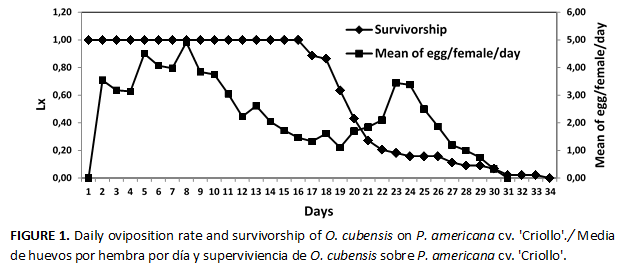
<p class="Normal1" style="text-align:justify;line-height:normal;"><font class="normalchar1"><font style="font-family:'Verdana','sans-serif'; font-size:10.0pt; ">The values found for <i>O. cubensis</i> are similar or superior to those reported for <i>O. yothersi</i> on the  cultivar 'Lorraine', where the preoviposition period was of 1.09 days, with  6.64 days for the oviposition period and a longevity of 8.35 days. The  fecundity mean was 14.43 eggs/female (</font></font><font style="font-family:'Verdana','sans-serif'; font-size:10.0pt; "><a href="#r">13</a></font><font class="normalchar1"><font style="font-family:'Verdana','sans-serif'; font-size:10.0pt; ">).</font></font><font style="font-family:'Verdana','sans-serif'; font-size:10.0pt; color:black; "> </font></p>     <p class="Normal1" style="text-align:justify;line-height:normal;"><font style="font-family:'Verdana','sans-serif'; font-size:10.0pt; color:black; ">The daily oviposition rate is illustrated  in </font><font style="font-family:'Verdana','sans-serif'; font-size:10.0pt; "><a href="/img/revistas/rpv/v32n3/f0104317.gif">Figure 1</a></font><font style="font-family:'Verdana','sans-serif'; font-size:10.0pt; color:black; ">. The first eggs were  laid approximately within one or two days after mating. The average number of  eggs laid per female increased from the beginning of the oviposition and  reached a maximum between the </font><font class="normalchar1"><font style="font-family:'Verdana','sans-serif'; font-size:10.0pt; ">fifth and tenth day</font></font><font style="font-family:'Verdana','sans-serif'; font-size:10.0pt; color:black; ">.  Furtherly, the number decreased with time, and egg laying ceased on day 31  after the beginning of oviposition. However, a number of females survived until  the 34th day. Female of <i>O</i>. <i>cubensis</i> reached the peak oviposition  rate of 5 eggs per female per day on the eighth day. Percentage of <i>O</i>. <i>cubensis</i> survivorship is also shown in </font><font style="font-family:'Verdana','sans-serif'; font-size:10.0pt; "><a href="/img/revistas/rpv/v32n3/f0104317.gif">Figure 1</a></font><font style="font-family:'Verdana','sans-serif'; font-size:10.0pt; color:black; ">.  Mortality increased after most of the females stopped ovipositing. </font><font class="normalchar1"><font style="font-family:'Verdana','sans-serif'; font-size:10.0pt; ">From cohorts of  observed eggs, 100 % of egg</font></font><font style="font-family:'Verdana','sans-serif'; font-size:10.0pt; color:black; "> </font><font class="normalchar1"><font style="font-family:'Verdana','sans-serif'; font-size:10.0pt; ">hatchability  was found.</font></font></p>     
<p class="Normal1" style="text-align:justify;line-height:normal;"><font class="normalchar1"><font style="font-family:'Verdana','sans-serif'; font-size:10.0pt; ">Adult females of <i>O. yothersi</i> showed two peaks of  oviposition, the first on day 9 with 12 eggs and another after 14 days with 11  eggs. However, there are very fecund females which lays an average of 7 eggs in  20 days (</font></font><font style="font-family:'Verdana','sans-serif'; font-size:10.0pt; "><a href="#r">13</a></font><font class="normalchar1"><font style="font-family:'Verdana','sans-serif'; font-size:10.0pt; ">).&nbsp; Fecundity rates of 4.05, 2.86 and 4.38 eggs  per female per day was determined for <i>O. punicae</i> on the cultivars  'Fuerte</font></font><font style="font-family:'Verdana','sans-serif'; font-size:10.0pt; ">, </font><font class="normalchar1"><font style="font-family:'Verdana','sans-serif'; font-size:10.0pt; ">'Hass', and  'Criollo', respectively. The maximum age-specific fecundity was 5.50  eggs/female/day on the 'Hass' variety in 16 days, while on 'Fuerte' and  'Criollo' varieties were 4.92 and 4.62 eggs/female/day in 14 and 16 days,  respectively (</font></font><font style="font-family:'Verdana','sans-serif'; font-size:10.0pt; "><a href="#r">18</a></font><font class="normalchar1"><font style="font-family:'Verdana','sans-serif'; font-size:10.0pt; ">).</font></font></p>     <p class="Normal1" style="text-align:justify;line-height:normal;"><font style="font-family:'Verdana','sans-serif'; font-size:10.0pt; ">The preoviposition period of <i>O. perseae</i> was of 3.37&plusmn;1.69 days, and of the oviposition 10.75&plusmn;5.99  days, the longevity of 17.33&plusmn;5.27 days, with 10.94 eggs/female/day, an average  of 13.29 eggs laid during its lifetime (</font><font style="font-family:'Verdana','sans-serif'; font-size:10.0pt; "><a href="#r">17</a></font><font style="font-family:'Verdana','sans-serif'; font-size:10.0pt; ">)</font><font style="font-family:'Verdana','sans-serif'; font-size:10.0pt; ">.</font><u><font style="font-family:'Verdana','sans-serif'; font-size:10.0pt; "> </font></u></p>     <p class="Normal1" style="text-align:justify;line-height:normal;"><font class="normalchar1"><font style="font-family:'Verdana','sans-serif'; font-size:10.0pt; ">The biological variables for <i>O.  cubensis</i> in this study demonstrate that this species has the biological  attributes necessary to become a serious pest of avocado crop, in particular  when the temperature and humidity conditions are appropriate for increasing  their populations. These results are important to establish the possible  management measures to regulate their populations. Therefore, it is necessary  to evaluate their population behavior under production conditions and to  determine the biotic and abiotic factors that modulate their populations.</font></font><b><font style="font-family:'Verdana','sans-serif'; font-size:10.0pt; "> </font></b></p>     ]]></body>
<body><![CDATA[<p class="Normal1" style="text-align:justify;line-height:normal;">&nbsp;</p>     <p style="text-align:justify;"><a name="r" id="r"><b><font style="font-family:'Verdana','sans-serif'; font-size:14.0pt; ">REFERENCIAS</font></b></a></p>     <!-- ref --><p style="text-align:justify;text-autospace:none;"><font style="font-family:'Verdana','sans-serif'; font-size:10.0pt; ">1. Whiley </font><font style="font-family:'Verdana','sans-serif'; font-size:10.0pt; ">AW, Schaffer B, Wolstenholme B. <i>El Palto. Bot&aacute;nica, producci&oacute;n y usos</i>.  Ediciones Universitarias de Valpara&iacute;so. Pontificia Universidad Cat&oacute;lica de  Valpara&iacute;so. 2007. 364 pp.    </font></p>     <!-- ref --><p style="text-align:justify;line-height:normal;punctuation-wrap:simple;vertical-align:baseline;"><font style="font-family:'Verdana','sans-serif'; font-size:10.0pt; ">2. Bernal JA, D&iacute;az CA. Manejo del cultivo. En: Actualizaci&oacute;n  tecnol&oacute;gica y buenas pr&aacute;cticas agr&iacute;colas (BPA) en el Cultivo del Aguacate</font><font style="font-family:'Verdana','sans-serif'; font-size:10.0pt; ">. Corporaci&oacute;n  Colombiana de Investigaci&oacute;n Agropecuaria (CORPOICA). 2013. Cap. I: 11-151.     </font></p>     <!-- ref --><p style="text-align:justify;"><font style="font-family:'Verdana','sans-serif'; font-size:10.0pt; ">3. Mu&ntilde;oz J,  Rodr&iacute;guez A. &Aacute;caros asociados al cultivo del aguacate (<i>Persea americana</i> Mill.) en la costa central de Per&uacute;. Agronom&iacute;a  Costarricense<i>.</i> 2014; 38(1):215-221.    </font></p>     <!-- ref --><p style="text-align:justify;"><font style="font-family:'Verdana','sans-serif'; font-size:10.0pt; ">4. Londo&ntilde;o ME,  Kondo T, Carabel&iacute; A, Var&oacute;n EH, Caicedo AM. Insectos y &aacute;caros. En: Actualizaci&oacute;n  tecnol&oacute;gica y buenas pr&aacute;cticas agr&iacute;colas (BPA) en el Cultivo del Aguacate</font><font style="font-family:'Verdana','sans-serif'; font-size:10.0pt; ">. Corporaci&oacute;n  Colombiana de Investigaci&oacute;n Agropecuaria (CORPOICA). 2013, Cap. V: 228-284.     </font></p>     ]]></body>
<body><![CDATA[<!-- ref --><p style="text-align:justify;"><font style="font-family:'Verdana','sans-serif'; font-size:10.0pt; ">5. Guzm&aacute;n E. 2012. Estructura gen&eacute;tica de  poblaciones de <i>Oligonychus perseae</i> y <i>Oligonychus punicae</i> (Acari:  Tetranychidae) en Huertos de aguacate. </font><font style="font-family:Symbol; ">[</font><font style="font-family:'Verdana','sans-serif'; font-size:10.0pt; ">Tesis de Maestr&iacute;a</font><font style="font-family:Symbol; ">]</font><font style="font-family:'Verdana','sans-serif'; font-size:10.0pt; ">. Montecillo,  Texcoco, Edo. De M&eacute;xico, 2012, 47 pp.     </font></p>     <!-- ref --><p style="text-align:justify;text-autospace:none;"><font style="font-family:'Verdana','sans-serif'; font-size:10.0pt; ">6.  Soto, G. A. 2013. Manejo alternativo de &aacute;caros. Revista de Ciencias Agr&iacute;colas, 2013; 30(2):34-44.    </font></p>     <!-- ref --><p style="text-align:justify;"><font style="font-family:'Verdana','sans-serif'; font-size:10.0pt; ">7. Ramos-Guti&eacute;rrez <font style="letter-spacing:-1.0pt; ">F</font>A, Santill&aacute;n-Ortega C,  Robles-Berm&uacute;dez<font style="letter-spacing:-.3pt; "> </font>A, Isiordia-Aquino N,  Garc&iacute;a-L&oacute;pez M, Flores-Canales RJ, Gonz&aacute;lez-Corona MS.</font><font style="font-family:'Verdana','sans-serif'; font-size:10.0pt; "> Susceptibility to acaricides in <i>Oligonychus  perseae</i> from avocado  orchards in Nayarit, Mexico. Revista Bio Ciencias. 2015; 3(3):220-227.    </font></p>     <!-- ref --><p style="text-align:justify;text-autospace:none;"><font style="font-family:'Verdana','sans-serif'; font-size:10.0pt; color:black; ">8. Lemus-Soriano</font><font style="font-family:'Verdana','sans-serif'; font-size:10.0pt; color:black; "> BA, P&eacute;rez-Aguilar DA. Control qu&iacute;mico del &aacute;caro caf&eacute; del aguacate <i>Oligonychus  punicae </i>(Hirst, 1926) (Acari: Tetranychidae).Entomolog&iacute;a mexicana<i>.</i> 2016;3: 349-353 (2016)</font><font style="font-family:'Verdana',    'sans-serif'; font-size:10.0pt; "> </font></p>     <!-- ref --><p style="text-align:justify;"><font style="font-family:'Verdana','sans-serif'; font-size:10.0pt; ">9. Rodr&iacute;guez JC. Detecci&oacute;n y manejo de la  resistencia a insecticidas. Colegio de Postgraduados. 2015.&nbsp; Disponible en: <a href="http://www.bayercropscience.com.mx/bayer/cropscience/bcsmexico.nsf/files/extranet/$file/MANEJO%20DE%20LA%20RESISTENCIA.pdf" target="_blank">http://www.bayercropscience.com.mx/bayer/cropscience/bcsmexico.nsf/files/extranet/$file/MANEJO%20DE%20LA%20RESISTENCIA.pdf</a>. (Consulta:  25-02-2017).    </font></p>     ]]></body>
<body><![CDATA[<!-- ref --><p style="text-align:justify;"><font style="font-family:'Verdana','sans-serif'; font-size:10.0pt; ">10. Bouriga-Valdivia E, Vargas-Sandoval M,  Ayala-Ortega JJ, Lara-Ch&aacute;vez MBN, Contreras-Guti&eacute;rrez M. Evaluaci&oacute;n de  insecticidas org&aacute;nicos para el control de &aacute;caros en el cultivo del aguacate.  Entomol mexicana. 2016; 3:125-130.    </font></p>     <!-- ref --><p style="text-align:justify;"><font style="font-family:'Verdana','sans-serif'; font-size:10.0pt; ">11. Livschitz IS, Salinas A. Preliminares  acerca de los &aacute;caros tetr&aacute;nicos de Cuba. Centro Nacional Fitosanitario. La  Habana, Instituto Cubano del Libro. 1968, 149 pp.    </font></p>     <!-- ref --><p style="text-align:justify;text-autospace:none;"><font style="font-family:'Verdana','sans-serif'; font-size:10.0pt; ">12.  Borges MI, Rodr&iacute;guez M, Hern&aacute;ndez D, Rodr&iacute;guez JL, Gonz&aacute;lez J. Ocurrencia de  artr&oacute;podos plagas, biorreguladores y su interacci&oacute;n en escenarios productivos  de frutales agroecol&oacute;gicos en Cuba. Rev Protecci&oacute;n Veg. 2015; 30(supl.1):107.    </font></p>     <p style="text-align:justify;text-autospace:none;"><font style="font-family:'Verdana','sans-serif'; font-size:10.0pt; ">13.  Reyes-Bello JC, Mesa-Cobo NC, Kondo T. Biolog&iacute;a de <i>Oligonychus yothersi</i> (McGregor) (Acari: Tetranychidae) sobre  aguacate <i>Persea americana</i> Mill. cv.  &lsquo;Lorena&rsquo; (Lauraceae). Caldasia. 2011; 33(1):211-220. </font></p>     <!-- ref --><p style="text-align:justify;text-autospace:none;"><font style="font-family:'Verdana','sans-serif'; font-size:10.0pt; ">14.  Alves LFA, Spongoski S, da S. Vieira FN, de Moraes GJ. Biologia e danos de <i>Oligonychus yothersi </i>(McGregor) (Acari:  Tetranychidae) em <i>Ilex paraguariensis</i>.  Arq. Inst. Biol., S&atilde;o Paulo. 2004;71(2):211-214.    </font></p>     <p style="text-align:justify;text-autospace:none;"><font style="font-family:'Verdana','sans-serif'; font-size:10.0pt; ">15.  De Coll OR, Saini ED. 1992. Insectos y &aacute;caros perjudiciales al cultivo de la  yerba mate en la Rep&uacute;blica Argentina. Buenos Aires: Instituto Nacional de  Tecnolog&iacute;a Agropecuaria&ndash;INTA. 1992, 48 pp.</font></p>     ]]></body>
<body><![CDATA[<!-- ref --><p style="text-align:justify;text-autospace:none;"><font style="font-family:'Verdana','sans-serif'; font-size:10.0pt; ">16.  Orozco-Hoyos J, Duque-Echeverry MC, Mesa-Cobo NC. Efecto de la temperatura  sobre la tabla de vida de <i>Oligonychus  yothersi</i> en <i>Coffea arabica</i>. Rev  Cent Nac Invest Caf&eacute;. 1990;41(1):5-18.    </font></p>     <!-- ref --><p style="text-align:justify;text-autospace:none;"><font style="font-family:'Verdana','sans-serif'; font-size:10.0pt; ">17. Imbachi-L&oacute;pez K, Estrada-Venegas EG,  Equihua-Mart&iacute;nez A. </font><font style="font-family:'Verdana','sans-serif'; font-size:10.0pt; ">Biolog&iacute;a  de <i>Oligonychus perseae</i> Tuttle, Baker  y Abbatiello, 1976 (Acari: Tetranychidae) en <i>Persea americana</i> Miller var. Hass en condiciones de laboratorio.  En: VIII Seminario Cient&iacute;fico Internacional de Sanidad Vegetal. Palacio de las Convenciones  de La Habana, Cuba, 10-14 de abril de 2017.    </font></p>     <!-- ref --><p style="text-align:justify;text-autospace:none;"><font style="font-family:'Verdana','sans-serif'; font-size:10.0pt; ">18.  Cerna E, Badii MH, Ochoa Y, Aguirre, LA, Landeros J. Life table of <i>Oligonychus punicae</i> Hirst (Acari:  Tetranychidae) in avocado leaves (<i>Persea  americana</i> Mill.) in the Hass, Fuerte and Criollo cultivars. Universidad y  Ciencia. 2009;25(2):133-140.    </font></p>        <p style="text-align:justify;">&nbsp;</p>       <p style="text-align:justify;">&nbsp;</p>     <p style="text-align:justify;"><font style="font-family:'Verdana','sans-serif'; font-size:10.0pt; ">Recibido: 3/8/2017</font></p>       <p class="MsoFootnoteText"><font style="font-family:'Verdana','sans-serif'; font-size:10.0pt; ">Aceptado: 9/12/2017</font></p>       ]]></body>
<body><![CDATA[<p class="MsoFootnoteText">&nbsp;</p>       <p class="MsoFootnoteText">&nbsp;</p>       <p class="MsoFootnoteText"><a href="#_ftnref1" name="_ftn1" title="" id="_ftn1"><font class="MsoFootnoteReference"><font style="font-family:'Verdana','sans-serif'; font-size:10.0pt; ">*</font></font></a><font style="font-family:'Verdana','sans-serif'; font-size:10.0pt; ">Autor  para correspondencia: </font></font><i><font style="font-family:'Verdana','sans-serif'; font-size:10.0pt; ">H.  Rodr&iacute;guez</font></i><font style="font-family:'Verdana','sans-serif'; font-size:10.0pt; ">. E-mail: <a href="mailto:morell_66@unah.edu.cu">morell_66@unah.edu.cu</a></font></p>      <p class="MsoFootnoteText"><a href="#_ftnref2" name="_ftn2" title="" id="_ftn2"><font class="MsoFootnoteReference"><font style="font-family:'Verdana','sans-serif'; font-size:10.0pt; ">*</font></font></a><font style="font-family:'Verdana','sans-serif'; font-size:10.0pt; "> <font style="color:#221E1F; ">Autor  para correspondencia: </font></font><i><font style="font-family:'Verdana','sans-serif'; font-size:10.0pt; ">Edith G.  Estrada-Venegas</font></i><font style="font-family:'Verdana','sans-serif'; font-size:10.0pt; ">.  E-mail: <a href="mailto:edith_ev@yahoo.com.mx">edith_ev@yahoo.com.mx</a></font></p>       ]]></body><back>
<ref-list>
<ref id="B1">
<label>1</label><nlm-citation citation-type="book">
<person-group person-group-type="author">
<name>
<surname><![CDATA[Whiley]]></surname>
<given-names><![CDATA[AW]]></given-names>
</name>
<name>
<surname><![CDATA[Schaffer]]></surname>
<given-names><![CDATA[B]]></given-names>
</name>
<name>
<surname><![CDATA[Wolstenholme]]></surname>
<given-names><![CDATA[B]]></given-names>
</name>
</person-group>
<source><![CDATA[El Palto. Botánica, producción y usos]]></source>
<year>2007</year>
<page-range>364</page-range><publisher-loc><![CDATA[Valparaíso ]]></publisher-loc>
<publisher-name><![CDATA[Ediciones Universitarias de Valparaíso]]></publisher-name>
</nlm-citation>
</ref>
<ref id="B2">
<label>2</label><nlm-citation citation-type="book">
<person-group person-group-type="author">
<name>
<surname><![CDATA[Bernal]]></surname>
<given-names><![CDATA[JA]]></given-names>
</name>
<name>
<surname><![CDATA[Díaz]]></surname>
<given-names><![CDATA[CA]]></given-names>
</name>
</person-group>
<article-title xml:lang="es"><![CDATA[Manejo del cultivo]]></article-title>
<source><![CDATA[Actualización tecnológica y buenas prácticas agrícolas (BPA) en el Cultivo del Aguacate]]></source>
<year>2013</year>
<page-range>11-151</page-range><publisher-name><![CDATA[Corporación Colombiana de Investigación Agropecuaria]]></publisher-name>
</nlm-citation>
</ref>
<ref id="B3">
<label>3</label><nlm-citation citation-type="journal">
<person-group person-group-type="author">
<name>
<surname><![CDATA[Muñoz]]></surname>
<given-names><![CDATA[J]]></given-names>
</name>
<name>
<surname><![CDATA[Rodríguez]]></surname>
<given-names><![CDATA[A]]></given-names>
</name>
</person-group>
<article-title xml:lang="pt"><![CDATA[Ácaros asociados al cultivo del aguacate (Persea americana Mill: ) en la costa central de Perú]]></article-title>
<source><![CDATA[Agronomía Costarricense]]></source>
<year>2014</year>
<volume>38</volume>
<numero>1</numero>
<issue>1</issue>
<page-range>215-221</page-range></nlm-citation>
</ref>
<ref id="B4">
<label>4</label><nlm-citation citation-type="book">
<person-group person-group-type="author">
<name>
<surname><![CDATA[Londoño]]></surname>
<given-names><![CDATA[ME]]></given-names>
</name>
<name>
<surname><![CDATA[Kondo]]></surname>
<given-names><![CDATA[T]]></given-names>
</name>
<name>
<surname><![CDATA[Carabelí]]></surname>
<given-names><![CDATA[A]]></given-names>
</name>
<name>
<surname><![CDATA[Varón]]></surname>
<given-names><![CDATA[EH]]></given-names>
</name>
<name>
<surname><![CDATA[Caicedo]]></surname>
<given-names><![CDATA[AM]]></given-names>
</name>
</person-group>
<article-title xml:lang="es"><![CDATA[Insectos y ácaros]]></article-title>
<source><![CDATA[Actualización tecnológica y buenas prácticas agrícolas (BPA) en el Cultivo del Aguacate]]></source>
<year>2013</year>
<page-range>228-284</page-range><publisher-name><![CDATA[Corporación Colombiana de Investigación Agropecuaria]]></publisher-name>
</nlm-citation>
</ref>
<ref id="B5">
<label>5</label><nlm-citation citation-type="">
<person-group person-group-type="author">
<name>
<surname><![CDATA[Guzmán]]></surname>
<given-names><![CDATA[E]]></given-names>
</name>
</person-group>
<source><![CDATA[Estructura genética de poblaciones de Oligonychus perseae y Oligonychus punicae (Acari: Tetranychidae) en Huertos de aguacate]]></source>
<year>2012</year>
<page-range>47</page-range></nlm-citation>
</ref>
<ref id="B6">
<label>6</label><nlm-citation citation-type="journal">
<person-group person-group-type="author">
<name>
<surname><![CDATA[Soto]]></surname>
<given-names><![CDATA[G.A.]]></given-names>
</name>
</person-group>
<article-title xml:lang="pt"><![CDATA[Manejo alternativo de ácaros]]></article-title>
<source><![CDATA[Revista de Ciencias Agrícolas,]]></source>
<year>2013</year>
<volume>30</volume>
<numero>2</numero>
<issue>2</issue>
<page-range>34-44</page-range></nlm-citation>
</ref>
<ref id="B7">
<label>7</label><nlm-citation citation-type="journal">
<person-group person-group-type="author">
<name>
<surname><![CDATA[Ramos-Gutiérrez]]></surname>
<given-names><![CDATA[FA]]></given-names>
</name>
<name>
<surname><![CDATA[Santillán-Ortega]]></surname>
<given-names><![CDATA[C]]></given-names>
</name>
<name>
<surname><![CDATA[Robles-Bermúdez]]></surname>
<given-names><![CDATA[A]]></given-names>
</name>
<name>
<surname><![CDATA[Isiordia-Aquino]]></surname>
<given-names><![CDATA[N]]></given-names>
</name>
<name>
<surname><![CDATA[García-López]]></surname>
<given-names><![CDATA[M]]></given-names>
</name>
<name>
<surname><![CDATA[Flores-Canales]]></surname>
<given-names><![CDATA[RJ]]></given-names>
</name>
<name>
<surname><![CDATA[González-Corona]]></surname>
<given-names><![CDATA[MS]]></given-names>
</name>
</person-group>
<article-title xml:lang="en"><![CDATA[Susceptibility to acaricides in Oligonychus perseae from avocado orchards in Nayarit, Mexico]]></article-title>
<source><![CDATA[Revista Bio Ciencias]]></source>
<year>2015</year>
<volume>3</volume>
<numero>3</numero>
<issue>3</issue>
<page-range>220-227</page-range></nlm-citation>
</ref>
<ref id="B8">
<label>8</label><nlm-citation citation-type="journal">
<person-group person-group-type="author">
<name>
<surname><![CDATA[Lemus-Soriano]]></surname>
<given-names><![CDATA[BA]]></given-names>
</name>
<name>
<surname><![CDATA[Pérez-Aguilar]]></surname>
<given-names><![CDATA[DA]]></given-names>
</name>
</person-group>
<article-title xml:lang="es"><![CDATA[Control químico del ácaro café del aguacate Oligonychus punicae (Hirst, 1926) (Acari: Tetranychidae)]]></article-title>
<source><![CDATA[Entomología mexicana]]></source>
<year>2016</year>
<volume>3</volume>
<page-range>349-353</page-range></nlm-citation>
</ref>
<ref id="B9">
<label>9</label><nlm-citation citation-type="">
<person-group person-group-type="author">
<name>
<surname><![CDATA[Rodríguez]]></surname>
<given-names><![CDATA[JC]]></given-names>
</name>
</person-group>
<source><![CDATA[Detección y manejo de la resistencia a insecticidas. Colegio de Postgraduados]]></source>
<year>2015</year>
</nlm-citation>
</ref>
<ref id="B10">
<label>10</label><nlm-citation citation-type="journal">
<person-group person-group-type="author">
<name>
<surname><![CDATA[Bouriga-Valdivia]]></surname>
<given-names><![CDATA[E]]></given-names>
</name>
<name>
<surname><![CDATA[Vargas-Sandoval]]></surname>
<given-names><![CDATA[M]]></given-names>
</name>
<name>
<surname><![CDATA[Ayala-Ortega]]></surname>
<given-names><![CDATA[JJ]]></given-names>
</name>
<name>
<surname><![CDATA[Lara-Chávez]]></surname>
<given-names><![CDATA[MBN]]></given-names>
</name>
<name>
<surname><![CDATA[Contreras-Gutiérrez]]></surname>
<given-names><![CDATA[M]]></given-names>
</name>
</person-group>
<article-title xml:lang="es"><![CDATA[Evaluación de insecticidas orgánicos para el control de ácaros en el cultivo del aguacate]]></article-title>
<source><![CDATA[Entomol mexicana]]></source>
<year>2016</year>
<volume>3</volume>
<page-range>125-130</page-range></nlm-citation>
</ref>
<ref id="B11">
<label>11</label><nlm-citation citation-type="book">
<person-group person-group-type="author">
<name>
<surname><![CDATA[Livschitz]]></surname>
<given-names><![CDATA[IS]]></given-names>
</name>
<name>
<surname><![CDATA[Salinas]]></surname>
<given-names><![CDATA[A]]></given-names>
</name>
</person-group>
<source><![CDATA[Preliminares acerca de los ácaros tetránicos de Cuba]]></source>
<year>1968</year>
<page-range>149</page-range><publisher-loc><![CDATA[^eLa Habana La Habana]]></publisher-loc>
<publisher-name><![CDATA[Centro Nacional FitosanitarioInstituto Cubano del Libro]]></publisher-name>
</nlm-citation>
</ref>
<ref id="B12">
<label>12</label><nlm-citation citation-type="journal">
<person-group person-group-type="author">
<name>
<surname><![CDATA[Borges]]></surname>
<given-names><![CDATA[MI]]></given-names>
</name>
<name>
<surname><![CDATA[Rodríguez]]></surname>
<given-names><![CDATA[M]]></given-names>
</name>
<name>
<surname><![CDATA[Hernández]]></surname>
<given-names><![CDATA[D]]></given-names>
</name>
<name>
<surname><![CDATA[Rodríguez]]></surname>
<given-names><![CDATA[JL]]></given-names>
</name>
<name>
<surname><![CDATA[González]]></surname>
<given-names><![CDATA[J]]></given-names>
</name>
</person-group>
<article-title xml:lang="es"><![CDATA[Ocurrencia de artrópodos plagas, biorreguladores y su interacción en escenarios productivos de frutales agroecológicos en Cuba]]></article-title>
<source><![CDATA[Rev Protección Veg]]></source>
<year>2015</year>
<volume>30</volume>
<numero>supl.1</numero>
<issue>supl.1</issue>
<page-range>107</page-range></nlm-citation>
</ref>
<ref id="B13">
<label>13</label><nlm-citation citation-type="journal">
<person-group person-group-type="author">
<name>
<surname><![CDATA[Reyes-Bello]]></surname>
<given-names><![CDATA[JC]]></given-names>
</name>
<name>
<surname><![CDATA[Mesa-Cobo]]></surname>
<given-names><![CDATA[NC]]></given-names>
</name>
<name>
<surname><![CDATA[Kondo]]></surname>
<given-names><![CDATA[T]]></given-names>
</name>
</person-group>
<article-title xml:lang="la"><![CDATA[Biología de Oligonychus yothersi (McGregor) (Acari: Tetranychidae) sobre aguacate Persea americana Mill. cv. 'Lorena' (Lauraceae)]]></article-title>
<source><![CDATA[Caldasia]]></source>
<year>2011</year>
<volume>33</volume>
<numero>1</numero>
<issue>1</issue>
<page-range>211-220</page-range></nlm-citation>
</ref>
<ref id="B14">
<label>14</label><nlm-citation citation-type="journal">
<person-group person-group-type="author">
<name>
<surname><![CDATA[Alves]]></surname>
<given-names><![CDATA[LFA]]></given-names>
</name>
<name>
<surname><![CDATA[Spongoski]]></surname>
<given-names><![CDATA[S]]></given-names>
</name>
<name>
<surname><![CDATA[da S. Vieira]]></surname>
<given-names><![CDATA[FN]]></given-names>
</name>
<name>
<surname><![CDATA[de Moraes]]></surname>
<given-names><![CDATA[GJ]]></given-names>
</name>
</person-group>
<article-title xml:lang="pt"><![CDATA[Biologia e danos de Oligonychus yothersi (McGregor) (Acari: Tetranychidae) em Ilex paraguariensis]]></article-title>
<source><![CDATA[Arq. Inst. Biol.]]></source>
<year>2004</year>
<volume>71</volume>
<numero>2</numero>
<issue>2</issue>
<page-range>211-214</page-range></nlm-citation>
</ref>
<ref id="B15">
<label>15</label><nlm-citation citation-type="book">
<person-group person-group-type="author">
<name>
<surname><![CDATA[De Coll]]></surname>
<given-names><![CDATA[OR]]></given-names>
</name>
<name>
<surname><![CDATA[Saini]]></surname>
<given-names><![CDATA[ED]]></given-names>
</name>
</person-group>
<source><![CDATA[Insectos y ácaros perjudiciales al cultivo de la yerba mate en la República Argentina]]></source>
<year>1992</year>
<page-range>48</page-range><publisher-loc><![CDATA[^eBuenos Aires Buenos Aires]]></publisher-loc>
<publisher-name><![CDATA[Instituto Nacional de Tecnología Agropecuaria]]></publisher-name>
</nlm-citation>
</ref>
<ref id="B16">
<label>16</label><nlm-citation citation-type="journal">
<person-group person-group-type="author">
<name>
<surname><![CDATA[Orozco-Hoyos]]></surname>
<given-names><![CDATA[J]]></given-names>
</name>
<name>
<surname><![CDATA[Duque-Echeverry]]></surname>
<given-names><![CDATA[MC]]></given-names>
</name>
<name>
<surname><![CDATA[Mesa-Cobo]]></surname>
<given-names><![CDATA[NC]]></given-names>
</name>
</person-group>
<article-title xml:lang="es"><![CDATA[Efecto de la temperatura sobre la tabla de vida de Oligonychus yothersi en Coffea arabica]]></article-title>
<source><![CDATA[Rev Cent Nac Invest Café]]></source>
<year>1990</year>
<volume>41</volume>
<numero>1</numero>
<issue>1</issue>
<page-range>5-18</page-range></nlm-citation>
</ref>
<ref id="B17">
<label>17</label><nlm-citation citation-type="confpro">
<person-group person-group-type="author">
<name>
<surname><![CDATA[Imbachi-López]]></surname>
<given-names><![CDATA[K]]></given-names>
</name>
<name>
<surname><![CDATA[Estrada-Venegas]]></surname>
<given-names><![CDATA[EG]]></given-names>
</name>
<name>
<surname><![CDATA[Equihua-Martínez]]></surname>
<given-names><![CDATA[A]]></given-names>
</name>
</person-group>
<article-title xml:lang="es"><![CDATA[Biología de Oligonychus perseae Tuttle, Baker y Abbatiello, 1976 (Acari: Tetranychidae) en Persea americana Miller var. Hass en condiciones de laboratorio]]></article-title>
<source><![CDATA[]]></source>
<year>2017</year>
<conf-name><![CDATA[VIII Seminario Científico Internacional de Sanidad Vegetal]]></conf-name>
<conf-loc>La Habana La Habana</conf-loc>
</nlm-citation>
</ref>
<ref id="B18">
<label>18</label><nlm-citation citation-type="journal">
<person-group person-group-type="author">
<name>
<surname><![CDATA[Cerna]]></surname>
<given-names><![CDATA[E]]></given-names>
</name>
<name>
<surname><![CDATA[Badii]]></surname>
<given-names><![CDATA[MH]]></given-names>
</name>
<name>
<surname><![CDATA[Ochoa]]></surname>
<given-names><![CDATA[Y]]></given-names>
</name>
<name>
<surname><![CDATA[Aguirre]]></surname>
<given-names><![CDATA[LA]]></given-names>
</name>
<name>
<surname><![CDATA[Landeros]]></surname>
<given-names><![CDATA[J]]></given-names>
</name>
</person-group>
<article-title xml:lang="en"><![CDATA[Life table of Oligonychus punicae Hirst (Acari: Tetranychidae) in avocado leaves (Persea americana Mill.) in the Hass, Fuerte and Criollo cultivars]]></article-title>
<source><![CDATA[Universidad y Ciencia]]></source>
<year>2009</year>
<volume>25</volume>
<numero>2</numero>
<issue>2</issue>
<page-range>133-140</page-range></nlm-citation>
</ref>
</ref-list>
</back>
</article>