Msc. Mohammad Hossein Biglu1
Prof. Dr. Walther Umstätter2
In order to know the trend of the language processing in the popular USA-Medline database, the registered publications of three non-English speaking countries (France, Germany and Russia) produced in English and in other local languages and indexed in Medline from 1965 to 2005 were identified. The study showed that the editorial policy of Medline is undergoing changes that have led to focus its attention on the scientific literature published in English language.
Key words: Medline, languages, editorial policy.
Con el objetivo de conocer la tendencia que presenta el procesamiento según idiomas en la popular base de datos Medline, se identificaron las publicaciones registradas de tres países no anglófonos: Francia, Alemania y Rusia, realizadas, tanto en inglés como en otros idiomas locales indizados en Medline entre 1965 y el 2005. La política editorial de Medline experimenta cambios que han llevado a centrar su atención en la literatura científica publicada en idioma inglés.
Palabras clave: Medline, idiomas, política editorial.
Copyright: © ECIMED. Open Access contribution, distributed under the terms of the Creative Commons Non-Commercial Shareware License 2.0, which allows the consultation, reproduction, public display and use of the results on practice as well as all of its derivates, without commercial purposes and with an identical license, as long as the author or authors is adequately cited as well as the source.Cite (Vancouver): Biglu MH, Umstätter W. The editorial policy of languages is being changed in Medline. Acimed 2007;16(3). Available from: http://bvs.sld.cu/revistas/aci/vol16_3_07/aci06907.htm [Consulted: day/month/year].
Science and scientific literature are growing and becoming more and more global and multilingual. Simultaneously, the core of scientific publications is written more often in English.
It is a generally accepted idea that English is the lingua franca of science today. In earlier times, it was Latin or sometimes also French, but now there is no doubt that it has been English since the last century.
]]> If we had a look at the literature of science a hundred years ago, we could find that the languages of scientific literature were a few, and that almost 90% of these publications were in English, French, German, Russian and in just a few other languages.Currently, we know that the global growth of science literature has brought out other languages such as Chinese, Japanese, Persian, Russian, Spanish, Turkish, and many other languages.
Such changes in the world of science would lead to the transformation of editorial policies for either choosing publications or entering the necessary language data to databases like Medline, SCI and the like.
On the other hand, the increasing predominance of English in the international relations of scientific collaboration has strongly affected the language of science literature. English is being developed as the main language in the world of science. The reason is clear--a great deal of communication systems is in English. In fact, it should be in English so that it can be understood by international colleagues in the world of science. The scientists even in non-English speaking countries prefer to publish their works in English. It has some advantages; literature written in English attracts a great number of citations. Colleges distributed all around the world make collaborate better.
Databases, such as Medline and SCI in the USA, have focused their attention on the literature of science in English. Some previous studies confirmed that the editorial policy for such databases in the USA is being changed.
Michele Bedard, Jennifer L. Greif and Todd C. Buckley (2004) analysed 13,865 journal articles on trauma published between 1987 and 2001 and indexed in the database of PILOTS (An Electronic Index to the Traumatic Stress Literature). Their study showed that 94% of trauma literature was published in English.1
Boldt J., Maleck W. and Koetter K.P. (2005) studied the papers published in the 10 intensive care medicine journals indexed in the JCR for two periods: 1992 – 1997, and 1998-2003. They took only into consideration the original papers from German universities. They found out that the total number of publications for German universities during 1998-2003 has increased 100% compared to 1992-1997. The number of publications for German universities increased from 621 during 1992-1997 to 1,245 during 1998-2003.2
Alvar Loria and Pedro Arroyo (2005) classified Medline’s journal articles by country of publication and language in 1966 and again from 1970 to 2000 at five-year intervals. Their study showed that English papers increased lineally and non-English papers decreased at a rate of 1,056 fewer papers annually. They suggested that the developing trend of English language in Medline was due to the Medline’s editorial policies change so that Medline has been increasingly deselecting journals from non English-speaking countries.3
Biglu, M.H.(2006) in a study found that of a total number of 427 journals published in Germany in 2005 and indexed in the JCR only 11% of them was in German; the rest was in English or multi language. Out 146 French journals indexed in the JCR in 2005, 23 % were in French, the rest were in English or multi language.4
In another study Biglu, M.H. found that 93.3 % of total publications in Tabriz University of Medical Sciences was published in Persian, and only 6.7% of them was published in English throughout 1988-1996.5
]]> Mauricio L. Barreto (2006) analysed the epidemiological articles produced in Brazil and published in the journals indexed in Medline between 1985 and 2004. They found that there was a predominance of the English language among articles by Brazilian authors indexed in the Medline database.6Mélitz, Jacques (2007) in his essay emphasised that English is on its way to becoming the dominant global language. He believes that the global dominance of English is bad news for world literature, because only those articles written in English will have a chance of reaching a world audience and achieving a “classic status”.7
In another study, Zhang Haiqi, Shigeaki Yamazaki and Kazuo Urata (2007) found that the percentage of English-language papers in Medline climbed steadily from 75.3% to 86.3% throughout 1984-1994.8
In this context we are interested in exploring the changing of editorial policy of a very famous database in the USA: Medline.
After exploring the trend of publication languages in these databases, all publications of three non-English speaking countries (France, Germany, and Russia) in English and domestic languages indexed in the Medline and SCI through 1965-2005 were extracted and analysed.
The four languages mentioned above were chosen according to my previous study, and it showed that English, German, Russian, and French were the most frequently languages used in the Medline database.
The database of PubMed was used to extract literature in English, French, German, and Russian through 1965-2005. PubMed provides access to Medline, a database of citations covering the fields of medicine, nursing, dentistry, veterinary medicine, the health care system, and preclinical sciences. The proportion of English and domestic languages for countries was determined. The trends of English, French, German, and Russian languages in the Medline were expected.
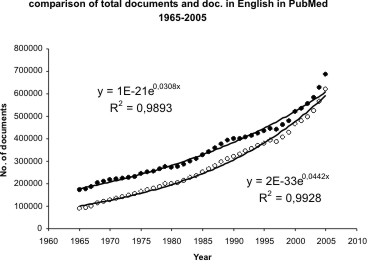
The figure 1 and annex 1 show the number of total publications and publications in English in PubMed through 1965-2005. The doubling time of total publications in PubMed through 1965-2005 was 22.5 years, whereas the doubling time for publications in English was 15.7 years. In other words, the doubling time of publications in English was 44 % faster than the total publications in PubMed.
Fig. 1. Comparison of total publications and publications in English in PubMed 1965-2005.
The percentage of documents in English has increased steadily through 1965-2005. It reached from 52 % in 1965 to 90% in 2005 - an increase of 72 %.
]]> Accurately the graph may be divided in two stages.Comparison of figure 2 and 3 indicates that the number of total publications and publications in English in PubMed has increased exponentially through 1965 and 1998; whereas it shows linear growth through 1999-2005.
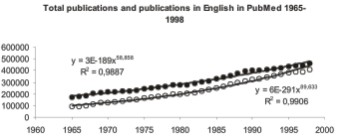
Fig. 2. Number of total publications and publications in English in PubMed 1965-1999.
Total publications and publications in English in PubMed 1965-2005.
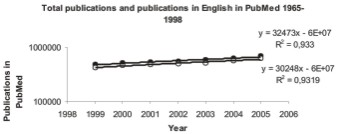
Fig. 3. The proportion of publications in English in PubMed 1965-2005.
Figure 4 shows the percentage of total publications in English (○), the percentage of publications in English for Germany (∆), and the percentage of publications in English for France (□) in Medline through 1965-2005.
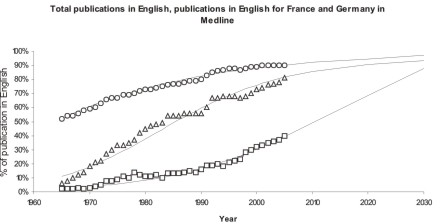
Fig. 4. Total number of documents in Germany, and the number from those that are written in English and German, 1965-2005.
The graph predicts that the percentage of publications in English in Medline will reach 97% in 2030, and the percentage of publications in English for Germany and France will reach 94 % and 88 %, respectively, in 2030.
]]> Annex 1 illustrates that the portion of documents in English has dramatically risen through 1965-2005.Figure 5 illustrates the total number of documents for Germany, those written in German, and in English throughout 1965-2005.

Fig. 5. The percentage of documents in German for Germany in PubMed 1965-2005.
The total number of publications for Germany experienced a relatively fast growth during 1984-1998. From 1990 it began to fall until 1996. This fall was simultaneous with the fall of publications in German which showed a continuous decrease since 1990.
The number of publications in German fell from 93 % of total documents in 1965 to 19 % in 2005.
The proportion of publications in English has risen dramatically since 1999. The percentage of documents in English increased from 6 % in 1965 to 81% in 2005.
The increasing number of publications in English has caused to increase the number of total publications for Germany dramatically.
In spite of the decreasing trend of publications in German, the number of publications in English for Germany rose. Accordingly, the number of publications for Germany showed a sharp rise.
Figure 6 and annex 2 show the percentage of publications in German for Germany through 1965-2005.
]]>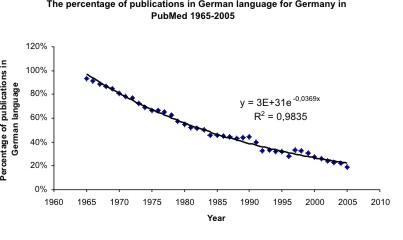
Fig. 6. Total number of publications in France, and the number from those that are written in English and French 1965-2005.
Figure 7 and annex 3 plot the number of total documents, documents in French, and documents in English for France throughout 1965-2005 in PubMed.
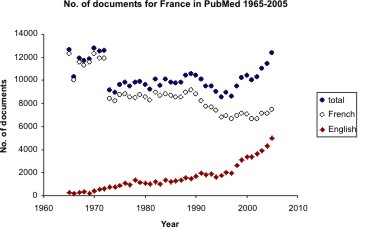
Fig. 7. Total number of documents and documents in the Russian language for Russia 1965-2005.
The graph indicates that the number of publications for France decreased steadily from 1990 to 1997. Since 1998 it [has] showed a relatively sharp growth.
The numbers of publications in English showed relatively slight rise from 1965 until 1977. Since 1998 the proportion of documents in English has showed a dramatic rise.
It is considerable that the number of publications in French has showed a fall since 1989. The decreasing trend of publications for France continued to the end of the fiscal year 2005.
The proportion of publications for France in English has showed a dramatic rise since 1998; consequently [it] caused to raise the number of publications in France.
Figure 8 and annex 4 show the total number of documents for Russia, and the number of those that are written in Russian and in English through 1965-2005.
]]>
Fig. 8. The proportion of publications in English for Russia in PubMed 1965-2005.
Since 1990 there has been a drop in the number of publications for Russia in PubMed. It is clear that since 1997 the number of publications in English has risen and consisted in an average of 4% of the total of publications through 1997-2005.
Figure 9 indicates that the portion of publications in English for Russia has increased since 1997.

Fig. 9
The analysis of data showed that the doubling time of total publications in Medline (PubMed) in English was 44% faster than the doubling time of total publications in Medline throughout 1965-2005. The doubling time of total publications was 22.5 years, whereas the doubling time for publications in English was 15.7 years. The proportion of documents in English showed a dramatic increase through 1965-2005. It reached from 52 % in 1965 to 90 % in 2005 - an increase of 72 %. The analysis of the study predicted that the percentage of publications in English in Medline will reach 97 % in 2030 (Figure 2).
The total number of publications for Germany in Medline had a relatively fast growth during 1984-1998. From 1990 on, it began to fall until 1996. This fall was simultaneous with the fall of publications in German, which showed a continuous decline since 1990.
The number of publications for Germany in German fell from 93 % of the total publications in 1965 to 19 % in 2005.
The proportion of publications for Germany in English has risen dramatically since 1999. The percentage of publications in English increased from 6 % in 1965 to 81 % in 2005.
]]> The increasing number of publications in English has led to a dramatic increase of the number of total publications for Germany.In spite of the decreasing trend of publications in German, the number of publications in English for Germany rose. Accordingly the number of publications for Germany has showed a sharp rise since 1999.
The number of publications for France in Medline decreased steadily from 1990 to 1997. Since 1998 it has showed relatively a sharp growth. Since 1998 the proportion of publications for France in English has showed a impressive rise; whereas the number of publications in French has showed a fall since 1989. The decreasing trend of publications in French for France continued to the end of the fiscal year 2005.
Since 1990, there has been a drop for the number of publications for Russia in Medline. Since 1997, the number of publications in English has risen and consisted in an average of 4 % of the total publications through 1997-2005. On the other hand, the number of publications for Russia in Russian has decreased dramatically since 1989; whereas the number of publications in English has increased dramatically since 1993.
The most interesting findings of this study are that evidently the reduction of publications for Germany in Medline through 1990–1999 was not due the fall of the Berlin Wall in November 1989. It was due to the changing of editorial policy in Medline. Because the study showed that the publications of Germany in German has decreased continuously since 1978; whereas the proportion of publications in English for Germany has increased throughout the period of study and very sharply since 1999. Furthermore, the proportion of publications for France in French, as well as the proportion of Russian for Russia has steadily decreased since 1989. At the same time the proportion of publications in English for France and for Russia increased.
Acknowledgement
Special thanks to Christine Falk.
1. Bedard MG, Jennifer L, Buckley TC. International Publication Trends in the Traumatic Stress Literature. Journal of Traumatic Stress, 2004; 17(2):97-101.
2. Boldt J, Maleck W, Koetter KP. Wer betriebt intensive medizinische forshung. Dtsch Med Wochenschr 2005;130:197-202. Available from: http://www.thieme-connect.com/ejournals/abstract/dmw/doi/10.1055/s-2005-837401 [Cited: 2007 May 23].
3. Loria A, Arroyo P Language and country preponderance trends in Medline and its causes. Med Libr Assoc 2005; 93(3):381-5.
4. Biglu MH. The comparison of Impact Factor and self citation trend between French and German journals. Arquivistica net 2006; 2(2). Available from: http://www.arquivistica.net/ojs/include/getdoc.php?id=295&article=96&mode=pdf [Cited: 2007 May 23].
5. Biglu MH. A bibliometric study of scientific output in Tabriz University of Medical Sciences. In: Proceedings of 10th International Conference of the International Society for Scientometrics and Informetrics (ISSI 2005). Stockholm: ISSI; 2005. p143-156.
6. Barreto ML. Growth and trends in scientific production in epidemiology in Brazil. Rev Saúde Pública 2006;40:79-85.
7. Mélitz J. English as the Global Language: Good for Business, Bad for Literature. Available from: http://www.cepr.org/press/DP2055PR.htm [Cited: 2007 May 23].
8. Zhang H, Yamazaki S Urata K. 2007. The tendency toward English-Language paper in Medline. Available from: http://www.pubmedcentral.nih.gov/picrender.fcgi?artid=226304&blobtype=pdf [Cited: 2007 May 23].
Received: 28 July 2007. Accepted: 30 July 2007.
Msc. Mohammad Hossein Biglu. Department of Library and Information Sciences. Humboldt Universität zu Berlin. Dorotheenstraße 26. Unter den Linden 6. D-10099 Berlin. Germany. E-mail: mh_biglu@yahoo.com
1Getting a Doctorate at the Department of Library & Information Science of Humboldt-University of Berlin.
2Professor of Library and Information Science at the Department of Library & Information Science of Humboldt-University of Berlin.
Processing Card
Classification: Original article.
Terms suggested for the indexation
According to DeCS1
MEDLINE; EDITORIAL POLICIES; BIBLIOMETRICS.
MEDLINE; POLÍTICAS EDITORIALES; BIBLIOMETRÍA.
According to DeCI2
MEDLINE; INFORMETRICS; SCIENTIFIC ARTICLES/analysis; BIBLIOGRAPHY OF MEDICINE; BIBLIOGRAPHIC DATABASE.
MEDLINE; INFORMETRIA; ARTICULOS CIENTIFICOS/análisis; BIBLIOGRAFIA DE MEDICINA; BASES DE DATOS BIBLIOGRAFICAS.
1BIREME. Descriptores en Ciencias de la Salud (DeCS). Sao Paulo: BIREME, 2004.
Disponible en: http://decs.bvs.br/E/homepagee.htm
2Díaz del Campo S. Propuesta de términos para la indización en Ciencias de la Información. Descriptores en Ciencias de la Información (DeCI). Disponible en: http://cis.sld.cu/E/tesauro.pdf