<?xml version="1.0" encoding="ISO-8859-1"?><article xmlns:mml="http://www.w3.org/1998/Math/MathML" xmlns:xlink="http://www.w3.org/1999/xlink" xmlns:xsi="http://www.w3.org/2001/XMLSchema-instance">
<front>
<journal-meta>
<journal-id>1024-9435</journal-id>
<journal-title><![CDATA[ACIMED]]></journal-title>
<abbrev-journal-title><![CDATA[ACIMED]]></abbrev-journal-title>
<issn>1024-9435</issn>
<publisher>
<publisher-name><![CDATA[Centro Nacional de Información de Ciencias Médicas]]></publisher-name>
</publisher>
</journal-meta>
<article-meta>
<article-id>S1024-94352009001200004</article-id>
<title-group>
<article-title xml:lang="es"><![CDATA[A socio-psycholinguistic model for English for specific purposes writing skill formation diagnosis]]></article-title>
<article-title xml:lang="en"><![CDATA[Modelo socio-psicolingüístico para el diagnóstico de la habilidad expresión escrita en la enseñanza del inglés con fines específicos]]></article-title>
</title-group>
<contrib-group>
<contrib contrib-type="author">
<name>
<surname><![CDATA[Forteza Fernández]]></surname>
<given-names><![CDATA[Rafael]]></given-names>
</name>
<xref ref-type="aff" rid="A01"/>
</contrib>
<contrib contrib-type="author">
<name>
<surname><![CDATA[Gunashekar]]></surname>
<given-names><![CDATA[Paul]]></given-names>
</name>
<xref ref-type="aff" rid="A02"/>
</contrib>
</contrib-group>
<aff id="A02">
<institution><![CDATA[,Department of Mateials Development, Testing and Evaluation  ]]></institution>
<addr-line><![CDATA[ ]]></addr-line>
<country>India</country>
</aff>
<aff id="A01">
<institution><![CDATA[,Facultad de Enfermería  ]]></institution>
<addr-line><![CDATA[Pueblo Nuevo ]]></addr-line>
</aff>
<pub-date pub-type="pub">
<day>00</day>
<month>12</month>
<year>2009</year>
</pub-date>
<pub-date pub-type="epub">
<day>00</day>
<month>12</month>
<year>2009</year>
</pub-date>
<volume>20</volume>
<numero>6</numero>
<fpage>141</fpage>
<lpage>160</lpage>
<copyright-statement/>
<copyright-year/>
<self-uri xlink:href="http://scielo.sld.cu/scielo.php?script=sci_arttext&amp;pid=S1024-94352009001200004&amp;lng=en&amp;nrm=iso"></self-uri><self-uri xlink:href="http://scielo.sld.cu/scielo.php?script=sci_abstract&amp;pid=S1024-94352009001200004&amp;lng=en&amp;nrm=iso"></self-uri><self-uri xlink:href="http://scielo.sld.cu/scielo.php?script=sci_pdf&amp;pid=S1024-94352009001200004&amp;lng=en&amp;nrm=iso"></self-uri><abstract abstract-type="short" xml:lang="en"><p><![CDATA[The teaching learning process of writing in English for Specific Purposes is influenced by factors which go beyond the environment of the classroom. These factors, identified as variables, have sociolinguistic, psychological and didactic nature. The present study uncovers some of the most outstanding variables and presents a new model for the continued diagnostic testing in the formation of writing skill in academic settings. The model is presented in variables which form new dimensions while testing takes place in loops, all of which giving rise to new regularities for this type of pedagogical activity.]]></p></abstract>
<abstract abstract-type="short" xml:lang="es"><p><![CDATA[El proceso enseñanza-aprendizaje de la escritura en el inglés con fines específicos está influenciado por factores que van más allá del ambiente del aula. Estos factores, identificados como variables, son de naturaleza sociolingüística, psicológica y didáctica. El estudio revela algunas de las más importantes de estas variables y presenta un modelo para pruebas diagnósticas continuas de la formación de esta habilidad en contextos académicos. El modelo se presenta en variables que dan lugar a nuevas dimensiones mientras el diagnóstico se realiza en forma de eslabones, todo lo cual origina nuevas regularidades en este tipo de actividad pedagógica.]]></p></abstract>
<kwd-group>
<kwd lng="en"><![CDATA[English for specific purposes]]></kwd>
<kwd lng="en"><![CDATA[diagnostic testing]]></kwd>
<kwd lng="en"><![CDATA[academic settings]]></kwd>
<kwd lng="es"><![CDATA[Inglés con fines específicos]]></kwd>
<kwd lng="es"><![CDATA[pruebas diagnósticas]]></kwd>
<kwd lng="es"><![CDATA[contextos académicos]]></kwd>
</kwd-group>
</article-meta>
</front><body><![CDATA[  <font face="Verdana, Arial, Helvetica, sans-serif" size="2"> </font>      <p align="right"><font face="Verdana, Arial, Helvetica, sans-serif" size="2"><b>ARTÍCULOS</b></font></p> <B>      <p> </p> </B>    <p><b><font face="Verdana, Arial, Helvetica, sans-serif" size="2">    <br>       <br>   <font size="4">    <br>   A socio-psycholinguistic model for <i>English for specific purposes</i> writing    skill formation diagnosis </font></font></b></p> <B>    <p> </p>     <p> </p>     <p><font face="Verdana, Arial, Helvetica, sans-serif" size="3">Modelo socio-psicoling&uuml;&iacute;stico    para el diagn&oacute;stico de la habilidad expresi&oacute;n escrita en la ense&ntilde;anza    del ingl&eacute;s con fines espec&iacute;ficos </font></p>     ]]></body>
<body><![CDATA[<p> </p>     <p> </p>     <p><font face="Verdana, Arial, Helvetica, sans-serif" size="2">    <br>       <br>       <br>       <br>   Rafael Forteza Fern&aacute;ndez,<SUP>I </SUP> Paul Gunashekar<SUP>II</SUP></font></p> </B>      <p> </p>     <p><font face="Verdana, Arial, Helvetica, sans-serif" size="2"><SUP>I</SUP>Doctor    in Pedagogical Sciences. Associate Professor of Research Methodology and English.    Facultad de Enfermer&iacute;a. Universidad M&eacute;dica &quot;Mariana Grajales    Coello&quot;. Holgu&iacute;n, Cuba.    <br>   <SUP>II</SUP>Head. Department of Materials Development, Testing and Evaluation.    The English and Foreign Languages University Hyderabad, India. </font></p>     ]]></body>
<body><![CDATA[<p> </p>     <p> </p>     <p><font face="Verdana, Arial, Helvetica, sans-serif" size="2"><B>    <br>       <br>   </B></font></p> <hr> <font face="Verdana, Arial, Helvetica, sans-serif" size="2"><B><font size="3">ABSTRACT</font></B>  </font>     <p> </p>     <p><font face="Verdana, Arial, Helvetica, sans-serif" size="2">The teaching learning    process of writing in <i>English for Specific Purposes</i> is influenced by    factors which go beyond the environment of the classroom. These factors, identified    as variables, have sociolinguistic, psychological and didactic nature. The present    study uncovers some of the most outstanding variables and presents a new model    for the continued diagnostic testing in the formation of writing skill in academic    settings. The model is presented in variables which form new dimensions while    testing takes place in loops, all of which giving rise to new regularities for    this type of pedagogical activity. </font></p>     <p> </p>     <p><font face="Verdana, Arial, Helvetica, sans-serif" size="2"><B>Key words</B>:    English for specific purposes, diagnostic testing, academic settings.    <br>   </font></p> <hr> <font face="Verdana, Arial, Helvetica, sans-serif" size="3"><B>RESUMEN</B> </font>     ]]></body>
<body><![CDATA[<p> </p>     <p><font face="Verdana, Arial, Helvetica, sans-serif" size="2">El proceso ense&ntilde;anza-aprendizaje    de la escritura en el ingl&eacute;s con fines espec&iacute;ficos est&aacute;    influenciado por factores que van m&aacute;s all&aacute; del ambiente del aula.    Estos factores, identificados como variables, son de naturaleza socioling&uuml;&iacute;stica,    psicol&oacute;gica y did&aacute;ctica. El estudio revela algunas de las m&aacute;s    importantes de estas variables y presenta un modelo para pruebas diagn&oacute;sticas    continuas de la formaci&oacute;n de esta habilidad en contextos acad&eacute;micos.    El modelo se presenta en variables que dan lugar a nuevas dimensiones mientras    el diagn&oacute;stico se realiza en forma de eslabones, todo lo cual origina    nuevas regularidades en este tipo de actividad pedag&oacute;gica. </font></p>     <p> </p>     <p><font face="Verdana, Arial, Helvetica, sans-serif" size="2"><B>Palabras clave</B>:    Ingl&eacute;s con fines espec&iacute;ficos, pruebas diagn&oacute;sticas, contextos    acad&eacute;micos.     <br>   </font></p> <hr>     <p><font face="Verdana, Arial, Helvetica, sans-serif" size="2"> </font></p>     <p>    <br>       <br>   <font face="Verdana, Arial, Helvetica, sans-serif" size="2">    <br>   Recent world events have underscored the need to increase understanding and    to improve communication among all citizens. An international exchange of ideas    is essential in areas ranging from the environmentglobal warming and the thinning    ozone layer-to medical research-genetic engineering and equitable distribution    of modern drug therapies-to the political challenges of a global economy. To    meet these communication needs, more and more individuals have highly specific    academic and professional reasons for seeking to improve their language skills.    For these students, usually adults, courses that fall under the heading English    for special purposes (ESP) hold particular appeal. </font></p>     ]]></body>
<body><![CDATA[<p> </p>     <p><font face="Verdana, Arial, Helvetica, sans-serif" size="2">Most ESP courses    form an important language provision for Non-native speakers (NNS) studying    at English-speaking universities. ESP courses can either be `pre-sessional',    where students take the course before they go on to further academic study,    or `in-sessional', where students study whilst already on an academic course.    A second distinction in course type is between `subject-specific ESP' and `common-core    ESP', &quot;&#133; if it is common-core it will be concerned with general academic    language and will focus on study skills; if it is subject-specific it will examine    the language features of particular academic disciplines or subjects, e.g. social    sciences or economics&quot;.<SUP>1</SUP></font></p>     <p> </p>     <p><font face="Verdana, Arial, Helvetica, sans-serif" size="2">The primary purpose,    however, of all ESP courses is the same. It is to equip NNS with the language    and study skills needed so that they may successfully follow their field of    academic study. Traditionally this has meant a syllabus defined primarily in    terms of `discourse functions' such as `cause and effect', `description', `narrative',    `process' etc. and delivered through skills classes such as `academic writing,    speaking, listening and reading'. Writing, in particular, helps these students    to insert themselves successfully in their corresponding academic discourse    communities. Project work and study skills usually form additional elements    to most courses. </font></p>     <p> </p>     <p><font face="Verdana, Arial, Helvetica, sans-serif" size="2">Writing skill formation    is a well-establish paradigm in contemporary foreign language teaching methodology.    Two distinct approaches have historically characterised the efforts to develop    the skill to write in a foreign code. The first, the product approach, focuses    on the forms of the language; and the second, the process approach, focuses    on the necessary stages to transform thought into written language. Nevertheless,    neither of these has been able to cope with producing competent writers. </font></p>     <p> </p>     <p><font face="Verdana, Arial, Helvetica, sans-serif" size="2">Focusing solely    in the structures of the language, either mother tongue (L1) or foreign language    (L2), the product approach to teaching writing has its origins in behaviourist    psychology and structural linguistics, out of which it takes its preoccupation    for constant modelling and repetition of structures at sentence, paragraph and    composition level writing. Correctness is the fundamental aim in learning how    to write. Other aspects of writing such as the text's fulfilment of social constraints    and communicative purpose(s) as well as the necessary processes for the transformation    of thought into written language are neglected. </font></p>     <p> </p>     <p><font face="Verdana, Arial, Helvetica, sans-serif" size="2">In the 1960s, cognitive    psychology studies of competent writers' processes for the transformation of    thought into written language brought about what today is known as process writing.    This approach focuses on the necessary steps to produce a text. These steps    extend from generating ideas, composing drafts, and revising to editing and    proofreading. The process approach pays no attention to the forms of the language,    and the student usually produces writing pieces with very rich in ideas, but    with no sense of accuracy due mainly to little or no revising or lack of knowledge    to do so.<SUP>2</SUP></font></p>     ]]></body>
<body><![CDATA[<p> </p>     <p><font face="Verdana, Arial, Helvetica, sans-serif" size="2">The situation turns    more difficult when the formation of writing skills is related to the production    of professional or academic texts. The nature of academic and professional literacy    often confuses and disorients students, particularly those who bring with them    a set of conventions that are at odds with those of the academic world they    are entering. In addition, the culture-specific nature of schemata &#151;abstract    mental structures representing our knowledge of things, events, and situations&#151;    can lead to difficulties when students write texts in L2. Knowing how to write    a &quot;summary&quot; or &quot;analysis&quot; in Mandarin or Spanish does not    necessarily mean that students will be able to do these things in English.<SUP>3</SUP>    </font></p>     <p> </p>     <p><font face="Verdana, Arial, Helvetica, sans-serif" size="2">In reference to    academic writing, since the mid-1980s, considerable attention has been paid    to the genre approach to teaching writing. In terms of writing in a second [or    foreign] language, <I>The Routledge Encyclopedia of Language Teaching and Learning    </I>defines the genre approach as a framework for language instruction based    on examples of a particular genre. A genre is &quot;a recognizable communicative    event characterized by a set of communicative purpose(s) identified and mutually    understood by the members of the professional or academic community in which    it regularly occurs&#133; [a genre is] often highly structured and conventionalized    with constraints on allowable contributions in terms of their intent, positioning,    form and functional value&quot;.<SUP>4</SUP> </font></p>     <p> </p>     <p><font face="Verdana, Arial, Helvetica, sans-serif" size="2">Language, then,    in a genre perspective, is both purposeful and inseparable from the social and    cultural context in which it occurs. The goals and objectives of genre-based    approach pedagogy are to enable learners to use genres which are important for    them to be able to participate in, and have access to a particular discourse    community. In other words, it incorporates relevant aspects of text production:    awareness of the social and cultural context and meaningful learning. In addition,    it takes into consideration the essential steps to produce a written professional    text with the necessary degree of correctness. </font></p>     <p> </p>     <p><font face="Verdana, Arial, Helvetica, sans-serif" size="2">Contrary to efforts    in developing new ways to approach the issue of teaching how to write in the    second or foreign language, diagnostic testing has not evolved in the same direction.    Reports state that several studies have looked at lecturers' views on ESL students'    writing or academic literacy skills; other studies have examined lecturers'    reactions to and tolerance of errors in grammar and English usage. For example,    the lecturers interviewed studied identified several `weaknesses' that contributed    to `academic illiteracy' including: limited disciplinary vocabulary, inability    to provide relevant examples connected to the concepts; and lack of objectivity.<SUP>5</SUP>    </font></p>     <p> </p>     <p><font face="Verdana, Arial, Helvetica, sans-serif" size="2">Hitherto ESP diagnostic    testing foundations are still behaviorist and structural. Any piece of writing    in assessed in terms of the forms of the language coherence, cohesion, grammar,    vocabulary, mechanics and punctuation. This assessment is generally based upon    a fixed set of indicators which tell nothing of the student's progress in learning,    except the system of the language. Other aspects such as writing processes,    choice of a correct strategy for writing, influence of the mother tongue, the    social constraints of the text, and the student's cognitive and motivational    state are never considered. Writing is always a product. Therefore, the information    obtained out of testing is of little or no value for feedback as the means to    correct both teaching and learning. <SUP>6</SUP></font></p>     ]]></body>
<body><![CDATA[<p> </p>     <p><font face="Verdana, Arial, Helvetica, sans-serif" size="2">The fact is that    the writing teaching-learning process is influenced by several variables which,    holistically seen, comprise social, linguo-procesal, and individual dimensions,    all of which in one way or another have a bearing upon writing skill formation.    Therefore, the objective of the paper was to provide the rationale for a socio-psycholinguistic    model for ESP writing skill diagnostic testing, accounting with the variables    related to this ability in professional settings.<B> </B> </font></p>     <p> </p>     <p><font face="Verdana, Arial, Helvetica, sans-serif" size="2">From the theoretical    point of view, the present study offers a new model to approach ESP diagnostic    testing of writing skill formation. The model encompasses some of the most important    variables with an incidence in the formation of this skill. </font></p>     <p> </p>     <p><font face="Verdana, Arial, Helvetica, sans-serif" size="2">The paper is divided    into two sections. The first is devoted to a brief analysis of the theory behind    the social semiotics, psychology, and didactics of ESP writing and testing.    The second section argues the socio-psycholinguistic model.     <br>       <br>       <br>   <b><font size="3">    <br>   SOCIO-PSYCHOLINGUISTIC AND DIDACTIC FOUNDATIONS OF ESP WRITING SKILL FORMATION    DIAGNOSTIC TESTING</font></b>    ]]></body>
<body><![CDATA[<br>   </font><font face="Verdana, Arial, Helvetica, sans-serif" size="2"> </font></p>     <p> </p>     <p><font face="Verdana, Arial, Helvetica, sans-serif" size="2">The aim of the    present section is to argue in brief an analysis of the theory behind writing    skill formation from an interdisciplinary point of view. First, an analysis    of some sociolinguistic aspects and genre theory are brought to attention together    with the essential psychological concepts and their bearing on the issue in    question. The second part is devoted to evaluate diagnostic testing from contemporary    Cuba didactics and its implications for ESP writing skill formation in professional    settings. In both sections, fundamental categories around which all the paper    is organized are defined. The methods used are analysis-synthesis, transit from    the abstract to the concrete, and dialectic hermeneutics.     <br>       <br>       <br>   </font></p>     <p><font face="Verdana, Arial, Helvetica, sans-serif" size="3">THE SOCIO-PSYCHOLINGUISTIC    FOUNDATIONS OF ESP WRITING SKILL FORMATION DIAGNOSTIC TESTING </font></p>     <p> </p>     <p><font face="Verdana, Arial, Helvetica, sans-serif" size="2">Systemic Functional    Linguistics (SFL) states that in the child's development language plays a central    role, for it is through it that the individual becomes a social being. That    is, it is through language that cultural patterns are transmitted. This linguist    recognizes that language can be studied from two different viewpoints; first,    as an inter-organic phenomenon; that is, as an attribute of mankind; and second,    as an intra-organic phenomenon; that is, as a potential form of behavior, internalized    and reproduced in his contact with other individuals, man's brain capacity to    store is and use it creatively. From this perspective, though far in time, linguistics    and psychology converge in a point: the role of language in the individual being's    socialization. </font></p>     <p> </p>     ]]></body>
<body><![CDATA[<p><font face="Verdana, Arial, Helvetica, sans-serif" size="2">In other words,    SFL view of the role of language for the human being is exactly the same as    that of all Vygotskian founded Psychology. It is through the process of the    individual's internalization of the historically created culture that all learning    takes place. This is a spiral, gradual, contradictory process, which by means    of quantitative accumulations brings about a leap forward towards a qualitatively    new formation, which negates the old one, but also contains it. </font></p>     <p> </p>     <p><font face="Verdana, Arial, Helvetica, sans-serif" size="2">In relation to    writing skill formation in professional settings, the above statement of philosophical,    psychological, and linguistic origins is of paramount importance. First, professional    or academic texts (from now on, referred either as professional or academic    genres) are a property of the discourse community which created them&#151;inter-psychic    or inter-organic knowledge; second, the genre users of that discourse community    have internalized the rules of the genre to a extent that they make use of them    for very well-defined communicative purposesintra-psychic or intra-organic-knowledge;    third, to become a member of the discourse community implies the gradual internalization    of the genre conforming to very often tacit rules expressed in individual text    samples. Finally, the whole process of internalizing leading to the skill formation    is gradual, which means that it is subjected to time, and personality factors,    which raises the contradictory aspect of learning. It is contradictory in the    sense that the social form of knowledge does not identify with that of the foreign    language learner in terms of discourse patterns, knowledge, and command of the    L2. Therefore, ESP writing skill formation is a complex and dialectic process.    </font></p>     <p> </p>     <p><font face="Verdana, Arial, Helvetica, sans-serif" size="2">The key in writing    skill formation is to focus teaching to the zone of proximal development (ZPD),    which is the difference between what the learner can do alone and what he can    do with the help of others. The ZPD is revealed through diagnostic testing.    In other words, diagnostic testing tasks must seek to reveal those mature forms    of knowledge in the process of being internalized so as to make them constituent    parts of the new formation. </font></p>     <p> </p>     <p><font face="Verdana, Arial, Helvetica, sans-serif" size="2">From a SFL viewpoint,    this means teaching must be focused on how the field, tenor, and mood of discourse    take expression in the genre object of study; that is, how extra-linguistic    constraints are expressed in language terms and how language use is consistent    with the system of the L2 accepted written forms. Previous work on the area,<SUP>7-10</SUP>    corroborate that &quot;the social occasions of which texts are part have a fundamentally    effects on texts. The characteristic features and structures of those situations,    the purposes of the participants, the goals of the participants all have their    effects on the forms [and contents] which are constructed in those situations&quot;.<SUP>4</SUP>    </font></p>     <p> </p>     <p><font face="Verdana, Arial, Helvetica, sans-serif" size="2">However, generic    features and the foreign language system are hardly the only aspects to learn    in professional communication. Other aspects such as writing process and strategies    are essential too. True, writing is subjected to the process of transformation    of thought into language. But the complexity of the process is not always the    same. It depends on the complexity of the thought to be expressed. For instance,    it is not the same to write a complaint letter as to write a scientific report,    nor it is the same to write a doctoral dissertation as to write its scientific    findings in plain language for a popular science magazine. </font></p>     <p> </p>     ]]></body>
<body><![CDATA[<p><font face="Verdana, Arial, Helvetica, sans-serif" size="2">Teaching genre    process writing, therefore, is closely related with choice of writing strategies    adequate to the text to be produced. A strategy is defined as a<I> </I>&quot;plan    that is intended to achieve a particular purpose&quot;.<SUP>11</SUP> In the    first of the two examples mentioned above, the complaint letter writer wants    to object about something; he only needs to put that in writing which means    finding the language to do it according to his state of mood. The scientific    report, on the contrary, covers what scientific literature on the topic says,    the writer's position about scientific propositions, the problems, object, object,    research methods, results, discussion, and conclusions. To put all that in writing    demands complex forms of thought: abstraction, comparison, generalization, all    of which will be expressed mainly through description and argumentation in a    synthetic enough piece of text to meet the requirements of scientific prose,    so that it is accepted as such by the intended consumers. Therefore, selection    of the correct strategy is paramount to academic genre production. </font></p>     <p> </p>     <p><font face="Verdana, Arial, Helvetica, sans-serif" size="2">Hitherto, the aspects    mentioned deal with inter-psychic knowledge which has to be internalized. But    what should be said about the learner? Isn't he one who is supposed to learn?    Doesn't he deserve a word? </font></p>     <p> </p>     <p><font face="Verdana, Arial, Helvetica, sans-serif" size="2">In practice, ESP    writing skill formation diagnostic testing is not conceived for the learner    as a distinct, unique personality, but to the product of his work: the academic    genre. If the learner is one of the active components in the teaching learning    process, if this is learner-centered, and based upon his needs, it follows that    there must be some moment during the process in which the affective sphere of    personality is assessed. </font></p>     <p> </p>     <p><font face="Verdana, Arial, Helvetica, sans-serif" size="2">Personality is    the unity of affective and cognitive contents with a stable organization&#133;    historically the result of the human being's process of individualization in    interaction with society, which regulate behavior. No content of personality    can be said to be entirely affective or entirely cognitive, though a given content    can be said to be more affective than cognitive and vice versa. For foreign    language teaching learning, personality contents with a strong affective component    are essential. Among them motivation and need are considered very important.<SUP>12-13</SUP>     </font></p>     <p> </p>     <p><font face="Verdana, Arial, Helvetica, sans-serif" size="2">The unity of cognitive    and affective processes operates at different hierarchal levels in personality,    from the selection of perceptual processes to personality. At this level, thought    is the most complex expression of the unity. Thought functions as instrument    of motivation, of its contents as an expression of motive, and of its operations    as mobilizing energy. Nevertheless, thought preserves its functional autonomy    and actively influences on the motive. It is both a way to express motives and    the cognitive source for its development. </font></p>     <p> </p>     ]]></body>
<body><![CDATA[<p><font face="Verdana, Arial, Helvetica, sans-serif" size="2">All the above has    its bearing in ESP writing skill formation. It is known that a strong relation    between need and motivation exists. That is, needs are real and thought-mediated    and are fulfilled through activity. Motivation is the leading force to fulfill    the task and reach the objective. A need is never satisfied if it is not mediated    by thought. </font></p>     <p> </p>     <p><font face="Verdana, Arial, Helvetica, sans-serif" size="2">This relationship    between need and motivation can be expressed in four different types of motivation;    each expresses how thought has appraised the need to learn the object of study    (academic genres). As a result there are intrinsic integrative or intrinsic    instrumental types of motivation and extrinsic integrative or extrinsic instrumental    types of motivation.<SUP>14-15</SUP> Therefore, the above is an important aspect    to take into consideration in the teaching learning process of academic genres,    because individual personality features are unique and unrepeatable. Similar    types of motivation may, and will surely, coincide in the language classroom,    but their contents will never be the same. </font><font face="Verdana, Arial, Helvetica, sans-serif" size="2">Hitherto,    the socio-psycholinguistics aspects analyzed justify the need to consider them    as part of diagnostic testing in ESP writing skill formation.     <br>       <br>       <br>       <br>   <font size="3">THE DIDACTIC FOUNDATIONS OF ESP WRITING FORMATION DIAGNOSTIC    TESTING</font>    <br>   </font></p>     <p> </p>     <p><font face="Verdana, Arial, Helvetica, sans-serif" size="2">Academic writing    is believed to be cognitively complex. The learning of academic vocabulary and    discourse style is particularly difficult. According to cognitive theory, communicating    in writing is an active process of skill development and gradual elimination    of errors as the learner internalizes the language. Indeed, learning is the    product of the complex interaction of the linguistic environment and the learner's    internal mechanisms. With practice, there is continual restructuring as learners    shift these internal representations in order to achieve increasing degrees    of mastery in the L2. </font></p>     ]]></body>
<body><![CDATA[<p> </p>     <p><font face="Verdana, Arial, Helvetica, sans-serif" size="2">From a didactic    viewpoint, the role of diagnostic testing is the constant monitoring of skill    formation. Therefore, diagnostic testing is no longer seen as an activity for    the beginning and end of the course. It is the continuous didactic device teachers    make use of to discover which areas of learning are in the ZDP. At the same    time, it cannot be conceived as an additional activity to the teaching learning    process, but as an integral part of it. </font></p>     <p> </p>     <p><font face="Verdana, Arial, Helvetica, sans-serif" size="2">Cuban contemporary    didactics characterize diagnostic testing as systemic, preventive, transforming,    corrective, and developmental. <SUP>2,6,15,16</SUP> In other words, diagnostic    testing is described as a pedagogical category far away from error detecting    and close to prevention, transformation and development for both the teacher    and the student. First, by means of error prevention, the instructor can help    to avoid negative feelings in the learning environment; second, by means of    the adequate use of the information obtained in testing, the instructor can    transform his own teaching and his students' learning; third, by means of feedback,    both the teacher and the students will focus in those aspects of formation which    impede further development. In this sense, diagnostic testing accomplishes the    three functions of the learning process: educational, developmental, and instructional.    </font></p>     <p> </p>     <p><font face="Verdana, Arial, Helvetica, sans-serif" size="2">Research in learners'    lack of progress in writing may be due to the following social reasons:<SUP>17</SUP>  </font></p>     <p> </p> <ol>       <li><font face="Verdana, Arial, Helvetica, sans-serif" size="2"> Negative attitudes      toward the target language. </font></li>       <li><font face="Verdana, Arial, Helvetica, sans-serif" size="2"> Continued lack      of progress in the L2. </font></li>       <li><font face="Verdana, Arial, Helvetica, sans-serif" size="2"> A wide social      and psychological distance between them and the target culture, and, </font></li>       ]]></body>
<body><![CDATA[<li><font face="Verdana, Arial, Helvetica, sans-serif" size="2">From the cognitive      point of view, this same author synthesizes: </font></li>       <li><font face="Verdana, Arial, Helvetica, sans-serif" size="2"> Lack of competence      in the L2 due to poor instruction. </font></li>       <li><font face="Verdana, Arial, Helvetica, sans-serif" size="2"> Incorrect choice      and follow up of writing strategies. </font></li>       <li><font face="Verdana, Arial, Helvetica, sans-serif" size="2"> Negative transfer      from the L2. </font></li>       <li><font face="Verdana, Arial, Helvetica, sans-serif" size="2"> Poor or no      planning and/or revision of drafts. </font></li>     </ol>     <p><font face="Verdana, Arial, Helvetica, sans-serif" size="2">In a study of pre-graduate    and post-graduate medical university students Forteza (2000, 2008)<B> </B>found    that other related causes can be:<SUP>2,6</SUP> </font></p> <ol>       <li><font face="Verdana, Arial, Helvetica, sans-serif" size="2"> Lack of familiarity      with the genre and rhetorical structures. </font></li>       <li><font face="Verdana, Arial, Helvetica, sans-serif" size="2"> Discourse progression.      </font></li>       <li><font face="Verdana, Arial, Helvetica, sans-serif" size="2"> Poor understanding      of the genre communicative purposes. </font></li>       ]]></body>
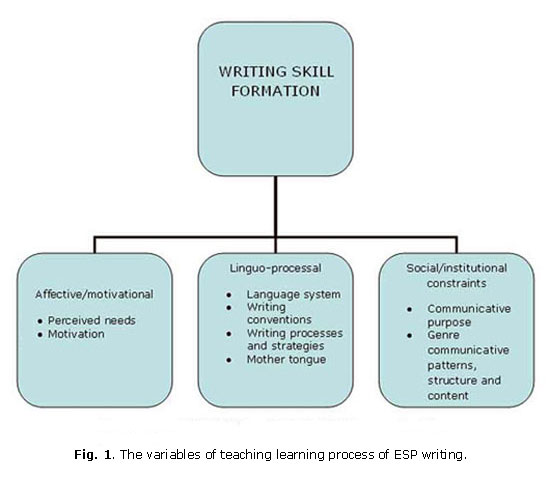
<body><![CDATA[<li><font face="Verdana, Arial, Helvetica, sans-serif" size="2"> Understanding      of writing as a task and not as communication. </font></li>     </ol>     <p> </p>     <p><font face="Verdana, Arial, Helvetica, sans-serif" size="2">Putting the socio-psycholinguistic    and didactic perspectives together, writing in a second language is a complex    process involving the skill to communicate in the L2 (learner output) and the    skill to construct a text in order to express one's ideas effectively in writing.    Finding out which social, motivational and cognitive factors related to writing    skill formation influence on the learning situation will, undoubtedly, help    in assessing the underlying reasons why L2 learners exhibit particular writing    errors. These factors can be conceived as variables and represented. See diagram    in appendix. </font></p>     <p> </p>     <p><font face="Verdana, Arial, Helvetica, sans-serif" size="2">These affective/motivational,    linguo-procesal, and social variables pose a challenge to the didactics of ESP    writing skill formation diagnostic testing. If all of them influence on ESP    writing skill formation, therefore, the study of the text (the written genre)    based on static indicators will only show the learner's incompetence to deal    with professional communication, and no more. The response to the challenge    is a new model for this type of pedagogical activity.     <br>       <br>       <br>   </font></p>     <p> </p>     ]]></body>
<body><![CDATA[<p> </p>     <p><font face="Verdana, Arial, Helvetica, sans-serif" size="2"><B> <font size="3">A    SOCIO-PSYCHOLINGUISTIC MODEL FOR ESP WRITING SKILL FORMATION DIAGNOSTIC TESTING</font></B></font></p>     <p> </p>     <p align="left"><font face="Verdana, Arial, Helvetica, sans-serif" size="2">The    present section argues a new model for ESP writing skill formation diagnostic    testing in which scientifically founded variables account for the student's    performance throughout all the learning process until he is able to produce    a genre similar to real life samples. Therefore, genre learning is no longer    considered as producing a piece of written text, it is thought of as a way of    learning how to behave in the new discourse community, a kind of social action    (<a href="#fig1">figura 1</a>).</font></p>     <p align="center"><font face="Verdana, Arial, Helvetica, sans-serif" size="2">    <br>       <br>   <a name="fig1"></a><img src="/img/revistas/aci/v20n6/f01041209.jpg" width="550" height="502"> </font></p>     
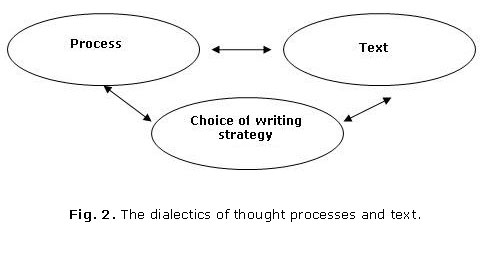
<p> </p>     <p align="left"><font face="Verdana, Arial, Helvetica, sans-serif" size="2">Writing    is an activity. Writing is an activity is the sense that it involves actions    such as planning, search, organization, and choice of information, drafting,    revising, and editing. All these actions are thought mediated. It was argued    before that all texts involve these actions; however, their complexity depends    on the conditions of writing, or to put it in other words, the kind of text    to be produced. Therefore, thought processes and product establish a dialectical    relation of cause-effect. The more complex the text, the more thought processes    involved, and viceversa. This dialectical relationship can be further developed    by a correct choice of a writing strategy (<a href="#fig2">figura 2</a>). </font></p>     <p align="center"><font face="Verdana, Arial, Helvetica, sans-serif" size="2">    ]]></body>
<body><![CDATA[<br>   <a name="fig2"></a><img src="/img/revistas/aci/v20n6/f02041209.jpg" width="487" height="253"> </font></p>     
<p></p>     <p> </p>     <p><font face="Verdana, Arial, Helvetica, sans-serif" size="2">This argument has    its foundation on Leontiev and Galperin's skill-related concepts of actions    and operations.<SUP>18-20</SUP>  A skill consists of actions which once carried out make    reaching the objective possible. The operations are condition- dependent; for    example, the complexity of the task. These concepts are relative; in the case    of a complex skill, such as when writing a research article the writer has to    know how to plan; how to organize both strategic actions; and also how to revise,    how to edit. In fact, planning, organizing, drafting, and editing are skills    in themselves, acting as actions for a complex skill. Whereas anyone can write    a shopping list, a simple skill, without much preoccupation for the second,    third, and fourth actions. It follows some complex skills (e.g. arguing, narrating,    assessing, and writing) comprise actions which in turn can be skills in themselves.    Therefore, correct choice of strategies (how to tackle the task conditions)    is essential in professional writing. </font></p>     <p> </p>     <p><font face="Verdana, Arial, Helvetica, sans-serif" size="2">Writing is also    communication because any piece of written language has a communicative purpose.    To achieve its communicative purpose, language is always in the form of text,    and as text it always belongs to a particular genre. Based on Leontiev's Activity    Theory,21 a genre is the mediating instrument in the relationship established    between the writer and his reader. Genres are always the property of a particular    discourse community, and domain of the genre determines the role of the members.    As a result, mastery of the genre language conventions is essential to be accepted    as a full member in any discourse community. </font></p>     <p> </p>     <p align="left"><font face="Verdana, Arial, Helvetica, sans-serif" size="2">Pre-graduate    and post-graduate ESP students are usually members of their professional discourse    community. They are mostly academic genre consumers. When the need to enter    the discourse community in the foreign language arises, the first problem they    encounter is not the lack of competence in the L2. Indeed, most ESP students    are very usually competent users of the foreign code. The point is that they    do not know how to make use of it within their profession. The contradiction    is, therefore, a matter of expressing thought/knowledge in another language.    This contradiction can be set in motion through information derived from diagnostic    testing on the positive and negative transfer of metafunctions from the L1 to    and within the L2 (<a href="#fig3">figura 3</a>). </font></p>     <p align="center"><a name="fig3"></a><img src="/img/revistas/aci/v20n6/f03041209.jpg" width="488" height="270"></p>     
<p align="left"><font face="Verdana, Arial, Helvetica, sans-serif" size="2">The    ideational, interpersonal, and textual metafunctions of all languages are the    same. They are expressed in the variables field, tenor and mode of discourse    in a particular context of situation or register. Therefore, learning the foreign    code for writing academic purposes is a matter of transference from what is    already known. It is discovering the shared universals of scientific writing    style: discourse development and organization, syntax, morphology, vocabulary    choice, preferred communication patterns, mechanics and punctuation. As competent    users of their mother tongue and as consumers of genres in their own language,    ESP learners know the metafunctions of academic discourse. Therefore, diagnostic    testing should aim at what is known in the L1 to favor transfer to the L2, again    the ZPD. </font></p>     ]]></body>
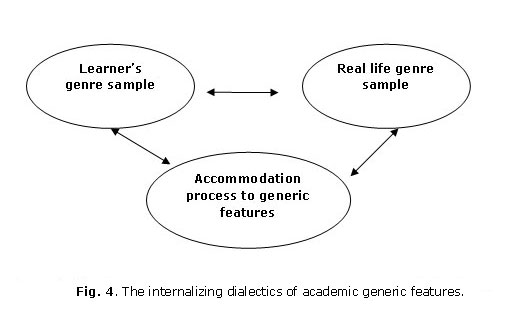
<body><![CDATA[<p> </p>     <p><font face="Verdana, Arial, Helvetica, sans-serif" size="2">An essential viewpoint    is that all genres control a set of communicative purposes within certain social    situations and that each genre has its own structural quality according to those    communicative purposes.<SUP>22</SUP>  Therefore, the communicative purposes and the structural    features should be identified when genres are used in writing. </font></p>     <p> </p>     <p><font face="Verdana, Arial, Helvetica, sans-serif" size="2">Genre learning    is a gradual process of accommodating academic writing to the expectations of    the foreign academic discourse community. On one side, the actual samples of    texts the learner can produce when the process of learning is taking place are    far from similar to real life genres. Diagnostic testing should, therefore,    aim at those instances of the genre production which are in the ZDP. That is,    which aspects of the genre the learner can produce alone, which with help, and    which need further teaching and practice (<a href="#fig4">figura 4</a>). </font></p>     <p align="center"><a name="fig4"></a><img src="/img/revistas/aci/v20n6/f04041209.jpg" width="516" height="324"></p>     
<p></p>     <p> </p>     <p><font face="Verdana, Arial, Helvetica, sans-serif" size="2">Generic features    are socially/institutionally constrained. In the case of academic genres these    limitations are clearly evident. For example, specialized journals regulate    the kinds of contents and types of research articles submitted for publication,    layout, sections, presentation of additional information and bibliographical    references, just to mention some. Though extra-linguistic, these restrictions    are expressed through language. Therefore, the learning of generic features    is a gradual process of accommodation to social/institutional demands to satisfy    the consumer's expectations. </font></p>     <p> </p>     <p><font face="Verdana, Arial, Helvetica, sans-serif" size="2">Hitherto, significant    categories related to external variables in ESP writing skill formation diagnostic    testing have been analyzed. These external variables account for aspects of    discourse properties of genre in academic settings and adequacy of academic    writing style. However, another important variable, an internal one, the individual    ESP student as the most important component of the teaching learning process    has very often been overlooked or simply mistreated. </font></p>     ]]></body>
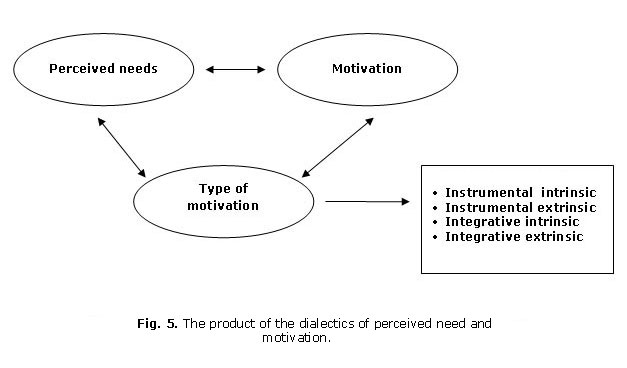
<body><![CDATA[<p> </p>     <p><font face="Verdana, Arial, Helvetica, sans-serif" size="2">The personality    factors which have been given prominence in foreign language teaching literature    are age, cultural background, attitude, aptitude, interest, perceived needs,    and motivation. As mentioned elsewhere before, a strong relation arises from    the combination of perceived needs and motivation. This combination brings with    it different types of motivation. </font></p>     <p> </p>     <p><font face="Verdana, Arial, Helvetica, sans-serif" size="2">The ESP student    goes into academic writing for different motives; first, he may want to enter    the academic discourse community to make his home-based research known. In this    case, his type of motivation is said to be instrumental. Second, he may want    to become a member of the discourse community, but within the dwellings of that    discourse community; in this case, the type of motivation is said to be integrative.    Furthermore, he may do any of those because he himself wants to do so. He has    perceived so as a need; that is, intrinsic motivation. On the contrary, he may    have been pressed by external agents such as his institution, his economic situation;    that is extrinsic motivation. Therefore, there are four different types of motivation    (<a href="#fig5">figura 5</a>). </font></p>     <p align="center"><a name="fig5"></a><img src="/img/revistas/aci/v20n6/f05041209.jpg" width="627" height="368"></p>     
<p></p>     <p> </p>     <p><font face="Verdana, Arial, Helvetica, sans-serif" size="2">The type of motivation    is very commonly related to the student's self-assessment concept. Self assessment    in foreign language learning is the result of complex interactions of the student's    history in language learning and present experience. Several factors for example,    the teacher's and/or peer opinion, and learning outcomes are very strong external    influences in self-assessment formation. When self-assessment is positive, the    student will perceive language learning as a challenge, and will make all efforts    to meet to that challenge. On the contrary, when it is negative, as he already    assumes he is going to fail, the channels for learning will be blocked. </font></p>     <p> </p>     <p><font face="Verdana, Arial, Helvetica, sans-serif" size="2">For ESP writing    skill formation diagnostic testing, types of motivation and self-assessment    should be seen as interacting configurations. The point is to gather information    so as to provide the students with positive experiences in learning how to write    in the profession and to discover the motivation type so as to move towards    a more favorable form of perceiving the learning experience as meaningful, enhancing    self-assessment, thus facilitating appropriation of the skill. </font></p>     ]]></body>
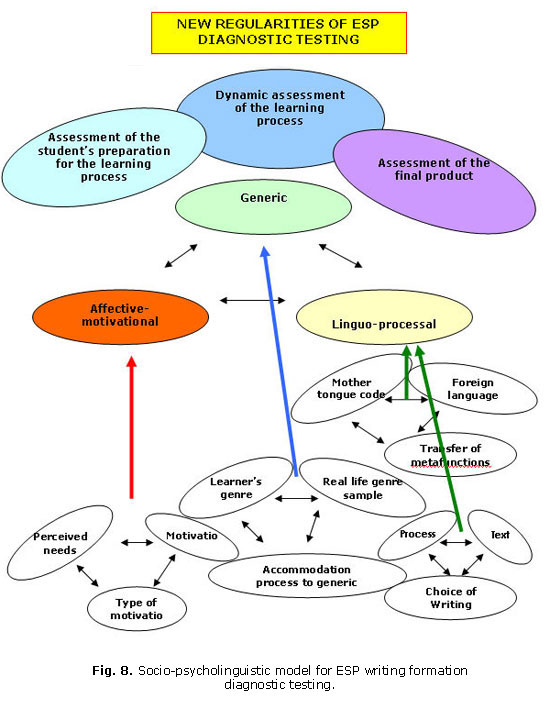
<body><![CDATA[<p> </p>     <p><font face="Verdana, Arial, Helvetica, sans-serif" size="2">The social and    psychological categories dealt with until now represent isolated variables which    give rise to configurations of a higher order of integration: the dimensions    of ESP writing skill formation diagnostic testing. These dimensions are the    linguo-processal, the generic, and the affective-motivational. They account    for different aspects which have to be taken into consideration in ESP writing    diagnostic testing. </font></p>     <p> </p>     <p><font face="Verdana, Arial, Helvetica, sans-serif" size="2">The linguo-processal    dimension arises from the dialectic interaction of thought-processes, text and    choice of strategy plus the interactions established between the mother tongue,    the foreign code, and the transfer of metafunctions from the L1 and from the    already known in the L2. The generic dimension is revealed from the interaction    of the real ESP competence in text producing the student presents with, the    real competence he is to achieve to produce a real life sample, and the moving    category, the necessary accommodation process of the writing output to the obligatory    features of the genre. The affective-motivational dimension owes its existence    to the interactions produced by types of motivation and self-assessment. These    dimensions coexist in ESP writing skill formation diagnostic testing (<a href="#fig6">figura    6 </a>). </font></p>     <p align="center"><a name="fig6"></a><img src="/img/revistas/aci/v20n6/f06041209.jpg" width="564" height="317"></p>     
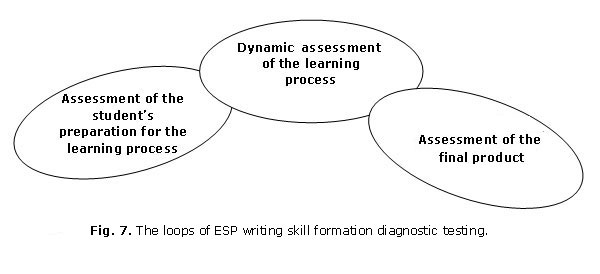
<p></p>     <p> </p>     <p><font face="Verdana, Arial, Helvetica, sans-serif" size="2">One of the criticisms    of today's model for writing diagnostic testing is that it is an activity for    the beginning of the course; another is that it only takes into consideration    fixed indicators related to the system of the language and the formalities of    the written language. The introduction of the above mentioned dimensions adds    more indicators accounting for more aspects to be taken into consideration.    The aspect to be solved now is how to carry out a continuous diagnostic testing    process during ESP writing skill formation. The answer is to carry out the process    in interconnected loops. </font></p>     <p> </p>     <p><font face="Verdana, Arial, Helvetica, sans-serif" size="2">The loops of ESP    writing skill formation diagnostic testing are closely related to the dimensions    of the process. A unifying principle makes that relation possible: Each loop    of ESP writing skill formation diagnostic testing represents the development    of the skill at a specific moment of time in a particular variable belonging    to a particular dimension. </font></p>     ]]></body>
<body><![CDATA[<p> </p>     <p><font face="Verdana, Arial, Helvetica, sans-serif" size="2">The Loops of the    ESP writing skill formation diagnostic testing process are: Assessment of the    student's preparation for the learning process, Dynamic assessment of the learning    process, and Assessment of the final product. Their relation with the dimensions    is as follows: </font></p>     <p> </p>     <p><font face="Verdana, Arial, Helvetica, sans-serif" size="2">An adequate assessment    of the student's preparation for the learning process<B> </B>entails: </font></p> <ol>       <li><font face="Verdana, Arial, Helvetica, sans-serif" size="2"> Finding out      about his communicative competence in the L1 </font></li>       <li><font face="Verdana, Arial, Helvetica, sans-serif" size="2"> Assessing his      previous experiences in foreign language learning </font></li>       <li><font face="Verdana, Arial, Helvetica, sans-serif" size="2"> Learning about      his knowledge of the genre object of study and the role he gives in the practice      of his profession </font></li>     </ol>     <p><font face="Verdana, Arial, Helvetica, sans-serif" size="2">An adequate dynamic    assessment of the learning process<B> </B>comprises:     <br>   </font></p> <ol>       ]]></body>
<body><![CDATA[<li><font face="Verdana, Arial, Helvetica, sans-serif" size="2"> Learning about      his mastery of the foreign language system </font></li>       <li><font face="Verdana, Arial, Helvetica, sans-serif" size="2"> Determining      his use of effective writing processes </font></li>       <li><font face="Verdana, Arial, Helvetica, sans-serif" size="2"> Getting acquainted      of his knowledge about writing strategies , which he uses and prefers </font></li>       <li><font face="Verdana, Arial, Helvetica, sans-serif" size="2"> Assessing the      degree of affective commitment with learning the skill </font></li>       <li><font face="Verdana, Arial, Helvetica, sans-serif" size="2"> Determining      the degree of approximation to the discursive characteristics of the genre      object of study </font></li>     </ol>     <p><font face="Verdana, Arial, Helvetica, sans-serif" size="2">An adequate assessment    of the final product<B> </B>consists of:     <br>   </font></p> <ol>       <li><font face="Verdana, Arial, Helvetica, sans-serif" size="2"> Assessing the      degree of affective commitment and change with the new learning </font></li>       <li><font face="Verdana, Arial, Helvetica, sans-serif" size="2"> Determining      to what extent the product is similar to real life samples </font></li>       ]]></body>
<body><![CDATA[<li><font face="Verdana, Arial, Helvetica, sans-serif" size="2"> Evaluating      if the scientific functional style has been used accurately </font></li>       <li><font face="Verdana, Arial, Helvetica, sans-serif" size="2"> Evaluating      the extent to which the system of the language and the written language conventions      have been used correctly </font></li>     </ol>     <p> </p>     <p><font face="Verdana, Arial, Helvetica, sans-serif" size="2">The conception    of ESP writing skill formation diagnostic testing in loops closely related with    the three dimensions stated before makes it possible for new qualities in this    type of process to arise. First, ESP writing skill formation diagnostic testing    becomes professional<B> </B>in the sense that the students learning and products    get closer to real life academic demands. For example, if it is an article what    he writes, it has to communicate as an article. Second, diagnostic testing is    converted into a developmental process for it sets the foundations for other    types of learning within the profession. Last, diagnostic testing as conceived    in the three loops and three dimensions develops into a personalized<B> </B>process,    centered in the individual learner making him responsible with his own learning    at the time he is offered all the help he needs for positive change (<a href="#fig7">figura    7 </a>). </font></p>     <p align="center"><a name="fig7"></a><img src="/img/revistas/aci/v20n6/f07041209.jpg" width="600" height="274"></p>     
<p align="left"></p>     <p> </p>     <p align="left"><font face="Verdana, Arial, Helvetica, sans-serif" size="2">The    socio-psycholinguistic model for ESP writing skill formation diagnostic testing<B>    </B>presented so far<B> </B>envisions the combination of product, process, and    genre approaches concepts to academic writing; at the same time, it focuses    on the individual learner's needs, motivation, and self-assessment as important    variables to this endeavor (<a href="#fig8">figura 8</a>). The adoption of the    model results in major changes in different components of the teaching learning    process, putting into motion new regularities. </font></p>     <p align="center"><font face="Verdana, Arial, Helvetica, sans-serif" size="2">    ]]></body>
<body><![CDATA[<br>       <br>   <a name="fig8"></a><img src="/img/revistas/aci/v20n6/f08041209.jpg" width="550" height="720"> </font></p>     
<p><font face="Verdana, Arial, Helvetica, sans-serif" size="2">The new regularities    in the ESP writing skill formation process brought about by the model enhance    its didactic possibilities towards success. First, the objectives of the teaching    learning process are conceived in terms of real communication acts rather than    in artificial text writing such as sentences, paragraphs, and compositions.    Second, the contents of writing include not only the system of the language,    but also how these are constrained by social/institutional constrains, writing    processes, choice of strategies, how to transfer form one language to another    in a real communication task. Third, the approach is basically generic for it    is genre writing what the ESP student needs to learn to insert himself in the    academic discourse community. Fourth, the teaching aids are updated with real    communication samples, authentic texts, which have the role of how to mean in    that discourse community, facilitating the understanding of essential concepts    such as rhetorical structures, communication patterns, reader's expectations,    style, and hedging. Last, diagnostic testing is not evaluation. It is finding    out the causes which impede development and learning. Qualitative in nature,    diagnostic testing dissociates itself from statistic analysis, centering in    personality and performance variables of which numbers can say very little.    </font></p>     <p> </p>     <p><font face="Verdana, Arial, Helvetica, sans-serif" size="2">ESP writing skill    diagnostic testing as presented in the model has different instructional, developmental,    and educational effects on the learner. Thus, writing skill formation: </font></p>     <p> </p> <ul>       <li><font face="Verdana, Arial, Helvetica, sans-serif" size="2"> Increases consciousness      level about the linguistic processes in the L1 and of its writing forms in      particular. </font></li>       <li><font face="Verdana, Arial, Helvetica, sans-serif" size="2"> Helps in the      process of learning the foreign language since writing is another channel      in its internalizing process. </font></li>       <li><font face="Verdana, Arial, Helvetica, sans-serif" size="2"> Contributes      to the development of thought skills and creativity. </font></li>       <li><font face="Verdana, Arial, Helvetica, sans-serif" size="2"> Increases the      capacities to plan, organize, and control verbal activity. </font></li>       ]]></body>
<body><![CDATA[<li><font face="Verdana, Arial, Helvetica, sans-serif" size="2"> Allows the      assimilation of other culture's writing and their critical assessment with      respect to the forms of expression of other men. </font></li>       <li><font face="Verdana, Arial, Helvetica, sans-serif" size="2"> Increases the      possibilities of insertion in a new discourse community and an easier access      to the workforce market, at the time he defends his identity and culture.      </font></li>       <li><font face="Verdana, Arial, Helvetica, sans-serif" size="2"> Makes active      participation in academic life possible.     <br>         <br>         <br>     </font></li>     </ul> <font face="Verdana, Arial, Helvetica, sans-serif" size="2"><b><font size="3">CONCLUSIONS</font></b></font>      <p> </p>     <p><font face="Verdana, Arial, Helvetica, sans-serif" size="2">The Socio-Psycholinguistic    Model for ESP Writing Skill Formation Diagnostic Testing<B> </B>is a conception    founded on sociolinguistic, psychological, and didactic criteria aimed at giving    a pedagogic response to structuralist and behaviorist ideas underlying ESP writing    diagnostic testing today. It encompasses social, linguistic, language processing    and transferring variables together with affective personality factors on dialectic    contradiction bases. </font></p>     <p> </p>     ]]></body>
<body><![CDATA[<p><font face="Verdana, Arial, Helvetica, sans-serif" size="2">Making use of relevant    research in discourse linguistics, it introduces the generic dimension for writing    skill formation diagnostic testing. The generic dimension of ESP writing skill    formation diagnostic testing fills the gap in reference to the social/institutional    constraints expressed through language in academic discourse. At the same time,    it reveals new qualities and regularities for this type of pedagogical activity.    </font></p>     <p> </p>     <p><font face="Verdana, Arial, Helvetica, sans-serif" size="2">The linguo-processal    and affective-motivational dimensions of ESP writing skill formation diagnostic    testing put together&#151;often neglected or treated in isolation&#151; variables    of learning which have a strong bearing in language learning. The information    obtained from this type of diagnostic testing will undoubtedly be useful in    the teaching of other skills. Finally, the conception of the model in loops    allows for constant monitoring of this skill formation and can be used in different    educational scenarios. </font></p>     <p> </p>     <p> </p>     <p><font face="Verdana, Arial, Helvetica, sans-serif" size="2">    <br>   <b>    <br>   </b></font><font face="Verdana, Arial, Helvetica, sans-serif" size="2"><font size="3"><b>BIBLIOGRAPHIC    REFERENCES </b></font></font></p>     <p></p>     <p> </p> <ol>       ]]></body>
<body><![CDATA[<!-- ref --><li><font face="Verdana, Arial, Helvetica, sans-serif" size="2"> Jordan R. English      for academic purposes (EAP). Language Teaching Journal. 1989;44(1):1501.    <br>         <br>     </font></li>       <!-- ref --><li><font face="Verdana, Arial, Helvetica, sans-serif" size="2"> Forteza Fern&aacute;ndez      R. Indicators for writing skill formation diagnostic testing. Master's dissertation      in English Language Teaching. Holgu&iacute;n: Instituto Superior Pedag&oacute;gico;      2000.    <br>         <br>     </font></li>       <!-- ref --><li><font face="Verdana, Arial, Helvetica, sans-serif" size="2"> Kern R. Literacy      and language teaching. Hong Kong: Oxford University Press.; 2000.    <br>         <br>     </font></li>       <!-- ref --><li><font face="Verdana, Arial, Helvetica, sans-serif" size="2"> Bhatia VK.      Analyzing genre: Language use in professional settings. New York C: Longman.      1983.    <br>         <br>     </font></li>       <!-- ref --><li><font face="Verdana, Arial, Helvetica, sans-serif" size="2"> Chi B. Issues      in assessing the academic writing of students from diverse linguistic and      cultural backgrounds: Preliminary findings from a study on lecturers' beliefs      and practices.<B> </B>Melbourne: The University of Melbourne; 2003.    <br>         <br>     </font></li>       <!-- ref --><li><font face="Verdana, Arial, Helvetica, sans-serif" size="2"> Forteza Fern&aacute;ndez      R. Diagnostic testing of the formation and development of writing ability      in English for Specific Purposes in Medical Sciences Students. Doctoral Dissertation.      Holgu&iacute;n: Universidad de Holgu&iacute;n; 2008.    <br>         <br>     </font></li>       <!-- ref --><li><font face="Verdana, Arial, Helvetica, sans-serif" size="2"> Kress G. Genre      as social process. In: Cope B, Kalantzis M (eds.) The Powers of Literacy:      A genre approach to teaching writing. London: Falmer; 1993.    <br>         ]]></body>
<body><![CDATA[<br>     </font></li>       <!-- ref --><li><font face="Verdana, Arial, Helvetica, sans-serif" size="2"> Swales J. Genre      analysis. Cambridge: Cambridge University Press; 1990.    <br>         <br>     </font></li>       <!-- ref --><li><font face="Verdana, Arial, Helvetica, sans-serif" size="2"> Forteza Fern&aacute;ndez      R. Estudio ling&uuml;&iacute;stico comunicativo de los planes de cuidado en      enfermer&iacute;a: perspectivas did&aacute;cticas. Acimed. 2003;11(2). Disponible      en: <U><FONT  COLOR="#0000ff"><a href="http://bvs.sld.cu/revistas/aci/vol11_2_03/aci070203.htm" target="_blank">http://bvs.sld.cu/revistas/aci/vol11_2_03/aci070203.htm</a></FONT></U>      [Consultado: 7 de octubre de 2009].    <br>         <br>     </font></li>       <!-- ref --><li><font face="Verdana, Arial, Helvetica, sans-serif" size="2"> Forteza Fern&aacute;ndez      R. El reporte de caso en medicina y estomatolog&iacute;a: morfofisiolog&iacute;a      de g&eacute;nero. Acimed. 2006;14(1). Disponible en: <U><FONT  COLOR="#0000ff"><a href="http://bvs.sld.cu/revistas/aci/vol14_1_06/aci09106.htm" target="_blank">http://bvs.sld.cu/revistas/aci/vol14_1_06/aci09106.htm</a></FONT></U>      [Consultado: 4 de octubre de 2009].    <br>         <br>     </font></li>       ]]></body>
<body><![CDATA[<!-- ref --><li><font face="Verdana, Arial, Helvetica, sans-serif" size="2"> Oxford University      Press. New Oxford advanced learner&#180;s dictionary. Oxford: Oxford University      Press; 2007.    <br>         <br>     </font></li>       <!-- ref --><li><font face="Verdana, Arial, Helvetica, sans-serif" size="2"> Gonz&aacute;lez      Serra D. Psicolog&iacute;a de la motivaci&oacute;n. La Habana: Ecimed; 2008.    <br>         <br>     </font></li>       <!-- ref --><li><font face="Verdana, Arial, Helvetica, sans-serif" size="2"> Brown D. Principles      of language learning and teaching. 2<SUP>nd</SUP> ed. Englewood Cliffs: Prentice      Hall; 1987.    <br>         <br>     </font></li>       <!-- ref --><li><font face="Verdana, Arial, Helvetica, sans-serif" size="2"> Mc Donough      S. Psychology in foreign language teaching. La Habana: Edici&oacute;n Revolucionaria;      1989.    <br>         <br>     </font></li>       <!-- ref --><li><font face="Verdana, Arial, Helvetica, sans-serif" size="2"> Abreu E. Diagn&oacute;stico      de las desviaciones del desarrollo ps&iacute;quico. La Habana: Pueblo y Educaci&oacute;n;      1990.    <br>         <br>     </font></li>       <!-- ref --><li><font face="Verdana, Arial, Helvetica, sans-serif" size="2"> Ponce S. Concepci&oacute;n      te&oacute;rica-metodol&oacute;gica integrativa para el diagn&oacute;stico      psicopedag&oacute;gico de los ni&ntilde;os de cero a tres a&ntilde;os de edad.      Tesis en opci&oacute;n al grado cient&iacute;fico de Doctor en Ciencias Pedag&oacute;gicas.      Holgu&iacute;n: Instituto Superior Pedag&oacute;gico. 2004.    <br>         <br>     </font></li>       <!-- ref --><li><font face="Verdana, Arial, Helvetica, sans-serif" size="2"> Myles J. Second      language writing and research: The writing process and error analysis in students      texts. TESL Journal 2002;6(2 A-1). Disponible en: <U><FONT  COLOR="#0000ff"><a href="http://www.kyoto-su.ac.jp/information/tesl-ej/ej22/a1.html" target="_blank">http://www.kyoto-su.ac.jp/information/tesl-ej/ej22/a1.html</a></FONT></U>      [Consultado: 3 de octubre de 2009].    <br>         ]]></body>
<body><![CDATA[<br>     </font></li>       <!-- ref --><li><font face="Verdana, Arial, Helvetica, sans-serif" size="2"> Tal&iacute;zina      N. Psicolog&iacute;a de la ense&ntilde;anza. Mosc&uacute;: Progreso. 1988.    <br>         <br>     </font></li>       <!-- ref --><li><font face="Verdana, Arial, Helvetica, sans-serif" size="2">&Aacute;lvarez      de Zayas C. La escuela en la vida. La Habana: Pueblo y Educaci&oacute;n. 1999.    <br>         <br>     </font></li>       <!-- ref --><li><font face="Verdana, Arial, Helvetica, sans-serif" size="2"> Fuentes Gonz&aacute;lez      H. Teor&iacute;a hol&iacute;stico configuracional y su aplicaci&oacute;n a      la did&aacute;ctica de la educaci&oacute;n superior. Santiago de Cuba: Universidad      de Oriente; 2002.    <br>         <br>     </font></li>       ]]></body>
<body><![CDATA[<!-- ref --><li><font face="Verdana, Arial, Helvetica, sans-serif" size="2"> Russel D. (1997).      Rethinking genre in school and society: An activity theory analysis. Written      Communication. 1997;4(4):504-54.    <br>         <br>     </font></li>       <!-- ref --><li><font face="Verdana, Arial, Helvetica, sans-serif" size="2">22. Kay H, Dudley-Evans      T. Genre: What teachers think [Electronic version]. ELT Journal. 1998;52(4):308-14.    <br>         <br>         <br>         <br>     </font></li>     </ol>     <p> </p>     ]]></body>
<body><![CDATA[<p> </p>     <p><font face="Verdana, Arial, Helvetica, sans-serif" size="2">    <br>   Received: November 11, 2007.    <br>   </font><font face="Verdana, Arial, Helvetica, sans-serif" size="2">Accepted:    December 22, 2007.     <br>       <br>       <br>       <br>   </font></p>     <p> </p>     <p> </p>     ]]></body>
<body><![CDATA[<p><font face="Verdana, Arial, Helvetica, sans-serif" size="2">Ph.D. <I>Rafael    Forteza Fern&aacute;ndez</I>. Facultad de Enfermer&iacute;a.<B> </B>Carretera    del Valle, Pueblo Nuevo. Holgu&iacute;n. CP: 80500. E-mail: <U><FONT  COLOR="#0000ff"><a href="/img/revistas/aci/v20n6/forteza@enfer.hlg.sld.cu">forteza@enfer.hlg.sld.cu</a>    </FONT></U> </font></p>     
<p> </p>     <p> </p>     <p><font face="Verdana, Arial, Helvetica, sans-serif" size="2">    <br>       <br>   Processing Card </font></p>     <p> </p>     <p><font face="Verdana, Arial, Helvetica, sans-serif" size="2">Classification:    Original article. </font></p>     <p><font face="Verdana, Arial, Helvetica, sans-serif" size="2">Terms suggested    for the indexation </font></p>     <p><font face="Verdana, Arial, Helvetica, sans-serif" size="2">According to DeCS<SUP>1</SUP>    </font></p>     ]]></body>
<body><![CDATA[<p><font face="Verdana, Arial, Helvetica, sans-serif" size="2">EDUCATION, MEDICAL;    STUDENTS, MEDICAL.    <br>   </font><font face="Verdana, Arial, Helvetica, sans-serif" size="2">EDUCACI&Oacute;N    M&Eacute;DICA; ESTUDIANTES DE MEDICINA. </font></p>     <p> </p>     <p><font face="Verdana, Arial, Helvetica, sans-serif" size="2">According to DeCI<SUP>2</SUP>    </font></p>     <p><font face="Verdana, Arial, Helvetica, sans-serif" size="2">TECHNICAL EDUCATION;    LEARNING.    <br>   </font><font face="Verdana, Arial, Helvetica, sans-serif" size="2">ENSE&Ntilde;ANZA    TECNICA; APRENDIZAJE. </font></p>     <p> </p>     <p><font face="Verdana, Arial, Helvetica, sans-serif" size="2"><SUP>1</SUP>BIREME.    Descriptores en Ciencias de la Salud (DeCS). Sao Paulo: BIREME, 2004. Available    from: <U><FONT COLOR="#0000ff"><a href="http://decs.bvs.br/E/homepagee.htm" target="_blank">http://decs.bvs.br/E/homepagee.htm</a>    <br>   </FONT></U></font><font face="Verdana, Arial, Helvetica, sans-serif" size="2"><SUP>2</SUP>D&iacute;az    del Campo S. Propuesta de t&eacute;rminos para la indizaci&oacute;n en Ciencias    de la Informaci&oacute;n. Descriptores en Ciencias de la Informaci&oacute;n    (DeCI). Available from: <U><FONT  COLOR="#0000ff"><a href="http://cis.sld.cu/E/tesauro.pdf" target="_blank">http://cis.sld.cu/E/tesauro.pdf</a>    </FONT></U> </font></p>     <p> </p>     ]]></body>
<body><![CDATA[<p> </p>     <p><font face="Verdana, Arial, Helvetica, sans-serif" size="2">Copyright: &#169;    ECIMED. Open Access contribution, distributed under the terms of the Creative    Commons Non-Commercial Shareware License 2.0, which allows the consultation,    reproduction, public display and use of the results on practice as well as all    of its derivates, without commercial purposes and with an identical license,    as long as the author or authors is adequately cited as well as the source.    </font></p>     <p> </p>     <p><font face="Verdana, Arial, Helvetica, sans-serif" size="2">    <br>       <br>   Cite (Vancouver): Forteza Fern&aacute;ndez R, Gunashekar P. A socio-psycholinguistic    model for English for Specific Purposes writing skill formation diagnosis. Acimed    2009;19(6). Available from: [Consulted: day/month/year]. </font></p>      ]]></body><back>
<ref-list>
<ref id="B1">
<nlm-citation citation-type="journal">
<person-group person-group-type="author">
<name>
<surname><![CDATA[Jordan]]></surname>
<given-names><![CDATA[R]]></given-names>
</name>
</person-group>
<article-title xml:lang="en"><![CDATA[English for academic purposes (EAP)]]></article-title>
<source><![CDATA[Language Teaching Journal.]]></source>
<year>1989</year>
<volume>44</volume>
<numero>1</numero>
<issue>1</issue>
<page-range>1501</page-range></nlm-citation>
</ref>
<ref id="B2">
<nlm-citation citation-type="book">
<person-group person-group-type="author">
<name>
<surname><![CDATA[Forteza Fernández]]></surname>
<given-names><![CDATA[R.]]></given-names>
</name>
</person-group>
<source><![CDATA[Indicators for writing skill formation diagnostic testing.]]></source>
<year>2000</year>
<publisher-loc><![CDATA[Holguín ]]></publisher-loc>
<publisher-name><![CDATA[Instituto Superior Pedagógico]]></publisher-name>
</nlm-citation>
</ref>
<ref id="B3">
<nlm-citation citation-type="book">
<person-group person-group-type="author">
<name>
<surname><![CDATA[Kern]]></surname>
<given-names><![CDATA[R.]]></given-names>
</name>
</person-group>
<source><![CDATA[Literacy and language teaching.]]></source>
<year>2000</year>
<publisher-loc><![CDATA[Hong Kong ]]></publisher-loc>
<publisher-name><![CDATA[Oxford University Press]]></publisher-name>
</nlm-citation>
</ref>
<ref id="B4">
<nlm-citation citation-type="book">
<person-group person-group-type="author">
<name>
<surname><![CDATA[Bhatia]]></surname>
<given-names><![CDATA[VK.]]></given-names>
</name>
</person-group>
<source><![CDATA[Analyzing genre:: Language use in professional settings.]]></source>
<year>1983</year>
<publisher-loc><![CDATA[New York C ]]></publisher-loc>
<publisher-name><![CDATA[Longman]]></publisher-name>
</nlm-citation>
</ref>
<ref id="B5">
<nlm-citation citation-type="book">
<person-group person-group-type="author">
<name>
<surname><![CDATA[Chi]]></surname>
<given-names><![CDATA[B.]]></given-names>
</name>
</person-group>
<source><![CDATA[Issues in assessing the academic writing of students from diverse linguistic and cultural backgrounds:: Preliminary findings from a study on lecturers' beliefs and practices.]]></source>
<year>2003</year>
<publisher-loc><![CDATA[Melbourne ]]></publisher-loc>
<publisher-name><![CDATA[The University of Melbourne]]></publisher-name>
</nlm-citation>
</ref>
<ref id="B6">
<nlm-citation citation-type="book">
<person-group person-group-type="author">
<name>
<surname><![CDATA[Forteza Fernández]]></surname>
<given-names><![CDATA[R.]]></given-names>
</name>
</person-group>
<source><![CDATA[Diagnostic testing of the formation and development of writing ability in English for Specific Purposes in Medical Sciences Students.]]></source>
<year>2008</year>
<publisher-loc><![CDATA[Holguín ]]></publisher-loc>
<publisher-name><![CDATA[Universidad de Holguín]]></publisher-name>
</nlm-citation>
</ref>
<ref id="B7">
<nlm-citation citation-type="book">
<person-group person-group-type="author">
<name>
<surname><![CDATA[Kress]]></surname>
<given-names><![CDATA[G.]]></given-names>
</name>
</person-group>
<article-title xml:lang="en"><![CDATA[Genre as social process.]]></article-title>
<person-group person-group-type="editor">
<name>
<surname><![CDATA[Cope]]></surname>
<given-names><![CDATA[B]]></given-names>
</name>
<name>
<surname><![CDATA[Kalantzis]]></surname>
<given-names><![CDATA[M]]></given-names>
</name>
</person-group>
<source><![CDATA[The Powers of Literacy:: A genre approach to teaching writing.]]></source>
<year>1993</year>
<publisher-loc><![CDATA[London ]]></publisher-loc>
<publisher-name><![CDATA[Falmer]]></publisher-name>
</nlm-citation>
</ref>
<ref id="B8">
<nlm-citation citation-type="book">
<person-group person-group-type="author">
<name>
<surname><![CDATA[Swales]]></surname>
<given-names><![CDATA[J.]]></given-names>
</name>
</person-group>
<source><![CDATA[Genre analysis.]]></source>
<year>1990</year>
<publisher-loc><![CDATA[Cambridge ]]></publisher-loc>
<publisher-name><![CDATA[Cambridge University Press]]></publisher-name>
</nlm-citation>
</ref>
<ref id="B9">
<nlm-citation citation-type="journal">
<person-group person-group-type="author">
<name>
<surname><![CDATA[Forteza Fernández]]></surname>
<given-names><![CDATA[R.]]></given-names>
</name>
</person-group>
<article-title xml:lang="es"><![CDATA[Estudio lingüístico comunicativo de los planes de cuidado en enfermería:: perspectivas didácticas.]]></article-title>
<source><![CDATA[Acimed]]></source>
<year>2003</year>
<volume>11</volume>
<numero>2</numero>
<issue>2</issue>
</nlm-citation>
</ref>
<ref id="B10">
<nlm-citation citation-type="journal">
<person-group person-group-type="author">
<name>
<surname><![CDATA[Forteza Fernández]]></surname>
<given-names><![CDATA[R.]]></given-names>
</name>
</person-group>
<article-title xml:lang="es"><![CDATA[El reporte de caso en medicina y estomatología:: morfofisiología de género.]]></article-title>
<source><![CDATA[Acimed]]></source>
<year>2006</year>
<volume>14</volume>
<numero>1</numero>
<issue>1</issue>
</nlm-citation>
</ref>
<ref id="B11">
<nlm-citation citation-type="book">
<collab>Oxford University Press.</collab>
<source><![CDATA[New Oxford advanced learner´s dictionary.]]></source>
<year>2007</year>
<publisher-loc><![CDATA[Oxford ]]></publisher-loc>
<publisher-name><![CDATA[Oxford University Press]]></publisher-name>
</nlm-citation>
</ref>
<ref id="B12">
<nlm-citation citation-type="book">
<person-group person-group-type="author">
<name>
<surname><![CDATA[González Serra]]></surname>
<given-names><![CDATA[D.]]></given-names>
</name>
</person-group>
<source><![CDATA[Psicología de la motivación.]]></source>
<year>2008</year>
<publisher-loc><![CDATA[La Habana ]]></publisher-loc>
<publisher-name><![CDATA[Ecimed]]></publisher-name>
</nlm-citation>
</ref>
<ref id="B13">
<nlm-citation citation-type="book">
<person-group person-group-type="author">
<name>
<surname><![CDATA[Brown]]></surname>
<given-names><![CDATA[D.]]></given-names>
</name>
</person-group>
<source><![CDATA[Principles of language learning and teaching.]]></source>
<year>1987</year>
<edition>2nd ed</edition>
<publisher-loc><![CDATA[Englewood Cliffs ]]></publisher-loc>
<publisher-name><![CDATA[Prentice Hall]]></publisher-name>
</nlm-citation>
</ref>
<ref id="B14">
<nlm-citation citation-type="book">
<person-group person-group-type="author">
<name>
<surname><![CDATA[Mc Donough]]></surname>
<given-names><![CDATA[S.]]></given-names>
</name>
</person-group>
<source><![CDATA[Psychology in foreign language teaching.]]></source>
<year>1989</year>
<publisher-loc><![CDATA[La Habana ]]></publisher-loc>
<publisher-name><![CDATA[Edición Revolucionaria]]></publisher-name>
</nlm-citation>
</ref>
<ref id="B15">
<nlm-citation citation-type="book">
<person-group person-group-type="author">
<name>
<surname><![CDATA[Abreu]]></surname>
<given-names><![CDATA[E.]]></given-names>
</name>
</person-group>
<source><![CDATA[Diagnóstico de las desviaciones del desarrollo psíquico.]]></source>
<year>1990</year>
<publisher-loc><![CDATA[La Habana ]]></publisher-loc>
<publisher-name><![CDATA[Pueblo y Educación]]></publisher-name>
</nlm-citation>
</ref>
<ref id="B16">
<nlm-citation citation-type="book">
<person-group person-group-type="author">
<name>
<surname><![CDATA[Ponce]]></surname>
<given-names><![CDATA[S.]]></given-names>
</name>
</person-group>
<source><![CDATA[Concepción teórica-metodológica integrativa para el diagnóstico psicopedagógico de los niños de cero a tres años de edad.]]></source>
<year>2004</year>
<publisher-loc><![CDATA[Holguín ]]></publisher-loc>
<publisher-name><![CDATA[Instituto Superior Pedagógico]]></publisher-name>
</nlm-citation>
</ref>
<ref id="B17">
<nlm-citation citation-type="journal">
<person-group person-group-type="author">
<name>
<surname><![CDATA[Myles]]></surname>
<given-names><![CDATA[J.]]></given-names>
</name>
</person-group>
<article-title xml:lang="en"><![CDATA[Second language writing and research:: The writing process and error analysis in students texts.]]></article-title>
<source><![CDATA[TESL Journal]]></source>
<year>2002</year>
<volume>6</volume>
<numero>2 A-1</numero>
<issue>2 A-1</issue>
</nlm-citation>
</ref>
<ref id="B18">
<nlm-citation citation-type="book">
<person-group person-group-type="author">
<name>
<surname><![CDATA[Talízina]]></surname>
<given-names><![CDATA[N.]]></given-names>
</name>
</person-group>
<source><![CDATA[Psicología de la enseñanza.]]></source>
<year>1988</year>
<publisher-loc><![CDATA[Moscú ]]></publisher-loc>
<publisher-name><![CDATA[Progreso]]></publisher-name>
</nlm-citation>
</ref>
<ref id="B19">
<nlm-citation citation-type="book">
<person-group person-group-type="author">
<name>
<surname><![CDATA[Álvarez de Zayas]]></surname>
<given-names><![CDATA[C.]]></given-names>
</name>
</person-group>
<source><![CDATA[La escuela en la vida.]]></source>
<year>1999</year>
<publisher-loc><![CDATA[La Habana ]]></publisher-loc>
<publisher-name><![CDATA[Pueblo y Educación]]></publisher-name>
</nlm-citation>
</ref>
<ref id="B20">
<nlm-citation citation-type="book">
<person-group person-group-type="author">
<name>
<surname><![CDATA[Fuentes González]]></surname>
<given-names><![CDATA[H.]]></given-names>
</name>
</person-group>
<source><![CDATA[Teoría holístico configuracional y su aplicación a la didáctica de la educación superior.]]></source>
<year>2002</year>
<publisher-loc><![CDATA[Santiago de Cuba ]]></publisher-loc>
<publisher-name><![CDATA[Universidad de Oriente]]></publisher-name>
</nlm-citation>
</ref>
<ref id="B21">
<nlm-citation citation-type="journal">
<person-group person-group-type="author">
<name>
<surname><![CDATA[Russel]]></surname>
<given-names><![CDATA[D.]]></given-names>
</name>
</person-group>
<article-title xml:lang="en"><![CDATA[(1997). Rethinking genre in school and society:: An activity theory analysis.]]></article-title>
<source><![CDATA[Written Communication]]></source>
<year>1997</year>
<volume>4</volume>
<numero>4</numero>
<issue>4</issue>
<page-range>504-54</page-range></nlm-citation>
</ref>
<ref id="B22">
<nlm-citation citation-type="journal">
<person-group person-group-type="author">
<name>
<surname><![CDATA[Kay]]></surname>
<given-names><![CDATA[H]]></given-names>
</name>
<name>
<surname><![CDATA[Dudley-Evans]]></surname>
<given-names><![CDATA[T]]></given-names>
</name>
</person-group>
<article-title xml:lang="en"><![CDATA[Genre: What teachers think [Electronic version]]]></article-title>
<source><![CDATA[ELT Journal.]]></source>
<year>1998</year>
<volume>52</volume>
<numero>4</numero>
<issue>4</issue>
<page-range>308-14</page-range></nlm-citation>
</ref>
</ref-list>
</back>
</article>