<?xml version="1.0" encoding="ISO-8859-1"?><article xmlns:mml="http://www.w3.org/1998/Math/MathML" xmlns:xlink="http://www.w3.org/1999/xlink" xmlns:xsi="http://www.w3.org/2001/XMLSchema-instance">
<front>
<journal-meta>
<journal-id>1024-9435</journal-id>
<journal-title><![CDATA[ACIMED]]></journal-title>
<abbrev-journal-title><![CDATA[ACIMED]]></abbrev-journal-title>
<issn>1024-9435</issn>
<publisher>
<publisher-name><![CDATA[Centro Nacional de Información de Ciencias Médicas]]></publisher-name>
</publisher>
</journal-meta>
<article-meta>
<article-id>S1024-94352012000300002</article-id>
<title-group>
<article-title xml:lang="en"><![CDATA[Biomedical scientific publication patterns in the Scopus database: a case study of Andalusia, Spain]]></article-title>
<article-title xml:lang="es"><![CDATA[Patrones de publicación científica en Biomedicina en la base de datos Scopus: Un caso de estudio de Andalucía, España]]></article-title>
</title-group>
<contrib-group>
<contrib contrib-type="author">
<name>
<surname><![CDATA[Chinchilla-Rodríguez]]></surname>
<given-names><![CDATA[Zaida]]></given-names>
</name>
<xref ref-type="aff" rid="A01"/>
</contrib>
<contrib contrib-type="author">
<name>
<surname><![CDATA[López-Illescas]]></surname>
<given-names><![CDATA[Carmen]]></given-names>
</name>
<xref ref-type="aff" rid="A01"/>
</contrib>
<contrib contrib-type="author">
<name>
<surname><![CDATA[Moya-Anegón]]></surname>
<given-names><![CDATA[Félix]]></given-names>
</name>
<xref ref-type="aff" rid="A01"/>
</contrib>
</contrib-group>
<aff id="A01">
<institution><![CDATA[,Instituto de Políticas y Bienes Públicos Centro de Ciencias Humanas y Sociales Consejo Superior de Investigaciones Científicas (IPP-CCHS-CSIC)]]></institution>
<addr-line><![CDATA[Madrid ]]></addr-line>
<country>Spain</country>
</aff>
<pub-date pub-type="pub">
<day>00</day>
<month>09</month>
<year>2012</year>
</pub-date>
<pub-date pub-type="epub">
<day>00</day>
<month>09</month>
<year>2012</year>
</pub-date>
<volume>23</volume>
<numero>3</numero>
<fpage>219</fpage>
<lpage>237</lpage>
<copyright-statement/>
<copyright-year/>
<self-uri xlink:href="http://scielo.sld.cu/scielo.php?script=sci_arttext&amp;pid=S1024-94352012000300002&amp;lng=en&amp;nrm=iso"></self-uri><self-uri xlink:href="http://scielo.sld.cu/scielo.php?script=sci_abstract&amp;pid=S1024-94352012000300002&amp;lng=en&amp;nrm=iso"></self-uri><self-uri xlink:href="http://scielo.sld.cu/scielo.php?script=sci_pdf&amp;pid=S1024-94352012000300002&amp;lng=en&amp;nrm=iso"></self-uri><abstract abstract-type="short" xml:lang="en"><p><![CDATA[This paper characterises scientific output in biomedicine in Andalusia, and Spain as a whole, and conduct a first-time comparison to Europe- and world-wide production. The data were extracted from the Scopus database. Three families of indicators are explored to analyse research quantity, quality and collaboration. The results show an upward trend on biomedical output in Andalusia. Over 50 % was in clinical medicine, whose growth doubled the basic medicine. We found greater than nationwide specialisation in biochemistry, genetics and molecular biology, immunology and microbiology, and pharmacology, while psychology proved to be the most prominent emerging area. The publication in most cited journals together with national and international collaboration enhanced research visibility. More citable papers were published on basic than clinical medicine, and the number of citations received by the former was also larger. The higher citation rate in basic medicine may also be explained by the bigger percentage of papers published in international instead domestic journals. Hence, publication patterns would appear to affect research visibility. The methodology proposed may provide guidance for public policy makers to improve, encourage and intensify good biomedical research practice.]]></p></abstract>
<abstract abstract-type="short" xml:lang="es"><p><![CDATA[Este trabajo presenta una caracterización bibliométrica de la producción científica biomédica en Andalucía y España durante la década 1996-2007, comparándola por primera vez a nivel europeo y mundial. El análisis se ha realizado con los datos procedentes del índice multidisciplinar de citas Scopus, que duplica en volumen a los índices Thomson Reuters. Se exploran tres bloques de indicadores bibliométricos para el análisis de la dimensión cuantitativa, cualitativa y colaborativa. Los resultados han revelado una tasa de crecimiento de la investigación en Andalucía del 124 % frente al 97 % nacional, principalmente en el campo de la Medicina Básica más que en la Clínica. También se ha detectado una mayor especialización temática con respecto a España en Bioquímica, Genética y Biología Molecular, en Inmunología y Microbiología y finalmente en Farmacología, mientras que Psicología destaca como el área más claramente emergente. La publicación de una mayor cantidad de documentos citables, la publicación en revistas nacionales y la colaboración internacional influyen en la visibilidad de la investigación. Por tanto, los patrones de publicación parecen estar influyendo en su visibilidad. La metodología propuesta proporciona una batería de indicadores y representaciones gráficas que permiten hacer un seguimiento de estos patrones para detectar buenas prácticas de publicación con el fin de incrementar la visibilidad de la investigación producida por cualquier agregado científico y ayudar a los gestores científicos en la toma de decisiones.]]></p></abstract>
<kwd-group>
<kwd lng="en"><![CDATA[bibliometrics, biomedicine]]></kwd>
<kwd lng="en"><![CDATA[Andalusia]]></kwd>
<kwd lng="en"><![CDATA[Spain]]></kwd>
<kwd lng="en"><![CDATA[SCImago Journal & Country Rank]]></kwd>
<kwd lng="en"><![CDATA[publication patterns]]></kwd>
<kwd lng="en"><![CDATA[Heliocentric Collaboration Networks]]></kwd>
<kwd lng="es"><![CDATA[bibliometría]]></kwd>
<kwd lng="es"><![CDATA[biomedicina]]></kwd>
<kwd lng="es"><![CDATA[Andalucía]]></kwd>
<kwd lng="es"><![CDATA[España]]></kwd>
<kwd lng="es"><![CDATA[SCImago Journal & Country Rank]]></kwd>
<kwd lng="es"><![CDATA[patrones de publicación]]></kwd>
<kwd lng="es"><![CDATA[Colaboración Heliocéntrica Networks]]></kwd>
</kwd-group>
</article-meta>
</front><body><![CDATA[ <p align="right"><font face="Verdana, Arial, Helvetica, sans-serif" size="2"><B>ART&Iacute;CULO    </B></font></p>     <p align="left"><font face="Verdana, Arial, Helvetica, sans-serif" size="4">    <br>   <b>Biomedical scientific publication patterns in the Scopus database: a case    study of Andalusia, Spain </b></font></p>     <p align="left"><font face="Verdana, Arial, Helvetica, sans-serif" size="4"><b>    <br>       <br>   <font size="3">Patrones de publicaci&oacute;n cient&iacute;fica en Biomedicina    en la base de datos Scopus: Un caso de estudio de Andaluc&iacute;a, Espa&ntilde;a</font>    <br>   </b></font></p>     <p> </p>     <p> </p>     <p><b><font face="Verdana, Arial, Helvetica, sans-serif" size="2">    ]]></body>
<body><![CDATA[<br>       <br>       <br>   Dra. C. Zaida Chinchilla-Rodr&iacute;guez, Dra. C. Carmen L&oacute;pez-Illescas,    Dr. C. F&eacute;lix de Moya-Aneg&oacute;n</font></b></p>      <p> </p>     <p><font face="Verdana, Arial, Helvetica, sans-serif" size="2">SCImago Research    Group. Instituto de Pol&iacute;ticas y Bienes P&uacute;blicos. Centro de Ciencias    Humanas y Sociales. Consejo Superior de Investigaciones Cient&iacute;ficas (IPP-CCHS-CSIC).    Madrid, Spain. </font></p>     <p>     <br>       <br> </p> <hr> <font face="Verdana, Arial, Helvetica, sans-serif" size="2"><B>ABSTRACT</B> </font>     <p><font face="Verdana, Arial, Helvetica, sans-serif" size="2">This paper characterises    scientific output in biomedicine in Andalusia, and Spain as a whole, and conduct    a first-time comparison to Europe- and world-wide production. The data were    extracted from the Scopus database. Three families of indicators are explored    to analyse research quantity, quality and collaboration. The results show an    upward trend on biomedical output in Andalusia. Over 50 % was in clinical medicine,    whose growth doubled the basic medicine. We found greater than nationwide specialisation    in biochemistry, genetics and molecular biology, immunology and microbiology,    and pharmacology, while psychology proved to be the most prominent emerging    area. The publication in most cited journals together with national and international    collaboration enhanced research visibility. More citable papers were published    on basic than clinical medicine, and the number of citations received by the    former was also larger.<FONT COLOR="#ff0000"> </FONT>The higher citation rate    in basic medicine may also be explained by the bigger percentage of papers published    in international instead domestic journals. Hence, publication patterns would    appear to affect research visibility. The methodology proposed may provide guidance    for public policy makers to improve, encourage and intensify good biomedical    research practice. </font></p>     <p><font face="Verdana, Arial, Helvetica, sans-serif" size="2"><B>Key words:</B>    bibliometrics, biomedicine, Andalusia, Spain, SCImago Journal &amp; Country    Rank, publication patterns, Heliocentric Collaboration Networks.     ]]></body>
<body><![CDATA[<br>   </font></p> <hr> <font face="Verdana, Arial, Helvetica, sans-serif" size="2"><b>RESUMEN    <br>     <br> </b>Este trabajo presenta una caracterizaci&oacute;n bibliom&eacute;trica de la  producci&oacute;n cient&iacute;fica biom&eacute;dica en Andaluc&iacute;a y Espa&ntilde;a  durante la d&eacute;cada 1996-2007, compar&aacute;ndola por primera vez a nivel  europeo y mundial. El an&aacute;lisis se ha realizado con los datos procedentes  del &iacute;ndice multidisciplinar de citas Scopus, que duplica en volumen a los  &iacute;ndices Thomson Reuters. Se exploran tres bloques de indicadores bibliom&eacute;tricos  para el an&aacute;lisis de la dimensi&oacute;n cuantitativa, cualitativa y colaborativa.  Los resultados han revelado una tasa de crecimiento de la investigaci&oacute;n  en Andaluc&iacute;a del 124 % frente al 97 % nacional, principalmente en el campo  de la Medicina B&aacute;sica m&aacute;s que en la Cl&iacute;nica. Tambi&eacute;n  se ha detectado una mayor especializaci&oacute;n tem&aacute;tica con respecto  a Espa&ntilde;a en Bioqu&iacute;mica, Gen&eacute;tica y Biolog&iacute;a Molecular,  en Inmunolog&iacute;a y Microbiolog&iacute;a y finalmente en Farmacolog&iacute;a,  mientras que Psicolog&iacute;a destaca como el &aacute;rea m&aacute;s claramente  emergente. La publicaci&oacute;n de una mayor cantidad de documentos citables,  la publicaci&oacute;n en revistas nacionales y la colaboraci&oacute;n internacional  influyen en la visibilidad de la investigaci&oacute;n. Por tanto, los patrones  de publicaci&oacute;n parecen estar influyendo en su visibilidad. La metodolog&iacute;a  propuesta proporciona una bater&iacute;a de indicadores y representaciones gr&aacute;ficas  que permiten hacer un seguimiento de estos patrones para detectar buenas pr&aacute;cticas  de publicaci&oacute;n con el fin de incrementar la visibilidad de la investigaci&oacute;n  producida por cualquier agregado cient&iacute;fico y ayudar a los gestores cient&iacute;ficos  en la toma de decisiones.     <br>     <br> <b>Palabras clave:</b></font> <font face="Verdana, Arial, Helvetica, sans-serif" size="2">bibliometr&iacute;a,  biomedicina, Andaluc&iacute;a, Espa&ntilde;a, SCImago Journal &amp; Country Rank,  patrones de publicaci&oacute;n, Colaboraci&oacute;n Helioc&eacute;ntrica Networks.      <br> </font>  <hr> <font face="Verdana, Arial, Helvetica, sans-serif" size="2"> </font>      <p></p>     <p></p> <font face="Verdana, Arial, Helvetica, sans-serif" size="2">     <br> </font>      <p><font face="Verdana, Arial, Helvetica, sans-serif" size="2"><B><font size="3">    ]]></body>
<body><![CDATA[<br>   INTRODUCTION</font></B> </font></p>     <p><font face="Verdana, Arial, Helvetica, sans-serif" size="2">No twenty-first    century government would question the importance of research for national progress.    This truism has placed research management at the top of policy makers' political    agendas in developed countries. The acknowledgement that scientific and technological    capacity is instrumental to regional development lies at the root of studies    such as the one discussed in this paper. The role and growing interest of regional    governments in scientific policy stems partly from the general acceptance of    an emerging rule whereby scientific supervision is a responsibility that should    be assumed by regional authorities.<SUP>1</SUP> Moreover, professional management    of research projects has been imposed by the European Commission as an imperative    for EU funding. Scientific and technological policy management, however, is    contingent upon the ability of governments and scientific institutions to assess    research performance. Quantitative studies on science and technology are proving    to be highly useful in this regard. Bibliometric assessment based on publications    and their impact is a subfield of quantitative studies on science and technology    focusing on the development of indicators to evaluate research performance.<SUP>2</SUP>    As other studies pointed out not only the characterization of a scientific domain    is important for the evaluation of research performance but also, some of the    many variables besides scientific quality that depends of factors related with    the publication patterns.<SUP>3 </SUP> </font></p>     <p><font face="Verdana, Arial, Helvetica, sans-serif" size="2">Over the last 50    years these bibliometric indicators have been derived nearly exclusively from    the citations published by Thomson Reuters, formerly Institute for Scientific    Information (ISI), in particular the Web of Science (WoS). In autumn 2004, however,    Elsevier, scientific publishers, launched Scopus, a new multidisciplinary citation    database. In the interim, a fair number of studies have appeared to compare    the two databases, most of which concur in highlighting the obvious advantage    of Scopus in terms of coverage.<SUP>4-5</SUP> This tool nearly doubled the volume    of sources included in the WoS, making it an effective alternative to the Thomson    citation index. </font></p>     <p><font face="Verdana, Arial, Helvetica, sans-serif" size="2">This is the first    study of Andalusian scientific output using the Scopus database, one of the    most comprehensive source of bibliographic data, and hence the first time that    account has been taken of much of the research conducted in Andalusia and not    reflected in the Thomson Reuters database.<SUP>6-10</SUP> A substantial portion    of Andalusian, as well as national production is still excluded, however, because    it is absent from both databases. This situation supports the premise that bibliometric    analytical findings depend on the methodologies and tools used and must be interpreted    bearing in mind both the conditioning factors and the policy and structural    context involved. </font></p>     <p><font face="Verdana, Arial, Helvetica, sans-serif" size="2">When assessing    the suitability of a given database for the bibliometric analysis of a scientific    area, the primary question is the coverage of that area in the databases considered.    The quality and reliability of the information gathered, in particular with    regard to citation and author affiliations, must be not only correct, but thorough    and well structured. Comparative studies of databases have shown that Scopus    also meets these requirements.<SUP>11</SUP> The additional information included    in Scopus makes it possible to develop accurate citation hyperlink algorithms.<SUP>12</SUP>    Scopus may therefore be regarded as an actual alternative source of data for    generating bibliometric indicators with which to assess research performance    in health science-related fields. </font></p>     <p> </p>     <p><font face="Verdana, Arial, Helvetica, sans-serif" size="2"></font><font face="Verdana, Arial, Helvetica, sans-serif" size="2">The    primary objective of this study was to analyse the variations in Andalusian    scientific output in biomedicine and draw comparisons with other geographic    areas and fields of science with bibliometric techniques and tools. While not    free of weaknesses or limitations,<SUP>13-14</SUP> bibliometric methodology    is generally acknowledged to be useful for research assessment.<SUP>15-16 </SUP>    </font></p>     <p><font face="Verdana, Arial, Helvetica, sans-serif" size="2">This study forms    part of a broader and highly detailed analysis of biomedicine and health science.    Unlike prior studies, the present paper aimed to assess biomedicine in Andalusia    over a 12-year period in the national and international context, and compare    the results to region-, nation-, Europe- and world-wide performance. The two    specific objectives were to analyse publication patterns, determining international    specialisation by subject; and to detect the fields with greatest visibility    (number of citations per paper, attractivity index), identifying collaboration    patterns to ascertain the strengths and weaknesses of biomedical research on    each scale studied. </font></p>     <p><font face="Verdana, Arial, Helvetica, sans-serif" size="2">This paper discusses    material and methods, describes the indicators used to measure the results of    Andalusian biomedical production and compares regional performance with the    performance in Spain as a whole, Europe and the world. It also reviews the methodology    for a brief analysis of one of the areas studied. The results on research activity    refer only to papers published in internationally visible journals indexed in    Scopus database. Finally, the conclusions and proposals for future studies are    presented.</font></p>     <p></p>     ]]></body>
<body><![CDATA[<p><font face="Verdana, Arial, Helvetica, sans-serif" size="2">    <br>       <br>   </font></p>     <p> </p>     <p><font face="Verdana, Arial, Helvetica, sans-serif" size="3"><B>METHODS</B>    </font><font face="Verdana, Arial, Helvetica, sans-serif" size="2">    <br>   </font></p>     <p><font face="Verdana, Arial, Helvetica, sans-serif" size="2">The data for the    analysis were obtained from the bibliometric version of the Scopus database    created by Spain's researchers.<SUP>17</SUP> The Scopus database contains over    18&#160;000 sources. The use of Scopus for the analysis proved to be both suitable    and promising for future research<SUP>18</SUP> and its inclusion of Medline,    which makes Scopus the leading international source of information on biomedical    articles.<SUP>19</SUP> </font></p>     <p><font face="Verdana, Arial, Helvetica, sans-serif" size="2">Prior studies have    also compared Scopus database to <I>Ulrich's Periodicals Directory</I> to determine    the degree of coverage and consistency in the databases, as well as to study    their representativeness, characteristics and bias. Attainment of the highest    possible degree of coverage does not suffice: the greatest possible uniformity    is also imperative, while discipline- and nationality-based bias must be avoided.    The correlation between Scopus and the Ulrich directory is high for subject    matter distribution (R2= 0.99), but somewhat lower for countries (R2= 0.95).<SUP>20</SUP>    </font></p>     <p><font face="Verdana, Arial, Helvetica, sans-serif" size="2">Given these characteristics,    the database used for calculating the indicators was open access portal SCImago    Journal &amp; Country Rank (SJR) [<U><FONT  COLOR="#0000ff"><a href="http://www.scimagojr.com" target="_blank">http://www.scimagojr.com</a></FONT></U>    ], based on Scopus data [<U><FONT  COLOR="#0000ff"><a href="http://www.scopus.com" target="_blank">http://www.scopus.com</a></FONT></U>].    The SJR portal, a scientific information system that ranks journals and countries,    is a resource for comparison on the regional, national or international scale.    In addition to its use for scientific benchmarking, it provides wider coverage    of data and type of document covered and hence is more representative of scientific    activity, in this particular case, in Andalusia, a region in southern Spain.    </font></p>     <p><font face="Verdana, Arial, Helvetica, sans-serif" size="2">The present study    entailed the development of specific software to import the records and build    an ad-hoc database in Microsoft Access with the information on biomedicine.    Once structured, the data were classified by date, geography and subject area.    The period studied was 1996 to 2007 and the areas were Andalusia, Spain, Western    Europe and the world. The Scopus subject area categories were used to classify    the journals by subject. Nine areas related to biomedicine were chosen and re-grouped    into two main subfields: clinical and basic medicine. The results are represented    by using the Microsoft Excel and Pajek, a software for network analysis. </font></p>     ]]></body>
<body><![CDATA[<p><font face="Verdana, Arial, Helvetica, sans-serif" size="2">The indicators    used in the study were structured under three headings: </font></p>     <blockquote>        <p><font face="Verdana, Arial, Helvetica, sans-serif" size="2">1. quantitative      information. </font></p>       <blockquote>          <p><font face="Verdana, Arial, Helvetica, sans-serif" size="2">Ndoc: number        of documents regardless document type; % Ndoc: percentage of documents with        respect to the region, nation-, or world-wide total; Ndocc: number of citable        documents: articles, reviews and conference papers only; GR: growth rate;        AI: activity or specialisation index, reflecting the relative activity in        a given subject area in terms of the level of specialisation, understood        to mean the relative effort devoted to that area.</font></p>   </blockquote>       <p><font face="Verdana, Arial, Helvetica, sans-serif" size="2">2. visibility.      </font></p>       <blockquote>         <p><font face="Verdana, Arial, Helvetica, sans-serif" size="2">Ncit: total        number of citations received in 1996-2007 Cpd: number of citations per document        in each aggregate; ATTI: attractivity index, which characterizes the relative        impact of a country's publication in a given subject field as reflected        in the citations they attract. ATT value of one is an indication that the        number of citations received by the unit (institution, region, discipline...)        in question is in line with the nation- or world-wide mean, or whatever        other reference is adopted. ATT value of over one signifies &quot;added        value&quot; or &quot;strength&quot; and means that the target unit received        more citations than the reference unit. A value below one denotes the opposite.<SUP>21</SUP>        </font></p>   </blockquote> </blockquote>     <p> </p>     <blockquote>        ]]></body>
<body><![CDATA[<p><font face="Verdana, Arial, Helvetica, sans-serif" size="2">3. Collaboration.      </font></p>       <blockquote>         <p><font face="Verdana, Arial, Helvetica, sans-serif" size="2">four types        of collaboration are defined: <I>no collaboration</I> means papers authored        by a single institution; <I>domestic collaboration </I> means papers authored        by two or more domestic institutions but with no foreign participation;        <I>domestic and international collaboration</I> for papers involving two        or more national institutions and at least one foreign institution; and        <I>international collaboration </I>means papers with authors in more than        one country but only one institutions for the analysed country. VtC is visibility        (i.e., citations per paper) depending on the type of collaboration. </font></p>   </blockquote> </blockquote>     <p> </p>     <p><font face="Verdana, Arial, Helvetica, sans-serif" size="2">    <br>       <br>       <br>   NETWORK VISUALISATION </font></p>     <p><font face="Verdana, Arial, Helvetica, sans-serif" size="2">For the heliocentric    network, the methodology applied was an adaptation of the methodology proposed    for international collaboration networks, factoring in collaboration and visibility    in terms of citations.<SUP>22-24</SUP> The Kamada Kawai<SUP>25</SUP> algorithm    was used to position the nodes. This method assigns coordinates to the nodes    to adjust the distances between them as closely as possible to the theoretical    distances<SUP>26</SUP> Pajek software<SUP>27 </SUP>was used to display the network.    The map was charted on the basis of the number of articles co-authored by the    country studied with each other country, taking a list of neighbours as the    point of departure. The countries are positioned depending on the number of    articles co-authored with the target country. The graphic, which occupies the    maximum space available, is characterised by a central node (country analysed)    and a number of surrounding nodes (collaborating countries) with orbits whose    distance from the central node depends on the intensity of their relationship    with it. The size of each sphere denotes the number of papers produced in collaboration    with the country in question, while the colour reflects the country's geographic    region. The citations received by articles written in collaboration with each    country are represented by lines. The partnering countries orbit around the    central node at a greater or lesser distance and their relationship is represented    by a line whose length is inversely proportional to visibility. This type of    graphic has been used to quickly identify the countries with which a country    publishes most (highest volume) and with which it is more visible (closer to    the centre). This analysis shows the main geographic axes and to what extent    and how these relationships impact visibility, depending on the type of collaboration.    Moreover, three concentric circles are included on the graphic, showing the    relative impact depending on the type of collaboration: no collaboration (dashed    grey line), domestic collaboration (solid black line) and international collaboration    (dashed black line). Countries can therefore be identified in terms of their    position with respect to the perimeter (less visible), and whether or not their    impact is above the mean for the type of scientific partnering involved. </font></p>     <p> </p>     ]]></body>
<body><![CDATA[<p><font face="Verdana, Arial, Helvetica, sans-serif" size="2"><B>    <br>       <br>       <br>   <font size="3">RESULTS</font></B> </font></p>     <p><font face="Verdana, Arial, Helvetica, sans-serif" size="2">GENERAL DATA </font></p>     <p><font face="Verdana, Arial, Helvetica, sans-serif" size="2">Between 1996 and    2007 the number of Andalusian papers published in internationally visible journals    were more than doubled (124&#160;%). That rise was higher than recorded for    Spanish science as a whole (97%) (<FONT  COLOR="#0000ff"><a href="#f1">Fig. 1</a><a name="f1"></a></FONT>) The region's    contribution to the nationwide total rose steadily, reaching 15.65&#160;% by    the end of the period studied.</font></p>     <p align="center"><img src="/img/revistas/aci/v23n3/f0102312.jpg" width="567" height="394"><a name="f1"></a>  </p>     
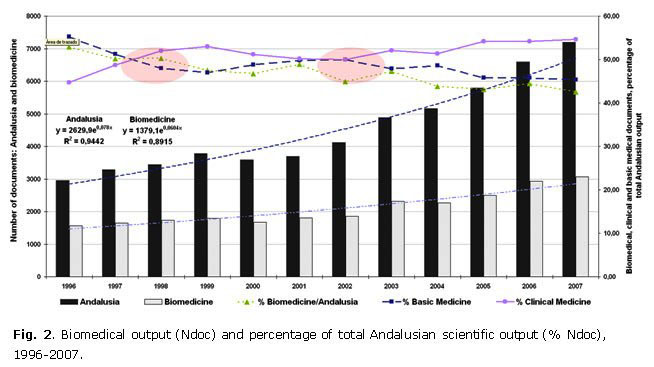
<p><font face="Verdana, Arial, Helvetica, sans-serif" size="2">While Andalusian    output grew faster than in the country overall, its biomedical output showed    slightly lower growth (95.46&#160;%). Although the number of biomedical papers    per year increased, their percentage of the regional total declined slightly    (<FONT  COLOR="#0000ff"><a href="/img/revistas/aci/v23n3/f0202312.jpg">Fig. 2</a><font color="#333333">)</font></FONT>,    dotted line with triangles. This decline may have been due to the consolidation    of the field of biomedicine to the point that it reached a saturation threshold,    along with the appearance in overall Andalusian output of emerging areas such    as agri-food sciences and mathematics, which have been gaining ground in the    region. The data on research visibility, in turn, showed that the number of    citations per paper received by Andalusian production as a whole was higher    than observed for Spain nationwide.<SUP>28</SUP> </font></p>     
<p><font face="Verdana, Arial, Helvetica, sans-serif" size="2">The breakdown of    biomedical output showed that clinical medicine grew nearly 140&#160;% while    basic medicine rose by under 60.4&#160;%. Consequently, the most prominent characteristic    observed was the increase in clinical studies and their contribution to Andalusian    biomedicine as a whole. <FONT COLOR="#0000ff"><a href="#f2" target="_top">Figure    2</a></FONT> shows that whereas output was higher in basic medicine in the early    years, the trend reversed from 1998 to 2000, although the two subfields converged    in 2001-2002. From that time on, however, production was consistently higher    in clinical medicine. </font></p>     <p align="center"><img src="/img/revistas/aci/v23n3/f0202312.jpg" width="567" height="417"><a name="f2"></a></p>     
]]></body>
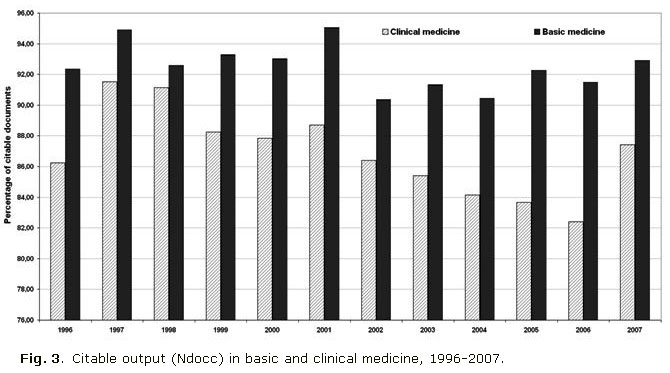
<body><![CDATA[<p align="left"><font face="Verdana, Arial, Helvetica, sans-serif" size="2">    <br>       <br>   TYPE AND LANGUAGE OF DOCUMENT </font></p>     <p><font face="Verdana, Arial, Helvetica, sans-serif" size="2">This upward trend    in clinical output did not carry over to equivalent growth in visibility, primarily    because growth was driven by an increase in non-citable documents on clinical    medicine, i.e., papers other than research articles, reviews or congress proceedings,    which are the types used to measure visibility. Despite the increase in the    number of documents in this area, then, since they included non-citable publications,    the number of citations did not rise in the same proportion. While primary or    citable output accounted for 92&#160;% of the papers in basic medicine, the    percentage dipped to 86&#160;% in clinical medicine. This publication pattern    translated into a higher percentage of documents cited and consequently a larger    number of citations in basic medicine (<FONT  COLOR="#0000ff"><a href="#f3">Fig. 3</a></FONT>). </font></p>     <p align="center"><img src="/img/revistas/aci/v23n3/f0302312.jpg" width="573" height="434"><a name="f3"></a></p>     
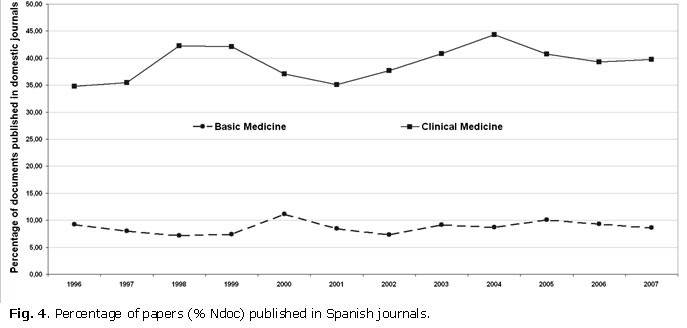
<p><font face="Verdana, Arial, Helvetica, sans-serif" size="2">The number of papers    published in Spanish journals varied widely (<FONT  COLOR="#0000ff"><a href="#f4">Fig. 4</a></FONT>). Whereas an average 39&#160;%    of papers dealing with clinical medicine appeared in national journals, less    than 9&#160;% of the articles on basic medicine were published nationally. This    would also have impacted citations, especially if the papers were published    in English. This finding, while important from the standpoint of information    and the possible change in publication habits, should not leave another consequential    fact unnoticed: an increasing number of papers were published in domestic journals    listed in the major databases. The most significant finding, in any event, was    that the number of papers published in the domestic journals listed in the major    databases increased in the latter years of the series. Several studies have    shown, in addition, that papers published in national journals received less    citations when written in a language other than English.<SUP>22,29-30</SUP>    </font></p>     <p align="center"><img src="/img/revistas/aci/v23n3/f0402312.jpg" width="560" height="398"><a name="f4"></a></p>     
<p> </p>     <p><font face="Verdana, Arial, Helvetica, sans-serif" size="2">    <br>       ]]></body>
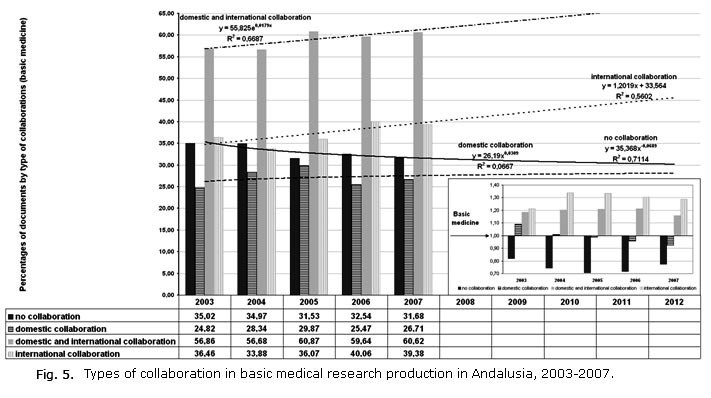
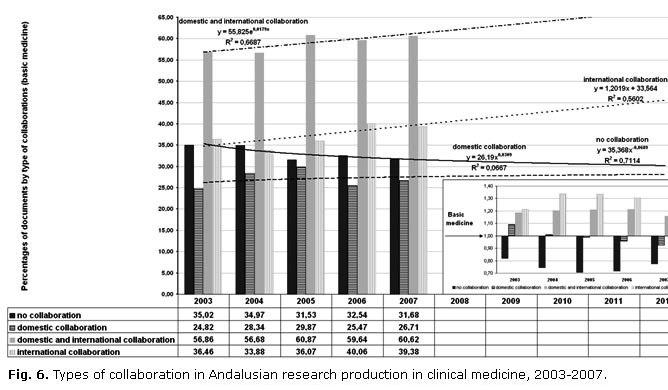
<body><![CDATA[<br>       <br>   COLLABORATION PATTERNS </font></p>     <p><font face="Verdana, Arial, Helvetica, sans-serif" size="2">Collaboration patterns    also impact visibility. The data showed that both in Andalusia as a whole and    in the two specialities analysed, papers involving national or international    collaboration had a higher citation rate than the articles authored by a single    institution. Throughout the period, basic medicine accounted for higher percentages    of national and international collaboration, while a higher percentage of papers    written by a single institution dealt with clinical medicine. </font></p>     <p><font face="Verdana, Arial, Helvetica, sans-serif" size="2">Over the years,    partnering tended to rise at the expense of single institution authorship (<FONT COLOR="#0000ff"><a href="#f5">figures    5</a></FONT> and <FONT  COLOR="#0000ff"><a href="#f6">6</a></FONT><a href="#f6">)</a>. Nonetheless, collaboration    rates were highest for papers authored by Spanish institutions only. This behaviour    put downward pressure on the papers co-authored with foreign institutions. A    substantial share of basic medical research (59&#160;%) was conducted in collaboration    with at least one other Spanish institution, while 38&#160;% of the papers were    authored with a foreign institution. Nonetheless, participation with foreign    partners also followed an upward trend in clinical medicine throughout the period.    </font></p>     <p><font face="Verdana, Arial, Helvetica, sans-serif" size="2">The sub-graph at    the bottom right in <FONT  COLOR="#0000ff"><a href="#f5">figures 5</a></FONT> and <FONT  COLOR="#0000ff"><a href="#f6">6</a></FONT> represents the attractivity index for    each type of collaboration (with respect to the total citations per paper for    the subfield). <FONT  COLOR="#0000ff"><a href="#f5">Figure 5</a></FONT><a href="/img/revistas/aci/v23n3/f0502212.jpg"> </a>shows    that in basic medicine, the papers authored by a single institution had a lower    average number of citations than the subfield as a whole, while those published    with foreign institutions had 20&#160;% more citations than the overall mean    in 2003 and over 30&#160;% more in the following three years. The only papers    that consistently had more than the mean number of citations recorded for the    entire subfield was the papers written by more than one Spanish and at least    one foreign institution. The patterns observed for clinical medicine differed    slightly, since collaboration involving Spanish institutions only did reach    visibility levels higher than the mean for clinical medicine as a whole except    in 2007 (sub-graph in <FONT  COLOR="#0000ff"><a href="#f6">figure 6</a></FONT>). </font></p>     
<p align="center"><img src="/img/revistas/aci/v23n3/f0502312.jpg" width="569" height="444"><a name="f5"></a></p>     
<p align="center">&nbsp;</p>     <p align="center"><img src="/img/revistas/aci/v23n3/f0602312.jpg" width="583" height="427"><a name="f6"></a></p>     
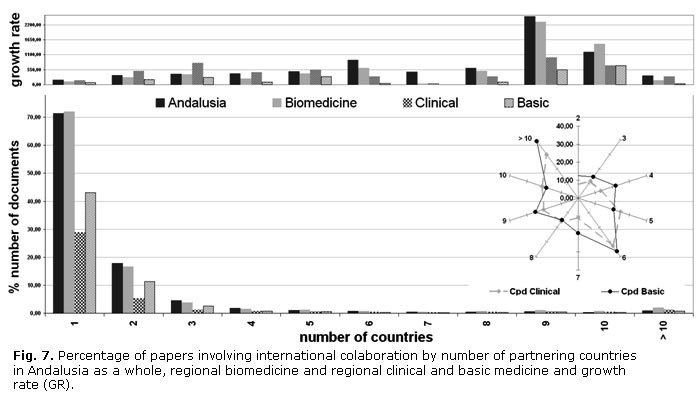
<p><font face="Verdana, Arial, Helvetica, sans-serif" size="2">A detailed analysis    of the number of participating countries (<FONT  COLOR="#0000ff"><a href="#f7">Fig. 7</a></FONT>) showed that international collaboration    with a single country accounted for over 40&#160;% of basic medical research    output, whereas for clinical medicine the figure was 30&#160;%. This graph corroborates    the greater international participation in the former than in the latter, although    the papers involving the largest number of participating countries were on clinical    research. The number of countries participating in clinical medicine also grew    steadily, bringing Andalusian research very close to converging on international    publication patterns. </font></p>     <p align="center"><img src="/img/revistas/aci/v23n3/f0702312.jpg" width="580" height="454"><a name="f7"></a></p>     
]]></body>
<body><![CDATA[<p><font face="Verdana, Arial, Helvetica, sans-serif" size="2">The subgraph in    the lower right quadrant in <FONT  COLOR="#0000ff"><a href="#f7">figure 7</a></FONT> shows the citations per paper    by number of collaborating countries (VtC) for clinical and basic medicine combined    (vertical axis) and the findings for each set of papers authored by X number    of countries (from two to ten or over). Basic medicine proved to be more visible    when the documents were authored by 2, 3, 6, 7, or 10 or more countries. Finally,    while clinical medicine had a larger percentage of papers in which over 10 countries    participated, basic medicine had more than the mean number of citations. </font></p>     <p> </p>     <p><font face="Verdana, Arial, Helvetica, sans-serif" size="2">    <br>       <br>   SUBJECT SPECIALISATION AND ATTRACTIVITY INDEX </font></p>     <p><font face="Verdana, Arial, Helvetica, sans-serif" size="2">According to prior    studies,<SUP>6-9</SUP> the scientific fields in which Andalusia is more specialised    than Spain as a whole are biochemistry, genetics and molecular biology (BGMB)    and immunology and microbiology (IM). These authors reported that the region    is more highly specialised than the European and world-wide mean in biochemistry,    pharmacology and immunology. Specialisation in both biochemistry and pharmacology    followed a downward trend world-, Europe- and region-wide, while it rose steadily    in immunology, in particular beginning in 2003. While the mean for psychology    was not higher in Andalusia than in Europe, this discipline exhibited the steepest    rise and proved to be an emerging area across the entire period.<SUP>28</SUP>    </font></p>     <p><font face="Verdana, Arial, Helvetica, sans-serif" size="2">The fields drawing    the largest number of citations concurred with the fields where specialisation    was greatest, although slight differences were noted. Trends varied across the    period, however. While the relative output in immunology declined, the number    of citations received rose. The reverse pattern was observed for health, where    the rise in output did not carry over to the number of citations. In biology    and psychology, however, the raise in the output involved a growth of the number    of citations (<font  color="#0000ff"><a href="#f8">Fig. 8</a></font>).</font></p>     <p align="center"><img src="/img/revistas/aci/v23n3/f0802312.jpg" width="554" height="413"><a name="f8"></a></p>     
<p><font color="#0000ff" face="Verdana, Arial, Helvetica, sans-serif" size="2"><a href="#f8">Figure    8</a></font><font face="Verdana, Arial, Helvetica, sans-serif" size="2"> compares    each biomedical area to the world mean values. Each bubble represents a subject    area and its size is proportional to the number of papers published. Its position    on the graph depends on the respective attractivity index values, which are    represented on the y-axis, and the specialisation or activity index on the x-axis.    The reference axes drawn in black represent the world-wide mean values for each    variable. As the graph shows, the areas located in the upper right quadrant    have higher values than the world-wide means for both variables, the ones in    the lower left quadrant are below the mean in both specialisation and attractivity,    the ones in the upper left quadrant have higher than mean attractivity but lower    than mean specialisation values and lastly, the ones in the lower right quadrant    have lower attractivity but higher specialisation values than the world as a    whole. According to the figure, the areas with the highest potential are clearly    biochemistry, immunology and pharmacology, located in the upper right quadrant,    which contrast in particular with the subjects positioned in the lower left    quadrant. Other information of interest with respect to the volume of papers    can also be extracted from the figure, however. Publishing a substantial number    of papers that outperform the world-wide mean constitutes added value for areas    such as biochemistry and medicine compared to the much smaller pharmacology    and immunology output. On this measure, the area with greatest international    impact is biochemistry. </font></p>     <p>    ]]></body>
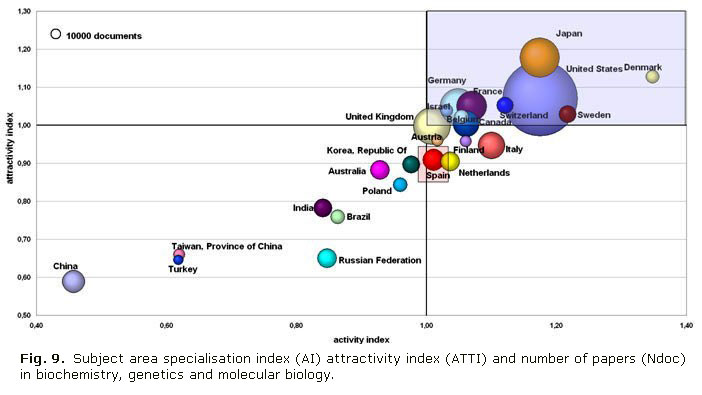
<body><![CDATA[<br>       <br>   <font face="Verdana, Arial, Helvetica, sans-serif" size="2">BIOCHEMISTRY, GENETICS    AND MOLECULAR BIOLOGY (BGMB) </font></p>     <p><font face="Verdana, Arial, Helvetica, sans-serif" size="2">This area merits    special mention because its indicator values were consistently higher than the    world-wide reference values. Spain holds ninth position in the world ranking    of knowledge producers by volume in BGMB, accounting for 8&#160;% of Western    European and 3&#160;% of world-wide output: i.e., higher than Australia but    behind China. Its activity index is slightly higher than the world mean but    not so its attractivity index (<FONT  COLOR="#0000ff"><a href="#f9">Fig. 9</a></FONT>) or the mean citations per paper.    Its position is comparable to the Netherlands', although it stands at a considerable    distance from the major producers: United States, Japan, United Kingdom, Germany,    France and Canada, all of which are located in the quadrant with the highest    international impact. That Denmark, Sweden, Switzerland, Belgium and Israel    are in this upper quadrant, they are ranked high despite their relatively scant    output. By contrast, so-called emerging countries such as China, Russia, Brazil,    Republic of Korea, India and Taiwan are all concentrated in the lower left quadrant.    </font></p>     <p align="center"><img src="/img/revistas/aci/v23n3/f0902312.jpg" width="544" height="424"><a name="f9"></a></p>     
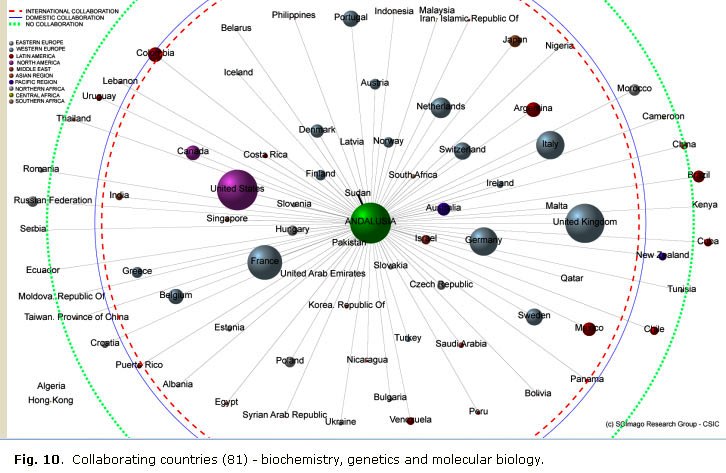
<p><font face="Verdana, Arial, Helvetica, sans-serif" size="2">In the national    ranking, biochemistry accounted for a little over 11&#160;% of output and citations,    although its relative contribution declined in both respects across the period.    The percentage of Andalusian biochemical research papers cited came to 14 %    of the nationwide total, which was comparable to the mean for all Spanish regions,    and the area boasted a much higher citation rate than other subject categories.    </font></p>     <p><font face="Verdana, Arial, Helvetica, sans-serif" size="2">In the last five    years of the series, in Andalusia and Spain, collaboration with other institutions    and countries was intense, involving nearly a third of the total output. The    result was a higher citation rate than for papers involving no collaboration    or Spanish collaboration only. Biochemistry was one of the most internationally-oriented    areas, with papers co-authored with 23 countries. Bilateral partnering accounted    for over 70&#160;% of output. Of the most productive countries, the major partners    of Andalusia were United States, United Kingdom, France, Germany and Italy,    collaboration with all of which yielded good results in terms of visibility.    With the exception of two years in the series, international partnering was    more intense in biochemistry than in Spanish research overall. </font></p>     <p><font face="Verdana, Arial, Helvetica, sans-serif" size="2">Finally, a word    is in order on an issue of no minor importance. While collaboration constitutes    added value that favours output, internationalisation and consequently visibility    for a country or region and is normally attained by intensifying international    relations, the results of such collaboration must be calibrated in terms of    visibility and impact on the international scientific community. In other words,    impact/visibility varies depending on the partner. A recent study on citation    flows by type of collaboration and neighbourhood influence concluded that science    knows no boundaries. The greater influence of certain countries, regions or    institutions over others is due to the existence of a number of immediate environs    and the quality or prestige that entails. Influence or the citation rate is    greatest in authors' most immediate environs, which need not concur with their    national surrounds, and wanes with the enlargement of those environs. The bias    introduced by self-citation is maximised in smaller circles. Since the greatest    domestically-oriented bias appears in small and developing countries, boundaries    should be avoided when establishing relationships<SUP>31</SUP>. On other hand,    assuming that impact (citations per paper) reflects the use made by researchers    of previously generated knowledge, the evidence shows that the major producers    use the knowledge generated by their own or neighboring countries. This would    explain why impact is so highly concentrated in the most productive regions.    One of the implications is that research institutions or country reputation    is influenced by their geography, and such prestige is often unattainable for    institutions/countries in less productive or less advanced regions or countries.    Put another way, a research institution's neighborhood may be limited by its    global scientific reputation, unless it can reach beyond its neighborhood through    inter-regional alliances with reputed institutions from highly productive regions.<SUP>32</SUP>    Therefore, the position of these small, highly visible countries may be explained    by factors such as size, international collaboration rate, area specialization    and the industrial status or stage of emergence of transition economies, while    the position of large countries is affected by the environs and the cumulative    repute of their institutions.<SUP>33</SUP> </font></p>     <p><font face="Verdana, Arial, Helvetica, sans-serif" size="2">By way of example,    the heliocentric network of Andalusia's international collaboration in biochemistry,    genetics and molecular biology is shown in <FONT  COLOR="#0000ff"><a href="#f10">figure 10</a></FONT> to gain insight into the effects    of collaboration. </font></p>     <p align="center"><img src="/img/revistas/aci/v23n3/f1002312.jpg" width="580" height="473"><a name="f10"></a></p>     
<p><font face="Verdana, Arial, Helvetica, sans-serif" size="2">The map shows,    interestingly, that while international collaboration enhanced visibility, not    all countries were equally effective in this regard. The three concentric circles    define visibility with respect to the mean citation values for each type of    collaboration. Note that in this subject area, the mean citation values for    domestic and international collaboration (solid and dashed black lines) are    very close. The countries positioned in the vicinity have the highest citation    rates and are consequently the most valuable partners. As in the preceding graphs,    here volume is also a factor to be borne in mind. Output with France, Germany,    United Kingdom, Italy and United States was much more visible than with Australia,    Finland, Israel, Pakistan or Sudan, even though these latter countries are closer    to the centre. Collaboration with Brazil, Russian Federation and China, in turn,    afforded the least visibility, which is why these countries are outliers, with    values even lower than for papers involving no collaboration. </font></p>     ]]></body>
<body><![CDATA[<p> </p>     <p><font face="Verdana, Arial, Helvetica, sans-serif" size="2"><B>    <br>       <br>   <font size="3">    <br>   DISCUSSION </font></B> </font></p>     <p><font face="Verdana, Arial, Helvetica, sans-serif" size="2">The findings, given    in the form of indicators and graphics, compare the status of Andalusian scientific    output and citations in biomedicine in 1996-2007, as recorded in the Scopus    database, to nation- and world-wide data. </font></p>     <p><font face="Verdana, Arial, Helvetica, sans-serif" size="2">The results drawn    from the bibliometric indicators on biomedical output in Andalusia show an upward    trend, with growth of over 91&#160;%. Over 50 % of the output was in clinical    medicine, whose growth doubled the basic medicine figure. Nonetheless, more    citable papers (articles, reviews and conference procceedings) were published    on basic than clinical medicine, and the number of citations received by the    former was also larger.<FONT  COLOR="#ff0000"> </FONT>The higher citation rate in basic medicine may also be    explained by the fact that fewer of these papers were published in less cited    domestic journals. Publication patterns would consequently appear to affect    research visibility. </font></p>     <p><font face="Verdana, Arial, Helvetica, sans-serif" size="2">The findings on    scientific output and research visibility in Andalusian biomedicine presented    here must be viewed in conjunction with other types of indicators to be properly    interpreted. The assessment of scientific activity must necessarily be &#171;polyhedral&#187;<SUP>22,34</SUP>    to obtain a meaningful overview. That means that bibliometric information, while    providing very significant insight into scientific activity, is not the only    criterion. It must be studied in conjunction with expert review as well as an    assessment of the economic impact or translation of research findings to science,    technology and society at large. The results can only be correctly interpreted    when account is taken of the organisation of the research system and structure    of the academic system to which they refer. Moreover, the results of any bibliometric    study depend on the tools, indicators and methodologies used. The focus cannot    be confined to what is being measured, but must be enlarged to encompass the    universe in which it lies and the aspects of research performance reflected.    </font></p>     <p><font face="Verdana, Arial, Helvetica, sans-serif" size="2">The present paper    drew from the Scopus database. This is instrumental to interpreting the results    and drawing conclusions. The use of Scopus meant that for the first time, a    more comprehensive study could be conducted of Andalusian biomedical research,    including a very significant part of the scientific output that had been excluded    to date in other studies. Likewise for the first time, a more comparison can    be drawn with other countries and the world as a whole. </font></p>     <p><font face="Verdana, Arial, Helvetica, sans-serif" size="2">In this context,    the huge increase in the number of sources impacted the citation rate, favourably    for some countries but in a negative manner for other in which the denominator    (number of papers) grew faster than the numerator (number of citations received)    in some regions as it is the case in our region of study. Prior analyses relating    to publishers' countries and languages of publication showed that many of the    journals recently included in Scopus tend to be domestically oriented. An analysis    conducted on oncological journals, for instance, revealed that the periodicals    listed exclusively in Scopus tended to have lower impact factors than the ones    in the WoS, while the journals included in both databases had a higher mean    citation rate in Scopus.<SUP>18</SUP> However, the countries, regions, institutions    and even individual authors whose total number of papers published was larger    in Scopus, saw their citation ranking decline.<SUP>35-36</SUP> As a result,    the citation rates of countries that publish primarily in English have barely    been affected by the enlargement. A number of papers have provided empirical    evidence of the bias that language introduces in the use of WoS-based citation    analyses, proving that articles published in other languages have much lower    impact factors than papers published in English.<SUP>29-30</SUP> </font></p>     ]]></body>
<body><![CDATA[<p><font face="Verdana, Arial, Helvetica, sans-serif" size="2">To confirm whether    the difference in citations received by biomedical papers produced in Andalusia,    as observed in the present study, was due to the language in which they were    published, subsequent research is planned to track the papers published in English    and Spanish in domestic biomedical journals. In addition, the citation rates    in domestically- and internationally-oriented journals, i.e., the ones in both    Thomson and Scopus and the ones in Scopus only, will be compared to assess the    long-term effects of international accessibility of the former. While the inclusion    of such journals may induce a short-term decline in institutions', regions'    or countries' citation rates, in the longer run it may entail higher visibility    not only for the papers and journals involved, but for research as a whole.    </font></p>     <p><font face="Verdana, Arial, Helvetica, sans-serif" size="2">Given the international    and multidisciplinary nature of biomedicine, partnerships play a very important    role both in output and in research visibility and impact. Consequently, information    on collaboration patterns and their variation in terms of output and citation    should be considered when designing collaboration strategies to improve research    visibility, as well as when drafting cooperation and human resource mobility    plans and programmes at whatever level (such as scholarships, grants or visiting    scholar programmes). Since international collaboration has consistently proven    to enhance the number of citations per paper, the characterisation of relationships    and alliances with foreign partners is a highly significant issue for managers    and decision-makers.<SUP>37</SUP> The ability to position each country in terms    of output and effective impact makes heliocentric mapping of international collaboration    networks a useful supplementary analysis and decision-making tool. This graphic    can be used for both static and dynamic descriptions of an institution, region,    country or field of science. An analysis of the variations in these relationships    will provide insight into their stability, expandability and visibility, enabling    anyone concerned to monitor joint projects and strategic alliances, among others.    </font></p>     <p></p>     <p></p>     <p>    <br> </p>     <p>&nbsp;</p>     <p>    <br>   <b><font face="Verdana, Arial, Helvetica, sans-serif" size="2">Acknowledgements</font></b></p>     <p> </p>     ]]></body>
<body><![CDATA[<p><font face="Verdana, Arial, Helvetica, sans-serif" size="2">The present study    was funded by the Spanish National Research Council (CSIC) in the framework    of the project entitled &#171;Generation of scientometric tools for the analysis    of scientific collaboration&#187; (CISC intramural project 200810I210). The    authors wish to thank reviewers for their helpful comments on an earlier draft    of this paper. </font></p>     <p> </p>     <p> </p>     <p><font face="Verdana, Arial, Helvetica, sans-serif" size="3"><B>    <br>       <br>       <br>   BIBLIOGRAFIC REFERENCES</B> </font></p>     <!-- ref --><p><font face="Verdana, Arial, Helvetica, sans-serif" size="2">1. Sanz-Men&eacute;ndez    L, Cruz-Castro L. The Increasing Involvement of Spanish Regional Governments    on Science Policy: Demand-Driven Explanations versus Diffusion Models. Durban,    South Africa: International Sociological Association Conference; 2006:23-9.        </font></p>     <p> </p>     ]]></body>
<body><![CDATA[<!-- ref --><p><font face="Verdana, Arial, Helvetica, sans-serif" size="2">2. Moed HF. Citation    Analysis in Research Evaluation<I>. </I>Dordrecht (the Netherlands): Springer;    2005.     </font></p>     <!-- ref --><p><font face="Verdana, Arial, Helvetica, sans-serif" size="2">3. Bormann L, Schier    H, Marx W, Daniel H. What factors determine citation counts of publications    in chemistry besides their quality? J Informetr. 2012;<I> </I>6:11-8.     </font></p>     <!-- ref --><p><font face="Verdana, Arial, Helvetica, sans-serif" size="2">4. Bar-Ilan J,    Levene M, Lin L. Some measures for comparing citation databases. J Informetr.    2007;1(1):26-34.     </font></p>     <!-- ref --><p><font face="Verdana, Arial, Helvetica, sans-serif" size="2">5. Bar-Ilan J.    Which h-index? - A comparison of WoS, Scopus and Google Scholar. Scientometrics.    2008;74(2):257-71.     </font></p>     <!-- ref --><p><font face="Verdana, Arial, Helvetica, sans-serif" size="2">6. Moya-Aneg&oacute;n    F, Sol&iacute;s-Cabrera FM, Chinchilla-Rodr&iacute;guez Z. Indicadores Cient&iacute;ficos    de Andaluc&iacute;a (ISI, Web of Science. 1998-2001)<I>.</I> Granada: Programa    de Divulgaci&oacute;n Cient&iacute;fica de Andaluc&iacute;a. Parque de las Ciencias.    Secretar&iacute;a General de Universidades. Junta de Andaluc&iacute;a, 2003.        </font></p>     ]]></body>
<body><![CDATA[<p> </p>     <!-- ref --><p><font face="Verdana, Arial, Helvetica, sans-serif" size="2">7. Moya-Aneg&oacute;n    F, Sol&iacute;s-Cabrera FM, Carretero-Guerra R, Chinchilla-Rodr&iacute;guez    Z. Indicadores cient&iacute;ficos de la producci&oacute;n andaluza en biomedicina    y ciencias de la salud (ISI, Web of Science, 1990-2002)<I>.</I> Sevilla: Consejer&iacute;a    de Salud. Junta de Andaluc&iacute;a; 2004.     </font></p>     <p> </p>     <!-- ref --><p><font face="Verdana, Arial, Helvetica, sans-serif" size="2">8. Moya-Aneg&oacute;n    F, Sol&iacute;s-Cabrera F, Mu&ntilde;oz-Fern&aacute;ndez FJ, Chinchilla-Rodr&iacute;guez    Z, Corera-&Aacute;lvarez E, Herrero-Solana V, et al. Indicadores cient&iacute;ficos    de Andaluc&iacute;a: ISI, Web of Science, 2002.<I> </I>Granada: Consejer&iacute;a    de Innovaci&oacute;n, Ciencia y Empresa; 2005.     </font></p>     <p> </p>     <!-- ref --><p><font face="Verdana, Arial, Helvetica, sans-serif" size="2">9. Moya-Aneg&oacute;n    F, Carretero-Guerra R, S&aacute;nchez-Malo F, Sol&iacute;s-Cabrera FM, Mu&ntilde;oz-Fern&aacute;ndez    FJ, Chinchilla-Rodr&iacute;guez Z, et al. Indicadores cient&iacute;ficos de    la producci&oacute;n andaluza en biomedicina y ciencias de la salud. (ISI, Web    of Science 2003-2004)<I>. </I>Sevilla: Junta de Andaluc&iacute;a, Consejer&iacute;a    de Salud; 2006 </font><p> </p>     <!-- ref --><p><font face="Verdana, Arial, Helvetica, sans-serif" size="2">10. Moya-Aneg&oacute;n    F, Sol&iacute;s-Cabrera FM, Corera-&Aacute;lvarez E, Chinchilla-Rodr&iacute;guez,    Z, G&oacute;mez-Cris&oacute;stomo R, Gonz&aacute;lez-Molina A, Vargas-Quesada    B. Indicadores Bibliom&eacute;tricos de la Producci&oacute;n Cient&iacute;fica    de Andaluc&iacute;a: 2003-2005. Sevilla: Junta de Andaluc&iacute;a; 2008.     </font></p>     <p> </p>     <!-- ref --><p><font face="Verdana, Arial, Helvetica, sans-serif" size="2">11. Zhao D, Strotmann    A. Intellectual structure of stem cell research: a comprehensive author co-citation    analysis of a highly collaborative and multidisciplinary field. Scientometrics.    2011;87(1):115-31.     </font></p>     <p> </p>     <!-- ref --><p><font face="Verdana, Arial, Helvetica, sans-serif" size="2">12. Gonz&aacute;lez-Pereira    B, Guerrero-Bote VP, Moya-Aneg&oacute;n F. A new approach to the metric of journals'scientific    prestige: The SJR indicator. J Informetr. 2011;4(3):379-91.     </font></p>     <p> </p>     <!-- ref --><p><font face="Verdana, Arial, Helvetica, sans-serif" size="2">13. MacRoberts    MH, MacRoberts BR. Problems of citation analysis. Scientometrics. 1996;36(3):435-44.        </font></p>     ]]></body>
<body><![CDATA[<p> </p>     <!-- ref --><p><font face="Verdana, Arial, Helvetica, sans-serif" size="2">14. Seglen PO.    Why the impact factor of journals should not be used for evaluating research.    Brit Med J. 1997;314(7079):498502.     </font></p>     <!-- ref --><p><font face="Verdana, Arial, Helvetica, sans-serif" size="2">15. Braun T, Gl&auml;nzel    W, Schubert A. World flash on basic research The newest version of the facts    and figures on publication output and relative citation impact of 100 countries    19811985. Scientometrics. 1988;13:181-8.     </font></p>     <!-- ref --><p><font face="Verdana, Arial, Helvetica, sans-serif" size="2">16. Van Raan AFJ.    Measuring Science. In: Moed HF, Gl&auml;nzel W, Schmoch U, editors. Handbook    of quantitative science and technology research. The use of publication and    patent statistics in studies of S&amp;T systems. Dordrecht (the Netherlands):    Kluwer Academic Publishers; 2004. p. 1950.     </font></p>     <p> </p>     <!-- ref --><p><font face="Verdana, Arial, Helvetica, sans-serif" size="2">17. Grupo SCImago.    SCImago journal &amp; country rank: un nuevo portal, dos nuevos rankings. El    profesional de la informaci&oacute;n. 2007;16(6):645-6.     </font></p>     ]]></body>
<body><![CDATA[<p> </p>     <!-- ref --><p><font face="Verdana, Arial, Helvetica, sans-serif" size="2">18. L&oacute;pez-Illescas    C, Moya-Aneg&oacute;n F, Moed HF. Coverage and citation impact of oncological    journals in the Web of Science and Scopus. J Informetr. 2008;2(4):304-16.     </font></p>     <p> </p>     <!-- ref --><p><font face="Verdana, Arial, Helvetica, sans-serif" size="2">19. Moya-Aneg&oacute;n    F, Chinchilla-Rodr&iacute;guez Z, Benavent-P&eacute;rez M, Corera-&Aacute;lvarez    E, Gonz&aacute;lez-Molina A, Vargas-Quesada B. Indicadores Bibliom&eacute;tricos    de la Actividad Cient&iacute;fica Espa&ntilde;ola: 2008<I>. </I>Madrid: Fundaci&oacute;n    Espa&ntilde;ola para la Ciencia y la Tecnolog&iacute;a; 2011.     </font></p>     <p> </p>     <!-- ref --><p><font face="Verdana, Arial, Helvetica, sans-serif" size="2">20. Moya-Aneg&oacute;n    F, Chinchilla-Rodr&iacute;guez Z, Vargas-Quesada B, Corera-&Aacute;lvarez E,    Mu&ntilde;oz-Fern&aacute;ndez FJ, Gonz&aacute;lez-Molina A. Coverage analysis    of Scopus: A journal metric approach. Scientometrics. 2007;73(1):53-78.     </font></p>     <p> </p>     ]]></body>
<body><![CDATA[<!-- ref --><p><font face="Verdana, Arial, Helvetica, sans-serif" size="2">21. Schubert A,    Braun T. Relative indicators and relational charts for comparative assessment    of publication output and citation impact. Scientometrics. 1986;9(5-6):281-91.        </font></p>     <p> </p>     <!-- ref --><p><font face="Verdana, Arial, Helvetica, sans-serif" size="2">22. Chinchilla-Rodr&iacute;guez    Z. An&aacute;lisis del dominio cient&iacute;fico espa&ntilde;ol: 1995-2002.    ISI, Web of Science<I> </I>[PhD Dissertation]. Granada:<I> </I>Universidad de    Granada; 2005.     </font></p>     <p> </p>     <!-- ref --><p><font face="Verdana, Arial, Helvetica, sans-serif" size="2">23. Chinchilla-Rodr&iacute;guez    Z, Vargas-Quesada B, Hassan-Montero Y, Gonz&aacute;lez-Molina A, Moya-Aneg&oacute;n    F. New approach to the visualization of international scientific collaboration.    Information Visualization. 2010;9(4):277-87.     </font></p>     <p> </p>     <!-- ref --><p><font face="Verdana, Arial, Helvetica, sans-serif" size="2">24. Chinchilla-Rodr&iacute;guez    Z, Moya-Aneg&oacute;n F, Vargas-Quesada B, Corera-&Aacute;lvarez E, Hassan-Montero    Y. Inter-institutional scientific collaboration: an approach from social network    analysis. Mexico D. F.: Paper presented at Prime Europe-Latin American Conference    on Science and Innovation Policy; 2008.     </font></p>     <p> </p>     <!-- ref --><p><font face="Verdana, Arial, Helvetica, sans-serif" size="2">25. Kamada T, Kawai    S. An algorithm for drawing general undirected graphs. Information Processing    Letters. 1989;31(1):7-15.     </font></p>     <!-- ref --><p><font face="Verdana, Arial, Helvetica, sans-serif" size="2">26. Vargas-Quesada    B, Moya-Aneg&oacute;n F. Visualizing the structure of science. Berlin: Springer-Verlag;    2007.     </font></p>     <!-- ref --><p><font face="Verdana, Arial, Helvetica, sans-serif" size="2">27. Batagelj V,    Mrvar A. Analysis and visualization of large networks. In: J&uuml;nger M, Mutzel    P (eds.). Graph Drawing Software. Berlin: Springer. 2003. pp. 77-103.     </font></p>     <!-- ref --><p><font face="Verdana, Arial, Helvetica, sans-serif" size="2">28. Moya-Aneg&oacute;n    F, Chinchilla-Rodr&iacute;guez Z. Indicadores Bibliom&eacute;tricos de la Actividad    Cient&iacute;fica Espa&ntilde;ola, 2002-2006<I>.</I> Madrid: Fundaci&oacute;n    Espa&ntilde;ola para la Ciencia y la Tecnolog&iacute;a; 2008.     </font></p>     ]]></body>
<body><![CDATA[<!-- ref --><p><font face="Verdana, Arial, Helvetica, sans-serif" size="2">29. Van Leeuwen    TN, Moed HF, Tijssen RJW, Visser MS, Van Raan AFJ. First Evidence of serious    language-bias in the use of citation analysis for the evaluation of national    science systems. Research Evaluation. 2000;9(2):1556.     </font></p>     <p> </p>     <!-- ref --><p><font face="Verdana, Arial, Helvetica, sans-serif" size="2">30. Van Leeuwen    TN, Moed HF, Tijssen RJW, Visser MS, Van Raan AFJ. Language biases in the coverage    of the Science Citation Index and its consequences for international comparisons    of national research performance. Scientometrics. 2001;51(1):335-46.     </font></p>     <p> </p>     <!-- ref --><p><font face="Verdana, Arial, Helvetica, sans-serif" size="2">31. Lancho-Barrantes    BS, Guerrero-Bote VP, Chinchilla-Rodr&iacute;guez Z, Moya-Aneg&oacute;n F. Citation    flows in the zones of influence of scientific collaborations. J Am Soc Inform    Sci Technol. 2011;63(3):481-9.     </font></p>     <p> </p>     <p><font face="Verdana, Arial, Helvetica, sans-serif" size="2">32. SCImago Lab.    Scientific Excellence Georeferenced. The neigborhood matters Retrieved [Internet].    2011 [cited 2011 October 25] Available from: <U><FONT  COLOR="#0000ff"><a href="http://www.scimagolab.com/blog/2011/scientific-excellence-georeferenced-theneighborhood-matters" target="_blank">http://www.scimagolab.com/blog/2011/scientific-excellence-georeferenced-theneighborhood-matters</a>    </FONT></U> </font></p>     ]]></body>
<body><![CDATA[<p> </p>     <!-- ref --><p><font face="Verdana, Arial, Helvetica, sans-serif" size="2">33. Chinchilla-Rodr&iacute;guez    Z, Benavent-P&eacute;rez M, Miguel S, Moya-Aneg&oacute;n F. International Collaboration    in Medical Research in Central and South America (In press). J Am Soc Inform    Sci Technol. <font color="#000000">Febrero 2012.    </font></font></p>     <p><font face="Verdana, Arial, Helvetica, sans-serif" size="2">34. Cam&iacute;    J, M&eacute;ndez-V&aacute;squez RI, Su&ntilde;&eacute;n-Pinyol E. Evoluci&oacute;n    de la productividad cient&iacute;fica de Espa&ntilde;a en Biomedicina (1981-2006).    Redes. 2008 [cited 2011 March 16];10:24-9. Available from: <U><FONT  COLOR="#0000ff"><a href="http://bac.prbb.org/publicacions/Redes.pdf" target="_blank">http://bac.prbb.org/publicacions/Redes.pdf</a></FONT></U>    </font></p>     <!-- ref --><p><font face="Verdana, Arial, Helvetica, sans-serif" size="2">35. Zitt M, Ramana-Rahary    S, Bassecoulard E. Correcting glasses help fair comparisons in international    science landscape: country indicators as a function of ISI database delineation.    Scientometrics. 2003;56(2):59282.     </font></p>     <!-- ref --><p><font face="Verdana, Arial, Helvetica, sans-serif" size="2">36. L&oacute;pez-Illescas    C, Moya-Aneg&oacute;n F, Moed HF. Comparing bibliometric country-by-country    rankings derived from the Web of Science and Scopus: the effect of poorly cited    journals in oncology. J Inform Sci. 2008;35(2):244-56.     </font></p>     <p> </p>     <!-- ref --><p><font face="Verdana, Arial, Helvetica, sans-serif" size="2">37. Perianes-Rodr&iacute;guez    A, Chinchilla-Rodr&iacute;guez, Z, Vargas-Quesada B, Olmeda-G&oacute;mez C,    Moya-Aneg&oacute;n F. Synthetic hybrid indicators based on scientific collaboration    to quantify and evaluate individual research results. J Informetr. 2009;3(2):91-101.        </font></p>     <p> </p>     <p> </p>     <p> </p>     <p><font face="Verdana, Arial, Helvetica, sans-serif" size="2">    <br>       <br>   Recibido 21-3-2012.    <br>   </font><font face="Verdana, Arial, Helvetica, sans-serif" size="2">Aceptado    11-6-2012. </font></p>     <p>    <br> </p>     ]]></body>
<body><![CDATA[<p><font face="Verdana, Arial, Helvetica, sans-serif" size="2"><I>Zaida Chinchilla-Rodr&iacute;guez</I>.    SCImago Research Group, Instituto de Pol&iacute;ticas y Bienes P&uacute;blicos    (IPP-CSIC). C/Albasanz 26-28, 28037, Madrid, Spain. E-mail address:<I> </I><FONT  COLOR="#0000ff"><a href="mailto:zaida.chinchilla@csic.es">zaida.chinchilla@csic.es</a></FONT></font>  </p>      ]]></body><back>
<ref-list>
<ref id="B1">
<label>1</label><nlm-citation citation-type="book">
<person-group person-group-type="author">
<name>
<surname><![CDATA[Sanz-Menéndez]]></surname>
<given-names><![CDATA[L]]></given-names>
</name>
<name>
<surname><![CDATA[Cruz-Castro]]></surname>
<given-names><![CDATA[L]]></given-names>
</name>
</person-group>
<source><![CDATA[The Increasing Involvement of Spanish Regional Governments on Science Policy: Demand-Driven Explanations versus Diffusion Models]]></source>
<year>2006</year>
<page-range>23-9</page-range><publisher-loc><![CDATA[Durban^eSouth Africa South Africa]]></publisher-loc>
<publisher-name><![CDATA[International Sociological Association Conference]]></publisher-name>
</nlm-citation>
</ref>
<ref id="B2">
<label>2</label><nlm-citation citation-type="book">
<person-group person-group-type="author">
<name>
<surname><![CDATA[Moed]]></surname>
<given-names><![CDATA[HF]]></given-names>
</name>
</person-group>
<source><![CDATA[Citation Analysis in Research Evaluation]]></source>
<year>2005</year>
<publisher-loc><![CDATA[Dordrecht (the Netherlands) ]]></publisher-loc>
<publisher-name><![CDATA[Springer]]></publisher-name>
</nlm-citation>
</ref>
<ref id="B3">
<label>3</label><nlm-citation citation-type="journal">
<person-group person-group-type="author">
<name>
<surname><![CDATA[Bormann]]></surname>
<given-names><![CDATA[L]]></given-names>
</name>
<name>
<surname><![CDATA[Schier]]></surname>
<given-names><![CDATA[H]]></given-names>
</name>
<name>
<surname><![CDATA[Marx]]></surname>
<given-names><![CDATA[W]]></given-names>
</name>
<name>
<surname><![CDATA[Daniel]]></surname>
<given-names><![CDATA[H]]></given-names>
</name>
</person-group>
<article-title xml:lang="en"><![CDATA[What factors determine citation counts of publications in chemistry besides their quality?]]></article-title>
<source><![CDATA[J Informetr.]]></source>
<year>2012</year>
<volume>6</volume>
<page-range>11-8</page-range></nlm-citation>
</ref>
<ref id="B4">
<label>4</label><nlm-citation citation-type="journal">
<person-group person-group-type="author">
<name>
<surname><![CDATA[Bar-Ilan]]></surname>
<given-names><![CDATA[J]]></given-names>
</name>
<name>
<surname><![CDATA[Levene]]></surname>
<given-names><![CDATA[M]]></given-names>
</name>
<name>
<surname><![CDATA[Lin]]></surname>
<given-names><![CDATA[L]]></given-names>
</name>
</person-group>
<article-title xml:lang="en"><![CDATA[Some measures for comparing citation databases]]></article-title>
<source><![CDATA[J Informetr.]]></source>
<year>2007</year>
<volume>1</volume>
<numero>1</numero>
<issue>1</issue>
<page-range>26-34</page-range></nlm-citation>
</ref>
<ref id="B5">
<label>5</label><nlm-citation citation-type="journal">
<person-group person-group-type="author">
<name>
<surname><![CDATA[Bar-Ilan]]></surname>
<given-names><![CDATA[J]]></given-names>
</name>
</person-group>
<article-title xml:lang="en"><![CDATA[Which h-index? - A comparison of WoS, Scopus and Google Scholar]]></article-title>
<source><![CDATA[Scientometrics.]]></source>
<year>2008</year>
<volume>74</volume>
<numero>2</numero>
<issue>2</issue>
<page-range>257-71</page-range></nlm-citation>
</ref>
<ref id="B6">
<label>6</label><nlm-citation citation-type="book">
<person-group person-group-type="author">
<name>
<surname><![CDATA[Moya-Anegón]]></surname>
<given-names><![CDATA[F]]></given-names>
</name>
<name>
<surname><![CDATA[Solís-Cabrera]]></surname>
<given-names><![CDATA[FM]]></given-names>
</name>
<name>
<surname><![CDATA[Chinchilla-Rodríguez]]></surname>
<given-names><![CDATA[Z]]></given-names>
</name>
</person-group>
<source><![CDATA[Indicadores Científicos de Andalucía (ISI, Web of Science. 1998-2001)]]></source>
<year>2003</year>
<publisher-loc><![CDATA[Granada ]]></publisher-loc>
<publisher-name><![CDATA[Programa de Divulgación Científica de Andalucía. Parque de las Ciencias. Secretaría General de Universidades. Junta de Andalucía]]></publisher-name>
</nlm-citation>
</ref>
<ref id="B7">
<label>7</label><nlm-citation citation-type="book">
<person-group person-group-type="author">
<name>
<surname><![CDATA[Moya-Anegón]]></surname>
<given-names><![CDATA[F]]></given-names>
</name>
<name>
<surname><![CDATA[Solís-Cabrera]]></surname>
<given-names><![CDATA[FM]]></given-names>
</name>
<name>
<surname><![CDATA[Carretero-Guerra]]></surname>
<given-names><![CDATA[R]]></given-names>
</name>
<name>
<surname><![CDATA[Chinchilla-Rodríguez]]></surname>
<given-names><![CDATA[Z]]></given-names>
</name>
</person-group>
<source><![CDATA[Indicadores científicos de la producción andaluza en biomedicina y ciencias de la salud (ISI, Web of Science, 1990-2002)]]></source>
<year>2004</year>
<publisher-loc><![CDATA[Sevilla ]]></publisher-loc>
<publisher-name><![CDATA[Consejería de Salud. Junta de Andalucía]]></publisher-name>
</nlm-citation>
</ref>
<ref id="B8">
<label>8</label><nlm-citation citation-type="book">
<person-group person-group-type="author">
<name>
<surname><![CDATA[Moya-Anegón]]></surname>
<given-names><![CDATA[F]]></given-names>
</name>
<name>
<surname><![CDATA[Solís-Cabrera]]></surname>
<given-names><![CDATA[F]]></given-names>
</name>
<name>
<surname><![CDATA[Muñoz-Fernández]]></surname>
<given-names><![CDATA[FJ]]></given-names>
</name>
<name>
<surname><![CDATA[Chinchilla-Rodríguez]]></surname>
<given-names><![CDATA[Z]]></given-names>
</name>
<name>
<surname><![CDATA[Corera-Álvarez]]></surname>
<given-names><![CDATA[E]]></given-names>
</name>
<name>
<surname><![CDATA[Herrero-Solana]]></surname>
<given-names><![CDATA[V]]></given-names>
</name>
</person-group>
<source><![CDATA[Indicadores científicos de Andalucía: ISI, Web of Science 2002]]></source>
<year>2005</year>
<publisher-loc><![CDATA[Granada ]]></publisher-loc>
<publisher-name><![CDATA[Consejería de Innovación, Ciencia y Empresa]]></publisher-name>
</nlm-citation>
</ref>
<ref id="B9">
<label>9</label><nlm-citation citation-type="book">
<person-group person-group-type="author">
<name>
<surname><![CDATA[Moya-Anegón]]></surname>
<given-names><![CDATA[F]]></given-names>
</name>
<name>
<surname><![CDATA[Carretero-Guerra]]></surname>
<given-names><![CDATA[R]]></given-names>
</name>
<name>
<surname><![CDATA[Sánchez-Malo]]></surname>
<given-names><![CDATA[F]]></given-names>
</name>
<name>
<surname><![CDATA[Solís-Cabrera]]></surname>
<given-names><![CDATA[FM]]></given-names>
</name>
<name>
<surname><![CDATA[Muñoz-Fernández]]></surname>
<given-names><![CDATA[FJ]]></given-names>
</name>
<name>
<surname><![CDATA[Chinchilla-Rodríguez]]></surname>
<given-names><![CDATA[Z]]></given-names>
</name>
</person-group>
<source><![CDATA[Indicadores científicos de la producción andaluza en biomedicina y ciencias de la salud. (ISI, Web of Science 2003-2004)]]></source>
<year>2006</year>
<publisher-loc><![CDATA[Sevilla ]]></publisher-loc>
<publisher-name><![CDATA[Junta de Andalucía, Consejería de Salud]]></publisher-name>
</nlm-citation>
</ref>
<ref id="B10">
<label>10</label><nlm-citation citation-type="book">
<person-group person-group-type="author">
<name>
<surname><![CDATA[Moya-Anegón]]></surname>
<given-names><![CDATA[F]]></given-names>
</name>
<name>
<surname><![CDATA[Solís-Cabrera]]></surname>
<given-names><![CDATA[FM]]></given-names>
</name>
<name>
<surname><![CDATA[Corera-Álvarez]]></surname>
<given-names><![CDATA[E]]></given-names>
</name>
<name>
<surname><![CDATA[Chinchilla-Rodríguez]]></surname>
<given-names><![CDATA[Z]]></given-names>
</name>
<name>
<surname><![CDATA[Gómez-Crisóstomo]]></surname>
<given-names><![CDATA[R]]></given-names>
</name>
<name>
<surname><![CDATA[González-Molina]]></surname>
<given-names><![CDATA[A]]></given-names>
</name>
<name>
<surname><![CDATA[Vargas-Quesada]]></surname>
<given-names><![CDATA[B]]></given-names>
</name>
</person-group>
<source><![CDATA[Indicadores Bibliométricos de la Producción Científica de Andalucía: 2003-2005]]></source>
<year>2008</year>
<publisher-loc><![CDATA[Sevilla ]]></publisher-loc>
<publisher-name><![CDATA[Junta de Andalucía]]></publisher-name>
</nlm-citation>
</ref>
<ref id="B11">
<label>11</label><nlm-citation citation-type="journal">
<person-group person-group-type="author">
<name>
<surname><![CDATA[Zhao]]></surname>
<given-names><![CDATA[D]]></given-names>
</name>
<name>
<surname><![CDATA[Strotmann]]></surname>
<given-names><![CDATA[A]]></given-names>
</name>
</person-group>
<article-title xml:lang="en"><![CDATA[Intellectual structure of stem cell research: a comprehensive author co-citation analysis of a highly collaborative and multidisciplinary field]]></article-title>
<source><![CDATA[Scientometrics.]]></source>
<year>2011</year>
<volume>87</volume>
<numero>1</numero>
<issue>1</issue>
<page-range>115-31</page-range></nlm-citation>
</ref>
<ref id="B12">
<label>12</label><nlm-citation citation-type="journal">
<person-group person-group-type="author">
<name>
<surname><![CDATA[González-Pereira]]></surname>
<given-names><![CDATA[B]]></given-names>
</name>
<name>
<surname><![CDATA[Guerrero-Bote]]></surname>
<given-names><![CDATA[VP]]></given-names>
</name>
<name>
<surname><![CDATA[Moya-Anegón]]></surname>
<given-names><![CDATA[F]]></given-names>
</name>
</person-group>
<article-title xml:lang="en"><![CDATA[A new approach to the metric of journals'scientific prestige: The SJR indicator]]></article-title>
<source><![CDATA[J Informetr.]]></source>
<year>2011</year>
<volume>4</volume>
<numero>3</numero>
<issue>3</issue>
<page-range>379-91</page-range></nlm-citation>
</ref>
<ref id="B13">
<label>13</label><nlm-citation citation-type="journal">
<person-group person-group-type="author">
<name>
<surname><![CDATA[MacRoberts]]></surname>
<given-names><![CDATA[MH]]></given-names>
</name>
<name>
<surname><![CDATA[MacRoberts]]></surname>
<given-names><![CDATA[BR]]></given-names>
</name>
</person-group>
<article-title xml:lang="en"><![CDATA[Problems of citation analysis]]></article-title>
<source><![CDATA[Scientometrics.]]></source>
<year>1996</year>
<volume>36</volume>
<numero>3</numero>
<issue>3</issue>
<page-range>435-44</page-range></nlm-citation>
</ref>
<ref id="B14">
<label>14</label><nlm-citation citation-type="journal">
<person-group person-group-type="author">
<name>
<surname><![CDATA[Seglen]]></surname>
<given-names><![CDATA[PO]]></given-names>
</name>
</person-group>
<article-title xml:lang="en"><![CDATA[Why the impact factor of journals should not be used for evaluating research]]></article-title>
<source><![CDATA[Brit Med J.]]></source>
<year>1997</year>
<volume>314</volume>
<numero>7079</numero>
<issue>7079</issue>
<page-range>498502</page-range></nlm-citation>
</ref>
<ref id="B15">
<label>15</label><nlm-citation citation-type="journal">
<person-group person-group-type="author">
<name>
<surname><![CDATA[Braun]]></surname>
<given-names><![CDATA[T]]></given-names>
</name>
<name>
<surname><![CDATA[Glänzel]]></surname>
<given-names><![CDATA[W]]></given-names>
</name>
<name>
<surname><![CDATA[Schubert]]></surname>
<given-names><![CDATA[A]]></given-names>
</name>
</person-group>
<article-title xml:lang="en"><![CDATA[World flash on basic research The newest version of the facts and figures on publication output and relative citation impact of 100 countries 19811985]]></article-title>
<source><![CDATA[Scientometrics.]]></source>
<year>1988</year>
<volume>13</volume>
<page-range>181-8</page-range></nlm-citation>
</ref>
<ref id="B16">
<label>16</label><nlm-citation citation-type="book">
<person-group person-group-type="author">
<name>
<surname><![CDATA[Van Raan]]></surname>
<given-names><![CDATA[AFJ]]></given-names>
</name>
</person-group>
<article-title xml:lang="en"><![CDATA[Measuring Science]]></article-title>
<person-group person-group-type="editor">
<name>
<surname><![CDATA[Moed]]></surname>
<given-names><![CDATA[HF]]></given-names>
</name>
<name>
<surname><![CDATA[Glänzel]]></surname>
<given-names><![CDATA[W]]></given-names>
</name>
<name>
<surname><![CDATA[Schmoch]]></surname>
<given-names><![CDATA[U]]></given-names>
</name>
</person-group>
<source><![CDATA[Handbook of quantitative science and technology research. The use of publication and patent statistics in studies of S/T systems]]></source>
<year>2004</year>
<page-range>1950</page-range><publisher-loc><![CDATA[Dordrecht (the Netherlands) ]]></publisher-loc>
<publisher-name><![CDATA[Kluwer Academic Publishers]]></publisher-name>
</nlm-citation>
</ref>
<ref id="B17">
<label>17</label><nlm-citation citation-type="journal">
<collab>Grupo SCImago</collab>
<article-title xml:lang="en"><![CDATA[SCImago journal / country rank: un nuevo portal, dos nuevos rankings]]></article-title>
<source><![CDATA[El profesional de la información.]]></source>
<year>2007</year>
<volume>16</volume>
<numero>6</numero>
<issue>6</issue>
<page-range>645-6</page-range></nlm-citation>
</ref>
<ref id="B18">
<label>18</label><nlm-citation citation-type="journal">
<person-group person-group-type="author">
<name>
<surname><![CDATA[López-Illescas]]></surname>
<given-names><![CDATA[C]]></given-names>
</name>
<name>
<surname><![CDATA[Moya-Anegón]]></surname>
<given-names><![CDATA[F]]></given-names>
</name>
<name>
<surname><![CDATA[Moed]]></surname>
<given-names><![CDATA[HF]]></given-names>
</name>
</person-group>
<article-title xml:lang="en"><![CDATA[Coverage and citation impact of oncological journals in the Web of Science and Scopus]]></article-title>
<source><![CDATA[J Informetr.]]></source>
<year>2008</year>
<volume>2</volume>
<numero>4</numero>
<issue>4</issue>
<page-range>304-16</page-range></nlm-citation>
</ref>
<ref id="B19">
<label>19</label><nlm-citation citation-type="book">
<person-group person-group-type="author">
<name>
<surname><![CDATA[Moya-Anegón]]></surname>
<given-names><![CDATA[F]]></given-names>
</name>
<name>
<surname><![CDATA[Chinchilla-Rodríguez]]></surname>
<given-names><![CDATA[Z]]></given-names>
</name>
<name>
<surname><![CDATA[Benavent-Pérez]]></surname>
<given-names><![CDATA[M]]></given-names>
</name>
<name>
<surname><![CDATA[Corera-Álvarez]]></surname>
<given-names><![CDATA[E]]></given-names>
</name>
<name>
<surname><![CDATA[González-Molina]]></surname>
<given-names><![CDATA[A]]></given-names>
</name>
<name>
<surname><![CDATA[Vargas-Quesada]]></surname>
<given-names><![CDATA[B]]></given-names>
</name>
</person-group>
<source><![CDATA[Indicadores Bibliométricos de la Actividad Científica Española: 2008]]></source>
<year>2011</year>
<publisher-loc><![CDATA[Madrid ]]></publisher-loc>
<publisher-name><![CDATA[Fundación Española para la Ciencia y la Tecnología]]></publisher-name>
</nlm-citation>
</ref>
<ref id="B20">
<label>20</label><nlm-citation citation-type="journal">
<person-group person-group-type="author">
<name>
<surname><![CDATA[Moya-Anegón]]></surname>
<given-names><![CDATA[F]]></given-names>
</name>
<name>
<surname><![CDATA[Chinchilla-Rodríguez]]></surname>
<given-names><![CDATA[Z]]></given-names>
</name>
<name>
<surname><![CDATA[Vargas-Quesada]]></surname>
<given-names><![CDATA[B]]></given-names>
</name>
<name>
<surname><![CDATA[Corera-Álvarez]]></surname>
<given-names><![CDATA[E]]></given-names>
</name>
<name>
<surname><![CDATA[Muñoz-Fernández]]></surname>
<given-names><![CDATA[FJ]]></given-names>
</name>
<name>
<surname><![CDATA[González-Molina]]></surname>
<given-names><![CDATA[A]]></given-names>
</name>
</person-group>
<article-title xml:lang="en"><![CDATA[Coverage analysis of Scopus: A journal metric approach]]></article-title>
<source><![CDATA[Scientometrics.]]></source>
<year>2007</year>
<volume>73</volume>
<numero>1</numero>
<issue>1</issue>
<page-range>53-78</page-range></nlm-citation>
</ref>
<ref id="B21">
<label>21</label><nlm-citation citation-type="journal">
<person-group person-group-type="author">
<name>
<surname><![CDATA[Schubert]]></surname>
<given-names><![CDATA[A]]></given-names>
</name>
<name>
<surname><![CDATA[Braun]]></surname>
<given-names><![CDATA[T]]></given-names>
</name>
</person-group>
<article-title xml:lang="en"><![CDATA[Relative indicators and relational charts for comparative assessment of publication output and citation impact]]></article-title>
<source><![CDATA[Scientometrics.]]></source>
<year>1986</year>
<volume>9</volume>
<numero>5-6</numero>
<issue>5-6</issue>
<page-range>281-91</page-range></nlm-citation>
</ref>
<ref id="B22">
<label>22</label><nlm-citation citation-type="book">
<person-group person-group-type="author">
<name>
<surname><![CDATA[Chinchilla-Rodríguez]]></surname>
<given-names><![CDATA[Z]]></given-names>
</name>
</person-group>
<source><![CDATA[Análisis del dominio científico español: 1995-2002. ISI, Web of Science [PhD Dissertation]]]></source>
<year>2005</year>
<publisher-loc><![CDATA[Granada ]]></publisher-loc>
<publisher-name><![CDATA[Universidad de Granada]]></publisher-name>
</nlm-citation>
</ref>
<ref id="B23">
<label>23</label><nlm-citation citation-type="journal">
<person-group person-group-type="author">
<name>
<surname><![CDATA[Chinchilla-Rodríguez]]></surname>
<given-names><![CDATA[Z]]></given-names>
</name>
<name>
<surname><![CDATA[Vargas-Quesada]]></surname>
<given-names><![CDATA[B]]></given-names>
</name>
<name>
<surname><![CDATA[Hassan-Montero]]></surname>
<given-names><![CDATA[Y]]></given-names>
</name>
<name>
<surname><![CDATA[González-Molina]]></surname>
<given-names><![CDATA[A]]></given-names>
</name>
<name>
<surname><![CDATA[Moya-Anegón]]></surname>
<given-names><![CDATA[F]]></given-names>
</name>
</person-group>
<article-title xml:lang="en"><![CDATA[New approach to the visualization of international scientific collaboration]]></article-title>
<source><![CDATA[Information Visualization.]]></source>
<year>2010</year>
<volume>9</volume>
<numero>4</numero>
<issue>4</issue>
<page-range>277-87</page-range></nlm-citation>
</ref>
<ref id="B24">
<label>24</label><nlm-citation citation-type="book">
<person-group person-group-type="author">
<name>
<surname><![CDATA[Chinchilla-Rodríguez]]></surname>
<given-names><![CDATA[Z]]></given-names>
</name>
<name>
<surname><![CDATA[Moya-Anegón]]></surname>
<given-names><![CDATA[F]]></given-names>
</name>
<name>
<surname><![CDATA[Vargas-Quesada]]></surname>
<given-names><![CDATA[B]]></given-names>
</name>
<name>
<surname><![CDATA[Corera-Álvarez]]></surname>
<given-names><![CDATA[E]]></given-names>
</name>
<name>
<surname><![CDATA[Hassan-Montero]]></surname>
<given-names><![CDATA[Y]]></given-names>
</name>
</person-group>
<source><![CDATA[Inter-institutional scientific collaboration: an approach from social network analysis]]></source>
<year>2008</year>
<publisher-loc><![CDATA[D.F^eMexico Mexico]]></publisher-loc>
<publisher-name><![CDATA[Paper presented at Prime Europe-Latin American Conference on Science and Innovation Policy]]></publisher-name>
</nlm-citation>
</ref>
<ref id="B25">
<label>25</label><nlm-citation citation-type="journal">
<person-group person-group-type="author">
<name>
<surname><![CDATA[Kamada]]></surname>
<given-names><![CDATA[T]]></given-names>
</name>
<name>
<surname><![CDATA[Kawai]]></surname>
<given-names><![CDATA[S]]></given-names>
</name>
</person-group>
<article-title xml:lang="en"><![CDATA[An algorithm for drawing general undirected graphs]]></article-title>
<source><![CDATA[Information Processing Letters.]]></source>
<year>1989</year>
<volume>31</volume>
<numero>1</numero>
<issue>1</issue>
<page-range>7-15</page-range></nlm-citation>
</ref>
<ref id="B26">
<label>26</label><nlm-citation citation-type="book">
<person-group person-group-type="author">
<name>
<surname><![CDATA[Vargas-Quesada]]></surname>
<given-names><![CDATA[B]]></given-names>
</name>
<name>
<surname><![CDATA[Moya-Anegón]]></surname>
<given-names><![CDATA[F]]></given-names>
</name>
</person-group>
<source><![CDATA[Visualizing the structure of science]]></source>
<year>2007</year>
<publisher-loc><![CDATA[Berlin ]]></publisher-loc>
<publisher-name><![CDATA[Springer-Verlag]]></publisher-name>
</nlm-citation>
</ref>
<ref id="B27">
<label>27</label><nlm-citation citation-type="book">
<person-group person-group-type="author">
<name>
<surname><![CDATA[Batagelj]]></surname>
<given-names><![CDATA[V]]></given-names>
</name>
<name>
<surname><![CDATA[Mrvar]]></surname>
<given-names><![CDATA[A]]></given-names>
</name>
</person-group>
<article-title xml:lang="en"><![CDATA[Analysis and visualization of large networks]]></article-title>
<person-group person-group-type="editor">
<name>
<surname><![CDATA[Jünger]]></surname>
<given-names><![CDATA[M]]></given-names>
</name>
<name>
<surname><![CDATA[Mutzel]]></surname>
<given-names><![CDATA[P]]></given-names>
</name>
</person-group>
<source><![CDATA[Graph Drawing Software]]></source>
<year>2003</year>
<page-range>77-103</page-range><publisher-loc><![CDATA[Berlin ]]></publisher-loc>
<publisher-name><![CDATA[Springer]]></publisher-name>
</nlm-citation>
</ref>
<ref id="B28">
<label>28</label><nlm-citation citation-type="book">
<person-group person-group-type="author">
<name>
<surname><![CDATA[Moya-Anegón]]></surname>
<given-names><![CDATA[F]]></given-names>
</name>
<name>
<surname><![CDATA[Chinchilla-Rodríguez]]></surname>
<given-names><![CDATA[Z]]></given-names>
</name>
</person-group>
<source><![CDATA[Indicadores Bibliométricos de la Actividad Científica Española, 2002-2006]]></source>
<year>2008</year>
<publisher-loc><![CDATA[Madrid ]]></publisher-loc>
<publisher-name><![CDATA[Fundación Española para la Ciencia y la Tecnología]]></publisher-name>
</nlm-citation>
</ref>
<ref id="B29">
<label>29</label><nlm-citation citation-type="journal">
<person-group person-group-type="author">
<name>
<surname><![CDATA[Van Leeuwen]]></surname>
<given-names><![CDATA[TN]]></given-names>
</name>
<name>
<surname><![CDATA[Moed]]></surname>
<given-names><![CDATA[HF]]></given-names>
</name>
<name>
<surname><![CDATA[Tijssen]]></surname>
<given-names><![CDATA[RJW]]></given-names>
</name>
<name>
<surname><![CDATA[Visser]]></surname>
<given-names><![CDATA[MS]]></given-names>
</name>
<name>
<surname><![CDATA[Van Raan]]></surname>
<given-names><![CDATA[AFJ]]></given-names>
</name>
</person-group>
<article-title xml:lang="en"><![CDATA[First Evidence of serious language-bias in the use of citation analysis for the evaluation of national science systems]]></article-title>
<source><![CDATA[Research Evaluation.]]></source>
<year>2000</year>
<volume>9</volume>
<numero>2</numero>
<issue>2</issue>
<page-range>1556</page-range></nlm-citation>
</ref>
<ref id="B30">
<label>30</label><nlm-citation citation-type="journal">
<person-group person-group-type="author">
<name>
<surname><![CDATA[Van Leeuwen]]></surname>
<given-names><![CDATA[TN]]></given-names>
</name>
<name>
<surname><![CDATA[Moed]]></surname>
<given-names><![CDATA[HF]]></given-names>
</name>
<name>
<surname><![CDATA[Tijssen]]></surname>
<given-names><![CDATA[RJW]]></given-names>
</name>
<name>
<surname><![CDATA[Visser]]></surname>
<given-names><![CDATA[MS]]></given-names>
</name>
<name>
<surname><![CDATA[Van Raan]]></surname>
<given-names><![CDATA[AFJ]]></given-names>
</name>
</person-group>
<article-title xml:lang="en"><![CDATA[Language biases in the coverage of the Science Citation Index and its consequences for international comparisons of national research performance]]></article-title>
<source><![CDATA[Scientometrics.]]></source>
<year>2001</year>
<volume>51</volume>
<numero>1</numero>
<issue>1</issue>
<page-range>335-46</page-range></nlm-citation>
</ref>
<ref id="B31">
<label>31</label><nlm-citation citation-type="journal">
<person-group person-group-type="author">
<name>
<surname><![CDATA[Lancho-Barrantes]]></surname>
<given-names><![CDATA[BS]]></given-names>
</name>
<name>
<surname><![CDATA[Guerrero-Bote]]></surname>
<given-names><![CDATA[VP]]></given-names>
</name>
<name>
<surname><![CDATA[Chinchilla-Rodríguez]]></surname>
<given-names><![CDATA[Z]]></given-names>
</name>
<name>
<surname><![CDATA[Moya-Anegón]]></surname>
<given-names><![CDATA[F]]></given-names>
</name>
</person-group>
<article-title xml:lang="en"><![CDATA[Citation flows in the zones of influence of scientific collaborations]]></article-title>
<source><![CDATA[J Am Soc Inform Sci Technol]]></source>
<year>2011</year>
<volume>63</volume>
<numero>3</numero>
<issue>3</issue>
<page-range>481-9</page-range></nlm-citation>
</ref>
<ref id="B32">
<label>32</label><nlm-citation citation-type="">
<collab>SCImago Lab</collab>
<source><![CDATA[Scientific Excellence Georeferenced. The neigborhood matters Retrieved [Internet]]]></source>
<year>2011</year>
</nlm-citation>
</ref>
<ref id="B33">
<label>33</label><nlm-citation citation-type="journal">
<person-group person-group-type="author">
<name>
<surname><![CDATA[Chinchilla-Rodríguez]]></surname>
<given-names><![CDATA[Z]]></given-names>
</name>
<name>
<surname><![CDATA[Benavent-Pérez]]></surname>
<given-names><![CDATA[M]]></given-names>
</name>
<name>
<surname><![CDATA[Miguel]]></surname>
<given-names><![CDATA[S]]></given-names>
</name>
<name>
<surname><![CDATA[Moya-Anegón]]></surname>
<given-names><![CDATA[F]]></given-names>
</name>
</person-group>
<article-title xml:lang="en"><![CDATA[International Collaboration in Medical Research in Central and South America (In press)]]></article-title>
<source><![CDATA[J Am Soc Inform Sci Technol]]></source>
<year>Febr</year>
<month>er</month>
<day>o </day>
</nlm-citation>
</ref>
<ref id="B34">
<label>34</label><nlm-citation citation-type="journal">
<person-group person-group-type="author">
<name>
<surname><![CDATA[Camí]]></surname>
<given-names><![CDATA[J]]></given-names>
</name>
<name>
<surname><![CDATA[Méndez-Vásquez]]></surname>
<given-names><![CDATA[RI]]></given-names>
</name>
<name>
<surname><![CDATA[Suñén-Pinyol]]></surname>
<given-names><![CDATA[E]]></given-names>
</name>
</person-group>
<article-title xml:lang="es"><![CDATA[Evolución de la productividad científica de España en Biomedicina (1981-2006)]]></article-title>
<source><![CDATA[Redes]]></source>
<year>2008</year>
<volume>10</volume>
<page-range>24-9</page-range></nlm-citation>
</ref>
<ref id="B35">
<label>35</label><nlm-citation citation-type="journal">
<person-group person-group-type="author">
<name>
<surname><![CDATA[Zitt]]></surname>
<given-names><![CDATA[M]]></given-names>
</name>
<name>
<surname><![CDATA[Ramana-Rahary]]></surname>
<given-names><![CDATA[S]]></given-names>
</name>
<name>
<surname><![CDATA[Bassecoulard]]></surname>
<given-names><![CDATA[E]]></given-names>
</name>
</person-group>
<article-title xml:lang="en"><![CDATA[Correcting glasses help fair comparisons in international science landscape: country indicators as a function of ISI database delineation]]></article-title>
<source><![CDATA[Scientometrics.]]></source>
<year>2003</year>
<volume>56</volume>
<numero>2</numero>
<issue>2</issue>
<page-range>59282</page-range></nlm-citation>
</ref>
<ref id="B36">
<label>36</label><nlm-citation citation-type="journal">
<person-group person-group-type="author">
<name>
<surname><![CDATA[López-Illescas]]></surname>
<given-names><![CDATA[C]]></given-names>
</name>
<name>
<surname><![CDATA[Moya-Anegón]]></surname>
<given-names><![CDATA[F]]></given-names>
</name>
<name>
<surname><![CDATA[Moed]]></surname>
<given-names><![CDATA[HF]]></given-names>
</name>
</person-group>
<article-title xml:lang="en"><![CDATA[Comparing bibliometric country-by-country rankings derived from the Web of Science and Scopus: the effect of poorly cited journals in oncology]]></article-title>
<source><![CDATA[J Inform Sci.]]></source>
<year>2008</year>
<volume>35</volume>
<numero>2</numero>
<issue>2</issue>
<page-range>244-56</page-range></nlm-citation>
</ref>
<ref id="B37">
<label>37</label><nlm-citation citation-type="journal">
<person-group person-group-type="author">
<name>
<surname><![CDATA[Perianes-Rodríguez]]></surname>
<given-names><![CDATA[A]]></given-names>
</name>
<name>
<surname><![CDATA[Chinchilla-Rodríguez]]></surname>
<given-names><![CDATA[Z]]></given-names>
</name>
<name>
<surname><![CDATA[Vargas-Quesada]]></surname>
<given-names><![CDATA[B]]></given-names>
</name>
<name>
<surname><![CDATA[Olmeda-Gómez]]></surname>
<given-names><![CDATA[C]]></given-names>
</name>
<name>
<surname><![CDATA[Moya-Anegón]]></surname>
<given-names><![CDATA[F]]></given-names>
</name>
</person-group>
<article-title xml:lang="en"><![CDATA[Synthetic hybrid indicators based on scientific collaboration to quantify and evaluate individual research results]]></article-title>
<source><![CDATA[J Informetr.]]></source>
<year>2009</year>
<volume>3</volume>
<numero>2</numero>
<issue>2</issue>
<page-range>91-101</page-range></nlm-citation>
</ref>
</ref-list>
</back>
</article>