<?xml version="1.0" encoding="ISO-8859-1"?><article xmlns:mml="http://www.w3.org/1998/Math/MathML" xmlns:xlink="http://www.w3.org/1999/xlink" xmlns:xsi="http://www.w3.org/2001/XMLSchema-instance">
<front>
<journal-meta>
<journal-id>1025-028X</journal-id>
<journal-title><![CDATA[Vaccimonitor]]></journal-title>
<abbrev-journal-title><![CDATA[Vaccimonitor]]></abbrev-journal-title>
<issn>1025-028X</issn>
<publisher>
<publisher-name><![CDATA[Finlay Ediciones]]></publisher-name>
</publisher>
</journal-meta>
<article-meta>
<article-id>S1025-028X2009000200008</article-id>
<title-group>
<article-title xml:lang="es"><![CDATA[Inmunización nasal con AFCo1 induce en ratones respuesta inmune a N. gonorrhoea]]></article-title>
<article-title xml:lang="en"><![CDATA[Nasal immunization with AFCo1 induces immune response to N. gonorrhoea in mice]]></article-title>
</title-group>
<contrib-group>
<contrib contrib-type="author">
<name>
<surname><![CDATA[Cuello]]></surname>
<given-names><![CDATA[Maribel]]></given-names>
</name>
<xref ref-type="aff" rid="A01"/>
</contrib>
<contrib contrib-type="author">
<name>
<surname><![CDATA[Cabrera]]></surname>
<given-names><![CDATA[Osmir]]></given-names>
</name>
<xref ref-type="aff" rid="A01"/>
</contrib>
<contrib contrib-type="author">
<name>
<surname><![CDATA[Acevedo]]></surname>
<given-names><![CDATA[Reinaldo]]></given-names>
</name>
<xref ref-type="aff" rid="A01"/>
</contrib>
<contrib contrib-type="author">
<name>
<surname><![CDATA[Nuñez]]></surname>
<given-names><![CDATA[Niury]]></given-names>
</name>
<xref ref-type="aff" rid="A01"/>
</contrib>
<contrib contrib-type="author">
<name>
<surname><![CDATA[del Campo]]></surname>
<given-names><![CDATA[Judith]]></given-names>
</name>
<xref ref-type="aff" rid="A01"/>
</contrib>
<contrib contrib-type="author">
<name>
<surname><![CDATA[Lastre]]></surname>
<given-names><![CDATA[Miriam]]></given-names>
</name>
<xref ref-type="aff" rid="A01"/>
</contrib>
<contrib contrib-type="author">
<name>
<surname><![CDATA[Zayas]]></surname>
<given-names><![CDATA[Caridad]]></given-names>
</name>
<xref ref-type="aff" rid="A01"/>
</contrib>
<contrib contrib-type="author">
<name>
<surname><![CDATA[González]]></surname>
<given-names><![CDATA[Elizabeth]]></given-names>
</name>
<xref ref-type="aff" rid="A01"/>
</contrib>
<contrib contrib-type="author">
<name>
<surname><![CDATA[Balboa]]></surname>
<given-names><![CDATA[Julio]]></given-names>
</name>
<xref ref-type="aff" rid="A01"/>
</contrib>
<contrib contrib-type="author">
<name>
<surname><![CDATA[Romeu]]></surname>
<given-names><![CDATA[Belkis]]></given-names>
</name>
<xref ref-type="aff" rid="A01"/>
</contrib>
<contrib contrib-type="author">
<name>
<surname><![CDATA[Thörn]]></surname>
<given-names><![CDATA[Karolina]]></given-names>
</name>
<xref ref-type="aff" rid="A02"/>
</contrib>
<contrib contrib-type="author">
<name>
<surname><![CDATA[Lindqvist]]></surname>
<given-names><![CDATA[Madelene]]></given-names>
</name>
<xref ref-type="aff" rid="A02"/>
</contrib>
<contrib contrib-type="author">
<name>
<surname><![CDATA[Persson]]></surname>
<given-names><![CDATA[Jossefine]]></given-names>
</name>
<xref ref-type="aff" rid="A02"/>
</contrib>
<contrib contrib-type="author">
<name>
<surname><![CDATA[Harandi]]></surname>
<given-names><![CDATA[Ali M.]]></given-names>
</name>
<xref ref-type="aff" rid="A02"/>
</contrib>
<contrib contrib-type="author">
<name>
<surname><![CDATA[Pérez]]></surname>
<given-names><![CDATA[Oliver]]></given-names>
</name>
<xref ref-type="aff" rid="A01"/>
</contrib>
</contrib-group>
<aff id="A01">
<institution><![CDATA[,Finlay Institute  ]]></institution>
<addr-line><![CDATA[Havana ]]></addr-line>
<country>Cuba</country>
</aff>
<aff id="A02">
<institution><![CDATA[,Institute of Biomedicine  ]]></institution>
<addr-line><![CDATA[ ]]></addr-line>
<country>Sweden</country>
</aff>
<pub-date pub-type="pub">
<day>00</day>
<month>08</month>
<year>2009</year>
</pub-date>
<pub-date pub-type="epub">
<day>00</day>
<month>08</month>
<year>2009</year>
</pub-date>
<volume>18</volume>
<numero>2</numero>
<fpage>78</fpage>
<lpage>80</lpage>
<copyright-statement/>
<copyright-year/>
<self-uri xlink:href="http://scielo.sld.cu/scielo.php?script=sci_arttext&amp;pid=S1025-028X2009000200008&amp;lng=en&amp;nrm=iso"></self-uri><self-uri xlink:href="http://scielo.sld.cu/scielo.php?script=sci_abstract&amp;pid=S1025-028X2009000200008&amp;lng=en&amp;nrm=iso"></self-uri><self-uri xlink:href="http://scielo.sld.cu/scielo.php?script=sci_pdf&amp;pid=S1025-028X2009000200008&amp;lng=en&amp;nrm=iso"></self-uri><abstract abstract-type="short" xml:lang="en"><p><![CDATA[Neisseria gonorrhoeae infections are common sexually transmitted diseases. Increased antibiotic-resistant of N. gonorrhoeae strains were reported. N. meningitidis is another human restricted bacterium transmitted through mucosa. However, the induction of systemic specific IgG antibody against some proteins between the two species is known, but the mucosal immune response to these pathogens is not clear. We hypothesized that N. meningitidis could induce immune response against N. gonorrhoeae. Therefore, serogroup B Proteoliposome (PL) was transformed into AFCo1 (Adjuvant Finlay Cochleate 1) and used for nasal immunization of C57Bl/6 mice. The specific IgG and IgG subclasses against both antigens in sera and vaginal extraction were measured by ELISA. Specific proliferation (3H incorporation) of spleen cells and lymph node recall in vitro with PL or N. gonorrhoeae total antigens was measured. Serum and vaginal extraction anti N. meningitidis and N. gonorrhoeae IgG as well as the induction of specific IgG subclasses were detected. N. gonorrhoeae induces specific proliferation of spleen, cervical lymph node (cLN), and mediestinal (meLN) cells from immunized mice. In conclusion, AFCo1 induce anti N. meningitidis immune responses that recognized N. gonorrhoeae antigens in mice.]]></p></abstract>
<kwd-group>
<kwd lng="en"><![CDATA[Nasal immunization]]></kwd>
<kwd lng="en"><![CDATA[Neisseria gonorrhoeae]]></kwd>
<kwd lng="en"><![CDATA[N. meningitidis]]></kwd>
<kwd lng="en"><![CDATA[Proteoliposome]]></kwd>
</kwd-group>
</article-meta>
</front><body><![CDATA[ <p align="right"><font size="2" face="Verdana, Arial, Helvetica, sans-serif"><b>ARTICULOS    ORIGINALES</b>    <br>   </font></p>     <p align="right">&nbsp;</p>     <p align="left"><font size="2" face="Verdana, Arial, Helvetica, sans-serif"><b><font size="4">Nasal    immunization with AFCo1 induces immune response to N. gonorrhoea in mice.</font></b></font></p>     <p align="left"><font size="2" face="Verdana, Arial, Helvetica, sans-serif"><b><font size="3">Inmunizaci&oacute;n    nasal con AFCo1 induce en ratones respuesta inmune a N. gonorrhoea.    <br>   </font>    <br>   Maribel Cuello, Osmir Cabrera, Reinaldo Acevedo, Niury Nu&ntilde;ez, Judith    del Campo, Miriam Lastre, Caridad Zayas, Elizabeth Gonz&aacute;lez; Julio Balboa,    Belkis Romeu, Karolina Th&ouml;rn*, Madelene Lindqvist*, Jossefine Persson*,    Ali M. Harandi*, and Oliver P&eacute;rez </b>    <br>       <br>   Immunology Department, Finlay Institute PO Box, 16017, Havana Cuba and *Department    of Microbiology &amp; Immunology, Institute of Biomedicine, University of Gothenburg,    Sweden </font></p>     <p align="left"><font size="2" face="Verdana, Arial, Helvetica, sans-serif">email:      <a href="emailto:mcuello@finlay.edu.cu">mcuello@finlay.edu.cu </a>    ]]></body>
<body><![CDATA[<br> </font></p> <hr>     <p><font size="2" face="Verdana, Arial, Helvetica, sans-serif"> <b><font size="3">Abstract</font>    <br>   </b>    <br>   Neisseria gonorrhoeae infections are common sexually transmitted diseases. Increased    antibiotic-resistant of N. gonorrhoeae strains were reported. N. meningitidis    is another human restricted bacterium transmitted through mucosa. However, the    induction of systemic specific IgG antibody against some proteins between the    two species is known, but the mucosal immune response to these pathogens is    not clear. We hypothesized that N. meningitidis could induce immune response    against N. gonorrhoeae. Therefore, serogroup B Proteoliposome (PL) was transformed    into AFCo1 (Adjuvant Finlay Cochleate 1) and used for nasal immunization of    C57Bl/6 mice. The specific IgG and IgG subclasses against both antigens in sera    and vaginal extraction were measured by ELISA. Specific proliferation (3H incorporation)    of spleen cells and lymph node recall in vitro with PL or N. gonorrhoeae total    antigens was measured. Serum and vaginal extraction anti N. meningitidis and    N. gonorrhoeae IgG as well as the induction of specific IgG subclasses were    detected. N. gonorrhoeae induces specific proliferation of spleen, cervical    lymph node (cLN), and mediestinal (meLN) cells from immunized mice. In conclusion,    AFCo1 induce anti N. meningitidis immune responses that recognized N. gonorrhoeae    antigens in mice. </font></p>     <p><font face="Verdana, Arial, Helvetica, sans-serif" size="2"><b>Keywords</b>:    Nasal immunization, Neisseria gonorrhoeae, N. meningitidis, Proteoliposome</font></p> <hr>     <p><font size="2" face="Verdana, Arial, Helvetica, sans-serif"><b><font size="3">Introduction    </font> </b></font></p>     <p><font size="2" face="Verdana, Arial, Helvetica, sans-serif">The World Health    Organization report estimated that there were 62.2 million cases of the sexually    transmitted infection gonorrhoea worldwide (1). Antibiotics are the treatment    of choice for Gonorrhea, but the increasing emergence of drug-resistant strains    has made treatment more difficult and expensive (2). On the other hand, approximately    10% of the healthy population are colonized with N. meningitidis in the nasopharynx    but only rarely develop disease (3), but N. meningitidis carriage leads to the    development of protective immunity both at the mucosal surface and systemically    (4,5). </font></p>     <p><font size="2" face="Verdana, Arial, Helvetica, sans-serif">Mucosal vaccine    delivery is a promising strategy, particularly because mucosal vaccines administered    in one part of the body can elicit an antibody response in mucosal tissues remote    from the site of initial antigen exposure (6). The mucosal immune system is    uniquely structured for the development of effective immune responses against    pathogens that invade mucosal surfaces. The administration of immunogenic formulations    through mucosal (intranasal, oral, intravaginal, or intrarectal), routes is    likely the best approach of inducing immune responses in both systemic and mucosal    immune compartments. </font></p>     <p><font size="2" face="Verdana, Arial, Helvetica, sans-serif">Meningococcal vaccine,    VA-MENGOC-BC&reg; an effective parenteral vaccine against N. meningitides serogroup    B was developed in Cuba (7). This vaccine has in its composition many Outer    Membrane Proteins, in form of Proteoliposome (PL), as principal antigenic components    for protection against serogroup B. In addition, some structural similarities    between these proteins and N. gonorrhoeae proteins have been reported (8). </font></p>     <p><font size="2" face="Verdana, Arial, Helvetica, sans-serif">Previous studies    have demonstrated that i.n. immunization of mice with AFCo1 and PL induced a    strong IgG response in sera against PL antigens, significantly higher in AFCo1    immunized groups. Therefore, we though AFCo1 applied by IN route will be able    to induce cross immune responses against N. gonorrhoeae in mice. </font></p>     ]]></body>
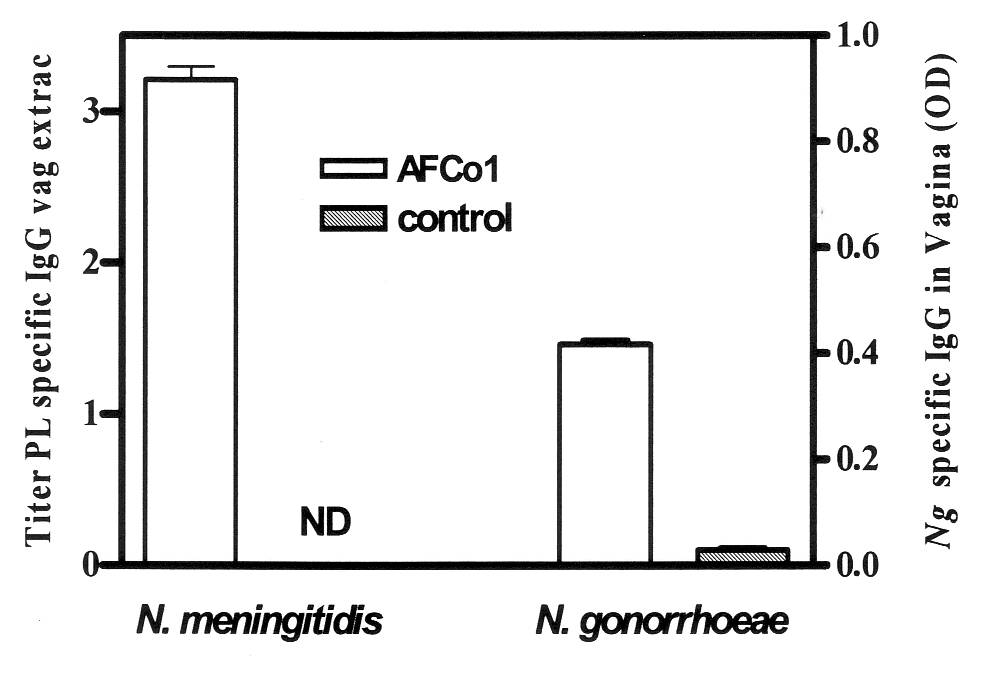
<body><![CDATA[<p><font size="3" face="Verdana, Arial, Helvetica, sans-serif"><b>Materials and    Methods </b> </font></p>     <p><font size="2" face="Verdana, Arial, Helvetica, sans-serif">PL was produce    by Finlay Institute from serogroup B N. meningitidis strain cu385-83 AFCo1 was    obtained from PL as previously described (9). Female C57Bl/6 mice (Taconic M&amp;B,    Denmark), were inoculated three times intranasal (IN) route with AFCo1. Then,    sera and vaginal extraction were collected. Antibodies specific IgG response    in sera and vaginal extract of immunized mice were determined by ELISA (10).    The supernatants of unpurified spleen cells or lymph node culture recall in    vitro with PL or total N. gonorrhoeae antigens. The cells were pulsed with 1mCi    of thymidine [3H] (Amersham, Pharmacia) and then assayed by liquid scintillation    counting. Statistical analyses were done by Student's t-test using Graph Pad    Prism 4 software (CA, USA). </font></p>     <p><font size="3" face="Verdana, Arial, Helvetica, sans-serif"><b>Results </b></font></p>     <p><font size="2" face="Verdana, Arial, Helvetica, sans-serif">In this study,    we investigated if the AFCo1 is able to induce antigen specific systemic immune    responses. Mice immunized by IN route showed higher titter of specific anti    N. meningitidis and N. gonorrhoeae IgG in sera and in the vaginal extracts,    compared with the mice that not received the AFCo1 (Figure 1 and 2). Total spleen    cells and cells of (cLN) and (meLN), but not the cells from genital (g) LN,    from immunized mice, showed significantly higher tittres of proliferative responses    against N. meningitidis and N. gonorrhoeae compared with cells isolated from    not immunized mice (p &lt; 0.01) (Figure 3 A and B). The AFCo1 induced a potent    cell proliferation against N. meningitidis and N. gonorrhoeae in samples evaluated    using IN immunization. </font></p>     <p><font size="2" face="Verdana, Arial, Helvetica, sans-serif"><a href="/img/revistas/vac/v18n2/f0108209.jpg">Figure    1</a>. Serum cross recognition of N gonorrhoeae antigen by AFCo1 nasal immunized    mice. Titter of specific IgG anti PL (N. meningitidis serogroup B) and anti    N. gonorrhoeae (Ng) obtained in serum of animals immunized with nasally with    AFCo1.     
<br>       <br>   <a href="/img/revistas/vac/v18n2/f0208209.jpg">Figure 2.</a> Vaginal cross recognition of N gonorrhoeae    antigen by AFCo1 nasal immunized mice. Titter of specific IgG anti PL (N. meningitidis    serogroup B) and anti N. gonorrhoeae (Ng) obtained in vaginal extracts of animals    immunized nasally with AFCo1.     
<br>       <br>   <a href="/img/revistas/vac/v18n2/f0308209.jpg">Figure 3</a>. Specific proliferative in spleen,    gLN, cLN and meLN cells after nasal immunization with AFCo1. Groups of female    C57Bl/6 mice (n=7) were nasally vaccinated with AFCo1. Four weeks after immunization,    genital, spleen, genital, cervical and mediestinal lymph node cells (106/ mL)    were co-cultured with PL (A) and total N. gonorrhoeae antigens (B). The results    are expressed as the mean + standard errors of counts per minute (cpm) for proliferation.        
<br>       ]]></body>
<body><![CDATA[<br> <font size="3"><b>Discussion </b></font></font></p>     <p><font size="2" face="Verdana, Arial, Helvetica, sans-serif">The administration    of vaccines to mucosal surfaces would confer considerable advantages since mucosal    surfaces are the sites through which most antigens are encountered. Previous    studies have shown that IN immunization is an effective means for the induction    of serum and mucosal antigens specific antibodies. The prolonged induction of    genital tract antigen-specific antibodies following IN vaccination has highlighted    this route of immunization as an attractive potential method for preventing    sexually transmitted infections (11). We immunizing mice IN with AFCo1 and demonstrated    that this immunization is an effective means of eliciting specific serum and    vaginal anti N. meningitidis and N. gonorrhoeae IgG antibodies. </font></p>     <p><font size="2" face="Verdana, Arial, Helvetica, sans-serif"><b><font size="3">Conclusion    </font></b></font></p>     <p><font size="2" face="Verdana, Arial, Helvetica, sans-serif">In conclusion,    AFCo1 induce anti N. meningitidis and anti N. gonorrheae immune responses in    mice that could be exploited for a bivalente vaccine design. </font></p>     <p><font size="3" face="Verdana, Arial, Helvetica, sans-serif"><b>References </b></font></p>     <p><font size="2" face="Verdana, Arial, Helvetica, sans-serif">1. Gerbase A C.    et al. Global epidemiology of sexually transmitted diseases. Lancet 998;351:2_4.    </font></p>     <!-- ref --><p><font size="2" face="Verdana, Arial, Helvetica, sans-serif">2. Price GA. et    al. Intranasal Administration of Recombinant Neisseria gonorrhoeae Transferrin    Binding Proteins A and B Conjugated to the Cholera Toxin B Subunit Induces Systemic    and Vaginal Antibodies in Mice. Infect Immun 2005;73:3945-53.    <br>       <br>   3. Stephens et al. Epidemic meningitis, meningococcaemia, and Neisseria meningitidis.    Lancet 2007;369:2196_210. </font></p>     <!-- ref --><p><font size="2" face="Verdana, Arial, Helvetica, sans-serif">4. Goldschneider    I, et al. Human immunity to the meningococcus. II. Development of natural immunity.    J. Exp. Med 1969;129:1327_48. </font><!-- ref --><p><font size="2" face="Verdana, Arial, Helvetica, sans-serif">5. Reller LB, et    al. Bactericidal antibody after colonization with Neisseria meningitidis. J    Infect Dis 1973;127:56_62. </font><!-- ref --><p><font size="2" face="Verdana, Arial, Helvetica, sans-serif">6. McGhee JR, J    Mestecky, MT Dertzbaugh, JH Eldridge, M Hirasawa, and H. Kiyono. The mucosal    immune system: from fundamental concepts to vaccine development. Vaccine 1992    10:75_88. </font><!-- ref --><p><font size="2" face="Verdana, Arial, Helvetica, sans-serif">7. Campa C, et    al. Method of producing Neisseria meningitidis B vaccine, and vaccine produced    by method.     United States Patent. Patent number: 5 597 572, 1997. </font></p>     <!-- ref --><p><font size="2" face="Verdana, Arial, Helvetica, sans-serif">8. Barlow AK, et    al. The class 1 outer membrane protein of Neisseria meningitidis: gene sequence    and structural and immunological similarities to gonococcal porins. Molecular    Microbiology 1989;3(2):131-39     <br>   </font></p>     <!-- ref --><p><font size="2" face="Verdana, Arial, Helvetica, sans-serif">9. P&eacute;rez    Mart&iacute;n O. Metodolog&iacute;a de obtenci&oacute;n de estructuras cocleares.    Composiciones vacunales y adyuvantes basados en estructuras cocleares y sus    intermediarios.     OCPI patente 23313, 2008. </font></p>     <!-- ref --><p><font size="2" face="Verdana, Arial, Helvetica, sans-serif">10. Ferriol X,    et al. Validacion de un ELISA para la cuantificacion de IgG humana anti prote&iacute;na    de Neisseria meningitidis serogrupo B. Rev. Cubana Med Trop 1999;51(12):99-105.    </font><!-- ref --><p><font size="2" face="Verdana, Arial, Helvetica, sans-serif">11. Price GA, Russell    MW, Cornelissen CN. Intranasal administration of recombinant Neisseria gonorrhoeae    transferrin binding proteins A and B conjugated to the cholera toxin B subunit    induces systemic and vaginal antibodies in mice. Infect Immun 2005;73:3945-53.    <br>       <br>       <br>       <br>       <br>       <br>       <br>       <br>   </font></p>      ]]></body><back>
<ref-list>
<ref id="B1">
<label>1</label><nlm-citation citation-type="journal">
<person-group person-group-type="author">
<name>
<surname><![CDATA[Gerbase]]></surname>
<given-names><![CDATA[A C]]></given-names>
</name>
</person-group>
<article-title xml:lang="en"><![CDATA[Global epidemiology of sexually transmitted diseases]]></article-title>
<source><![CDATA[Lancet]]></source>
<year>1998</year>
<volume>351</volume>
<page-range>2_4</page-range></nlm-citation>
</ref>
<ref id="B2">
<label>2.</label><nlm-citation citation-type="journal">
<person-group person-group-type="author">
<name>
<surname><![CDATA[Price]]></surname>
<given-names><![CDATA[GA]]></given-names>
</name>
</person-group>
<article-title xml:lang="en"><![CDATA[Intranasal Administration of Recombinant Neisseria gonorrhoeae Transferrin Binding Proteins A and B Conjugated to the Cholera Toxin B Subunit Induces Systemic and Vaginal Antibodies in Mice]]></article-title>
<source><![CDATA[Infect Immun]]></source>
<year>2005</year>
<volume>73</volume>
<page-range>3945-53</page-range></nlm-citation>
</ref>
<ref id="B3">
<label>3.</label><nlm-citation citation-type="journal">
<person-group person-group-type="author">
<name>
<surname><![CDATA[Stephens]]></surname>
<given-names><![CDATA[DS]]></given-names>
</name>
</person-group>
<article-title xml:lang="en"><![CDATA[Epidemic meningitis, meningococcaemia, and Neisseria meningitidis]]></article-title>
<source><![CDATA[Lancet]]></source>
<year>2007</year>
<volume>369</volume>
<page-range>2196_210</page-range></nlm-citation>
</ref>
<ref id="B4">
<label>4</label><nlm-citation citation-type="journal">
<person-group person-group-type="author">
<name>
<surname><![CDATA[Goldschneider]]></surname>
<given-names><![CDATA[I]]></given-names>
</name>
</person-group>
<article-title xml:lang="en"><![CDATA[Human immunity to the meningococcus: . Development of natural immunity]]></article-title>
<source><![CDATA[J. Exp. Med]]></source>
<year>1969</year>
<volume>129</volume>
<page-range>1327_48</page-range></nlm-citation>
</ref>
<ref id="B5">
<label>5</label><nlm-citation citation-type="journal">
<person-group person-group-type="author">
<name>
<surname><![CDATA[Reller]]></surname>
<given-names><![CDATA[LB]]></given-names>
</name>
</person-group>
<article-title xml:lang="en"><![CDATA[Bactericidal antibody after colonization with Neisseria meningitidis]]></article-title>
<source><![CDATA[J Infect Dis]]></source>
<year>1973</year>
<volume>127</volume>
<page-range>56_62</page-range></nlm-citation>
</ref>
<ref id="B6">
<label>6</label><nlm-citation citation-type="journal">
<person-group person-group-type="author">
<name>
<surname><![CDATA[McGhee]]></surname>
<given-names><![CDATA[JR]]></given-names>
</name>
<name>
<surname><![CDATA[Mestecky]]></surname>
<given-names><![CDATA[J]]></given-names>
</name>
<name>
<surname><![CDATA[Dertzbaugh]]></surname>
<given-names><![CDATA[MT]]></given-names>
</name>
<name>
<surname><![CDATA[Eldridge]]></surname>
<given-names><![CDATA[JH]]></given-names>
</name>
<name>
<surname><![CDATA[Hirasawa]]></surname>
<given-names><![CDATA[M]]></given-names>
</name>
<name>
<surname><![CDATA[Kiyono]]></surname>
<given-names><![CDATA[H.]]></given-names>
</name>
</person-group>
<article-title xml:lang="en"><![CDATA[The mucosal immune system: from fundamental concepts to vaccine development]]></article-title>
<source><![CDATA[Vaccine]]></source>
<year>1992</year>
<volume>10</volume>
<page-range>75_88</page-range></nlm-citation>
</ref>
<ref id="B7">
<label>7</label><nlm-citation citation-type="">
<person-group person-group-type="author">
<name>
<surname><![CDATA[Campa]]></surname>
<given-names><![CDATA[C]]></given-names>
</name>
</person-group>
<source><![CDATA[Method of producing Neisseria meningitidis B vaccine, and vaccine produced by method]]></source>
<year></year>
</nlm-citation>
</ref>
<ref id="B8">
<label>8</label><nlm-citation citation-type="journal">
<person-group person-group-type="author">
<name>
<surname><![CDATA[Barlow]]></surname>
<given-names><![CDATA[AK]]></given-names>
</name>
</person-group>
<article-title xml:lang="en"><![CDATA[The class 1 outer membrane protein of Neisseria meningitidis: gene sequence and structural and immunological similarities to gonococcal porins]]></article-title>
<source><![CDATA[Molecular Microbiology]]></source>
<year>1989</year>
<volume>3</volume>
<page-range>131-39</page-range></nlm-citation>
</ref>
<ref id="B9">
<label>9</label><nlm-citation citation-type="">
<person-group person-group-type="author">
<name>
<surname><![CDATA[Pérez Martín]]></surname>
<given-names><![CDATA[O]]></given-names>
</name>
</person-group>
<source><![CDATA[Metodología de obtención de estructuras cocleares. Composiciones vacunales y adyuvantes basados en estructuras cocleares y sus intermediarios]]></source>
<year></year>
</nlm-citation>
</ref>
<ref id="B10">
<label>10</label><nlm-citation citation-type="journal">
<person-group person-group-type="author">
<name>
<surname><![CDATA[Ferriol]]></surname>
<given-names><![CDATA[X]]></given-names>
</name>
</person-group>
<article-title xml:lang="es"><![CDATA[Validacion de un ELISA para la cuantificacion de IgG humana anti proteína de Neisseria meningitidis serogrupo B]]></article-title>
<source><![CDATA[Rev. Cubana Med Trop]]></source>
<year>1999</year>
<volume>51</volume>
<page-range>99-105</page-range></nlm-citation>
</ref>
<ref id="B11">
<label>11</label><nlm-citation citation-type="journal">
<person-group person-group-type="author">
<name>
<surname><![CDATA[Price]]></surname>
<given-names><![CDATA[GA]]></given-names>
</name>
<name>
<surname><![CDATA[Russell]]></surname>
<given-names><![CDATA[MW]]></given-names>
</name>
<name>
<surname><![CDATA[Cornelissen]]></surname>
<given-names><![CDATA[CN]]></given-names>
</name>
</person-group>
<article-title xml:lang="es"><![CDATA[Intranasal administration of recombinant Neisseria gonorrhoeae transferrin binding proteins A and B conjugated to the cholera toxin B subunit induces systemic and vaginal antibodies in mice]]></article-title>
<source><![CDATA[Infect Immun]]></source>
<year>2005</year>
<volume>73</volume>
<page-range>3945-53</page-range></nlm-citation>
</ref>
</ref-list>
</back>
</article>