<?xml version="1.0" encoding="ISO-8859-1"?><article xmlns:mml="http://www.w3.org/1998/Math/MathML" xmlns:xlink="http://www.w3.org/1999/xlink" xmlns:xsi="http://www.w3.org/2001/XMLSchema-instance">
<front>
<journal-meta>
<journal-id>1025-028X</journal-id>
<journal-title><![CDATA[Vaccimonitor]]></journal-title>
<abbrev-journal-title><![CDATA[Vaccimonitor]]></abbrev-journal-title>
<issn>1025-028X</issn>
<publisher>
<publisher-name><![CDATA[Finlay Ediciones]]></publisher-name>
</publisher>
</journal-meta>
<article-meta>
<article-id>S1025-028X2009000200010</article-id>
<title-group>
<article-title xml:lang="es"><![CDATA[Actividad opsonofagocítica contra meningococos del grupo B: ¿Un correlato de protección adicional contra la enfermedad meningococica?]]></article-title>
<article-title xml:lang="en"><![CDATA[Opsonophagocytic activity against group b meningococci: An additional laboratory correlate of protection against meningococcal disease?]]></article-title>
</title-group>
<contrib-group>
<contrib contrib-type="author">
<name>
<surname><![CDATA[Aase]]></surname>
<given-names><![CDATA[Audun]]></given-names>
</name>
<xref ref-type="aff" rid="A01"/>
</contrib>
</contrib-group>
<aff id="A01">
<institution><![CDATA[,Norwegian Institute of Public Health  ]]></institution>
<addr-line><![CDATA[Oslo ]]></addr-line>
<country>Norway</country>
</aff>
<pub-date pub-type="pub">
<day>00</day>
<month>08</month>
<year>2009</year>
</pub-date>
<pub-date pub-type="epub">
<day>00</day>
<month>08</month>
<year>2009</year>
</pub-date>
<volume>18</volume>
<numero>2</numero>
<fpage>84</fpage>
<lpage>86</lpage>
<copyright-statement/>
<copyright-year/>
<self-uri xlink:href="http://scielo.sld.cu/scielo.php?script=sci_arttext&amp;pid=S1025-028X2009000200010&amp;lng=en&amp;nrm=iso"></self-uri><self-uri xlink:href="http://scielo.sld.cu/scielo.php?script=sci_abstract&amp;pid=S1025-028X2009000200010&amp;lng=en&amp;nrm=iso"></self-uri><self-uri xlink:href="http://scielo.sld.cu/scielo.php?script=sci_pdf&amp;pid=S1025-028X2009000200010&amp;lng=en&amp;nrm=iso"></self-uri><abstract abstract-type="short" xml:lang="en"><p><![CDATA[Opsonophagocytic activity and serum bactericidal activity against group B meningococci were compared in sera from three vaccine groups given two different outer membrane vesicles vaccines separately or in combination. Opsonophagocytic activity defined more responders and revealed more cross-reactivity against heterologous strains than observed with serum bactericidal activity, and it showed the highest correlation with IgG-binding to live meningococci. Determination of opsonophagocytic activity may therefore be a valuable laboratory supplement to serum bactericidal activity for monitoring protection against group B meningococcal disease.]]></p></abstract>
<kwd-group>
<kwd lng="en"><![CDATA[Opsonophagocytic activity]]></kwd>
<kwd lng="en"><![CDATA[correlate of protection]]></kwd>
<kwd lng="en"><![CDATA[group B meningococci]]></kwd>
</kwd-group>
</article-meta>
</front><body><![CDATA[ <p align="right"><font face="Verdana, Arial, Helvetica, sans-serif" size="2"><b>ARTICULOS    ORIGINALES</b></font></p>     <p><font face="Verdana, Arial, Helvetica, sans-serif" size="2">    <br>   </font></p>     <p><font face="Verdana, Arial, Helvetica, sans-serif" size="2"><b><font size="4">Actividad    opsonofagoc&iacute;tica contra meningococos del grupo B:&iquest;Un correlato    de protecci&oacute;n adicional contra la enfermedad meningococica?</font></b></font></p>     <p><font face="Verdana, Arial, Helvetica, sans-serif" size="2"><b><font size="3">Opsonophagocytic    activity against group b meningococci: An additional laboratory correlate of    protection against meningococcal disease?.</font></b></font></p>     <p><font face="Verdana, Arial, Helvetica, sans-serif" size="2"><b>Audun Aase</b>        <br>       <br>   Norwegian Institute of Public Health, P.O.Box 4404 Nydalen, NO-0403 Oslo, Norway    </font></p>     <p><font face="Verdana, Arial, Helvetica, sans-serif" size="2"><a href="mailto:%20audun.aase@fhi.no%20">email:    audun.aase@fhi.no </a>    <br>       ]]></body>
<body><![CDATA[<br>   </font></p> <hr>     <p><font face="Verdana, Arial, Helvetica, sans-serif" size="2"><b><font size="3">Abstract</font></b></font></p>     <p><font face="Verdana, Arial, Helvetica, sans-serif" size="2">Opsonophagocytic    activity and serum bactericidal activity against group B meningococci were compared    in sera from three vaccine groups given two different outer membrane vesicles    vaccines separately or in combination. Opsonophagocytic activity defined more    responders and revealed more cross-reactivity against heterologous strains than    observed with serum bactericidal activity, and it showed the highest correlation    with IgG-binding to live meningococci. Determination of opsonophagocytic activity    may therefore be a valuable laboratory supplement to serum bactericidal activity    for monitoring protection against group B meningococcal disease. </font></p>     <p><font face="Verdana, Arial, Helvetica, sans-serif" size="2"><b>Keywords</b>:    Opsonophagocytic activity, correlate of protection, group B meningococci. </font></p> <hr>     <p><font face="Verdana, Arial, Helvetica, sans-serif" size="3"><b>Introduction    </b></font></p>     <p><font face="Verdana, Arial, Helvetica, sans-serif" size="2">Serum bactericidal    activity (SBA) has been accepted as the &quot;gold standard&quot; laboratory    correlate of protection for meningococcal disease. This concept was first based    upon the excellent works by Goldschneider et al. (1) among army recruits, and    has since been supported in more recent studies as reviewed by Borrow et al.    (2). However, as also pointed out in the Goldschneider paper, several recruits    who became carriers with the epidemic strain did not develop meningococcal disease    although they had no detectable SBA. More recent studies in USA and UK indicate    that the prevalence of healthy people with SBA titre &lt;4 (with human complement)    is increasing, while the incidence of meningococcal disease of the same population    has decreased, although the carrier rate is still high (3). This indicates that    other protective mechanisms may play a role like e.g. opsonophagocytosis, particular    for group B disease (4). In this study we have compared the SBA, opsonophagocytic    activity (OPA) and IgG-binding to live meningococci in sera from a clinical    vaccine trial. Two group B OMV vaccines (MeNZBTM and MenBvac) were administrated    each or in combination to three groups of healthy adults (5). The results indicate    that OPA may identify more responders and also recognize more cross-reactivity    against heterologous strains than SBA. </font></p>     <p><font face="Verdana, Arial, Helvetica, sans-serif" size="3"><b>Material and    methods </b> </font></p>     <p><font face="Verdana, Arial, Helvetica, sans-serif" size="2">A clinical trial    investigating the immunogenicity and safety of a combination of two serogroup    B meningococcal outer membrane vesicle vaccines was performed (5). Groups of    app. 30 persons were immunized with three doses of either MenBvac (25 mg/dose)    (strain 44/76; B:15:P1.7,16), MeNZBTM (25 mg/dose) (strain NZ98/254; B:4:P1.7-2)    or a combination of MenBvac and MeNZBTM ((12.5 mg + 12.5 mg)/dose). The doses    were given at six weeks intervals, and blood samples collected before and six    weeks after each dose. </font></p>     <p><font face="Verdana, Arial, Helvetica, sans-serif" size="2">SBA was measured    by the &quot;tilt method&quot; as described previously using human serum as    complement source (2, 5). </font></p>     <p><font face="Verdana, Arial, Helvetica, sans-serif" size="2">OPA was measured    as respiratory burst as described (6), using live meningococci as target, human    serum as complement source and human polymorphonuclear leukocytes (PMNs) as    effector cells. The highest reciprocal serum-dilution giving respiratory burst    in &sup3; 50% of the PMNs is recorded as OPA titer. </font></p>     ]]></body>
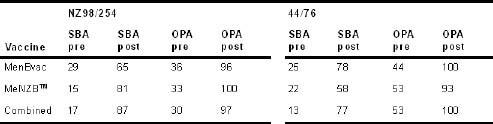
<body><![CDATA[<p><font face="Verdana, Arial, Helvetica, sans-serif" size="2">An indirect immunofluorescent    method was used to measure the levels of IgG antibodies binding to live meningococci    by a flow cytometry method as described (6). </font></p>     <p><font face="Verdana, Arial, Helvetica, sans-serif" size="2">The geometric mean    titers (GMTs) and geometric mean concentrations (GMCs) and the associate 95%    confidence interval (CI) were calculated for the SBA, OPA and IgG-binding, respectively.    The proportion of responders, defined as at least a fourfold increase in response    from pre-vaccination to 6 weeks post 3rd dose, and the 95% CI was determined.    Linear regression analyses were performed to look for relationship between the    assays, and the Pearson's correlation coefficient calculated. </font></p>     <p><font face="Verdana, Arial, Helvetica, sans-serif" size="3"><b>Results and    discussion</b></font><font face="Verdana, Arial, Helvetica, sans-serif" size="2">    </font></p>     <p><font face="Verdana, Arial, Helvetica, sans-serif" size="2">In this study we    tested out two different OMV group B meningococcal vaccines administered separately    or combined, and compared the SBA and OPA responses. All the vaccines induced    significant responses as measured by SBA and OPA. The proportion of pre-vaccinated    sera with titers &sup3; 4 (defined as positive) was higher in the OPA (range:    30% - 53%) assay than in the SBA assay (range: 13% - 29%), depending on the    vaccine group and target strain (Table 1).     <br>   </font></p>     <p><font face="Verdana, Arial, Helvetica, sans-serif" size="2">    <br>   <a href="/img/revistas/vac/v18n2/t0110209.jpg">Table 1</a>. Proportion of subjects (%) with serum    titers &sup3; 4 pre-vaccination and six weeksafter the 3rd dose within the different    vaccine groups against the two target strains.     
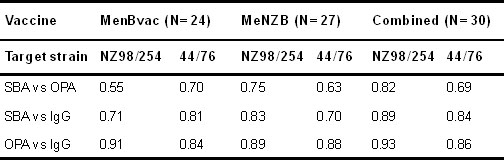
<br>       <br>       <br>   <a href="/img/revistas/vac/v18n2/t0210209.jpg">Table 2</a>. Pearson's correlation coefficients    of the different assays against the two target strains and vaccine groups.     
]]></body>
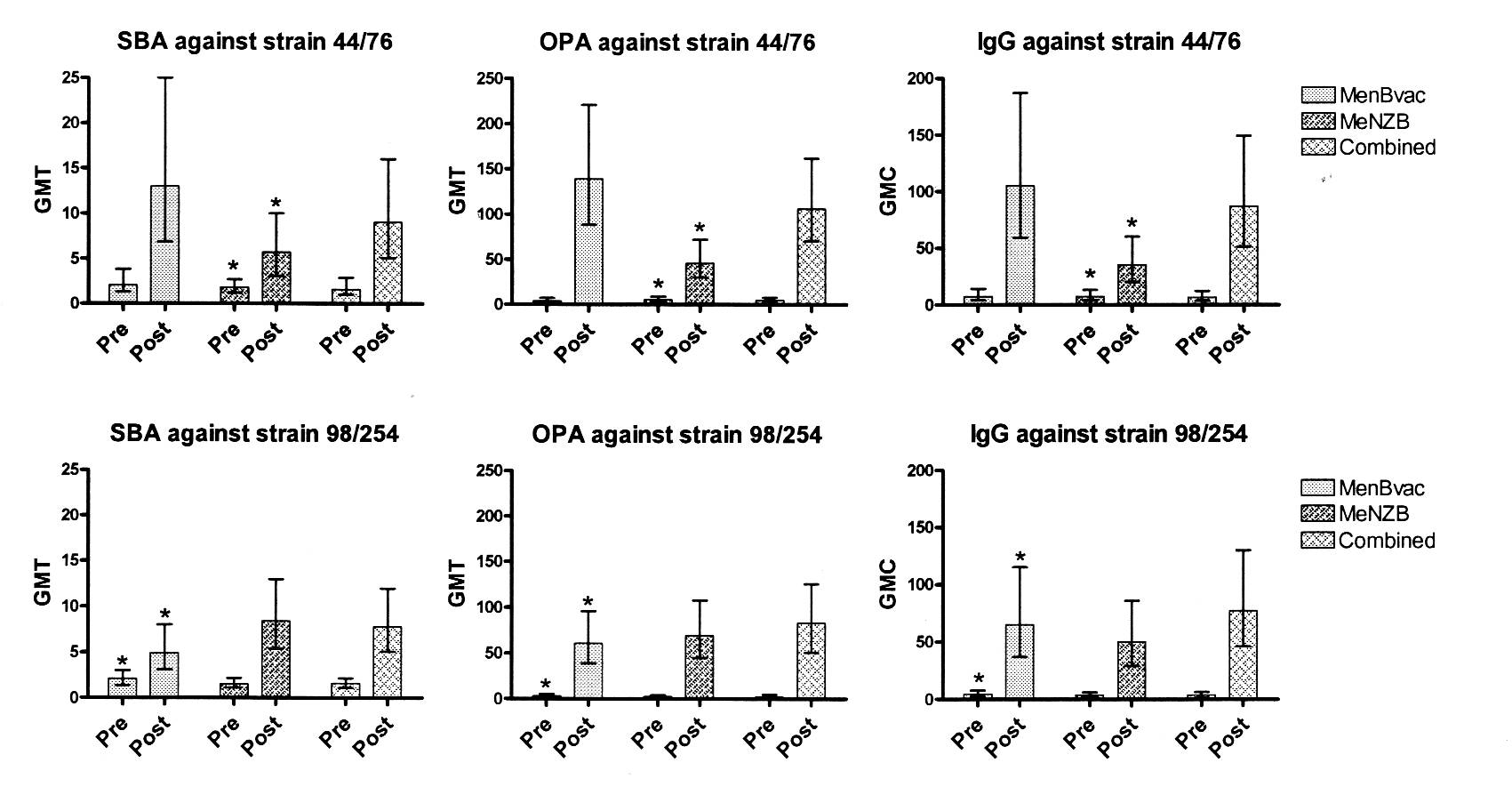
<body><![CDATA[<br>       <br>       <br>   <a href="/img/revistas/vac/v18n2/f0110209.jpg">Figure 1</a>. Geometric mean SBA and OPA titer,    and IgG concentration against live bacteria (AU/mL) with 95% CI.</font><font face="Verdana, Arial, Helvetica, sans-serif" size="2">(*    indicate activity against heterologous strain.) (Note different scaling of Y-axis).        
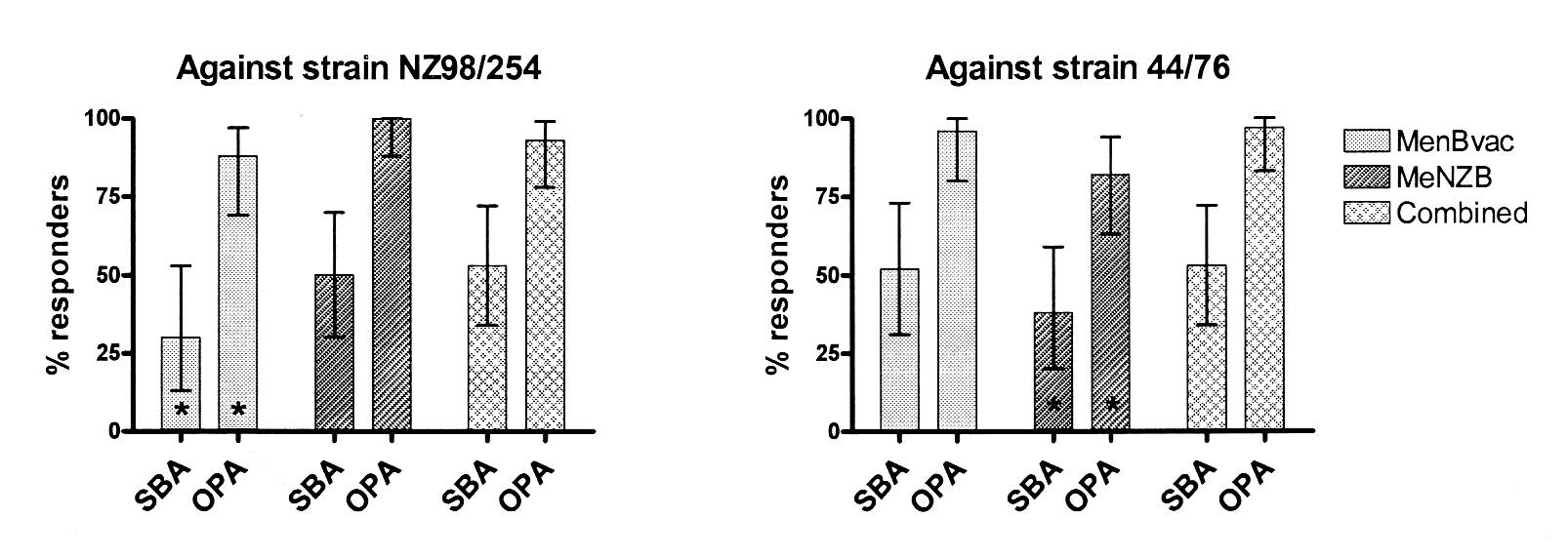
<br>       <br>       <br>   <a href="/img/revistas/vac/v18n2/f0210209.jpg">Figure 2</a>. Proportion of responders (%) i.e.    at least a fourfold increase and 95% CI, from pre-vaccination to post 3rd dose.    (* indicate activity against heterologous strain.)     
<br>       <br>       <br>   These subjects, with positive OPA and negative SBA, may possibly be protected    against serogroup B disease. After the 3rd dose, 93% - 100% of the participants    achieved a titer &sup3; 4 in OPA, whereas in the SBA 58% - 87% obtained a titer    &sup3; 4 (Table 1). </font></p>     <p><font face="Verdana, Arial, Helvetica, sans-serif" size="2">    ]]></body>
<body><![CDATA[<br>   The pre-vaccinated sera had slightly higher OPA titers than SBA titers, particular    when tested against strain 44/76 (Figure 1). Six weeks after the third dose    the geometric mean OPA titre had increased 9 to 36-fold depending on the vaccine    group and target strain. The SBA revealed an increase of 3 to 6.5-fold and the    IgG-binding an increase of 5 to 22-fold. </font></p>     <p><font face="Verdana, Arial, Helvetica, sans-serif" size="2">When we looked    at the proportion of responders defined as &sup3; 4-fold increase form prevaccination    to after the 3rd dose, 100% of the participants given the MeNZBTM vaccine were    responders in the OPA assay, against the homologous strain (NZ98/254), whereas    50% were responders in the SBA assay (Figure 2). Of the MenBvac group, 96% were    responders in the OPA against the homologous strain (44/76); the corresponding    number for the SBA was 52%. </font></p>     <p><font face="Verdana, Arial, Helvetica, sans-serif" size="2">The combined vaccine    induced a &sup3; 4-fold OPA increase in 93% and 97% of the vaccinees against    strain NZ98/254 and 44/76, respectively, whereas in the SBA the corresponding    number of responders were 53% against both strains. Interestingly, against the    heterologous strain, the MeNZBTM induced a &sup3; 4-fold OPA response in 82%    (95% CI: 63-94%) of the vaccinees, whereas 38% (95% CI: 20-59%) obtained a similar    increase in SBA. The MenBvac induced a &sup3; 4-fold OPA response against the    heterologous (NZ98/254) strain of 88% (95% CI: 69-97%) of the participants,    while there were 30% (95% CI: 13-53%) responders in the SBA assay (Figure 2).    </font></p>     <p><font face="Verdana, Arial, Helvetica, sans-serif" size="2">This high cross-reactivity    demonstrated with the OPA but not with the SBA, may signify higher cross-protection    against group B meningococcal disease than indicated by SBA. However, we do    not know if this is a general occurrence or if it is only restricted to the    two group B strains examined in this study. The IgG-binding to live meningococci    was very similar to the OPA, also demonstrating high cross-reactivity (Figure    1).     <br>   Linear regression analysis between assays and corresponding Pearson's correlation    coefficients demonstrate a very strong correlation between OPA and IgG-binding    to live bacteria (Table 2). There was higher correlation between SBA and IgG    than between SBA and OPA, indicating interesting differences between these two    functional assays. IgG antibodies binding to live meningococci are thought to    be the primary inducers of both SBA and OPA in these studies. It is possible    that some IgG specificities may activate complement through C3, but not produce    functional terminal complement complex activation and bacteriolysis; thus favoring    OPA rather than SBA. </font></p>     <p><font face="Verdana, Arial, Helvetica, sans-serif" size="2"><b><font size="3">Reference    </font></b></font></p>     <!-- ref --><p><font face="Verdana, Arial, Helvetica, sans-serif" size="2">1. Goldschneider    I, Gotschlich EC, Artenstein MS. Human immunity to the meningococcus. I. The    role of humoral antibodies. J Exp Med 1969;129:1307-26. </font><!-- ref --><p><font face="Verdana, Arial, Helvetica, sans-serif" size="2">2. Borrow R, Balmer    P, Miller E. Meningococcal surrogates of protection&#151;serum bactericidal    antibody activity. Vaccine 2005;23:2222-7. </font><!-- ref --><p><font face="Verdana, Arial, Helvetica, sans-serif" size="2">3. Granoff DM,    Harrison LH, Borrow R. Meningococcal vaccines. In: Plotkin S, Orenstein W, Offit    P, editors. Vaccines. Fifth ed. Elsevier; 2008. p. 399-434. </font><!-- ref --><p><font face="Verdana, Arial, Helvetica, sans-serif" size="2">4. Ross SC, Rosenthal    PJ, Berberich HM, Densen P. Killing of Neisseria meningitidis by human neutrophils:    implications for normal and complement-deficient individuals. J Infect Dis 1987;155:1266-75.    </font><!-- ref --><p><font face="Verdana, Arial, Helvetica, sans-serif" size="2">5. Sandbu S, Feiring    B, Oster P, Helland OS, Bakke HS, Naess LM, et al. Immunogenicity and safety    of a combination of two serogroup B meningococcal outer membrane vesicle vaccines.    Clin Vaccine Immunol 2007;14:1062-9. </font><!-- ref --><p><font face="Verdana, Arial, Helvetica, sans-serif" size="2">6. Aase A, Naess    LM, Sandin RH, Herstad TK, Oftung F, Holst J, et al. Comparison of functional    immune responses in humans after intranasal and intramuscular immunisations    with outer membrane vesicle vaccines against group B meningococcal disease.    Vaccine 2003;21:2042-51.    <br>       <br>       <br>       <br>   </font></p>     <p><font face="Verdana, Arial, Helvetica, sans-serif" size="2">    <br>       <br>       <br>       ]]></body>
<body><![CDATA[<br>       <br>       <br>   </font></p>      ]]></body><back>
<ref-list>
<ref id="B1">
<label>1</label><nlm-citation citation-type="journal">
<person-group person-group-type="author">
<name>
<surname><![CDATA[Goldschneider]]></surname>
<given-names><![CDATA[I]]></given-names>
</name>
<name>
<surname><![CDATA[Gotschlich]]></surname>
<given-names><![CDATA[EC]]></given-names>
</name>
<name>
<surname><![CDATA[Artenstein]]></surname>
<given-names><![CDATA[MS]]></given-names>
</name>
</person-group>
<article-title xml:lang="en"><![CDATA[Human immunity to the meningococcus: I.The role of humoral antibodies]]></article-title>
<source><![CDATA[J Exp Med]]></source>
<year>1969</year>
<volume>129</volume>
<page-range>1307-26</page-range></nlm-citation>
</ref>
<ref id="B2">
<label>2</label><nlm-citation citation-type="journal">
<person-group person-group-type="author">
<name>
<surname><![CDATA[Borrow]]></surname>
<given-names><![CDATA[R]]></given-names>
</name>
<name>
<surname><![CDATA[Balmer]]></surname>
<given-names><![CDATA[P]]></given-names>
</name>
<name>
<surname><![CDATA[Miller]]></surname>
<given-names><![CDATA[E]]></given-names>
</name>
</person-group>
<article-title xml:lang="en"><![CDATA[Meningococcal surrogates of protection-serum bactericidal antibody activity]]></article-title>
<source><![CDATA[Vaccine]]></source>
<year>2005</year>
<volume>23</volume>
<page-range>2222-7</page-range></nlm-citation>
</ref>
<ref id="B3">
<label>3</label><nlm-citation citation-type="book">
<person-group person-group-type="author">
<name>
<surname><![CDATA[Granoff]]></surname>
<given-names><![CDATA[DM]]></given-names>
</name>
<name>
<surname><![CDATA[Harrison]]></surname>
<given-names><![CDATA[LH]]></given-names>
</name>
<name>
<surname><![CDATA[Borrow]]></surname>
<given-names><![CDATA[R]]></given-names>
</name>
</person-group>
<article-title xml:lang="en"><![CDATA[Meningococcal vaccines]]></article-title>
<person-group person-group-type="editor">
<name>
<surname><![CDATA[Plotkin]]></surname>
<given-names><![CDATA[S]]></given-names>
</name>
<name>
<surname><![CDATA[Orenstein]]></surname>
<given-names><![CDATA[W]]></given-names>
</name>
<name>
<surname><![CDATA[Offit]]></surname>
<given-names><![CDATA[P]]></given-names>
</name>
</person-group>
<source><![CDATA[Vaccines]]></source>
<year>2008</year>
<edition>Fifth</edition>
<page-range>399-434</page-range><publisher-name><![CDATA[Elsevier]]></publisher-name>
</nlm-citation>
</ref>
<ref id="B4">
<label>4</label><nlm-citation citation-type="journal">
<person-group person-group-type="author">
<name>
<surname><![CDATA[Ross]]></surname>
<given-names><![CDATA[SC]]></given-names>
</name>
<name>
<surname><![CDATA[Rosenthal]]></surname>
<given-names><![CDATA[PJ]]></given-names>
</name>
<name>
<surname><![CDATA[Berberich]]></surname>
<given-names><![CDATA[HM]]></given-names>
</name>
<name>
<surname><![CDATA[Densen]]></surname>
<given-names><![CDATA[P]]></given-names>
</name>
</person-group>
<article-title xml:lang="en"><![CDATA[Killing of Neisseria meningitidis by human neutrophils: implications for normal and complement-deficient individuals]]></article-title>
<source><![CDATA[J Infect Dis]]></source>
<year>1987</year>
<volume>155</volume>
<page-range>1266-75</page-range></nlm-citation>
</ref>
<ref id="B5">
<label>5</label><nlm-citation citation-type="journal">
<person-group person-group-type="author">
<name>
<surname><![CDATA[Sandbu]]></surname>
<given-names><![CDATA[S]]></given-names>
</name>
<name>
<surname><![CDATA[Feiring]]></surname>
<given-names><![CDATA[B]]></given-names>
</name>
<name>
<surname><![CDATA[Oster]]></surname>
<given-names><![CDATA[P]]></given-names>
</name>
<name>
<surname><![CDATA[Helland]]></surname>
<given-names><![CDATA[OS]]></given-names>
</name>
<name>
<surname><![CDATA[Bakke]]></surname>
<given-names><![CDATA[HS]]></given-names>
</name>
<name>
<surname><![CDATA[Naess]]></surname>
<given-names><![CDATA[LM]]></given-names>
</name>
</person-group>
<article-title xml:lang="en"><![CDATA[Immunogenicity and safety of a combination of two serogroup B meningococcal outer membrane vesicle vaccines]]></article-title>
<source><![CDATA[Clin Vaccine Immunol]]></source>
<year>2007</year>
<volume>14</volume>
<page-range>1062-9</page-range></nlm-citation>
</ref>
<ref id="B6">
<label>6</label><nlm-citation citation-type="journal">
<person-group person-group-type="author">
<name>
<surname><![CDATA[Aase]]></surname>
<given-names><![CDATA[A]]></given-names>
</name>
<name>
<surname><![CDATA[Naess]]></surname>
<given-names><![CDATA[LM]]></given-names>
</name>
<name>
<surname><![CDATA[Sandin]]></surname>
<given-names><![CDATA[RH]]></given-names>
</name>
<name>
<surname><![CDATA[Herstad]]></surname>
<given-names><![CDATA[TK]]></given-names>
</name>
<name>
<surname><![CDATA[Oftung]]></surname>
<given-names><![CDATA[F]]></given-names>
</name>
<name>
<surname><![CDATA[Holst]]></surname>
<given-names><![CDATA[J]]></given-names>
</name>
</person-group>
<article-title xml:lang="en"><![CDATA[Comparison of functional immune responses in humans after intranasal and intramuscular immunisations with outer membrane vesicle vaccines against group B meningococcal disease]]></article-title>
<source><![CDATA[Vaccine]]></source>
<year>2003</year>
<volume>21</volume>
<page-range>2042-51</page-range></nlm-citation>
</ref>
</ref-list>
</back>
</article>