<?xml version="1.0" encoding="ISO-8859-1"?><article xmlns:mml="http://www.w3.org/1998/Math/MathML" xmlns:xlink="http://www.w3.org/1999/xlink" xmlns:xsi="http://www.w3.org/2001/XMLSchema-instance">
<front>
<journal-meta>
<journal-id>1025-028X</journal-id>
<journal-title><![CDATA[Vaccimonitor]]></journal-title>
<abbrev-journal-title><![CDATA[Vaccimonitor]]></abbrev-journal-title>
<issn>1025-028X</issn>
<publisher>
<publisher-name><![CDATA[Finlay Ediciones]]></publisher-name>
</publisher>
</journal-meta>
<article-meta>
<article-id>S1025-028X2013000100002</article-id>
<title-group>
<article-title xml:lang="en"><![CDATA[Adjuvant activity of peanut, cottonseed and rice oils on cellular and humoral response]]></article-title>
<article-title xml:lang="es"><![CDATA[Actividad adyuvante de los aceites de maní, de semilla de algodón y de arroz en la respuesta celular y humoral]]></article-title>
</title-group>
<contrib-group>
<contrib contrib-type="author">
<name>
<surname><![CDATA[Freitas]]></surname>
<given-names><![CDATA[Erika]]></given-names>
</name>
<xref ref-type="aff" rid="A01"/>
</contrib>
<contrib contrib-type="author">
<name>
<surname><![CDATA[Marinho]]></surname>
<given-names><![CDATA[Ana Claudia]]></given-names>
</name>
<xref ref-type="aff" rid="A02"/>
</contrib>
<contrib contrib-type="author">
<name>
<surname><![CDATA[Albuquerque]]></surname>
<given-names><![CDATA[Deijanira]]></given-names>
</name>
<xref ref-type="aff" rid="A03"/>
</contrib>
<contrib contrib-type="author">
<name>
<surname><![CDATA[Teles]]></surname>
<given-names><![CDATA[Leiliane]]></given-names>
</name>
<xref ref-type="aff" rid="A02"/>
</contrib>
<contrib contrib-type="author">
<name>
<surname><![CDATA[Sindeaux]]></surname>
<given-names><![CDATA[Mércia]]></given-names>
</name>
<xref ref-type="aff" rid="A04"/>
</contrib>
<contrib contrib-type="author">
<name>
<surname><![CDATA[Salles]]></surname>
<given-names><![CDATA[María Teresa]]></given-names>
</name>
<xref ref-type="aff" rid="A05"/>
</contrib>
<contrib contrib-type="author">
<name>
<surname><![CDATA[Sousa]]></surname>
<given-names><![CDATA[Diana Célia]]></given-names>
</name>
<xref ref-type="aff" rid="A06"/>
</contrib>
<contrib contrib-type="author">
<name>
<surname><![CDATA[Lima]]></surname>
<given-names><![CDATA[Margarida María]]></given-names>
</name>
<xref ref-type="aff" rid="A04"/>
</contrib>
<contrib contrib-type="author">
<name>
<surname><![CDATA[Silva]]></surname>
<given-names><![CDATA[María da Guia]]></given-names>
</name>
<xref ref-type="aff" rid="A02"/>
</contrib>
<contrib contrib-type="author">
<name>
<surname><![CDATA[Fernandes]]></surname>
<given-names><![CDATA[Dirce]]></given-names>
</name>
<xref ref-type="aff" rid="A02"/>
</contrib>
</contrib-group>
<aff id="A01">
<institution><![CDATA[,Universida de Federal do Ceará Departamento de Biología ]]></institution>
<addr-line><![CDATA[Fortaleza, CE ]]></addr-line>
<country>Brasil</country>
</aff>
<aff id="A02">
<institution><![CDATA[,Universida de Federal do Ceará Departamento de Bioquímica e Biología Molecular ]]></institution>
<addr-line><![CDATA[Fortaleza,CE ]]></addr-line>
<country>Brasil</country>
</aff>
<aff id="A03">
<institution><![CDATA[,Universida de Federal do Ceará Departamento de Ciéncias Básicas em Saúd ]]></institution>
<addr-line><![CDATA[Cuiabá, MT ]]></addr-line>
<country>Brasil</country>
</aff>
<aff id="A04">
<institution><![CDATA[,Universida de Federal do Ceará Departamento de Patología e Medicina Legal ]]></institution>
<addr-line><![CDATA[Fortaleza, CE ]]></addr-line>
<country>Brasil</country>
</aff>
<aff id="A05">
<institution><![CDATA[,Universida de Federal do Ceará Departamento de Química Orgânica ]]></institution>
<addr-line><![CDATA[Fortaleza, CE ]]></addr-line>
<country>Brasil</country>
</aff>
<aff id="A06">
<institution><![CDATA[,Universida de Federal do Ceará Faculdade de Veterinária ]]></institution>
<addr-line><![CDATA[Fortaleza, CE ]]></addr-line>
<country>Brasil</country>
</aff>
<pub-date pub-type="pub">
<day>00</day>
<month>04</month>
<year>2013</year>
</pub-date>
<pub-date pub-type="epub">
<day>00</day>
<month>04</month>
<year>2013</year>
</pub-date>
<volume>22</volume>
<numero>1</numero>
<fpage>4</fpage>
<lpage>9</lpage>
<copyright-statement/>
<copyright-year/>
<self-uri xlink:href="http://scielo.sld.cu/scielo.php?script=sci_arttext&amp;pid=S1025-028X2013000100002&amp;lng=en&amp;nrm=iso"></self-uri><self-uri xlink:href="http://scielo.sld.cu/scielo.php?script=sci_abstract&amp;pid=S1025-028X2013000100002&amp;lng=en&amp;nrm=iso"></self-uri><self-uri xlink:href="http://scielo.sld.cu/scielo.php?script=sci_pdf&amp;pid=S1025-028X2013000100002&amp;lng=en&amp;nrm=iso"></self-uri><abstract abstract-type="short" xml:lang="en"><p><![CDATA[The potentiality of the usage of vegetable oils such as soybean, corn, olive, sesame, murici seed, rapeseed, linseed, rice and cashew nuts as adjuvant of the humoral and cellular immune response has been recently shown. In the present work, besides of evaluating the adjuvant action of peanut, cottonseed and rice oils on humoral and cellular immune responses against ovalbumin (OVA) we also evaluated the protective immune response induced by Leishmania antigens. The peanut oil significantly increased the synthesis of anti-ovalbumin antibodies in the primary response, but it did not favor cellular response. Concerning mice immunized with L. amazonensis antigens emulsified with peanut oil exacerbated skin lesions and lymph node parasite load what suggests stimulation of the Th2 immune response and down regulation of Th1 response. The cottonseed oil was shown to have adjuvant effect to the humoral response, stimulating a secondary response and also favored the delayed-type hypersensitivity (DTH) response to OVA. The rice oil stimulated a strong DTH reaction to OVA and enhanced the synthesis of antibodies after the third dose. Mice immunized with L. amazonensis antigens emulsified with rice oil or cotton seed oil were protected from developing skin lesions and lymph node parasite load. These results emphasize the interest and importance of the vegetable oils as tools in different procedures of immunization and their differential role in relation to the other adjuvant under usage]]></p></abstract>
<abstract abstract-type="short" xml:lang="es"><p><![CDATA[Recientemente se ha demostrado el uso potencial de los aceites vegetales, tales como los de soya, maíz, oliva, ajonjolí, colza, nabina, linaza, arroz y anacardo, como adyuvantes de las respuestas inmune celular y humoral. En este trabajo, además de evaluar la acción adyuvante de los aceites de maní, de la semilla de algodón y del arroz en la respuesta inmune celular y humoral contra la ovalbúmina (OVA), también se evaluó la respuesta inmune protectora inducida por los antígenos de Leishmania. El aceite de maní incrementó significativamente la síntesis de los anticuerpos anti-ovalbúmina en la respuesta primaria, pero no favoreció la respuesta celular. Con respecto a los ratones inmunizados con los antígenos de L. amazonensis emulsionados con aceite de maní, este exacerbó las lesiones de la piel y la carga parasitaria en los nódulos linfáticos, lo que sugiere la estimulación de la respuesta inmune Th2 y la baja regulación de la respuesta Th1. El aceite de semilla de algodón mostró tener efecto adyuvante para la respuesta humoral, al estimular la respuesta secundaria y favorecer también la respuesta de hipersensibilidad demorada (DTH) a OVA. El aceite de arroz estimuló una fuerte reacción DTH a OVA y amplió la síntesis de los anticuerpos luego de la tercera dosis. Los ratones inmunizados con los antígenos de L. amazonensis emulsionados con aceite de arroz o de semilla de algodón recibieron protección contra el desarrollo de lesiones de la piel y la carga parasitaria de los nódulos linfáticos. Estos resultados destacan el interés y la importancia de los aceites vegetales como herramientas en los diferentes procedimientos de inmunización y su papel diferencial en comparación con otros adyuvantes en uso.]]></p></abstract>
<kwd-group>
<kwd lng="en"><![CDATA[plant oils]]></kwd>
<kwd lng="en"><![CDATA[adjuvants]]></kwd>
<kwd lng="en"><![CDATA[cellular immune response]]></kwd>
<kwd lng="en"><![CDATA[antibody response]]></kwd>
<kwd lng="es"><![CDATA[aceites vegetales]]></kwd>
<kwd lng="es"><![CDATA[adyuvantes]]></kwd>
<kwd lng="es"><![CDATA[respuesta inmune celular]]></kwd>
<kwd lng="es"><![CDATA[respuesta de anticuerpos]]></kwd>
</kwd-group>
</article-meta>
</front><body><![CDATA[ <div align="right">     <p><font face="Verdana, Arial, Helvetica, sans-serif" size="2"><b>ART&Iacute;CULO  ORIGINAL </b></font></p>    <p>&nbsp;</p></div>    <p align="justify"><strong><font size="4" face="Verdana, Arial, Helvetica, sans-serif">Adjuvant  activity of peanut, cottonseed and rice oils on cellular and humoral response</font></strong></p>    <p align="justify">&nbsp;</p>    <p align="justify"><strong><font size="3" face="Verdana, Arial, Helvetica, sans-serif">Actividad  adyuvante de los aceites de man&iacute;, de semilla de algod&oacute;n y de arroz  en la respuesta celular y humoral </font></strong></p>    <p align="justify">&nbsp;</p>    <p align="justify">&nbsp;</p>    <p align="justify"><font size="2" face="Verdana, Arial, Helvetica, sans-serif"><strong>Erika  Freitas,<sup>1</sup><A HREF="#">*</A><A NAME=""></A> Ana Claudia Marinho,<sup>2</sup>  Deijanira Albuquerque,<sup>3</sup> Leiliane Teles,<sup>2</sup> M&eacute;rcia Sindeaux,<sup>4</sup>  Mar&iacute;a Teresa Salles,<sup>5</sup> Diana C&eacute;lia Sousa,<sup>6</sup>  Margarida Mar&iacute;a Lima,<sup>4</sup> Mar&iacute;a da Guia Silva,<sup>2 </sup>Dirce  Fernandes<sup>2</sup></strong><sup></sup></font><br /> <font size="2" face="Verdana, Arial, Helvetica, sans-serif"><sup>1  </sup>Departamento de Biolog&iacute;a, Universidade Federal do Cear&aacute;. CEP:  60455-900. Fortaleza, CE, Brasil. </font><br /> <font size="2" face="Verdana, Arial, Helvetica, sans-serif"><sup>2  </sup>Departamento de Bioqu&iacute;mica e Biolog&iacute;a Molecular, Universidade  Federal do Cear&aacute;. CEP: 60455-900. Fortaleza, CE, Brasil. </font><br />  <font size="2" face="Verdana, Arial, Helvetica, sans-serif"><sup>3 </sup>Departamento  de Ci&ecirc;ncias B&aacute;sicas em Sa&uacute;de, Universidade Federal do Mato  Grosso. CEP: 78000-900. Cuiab&aacute;, MT, Brasil. </font><br /> <font size="2" face="Verdana, Arial, Helvetica, sans-serif"><sup>4  </sup>Departamento de Patolog&iacute;a e Medicina Legal, Universidade Federal  do Cear&aacute;. CEP: 60430-970. Fortaleza, CE, Brasil. </font><br /> <font size="2" face="Verdana, Arial, Helvetica, sans-serif"><sup>5  </sup>Departamento de Qu&iacute;mica Org&acirc;nica, Universidade Federal do Cear&aacute;.  CEP: 60455-900. Fortaleza, CE, Brasil. </font><br /> <font size="2" face="Verdana, Arial, Helvetica, sans-serif"><sup>6  </sup>Faculdade de Veterin&aacute;ria, Universidade Estadual do Cear&aacute;.  CEP: 60740-002. Fortaleza, CE, Brasil. </font></p>    <p align="justify"><font size="2" face="Verdana, Arial, Helvetica, sans-serif"><b>email:</b>  <a href="mailto:erika.mota@ufc.br">erika.mota@ufc.br </a></font><br /> <font size="2" face="Verdana, Arial, Helvetica, sans-serif"><A NAME=""></A><A HREF="#">*</A>  DSc, Professor. UFC. </font></p>    ]]></body>
<body><![CDATA[<p align="justify">&nbsp;</p>    <p align="justify">&nbsp;</p><hr align="JUSTIFY" />      <p align="justify"><font size="2" face="Verdana, Arial, Helvetica, sans-serif"><strong>ABSTRACT  </strong></font></p>    <p align="justify"><font size="2" face="Verdana, Arial, Helvetica, sans-serif">The  potentiality of the usage of vegetable oils such as soybean, corn, olive, sesame,  murici seed, rapeseed, linseed, rice and cashew nuts as adjuvant of the humoral  and cellular immune response has been recently shown. In the present work, besides  of evaluating the adjuvant action of peanut, cottonseed and rice oils on humoral  and cellular immune responses against ovalbumin (OVA) we also evaluated the protective  immune response induced by <i>Leishmania</i> antigens. The peanut oil significantly  increased the synthesis of anti-ovalbumin antibodies in the primary response,  but it did not favor cellular response. Concerning mice immunized with <i>L. amazonensis</i>  antigens emulsified with peanut oil exacerbated skin lesions and lymph node parasite  load what suggests stimulation of the Th2 immune response and down regulation  of Th1 response. The cottonseed oil was shown to have adjuvant effect to the humoral  response, stimulating a secondary response and also favored the delayed-type hypersensitivity  (DTH) response to OVA. The rice oil stimulated a strong DTH reaction to OVA and  enhanced the synthesis of antibodies after the third dose. Mice immunized with  <i>L. amazonensis</i> antigens emulsified with rice oil or cotton seed oil were  protected from developing skin lesions and lymph node parasite load. These results  emphasize the interest and importance of the vegetable oils as tools in different  procedures of immunization and their differential role in relation to the other  adjuvant under usage. </font><br /> <br /> <font size="2" face="Verdana, Arial, Helvetica, sans-serif"><b>Key  words:</b> plant oils, adjuvants, cellular immune response, antibody response.</font><br />  </p><hr align="JUSTIFY" />     <p align="justify"><font size="2" face="Verdana"><strong>RESUMEN</strong></font><br />  <br /> <font size="2" face="Verdana, Arial, Helvetica, sans-serif">Recientemente  se ha demostrado el uso potencial de los aceites vegetales, tales como los de  soya, ma&iacute;z, oliva, ajonjol&iacute;, colza, nabina, linaza, arroz y anacardo,  como adyuvantes de las respuestas inmune celular y humoral. En este trabajo, adem&aacute;s  de evaluar la acci&oacute;n adyuvante de los aceites de man&iacute;, de la semilla  de algod&oacute;n y del arroz en la respuesta inmune celular y humoral contra  la ovalb&uacute;mina (OVA), tambi&eacute;n se evalu&oacute; la respuesta inmune  protectora inducida por los ant&iacute;genos de <i>Leishmania</i>. El aceite de  man&iacute; increment&oacute; significativamente la s&iacute;ntesis de los anticuerpos  anti-ovalb&uacute;mina en la respuesta primaria, pero no favoreci&oacute; la respuesta  celular. Con respecto a los ratones inmunizados con los ant&iacute;genos de <i>L.  amazonensis</i> emulsionados con aceite de man&iacute;, este exacerb&oacute; las  lesiones de la piel y la carga parasitaria en los n&oacute;dulos linf&aacute;ticos,  lo que sugiere la estimulaci&oacute;n de la respuesta inmune Th2 y la baja regulaci&oacute;n  de la respuesta Th1. El aceite de semilla de algod&oacute;n mostr&oacute; tener  efecto adyuvante para la respuesta humoral, al estimular la respuesta secundaria  y favorecer tambi&eacute;n la respuesta de hipersensibilidad demorada (DTH) a  OVA. El aceite de arroz estimul&oacute; una fuerte reacci&oacute;n DTH a OVA y  ampli&oacute; la s&iacute;ntesis de los anticuerpos luego de la tercera dosis.  Los ratones inmunizados con los ant&iacute;genos de <i> L. amazonensis</i> emulsionados  con aceite de arroz o de semilla de algod&oacute;n recibieron protecci&oacute;n  contra el desarrollo de lesiones de la piel y la carga parasitaria de los n&oacute;dulos  linf&aacute;ticos. Estos resultados destacan el inter&eacute;s y la importancia  de los aceites vegetales como herramientas en los diferentes procedimientos de  inmunizaci&oacute;n y su papel diferencial en comparaci&oacute;n con otros adyuvantes  en uso. </font><br /> <br /> <font size="2" face="Verdana, Arial, Helvetica, sans-serif"><b>Palabras  clave</b>: aceites vegetales, adyuvantes, respuesta inmune celular, respuesta  de anticuerpos. </font><br /> </p><hr align="JUSTIFY" />     <p align="justify">&nbsp;</p>    <p align="justify">&nbsp;  </p>    <p align="justify"><font size="3" face="Verdana, Arial, Helvetica, sans-serif"><strong>INTRODUCCI&Oacute;N</strong></font></p>    <p align="justify"><font size="2" face="Verdana, Arial, Helvetica, sans-serif">Adjuvants  are essential tools used to stimulate the immune response to purified antigens  that have low immunogenicity. Traditionally complete Freund&#180;s adjuvant (CFA)  has been widely used in experimental models, but the severity of its side effects  have impeded its use in vaccines for human beings and other animals (1). Therefore,  the development of new adjuvants is stimulated by a number of factors, not only  on the low immunogenicity of purified antigens as by its promising influence on  DNA vaccines (2). </font></p>    <p align="justify"><font size="2" face="Verdana, Arial, Helvetica, sans-serif">The  judicious choice of adjuvants can influence certain aspects of antibody response  like epitope specificity, affinity, class and/or isotype (3). Therefore, it becomes  very important to study and develop new immunologic adjuvants with low toxicity,  high efficiency and extensive resource (4). </font></p>    ]]></body>
<body><![CDATA[<p align="justify"><font size="2" face="Verdana, Arial, Helvetica, sans-serif">Vegetable  oils are such potential adjuvant sources. The most important advantage of vegetable  oils is that they have minimal adverse side-effects since they are biodegradable  compounds (5). Additionally, they are pure, safe, cheap and easily available.  Initially, it was shown that vegetable oil based formulations are potent immunological  adjuvants (5, 6). More recently, our group has shown that vegetable oils such  as soybean, corn, olive, sesame, murici seed, rapeseed, linseed, rice and cashew  nuts potently stimulated the humoral and cellular immune response (7-9).</font></p>    <p align="justify"><font size="2" face="Verdana, Arial, Helvetica, sans-serif">In  this work, we showed that emulsions made with soluble OVA plus peanut, cottonseed  and rice oils were able to stimulate a strong antibody and DTH response to OVA.  Additionally, peanut, cottonseed and rice oils regulated the immune response induced  by <i>Leishmania amazonensis</i> in mice. </font></p>    <p align="justify">&nbsp;</p>    <p align="justify"><strong><font size="3" face="Verdana, Arial, Helvetica, sans-serif">MATERIALS  AND METHODS</font></strong></p>    <p align="justify"><font size="2" face="Verdana, Arial, Helvetica, sans-serif"><strong>Animals:</strong>  The 8-week-old female Swiss mice and adult rats used in this work were provided  by Central Animal House of the Federal University of Cear&aacute;, Brazil. The  animals were kept in micro-isolators and all experiments have been conducted in  accordance with the guideline for care and use of experimental animal of the National  Counsel of Animal Experimentation Control (CONCEA-Brazil).</font></p>    <p align="justify"><font size="2" face="Verdana, Arial, Helvetica, sans-serif"><b>Antigens,  plant oils and adjuvants:</b> OVA (grade V) was obtained from Sigma Chemical Co.,  St. Louis, USA. <i>Leishmania amazonensis </i>(MHOM/Br/76/Leila) was used for  both, infection and antigen preparation. Peanut (<i>Arachis hypogeae L</i>.) and  cottonseed (<i>Gossypium hirsutum L.</i>) (Sigma) and commercial edible rice (<i>Oryza  sativa L.</i>) oils were used after microbiological analysis and determination  of the fatty acid content. Complete (CFA) and incomplete (IFA) Freund's adjuvants  were purchased from Sigma Chemical Co., St. Louis, USA. </font></p>    <p align="justify"><font size="2" face="Verdana, Arial, Helvetica, sans-serif"><strong>Determination  of plant oils adjuvants activity on humoral immune response </strong></font></p>    <p align="justify"><font size="2" face="Verdana, Arial, Helvetica, sans-serif">Groups  of 10 Swiss mice were immunized by subcutaneous (s.c.) injection with 10 mg OVA  alone or emulsified to CFA, peanut (PN), cottonseed (CT) or rice (RC) oils following  an immunization scheme with each dose administrated on days 0, 14 and 28. Non-immunized  mice received equal volume of sterile physiological saline (SAL). The mice were  bled from the orbital plexus on days 14, 28, 42 after the first injection. The  sera were stored at -20 &#176;C until usage. The total OVA-specific antibody levels  were assayed by ELISA using sera from each animal of different groups, as previously  described by Sartor et al (9). For each serum, the absorbance of six serial dilutions  (1/400 and 1/39,062) were added and multiplied by 1000. These coded values were  called ELISA scores (ELISA*), as described by Verdolin et al (10). </font></p>    <p align="justify"><font size="2" face="Verdana, Arial, Helvetica, sans-serif"><strong>Evaluation  of adjuvant activity of plant oils on the delayed-type hypersensitivity reaction  to ovalbumin </strong></font></p>    <p align="justify"><font size="2" face="Verdana, Arial, Helvetica, sans-serif">According  Zimecki &amp; Kruzel (11), mice were immunized by s.c. injection into tail base  with 50 &#181;g OVA (control) and with 50 &#181;g OVA emulsified to CFA, PN, CT  or RC oils. Non-immunized mice received equal volume of saline (SAL). After 7  days, the DTH reaction was elicited by s.c. injection of 50 &#181;g OVA emulsified  in IFA into one hind feet. The other foot-pad (control) was injected with IFA  only. Foot-pad thickness was measured 24 h later with a dial-gauge caliper. The  specific DTH reaction was calculated by subtracting the foot-pad thickness inject  with IFA alone from the foot-pad thickness inject with OVA emulsified in IFA.  All data are expressed in DTH units (1 unit = 0.1 mm) as mean values from twelve  determinations &#177; S.E. </font></p>    ]]></body>
<body><![CDATA[<p align="justify"><font size="2" face="Verdana, Arial, Helvetica, sans-serif"><strong>Evaluation  of adjuvant activity of plant oils on the vaccine against leishmaniasis in a murine  experimental model </strong></font></p>    <p align="justify"><font size="2" face="Verdana, Arial, Helvetica, sans-serif">The  <i>Leishmania</i> antigens were prepared according to De Luca <i>et al.</i> (12)  with modifications. In details, promastigotes were grown in Schneider's drosophila  medium (Sigma Chemical Co., St. Louis, USA) supplemented with antibiotics [100  IU/mL penicillin G-potassium, 100 &#181;g/mL streptomycin sulphate (Sigma)], 2  mM L-glutamine (Gibco BRL, Grand Island, USA), 5% sterile fetal bovine serum and  2% of sterile normal human urine for 5 days, as described by Teixeira <i>et al.</i>  (13). The culture was then centrifuged at 4 &#176;C for 20 min at 1350 x <i>g</i>.  Promastigotes were washed three times, then suspended in SAL and incubated at  56 &#176;C for 30 min. After the thermal treatment, the suspension of promastigotes  was halved and the organisms in one half were disrupted by sonication during three  times for 30 seconds (70 Hz). Then the two halves were mixed and the protein content  was determined by the method of Lowry <i>et al</i> (14) with bovine seroalbumine  (BSA) as the standard. </font></p>    <p align="justify"><font size="2" face="Verdana, Arial, Helvetica, sans-serif">Swiss  mice were subcutaneously (5/ group) immunized with the <i>Leishmania</i> antigens  (360 &#181;g/animal) emulsified or not with studied oils at 0 and 15<sup>th</sup>  day. Non-immunized mice received equal volume of SAL. Two weeks after the second  dose, the mice were subcutaneously challenged with 10<sup>6</sup> viable stationary-phase  promastigotes in the left hind foot-pad. </font></p>    <p align="justify"><font size="2" face="Verdana, Arial, Helvetica, sans-serif">Lesion  sizes were measured with a dial gauge caliper (Mitutoyo, 0.01 mm sensitivity)  and expressed as the difference in thickness (mm) between the infected foot-pad  and counter lateral uninfected foot-pad. Measurements were initiated one week  after the infection and continued for a period of 5 months. The animals were killed  5 months post-infection to assess parasitological loads in the draining lymph  nodes, using the limiting dilution assay of Titus et al (15). The number of parasites,  present in lymph nodes, was determined by minimum c<sup>2</sup> analysis applied  a Poisson distribution (16). </font></p>    <p align="justify"><font size="2" face="Verdana, Arial, Helvetica, sans-serif"><strong>Determination  of antioxidant potential of plant oils </strong></font></p>    <p align="justify"><font size="2" face="Verdana, Arial, Helvetica, sans-serif">The  antioxidant activity of the peanut, cottonseed and rice oils was determined according  to Owen <i>et al.</i> (17). Briefly, the relevant concentration range in methanol  was added to 2 mL plastic centrifuge tubes in duplicate and the solvent was removed  under a stream of nitrogen. The dried residue, resuspended in 1.0 mL of phosphate  buffer saline (PBS), and 10.0 &#181;L of a 1:5 dilution of xanthine oxidase in  NH<sub>4</sub>SO<sub>4</sub> (3.20 mol/L) was added to initiate the reaction.  The tubes were incubated for 3 h until reaction completion at 37 &#176;C. After  incubation, 20 &#181;L of the reaction mixture was analyzed by HPLC. The quantification  of phenolic compounds and hydroxylation of hypoxanthine was carried out at 278  nm and the hydroxylation of salicylic acid at 325 nm. </font></p>    <p align="justify"><font size="2" face="Verdana, Arial, Helvetica, sans-serif"><strong>Statistical  analysis </strong></font></p>    <p align="justify"><font size="2" face="Verdana, Arial, Helvetica, sans-serif">The  results were shown as the mean &#177; standard errors. Statistical analysis was  performed using the Graph-Pad program PRISM 5.0. The data were compared by Mann-Whitney  U-test. The significant differences between the means in the same group at different  times the pared Student's <i>t</i>-test was used. Statistical significance was  assigned for values of <i>p</i> &lt; 0.05.</font></p>    <p align="justify">&nbsp;</p>    <p align="justify"><font size="3" face="Verdana, Arial, Helvetica, sans-serif"><b>RESULT</b>  </font></p>    ]]></body>
<body><![CDATA[<p align="justify"><font size="2" face="Verdana, Arial, Helvetica, sans-serif"><strong>Adjuvant  activity of plant oils on the antibody response to ovalbumin</strong> </font></p>    <p align="justify"><font size="2" face="Verdana, Arial, Helvetica, sans-serif">In  order to evaluate the adjuvant effect of the peanut, cottonseed and rice oils  on total anti-OVA antibodies, sera from mice immunized, as previously described  were analyzed by ELISA. Data in figure 1 show that at the days 14<sup>th</sup>,  28<sup>th</sup> and 42<sup>nd</sup> after the first immunization, PN oil significantly  increased the antibody levels against OVA compared to those obtained from mice  immunized with OVA alone. Concerning to RC oil, it did not enhance total OVA-specific  antibody levels on the days 14<sup>th </sup>and 28<sup>th</sup> (<a href="/img/revistas/vac/v22n1/f0102113.jpg">Fig.  1</a>). </font></p>    
<p align="justify"><font size="2" face="Verdana, Arial, Helvetica, sans-serif">However,  on the day 42<sup>nd</sup> RC oil significantly increased the total anti-OVA antibody  response compared with those obtained from mice immunized with OVA alone. On the  secondary response, the levels of total OVA-specific antibodies stimulated by  CT oil were higher than those induced by OVA alone. According to the data, on  the secondary response all plant oils studied stimulated the antibody levels to  OVA. To assess the magnitude of adjuvant action of the peanut, cottonseed and  rice oils, mice were immunized with OVA emulsified with CFA. On the 42<sup>nd</sup>  day PN, RC and CT oils stimulated an OVA-specific humoral response similar to  CFA (<a href="/img/revistas/vac/v22n1/f0102113.jpg">Fig. 1</a>). </font></p>    
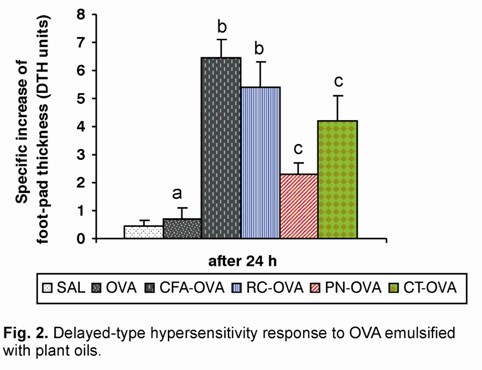
<p align="justify"><font size="2" face="Verdana, Arial, Helvetica, sans-serif"><strong>Stimulation  of ovalbumin-induced delayed type hypersensitivity by plant oils </strong></font></p>    <p align="justify"><font size="2" face="Verdana, Arial, Helvetica, sans-serif">To  investigate the adjuvant effect of the peanut, cottonseed and rice oils on cell-mediated  response, DTH testing was performed. Results presented in Figure 2 show that RC-OVA  stimulated an OVA-specific DTH response higher than OVA alone and similar to CFA-OVA.  The PN and CT oils increased the OVA-specific DTH reaction higher than OVA alone  and lower than that stimulated by CFA (<a href="/img/revistas/vac/v22n1/f0202113.jpg">Fig.  2</a>).</font></p>    
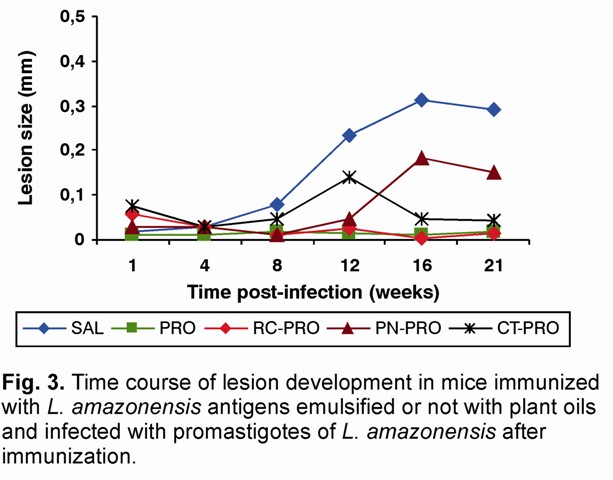
<p align="justify"><font size="2" face="Verdana, Arial, Helvetica, sans-serif"><strong>Effect  of plant oils on the immune response and protection against <i>L. amazonensis</i>  </strong></font></p>    <p align="justify"><font size="2" face="Verdana, Arial, Helvetica, sans-serif">The  adjuvant effect of the peanut, cottonseed and rice oils on the immune response  was also evaluated using <i>Leishmania</i> antigens (PRO) emulsified or not with  the studied oils. Non-immunized mice received equal volume of SAL. Figure 3 shows  that, whereas non-immunized mice developed lesions from the 8<sup>th</sup> weeks  after infection, mice subcutaneously immunized with <i>Leishmania</i> antigens  emulsified with PN oil started developing lesions only from the 12<sup>th</sup>  week post-infection. Furthermore, non-immunized mice as well as animals immunized  with <i>Leishmania</i> antigens emulsified with PN oil developed similar and progressive  lesions until the end of the experiment. Mice injected with <i>Leishmania</i>  antigens emulsified with CT oil started developing smaller lesions from the 8<sup>th</sup>  week post-infection that were controlled after the week 16<sup>th</sup>. </font></p>    <p align="justify"><font size="2" face="Verdana, Arial, Helvetica, sans-serif">The  vaccine of mice with <i>Leishmania </i>antigens alone as well as <i>Leishmania</i>  antigens emulsified with RC oil protected them from infection with alive promastigotes  (<a href="/img/revistas/vac/v22n1/f0302113.jpg">Fig. 3</a>). </font></p>    
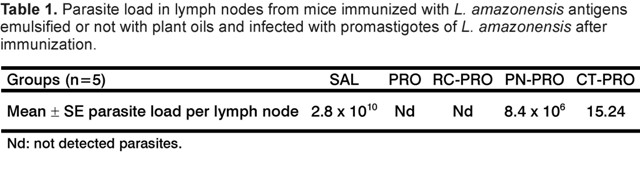
<p align="justify"><font size="2" face="Verdana, Arial, Helvetica, sans-serif">In  order to obtain a better evaluation of the studied oils on the protection against  <i>Leishmania</i>, the viable parasites were quantified in draining lymph nodes  of immunized and non-immunized mice using a limiting dilution assay, as previously  described (16). </font></p>    <p align="justify"><font size="2" face="Verdana, Arial, Helvetica, sans-serif">Table  1 shows that lymph nodes from non-immunized mice presented a higher parasite load  than lymph nodes from animals subcutaneously immunized with <i>Leishmania</i>  antigens emulsified with PN oil. The vaccination of mice with <i>Leishmania </i>antigens  alone as well as <i>Leishmania</i> antigens emulsified with RC oil presented negative  parasite loads (<a href="/img/revistas/vac/v22n1/t0102113.jpg">Table 1</a>).</font></p>    
]]></body>
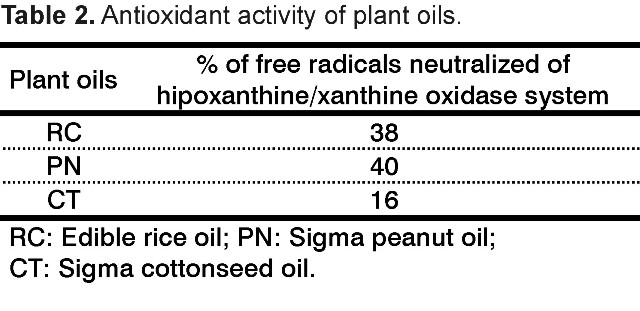
<body><![CDATA[<p align="left"><font size="2" face="Verdana, Arial, Helvetica, sans-serif"><strong>Evaluation  of antioxidant activity of plant oils</strong> </font></p>    <p align="justify"><font size="2" face="Verdana, Arial, Helvetica, sans-serif">The  antioxidant capacity of the peanut, cottonseed and rice oils is shown on the <a href="/img/revistas/vac/v22n1/t0202113.jpg">table  2</a>. The compounds extracted from the PN, RC, and CT oils neutralized 40, 38,  and 16% of reactive oxygen species (ROS) produced by the hypoxanthine/xanthine  oxidase system, respectively. </font></p>    
<p align="justify">&nbsp;</p>    <p align="justify"><font size="3" face="Verdana, Arial, Helvetica, sans-serif"><b>DISCUSSION</b>  </font></p>    <p align="justify"><font size="2" face="Verdana, Arial, Helvetica, sans-serif">In  the current study, we investigated the adjuvant effect of cottonseed, peanut and  rice oils on the humoral response and DTH reaction both induced by immunization  of <i>Swiss</i> mice with OVA, and also to the capacity of protecting against  murine experimental leishmaniasis after vaccination. </font></p>    <p align="justify"><font size="2" face="Verdana, Arial, Helvetica, sans-serif">The  peanut oil significantly elevated the synthesis of total anti-OVA antibodies already  in the primary response, but it did not favor cellular response. Moreover, mice  immunized with <i>L. amazonensis</i> antigens emulsified with peanut oil had exacerbated  skin lesions and lymph node parasite load compared to the immunized control animals.  These data suggest that peanut oil stimulated the Th2 immune response and down  regulated Th1 response. </font></p>    <p align="justify"><font size="2" face="Verdana, Arial, Helvetica, sans-serif">The  cottonseed oil was a good adjuvant to the humoral response, stimulating a secondary  response and being also capable to favor the DTH response to OVA. </font></p>    <p align="justify"><font size="2" face="Verdana, Arial, Helvetica, sans-serif">Regarding  to the rice oil it stimulated a strong DTH reaction to OVA and only enhanced the  synthesis of antibodies after the third dose. Also, mice immunized with <i>L.  amazonensis</i> antigens emulsified with rice oil or cottonseed oil were protected  from developing skin lesions and lymph node parasite load as were the animals  immunized with <i> L. amazonensis</i> antigens alone, suggesting that these oils  did not alter the protective immune response induced by <i> L. amazonensis</i>  antigens. In this work, the mechanism underlying the stimulation of the cellular  immune response by rice oil was not described but we postulate that rice oil may  act through its phenolic components, since it is the only one out of the studied  oils that contains phenolic compounds, known by their ability to enhance the immune  response (18). </font></p>    <p align="justify"><font size="2" face="Verdana, Arial, Helvetica, sans-serif">Despite  a significant humoral immune response stimulated by cottonseed, peanut and rice  oils, at no time were any lesions noted at the site of injection of emulsions  of these oils with antigens. This finding contrasts with the injection of IFA  and CFA, which are known to induce severe lesions at their site of injections  (1).</font></p>    <p align="justify"><font size="2" face="Verdana, Arial, Helvetica, sans-serif">Although  cottonseed, peanut and rice oils enhanced the antibody and cellular response to  OVA, our results do not identify the underlying mechanism. </font></p>    ]]></body>
<body><![CDATA[<p align="justify"><font size="2" face="Verdana, Arial, Helvetica, sans-serif">At  least two different pathways are possible. First, cottonseed, peanut and rice  oils may enhance the immune response by maintaining the antigen in the local of  injection, since emulsions made of OVA with those oils were stable from 3 to 10  minutes. As it is well known, the sustained release of antigen over a period of  time is necessary to stimulate the immune system and generate a high titer of  antibody, perhaps though attraction and retention of professional antigen-presenting  cells (6, 9). The second pathway may involve the regulation of the immune system  by linoleic and oleic acids, as it has been previously shown (19, 20). Accordingly,  peanut oil that contains 62.0% of oleic acid, it significantly stimulated the  primary antibody response to OVA. </font></p>    <p align="justify"><font size="2" face="Verdana, Arial, Helvetica, sans-serif">This  result reinforce the data from literature showing that emulsions made of oleic  acid plus diphiteric toxoid strongly increased the IgG levels to that toxoid (20).  An important advantage of using vegetable oils as immunological adjuvants is that  they have minimal adverse side-effects since they are easily metabolisable by  the organism (5). </font></p>    <p align="justify"><font size="2" face="Verdana, Arial, Helvetica, sans-serif">However,  we hypothesize that the metabolizing property of vegetable oils may influence  their ability to stimulate the primary immune response, as in our study cottonseed  and rice oils did not stimulated the primary immune response to OVA. This potential  disadvantage might be overcome by vegetable oils containing high levels of oleic  acid such as peanut oil that stimulated the primary antibody response to OVA.  </font></p>    <p align="justify"><font size="2" face="Verdana, Arial, Helvetica, sans-serif">The  variety of stimulated/regulated immune response by vegetable oil emulsions emphasizes  the interest and importance of these oils as tools in different procedures of  immunization and is a differential in relation to the other adjuvant under usage.  We would conclude that these vegetable oils are potent adjuvants in immune response  to OVA and apparently peanut oil down regulated the protective immune response  induced by <i>Leishmania</i> antigens. </font></p>    <p align="justify">&nbsp;</p>    <p align="justify"><font size="2" face="Verdana, Arial, Helvetica, sans-serif"><b>Acknowledgements  </b> </font></p>    <p align="justify"><font size="2" face="Verdana, Arial, Helvetica, sans-serif">This  work was supported by grants from CAPES, FUNCAP and CNPq. </font></p>    <p align="justify">&nbsp;</p>    <p align="justify"><font size="3" face="Verdana, Arial, Helvetica, sans-serif"><b>REFERENCES  </b> </font></p>    <!-- ref --><p align="justify"><font size="2" face="Verdana, Arial, Helvetica, sans-serif">1.  Gupta RK, Relyveld EH, Lindblad EB, Bizzini B, Ben-Efraim S, Gupta CK. Adjuvants-  a balance between toxicity and adjuvanticity. Vaccine 1993;11:293-306.     </font></p>    <!-- ref --><p align="justify"><font size="2" face="Verdana, Arial, Helvetica, sans-serif">2.  Sesardic D, Dobbelaer R. European Union regulatory developments for new vaccine  adjuvants and delivery systems. Vaccine 2004;22:2452-6.     </font></p>    <!-- ref --><p align="justify"><font size="2" face="Verdana, Arial, Helvetica, sans-serif">3.  Allison AC, Byars NE. Immunological adjuvants: Desirable properties and side-effects.  Mol Immunol 1991;28:279-84.     </font></p>    <!-- ref --><p align="justify"><font size="2" face="Verdana, Arial, Helvetica, sans-serif">4.  Sun JH. Research headway of immunopotentiator. Helongjiang Ani Hus Vet Med 1998;2(4):40-2.      </font></p>    <!-- ref --><p align="justify"><font size="2" face="Verdana, Arial, Helvetica, sans-serif">5.  Eghafona NO. Immune response following cocktails of inactived measles vaccine  and <i>Arachis hypogea</i> L. (groundnut) or <i>Cocos nucifera</i> L. oils adjuvant.  Vaccine 1996;14:1703-8.     </font></p>    <!-- ref --><p align="justify"><font size="2" face="Verdana, Arial, Helvetica, sans-serif">6.  Audibert F, Chedid L. Increase of immune response by administration of metabolizable  vegetable oil emulsions. CR Acad Sci Hebd Seances Acad Sci D 1975;280:1629-32.      </font></p>    <!-- ref --><p align="justify"><font size="2" face="Verdana, Arial, Helvetica, sans-serif">7.  Silva ACM. Estudo comparativo entre os efeitos imunoadjuvantes e inflamat&oacute;rios  dos &oacute;leos de oliva, milho e soja. [Thesis Doctoral]. Fortaleza, CE, Brazil:  Departamento de Bioqu&iacute;mica e Biologia Molecular, Universidade Federal do  Cear&aacute;; 2004.     </font></p>    <!-- ref --><p align="justify"><font size="2" face="Verdana, Arial, Helvetica, sans-serif">8.  Feij&oacute; DF. Efeito imunoadjuvante dos &oacute;leos de murici (<i>Byrsonima  crassifolia</i>), s&eacute;samo (<i>Sesamum indicum</i>), linha&ccedil;a (<i>Linum  usistatissimum</i>), canola (<i>Brassica sp</i>.) e da am&ecirc;ndoa de caju (<i>Anacardium  occidentale</i>). [Thesis Master]. Fortaleza, CE, Brazil: Departamento de Bioqu&iacute;mica  e Biologia Molecular, Universidade Federal do Cear&aacute;; 2005.     </font></p>    <!-- ref --><p align="justify"><font size="2" face="Verdana, Arial, Helvetica, sans-serif">9.  Sartor ITM, Colodel EM, Albuquerque D. Adjuvant activity of rice oil on the immune  response to ovalbumin. VacciMonitor 2011;20(2):1-5.     </font></p>    <!-- ref --><p align="justify"><font size="2" face="Verdana, Arial, Helvetica, sans-serif">10.  Verdolin BA, Ficker SM, Faria AMC, Vaz NM, Carvalho CR. Stabilization of serum  antibody responses triggered by initial mucosal contact with the antigen independently  of oral tolerance induction. Braz J Med Biol Res 2001;34:211-19.     </font></p>    <!-- ref --><p align="justify"><font size="2" face="Verdana, Arial, Helvetica, sans-serif">11.  Zimecki M, Kruzel ML. Systemic or local co-administration of lactoferrin with  sensitizing dose of antigen enhances delayed type hypersensitivity in mice. Immunol  Lett 2000;74:183-8.     </font></p>    <!-- ref --><p align="justify"><font size="2" face="Verdana, Arial, Helvetica, sans-serif">12.  De Luca PM, Mayrink W, Pinto J&Aacute;, Coutinho SG, Santiago MA, Toledo VP <i>et  al.</i> Randomized double-blind placebo-controlled trial to evaluate the immunogenicity  of a candidate vaccine against american tegumentary leishmaniasis. Acta Trop 2001;80:251-60.      </font></p>    <!-- ref --><p align="justify"><font size="2" face="Verdana, Arial, Helvetica, sans-serif">13.  Teixeira CR, Cavassani KA, Gomes RB, Teixeira MJ, Roque-Barreira MC, Cavada BS  <i>et al. </i>Potential of KM+ lectin in immunization against <i>Leishmania amazonensis  </i>infection. Vaccine 2006; 24:3001-8.     </font></p>    <!-- ref --><p align="justify"><font size="2" face="Verdana, Arial, Helvetica, sans-serif">14.  Lowry OH, Rosebrough NJ, Faar AL. Protein measurement with the Folin phenol reagent.  J Biol Chem 1951;193:265-75.     </font></p>    <!-- ref --><p align="justify"><font size="2" face="Verdana, Arial, Helvetica, sans-serif">15.  Titus RG, Ceredig R, Cerotinni JC, Louis JA. Therapeutic effect of anti-L3T4 monoclonal  antibody GK 1.5 on cutaneous leishmaniasis in genetically susceptible BALB/c mice.  J Immunol 1985;135:2108-14.     </font></p>    <!-- ref --><p align="justify"><font size="2" face="Verdana, Arial, Helvetica, sans-serif">16.  Taswell C. Limiting dilution assays for the determination of immunocompetent cell  frequencies III. Validity tests for the Single-hit Poisson model. J Immunol Methods  1984;72(1):29-40.     </font></p>    <!-- ref --><p align="justify"><font size="2" face="Verdana, Arial, Helvetica, sans-serif">17.  Owen RW, Giacosa A, Hull WE, Haubner R, Spiegelhader B, Bartsch H<i>.</i> The  antioxidant/anticancer potential of phenolic compounds isolated from olive oil.  Eur J Cancer 2000;36:1235-47.    </font></p>    <!-- ref --><p align="justify"><font size="2" face="Verdana, Arial, Helvetica, sans-serif">18.  Bendich A. Symposium: antioxidants, immune response, and animal function. Physiological  role of antioxidants in the immune system. Journal of Dairy Science 1993;76:2789-94.      </font></p>    <!-- ref --><p align="justify"><font size="2" face="Verdana, Arial, Helvetica, sans-serif">19.  Calder PC. Immunoregularory and anti-inflammatory effects of n-3 polyunsaturated  fatty acids. Braz J Med Biol Res 1998;31:467-90.     </font></p>    <!-- ref --><p align="justify"><font size="2" face="Verdana, Arial, Helvetica, sans-serif">20.  Sch&ouml;rder U, Svenson SB. Nasal and parenteral immunizations with diphteria  toxoid using monoglyceride/ fatty acid lipid suspensions as adjuvants. Vaccine  1999;17:2096-2103.     </font></p>    <p align="justify">&nbsp;</p>    ]]></body>
<body><![CDATA[<p align="justify">&nbsp;</p>    <p align="justify"><font size="2" face="Verdana">Recibido:  </font><font size="2" face="Verdana, Arial, Helvetica, sans-serif">Agosto de 2012</font><font size="2" face="Verdana">  <br /> Aceptado: Septiembre de 2012</font><br /> </p>      ]]></body><back>
<ref-list>
<ref id="B1">
<label>1</label><nlm-citation citation-type="journal">
<person-group person-group-type="author">
<name>
<surname><![CDATA[Gupta]]></surname>
<given-names><![CDATA[RK]]></given-names>
</name>
<name>
<surname><![CDATA[Relyveld]]></surname>
<given-names><![CDATA[EH]]></given-names>
</name>
<name>
<surname><![CDATA[Lindblad]]></surname>
<given-names><![CDATA[EB]]></given-names>
</name>
<name>
<surname><![CDATA[Bizzini]]></surname>
<given-names><![CDATA[B]]></given-names>
</name>
<name>
<surname><![CDATA[Ben-Efraim]]></surname>
<given-names><![CDATA[S]]></given-names>
</name>
<name>
<surname><![CDATA[Gupta]]></surname>
<given-names><![CDATA[CK]]></given-names>
</name>
</person-group>
<article-title xml:lang="en"><![CDATA[Adjuvants- a balance between toxicity and adjuvanticity]]></article-title>
<source><![CDATA[Vaccine]]></source>
<year>1993</year>
<volume>11</volume><volume>293-306</volume>
</nlm-citation>
</ref>
<ref id="B2">
<label>2</label><nlm-citation citation-type="journal">
<person-group person-group-type="author">
<name>
<surname><![CDATA[Sesardic]]></surname>
<given-names><![CDATA[D]]></given-names>
</name>
<name>
<surname><![CDATA[Dobbelaer]]></surname>
<given-names><![CDATA[R]]></given-names>
</name>
</person-group>
<article-title xml:lang="en"><![CDATA[European Union regulatory developments for new vaccine adjuvants and delivery systems]]></article-title>
<source><![CDATA[Vaccine]]></source>
<year>2004</year>
<volume>22</volume>
<page-range>2452-6</page-range></nlm-citation>
</ref>
<ref id="B3">
<label>3</label><nlm-citation citation-type="journal">
<person-group person-group-type="author">
<name>
<surname><![CDATA[Allison]]></surname>
<given-names><![CDATA[AC]]></given-names>
</name>
<name>
<surname><![CDATA[Byars]]></surname>
<given-names><![CDATA[NE]]></given-names>
</name>
</person-group>
<article-title xml:lang="en"><![CDATA[Immunological adjuvants: Desirable properties and side-effects]]></article-title>
<source><![CDATA[Mol Immunol]]></source>
<year>1991</year>
<volume>28</volume>
<page-range>279-84</page-range></nlm-citation>
</ref>
<ref id="B4">
<label>4</label><nlm-citation citation-type="journal">
<person-group person-group-type="author">
<name>
<surname><![CDATA[Sun]]></surname>
<given-names><![CDATA[JH]]></given-names>
</name>
</person-group>
<article-title xml:lang="en"><![CDATA[Research headway of immunopotentiator]]></article-title>
<source><![CDATA[Helongjiang Ani Hus Vet Med]]></source>
<year>1998</year>
<volume>2</volume>
<numero>4</numero>
<issue>4</issue>
<page-range>40-2</page-range></nlm-citation>
</ref>
<ref id="B5">
<label>5</label><nlm-citation citation-type="journal">
<person-group person-group-type="author">
<name>
<surname><![CDATA[Eghafona]]></surname>
<given-names><![CDATA[NO]]></given-names>
</name>
</person-group>
<article-title xml:lang="en"><![CDATA[Immune response following cocktails of inactived measles vaccine and Arachis hypogea L. (groundnut) or Cocos nucifera L. oils adjuvant]]></article-title>
<source><![CDATA[Vaccine]]></source>
<year>1996</year>
<volume>14</volume>
<page-range>1703-8</page-range></nlm-citation>
</ref>
<ref id="B6">
<label>6</label><nlm-citation citation-type="journal">
<person-group person-group-type="author">
<name>
<surname><![CDATA[Audibert]]></surname>
<given-names><![CDATA[F]]></given-names>
</name>
<name>
<surname><![CDATA[Chedid]]></surname>
<given-names><![CDATA[L]]></given-names>
</name>
</person-group>
<article-title xml:lang="en"><![CDATA[Increase of immune response by administration of metabolizable vegetable oil emulsions]]></article-title>
<source><![CDATA[CR Acad Sci Hebd Seances Acad Sci D]]></source>
<year>1975</year>
<volume>280</volume>
<page-range>1629-32</page-range></nlm-citation>
</ref>
<ref id="B7">
<label>7</label><nlm-citation citation-type="">
<person-group person-group-type="author">
<name>
<surname><![CDATA[Silva]]></surname>
<given-names><![CDATA[ACM]]></given-names>
</name>
</person-group>
<source><![CDATA[Estudo comparativo entre os efeitos imunoadjuvantes e inflamatórios dos óleos de oliva, milho e soja]]></source>
<year></year>
</nlm-citation>
</ref>
<ref id="B8">
<label>8</label><nlm-citation citation-type="">
<person-group person-group-type="author">
<name>
<surname><![CDATA[Feijó]]></surname>
<given-names><![CDATA[DF]]></given-names>
</name>
</person-group>
<source><![CDATA[Efeito imunoadjuvante dos óleos de murici (Byrsonima crassifolia), sésamo (Sesamum indicum),linhaça (Linum usistatissimum), canola (Brassica sp.) e da amêndoa de caju (Anacardium occidentale)]]></source>
<year></year>
</nlm-citation>
</ref>
<ref id="B9">
<label>9</label><nlm-citation citation-type="journal">
<person-group person-group-type="author">
<name>
<surname><![CDATA[Sartor]]></surname>
<given-names><![CDATA[ITM]]></given-names>
</name>
<name>
<surname><![CDATA[Colodel]]></surname>
<given-names><![CDATA[EM]]></given-names>
</name>
<name>
<surname><![CDATA[Albuquerque]]></surname>
<given-names><![CDATA[D]]></given-names>
</name>
</person-group>
<article-title xml:lang="en"><![CDATA[Adjuvant activity of rice oil on the immune response to ovalbumin]]></article-title>
<source><![CDATA[VacciMonitor]]></source>
<year>2011</year>
<volume>20</volume>
<numero>2</numero>
<issue>2</issue>
<page-range>1-5</page-range></nlm-citation>
</ref>
<ref id="B10">
<label>10</label><nlm-citation citation-type="journal">
<person-group person-group-type="author">
<name>
<surname><![CDATA[Verdolin]]></surname>
<given-names><![CDATA[BA]]></given-names>
</name>
<name>
<surname><![CDATA[Ficker]]></surname>
<given-names><![CDATA[SM]]></given-names>
</name>
<name>
<surname><![CDATA[Faria]]></surname>
<given-names><![CDATA[AMC]]></given-names>
</name>
<name>
<surname><![CDATA[Vaz]]></surname>
<given-names><![CDATA[NM]]></given-names>
</name>
<name>
<surname><![CDATA[Carvalho]]></surname>
<given-names><![CDATA[CR]]></given-names>
</name>
</person-group>
<article-title xml:lang="en"><![CDATA[Stabilization of serum antibody responses triggered by initial mucosal contact with the antigen independently of oral tolerance induction]]></article-title>
<source><![CDATA[Braz J Med Biol Res]]></source>
<year>2001</year>
<volume>34</volume>
<page-range>211-19</page-range></nlm-citation>
</ref>
<ref id="B11">
<label>11</label><nlm-citation citation-type="journal">
<person-group person-group-type="author">
<name>
<surname><![CDATA[Zimecki]]></surname>
<given-names><![CDATA[M]]></given-names>
</name>
<name>
<surname><![CDATA[Kruzel]]></surname>
<given-names><![CDATA[M L]]></given-names>
</name>
</person-group>
<article-title xml:lang="en"><![CDATA[Systemic or local co-administration of lactoferrin with sensitizing dose of antigen enhances delayed type hypersensitivity in mice]]></article-title>
<source><![CDATA[Immunol Lett]]></source>
<year>2000</year>
<volume>74</volume>
<page-range>183-8</page-range></nlm-citation>
</ref>
<ref id="B12">
<label>12</label><nlm-citation citation-type="journal">
<person-group person-group-type="author">
<name>
<surname><![CDATA[De Luca]]></surname>
<given-names><![CDATA[PM]]></given-names>
</name>
<name>
<surname><![CDATA[Mayrink]]></surname>
<given-names><![CDATA[W]]></given-names>
</name>
<name>
<surname><![CDATA[Pinto]]></surname>
<given-names><![CDATA[JÁ]]></given-names>
</name>
<name>
<surname><![CDATA[Coutinho]]></surname>
<given-names><![CDATA[SG]]></given-names>
</name>
<name>
<surname><![CDATA[Santiago]]></surname>
<given-names><![CDATA[MA]]></given-names>
</name>
<name>
<surname><![CDATA[Toledo]]></surname>
<given-names><![CDATA[VP]]></given-names>
</name>
</person-group>
<article-title xml:lang="en"><![CDATA[Randomized double-blind placebo-controlled trial to evaluate the immunogenicity of a candidate vaccine against american tegumentary leishmaniasis]]></article-title>
<source><![CDATA[Acta Trop]]></source>
<year>2001</year>
<volume>80</volume>
<page-range>251-60</page-range></nlm-citation>
</ref>
<ref id="B13">
<label>13</label><nlm-citation citation-type="journal">
<person-group person-group-type="author">
<name>
<surname><![CDATA[Teixeira]]></surname>
<given-names><![CDATA[CR]]></given-names>
</name>
<name>
<surname><![CDATA[Cavassani]]></surname>
<given-names><![CDATA[KA]]></given-names>
</name>
<name>
<surname><![CDATA[Gomes]]></surname>
<given-names><![CDATA[RB]]></given-names>
</name>
<name>
<surname><![CDATA[Teixeira]]></surname>
<given-names><![CDATA[MJ]]></given-names>
</name>
<name>
<surname><![CDATA[Roque-Barreira]]></surname>
<given-names><![CDATA[MC]]></given-names>
</name>
<name>
<surname><![CDATA[Cavada]]></surname>
<given-names><![CDATA[BS]]></given-names>
</name>
</person-group>
<article-title xml:lang="en"><![CDATA[Potential of KM+ lectin in immunization against Leishmania amazonensis infection]]></article-title>
<source><![CDATA[Vaccine]]></source>
<year>2006</year>
<volume>24</volume>
<page-range>3001-8</page-range></nlm-citation>
</ref>
<ref id="B14">
<label>14</label><nlm-citation citation-type="journal">
<person-group person-group-type="author">
<name>
<surname><![CDATA[Lowry]]></surname>
<given-names><![CDATA[OH]]></given-names>
</name>
<name>
<surname><![CDATA[Rosebrough]]></surname>
<given-names><![CDATA[NJ]]></given-names>
</name>
<name>
<surname><![CDATA[Faar]]></surname>
<given-names><![CDATA[AL]]></given-names>
</name>
</person-group>
<article-title xml:lang="en"><![CDATA[Protein measurement with the Folin phenol reagent]]></article-title>
<source><![CDATA[J Biol Chem]]></source>
<year>1951</year>
<volume>193</volume>
<page-range>265-75</page-range></nlm-citation>
</ref>
<ref id="B15">
<label>15</label><nlm-citation citation-type="journal">
<person-group person-group-type="author">
<name>
<surname><![CDATA[Titus]]></surname>
<given-names><![CDATA[RG]]></given-names>
</name>
<name>
<surname><![CDATA[Ceredig]]></surname>
<given-names><![CDATA[R]]></given-names>
</name>
<name>
<surname><![CDATA[Cerotinni]]></surname>
<given-names><![CDATA[JC]]></given-names>
</name>
<name>
<surname><![CDATA[Louis]]></surname>
<given-names><![CDATA[JA]]></given-names>
</name>
</person-group>
<article-title xml:lang="en"><![CDATA[Therapeutic effect of anti-L3T4 monoclonal antibody GK 1.5 on cutaneous leishmaniasis in genetically susceptible BALB/c mice]]></article-title>
<source><![CDATA[J Immunol]]></source>
<year>1985</year>
<volume>135</volume>
<page-range>2108-14</page-range></nlm-citation>
</ref>
<ref id="B16">
<label>16</label><nlm-citation citation-type="journal">
<person-group person-group-type="author">
<name>
<surname><![CDATA[Taswell]]></surname>
<given-names><![CDATA[C]]></given-names>
</name>
</person-group>
<article-title xml:lang="en"><![CDATA[Limiting dilution assays for the determination of immunocompetent cell frequencies III: Validity tests for the Single-hit Poisson model]]></article-title>
<source><![CDATA[J Immunol Methods]]></source>
<year>1984</year>
<volume>72</volume>
<numero>1</numero>
<issue>1</issue>
<page-range>29-40</page-range></nlm-citation>
</ref>
<ref id="B17">
<label>17</label><nlm-citation citation-type="journal">
<person-group person-group-type="author">
<name>
<surname><![CDATA[Owen]]></surname>
<given-names><![CDATA[RW]]></given-names>
</name>
<name>
<surname><![CDATA[Giacosa]]></surname>
<given-names><![CDATA[A]]></given-names>
</name>
<name>
<surname><![CDATA[Hull]]></surname>
<given-names><![CDATA[WE]]></given-names>
</name>
<name>
<surname><![CDATA[Haubner]]></surname>
<given-names><![CDATA[R]]></given-names>
</name>
<name>
<surname><![CDATA[Spiegelhader]]></surname>
<given-names><![CDATA[B]]></given-names>
</name>
<name>
<surname><![CDATA[Bartsch]]></surname>
<given-names><![CDATA[H]]></given-names>
</name>
</person-group>
<article-title xml:lang="en"><![CDATA[The antioxidant/anticancer potential of phenolic compounds isolated from olive oil]]></article-title>
<source><![CDATA[Eur J Cancer]]></source>
<year>2000</year>
<volume>36</volume>
<page-range>1235-47</page-range></nlm-citation>
</ref>
<ref id="B18">
<label>18</label><nlm-citation citation-type="journal">
<person-group person-group-type="author">
<name>
<surname><![CDATA[Bendich]]></surname>
<given-names><![CDATA[A]]></given-names>
</name>
</person-group>
<article-title xml:lang="en"><![CDATA[antioxidants, immune response, and animal function. Physiological role of antioxidants in the immune system]]></article-title>
<source><![CDATA[Journal of Dairy Science]]></source>
<year>1993</year>
<volume>76</volume>
<page-range>2789-94</page-range></nlm-citation>
</ref>
<ref id="B19">
<label>19</label><nlm-citation citation-type="journal">
<person-group person-group-type="author">
<name>
<surname><![CDATA[Calder]]></surname>
<given-names><![CDATA[PC]]></given-names>
</name>
</person-group>
<article-title xml:lang="en"><![CDATA[Immunoregularory and anti-inflammatory effects of n-3 polyunsaturated fatty acids]]></article-title>
<source><![CDATA[Braz J Med Biol Res]]></source>
<year>1998</year>
<volume>31</volume>
<page-range>467-90</page-range></nlm-citation>
</ref>
<ref id="B20">
<label>20</label><nlm-citation citation-type="journal">
<person-group person-group-type="author">
<name>
<surname><![CDATA[Schörder]]></surname>
<given-names><![CDATA[U]]></given-names>
</name>
<name>
<surname><![CDATA[Svenson]]></surname>
<given-names><![CDATA[SB]]></given-names>
</name>
</person-group>
<article-title xml:lang="en"><![CDATA[Nasal and parenteral immunizations with diphteria toxoid using monoglyceride/ fatty acid lipid suspensions as adjuvants]]></article-title>
<source><![CDATA[Vaccine]]></source>
<year>1999</year>
<volume>17</volume>
<page-range>2096-2103</page-range></nlm-citation>
</ref>
</ref-list>
</back>
</article>