<?xml version="1.0" encoding="ISO-8859-1"?><article xmlns:mml="http://www.w3.org/1998/Math/MathML" xmlns:xlink="http://www.w3.org/1999/xlink" xmlns:xsi="http://www.w3.org/2001/XMLSchema-instance">
<front>
<journal-meta>
<journal-id>1027-2852</journal-id>
<journal-title><![CDATA[Biotecnología Aplicada]]></journal-title>
<abbrev-journal-title><![CDATA[Biotecnol Apl]]></abbrev-journal-title>
<issn>1027-2852</issn>
<publisher>
<publisher-name><![CDATA[Editorial Elfos Scientiae]]></publisher-name>
</publisher>
</journal-meta>
<article-meta>
<article-id>S1027-28522009000100001</article-id>
<title-group>
<article-title xml:lang="en"><![CDATA[Complexity and solutions to the isolation problem of Gram negative lipopolysaccharides' bacteria molecular species]]></article-title>
<article-title xml:lang="es"><![CDATA[Complejidad y soluciones al problema de aislamiento de las especies moleculares de los lipopolisacáridos de las bacterias Gram negativas.]]></article-title>
</title-group>
<contrib-group>
<contrib contrib-type="author">
<name>
<surname><![CDATA[Pupo]]></surname>
<given-names><![CDATA[Elder]]></given-names>
</name>
<xref ref-type="aff" rid="A01"/>
</contrib>
<contrib contrib-type="author">
<name>
<surname><![CDATA[Hardy]]></surname>
<given-names><![CDATA[Eugenio]]></given-names>
</name>
<xref ref-type="aff" rid="A02"/>
</contrib>
</contrib-group>
<aff id="A02">
<institution><![CDATA[,Centro de Ingeniería Genética y Biotecnología División de Química-Física ]]></institution>
<addr-line><![CDATA[Ciudad de La Habana ]]></addr-line>
<country>Cuba</country>
</aff>
<aff id="A01">
<institution><![CDATA[,Universidad de La Habana Instituto de Ciencia y Tecnología de los Materiales Laboratorio de Polímeros]]></institution>
<addr-line><![CDATA[La Habana ]]></addr-line>
<country>Cuba</country>
</aff>
<pub-date pub-type="pub">
<day>00</day>
<month>03</month>
<year>2009</year>
</pub-date>
<pub-date pub-type="epub">
<day>00</day>
<month>03</month>
<year>2009</year>
</pub-date>
<volume>26</volume>
<numero>1</numero>
<fpage>9</fpage>
<lpage>15</lpage>
<copyright-statement/>
<copyright-year/>
<self-uri xlink:href="http://scielo.sld.cu/scielo.php?script=sci_arttext&amp;pid=S1027-28522009000100001&amp;lng=en&amp;nrm=iso"></self-uri><self-uri xlink:href="http://scielo.sld.cu/scielo.php?script=sci_abstract&amp;pid=S1027-28522009000100001&amp;lng=en&amp;nrm=iso"></self-uri><self-uri xlink:href="http://scielo.sld.cu/scielo.php?script=sci_pdf&amp;pid=S1027-28522009000100001&amp;lng=en&amp;nrm=iso"></self-uri><abstract abstract-type="short" xml:lang="en"><p><![CDATA[Gram negative bacteria frequently synthesize a great number of lipopolysaccharides (LPS) molecular species. The high LPS structural heterogeneity and its trend to conform molecular aggregates make the fraction of its molecular species extremely difficult. The application of chromatographic methods individually has allowed the obtainment of little homogeneous LPS fractions. With the combination of orthogonal chromatographic principles, only the purification of the simplest rough type LPS up to chemical homogeneity has been reached. This has determined that efforts aimed at more homogeneous LPS isolation is focused on the use of electrophoresis in slab gel. Electrophoresis methods are capable of separating species of similar molecular masses next to from the most complex smooth type LPS. Consequently upon this basis, a new methodology allowing the isolation of intact LPS of either rough or smooth types up to electrophoretic homogeneity has been developed. Under such methodology, sensible structural analysis through mass spectrometry and LAL (Limulus Amebocyte Lysate) activity of LPS individual species is feasible, composed of just a few chemical species. This methodology has proved the possible way of combining electrophoresis with other orthogonal separation principles, a further step which could guarantee the obtainment of chemically homogeneous preparations from complex LPS mixtures.]]></p></abstract>
<abstract abstract-type="short" xml:lang="es"><p><![CDATA[Las bacterias Gram negativas sintetizan de manera frecuente un gran número de especies moleculares de lipopolisacáridos (LPS). La elevada heterogeneidad estructural de los LPS y su tendencia a formar agregados moleculares hacen extremadamente difícil el fraccionamiento de sus especies moleculares. La aplicación de métodos cromatográficos de forma individual ha permitido la obtención de fracciones de LPS poco homogéneas. Con la combinación de principios cromatográficos ortogonales, solo se ha logrado la purificación hasta homogeneidad química de los LPS de tipo rugoso más simples. Ello ha determinado que los esfuerzos dirigidos al aislamiento de LPS más homogéneos se centren en el uso de la electroforesis en el gel plano. Los métodos de electroforesis son capaces de separar especies de masas moleculares cercanas de LPS más complejos de tipo liso. Consecuentemente, sobre esta base se ha desarrollado una nueva metodología que permite el aislamiento de LPS intactos de tipo rugoso o liso hasta homogeneidad electroforética. Con ella es posible el análisis estructural sensible por espectrometría de masas y la medición de la actividad LAL (Limulus Amoebocyte Lysate) de especies individuales de LPS, compuestas de unas pocas especies químicas. Esta metodología ha abierto las puertas hacia la posibilidad de combinar la electroforesis con otros principios ortogonales de separación, un próximo paso que podría facilitar la obtención de preparaciones químicamente homogéneas a partir de mezclas de LPS complejas.]]></p></abstract>
<kwd-group>
<kwd lng="en"><![CDATA[lipopolysaccharides]]></kwd>
<kwd lng="en"><![CDATA[isolation]]></kwd>
<kwd lng="en"><![CDATA[chromatography]]></kwd>
<kwd lng="en"><![CDATA[electrophoresis]]></kwd>
<kwd lng="en"><![CDATA[reverse staining]]></kwd>
<kwd lng="en"><![CDATA[elution]]></kwd>
<kwd lng="en"><![CDATA[mass spectrometr]]></kwd>
<kwd lng="es"><![CDATA[lipopolisacárido]]></kwd>
<kwd lng="es"><![CDATA[aislamiento]]></kwd>
<kwd lng="es"><![CDATA[cromatografía]]></kwd>
<kwd lng="es"><![CDATA[electroforesis]]></kwd>
<kwd lng="es"><![CDATA[tinción inversa]]></kwd>
<kwd lng="es"><![CDATA[elución]]></kwd>
<kwd lng="es"><![CDATA[espectrometría de masas]]></kwd>
</kwd-group>
</article-meta>
</front><body><![CDATA[ <div class=Section1>      <div>      <p align=right style='text-align:right'><b><span lang=EN-US style='font-size: 10.0pt;font-family:"Verdana","sans-serif"'>REVIEW </span></b></p>      <p align=right style='text-align:right'><span lang=EN-US>&nbsp;</span></p>      <p><b><span lang=EN-US style='font-size:13.5pt;font-family:"Verdana","sans-serif"; color:#211E1E'>Complexity and solutions to the isolation problem of Gram negative lipopolysaccharides' bacteria molecular species</span></b></p>      <p><span lang=EN-US>&nbsp;</span></p>      <p><b><span style='font-family:"Verdana","sans-serif";color:#211E1E'>Complejidad y soluciones al problema de aislamiento de las especies moleculares de los lipopolisacáridos de las bacterias Gram negativas.</span></b><span style='font-family:"Verdana","sans-serif"; color:#211E1E'> </span></p>      <p><span style='font-size:13.5pt;color:#211E1E'>&nbsp;</span></p>      <p><span style='font-size:13.5pt;color:#211E1E'>&nbsp;</span></p>      <p><b><span style='font-size:10.0pt;font-family:"Verdana","sans-serif"; color:#211E1E'>Elder Pupo<sup>1</sup>, Eugenio Hardy<sup>2</sup></span></b></p>      ]]></body>
<body><![CDATA[<p><sup><span style='font-size:10.0pt;font-family:"Verdana","sans-serif"; color:#211E1E'>1</span></sup><span style='font-size:10.0pt;font-family:"Verdana","sans-serif"; color:#211E1E'>Laboratorio de Polímeros, Instituto de Ciencia y Tecnología de los Materiales, Universidad de La Habana. Cuba<sup>    <br> 2</sup>División de Química-Física, Centro de Ingeniería Genética y Biotecnología, CIGB. Ave. 31 entre 158 y 190, Cubanacán, Playa, AP 6162, CP 10600, Ciudad de La Habana, Cuba</span><span style='font-size:11.0pt; font-family:"Arial","sans-serif";color:#FF6600'> </span></p>      <p><span style='font-size:13.5pt'>&nbsp;</span></p>      <p><span style='font-size:13.5pt'>&nbsp;</span></p>      <div class=MsoNormal align=center style='text-align:center'>  <hr size=2 width="100%" align=center>  </div>      <p><b><span lang=EN-US style='font-size:10.0pt;font-family:"Verdana","sans-serif"'>ABSTRACT </span></b></p>      <p><span lang=EN-US style='font-size:10.0pt;font-family:"Verdana","sans-serif"; color:#211E1E'>Gram negative bacteria frequently synthesize a great number of lipopolysaccharides </span><span lang=EN-US style='font-size:10.0pt;font-family: "Verdana","sans-serif";color:windowtext'>(</span><span lang=EN-US style='font-size:10.0pt;font-family:"Verdana","sans-serif";color:#211E1E'>LPS) molecular species. The high LPS structural heterogeneity and its trend to conform molecular aggregates make the fraction of its molecular species extremely difficult. The application of chromatographic methods individually has allowed the obtainment of little homogeneous LPS fractions. With the combination of orthogonal chromatographic principles, only the purification of the simplest rough type LPS up to chemical homogeneity has been reached. This has determined that efforts aimed at more homogeneous LPS isolation is focused on the use of electrophoresis in slab gel. Electrophoresis methods are capable of separating species of similar molecular masses next to from the most complex smooth type LPS. Consequently upon this basis, a new methodology allowing the isolation of intact LPS of either rough or smooth types up to electrophoretic homogeneity has been developed. Under such methodology, sensible structural analysis through mass spectrometry and LAL </span><span lang=EN-US style='font-size:10.0pt;font-family:"Verdana","sans-serif";color:windowtext'>(</span><i><span lang=EN-US style='font-size:10.0pt;font-family:"Verdana","sans-serif"; color:#211E1E'>Limulus Amebocyte Lysate</span></i><span lang=EN-US style='font-size:10.0pt;font-family:"Verdana","sans-serif";color:#211E1E'>) activity of LPS individual species is feasible, composed of just a few chemical species. This methodology has proved the possible way of combining electrophoresis with other orthogonal separation principles, a further step which could guarantee the obtainment of chemically homogeneous preparations from complex LPS mixtures.</span></p>      <p class=MsoNormal><b><span lang=EN-US style='font-size:10.0pt;font-family: "Verdana","sans-serif";color:#211E1E'>Keywords:</span></b><span lang=EN-US style='font-size:10.0pt;font-family:"Verdana","sans-serif";color:#211E1E'> lipopolysaccharides, isolation, chromatography, electrophoresis, reverse staining, elution, mass spectrometr.</span></p>      <div class=MsoNormal align=center style='text-align:center'>  <hr size=2 width="100%" align=center>  </div>      <p><b><span style='font-size:10.0pt;font-family:"Verdana","sans-serif"; color:#211E1E'>RESUMEN </span></b></p>      ]]></body>
<body><![CDATA[<p><span style='font-size:10.0pt;font-family:"Verdana","sans-serif";color:#211E1E'>Las bacterias Gram negativas sintetizan de manera frecuente un gran número de especies moleculares de lipopolisacáridos </span><span style='font-size:10.0pt; font-family:"Verdana","sans-serif";color:windowtext'>(</span><span style='font-size:10.0pt;font-family:"Verdana","sans-serif";color:#211E1E'>LPS). La elevada heterogeneidad estructural de los LPS y su tendencia a formar agregados moleculares hacen extremadamente difícil el fraccionamiento de sus especies moleculares. La aplicación de métodos cromatográficos de forma individual ha permitido la obtención de fracciones de LPS poco homogéneas. Con la combinación de principios cromatográficos ortogonales, solo se ha logrado la purificación hasta homogeneidad química de los LPS de tipo rugoso más simples. Ello ha determinado que los esfuerzos dirigidos al aislamiento de LPS más homogéneos se centren en el uso de la electroforesis en el gel plano. Los métodos de electroforesis son capaces de separar especies de masas moleculares cercanas de LPS más complejos de tipo liso. Consecuentemente, sobre esta base se ha desarrollado una nueva metodología que permite el aislamiento de LPS intactos de tipo rugoso o liso hasta homogeneidad electroforética. Con ella es posible el análisis estructural sensible por espectrometría de masas y la medición de la actividad LAL </span><span style='font-size:10.0pt;font-family: "Verdana","sans-serif";color:windowtext'>(</span><i><span style='font-size: 10.0pt;font-family:"Verdana","sans-serif";color:#211E1E'>Limulus Amoebocyte Lysate</span></i><span style='font-size:10.0pt;font-family:"Verdana","sans-serif"; color:#211E1E'>) de especies individuales de LPS, compuestas de unas pocas especies químicas. Esta metodología ha abierto las puertas hacia la posibilidad de combinar la electroforesis con otros principios ortogonales de separación, un próximo paso que podría facilitar la obtención de preparaciones químicamente homogéneas a partir de mezclas de LPS complejas. </span></p>      <p class=MsoNormal><b><span style='font-size:10.0pt;font-family:"Verdana","sans-serif"; color:#211E1E'>Palabras clave:</span></b><span style='font-size:10.0pt; font-family:"Verdana","sans-serif";color:#211E1E'> lipopolisacárido, aislamiento, cromatografía, electroforesis, tinción inversa, elución, espectrometría de masas.</span><span style='font-size:11.0pt;font-family:"Arial","sans-serif"; color:blue'> </span></p>      <div class=MsoNormal align=center style='text-align:center'>  <hr size=2 width="100%" align=center>  </div>      <p><span lang=EN-US style='font-size:13.5pt;color:#211E1E'>&nbsp;</span></p>      <p><span lang=EN-US style='font-size:13.5pt;color:#211E1E'>&nbsp;</span></p>      <p><b><span lang=EN-US style='font-family:"Verdana","sans-serif"'>INTRODUCTION</span></b></p>      <p><span lang=EN-US style='font-size:10.0pt;font-family:"Verdana","sans-serif"; color:#211E1E'>Lipopolysaccharides </span><span lang=EN-US style='font-size: 10.0pt;font-family:"Verdana","sans-serif";color:windowtext'>(</span><span lang=EN-US style='font-size:10.0pt;font-family:"Verdana","sans-serif"; color:#211E1E'>LPS), also called endotoxins, are major components of the Gram negative bacteria outer membrane. Generally, LPS are formed by a lipidic domain named lipid A which functions like an anchor at the outer membrane and is bound to an oligopolysaccharide extending towards the exterior part of the bacteria. A very same bacterial strain frequently synthesizes a great number of LPS molecular species. </span></p>      <p><span lang=EN-US style='font-size:10.0pt;font-family:"Verdana","sans-serif"; color:#211E1E'>LPS as integral components of the outer membrane fulfill essential functions for the bacteria and show a wide variety of both, immunological and biological activities in other organisms </span><span lang=EN-US style='font-size:10.0pt;font-family:"Verdana","sans-serif"; color:windowtext'>(</span><span lang=EN-US style='font-size:10.0pt;font-family: "Verdana","sans-serif";color:#211E1E'>1, 2). These glycolipids play a key role of mediators in the bacterial infection, sepsis, and septic shock </span><span lang=EN-US style='font-size:10.0pt;font-family:"Verdana","sans-serif"; color:windowtext'>(</span><span lang=EN-US style='font-size:10.0pt;font-family: "Verdana","sans-serif";color:#211E1E'>1, 2). LPS are considered targets, as these biomolecules and their synthetic derivates are used as antigens or adjuvants to provide vaccines against diverse pathogens </span><span lang=EN-US style='font-size:10.0pt;font-family:"Verdana","sans-serif"; color:windowtext'>(</span><span lang=EN-US style='font-size:10.0pt;font-family: "Verdana","sans-serif";color:#211E1E'>3-5). </span></p>      <p><span lang=EN-US style='font-size:10.0pt;font-family:"Verdana","sans-serif"; color:#211E1E'>In this review, several aspects of LPS molecular species separation are examined. First, the complexity of LPS mixtures synthesized by the bacteria is under discussion: the great amount of subspecies, the high number of chemical structures, and the differences in biological activity. Next, the need for the separation of subspecies for the improvement of LPS biochemical characterization is fundamented. Finally, an analysis on advances in the isolation of molecular species and problems arising from the methods used for such purpose is performed, from the point of view of the homogeneity of the preparations, its applicability to different LPS sources, and compatibility with standard methods for LPS biochemical analysis. </span></p>      <p><b><span lang=EN-US style='font-family:"Verdana","sans-serif";color:#211E1E'>STRUCTURAL HETEROGENEITY OF LIPOPOLYSACCHARIDES</span></b></p>          ]]></body>
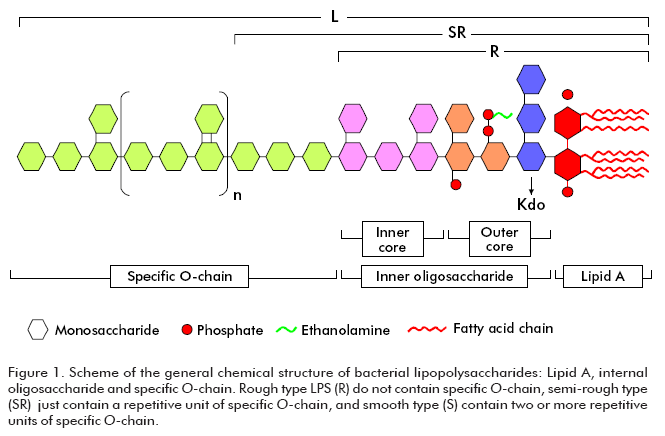
<body><![CDATA[<p><span lang=EN-US style='font-size:10.0pt;font-family:"Verdana","sans-serif"; color:#211E1E'>In general, LPS chemical structure </span><span lang=EN-US style='font-size:10.0pt;font-family:"Verdana","sans-serif";color:windowtext'>(</span><span style='font-size:10.0pt;font-family:"Verdana","sans-serif";color:#211E1E'><a href="/img/revistas/bta/v26n1/f0102109.gif"><span lang=EN-US>Figure 1</span></a></span><span lang=EN-US style='font-size:10.0pt;font-family:"Verdana","sans-serif"; color:#211E1E'>) comprises three regions: a lipid </span><span lang=EN-US style='font-size:10.0pt;font-family:"Verdana","sans-serif";color:windowtext'>(</span><span lang=EN-US style='font-size:10.0pt;font-family:"Verdana","sans-serif"; color:#211E1E'>called lipid A), an internal oligosaccharide bound to lipid A by        Kdo </span><span lang=EN-US style='font-size:10.0pt;font-family:"Verdana","sans-serif"; color:windowtext'>(</span><span lang=EN-US style='font-size:10.0pt;font-family: "Verdana","sans-serif";color:#211E1E'>3-deoxi-Dmanno- octulosonic acid) and specific        O-chain bound to the internal oligosaccharide. Specific O-chain, consisting        of a repeated sequence of just a few monosaccharides, presents a variable        polymerization degree. Consequently, some LPS do not contain specific O-chain        </span><span lang=EN-US style='font-size:10.0pt;font-family:"Verdana","sans-serif"; color:windowtext'>(</span><span lang=EN-US style='font-size:10.0pt;font-family: "Verdana","sans-serif";color:#211E1E'>known as rough type LPS), which only show        a single repetitive unit </span><span lang=EN-US style='font-size:10.0pt; font-family:"Verdana","sans-serif";color:windowtext'>(</span><span lang=EN-US style='font-size:10.0pt;font-family:"Verdana","sans-serif";color:#211E1E'>semi-rough        type; </span><span style='font-size:10.0pt;font-family:"Verdana","sans-serif"; color:#211E1E'><a href="/img/revistas/bta/v26n1/f0102109.gif"><span lang=EN-US>Figure        1</span></a></span><span lang=EN-US style='font-size:10.0pt;font-family:"Verdana","sans-serif"; color:#211E1E'>), and others showing several repetitive subunits in the specific        O-chain </span><span lang=EN-US style='font-size:10.0pt;font-family: "Verdana","sans-serif";color:windowtext'>(</span><span lang=EN-US style='font-size:10.0pt;font-family:"Verdana","sans-serif";color:#211E1E'>smooth        type). In spite of LPS having the biological activities associated to the        molecule lipidic region, the polysaccharide also plays a significant functional        role </span><span lang=EN-US style='font-size:10.0pt;font-family:"Verdana","sans-serif"; color:windowtext'>(</span><span lang=EN-US style='font-size:10.0pt;font-family: "Verdana","sans-serif";color:#211E1E'>7-10). </span></p>      
<p><span lang=EN-US style='font-size:10.0pt;font-family:"Verdana","sans-serif"; color:#211E1E'>It is fairly common that LPS produced by a bacterial strain differ in respect to: <i>i</i>) the number, nature, length, and the position of fatty acids from lipid A; <i>ii</i>) the replacement of phosphate groups and phosphorilation degree of lipid A; <i>iii</i>) length sequence, and oligopolysaccharide sugars; or <i>iv</i>) the replacement of the oligopolysaccharide with acetyl groups, phosphate and phosphorilethanolamine. As a result, the number of LPS molecular species synthesized by a bacterial strain is usually big. For example, the typical laddering pattern shown by smooth type LPS, through the electrophoresis technique of polyacrylamide gel in presence of dodecyl sodium phosphate </span><span lang=EN-US style='font-size: 10.0pt;font-family:"Verdana","sans-serif";color:windowtext'>(</span><span lang=EN-US style='font-size:10.0pt;font-family:"Verdana","sans-serif"; color:#211E1E'>SDS) or sodium deoxycholate </span><span lang=EN-US style='font-size:10.0pt;font-family:"Verdana","sans-serif";color:windowtext'>(</span><span lang=EN-US style='font-size:10.0pt;font-family:"Verdana","sans-serif"; color:#211E1E'>DOC), reveals multiple LPS populations with a different polymeration degree of specific O-chain </span><span lang=EN-US style='font-size:10.0pt;font-family:"Verdana","sans-serif";color:windowtext'>(</span><span style='font-size:10.0pt;font-family:"Verdana","sans-serif";color:#211E1E'><a href="#fig2"><span lang=EN-US><FIG2>Figure 2</span></a></span><span lang=EN-US style='font-size:10.0pt;font-family:"Verdana","sans-serif";color:#211E1E'>). In a new example, in a non-typable <i>Haemophilus influenzae </i>strain, 36 species of different oligosaccharide structures were identified </span><span lang=EN-US style='font-size:10.0pt;font-family:"Verdana","sans-serif"; color:windowtext'>(</span><span lang=EN-US style='font-size:10.0pt;font-family: "Verdana","sans-serif";color:#211E1E'>11).</span></p>      <p align=center style='text-align:center'><span style='font-size:13.5pt; color:#211E1E'><img border=0 width=408 height=612 src="/img/revistas/bta/v26n1/f0202109.gif"></span><a name=fig2></a></p>      
<p><span lang=EN-US style='font-size:10.0pt;font-family:"Verdana","sans-serif"; color:#211E1E'>LPS variants may also differ notably in their biological activity in <i>in vivo </i>and <i>in vitro </i>assays. Natural occurrence of variations in the chemical structure of lipid A, responsible for most LPS biological activity </span><span lang=EN-US style='font-size:10.0pt;font-family: "Verdana","sans-serif";color:windowtext'>(</span><span lang=EN-US style='font-size:10.0pt;font-family:"Verdana","sans-serif";color:#211E1E'>12) is supposed to induce remarkable differences among the biological activities of LPS molecular species. This may be inferred from the structure-function relations of lipid A which have been established in biological studies with lipid A obtained from natural sources or their synthetic structures </span><span lang=EN-US style='font-size:10.0pt;font-family:"Verdana","sans-serif"; color:windowtext'>(</span><span lang=EN-US style='font-size:10.0pt;font-family: "Verdana","sans-serif";color:#211E1E'>13-16). </span></p>      <p><span lang=EN-US style='font-size:10.0pt;font-family:"Verdana","sans-serif"; color:#211E1E'>Apart from the lipid A region, structural heterogeneity associated to the polysaccharidic-O-chain constitutes other variation source of biological activity for LPS species. For instance, the activation mechanism of macrophages or similar cells by smooth type LPS may be different from that of rough type LPS </span><span lang=EN-US style='font-size:10.0pt;font-family: "Verdana","sans-serif";color:windowtext'>(</span><span lang=EN-US style='font-size:10.0pt;font-family:"Verdana","sans-serif";color:#211E1E'>17). Both LPS show distinctive qualitative differences according to their interactions with the complement system and a different distribution in organs <i>in vivo</i>. While hepatic adsorption of smooth LPS from blood occurs in an exclusive manner by sinusoidal cells </span><span lang=EN-US style='font-size: 10.0pt;font-family:"Verdana","sans-serif";color:windowtext'>(</span><span lang=EN-US style='font-size:10.0pt;font-family:"Verdana","sans-serif"; color:#211E1E'>Kupffer cells); rough type LPS absorption occurs through the Kupffer cells themselves and hepatocytes </span><span lang=EN-US style='font-size:10.0pt;font-family:"Verdana","sans-serif";color:windowtext'>(</span><span lang=EN-US style='font-size:10.0pt;font-family:"Verdana","sans-serif"; color:#211E1E'>18). Smooth and rough type LPS interactions with the high density lipoprotein <i>in vivo </i>are also different. As a result, great amounts of smooth type LPS accumulate at the suprarenal glands, while the amounts of rough type LPS in this organ are insignificant </span><span lang=EN-US style='font-size:10.0pt;font-family:"Verdana","sans-serif"; color:windowtext'>(</span><span lang=EN-US style='font-size:10.0pt;font-family: "Verdana","sans-serif";color:#211E1E'>19). </span></p>      <p><span lang=EN-US style='font-size:10.0pt;font-family:"Verdana","sans-serif"; color:#211E1E'>The different LPS molecular forms may also differ in respect to the cell activation mechanism. In recent studies with wild type LPS strains and <i>Salmonella </i>and <i>Escherichia coli </i>mutants of rough phenotype, it was determined that rough type LPS easily activate the cells expressing the LPS signaling receptor, composed by the Toll-like receptor 4, and the myeloid differentiation protein 2 </span><span lang=EN-US style='font-size:10.0pt; font-family:"Verdana","sans-serif";color:windowtext'>(</span><span lang=EN-US style='font-size:10.0pt;font-family:"Verdana","sans-serif";color:#211E1E'>TLR4/MD-2). Smooth type LPS require LPS binding proteins </span><span lang=EN-US style='font-size:10.0pt;font-family:"Verdana","sans-serif";color:windowtext'>(</span><span lang=EN-US style='font-size:10.0pt;font-family:"Verdana","sans-serif"; color:#211E1E'>LBP and CD14) in order to activate this same receptor </span><span lang=EN-US style='font-size:10.0pt;font-family:"Verdana","sans-serif"; color:windowtext'>(</span><span lang=EN-US style='font-size:10.0pt;font-family: "Verdana","sans-serif";color:#211E1E'>20). This conclusion is derived from an <i>in vitro </i>LPS activation experiment of mastocytes not expressing the membrane protein CD14. Rough type LPS was a potent inducer of interleukin-6 and the tumor necrosis factor-</span><span style='font-size:10.0pt;font-family:"Verdana","sans-serif"; color:#211E1E'>&#945;</span><span lang=EN-US style='font-size:10.0pt; font-family:"Verdana","sans-serif";color:#211E1E'>; however, smooth type LPS lacked from enhancing activity </span><span lang=EN-US style='font-size:10.0pt; font-family:"Verdana","sans-serif";color:windowtext'>(</span><span lang=EN-US style='font-size:10.0pt;font-family:"Verdana","sans-serif";color:#211E1E'>20). As a result of this finding, it was determined in physiological conditions that rough type LPS activates a higher cell spectrum than smooth type LPS. In addition, as wild bacteria LPS </span><span lang=EN-US style='font-size:10.0pt; font-family:"Verdana","sans-serif";color:windowtext'>(</span><span lang=EN-US style='font-size:10.0pt;font-family:"Verdana","sans-serif";color:#211E1E'>smooth phenotype) also contain a fraction of rough type low molecular mass LPS; it is speculated that the contribution of rough type LPS to the immune response and the physiopathology of the infection provoked by Gram negative bacteria could be higher than the smooth type LPS forms </span><span lang=EN-US style='font-size:10.0pt;font-family:"Verdana","sans-serif";color:windowtext'>(</span><span lang=EN-US style='font-size:10.0pt;font-family:"Verdana","sans-serif"; color:#211E1E'>20). </span></p>      <p><b><span lang=EN-US style='font-family:"Verdana","sans-serif";color:#211E1E'>RELEVANCE OF SEPARATION METHODS FOR THE BIOCHEMICAL ANALYSIS OF LIPOPOLYSACCHARIDES</span></b></p>      <p><span lang=EN-US style='font-size:10.0pt;font-family:"Verdana","sans-serif"; color:#211E1E'>Facing a so complex LPS molecule nature demands the use of sophisticated analytical techniques and frequently of different biochemical methods for its structural characterization. Nuclear magnetic resonance and mass spectrometry </span><span lang=EN-US style='font-size:10.0pt;font-family: "Verdana","sans-serif";color:windowtext'>(</span><span lang=EN-US style='font-size:10.0pt;font-family:"Verdana","sans-serif";color:#211E1E'>MS) are complemented to determine the most representative LPS structures. However, analyses on LPS are usually being performed obtained in high scale-grown bacteria, as significant amounts are required. This hinders LPS characterization when such amounts are too scarce </span><span lang=EN-US style='font-size:10.0pt;font-family:"Verdana","sans-serif";color:windowtext'>(</span><i><span lang=EN-US style='font-size:10.0pt;font-family:"Verdana","sans-serif"; color:#211E1E'>e.g.</span></i><span lang=EN-US style='font-size:10.0pt; font-family:"Verdana","sans-serif";color:#211E1E'>, in direct samples taken from infected patients). LPS analyses of clinical samples, from bacterium grown in a culture medium undertakes the inconvenient that such biomolecules may vary its structure during cell culture, a kind of phenomenon called phase variation occurring due to the use of alternative oligopolysaccharides biosynthesis pathways </span><span lang=EN-US style='font-size:10.0pt;font-family:"Verdana","sans-serif"; color:windowtext'>(</span><span lang=EN-US style='font-size:10.0pt;font-family: "Verdana","sans-serif";color:#211E1E'>21). </span></p>      <p><span lang=EN-US style='font-size:10.0pt;font-family:"Verdana","sans-serif"; color:#211E1E'>The sensibility of LPS structural characterization methods has considerably increased right from the use of a separation technique, the O-desacylated LPS capillary electrophoresis, in combination with MS </span><span lang=EN-US style='font-size:10.0pt;font-family:"Verdana","sans-serif"; color:windowtext'>(</span><span lang=EN-US style='font-size:10.0pt;font-family: "Verdana","sans-serif";color:#211E1E'>22). This methodology has allowed the analysis of so small amounts of LPS as the ones expressed by a few bacterial colonies </span><span lang=EN-US style='font-size:10.0pt;font-family:"Verdana","sans-serif"; color:windowtext'>(</span><span lang=EN-US style='font-size:10.0pt;font-family: "Verdana","sans-serif";color:#211E1E'>23). </span></p>      <p><span lang=EN-US style='font-size:10.0pt;font-family:"Verdana","sans-serif"; color:#211E1E'>Nevertheless, the LPS structural characterization highest handicap is in its structure which is often inferred from the analysis of its fragments </span><span lang=EN-US style='font-size:10.0pt;font-family:"Verdana","sans-serif"; color:windowtext'>(</span><span lang=EN-US style='font-size:10.0pt;font-family: "Verdana","sans-serif";color:#211E1E'>O-desacylated LPS, lipid A, oligopolysaccharide), in different hydrolysis reactions. Due to certain hydrolysis conditions may also induce to the loss of replacement groups bound to the glycosidic skeleton, the full natural heterogeneity of these molecules cannot be established. </span></p>      ]]></body>
<body><![CDATA[<p><span lang=EN-US style='font-size:10.0pt;font-family:"Verdana","sans-serif"; color:#211E1E'>A solution to this problem lies in the direct structural analysis of intact LPS species. Plasma desorption MS, and further matrix-assisted laser desorption/ ionization time-of-flight MS </span><span lang=EN-US style='font-size:10.0pt;font-family:"Verdana","sans-serif"; color:windowtext'>(</span><span lang=EN-US style='font-size:10.0pt;font-family: "Verdana","sans-serif";color:#211E1E'>MALDITOFMS) has allowed the structural analysis of intact, low molecular mass rough type LPS molecules </span><span lang=EN-US style='font-size:10.0pt;font-family:"Verdana","sans-serif"; color:windowtext'>(</span><span lang=EN-US style='font-size:10.0pt;font-family: "Verdana","sans-serif";color:#211E1E'>24). However, the amphipathic nature and the high heterogeneity of smooth type LPS show a series of wide ion peaks too little resolved </span><span lang=EN-US style='font-size:10.0pt;font-family: "Verdana","sans-serif";color:windowtext'>(</span><span lang=EN-US style='font-size:10.0pt;font-family:"Verdana","sans-serif";color:#211E1E'>25, 26). It is only possible to know mass difference among the main components and elucidate the mass of specific O-chain repetitive unit starting from those spectra. The complex spectrum of smooth type LPS does not allow to obtain any kind of information on lipid A composition </span><span lang=EN-US style='font-size:10.0pt;font-family:"Verdana","sans-serif";color:windowtext'>(</span><span lang=EN-US style='font-size:10.0pt;font-family:"Verdana","sans-serif"; color:#211E1E'>12). Consequently, the determination of lipid A structural variability has not been possible; the most important LPS component from the biological point of view among the smooth type individual glycoforms. In very few studies, average differences among lipid A acylation patterns, from either long or short polysaccharidic chains of LPS species though with little resolution, have been known only after the fractioning of LPS mixtures </span><span lang=EN-US style='font-size:10.0pt;font-family:"Verdana","sans-serif"; color:windowtext'>(</span><span lang=EN-US style='font-size:10.0pt;font-family: "Verdana","sans-serif";color:#211E1E'>27, 28). For instance, the analysis by plasma desorption MS of two chromatographic fractions, yet heterogeneous, of low molecular mass </span><span lang=EN-US style='font-size:10.0pt;font-family: "Verdana","sans-serif";color:windowtext'>(</span><span lang=EN-US style='font-size:10.0pt;font-family:"Verdana","sans-serif";color:#211E1E'>rough type) and high molecular mass </span><span lang=EN-US style='font-size:10.0pt; font-family:"Verdana","sans-serif";color:windowtext'>(</span><span lang=EN-US style='font-size:10.0pt;font-family:"Verdana","sans-serif";color:#211E1E'>smooth type) LPS of <i>E. coli </i>097, showed that rough type LPS fraction is found tetra-acylated while the smooth type is found hexaacylated </span><span lang=EN-US style='font-size:10.0pt;font-family:"Verdana","sans-serif"; color:windowtext'>(</span><span lang=EN-US style='font-size:10.0pt;font-family: "Verdana","sans-serif";color:#211E1E'>28). In a different study, smooth type LPS from <i>Salmonella abortus equi </i>has a lesser acylation degree than the rough type fraction </span><span lang=EN-US style='font-size:10.0pt;font-family: "Verdana","sans-serif";color:windowtext'>(</span><span lang=EN-US style='font-size:10.0pt;font-family:"Verdana","sans-serif";color:#211E1E'>27). All the above proves that the use of high resolution separation methods preserving LPS chemical integrity and its combination with the most sensitive structural analysis techniques </span><span lang=EN-US style='font-size:10.0pt; font-family:"Verdana","sans-serif";color:windowtext'>(</span><i><span lang=EN-US style='font-size:10.0pt;font-family:"Verdana","sans-serif"; color:#211E1E'>e.g.</span></i><span lang=EN-US style='font-size:10.0pt; font-family:"Verdana","sans-serif";color:#211E1E'>, MALDITOF-MS, ESI-MS) may contribute to a wider knowledge on the native chemical structure of these biomolecules. </span></p>      <p><span lang=EN-US style='font-size:10.0pt;font-family:"Verdana","sans-serif"; color:#211E1E'>Huge difficulty to separate LPS has provoked that so far, most biological studies of LPS isolated from natural sources have defined the biological activities of these glycolipids from heterogeneous preparations. In very few cases, fully homogeneous preparations, such as LPS <i>Re </i>type from <i>Rhodobacter sphaeroides </i></span><span lang=EN-US style='font-size:10.0pt; font-family:"Verdana","sans-serif";color:windowtext'>(</span><span lang=EN-US style='font-size:10.0pt;font-family:"Verdana","sans-serif";color:#211E1E'>29), have been used. As a result, in most studies, the direct biological activity of different LPS molecular species have not been possibly assessed, nor derived the precise relations between the structure and function of these biomolecules. Hence, the development of methods allowing the isolation of LPS individual glycoforms up to homogeneity is a ruling objective, as it may notably contribute to the determination of the biological properties of these macromolecules. </span></p>      <p><b><span lang=EN-US style='font-family:"Verdana","sans-serif";color:#211E1E'>SOLUTIONS FOR THE ISOLATION OF LIPOPOLYSACCHARIDE MOLECULAR SPECIES</span></b></p>      <p><span lang=EN-US style='font-size:10.0pt;font-family:"Verdana","sans-serif"; color:#211E1E'>LPS fractioning in their molecular species at semipreparative or preparative scale is extremely difficult due to their high heterogeneity and trend to form molecular aggregates. The presence of lipidic structures, both polar and ionic in LPS make these glycoconjugates be very amphipathic and little soluble in water or most organic solvents </span><span lang=EN-US style='font-size:10.0pt;font-family:"Verdana","sans-serif";color:windowtext'>(</span><span lang=EN-US style='font-size:10.0pt;font-family:"Verdana","sans-serif"; color:#211E1E'>6). For instance, smooth type LPS critical aggregation concentration of <i>E. coli </i>0111:B4, <i>E, coli </i>055:B5, <i>S. abortus equi, Salmonella typhimurium </i>and <i>Serratia marcescens </i>were found between 10 and 38 mg LPS/mL </span><span lang=EN-US style='font-size:10.0pt; font-family:"Verdana","sans-serif";color:windowtext'>(</span><span lang=EN-US style='font-size:10.0pt;font-family:"Verdana","sans-serif";color:#211E1E'>30). LPS aggregation also produces big and polydisperse multimolecular entities of molecular mass between 10<sup>5</sup> and 10<sup>6</sup> Da </span><span lang=EN-US style='font-size:10.0pt;font-family:"Verdana","sans-serif"; color:windowtext'>(</span><span lang=EN-US style='font-size:10.0pt;font-family: "Verdana","sans-serif";color:#211E1E'>31, 32). Consequently, LPS separation under diverse principles has been combined with methods allowing its disaggregation. </span></p>      <p><span lang=EN-US style='font-size:10.0pt;font-family:"Verdana","sans-serif"; color:#211E1E'>Afterwards, diverse LPS isolation methods are analyzed and described; as a lot of emphasis is made on the performance of the following parameters: <i>i</i>) LPS purity; <i>ii</i>) preservation of the molecule chemical integrity; <i>iii</i>) applicability to diverse LPS sources; and <i>iv</i>) compatibility with biological and structural LPS characterization methods. </span></p>      <p><b><span lang=EN-US style='font-size:10.0pt;font-family:"Verdana","sans-serif"; color:#211E1E'>Liquid-liquid extraction</span></b><span lang=EN-US style='font-size:10.0pt;font-family:"Verdana","sans-serif";color:#211E1E'> </span></p>      <p><span lang=EN-US style='font-size:10.0pt;font-family:"Verdana","sans-serif"; color:#211E1E'>At least 18 different methods for bacterial LPS extraction have at least been described. Among them: the hot phenol-water </span><span lang=EN-US style='font-size:10.0pt;font-family:"Verdana","sans-serif"; color:windowtext'>(</span><span lang=EN-US style='font-size:10.0pt;font-family: "Verdana","sans-serif";color:#211E1E'>33), phenol-chloroform-petroleum ether </span><span lang=EN-US style='font-size:10.0pt;font-family:"Verdana","sans-serif"; color:windowtext'>(</span><span lang=EN-US style='font-size:10.0pt;font-family: "Verdana","sans-serif";color:#211E1E'>34), and the Hitchcock-Brown methods stand as the mostly used, including the extraction with SDS and digestion with proteinase K </span><span lang=EN-US style='font-size:10.0pt;font-family:"Verdana","sans-serif"; color:windowtext'>(</span><span lang=EN-US style='font-size:10.0pt;font-family: "Verdana","sans-serif";color:#211E1E'>35). The result of the application of these methods lies on LPS separation of other biomolecule types </span><span lang=EN-US style='font-size:10.0pt;font-family:"Verdana","sans-serif"; color:windowtext'>(</span><i><span lang=EN-US style='font-size:10.0pt; font-family:"Verdana","sans-serif";color:#211E1E'>e.g.</span></i><span lang=EN-US style='font-size:10.0pt;font-family:"Verdana","sans-serif"; color:#211E1E'>, proteins, DNA) conforming the microorganism. Generally, obtained preparations are highly heterogeneous in terms of LPS molecular species, but relatively pure regarding the content of proteic contaminants, DNA and phospholipids. As an initial purification stage, liquid-liquid extraction is useful, as it facilitates the further separation of LPS molecular species through the use of other techniques. </span></p>      <p><b><span lang=EN-US style='font-size:10.0pt;font-family:"Verdana","sans-serif"; color:#211E1E'>Liquid chromatography </span></b></p>      <p><span lang=EN-US style='font-size:10.0pt;font-family:"Verdana","sans-serif"; color:#211E1E'>Several chromatographic methods for the separation of LPS species have been used: countercurrent chromatography </span><span lang=EN-US style='font-size:10.0pt;font-family:"Verdana","sans-serif";color:windowtext'>(</span><span lang=EN-US style='font-size:10.0pt;font-family:"Verdana","sans-serif"; color:#211E1E'>36), gel filtration, ionic exchange </span><span lang=EN-US style='font-size:10.0pt;font-family:"Verdana","sans-serif";color:windowtext'>(</span><span lang=EN-US style='font-size:10.0pt;font-family:"Verdana","sans-serif"; color:#211E1E'>38), hydrophobic interactions </span><span lang=EN-US style='font-size:10.0pt;font-family:"Verdana","sans-serif";color:windowtext'>(</span><span lang=EN-US style='font-size:10.0pt;font-family:"Verdana","sans-serif"; color:#211E1E'>39) using silica gel </span><span lang=EN-US style='font-size: 10.0pt;font-family:"Verdana","sans-serif";color:windowtext'>(</span><span lang=EN-US style='font-size:10.0pt;font-family:"Verdana","sans-serif"; color:#211E1E'>40), hydroxyapatite </span><span lang=EN-US style='font-size: 10.0pt;font-family:"Verdana","sans-serif";color:windowtext'>(</span><span lang=EN-US style='font-size:10.0pt;font-family:"Verdana","sans-serif"; color:#211E1E'>41), and reverse phase </span><span lang=EN-US style='font-size: 10.0pt;font-family:"Verdana","sans-serif";color:windowtext'>(</span><span lang=EN-US style='font-size:10.0pt;font-family:"Verdana","sans-serif"; color:#211E1E'>42, 43). Despite the existing variety of separation principles in which they are based, they generally produce nonhomogeneous LPS fractions. </span></p>      <p><span lang=EN-US style='font-size:10.0pt;font-family:"Verdana","sans-serif"; color:#211E1E'>For example, countercurrent chromatography, based on the differential partition of smooth and rough LPS between the organic and aqueous phase, is the one which has been used to fractionate LPS from wildtype strains of <i>S. enterica</i>, <i>S. serovars abortus equi </i>and <i>Salmonella friedenau </i>and <i>Citrobacter freundii. </i>The two fractions contain various LPS species of long polysaccharidic chain or not containing specific Ochain </span><span lang=EN-US style='font-size:10.0pt;font-family:"Verdana","sans-serif"; color:windowtext'>(</span><span lang=EN-US style='font-size:10.0pt;font-family: "Verdana","sans-serif";color:#211E1E'>36). On the other side, gel filtration chromatography Sephadex G-200, or Sepharose 4B in presence of SDS or DOC, which has been much used for LPS separation according to molecular mass, generally produces between two and three lipopolysaccharide heterogeneous fractions </span><span lang=EN-US style='font-size:10.0pt;font-family:"Verdana","sans-serif"; color:windowtext'>(</span><span lang=EN-US style='font-size:10.0pt;font-family: "Verdana","sans-serif";color:#211E1E'>37). </span></p>      ]]></body>
<body><![CDATA[<p><span lang=EN-US style='font-size:10.0pt;font-family:"Verdana","sans-serif"; color:#211E1E'>Hydrophobic interaction chromatography in octylsepharose gels, of adsorption in silica gel or in hydroxyapatite gels, were used in slab type LPS separation of <i>S. typhimurium </i>and <i>S. abortus equi; Yersinia enterocolitica </i>O:11,17, <i>E. coli </i>O97 and <i>S. typhimurium </i>LT2; or from various <i>Bordetella pertussis </i>strains, respectively. LPS separated into two types of fractions containing smooth and rough types of LPS populations </span><span lang=EN-US style='font-size:10.0pt;font-family:"Verdana","sans-serif"; color:windowtext'>(</span><span lang=EN-US style='font-size:10.0pt;font-family: "Verdana","sans-serif";color:#211E1E'>28, 39, 40). </span></p>      <p><span lang=EN-US style='font-size:10.0pt;font-family:"Verdana","sans-serif"; color:#211E1E'>Ionic exchange chromatography in tertiary amine anionic exchangers </span><span lang=EN-US style='font-size:10.0pt;font-family:"Verdana","sans-serif"; color:windowtext'>(</span><i><span lang=EN-US style='font-size:10.0pt; font-family:"Verdana","sans-serif";color:#211E1E'>e.g.</span></i><span lang=EN-US style='font-size:10.0pt;font-family:"Verdana","sans-serif"; color:#211E1E'>, Amberlite XE 220 resin) has been used to separate native LPS </span><span lang=EN-US style='font-size:10.0pt;font-family:"Verdana","sans-serif"; color:windowtext'>(</span><span lang=EN-US style='font-size:10.0pt;font-family: "Verdana","sans-serif";color:#211E1E'>38). Although obtained fractions had different demonstrated biological and structural properties, purity could not be demonstrated </span><span lang=EN-US style='font-size:10.0pt;font-family: "Verdana","sans-serif";color:windowtext'>(</span><i><span lang=EN-US style='font-size:10.0pt;font-family:"Verdana","sans-serif";color:#211E1E'>e.g. </span></i><span lang=EN-US style='font-size:10.0pt;font-family:"Verdana","sans-serif"; color:#211E1E'>through a higher LPS separation power method, as SDS-PAGE). This chromatographic method has also the inconvenient of using a strong alkaline elution agent, capable of modifying LPS properties and not allowing the recover of some of the LPS fractions from the chromatographic column due to the very high affinity by the resin. </span></p>      <p><span lang=EN-US style='font-size:10.0pt;font-family:"Verdana","sans-serif"; color:#211E1E'>High-resolution reverse phase liquid chromatography </span><span lang=EN-US style='font-size:10.0pt;font-family:"Verdana","sans-serif"; color:windowtext'>(</span><span lang=EN-US style='font-size:10.0pt;font-family: "Verdana","sans-serif";color:#211E1E'>RP-HPLC) has been used to purify LPS from <i>Klebsiella pneumonae </i>O1 K2 homogenates. Through this method, a protein-free but heterogeneous LPS preparation was obtained, with the same biological properties than the one extracted with the hot phenolwater method </span><span lang=EN-US style='font-size:10.0pt;font-family:"Verdana","sans-serif"; color:windowtext'>(</span><span lang=EN-US style='font-size:10.0pt;font-family: "Verdana","sans-serif";color:#211E1E'>41). </span></p>      <p><span lang=EN-US style='font-size:10.0pt;font-family:"Verdana","sans-serif"; color:#211E1E'>Thin layer chromatography </span><span lang=EN-US style='font-size:10.0pt;font-family:"Verdana","sans-serif";color:windowtext'>(</span><span lang=EN-US style='font-size:10.0pt;font-family:"Verdana","sans-serif"; color:#211E1E'>TLC) is one of the simplest and fastest methods used for the separation of glycolipids. This has been recently used for the direct micro extraction and analysis of rough type native LPS through MALDI-MS </span><span lang=EN-US style='font-size:10.0pt;font-family:"Verdana","sans-serif"; color:windowtext'>(</span><span lang=EN-US style='font-size:10.0pt;font-family: "Verdana","sans-serif";color:#211E1E'>44). However, TLC has a very limited resolution for native LPS, and has proved only been useful in the partial separation of LPS species of low molecular mass and little complexity. Difficulties in LPS extraction of TLC plates due to the contamination of these with silica gel and a low LPS recovery have also been found </span><span lang=EN-US style='font-size:10.0pt;font-family:"Verdana","sans-serif"; color:windowtext'>(</span><span lang=EN-US style='font-size:10.0pt;font-family: "Verdana","sans-serif";color:#211E1E'>45). </span></p>      <p><span lang=EN-US style='font-size:10.0pt;font-family:"Verdana","sans-serif"; color:#211E1E'>Summarizing, completely homogeneous preparations have not been reached with any of the chromatographic methods been used individually for the purification of LPS molecular species. This conclusion has suggested that, perhaps, the combination of various orthogonal principles could be needed in order to be able to separate the different LPS heterogeneities </span><span lang=EN-US style='font-size:10.0pt;font-family:"Verdana","sans-serif"; color:windowtext'>(</span><i><span lang=EN-US style='font-size:10.0pt; font-family:"Verdana","sans-serif";color:#211E1E'>e.g.</span></i><span lang=EN-US style='font-size:10.0pt;font-family:"Verdana","sans-serif"; color:#211E1E'>,electric charge, hydrophobicity, molecular size). </span></p>      <p><span lang=EN-US style='font-size:10.0pt;font-family:"Verdana","sans-serif"; color:#211E1E'>Such idea has been demonstrated with the purification up to homogeneity of the simplest LPS </span><span lang=EN-US style='font-size:10.0pt; font-family:"Verdana","sans-serif";color:windowtext'>(</span><i><span lang=EN-US style='font-size:10.0pt;font-family:"Verdana","sans-serif"; color:#211E1E'>Re </span></i><span lang=EN-US style='font-size:10.0pt; font-family:"Verdana","sans-serif";color:#211E1E'>type, consisting in lipid A bound to two units of Kdo) of <i>E. coli </i>D31m4, by combining ion-exchange chromatography and RP-HPLC </span><span lang=EN-US style='font-size:10.0pt; font-family:"Verdana","sans-serif";color:windowtext'>(</span><span lang=EN-US style='font-size:10.0pt;font-family:"Verdana","sans-serif";color:#211E1E'>46). LPS extracted from the rough mutant <i>Re </i>from <i>E. coli </i>D31m4, was disaggregated with 0.1 M EDTA and fractioned in a diethylaminoethyl-cellulose. The biphosphorylated form of the lipopolysaccharide was obtained at this chromatographic step, separated from the phospholipids and other charged LPS forms. In order to separate the majoritary hexacylated form from others present in this preparation, as the pentacylated one, a RPHPLC </span><span lang=EN-US style='font-size:10.0pt;font-family:"Verdana","sans-serif";color:windowtext'>(</span><span lang=EN-US style='font-size:10.0pt;font-family:"Verdana","sans-serif"; color:#211E1E'>C18) was performed. Native glycolipids were separated in this new chromatography with the use of tetrabutylammonium salt, an LPS disaggregating agent. When it was analyzed by MS, purified LPS proved fully homogeneous. In spite, this result evidenced for the first time that it is possible to isolate LPS to homogeneity, the purification procedure was only applied to the simplest LPS, <i>Re </i>type, and has not successfully been used in the separation of other more complex LPS types </span><span lang=EN-US style='font-size:10.0pt;font-family:"Verdana","sans-serif";color:windowtext'>(</span><i><span lang=EN-US style='font-size:10.0pt;font-family:"Verdana","sans-serif"; color:#211E1E'>e.g.</span></i><span lang=EN-US style='font-size:10.0pt; font-family:"Verdana","sans-serif";color:#211E1E'>, smooth type LPS). </span></p>      <p><b><span lang=EN-US style='font-size:10.0pt;font-family:"Verdana","sans-serif"; color:#211E1E'>Electrophoresis </span></b></p>      <p><b><i><span lang=EN-US style='font-size:10.0pt;font-family:"Verdana","sans-serif"; color:#211E1E'>Capillary electrophoresis </span></i></b></p>      <p><span lang=EN-US style='font-size:10.0pt;font-family:"Verdana","sans-serif"; color:#211E1E'>For the structural LPS characterization, one of the modern separation methods widely used is capillary electrophoresis in combination with MS </span><span lang=EN-US style='font-size:10.0pt;font-family:"Verdana","sans-serif"; color:windowtext'>(</span><span lang=EN-US style='font-size:10.0pt;font-family: "Verdana","sans-serif";color:#211E1E'>22, 47). Separation through capillary electrophoresis resolves very efficiently O-desacylated rough type LPS species. </span></p>      <p><span lang=EN-US style='font-size:10.0pt;font-family:"Verdana","sans-serif"; color:#211E1E'>For instance, it allows the separation of glycoforms that differ only in just a phosphate group </span><span lang=EN-US style='font-size:10.0pt; font-family:"Verdana","sans-serif";color:windowtext'>(</span><span lang=EN-US style='font-size:10.0pt;font-family:"Verdana","sans-serif";color:#211E1E'>48). When connected in line with MS, ESI-MS is a structural analysis method of a very high resolution and sensitivity </span><span lang=EN-US style='font-size: 10.0pt;font-family:"Verdana","sans-serif";color:windowtext'>(</span><span lang=EN-US style='font-size:10.0pt;font-family:"Verdana","sans-serif"; color:#211E1E'>48, 49). However, this technique is limited by the release of some proportions of phosphate groups and phosphoethanolamine during LPS O-desacylation with alkaline media </span><span lang=EN-US style='font-size: 10.0pt;font-family:"Verdana","sans-serif";color:windowtext'>(</span><span lang=EN-US style='font-size:10.0pt;font-family:"Verdana","sans-serif"; color:#211E1E'>50, 51). Thus, a non-natural LPS heterogeneity is introduced, which structure is more difficult to be analyzed. </span></p>      ]]></body>
<body><![CDATA[<p><span lang=EN-US style='font-size:10.0pt;font-family:"Verdana","sans-serif"; color:#211E1E'>Intact LPS, though, has not successfully been separated or completely analyzed equally through capillary electrophoresis because LPS is too little soluble in the buffer solutions used in this technique. On the other hand, the separation of native smooth type LPS in presence of detergent </span><span lang=EN-US style='font-size:10.0pt;font-family:"Verdana","sans-serif"; color:windowtext'>(</span><i><span lang=EN-US style='font-size:10.0pt; font-family:"Verdana","sans-serif";color:#211E1E'>e.g.</span></i><span lang=EN-US style='font-size:10.0pt;font-family:"Verdana","sans-serif"; color:#211E1E'>, SDS) shows low resolution </span><span lang=EN-US style='font-size:10.0pt;font-family:"Verdana","sans-serif";color:windowtext'>(</span><span lang=EN-US style='font-size:10.0pt;font-family:"Verdana","sans-serif"; color:#211E1E'>52). Capillary electrophoresis has not been used for the isolation of native LPS; either its characterization in biological activity assays. </span></p>      <p><b><i><span lang=EN-US style='font-size:10.0pt;font-family:"Verdana","sans-serif"; color:#211E1E'>Electrophoresis in polyacrylamide gel of cylindrical format in presence of detergents </span></i></b></p>      <p><span lang=EN-US style='font-size:10.0pt;font-family:"Verdana","sans-serif"; color:#211E1E'>Preparative DOC-PAGE electrophoresis of cylindrical format has successfully been used for the separation of different LPS glycoforms of various microorganisms with a high purity </span><span lang=EN-US style='font-size:10.0pt;font-family:"Verdana","sans-serif";color:windowtext'>(</span><span lang=EN-US style='font-size:10.0pt;font-family:"Verdana","sans-serif"; color:#211E1E'>53, 54). Apart from the different LPS types </span><span lang=EN-US style='font-size:10.0pt;font-family:"Verdana","sans-serif"; color:windowtext'>(</span><span lang=EN-US style='font-size:10.0pt;font-family: "Verdana","sans-serif";color:#211E1E'>rough, semi-rough and smooth) diverse LPS species of different molecular sizes of smooth or semi-smooth types are separated </span><span lang=EN-US style='font-size:10.0pt;font-family:"Verdana","sans-serif"; color:windowtext'>(</span><span lang=EN-US style='font-size:10.0pt;font-family: "Verdana","sans-serif";color:#211E1E'>53). However, the usefulness of this format for the biological and structural characterization of individual LPS species has not been fully demonstrated yet. In fact, purified individual species were mixed again in heterogeneous fractions </span><span lang=EN-US style='font-size:10.0pt;font-family:"Verdana","sans-serif";color:windowtext'>(</span><span lang=EN-US style='font-size:10.0pt;font-family:"Verdana","sans-serif"; color:#211E1E'>rough or smooth types) in order to determine their monosaccharide composition </span><span lang=EN-US style='font-size:10.0pt; font-family:"Verdana","sans-serif";color:windowtext'>(</span><span lang=EN-US style='font-size:10.0pt;font-family:"Verdana","sans-serif";color:#211E1E'>54). This technique disadvantageously lacks of a method for in line detection of electroeluted LPS. Consequently, LPS fractioning is difficult and imprecise, and may eventually provoke the mixing of LPS species which have priorly been separated in the gel. On the other side, LPS elutes in presence of detergents and salts interfering with the further analysis of these molecules by biological assays or MS. </span></p>      <p><b><i><span lang=EN-US style='font-size:10.0pt;font-family:"Verdana","sans-serif"; color:#211E1E'>Electrophoresis in slab-polyacrylamide gel in presence of detergents </span></i></b></p>      <p><span lang=EN-US style='font-size:10.0pt;font-family:"Verdana","sans-serif"; color:#211E1E'>Systematic studies on LPS molecule separation by slabpolyacrylamide gel electrophoresis </span><span lang=EN-US style='font-size:10.0pt;font-family: "Verdana","sans-serif";color:windowtext'>(</span><span lang=EN-US style='font-size:10.0pt;font-family:"Verdana","sans-serif";color:#211E1E'>slab-PAGE), performed through the use of LPS chemotypes characterized in chemical terms </span><span lang=EN-US style='font-size:10.0pt;font-family:"Verdana","sans-serif"; color:windowtext'>(</span><i><span lang=EN-US style='font-size:10.0pt; font-family:"Verdana","sans-serif";color:#211E1E'>e</span></i><span lang=EN-US style='font-size:10.0pt;font-family:"Verdana","sans-serif";color:#211E1E'>.<i>g</i>., <i>Salmonella </i></span><span lang=EN-US style='font-size:10.0pt;font-family: "Verdana","sans-serif";color:windowtext'>(</span><span lang=EN-US style='font-size:10.0pt;font-family:"Verdana","sans-serif";color:#211E1E'>35)), showed how differences in LPS separation profiles detected with silver </span><span lang=EN-US style='font-size:10.0pt;font-family:"Verdana","sans-serif"; color:windowtext'>(</span><span lang=EN-US style='font-size:10.0pt;font-family: "Verdana","sans-serif";color:#211E1E'>55) correlated with the differences in chemical structures among LPS. In fact, smooth type glycolipids, only differing in O-chain sugar components separated themselves in a laddering differential pattern </span><span lang=EN-US style='font-size:10.0pt;font-family:"Verdana","sans-serif"; color:windowtext'>(</span><span lang=EN-US style='font-size:10.0pt;font-family: "Verdana","sans-serif";color:#211E1E'>35). Likewise, LPS band mobility of the highest migration of bacterial mutant chemotypes </span><span lang=EN-US style='font-size:10.0pt;font-family:"Verdana","sans-serif";color:windowtext'>(</span><i><span lang=EN-US style='font-size:10.0pt;font-family:"Verdana","sans-serif"; color:#211E1E'>Rd</span></i><span lang=EN-US style='font-size:10.0pt; font-family:"Verdana","sans-serif";color:#211E1E'>, <i>Rc</i>, <i>Rb </i>and <i>Ra</i>) increases while the inner oligosaccharide shortens </span><span lang=EN-US style='font-size:10.0pt;font-family:"Verdana","sans-serif";color:windowtext'>(</span><span lang=EN-US style='font-size:10.0pt;font-family:"Verdana","sans-serif"; color:#211E1E'>35). On the other hand, inconsistencies in separation </span><span lang=EN-US style='font-size:10.0pt;font-family:"Verdana","sans-serif"; color:windowtext'>(</span><span lang=EN-US style='font-size:10.0pt;font-family: "Verdana","sans-serif";color:#211E1E'>like the diffuse, low migration speed, doublet shaped bands produced as a result of the incomplete dissociation of LPS aggregates during electrophoresis) have resolved by electrophoresis of the gel before separation or by increasing SDS concentration in it </span><span lang=EN-US style='font-size:10.0pt;font-family:"Verdana","sans-serif"; color:windowtext'>(</span><span lang=EN-US style='font-size:10.0pt;font-family: "Verdana","sans-serif";color:#211E1E'>56). In order to solve this problem, SDS was replaced with sodium desoxycolate, which dissociated with higher efficiency LPS multimers and generated well solved smooth and rough type LPS patterns </span><span lang=EN-US style='font-size:10.0pt;font-family:"Verdana","sans-serif"; color:windowtext'>(</span><span lang=EN-US style='font-size:10.0pt;font-family: "Verdana","sans-serif";color:#211E1E'>57). A higher LPS resolution can also be obtained in slab-SDS-PAGE through a change in the conventional buffer system to tricine </span><span lang=EN-US style='font-size:10.0pt;font-family:"Verdana","sans-serif"; color:windowtext'>(</span><span lang=EN-US style='font-size:10.0pt;font-family: "Verdana","sans-serif";color:#211E1E'>58), or the use of polyacrylamide concentration gradient gels </span><span lang=EN-US style='font-size:10.0pt; font-family:"Verdana","sans-serif";color:windowtext'>(</span><span lang=EN-US style='font-size:10.0pt;font-family:"Verdana","sans-serif";color:#211E1E'>59). Therefore, there are very effective methods to dissociate LPS mixtures in their monomers and separate, in a reproducible way, LPS native species with a high resolution through slab-PAGE. </span></p>      <p><span lang=EN-US style='font-size:10.0pt;font-family:"Verdana","sans-serif"; color:#211E1E'>However, it is important to notice that slab-PAGE technique had not been used in an extended form with preparative purposes until recent times because the most conventional and sensible of all methods for visualizing separate in gel LPS silver staining </span><span lang=EN-US style='font-size: 10.0pt;font-family:"Verdana","sans-serif";color:windowtext'>(</span><span lang=EN-US style='font-size:10.0pt;font-family:"Verdana","sans-serif"; color:#211E1E'>55) originates the chemical modification and irreversible fixation of these macromolecules into the gel. This has conspired against individual LPS glycoforms’ recovery. As a consequence, localization and scission of LPS bands have had to be done in a very imprecise manner by sectioning unstained gels in two or three LPS band regions and its further comparison with other silverstained gels run in parallel. In general, the result continued showing much heterogeneity in the recuperated LPS fractions of slab-PAGE </span><span lang=EN-US style='font-size:10.0pt;font-family:"Verdana","sans-serif"; color:windowtext'>(</span><span lang=EN-US style='font-size:10.0pt;font-family: "Verdana","sans-serif";color:#211E1E'>42, 60, 61). </span></p>      <p><span lang=EN-US style='font-size:10.0pt;font-family:"Verdana","sans-serif"; color:#211E1E'>Preparative LPS separation by slab-PAGE is difficult due to: <i>i</i>) a high number of fractions should be recuperated from the gel </span><span lang=EN-US style='font-size:10.0pt;font-family:"Verdana","sans-serif"; color:windowtext'>(</span><i><span lang=EN-US style='font-size:10.0pt; font-family:"Verdana","sans-serif";color:#211E1E'>e.g.</span></i><span lang=EN-US style='font-size:10.0pt;font-family:"Verdana","sans-serif"; color:#211E1E'>, generally more than 10 for smooth type LPS); <i>ii</i>) high precision is needed to locate and divide the separated LPS bands, so as to avoid LPS fractions mixture that were previously resolved in the gel; <i>iii</i>) High LPS recuperation efficiency is demanded allowing to obtain enough quantities of minoritary LPS species for its evaluation in standard biological assays; <i>iv</i>) LPS should be recuperated from the gel without modifying their biological properties; and <i>v</i>) recuperated LPS from the gel should be free from detergents or salts associated to electrophoresis or elution; avoiding these chemicals could interfere in further LPS biological analyses. </span></p>          <p><span lang=EN-US style='font-size:10.0pt;font-family:"Verdana","sans-serif"; color:#211E1E'>Recently, at first stage, to overcome most obstacles, a sensitive        and non-destructive reverse staining method of the LPS separated in gel        was researched and established </span><span lang=EN-US style='font-size: 10.0pt;font-family:"Verdana","sans-serif";color:windowtext'>(</span><span lang=EN-US style='font-size:10.0pt;font-family:"Verdana","sans-serif"; color:#211E1E'>43, 62, 63). At the second stage, it was known that individual        LPS bands could diffuse in a fast and efficient way in a 5% triethylamine        solution when extruded until producing gel microparticles of an average        size 32 mm </span><span lang=EN-US style='font-size:10.0pt;font-family:"Verdana","sans-serif"; color:windowtext'>(</span><span lang=EN-US style='font-size:10.0pt;font-family: "Verdana","sans-serif";color:#211E1E'>64). Based on such principles, a new isolation        methodology was established combining the separation in slab gel polyacrylamide,        reverse staining, extrusion, and passive elution, to isolate to electrophoretic        homogeneity microgram amounts of LPS individual species, starting from complex        LPS mixtures of smooth or rough types </span><span lang=EN-US style='font-size:10.0pt;font-family:"Verdana","sans-serif"; color:windowtext'>(</span><span style='font-size:10.0pt;font-family:"Verdana","sans-serif"; color:#211E1E'><a href="/img/revistas/bta/v26n1/f0302109.gif"><span lang=EN-US>Figure        3</span></a></span><span lang=EN-US style='font-size:10.0pt;font-family:"Verdana","sans-serif"; color:#211E1E'>) </span><span lang=EN-US style='font-size:10.0pt;font-family: "Verdana","sans-serif";color:windowtext'>(</span><span lang=EN-US style='font-size:10.0pt;font-family:"Verdana","sans-serif";color:#211E1E'>65-67).        </span></p>      
<p><span lang=EN-US style='font-size:10.0pt;font-family:"Verdana","sans-serif"; color:#211E1E'>The amounts of obtained fractions from the two LPS sources </span><span lang=EN-US style='font-size:10.0pt;font-family:"Verdana","sans-serif"; color:windowtext'>(</span><i><span lang=EN-US style='font-size:10.0pt; font-family:"Verdana","sans-serif";color:#211E1E'>Vibrio fischeri </span></i><span lang=EN-US style='font-size:10.0pt;font-family:"Verdana","sans-serif"; color:#211E1E'>HMK strain, and <i>H.influenzae Rd</i>) were enough for its structural analysis by MS either ESI or MALDI-TOF types </span><span lang=EN-US style='font-size:10.0pt;font-family:"Verdana","sans-serif"; color:windowtext'>(</span><span lang=EN-US style='font-size:10.0pt;font-family: "Verdana","sans-serif";color:#211E1E'>65, 66). For the first time, it was possible to demonstrate the relative abundance and structure characteristics of molecular species contained in each slab-PAGE band </span><span lang=EN-US style='font-size:10.0pt;font-family:"Verdana","sans-serif";color:windowtext'>(</span><i><span lang=EN-US style='font-size:10.0pt;font-family:"Verdana","sans-serif"; color:#211E1E'>e.g.</span></i><span lang=EN-US style='font-size:10.0pt; font-family:"Verdana","sans-serif";color:#211E1E'>, the exact molecular mass, the oligosaccharidic sequence by ESI-MS or ESI-MS/MS, and lipid A phosphorylation status, the exact molecular mass of their intact oligosaccharides by ESI-MS or ESI-MS/MS or their O-desacylated by MALDITOF-MS). These analyses confirmed that the isolation method did not alter LPS chemical integrity </span><span lang=EN-US style='font-size:10.0pt;font-family:"Verdana","sans-serif"; color:windowtext'>(</span><span lang=EN-US style='font-size:10.0pt;font-family: "Verdana","sans-serif";color:#211E1E'>65, 66). This is the first time that separation with high resolution of LPS by slab- PAGE corresponded with the LPS structural analysis carried out by MS, which represents a significant improvement towards the direct correlation of chemical and biological assays. </span></p>      <p><span lang=EN-US style='font-size:10.0pt;font-family:"Verdana","sans-serif"; color:#211E1E'>This isolation method does not modify biochemical properties </span><span lang=EN-US style='font-size:10.0pt;font-family:"Verdana","sans-serif"; color:windowtext'>(</span><i><span lang=EN-US style='font-size:10.0pt; font-family:"Verdana","sans-serif";color:#211E1E'>e.g.</span></i><span lang=EN-US style='font-size:10.0pt;font-family:"Verdana","sans-serif"; color:#211E1E'>, TNF-</span><span style='font-size:10.0pt;font-family:"Verdana","sans-serif"; color:#211E1E'>&#945;</span><span lang=EN-US style='font-size:10.0pt; font-family:"Verdana","sans-serif";color:#211E1E'> induction) of these biomolecules </span><span lang=EN-US style='font-size:10.0pt;font-family:"Verdana","sans-serif"; color:windowtext'>(</span><span lang=EN-US style='font-size:10.0pt;font-family: "Verdana","sans-serif";color:#211E1E'>63). Moreover, purified quantities of fifteen smooth type LPS individual species of <i>E. coli </i>K-235 </span><span lang=EN-US style='font-size:10.0pt;font-family:"Verdana","sans-serif"; color:windowtext'>(</span><span lang=EN-US style='font-size:10.0pt;font-family: "Verdana","sans-serif";color:#211E1E'>from 280 ng and 411 ng) were enough to quantify its activity at the LAL assay </span><span lang=EN-US style='font-size:10.0pt;font-family:"Verdana","sans-serif";color:windowtext'>(</span><span lang=EN-US style='font-size:10.0pt;font-family:"Verdana","sans-serif"; color:#211E1E'>67). For the first time, the LAL activity from smooth type LPS species was possible to be determined with a high level of electrophoretic homogeneity. Now that LPS molecules, in the amounts obtained by this methodology, are powerful inducers of diverse biological responses </span><span lang=EN-US style='font-size:10.0pt;font-family:"Verdana","sans-serif"; color:windowtext'>(</span><i><span lang=EN-US style='font-size:10.0pt; font-family:"Verdana","sans-serif";color:#211E1E'>e.g., </span></i><span lang=EN-US style='font-size:10.0pt;font-family:"Verdana","sans-serif"; color:#211E1E'>induction of cells to produce TNF-</span><span style='font-size: 10.0pt;font-family:"Verdana","sans-serif";color:#211E1E'>&#945;</span><span lang=EN-US style='font-size:10.0pt;font-family:"Verdana","sans-serif"; color:#211E1E'> or nitric oxide <i>in vitro</i>, or lethal toxicity in mice sensitized with D-galactosamine <i>in vivo</i>), we look forward to using this method also for the analyses of LPS individual species in other biological assays. </span></p>      ]]></body>
<body><![CDATA[<p><span lang=EN-US style='font-size:10.0pt;font-family:"Verdana","sans-serif"; color:#211E1E'>This methodology owns several advantages compared to other methods for the separation of complex LPS molecular species. For the first time, the joint of smooth type LPS individual bands resolved by electrophoresis in a slab-polyacrylamide gel in presence of DOC </span><span lang=EN-US style='font-size:10.0pt;font-family:"Verdana","sans-serif";color:windowtext'>(</span><span lang=EN-US style='font-size:10.0pt;font-family:"Verdana","sans-serif"; color:#211E1E'>DOC-slab-PAGE) have been isolated up to electrophoretic homogeneity </span><span lang=EN-US style='font-size:10.0pt;font-family:"Verdana","sans-serif"; color:windowtext'>(</span><span lang=EN-US style='font-size:10.0pt;font-family: "Verdana","sans-serif";color:#211E1E'>67). Prior than this, the pattern of separated bands by electrophoresis in slab-polyacrylamide gel had been fractioned through scission in two or three regions from an unstained gel </span><span lang=EN-US style='font-size:10.0pt;font-family:"Verdana","sans-serif"; color:windowtext'>(</span><span lang=EN-US style='font-size:10.0pt;font-family: "Verdana","sans-serif";color:#211E1E'>59, 60). Though this method proved to be useful to separate rough type LPS fractions from smooth type LPS, it did not allow the precise fractioning of individual LPS bands. Logically, at the time of reanalyzing purified LPS fractions through electrophoresis, several species appeared </span><span lang=EN-US style='font-size:10.0pt;font-family:"Verdana","sans-serif"; color:windowtext'>(</span><span lang=EN-US style='font-size:10.0pt;font-family: "Verdana","sans-serif";color:#211E1E'>59, 60). Compared to the preparative DOC-PAGE method of cylindrical format, the isolation methodology based on separation by electrophoresis in smooth gel polyacrylamide also owns the advantage of providing a more precise detection and isolation of LPS individual species </span><span lang=EN-US style='font-size:10.0pt;font-family:"Verdana","sans-serif"; color:windowtext'>(</span><span lang=EN-US style='font-size:10.0pt;font-family: "Verdana","sans-serif";color:#211E1E'>51, 52). Besides, differently from the DOC-PAGE technique in cylindrical format, salts and detergents associated to electrophoresis are washed in the gel matrix before LPS elutes, and recovered fractions are released from these contaminants. The separation of LPS fractions based on DOC-lectrophoresis in slab-polyacrylamide gels offer several advantages upon other chromatographic methods which have been used to separate the whole LPS pattern </span><span lang=EN-US style='font-size:10.0pt; font-family:"Verdana","sans-serif";color:windowtext'>(</span><span lang=EN-US style='font-size:10.0pt;font-family:"Verdana","sans-serif";color:#211E1E'>36-42, 68). These include a higher resolution, combined with a higher reproducibility at lower costs. </span></p>      <p><span lang=EN-US style='font-size:10.0pt;font-family:"Verdana","sans-serif"; color:#211E1E'>Although fractions obtained through the methodology based on electrophoresis in slab-polyacrylamide gel show a high electrophoretic homogeneity, being completely homogeneous in terms of molecular species is not expected </span><span lang=EN-US style='font-size:10.0pt;font-family:"Verdana","sans-serif"; color:windowtext'>(</span><span lang=EN-US style='font-size:10.0pt;font-family: "Verdana","sans-serif";color:#211E1E'>55, 65, 66). The analysis by MS of individual LPS fractions allowed detecting micro-heterogeneities that are below slab-PAGE resolution </span><span lang=EN-US style='font-size:10.0pt; font-family:"Verdana","sans-serif";color:windowtext'>(</span><span lang=EN-US style='font-size:10.0pt;font-family:"Verdana","sans-serif";color:#211E1E'>65, 66). Mass spectra of the fraction with a lower LPS molecular mass of <i>V. fischeri </i>HMK, and the fractions of lower and higher molecular mass of <i>H. influenzae </i>LPS <i>Rd</i>, showed various molecular species </span><span lang=EN-US style='font-size:10.0pt;font-family:"Verdana","sans-serif"; color:windowtext'>(</span><span lang=EN-US style='font-size:10.0pt;font-family: "Verdana","sans-serif";color:#211E1E'>65, 66). At the time of correlating in an indirect way LPS band patterns generated by slab-polyacrylamide gel electrophoresis with mass spectra from LPS species </span><span lang=EN-US style='font-size: 10.0pt;font-family:"Verdana","sans-serif";color:windowtext'>(</span><span lang=EN-US style='font-size:10.0pt;font-family:"Verdana","sans-serif"; color:#211E1E'>24, 69-71), it was confirmed that slab-PAGE is not, in an ordinary form, capable of solving small structural differences among the LPS species, like the presence of absence of low molecular weight replacement groups such as residues of ethanolamine, phosphates, or acetyl groups bound to the poly oligosaccharide skeleton or lipid A, nor LPS of close molecular masses resulting from the addition of a fatty acid to lipid A can be resolved. So, the next step towards the isolation of LPS molecular species up to chemical homogeneity level from complex mixtures of these glycolipids would probably need of other orthogonal separation principles </span><span lang=EN-US style='font-size:10.0pt;font-family:"Verdana","sans-serif";color:windowtext'>(</span><i><span lang=EN-US style='font-size:10.0pt;font-family:"Verdana","sans-serif"; color:#211E1E'>e.g.</span></i><span lang=EN-US style='font-size:10.0pt; font-family:"Verdana","sans-serif";color:#211E1E'>, ionic exchange chromatography and RP-HPLC) in combination with slabpolyacrylamide gel electrophoresis. </span></p>      <p><span lang=EN-US style='font-size:10.0pt;font-family:"Verdana","sans-serif"; color:#211E1E'>Nevertheless, the exhaustive application of the isolation methodology of LPS individual species based on slab-polyacrylamide gel electrophoresis, combined with the simultaneous analysis of individual fractions by MS and biological assays may bring a new form of obtaining, in a more precise manner, information on chemical and functional heterogeneity, and the structure-function relations of LPS complex mixtures. These studies will have an important impact in the comprehension of LPS biosynthesis process and the role of these biomolecules in the physiopathology of bacterial infection, sepsis, and septic shock. </span></p>      <p><b><span lang=EN-US style='font-family:"Verdana","sans-serif";color:#211E1E'>CONCLUSIONS</span></b></p>      <p><span lang=EN-US style='font-size:10.0pt;font-family:"Verdana","sans-serif"; color:#211E1E'>High structural heterogeneity of LPS and its amphipathic character makes the isolation of its molecular species extremely complex. Various methods have been applied for the purification of lipopolysaccharides with unsatisfactory results; yet in some of the following evaluation parameters: <i>i</i>) chemical homogeneity of LPS preparations; <i>ii</i>) preservation of the molecule’s chemical integrity; <i>iii</i>) applicability to diverse LPS sources; and <i>iv</i>) compatibility with structural and biological LPS characterization methods. LPS separation in a single chromatographic step has not led to the obtainment of LPS fractions of an adequate homogeneity. Even in its combined form, ionic exchange chromatographies and reversed phase, high resolution have allowed purification up to chemical homogeneity just from the simplest rough type LPS. </span></p>      <p><span lang=EN-US style='font-size:10.0pt;font-family:"Verdana","sans-serif"; color:#211E1E'>With the electrophoresis methods, including that of capillary format, preparative of cylindrical format or the slab-polyacrylamide, complex smooth type LPS have been separated. In this field, a new methodology combining electrophoresis techniques in slab-polyacrylamide, reverse staining, extrusion and passive elution have allowed the isolation of rough or smooth type intact LPS up to electrophoretic homogeneity. With this methodology, a sensible structural analysis by MS and the measurement of the biological activity of individual LPS species </span><span lang=EN-US style='font-size:10.0pt; font-family:"Verdana","sans-serif";color:windowtext'>(</span><span lang=EN-US style='font-size:10.0pt;font-family:"Verdana","sans-serif";color:#211E1E'>intact) have been reached. It has been demonstrated that isolated fractions posses very few chemical species, and therefore, they are far more homogeneous than their original counterparts. The combination of electrophoresis with other orthogonal separation principles could probably constitute a next step forward towards the obtainment of chemically homogeneous preparations starting from complex LPS mixtures.</span><span lang=EN-US style='font-size:11.0pt;font-family:"Arial","sans-serif"; color:blue'> </span></p>      <p><span lang=EN-US style='font-size:11.0pt;font-family:"Arial","sans-serif"; color:red'>&nbsp;</span><b><span lang=EN-US style='font-family:"Verdana","sans-serif"; color:#211E1E'>REFERENCES </span></b></p>      <!-- ref --><p><span lang=EN-US style='font-size:10.0pt;font-family:"Verdana","sans-serif"; color:#211E1E'>1. Morrison DC, Silverstein R, Luchi M, Shnyra A. Structure-function relationships of bacterial endotoxins. Contribution to microbial sepsis. Infect Dis Clin North Am</span><span lang=EN-US style='font-size:11.0pt;font-family:"Arial","sans-serif";color:red'> </span><span lang=EN-US style='font-size:10.0pt;font-family:"Verdana","sans-serif"; color:#211E1E'>1999;13:313-40.</span><!-- ref --><p><span lang=EN-US style='font-size:10.0pt;font-family:"Verdana","sans-serif"; color:#211E1E'>2. Rietschel ET, Brade H, Holst O, Brade L, Muller-Loennies S, Mamat U, et al. Bacterial endotoxin: Chemical constitution, biological recognition, host response, and immunological detoxification. Curr Top Microbiol Immunol</span><span lang=EN-US style='font-size:11.0pt;font-family: "Arial","sans-serif";color:red'> </span><span lang=EN-US style='font-size:10.0pt; font-family:"Verdana","sans-serif";color:#211E1E'>1996;216:39-81.</span><!-- ref --><p><span lang=EN-US style='font-size:10.0pt;font-family:"Verdana","sans-serif"; color:#211E1E'>3. Pier GB. Promises and pitfalls of <i>Pseudomonas aeruginosa</i> lipopolysaccharide as a vaccine antigen. Carbohydr Res</span><span lang=EN-US style='font-size:11.0pt;font-family:"Arial","sans-serif";color:red'> </span><span lang=EN-US style='font-size:10.0pt;font-family:"Verdana","sans-serif"; color:#211E1E'>2003;338:2549-56.</span><!-- ref --><p><span lang=EN-US style='font-size:10.0pt;font-family:"Verdana","sans-serif"; color:#211E1E'>4. Hu WG, Berry J, Chen J. Exploration of <i>Moraxella catarrhalis</i> outer membrane proteins, CD and UspA, as new carriers for lipooligosaccharide-based conjugates. FEMS Immunol Med Microbiol</span><span lang=EN-US style='font-size:11.0pt;font-family:"Arial","sans-serif";color:red'> </span><span lang=EN-US style='font-size:10.0pt;font-family:"Verdana","sans-serif"; color:#211E1E'>2004;41:109-15.</span><!-- ref --><p><span lang=EN-US style='font-size:10.0pt;font-family:"Verdana","sans-serif"; color:#211E1E'>5. McCluskie MJ, Weeratna RD. Novel adjuvant systems. Curr Drug Targets Infect Disord</span><span lang=EN-US style='font-size:11.0pt; font-family:"Arial","sans-serif";color:red'> </span><span lang=EN-US style='font-size:10.0pt;font-family:"Verdana","sans-serif";color:#211E1E'>2001;1:263-71.</span><!-- ref --><p><span lang=EN-US style='font-size:10.0pt;font-family:"Verdana","sans-serif"; color:#211E1E'>6. Caroff M, Karibian D. Structure of bacterial lipopolysaccharides. Carbohydr Res</span><span lang=EN-US style='font-size: 11.0pt;font-family:"Arial","sans-serif";color:red'> </span><span lang=EN-US style='font-size:10.0pt;font-family:"Verdana","sans-serif";color:#211E1E'>2003;338:2431-47.</span><!-- ref --><p><span lang=EN-US style='font-size:10.0pt;font-family:"Verdana","sans-serif"; color:#211E1E'>7. Muroi M, Tanamoto KI. The polysaccharide portion plays an indispensable role in Salmonella lipopolysaccharide-induced activation of NF-kappaB through human toll-like receptor 4. Infect Immun</span><span lang=EN-US style='font-size:11.0pt;font-family:"Arial","sans-serif";color:red'> </span><span lang=EN-US style='font-size:10.0pt;font-family:"Verdana","sans-serif"; color:#211E1E'>2002;70:6043-7.</span><!-- ref --><p><span lang=EN-US style='font-size:10.0pt;font-family:"Verdana","sans-serif"; color:#211E1E'>8. Brade L, Engel R, Christ WJ, Rietschel ETh. A non-substituted primary hydroxyl group in position 6' of free lipid A is required for binding of lipid A monoclonal antibodies. Infect Immun</span><span lang=EN-US style='font-size:11.0pt;font-family:"Arial","sans-serif";color:red'> </span><span lang=EN-US style='font-size:10.0pt;font-family:"Verdana","sans-serif"; color:#211E1E'>1997;65:3961-5.</span><!-- ref --><p><span lang=EN-US style='font-size:10.0pt;font-family:"Verdana","sans-serif"; color:#211E1E'>9. Caroff M, Cavaillon JM, Fitting C, Haeffner-Cavaillon N. Inability of pyrogenic, purified <i>Bordetella pertussis</i> lipid A to induce interleukin-1 release by human monocytes. Infect Immun</span><span lang=EN-US style='font-size:11.0pt;font-family:"Arial","sans-serif";color:red'> </span><span lang=EN-US style='font-size:10.0pt;font-family:"Verdana","sans-serif"; color:#211E1E'>1986;54:465-71.</span><!-- ref --><p><span lang=EN-US style='font-size:10.0pt;font-family:"Verdana","sans-serif"; color:#211E1E'>10. Haeffner-Cavaillon N, Caroff M, Cavaillon JM. Interleukin-1 induction by lipopolysaccharides: structural requirements of the 3-deoxy-D-manno-2-octulosonic acid </span><span lang=EN-US style='font-size: 10.0pt;font-family:"Verdana","sans-serif";color:windowtext'>(</span><span lang=EN-US style='font-size:10.0pt;font-family:"Verdana","sans-serif"; color:#211E1E'>KDO). Molec Immunol</span><span lang=EN-US style='font-size: 11.0pt;font-family:"Arial","sans-serif";color:red'> </span><span lang=EN-US style='font-size:10.0pt;font-family:"Verdana","sans-serif";color:#211E1E'>1989;26:485-94.</span><!-- ref --><p><span lang=EN-US style='font-size:10.0pt;font-family:"Verdana","sans-serif"; color:#211E1E'>11. Haeffner-Cavaillon N, Carreno MP, Aussel L, Caroff M. Molecular aspects of endotoxins relevant to their biological functions. Nephrol Dial Transplant</span><span lang=EN-US style='font-size:11.0pt;font-family: "Arial","sans-serif";color:red'> </span><span lang=EN-US style='font-size:10.0pt; font-family:"Verdana","sans-serif";color:#211E1E'>1999;14:853-60.</span><p><span lang=EN-US style='font-size:10.0pt;font-family:"Verdana","sans-serif"; color:#211E1E'>12. Zahringer</span><span lang=EN-US style='font-family:"Arial","sans-serif"; color:blue'> </span><span lang=EN-US style='font-size:10.0pt;font-family:"Verdana","sans-serif"; color:#211E1E'>U, Lindner</span><span lang=EN-US style='font-family:"Arial","sans-serif"; color:blue'> </span><span lang=EN-US style='font-size:10.0pt;font-family:"Verdana","sans-serif"; color:#211E1E'>B, Rietschel</span><span lang=EN-US style='font-family:"Arial","sans-serif"; color:blue'> </span><span lang=EN-US style='font-size:10.0pt;font-family:"Verdana","sans-serif"; color:#211E1E'>ET. Chemical structure of lipid A. Recent advances in structural analysis of biologically active molecules</span><span lang=EN-US style='font-family:"Arial","sans-serif";color:gray'> </span><span lang=EN-US style='font-family:"Arial","sans-serif";color:teal'>&nbsp;</span><span lang=EN-US style='font-size:10.0pt;font-family:"Verdana","sans-serif"; color:#211E1E'>. In: Brade</span><span lang=EN-US style='font-family:"Arial","sans-serif"; color:blue'> </span><span lang=EN-US style='font-size:10.0pt;font-family:"Verdana","sans-serif"; color:#211E1E'>H, Opal</span><span lang=EN-US style='font-family:"Arial","sans-serif"; color:blue'> </span><span lang=EN-US style='font-size:10.0pt;font-family:"Verdana","sans-serif"; color:#211E1E'>SM, Vogel</span><span lang=EN-US style='font-family:"Arial","sans-serif"; color:blue'> </span><span lang=EN-US style='font-size:10.0pt;font-family:"Verdana","sans-serif"; color:#211E1E'>SN, Morrison</span><span lang=EN-US style='font-family:"Arial","sans-serif"; color:blue'> </span><span lang=EN-US style='font-size:10.0pt;font-family:"Verdana","sans-serif"; color:#211E1E'>DC</span><span lang=EN-US style='font-family:"Arial","sans-serif"; color:gray'> </span><span lang=EN-US style='font-size:10.0pt;font-family:"Verdana","sans-serif"; color:#211E1E'>&nbsp;</span><span lang=EN-US style='font-size:10.0pt; font-family:"Verdana","sans-serif";color:windowtext'>(</span><span lang=EN-US style='font-size:10.0pt;font-family:"Verdana","sans-serif";color:#211E1E'>editors). Endotoxin in Health and Disease. New York: Marcel Dekker Inc;1999, p. 3-114</span><span lang=SV style='font-family:"Arial","sans-serif";color:teal'>.</span><span lang=SV style='font-size:10.0pt;font-family:"Verdana","sans-serif";color:#211E1E'> </span></p>      <!-- ref --><p><span lang=EN-US style='font-size:10.0pt;font-family:"Verdana","sans-serif"; color:#211E1E'>13. Laude-Sharp M, Haeffner-Cavaillon N, Caroff M, Lantreibecq F, Pusineri C, Kazatchkine MD. Dissociation between the interleukin 1-inducing capacity and Limulus reactivity of lipopolysaccharides from gram-negative bacteria. </span><span style='font-size:10.0pt;font-family:"Verdana","sans-serif"; color:#211E1E'>Cytokine</span><span style='font-size:11.0pt;font-family:"Arial","sans-serif"; color:red'> </span><span style='font-size:10.0pt;font-family:"Verdana","sans-serif"; color:#211E1E'>1990;2:253-8.</span><!-- ref --><p><span style='font-size:10.0pt;font-family:"Verdana","sans-serif";color:#211E1E'>14. Koyama S, Sato E, Nomura H, Kubo K, Miura M, Yamashita T, et al. </span><span lang=EN-US style='font-size:10.0pt;font-family:"Verdana","sans-serif"; color:#211E1E'>The potencial of various lipopolysaccharides to release IL-8 and G-CSF. Am J Physiol</span><span lang=EN-US style='font-size:11.0pt;font-family: "Arial","sans-serif";color:red'> </span><span lang=EN-US style='font-size:10.0pt; font-family:"Verdana","sans-serif";color:#211E1E'>2000;278:L658-66.</span><!-- ref --><p><span lang=EN-US style='font-size:10.0pt;font-family:"Verdana","sans-serif"; color:#211E1E'>15. Paeng N, Kido N, Schmidt G, Sugiyama T, Kato Y, Koide N, et al. Augmented immunological activities of recombinant lipopolysaccharide possessing the mannose homopolymer as the O-specific polysaccharide. Infect Immun</span><span lang=EN-US style='font-size:11.0pt;font-family:"Arial","sans-serif"; color:red'> </span><span lang=EN-US style='font-size:10.0pt;font-family:"Verdana","sans-serif"; color:#211E1E'>1996;64:305-9.</span><!-- ref --><p><span lang=EN-US style='font-size:10.0pt;font-family:"Verdana","sans-serif"; color:#211E1E'>16. Blondiau C, Lagadec P, Lejeune P, Onier N, Cavaillon JM, Jeannin JF. Correlation between the capacity to activate macrophages <i>in vitro </i>and the antitumor activity <i>in vivo </i>of lipopolysaccharides from different bacterial species. Immunobiology</span><span lang=EN-US style='font-size:11.0pt;font-family:"Arial","sans-serif";color:red'> </span><span lang=EN-US style='font-size:10.0pt;font-family:"Verdana","sans-serif"; color:#211E1E'>1994;190:243-54.</span><!-- ref --><p><span lang=EN-US style='font-size:10.0pt;font-family:"Verdana","sans-serif"; color:#211E1E'>17. Kirikae T, Schade FU, Kirikae F, Rietschel ETh, Morrison DC. Isolation of a macrophage-like cell line defective in binding of lipopolysaccharide. Influence of serum and lipopolysaccharide chain length on macrophage activation. J Immunol</span><span lang=EN-US style='font-size:11.0pt; font-family:"Arial","sans-serif";color:red'> </span><span lang=EN-US style='font-size:10.0pt;font-family:"Verdana","sans-serif";color:#211E1E'>1993;151:2742-52.</span><!-- ref --><p><span lang=EN-US style='font-size:10.0pt;font-family:"Verdana","sans-serif"; color:#211E1E'>18. Freudenberg MA, Freudenberg N, Galanos C. Time course of cellular distribution of endotoxin in liver, lungs and kidneys of rats. Br J Exp Path</span><span lang=EN-US style='font-size:11.0pt;font-family:"Arial","sans-serif"; color:red'> </span><span lang=EN-US style='font-size:10.0pt;font-family:"Verdana","sans-serif"; color:#211E1E'>1982;63:56-65.</span><!-- ref --><p><span lang=EN-US style='font-size:10.0pt;font-family:"Verdana","sans-serif"; color:#211E1E'>19. Freudenberg MA, Bog-Hansen TC, Back U, Galanos C. Interaction of lipopolysaccharides with &nbsp;plasma high-density lipoprotein in rats. Infect Immun</span><span lang=EN-US style='font-size:11.0pt; font-family:"Arial","sans-serif";color:red'> </span><span lang=EN-US style='font-size:10.0pt;font-family:"Verdana","sans-serif";color:#211E1E'>1980;28:373-80.</span><!-- ref --><p><span lang=EN-US style='font-size:10.0pt;font-family:"Verdana","sans-serif"; color:#211E1E'>20. Huber M, Kalis C, Keck S, Jiang Z, Georgel P, Du X, et al. R-form LPS, the master key to the activation ofTLR4/MD-2-positive cells. Eur J Immunol</span><span lang=EN-US style='font-size:11.0pt;font-family:"Arial","sans-serif"; color:red'> </span><span lang=EN-US style='font-size:10.0pt;font-family:"Verdana","sans-serif"; color:#211E1E'>2006;36:701-11.</span><!-- ref --><p><span lang=EN-US style='font-size:10.0pt;font-family:"Verdana","sans-serif"; color:#211E1E'>21. Raetz CR, Whitfield C. Lipopolysaccharide endotoxins. Annu Rev Biochem</span><span lang=EN-US style='font-size:11.0pt;font-family:"Arial","sans-serif"; color:red'> </span><span lang=EN-US style='font-size:10.0pt;font-family:"Verdana","sans-serif"; color:#211E1E'>2002;71:635-700.</span><!-- ref --><p><span style='font-size:10.0pt;font-family:"Verdana","sans-serif";color:#211E1E'>22. Lamari FN, Gioldassi XM, Mitropoulou TN, Karamanos NK. </span><span lang=EN-US style='font-size:10.0pt;font-family:"Verdana","sans-serif";color:#211E1E'>Structure analysis of lipoglycans and lipoglycan-derived carbohydrates by capillary electrophoresis and mass spectrometry. Biomed Chromatogr</span><span lang=EN-US style='font-size:11.0pt;font-family:"Arial","sans-serif";color:red'> </span><span lang=EN-US style='font-size:10.0pt;font-family:"Verdana","sans-serif"; color:#211E1E'>2002;16:116-26.</span><!-- ref --><p><span lang=EN-US style='font-size:10.0pt;font-family:"Verdana","sans-serif"; color:#211E1E'>23. Li J, Thibault P, Martin A, Richards JC, Wakarchuk WW, Van der Wilp W. Development of an on-line preconcentration method for the analysis of pathogenic lipopolysaccharides using capillary electrophoresis-electrospray mass spectrometry. Application to small colony isolates. J Chromatogr A</span><span lang=EN-US style='font-size:11.0pt;font-family:"Arial","sans-serif";color:red'> </span><span lang=EN-US style='font-size:10.0pt;font-family:"Verdana","sans-serif"; color:#211E1E'>1998;817:325-36.</span><!-- ref --><p><span lang=EN-US style='font-size:10.0pt;font-family:"Verdana","sans-serif"; color:#211E1E'>24. Caroff M, Deprun C, Karibian D. 252Cf plasma desorption mass spectrometry applied to the analysis of underivatized rough-type endotoxin preparations. J Biol Chem</span><span lang=EN-US style='font-size:11.0pt; font-family:"Arial","sans-serif";color:red'> </span><span lang=EN-US style='font-size:10.0pt;font-family:"Verdana","sans-serif";color:#211E1E'>1993;268:12321-4.</span><!-- ref --><p><span lang=EN-US style='font-size:10.0pt;font-family:"Verdana","sans-serif"; color:#211E1E'>25. Czaja J, Jachymek W, Niedziela T, Lugowski C, Aldova E, Kenne L. Structural studies of the O-specific polysaccharide from <i>Plesiomonas shigelloides</i> strain CNCTC 113/92. Eur J Biochem</span><span lang=EN-US style='font-size:11.0pt;font-family:"Arial","sans-serif";color:red'> </span><span lang=EN-US style='font-size:10.0pt;font-family:"Verdana","sans-serif"; color:#211E1E'>2000;267:1672-9.</span><!-- ref --><p><span lang=EN-US style='font-size:10.0pt;font-family:"Verdana","sans-serif"; color:#211E1E'>26. Plotz BM, Lindner B, Stetter KO, Holst O. Characterization of a novel lipid A containing D-galacturonic acid that replaces phosphate residues. The structure of the lipid A of the lipopolysaccharide from the hyperthermophilic bacterium <i>Aquifex pyrophilus</i>. J Biol Chem</span><span lang=EN-US style='font-size:11.0pt;font-family:"Arial","sans-serif";color:red'> </span><span lang=EN-US style='font-size:10.0pt;font-family:"Verdana","sans-serif"; color:#211E1E'>2000;275:11222-8.</span><!-- ref --><p><span lang=EN-US style='font-size:10.0pt;font-family:"Verdana","sans-serif"; color:#211E1E'>27. Jiao BH, Freudenberg M, Galanos C. Characterization of the lipid A component of genuine smooth-form lipopolysaccharide. Eur J Biochem</span><span lang=EN-US style='font-size:11.0pt;font-family:"Arial","sans-serif";color:red'> </span><span lang=EN-US style='font-size:10.0pt;font-family:"Verdana","sans-serif"; color:#211E1E'>1989;180:515-8.</span><!-- ref --><p><span lang=EN-US style='font-size:10.0pt;font-family:"Verdana","sans-serif"; color:#211E1E'>28. Lebbar S, Karibian D, Deprun C, Caroff M. Distribution of lipid A species between long and short chain lipopolysaccharides isolated from Salmonella, Yersinia, and Escherichia as seen by 252Cf plasma desorption mass spectrometry. J Biol Chem</span><span lang=EN-US style='font-size:11.0pt; font-family:"Arial","sans-serif";color:red'> </span><span lang=EN-US style='font-size:10.0pt;font-family:"Verdana","sans-serif";color:#211E1E'>1994;269:31881-4.</span><!-- ref --><p><span lang=EN-US style='font-size:10.0pt;font-family:"Verdana","sans-serif"; color:#211E1E'>29. Jarvis BW, Qureshi N. Inhibition of lipopolysaccharide-induced transcription factor Sp1 binding by spectrally pure diphosphoryl lipid A from <i>Rhodobacter sphaeroides</i>, protein kinase inhibitor H-8, and dexamethasone. Infect Immun</span><span lang=EN-US style='font-size:11.0pt;font-family:"Arial","sans-serif";color:red'> </span><span lang=EN-US style='font-size:10.0pt;font-family:"Verdana","sans-serif"; color:#211E1E'>1997;65:1640-3.</span><!-- ref --><p><span lang=EN-US style='font-size:10.0pt;font-family:"Verdana","sans-serif"; color:#211E1E'>30. Aurell CA, Wistrom AO. Critical aggregation concentrations of Gram negative bacterial lipopolysaccharides </span><span lang=EN-US style='font-size:10.0pt;font-family:"Verdana","sans-serif";color:windowtext'>(</span><span lang=EN-US style='font-size:10.0pt;font-family:"Verdana","sans-serif"; color:#211E1E'>LPS). Biochem Biophys Res Commun</span><span lang=EN-US style='font-size:11.0pt;font-family:"Arial","sans-serif";color:red'> </span><span lang=EN-US style='font-size:10.0pt;font-family:"Verdana","sans-serif"; color:#211E1E'>1998;253:119-23.</span><!-- ref --><p><span lang=EN-US style='font-size:10.0pt;font-family:"Verdana","sans-serif"; color:#211E1E'>31. Ribi E, Anacker R, Brown W, Haskins WT, Malmgren B, Milner KC, et al. Reaction of endotoxin and surfactants. I. Physical and biological properties of endotoxin treated with sodium deoxycholate. J Bacteriol</span><span lang=EN-US style='font-size:11.0pt;font-family:"Arial","sans-serif";color:red'> </span><span lang=EN-US style='font-size:10.0pt;font-family:"Verdana","sans-serif"; color:#211E1E'>1966;92:1493-1509.</span><!-- ref --><p><span lang=EN-US style='font-size:10.0pt;font-family:"Verdana","sans-serif"; color:#211E1E'>32. Shands JW Jr, Chun PW. The dispersion of gram-negative lipopolysaccharide by deoxycholate. Subunit molecular weight. J Biol Chem</span><span lang=EN-US style='font-size:11.0pt;font-family:"Arial","sans-serif";color:red'> </span><span lang=EN-US style='font-size:10.0pt;font-family:"Verdana","sans-serif"; color:#211E1E'>1980;255:1221-6.</span><!-- ref --><p><span lang=EN-US style='font-size:10.0pt;font-family:"Verdana","sans-serif"; color:#211E1E'>33. Westphal O, Jann K. Bacterial lipopolysaccharides: extraction with phenol-water and further &nbsp;applications of the procedure. Methods Carbohydr Chem</span><span lang=EN-US style='font-size:11.0pt; font-family:"Arial","sans-serif";color:red'> </span><span lang=EN-US style='font-size:10.0pt;font-family:"Verdana","sans-serif";color:#211E1E'>1965;5:83-91.</span><!-- ref --><p><span lang=EN-US style='font-size:10.0pt;font-family:"Verdana","sans-serif"; color:#211E1E'>34. Galanos C, Luderitz O, Westphal O. A new method for the extraction of R lipopolysaccharides. Eur J Biochem</span><span lang=EN-US style='font-size:11.0pt;font-family:"Arial","sans-serif";color:red'> </span><span lang=EN-US style='font-size:10.0pt;font-family:"Verdana","sans-serif"; color:#211E1E'>1969;9:245-9.</span><!-- ref --><p><span lang=EN-US style='font-size:10.0pt;font-family:"Verdana","sans-serif"; color:#211E1E'>35. Hitchcock PJ, Brown TM. Morphological heterogeneity among Salmonella lipopolysaccharide chemotypes in silver-stained polyacrylamide gels. </span><span style='font-size:10.0pt;font-family:"Verdana","sans-serif"; color:#211E1E'>J Bacteriol</span><span style='font-size:11.0pt;font-family: "Arial","sans-serif";color:red'> </span><span style='font-size:10.0pt; font-family:"Verdana","sans-serif";color:#211E1E'>1983;154:269-77.</span><!-- ref --><p><span style='font-size:10.0pt;font-family:"Verdana","sans-serif";color:#211E1E'>36. Suda Y, Shiyama T, Yasukochi T, Kawano K, Brade H, Rietschel ET, et al. </span><span lang=EN-US style='font-size:10.0pt;font-family:"Verdana","sans-serif"; color:#211E1E'>Separation of wild-type lipopolysaccharides by centrifugal partition chromatography: isolation of smooth form species. J Endotoxin Res</span><span lang=EN-US style='font-size:11.0pt;font-family:"Arial","sans-serif";color:red'> </span><span lang=EN-US style='font-size:10.0pt;font-family:"Verdana","sans-serif"; color:#211E1E'>1996;3:1-7.</span><!-- ref --><p><span lang=EN-US style='font-size:10.0pt;font-family:"Verdana","sans-serif"; color:#211E1E'>37. Yeh HY, Jacobs DM. Characterization of lipopolysaccharide fractions and their interactions with cells and model membranes. J Bacteriol</span><span lang=EN-US style='font-size:11.0pt;font-family:"Arial","sans-serif";color:red'> </span><span lang=EN-US style='font-size:10.0pt;font-family:"Verdana","sans-serif"; color:#211E1E'>1992;174:336-41.</span><!-- ref --><p><span lang=EN-US style='font-size:10.0pt;font-family:"Verdana","sans-serif"; color:#211E1E'>38. Nowotny A. Heterogeneity of endotoxic bacterial lipopolysaccharides revealed by ion-exchange column chromatography. Nature</span><span lang=EN-US style='font-size:11.0pt;font-family:"Arial","sans-serif";color:red'> </span><span lang=EN-US style='font-size:10.0pt;font-family:"Verdana","sans-serif"; color:#211E1E'>1966;210:278-80.</span><!-- ref --><p><span lang=EN-US style='font-size:10.0pt;font-family:"Verdana","sans-serif"; color:#211E1E'>39. Fischer W. Purification and fractionation of lipopolysaccharide from gram-negative bacteria by hydrophobic interaction chromatography. Eur J Biochem</span><span lang=EN-US style='font-size:11.0pt; font-family:"Arial","sans-serif";color:red'> </span><span lang=EN-US style='font-size:10.0pt;font-family:"Verdana","sans-serif";color:#211E1E'>1990;194:655-61.</span><!-- ref --><p><span lang=EN-US style='font-size:10.0pt;font-family:"Verdana","sans-serif"; color:#211E1E'>40. Le Dur A, Chaby R, Szabo L. Isolation of two protein-free and chemically different lipopolysaccharides from Bordetella pertussis phenol-extracted endotoxin. J Bacteriol</span><span lang=EN-US style='font-size:11.0pt;font-family:"Arial","sans-serif";color:red'> </span><span lang=EN-US style='font-size:10.0pt;font-family:"Verdana","sans-serif"; color:#211E1E'>1980;143:78-88.</span><!-- ref --><p><span lang=EN-US style='font-size:10.0pt;font-family:"Verdana","sans-serif"; color:#211E1E'>41. Kol O, Montreuil J, Fournet B, Zalisz R, Smets P. Purification of the lipopolysaccharide fraction from Klebsiella pneumonia O1 K2 by high-performance liquid chromatography. J Chromatogr</span><span lang=EN-US style='font-size:11.0pt;font-family:"Arial","sans-serif";color:red'> </span><span lang=EN-US style='font-size:10.0pt;font-family:"Verdana","sans-serif"; color:#211E1E'>1987;396:281-6.</span><!-- ref --><p><span lang=EN-US style='font-size:10.0pt;font-family:"Verdana","sans-serif"; color:#211E1E'>42. Komuro T, Yomota C, Kimura T, Galanos C. Comparison of R- and S-form lipopolysaccharides fractionated from Escherichia coli UKT-B lipopolysaccharide in pyrogen and Limulus tests. FEMS Microbiol Lett</span><span lang=EN-US style='font-size:11.0pt;font-family:"Arial","sans-serif";color:red'> </span><span lang=EN-US style='font-size:10.0pt;font-family:"Verdana","sans-serif"; color:#211E1E'>1989;51:79-83.</span><!-- ref --><p><span lang=EN-US style='font-size:10.0pt;font-family:"Verdana","sans-serif"; color:#211E1E'>43. Hardy E, Pupo E, Castellanos-Serra L, Reyes J, Fernández-Patrón C. Sensitive reverse staining of bacterial lipopolysaccharides on polyacrylamide gels by using zinc and imidazole salts. Anal Biochem</span><span lang=EN-US style='font-size:11.0pt;font-family:"Arial","sans-serif";color:red'> </span><span lang=EN-US style='font-size:10.0pt;font-family:"Verdana","sans-serif"; color:#211E1E'>1997;244:28-32.</span><!-- ref --><p><span lang=EN-US style='font-size:10.0pt;font-family:"Verdana","sans-serif"; color:#211E1E'>44. Therisod H, Labas V, Caroff M. Direct microextraction and analysis of roughtype lipopolysaccharides by combined thin-layer chromatography and MALDI mass spectrometry. Anal Chem</span><span lang=EN-US style='font-size: 11.0pt;font-family:"Arial","sans-serif";color:red'> </span><span lang=EN-US style='font-size:10.0pt;font-family:"Verdana","sans-serif";color:#211E1E'>2001;73:3804-7.</span><!-- ref --><p><span lang=EN-US style='font-size:10.0pt;font-family:"Verdana","sans-serif"; color:#211E1E'>45. Chen CH, Chang C, Nowotny AM, Nowotny A. Rapid biological and chemical analyses of bacterial endotoxins separated by preparative thin-layer chromatography. Anal Biochem</span><span lang=EN-US style='font-size:11.0pt;font-family:"Arial","sans-serif";color:red'> </span><span lang=EN-US style='font-size:10.0pt;font-family:"Verdana","sans-serif"; color:#211E1E'>1975;63:183-94.</span><!-- ref --><p><span lang=EN-US style='font-size:10.0pt;font-family:"Verdana","sans-serif"; color:#211E1E'>46. Qureshi N, Takayama K, Mascagni P, Honovich J, Wong R, Cotter RJ. Complete structural determination of lipopolysaccharide obtained from deep rough mutant of <i>Escherichia coli. </i>Purification by high performance liquid chromatography and direct analysis by plasma desorption mass spectrometry. J Biol Chem</span><span lang=EN-US style='font-size:11.0pt; font-family:"Arial","sans-serif";color:red'> </span><span lang=EN-US style='font-size:10.0pt;font-family:"Verdana","sans-serif";color:#211E1E'>1988;263:11971-6.</span><!-- ref --><p><span lang=EN-US style='font-size:10.0pt;font-family:"Verdana","sans-serif"; color:#211E1E'>47. Zamfir A, Peter-Katalinic J. Capillary electrophoresis-mass spectrometry for glycoscreening in biomedical research. Electrophoresis</span><span lang=EN-US style='font-size:11.0pt;font-family:"Arial","sans-serif";color:red'> </span><span lang=EN-US style='font-size:10.0pt;font-family:"Verdana","sans-serif"; color:#211E1E'>2004;25:1949-63.</span><!-- ref --><p><span lang=EN-US style='font-size:10.0pt;font-family:"Verdana","sans-serif"; color:#211E1E'>48. Kelly J, Masoud H, Perry MB, Richards JC, Thibault P. Separation and characterization of O-deacylated lipo-oligosaccharides and glycans derived from Moraxella catarrhalis using capillary electrophoresis-electrospray mass spectrometry and tandem mass spectrometry. Anal Biochem</span><span lang=EN-US style='font-size:11.0pt;font-family:"Arial","sans-serif"; color:red'> </span><span lang=EN-US style='font-size:10.0pt;font-family:"Verdana","sans-serif"; color:#211E1E'>1996;233:15-30.</span><!-- ref --><p><span lang=EN-US style='font-size:10.0pt;font-family:"Verdana","sans-serif"; color:#211E1E'>49. Thibault JL, Martin A, Richards JC, Wakarchuk WW, van der Wilp W. Development of an on-line preconcentration method for the analysis of pathogenic lipopolysaccharides using capillary electrophoresis-electrospray mass spectrometry. Application to small colony isolates. J Chromatogr A</span><span lang=EN-US style='font-size:11.0pt;font-family:"Arial","sans-serif";color:red'> </span><span lang=EN-US style='font-size:10.0pt;font-family:"Verdana","sans-serif"; color:#211E1E'>1998;817:325-36.</span><!-- ref --><p><span lang=EN-US style='font-size:10.0pt;font-family:"Verdana","sans-serif"; color:#211E1E'>50. Horton D, Riley DA. 31P nuclear magnetic resonance spectroscopy of lipopolysaccharides from Pseudomonas aeruginosa. Biochim Biophys Acta</span><span lang=EN-US style='font-size:11.0pt;font-family:"Arial","sans-serif"; color:red'> </span><span lang=EN-US style='font-size:10.0pt;font-family:"Verdana","sans-serif"; color:#211E1E'>1981;640:727-33.</span><!-- ref --><p><span lang=EN-US style='font-size:10.0pt;font-family:"Verdana","sans-serif"; color:#211E1E'>51. Knirel YA, Helbig JH, Zahringer U. Structure of a decasaccharide isolated by mild acid degradation and dephosphorylation of the lipopolysaccharide of Pseudomonas fluorescens strain ATCC 49271. Carbohydr Res</span><span lang=EN-US style='font-size:11.0pt;font-family:"Arial","sans-serif";color:red'> </span><span lang=EN-US style='font-size:10.0pt;font-family:"Verdana","sans-serif"; color:#211E1E'>1996;283:129-39.</span><!-- ref --><p><span lang=EN-US style='font-size:10.0pt;font-family:"Verdana","sans-serif"; color:#211E1E'>52. Volpi N. Separation of <i>Escherichia coli </i>055:B5 lipopolysaccharide and detoxified lipopolysaccharide by high-performance capillary electrophoresis. Electrophoresis</span><span lang=EN-US style='font-size:11.0pt; font-family:"Arial","sans-serif";color:red'> </span><span lang=EN-US style='font-size:10.0pt;font-family:"Verdana","sans-serif";color:#211E1E'>2003;24:3097-103.</span><!-- ref --><p><span lang=EN-US style='font-size:10.0pt;font-family:"Verdana","sans-serif"; color:#211E1E'>53. Kim JS, Reuhs BL, Rahman MM, Ridley B, Carlson RW. Separation of bacterial capsular and lipopolysaccharides by preparative electrophoresis. Glycobiology</span><span lang=EN-US style='font-size:11.0pt; font-family:"Arial","sans-serif";color:red'> </span><span lang=EN-US style='font-size:10.0pt;font-family:"Verdana","sans-serif";color:#211E1E'>1996;6:433-7.</span><!-- ref --><p><span lang=EN-US style='font-size:10.0pt;font-family:"Verdana","sans-serif"; color:#211E1E'>54. Rahman MM, Guard-Petter J, Carlson RW. A virulent isolate of Salmonella enteritidis produces a Salmonella typhi-like lipopolysaccharide. J Bacteriol</span><span lang=EN-US style='font-size:11.0pt;font-family:"Arial","sans-serif"; color:red'> </span><span lang=EN-US style='font-size:10.0pt;font-family:"Verdana","sans-serif"; color:#211E1E'>1997;179:2126-31.</span><!-- ref --><p><span lang=EN-US style='font-size:10.0pt;font-family:"Verdana","sans-serif"; color:#211E1E'>55. Tsai CM, Frasch CE. A sensitive silver stain for detecting lipopolysaccharides in polyacrylamide gels. Anal Biochem</span><span lang=EN-US style='font-size:11.0pt;font-family:"Arial","sans-serif";color:red'> </span><span lang=EN-US style='font-size:10.0pt;font-family:"Verdana","sans-serif"; color:#211E1E'>1982;5:115-9.</span><!-- ref --><p><span lang=EN-US style='font-size:10.0pt;font-family:"Verdana","sans-serif"; color:#211E1E'>56. Peterson AA, McGroarty EJ. High molecular-weight components in lipopolysaccharides of Salmonella typhimurium, Salmonella minnesota, and <i>Escherichia coli</i>. J Bacteriol</span><span lang=EN-US style='font-size:11.0pt; font-family:"Arial","sans-serif";color:red'> </span><span lang=EN-US style='font-size:10.0pt;font-family:"Verdana","sans-serif";color:#211E1E'>1985;162:738-45.</span><!-- ref --><p><span lang=EN-US style='font-size:10.0pt;font-family:"Verdana","sans-serif"; color:#211E1E'>57. Komuro T, Galanos C. Analysis of Salmonella lipopolysaccharides by sodium deoxycholate-polyacrylamide gel electrophoresis. J Chromatogr</span><span lang=EN-US style='font-size:11.0pt;font-family:"Arial","sans-serif"; color:red'> </span><span lang=EN-US style='font-size:10.0pt;font-family:"Verdana","sans-serif"; color:#211E1E'>1988;450:381-7.</span><!-- ref --><p><span lang=EN-US style='font-size:10.0pt;font-family:"Verdana","sans-serif"; color:#211E1E'>58. Lesse AJ, Campagnari AA, Bittner WE, Apicella MA. Increased resolution of lipopolysaccharides and lipopoligosaccharides utilizing tricine-sodium dodecyl sulfate polyacrylamide gel electrophoresis. J Immunol Methods</span><span lang=EN-US style='font-size:11.0pt;font-family:"Arial","sans-serif"; color:red'> </span><span lang=EN-US style='font-size:10.0pt;font-family:"Verdana","sans-serif"; color:#211E1E'>1990;126:109-17.</span><!-- ref --><p><span lang=EN-US style='font-size:10.0pt;font-family:"Verdana","sans-serif"; color:#211E1E'>59. Noda K, Kubota K, Yamasaki R. Separation of lipooligosaccharides by linear gradient gel electrophoresis. Anal Biochem</span><span lang=EN-US style='font-size:11.0pt;font-family:"Arial","sans-serif";color:red'> </span><span lang=EN-US style='font-size:10.0pt;font-family:"Verdana","sans-serif"; color:#211E1E'>2000;279:18-22.</span><!-- ref --><p><span lang=EN-US style='font-size:10.0pt;font-family:"Verdana","sans-serif"; color:#211E1E'>60. DiRienzo JM, MacLeod RA. Composition of the fractions separated by polyacrylamide gel electrophoresis of the lipopolysaccharide of a marine bacterium. J Bacteriol</span><span lang=EN-US style='font-size:11.0pt; font-family:"Arial","sans-serif";color:red'> </span><span lang=EN-US style='font-size:10.0pt;font-family:"Verdana","sans-serif";color:#211E1E'>1978;136:158-67.</span><!-- ref --><p><span lang=EN-US style='font-size:10.0pt;font-family:"Verdana","sans-serif"; color:#211E1E'>61. Ohta M, Rothmann J, Kovats E, Phan PH, Nowotny A. Biological activities of lipopolysaccharide fractionated by preparative acrylamide gel electrophoresis. </span><span style='font-size:10.0pt;font-family:"Verdana","sans-serif"; color:#211E1E'>Microbiol Immunol</span><span style='font-size:11.0pt; font-family:"Arial","sans-serif";color:red'> </span><span style='font-size: 10.0pt;font-family:"Verdana","sans-serif";color:#211E1E'>1985;29:1-12.</span><!-- ref --><p><span style='font-size:10.0pt;font-family:"Verdana","sans-serif";color:#211E1E'>62. Hardy</span><span style='font-family:"Arial","sans-serif";color:blue'> </span><span style='font-size:10.0pt;font-family:"Verdana","sans-serif";color:#211E1E'>E. Detección con zinc-imidazol de biomoléculas en geles: aplicaciones analíticas y micropreparativas</span><span style='font-family:"Arial","sans-serif"; color:gray'> </span><span style='font-size:10.0pt;font-family:"Verdana","sans-serif"; color:#211E1E'>&nbsp;&#091;</span><span style='font-family:"Arial","sans-serif"; color:gray'> </span><span style='font-size:10.0pt;font-family:"Verdana","sans-serif"; color:#211E1E'>dissertation&#093;. La Habana: Habana Univ.;1998</span><span style='font-family:"Arial","sans-serif";color:gray'> </span><span style='font-family:"Arial","sans-serif";color:teal'>&nbsp;</span><span lang=SV style='font-family:"Arial","sans-serif";color:teal'>.</span><span lang=SV style='font-size:10.0pt;font-family:"Verdana","sans-serif";color:#211E1E'> </span><!-- ref --><p><span style='font-size:10.0pt;font-family:"Verdana","sans-serif";color:#211E1E'>63. Hardy E, Pupo E, Santana H, Guerra M, Castellanos-Serra L. Elution of lipopolysaccharides from polyacrylamide gels. </span><span lang=EN-US style='font-size:10.0pt;font-family:"Verdana","sans-serif";color:#211E1E'>Anal Biochem</span><span lang=EN-US style='font-size:11.0pt;font-family:"Arial","sans-serif"; color:red'> </span><span lang=EN-US style='font-size:10.0pt;font-family:"Verdana","sans-serif"; color:#211E1E'>1998;259:162-5.</span><!-- ref --><p><span lang=EN-US style='font-size:10.0pt;font-family:"Verdana","sans-serif"; color:#211E1E'>64. Pupo E, López CM, Alonso M, Hardy E. High-efficiency passive elution of bacterial lipopolysaccharides from polyacrylamide gels. Electrophoresis</span><span lang=EN-US style='font-size:11.0pt;font-family: "Arial","sans-serif";color:red'> </span><span lang=EN-US style='font-size:10.0pt; font-family:"Verdana","sans-serif";color:#211E1E'>2000;21:526-30.</span><!-- ref --><p><span lang=EN-US style='font-size:10.0pt;font-family:"Verdana","sans-serif"; color:#211E1E'>65. Pupo E, Phillips NJ, Gibson BW, Apicella MA, Hardy E. Matrix-assisted laser desorption/ionization-time of flight-mass spectrometry of lipopolysaccharide species separated by slab-polyacrylamide gel electrophoresis: high resolution separation and molecular weight determination of lipooligosaccharides from Vibrio fischeri strain HMK. Electrophoresis</span><span lang=EN-US style='font-size:11.0pt;font-family:"Arial","sans-serif";color:red'> </span><span lang=EN-US style='font-size:10.0pt;font-family:"Verdana","sans-serif"; color:#211E1E'>2004;25:2156-64.</span><!-- ref --><p><span lang=EN-US style='font-size:10.0pt;font-family:"Verdana","sans-serif"; color:#211E1E'>66. Gulin S, Pupo E, Schweda EK, Hardy E. Linking mass spectrometry and slab-polyacrylamide gel electrophoresis by passive elution of lipopolysaccharides from reverse-stained gels: analysis of gel-purified lipopolysaccharides from Haemophilus influenza strain Rd. Anal Chem</span><span lang=EN-US style='font-size:11.0pt;font-family:"Arial","sans-serif";color:red'> </span><span lang=EN-US style='font-size:10.0pt;font-family:"Verdana","sans-serif"; color:#211E1E'>2003;75:4918-24.</span><!-- ref --><p><span lang=EN-US style='font-size:10.0pt;font-family:"Verdana","sans-serif"; color:#211E1E'>67. Pupo E, Hardy E. Isolation of smoothtype lipopolysaccharides to electrophoretic homogeneity. Electrophoresis</span><span lang=EN-US style='font-size:11.0pt;font-family:"Arial","sans-serif";color:red'> </span><span lang=EN-US style='font-size:10.0pt;font-family:"Verdana","sans-serif"; color:#211E1E'>2007;28:2351-7.</span><!-- ref --><p><span lang=EN-US style='font-size:10.0pt;font-family:"Verdana","sans-serif"; color:#211E1E'>68. Goodman MG, Morrison DC, Weigle WO. Modulation of lipopolysaccharide </span><span lang=EN-US style='font-size:10.0pt;font-family: "Verdana","sans-serif";color:windowtext'>(</span><span lang=EN-US style='font-size:10.0pt;font-family:"Verdana","sans-serif";color:#211E1E'>LPS)-mediated function by structural differences of two physically distinct fractions of Escherichia coli K235 LPS. J Immunol</span><span lang=EN-US style='font-size: 11.0pt;font-family:"Arial","sans-serif";color:red'> </span><span lang=EN-US style='font-size:10.0pt;font-family:"Verdana","sans-serif";color:#211E1E'>1977;118:1852-7.</span><!-- ref --><p><span lang=EN-US style='font-size:10.0pt;font-family:"Verdana","sans-serif"; color:#211E1E'>69. Gibson BW, Campagnari AA, Melaugh W, Phillips NJ, Apicella MA, Grass S, et al. Characterization of a transposon Tn916-generated mutant of Haemophilus ducreyi 35000 defective in lipooligosaccharide biosynthesis. J Bacteriol</span><span lang=EN-US style='font-size:11.0pt;font-family:"Arial","sans-serif"; color:red'> </span><span lang=EN-US style='font-size:10.0pt;font-family:"Verdana","sans-serif"; color:#211E1E'>1997;179:5062-71.</span><!-- ref --><p><span lang=EN-US style='font-size:10.0pt;font-family:"Verdana","sans-serif"; color:#211E1E'>70. Cox AD, Hood DW, Martin A, Makepeace KM, Deadman ME, Li J, et al. Identificationand structural characterization of a sialylated lacto-N-neotetraose structure in the lipopolysaccharide of <i>Haemophilus influenzae</i>. Eur J Biochem</span><span lang=EN-US style='font-size:11.0pt; font-family:"Arial","sans-serif";color:red'> </span><span lang=EN-US style='font-size:10.0pt;font-family:"Verdana","sans-serif";color:#211E1E'>2002;269:4009-19.</span><!-- ref --><p><span lang=EN-US style='font-size:10.0pt;font-family:"Verdana","sans-serif"; color:#211E1E'>71. Post DM, Phillips NJ, Shao JQ, Entz DD, Gibson BW, Apicella MA. Intracellular survival of <i>Neisseria gonorrhoeae </i>in male urethral epithelial cells: importance of a hexaacyl lipid A. Infect Immun</span><span lang=EN-US style='font-size:11.0pt;font-family:"Arial","sans-serif";color:red'> </span><span lang=EN-US style='font-size:10.0pt;font-family:"Verdana","sans-serif"; color:#211E1E'>2002;70:909-20.</span><span lang=EN-US style='font-size:11.0pt; font-family:"Arial","sans-serif";color:green'> </span><p><span lang=EN-US style='font-size:13.5pt;color:#211E1E'>&nbsp;</span></p>      <p><span lang=EN-US style='font-size:10.0pt;font-family:"Verdana","sans-serif"; color:#211E1E'>Received inDecember 2007. </span><span lang=EN-US style='font-size:13.5pt;color:#211E1E'>    ]]></body>
<body><![CDATA[<br> </span><span lang=EN-US style='font-size:10.0pt;font-family:"Verdana","sans-serif"; color:#211E1E'>Accepted for publication inJuly 2008.</span><span lang=EN-US style='font-size:11.0pt;font-family:"Arial","sans-serif";color:red'> </span></p>      <p><span lang=EN-US style='font-size:13.5pt;color:#211E1E'>&nbsp;</span></p>      <p><span style='font-size:10.0pt;font-family:"Verdana","sans-serif";color:#211E1E'>Elder Pupo. Laboratorio de Polímeros, Instituto de Ciencia y Tecnología de los Materiales, Universidad de La Habana, La Habana, Cuba. Correo electrónico: <a href="mailto:ehardy@imre.oc.uh.cu">ehardy@imre.oc.uh.cu</a></span><span style='font-size:11.0pt;font-family:"Arial","sans-serif";color:#FF6600'> </span></p>      <p><span style='font-size:13.5pt;color:#211E1E'>&nbsp;</span></p>      <p><span style='font-size:10.0pt;font-family:"Verdana","sans-serif";color:#211E1E'>&nbsp;</span></p>  </div>  </div>       ]]></body><back>
<ref-list>
<ref id="B1">
<label>1</label><nlm-citation citation-type="journal">
<person-group person-group-type="author">
<name>
<surname><![CDATA[Morrison]]></surname>
<given-names><![CDATA[DC]]></given-names>
</name>
<name>
<surname><![CDATA[Silverstein]]></surname>
<given-names><![CDATA[R]]></given-names>
</name>
<name>
<surname><![CDATA[Luchi]]></surname>
<given-names><![CDATA[M]]></given-names>
</name>
<name>
<surname><![CDATA[Shnyra]]></surname>
<given-names><![CDATA[A]]></given-names>
</name>
</person-group>
<article-title xml:lang="en"><![CDATA[Structure-function relationships of bacterial endotoxins: Contribution to microbial sepsis]]></article-title>
<source><![CDATA[Infect Dis Clin North Am]]></source>
<year>1999</year>
<volume>13</volume>
<page-range>313-40</page-range></nlm-citation>
</ref>
<ref id="B2">
<label>2</label><nlm-citation citation-type="journal">
<person-group person-group-type="author">
<name>
<surname><![CDATA[Rietschel]]></surname>
<given-names><![CDATA[ET]]></given-names>
</name>
<name>
<surname><![CDATA[Brade]]></surname>
<given-names><![CDATA[H]]></given-names>
</name>
<name>
<surname><![CDATA[Holst]]></surname>
<given-names><![CDATA[O]]></given-names>
</name>
<name>
<surname><![CDATA[Brade]]></surname>
<given-names><![CDATA[L]]></given-names>
</name>
<name>
<surname><![CDATA[Muller-Loennies]]></surname>
<given-names><![CDATA[S]]></given-names>
</name>
<name>
<surname><![CDATA[Mamat]]></surname>
<given-names><![CDATA[U]]></given-names>
</name>
</person-group>
<article-title xml:lang="en"><![CDATA[Bacterial endotoxin: Chemical constitution, biological recognition, host response, and immunological detoxification]]></article-title>
<source><![CDATA[Curr Top Microbiol Immunol]]></source>
<year>1996</year>
<volume>216</volume>
<page-range>39-81</page-range></nlm-citation>
</ref>
<ref id="B3">
<label>3</label><nlm-citation citation-type="journal">
<person-group person-group-type="author">
<name>
<surname><![CDATA[Pier]]></surname>
<given-names><![CDATA[GB]]></given-names>
</name>
</person-group>
<article-title xml:lang="en"><![CDATA[Promises and pitfalls of Pseudomonas aeruginosa lipopolysaccharide as a vaccine antigen]]></article-title>
<source><![CDATA[Carbohydr Res]]></source>
<year>2003</year>
<volume>338</volume>
<page-range>2549-56</page-range></nlm-citation>
</ref>
<ref id="B4">
<label>4</label><nlm-citation citation-type="journal">
<person-group person-group-type="author">
<name>
<surname><![CDATA[Hu]]></surname>
<given-names><![CDATA[WG]]></given-names>
</name>
<name>
<surname><![CDATA[Berry]]></surname>
<given-names><![CDATA[J]]></given-names>
</name>
<name>
<surname><![CDATA[Chen]]></surname>
<given-names><![CDATA[J]]></given-names>
</name>
</person-group>
<article-title xml:lang="en"><![CDATA[Exploration of Moraxella catarrhalis outer membrane proteins, CD and UspA, as new carriers for lipooligosaccharide-based conjugates]]></article-title>
<source><![CDATA[FEMS Immunol Med Microbiol]]></source>
<year>2004</year>
<volume>41</volume>
<page-range>109-15</page-range></nlm-citation>
</ref>
<ref id="B5">
<label>5</label><nlm-citation citation-type="journal">
<person-group person-group-type="author">
<name>
<surname><![CDATA[McCluskie]]></surname>
<given-names><![CDATA[MJ]]></given-names>
</name>
<name>
<surname><![CDATA[Weeratna]]></surname>
<given-names><![CDATA[RD]]></given-names>
</name>
</person-group>
<article-title xml:lang="en"><![CDATA[Novel adjuvant systems]]></article-title>
<source><![CDATA[Curr Drug Targets Infect Disord]]></source>
<year>2001</year>
<volume>1</volume>
<page-range>263-71</page-range></nlm-citation>
</ref>
<ref id="B6">
<label>6</label><nlm-citation citation-type="journal">
<person-group person-group-type="author">
<name>
<surname><![CDATA[Caroff]]></surname>
<given-names><![CDATA[M]]></given-names>
</name>
<name>
<surname><![CDATA[Karibian]]></surname>
<given-names><![CDATA[D]]></given-names>
</name>
</person-group>
<article-title xml:lang="en"><![CDATA[Structure of bacterial lipopolysaccharides]]></article-title>
<source><![CDATA[Carbohydr Res]]></source>
<year>2003</year>
<volume>338</volume>
<page-range>2431-47</page-range></nlm-citation>
</ref>
<ref id="B7">
<label>7</label><nlm-citation citation-type="journal">
<person-group person-group-type="author">
<name>
<surname><![CDATA[Muroi]]></surname>
<given-names><![CDATA[M]]></given-names>
</name>
<name>
<surname><![CDATA[Tanamoto]]></surname>
<given-names><![CDATA[KI]]></given-names>
</name>
</person-group>
<article-title xml:lang="en"><![CDATA[The polysaccharide portion plays an indispensable role in Salmonella lipopolysaccharide-induced activation of NF-kappaB through human toll-like receptor 4]]></article-title>
<source><![CDATA[Infect Immun]]></source>
<year>2002</year>
<volume>70</volume>
<page-range>6043-7</page-range></nlm-citation>
</ref>
<ref id="B8">
<label>8</label><nlm-citation citation-type="journal">
<person-group person-group-type="author">
<name>
<surname><![CDATA[Brade]]></surname>
<given-names><![CDATA[L]]></given-names>
</name>
<name>
<surname><![CDATA[Engel]]></surname>
<given-names><![CDATA[R]]></given-names>
</name>
<name>
<surname><![CDATA[Christ]]></surname>
<given-names><![CDATA[WJ]]></given-names>
</name>
<name>
<surname><![CDATA[Rietschel]]></surname>
<given-names><![CDATA[ETh]]></given-names>
</name>
</person-group>
<article-title xml:lang="en"><![CDATA[A non-substituted primary hydroxyl group in position 6' of free lipid A is required for binding of lipid A monoclonal antibodies]]></article-title>
<source><![CDATA[Infect Immun]]></source>
<year>1997</year>
<volume>65</volume>
<page-range>3961-5</page-range></nlm-citation>
</ref>
<ref id="B9">
<label>9</label><nlm-citation citation-type="journal">
<person-group person-group-type="author">
<name>
<surname><![CDATA[Caroff]]></surname>
<given-names><![CDATA[M]]></given-names>
</name>
<name>
<surname><![CDATA[Cavaillon]]></surname>
<given-names><![CDATA[JM]]></given-names>
</name>
<name>
<surname><![CDATA[Fitting]]></surname>
<given-names><![CDATA[C]]></given-names>
</name>
<name>
<surname><![CDATA[Haeffner-Cavaillon]]></surname>
<given-names><![CDATA[N]]></given-names>
</name>
</person-group>
<article-title xml:lang="en"><![CDATA[Inability of pyrogenic, purified Bordetella pertussis lipid A to induce interleukin-1 release by human monocytes]]></article-title>
<source><![CDATA[Infect Immun]]></source>
<year>1986</year>
<volume>54</volume>
<page-range>465-71</page-range></nlm-citation>
</ref>
<ref id="B10">
<label>10</label><nlm-citation citation-type="journal">
<person-group person-group-type="author">
<name>
<surname><![CDATA[Haeffner-Cavaillon]]></surname>
<given-names><![CDATA[N]]></given-names>
</name>
<name>
<surname><![CDATA[Caroff]]></surname>
<given-names><![CDATA[M]]></given-names>
</name>
<name>
<surname><![CDATA[Cavaillon]]></surname>
<given-names><![CDATA[JM]]></given-names>
</name>
</person-group>
<article-title xml:lang="en"><![CDATA[Interleukin-1 induction by lipopolysaccharides: structural requirements of the 3-deoxy-D-manno-2-octulosonic acid (KDO)]]></article-title>
<source><![CDATA[Molec Immunol]]></source>
<year>1989</year>
<volume>26</volume>
<page-range>485-94</page-range></nlm-citation>
</ref>
<ref id="B11">
<label>11</label><nlm-citation citation-type="journal">
<person-group person-group-type="author">
<name>
<surname><![CDATA[Haeffner-Cavaillon]]></surname>
<given-names><![CDATA[N]]></given-names>
</name>
<name>
<surname><![CDATA[Carreno]]></surname>
<given-names><![CDATA[MP]]></given-names>
</name>
<name>
<surname><![CDATA[Aussel]]></surname>
<given-names><![CDATA[L]]></given-names>
</name>
<name>
<surname><![CDATA[Caroff]]></surname>
<given-names><![CDATA[M]]></given-names>
</name>
</person-group>
<article-title xml:lang="en"><![CDATA[Molecular aspects of endotoxins relevant to their biological functions]]></article-title>
<source><![CDATA[Nephrol Dial Transplant]]></source>
<year>1999</year>
<volume>14</volume>
<page-range>853-60</page-range></nlm-citation>
</ref>
<ref id="B12">
<label>12</label><nlm-citation citation-type="book">
<person-group person-group-type="author">
<name>
<surname><![CDATA[Zahringer]]></surname>
<given-names><![CDATA[U]]></given-names>
</name>
<name>
<surname><![CDATA[Lindner]]></surname>
<given-names><![CDATA[B]]></given-names>
</name>
<name>
<surname><![CDATA[Rietschel]]></surname>
<given-names><![CDATA[ET]]></given-names>
</name>
</person-group>
<article-title xml:lang="en"><![CDATA[Chemical structure of lipid A: Recent advances in structural analysis of biologically active molecules]]></article-title>
<person-group person-group-type="editor">
<name>
<surname><![CDATA[Brade]]></surname>
<given-names><![CDATA[H]]></given-names>
</name>
<name>
<surname><![CDATA[Opal]]></surname>
<given-names><![CDATA[SM]]></given-names>
</name>
<name>
<surname><![CDATA[Vogel]]></surname>
<given-names><![CDATA[SN]]></given-names>
</name>
<name>
<surname><![CDATA[Morrison]]></surname>
<given-names><![CDATA[DC]]></given-names>
</name>
</person-group>
<source><![CDATA[Endotoxin in Health and Disease]]></source>
<year>1999</year>
<page-range>93-114</page-range><publisher-loc><![CDATA[New York ]]></publisher-loc>
<publisher-name><![CDATA[Marcel Dekker Inc]]></publisher-name>
</nlm-citation>
</ref>
<ref id="B13">
<label>13</label><nlm-citation citation-type="journal">
<person-group person-group-type="author">
<name>
<surname><![CDATA[Laude-Sharp]]></surname>
<given-names><![CDATA[M]]></given-names>
</name>
<name>
<surname><![CDATA[Haeffner-Cavaillon]]></surname>
<given-names><![CDATA[N]]></given-names>
</name>
<name>
<surname><![CDATA[Caroff]]></surname>
<given-names><![CDATA[M]]></given-names>
</name>
<name>
<surname><![CDATA[Lantreibecq]]></surname>
<given-names><![CDATA[F]]></given-names>
</name>
<name>
<surname><![CDATA[Pusineri]]></surname>
<given-names><![CDATA[C]]></given-names>
</name>
<name>
<surname><![CDATA[Kazatchkine]]></surname>
<given-names><![CDATA[MD]]></given-names>
</name>
</person-group>
<article-title xml:lang="en"><![CDATA[Dissociation between the interleukin 1-inducing capacity and Limulus reactivity of lipopolysaccharides from gram-negative bacteria]]></article-title>
<source><![CDATA[Cytokine]]></source>
<year>1990</year>
<volume>2</volume>
<page-range>253-8</page-range></nlm-citation>
</ref>
<ref id="B14">
<label>14</label><nlm-citation citation-type="journal">
<person-group person-group-type="author">
<name>
<surname><![CDATA[Koyama]]></surname>
<given-names><![CDATA[S]]></given-names>
</name>
<name>
<surname><![CDATA[Sato]]></surname>
<given-names><![CDATA[E]]></given-names>
</name>
<name>
<surname><![CDATA[Nomura]]></surname>
<given-names><![CDATA[H]]></given-names>
</name>
<name>
<surname><![CDATA[Kubo]]></surname>
<given-names><![CDATA[K]]></given-names>
</name>
<name>
<surname><![CDATA[Miura]]></surname>
<given-names><![CDATA[M]]></given-names>
</name>
<name>
<surname><![CDATA[Yamashita]]></surname>
<given-names><![CDATA[T]]></given-names>
</name>
</person-group>
<article-title xml:lang="en"><![CDATA[The potencial of various lipopolysaccharides to release IL-8 and G-CSF]]></article-title>
<source><![CDATA[Am J Physiol]]></source>
<year>2000</year>
<volume>278</volume>
<page-range>L658-66</page-range></nlm-citation>
</ref>
<ref id="B15">
<label>15</label><nlm-citation citation-type="journal">
<person-group person-group-type="author">
<name>
<surname><![CDATA[Paeng]]></surname>
<given-names><![CDATA[N]]></given-names>
</name>
<name>
<surname><![CDATA[Kido]]></surname>
<given-names><![CDATA[N]]></given-names>
</name>
<name>
<surname><![CDATA[Schmidt]]></surname>
<given-names><![CDATA[G]]></given-names>
</name>
<name>
<surname><![CDATA[Sugiyama]]></surname>
<given-names><![CDATA[T]]></given-names>
</name>
<name>
<surname><![CDATA[Kato]]></surname>
<given-names><![CDATA[Y]]></given-names>
</name>
<name>
<surname><![CDATA[Koide]]></surname>
<given-names><![CDATA[N]]></given-names>
</name>
</person-group>
<article-title xml:lang="en"><![CDATA[Augmented immunological activities of recombinant lipopolysaccharide possessing the mannose homopolymer as the O-specific polysaccharide]]></article-title>
<source><![CDATA[Infect Immun]]></source>
<year>1996</year>
<volume>64</volume>
<page-range>305-9</page-range></nlm-citation>
</ref>
<ref id="B16">
<label>16</label><nlm-citation citation-type="journal">
<person-group person-group-type="author">
<name>
<surname><![CDATA[Blondiau]]></surname>
<given-names><![CDATA[C]]></given-names>
</name>
<name>
<surname><![CDATA[Lagadec]]></surname>
<given-names><![CDATA[P]]></given-names>
</name>
<name>
<surname><![CDATA[Lejeune]]></surname>
<given-names><![CDATA[P]]></given-names>
</name>
<name>
<surname><![CDATA[Onier]]></surname>
<given-names><![CDATA[N]]></given-names>
</name>
<name>
<surname><![CDATA[Cavaillon]]></surname>
<given-names><![CDATA[JM]]></given-names>
</name>
<name>
<surname><![CDATA[Jeannin]]></surname>
<given-names><![CDATA[JF]]></given-names>
</name>
</person-group>
<article-title xml:lang="en"><![CDATA[Correlation between the capacity to activate macrophages in vitro and the antitumor activity in vivo of lipopolysaccharides from different bacterial species]]></article-title>
<source><![CDATA[Immunobiology]]></source>
<year>1994</year>
<volume>190</volume>
<page-range>243-54</page-range></nlm-citation>
</ref>
<ref id="B17">
<label>17</label><nlm-citation citation-type="journal">
<person-group person-group-type="author">
<name>
<surname><![CDATA[Kirikae]]></surname>
<given-names><![CDATA[T]]></given-names>
</name>
<name>
<surname><![CDATA[Schade]]></surname>
<given-names><![CDATA[FU]]></given-names>
</name>
<name>
<surname><![CDATA[Kirikae]]></surname>
<given-names><![CDATA[F]]></given-names>
</name>
<name>
<surname><![CDATA[Rietschel]]></surname>
<given-names><![CDATA[ETh]]></given-names>
</name>
<name>
<surname><![CDATA[Morrison]]></surname>
<given-names><![CDATA[DC]]></given-names>
</name>
</person-group>
<article-title xml:lang="en"><![CDATA[Isolation of a macrophage-like cell line defective in binding of lipopolysaccharide: Influence of serum and lipopolysaccharide chain length on macrophage activation]]></article-title>
<source><![CDATA[J Immunol]]></source>
<year>1993</year>
<volume>151</volume>
<page-range>2742-52</page-range></nlm-citation>
</ref>
<ref id="B18">
<label>18</label><nlm-citation citation-type="journal">
<person-group person-group-type="author">
<name>
<surname><![CDATA[Freudenberg]]></surname>
<given-names><![CDATA[MA]]></given-names>
</name>
<name>
<surname><![CDATA[Freudenberg]]></surname>
<given-names><![CDATA[N]]></given-names>
</name>
<name>
<surname><![CDATA[Galanos]]></surname>
<given-names><![CDATA[C]]></given-names>
</name>
</person-group>
<article-title xml:lang="en"><![CDATA[Time course of cellular distribution of endotoxin in liver, lungs and kidneys of rats]]></article-title>
<source><![CDATA[Br J Exp Path]]></source>
<year>1982</year>
<volume>63</volume>
<page-range>56-65</page-range></nlm-citation>
</ref>
<ref id="B19">
<label>19</label><nlm-citation citation-type="journal">
<person-group person-group-type="author">
<name>
<surname><![CDATA[Freudenberg]]></surname>
<given-names><![CDATA[MA]]></given-names>
</name>
<name>
<surname><![CDATA[Bog-Hansen]]></surname>
<given-names><![CDATA[TC]]></given-names>
</name>
<name>
<surname><![CDATA[Back]]></surname>
<given-names><![CDATA[U]]></given-names>
</name>
<name>
<surname><![CDATA[Galanos]]></surname>
<given-names><![CDATA[C]]></given-names>
</name>
</person-group>
<article-title xml:lang="en"><![CDATA[Interaction of lipopolysaccharides with plasma high-density lipoprotein in rats]]></article-title>
<source><![CDATA[Infect Immun]]></source>
<year>1980</year>
<volume>28</volume>
<page-range>373-80</page-range></nlm-citation>
</ref>
<ref id="B20">
<label>20</label><nlm-citation citation-type="journal">
<person-group person-group-type="author">
<name>
<surname><![CDATA[Huber]]></surname>
<given-names><![CDATA[M]]></given-names>
</name>
<name>
<surname><![CDATA[Kalis]]></surname>
<given-names><![CDATA[C]]></given-names>
</name>
<name>
<surname><![CDATA[Keck]]></surname>
<given-names><![CDATA[S]]></given-names>
</name>
<name>
<surname><![CDATA[Jiang]]></surname>
<given-names><![CDATA[Z]]></given-names>
</name>
<name>
<surname><![CDATA[Georgel]]></surname>
<given-names><![CDATA[P]]></given-names>
</name>
<name>
<surname><![CDATA[Du]]></surname>
<given-names><![CDATA[X]]></given-names>
</name>
</person-group>
<article-title xml:lang="en"><![CDATA[R-form LPS, the master key to the activation ofTLR4/MD-2-positive cells]]></article-title>
<source><![CDATA[Eur J Immunol]]></source>
<year>2006</year>
<volume>36</volume>
<page-range>701-11</page-range></nlm-citation>
</ref>
<ref id="B21">
<label>21</label><nlm-citation citation-type="journal">
<person-group person-group-type="author">
<name>
<surname><![CDATA[Raetz]]></surname>
<given-names><![CDATA[CR]]></given-names>
</name>
<name>
<surname><![CDATA[Whitfield]]></surname>
<given-names><![CDATA[C]]></given-names>
</name>
</person-group>
<article-title xml:lang="en"><![CDATA[Lipopolysaccharide endotoxins]]></article-title>
<source><![CDATA[Annu Rev Biochem]]></source>
<year>2002</year>
<volume>71</volume>
<page-range>635-700</page-range></nlm-citation>
</ref>
<ref id="B22">
<label>22</label><nlm-citation citation-type="journal">
<person-group person-group-type="author">
<name>
<surname><![CDATA[Lamari]]></surname>
<given-names><![CDATA[FN]]></given-names>
</name>
<name>
<surname><![CDATA[Gioldassi]]></surname>
<given-names><![CDATA[XM]]></given-names>
</name>
<name>
<surname><![CDATA[Mitropoulou]]></surname>
<given-names><![CDATA[TN]]></given-names>
</name>
<name>
<surname><![CDATA[Karamanos]]></surname>
<given-names><![CDATA[NK]]></given-names>
</name>
</person-group>
<article-title xml:lang="en"><![CDATA[Structure analysis of lipoglycans and lipoglycan-derived carbohydrates by capillary electrophoresis and mass spectrometry]]></article-title>
<source><![CDATA[Biomed Chromatogr]]></source>
<year>2002</year>
<volume>16</volume>
<page-range>116-26</page-range></nlm-citation>
</ref>
<ref id="B23">
<label>23</label><nlm-citation citation-type="journal">
<person-group person-group-type="author">
<name>
<surname><![CDATA[Li]]></surname>
<given-names><![CDATA[J]]></given-names>
</name>
<name>
<surname><![CDATA[Thibault]]></surname>
<given-names><![CDATA[P]]></given-names>
</name>
<name>
<surname><![CDATA[Martin]]></surname>
<given-names><![CDATA[A]]></given-names>
</name>
<name>
<surname><![CDATA[Richards]]></surname>
<given-names><![CDATA[JC]]></given-names>
</name>
<name>
<surname><![CDATA[Wakarchuk]]></surname>
<given-names><![CDATA[WW]]></given-names>
</name>
<name>
<surname><![CDATA[Van der Wilp]]></surname>
<given-names><![CDATA[W]]></given-names>
</name>
</person-group>
<article-title xml:lang="en"><![CDATA[Development of an on-line preconcentration method for the analysis of pathogenic lipopolysaccharides using capillary electrophoresis-electrospray mass spectrometry: Application to small colony isolates]]></article-title>
<source><![CDATA[J Chromatogr A]]></source>
<year>1998</year>
<volume>817</volume>
<page-range>325-36</page-range></nlm-citation>
</ref>
<ref id="B24">
<label>24</label><nlm-citation citation-type="journal">
<person-group person-group-type="author">
<name>
<surname><![CDATA[Caroff]]></surname>
<given-names><![CDATA[M]]></given-names>
</name>
<name>
<surname><![CDATA[Deprun]]></surname>
<given-names><![CDATA[C]]></given-names>
</name>
<name>
<surname><![CDATA[Karibian]]></surname>
<given-names><![CDATA[D]]></given-names>
</name>
</person-group>
<article-title xml:lang="en"><![CDATA[252Cf plasma desorption mass spectrometry applied to the analysis of underivatized rough-type endotoxin preparations]]></article-title>
<source><![CDATA[J Biol Chem]]></source>
<year>1993</year>
<volume>268</volume>
<page-range>12321-4</page-range></nlm-citation>
</ref>
<ref id="B25">
<label>25</label><nlm-citation citation-type="journal">
<person-group person-group-type="author">
<name>
<surname><![CDATA[Czaja]]></surname>
<given-names><![CDATA[J]]></given-names>
</name>
<name>
<surname><![CDATA[Jachymek]]></surname>
<given-names><![CDATA[W]]></given-names>
</name>
<name>
<surname><![CDATA[Niedziela]]></surname>
<given-names><![CDATA[T]]></given-names>
</name>
<name>
<surname><![CDATA[Lugowski]]></surname>
<given-names><![CDATA[C]]></given-names>
</name>
<name>
<surname><![CDATA[Aldova]]></surname>
<given-names><![CDATA[E]]></given-names>
</name>
<name>
<surname><![CDATA[Kenne]]></surname>
<given-names><![CDATA[L]]></given-names>
</name>
</person-group>
<article-title xml:lang="en"><![CDATA[Structural studies of the O-specific polysaccharide from Plesiomonas shigelloides strain CNCTC 113/92]]></article-title>
<source><![CDATA[Eur J Biochem]]></source>
<year>2000</year>
<volume>267</volume>
<page-range>1672-9</page-range></nlm-citation>
</ref>
<ref id="B26">
<label>26</label><nlm-citation citation-type="journal">
<person-group person-group-type="author">
<name>
<surname><![CDATA[Plotz]]></surname>
<given-names><![CDATA[BM]]></given-names>
</name>
<name>
<surname><![CDATA[Lindner]]></surname>
<given-names><![CDATA[B]]></given-names>
</name>
<name>
<surname><![CDATA[Stetter]]></surname>
<given-names><![CDATA[KO]]></given-names>
</name>
<name>
<surname><![CDATA[Holst]]></surname>
<given-names><![CDATA[O]]></given-names>
</name>
</person-group>
<article-title xml:lang="en"><![CDATA[Characterization of a novel lipid A containing D-galacturonic acid that replaces phosphate residues: The structure of the lipid A of the lipopolysaccharide from the hyperthermophilic bacterium Aquifex pyrophilus]]></article-title>
<source><![CDATA[J Biol Chem]]></source>
<year>2000</year>
<volume>275</volume>
<page-range>11222-8</page-range></nlm-citation>
</ref>
<ref id="B27">
<label>27</label><nlm-citation citation-type="journal">
<person-group person-group-type="author">
<name>
<surname><![CDATA[Jiao]]></surname>
<given-names><![CDATA[BH]]></given-names>
</name>
<name>
<surname><![CDATA[Freudenberg]]></surname>
<given-names><![CDATA[M]]></given-names>
</name>
<name>
<surname><![CDATA[Galanos]]></surname>
<given-names><![CDATA[C]]></given-names>
</name>
</person-group>
<article-title xml:lang="en"><![CDATA[Characterization of the lipid A component of genuine smooth-form lipopolysaccharide]]></article-title>
<source><![CDATA[Eur J Biochem]]></source>
<year>1989</year>
<volume>180</volume>
<page-range>515-8</page-range></nlm-citation>
</ref>
<ref id="B28">
<label>28</label><nlm-citation citation-type="journal">
<person-group person-group-type="author">
<name>
<surname><![CDATA[Lebbar]]></surname>
<given-names><![CDATA[S]]></given-names>
</name>
<name>
<surname><![CDATA[Karibian]]></surname>
<given-names><![CDATA[D]]></given-names>
</name>
<name>
<surname><![CDATA[Deprun]]></surname>
<given-names><![CDATA[C]]></given-names>
</name>
<name>
<surname><![CDATA[Caroff]]></surname>
<given-names><![CDATA[M]]></given-names>
</name>
</person-group>
<article-title xml:lang="en"><![CDATA[Distribution of lipid A species between long and short chain lipopolysaccharides isolated from Salmonella, Yersinia, and Escherichia as seen by 252Cf plasma desorption mass spectrometry]]></article-title>
<source><![CDATA[J Biol Chem]]></source>
<year>1994</year>
<volume>269</volume>
<page-range>31881-4</page-range></nlm-citation>
</ref>
<ref id="B29">
<label>29</label><nlm-citation citation-type="journal">
<person-group person-group-type="author">
<name>
<surname><![CDATA[Jarvis]]></surname>
<given-names><![CDATA[BW]]></given-names>
</name>
<name>
<surname><![CDATA[Qureshi]]></surname>
<given-names><![CDATA[N]]></given-names>
</name>
</person-group>
<article-title xml:lang="en"><![CDATA[Inhibition of lipopolysaccharide-induced transcription factor Sp1 binding by spectrally pure diphosphoryl lipid A from Rhodobacter sphaeroides, protein kinase inhibitor H-8, and dexamethasone]]></article-title>
<source><![CDATA[Infect Immun]]></source>
<year>1997</year>
<volume>65</volume>
<page-range>1640-3</page-range></nlm-citation>
</ref>
<ref id="B30">
<label>30</label><nlm-citation citation-type="journal">
<person-group person-group-type="author">
<name>
<surname><![CDATA[Aurell]]></surname>
<given-names><![CDATA[CA]]></given-names>
</name>
<name>
<surname><![CDATA[Wistrom]]></surname>
<given-names><![CDATA[AO]]></given-names>
</name>
</person-group>
<article-title xml:lang="en"><![CDATA[Critical aggregation concentrations of Gram negative bacterial lipopolysaccharides (LPS)]]></article-title>
<source><![CDATA[Biochem Biophys Res Commun]]></source>
<year>1998</year>
<volume>253</volume>
<page-range>119-23</page-range></nlm-citation>
</ref>
<ref id="B31">
<label>31</label><nlm-citation citation-type="journal">
<person-group person-group-type="author">
<name>
<surname><![CDATA[Ribi]]></surname>
<given-names><![CDATA[E]]></given-names>
</name>
<name>
<surname><![CDATA[Anacker]]></surname>
<given-names><![CDATA[R]]></given-names>
</name>
<name>
<surname><![CDATA[Brown]]></surname>
<given-names><![CDATA[W]]></given-names>
</name>
<name>
<surname><![CDATA[Haskins]]></surname>
<given-names><![CDATA[WT]]></given-names>
</name>
<name>
<surname><![CDATA[Malmgren]]></surname>
<given-names><![CDATA[B]]></given-names>
</name>
<name>
<surname><![CDATA[Milner]]></surname>
<given-names><![CDATA[KC]]></given-names>
</name>
</person-group>
<article-title xml:lang="en"><![CDATA[Reaction of endotoxin and surfactants: I. Physical and biological properties of endotoxin treated with sodium deoxycholate]]></article-title>
<source><![CDATA[J Bacteriol]]></source>
<year>1966</year>
<volume>92</volume>
<page-range>1493-1509</page-range></nlm-citation>
</ref>
<ref id="B32">
<label>32</label><nlm-citation citation-type="journal">
<person-group person-group-type="author">
<name>
<surname><![CDATA[Shands]]></surname>
<given-names><![CDATA[JW]]></given-names>
</name>
<name>
<surname><![CDATA[Chun]]></surname>
<given-names><![CDATA[PW]]></given-names>
</name>
</person-group>
<article-title xml:lang="en"><![CDATA[The dispersion of gram-negative lipopolysaccharide by deoxycholate: Subunit molecular weight]]></article-title>
<source><![CDATA[J Biol Chem]]></source>
<year>1980</year>
<volume>255</volume>
<page-range>1221-6</page-range></nlm-citation>
</ref>
<ref id="B33">
<label>33</label><nlm-citation citation-type="journal">
<person-group person-group-type="author">
<name>
<surname><![CDATA[Westphal]]></surname>
<given-names><![CDATA[O]]></given-names>
</name>
<name>
<surname><![CDATA[Jann]]></surname>
<given-names><![CDATA[K]]></given-names>
</name>
</person-group>
<article-title xml:lang="en"><![CDATA[Bacterial lipopolysaccharides: extraction with phenol-water and further applications of the procedure]]></article-title>
<source><![CDATA[Methods Carbohydr Chem]]></source>
<year>1965</year>
<volume>5</volume>
<page-range>83-91</page-range></nlm-citation>
</ref>
<ref id="B34">
<label>34</label><nlm-citation citation-type="journal">
<person-group person-group-type="author">
<name>
<surname><![CDATA[Galanos]]></surname>
<given-names><![CDATA[C]]></given-names>
</name>
<name>
<surname><![CDATA[Luderitz]]></surname>
<given-names><![CDATA[O]]></given-names>
</name>
<name>
<surname><![CDATA[Westphal]]></surname>
<given-names><![CDATA[O]]></given-names>
</name>
</person-group>
<article-title xml:lang="en"><![CDATA[A new method for the extraction of R lipopolysaccharides]]></article-title>
<source><![CDATA[Eur J Biochem]]></source>
<year>1969</year>
<volume>9</volume>
<page-range>245-9</page-range></nlm-citation>
</ref>
<ref id="B35">
<label>35</label><nlm-citation citation-type="journal">
<person-group person-group-type="author">
<name>
<surname><![CDATA[Hitchcock]]></surname>
<given-names><![CDATA[PJ]]></given-names>
</name>
<name>
<surname><![CDATA[Brown]]></surname>
<given-names><![CDATA[TM]]></given-names>
</name>
</person-group>
<article-title xml:lang="en"><![CDATA[Morphological heterogeneity among Salmonella lipopolysaccharide chemotypes in silver-stained polyacrylamide gels]]></article-title>
<source><![CDATA[J Bacteriol]]></source>
<year>1983</year>
<volume>154</volume>
<page-range>269-77</page-range></nlm-citation>
</ref>
<ref id="B36">
<label>36</label><nlm-citation citation-type="journal">
<person-group person-group-type="author">
<name>
<surname><![CDATA[Suda]]></surname>
<given-names><![CDATA[Y]]></given-names>
</name>
<name>
<surname><![CDATA[Shiyama]]></surname>
<given-names><![CDATA[T]]></given-names>
</name>
<name>
<surname><![CDATA[Yasukochi]]></surname>
<given-names><![CDATA[T]]></given-names>
</name>
<name>
<surname><![CDATA[Kawano]]></surname>
<given-names><![CDATA[K]]></given-names>
</name>
<name>
<surname><![CDATA[Brade]]></surname>
<given-names><![CDATA[H]]></given-names>
</name>
<name>
<surname><![CDATA[Rietschel]]></surname>
<given-names><![CDATA[ET]]></given-names>
</name>
</person-group>
<article-title xml:lang="en"><![CDATA[Separation of wild-type lipopolysaccharides by centrifugal partition chromatography: isolation of smooth form species]]></article-title>
<source><![CDATA[J Endotoxin Res]]></source>
<year>1996</year>
<volume>3</volume>
<page-range>1-7</page-range></nlm-citation>
</ref>
<ref id="B37">
<label>37</label><nlm-citation citation-type="journal">
<person-group person-group-type="author">
<name>
<surname><![CDATA[Yeh]]></surname>
<given-names><![CDATA[HY]]></given-names>
</name>
<name>
<surname><![CDATA[Jacobs]]></surname>
<given-names><![CDATA[DM]]></given-names>
</name>
</person-group>
<article-title xml:lang="en"><![CDATA[Characterization of lipopolysaccharide fractions and their interactions with cells and model membranes]]></article-title>
<source><![CDATA[J Bacteriol]]></source>
<year>1992</year>
<volume>174</volume>
<page-range>336-41</page-range></nlm-citation>
</ref>
<ref id="B38">
<label>38</label><nlm-citation citation-type="journal">
<person-group person-group-type="author">
<name>
<surname><![CDATA[Nowotny]]></surname>
<given-names><![CDATA[A]]></given-names>
</name>
</person-group>
<article-title xml:lang="en"><![CDATA[Heterogeneity of endotoxic bacterial lipopolysaccharides revealed by ion-exchange column chromatography]]></article-title>
<source><![CDATA[Nature]]></source>
<year>1966</year>
<volume>210</volume>
<page-range>278-80</page-range></nlm-citation>
</ref>
<ref id="B39">
<label>39</label><nlm-citation citation-type="journal">
<person-group person-group-type="author">
<name>
<surname><![CDATA[Fischer]]></surname>
<given-names><![CDATA[W]]></given-names>
</name>
</person-group>
<article-title xml:lang="en"><![CDATA[Purification and fractionation of lipopolysaccharide from gram-negative bacteria by hydrophobic interaction chromatography]]></article-title>
<source><![CDATA[Eur J Biochem]]></source>
<year>1990</year>
<volume>194</volume>
<page-range>655-61</page-range></nlm-citation>
</ref>
<ref id="B40">
<label>40</label><nlm-citation citation-type="journal">
<person-group person-group-type="author">
<name>
<surname><![CDATA[Le Dur]]></surname>
<given-names><![CDATA[A]]></given-names>
</name>
<name>
<surname><![CDATA[Chaby]]></surname>
<given-names><![CDATA[R]]></given-names>
</name>
<name>
<surname><![CDATA[Szabo]]></surname>
<given-names><![CDATA[L]]></given-names>
</name>
</person-group>
<article-title xml:lang="en"><![CDATA[Isolation of two protein-free and chemically different lipopolysaccharides from Bordetella pertussis phenol-extracted endotoxin]]></article-title>
<source><![CDATA[J Bacteriol]]></source>
<year>1980</year>
<volume>143</volume>
<page-range>78-88</page-range></nlm-citation>
</ref>
<ref id="B41">
<label>41</label><nlm-citation citation-type="journal">
<person-group person-group-type="author">
<name>
<surname><![CDATA[Kol]]></surname>
<given-names><![CDATA[O]]></given-names>
</name>
<name>
<surname><![CDATA[Montreuil]]></surname>
<given-names><![CDATA[J]]></given-names>
</name>
<name>
<surname><![CDATA[Fournet]]></surname>
<given-names><![CDATA[B]]></given-names>
</name>
<name>
<surname><![CDATA[Zalisz]]></surname>
<given-names><![CDATA[R]]></given-names>
</name>
<name>
<surname><![CDATA[Smets]]></surname>
<given-names><![CDATA[P]]></given-names>
</name>
</person-group>
<article-title xml:lang="en"><![CDATA[Purification of the lipopolysaccharide fraction from Klebsiella pneumonia O1 K2 by high-performance liquid chromatography]]></article-title>
<source><![CDATA[J Chromatogr]]></source>
<year>1987</year>
<volume>396</volume>
<page-range>281-6</page-range></nlm-citation>
</ref>
<ref id="B42">
<label>42</label><nlm-citation citation-type="journal">
<person-group person-group-type="author">
<name>
<surname><![CDATA[Komuro]]></surname>
<given-names><![CDATA[T]]></given-names>
</name>
<name>
<surname><![CDATA[Yomota]]></surname>
<given-names><![CDATA[C]]></given-names>
</name>
<name>
<surname><![CDATA[Kimura]]></surname>
<given-names><![CDATA[T]]></given-names>
</name>
<name>
<surname><![CDATA[Galanos]]></surname>
<given-names><![CDATA[C]]></given-names>
</name>
</person-group>
<article-title xml:lang="en"><![CDATA[Comparison of R- and S-form lipopolysaccharides fractionated from Escherichia coli UKT-B lipopolysaccharide in pyrogen and Limulus tests]]></article-title>
<source><![CDATA[FEMS Microbiol Lett]]></source>
<year>1989</year>
<volume>51</volume>
<page-range>79-83</page-range></nlm-citation>
</ref>
<ref id="B43">
<label>43</label><nlm-citation citation-type="journal">
<person-group person-group-type="author">
<name>
<surname><![CDATA[Hardy]]></surname>
<given-names><![CDATA[E]]></given-names>
</name>
<name>
<surname><![CDATA[Pupo]]></surname>
<given-names><![CDATA[E]]></given-names>
</name>
<name>
<surname><![CDATA[Castellanos-Serra]]></surname>
<given-names><![CDATA[L]]></given-names>
</name>
<name>
<surname><![CDATA[Reyes]]></surname>
<given-names><![CDATA[J]]></given-names>
</name>
<name>
<surname><![CDATA[Fernández-Patrón]]></surname>
<given-names><![CDATA[C]]></given-names>
</name>
</person-group>
<article-title xml:lang="en"><![CDATA[Sensitive reverse staining of bacterial lipopolysaccharides on polyacrylamide gels by using zinc and imidazole salts]]></article-title>
<source><![CDATA[Anal Biochem]]></source>
<year>1997</year>
<volume>244</volume>
<page-range>28-32</page-range></nlm-citation>
</ref>
<ref id="B44">
<label>44</label><nlm-citation citation-type="journal">
<person-group person-group-type="author">
<name>
<surname><![CDATA[Therisod]]></surname>
<given-names><![CDATA[H]]></given-names>
</name>
<name>
<surname><![CDATA[Labas]]></surname>
<given-names><![CDATA[V]]></given-names>
</name>
<name>
<surname><![CDATA[Caroff]]></surname>
<given-names><![CDATA[M]]></given-names>
</name>
</person-group>
<article-title xml:lang="en"><![CDATA[Direct microextraction and analysis of roughtype lipopolysaccharides by combined thin-layer chromatography and MALDI mass spectrometry]]></article-title>
<source><![CDATA[Anal Chem]]></source>
<year>2001</year>
<volume>73</volume>
<page-range>3804-7</page-range></nlm-citation>
</ref>
<ref id="B45">
<label>45</label><nlm-citation citation-type="journal">
<person-group person-group-type="author">
<name>
<surname><![CDATA[Chen]]></surname>
<given-names><![CDATA[CH]]></given-names>
</name>
<name>
<surname><![CDATA[Chang]]></surname>
<given-names><![CDATA[C]]></given-names>
</name>
<name>
<surname><![CDATA[Nowotny]]></surname>
<given-names><![CDATA[AM]]></given-names>
</name>
<name>
<surname><![CDATA[Nowotny]]></surname>
<given-names><![CDATA[A]]></given-names>
</name>
</person-group>
<article-title xml:lang="en"><![CDATA[Rapid biological and chemical analyses of bacterial endotoxins separated by preparative thin-layer chromatography]]></article-title>
<source><![CDATA[Anal Biochem]]></source>
<year>1975</year>
<volume>63</volume>
<page-range>183-94</page-range></nlm-citation>
</ref>
<ref id="B46">
<label>46</label><nlm-citation citation-type="journal">
<person-group person-group-type="author">
<name>
<surname><![CDATA[Qureshi]]></surname>
<given-names><![CDATA[N]]></given-names>
</name>
<name>
<surname><![CDATA[Takayama]]></surname>
<given-names><![CDATA[K]]></given-names>
</name>
<name>
<surname><![CDATA[Mascagni]]></surname>
<given-names><![CDATA[P]]></given-names>
</name>
<name>
<surname><![CDATA[Honovich]]></surname>
<given-names><![CDATA[J]]></given-names>
</name>
<name>
<surname><![CDATA[Wong]]></surname>
<given-names><![CDATA[R]]></given-names>
</name>
<name>
<surname><![CDATA[Cotter]]></surname>
<given-names><![CDATA[RJ]]></given-names>
</name>
</person-group>
<article-title xml:lang="en"><![CDATA[Complete structural determination of lipopolysaccharide obtained from deep rough mutant of Escherichia coli: Purification by high performance liquid chromatography and direct analysis by plasma desorption mass spectrometry]]></article-title>
<source><![CDATA[J Biol Chem]]></source>
<year>1988</year>
<volume>263</volume>
<page-range>11971-6</page-range></nlm-citation>
</ref>
<ref id="B47">
<label>47</label><nlm-citation citation-type="journal">
<person-group person-group-type="author">
<name>
<surname><![CDATA[Zamfir]]></surname>
<given-names><![CDATA[A]]></given-names>
</name>
<name>
<surname><![CDATA[Peter-Katalinic]]></surname>
<given-names><![CDATA[J]]></given-names>
</name>
</person-group>
<article-title xml:lang="en"><![CDATA[Capillary electrophoresis-mass spectrometry for glycoscreening in biomedical research]]></article-title>
<source><![CDATA[Electrophoresis]]></source>
<year>2004</year>
<volume>25</volume>
<page-range>1949-63</page-range></nlm-citation>
</ref>
<ref id="B48">
<label>48</label><nlm-citation citation-type="journal">
<person-group person-group-type="author">
<name>
<surname><![CDATA[Kelly]]></surname>
<given-names><![CDATA[J]]></given-names>
</name>
<name>
<surname><![CDATA[Masoud]]></surname>
<given-names><![CDATA[H]]></given-names>
</name>
<name>
<surname><![CDATA[Perry]]></surname>
<given-names><![CDATA[MB]]></given-names>
</name>
<name>
<surname><![CDATA[Richards]]></surname>
<given-names><![CDATA[JC]]></given-names>
</name>
<name>
<surname><![CDATA[Thibault]]></surname>
<given-names><![CDATA[P]]></given-names>
</name>
</person-group>
<article-title xml:lang="en"><![CDATA[Separation and characterization of O-deacylated lipo-oligosaccharides and glycans derived from Moraxella catarrhalis using capillary electrophoresis-electrospray mass spectrometry and tandem mass spectrometry]]></article-title>
<source><![CDATA[Anal Biochem]]></source>
<year>1996</year>
<volume>233</volume>
<page-range>15-30</page-range></nlm-citation>
</ref>
<ref id="B49">
<label>49</label><nlm-citation citation-type="journal">
<person-group person-group-type="author">
<name>
<surname><![CDATA[Thibault]]></surname>
<given-names><![CDATA[JL]]></given-names>
</name>
<name>
<surname><![CDATA[Martin]]></surname>
<given-names><![CDATA[A]]></given-names>
</name>
<name>
<surname><![CDATA[Richards]]></surname>
<given-names><![CDATA[JC]]></given-names>
</name>
<name>
<surname><![CDATA[Wakarchuk]]></surname>
<given-names><![CDATA[WW]]></given-names>
</name>
<name>
<surname><![CDATA[van der Wilp]]></surname>
<given-names><![CDATA[W]]></given-names>
</name>
</person-group>
<article-title xml:lang="en"><![CDATA[Development of an on-line preconcentration method for the analysis of pathogenic lipopolysaccharides using capillary electrophoresis-electrospray mass spectrometry: Application to small colony isolates]]></article-title>
<source><![CDATA[J Chromatogr A]]></source>
<year>1998</year>
<volume>817</volume>
<page-range>325-36</page-range></nlm-citation>
</ref>
<ref id="B50">
<label>50</label><nlm-citation citation-type="journal">
<person-group person-group-type="author">
<name>
<surname><![CDATA[Horton]]></surname>
<given-names><![CDATA[D]]></given-names>
</name>
<name>
<surname><![CDATA[Riley]]></surname>
<given-names><![CDATA[DA]]></given-names>
</name>
</person-group>
<article-title xml:lang="en"><![CDATA[31P nuclear magnetic resonance spectroscopy of lipopolysaccharides from Pseudomonas aeruginosa]]></article-title>
<source><![CDATA[Biochim Biophys Acta]]></source>
<year>1981</year>
<volume>640</volume>
<page-range>727-33</page-range></nlm-citation>
</ref>
<ref id="B51">
<label>51</label><nlm-citation citation-type="journal">
<person-group person-group-type="author">
<name>
<surname><![CDATA[Knirel]]></surname>
<given-names><![CDATA[YA]]></given-names>
</name>
<name>
<surname><![CDATA[Helbig]]></surname>
<given-names><![CDATA[JH]]></given-names>
</name>
<name>
<surname><![CDATA[Zahringer]]></surname>
<given-names><![CDATA[U]]></given-names>
</name>
</person-group>
<article-title xml:lang="en"><![CDATA[Structure of a decasaccharide isolated by mild acid degradation and dephosphorylation of the lipopolysaccharide of Pseudomonas fluorescens strain ATCC 49271]]></article-title>
<source><![CDATA[Carbohydr Res]]></source>
<year>1996</year>
<volume>283</volume>
<page-range>129-39</page-range></nlm-citation>
</ref>
<ref id="B52">
<label>52</label><nlm-citation citation-type="journal">
<person-group person-group-type="author">
<name>
<surname><![CDATA[Volpi]]></surname>
<given-names><![CDATA[N]]></given-names>
</name>
</person-group>
<article-title xml:lang="en"><![CDATA[Separation of Escherichia coli 055:B5 lipopolysaccharide and detoxified lipopolysaccharide by high-performance capillary electrophoresis]]></article-title>
<source><![CDATA[Electrophoresis]]></source>
<year>2003</year>
<volume>24</volume>
<page-range>3097-103</page-range></nlm-citation>
</ref>
<ref id="B53">
<label>53</label><nlm-citation citation-type="journal">
<person-group person-group-type="author">
<name>
<surname><![CDATA[Kim]]></surname>
<given-names><![CDATA[JS]]></given-names>
</name>
<name>
<surname><![CDATA[Reuhs]]></surname>
<given-names><![CDATA[BL]]></given-names>
</name>
<name>
<surname><![CDATA[Rahman]]></surname>
<given-names><![CDATA[MM]]></given-names>
</name>
<name>
<surname><![CDATA[Ridley]]></surname>
<given-names><![CDATA[B]]></given-names>
</name>
<name>
<surname><![CDATA[Carlson]]></surname>
<given-names><![CDATA[RW]]></given-names>
</name>
</person-group>
<article-title xml:lang="en"><![CDATA[Separation of bacterial capsular and lipopolysaccharides by preparative electrophoresis]]></article-title>
<source><![CDATA[Glycobiology]]></source>
<year>1996</year>
<volume>6</volume>
<page-range>433-7</page-range></nlm-citation>
</ref>
<ref id="B54">
<label>54</label><nlm-citation citation-type="journal">
<person-group person-group-type="author">
<name>
<surname><![CDATA[Rahman]]></surname>
<given-names><![CDATA[MM]]></given-names>
</name>
<name>
<surname><![CDATA[Guard-Petter]]></surname>
<given-names><![CDATA[J]]></given-names>
</name>
<name>
<surname><![CDATA[Carlson]]></surname>
<given-names><![CDATA[RW]]></given-names>
</name>
</person-group>
<article-title xml:lang="en"><![CDATA[A virulent isolate of Salmonella enteritidis produces a Salmonella typhi-like lipopolysaccharide]]></article-title>
<source><![CDATA[J Bacteriol]]></source>
<year>1997</year>
<volume>179</volume>
<page-range>2126-31</page-range></nlm-citation>
</ref>
<ref id="B55">
<label>55</label><nlm-citation citation-type="journal">
<person-group person-group-type="author">
<name>
<surname><![CDATA[Tsai]]></surname>
<given-names><![CDATA[CM]]></given-names>
</name>
<name>
<surname><![CDATA[Frasch]]></surname>
<given-names><![CDATA[CE]]></given-names>
</name>
</person-group>
<article-title xml:lang="en"><![CDATA[A sensitive silver stain for detecting lipopolysaccharides in polyacrylamide gels]]></article-title>
<source><![CDATA[Anal Biochem]]></source>
<year>1982</year>
<volume>5</volume>
<page-range>115-9</page-range></nlm-citation>
</ref>
<ref id="B56">
<label>56</label><nlm-citation citation-type="journal">
<person-group person-group-type="author">
<name>
<surname><![CDATA[Peterson]]></surname>
<given-names><![CDATA[AA]]></given-names>
</name>
<name>
<surname><![CDATA[McGroarty]]></surname>
<given-names><![CDATA[EJ]]></given-names>
</name>
</person-group>
<article-title xml:lang="en"><![CDATA[High molecular-weight components in lipopolysaccharides of Salmonella typhimurium, Salmonella minnesota, and Escherichia coli]]></article-title>
<source><![CDATA[J Bacteriol]]></source>
<year>1985</year>
<volume>162</volume>
<page-range>738-45</page-range></nlm-citation>
</ref>
<ref id="B57">
<label>57</label><nlm-citation citation-type="journal">
<person-group person-group-type="author">
<name>
<surname><![CDATA[Komuro]]></surname>
<given-names><![CDATA[T]]></given-names>
</name>
<name>
<surname><![CDATA[Galanos]]></surname>
<given-names><![CDATA[C]]></given-names>
</name>
</person-group>
<article-title xml:lang="en"><![CDATA[Analysis of Salmonella lipopolysaccharides by sodium deoxycholate-polyacrylamide gel electrophoresis]]></article-title>
<source><![CDATA[J Chromatogr]]></source>
<year>1988</year>
<volume>450</volume>
<page-range>381-7</page-range></nlm-citation>
</ref>
<ref id="B58">
<label>58</label><nlm-citation citation-type="journal">
<person-group person-group-type="author">
<name>
<surname><![CDATA[Lesse]]></surname>
<given-names><![CDATA[AJ]]></given-names>
</name>
<name>
<surname><![CDATA[Campagnari]]></surname>
<given-names><![CDATA[AA]]></given-names>
</name>
<name>
<surname><![CDATA[Bittner]]></surname>
<given-names><![CDATA[WE]]></given-names>
</name>
<name>
<surname><![CDATA[Apicella]]></surname>
<given-names><![CDATA[MA]]></given-names>
</name>
</person-group>
<article-title xml:lang="en"><![CDATA[Increased resolution of lipopolysaccharides and lipopoligosaccharides utilizing tricine-sodium dodecyl sulfate polyacrylamide gel electrophoresis]]></article-title>
<source><![CDATA[J Immunol Methods]]></source>
<year>1990</year>
<volume>126</volume>
<page-range>109-17</page-range></nlm-citation>
</ref>
<ref id="B59">
<label>59</label><nlm-citation citation-type="journal">
<person-group person-group-type="author">
<name>
<surname><![CDATA[Noda]]></surname>
<given-names><![CDATA[K]]></given-names>
</name>
<name>
<surname><![CDATA[Kubota]]></surname>
<given-names><![CDATA[K]]></given-names>
</name>
<name>
<surname><![CDATA[Yamasaki]]></surname>
<given-names><![CDATA[R]]></given-names>
</name>
</person-group>
<article-title xml:lang="en"><![CDATA[Separation of lipooligosaccharides by linear gradient gel electrophoresis]]></article-title>
<source><![CDATA[Anal Biochem]]></source>
<year>2000</year>
<volume>279</volume>
<page-range>18-22</page-range></nlm-citation>
</ref>
<ref id="B60">
<label>60</label><nlm-citation citation-type="journal">
<person-group person-group-type="author">
<name>
<surname><![CDATA[DiRienzo]]></surname>
<given-names><![CDATA[JM]]></given-names>
</name>
<name>
<surname><![CDATA[MacLeod]]></surname>
<given-names><![CDATA[RA]]></given-names>
</name>
</person-group>
<article-title xml:lang="en"><![CDATA[Composition of the fractions separated by polyacrylamide gel electrophoresis of the lipopolysaccharide of a marine bacterium]]></article-title>
<source><![CDATA[J Bacteriol]]></source>
<year>1978</year>
<volume>136</volume>
<page-range>158-67</page-range></nlm-citation>
</ref>
<ref id="B61">
<label>61</label><nlm-citation citation-type="journal">
<person-group person-group-type="author">
<name>
<surname><![CDATA[Ohta]]></surname>
<given-names><![CDATA[M]]></given-names>
</name>
<name>
<surname><![CDATA[Rothmann]]></surname>
<given-names><![CDATA[J]]></given-names>
</name>
<name>
<surname><![CDATA[Kovats]]></surname>
<given-names><![CDATA[E]]></given-names>
</name>
<name>
<surname><![CDATA[Phan]]></surname>
<given-names><![CDATA[PH]]></given-names>
</name>
<name>
<surname><![CDATA[Nowotny]]></surname>
<given-names><![CDATA[A]]></given-names>
</name>
</person-group>
<article-title xml:lang="en"><![CDATA[Biological activities of lipopolysaccharide fractionated by preparative acrylamide gel electrophoresis]]></article-title>
<source><![CDATA[Microbiol Immunol]]></source>
<year>1985</year>
<volume>29</volume>
<page-range>1-12</page-range></nlm-citation>
</ref>
<ref id="B62">
<label>62</label><nlm-citation citation-type="">
<person-group person-group-type="author">
<name>
<surname><![CDATA[Hardy]]></surname>
<given-names><![CDATA[E]]></given-names>
</name>
</person-group>
<source><![CDATA[Detección con zinc-imidazol de biomoléculas en geles: aplicaciones analíticas y micropreparativas]]></source>
<year></year>
</nlm-citation>
</ref>
<ref id="B63">
<label>63</label><nlm-citation citation-type="journal">
<person-group person-group-type="author">
<name>
<surname><![CDATA[Hardy]]></surname>
<given-names><![CDATA[E]]></given-names>
</name>
<name>
<surname><![CDATA[Pupo]]></surname>
<given-names><![CDATA[E]]></given-names>
</name>
<name>
<surname><![CDATA[Santana]]></surname>
<given-names><![CDATA[H]]></given-names>
</name>
<name>
<surname><![CDATA[Guerra]]></surname>
<given-names><![CDATA[M]]></given-names>
</name>
<name>
<surname><![CDATA[Castellanos-Serra]]></surname>
<given-names><![CDATA[L]]></given-names>
</name>
</person-group>
<article-title xml:lang="en"><![CDATA[Elution of lipopolysaccharides from polyacrylamide gels]]></article-title>
<source><![CDATA[Anal Biochem]]></source>
<year>1998</year>
<volume>259</volume>
<page-range>162-5</page-range></nlm-citation>
</ref>
<ref id="B64">
<label>64</label><nlm-citation citation-type="journal">
<person-group person-group-type="author">
<name>
<surname><![CDATA[Pupo]]></surname>
<given-names><![CDATA[E]]></given-names>
</name>
<name>
<surname><![CDATA[López]]></surname>
<given-names><![CDATA[CM]]></given-names>
</name>
<name>
<surname><![CDATA[Alonso]]></surname>
<given-names><![CDATA[M]]></given-names>
</name>
<name>
<surname><![CDATA[Hardy]]></surname>
<given-names><![CDATA[E]]></given-names>
</name>
</person-group>
<article-title xml:lang="en"><![CDATA[High-efficiency passive elution of bacterial lipopolysaccharides from polyacrylamide gels]]></article-title>
<source><![CDATA[Electrophoresis]]></source>
<year>2000</year>
<volume>21</volume>
<page-range>526-30</page-range></nlm-citation>
</ref>
<ref id="B65">
<label>65</label><nlm-citation citation-type="journal">
<person-group person-group-type="author">
<name>
<surname><![CDATA[Pupo]]></surname>
<given-names><![CDATA[E]]></given-names>
</name>
<name>
<surname><![CDATA[Phillips]]></surname>
<given-names><![CDATA[NJ]]></given-names>
</name>
<name>
<surname><![CDATA[Gibson]]></surname>
<given-names><![CDATA[BW]]></given-names>
</name>
<name>
<surname><![CDATA[Apicella]]></surname>
<given-names><![CDATA[MA]]></given-names>
</name>
<name>
<surname><![CDATA[Hardy]]></surname>
<given-names><![CDATA[E]]></given-names>
</name>
</person-group>
<article-title xml:lang="en"><![CDATA[Matrix-assisted laser desorption/ionization-time of flight-mass spectrometry of lipopolysaccharide species separated by slab-polyacrylamide gel electrophoresis: high resolution separation and molecular weight determination of lipooligosaccharides from Vibrio fischeri strain HMK]]></article-title>
<source><![CDATA[Electrophoresis]]></source>
<year>2004</year>
<volume>25</volume>
<page-range>2156-64</page-range></nlm-citation>
</ref>
<ref id="B66">
<label>66</label><nlm-citation citation-type="journal">
<person-group person-group-type="author">
<name>
<surname><![CDATA[Gulin]]></surname>
<given-names><![CDATA[S]]></given-names>
</name>
<name>
<surname><![CDATA[Pupo]]></surname>
<given-names><![CDATA[E]]></given-names>
</name>
<name>
<surname><![CDATA[Schweda]]></surname>
<given-names><![CDATA[EK]]></given-names>
</name>
<name>
<surname><![CDATA[Hardy]]></surname>
<given-names><![CDATA[E]]></given-names>
</name>
</person-group>
<article-title xml:lang="en"><![CDATA[Linking mass spectrometry and slab-polyacrylamide gel electrophoresis by passive elution of lipopolysaccharides from reverse-stained gels: analysis of gel-purified lipopolysaccharides from Haemophilus influenza strain Rd]]></article-title>
<source><![CDATA[Anal Chem]]></source>
<year>2003</year>
<volume>75</volume>
<page-range>4918-24</page-range></nlm-citation>
</ref>
<ref id="B67">
<label>67</label><nlm-citation citation-type="journal">
<person-group person-group-type="author">
<name>
<surname><![CDATA[Pupo]]></surname>
<given-names><![CDATA[E]]></given-names>
</name>
<name>
<surname><![CDATA[Hardy]]></surname>
<given-names><![CDATA[E]]></given-names>
</name>
</person-group>
<article-title xml:lang="en"><![CDATA[Isolation of smoothtype lipopolysaccharides to electrophoretic homogeneity]]></article-title>
<source><![CDATA[Electrophoresis]]></source>
<year>2007</year>
<volume>28</volume>
<page-range>2351-7</page-range></nlm-citation>
</ref>
<ref id="B68">
<label>68</label><nlm-citation citation-type="journal">
<person-group person-group-type="author">
<name>
<surname><![CDATA[Goodman]]></surname>
<given-names><![CDATA[MG]]></given-names>
</name>
<name>
<surname><![CDATA[Morrison]]></surname>
<given-names><![CDATA[DC]]></given-names>
</name>
<name>
<surname><![CDATA[Weigle]]></surname>
<given-names><![CDATA[WO]]></given-names>
</name>
</person-group>
<article-title xml:lang="en"><![CDATA[Modulation of lipopolysaccharide (LPS)-mediated function by structural differences of two physically distinct fractions of Escherichia coli K235 LPS]]></article-title>
<source><![CDATA[J Immunol]]></source>
<year>1977</year>
<volume>118</volume>
<page-range>1852-7</page-range></nlm-citation>
</ref>
<ref id="B69">
<label>69</label><nlm-citation citation-type="journal">
<person-group person-group-type="author">
<name>
<surname><![CDATA[Gibson]]></surname>
<given-names><![CDATA[BW]]></given-names>
</name>
<name>
<surname><![CDATA[Campagnari]]></surname>
<given-names><![CDATA[AA]]></given-names>
</name>
<name>
<surname><![CDATA[Melaugh]]></surname>
<given-names><![CDATA[W]]></given-names>
</name>
<name>
<surname><![CDATA[Phillips]]></surname>
<given-names><![CDATA[NJ]]></given-names>
</name>
<name>
<surname><![CDATA[Apicella]]></surname>
<given-names><![CDATA[MA]]></given-names>
</name>
<name>
<surname><![CDATA[Grass]]></surname>
<given-names><![CDATA[S]]></given-names>
</name>
</person-group>
<article-title xml:lang="en"><![CDATA[Characterization of a transposon Tn916-generated mutant of Haemophilus ducreyi 35000 defective in lipooligosaccharide biosynthesis]]></article-title>
<source><![CDATA[J Bacteriol]]></source>
<year>1997</year>
<volume>179</volume>
<page-range>5062-71</page-range></nlm-citation>
</ref>
<ref id="B70">
<label>70</label><nlm-citation citation-type="journal">
<person-group person-group-type="author">
<name>
<surname><![CDATA[Cox]]></surname>
<given-names><![CDATA[AD]]></given-names>
</name>
<name>
<surname><![CDATA[Hood]]></surname>
<given-names><![CDATA[DW]]></given-names>
</name>
<name>
<surname><![CDATA[Martin]]></surname>
<given-names><![CDATA[A]]></given-names>
</name>
<name>
<surname><![CDATA[Makepeace]]></surname>
<given-names><![CDATA[KM]]></given-names>
</name>
<name>
<surname><![CDATA[Deadman]]></surname>
<given-names><![CDATA[ME]]></given-names>
</name>
<name>
<surname><![CDATA[Li]]></surname>
<given-names><![CDATA[J]]></given-names>
</name>
</person-group>
<article-title xml:lang="en"><![CDATA[Identificationand structural characterization of a sialylated lacto-N-neotetraose structure in the lipopolysaccharide of Haemophilus influenzae]]></article-title>
<source><![CDATA[Eur J Biochem]]></source>
<year>2002</year>
<volume>269</volume>
<page-range>4009-19</page-range></nlm-citation>
</ref>
<ref id="B71">
<label>71</label><nlm-citation citation-type="journal">
<person-group person-group-type="author">
<name>
<surname><![CDATA[Post]]></surname>
<given-names><![CDATA[DM]]></given-names>
</name>
<name>
<surname><![CDATA[Phillips]]></surname>
<given-names><![CDATA[NJ]]></given-names>
</name>
<name>
<surname><![CDATA[Shao]]></surname>
<given-names><![CDATA[JQ]]></given-names>
</name>
<name>
<surname><![CDATA[Entz]]></surname>
<given-names><![CDATA[DD]]></given-names>
</name>
<name>
<surname><![CDATA[Gibson]]></surname>
<given-names><![CDATA[BW]]></given-names>
</name>
<name>
<surname><![CDATA[Apicella]]></surname>
<given-names><![CDATA[MA]]></given-names>
</name>
</person-group>
<article-title xml:lang="en"><![CDATA[Intracellular survival of Neisseria gonorrhoeae in male urethral epithelial cells: importance of a hexaacyl lipid A]]></article-title>
<source><![CDATA[Infect Immun]]></source>
<year>2002</year>
<volume>70</volume>
<page-range>909-20</page-range></nlm-citation>
</ref>
</ref-list>
</back>
</article>