<?xml version="1.0" encoding="ISO-8859-1"?><article xmlns:mml="http://www.w3.org/1998/Math/MathML" xmlns:xlink="http://www.w3.org/1999/xlink" xmlns:xsi="http://www.w3.org/2001/XMLSchema-instance">
<front>
<journal-meta>
<journal-id>1027-2852</journal-id>
<journal-title><![CDATA[Biotecnología Aplicada]]></journal-title>
<abbrev-journal-title><![CDATA[Biotecnol Apl]]></abbrev-journal-title>
<issn>1027-2852</issn>
<publisher>
<publisher-name><![CDATA[Editorial Elfos Scientiae]]></publisher-name>
</publisher>
</journal-meta>
<article-meta>
<article-id>S1027-28522009000100004</article-id>
<title-group>
<article-title xml:lang="en"><![CDATA[Improving the expression of Human Epidermal Growth Factor in Saccharomyces cerevisiae by manipulating culture conditions]]></article-title>
<article-title xml:lang="es"><![CDATA[Incremento de la expresión del Factor de Crecimiento Epidérmico en Saccharomyces cerevisiae mediante la manipulación de las condiciones de cultivo]]></article-title>
</title-group>
<contrib-group>
<contrib contrib-type="author">
<name>
<surname><![CDATA[Valdés]]></surname>
<given-names><![CDATA[Jorge]]></given-names>
</name>
<xref ref-type="aff" rid="A01"/>
</contrib>
<contrib contrib-type="author">
<name>
<surname><![CDATA[Mantilla]]></surname>
<given-names><![CDATA[Ernesto]]></given-names>
</name>
<xref ref-type="aff" rid="A01"/>
</contrib>
<contrib contrib-type="author">
<name>
<surname><![CDATA[Márquez]]></surname>
<given-names><![CDATA[Gabriel]]></given-names>
</name>
<xref ref-type="aff" rid="A01"/>
</contrib>
<contrib contrib-type="author">
<name>
<surname><![CDATA[Bonilla]]></surname>
<given-names><![CDATA[Regla M]]></given-names>
</name>
<xref ref-type="aff" rid="A01"/>
</contrib>
<contrib contrib-type="author">
<name>
<surname><![CDATA[Lugo]]></surname>
<given-names><![CDATA[Victoria M]]></given-names>
</name>
<xref ref-type="aff" rid="A01"/>
</contrib>
<contrib contrib-type="author">
<name>
<surname><![CDATA[Pérez]]></surname>
<given-names><![CDATA[Mariela]]></given-names>
</name>
<xref ref-type="aff" rid="A01"/>
</contrib>
<contrib contrib-type="author">
<name>
<surname><![CDATA[García]]></surname>
<given-names><![CDATA[Yanara]]></given-names>
</name>
<xref ref-type="aff" rid="A01"/>
</contrib>
<contrib contrib-type="author">
<name>
<surname><![CDATA[Narciandi]]></surname>
<given-names><![CDATA[Emilio]]></given-names>
</name>
<xref ref-type="aff" rid="A02"/>
</contrib>
</contrib-group>
<aff id="A02">
<institution><![CDATA[,Center for Genetic Engineering and Biotechnology  ]]></institution>
<addr-line><![CDATA[Havana ]]></addr-line>
<country>Cuba</country>
</aff>
<aff id="A01">
<institution><![CDATA[,Center for Genetic Engineering and Biotechnology  ]]></institution>
<addr-line><![CDATA[Havana ]]></addr-line>
<country>Cuba</country>
</aff>
<pub-date pub-type="pub">
<day>00</day>
<month>03</month>
<year>2009</year>
</pub-date>
<pub-date pub-type="epub">
<day>00</day>
<month>03</month>
<year>2009</year>
</pub-date>
<volume>26</volume>
<numero>1</numero>
<fpage>34</fpage>
<lpage>38</lpage>
<copyright-statement/>
<copyright-year/>
<self-uri xlink:href="http://scielo.sld.cu/scielo.php?script=sci_arttext&amp;pid=S1027-28522009000100004&amp;lng=en&amp;nrm=iso"></self-uri><self-uri xlink:href="http://scielo.sld.cu/scielo.php?script=sci_abstract&amp;pid=S1027-28522009000100004&amp;lng=en&amp;nrm=iso"></self-uri><self-uri xlink:href="http://scielo.sld.cu/scielo.php?script=sci_pdf&amp;pid=S1027-28522009000100004&amp;lng=en&amp;nrm=iso"></self-uri><abstract abstract-type="short" xml:lang="en"><p><![CDATA[Human Epidermal Growth Factor (hEGF) is a protein molecule with potent mitogenic activity, increasing the rate of wound and ulcer healing in different tissues of the human body. In recent years, the Center for Genetic Engineering and Biotechnology (CIGB) has carried out projects at the developmental stages for the application of hEGF in novel therapies. It is now necessary to increase production capacity within the same facility, to meet the increasing demand of this product.The aim of this work was to increase hEGF expression levels by optimizing the culture conditions. The culture media, pH and temperature dependency of hEGF expression and degradation rate were studied. An increase of 1.8 times of the hEGF expression level was achieved by adding to the medium 50 mg/L of histidine and leucine. A factorial design experiment was applied to optimize the yeast extract and bacteriological peptone concentration in the culture media. The statistical analysis of response surface predicted that using 18 g/L of yeast extract and 25 g/L of bacteriological peptone improved the hEGF expression level up to 3.5 mg/g. This is the highest expression level reported for hEGF in yeast up to now. Furthermore, the form in which the hEGF degradation rate was reduced to less than 10% in fermenters when the culture was made on the optimized medium at pH 6.5 and 25 °C, is discussed.]]></p></abstract>
<abstract abstract-type="short" xml:lang="es"><p><![CDATA[El Factor de crecimiento epidérmico humano (FCE-h) es una proteína que posee una potente actividad mitógenica la cual se manifiesta en el incremento la velocidad de cicatrización de heridas y ulceras en diferentes tejidos del cuerpo humano. Durante los últimos años el Centro de Ingeniería Genética y Biotecnología (CIGB) ha estado involucrado en diversos proyectos de terapias novedosas asociadas al uso del FCE-h. Actualmente existe la necesidad de aumentar de forma significativa la capacidad productiva de esta molécula en la misma instalación industrial para dar respuesta a la creciente demanda de este producto. El objetivo central de este trabajo fue el aumento del nivel de expresión de FCE-h mediante la optimización de las condiciones de cultivo. En el siguiente trabajo se estudió la influencia del medio de cultivo, el pH y la temperatura sobre la expresión del Factor de Crecimiento Epidérmico humano (FCE-h). Se logró un aumento de 1.8 veces en el nivel de expresión del FCE-h mediante la adición de 50 mg/L de histidina y leucina respecto al medio base. El medio de cultivo fue optimizado empleando un experimento factorial de superficie de respuesta. Se encontró un óptimo de concentración de extracto de levadura y peptona bacteriológica de 18 y 25 g/L, respectivamente, correspondiéndose con un nivel de expresión máximo de 3.5 mg/g. Este nivel de expresión es el máximo reportado para el FCE-h en levaduras. Por otra parte, se discute como es posible lograr un control de la proteolisis del FCE-h cuando se opera a un pH de 6.5 y una temperatura de 25 °C.]]></p></abstract>
<kwd-group>
<kwd lng="en"><![CDATA[Culture media]]></kwd>
<kwd lng="en"><![CDATA[expression improvement]]></kwd>
<kwd lng="en"><![CDATA[human epidermal growth factor]]></kwd>
<kwd lng="en"><![CDATA[proteolysis control]]></kwd>
<kwd lng="en"><![CDATA[Saccharomyces cerevisiae]]></kwd>
<kwd lng="es"><![CDATA[Medio de cultivo]]></kwd>
<kwd lng="es"><![CDATA[optimización]]></kwd>
<kwd lng="es"><![CDATA[mejora de la expresión]]></kwd>
<kwd lng="es"><![CDATA[factor de crecimiento epidérmico humano]]></kwd>
<kwd lng="es"><![CDATA[control de la proteolisis]]></kwd>
<kwd lng="es"><![CDATA[Saccharomyces cerevisiae]]></kwd>
</kwd-group>
</article-meta>
</front><body><![CDATA[ <div class=Section1>      <div>      <p align=right style='text-align:right'><b><span lang=EN-US style='font-size: 10.0pt;font-family:"Verdana","sans-serif";color:#211E1E'>RESEARCH </span></b></p>      <p><b><span lang=EN-US style='font-size:13.5pt;color:#211E1E'>&nbsp;</span></b></p>      <p><span lang=EN-US style='font-size:11.0pt;font-family:"Arial","sans-serif"; color:red'> </span><b><span lang=EN-US style='font-size:13.5pt;font-family: "Verdana","sans-serif";color:#211E1E'>Improving the expression of Human Epidermal Growth Factor in <i>Saccharomyces cerevisiae</i> by manipulating culture conditions<i> </i></span></b></p>      <p><b><span lang=EN-US style='font-size:13.5pt;color:#211E1E'>&nbsp;</span></b></p>      <p style='margin:0cm;margin-bottom:.0001pt'><b><span style='font-family:"Verdana","sans-serif"; color:#211E1E'>Incremento de la expresión del Factor de Crecimiento Epidérmico en Saccharomyces cerevisiae mediante</span></b></p>      <p style='margin:0cm;margin-bottom:.0001pt'><b><span style='font-family:"Verdana","sans-serif"; color:#211E1E'>la manipulación de las condiciones de cultivo</span></b><span style='font-size:11.0pt;font-family:"Arial","sans-serif";color:red'> </span></p>      <p><span style='font-size:13.5pt'>&nbsp;</span></p>      <p><b><span style='font-size:13.5pt;color:#211E1E'>&nbsp;</span></b></p>      ]]></body>
<body><![CDATA[<p><span style='font-size:11.0pt;font-family:"Arial","sans-serif";color:blue'> </span><b><span style='font-size:10.0pt;font-family:"Verdana","sans-serif";color:#211E1E'>Jorge Valdés<sup>1</sup>, Ernesto Mantilla<sup>1</sup>, Gabriel Márquez<sup>1</sup>, Regla M Bonilla<sup>1</sup>, Victoria M Lugo<sup>1</sup>, Mariela Pérez<sup>1</sup>, Yanara García<sup>1</sup>, Emilio Narciandi<sup>2</sup></span></b></p>      <p><sup><span lang=EN-US style='font-size:10.0pt;font-family:"Verdana","sans-serif"; color:#211E1E'>1</span></sup><span lang=EN-US style='font-size:10.0pt; font-family:"Verdana","sans-serif";color:#211E1E'>Technological Development Unit <sup>    <br> 2</sup>Transfer Technology Department </span><span lang=EN-US style='font-size: 13.5pt;color:#211E1E'>    <br> </span><span lang=EN-US style='font-size:10.0pt;font-family:"Verdana","sans-serif"; color:#211E1E'>Center for Genetic Engineering and Biotechnology, CIGB. Ave. 31 / 158 and 190, Playa, PO Box 6162, Havana 10600, Cuba</span><span lang=EN-US style='font-size:11.0pt;font-family:"Arial","sans-serif";color:#FF6600'> </span></p>      <p><span lang=EN-US style='font-size:13.5pt'>&nbsp;</span></p>      <p><span lang=EN-US style='font-size:13.5pt'>&nbsp;</span></p>      <div class=MsoNormal align=center style='text-align:center'>  <hr size=2 width="100%" align=center>  </div>      <p class=MsoNormal><b><span lang=EN-US style='font-size:10.0pt;font-family: "Verdana","sans-serif";color:#211E1E'>ABSTRACT</span></b><span lang=EN-US style='font-size:13.5pt;color:#211E1E'> </span></p>      <p><span lang=EN-US style='font-size:10.0pt;font-family:"Verdana","sans-serif"; color:#211E1E'>Human Epidermal Growth Factor </span><span lang=EN-US style='font-size:10.0pt;font-family:"Verdana","sans-serif";color:windowtext'>(</span><span lang=EN-US style='font-size:10.0pt;font-family:"Verdana","sans-serif"; color:#211E1E'>hEGF) is a protein molecule with potent mitogenic activity, increasing the rate of wound and ulcer healing in different tissues of the human body. In recent years, the Center for Genetic Engineering and Biotechnology </span><span lang=EN-US style='font-size:10.0pt;font-family:"Verdana","sans-serif"; color:windowtext'>(</span><span lang=EN-US style='font-size:10.0pt;font-family: "Verdana","sans-serif";color:#211E1E'>CIGB) has carried out projects at the developmental stages for the application of hEGF in novel therapies. It is now necessary to increase production capacity within the same facility, to meet the increasing demand of this product.The aim of this work was to increase hEGF expression levels by optimizing the culture conditions. The culture media, pH and temperature dependency of hEGF expression and degradation rate were studied. An increase of 1.8 times of the hEGF expression level was achieved by adding to the medium 50 mg/L of histidine and leucine. A factorial design experiment was applied to optimize the yeast extract and bacteriological peptone concentration in the culture media. The statistical analysis of response surface predicted that using 18 g/L of yeast extract and 25 g/L of bacteriological peptone improved the hEGF expression level up to 3.5 mg/g. This is the highest expression level reported for hEGF in yeast up to now. Furthermore, the form in which the hEGF degradation rate was reduced to less than 10% in fermenters when the culture was made on the optimized medium at pH 6.5 and 25 °C, is discussed.</span></p>      <p class=MsoNormal><b><span lang=EN-US style='font-size:10.0pt;font-family: "Verdana","sans-serif";color:#211E1E'>Keywords:</span></b><span lang=EN-US style='font-size:10.0pt;font-family:"Verdana","sans-serif";color:#211E1E'> Culture media, expression improvement, human epidermal growth factor, proteolysis control, <i>Saccharomyces cerevisiae.</i></span></p>      ]]></body>
<body><![CDATA[<div class=MsoNormal align=center style='text-align:center'>  <hr size=2 width="100%" align=center>  </div>      <p><b><span style='font-size:10.0pt;font-family:"Verdana","sans-serif"; color:#211E1E'>RESUMEN </span></b></p>      <p><span style='font-size:10.0pt;font-family:"Verdana","sans-serif";color:#211E1E'>El Factor de crecimiento epidérmico humano </span><span style='font-size:10.0pt; font-family:"Verdana","sans-serif";color:windowtext'>(</span><span style='font-size:10.0pt;font-family:"Verdana","sans-serif";color:#211E1E'>FCE-h) es una proteína que posee una potente actividad mitógenica la cual se manifiesta en el incremento la velocidad de cicatrización de heridas y ulceras en diferentes tejidos del cuerpo humano. Durante los últimos años el Centro de Ingeniería Genética y Biotecnología </span><span style='font-size:10.0pt; font-family:"Verdana","sans-serif";color:windowtext'>(</span><span style='font-size:10.0pt;font-family:"Verdana","sans-serif";color:#211E1E'>CIGB) ha estado involucrado en diversos proyectos de terapias novedosas asociadas al uso del FCE-h. Actualmente existe la necesidad de aumentar de forma significativa la capacidad productiva de esta molécula en la misma instalación industrial para dar respuesta a la creciente demanda de este producto. El objetivo central de este trabajo fue el aumento del nivel de expresión de FCE-h mediante la optimización de las condiciones de cultivo. En el siguiente trabajo se estudió la influencia del medio de cultivo, el pH y la temperatura sobre la expresión del Factor de Crecimiento Epidérmico humano </span><span style='font-size:10.0pt;font-family:"Verdana","sans-serif";color:windowtext'>(</span><span style='font-size:10.0pt;font-family:"Verdana","sans-serif";color:#211E1E'>FCE-h). Se logró un aumento de 1.8 veces en el nivel de expresión del FCE-h mediante la adición de 50 mg/L de histidina y leucina respecto al medio base. El medio de cultivo fue optimizado empleando un experimento factorial de superficie de respuesta. Se encontró un óptimo de concentración de extracto de levadura y peptona bacteriológica de 18 y 25 g/L, respectivamente, correspondiéndose con un nivel de expresión máximo de 3.5 mg/g. Este nivel de expresión es el máximo reportado para el FCE-h en levaduras. Por otra parte, se discute como es posible lograr un control de la proteolisis del FCE-h cuando se opera a un pH de 6.5 y una temperatura de 25 °C. </span></p>      <p class=MsoNormal><b><span style='font-size:10.0pt;font-family:"Verdana","sans-serif"; color:#211E1E'>Palabras clave:</span></b><span style='font-size:10.0pt; font-family:"Verdana","sans-serif";color:#211E1E'> Medio de cultivo, optimización, mejora de la expresión, factor de crecimiento epidérmico humano, control de la proteolisis, <i>Saccharomyces cerevisiae.</i></span><span style='font-size: 11.0pt;font-family:"Arial","sans-serif";color:red'> </span></p>      <div class=MsoNormal align=center style='text-align:center'>  <hr size=2 width="100%" align=center>  </div>      <p><span lang=EN-US style='font-size:13.5pt'>&nbsp;</span></p>      <p><span lang=EN-US style='font-size:13.5pt'>&nbsp;</span></p>      <p><b><span lang=EN-US style='font-family:"Verdana","sans-serif";color:#211E1E'>INTRODUCTION </span></b></p>      <p><span lang=EN-US style='font-size:10.0pt;font-family:"Verdana","sans-serif"; color:#211E1E'>The human Epidermal Growth Factor </span><span lang=EN-US style='font-size:10.0pt;font-family:"Verdana","sans-serif";color:windowtext'>(</span><span lang=EN-US style='font-size:10.0pt;font-family:"Verdana","sans-serif"; color:#211E1E'>hEGF) is a 53 aa. single-chain polypeptide that stimulates the proliferation of a number of cell types including epithelial and epidermal tissues and is also capable of inhibiting gastric acid secretion in man </span><span lang=EN-US style='font-size:10.0pt;font-family:"Verdana","sans-serif"; color:windowtext'>(</span><span lang=EN-US style='font-size:10.0pt;font-family: "Verdana","sans-serif";color:#211E1E'>1). These properties have led to its use in a number of therapeutic applications such as wound healing, healing of corneal surface abrasions and transplants, the treatment of pressure and diabetic neuropathic foot ulcers, among others </span><span lang=EN-US style='font-size:10.0pt;font-family:"Verdana","sans-serif";color:windowtext'>(</span><span lang=EN-US style='font-size:10.0pt;font-family:"Verdana","sans-serif"; color:#211E1E'>2-4). </span></p>      <p><span lang=EN-US style='font-size:10.0pt;font-family:"Verdana","sans-serif"; color:#211E1E'>The biotechnological production process is the result of time-consuming and expensive research and development. For optimal returns, it is necessary to improve the producer strain, the culture medium and other process parameters to reach a maximal productivity or the highest production capacity. At our institution extracellular hEGF was expressed in <i>Saccharomyces cerevisiae </i>and <i>Pichia pastoris</i>, obtaining the best overall productivity in <i>S. cerevisiae</i>, for which reason it was selected as the production host </span><span lang=EN-US style='font-size:10.0pt;font-family: "Verdana","sans-serif";color:windowtext'>(</span><span lang=EN-US style='font-size:10.0pt;font-family:"Verdana","sans-serif";color:#211E1E'>5). </span></p>      ]]></body>
<body><![CDATA[<p><span lang=EN-US style='font-size:10.0pt;font-family:"Verdana","sans-serif"; color:#211E1E'>Genetic characteristics and environmental variables play an important role on the productivity of biotechnological processes. Recombinant protein production through its host is affected by many environmental variables, such as the culture media, pH, temperature, and shaking and aeration rate, among others. In general, many studies have been carried out on the effects of media composition on cell growth and protein expression </span><span lang=EN-US style='font-size:10.0pt;font-family:"Verdana","sans-serif"; color:windowtext'>(</span><span lang=EN-US style='font-size:10.0pt;font-family: "Verdana","sans-serif";color:#211E1E'>6-10), as well as on protein degradation during the cell culture process </span><span lang=EN-US style='font-size:10.0pt; font-family:"Verdana","sans-serif";color:windowtext'>(</span><span lang=EN-US style='font-size:10.0pt;font-family:"Verdana","sans-serif";color:#211E1E'>11-13) due to the cosecretion of proteases or their release through cell lysis. </span></p>      <p><span lang=EN-US style='font-size:10.0pt;font-family:"Verdana","sans-serif"; color:#211E1E'>In this context, a number of adjustments to the standard recombinant yeast fermentation process have been reported, including changing the culture pH or the temperature </span><span lang=EN-US style='font-size: 10.0pt;font-family:"Verdana","sans-serif";color:windowtext'>(</span><span lang=EN-US style='font-size:10.0pt;font-family:"Verdana","sans-serif"; color:#211E1E'>11, 14-17). </span></p>      <p><span lang=EN-US style='font-size:10.0pt;font-family:"Verdana","sans-serif"; color:#211E1E'>The expression of hEGF has been thoroughly studied in the past as a model of a protein expression in yeast, however the reported yield and expression level is quite low, from 0.5 to 2.5 mg/g </span><span lang=EN-US style='font-size:10.0pt;font-family:"Verdana","sans-serif";color:windowtext'>(</span><span lang=EN-US style='font-size:10.0pt;font-family:"Verdana","sans-serif"; color:#211E1E'>11, 18). Up to now there is no evidence in the literature on a systematic approach to study the culture media and operational bioreactor variables to improve hEGF expression. Besides, no papers have been devoted to the development of high productivity-large scale hEGF processes for commercial use. </span></p>      <p><span lang=EN-US style='font-size:10.0pt;font-family:"Verdana","sans-serif"; color:#211E1E'>The present paper examines the results of a preliminary study for the development a large scale hEGF production process, specifically focused on the analysis of the effect of media composition as well as the influence of temperature and pH on hEGF expression and degradation rate during the culture process. </span></p>      <p><b><span lang=EN-US style='font-family:"Verdana","sans-serif";color:#211E1E'>MATERIALS AND METHODS </span></b></p>      <p><b><span lang=EN-US style='font-size:10.0pt;font-family:"Verdana","sans-serif"; color:#211E1E'>Chemicals </span></b></p>      <p><span lang=EN-US style='font-size:10.0pt;font-family:"Verdana","sans-serif"; color:#211E1E'>All chemicals were of spectral or analytical grade and unless otherwise stated, all chemicals used for preparing the culture media and buffers were obtained from Merck KGaA </span><span lang=EN-US style='font-size: 10.0pt;font-family:"Verdana","sans-serif";color:windowtext'>(</span><span lang=EN-US style='font-size:10.0pt;font-family:"Verdana","sans-serif"; color:#211E1E'>Darmstadt, Germany), and Biocen S.A. </span><span lang=EN-US style='font-size:10.0pt;font-family:"Verdana","sans-serif";color:windowtext'>(</span><span lang=EN-US style='font-size:10.0pt;font-family:"Verdana","sans-serif"; color:#211E1E'>Havana, Cuba). </span></p>      <p><b><span lang=EN-US style='font-size:10.0pt;font-family:"Verdana","sans-serif"; color:#211E1E'>Microorganism </span></b></p>      <p><span lang=EN-US style='font-size:10.0pt;font-family:"Verdana","sans-serif"; color:#211E1E'>The recombinant producer strain <i>Saccharomyces cerevisiae </i>UD05PS102 </span><span lang=EN-US style='font-size:10.0pt;font-family:"Verdana","sans-serif"; color:windowtext'>(</span><span lang=EN-US style='font-size:10.0pt;font-family: "Verdana","sans-serif";color:#211E1E'>MATa, leu2-3- 112, his4-519) was obtained and preserved by CIGB culture collection </span><span lang=EN-US style='font-size:10.0pt;font-family:"Verdana","sans-serif";color:windowtext'>(</span><span lang=EN-US style='font-size:10.0pt;font-family:"Verdana","sans-serif"; color:#211E1E'>5). The pHEGF27 expression plasmid complemented host strain mutation in the ura3 gene. </span></p>      <p><b><span lang=EN-US style='font-size:10.0pt;font-family:"Verdana","sans-serif"; color:#211E1E'>Culture media and conditions </span></b></p>      ]]></body>
<body><![CDATA[<p><span lang=EN-US style='font-size:10.0pt;font-family:"Verdana","sans-serif"; color:#211E1E'>Two milliliters of thawed cell suspension were inoculated into the 400 mL G0 seed medium </span><span lang=EN-US style='font-size:10.0pt; font-family:"Verdana","sans-serif";color:windowtext'>(</span><span lang=EN-US style='font-size:10.0pt;font-family:"Verdana","sans-serif";color:#211E1E'>5) in a 2-L flask. This seed culture was incubated at 28 °C and 150 rpm for 48 h. For the shake flask experiments, 5 mL of this seed culture were transferred to 100 mL of the production medium, and for fermentation studies the entire 400 mL were inoculated. </span></p>      <p><span lang=EN-US style='font-size:10.0pt;font-family:"Verdana","sans-serif"; color:#211E1E'>The production media composition for growth and hEGF expression cultures are YEPS1 </span><span lang=EN-US style='font-size:10.0pt;font-family: "Verdana","sans-serif";color:windowtext'>(</span><span lang=EN-US style='font-size:10.0pt;font-family:"Verdana","sans-serif";color:#211E1E'>sucrose 40 g/L, bacteriological peptone 20 g/L, yeast extract 10 g/L, pH 6) and YEPS3 </span><span lang=EN-US style='font-size:10.0pt;font-family:"Verdana","sans-serif"; color:windowtext'>(</span><span lang=EN-US style='font-size:10.0pt;font-family: "Verdana","sans-serif";color:#211E1E'>sucrose 40 g/L, leucine 0.9 g/L, histidine 0.31 g/L, NH<sub>4</sub>Cl 1 g/L, MgSO<sub>4</sub>·7H<sub>2</sub>O 0.9 g/L, KH<sub>2</sub>PO<sub>4</sub> 1.4 g/L, NaCl 0.035 g/L, CaCl<sub>2</sub>·2H<sub>2</sub>O 0.175 g/L, trace solution 1.5 mL/L, vitamin solution 3.5 mL/L, pH 6). The bacteriological peptone and yeast extract concentrations ranged from 5 to 25 g/L. The preparation of trace and vitamin solutions were described previously </span><span lang=EN-US style='font-size:10.0pt;font-family:"Verdana","sans-serif"; color:windowtext'>(</span><span lang=EN-US style='font-size:10.0pt;font-family: "Verdana","sans-serif";color:#211E1E'>5). </span></p>      <p><span lang=EN-US style='font-size:10.0pt;font-family:"Verdana","sans-serif"; color:#211E1E'>All shake flask studies were performed in 1 L flasks at 28 °C and 150 rpm for 48 h in YEPS1 or YEPS3, depending on the experiment. Experimental studies in the medium named 2X, 1X, 0.5X, 0.25X correspond to 2, 1, 0.5 and 0.25 times the YEPS1 medium, respectively. </span></p>      <p><span lang=EN-US style='font-size:10.0pt;font-family:"Verdana","sans-serif"; color:#211E1E'>For fermentation studies the culture was in a fully-automated 7-L fermenter </span><span lang=EN-US style='font-size:10.0pt;font-family:"Verdana","sans-serif"; color:windowtext'>(</span><span lang=EN-US style='font-size:10.0pt;font-family: "Verdana","sans-serif";color:#211E1E'>BE Marubishi, Tokyo, Japan). Each bioreactor was loaded with 4.0 L of the YEPS1 or YEPS3 media supplemented with amino acids </span><span lang=EN-US style='font-size:10.0pt;font-family:"Verdana","sans-serif"; color:windowtext'>(</span><span lang=EN-US style='font-size:10.0pt;font-family: "Verdana","sans-serif";color:#211E1E'>leucine and histidine). Unless otherwise stated the fermentation parameters were pH 5.0, 30 °C, 700 rpm and 1.0 vvm, operated in a batch-wise mode with up to 22 h of culture time. </span></p>      <p><span lang=EN-US style='font-size:10.0pt;font-family:"Verdana","sans-serif"; color:#211E1E'>Culture media was optimized in the shake flask experiments, specifically, the concentration of bacteriological peptone, yeast extract, leucine and histidine. Fermentation pH and temperature were studied on bioreactors. </span></p>      <p><span lang=EN-US style='font-size:10.0pt;font-family:"Verdana","sans-serif"; color:#211E1E'>The hEGF stability study of the culture supernatant was carried out in 1.5 mL vials at various pH and temperatures. </span></p>      <p><b><span lang=EN-US style='font-size:10.0pt;font-family:"Verdana","sans-serif"; color:#211E1E'>Analytical determinations</span></b><span lang=EN-US style='font-size:10.0pt;font-family:"Verdana","sans-serif";color:#211E1E'> </span></p>      <p><b><i><span lang=EN-US style='font-size:10.0pt;font-family:"Verdana","sans-serif"; color:#211E1E'>Cell mass determinations </span></i></b></p>      <p><span lang=EN-US style='font-size:10.0pt;font-family:"Verdana","sans-serif"; color:#211E1E'>Each sample </span><span lang=EN-US style='font-size:10.0pt; font-family:"Verdana","sans-serif";color:windowtext'>(</span><span lang=EN-US style='font-size:10.0pt;font-family:"Verdana","sans-serif";color:#211E1E'>~10 mL) was centrifuged and supernatants were frozen at -20 °C until later used in ELISA and RP-HPLC analyses. The biomass was determined gravimetrically </span><span lang=EN-US style='font-size:10.0pt;font-family:"Verdana","sans-serif"; color:windowtext'>(</span><span lang=EN-US style='font-size:10.0pt;font-family: "Verdana","sans-serif";color:#211E1E'>wet weight) and converted to dry weight </span><span lang=EN-US style='font-size:10.0pt;font-family:"Verdana","sans-serif"; color:windowtext'>(</span><span lang=EN-US style='font-size:10.0pt;font-family: "Verdana","sans-serif";color:#211E1E'>dw) by an in-house established correlation between dry and wet-weight concentrations where: 1 g/L dw = </span><span lang=EN-US style='font-size:10.0pt;font-family:"Verdana","sans-serif"; color:windowtext'>(</span><span lang=EN-US style='font-size:10.0pt;font-family: "Verdana","sans-serif";color:#211E1E'>0.280 ± 0.007) g/L wet weight </span><span lang=EN-US style='font-size:10.0pt;font-family:"Verdana","sans-serif"; color:windowtext'>(</span><span lang=EN-US style='font-size:10.0pt;font-family: "Verdana","sans-serif";color:#211E1E'>hereafter: average ± standard deviation). </span></p>      <p><b><span lang=EN-US style='font-size:10.0pt;font-family:"Verdana","sans-serif"; color:#211E1E'>Determination of hEGF concentration </span></b></p>      ]]></body>
<body><![CDATA[<p><span lang=EN-US style='font-size:10.0pt;font-family:"Verdana","sans-serif"; color:#211E1E'>hEGF concentration was determined using an ELISA against a secondary standard of human Epidermal Growth Factor. The procedure was performed as described in a previous paper </span><span lang=EN-US style='font-size:10.0pt;font-family:"Verdana","sans-serif";color:windowtext'>(</span><span lang=EN-US style='font-size:10.0pt;font-family:"Verdana","sans-serif"; color:#211E1E'>5). </span></p>      <p><span lang=EN-US style='font-size:10.0pt;font-family:"Verdana","sans-serif"; color:#211E1E'>The quantification of hEGF degradation was performed by RP-HPLC in a Merck-Hitachi analytical system </span><span lang=EN-US style='font-size: 10.0pt;font-family:"Verdana","sans-serif";color:windowtext'>(</span><span lang=EN-US style='font-size:10.0pt;font-family:"Verdana","sans-serif"; color:#211E1E'>Merck KGaA, Darmstadt, Germany), employing a C8 column </span><span lang=EN-US style='font-size:10.0pt;font-family:"Verdana","sans-serif"; color:windowtext'>(</span><span lang=EN-US style='font-size:10.0pt;font-family: "Verdana","sans-serif";color:#211E1E'>208TP5415; Ø 4 x 150 mm, 5 mm) from Grace Vydac </span><span lang=EN-US style='font-size:10.0pt;font-family:"Verdana","sans-serif"; color:windowtext'>(</span><span lang=EN-US style='font-size:10.0pt;font-family: "Verdana","sans-serif";color:#211E1E'>Hesperia, CA), keeping the columns at 37 °C. A gradient from 20 to 40% of buffer B in 50 min at a flow of 0.8 mL/min was employed. Buffers A and B were 0.1% </span><span lang=EN-US style='font-size: 10.0pt;font-family:"Verdana","sans-serif";color:windowtext'>(</span><span lang=EN-US style='font-size:10.0pt;font-family:"Verdana","sans-serif"; color:#211E1E'>v/v) of trifluoroacetic acid, and acetonitrile </span><span lang=EN-US style='font-size:10.0pt;font-family:"Verdana","sans-serif"; color:windowtext'>(</span><span lang=EN-US style='font-size:10.0pt;font-family: "Verdana","sans-serif";color:#211E1E'>Acetonitrile-212, Caledon Laboratories Ltd., Georgetown, ON, Canada) plus 0.05% </span><span lang=EN-US style='font-size: 10.0pt;font-family:"Verdana","sans-serif";color:windowtext'>(</span><span lang=EN-US style='font-size:10.0pt;font-family:"Verdana","sans-serif"; color:#211E1E'>v/v) of trifluoroacetic acid, respectively. </span></p>      <p><b><span lang=EN-US style='font-size:10.0pt;font-family:"Verdana","sans-serif"; color:#211E1E'>hEGF stability studies in the culture supernatant </span></b></p>      <p><span lang=EN-US style='font-size:10.0pt;font-family:"Verdana","sans-serif"; color:#211E1E'>For temperature hEGF stability studies in the culture supernatant, a sample from the fermentation harvest </span><span lang=EN-US style='font-size:10.0pt;font-family:"Verdana","sans-serif";color:windowtext'>(</span><span lang=EN-US style='font-size:10.0pt;font-family:"Verdana","sans-serif"; color:#211E1E'>at pH 6.5) was centrifuged </span><span lang=EN-US style='font-size:10.0pt;font-family:"Verdana","sans-serif";color:windowtext'>(</span><span lang=EN-US style='font-size:10.0pt;font-family:"Verdana","sans-serif"; color:#211E1E'>4000 <i>g</i>, 20 min) and incubated at 4, 28 or 37 °C. Each sample was assayed at 12, 24 and 48 h. </span></p>      <p><span lang=EN-US style='font-size:10.0pt;font-family:"Verdana","sans-serif"; color:#211E1E'>Similar studies were done for pH stability studies adjusting the supernatant to different pH </span><span lang=EN-US style='font-size:10.0pt; font-family:"Verdana","sans-serif";color:windowtext'>(</span><span lang=EN-US style='font-size:10.0pt;font-family:"Verdana","sans-serif";color:#211E1E'>5.0, 5.5, 6.0, 6.5, 7.0, 7.5 and 8.0) with 1 M of NaOH or HCl and incubated for 24 h at 28 °C. </span></p>      <p><span lang=EN-US style='font-size:10.0pt;font-family:"Verdana","sans-serif"; color:#211E1E'>The degree of hEGF degradation was measured by RP-HPLC through the quantification of the relative hEGF peak area. </span></p>      <p><b><span lang=EN-US style='font-size:10.0pt;font-family:"Verdana","sans-serif"; color:#211E1E'>Statistics, experimental design </span></b></p>      <p><span lang=EN-US style='font-size:10.0pt;font-family:"Verdana","sans-serif"; color:#211E1E'>A factorial experimental design 32 </span><span lang=EN-US style='font-size:10.0pt;font-family:"Verdana","sans-serif";color:windowtext'>(</span><span lang=EN-US style='font-size:10.0pt;font-family:"Verdana","sans-serif"; color:#211E1E'>surface response) was applied to optimize the concentration of bacteriological peptone and yeast extract in the YEPS3 medium. Both variables were tested in three coded levels: low </span><span lang=EN-US style='font-size:10.0pt;font-family:"Verdana","sans-serif";color:windowtext'>(</span><span lang=EN-US style='font-size:10.0pt;font-family:"Verdana","sans-serif"; color:#211E1E'>-1), medium </span><span lang=EN-US style='font-size:10.0pt; font-family:"Verdana","sans-serif";color:windowtext'>(</span><span lang=EN-US style='font-size:10.0pt;font-family:"Verdana","sans-serif";color:#211E1E'>0), high </span><span lang=EN-US style='font-size:10.0pt;font-family:"Verdana","sans-serif"; color:windowtext'>(</span><span lang=EN-US style='font-size:10.0pt;font-family: "Verdana","sans-serif";color:#211E1E'>+1). The coded values corresponded for both variables as follows: -1 </span><span lang=EN-US style='font-size:10.0pt; font-family:"Verdana","sans-serif";color:windowtext'>(</span><span lang=EN-US style='font-size:10.0pt;font-family:"Verdana","sans-serif";color:#211E1E'>5 g/L), 0 </span><span lang=EN-US style='font-size:10.0pt;font-family:"Verdana","sans-serif"; color:windowtext'>(</span><span lang=EN-US style='font-size:10.0pt;font-family: "Verdana","sans-serif";color:#211E1E'>15 g/L), + 1 </span><span lang=EN-US style='font-size:10.0pt;font-family:"Verdana","sans-serif";color:windowtext'>(</span><span lang=EN-US style='font-size:10.0pt;font-family:"Verdana","sans-serif"; color:#211E1E'>25 g/L). Once the hEGF expression level was determined </span><span lang=EN-US style='font-size:10.0pt;font-family:"Verdana","sans-serif"; color:windowtext'>(</span><span lang=EN-US style='font-size:10.0pt;font-family: "Verdana","sans-serif";color:#211E1E'>as the ratio of hEGF to biomass concentration), a second order polynomial model was fitted to the response data obtained from the design. All the statistical procedure for the experimental design, data analysis and optimization were performed with the software package Statgraphics Plus® for Windows 5.1. </span></p>      <p><b><span lang=EN-US style='font-family:"Verdana","sans-serif";color:#211E1E'>RESULTS AND DISCUSSION </span></b></p>      <p><b><span lang=EN-US style='font-size:10.0pt;font-family:"Verdana","sans-serif"; color:#211E1E'>Effect of the leucine and histidine supplement in the culture media</span></b><span lang=EN-US style='font-size:10.0pt;font-family:"Verdana","sans-serif"; color:#211E1E'> </span></p>      ]]></body>
<body><![CDATA[<p><span lang=EN-US style='font-size:10.0pt;font-family:"Verdana","sans-serif"; color:#211E1E'>The effect of the concentration factor of peptone and yeast extract on hEGF expression in YEPS1 is shown in </span><span style='font-size: 10.0pt;font-family:"Verdana","sans-serif";color:#211E1E'><a href="#fig1"><span lang=EN-US>figure 1</span></a></span><span lang=EN-US style='font-size:10.0pt; font-family:"Verdana","sans-serif";color:#211E1E'>. As mentioned before, the producer strain carries mutations for the synthesis of histidine and leucine, making it necessary to add both amino acids to the culture medium. The inclusion of bacteriological peptone and yeast extract in the culture medium works as a source of amino acids, vitamins, nucleotides and trace elements. We believe that yields may be enhanced when precursors such as amino acids are added in a manner that considers both the strain’s auxotrophy and the primary amino acid composition of the protein produced. </span></p>      <p align=center style='text-align:center'><span style='font-size:13.5pt; color:#211E1E'><img border=0 width=342 height=463 src="/img/revistas/bta/v26n1/f0105109.gif"></span><a name=fig1></a></p>      
<p><span lang=EN-US style='font-size:10.0pt;font-family:"Verdana","sans-serif"; color:#211E1E'>It can be observed that when the concentration of peptone and yeast extract are doubled, the expression does not increase, but when the concentration of both components are diluted 1/2 or 1/3 the expression drops 3-fold compared to the standard culture conditions </span><span lang=EN-US style='font-size:10.0pt;font-family:"Verdana","sans-serif";color:windowtext'>(</span><span style='font-size:10.0pt;font-family:"Verdana","sans-serif";color:#211E1E'><a href="#fig1"><span lang=EN-US>Figure 1</span></a></span><span lang=EN-US style='font-size:10.0pt;font-family:"Verdana","sans-serif";color:#211E1E'>). </span></p>      <p><span lang=EN-US style='font-size:10.0pt;font-family:"Verdana","sans-serif"; color:#211E1E'>This result indicates that the concentration range of 0.5 to 1.0 X in YEPS1 is suitable for further studies on media development. In fact at this range of bacteriological peptone and yeast extract concentration </span><span lang=EN-US style='font-size:10.0pt;font-family:"Verdana","sans-serif"; color:windowtext'>(</span><span lang=EN-US style='font-size:10.0pt;font-family: "Verdana","sans-serif";color:#211E1E'>0.5 to 1 X of YEPS1 media) we studied the amino acids supplements of leucine and histidine </span><span lang=EN-US style='font-size:10.0pt;font-family:"Verdana","sans-serif";color:windowtext'>(</span><span style='font-size:10.0pt;font-family:"Verdana","sans-serif";color:#211E1E'><a href="#fig2"><span lang=EN-US>Figure 2</span></a></span><span lang=EN-US style='font-size:10.0pt;font-family:"Verdana","sans-serif";color:#211E1E'>). It is observed that the addition of both amino acids increases hEGF expression 1.7-2.0 times for both concentration conditions </span><span lang=EN-US style='font-size:10.0pt;font-family:"Verdana","sans-serif";color:windowtext'>(</span><span style='font-size:10.0pt;font-family:"Verdana","sans-serif";color:#211E1E'><a href="#fig2"><span lang=EN-US>Figure 2</span></a></span><span lang=EN-US style='font-size:10.0pt;font-family:"Verdana","sans-serif";color:#211E1E'>).</span></p>      <p align=center style='text-align:center'><span style='font-size:13.5pt; color:#211E1E'><img border=0 width=345 height=510 src="/img/revistas/bta/v26n1/f0205109.gif"></span><a name=fig2></a></p>      
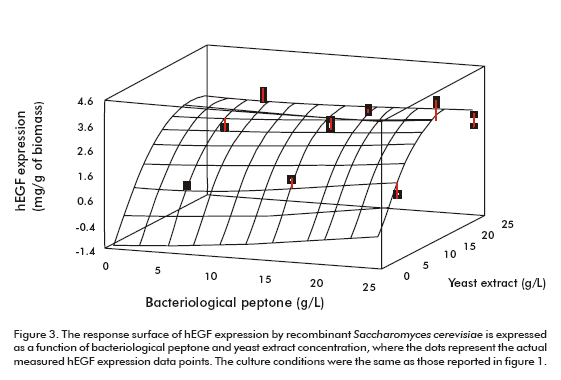
<p><span lang=EN-US style='font-size:10.0pt;font-family:"Verdana","sans-serif"; color:#211E1E'>It is well known that overproduction of recombinant proteins usually diminishes the availability of free amino acids </span><span lang=EN-US style='font-size:10.0pt;font-family:"Verdana","sans-serif"; color:windowtext'>(</span><span lang=EN-US style='font-size:10.0pt;font-family: "Verdana","sans-serif";color:#211E1E'>7) and therefore the replenishment with the necessary nutrients results in a substantial increase in protein production. Although part of the leucine and histidine needs for yeast growth is provided by complex components of the medium </span><span lang=EN-US style='font-size:10.0pt;font-family:"Verdana","sans-serif";color:windowtext'>(</span><span lang=EN-US style='font-size:10.0pt;font-family:"Verdana","sans-serif"; color:#211E1E'>as bacteriological peptone and yeast extract) hEGF expression is limited. Leucine is the third most frequent amino acid in the hEGF protein </span><span lang=EN-US style='font-size:10.0pt;font-family:"Verdana","sans-serif"; color:windowtext'>(</span><span lang=EN-US style='font-size:10.0pt;font-family: "Verdana","sans-serif";color:#211E1E'>9.2%) as well as in <i>S. cerevisiae </i>whole protein yeast </span><span lang=EN-US style='font-size:10.0pt;font-family:"Verdana","sans-serif"; color:windowtext'>(</span><span lang=EN-US style='font-size:10.0pt;font-family: "Verdana","sans-serif";color:#211E1E'>8.3%), while the composition of the leucine in the complex medium is of about 3.8% to 6.5% </span><span lang=EN-US style='font-size:10.0pt;font-family:"Verdana","sans-serif";color:windowtext'>(</span><span lang=EN-US style='font-size:10.0pt;font-family:"Verdana","sans-serif"; color:#211E1E'>10). </span></p>      <p><span lang=EN-US style='font-size:10.0pt;font-family:"Verdana","sans-serif"; color:#211E1E'>In the case of histidine the possible limitation is very severe. The proportion of histidine in the hEGF protein is 4.3%, but in the whole protein yeast it is 2.2%. On the other hand, the composition of histidine in the complex media is very low </span><span lang=EN-US style='font-size:10.0pt; font-family:"Verdana","sans-serif";color:windowtext'>(</span><span lang=EN-US style='font-size:10.0pt;font-family:"Verdana","sans-serif";color:#211E1E'>0.7% to 1.7%). This demonstrates that the addition of both amino cids significantly improves the nutritional balance of the culture medium, thereby achieving an increase in hEGF expression. </span></p>      <p><b><span lang=EN-US style='font-size:10.0pt;font-family:"Verdana","sans-serif"; color:#211E1E'>Optimization of bacteriological peptone and yeast extract concentration in the YEPS3 medium</span></b><span lang=EN-US style='font-size: 10.0pt;font-family:"Verdana","sans-serif";color:#211E1E'> </span></p>      <p><span lang=EN-US style='font-size:10.0pt;font-family:"Verdana","sans-serif"; color:#211E1E'>Peptone and yeast extract concentrations were optimized using a medium already supplemented with both amino acids as explained above. </span><span style='font-size:10.0pt;font-family:"Verdana","sans-serif";color:#211E1E'><a href="#fig3"><span lang=EN-US>Figure 3</span></a></span><span lang=EN-US style='font-size:10.0pt;font-family:"Verdana","sans-serif";color:#211E1E'> shows the surface response of the optimization experiment. According to the optimization program the highest hEGF expression level </span><span lang=EN-US style='font-size:10.0pt;font-family:"Verdana","sans-serif";color:windowtext'>(</span><span lang=EN-US style='font-size:10.0pt;font-family:"Verdana","sans-serif"; color:#211E1E'>3.33 mg/g of biomass) could be obtained for the optimum values of 25.0 g/L and 17.7 g/L of bacteriological peptone and yeast extract, respectively </span><span lang=EN-US style='font-size:10.0pt;font-family:"Verdana","sans-serif"; color:windowtext'>(</span><span style='font-size:10.0pt;font-family:"Verdana","sans-serif"; color:#211E1E'><a href="#fig3"><span lang=EN-US>Figure 3</span></a></span><span lang=EN-US style='font-size:10.0pt;font-family:"Verdana","sans-serif"; color:#211E1E'>).</span></p>      <p align=center style='text-align:center'><span style='font-size:13.5pt; color:#211E1E'><img border=0 width=561 height=379 src="/img/revistas/bta/v26n1/f0305109.gif"></span><a name=fig3></a></p>      
]]></body>
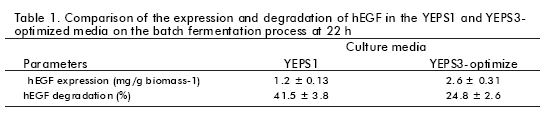
<body><![CDATA[<p><span lang=EN-US style='font-size:10.0pt;font-family:"Verdana","sans-serif"; color:#211E1E'>The procedure applied for optimizing the culture medium produced an increase of 3 times the expression level of hEGF </span><span lang=EN-US style='font-size:10.0pt;font-family:"Verdana","sans-serif";color:windowtext'>(</span><span lang=EN-US style='font-size:10.0pt;font-family:"Verdana","sans-serif"; color:#211E1E'>3.22 ± 0.20 mg/g of biomass). This optimized medium has been proven in batch fermentation with bioreactors </span><span lang=EN-US style='font-size:10.0pt;font-family:"Verdana","sans-serif";color:windowtext'>(</span><span style='font-size:10.0pt;font-family:"Verdana","sans-serif";color:#211E1E'><a href="#tab1"><span lang=EN-US>Table 1</span></a></span><span lang=EN-US style='font-size:10.0pt;font-family:"Verdana","sans-serif";color:#211E1E'>). </span></p>      <p align=center style='text-align:center'><span style='font-size:13.5pt; color:#211E1E'><img border=0 width=551 height=117 src="/img/revistas/bta/v26n1/t0105109.gif"></span><a name=tab1></a></p>      
<p><span lang=EN-US style='font-size:10.0pt;font-family:"Verdana","sans-serif"; color:#211E1E'>Even when the YEPS3-optimized medium seems to perform better in bioreactors in terms of hEGF expression </span><span lang=EN-US style='font-size:10.0pt;font-family:"Verdana","sans-serif";color:windowtext'>(</span><span lang=EN-US style='font-size:10.0pt;font-family:"Verdana","sans-serif"; color:#211E1E'>2.60 ± 0.31 vs 1.20 ± 0.13 mg/g of biomass) the yield was lower than expected </span><span lang=EN-US style='font-size:10.0pt;font-family:"Verdana","sans-serif"; color:windowtext'>(</span><span lang=EN-US style='font-size:10.0pt;font-family: "Verdana","sans-serif";color:#211E1E'>only 2.2 times higher than for YEPS1 expression). On the other hand, hEGF degradation was lower in the YEPS3 medium </span><span lang=EN-US style='font-size:10.0pt;font-family:"Verdana","sans-serif"; color:windowtext'>(</span><span lang=EN-US style='font-size:10.0pt;font-family: "Verdana","sans-serif";color:#211E1E'>1.7 times) than in YEPS1, but unfortunately degradation is still at a considerable level </span><span lang=EN-US style='font-size:10.0pt;font-family:"Verdana","sans-serif"; color:windowtext'>(</span><span lang=EN-US style='font-size:10.0pt;font-family: "Verdana","sans-serif";color:#211E1E'>25%). </span></p>      <p><span lang=EN-US style='font-size:10.0pt;font-family:"Verdana","sans-serif"; color:#211E1E'>It is well known that the extent of degradation of a secreted protein </span><span lang=EN-US style='font-size:10.0pt;font-family:"Verdana","sans-serif"; color:windowtext'>(</span><span lang=EN-US style='font-size:10.0pt;font-family: "Verdana","sans-serif";color:#211E1E'>including the hEGF) depends on the culture’s pH, temperature, culture time, cell concentration, among others </span><span lang=EN-US style='font-size:10.0pt;font-family:"Verdana","sans-serif"; color:windowtext'>(</span><span lang=EN-US style='font-size:10.0pt;font-family: "Verdana","sans-serif";color:#211E1E'>16). Cell concentration at 36 h was 1.8 times higher in the YEPS3 medium than in YEPS1 </span><span lang=EN-US style='font-size:10.0pt;font-family:"Verdana","sans-serif";color:windowtext'>(</span><span lang=EN-US style='font-size:10.0pt;font-family:"Verdana","sans-serif"; color:#211E1E'>data not shown) and this fact could also contribute to the increase in degradation rate and consequently reduce overall hEGF expression level. This analysis indicated that other fermentation variables could contribute to that fact that the optimum hEGF expression level obtained in shake flask experiments was not reached. </span></p>      <p><b><span lang=EN-US style='font-size:10.0pt;font-family:"Verdana","sans-serif"; color:#211E1E'>Influence of temperature and pH on hEGF expression in the YEPS3-optimized medium </span></b></p>      <p><span style='font-size:10.0pt;font-family:"Verdana","sans-serif";color:#211E1E'><a href="#fig4"><span lang=EN-US>Figure 4</span></a></span><span style='font-size: 10.0pt;font-family:"Verdana","sans-serif";color:#211E1E'> <span lang=EN-US>shows a stability study of the hEGF culture supernatant at different temperatures and pH. As expected the low temperature decreased hEGF degradation rate throughout the range tested </span></span><span lang=EN-US style='font-size:10.0pt; font-family:"Verdana","sans-serif";color:windowtext'>(</span><span style='font-size:10.0pt;font-family:"Verdana","sans-serif";color:#211E1E'><a href="#fig4"><span lang=EN-US>Figure 4A</span></a></span><span lang=EN-US style='font-size:10.0pt;font-family:"Verdana","sans-serif";color:#211E1E'>), but after 24 h of incubation there was practically no difference observed between 28 and 37 °C, which means that temperature itself is not enough to control hEGF proteolysis </span><span lang=EN-US style='font-size:10.0pt; font-family:"Verdana","sans-serif";color:windowtext'>(</span><span style='font-size:10.0pt;font-family:"Verdana","sans-serif";color:#211E1E'><a href="#fig4"><span lang=EN-US>Figure 4</span></a></span><span lang=EN-US style='font-size:10.0pt;font-family:"Verdana","sans-serif";color:#211E1E'>).</span></p>      <p align=center style='text-align:center'><span style='font-size:13.5pt; color:#211E1E'><img border=0 width=556 height=332 src="/img/revistas/bta/v26n1/f0405109.gif"></span><a name=fig4></a></p>      
<p><span lang=EN-US style='font-size:10.0pt;font-family:"Verdana","sans-serif"; color:#211E1E'>In the pH study </span><span lang=EN-US style='font-size:10.0pt; font-family:"Verdana","sans-serif";color:windowtext'>(</span><span style='font-size:10.0pt;font-family:"Verdana","sans-serif";color:#211E1E'><a href="#fig4"><span lang=EN-US>Figure 4B</span></a></span><span lang=EN-US style='font-size:10.0pt;font-family:"Verdana","sans-serif";color:#211E1E'>), at 6.5 there is a significant decrease of hEGF proteolysis </span><span lang=EN-US style='font-size:10.0pt;font-family:"Verdana","sans-serif"; color:windowtext'>(</span><span lang=EN-US style='font-size:10.0pt;font-family: "Verdana","sans-serif";color:#211E1E'>for 24 h incubation at 28 °C) compared to the range of pH of 5.0-6.0, and, at pH above 7.0, hEGF proteolysis is controlled </span><span lang=EN-US style='font-size:10.0pt;font-family:"Verdana","sans-serif"; color:windowtext'>(</span><span lang=EN-US style='font-size:10.0pt;font-family: "Verdana","sans-serif";color:#211E1E'>only 20% of the hEGF is degraded). </span></p>      <p><span lang=EN-US style='font-size:10.0pt;font-family:"Verdana","sans-serif"; color:#211E1E'>The results of the control of hEGF degradation by manipulating the pH are similar to those reported by Clare <i>et al</i>. </span><span lang=EN-US style='font-size:10.0pt;font-family:"Verdana","sans-serif"; color:windowtext'>(</span><span lang=EN-US style='font-size:10.0pt;font-family: "Verdana","sans-serif";color:#211E1E'>11, 12) and Hong <i>et al</i>. </span><span lang=EN-US style='font-size:10.0pt;font-family:"Verdana","sans-serif"; color:windowtext'>(</span><span lang=EN-US style='font-size:10.0pt;font-family: "Verdana","sans-serif";color:#211E1E'>16), due to a decrease of yeast proteolytic activity. According to Jahic <i>et al</i>. </span><span lang=EN-US style='font-size:10.0pt;font-family:"Verdana","sans-serif";color:windowtext'>(</span><span lang=EN-US style='font-size:10.0pt;font-family:"Verdana","sans-serif"; color:#211E1E'>14, 15) is it advisable to operate the fermentation process in the range of 20 to 25 °C in order to reduce cell lysis occurring during fermentation, and therefore decrease the proteases released in the culture medium. Based on these findings and our previous experience, we decided to establish the culture parameters for hEGF fermentation at 30 to 25 °C and with pH from 5.0 to 6.5. </span></p>          <p><span style='font-size:10.0pt;font-family:"Verdana","sans-serif";color:#211E1E'><a href="/img/revistas/bta/v26n1/f0505109.gif"><span lang=EN-US>Figure 5</span></a></span><span lang=EN-US style='font-size:10.0pt;font-family:"Verdana","sans-serif"; color:#211E1E'> shows the hEGF expression and degradation profile using the new        culture conditions. The hEGF expression was of 3.50 ± 0.32 mg/g, which is        similar to the expression obtained in the shaking flask experiments, and        the hEGF degradation was almost completely controlled at less than 10%.        This expression level is significantly higher than the maximum value reported        up to now by Coppella and Dhujarti </span><span lang=EN-US style='font-size:10.0pt; font-family:"Verdana","sans-serif";color:windowtext'>(</span><span lang=EN-US style='font-size:10.0pt;font-family:"Verdana","sans-serif";color:#211E1E'>18)        for hEGF in <i>S</i>. <i>cerevisiae </i></span><span lang=EN-US style='font-size:10.0pt;font-family:"Verdana","sans-serif";color:windowtext'>(</span><span lang=EN-US style='font-size:10.0pt;font-family:"Verdana","sans-serif"; color:#211E1E'>0.52 mg/g) and in <i>P. pastoris </i></span><span lang=EN-US style='font-size:10.0pt;font-family:"Verdana","sans-serif";color:windowtext'>(</span><span lang=EN-US style='font-size:10.0pt;font-family:"Verdana","sans-serif"; color:#211E1E'>11) </span><span lang=EN-US style='font-size:10.0pt;font-family: "Verdana","sans-serif";color:windowtext'>(</span><span lang=EN-US style='font-size:10.0pt;font-family:"Verdana","sans-serif";color:#211E1E'>2.54        mg/g). It is important to point out that the yield observed is a function        of the expression rate minus the degradation rate, and therefore an engineering        approach to the optimization of the bioprocess is to maximize the expression        and minimize proteolysis at the same time </span><span lang=EN-US style='font-size:10.0pt;font-family:"Verdana","sans-serif";color:windowtext'>(</span><span style='font-size:10.0pt;font-family:"Verdana","sans-serif";color:#211E1E'><a href="/img/revistas/bta/v26n1/f0505109.gif"><span lang=EN-US>Figure 5</span></a></span><span lang=EN-US style='font-size:10.0pt;font-family:"Verdana","sans-serif"; color:#211E1E'>). </span></p>      
]]></body>
<body><![CDATA[<p><span lang=EN-US style='font-size:10.0pt;font-family:"Verdana","sans-serif"; color:#211E1E'>The decision for establishing the operation pH at 6.5 is based on the common practice at a production scale to operate with the pH as low as possible so as to reduce the risk of contamination, but the authors agree that it will be interesting to explore in the future, the optimum pH for maximizing hEGF expression in this particular process. </span></p>      <p><b><span lang=EN-US style='font-family:"Verdana","sans-serif";color:#211E1E'>CONCLUSIONS </span></b></p>      <p><span lang=EN-US style='font-size:10.0pt;font-family:"Verdana","sans-serif"; color:#211E1E'>Optimizing the bacteriological peptone and yeast extract concentration with a supplement of leucine and histidine, has a significant impact in increasing recombinant hEGF protein expression. The optimized YEPS3 culture medium produced a 3-fold increase in hEGF expression. On the other hand, it was demonstrated that changing the culture conditions to pH 6.5 and 25 °C using the optimized YEPS3 it is possible to control hEGF proteolysis in fermenters, ensuring the operation of the entire fermentation process at a maximum hEGF expression. This is the first report where a combination of the culture medium, temperature and pH is able to improve hEGF expression and control proteolysis. The culture protocol will be the milestone for the future improvement of a large-scale high efficiency hEGF fermentation process. </span></p>      <p><b><span lang=EN-US style='font-family:"Verdana","sans-serif"'>REFERENCES </span></b></p>      <!-- ref --><p><span lang=EN-US style='font-size:10.0pt;font-family:"Verdana","sans-serif"; color:#211E1E'>1. Nakagawa S, Yoshida S, Hirao Y, Kasuga S, Fuwa T. Biological effects of biosynthetic hEGF on the growth of mammalian cells in vitro. Differentiation</span><span lang=EN-US style='font-size:11.0pt;font-family:"Arial","sans-serif";color:red'> </span><span lang=EN-US style='font-size:10.0pt;font-family:"Verdana","sans-serif"; color:#211E1E'>1985;29:284-8.</span><span lang=EN-US style='font-size:11.0pt; font-family:"Arial","sans-serif";color:blue'> </span><!-- ref --><p><span lang=EN-US style='font-size:10.0pt;font-family:"Verdana","sans-serif"; color:#211E1E'>2. Carpenter G, Cohen S. Epidermal growth factor. Ann Rev Biochem</span><span lang=EN-US style='font-size:11.0pt;font-family:"Arial","sans-serif"; color:red'> </span><span lang=EN-US style='font-size:10.0pt;font-family:"Verdana","sans-serif"; color:#211E1E'>1979;48:193-216.</span><span lang=EN-US style='font-size:11.0pt; font-family:"Arial","sans-serif";color:blue'> </span><!-- ref --><p><span lang=EN-US style='font-size:10.0pt;font-family:"Verdana","sans-serif"; color:#211E1E'>3. Carpenter G, Cohen S. Epidermal growth factor. J Biol Chem</span><span lang=EN-US style='font-size:11.0pt;font-family:"Arial","sans-serif";color:red'> </span><span lang=EN-US style='font-size:10.0pt;font-family:"Verdana","sans-serif"; color:#211E1E'>1990;265:7709-12.</span><span lang=EN-US style='font-size:11.0pt; font-family:"Arial","sans-serif";color:blue'> </span><!-- ref --><p><span lang=EN-US style='font-size:10.0pt;font-family:"Verdana","sans-serif"; color:#211E1E'>4. Lee DN, Kuo TY, Chen MC, Tang TY, Liu FH, Cheng CF. Expression of porcine epidermal growth factor in <i>Pichia pastoris </i>and its biology activity in early-weaned piglets. </span><span style='font-size:10.0pt; font-family:"Verdana","sans-serif";color:#211E1E'>Life Sci</span><span style='font-size:11.0pt;font-family:"Arial","sans-serif";color:red'> </span><span style='font-size:10.0pt;font-family:"Verdana","sans-serif";color:#211E1E'>2006;78:649-54.</span><span style='font-size:11.0pt;font-family:"Arial","sans-serif";color:blue'> </span><p><span style='font-size:10.0pt;font-family:"Verdana","sans-serif";color:#211E1E'>5. Cinza AM, Quintana M, Lombardero J, Poutou R, Pérez E, Pérez LC <i>et</i> <i>al. </i>Establecimiento de un cultivo discontinuo para la producción de factor de crecimiento epidérmico humano en levaduras. </span><span lang=EN-US style='font-size:10.0pt;font-family:"Verdana","sans-serif";color:#211E1E'>Caracterización del producto. Biotecnol Apl</span><span lang=EN-US style='font-size:11.0pt; font-family:"Arial","sans-serif";color:red'> </span><span lang=EN-US style='font-size:10.0pt;font-family:"Verdana","sans-serif";color:#211E1E'>1991;8:166-73.</span><span lang=EN-US style='font-size:11.0pt;font-family:"Arial","sans-serif";color:blue'> </span></p>      <!-- ref --><p><span lang=EN-US style='font-size:10.0pt;font-family:"Verdana","sans-serif"; color:#211E1E'>6. Nowruzi K, Elkamel A, Scharer J, Cossar D, Moo-Young M. Development of a minimal defined medium for recombinant hIL-3 production by <i>Streptomyces lividans 66</i>. Biotechnol Bioeng</span><span lang=EN-US style='font-size: 11.0pt;font-family:"Arial","sans-serif";color:red'> </span><span lang=EN-US style='font-size:10.0pt;font-family:"Verdana","sans-serif";color:#211E1E'>2008;99:214-22.</span><span lang=EN-US style='font-size:11.0pt;font-family:"Arial","sans-serif";color:blue'> </span><!-- ref --><p><span lang=EN-US style='font-size:10.0pt;font-family:"Verdana","sans-serif"; color:#211E1E'>7. Chen PT, Chao YP. Enhanced production of recombinant nattokinase in <i>Bacillus subtilis </i>by the elimination of limiting factors. Biotechnol Lett</span><span lang=EN-US style='font-size:11.0pt;font-family: "Arial","sans-serif";color:red'> </span><span lang=EN-US style='font-size:10.0pt; font-family:"Verdana","sans-serif";color:#211E1E'>2006;28:1595-600.</span><span lang=EN-US style='font-size:11.0pt;font-family:"Arial","sans-serif";color:blue'> </span><!-- ref --><p><span lang=EN-US style='font-size:10.0pt;font-family:"Verdana","sans-serif"; color:#211E1E'>8. Görgens JF, Passoth V, van Zyl W, Knoetze JH, Hanh-Hägerdal B. Amino acid supplementation, controlled oxygen limitation and sequential double induction improves heterologous xylanase production by <i>Pichia stipitis</i>. FEMS Yeast Res</span><span lang=EN-US style='font-size:11.0pt;font-family:"Arial","sans-serif"; color:red'> </span><span lang=EN-US style='font-size:10.0pt;font-family:"Verdana","sans-serif"; color:#211E1E'>2005;5:677-83.</span><span lang=EN-US style='font-size:11.0pt; font-family:"Arial","sans-serif";color:blue'> </span><!-- ref --><p><span lang=EN-US style='font-size:10.0pt;font-family:"Verdana","sans-serif"; color:#211E1E'>9. Wang ZW, Chen Y, Chao YP. Enhancement of recombinant protein production in <i>Escherichia coli </i>by coproduction of aspartase. J Biotechnol</span><span lang=EN-US style='font-size:11.0pt;font-family:"Arial","sans-serif"; color:red'> </span><span lang=EN-US style='font-size:10.0pt;font-family:"Verdana","sans-serif"; color:#211E1E'>2006;124:403-11.</span><span lang=EN-US style='font-size:11.0pt; font-family:"Arial","sans-serif";color:blue'> </span><!-- ref --><p><span lang=EN-US style='font-size:10.0pt;font-family:"Verdana","sans-serif"; color:#211E1E'>10. Hahn-Hagerdal B, Karhumaa K, Larsson C, Gorwa-Grauslund M, Gorgens J, van Zyl W. Role of cultivation media in the development yeast strains for largescale industrial use. Microb Cell Fact</span><span lang=EN-US style='font-size:11.0pt;font-family:"Arial","sans-serif";color:red'> </span><span lang=EN-US style='font-size:10.0pt;font-family:"Verdana","sans-serif"; color:#211E1E'>2005;4:1-16.</span><span lang=EN-US style='font-size:11.0pt; font-family:"Arial","sans-serif";color:blue'> </span><!-- ref --><p><span lang=EN-US style='font-size:10.0pt;font-family:"Verdana","sans-serif"; color:#211E1E'>11. Clare JJ, Romanos MA, Rayment FB, Rowedder JE, Smith MA, Payne MM, et al. Production of mouse epidermal growth factor in yeast: high-level secretion using <i>Pichia pastoris </i>strains containing multiple gene copies. Gene</span><span lang=EN-US style='font-size:11.0pt;font-family:"Arial","sans-serif"; color:red'> </span><span lang=EN-US style='font-size:10.0pt;font-family:"Verdana","sans-serif"; color:#211E1E'>1991;105:205-12.</span><span lang=EN-US style='font-size:11.0pt; font-family:"Arial","sans-serif";color:blue'> </span><!-- ref --><p><span lang=EN-US style='font-size:10.0pt;font-family:"Verdana","sans-serif"; color:#211E1E'>12. Clare J, Scorer C, Buckholz R, Romanos M. Expression of EGF and HIV envelope glycoprotein. Methods Mol Biol</span><span lang=EN-US style='font-size:11.0pt;font-family:"Arial","sans-serif";color:red'> </span><span lang=EN-US style='font-size:10.0pt;font-family:"Verdana","sans-serif"; color:#211E1E'>1998;103:209-25.</span><span lang=EN-US style='font-size:11.0pt; font-family:"Arial","sans-serif";color:blue'> </span><!-- ref --><p><span lang=EN-US style='font-size:10.0pt;font-family:"Verdana","sans-serif"; color:#211E1E'>13. Hong F, Meinander NQ, Jönsson LJ. Fermentation strategies for improved heterologous expression of laccase in <i>Pichia pastoris</i>. Biotechnol Bioeng</span><span lang=EN-US style='font-size:11.0pt;font-family:"Arial","sans-serif"; color:red'> </span><span lang=EN-US style='font-size:10.0pt;font-family:"Verdana","sans-serif"; color:#211E1E'>2002;79:438-49.</span><span lang=EN-US style='font-size:11.0pt; font-family:"Arial","sans-serif";color:blue'> </span><!-- ref --><p><span lang=EN-US style='font-size:10.0pt;font-family:"Verdana","sans-serif"; color:#211E1E'>14. Jahic M, Gustavsson M, Jansen AK, Martinelle M, Enfors SO. Analysis and control of proteolysis of a fusion protein in <i>Pichia pastoris </i>fed-batch processes. J Biotechnol</span><span lang=EN-US style='font-size:11.0pt; font-family:"Arial","sans-serif";color:red'> </span><span lang=EN-US style='font-size:10.0pt;font-family:"Verdana","sans-serif";color:#211E1E'>2003;102:45-53.</span><span lang=EN-US style='font-size:11.0pt;font-family:"Arial","sans-serif";color:blue'> </span><!-- ref --><p><span lang=EN-US style='font-size:10.0pt;font-family:"Verdana","sans-serif"; color:#211E1E'>15. Jahic M, Wallberg F, Bollok M, García P, Enfors SO. Temperature limited fed-batch technique for control of proteolysis in <i>Pichia pastoris </i>bioreactor cultures. Microb Cell Fact 2003;2:6-16.</span><span lang=EN-US style='font-size:11.0pt;font-family:"Arial","sans-serif";color:blue'> </span><!-- ref --><p><span lang=EN-US style='font-size:10.0pt;font-family:"Verdana","sans-serif"; color:#211E1E'>16. Hong S, Moon H, Kim H, Rhee S, Choi E, Kim I. Optimal strategy of pH control in the production of recombinant human epi-dermal growth factor by <i>Hansenula polymorpha</i>. Process Biochem</span><span lang=EN-US style='font-size:11.0pt;font-family:"Arial","sans-serif";color:red'> </span><span lang=EN-US style='font-size:10.0pt;font-family:"Verdana","sans-serif"; color:#211E1E'>2002;38:487-95.</span><span lang=EN-US style='font-size:11.0pt; font-family:"Arial","sans-serif";color:blue'> </span><!-- ref --><p><span lang=EN-US style='font-size:10.0pt;font-family:"Verdana","sans-serif"; color:#211E1E'>17. Ohya T, Morita M, Miura M, Kuwae S, Kobayashi K. High-level production of prourokinase-annexin V chimeras in the methylotrophic yeast <i>Pichia pastoris</i>. J Biosci Bioeng</span><span lang=EN-US style='font-size:11.0pt; font-family:"Arial","sans-serif";color:red'> </span><span lang=EN-US style='font-size:10.0pt;font-family:"Verdana","sans-serif";color:#211E1E'>2002;94:467-73.</span><span lang=EN-US style='font-size:11.0pt;font-family:"Arial","sans-serif";color:blue'> </span><!-- ref --><p><span lang=EN-US style='font-size:10.0pt;font-family:"Verdana","sans-serif"; color:#211E1E'>18. Coppella S, Dhujarti P. A mathematical description of recombinant yeast. Biotechnol Bioeng</span><span lang=EN-US style='font-size: 11.0pt;font-family:"Arial","sans-serif";color:red'> </span><span lang=EN-US style='font-size:10.0pt;font-family:"Verdana","sans-serif";color:#211E1E'>1990;35:359-74.</span><span lang=EN-US style='font-size:11.0pt;font-family:"Arial","sans-serif";color:green'> </span><p><span lang=EN-US style='font-size:13.5pt;color:#211E1E'>&nbsp;</span></p>      <p><span lang=EN-US style='font-size:10.0pt;font-family:"Verdana","sans-serif"; color:#211E1E'>Received in September, 2008.     <br> Accepted for publication in March, 2009.</span><span lang=EN-US style='font-size:11.0pt;font-family:"Arial","sans-serif";color:red'> </span></p>      <p><span lang=EN-US style='font-size:10.0pt;font-family:"Verdana","sans-serif"; color:#211E1E'>Jorge Valdés. Technological Development Unit. Center for Genetic Engineering and Biotechnology, CIGB. Ave. 31 / 158 and 190, Playa, PO Box 6162, Havana 10600, Havana, Cuba. E-mail: </span><span style='font-size:10.0pt; font-family:"Verdana","sans-serif";color:#211E1E'><a href="mailto:jorge.valdes@cigb.edu.cu"><span lang=EN-US>jorge.valdes@cigb.edu.cu</span></a></span><span style='font-size:11.0pt;font-family:"Arial","sans-serif";color:#FF6600'> </span></p>      <p><span lang=EN-US style='font-size:13.5pt'>&nbsp;</span></p>  </div>  </div>       ]]></body><back>
<ref-list>
<ref id="B1">
<label>1</label><nlm-citation citation-type="journal">
<person-group person-group-type="author">
<name>
<surname><![CDATA[Nakagawa]]></surname>
<given-names><![CDATA[S]]></given-names>
</name>
<name>
<surname><![CDATA[Yoshida]]></surname>
<given-names><![CDATA[S]]></given-names>
</name>
<name>
<surname><![CDATA[Hirao]]></surname>
<given-names><![CDATA[Y]]></given-names>
</name>
<name>
<surname><![CDATA[Kasuga]]></surname>
<given-names><![CDATA[S]]></given-names>
</name>
<name>
<surname><![CDATA[Fuwa]]></surname>
<given-names><![CDATA[T]]></given-names>
</name>
</person-group>
<article-title xml:lang="en"><![CDATA[Biological effects of biosynthetic hEGF on the growth of mammalian cells in vitro]]></article-title>
<source><![CDATA[Differentiation]]></source>
<year>1985</year>
<volume>29</volume>
<page-range>284-8</page-range></nlm-citation>
</ref>
<ref id="B2">
<label>2</label><nlm-citation citation-type="journal">
<person-group person-group-type="author">
<name>
<surname><![CDATA[Carpenter]]></surname>
<given-names><![CDATA[G]]></given-names>
</name>
<name>
<surname><![CDATA[Cohen]]></surname>
<given-names><![CDATA[S]]></given-names>
</name>
</person-group>
<article-title xml:lang="en"><![CDATA[Epidermal growth factor]]></article-title>
<source><![CDATA[Ann Rev Biochem]]></source>
<year>1979</year>
<volume>48</volume>
<page-range>193-216</page-range></nlm-citation>
</ref>
<ref id="B3">
<label>3</label><nlm-citation citation-type="journal">
<person-group person-group-type="author">
<name>
<surname><![CDATA[Carpenter]]></surname>
<given-names><![CDATA[G]]></given-names>
</name>
<name>
<surname><![CDATA[Cohen]]></surname>
<given-names><![CDATA[S]]></given-names>
</name>
</person-group>
<article-title xml:lang="en"><![CDATA[Epidermal growth factor]]></article-title>
<source><![CDATA[J Biol Chem]]></source>
<year>1990</year>
<volume>265</volume>
<page-range>7709-12</page-range></nlm-citation>
</ref>
<ref id="B4">
<label>4</label><nlm-citation citation-type="journal">
<person-group person-group-type="author">
<name>
<surname><![CDATA[Lee]]></surname>
<given-names><![CDATA[DN]]></given-names>
</name>
<name>
<surname><![CDATA[Kuo]]></surname>
<given-names><![CDATA[TY]]></given-names>
</name>
<name>
<surname><![CDATA[Chen]]></surname>
<given-names><![CDATA[MC]]></given-names>
</name>
<name>
<surname><![CDATA[Tang]]></surname>
<given-names><![CDATA[TY]]></given-names>
</name>
<name>
<surname><![CDATA[Liu]]></surname>
<given-names><![CDATA[FH]]></given-names>
</name>
<name>
<surname><![CDATA[Cheng]]></surname>
<given-names><![CDATA[CF]]></given-names>
</name>
</person-group>
<article-title xml:lang="en"><![CDATA[Expression of porcine epidermal growth factor in Pichia pastoris and its biology activity in early-weaned piglets]]></article-title>
<source><![CDATA[Life Sci]]></source>
<year>2006</year>
<volume>78</volume>
<page-range>649-54</page-range></nlm-citation>
</ref>
<ref id="B5">
<label>5</label><nlm-citation citation-type="journal">
<person-group person-group-type="author">
<name>
<surname><![CDATA[Cinza]]></surname>
<given-names><![CDATA[AM]]></given-names>
</name>
<name>
<surname><![CDATA[Quintana]]></surname>
<given-names><![CDATA[M]]></given-names>
</name>
<name>
<surname><![CDATA[Lombardero]]></surname>
<given-names><![CDATA[J]]></given-names>
</name>
<name>
<surname><![CDATA[Poutou]]></surname>
<given-names><![CDATA[R]]></given-names>
</name>
<name>
<surname><![CDATA[Pérez]]></surname>
<given-names><![CDATA[E]]></given-names>
</name>
<name>
<surname><![CDATA[Pérez]]></surname>
<given-names><![CDATA[LC]]></given-names>
</name>
</person-group>
<article-title xml:lang="es"><![CDATA[Establecimiento de un cultivo discontinuo para la producción de factor de crecimiento epidérmico humano en levaduras: Caracterización del producto]]></article-title>
<source><![CDATA[Biotecnol Apl]]></source>
<year>1991</year>
<volume>8</volume>
<page-range>166-73</page-range></nlm-citation>
</ref>
<ref id="B6">
<label>6</label><nlm-citation citation-type="journal">
<person-group person-group-type="author">
<name>
<surname><![CDATA[Nowruzi]]></surname>
<given-names><![CDATA[K]]></given-names>
</name>
<name>
<surname><![CDATA[Elkamel]]></surname>
<given-names><![CDATA[A]]></given-names>
</name>
<name>
<surname><![CDATA[Scharer]]></surname>
<given-names><![CDATA[J]]></given-names>
</name>
<name>
<surname><![CDATA[Cossar]]></surname>
<given-names><![CDATA[D]]></given-names>
</name>
<name>
<surname><![CDATA[Moo-Young]]></surname>
<given-names><![CDATA[M]]></given-names>
</name>
</person-group>
<article-title xml:lang="en"><![CDATA[Development of a minimal defined medium for recombinant hIL-3 production by Streptomyces lividans 66]]></article-title>
<source><![CDATA[Biotechnol Bioeng]]></source>
<year>2008</year>
<volume>99</volume>
<page-range>214-22</page-range></nlm-citation>
</ref>
<ref id="B7">
<label>7</label><nlm-citation citation-type="journal">
<person-group person-group-type="author">
<name>
<surname><![CDATA[Chen]]></surname>
<given-names><![CDATA[PT]]></given-names>
</name>
<name>
<surname><![CDATA[Chao]]></surname>
<given-names><![CDATA[YP]]></given-names>
</name>
</person-group>
<article-title xml:lang="en"><![CDATA[Enhanced production of recombinant nattokinase in Bacillus subtilis by the elimination of limiting factors]]></article-title>
<source><![CDATA[Biotechnol Lett]]></source>
<year>2006</year>
<volume>28</volume>
<page-range>1595-600</page-range></nlm-citation>
</ref>
<ref id="B8">
<label>8</label><nlm-citation citation-type="journal">
<person-group person-group-type="author">
<name>
<surname><![CDATA[Görgens]]></surname>
<given-names><![CDATA[JF]]></given-names>
</name>
<name>
<surname><![CDATA[Passoth]]></surname>
<given-names><![CDATA[V]]></given-names>
</name>
<name>
<surname><![CDATA[van Zyl]]></surname>
<given-names><![CDATA[W]]></given-names>
</name>
<name>
<surname><![CDATA[Knoetze]]></surname>
<given-names><![CDATA[JH]]></given-names>
</name>
<name>
<surname><![CDATA[Hanh-Hägerdal]]></surname>
<given-names><![CDATA[B]]></given-names>
</name>
</person-group>
<article-title xml:lang="en"><![CDATA[Amino acid supplementation, controlled oxygen limitation and sequential double induction improves heterologous xylanase production by Pichia stipitis]]></article-title>
<source><![CDATA[FEMS Yeast Res]]></source>
<year>2005</year>
<volume>5</volume>
<page-range>677-83</page-range></nlm-citation>
</ref>
<ref id="B9">
<label>9</label><nlm-citation citation-type="journal">
<person-group person-group-type="author">
<name>
<surname><![CDATA[Wang]]></surname>
<given-names><![CDATA[ZW]]></given-names>
</name>
<name>
<surname><![CDATA[Chen]]></surname>
<given-names><![CDATA[Y]]></given-names>
</name>
<name>
<surname><![CDATA[Chao]]></surname>
<given-names><![CDATA[YP]]></given-names>
</name>
</person-group>
<article-title xml:lang="en"><![CDATA[Enhancement of recombinant protein production in Escherichia coli by coproduction of aspartase]]></article-title>
<source><![CDATA[J Biotechnol]]></source>
<year>2006</year>
<volume>124</volume>
<page-range>403-11</page-range></nlm-citation>
</ref>
<ref id="B10">
<label>10</label><nlm-citation citation-type="journal">
<person-group person-group-type="author">
<name>
<surname><![CDATA[Hahn-Hagerdal]]></surname>
<given-names><![CDATA[B]]></given-names>
</name>
<name>
<surname><![CDATA[Karhumaa]]></surname>
<given-names><![CDATA[K]]></given-names>
</name>
<name>
<surname><![CDATA[Larsson]]></surname>
<given-names><![CDATA[C]]></given-names>
</name>
<name>
<surname><![CDATA[Gorwa-Grauslund]]></surname>
<given-names><![CDATA[M]]></given-names>
</name>
<name>
<surname><![CDATA[Gorgens]]></surname>
<given-names><![CDATA[J]]></given-names>
</name>
<name>
<surname><![CDATA[van Zyl]]></surname>
<given-names><![CDATA[W]]></given-names>
</name>
</person-group>
<article-title xml:lang="en"><![CDATA[Role of cultivation media in the development yeast strains for largescale industrial use]]></article-title>
<source><![CDATA[Microb Cell Fact]]></source>
<year>2005</year>
<volume>4</volume>
<page-range>1-16</page-range></nlm-citation>
</ref>
<ref id="B11">
<label>11</label><nlm-citation citation-type="journal">
<person-group person-group-type="author">
<name>
<surname><![CDATA[Clare]]></surname>
<given-names><![CDATA[JJ]]></given-names>
</name>
<name>
<surname><![CDATA[Romanos]]></surname>
<given-names><![CDATA[MA]]></given-names>
</name>
<name>
<surname><![CDATA[Rayment]]></surname>
<given-names><![CDATA[FB]]></given-names>
</name>
<name>
<surname><![CDATA[Rowedder]]></surname>
<given-names><![CDATA[JE]]></given-names>
</name>
<name>
<surname><![CDATA[Smith]]></surname>
<given-names><![CDATA[MA]]></given-names>
</name>
<name>
<surname><![CDATA[Payne]]></surname>
<given-names><![CDATA[MM]]></given-names>
</name>
</person-group>
<article-title xml:lang="en"><![CDATA[Production of mouse epidermal growth factor in yeast: high-level secretion using Pichia pastoris strains containing multiple gene copies]]></article-title>
<source><![CDATA[Gene]]></source>
<year>1991</year>
<volume>105</volume>
<page-range>205-12</page-range></nlm-citation>
</ref>
<ref id="B12">
<label>12</label><nlm-citation citation-type="journal">
<person-group person-group-type="author">
<name>
<surname><![CDATA[Clare]]></surname>
<given-names><![CDATA[J]]></given-names>
</name>
<name>
<surname><![CDATA[Scorer]]></surname>
<given-names><![CDATA[C]]></given-names>
</name>
<name>
<surname><![CDATA[Buckholz]]></surname>
<given-names><![CDATA[R]]></given-names>
</name>
<name>
<surname><![CDATA[Romanos]]></surname>
<given-names><![CDATA[M]]></given-names>
</name>
</person-group>
<article-title xml:lang="en"><![CDATA[Expression of EGF and HIV envelope glycoprotein]]></article-title>
<source><![CDATA[Methods Mol Biol]]></source>
<year>1998</year>
<volume>103</volume>
<page-range>209-25</page-range></nlm-citation>
</ref>
<ref id="B13">
<label>13</label><nlm-citation citation-type="journal">
<person-group person-group-type="author">
<name>
<surname><![CDATA[Hong]]></surname>
<given-names><![CDATA[F]]></given-names>
</name>
<name>
<surname><![CDATA[Meinander]]></surname>
<given-names><![CDATA[NQ]]></given-names>
</name>
<name>
<surname><![CDATA[Jönsson]]></surname>
<given-names><![CDATA[LJ]]></given-names>
</name>
</person-group>
<article-title xml:lang="en"><![CDATA[Fermentation strategies for improved heterologous expression of laccase in Pichia pastoris]]></article-title>
<source><![CDATA[Biotechnol Bioeng]]></source>
<year>2002</year>
<volume>79</volume>
<page-range>438-49</page-range></nlm-citation>
</ref>
<ref id="B14">
<label>14</label><nlm-citation citation-type="journal">
<person-group person-group-type="author">
<name>
<surname><![CDATA[Jahic]]></surname>
<given-names><![CDATA[M]]></given-names>
</name>
<name>
<surname><![CDATA[Gustavsson]]></surname>
<given-names><![CDATA[M]]></given-names>
</name>
<name>
<surname><![CDATA[Jansen]]></surname>
<given-names><![CDATA[AK]]></given-names>
</name>
<name>
<surname><![CDATA[Martinelle]]></surname>
<given-names><![CDATA[M]]></given-names>
</name>
<name>
<surname><![CDATA[Enfors]]></surname>
<given-names><![CDATA[SO]]></given-names>
</name>
</person-group>
<article-title xml:lang="en"><![CDATA[Analysis and control of proteolysis of a fusion protein in Pichia pastoris fed-batch processes]]></article-title>
<source><![CDATA[J Biotechnol]]></source>
<year>2003</year>
<volume>102</volume>
<page-range>45-53</page-range></nlm-citation>
</ref>
<ref id="B15">
<label>15</label><nlm-citation citation-type="journal">
<person-group person-group-type="author">
<name>
<surname><![CDATA[Jahic]]></surname>
<given-names><![CDATA[M]]></given-names>
</name>
<name>
<surname><![CDATA[Wallberg]]></surname>
<given-names><![CDATA[F]]></given-names>
</name>
<name>
<surname><![CDATA[Bollok]]></surname>
<given-names><![CDATA[M]]></given-names>
</name>
<name>
<surname><![CDATA[García]]></surname>
<given-names><![CDATA[P]]></given-names>
</name>
<name>
<surname><![CDATA[Enfors]]></surname>
<given-names><![CDATA[SO]]></given-names>
</name>
</person-group>
<article-title xml:lang="en"><![CDATA[Temperature limited fed-batch technique for control of proteolysis in Pichia pastoris bioreactor cultures]]></article-title>
<source><![CDATA[Microb Cell Fact]]></source>
<year>2003</year>
<volume>2</volume>
<page-range>6-16</page-range></nlm-citation>
</ref>
<ref id="B16">
<label>16</label><nlm-citation citation-type="journal">
<person-group person-group-type="author">
<name>
<surname><![CDATA[Hong]]></surname>
<given-names><![CDATA[S]]></given-names>
</name>
<name>
<surname><![CDATA[Moon]]></surname>
<given-names><![CDATA[H]]></given-names>
</name>
<name>
<surname><![CDATA[Kim]]></surname>
<given-names><![CDATA[H]]></given-names>
</name>
<name>
<surname><![CDATA[Rhee]]></surname>
<given-names><![CDATA[S]]></given-names>
</name>
<name>
<surname><![CDATA[Choi]]></surname>
<given-names><![CDATA[E]]></given-names>
</name>
<name>
<surname><![CDATA[Kim]]></surname>
<given-names><![CDATA[I]]></given-names>
</name>
</person-group>
<article-title xml:lang="en"><![CDATA[Optimal strategy of pH control in the production of recombinant human epi-dermal growth factor by Hansenula polymorpha]]></article-title>
<source><![CDATA[Process Biochem]]></source>
<year>2002</year>
<volume>38</volume>
<page-range>487-95</page-range></nlm-citation>
</ref>
<ref id="B17">
<label>17</label><nlm-citation citation-type="journal">
<person-group person-group-type="author">
<name>
<surname><![CDATA[Ohya]]></surname>
<given-names><![CDATA[T]]></given-names>
</name>
<name>
<surname><![CDATA[Morita]]></surname>
<given-names><![CDATA[M]]></given-names>
</name>
<name>
<surname><![CDATA[Miura]]></surname>
<given-names><![CDATA[M]]></given-names>
</name>
<name>
<surname><![CDATA[Kuwae]]></surname>
<given-names><![CDATA[S]]></given-names>
</name>
<name>
<surname><![CDATA[Kobayashi]]></surname>
<given-names><![CDATA[K]]></given-names>
</name>
</person-group>
<article-title xml:lang="en"><![CDATA[High-level production of prourokinase-annexin V chimeras in the methylotrophic yeast Pichia pastoris]]></article-title>
<source><![CDATA[J Biosci Bioeng]]></source>
<year>2002</year>
<volume>94</volume>
<page-range>467-73</page-range></nlm-citation>
</ref>
<ref id="B18">
<label>18</label><nlm-citation citation-type="journal">
<person-group person-group-type="author">
<name>
<surname><![CDATA[Coppella]]></surname>
<given-names><![CDATA[S]]></given-names>
</name>
<name>
<surname><![CDATA[Dhujarti]]></surname>
<given-names><![CDATA[P]]></given-names>
</name>
</person-group>
<article-title xml:lang="en"><![CDATA[A mathematical description of recombinant yeast]]></article-title>
<source><![CDATA[Biotechnol Bioeng]]></source>
<year>1990</year>
<volume>35</volume>
<page-range>359-74</page-range></nlm-citation>
</ref>
</ref-list>
</back>
</article>