<?xml version="1.0" encoding="ISO-8859-1"?><article xmlns:mml="http://www.w3.org/1998/Math/MathML" xmlns:xlink="http://www.w3.org/1999/xlink" xmlns:xsi="http://www.w3.org/2001/XMLSchema-instance">
<front>
<journal-meta>
<journal-id>1027-2852</journal-id>
<journal-title><![CDATA[Biotecnología Aplicada]]></journal-title>
<abbrev-journal-title><![CDATA[Biotecnol Apl]]></abbrev-journal-title>
<issn>1027-2852</issn>
<publisher>
<publisher-name><![CDATA[Editorial Elfos Scientiae]]></publisher-name>
</publisher>
</journal-meta>
<article-meta>
<article-id>S1027-28522009000100009</article-id>
<title-group>
<article-title xml:lang="en"><![CDATA[Mutated variant of human vascular endothelial growth factor as a vaccine candidate for cancer immunotherapy]]></article-title>
</title-group>
<contrib-group>
<contrib contrib-type="author">
<name>
<surname><![CDATA[Bequet-Romero]]></surname>
<given-names><![CDATA[Mónica]]></given-names>
</name>
<xref ref-type="aff" rid="A01"/>
</contrib>
<contrib contrib-type="author">
<name>
<surname><![CDATA[Morera]]></surname>
<given-names><![CDATA[Yanelys]]></given-names>
</name>
<xref ref-type="aff" rid="A01"/>
</contrib>
<contrib contrib-type="author">
<name>
<surname><![CDATA[Ayala]]></surname>
<given-names><![CDATA[Marta]]></given-names>
</name>
<xref ref-type="aff" rid="A01"/>
</contrib>
<contrib contrib-type="author">
<name>
<surname><![CDATA[Acevedo]]></surname>
<given-names><![CDATA[Boris E]]></given-names>
</name>
<xref ref-type="aff" rid="A01"/>
</contrib>
<contrib contrib-type="author">
<name>
<surname><![CDATA[Lamdan]]></surname>
<given-names><![CDATA[Humberto]]></given-names>
</name>
<xref ref-type="aff" rid="A01"/>
</contrib>
<contrib contrib-type="author">
<name>
<surname><![CDATA[Gavilondo]]></surname>
<given-names><![CDATA[Jorge V]]></given-names>
</name>
<xref ref-type="aff" rid="A01"/>
</contrib>
</contrib-group>
<aff id="A01">
<institution><![CDATA[,Center for Genetic Engineering and Biotechnology  ]]></institution>
<addr-line><![CDATA[Havana ]]></addr-line>
<country>Cuba</country>
</aff>
<pub-date pub-type="pub">
<day>00</day>
<month>03</month>
<year>2009</year>
</pub-date>
<pub-date pub-type="epub">
<day>00</day>
<month>03</month>
<year>2009</year>
</pub-date>
<volume>26</volume>
<numero>1</numero>
<fpage>80</fpage>
<lpage>83</lpage>
<copyright-statement/>
<copyright-year/>
<self-uri xlink:href="http://scielo.sld.cu/scielo.php?script=sci_arttext&amp;pid=S1027-28522009000100009&amp;lng=en&amp;nrm=iso"></self-uri><self-uri xlink:href="http://scielo.sld.cu/scielo.php?script=sci_abstract&amp;pid=S1027-28522009000100009&amp;lng=en&amp;nrm=iso"></self-uri><self-uri xlink:href="http://scielo.sld.cu/scielo.php?script=sci_pdf&amp;pid=S1027-28522009000100009&amp;lng=en&amp;nrm=iso"></self-uri></article-meta>
</front><body><![CDATA[ <div class=Section1>      <div>      <p align=right style='text-align:right'><b><span lang=EN-US style='font-size: 10.0pt;font-family:"Verdana","sans-serif";color:#211E1E'>REPORT </span></b></p>      <p><b><span lang=EN-US style='font-size:13.5pt;color:#211E1E'>&nbsp;</span></b></p>      <p><b><span lang=EN-US style='font-size:13.5pt;font-family:"Verdana","sans-serif"; color:#211E1E'>Mutated variant of human vascular endothelial growth factor as a vaccine candidate for cancer immunotherapy</span></b><b><span style='font-size: 13.5pt;font-family:"Verdana","sans-serif";color:#211E1E'><a href="#award"><span lang=EN-US>*</span></a></span></b><b><span style='font-size:13.5pt'> </span></b></p>      <p><span lang=EN-US style='font-size:13.5pt'>&nbsp;</span></p>      <p><span lang=EN-US style='font-size:13.5pt'>&nbsp;</span></p>      <p><b><span style='font-size:10.0pt;font-family:"Verdana","sans-serif"; color:#211E1E'>Mónica</span></b><b><span style='font-family:"Verdana","sans-serif"; color:#211E1E'> </span></b><b><span style='font-size:10.0pt;font-family:"Verdana","sans-serif"; color:#211E1E'>Bequet-Romero, Yanelys Morera</span></b><b><span style='font-family:"Verdana","sans-serif";color:#211E1E'>, </span></b><b><span style='font-size:10.0pt;font-family:"Verdana","sans-serif";color:#211E1E'>Marta</span></b><b><span style='font-family:"Verdana","sans-serif";color:#211E1E'> </span></b><b><span style='font-size:10.0pt;font-family:"Verdana","sans-serif";color:#211E1E'>Ayala</span></b><b><span style='font-family:"Verdana","sans-serif";color:#211E1E'>, </span></b><b><span style='font-size:10.0pt;font-family:"Verdana","sans-serif";color:#211E1E'>Boris E</span></b><b><span style='font-family:"Verdana","sans-serif";color:#211E1E'> </span></b><b><span style='font-size:10.0pt;font-family:"Verdana","sans-serif";color:#211E1E'>Acevedo</span></b><b><span style='font-family:"Verdana","sans-serif";color:#211E1E'>, </span></b><b><span style='font-size:10.0pt;font-family:"Verdana","sans-serif";color:#211E1E'>Humberto</span></b><b><span style='font-family:"Verdana","sans-serif";color:#211E1E'> </span></b><b><span style='font-size:10.0pt;font-family:"Verdana","sans-serif";color:#211E1E'>Lamdan</span></b><b><span style='font-family:"Verdana","sans-serif";color:#211E1E'>, </span></b><b><span style='font-size:10.0pt;font-family:"Verdana","sans-serif";color:#211E1E'>Jorge V</span></b><b><span style='font-family:"Verdana","sans-serif";color:#211E1E'> </span></b><b><span style='font-size:10.0pt;font-family:"Verdana","sans-serif";color:#211E1E'>Gavilondo</span></b><span style='font-size:11.0pt;font-family:"Arial","sans-serif";color:red'> </span></p>      <p><span lang=EN-US style='font-size:10.0pt;font-family:"Verdana","sans-serif"'>Recombinant Antibodies Laboratory, Center for Genetic Engineering and Biotechnology, CIGB Ave. 31 / 158 and 190, Playa, POBox 6162, Havana 10600, Cuba </span></p>      <p><span lang=EN-US style='font-size:13.5pt'>&nbsp;</span></p>      ]]></body>
<body><![CDATA[<p><span lang=EN-US style='font-size:13.5pt'>&nbsp;</span></p>      <div class=MsoNormal align=center style='text-align:center'>  <hr size=2 width="100%" align=center>  </div>      <p><span lang=EN-US>&nbsp;</span></p>      <p><b><span lang=EN-US style='font-family:"Verdana","sans-serif";color:#211E1E'>INTRODUCTION</span></b><b><span lang=EN-US style='font-size:10.0pt;font-family:"Verdana","sans-serif"; color:#211E1E'> </span></b></p>      <p><span lang=EN-US style='font-size:10.0pt;font-family:"Verdana","sans-serif"; color:#211E1E'>The finding that neo-angiogenesis, –the production of new blood vessels from pre-existing ones–, is an essential mechanism for tumor development and progression </span><span lang=EN-US style='font-size:10.0pt; font-family:"Verdana","sans-serif";color:windowtext'>(</span><span lang=EN-US style='font-size:10.0pt;font-family:"Verdana","sans-serif";color:#211E1E'>1) has produced a totally new modality for cancer treatment: anti-angiogenic therapy </span><span lang=EN-US style='font-size:10.0pt;font-family:"Verdana","sans-serif"; color:windowtext'>(</span><span lang=EN-US style='font-size:10.0pt;font-family: "Verdana","sans-serif";color:#211E1E'>1). Novel anti-angiogenic cancer therapies based on synthetic and natural molecules target pro-angiogenic growth factors produced by tumors and/or their cell surface receptors in endothelial cells, or even in some cancer cells. Among these growth factors, vascular endothelial growth factor </span><span lang=EN-US style='font-size:10.0pt; font-family:"Verdana","sans-serif";color:windowtext'>(</span><span lang=EN-US style='font-size:10.0pt;font-family:"Verdana","sans-serif";color:#211E1E'>VEGF) and its receptors have received special attention, due to: a) their central role in endothelial cell physiology and neo-angiogenesis; b) the detection of VEGF at high concentrations in most of the human tumors and their metastasis; </span><span lang=EN-US style='font-size:10.0pt;font-family:"Verdana","sans-serif"; color:windowtext'>(</span><span lang=EN-US style='font-size:10.0pt;font-family: "Verdana","sans-serif";color:#211E1E'>c) its frequent association with a bad prognosis in cancer; and d) the differential nature of tumor angiogenesis, when compared to normal tissues </span><span lang=EN-US style='font-size:10.0pt; font-family:"Verdana","sans-serif";color:windowtext'>(</span><span lang=EN-US style='font-size:10.0pt;font-family:"Verdana","sans-serif";color:#211E1E'>2). </span></p>      <p><span lang=EN-US style='font-size:10.0pt;font-family:"Verdana","sans-serif"; color:#211E1E'>Anti-angiogenesis as cancer therapy was validated in 2004, when the FDA first approved Bevacizumab </span><span lang=EN-US style='font-size: 10.0pt;font-family:"Verdana","sans-serif";color:windowtext'>(</span><span lang=EN-US style='font-size:10.0pt;font-family:"Verdana","sans-serif"; color:#211E1E'>Avastin®, Genentech), a humanized monoclonal antibody that blocks the interaction of circulating VEGFA and VEGF receptors, for the treatment of metastatic colorectal cancer </span><span lang=EN-US style='font-size:10.0pt;font-family:"Verdana","sans-serif";color:windowtext'>(</span><span lang=EN-US style='font-size:10.0pt;font-family:"Verdana","sans-serif"; color:#211E1E'>3).In the following years Bevacizumab has been also approved for the treatment of non-small cell lung carcinoma </span><span lang=EN-US style='font-size:10.0pt;font-family:"Verdana","sans-serif";color:windowtext'>(</span><span lang=EN-US style='font-size:10.0pt;font-family:"Verdana","sans-serif"; color:#211E1E'>4) and metastatic breast cancer </span><span lang=EN-US style='font-size:10.0pt;font-family:"Verdana","sans-serif";color:windowtext'>(</span><span lang=EN-US style='font-size:10.0pt;font-family:"Verdana","sans-serif"; color:#211E1E'>5), and is under phase I, II, and III clinical trials in more than thirty other tumor types. Several other antibodies that block VEGF-VEGFR2 interaction are also under intensive preclinical and clinical investigations </span><span lang=EN-US style='font-size:10.0pt;font-family:"Verdana","sans-serif"; color:windowtext'>(</span><span lang=EN-US style='font-size:10.0pt;font-family: "Verdana","sans-serif";color:#211E1E'>6). </span></p>      <p><span lang=EN-US style='font-size:10.0pt;font-family:"Verdana","sans-serif"; color:#211E1E'>An exciting new approach for antiangiogenic cancer therapy involves active specific immunotherapy. Antiangiogenic cancer vaccines could hopefully not only elicit endogenous antibodies that neutralize VEGF and its receptors, but also induce cytotoxic T lymphocytes- mediated tumor destroying mechanisms. Collateral effects of such vaccines could also be milder than those elicited by externally infused anti-VEGF antibodies. </span></p>      <p><span lang=EN-US style='font-size:10.0pt;font-family:"Verdana","sans-serif"; color:#211E1E'>Experimental vaccination using xenogeneic </span><span lang=EN-US style='font-size:10.0pt;font-family:"Verdana","sans-serif"; color:windowtext'>(</span><span lang=EN-US style='font-size:10.0pt;font-family: "Verdana","sans-serif";color:#211E1E'>7) and autologous </span><span lang=EN-US style='font-size:10.0pt;font-family:"Verdana","sans-serif"; color:windowtext'>(</span><span lang=EN-US style='font-size:10.0pt;font-family: "Verdana","sans-serif";color:#211E1E'>8, 9) endothelial cells have initially validated the likelihood of this strategy. But, the heterogeneity of these vaccine preparations have encouraged studies with more defined vaccine antigens, namely, pro-angiogenic factors and their receptors. Xenogeneic </span><span lang=EN-US style='font-size:10.0pt;font-family:"Verdana","sans-serif"; color:windowtext'>(</span><span lang=EN-US style='font-size:10.0pt;font-family: "Verdana","sans-serif";color:#211E1E'>10) and autologous VEGF </span><span lang=EN-US style='font-size:10.0pt;font-family:"Verdana","sans-serif"; color:windowtext'>(</span><span lang=EN-US style='font-size:10.0pt;font-family: "Verdana","sans-serif";color:#211E1E'>11), VEGF receptor 2 </span><span lang=EN-US style='font-size:10.0pt;font-family:"Verdana","sans-serif"; color:windowtext'>(</span><span lang=EN-US style='font-size:10.0pt;font-family: "Verdana","sans-serif";color:#211E1E'>12), in the form of protein or naked DNA vaccines, or infused as antigen-loaded dendritic cells, have resulted in antitumoral and antiangiogenic effects in cancer animal models. </span></p>      <p><span lang=EN-US style='font-size:10.0pt;font-family:"Verdana","sans-serif"; color:#211E1E'>Wei <i>et al</i>. </span><span lang=EN-US style='font-size:10.0pt; font-family:"Verdana","sans-serif";color:windowtext'>(</span><span lang=EN-US style='font-size:10.0pt;font-family:"Verdana","sans-serif";color:#211E1E'>10) using xenogeneic VEGF<sub>165 </sub>DNA as antigen, and Rad <i>et al</i>. </span><span lang=EN-US style='font-size:10.0pt;font-family:"Verdana","sans-serif"; color:windowtext'>(</span><span lang=EN-US style='font-size:10.0pt;font-family: "Verdana","sans-serif";color:#211E1E'>13), immunizing with autologous VEGF<sub>164</sub> protein kinoids, have reported the induction of an antibody-mediated VEGF neutralizing response that led to anti-tumor effects, but with no evidences of breaking T-cell tolerance to this growth factor. On the contrary, Kamstock <i>et al</i>., immunizing an outbreed dog population affected by advanced sarcomas, demonstrated a 30% tumor response rate using human VEGF<sub>165</sub> protein mixed with a previously prepared liposome-DNA complex, but found no relevant antibody titers to canine VEGF </span><span lang=EN-US style='font-size:10.0pt; font-family:"Verdana","sans-serif";color:windowtext'>(</span><span lang=EN-US style='font-size:10.0pt;font-family:"Verdana","sans-serif";color:#211E1E'>11). </span></p>      <p><span lang=EN-US style='font-size:10.0pt;font-family:"Verdana","sans-serif"; color:#211E1E'>Within this rising field of investigation, our group was very early involved in the development of an improved VEGF vaccine strategy, having as centerpiece the use of a functional mutant of the autologous VEGF molecule </span><span lang=EN-US style='font-size:10.0pt;font-family:"Verdana","sans-serif"; color:windowtext'>(</span><span lang=EN-US style='font-size:10.0pt;font-family: "Verdana","sans-serif";color:#211E1E'>or a very high homologous one), impaired for binding to the VEGFR2, as antigen. </span></p>      ]]></body>
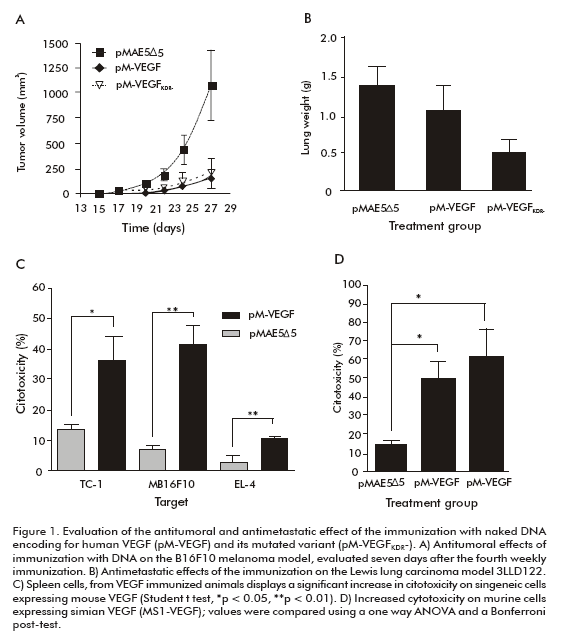
<body><![CDATA[<p><span lang=EN-US style='font-size:10.0pt;font-family:"Verdana","sans-serif"; color:#211E1E'>Our preliminary results demonstrated the feasibility of using a human VEGF variant impaired for VEGFR2 binding as a vaccine antigen in a naked DNA format as an antitumoral approach in mice and provide an insight on the immune mechanism involved </span><span lang=EN-US style='font-size:10.0pt; font-family:"Verdana","sans-serif";color:windowtext'>(</span><span lang=EN-US style='font-size:10.0pt;font-family:"Verdana","sans-serif";color:#211E1E'>14). Further work was directed to the development of a new candidate vaccine using a recombinant antigen produced as a fusion protein containing the mutated human VEGF and an amino terminal sequence of <i>Neisseria Meningitidis </i>P64K protein. The antigen was tested with adjuvants of different chemical nature clinically proven or under advanced preclinical testing. With this vaccine candidate, we showed the induction of anti-tumor effects in the C57Bl/6 melanoma B16-F10 tumor system, with the production in mice of neutralizing antibodies against both human and mouse VEGF, and specific T cell responses against murine tumor cells that produce VEGF </span><span lang=EN-US style='font-size:10.0pt;font-family:"Verdana","sans-serif";color:windowtext'>(</span><span lang=EN-US style='font-size:10.0pt;font-family:"Verdana","sans-serif"; color:#211E1E'>15). </span></p>      <p><b><span lang=EN-US style='font-family:"Verdana","sans-serif";color:#211E1E'>ANTI-TUMOR EFFECT OF A HUMAN VEGF GENE VARIANT IMPAIRED FOR VEGFR2 BINDING ADMINISTERED TO SYNGENIC MICE AS A NAKED DNA VACCINE </span></b></p>      <p><span lang=EN-US style='font-size:10.0pt;font-family:"Verdana","sans-serif"; color:#211E1E'>The human VEGF<sub>121</sub> gene with its native signal peptide was PCR-amplified and cloned into pMAE5</span><span style='font-size:10.0pt; font-family:"Verdana","sans-serif";color:#211E1E'>&#948;</span><span lang=EN-US style='font-size:10.0pt;font-family:"Verdana","sans-serif"; color:#211E1E'>5, a vector designed for naked DNA immunization and bearing 5 CpG motifs </span><span lang=EN-US style='font-size:10.0pt;font-family:"Verdana","sans-serif"; color:windowtext'>(</span><span lang=EN-US style='font-size:10.0pt;font-family: "Verdana","sans-serif";color:#211E1E'>14). The VEGFR2 binding zone of the VEGF gene was either preserved or disrupted, the latter one by overlapping PCR substitution of the bases corresponding to the aminoacids R82, K84 and H86, by those coding for glutamic acid </span><span lang=EN-US style='font-size:10.0pt; font-family:"Verdana","sans-serif";color:windowtext'>(</span><span lang=EN-US style='font-size:10.0pt;font-family:"Verdana","sans-serif";color:#211E1E'>E). Resulting constructions were named pM-VEGF and pM-VEGFKDR-, respectively. DNA for vaccination was purified using Giga Endo-free columns </span><span lang=EN-US style='font-size:10.0pt;font-family:"Verdana","sans-serif"; color:windowtext'>(</span><span lang=EN-US style='font-size:10.0pt;font-family: "Verdana","sans-serif";color:#211E1E'>QIAGEN) and formulated in phosphate buffered saline </span><span lang=EN-US style='font-size:10.0pt;font-family: "Verdana","sans-serif";color:windowtext'>(</span><span lang=EN-US style='font-size:10.0pt;font-family:"Verdana","sans-serif";color:#211E1E'>PBS) to a final concentration of 2 mg/mL and stored at -20 °C in aliquots. </span></p>      <p><span lang=EN-US style='font-size:10.0pt;font-family:"Verdana","sans-serif"; color:#211E1E'>DNA immunization was conducted by injecting 50 µL of test plasmid DNA in PBS by the left quadriceps intramuscular </span><span lang=EN-US style='font-size:10.0pt;font-family:"Verdana","sans-serif"; color:windowtext'>(</span><span lang=EN-US style='font-size:10.0pt;font-family: "Verdana","sans-serif";color:#211E1E'>i.m.) route and administered every day for 4 weeks. Subcutaneous </span><span lang=EN-US style='font-size:10.0pt; font-family:"Verdana","sans-serif";color:windowtext'>(</span><span lang=EN-US style='font-size:10.0pt;font-family:"Verdana","sans-serif";color:#211E1E'>s.c.) tumor challenge was done a week after the last immunization, as well as the evaluations of the tumoral and cellular immune responses. </span></p>      <p><span lang=EN-US style='font-size:10.0pt;font-family:"Verdana","sans-serif"; color:#211E1E'>Prophylactic immunization with pM-VEGF significantly delayed tumor development for melanoma B16-F10 </span><span lang=EN-US style='font-size:10.0pt;font-family:"Verdana","sans-serif";color:windowtext'>(</span><span lang=EN-US style='font-size:10.0pt;font-family:"Verdana","sans-serif"; color:#211E1E'>p = 0.0201), reduced tumor growth kinetics </span><span lang=EN-US style='font-size:10.0pt;font-family:"Verdana","sans-serif"; color:windowtext'>(</span><span lang=EN-US style='font-size:10.0pt;font-family: "Verdana","sans-serif";color:#211E1E'>p &lt; 0.01), and increased C57Bl/6 mouse survival </span><span lang=EN-US style='font-size:10.0pt;font-family:"Verdana","sans-serif"; color:windowtext'>(</span><span lang=EN-US style='font-size:10.0pt;font-family: "Verdana","sans-serif";color:#211E1E'>p = 0.0229), as compared to the control group receiving the empty vector. A similar effect was observed in the same mouse strain using the lung carcinoma model TC-1, where from day 28, after tumor challenge, a significant reduction on tumor volume was detected, as well as, a significant increase on survival </span><span lang=EN-US style='font-size:10.0pt;font-family:"Verdana","sans-serif";color:windowtext'>(</span><span lang=EN-US style='font-size:10.0pt;font-family:"Verdana","sans-serif"; color:#211E1E'>p = 0.0428) of the pM-VEGF treated animals </span><span lang=EN-US style='font-size:10.0pt;font-family:"Verdana","sans-serif"; color:windowtext'>(</span><span lang=EN-US style='font-size:10.0pt;font-family: "Verdana","sans-serif";color:#211E1E'>14). These results demonstrated that it was possible to induce an antitumoral response by administering naked DNA encoding for a VEGF molecule highly homologous to its murine counterpart </span><span lang=EN-US style='font-size:10.0pt;font-family:"Verdana","sans-serif"; color:windowtext'>(</span><span lang=EN-US style='font-size:10.0pt;font-family: "Verdana","sans-serif";color:#211E1E'>89%). </span></p>      <p><span lang=EN-US style='font-size:10.0pt;font-family:"Verdana","sans-serif"; color:#211E1E'>To avoid concerns of regulatory agencies for the clinical testing of a VEGF-based vaccine, and taking into consideration that the pro-angiogenic potential of VEGF is directly related to its binding to VEGFR2 </span><span lang=EN-US style='font-size:10.0pt;font-family:"Verdana","sans-serif"; color:windowtext'>(</span><span lang=EN-US style='font-size:10.0pt;font-family: "Verdana","sans-serif";color:#211E1E'>2), we mutated the human VEGF<sub>121</sub> gene </span><span lang=EN-US style='font-size:10.0pt;font-family:"Verdana","sans-serif"; color:windowtext'>(</span><span lang=EN-US style='font-size:10.0pt;font-family: "Verdana","sans-serif";color:#211E1E'>hVEGF<sub>KDR<i>-</i></sub>) encoding of key residues for receptor recognition </span><span lang=EN-US style='font-size: 10.0pt;font-family:"Verdana","sans-serif";color:windowtext'>(</span><span lang=EN-US style='font-size:10.0pt;font-family:"Verdana","sans-serif"; color:#211E1E'>16). The mutations introduced in the human VEGF<sub>121</sub> gene affected the so-called “loop of the 80’s” of VEGF. This region has been reported to be recognized or sterically blocked by several neutralizing antibodies </span><span lang=EN-US style='font-size:10.0pt;font-family:"Verdana","sans-serif"; color:windowtext'>(</span><span lang=EN-US style='font-size:10.0pt;font-family: "Verdana","sans-serif";color:#211E1E'>17), and such mutation in an antigen could hamper the production of this type of immunoglobulins. Nevertheless, we hypothesized that other biologically relevant epitopes in VEGF would expose. Naked DNA immunization of mice with the pM-VEGFKDR- mutated gene molecule evidenced that the anti-tumor effect was still present when animals were challenged with melanoma B16-F10 </span><span lang=EN-US style='font-size:10.0pt; font-family:"Verdana","sans-serif";color:windowtext'>(</span><span style='font-size:10.0pt;font-family:"Verdana","sans-serif";color:#211E1E'><a href="#fig1"><span lang=EN-US>Figure 1A</span></a></span><span lang=EN-US style='font-size:10.0pt;font-family:"Verdana","sans-serif";color:#211E1E'>). Furthermore, the comparative evaluation of the anti-metastatic effect of the immunization with pM-VEGF and pM-VEGF<sub>KDR</sub> showed that both genes led to a significant reduction in the number of lung metastases, using the spontaneous metastases Lewis lung carcinoma model, where footpad tumors were removed after sustained growth and lungs were later on examined for metastatic dissemination </span><span lang=EN-US style='font-size:10.0pt;font-family:"Verdana","sans-serif"; color:windowtext'>(</span><span style='font-size:10.0pt;font-family:"Verdana","sans-serif"; color:#211E1E'><a href="#fig1"><span lang=EN-US>Figure 1B</span></a></span><span lang=EN-US style='font-size:10.0pt;font-family:"Verdana","sans-serif"; color:#211E1E'>) </span><span lang=EN-US style='font-size:10.0pt;font-family: "Verdana","sans-serif";color:windowtext'>(</span><span lang=EN-US style='font-size:10.0pt;font-family:"Verdana","sans-serif";color:#211E1E'>14). </span></p>      <p align=center style='text-align:center'><span style='font-size:13.5pt; color:#211E1E'><img border=0 width=562 height=644 src="/img/revistas/bta/v26n1/f0113109.gif"></span><a name=fig1></a></p>      
<p><span lang=EN-US style='font-size:10.0pt;font-family:"Verdana","sans-serif"; color:#211E1E'>No anti-human VEGF<sub>121</sub> antibody titers were detected by a specific ELISA after prophylactic immunization using either pM-VEGF or pM-VEGF<sub>KDR-</sub>, but freshly isolated spleen cells from vaccinated mice induced significant direct <i>in vitro </i>lysis of three murine VEGF-producer tumor cell lines, without prior IL-2 stimulation </span><span lang=EN-US style='font-size:10.0pt;font-family:"Verdana","sans-serif";color:windowtext'>(</span><span style='font-size:10.0pt;font-family:"Verdana","sans-serif";color:#211E1E'><a href="#fig1"><span lang=EN-US>Figure 1C</span></a></span><span lang=EN-US style='font-size:10.0pt;font-family:"Verdana","sans-serif";color:#211E1E'>), as evaluated using a LDH release assay. In addition, spleen cells from such animals showed a significant increase in IFN-</span><span style='font-size: 10.0pt;font-family:"Verdana","sans-serif";color:#211E1E'>&#947;</span><span style='font-size:10.0pt;font-family:"Verdana","sans-serif";color:#211E1E'> <span lang=EN-US>secretion after co-culturing for 24 hours with EL-4 target tumor cells, comparing spleen cells obtained from empty pMAE5&#8710;5 vector-treated mice. Moreover, cytolysis of mouse endothelial cells </span></span><span lang=EN-US style='font-size:10.0pt;font-family:"Verdana","sans-serif"; color:windowtext'>(</span><span lang=EN-US style='font-size:10.0pt;font-family: "Verdana","sans-serif";color:#211E1E'>MS-1- VEGF) transfected with monkey VEGF isoform 121 was seen after spleen cells of pM-VEGF or pM-VEGF<sub>KDR-</sub> immunized animals were stimulated by low amounts of IL-2 and antigen </span><span lang=EN-US style='font-size:10.0pt;font-family:"Verdana","sans-serif"; color:windowtext'>(</span><span style='font-size:10.0pt;font-family:"Verdana","sans-serif"; color:#211E1E'><a href="#fig1"><span lang=EN-US>Figure 1D</span></a></span><span lang=EN-US style='font-size:10.0pt;font-family:"Verdana","sans-serif"; color:#211E1E'>). In the absence of a humoral response to VEGF, these result demonstrated for the first time the possibility of activating the cellular arm of the immune response in C57Bl/6 mice to achieve an antitumoral effect. </span></p>      <p><b><span lang=EN-US style='font-family:"Verdana","sans-serif";color:#211E1E'>DEVELOPMENT AND EXPERIMENTAL TESTING OF A VACCINE CANDIDATE BASED ON A RECOMBINANT MUTATED HUMAN VEGF AND A CLINICALLY TESTED ADJUVANT </span></b></p>      <p><span lang=EN-US style='font-size:10.0pt;font-family:"Verdana","sans-serif"; color:#211E1E'>Taking into account the reported low efficiency of naked DNA vaccination in humans, and the need of enhancing the anti-tumor response to immunization <i>via </i>the development of both neutralizing antibodies and specific cytotoxic T lymphocytes, our work moved towards the production of a suitable recombinant antigen in <i>Escherichia coli</i>. The first expression system used was the pGEX-6P plasmid GST fusion system. The human VEGF<sub>121</sub>, and the corresponding mouse VEGF isoform 120, were cloned, expressed, and purified using glutathione-Sepharose affinity chromatography. Both GST fusion protein preparations were able to elicit high antibody titres in mice after immunization, similar to commercially available human VEGF, using Freund’s adjuvant </span><span lang=EN-US style='font-size:10.0pt;font-family:"Verdana","sans-serif"; color:windowtext'>(</span><span lang=EN-US style='font-size:10.0pt;font-family: "Verdana","sans-serif";color:#211E1E'>18). </span></p>      ]]></body>
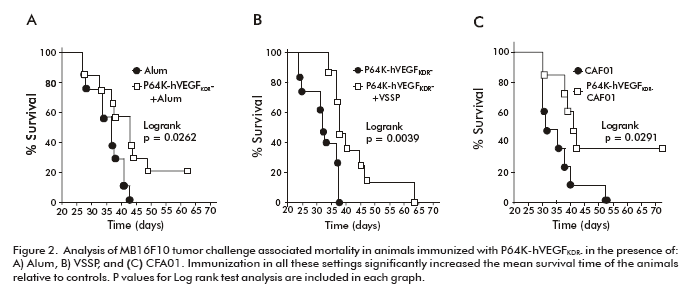
<body><![CDATA[<p><span lang=EN-US style='font-size:10.0pt;font-family:"Verdana","sans-serif"; color:#211E1E'>To produce a vaccine antigen feasible for clinical trials, the mutated human VEGF isoform 121 gene was cloned. The recombinant antigen P64k- VEGF<sub>KDR-</sub>, was designed as a fusion protein where the mutated human VEGF is genetically coupled at its N-terminus to the first 47 aminoacids of the <i>N. meningitidis </i>P64K protein. Protein yileds of 60 mg/L were obtained from non-optimized bacterial cultures, a promising figure in terms of scaling up </span><span lang=EN-US style='font-size:10.0pt;font-family:"Verdana","sans-serif"; color:windowtext'>(</span><span lang=EN-US style='font-size:10.0pt;font-family: "Verdana","sans-serif";color:#211E1E'>15). </span></p>          <p><span lang=EN-US style='font-size:10.0pt;font-family:"Verdana","sans-serif"'>Experimental        anti-tumor activity of this recombinant antigen was tested with three adjuvants        of different chemical composition, already employed in humans, or having        strong preclinical data available: aluminum hydroxide, very small sized        proteoliposomes </span><span lang=EN-US style='font-size:10.0pt;font-family: "Verdana","sans-serif";color:windowtext'>(</span><span lang=EN-US style='font-size:10.0pt;font-family:"Verdana","sans-serif"'>VSSP; Center of Molecular        Immunology, CIM, Havana) and dimethyldioctadecil ammonium/ trehalose 6,6        dibehenate </span><span lang=EN-US style='font-size:10.0pt;font-family: "Verdana","sans-serif";color:windowtext'>(</span><span lang=EN-US style='font-size:10.0pt;font-family:"Verdana","sans-serif"'>CAF01; Serum Institute,        Denmark). The vaccination scheme involved weekly s.c. injections of 100        µg of antigen and adjuvant, in the form of three prophylactic and three        therapeutic immunizations. The combination of P64khVEGF<sub>KDR-</sub> and        the three adjuvants demonstrated positive anti-tumor effects against C57Bl/6        melanoma B16-F10 in terms of extended time for the appearance of palpable        tumors. Effects of vaccination on tumor growth kinetics were evident when        performed the P64k-hVEGF<sub>KDR-</sub> + VSSP combination, only partial        when the adjuvant was changed to Alum, and not detected with the P64k-hVEGF<sub>KDR-</sub>        + CAF01. However, a significant increase in animal survival was observed        for all the experimental settings testing antigen plus adjuvant, when compared        with the control animals </span><span lang=EN-US style='font-size:10.0pt;font-family: "Verdana","sans-serif";color:windowtext'>(</span><span style='font-size:10.0pt; font-family:"Verdana","sans-serif"'><a href="/img/revistas/bta/v26n1/f0213109.gif"><span lang=EN-US>Figure        2A-C</span></a></span><span lang=EN-US style='font-size:10.0pt;font-family: "Verdana","sans-serif"'>) </span><span lang=EN-US style='font-size:10.0pt; font-family:"Verdana","sans-serif";color:windowtext'>(</span><span lang=EN-US style='font-size:10.0pt;font-family:"Verdana","sans-serif"'>15). </span></p>          
<p><span lang=EN-US style='font-size:10.0pt;font-family:"Verdana","sans-serif"; color:#211E1E'>Immunization with the P64k-hVEGFKDR- protein antigen and all the        adjuvants tested resulted in IgG antibodies that recognized wild type human        and murine VEGF in a correlated manner </span><span lang=EN-US style='font-size: 10.0pt;font-family:"Verdana","sans-serif";color:windowtext'>(</span><span style='font-size:10.0pt;font-family:"Verdana","sans-serif";color:#211E1E'><a href="/img/revistas/bta/v26n1/f0313109.gif"><span lang=EN-US>Figure 3A</span></a></span><span lang=EN-US style='font-size:10.0pt;font-family:"Verdana","sans-serif"; color:#211E1E'>). <i>In vitro </i>experiments were performed to test whether the        antibodies raised by vaccination were capable of neutralizing the stimulatory        effect of human VEGF on the proliferation of human umbilical cord endothelial        cells </span><span lang=EN-US style='font-size:10.0pt;font-family: "Verdana","sans-serif";color:windowtext'>(</span><span lang=EN-US style='font-size:10.0pt;font-family:"Verdana","sans-serif";color:#211E1E'>HuVEC).        Taking as example antigen plus alum, or antigen plus VSSP </span><span lang=EN-US style='font-size:10.0pt;font-family:"Verdana","sans-serif"; color:windowtext'>(</span><span lang=EN-US style='font-size:10.0pt;font-family: "Verdana","sans-serif";color:#211E1E'>that resulted in a better anti-tumor response),        we found that pooled sera from these two treatment groups blocked the proliferation        of HuVEC, and sera from animals immunized with P64k-hVEGFKDR- plus VSSP        were better at blocking </span><span lang=EN-US style='font-size: 10.0pt;font-family:"Verdana","sans-serif";color:windowtext'>(</span><span style='font-size:10.0pt;font-family:"Verdana","sans-serif";color:#211E1E'><a href="/img/revistas/bta/v26n1/f0313109.gif"><span lang=EN-US>Figure 3B</span></a></span><span lang=EN-US style='font-size:10.0pt;font-family:"Verdana","sans-serif"; color:#211E1E'>). Moreover, when the group of animals immunized with antigen plus        VSSP was stratified according to the effect of vaccination in tumor growth        at a given point of time, sera coming from mice showing lower tumor volumes        representative of a higher effect, consistently produced a stronger inhibition        of the stimulatory effect of human VEGF on HuVEC </span><span lang=EN-US style='font-size:10.0pt;font-family:"Verdana","sans-serif";color:windowtext'>(</span><span style='font-size:10.0pt;font-family:"Verdana","sans-serif";color:#211E1E'><a href="/img/revistas/bta/v26n1/f0313109.gif"><span lang=EN-US>Figure 3C</span></a></span><span lang=EN-US style='font-size:10.0pt;font-family:"Verdana","sans-serif"; color:#211E1E'>). An ELISA assay was developed to test the ability of sera to        block VEGF-VEGFR2 </span><span lang=EN-US style='font-size:10.0pt;font-family: "Verdana","sans-serif";color:windowtext'>(</span><span lang=EN-US style='font-size:10.0pt;font-family:"Verdana","sans-serif";color:#211E1E'>KDR)        interaction. The ability of the antibodies raised by vaccination to interfere        the binding of soluble KDRFc to VEGF adsorbed to the solid phase was confirmed        by this alternative method </span><span lang=EN-US style='font-size:10.0pt; font-family:"Verdana","sans-serif";color:windowtext'>(</span><span lang=EN-US style='font-size:10.0pt;font-family:"Verdana","sans-serif";color:#211E1E'>15).        </span></p>      
<p><span lang=EN-US style='font-size:10.0pt;font-family:"Verdana","sans-serif"; color:#211E1E'>To explore the involvement of direct cell cytotoxicity in the overall antitumor response seen in our experiments, C57Bl/6 mice immunized with antigen plus VSSP were depleted of CD8+ T cells with specific monoclonal antibodies during and after the immunization schedule. We found that CD8+ T cells removal significantly abrogated the anti-tumor effect, an indication of a potential involvement of a cellular response in the antitumoral effect of our VEGF targeted immunotherapy. Also, spleen cells of immunized mice were able to provoke lyses of CFSE-charged tumor cells, as demonstrated by FACS </span><span lang=EN-US style='font-size:10.0pt;font-family:"Verdana","sans-serif"; color:windowtext'>(</span><span lang=EN-US style='font-size:10.0pt;font-family: "Verdana","sans-serif";color:#211E1E'>15). </span></p>      <p><b><span lang=EN-US style='font-family:"Verdana","sans-serif";color:#211E1E'>CONCLUSIONS </span></b></p>      <p><span lang=EN-US style='font-size:10.0pt;font-family:"Verdana","sans-serif"; color:#211E1E'>Our results demonstrated that it is possible to produce IgG antibodies that neutralize the pro-angiogenic effects of human and murine VEGF, induce specific cytotoxic T cell responses, and elicit consequent antitumor effects in mice via vaccination with a mutated human VEGF molecule. In our way to clinical trials, we have developed and produced the antigen as a recombinant protein in <i>E. coli</i>, and tested with success using clinically relevant adjuvants in different experimental settings. Our novel active immunotherapy approach to cancer combines anti-angiogenesis, by selective antibody removal/blocking of soluble proangiogenic VEGF produced by tumors, and the development of an anti-tumor T cell response. </span></p>      <p><b><span lang=EN-US style='font-family:"Verdana","sans-serif";color:#211E1E'>ACKNOWLEDGEMENTS </span></b></p>      <p><span lang=EN-US style='font-size:10.0pt;font-family:"Verdana","sans-serif"; color:#211E1E'>We thank to the following collaborators of the CIGB for their contribution to this work: Yordanka Soria, Dioslaida Urquiza, Aracelys Blanco, Omar López, Ernesto Galbán, Ariel Vázquez, Myladis Limonta, Victoria M. Lugo, Daniel Yero, Isis del Carmen Torrens, Leonardo Canaan, Hansel Bell, Ernesto M González, Jorge Sánchez and Maelys Miyares; and to Dr. Daniel Yero from the Finlay Institute. </span></p>      <p><span lang=EN-US style='font-size:11.0pt;font-family:"Arial","sans-serif"; color:red'>&nbsp;</span><b><span lang=EN-US style='font-family:"Verdana","sans-serif"; color:#211E1E'>REFERENCES </span></b></p>      <!-- ref --><p><span lang=EN-US style='font-size:10.0pt;font-family:"Verdana","sans-serif"'>1. Folkman J. Angiogenesis: an organizing principle for drug discovery Nat Rev Drug Discov</span><span lang=EN-US style='font-size:11.0pt;font-family:"Arial","sans-serif"; color:red'> </span><span lang=EN-US style='font-size:10.0pt;font-family:"Verdana","sans-serif"'>2007;6:273-286.</span><p><span lang=EN-US style='font-size:10.0pt;font-family:"Verdana","sans-serif"'>2. Ferrara N. VEGF as a therapeutic target in cancer. Oncology</span><span lang=EN-US style='font-size:11.0pt;font-family:"Arial","sans-serif";color:red'> </span><span lang=EN-US style='font-size:10.0pt;font-family:"Verdana","sans-serif"'>2005;69</span><span lang=EN-US style='font-size:11.0pt;font-family:"Arial","sans-serif";color:red'> </span><span lang=EN-US style='font-size:10.0pt;font-family:"Verdana","sans-serif"'>Suppl 3:11- 6.</span></p>      <!-- ref --><p><span lang=EN-US style='font-size:10.0pt;font-family:"Verdana","sans-serif"'>3. Hurwitz H, Fehrenbacher L, Novotny W, Cartwright T, Hainsworth J, Heim W, et al. Bevacizumab plus irinotecan, fluorouracil, and leucovorin for metastatic colorectal cancer. N Engl J Med</span><span lang=EN-US style='font-size:11.0pt; font-family:"Arial","sans-serif";color:red'> </span><span lang=EN-US style='font-size:10.0pt;font-family:"Verdana","sans-serif"'>2004;350:2335-2342.</span><!-- ref --><p><span lang=EN-US style='font-size:10.0pt;font-family:"Verdana","sans-serif"'>4. Sandler A, Gray R, Perry MC, Brahmer J, Schiller JH, Dowlati A, et al. Paclitaxel-carboplatin alone or with bevacizumab for non-small-cell lung cancer. N Engl J Med</span><span lang=EN-US style='font-size:11.0pt;font-family: "Arial","sans-serif";color:red'> </span><span lang=EN-US style='font-size:10.0pt; font-family:"Verdana","sans-serif"'>2006;355:2542-2550.</span><!-- ref --><p><span lang=EN-US style='font-size:10.0pt;font-family:"Verdana","sans-serif"'>5. Miller K, Wang M, Gralow J, Dickler M, Cobleigh M, Perez EA, et al. Paclitaxel plus bevacizumab versus paclitaxel alone for metastatic breast cancer. N Engl J Med</span><span lang=EN-US style='font-size:11.0pt;font-family:"Arial","sans-serif"; color:red'> </span><span lang=EN-US style='font-size:10.0pt;font-family:"Verdana","sans-serif"'>2007;357:2666-2676.</span><!-- ref --><p><span lang=EN-US style='font-size:10.0pt;font-family:"Verdana","sans-serif"'>6. Posey JA, Ng TC, Yang B, Khazaeli MB, Carpenter MD, Fox F, et al. A phase I study of anti-kinase insert domain-containing receptor antibody, IMC-1C11, in patients with liver metastases from colorectal carcinoma. Clin Cancer Res</span><span lang=EN-US style='font-size:11.0pt;font-family:"Arial","sans-serif";color:red'> </span><span lang=EN-US style='font-size:10.0pt;font-family:"Verdana","sans-serif"'>2003;9:1323- 1332.</span><!-- ref --><p><span lang=EN-US style='font-size:10.0pt;font-family:"Verdana","sans-serif"'>7. Wei YQ, Wang QR, Zhao X, Yang L, Tian L, Lu Y, et al. Immunotherapy of tumors with xenogeneic endothelial cells as a vaccine. Nat Med</span><span lang=EN-US style='font-size:11.0pt;font-family:"Arial","sans-serif";color:red'> </span><span lang=EN-US style='font-size:10.0pt;font-family:"Verdana","sans-serif"'>2000;6:1160-1166.</span><!-- ref --><p><span lang=EN-US style='font-size:10.0pt;font-family:"Verdana","sans-serif"'>8. Chen XY, Zhang W, Zhang W, Mirabet V, Carbonell F, Castell JV, et al. Vaccination with viable human umbilical vein endothelial cells prevents metastatic tumors by attack on tumor vasculature with both cellular and humoral immunity. Clin Cancer Res</span><span lang=EN-US style='font-size:11.0pt; font-family:"Arial","sans-serif";color:red'> </span><span lang=EN-US style='font-size:10.0pt;font-family:"Verdana","sans-serif"'>2006;12:5834-5840.</span><!-- ref --><p><span lang=EN-US style='font-size:10.0pt;font-family:"Verdana","sans-serif"'>9. Okaji Y, Tsuno NH, Kitayama J, Saito S, Takahashi T, Kawai K, et al. Vaccination with autologous endothelium inhibits angiogenesis and metastasis of colon cancer through autoimmunity. Cancer Sci</span><span lang=EN-US style='font-size:11.0pt;font-family:"Arial","sans-serif";color:red'> </span><span lang=EN-US style='font-size:10.0pt;font-family:"Verdana","sans-serif"'>2004;95:85-90.</span><!-- ref --><p><span lang=EN-US style='font-size:10.0pt;font-family:"Verdana","sans-serif"'>10. Wei YQ, Huang MJ, Yang L, Zhao X, Tian L, Lu Y, et al. Immunogene therapy of tumors with vaccine based on Xenopus homologous vascular endothelial growth factor as a model antigen. Proc Natl Acad Sci USA</span><span lang=EN-US style='font-size:11.0pt;font-family:"Arial","sans-serif";color:red'> </span><span lang=EN-US style='font-size:10.0pt;font-family:"Verdana","sans-serif"'>2001;98:11545-50.</span><!-- ref --><p><span lang=EN-US style='font-size:10.0pt;font-family:"Verdana","sans-serif"'>11. Kamstock D, Elmslie R, Thamm D, Dow S. Evaluation of a xenogeneic VEGF vaccine in dogs with soft tissue sarcoma. Cancer Immunol Immunother</span><span lang=EN-US style='font-size:11.0pt;font-family:"Arial","sans-serif";color:red'> </span><span lang=EN-US style='font-size:10.0pt;font-family:"Verdana","sans-serif"'>2007;56:1299-309.</span><!-- ref --><p><span lang=EN-US style='font-size:10.0pt;font-family:"Verdana","sans-serif"'>12. Li Y, Wang MN, Li H, King KD, Bassi R, Sun H, et al. Active immunization against the vascular endothelial growth factor receptor flk1 inhibits tumor angiogenesis and metastasis. J Exp Med</span><span lang=EN-US style='font-size: 11.0pt;font-family:"Arial","sans-serif";color:red'> </span><span lang=EN-US style='font-size:10.0pt;font-family:"Verdana","sans-serif"'>2002;195:1575-84.</span><!-- ref --><p><span lang=EN-US style='font-size:10.0pt;font-family:"Verdana","sans-serif"'>13. Rad FH, Le BH, Paturance S, Larcier P, Genne P, Ryffel B, et al. VEGF kinoid vaccine, a therapeutic approach against tumor angiogenesis and metastases. </span><span style='font-size:10.0pt;font-family:"Verdana","sans-serif"'>Proc Natl Acad Sci USA</span><span style='font-size:11.0pt;font-family:"Arial","sans-serif"; color:red'> </span><span style='font-size:10.0pt;font-family:"Verdana","sans-serif"'>2007;104:2837-42.</span><!-- ref --><p><span style='font-size:10.0pt;font-family:"Verdana","sans-serif"'>14. Bequet-Romero M, Ayala M, Acevedo BE, Rodríguez EG, Ocejo OL, Torrens I, et al. </span><span lang=EN-US style='font-size:10.0pt;font-family:"Verdana","sans-serif"'>Prophylactic naked DNA vaccination with the human vascular endothelial growth factor induces an anti-tumor response in C57Bl/6 mice. Angiogenesis</span><span lang=EN-US style='font-size:11.0pt;font-family:"Arial","sans-serif";color:red'> </span><span lang=EN-US style='font-size:10.0pt;font-family:"Verdana","sans-serif"'>2007;10:23-34.</span><!-- ref --><p><span lang=EN-US style='font-size:10.0pt;font-family:"Verdana","sans-serif"'>15. Morera Y, Bequet-Romero M, Ayala M, Lamdán H, Agger EM, Andersen P, et al. Antitumoral effect of active immunotherapy in C57BL/6 mice using a recombinant human VEGF protein as antigen and three chemically unrelated adjuvants. Angiogenesis</span><span lang=EN-US style='font-size:11.0pt;font-family:"Arial","sans-serif"; color:red'> </span><span lang=EN-US style='font-size:10.0pt;font-family:"Verdana","sans-serif"'>2008;11:381-93.</span><!-- ref --><p><span lang=EN-US style='font-size:10.0pt;font-family:"Verdana","sans-serif"'>16. Keyt BA, Nguyen HV, Berleau LT, Duarte CM, Park J, Chen H, et al. Identification of vascular endothelial growth factor determinants for binding KDR and FLT-1 receptors. Generation of receptor-selective VEGF variants by site-directed mutagenesis. <i>J Biol Chem</i></span><span lang=EN-US style='font-size:11.0pt;font-family:"Arial","sans-serif";color:red'> </span><span lang=EN-US style='font-size:10.0pt;font-family:"Verdana","sans-serif"'>1996;271:5638-46.</span><!-- ref --><p><span lang=EN-US style='font-size:10.0pt;font-family:"Verdana","sans-serif"'>17. Kim KJ, Li B, Houck K, Winer J, Ferrara N. The vascular endothelial growth factor proteins: identification of biologically relevant regions by neutralizing monoclonal antibodies. Growth Factors</span><span lang=EN-US style='font-size:11.0pt;font-family:"Arial","sans-serif";color:red'> </span><span lang=EN-US style='font-size:10.0pt;font-family:"Verdana","sans-serif"'>1992;7:53-64.</span><!-- ref --><p><span lang=EN-US style='font-size:10.0pt;font-family:"Verdana","sans-serif"'>18. Morera Y, Lamdan H, Bequet M, Ayala, G, et al. </span><span style='font-size: 10.0pt;font-family:"Verdana","sans-serif"'>Rojas, Y. Muñoz, <i>et al</i>. </span><span lang=EN-US style='font-size:10.0pt;font-family:"Verdana","sans-serif"'>Biologically active vascular endothelial growth factor as a bacterial recombinant glutathione S transferase fusion protein. Biotechnol &nbsp;Appl Biochem</span><span lang=EN-US style='font-size:11.0pt;font-family:"Arial","sans-serif";color:red'> </span><span lang=EN-US style='font-size:10.0pt;font-family:"Verdana","sans-serif"'>2006;44:45-53.</span><span lang=EN-US style='font-size:11.0pt;font-family:"Arial","sans-serif";color:green'> </span><p><span lang=EN-US style='font-size:13.5pt'>&nbsp;</span></p>      <p><a name=award></a><b><i><span lang=EN-US style='font-size:10.0pt;font-family: "Verdana","sans-serif"'>*This work received the Award of the National Academy of Sciences of Cuba for the year 2008.</span></i></b></p>      <p><span lang=EN-US style='font-size:13.5pt'>&nbsp;</span></p>      ]]></body>
<body><![CDATA[<p><span lang=EN-US style='font-size:10.0pt;font-family:"Verdana","sans-serif"; color:#211E1E'>Mónica Bequet-Romero. Recombinant Antibodies Laboratory, Center for Genetic Engineering and Biotechnology, CIGB. Ave. 31 / 158 and 190, Playa, POBox 6162, Havana 10600, Havana, Cuba. E-mail: </span><span style='font-size: 10.0pt;font-family:"Verdana","sans-serif";color:#211E1E'><a href="mailto:monica.bequet@cigb.edu.cu"><span lang=EN-US>monica.bequet@cigb.edu.cu</span></a></span><span style='font-size:11.0pt;font-family:"Arial","sans-serif";color:#FF6600'> </span></p>  </div>  </div>       ]]></body><back>
<ref-list>
<ref id="B1">
<label>1</label><nlm-citation citation-type="">
<person-group person-group-type="author">
<name>
<surname><![CDATA[Folkman]]></surname>
<given-names><![CDATA[J]]></given-names>
</name>
</person-group>
<article-title xml:lang="en"><![CDATA[en]]></article-title>
<source><![CDATA[]]></source>
<year></year>
</nlm-citation>
</ref>
<ref id="B2">
<label>2</label><nlm-citation citation-type="journal">
<person-group person-group-type="author">
<name>
<surname><![CDATA[Ferrara]]></surname>
<given-names><![CDATA[N]]></given-names>
</name>
</person-group>
<article-title xml:lang="en"><![CDATA[VEGF as a therapeutic target in cancer]]></article-title>
<source><![CDATA[Oncology]]></source>
<year>2005</year>
<volume>69</volume>
<page-range>11- 6</page-range></nlm-citation>
</ref>
<ref id="B3">
<label>3</label><nlm-citation citation-type="journal">
<person-group person-group-type="author">
<name>
<surname><![CDATA[Hurwitz]]></surname>
<given-names><![CDATA[H]]></given-names>
</name>
<name>
<surname><![CDATA[Fehrenbacher]]></surname>
<given-names><![CDATA[L]]></given-names>
</name>
<name>
<surname><![CDATA[Novotny]]></surname>
<given-names><![CDATA[W]]></given-names>
</name>
<name>
<surname><![CDATA[Cartwright]]></surname>
<given-names><![CDATA[T]]></given-names>
</name>
<name>
<surname><![CDATA[Hainsworth]]></surname>
<given-names><![CDATA[J]]></given-names>
</name>
<name>
<surname><![CDATA[Heim]]></surname>
<given-names><![CDATA[W]]></given-names>
</name>
</person-group>
<article-title xml:lang="en"><![CDATA[Bevacizumab plus irinotecan, fluorouracil, and leucovorin for metastatic colorectal cancer]]></article-title>
<source><![CDATA[N Engl J Med]]></source>
<year>2004</year>
<volume>350</volume>
<page-range>2335-2342</page-range></nlm-citation>
</ref>
<ref id="B4">
<label>4</label><nlm-citation citation-type="journal">
<person-group person-group-type="author">
<name>
<surname><![CDATA[Sandler]]></surname>
<given-names><![CDATA[A]]></given-names>
</name>
<name>
<surname><![CDATA[Gray]]></surname>
<given-names><![CDATA[R]]></given-names>
</name>
<name>
<surname><![CDATA[Perry]]></surname>
<given-names><![CDATA[MC]]></given-names>
</name>
<name>
<surname><![CDATA[Brahmer]]></surname>
<given-names><![CDATA[J]]></given-names>
</name>
<name>
<surname><![CDATA[Schiller]]></surname>
<given-names><![CDATA[JH]]></given-names>
</name>
<name>
<surname><![CDATA[Dowlati]]></surname>
<given-names><![CDATA[A]]></given-names>
</name>
</person-group>
<article-title xml:lang="en"><![CDATA[Paclitaxel-carboplatin alone or with bevacizumab for non-small-cell lung cancer]]></article-title>
<source><![CDATA[N Engl J Med]]></source>
<year>2006</year>
<volume>355</volume>
<page-range>2542-2550</page-range></nlm-citation>
</ref>
<ref id="B5">
<label>5</label><nlm-citation citation-type="journal">
<person-group person-group-type="author">
<name>
<surname><![CDATA[Miller]]></surname>
<given-names><![CDATA[K]]></given-names>
</name>
<name>
<surname><![CDATA[Wang]]></surname>
<given-names><![CDATA[M]]></given-names>
</name>
<name>
<surname><![CDATA[Gralow]]></surname>
<given-names><![CDATA[J]]></given-names>
</name>
<name>
<surname><![CDATA[Dickler]]></surname>
<given-names><![CDATA[M]]></given-names>
</name>
<name>
<surname><![CDATA[Cobleigh]]></surname>
<given-names><![CDATA[M]]></given-names>
</name>
<name>
<surname><![CDATA[Perez]]></surname>
<given-names><![CDATA[EA]]></given-names>
</name>
</person-group>
<article-title xml:lang="en"><![CDATA[Paclitaxel plus bevacizumab versus paclitaxel alone for metastatic breast cancer]]></article-title>
<source><![CDATA[N Engl J Med]]></source>
<year>2007</year>
<volume>357</volume>
<page-range>2666-2676</page-range></nlm-citation>
</ref>
<ref id="B6">
<label>6</label><nlm-citation citation-type="journal">
<person-group person-group-type="author">
<name>
<surname><![CDATA[Posey]]></surname>
<given-names><![CDATA[JA]]></given-names>
</name>
<name>
<surname><![CDATA[Ng]]></surname>
<given-names><![CDATA[TC]]></given-names>
</name>
<name>
<surname><![CDATA[Yang]]></surname>
<given-names><![CDATA[B]]></given-names>
</name>
<name>
<surname><![CDATA[Khazaeli]]></surname>
<given-names><![CDATA[MB]]></given-names>
</name>
<name>
<surname><![CDATA[Carpenter]]></surname>
<given-names><![CDATA[MD]]></given-names>
</name>
<name>
<surname><![CDATA[Fox]]></surname>
<given-names><![CDATA[F]]></given-names>
</name>
</person-group>
<article-title xml:lang="en"><![CDATA[A phase I study of anti-kinase insert domain-containing receptor antibody, IMC-1C11, in patients with liver metastases from colorectal carcinoma]]></article-title>
<source><![CDATA[Clin Cancer Res]]></source>
<year>2003</year>
<volume>9</volume>
<page-range>1323- 1332</page-range></nlm-citation>
</ref>
<ref id="B7">
<label>7</label><nlm-citation citation-type="journal">
<person-group person-group-type="author">
<name>
<surname><![CDATA[Wei]]></surname>
<given-names><![CDATA[YQ]]></given-names>
</name>
<name>
<surname><![CDATA[Wang]]></surname>
<given-names><![CDATA[QR]]></given-names>
</name>
<name>
<surname><![CDATA[Zhao]]></surname>
<given-names><![CDATA[X]]></given-names>
</name>
<name>
<surname><![CDATA[Yang]]></surname>
<given-names><![CDATA[L]]></given-names>
</name>
<name>
<surname><![CDATA[Tian]]></surname>
<given-names><![CDATA[L]]></given-names>
</name>
<name>
<surname><![CDATA[Lu]]></surname>
<given-names><![CDATA[Y]]></given-names>
</name>
</person-group>
<article-title xml:lang="en"><![CDATA[Immunotherapy of tumors with xenogeneic endothelial cells as a vaccine]]></article-title>
<source><![CDATA[Nat Med]]></source>
<year>2000</year>
<volume>6</volume>
<page-range>1160-1166</page-range></nlm-citation>
</ref>
<ref id="B8">
<label>8</label><nlm-citation citation-type="journal">
<person-group person-group-type="author">
<name>
<surname><![CDATA[Chen]]></surname>
<given-names><![CDATA[XY]]></given-names>
</name>
<name>
<surname><![CDATA[Zhang]]></surname>
<given-names><![CDATA[W]]></given-names>
</name>
<name>
<surname><![CDATA[Zhang]]></surname>
<given-names><![CDATA[W]]></given-names>
</name>
<name>
<surname><![CDATA[Mirabet]]></surname>
<given-names><![CDATA[V]]></given-names>
</name>
<name>
<surname><![CDATA[Carbonell]]></surname>
<given-names><![CDATA[F]]></given-names>
</name>
<name>
<surname><![CDATA[Castell]]></surname>
<given-names><![CDATA[JV]]></given-names>
</name>
</person-group>
<article-title xml:lang="en"><![CDATA[Vaccination with viable human umbilical vein endothelial cells prevents metastatic tumors by attack on tumor vasculature with both cellular and humoral immunity]]></article-title>
<source><![CDATA[Clin Cancer Res]]></source>
<year>2006</year>
<volume>12</volume>
<page-range>5834-5840</page-range></nlm-citation>
</ref>
<ref id="B9">
<label>9</label><nlm-citation citation-type="journal">
<person-group person-group-type="author">
<name>
<surname><![CDATA[Okaji]]></surname>
<given-names><![CDATA[Y]]></given-names>
</name>
<name>
<surname><![CDATA[Tsuno]]></surname>
<given-names><![CDATA[NH]]></given-names>
</name>
<name>
<surname><![CDATA[Kitayama]]></surname>
<given-names><![CDATA[J]]></given-names>
</name>
<name>
<surname><![CDATA[Saito]]></surname>
<given-names><![CDATA[S]]></given-names>
</name>
<name>
<surname><![CDATA[Takahashi]]></surname>
<given-names><![CDATA[T]]></given-names>
</name>
<name>
<surname><![CDATA[Kawai]]></surname>
<given-names><![CDATA[K]]></given-names>
</name>
</person-group>
<article-title xml:lang="en"><![CDATA[Vaccination with autologous endothelium inhibits angiogenesis and metastasis of colon cancer through autoimmunity]]></article-title>
<source><![CDATA[Cancer Sci]]></source>
<year>2004</year>
<volume>95</volume>
<page-range>85-90</page-range></nlm-citation>
</ref>
<ref id="B10">
<label>10</label><nlm-citation citation-type="journal">
<person-group person-group-type="author">
<name>
<surname><![CDATA[Wei]]></surname>
<given-names><![CDATA[YQ]]></given-names>
</name>
<name>
<surname><![CDATA[Huang]]></surname>
<given-names><![CDATA[MJ]]></given-names>
</name>
<name>
<surname><![CDATA[Yang]]></surname>
<given-names><![CDATA[L]]></given-names>
</name>
<name>
<surname><![CDATA[Zhao]]></surname>
<given-names><![CDATA[X]]></given-names>
</name>
<name>
<surname><![CDATA[Tian]]></surname>
<given-names><![CDATA[L]]></given-names>
</name>
<name>
<surname><![CDATA[Lu]]></surname>
<given-names><![CDATA[Y]]></given-names>
</name>
</person-group>
<article-title xml:lang="en"><![CDATA[Immunogene therapy of tumors with vaccine based on Xenopus homologous vascular endothelial growth factor as a model antigen]]></article-title>
<source><![CDATA[Proc Natl Acad Sci USA]]></source>
<year>2001</year>
<volume>98</volume>
<page-range>11545-50</page-range></nlm-citation>
</ref>
<ref id="B11">
<label>11</label><nlm-citation citation-type="journal">
<person-group person-group-type="author">
<name>
<surname><![CDATA[Kamstock]]></surname>
<given-names><![CDATA[D]]></given-names>
</name>
<name>
<surname><![CDATA[Elmslie]]></surname>
<given-names><![CDATA[R]]></given-names>
</name>
<name>
<surname><![CDATA[Thamm]]></surname>
<given-names><![CDATA[D]]></given-names>
</name>
<name>
<surname><![CDATA[Dow]]></surname>
<given-names><![CDATA[S]]></given-names>
</name>
</person-group>
<article-title xml:lang="en"><![CDATA[Evaluation of a xenogeneic VEGF vaccine in dogs with soft tissue sarcoma]]></article-title>
<source><![CDATA[Cancer Immunol Immunother]]></source>
<year>2007</year>
<volume>56</volume>
<page-range>1299-309</page-range></nlm-citation>
</ref>
<ref id="B12">
<label>12</label><nlm-citation citation-type="journal">
<person-group person-group-type="author">
<name>
<surname><![CDATA[Li]]></surname>
<given-names><![CDATA[Y]]></given-names>
</name>
<name>
<surname><![CDATA[Wang]]></surname>
<given-names><![CDATA[MN]]></given-names>
</name>
<name>
<surname><![CDATA[Li]]></surname>
<given-names><![CDATA[H]]></given-names>
</name>
<name>
<surname><![CDATA[King]]></surname>
<given-names><![CDATA[KD]]></given-names>
</name>
<name>
<surname><![CDATA[Bassi]]></surname>
<given-names><![CDATA[R]]></given-names>
</name>
<name>
<surname><![CDATA[Sun]]></surname>
<given-names><![CDATA[H]]></given-names>
</name>
</person-group>
<article-title xml:lang="en"><![CDATA[Active immunization against the vascular endothelial growth factor receptor flk1 inhibits tumor angiogenesis and metastasis]]></article-title>
<source><![CDATA[J Exp Med]]></source>
<year>2002</year>
<volume>195</volume>
<page-range>1575-84</page-range></nlm-citation>
</ref>
<ref id="B13">
<label>13</label><nlm-citation citation-type="journal">
<person-group person-group-type="author">
<name>
<surname><![CDATA[Rad]]></surname>
<given-names><![CDATA[FH]]></given-names>
</name>
<name>
<surname><![CDATA[Le]]></surname>
<given-names><![CDATA[BH]]></given-names>
</name>
<name>
<surname><![CDATA[Paturance]]></surname>
<given-names><![CDATA[S]]></given-names>
</name>
<name>
<surname><![CDATA[Larcier]]></surname>
<given-names><![CDATA[P]]></given-names>
</name>
<name>
<surname><![CDATA[Genne]]></surname>
<given-names><![CDATA[P]]></given-names>
</name>
<name>
<surname><![CDATA[Ryffel]]></surname>
<given-names><![CDATA[B]]></given-names>
</name>
</person-group>
<article-title xml:lang="en"><![CDATA[VEGF kinoid vaccine, a therapeutic approach against tumor angiogenesis and metastases]]></article-title>
<source><![CDATA[Proc Natl Acad Sci USA]]></source>
<year>2007</year>
<volume>104</volume>
<page-range>2837-42</page-range></nlm-citation>
</ref>
<ref id="B14">
<label>14</label><nlm-citation citation-type="journal">
<person-group person-group-type="author">
<name>
<surname><![CDATA[Bequet-Romero]]></surname>
<given-names><![CDATA[M]]></given-names>
</name>
<name>
<surname><![CDATA[Ayala]]></surname>
<given-names><![CDATA[M]]></given-names>
</name>
<name>
<surname><![CDATA[Acevedo]]></surname>
<given-names><![CDATA[BE]]></given-names>
</name>
<name>
<surname><![CDATA[Rodríguez]]></surname>
<given-names><![CDATA[EG]]></given-names>
</name>
<name>
<surname><![CDATA[Ocejo]]></surname>
<given-names><![CDATA[OL]]></given-names>
</name>
<name>
<surname><![CDATA[Torrens]]></surname>
<given-names><![CDATA[I]]></given-names>
</name>
</person-group>
<article-title xml:lang="en"><![CDATA[Prophylactic naked DNA vaccination with the human vascular endothelial growth factor induces an anti-tumor response in C57Bl/6 mice]]></article-title>
<source><![CDATA[Angiogenesis]]></source>
<year>2007</year>
<volume>10</volume>
<page-range>23-34</page-range></nlm-citation>
</ref>
<ref id="B15">
<label>15</label><nlm-citation citation-type="journal">
<person-group person-group-type="author">
<name>
<surname><![CDATA[Morera]]></surname>
<given-names><![CDATA[Y]]></given-names>
</name>
<name>
<surname><![CDATA[Bequet-Romero]]></surname>
<given-names><![CDATA[M]]></given-names>
</name>
<name>
<surname><![CDATA[Ayala]]></surname>
<given-names><![CDATA[M]]></given-names>
</name>
<name>
<surname><![CDATA[Lamdán]]></surname>
<given-names><![CDATA[H]]></given-names>
</name>
<name>
<surname><![CDATA[Agger]]></surname>
<given-names><![CDATA[EM]]></given-names>
</name>
<name>
<surname><![CDATA[Andersen]]></surname>
<given-names><![CDATA[P]]></given-names>
</name>
</person-group>
<article-title xml:lang="en"><![CDATA[Antitumoral effect of active immunotherapy in C57BL/6 mice using a recombinant human VEGF protein as antigen and three chemically unrelated adjuvants]]></article-title>
<source><![CDATA[Angiogenesis]]></source>
<year>2008</year>
<volume>11</volume>
<page-range>381-93</page-range></nlm-citation>
</ref>
<ref id="B16">
<label>16</label><nlm-citation citation-type="journal">
<person-group person-group-type="author">
<name>
<surname><![CDATA[Keyt]]></surname>
<given-names><![CDATA[BA]]></given-names>
</name>
<name>
<surname><![CDATA[Nguyen]]></surname>
<given-names><![CDATA[HV]]></given-names>
</name>
<name>
<surname><![CDATA[Berleau]]></surname>
<given-names><![CDATA[LT]]></given-names>
</name>
<name>
<surname><![CDATA[Duarte]]></surname>
<given-names><![CDATA[CM]]></given-names>
</name>
<name>
<surname><![CDATA[Park]]></surname>
<given-names><![CDATA[J]]></given-names>
</name>
<name>
<surname><![CDATA[Chen]]></surname>
<given-names><![CDATA[H]]></given-names>
</name>
</person-group>
<article-title xml:lang="en"><![CDATA[Identification of vascular endothelial growth factor determinants for binding KDR and FLT-1 receptors: Generation of receptor-selective VEGF variants by site-directed mutagenesis]]></article-title>
<source><![CDATA[J Biol Chem]]></source>
<year>1996</year>
<volume>271</volume>
<page-range>5638-46</page-range></nlm-citation>
</ref>
<ref id="B17">
<label>17</label><nlm-citation citation-type="journal">
<person-group person-group-type="author">
<name>
<surname><![CDATA[Kim]]></surname>
<given-names><![CDATA[KJ]]></given-names>
</name>
<name>
<surname><![CDATA[Li]]></surname>
<given-names><![CDATA[B]]></given-names>
</name>
<name>
<surname><![CDATA[Houck]]></surname>
<given-names><![CDATA[K]]></given-names>
</name>
<name>
<surname><![CDATA[Winer]]></surname>
<given-names><![CDATA[J]]></given-names>
</name>
<name>
<surname><![CDATA[Ferrara]]></surname>
<given-names><![CDATA[N]]></given-names>
</name>
</person-group>
<article-title xml:lang="en"><![CDATA[The vascular endothelial growth factor proteins: identification of biologically relevant regions by neutralizing monoclonal antibodies]]></article-title>
<source><![CDATA[Growth Factors]]></source>
<year>1992</year>
<volume>7</volume>
<page-range>53-64</page-range></nlm-citation>
</ref>
<ref id="B18">
<label>18</label><nlm-citation citation-type="journal">
<person-group person-group-type="author">
<name>
<surname><![CDATA[Morera]]></surname>
<given-names><![CDATA[Y]]></given-names>
</name>
<name>
<surname><![CDATA[Lamdan]]></surname>
<given-names><![CDATA[H]]></given-names>
</name>
<name>
<surname><![CDATA[Bequet]]></surname>
<given-names><![CDATA[M]]></given-names>
</name>
<name>
<surname><![CDATA[Ayala]]></surname>
</name>
<name>
<surname><![CDATA[G]]></surname>
</name>
</person-group>
<article-title xml:lang="en"><![CDATA[Rojas, Y: Muñoz, et al. Biologically active vascular endothelial growth factor as a bacterial recombinant glutathione S transferase fusion protein]]></article-title>
<source><![CDATA[Biotechnol Appl Biochem]]></source>
<year>2006</year>
<volume>44</volume>
<page-range>45-53</page-range></nlm-citation>
</ref>
</ref-list>
</back>
</article>