<?xml version="1.0" encoding="ISO-8859-1"?><article xmlns:mml="http://www.w3.org/1998/Math/MathML" xmlns:xlink="http://www.w3.org/1999/xlink" xmlns:xsi="http://www.w3.org/2001/XMLSchema-instance">
<front>
<journal-meta>
<journal-id>1027-2852</journal-id>
<journal-title><![CDATA[Biotecnología Aplicada]]></journal-title>
<abbrev-journal-title><![CDATA[Biotecnol Apl]]></abbrev-journal-title>
<issn>1027-2852</issn>
<publisher>
<publisher-name><![CDATA[Editorial Elfos Scientiae]]></publisher-name>
</publisher>
</journal-meta>
<article-meta>
<article-id>S1027-28522009000200005</article-id>
<title-group>
<article-title xml:lang="en"><![CDATA[Quantification and determination of topical delivery of epidermal growth factor from semisolid formulations]]></article-title>
<article-title xml:lang="es"><![CDATA[Cuantificación del EGF contenido en formulaciones semisólidas. Determinación de la liberación tópica del Factor de crecimiento epidérmico]]></article-title>
</title-group>
<contrib-group>
<contrib contrib-type="author">
<name>
<surname><![CDATA[Aguilera]]></surname>
<given-names><![CDATA[Ana]]></given-names>
</name>
<xref ref-type="aff" rid="A01"/>
</contrib>
<contrib contrib-type="author">
<name>
<surname><![CDATA[Bermúdez]]></surname>
<given-names><![CDATA[Yilian]]></given-names>
</name>
<xref ref-type="aff" rid="A01"/>
</contrib>
<contrib contrib-type="author">
<name>
<surname><![CDATA[García]]></surname>
<given-names><![CDATA[Oscar]]></given-names>
</name>
<xref ref-type="aff" rid="A02"/>
</contrib>
<contrib contrib-type="author">
<name>
<surname><![CDATA[Páez]]></surname>
<given-names><![CDATA[Rolando]]></given-names>
</name>
<xref ref-type="aff" rid="A01"/>
</contrib>
<contrib contrib-type="author">
<name>
<surname><![CDATA[Martínez]]></surname>
<given-names><![CDATA[Eduardo]]></given-names>
</name>
<xref ref-type="aff" rid="A01"/>
</contrib>
</contrib-group>
<aff id="A02">
<institution><![CDATA[,Pharmaceutical Laboratories Roberto Escudero  ]]></institution>
<addr-line><![CDATA[Havana ]]></addr-line>
<country>Cuba</country>
</aff>
<aff id="A01">
<institution><![CDATA[,Center for Genetic Engineering and Biotechnology  ]]></institution>
<addr-line><![CDATA[Havana ]]></addr-line>
<country>Cuba</country>
</aff>
<pub-date pub-type="pub">
<day>00</day>
<month>06</month>
<year>2009</year>
</pub-date>
<pub-date pub-type="epub">
<day>00</day>
<month>06</month>
<year>2009</year>
</pub-date>
<volume>26</volume>
<numero>2</numero>
<fpage>138</fpage>
<lpage>142</lpage>
<copyright-statement/>
<copyright-year/>
<self-uri xlink:href="http://scielo.sld.cu/scielo.php?script=sci_arttext&amp;pid=S1027-28522009000200005&amp;lng=en&amp;nrm=iso"></self-uri><self-uri xlink:href="http://scielo.sld.cu/scielo.php?script=sci_abstract&amp;pid=S1027-28522009000200005&amp;lng=en&amp;nrm=iso"></self-uri><self-uri xlink:href="http://scielo.sld.cu/scielo.php?script=sci_pdf&amp;pid=S1027-28522009000200005&amp;lng=en&amp;nrm=iso"></self-uri><abstract abstract-type="short" xml:lang="en"><p><![CDATA[In order to obtain a procedure to quantify EGF by ELISA from semisolid formulations different buffers and organic solvents were used, having different polarities and miscibility with water. We studied it from oil-in-water (o/w) cream, water-in-oil (w/o), polyethylene glycol (PEG) ointment, and a jelly. Precision, accuracy and selectivity were determined and variation coefficients were less than 10% after different extraction method with a recovery of 95.54 -108.98%. According to results, it is possible to estimate the EGF concentration with high precision and reproducibility. No statistically significant differences were detected, when compared a placebo extraction solution with the ELISA standard solution demonstrating that placebo does not produce interferences in the quantification of the molecule. To determine the delivery of the active ingredient from different preparations we used a static diffusion cell system to evaluate the release and penetrability of the active ingredient throughout abdominal pig skin. Results showed that release and penetrability of EGF increased proportionally with the hydrosolubility of the vehicle. Therefore, the rate was obtained in jelly, PEG > o/w > w/o. Additionally, PEG ointment and o/w cream allowed the highest distribution of labeled 125I EGF in the epidermis and dermis and receptor medium.]]></p></abstract>
<abstract abstract-type="short" xml:lang="es"><p><![CDATA[Con el objetivo de obtener un procedimiento para cuantificar el EGF mediante ELISA a partir de formulaciones semisólidas, diferentes tampones y solventes orgánicos con diferentes polaridades y miscibilidad en agua fueron usados. En este estudio las formulaciones utilizadas fueron una crema de aceite-en-agua (o/w), una agua-en-aceite (w/o), un ungüento de polietilenglicol (PEG) y una jalea. La precisión, la exactitud y la selectividad fueron determinadas y los coeficientes de variación fueron menores del 10 % luego de emplear diferentes sistemas de extracción, con una recuperación de 95.54-108.98 %. De acuerdo con estos resultados, es posible calcular la concentración de EGF con alta precisión y reproducibilidad. No se observaron diferencias significativas en la cuantificación del placebo comparada con la solución estándar del ELISA, por lo que se demostró que el placebo no produce interferencias en la cuantificación de la molécula. Para determinar la liberación y la penetrabilidad del ingrediente farmacéutico activo a partir de diferentes formulaciones se utilizó un sistema de celda de difusión estática y piel abdominal de cerdo. Los resultados mostraron que la liberación y la penetrabilidad del EGF aumentaron proporcionalmente con la hidrosolubilidad del vehículo. Por lo tanto, se obtuvo el siguiente orden de liberación jalea, PEG > o/w > w/o. Además, el ungüento PEG y la crema o/w permitieron una distribución mayor del EGF125I en la epidermis, la dermis y el medio receptor.]]></p></abstract>
<kwd-group>
<kwd lng="en"><![CDATA[Epidermal growth factor]]></kwd>
<kwd lng="en"><![CDATA[release]]></kwd>
<kwd lng="en"><![CDATA[quantification]]></kwd>
<kwd lng="es"><![CDATA[Factor de crecimiento epidérmico]]></kwd>
<kwd lng="es"><![CDATA[liberación]]></kwd>
<kwd lng="es"><![CDATA[cuantificación]]></kwd>
</kwd-group>
</article-meta>
</front><body><![CDATA[ <div class=Section1>      <div>      <p align=right style='text-align:right'><b><span lang=EN-US style='font-size: 10.0pt;font-family:"Verdana","sans-serif";color:#211E1E'>RESEARCH </span></b></p>      <p align=right style='text-align:right'><span lang=EN-US>&nbsp;</span></p>      <p><span lang=EN-US style='font-size:11.0pt;font-family:"Arial","sans-serif"; color:red'>&nbsp;</span><b><span lang=EN-US style='font-size:13.5pt;font-family: "Verdana","sans-serif";color:#211E1E'>Quantification and determination of topical delivery of epidermal growth factor from semisolid formulations</span></b></p>      <p><span lang=EN-US style='font-size:13.5pt'>&nbsp;</span></p>      <p><b><span style='font-family:"Verdana","sans-serif"'>Cuantificación del EGF contenido en formulaciones semisólidas. Determinación de la liberación tópica del Factor de crecimiento epidérmico</span></b><span style='font-size:11.0pt; font-family:"Arial","sans-serif";color:red'> </span></p>      <p><span style='font-size:13.5pt'>&nbsp;</span></p>      <p><span style='font-size:13.5pt'>&nbsp;</span></p>  </div>      <p><span style='font-size:11.0pt;font-family:"Arial","sans-serif";color:blue'>&nbsp;</span><b><span style='font-size:10.0pt;font-family:"Verdana","sans-serif"'>Ana Aguilera</span></b><span style='font-size:11.0pt;font-family:"Arial","sans-serif";color:red'> </span><b><sup><span style='font-size:10.0pt;font-family:"Verdana","sans-serif"'>1</span></sup></b><b><span style='font-size:10.0pt;font-family:"Verdana","sans-serif"'>, Yilian Bermúdez</span></b><span style='font-size:11.0pt;font-family:"Arial","sans-serif";color:red'> </span><b><sup><span style='font-size:10.0pt;font-family:"Verdana","sans-serif"'>1</span></sup></b><b><span style='font-size:10.0pt;font-family:"Verdana","sans-serif"'>, Oscar García</span></b><span style='font-size:11.0pt;font-family:"Arial","sans-serif";color:blue'> </span><b><sup><span style='font-size:10.0pt;font-family:"Verdana","sans-serif"'>2</span></sup></b><b><span style='font-size:10.0pt;font-family:"Verdana","sans-serif"'>, Rolando Páez</span></b><span style='font-size:11.0pt;font-family:"Arial","sans-serif";color:red'> </span><b><sup><span style='font-size:10.0pt;font-family:"Verdana","sans-serif"'>1</span></sup></b><b><span style='font-size:10.0pt;font-family:"Verdana","sans-serif"'>, Eduardo Martínez <sup>1</sup></span></b></p>      ]]></body>
<body><![CDATA[<p><sup><span lang=EN-US style='font-size:10.0pt;font-family:"Verdana","sans-serif"'>1</span></sup><span lang=EN-US style='font-size:10.0pt;font-family:"Verdana","sans-serif"'>Center for Genetic Engineering and Biotechnology, CIGB. </span><span style='font-size: 10.0pt;font-family:"Verdana","sans-serif"'>Ave. 31 / 158 and 190, Cubanacán, Playa, CP 10400, PO Box 6162, Havana, Cuba <sup>    <br> 2</sup>Pharmaceutical Laboratories Roberto Escudero, Havana, Cuba</span><span style='font-size:11.0pt;font-family:"Arial","sans-serif";color:#FF6600'> </span></p>      <p><span style='font-size:13.5pt'>&nbsp;</span></p>      <p><span style='font-size:13.5pt'>&nbsp;</span></p>      <div class=MsoNormal align=center style='text-align:center'>  <hr size=2 width="100%" align=center>  </div>      <p><b><span lang=EN-US style='font-size:10.0pt;font-family:"Verdana","sans-serif"'>ABSTRACT </span></b></p>      <p><span lang=EN-US style='font-size:10.0pt;font-family:"Verdana","sans-serif"'>In order to obtain a procedure to quantify EGF by ELISA from semisolid formulations different buffers and organic solvents were used, having different polarities and miscibility with water. We studied it from oil-in-water </span><span lang=EN-US style='font-size:10.0pt;font-family:"Verdana","sans-serif"; color:windowtext'>(</span><span lang=EN-US style='font-size:10.0pt;font-family: "Verdana","sans-serif"'>o/w) cream, water-in-oil </span><span lang=EN-US style='font-size:10.0pt;font-family:"Verdana","sans-serif";color:windowtext'>(</span><span lang=EN-US style='font-size:10.0pt;font-family:"Verdana","sans-serif"'>w/o), polyethylene glycol </span><span lang=EN-US style='font-size:10.0pt;font-family: "Verdana","sans-serif";color:windowtext'>(</span><span lang=EN-US style='font-size:10.0pt;font-family:"Verdana","sans-serif"'>PEG) ointment, and a jelly. Precision, accuracy and selectivity were determined and variation coefficients were less than 10% after different extraction method with a recovery of 95.54 -108.98%. According to results, it is possible to estimate the EGF concentration with high precision and reproducibility. No statistically significant differences were detected, when compared a placebo extraction solution with the ELISA standard solution demonstrating that placebo does not produce interferences in the quantification of the molecule. To determine the delivery of the active ingredient from different preparations we used a static diffusion cell system to evaluate the release and penetrability of the active ingredient throughout abdominal pig skin. Results showed that release and penetrability of EGF increased proportionally with the hydrosolubility of the vehicle. Therefore, the rate was obtained in jelly, PEG &gt; o/w &gt; w/o. Additionally, PEG ointment and o/w cream allowed the highest distribution of labeled <sup>125</sup>I EGF in the epidermis and dermis and receptor medium.</span></p>      <p class=MsoNormal><b><span lang=EN-US style='font-size:10.0pt;font-family: "Verdana","sans-serif";color:#211E1E'>Keywords:</span></b><span lang=EN-US style='font-size:10.0pt;font-family:"Verdana","sans-serif";color:#211E1E'> Epidermal growth factor, release, quantification.</span></p>      <div class=MsoNormal align=center style='text-align:center'>  <hr size=2 width="100%" align=center>  </div>      <p><b><span style='font-size:10.0pt;font-family:"Verdana","sans-serif"'>RESUMEN </span></b></p>      ]]></body>
<body><![CDATA[<p><span style='font-size:10.0pt;font-family:"Verdana","sans-serif"'>Con el objetivo de obtener un procedimiento para cuantificar el EGF mediante ELISA a partir de formulaciones semisólidas, diferentes tampones y solventes orgánicos con diferentes polaridades y miscibilidad en agua fueron usados. En este estudio las formulaciones utilizadas fueron una crema de aceite-en-agua </span><span style='font-size:10.0pt;font-family:"Verdana","sans-serif";color:windowtext'>(</span><span style='font-size:10.0pt;font-family:"Verdana","sans-serif"'>o/w), una agua-en-aceite </span><span style='font-size:10.0pt;font-family:"Verdana","sans-serif"; color:windowtext'>(</span><span style='font-size:10.0pt;font-family:"Verdana","sans-serif"'>w/o), un ungüento de polietilenglicol </span><span style='font-size:10.0pt; font-family:"Verdana","sans-serif";color:windowtext'>(</span><span style='font-size:10.0pt;font-family:"Verdana","sans-serif"'>PEG) y una jalea. La precisión, la exactitud y la selectividad fueron determinadas y los coeficientes de variación fueron menores del 10 % luego de emplear diferentes sistemas de extracción, con una recuperación de 95.54-108.98 %. De acuerdo con estos resultados, es posible calcular la concentración de EGF con alta precisión y reproducibilidad. No se observaron diferencias significativas en la cuantificación del placebo comparada con la solución estándar del ELISA, por lo que se demostró que el placebo no produce interferencias en la cuantificación de la molécula. Para determinar la liberación y la penetrabilidad del ingrediente farmacéutico activo a partir de diferentes formulaciones se utilizó un sistema de celda de difusión estática y piel abdominal de cerdo. Los resultados mostraron que la liberación y la penetrabilidad del EGF aumentaron proporcionalmente con la hidrosolubilidad del vehículo. Por lo tanto, se obtuvo el siguiente orden de liberación jalea, PEG &gt; o/w &gt; w/o. Además, el ungüento PEG y la crema o/w permitieron una distribución mayor del EGF<sup>125</sup>I en la epidermis, la dermis y el medio receptor.</span></p>      <p class=MsoNormal><b><span style='font-size:10.0pt;font-family:"Verdana","sans-serif"'>Palabras clave:</span></b><span style='font-size:10.0pt;font-family:"Verdana","sans-serif"'> Factor de crecimiento epidérmico, liberación, cuantificación.</span><span style='font-size:11.0pt;font-family:"Arial","sans-serif";color:red'> </span></p>      <div class=MsoNormal align=center style='text-align:center'>  <hr size=2 width="100%" align=center>  </div>      <p><span lang=EN-US style='font-size:13.5pt'>&nbsp;</span></p>      <p><span lang=EN-US style='font-size:13.5pt'>&nbsp;</span></p>      <p><b><span lang=EN-US style='font-family:"Verdana","sans-serif"'>INTRODUCTION </span></b></p>      <p><span lang=EN-US style='font-size:10.0pt;font-family:"Verdana","sans-serif"'>Wound healing is a complex, integrated and critically orchestrated cascade of events to restore the skin barrier function </span><span lang=EN-US style='font-size: 10.0pt;font-family:"Verdana","sans-serif";color:windowtext'>(</span><span lang=EN-US style='font-size:10.0pt;font-family:"Verdana","sans-serif"'>1). Growth factors and their receptors regulate key events in this process. Therefore, an effective exogenous delivery of peptides and proteins would be crucial to enhance wound healing </span><span lang=EN-US style='font-size:10.0pt; font-family:"Verdana","sans-serif";color:windowtext'>(</span><span lang=EN-US style='font-size:10.0pt;font-family:"Verdana","sans-serif"'>2). One of these factors, the epidermal growth factor </span><span lang=EN-US style='font-size: 10.0pt;font-family:"Verdana","sans-serif";color:windowtext'>(</span><span lang=EN-US style='font-size:10.0pt;font-family:"Verdana","sans-serif"'>EGF) is a single 53 aminoacid polypeptide, originally isolated from submaxillary glands in mice </span><span lang=EN-US style='font-size:10.0pt;font-family:"Verdana","sans-serif"; color:windowtext'>(</span><span lang=EN-US style='font-size:10.0pt;font-family: "Verdana","sans-serif"'>3). Topical administration of this macromolecule accelerates regeneration of skin in partial thickness wounds, second-degree burns in pigs or dermatome wounds in humans </span><span lang=EN-US style='font-size:10.0pt;font-family:"Verdana","sans-serif";color:windowtext'>(</span><span lang=EN-US style='font-size:10.0pt;font-family:"Verdana","sans-serif"'>4). Successful re-epithelialization was obtained in patients with chronic wounds </span><span lang=EN-US style='font-size:10.0pt;font-family:"Verdana","sans-serif"; color:windowtext'>(</span><span lang=EN-US style='font-size:10.0pt;font-family: "Verdana","sans-serif"'>5). </span></p>      <p><span lang=EN-US style='font-size:10.0pt;font-family:"Verdana","sans-serif"'>However, the EGF administration should meet some pre-requisites to achieve therapeutic efficacy and significantly enhance wound healing. Some of these pre-requisites are prolonged local bioavailability of the active growth factor </span><span lang=EN-US style='font-size:10.0pt;font-family:"Verdana","sans-serif"; color:windowtext'>(</span><span lang=EN-US style='font-size:10.0pt;font-family: "Verdana","sans-serif"'>6), treatment regimen </span><span lang=EN-US style='font-size:10.0pt;font-family:"Verdana","sans-serif";color:windowtext'>(</span><span lang=EN-US style='font-size:10.0pt;font-family:"Verdana","sans-serif"'>7), effective dose </span><span lang=EN-US style='font-size:10.0pt;font-family: "Verdana","sans-serif";color:windowtext'>(</span><span lang=EN-US style='font-size:10.0pt;font-family:"Verdana","sans-serif"'>8) and use of a protease inhibitor </span><span lang=EN-US style='font-size:10.0pt;font-family: "Verdana","sans-serif";color:windowtext'>(</span><span lang=EN-US style='font-size:10.0pt;font-family:"Verdana","sans-serif"'>9), among others. In this sense, Bukley <i>et al. </i>demonstrated that prolonged exposure to EGF enhances wound healing by its sustained release from pellets implanted in subcutaneous sponges, increasing the formation of granulation tissue when compared to daily injections of EGF into sponges or its topical application to surgical incisions in saline </span><span lang=EN-US style='font-size:10.0pt; font-family:"Verdana","sans-serif";color:windowtext'>(</span><span lang=EN-US style='font-size:10.0pt;font-family:"Verdana","sans-serif"'>6). Additionally, formulating EGF in creams also provides a method to release this growth factor to partial thickness wounds for prolonged periods of time. Clinical trials using skin-graft-donor sites have been conducted to determine whether EGF would accelerate the rate of epidermal regeneration in humans. These studies have confirmed that EGF accelerates wound healing </span><span lang=EN-US style='font-size:10.0pt;font-family:"Verdana","sans-serif";color:windowtext'>(</span><span lang=EN-US style='font-size:10.0pt;font-family:"Verdana","sans-serif"'>5). </span></p>      <p><span lang=EN-US style='font-size:10.0pt;font-family:"Verdana","sans-serif"'>The aim of this study was to evaluate the release profile and the <i>in vitro </i>penetrability of EGF for four semisolid formulations containing it as an active pharmaceutical ingredient. </span></p>      <p><b><span lang=EN-US style='font-family:"Verdana","sans-serif"'>MATERIALS AND METHODS </span></b></p>      ]]></body>
<body><![CDATA[<p><b><span lang=EN-US style='font-size:10.0pt;font-family:"Verdana","sans-serif"'>Materials </span></b></p>      <p><span lang=EN-US style='font-size:10.0pt;font-family:"Verdana","sans-serif"'>Human recombinant EGF </span><span lang=EN-US style='font-size:10.0pt;font-family: "Verdana","sans-serif";color:windowtext'>(</span><span lang=EN-US style='font-size:10.0pt;font-family:"Verdana","sans-serif"'>hrEGF) with more than 95% of purity, monoclonal antibodies CB-EGF-1 mouse and CB-EGF-2 peroxidase-conjugated antibody were purchased by the Center for Genetic Engineering and Biotechnology, Havana, Cuba. </span></p>      <p><span lang=EN-US style='font-size:10.0pt;font-family:"Verdana","sans-serif"'>Carbopol 940 was purchased from Noveon, Cleveland, USA. </span></p>      <p><span lang=EN-US style='font-size:10.0pt;font-family:"Verdana","sans-serif"'>EDTA, PEG 350 and 400, Cetyl alcohol, gelatin, white wax, cholesterol, stearyl alcohol, Chloroform, Carbon tetrachloride, Diethyl ether were purchased from Merk, Darmstadt, Germany. </span></p>      <p><b><span lang=EN-US style='font-size:10.0pt;font-family:"Verdana","sans-serif"'>Composition of the semisolid formulations </span></b></p>      <p><span lang=EN-US style='font-size:10.0pt;font-family:"Verdana","sans-serif"'>Hydrophilic jelly was elaborated using Carbopol 940, EDTA like enzyme inhibitor, water and preservatives. </span></p>      <p><span lang=EN-US style='font-size:10.0pt;font-family:"Verdana","sans-serif"'>A polyethylene PEG ointment was elaborated using PEG 350 and 4000 MW. </span></p>      <p><span lang=EN-US style='font-size:10.0pt;font-family:"Verdana","sans-serif"'>Emulsion o/w was elaborated using cetyl alcohol, EDTA, ionic emulsifiers, humectation agent, stabilizer, preservatives and water. </span></p>      <p><span lang=EN-US style='font-size:10.0pt;font-family:"Verdana","sans-serif"'>Emulsion w/o was elaborated with petrolatum, white wax, cholesterol, stearyl alcohol and water. </span></p>      <p><span lang=EN-US style='font-size:10.0pt;font-family:"Verdana","sans-serif"'>Manufacturing processes for semisolid are conventional method for PEG ointment and jelly. In the case of emulsions, fusion method was used </span><span lang=EN-US style='font-size:10.0pt;font-family:"Verdana","sans-serif";color:windowtext'>(</span><span lang=EN-US style='font-size:10.0pt;font-family:"Verdana","sans-serif"'>10). </span></p>      ]]></body>
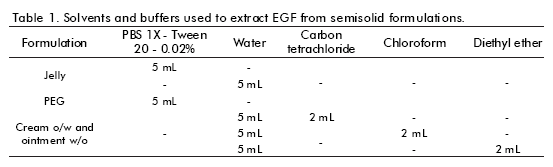
<body><![CDATA[<p><b><span lang=EN-US style='font-size:10.0pt;font-family:"Verdana","sans-serif"'>EGF quantification in semisolid formulations </span></b></p>      <p><span lang=EN-US style='font-size:10.0pt;font-family:"Verdana","sans-serif"'>Different organic solvents and buffer solutions were used to extract the active ingredient, depending on the features of the semisolid preparations </span><span lang=EN-US style='font-size:10.0pt;font-family:"Verdana","sans-serif"; color:windowtext'>(</span><span style='font-size:10.0pt;font-family:"Verdana","sans-serif"'><a href="#tab1"><span lang=EN-US>Table 1</span></a></span><span lang=EN-US style='font-size:10.0pt;font-family:"Verdana","sans-serif"'>). </span></p>      <p align=center style='text-align:center'><span style='font-size:13.5pt'><img border=0 width=553 height=167 src="/img/revistas/bta/v26n2/t0107209.gif"></span><a name=tab1></a></p>      
<p><span lang=EN-US style='font-size:10.0pt;font-family:"Verdana","sans-serif"'>Water or PBS were selected as extraction solvents, since the jelly and PEG ointment are water-soluble formulations. Tween 20-0.02% was also used for protein stabilization </span><span lang=EN-US style='font-size:10.0pt;font-family:"Verdana","sans-serif"; color:windowtext'>(</span><span lang=EN-US style='font-size:10.0pt;font-family: "Verdana","sans-serif"'>11). The w/o and o/w formulations required breaking the emulsion to separate the oil phase, and was achieved by adding chloroform, carbon tetrachloride or diethylether. </span></p>      <p><span lang=EN-US style='font-size:10.0pt;font-family:"Verdana","sans-serif"'>EGF was quantified by using an ELISA assay for jelly and PEG ointment after the total dissolution of 0.5 g of these semisolid formulations in either buffer or water. </span></p>      <p><span lang=EN-US style='font-size:10.0pt;font-family:"Verdana","sans-serif"'>The extraction of EGF from the other two formulations was accomplished by dissolving 0.5 g of each formulation in the organic solvent given in </span><span style='font-size:10.0pt;font-family:"Verdana","sans-serif"'><a href="#tab1"><span lang=EN-US>table 1</span></a></span><span lang=EN-US style='font-size:10.0pt; font-family:"Verdana","sans-serif"'>, followed by adding a buffer solution or water to this suspension. </span></p>      <p><span lang=EN-US style='font-size:10.0pt;font-family:"Verdana","sans-serif"'>Each sample was centrifuged for 20 min at 1000 g using a Hitachi, HIMAC SCT5BA centrifuge. The aqueous phase was collected to quantify EGF by ELISA. Accuracy, precision and selectivity of the extraction method were also determined, as described below. </span></p>      <p><b><span lang=EN-US style='font-size:10.0pt;font-family:"Verdana","sans-serif"'>Accuracy determination </span></b></p>      <p><span lang=EN-US style='font-size:10.0pt;font-family:"Verdana","sans-serif"'>Accuracy was determined using semisolid formulations at different concentrations of EGF: 5 µg/g, 10 µg/g, 15 </span><span style='font-size:10.0pt;font-family:"Verdana","sans-serif"'>&#956;</span><span lang=EN-US style='font-size:10.0pt;font-family:"Verdana","sans-serif"'>g/g and 20 µg/g. Six replicas of each concentration were prepared, and the EGF was extracted, as explained above. Linear regression and the null hypothesis slope were equal to 1, and the intercept equal to 0 was tested. Accuracy was determined as the recovery of EGF after its extraction and quantification by ELISA, as compared with the optimal value of 100%. </span></p>      <p><b><span lang=EN-US style='font-size:10.0pt;font-family:"Verdana","sans-serif"; color:#211E1E'>Precision determination </span></b></p>      ]]></body>
<body><![CDATA[<p><span lang=EN-US style='font-size:10.0pt;font-family:"Verdana","sans-serif"'>The intra-assay variability was determined by a repeated measurement of the sample values in the same plate. Inter-assay precision was determined in six replicated extractions and quantification assays by two analysts for each assay at different times. For both precision assays as described above, the acceptance criteria were less than 10 and 20%, of the variation coefficient </span><span lang=EN-US style='font-size:10.0pt;font-family:"Verdana","sans-serif"; color:windowtext'>(</span><span lang=EN-US style='font-size:10.0pt;font-family: "Verdana","sans-serif"'>CV) </span><span lang=EN-US style='font-size:10.0pt; font-family:"Verdana","sans-serif";color:windowtext'>(</span><span lang=EN-US style='font-size:10.0pt;font-family:"Verdana","sans-serif"'>12-14). </span></p>      <p><b><span lang=EN-US style='font-size:10.0pt;font-family:"Verdana","sans-serif"'>Specificity analysis </span></b></p>      <p><span lang=EN-US style='font-size:10.0pt;font-family:"Verdana","sans-serif"'>Specificity is the ability to asses unequivocally the analyte in the presence of components which may be expected to be present. Statistical comparison, using a Student’s <i>t </i>test, between the solution obtained after achieving the extraction of placebo and ELISA standard solution </span><span lang=EN-US style='font-size: 10.0pt;font-family:"Verdana","sans-serif";color:windowtext'>(</span><span lang=EN-US style='font-size:10.0pt;font-family:"Verdana","sans-serif"'>PBS and 0.5% w/v casein) was performed. These samples were analyzed by ELISA. </span></p>      <p><b><span lang=EN-US style='font-size:10.0pt;font-family:"Verdana","sans-serif"'>EGF release profile measurement </span></b></p>      <p><span lang=EN-US style='font-size:10.0pt;font-family:"Verdana","sans-serif"'>To determine the release profile of EGF, we used a diffusion cell described according to Estévez <i>et al. </i></span><span lang=EN-US style='font-size: 10.0pt;font-family:"Verdana","sans-serif";color:windowtext'>(</span><span lang=EN-US style='font-size:10.0pt;font-family:"Verdana","sans-serif"'>15). A small teflon-covered magnet, rotating at 600 rpm was used to stir the receptor solution. The receptor chamber was kept at 37 ºC during the experiment. A cellulose acetate membrane with pore diameter of 0.2 mm was used to place the semisolid formulation. It was previously soaked in the receptor solution </span><span lang=EN-US style='font-size:10.0pt;font-family:"Verdana","sans-serif"; color:windowtext'>(</span><span lang=EN-US style='font-size:10.0pt;font-family: "Verdana","sans-serif"'>phosphate-buffered saline 1X, PBS 1X) during 24 h at 4 ºC to diminish the lag time period. </span></p>      <p><span lang=EN-US style='font-size:10.0pt;font-family:"Verdana","sans-serif"'>One gram of the semisolid formulation containing 10 mg of EGF was placed in the receptor compartment, and 150 </span><span lang=EN-US style='font-size:10.0pt; font-family:"Verdana","sans-serif";color:#211E1E'>µ</span><span lang=EN-US style='font-size:10.0pt;font-family:"Verdana","sans-serif"'>L of the buffer solution were sampled at the initial time and after 0.5, 1, 2, 4, 6, 8 and 24 h. After sampling, the same volume of the buffer solution was replaced in the receptor compartment to maintain the total volume. Each sample was further analyzed in duplicates by ELISA. </span></p>      <p><b><span lang=EN-US style='font-size:10.0pt;font-family:"Verdana","sans-serif"'>Penetrability assay </span></b></p>      <p><span lang=EN-US style='font-size:10.0pt;font-family:"Verdana","sans-serif"'>A diffusion cell, assembled with pig abdominal skin punches, was used instead of cellulose acetate membranes, to determine the penetrability on EGF. The skin punches were incubated on receptor medium containing 0.025% gentamicine and PBS 1X during 4 h, at 4 ºC. The skin was placed inside the cell with the epidermis facing the donor chamber. The EGF used in this experiment was labeled with <sup>125</sup>I following essentially the chloramines-T method </span><span lang=EN-US style='font-size:10.0pt;font-family:"Verdana","sans-serif";color:windowtext'>(</span><span lang=EN-US style='font-size:10.0pt;font-family:"Verdana","sans-serif"'>16). </span></p>      <p><span lang=EN-US style='font-size:10.0pt;font-family:"Verdana","sans-serif"'>The percentage of EGF in the receptor medium, epidermis, dermis and semisolid was determined by measuring the remaining radioactivity in a gamma counter Wizard, Model 1470, Wallac. </span></p>      <p><b><span lang=EN-US style='font-size:10.0pt;font-family:"Verdana","sans-serif"'>ELISA </span></b></p>      ]]></body>
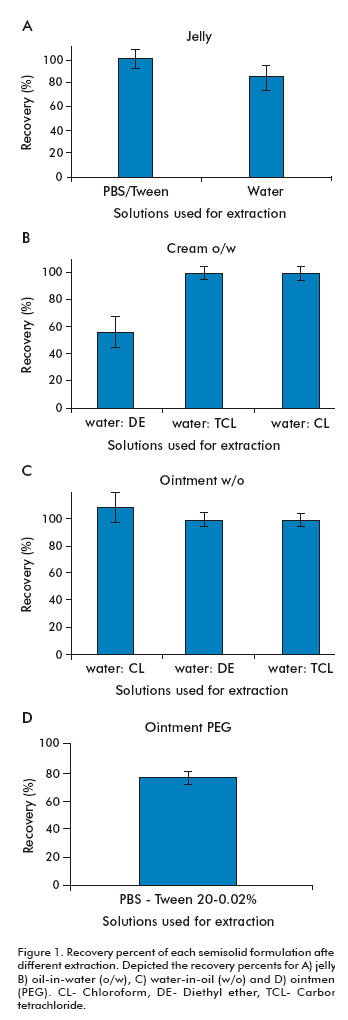
<body><![CDATA[<p><span lang=EN-US style='font-size:10.0pt;font-family:"Verdana","sans-serif"'>To quantify the hrEGF a sandwich-type ELISA was used. Polystyrene 96-well flat-bottom immuno-plate </span><span lang=EN-US style='font-size:10.0pt; font-family:"Verdana","sans-serif";color:windowtext'>(</span><span lang=EN-US style='font-size:10.0pt;font-family:"Verdana","sans-serif"'>Nunc, Denmark) were coated with 100 mL of the CB-EGF1 monoclonal antibody against the recombinant EGF, at 10 mg in 1 mL of 0.1 M Na<sub>2</sub>CO<sub>3</sub>/ NaHCO<sub>3</sub> , pH 9.6-10.8, for 3 h at 37 ºC. Plates were washed twice with Tween 20 solution at 0.05%. </span></p>      <p><span lang=EN-US style='font-size:10.0pt;font-family:"Verdana","sans-serif"'>After washing, 100 mL of a standard EGF, control and unknown samples previously diluted in PBS, and 0.5% w/v casein were added to each well. Plates were incubated for 1 h at 37 ºC and then washed. </span></p>      <p><span lang=EN-US style='font-size:10.0pt;font-family:"Verdana","sans-serif"'>Eighty microliters of a peroxidase-conjugated antibody against the recombinant human EGF </span><span lang=EN-US style='font-size:10.0pt;font-family:"Verdana","sans-serif"; color:windowtext'>(</span><span lang=EN-US style='font-size:10.0pt;font-family: "Verdana","sans-serif"'>CBEGF2) were added to the plates and incubated for 1h at room temperature. After that time, plates were washed six times. The reaction was developed for 10 min by adding 100 mL of the substrate solution containing 5.5 µL 30% H<sub>2</sub>O<sub>2</sub>; 5.5 µg O- phenylendiamine and diluted in 0.1 M sodium citrate, pH 5.0. The reaction was stopped by adding 50 µL of 2 M sulfuric acid. Absorbance was measured by using a microtiter plate analyzer Multiscan, Merck-Sensident Scan, Darmstadt, Germany at 492 nm. Positive control and unknown samples concentrations were calculated by interpolating absorbances values in a standard curve generated, when absorbance was plotted against EGF concentration </span><span lang=EN-US style='font-size: 10.0pt;font-family:"Verdana","sans-serif";color:windowtext'>(</span><span lang=EN-US style='font-size:10.0pt;font-family:"Verdana","sans-serif"'>17). </span></p>      <p><b><span lang=EN-US style='font-size:10.0pt;font-family:"Verdana","sans-serif"'>Statistical analysis </span></b></p>      <p><span lang=EN-US style='font-size:10.0pt;font-family:"Verdana","sans-serif"'>All measurements were expressed as mean ± standard error. Statistical differences were tested using the Student’s t test with a significance of p &lt; 0.05. </span></p>      <p><b><span lang=EN-US style='font-family:"Verdana","sans-serif"'>RESULTS AND DISCUSSION</span></b><b><span lang=EN-US style='font-size:10.0pt;font-family: "Verdana","sans-serif"'> </span></b></p>      <p><b><span lang=EN-US style='font-size:10.0pt;font-family:"Verdana","sans-serif"'>EGF determination in semisolid formulations </span></b></p>      <p><span lang=EN-US style='font-size:10.0pt;font-family:"Verdana","sans-serif"'>EGF has been widely used in the treatment of damaged skin in semisolid formulation </span><span lang=EN-US style='font-size:10.0pt;font-family:"Verdana","sans-serif"; color:windowtext'>(</span><span lang=EN-US style='font-size:10.0pt;font-family: "Verdana","sans-serif"'>6), because of that it is necessary to establish a method to extract EGF for quality control in pharmaceutical research and it is mandatory by many regulatory agencies </span><span lang=EN-US style='font-size: 10.0pt;font-family:"Verdana","sans-serif";color:windowtext'>(</span><span lang=EN-US style='font-size:10.0pt;font-family:"Verdana","sans-serif"'>18). One of the most commonly used methods to estimate the concentration of EGF is the enzyme-linked immunosorbent assay. In order to obtain a procedure to quantify EGF from semisolid formulations different buffers and organic solvents having different polarities and miscibility with water were used and then EGF was quantified by ELISA. </span></p>      <p><span style='font-size:13.5pt'><a href="#fig1"><span lang=EN-US style='font-size:10.0pt;font-family:"Verdana","sans-serif"'>Figure 1</span></a></span><span lang=EN-US style='font-size:10.0pt;font-family:"Verdana","sans-serif"'> shows the recovery percent for each semisolid formulation after different extraction procedures described in </span><span style='font-size:10.0pt;font-family:"Verdana","sans-serif"'><a href="#tab1"><span lang=EN-US>table 1</span></a></span><span lang=EN-US style='font-size:10.0pt;font-family:"Verdana","sans-serif"'>. The EGF recovery percent was over 90% for PBS 1X-Tween 20- 0.02% solution for jelly and PEG; water/chloroform and water/tetrachloride solutions for o/w; and water/chloroform, water/ tetrachloride, water/diethylether solutions for w/o. </span></p>      <p><span lang=EN-US style='font-size:10.0pt;font-family:"Verdana","sans-serif"'>The obtained results were previous step for further experiment. </span></p>      ]]></body>
<body><![CDATA[<p align=center style='text-align:center'><span style='font-size:13.5pt'><img border=0 width=348 height=1020 src="/img/revistas/bta/v26n2/f0107209.gif"></span><a name=fig1></a></p>      
<p><b><span lang=EN-US style='font-size:10.0pt;font-family:"Verdana","sans-serif"'>Accuracy determinations </span></b></p>        <p><span lang=EN-US style='font-size:10.0pt;font-family:"Verdana","sans-serif"'>Accuracy      was calculated as the percent of EGF recovery from the selected semisolid      formulations, irrespective of the extraction method used. Results obtained      are showed in </span><span style='font-size:10.0pt;font-family:"Verdana","sans-serif"'><a href="/img/revistas/bta/v26n2/t0207209.gif"><span lang=EN-US>table 2</span></a></span><span lang=EN-US style='font-size:10.0pt;font-family:"Verdana","sans-serif"'>. Extraction      methods for PEG and Jelly in PBS 1X-Tween 20-0.02%, o/w in carbon tetrachloride      and w/o in chloroform didn’t show statistically significant differences </span><span lang=EN-US style='font-size:10.0pt;font-family:"Verdana","sans-serif"; color:windowtext'>(</span><span lang=EN-US style='font-size:10.0pt;font-family: "Verdana","sans-serif"'>p &gt; 0.05) in slopes and intercepts respect to values      1 and 0, respectively. Their respective R<sup>2</sup> values were 0.9893,      0.9908, 0.9845 and 0.9973. Each recovery percent was compared </span><span lang=EN-US style='font-size:10.0pt;font-family:"Verdana","sans-serif"; color:windowtext'>(</span><span lang=EN-US style='font-size:10.0pt;font-family: "Verdana","sans-serif"'>n = 6) to the total amount of EGF formulated by a Student´s      t test, and no significant differences were detected. The recovery range was      from 95.5 to 108.9 which confirmed the reliability of the assay. All these      indicated that both the extraction and quantitative determination methods      were accurate. Similar results were not obtained for the rest of the formulations      tested. Our results indicated that ELISA assay and the selective method for      EGF extraction fulfill the criterion for measuring it in a semisolid formulation.      </span></p>      
<p><b><span lang=EN-US style='font-size:10.0pt;font-family:"Verdana","sans-serif"'>Precision determinations </span></b></p>      <div>          <p><span lang=EN-US style='font-size:10.0pt;font-family:"Verdana","sans-serif"'>Intra-        and inter-assay variability data were used to determine the precision of        the assay. Interassay and intrassay precision ranged from 4.6 to 9.9% and        from 4.2 to 9.9%, respectively. </span><span style='font-size:10.0pt;font-family:"Verdana","sans-serif"'><a href="/img/revistas/bta/v26n2/t0307209.gif"><span lang=EN-US>Table 3</span></a></span><span lang=EN-US style='font-size:10.0pt;font-family:"Verdana","sans-serif"'> shows        the repeatability and reproducibility of the assay under the experimental        conditions used to demonstrate low intra and inter- plate variation. The        coefficient of variation </span><span lang=EN-US style='font-size:10.0pt; font-family:"Verdana","sans-serif";color:windowtext'>(</span><span lang=EN-US style='font-size:10.0pt;font-family:"Verdana","sans-serif"'>CV) was calculated        for each EGF semisolid formulation at 10 µg/g. Six quantifications were        carried out. The CV was lower than 10% for protein quantification by ELISA,        indicative of a precise method. This CV demonstrated that the assay is precise        according to ICH requirements </span><span lang=EN-US style='font-size:10.0pt;font-family: "Verdana","sans-serif";color:windowtext'>(</span><span lang=EN-US style='font-size:10.0pt;font-family:"Verdana","sans-serif"'>13, 14).</span><span lang=EN-US style='font-size:13.5pt'> </span></p>  </div>      
<div>      <p><b><span lang=EN-US style='font-size:10.0pt;font-family:"Verdana","sans-serif"'>Specificity analysis </span></b></p>      <p><span lang=EN-US style='font-size:10.0pt;font-family:"Verdana","sans-serif"'>In order to confirm that ELISA only detects EGF, specificity assay was performed. The specificity of assay was assessed by comparing a placebo formulation extraction with the standard solution </span><span lang=EN-US style='font-size: 10.0pt;font-family:"Verdana","sans-serif";color:windowtext'>(</span><span lang=EN-US style='font-size:10.0pt;font-family:"Verdana","sans-serif"'>PBS and 0.5% w/v casein) used in ELISA quantification. This assay rules out any positive signal from the excipients of the formulation. No statistically significant differences were detected, by comparing a placebo extraction solution with the standard solution </span><span lang=EN-US style='font-size: 10.0pt;font-family:"Verdana","sans-serif";color:windowtext'>(</span><span lang=EN-US style='font-size:10.0pt;font-family:"Verdana","sans-serif"'>p &gt; 0.05), indicating that the assay was selective for EGF. </span></p>      <p><b><span lang=EN-US style='font-size:10.0pt;font-family:"Verdana","sans-serif"'>EGF release profile measurement </span></b></p>      ]]></body>
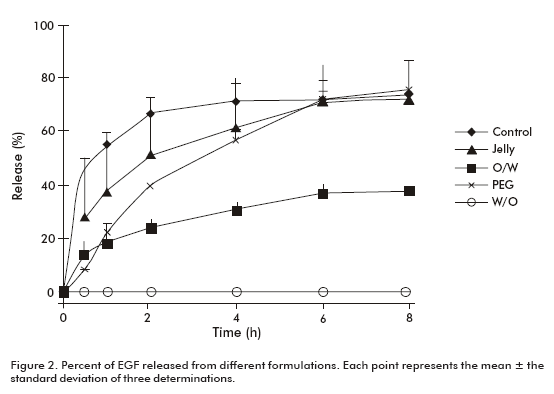
<body><![CDATA[<p><span lang=EN-US style='font-size:10.0pt;font-family:"Verdana","sans-serif"'>The overall effectiveness of a topical formulation depends on the release characteristics of the vehicle and the pharmacokinetics of the drug as it diffuses through the skin </span><span lang=EN-US style='font-size:10.0pt; font-family:"Verdana","sans-serif";color:windowtext'>(</span><span lang=EN-US style='font-size:10.0pt;font-family:"Verdana","sans-serif"'>10). In this study the <i>in vitro </i>releases for four semisolid formulations containing EGF at 10 µg/g were evaluated. To achieve this, a range of semisolids with various flow characteristics </span><span lang=EN-US style='font-size:10.0pt; font-family:"Verdana","sans-serif";color:windowtext'>(</span><span lang=EN-US style='font-size:10.0pt;font-family:"Verdana","sans-serif"'>19) were formulated and the <i>in vitro </i>releases and penetrability were evaluated. In the jelly, PEG and o/w cream the compound forms a continuous structure in direct contact with the skin. On the other hand in the w/o ointment the active compound is isolated in individual compartments </span><span lang=EN-US style='font-size:10.0pt;font-family:"Verdana","sans-serif";color:windowtext'>(</span><span lang=EN-US style='font-size:10.0pt;font-family:"Verdana","sans-serif"'>droplets) and has to diffuse through the aqueous phase to reach the skin </span><span lang=EN-US style='font-size:10.0pt;font-family:"Verdana","sans-serif"; color:windowtext'>(</span><span lang=EN-US style='font-size:10.0pt;font-family: "Verdana","sans-serif"'>20). These characteristics allow different EGF release profile which in turn affects the subsequent percutaneous absorption </span><span lang=EN-US style='font-size:10.0pt;font-family:"Verdana","sans-serif"; color:windowtext'>(</span><span lang=EN-US style='font-size:10.0pt;font-family: "Verdana","sans-serif"'>21). </span><span style='font-size:10.0pt;font-family: "Verdana","sans-serif"'><a href="#fig2"><span lang=EN-US>Figure 2</span></a></span><span lang=EN-US style='font-size:10.0pt;font-family:"Verdana","sans-serif"'> shows the release of EGF from the investigated semisolids bases. All the evaluated semisolids showed different release profiles, an effect also resulting from the particular viscosity and hydrophilicity of these preparations </span><span lang=EN-US style='font-size:10.0pt;font-family:"Verdana","sans-serif"; color:windowtext'>(</span><span lang=EN-US style='font-size:10.0pt;font-family: "Verdana","sans-serif"'>22). The diffusion coefficients of the EGF from the aqueous solution and the jelly formulation were similar. In the case of jelly, a high percentage of EGF is found in the receptor fluid in a short period of time </span><span lang=EN-US style='font-size:10.0pt;font-family:"Verdana","sans-serif"; color:windowtext'>(</span><span lang=EN-US style='font-size:10.0pt;font-family: "Verdana","sans-serif"'>about 72% in 8 h), whereas a 75% of EGF is released from the PEG ointment in the same period of time. Both semisolids had hydrophilic properties and low viscosity and thus the release was pronounced. </span></p>      <p align=center style='text-align:center'><span style='font-size:13.5pt'><img border=0 width=554 height=394 src="/img/revistas/bta/v26n2/f0207209.gif"></span><a name=fig2></a></p>      
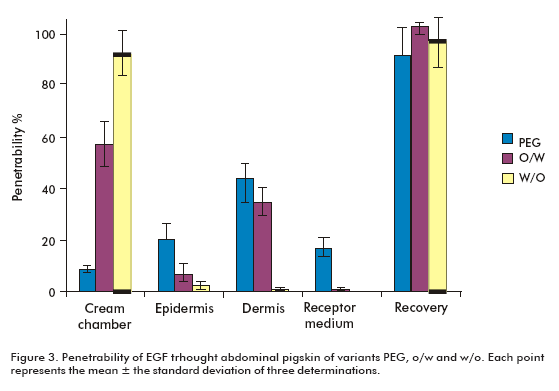
<p><span lang=EN-US style='font-size:10.0pt;font-family:"Verdana","sans-serif"'>On the other hand, the presence of cetyl alcohol decreased the EGF release profile from o/w formulation due to the hydrophobic properties of the o/w cream and increased consistency of this base </span><span lang=EN-US style='font-size: 10.0pt;font-family:"Verdana","sans-serif";color:windowtext'>(</span><span lang=EN-US style='font-size:10.0pt;font-family:"Verdana","sans-serif"'>21). In this case 38% of EGF was found in receptor fluid of the system after 8h. </span></p>      <p><span lang=EN-US style='font-size:10.0pt;font-family:"Verdana","sans-serif"'>The oil phase would also modify the rate of protein release by increasing viscosity in the w/o formulation. This effect is more pronounced in the w/o variant, where the protein is emulsified as small aqueous particles that have to migrate from inside the oleaginous phase also the higher viscosity resulting in a decrease in the molecular and the droplet diffusion. A comparison of release values of these formulations reveals the importance of the droplet diffusion on the release rate of EGF </span><span lang=EN-US style='font-size:10.0pt; font-family:"Verdana","sans-serif";color:windowtext'>(</span><span lang=EN-US style='font-size:10.0pt;font-family:"Verdana","sans-serif"'>22-24). Therefore the same amount of EGF is released in a longer period of time than in the o/w formulation. Therefore, the profiles of o/w and w/o formulations were typical of systems with prolonged released profiles compared with hydrophilic bases, suggesting them as more efficient presentations for wound healing because the need of prolonged release of EGF in wound healing. </span></p>      <p><b><span lang=EN-US style='font-size:10.0pt;font-family:"Verdana","sans-serif"'>Penetrability assay </span></b></p>      <p><span lang=EN-US style='font-size:10.0pt;font-family:"Verdana","sans-serif"'>Considering the previous results, we further evaluated penetrability by substituting the cellulose acetate membrane by abdominal pig skin. </span></p>      <p><span lang=EN-US style='font-size:10.0pt;font-family:"Verdana","sans-serif"'>The release cell was loaded with 0.5 g of PEG, o/w or w/o formulations charged with EGF-<sup>125</sup>I at 10 mg/g each. </span><span style='font-size:10.0pt; font-family:"Verdana","sans-serif"'><a href="#fig3"><span lang=EN-US>Figure 3</span></a></span><span lang=EN-US style='font-size:10.0pt;font-family:"Verdana","sans-serif"'> shows the distribution of EGF- <sup>125</sup>I among both cell compartments and the epidermis and dermis. PEG and o/w formulations allowed a wider distribution of labeled protein into the skin layers </span><span lang=EN-US style='font-size: 10.0pt;font-family:"Verdana","sans-serif";color:windowtext'>(</span><span lang=EN-US style='font-size:10.0pt;font-family:"Verdana","sans-serif"'>21 and 8% in the epidermis, and 41 and 36% in the dermis, respectively) and in the receptor medium. The behavior of the w/o formulation was lower </span><span lang=EN-US style='font-size:10.0pt;font-family:"Verdana","sans-serif"; color:windowtext'>(</span><span lang=EN-US style='font-size:10.0pt;font-family: "Verdana","sans-serif"'>3% in the epidermis and 2% in the dermis). According to the bases nature and composition, hydrophilic bases would allow a higher delivery and penetrability of the active principle to the deepest skin zones than the oleaginous ones. </span></p>      <p align=center style='text-align:center'><span style='font-size:13.5pt'><img border=0 width=559 height=391 src="/img/revistas/bta/v26n2/f0307209.gif"></span><a name=fig3></a></p>      
<p><span lang=EN-US style='font-size:10.0pt;font-family:"Verdana","sans-serif"'>Conventional topical vehicles </span><span lang=EN-US style='font-size:10.0pt;font-family: "Verdana","sans-serif";color:windowtext'>(</span><i><span lang=EN-US style='font-size:10.0pt;font-family:"Verdana","sans-serif"'>e.g.</span></i><span lang=EN-US style='font-size:10.0pt;font-family:"Verdana","sans-serif"'>, ointments, creams or jellys) predominantly exert their effect by releasing the drug onto the skin, which has to diffuse through the different skin layers. Among them, the stratum corneous is the major permeability barrier due to its organized structure, being regarded as the rate-limiting factor for drug penetration at therapeutic levels </span><span lang=EN-US style='font-size: 10.0pt;font-family:"Verdana","sans-serif";color:windowtext'>(</span><span lang=EN-US style='font-size:10.0pt;font-family:"Verdana","sans-serif"'>25, 26). Therefore, absorption and penetration are highly influenced by the nature of the topical vehicle. Nonetheless, the extent of diffusion depends on the physicochemical properties of the drug itself. </span></p>      <p><span lang=EN-US style='font-size:10.0pt;font-family:"Verdana","sans-serif"'>In general, the modification of drug absorption kinetics by these vehicles is the result of their ability to provide increased hydration by occlusion or some other mechanisms. If the size and solubility properties of the drug are not appropriate, only limited uptake by the skin will occur. </span></p>      ]]></body>
<body><![CDATA[<p><b><span lang=EN-US style='font-family:"Verdana","sans-serif"'>CONCLUSIONS </span></b></p>      <p><span lang=EN-US style='font-size:10.0pt;font-family:"Verdana","sans-serif"'>The methods developed for EGF extraction were simple, easy to use, and precise. They are currently in use for routine analysis and quality control of EGF in different semisolid formulations. </span></p>      <p><b><span lang=EN-US style='font-family:"Verdana","sans-serif"'>ACKNOWLEDGEMENTS </span></b></p>      <p><span lang=EN-US style='font-size:10.0pt;font-family:"Verdana","sans-serif"'>The authors want to thank to Ernesto Galbán Rodríguez for the detailed review of the manuscript and suggestions, and to Elizabeth Díaz López for language review. </span></p>      <p><span lang=EN-US style='font-size:13.5pt'>&nbsp;</span></p>      <p><span lang=EN-US style='font-size:11.0pt;font-family:"Arial","sans-serif"; color:red'>&nbsp;</span><b><span lang=EN-US style='font-family:"Verdana","sans-serif"'>REFERENCES </span></b></p>      <!-- ref --><p><span lang=EN-US style='font-size:10.0pt;font-family:"Verdana","sans-serif"'>1. Martin P. Wound healing- Aiming for perfect skin regeneration. Science</span><span lang=EN-US style='font-size:11.0pt;font-family:"Arial","sans-serif";color:red'> </span><span lang=EN-US style='font-size:10.0pt;font-family:"Verdana","sans-serif"'>1997;276:75-81.</span><!-- ref --><p><span lang=EN-US style='font-size:10.0pt;font-family:"Verdana","sans-serif"'>2. Bennett N, Schultz N. Growth factors and wound healing. Part II Role in normal and chronic wound healing. Am J Surg</span><span lang=EN-US style='font-size: 11.0pt;font-family:"Arial","sans-serif";color:red'> </span><span lang=EN-US style='font-size:10.0pt;font-family:"Verdana","sans-serif"'>1993;166:74-81.</span><!-- ref --><p><span lang=EN-US style='font-size:10.0pt;font-family:"Verdana","sans-serif"'>3. Defize LHK, deLaat SW. Structural and functional aspects of epidermal growth factor </span><span lang=EN-US style='font-size:10.0pt;font-family:"Verdana","sans-serif"; color:windowtext'>(</span><span lang=EN-US style='font-size:10.0pt;font-family: "Verdana","sans-serif"'>EGF) and its receptor. Prog Brain Res</span><span lang=EN-US style='font-size:11.0pt;font-family:"Arial","sans-serif";color:red'> </span><span lang=EN-US style='font-size:10.0pt;font-family:"Verdana","sans-serif"'>1986;69:169-82.</span><!-- ref --><p><span lang=EN-US style='font-size:10.0pt;font-family:"Verdana","sans-serif"'>4. Nanney LB. Epidermal and dermal effects of epidermal growth factor during wound repair. J Invest Dermatol</span><span lang=EN-US style='font-size:11.0pt; font-family:"Arial","sans-serif";color:red'> </span><span lang=EN-US style='font-size:10.0pt;font-family:"Verdana","sans-serif"'>1990;94:624-9.</span><!-- ref --><p><span lang=EN-US style='font-size:10.0pt;font-family:"Verdana","sans-serif"'>5. Nanney LB, Griffen J, Cramer AB, Yancey JM, Curtsinger LJ, Holtzin L, et al. Enhancement of wound healing by topical treatment with epidermal growth factor. N Engl J Med</span><span lang=EN-US style='font-size:11.0pt;font-family:"Arial","sans-serif"; color:red'> </span><span lang=EN-US style='font-size:10.0pt;font-family:"Verdana","sans-serif"'>1989;321:76-9.</span><!-- ref --><p><span lang=EN-US style='font-size:10.0pt;font-family:"Verdana","sans-serif"'>6. Buckley A, Davison JM, Kamerath CD, Terrill BW, Woodward CS. Sustained release of epidermal growth factor accelerates wound repair. Cell Biol</span><span lang=EN-US style='font-size:11.0pt;font-family:"Arial","sans-serif";color:red'> </span><span lang=EN-US style='font-size:10.0pt;font-family:"Verdana","sans-serif"'>1985;82:7340-4.</span><!-- ref --><p><span lang=EN-US style='font-size:10.0pt;font-family:"Verdana","sans-serif"'>7. Schultz G, Rotatori DS, Clark W. EGF and TGF-alpha in wound healing and repair. J Cell Biochem</span><span lang=EN-US style='font-size:11.0pt;font-family:"Arial","sans-serif"; color:red'> </span><span lang=EN-US style='font-size:10.0pt;font-family:"Verdana","sans-serif"'>1991;45:346-52.</span><!-- ref --><p><span lang=EN-US style='font-size:10.0pt;font-family:"Verdana","sans-serif"'>8. Choi JS, Leong KW, Yoo HS. In vivo wound healing of diabetic ulcers using electrospun nanofibers immobilized with human epidermal growth factor </span><span lang=EN-US style='font-size:10.0pt;font-family:"Verdana","sans-serif"; color:windowtext'>(</span><span lang=EN-US style='font-size:10.0pt;font-family: "Verdana","sans-serif"'>EGF). Biomaterials</span><span lang=EN-US style='font-size:11.0pt;font-family:"Arial","sans-serif";color:red'> </span><span lang=EN-US style='font-size:10.0pt;font-family:"Verdana","sans-serif"'>2008;29:587-96.</span><!-- ref --><p><span lang=EN-US style='font-size:10.0pt;font-family:"Verdana","sans-serif"'>9. Kiyohara Y, Komada F, Iwakawa S, Hirai M, Fuwa T, Okumura K. Improvement in wound healing by epidermal growth factor </span><span lang=EN-US style='font-size:10.0pt;font-family:"Verdana","sans-serif";color:windowtext'>(</span><span lang=EN-US style='font-size:10.0pt;font-family:"Verdana","sans-serif"'>EGF) ointment. II. Effect of protease Inhibitor, Nafamostat, on stabilization and efficacy of EGF in burn. J Pharmacobiodyn</span><span lang=EN-US style='font-size:11.0pt;font-family:"Arial","sans-serif";color:red'> </span><span lang=EN-US style='font-size:10.0pt;font-family:"Verdana","sans-serif"'>1991;14:47-52.</span><!-- ref --><p><span style='font-size:10.0pt;font-family:"Verdana","sans-serif"'>10. Tecnología Farmacéutica 2: Formas Farmacéuticas. Vila Jato</span><span style='font-family:"Arial","sans-serif";color:blue'> </span><span style='font-size:10.0pt;font-family:"Verdana","sans-serif"'>JL</span><span style='font-family:"Arial","sans-serif";color:gray'> </span><span style='font-size:10.0pt;font-family:"Verdana","sans-serif"'>&nbsp;Ed. Síntesis 1997</span><span lang=SV style='font-family:"Arial","sans-serif";color:teal'>.</span><span lang=SV style='font-size:10.0pt;font-family:"Verdana","sans-serif";color:#211E1E'> </span><span lang=SV style='font-size:10.0pt;font-family:"Verdana","sans-serif"'>&nbsp;</span><!-- ref --><p><span style='font-size:10.0pt;font-family:"Verdana","sans-serif"'>11. Bam NB, Cleland JL, Yang J, Manning MC, Carpenter JF, Kelley RF, et al. </span><span lang=EN-US style='font-size:10.0pt;font-family:"Verdana","sans-serif"'>Tween protects recombinant human growth hormone against agitation-induced damage via hydrophobic interactions. J Pharm Sci</span><span lang=EN-US style='font-size: 11.0pt;font-family:"Arial","sans-serif";color:red'> </span><span lang=EN-US style='font-size:10.0pt;font-family:"Verdana","sans-serif"'>1998;87:1554-9.</span><!-- ref --><p><span lang=EN-US style='font-size:10.0pt;font-family:"Verdana","sans-serif"'>12. International Conference on the Harmonization of Technical Requirements for the registration of Pharmaceuticals for Human Use: Text on Validation of Analytical procedures.1994. p. 1-5</span><span lang=SV style='font-family:"Arial","sans-serif"; color:teal'>.</span><span lang=SV style='font-size:10.0pt;font-family:"Verdana","sans-serif"'> </span><!-- ref --><p><span lang=EN-US style='font-size:10.0pt;font-family:"Verdana","sans-serif"'>13. International Conference on the Harmonization of Technical Requirements for the registration of Pharmaceuticals for Human Use. Validation of Analytical procedures.1996. p. 1-8</span><span lang=SV style='font-family:"Arial","sans-serif"; color:teal'>.</span><span lang=SV style='font-size:10.0pt;font-family:"Verdana","sans-serif"'> </span><!-- ref --><p><span lang=EN-US style='font-size:10.0pt;font-family:"Verdana","sans-serif"'>14. The United States Pharmacopeia 31 NF26. Validation of compendia methods. Rockville, MD: USP Convention INC.; 2008</span><span lang=SV style='font-family: "Arial","sans-serif";color:teal'>.</span><span lang=EN-US style='font-size: 10.0pt;font-family:"Verdana","sans-serif"'>&nbsp; </span><!-- ref --><p><span style='font-size:10.0pt;font-family:"Verdana","sans-serif"'>15. Estévez T, Aguilera A, Sáez A, Hardy E. Diseño y validación de una celda de difusión para estudios de liberación <i>in vitro </i>de biomoléculas. </span><span lang=EN-US style='font-size:10.0pt;font-family:"Verdana","sans-serif"'>Biotecnol &nbsp;Apl</span><span lang=EN-US style='font-size:11.0pt;font-family:"Arial","sans-serif"; color:red'> </span><span lang=EN-US style='font-size:10.0pt;font-family:"Verdana","sans-serif"'>2000;17:187-90.</span><!-- ref --><p><span lang=EN-US style='font-size:10.0pt;font-family:"Verdana","sans-serif"'>16. Basavaiah K, Prameela HC. Two simple methods for the estimation of albendazole and its dosage forms using chloramine-T. </span><span style='font-size:10.0pt; font-family:"Verdana","sans-serif"'>Farmaco</span><span style='font-size:11.0pt; font-family:"Arial","sans-serif";color:red'> </span><span style='font-size: 10.0pt;font-family:"Verdana","sans-serif"'>2003;58:527-34.</span><p><span style='font-size:10.0pt;font-family:"Verdana","sans-serif"'>17. Puchades Y, Ojalvo AG, García Y, Chinea G, Gerónimo H, Vispo NS. </span><span lang=EN-US style='font-size:10.0pt;font-family:"Verdana","sans-serif"'>Identification of peptide mimics of the epitope recognized by CB-EGF1, a monoclonal antibody EGF specific. Biotecnol Apl</span><span lang=EN-US style='font-size:11.0pt; font-family:"Arial","sans-serif";color:red'> </span><span lang=EN-US style='font-size:10.0pt;font-family:"Verdana","sans-serif"'>2005;22:203-6.</span><span lang=EN-US style='font-size:11.0pt;font-family:"Arial","sans-serif";color:red'> </span></p>      <!-- ref --><p><span lang=EN-US style='font-size:10.0pt;font-family:"Verdana","sans-serif"'>18. CFR Title 21. Testing and release distribution. Food and drugs, chapter 1, FDA, I Part 211.22</span><span lang=SV style='font-family:"Arial","sans-serif"; color:teal'>.</span><!-- ref --><p><span lang=EN-US style='font-size:10.0pt;font-family:"Verdana","sans-serif"'>19. Welin-Berger K, Neelissen AM, Bergenstahl B. <i>In vitro </i>permeation profile of a local anaesthetic compound from topical formulations with different rheological behaviour verified by <i>in vivo </i>efficacy data. Eur J Pharm Sci</span><span lang=EN-US style='font-size:11.0pt;font-family:"Arial","sans-serif";color:red'> </span><span lang=EN-US style='font-size:10.0pt;font-family:"Verdana","sans-serif"'>2001;14:229-36.</span><p><span lang=EN-US style='font-size:10.0pt;font-family:"Verdana","sans-serif"'>20. Osborne</span><span lang=EN-US style='font-family:"Arial","sans-serif"; color:blue'> </span><span lang=EN-US style='font-size:10.0pt;font-family:"Verdana","sans-serif"'>DW, Amann</span><span lang=EN-US style='font-family:"Arial","sans-serif"; color:blue'> </span><span lang=EN-US style='font-size:10.0pt;font-family:"Verdana","sans-serif"'>AH. Topical Drug Delivery Formulations</span><span lang=EN-US style='font-family: "Arial","sans-serif";color:gray'> </span><span lang=EN-US style='font-size: 10.0pt;font-family:"Verdana","sans-serif"'>&nbsp;Eds. Vol 2. Marcel Dekker, New York and Basel 1990</span><span lang=SV style='font-family:"Arial","sans-serif"; color:teal'>.</span><span lang=SV style='font-size:10.0pt;font-family:"Verdana","sans-serif"; color:#211E1E'> </span><span lang=EN-US style='font-size:10.0pt;font-family: "Verdana","sans-serif"'>&nbsp;&nbsp;</span></p>      <!-- ref --><p><span lang=EN-US style='font-size:10.0pt;font-family:"Verdana","sans-serif"'>21. Welin-Berger K, Neelissen AM, Bergenstahl B. The effects of rheological behavior of a topical anaesthetic formulation on the release and permeation rates of the active compound. Eur J Pharm Sci</span><span lang=EN-US style='font-size:11.0pt;font-family:"Arial","sans-serif";color:red'> </span><span lang=EN-US style='font-size:10.0pt;font-family:"Verdana","sans-serif"'>2001;13:309-18.</span><!-- ref --><p><span lang=EN-US style='font-size:10.0pt;font-family:"Verdana","sans-serif"'>22. Higuchi WI. Analysis of data on the medicament release from ointment. J Pharm Sci</span><span lang=EN-US style='font-size:11.0pt;font-family:"Arial","sans-serif"; color:red'> </span><span lang=EN-US style='font-size:10.0pt;font-family:"Verdana","sans-serif"'>1962;51:802-4.</span><!-- ref --><p><span lang=EN-US style='font-size:10.0pt;font-family:"Verdana","sans-serif"'>23. Gallagher SJ, Trottet L, Carter TP, Heard CM. Effects of membrane type and liquid/ liquid phase boundary on <i>in vitro </i>release of ketoprofen from gel formulations. J Drug Target</span><span lang=EN-US style='font-size:11.0pt; font-family:"Arial","sans-serif";color:red'> </span><span lang=EN-US style='font-size:10.0pt;font-family:"Verdana","sans-serif"'>2003;6:373-9.</span><p><span lang=EN-US style='font-size:10.0pt;font-family:"Verdana","sans-serif"'>24. Steffe</span><span lang=EN-US style='font-family:"Arial","sans-serif"; color:blue'> </span><span lang=EN-US style='font-size:10.0pt;font-family:"Verdana","sans-serif"'>JF. Rheological methods in food process engineering. 2nd Ed., USA.1996</span><span lang=SV style='font-family:"Arial","sans-serif";color:teal'>.</span><span lang=SV style='font-size:10.0pt;font-family:"Verdana","sans-serif"'> </span></p>      ]]></body>
<body><![CDATA[<p><span lang=EN-US style='font-size:10.0pt;font-family:"Verdana","sans-serif"'>25. Welin-Berger K, Bergemstahl B. Inhibition of Ostwald ripening in local anes-thetic emulsions by using hydrophobic excipients in the disperse phase. Int J Pharm</span><span lang=EN-US style='font-size:11.0pt;font-family:"Arial","sans-serif";color:red'> </span><span lang=EN-US style='font-size:10.0pt;font-family:"Verdana","sans-serif"'>2000;200 (Suppl 2):249-60.</span></p>      <!-- ref --><p><span lang=EN-US style='font-size:10.0pt;font-family:"Verdana","sans-serif"'>26. Mark R. Microneedles for transdermal drug delivery. Adv Drug Deliv Rev</span><span lang=EN-US style='font-size:11.0pt;font-family:"Arial","sans-serif";color:red'> </span><span lang=EN-US style='font-size:10.0pt;font-family:"Verdana","sans-serif"'>2004;56:581-7.</span><span lang=EN-US style='font-size:11.0pt;font-family:"Arial","sans-serif";color:green'> </span><p><span lang=EN-US style='font-size:13.5pt'>&nbsp;</span></p>      <p><span lang=EN-US style='font-size:11.0pt;font-family:"Arial","sans-serif"; color:blue'>&nbsp;</span><span lang=EN-US style='font-size:10.0pt;font-family: "Verdana","sans-serif";color:#211E1E'>Received in February, 2009.     <br> Accepted for publication in June, 2009.</span><span lang=EN-US style='font-size:11.0pt;font-family:"Arial","sans-serif";color:red'> </span></p>      <p><span lang=EN-US style='font-size:10.0pt;font-family:"Verdana","sans-serif"'>Ana Aguilera. Center for Genetic Engineering and Biotechnology, CIGB Ave. 31 / 158 and 190, Cuabanacan, Playa, CP 10400, PO Box 6162, Havana, Cuba. E-mail: </span><span style='font-size:10.0pt;font-family:"Verdana","sans-serif"'><a href="mailto:ana.aguilera@cigb.edu.cu"><span lang=EN-US>ana.aguilera@cigb.edu.cu</span></a></span><span style='font-size:11.0pt;font-family:"Arial","sans-serif";color:#FF6600'> </span></p>      <p><span lang=EN-US style='font-size:13.5pt'>&nbsp;</span></p>  </div>  </div>       ]]></body><back>
<ref-list>
<ref id="B1">
<label>1</label><nlm-citation citation-type="journal">
<person-group person-group-type="author">
<name>
<surname><![CDATA[Martin]]></surname>
<given-names><![CDATA[P]]></given-names>
</name>
</person-group>
<article-title xml:lang="en"><![CDATA[Wound healing: Aiming for perfect skin regeneration]]></article-title>
<source><![CDATA[Science]]></source>
<year>1997</year>
<volume>276</volume>
<page-range>75-81</page-range></nlm-citation>
</ref>
<ref id="B2">
<label>2</label><nlm-citation citation-type="journal">
<person-group person-group-type="author">
<name>
<surname><![CDATA[Bennett]]></surname>
<given-names><![CDATA[N]]></given-names>
</name>
<name>
<surname><![CDATA[Schultz]]></surname>
<given-names><![CDATA[N]]></given-names>
</name>
</person-group>
<article-title xml:lang="en"><![CDATA[Growth factors and wound healing: Part II Role in normal and chronic wound healing]]></article-title>
<source><![CDATA[Am J Surg]]></source>
<year>1993</year>
<volume>166</volume>
<page-range>74-81</page-range></nlm-citation>
</ref>
<ref id="B3">
<label>3</label><nlm-citation citation-type="journal">
<person-group person-group-type="author">
<name>
<surname><![CDATA[Defize]]></surname>
<given-names><![CDATA[LHK]]></given-names>
</name>
<name>
<surname><![CDATA[deLaat]]></surname>
<given-names><![CDATA[SW]]></given-names>
</name>
</person-group>
<article-title xml:lang="en"><![CDATA[Structural and functional aspects of epidermal growth factor (EGF) and its receptor]]></article-title>
<source><![CDATA[Prog Brain Res]]></source>
<year>1986</year>
<volume>69</volume>
<page-range>169-82</page-range></nlm-citation>
</ref>
<ref id="B4">
<label>4</label><nlm-citation citation-type="journal">
<person-group person-group-type="author">
<name>
<surname><![CDATA[Nanney]]></surname>
<given-names><![CDATA[LB]]></given-names>
</name>
</person-group>
<article-title xml:lang="en"><![CDATA[Epidermal and dermal effects of epidermal growth factor during wound repair]]></article-title>
<source><![CDATA[J Invest Dermatol]]></source>
<year>1990</year>
<volume>94</volume>
<page-range>624-9</page-range></nlm-citation>
</ref>
<ref id="B5">
<label>5</label><nlm-citation citation-type="journal">
<person-group person-group-type="author">
<name>
<surname><![CDATA[Nanney]]></surname>
<given-names><![CDATA[LB]]></given-names>
</name>
<name>
<surname><![CDATA[Griffen]]></surname>
<given-names><![CDATA[J]]></given-names>
</name>
<name>
<surname><![CDATA[Cramer]]></surname>
<given-names><![CDATA[AB]]></given-names>
</name>
<name>
<surname><![CDATA[Yancey]]></surname>
<given-names><![CDATA[JM]]></given-names>
</name>
<name>
<surname><![CDATA[Curtsinger]]></surname>
<given-names><![CDATA[LJ]]></given-names>
</name>
<name>
<surname><![CDATA[Holtzin]]></surname>
<given-names><![CDATA[L]]></given-names>
</name>
</person-group>
<article-title xml:lang="en"><![CDATA[Enhancement of wound healing by topical treatment with epidermal growth factor]]></article-title>
<source><![CDATA[N Engl J Med]]></source>
<year>1989</year>
<volume>321</volume>
<page-range>76-9</page-range></nlm-citation>
</ref>
<ref id="B6">
<label>6</label><nlm-citation citation-type="journal">
<person-group person-group-type="author">
<name>
<surname><![CDATA[Buckley]]></surname>
<given-names><![CDATA[A]]></given-names>
</name>
<name>
<surname><![CDATA[Davison]]></surname>
<given-names><![CDATA[JM]]></given-names>
</name>
<name>
<surname><![CDATA[Kamerath]]></surname>
<given-names><![CDATA[CD]]></given-names>
</name>
<name>
<surname><![CDATA[Terrill]]></surname>
<given-names><![CDATA[BW]]></given-names>
</name>
<name>
<surname><![CDATA[Woodward]]></surname>
<given-names><![CDATA[CS]]></given-names>
</name>
</person-group>
<article-title xml:lang="en"><![CDATA[Sustained release of epidermal growth factor accelerates wound repair]]></article-title>
<source><![CDATA[Cell Biol]]></source>
<year>1985</year>
<volume>82</volume>
<page-range>7340-4</page-range></nlm-citation>
</ref>
<ref id="B7">
<label>7</label><nlm-citation citation-type="journal">
<person-group person-group-type="author">
<name>
<surname><![CDATA[Schultz]]></surname>
<given-names><![CDATA[G]]></given-names>
</name>
<name>
<surname><![CDATA[Rotatori]]></surname>
<given-names><![CDATA[DS]]></given-names>
</name>
<name>
<surname><![CDATA[Clark]]></surname>
<given-names><![CDATA[W]]></given-names>
</name>
</person-group>
<article-title xml:lang="en"><![CDATA[EGF and TGF-alpha in wound healing and repair]]></article-title>
<source><![CDATA[J Cell Biochem]]></source>
<year>1991</year>
<volume>45</volume>
<page-range>346-52</page-range></nlm-citation>
</ref>
<ref id="B8">
<label>8</label><nlm-citation citation-type="journal">
<person-group person-group-type="author">
<name>
<surname><![CDATA[Choi]]></surname>
<given-names><![CDATA[JS]]></given-names>
</name>
<name>
<surname><![CDATA[Leong]]></surname>
<given-names><![CDATA[KW]]></given-names>
</name>
<name>
<surname><![CDATA[Yoo]]></surname>
<given-names><![CDATA[HS]]></given-names>
</name>
</person-group>
<article-title xml:lang="en"><![CDATA[In vivo wound healing of diabetic ulcers using electrospun nanofibers immobilized with human epidermal growth factor (EGF)]]></article-title>
<source><![CDATA[Biomaterials]]></source>
<year>2008</year>
<volume>29</volume>
<page-range>587-96</page-range></nlm-citation>
</ref>
<ref id="B9">
<label>9</label><nlm-citation citation-type="journal">
<person-group person-group-type="author">
<name>
<surname><![CDATA[Kiyohara]]></surname>
<given-names><![CDATA[Y]]></given-names>
</name>
<name>
<surname><![CDATA[Komada]]></surname>
<given-names><![CDATA[F]]></given-names>
</name>
<name>
<surname><![CDATA[Iwakawa]]></surname>
<given-names><![CDATA[S]]></given-names>
</name>
<name>
<surname><![CDATA[Hirai]]></surname>
<given-names><![CDATA[M]]></given-names>
</name>
<name>
<surname><![CDATA[Fuwa]]></surname>
<given-names><![CDATA[T]]></given-names>
</name>
<name>
<surname><![CDATA[Okumura]]></surname>
<given-names><![CDATA[K]]></given-names>
</name>
</person-group>
<article-title xml:lang="en"><![CDATA[Improvement in wound healing by epidermal growth factor (EGF) ointment: II. Effect of protease Inhibitor, Nafamostat, on stabilization and efficacy of EGF in burn]]></article-title>
<source><![CDATA[J Pharmacobiodyn]]></source>
<year>1991</year>
<volume>14</volume>
<page-range>47-52</page-range></nlm-citation>
</ref>
<ref id="B10">
<label>10</label><nlm-citation citation-type="book">
<person-group person-group-type="author">
<name>
<surname><![CDATA[Vila Jato]]></surname>
<given-names><![CDATA[JL]]></given-names>
</name>
</person-group>
<source><![CDATA[Tecnología Farmacéutica 2: Formas Farmacéuticas]]></source>
<year>1997</year>
<publisher-name><![CDATA[Síntesis]]></publisher-name>
</nlm-citation>
</ref>
<ref id="B11">
<label>11</label><nlm-citation citation-type="journal">
<person-group person-group-type="author">
<name>
<surname><![CDATA[Bam]]></surname>
<given-names><![CDATA[NB]]></given-names>
</name>
<name>
<surname><![CDATA[Cleland]]></surname>
<given-names><![CDATA[JL]]></given-names>
</name>
<name>
<surname><![CDATA[Yang]]></surname>
<given-names><![CDATA[J]]></given-names>
</name>
<name>
<surname><![CDATA[Manning]]></surname>
<given-names><![CDATA[MC]]></given-names>
</name>
<name>
<surname><![CDATA[Carpenter]]></surname>
<given-names><![CDATA[JF]]></given-names>
</name>
<name>
<surname><![CDATA[Kelley]]></surname>
<given-names><![CDATA[RF]]></given-names>
</name>
</person-group>
<article-title xml:lang="en"><![CDATA[Tween protects recombinant human growth hormone against agitation-induced damage via hydrophobic interactions]]></article-title>
<source><![CDATA[J Pharm Sci]]></source>
<year>1998</year>
<volume>87</volume>
<page-range>1554-9</page-range></nlm-citation>
</ref>
<ref id="B12">
<label>12</label><nlm-citation citation-type="">
<source><![CDATA[International Conference on the Harmonization of Technical Requirements for the registration of Pharmaceuticals for Human Use: Text on Validation of Analytical procedures]]></source>
<year>1994</year>
<page-range>1-5</page-range></nlm-citation>
</ref>
<ref id="B13">
<label>13</label><nlm-citation citation-type="">
<source><![CDATA[International Conference on the Harmonization of Technical Requirements for the registration of Pharmaceuticals for Human Use: Validation of Analytical procedures]]></source>
<year>1996</year>
<page-range>1-8</page-range></nlm-citation>
</ref>
<ref id="B14">
<label>14</label><nlm-citation citation-type="book">
<source><![CDATA[The United States Pharmacopeia 31 NF26: Validation of compendia methods]]></source>
<year>2008</year>
<publisher-loc><![CDATA[Rockville ]]></publisher-loc>
<publisher-name><![CDATA[USP Convention INC.]]></publisher-name>
</nlm-citation>
</ref>
<ref id="B15">
<label>15</label><nlm-citation citation-type="journal">
<person-group person-group-type="author">
<name>
<surname><![CDATA[Estévez]]></surname>
<given-names><![CDATA[T]]></given-names>
</name>
<name>
<surname><![CDATA[Aguilera]]></surname>
<given-names><![CDATA[A]]></given-names>
</name>
<name>
<surname><![CDATA[Sáez]]></surname>
<given-names><![CDATA[A]]></given-names>
</name>
<name>
<surname><![CDATA[Hardy]]></surname>
<given-names><![CDATA[E]]></given-names>
</name>
</person-group>
<article-title xml:lang="es"><![CDATA[Diseño y validación de una celda de difusión para estudios de liberación in vitro de biomoléculas]]></article-title>
<source><![CDATA[Biotecnol Apl]]></source>
<year>2000</year>
<volume>17</volume>
<page-range>187-90</page-range></nlm-citation>
</ref>
<ref id="B16">
<label>16</label><nlm-citation citation-type="journal">
<person-group person-group-type="author">
<name>
<surname><![CDATA[Basavaiah]]></surname>
<given-names><![CDATA[K]]></given-names>
</name>
<name>
<surname><![CDATA[Prameela]]></surname>
<given-names><![CDATA[HC]]></given-names>
</name>
</person-group>
<article-title xml:lang="en"><![CDATA[Two simple methods for the estimation of albendazole and its dosage forms using chloramine-T]]></article-title>
<source><![CDATA[Farmaco]]></source>
<year>2003</year>
<volume>58</volume>
<page-range>527-34</page-range></nlm-citation>
</ref>
<ref id="B17">
<label>18</label><nlm-citation citation-type="book">
<source><![CDATA[CFR Title 21: Testing and release distribution. Food and drugs, chapter 1]]></source>
<year></year>
<publisher-name><![CDATA[FDA]]></publisher-name>
</nlm-citation>
</ref>
<ref id="B18">
<label>19</label><nlm-citation citation-type="journal">
<person-group person-group-type="author">
<name>
<surname><![CDATA[Welin-Berger]]></surname>
<given-names><![CDATA[K]]></given-names>
</name>
<name>
<surname><![CDATA[Neelissen]]></surname>
<given-names><![CDATA[AM]]></given-names>
</name>
<name>
<surname><![CDATA[Bergenstahl]]></surname>
<given-names><![CDATA[B]]></given-names>
</name>
</person-group>
<article-title xml:lang="en"><![CDATA[In vitro permeation profile of a local anaesthetic compound from topical formulations with different rheological behaviour verified by in vivo efficacy data]]></article-title>
<source><![CDATA[Eur J Pharm Sci]]></source>
<year>2001</year>
<volume>14</volume>
<page-range>229-36</page-range></nlm-citation>
</ref>
<ref id="B19">
<label>20</label><nlm-citation citation-type="book">
<person-group person-group-type="author">
<name>
<surname><![CDATA[Osborne]]></surname>
<given-names><![CDATA[DW]]></given-names>
</name>
<name>
<surname><![CDATA[Amann]]></surname>
<given-names><![CDATA[AH]]></given-names>
</name>
</person-group>
<source><![CDATA[Topical Drug Delivery Formulations]]></source>
<year>1990</year>
<publisher-loc><![CDATA[New YorkBasel ]]></publisher-loc>
<publisher-name><![CDATA[Marcel Dekker]]></publisher-name>
</nlm-citation>
</ref>
<ref id="B20">
<label>21</label><nlm-citation citation-type="journal">
<person-group person-group-type="author">
<name>
<surname><![CDATA[Welin-Berger]]></surname>
<given-names><![CDATA[K]]></given-names>
</name>
<name>
<surname><![CDATA[Neelissen]]></surname>
<given-names><![CDATA[AM]]></given-names>
</name>
<name>
<surname><![CDATA[Bergenstahl]]></surname>
<given-names><![CDATA[B]]></given-names>
</name>
</person-group>
<article-title xml:lang="en"><![CDATA[The effects of rheological behavior of a topical anaesthetic formulation on the release and permeation rates of the active compound]]></article-title>
<source><![CDATA[Eur J Pharm Sci]]></source>
<year>2001</year>
<volume>13</volume>
<page-range>309-18</page-range></nlm-citation>
</ref>
<ref id="B21">
<label>22</label><nlm-citation citation-type="journal">
<person-group person-group-type="author">
<name>
<surname><![CDATA[Higuchi]]></surname>
<given-names><![CDATA[WI]]></given-names>
</name>
</person-group>
<article-title xml:lang="en"><![CDATA[Analysis of data on the medicament release from ointment]]></article-title>
<source><![CDATA[J Pharm Sci]]></source>
<year>1962</year>
<volume>51</volume>
<page-range>802-4</page-range></nlm-citation>
</ref>
<ref id="B22">
<label>23</label><nlm-citation citation-type="journal">
<person-group person-group-type="author">
<name>
<surname><![CDATA[Gallagher]]></surname>
<given-names><![CDATA[SJ]]></given-names>
</name>
<name>
<surname><![CDATA[Trottet]]></surname>
<given-names><![CDATA[L]]></given-names>
</name>
<name>
<surname><![CDATA[Carter]]></surname>
<given-names><![CDATA[TP]]></given-names>
</name>
<name>
<surname><![CDATA[Heard]]></surname>
<given-names><![CDATA[CM]]></given-names>
</name>
</person-group>
<article-title xml:lang="en"><![CDATA[Effects of membrane type and liquid/ liquid phase boundary on in vitro release of ketoprofen from gel formulations]]></article-title>
<source><![CDATA[J Drug Target]]></source>
<year>2003</year>
<volume>6</volume>
<page-range>373-9</page-range></nlm-citation>
</ref>
<ref id="B23">
<label>24</label><nlm-citation citation-type="">
<person-group person-group-type="author">
<name>
<surname><![CDATA[Steffe]]></surname>
<given-names><![CDATA[JF]]></given-names>
</name>
</person-group>
<source><![CDATA[Rheological methods in food process engineering]]></source>
<year>1996</year>
<edition>2</edition>
</nlm-citation>
</ref>
<ref id="B24">
<label>25</label><nlm-citation citation-type="journal">
<person-group person-group-type="author">
<name>
<surname><![CDATA[Welin-Berger]]></surname>
<given-names><![CDATA[K]]></given-names>
</name>
<name>
<surname><![CDATA[Bergemstahl]]></surname>
<given-names><![CDATA[B]]></given-names>
</name>
</person-group>
<article-title xml:lang="en"><![CDATA[Inhibition of Ostwald ripening in local anes-thetic emulsions by using hydrophobic excipients in the disperse phase]]></article-title>
<source><![CDATA[Int J Pharm]]></source>
<year>2000</year>
<volume>200</volume>
<page-range>249-60</page-range></nlm-citation>
</ref>
<ref id="B25">
<label>26</label><nlm-citation citation-type="journal">
<person-group person-group-type="author">
<name>
<surname><![CDATA[Mark]]></surname>
<given-names><![CDATA[R]]></given-names>
</name>
</person-group>
<article-title xml:lang="en"><![CDATA[Microneedles for transdermal drug delivery]]></article-title>
<source><![CDATA[Adv Drug Deliv Rev]]></source>
<year>2004</year>
<volume>56</volume>
<page-range>581-7</page-range></nlm-citation>
</ref>
</ref-list>
</back>
</article>