<?xml version="1.0" encoding="ISO-8859-1"?><article xmlns:mml="http://www.w3.org/1998/Math/MathML" xmlns:xlink="http://www.w3.org/1999/xlink" xmlns:xsi="http://www.w3.org/2001/XMLSchema-instance">
<front>
<journal-meta>
<journal-id>1027-2852</journal-id>
<journal-title><![CDATA[Biotecnología Aplicada]]></journal-title>
<abbrev-journal-title><![CDATA[Biotecnol Apl]]></abbrev-journal-title>
<issn>1027-2852</issn>
<publisher>
<publisher-name><![CDATA[Editorial Elfos Scientiae]]></publisher-name>
</publisher>
</journal-meta>
<article-meta>
<article-id>S1027-28522009000200006</article-id>
<title-group>
<article-title xml:lang="en"><![CDATA[Comparison between an immunochromatographic test with an amplified ELISA for detecting e antigen and anti-e antigen antibodies in chronic Hepatitis B]]></article-title>
<article-title xml:lang="es"><![CDATA[Comparación entre una prueba inmunocromatográfica con un ELISA amplificado para la detección de antigeno e y de anticuerpos anti-antígeno e en la Hepatitis B crónica]]></article-title>
</title-group>
<contrib-group>
<contrib contrib-type="author">
<name>
<surname><![CDATA[Mainet-González]]></surname>
<given-names><![CDATA[Damián]]></given-names>
</name>
<xref ref-type="aff" rid="A01"/>
</contrib>
<contrib contrib-type="author">
<name>
<surname><![CDATA[Palenzuela-Gardon]]></surname>
<given-names><![CDATA[Daniel O]]></given-names>
</name>
<xref ref-type="aff" rid="A01"/>
</contrib>
<contrib contrib-type="author">
<name>
<surname><![CDATA[Aguilar-Rubido]]></surname>
<given-names><![CDATA[Julio C]]></given-names>
</name>
<xref ref-type="aff" rid="A01"/>
</contrib>
</contrib-group>
<aff id="A01">
<institution><![CDATA[,Center for Genetic Engineering and Biotechnology Diagnostics and Genomic Division ]]></institution>
<addr-line><![CDATA[Havana ]]></addr-line>
<country>Cuba</country>
</aff>
<pub-date pub-type="pub">
<day>00</day>
<month>06</month>
<year>2009</year>
</pub-date>
<pub-date pub-type="epub">
<day>00</day>
<month>06</month>
<year>2009</year>
</pub-date>
<volume>26</volume>
<numero>2</numero>
<fpage>143</fpage>
<lpage>145</lpage>
<copyright-statement/>
<copyright-year/>
<self-uri xlink:href="http://scielo.sld.cu/scielo.php?script=sci_arttext&amp;pid=S1027-28522009000200006&amp;lng=en&amp;nrm=iso"></self-uri><self-uri xlink:href="http://scielo.sld.cu/scielo.php?script=sci_abstract&amp;pid=S1027-28522009000200006&amp;lng=en&amp;nrm=iso"></self-uri><self-uri xlink:href="http://scielo.sld.cu/scielo.php?script=sci_pdf&amp;pid=S1027-28522009000200006&amp;lng=en&amp;nrm=iso"></self-uri><abstract abstract-type="short" xml:lang="en"><p><![CDATA[The disappearance of the e antigen and the appearance of anti-e antigen antibodies are two biomarkers that indicate favorable prognosis in Hepatitis B. In this study the Advanced QualityTM immunochromatographic test for detecting those biomarkers was compared to the Vidas® semi-quantitative ELISA test. Our hypothesis was that it is possible to use these biomarkers measured in a rapid and simple Advanced QualityTM immunochromatographic test for evaluating the therapeutic response in clinical trials with chronic hepatitis B patients. The two methods were done following the manufacturer’s instructions. The sera were taken from 69 patients with chronic hepatitis B of the clinical trial of the CIGB 440 therapeutic candidate. The immunochromatographic test and ELISA for detecting e antigen and anti-e antigen antibodies presented from substantial to almost perfect agreement in the evaluation of the sera of chronic Hepatitis B patients in a clinical trial. The immunochromatographic test for detecting e antigen had a low positive average agreement and a high negative average agreement compared to the ELISA. Nevertheless, the immunochromatographic test for detecting anti-e antigen antibodies had a high negative and positive average agreement in comparison to the ELISA. The immunochromagraphic test for the e antigen had a lower positive average agreement compared to the ELISA and some patients infected with Hepatitis B virus could not be detected by the former assay. The immunochromatographic test for anti-e antigen antibodies showed a similar performance to that of ELISA and could therefore be used in clinical trials for chronic Hepatitis B in health institutions without the need of a highly qualified lab technician.]]></p></abstract>
<kwd-group>
<kwd lng="en"><![CDATA[chronic Hepatitis B]]></kwd>
<kwd lng="en"><![CDATA[diagnosis]]></kwd>
<kwd lng="en"><![CDATA[antibodies]]></kwd>
<kwd lng="en"><![CDATA[e antigen]]></kwd>
<kwd lng="en"><![CDATA[enzyme-immunoassay]]></kwd>
<kwd lng="en"><![CDATA[immunochromatographic test]]></kwd>
</kwd-group>
</article-meta>
</front><body><![CDATA[ <div class=Section1>      <div>      <p align=right style='text-align:right'><b><span lang=EN-US style='font-size: 10.0pt;font-family:"Verdana","sans-serif";color:#211E1E'>RESEARCH </span></b></p>      <p align=right style='text-align:right'><span lang=EN-US>&nbsp;</span></p>      <p><b><span lang=EN-US style='font-size:13.5pt;font-family:"Verdana","sans-serif"; color:#211E1E'>Comparison between an immunochromatographic test with an amplified ELISA for detecting e antigen and anti-e antigen antibodies in chronic Hepatitis B</span></b></p>      <p><b><span lang=EN-US style='font-family:"Verdana","sans-serif";color:#211E1E'>&nbsp;</span></b></p>      <p><b><span style='font-family:"Verdana","sans-serif";color:#211E1E'>Comparación entre una prueba inmunocromatográfica con un ELISA amplificado para la detección de antigeno e y de anticuerpos anti-antígeno e en la Hepatitis B crónica</span></b><span style='font-family:"Verdana","sans-serif";color:#211E1E'> </span></p>      <p><span style='font-size:13.5pt'>&nbsp;</span></p>      <p><span style='font-size:13.5pt'>&nbsp;</span></p>      <p><b><span style='font-size:10.0pt;font-family:"Verdana","sans-serif"; color:#211E1E'>Damián Mainet-González, Daniel O Palenzuela-Gardon, Julio C Aguilar-Rubido</span></b><span style='font-size:11.0pt;font-family:"Arial","sans-serif"; color:red'> </span></p>      ]]></body>
<body><![CDATA[<p><span lang=EN-US style='font-size:10.0pt;font-family:"Verdana","sans-serif"; color:#211E1E'>Diagnostics and Genomic Division Center of Genetic Engineering and Biotechnology, CIGB Ave. 31 / 158 and 190, Cuabanacán, Playa, PO Box 6162, CP 10600, Havana, Cuba </span></p>      <p><span lang=EN-US style='font-size:13.5pt;color:#211E1E'>&nbsp;</span></p>      <p><span lang=EN-US style='font-size:13.5pt;color:#211E1E'>&nbsp;</span></p>      <div class=MsoNormal align=center style='text-align:center'>  <hr size=2 width="100%" align=center>  </div>      <p><b><span lang=EN-US style='font-size:10.0pt;font-family:"Verdana","sans-serif"; color:#211E1E'>ABSTRACT </span></b></p>      <p><span lang=EN-US style='font-size:10.0pt;font-family:"Verdana","sans-serif"; color:#211E1E'>The disappearance of the e antigen and the appearance of anti-e antigen antibodies are two biomarkers that indicate favorable prognosis in Hepatitis B. In this study the Advanced Quality<sup>TM</sup> immunochromatographic test for detecting those biomarkers was compared to the Vidas® semi-quantitative ELISA test. Our hypothesis was that it is possible to use these biomarkers measured in a rapid and simple Advanced Quality<sup>TM</sup><sub> </sub>immunochromatographic test for evaluating the therapeutic response in clinical trials with chronic hepatitis B patients. The two methods were done following the manufacturer’s instructions. The sera were taken from 69 patients with chronic hepatitis B of the clinical trial of the CIGB 440 therapeutic candidate. The immunochromatographic test and ELISA for detecting e antigen and anti-e antigen antibodies presented from substantial to almost perfect agreement in the evaluation of the sera of chronic Hepatitis B patients in a clinical trial. The immunochromatographic test for detecting e antigen had a low positive average agreement and a high negative average agreement compared to the ELISA. Nevertheless, the immunochromatographic test for detecting anti-e antigen antibodies had a high negative and positive average agreement in comparison to the ELISA. The immunochromagraphic test for the e antigen had a lower positive average agreement compared to the ELISA and some patients infected with Hepatitis B virus could not be detected by the former assay. The immunochromatographic test for anti-e antigen antibodies showed a similar performance to that of ELISA and could therefore be used in clinical trials for chronic Hepatitis B in health institutions without the need of a highly qualified lab technician.</span></p>      <p class=MsoNormal><b><span lang=EN-US style='font-size:10.0pt;font-family: "Verdana","sans-serif";color:#211E1E'>Keywords:</span></b><span lang=EN-US style='font-size:10.0pt;font-family:"Verdana","sans-serif";color:#211E1E'> chronic Hepatitis B, diagnosis, antibodies, e antigen, enzyme-immunoassay, immunochromatographic test.</span><span lang=EN-US style='font-size:11.0pt; font-family:"Arial","sans-serif";color:red'> </span></p>      <div class=MsoNormal align=center style='text-align:center'>  <hr size=2 width="100%" align=center>  </div>      <p><b><span style='font-size:10.0pt;font-family:"Verdana","sans-serif"; color:#211E1E'>RESUMEN </span></b></p>      <p><span style='font-size:10.0pt;font-family:"Verdana","sans-serif";color:#211E1E'>La desaparición de los antígenos e y la aparición de los anticuerpos anti-antígeno e de Hepatitis B son dos biomarcadores que indican un pronóstico favorable en esta enfermedad. En este trabajo, la prueba inmunocromatográfica Advanced Quality<sup>TM</sup> para detectar esos biomarcadores fue comparada con un Elisa semicuantitativo Vidas®. Es posible el uso de esos dos biomarcadores en una prueba inmunocromatográfica Advanced Quality<sup>TM</sup> rápida y simple para evaluar respuesta terapéutica en un ensayo clínico de pacientes con hepatitis B crónica. Los dos ensayos fueron realizados siguiendo las instrucciones de los fabricantes. Los sueros fueron extraídos de 69 pacientes con hepatitis B crónica del ensayo clínico del candidato terapéutico CIGB- 440. La prueba inmunocromatográfica y el ELISA para detectar antígeno e y anticuerpos anti-antígeno e de Hepatitis B presentaron una concordancia que osciló desde importante hasta casi perfecta. La prueba inmunocromatográfica para antígeno e presentó acuerdos promedios positivos bajos y acuerdos promedios negativos altos con el ELISA. Sin embargo, la prueba inmunocromatográfica para anticuerpos anti-antígeno e presentó acuerdos promedios negativo y positivo altos con el ELISA. La prueba inmunocromatográfica para la detección de antígenos e tuvo menos concordancia promedio positiva que el ELISA y puede no detectar pacientes con infectividad para el virus de hepatitis B y la prueba inmunocromatográfica para anticuerpos anti-antígeno e tuvo una evaluación clínica similar al ELISA y podría ser utilizado en centros de salud sin técnicos de laboratorio calificado.</span></p>      ]]></body>
<body><![CDATA[<p class=MsoNormal><b><span style='font-size:10.0pt;font-family:"Verdana","sans-serif"; color:#211E1E'>Palabras clave:</span></b><span style='font-size:10.0pt; font-family:"Verdana","sans-serif";color:#211E1E'> Hepatitis B crónica, diagnóstico, anticuerpos, antígeno e, inmunoanálisis enzimático, prueba inmunocromatográfica.</span><span style='font-size:11.0pt;font-family:"Arial","sans-serif"; color:red'> </span></p>      <div class=MsoNormal align=center style='text-align:center'>  <hr size=2 width="100%" align=center>  </div>      <p><span lang=EN-US style='font-size:13.5pt'>&nbsp;</span></p>      <p><span lang=EN-US style='font-size:13.5pt'>&nbsp;</span></p>      <p><b><span lang=EN-US style='font-family:"Verdana","sans-serif";color:#211E1E'>INTRODUCTION </span></b></p>      <p><span lang=EN-US style='font-size:10.0pt;font-family:"Verdana","sans-serif"; color:#211E1E'>Viral hepatitis B (HB) affects about 5% of the world population (1). It is the first cause of cirrhosis and liver cancer. The main objective of the HB treatment is to eliminate the virus from the body in two phases. The first phase is to stop the viral replication, and the second phase is to decrease the plasma viral load to undetectable levels. Certain biomarkers help physicians in learning what treatment (antiviral agent, immunomodulation therapy or both) should be indicated. In the first phase, the disappearance of the Hepatitis B e antigen (HBeAg), the appearance of the anti- HBeAg antibody (HBeAb) and the decrease of viral load to minus 104 genome equivalents/mL suggests a favorable prognosis in 50 to 70% of the patients with HB (2, 3). In the second phase, the disappearance of the HB surface antigen (HBsAg) and the appearance </span></p>      <p><span lang=EN-US style='font-size:10.0pt;font-family:"Verdana","sans-serif"; color:#211E1E'>of the antiHBsAg antibody, the normal level of transaminases, and a decrease of viral load until undetectable levels by polymerase chain reaction suggests a possible cure and immunity of patients with HB (4). </span></p>      <p><span lang=EN-US style='font-size:10.0pt;font-family:"Verdana","sans-serif"; color:#211E1E'>The enzyme linked immunoadsorbent assay (ELISA) is used in health units where necessary to make many determinations in a short period of time. These medical units must have equipment and qualified personnel for this technique. The immunochromatographic test (IT) is simple and is used for certain determinations in health units that do not have specialized equipment and qualified personnel. The IT for detecting HBeAg and anti-HBeAb could be used in evaluating the therapeutic response in clinical trials with chronic HB patients if the IT for these analytes shows a similar clinical performance to that of the quantitative immunoassay. The detection limits of enzyme immunoassays amplified with or without fluorescence for detecting HBeAg are 10 NCU/L (National Center Unit, Beijing, China) and 300 NCU/L or 300 PEI U/L (Paul Ehrlich Institute Unit, Germany), respectively (5, 6). The detection limit of some commercial immunochromatographic tests for HBeAg is 2000 NCU/L (7) or 2000 PEI U/L in the serum or plasma (8). That means that the ELISA for detecting HBeAg is 6.7 times more sensitive than the IT today. The detection limit of ELISA for quantifying HBeAb is the antibody concentration needed to neutralize 500 PEI U/L of HBeAg (6). The detection limit of the immunochromatographic test of HBeAb is 2000 NCU/L (9). In both cases, we do not know the equivalence between NCU/L and PEI U/L. Our interest is to use immunochromatography to assess patients with chronic hepatitis B in clinical trials when qualified laboratory staff is not available. In this study, the IT was compared to the semi-quantitative immunoassay used for determining those biomarkers in samples taken from a clinical trial of patients with chronic HB. </span></p>      <p><b><span lang=EN-US style='font-family:"Verdana","sans-serif";color:#211E1E'>MATERIALS AND METHODS </span></b></p>      <p><b><span lang=EN-US style='font-size:10.0pt;font-family:"Verdana","sans-serif"; color:#211E1E'>Material </span></b></p>      ]]></body>
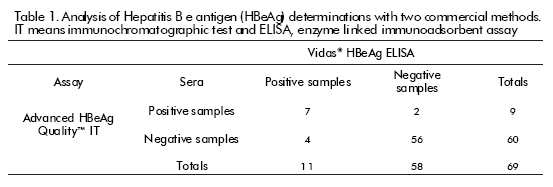
<body><![CDATA[<p><span lang=EN-US style='font-size:10.0pt;font-family:"Verdana","sans-serif"; color:#211E1E'>The Advanced Quality<sup>TM</sup> (A/Q, InTec Products Inc, China) IT for detecting HBeAg and anti-HBeAb and was made according to the manufacturer’s instructions. The procedure of IT cards for detecting HBeAg assay required the following steps: a) the foil pack was not to be open until you are ready to test the sample, b) all reagents and specimens must be brought to room temperature, c) the test card is removed from the foil pack and placed on a clean dry surface, d) the test card must be identified for each specimen or control, c) dispense 60 </span><span style='font-size:10.0pt;font-family:"Verdana","sans-serif"; color:#211E1E'>&#956;</span><span lang=EN-US style='font-size:10.0pt; font-family:"Verdana","sans-serif";color:#211E1E'>L or 2 drops for HBeAg IT and 100 </span><span style='font-size:10.0pt;font-family:"Verdana","sans-serif"; color:#211E1E'>&#956;</span><span lang=EN-US style='font-size:10.0pt; font-family:"Verdana","sans-serif";color:#211E1E'>L or 3 drops for HBeAb IT of the specimen or control into the sample well on the card, d) interpret test results after 15 min. All the IT’s were made before the expiry date (September 2007). The lots of the one step HBeAg test and the one step HBeAb test were 2006032301 and 2006032302, respectively. The determinations of HBeAg and HBeAb were made with the semi-quantitative immunoenzymatic fluorescence system Vidas® (Biomérieux, France) and amplified with streptavidin-biotin, following the manufacturer’s instructions (10). The ELISA after the confirmatory criteria has a 100% relative specificity (95% confidence interval, CI: 99%- 100%) and a 98.6% relative sensitivity (CI: 96.5%- 99.4%). The Vaccine Division of CIGB offered the data of the determinations of HBeAg and HBeAb that were performed in the non-hemolytic and non-fibrin sera of 69 patients with chronic HB included in the clinical trial for evaluating a therapeutic candidate (CIGB- 440). For this study, it was irrelevant to know which patients were treated with that therapeutic candidate. The institutional review board for ethics and human investigation at different Cuban hospitals approved the clinical trial. The sera were obtained with the informed consent from the patients. The samples were kept in aliquots at -20 ºC until testing. The direct quantification in plasma or serum of the viral load was made using the Versant HBV 3.0, System 340 (Bayer Diagnostics, USA) that it is a third-generation branched- DNA (bDNA) assay. </span></p>      <p><b><span lang=EN-US style='font-size:10.0pt;font-family:"Verdana","sans-serif"; color:#211E1E'>Statistical analysis </span></b></p>      <p><span lang=EN-US style='font-size:10.0pt;font-family:"Verdana","sans-serif"; color:#211E1E'>The comparison between the two methods was made by calculating the prevalence adjusted and bias adjusted kappa (PABAK), positive (Ppos) and negative (Pneg) average agreements with the formula described by Looney (11) and the chi square test (null hypothesis: both methods are independent versus the alternative hypothesis: both methods are dependent). The hypothesis contrast test for binomial variables was presented with the null hypothesis: proportions = 0.5 versus the alternative hypothesis: proportions &gt; 0.5 with the Statgraphics plus version 5.1 for Window software (Statistical graphics Corp., USA). The data were considered significantly different for p &lt; 0.05. The CI for the statistics used were calculated for proportions using the Microsoft® Excel 2000 software (Microsoft Corp.; USA). Samples showing discrepancy were evaluated twice, independently, in the IT. The criteria of a positive and negative or a gray zone in the ELISA were determined following the manufacturer’s instructions. </span></p>      <p><b><span lang=EN-US style='font-family:"Verdana","sans-serif";color:#211E1E'>RESULTS AND DISCUSION </span></b></p>      <p><span lang=EN-US style='font-size:10.0pt;font-family:"Verdana","sans-serif"; color:#211E1E'>The determinations of IT and ELISA for detecting HBeAg were shown in </span><span style='font-size:10.0pt;font-family:"Verdana","sans-serif"; color:#211E1E'><a href="#tab1"><span lang=EN-US>table 1</span></a></span><span lang=EN-US style='font-size:10.0pt;font-family:"Verdana","sans-serif"; color:#211E1E'>. Both methods for detecting that antigen showed a highly dependent relation (chi square = 29.5; degrees of freedom = 1, p &lt; 0.001). The PABAK was 0.82 (CI: 0.73-0.91; p &lt; 0.000 1) and was considered almost perfect (according to Looney). The Ppos was 0.7 (CI: 0.42-0.98, p = 0.172) when the sample size of the HBeAg positive sera was very small (N &lt; 30). This Ppos was not substantial when the methods were correlated. However, the Pneg was 0.95 (CI: 0.89 - 1.01; p &lt; 0.000 1) and was interpreted as being almost perfect. One false negative sample in the IT had an index near that of the HBeAg ELISA cut-off value. One false positive sample in the A/Q IT was detected in its gray zone. The sample of 69 sera had 72.4% chronic HB patients with a viral load higher than 104 genome equivalents/mL. These results suggest that IT for detecting HBeAg in the serum was less sensitive than the ELISA in the small sample size and perhaps, certain patients who have viral replication and a high infection may not be detected in the IT. These results differ from a study (12) where a perfect agreement was reported (the PABAK was 0.96, p &lt; 0.05) between the qualitative evaluation for HBeAg and the AxSym HBe 2.0 quantitative system (Abbot Laboratories) for a sample size of 698 patients. The rapid and simple test had an analytical sensitivity of 2000 PEI U/L and detects 292 out of 303 positive patients (<i>P</i><sub>pos</sub>: 0.97; p &lt; 0.05) and 391 out of 395 negative patients (<i>P</i><sub>neg</sub>: 0.98; p &lt; 0.05) using the AxSym HBe 2.0 system. In our study, the qualitative and simple assay for testing HBeAg has an analytical sensitivity of 2000 NCU/L and showed significantly poor coincidence in the positive average agreement compared to the semi-quantitative immunoassay. </span></p>      <p align=center style='text-align:center'><span style='font-size:13.5pt; color:#211E1E'><img border=0 width=553 height=187 src="/img/revistas/bta/v26n2/t0108209.gif"></span><a name=tab1></a></p>      
<p><span lang=EN-US style='font-size:10.0pt;font-family:"Verdana","sans-serif"; color:#211E1E'>The data of the A/Q IT and ELISA for detecting HBeAb can be observed in </span><span style='font-size:10.0pt;font-family:"Verdana","sans-serif"; color:#211E1E'><a href="#tab2"><span lang=EN-US>table 2</span></a></span><span lang=EN-US style='font-size:10.0pt;font-family:"Verdana","sans-serif"; color:#211E1E'>. Both methods for detecting that analyte showed an important dependent relationship (chi square = 38.4; degrees of freedom = 1, p &lt; 0.001). The PABAK was 0.74 (CI: 0.64-0.84; p &lt; 0.0001) and the agreement between both of them was considered substantial. The <i>P</i><sub>pos </sub>was 0.9 (CI: 0.81- 0.99; p &lt; 0.0001). This parameter was interpreted as being almost perfect when the positive results between both assays were correlated. And the <i>P</i><sub>neg </sub>was 0.81 (CI: 0.65-0.97, p = 0.0013) when the sample size of the HBeAb positive sera was very small (N &lt; 30). That result also was interpreted as being almost perfect. Two false negative samples of IT were close to the ELISA cut-off value for HBeAb and another two false negative samples with this biomarker were in its gray zone. Although anti-HBe seroconversion does not necessarily indicate HBeAg clearance, the earlier detection of anti-HBe seroconversion could have clinical significance for monitoring patients undergoing HB immunotherapy (13). These results suggest that the IT for detecting HBeAb in the serum could be a good biomarker of the therapeutic response of these patients. In the recent literature, a higher agreement (85%) was observed between the integrated protein microarrays and an ELISA for HBeAg and HBeAb detections in human sera (14); but the comparison was not made between the fast and simple Advanced Quality rapid system and the Vidas semi-quantitative immunoassay for detecting anti-HBe antibodies before of this study. </span></p>      <p align=center style='text-align:center'><span style='font-size:13.5pt; color:#211E1E'><img border=0 width=552 height=201 src="/img/revistas/bta/v26n2/t0208209.gif"></span><a name=tab2></a></p>      
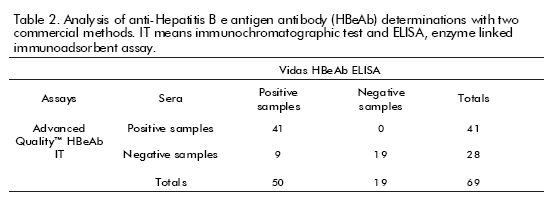
<p><span lang=EN-US style='font-size:10.0pt;font-family:"Verdana","sans-serif"; color:#211E1E'>Here we found a high relationship between the ELISA and the IT for two biomarkers in the patients with chronic HB. Only when the IT was used for detecting HBeAg in positive samples there were significant differences with the ELISA. This result can be explained through four main reasons: the use of monoclonal and polyclonal antibodies with different epitopic combinations in these methods (this information can be confidential for some commercial immunoassay manufacturers), the different standards of HBeAg or the unit of measurement (PEI U/L versus NCU/L) that were used in these assays, the small size of the positive HBeAg samples that were analyzed in the ELISA and that this latter method may truly be more sensitive than the IT method. Currently, the use of HBeAg for measuring the replication activity of HBV is less useful for viral load assessment as negative HBeAg precore mutants are more often detected. In these cases the type and length of the treatment must be carefully assessed because the progression of chronic HB to hepatocellular carcinoma and cirrosis is very frequent (15). The presence of HBeAb is an indicator of a favorable prognosis mainly when the infection of the wild HB virus is detected and viral load levels are low. In this study, the IT for detecting HBeAb in chronic HB patients could be used in remote health units and those not having the qualified personnel for using ELISA. </span></p>      <p><b><span lang=EN-US style='font-family:"Verdana","sans-serif";color:#211E1E'>ACKNOWLEDGMENT </span></b></p>      ]]></body>
<body><![CDATA[<p><span lang=EN-US style='font-size:10.0pt;font-family:"Verdana","sans-serif"; color:#211E1E'>The authors highly appreciate the information on the commercial enzymatic immunoassay given by Dr. Zurina Cinza Estévez. </span></p>      <p><b><span lang=EN-US style='font-family:"Verdana","sans-serif"'>REFERENCES</span></b><b><span lang=EN-US style='font-size:10.0pt;font-family:"Verdana","sans-serif"'> </span></b></p>      <p><span lang=EN-US style='font-size:10.0pt;font-family:"Verdana","sans-serif"; color:#211E1E'>1. Coppola</span><span lang=EN-US style='font-family:"Arial","sans-serif"; color:blue'> </span><span lang=EN-US style='font-size:10.0pt;font-family:"Verdana","sans-serif"; color:#211E1E'>R, Rizetto</span><span lang=EN-US style='font-family:"Arial","sans-serif"; color:blue'> </span><span lang=EN-US style='font-size:10.0pt;font-family:"Verdana","sans-serif"; color:#211E1E'>M, Bradley</span><span lang=EN-US style='font-family:"Arial","sans-serif"; color:blue'> </span><span lang=EN-US style='font-size:10.0pt;font-family:"Verdana","sans-serif"; color:#211E1E'>DW. Hepatitis B</span><span lang=EN-US style='font-family:"Arial","sans-serif"; color:gray'> </span><span lang=EN-US style='font-family:"Arial","sans-serif"; color:teal'>&nbsp;</span><span lang=EN-US style='font-size:10.0pt;font-family: "Verdana","sans-serif";color:#211E1E'>. In: Crivelli</span><span lang=EN-US style='font-family:"Arial","sans-serif";color:blue'> </span><span lang=EN-US style='font-size:10.0pt;font-family:"Verdana","sans-serif";color:#211E1E'>O, editor. Viral hepatitis Handbook. Saluggia (Italy): Sorin Biomedica 1996. p. 27-56</span><span lang=SV style='font-family:"Arial","sans-serif";color:teal'>.</span><span lang=EN-US style='font-size:10.0pt;font-family:"Verdana","sans-serif"; color:#211E1E'>&nbsp; </span></p>      <!-- ref --><p><span lang=EN-US style='font-size:10.0pt;font-family:"Verdana","sans-serif"; color:#211E1E'>2. Park W, Keeffe EB. Diagnosis and treatment of chronic hepatitis B. Minerva Gastroenterol Dietol</span><span lang=EN-US style='font-size:11.0pt;font-family:"Arial","sans-serif";color:red'> </span><span lang=EN-US style='font-size:10.0pt;font-family:"Verdana","sans-serif"; color:#211E1E'>2004;50:289-303.</span><!-- ref -->    <p><span lang=EN-US style='font-size:10.0pt;font-family:"Verdana","sans-serif"; color:#211E1E'>3. Yun-Fan L. Hepatitis Flares and Hepatitis B e Antigen Seroconversion: Implication in Anti-Hepatitis B Virus Therapy. J Gastroenterol Hepatol;18:246-52.</span></p>      <p><span lang=EN-US style='font-size:10.0pt;font-family:"Verdana","sans-serif"; color:#211E1E'>4. The Jury of European Association for the Study of the Liver (EASL). EASL International Consensus Conference on Hepatitis B. J Hepatol</span><span lang=EN-US style='font-size:11.0pt;font-family:"Arial","sans-serif";color:red'> </span><span lang=EN-US style='font-size:10.0pt;font-family:"Verdana","sans-serif"; color:#211E1E'>2003;38:533-40.</span></p>      <!-- ref --><p><span lang=EN-US style='font-size:10.0pt;font-family:"Verdana","sans-serif"; color:#211E1E'>5. Xu Y, Li Q. Multiple fluorescent labeling of silica nanoparticles with lanthanide chelates for highly sensitive time-resolved immunofluorometric assays. Clin Chem</span><span lang=EN-US style='font-size:11.0pt;font-family: "Arial","sans-serif";color:red'> </span><span lang=EN-US style='font-size:10.0pt; font-family:"Verdana","sans-serif";color:#211E1E'>2007;53</span><span lang=EN-US style='font-size:10.0pt;font-family:"Arial","sans-serif"'>(</span><span lang=EN-US style='font-size:10.0pt;font-family:"Verdana","sans-serif"; color:#211E1E'>8):1503-10.</span><p><span lang=EN-US style='font-size:10.0pt;font-family:"Verdana","sans-serif"; color:#211E1E'>6. Organon Teknika Gmbh. Hepanostika ® Hbe. Manual of Hepanostika® Hbe microelisa system. Eppelheim, Germany;1996. p.</span><span lang=EN-US style='font-size:11.0pt;font-family:"Arial","sans-serif";color:blue'> </span><span lang=EN-US style='font-size:10.0pt;font-family:"Verdana","sans-serif"; color:#211E1E'>3-18.&nbsp; </span></p>      <!-- ref --><p><span lang=EN-US style='font-size:10.0pt;font-family:"Verdana","sans-serif"; color:#211E1E'>7. Manual of Instructions of Advanced Quality™ One Step HBeAg Test (serum/ plasma)</span><span lang=EN-US style='font-family:"Arial","sans-serif"; color:blue'> </span><span lang=EN-US style='font-size:10.0pt;font-family:"Verdana","sans-serif"; color:#211E1E'>InTec Products, Inc (online, two screens). Available from URL: </span><span style='font-size:10.0pt;font-family:"Verdana","sans-serif"'><a href="http://www.asintec.com/en/"><span lang=EN-US>http:www.asintec.com/en/</span></a></span><span style='font-size:10.0pt;font-family:"Verdana","sans-serif"'> </span><span lang=EN-US style='font-size:10.0pt;font-family:"Verdana","sans-serif"; color:#211E1E'>(cited 2006 June 13). </span><!-- ref --><p><span lang=EN-US style='font-size:10.0pt;font-family:"Verdana","sans-serif"; color:#211E1E'>8. Clement F, Dewint P, Leroux-Roels G. Evaluation of a new rapid test for the combined detection of hepatitis B virus surface antigen and hepatitis B virus e antigen. J Clin Microbiol</span><span lang=EN-US style='font-size:11.0pt;font-family:"Arial","sans-serif";color:red'> </span><span lang=EN-US style='font-size:10.0pt;font-family:"Verdana","sans-serif"; color:#211E1E'>2002;40</span><span lang=EN-US style='font-size:10.0pt; font-family:"Arial","sans-serif"'>(</span><span lang=EN-US style='font-size: 10.0pt;font-family:"Verdana","sans-serif";color:#211E1E'>12):4603-6.</span><!-- ref --><p><span lang=EN-US style='font-size:10.0pt;font-family:"Verdana","sans-serif"; color:#211E1E'>9. Manual of Instructions of Advanced Quality™ One Step HBeAb Test (serum/ plasma)</span><span lang=EN-US style='font-family:"Arial","sans-serif"; color:blue'> </span><span lang=EN-US style='font-size:10.0pt;font-family:"Verdana","sans-serif"; color:#211E1E'>InTec Products, Inc (online, two screens). Available from URL: </span><span style='font-size:10.0pt;font-family:"Verdana","sans-serif"'><a href="http://www.asintec.com/en/"><span lang=EN-US>http:www.asintec.com/en/</span></a></span><span style='font-size:10.0pt;font-family:"Verdana","sans-serif"'> </span><span lang=EN-US style='font-size:10.0pt;font-family:"Verdana","sans-serif"; color:#211E1E'>(cited 2006 June 13). </span><p><span lang=EN-US style='font-size:10.0pt;font-family:"Verdana","sans-serif"; color:#211E1E'>10. Manual of Instructions of Vidas® HBe / Anti-HBe 30 tests</span><span lang=EN-US style='font-family:"Arial","sans-serif";color:gray'> </span><span lang=EN-US style='font-size:10.0pt;font-family:"Verdana","sans-serif"; color:#211E1E'>&nbsp;Ref. 30 305 Biomérieux, Spain. Available from URL: </span><span style='font-size:10.0pt;font-family:"Verdana","sans-serif";color:#211E1E'><a href="http://www.biomerieux.com/Customerextranet/TechnicalLibrary"><span lang=EN-US>http:</span><span lang=EN-US style='color:black'>www.biomerieux.com/Customerextranet/TechnicalLibrary</span></a></span><span style='font-size:10.0pt;font-family:"Verdana","sans-serif"'> </span><span lang=EN-US style='font-size:10.0pt;font-family:"Verdana","sans-serif"; color:#211E1E'>(cited 2007 October). </span></p>      <p><span lang=EN-US style='font-size:10.0pt;font-family:"Verdana","sans-serif"; color:#211E1E'>11. Looney</span><span lang=EN-US style='font-family:"Arial","sans-serif"; color:blue'> </span><span lang=EN-US style='font-size:10.0pt;font-family:"Verdana","sans-serif"; color:#211E1E'>SW. Statistical Methods for Assessing Biomarkers. In: Looney</span><span lang=EN-US style='font-family:"Arial","sans-serif";color:blue'> </span><span lang=EN-US style='font-size:10.0pt;font-family:"Verdana","sans-serif"; color:#211E1E'>SW, editor. Biostatistical Methods. New Jersey: Humana Press Inc;2002. p. 81-110. </span></p>      <!-- ref --><p class=MsoNormal style='text-autospace:none'><span lang=EN-US style='font-size:10.0pt;font-family:"Verdana","sans-serif";color:#211E1E'>12. Clement F, Dewint P, Leroux-Roels G. Evaluation of a New Rapid Test for the Combined Detection of Hepatitis B Virus Surface Antigen and Hepatitis B Virus e Antigen. J Clin Microbiol 2002;40(12):4603-6.</span><!-- ref --><p><span lang=EN-US style='font-size:10.0pt;font-family:"Verdana","sans-serif"; color:#211E1E'>13. Baumeister MA, Medina-Selby A, Coit D, Nguyen S, George-Nascimento C, Gyenes A, et al. Hepatitis B virus e antigen specific epitopes and limitations of commercial anti- HBe immunoassays. J Med Virol</span><span lang=EN-US style='font-size:11.0pt;font-family:"Arial","sans-serif";color:red'> </span><span lang=EN-US style='font-size:10.0pt;font-family:"Verdana","sans-serif"; color:#211E1E'>2000;60</span><span lang=EN-US style='font-size:10.0pt; font-family:"Arial","sans-serif"'>(</span><span lang=EN-US style='font-size: 10.0pt;font-family:"Verdana","sans-serif";color:#211E1E'>3):256-63.</span><!-- ref --><p><span lang=EN-US style='font-size:10.0pt;font-family:"Verdana","sans-serif"; color:#211E1E'>14. Xu R, Gan X, Fang Y, Zheng S, Dong Q. A simple, rapid, and sensitive integrated protein microarray for simultaneous detection of multiple antigens and antibodies of five human hepatitis viruses: HBV, HCV, HDV, HEV, and HGV. Anal Biochem</span><span lang=EN-US style='font-size:11.0pt; font-family:"Arial","sans-serif";color:red'> </span><span lang=EN-US style='font-size:10.0pt;font-family:"Verdana","sans-serif";color:#211E1E'>2007;362</span><span lang=EN-US style='font-size:10.0pt;font-family:"Arial","sans-serif"'>(</span><span lang=EN-US style='font-size:10.0pt;font-family:"Verdana","sans-serif"; color:#211E1E'>1):69-75.</span><span lang=EN-US style='font-size:11.0pt; font-family:"Arial","sans-serif";color:blue'> </span><p><span lang=EN-US style='font-size:10.0pt;font-family:"Verdana","sans-serif"; color:#211E1E'>15. Schildgen</span><span lang=EN-US style='font-family:"Arial","sans-serif"; color:blue'> </span><span lang=EN-US style='font-size:10.0pt;font-family:"Verdana","sans-serif"; color:#211E1E'>O. Acute and chronic hepatitis B -Diagnostic test. In: Stefan</span><span lang=EN-US style='font-family:"Arial","sans-serif";color:blue'> </span><span lang=EN-US style='font-size:10.0pt;font-family:"Verdana","sans-serif"; color:#211E1E'>M, Berg</span><span lang=EN-US style='font-family:"Arial","sans-serif"; color:blue'> </span><span lang=EN-US style='font-size:10.0pt;font-family:"Verdana","sans-serif"; color:#211E1E'>T, Rockstroch</span><span lang=EN-US style='font-family:"Arial","sans-serif"; color:blue'> </span><span lang=EN-US style='font-size:10.0pt;font-family:"Verdana","sans-serif"; color:#211E1E'>J, Sarrazin</span><span lang=EN-US style='font-family:"Arial","sans-serif"; color:blue'> </span><span lang=EN-US style='font-size:10.0pt;font-family:"Verdana","sans-serif"; color:#211E1E'>C, Wedemeyer</span><span lang=EN-US style='font-family:"Arial","sans-serif"; color:blue'> </span><span lang=EN-US style='font-size:10.0pt;font-family:"Verdana","sans-serif"; color:#211E1E'>H, editors. Hepatology: A clinical textbook. Duesseldorf </span><span lang=EN-US style='font-size:10.0pt;font-family:"Verdana","sans-serif"; color:windowtext'>(</span><span lang=EN-US style='font-size:10.0pt;font-family: "Verdana","sans-serif";color:#211E1E'>Germany): Flying Publisher;2009. p.</span><span lang=EN-US style='font-size:11.0pt;font-family:"Arial","sans-serif";color:blue'> </span><span lang=EN-US style='font-size:10.0pt;font-family:"Verdana","sans-serif"; color:#211E1E'>113-8.</span><span lang=EN-US style='font-size:11.0pt; font-family:"Arial","sans-serif";color:green'> </span></p>      <p><span lang=EN-US style='font-size:13.5pt;color:#211E1E'>&nbsp;</span></p>      <p><span lang=EN-US style='font-size:10.0pt;font-family:"Verdana","sans-serif"; color:#211E1E'>Received in October, 2008.     ]]></body>
<body><![CDATA[<br> Accepted for publication in June, 2009.</span><span lang=EN-US style='font-size:11.0pt;font-family:"Arial","sans-serif";color:red'> </span></p>      <p><span lang=EN-US style='font-size:10.0pt;font-family:"Verdana","sans-serif"; color:#211E1E'>Damián Mainet González. Diagnostics and Genomic Division. Center for Genetic Engineering and Biotechnology, CIGB Ave. 31 / 158 and 190, Cuabanacán, Playa, PO Box 6162, CP 10600, Havana, Cuba. E-mail: </span><span style='font-size:10.0pt;font-family:"Verdana","sans-serif";color:#211E1E'><a href="mailto:damian.mainet@cigb.edu.cu"><span lang=EN-US>damian.mainet@cigb.edu.cu</span></a></span><span style='font-size:11.0pt;font-family:"Arial","sans-serif";color:#FF6600'> </span></p>      <p><span lang=EN-US style='font-size:13.5pt'>&nbsp;</span></p>  </div>  </div>       ]]></body><back>
<ref-list>
<ref id="B1">
<label>1</label><nlm-citation citation-type="book">
<person-group person-group-type="author">
<name>
<surname><![CDATA[Coppola]]></surname>
<given-names><![CDATA[R]]></given-names>
</name>
<name>
<surname><![CDATA[Rizetto]]></surname>
<given-names><![CDATA[M]]></given-names>
</name>
<name>
<surname><![CDATA[Bradley]]></surname>
<given-names><![CDATA[DW]]></given-names>
</name>
</person-group>
<article-title xml:lang="en"><![CDATA[Hepatitis B]]></article-title>
<person-group person-group-type="editor">
<name>
<surname><![CDATA[Crivelli]]></surname>
<given-names><![CDATA[O]]></given-names>
</name>
</person-group>
<source><![CDATA[Viral hepatitis Handbook]]></source>
<year>1996</year>
<page-range>27-56</page-range><publisher-loc><![CDATA[Saluggia ]]></publisher-loc>
<publisher-name><![CDATA[Sorin Biomedica]]></publisher-name>
</nlm-citation>
</ref>
<ref id="B2">
<label>2</label><nlm-citation citation-type="journal">
<person-group person-group-type="author">
<name>
<surname><![CDATA[Park]]></surname>
<given-names><![CDATA[W]]></given-names>
</name>
<name>
<surname><![CDATA[Keeffe]]></surname>
<given-names><![CDATA[EB]]></given-names>
</name>
</person-group>
<article-title xml:lang="en"><![CDATA[Diagnosis and treatment of chronic hepatitis B]]></article-title>
<source><![CDATA[Minerva Gastroenterol Dietol]]></source>
<year>2004</year>
<volume>50</volume>
<page-range>289-303</page-range></nlm-citation>
</ref>
<ref id="B3">
<label>3</label><nlm-citation citation-type="journal">
<person-group person-group-type="author">
<name>
<surname><![CDATA[Yun-Fan]]></surname>
<given-names><![CDATA[L]]></given-names>
</name>
</person-group>
<article-title xml:lang="en"><![CDATA[Hepatitis Flares and Hepatitis B e Antigen Seroconversion: Implication in Anti-Hepatitis B Virus Therapy]]></article-title>
<source><![CDATA[J Gastroenterol Hepatol]]></source>
<year>2003</year>
<volume>18</volume>
<page-range>246-52</page-range></nlm-citation>
</ref>
</ref-list>
</back>
</article>
