<?xml version="1.0" encoding="ISO-8859-1"?><article xmlns:mml="http://www.w3.org/1998/Math/MathML" xmlns:xlink="http://www.w3.org/1999/xlink" xmlns:xsi="http://www.w3.org/2001/XMLSchema-instance">
<front>
<journal-meta>
<journal-id>1027-2852</journal-id>
<journal-title><![CDATA[Biotecnología Aplicada]]></journal-title>
<abbrev-journal-title><![CDATA[Biotecnol Apl]]></abbrev-journal-title>
<issn>1027-2852</issn>
<publisher>
<publisher-name><![CDATA[Editorial Elfos Scientiae]]></publisher-name>
</publisher>
</journal-meta>
<article-meta>
<article-id>S1027-28522009000200011</article-id>
<title-group>
<article-title xml:lang="en"><![CDATA[Engineering drought and salt tolerance in plants using SodERF3, a novel sugarcane ethylene responsive factor]]></article-title>
</title-group>
<contrib-group>
<contrib contrib-type="author">
<name>
<surname><![CDATA[Trujillo]]></surname>
<given-names><![CDATA[Luis E]]></given-names>
</name>
<xref ref-type="aff" rid="A01"/>
</contrib>
<contrib contrib-type="author">
<name>
<surname><![CDATA[Menéndez]]></surname>
<given-names><![CDATA[Carmen]]></given-names>
</name>
<xref ref-type="aff" rid="A01"/>
</contrib>
<contrib contrib-type="author">
<name>
<surname><![CDATA[Ochogavía]]></surname>
<given-names><![CDATA[María E]]></given-names>
</name>
<xref ref-type="aff" rid="A01"/>
</contrib>
<contrib contrib-type="author">
<name>
<surname><![CDATA[Hernández]]></surname>
<given-names><![CDATA[Ingrid]]></given-names>
</name>
<xref ref-type="aff" rid="A02"/>
</contrib>
<contrib contrib-type="author">
<name>
<surname><![CDATA[Borrás]]></surname>
<given-names><![CDATA[Orlando]]></given-names>
</name>
<xref ref-type="aff" rid="A02"/>
</contrib>
<contrib contrib-type="author">
<name>
<surname><![CDATA[Rodríguez]]></surname>
<given-names><![CDATA[Raisa]]></given-names>
</name>
<xref ref-type="aff" rid="A02"/>
</contrib>
<contrib contrib-type="author">
<name>
<surname><![CDATA[Coll]]></surname>
<given-names><![CDATA[Yamilet]]></given-names>
</name>
<xref ref-type="aff" rid="A02"/>
</contrib>
<contrib contrib-type="author">
<name>
<surname><![CDATA[Arrieta]]></surname>
<given-names><![CDATA[Juan G]]></given-names>
</name>
<xref ref-type="aff" rid="A01"/>
</contrib>
<contrib contrib-type="author">
<name>
<surname><![CDATA[Banguela]]></surname>
<given-names><![CDATA[Alexander]]></given-names>
</name>
<xref ref-type="aff" rid="A01"/>
</contrib>
<contrib contrib-type="author">
<name>
<surname><![CDATA[Ramírez]]></surname>
<given-names><![CDATA[Ricardo]]></given-names>
</name>
<xref ref-type="aff" rid="A01"/>
</contrib>
<contrib contrib-type="author">
<name>
<surname><![CDATA[Hernández]]></surname>
<given-names><![CDATA[Lázaro]]></given-names>
</name>
<xref ref-type="aff" rid="A01"/>
</contrib>
</contrib-group>
<aff id="A02">
<institution><![CDATA[,Center for Genetic Engineering and Biotechnology Plants Division Laboratory of Plant Functional Genomics]]></institution>
<addr-line><![CDATA[Havana ]]></addr-line>
<country>Cuba</country>
</aff>
<aff id="A01">
<institution><![CDATA[,Center for Genetic Engineering and Biotechnology Plants Division Plant-microorganism Interaction Laboratory]]></institution>
<addr-line><![CDATA[Havana ]]></addr-line>
<country>Cuba</country>
</aff>
<pub-date pub-type="pub">
<day>00</day>
<month>06</month>
<year>2009</year>
</pub-date>
<pub-date pub-type="epub">
<day>00</day>
<month>06</month>
<year>2009</year>
</pub-date>
<volume>26</volume>
<numero>2</numero>
<fpage>168</fpage>
<lpage>171</lpage>
<copyright-statement/>
<copyright-year/>
<self-uri xlink:href="http://scielo.sld.cu/scielo.php?script=sci_arttext&amp;pid=S1027-28522009000200011&amp;lng=en&amp;nrm=iso"></self-uri><self-uri xlink:href="http://scielo.sld.cu/scielo.php?script=sci_abstract&amp;pid=S1027-28522009000200011&amp;lng=en&amp;nrm=iso"></self-uri><self-uri xlink:href="http://scielo.sld.cu/scielo.php?script=sci_pdf&amp;pid=S1027-28522009000200011&amp;lng=en&amp;nrm=iso"></self-uri><abstract abstract-type="short" xml:lang="en"><p><![CDATA[The ability of plants to tolerate salt and drought conditions is crucial for agricultural production worldwide. The increased understanding of the regulatory networks controlling drought stress response has led to practical approaches for engineering salt and drought tolerance in plants. By a single-pass sequencing of randomly selected clones from a &#955; ZAP-cDNA library generated from ethephon-treated young sugarcane leaves, we identified an expressed sequence tag encoding a putative protein with a DNA-binding domain that is typically found in EREBP/ AP2-type transcription factors. The full-length cDNA clone, named SodERF3 (EMBL accession number AM493723) was further isolated from the excised library. SodERF3 encodes a 240 amino acid DNA-binding protein that acts as a transcriptional regulator of the Ethylene Responsive Factor (ERF) superfamily, but also contains a C-terminal short hydrophobic region resembling an ERF-associated amphiphilic repression-like motif, typical for class II ERFs. This protein binds to the GGC box, and its deduced amino acid sequence contains an N-terminal putative nuclear localization signal. SodERF3 is induced in sugar cane leaves by ethylene, abscisic acid, salt stress and wounding as judged by Northern and Western blots assays. Greenhouse grown transgenic tobacco plants (Nicotiana tabacum L. cv. SR1) expressing SodERF3 were found to display increased tolerance to drought and osmotic stress without any visible phenotypic change in growth and development. According to our results SodERF3 will be a valuable tool to assist the manipulation of plants to improve their stress tolerance.]]></p></abstract>
</article-meta>
</front><body><![CDATA[ <div class=Section1>      <div>      <p align=right style='text-align:right'><b><span lang=EN-US style='font-size: 10.0pt;font-family:"Verdana","sans-serif";color:#211E1E'>REPORT </span></b></p>      <p align=right style='text-align:right'><span lang=EN-US>&nbsp;</span></p>      <p><b><span lang=EN-US style='font-size:13.5pt;font-family:"Verdana","sans-serif"; color:#211E1E'>Engineering drought and salt tolerance in plants using SodERF3, a novel sugarcane ethylene responsive factor</span></b><b><span style='font-size:13.5pt;font-family:"Verdana","sans-serif";color:#211E1E'><a href="#award"><span lang=EN-US>*</span></a></span></b></p>      <p><b><span lang=EN-US style='font-size:13.5pt;color:#211E1E'>&nbsp;</span></b></p>      <p><b><span style='font-size:10.0pt;font-family:"Verdana","sans-serif"; color:#211E1E'>Luis E Trujillo<sup>1</sup>, Carmen Menéndez<sup>1</sup>, María E Ochogavía<sup>1</sup>, Ingrid Hernández<sup>2</sup>, Orlando Borrás<sup>2</sup>, Raisa Rodríguez<sup>2</sup>, Yamilet Coll<sup>2</sup>, Juan G Arrieta<sup>1</sup>, Alexander Banguela<sup>1</sup>, Ricardo Ramírez<sup>1</sup>, Lázaro Hernández<sup>1</sup></span></b></p>      <p><sup><span lang=EN-US style='font-size:10.0pt;font-family:"Verdana","sans-serif"; color:#211E1E'>1</span></sup><span lang=EN-US style='font-size:10.0pt; font-family:"Verdana","sans-serif";color:#211E1E'>Plant-microorganism Interaction Laboratory, Plants Division    <br> <sup>2</sup>Laboratory of Plant Functional Genomics    <br> Center for Genetic Engineering and Biotechnology, CIGB. Ave. 31 / 158 and 190, Cubanacán, Playa, PO Box 6162, Havana, Cuba</span><span lang=EN-US style='font-size:11.0pt;font-family:"Arial","sans-serif";color:#FF6600'> </span></p>      ]]></body>
<body><![CDATA[<p><span lang=EN-US style='font-size:13.5pt;color:#211E1E'>&nbsp;</span></p>      <p><span lang=EN-US style='font-size:13.5pt;color:#211E1E'>&nbsp;</span></p>      <div class=MsoNormal align=center style='text-align:center'>  <hr size=2 width="100%" align=center>  </div>      <p><b><span lang=EN-US style='font-size:10.0pt;font-family:"Verdana","sans-serif"'>ABSTRACT </span></b></p>      <p class=MsoNormal><span lang=EN-US style='font-size:10.0pt;font-family:"Verdana","sans-serif"'>The ability of plants to tolerate salt and drought conditions is crucial for agricultural production worldwide. The increased understanding of the regulatory networks controlling drought stress response has led to practical approaches for engineering salt and drought tolerance in plants. By a single-pass sequencing of randomly selected clones from a </span><span style='font-size: 10.0pt;font-family:"Verdana","sans-serif"'>&#955;</span><span lang=EN-US style='font-size:10.0pt;font-family:"Verdana","sans-serif"'> ZAP-cDNA library generated from ethephon-treated young sugarcane leaves, we identified an expressed sequence tag encoding a putative protein with a DNA-binding domain that is typically found in EREBP/ AP2-type transcription factors. The full-length cDNA clone, named SodERF3 (EMBL accession number AM493723) was further isolated from the excised library. SodERF3 encodes a 240 amino acid DNA-binding protein that acts as a transcriptional regulator of the Ethylene Responsive Factor (ERF) superfamily, but also contains a C-terminal short hydrophobic region resembling an ERF-associated amphiphilic repression-like motif, typical for class II ERFs. This protein binds to the GGC box, and its deduced amino acid sequence contains an N-terminal putative nuclear localization signal. SodERF3 is induced in sugar cane leaves by ethylene, abscisic acid, salt stress and wounding as judged by Northern and Western blots assays. Greenhouse grown transgenic tobacco plants (<i>Nicotiana tabacum</i> L. cv. SR1) expressing SodERF3 were found to display increased tolerance to drought and osmotic stress without any visible phenotypic change in growth and development. According to our results SodERF3 will be a valuable tool to assist the manipulation of plants to improve their stress tolerance.</span><span lang=EN-US style='font-size:11.0pt;font-family:"Arial","sans-serif";color:red'> </span></p>      <div class=MsoNormal align=center style='text-align:center'>  <hr size=2 width="100%" align=center>  </div>      <p><span lang=EN-US style='font-size:13.5pt'>&nbsp;</span></p>      <p><span lang=EN-US style='font-size:13.5pt'>&nbsp;</span></p>      <p><b><span lang=EN-US style='font-family:"Verdana","sans-serif";color:#211E1E'>INTRODUCTION </span></b></p>      <p><span lang=EN-US style='font-size:10.0pt;font-family:"Verdana","sans-serif"; color:#211E1E'>Growing in their natural environment, plants often encounter unfavorable environmental conditions that interrupt their normal growth and productivity. Among such environmental stresses drought and salinity are among the most important environmental constraints for agriculture in the world (1). </span></p>      ]]></body>
<body><![CDATA[<p><span lang=EN-US style='font-size:10.0pt;font-family:"Verdana","sans-serif"; color:#211E1E'>About 20% of the arable land in Cuba is affected by drought and salinity (2); however, to date the strategies are inadequate to increase the stability of crop production under these conditions (3). Therefore, engineering drought and salt tolerance in plants is of enormous economic importance. </span></p>      <p><span lang=EN-US style='font-size:10.0pt;font-family:"Verdana","sans-serif"; color:#211E1E'>Recent progress has been made in our understanding of gene expression, transcriptional regulation and signal transduction in plant responses to salinity and drought. On the other hand, molecular and genomic analyses have facilitated gene discovery and enabled genetic engineering using several functional or regulatory genes to activate or repress specific or broad pathways related to salinity and drought tolerance in plants. Also, the understanding of regulatory networks controlling drought/salinity stress response has led to practical approaches for engineering drought/salinity tolerance in plants. </span></p>      <p><span lang=EN-US style='font-size:10.0pt;font-family:"Verdana","sans-serif"; color:#211E1E'>Transcription factors (TF) involved in the response to ethylene, the so-called ethylene responsive factors (ERF-TF), confer tolerance to different biotic and abiotic stresses (4, 5). These transcriptional regulators once activated by the ethylene biosynthesis pathway, increase or repress the activation of genes related to stress and vegetative development. </span></p>      <p><span lang=EN-US style='font-size:10.0pt;font-family:"Verdana","sans-serif"; color:#211E1E'>The main objectives of this study were: 1) The identification, isolation, cloning and characterization of a new sugarcane gene encoding a transcription factor linked to the response to ethephon (ethylene analogue) treatment called <i>SodERF</i>3; 2) To determine how the <i>SodERF</i>3 gene is regulated in sugarcane in the response to different hormones involved in biotic and abiotic stress, and 3) To assess tolerance to salinity and drought in transgenic 35S: <i>SodERF</i>3 tobacco lines used as an experimental model. </span></p>      <p><span lang=EN-US style='font-size:10.0pt;font-family:"Verdana","sans-serif"; color:#211E1E'>The working strategy included: 1) The identification and isolation of the gene encoding for an ERF-TF from a </span><span style='font-size:10.0pt;font-family:"Verdana","sans-serif";color:#211E1E'>&#955;</span><span lang=EN-US style='font-size:10.0pt;font-family:"Verdana","sans-serif"; color:#211E1E'> ZAP-cDNA library generated from ethephon- treated young sugarcane leaves; 2) The cloning and analysis of the S<i>odERF</i>3 DNA sequence; 3) The location of <i>SodERF3 </i>phylogeny and the introduction of the new DNA sequence in the database EMBLGene Bank; 4) Showing the binding capacity of this protein to DNA <i>in vitro</i>; 5) Describing the regulation of this gene in sugarcane plants subjected to the treatment of different hormones related to abiotic factors; 6) Assessing the biological function of <i>SodERF</i>3 in transgenic model plants (<i>Nicotiana tabacum </i>L. cv. SR1) without and under salt stress and drought; and 7) A detailed phenotypic study of transgenic plants overexpressing <i>SodERF</i>3. </span></p>      <p><b><span lang=EN-US style='font-family:"Verdana","sans-serif";color:#211E1E'>RESULTS AND DISCUSSION</span></b><b><span lang=EN-US style='font-size:10.0pt; font-family:"Verdana","sans-serif";color:#211E1E'> </span></b></p>      <p><b><i><span lang=EN-US style='font-size:10.0pt;font-family:"Verdana","sans-serif"; color:#211E1E'>SodERF3 </span></i></b><b><span lang=EN-US style='font-size: 10.0pt;font-family:"Verdana","sans-serif";color:#211E1E'>encodes a novel ERF-TF protein from sugarcane </span></b></p>      <p><span lang=EN-US style='font-size:10.0pt;font-family:"Verdana","sans-serif"; color:#211E1E'>Using a </span><span style='font-size:10.0pt;font-family:"Verdana","sans-serif"; color:#211E1E'>&#955;</span><span lang=EN-US style='font-size:10.0pt; font-family:"Verdana","sans-serif";color:#211E1E'> ZAP-cDNA library generated from ethephon- treated young sugarcane (<i>Saccharum officinarum </i>L. cv Ja60-5) leaves we isolated a cDNA encoding <i>SodERF3 </i>(GeneBank No. AM493723), a 201 residues polypeptide with a predicted molecular mass of 20.7 kDa. The N-terminal region of the predicted protein contains a short stretch of basic amino acids in its N-terminal that may function as a nuclear localization signal (NLS) and a putative DNA-binding domain that is highly conserved in all members of the APETALA 2 (AP2) ERF TF superfamily. Sequence analysis also revealed that this protein contains a short C-terminal hydrophobic region similar to an ERF-associated amphiphilic repression (EAR) motif (L/F)DLN(L/F)xP typical of Class II ERFs (5, 6). However, in the case of <i>SodERF3 </i>and other sugarcane EST as shown in red in </span><span style='font-size:10.0pt; font-family:"Verdana","sans-serif";color:#211E1E'><a href="#fig1"><span lang=EN-US>figure 1</span></a></span><span lang=EN-US style='font-size:10.0pt; font-family:"Verdana","sans-serif";color:#211E1E'>, the seventh amino acid in the motif corresponds to a leucine (L) instead of the strictly conserved proline (P) described previously by Ohta <i>et </i>al. (6) in other ERFs proteins (</span><span style='font-size:10.0pt;font-family:"Verdana","sans-serif";color:#211E1E'><a href="#fig1"><span lang=EN-US>Figure 1</span></a></span><span lang=EN-US style='font-size:10.0pt;font-family:"Verdana","sans-serif";color:#211E1E'>). This new finding may have an evolutionary, structural and physiological meaning. Sequence comparison analysis at the amino acid level showed that the <i>SodERF3 </i>binding domain is highly homologous with both dicotylenedous and monocotylenedous members of the AP2/ ERFs TFs superfamily so, according to the phylogeny, <i>SodERF3 </i>is gathered in the B-subgroup; cluster VIII of the AP2 super family according to the classification of Nakano <i>et al. </i></span><span style='font-size:10.0pt;font-family:"Verdana","sans-serif";color:#211E1E'>(7). </span></p>      <p align=center style='text-align:center'><span style='font-size:13.5pt; color:#211E1E'><img border=0 width=341 height=282 src="/img/revistas/bta/v26n2/f0114209.gif"></span><a name=fig1></a></p>      
<p><span lang=EN-US style='font-size:10.0pt;font-family:"Verdana","sans-serif"; color:#211E1E'>Interestingly, the protein-protein BLAST search of <i>SodERF3 </i>without the ERF domain showed in general very low similarity scores (less than 9%) of the flanking sequences with other members of the ERF family. </span></p>      ]]></body>
<body><![CDATA[<p><span lang=EN-US style='font-size:10.0pt;font-family:"Verdana","sans-serif"; color:#211E1E'>According to these findings <i>SodERF</i>3 encodes for a new sugarcane protein that belongs to the B-subgroup; cluster VIII of the AP2 super family and therefore, it is a new member of this family. </span></p>      <p><b><i><span lang=EN-US style='font-size:10.0pt;font-family:"Verdana","sans-serif"; color:#211E1E'>SodERF3 </span></i></b><b><span lang=EN-US style='font-size: 10.0pt;font-family:"Verdana","sans-serif";color:#211E1E'>expression in sugarcane is induced by hormones involved in biotic and abiotic stress </span></b></p>      <p><span lang=EN-US style='font-size:10.0pt;font-family:"Verdana","sans-serif"; color:#211E1E'>Contrasting with the high presence of <i>SodERF3 </i>transcripts easily detected in sugarcane leaves treated 48 h with ethephon (ET), ABA, NaCl or wounding (W), a weak induction of <i>SodERF3 </i>was observed upon the treatment with salicylic acid (SA) as shown in </span><span style='font-size: 10.0pt;font-family:"Verdana","sans-serif";color:#211E1E'><a href="#fig2"><span lang=EN-US>figure 2A</span></a></span><span lang=EN-US style='font-size:10.0pt; font-family:"Verdana","sans-serif";color:#211E1E'>. Time-course experiments showed that <i>SodERF3 </i>expression can be observed as early as 1 h after the treatment with ethephon, ABA and NaCl (</span><span style='font-size:10.0pt; font-family:"Verdana","sans-serif";color:#211E1E'><a href="#fig2"><span lang=EN-US>Figure 2B</span></a></span><span lang=EN-US style='font-size:10.0pt; font-family:"Verdana","sans-serif";color:#211E1E'>). The transcript amount gradually increased over 48 h in the experiment. The protein synthesis and accumulation also occurred gradually after the ethephon treatment of sugarcane leaf discs as monitored by western blot analysis using antibodies against recombinant <i>SodERF3 </i>(</span><span style='font-size:10.0pt;font-family: "Verdana","sans-serif";color:#211E1E'><a href="#fig2"><span lang=EN-US>Figure 2C</span></a></span><span lang=EN-US style='font-size:10.0pt;font-family:"Verdana","sans-serif"; color:#211E1E'>). The fact that <i>SodERF3 </i>is induced by ABA and wounding could indicate the possibility that this ERF plays an integral role in both the biotic and abiotic signaling pathways. </span></p>      <p align=center style='text-align:center'><span style='font-size:13.5pt; color:#211E1E'><img border=0 width=347 height=602 src="/img/revistas/bta/v26n2/f0214209.gif"></span><a name=fig2></a></p>      
<p><span lang=EN-US style='font-size:10.0pt;font-family:"Verdana","sans-serif"; color:#211E1E'>ABA is the major plant hormone related to water stress signaling and regulates plant water balance and osmotic stress tolerance (8). </span></p>      <p><b><i><span lang=EN-US style='font-size:10.0pt;font-family:"Verdana","sans-serif"; color:#211E1E'>SodERF3 </span></i></b><b><span lang=EN-US style='font-size: 10.0pt;font-family:"Verdana","sans-serif";color:#211E1E'>is a GCC box-binding protein</span></b><span lang=EN-US style='font-size:10.0pt;font-family:"Verdana","sans-serif"; color:#211E1E'> </span></p>      <p><span lang=EN-US style='font-size:10.0pt;font-family:"Verdana","sans-serif"; color:#211E1E'>It has been demonstrated that ERF proteins interact through the EREBP/AP2 binding domain with the GCC box <i>cis </i>element present in the promoter region of the genes whose expression they control (9). To analyze if <i>SodERF3 </i>has GCC box-binding activity <i>in vitro</i>, recombinant <i>SodERF3 </i>was used in an electrophoretic mobility shift assay. To this end, the <i>SodERF3 </i>coding region was over-expressed as a fusion protein with a hexa-histidine tag in <i>Escherichia coli. </i></span></p>      <p><span lang=EN-US style='font-size:10.0pt;font-family:"Verdana","sans-serif"; color:#211E1E'>The recombinant <i>SodERF3 </i>produced a gel shift when the labeled probe with a wild-type GCC box was used (CATAAGA<b>GCCGCC</b>ACT), but not with a labeled probe carrying a mutated GCC box (CATA AGA<b>TCCTCC</b>ACT) (</span><span style='font-size:10.0pt;font-family:"Verdana","sans-serif"; color:#211E1E'><a href="#fig3"><span lang=EN-US>Figure 3A</span></a></span><span lang=EN-US style='font-size:10.0pt;font-family:"Verdana","sans-serif"; color:#211E1E'>). The <i>SodERF3 </i>binding capacity was severely reduced in a competition assay with an excess of the unlabelled probe (</span><span style='font-size:10.0pt;font-family:"Verdana","sans-serif";color:#211E1E'><a href="#fig3"><span lang=EN-US>Figure 3B</span></a></span><span lang=EN-US style='font-size:10.0pt;font-family:"Verdana","sans-serif";color:#211E1E'>). According to this experiment, <i>SodERF3 </i>displays specific GCC box-binding activity <i>in vitro</i>. </span></p>      <p align=center style='text-align:center'><span style='font-size:13.5pt; color:#211E1E'><img border=0 width=337 height=509 src="/img/revistas/bta/v26n2/f0314209.gif"></span><a name=fig3></a></p>      
<p><b><span lang=EN-US style='font-size:10.0pt;font-family:"Verdana","sans-serif"; color:#211E1E'>Ectopic expression of <i>SodERF3 </i>enhances salt and drought tolerance in model tobacco plants </span></b></p>      ]]></body>
<body><![CDATA[<p><span lang=EN-US style='font-size:10.0pt;font-family:"Verdana","sans-serif"; color:#211E1E'>To evaluate the role of <i>SodERF3 </i>in transcriptional responses, gene functional analysis in sugarcane would obviously be highly desirable; however, genetic tools in this crop are limited because of the generally polyploid genomes for most varieties, chromosomal mosaic and gene functional redundancy. Therefore, we generated transgenic tobacco lines expressing <i>SodERF3 </i>under the transcriptional control of the constitutive Cauliflower Mosaic Virus (CaMV) 35S promoter, to investigate its biological function <i>in vivo</i>. </span></p>      <p><span lang=EN-US style='font-size:10.0pt;font-family:"Verdana","sans-serif"; color:#211E1E'>After a Northern Blot analysis we found that 30 independent transgenic tobacco lines showed different levels of <i>SodERF</i>3 transcripts (data not shown). Since <i>SodERF3 </i>expression in sugarcane leaves was induced with the NaCl treatment (</span><span style='font-size:10.0pt; font-family:"Verdana","sans-serif";color:#211E1E'><a href="#fig2"><span lang=EN-US>Figure 2A and B</span></a></span><span lang=EN-US style='font-size: 10.0pt;font-family:"Verdana","sans-serif";color:#211E1E'>), we performed a germination assay in seeds collected from the 30 northern blot-positive transgenic tobacco lines. Twenty two lines were found to be tolerant to NaCl concentrations of 150 and 250 mM indicating that <i>SodERF3 </i>expression enhances salt tolerance during seed germination (data not shown). However, we focused our attention on lines 16, 28 and 34 because their germination rate in 350 mM NaCl was quite close to that displayed by WT seeds grown in the MS medium without NaCl (</span><span style='font-size:10.0pt;font-family:"Verdana","sans-serif"; color:#211E1E'><a href="#fig4"><span lang=EN-US>Figure 4A</span></a></span><span lang=EN-US style='font-size:10.0pt;font-family:"Verdana","sans-serif"; color:#211E1E'>). When these <i>SodERF</i>3- transformed seedlings were subsequently grown on the MS medium supplemented with 350 mM NaCl, they started a significant root elongation and vegetative development (<i>p </i>&lt; 0.001; <i>X<sup>2</sup> </i>test), contrasting with the severely retarded growth of the WT non-transformed seedlings. </span></p>      <p align=center style='text-align:center'><span style='font-size:13.5pt; color:#211E1E'><img border=0 width=563 height=980 src="/img/revistas/bta/v26n2/f0414209.gif"></span><a name=fig4></a></p>          
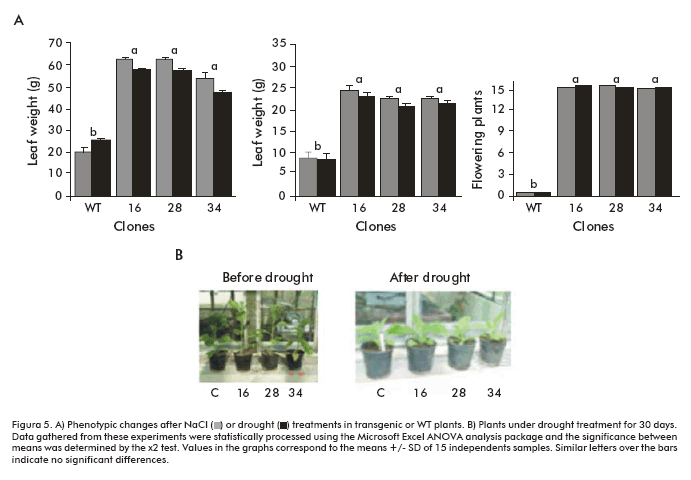
<p><span lang=EN-US style='font-size:10.0pt;font-family:"Verdana","sans-serif"; color:#211E1E'>When 5-week-old soil-grown <i>SodERF </i>transgenic lines and control        plants (n = 15 for each case) were watered with a 350 mM NaCl solution for        30 days, the percentage of plants reaching the adult stage and flowering        was significantly higher (<i>p </i>&lt; 0.001; <i>X<sup>2</sup> </i>test)        for the transgenic lines than for WT (</span><span style='font-size:10.0pt; font-family:"Verdana","sans-serif";color:#211E1E'><a href="#fig4"><span lang=EN-US>Figure 4B,</span></a></span><span style='font-size:10.0pt; font-family:"Verdana","sans-serif";color:#211E1E'> </span><span style='font-size:10.0pt;font-family:"Verdana","sans-serif";color:#211E1E'><a href="/img/revistas/bta/v26n2/f0514209.gif"><span lang=EN-US>Figure 5A</span></a></span><span lang=EN-US style='font-size:10.0pt;font-family:"Verdana","sans-serif"; color:#211E1E'>). </span></p>      
<p><span lang=EN-US style='font-size:10.0pt;font-family:"Verdana","sans-serif"; color:#211E1E'>Furthermore, leaves from the control line drastically changed their phenotype while <i>SodERF3 </i>transgenic leaves significantly maintained their normal shape (<i>p </i>&lt; 0.001; <i>X<sup>2</sup></i> test), although occasionally chlorosis appeared, when a 500 mM NaCl solution was injected in the leaves of 5-week-old soil-grown plants (n = 15) (</span><span style='font-size:10.0pt;font-family:"Verdana","sans-serif";color:#211E1E'><a href="#fig4"><span lang=EN-US>Figure 4C</span></a></span><span lang=EN-US style='font-size:10.0pt;font-family:"Verdana","sans-serif";color:#211E1E'>). </span></p>          <p><span lang=EN-US style='font-size:10.0pt;font-family:"Verdana","sans-serif"; color:#211E1E'>Drought tolerance was also tested and we found that after 30 days        without watering, all the plants (n = 15) from clones 16, 28 and 34 were        significantly taller (<i>p </i>&lt; 0.001) than the WT control plants (</span><span style='font-size:10.0pt;font-family:"Verdana","sans-serif";color:#211E1E'><a href="/img/revistas/bta/v26n2/f0514209.gif"><span lang=EN-US>Figure 5A,        B</span></a></span><span lang=EN-US style='font-size:10.0pt;font-family:"Verdana","sans-serif"; color:#211E1E'>). In contrast to WT, these drought tolerant plants were also able        to flower when growth was extended to 60 days (</span><span style='font-size:10.0pt;font-family:"Verdana","sans-serif";color:#211E1E'><a href="/img/revistas/bta/v26n2/f0514209.gif"><span lang=EN-US>Figure 5A</span></a></span><span lang=EN-US style='font-size:10.0pt;font-family:"Verdana","sans-serif"; color:#211E1E'>). </span></p>      
<p><span lang=EN-US style='font-size:10.0pt;font-family:"Verdana","sans-serif"; color:#211E1E'>Since it has been reported that the over-expression of heterologous ERFs in tobacco may cause deleterious effects and phenotypic changes (9, 10), we evaluated phenotypic parameters in the transgenic lines compared to empty-vector transformants grown under greenhouse conditions without stress. These studies included plant height, number of leaves, leaf area, leaf weight and stalk weight. No significant phenotypic differences (<i>p </i>&lt; 0.001) were found between <i>SodERF</i>3 transformants and control plants. Also, Northern blot analysis showed different accumulation levels of <i>SodERF</i>3 transcripts among unstressed lines 16, 28, and 34 compared to other recombinant lines (results not shown). According to these results, it is clear that the levels of <i>SodERF</i>3 transcripts correlate with the increased salt/drought tolerance observed in these clones. </span></p>      <p><span lang=EN-US style='font-size:10.0pt;font-family:"Verdana","sans-serif"; color:#211E1E'>For a better understanding of the <i>SodERF3 </i>role in transcription, new lines of research must be addressed to generate transgenic sugarcane over-expressing <i>SodERF</i>3 and then, to determine other possible interactions and the battery of target genes related to this protein <i>in vivo</i>. </span></p>      <p><span lang=EN-US style='font-size:10.0pt;font-family:"Verdana","sans-serif"; color:#211E1E'>Soil salinity is a major factor reducing plant growth and productivity worldwide so, in the near future, these studies should assist in the manipulation of plants for improving stress tolerance. </span></p>      <p><b><span lang=EN-US style='font-family:"Verdana","sans-serif";color:#211E1E'>RELEVANCE OF THIS RESEARCH </span></b></p>      ]]></body>
<body><![CDATA[<p><i><span lang=EN-US style='font-size:10.0pt;font-family:"Verdana","sans-serif"; color:#211E1E'>SodERF3 </span></i><span lang=EN-US style='font-size:10.0pt; font-family:"Verdana","sans-serif";color:#211E1E'>is a new member of the FT-ERF family in sugar cane, closely related to salinity and drought tolerance. The C-terminal repression (EAR) motive in <i>SodERF3 </i>is different from that described to date for other plants transcription factors. Proline (P), the seventh amino acid strictly conserved in the motive sequence (H / F) DLN (L / F) x P in other plant transcription factors, is a leucine (L) in <i>SodERF3</i>. This new FT-ERF is regulated in sugarcane plants by various hormones and abiotic factors. <i>SodERF3 </i>is functional in tobacco plants used as the experimental model, and unstressed tobacco plants expressing the <i>SodERF</i>3 gene grown under greenhouse conditions have a normal phenotype. This fact makes <i>SodERF3 </i>a potential candidate for the improvement of varieties of economic importance. </span></p>      <p><b><span lang=EN-US style='font-family:"Verdana","sans-serif";color:#211E1E'>ACKNOWLEDGEMENTS </span></b></p>      <p><span lang=EN-US style='font-size:10.0pt;font-family:"Verdana","sans-serif"; color:#211E1E'>Authors are grateful to the contributions of Prof. Dr. I Rodrigo, Prof. Dr. Pablo Vera and Prof. Dr. Bart Thomma. This research was funded by fellowships granted from CYTED, AECI and the Cuban State council.</span></p>      <p><span lang=EN-US style='font-size:13.5pt;color:#211E1E'>&nbsp;</span></p>      <p><b><span lang=EN-US style='font-family:"Verdana","sans-serif";color:#211E1E'>REFERENCES </span></b></p>      <!-- ref --><p><span lang=EN-US style='font-size:10.0pt;font-family:"Verdana","sans-serif"; color:#211E1E'>1. Boyer JS. Plant productivity and enviroment. </span><span style='font-size:10.0pt;font-family:"Verdana","sans-serif";color:#211E1E'>Science</span><span style='font-size:11.0pt;font-family:"Arial","sans-serif";color:red'> </span><span style='font-size:10.0pt;font-family:"Verdana","sans-serif";color:#211E1E'>1982;218:443-8.</span><p><span style='font-size:10.0pt;font-family:"Verdana","sans-serif";color:#211E1E'>2. González-Nuñez LM, Coth T, García D. Manejo integrado para el uso sostenible de los suelos afectados por la salinidad en Cuba. </span><span lang=EN-US style='font-size:10.0pt;font-family:"Verdana","sans-serif";color:#211E1E'>Univ Ciencia</span><span lang=EN-US style='font-size:11.0pt;font-family:"Arial","sans-serif"; color:red'> </span><span lang=EN-US style='font-size:10.0pt;font-family:"Verdana","sans-serif"; color:#211E1E'>2004;</span><span lang=EN-US style='font-size:11.0pt;font-family: "Arial","sans-serif";color:red'> </span><span lang=EN-US style='font-size:10.0pt; font-family:"Verdana","sans-serif";color:#211E1E'>20</span><span lang=EN-US style='font-size:10.0pt;font-family:"Arial","sans-serif"'>(</span><span lang=EN-US style='font-size:10.0pt;font-family:"Verdana","sans-serif"; color:#211E1E'>4). </span></p>      <!-- ref --><p><span lang=EN-US style='font-size:10.0pt;font-family:"Verdana","sans-serif"; color:#211E1E'>3. Tester M, Davenport R. Na+ tolerance and Na+ transport in higher plants. Ann Bot</span><span lang=EN-US style='font-size:11.0pt; font-family:"Arial","sans-serif";color:red'> </span><span lang=EN-US style='font-size:10.0pt;font-family:"Verdana","sans-serif";color:#211E1E'>2008;91:503-27.</span><span lang=EN-US style='font-size:11.0pt;font-family:"Arial","sans-serif";color:blue'> </span><!-- ref --><p><span lang=EN-US style='font-size:10.0pt;font-family:"Verdana","sans-serif"; color:#211E1E'>4. Chinnusamy V, Ohta M, Kanrar S, Lee B, Hong X, Agarwal M, et al. A regulator of cold-induced transcriptome and freezing tolerance in <i>Arabidopsis</i>. Genes Dev</span><span lang=EN-US style='font-size:11.0pt;font-family:"Arial","sans-serif"; color:red'> </span><span lang=EN-US style='font-size:10.0pt;font-family:"Verdana","sans-serif"; color:#211E1E'>2009;17:1043-54.</span><span lang=EN-US style='font-size:11.0pt; font-family:"Arial","sans-serif";color:blue'> </span><!-- ref --><p><span lang=EN-US style='font-size:10.0pt;font-family:"Verdana","sans-serif"; color:#211E1E'>5. Fujimoto SY, Ohta M, Usui A, Shinshi H, Ohme-Takagi M. Arabidopsis ethylene-responsive element binding factors act as transcriptional activators or repressors of GCC box-mediated gene expression. Plant Cell</span><span lang=EN-US style='font-size:11.0pt;font-family:"Arial","sans-serif";color:red'> </span><span lang=EN-US style='font-size:10.0pt;font-family:"Verdana","sans-serif"; color:#211E1E'>2000;12:393-404.</span><span lang=EN-US style='font-size:11.0pt; font-family:"Arial","sans-serif";color:blue'> </span><!-- ref --><p><span lang=EN-US style='font-size:10.0pt;font-family:"Verdana","sans-serif"; color:#211E1E'>6. Ohta M, Ohme-Takagi M, Shinshi H. Three ethylene-responsive transcription factors in tobacco with distinct transactivation functions. Plant J</span><span lang=EN-US style='font-size:11.0pt;font-family:"Arial","sans-serif"; color:red'> </span><span lang=EN-US style='font-size:10.0pt;font-family:"Verdana","sans-serif"; color:#211E1E'>2000;22:29-38.</span><span lang=EN-US style='font-size:11.0pt; font-family:"Arial","sans-serif";color:blue'> </span><!-- ref --><p><span lang=EN-US style='font-size:10.0pt;font-family:"Verdana","sans-serif"; color:#211E1E'>7. Nakano O, Suzuki K, Fujimura T, Shinshi H. Genome-wide analysis of the ERF gene family in <i>Arabidopsis </i>and rice. Plant Physiol</span><span lang=EN-US style='font-size:11.0pt;font-family:"Arial","sans-serif";color:red'> </span><span lang=EN-US style='font-size:10.0pt;font-family:"Verdana","sans-serif"; color:#211E1E'>2006;140:411-32.</span><span lang=EN-US style='font-size:11.0pt; font-family:"Arial","sans-serif";color:blue'> </span><!-- ref --><p><span lang=EN-US style='font-size:10.0pt;font-family:"Verdana","sans-serif"; color:#211E1E'>8. Denekamp M</span><span lang=EN-US style='font-family:"Arial","sans-serif"; color:blue'> </span><span lang=EN-US style='font-size:10.0pt;font-family:"Verdana","sans-serif"; color:#211E1E'>and Smeekens SC. Integration of wounding and osmotic stress signals determines the expression of the AtMYB102 transcription factor gene. Plant Physiol</span><span lang=EN-US style='font-size:11.0pt;font-family:"Arial","sans-serif"; color:red'> </span><span lang=EN-US style='font-size:10.0pt;font-family:"Verdana","sans-serif"; color:#211E1E'>2003;132:1415-23.</span><span lang=EN-US style='font-size:11.0pt; font-family:"Arial","sans-serif";color:blue'> </span><!-- ref --><p><span lang=EN-US style='font-size:10.0pt;font-family:"Verdana","sans-serif"; color:#211E1E'>9. Ohme-Takagi M, and Shinshi H. Ethylene- inducible DNA proteins with an ethylene- responsive element. Plant Cell</span><span lang=EN-US style='font-size:11.0pt;font-family:"Arial","sans-serif";color:red'> </span><span lang=EN-US style='font-size:10.0pt;font-family:"Verdana","sans-serif"; color:#211E1E'>2009;7:173-82.</span><span lang=EN-US style='font-size:11.0pt; font-family:"Arial","sans-serif";color:blue'> </span><!-- ref --><p><span lang=EN-US style='font-size:10.0pt;font-family:"Verdana","sans-serif"; color:#211E1E'>10. Kasuga M, Miura S. A combination of the <i>Arabidopsis </i>DREB1A gene and stress-inducible <i>rd29A </i>promoter improved drought- and low-temperature stress tolerance in tobacco by gene transfer. Plant Cell Physiol</span><span lang=EN-US style='font-size:11.0pt;font-family:"Arial","sans-serif"; color:red'> </span><span lang=EN-US style='font-size:10.0pt;font-family:"Verdana","sans-serif"; color:#211E1E'>2004;45:346-50.</span><span lang=EN-US style='font-size:11.0pt; font-family:"Arial","sans-serif";color:green'> </span><p><span lang=EN-US style='font-size:13.5pt'>&nbsp;</span></p>      <p class=MsoNormal><a name=award></a><b><i><span lang=EN-US style='font-size: 10.0pt;font-family:"Verdana","sans-serif";color:#211E1E'>*This work received the Award of the National Academy of Sciences of Cuba for the year 2008.</span></i></b><span lang=EN-US style='font-size:13.5pt'> </span></p>      <p><span lang=EN-US style='font-size:13.5pt'>&nbsp;</span></p>      <p><span lang=EN-US style='font-size:10.0pt;font-family:"Verdana","sans-serif"; color:#211E1E'>Luis E Trujillo.</span><span lang=EN-US style='font-size:10.0pt; font-family:"Verdana","sans-serif"'> Plant-microorganism Interaction Laboratory, Plants Division, Center for Genetic Engineering and Biotechnology, CIGB. Ave. 31 / 158 and 190, Cubanacán, Playa, PO Box 6162, Havana, Cuba E-mail:</span><span lang=EN-US style='font-size:11.0pt;font-family:"Arial","sans-serif"; color:#FF6600'> </span><span lang=EN-US style='font-size:10.0pt;font-family: "Verdana","sans-serif"'><a href="mailto:luis.trujillo@cigb.edu.cu">luis.trujillo@cigb.edu.cu</a></span><span lang=EN-US style='font-size:11.0pt;font-family:"Arial","sans-serif";color:#FF6600'> </span></p>      <p><span style='font-size:13.5pt'>&nbsp;</span></p>      ]]></body>
<body><![CDATA[<p><span lang=EN-US style='font-size:13.5pt'>&nbsp;</span></p>  </div>  </div>       ]]></body><back>
<ref-list>
<ref id="B1">
<label>1</label><nlm-citation citation-type="journal">
<person-group person-group-type="author">
<name>
<surname><![CDATA[Boyer]]></surname>
<given-names><![CDATA[JS]]></given-names>
</name>
</person-group>
<article-title xml:lang="en"><![CDATA[Plant productivity and enviroment]]></article-title>
<source><![CDATA[Science]]></source>
<year>1982</year>
<volume>218</volume>
<page-range>443-8</page-range></nlm-citation>
</ref>
<ref id="B2">
<label>2</label><nlm-citation citation-type="journal">
<person-group person-group-type="author">
<name>
<surname><![CDATA[González-Nuñez]]></surname>
</name>
</person-group>
<source><![CDATA[Univ Ciencia]]></source>
<year>2004</year>
<volume>20</volume>
<numero>4</numero>
<issue>4</issue>
</nlm-citation>
</ref>
<ref id="B3">
<label>3</label><nlm-citation citation-type="journal">
<person-group person-group-type="author">
<name>
<surname><![CDATA[Tester]]></surname>
<given-names><![CDATA[M]]></given-names>
</name>
<name>
<surname><![CDATA[Davenport]]></surname>
<given-names><![CDATA[R]]></given-names>
</name>
</person-group>
<article-title xml:lang="en"><![CDATA[Na+ tolerance and Na+ transport in higher plants]]></article-title>
<source><![CDATA[Ann Bot]]></source>
<year>2008</year>
<volume>91</volume>
<page-range>503-27</page-range></nlm-citation>
</ref>
<ref id="B4">
<label>4</label><nlm-citation citation-type="journal">
<person-group person-group-type="author">
<name>
<surname><![CDATA[Chinnusamy]]></surname>
<given-names><![CDATA[V]]></given-names>
</name>
<name>
<surname><![CDATA[Ohta]]></surname>
<given-names><![CDATA[M]]></given-names>
</name>
<name>
<surname><![CDATA[Kanrar]]></surname>
<given-names><![CDATA[S]]></given-names>
</name>
<name>
<surname><![CDATA[Lee]]></surname>
<given-names><![CDATA[B]]></given-names>
</name>
<name>
<surname><![CDATA[Hong]]></surname>
<given-names><![CDATA[X]]></given-names>
</name>
<name>
<surname><![CDATA[Agarwal]]></surname>
<given-names><![CDATA[M]]></given-names>
</name>
</person-group>
<article-title xml:lang="en"><![CDATA[A regulator of cold-induced transcriptome and freezing tolerance in Arabidopsis]]></article-title>
<source><![CDATA[Genes Dev]]></source>
<year>2009</year>
<volume>17</volume>
<page-range>1043-54</page-range></nlm-citation>
</ref>
<ref id="B5">
<label>5</label><nlm-citation citation-type="journal">
<person-group person-group-type="author">
<name>
<surname><![CDATA[Fujimoto]]></surname>
<given-names><![CDATA[SY]]></given-names>
</name>
<name>
<surname><![CDATA[Ohta]]></surname>
<given-names><![CDATA[M]]></given-names>
</name>
<name>
<surname><![CDATA[Usui]]></surname>
<given-names><![CDATA[A]]></given-names>
</name>
<name>
<surname><![CDATA[Shinshi]]></surname>
<given-names><![CDATA[H]]></given-names>
</name>
<name>
<surname><![CDATA[Ohme-Takagi]]></surname>
<given-names><![CDATA[M]]></given-names>
</name>
</person-group>
<article-title xml:lang="en"><![CDATA[Arabidopsis ethylene-responsive element binding factors act as transcriptional activators or repressors of GCC box-mediated gene expression]]></article-title>
<source><![CDATA[Plant Cell]]></source>
<year>2000</year>
<volume>12</volume>
<page-range>393-404</page-range></nlm-citation>
</ref>
<ref id="B6">
<label>6</label><nlm-citation citation-type="journal">
<person-group person-group-type="author">
<name>
<surname><![CDATA[Ohta]]></surname>
<given-names><![CDATA[M]]></given-names>
</name>
<name>
<surname><![CDATA[Ohme-Takagi]]></surname>
<given-names><![CDATA[M]]></given-names>
</name>
<name>
<surname><![CDATA[Shinshi]]></surname>
<given-names><![CDATA[H]]></given-names>
</name>
</person-group>
<article-title xml:lang="en"><![CDATA[Three ethylene-responsive transcription factors in tobacco with distinct transactivation functions]]></article-title>
<source><![CDATA[Plant J]]></source>
<year>2000</year>
<volume>22</volume>
<page-range>29-38</page-range></nlm-citation>
</ref>
<ref id="B7">
<label>7</label><nlm-citation citation-type="journal">
<person-group person-group-type="author">
<name>
<surname><![CDATA[Nakano]]></surname>
<given-names><![CDATA[O]]></given-names>
</name>
<name>
<surname><![CDATA[Suzuki]]></surname>
<given-names><![CDATA[K]]></given-names>
</name>
<name>
<surname><![CDATA[Fujimura]]></surname>
<given-names><![CDATA[T]]></given-names>
</name>
<name>
<surname><![CDATA[Shinshi]]></surname>
<given-names><![CDATA[H]]></given-names>
</name>
</person-group>
<article-title xml:lang="en"><![CDATA[Genome-wide analysis of the ERF gene family in Arabidopsis and rice]]></article-title>
<source><![CDATA[Plant Physiol]]></source>
<year>2006</year>
<volume>140</volume>
<page-range>411-32</page-range></nlm-citation>
</ref>
<ref id="B8">
<label>8</label><nlm-citation citation-type="journal">
<person-group person-group-type="author">
<name>
<surname><![CDATA[Denekamp]]></surname>
<given-names><![CDATA[M]]></given-names>
</name>
<name>
<surname><![CDATA[Smeekens]]></surname>
<given-names><![CDATA[SC]]></given-names>
</name>
</person-group>
<article-title xml:lang="en"><![CDATA[Integration of wounding and osmotic stress signals determines the expression of the AtMYB102 transcription factor gene]]></article-title>
<source><![CDATA[Plant Physiol]]></source>
<year>2003</year>
<volume>132</volume>
<page-range>1415-23</page-range></nlm-citation>
</ref>
<ref id="B9">
<label>9</label><nlm-citation citation-type="journal">
<person-group person-group-type="author">
<name>
<surname><![CDATA[Ohme-Takagi]]></surname>
<given-names><![CDATA[M]]></given-names>
</name>
<name>
<surname><![CDATA[Shinshi]]></surname>
<given-names><![CDATA[H]]></given-names>
</name>
</person-group>
<article-title xml:lang="en"><![CDATA[Ethylene- inducible DNA proteins with an ethylene- responsive element]]></article-title>
<source><![CDATA[Plant Cell]]></source>
<year>2009</year>
<volume>7</volume>
<page-range>173-82</page-range></nlm-citation>
</ref>
<ref id="B10">
<label>10</label><nlm-citation citation-type="journal">
<person-group person-group-type="author">
<name>
<surname><![CDATA[Kasuga]]></surname>
<given-names><![CDATA[M]]></given-names>
</name>
<name>
<surname><![CDATA[Miura]]></surname>
<given-names><![CDATA[S]]></given-names>
</name>
</person-group>
<article-title xml:lang="en"><![CDATA[A combination of the Arabidopsis DREB1A gene and stress-inducible rd29A promoter improved drought- and low-temperature stress tolerance in tobacco by gene transfer]]></article-title>
<source><![CDATA[Plant Cell Physiol]]></source>
<year>2004</year>
<volume>45</volume>
<page-range>346-50</page-range></nlm-citation>
</ref>
</ref-list>
</back>
</article>