<?xml version="1.0" encoding="ISO-8859-1"?><article xmlns:mml="http://www.w3.org/1998/Math/MathML" xmlns:xlink="http://www.w3.org/1999/xlink" xmlns:xsi="http://www.w3.org/2001/XMLSchema-instance">
<front>
<journal-meta>
<journal-id>1027-2852</journal-id>
<journal-title><![CDATA[Biotecnología Aplicada]]></journal-title>
<abbrev-journal-title><![CDATA[Biotecnol Apl]]></abbrev-journal-title>
<issn>1027-2852</issn>
<publisher>
<publisher-name><![CDATA[Editorial Elfos Scientiae]]></publisher-name>
</publisher>
</journal-meta>
<article-meta>
<article-id>S1027-28522009000300009</article-id>
<title-group>
<article-title xml:lang="en"><![CDATA[GM3 ganglioside: a novel target for the therapy against melanoma]]></article-title>
</title-group>
<contrib-group>
<contrib contrib-type="author">
<name>
<surname><![CDATA[Mazorra]]></surname>
<given-names><![CDATA[Zaima]]></given-names>
</name>
<xref ref-type="aff" rid="A01"/>
</contrib>
<contrib contrib-type="author">
<name>
<surname><![CDATA[Mesa]]></surname>
<given-names><![CDATA[Cirse]]></given-names>
</name>
<xref ref-type="aff" rid="A02"/>
</contrib>
<contrib contrib-type="author">
<name>
<surname><![CDATA[Fernández]]></surname>
<given-names><![CDATA[Luis E]]></given-names>
</name>
<xref ref-type="aff" rid="A02"/>
</contrib>
</contrib-group>
<aff id="A01">
<institution><![CDATA[,Center of Molecular Immunology Department of Vaccines ]]></institution>
<addr-line><![CDATA[Havana ]]></addr-line>
<country>Cuba</country>
</aff>
<aff id="A01">
<institution><![CDATA[,Center of Molecular Immunology Department of Clinical Immunology Departamento Hepatitis B]]></institution>
<addr-line><![CDATA[Havana ]]></addr-line>
<country>Cuba</country>
</aff>
<pub-date pub-type="pub">
<day>00</day>
<month>09</month>
<year>2009</year>
</pub-date>
<pub-date pub-type="epub">
<day>00</day>
<month>09</month>
<year>2009</year>
</pub-date>
<volume>26</volume>
<numero>3</numero>
<fpage>256</fpage>
<lpage>259</lpage>
<copyright-statement/>
<copyright-year/>
<self-uri xlink:href="http://scielo.sld.cu/scielo.php?script=sci_arttext&amp;pid=S1027-28522009000300009&amp;lng=en&amp;nrm=iso"></self-uri><self-uri xlink:href="http://scielo.sld.cu/scielo.php?script=sci_abstract&amp;pid=S1027-28522009000300009&amp;lng=en&amp;nrm=iso"></self-uri><self-uri xlink:href="http://scielo.sld.cu/scielo.php?script=sci_pdf&amp;pid=S1027-28522009000300009&amp;lng=en&amp;nrm=iso"></self-uri><abstract abstract-type="short" xml:lang="en"><p><![CDATA[Malignant melanoma is a tumor with a steeply increasing incidence and scarce therapeutic options once metastatic. Currently, no vaccine is widely commercially available for melanoma treatment or prevention. The overexpression of GM3 ganglioside in murine and human melanomas and its important role in tumor progression makes this self antigen a potential target for preventive immunotherapy of this neoplasm. Previously, we have shown that preventive vaccination with GM3/VSSP induced a specific antitumor response; and elicited the rejection of syngeneic GM3- positive melanoma cells in immunized mice. In the present paper, we published the induction of a potent antitumor effect of this vaccine administered in a minimal residual disease B16 melanoma model. These findings propose the GM3/VSSP vaccine as a therapy designed to elicit and/or boost antitumor immunity in patients with minimal residual disease after surgery; thereby preventing or prolonging the time to recurrence. This is an important issue of the clinical setting because patients with stage II melanoma were reported to have 60% chance of survival 5 years after surgery. In addition, we examined the mechanisms by which this immunogen confers tumor protection. Surprisingly, in spite of the glycolipidic nature of this antigen, we have found that induction of anti-GM3 IgG antibodies and tumor- specific IFN &#947; secreting CD8+ T cells correlated with tumor protection. As a result, these findings demonstrate, for the first time, the direct involvement of the cellular immune response in the anti-tumor protection induced by a ganglioside-based vaccine.]]></p></abstract>
</article-meta>
</front><body><![CDATA[ <div class=Section1>      <div>      <p align=right style='text-align:right'><b><span lang=EN-US style='font-size: 10.0pt;font-family:"Verdana","sans-serif"'>REPORT </span></b></p>      <p align=right style='text-align:right'><span lang=EN-US>&nbsp;</span></p>      <p><b><span lang=EN-US style='font-size:13.5pt;font-family:"Verdana","sans-serif"; color:#211E1E'>GM3 ganglioside: a novel target for the therapy against melanoma </span></b><b><span style='font-size:13.5pt;font-family:"Verdana","sans-serif"; color:#211E1E'><a href="#award"><span lang=EN-US>*</span></a></span></b></p>      <p><b><span lang=EN-US style='font-size:13.5pt;color:#211E1E'>&nbsp;</span></b></p>      <p><b><span style='font-size:10.0pt;font-family:"Verdana","sans-serif"; color:#211E1E'>Zaima Mazorra<sup>1</sup>, Cirse Mesa<sup>2</sup>, Luis E Fernández<sup>2</sup></span></b></p>      <p><sup><span lang=EN-US style='font-size:10.0pt;font-family:"Verdana","sans-serif"; color:#211E1E'>1</span></sup><span lang=EN-US style='font-size:10.0pt; font-family:"Verdana","sans-serif";color:#211E1E'>Department of Clinical Immunology    <br> <sup>2</sup>Department of Vaccines    <br> Center of Molecular Immunology, CIM Ave. 216, corner 15, Atabey, Playa, PO Box 16 040, Havana, Cuba</span><span lang=EN-US style='font-size:11.0pt;font-family: "Arial","sans-serif";color:#FF6600'> </span></p>      ]]></body>
<body><![CDATA[<p><span lang=EN-US style='font-size:13.5pt;color:#211E1E'>&nbsp;</span></p>      <p><span lang=EN-US style='font-size:13.5pt;color:#211E1E'>&nbsp;</span></p>      <div class=MsoNormal align=center style='text-align:center'>  <hr size=2 width="100%" align=center>  </div>      <p><b><span lang=EN-US style='font-size:10.0pt;font-family:"Verdana","sans-serif"; color:#211E1E'>ABSTRACT </span></b></p>      <p class=MsoNormal><span lang=EN-US style='font-size:10.0pt;font-family:"Verdana","sans-serif"; color:#211E1E'>Malignant melanoma is a tumor with a steeply increasing incidence and scarce therapeutic options once metastatic. Currently, no vaccine is widely commercially available for melanoma treatment or prevention. The overexpression of GM3 ganglioside in murine and human melanomas and its important role in tumor progression makes this self antigen a potential target for preventive immunotherapy of this neoplasm. Previously, we have shown that preventive vaccination with GM3/VSSP induced a specific antitumor response; and elicited the rejection of syngeneic GM3- positive melanoma cells in immunized mice. In the present paper, we published the induction of a potent antitumor effect of this vaccine administered in a minimal residual disease B16 melanoma model. These findings propose the GM3/VSSP vaccine as a therapy designed to elicit and/or boost antitumor immunity in patients with minimal residual disease after surgery; thereby preventing or prolonging the time to recurrence. This is an important issue of the clinical setting because patients with stage II melanoma were reported to have 60% chance of survival 5 years after surgery. In addition, we examined the mechanisms by which this immunogen confers tumor protection. Surprisingly, in spite of the glycolipidic nature of this antigen, we have found that induction of anti-GM3 IgG antibodies and tumor- specific IFN </span><span style='font-size:10.0pt;font-family:"Verdana","sans-serif"; color:#211E1E'>&#947;</span><span lang=EN-US style='font-size:10.0pt; font-family:"Verdana","sans-serif";color:#211E1E'> secreting CD8+ T cells correlated with tumor protection. As a result, these findings demonstrate, for the first time, the direct involvement of the cellular immune response in the anti-tumor protection induced by a ganglioside-based vaccine.</span><span lang=EN-US style='font-size:11.0pt;font-family:"Arial","sans-serif";color:red'> </span></p>      <div class=MsoNormal align=center style='text-align:center'>  <hr size=2 width="100%" align=center>  </div>      <p><span lang=EN-US style='font-size:13.5pt;color:#211E1E'>&nbsp;</span></p>      <p><span lang=EN-US style='font-size:13.5pt;color:#211E1E'>&nbsp;</span></p>      <p><b><span lang=EN-US style='font-family:"Verdana","sans-serif";color:#211E1E'>INTRODUCTION</span></b></p>      <p><span lang=EN-US style='font-size:10.0pt;font-family:"Verdana","sans-serif"; color:#211E1E'>The incidence of malignant melanoma is rising faster than any other malignancy. A large number of patients once develop metastatic disease, lack of an effective therapeutic option </span><span lang=EN-US style='font-size:10.0pt;font-family:"Verdana","sans-serif";color:windowtext'>(</span><span lang=EN-US style='font-size:10.0pt;font-family:"Verdana","sans-serif"; color:#211E1E'>1). In the therapeutic cancer vaccines field, the largest accumulated clinical experience, so far, has been in advanced stage melanoma, though with rather modest outcomes in most of the clinical studies </span><span lang=EN-US style='font-size:10.0pt;font-family:"Verdana","sans-serif"; color:windowtext'>(</span><span lang=EN-US style='font-size:10.0pt;font-family: "Verdana","sans-serif";color:#211E1E'>2). One of the reasons for this poor effectiveness is that the antitumor vaccination trials have included patients in late stages of the disease in which the development of tumor-induced immunosuppression significantly interferes with immunization. It is likely that active immunotherapy could operate more efficiently early during tumor progression or could prevent the disease in patients at a high risk of having malignant lesions. For these reasons, the therapeutic success of a GM3-based vaccine in patients with earlystage melanoma remains an interesting and open question, but more preclinical evidence in a relevant animal model is needed. </span></p>      ]]></body>
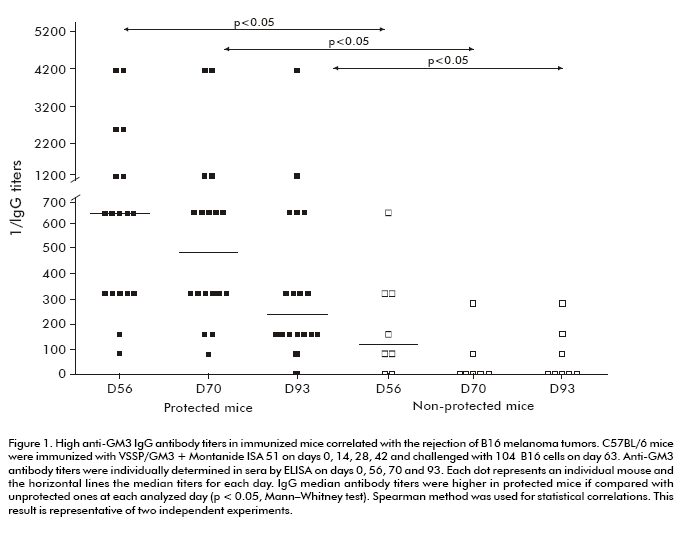
<body><![CDATA[<p><span lang=EN-US style='font-size:10.0pt;font-family:"Verdana","sans-serif"; color:#211E1E'>Gangliosides are a family of sialic acid-containing glycosphingolipids frequently over expressed in the external membrane of cancer cells, not only of neuroectodermal origin. Ganglioside vaccines have been clinically tested in different types of advanced cancers, mainly melanomas </span><span lang=EN-US style='font-size:10.0pt;font-family:"Verdana","sans-serif"; color:windowtext'>(</span><span lang=EN-US style='font-size:10.0pt;font-family: "Verdana","sans-serif";color:#211E1E'>3), based on the observation that altered expression of these glycolipids in melanoma cells correlated with their metastatic potential. Additionally, GM3 and GD3, the major gangliosides in melanomas, are shed into the tumor microenvironment which can promote severe immune dysfunctions </span><span lang=EN-US style='font-size:10.0pt;font-family: "Verdana","sans-serif";color:windowtext'>(</span><span lang=EN-US style='font-size:10.0pt;font-family:"Verdana","sans-serif";color:#211E1E'>4, 5). It has been claimed that the induction of anti-GM3 antibodies circumvents this specific immunosuppression </span><span lang=EN-US style='font-size:10.0pt; font-family:"Verdana","sans-serif";color:windowtext'>(</span><span lang=EN-US style='font-size:10.0pt;font-family:"Verdana","sans-serif";color:#211E1E'>5, 6). The role of antibodies in the anti-tumor effect of ganglioside vaccines has been considered to be predominant, if not exclusive </span><span lang=EN-US style='font-size:10.0pt;font-family:"Verdana","sans-serif";color:windowtext'>(</span><span lang=EN-US style='font-size:10.0pt;font-family:"Verdana","sans-serif"; color:#211E1E'>7). </span></p>      <p><span lang=EN-US style='font-size:10.0pt;font-family:"Verdana","sans-serif"; color:#211E1E'>However, the involvement of T cells in the antitumor protection induced by ganglioside-based vaccines has not been described yet. This is an important issue, since if a robust cellular immune response could be elicited, then immunological memory could be long lasting, eradicating tumor before it becomes clinically obvious. </span></p>      <p><span lang=EN-US style='font-size:10.0pt;font-family:"Verdana","sans-serif"; color:#211E1E'>In the present work, we described the induction of a potent anti-tumor effect of the GM3/VSSP vaccine in combination with surgical excision of the primary tumor burden. In addition, we examined the mechanisms by which this immunogen confers tumor protection. </span></p>      <p><b><span lang=EN-US style='font-family:"Verdana","sans-serif";color:#211E1E'>RESULTS AND DISCUSSION</span></b><b><span lang=EN-US style='font-size:10.0pt; font-family:"Verdana","sans-serif";color:#211E1E'> </span></b></p>      <p><span lang=EN-US style='font-size:10.0pt;font-family:"Verdana","sans-serif"; color:#211E1E'>In order to find new effective therapies against melanoma, a novel vaccine was tested in the B16 mouse melanoma model. This vaccine is composed of very small sized proteoliposomes </span><span lang=EN-US style='font-size:10.0pt;font-family:"Verdana","sans-serif";color:windowtext'>(</span><span lang=EN-US style='font-size:10.0pt;font-family:"Verdana","sans-serif"; color:#211E1E'>VSSP) resulting from the hydrophobic incorporation with GM3/VSSP ganglioside into <i>Neisseria meningitidis </i>natural outer membrane vesicles </span><span lang=EN-US style='font-size:10.0pt;font-family:"Verdana","sans-serif"; color:windowtext'>(</span><span lang=EN-US style='font-size:10.0pt;font-family: "Verdana","sans-serif";color:#211E1E'>8). We have previously shown experimental data indicating that preventive immunization of mice with the GM3/VSSP vaccine elicited the rejection of B16 melanoma tumors </span><span lang=EN-US style='font-size:10.0pt;font-family:"Verdana","sans-serif";color:windowtext'>(</span><span lang=EN-US style='font-size:10.0pt;font-family:"Verdana","sans-serif"; color:#211E1E'>6). However, the capacity of this vaccine to generate long lasting protection has not been studied. The duration of antitumor protection after pre-immunization with four biweekly i.m. doses of 120 </span><span style='font-size:10.0pt;font-family:"Verdana","sans-serif";color:#211E1E'>&#956;</span><span lang=EN-US style='font-size:10.0pt;font-family:"Verdana","sans-serif"; color:#211E1E'>g GM3/VSSP by injecting a low tumor burden of 2.5 x 10<sup>3</sup> B16F0 cells subcutaneously </span><span lang=EN-US style='font-size:10.0pt; font-family:"Verdana","sans-serif";color:windowtext'>(</span><span lang=EN-US style='font-size:10.0pt;font-family:"Verdana","sans-serif";color:#211E1E'>S.C.) was investigated. In different sets of experiments, at least 80% of control animals developed s.c. tumors and died 46.5 ± 5.7 days </span><span lang=EN-US style='font-size:10.0pt;font-family:"Verdana","sans-serif";color:windowtext'>(</span><span lang=EN-US style='font-size:10.0pt;font-family:"Verdana","sans-serif"; color:#211E1E'>mean ± SE) after challenge. Complete antitumor protection was obtained from 21 to 35 days after the administration of the last dose of the vaccine. A significant antitumor protection was still maintained 91 days after tumor inoculation. </span></p>          <p><span lang=EN-US style='font-size:10.0pt;font-family:"Verdana","sans-serif"; color:#211E1E'>The precise mechanisms by which this vaccine confers tumor protection        were unknown. Here we reported the cellular and humoral requirements for        the antitumor activity of VSSP/GM3 vaccine in the prophylactic B16 melanoma        model. The role in melanoma protection of the anti-ganglioside antibody        response, detected in vaccinated mice, was addressed by injecting C57BL/6        mice with four doses of VSSP/GM3 + Montanide ISA 51. Mice were challenged        with 104 B16 melanoma cells on day 63. Sera were collected four times until        day 93 and the anti-GM3 IgG and IgM titers were measured by ELISA. Before        immunization, antibodies against GM3 were absent from animal sera. Curiously,        in protected mice, median anti-ganglioside IgG titers were 1:640, 1:480        and 1:240 in days 56, 70 and 93, respectively, while in unprotected mice        these values were 1:120, 0 and 0 at the same time points </span><span lang=EN-US style='font-size:10.0pt; font-family:"Verdana","sans-serif";color:windowtext'>(</span><i><span lang=EN-US style='font-size:10.0pt;font-family:"Verdana","sans-serif"; color:#211E1E'>p </span></i><span lang=EN-US style='font-size:10.0pt; font-family:"Verdana","sans-serif";color:#211E1E'>&lt; 0.05, Mann Whitney test)        </span><span lang=EN-US style='font-size:10.0pt;font-family:"Verdana","sans-serif"; color:windowtext'>(</span><span style='font-size:10.0pt;font-family:"Verdana","sans-serif"; color:#211E1E'><a href="/img/revistas/bta/v26n3/f0114309.gif"><span lang=EN-US>Figure        1</span></a></span><span lang=EN-US style='font-size:10.0pt;font-family:"Verdana","sans-serif"; color:#211E1E'>). Interestingly, in protected mice, specific IgG serum antibodies        persisted, in almost all animals, at least 50 days after the last vaccination        while median IgM titers remained similar irrespective of the vaccine outcome.        Noteworthy, a significant direct correlation between the magnitude of the        vaccine induced anti-GM3 IgG antibody response and the tumor rejection capacity        was observed in each post-immunization time point </span><span lang=EN-US style='font-size:10.0pt;font-family:"Verdana","sans-serif";color:windowtext'>(</span><i><span lang=EN-US style='font-size:10.0pt;font-family:"Verdana","sans-serif"; color:#211E1E'>p </span></i><span lang=EN-US style='font-size:10.0pt; font-family:"Verdana","sans-serif";color:#211E1E'>&lt; 0.05, Spearman correlation).        </span></p>         
<p><span lang=EN-US style='font-size:10.0pt;font-family:"Verdana","sans-serif"; color:#211E1E'>In line with these findings, our clinical results suggest a positive        correlation between antiganglioside IgG antibodies titers and prolonged        survival of advanced breast cancer patients immunized with a gangliosidebased        vaccine </span><span lang=EN-US style='font-size:10.0pt; font-family:"Verdana","sans-serif";color:windowtext'>(</span><span lang=EN-US style='font-size:10.0pt;font-family:"Verdana","sans-serif";color:#211E1E'>manuscript        in preparation). In contrast, previous studies have shown an association        between vaccine-induced anti-GM3 IgM antibodies and tumor protection when        C57BL/6 mice were immunized with a melanoma cell-based vaccine </span><span lang=EN-US style='font-size:10.0pt;font-family:"Verdana","sans-serif"; color:windowtext'>(</span><span lang=EN-US style='font-size:10.0pt;font-family: "Verdana","sans-serif";color:#211E1E'>9). These results have been also found in        clinical studies, in which a positive correlation between elevated antiganglioside        IgM antibody titers and improved survival for melanoma and soft tissue sarcoma        patients has been reported. It has been speculated that anti-ganglioside        IgM antibodies are effective against tumors because the capacity of these        immunoglobulins to neutralize and clear immunosuppressive gangliosides,        eliminating tumor cells by complement mediated cytotoxicity </span><span lang=EN-US style='font-size:10.0pt;font-family:"Verdana","sans-serif"; color:windowtext'>(</span><span lang=EN-US style='font-size:10.0pt;font-family: "Verdana","sans-serif";color:#211E1E'>CMC) </span><span lang=EN-US style='font-size:10.0pt;font-family:"Verdana","sans-serif";color:windowtext'>(</span><span lang=EN-US style='font-size:10.0pt;font-family:"Verdana","sans-serif"; color:#211E1E'>10). Regarding the functional properties of the anti-GM3 IgG antibodies        induced by the VSSP/GM3 vaccine, we previously reported their capacity to        evoke CMC against B16F10 cells in BALB/c mice using heterologous complement        </span><span lang=EN-US style='font-size:10.0pt;font-family:"Verdana","sans-serif"; color:windowtext'>(</span><span lang=EN-US style='font-size:10.0pt;font-family: "Verdana","sans-serif";color:#211E1E'>6). In the present work, we found that anti-GM3        antibodies that persisted after tumor challenge in surviving-vaccinated        mice were able to induce CMC. In this case, autologous complement was used.        However, this result should be confirmed in further experiments with larger        amount of mice, the CMC activity by IgG antibodies may play an important        role in melanoma eradication. </span></p>          <p><span lang=EN-US style='font-size:10.0pt;font-family:"Verdana","sans-serif"; color:#211E1E'>Despite the crucial role of cellular immune response in tumor protection,        the involvement of T cells in anti-tumor immunity of ganglioside vaccines        was not described before. This is an important issue, since if a robust        cellular immune response could be elicited, the immunological memory could        be long lasting, eradicating tumor before it becomes clinically obvious.        In our <i>in vivo </i>depletion experiments, we found that CD8+ T cells        were essential for tumor protection </span><span lang=EN-US style='font-size:10.0pt; font-family:"Verdana","sans-serif";color:windowtext'>(</span><span style='font-size:10.0pt;font-family:"Verdana","sans-serif";color:#211E1E'><a href="/img/revistas/bta/v26n3/f0214309.gif"><span lang=EN-US>Figure        2A</span></a></span><span lang=EN-US style='font-size:10.0pt;font-family:"Verdana","sans-serif";color:#211E1E'>). Immunized        mice lacking effectors CD8+ T cells were unprotected from tumor challenge        if compared with their competent littermates </span><span lang=EN-US style='font-size:10.0pt;font-family:"Verdana","sans-serif";color:windowtext'>(</span><i><span lang=EN-US style='font-size:10.0pt;font-family:"Verdana","sans-serif"; color:#211E1E'>p </span></i><span lang=EN-US style='font-size:10.0pt; font-family:"Verdana","sans-serif";color:#211E1E'>&gt; 0.05, Log-rank test). Moreover,        T cells from surviving-immunized mice were able to secrete significant amounts        of IFN</span><span style='font-size:10.0pt;font-family: "Verdana","sans-serif";color:#211E1E'>&#947;</span><span lang=EN-US style='font-size:10.0pt;font-family:"Verdana","sans-serif";color:#211E1E'> only        if they were co-cultured with MHC class I high B16 melanoma cells </span><span lang=EN-US style='font-size:10.0pt;font-family:"Verdana","sans-serif"; color:windowtext'>(</span><i><span lang=EN-US style='font-size:10.0pt; font-family:"Verdana","sans-serif";color:#211E1E'>p </span></i><span lang=EN-US style='font-size:10.0pt;font-family:"Verdana","sans-serif"; color:#211E1E'>&lt; 0.05, Mann Whitney test). When the stimulus came from 3LL-D122        cells </span><span lang=EN-US style='font-size:10.0pt;font-family: "Verdana","sans-serif";color:windowtext'>(</span><span lang=EN-US style='font-size:10.0pt;font-family:"Verdana","sans-serif";color:#211E1E'>also        pre-treated with IFN</span><span style='font-size:10.0pt;font-family:"Verdana","sans-serif"; color:#211E1E'>&#945;</span><span lang=EN-US style='font-size:10.0pt; font-family:"Verdana","sans-serif";color:#211E1E'>) IFN</span><span style='font-size:10.0pt;font-family:"Verdana","sans-serif";color:#211E1E'>&#947;</span><span lang=EN-US style='font-size:10.0pt;font-family:"Verdana","sans-serif"; color:#211E1E'> was almost absent from the supernatants </span><span lang=EN-US style='font-size:10.0pt;font-family:"Verdana","sans-serif"; color:windowtext'>(</span><span style='font-size:10.0pt;font-family:"Verdana","sans-serif"; color:#211E1E'><a href="/img/revistas/bta/v26n3/f0214309.gif"><span lang=EN-US>Figure        2B</span></a></span><span lang=EN-US style='font-size:10.0pt;font-family:"Verdana","sans-serif"; color:#211E1E'>). T cells did not release IFN</span><span style='font-size: 10.0pt;font-family:"Verdana","sans-serif";color:#211E1E'>&#947;</span><span style='font-size:10.0pt;font-family:"Verdana","sans-serif";color:#211E1E'> <span lang=EN-US>in the presence of MHC I low counterparts cell lines </span></span><span lang=EN-US style='font-size:10.0pt;font-family:"Verdana","sans-serif"; color:windowtext'>(</span><span lang=EN-US style='font-size:10.0pt;font-family: "Verdana","sans-serif";color:#211E1E'>data not shown). It is known that B16 melanoma        is a tumor with well-established mechanisms of tolerance induction and immune        escape. One of these mechanism is the down regulation of class I MHC molecules        and antigen processing machinery </span><span lang=EN-US style='font-size:10.0pt; font-family:"Verdana","sans-serif";color:windowtext'>(</span><span lang=EN-US style='font-size:10.0pt;font-family:"Verdana","sans-serif";color:#211E1E'>11).        Moreover, it has been extensively shown that IFN</span><span style='font-size: 10.0pt;font-family:"Verdana","sans-serif";color:#211E1E'>&#947;</span><span lang=EN-US style='font-size:10.0pt;font-family:"Verdana","sans-serif"; color:#211E1E'> is required in vaccine-induced antitumor immunity; it is specifically        effective against B16 melanoma cells </span><span lang=EN-US style='font-size:10.0pt;font-family:"Verdana","sans-serif";color:windowtext'>(</span><span lang=EN-US style='font-size:10.0pt;font-family:"Verdana","sans-serif"; color:#211E1E'>12). Considering these findings, we could hypothesize that the        vaccine could induce cytokine release such as interferons able to up-regulate        the MHC I expression on tumor cells, which could be then eliminated by CTL        specific for melanoma antigens. By contrasting, up-regulation of MHC I expression        prevents recognition of tumor cells by NK cells which, in our data set,        were not necessary on the effect or phase of the antitumor response. These        results indicate how the vaccination process induced, in protected mice,        effectors CD8+ T cells specific for melanoma antigens.</span></p>         
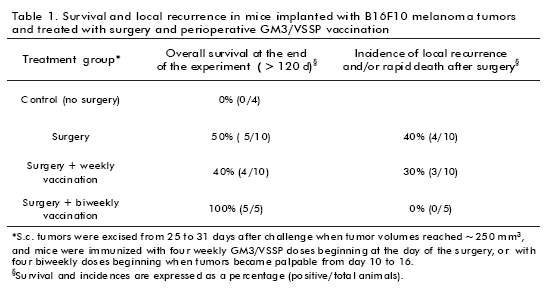
<p><span lang=EN-US style='font-size:10.0pt;font-family:"Verdana","sans-serif"; color:#211E1E'>It is known that mice with experimental tumors, as well as patients        with cancer, show a decreased immunologic potency. This tumor induced immunosuppression        is reinforced in patients with high tumor burdens </span><span lang=EN-US style='font-size:10.0pt;font-family:"Verdana","sans-serif"; color:windowtext'>(</span><span lang=EN-US style='font-size:10.0pt;font-family: "Verdana","sans-serif";color:#211E1E'>13). Consequently, in the last few years,        our view of the range of applications of tumor vaccines has changed because        treatment of patients with minimal residual disease or with low staging        showed better responses to vaccination. Furthermore, an open question remains        regarding whether vaccines have sufficient benefit for exploration in adjuvant        or even in preventive conditions. The answers to these questions could be        found, in part, by exploring the responses observed with the correct use        of animal models. </span> </p>      <p><span lang=EN-US style='font-size:10.0pt;font-family:"Verdana","sans-serif"; color:#211E1E'>Taking into consideration these findings, we have explored immunization with GM3/VSSP vaccine in combination with surgical excision of the primary tumor mass. The results showed that this model could clear the response to vaccination in combination with resection of the highly aggressive B16F10 melanoma. In this scenario, we observed that mice subjected to surgery plus a perioperative vaccination protocol consisting of four GM3/VSSP doses every 14 days beginning before surgery have an increased survival period compared with any other group. Furthermore, all mice showed neither local recurrence nor visible lung metastasis at the end of the experiment </span><span lang=EN-US style='font-size:10.0pt;font-family:"Verdana","sans-serif";color:windowtext'>(</span><span style='font-size:10.0pt;font-family:"Verdana","sans-serif";color:#211E1E'><a href="#tab1"><span lang=EN-US>Table 1</span></a></span><span lang=EN-US style='font-size:10.0pt;font-family:"Verdana","sans-serif";color:#211E1E'>). Interestingly, mice under a similar perioperative immunization with four doses of the vaccine, but administered every 7 days, showed reduced survival, similar to animals treated with surgery alone. </span></p>      ]]></body>
<body><![CDATA[<p align=center style='text-align:center'><span style='font-size:13.5pt; color:#211E1E'><img border=0 width=548 height=291 src="/img/revistas/bta/v26n3/t0114309.gif"></span><a name=tab1></a></p>      
<p><span lang=EN-US style='font-size:10.0pt;font-family:"Verdana","sans-serif"; color:#211E1E'>Because several clinical protocols involve active immunotherapy in cancer patients with large primary tumors or post-surgery patients, the functional effect of the tumor mass in the immune response would be an important feature. In this sense, we studied the functional immunologic variables following immunization with a ‘‘foreign’’ antigen, such as ovoalbumin </span><span lang=EN-US style='font-size:10.0pt;font-family:"Verdana","sans-serif"; color:windowtext'>(</span><span lang=EN-US style='font-size:10.0pt;font-family: "Verdana","sans-serif";color:#211E1E'>OVA) in tumor-bearing and healthy mice. The purpose of the experiment was to examine the response to vaccination with OVA before and after tumor surgery and the possible kinetics of immune recovery after excision of the tumor mass. In immunocompetent mice, this antigen should induce a strong and specific response. For this purpose, OVA-specific DTH was assayed by immunizing two doses of OVA in complete Freund’s adjuvant. Compared with tumor-bearing mice, CD4+ T-cell response in B16F10-operated mice showed a significant recovery after surgery, measured by ovoalbumin antigen-specific DTH </span><span lang=EN-US style='font-size:10.0pt;font-family:"Verdana","sans-serif"; color:windowtext'>(</span><i><span lang=EN-US style='font-size:10.0pt; font-family:"Verdana","sans-serif";color:#211E1E'>p </span></i><span lang=EN-US style='font-size:10.0pt;font-family:"Verdana","sans-serif"; color:#211E1E'>&lt; 0.05, Tukey test). However, this response is largely distant from the DTH developed in healthy, sham-operated mice </span><span lang=EN-US style='font-size:10.0pt;font-family:"Verdana","sans-serif"; color:windowtext'>(</span><i><span lang=EN-US style='font-size:10.0pt; font-family:"Verdana","sans-serif";color:#211E1E'>p </span></i><span lang=EN-US style='font-size:10.0pt;font-family:"Verdana","sans-serif"; color:#211E1E'>&lt; 0.01, Tukey test). To analyze whether surgical excision of primary tumor recovers CD4+ T-cell function, B16F10-operated mice were immunized at 2, 15, and 30 days after surgery with OVA emulsified in complete Freund’s adjuvant. Seven days later, inguinal lymph nodes were removed, cells were cultured for 4 days with OVA, and the supernatant was collected for cytokine quantification by ELISA. Strikingly, immunization induced a strong IL-4 secretion in B16F10-operated mice as compared with healthy animals </span><span lang=EN-US style='font-size:10.0pt;font-family:"Verdana","sans-serif"; color:windowtext'>(</span><i><span lang=EN-US style='font-size:10.0pt; font-family:"Verdana","sans-serif";color:#211E1E'>p </span></i><span lang=EN-US style='font-size:10.0pt;font-family:"Verdana","sans-serif"; color:#211E1E'>&lt; 0.05, Student’s t test), but values returned to normal 30 days after tumor excision. Few studies have indicated that immune system functions in cancer patients recover after surgery </span><span lang=EN-US style='font-size:10.0pt;font-family:"Verdana","sans-serif";color:windowtext'>(</span><span lang=EN-US style='font-size:10.0pt;font-family:"Verdana","sans-serif"; color:#211E1E'>14). However, there are no precedent studies of this phenomenon for melanoma. Our results showed that the B16F10 tumor could induce a CD4+ T-cell dysfunction and not rapidly overcome, lasting for at least 30 days after surgical treatment. In this scenario, four biweekly immunizations with GM3/ VSSP during the immunosuppression window induced a strong antitumor response. This fact suggests that our vaccine, given in a correct immunization protocol, could be able to increase the immune responsiveness and allow the immune system to prevent tumor recurrence or metastasis. </span></p>      <p><span lang=EN-US style='font-size:10.0pt;font-family:"Verdana","sans-serif"; color:#211E1E'>All these preclinical data strongly suggest a combined therapeutic effect of tumor excision and vaccination with GM3/VSSP every 14 days. This is an important issue to translate to the clinical setting because patients with stage II melanoma were reported to have a 60% chance of survival five years after surgery. Some patients with stage II melanoma are at high risk for recurrent disease, and occult micro metastases cause recurrence following treatment with surgery alone </span><span lang=EN-US style='font-size:10.0pt; font-family:"Verdana","sans-serif";color:windowtext'>(</span><span lang=EN-US style='font-size:10.0pt;font-family:"Verdana","sans-serif";color:#211E1E'>15). According to the results obtained with the present preclinical model, vaccination with GM3/ VSSP could significantly increase survival after the surgical management of primary cutaneous melanoma. </span></p>      <p><b><span lang=EN-US style='font-family:"Verdana","sans-serif";color:#211E1E'>CONCLUDING REMARKS </span></b></p>      <p><span lang=EN-US style='font-size:10.0pt;font-family:"Verdana","sans-serif"; color:#211E1E'>Altogether, these preclinical experiments propose the GM3/VSSP vaccine as a therapy designed to elicit and/or boost antitumor immunity in patients with minimal residual disease after surgery, thereby preventing or prolonging the time to recurrence. Future clinical trials will be needed for a definitive confirmation about the beneficial role of the GM3/VSSP vaccine in the perioperative handling of patients with stage II melanoma. Regarding to the mechanism by which GM3/VSSP confers, for the first time, it was demonstrated the direct involvement of the cellular immune response in the antitumor protection induced by a ganglioside-based vaccine. </span></p>      <p><b><span lang=EN-US style='font-family:"Verdana","sans-serif";color:#211E1E'>ACKNOWLEDGEMENTS </span></b></p>      <p><span lang=EN-US style='font-size:10.0pt;font-family:"Verdana","sans-serif"; color:#211E1E'>The authors thank Audry Fernández, Dr. Mariano R Gabri, Dr. Giselle V Ripoll and Dr. Daniel E Gómez for their important contribution to this work. In addition, we would like to thank Dr. Carmen Viada for her statistical advice and Armando López for his excellent technical assistance. </span></p>      <p><b><span lang=EN-US style='font-family:"Verdana","sans-serif";color:#211E1E'>&nbsp;</span></b></p>      <p><b><span lang=EN-US style='font-family:"Verdana","sans-serif";color:#211E1E'>REFERENCES </span></b></p>      <!-- ref --><p><span lang=EN-US style='font-size:10.0pt;font-family:"Verdana","sans-serif"; color:#211E1E'>1. Koon HB, Atkins MB. Update on therapy for melanoma: opportunities for patient selection and overcoming tumor resistance. Expert Rev Anticancer Ther</span><span lang=EN-US style='font-size:11.0pt;font-family: "Arial","sans-serif";color:red'> </span><span lang=EN-US style='font-size:10.0pt; font-family:"Verdana","sans-serif";color:#211E1E'>2007;7:79-88.</span><!-- ref --><p><span lang=EN-US style='font-size:10.0pt;font-family:"Verdana","sans-serif"; color:#211E1E'>2. Rosenberg SA, Yang JC, Restifo NP. Cancer immunotherapy: moving beyond current vaccines. Nat Med</span><span lang=EN-US style='font-size:11.0pt;font-family:"Arial","sans-serif";color:red'> </span><span lang=EN-US style='font-size:10.0pt;font-family:"Verdana","sans-serif"; color:#211E1E'>2004;10:909-915.</span><!-- ref --><p><span lang=EN-US style='font-size:10.0pt;font-family:"Verdana","sans-serif"; color:#211E1E'>3. Kananath D, Hill AD, Djikstra B, Kenelly R, McDermott EM, O’Higgins NJ. Adjuvant therapies in the treatment of stage II and III malignant melanoma. Surgeon</span><span lang=EN-US style='font-size:11.0pt;font-family: "Arial","sans-serif";color:red'> </span><span lang=EN-US style='font-size:10.0pt; font-family:"Verdana","sans-serif";color:#211E1E'>2005;3:245-56.</span><!-- ref --><p><span lang=EN-US style='font-size:10.0pt;font-family:"Verdana","sans-serif"; color:#211E1E'>4. Kudo D, Rayman P, Horton C, et al. Gangliosides expressed by the renal cell carcinoma cell line KK-RC-45 are involved in tumor-induced apoptosis of T cells. Cancer Res</span><span lang=EN-US style='font-size:11.0pt; font-family:"Arial","sans-serif";color:red'> </span><span lang=EN-US style='font-size:10.0pt;font-family:"Verdana","sans-serif";color:#211E1E'>2003;63:1676-83.</span><!-- ref --><p><span lang=EN-US style='font-size:10.0pt;font-family:"Verdana","sans-serif"; color:#211E1E'>5. Dohi T, Nores G, Hakomori S. An IgG3 monoclonal antibody established after immunization with GM3 lactone: immunochemical specificity and inhibition of melanoma cell growth <i>in vitro </i>and <i>in vivo</i>. </span><span style='font-size:10.0pt;font-family:"Verdana","sans-serif";color:#211E1E'>Cancer Res</span><span style='font-size:11.0pt;font-family:"Arial","sans-serif"; color:red'> </span><span style='font-size:10.0pt;font-family:"Verdana","sans-serif"; color:#211E1E'>1988;48:5680-5.</span><!-- ref --><p><span style='font-size:10.0pt;font-family:"Verdana","sans-serif";color:#211E1E'>6. Carr A, Mazorra Z, Alonso DF, et al. </span><span lang=EN-US style='font-size: 10.0pt;font-family:"Verdana","sans-serif";color:#211E1E'>A purified GM3 ganglioside conjugated vaccine induces speciWc, adjuvant-dependent and non-transient antitumor activity against B16 mouse melanoma <i>in vitro </i>and <i>in vivo</i>. Melanoma Res</span><span lang=EN-US style='font-size:11.0pt; font-family:"Arial","sans-serif";color:red'> </span><span lang=EN-US style='font-size:10.0pt;font-family:"Verdana","sans-serif";color:#211E1E'>2001;11:219-27.</span><!-- ref --><p><span lang=EN-US style='font-size:10.0pt;font-family:"Verdana","sans-serif"; color:#211E1E'>7. Livingston PO, Ragupati G. Carbohydrate vaccines that induce antibodies against cancer. 2. Previous experience and future &nbsp;plans. Cancer Immunol Immunother</span><span lang=EN-US style='font-size:11.0pt; font-family:"Arial","sans-serif";color:red'> </span><span lang=EN-US style='font-size:10.0pt;font-family:"Verdana","sans-serif";color:#211E1E'>1997;45:10-9.</span><!-- ref --><p><span style='font-size:10.0pt;font-family:"Verdana","sans-serif";color:#211E1E'>8. Estévez F, Carr A, Solorzano L, et al. </span><span lang=EN-US style='font-size:10.0pt;font-family:"Verdana","sans-serif";color:#211E1E'>Enhancement of the immune response to poorly immunogenic gangliosides after incorporation into very small size proteoliposomes </span><span lang=EN-US style='font-size: 10.0pt;font-family:"Verdana","sans-serif";color:windowtext'>(</span><span lang=EN-US style='font-size:10.0pt;font-family:"Verdana","sans-serif"; color:#211E1E'>VSSP).Vaccine</span><span lang=EN-US style='font-size:11.0pt; font-family:"Arial","sans-serif";color:red'> </span><span lang=EN-US style='font-size:10.0pt;font-family:"Verdana","sans-serif";color:#211E1E'>2000;18:190-7.</span><!-- ref --><p><span lang=EN-US style='font-size:10.0pt;font-family:"Verdana","sans-serif"; color:#211E1E'>9. Ravindranath MH, Brazeau SM, Morton DL. Efficacy of tumor cell vaccine after incorporating monophosphoryl lipid A </span><span lang=EN-US style='font-size:10.0pt;font-family:"Verdana","sans-serif"; color:windowtext'>(</span><span lang=EN-US style='font-size:10.0pt;font-family: "Verdana","sans-serif";color:#211E1E'>MPL) in tumor cell membranes containing tumor-associated ganglioside. Experientia</span><span lang=EN-US style='font-size:11.0pt;font-family:"Arial","sans-serif";color:red'> </span><span lang=EN-US style='font-size:10.0pt;font-family:"Verdana","sans-serif"; color:#211E1E'>1994;50:648-53.</span><!-- ref --><p><span lang=EN-US style='font-size:10.0pt;font-family:"Verdana","sans-serif"; color:#211E1E'>10. Ragupathi G, Liu NX, Musselli C, Powell S, Lloyd K, Livingston PO. Antibodies against tumor cell glycolipids and proteins, but not mucins, mediate complement-dependent cytotoxicity. J Immunol</span><span lang=EN-US style='font-size:11.0pt;font-family:"Arial","sans-serif";color:red'> </span><span lang=EN-US style='font-size:10.0pt;font-family:"Verdana","sans-serif"; color:#211E1E'>2005;174:5706-12.</span><!-- ref --><p><span lang=EN-US style='font-size:10.0pt;font-family:"Verdana","sans-serif"; color:#211E1E'>11. Lizee G, Radvanyi LG, Overwijk WW, Hwu P. Immunosuppression in melanoma immunotherapy: potential opportunities for intervention. Clin Cancer Res</span><span lang=EN-US style='font-size:11.0pt;font-family:"Arial","sans-serif"; color:red'> </span><span lang=EN-US style='font-size:10.0pt;font-family:"Verdana","sans-serif"; color:#211E1E'>2006;12:2359s-65s.</span><!-- ref --><p><span lang=EN-US style='font-size:10.0pt;font-family:"Verdana","sans-serif"; color:#211E1E'>12. Winter H, Hu HM, McClain K, Urba WJ, Fox BA. Immunotherapy of melanoma: a dichotomy in the requirement for IFN g in vaccine-induced antitumor immunity versus adoptive immunotherapy. J Immunol</span><span lang=EN-US style='font-size:11.0pt;font-family:"Arial","sans-serif";color:red'> </span><span lang=EN-US style='font-size:10.0pt;font-family:"Verdana","sans-serif"; color:#211E1E'>2000;166:7370-80.</span><!-- ref --><p><span lang=EN-US style='font-size:10.0pt;font-family:"Verdana","sans-serif"; color:#211E1E'>13. Kiessling R, Wasserman K, Horiguchi S. Tumor induced immune dysfunction. Cancer Immunol Immunother</span><span lang=EN-US style='font-size: 11.0pt;font-family:"Arial","sans-serif";color:red'> </span><span lang=EN-US style='font-size:10.0pt;font-family:"Verdana","sans-serif";color:#211E1E'>1999;48:353-62.</span><!-- ref --><p><span lang=EN-US style='font-size:10.0pt;font-family:"Verdana","sans-serif"; color:#211E1E'>14. Barbieri C, Fujisawa MM, Yasuda CL, et al. Effect of surgical treatment on the cellular immune response of gastric cancer patients. Braz J Med Biol Res</span><span lang=EN-US style='font-size:11.0pt;font-family: "Arial","sans-serif";color:red'> </span><span lang=EN-US style='font-size:10.0pt; font-family:"Verdana","sans-serif";color:#211E1E'>2003;36:339-45.</span><!-- ref --><p><span lang=EN-US style='font-size:10.0pt;font-family:"Verdana","sans-serif"; color:#211E1E'>15. Ross MI. Early-stage melanoma: staging criteria and prognostic modeling. Clin Cancer Res</span><span lang=EN-US style='font-size: 11.0pt;font-family:"Arial","sans-serif";color:red'> </span><span lang=EN-US style='font-size:10.0pt;font-family:"Verdana","sans-serif";color:#211E1E'>2006;12:312-9.</span><span lang=EN-US style='font-size:13.5pt;color:#211E1E'>&nbsp;</span><p><span lang=EN-US style='font-size:13.5pt;color:#211E1E'>&nbsp;</span></p>      <p><a name=award></a><b><i><span lang=EN-US style='font-size:10.0pt;font-family: "Verdana","sans-serif";color:#211E1E'>*This work received the Award of the National Academy of Sciences of Cuba for the year 2008.</span></i></b></p>      <p><span lang=EN-US style='font-size:13.5pt;color:#211E1E'>&nbsp;</span></p>      <p><span lang=EN-US style='font-size:10.0pt;font-family:"Verdana","sans-serif"; color:#211E1E'>Zaima Mazorra. Department of Clinical Immunology. Center of Molecular Immunology, CIM. Ave. 216, corner 15, Atabey, Playa, PO Box 16 040, Havana, Cuba. E-mail: </span><span lang=EN-US style='font-size:11.0pt;font-family:"Arial","sans-serif"; color:#211E1E'><a href="mailto:zaima@cim.sld.cu">mailto:zaima@cim.sld.cu</a></span><span lang=EN-US style='font-size:11.0pt;font-family:"Arial","sans-serif";color:#FF6600'> </span></p>      <p><span lang=EN-US style='font-size:11.0pt;font-family:"Arial","sans-serif"; color:#C00000'>&nbsp;</span></p>  </div>  </div>       ]]></body><back>
<ref-list>
<ref id="B1">
<label>1</label><nlm-citation citation-type="journal">
<person-group person-group-type="author">
<name>
<surname><![CDATA[Koon]]></surname>
<given-names><![CDATA[HB]]></given-names>
</name>
<name>
<surname><![CDATA[Atkins]]></surname>
<given-names><![CDATA[MB]]></given-names>
</name>
</person-group>
<article-title xml:lang="en"><![CDATA[Update on therapy for melanoma: opportunities for patient selection and overcoming tumor resistance]]></article-title>
<source><![CDATA[Expert Rev Anticancer Ther]]></source>
<year>2007</year>
<volume>7</volume>
<page-range>79-88</page-range></nlm-citation>
</ref>
<ref id="B2">
<label>2</label><nlm-citation citation-type="journal">
<person-group person-group-type="author">
<name>
<surname><![CDATA[Rosenberg]]></surname>
<given-names><![CDATA[SA]]></given-names>
</name>
<name>
<surname><![CDATA[Yang]]></surname>
<given-names><![CDATA[JC]]></given-names>
</name>
<name>
<surname><![CDATA[Restifo]]></surname>
<given-names><![CDATA[NP]]></given-names>
</name>
</person-group>
<article-title xml:lang="en"><![CDATA[Cancer immunotherapy: moving beyond current vaccines]]></article-title>
<source><![CDATA[Nat Med]]></source>
<year>2004</year>
<volume>10</volume>
<page-range>909-915</page-range></nlm-citation>
</ref>
<ref id="B3">
<label>3</label><nlm-citation citation-type="journal">
<person-group person-group-type="author">
<name>
<surname><![CDATA[Kananath]]></surname>
<given-names><![CDATA[D]]></given-names>
</name>
<name>
<surname><![CDATA[Hill]]></surname>
<given-names><![CDATA[AD]]></given-names>
</name>
<name>
<surname><![CDATA[Djikstra]]></surname>
<given-names><![CDATA[B]]></given-names>
</name>
<name>
<surname><![CDATA[Kenelly]]></surname>
<given-names><![CDATA[R]]></given-names>
</name>
<name>
<surname><![CDATA[McDermott]]></surname>
<given-names><![CDATA[EM]]></given-names>
</name>
<name>
<surname><![CDATA[O’Higgins]]></surname>
<given-names><![CDATA[NJ]]></given-names>
</name>
</person-group>
<article-title xml:lang="en"><![CDATA[Adjuvant therapies in the treatment of stage II and III malignant melanoma]]></article-title>
<source><![CDATA[Surgeon]]></source>
<year>2005</year>
<volume>3</volume>
<page-range>245-56</page-range></nlm-citation>
</ref>
<ref id="B4">
<label>4</label><nlm-citation citation-type="journal">
<person-group person-group-type="author">
<name>
<surname><![CDATA[Kudo]]></surname>
<given-names><![CDATA[D]]></given-names>
</name>
<name>
<surname><![CDATA[Rayman]]></surname>
<given-names><![CDATA[P]]></given-names>
</name>
<name>
<surname><![CDATA[Horton]]></surname>
<given-names><![CDATA[C]]></given-names>
</name>
</person-group>
<article-title xml:lang="en"><![CDATA[Gangliosides expressed by the renal cell carcinoma cell line KK-RC-45 are involved in tumor-induced apoptosis of T cells]]></article-title>
<source><![CDATA[Cancer Res]]></source>
<year>2003</year>
<volume>63</volume>
<page-range>1676-83</page-range></nlm-citation>
</ref>
<ref id="B5">
<label>5</label><nlm-citation citation-type="journal">
<person-group person-group-type="author">
<name>
<surname><![CDATA[Dohi]]></surname>
<given-names><![CDATA[T]]></given-names>
</name>
<name>
<surname><![CDATA[Nores]]></surname>
<given-names><![CDATA[G]]></given-names>
</name>
<name>
<surname><![CDATA[Hakomori]]></surname>
<given-names><![CDATA[S]]></given-names>
</name>
</person-group>
<article-title xml:lang="en"><![CDATA[An IgG3 monoclonal antibody established after immunization with GM3 lactone: immunochemical specificity and inhibition of melanoma cell growth in vitro and in vivo]]></article-title>
<source><![CDATA[Cancer Res]]></source>
<year>1988</year>
<volume>48</volume>
<page-range>5680-5</page-range></nlm-citation>
</ref>
<ref id="B6">
<label>6</label><nlm-citation citation-type="journal">
<person-group person-group-type="author">
<name>
<surname><![CDATA[Carr]]></surname>
<given-names><![CDATA[A]]></given-names>
</name>
<name>
<surname><![CDATA[Mazorra]]></surname>
<given-names><![CDATA[Z]]></given-names>
</name>
<name>
<surname><![CDATA[Alonso]]></surname>
<given-names><![CDATA[DF]]></given-names>
</name>
</person-group>
<article-title xml:lang="en"><![CDATA[A purified GM3 ganglioside conjugated vaccine induces speciWc, adjuvant-dependent and non-transient antitumor activity against B16 mouse melanoma in vitro and in vivo]]></article-title>
<source><![CDATA[Melanoma Res]]></source>
<year>2001</year>
<volume>11</volume>
<page-range>219-27</page-range></nlm-citation>
</ref>
<ref id="B7">
<label>7</label><nlm-citation citation-type="journal">
<person-group person-group-type="author">
<name>
<surname><![CDATA[Livingston]]></surname>
<given-names><![CDATA[PO]]></given-names>
</name>
<name>
<surname><![CDATA[Ragupati]]></surname>
<given-names><![CDATA[G]]></given-names>
</name>
</person-group>
<article-title xml:lang="en"><![CDATA[Carbohydrate vaccines that induce antibodies against cancer: 2. Previous experience and future plans]]></article-title>
<source><![CDATA[Cancer Immunol Immunother]]></source>
<year>1997</year>
<volume>45</volume>
<page-range>10-9</page-range></nlm-citation>
</ref>
<ref id="B8">
<label>8</label><nlm-citation citation-type="">
<person-group person-group-type="author">
<name>
<surname><![CDATA[Estévez]]></surname>
<given-names><![CDATA[F]]></given-names>
</name>
<name>
<surname><![CDATA[Carr]]></surname>
<given-names><![CDATA[A]]></given-names>
</name>
<name>
<surname><![CDATA[Solorzano]]></surname>
<given-names><![CDATA[L]]></given-names>
</name>
</person-group>
<article-title xml:lang="en"><![CDATA[en]]></article-title>
<source><![CDATA[]]></source>
<year></year>
</nlm-citation>
</ref>
<ref id="B9">
<label>9</label><nlm-citation citation-type="journal">
<person-group person-group-type="author">
<name>
<surname><![CDATA[Ravindranath]]></surname>
<given-names><![CDATA[MH]]></given-names>
</name>
<name>
<surname><![CDATA[Brazeau]]></surname>
<given-names><![CDATA[SM]]></given-names>
</name>
<name>
<surname><![CDATA[Morton]]></surname>
<given-names><![CDATA[DL]]></given-names>
</name>
</person-group>
<article-title xml:lang="en"><![CDATA[Efficacy of tumor cell vaccine after incorporating monophosphoryl lipid A (MPL) in tumor cell membranes containing tumor-associated ganglioside]]></article-title>
<source><![CDATA[Experientia]]></source>
<year>1994</year>
<volume>50</volume>
<page-range>648-53</page-range></nlm-citation>
</ref>
<ref id="B10">
<label>10</label><nlm-citation citation-type="journal">
<person-group person-group-type="author">
<name>
<surname><![CDATA[Ragupathi]]></surname>
<given-names><![CDATA[G]]></given-names>
</name>
<name>
<surname><![CDATA[Liu]]></surname>
<given-names><![CDATA[NX]]></given-names>
</name>
<name>
<surname><![CDATA[Musselli]]></surname>
<given-names><![CDATA[C]]></given-names>
</name>
<name>
<surname><![CDATA[Powell]]></surname>
<given-names><![CDATA[S]]></given-names>
</name>
<name>
<surname><![CDATA[Lloyd]]></surname>
<given-names><![CDATA[K]]></given-names>
</name>
<name>
<surname><![CDATA[Livingston]]></surname>
<given-names><![CDATA[PO]]></given-names>
</name>
</person-group>
<article-title xml:lang="en"><![CDATA[Antibodies against tumor cell glycolipids and proteins, but not mucins, mediate complement-dependent cytotoxicity]]></article-title>
<source><![CDATA[J Immunol]]></source>
<year>2005</year>
<volume>174</volume>
<page-range>5706-12</page-range></nlm-citation>
</ref>
<ref id="B11">
<label>11</label><nlm-citation citation-type="journal">
<person-group person-group-type="author">
<name>
<surname><![CDATA[Lizee]]></surname>
<given-names><![CDATA[G]]></given-names>
</name>
<name>
<surname><![CDATA[Radvanyi]]></surname>
<given-names><![CDATA[LG]]></given-names>
</name>
<name>
<surname><![CDATA[Overwijk]]></surname>
<given-names><![CDATA[WW]]></given-names>
</name>
<name>
<surname><![CDATA[Hwu]]></surname>
<given-names><![CDATA[P]]></given-names>
</name>
</person-group>
<article-title xml:lang="en"><![CDATA[Immunosuppression in melanoma immunotherapy: potential opportunities for intervention]]></article-title>
<source><![CDATA[Clin Cancer Res]]></source>
<year>2006</year>
<volume>12</volume>
<page-range>2359s-65s</page-range></nlm-citation>
</ref>
<ref id="B12">
<label>12</label><nlm-citation citation-type="journal">
<person-group person-group-type="author">
<name>
<surname><![CDATA[Winter]]></surname>
<given-names><![CDATA[H]]></given-names>
</name>
<name>
<surname><![CDATA[Hu]]></surname>
<given-names><![CDATA[HM]]></given-names>
</name>
<name>
<surname><![CDATA[McClain]]></surname>
<given-names><![CDATA[K]]></given-names>
</name>
<name>
<surname><![CDATA[Urba]]></surname>
<given-names><![CDATA[WJ]]></given-names>
</name>
<name>
<surname><![CDATA[Fox]]></surname>
<given-names><![CDATA[BA]]></given-names>
</name>
</person-group>
<article-title xml:lang="en"><![CDATA[Immunotherapy of melanoma: a dichotomy in the requirement for IFN g in vaccine-induced antitumor immunity versus adoptive immunotherapy]]></article-title>
<source><![CDATA[J Immunol]]></source>
<year>2000</year>
<volume>166</volume>
<page-range>7370-80</page-range></nlm-citation>
</ref>
<ref id="B13">
<label>13</label><nlm-citation citation-type="journal">
<person-group person-group-type="author">
<name>
<surname><![CDATA[Kiessling]]></surname>
<given-names><![CDATA[R]]></given-names>
</name>
<name>
<surname><![CDATA[Wasserman]]></surname>
<given-names><![CDATA[K]]></given-names>
</name>
<name>
<surname><![CDATA[Horiguchi]]></surname>
<given-names><![CDATA[S]]></given-names>
</name>
</person-group>
<article-title xml:lang="en"><![CDATA[Tumor induced immune dysfunction]]></article-title>
<source><![CDATA[Cancer Immunol Immunother]]></source>
<year>1999</year>
<volume>48</volume>
<page-range>353-62</page-range></nlm-citation>
</ref>
<ref id="B14">
<label>14</label><nlm-citation citation-type="journal">
<person-group person-group-type="author">
<name>
<surname><![CDATA[Barbieri]]></surname>
<given-names><![CDATA[C]]></given-names>
</name>
<name>
<surname><![CDATA[Fujisawa]]></surname>
<given-names><![CDATA[MM]]></given-names>
</name>
<name>
<surname><![CDATA[Yasuda]]></surname>
<given-names><![CDATA[CL]]></given-names>
</name>
</person-group>
<article-title xml:lang="en"><![CDATA[Effect of surgical treatment on the cellular immune response of gastric cancer patients]]></article-title>
<source><![CDATA[Braz J Med Biol Res]]></source>
<year>2003</year>
<volume>36</volume>
<page-range>339-45</page-range></nlm-citation>
</ref>
<ref id="B15">
<label>15</label><nlm-citation citation-type="journal">
<person-group person-group-type="author">
<name>
<surname><![CDATA[Ross]]></surname>
<given-names><![CDATA[MI]]></given-names>
</name>
</person-group>
<article-title xml:lang="en"><![CDATA[Early-stage melanoma: staging criteria and prognostic modeling]]></article-title>
<source><![CDATA[Clin Cancer Res]]></source>
<year>2006</year>
<volume>12</volume>
<page-range>312-9</page-range></nlm-citation>
</ref>
</ref-list>
</back>
</article>