<?xml version="1.0" encoding="ISO-8859-1"?><article xmlns:mml="http://www.w3.org/1998/Math/MathML" xmlns:xlink="http://www.w3.org/1999/xlink" xmlns:xsi="http://www.w3.org/2001/XMLSchema-instance">
<front>
<journal-meta>
<journal-id>1027-2852</journal-id>
<journal-title><![CDATA[Biotecnología Aplicada]]></journal-title>
<abbrev-journal-title><![CDATA[Biotecnol Apl]]></abbrev-journal-title>
<issn>1027-2852</issn>
<publisher>
<publisher-name><![CDATA[Editorial Elfos Scientiae]]></publisher-name>
</publisher>
</journal-meta>
<article-meta>
<article-id>S1027-28522009000400008</article-id>
<title-group>
<article-title xml:lang="en"><![CDATA[HER1 Vaccine: An autologous EGFR vaccine candidate to treat epithelial tumors]]></article-title>
</title-group>
<contrib-group>
<contrib contrib-type="author">
<name>
<surname><![CDATA[Sánchez]]></surname>
<given-names><![CDATA[Belinda]]></given-names>
</name>
<xref ref-type="aff" rid="A01"/>
</contrib>
<contrib contrib-type="author">
<name>
<surname><![CDATA[Aguiar]]></surname>
<given-names><![CDATA[Yeranddy]]></given-names>
</name>
<xref ref-type="aff" rid="A01"/>
</contrib>
<contrib contrib-type="author">
<name>
<surname><![CDATA[Hernández]]></surname>
<given-names><![CDATA[Diana R]]></given-names>
</name>
<xref ref-type="aff" rid="A01"/>
</contrib>
<contrib contrib-type="author">
<name>
<surname><![CDATA[Garrido]]></surname>
<given-names><![CDATA[Greta]]></given-names>
</name>
<xref ref-type="aff" rid="A01"/>
</contrib>
<contrib contrib-type="author">
<name>
<surname><![CDATA[Pérez]]></surname>
<given-names><![CDATA[Rolando]]></given-names>
</name>
<xref ref-type="aff" rid="A01"/>
</contrib>
<contrib contrib-type="author">
<name>
<surname><![CDATA[Fernández]]></surname>
<given-names><![CDATA[Luis E]]></given-names>
</name>
<xref ref-type="aff" rid="A01"/>
</contrib>
</contrib-group>
<aff id="A01">
<institution><![CDATA[,Center of Molecular Immunology  ]]></institution>
<addr-line><![CDATA[Havana ]]></addr-line>
<country>Cuba</country>
</aff>
<pub-date pub-type="pub">
<day>00</day>
<month>12</month>
<year>2009</year>
</pub-date>
<pub-date pub-type="epub">
<day>00</day>
<month>12</month>
<year>2009</year>
</pub-date>
<volume>26</volume>
<numero>4</numero>
<fpage>342</fpage>
<lpage>344</lpage>
<copyright-statement/>
<copyright-year/>
<self-uri xlink:href="http://scielo.sld.cu/scielo.php?script=sci_arttext&amp;pid=S1027-28522009000400008&amp;lng=en&amp;nrm=iso"></self-uri><self-uri xlink:href="http://scielo.sld.cu/scielo.php?script=sci_abstract&amp;pid=S1027-28522009000400008&amp;lng=en&amp;nrm=iso"></self-uri><self-uri xlink:href="http://scielo.sld.cu/scielo.php?script=sci_pdf&amp;pid=S1027-28522009000400008&amp;lng=en&amp;nrm=iso"></self-uri><abstract abstract-type="short" xml:lang="en"><p><![CDATA[The Epidermal Growth Factor Receptor (EGFR) plays an essential role in regulating neoplastic processes. EGFR over-expression in many human epithelial tumors has been correlated with disease progression and bad prognosis. Passive EGFR-directed immunotherapy has been introduced in medical oncology practice, but no active specific approaches have been used. We designed a vaccine candidate based on the extracellular domain (ECD) of human EGFR (HER1), and the homologous vaccine for mice based on murine EGFR. This vaccine candidate uses the Very Small-Sized Proteoliposomes from Neisseria meningitidis (VSSP) and Montanide ISA 51-VG as adjuvants. The autologous vaccine circumvents the tolerance to self EGFR by inducing a specific immune response with an anti-metastatic effect on EGFR+ tumors. The vaccine candidate based on HER1-ECD induced anti-EGFR polyclonal antibodies (PAb) that bind EGFR+ human tumor cell lines from different tissues. These anti-EGFR PAb abrogate ligand-dependent EGFR phosphorylation, provoking the inhibition of tumor cell growth and apoptosis. Preclinical results further encouraged the evaluation of the HER1 vaccine candidate in phase I clinical trials]]></p></abstract>
</article-meta>
</front><body><![CDATA[ <DIV class="Sect"   >        <P   align="right" ><font size="2" color="#000000" face="Verdana, Arial, Helvetica, sans-serif"><b>REPORT</b>      </font></P >   <FONT size="+1" color="#000000">        <P   align="right" >&nbsp;</P >       <P   > </P >       <P   ><font size="4" color="#201D1E" face="Verdana, Arial, Helvetica, sans-serif">HER1      Vaccine: An autologous EGFR vaccine candidate to treat epithelial tumors</font></P >       <P   >&nbsp;</P >       <P   >&nbsp;</P >   <FONT size="+1" color="#201D1E">        <P   ><font size="2" face="Verdana, Arial, Helvetica, sans-serif"><b>Belinda S&aacute;nchez,      Yeranddy Aguiar, Diana R Hern&aacute;ndez, Greta Garrido, Rolando P&eacute;rez,      Luis E Fern&aacute;ndez </b></font></P >       <P   >&nbsp;</P >   <FONT size="+1">        <P   ><font size="2" face="Verdana, Arial, Helvetica, sans-serif">Center of Molecular      Immunology, CIM 216 corner 15, PO Box 11 600, Atabey, Playa, Havana, Cuba      </font></P >       ]]></body>
<body><![CDATA[<P   >&nbsp;</P >       <P   >&nbsp;</P >   </font></font></font>    <hr>   <FONT size="+1" color="#000000"><FONT size="+1" color="#201D1E"><FONT size="+1">        <P   ><font face="Verdana, Arial, Helvetica, sans-serif" size="2"><b>ABSTRACT</b></font></P >   <FONT size="+1">        <P   ><font face="Verdana, Arial, Helvetica, sans-serif" size="2">The Epidermal Growth      Factor Receptor (EGFR) plays an essential role in regulating neoplastic processes.      EGFR over-expression in many human epithelial tumors has been correlated with      disease progression and bad prognosis. Passive EGFR-directed immunotherapy      has been introduced in medical oncology practice, but no active specific approaches      have been used. We designed a vaccine candidate based on the extracellular      domain (ECD) of human EGFR (HER1), and the homologous vaccine for mice based      on murine EGFR. This vaccine candidate uses the Very Small-Sized Proteoliposomes      from Neisseria meningitidis (VSSP) and Montanide ISA 51-VG as adjuvants. The      autologous vaccine circumvents the tolerance to self EGFR by inducing a specific      immune response with an anti-metastatic effect on EGFR<Sup>+ </Sup>tumors.      The vaccine candidate based on HER1-ECD induced anti-EGFR polyclonal antibodies      (PAb) that bind EGFR<Sup>+ </Sup>human tumor cell lines from different tissues.      These anti-EGFR PAb abrogate ligand-dependent EGFR phosphorylation, provoking      the inhibition of tumor cell growth and apoptosis. Preclinical results further      encouraged the evaluation of the HER1 vaccine candidate in phase I clinical      trials.</font></P >   </font></font></font></font>   <hr>   <FONT size="+1" color="#000000"><FONT size="+1" color="#201D1E"><FONT size="+1"><FONT size="+1">        <P   >&nbsp;</P >       <P   >&nbsp;</P >   <FONT size="+1"><FONT size="+1"><FONT size="+1"><FONT size="+1">        <P   ><font face="Verdana, Arial, Helvetica, sans-serif" size="3"><b>INTRODUCTION</b></font></P >   <FONT size="+1" color="#000000"><FONT color="#201D1E">        <P   ><font size="2" face="Verdana, Arial, Helvetica, sans-serif">The human epidermal      growth factor receptor (EGFR or HER1) belongs to the erbB family of four closely      related cell membrane receptors, also known as the Type I Receptor Tyrosine      Kinase family: HER1/erbB1, HER2/erbB2, HER3/erbB3 and HER4/erbB4 (1, 2). The      four receptors consist of an extracellular ligand-binding domain (ECD), a      transmembrane domain, and an intracellular domain with tyrosine kinase activity      for signal transduction. EGFR plays an essential role in regulating both development      and neoplastic processes. On binding their specific ligands, such as the epidermal      growth factor (EGF) or transforming growth factor alpha (TGF-&alpha;), among      others, there is an induction of receptor activation, modulation of cell proliferation      and the differentiation in normal tissues and tumors. EGFR can be found over-expressed      or mutated in many human epithelial tumors such as those of breast, lung,      prostate, head and neck, colorectal, pancreatic, bladder, vulva and ovarian      tumors. This over-expression has been correlated with disease progression      and poor prognosis (3). The activation of the EGFR signaling pathway in cancer      cells has been shown to enhance cell proliferation, angiogenesis, tumor promotion      and metastasis, and to decrease apoptosis. The potential of EGFR-targeted      therapies for cancer treatment has increased the development of different      passive agents (4), but active specific approaches have not been introduced      in medical oncology practice. HER1-based active specific immunotherapy may      be an alternative and complementary approach to treat epithelial tumors, provided      the induction of an immune response against self EGFR is feasible. </font></P >   <FONT size="+1">        <P   ><font face="Verdana, Arial, Helvetica, sans-serif" size="2"><b><font size="3">RESULTS      AND DISCUSSION</font></b></font></P >   <FONT size="+1">        <P   ><font size="2" face="Verdana, Arial, Helvetica, sans-serif">In order to design      a vaccine based on Her1-ECD, the cDNAs encoding both Her1-ECD and murine EGFR-ECD      (mEGFR-ECD) were successfully cloned into the pcDNA3 expression vector and      used to transfect HEK293 cells (5). The identity and subsequent potential      of recombinant proteins such as immunogens were demonstrated through their      recognition by specific MAbs. The vaccine candidate included VSSP (very small      size proteoliposomes) a new product that has been clinically tested in humans,      and Montanide ISA 51 (Mont) as adjuvants. VSSP was selected because of its      properties in maturing dendritic cells by inducing IL-12 production, which      in turn is vital for pro-inflammatory responses (6). </font></P >   <FONT size="+1">        ]]></body>
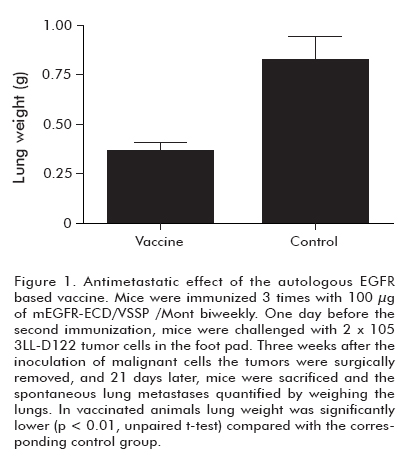
<body><![CDATA[<P   ><font face="Verdana, Arial, Helvetica, sans-serif" size="2">The humoral response      of the autologous vaccine was explored by immunizing C57BL/6 mice 4 times      biweekly with 50 &mu;g of mEGFR-ECD in VSSP/ Mont. Inoculated mice developed      specific cellular and humoral immune responses. The high serum IgG antibody      levels comprised IgG2a, IgG2b and IgG1 subclasses, which increased with successive      immunizations. It was thus demonstrated that vaccination breaks the tolerance      to EGFR, which constitutes a central deletion antigen expressed in the thymus      (5). The high immunogenicity of the antigen could be derived from the presentation      context and the use of a truncated protein that could modify the immunodominance      of the T cell repertoire. To check whether immunizations with a truncated      EGFR affects the recognition of the full length EGFR in its native conformation      on the cell surface, EGFR<Sup>+ </Sup>cells were analyzed by FACS. EAT and      3LL-D122 murine cell lines were positively stained by mEGFR-ECD/ VSSP/ Mont-immunized      mice sera. These sera showed <I>in vitro </I>anti-tumor effect, inhibiting      EGFR<Sup>+ </Sup>tumor cell proliferation and decreasing the number of viable      cells (5). </font></P >   <FONT size="+1"><FONT size="+1"><FONT size="+1"><FONT size="+1">        <P   ><font face="Verdana, Arial, Helvetica, sans-serif" size="2">To investigate whether      autologous vaccination can protect individuals from widespread metastases,      mice received a first immunization with the mEGFR-ECD in VSSP/ Mont and, 1      day before the booster immunization, they were challenged with 2 x 10<Sup>5      </Sup>tumor cells in the foot pad. Three weeks after inoculating malignant      cells, tumors were surgically removed. Twenty-one days after surgery, mice      were sacrificed and the spontaneous lung metastases were quantified by weighing      the lungs. As shown in<a href="#fig1"> Figure 1</a>, vaccination significantly      reduced lung metastasis of mice (p &lt; 0.01), compared to the control group      (5). The anti-metastatic model we have used simulates the medical practices      in which physicians remove the primary tumors and sometimes, depending on      the stage of the tumor, metastatic disse-mination can occur. In fact metastatic      dissemination is normally responsible for the death of the patients. That      is the reason why avoiding metastases is the main challenge for cancer vaccines.      The anti-metastatic effect of the HER1 vaccine involved the cellular immune      response, which was demonstrated by depletion experiments (unpublished data).      The specificity of these CD8<Sup>+ </Sup>T cells is currently studied. On      the other hand, potential side effects of &ldquo;self&rdquo;&rsquo; immunization      in humans were stressed by examining the appearance of reproductive anomalies      in female mice immunized with the mEGFR-ECD in VSSP/Mont. After vaccination,      animals were mated and their progeny studied. Pregnancy rates, pups per litter,      birth weights, hair growth, eyes opening and incisor appearance parameters      did not differ between the vaccinated and the control group of mice (Mann      Whitney U test, p &gt; 0.05). Besides, a group of mice was observed for 1      year after the end of the immunization protocol, and vitality, temperature      and food intake were completely normal No changes were found in functional      hepatic parameters when compared to those of non-immunized mice (5). </font></P >       <P align="center"   ><img src="/img/revistas/bta/v26n4/f0110409.jpg" width="416" height="460"><a name="fig1"></a></P >   <FONT size="+1"><FONT size="+1"><FONT size="+1"><FONT size="+1">        
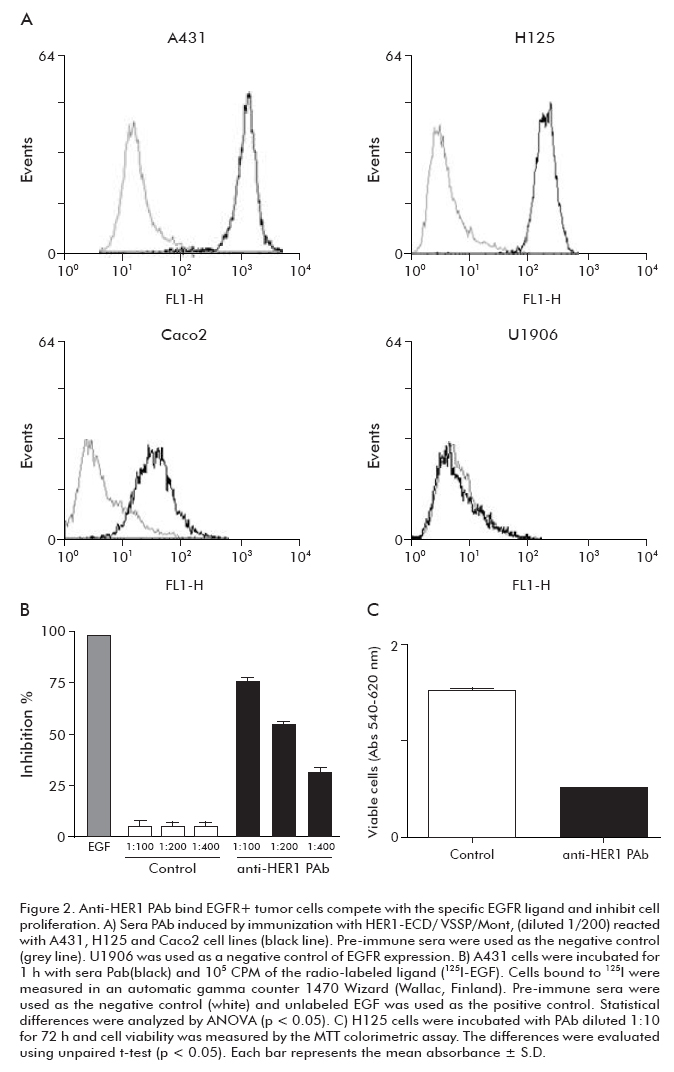
<P   ><font face="Verdana, Arial, Helvetica, sans-serif" size="2">Once the proof of      principle of autologous vaccination based on mEGFR, was demonstrated we characterized      the immune response, in mice, induced by the vaccine candidate intended for      clinical studies in EGFR<Sup>+ </Sup>epithelial tumor patients: HER1-ECD/      VSSP/Mont. This vaccine activated the cellular immune response in mice, which      was demonstrated by the induction of specific DTH response and the stimulation      of T lymphocytes (7). Furthermore, immunization induced high specific IgG      antibody titers, which increased by increasing the number of HER1-ECD doses      administered in the vaccine formulation (8). Curiously, polyclonal antibodies      (PAb) generated by HER1-ECD vaccination were poorly cross-reactive with mEGFR-ECD      in spite of the high homology in primary sequence (87%) between these two      proteins (5). This result supports the concept of autologous vaccination,      indicating that the patient-directed vaccine should contain the human EGFR-ECD      protein. Vaccination-induced PAb recognized a panel of EGFR<Sup>+ </Sup>human      tumor cell lines of different origins and levels of receptor expression, such      as vulva, lung, colon, breast and glioma (<a href="/img/revistas/bta/v26n4/f0210409.jpg">Figure      2a</a>) (8). This result suggests that the HER1 vaccine could be used in a      wide array of patients with different EGFR<Sup>+ </Sup>tumor origins, irrespective      of the level of EGFR expression. It was also demonstrated that these PAb are      capable of inhibiting EGF and TGF&alpha; binding to EGFR<Sup>+ </Sup>tumor      cells (<a href="/img/revistas/bta/v26n4/f0210409.jpg">Figure 2b</a>).      This could abrogate the ligand-dependent EGFR phosphorylation. It inhibits      the activation of signaling cascade proteins, such as Erk1/2, which are directly      connected to cell proliferation. In fact, the incubation with the specific      vaccine PAb arrested EGFR<Sup>+ </Sup>tumor cell lines at the G0/G1 phase,      it inhibited cell proliferation (<a href="/img/revistas/bta/v26n4/f0210409.jpg">Figure      2c</a>) and induced apoptosis (8). </font></P >   <FONT size="+1"><FONT size="+1"><FONT size="+1"><FONT size="+1"><FONT size="+1"><FONT size="+1"><FONT size="+1"><FONT size="+1"><FONT size="+1"><FONT size="+1">        
<P   ><font face="Verdana, Arial, Helvetica, sans-serif" size="2">We conclude that      self EGFR-ECD is immunogenic in VSSP contexts, specifically activating the      humoral and cellular immune responses. The anti-metastatic effect of the vaccine      involves CD8<Sup>+ </Sup>T cells, suggesting the activation of cytotoxic T      lymphocytes. The antibodies produced by vaccination recognize a wide array      of EGFR<Sup>+ </Sup>tumor cells and shows anti-proliferative and anti-apoptotic      effects as a consequence of ligand-dependent EGFR inhibition. As a whole,      these results indicate that the HER1 vaccine can be an attractive therapeutic      approach to treat patients with EGFR<Sup>+ </Sup>tumors. </font></P >   <FONT size="+1"><FONT size="+1"><FONT size="+1"><FONT size="+1"><FONT size="+1"><FONT size="+1">        <P   ><font face="Verdana, Arial, Helvetica, sans-serif" size="2" color="#000000"><b><font size="3">REFERENCES</font></b></font></P >   <FONT size="+1" color="#000000">        <P   > </P >       <!-- ref --><P   ><font size="2" color="#201D1E" face="Verdana, Arial, Helvetica, sans-serif">1.      Ullrich A, Coussens L, Hayflick JS, Dull TJ, Gray A, Tam AW, et al. Human      epidermal growth factor receptor cDNA sequence and aberrant expression of      the amplified gene in A431 epidermoid carcinoma cells. Nature 1984;309(5967):418-25.          </font></P >   <FONT size="+1" color="#201D1E">        <!-- ref --><P   ><font face="Verdana, Arial, Helvetica, sans-serif" size="2">2. Normanno N, Bianco      C, Strizzi L, Mancino M, Maiello MR, De Luca A, et al. The ErbB receptors      and their ligands in cancer: an overview. Curr Drug Targets 2005;6(3):243-57.          </font></P >       <!-- ref --><P   ><font face="Verdana, Arial, Helvetica, sans-serif" size="2">3. Khademi B, Shirazi      FM, Vasei M, Doroudchi M, Gandomi B, Modjtahedi H, et al. The expression of      p53, c-erbB-1 and c-erbB-2 molecules and their correlation with prognostic      markers in patients with head and neck tumors. Cancer Lett 2002;184(2):223-30.          </font></P >       <!-- ref --><P   ><font face="Verdana, Arial, Helvetica, sans-serif" size="2">4. Crombet T, Torres      L, Neninger E, Catala M, Solano ME, Perera A, et al. Pharacological evaluation      of humanized anti-epidermal growth factor receptor, monoclonal an-tibody h-R3,      in patients with advanced epithelial-derived cancer. J Immunother 2003;26(2):139-48.          </font></P >       <!-- ref --><P   ><font face="Verdana, Arial, Helvetica, sans-serif" size="2">5. Ram&iacute;rez      BS, Pestana ES, Hidalgo GG, Garc&iacute;a TH, Rodr&iacute;guez RP, Ullrich      A, et al. Active antimetastatic immunotherapy in Lewis lung carcinoma with      self EGFR extracellular domain protein in VSSP adjuvant. Int J Cancer 2006;119(9):2190-9.          </font></P >       <!-- ref --><P   ><font face="Verdana, Arial, Helvetica, sans-serif" size="2">6. Mesa C, De Leon      J, Rigley K, Fern&aacute;ndez LE. Very small size proteoliposomes derived      from Neisseria meningitidis: an effective adjuvant for Th1 induction and dendritic      cell activation. Vaccine 2004;22(23-24):3045-52.     </font></P >       <!-- ref --><P   ><font face="Verdana, Arial, Helvetica, sans-serif" size="2">7. Ram&iacute;rez      BS, Alpizar YA, Hidalgo GG, Capote AR, Fern&aacute;ndez DR, Rodr&iacute;guez      RP, et al. Specific immune response induced in mice by immunization with the      human Epidermal Growth Factor Receptor extra-cellular domain. Biotecnol Apl      2008;25: 135-40.     </font></P >       <!-- ref --><P   ><font face="Verdana, Arial, Helvetica, sans-serif" size="2">8. Ram&iacute;rez      BS, Alpizar YA, Fern&aacute;ndez DR, Hidalgo GG, Capote AR, Rodr&iacute;guez      RP, et al. Anti-EGFR activation, anti-proliferative and pro-apoptotic effects      of polyclonal antibodies induced by EGFR-based cancer vaccine. Vaccine 2008;26(38):4918-26.          </font></P >       <P   > </P >   <font size="2" color="#201D1E" face="Verdana, Arial, Helvetica, sans-serif">Belinda      S&aacute;nchez. Center of Molecular Immunology, CIM 216 corner 15, PO Box      11 600, Atabey, Playa, Havana, Cuba. E-mail: <A href="mailto:belinda@cim.sld.cu">      <U><U><FONT color="#0000FF">belinda@cim.sld.cu</font></U></U></A> </font></P >   <FONT size="+1" color="#201D1E"><FONT size="+1"><FONT color="#0000FF"><FONT color="#201D1E">          ]]></body><back>
<ref-list>
<ref id="B1">
<label>1</label><nlm-citation citation-type="journal">
<person-group person-group-type="author">
<name>
<surname><![CDATA[Ullrich]]></surname>
<given-names><![CDATA[A]]></given-names>
</name>
<name>
<surname><![CDATA[Coussens]]></surname>
<given-names><![CDATA[L]]></given-names>
</name>
<name>
<surname><![CDATA[Hayflick]]></surname>
<given-names><![CDATA[JS]]></given-names>
</name>
<name>
<surname><![CDATA[Dull]]></surname>
<given-names><![CDATA[TJ]]></given-names>
</name>
<name>
<surname><![CDATA[Gray]]></surname>
<given-names><![CDATA[A]]></given-names>
</name>
<name>
<surname><![CDATA[Tam]]></surname>
<given-names><![CDATA[AW]]></given-names>
</name>
</person-group>
<article-title xml:lang="en"><![CDATA[Human epidermal growth factor receptor cDNA sequence and aberrant expression of the amplified gene in A431 epidermoid carcinoma cells]]></article-title>
<source><![CDATA[Nature]]></source>
<year>1984</year>
<volume>309</volume>
<numero>5967</numero>
<issue>5967</issue>
<page-range>418-25</page-range></nlm-citation>
</ref>
<ref id="B2">
<label>2</label><nlm-citation citation-type="journal">
<person-group person-group-type="author">
<name>
<surname><![CDATA[Normanno]]></surname>
<given-names><![CDATA[N]]></given-names>
</name>
<name>
<surname><![CDATA[Bianco]]></surname>
<given-names><![CDATA[C]]></given-names>
</name>
<name>
<surname><![CDATA[Strizzi]]></surname>
<given-names><![CDATA[L]]></given-names>
</name>
<name>
<surname><![CDATA[Mancino]]></surname>
<given-names><![CDATA[M]]></given-names>
</name>
<name>
<surname><![CDATA[Maiello]]></surname>
<given-names><![CDATA[MR]]></given-names>
</name>
<name>
<surname><![CDATA[De Luca]]></surname>
<given-names><![CDATA[A]]></given-names>
</name>
</person-group>
<article-title xml:lang="en"><![CDATA[The ErbB receptors and their ligands in cancer: an overview]]></article-title>
<source><![CDATA[Curr Drug Targets]]></source>
<year>2005</year>
<volume>6</volume>
<numero>3</numero>
<issue>3</issue>
<page-range>243-57</page-range></nlm-citation>
</ref>
<ref id="B3">
<label>3</label><nlm-citation citation-type="journal">
<person-group person-group-type="author">
<name>
<surname><![CDATA[Khademi]]></surname>
<given-names><![CDATA[B]]></given-names>
</name>
<name>
<surname><![CDATA[Shirazi]]></surname>
<given-names><![CDATA[FM]]></given-names>
</name>
<name>
<surname><![CDATA[Vasei]]></surname>
<given-names><![CDATA[M]]></given-names>
</name>
<name>
<surname><![CDATA[Doroudchi]]></surname>
<given-names><![CDATA[M]]></given-names>
</name>
<name>
<surname><![CDATA[Gandomi]]></surname>
<given-names><![CDATA[B]]></given-names>
</name>
<name>
<surname><![CDATA[Modjtahedi]]></surname>
<given-names><![CDATA[H]]></given-names>
</name>
</person-group>
<article-title xml:lang="en"><![CDATA[The expression of p53, c-erbB-1 and c-erbB-2 molecules and their correlation with prognostic markers in patients with head and neck tumors]]></article-title>
<source><![CDATA[Cancer Lett]]></source>
<year>2002</year>
<volume>184</volume>
<numero>2</numero>
<issue>2</issue>
<page-range>223-30</page-range></nlm-citation>
</ref>
<ref id="B4">
<label>4</label><nlm-citation citation-type="journal">
<person-group person-group-type="author">
<name>
<surname><![CDATA[Crombet]]></surname>
<given-names><![CDATA[T]]></given-names>
</name>
<name>
<surname><![CDATA[Torres]]></surname>
<given-names><![CDATA[L]]></given-names>
</name>
<name>
<surname><![CDATA[Neninger]]></surname>
<given-names><![CDATA[E]]></given-names>
</name>
<name>
<surname><![CDATA[Catala]]></surname>
<given-names><![CDATA[M]]></given-names>
</name>
<name>
<surname><![CDATA[Solano]]></surname>
<given-names><![CDATA[ME]]></given-names>
</name>
<name>
<surname><![CDATA[Perera]]></surname>
<given-names><![CDATA[A]]></given-names>
</name>
</person-group>
<article-title xml:lang="en"><![CDATA[Pharacological evaluation of humanized anti-epidermal growth factor receptor, monoclonal an-tibody h-R3, in patients with advanced epithelial-derived cancer]]></article-title>
<source><![CDATA[J Immunother]]></source>
<year>2003</year>
<volume>26</volume>
<numero>2</numero>
<issue>2</issue>
<page-range>139-48</page-range></nlm-citation>
</ref>
<ref id="B5">
<label>5</label><nlm-citation citation-type="journal">
<person-group person-group-type="author">
<name>
<surname><![CDATA[Ramírez]]></surname>
<given-names><![CDATA[BS]]></given-names>
</name>
<name>
<surname><![CDATA[Pestana]]></surname>
<given-names><![CDATA[ES]]></given-names>
</name>
<name>
<surname><![CDATA[Hidalgo]]></surname>
<given-names><![CDATA[GG]]></given-names>
</name>
<name>
<surname><![CDATA[García]]></surname>
<given-names><![CDATA[TH]]></given-names>
</name>
<name>
<surname><![CDATA[Rodríguez]]></surname>
<given-names><![CDATA[RP]]></given-names>
</name>
<name>
<surname><![CDATA[Ullrich]]></surname>
<given-names><![CDATA[A]]></given-names>
</name>
</person-group>
<article-title xml:lang="en"><![CDATA[Active antimetastatic immunotherapy in Lewis lung carcinoma with self EGFR extracellular domain protein in VSSP adjuvant]]></article-title>
<source><![CDATA[Int J Cancer]]></source>
<year>2006</year>
<volume>119</volume>
<numero>9</numero>
<issue>9</issue>
<page-range>2190-9</page-range></nlm-citation>
</ref>
<ref id="B6">
<label>6</label><nlm-citation citation-type="journal">
<person-group person-group-type="author">
<name>
<surname><![CDATA[Mesa]]></surname>
<given-names><![CDATA[C]]></given-names>
</name>
<name>
<surname><![CDATA[De Leon]]></surname>
<given-names><![CDATA[J]]></given-names>
</name>
<name>
<surname><![CDATA[Rigley]]></surname>
<given-names><![CDATA[K]]></given-names>
</name>
<name>
<surname><![CDATA[Fernández]]></surname>
<given-names><![CDATA[LE]]></given-names>
</name>
</person-group>
<article-title xml:lang="en"><![CDATA[Very small size proteoliposomes derived from Neisseria meningitidis: an effective adjuvant for Th1 induction and dendritic cell activation]]></article-title>
<source><![CDATA[Vaccine]]></source>
<year>2004</year>
<volume>22</volume>
<numero>23</numero>
<issue>23</issue>
<page-range>3045-52</page-range></nlm-citation>
</ref>
<ref id="B7">
<label>7</label><nlm-citation citation-type="journal">
<person-group person-group-type="author">
<name>
<surname><![CDATA[Ramírez]]></surname>
<given-names><![CDATA[BS]]></given-names>
</name>
<name>
<surname><![CDATA[Alpizar]]></surname>
<given-names><![CDATA[YA]]></given-names>
</name>
<name>
<surname><![CDATA[Hidalgo]]></surname>
<given-names><![CDATA[GG]]></given-names>
</name>
<name>
<surname><![CDATA[Capote]]></surname>
<given-names><![CDATA[AR]]></given-names>
</name>
<name>
<surname><![CDATA[Fernández]]></surname>
<given-names><![CDATA[DR]]></given-names>
</name>
<name>
<surname><![CDATA[Rodríguez]]></surname>
<given-names><![CDATA[RP]]></given-names>
</name>
</person-group>
<article-title xml:lang="en"><![CDATA[Specific immune response induced in mice by immunization with the human Epidermal Growth Factor Receptor extra-cellular domain]]></article-title>
<source><![CDATA[Biotecnol Apl]]></source>
<year>2008</year>
<volume>25</volume>
<page-range>135-40</page-range></nlm-citation>
</ref>
<ref id="B8">
<label>8</label><nlm-citation citation-type="journal">
<person-group person-group-type="author">
<name>
<surname><![CDATA[Ramírez]]></surname>
<given-names><![CDATA[BS]]></given-names>
</name>
<name>
<surname><![CDATA[Alpizar]]></surname>
<given-names><![CDATA[YA]]></given-names>
</name>
<name>
<surname><![CDATA[Fernández]]></surname>
<given-names><![CDATA[DR]]></given-names>
</name>
<name>
<surname><![CDATA[Hidalgo]]></surname>
<given-names><![CDATA[GG]]></given-names>
</name>
<name>
<surname><![CDATA[Capote]]></surname>
<given-names><![CDATA[AR]]></given-names>
</name>
<name>
<surname><![CDATA[Rodríguez]]></surname>
<given-names><![CDATA[RP]]></given-names>
</name>
</person-group>
<article-title xml:lang="en"><![CDATA[Anti-EGFR activation, anti-proliferative and pro-apoptotic effects of polyclonal antibodies induced by EGFR-based cancer vaccine]]></article-title>
<source><![CDATA[Vaccine]]></source>
<year>2008</year>
<volume>26</volume>
<numero>38</numero>
<issue>38</issue>
<page-range>4918-26</page-range></nlm-citation>
</ref>
</ref-list>
</back>
</article>