<?xml version="1.0" encoding="ISO-8859-1"?><article xmlns:mml="http://www.w3.org/1998/Math/MathML" xmlns:xlink="http://www.w3.org/1999/xlink" xmlns:xsi="http://www.w3.org/2001/XMLSchema-instance">
<front>
<journal-meta>
<journal-id>1027-2852</journal-id>
<journal-title><![CDATA[Biotecnología Aplicada]]></journal-title>
<abbrev-journal-title><![CDATA[Biotecnol Apl]]></abbrev-journal-title>
<issn>1027-2852</issn>
<publisher>
<publisher-name><![CDATA[Editorial Elfos Scientiae]]></publisher-name>
</publisher>
</journal-meta>
<article-meta>
<article-id>S1027-28522009000400010</article-id>
<title-group>
<article-title xml:lang="en"><![CDATA[Association between enterovirus infection and type 1 diabetes: new findings from Cuban studies]]></article-title>
</title-group>
<contrib-group>
<contrib contrib-type="author">
<name>
<surname><![CDATA[Sarmiento]]></surname>
<given-names><![CDATA[Luis]]></given-names>
</name>
<xref ref-type="aff" rid="A01"/>
</contrib>
<contrib contrib-type="author">
<name>
<surname><![CDATA[Cabrera]]></surname>
<given-names><![CDATA[Eduardo]]></given-names>
</name>
<xref ref-type="aff" rid="A02"/>
</contrib>
<contrib contrib-type="author">
<name>
<surname><![CDATA[Díaz]]></surname>
<given-names><![CDATA[Oscar]]></given-names>
</name>
<xref ref-type="aff" rid="A02"/>
</contrib>
<contrib contrib-type="author">
<name>
<surname><![CDATA[Fonseca]]></surname>
<given-names><![CDATA[Magile]]></given-names>
</name>
<xref ref-type="aff" rid="A01"/>
</contrib>
<contrib contrib-type="author">
<name>
<surname><![CDATA[Molina]]></surname>
<given-names><![CDATA[Gisela]]></given-names>
</name>
<xref ref-type="aff" rid="A02"/>
</contrib>
<contrib contrib-type="author">
<name>
<surname><![CDATA[Cuba]]></surname>
<given-names><![CDATA[Ileana]]></given-names>
</name>
<xref ref-type="aff" rid="A02"/>
</contrib>
<contrib contrib-type="author">
<name>
<surname><![CDATA[Más]]></surname>
<given-names><![CDATA[Pedro]]></given-names>
</name>
<xref ref-type="aff" rid="A01"/>
</contrib>
<contrib contrib-type="author">
<name>
<surname><![CDATA[Díaz]]></surname>
<given-names><![CDATA[Lai Heng¹,Oscar]]></given-names>
</name>
<xref ref-type="aff" rid="A02"/>
</contrib>
<contrib contrib-type="author">
<name>
<surname><![CDATA[Resik]]></surname>
<given-names><![CDATA[Sonia]]></given-names>
</name>
<xref ref-type="aff" rid="A01"/>
</contrib>
</contrib-group>
<aff id="A02">
<institution><![CDATA[,National Institute of Endocrinology Department of Immunology of Diabetes ]]></institution>
<addr-line><![CDATA[Havana ]]></addr-line>
<country>Cuba</country>
</aff>
<aff id="A01">
<institution><![CDATA[,Department of Virology Pedro Kourí Tropical Medicine Institute ]]></institution>
<addr-line><![CDATA[ ]]></addr-line>
</aff>
<pub-date pub-type="pub">
<day>00</day>
<month>12</month>
<year>2009</year>
</pub-date>
<pub-date pub-type="epub">
<day>00</day>
<month>12</month>
<year>2009</year>
</pub-date>
<volume>26</volume>
<numero>4</numero>
<fpage>349</fpage>
<lpage>351</lpage>
<copyright-statement/>
<copyright-year/>
<self-uri xlink:href="http://scielo.sld.cu/scielo.php?script=sci_arttext&amp;pid=S1027-28522009000400010&amp;lng=en&amp;nrm=iso"></self-uri><self-uri xlink:href="http://scielo.sld.cu/scielo.php?script=sci_abstract&amp;pid=S1027-28522009000400010&amp;lng=en&amp;nrm=iso"></self-uri><self-uri xlink:href="http://scielo.sld.cu/scielo.php?script=sci_pdf&amp;pid=S1027-28522009000400010&amp;lng=en&amp;nrm=iso"></self-uri><abstract abstract-type="short" xml:lang="en"><p><![CDATA[Enteroviruses have been examined for their possible role in the etiology of type 1 diabetes mellitus (T1DM) for nearly 40 years; however, the evidence remains inconclusive so far. This article provides new findings from Cuban studies suggesting the involvement of enteroviruses, either with the clinical T1DM onset or the pre-clinical stages of the &#946;- cell autoimmunity in populations with low incidence of diabetes and high enteroviral circulation. Potential mechanisms of pathogenesis such as direct &#946;- cell lysis and molecular mimicry are also discussed.]]></p></abstract>
<kwd-group>
<kwd lng="en"><![CDATA[type 1 diabetes mellitus]]></kwd>
<kwd lng="en"><![CDATA[autoimmunity]]></kwd>
<kwd lng="en"><![CDATA[autoantibodies]]></kwd>
<kwd lng="en"><![CDATA[enterovirus]]></kwd>
</kwd-group>
</article-meta>
</front><body><![CDATA[ <DIV class="Sect"   >        <P   align="right" ><font size="2" color="#000000" face="Verdana, Arial, Helvetica, sans-serif"><b>REPORT</b>      </font></P >   <FONT size="+1" color="#000000">        <P   align="right" >&nbsp;</P >       <P   > </P >       <P   ><font size="4" face="Verdana, Arial, Helvetica, sans-serif"><b>Association between      enterovirus infection and type 1 diabetes: new findings from Cuban studies</b></font></P >       <P   >&nbsp;</P >       <P   >&nbsp;</P >   <FONT size="+1">        <P   > </P >       <P   > </P >       <P   ><b><font size="2" face="Verdana, Arial, Helvetica, sans-serif">Luis Sarmiento<Sup>1</Sup>,      Eduardo Cabrera<Sup>2</Sup>, Oscar D&iacute;az<Sup>2</Sup>, Magile Fonseca<Sup>1</Sup>,      Gisela Molina<Sup>2</Sup>, Ileana Cuba<Sup>2</Sup>, Pedro M&aacute;s<Sup>1</Sup>,      Lai Heng<Sup>1</Sup>,Oscar D&iacute;az<Sup>2</Sup>, Sonia Resik<Sup>1 </Sup></font></b></P >       ]]></body>
<body><![CDATA[<P   >&nbsp;</P >   <FONT size="+1"><FONT size="+1"><FONT size="+1"><FONT size="+1"><FONT size="+1"><FONT size="+1"><FONT size="+1"><FONT size="+1"><FONT size="+1"><FONT size="+1"><FONT size="+1"><FONT size="+1"><FONT size="+1"><FONT size="+1"><FONT size="+1"><FONT size="+1"><FONT size="+1"><FONT size="+1"><FONT size="+1"><FONT size="+1">        <P   > </P >       <P   ><font face="Verdana, Arial, Helvetica, sans-serif" size="2"><Sup>1 </Sup>Department      of Virology, &ldquo;Pedro Kour&iacute;&rdquo; Tropical Medicine Institute,      IPK    <br>     <Sup>2 </Sup>Department of Immunology of Diabetes, National Institute of Endocrinology,      Havana, Cuba </font></P >       <P   >&nbsp;</P >       <P   >&nbsp;</P >   </font></font></font></font></font></font></font></font></font></font></font></font></font></font></font></font></font></font></font></font></font></font>    <hr>   <FONT size="+1" color="#000000"><FONT size="+1"><FONT size="+1"><FONT size="+1"><FONT size="+1"><FONT size="+1"><FONT size="+1"><FONT size="+1"><FONT size="+1"><FONT size="+1"><FONT size="+1"><FONT size="+1"><FONT size="+1"><FONT size="+1"><FONT size="+1"><FONT size="+1"><FONT size="+1"><FONT size="+1"><FONT size="+1"><FONT size="+1"><FONT size="+1"><FONT size="+1">        <P   ><b><font face="Verdana, Arial, Helvetica, sans-serif" size="2">ABSTRACT</font></b><font face="Verdana, Arial, Helvetica, sans-serif" size="2">      </font></P >   <FONT size="+1"><FONT size="+1"><FONT size="+1"><FONT size="+1">        <P   ><font face="Verdana, Arial, Helvetica, sans-serif" size="2">Enteroviruses have      been examined for their possible role in the etiology of type 1 diabetes mellitus      (T1DM) for nearly 40 years; however, the evidence remains inconclusive so      far. This article provides new findings from Cuban studies suggesting the      involvement of enteroviruses, either with the clinical T1DM onset or the pre-clinical      stages of the &beta;- cell autoimmunity in populations with low incidence      of diabetes and high enteroviral circulation. Potential mechanisms of pathogenesis      such as direct &beta;- cell lysis and molecular mimicry are also discussed.      </font></P >       <P   ><font face="Verdana, Arial, Helvetica, sans-serif" size="2"><b>Keywords:</b>      type 1 diabetes mellitus, autoimmunity, autoantibodies, enterovirus </font></P >   </font></font></font></font></font></font></font></font></font></font></font></font></font></font></font></font></font></font></font></font></font></font></font></font></font></font>   <hr>   <FONT size="+1" color="#000000"><FONT size="+1"><FONT size="+1"><FONT size="+1"><FONT size="+1"><FONT size="+1"><FONT size="+1"><FONT size="+1"><FONT size="+1"><FONT size="+1"><FONT size="+1"><FONT size="+1"><FONT size="+1"><FONT size="+1"><FONT size="+1"><FONT size="+1"><FONT size="+1"><FONT size="+1"><FONT size="+1"><FONT size="+1"><FONT size="+1"><FONT size="+1"><FONT size="+1"><FONT size="+1"><FONT size="+1"><FONT size="+1">        <P   >&nbsp;</P >       ]]></body>
<body><![CDATA[<P   >&nbsp;</P >       <P   ><font face="Verdana, Arial, Helvetica, sans-serif" size="2"><b><font size="3">INTRODUCTION</font></b></font></P >   <FONT size="+1">        <P   ><font size="2" face="Verdana, Arial, Helvetica, sans-serif">Type 1 diabetes mellitus      (T1DM) results from autoimmune destruction of pancreatic islet &beta; cells.      One of its major hallmarks is the presence of islet cell autoantibodies (ICA),      present in over 90% of cases and defined by indirect immunofluorescence or      by reactivity to three molecularly defined islet autoantigens: insulin autoantibodies      (IAA), glutamic acid decarboxylase autoantibodies (GADA) and insulinoma-associated-antigen-2      autoantibodies (IA-2A) (1). </font></P >   <FONT size="+1">        <P   ><font face="Verdana, Arial, Helvetica, sans-serif" size="2">Although the discovery      of islet cell autoantibo-dies in 1974 shaped thinking on the pathogenesis      of T1DM, leading to its classification as autoimmune in nature, the etiology      of the disease remains unknown (1). Disease-associated genes are clearly important,      but numerous studies, especially those on monozygotic twins, show that heritable      factors alone account for only 30-50% of disease susceptibility. Therefore,      attention has been focused on environmental factors that might trigger and/or      accelerate disease (2). </font></P >       <P   ><font face="Verdana, Arial, Helvetica, sans-serif" size="2">Several studies have      suggested that enteroviruses are one of the major environmental agents contribu-ting      to the increased T1DM incidence observed over the last few decades. However,      the majority of those studies have been carried out in countries with either      exceptionally high or intermediate incidence of T1DM (3). The purpose of this      article is to provide further support for the association between enterovirus      infections and T1DM in a population with low incidence of T1DM (4) and high      circulation of enteroviruses (5). </font></P >       <P   > </P >       <P   ><font size="2" face="Verdana, Arial, Helvetica, sans-serif"><b><font size="3">MATERIALS      AND METHODS</font></b></font></P >   <FONT size="+1">        <P   ><font size="2" face="Verdana, Arial, Helvetica, sans-serif"><b>Type 1 diabetes      islet associated antibodies in subjects infected by echovirus 16 and echovirus      30</b> </font></P >   <FONT size="+1">        <P   ><font face="Verdana, Arial, Helvetica, sans-serif" size="2">We obtained 38 serum      samples from children and adolescents in the acute (five/five to six days      after the beginning of the infection) and convalescent (30/29 to 35 days after      the beginning of the infection) stage from a large-scale echovirus 16 (E16)      meningitis epidemic throughout the country in the year 2000. In addition,      eight paired sera randomly selected from echovirus 30 (E30) meningitis epidemic      occurred in Cuba in 2001 were included in the study. Sera from infected children      were matched with at least two control sera (selected from 300 healthy children)      for age, sex, date of collection, and location. All subjects involved in the      study had no family history of diabetes and were screened for diabetes-associated      antibodies (ICA, GADA, IAA,IA2A) and neutralizing antibodies against different      enterovirus serotypes (Echoviruses: E4, E6, E9, E11,E16, E30 and Coxsackieviruses:      CVA9, CVB1, CVB2,CVB3, CVB4, CVB5, CVB6) using international work-shop-validated      assays (6, 7). </font></P >       <P   ><font face="Verdana, Arial, Helvetica, sans-serif" size="2">Thyroid Microsomal      Antibodies (TMA) and Parietal Gastric Cells Antibodies (PGA) measurement were      only carried out in subjects infected in order to show the specific pancreatotoxic      activity of this infection (6,7). </font></P >       ]]></body>
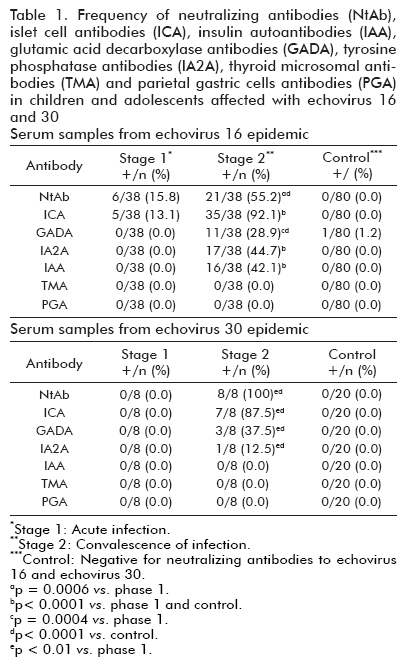
<body><![CDATA[<P   ><font face="Verdana, Arial, Helvetica, sans-serif" size="2"><b>Enterovirus RNA      in serum of children with newly diagnosed T1DM and islet cell autoantibody-positive      subjects</b> </font></P >       <P   ><font face="Verdana, Arial, Helvetica, sans-serif" size="2">Enterovirus genome      detection was carried out using a Reverse Transcriptase-Nested Polymerase      Chain Reaction assay of serum specimens from: (I) 34 children at T1DM onset,      (II) 32 ICA positive T1DM first-degree relatives, (III) 31 ICA negative T1DM      first-de-gree relatives and (IV) 194 healthy subjects who were verified negative      for ICA and had no family history of diabetes. Two control sera were matched      with each serum from group I, II and III for age, sex, date of collection      and location. Urianalysis for the detection of ketones was performed on samples      from children with newly diagnosed T1DM at initial presentation, prior to      the administration of insulin. Severe diabetic ketoacidosis was defined as      pH, 7.1 and bicarbonate, 5 mmol/L (8). </font></P >       <P   ><font face="Verdana, Arial, Helvetica, sans-serif" size="2"><b>Antibodies to      human glutamic acid decarboxylase in sera from enterovirus-immunized rabbit</b>      </font></P >       <P   ><font face="Verdana, Arial, Helvetica, sans-serif" size="2">Enterovirus antisera      were prepared by immunizing New Zealand white rabbit with enteroviral antigens      obtained from 17 strains of enterovirus serotypes most frequently isolated      during the last 30 years in Cuba (Echoviruses: E1, E2, E3, E4, E6, E9, E11,      E16, E30 and Coxsackieviruses: CVA7, CVA9, CVA16, CVA24,CVB1, CVB3, CVB5,      CVB6). Antigens from moninoculated cells where utilized as negative controls.      Rabbit sera were screened for three human islet autoantigens: GADA, IAA and      IA2A using international workshop-validated assays (9). </font></P >       <P   ><font face="Verdana, Arial, Helvetica, sans-serif" size="2"><b>Statistical Analysis      </b> </font></P >       <P   ><font face="Verdana, Arial, Helvetica, sans-serif" size="2">Statistical differences      of frequencies among groups were analyzed by the Chi-square or Fisher&rsquo;s      exact test. A p value of less than 0.05 was considered to be statistically      significant. </font></P >       <P   ><font face="Verdana, Arial, Helvetica, sans-serif" size="3"><b>RESULTS</b></font></P >   <FONT size="+1">        <P   ><font size="2" face="Verdana, Arial, Helvetica, sans-serif"><b>Type 1 diabetes      islet associated antibodies in subjects infected by echovirus 16 and echovirus      30 </b> </font></P >   <FONT size="+1">        <P   ><font face="Verdana, Arial, Helvetica, sans-serif" size="2">Notably, in the convalescent      (but not the acute stage of the infection), ICA seroconversion was demonstrated,      as well as the emergence of IAA and GADA and IA2A concentrations. The islet      cell autoimmunity is clearly epidemic and infection-associated, since no serum      samples from uninfected subjects serologically negative for neutralizing antibodies      to E16 and E30 had ICA, and only one was GADA positive (similar to reported      background population prevalence of GADA). The presence of T1DM islet associated      antibodies in subjects does not seem to reflect a general response of autoantibodies      since none of the serum samples obtained during the infection were positive      for TMA or PGA (<a href="#tab1">Table 1</a>). </font></P >       <P align="center"   ><img src="/img/revistas/bta/v26n4/t0112409.jpg" width="407" height="668"><a name="tab1"></a></P >       
]]></body>
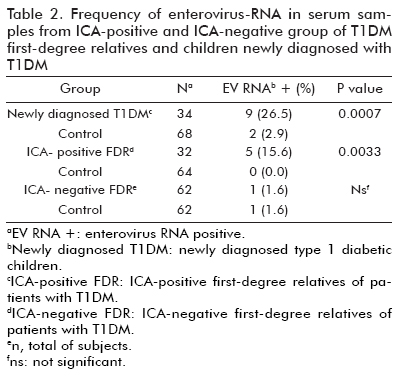
<body><![CDATA[<P   > </P >       <P   ><font face="Verdana, Arial, Helvetica, sans-serif" size="2">Only a patient who      developed pancreatic autoimmunity and T1DM after E30 epidemic was reported.      After the meningitis episode this patient gained 5 kg of weight in the subsequent      6 months. Eight months after the infection the subject started to show symptoms      suggesting diabetes such as polyuria, polydipsia, increased appetite and weight      lost (3 kg). At this period, fasting and postprandial blood glucose concentrations      were 12.1 and 18.9 mmol/L, respectively. ICA and IA2A were detected post-infection      in the adolescent with newly diagnosed T1DM. In addition, the analysis of      neutralizing antibodies to enterovirus serotypes most frequently isolated      during the last 30 years in Cuba showed high titres of neutralizing antibodies      only to E30 (1:80) suggesting that this virus was the agent who caused the      aseptic meningitis. However, the adolescent was found to carry the HLA DR      15(DR2)/DR7 and DQ 2/DQ6 (DQ1) genotype which is not associated with an increased      risk for T1DM. </font></P >       <P   ><font face="Verdana, Arial, Helvetica, sans-serif" size="2"><b>Enterovirus RNA      in serum of children with newly diagnosed T1DM and islet cell autoantibody-positive      subjects </b></font></P >       <P   ><font face="Verdana, Arial, Helvetica, sans-serif" size="2">The rate of enterovirus      sequences detection in newly diagnosed T1DM children (9/34, 26.5%) and ICA-positive      first-degree relatives (5/32, 15.6%) was significantly higher than their corresponding      matched controls (2/68, 2.9%, p = 0.0007 and 0/64, 0.0%, p = 0.0033, respectively).      There was no significant difference in the frequency of enterovirus RNA detection      between ICA-negative T1DM first degree relatives and their matched-controls      (1.6%, 1 out of 62 <I>vs. </I>1.6%, 1 out of 62) (<a href="#tab2">Table 2</a>).</font></P >       <P align="center"   ><img src="/img/revistas/bta/v26n4/t0212409.jpg" width="403" height="379"><a name="tab2"></a></P >       
<P   ><font face="Verdana, Arial, Helvetica, sans-serif" size="2">Interestingly, subjects      at T1DM onset with occurrence of enterovirus RNA were more likely to suffer      severe diabetic ketoacidosis (66.6%, 6 out of 9 <I>vs. </I>20.0%, 5 out of      25; p = 0.0328). However, the presence of ketosis and mild diabetic ketoacidosis      at diagnosis of T1DM was equally distributed among positive and negative subjects      for enterovirus RNA. </font></P >       <P   ><font face="Verdana, Arial, Helvetica, sans-serif" size="2"><b>Antibodies to      human glutamic acid decarboxylase in sera from enterovirus-immunized rabbit</b>      </font></P >       <P   ><font face="Verdana, Arial, Helvetica, sans-serif" size="2">Our results revealed      the presence of antibodies to &beta;-cell autoantigen glutamic acid decarboxylase      (GAD 65) in the hyperimmune rabbit sera immunized with E9, E11, E16, E30,      CVB1, CVB3 and CVB5. IAA or IA2A were not detected in any of the sera studied.      Sera from rabbits immunized with negative control antigen preparations were      negative for the three islet-related autoantibodies. </font></P >       <P   ><font face="Verdana, Arial, Helvetica, sans-serif" size="2"><b><font size="3">RELEVANCE      OF THE STUDY</font></b> </font></P >   <FONT size="+1">        <P   ><font size="2" face="Verdana, Arial, Helvetica, sans-serif">The opportunistic      study of enterovirus epidemics in Cuba and their relationship to islet cell      autoimmunity and T1DM showed that various types of enterovirus were associated      with a varying degree in the acute development of islet cell autoimmunity.      Thus, our fin-dings provide the first evidence of association of E16 and E30      with the appearance of pancreatic autoimmunity worldwide and suggest that      the induction of islet cell associated antibodies seems to occur right after      episodes of enterovirus infections. </font></P >   <FONT size="+1">        ]]></body>
<body><![CDATA[<P   ><font face="Verdana, Arial, Helvetica, sans-serif" size="2">Moreover, the epidemic      echovirus strains showed subtle differences in the nature of the islet cell      autoimmunity they induced. The isolation of viruses with proven but varying      potency in their ability to induce islet autoimmunity in man suggests that      there is heterogeneity of the immune response against &beta;-cell antigens      after echovirus infection. </font></P >       <P   ><font face="Verdana, Arial, Helvetica, sans-serif" size="2">Our results indicate      a strong temporal relationship between islet autoantibodies and exposure to      echovirus, and prompt further important questions, such as the longevity of      post-echovirus islet autoimmunity or whether the autoimmune response is transient      and wanes. Although, no follow-up of these children for diabetes has been      done, we predict that the post-echovirus islet autoimmunity detected in the      original epidemics will not show persistence, and it is unlikely to cause      T1DM onset. This assertion is based on the fact that T1DM incidence in Cuba      is low (3/100.000) (4). Thus, while &beta;-cell autoimmunity may be triggered      in anyone, the HLA genes may be crucial for progression from autoimmunity      to T1DM. </font></P >       <P   ><font face="Verdana, Arial, Helvetica, sans-serif" size="2">It is worth noting      that the present study has shown a significantly higher frequency of enterovirus      RNA in serum from T1DM children at the onset of disease, as well as in ICA      positive first-degree relatives compa-red to healthy control subjects and      ICA negative first-degree relatives. It suggests that enterovirus infection      is associated with T1DM onset and &beta;-cell autoimmunity in subjects at      risk of developing T1DM. However, the emergence of pancreatic autoimmunity      and T1DM after meningitis infection by E30 in adolescent ca-rrying specific      low-risk genotypes for T1DM suggests that enterovirus can contribute to the      development of T1DM in subject with a low genetic risk. </font></P >       <P   ><font face="Verdana, Arial, Helvetica, sans-serif" size="2">The high occurrence      of severe diabetic ketoacidosis at onset in subjects with enterovirus RNA-positive      suggests that enteroviruses may cause direct cytolytic damage against &beta;-cells      rather than a chronic autoimmune process. However, destruction of pancreatic      &beta;-cells by a virus-directed immune response against infected &beta;-cells      should not be excluded since an association between the presence of enterovirus      infection and the occurrence of islet related autoantibodies without diabetes      was also found. Indeed, the presence of GADA in sera from enterovirus-immunized      rabbits suggests the existence of common determinants among enterovirus serotypes      and the human &beta;-cell autoantigen GAD 65 and support the hypothesis that      molecular mimicry is a possible mechanism involved in the development of &beta;-cell      autoimmunity induced by enteroviruses. </font></P >       <P   ><font face="Verdana, Arial, Helvetica, sans-serif" size="2"><b><font size="3">CONCLUSIONS</font></b></font></P >   <FONT size="+1">        <P   ><font size="2" face="Verdana, Arial, Helvetica, sans-serif">Our findings suggest      that enterovirus infections are associated with T1DM onset and &beta;-cell      autoimmunity in populations with low incidence of diabetes and high enteroviral      circulation and are in agreement with the idea that the molecular mimicry      and direct cytolytic damage against &beta; -cells are possible mechanisms      involved in the development of &beta; -cell autoimmunity induced by enteroviruses.      </font></P >   <FONT size="+1">        <P   ><font face="Verdana, Arial, Helvetica, sans-serif" size="2">If enteroviruses      associate with T1DM: How could a low incidence of T1DM coexisting with a high      circulation of enteroviruses be explained in the Cuban situation? </font></P >       <P   ><font face="Verdana, Arial, Helvetica, sans-serif" size="2">Two different, yet      non-mutually, exclusive hypotheses could explain this paradox. Firstly, the      genetic T1DM susceptibility background within populations (Differences in      high risk HLA prevalence and other genetic loci). This points out the possibility      that enterovirus infection could be &ldquo;more dangerous&rdquo; with regard      to the diabetogenic potential in those populations carrying specific high-risk      genotypes. Probably the low frequency of T1DM susceptibility genes in Cuban      population (10) could justify the low incidence of T1DM although enterovirus      infections are highly prevalent in Cuba (11). Secondly, the so-called &ldquo;Hygiene      Hypothesis&rdquo; according to which reduced rate of infection contributes      to increased T1DM incidence (12). Thus, the more the population is exposed      to enteroviruses (<I>e.g</I>. Cuba) the higher the probability to be immunized      against subsequent &ldquo;diabetogenic&rdquo; strain exposition. The other      way around also occurs in the European population in which a low frequency      of enterovirus infections in the background population would increase the      susceptibility of young children to the diabetogenic effect of such viruses.      </font></P >       <P   ><font face="Verdana, Arial, Helvetica, sans-serif" size="2">In conclusion, although      direct proof for enteroviruses as causative agents for T1DM is difficult to      verify, our findings support the role of enterovirus in the pathogenesis of      T1DM and its confirmation might contribute to the development of preventive      strategies in the T1DM. </font></P >       <P   > </P >       ]]></body>
<body><![CDATA[<P   ><font size="3"><b><font face="Verdana, Arial, Helvetica, sans-serif">REFERENCES</font></b></font><font face="Verdana, Arial, Helvetica, sans-serif" size="2">      </font></P >       <P   > </P >       <!-- ref --><P   ><font size="2" face="Verdana, Arial, Helvetica, sans-serif">1. Haller MJ, Atkinson      MA, Schatz D. Type 1 diabetes mellitus: Etiology, presentation, and management.      Pediatr Clin N Am 2005;52:1553-78.     </font></P >   <FONT size="+1">        <!-- ref --><P   ><font face="Verdana, Arial, Helvetica, sans-serif" size="2">2. Rewers M, Norris      J, Dabelea D. Epidemiology of type 1 diabetes. In: George S Eisenbarth, ed.      Immunology of type 1 diabetes. New York: Eurekah.com and Kluwer Academic/      Plenum Publishers;2004, p. 219-46.     </font></P >       <!-- ref --><P   ><font face="Verdana, Arial, Helvetica, sans-serif" size="2">3. Sarmiento L. Enterovirus      - Induced Type 1 Diabetes. In: Luis Sarmiento-P&eacute;rez and Eduardo Cabrera-Rode      (editors). Enterovirus infections and type 1 Diabetes Mellitus. New York:      Nova Science Publishers; 2007,p.125-65.     </font></P >       <!-- ref --><P   ><font face="Verdana, Arial, Helvetica, sans-serif" size="2">4. Collado F, D&iacute;az      O, Hern&aacute;ndez I. Epidemiologic behaviour of insulin dependent diabetes      mellitus in children younger than 15 years of old. Cuba, 1990-1993. Rev Cub      Endocrinol 1993;8:119-25.     </font></P >       ]]></body>
<body><![CDATA[<P   ><font face="Verdana, Arial, Helvetica, sans-serif" size="2">5. Sarmiento L. Enteroviral      meningitis and emergence of rare enterovirus types: Cuban experience&rdquo;,      In: Strong P (editor), Focus on Meningitis Research, (Nova Science Publishers,      New York), 2004, p.1-14. </font></P >       <!-- ref --><P   ><font face="Verdana, Arial, Helvetica, sans-serif" size="2">6. Cabrera-Rode E,      Sarmiento L, Tiberti C, Molina G, Barrios J. Hernandez D, et al. Type 1 diabetes      islet associated antibodies in subject infected by echovirus 16. Diabe-tologia      2003; 46(10):1348-53.     </font></P >       <!-- ref --><P   ><font face="Verdana, Arial, Helvetica, sans-serif" size="2">7. Cabrera-Rode E,      Sarmiento L, Molina G, P&eacute;rez C, Arranz C, Galvan J, et al. Islet cell      related antibodies and Type 1 diabe-tes associated with echovirus 30 Epide-mic:      A case report. J Med Virol 2005;76(3): 373-7.     </font></P >       <!-- ref --><P   ><font face="Verdana, Arial, Helvetica, sans-serif" size="2">8. Sarmiento L, Cabrera-Rode      E, Lekuleni L, Cuba I, Molina G, Fonseca M, et al. Occurrence of enterovirus      RNA in serum of children with newly diagnosed type 1 diabetes and islet cell      autoantibody-positive subjects in a population with incidence of type 1 diabetes.      Autoimmunity 2007; 40(7):540-5.     </font></P >       <!-- ref --><P   ><font face="Verdana, Arial, Helvetica, sans-serif" size="2">9. Sarmiento L, Cabrera-Rode      E, Mas P, D&iacute;az-Horta O. Antibodies to human glutamic acid decarboxylase      in sera from enterovirus-Immunized Rabbit. Autoimmunity 2007;40(7):546-7.          </font></P >       <!-- ref --><P   ><font face="Verdana, Arial, Helvetica, sans-serif" size="2">10. Alegre R, Moscoso      J, Martinez-Laso J, Martin-Villa M, Suarez J, Moreno A, et al. HLA genes in      Cubans and the detection of Amerindian alleles. Mol Immunol 2007;44:2426-35.          </font></P >       <!-- ref --><P   ><font face="Verdana, Arial, Helvetica, sans-serif" size="2">11. Sarmiento L.      Human enterovirus in-fections. In: Luis Sarmiento-P&eacute;rez and Eduardo      Cabrera-Rode (editors). Entero-virus Infections and Type 1 Diabetes Mellitus.      New York: Nova Science Publishers; 2007, p.93-123.     </font></P >       <!-- ref --><P   ><font face="Verdana, Arial, Helvetica, sans-serif" size="2">12. Hintermann E      , Christen U. Viral infection - A cure for type 1 diabetes? Curr Med Chem      2007;14:2048-52.    </font></P >       <P   >&nbsp;</P >       <P   > </P >   <FONT size="+1">        <P   ><font size="2" face="Verdana, Arial, Helvetica, sans-serif">Luis Sarmiento. Department      of Virology, &ldquo;Pedro Kour&iacute;&rdquo; Tropical Medicine Institute,      IPK, Havana, Cuba. E-mail: <A href="mailto:sarmiento@ipk.sld.cu"> <U><U><FONT color="#0000FF">sarmiento@ipk.sld.cu</font></U></U></A>      </font></P >   <FONT size="+1"><FONT size="+1"><FONT color="#0000FF"><FONT color="#000000">        <P   > </P >   </font></font></font></font></font></font></font></font></font></font></font></font></font></font></font></font></font></font></font></font></font></font></font></font></font></font></font></font></font></font></font></font></font></font></font></font></font></font></font></font></font></font></DIV >      ]]></body><back>
<ref-list>
<ref id="B1">
<label>1</label><nlm-citation citation-type="journal">
<person-group person-group-type="author">
<name>
<surname><![CDATA[Haller]]></surname>
<given-names><![CDATA[MJ]]></given-names>
</name>
<name>
<surname><![CDATA[Atkinson]]></surname>
<given-names><![CDATA[MA]]></given-names>
</name>
<name>
<surname><![CDATA[Schatz]]></surname>
<given-names><![CDATA[D]]></given-names>
</name>
</person-group>
<article-title xml:lang="en"><![CDATA[Type 1 diabetes mellitus: Etiology, presentation, and management]]></article-title>
<source><![CDATA[Pediatr Clin N Am]]></source>
<year>2005</year>
<volume>52</volume>
<page-range>1553-78</page-range></nlm-citation>
</ref>
<ref id="B2">
<label>2</label><nlm-citation citation-type="book">
<person-group person-group-type="author">
<name>
<surname><![CDATA[Rewers]]></surname>
<given-names><![CDATA[M]]></given-names>
</name>
<name>
<surname><![CDATA[Norris]]></surname>
<given-names><![CDATA[J]]></given-names>
</name>
<name>
<surname><![CDATA[Dabelea]]></surname>
<given-names><![CDATA[D]]></given-names>
</name>
</person-group>
<article-title xml:lang="en"><![CDATA[Epidemiology of type 1 diabetes]]></article-title>
<person-group person-group-type="editor">
<name>
<surname><![CDATA[Eisenbarth]]></surname>
<given-names><![CDATA[George S]]></given-names>
</name>
</person-group>
<source><![CDATA[Immunology of type 1 diabetes]]></source>
<year>2004</year>
<page-range>219-46</page-range><publisher-loc><![CDATA[New York ]]></publisher-loc>
<publisher-name><![CDATA[Eurekah.comKluwer Academic/ Plenum]]></publisher-name>
</nlm-citation>
</ref>
<ref id="B3">
<label>3</label><nlm-citation citation-type="book">
<person-group person-group-type="author">
<name>
<surname><![CDATA[Sarmiento]]></surname>
<given-names><![CDATA[L]]></given-names>
</name>
</person-group>
<article-title xml:lang="en"><![CDATA[Enterovirus - Induced Type 1 Diabetes]]></article-title>
<person-group person-group-type="editor">
<name>
<surname><![CDATA[Sarmiento-Pérez]]></surname>
<given-names><![CDATA[Luis]]></given-names>
</name>
<name>
<surname><![CDATA[Cabrera-Rode]]></surname>
<given-names><![CDATA[Eduardo]]></given-names>
</name>
</person-group>
<source><![CDATA[Enterovirus infections and type 1 Diabetes Mellitus]]></source>
<year>2007</year>
<page-range>125-65</page-range><publisher-loc><![CDATA[New York ]]></publisher-loc>
<publisher-name><![CDATA[Nova Science]]></publisher-name>
</nlm-citation>
</ref>
<ref id="B4">
<label>4</label><nlm-citation citation-type="journal">
<person-group person-group-type="author">
<name>
<surname><![CDATA[Collado]]></surname>
<given-names><![CDATA[F]]></given-names>
</name>
<name>
<surname><![CDATA[Díaz]]></surname>
<given-names><![CDATA[O]]></given-names>
</name>
<name>
<surname><![CDATA[Hernández]]></surname>
<given-names><![CDATA[I]]></given-names>
</name>
</person-group>
<article-title xml:lang="en"><![CDATA[Epidemiologic behaviour of insulin dependent diabetes mellitus in children younger than 15 years of old: Cuba, 1990-1993]]></article-title>
<source><![CDATA[Rev Cub Endocrinol]]></source>
<year>1993</year>
<volume>8</volume>
<page-range>119-25</page-range></nlm-citation>
</ref>
<ref id="B5">
<label>5</label><nlm-citation citation-type="book">
<person-group person-group-type="author">
<name>
<surname><![CDATA[Sarmiento]]></surname>
<given-names><![CDATA[L]]></given-names>
</name>
</person-group>
<article-title xml:lang="en"><![CDATA[Enteroviral meningitis and emergence of rare enterovirus types: Cuban experience]]></article-title>
<person-group person-group-type="editor">
<name>
<surname><![CDATA[Strong]]></surname>
<given-names><![CDATA[P]]></given-names>
</name>
</person-group>
<source><![CDATA[Focus on Meningitis Research]]></source>
<year>2004</year>
<page-range>1-14</page-range><publisher-loc><![CDATA[New York ]]></publisher-loc>
<publisher-name><![CDATA[Nova Science]]></publisher-name>
</nlm-citation>
</ref>
<ref id="B6">
<label>6</label><nlm-citation citation-type="journal">
<person-group person-group-type="author">
<name>
<surname><![CDATA[Cabrera-Rode]]></surname>
<given-names><![CDATA[E]]></given-names>
</name>
<name>
<surname><![CDATA[Sarmiento]]></surname>
<given-names><![CDATA[L]]></given-names>
</name>
<name>
<surname><![CDATA[Tiberti]]></surname>
<given-names><![CDATA[C]]></given-names>
</name>
<name>
<surname><![CDATA[Molina]]></surname>
<given-names><![CDATA[G]]></given-names>
</name>
<name>
<surname><![CDATA[Barrios]]></surname>
<given-names><![CDATA[J]]></given-names>
</name>
</person-group>
<article-title xml:lang="en"><![CDATA[Hernandez D, et al: Type 1 diabetes islet associated antibodies in subject infected by echovirus 16]]></article-title>
<source><![CDATA[Diabetologia]]></source>
<year>2003</year>
<volume>46</volume>
<numero>10</numero>
<issue>10</issue>
<page-range>1348-53</page-range></nlm-citation>
</ref>
<ref id="B7">
<label>7</label><nlm-citation citation-type="journal">
<person-group person-group-type="author">
<name>
<surname><![CDATA[Cabrera-Rode]]></surname>
<given-names><![CDATA[E]]></given-names>
</name>
<name>
<surname><![CDATA[Sarmiento]]></surname>
<given-names><![CDATA[L]]></given-names>
</name>
<name>
<surname><![CDATA[Molina]]></surname>
<given-names><![CDATA[G]]></given-names>
</name>
<name>
<surname><![CDATA[Pérez]]></surname>
<given-names><![CDATA[C]]></given-names>
</name>
<name>
<surname><![CDATA[Arranz]]></surname>
<given-names><![CDATA[C]]></given-names>
</name>
<name>
<surname><![CDATA[Galvan]]></surname>
<given-names><![CDATA[J]]></given-names>
</name>
</person-group>
<article-title xml:lang="en"><![CDATA[Islet cell related antibodies and Type 1 diabetes associated with echovirus 30 Epidemic: A case report]]></article-title>
<source><![CDATA[J Med Virol]]></source>
<year>2005</year>
<volume>76</volume>
<numero>3</numero>
<issue>3</issue>
<page-range>373-7</page-range></nlm-citation>
</ref>
<ref id="B8">
<label>8</label><nlm-citation citation-type="journal">
<person-group person-group-type="author">
<name>
<surname><![CDATA[Sarmiento]]></surname>
<given-names><![CDATA[L]]></given-names>
</name>
<name>
<surname><![CDATA[Cabrera-Rode]]></surname>
<given-names><![CDATA[E]]></given-names>
</name>
<name>
<surname><![CDATA[Lekuleni]]></surname>
<given-names><![CDATA[L]]></given-names>
</name>
<name>
<surname><![CDATA[Cuba]]></surname>
<given-names><![CDATA[I]]></given-names>
</name>
<name>
<surname><![CDATA[Molina]]></surname>
<given-names><![CDATA[G]]></given-names>
</name>
<name>
<surname><![CDATA[Fonseca]]></surname>
<given-names><![CDATA[M]]></given-names>
</name>
</person-group>
<article-title xml:lang="en"><![CDATA[Occurrence of enterovirus RNA in serum of children with newly diagnosed type 1 diabetes and islet cell autoantibody-positive subjects in a population with incidence of type 1 diabetes]]></article-title>
<source><![CDATA[Autoimmunity]]></source>
<year>2007</year>
<volume>40</volume>
<numero>7</numero>
<issue>7</issue>
<page-range>540-5</page-range></nlm-citation>
</ref>
<ref id="B9">
<label>9</label><nlm-citation citation-type="journal">
<person-group person-group-type="author">
<name>
<surname><![CDATA[Sarmiento]]></surname>
<given-names><![CDATA[L]]></given-names>
</name>
<name>
<surname><![CDATA[Cabrera-Rode]]></surname>
<given-names><![CDATA[E]]></given-names>
</name>
<name>
<surname><![CDATA[Mas]]></surname>
<given-names><![CDATA[P]]></given-names>
</name>
<name>
<surname><![CDATA[Díaz-Horta]]></surname>
<given-names><![CDATA[O]]></given-names>
</name>
</person-group>
<article-title xml:lang="en"><![CDATA[Antibodies to human glutamic acid decarboxylase in sera from enterovirus-Immunized Rabbit]]></article-title>
<source><![CDATA[Autoimmunity]]></source>
<year>2007</year>
<volume>40</volume>
<numero>7</numero>
<issue>7</issue>
<page-range>546-7</page-range></nlm-citation>
</ref>
<ref id="B10">
<label>10</label><nlm-citation citation-type="journal">
<person-group person-group-type="author">
<name>
<surname><![CDATA[Alegre]]></surname>
<given-names><![CDATA[R]]></given-names>
</name>
<name>
<surname><![CDATA[Moscoso]]></surname>
<given-names><![CDATA[J]]></given-names>
</name>
<name>
<surname><![CDATA[Martinez-Laso]]></surname>
<given-names><![CDATA[J]]></given-names>
</name>
<name>
<surname><![CDATA[Martin-Villa]]></surname>
<given-names><![CDATA[M]]></given-names>
</name>
<name>
<surname><![CDATA[Suarez]]></surname>
<given-names><![CDATA[J]]></given-names>
</name>
<name>
<surname><![CDATA[Moreno]]></surname>
<given-names><![CDATA[A]]></given-names>
</name>
</person-group>
<article-title xml:lang="en"><![CDATA[HLA genes in Cubans and the detection of Amerindian alleles]]></article-title>
<source><![CDATA[Mol Immunol]]></source>
<year>2007</year>
<volume>44</volume>
<page-range>2426-35</page-range></nlm-citation>
</ref>
<ref id="B11">
<label>11</label><nlm-citation citation-type="book">
<person-group person-group-type="author">
<name>
<surname><![CDATA[Sarmiento]]></surname>
<given-names><![CDATA[L]]></given-names>
</name>
</person-group>
<article-title xml:lang="en"><![CDATA[Human enterovirus infections]]></article-title>
<person-group person-group-type="editor">
<name>
<surname><![CDATA[Sarmiento-Pérez]]></surname>
<given-names><![CDATA[Luis]]></given-names>
</name>
<name>
<surname><![CDATA[Cabrera-Rode]]></surname>
<given-names><![CDATA[Eduardo]]></given-names>
</name>
</person-group>
<source><![CDATA[Enterovirus Infections and Type 1 Diabetes Mellitus]]></source>
<year>2007</year>
<page-range>93-123</page-range><publisher-loc><![CDATA[New York ]]></publisher-loc>
<publisher-name><![CDATA[Nova Science]]></publisher-name>
</nlm-citation>
</ref>
<ref id="B12">
<label>12</label><nlm-citation citation-type="journal">
<person-group person-group-type="author">
<name>
<surname><![CDATA[Hintermann]]></surname>
<given-names><![CDATA[E]]></given-names>
</name>
<name>
<surname><![CDATA[Christen]]></surname>
<given-names><![CDATA[U]]></given-names>
</name>
</person-group>
<article-title xml:lang="en"><![CDATA[Viral infection - A cure for type 1 diabetes?]]></article-title>
<source><![CDATA[Curr Med Chem]]></source>
<year>2007</year>
<volume>14</volume>
<page-range>2048-52</page-range></nlm-citation>
</ref>
</ref-list>
</back>
</article>