<?xml version="1.0" encoding="ISO-8859-1"?><article xmlns:mml="http://www.w3.org/1998/Math/MathML" xmlns:xlink="http://www.w3.org/1999/xlink" xmlns:xsi="http://www.w3.org/2001/XMLSchema-instance">
<front>
<journal-meta>
<journal-id>1027-2852</journal-id>
<journal-title><![CDATA[Biotecnología Aplicada]]></journal-title>
<abbrev-journal-title><![CDATA[Biotecnol Apl]]></abbrev-journal-title>
<issn>1027-2852</issn>
<publisher>
<publisher-name><![CDATA[Editorial Elfos Scientiae]]></publisher-name>
</publisher>
</journal-meta>
<article-meta>
<article-id>S1027-28522010000200003</article-id>
<title-group>
<article-title xml:lang="en"><![CDATA[Heberprot-P-associated metabolic control in patients with diabetic foot ulcers]]></article-title>
<article-title xml:lang="es"><![CDATA[El control metabólico del paciente con úlceras del pie diabético asociado al uso de Heberprot-P]]></article-title>
</title-group>
<contrib-group>
<contrib contrib-type="author">
<name>
<surname><![CDATA[Álvarez]]></surname>
<given-names><![CDATA[Eduardo]]></given-names>
</name>
<xref ref-type="aff" rid="A01"/>
</contrib>
<contrib contrib-type="author">
<name>
<surname><![CDATA[Faget]]></surname>
<given-names><![CDATA[Orestes L]]></given-names>
</name>
<xref ref-type="aff" rid="A01"/>
</contrib>
<contrib contrib-type="author">
<name>
<surname><![CDATA[Orlandi]]></surname>
<given-names><![CDATA[Neraldo]]></given-names>
</name>
<xref ref-type="aff" rid="A01"/>
</contrib>
<contrib contrib-type="author">
<name>
<surname><![CDATA[Torres]]></surname>
<given-names><![CDATA[Omaida F]]></given-names>
</name>
<xref ref-type="aff" rid="A02"/>
</contrib>
</contrib-group>
<aff id="A02">
<institution><![CDATA[,Hospital Universitario Julio Trigo López Departamento de Endocrinología ]]></institution>
<addr-line><![CDATA[La Habana ]]></addr-line>
<country>Cuba</country>
</aff>
<aff id="A01">
<institution><![CDATA[,Instituto Nacional de Endocrinología (INEN) Centro de Atención al Diabético (CAD) ]]></institution>
<addr-line><![CDATA[Ciudad de La Habana ]]></addr-line>
<country>Cuba</country>
</aff>
<pub-date pub-type="pub">
<day>00</day>
<month>06</month>
<year>2010</year>
</pub-date>
<pub-date pub-type="epub">
<day>00</day>
<month>06</month>
<year>2010</year>
</pub-date>
<volume>27</volume>
<numero>2</numero>
<fpage>98</fpage>
<lpage>100</lpage>
<copyright-statement/>
<copyright-year/>
<self-uri xlink:href="http://scielo.sld.cu/scielo.php?script=sci_arttext&amp;pid=S1027-28522010000200003&amp;lng=en&amp;nrm=iso"></self-uri><self-uri xlink:href="http://scielo.sld.cu/scielo.php?script=sci_abstract&amp;pid=S1027-28522010000200003&amp;lng=en&amp;nrm=iso"></self-uri><self-uri xlink:href="http://scielo.sld.cu/scielo.php?script=sci_pdf&amp;pid=S1027-28522010000200003&amp;lng=en&amp;nrm=iso"></self-uri><abstract abstract-type="short" xml:lang="en"><p><![CDATA[Diabetes mellitus is a unmet medical need of significant social and economical impact. Diabetic foot is a chronic and avoidable complication, and still the source of non-traumatic amputations, with metabolic imbalance, macroand micro-angiopathy, and ulceration or trauma contributing to its development. The introduction of Heberprot-P to treat diabetic foot ulcers has been a tremendous advance to reduce the amputation index and disability among patients. However, it is essential to guarantee an optimal and personalized glycemic control for achieving even more favorable results. This can be attained by implementing an intensive therapeutic strategy with multiple doses of insulin since the very first diagnose of the lesion. Due to the relevance of this topic for medical practice, here is reviewed how to establish such a therapy, and the goals for glycemic control to achieve a better quality of life when attending diabetic foot ulcer patients.]]></p></abstract>
<abstract abstract-type="short" xml:lang="es"><p><![CDATA[La diabetes mellitus constituye un problema sanitario con una importante repercusión social y económica. El pie diabético es una complicación crónica prevenible y aún es la causa de la mayoría de las amputaciones no traumáticas; el descontrol metabólico, la macro y la microangiopatía, y la ulceración o trauma, contribuyen a su desarrollo. La introducción del Heberprot-P para el tratamiento de la úlcera del pie diabético ha sido un formidable avance en la reducción del índice de amputaciones y discapacidad de estas personas. Sin embargo, para percibir resultados más favorables, es imprescindible garantizar un control glucémico óptimo e individualizado mediante el uso de la terapéutica intensiva con múltiples dosis de insulina desde el diagnóstico de la lesión. Por la importancia de este tema para la práctica médica, se hace una revisión acerca de cómo establecer esta terapia, así como las metas del control glucémico, con vistas a una mejor calidad en la atención a los pacientes con úlceras del pie diabético.]]></p></abstract>
<kwd-group>
<kwd lng="en"><![CDATA[Diabetes mellitus]]></kwd>
<kwd lng="en"><![CDATA[diabetic foot]]></kwd>
<kwd lng="en"><![CDATA[glycemic control]]></kwd>
<kwd lng="en"><![CDATA[metabolic control]]></kwd>
<kwd lng="en"><![CDATA[Heberprot-P]]></kwd>
<kwd lng="es"><![CDATA[Diabetes mellitus]]></kwd>
<kwd lng="es"><![CDATA[pie diabético]]></kwd>
<kwd lng="es"><![CDATA[control glucémico]]></kwd>
<kwd lng="es"><![CDATA[control metabólico]]></kwd>
<kwd lng="es"><![CDATA[Heberprot-P]]></kwd>
</kwd-group>
</article-meta>
</front><body><![CDATA[ <DIV class="Sect"   >        <P align="right"   ><font size="2" color="#000000" face="Verdana, Arial, Helvetica, sans-serif"><b>REVIEW</b>      </font></P >       <P align="right"   >&nbsp;</P >   <FONT size="+1" color="#000000">        <P   > </P >       <P   ><b><font size="4" face="Verdana, Arial, Helvetica, sans-serif">Heberprot-P-associated      metabolic control in patients with diabetic foot ulcers</font></b><font size="2" face="Verdana, Arial, Helvetica, sans-serif"><B><I>      </I></b></font></P >       <P   >&nbsp;</P >       <P   ><font size="3" face="Verdana, Arial, Helvetica, sans-serif"><b>El control metab&oacute;lico      del paciente con &uacute;lceras del pie diab&eacute;tico asociado al uso de      Heberprot-P</b></font></P >       <P   >&nbsp;</P >       <P   >&nbsp;</P >       <P   ><font size="2" face="Verdana, Arial, Helvetica, sans-serif"><b>Eduardo &Aacute;lvarez<sup>1</sup>,      Orestes L Faget<sup>1</sup>, Neraldo Orlandi<sup>1</sup>, Omaida F Torres<sup>2</sup></b>      </font></P >   <FONT size="+1"><FONT size="+1"><FONT size="+1"><FONT size="+1"><FONT size="+1"><FONT size="+1"><FONT size="+1"><FONT size="+1"><FONT size="+1"><FONT size="+1"><FONT size="+1">        ]]></body>
<body><![CDATA[<P   ><font size="2" face="Verdana, Arial, Helvetica, sans-serif">1 Centro de Atenci&oacute;n      al Diab&eacute;tico (CAD). Instituto Nacional de Endocrinolog&iacute;a (INEN)      Calle Zapata esquina D, Vedado, Plaza, Ciudad de La Habana, Cuba<FONT color="#0000FF"><FONT color="#000000">    <br>     2 Departamento de Endocrinolog&iacute;a del Hospital Universitario &quot;Julio      Trigo L&oacute;pez&quot; Calzada de Bejucal Km 7&frac12;, La Esperanza, Arroyo      Naranjo, La Habana, Cuba </font></font></font></P >       <P   >&nbsp;</P >   </font></font></font></font></font></font></font></font></font></font></font></font>   <hr>   <FONT size="+1" color="#000000"><FONT size="+1"><FONT size="+1"><FONT size="+1"><FONT size="+1"><FONT size="+1"><FONT size="+1"><FONT size="+1"><FONT size="+1"><FONT size="+1"><FONT size="+1"><FONT size="+1">        <P   ><font face="Verdana, Arial, Helvetica, sans-serif" size="2"><b>ABSTRACT</b></font></P >   <FONT size="+1"><FONT size="+1"><FONT color="#0000FF"><FONT color="#000000"><FONT size="+1"><FONT size="+1">        <P   ><font face="Verdana, Arial, Helvetica, sans-serif" size="2">Diabetes mellitus      is a unmet medical need of significant social and economical impact. Diabetic      foot is a chronic and avoidable complication, and still the source of non-traumatic      amputations, with metabolic imbalance, macroand micro-angiopathy, and ulceration      or trauma contributing to its development. The introduction of Heberprot-P      to treat diabetic foot ulcers has been a tremendous advance to reduce the      amputation index and disability among patients. However, it is essential to      guarantee an optimal and personalized glycemic control for achieving even      more favorable results. This can be attained by implementing an intensive      therapeutic strategy with multiple doses of insulin since the very first diagnose      of the lesion. Due to the relevance of this topic for medical practice, here      is reviewed how to establish such a therapy, and the goals for glycemic control      to achieve a better quality of life when attending diabetic foot ulcer patients.      </font></P >       <P   ><font face="Verdana, Arial, Helvetica, sans-serif" size="2"><b>Keywords</b>:      Diabetes mellitus, diabetic foot, glycemic control, metabolic control, Heberprot-P      </font></P >   </font></font></font></font></font></font></font></font></font></font></font></font></font></font></font></font></font></font>   <hr>   <FONT size="+1" color="#000000"><FONT size="+1"><FONT size="+1"><FONT size="+1"><FONT size="+1"><FONT size="+1"><FONT size="+1"><FONT size="+1"><FONT size="+1"><FONT size="+1"><FONT size="+1"><FONT size="+1"><FONT size="+1"><FONT size="+1"><FONT color="#0000FF"><FONT color="#000000"><FONT size="+1"><FONT size="+1">       <P   ><font face="Verdana, Arial, Helvetica, sans-serif" size="2"><b>RESUMEN </b></font></P >       <P   ><font face="Verdana, Arial, Helvetica, sans-serif" size="2">La diabetes mellitus      constituye un problema sanitario con una importante repercusi&oacute;n social      y econ&oacute;mica. El pie diab&eacute;tico es una complicaci&oacute;n cr&oacute;nica      prevenible y a&uacute;n es la causa de la mayor&iacute;a de las amputaciones      no traum&aacute;ticas; el descontrol metab&oacute;lico, la macro y la microangiopat&iacute;a,      y la ulceraci&oacute;n o trauma, contribuyen a su desarrollo. La introducci&oacute;n      del Heberprot-P para el tratamiento de la &uacute;lcera del pie diab&eacute;tico      ha sido un formidable avance en la reducci&oacute;n del &iacute;ndice de amputaciones      y discapacidad de estas personas. Sin embargo, para percibir resultados m&aacute;s      favorables, es imprescindible garantizar un control gluc&eacute;mico &oacute;ptimo      e individualizado mediante el uso de la terap&eacute;utica intensiva con m&uacute;ltiples      dosis de insulina desde el diagn&oacute;stico de la lesi&oacute;n. Por la      importancia de este tema para la pr&aacute;ctica m&eacute;dica, se hace una      revisi&oacute;n acerca de c&oacute;mo establecer esta terapia, as&iacute;      como las metas del control gluc&eacute;mico, con vistas a una mejor calidad      en la atenci&oacute;n a los pacientes con &uacute;lceras del pie diab&eacute;tico.      </font></P >       <P   ><font face="Verdana, Arial, Helvetica, sans-serif" size="2"><b>Palabras clave</b>:      Diabetes mellitus, pie diab&eacute;tico, control gluc&eacute;mico, control      metab&oacute;lico, Heberprot-P </font></P >   </font></font></font></font></font></font></font></font></font></font></font></font></font></font></font></font></font></font>    <hr>   <FONT size="+1" color="#000000"><FONT size="+1"><FONT size="+1"><FONT size="+1"><FONT size="+1"><FONT size="+1"><FONT size="+1"><FONT size="+1"><FONT size="+1"><FONT size="+1"><FONT size="+1"><FONT size="+1"><FONT size="+1"><FONT size="+1"><FONT color="#0000FF"><FONT color="#000000"><FONT size="+1"><FONT size="+1">        <P   > </P >       ]]></body>
<body><![CDATA[<P   > </P >       <P   > </P >       <P   >&nbsp;</P >       <P   >&nbsp;</P >       <P   ><font size="2" face="Verdana, Arial, Helvetica, sans-serif"><B><font size="3">INTRODUCTION</font></B>      </font></P >   <FONT size="+1">        <P   ><font size="2" face="Verdana, Arial, Helvetica, sans-serif">Diabetes mellitus      is an unmet medical need of important social and economic impact. It is estimated      that about 200 million diabetic patients, suffer from diabetes mellitus type      2 (MD2)and by the year 2025 the figure is expected to be about 64 millions      in Africa. </font></P >   <FONT size="+1">        <P   ><font face="Verdana, Arial, Helvetica, sans-serif" size="2">The higher the population      of diabetics, the higher the amount of them with chronic complications; diabetic      foot among them (1-10). </font></P >       <P   ><font face="Verdana, Arial, Helvetica, sans-serif" size="2">Despite being a one      of those preventable complications, the diabetic foot is the cause of most      of non-traumatic amputations. Metabolic disorders, macroangiopathy, microangiopathy,      and ulceration or trauma, contribute to its development. Epidemiological studies      show that 15% of diabetic patients will develop foot ulcers, which will affect      their quality of life (1-10). </font></P >       <P   ><font face="Verdana, Arial, Helvetica, sans-serif" size="2">Always preventing      ulceration, amputation and disability of people affected with DM at all cost,      will be the target task of the Cuban health system, by achieving an adequate      and metabolic control with the implementation of health educative strategies.      However, once a wound has arised, the opprtune treatment requires fast and      efficient care by a multidisciplinary team to improve diagnosis and prevent      patient&acute;s disability (7). </font></P >       <P   ><font face="Verdana, Arial, Helvetica, sans-serif" size="2">The introduction      of the Cuban drug called Heberprot- P in the treatment of diabetic foot ulcers      has represented a tremendous advance in reducing the rate of both amputations      and disabilities in such people. Nevertheless, it is indispensable to guarantee      metabolic control to get good results with the use of this drug. </font></P >       ]]></body>
<body><![CDATA[<P   ><font size="2" face="Verdana, Arial, Helvetica, sans-serif"><B><font size="3">WHY      ARE EFFICIENT GLYCEMIC AND METABOLIC CONTROL IMPORTANT FOR THE PREVENTION      AND TREATMENT OF THE DIABETIC FOOT?</font></B> </font></P >   <FONT size="+1">        <P   ><font size="2" face="Verdana, Arial, Helvetica, sans-serif">Although a relation      between complications of diabetes and hyperglycemia was postulated early last      century, evidences of such hypotheses have been obtained just since the last      decades. The results of the study on diabetes control and those of its complications      (<I>Diabetes Control and Complications Trial, </I>DCCT) showed that the reduction      of blood glucose levels retarded the start and progression of microvascular      complications in DM1 (11). For its part, secondary analysis to this study      evidenced a close correlation between the risks of developing these complications      and the time of exposure to glycemia: as the levels of glycemia came closer      to normal values, complications decreased (12, 13). </font></P >   <FONT size="+1">        <P   ><font face="Verdana, Arial, Helvetica, sans-serif" size="2">Other clinical studies      also support the correlation between glycemic control and diabetic complications      in petients with DM2. A controlled study in 110 Japanese petients with DM2      showed that a better glycemic control was achieved by administering insulin      multiple injections, evidenced by lower levels of glycosilated hemoglobin      (HbA1c = 7.1%), than with conventional treatment (HbA1c = 9.4%), and diabetic      microvascular complications were reduced significantly (14, 15). The extension      of risk reduction in this Japanese study was identical to that observed in      DCCT, which confirms the hypothesis that glycemic control is important in      both types DM. United Kingdom Prospective Diabetes Study, UKPDS) has been      the most numerous study on patients with DM2. This study included 5102 patients      with recently diagnosed DM2 from 23 care centers between 1977 and 1991. Its      follow-up lasted for about 10 years and it was determined that the application      of intensive treatment to reduce the levels of blood glucose linical benefits,      for instance, the reduction of microvascular and macrovascular complications.      This study showed that each l 1% reduction of HbA1c was associated with a      risk lower than 21% of deaths caused by DM and less than 37% for microvascular      complications, although increases the risk of hypoglycemy when HbA1c levels      were lower than 7% (16). </font></P >       <P   ><font face="Verdana, Arial, Helvetica, sans-serif" size="2">Therefore, the intensive      control of hyperglycemy in diabetic patients is very important to prevent      as well as to treat associated complications as it is the case of foot ulcers.      The adequate metabolic control is achieved when glycemy follow-up is accompanied      by the control of other parameters, such as body weight index (BWI), arterial      tension, sanguinous lipids and urine excretion, and albumin urinary excretion.      </font></P >       <P   ><font size="2" face="Verdana, Arial, Helvetica, sans-serif"><B><font size="3">HOW      CAN AN OPTIMUM METABOLIC CONTROL BE GUARANTEED?</font></B> </font></P >   <FONT size="+1">        <P   ><font size="2" face="Verdana, Arial, Helvetica, sans-serif">Various studies back      up intensive treatment with insulin to achieve glycemic control and the prevention      or delay of complications in patients with DM, or simply, to guarantee a satisfactory      evolution in acute and complex situations, as in the case of the diabetic      foot. The publication of DCCT study (11) and that on interventions and diabetes      epidemiological complications (EDIC) (12, 13), among others, confirm this.      Besides its hypoglycemic effect, immunomodulator actions are attributed to      insulin, and also as growth factor (1). </font></P >   <FONT size="+1">        <P   ><font face="Verdana, Arial, Helvetica, sans-serif" size="2">The intensive multiple      dose treatment with insulin should be applied as soon as the diabetic foot      arises (Wagner grade I), either with regular insuline or with fast action      analogous, before breakfast, lunch and dinner and intermediate insuline (NPH)      or analogous of prolonged lengthy action before going to bed. The initial      dose of insulin should fluctuate between 0.25 and 0.5 UI/kg body weight/ day.      It is recomended to start at the lower limit to avoid poor adhesion to the      treatment by the patient due to periods of hypoglycemy as well as not to administer      more than 60 UI of insulin per day because glycemic control improves very      little while hypoglycemy frequency and weight increase. The abdominal region      is the best to administer insulin, because it is absorbed with less variations:      2 cm in the outter part of the umbilical scar, and with a clockwikse application      sequence to prevent fat degeneration in the long term. The front and lateral      part of the thigh, the back part of the arm and the gluteal region. </font></P >       <P   ><font face="Verdana, Arial, Helvetica, sans-serif" size="2">Measuring postprandrial      glycemia at 2 hours is the best parameter to adjust doses that are performed      in 2 UI steps when hyperglycemia or hypoglycemy is detected one right after      the other at the same time of the day (increase or reduce 2 UI with respect      to the dose of insulin applied before measuring glycemia (1, 5, 7). </font></P >       <P   ><font face="Verdana, Arial, Helvetica, sans-serif" size="2">This multiple dose      treatment plan is valid for any type of DM (<a href="/img/revistas/bta/v27n2/t0103210.gif">Table      1</a>). </font></P >       
<P   ><font face="Verdana, Arial, Helvetica, sans-serif" size="2">If conventional intensive      treatment is applied, fast insulin should be administered 30 minutes before      eating any food. It is not the same with fast insulin analogous since starting      its action takes less time (30-50 minutes in fast conventional insulin compared      with 5-15 minutos in those analogous) (1, 5, 7). An analysis of glycemia should      be performed before eating anything, 2 hours after eating foot and before      going to bed to evaluate metabolic control. Having a glucometer would facilitate      monitoring glycemia. If not available, glycemic profiles will be performed      by the clinic laboratory, while the patient is hospitalized. Glucosuria will      be used as a guide for the management of insulin if there are not previous      complication such as the neurogenic bladder and chronic renal failure. The      possibility of determining HbA1c or fructosamin and glycemia before eating      anything and postprandial (it gives immediate information) would be ideal      for the management of the metabolic control diabetic patients (1, 5, 7, 17,      18). Particularly, HbA1c will back up the 12-week control period while fructosamin      shows 2 to 3 glycemia a week on average and it is recommended for patients      that can not undergo HbA1c (eg,, with hemoglobinopaties). </font></P >       ]]></body>
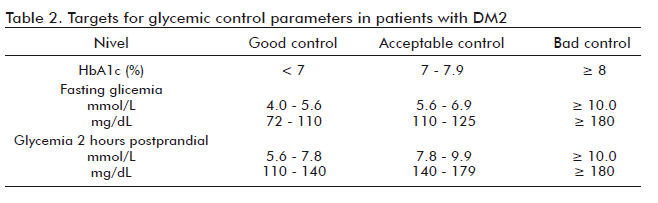
<body><![CDATA[<P   ><font face="Verdana, Arial, Helvetica, sans-serif" size="2">Glycemia-regulator      oral drugs are not recommended during the treatment of this condition, because      they do not ensure a better glycemic control in those patients (1). Moreover,      the use of metformin could cause more serious complications. A conventional      treatment with two doses of intermediate-acting insulin could be attemted      in case of patients who undergo the treatment with insulin multiple doses      NPH again (2/3 of the total dose before breakfast and 1/3 at 10:00 p.m.).      In case of dislipoproteinemia or other comorbidities, such as high blood pressure      or nephropathy, the corresponding treatment is needed (1, 5, 7, 17, 18) </font></P >       <P   ><font face="Verdana, Arial, Helvetica, sans-serif" size="2">Health professionals      should transmit therapeutic education to those people with diabetic foot,      together with sustained medical care, because the success of the treatment      will depend on both aspects to a great extent. Education and care should always      go together. </font></P >       <P   ><font size="2" face="Verdana, Arial, Helvetica, sans-serif"><b><font size="3">WHAT      ARE THE GOALS FOR GLYCEMIC CONTROL IN PEOPLE WITH DIABETIC FOOT ULCERS AND      THAT ARE UNDER TREATMENT WITH HEBERPROT-P?</font></b> </font></P >   <FONT size="+1">        <P   ><font size="2" face="Verdana, Arial, Helvetica, sans-serif">The goals for glycemic      control in people with diabetic foot ulcers and that are under treatment do      not differ from those recommended for the diabetic population in general and      are shown in <a href="/img/revistas/bta/v27n2/t0203210.gif">table 2</a>.      They are based on HbA1c values that correlate with glycemic values, although      reaching preprandial and postprandial cut levels is complex (19-22). Both      preprandial and postprandial hyperglycemia, contribute to increase HbA1c,      which is a good predictor of microvascular and macrovascular complications,      taking those values close to 7% as cut point, according to results of great      grandes ECA like UKPDS (16, 23, 24). The increase of serious hypoglycemy episodes      was the main adverse effect, so that individualization of glycemic objectives      is recommended. The guides consulted se&ntilde;alan objectives of HbA1c lower      than 7% for guidance (8, 25-28). Based on recommendations from the Diabetis      American Society (24), The Health World Organization (25) and the Diabetis      Latin American Society(27), good, acceptable and bad glycemic control values      were established for pre- and postprandial glycemias as well as for that HbA1c.      </font><FONT size="+1"> </font></P >   <FONT size="+1">        
<P   ><font face="Verdana, Arial, Helvetica, sans-serif" size="2">Goals for good glycemic      control should be established in patients with diabetic foot ulcer treated      with Heberprot-P, to assure drug effectiveness and diminish the occurrence      of adverse events. In case of risk of hypoglycemias (elderly, renal or hepatic      failure, cardiovascular disease, among others), the doses of insulin are adjusted      to achieve acceptable goals of glycemic control. </font></P >       <P   ><font face="Verdana, Arial, Helvetica, sans-serif" size="2">Once ulcerous wounds      are healed, patients may go back to initial treatment for diabetes control,      with drug dose readjustment, and always under the strict follow-up of preprandial      and postprandial glycemia. </font></P >       <P   ><font size="2" face="Verdana, Arial, Helvetica, sans-serif"><B><font size="3">CONCLUSIONS</font></B>      </font></P >   <FONT size="+1">        <P   ><font size="2" face="Verdana, Arial, Helvetica, sans-serif">Given the disability      caused by ulcerous wounds in the feet of patients with diabetes mellitus,      the medical activity focused on the prevention and early detection of this      condition becomes extremely important. Once diagnosed, the intervention of      a multidisciplinary medical team is imperative not only to give guidance on      healing the wounds and the imposition of the best specific treatments, but      also towards the optimum control of diabetes and other comorbidities. In this      sense, the importance of achieving good glycemic control as a target, by using      multiple dose of insulin in an individualized way during the treatment with      Heberprot-P. Likewise, therapeutic education aimed at achieving the adequate      metabolic control as well as preventing the ocurrence or relapse of future      ulcerous wounds, becomes the cornerstone in patients&acute; follow-up. </font></P >   <FONT size="+1">        <P   ><font face="Verdana, Arial, Helvetica, sans-serif" size="2"><b><font size="3">REFERENCES</font></b>      </font></P >       <!-- ref --><P   ><font size="2" face="Verdana, Arial, Helvetica, sans-serif">1. Llanes JA, &Aacute;lvarez      HT, Toledo AM, Fern&aacute;ndez JI, Torres OF; Chirino N, <I>et al</I>. Manual      para la prevenci&oacute;n, diagn&oacute;stico y tratamiento del pie diab&eacute;tico.      Rev Cubana Angiol Cirug Vasc 2009;10(1). Disponible en: <FONT color="#0000FF"><a href="http://bvs.sld.cu/revistas/ang/vol10_1_09/ang06109.htm">http://bvs.sld.cu/revistas/      ang/vol10_1_09/ang06109.htm</a> <FONT color="#000000">(Consultado: 2 de mayo      de 2010). </font></font></font></P >   <FONT size="+1"><FONT color="#0000FF"><FONT color="#000000">        <!-- ref --><P   ><font face="Verdana, Arial, Helvetica, sans-serif" size="2">2. Boulton AJM, Kirsner      RS, Vileikyte L. Neuropathic diabetic foot ulcers. N Eng J Med 2004; 351:48-55.      </font></P >       <P   ><font face="Verdana, Arial, Helvetica, sans-serif" size="2">3. Vera M. Prevenci&oacute;n      del pie diab&eacute;tico. Rev Cubana Endocrinol 2005;16(3). Disponible en:      <FONT color="#0000FF"><a href="http://scielo.sld.cu/scielo.php?script=sci_arttext&pid=S1561-29532005000300001&Ing=es">http://scielo.sld.cu/scielo.php?script=sci_arttext&amp;pid=S1561-      29532005000300001&amp;Ing=es</a> <FONT color="#000000">(Consultado: 9 de mayo      de 2010). </font></font></font></P >   <FONT color="#0000FF"><FONT color="#000000">        <P   ><font face="Verdana, Arial, Helvetica, sans-serif" size="2">4. Torres O. Pie      diab&eacute;tico. En: Torres O. Usted puede controlar su diabetes. Ciudad      de La Habana: Ed. Cient&iacute;fico- T&eacute;cnica; 2007. p. 122-5. </font></P >       <!-- ref --><P   ><font face="Verdana, Arial, Helvetica, sans-serif" size="2">5. Colectivo de autores      del Instituto Nacional de Endocrinolog&iacute;a. S&iacute;ndrome de pie diab&eacute;tico.      En: Manual de Diagn&oacute;stico y tratamiento de las enfermedades endocrinas.      Tomo III. Diabetes mellitus. Editorial Ciencias M&eacute;dicas 2003. p. 85-97      </font></P >       <!-- ref --><P   ><font face="Verdana, Arial, Helvetica, sans-serif" size="2">6. Katsilambros N,      Dounis E, Tsapogas P, Tentolouris N. Atlas of the Diabetic Foot. John Wiley      &amp; Sons, Ltd, 2003. </font></P >       <!-- ref --><P   ><font face="Verdana, Arial, Helvetica, sans-serif" size="2">7. Instituto Nacional      de Endocrinolog&iacute;a. Manual de organizaci&oacute;n y procedimientos de      la Cl&iacute;nica del Pie Diab&eacute;tico. Ministerio de Salud P&uacute;blica,      Cuba, 2009. </font></P >       <!-- ref --><P   ><font face="Verdana, Arial, Helvetica, sans-serif" size="2">8. American Diabetes      Association. Standards of medical care in diabetes. Diabetes Care 2009;32(1):S13-6.      </font></P >       <!-- ref --><P   ><font face="Verdana, Arial, Helvetica, sans-serif" size="2">9. Skyler J. Diabetic      complications: the importance of glucose control. Endocrinol Metab Clin North      Am 1996;25:243-54. </font></P >       <!-- ref --><P   ><font face="Verdana, Arial, Helvetica, sans-serif" size="2">10. MINSAP. Programa      nacional de diabetes mellitus. Disponible en: <FONT color="#0000FF"><a href="http://www.sld.cu/galerias/pdf/sitios/diabetes/%20programa__nacional_de_diabetes.pdf">http://      www.sld.cu/galerias/pdf/sitios/diabetes/ programa__nacional_de_diabetes.pdf</a>.      <FONT color="#000000">(Consultado: 9 de mayo de 2010). </font></font></font></P >   <FONT color="#0000FF"><FONT color="#000000">        <!-- ref --><P   ><font face="Verdana, Arial, Helvetica, sans-serif" size="2">11. The DCCT Research      Group. The effect of intensive treatment of diabetes on the development and      progression of long-term complications in insulindependent diabetes mellitus.      N Eng J Med 1993;329:977-86 </font></P >       <!-- ref --><P   ><font face="Verdana, Arial, Helvetica, sans-serif" size="2">12. The Diabetes      Control and Complications Trial/Epidemiology of Diabetes Interventions and      Complications Research Group. Retinopathy and nephropathy in patients with      type 1 diabetes four years after a trial of intensive therapy. N Engl J Med      2000;342:381-9. </font></P >       <!-- ref --><P   ><font face="Verdana, Arial, Helvetica, sans-serif" size="2">13. Martin CL, Albers      J, Herman WH, Cleary P, Waberski B, Greene DA, <I>et al</I>. Neuropathy among      the diabetes control and complications trial cohort 8 years after trial completion.      Diabetes Care 2006;29:340-4. </font></P >       <!-- ref --><P   ><font face="Verdana, Arial, Helvetica, sans-serif" size="2">14. Ohkubo Y, Kishikawa      H, Araki E, Miyata T, Isami S, Motoyoshi S, <I>et al</I>. Intensive insulin      therapy prevents the progression of diabetic microvascular complications in      Japanese patients with non-insulindependent diabetes mellitus: a randomized      prospective 6-year study. Diabetes Res Clin Pract 1995;28:103-17. </font></P >       <P   ><font face="Verdana, Arial, Helvetica, sans-serif" size="2">15. Shichiri M, Kishikawa      H, Ohkubo Y, Wake N. Long-term results of the Kumamoto Study on optimal diabetes      control in type 2 diabetic patients. Diabetes Care 2000;23(Suppl 2):B21-9.      </font></P >       <!-- ref --><P   ><font face="Verdana, Arial, Helvetica, sans-serif" size="2">16. Stratton IM,      Adler AI, Neil HA, Matthews DR, Manley SE, Cull CA, <I>et al</I>. Association      of glycaemia with macrovascular and microvascular complications of type 2      diabetes (UKPDS 35): prospective observational study. British Med J 2000;      321:405-23. </font></P >       <!-- ref --><P   ><font face="Verdana, Arial, Helvetica, sans-serif" size="2">17. Gerstein HC,      Miller ME, Byington RP, Goff DC Jr, Bigger JT, Buse JB, <I>et al</I>. Effects      of intensive glucose lowering in type 2 diabetes (ACCORD). N Engl J Med 2008;358:2545-59.      </font></P >       <!-- ref --><P   ><font face="Verdana, Arial, Helvetica, sans-serif" size="2">18. Patel A, MacMahon      S, Chalmers J, Neal B, Billot L, Woodward M, <I>et al</I>. Intensive blood      glucosa control and vascular outcomes in patients with type 2 diabetes. (ADVANCE).      N Engl J Med 2008;358: 2560-72. </font></P >       <!-- ref --><P   ><font face="Verdana, Arial, Helvetica, sans-serif" size="2">19. Nathan DM, Kuenen      j, Borg J, Zheng H, Schoenfeld D, Heine RJ. Translating the A1C assay into      estimated average glucose values. Diabetes Care 2008;31:1473-8. </font></P >       <!-- ref --><P   ><font face="Verdana, Arial, Helvetica, sans-serif" size="2">20. Alvarez E, Gonz&aacute;lez      TM, Cabrera E, Conesa AI, Parl&aacute; J, Gonz&aacute;lez EA. Algunos aspectos      de actualidad sobre la hemoglobina glucosilada y sus aplicaciones. Rev Cubana      Endocrinol 2009;20(3):141-51. </font></P >       <!-- ref --><P   ><font face="Verdana, Arial, Helvetica, sans-serif" size="2">21. Qaseem A, Vijan      S, Snow V, Cross JT, Weiss KB, Owens DK. Glycemic control and type 2 diabetes      mellitus: The optimal hemoglobin A1 targets. A guidance statement from the      American College of Physicians. Ann Intern Med. 2007;147:417-22. </font></P >       <!-- ref --><P   ><font face="Verdana, Arial, Helvetica, sans-serif" size="2">22. Monnier L, Lapinski      H, Colette C. Contributions of fasting and postprandial plasma glucose increments      to the overall diurnal hyperglycemia of type 2 diabetic patients variations      with increasing levels of HbA1c. Diabetes Care 2003;26:881-5. </font></P >       <!-- ref --><P   ><font face="Verdana, Arial, Helvetica, sans-serif" size="2">23. Ceriello A, Taboga      C, Tonutti L, Quagliaro L, Piconi L, Bais B, <I>et al</I>. Evidence for an      independent and cumulative effect of postprandial hypertriglyceridemia and      hyperglycemia on endothelial dysfunction and oxidative stress generation:      effects of short- and long-term simvastatin treatment. Circulation 2002;106:1211-8.      </font></P >       <!-- ref --><P   ><font face="Verdana, Arial, Helvetica, sans-serif" size="2">24. American Diabetes      Association. Post-prandial blood glucosa (Consensus Statement). Diabetes Care      2001;24:775-8. </font></P >       <P   ><font face="Verdana, Arial, Helvetica, sans-serif" size="2">25. Asociaci&oacute;n      Latinoamericana de Diabetes. Gu&iacute;as ALAD 2000 para el diagn&oacute;stico      y manejo de la diabetes mellitus tipo 2 con medicina basada en evidencia.      Rev Asoc Latinoam Diab 2000; Supl.1, Ed. Extraordinaria. </font></P >       <!-- ref --><P   ><font face="Verdana, Arial, Helvetica, sans-serif" size="2">26. NICE. Clinical      Guideline. Management of type 2 diabetes: Management of blood glucose. London:      National Institute for Clinical Excellence; 2002. </font></P >       <P   ><font face="Verdana, Arial, Helvetica, sans-serif" size="2">27. WHO Consultation:      Definition, diagnosis and classification of diabetes mellitus and its complcations.WHO/NCD/NCS/99.2      </font></P >       <!-- ref --><P   ><font face="Verdana, Arial, Helvetica, sans-serif" size="2">28. Grupo de trabajo      de la Gu&iacute;a de Pr&aacute;ctica Cl&iacute;nica sobre Diabetes tipo 2.      Gu&iacute;a de Pr&aacute;ctica Cl&iacute;nica sobre Diabetes tipo 2. Madrid:      Plan Nacional para el SNS del MSC. Agencia de Evaluaci&oacute;n de Tecnolog&iacute;as      Sanitarias del Pa&iacute;s Vasco; 2008. Gu&iacute;as de Pr&aacute;ctica Cl&iacute;nica      en el SNS: OSTEBA N&ordm; 2006/08.</font></P >       <P   ><font size="2" face="Verdana, Arial, Helvetica, sans-serif">Received in August,      2010. </font>    <br>     <font face="Verdana, Arial, Helvetica, sans-serif" size="2">Accepted for publication      in September, 2010.<I> </I></font></P >   </font><font size="+1" color="#000000"><font size="2" face="Verdana, Arial, Helvetica, sans-serif">Eduardo    &Aacute;lvarez</font></font><font color="#000000">, </font><font size="+1" color="#000000"><font size="+1"><font size="+1"><font size="+1"><font size="+1"><font size="+1"><font size="+1"><font size="+1"><font size="+1"><font size="+1"><font size="+1"><font size="+1"><font size="2" face="Verdana, Arial, Helvetica, sans-serif">Centro    de Atenci&oacute;n al Diab&eacute;tico (CAD). Instituto Nacional de Endocrinolog&iacute;a    (INEN) Calle Zapata esquina D, Vedado, Plaza, Ciudad de La Habana, Cuba E-mail:    <a href="mailto:edualvarez@infomed.sld.cu"> <font color="#0000FF">edualvarez@infomed.sld.cu</font></a></font></font></font></font></font></font></font></font></font></font></font></font></font><font color="#000000">        <P   >&nbsp;</P >   </font></font></font></font></font></font></font></font></font></font></font></font></font></font></font></font></font></font></font></font></font></font></font></font></font></font></font></font></font></font></font></font></font></font></font></DIV >     ]]></body>
<body><![CDATA[ ]]></body><back>
<ref-list>
<ref id="B1">
<label>1</label><nlm-citation citation-type="journal">
<person-group person-group-type="author">
<name>
<surname><![CDATA[Llanes]]></surname>
<given-names><![CDATA[JA]]></given-names>
</name>
<name>
<surname><![CDATA[Álvarez]]></surname>
<given-names><![CDATA[HT]]></given-names>
</name>
<name>
<surname><![CDATA[Toledo]]></surname>
<given-names><![CDATA[AM]]></given-names>
</name>
<name>
<surname><![CDATA[Fernández]]></surname>
<given-names><![CDATA[JI]]></given-names>
</name>
<name>
<surname><![CDATA[Torres]]></surname>
<given-names><![CDATA[OF]]></given-names>
</name>
<name>
<surname><![CDATA[Chirino]]></surname>
<given-names><![CDATA[N]]></given-names>
</name>
</person-group>
<article-title xml:lang="es"><![CDATA[Manual para la prevención, diagnóstico y tratamiento del pie diabético]]></article-title>
<source><![CDATA[Rev Cubana Angiol Cirug Vasc]]></source>
<year>2009</year>
<volume>10</volume>
<numero>1</numero>
<issue>1</issue>
</nlm-citation>
</ref>
<ref id="B2">
<label>2</label><nlm-citation citation-type="journal">
<person-group person-group-type="author">
<name>
<surname><![CDATA[Boulton]]></surname>
<given-names><![CDATA[AJM]]></given-names>
</name>
<name>
<surname><![CDATA[Kirsner]]></surname>
<given-names><![CDATA[RS]]></given-names>
</name>
<name>
<surname><![CDATA[Vileikyte]]></surname>
<given-names><![CDATA[L]]></given-names>
</name>
</person-group>
<article-title xml:lang="en"><![CDATA[Neuropathic diabetic foot ulcers]]></article-title>
<source><![CDATA[N Eng J Med]]></source>
<year>2004</year>
<volume>351</volume>
<page-range>48-55</page-range></nlm-citation>
</ref>
<ref id="B3">
<label>3</label><nlm-citation citation-type="journal">
<person-group person-group-type="author">
<name>
<surname><![CDATA[Vera]]></surname>
<given-names><![CDATA[M]]></given-names>
</name>
</person-group>
<article-title xml:lang="es"><![CDATA[Prevención del pie diabético]]></article-title>
<source><![CDATA[Rev Cubana Endocrinol]]></source>
<year>2005</year>
<volume>16</volume>
<numero>3</numero>
<issue>3</issue>
</nlm-citation>
</ref>
<ref id="B4">
<label>4</label><nlm-citation citation-type="book">
<person-group person-group-type="author">
<name>
<surname><![CDATA[Torres]]></surname>
<given-names><![CDATA[O]]></given-names>
</name>
</person-group>
<article-title xml:lang="es"><![CDATA[Pie diabético]]></article-title>
<person-group person-group-type="editor">
<name>
<surname><![CDATA[Torres]]></surname>
<given-names><![CDATA[O]]></given-names>
</name>
</person-group>
<source><![CDATA[Usted puede controlar su diabetes]]></source>
<year>2007</year>
<page-range>122-5</page-range><publisher-loc><![CDATA[Ciudad de La Habana ]]></publisher-loc>
<publisher-name><![CDATA[Ed. Científico-Técnica]]></publisher-name>
</nlm-citation>
</ref>
<ref id="B5">
<label>5</label><nlm-citation citation-type="book">
<collab>Instituto Nacional de Endocrinología</collab>
<article-title xml:lang="es"><![CDATA[Síndrome de pie diabético]]></article-title>
<source><![CDATA[Manual de Diagnóstico y tratamiento de las enfermedades endocrinas: Tomo III. Diabetes mellitus]]></source>
<year>2003</year>
<page-range>85-97</page-range><publisher-name><![CDATA[Editorial Ciencias Médicas]]></publisher-name>
</nlm-citation>
</ref>
<ref id="B6">
<label>6</label><nlm-citation citation-type="book">
<person-group person-group-type="author">
<name>
<surname><![CDATA[Katsilambros]]></surname>
<given-names><![CDATA[N]]></given-names>
</name>
<name>
<surname><![CDATA[Dounis]]></surname>
<given-names><![CDATA[E]]></given-names>
</name>
<name>
<surname><![CDATA[Tsapogas]]></surname>
<given-names><![CDATA[P]]></given-names>
</name>
<name>
<surname><![CDATA[Tentolouris]]></surname>
<given-names><![CDATA[N]]></given-names>
</name>
</person-group>
<source><![CDATA[Atlas of the Diabetic Foot]]></source>
<year>2003</year>
<publisher-name><![CDATA[John Wiley & Sons, Ltd]]></publisher-name>
</nlm-citation>
</ref>
<ref id="B7">
<label>7</label><nlm-citation citation-type="book">
<collab>Instituto Nacional de Endocrinología</collab>
<source><![CDATA[Manual de organización y procedimientos de la Clínica del Pie Diabético]]></source>
<year>2009</year>
<publisher-name><![CDATA[Ministerio de Salud Pública]]></publisher-name>
</nlm-citation>
</ref>
<ref id="B8">
<label>8</label><nlm-citation citation-type="journal">
<collab>American Diabetes Association</collab>
<article-title xml:lang="en"><![CDATA[Standards of medical care in diabetes]]></article-title>
<source><![CDATA[Diabetes Care]]></source>
<year>2009</year>
<volume>32</volume>
<numero>1</numero>
<issue>1</issue>
<page-range>S13-6</page-range></nlm-citation>
</ref>
<ref id="B9">
<label>9</label><nlm-citation citation-type="journal">
<person-group person-group-type="author">
<name>
<surname><![CDATA[Skyler]]></surname>
<given-names><![CDATA[J]]></given-names>
</name>
</person-group>
<article-title xml:lang="en"><![CDATA[Diabetic complications: the importance of glucose control]]></article-title>
<source><![CDATA[Endocrinol Metab Clin North Am]]></source>
<year>1996</year>
<volume>25</volume>
<page-range>243-54</page-range></nlm-citation>
</ref>
<ref id="B10">
<label>10</label><nlm-citation citation-type="">
<collab>MINSAP</collab>
<source><![CDATA[Programa nacional de diabetes mellitus]]></source>
<year>9 de</year>
<month> m</month>
<day>ay</day>
</nlm-citation>
</ref>
<ref id="B11">
<label>11</label><nlm-citation citation-type="journal">
<collab>The DCCT Research Group</collab>
<article-title xml:lang="en"><![CDATA[The effect of intensive treatment of diabetes on the development and progression of long-term complications in insulin-dependent diabetes mellitus]]></article-title>
<source><![CDATA[N Eng J Med]]></source>
<year>1993</year>
<volume>329</volume>
<page-range>977-86</page-range></nlm-citation>
</ref>
<ref id="B12">
<label>12</label><nlm-citation citation-type="journal">
<collab>The Diabetes Control and Complications Trial/Epidemiology of Diabetes Interventions and Complications Research Group</collab>
<article-title xml:lang="en"><![CDATA[Retinopathy and nephropathy in patients with type 1 diabetes four years after a trial of intensive therapy]]></article-title>
<source><![CDATA[N Engl J Med]]></source>
<year>2000</year>
<volume>342</volume>
<page-range>381-9</page-range></nlm-citation>
</ref>
<ref id="B13">
<label>13</label><nlm-citation citation-type="journal">
<person-group person-group-type="author">
<name>
<surname><![CDATA[Martin]]></surname>
<given-names><![CDATA[CL]]></given-names>
</name>
<name>
<surname><![CDATA[Albers]]></surname>
<given-names><![CDATA[J]]></given-names>
</name>
<name>
<surname><![CDATA[Herman]]></surname>
<given-names><![CDATA[WH]]></given-names>
</name>
<name>
<surname><![CDATA[Cleary]]></surname>
<given-names><![CDATA[P]]></given-names>
</name>
<name>
<surname><![CDATA[Waberski]]></surname>
<given-names><![CDATA[B]]></given-names>
</name>
<name>
<surname><![CDATA[Greene]]></surname>
<given-names><![CDATA[DA]]></given-names>
</name>
</person-group>
<article-title xml:lang="en"><![CDATA[Neuropathy among the diabetes control and complications trial cohort 8 years after trial completion]]></article-title>
<source><![CDATA[Diabetes Care]]></source>
<year>2006</year>
<volume>29</volume>
<page-range>340-4</page-range></nlm-citation>
</ref>
<ref id="B14">
<label>14</label><nlm-citation citation-type="journal">
<person-group person-group-type="author">
<name>
<surname><![CDATA[Ohkubo]]></surname>
<given-names><![CDATA[Y]]></given-names>
</name>
<name>
<surname><![CDATA[Kishikawa]]></surname>
<given-names><![CDATA[H]]></given-names>
</name>
<name>
<surname><![CDATA[Araki]]></surname>
<given-names><![CDATA[E]]></given-names>
</name>
<name>
<surname><![CDATA[Miyata]]></surname>
<given-names><![CDATA[T]]></given-names>
</name>
<name>
<surname><![CDATA[Isami]]></surname>
<given-names><![CDATA[S]]></given-names>
</name>
<name>
<surname><![CDATA[Motoyoshi]]></surname>
<given-names><![CDATA[S]]></given-names>
</name>
</person-group>
<article-title xml:lang="en"><![CDATA[Intensive insulin therapy prevents the progression of diabetic microvascular complications in Japanese patients with non-insulindependent diabetes mellitus: a randomized prospective 6-year study]]></article-title>
<source><![CDATA[Diabetes Res Clin Pract]]></source>
<year>1995</year>
<volume>28</volume>
<page-range>103-17</page-range></nlm-citation>
</ref>
<ref id="B15">
<label>15</label><nlm-citation citation-type="journal">
<person-group person-group-type="author">
<name>
<surname><![CDATA[Shichiri]]></surname>
<given-names><![CDATA[M]]></given-names>
</name>
<name>
<surname><![CDATA[Kishikawa]]></surname>
<given-names><![CDATA[H]]></given-names>
</name>
<name>
<surname><![CDATA[Ohkubo]]></surname>
<given-names><![CDATA[Y]]></given-names>
</name>
<name>
<surname><![CDATA[Wake]]></surname>
<given-names><![CDATA[N]]></given-names>
</name>
</person-group>
<article-title xml:lang="en"><![CDATA[Long-term results of the Kumamoto Study on optimal diabetes control in type 2 diabetic patients]]></article-title>
<source><![CDATA[Diabetes Care]]></source>
<year>2000</year>
<volume>23</volume>
<page-range>B21-9</page-range></nlm-citation>
</ref>
<ref id="B16">
<label>16</label><nlm-citation citation-type="journal">
<person-group person-group-type="author">
<name>
<surname><![CDATA[Stratton]]></surname>
<given-names><![CDATA[IM]]></given-names>
</name>
<name>
<surname><![CDATA[Adler]]></surname>
<given-names><![CDATA[AI]]></given-names>
</name>
<name>
<surname><![CDATA[Neil]]></surname>
<given-names><![CDATA[HA]]></given-names>
</name>
<name>
<surname><![CDATA[Matthews]]></surname>
<given-names><![CDATA[DR]]></given-names>
</name>
<name>
<surname><![CDATA[Manley]]></surname>
<given-names><![CDATA[SE]]></given-names>
</name>
<name>
<surname><![CDATA[Cull]]></surname>
<given-names><![CDATA[CA]]></given-names>
</name>
</person-group>
<article-title xml:lang="en"><![CDATA[Association of glycaemia with macrovascular and microvascular complications of type 2 diabetes (UKPDS 35): prospective observational study]]></article-title>
<source><![CDATA[British Med J]]></source>
<year>2000</year>
<volume>321</volume>
<page-range>405-23</page-range></nlm-citation>
</ref>
<ref id="B17">
<label>17</label><nlm-citation citation-type="journal">
<person-group person-group-type="author">
<name>
<surname><![CDATA[Gerstein]]></surname>
<given-names><![CDATA[HC]]></given-names>
</name>
<name>
<surname><![CDATA[Miller]]></surname>
<given-names><![CDATA[ME]]></given-names>
</name>
<name>
<surname><![CDATA[Byington]]></surname>
<given-names><![CDATA[RP]]></given-names>
</name>
<name>
<surname><![CDATA[Goff]]></surname>
<given-names><![CDATA[DC]]></given-names>
</name>
<name>
<surname><![CDATA[Bigger]]></surname>
<given-names><![CDATA[JT]]></given-names>
</name>
<name>
<surname><![CDATA[Buse]]></surname>
<given-names><![CDATA[JB]]></given-names>
</name>
</person-group>
<article-title xml:lang="en"><![CDATA[Effects of intensive glucose lowering in type 2 diabetes (ACCORD)]]></article-title>
<source><![CDATA[N Engl J Med]]></source>
<year>2008</year>
<volume>358</volume>
<page-range>2545-59</page-range></nlm-citation>
</ref>
<ref id="B18">
<label>18</label><nlm-citation citation-type="journal">
<person-group person-group-type="author">
<name>
<surname><![CDATA[Patel]]></surname>
<given-names><![CDATA[A]]></given-names>
</name>
<name>
<surname><![CDATA[MacMahon]]></surname>
<given-names><![CDATA[S]]></given-names>
</name>
<name>
<surname><![CDATA[Chalmers]]></surname>
<given-names><![CDATA[J]]></given-names>
</name>
<name>
<surname><![CDATA[Neal]]></surname>
<given-names><![CDATA[B]]></given-names>
</name>
<name>
<surname><![CDATA[Billot]]></surname>
<given-names><![CDATA[L]]></given-names>
</name>
<name>
<surname><![CDATA[Woodward]]></surname>
<given-names><![CDATA[M]]></given-names>
</name>
</person-group>
<article-title xml:lang="en"><![CDATA[Intensive blood glucosa control and vascular outcomes in patients with type 2 diabetes (ADVANCE)]]></article-title>
<source><![CDATA[N Engl J Med]]></source>
<year>2008</year>
<volume>358</volume>
<page-range>2560-72</page-range></nlm-citation>
</ref>
<ref id="B19">
<label>19</label><nlm-citation citation-type="journal">
<person-group person-group-type="author">
<name>
<surname><![CDATA[Nathan]]></surname>
<given-names><![CDATA[DM]]></given-names>
</name>
<name>
<surname><![CDATA[Kuenen]]></surname>
<given-names><![CDATA[J]]></given-names>
</name>
<name>
<surname><![CDATA[Borg]]></surname>
<given-names><![CDATA[J]]></given-names>
</name>
<name>
<surname><![CDATA[Zheng]]></surname>
<given-names><![CDATA[H]]></given-names>
</name>
<name>
<surname><![CDATA[Schoenfeld]]></surname>
<given-names><![CDATA[D]]></given-names>
</name>
<name>
<surname><![CDATA[Heine]]></surname>
<given-names><![CDATA[RJ]]></given-names>
</name>
</person-group>
<article-title xml:lang="en"><![CDATA[Translating the A1C assay into estimated average glucose values]]></article-title>
<source><![CDATA[Diabetes Care]]></source>
<year>2008</year>
<volume>31</volume>
<page-range>1473-8</page-range></nlm-citation>
</ref>
<ref id="B20">
<label>20</label><nlm-citation citation-type="journal">
<person-group person-group-type="author">
<name>
<surname><![CDATA[Alvarez]]></surname>
<given-names><![CDATA[E]]></given-names>
</name>
<name>
<surname><![CDATA[González]]></surname>
<given-names><![CDATA[TM]]></given-names>
</name>
<name>
<surname><![CDATA[Cabrera]]></surname>
<given-names><![CDATA[E]]></given-names>
</name>
<name>
<surname><![CDATA[Conesa]]></surname>
<given-names><![CDATA[AI]]></given-names>
</name>
<name>
<surname><![CDATA[Parlá]]></surname>
<given-names><![CDATA[J]]></given-names>
</name>
<name>
<surname><![CDATA[González]]></surname>
<given-names><![CDATA[EA]]></given-names>
</name>
</person-group>
<article-title xml:lang="es"><![CDATA[Algunos aspectos de actualidad sobre la hemoglobina glucosilada y sus aplicaciones]]></article-title>
<source><![CDATA[Rev Cubana Endocrinol]]></source>
<year>2009</year>
<volume>20</volume>
<numero>3</numero>
<issue>3</issue>
<page-range>141-51</page-range></nlm-citation>
</ref>
<ref id="B21">
<label>21</label><nlm-citation citation-type="journal">
<person-group person-group-type="author">
<name>
<surname><![CDATA[Qaseem]]></surname>
<given-names><![CDATA[A]]></given-names>
</name>
<name>
<surname><![CDATA[Vijan]]></surname>
<given-names><![CDATA[S]]></given-names>
</name>
<name>
<surname><![CDATA[Snow]]></surname>
<given-names><![CDATA[V]]></given-names>
</name>
<name>
<surname><![CDATA[Cross]]></surname>
<given-names><![CDATA[JT]]></given-names>
</name>
<name>
<surname><![CDATA[Weiss]]></surname>
<given-names><![CDATA[KB]]></given-names>
</name>
<name>
<surname><![CDATA[Owens]]></surname>
<given-names><![CDATA[DK]]></given-names>
</name>
</person-group>
<article-title xml:lang="en"><![CDATA[Glycemic control and type 2 diabetes mellitus: The optimal hemoglobin A1 targets. A guidance statement from the American College of Physicians]]></article-title>
<source><![CDATA[Ann Intern Med]]></source>
<year>2007</year>
<volume>147</volume>
<page-range>417-22</page-range></nlm-citation>
</ref>
<ref id="B22">
<label>22</label><nlm-citation citation-type="journal">
<person-group person-group-type="author">
<name>
<surname><![CDATA[Monnier]]></surname>
<given-names><![CDATA[L]]></given-names>
</name>
<name>
<surname><![CDATA[Lapinski]]></surname>
<given-names><![CDATA[H]]></given-names>
</name>
<name>
<surname><![CDATA[Colette]]></surname>
<given-names><![CDATA[C]]></given-names>
</name>
</person-group>
<article-title xml:lang="en"><![CDATA[Contributions of fasting and postprandial plasma glucose increments to the overall diurnal hyperglycemia of type 2 diabetic patients variations with increasing levels of HbA1c]]></article-title>
<source><![CDATA[Diabetes Care]]></source>
<year>2003</year>
<volume>26</volume>
<page-range>881-5</page-range></nlm-citation>
</ref>
<ref id="B23">
<label>23</label><nlm-citation citation-type="journal">
<person-group person-group-type="author">
<name>
<surname><![CDATA[Ceriello]]></surname>
<given-names><![CDATA[A]]></given-names>
</name>
<name>
<surname><![CDATA[Taboga]]></surname>
<given-names><![CDATA[C]]></given-names>
</name>
<name>
<surname><![CDATA[Tonutti]]></surname>
<given-names><![CDATA[L]]></given-names>
</name>
<name>
<surname><![CDATA[Quagliaro]]></surname>
<given-names><![CDATA[L]]></given-names>
</name>
<name>
<surname><![CDATA[Piconi]]></surname>
<given-names><![CDATA[L]]></given-names>
</name>
<name>
<surname><![CDATA[Bais]]></surname>
<given-names><![CDATA[B]]></given-names>
</name>
</person-group>
<article-title xml:lang="en"><![CDATA[Evidence for an independent and cumulative effect of postprandial hypertriglyceridemia and hyperglycemia on endothelial dysfunction and oxidative stress generation: effects of short- and long-term simvastatin treatment]]></article-title>
<source><![CDATA[Circulation]]></source>
<year>2002</year>
<volume>106</volume>
<page-range>1211-8</page-range></nlm-citation>
</ref>
<ref id="B24">
<label>24</label><nlm-citation citation-type="journal">
<collab>American Diabetes Association</collab>
<article-title xml:lang="en"><![CDATA[Post-prandial blood glucosa (Consensus Statement)]]></article-title>
<source><![CDATA[Diabetes Care]]></source>
<year>2001</year>
<volume>24</volume>
<page-range>775-8</page-range></nlm-citation>
</ref>
<ref id="B25">
<label>25</label><nlm-citation citation-type="journal">
<collab>Asociación Latinoamericana de Diabetes</collab>
<article-title xml:lang="es"><![CDATA[Guías ALAD 2000 para el diagnóstico y manejo de la diabetes mellitus tipo 2 con medicina basada en evidencia]]></article-title>
<source><![CDATA[Rev Asoc Latinoam Diab]]></source>
<year>2000</year>
<page-range>Ed. Extraordinaria</page-range></nlm-citation>
</ref>
<ref id="B26">
<label>26</label><nlm-citation citation-type="book">
<collab>NICE</collab>
<source><![CDATA[Clinical Guideline. Management of type 2 diabetes: Management of blood glucose]]></source>
<year>2002</year>
<publisher-loc><![CDATA[London ]]></publisher-loc>
<publisher-name><![CDATA[National Institute for Clinical Excellence]]></publisher-name>
</nlm-citation>
</ref>
<ref id="B27">
<label>27</label><nlm-citation citation-type="">
<collab>WHO</collab>
<source><![CDATA[Consultation: Definition, diagnosis and classification of diabetes mellitus and its complications: WHO/NCD/NCS/99.2]]></source>
<year></year>
</nlm-citation>
</ref>
<ref id="B28">
<label>28</label><nlm-citation citation-type="book">
<collab>Grupo de trabajo de la Guía de Práctica Clínica sobre Diabetes tipo 2</collab>
<source><![CDATA[Guía de Práctica Clínica sobre Diabetes tipo 2: Madrid: Plan Nacional para el SNS del MSC]]></source>
<year>2008</year>
<publisher-name><![CDATA[Agencia de Evaluación de Tecnologías Sanitarias del País Vasco]]></publisher-name>
</nlm-citation>
</ref>
</ref-list>
</back>
</article>